• Home
  • about
  • about the photographs
  • Local Nature Reserves
    • Bryn Euryn Local Nature Reserve
    • Mynydd Marian
  • Wales Coast Path
    • Grey Seals in North Wales
    • St.Trillo’s Chapel
    • Wildflowers of North Wales Coastal Paths, Cliffs and Dunes

everyday nature trails

everyday nature trails

Category Archives: Wildflowers of Wales

Sleeping Seals and Stonechats

02 Saturday Apr 2016

Posted by theresagreen in coastal habitat, Little Orme, Nature, Nature of Wales, nature photography, Rhiwledyn Nature Reserve, Rhos-on-Sea, Seals, The Wales Coast Path, Wildflowers of Wales

≈ 14 Comments

Tags

alexanders, dunnock, grey seals, grey seals in Angel Bay, jackdaw, jackdaws on cliff, stonechat

A brightly sunny day, too good to miss, so I headed for the Little Orme which offers reliable sightings of a wide variety of wildlife in a relatively compact area with little effort required. Well-used by local people and visitors to the area and part of the route of both the Wales Coast Path and the North Wales Path, the pathways of the lower part of the reserve particularly are often very busy. Opportunities for uninterrupted attempts to photograph the more wary small woodland birds may be limited, but despite close human proximity the birds carry on regardless and largely unnoticed.

I use the entrance to the reserve sited at the back end of a residential area. Today the lawns of the unfenced front gardens were providing foraging for jackdaws and a few Pied wagtails. Outside the breeding season wagtails gather here in the evenings before setting off to roost comunally for the night. On the roofs were perched gulls, Wood pigeons and Magpies and a singing Greenfinch. There’s a thriving House sparrow population here too and cheerful chirruping greeted me as I  climbed the steps up to the reserve, where they frequent the tangle of brambles and shrubs there.

160310-1-Little Orme

The Fulmars have returned to their nest sites high on the cliffs. Although a small colony of just 10 or so pairs they draw attention to themselves by noisily proclaiming their territories and can be heard as soon as you enter the site. I looked out for Ravens that have used the same nest site up on the cliff for many years, but I didn’t see or hear them today.

I was pleased to see a pair of Stonechat though, one of my favourite little birds. They were in the same area within which a pair successfully raised a family last year, so I like to think this may be the same pair. I couldn’t get close enough to them to get good photographs, but I prefer to use ‘real time’ images whenever possible, so these were today’s best record shots.

Stonechat male

Stonechat -Saxicola rubicans -male

Stonechat female

Stonechat female

The biggest draw to the reserve are the Grey Seals that at this time of year can be fairly reliably seen, when the tide is out, hauled up on the stony beach of Angel Bay. Today there were about 20 females and their rapidly growing pups, a few in the water, the rest sleeping blending perfectly into the background of stones and rocks.

Grey Seals in Angel Bay, Little Orme

Grey Seals in Angel Bay, Little Orme

160310-9-Little Orme-Grey Seals on edge of sea

160310-11-Little Orme-Grey Seal sleeping on rock pillow

160310-7-Little Orme-Grey Seals on edge of sea

160310-12-Little Orme-Grey Seal sleeping on rock pillow

160310-4-Little Orme-Grey Seal on edge of sea

Jackdaws are without doubt the most numerous birds here and a great number gather here to breed, nesting on the rocky cliff faces. They spread throughout the site to feed and also separate into small flocks that venture back and forth to forage in a wide variety of places locally, arriving back noisily to land on the cliffs where they site their nests. It is good to see them foraging and nesting in their natural cliff habitat rather than in villages roosting on roofs and nesting in chimneypots.

Jackdaw

Jackdaw

Jackdaws in their natural habitat

Jackdaws in their natural breeding habitat

160310-23a-Little Orme-Jackdaws on cliff

Blackbirds are another numerous bird here as are Robins and Dunnocks, with males singing from shrubs throughout the site. Close to the backs of houses trees and shrubs are frequented by good numbers of birds. The House sparrows are nesting close to a busy path here and a chorus of chirrupings emanated loudly from within the shrubs, but despite being audible from some distance away, they stayed well hidden. Also seen and heard singing here were Chaffinch, Greenfinch, Wren, Great Tit and Blue Tit.
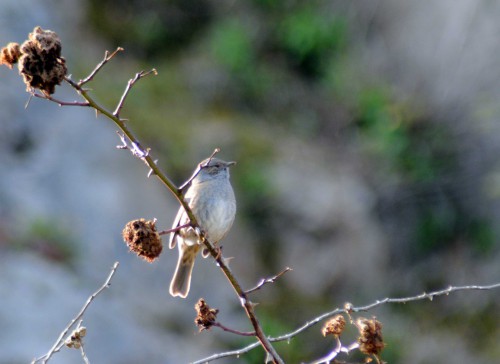
Dunnock male

Dunnock male singing from a wild rose stem with numerous Robins pincushion galls

Wildflowers appear a little later on this windswept clifftop than in more sheltered areas, but there’s plenty of the early flowering Alexanders on show.

Alexanders

Alexanders

Elder leaves are well grown too.

160310-26a-Little Orme-Magpie in Elder tree

Magpie well concealed in an Elder tree

Share this:

  • Share on Facebook (Opens in new window) Facebook
  • Share on Pinterest (Opens in new window) Pinterest
  • Share on X (Opens in new window) X
Like Loading...

Wildflowers in Winter

28 Thursday Jan 2016

Posted by theresagreen in Bryn Euryn Nature Reserve, Nature, Nature of Wales, nature of woodlands, nature photography, wildflowers, Wildflowers of Wales

≈ 8 Comments

Tags

daisy, gorse, hart's tongue fern, hazel catkins, lesser celandine, male fern, wildflowers blooming in January, winter heliotrope, winter wildflowers

Daisies look delicate, but they’re tough little plants and flower more-or-less continuously from December to January. I love them so am happy they can decorate grassy areas in peace before the lawn-mowers emerge from hibernation.

160128-TGFLR 1 (8)

Daisy-Bellis perennis

Celandines are one of the first heralds of Spring, but I was taken by surprise to find some this early in the year.

Celandines

Lesser Celandine-Ficaria verna

Herb Robert was also a surprise, its flowering season is more April-November, so this is probably a plant that has not died down and carried on growing.

Herb Robert

Herb Robert

Another survivor is this Nipplewort which is growing in a sheltered corner against a wall on the roadside.

Nipplewort

Nipplewort

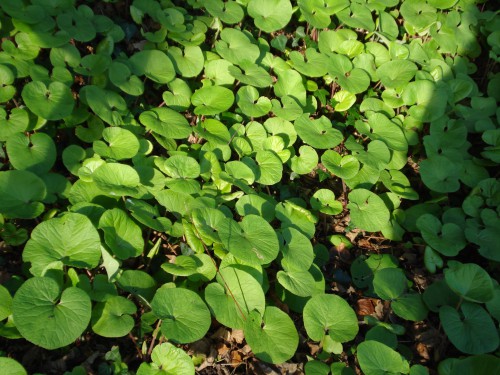
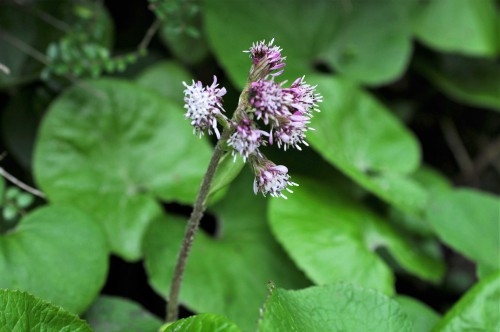
There are some wildflowers that are truly winter flowering. The bright green leaves of Winter heliotrope are present here throughout the year and the lilac flowers, which have a fragrant, vanilla-like scent appear from November to March.

Leaves of Winter heliotrope

Leaves of Winter heliotrope

Winter heliotrope

Winter heliotrope – Petasites fragrans

January 26th was a mild sunny day, warm enough to coax out this little Red-tailed bumblebee, but it seemed to be struggling to take off from the flower, so maybe it wasn’t quite warm enough.

A red-tailed bumblebee on a heliotrope flower

A red-tailed bumblebee on a heliotrope flower

Three-cornered Garlic is named for the shape of its flower stems, which are triangular. It is also known as White bluebell and does resemble one, until you smell it. It’s flowering season is February- June but has been in flower here since last December.

Three-cornered Garlic

Three-cornered Garlic-Allium triquetrum

Flowers resemble those of the bluebell

Flowers resemble those of the bluebell

“When gorse is out of bloom, kissing is out of season“. In other words, gorse pretty much flowers all year round to some extent. Now, at the end of this mild January many bushes are well-covered with the lusciously coconut-scented blossom.

Gorse

Gorse

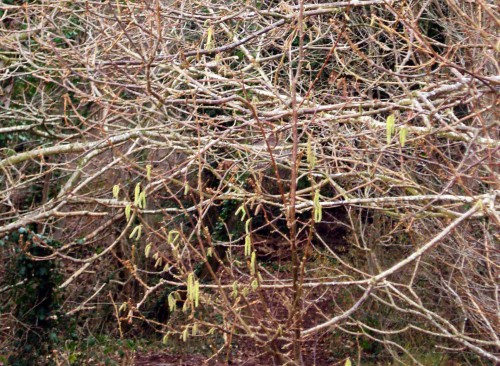
Hazel catkins have also been present on some trees since last month.

Hazel catkins

Hazel catkins

Sycamore buds are greening

Sycamore buds are greening

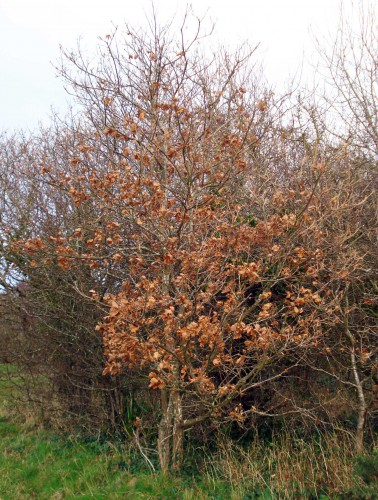
A few trees have retained their dried leaves for some reason, this is a small oak.

A small oak tree has kept its dried leaves

A small tree has kept its dried leaves

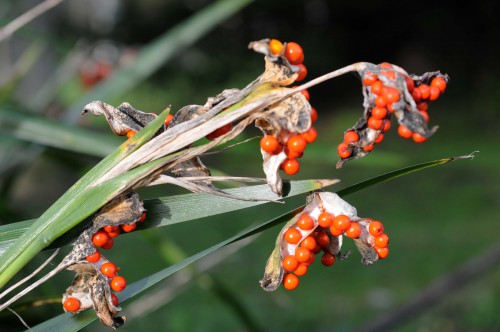
Some plants characteristically hang on to their berries well into the winter, one such is the unfortunately-named Stinking iris that has bright orange berries

Berries of Stinking Iris-Iris foetidissima

Berries of Stinking Iris-Iris foetidissima

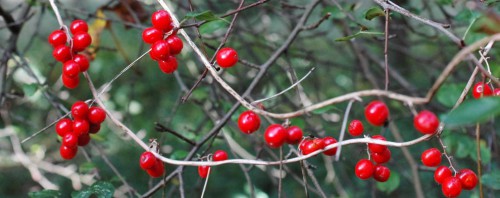
and another is Black bryony, whose bright scarlet berries garland shrubs like strings of shiny beads.

Black bryony berries

Black bryony berries

A surprising number of ferns are still green

Polypody fern

Polypody fern

Spores or sori still in place on the back of the fern fronds

Spores or sori still in place on the back of the Polypody fern fronds

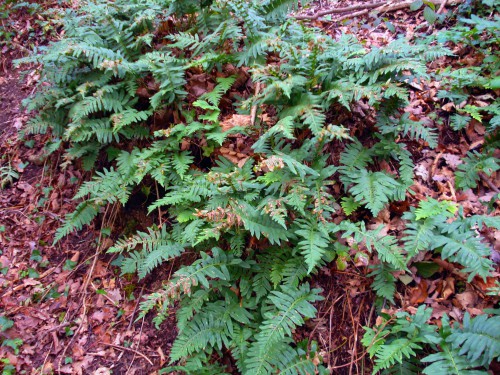
Both the Male fern and the Hart’s Tongue fern are semi-evergreen, but this group shows no sign of dying down at all.

Male fern and Harts tongue ferns

Male fern and Harts tongue ferns

Winter is a good time to appreciate mosses. Looking closely at this one it has fern-like leaves.

A cushion of moss tucked against rocks

A cushion of moss tucked against rocks

Close-up of moss

Close-up of moss

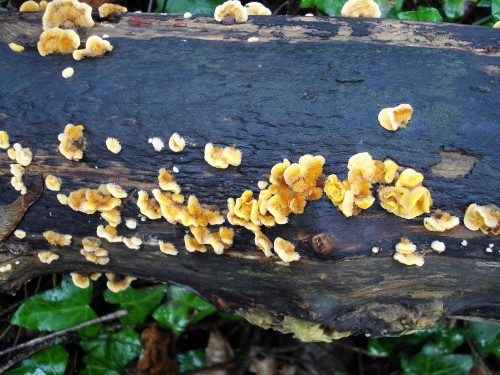
On a fallen Scots pine a colony of tiny bright yellow coloured fungi has established itself; it seems to be a bracket fungi, maybe a turkeytail?

Bright yellow bracket fungus-maybe a small turkeytail

Bright yellow bracket fungus-maybe a turkeytail


Share this:

  • Share on Facebook (Opens in new window) Facebook
  • Share on Pinterest (Opens in new window) Pinterest
  • Share on X (Opens in new window) X
Like Loading...

Autumn

27 Tuesday Oct 2015

Posted by theresagreen in Bryn Euryn Nature Reserve, Bryn Pydew, Nature, Nature of Wales, nature of woodlands, nature photography, North Wales, Wildflowers of Wales, woodland walks in Wales

≈ 7 Comments

Tags

ash leaves, autumn colour, autumn leaves, eristalis pertinax, fallen leaves, goldenrod, hazel leaves, North Wales Wildlife Trust, oak leaves, puffball fungus

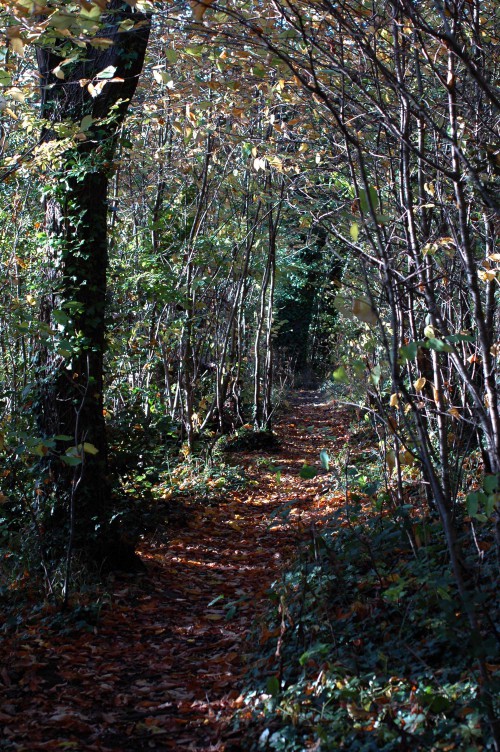
Autumn in North Wales is glorious this year thanks to a prolonged sunny and mild spell of weather, as yet broken only occasionally by rain. Walking between the trees in the dappled shade of the woodland along sun-striped paths thickly carpeted with fallen leaves in all the shades of the season, has been truly joyful. As October draws to an end, here are some of my views of the month.

151021-Bryn Euryn Woods 4a-Path sun-striped 151021-Bryn Euryn Woods 5a-Path leaf-strewn

Ivy is flowering now providing vital supplies of pollen and nectar to late-flying insects.

151021-Bryn Euryn Woods 2a- Ivy flower

Ivy is flowering

151021-Bryn Euryn Woods 8a-Woodland Trail

Ash trees leaves have mostly turned to a bright yellow.

151021-Bryn Euryn Woods 7a-Ash tree canopy
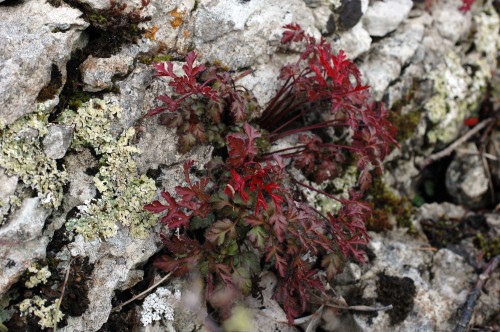
Ash tree canopy

Many have already fallen.
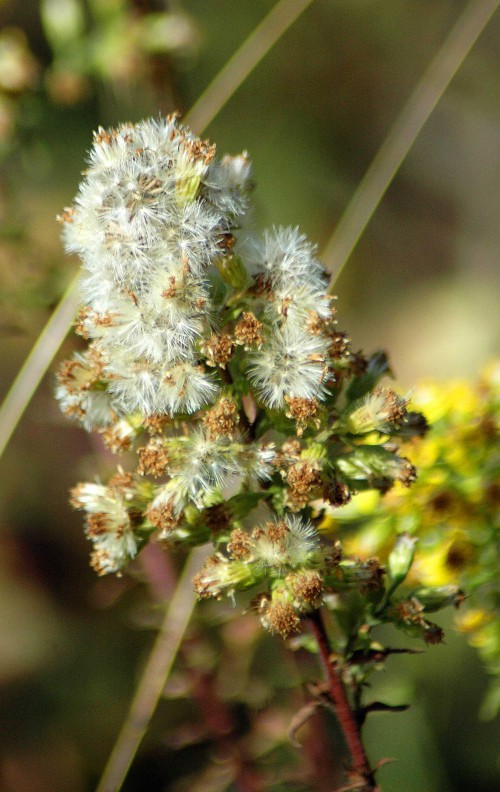
151021-Bryn Euryn Woods 10a-Woodland Trail-Ash leaves

Strings of Black bryony berries are strung between stems of lower-storey vegetation

151008-Bryn Pydew (29)

Black Bryony berries

151021-Bryn Euryn Woods 9a-Woodland Trail

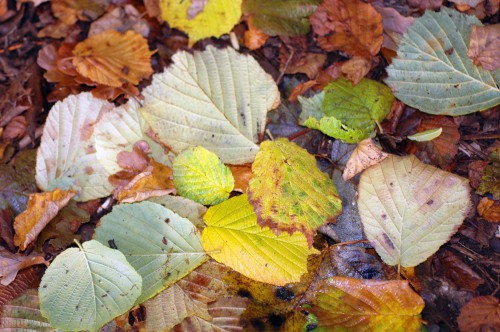
151021-Bryn Euryn Woods 6a-Hazel leaves

Hazel leaves fallen

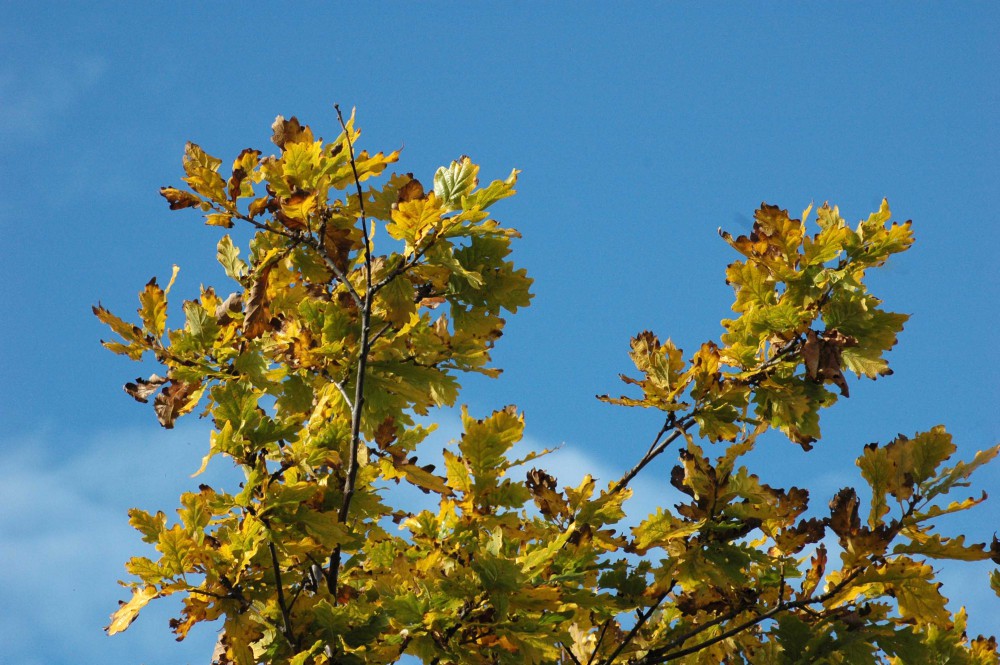
Oak trees are in varying shades, some still retaining a lot of green where they are in shade while those exposed to more sunlight have turned golden.

151008-Bryn Pydew (6a)-Oak leaves turned yellow & blue sky

Last year there was a national shortage of acorns and here at least it doesn’t look as though this year is going to be any more productive.

Sessile Oak and acorns

Sessile Oak and acorns

151008-Bryn Pydew (37a)-Cherry gall under oak leaf

Cherry gall under an oak leaf

Female Yew trees have ripening pink-red berries

151008-Bryn Pydew (53a)-Yew berry

On the woodland edges and in clearings there is still plenty to see.

151008-Bryn Pydew (2a)-Blackberries & clematis

Late blackberries and Old Mans Beard

In a sunny spot I watched a gathering of a dozen or so hoverflies. Some were hovering and darting around, others were attempting to bask in the sunshine but were deliberately disturbed by their dive-bombing peers.

151008-Bryn Pydew (11a)-Eristalis hoverfly

Bryn Pydew-Eristalis pertinax

On limestone pavement I found Herb Robert leaves that have turned beautiful shades of red

151008-Bryn Pydew (43a)-Herb Robert leaves turned red

Goldenrod is a favourite late flowering plant

151008-Bryn Pydew (30a)-Goldenrod flower stem

Goldenrod

although most plants have set seed by now.

Goldenrod seedheads

Goldenrod seedheads

Tucked into a damp sheltered corner where two quarried limestone walls meet, a maidenhair spleenwort fern remains fresh and green.

151008-Bryn Pydew (35a)-Maidenhair Spleenwort

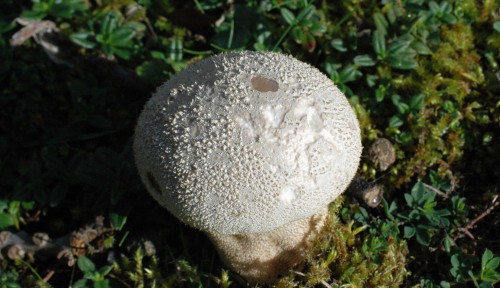
And of course there are fungi, this is one of the few that I recognise!

151008-Bryn Pydew (48a)-Puffball

Puffball

And to finish, a corvid feather, just because I liked it.

151008-Bryn Pydew (59a)-Corvid feather


Share this:

  • Share on Facebook (Opens in new window) Facebook
  • Share on Pinterest (Opens in new window) Pinterest
  • Share on X (Opens in new window) X
Like Loading...

Secret passage behind the sea wall

15 Thursday Oct 2015

Posted by theresagreen in birds of the seashore, coastal habitat, coastal walks, coastal wildflowers, Nature, Nature of Wales, nature photography, wading birds, Wales Coast Path, Wildflowers of Wales

≈ 4 Comments

Tags

coastal birds, Linnet, migrant birds, Northern Wheatear, penrhyn bay, rhos on sea, Rhos Point, rocky seashores, seashore walks

On a sunny day last week I intended to spend some time checking out the birdlife on Rhos Point to see what treats the autumn migration had already brought to us. I started out on the roadside where there’s a posh new sign on the roadside above the bijou St Trillo’s Chapel, the favoured starting point for many of my seashore posts.

151007TGNW-1-St Trillo Chapel plaque-Rhos-on-Sea

St Trillo's Chapel, Rhos on Sea

St Trillo’s Chapel, Rhos on Sea

It was windy here and decidedly chilly as it can be when the tide is coming in. A quick look and listen from the promenade revealed a good number of cormorants, gulls, oystercatchers, redshanks and curlews, but all still too far out on the tideline on the mussel bed to see easily.

151007TGNW-2-Tide coming in-Rhos-on-Sea

I picked up a few seashells of some of the most commonly occurring species here.

151007TGNW-3a-Some seashells-Rhos-on-Sea 1

Despite the sunshine, this was definitely not a day to hang around on the shore, so I turned to walk along to Penrhyn Bay, hoping I might find a Rock Pipit or two amongst the huge rocks of the seabreak.

Fox -and-cubs on the embankment

Fox -and-cubs flowers on the grassy embankment bending in the wind

151007TGNW-Fox-and-cubs

This view of the Little Orme clearly shows the tiers formed by quarrying.

151007TGNW-4-Promenade towards Little Orme 1

151007TGNW-4bb-Promenade sign 1

I soon knew I wasn’t going to enjoy battling along against the cold headwind, so at the earliest opportunity dropped down onto the parapet of the seawall where a passageway is formed between the wall and the seabreak rocks. It was still windy here but not quite as strongly, besides which this passageway fascinates me as a habitat for an ever-increasing collection of plants and at this time of year it can be a good place to spot rock pipits and pied wagtails. And the rocks themselves are endlessly fascinating.

151007TGNW-6a-Rock 1

151007TGNW-6b-Rock with turquoise stripe

The turquoise green of the vein in the rock above puts me in mind of the verdigris you get on copper. The one below has sparkly white and pink crystal-like parts held within it.

151007TGNW-6e-Rock -pink with crystals

151007TGNW-13-Rocks & spider's web

A spider’s web screens a space between rocks

I spotted a bird on the rocks close to these steps and went down to see if I could find it again.

151007TGNW-8-Sea wall- Steps going down

Steps going down to the seashore

I managed a quick shot before it disappeared. Definitely a pipit.

151007TGNW-7-Pipit-Rhos-on-Sea promenade

In the winter and in rough windy weather the sea reaches the top of these steps; the bottom few are bleached almost white, their edges smoothed, curved and shaped to form channels by seawater covering them and cascading back down.

151007TGNW-9-Sea wall- Steps going up 1Continuing along there’s a stretch that is particularly flowery. There’s a lot of red valerian interspersed with an array of wild plants and garden escapées.

151007TGNW-10-Sea wall path-Towards Penrhyn Bay

Sea mayweedhugs the curve of the sea wall

Sea mayweed hugs the curve of the sea wall

ivy-leaved toadflax

Ivy-leaved toadflax

151007TGNW- Penrhyn Bay-Plant with laarge glossy green leaves

Sunlit fern in a rocky crevice

Sunlit fern in a rocky crevice

marigold escaped from a garden

Marigold escaped from a garden

Tree mallow flower

Tree mallow flower

Penrhyn Bay

151007TGNW- Rock covered with seaweed

151007TGNW-Penrhyn Bay-Breakwater & sign

Between the breakwater and the rocky shore there is a patch of flowery grass

151007TGNW-Little Orme & Penrhyn Bay-grassy patch

151007TGNW- Penrhyn Bay-grassy patch

and behind the rocks scrubby shore plants grow amongst the sand and stone chippings. This is the best place I know for fairly reliable sightings of linnets that come to forage for seeds. There were linnets there when I arrived, which I realised when they all took off and headed off across the road towards the golf course. From past experience I thought if I sat and waited on the steps beneath the sea wall they may well come back. Sitting quietly I realised there were still birds close by that gradually came back into the open in front of me which turned out to be a Northern wheatear and a pipit. I want to say it was a Rock pipit as this is a likely spot to find them, but it had an olive-green tinge to its plumage and may have been a Meadow pipit.

Northern wheatear with pipit

Northern wheatear with pipit

Lovely wheatear though.

151007TGNW- Penrhyn Bay-Northern Wheatear 1

As hoped the linnets came back too, a small flock of 10 or 12 birds, albeit too far away to photograph well.

151007TGNW- Penrhyn Bay-Linnets feeding 4

151007TGNW- Penrhyn Bay-Linnets feeding 1

151007TGNW- Penrhyn Bay-Linnet 1

151007TGNW- Penrhyn Bay-Linnet on rock 1

Share this:

  • Share on Facebook (Opens in new window) Facebook
  • Share on Pinterest (Opens in new window) Pinterest
  • Share on X (Opens in new window) X
Like Loading...

Late Summer Specials

17 Monday Aug 2015

Posted by theresagreen in British hoverflies, Bryn Euryn Nature Reserve, butterflies, Butterflies of Wales, calcareous grassland, day-flying moths, Nature of Wales, nature photography, plants important to wilflife, Rhos-on-Sea, Wildflowers of Wales

≈ 2 Comments

Tags

ash keys, bee mimic hoverfly, cheilosa illustrata, common ragwort, ferdinandea cuprea, green-veined white, hawthorn berries, mating gatekeeper butterflies, Nature in August, purple hairstreak

August so far has brought mixed weather, days have been mostly warm, but many have been cloudy or overcast and occasionally there’s been some sunshine.

Looking across to Conwy Estuary

Looking across to Conwy Estuary from Bryn Euryn

It’s only been a week or two since my last visit to Bryn Euryn, but now rapidly approaching late summer, much has already changed. Many plants are setting seed, there are ripe wild raspberries, a few ripe blackberries and sloes, still as hard as bullets.

Purple sloes are swelling on Blackthorn

Purple sloes are swelling on Blackthorn

Last year there were sparse crops of acorns and sloes, this year may be more bountiful.

3/8/15-Wood avens seedhead

3/8/15-Wood avens seedhead

Large fruit capsules of the Stinking Iris

Large fruit capsules of the Stinking Iris

On a last hogweed flowerhead, a new-to-me, furry little hoverfly; it  is one of a number of species referred to as a bee mimic, but it  doesn’t really look like one.

Hoverfly-cheilosa illustrata- a bee mimic

Hoverfly-cheilosa illustrata- a bee mimic

Another hoverfly caught my eye, it was basking on a bramble leaf and as the sun caught it, the insect shone a bright metallic golden bronze colour.

Hoverfly-ferdinandea cuprea

Hoverfly-ferdinandea cuprea

About to enter the meadow, I caught sight of a Speckled wood butterfly basking on an Oak leaf. I moved in to take a photograph as I haven’t had many good opportunities with this species so far this year, then caught sight of another butterfly sitting on a leaf slightly higher up.

7/8/15 - Purple Hairstreak

7/8/15 – Purple Hairstreak

I moved in a little closer and realised this was a butterfly I had never seen before other than in pictures, a Purple Hairstreak. A species that spends most of its time in and around the tops of Oak trees, I was surprised and delighted to see it and tried not  to alarm it as I focussed the camera. It moved a little to reveal two small orange eyespots on its hindwing, but just as I had it back in focus the Speckled wood flew up and chased it away. I waited a while to see if it would return, but no luck. At least I know to look out for them here again!

The colours of the landscape are changing subtly. Hay has been cut and in many places baled and put safely under cover. Meadows of seeding long grass left standing have taken on a golden hue and on our limestone hill, the wildflowers typical of late summer are at the peak of their flowering. Most are ‘tough’ plants, Knapweed, Hemp agrimony & Ragwort, which are all imortant nectar sources for insects.

Late summer long grass and wildflowers

Late summer long grass and wildflowers, mostly hedge parsley and harebells

7/8/15-Knapweed with a view

It’s been a while since I had a good opportunity to photograph a Green-veined White, so I was pleased to see this fresh one on a Knapweed flowerhead.

3/8/15-Bryn Euryn

3/8/15-Bryn Euryn

Knapweed and Hemp Agrmony

Knapweed and Hemp Agrmony

Burnet moth on knapweed

Burnet moth on knapweed- wings faded and almost transparent

Also clinging to a knapweed plant was a pair of mating Gatekeepers; a perfect opportunity to see the difference between the male and female of the species, as helpfully, the female opened her wings to show the plainer upperside to her wings.

Mating Gatekeeper butterflies - female above male

Mating Gatekeeper butterflies – female above male

A good opportnity to show the upperside of the female

A good opportunity to show the upperside of the female

As anticipated by the abundance of flowers back in the spring, Ash trees are bearing thick bunches of ‘keys’.

Ash trees have heavy bunches of 'keys'

Ash trees have heavy bunches of ‘keys’

Acorns forming on Pedunculate Oak

Acorns forming on Pedunculate Oak

Haws are ripening and leaves beginning to take on colour

Haws are ripening and leaves beginning to take on colour

Walking close to gorse bushes the air is filled with the gentle sound of pods crackling as they open to release seeds.

Gorse pods crackle as they open to release seeds

Gorse pods crackle as they open to release seeds

Higher up on the steep slope near to the summit there is a stand of Ragwort growing with thistles.

Ragwort and thistles

Ragwort and thistles

And further round more Ragwort, this time interspersed with tall spikes of velvety Mullein.

Ragwort and Mullein

Ragwort and Mullein

The seedpods of Bird's-foot Trefoil are from where it takes it name

The seedpods of Bird’s-foot Trefoil are from where it takes it name

And a final shot of a Speckled Wood next to hypericum berries sums up the season, I think.

Speckled Wood & hypericum berries

Speckled Wood & hypericum berries

Share this:

  • Share on Facebook (Opens in new window) Facebook
  • Share on Pinterest (Opens in new window) Pinterest
  • Share on X (Opens in new window) X
Like Loading...

Beetles, bugs and spiders

03 Monday Aug 2015

Posted by theresagreen in Beetles, Bryn Euryn Nature Reserve, Insects, Nature, Nature of Wales, nature photography, North Wales, plants important to wilflife, spiders, Wildflowers of Wales

≈ 7 Comments

Tags

crab spider, flowering in July, froghopper, green shield bug, harebell, hogweed, mating red beetles on flowers, Nursery Web spider, red soldier beetle, red-legged shield bug, spider that makes web tents in grass, strangalia maculata, sulphur beetle, wild thyme, yellow and black beetle

July 15th

In the woods I spotted this extremely tiny froghopper, but only because he was struggling to extricate himself from a spider’s web built in ivy climbing up a tree trunk.

Tiny froghopper
Tiny froghopper
Tiny froghopper enlarged

150712TG-Bryn Euryn-Adder's Field (10)-Nursery-web spider 1In the meadow, the Nursery-web spider would probably have escaped my notice too if I hadn’t been trying to get closer to a butterfly in the brambles. More used to seeing this species web ‘tents’ on the ground in the grass, I wouldn’t have realised who had built this one if I hadn’t seen her guarding it.

Nursery web spider on brambles

There are some lovely wildflowers in bloom in the meadow amongst the grass, my current favourite are the delicate-looking harebells,

150710tg-Bryn Euryn-flwr-Harebells 1

although I have always been fond of the sunshine yellow Lady’s Bedstraw

150712-46-Bryn Euryn-lady's bedstraw patch

but then there’s the Wild Thyme that is looking spectacular this year where a large patch of it cascades down the limestone rocks.

150710tg-Bryn Euryn-flwr-Wild Thyme 1

There’s a Cat’s Ear plant near that spot too, which nicely demonstrates both the flowers and the seedhead ‘clocks’ simultaneously.

150710tg-Bryn Euryn-flwr-Cat's Ear 1

Hogweed works at another level and is an invaluable food source for a whole host of insects from beetles to butterflies.

150710tg-Bryn Euryn-flwr&vw-hogweed in long grass

Some of the insects feasting on the flowers today were Sulphur beetles, including dozens of tiny ‘baby’ ones

150712TG-Bryn Euryn-Adder's Field (15)-Small Sulphur beetles on hogweed 1
150712TG-Bryn Euryn-Adder's Field (19)-Sulphur beetle cloe-up
150712TG-Bryn Euryn-Adder's Field (21)-Sulphur beetle on hogweed

A 7-spot ladybird, a so-far un-named brown beetle

150712TG-Bryn Euryn-7-spot ladybird-Coccinella 7-punctata (3a)
150712TG-Bryn Euryn-Adder's Field (22)-no ID beetle

There were dozens of Red Soldier Beetles, many in the act of procreation as these beetles always seem to be. There was a little moth there with them, but again I haven’t discovered what it is yet.

150712TG-Bryn Euryn-Adder's Field (24)-Red soldier beetle
150712TG-Bryn Euryn-btl-Red soldier beetle-Rhagonycha fulva (7a)
150712TG-Bryn Euryn-btl-Red soldier beetle-Rhagonycha fulva (3a)
150712TG-Bryn Euryn-btl-Red soldier beetle-Rhagonycha fulva mating

150712TG-Bryn Euryn-Crab spider victim trussed up

Whilst photographing a pair of mating Red soldier beetles, I noticed another beetle caught up in spider’s webbing. As I looked closer I spotted the head and front legs of a spider creeping up over the edge of the flower, then she darted out and begin to drag her victim backwards to where she had appeared from. This was a Crab spider, mistress of camouflage and deadly to insects that stray into her path regardless of their size. Cruel, but fascinating and quite a feat as the beetle was as least equal in size to her.

150712TG-Bryn Euryn-Adder's Field (26)-Crab spider dragging victim to edge of flower
150712TG-Bryn Euryn-Adder's Field (27)-Crab spider with victim 1

Crab spiders are able to change their body colour to match their background. The process can take a few days, but they can appear white, yellow or green. The  irony of this scene struck me; a beetle life ended in full view of a pair of his kind in the act of procreating the species….

150712TG-Bryn Euryn-Adder's Field (29)-Crab Spider rear view
150712TG-Bryn Euryn-Adder's Field (28)-Spider crab securing victim

The Crab spider show would take some beating, but my ‘discovery of the day’ was quite definitely a splendid large yellow and black beetle, Strangalia maculata, that surprisingly doesn’t appear to have a common name.

150712TG-Bryn Euryn-btl-Strangalia maculata (1a)
150712TG-Bryn Euryn-btl-Strangalia maculata (10a)
150712TG-Bryn Euryn-btl-Strangalia maculata (7a)
150712TG-Bryn Euryn-btl-Yellow & black beetles 1

On another flowerhead another spider lurked, this time a small brown one, much enlarged in the photograph.

150710tg-Bryn Euryn-bug-Shield bug 1In the long grass I spotted an insect flying and managed to keep an eye on where it landed, otherwise I would never have found it; a Gorse Shieldbug.

A bright fresh bronzy-coloured forest bug was more easily spotted.

150712TG-Bryn Euryn -bug-Forest bug-Red-legged ShieldbugPentatoma rufipes (1a)

Red-legged shield bug-Pentatoma rufipes

A peek at the oak trees revealed tiny acorns. The ones I photographed belonges to a  Sessile Oak – the acorns sit flat rather than hanging on stems as those of the Pedunculate Oak. Hopefully this will be a better year for them than last year was.

150710tg-Bryn Euryn-tree- Sessile Oak-baby acorns

Rain clouds were gathering – is it really summer?

150712TG-Bryn Euryn-view (3)

Highlighted text for Shieldbugs are links to more details about these insects in my ‘Species Collections’.

Share this:

  • Share on Facebook (Opens in new window) Facebook
  • Share on Pinterest (Opens in new window) Pinterest
  • Share on X (Opens in new window) X
Like Loading...

Butterfly meadow

02 Sunday Aug 2015

Posted by theresagreen in Bryn Euryn Nature Reserve, butterflies, Butterflies of Wales, Nature, Nature of Wales, nature of woodlands, nature photography, Wildflowers of Wales, woodland wildflowers

≈ 5 Comments

Tags

aphantopus hyperantus, argynnis aglaja, dark green fritillary, Gatekeeper, maniola jurtina, Meadow Brown, pyronia tythonus, Ringlet, small skipper, thymelicus sylvestris

In the meadow the grass is long and beginning to turn golden brown as it sets seed.

The meadow grass is long , brightened by patches of yellow Lady's Bedstraw

The meadow grass is long , brightened by patches of yellow Lady’s Bedstraw

Bright golden yellow patches of Lady’s Bedstraw, scented like new mown hay catch my eye.

Lady's Bedstraw-Galium verum

Lady’s Bedstraw-Galium verum

At this end of the field there are more brambles and I spot several dark brown butterflies flying low down along the length of them. It was a while before any settled for long enough to see properly what they were. As I hoped, some were dark, chocolatey brown Ringlets.

Ringlet butterfly on bramble leaf

Ringlet butterfly on bramble leaf – wings of butterflies that frequent brambles often get torn on prickles

One Ringlet male was clearly patrolling a territory. The brambles fill a corner of the field; he was flying to one ‘end’ of the patch, turning around, flying to the other end, then where the bramble curves around the corner he cut across to the other side of the track, flitted a short way through the long grass then back across the track to the brambles. Occasionally he paused for rest or to skirmish with intruders.

An undamaged Ringlet

As well as Ringlets there were Meadow Browns, some of which were also coloured dark brown, hence my initial hesitation identifying the Ringlets. It’s quite unusual to see Meadow Browns resting with their wings fully open and it is interesting to see how variable this species is in size and colouring.

A dark coloured Meadow Brown

The male  Meadow Brown is darker brown than the female and may not have orange patches

A lighter shaded Meadow Brown

A lighter shaded female Meadow Brown

Medow Brown underside

Meadow Brown (male) underside showing orange underwing and eyespots

More usual view of a Meadow Brown underside

Meadow Brown underside-female

I was pleased to see a lovely fresh Gatekeeper here too, my first one for this year. This one was a male;  he has dark scent scale patches in the centre of the forewings which females don’t have.

Gatekeeper

Gatekeeper-Pyronia tithonus

In the opposite corner of the field there are more brambles; there were more Meadow Browns here and little golden brown Skippers that happily are abundant here and that also occur in other nearby locations, particularly on the Little Orme.

Small Skipper has orange-brown tips to antennae

Small Skipper (male) has a line of  black scent scales on forewings

There were a good number of these lovely little butterflies flitting about, expertly manoeuvering at speed between the long grass stems.

Small,or possibly Essex Skipper

Small Skipper-Thymelicus sylvestris

Ringlets are not widespread throughout the site, but rather occur in colonies in a few different locations. I walked on up past the top end of the field where I have found them in previous years, again on brambles. I was pleased to see there were; maybe half a dozen individuals, mostly flying around in the long grass in front of the brambles. Finally one flew up to feed on one of the last remaining flowers.

Ringlet

Ringlet feeding on the last of the bramble flowers

I was wondering what there was for the butterflies to feed on here now the bramble flowers are over, then saw one fly up onto a nearby oak tree. A closer look revealed it appeared to be feeding on something on a leaf surface, or maybe there were a few drops of moisture there.

  Last year I didn’t see any Ringlets at all, perhaps I missed their rather short season, which is just July-August, or maybe there were only a few which I overlooked. As they are here now there must have been some to generate this year’s brood. Now I wanted to know if there were any to be found in yet another spot I found them in the year before last, which is at the bottom of the ‘downland’ slope that leads up to the summit of the hill. Happily, there were indeed some there too. So, a good year for Ringlets.

Emerging from the woodland onto the steep slope I had caught sight of a flash of orange flying over a stand of Rosebay Willow Herb, so headed off now to investigate that. It wasn’t long before I saw more orange flashes of speeding Dark Green Fritillaries, the most special butterfly treats of this reserve. This patch of the hillside and sometimes a spot on the other side of the hill are the only places I have seen them, Colonies are more plentifully populated some years than others.

Dark green Fritillary

Dark green Fritillary- Argynnis aglaja

The fritillaries were feeding mainly on thistles, for want of anthing much else. They would also feed on knapweed, but it’s not quite out yet and scabious, of which there is only a little flowering nearby.

150712TG-Bryn Euryn-bfly-Dk green fritillary 2

An older, more faded butterfly

There were perhaps 10-12 individuals, some faded, others much fresher.

150712TG-Bryn Euryn-bfly-Dk green fritillary 11

They are strong, fast flyers and glide on flat wings.

150712TG-Bryn Euryn-bfly-Dk green fritillary 13

On the hindwings there are silver spots on a dark green background

Share this:

  • Share on Facebook (Opens in new window) Facebook
  • Share on Pinterest (Opens in new window) Pinterest
  • Share on X (Opens in new window) X
Like Loading...

Summer along a Welsh Woodland Trail

30 Thursday Jul 2015

Posted by theresagreen in British hoverflies, Bryn Euryn Nature Reserve, bumblebees, butterflies, Butterflies of Wales, hoverflies, Insects, Nature, Nature of Wales, nature photography, wildflowers, Wildflowers of Wales

≈ 6 Comments

Tags

ash tree, episyrphus balteatus, eristalis pertinax, flesh-eating fly, hedge woundwort, helophilus pendulus, hypericum montanum, large pied hoverfly, marmalade fly, Pale St John's Wort, sarcophoga carnaria, Stinking Iris-Iris foetidissima, syrphus ribesii, tapered drone fly, volucella zonaria, wild strawberry fruit, woodland flowers

Variable summer weather is perhaps more the norm here in North Wales than in some other parts of the UK, although we still feel hard done to when yet another day dawns doomed to be overcast. There are many compensations though, one of which is that when the odd sunny, or partially sunny day occurs, the insects come out in force in search of sustenance. I photographed all of the following along Bryn Euryn’s Woodland Trail during a fleeting sunny spell a couple of weeks ago.

The woodland trail

The shady woodland trail

On the edge of the trail a substantial bramble was still flowering and literally buzzing with insects, mostly hoverflies and bees. There were two butterflies, a Red Admiral and a Comma that were flying around rather frantically, both of which briefly (and separately) landed on my arm. Poor things were clearly overcome by the presence of both sun and nectar. I would have liked a more conventional shot of the Comma, this being the first I’d seen here this year, but it was taunting me from high over my head so this was my best view. I rather like it and it’s clear from the outline that it is a Comma.

The Comma insisted on playing hide and seek

The Comma insisted on playing hide and seek

The hoverflies were very active, not pausing for long but these are the ones I could get to fairly easily:

Volucella pellucens-Pellucid fly is the largest fly in Great Britain

Volucella pellucens- sometimes called the Pellucid fly, this is the largest fly of Great Britain

150712TG-Bryn Euryn-hvfly-Volucella pellucens (7)

A gorgeous Volucella zonaria

A gorgeous Volucella zonaria – my first sighting here

A Tapered drone fly-eristalis pertinax grooming its legs

A Tapered drone fly – Eristalis pertinax

Eristalis nemorum (interruptus)

Eristalis nemorum (interruptus)

A more distant view of a Helophilus pendulus

A more distant view of a Helophilus pendulus

A Syrphus sp hoverfly-Syrphus ribesii - one of the most common species

A Syrphus sp hoverfly-Syrphus ribesii – one of the most commonly seen species

A tiny Marmalade fly-Episyrphus balteatus, probably our most common hoverfly

A tiny Marmalade fly-Episyrphus balteatus, probably our most common hoverfly

There were bees too, including lots of tiny red-tailed and buff-tailed worker bumblebees that were way too quick for me to focus on.

Honey bee

Honey bee

A less charming insect to many, I find the Flesh-eating fly-Sarcophaga carnaria rather attractive to look at. I think the white feet complete the look, makes it look rather dapper.

Flesh-eating fly-Sarcophoga carnaria

Flesh-eating fly-Sarcophoga carnaria

The trees are still green and fresh-looking thanks to the rain and cooler weather, although those in the top right of the next picture are looking quite lacy.

150712TG-Bryn Euryn-looking up into an ash tree

Looking up into an Ash tree

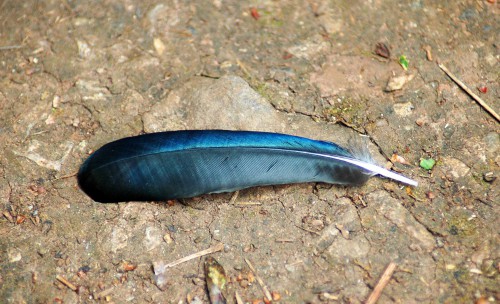
Continuing along the trail I hear a few birds letting the world know they are still about, Chiffchaff song bursts were fairly frequent, I heard Wrens and the contact calls of Blue Tits and plenty of corvid cawings. I found this feather too, maybe once belonging to a Magpie, it gleamed shades of almost peacock-blue in the dappled sunlight.

A corvid feather

A corvid feather

Honeysuckle is in flower now on the trail’s  edge and I couldn’t resist stopping to inhale its clean, fresh fragrance.

Lovely scented honeysuckle

Lovely scented honeysuckle

There is purple Hedge woundwort too, which has an earthy pungent, nettle-like scent.

Pungently scented Hedge Woundwort

Pungently scented Hedge Woundwort

Foxgloves are almost over-flowering reduced to the tips of the long bent-over  stems

Foxgloves are almost over-flowering reduced to the tips of the long bent-over stems

Wood sage-Teucrium scorodonia

Wood sage-Teucrium scorodonia

And a St John’s Wort I’d not spotted before, which I think is hypericum montanum, but happy to be corrected as always.

Pale St John's Wort-Hypericum montanum

Pale St John’s Wort-Hypericum montanum

A rather unusual plant grows here in the shady woodland, delightfully named the Stinking Iris and sometimes the ‘Roast-beef Plant’, both names allude to the sweetly acrid smell, like ‘high’ meat. This is one of just two Iris species native to the UK; the other is the Yellow Flag Iris.

The charmingly-named Stinking Iris-Iris foetidissima

The delightfully-named Stinking Iris-Iris foetidissima

Closer look at an Iris flower

Closer look at an Iris flower which is a greyish-mauve tinged with a brownish-pink

The much more common Nipplewort

The much more common Nipplewort-Lapsana communis

A Nipplewort leaf showing the path of a leaf-miner

A Nipplewort leaf showing the path of a leaf-miner

I picked a couple of ripe wild wild strawberries, trying not to think about the fly sitting on a leaf above them and their proximity to the path along which there is a regular procession of loose dogs….. They were delicious, regardless.

Sweet-tasting Wild Strawberries

Sweet-tasting Wild Strawberries

Turned off and took the steps up to Adder’s Field

Steps leading up to the meadow

Steps leading up to the meadow

more treats were in store there but there’s far too much to cram into one post, so will be continued….

Share this:

  • Share on Facebook (Opens in new window) Facebook
  • Share on Pinterest (Opens in new window) Pinterest
  • Share on X (Opens in new window) X
Like Loading...

Wales Coast Path – Little Orme

24 Sunday May 2015

Posted by theresagreen in birds of Wales, Birdwatching on North Wales coast, coastal walks, coastal wildflowers, Little Orme, Nature of Wales, Rhiwledyn Nature Reserve, The Wales Coast Path, Wildflowers of Wales

≈ 3 Comments

Tags

Cormorant, cormorants nesting, fulmar, fulmar nesting, ground ivy, jackdaw, sea campion, The Wales Coast Path-Little Orme

The Little Orme is a highlight of both the northern Wales Coast Path and the North Wales Path; it is a Nature Reserve with diverse habitats and wildlife and is popular with visitors and locals. I walk here often throughout the year but thought I would photograph this walk, taken at the end of April, as though I was following the Path, while meandering around as I usually do admiring the views and the special wildlife.

The Coast Path follows the promenade from Rhos-on-Sea around the Point and up to Penrhyn Bay. To reach the Little Orme turn off the main road and walk along Beach Road, which ends in a cul-de-sac where there are steps up to the site. Turn right at the top of the path from the steps to continue on the route.

In late winter to early spring Fulmars return to their nest sites here. They are noisy birds and vocalise loudly in the first weeks of their return as they sort out who is nesting where. Now, in late April they have quietened down and are settled into their nest sites on the more sheltered sides of the cliffs. There are currently five pairs on the more inland cliff and three or four more pairs on the lee sides of the cliff faces nearest to the sea. Their numbers are few but seem to be reasonably consistent year on year.
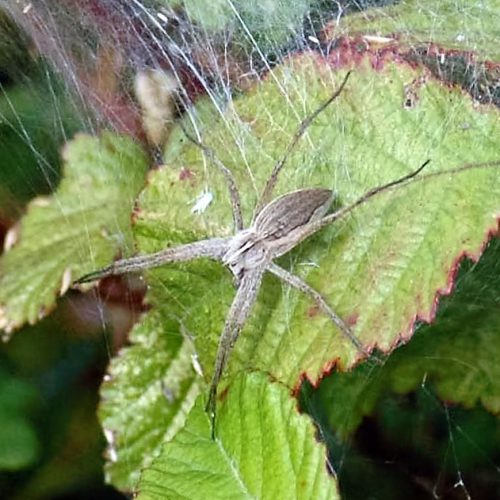
Fulmar nest on cliff nearer the sea

Fulmar nest on cliff nearer the sea

Fulmar pair sitting on cliff edge

Fulmar pair sitting on cliff edge

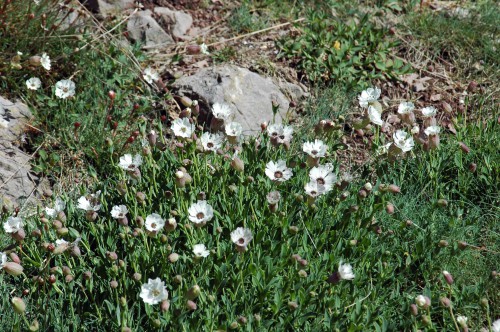
At the base of the cliff forming one side of Angel Bay, Sea Campion is flowering.

Sea Campion

Sea Campion-Silene maritima

I usually head for the cliff edge overlooking Angel Bay to see if there are any Grey Seals about. Today there were just two young ones swimming close to the rocks. The path to the summit involves an initial steep climb up an incline locally known as ‘Rabbit Hill’. It looks a gentle slope in the photograph, but it really isn’t, especially when you are as unfit as I was after my marathon-long virus! I had to stop twice today, but who cares when there are stunning views to look back at.

The Coast Path continues up steeply sloping 'Rabbit Hill'

The Coast Path continues up steeply sloping ‘Rabbit Hill’

Jackdaws are numerous residents and pairs of the characterful birds are nesting in nooks and crannies all over the cliffs. It’s always good to see them nesting communally in their ‘proper’ habitat rather than in the chimneys of houses in towns and villages. There are a particularly large number of them nesting up on the cliff at the back of the flat quarried-out grassy area at the top of Rabbit Hill and as I reached there I watched them as they used their numbers to chase off two Herring Gulls that were probably speculating for unguarded eggs.

Cliff face of the old quarry  that is now inhabitated by Jackdaws

Cliff face of the old quarry that is now inhabitated by Jackdaws

Jackdaw foraging at the base of the cliff

Jackdaw foraging at the base of the cliff

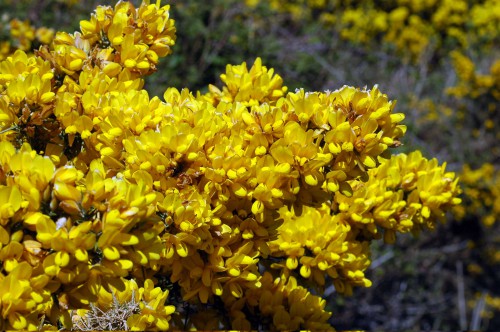
Onwards and upwards from the rock-strewn quarry field the track is bordered by gorse bushes and the air was perfumed with its wonderful coconut scent. Every bush was smothered with thousands of tightly packed golden flowers, a truly glorious treat for both eyes and nose. The grass is kept closely cropped by both rabbits and wandering sheep and a variety of birds including blackbirds, robins, chaffinches, goldfinches and dunnocks all forage here on the ground or amongst the scrubby shrubbery.

A baby bunny dozing in a sunny spot at the side of the track

A baby bunny dozing in a sunny spot at the side of the track

The track upwards bends to the right now and passes by an enclosed rough pasture grazed by  sheep and is frequented by Jackdaws. It’s always worth checking to see if any of the black birds are actually Chough.

A sheep pauses from grazing in the enclosed field to admire the view

A sheep pauses from grazing in the enclosed field to admire the view

At the top of the field the track turns sharply left and continues bordered by more gorse, blackthorn and hawthorn. Today walking through the fragrant gorse and blackthorn blossom was blissful.

The  trail winds through a thicket of gorse and blackthorn

The trail winds through a thicket of gorse and blackthorn

Every gorse bush was packed tight with blossoms

Every gorse bush was packed tight with fragrant blossoms

Eristalis Hoverfly nectaring on gorse flower

Eristalis Hoverfly nectaring on gorse flower

If you had been walking the Coast Path, there is a perfect view from the top of this section of the track of where you have walked if coming from the direction of Abergele, or of where you will be walking if going the other way.

View from the cliff edge showing the route of the Coast Path from Abergele, past Lladdulas and around Colwyn Bay and Rhos Point

View from the cliff edge showing the route of the Coast Path from Abergele, past Lladdulas and around Colwyn Bay and Rhos Point

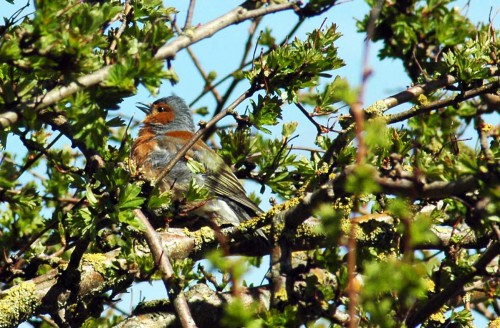
I could hear a Chaffinch singing so diverted from the main track here along one made by sheep to try to find him. It wasn’t long before I spotted him in a hawthorn tree preening himself and intermittently responding to the song of another male somewhere nearby.

Male Chaffinch singing and preening

Male Chaffinch singing and preening

Ground Ivy

Ground Ivy

The track continues upwards towards the top

The track continues upwards towards the top waymarked Wales Coast Path and North Wales Path

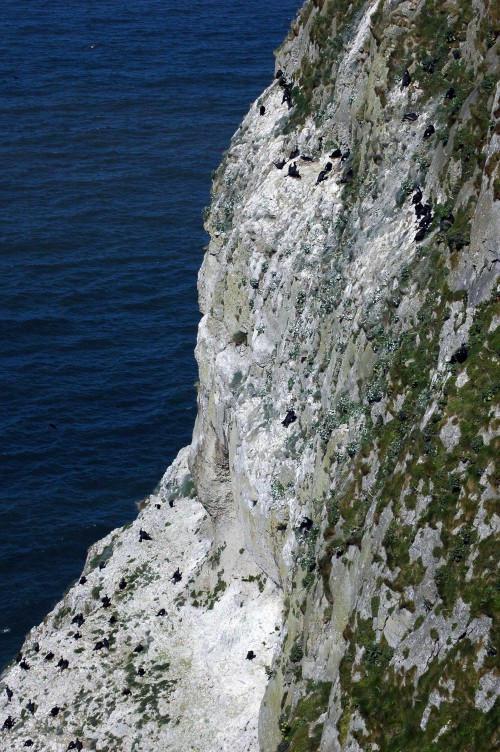
One of the reasons for taking this walk today was to check up on the Cormorants that nest on the sea cliffs of the headland. I wouldn’t recommend making this diversion to the cliff edge if you have children or a dog not on a lead with you, or if you are of a nervous disposition as to get a good view of the birds you do have to go carefully down a slope which has no barrier between its edge and the drop down. It was windy today too, as you can see by the ruffled sea.

A ewe with her lamb on the slope of the cliff edge

A ewe with her lamb on the slope of the cliff edge

There are large numbers of Cormorants here all year round and in Welsh the bird is known as ‘llanc llandudno’. I’m sure they have nest sites all around the headland, but this is the only one I know of that is reasonably visible from the cliffs. The limestone rock is smooth and sheer so it is amazing that the Cormorants, quite large birds, find safe places to site their nests here.

A view of the nest site on the almost-sheer cliff face

An overview of the nest site on the almost-sheer cliff face

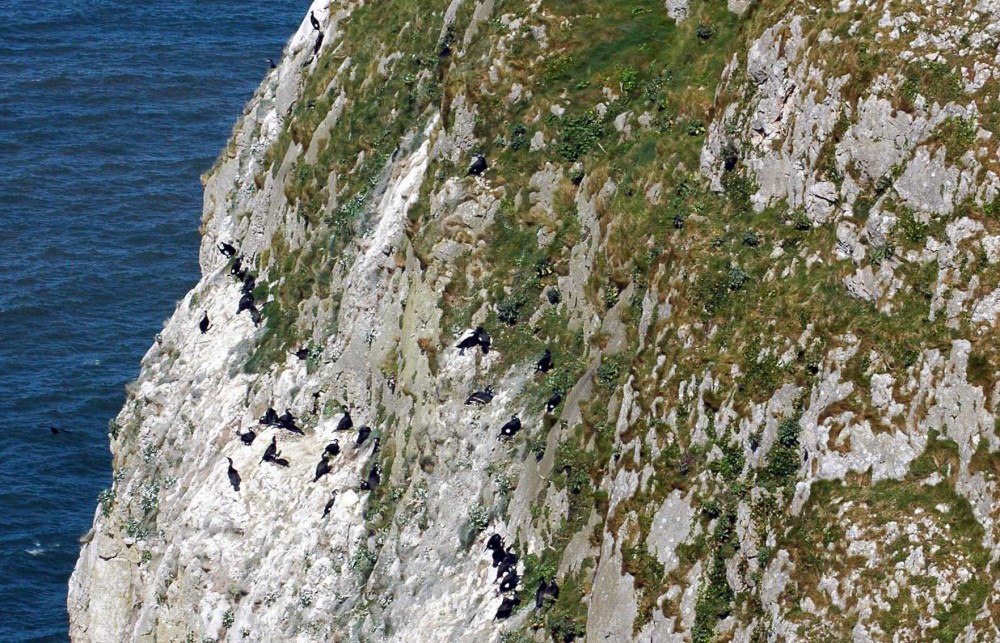
There are three areas the birds are gathered in, an area at the top, a middle section and a few on a shelf quite near the bottom.

A closer view of the area most of the birds were gathered in

A closer view of the top-level area some of the birds were gathered in

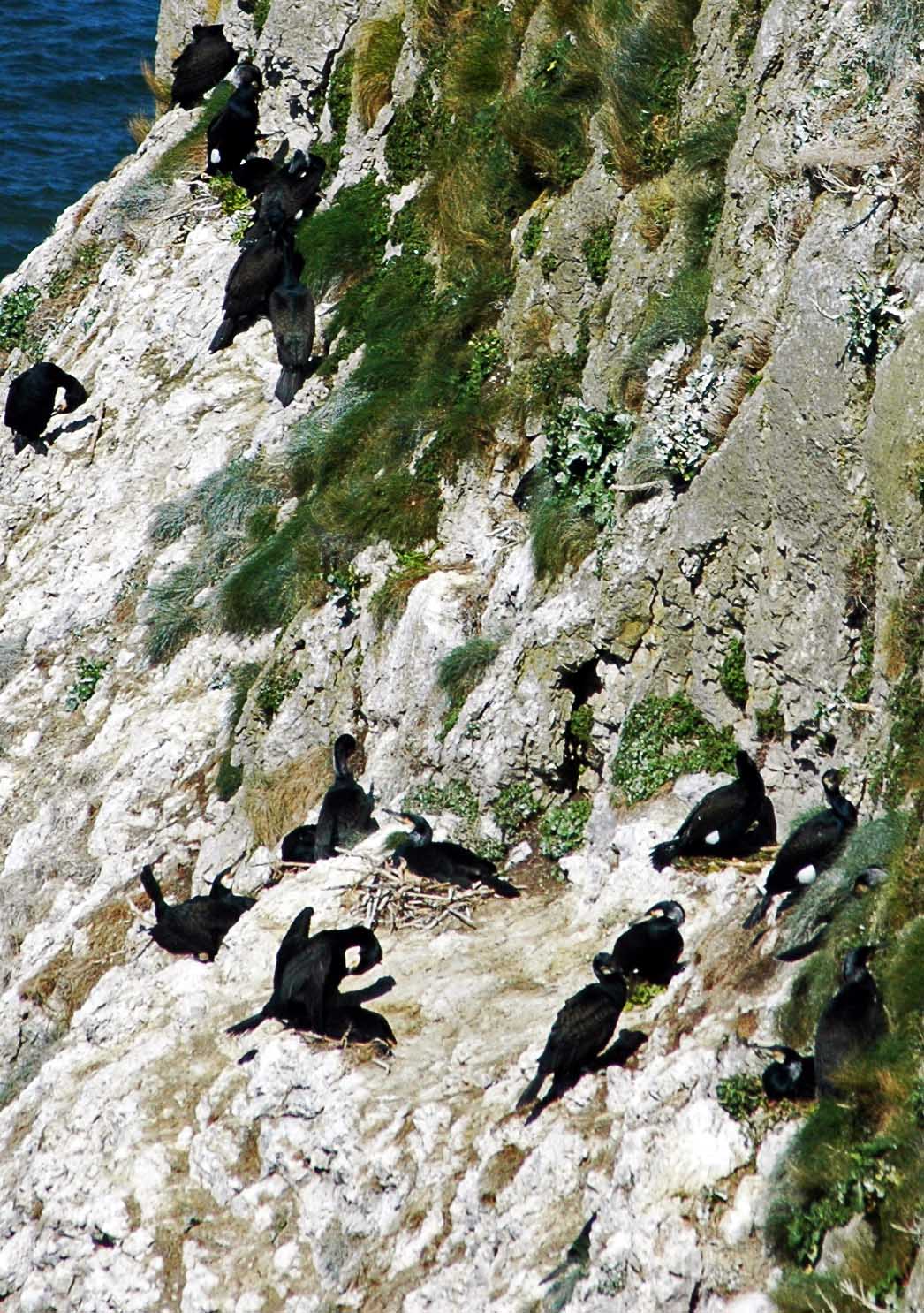
A few birds wwere sitting on nests while others, probably males, sat with their backs to the sea

A few birds were sitting on nests while others sat with their backs to the sea

Cormorants sitting against the cliff with backs to the sea

Cormorants sitting against the cliff with backs to the sea

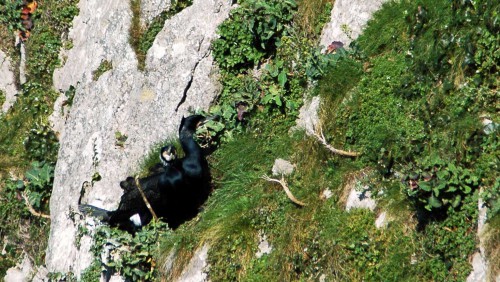
A pair of birds nesting amongst wild cabbage plants

A pair of birds nesting amongst wild cabbage plants

Another pair on a sloping rocky ledge

Another pair on a sloping rocky ledge

Cormorant flying past cliff

Cormorant flying past cliff

Fascinating as the Cormorants were, it was chilly here on the windy cliff, so I went back up and along the cliff edge to the part below the summit which was sheltered from the wind and from where there are stunning views across the bay to Llandudno’s Victoria Pier and Little Orme’s big brother, the Great Orme. In the background is the Isle of Anglesey.This view shows the route of the ongoing Coast Path around Llandudno Bay.

Panoramic view of Llandudno, the pier and Great Orme with Anglesey in the background (click to enlarge)

Panoramic view of Llandudno, the pier and Great Orme with Anglesey in the background (click to enlarge)

Cormorants race past and Herring Gulls are always to be seen flying or gliding around this part of the cliff, and there is occasionally a Kestrel, but today I was surprised to see two Buzzards flying out over the sea and a Sparrowhawk flying in and heading towards the Great Orme.

The ongoing Coast Path

The ongoing Coast Path passes around Llandudno and on to Deganwy and Conwy

It is possible to go up a little further to reach the trig point on the summit but the views are no better from there so I don’t often get that far and turn around to go back the way I came. If you were following the Coast Path though you would follow the track that takes you down to rejoin the main road at Craigside and continue towards Llandudno.

Share this:

  • Share on Facebook (Opens in new window) Facebook
  • Share on Pinterest (Opens in new window) Pinterest
  • Share on X (Opens in new window) X
Like Loading...

Spring on the Bryn-part II

11 Monday May 2015

Posted by theresagreen in Bryn Euryn Nature Reserve, butterflies, Butterflies of Wales, Nature of Wales, nature of woodlands, Wildflowers of Wales

≈ 2 Comments

Tags

blackthorn, blackthorn blossom, Blue tit, dog violet, Great Tit, mistle thrush, orange tip, peacock butterfly, rabbit, small tortoiseshell, speckled wood, wild strawberry, woodland flowers

Walking further up through the field the local buzzard pair circled overhead, then just a few minutes later a sparrowhawk appeared from somewhere close by and startled me as it flew just a few feet over my head, then continued towards the direction from which I had come.

Gorse fully in flower

Gorse fully in flower

A bit further on I stopped for a while and sat on one of my favourite rocks savouring the warm sun and the peace and quiet; that rarely lasts long just here as its at a sort of junction of trails so there are passing dogs, usually well ahead of their owners that invariably come over to see what I’m up to. I watched two peacock butterflies vying for the best spot on a sun-warmed rock. The winner opened its slightly faded, but still beautiful wings and basked for a few short minutes undisturbed.

Peacock butterfly

Peacock butterfly

Moving off my rock to photograph the butterflies I noticed a patch of Wild Strawberry in flower. Tucked back against the rock it is sheltered and in a sunny spot, perfect for ripening berries.

Wild Strawberry plant in flower

Wild Strawberry-Fragaria vesca in flower

Back in the woods to walk up towards the summit I disturbed a large foraging bird. It flew up to a tree branch where it blended well into the dappled shade. It had to be a Mistle Thrush but I wasn’t entirely sure until it flew back down to the ground giving a better view.

A Mistle Thrush blending into the dappled shade of the wood

A Mistle Thrush blending into the dappled shade of the wood

Unmistakably a Mistle Thrush

Unmistakably a Mistle Thrush

At the top of the track there was a single Speckled Wood butterfly, a lovely ‘fresh’ one. It was intent on finding somewhere to bask in the sun and flitting and zig-zagging about low over the track. You have to keep an eye on them because once they settle they can be difficult to spot. I had to make do with this view as it still wasn’t happy and shot off quickly.

Speckled Wood butterfly

Speckled Wood butterfly

Back out in the open and continuing upwards I almost stepped on a Small Tortoiseshell butterfly also sunning itself on the bare earth of the track.

Small tortoiseshell- Aglais urticae

Small tortoiseshell- Aglais urticae

A little clump of Dog Violets growing in the grass at the side of the track caught my eye; the bee-fly zoomed in just as I pressed the shutter and was gone again before I could refocus on it.

Common Dog Violet- Viola riviniana

Common Dog Violet- Viola riviniana

Blackthorn, of which there is a generous amount up here, has been flowering for a short while now but is at its beautiful peak now. Last year was a sparse one in respect of the amount of sloes on the shrubs here, but if the masses of blossom on them now are anything to go by, this could be a bumper year.

Blackthorn with a view

Blackthorn with a view

The flowers of blackthorn appear before the leaves and these are just beginning to break from their buds.

Blackthorn-Prunus spinosa

Blackthorn-Prunus spinosa

Blackthorn blossom against a clear blue sky

Blackthorn blossom against a clear blue sky

Another male Orange Tip butterfly was racing along the boundary of the blackthorn scrub. He didn’t stop, but as my first sighting of this species this year was a few days earlier of one nectaring on blackthorn, I’m using one of the photographs I took then.

Orange Tip- Anthocharis cardamines

Orange Tip- Anthocharis cardamines

Following the path around to go up to the summit I noticed two Small Tortoiseshell butterflies on the ground. I thought at first they were mating, or about to do so and they did change their positions a few times, but nothing happened during the time I watched them. One was more fresh-looking than the other, but they were both perfectly intact and gorgeous.

150424TG-BE336-Two tortoiseshells150424TG-BE337-Two tortoiseshells150424TG-BE335-Two tortoiseshells

The grass up around the summit of the hill is kept short, constantly cropped by grazing rabbits. I think it’s highly likely that this particular part of the hill covers a maze of warrens and tunnels. You don’t often get to see them , especially during the daytime, but there are baby ones around now and not yet wise they can be seen out in the open.

Young bunnies

Young bunnies

Ground Ivy-Glechoma hederacea

Ground Ivy-Glechoma hederacea

I cut back into the woods here from the track the bunnies were on, hearing a chiffchaff a short way in. I spotted Great Tits foraging in the trees close to the track that flew over to the scrubby wild clematis-covered scrub on the other side.

Great Tit

Great Tit

Where I stopped to take the picture there were a large number of smallish hoverflies darting about, resting briefly on leaves or many on the ground, all shiny and fresh looking as the ones I saw lower down earlier in the afternoon.

There were Blue Tits out foraging too and I think its likely that a pair have a nest site quite high in a tree with ivy growing up through it.

Foraging Blue Tits

Foraging Blue Tits

At the bottom of the track I stopped for a few minutes to listen to a Mistle Thrush singing. This was a déjà vu moment as I recall doing this exact same thing last year, more or less in the exact same spot, scanning the trees for the singer. I found him then, but couldn’t spot him today, so here’s last year’s picture to be going on with. What a lovely bird and how lovely to see him again. (More about the Mistle Thrush here)

A well-marked, singing mistle thrush

A well-marked, singing Mistle Thrush


Share this:

  • Share on Facebook (Opens in new window) Facebook
  • Share on Pinterest (Opens in new window) Pinterest
  • Share on X (Opens in new window) X
Like Loading...
← Older posts
Newer posts →
Follow everyday nature trails on WordPress.com

Enter your email address to follow this blog and receive notifications of new posts by email.

‘But it is the common species that keep the living world ticking over and provide most of our experiences of wildlife, and I would argue that maintaining the abundance of these is as important a conservation priority as maintaining the existence of rarities’. Richard Mabey

MOST RECENT POSTS

  • A Glimpse of Spring to Come January 22, 2025
  • Hunting the Wren December 28, 2024
  • Oh, Christmas Tree December 18, 2024
  • In and Out of the Ivy February 15, 2024
  • Nature’s Fireworks November 30, 2023
  • Wild Autumn along the Coast Path November 3, 2023

OLDER POSTS

LOOKING FOR SOMETHING IN PARTICULAR?

  • Sights and Sounds from the Little Orme 1
    Sights and Sounds from the Little Orme 1
  • Things Bright and Beautiful
    Things Bright and Beautiful
  • Catchers, a Duck and Divers
    Catchers, a Duck and Divers
  • Following a river to a Fairy Glen
    Following a river to a Fairy Glen
  • May Bee Appearing on Ivy near You
    May Bee Appearing on Ivy near You
  • Shades, Sounds and Scents of the Woods
    Shades, Sounds and Scents of the Woods
  • Fine Dining for Crows
    Fine Dining for Crows
  • A Windy Wildflower Trail
    A Windy Wildflower Trail
  • The Windhover
    The Windhover
  • Butterflies and more rare treats
    Butterflies and more rare treats

nightingale trails

The Walk of the Monarch Butterfly-Sendero de la Mariposa Monarca

The Walk of the Monarch Butterfly-Sendero de la Mariposa Monarca

MY WILDFLOWER BLOG: where the wildflowers are

Snowdrop

Snowdrop

most recent posts

Follow everyday nature trails on WordPress.com

Social

  • View teresamaygreen’s profile on Twitter

Enter your email address to follow this blog and receive notifications of new posts by email.

Website Built with WordPress.com.

  • Subscribe Subscribed
    • everyday nature trails
    • Join 359 other subscribers
    • Already have a WordPress.com account? Log in now.
    • everyday nature trails
    • Subscribe Subscribed
    • Sign up
    • Log in
    • Report this content
    • View site in Reader
    • Manage subscriptions
    • Collapse this bar
 

Loading Comments...
 

    %d