• Home
  • about
  • about the photographs
  • Local Nature Reserves
    • Bryn Euryn Local Nature Reserve
    • Mynydd Marian
  • Wales Coast Path
    • Grey Seals in North Wales
    • St.Trillo’s Chapel
    • Wildflowers of North Wales Coastal Paths, Cliffs and Dunes

everyday nature trails

everyday nature trails

Category Archives: Nature of Wales

Autumn

27 Tuesday Oct 2015

Posted by theresagreen in Bryn Euryn Nature Reserve, Bryn Pydew, Nature, Nature of Wales, nature of woodlands, nature photography, North Wales, Wildflowers of Wales, woodland walks in Wales

≈ 7 Comments

Tags

ash leaves, autumn colour, autumn leaves, eristalis pertinax, fallen leaves, goldenrod, hazel leaves, North Wales Wildlife Trust, oak leaves, puffball fungus

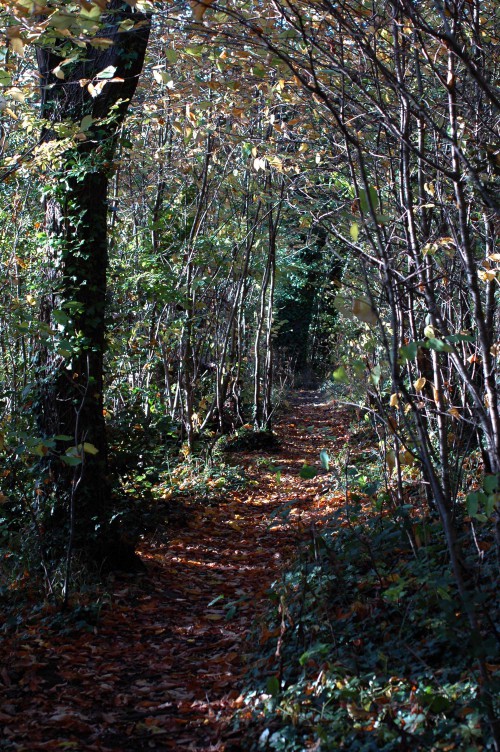
Autumn in North Wales is glorious this year thanks to a prolonged sunny and mild spell of weather, as yet broken only occasionally by rain. Walking between the trees in the dappled shade of the woodland along sun-striped paths thickly carpeted with fallen leaves in all the shades of the season, has been truly joyful. As October draws to an end, here are some of my views of the month.

151021-Bryn Euryn Woods 4a-Path sun-striped 151021-Bryn Euryn Woods 5a-Path leaf-strewn

Ivy is flowering now providing vital supplies of pollen and nectar to late-flying insects.

151021-Bryn Euryn Woods 2a- Ivy flower

Ivy is flowering

151021-Bryn Euryn Woods 8a-Woodland Trail

Ash trees leaves have mostly turned to a bright yellow.

151021-Bryn Euryn Woods 7a-Ash tree canopy

Ash tree canopy

Many have already fallen.

151021-Bryn Euryn Woods 10a-Woodland Trail-Ash leaves

Strings of Black bryony berries are strung between stems of lower-storey vegetation

151008-Bryn Pydew (29)

Black Bryony berries

151021-Bryn Euryn Woods 9a-Woodland Trail

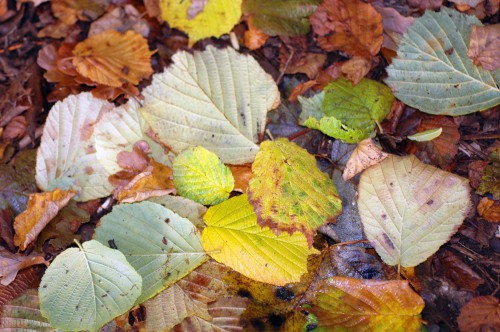
151021-Bryn Euryn Woods 6a-Hazel leaves

Hazel leaves fallen

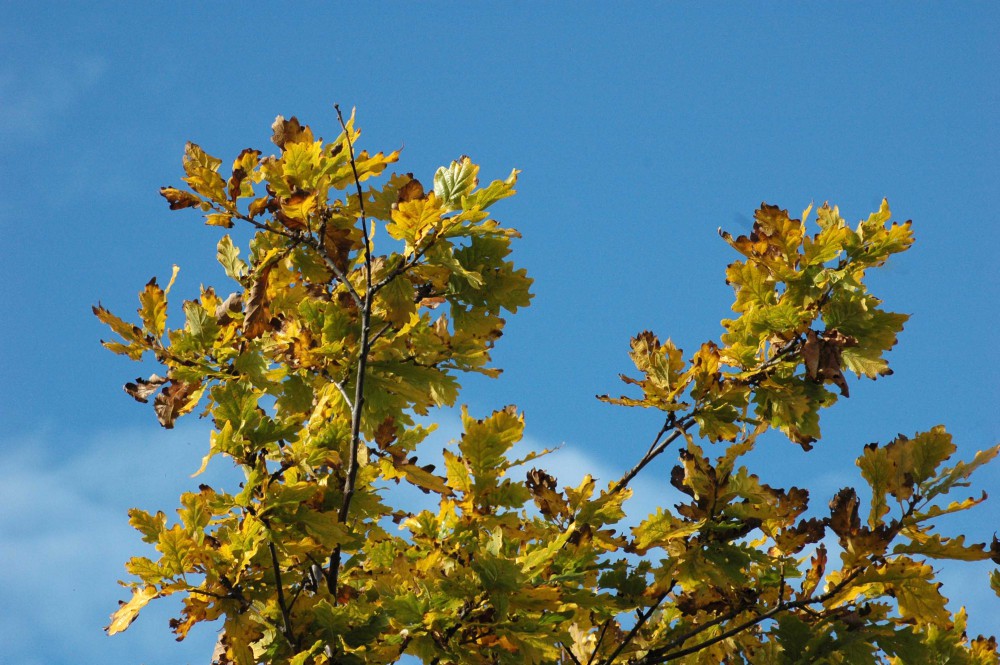
Oak trees are in varying shades, some still retaining a lot of green where they are in shade while those exposed to more sunlight have turned golden.

151008-Bryn Pydew (6a)-Oak leaves turned yellow & blue sky

Last year there was a national shortage of acorns and here at least it doesn’t look as though this year is going to be any more productive.

Sessile Oak and acorns

Sessile Oak and acorns

151008-Bryn Pydew (37a)-Cherry gall under oak leaf

Cherry gall under an oak leaf

Female Yew trees have ripening pink-red berries

151008-Bryn Pydew (53a)-Yew berry

On the woodland edges and in clearings there is still plenty to see.

151008-Bryn Pydew (2a)-Blackberries & clematis

Late blackberries and Old Mans Beard

In a sunny spot I watched a gathering of a dozen or so hoverflies. Some were hovering and darting around, others were attempting to bask in the sunshine but were deliberately disturbed by their dive-bombing peers.

151008-Bryn Pydew (11a)-Eristalis hoverfly

Bryn Pydew-Eristalis pertinax

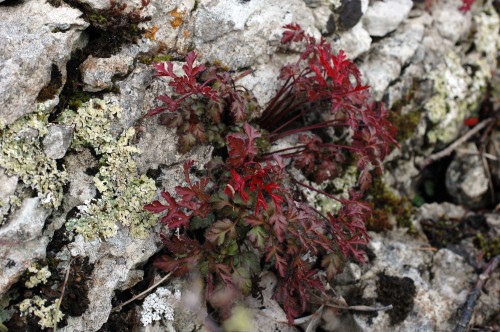
On limestone pavement I found Herb Robert leaves that have turned beautiful shades of red

151008-Bryn Pydew (43a)-Herb Robert leaves turned red

Goldenrod is a favourite late flowering plant

151008-Bryn Pydew (30a)-Goldenrod flower stem

Goldenrod

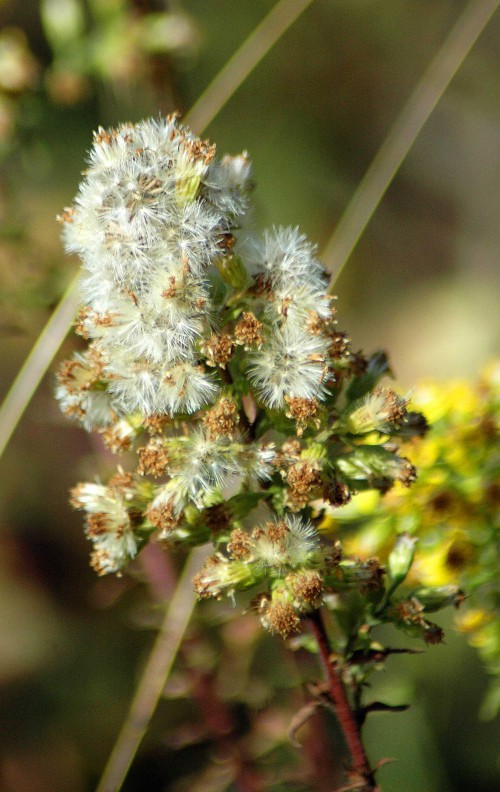
although most plants have set seed by now.

Goldenrod seedheads

Goldenrod seedheads

Tucked into a damp sheltered corner where two quarried limestone walls meet, a maidenhair spleenwort fern remains fresh and green.

151008-Bryn Pydew (35a)-Maidenhair Spleenwort

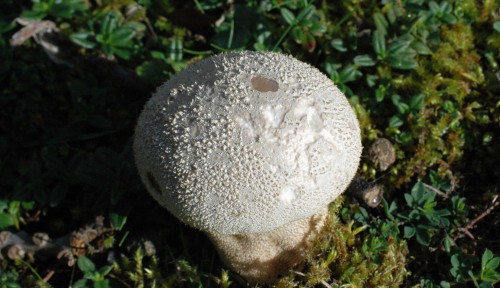
And of course there are fungi, this is one of the few that I recognise!

151008-Bryn Pydew (48a)-Puffball

Puffball

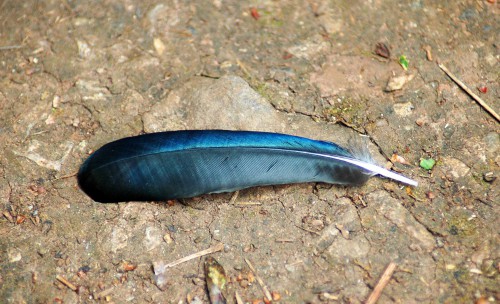
And to finish, a corvid feather, just because I liked it.

151008-Bryn Pydew (59a)-Corvid feather


Share this:

  • Share on Facebook (Opens in new window) Facebook
  • Share on Pinterest (Opens in new window) Pinterest
  • Share on X (Opens in new window) X
Like Loading...

Secret passage behind the sea wall 2

17 Saturday Oct 2015

Posted by theresagreen in Birds, birds of the seashore, birds of Wales, coastal walks, Nature, Nature of Wales, nature photography, Rhos Point, Rhos-on-Sea, Wales Coast Path

≈ 4 Comments

Tags

Crows on seashore, curlew flying, herring gull, meadow pipit, mussel bed, Rhos Point

An hour or so later the walk back to Rhos Point was quite different. The going was easier too as the strong wind was behind me now and not taking my breath away. Almost immediately I caught sight of a bird hopping around on the rocks. I waited hoping it would come into view, which it did, just as a woman with a dog approached and chose that moment to break into a run. The bird flew away. Again it was a pipit, possibly the same one I’d seen back on the beach. The legs are pinkish and plumage brown so maybe a Meadow Pipit?

151007TGNW- Penrhyn Bay-Pipit on rocks 3

151007TGNW- Penrhyn Bay-Pipit on rocks 4

A small sedum plants looks at home in a pocket eroded in a limestone rock.

151007TGNW- Penrhyn Bay-Sedum

Small pools of rainwater are held briefly, lasting longer in the hard granite rocks.

151007TGNW-6d-Rock pool 2

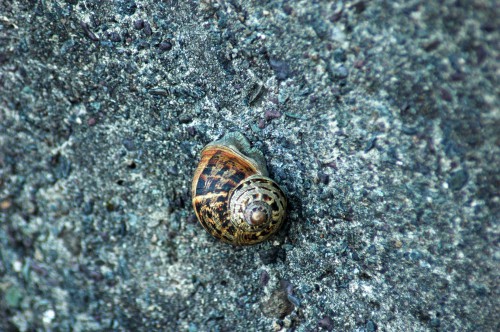
The garden snail must have found it hard going sliding over the rough surface of the sea wall.

151007TGNW-15-Sea wall- Garden snail

151007TGNW-Rock with moss

151007TGNW--Penrhyn Bay-Wasp

151007TGNW- Penrhyn Bay-sign at top of ramp

There is a wide concrete ramp reaching from the road down to the shore which probably gave access to heavy construction vehicles when the huge boulders of the sea defences originally were put in place. The lower section is being absorbed back into the shore, it is strewn with pebbles and small rocks and slippery with seaweed. Limpets are embedded into the wall itself as well as in large rocks on the shore at the bottom of the ramp.

151007TGNW-Limpets embedded in rock

I love the textured ‘lacy’ look of this rock almost covered with barnacles.

151007TGNW-Rock covered with barnacles & limpets

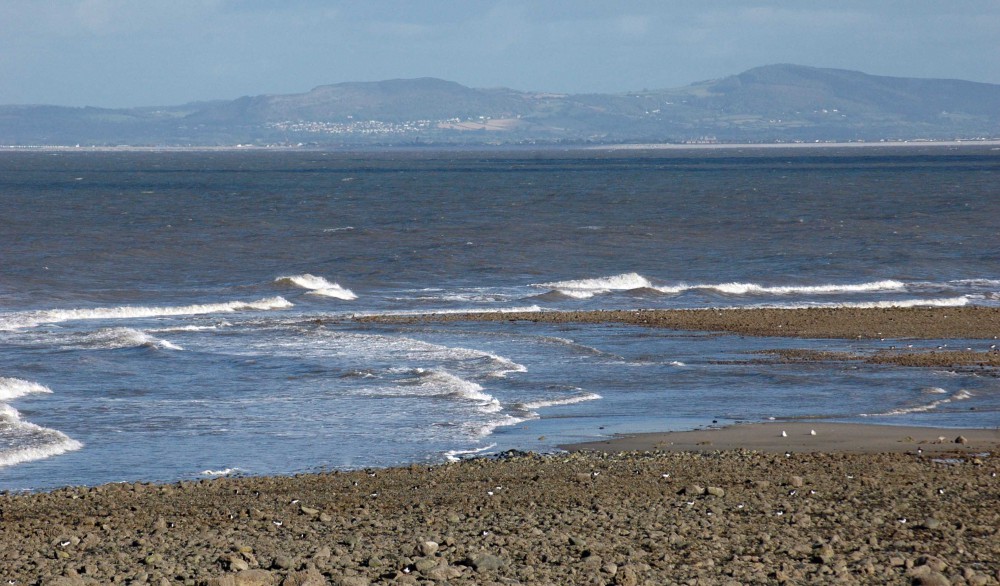
The sea is often at its most beautiful on these sunny windy days, its surface whipped up roughened and flecked with foam-edged ripples and the colour of the water ranging from deepest inky dark blue to pale turquoise-green. Large areas are stained brown by dredged up sand.

151007TGNW- Penrhyn Bay-Back to Rhos-Sea colours 1

Sun, shade and curves make this man-made construction interesting.

151007TGNW- Penrhyn Bay-Back to Rhos

The white marks highlighting the curved sea wall are mineral, maybe lime leached from the concrete?

151007TGNW-5-Wall markings-Rhos-on-Sea promenade

The parapet floor has an interesting pattern and texture and is spotted with patches of white lichen.

151007TGNW- Penrhyn Bay-Back to Rhos-Concrete floor3

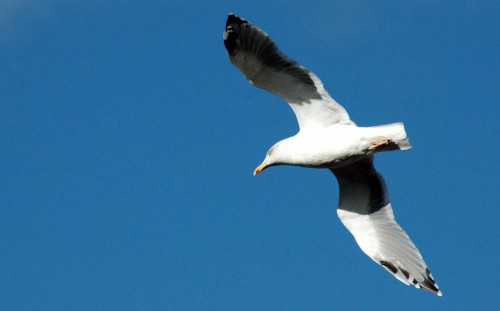
As I got nearer to the Point I knew the tide was further in by the increased bird activity; the excitement it generates is almost tangible. Gulls take to the air and fly back and forth along the shoreline. Oystercatchers and other waders scuttle about, heads down, beaks probing for anything edible brought in on the waves.

151007TGNW- Penrhyn Bay-Back to Rhos-Herring gull

151007TGNW- Penrhyn Bay-Back to Rhos-Herring gull young 1

Crows head shorewards too, the one in my picture landed on a lampost towering above me, cawing loudly. They forage amongst the rocks along with the waders and are often seen picking up a shellfish then flying up with and dropping it onto the rocks below to crack it open.

151007TGNW- Penrhyn Bay-Back to Rhos-Crow 1

Even the curlews were excited. Most often seen stalking sedately around rocks and pools, now there were several flying along at speed, skimming low over the rocks on the shore below me. A couple of them may have been in pursuit of the one I managed to capture a shot of; it was travelling so fast I didn’t realise it had food in its beak until I saw the photograph.

151007TGNW- Penrhyn Bay-Back to Rhos-Curlew

On the Point the incoming tide approaches from either side of the mussel bed, where I assume different currents merge. The birds have an infallible instinct for the tidal changes and in the hour before and after high tide their numbers increase dramatically. They are brought closer to the shore then too and absorbed with foraging and eating, are easier to see.

151007TGNW- Penrhyn Bay-Back to Rhos-Sea colours on point

151007TGNW- Penrhyn Bay-Back to Rhos-Oystercatchers active

It was too cold and windy to hang around and wait today though, so I had a quick peek into the chapel, which I can never resist. There are only 6 seats inside, so I wonder if they’ve lined up these memorial benches on the promenade outside to serve as overflow pews?

151007TGNW- Penrhyn Bay-Back to Rhos-benches 2

Many young Herring gulls wander around the village at this time of year, often screeching for the attention of a parent. They have no road sense and sadly quite a few are killed by cars.

151007TGNW- Penrhyn Bay-Back to Rhos-Herring gull young on road edge

Share this:

  • Share on Facebook (Opens in new window) Facebook
  • Share on Pinterest (Opens in new window) Pinterest
  • Share on X (Opens in new window) X
Like Loading...

Secret passage behind the sea wall

15 Thursday Oct 2015

Posted by theresagreen in birds of the seashore, coastal habitat, coastal walks, coastal wildflowers, Nature, Nature of Wales, nature photography, wading birds, Wales Coast Path, Wildflowers of Wales

≈ 4 Comments

Tags

coastal birds, Linnet, migrant birds, Northern Wheatear, penrhyn bay, rhos on sea, Rhos Point, rocky seashores, seashore walks

On a sunny day last week I intended to spend some time checking out the birdlife on Rhos Point to see what treats the autumn migration had already brought to us. I started out on the roadside where there’s a posh new sign on the roadside above the bijou St Trillo’s Chapel, the favoured starting point for many of my seashore posts.

151007TGNW-1-St Trillo Chapel plaque-Rhos-on-Sea

St Trillo's Chapel, Rhos on Sea

St Trillo’s Chapel, Rhos on Sea

It was windy here and decidedly chilly as it can be when the tide is coming in. A quick look and listen from the promenade revealed a good number of cormorants, gulls, oystercatchers, redshanks and curlews, but all still too far out on the tideline on the mussel bed to see easily.

151007TGNW-2-Tide coming in-Rhos-on-Sea

I picked up a few seashells of some of the most commonly occurring species here.

151007TGNW-3a-Some seashells-Rhos-on-Sea 1

Despite the sunshine, this was definitely not a day to hang around on the shore, so I turned to walk along to Penrhyn Bay, hoping I might find a Rock Pipit or two amongst the huge rocks of the seabreak.

Fox -and-cubs on the embankment

Fox -and-cubs flowers on the grassy embankment bending in the wind

151007TGNW-Fox-and-cubs

This view of the Little Orme clearly shows the tiers formed by quarrying.

151007TGNW-4-Promenade towards Little Orme 1

151007TGNW-4bb-Promenade sign 1

I soon knew I wasn’t going to enjoy battling along against the cold headwind, so at the earliest opportunity dropped down onto the parapet of the seawall where a passageway is formed between the wall and the seabreak rocks. It was still windy here but not quite as strongly, besides which this passageway fascinates me as a habitat for an ever-increasing collection of plants and at this time of year it can be a good place to spot rock pipits and pied wagtails. And the rocks themselves are endlessly fascinating.

151007TGNW-6a-Rock 1

151007TGNW-6b-Rock with turquoise stripe

The turquoise green of the vein in the rock above puts me in mind of the verdigris you get on copper. The one below has sparkly white and pink crystal-like parts held within it.

151007TGNW-6e-Rock -pink with crystals

151007TGNW-13-Rocks & spider's web

A spider’s web screens a space between rocks

I spotted a bird on the rocks close to these steps and went down to see if I could find it again.

151007TGNW-8-Sea wall- Steps going down

Steps going down to the seashore

I managed a quick shot before it disappeared. Definitely a pipit.

151007TGNW-7-Pipit-Rhos-on-Sea promenade

In the winter and in rough windy weather the sea reaches the top of these steps; the bottom few are bleached almost white, their edges smoothed, curved and shaped to form channels by seawater covering them and cascading back down.

151007TGNW-9-Sea wall- Steps going up 1Continuing along there’s a stretch that is particularly flowery. There’s a lot of red valerian interspersed with an array of wild plants and garden escapées.

151007TGNW-10-Sea wall path-Towards Penrhyn Bay

Sea mayweedhugs the curve of the sea wall

Sea mayweed hugs the curve of the sea wall

ivy-leaved toadflax

Ivy-leaved toadflax

151007TGNW- Penrhyn Bay-Plant with laarge glossy green leaves

Sunlit fern in a rocky crevice

Sunlit fern in a rocky crevice

marigold escaped from a garden

Marigold escaped from a garden

Tree mallow flower

Tree mallow flower

Penrhyn Bay

151007TGNW- Rock covered with seaweed

151007TGNW-Penrhyn Bay-Breakwater & sign

Between the breakwater and the rocky shore there is a patch of flowery grass

151007TGNW-Little Orme & Penrhyn Bay-grassy patch

151007TGNW- Penrhyn Bay-grassy patch

and behind the rocks scrubby shore plants grow amongst the sand and stone chippings. This is the best place I know for fairly reliable sightings of linnets that come to forage for seeds. There were linnets there when I arrived, which I realised when they all took off and headed off across the road towards the golf course. From past experience I thought if I sat and waited on the steps beneath the sea wall they may well come back. Sitting quietly I realised there were still birds close by that gradually came back into the open in front of me which turned out to be a Northern wheatear and a pipit. I want to say it was a Rock pipit as this is a likely spot to find them, but it had an olive-green tinge to its plumage and may have been a Meadow pipit.

Northern wheatear with pipit

Northern wheatear with pipit

Lovely wheatear though.

151007TGNW- Penrhyn Bay-Northern Wheatear 1

As hoped the linnets came back too, a small flock of 10 or 12 birds, albeit too far away to photograph well.

151007TGNW- Penrhyn Bay-Linnets feeding 4

151007TGNW- Penrhyn Bay-Linnets feeding 1

151007TGNW- Penrhyn Bay-Linnet 1

151007TGNW- Penrhyn Bay-Linnet on rock 1

Share this:

  • Share on Facebook (Opens in new window) Facebook
  • Share on Pinterest (Opens in new window) Pinterest
  • Share on X (Opens in new window) X
Like Loading...

Ravens of the Little Orme

05 Monday Oct 2015

Posted by theresagreen in bird behaviour, bird mythology, Birds, birds of Wales, Little Orme, Nature, Nature of Wales, nature photography, Rhiwledyn Nature Reserve

≈ 8 Comments

Tags

coastal birds, corvus corax, raven, raven folklore

Ravens once scavenged on the streets of London and other British towns and cities, but were gradually pushed further and further away to the west and north of the country, until the majority of those remaining were residing in the mountains of Scotland and Wales. At one time, due to persecution, their numbers were  reduced to around 1,000 pairs and they became birds much associated with upland wild places. However, the ravens fortunes have turned and over the last twenty years their numbers have increased dramatically and they have repopulated much of Britain, including some urban areas. There are now over 12,000 breeding pairs.

Newborough  forest  on the Isle of Anglesey is famed for its huge raven roost, where up to 2,000 birds have been recorded, making it the second largest raven roost in the world.

Ravens are also found around the Welsh coast, where they nest on sea cliffs. In my local area of North Wales we are lucky in having a resident breeding pair on the Little Orme and for me, a visit there is not complete without seeing what these charismatic corvids are up to.

Raven-Corvus corax

Raven-Corvus corax

RAVEN – Welsh name: BRAN – Scientific name: Corvus corax

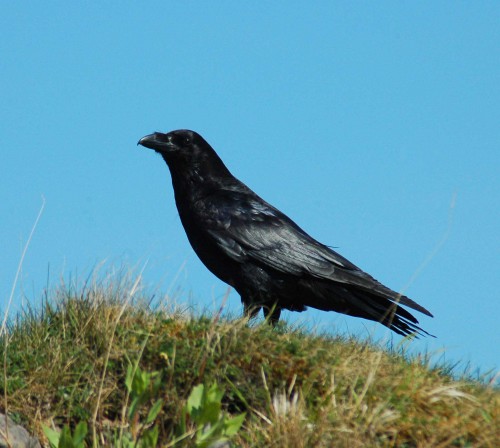
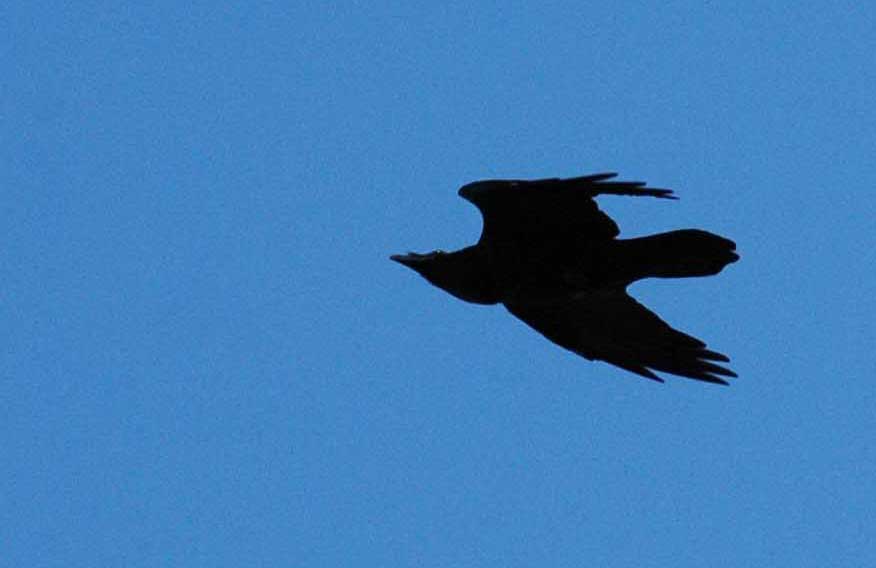
The raven is Britain’s largest corvid (crow). Plumage is black and highly glossy in appearance, with bright sunlight bringing forth purple and green highlights; the tail is wedge-shaped. The bill is massive; adapted to pull apart raw flesh it’s an essential tool for a bird which scavenges on dead animals.
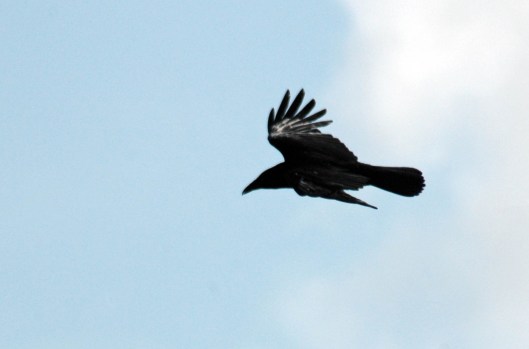
A flying raven showing the wedge-shaped tail and dead-mans fingers at wing tips

A flying raven showing the wedge-shaped tail and dead-mans fingers at wing tips

VOICE

Their call is distinctive, a deep croaking sound, known as ‘gronking’ which often alerts me to look up to watch one flying overhead and that is surely one of the most evocative sounds of Britain’s uplands.

Raven calling whilst flying

Raven calling while flying

TERRITORY

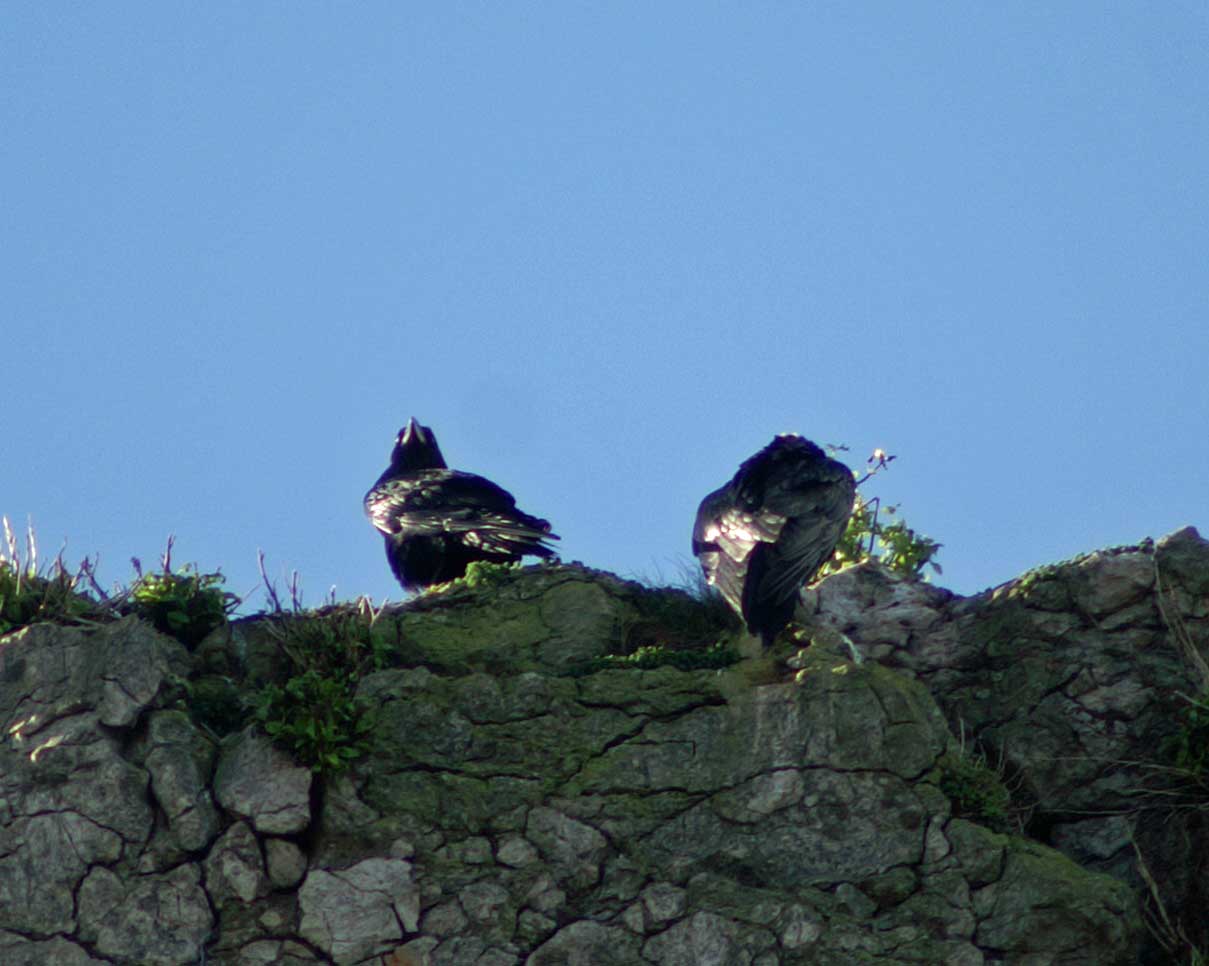
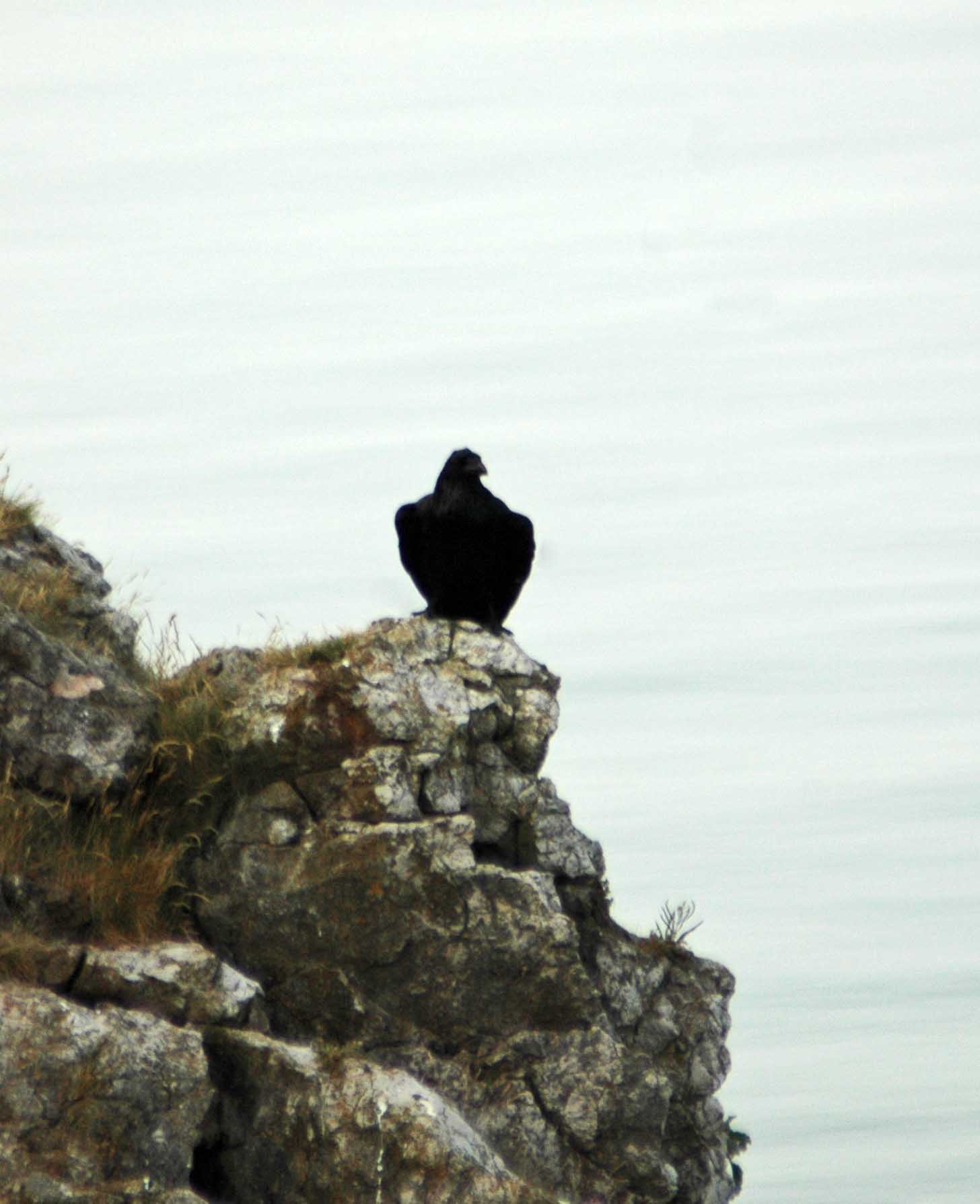
The Little Orme’s resident ravens are the avian monarchs of this cliff. They are often seen sitting together on the cliff edge from where they survey their realm, gleaming regally in the sunshine, occasionally lifting their heads to gronk at passing birds or at the empty sky. They have no need to defend their territory as the mere physical presence of these powerful birds is enough to establish their claim to it. But as with other species of birds, when nesting they may become more defensive and will attack anything they perceive to be a threat.

Raven pair in a favoured spot on the clifftop

Raven pair in a favoured spot on the clifftop

When they are not ensconced there, another favoured spot for perching is further up towards the summit atop a rocky ridge. They can sometimes be found flying along the cliffs and across the summit.

The male of the pair may also be found at the sea edge of the cliffs where he spends long minutes hunched on a ledge gazing out to sea watching for potential invaders.
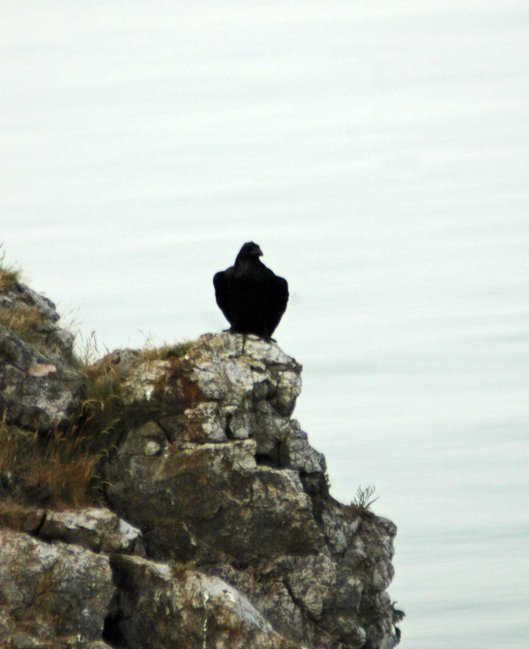
July- Raven looking out to sea

July- Raven looking out to sea

FLIGHT

The everyday flight of the raven is direct, strong and steady, but it can also glide and soar freely and put on an impressive aerobatic display. In spring particularly, pairs of ravens tumble together high in the air, wings half-closed, rolling over sideways and nose-diving. They also have the trick of flying upside down for short distances. Perhaps these aerobics are part of the raven’s courtship display, but they may also perform for the joy of it and just because they can.

16/9/15-Raven flying sideways

16/9/15-Raven soaring sideways

FOOD

Ravens are sometimes regarded as the vultures of sheep country as they patrol in a pair or as a family group, searching for carrion or an ailing sheep or deer which they will watch and wait to die. They will eat almost anything, mainly carrion and small animals, but also insects, shellfish and even grain and acorns.

NESTING

The Little Orme’s ravens return to the same nest each year, adding new material to renovate it as they need to. In the years I have watched them, they have raised only one or two young each year.

Both sexes build a nest of sticks cemented together with mud and bound and lined with moss and sheep’s wool or whatever is available locally, it is shaped into a deep cup, preferably on a ledge or in a crevice. They are amongst the earliest of birds to produce eggs, between February & April. There may be 4-6 eggs, pale green or blue with dark markings. Incubation, by the female only, takes about 19 days. Nestlings are fed by both parents until they leave at about 6 weeks.

31/5/14-Young raven on the nest almost ready to leave

31/5/14-Young raven on the nest almost ready to leave-Little Orme

MYTHOLOGY & FOLKLORE    

The raven is probably one of the world’s most intelligent and playful bird. Modern experiments have shown that they can count up to 8. Our hunter-gatherer ancestors would have observed the keen intelligence of this bird. It has a well-documented habit of deliberately revealing the whereabouts of deer, so that hunting wolves can find their quarry and leave spoils, which the ravens could eat. Even modern deer-stalkers have reported ravens helping them to locate deer, as the birds know that they will receive the ‘gralloch’ or guts after the deer is killed.

Paradoxically it has also been regarded as a bird of ill-omen. The old collective noun for a group of ravens is an ‘unkindness’, perhaps because of its harsh call and its presence as a scavenger at scenes of death.
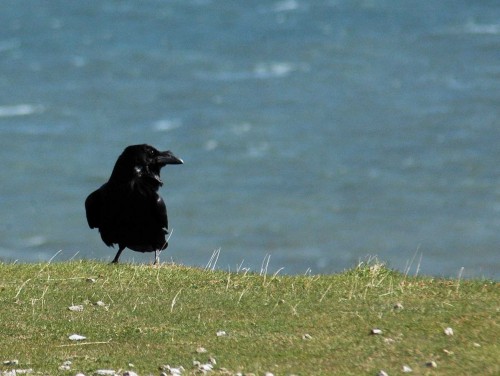
150428TGLO-Raven on cliff edge 2

In the Old Testament of the Bible, the raven was the first bird Noah sent to look for land, and Elijah is described as being provided for by ravens. They are used as a symbol of God’s providence in both the New Testament and in Christian art.

There is probably more folklore concerning the raven than any other bird in Britain.

In Welsh folklore, Bran the Blessed, the brother of Branwen (Bran is Welsh for raven) is a deity and a guardian of Britain whose totem is a raven. According to the Mabinogion, Bran ordered for his own head to be cut off,  after which it could still speak words of prophecy. Eventually it was said to have been buried beneath Tower Hill, at the Tower of London as a talisman against invasion.

The presence of ravens at the Tower is an echo of this legend and the prophecy says that if the ravens ever leave the tower, the Kingdom of England will fall, hence their wings are clipped as a precaution. It is thought that there have been at least six ravens in residence at the tower for centuries. Charles II reputedly ordered their removal following complaints from John Flamsteed, the Royal Astronomer. However, they were not removed as Charles was then told of the legend. Charles, following the time of the English Civil War, superstition or not, was not prepared to take the chance, and instead had the observatory moved to Greenwich.

Odin, the chief of the Norse gods, was accompanied by a pair of ravens, Hugin (thought) and Munin (memory), who would fly far and wide to bring news to Odin. One of Odin’s names, Hrafnagud, means the ‘Raven God’.
Share this:

  • Share on Facebook (Opens in new window) Facebook
  • Share on Pinterest (Opens in new window) Pinterest
  • Share on X (Opens in new window) X
Like Loading...

Llechwedd Slate Caverns

25 Tuesday Aug 2015

Posted by theresagreen in Nature of Wales, North Wales

≈ 4 Comments

Tags

Llechwedd Slate Caverns, slate, slate mining in North Wales

Thus far this week the weather has been damp and grey with only intermittent bursts of sunshine, so I opted for a couple of days of not going out walking and instead spending some time sorting through a backlog of photographs. It’s been interesting, not least because some of them are from this time last year and guess what? The weather was damp and grey with only intermittent bursts of sunshine.

140826TGNW-Llechwedd Slate Mine (42)

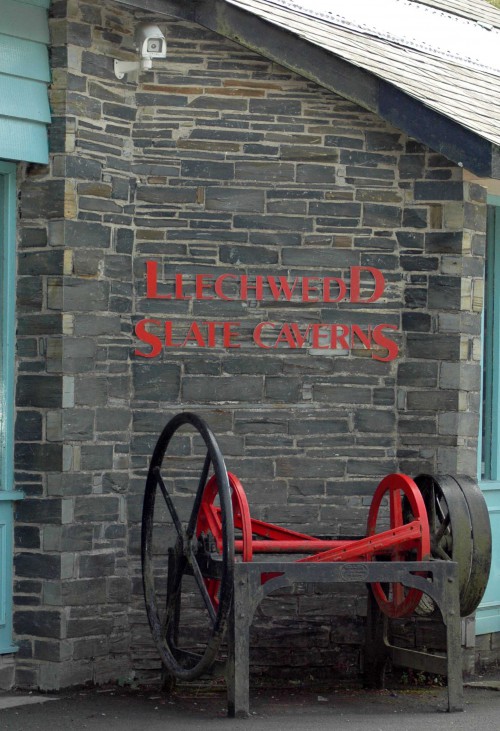
My family were visiting at the time and were keen to try out the then newly-opened giant underground trampoline  that is located within the Llechwedd Slate Caverns at Blaenau Ffestiniog. The idea of the bouncing didn’t much appeal to me, but it’s been a few years since I visited the site and as an extra car + driver was needed I was happy to oblige and to wander around while they all sought underground thrills.

Llechwedd Slate Mines

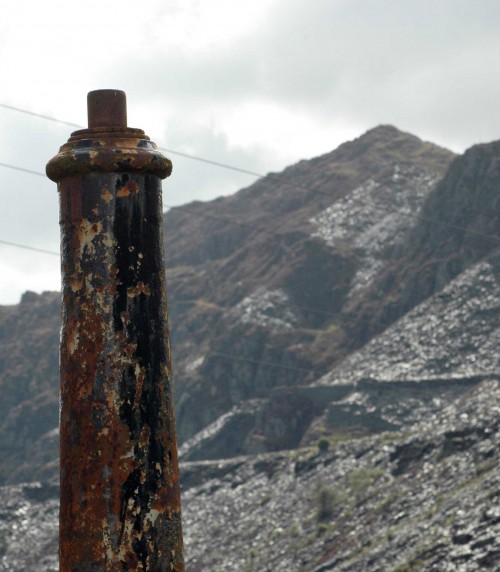
The former Llechwedd Slate Caverns underground slate workings extend deep below the ground and most consist of huge caverns. Several of those near to the surface have been adapted to create one of the most popular visitor attractions in Wales.

140826TGNW-Llechwedd Slate Mine (43)

In late Victorian times the slate mining industry was largely confined to a few slate mines in North Wales. J.W.Greaves began extracting slate from the Llechwedd mines in 1836.  Since that time the high quality blue-grey slate is still in demand in many corners of the world. The company still produce a range of slate  products sold in the on-site shop and a range of architectural products sold throughout the country and within the European market place.

140826TGNW-Llechwedd Slate Mine (18)

The slate quarried at Llechwedd is blue-grey and of high quality

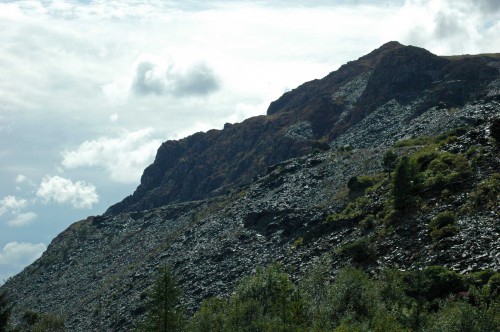
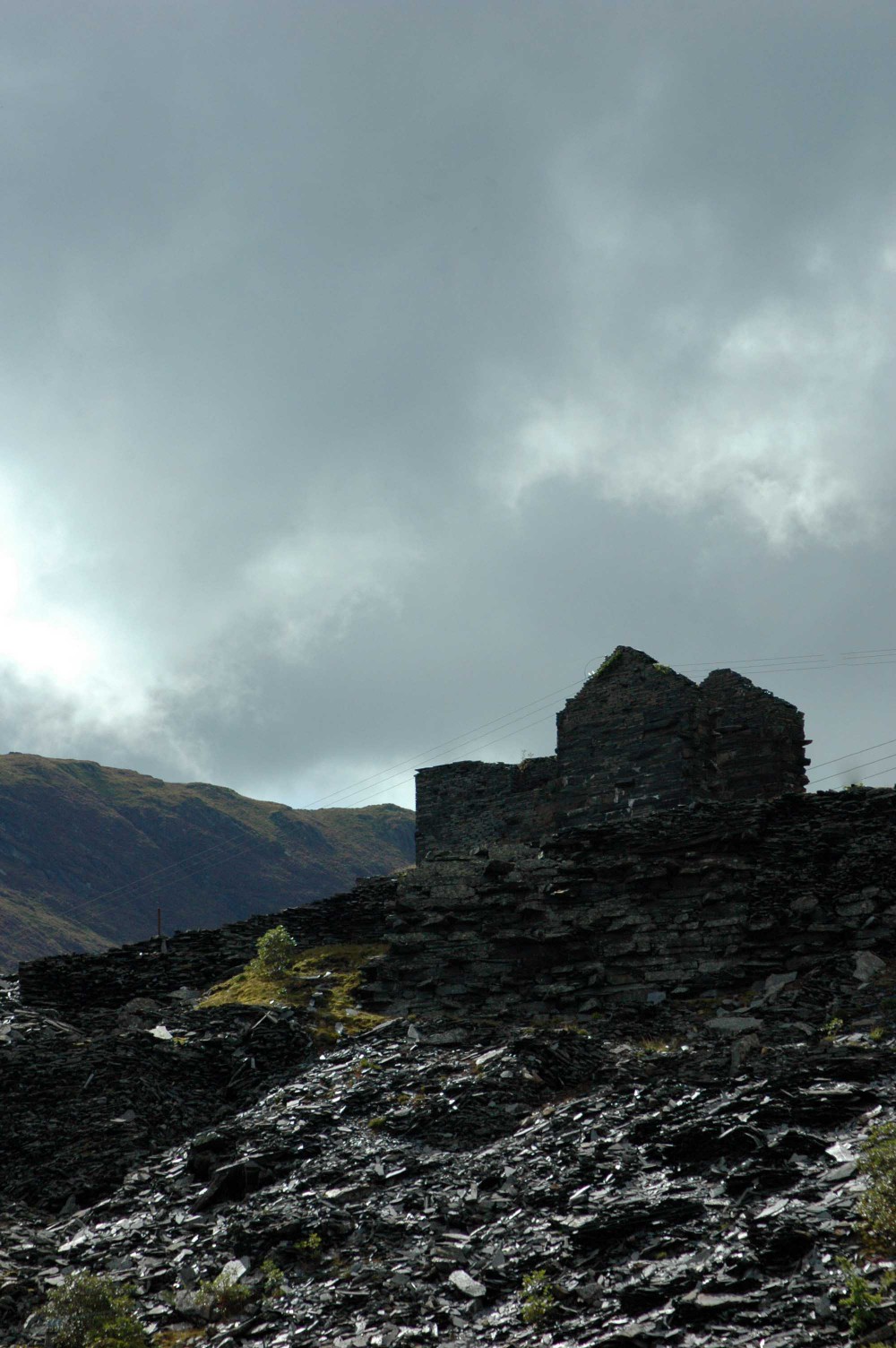
The evidence of slate quarrying and mining dominates the landscape of this whole area; it rains a lot here and when grey skies and blue-grey slate merge together it can create a somewhat depressing atmosphere. But it has great drama and when the sun does shine through the clouds it adds highlights and brings forth textures that change constantly.

140826TGNW-Llechwedd Slate Mine (12)

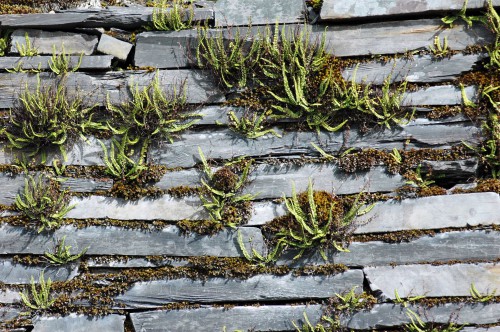
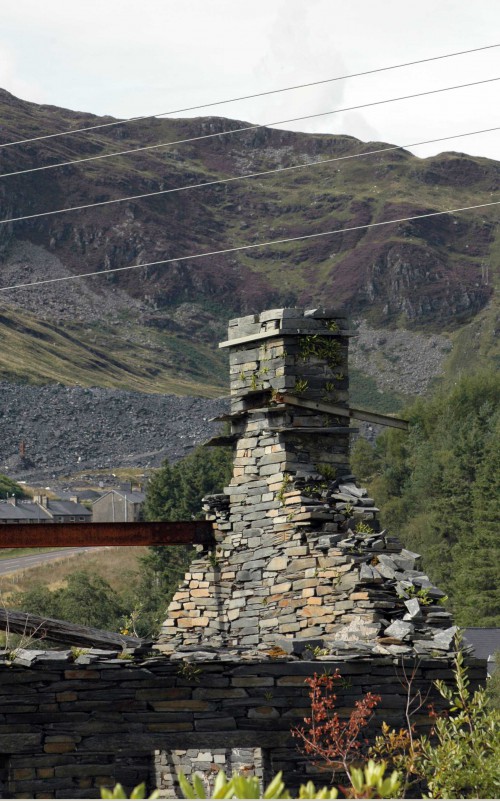
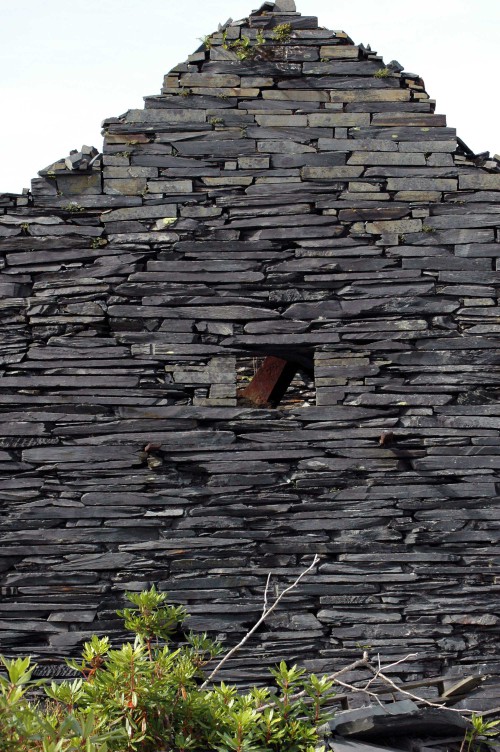
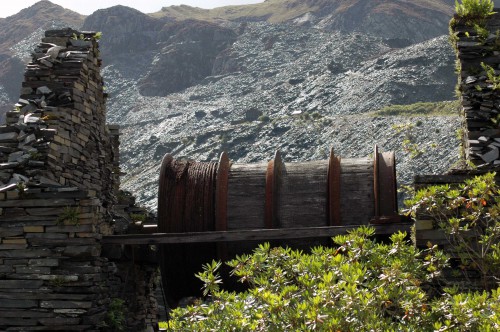
Buildings and boundary walls are constructed from slate and seem to have grown organically from the mountain and those no longer in use are simply being slowly re-absorbed.

140826TGNW-Llechwedd Slate Mine (10)

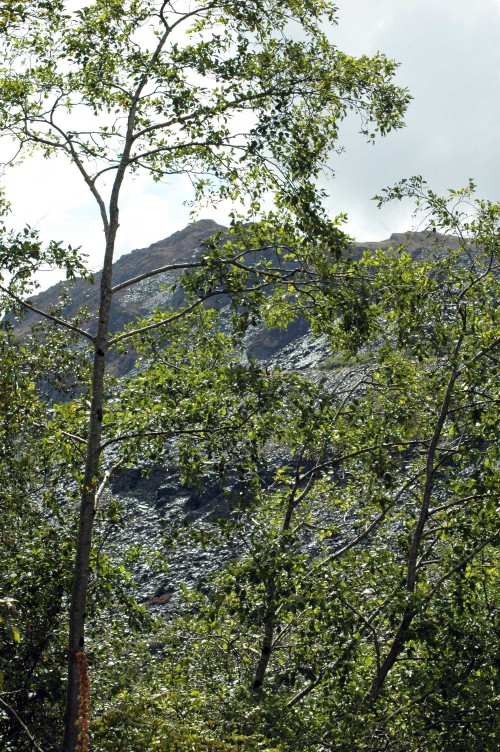
I liked the contrast of the graceful trees in front of the hard background of the hard slatey mountainside.

140826TGNW-Llechwedd Slate Mine (7)

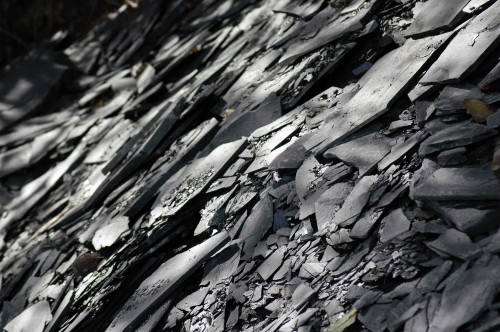
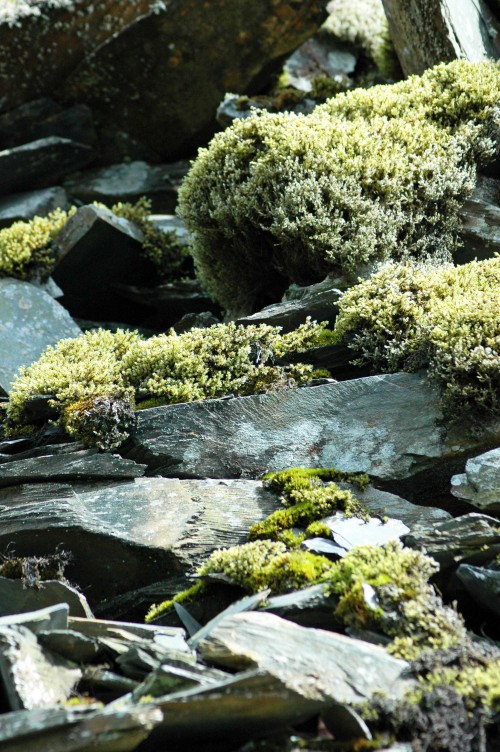
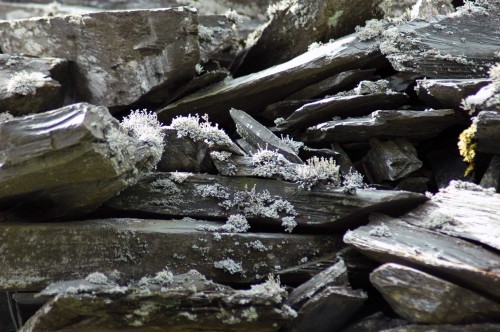
When left undisturbed mosses and lichens establish themselves on old slate piles.

140826TGNW-Llechwedd Slate Mine (1)

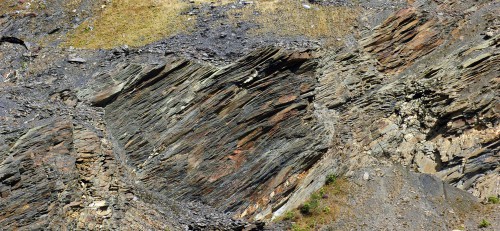
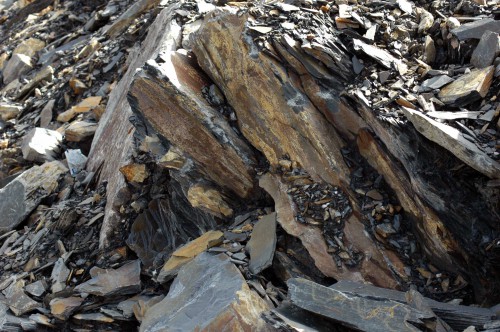
Slate is a fine-grained, foliated, homogeneous metamorphic rock derived from an original shale-type sedimentary rock composed of clay or volcanic ash through low-grade regional metamorphism. It is the finest grained foliated metamorphic rock.

140826TGNW-Llechwedd Slate Mine (6)

Foliation may not correspond to the original sedimentary layering, but instead is in planes perpendicular to the direction of metamorphic compression.

140826TGNW-Llechwedd Slate Mine (21)

Slate occurs in a variety of colors even from a single locality; slate from North Wales can be found in many shades of grey, from pale to dark, and may also be purple, green or cyan.

140826TGNW-Llechwedd Slate Mine (17)

Buildings on the site are deteriorating.

140826TGNW-Llechwedd Slate Mine (32)

140826TGNW-Llechwedd Slate Mine (35)

140826TGNW-Llechwedd Slate Mine (25)

140826TGNW-Llechwedd Slate Mine (36)

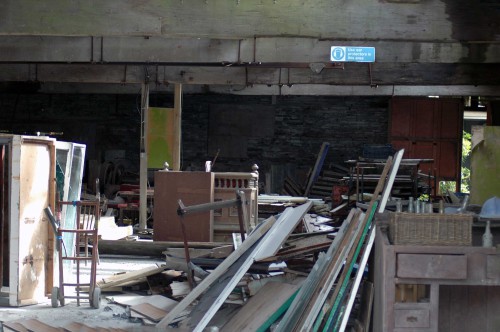
Inside a large shed – an eclectic collection of stuff gathering dust

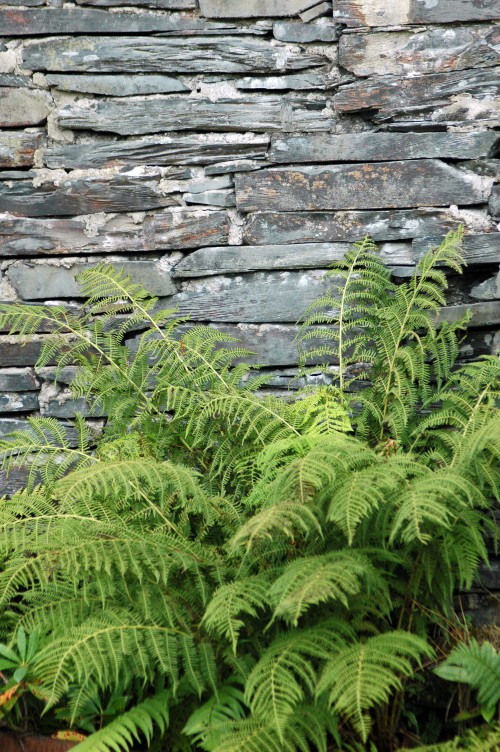
And outside a beautiful fern softens the slate wall

And outside a beautiful fern softens the slate wall

140826TGNW-Llechwedd Slate Mine (20)

A poignant reminder that this was once the workplace of a large number of men and boys who spent long hours underground.

140826TGNW-Llechwedd Slate Mine (15) 140826TGNW-Llechwedd Slate Mine (14)

A Ffestiniog Railway brake truck would have been loaded with slates and transported to Porthmadog

A Ffestiniog Railway brake truck that would have been loaded with slates and transported to Porthmadog

140826TGNW-Llechwedd Slate Mine (39)

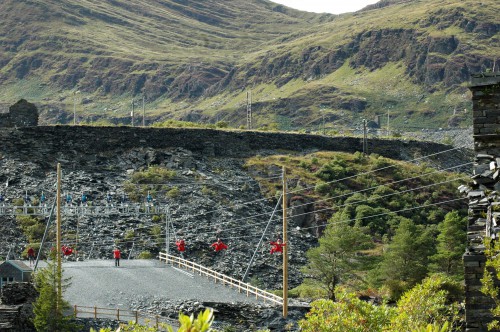
Evidence of a further modern attraction of the site appears in some of the photographs – zip lines stretching over 8km on which riders can reach speeds up to 70mph over moor, mountain and mine.

140826TGNW-Llechwedd Slate Mine (31)

Now that looks exhilarating!

Share this:

  • Share on Facebook (Opens in new window) Facebook
  • Share on Pinterest (Opens in new window) Pinterest
  • Share on X (Opens in new window) X
Like Loading...

Late Summer Specials

17 Monday Aug 2015

Posted by theresagreen in British hoverflies, Bryn Euryn Nature Reserve, butterflies, Butterflies of Wales, calcareous grassland, day-flying moths, Nature of Wales, nature photography, plants important to wilflife, Rhos-on-Sea, Wildflowers of Wales

≈ 2 Comments

Tags

ash keys, bee mimic hoverfly, cheilosa illustrata, common ragwort, ferdinandea cuprea, green-veined white, hawthorn berries, mating gatekeeper butterflies, Nature in August, purple hairstreak

August so far has brought mixed weather, days have been mostly warm, but many have been cloudy or overcast and occasionally there’s been some sunshine.

Looking across to Conwy Estuary

Looking across to Conwy Estuary from Bryn Euryn

It’s only been a week or two since my last visit to Bryn Euryn, but now rapidly approaching late summer, much has already changed. Many plants are setting seed, there are ripe wild raspberries, a few ripe blackberries and sloes, still as hard as bullets.

Purple sloes are swelling on Blackthorn

Purple sloes are swelling on Blackthorn

Last year there were sparse crops of acorns and sloes, this year may be more bountiful.

3/8/15-Wood avens seedhead

3/8/15-Wood avens seedhead

Large fruit capsules of the Stinking Iris

Large fruit capsules of the Stinking Iris

On a last hogweed flowerhead, a new-to-me, furry little hoverfly; it  is one of a number of species referred to as a bee mimic, but it  doesn’t really look like one.

Hoverfly-cheilosa illustrata- a bee mimic

Hoverfly-cheilosa illustrata- a bee mimic

Another hoverfly caught my eye, it was basking on a bramble leaf and as the sun caught it, the insect shone a bright metallic golden bronze colour.

Hoverfly-ferdinandea cuprea

Hoverfly-ferdinandea cuprea

About to enter the meadow, I caught sight of a Speckled wood butterfly basking on an Oak leaf. I moved in to take a photograph as I haven’t had many good opportunities with this species so far this year, then caught sight of another butterfly sitting on a leaf slightly higher up.

7/8/15 - Purple Hairstreak

7/8/15 – Purple Hairstreak

I moved in a little closer and realised this was a butterfly I had never seen before other than in pictures, a Purple Hairstreak. A species that spends most of its time in and around the tops of Oak trees, I was surprised and delighted to see it and tried not  to alarm it as I focussed the camera. It moved a little to reveal two small orange eyespots on its hindwing, but just as I had it back in focus the Speckled wood flew up and chased it away. I waited a while to see if it would return, but no luck. At least I know to look out for them here again!

The colours of the landscape are changing subtly. Hay has been cut and in many places baled and put safely under cover. Meadows of seeding long grass left standing have taken on a golden hue and on our limestone hill, the wildflowers typical of late summer are at the peak of their flowering. Most are ‘tough’ plants, Knapweed, Hemp agrimony & Ragwort, which are all imortant nectar sources for insects.

Late summer long grass and wildflowers

Late summer long grass and wildflowers, mostly hedge parsley and harebells

7/8/15-Knapweed with a view

It’s been a while since I had a good opportunity to photograph a Green-veined White, so I was pleased to see this fresh one on a Knapweed flowerhead.

3/8/15-Bryn Euryn

3/8/15-Bryn Euryn

Knapweed and Hemp Agrmony

Knapweed and Hemp Agrmony

Burnet moth on knapweed

Burnet moth on knapweed- wings faded and almost transparent

Also clinging to a knapweed plant was a pair of mating Gatekeepers; a perfect opportunity to see the difference between the male and female of the species, as helpfully, the female opened her wings to show the plainer upperside to her wings.

Mating Gatekeeper butterflies - female above male

Mating Gatekeeper butterflies – female above male

A good opportnity to show the upperside of the female

A good opportunity to show the upperside of the female

As anticipated by the abundance of flowers back in the spring, Ash trees are bearing thick bunches of ‘keys’.

Ash trees have heavy bunches of 'keys'

Ash trees have heavy bunches of ‘keys’

Acorns forming on Pedunculate Oak

Acorns forming on Pedunculate Oak

Haws are ripening and leaves beginning to take on colour

Haws are ripening and leaves beginning to take on colour

Walking close to gorse bushes the air is filled with the gentle sound of pods crackling as they open to release seeds.

Gorse pods crackle as they open to release seeds

Gorse pods crackle as they open to release seeds

Higher up on the steep slope near to the summit there is a stand of Ragwort growing with thistles.

Ragwort and thistles

Ragwort and thistles

And further round more Ragwort, this time interspersed with tall spikes of velvety Mullein.

Ragwort and Mullein

Ragwort and Mullein

The seedpods of Bird's-foot Trefoil are from where it takes it name

The seedpods of Bird’s-foot Trefoil are from where it takes it name

And a final shot of a Speckled Wood next to hypericum berries sums up the season, I think.

Speckled Wood & hypericum berries

Speckled Wood & hypericum berries

Share this:

  • Share on Facebook (Opens in new window) Facebook
  • Share on Pinterest (Opens in new window) Pinterest
  • Share on X (Opens in new window) X
Like Loading...

A sea-shore in waiting

11 Tuesday Aug 2015

Posted by theresagreen in Birdwatching on North Wales coast, coastal habitat, mussel beds, Nature, Nature of Wales, nature photography, North Wales, Rhos Point, Rhos-on-Sea, wading birds, Wales Coast Path

≈ Leave a comment

Tags

acorn barnacles, barnacle, common mussel, great black-backed gull, herring gull, mussel bed, mussel beds, mussel beds of Rhos-on-sea, Nature in August, periwinkle, Rhos Point, seashore in August, winkle

Rhos Point from the Little Orme

Rhos Point from the Little Orme

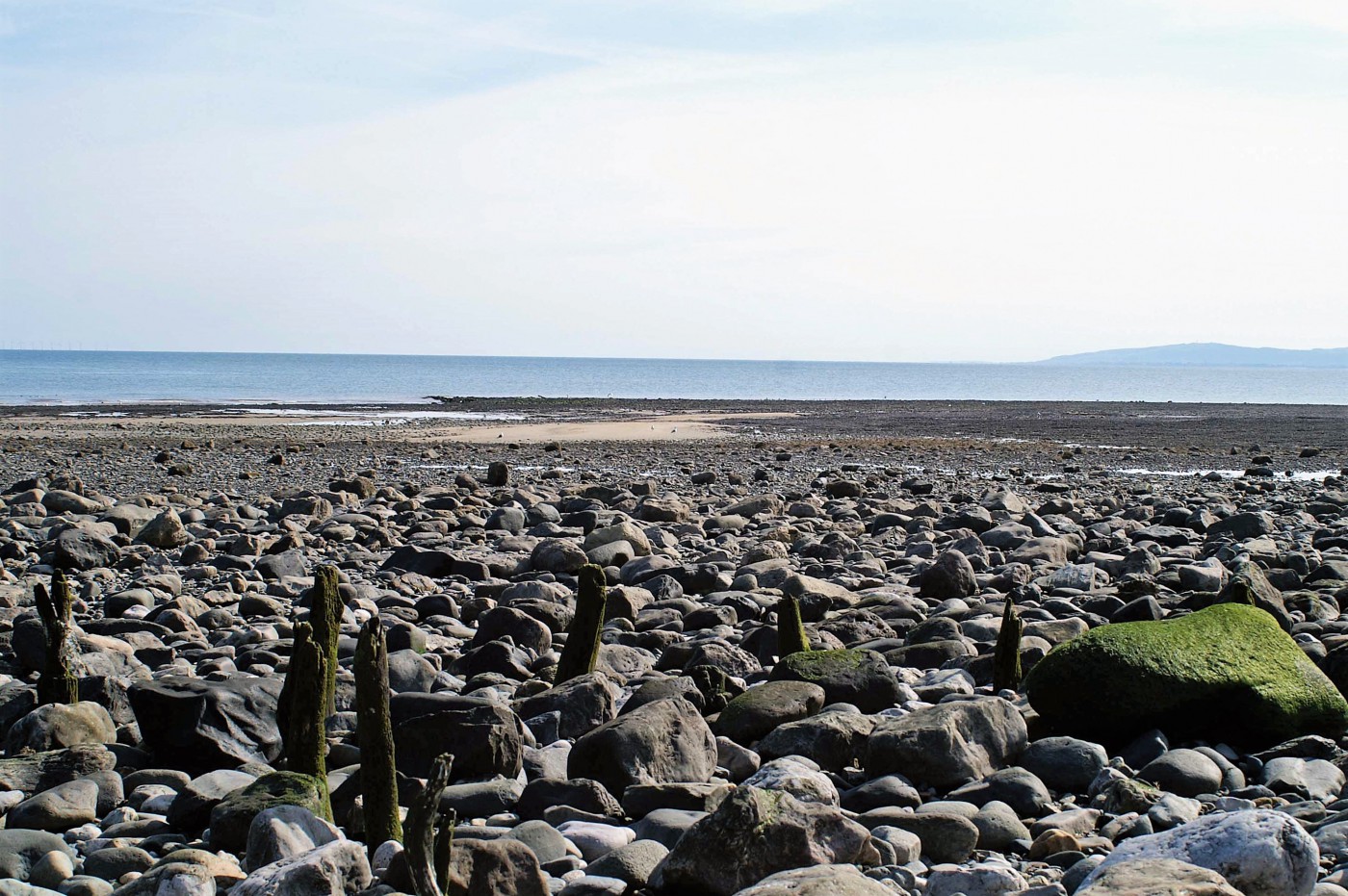
Rhos-on-Sea is a popular seaside venue that is busy with people visiting most of the year round, particularly at weekends and when the sun shines, but they don’t come here for its beach. The seashore, wrapped around the flat fortified headland of Rhos Point, is not the most beautiful in North Wales: a general first impression may well be of an expanse of flat shoreline littered with variously sized brown-coloured rocks and boulders. No easy strolling or picnicking here.

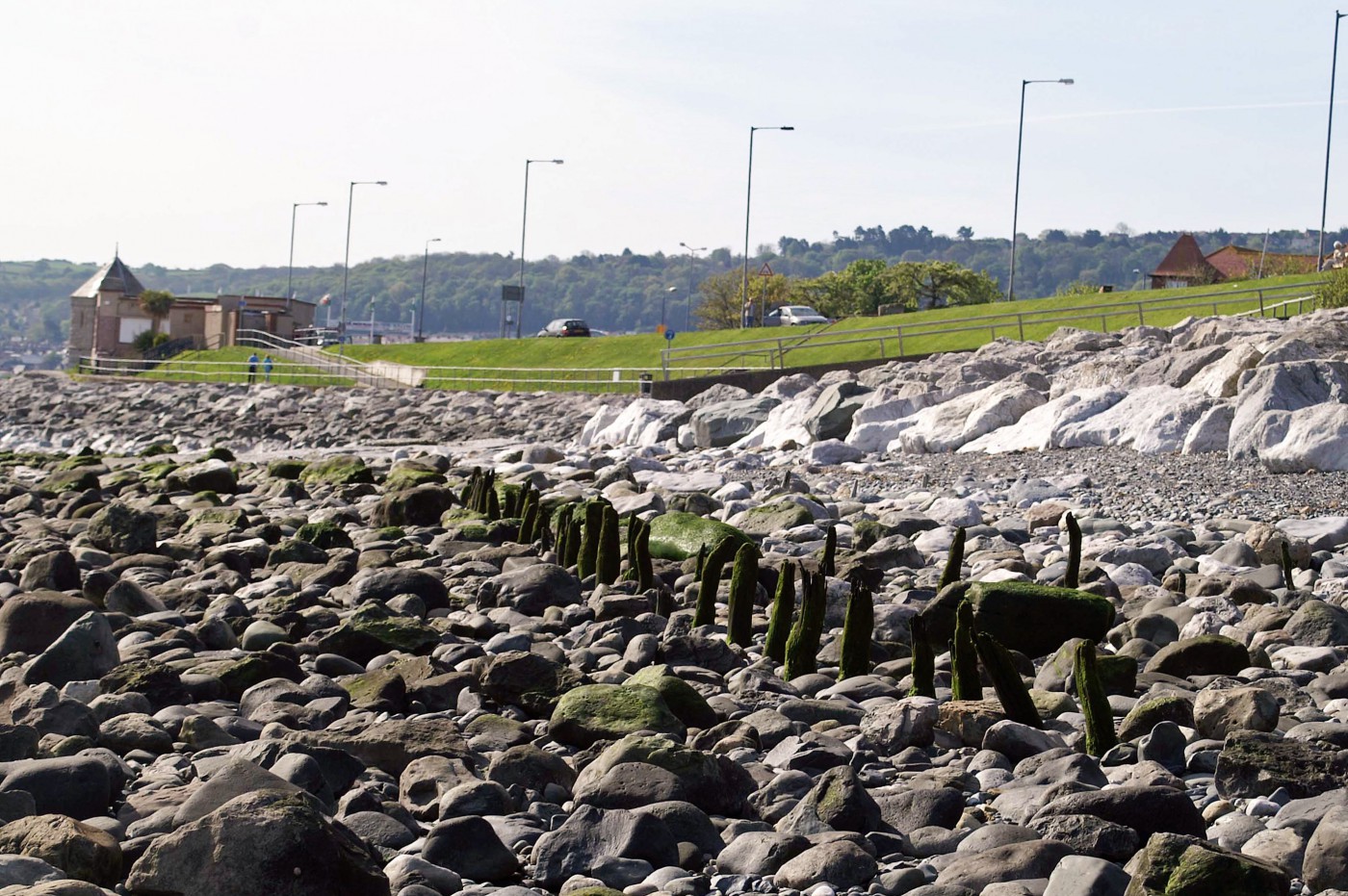
The stumps of posts are the remains of an ancient fishing weir

Rhos Point shore looking towards Colwyn Bay-the stumps of posts are the remains of an ancient fishing weir

The rocky shore of Rhos Point from Penrhyn Bay

The rocky shore of Rhos Point from Penrhyn Bay

However, between the rocky shore and the sea lies an expanse of long-established Mussel beds which is highly attractive to visitors – of the avian variety. Large numbers of a variety of species of sea and shore birds will be returning here this month from their summer breeding grounds to spend the autumn and winter to feast on the gourmet seafood on offer here.

Rhos Point across the rock strewn shore to the mussel beds

Rhos Point across the rock strewn shore to the mussel beds

Part of the expanse of mussel bed beyond the rocks

Part of the expanse of mussel bed beyond the rocks on a sunny day

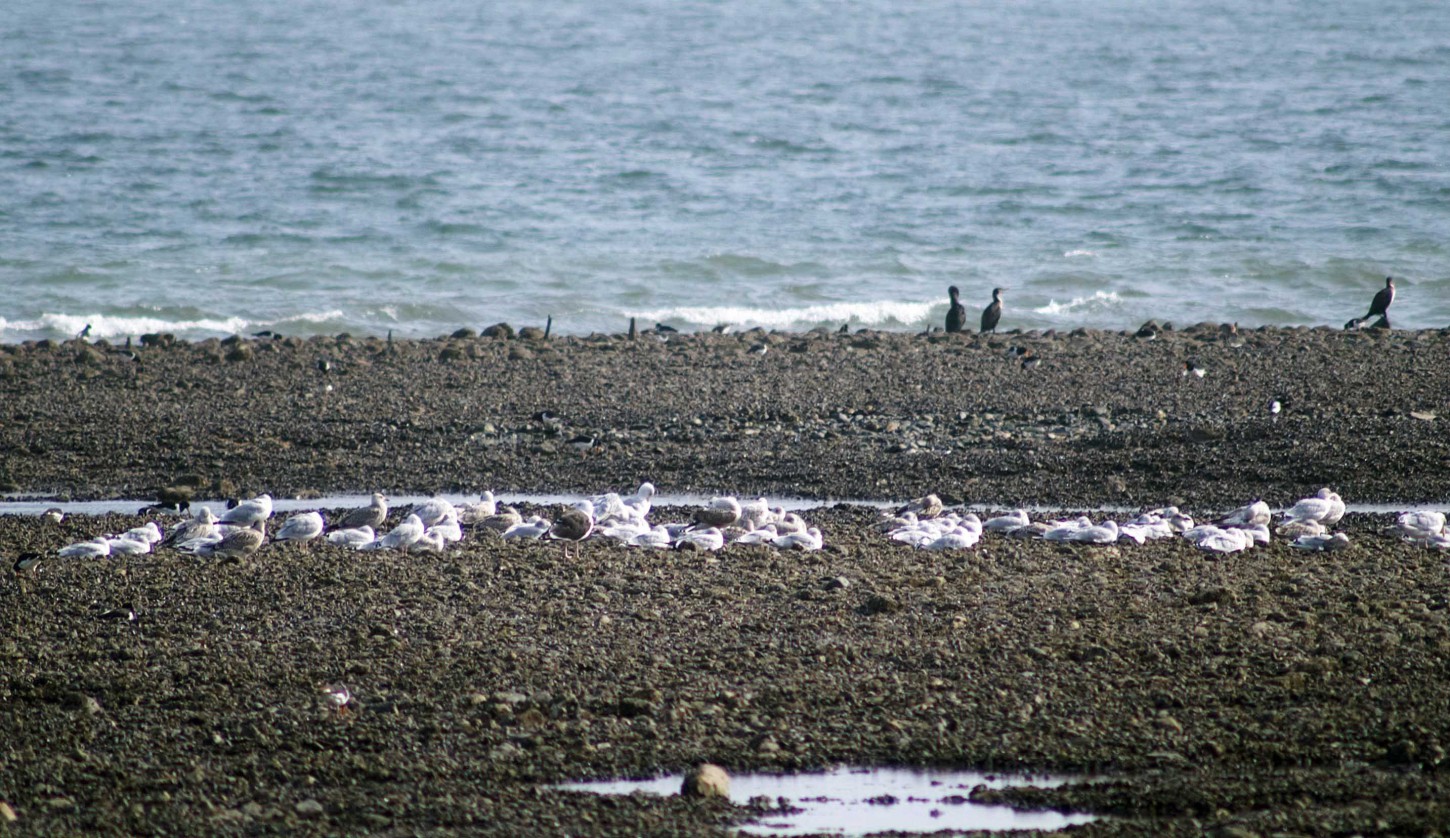
There may be a few early arrivals, maybe a Turnstone or two, but for now, approaching mid-August, the resident breeding birds, the Herring gulls, a smallish number of Lesser Black-backed gulls, Cormorants, plus a few Oystercatchers have the place more or less to themselves.

KONICA MINOLTA DIGITAL CAMERA

Great Black-backed gulls, adults & juveniles, Herring gull & Oystercatchers

Rhos Point shoreline with fishing weir posts cormorants & gulls

Rhos Point mussel bed, juv. cormorants, oystercatchers & gulls

Soon they will be joined by large numbers of Curlews, Redshanks, more Oystercatchers, Turnstones, Dunlins, Ringed Plovers and Sandwich Terns. If we are lucky there may be a few Purple Sandpipers in the mix, and there will doubtless be a few temporary visitors stopping to feed before escaping to warmer climes. There will be Rock Pipits and Pied Wagtails amongst the huge rocks of the sea defences. So much to look  forward to!

Without the movement and cries of the absent birds the landscape appears harsh, a sombrely coloured, barren place devoid of life. But look more closely and you’ll see it is in fact a living landscape, richly populated by hosts of small sea creatures, which is of course why the birds head here for the winter.

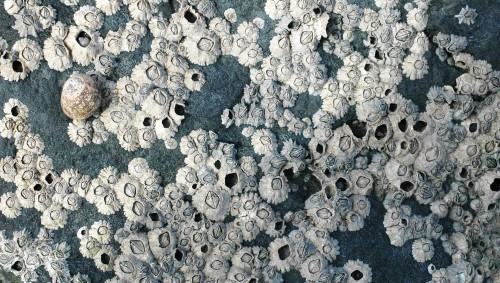
On close inspection, the rocks that appear a uniform brown colour from a distance are actually encrusted with colonies of barnacles, millions of them.

Barnacles and winkles cover the surface of a rock

Barnacles cover the surfaces of rocks

Acorn barnacles

Acorn barnacles

Barnacles and winkles

Barnacles and winkles

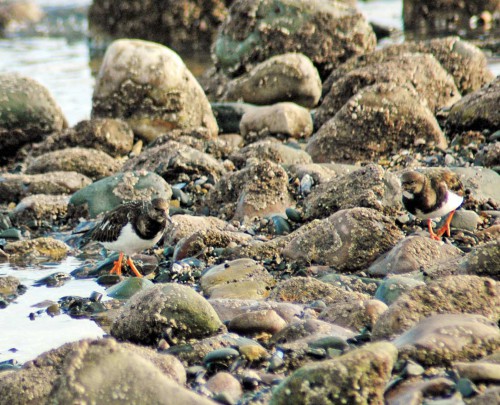
Turnstones camouflaged amongst the barnacle-covered rocks

Turnstones will be perfectly camouflaged amongst the barnacle-covered rocks

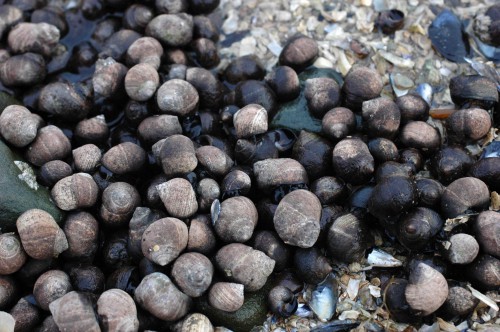
Winkles, or periwinkles are numerous too.

Winkles

Common periwinkle or Winkle-Littorina littorea

At low tide, cross the rocks, skirting the pools of shallow water left behind

Rock pool

Rock pool with more winkles

A flower of the sea -Beadlet anemone - Actinia equina

A flower of the sea -Beadlet anemone – Actinia equina

and soon the crunch of shells accompanies every footstep, as you are literally walking across the surface of a dense mass of living Mussels. It’s a very strange feeling.

Live mussels

The Mussel bed – live mussels amongst empty shells

You realise now why you see mussel shells everywhere.

Mussel shells under water

Mussel shells under water

141017TGNW4-Seashells mixed & crab legs

Live mussels & a live cockle amongst empty shells and crab claws

Mussel shells on the tide line of Rhos Harbour beach

Mussel shells on the tide line of Rhos Harbour beach

All is ready for the avian invasion.


Share this:

  • Share on Facebook (Opens in new window) Facebook
  • Share on Pinterest (Opens in new window) Pinterest
  • Share on X (Opens in new window) X
Like Loading...

Beetles, bugs and spiders

03 Monday Aug 2015

Posted by theresagreen in Beetles, Bryn Euryn Nature Reserve, Insects, Nature, Nature of Wales, nature photography, North Wales, plants important to wilflife, spiders, Wildflowers of Wales

≈ 7 Comments

Tags

crab spider, flowering in July, froghopper, green shield bug, harebell, hogweed, mating red beetles on flowers, Nursery Web spider, red soldier beetle, red-legged shield bug, spider that makes web tents in grass, strangalia maculata, sulphur beetle, wild thyme, yellow and black beetle

July 15th

In the woods I spotted this extremely tiny froghopper, but only because he was struggling to extricate himself from a spider’s web built in ivy climbing up a tree trunk.

Tiny froghopper
Tiny froghopper
Tiny froghopper enlarged

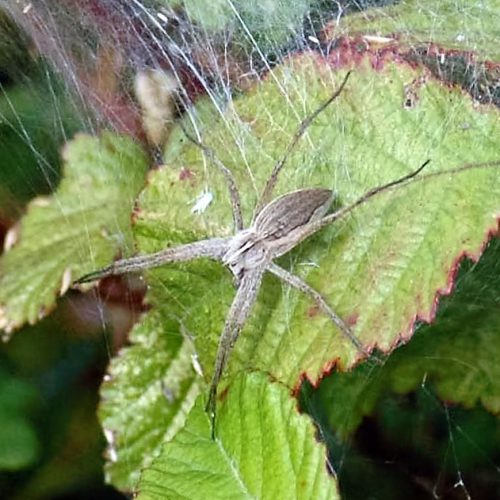
150712TG-Bryn Euryn-Adder's Field (10)-Nursery-web spider 1In the meadow, the Nursery-web spider would probably have escaped my notice too if I hadn’t been trying to get closer to a butterfly in the brambles. More used to seeing this species web ‘tents’ on the ground in the grass, I wouldn’t have realised who had built this one if I hadn’t seen her guarding it.

Nursery web spider on brambles

There are some lovely wildflowers in bloom in the meadow amongst the grass, my current favourite are the delicate-looking harebells,

150710tg-Bryn Euryn-flwr-Harebells 1

although I have always been fond of the sunshine yellow Lady’s Bedstraw

150712-46-Bryn Euryn-lady's bedstraw patch

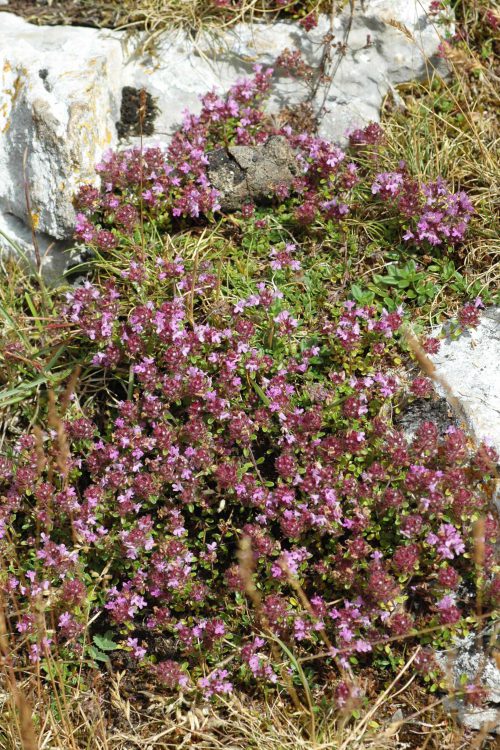
but then there’s the Wild Thyme that is looking spectacular this year where a large patch of it cascades down the limestone rocks.

150710tg-Bryn Euryn-flwr-Wild Thyme 1

There’s a Cat’s Ear plant near that spot too, which nicely demonstrates both the flowers and the seedhead ‘clocks’ simultaneously.

150710tg-Bryn Euryn-flwr-Cat's Ear 1

Hogweed works at another level and is an invaluable food source for a whole host of insects from beetles to butterflies.

150710tg-Bryn Euryn-flwr&vw-hogweed in long grass

Some of the insects feasting on the flowers today were Sulphur beetles, including dozens of tiny ‘baby’ ones

150712TG-Bryn Euryn-Adder's Field (15)-Small Sulphur beetles on hogweed 1
150712TG-Bryn Euryn-Adder's Field (19)-Sulphur beetle cloe-up
150712TG-Bryn Euryn-Adder's Field (21)-Sulphur beetle on hogweed

A 7-spot ladybird, a so-far un-named brown beetle

150712TG-Bryn Euryn-7-spot ladybird-Coccinella 7-punctata (3a)
150712TG-Bryn Euryn-Adder's Field (22)-no ID beetle

There were dozens of Red Soldier Beetles, many in the act of procreation as these beetles always seem to be. There was a little moth there with them, but again I haven’t discovered what it is yet.

150712TG-Bryn Euryn-Adder's Field (24)-Red soldier beetle
150712TG-Bryn Euryn-btl-Red soldier beetle-Rhagonycha fulva (7a)
150712TG-Bryn Euryn-btl-Red soldier beetle-Rhagonycha fulva (3a)
150712TG-Bryn Euryn-btl-Red soldier beetle-Rhagonycha fulva mating

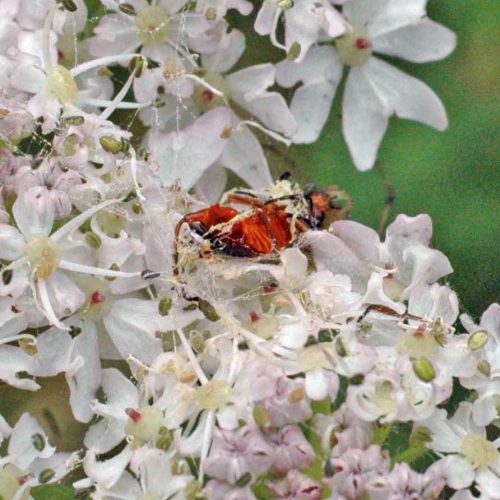
150712TG-Bryn Euryn-Crab spider victim trussed up

Whilst photographing a pair of mating Red soldier beetles, I noticed another beetle caught up in spider’s webbing. As I looked closer I spotted the head and front legs of a spider creeping up over the edge of the flower, then she darted out and begin to drag her victim backwards to where she had appeared from. This was a Crab spider, mistress of camouflage and deadly to insects that stray into her path regardless of their size. Cruel, but fascinating and quite a feat as the beetle was as least equal in size to her.

150712TG-Bryn Euryn-Adder's Field (26)-Crab spider dragging victim to edge of flower
150712TG-Bryn Euryn-Adder's Field (27)-Crab spider with victim 1

Crab spiders are able to change their body colour to match their background. The process can take a few days, but they can appear white, yellow or green. The  irony of this scene struck me; a beetle life ended in full view of a pair of his kind in the act of procreating the species….

150712TG-Bryn Euryn-Adder's Field (29)-Crab Spider rear view
150712TG-Bryn Euryn-Adder's Field (28)-Spider crab securing victim

The Crab spider show would take some beating, but my ‘discovery of the day’ was quite definitely a splendid large yellow and black beetle, Strangalia maculata, that surprisingly doesn’t appear to have a common name.

150712TG-Bryn Euryn-btl-Strangalia maculata (1a)
150712TG-Bryn Euryn-btl-Strangalia maculata (10a)
150712TG-Bryn Euryn-btl-Strangalia maculata (7a)
150712TG-Bryn Euryn-btl-Yellow & black beetles 1

On another flowerhead another spider lurked, this time a small brown one, much enlarged in the photograph.

150710tg-Bryn Euryn-bug-Shield bug 1In the long grass I spotted an insect flying and managed to keep an eye on where it landed, otherwise I would never have found it; a Gorse Shieldbug.

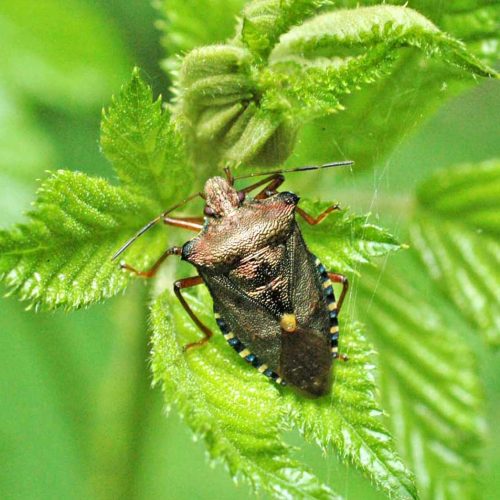
A bright fresh bronzy-coloured forest bug was more easily spotted.

150712TG-Bryn Euryn -bug-Forest bug-Red-legged ShieldbugPentatoma rufipes (1a)

Red-legged shield bug-Pentatoma rufipes

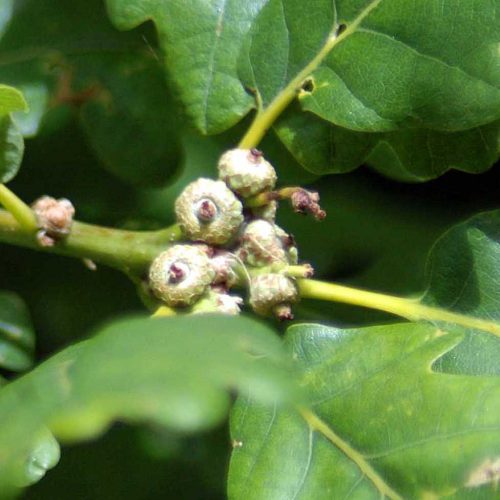
A peek at the oak trees revealed tiny acorns. The ones I photographed belonges to a  Sessile Oak – the acorns sit flat rather than hanging on stems as those of the Pedunculate Oak. Hopefully this will be a better year for them than last year was.

150710tg-Bryn Euryn-tree- Sessile Oak-baby acorns

Rain clouds were gathering – is it really summer?

150712TG-Bryn Euryn-view (3)

Highlighted text for Shieldbugs are links to more details about these insects in my ‘Species Collections’.
Share this:

  • Share on Facebook (Opens in new window) Facebook
  • Share on Pinterest (Opens in new window) Pinterest
  • Share on X (Opens in new window) X
Like Loading...
Butterfly meadow

02 Sunday Aug 2015

Posted by theresagreen in Bryn Euryn Nature Reserve, butterflies, Butterflies of Wales, Nature, Nature of Wales, nature of woodlands, nature photography, Wildflowers of Wales, woodland wildflowers

≈ 5 Comments

Tags

aphantopus hyperantus, argynnis aglaja, dark green fritillary, Gatekeeper, maniola jurtina, Meadow Brown, pyronia tythonus, Ringlet, small skipper, thymelicus sylvestris

In the meadow the grass is long and beginning to turn golden brown as it sets seed.

The meadow grass is long , brightened by patches of yellow Lady's Bedstraw

The meadow grass is long , brightened by patches of yellow Lady’s Bedstraw

Bright golden yellow patches of Lady’s Bedstraw, scented like new mown hay catch my eye.

Lady's Bedstraw-Galium verum

Lady’s Bedstraw-Galium verum

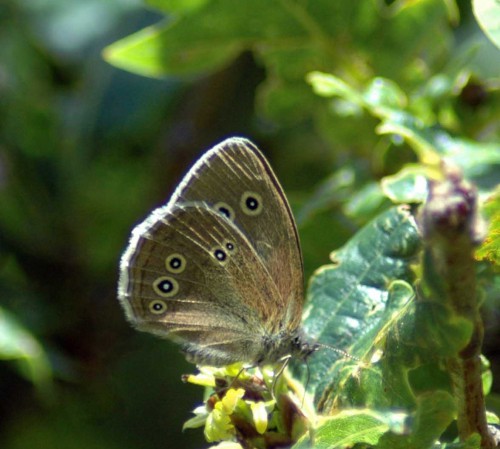
At this end of the field there are more brambles and I spot several dark brown butterflies flying low down along the length of them. It was a while before any settled for long enough to see properly what they were. As I hoped, some were dark, chocolatey brown Ringlets.

Ringlet butterfly on bramble leaf

Ringlet butterfly on bramble leaf – wings of butterflies that frequent brambles often get torn on prickles

One Ringlet male was clearly patrolling a territory. The brambles fill a corner of the field; he was flying to one ‘end’ of the patch, turning around, flying to the other end, then where the bramble curves around the corner he cut across to the other side of the track, flitted a short way through the long grass then back across the track to the brambles. Occasionally he paused for rest or to skirmish with intruders.

An undamaged Ringlet

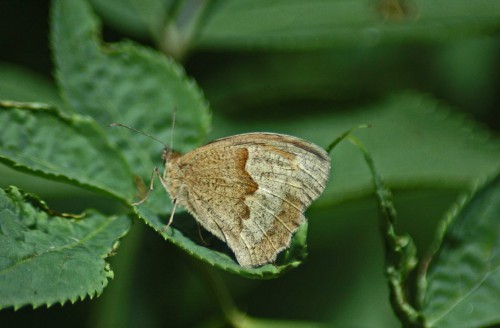
As well as Ringlets there were Meadow Browns, some of which were also coloured dark brown, hence my initial hesitation identifying the Ringlets. It’s quite unusual to see Meadow Browns resting with their wings fully open and it is interesting to see how variable this species is in size and colouring.

A dark coloured Meadow Brown

The male  Meadow Brown is darker brown than the female and may not have orange patches

A lighter shaded Meadow Brown

A lighter shaded female Meadow Brown

Medow Brown underside

Meadow Brown (male) underside showing orange underwing and eyespots

More usual view of a Meadow Brown underside

Meadow Brown underside-female

I was pleased to see a lovely fresh Gatekeeper here too, my first one for this year. This one was a male;  he has dark scent scale patches in the centre of the forewings which females don’t have.

Gatekeeper

Gatekeeper-Pyronia tithonus

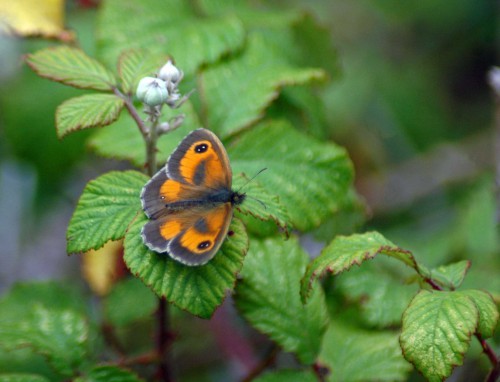
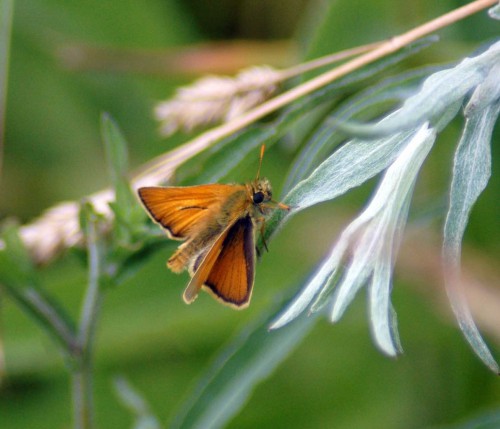
In the opposite corner of the field there are more brambles; there were more Meadow Browns here and little golden brown Skippers that happily are abundant here and that also occur in other nearby locations, particularly on the Little Orme.

Small Skipper has orange-brown tips to antennae

Small Skipper (male) has a line of  black scent scales on forewings

There were a good number of these lovely little butterflies flitting about, expertly manoeuvering at speed between the long grass stems.

Small,or possibly Essex Skipper

Small Skipper-Thymelicus sylvestris

Ringlets are not widespread throughout the site, but rather occur in colonies in a few different locations. I walked on up past the top end of the field where I have found them in previous years, again on brambles. I was pleased to see there were; maybe half a dozen individuals, mostly flying around in the long grass in front of the brambles. Finally one flew up to feed on one of the last remaining flowers.

Ringlet

Ringlet feeding on the last of the bramble flowers

I was wondering what there was for the butterflies to feed on here now the bramble flowers are over, then saw one fly up onto a nearby oak tree. A closer look revealed it appeared to be feeding on something on a leaf surface, or maybe there were a few drops of moisture there.

  Last year I didn’t see any Ringlets at all, perhaps I missed their rather short season, which is just July-August, or maybe there were only a few which I overlooked. As they are here now there must have been some to generate this year’s brood. Now I wanted to know if there were any to be found in yet another spot I found them in the year before last, which is at the bottom of the ‘downland’ slope that leads up to the summit of the hill. Happily, there were indeed some there too. So, a good year for Ringlets.

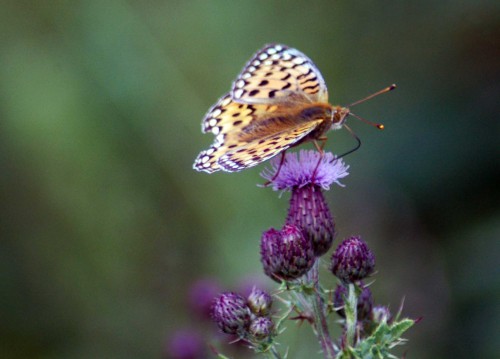
Emerging from the woodland onto the steep slope I had caught sight of a flash of orange flying over a stand of Rosebay Willow Herb, so headed off now to investigate that. It wasn’t long before I saw more orange flashes of speeding Dark Green Fritillaries, the most special butterfly treats of this reserve. This patch of the hillside and sometimes a spot on the other side of the hill are the only places I have seen them, Colonies are more plentifully populated some years than others.

Dark green Fritillary

Dark green Fritillary- Argynnis aglaja

The fritillaries were feeding mainly on thistles, for want of anthing much else. They would also feed on knapweed, but it’s not quite out yet and scabious, of which there is only a little flowering nearby.

150712TG-Bryn Euryn-bfly-Dk green fritillary 2

An older, more faded butterfly

There were perhaps 10-12 individuals, some faded, others much fresher.

150712TG-Bryn Euryn-bfly-Dk green fritillary 11

They are strong, fast flyers and glide on flat wings.

150712TG-Bryn Euryn-bfly-Dk green fritillary 13

On the hindwings there are silver spots on a dark green background

Share this:

  • Share on Facebook (Opens in new window) Facebook
  • Share on Pinterest (Opens in new window) Pinterest
  • Share on X (Opens in new window) X
Like Loading...

Summer along a Welsh Woodland Trail

30 Thursday Jul 2015

Posted by theresagreen in British hoverflies, Bryn Euryn Nature Reserve, bumblebees, butterflies, Butterflies of Wales, hoverflies, Insects, Nature, Nature of Wales, nature photography, wildflowers, Wildflowers of Wales

≈ 6 Comments

Tags

ash tree, episyrphus balteatus, eristalis pertinax, flesh-eating fly, hedge woundwort, helophilus pendulus, hypericum montanum, large pied hoverfly, marmalade fly, Pale St John's Wort, sarcophoga carnaria, Stinking Iris-Iris foetidissima, syrphus ribesii, tapered drone fly, volucella zonaria, wild strawberry fruit, woodland flowers

Variable summer weather is perhaps more the norm here in North Wales than in some other parts of the UK, although we still feel hard done to when yet another day dawns doomed to be overcast. There are many compensations though, one of which is that when the odd sunny, or partially sunny day occurs, the insects come out in force in search of sustenance. I photographed all of the following along Bryn Euryn’s Woodland Trail during a fleeting sunny spell a couple of weeks ago.

The woodland trail

The shady woodland trail

On the edge of the trail a substantial bramble was still flowering and literally buzzing with insects, mostly hoverflies and bees. There were two butterflies, a Red Admiral and a Comma that were flying around rather frantically, both of which briefly (and separately) landed on my arm. Poor things were clearly overcome by the presence of both sun and nectar. I would have liked a more conventional shot of the Comma, this being the first I’d seen here this year, but it was taunting me from high over my head so this was my best view. I rather like it and it’s clear from the outline that it is a Comma.

The Comma insisted on playing hide and seek

The Comma insisted on playing hide and seek

The hoverflies were very active, not pausing for long but these are the ones I could get to fairly easily:

Volucella pellucens-Pellucid fly is the largest fly in Great Britain

Volucella pellucens- sometimes called the Pellucid fly, this is the largest fly of Great Britain

150712TG-Bryn Euryn-hvfly-Volucella pellucens (7)

A gorgeous Volucella zonaria

A gorgeous Volucella zonaria – my first sighting here

A Tapered drone fly-eristalis pertinax grooming its legs

A Tapered drone fly – Eristalis pertinax

Eristalis nemorum (interruptus)

Eristalis nemorum (interruptus)

A more distant view of a Helophilus pendulus

A more distant view of a Helophilus pendulus

A Syrphus sp hoverfly-Syrphus ribesii - one of the most common species

A Syrphus sp hoverfly-Syrphus ribesii – one of the most commonly seen species

A tiny Marmalade fly-Episyrphus balteatus, probably our most common hoverfly

A tiny Marmalade fly-Episyrphus balteatus, probably our most common hoverfly

There were bees too, including lots of tiny red-tailed and buff-tailed worker bumblebees that were way too quick for me to focus on.

Honey bee

Honey bee

A less charming insect to many, I find the Flesh-eating fly-Sarcophaga carnaria rather attractive to look at. I think the white feet complete the look, makes it look rather dapper.

Flesh-eating fly-Sarcophoga carnaria

Flesh-eating fly-Sarcophoga carnaria

The trees are still green and fresh-looking thanks to the rain and cooler weather, although those in the top right of the next picture are looking quite lacy.

150712TG-Bryn Euryn-looking up into an ash tree

Looking up into an Ash tree

Continuing along the trail I hear a few birds letting the world know they are still about, Chiffchaff song bursts were fairly frequent, I heard Wrens and the contact calls of Blue Tits and plenty of corvid cawings. I found this feather too, maybe once belonging to a Magpie, it gleamed shades of almost peacock-blue in the dappled sunlight.

A corvid feather

A corvid feather

Honeysuckle is in flower now on the trail’s  edge and I couldn’t resist stopping to inhale its clean, fresh fragrance.

Lovely scented honeysuckle

Lovely scented honeysuckle

There is purple Hedge woundwort too, which has an earthy pungent, nettle-like scent.

Pungently scented Hedge Woundwort

Pungently scented Hedge Woundwort

Foxgloves are almost over-flowering reduced to the tips of the long bent-over  stems

Foxgloves are almost over-flowering reduced to the tips of the long bent-over stems

Wood sage-Teucrium scorodonia

Wood sage-Teucrium scorodonia

And a St John’s Wort I’d not spotted before, which I think is hypericum montanum, but happy to be corrected as always.

Pale St John's Wort-Hypericum montanum

Pale St John’s Wort-Hypericum montanum

A rather unusual plant grows here in the shady woodland, delightfully named the Stinking Iris and sometimes the ‘Roast-beef Plant’, both names allude to the sweetly acrid smell, like ‘high’ meat. This is one of just two Iris species native to the UK; the other is the Yellow Flag Iris.

The charmingly-named Stinking Iris-Iris foetidissima

The delightfully-named Stinking Iris-Iris foetidissima

Closer look at an Iris flower

Closer look at an Iris flower which is a greyish-mauve tinged with a brownish-pink

The much more common Nipplewort

The much more common Nipplewort-Lapsana communis

A Nipplewort leaf showing the path of a leaf-miner

A Nipplewort leaf showing the path of a leaf-miner

I picked a couple of ripe wild wild strawberries, trying not to think about the fly sitting on a leaf above them and their proximity to the path along which there is a regular procession of loose dogs….. They were delicious, regardless.

Sweet-tasting Wild Strawberries

Sweet-tasting Wild Strawberries

Turned off and took the steps up to Adder’s Field

Steps leading up to the meadow

Steps leading up to the meadow

more treats were in store there but there’s far too much to cram into one post, so will be continued….

Share this:

  • Share on Facebook (Opens in new window) Facebook
  • Share on Pinterest (Opens in new window) Pinterest
  • Share on X (Opens in new window) X
Like Loading...
← Older posts
Newer posts →
Follow everyday nature trails on WordPress.com

Enter your email address to follow this blog and receive notifications of new posts by email.

‘But it is the common species that keep the living world ticking over and provide most of our experiences of wildlife, and I would argue that maintaining the abundance of these is as important a conservation priority as maintaining the existence of rarities’. Richard Mabey

MOST RECENT POSTS

  • A Glimpse of Spring to Come January 22, 2025
  • Hunting the Wren December 28, 2024
  • Oh, Christmas Tree December 18, 2024
  • In and Out of the Ivy February 15, 2024
  • Nature’s Fireworks November 30, 2023
  • Wild Autumn along the Coast Path November 3, 2023

OLDER POSTS

LOOKING FOR SOMETHING IN PARTICULAR?

  • May Bee Appearing on Ivy near You
    May Bee Appearing on Ivy near You
  • Catchers, a Duck and Divers
    Catchers, a Duck and Divers
  • Sights and Sounds from the Little Orme 1
    Sights and Sounds from the Little Orme 1
  • Following a river to a Fairy Glen
    Following a river to a Fairy Glen
  • The life of a Yellow Dung-fly
    The life of a Yellow Dung-fly
  • The Windhover
    The Windhover
  • Butterflies and more rare treats
    Butterflies and more rare treats
  • Shades, Sounds and Scents of the Woods
    Shades, Sounds and Scents of the Woods
  • Fine Dining for Crows
    Fine Dining for Crows
  • A Windy Wildflower Trail
    A Windy Wildflower Trail

nightingale trails

The Walk of the Monarch Butterfly-Sendero de la Mariposa Monarca

The Walk of the Monarch Butterfly-Sendero de la Mariposa Monarca

MY WILDFLOWER BLOG: where the wildflowers are

Snowdrop

Snowdrop

most recent posts

Follow everyday nature trails on WordPress.com

Social

  • View teresamaygreen’s profile on Twitter

Enter your email address to follow this blog and receive notifications of new posts by email.

Website Built with WordPress.com.

  • Subscribe Subscribed
    • everyday nature trails
    • Join 358 other subscribers
    • Already have a WordPress.com account? Log in now.
    • everyday nature trails
    • Subscribe Subscribed
    • Sign up
    • Log in
    • Report this content
    • View site in Reader
    • Manage subscriptions
    • Collapse this bar
 

Loading Comments...
 

    %d