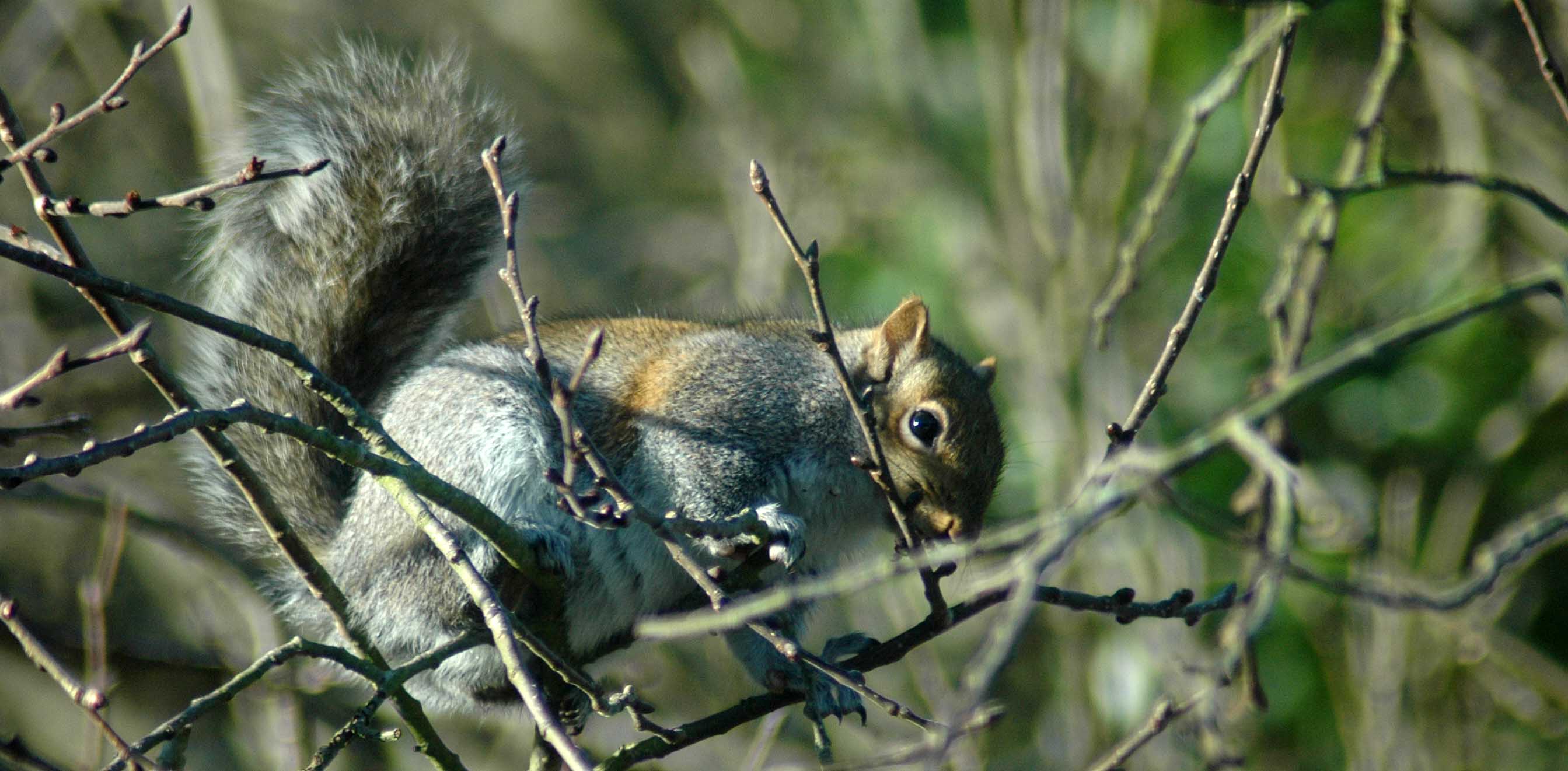
• Home
  • about
  • about the photographs
  • Local Nature Reserves
    • Bryn Euryn Local Nature Reserve
    • Mynydd Marian
  • Wales Coast Path
    • Grey Seals in North Wales
    • St.Trillo’s Chapel
    • Wildflowers of North Wales Coastal Paths, Cliffs and Dunes

everyday nature trails

everyday nature trails

Category Archives: Bryn Euryn Nature Reserve

Late Summer Specials

17 Monday Aug 2015

Posted by theresagreen in British hoverflies, Bryn Euryn Nature Reserve, butterflies, Butterflies of Wales, calcareous grassland, day-flying moths, Nature of Wales, nature photography, plants important to wilflife, Rhos-on-Sea, Wildflowers of Wales

≈ 2 Comments

Tags

ash keys, bee mimic hoverfly, cheilosa illustrata, common ragwort, ferdinandea cuprea, green-veined white, hawthorn berries, mating gatekeeper butterflies, Nature in August, purple hairstreak

August so far has brought mixed weather, days have been mostly warm, but many have been cloudy or overcast and occasionally there’s been some sunshine.

Looking across to Conwy Estuary

Looking across to Conwy Estuary from Bryn Euryn

It’s only been a week or two since my last visit to Bryn Euryn, but now rapidly approaching late summer, much has already changed. Many plants are setting seed, there are ripe wild raspberries, a few ripe blackberries and sloes, still as hard as bullets.

Purple sloes are swelling on Blackthorn

Purple sloes are swelling on Blackthorn

Last year there were sparse crops of acorns and sloes, this year may be more bountiful.

3/8/15-Wood avens seedhead

3/8/15-Wood avens seedhead

Large fruit capsules of the Stinking Iris

Large fruit capsules of the Stinking Iris

On a last hogweed flowerhead, a new-to-me, furry little hoverfly; it  is one of a number of species referred to as a bee mimic, but it  doesn’t really look like one.

Hoverfly-cheilosa illustrata- a bee mimic

Hoverfly-cheilosa illustrata- a bee mimic

Another hoverfly caught my eye, it was basking on a bramble leaf and as the sun caught it, the insect shone a bright metallic golden bronze colour.

Hoverfly-ferdinandea cuprea

Hoverfly-ferdinandea cuprea

About to enter the meadow, I caught sight of a Speckled wood butterfly basking on an Oak leaf. I moved in to take a photograph as I haven’t had many good opportunities with this species so far this year, then caught sight of another butterfly sitting on a leaf slightly higher up.

7/8/15 - Purple Hairstreak

7/8/15 – Purple Hairstreak

I moved in a little closer and realised this was a butterfly I had never seen before other than in pictures, a Purple Hairstreak. A species that spends most of its time in and around the tops of Oak trees, I was surprised and delighted to see it and tried not  to alarm it as I focussed the camera. It moved a little to reveal two small orange eyespots on its hindwing, but just as I had it back in focus the Speckled wood flew up and chased it away. I waited a while to see if it would return, but no luck. At least I know to look out for them here again!

The colours of the landscape are changing subtly. Hay has been cut and in many places baled and put safely under cover. Meadows of seeding long grass left standing have taken on a golden hue and on our limestone hill, the wildflowers typical of late summer are at the peak of their flowering. Most are ‘tough’ plants, Knapweed, Hemp agrimony & Ragwort, which are all imortant nectar sources for insects.

Late summer long grass and wildflowers

Late summer long grass and wildflowers, mostly hedge parsley and harebells

7/8/15-Knapweed with a view

It’s been a while since I had a good opportunity to photograph a Green-veined White, so I was pleased to see this fresh one on a Knapweed flowerhead.

3/8/15-Bryn Euryn

3/8/15-Bryn Euryn

Knapweed and Hemp Agrmony

Knapweed and Hemp Agrmony

Burnet moth on knapweed

Burnet moth on knapweed- wings faded and almost transparent

Also clinging to a knapweed plant was a pair of mating Gatekeepers; a perfect opportunity to see the difference between the male and female of the species, as helpfully, the female opened her wings to show the plainer upperside to her wings.

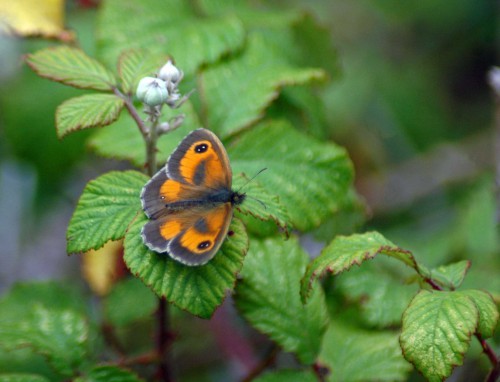
Mating Gatekeeper butterflies - female above male

Mating Gatekeeper butterflies – female above male

A good opportnity to show the upperside of the female

A good opportunity to show the upperside of the female

As anticipated by the abundance of flowers back in the spring, Ash trees are bearing thick bunches of ‘keys’.

Ash trees have heavy bunches of 'keys'

Ash trees have heavy bunches of ‘keys’

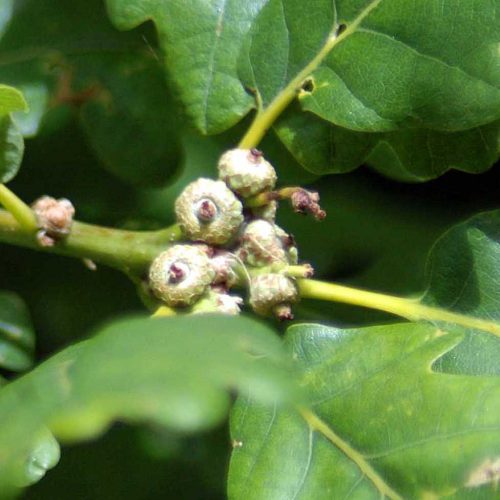
Acorns forming on Pedunculate Oak

Acorns forming on Pedunculate Oak

Haws are ripening and leaves beginning to take on colour

Haws are ripening and leaves beginning to take on colour

Walking close to gorse bushes the air is filled with the gentle sound of pods crackling as they open to release seeds.

Gorse pods crackle as they open to release seeds

Gorse pods crackle as they open to release seeds

Higher up on the steep slope near to the summit there is a stand of Ragwort growing with thistles.

Ragwort and thistles

Ragwort and thistles

And further round more Ragwort, this time interspersed with tall spikes of velvety Mullein.

Ragwort and Mullein

Ragwort and Mullein

The seedpods of Bird's-foot Trefoil are from where it takes it name

The seedpods of Bird’s-foot Trefoil are from where it takes it name

And a final shot of a Speckled Wood next to hypericum berries sums up the season, I think.

Speckled Wood & hypericum berries

Speckled Wood & hypericum berries

Share this:

  • Share on Facebook (Opens in new window) Facebook
  • Share on Pinterest (Opens in new window) Pinterest
  • Share on X (Opens in new window) X
Like Loading...

Beetles, bugs and spiders

03 Monday Aug 2015

Posted by theresagreen in Beetles, Bryn Euryn Nature Reserve, Insects, Nature, Nature of Wales, nature photography, North Wales, plants important to wilflife, spiders, Wildflowers of Wales

≈ 7 Comments

Tags

crab spider, flowering in July, froghopper, green shield bug, harebell, hogweed, mating red beetles on flowers, Nursery Web spider, red soldier beetle, red-legged shield bug, spider that makes web tents in grass, strangalia maculata, sulphur beetle, wild thyme, yellow and black beetle

July 15th

In the woods I spotted this extremely tiny froghopper, but only because he was struggling to extricate himself from a spider’s web built in ivy climbing up a tree trunk.

Tiny froghopper
Tiny froghopper
Tiny froghopper enlarged

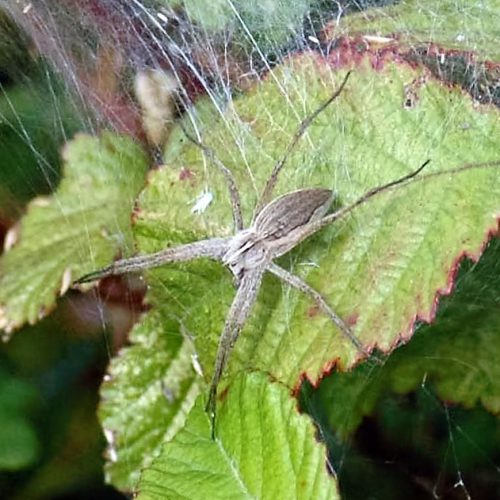
150712TG-Bryn Euryn-Adder's Field (10)-Nursery-web spider 1In the meadow, the Nursery-web spider would probably have escaped my notice too if I hadn’t been trying to get closer to a butterfly in the brambles. More used to seeing this species web ‘tents’ on the ground in the grass, I wouldn’t have realised who had built this one if I hadn’t seen her guarding it.

Nursery web spider on brambles

There are some lovely wildflowers in bloom in the meadow amongst the grass, my current favourite are the delicate-looking harebells,

150710tg-Bryn Euryn-flwr-Harebells 1

although I have always been fond of the sunshine yellow Lady’s Bedstraw

150712-46-Bryn Euryn-lady's bedstraw patch

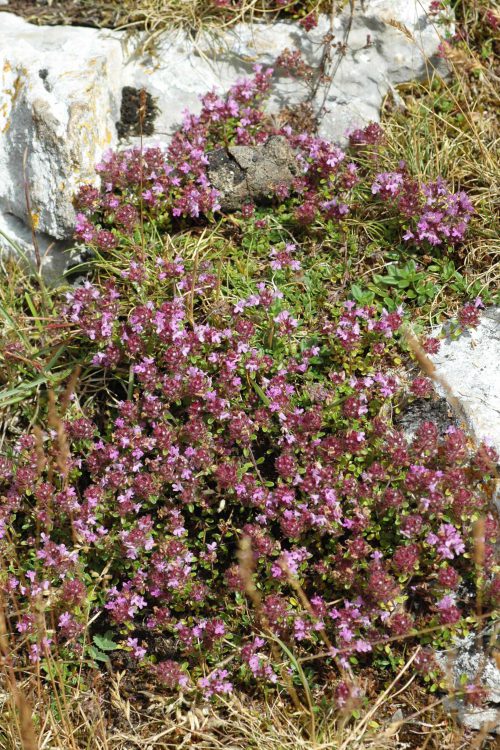
but then there’s the Wild Thyme that is looking spectacular this year where a large patch of it cascades down the limestone rocks.

150710tg-Bryn Euryn-flwr-Wild Thyme 1

There’s a Cat’s Ear plant near that spot too, which nicely demonstrates both the flowers and the seedhead ‘clocks’ simultaneously.

150710tg-Bryn Euryn-flwr-Cat's Ear 1

Hogweed works at another level and is an invaluable food source for a whole host of insects from beetles to butterflies.

150710tg-Bryn Euryn-flwr&vw-hogweed in long grass

Some of the insects feasting on the flowers today were Sulphur beetles, including dozens of tiny ‘baby’ ones

150712TG-Bryn Euryn-Adder's Field (15)-Small Sulphur beetles on hogweed 1
150712TG-Bryn Euryn-Adder's Field (19)-Sulphur beetle cloe-up
150712TG-Bryn Euryn-Adder's Field (21)-Sulphur beetle on hogweed

A 7-spot ladybird, a so-far un-named brown beetle

150712TG-Bryn Euryn-7-spot ladybird-Coccinella 7-punctata (3a)
150712TG-Bryn Euryn-Adder's Field (22)-no ID beetle

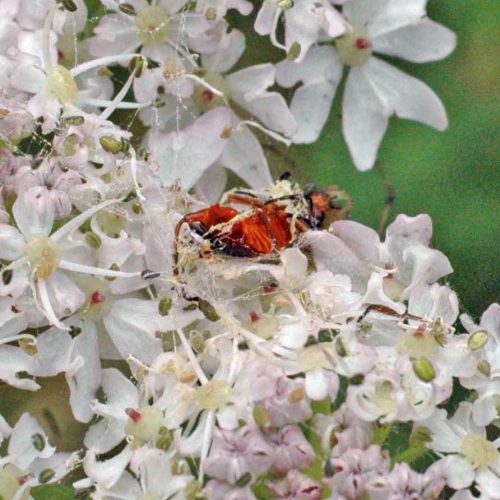
There were dozens of Red Soldier Beetles, many in the act of procreation as these beetles always seem to be. There was a little moth there with them, but again I haven’t discovered what it is yet.

150712TG-Bryn Euryn-Adder's Field (24)-Red soldier beetle
150712TG-Bryn Euryn-btl-Red soldier beetle-Rhagonycha fulva (7a)
150712TG-Bryn Euryn-btl-Red soldier beetle-Rhagonycha fulva (3a)
150712TG-Bryn Euryn-btl-Red soldier beetle-Rhagonycha fulva mating

150712TG-Bryn Euryn-Crab spider victim trussed up

Whilst photographing a pair of mating Red soldier beetles, I noticed another beetle caught up in spider’s webbing. As I looked closer I spotted the head and front legs of a spider creeping up over the edge of the flower, then she darted out and begin to drag her victim backwards to where she had appeared from. This was a Crab spider, mistress of camouflage and deadly to insects that stray into her path regardless of their size. Cruel, but fascinating and quite a feat as the beetle was as least equal in size to her.

150712TG-Bryn Euryn-Adder's Field (26)-Crab spider dragging victim to edge of flower
150712TG-Bryn Euryn-Adder's Field (27)-Crab spider with victim 1

Crab spiders are able to change their body colour to match their background. The process can take a few days, but they can appear white, yellow or green. The  irony of this scene struck me; a beetle life ended in full view of a pair of his kind in the act of procreating the species….

150712TG-Bryn Euryn-Adder's Field (29)-Crab Spider rear view
150712TG-Bryn Euryn-Adder's Field (28)-Spider crab securing victim

The Crab spider show would take some beating, but my ‘discovery of the day’ was quite definitely a splendid large yellow and black beetle, Strangalia maculata, that surprisingly doesn’t appear to have a common name.

150712TG-Bryn Euryn-btl-Strangalia maculata (1a)
150712TG-Bryn Euryn-btl-Strangalia maculata (10a)
150712TG-Bryn Euryn-btl-Strangalia maculata (7a)
150712TG-Bryn Euryn-btl-Yellow & black beetles 1

On another flowerhead another spider lurked, this time a small brown one, much enlarged in the photograph.

150710tg-Bryn Euryn-bug-Shield bug 1In the long grass I spotted an insect flying and managed to keep an eye on where it landed, otherwise I would never have found it; a Gorse Shieldbug.

A bright fresh bronzy-coloured forest bug was more easily spotted.

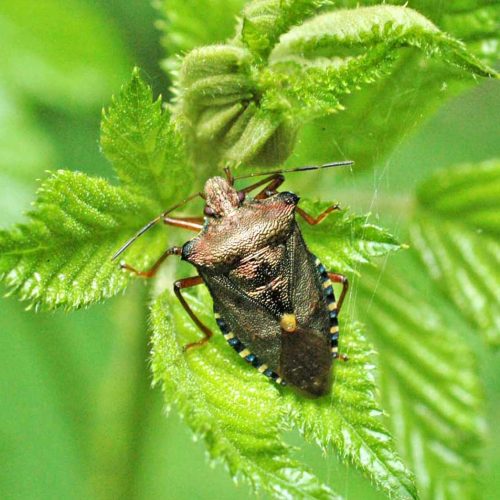
150712TG-Bryn Euryn -bug-Forest bug-Red-legged ShieldbugPentatoma rufipes (1a)

Red-legged shield bug-Pentatoma rufipes

A peek at the oak trees revealed tiny acorns. The ones I photographed belonges to a  Sessile Oak – the acorns sit flat rather than hanging on stems as those of the Pedunculate Oak. Hopefully this will be a better year for them than last year was.

150710tg-Bryn Euryn-tree- Sessile Oak-baby acorns

Rain clouds were gathering – is it really summer?

150712TG-Bryn Euryn-view (3)

Highlighted text for Shieldbugs are links to more details about these insects in my ‘Species Collections’.

Share this:

  • Share on Facebook (Opens in new window) Facebook
  • Share on Pinterest (Opens in new window) Pinterest
  • Share on X (Opens in new window) X
Like Loading...

Butterfly meadow

02 Sunday Aug 2015

Posted by theresagreen in Bryn Euryn Nature Reserve, butterflies, Butterflies of Wales, Nature, Nature of Wales, nature of woodlands, nature photography, Wildflowers of Wales, woodland wildflowers

≈ 5 Comments

Tags

aphantopus hyperantus, argynnis aglaja, dark green fritillary, Gatekeeper, maniola jurtina, Meadow Brown, pyronia tythonus, Ringlet, small skipper, thymelicus sylvestris

In the meadow the grass is long and beginning to turn golden brown as it sets seed.

The meadow grass is long , brightened by patches of yellow Lady's Bedstraw

The meadow grass is long , brightened by patches of yellow Lady’s Bedstraw

Bright golden yellow patches of Lady’s Bedstraw, scented like new mown hay catch my eye.

Lady's Bedstraw-Galium verum

Lady’s Bedstraw-Galium verum

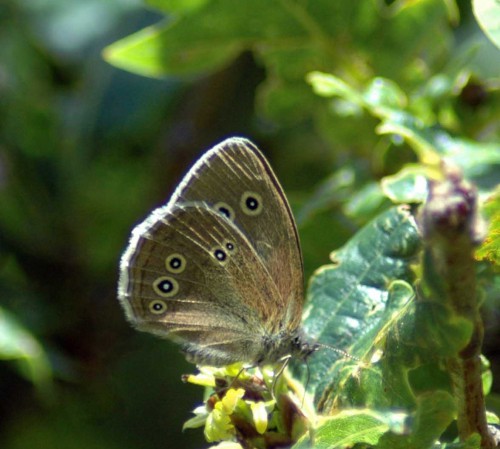
At this end of the field there are more brambles and I spot several dark brown butterflies flying low down along the length of them. It was a while before any settled for long enough to see properly what they were. As I hoped, some were dark, chocolatey brown Ringlets.

Ringlet butterfly on bramble leaf

Ringlet butterfly on bramble leaf – wings of butterflies that frequent brambles often get torn on prickles

One Ringlet male was clearly patrolling a territory. The brambles fill a corner of the field; he was flying to one ‘end’ of the patch, turning around, flying to the other end, then where the bramble curves around the corner he cut across to the other side of the track, flitted a short way through the long grass then back across the track to the brambles. Occasionally he paused for rest or to skirmish with intruders.

An undamaged Ringlet

As well as Ringlets there were Meadow Browns, some of which were also coloured dark brown, hence my initial hesitation identifying the Ringlets. It’s quite unusual to see Meadow Browns resting with their wings fully open and it is interesting to see how variable this species is in size and colouring.

A dark coloured Meadow Brown

The male  Meadow Brown is darker brown than the female and may not have orange patches

A lighter shaded Meadow Brown

A lighter shaded female Meadow Brown

Medow Brown underside

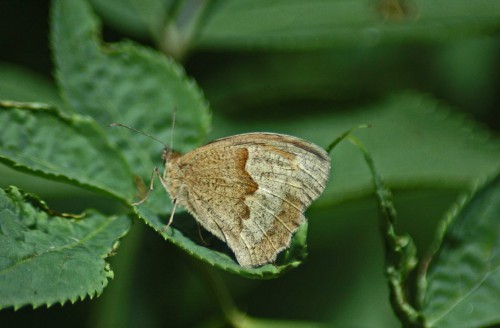
Meadow Brown (male) underside showing orange underwing and eyespots

More usual view of a Meadow Brown underside

Meadow Brown underside-female

I was pleased to see a lovely fresh Gatekeeper here too, my first one for this year. This one was a male;  he has dark scent scale patches in the centre of the forewings which females don’t have.

Gatekeeper

Gatekeeper-Pyronia tithonus

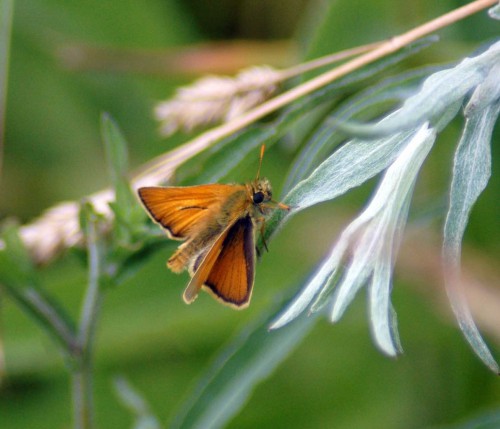
In the opposite corner of the field there are more brambles; there were more Meadow Browns here and little golden brown Skippers that happily are abundant here and that also occur in other nearby locations, particularly on the Little Orme.

Small Skipper has orange-brown tips to antennae

Small Skipper (male) has a line of  black scent scales on forewings

There were a good number of these lovely little butterflies flitting about, expertly manoeuvering at speed between the long grass stems.

Small,or possibly Essex Skipper

Small Skipper-Thymelicus sylvestris

Ringlets are not widespread throughout the site, but rather occur in colonies in a few different locations. I walked on up past the top end of the field where I have found them in previous years, again on brambles. I was pleased to see there were; maybe half a dozen individuals, mostly flying around in the long grass in front of the brambles. Finally one flew up to feed on one of the last remaining flowers.

Ringlet

Ringlet feeding on the last of the bramble flowers

I was wondering what there was for the butterflies to feed on here now the bramble flowers are over, then saw one fly up onto a nearby oak tree. A closer look revealed it appeared to be feeding on something on a leaf surface, or maybe there were a few drops of moisture there.

  Last year I didn’t see any Ringlets at all, perhaps I missed their rather short season, which is just July-August, or maybe there were only a few which I overlooked. As they are here now there must have been some to generate this year’s brood. Now I wanted to know if there were any to be found in yet another spot I found them in the year before last, which is at the bottom of the ‘downland’ slope that leads up to the summit of the hill. Happily, there were indeed some there too. So, a good year for Ringlets.

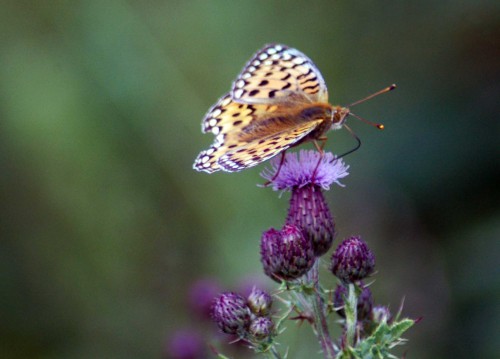
Emerging from the woodland onto the steep slope I had caught sight of a flash of orange flying over a stand of Rosebay Willow Herb, so headed off now to investigate that. It wasn’t long before I saw more orange flashes of speeding Dark Green Fritillaries, the most special butterfly treats of this reserve. This patch of the hillside and sometimes a spot on the other side of the hill are the only places I have seen them, Colonies are more plentifully populated some years than others.

Dark green Fritillary

Dark green Fritillary- Argynnis aglaja

The fritillaries were feeding mainly on thistles, for want of anthing much else. They would also feed on knapweed, but it’s not quite out yet and scabious, of which there is only a little flowering nearby.

150712TG-Bryn Euryn-bfly-Dk green fritillary 2

An older, more faded butterfly

There were perhaps 10-12 individuals, some faded, others much fresher.

150712TG-Bryn Euryn-bfly-Dk green fritillary 11

They are strong, fast flyers and glide on flat wings.

150712TG-Bryn Euryn-bfly-Dk green fritillary 13

On the hindwings there are silver spots on a dark green background

Share this:

  • Share on Facebook (Opens in new window) Facebook
  • Share on Pinterest (Opens in new window) Pinterest
  • Share on X (Opens in new window) X
Like Loading...

Summer along a Welsh Woodland Trail

30 Thursday Jul 2015

Posted by theresagreen in British hoverflies, Bryn Euryn Nature Reserve, bumblebees, butterflies, Butterflies of Wales, hoverflies, Insects, Nature, Nature of Wales, nature photography, wildflowers, Wildflowers of Wales

≈ 6 Comments

Tags

ash tree, episyrphus balteatus, eristalis pertinax, flesh-eating fly, hedge woundwort, helophilus pendulus, hypericum montanum, large pied hoverfly, marmalade fly, Pale St John's Wort, sarcophoga carnaria, Stinking Iris-Iris foetidissima, syrphus ribesii, tapered drone fly, volucella zonaria, wild strawberry fruit, woodland flowers

Variable summer weather is perhaps more the norm here in North Wales than in some other parts of the UK, although we still feel hard done to when yet another day dawns doomed to be overcast. There are many compensations though, one of which is that when the odd sunny, or partially sunny day occurs, the insects come out in force in search of sustenance. I photographed all of the following along Bryn Euryn’s Woodland Trail during a fleeting sunny spell a couple of weeks ago.

The woodland trail

The shady woodland trail

On the edge of the trail a substantial bramble was still flowering and literally buzzing with insects, mostly hoverflies and bees. There were two butterflies, a Red Admiral and a Comma that were flying around rather frantically, both of which briefly (and separately) landed on my arm. Poor things were clearly overcome by the presence of both sun and nectar. I would have liked a more conventional shot of the Comma, this being the first I’d seen here this year, but it was taunting me from high over my head so this was my best view. I rather like it and it’s clear from the outline that it is a Comma.

The Comma insisted on playing hide and seek

The Comma insisted on playing hide and seek

The hoverflies were very active, not pausing for long but these are the ones I could get to fairly easily:

Volucella pellucens-Pellucid fly is the largest fly in Great Britain

Volucella pellucens- sometimes called the Pellucid fly, this is the largest fly of Great Britain

150712TG-Bryn Euryn-hvfly-Volucella pellucens (7)

A gorgeous Volucella zonaria

A gorgeous Volucella zonaria – my first sighting here

A Tapered drone fly-eristalis pertinax grooming its legs

A Tapered drone fly – Eristalis pertinax

Eristalis nemorum (interruptus)

Eristalis nemorum (interruptus)

A more distant view of a Helophilus pendulus

A more distant view of a Helophilus pendulus

A Syrphus sp hoverfly-Syrphus ribesii - one of the most common species

A Syrphus sp hoverfly-Syrphus ribesii – one of the most commonly seen species

A tiny Marmalade fly-Episyrphus balteatus, probably our most common hoverfly

A tiny Marmalade fly-Episyrphus balteatus, probably our most common hoverfly

There were bees too, including lots of tiny red-tailed and buff-tailed worker bumblebees that were way too quick for me to focus on.

Honey bee

Honey bee

A less charming insect to many, I find the Flesh-eating fly-Sarcophaga carnaria rather attractive to look at. I think the white feet complete the look, makes it look rather dapper.

Flesh-eating fly-Sarcophoga carnaria

Flesh-eating fly-Sarcophoga carnaria

The trees are still green and fresh-looking thanks to the rain and cooler weather, although those in the top right of the next picture are looking quite lacy.

150712TG-Bryn Euryn-looking up into an ash tree

Looking up into an Ash tree

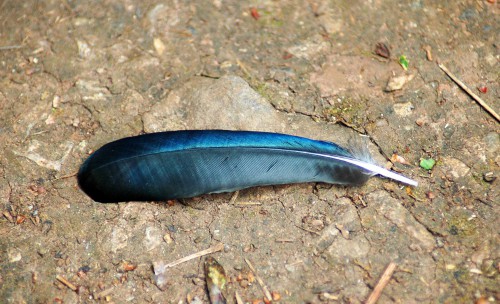
Continuing along the trail I hear a few birds letting the world know they are still about, Chiffchaff song bursts were fairly frequent, I heard Wrens and the contact calls of Blue Tits and plenty of corvid cawings. I found this feather too, maybe once belonging to a Magpie, it gleamed shades of almost peacock-blue in the dappled sunlight.

A corvid feather

A corvid feather

Honeysuckle is in flower now on the trail’s  edge and I couldn’t resist stopping to inhale its clean, fresh fragrance.

Lovely scented honeysuckle

Lovely scented honeysuckle

There is purple Hedge woundwort too, which has an earthy pungent, nettle-like scent.

Pungently scented Hedge Woundwort

Pungently scented Hedge Woundwort

Foxgloves are almost over-flowering reduced to the tips of the long bent-over  stems

Foxgloves are almost over-flowering reduced to the tips of the long bent-over stems

Wood sage-Teucrium scorodonia

Wood sage-Teucrium scorodonia

And a St John’s Wort I’d not spotted before, which I think is hypericum montanum, but happy to be corrected as always.

Pale St John's Wort-Hypericum montanum

Pale St John’s Wort-Hypericum montanum

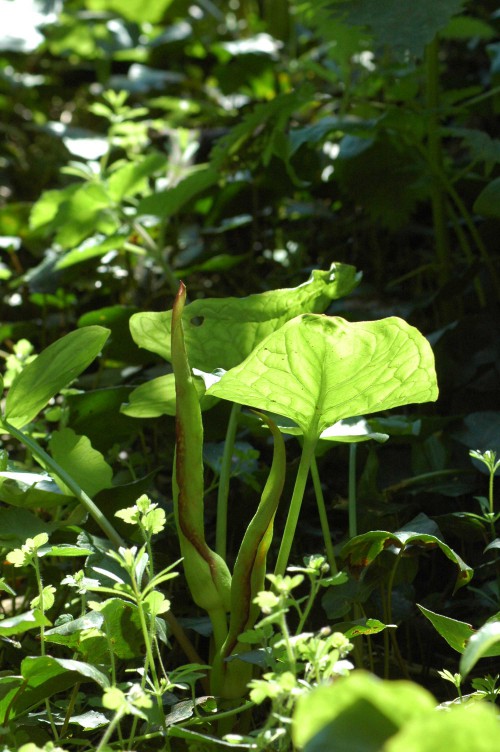
A rather unusual plant grows here in the shady woodland, delightfully named the Stinking Iris and sometimes the ‘Roast-beef Plant’, both names allude to the sweetly acrid smell, like ‘high’ meat. This is one of just two Iris species native to the UK; the other is the Yellow Flag Iris.

The charmingly-named Stinking Iris-Iris foetidissima

The delightfully-named Stinking Iris-Iris foetidissima

Closer look at an Iris flower

Closer look at an Iris flower which is a greyish-mauve tinged with a brownish-pink

The much more common Nipplewort

The much more common Nipplewort-Lapsana communis

A Nipplewort leaf showing the path of a leaf-miner

A Nipplewort leaf showing the path of a leaf-miner

I picked a couple of ripe wild wild strawberries, trying not to think about the fly sitting on a leaf above them and their proximity to the path along which there is a regular procession of loose dogs….. They were delicious, regardless.

Sweet-tasting Wild Strawberries

Sweet-tasting Wild Strawberries

Turned off and took the steps up to Adder’s Field

Steps leading up to the meadow

Steps leading up to the meadow

more treats were in store there but there’s far too much to cram into one post, so will be continued….

Share this:

  • Share on Facebook (Opens in new window) Facebook
  • Share on Pinterest (Opens in new window) Pinterest
  • Share on X (Opens in new window) X
Like Loading...

Beauty and the Bullfinch

24 Wednesday Jun 2015

Posted by theresagreen in bird behaviour, Birds, birds of Wales, Bryn Euryn Nature Reserve, Nature, Nature of Wales, nature photography, North Wales, woodland birds

≈ 2 Comments

Tags

Bullfinch, bullfinch eating tree seeds, colourful British birds, Eurasian Bullfinch, pyrrhula pyrrhula

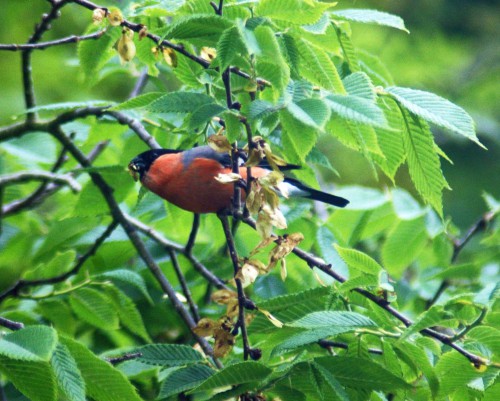
The Bullfinch, Common Bullfinch or Eurasian Bullfinch (Pyrrhula pyrrhula) is a small passerine bird in the finch family Fringillidae that breeds across Europe and temperate Asia and is classified as a Woodland Bird. Pyrrhula pyrrhula Eurasian Bullfinch -48 -1 ↓ -16 -2 ↓ sd

The male Bullfinch is surely one of our most strikingly beautiful and exotic-looking birds and a good sighting of one is always a treat, even if that does involve a certain amount of sacrifice of buds borne by your favourite fruit-tree. In the wild they tend to be more elusive, as despite their showy appearance the Bullfinch is a quiet, secretive character that usually spends its time among the branches and dense undergrowth of woodlands; often the only sight of one will have been a flash of a white rump retreating back into cover. Bullfinches are mainly sedentary or short-distance migratory birds and are relatively non-territorial, more likely to be seen in pairs or small family groups; they rarely flock as do other finches such as  Goldfinches and Chaffinches.

I’ve had some wonderful sightings of Bullfinches this year and I haven’t had to work for them at all as they have been from my kitchen window and courtesy the tree directly in front of that window. A female appeared first, back in February and I included her in a blog at the time. I had a couple of glimpses of her subsequently and hoped she had a mate somewhere close by.

3/2/15-Bullfinch female

3/2/15-Bullfinch female

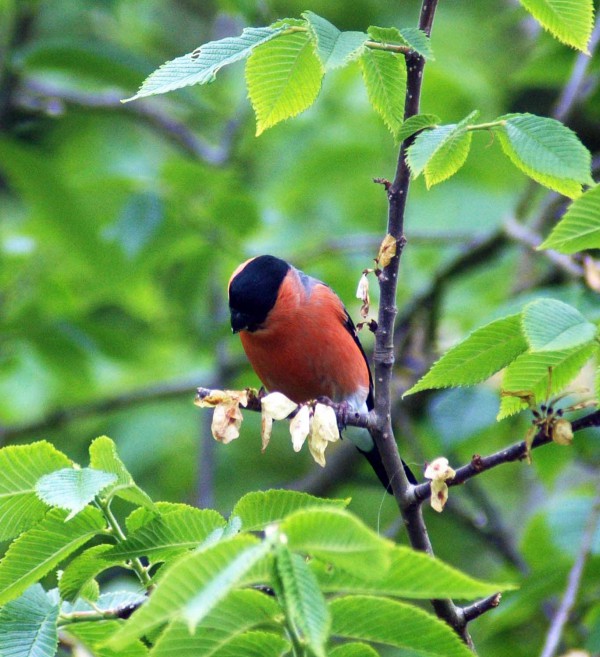
My first proper sighting of a male was much later on in May when he visited to dine on the seeds of the tree directly in front of the window.

13/5/15-Male Bullfinch

13/5/15-Male Bullfinch

Based on that sighting and the species habit of not travelling far to find food,  I hoped that he was paired with the earlier female and that they were nesting  somewhere nearby. A couple of weeks later I saw him again and was able to watch him gorging on the tree seeds for a good few minutes; maybe the seeds were riper and more palatable.

Bullfinch male

25/5/15-Bullfinch male back for more seeds

DESCRIPTION

The Bullfinch most likely takes its common name from its shape, as they are plump-to-heavily-built and somewhat ‘bull-necked’. Both sexes have a stout grey-black bill, black wings, nape, crown and chin, and a white rump, under-tail coverts and wing-bar which are striking in flight. The tail is slightly forked and the legs are brown.

The Bullfinch was here to eat

The Bullfinch has a beak perfectly adapted to remove and eat seeds

The adult male has a slate blue-grey back and a glorious deep rose-pink breast, belly and cheeks. The female has a brown back and  pink-tinged grey-buff underparts. The juveniles are similar to the adult female, but do not have black caps.

The female Bullfinch has a pink-buff coloured breast

The female Bullfinch has pink tinged grey-buff coloured breast and underparts


VOICE

The song of this unobtrusive bird contains fluted whistles that is often described as sad or mournful. In Victorian times Bullfinches were a desired captive bird because of their beautiful plumage and call. It was believed that the caged bird could be trained to mimic music and it became a popular pastime to play a special flute to the bird.

HABITAT & BREEDING

Bullfinches usually nest in shrubs or bushes, such as blackthorn and hawthorn, in woodland, orchards, agricultural farmland or large gardens. The nest is a flimsy, loose structure of twigs and moss lined with fine roots and hair, which is built by the female. She lays and incubates eggs that are smooth, glossy and light blue with purplish markings at one end. The eggs are about 20 mm by 15 mm. Both parents feed the young after they have hatched.

DIET

In the late autumn Bullfinches range a little more freely foraging for food and feed largely on the seeds of herbaceous plants, but as winter sets in their attention turns to tree seeds, particularly those of the ash. In the spring tree buds, including hawthorn, blackthorn and sallow, as well as the buds of fruit trees, become the birds’ staple diet and it is this aspect of their lifestyle that in the past brought them into serious conflict with fruit farmers: a single bullfinch can easily remove 30 or more buds in a minute.

Not noted for its agility, the Bullfinch managed to reach and eat rather a lot

Not noted for its agility, the Bullfinch managed to reach and eat rather a lot

STATUS & CONSERVATION

In the UK the Bullfinch is mainly a year-round resident, but many northern (Scandinavian) birds migrate further south in the winter when our British population numbers may be temporarily swelled.

Bullfinch numbers increased enormously in the 1950s which brought about a serious problem for Brtain’s fruit-growing industry. The birds’ dietary preference put them into conflict with commercial growers and thousands were killed each year. Although trapping and culling reduced the damage the fact that catches continued year after year showed that it had no sustained effect on bullfinch numbers. But then gradually, from the mid 1970s, bullfinches became scarcer again and catches on most farms steadily declined.

A good view of the birds black cap and bill

A good view of the male’s black cap and bill

Subsequently, the Bullfinch was a Red List species for many years as their breeding population had declined by more than half. This was attributed to a reduction in quantity and quality of woodland margins and hedgerows and increased grazing by deer. However, their numbers have recovered once more (and continue to do so) and they are currently classified in the UK as an Amber List species under the Birds of Conservation Concern review.

ETYMOLOGY

There are several theories as to why the Bullfinch is so called. Most favour the bird’s shape as the key, but there is also the possibility it may once have been a ‘bud-finch’ referring to its Spring feeding habits and to the time of year when the birds are their most visible.

According to Mark Cocker & Richard Mabey 2005 (Birds Britannica):

“W. B. Lockwood feels that the explanation for the name (Bullfinch), which in medieval times was simply shortened to “bull”, ‘remains elusive’. Yet one cannot help thinking that the bird’s globular bill and neckless rotundity are the key. As in ‘bulldog’ or ‘bullfrog’, the name was intended to convey the creature’s front-heavy – literally bull-headed – construction.”

Francesca Greenoak 1997 (British Birds – their Folklore, Names & Literature) concurs: “from its large head and stocky form”.

But Greenoak also gives as other British names:

  • from its large head & stocky form: Bull Flinch (Yorks), Bull Head, Bulldog, Bull Spink, Bully (Yorks), Thick Bill (Lancs)
  • from ‘Alpe’ the old name for the bird: Alpe, Hoop, Hope (SW), Tope, Hoof, Cock Hoop (Hereford), Olf (E Suffolk), Nope (Staffs/Salop), Mwope (Dorset), Mawp (Lancs), Pope (Dorset)
  • colour names: Red Hoop (m, Dorset), Blood Olp (m, Surrey/Norfolk), Tawny (f, Somerset), Tony Hoop, Tonnihood (f, Somerset), Black Cap (Lincs), Billy Black Cap, Black Nob (Salop), Monk
  • from its partiality to fruit buds: Bud Bird, Bud Finch, Bud Picker (Devon), Budding Bird (Hereford), Plum Bird, Lum Budder (Salop)


Share this:

  • Share on Facebook (Opens in new window) Facebook
  • Share on Pinterest (Opens in new window) Pinterest
  • Share on X (Opens in new window) X
Like Loading...

Spring on the Bryn-part II

11 Monday May 2015

Posted by theresagreen in Bryn Euryn Nature Reserve, butterflies, Butterflies of Wales, Nature of Wales, nature of woodlands, Wildflowers of Wales

≈ 2 Comments

Tags

blackthorn, blackthorn blossom, Blue tit, dog violet, Great Tit, mistle thrush, orange tip, peacock butterfly, rabbit, small tortoiseshell, speckled wood, wild strawberry, woodland flowers

Walking further up through the field the local buzzard pair circled overhead, then just a few minutes later a sparrowhawk appeared from somewhere close by and startled me as it flew just a few feet over my head, then continued towards the direction from which I had come.

Gorse fully in flower

Gorse fully in flower

A bit further on I stopped for a while and sat on one of my favourite rocks savouring the warm sun and the peace and quiet; that rarely lasts long just here as its at a sort of junction of trails so there are passing dogs, usually well ahead of their owners that invariably come over to see what I’m up to. I watched two peacock butterflies vying for the best spot on a sun-warmed rock. The winner opened its slightly faded, but still beautiful wings and basked for a few short minutes undisturbed.

Peacock butterfly

Peacock butterfly

Moving off my rock to photograph the butterflies I noticed a patch of Wild Strawberry in flower. Tucked back against the rock it is sheltered and in a sunny spot, perfect for ripening berries.

Wild Strawberry plant in flower

Wild Strawberry-Fragaria vesca in flower

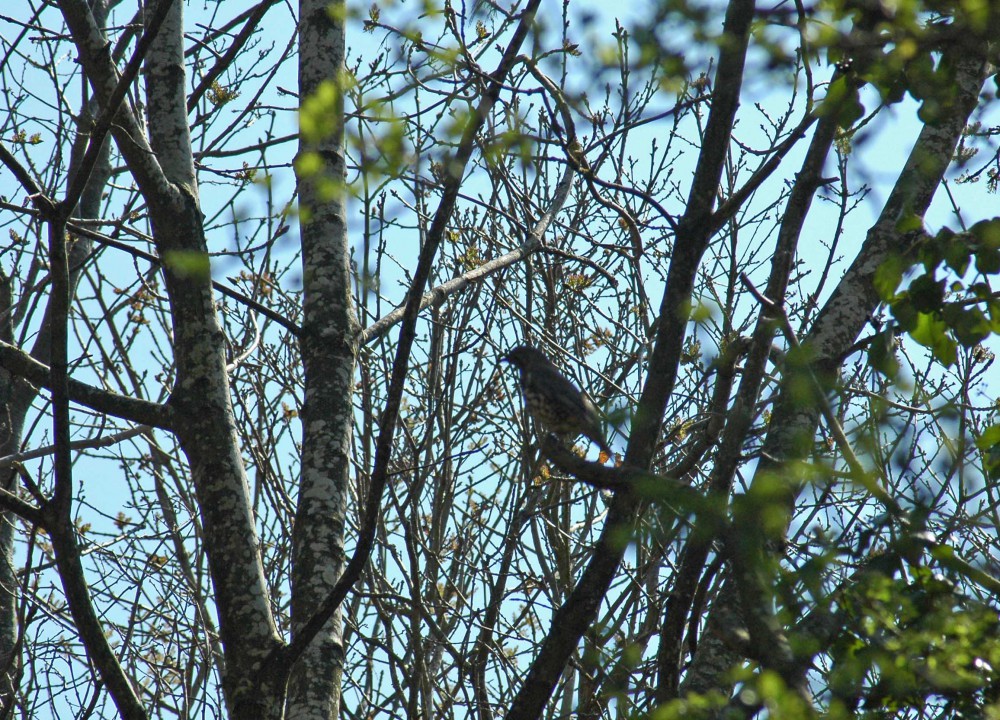
Back in the woods to walk up towards the summit I disturbed a large foraging bird. It flew up to a tree branch where it blended well into the dappled shade. It had to be a Mistle Thrush but I wasn’t entirely sure until it flew back down to the ground giving a better view.

A Mistle Thrush blending into the dappled shade of the wood

A Mistle Thrush blending into the dappled shade of the wood

Unmistakably a Mistle Thrush

Unmistakably a Mistle Thrush

At the top of the track there was a single Speckled Wood butterfly, a lovely ‘fresh’ one. It was intent on finding somewhere to bask in the sun and flitting and zig-zagging about low over the track. You have to keep an eye on them because once they settle they can be difficult to spot. I had to make do with this view as it still wasn’t happy and shot off quickly.

Speckled Wood butterfly

Speckled Wood butterfly

Back out in the open and continuing upwards I almost stepped on a Small Tortoiseshell butterfly also sunning itself on the bare earth of the track.

Small tortoiseshell- Aglais urticae

Small tortoiseshell- Aglais urticae

A little clump of Dog Violets growing in the grass at the side of the track caught my eye; the bee-fly zoomed in just as I pressed the shutter and was gone again before I could refocus on it.

Common Dog Violet- Viola riviniana

Common Dog Violet- Viola riviniana

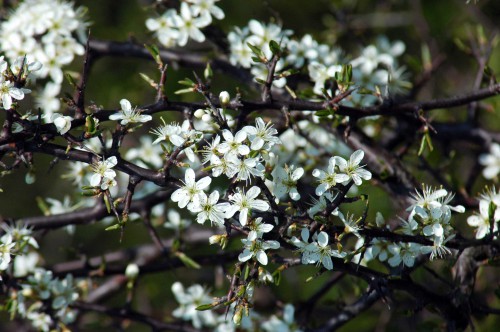
Blackthorn, of which there is a generous amount up here, has been flowering for a short while now but is at its beautiful peak now. Last year was a sparse one in respect of the amount of sloes on the shrubs here, but if the masses of blossom on them now are anything to go by, this could be a bumper year.

Blackthorn with a view

Blackthorn with a view

The flowers of blackthorn appear before the leaves and these are just beginning to break from their buds.

Blackthorn-Prunus spinosa

Blackthorn-Prunus spinosa

Blackthorn blossom against a clear blue sky

Blackthorn blossom against a clear blue sky

Another male Orange Tip butterfly was racing along the boundary of the blackthorn scrub. He didn’t stop, but as my first sighting of this species this year was a few days earlier of one nectaring on blackthorn, I’m using one of the photographs I took then.

Orange Tip- Anthocharis cardamines

Orange Tip- Anthocharis cardamines

Following the path around to go up to the summit I noticed two Small Tortoiseshell butterflies on the ground. I thought at first they were mating, or about to do so and they did change their positions a few times, but nothing happened during the time I watched them. One was more fresh-looking than the other, but they were both perfectly intact and gorgeous.

150424TG-BE336-Two tortoiseshells150424TG-BE337-Two tortoiseshells150424TG-BE335-Two tortoiseshells

The grass up around the summit of the hill is kept short, constantly cropped by grazing rabbits. I think it’s highly likely that this particular part of the hill covers a maze of warrens and tunnels. You don’t often get to see them , especially during the daytime, but there are baby ones around now and not yet wise they can be seen out in the open.

Young bunnies

Young bunnies

Ground Ivy-Glechoma hederacea

Ground Ivy-Glechoma hederacea

I cut back into the woods here from the track the bunnies were on, hearing a chiffchaff a short way in. I spotted Great Tits foraging in the trees close to the track that flew over to the scrubby wild clematis-covered scrub on the other side.

Great Tit

Great Tit

Where I stopped to take the picture there were a large number of smallish hoverflies darting about, resting briefly on leaves or many on the ground, all shiny and fresh looking as the ones I saw lower down earlier in the afternoon.

There were Blue Tits out foraging too and I think its likely that a pair have a nest site quite high in a tree with ivy growing up through it.

Foraging Blue Tits

Foraging Blue Tits

At the bottom of the track I stopped for a few minutes to listen to a Mistle Thrush singing. This was a déjà vu moment as I recall doing this exact same thing last year, more or less in the exact same spot, scanning the trees for the singer. I found him then, but couldn’t spot him today, so here’s last year’s picture to be going on with. What a lovely bird and how lovely to see him again. (More about the Mistle Thrush here)

A well-marked, singing mistle thrush

A well-marked, singing Mistle Thrush


Share this:

  • Share on Facebook (Opens in new window) Facebook
  • Share on Pinterest (Opens in new window) Pinterest
  • Share on X (Opens in new window) X
Like Loading...

Bumbles, Masons and Miners

10 Sunday May 2015

Posted by theresagreen in Bryn Euryn Nature Reserve, bumblebees, Little Orme, Local Nature Reserves, Nature of Wales, Rhiwledyn Nature Reserve

≈ 4 Comments

Tags

buff-tailed bumblebee, common carder bee, early mining bee, mason bees, mining bees, red mason bee, red-tailed bumblebee, tawny mining bee, tree bumblebee

Early spring is a good time to look out for some of the different species of bees found locally, catching them before they settle in to producing the next generation. On recent outings Bryn Euryn was particularly well blessed with bumblebees and some other interesting species and the Little Orme brought an unexpected treat so I thought I’d put them all together.

The Buff-tailed bumblebee- Bombus terrestris is the largest of our native bumblebees. Queens, workers and males have a dirty golden yellow collar near the head and one on the abdomen.

Buff-tailed bumblebee

Bryn Euryn – Buff-tailed bumblebee queen

The queen’s tail is an off white/buff colour which can sometimes appear orange. The queens are busy establishing new colonies and may be seen collecting pollen to stock it and crawling around on the ground where they nest in burrows underground.

Buff-tailed bumblebee queen on the ground

Bryn Euryn-Buff-tailed bumblebee queen on the ground

I didn’t spot any workers or males on the days I was out and about, if I had these would both be smaller than the queens and look slightly different as workers have a white tail and that of the males is white ringed with a buff line.

Red-tailed Bumblebee- Bombus lapidarius queens are also establishing new colonies and can be seen feeding and collecting pollen from flowers and also crawling around on the ground as they too nest underground.

Red-tailed bumblebee queen with full pollen baskets

Red-tailed bumblebee queen with full pollen baskets

Queens are distinctive with their black bodies and red tails and are large, between 20 -22mm long which is a similar length to that of the Buff-tailed bumblebee queens, but the red-tailed is less bulky.

Red-tailed Bumblebee queen emerging from a patch of ivy-leaved speedwell

Bryn-Euryn -Red-tailed Bumblebee queen emerging from a patch of ivy-leaved speedwell

There are Red-tailed bumblebee workers about too. They have the same colouring as the queens but are smaller, varying in size from 1-16mm in length, with some early workers being no bigger than a house fly.

They have comparatively short tongues and favour flowers that provide them with a landing platform such as dandelions and daisies and later on, thistles and ragwort. In gardens they like chive flowers and lavender.

24/4/15-Red-tailed worker bee on dandelion

24/4/15-Bryn Euryn-Red-tailed worker bee on dandelion

To make things confusing there is a cuckoo-bee that closely resembles the Red-tailed bumblebee. The main differences are that the cuckoo bee has black wings and the back legs are hairy and without the shiny hairless patch, the pollen basket, of the true bee.

There were a very few Common Carder bees Bombus pascuorum about and I only managed one quick shot of one visiting a dog violet flower. There will be many more later on.

Carder Bee

Bryn Euryn – Common Carder Bee

An exciting new recording for me here was of the Tree Bumblebee Bombus hypnorum, that’s is not to say they weren’t here before, just that I had never seen one. I was lucky to spot two that were taking nectar from the Green Alkanet flowers which grow in a big patch next to the car-park gate.

21/4/15 -Tree bumblebee-Bombus hypnorum

21/4/15 – Bryn Euryn-Tree bumblebee-Bombus hypnorum

Tree bumblebees are fairly new arrivals to the UK, first found in 2001 in Wiltshire. Since then they have spread across most of England and Wales and made it to Southern Scotland in 2013. Queens, workers and males all have a similar colour pattern; the thorax is tawny to reddish-brown, the abdomen is black and the tail is white.

Tree bumblebee burdened with mites

Tree bumblebee burdened with mites

Queens vary significantly in size and can reach up to 18mm in length. Males are quite chunky and can be as much as 16mm in length; fresh males have a patch of yellowish facial hair which eventually wears off. Workers, which is what I believe I photographed range from 11-16mm in length; they move around rapidly and are effective pollinators.

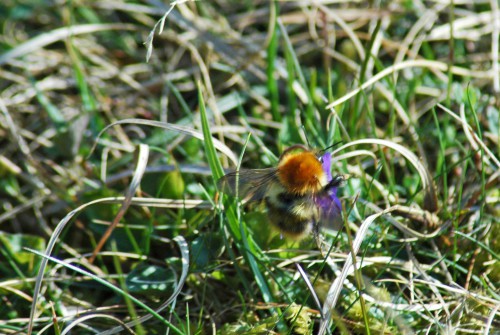
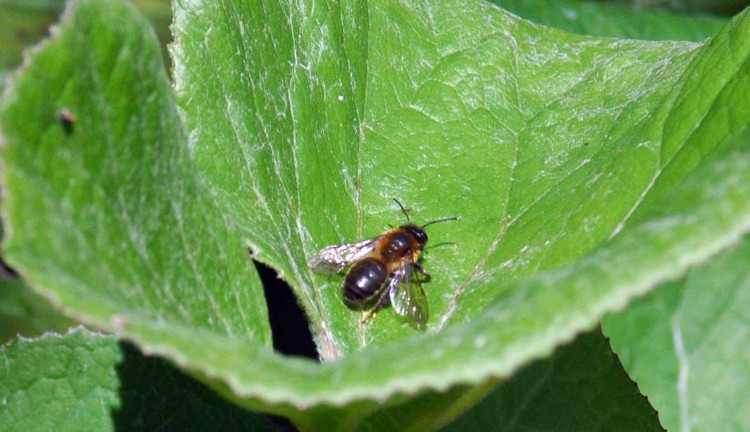
Basking on the leaves of the butterbur plant that also grows near the gate at the bottom end of of the car park was another little bee. I’m not positive about its identification but based on the colour of the hairs on its thorax I think it may be an Early Mining Bee – Andrena haemorrhoa.

150421TGNW-BE68c-Early Mining Bee

Bryn Euryn-Early Mining Bee-Andrena haemorrhoa

A couple of days later I was walking on the Little Orme and came across another species of mining bee that cannot be mistaken for anything else, the Tawny Mining Bee-Andrena fulva.

There were two individuals attempting to nectar on Alexander’s while a particularly strong wind was bending and tossing the flower around. It was tricky trying to get focussed images.

28/4/15- Tawny Mining Bee on Alexanders -Little Orme

28/4/15- Little Orme-Tawny Mining Bee on Alexanders

Males are 10 to 12 mm and the females 8 to 10 mm long. The females are covered with fox red hair on their backs and black on the underside, whilst the males are more slender and yellower in appearance.

Tawny Mining Bee

Little Orme-Tawny Mining Bee

One of the two managed to hold on and kept searching over the florets, but the other gave up and dropped to the ground.

Tawny Mining Bee on the ground

Tawny Mining Bee on the ground

The bees mate in spring, after which the male dies and the female starts to build a nest. Sometimes more than a hundred females build nests in a few square metres but the Tawny Mining Bee normally does not create a colony: each female has her own nest.

Finally I’d like to mention another little bee found locally, the Red Mason Bee Osmia rufa, also most likely to be spotted around this time of year.

Fairy Glen-Red Mason Bee

Fairy Glen-Red Mason Bee

The males are smaller than the females at 6 -11 mm. Both sexes are covered in dense gingery hairs, the male with white tufts on the head while the female’s head is black.

Red Mason Bee

Red Mason Bee (m)

It is a solitary bee, each nest being the work of a single female bee working alone. They nest in pre-existing cavities such as hollow plant stems, old garden canes, air bricks, and even old nail holes in fence posts, lining the inside of the cavity with mud.


Share this:

  • Share on Facebook (Opens in new window) Facebook
  • Share on Pinterest (Opens in new window) Pinterest
  • Share on X (Opens in new window) X
Like Loading...

Spring on the Bryn

07 Thursday May 2015

Posted by theresagreen in Bryn Euryn Nature Reserve, hoverflies, Insects, Nature, Nature of Wales, nature of woodlands, tree folklore

≈ 4 Comments

Tags

ash tree, Bee-fly, chequered hoverfly, common field speedwell, cowslip, dog mercury, eupeodes latifasciatus, garlic mustard, hart's tongue fern, ivy-leaved speedwell, oak tree, wood anemone, wood sorrel

Recent outings have been ambles rather than rambles as I’m getting back to fit after being laid low for a few weeks by some kind of virus, which also accounts for the recent absence from blogging. I’ve found it most frustrating, especially at this time of year too when there’s so much going on. But I’m keen to catch up and already have a lot to share, so here’s a mostly-pictorial view of Bryn Euryn as I saw it on two beautiful sunny-day ambles in the last week of April.

There are a lot of Ash trees on the Bryn, thankfully all of which appear to be healthy at the present time and they seem to have had an exceptional amount of flowers this year. The flowers start off a dark pinkish-purple but now most of them are over now and the clusters are mostly green.

Ash tree flowers are almost over

Ash tree flowers are almost over

Some trees have produced so many flowers that now the clusters are green, from a distance it gives the illusion that they are in leaf.

Spent flower clusters give ash trees the illusion of being in leaf

Spent flower clusters give ash trees the illusion of being in leaf

Looking more closely at the tree in the photo above, there are a few  leaves already appearing.

New ash leaves opening

New ash leaves opening

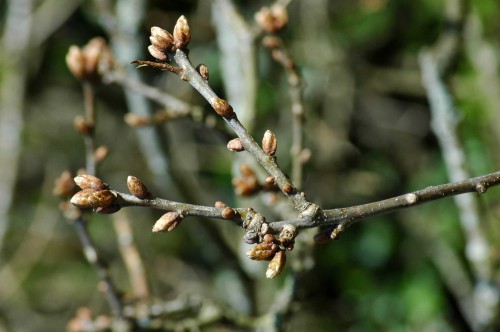
Naturally, once I had seen the ash leaves I had then to check out the oaks to guage if we are in for a ‘splash or  a soak’ this summer. On the day I took the photo of the ash the oaks were all in tight bud.

21/4/15- Oak leaves in tight bud

21/4/15- Oak leaves in tight bud

But three sunny days later I was amazed to see that leaves had begun to open and not only that, insects had already moved in.

24/4/15-New oak leaves with insects

24/4/15-New oak leaves with insects

For anyone that has no idea what that last bit was about, a traditional English way of predicting whether the summer will be wet or dry was based on whether the oak or the ash trees opened their leaves first.

“When the oak is before the ash, then you will only get a splash; when the ash is before the oak, then you may expect a soak “

So things appear to be fairly even in the rainfall prediction stakes so far.

Robin singing from high in an ash tree

Robin singing from high in an ash tree

It was a perfect spring day, the sun was shining the sky was blue and a host of birds were singing. Along the quarry field edge the vegetation is growing up quickly although there’s not much flowering yet. Celandines are beginning to fade and some dandelions have already set seed.

Vegetation on woodland edge-celandines, nettles & arum

Vegetation on woodland edge-Lesser Celandines, nettles & arum

Cuckoo Pint or Lords and Ladies-Arum maculatum

Cuckoo Pint or Lords and Ladies-Arum maculatum

There was a single male Orange Tip butterfly racing along at their normal break-neck speed and one female Small White that obligingly settled on a bramble.

Small White (f) on bramble leaf

Small White (f) on bramble leaf

150421TGNW-BE1-Chequered Hoverfly(m) -Melanstoma scalare

Tiny male Chequered Hoverfly-Melanstoma scalare (enlarged)

I was quite surprised to see a good number of hoverflies about, all looking shiny and fresh, so I assume they were newly-emerged.

Hoverfly-Eupeodes latifasciatus

I think this is Eupeodes latifasciatus

As I was checking out a splash of colour that turned out to be from this escaped garden plant, I was happy to see this little bee-fly arrive to take its nectar. One of my favourite insects, they look cute and furry but are classified under the general heading of ‘robber-flies’ and their larvae live as parasitoids in the nests of mining bees.

An escaped garden plant attracting a bee-fly

An escaped garden plant attracting a bee-fly

There are two species of pretty blue speedwell flowering here, one is the familiar Common Field Speedwell

Common Field Speedwell- Veronica persica

Common Field Speedwell- Veronica persica

and the other is the even tinier-flowered Ivy-leaved Speedwell.

Ivy-leaved speedwell-Veronica hederifolia

Ivy-leaved speedwell-Veronica hederifolia

You could easily overlook this rather sprawling untidy plant, and you’d probably pull it out of your garden as a ‘weed’, but as with all speedwells, on closer inspection its tiny flowers are really pretty.

Close-up of flower of ivy-leaved speedwell

Close-up of flower and leaves of Ivy-leaved Speedwell

In the woods the tree canopy is still open but there are small new leaves on some trees.

24/4/15-Tree canopy still open

24/4/15-Tree canopy still open – new beech leaves in foreground

Wood anemones are still flowering

Wood anemone-Anemone nemorosa

Wood anemone-Anemone nemorosa

and there was one patch of Wood Sorrel.

Wood Sorrel-Oxalis acetosella

Wood Sorrel-Oxalis acetosella

Harts Tongue fern fronds unfurling

Harts Tongue fern fronds unfurling

Garlic Mustard is beginning to flower- if you never have, try crushing a leaf they really do smell of garlic…

Garlic Mustard - Alliaria petiolata

Garlic Mustard – Alliaria petiolata

and another plant that doesn’t smell too pleasant, Dog Mercury, is also displaying its spikes of rather insignificant small pale green, petalless flowers.

Dog Mercury - Mercurialis perennis

Dog Mercury – Mercurialis perennis

There are still ivy berries on some plants, although those left are probably still there because they are difficult for their chief consumers, blackbirds and bulky old wood pigeons to reach.

Ivy berries

Ivy berries

In the open wildflower meadow cowslips are blooming. I love their graceful fragrant flowers and the sight of them always takes me back to childhood when it was still OK to pick bunches of them and we used them as part of the floral decorations for the school May Day celebrations.

Cowslip-Primula veris

Cowslip-Primula veris

Hawthorn is now green with fresh leaves.

Fresh hawthorn leaves

Fresh hawthorn leaves

Part 2 to follow ….


Share this:

  • Share on Facebook (Opens in new window) Facebook
  • Share on Pinterest (Opens in new window) Pinterest
  • Share on X (Opens in new window) X
Like Loading...

Winter Greens

08 Sunday Feb 2015

Posted by theresagreen in Bryn Euryn Nature Reserve, ferns, Nature, Nature of Wales, woodland walks in Wales

≈ 2 Comments

Tags

evergreen trees, Great Tit, hart's tongue fern, holly, ivy, polypody fern, scots pine, stinking iris, yew

My walks on Bryn Euryn have a different starting point now and it has been interesting to note the differences in the character of the woodland on this eastern to south-eastern aspect of the hill. Firstly, on this particular pathway you are immediately in the woodland and notice there is a difference in the pattern of tree species. I am fairly sure that is because the land that the apartment block that I now live in was formerly the site of a large house, one of several similar ones, most of which are still standing and in use as residential care homes. All have large mature gardens to the fronts and sides and are set back tightly against the rising wooded hillside, so certain of the trees and shrubs, such as laurels and Scots Pines, that you don’t find on the other slopes of the hill, have inevitably escaped. Other evergreens Yew, Holly and Ivy occur throughout the woodland on all sides, but this area seems to have more and larger specimens of them and so appears particularly green.

Sunlight on a path lined with evergreens

Sunlight on a path lined with evergreens-yew, holly & laurel

Yew is one of our native species of trees and occurs naturally in the wild in woodlands in several parts of Britain, although it is not as widespread as it used to be.

Yew tree

A large Yew tree

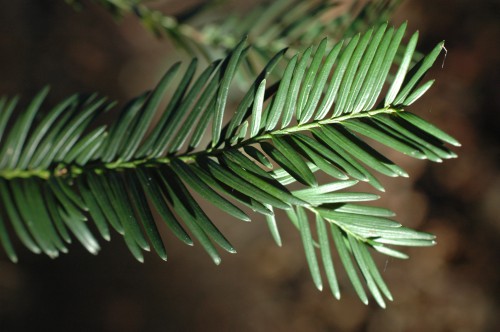
Yew foliage

Yew foliage

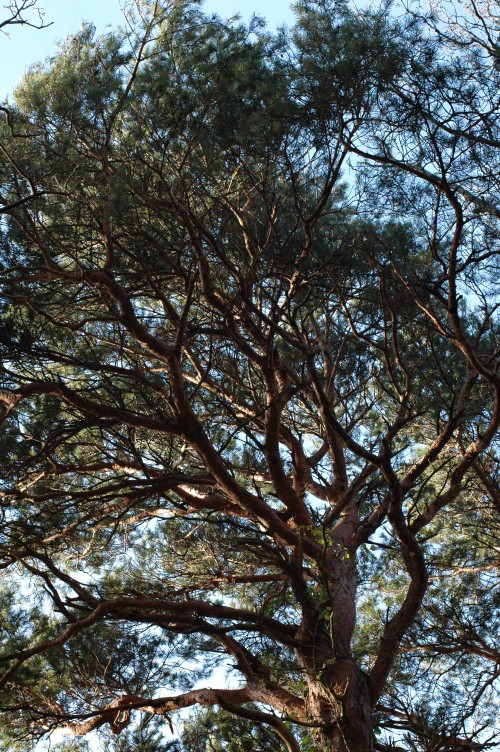
Scots pine (Pinus sylvestris) is an evergreen conifer native to northern Europe, and is one of just three conifers native to the UK.

150104TGFL-Bryn Euryn 12-Scots Pine

A huge Scots Pine

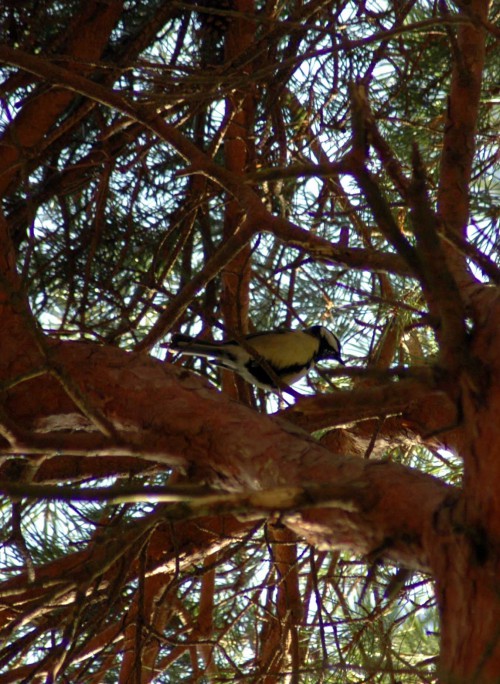
A Great tit in the pine tree

A Great tit in the pine tree

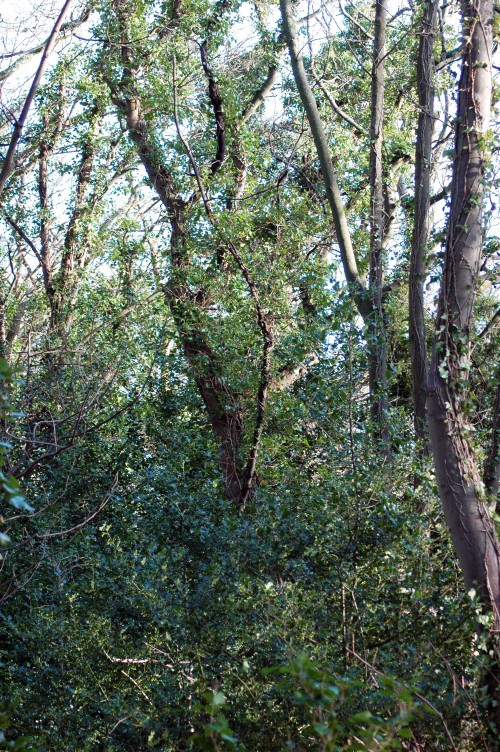
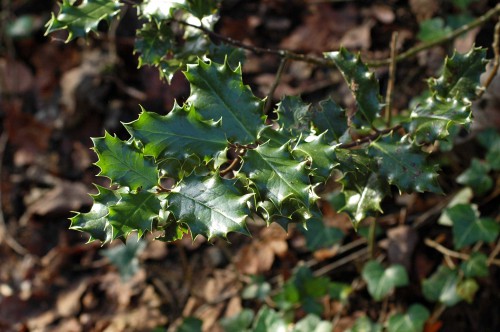
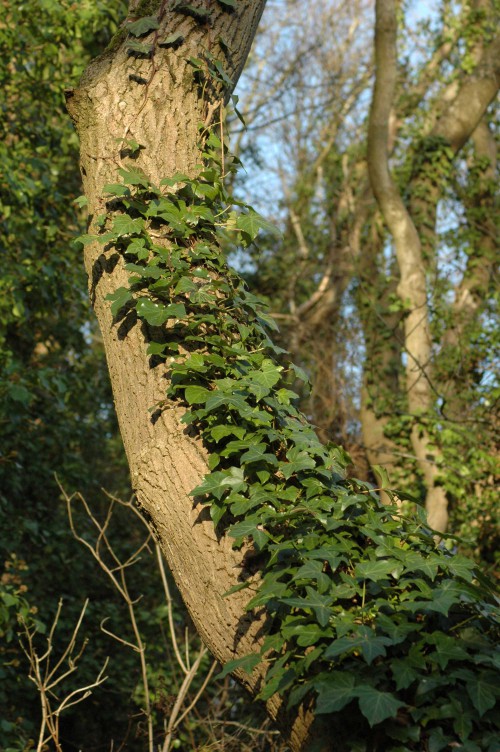
Holly and Ivy

Holly and Ivy

Shiny Holly leaves

Shiny Holly leaves

Ivy

Ivy

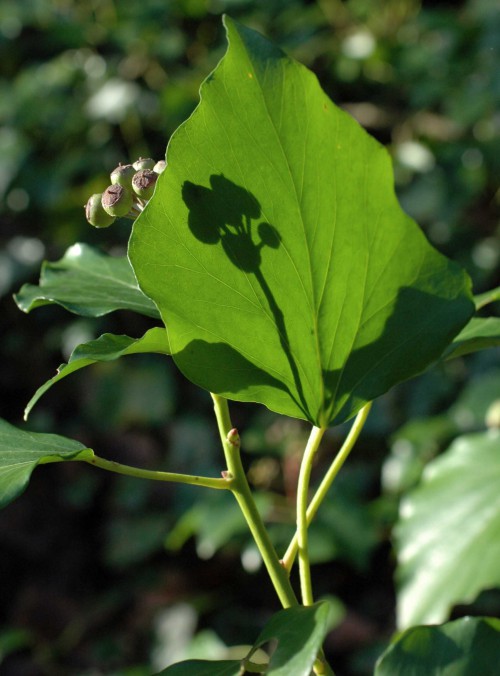
Sun shining through an ivy leaf

Sun shining through an ivy leaf

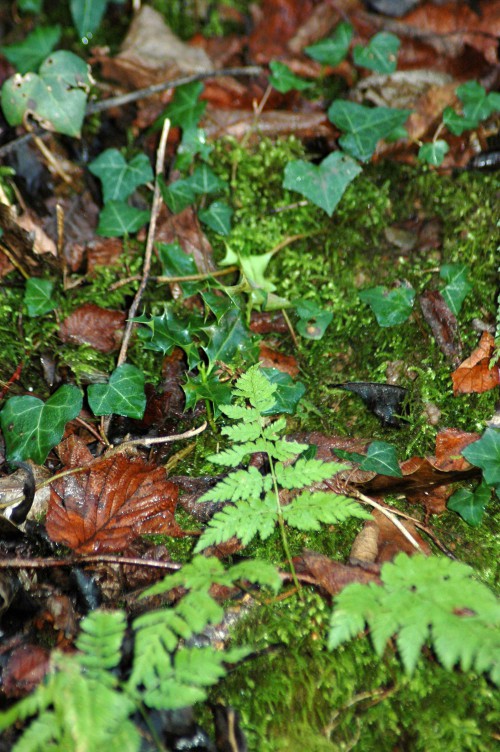
Greenery is also abundant on the woodland floor.

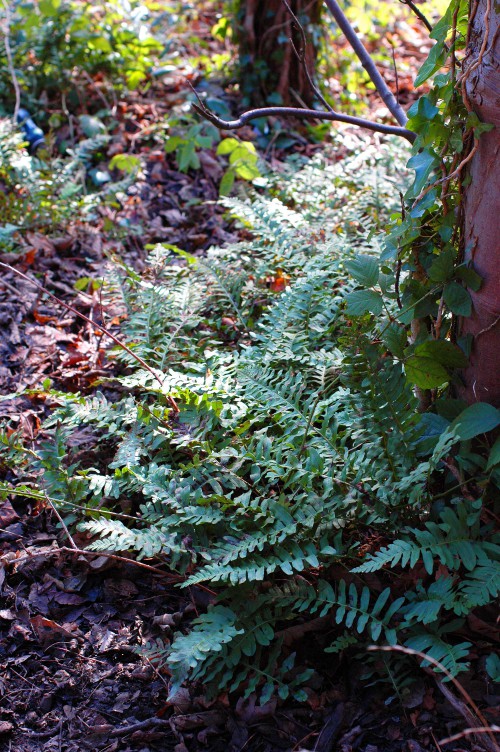
Fern around the base of a tree

Polypody fern around the base of a tree

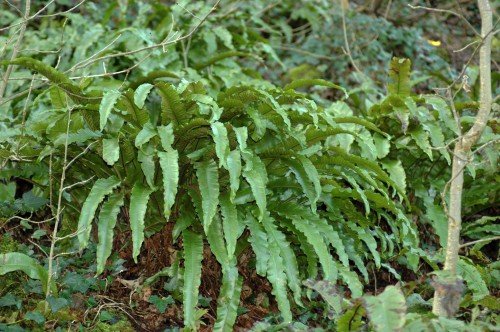
Hart's tongue fern

Hart’s tongue fern

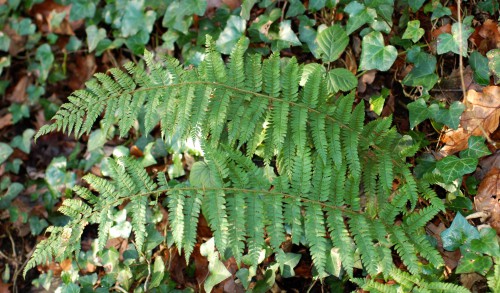
Male fern

Male fern

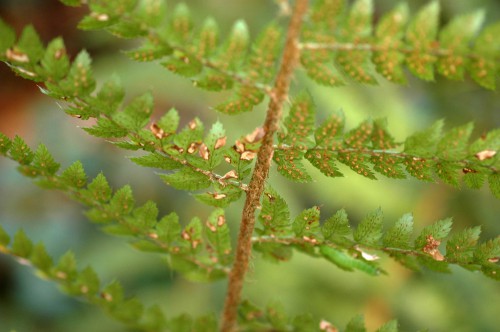
Spores on the back of a fern leaf

Spores (sori) still cling to the back of a fern leaf

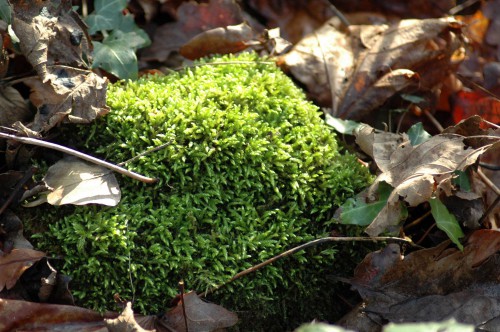
Vibrant green moss amongst dry brown leaves

Vibrant green moss amongst dry brown leaves

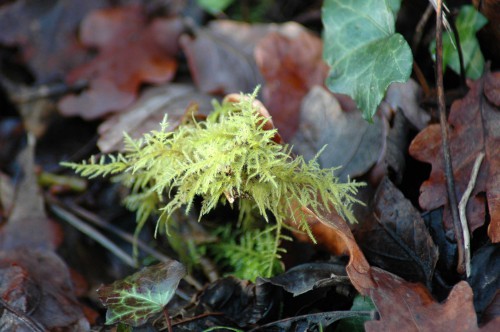
Winter is a good time time to see mosses when many are at their best.

Feather moss

Feather moss

Young fern and holly plants in a mossy bed

Young fern and holly plants in a mossy bed

A few splashes of colour…….

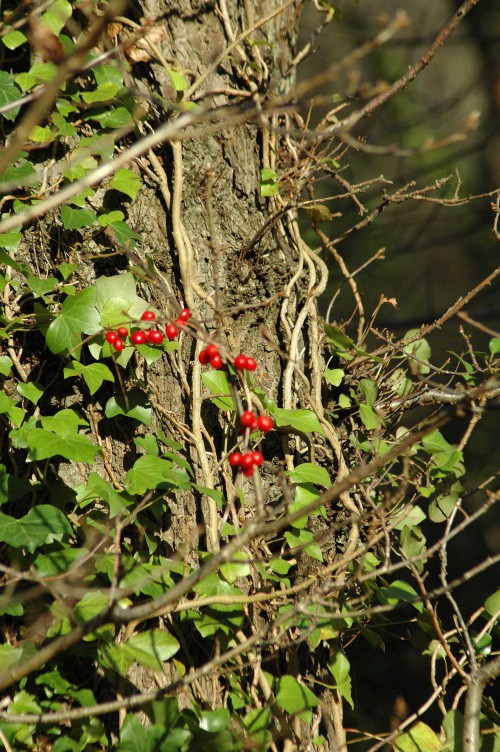
Red berries of nightshade strung like beads around ivy

Red berries of nightshade strung like beads around ivy

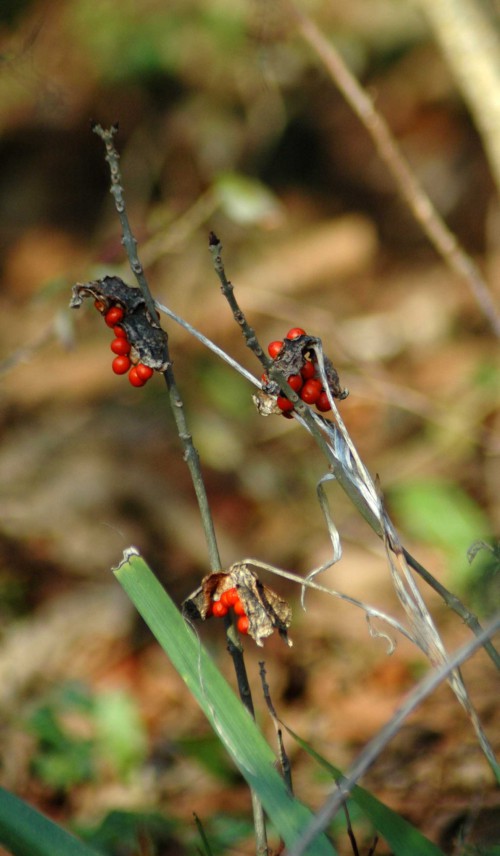
A few berries remain on a 'Stinking Iris'- Iris foetidissma

A few berries remain on a ‘Stinking Iris’- Iris foetidissma


Share this:

  • Share on Facebook (Opens in new window) Facebook
  • Share on Pinterest (Opens in new window) Pinterest
  • Share on X (Opens in new window) X
Like Loading...

Getting to know my new neighbours

07 Saturday Feb 2015

Posted by theresagreen in Bryn Euryn Nature Reserve, Nature, Nature of Wales, nature photography, Rhos-on-Sea, woodland birds

≈ 4 Comments

Tags

blackbird, Blackcap, Blue tit, Bullfinch, coal tit, dunnock, Great Tit, grey squirrel, redwing, Robin, wood pigeon

The beginning of this year has been a busy one and I’ve been distracted and often frustrated by the myriad of mostly mundane issues involved in moving home, but it’s all done and dusted now and at last I can get back to more enjoyable activities. I haven’t moved far and I know my new location is going to be the perfect base from which to carry on discovering more about the rich and varied habitats and wildlife of this part of North Wales.

A good few of my posts have related to the nature reserve of Bryn Euryn, the big bulky hill around whose base much of Rhos on Sea is built and my new home, on its eastern slope couldn’t have put me into closer contact with it. The beginning of a public footpath leading up onto the Bryn’s Woodland Trail is within a few metres of the entrance to the apartment block I live in now.

Early morning view

Early morning view to the east across Colwyn Bay

The views from the living room of my top-floor flat, although partially screened by trees, are ones I have photographed many times, albeit from higher up on the hilltop and then from the kitchen window the steeply rising wooded hillside is just a few metres away. Thanks to residents on the ground floor who put food out for the birds, I have a wonderful eye-level view of an array of woodland birds making the most of the food on offer.

There are almost always wood pigeons somewhere close by, most often perched up high surveying the busy little birds flitting about below. Pigeons nest pretty much all year round and on several occasions in the past weeks I have seen birds carrying sticks, probably for running repairs.

Wood Pigeons keep an eye on an approaching Grey Squirrel

Wood Pigeons keep an eye on an approaching Grey Squirrel

Sometimes they descend from their lofty perches allowing a closer look at their lovely softly-shaded plumage.

A handsome Wood Pigeon

A handsome Wood Pigeon

Other larger birds I see on a regular basis are a pair of crows and a pair of magpies, who also strut around on the lawn and there have been a few glimpses of jays.

Where there is food on offer then there are bound to be opportunistic grey squirrels, there are several that scamper about amongst the trees here on the woodland edge. They generally get a bad press, but I love watching them, they are entertaining and clever and you have to admire their incredible agility. They are rather photogenic too.

One of the squirrels nibbling on a twig
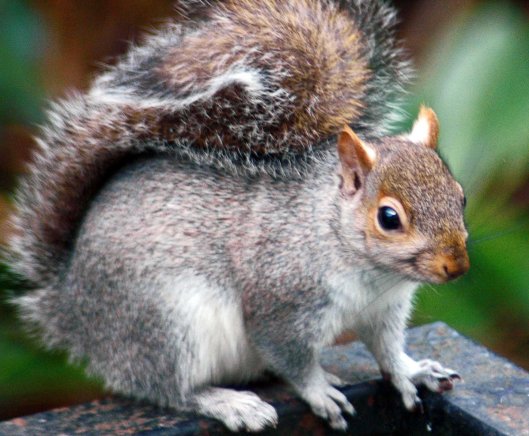
One of the squirrels nibbling on a twig

A photogenic Grey squirrel

A photogenic Grey squirrel

There are always blackbirds of course and recently both males and females have become more territorial. Males are singing and there are many chases amongst those that arrive for food;  first arrivals see off those that may follow. I have no idea which, if any, are regular visitors, particularly since I watched the piece on TV about the Holt Blackbird Project, where the blackbirds are fitted with different combinations of coloured leg tags and residents monitor their comings and goings. To quote from the published results:  One of the really incredible outcomes of the project is an understanding of the sheer number of birds that use the garden during the breeding season. The greatest number of individuals recorded on one day was 74, and even then there were some unringed birds still present. So, next time you see ‘your’ pair of Blackbirds in the garden, remember that they may not be exactly who you think they are!  Who knew? I always knew there were a good few of them around, but as you only really see them singly or in twos or threes when they’re establishing territory, those numbers seem incredible. I have given a link to the article about the project, which makes fascinating reading.

Male blackbird

Male blackbird

Female blackbird

A dark and well-marked female blackbird
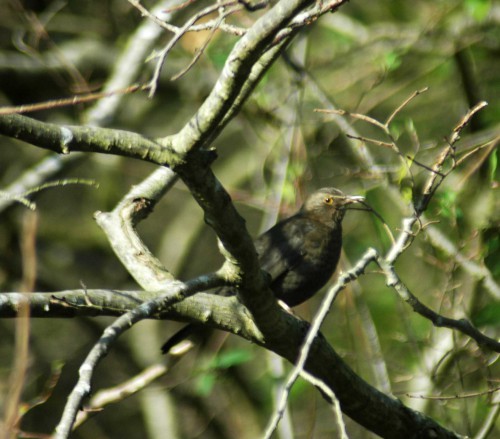
A lighter female blending perfectly in amongst the sunlit twiggy tree branches

A lighter female blending perfectly in amongst the sunlit twiggy tree branches

There are thrushes about too, or at least one anyway. Back in early January I heard one singing early one morning from a tree in the front grounds, when it was barely light. I thought it was most likely to be a mistle thrush as they are early nesters, but I am not at all sure and was even less sure when I heard more singing at 7.25am in the morning a week later, this time at the back of the building and looked out of the bedroom window to see him singing away illuminated by a nearby security light.

150109TG-Thrush singing (1) -Bryn Euryn (DC)

9th January – A thrush singing from high in a tree

Robins have been singing for a few weeks now too and as with the blackbirds, there is no peace for those that venture in for food; as soon as one perches another is almost sure to swoop in and there are frequent chases through the vegetation.

A robin enjoying a rare moment of peace in the sun

A robin enjoying a rare moment of peace in the sun

So far, the finches I have seen here have been goldfinches and chaffinches, but on Tuesday a lovely female bullfinch was here for a while. I was expecting to see a male with her, but alas no sign of one, so perhaps it was a young one that hasn’t got a mate yet.
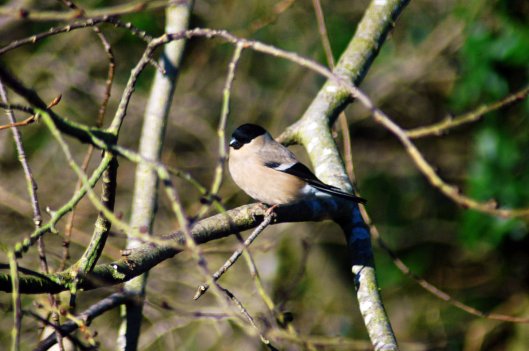
3/2/15-Bullfinch female

3/2/15-Bullfinch female

There are no house sparrows and I miss their noisy chirping and cheeping, and no starlings either, but I still have contact with both when I go back down the hill to visit my daughter. There are dunnocks though. Male dunnocks are singing now too.

Of the frequent visitors, Blue tits are the most numerous and there can be several here at any one time. They seem to have an orderly queuing system, each one taking food then taking leave or sometimes carrying it back to a nearby branch to eat it. There are more feeders in the garden next door and there is much commuting back and forth.

150203TG-Kitchen window-Blue Tit

Blue tit

There are only ever two Great tits present at any one time, a male and a female. They have a  more business-like approach to their feeding and although they make regular visits, they do not hang around once they have what they came for.

Female great tit

Female great tit

There are one, or perhaps two delightful little Coal tits too. Their approach in to the feeding site is more discreet than that of the Blue tits, made via the lower twiggy branches of the shrubby trees. They are also quick to leave once they have taken food.
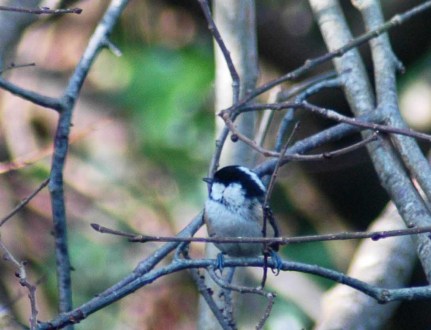
Coal tit

Coal tit

A small flock of glorious Long-tailed tits flutter in intermittently as they make their rounds, but I haven’t managed to photograph them here yet.

One morning I looked  out of the window and saw a bird that I didn’t immediately recognise, although it did look a bit thrush-like. I ran to get my camera and got just one image, through the glass, that I hoped would help with my identification. I had a feeling it was a redwing, but I hadn’t seen one for some years and couldn’t quite make the image I had fit with those in my books. I thought then maybe it was a sparrowhawk- right place, similar stance on the branch…? Anyway, I have been put right by fellow blogger Tony, who despite the not-so-brilliant quality of the image, immediately spotted it was indeed a redwing! I’m delighted – it’s another species to add to my list and to look out for again and I’m sure a sparrowhawk will be along any time soon.
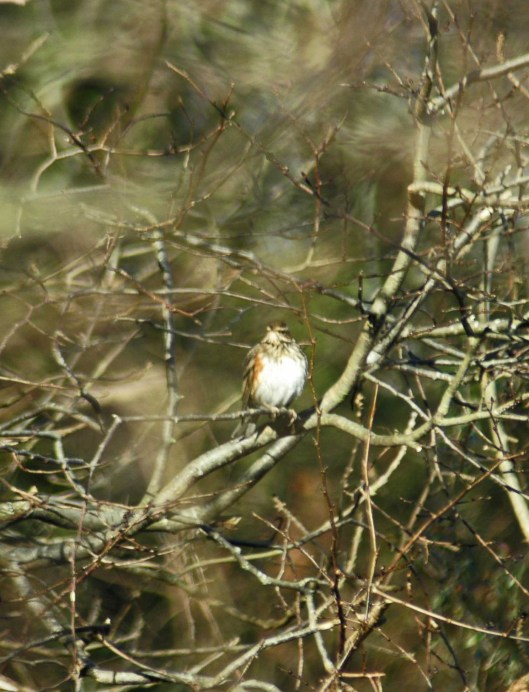
150104TGBRD-Kitchen view 12- Sparrowhawk

Redwing-Turdus iliacus

Tuesday this week (the day I saw the bullfinch) was a glorious sunny day and a few of the birds took advantage of the warmth to take brief respite from their hectic feeding schedules to sit in the sunshine. I looked across to the laurel hedge and spotted a bird nestled into a small space framed by leaves. My eye was drawn by its pale-coloured breast, but it wasn’t until I looked through the camera lens that it occurred to me it was a blackcap, a female.

4/2/15-First glimpse of the female blackcap

4/2/15-First glimpse of the female blackcap

She ventured out onto a twig in the sunshine

She ventured out onto a twig in the sunshine

150204TGDC-Blackcap female first sighting this year (4)

She sat in the sunshine for a short while before flying off

She stayed around for a good few minutes, then moved across to an evergreen shrub in the neighbouring garden for a while before flying off. I expected to see a male somewhere near her, but as with the bullfinch there was no sign of one. More about blackcaps here.

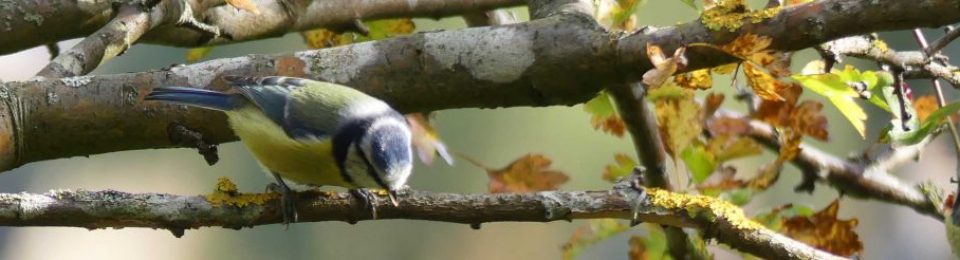
Thursday morning was again gloriously sunny and a much warmer day too and a few minutes spent watching the usual comings and goings brought forth two more additions to my list. Firstly a glimpse of a greater spotted woodpecker high up in a tree, half-hiding behind a branch, then even more excitingly a tiny goldcrest. I was fairly sure I’d seen one here flitting about in the vegetation on a couple of occasions previously, and I stopped to watch one on my walk on Tuesday, but this was a really good, though brief sighting that confirmed my previous sightings weren’t just wishful thinking. We have a good number of conifer trees close by, which they like to use as nest sites, so I’m hoping to see more.
Share this:

  • Share on Facebook (Opens in new window) Facebook
  • Share on Pinterest (Opens in new window) Pinterest
  • Share on X (Opens in new window) X
Like Loading...
← Older posts
Newer posts →
Follow everyday nature trails on WordPress.com

Enter your email address to follow this blog and receive notifications of new posts by email.

‘But it is the common species that keep the living world ticking over and provide most of our experiences of wildlife, and I would argue that maintaining the abundance of these is as important a conservation priority as maintaining the existence of rarities’. Richard Mabey

MOST RECENT POSTS

  • A Glimpse of Spring to Come January 22, 2025
  • Hunting the Wren December 28, 2024
  • Oh, Christmas Tree December 18, 2024
  • In and Out of the Ivy February 15, 2024
  • Nature’s Fireworks November 30, 2023
  • Wild Autumn along the Coast Path November 3, 2023

OLDER POSTS

LOOKING FOR SOMETHING IN PARTICULAR?

  • Sights and Sounds from the Little Orme 1
    Sights and Sounds from the Little Orme 1
  • Things Bright and Beautiful
    Things Bright and Beautiful
  • Catchers, a Duck and Divers
    Catchers, a Duck and Divers
  • May Bee Appearing on Ivy near You
    May Bee Appearing on Ivy near You
  • Following a river to a Fairy Glen
    Following a river to a Fairy Glen
  • Shades, Sounds and Scents of the Woods
    Shades, Sounds and Scents of the Woods
  • A Windy Wildflower Trail
    A Windy Wildflower Trail
  • The Windhover
    The Windhover
  • Fine Dining for Crows
    Fine Dining for Crows
  • A Window on the Woods-Winter 1
    A Window on the Woods-Winter 1

nightingale trails

The Walk of the Monarch Butterfly-Sendero de la Mariposa Monarca

The Walk of the Monarch Butterfly-Sendero de la Mariposa Monarca

MY WILDFLOWER BLOG: where the wildflowers are

Snowdrop

Snowdrop

most recent posts

Follow everyday nature trails on WordPress.com

Social

  • View teresamaygreen’s profile on Twitter

Enter your email address to follow this blog and receive notifications of new posts by email.

Website Built with WordPress.com.

  • Subscribe Subscribed
    • everyday nature trails
    • Join 359 other subscribers
    • Already have a WordPress.com account? Log in now.
    • everyday nature trails
    • Subscribe Subscribed
    • Sign up
    • Log in
    • Report this content
    • View site in Reader
    • Manage subscriptions
    • Collapse this bar
 

Loading Comments...
 

    %d