• Home
  • about
  • about the photographs
  • Local Nature Reserves
    • Bryn Euryn Local Nature Reserve
    • Mynydd Marian
  • Wales Coast Path
    • Grey Seals in North Wales
    • St.Trillo’s Chapel
    • Wildflowers of North Wales Coastal Paths, Cliffs and Dunes

everyday nature trails

everyday nature trails

Category Archives: Insects

Late summer on Bryn Euryn

08 Saturday Sep 2012

Posted by theresagreen in Bryn Euryn Nature Reserve, bumblebees, Local Nature Reserves, Nature, nature photography, Wildflowers of Wales

≈ 4 Comments

Tags

agrimony, black knapweed, Bryn Euryn Nature Reserve, carder bumblebee, gatekeeper butterfly, hemp agrimony, hoverflies, Meadow Brown, nodding wild onion, peacock butterfly, ragwort, red-tailed bumblebee, self-heal, wildflowers of Bryn Euryn

The soggy conditions created by the rainfall this year have not been ideal for many late summer wildflowers and, perhaps as a result of that, it seems to me that there has been a drop in some insect populations. I was on the lookout for flower beetles, in particular soldier beetles, which in  previous years have been prolific, and struggled to find many at all.

I spent a couple of hours roaming the pathways of Bryn Euryn on one sunny afternoon in mid-August, ignoring grey clouds rolling in at my peril, getting caught right at the top in a proper downpour. There is  almost always something interesting to photograph here whatever the weather though, and these are my offerings for that day.

There were very few plants still flowering on the lower field edge, but the first one, the Great Willowherb, often mistaken for Rosebay Willowherb, is one I’ve wanted to mention for a while and will do at greater length soon.

Great willowherb is often mistaken for rosebay willowherb

Common Mallow-Malva sylvestris

banded Snail on a bindweed leaf

Greenbottle fly-Lucilia caesar on Hogweed flowers

Most of the hogweed plants are setting seed


Self-heal- Prunella vulgaris

In the clearing at the top of the steps that cut through the lower woodland is a bramble patch that always seems to attract an array of nectar-seeking insects. Today there were a good number of hoverflies, most the one photographed below, but there were a few other Eristalis species too.

This attractive hoverfly is Helophilus pendulus, common names are Sun Fly as it does enjoy basking in sunny patches, and The Footballer referring to its colours and stripy patterning

Eristalis on Wild Carrot- Daucus carota

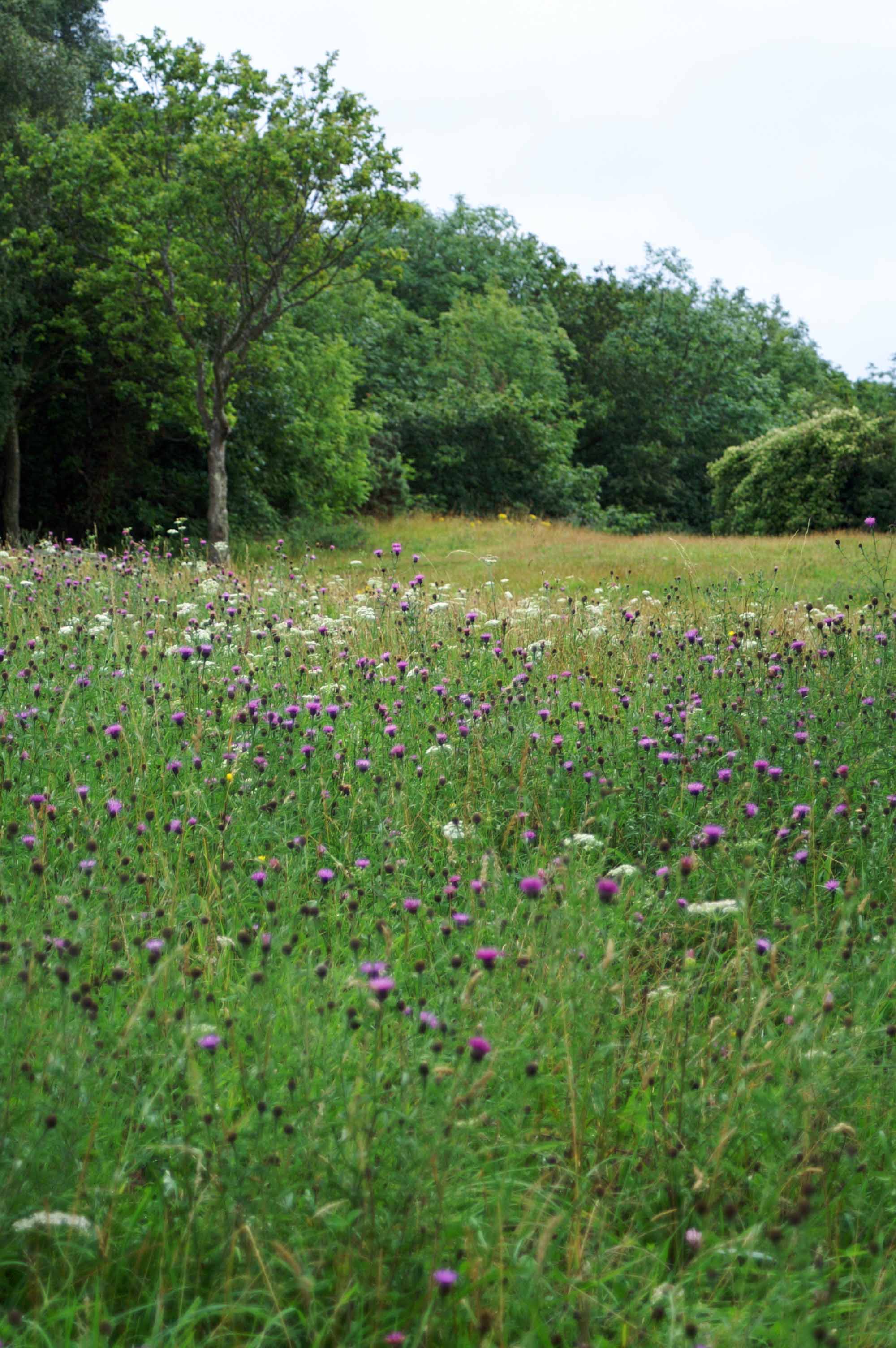
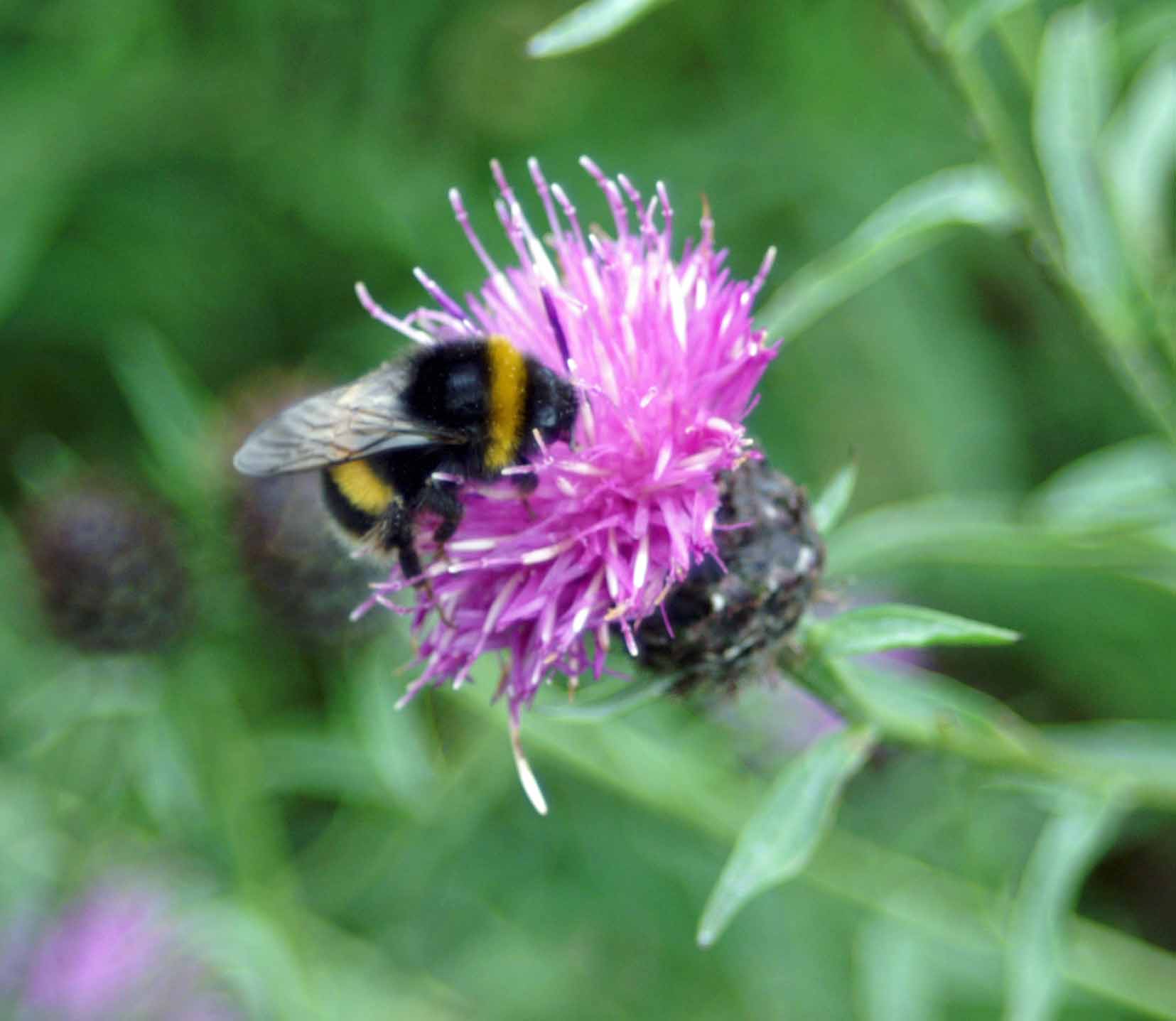
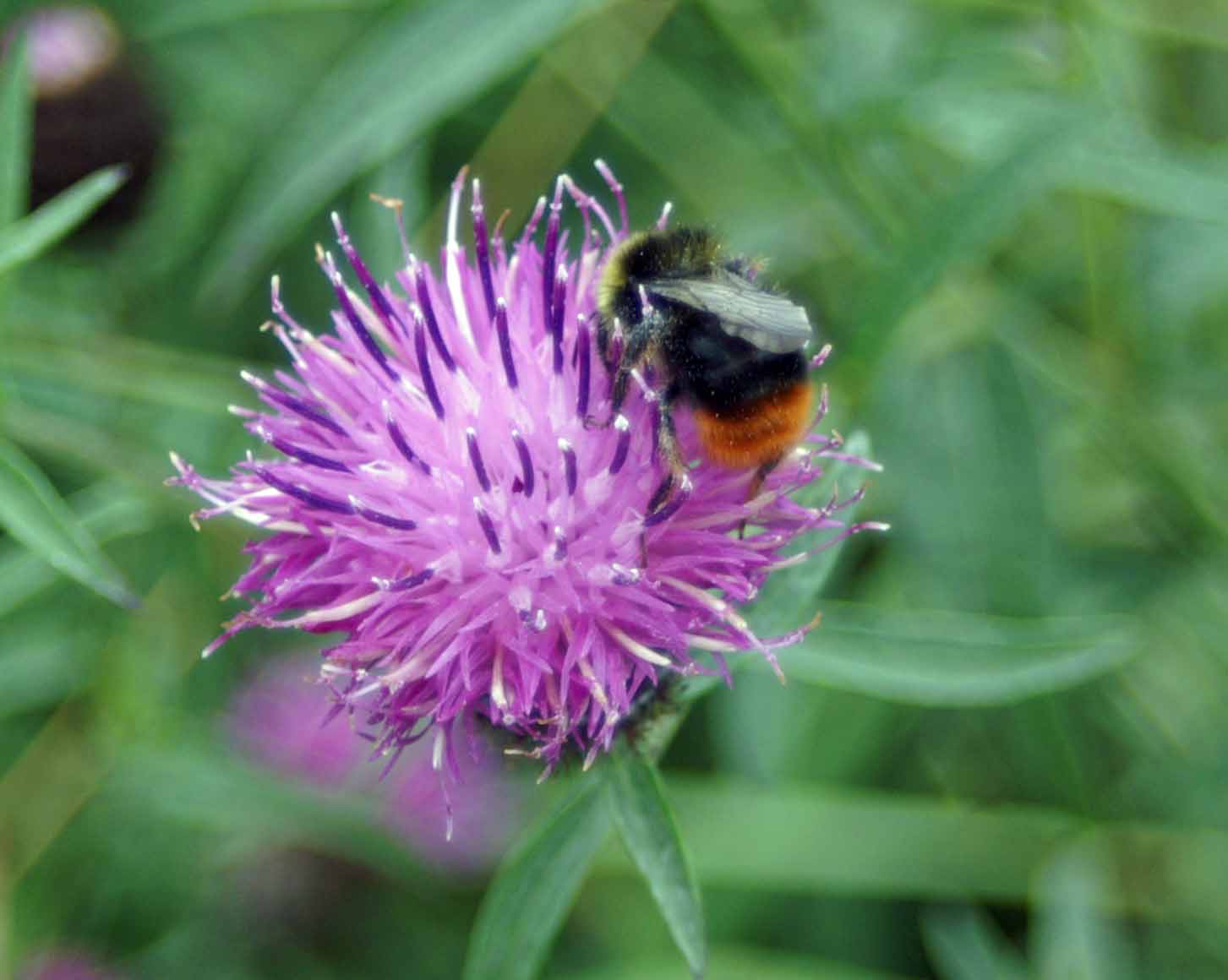
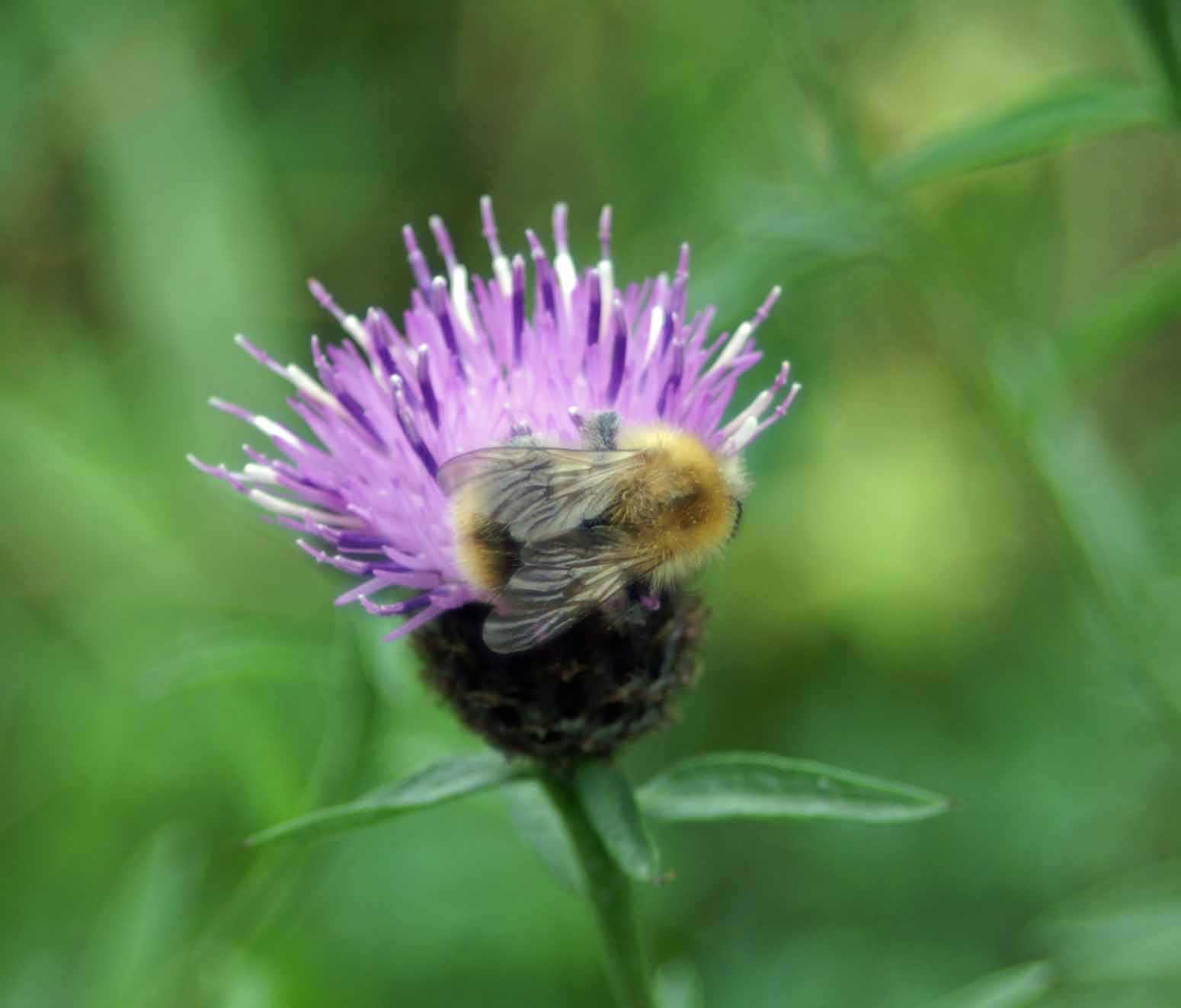
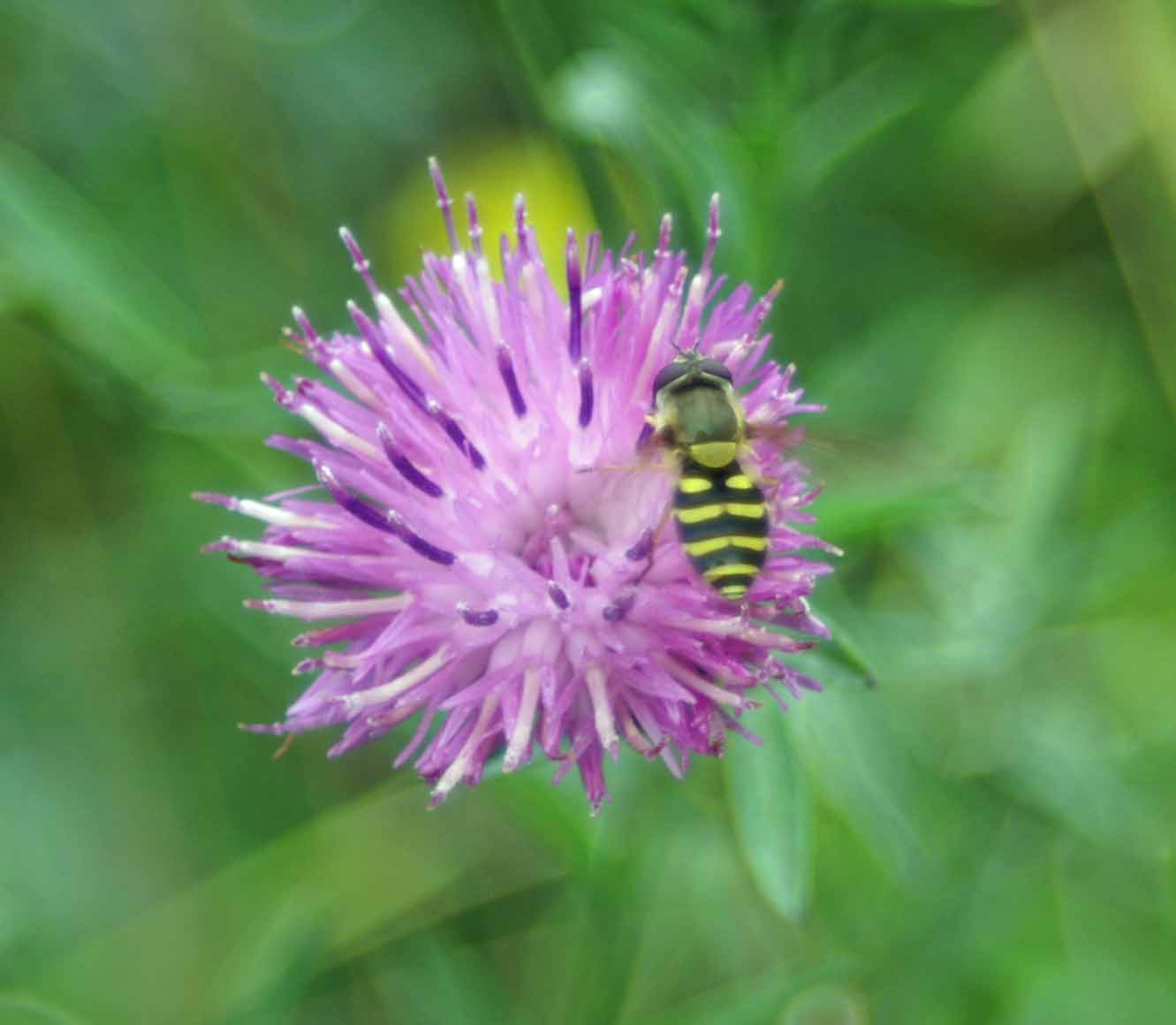
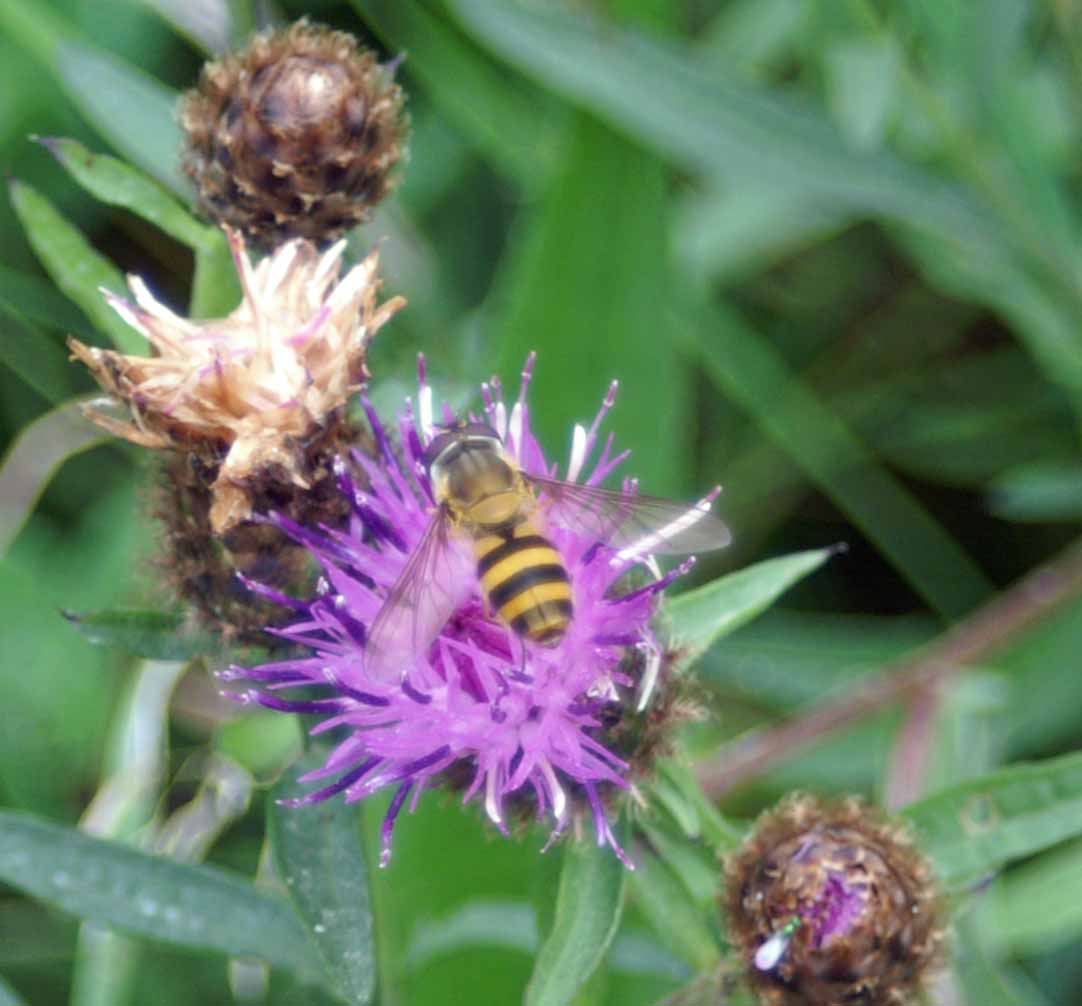
I headed a bit round to the open grassy area that this time last year was covered in purple flowered knapweed and buzzing with dozens of insects,  but now was looking quite bedraggled and bereft of colourful blooms. There was some knapweed, but hardly enough to go around apparently as most of the flowers had more than one bumblebee or hoverfly competing for its bounty.

Black Knapweed-Centaurea nigra

Red-tailed Bumblebee on knapweed flower

Common Carder bee on knapweed

In amongst the long damp grass was a pink flower that I recognised from last year but didn’t get around to identifying. This (I believe/hope) is an unusual plant of the allium family, common name Nodding Wild Onion or Allium. The pink bell-shaped flowers are  tiny and have protruding stamens; very pretty.

Nodding Wild Onion-Allium Cernuum tangled in amongst the long damp grass

A closer look at the pretty little flowers

There were a few plants of Agrimony – Agrimoniia eupatoria

The other staple of late summer nectar, Ragwort, is also flowering of course. I can’t not include it here, so thought I’d just put in a close-up of an individual flower to show how pretty they really are.

Close up of Ragwort flowers

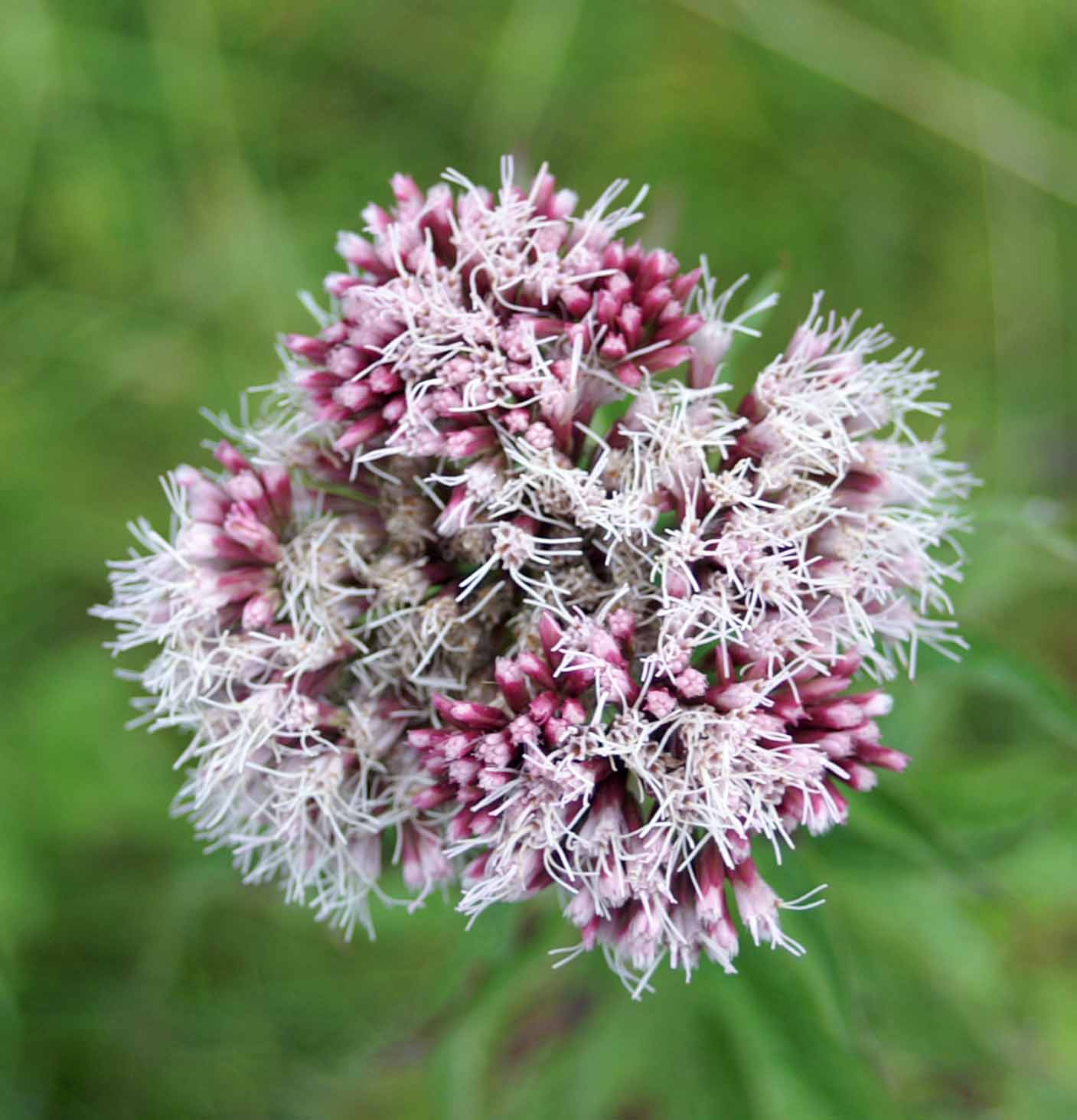
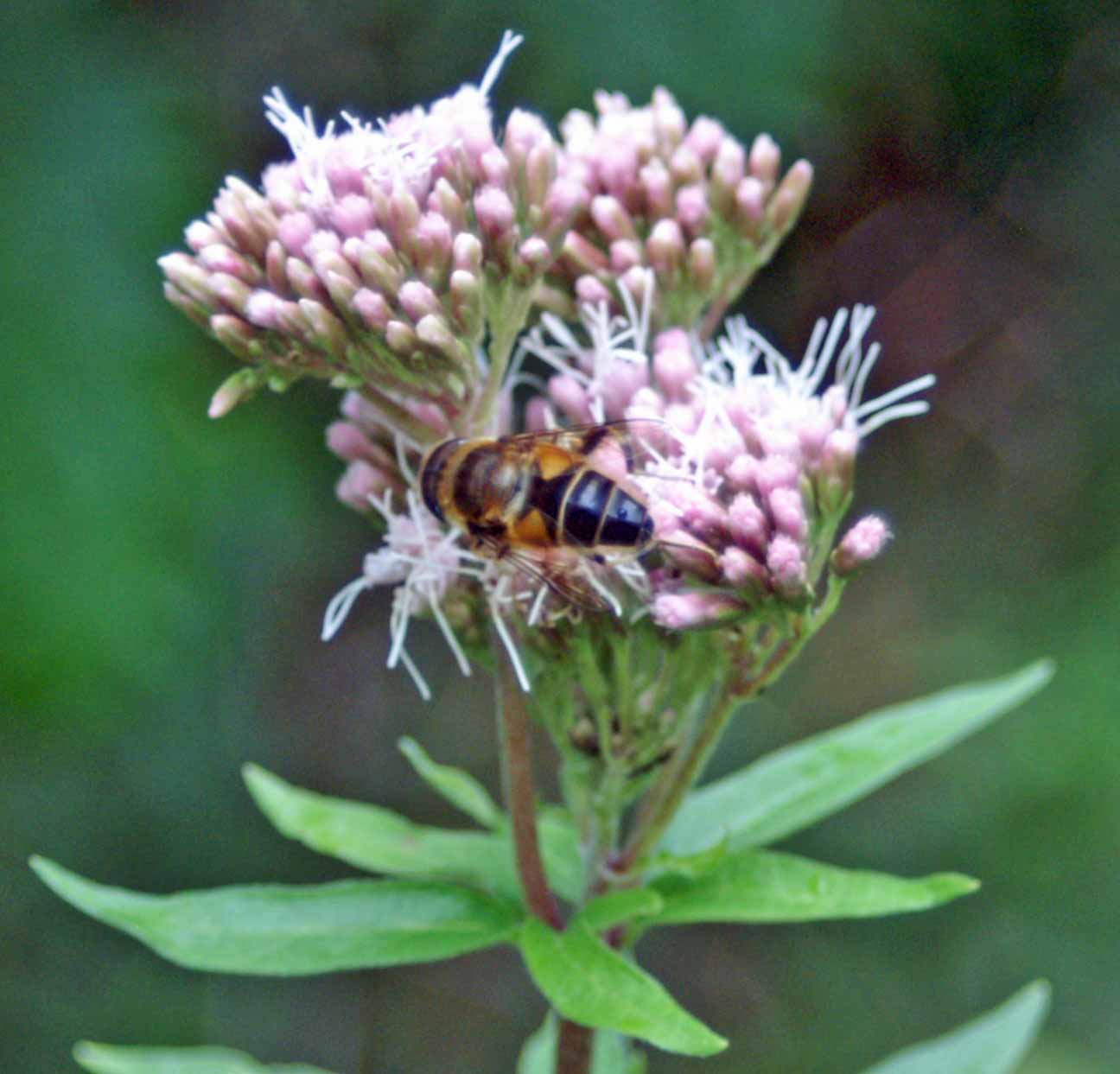
One flowering plant that is relishing the damp conditions and flowering prolifically here was Hemp Agrimony. Its flat, open flowers are very attractive to insects; great for butterflies.

Hemp Agrimony-Eupatorium cannabinum

A partially-open flower head of hemp agrimony

There were a few butterflies about, but as the clouds came over and the air cooled those that were out and about were not very mobile. Meadow Browns were most numerous but most were fluttering about low down in the long grass. I spotted one on Hemp Agrimony, also a single Gatekeeper and was taken by surprise when a Peacock (butterfly!) flew right in front of my face. I did photograph them all, but by now it was minutes away from the onset of the downpour and quite dark, so the resulting images are a bit grainy, but there for the record.

Meadow Brown on Hemp Agrimony

Gatekeeper – Pyronia tithonus

Peacock – Nymphalis io, looking a bit faded and worn, on hemp agrimony

Tiny acorns are beginning to show on the oak trees

Share this:

  • Share on Facebook (Opens in new window) Facebook
  • Share on Pinterest (Opens in new window) Pinterest
  • Share on X (Opens in new window) X
Like Loading...

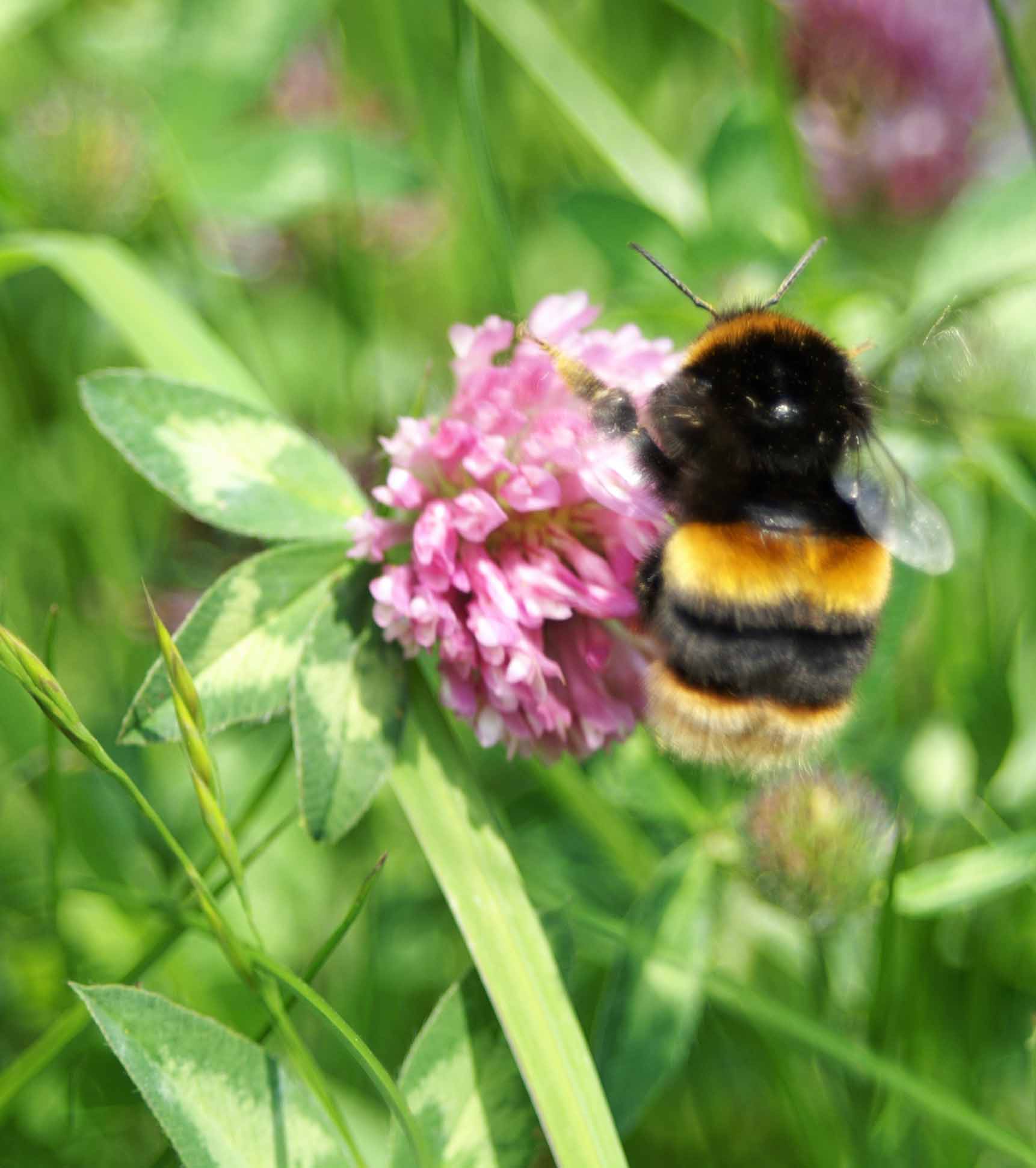
Bumblebee in red clover

29 Tuesday May 2012

Posted by theresagreen in bumblebees, flower folklore, Nature, nature photography, Old Colwyn, Wildflowers of Wales

≈ 5 Comments

Tags

bombus terrestris, buff-tailed bumblebee, meadow flowers, medicinal plants, red clover, trifolium pratense, wayside flowers

There is a beautiful patch of red clover growing alongside the road leaving Old Colwyn and I just had to stop and have a closer look on my way home on Friday before it is past its best.

Red Clover- Trifolium pratense

Red Clover –Trifolium pratense  is a species of clover that is native to Europe, Western Asia and northwest Africa, but widely planted and naturalised in many other regions.

Red clover is said to be the national flower of Denmark, although apparently not officially designated . It is however the state flower of Vermont. “No. 159 of the Acts of 1894, effective February 1, 1895, designated the Red Clover as the official State Flower. Both an integral part of many a cultivated hay field and a common sight along numerous Vermont roadsides, the Red Clover is symbolic of Vermont’s scenic countryside generally and of its dairy farms in particular. Oddly enough, however, Trifolium pratense is not a native of Vermont but was “naturalized” from Europe”.  http://www.50states.com

The dark pink/purple flowers are held in dense rounded heads and have two leaves just below the top of the peduncle

An herbaceous, short-lived perennial plant, with hairy erect stems; variable in height, growing to 20–80 cm tall. The leaves are alternate, trifoliate (with three leaflets), each leaflet 15–30 mm long and 8–15 mm broad, green with a characteristic pale crescent in the outer half of the leaf; the petiole is 1–4 cm long, with two basal stipules.

The plant was named Trifolium pratense by Carolus Linnaeus in 1753. Trifolium  simply means ‘three-leaves’ and Pratense is the Latin for “of meadows”.

Agricultural uses

High in vegetable protein, red clover is widely grown as a forage crop and is also valued for its nitrogen fixation, which increases soil fertility and is used as a green manure crop. It has become naturalised in many temperate areas, including the Americas and Australasia as an escape from cultivation.

Medicinal uses

Red clover has been reported to be used for a variety of medicinal purposes, such as the treatment of bronchitis, burns, cancers, ulcers, sedation, asthma, and syphilis. These days its use may be recommended to alleviate symptoms of menopause; red clover contains isoflavones (oestrogen-like compounds) which may relieve the discomfort of ‘hot flushes’.

Folklore

Clover was an ancient protective herb. The Druids considered the trefoils, symbolic of the eternal verities of Earth, Sea and Sky. The Celts saw the clover as a sacred, magical plant. A 4-leafed clover is a sign of good luck and is a charm against snakes, witches, the devil and other dangerous creatures. It is also said to give the gift of second sight, enabling one to see fairies. In the language of flowers clover means “think of me”  or “be mine”.

Pollinator plant

Buff-tailed Bumblebee – Bombus terrestris

Buff-tailed Bumblebee-Bombus terrestris on red clover

Share this:

  • Share on Facebook (Opens in new window) Facebook
  • Share on Pinterest (Opens in new window) Pinterest
  • Share on X (Opens in new window) X
Like Loading...

The Cockchafer or Maybug

29 Tuesday May 2012

Posted by theresagreen in Beetles, garden wildlife, Nature, Nature of Wales, nature photography

≈ 7 Comments

Tags

cockchafer, large beetle attracted to lights, maybug, melolontha melonontha

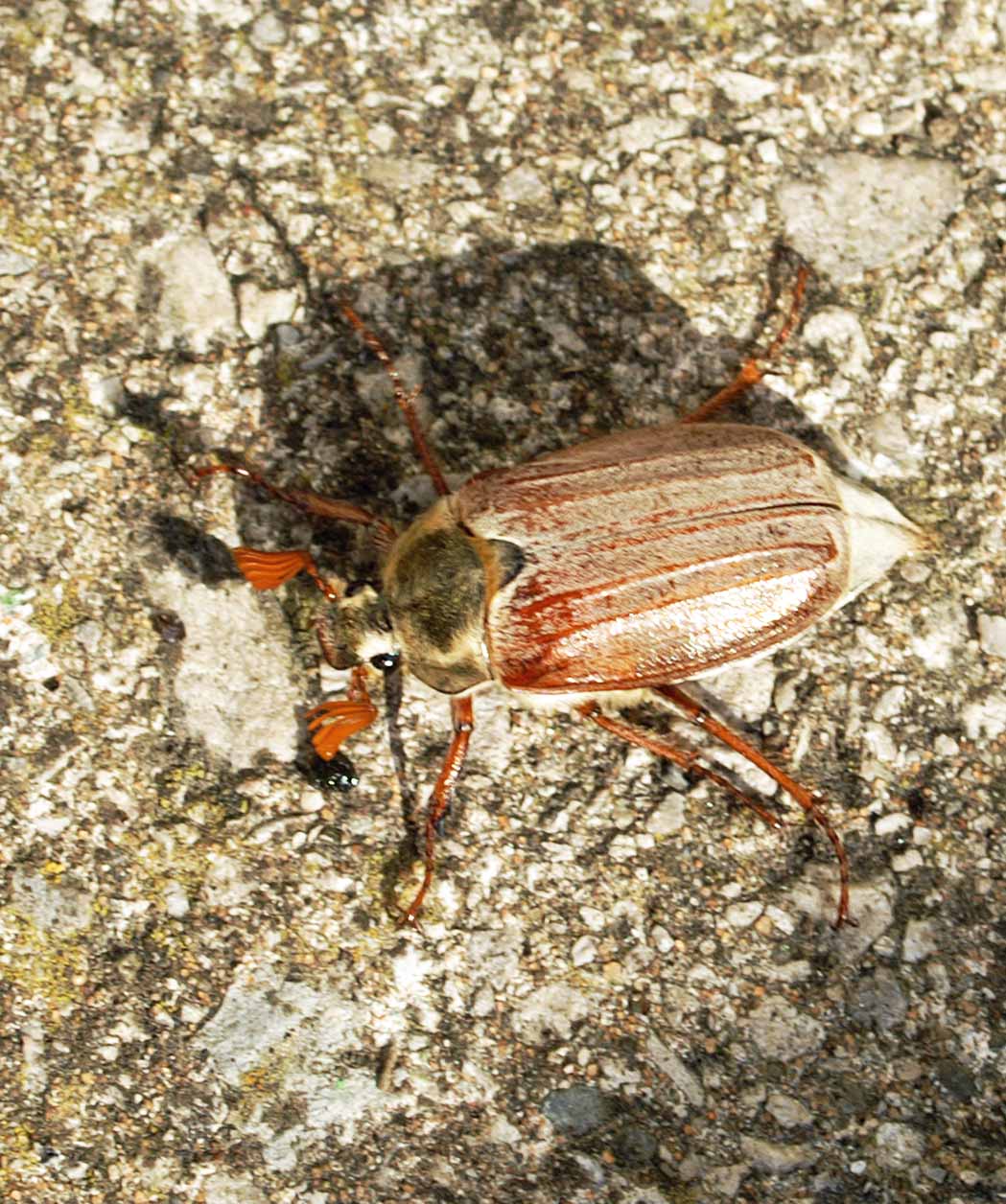
One morning last week I carried my early cup of tea outside to enjoy some early morning sunshine and discovered a big fat Maybug on its back on the chair. No amount of struggling was effecting him righting himself, he just lay there frantically waving his legs in the air, poor thing. Of course I helped him after I had taken advantage of his plight to photograph him, allowing him to hook his feet around my finger and placing him on the ground from where he took off rapidly and headed for the sycamore tree.

Maybug on its back showing the very furry body

Maybug, Cockchafer–Melolontha melolontha The Cockchafer is one of the more familiar large beetles as it is often encountered flying noisily about on warm evenings of the early summer, when it may crash into windows, attracted there by lights. It is also known as the May Bug as this is the month in which it most commonly appears. It is common and widespread throughout Britain and Europe except in the far north, occurring in grassy and lightly wooded places.

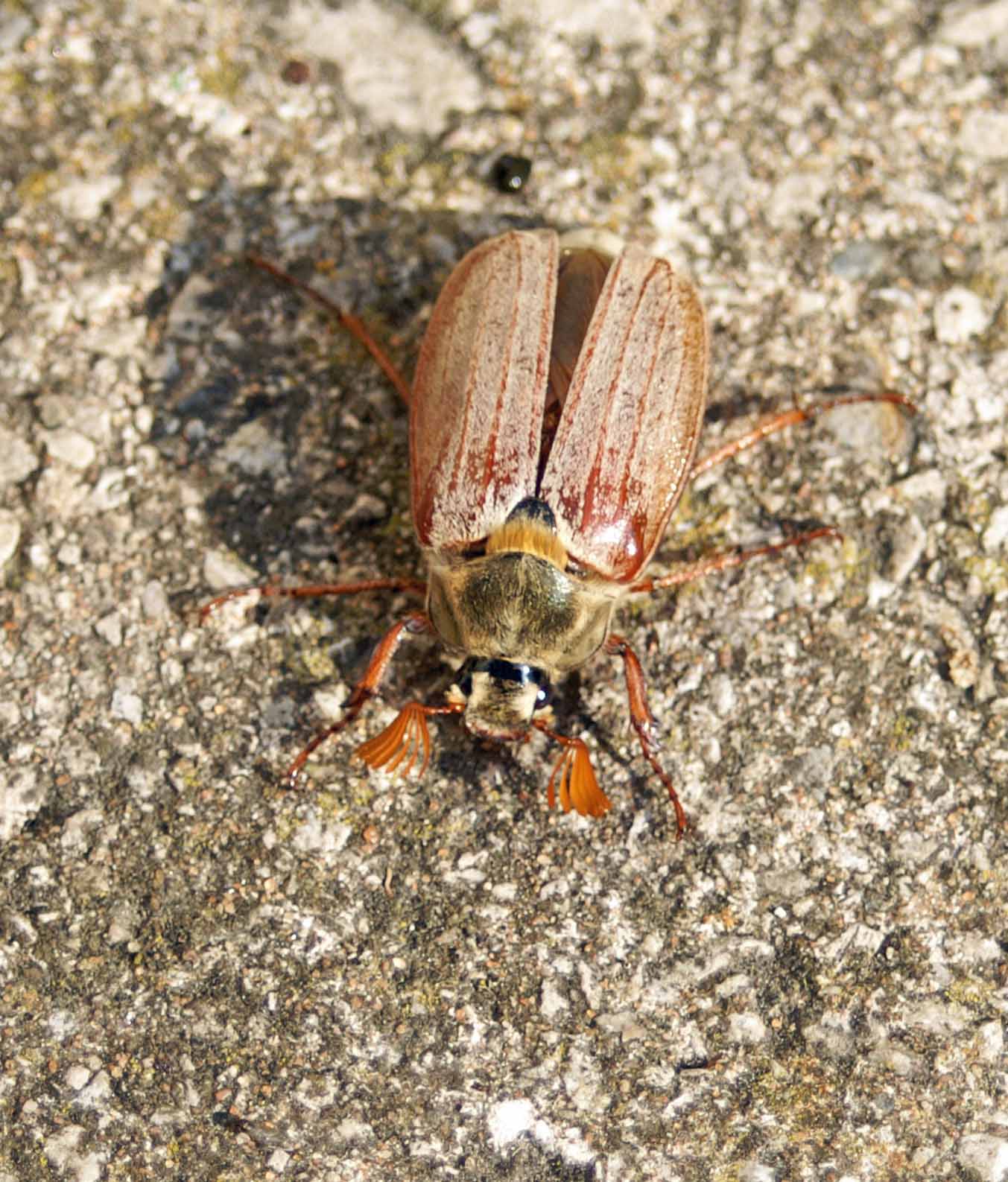
Cockchafers have a black head and thorax and brown sculptured elytra (wing-cases).

The larvae live on the roots of grasses and other plants in areas kept as permanent pasture and once were so abundant they were regarded as a pest species.

The beetle, particularly the male, has large impressive feathery antennae that open like a fan

Share this:

  • Share on Facebook (Opens in new window) Facebook
  • Share on Pinterest (Opens in new window) Pinterest
  • Share on X (Opens in new window) X
Like Loading...

Butterfly study: Holly Blue

15 Sunday Apr 2012

Posted by theresagreen in butterflies, Butterflies of Wales, Nature, nature photography

≈ 2 Comments

Tags

celastrina argiolus, holly, holly blue, pale blue butterfly

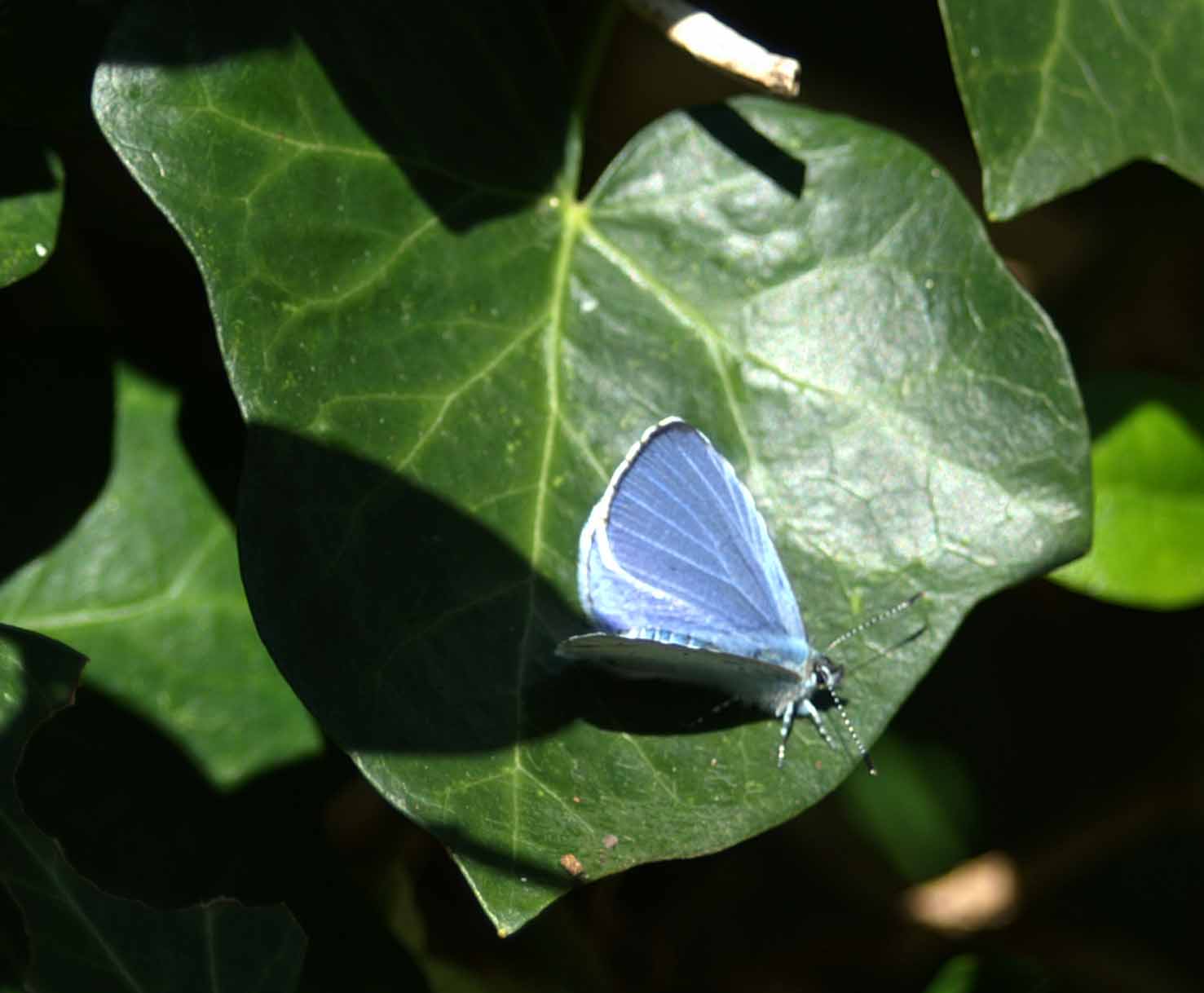
I have mentioned that my first butterfly sighting this year was of a beautiful little Holly Blue skipping along the sunny side of the privet hedge, but at the time I couldn’t catch it being still long enough to photograph. Last weekend though there were more, and from their pristine condition and the fact that they stayed basking in one sunny spot for quite a while I think it is safe to assume that they were very newly emerged.

Holly Blue on an ivy leaf

Holly Blue on an ivy leaf

  • Common name: Holly Blue
  • Latin name : Celastrina argiolus
  • Family group: Blues

The Holly Blue is the earliest of the blue butterflies to emerge in the spring, so for that reason alone is easy to identify. It also tends to fly high    around trees and bushes while other blues are more likely to be found at grass level.

Distribution and status

In Great Britain the Holly Blue is largely confined to England and Wales, although there are very sporadic records from Scotland and Ireland, but its population numbers fluctuate greatly from year to year. Worldwide it is widespread throughout Europe, reaches Japan and is also found in North Africa and North America.

The conservation status of the holly blue is presently of no concern in Britain; population levels are secure and the species’ range is increasing, although it is protected in Ireland. Similarly in Europe the range is rated as stable, with recent expansions in some countries.

Habitat

The Holly Blue occurs in a wide range of habitats, including hedgerows, field margins, woodland rides, gardens, and parks, including those in urban and suburban areas. In England, it often breeds in churchyards, many of which have Holly and Ivy. In Ireland, it is limited mainly to deciduous woods with Holly and, occasionally, country gardens.

Wings are bright blue. Females have black wing edges. Undersides pale blue with small black spots which distinguish them from Common Blue. Antennae & legs are striped with black.

Life-cycle

The lovely little holly blue has a strange but interesting life-cycle. The first generation of the year emerges quite early in spring and the females of this generation will lay their eggs singly, mainly on holly, but also on dogwood, gorse or buckthorn. The green slug-like caterpillars feed nocturnally on the flower buds, developing seeds and berries of the various foodplants, and rarely on the young tender leaves. They habitually sit on the skin of a berry, with their head buried inside it. The caterpillar is easy to find, either by searching directly, or by looking for half eaten berries in which the caterpillar has left a distinctive circular hole. As well as the plain green form of the caterpillar, there are also forms with prominent whitish and purplish markings.

The adults emerge in August and these second-generation females lay their eggs mainly on ivy, which flowers and fruits in the autumn and winter, but also on privet, gorse, heather, rowan and  snowberry. The adults of this generation are the ones we are seeing now. The eggs are almost also laid on bushes growing in sunny and sheltered locations and hatch after about a week.

Adult behaviour

Adult Holly Blues commonly feed on the aphid secretions ( honey dew ) which coats the upper surface of ash and oak leaves, but also sometimes settle on the ground to feed at bird droppings or take moisture from damp paths. Additionally, in spring they nectar at hawthorn, daisies and wood spurge. The second brood nectars on a wider range of plants including bramble, hemp agrimony, fleabane, bell heather, cross-leaved heath, hogweed and burdock.

When feeding they always keep their wings closed, but in the low sunshine of early evening they may settle on bushes to bask, holding their wings partly open.

Relationships with other insects 

In common with most Lycaenids, the larvae are attended by various species of ants, which obtain sugary secretions from a gland on the caterpillar.

The larvae may be parasitised by a host-specific  ichneumon wasp, listrodomus nycthemerus, which is thought to be an important factor in the population fluctuations of the species. In certain years, when climatic conditions favour the wasp, the butterflies can be extremely scarce. However when mild winters are followed by hot summers the wasps emerge out of synchrony with the caterpillars, and consequently in such years the butterflies are far more common.


Share this:

  • Share on Facebook (Opens in new window) Facebook
  • Share on Pinterest (Opens in new window) Pinterest
  • Share on X (Opens in new window) X
Like Loading...

Fair weather gardening

02 Monday Apr 2012

Posted by theresagreen in garden wildlife, Insects, Nature, nature photography

≈ 9 Comments

Tags

Bee-fly, Drone fly, herring gull, house sparrow, starling, wood pigeon

There are times when life takes precedence over blogging and I’m lagging behind a little with my postings as a result, only by a week or so, but at this time of year when nature is pressing on apace, an awful lot can happen in a very short time, so I’m trying to catch up.

The hot weekend of 25-26th March brought the incentive I needed to finally get out and cut the grass for the first time this year before its height exceeded the capabilities of my daughter’s little Flymo. My antics attracted the curiosity of  a few of the neighbours, who peered down from their penthouses to see what the racket was about.

An imperious stare from the beady yellow eye of one of 'our' herring gull pair

A wood Pigeon chose an aerial view of proceedings and seemed quite surprised by them

The starling was more preoccupied with posing

The starling, recognisable as a male by the blue base to his bill, looked so gorgeous I am putting in another shot of him.

He was whistling and singing, hence the fluffed out throat feathers

“I’m only a poor little sparrow, no colourful feathers have I, I can’t even sing when I’m nesting in spring……”

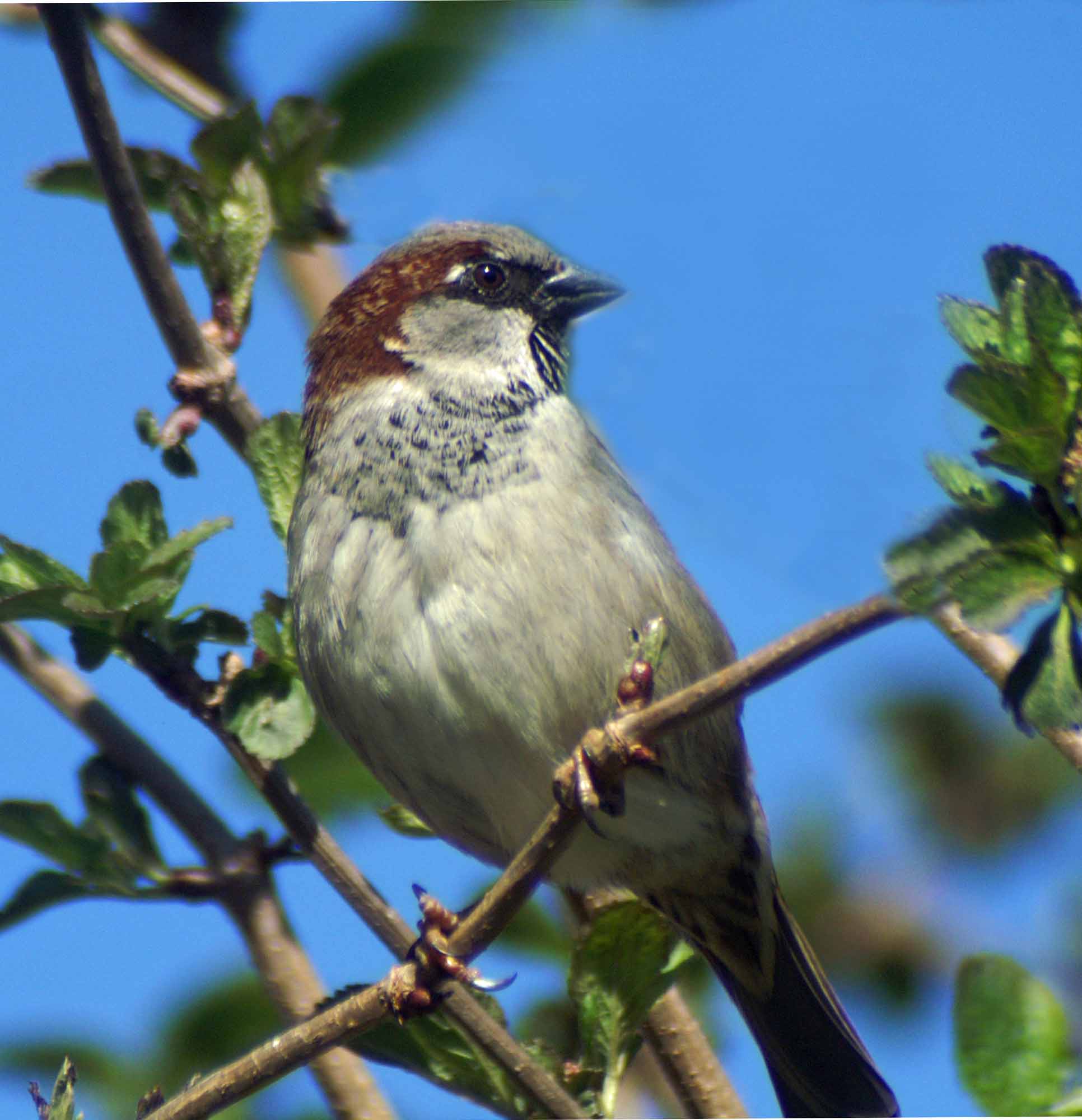
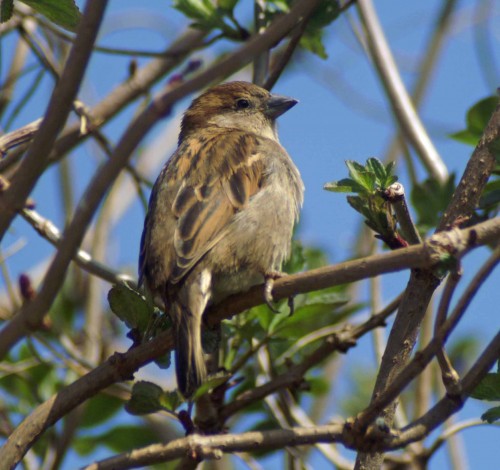
The garden hedges were bursting with House Sparrows, and I can see that at least two pairs are beginning to nest within the spiny pyracantha; more are occupying a space they have found high up in the eaves of the house at the front. Their constant cheerful cheepings and chatterings ensure I am aware of their companionship. They may not be colourful, nor can they sing, but I love them.

The male House Sparrows are all bright eyed and in their mating best plumage now

They may be brown, but how can you not appreciate the subtlety and detailed patterning of a female Sparrow's wing?

A weed is just a flower out of place

I’ve never been a fan of closely mown and weed-free lawns, partly because I never had the time or the inclination to spend hours on nurturing such a sward, but mainly because I could never bring myself to mow down daisies and would always leave little archipelagos of them strung throughout mine. I have a slightly different attitude to dandelions; whilst I do appreciate their golden beauty, they go to seed so rapidly and spread like wildfire so although I will leave a few, the majority do have to go. They are a very important source of nectar for early pollen and nectar foraging insects though, so I’m not too hasty to give them the chop.

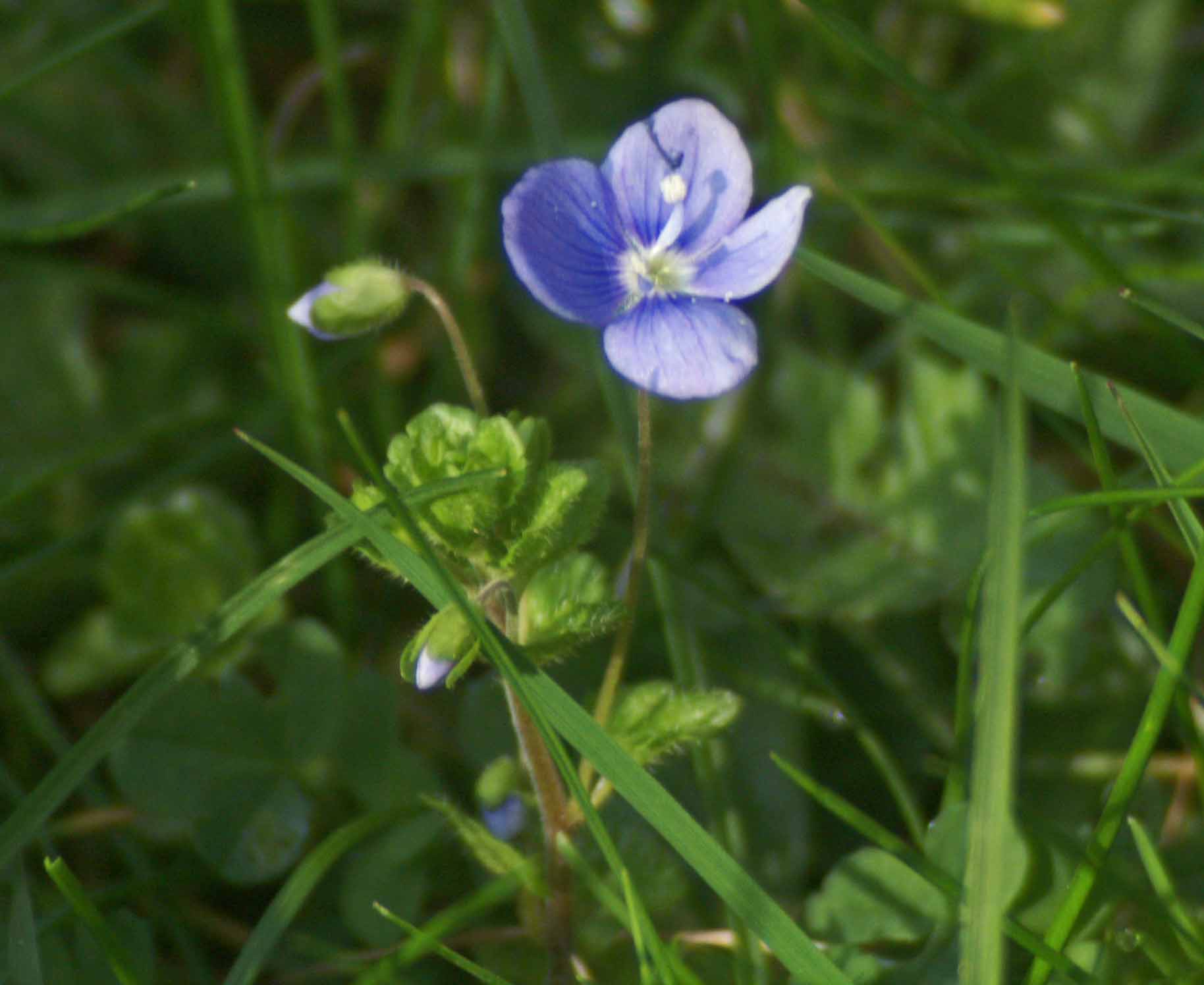
Dainty blue speedwell is another wild flower I hate to cut down. They don't take up much space and are so pretty.

Hoverfly on lesser celandine

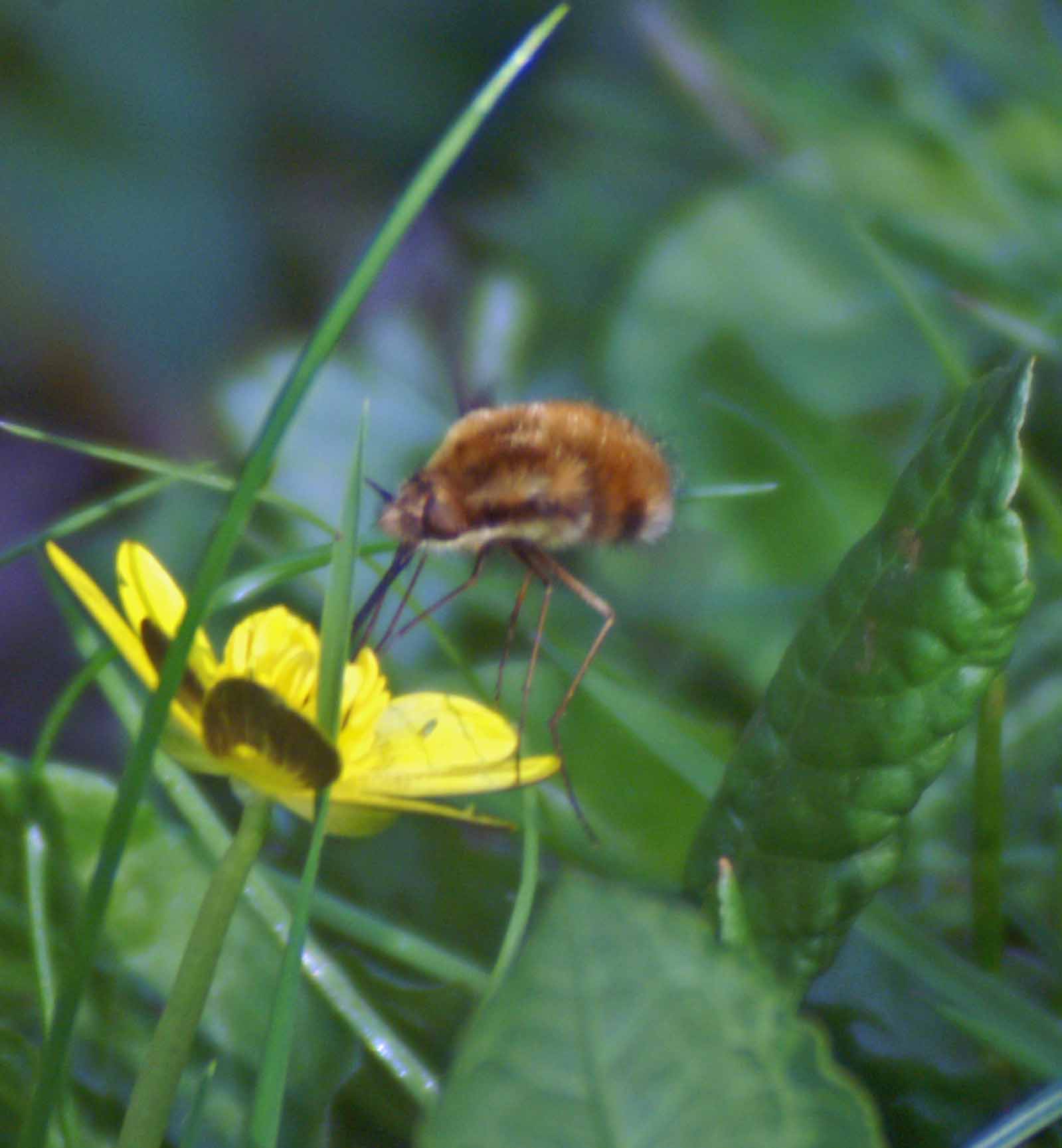
There are a couple of patches of lesser celandine in the lawn in this little garden that I am loathe to cut , even though I know they are just going to continue to grow and spread and probably get out of hand, but whilst I’m care-taking here they’ll stay. I was gratified to see a small hoverfly on a flower and delighted by a visit from one of my all-time favourite insects, a crazily-constructed bee-fly.

A favourite insect of mine, the bee-fly has a permanently projected long proboscis and ridiculously long legs to balance it

Bee-fly – Bombylius major

A very distinctive fly, a bee-mimic, these fascinating insects are most frequently seen in the early spring, from April to June when they may attract attention as they hover for several seconds at a time in the same spot, either over bare ground or over a  flower then dart off and return to the spot facing in a different direction.  Their hovering may be accompanied by a high-pitched buzz.

The body is rounded and furry,  the legs appear disproportionately long and spindly, but are probably required to balance the long rigid proboscis which is permanently fixed on the front of the head. Their boldly patterned wings have a distinct dividing border through the horizontal middle between the dark and clear portions. Their antennae are typically very short and pointed. The bee-fly’s behaviour belies its cute appearance though. The adult female lays her eggs close to the underground nest of a solitary bee 0r wasps, then flicks them towards the entrance. After hatching, the bee-fly larvae find their way into the nests to feed on the nest owner’s larvae.

A bee-fly resting on the ground showing better the patterned wings

There were lots of drone  flies about and a lesser number of smaller species hoverflies. Surprisingly my first butterfly sighting of this year was a little Holly Blue, followed a while later by the species I had expected to see first, a Speckled Wood. Neither obliged by resting for long enough for me to photograph and it feels like cheating to use ‘one I made earlier’, so I’ll have to wait.

Drone-fly-eristalis pertinax

An early marmalade fly

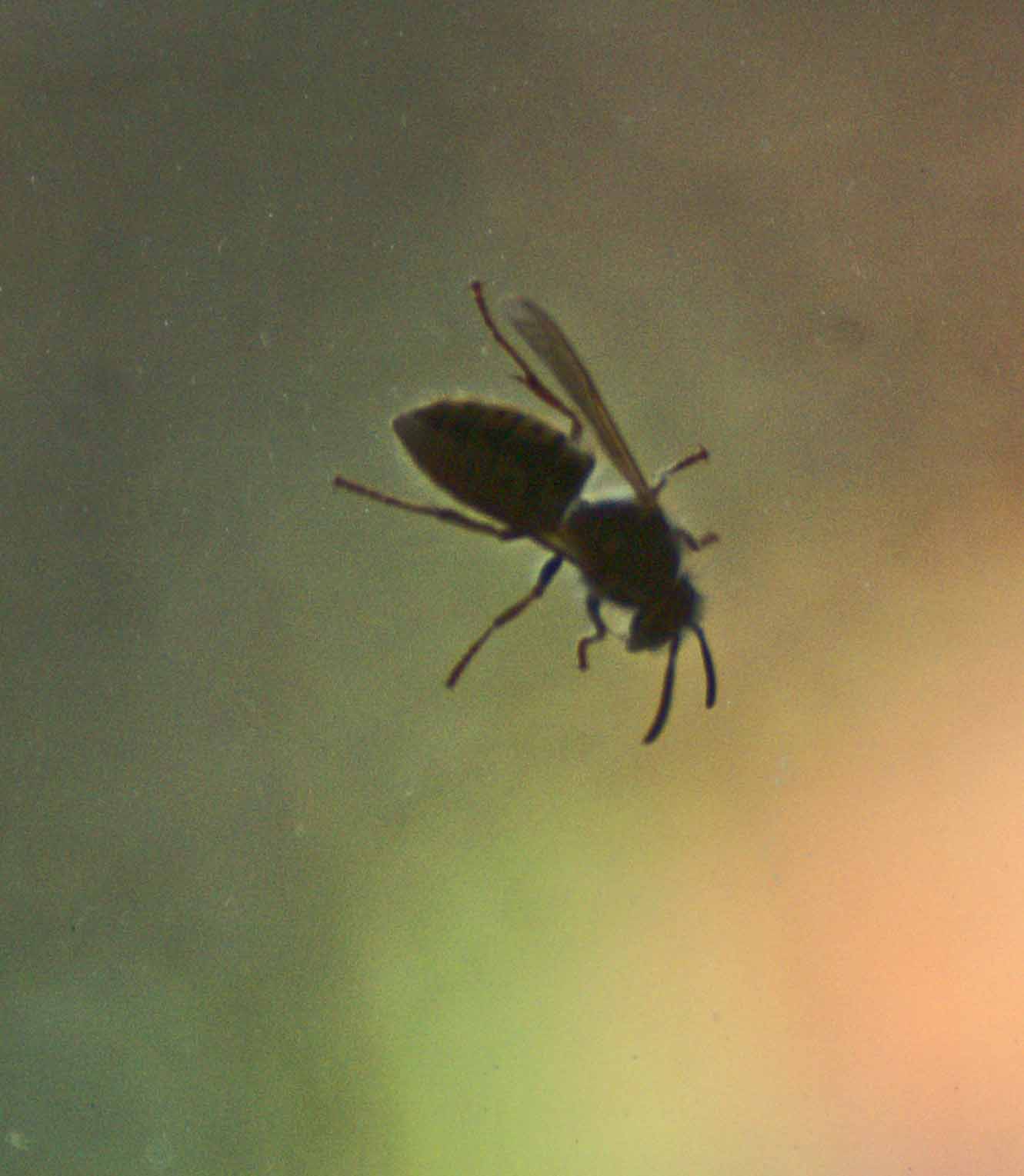
Inside the house, a large queen wasp had become trapped against the kitchen window: I had watched it earlier  flying back and forth along the bottom of the hedge. After taking the photograph I let it out. Must clean that window.

Wasp trapped on the inside of the kitchen window

On the living room window a pair of flies were mating - underside view

The upperside view of the flies on the outside of the window. Difference in size between the sexes is appreciable, the male considerably smaller.

Share this:

  • Share on Facebook (Opens in new window) Facebook
  • Share on Pinterest (Opens in new window) Pinterest
  • Share on X (Opens in new window) X
Like Loading...

Last of the summer nectar

23 Friday Sep 2011

Posted by theresagreen in Insects, Nature, nature photography, wildflowers

≈ 1 Comment

Tags

Bryn Euryn Nature Reserve, carder bumblebee, common rockrose, hoverflies, knapweed, late summer wildflowers, red-tailed bumblebee

18/9/11-A hoverfly on wild clematis flower

18/9/11-Carder bumblebee on Knapweed

18/9/11-Red-tailed bumblebee on thistles

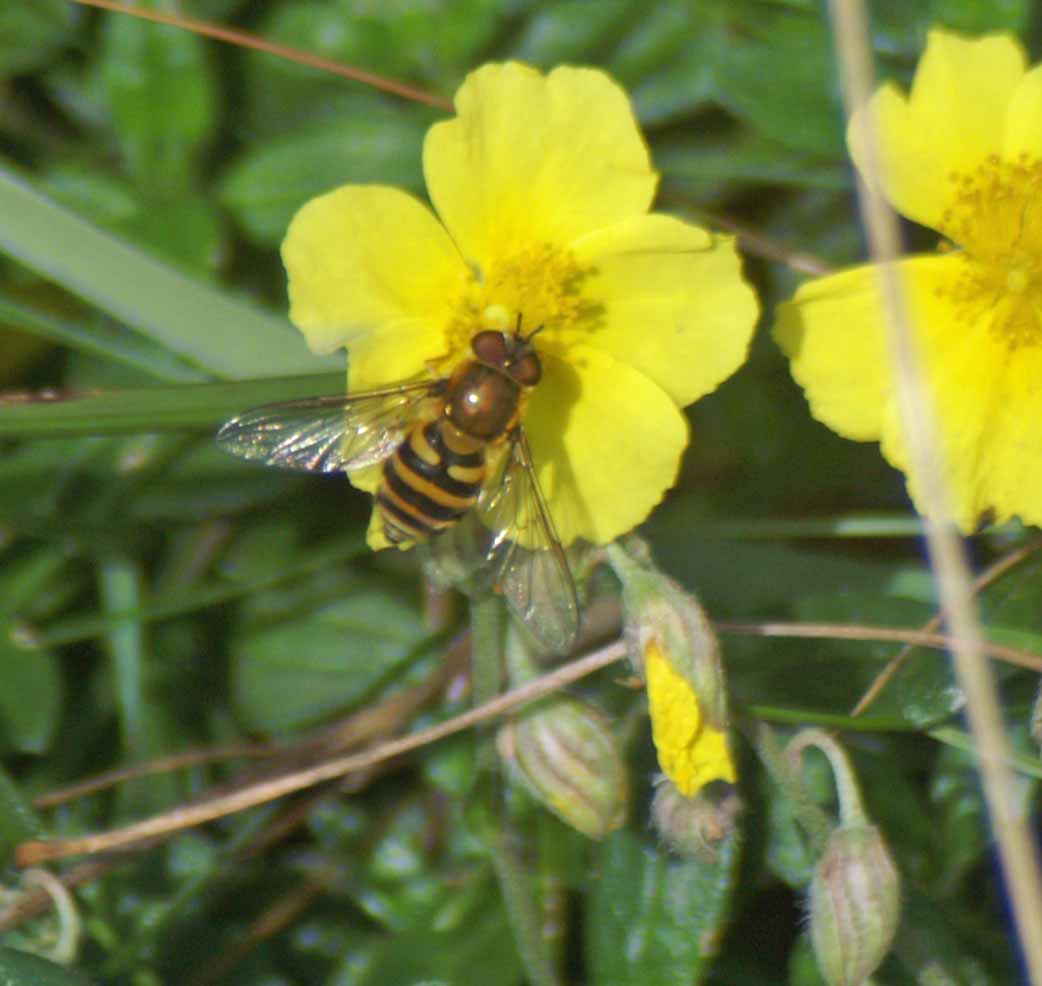
18/9/11-A hoverfly on Common Rockrose

Share this:

  • Share on Facebook (Opens in new window) Facebook
  • Share on Pinterest (Opens in new window) Pinterest
  • Share on X (Opens in new window) X
Like Loading...

Irresistible ivy

22 Thursday Sep 2011

Posted by theresagreen in butterflies, Nature, nature photography

≈ 2 Comments

Tags

bluebottle, Drone fly, hoverflies, importance of ivy to late summer insects, ivy flowers, marmalade hoverfly, Red Admiral

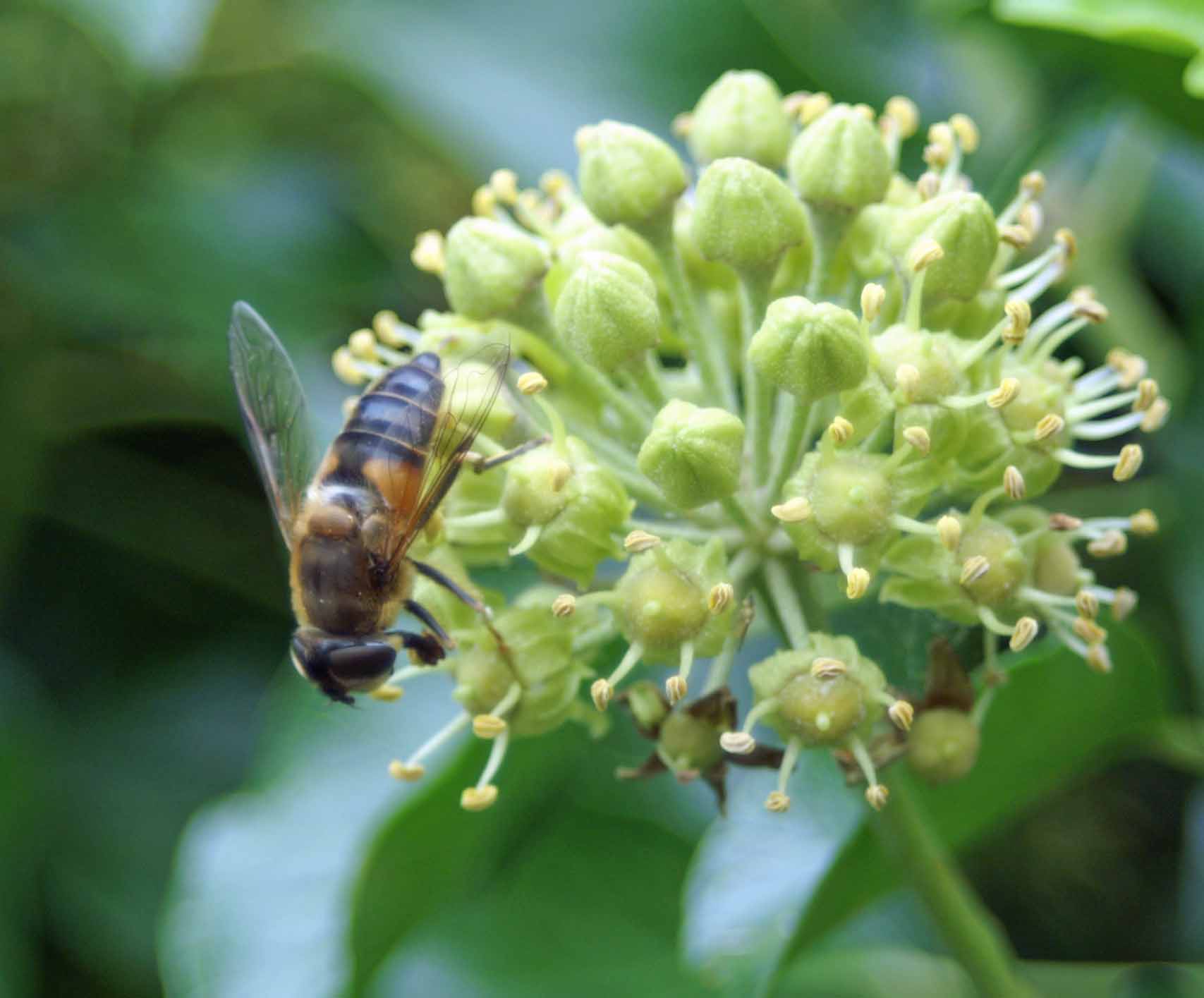
Ivy plants are flowering locally and are drawing in crowds of insects, particularly hoverflies but also bumblebees and butterflies. The flowers are not completely out yet, so I’m sure that there will be more to see shortly, if we have some sunshine, but the following are what I’ve spotted so far.

15/9/11-Red Admiral

Ivy flowers are produced from late summer until late autumn, the individual flowers are small and clustered in 3–5 cm diameter umbels. They are greenish-yellow in colour and very rich in nectar  and an important late autumn food source for many insects.

A bright shiny bluebottle fly

The most numerous insects drawn to the flowers were from various species of hoverfly.

Tapered Drone Fly-Eristalis pertinax

15/9/11-A larger yellow and black hoverfly, not yet identified

15/9/11-Hoverfly-syrphus ribesii

Marmalade Hoverfly-Episyrphus balteatus

Share this:

  • Share on Facebook (Opens in new window) Facebook
  • Share on Pinterest (Opens in new window) Pinterest
  • Share on X (Opens in new window) X
Like Loading...

Late summer’s fruitfulness

14 Wednesday Sep 2011

Posted by theresagreen in Insects, Nature, nature photography

≈ 1 Comment

Tags

burdock, late summer wildflowers, Little Orme, potter wasp, RAF rescue helicopter, Rhiwledyn Nature Reserve, rosehips, toadflax, tortoiseshell butterfly, wasps

22nd August

I took a walk around the Rhiwledyn Nature Reserve on the Little Orme this afternoon to seek out some late-summer insects; I was hoping for a Small Copper butterfly and maybe another Comma, but a Small Tortoiseshell was top of the list and to my surprise and delight I spotted one almost straightaway. Beautifully bright coloured it was a pristine specimen that rested on the ground, wings outstretched.

22/8/11-Small Tortoiseshell-Aglais urticae

It was a sunny but windy afternoon, so I headed away from the exposed cliff top to explore the more sheltered area of scrubby ground at the opposite end of the site. I spotted some yellow-green flowers that I think were those of fennel and found a Common Wasp feeding there.

22/8/11-A Common Wasp on fennel flowers

Nearby there were also a number of attractive little Potter Wasps busy on Knapweed flowers. Although being coloured and striped in yellow and black, a closer look soon reveals them to be very different in size and shape to the Common Wasp.

22/8/11- Potter wasps on a Knapweed flower

22/8/11-Potter Wasp-Ansitrocerus parietum

Several Large White butterflies fluttering around a bramble attracted my attention and moving closer I saw that a single female was the draw for several males that were competing to mate with her. I took the opportunity to photograph a male resting with its wings open.

22/8/11-Large White-Pieris brassicae

22/8/11-Common Carder Bumblebee on scotch thistle

On Ragwort flowers I spotted a hoverfly, black with interrupted white stripes which is a new-to-me species to add to my collection later identified as a Pied Hoverfly – Scaeva pyrastri. I only managed to get one photograph which unfortunately is a bit blurred as the wind was blowing the plant around and the insect didn’t stay there for long.

22/8/11-Pied Hoverfly-Scaeva pyrastri

22/8/11-There are still Cinnabar Moth caterpillars feeding on ragwort

Many plants are now bearing seeds or fruits; blackberries are ripening and watching a Bluebottle fly feasting on them I was reminded why it’s probably best not to pick them and eat them without washing or cooking them first!

22/8/11-Bluebottle fly on blackberries

22/8/11-Teasel seed head

22/8/11-Ripe rosehips

22/8/11-Robin's Pincushion on wild rose

22/8/11-Carline thistle seed heads

Late-blooming wildflowers I photographed today included Burdock, Yarrow and Toadflax. Ragwort is still flowering although some plants are going to seed. Knapweed is also still blooming and there are still a few fresh thistle flowers, although most are seeded.

22/8/11-A 6-spot Burnet Moth on a fading Scotch thistle flower

22/8/11-Burdock

22/8/11-Yarrow-Achillea millefolium

22/8/11-Common Toadflax-Linaria vulgaris

Linaria vulgaris (Common Toadflax, Yellow Toadflax, or Butter-and-eggs) is a species of toadflax (Linaria), native to most of Europe and northern Asia, from the United Kingdom south to Spain in the west, and east to eastern Siberia and western China.

22/8/11- RAF Rescue helicopter

The noisy presence of a bright yellow RAF Air-Sea Rescue helicopter is not an uncommon sight around the cliffs of the Little Orme as this is one of the practice sites for those based on Anglesey. However,today’s mission was real and assistance was required by a person that had injured themselves and were inaccessible to an ambulance, so the helicopter actually landed. A crowd quickly gathered to watch the proceedings, but from what I gathered from speaking to a few different people, this was not out of concern for the injured person, but rather to try to spot if it may be Prince William flying the helicopter! It wasn’t, but as there are only three craft based in Anglesey, it was a possibility it could have been.

22/8/11-Sheep grazing on the rocky hillside

I have walked up the steep grassy pathway on the hillside several times, but had never ventured further on along the ridge, so I thought I would rectify that today. This area is grazed by sheep and edged by shrubby vegetation and small trees,adding yet another dimension to the reserve as habitat for woodland birds. It was a little too late to venture far, but a good time to catch quite a few birds out and about foraging for their supper, including Blackbirds, Robin and Chaffinch.

A chaffinch amongst elderberries

22/8/11-Banded snail

Share this:

  • Share on Facebook (Opens in new window) Facebook
  • Share on Pinterest (Opens in new window) Pinterest
  • Share on X (Opens in new window) X
Like Loading...

Catching up on the gardening

13 Tuesday Sep 2011

Posted by theresagreen in garden wildlife, Insects, Nature

≈ 2 Comments

Tags

bird's foot trefoil seedpods, brimstone moth, buff-tailed bumblebee, garden snail blowing bubbles, gatekeeper butterfly, orange and brown butterfly

This month’s weather has been variable and time spent sorting out the garden has been sporadic, but when I have had the opportunity I have been clearing some overgrown borders and have seen or disturbed some interesting things in the process.

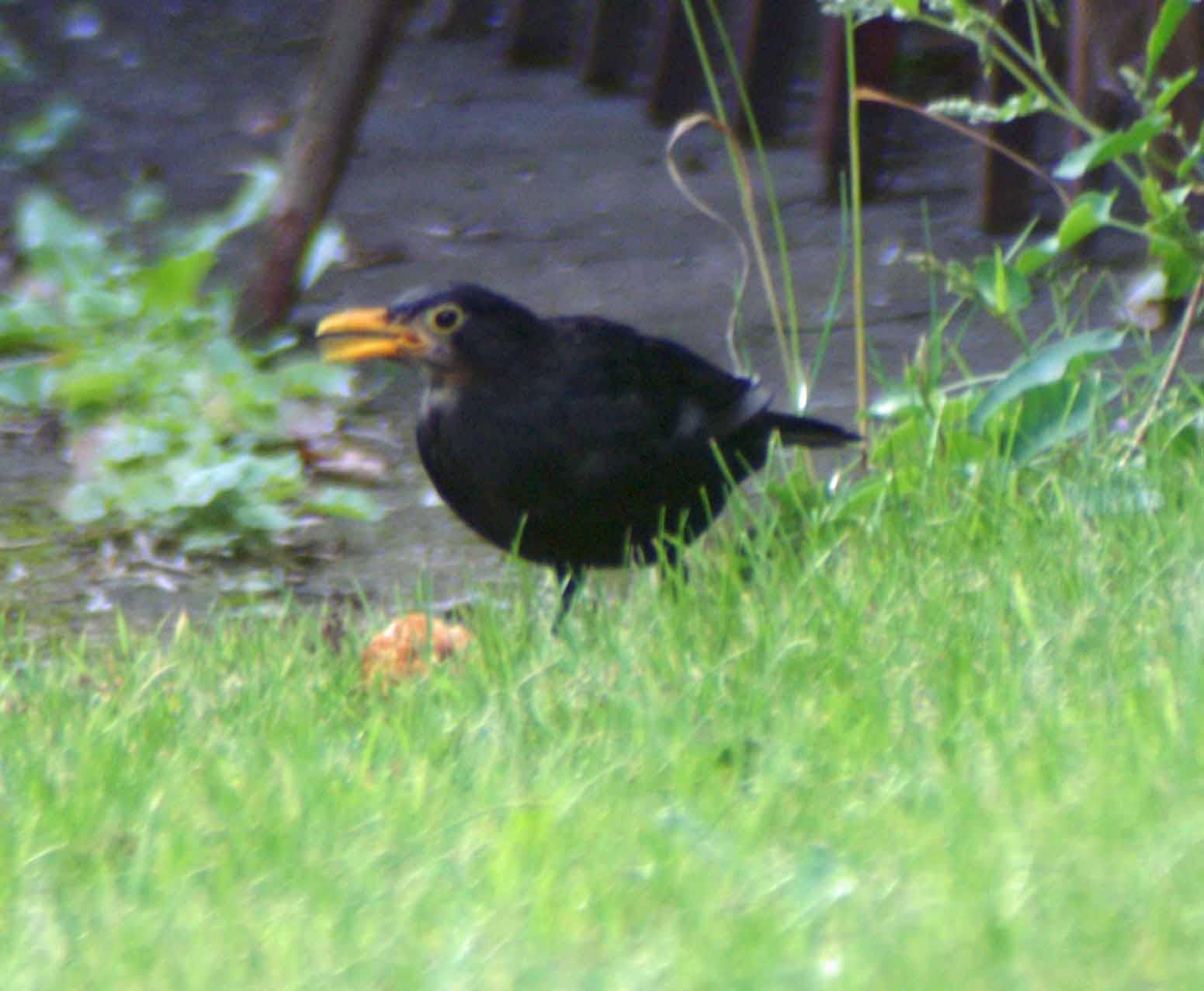
Part of next door’s apple tree overhangs the hedge; the tree is laden with rosy apples and many of the smaller fruit have begun to drop to the ground. The windfalls have been providing a regular treat for the Blackbirds.

22/8/11-Blackbird enjoying a windfall apple

I disturbed the lovely little Brimstone Moth in the following photograph when I was pulling out overgrown ivy.

22/8/11-Brimstone Moth-Opisthograptis luteolata

I found a garden snail close by the spot the moth flew out from. There is nothing it can do much damage to in that particular area, so I replaced it under the hedge, where to my surprise it began producing a mass of foamy bubbles. I’ve been trying to discover why it would have been doing that but haven’t come across an explanation I’m happy with yet.

22/8/11-A garden snail blowing bubbles

The sunshine brought out a few butterflies including Large White, Holly Blue and a couple of Gatekeepers that were beginning to look a little faded.

22/8/11-Gatekeeper butterfly

22/8/11-Buff-tailed bumblebee covered with pollen

There are several species of wildflowers that I leave to grow in the garden, one is the pretty yellow Bird’s foot trefoil, which also currently has seed-pods, the form of which give the plant its name.

22/8/11-Bird's-foot trefoil-Lotus cornicularis

Bird’s-foot Trefoil – Lotus corniculatus is a common flowering perennial plant native to grassland temperate Eurasia and North Africa that flowers from June until September. . The flowers develop into small pea-like pods or legumes; the name ‘bird’s foot’ refers to the appearance of the seed pods on their stalk.

The height of the plant is variable, from 5-20 cm, occasionally more where supported by other plants; the stems can reach up to 50 cm long. It can survive fairly close grazing, trampling and mowing and is a very important plant in the life-cycle of many butterflies and moths. It is most often found growing in light sandy soils.

The plant has had many common English names in Britain, which are now mostly out of use. These names were often connected with the yellow and orange colour of the flowers, e.g. ‘butter and eggs’. One name that I knew it by as a child that is still used is ‘Eggs and Bacon‘.

22/8/11-Bird'sfoot trefoil seedpods. The form and claw-like arrangement of the pods is from where the common name derives

Another of my favourite wildflowers also largely left alone, is the Blue bugle, Ajuga reptans. It has always seemed strange to me that it is often treated as a ‘weed’ in gardens where it occurs in its natural form but that larger-flowered cultivated versions of similar species are purchased and planted.

22/8/11-Blue bugle -Ajuga reptans

Share this:

  • Share on Facebook (Opens in new window) Facebook
  • Share on Pinterest (Opens in new window) Pinterest
  • Share on X (Opens in new window) X
Like Loading...

Late summer wildflowers and busy bumblebees

31 Wednesday Aug 2011

Posted by theresagreen in Bryn Euryn Nature Reserve, bumblebees, Nature

≈ 2 Comments

Tags

carder bee, forest bug, hemp agrimony, hoverflies, knapweed, late summer wildflowers, michaelmas daisy

11th August

Taking advantage of a pause in the rain I headed up to Bryn Euryn for some fresh air. Planning to stick to the woodland areas in case it began raining again, the track passed by a cleared grassy area that was bright with purple knapweed flowers and noticing insects flying, despite the coolness and dampness of the afternoon, I got waylaid for a while. Looking more closely I realised there were large numbers of bumblebees and hoverflies of several different species flying around the flowers busily taking nectar or collecting pollen, all doubtless also taking advantage of the dry interlude. The opportunity to get a good look at the insects as they were slowed down a little by the coolness of the air kept me there, stooped over with the camera, for a good half and hour or so and also got me some funny looks from passing dog-walkers.

11/8/11- Flowery grassland attracting dozens of insects

11/8/11-Black Knapweed-Centaurea nigra

Centaurea nigra is a species of flowering plant in the daisy family known by the common names Lesser Knapweed, Common Knapweed and Black Knapweed. A local vernacular name is Hardheads. The plant flowers from July until September and is important  for a large number of insects including Gatekeeper, Large skipper, Lime-speck pug moth, Meadow Brown, Painted lady, Peacock, Red admiral, Small copper, Small Skipper, Honeybee and Bumblebees and Hoverflies. Goldfinches later feed on the seeds.

The plant is native to Europe but it is known on other continents as an introduced species where it is often treated as a noxious weed.

11/8/11-Buff-tailed bumblebee-Bombus terrestris

11/8/11-Red-tailed bumblebee (m)-Bombus lapidarius

11/8/11-Common Carder Bee-Bombus pascuorum

The common carder bee, Bombus pascuorum, has shaggy hair and can be seen at flowers late in the year, often into November in southern Britain. It is one of our most common bumblebee species, found even in the centres of large cities.

11/8/11-Hoverfly-Syrphus ribesii

11/8/11-Hoverfly- Melangyna cincta

11/8/11-Hemp Agrimony

Also attracting the attentions of a few insects were the flowers of Hemp Agrimony –  (Eupatorium cannabinum)

A large plant (1-2m) often found in clumps with big, fluffy heads of tiny pink flowers. Its leaves grow up to 10cm long and are arranged in pairs on a reddish stem.

Can be found throughout the UK growing in open or shady, damp or dry areas; waste ground and near water.

Flowers July-September.

11/8/11- Hemp Agrimony- Eupatorium cannabinum

The ‘hemp’ part of the plant’s common name comes from the similarity between its leaves and that of the cannabis plant. The two species are entirely unrelated, however, and do not share any other properties!

Hemp-agrimony is one of the flowers Plantlife keep track of in their Wildflowers Count survey – click here to find out how you can help out.

11/8/11-Drone fly-Eristalsis arbustorum

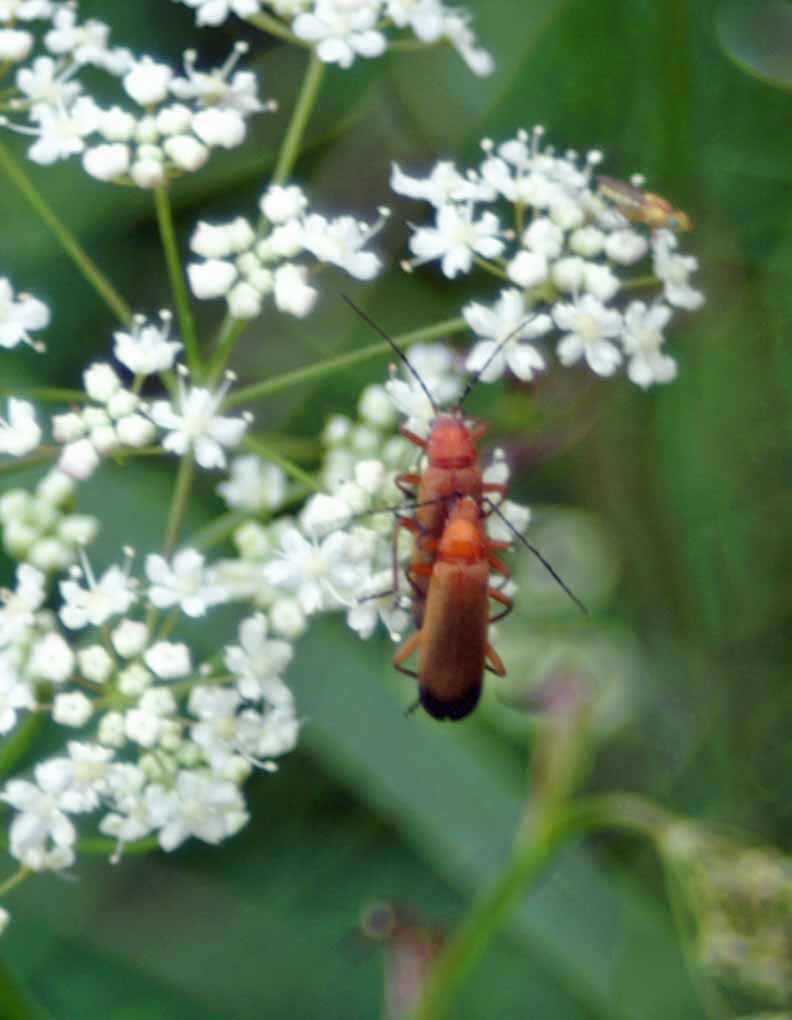
11/8/11-A mating pair of Red Soldier beetles

A plant I’m not sure about the identity of has similar flowerheads to the wild carrot/parsley but all parts are smaller and more delicate. This particular one was supporting a mating pair of Red Soldier beetles as well attracting a variety of small flies.

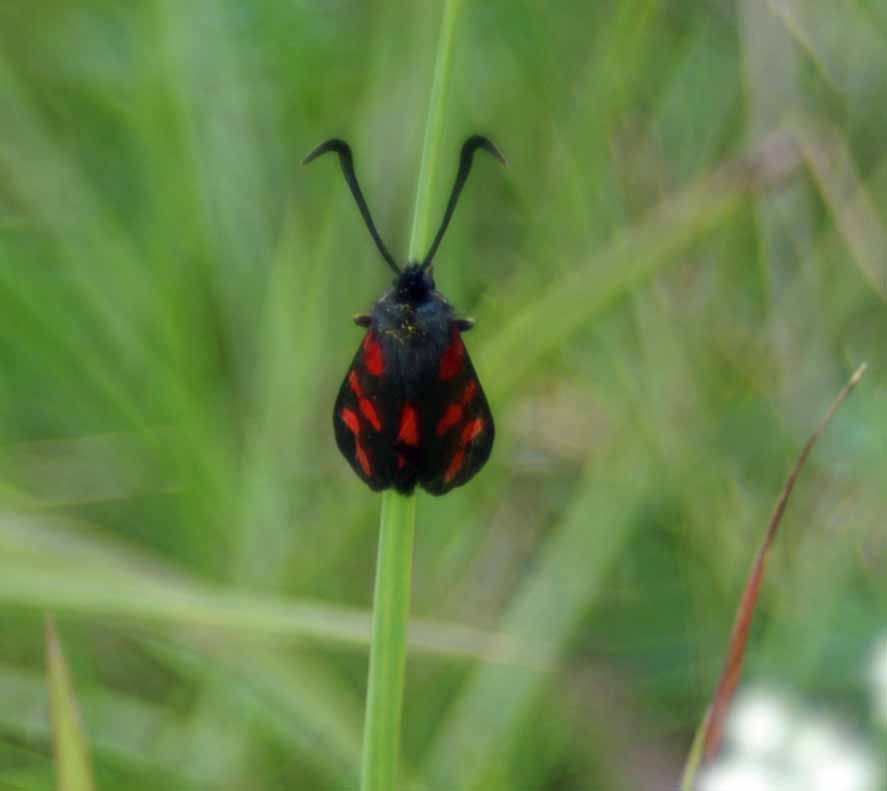
A 6-spot Burnet Moth was sheltering from the showers, clinging to a grass stem.

11/8/11-A 6-spot Burnet Moth resting on a grass stem

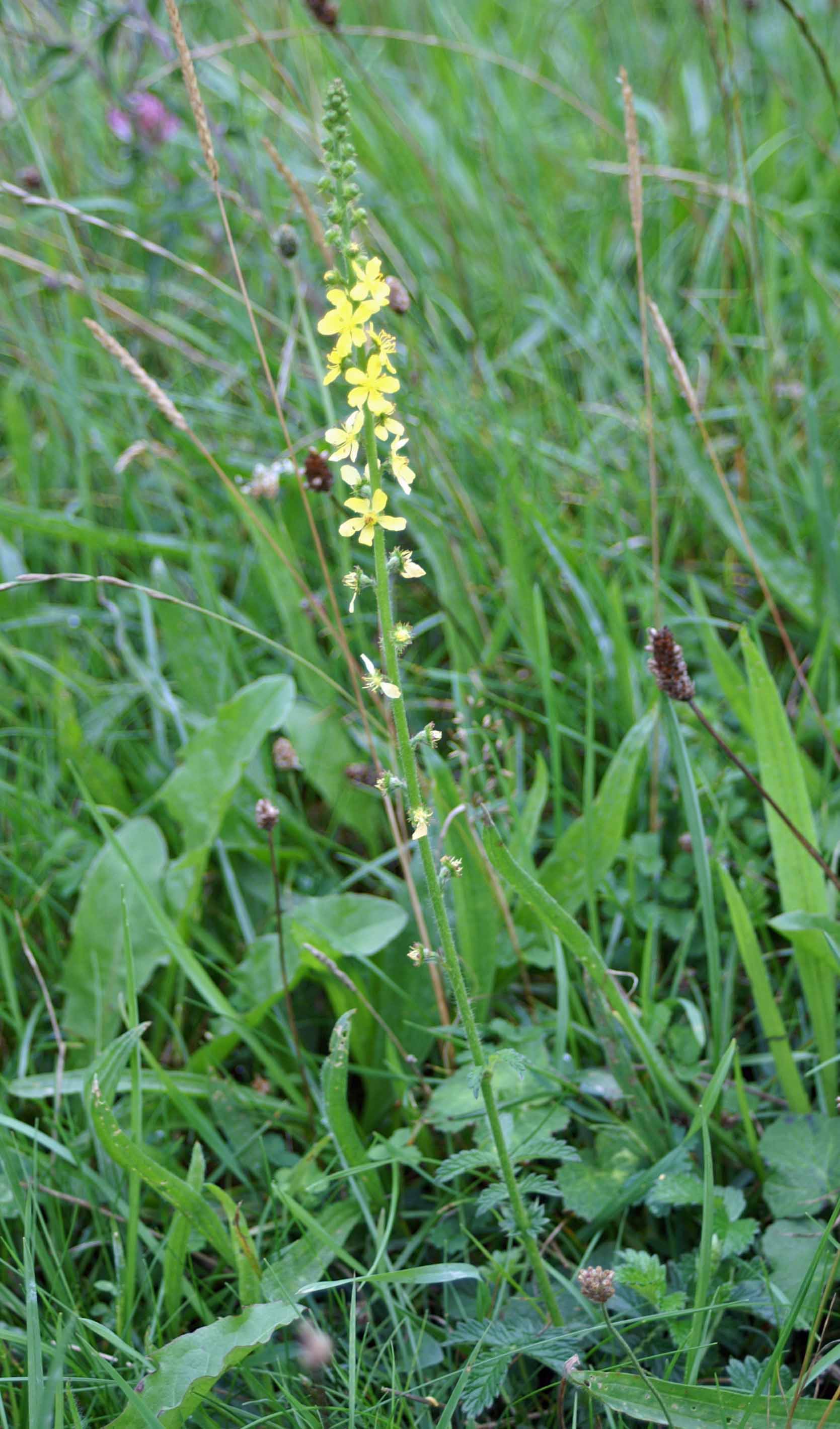
A wildflower I do recognise and can name is Agrimony, also familiar to me as one of the 38 Bach flower remedies. The plant is quite delicate-looking and may be easily overlooked, but it has a long history of use as a healing herb.

11/8/11-Agrimony

Agrimonia eupatoria is a species of agrimony that is often referred to as common agrimony, church steeples or sticklewort.

The common agrimony grows as a deciduous, perennial herbaceous plant and reached heights of up to 100 centimeters. Its roots are deep rhizomes , from which spring the stems. It is characterized by its typical serrated edged pinnate leaves. The whole plant is dark green with numerous soft hairs that assist in the plant’s seed pods sticking to any animal or person coming in contact with the plant. The flower spikes have a delicately spicy scent, a little like apricots.

A. eupatoria is a foodplant for the caterpillars of the snout moth Endotricha flammealis.

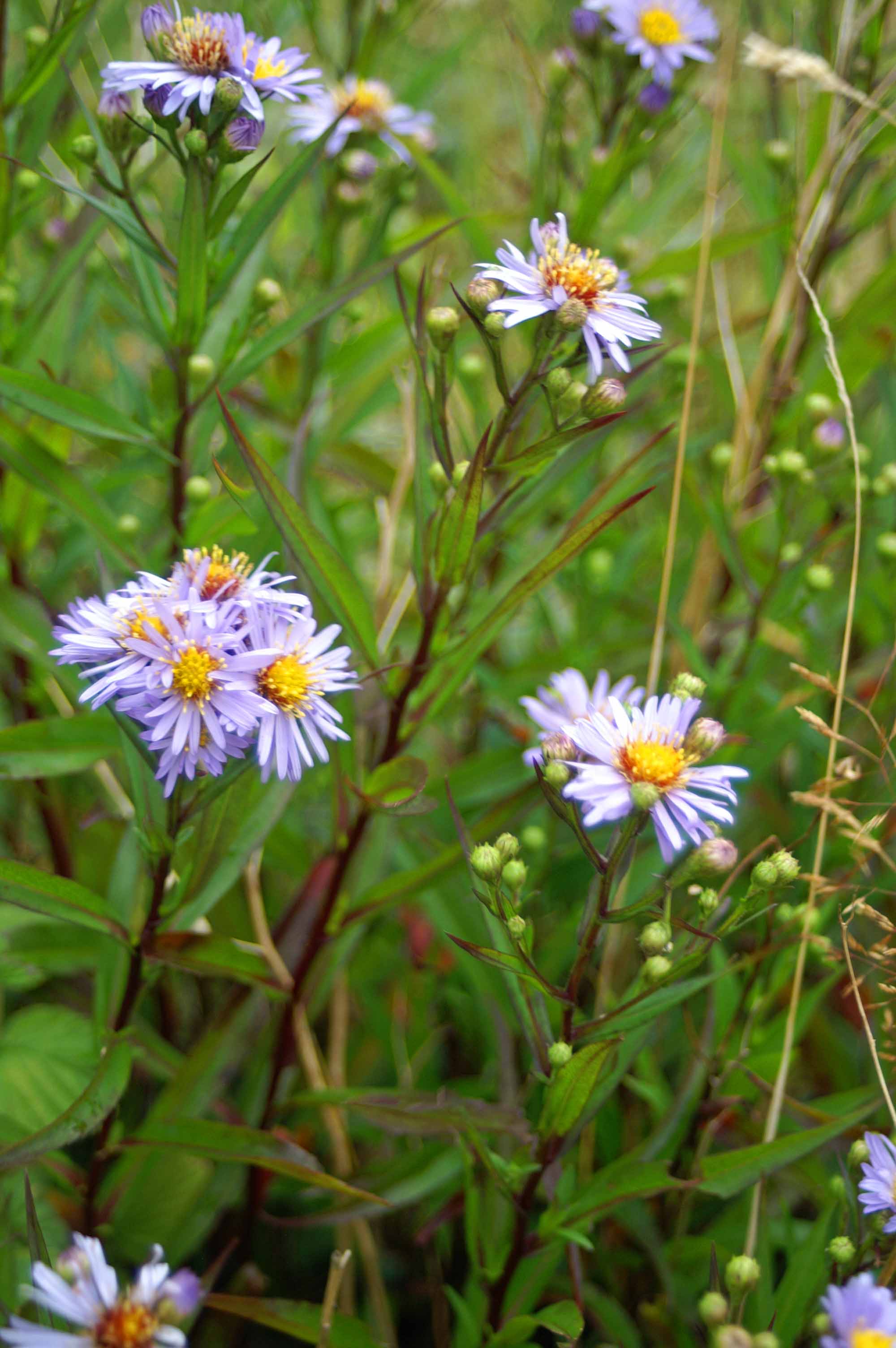
11/8/11-Michaelmas daisy-Aster novi-belgii

Originating in North America, Michaelmas daisies were originally introduced to Britain from North America in the early 1700’s. Although they are not native, they survive extremely well and are grown in gardens for their late summer flowers. The plant has also become naturalised and is found in wild places throughout the UK, often growing on damp ground or close to streams. It flowers from August through to late October providing late-flying butterflies such as peacocks and small tortoiseshells with a good source of nectar.

Michaelmas means Michael’s Mass. The flowers traditionally bloom on September 29th which is ‘The Feast of Saint Michael’.

Ragwort is still flowering profusely and I photographed a further two insects on separate plants, a Forest bug and a 6-spot Burnet Moth.

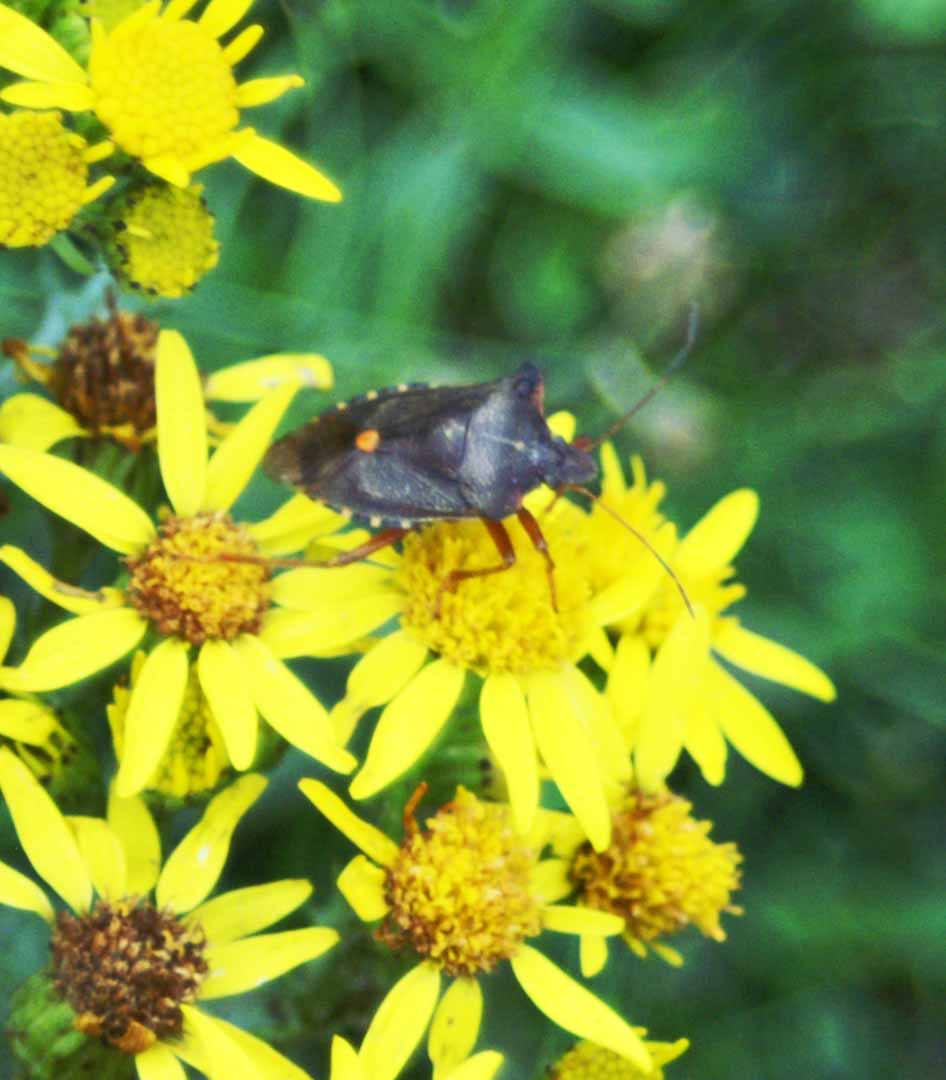
11/8/11- Forest bug - Pentatoma rufipes

The forest bug, Pentatoma rufipes, is a species of shield bug in the family Pentatomidae. It is a common and widespread species found in forests and woodlands worldwide. It is shiny dark brown with red-orange markings on its body and bright orange legs. It is shaped like an escutcheon-type shield, flat, and about 14 millimetres (0.55 in) long. Its distinguishing characteristic is a pair of plates extending forward from the shoulders at the front of its dorsal thorax.

The forest bug’s main food source is any of several species of oak. It is a sap-feeder and uses piercing mouthparts to withdraw the liquid. It can also be found on other species of deciduous trees. The forest bug may also be regarded an agricultural and garden pest, as it will not hesitate to feed on fruit and nut trees. Occasionally it will consume other insects.

Adults lay eggs during the summer in the cracks of tree bark, and the larvae hatch the following spring.

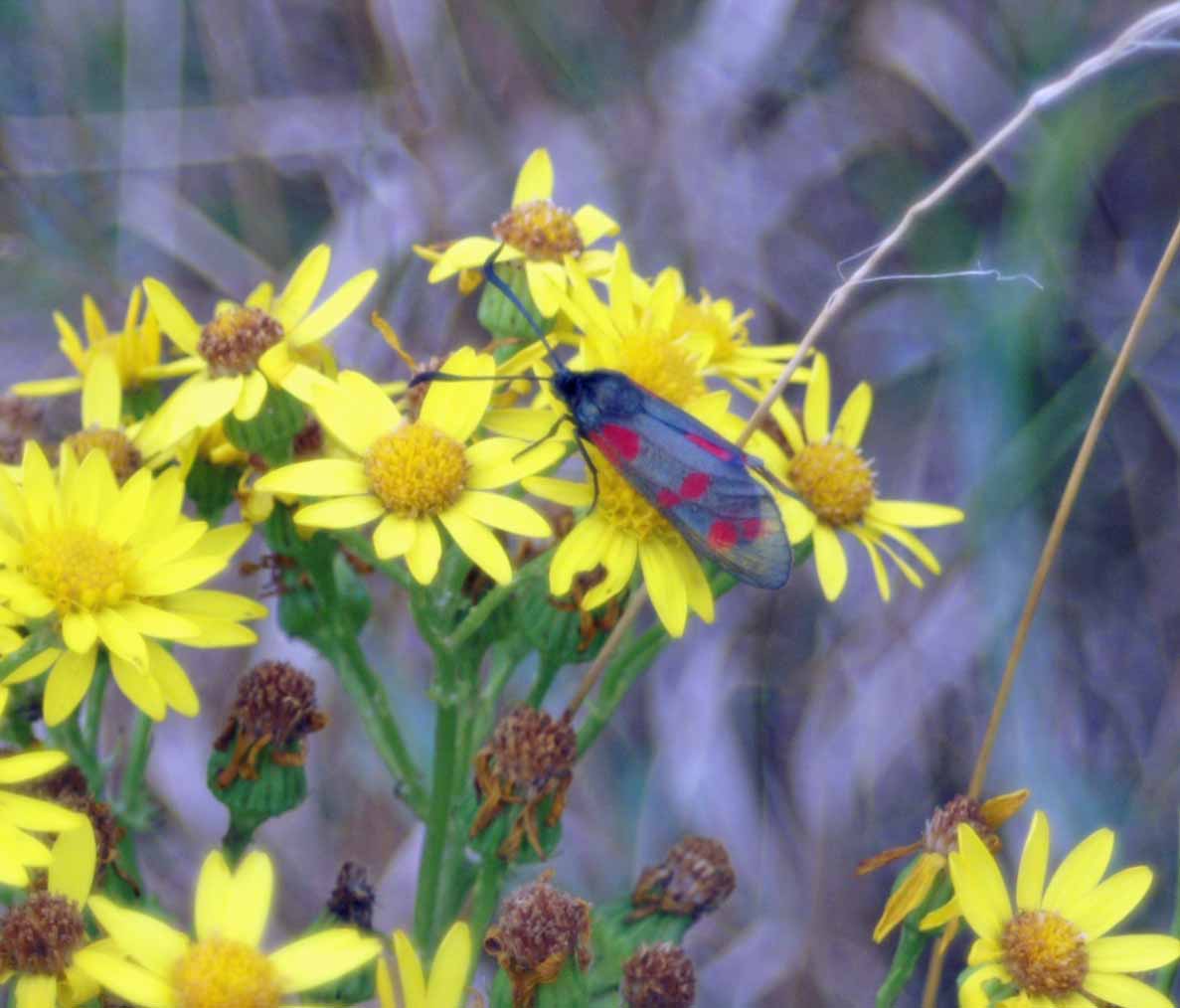
11/8/11-6-spot Burnet moth on ragwort

Share this:

  • Share on Facebook (Opens in new window) Facebook
  • Share on Pinterest (Opens in new window) Pinterest
  • Share on X (Opens in new window) X
Like Loading...
← Older posts
Newer posts →
Follow everyday nature trails on WordPress.com

Enter your email address to follow this blog and receive notifications of new posts by email.

‘But it is the common species that keep the living world ticking over and provide most of our experiences of wildlife, and I would argue that maintaining the abundance of these is as important a conservation priority as maintaining the existence of rarities’. Richard Mabey

MOST RECENT POSTS

  • A Glimpse of Spring to Come January 22, 2025
  • Hunting the Wren December 28, 2024
  • Oh, Christmas Tree December 18, 2024
  • In and Out of the Ivy February 15, 2024
  • Nature’s Fireworks November 30, 2023
  • Wild Autumn along the Coast Path November 3, 2023

OLDER POSTS

LOOKING FOR SOMETHING IN PARTICULAR?

  • Sights and Sounds from the Little Orme 1
    Sights and Sounds from the Little Orme 1
  • Catchers, a Duck and Divers
    Catchers, a Duck and Divers
  • Shades, Sounds and Scents of the Woods
    Shades, Sounds and Scents of the Woods
  • Fine Dining for Crows
    Fine Dining for Crows
  • Things Bright and Beautiful
    Things Bright and Beautiful
  • Following a river to a Fairy Glen
    Following a river to a Fairy Glen
  • The Windhover
    The Windhover
  • A Windy Wildflower Trail
    A Windy Wildflower Trail
  • Pines and Primroses
    Pines and Primroses
  • Everyday Birds - The Blue Tit
    Everyday Birds - The Blue Tit

nightingale trails

The Walk of the Monarch Butterfly-Sendero de la Mariposa Monarca

The Walk of the Monarch Butterfly-Sendero de la Mariposa Monarca

MY WILDFLOWER BLOG: where the wildflowers are

Snowdrop

Snowdrop

most recent posts

Follow everyday nature trails on WordPress.com

Social

  • View teresamaygreen’s profile on Twitter

Enter your email address to follow this blog and receive notifications of new posts by email.

Website Built with WordPress.com.

  • Subscribe Subscribed
    • everyday nature trails
    • Join 358 other subscribers
    • Already have a WordPress.com account? Log in now.
    • everyday nature trails
    • Subscribe Subscribed
    • Sign up
    • Log in
    • Report this content
    • View site in Reader
    • Manage subscriptions
    • Collapse this bar

Loading Comments...

    %d