• Home
  • about
  • about the photographs
  • Local Nature Reserves
    • Bryn Euryn Local Nature Reserve
    • Mynydd Marian
  • Wales Coast Path
    • Grey Seals in North Wales
    • St.Trillo’s Chapel
    • Wildflowers of North Wales Coastal Paths, Cliffs and Dunes

everyday nature trails

everyday nature trails

Author Archives: theresagreen

Sleeping Seals and Stonechats

02 Saturday Apr 2016

Posted by theresagreen in coastal habitat, Little Orme, Nature, Nature of Wales, nature photography, Rhiwledyn Nature Reserve, Rhos-on-Sea, Seals, The Wales Coast Path, Wildflowers of Wales

≈ 14 Comments

Tags

alexanders, dunnock, grey seals, grey seals in Angel Bay, jackdaw, jackdaws on cliff, stonechat

A brightly sunny day, too good to miss, so I headed for the Little Orme which offers reliable sightings of a wide variety of wildlife in a relatively compact area with little effort required. Well-used by local people and visitors to the area and part of the route of both the Wales Coast Path and the North Wales Path, the pathways of the lower part of the reserve particularly are often very busy. Opportunities for uninterrupted attempts to photograph the more wary small woodland birds may be limited, but despite close human proximity the birds carry on regardless and largely unnoticed.

I use the entrance to the reserve sited at the back end of a residential area. Today the lawns of the unfenced front gardens were providing foraging for jackdaws and a few Pied wagtails. Outside the breeding season wagtails gather here in the evenings before setting off to roost comunally for the night. On the roofs were perched gulls, Wood pigeons and Magpies and a singing Greenfinch. There’s a thriving House sparrow population here too and cheerful chirruping greeted me as I  climbed the steps up to the reserve, where they frequent the tangle of brambles and shrubs there.

160310-1-Little Orme

The Fulmars have returned to their nest sites high on the cliffs. Although a small colony of just 10 or so pairs they draw attention to themselves by noisily proclaiming their territories and can be heard as soon as you enter the site. I looked out for Ravens that have used the same nest site up on the cliff for many years, but I didn’t see or hear them today.

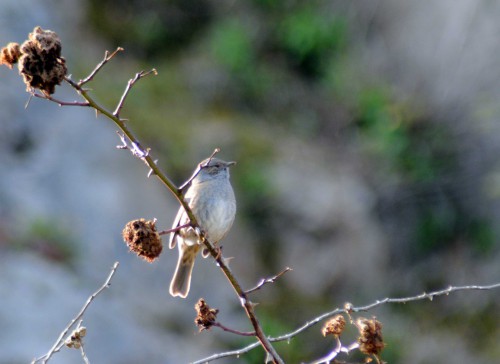
I was pleased to see a pair of Stonechat though, one of my favourite little birds. They were in the same area within which a pair successfully raised a family last year, so I like to think this may be the same pair. I couldn’t get close enough to them to get good photographs, but I prefer to use ‘real time’ images whenever possible, so these were today’s best record shots.

Stonechat male

Stonechat -Saxicola rubicans -male

Stonechat female

Stonechat female

The biggest draw to the reserve are the Grey Seals that at this time of year can be fairly reliably seen, when the tide is out, hauled up on the stony beach of Angel Bay. Today there were about 20 females and their rapidly growing pups, a few in the water, the rest sleeping blending perfectly into the background of stones and rocks.

Grey Seals in Angel Bay, Little Orme

Grey Seals in Angel Bay, Little Orme

160310-9-Little Orme-Grey Seals on edge of sea

160310-11-Little Orme-Grey Seal sleeping on rock pillow

160310-7-Little Orme-Grey Seals on edge of sea

160310-12-Little Orme-Grey Seal sleeping on rock pillow

160310-4-Little Orme-Grey Seal on edge of sea

Jackdaws are without doubt the most numerous birds here and a great number gather here to breed, nesting on the rocky cliff faces. They spread throughout the site to feed and also separate into small flocks that venture back and forth to forage in a wide variety of places locally, arriving back noisily to land on the cliffs where they site their nests. It is good to see them foraging and nesting in their natural cliff habitat rather than in villages roosting on roofs and nesting in chimneypots.

Jackdaw

Jackdaw

Jackdaws in their natural habitat

Jackdaws in their natural breeding habitat

160310-23a-Little Orme-Jackdaws on cliff

Blackbirds are another numerous bird here as are Robins and Dunnocks, with males singing from shrubs throughout the site. Close to the backs of houses trees and shrubs are frequented by good numbers of birds. The House sparrows are nesting close to a busy path here and a chorus of chirrupings emanated loudly from within the shrubs, but despite being audible from some distance away, they stayed well hidden. Also seen and heard singing here were Chaffinch, Greenfinch, Wren, Great Tit and Blue Tit.

Dunnock male

Dunnock male singing from a wild rose stem with numerous Robins pincushion galls

Wildflowers appear a little later on this windswept clifftop than in more sheltered areas, but there’s plenty of the early flowering Alexanders on show.

Alexanders

Alexanders

Elder leaves are well grown too.

160310-26a-Little Orme-Magpie in Elder tree

Magpie well concealed in an Elder tree

Share this:

  • Share on Facebook (Opens in new window) Facebook
  • Share on Pinterest (Opens in new window) Pinterest
  • Share on X (Opens in new window) X
Like Loading...

St David’s Day – Dydd Dewi Sant

29 Monday Feb 2016

Posted by theresagreen in coastal walks, Colwyn Bay, Nature of Wales, Saints of Wales, Welsh culture and mythology

≈ 9 Comments

Tags

Patron Saint of Wales, St David, St David's Cathedral, St David's Day, St David's Day celebrations, St David's Day traditions, Tenby daffodil, Welsh, welsh emblems, welsh flag

Happy St David’s Day! Dydd Gwŷl Dewi (Sant) hapus!

welsh_flagVisit Wales on March 1 and you can’t help but notice it’s a special day here with many opportunities to witness displays and celebrations of Welsh national pride. The Red Dragon flags are flying and hosts of golden daffodils adorn shop windows and homes. Folks will pin a felt leek or a daffodil to their lapels while children dress up in traditional costume. Celebratory parades and concerts are held in towns and villages throughout the country.

All is in honour of Dewi Sant – St David – but not much is actually known about the patron saint himself.

St David – Patron Saint of Wales

Dewi Sant or St David lived in the sixth century and died on 1 March 589AD. He was a Celtic monk, abbot and bishop.

Dewi is said to have been of royal lineage. His father, Sant, was the son of Ceredig, who was prince of Ceredigion, a region in South-West Wales. His mother, Non, was the daughter of a local chieftain and legend has it that she was also a niece of King Arthur.

He was born near Capel Non (Non’s chapel) on the South-West Wales coast near the present city of Saint David. He was educated in a monastery called Hen Fynyw, in Cardiganshire, his teacher being Paulinus, a blind monk and stayed there for some years before setting out with a party of followers on his missionary travels, founding religious centres across Wales and England, including one at Glastonbury along the way. He travelled as far as Jerusalem, where he was made an archbishop. During his life, he was the archbishop of Wales, and he was one of many early saints who helped to spread Christianity among the pagan Celtic tribes of western Britain.

He eventually settled at Glyn Rhosyn, now St. Davids, in south west Wales, where he established a religious community. Many miracles have been attributed to him. The most incredible being when he caused the ground to rise beneath him when preaching so that everyone could see and hear him.

It is claimed that Dewi lived for over 100 years, and it is generally accepted that he died in 589.  His last words to his followers were in a sermon on the previous Sunday. Rhigyfarch transcribes these as ‘Be joyful, and keep your faith and your creed. Do the little things that you have seen me do and heard about. I will walk the path that our fathers have trod before us.’

‘Do the little things’ (‘Gwnewch y pethau bychain’) is today a very well-known phrase in Welsh, and has proved an inspiration to many.

KONICA MINOLTA DIGITAL CAMERA

St David’s Cathedral

St David’s remains are buried within the Cathedral of St David in the lovely coastal town of St David’s in Pembrokeshire, south west Wales, which is the smallest city in Britain.  The location became a popular place of pilgrimage and it was said that two pilgrimages to St Davids equalled one to Rome and three equalled one to Jerusalem. The most well-known medieval pilgrimage route begins at Holywell, Flintshire North Wales and ends at St Davids.

National emblems

To mark the Saint’s day, Welsh people around the world wear one or both of our national emblems – a daffodil or leek.

The Leek

The connection between Wales and the leek is obscure.  Most researchers trying to trace the link are met with one or other of the legends that show it was used by the Welsh as a cap badge in battle to show friend from foe.

One version is that on the eve of a battle with the Saxons, St David himself advised the Britons to wear leeks in their caps so that they could easily distinguish friend from foe. This apparently helped to secure a great victory. A variation of that is that the leek is worn to celebrate the battle as it was won in a field of leeks.

Another version has the same thing happening at the Battle of Agincourt in 1415 where Welsh archers fought with Henry V against the French. Again, leeks worn in their caps distinguished them from their enemies.

By 1536, when Henry VIII gave a leek to his daughter on 1 March, the leek was already associated with St David’s Day. It is possible that the green and white family colours adopted by the Tudors were taken from their liking for the leek.

Since the 6th Century Welsh soldiers have worn a leek in their caps to distinguish themselves from their foes in battle. Welsh soldiers today still have cap badges and buttons with leeks on and it is a surviving tradition that soldiers in the Welsh regiments eat a raw leek on St David’s Day.

THE DAFFODIL

If the link between the leek and the Welsh is obscure, then that with the Daffodil is even more so. It is possible that the reason the daffodil is used as an emblem is that the word for daffodil and for leek are the same in Welsh  (Cenhinen = Leek, Cenhinen Pedr =Daffodil ). This confusion means that both have been adopted as national emblems and the use of one over the other is down to personal preference.

In comparison with the ancient Welsh associations of the leek, the daffodil has only recently assumed a position of national importance. It is said by some that the daffodil was encouraged more by the English government, as it does not have the nationalistic overtones that the leek has, with its association with the defeat of Saxons.

The Victorians are reputed to have introduced the alternative daffodils we pin to our lapels instead of leeks on St David’s Day. A common vegetable such as the leek wasn’t considered glamorous enough to be the Welsh national emblem and the daffodil, whose flowering coincides with the Welsh patron saint’s holiday, seemed like a fitting replacement.

An increasingly popular flower during the 19th century, especially among women, its status was elevated by the Welsh-born prime minister David Lloyd George, who wore it on St David’s Day and used it in ceremonies in 1911 to mark the investiture of the then Prince of Wales at Caernarfon.

Welsh and Tenby daffodils

There are types of daffodil unique to Wales – the Welsh daffodil or Lent lily and the Tenby daffodil, although there is still debate as to whether the Tenby Daffodil is naturalised or introduced. The only other true British native daffodil, Narcissus pseudonarcissus, also found mainly in south Wales is known as the Lent Lily because it flowers through February, March and sometimes early April, therefore over the period of lent.

Tenby daffodil-Narcissus pseudonarcissus obvallaris

Tenby daffodil-Narcissus pseudonarcissus obvallaris

The diminuitive  little Tenby daffodil, growing to just 20cm (8″) tall is all one colour. It is so called because it is mostly found growing wild around the Tenby area. It can also be found in other areas of Pembrokeshire, Carmarthenshire and Ceredigion but is scarce.

The Tenby daffodil suffered in Victorian times from being too popular as they were regularly dug up and became quite scarce but replanting has helped and nowadays you’ll see plenty in the spring time around Tenby.

A version of the Tenby Daffodil has been cultivated since medieval times and the Royal Horticultural Society have now given it their prestigious Award of Garden Merit (AGM) in recognition of its outstanding excellence. 

Coed y Bwl wild daffodil woods, near St. Brides Major by Richard Marks

Coed y Bwl wild daffodil woods, near St. Brides Major. photograph by Richard Marks

The Welsh variety is more widespread, but still scarce. The Welsh daffodil or Lenten lily is two toned in colour with a different shade of yellow/ orange on the trumpet to that of the petals.

One of the biggest displays of Welsh daffodils can be seen at Coed y Bwl Wood, at Castle Upon Alun, near Bridgend.

Both species have suffered decline over the years as a result of property development on land where they once thrived.

celebrations of the day

The tradition of celebrating St. David’s day is still much alive throughout Wales and in many parts of the world where there are communities of people with Welsh origins.

Towns all over Wales celebrate with special meetings, parades, concerts and a myriad of other events. The National St David’s Day Parade across the centre of Cardiff, features all sorts of fiery performances from giant dragons and theatrical groups finishing with a rousing mass rendition of the national anthem, Hen Wlad Fy Nhadau outside St David’s Hall. A special gala concert from the BBC National Orchestra of Wales is traditionally held in the evening.  Male voice choirs are flown to all corners of the globe on St. David’s Day, to entertain Welsh communities.

Many of the country’s castles and heritage sites open their doors for free on the day, including  St David’s Bishop’s Palace, and the surrounding streets are the scenes for a fitting mini-festival in honour of their holiest former resident. Led by clergy, the annual Pilgrims’ Walk leads to the illumination of the St David’s Day Stone, ending at the Oriel y Parc, where you can wander around a traditional Welsh market or dance to live bands.

Schools throughout the country celebrate the day. My own children attended Welsh Medium schools in South Wales and St. David’s Day, particulary at their primary school was a looked-forward to special event.

Traditional Welsh Girls Costume

A modern take on the girl’s traditional Welsh costume

Pupils went to school dressed in Welsh costumes. The girls wore variations on the traditional pais a betgwn – a petticoat and overcoat, made of Welsh flannel, and a felt beaver hat, worn over a frilled white bonnet.

Welsh Girls Costume Bonnet

Traditional Girls Costume Bonnet


Boys Traditional Tweed Dai Cap - Welsh National Costume

Boys Traditional Tweed Dai Cap

Boys were persuaded to wear a white shirt with a a Welsh flannel waistcoat, black breeches, long woollen socks, black shoes and a traditional Dai cap, although in these more modern times others favoured their Welsh rugby shirts.

The day would include a walk to the local chapel for a religious service. Later in the day a mini-Eisteddford (concert) took place, where traditional songs and dances were performed and poems read. A photographer from the local newspaper visited all the local schools took photographs of each class of children which were subsequently printed in the next edition as souvenir supplements. Happy days!


Share this:

  • Share on Facebook (Opens in new window) Facebook
  • Share on Pinterest (Opens in new window) Pinterest
  • Share on X (Opens in new window) X
Like Loading...

Pines and Primroses

27 Saturday Feb 2016

Posted by theresagreen in Colwyn Bay, Nature of Wales, Trees, Wales Coast Path, Wildlife of the Wales Coast Path

≈ 18 Comments

Tags

Colwyn Bay embankment, early spring flowers, King Alfred's Cakes fungus, pine trees by the sea, Porth Eirias, primrose

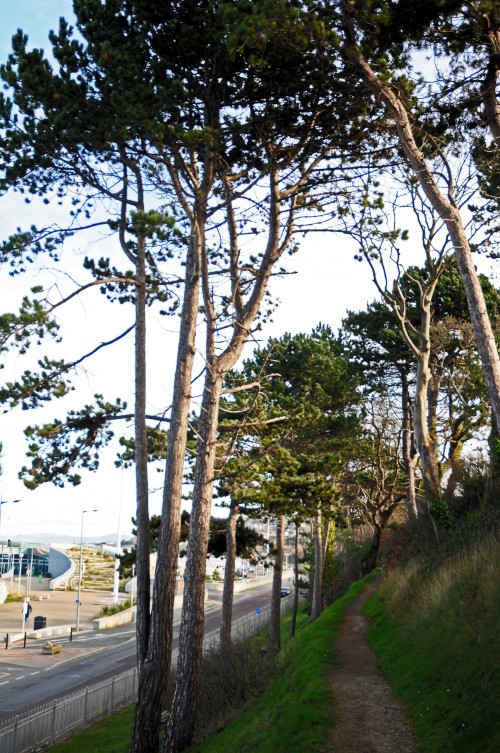
Pine trees are well-used as feature plantings in many parts of Colwyn Bay, but those with the greatest impact are those elegantly lining the road into Rhos-on-Sea set on the steep sea-facing railway embankment.

Pine trees along Colwyn Bay embankment

Pine trees along Colwyn Bay embankment

Where the trees thin out primroses smother the grassy embankment. They began flowering early this year but look as though they will continue for some time to come.

Pine tree and primroses

Pine tree and primroses

A lovely clump of fragrant primroses

A lovely clump of fragrant primroses

The back of Colwyn Bay railway station

The back of Colwyn Bay railway station

The grassy embankment is a favourite spot for Herring gulls to paddle for worms.

Herring gulls paddling for worms

Herring gulls paddling for worms

I walked along the promenade then crossed the road at the point where there’s access to the elevated pathway near the top of the embankment.

View to Rhos-on-Sea

View to Rhos-on-Sea

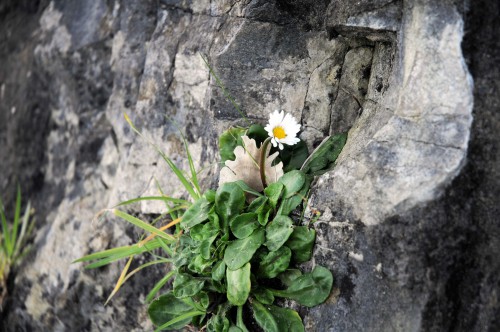
Daisy growing from embankment wall

Daisy growing from embankment wall

Fallen pine cones on embankment wall

Fallen pine cones on embankment wall

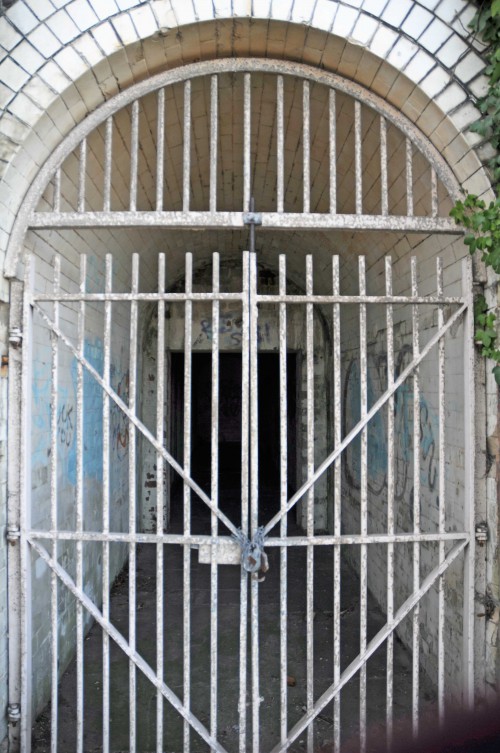
The pathway high up on the embankment leads through the pines and offers some protection on cold windy days such as this one was as well as an elevated view. I’ve always been curious about where this gated tunnel leads, but assume it comes out somewhere close to the railway station. It looks like it would be a good place for bats to roost or hibernate; I wonder if they do?

Iron gate closing off a tunnel under the railway line

Iron gate closing off a tunnel under the railway line

Pathway along the embankment

Pathway along the embankment

Ivy clambering high into a pine tree

Ivy clambering high into a pine tree

This can be a good place to see a number of bird species amongst the trees, but today there was just a solitary crow.

Crow enjoying the view out to sea

Crow enjoying the view out to sea

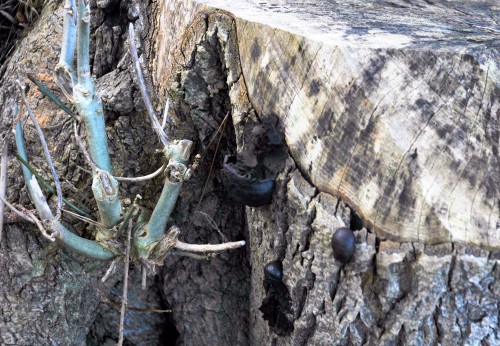
There are other species of tree along the path and I came across the stump of a felled ash tree that is regenerating from its base. It also had a mature patch of the curious brittle black King Alfred’s Cakes Daldinia concentrica  fungus.

Cut ash tree regenerating with King Alfred's Cakes fungus

Cut ash tree regenerating with King Alfred’s Cakes fungus

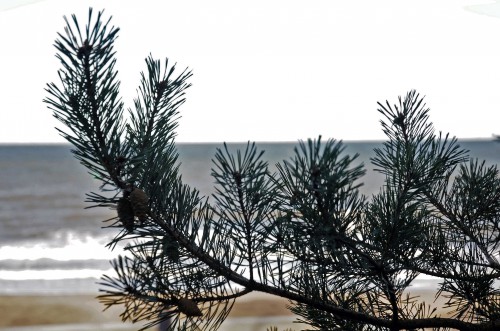
Scots Pine branch with cones

Scots Pine branch with cones

Approaching the end of the path

Approaching the end of the path

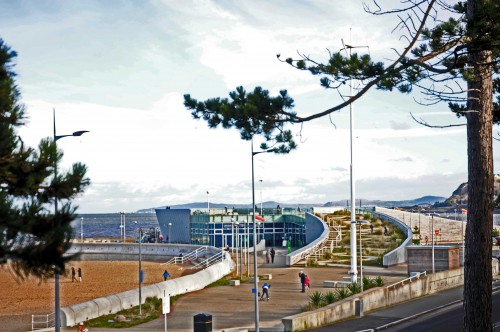
The elevated pathway offers a good view of the Porth Eirias Watersports centre

The elevated pathway offers a good view of the Porth Eirias Watersports centre

The pathway ends by the railway bridge opposite Porth Eirias where these beautiful Hellebores were growing.

Hellebores (Lenten Roses) with green flowers

Hellebores (Lenten Roses) with green flowers

It’s good to see that the traditional planting of pines is being continued. There are several young trees in beds at the front of Porth Eirias.

A newly-planted pine tree at Porth Eirias

A newly-planted pine tree at Porth Eirias

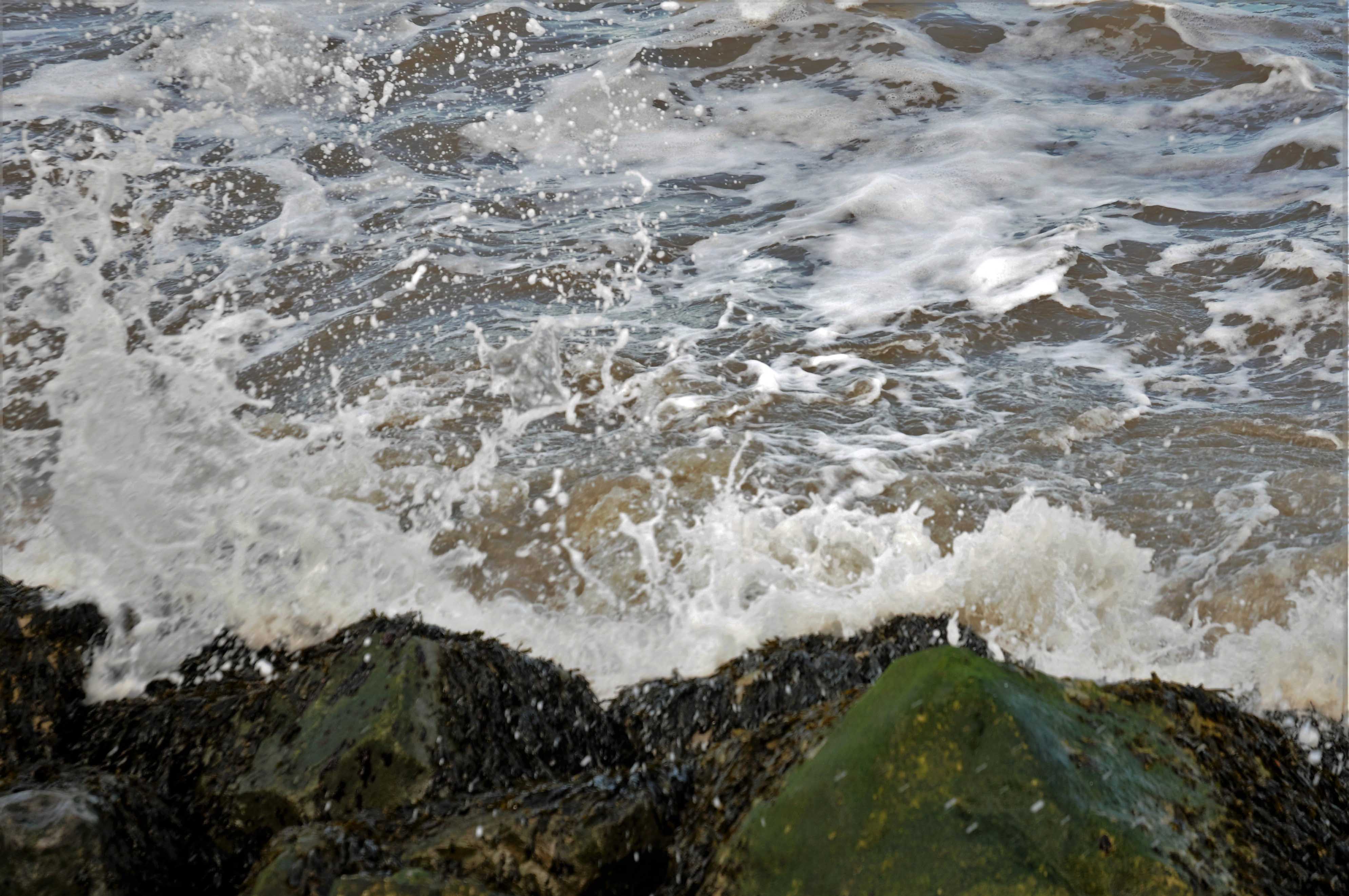
A last look at the sea splashing up onto the rocks at the base of the sea wall before gratefully retreating into the shelter of my car.

160214-Sea splashing on rocks

Share this:

  • Share on Facebook (Opens in new window) Facebook
  • Share on Pinterest (Opens in new window) Pinterest
  • Share on X (Opens in new window) X
Like Loading...

Welcome back to the Mistle Thrush

05 Friday Feb 2016

Posted by theresagreen in birds of Wales, Bryn Euryn Nature Reserve, Nature, Nature of Wales, nature of woodlands

≈ 8 Comments

Tags

birds of conservation concern, Conservation issues, mistle thrush, turdus viscivorus

At 7.10 am it was barely light, but from high in a cherry tree, easily piercing the double glazing of my living room window, a Mistle thrush exuberantly proclaimed his return. He sang long and loud for at least the next hour before crossing the building to announce his presence from the woodland edge behind us. I was out for most of the day, but arriving home at 5 pm, again in the fading light, he was back in the same place reinforcing his presence.

Mistle thrush singing from ash tree

Mistle thrush singing from ash tree 

I could barely see him, so much to dark to photograph him, so the photograph is one from last year that I took of a bird in the neighbouring tree that arrived here on a similar date and behaved in a very similar way. I would like to believe it was the same bird returning to reclaim his breeding territory, especially as the Mistle thrush has moved from the amber list to red-listed status as a bird of conservation concern, with 170,000 breeding territories recorded.

Mistle thrushes are early nesters and many nests are built in late February. typically they favour sites in woodland as high as 30ft up on the top of a snapped-off tree. Each pair raises two or occasionally three broods and they may sometimes use the same nest. To my knowledge at least one pair bred successfully here on Bryn Euryn last year and similarly the previous year, so this is clearly a well-established breeding site – fingers crossed for this year too.

Read more about the Mistle thrush here.


Share this:

  • Share on Facebook (Opens in new window) Facebook
  • Share on Pinterest (Opens in new window) Pinterest
  • Share on X (Opens in new window) X
Like Loading...

Early Spring Flowers Record Breaker – The Wildlife Trust of South and West Wales

31 Sunday Jan 2016

Posted by theresagreen in Nature of Wales

≈ 2 Comments

This article is not from my end of Wales, but is an interesting account of the early onset of wildflower blooming in the South and West of the Principality that would seem to be similar to here in the North.

Source: Early Spring Flowers Record Breaker – The Wildlife Trust of South and West Wales

Share this:

  • Share on Facebook (Opens in new window) Facebook
  • Share on Pinterest (Opens in new window) Pinterest
  • Share on X (Opens in new window) X
Like Loading...

Wildflowers in Winter

28 Thursday Jan 2016

Posted by theresagreen in Bryn Euryn Nature Reserve, Nature, Nature of Wales, nature of woodlands, nature photography, wildflowers, Wildflowers of Wales

≈ 8 Comments

Tags

daisy, gorse, hart's tongue fern, hazel catkins, lesser celandine, male fern, wildflowers blooming in January, winter heliotrope, winter wildflowers

Daisies look delicate, but they’re tough little plants and flower more-or-less continuously from December to January. I love them so am happy they can decorate grassy areas in peace before the lawn-mowers emerge from hibernation.

160128-TGFLR 1 (8)

Daisy-Bellis perennis

Celandines are one of the first heralds of Spring, but I was taken by surprise to find some this early in the year.

Celandines

Lesser Celandine-Ficaria verna

Herb Robert was also a surprise, its flowering season is more April-November, so this is probably a plant that has not died down and carried on growing.

Herb Robert

Herb Robert

Another survivor is this Nipplewort which is growing in a sheltered corner against a wall on the roadside.

Nipplewort

Nipplewort

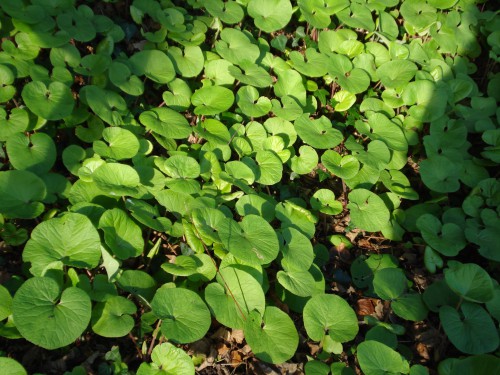
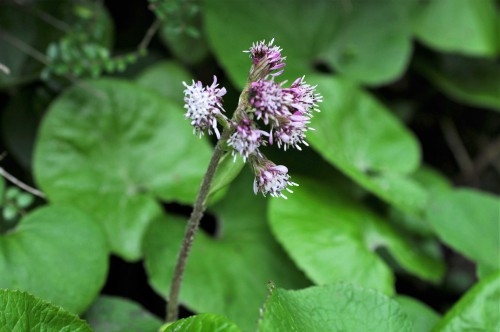
There are some wildflowers that are truly winter flowering. The bright green leaves of Winter heliotrope are present here throughout the year and the lilac flowers, which have a fragrant, vanilla-like scent appear from November to March.

Leaves of Winter heliotrope

Leaves of Winter heliotrope

Winter heliotrope

Winter heliotrope – Petasites fragrans

January 26th was a mild sunny day, warm enough to coax out this little Red-tailed bumblebee, but it seemed to be struggling to take off from the flower, so maybe it wasn’t quite warm enough.

A red-tailed bumblebee on a heliotrope flower

A red-tailed bumblebee on a heliotrope flower

Three-cornered Garlic is named for the shape of its flower stems, which are triangular. It is also known as White bluebell and does resemble one, until you smell it. It’s flowering season is February- June but has been in flower here since last December.

Three-cornered Garlic

Three-cornered Garlic-Allium triquetrum

Flowers resemble those of the bluebell

Flowers resemble those of the bluebell

“When gorse is out of bloom, kissing is out of season“. In other words, gorse pretty much flowers all year round to some extent. Now, at the end of this mild January many bushes are well-covered with the lusciously coconut-scented blossom.

Gorse

Gorse

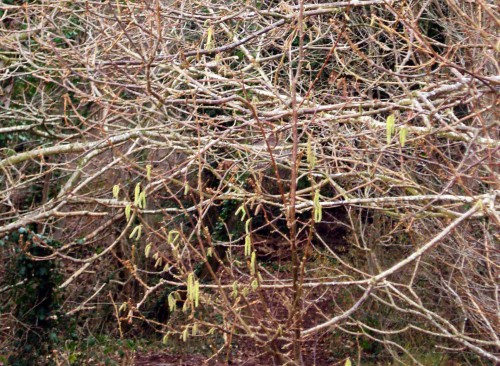
Hazel catkins have also been present on some trees since last month.

Hazel catkins

Hazel catkins

Sycamore buds are greening

Sycamore buds are greening

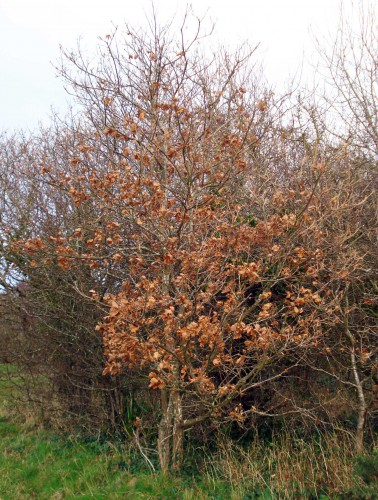
A few trees have retained their dried leaves for some reason, this is a small oak.

A small oak tree has kept its dried leaves

A small tree has kept its dried leaves

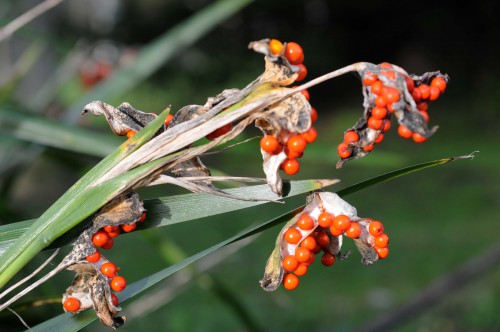
Some plants characteristically hang on to their berries well into the winter, one such is the unfortunately-named Stinking iris that has bright orange berries

Berries of Stinking Iris-Iris foetidissima

Berries of Stinking Iris-Iris foetidissima

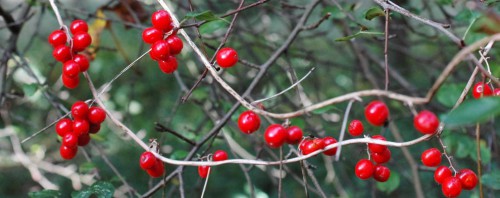
and another is Black bryony, whose bright scarlet berries garland shrubs like strings of shiny beads.

Black bryony berries

Black bryony berries

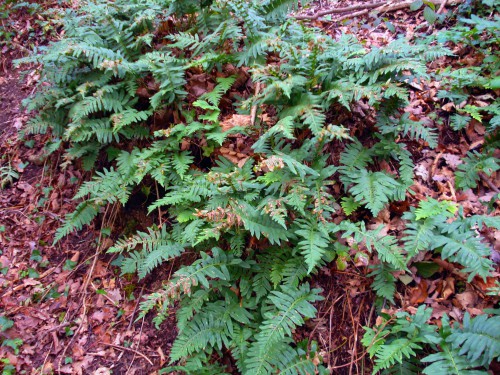
A surprising number of ferns are still green

Polypody fern

Polypody fern

Spores or sori still in place on the back of the fern fronds

Spores or sori still in place on the back of the Polypody fern fronds

Both the Male fern and the Hart’s Tongue fern are semi-evergreen, but this group shows no sign of dying down at all.

Male fern and Harts tongue ferns

Male fern and Harts tongue ferns

Winter is a good time to appreciate mosses. Looking closely at this one it has fern-like leaves.

A cushion of moss tucked against rocks

A cushion of moss tucked against rocks

Close-up of moss

Close-up of moss

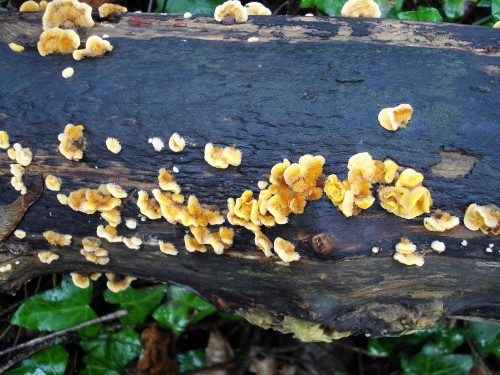
On a fallen Scots pine a colony of tiny bright yellow coloured fungi has established itself; it seems to be a bracket fungi, maybe a turkeytail?

Bright yellow bracket fungus-maybe a small turkeytail

Bright yellow bracket fungus-maybe a turkeytail


Share this:

  • Share on Facebook (Opens in new window) Facebook
  • Share on Pinterest (Opens in new window) Pinterest
  • Share on X (Opens in new window) X
Like Loading...

An Ancient Yew

11 Monday Jan 2016

Posted by theresagreen in Nature, Nature of Wales, North Wales, Welsh culture and mythology

≈ 18 Comments

Tags

Ancient Trees, ancient yew trees, Llangernyw Yew, St Digain's Church, taxus baccata

There are just three species of conifer that are true natives of Britain; the Yew-Taxus baccata, the Juniper-Juniperus communis and the Scots Pine-Pinus sylvestris. All of them are found growing ‘in the wild’ in this part of North Wales, but of the three species it is the Yew that predominates.

150104TGFL-Bryn Euryn 4-Yew leavesThe Yew tree is a familiar sight in many churchyards throughout Great Britain and some are even older than the Christian faith itself due to their ability to regenerate and regrow. Wales is one of the most significant places in Europe for ancient and veteran yew trees and most are found in churchyards. Sacred to Druids and Celts, yews would have marked venerated places in pre-history, many of which became Christian sites later on. Our wet climate and lower light levels led to a deeper veneration of one of the few native evergreen plants.

The subject of this post is the most ancient of them all. It is located in the churchyard of St. Digain’s in the small village of Llangernyw, sited in the Elwy Valley in Conwy county, which I went to see on a lovely day at the end of last autumn.

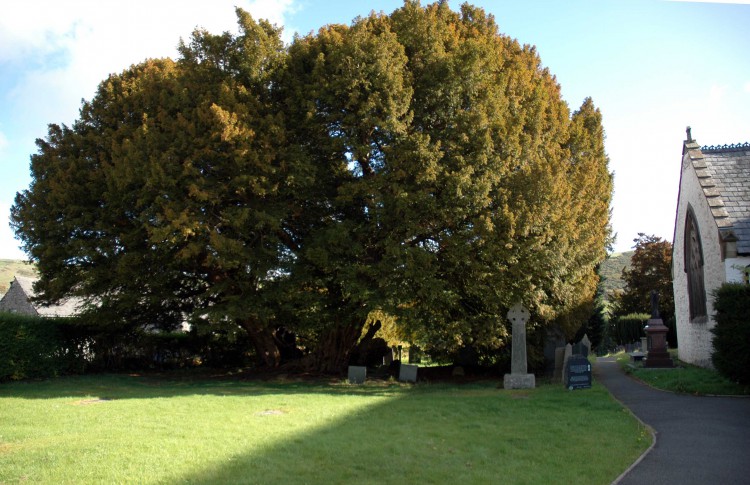
This amazing tree is recognised as the oldest known tree in Wales and England and furthermore, at an estimated 4,000 years old  as one of the oldest living things in the world. There are no barriers or signs prohibiting you from approaching or touching the tree, which is a rare privilege in itself, but to be in the presence of a living entity that may have begun its life in what was the Bronze Age in Britain is incredible.

The Old Yew Tree St Digain's, Llangernyw

The Old Yew Tree, St Digain’s, Llangernyw

151022-Llangernyw-Ancient Yew 4a

The tree is male, so bears no berries. The body of the tree is fragmented; its core part has been lost, leaving several enormous offshoots growing from its base, still thriving despite not always being treated with the respect it commands now. In the mid-1990s the church oil tank stood in the space between the two trunk fragments and much of the dead wood was removed  from the site when the tank was built, which made dating the age of the tree more difficult for experts in the field (known as dendrochronologists). Thankfully the tank was removed when it was realised that the tree was ancient.

The fragmented trunk of the tree

The fragmented trunk of the tree

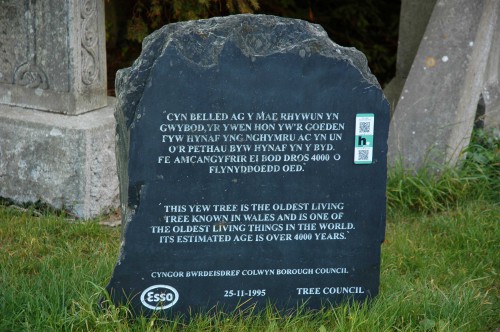
In 1995 a plaque was erected by the Tree Council giving the estimated age of the tree as just over 4,000 years; the age being determined by a calculation using a formula based on the girth if the tree, which is a mighty 12.5 metres, or 41 feet at ground level.
151022-Llangernyw-Ancient Yew monument stone 1

In June 2002, the tree was granted more recogntion by the Tree Council, in celebration of the Golden Jubilee of Queen Elizabeth II, it designated the Llangernyw Yew tree one of the Fifty Great British trees in recognition of its place in national heritage.

Looking up into the canopy

Looking up into the canopy

According to a survey by the Ancient Yew Group, the Church in Wales owns 334 yew trees which are more than 500-years-old, which they equate to owning 95% of all the Grade 1 listed buildings in Wales.

Celtic cross memorial stone

Celtic cross memorial stone

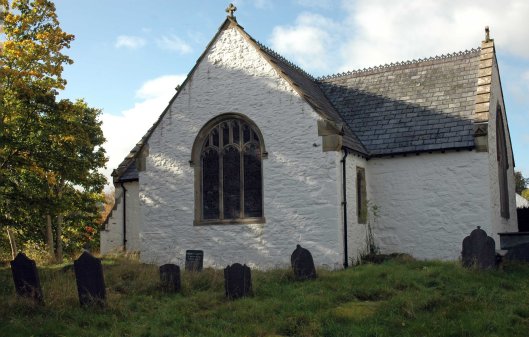
The original church was founded here by Digain, son of Cystenyn Gorneu, a Saint of the 5th Century. Parts of the attractive building now standing date back to the early 15th century, including the roof construction, an interior door and the stoup.

St Digain's Church, Llangernyw, in the parish of St Asaph

St Digain’s Church, Llangernyw, in the parish of St Asaph

There are  other yew trees growing within the site and the church is framed in the photograph above by trees that flank the lych gate.

151022-Llangernyw-Church lych gate and yew trees 1

Lych gate and yew trees

The lych gate was erected in 1745 at a cost of three pounds, fifteen shillings and sixpence in old money; £3.76p now.

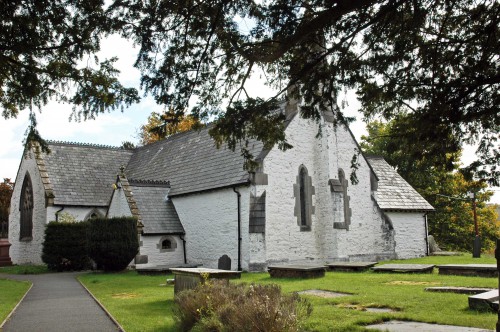
151022-Llangernyw-Church from the back 1

The church from the back

Some interesting pieces from the church interior:

151022-Llangernyw-Church inside 2a
The font
The font
151022-Llangernyw-Church organ 1
151022-Llangernyw-Church furniture 1
151022-Llangernyw-Church stained glass window 1
151022-Llangernyw-Church stained glass window 2a
151022-Llangernyw-Church window 1

It’s well worth visiting Llangernyw for the wonderful scenery surrounding the village – the road from Abergele to Llanwrst is rightfully designated a ‘scenic route’.

(click on images for a  better view)

151022-Llangernyw-Llanwrst view 4a151022-Llangernyw-Llanwrst view 5a151022-Llangernyw-Llanwrst view 9a

Before I go, I’d like to wish everyone a happy, healthy, peaceful 2016 and to thank all of those that have followed, commented and/or liked posts and pages on this blog during 2015. Thank you for your loyalty too; the recent lack of posts are due to a challenging health issue that presented itself in the last months of 2015, with no warning (!), that will demand a few months more of treatment and may commute my meanderings to ‘potterings’. Posts may be erratic for a while, but the best therapy for me is getting out and about, so as and when weather permits I will be checking on what’s happening around me and keeping things current. Meanwhile I have a whole library of photographs to draw on and look forward to seeing and hearing what you are all up to.


Share this:

  • Share on Facebook (Opens in new window) Facebook
  • Share on Pinterest (Opens in new window) Pinterest
  • Share on X (Opens in new window) X
Like Loading...

Autumn

27 Tuesday Oct 2015

Posted by theresagreen in Bryn Euryn Nature Reserve, Bryn Pydew, Nature, Nature of Wales, nature of woodlands, nature photography, North Wales, Wildflowers of Wales, woodland walks in Wales

≈ 7 Comments

Tags

ash leaves, autumn colour, autumn leaves, eristalis pertinax, fallen leaves, goldenrod, hazel leaves, North Wales Wildlife Trust, oak leaves, puffball fungus

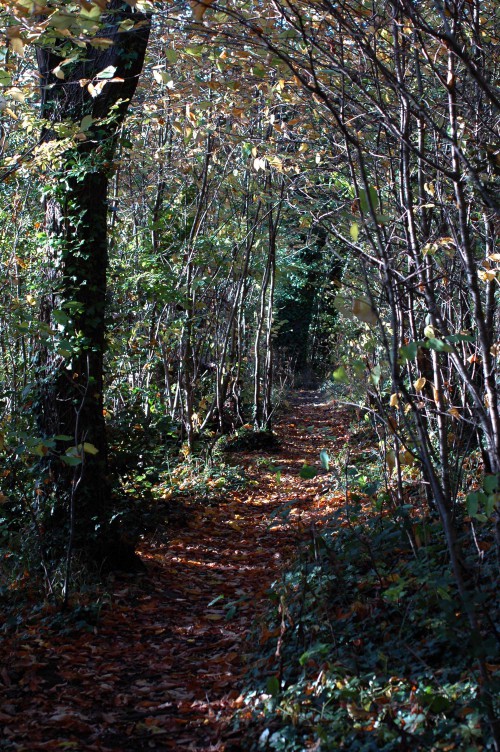
Autumn in North Wales is glorious this year thanks to a prolonged sunny and mild spell of weather, as yet broken only occasionally by rain. Walking between the trees in the dappled shade of the woodland along sun-striped paths thickly carpeted with fallen leaves in all the shades of the season, has been truly joyful. As October draws to an end, here are some of my views of the month.

151021-Bryn Euryn Woods 4a-Path sun-striped 151021-Bryn Euryn Woods 5a-Path leaf-strewn

Ivy is flowering now providing vital supplies of pollen and nectar to late-flying insects.

151021-Bryn Euryn Woods 2a- Ivy flower

Ivy is flowering

151021-Bryn Euryn Woods 8a-Woodland Trail

Ash trees leaves have mostly turned to a bright yellow.

151021-Bryn Euryn Woods 7a-Ash tree canopy

Ash tree canopy

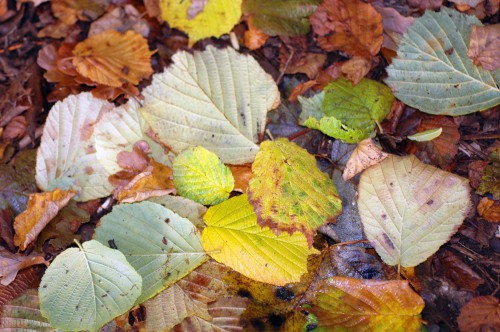
Many have already fallen.

151021-Bryn Euryn Woods 10a-Woodland Trail-Ash leaves

Strings of Black bryony berries are strung between stems of lower-storey vegetation

151008-Bryn Pydew (29)

Black Bryony berries

151021-Bryn Euryn Woods 9a-Woodland Trail

151021-Bryn Euryn Woods 6a-Hazel leaves

Hazel leaves fallen

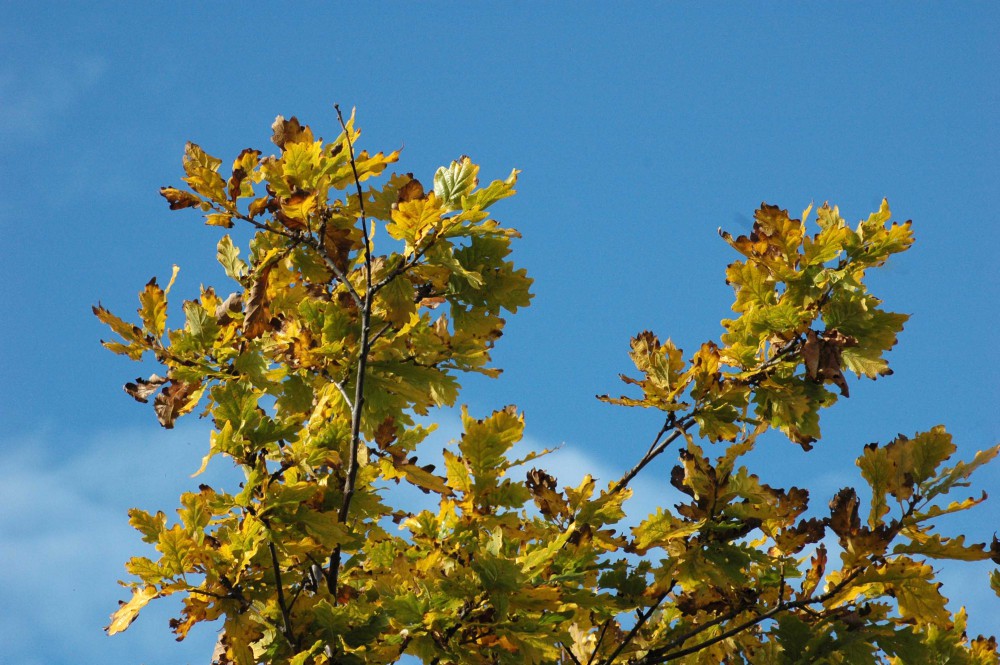
Oak trees are in varying shades, some still retaining a lot of green where they are in shade while those exposed to more sunlight have turned golden.

151008-Bryn Pydew (6a)-Oak leaves turned yellow & blue sky

Last year there was a national shortage of acorns and here at least it doesn’t look as though this year is going to be any more productive.

Sessile Oak and acorns

Sessile Oak and acorns

151008-Bryn Pydew (37a)-Cherry gall under oak leaf

Cherry gall under an oak leaf

Female Yew trees have ripening pink-red berries

151008-Bryn Pydew (53a)-Yew berry

On the woodland edges and in clearings there is still plenty to see.

151008-Bryn Pydew (2a)-Blackberries & clematis

Late blackberries and Old Mans Beard

In a sunny spot I watched a gathering of a dozen or so hoverflies. Some were hovering and darting around, others were attempting to bask in the sunshine but were deliberately disturbed by their dive-bombing peers.

151008-Bryn Pydew (11a)-Eristalis hoverfly

Bryn Pydew-Eristalis pertinax

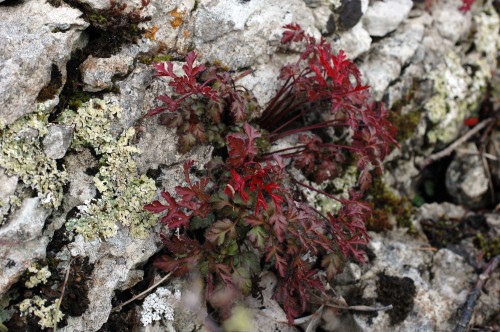
On limestone pavement I found Herb Robert leaves that have turned beautiful shades of red

151008-Bryn Pydew (43a)-Herb Robert leaves turned red

Goldenrod is a favourite late flowering plant

151008-Bryn Pydew (30a)-Goldenrod flower stem

Goldenrod

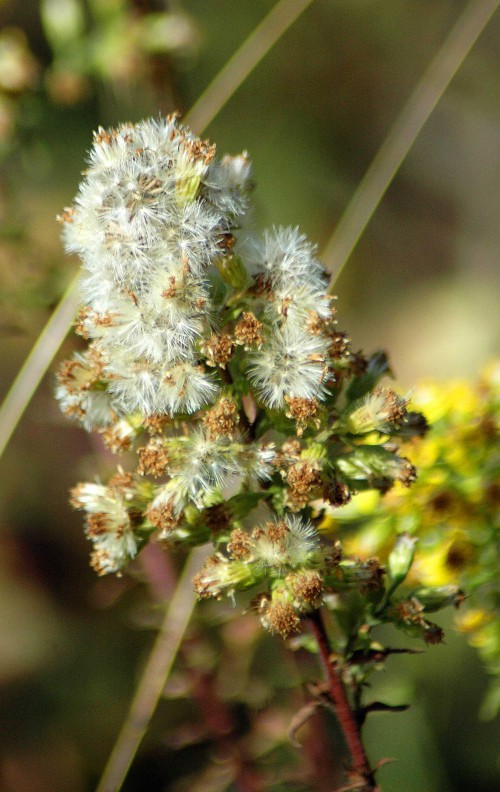
although most plants have set seed by now.

Goldenrod seedheads

Goldenrod seedheads

Tucked into a damp sheltered corner where two quarried limestone walls meet, a maidenhair spleenwort fern remains fresh and green.

151008-Bryn Pydew (35a)-Maidenhair Spleenwort

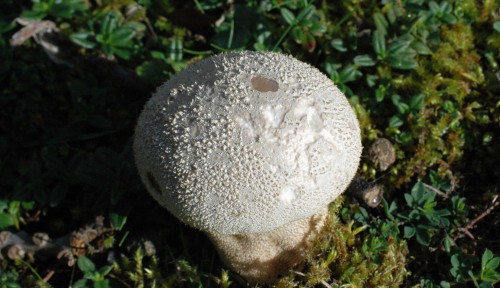
And of course there are fungi, this is one of the few that I recognise!

151008-Bryn Pydew (48a)-Puffball

Puffball

And to finish, a corvid feather, just because I liked it.

151008-Bryn Pydew (59a)-Corvid feather


Share this:

  • Share on Facebook (Opens in new window) Facebook
  • Share on Pinterest (Opens in new window) Pinterest
  • Share on X (Opens in new window) X
Like Loading...

Last of the butterfly days

21 Wednesday Oct 2015

Posted by theresagreen in Bryn Pydew, butterflies, Butterflies of Wales, Insects, Nature, nature photography

≈ 2 Comments

Tags

butterflies on sea cliffs, common blue, lassiomata megera, Red Admiral, silver y moth, speckled wood, Wall, Wall butterfly

October generally sees the last of the butterflies on the wing, but it would seem that records of species emerging earlier and flying later are increasing, which may or may not be attributable to global warming. I was surprised to learn that as many as thirteen species have been recorded as being out and about throughout the UK in this month of the year: it is rated as a ‘low-flight period’ for them, whose duration must surely be dependent on the local weather conditions and available food supplies.

The species on the list of those that may be seen this month are Brimstone, Large White, Small White, Small Tortoishell, Red Admiral, Peacock, Painted Lady, Comma, Wall, Speckled Wood, Small Heath, Small Copper and Brown Hairstreak. 

My own list of butterfly species photographed here in North Wales in October is significantly shorter, to date comprising only two mentioned on the above list; the hardy Speckled Wood and the Red Admiral. I have yet to see a Brimstone, let alone a Brown Hairstreak in any month here, and the latest I’ve recorded Small Copper and Small Heath has been during early-mid September. I may well have seen glimpses of some of the others but not on a regular basis.

2/10/15-Speckled Wood on oak leaves

2/10/15-Speckled Wood on oak leaves

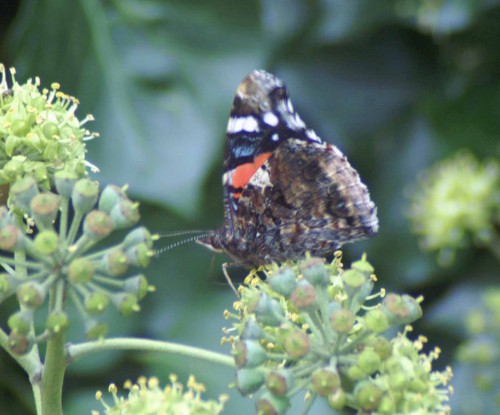
13/10/11-Red Admiral on ivy flowers

13/10/11-Red Admiral on ivy flowers

18/10/14-Red Admiral basking on a muddy woodland ride

18/10/14-Red Admiral basking on a muddy woodland ride

8/10/15-Common Blue-Bryn Pydew

8/10/15-Common Blue-Bryn Pydew

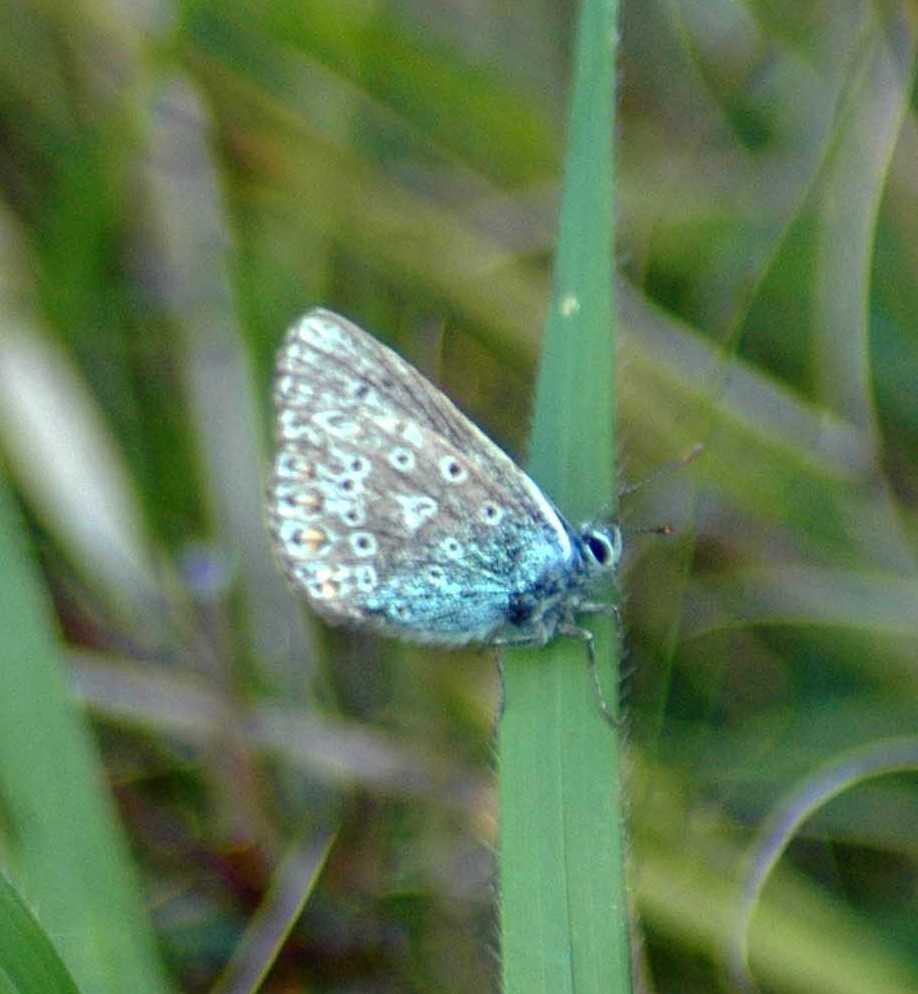
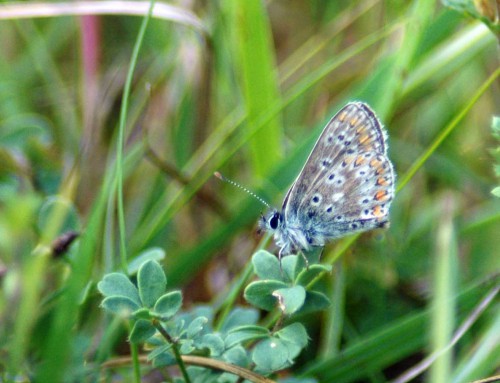
Probably due to this year’s glorious mild and sunny autumn, I do have one to add this year and that is a Blue. At Bryn Pydew there were several, probably Common Blues but as they were all in varying degrees of faded, it was difficult to say for sure. They were not really actively flying around, but rather keeping low in the grass either perched or flitting short distances amongst the low-growing plants then perching again.

8/10/15-Common Blue-Bryn Pydew

There was a more mobile Silver Y moth there too, who ended up landing on a bunch of ash keys dangling high above my head.

Silver Y moth on Ash keys

8/10/15-Silver Y moth on Ash keys-Bryn Pydew

Now, before our beautiful butterflies fade from our summer memories completely, I wanted to bring special attention to one of those that is on the list of 13 that I encountered on the Little Orme in September of this year; a Wall, or Wall Brown.

This was my first and, to date, only sighting of a Wall, Lasiommata megera, in North Wales and seeing it was an unexpected treat for me, particularly as I later learned that this species is far less common that it used to be. Quoted from the UK Butterflies website: “There has been a severe and worrying decline of inland populations of the species, with most remaining populations now being found in coastal areas. This species is therefore a priority for conservation efforts.” It doesn’t appear to be numerous on the coast either, at least not here.

150916-Little Orme 6a-Wall Brown on eyebright (2)

150916-Little Orme-Wall Brown- Lasiommata megera on eyebright

The day of my sighting I was walking on a path on the edge of the clifftop of the Little Orme. The day was beautifully sunny but with a strong cold wind blowing in off the Irish Sea, which may well have brought the butterfly here. It was in an almost-perfect condition and flying low to take nectar from various tiny eyebright and cranesbill flowers.

150916-Little Orme-Wall Brown 2

It stayed around for just long enough to allow me to get some images of it in various poses (the butterfly and me as it was so low on the ground) before it took off, probably in search of a more substantial meal.

150916-Little Orme 11a-Wall Brown on cranesbill

(More info on this butterfly:  https://theresagreen.me/about-the-blog/species-lists/butterflies-of-wales/ )

PS – I’d love to hear if you have more October species to add from other parts of the country.

Share this:

  • Share on Facebook (Opens in new window) Facebook
  • Share on Pinterest (Opens in new window) Pinterest
  • Share on X (Opens in new window) X
Like Loading...

Secret passage behind the sea wall 2

17 Saturday Oct 2015

Posted by theresagreen in Birds, birds of the seashore, birds of Wales, coastal walks, Nature, Nature of Wales, nature photography, Rhos Point, Rhos-on-Sea, Wales Coast Path

≈ 4 Comments

Tags

Crows on seashore, curlew flying, herring gull, meadow pipit, mussel bed, Rhos Point

An hour or so later the walk back to Rhos Point was quite different. The going was easier too as the strong wind was behind me now and not taking my breath away. Almost immediately I caught sight of a bird hopping around on the rocks. I waited hoping it would come into view, which it did, just as a woman with a dog approached and chose that moment to break into a run. The bird flew away. Again it was a pipit, possibly the same one I’d seen back on the beach. The legs are pinkish and plumage brown so maybe a Meadow Pipit?

151007TGNW- Penrhyn Bay-Pipit on rocks 3

151007TGNW- Penrhyn Bay-Pipit on rocks 4

A small sedum plants looks at home in a pocket eroded in a limestone rock.

151007TGNW- Penrhyn Bay-Sedum

Small pools of rainwater are held briefly, lasting longer in the hard granite rocks.

151007TGNW-6d-Rock pool 2

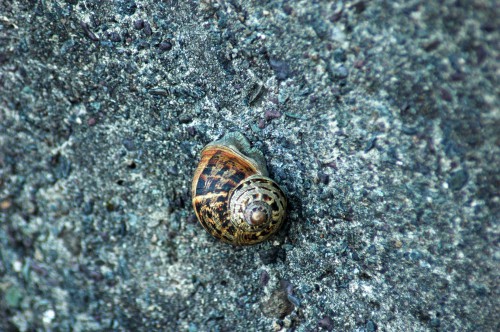
The garden snail must have found it hard going sliding over the rough surface of the sea wall.

151007TGNW-15-Sea wall- Garden snail

151007TGNW-Rock with moss

151007TGNW--Penrhyn Bay-Wasp

151007TGNW- Penrhyn Bay-sign at top of ramp

There is a wide concrete ramp reaching from the road down to the shore which probably gave access to heavy construction vehicles when the huge boulders of the sea defences originally were put in place. The lower section is being absorbed back into the shore, it is strewn with pebbles and small rocks and slippery with seaweed. Limpets are embedded into the wall itself as well as in large rocks on the shore at the bottom of the ramp.

151007TGNW-Limpets embedded in rock

I love the textured ‘lacy’ look of this rock almost covered with barnacles.

151007TGNW-Rock covered with barnacles & limpets

The sea is often at its most beautiful on these sunny windy days, its surface whipped up roughened and flecked with foam-edged ripples and the colour of the water ranging from deepest inky dark blue to pale turquoise-green. Large areas are stained brown by dredged up sand.

151007TGNW- Penrhyn Bay-Back to Rhos-Sea colours 1

Sun, shade and curves make this man-made construction interesting.

151007TGNW- Penrhyn Bay-Back to Rhos

The white marks highlighting the curved sea wall are mineral, maybe lime leached from the concrete?

151007TGNW-5-Wall markings-Rhos-on-Sea promenade

The parapet floor has an interesting pattern and texture and is spotted with patches of white lichen.

151007TGNW- Penrhyn Bay-Back to Rhos-Concrete floor3

As I got nearer to the Point I knew the tide was further in by the increased bird activity; the excitement it generates is almost tangible. Gulls take to the air and fly back and forth along the shoreline. Oystercatchers and other waders scuttle about, heads down, beaks probing for anything edible brought in on the waves.

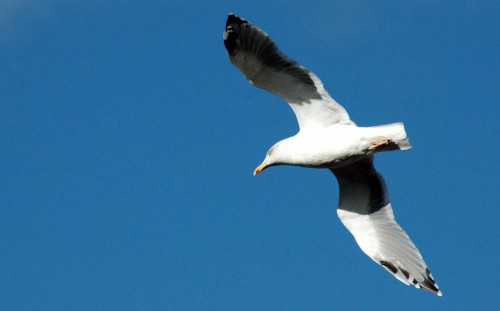
151007TGNW- Penrhyn Bay-Back to Rhos-Herring gull

151007TGNW- Penrhyn Bay-Back to Rhos-Herring gull young 1

Crows head shorewards too, the one in my picture landed on a lampost towering above me, cawing loudly. They forage amongst the rocks along with the waders and are often seen picking up a shellfish then flying up with and dropping it onto the rocks below to crack it open.

151007TGNW- Penrhyn Bay-Back to Rhos-Crow 1

Even the curlews were excited. Most often seen stalking sedately around rocks and pools, now there were several flying along at speed, skimming low over the rocks on the shore below me. A couple of them may have been in pursuit of the one I managed to capture a shot of; it was travelling so fast I didn’t realise it had food in its beak until I saw the photograph.

151007TGNW- Penrhyn Bay-Back to Rhos-Curlew

On the Point the incoming tide approaches from either side of the mussel bed, where I assume different currents merge. The birds have an infallible instinct for the tidal changes and in the hour before and after high tide their numbers increase dramatically. They are brought closer to the shore then too and absorbed with foraging and eating, are easier to see.

151007TGNW- Penrhyn Bay-Back to Rhos-Sea colours on point

151007TGNW- Penrhyn Bay-Back to Rhos-Oystercatchers active

It was too cold and windy to hang around and wait today though, so I had a quick peek into the chapel, which I can never resist. There are only 6 seats inside, so I wonder if they’ve lined up these memorial benches on the promenade outside to serve as overflow pews?

151007TGNW- Penrhyn Bay-Back to Rhos-benches 2

Many young Herring gulls wander around the village at this time of year, often screeching for the attention of a parent. They have no road sense and sadly quite a few are killed by cars.

151007TGNW- Penrhyn Bay-Back to Rhos-Herring gull young on road edge

Share this:

  • Share on Facebook (Opens in new window) Facebook
  • Share on Pinterest (Opens in new window) Pinterest
  • Share on X (Opens in new window) X
Like Loading...
← Older posts
Newer posts →
Follow everyday nature trails on WordPress.com

Enter your email address to follow this blog and receive notifications of new posts by email.

‘But it is the common species that keep the living world ticking over and provide most of our experiences of wildlife, and I would argue that maintaining the abundance of these is as important a conservation priority as maintaining the existence of rarities’. Richard Mabey

MOST RECENT POSTS

  • A Glimpse of Spring to Come January 22, 2025
  • Hunting the Wren December 28, 2024
  • Oh, Christmas Tree December 18, 2024
  • In and Out of the Ivy February 15, 2024
  • Nature’s Fireworks November 30, 2023
  • Wild Autumn along the Coast Path November 3, 2023

OLDER POSTS

LOOKING FOR SOMETHING IN PARTICULAR?

  • Sights and Sounds from the Little Orme 1
    Sights and Sounds from the Little Orme 1
  • Catchers, a Duck and Divers
    Catchers, a Duck and Divers
  • Following a river to a Fairy Glen
    Following a river to a Fairy Glen
  • Shades, Sounds and Scents of the Woods
    Shades, Sounds and Scents of the Woods
  • Things Bright and Beautiful
    Things Bright and Beautiful
  • Fine Dining for Crows
    Fine Dining for Crows
  • Butterflies and more rare treats
    Butterflies and more rare treats
  • May Bee Appearing on Ivy near You
    May Bee Appearing on Ivy near You
  • A Window on the Woods-Winter 1
    A Window on the Woods-Winter 1
  • The Windhover
    The Windhover

nightingale trails

The Walk of the Monarch Butterfly-Sendero de la Mariposa Monarca

The Walk of the Monarch Butterfly-Sendero de la Mariposa Monarca

MY WILDFLOWER BLOG: where the wildflowers are

Snowdrop

Snowdrop

most recent posts

Follow everyday nature trails on WordPress.com

Social

  • View teresamaygreen’s profile on Twitter

Enter your email address to follow this blog and receive notifications of new posts by email.

Website Built with WordPress.com.

  • Subscribe Subscribed
    • everyday nature trails
    • Join 359 other subscribers
    • Already have a WordPress.com account? Log in now.
    • everyday nature trails
    • Subscribe Subscribed
    • Sign up
    • Log in
    • Report this content
    • View site in Reader
    • Manage subscriptions
    • Collapse this bar
 

Loading Comments...
 

    %d