• Home
  • about
  • about the photographs
  • Local Nature Reserves
    • Bryn Euryn Local Nature Reserve
    • Mynydd Marian
  • Wales Coast Path
    • Grey Seals in North Wales
    • St.Trillo’s Chapel
    • Wildflowers of North Wales Coastal Paths, Cliffs and Dunes

everyday nature trails

everyday nature trails

Tag Archives: herring gull

Wild Autumn along the Coast Path

03 Friday Nov 2023

Posted by theresagreen in Birdwatching on North Wales coast, Wildlife of the Wales Coast Path

≈ 5 Comments

Tags

autumn, beachcombing, common gull, Curlew, herring gull, little egret, Llanddulas, October, rip-rap, sea defences, strandline

October 25th

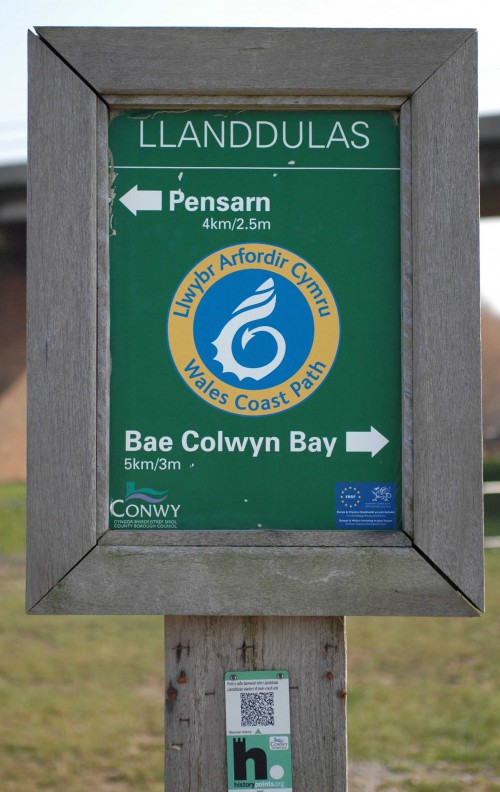
As the effects of recent storms were subsiding, albeit it temporarily as it’s turned out, a sunny warmish day finally presented an opportunity to get out beyond my local patch for fresh air, some not-too strenuous exercise and above all, the sight of some wildlife. I was also keen to see how the weather might have affected the coastline, so settled for one of my favourite stretches of the Coast Path between Llanddulas and Pensarn, one of the best walks I know for amazing views, wildflowers, birds and so much more.

The car parking area at Llanddulas, located immediately behind a defensive wall of rip-rap, or rock armour (piled up giant-sized boulders that serve to protect against erosion and to diffuse the power and velocity of high seas), is still frequently scoured by over-topping waves and spray, which carve out numerous deep pot-holes and craters. Following the most recent storms, it was worse than I’ve ever known it. The Coast Path running past it seems to have survived unscathed though, as far as I could see.

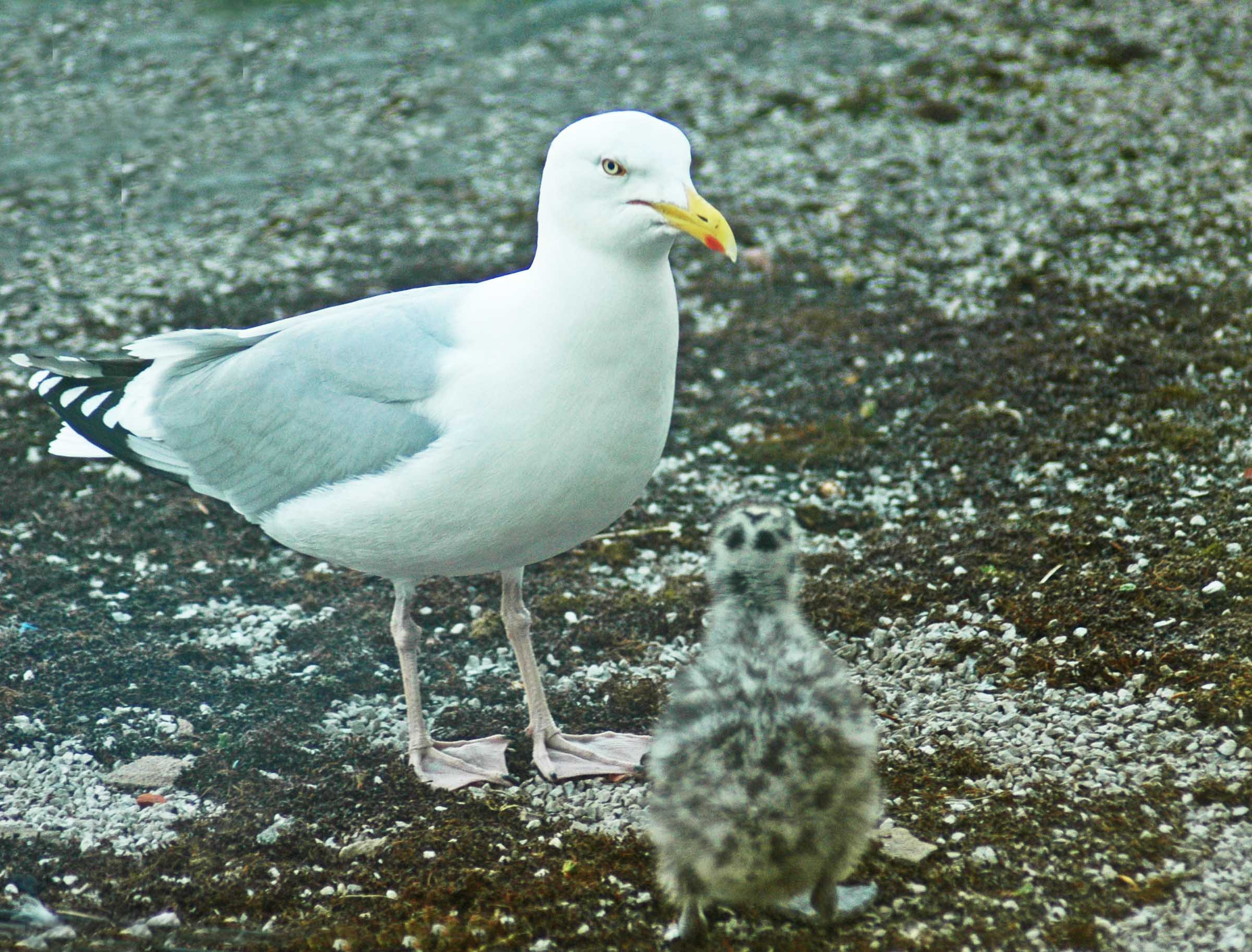
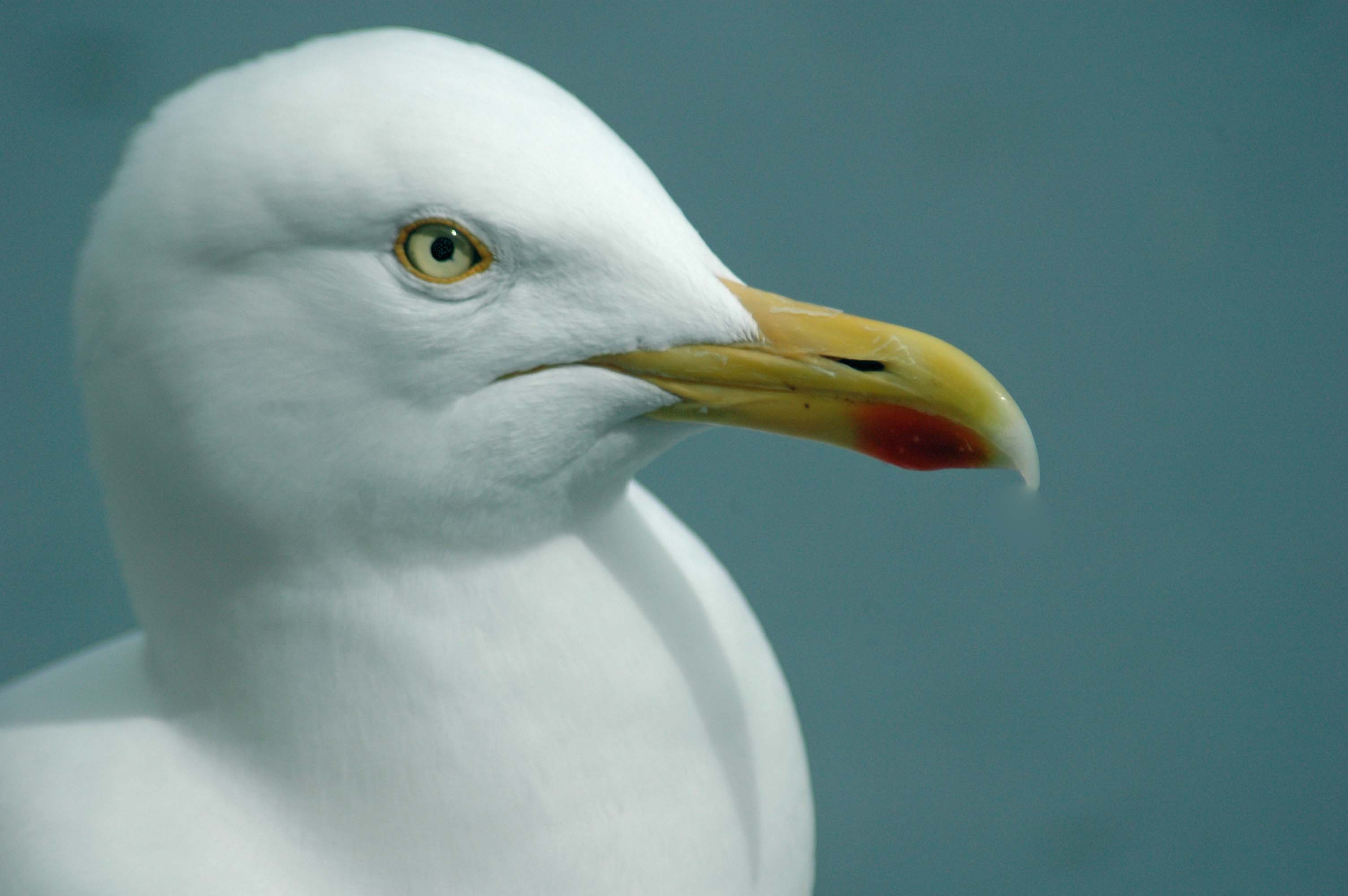
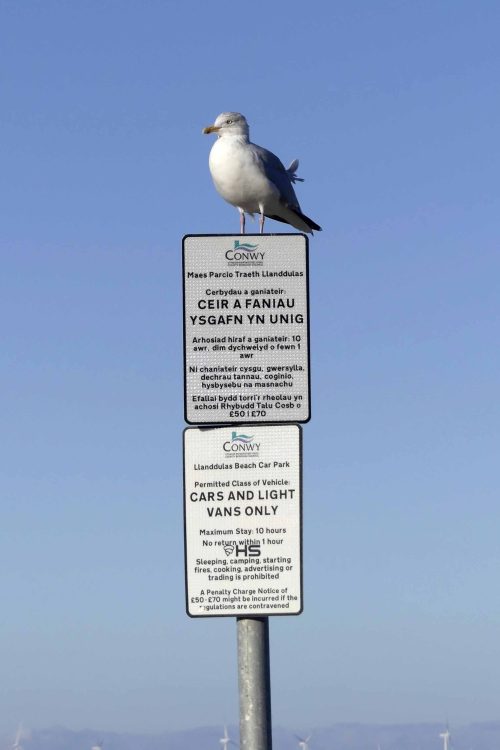
Herring gulls will claim any perch that has some height, and are often on duty here drawing attention to signs stating the rules for parking. Taking on their winter plumage now, they are looking particularly handsome.

The tide was going out, so it would be unlikely that I’d find gulls and cormorants occupying the posts of the lines of groynes further along the shore as they do at high tide, but I was pleased to see at least a few cormorants were out on posts at this end of the shore, before the outgoing tide fully exposed them.

Afon Llanddulas

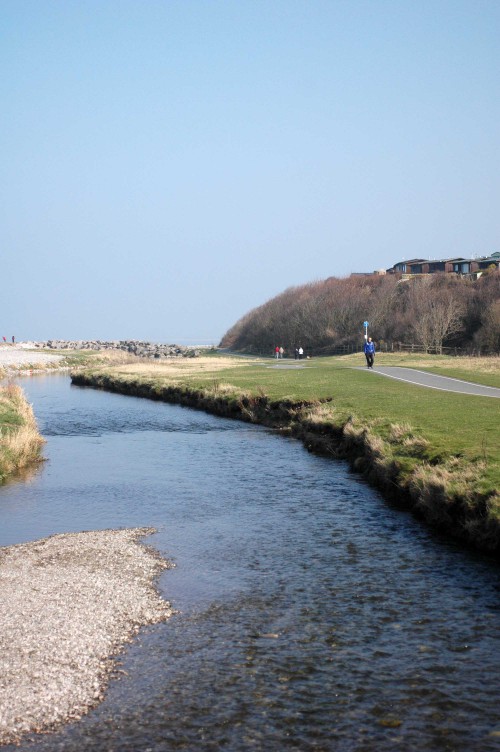
Running beneath the viaduct that carries the main train line, the river is full and flowing fast towards its end. Where it bends to follow the line of the path the mud and flattened vegetation show that it has flooded recently well beyond its usual boundaries, but again, no serious damage seems to have been done.

Beyond the footbridge, while the water was still travelling fast, it is fairly shallow.

A little further on, guided and contained by a high wall of more rip-rap it reaches its final destination and escapes into the sea.

The far side of the rip-rap wall is more sheltered and has been colonised by a variety of plants. Sunning itself on the leaf of alexanders, which in recent years has become the dominant wild plant throughout this whole site, was a hairy shieldbug.

Lichens pattern some of the rocks, and in some spots, cushiony moss, revived by rainfalls, helps to soften their harshness.

Perched on top of a high rock, a jackdaw gleaming brightly in the sunlight sat sentry-like surveying his kingdom, his steely blue-grey eyes matching the colour of the sky behind him.

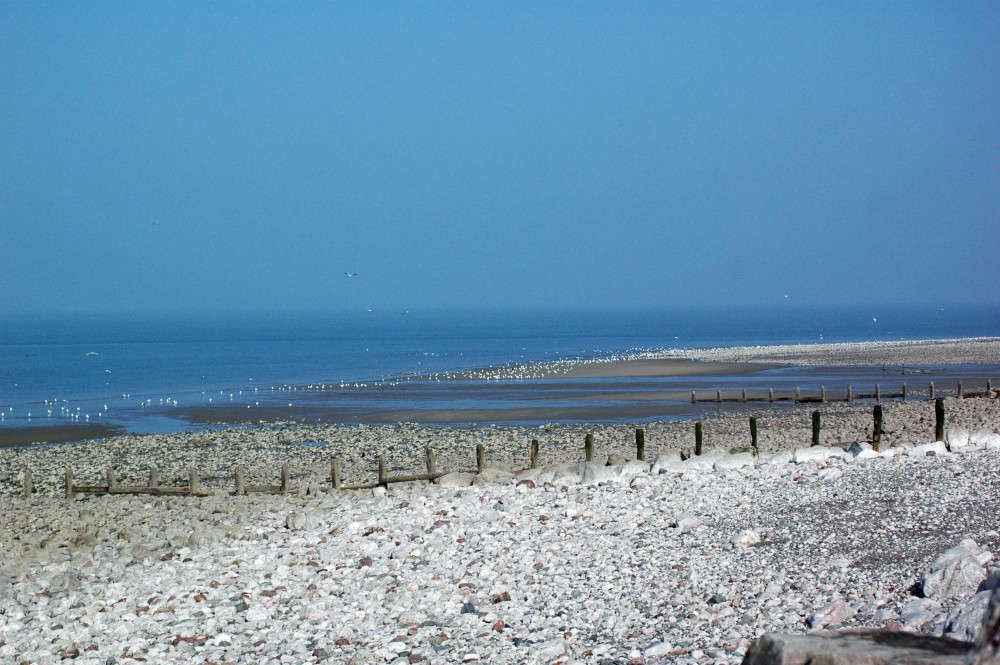
Beyond, the flat stony seashore stretches for miles in front, curving gracefully around to the headland on which sits the town of Rhyl. It may not have the aesthetic appeal of miles of unbroken sandy beach, but there’s no denying that it has great dramatic impact, emphasised by huge skies.

Several curving strandlines mark the reaches of various recent high tides.

A high fence of sturdy wire enclosing heavy machinery indicated that some storm-damage has occurred here. It’s not at ground level though, they seem to be reinforcing the cliff where it looks as though there has been a landslip, perhaps caused by water running down from above, where mobile homes are lined close to the edge.

Beachcombing

Strandlines are always interesting to explore, but there wasn’t much to find today other than dried seaweeds, leaves and twigs and a few whelk and razor shells. Pieces of dried hornwrack are often found blowing around on this and most other beaches. Easily mistaken for a seaweed, it is actually a detached part of colony of individual animals known as zooids. Today there were a few clumps of what I’m fairly sure is ‘fresh’ hornwrack as it looks when alive and growing, sadly torn from their anchor points in the shallow foreshore.

Hornwrack Flustra foliacea (fresh)
Hornwrack Flustra foliacea (dried & fresh)

Herring gulls gather along the shoreline here, often in huge numbers. A line of them, quietly resting and preening was strung out along the worm reef on the lower shoreline, waiting for the tide to turn.

From some distance away I spotted a single gull perched on a post of a line of groynes. It seemed too small to be a herring gull, and in this same spot I’ve occasionally seen a common gull or two, so I was pleased on checking my photographs later, to see it had green legs, which common gulls have. (Herring gulls have pink ones.)

Coastal Wildflowers

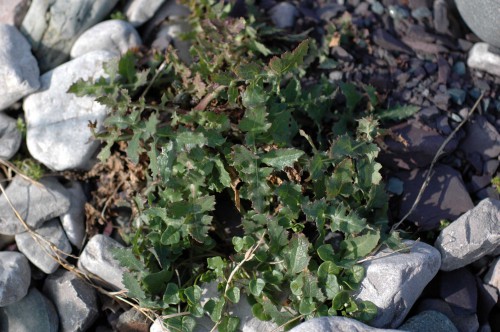
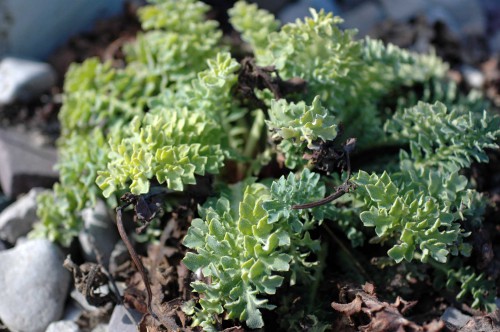
Beyond the strandline, the back of the beach is a great habitat for wild plants, and several interesting and uncommon species, including the lovely yellow-horned poppy can be found here. Although flowering and fruiting are long finished now, fresh leaves often appear after autumn rains and can last throughout the winter.

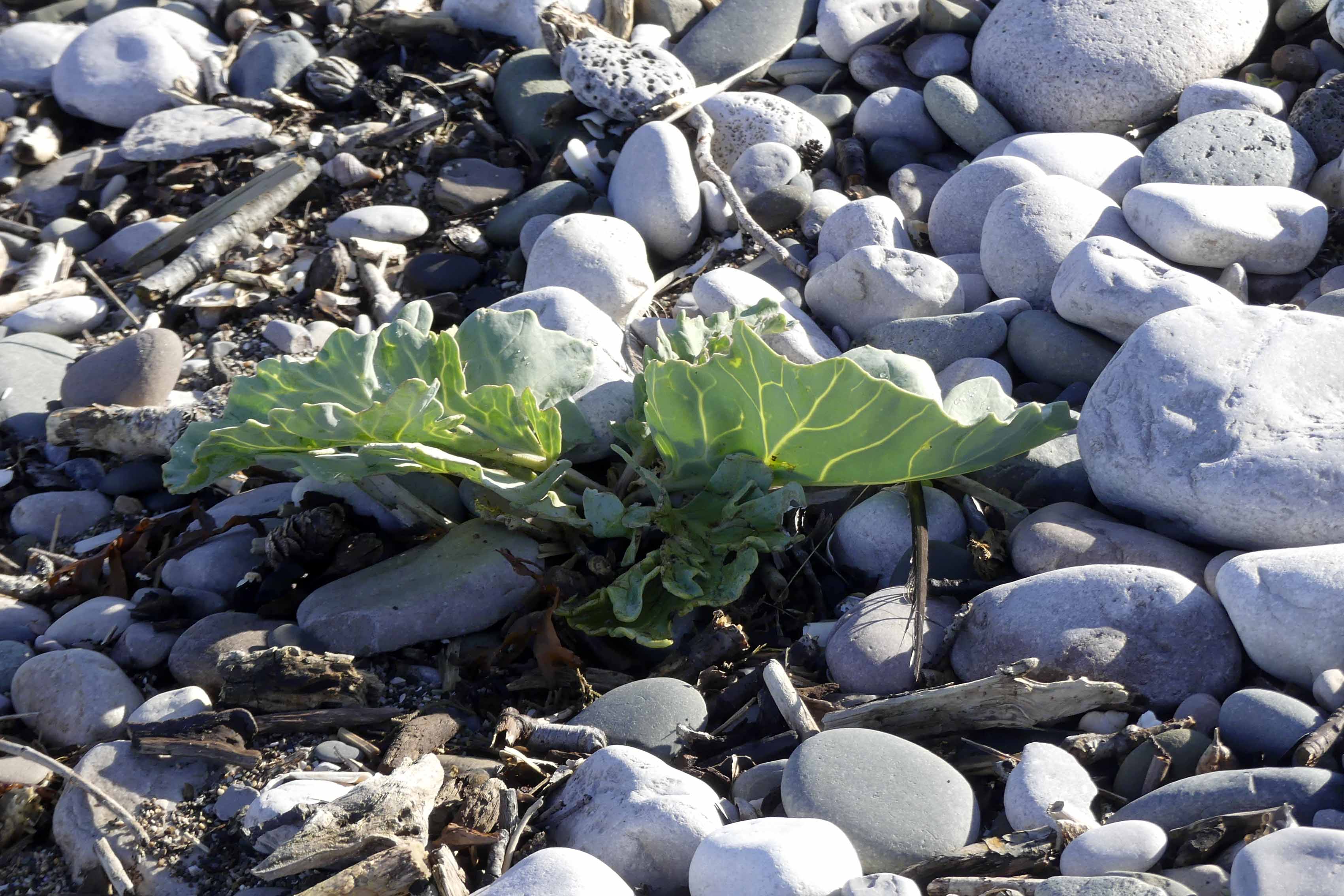
leaves of yellow horned poppy
leaves of sea kale

Leaving the beach I got back onto the Path, depositing the collection of fishing twine, plastic bottle tops & other miscellaneous bits of rubbish I had stuffed in my pockets, plus 2 plastic &1 glass bottle I was carrying in my hand in the only bin for miles. This section of Path, being long and straight often tempts cyclists to speed up and race along it, and not all warn you they are behind you, so I have to remember to check behind me before meandering from one side to the other.

In years past this has been one of the most interesting lengths of the Coast Path, having a lovely diversity of wildflowers along its edges. Now, alexanders has spread exponentially along both edges, smothering out less robust plants and forcing tougher ones to break through where they can. The other locally prolific invader, winter heliotrope, also has a firm grip here.

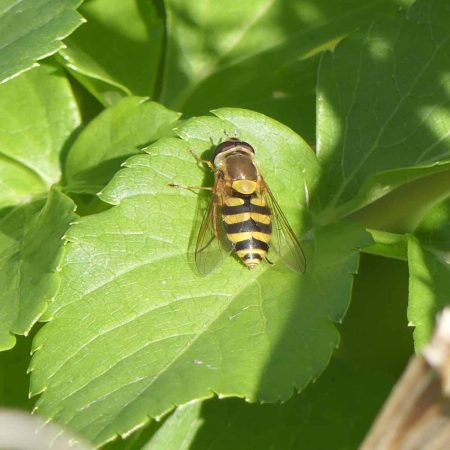
on alexanders – eristalis sp hoverfly
on alexanders-syrphus sp hoverfly

There’s not a lot still flowering, but there are a few fresh plants in flower of fennel, wild carrot and ragwort. There were quite a few insects about too, mostly various flies and a few different species of hoverflies, but also a few of my favourite little yellow dung flies.
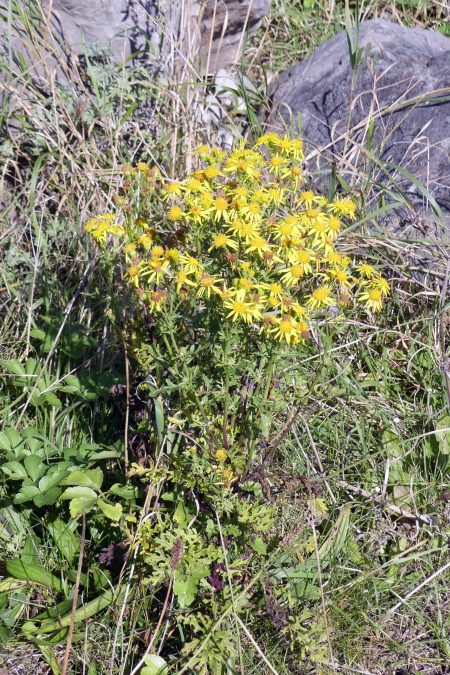
fresh ragwort
fresh fennel

Some plants look good even when their flowers are done, bleached stems of hogweed against a backdrop of rocky shore, blue sea and sky are particularly striking.

A dunnock explored the dried stems and down on the shore beneath a few oystercatchers foraged around rockpools, this one casting its shadow and a reflection.

Oystercatcher

There may not be cormorants to see perched on groyne posts, but on the sea edge there were distant views of several groups of them on the sea edge. Some were active, taking off onto the sea, others were more sedentary, opening up their wings to dry or preening their glossy feathers.
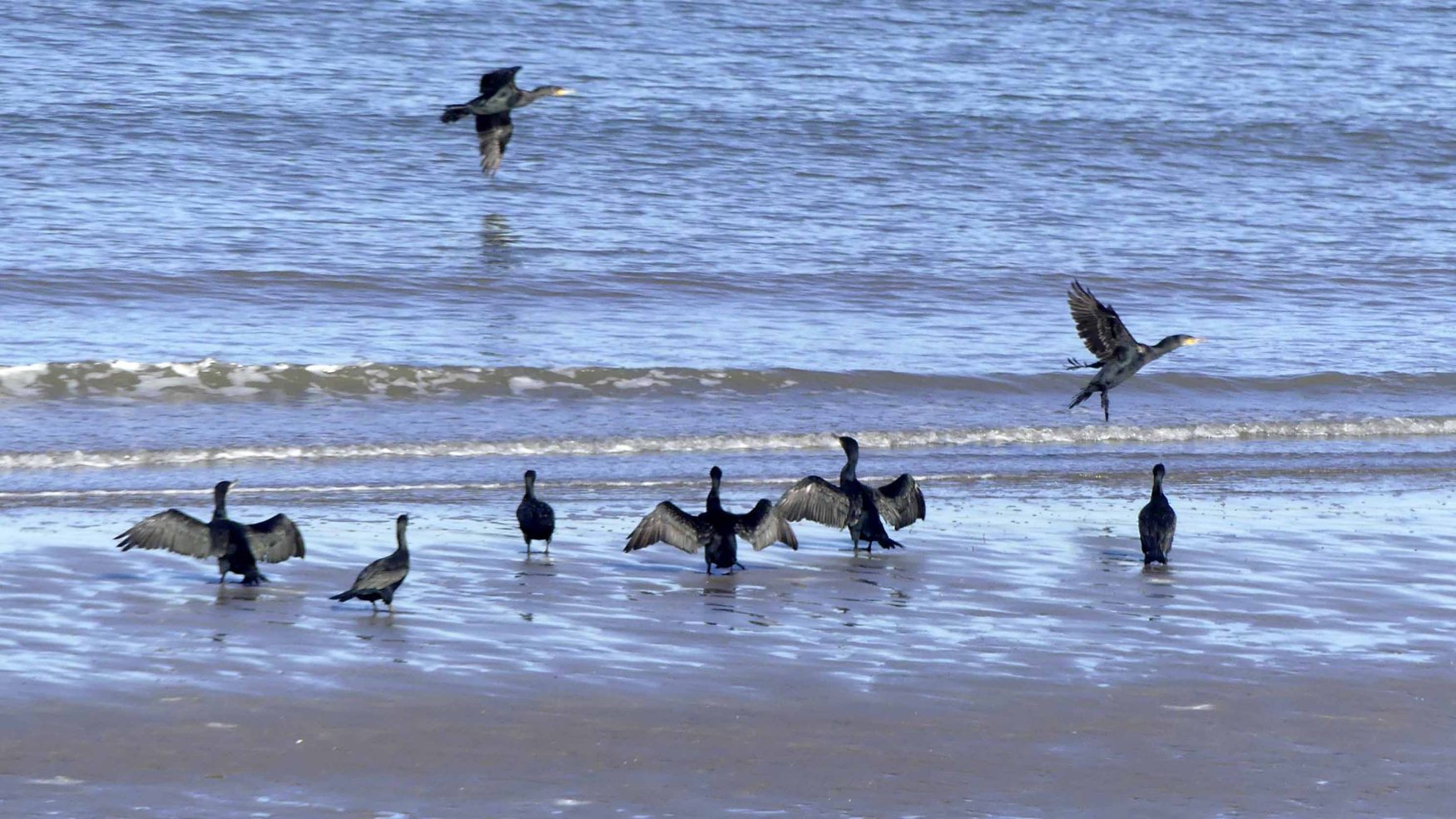
Cormorants hanging about to dry

I had heard the calls of curlew, but they were so far away and well-camouflaged I hadn’t expected to see them. It was a treat then to see three out in the open walking in line across the sand.

The Last of the Wildflowers

When there are only a few wildflowers left, you can really appreciate their individual charm and more importantly, so do lingering insects.
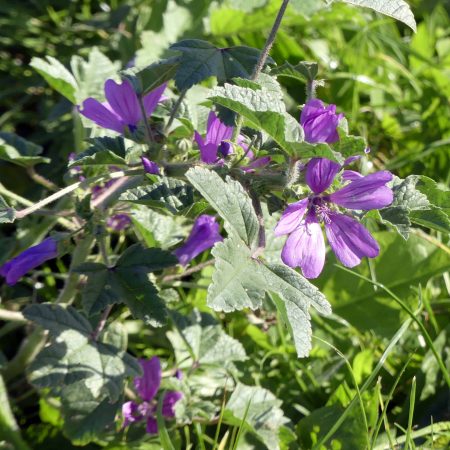
common mallow
bristly oxtongue
knapweed
chicory
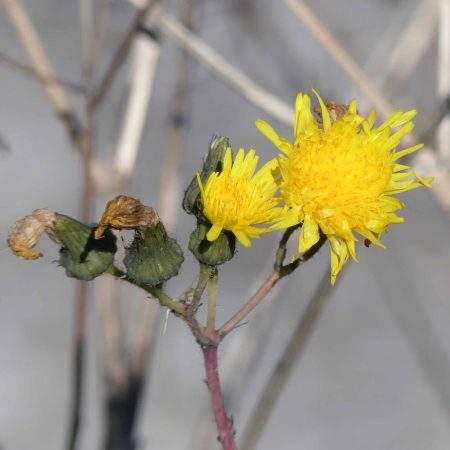
prickly sow thistle
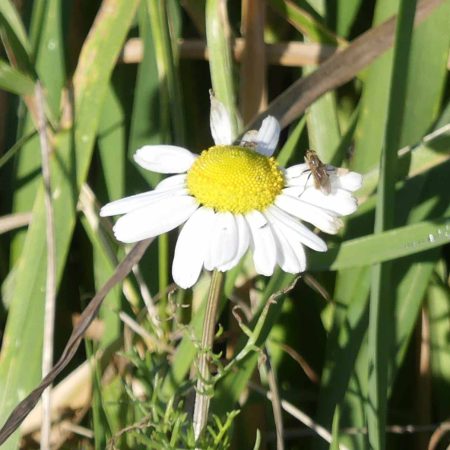
sea mayweed with yellow dung fly

On a clear, sunny, calm day you can follow with your eyes the spectacular sweep and curve of the shoreline past Pensarn, Kinmel Bay and right around to Rhyl, with the Clwydian Hills in the background.
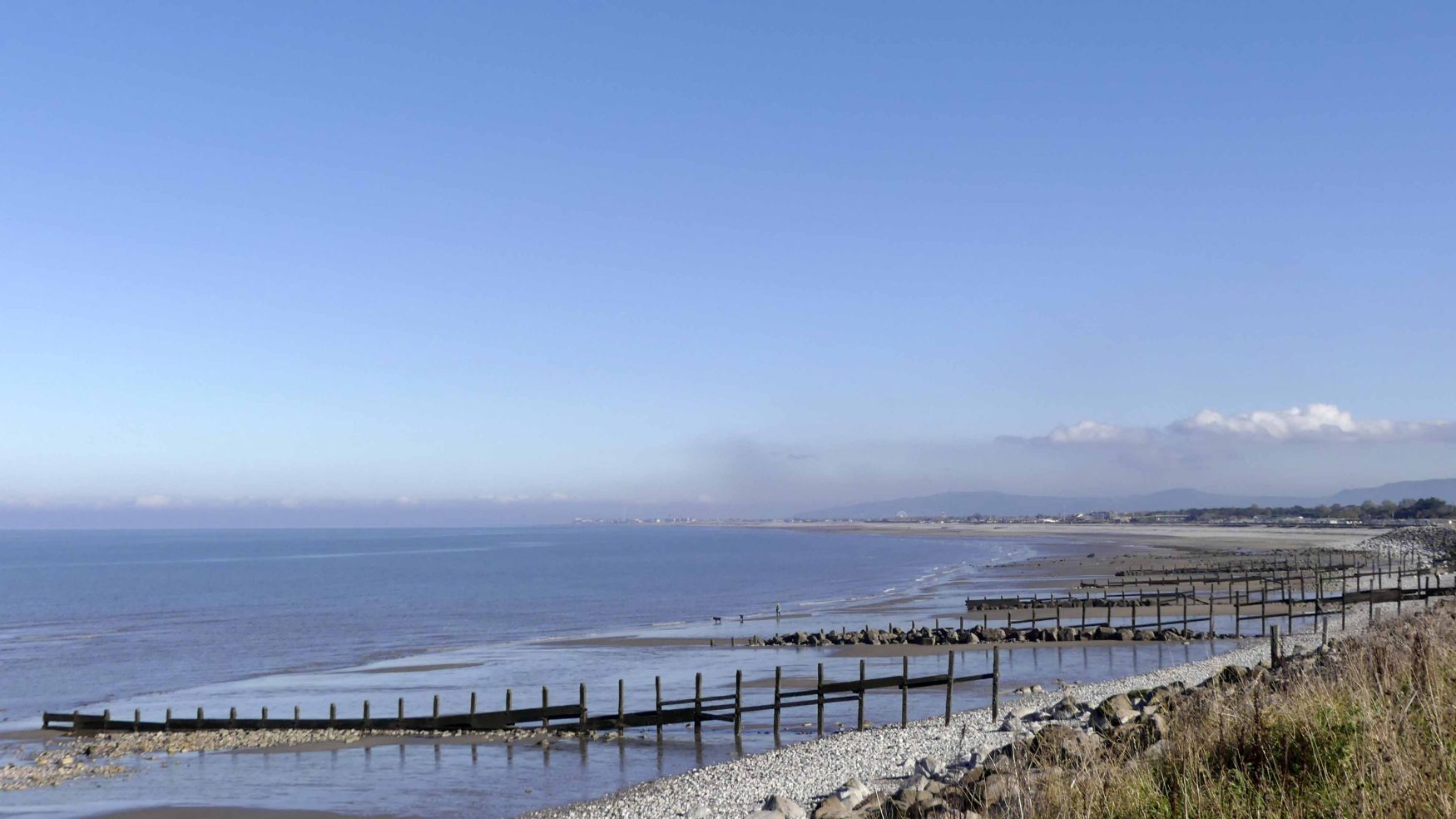
Although brightly sunny, there was a chill to the air and where the Path became shadowed, a short way from the beginning of Pensarn beach, I stopped, admired the view ahead for a few moments and turned to walk back.

Soft fluffy old man’s beard scrambles over hard rocks

old man’s beard

The Way Back

Looking towards Penmaen Head and the Little Orme beyond
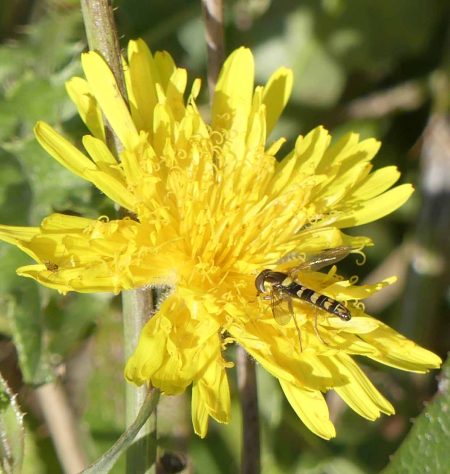
hoverfly on sea mayweed
yellow dung fly on yarrow

Although not the greatest fan of linear walks, it’s sometimes surprising how much more there can be to see along a stretch of path only passed along few minutes previously, when travelling in the other direction. Less than five minutes after turning to walk back, I’d spotted more wildflowers and this lovely little female stonechat that flew across the path and paused briefly on the wire fence that bounds the area of scrubby wasteland between the Path and the railway.

Stonechat female

Then down on the shore, there was one of the birds I always hope to see here, a little egret, stalking through shallow water on the hunt for a temporarily-stranded meal.

little egret
little egret about to strike

It was interesting to watch as it followed behind a paddling herring gull, cleverly waiting to see if the gull’s big flat feet stirred up anything edible from the sand. It’s also interesting to compare the size and shape of the two birds, the egret looks so graceful and elegant next to the chunky gull.

little egret following a herring gull

Nearer to the edge of the sea a small group of gulls attracted my eye. Mostly sitting and with their heads turned towards the water, so not giving the best of views, zooming in on the only one standing confirmed them to be common gulls.

Common gulls

Groynes are looking battered and the worse for wear

dried seedheads of knapweed
lesser burdock

An unexpected sight was of this slug crossing the path. Hope it made it.

A few more flowers, including a wild carrot flowerhead giving shelter to a tiny spider

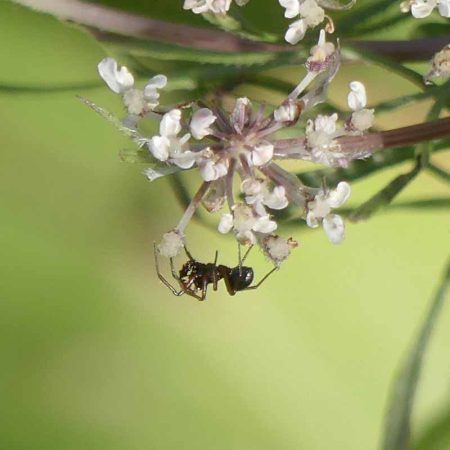
wild carrot flowerhead
a tiny spider on wild carrot flowers
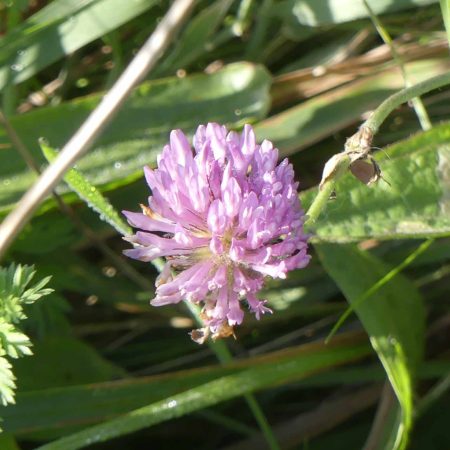
red clover
long hoverfly

and I know it’s a pain in the garden, but the pure white trumpet blossoms and heart-shaped leaves of hedge bindweed are really quite lovely.

Down on the sand a great black-backed gull stood looking out to sea

Great Black-backed Gull

Back on the beach

Sea Mayweed
Rock Samphire

From where the river runs into the sea and back along towards the carparks, a high defending bank of stone and earth hides the view of the sea.

High bank between the river and the sea

The loose sandy earth and small rocks of the bank can be a good place to see linnets foraging on the seeds of plants that grow there, but today there was only a perky pied wagtail running around chasing flies.
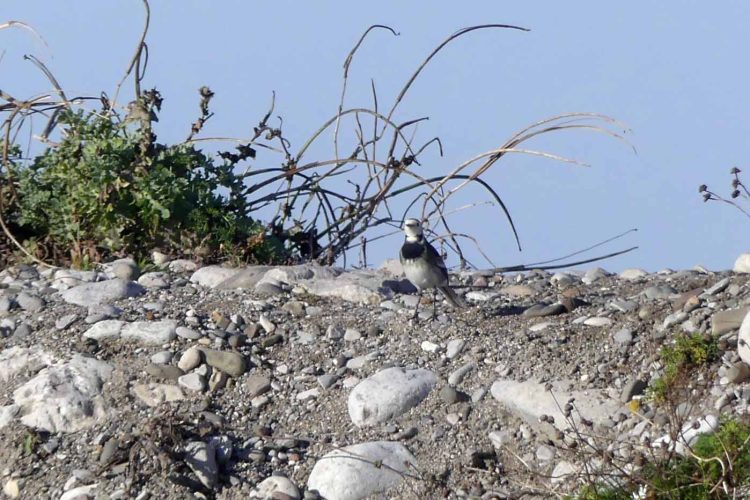
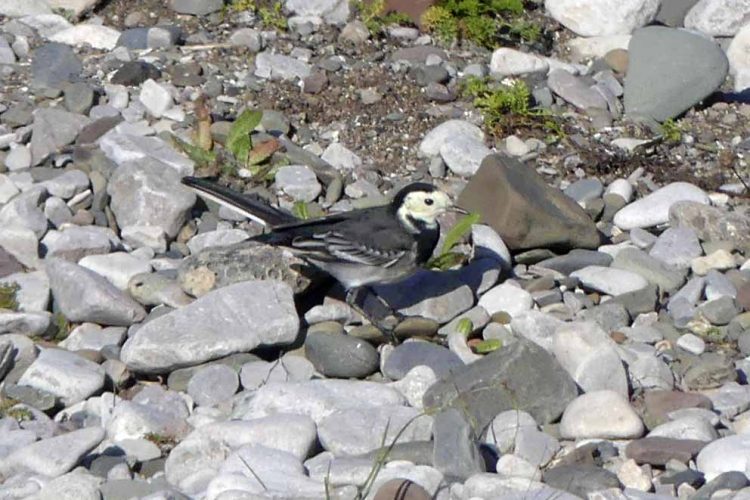
Pied Wagtail

Last view of the river

and back to the carpark, where a herring gull is still keeping an eye on the comings and goings.
Today’s birds: herring gull; black-headed gull; common gull; great black-backed gull; cormorant; oystercatcher; curlew; little egret; robin; dunnock; stonechat; pied wagtail; house sparrow

Wildflowers still in flower: ragwort; common mallow; sea mayweed; common daisy; red clover; fennel; wild carrot; knapweed; chicory; bristly ox-tongue; hedge bindweed; yarrow; sow-thistle
Share this:

  • Click to share on Facebook (Opens in new window) Facebook
  • Click to share on Pinterest (Opens in new window) Pinterest
  • Click to share on X (Opens in new window) X
Like Loading...

Kinmel Dunes-Twyni Cymnel

09 Sunday Feb 2020

Posted by theresagreen in Coastal Nature Reserves, coastal wildflowers, Local Nature Reserves, Nature of Wales, North Wales, North Wales Path, Wildlife of the Wales Coast Path

≈ 10 Comments

Tags

active sand dunes, Alauda arvensis, bird behaviour, Black-headed Gull, Buck's-horn Plantain, cormorants flying, herring gull, kestrel, Kinmel Dunes, moss in sand dunes, sand dunes, Sand-hill Screw Moss, seashells, skylark, tree mallow

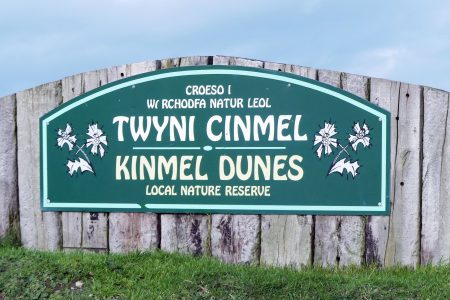
Much of the sand dune system that once stretched along the eastern end of the North Wales coastline has long-since disappeared, flattened to make way for ‘coastal development’, but a small fragment survives at Kinmel Bay, which lies between Rhyl and Towyn on the Wales Coast Path. This active dune area is designated as a Local Nature Reserve, which means that its worth to wildlife is recognised, but that it is also an amenity area for people; a challenging balancing act for those trying to maintain it, particularly so in a small space that is also regularly severely battered by strong winds and powerful tides.

This was my first visit here, and my first impression was that although proudly and prominently signed as Kinmel Dunes Nature Reserve, this is firstly an amenity area for people. The large tarmacked car park placed at the centre of the dune area, effectively dividing the reserve area into two, was the first indication of that. Then there are toilets and a refreshment kiosk at the beach end of it, both firmly closed up for the winter. It is clear though that the Reserve area is valued and cared for and there are several interpretation boards informing about the dunes themselves and the wildlife that may be found there. There are also North Wales Wildlife Trust guides to things you may find on the beach and details of how to record anything you might find.

Later on it struck me that if you were walking the Wales Coast Path you quite possibly wouldn’t realise that you were walking past, or through a Nature Reserve here as there are no signs on the path itself at either end to inform you of that.

To get an ‘overview’ of the Reserve area I followed a track from the carpark to the top of a small hillock topped with picnic tables, which I’m fairly sure would have been man-made as a view point over this otherwise flat and otherwise featureless stretch of coastline.

The view above shows the North Wales Path/Wales Coast Path coming in on the right (east), from the direction of Rhyl, then passing the public car park and the beach café, which is currently firmly closed for the winter. In the forefront a surfaced path curves through the dune area, which attempts to encourage people to refrain from trampling across the fragile dune area itself. On the shore edge you can see where the surfaced Coast path has been cut through the dunes for part of its length and where they gradually peter out to be replaced by a shore of shingle.

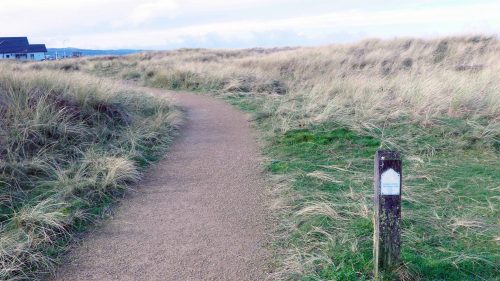
Leaving the viewpoint on the other side, I joined the Coast Path, which is also marked as ‘The Dunes Trail’. Today the path was heavily strewn with sand either washed from the dunes by high seas or rain or blown out by strong winds. Probably a combination of all three. As usual I hadn’t formulated a plan as to what I’d do when I got here, so for no particular reason turned left to head towards Towyn, back past the car park and the firmly-closed refreshment kiosk. There are numerous notices, warning signs about the dangers of the sandy shore area, keep off the sea wall, no dogs from May to September and a life-saving ring.There is also one of the iconic colourful Cycle Network signposts informing me that I am 1¼ miles from Towyn and 1½ miles from Rhyl in the other direction.

It soon becomes clear that signs and warnings are to be significant features of this stretch of path as here too is the more traditional Wales Coast Path sign, informing that Pensarn is 3 miles away.

The path is long and straight and bounded by a wide low concrete sea wall. The surrounding landscape appears flat and quite featureless, but in front of you can see the not-too distant hills rising on the horizon and stretching all the way round to the headland of the Great Orme.


Countless numbers of times I have stood and looked at the view from points high and low across the other side of this expanse of sea, so it was interesting to be standing at a point I’ve probably photographed many times.

Out to sea are the turbines of Rhyl Flats Wind Farm, situated in Liverpool Bay. This started out as a modest 25 units back in 2008/9, but the ranks of turbines has since expanded greatly so that now there seems to be continuous lines of them stretching from one side of the bay to the other.

I find it amazing that any wildlife can survive, let alone thrive in harsh, well-trodden  habitats such as this, but it’s also a wild(ish) strip of land on the border between human habitation and the seashore, so although not ‘pure’ sand dune, it can be interesting and well worth exploring. I left the path when I saw the beginning of a sandy path wending its way through and around the dunes.

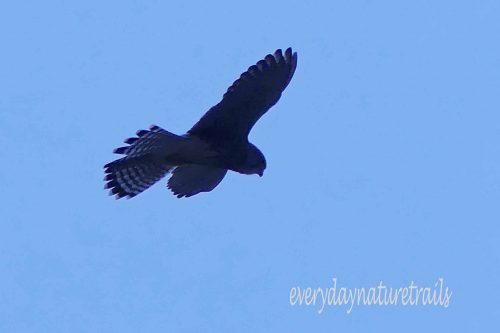
I got off to a good start – a few steps in I spotted a bird flying in towards where I was standing, and was treated to a display by a hovering Kestrel. It may have spotted some movement on the ground below as it lingered for a moment, but there was no downward swoop and it soon moved away.

I was facing into the sunlight, so couldn’t make out all the beautiful details of the bird, but there’s no mistaking that shape and seemingly effortless aviation skills.

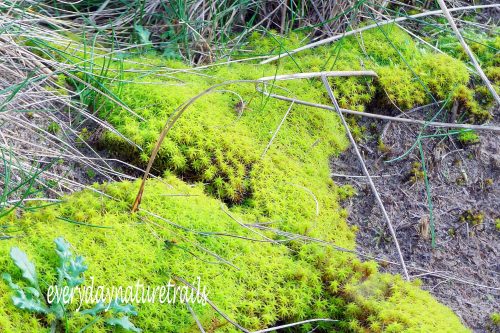
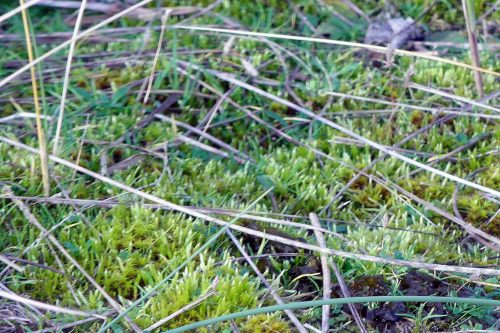
The dominant plant of the dunes is of course Marram grass, of which there is plenty here holding everything together. I’m sure there will be flowering plants in amongst it later on, but today the star plant was, quite unexpectedly, lovely bright green moss. I’d never connected damp-loving mosses with dry sandy dunes, but I’ve since learnt that they are often found on their damp sheltered sides and are important stabilising plants in dune systems. I’ve said before that I’m fairly clueless about bryophytes (mosses & liverworts), but I do love to see and photograph them and am trying to learn to recognise at least a few. Going on its location, i.e. sand dunes, and its distinctive ‘starry’ appearance, this might well be Sand-hill Screw Moss – Syntrichia ruraliformis. Growing close by to this lovely spread was another smaller, similar-looking patch with fruiting bodies, which may (or may not) be Redshank Moss – Ceratodon purpureus. Apparently the two species often do grow close together.

200127-KBLNR- (23a)-Moss in sand dunes
200127-KBLNR- (24a)-moss in sand-dunes fruiting bodies

To add to my identification issues, I found another patch that looked different again, but I think it’s the same Sand-hill Screw Moss, which protects itself from dehydration in dry conditions by rolling up its leaves around its stems, giving it a completely different appearance. I guess it’s this habit that gives the plant its ‘screw moss’ common name.

The path I was on soon met up with the surfaced path that I now realised had started from the car park, also marked as The Dune Trail.

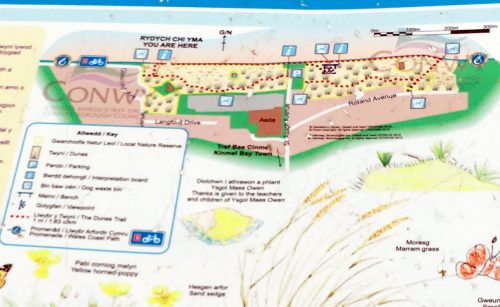
An interpretation board at the end of this short trail, where it rejoins the main path, indicates it as a dotted red line. The board also shows the size and scale of the reserve and the proximity of ‘developments’, such as the Asda supermarket and its carpark.

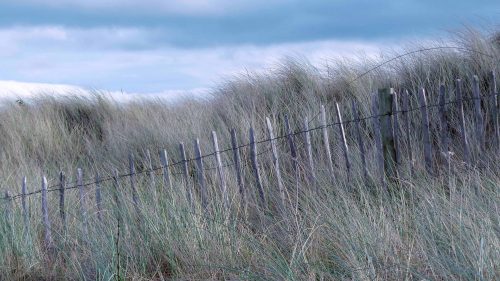
All too soon I’m back on the main path and spot a length of chestnut post and wire fencing, (which in my mind at least, made a connection to my last post about the Sweet Chestnut tree).  I’m not sure if the fencing  is there to help stabilise the dune or to deter people from trampling over it.

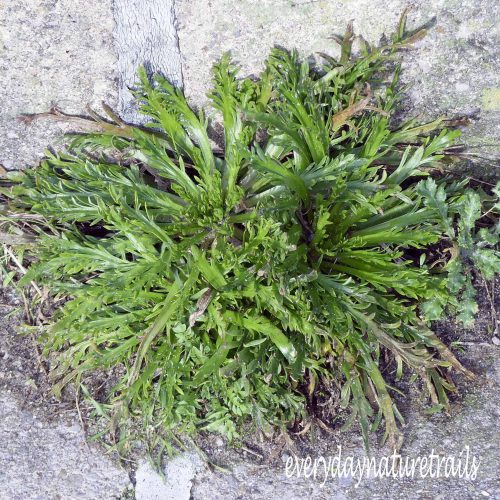
Growing in the crevice between the path and the retaining sea wall, a flourishing clump of Buck’s-horn Plantain, clearly showing the leaf shape that gives the plant its common name.

Standing quietly atop the shingle bank behind the sea wall a Black-headed Gull. The birds’ heads are actually white in the winter with just a black spot behind each eye, then approaching the breeding season the head begins to take on colour as this bird’s is, darkening gradually to a rich dark chocolate brown; not actually black as in its name.

Black-headed Gull – Larus ridibundis

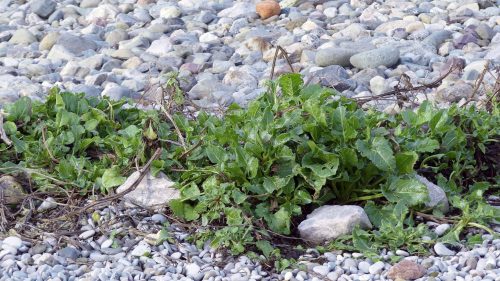
Also on the shingle, a patch of new Sea Beet leaves. The plants waxy-leathery leaves give it the protection it needs to withstand the tough conditions here.

More signs! This really can be a dangerous place for the unwary or foolhardy.

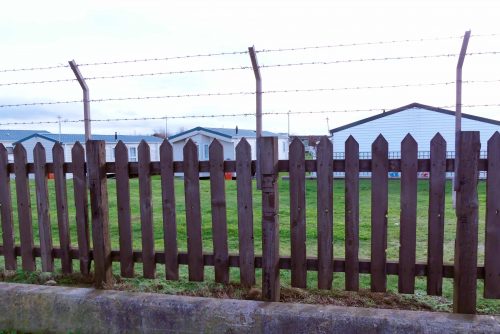
This coastline is reknowned for its many hundreds of mobile homes, most of which are actually static and available to occupy for 10 months of the year. I wondered if the intimidating fencing along the boundary of this site was designed to keep people out or in?

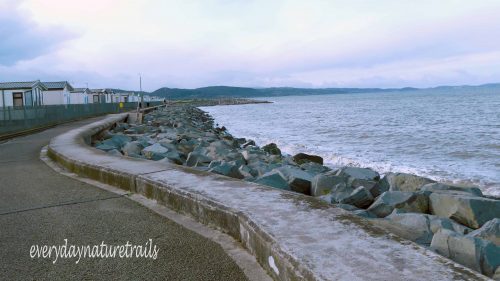
As a walk for anything other than fresh air and exercise this section of the Path, at least while the tide is high feels more like a corridor between mobile homes and the hard lines of the sea wall and the defensive rip-rap.

At the next bend I decided to turn around and head back the way I’d come. The backdrop to the houses is the Clwydian Hills.

The tide was beginning to recede. I wasn’t sure if the fisherman on the edge of the shingle bank was setting up or packing up and I wonder if he caught or will catch anything.

On the developed side of the path between the retaining wall and the houses is a wide strip of mown grass. On its edge there’s a patch of Rockrose with Ribwort Plantain growing through it.

Leaves of Common Rockrose & Ribwort Plantain

Lower down, in the sheltered crevice where the wall meets the path, more opportunistic plants are flourishing. A left-over, rather sad flower on Sea Mayweed; freshly flowering Groundsel; leaves of Dove’s-foot Cranesbill surrounded by new Chickweed sprouts and most surprisingly, several plants of Tree Mallow.

Sea Mayweed
Sea Mayweed
Groundsel
Groundsel
Dove's-foot Cranesbill
Dove’s-foot Cranesbill
Tree Mallow
Tree Mallow

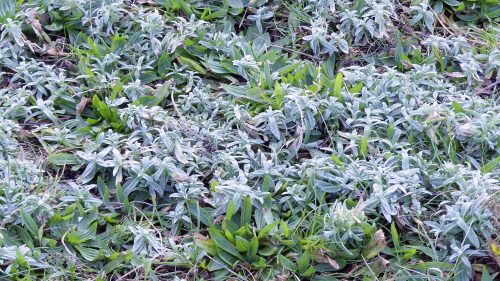
And here a lovely aggregation of leaves of wildflowers-to-come in a pretty array of shapes and shades of green, which includes Dove’s-foot Cranesbill, Common Stork’s-bill & Common Chickweed.


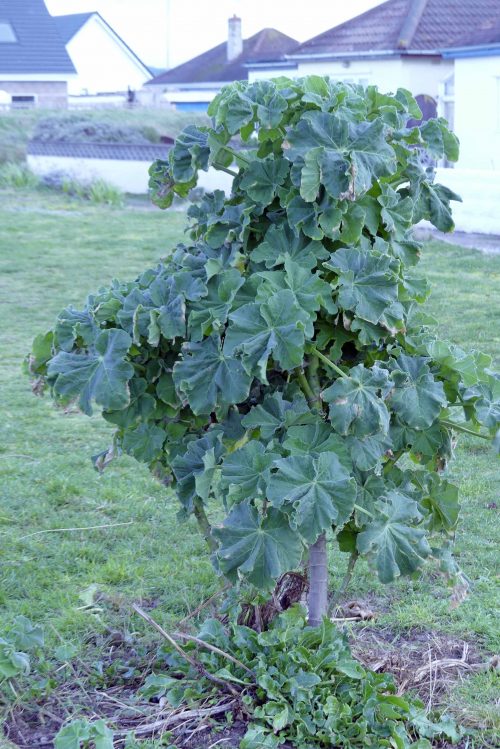
I wondered if the origins of the Tree Mallows might be this tall and seemingly well-nourished specimen.

Along part of the edge of wall where it meets the grass a line of Marram Grass has established and left to grow. As it is in a straight line, perhaps it’s been deliberately planted to protect the grass from some of the salt spray and wind. I wonder why they don’t just let it revert to its natural state? It would look so much better and wouldn’t need cutting.


If you look closer, the concrete walls aren’t totally featureless, there are patches of lichens growing there, which I’m not attempting to identify, other than to say some are greyish-white, others yellow or orange.

200127-KBLNR- (55a)-Lichen on path wall
200127-KBLNR- (58)-Lichen on sea wall

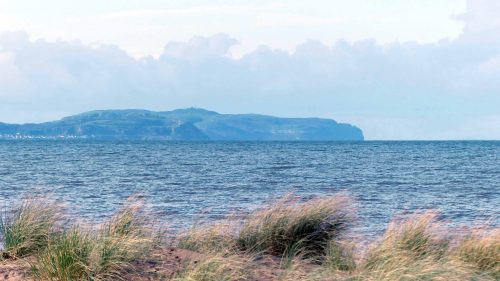
The skies brightened, showing up some of the green on the Little and Great Ormes through a lighter haze.

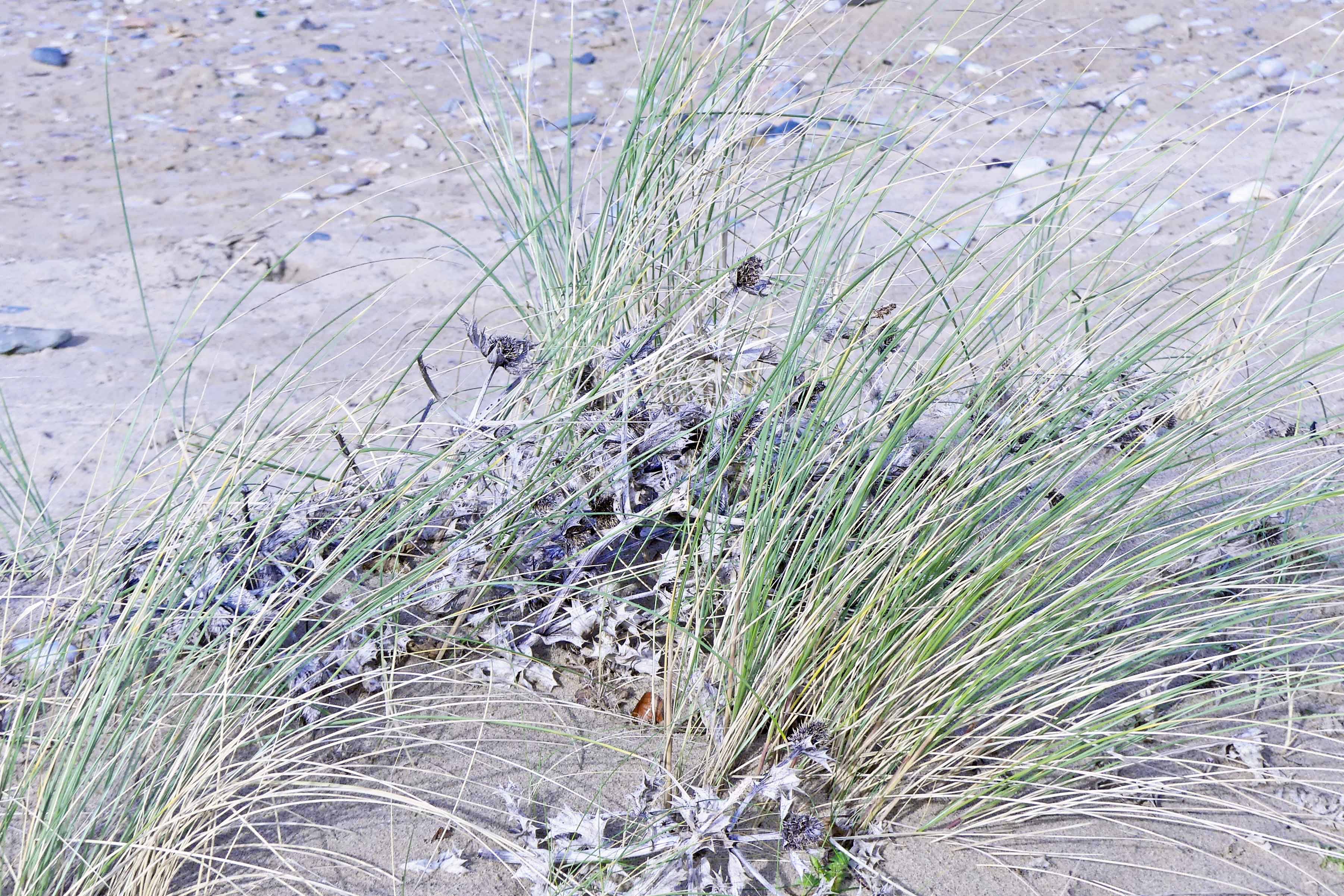
Sea Holly is another tough but beautiful plant that can handle these harsh conditions, evident for now by patches of dry stems with prickly leaves still attached, held in place amongst Marram stems.
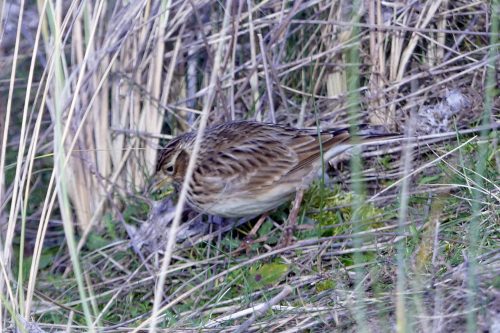
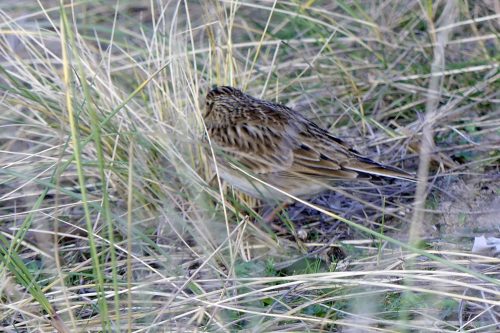
I glimpsed a flash of a bird that dashed from the dune side of the path to land on the shore side, quickly disappearing into the cover of Marram grass. My first impressions were that it was small, brown and maybe a Rock Pipit. Fairly well concealed amongst the dry grass stems it carried on foraging amongst them, in no great hurry, keeping half a wary eye on me and allowing me quick glimpses as it moved further away towards the beach. Possibly because I expected it to be, I had convinced myself this was a Rock Pipit, but I’m very grateful to Tony, who in his comment below has given me the much more exciting identification of a Skylark!

Skylark – Alauda arvensis

I know much less about Skylark behaviour than of Rock Pipits, so it was great to know they are here and to get so close to one. I’ll have to go back later in the year to see if I can catch any singing.

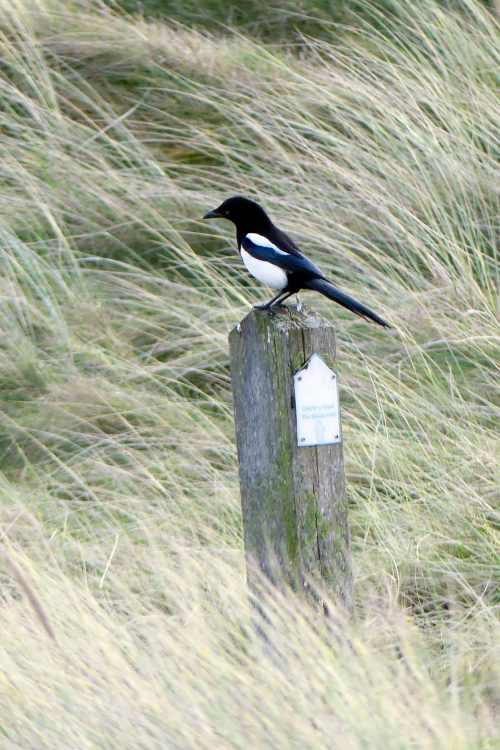
Another bird flew in front of me heading from the shore across to the dunes; a Magpie which landed on top of a Dune Trail marked post. I didn’t realise until I saw the photograph later that I’d caught it having a poo (sorry!); it looks like this might be a favourite perch for the purpose.

The sun continued to shine and as it felt a bit warmer and being in no particular hurry, I decided to carry on for a while and walk towards Rhyl.

At intervals along the path steps, safeguarded with iron railings allow you to cross the sea wall onto the beach.

All of those I’d passed walking in the opposite direction had been closed off, but one here was open. Taking the opportunity to get off the long straight path I thought I’d have a meander along the strand-line to see what I could find.

Views along the beach: above towards the Great Orme and below towards Rhyl.

I’m surprised anything survives being pounded by waves against the stony bank, but there were seashells there as well as clumps of Whelk egg cases and the egg case of a Ray.

Whelk egg case cluster
Whelk shell & limpet shell
Razor shell
Razor shell
Peppery Furrow shell
Mussel shell with barnacles
Ray egg case
Ray egg case

More random was a plastic bottle I found on the sea edge full of pebbles that I guessed may have been used to anchor something down and a sea-smoothed fragment of a house brick bearing part of its maker’s name.
200127-KBLNR- (94)-plastic bottle filled with pebbles
200127-KBLNR- (88)-brick fragment


some of my rubbish haul


As always there was the usual rubbish entwined amongst the seaweed, nylon fishing line, dried-out wipes, bottle tops etc. Also the wrapper from a packet of biscuits, nearby Asda store’s own brand & some sticky plastic tape. I picked up as much as I could stuff into my pocket as I’d come without a bag.


A Cormorant fly-past

I carried on until I could see Rhyl on the near horizon. The lifeboat was out and ready to go, hopefully not imminently and the landmark ‘Sky Tower’ that is visible from far across the other side of the bay.

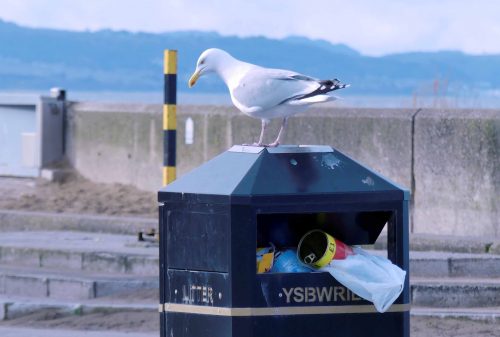
Back in the car park a pair of Herring gulls were investigating the overflowing rubbish bin. They’d pulled out some to study further, but I don’t think there was much there to tempt them. I picked up a few more bits that had blown across the carpark and left them to it.

Share this:

  • Click to share on Facebook (Opens in new window) Facebook
  • Click to share on Pinterest (Opens in new window) Pinterest
  • Click to share on X (Opens in new window) X
Like Loading...

Spring is Coming to the Great Orme

30 Friday Mar 2018

Posted by theresagreen in Birdwatching on North Wales coast, Great Orme, Llandudno, Nature of Wales, North Wales, North Wales Path, North Wales Wildlife Trust

≈ 4 Comments

Tags

fulmar, fulmarus glacialis, goats of the Great Orme, herring gull, jackdaw

Wednesday March 28th

An early Easter and school holidays and the Great Orme Summit is fully open for business, including our NWWT shop, so all volunteers called back to action. I’m sticking with my Wednesday shift and was really looking forward to seeing what was happening in the wild world of the headland. I left deliberately early so I could take my time driving up along the scenic Marine Drive route and make a few stops along the way. The afternoon was bright and sunny but chilled, as it frequently is by a cold wind that ruffled the surface of the sea. Despite that there are plenty of signs that Spring won’t be put off any longer.

Just a short way in to my drive I spotted five goats strung out along a narrow ledge high up on the cliff. Too high to see properly from the car I stopped and got out: they looked even higher up from where I stood. Their agility and balance is breathtaking; I couldn’t imagine how they were going to get down, or back up from there but I’m sure they did.


The leader looks  like a Nanny that has given birth fairly recently and the one behind is small, so maybe this was a lesson in advanced foraging.

Watching the goats I heard the unmistakable calls of Fulmars and followed the sounds to where there were several sitting on the ledges where they will nest. The massive bulk of the cliff emphasised how small and fragile the birds are. If they didn’t draw attention to themselves with their loud cries you’d be hard pressed to spot them.

Spot the Fulmars!

One or two were flying back and forth from the ledges. They are distinctive in flight, holding their wings outstretched stiffly.

Fulmars weren’t the only noisy birds in the vicinity – from the other side of the sea wall I heard the calls of Oystercatchers. The tide was beginning to go out and had exposed a strip of the rocky shore far below but it wasn’t until a bird flew in to join those already there that I spotted them. They’re surprisingly well camouflaged despite those bright bills and legs.

1243 – Driving on another gull caught my eye; a Herring gull. It’s good to see them in a more natural setting away from roofs and chimney pots.

This view shows clearly the line of the road ahead that continues around the point of the headland and back down to West Shore and Llandudno town. The road to the summit forks off to pass the buildings you can see in the middle of the photograph and St Tudno’s Church which is in the top left corner.

Passing the church I carried on, stopping at the pull-in parking area down below the cable car station, hoping to catch sight of a Stonechat or maybe a displaying Meadow Pipit amongst the gorse bushes. Two rabbits were out in the sunshine, one was grazing busily and the other, a much bigger one lay down to soak up the sun. I’m sure this wasn’t a true wild rabbit. It was big and white underneath, so may have been an escaped pet or at least was in some way related to one.

A man with two free-running dogs approached startling them and Big Bunny sat up quickly before they both shot for cover.

Big Bunny

A pair of smart Magpies flew in and perched jauntily on a bramble bush behind where the rabbits had been. There are often one or two to be seen around the area of the church.

Two for joy

One of them left the bush to pick up stems of dried grass, so likely they have a nest nearby.

There were no smaller birds that I could see so I crossed the road to the cliff side where there is more Gorse to give them cover. I could hear birds singing but couldn’t see any, they were probably sensibly staying out of the wind. I did catch sight of a singing Dunnock, but he too stayed on the leeward side of an Elder tree, well concealed behind its dense twigs. Nice to see signs of new leaves on the tree.

Dunnock on Elder
Dunnock on Elder
180328-GO-1300-Dunnock singng from Elder 1

The grass here is thick and dense and forms hummocks that catch the light. Walking on it feels very strange, it’s soft and spongy and bouncy underfoot. I like the way the sunlight catches it.

Sheep must find it comfortable to lie on. I came upon these ladies-in-waiting lying in a sheltered spot. They all had large blue patches painted on their backs and looked as though their lambs’ arrival may be imminent. They may have been marked this way as their lambs will arrive around the same time and the farmer can easily pick them out and be prepared.

One of my favourite Spring sights is of golden gorse against a background of blue sea. Today was perfect for such a sight with the sea perfectly reflecting the colour of the sky.

Huge banks of towering fluffy clouds brought drama to the scene.

The Gorse as always smelled wonderful. I liked the way the rounded hilltop and the cloud echoed the shape of this blossom covered bush.

Returning to my car a Herring gull had taken up position on the sign board – this is a regular perching place where they wait in hope of scraps of food being left for them.

No signs of the Stonechats or Meadow Pipits I was hoping to see. It was good to see the Trams back in action at the Half-way Station. No 7 is waiting to pick up passengers that will de-board No 6 that will bring them from the Summit Station to here, then will take them down to the bottom.

Almost at the top I couldn’t resist another stop to watch Jackdaws that were strutting around near the edge of the road, busily collecting dry grass.

This one seemed intent on making as few trips as possible back and forth to the nest, cramming in an impressive amount before flying off.

Parking at the top a Herring gull came in to land in front of me and began posturing and squawking at the top of its voice.

It was calling to its mate who duly landed close by its side, squawking in response.

Don’t they make a handsome couple?

The view across the bay and the Conwy Estuary was stunning as always with more dramatic clouds casting shade to make patterns on the surface of the sea.

A quick look down from the other side of the car park over the farmland dotted with sheep…..

I zoomed in to see if there were any lambs yet. None to see, but I did spy the Magpies again.

It was really cold and windy up here. Anticipated trade in our best-selling woolly hats and gloves!


Share this:

  • Click to share on Facebook (Opens in new window) Facebook
  • Click to share on Pinterest (Opens in new window) Pinterest
  • Click to share on X (Opens in new window) X
Like Loading...

Keeping up with the Herring Gulls

10 Friday Feb 2017

Posted by theresagreen in bird behaviour, Birdwatching on North Wales coast, Nature of Wales, Rhos-on-Sea

≈ 9 Comments

Tags

birds of conservation concern, European Herring Gull, Gwylan y Penwaig, herring gull, herring gull breeding behaviour, herring gull foot-paddling, herring gulls nesting on roofs, larus argentatus

January 9th – Chimney Pots, Rhos-on-Sea

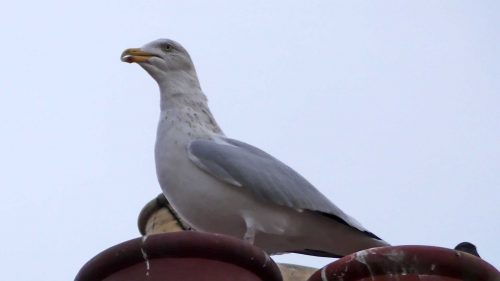
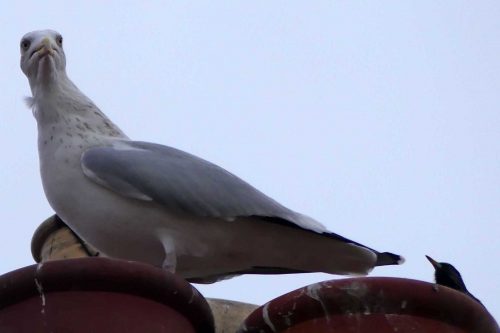
After a few months of being relatively quiet and peaceful, our Herring gull neighbours are back and making their presence heard and seen throughout the village. Pairs stake out their territories early in the year and will defend them vigorously and vociferously from now until nesting begins, continuing to do so until this year’s offspring have grown and are mature enough to leave the site. It all looks and sounds like a lot of effort and hard work, but that is the price this pair are prepared to pay for a prime high-rise site.

170109-rosrc05-herring-gull-pair-defending-nest-site

These particular chimney pots are atop my daughter’s 3 storey house, offering well-elevated accommodation and boasting unrivalled 360° views extending over rooftops and the surrounding landscape, which includes the sea. It is a mere two-minute, maybe less, flight to the seashore. Both the male and female of the pair take responsibility for defending the site, sometimes together and sometimes on their own. They must need to take frequent breaks to restore their energy levels after a bout of meaningful squawking at the sky.

10: 29 – Female flies to roof edge, has a quick look around then takes off,

170109-rosrc03-herring-gull-on-roof-edge

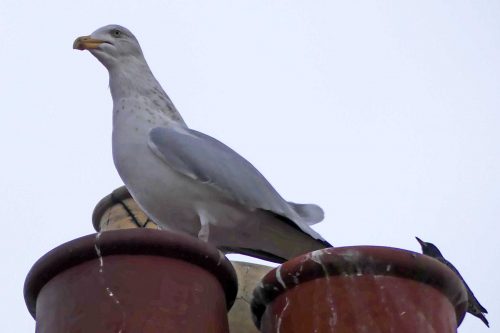
leaving the male in charge. I didn’t notice while I was taking these photographs, but he was not left entirely alone. To my amusement, a male Starling had his back. He has located his family home in the eaves of the adjoining property.

170109-rosrc09-herring-gull-male-starling

He seemed to have his work cut out, although from where I was standing in the garden I couldn’t see what or who he was directing his attention towards.

170109-rosrc06a-herring-gull-male

I couldn’t quite catch him in full squawk this morning, but he was making plenty of noise. He is still sporting his winter plumage and appears to be in pretty good shape, but he’s not a young bird. When I looked at my images I recognised him by his eyes, or rather by the lack of feathers around his eyes as the male of a pair I spent a lot of time watching back in the spring and summer of 2012.

170109-rosrc06c-herring-gull-male

As you can tell from the next couple of images he is looking a bit scrawny around the neck area, not as plump and well-filled out as he was back in the day.

170109-rosrc07-herring-gull-male-starling

Herring gulls breed for the first time at age 4 and a typical lifespan is 12 years. The oldest recorded Herring gull (from ringing records) was  32 years 9 months and 25 days old. This record was set in 2013. 

170109-rosrc08-herring-gull-male-starling

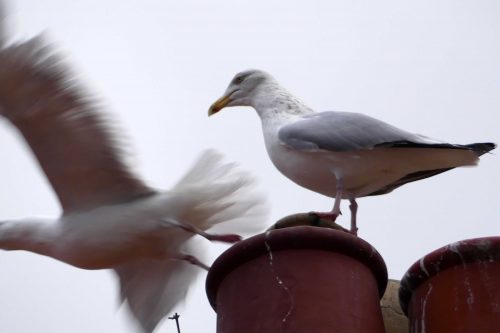
10.39am – the female arrives back with a flourish and lends her voice to the warning-off aria.

170109-rosrc12-herring-gull-pair

he may be older, but clearly still has got what it takes to attract a mate and this one appears younger. It must be something to do with the status of his domain.

170109-rosrc13-herring-gull-pair

170109-rosrc14-herring-gull-pair

10.40 – She’s a bit on edge though and leaves again a minute later, I think she was chasing off another gull from their airspace, perhaps a rival female. It started to rain quite heavily then and he left shortly afterwards too.

170109-rosrc15-herring-gull-pair

Then and now

This is a head shot of the male showing his ‘scabby’ eyes taken this January

170109-rosrc06c-herring-gull-male-scabby-eye

and below is one I took on July 24th 2012. He’s in his brighter summer/breeding plumage here, but had the ‘scabby’ eyes even then. It’s too much of a coincidence for it not to be the same bird isn’t it? He was considerably better-padded then too. If 2012 was his first year of breeding he would have been 4 plus the 5 years from then till now would make him 9, but I think he could be older.

7-1912tgnw-adult-gull-front-view

This was him and his mate in full squawk back then, after they had successfully reared a chick that had fallen out of the chimneypot nest and landed on the flat roof below. More about that here:   https://theresagreen.me/2013/06/20/theres-a-new-gull-on-the-roof

7-1912tgnw-adult-pair-one-squawking-one-sitting

He was and I’m sure, still is a brilliant and attentive parent, bringing regular and diverse meals back to his hungry youngster. Including a starfish and regurgitated chips.

7-2412tgnw-adult-gull-with-starfish-2

January 24th 2017

Back to the present. I was out taking my baby granddaughter for a walk along the prom and spotted this chap paddling for worms on the grass embankment. Old scabby eyes himself.

170124-rosprm-herring-gull-paddling-for-worms-scabby-eye-2

The Herring gull remains on the RED list of European threatened birds and it is illegal to harm them or damage or remove their eggs from nests.


Share this:

  • Click to share on Facebook (Opens in new window) Facebook
  • Click to share on Pinterest (Opens in new window) Pinterest
  • Click to share on X (Opens in new window) X
Like Loading...

Secret passage behind the sea wall 2

17 Saturday Oct 2015

Posted by theresagreen in Birds, birds of the seashore, birds of Wales, coastal walks, Nature, Nature of Wales, nature photography, Rhos Point, Rhos-on-Sea, Wales Coast Path

≈ 4 Comments

Tags

Crows on seashore, curlew flying, herring gull, meadow pipit, mussel bed, Rhos Point

An hour or so later the walk back to Rhos Point was quite different. The going was easier too as the strong wind was behind me now and not taking my breath away. Almost immediately I caught sight of a bird hopping around on the rocks. I waited hoping it would come into view, which it did, just as a woman with a dog approached and chose that moment to break into a run. The bird flew away. Again it was a pipit, possibly the same one I’d seen back on the beach. The legs are pinkish and plumage brown so maybe a Meadow Pipit?

151007TGNW- Penrhyn Bay-Pipit on rocks 3

151007TGNW- Penrhyn Bay-Pipit on rocks 4

A small sedum plants looks at home in a pocket eroded in a limestone rock.

151007TGNW- Penrhyn Bay-Sedum

Small pools of rainwater are held briefly, lasting longer in the hard granite rocks.

151007TGNW-6d-Rock pool 2

The garden snail must have found it hard going sliding over the rough surface of the sea wall.

151007TGNW-15-Sea wall- Garden snail

151007TGNW-Rock with moss

151007TGNW--Penrhyn Bay-Wasp

151007TGNW- Penrhyn Bay-sign at top of ramp

There is a wide concrete ramp reaching from the road down to the shore which probably gave access to heavy construction vehicles when the huge boulders of the sea defences originally were put in place. The lower section is being absorbed back into the shore, it is strewn with pebbles and small rocks and slippery with seaweed. Limpets are embedded into the wall itself as well as in large rocks on the shore at the bottom of the ramp.

151007TGNW-Limpets embedded in rock

I love the textured ‘lacy’ look of this rock almost covered with barnacles.

151007TGNW-Rock covered with barnacles & limpets

The sea is often at its most beautiful on these sunny windy days, its surface whipped up roughened and flecked with foam-edged ripples and the colour of the water ranging from deepest inky dark blue to pale turquoise-green. Large areas are stained brown by dredged up sand.

151007TGNW- Penrhyn Bay-Back to Rhos-Sea colours 1

Sun, shade and curves make this man-made construction interesting.

151007TGNW- Penrhyn Bay-Back to Rhos

The white marks highlighting the curved sea wall are mineral, maybe lime leached from the concrete?

151007TGNW-5-Wall markings-Rhos-on-Sea promenade

The parapet floor has an interesting pattern and texture and is spotted with patches of white lichen.

151007TGNW- Penrhyn Bay-Back to Rhos-Concrete floor3

As I got nearer to the Point I knew the tide was further in by the increased bird activity; the excitement it generates is almost tangible. Gulls take to the air and fly back and forth along the shoreline. Oystercatchers and other waders scuttle about, heads down, beaks probing for anything edible brought in on the waves.

151007TGNW- Penrhyn Bay-Back to Rhos-Herring gull

151007TGNW- Penrhyn Bay-Back to Rhos-Herring gull young 1

Crows head shorewards too, the one in my picture landed on a lampost towering above me, cawing loudly. They forage amongst the rocks along with the waders and are often seen picking up a shellfish then flying up with and dropping it onto the rocks below to crack it open.

151007TGNW- Penrhyn Bay-Back to Rhos-Crow 1

Even the curlews were excited. Most often seen stalking sedately around rocks and pools, now there were several flying along at speed, skimming low over the rocks on the shore below me. A couple of them may have been in pursuit of the one I managed to capture a shot of; it was travelling so fast I didn’t realise it had food in its beak until I saw the photograph.

151007TGNW- Penrhyn Bay-Back to Rhos-Curlew

On the Point the incoming tide approaches from either side of the mussel bed, where I assume different currents merge. The birds have an infallible instinct for the tidal changes and in the hour before and after high tide their numbers increase dramatically. They are brought closer to the shore then too and absorbed with foraging and eating, are easier to see.

151007TGNW- Penrhyn Bay-Back to Rhos-Sea colours on point

151007TGNW- Penrhyn Bay-Back to Rhos-Oystercatchers active

It was too cold and windy to hang around and wait today though, so I had a quick peek into the chapel, which I can never resist. There are only 6 seats inside, so I wonder if they’ve lined up these memorial benches on the promenade outside to serve as overflow pews?

151007TGNW- Penrhyn Bay-Back to Rhos-benches 2

Many young Herring gulls wander around the village at this time of year, often screeching for the attention of a parent. They have no road sense and sadly quite a few are killed by cars.

151007TGNW- Penrhyn Bay-Back to Rhos-Herring gull young on road edge

Share this:

  • Click to share on Facebook (Opens in new window) Facebook
  • Click to share on Pinterest (Opens in new window) Pinterest
  • Click to share on X (Opens in new window) X
Like Loading...

A sea-shore in waiting

11 Tuesday Aug 2015

Posted by theresagreen in Birdwatching on North Wales coast, coastal habitat, mussel beds, Nature, Nature of Wales, nature photography, North Wales, Rhos Point, Rhos-on-Sea, wading birds, Wales Coast Path

≈ Leave a comment

Tags

acorn barnacles, barnacle, common mussel, great black-backed gull, herring gull, mussel bed, mussel beds, mussel beds of Rhos-on-sea, Nature in August, periwinkle, Rhos Point, seashore in August, winkle

Rhos Point from the Little Orme

Rhos Point from the Little Orme

Rhos-on-Sea is a popular seaside venue that is busy with people visiting most of the year round, particularly at weekends and when the sun shines, but they don’t come here for its beach. The seashore, wrapped around the flat fortified headland of Rhos Point, is not the most beautiful in North Wales: a general first impression may well be of an expanse of flat shoreline littered with variously sized brown-coloured rocks and boulders. No easy strolling or picnicking here.

The stumps of posts are the remains of an ancient fishing weir

Rhos Point shore looking towards Colwyn Bay-the stumps of posts are the remains of an ancient fishing weir

The rocky shore of Rhos Point from Penrhyn Bay

The rocky shore of Rhos Point from Penrhyn Bay

However, between the rocky shore and the sea lies an expanse of long-established Mussel beds which is highly attractive to visitors – of the avian variety. Large numbers of a variety of species of sea and shore birds will be returning here this month from their summer breeding grounds to spend the autumn and winter to feast on the gourmet seafood on offer here.

Rhos Point across the rock strewn shore to the mussel beds

Rhos Point across the rock strewn shore to the mussel beds

Part of the expanse of mussel bed beyond the rocks

Part of the expanse of mussel bed beyond the rocks on a sunny day

There may be a few early arrivals, maybe a Turnstone or two, but for now, approaching mid-August, the resident breeding birds, the Herring gulls, a smallish number of Lesser Black-backed gulls, Cormorants, plus a few Oystercatchers have the place more or less to themselves.

KONICA MINOLTA DIGITAL CAMERA

Great Black-backed gulls, adults & juveniles, Herring gull & Oystercatchers

Rhos Point shoreline with fishing weir posts cormorants & gulls

Rhos Point mussel bed, juv. cormorants, oystercatchers & gulls

Soon they will be joined by large numbers of Curlews, Redshanks, more Oystercatchers, Turnstones, Dunlins, Ringed Plovers and Sandwich Terns. If we are lucky there may be a few Purple Sandpipers in the mix, and there will doubtless be a few temporary visitors stopping to feed before escaping to warmer climes. There will be Rock Pipits and Pied Wagtails amongst the huge rocks of the sea defences. So much to look  forward to!

Without the movement and cries of the absent birds the landscape appears harsh, a sombrely coloured, barren place devoid of life. But look more closely and you’ll see it is in fact a living landscape, richly populated by hosts of small sea creatures, which is of course why the birds head here for the winter.

On close inspection, the rocks that appear a uniform brown colour from a distance are actually encrusted with colonies of barnacles, millions of them.

Barnacles and winkles cover the surface of a rock

Barnacles cover the surfaces of rocks

Acorn barnacles

Acorn barnacles

Barnacles and winkles

Barnacles and winkles

Turnstones camouflaged amongst the barnacle-covered rocks

Turnstones will be perfectly camouflaged amongst the barnacle-covered rocks

Winkles, or periwinkles are numerous too.

Winkles

Common periwinkle or Winkle-Littorina littorea

At low tide, cross the rocks, skirting the pools of shallow water left behind

Rock pool

Rock pool with more winkles

A flower of the sea -Beadlet anemone - Actinia equina

A flower of the sea -Beadlet anemone – Actinia equina

and soon the crunch of shells accompanies every footstep, as you are literally walking across the surface of a dense mass of living Mussels. It’s a very strange feeling.

Live mussels

The Mussel bed – live mussels amongst empty shells

You realise now why you see mussel shells everywhere.

Mussel shells under water

Mussel shells under water

141017TGNW4-Seashells mixed & crab legs

Live mussels & a live cockle amongst empty shells and crab claws

Mussel shells on the tide line of Rhos Harbour beach

Mussel shells on the tide line of Rhos Harbour beach

All is ready for the avian invasion.


Share this:

  • Click to share on Facebook (Opens in new window) Facebook
  • Click to share on Pinterest (Opens in new window) Pinterest
  • Click to share on X (Opens in new window) X
Like Loading...

Wales Coast Path-Colwyn Bay to Pensarn

05 Tuesday May 2015

Posted by theresagreen in Nature of Wales, North Wales, Wales Coast Path

≈ 8 Comments

Tags

colwyn bay pier, goldcrest, grey wagtail, herring gull, Llanddulas Point, Old Colwyn, sea holly, sea mayweed, seashore walks, yellow horned poppy

One of my ambitions for this year is to walk more of the North Wales section of the  Wales Coast Path, which begins, or ends depending on which way you’re walking at Chester and continues around to Caernarfon. Some of the walks I do fairly regularly are part of the Coast Path, and there are other bits within reasonable striking distance that I could do fairly easily and I am keen to see more of the wildlife found along this amazing and varied coastline. On a sunny day back in the middle of March I set off in the opposite direction to that of my usual routes planning to walk the section from Colwyn Bay to Pensarn, the seaside part of Abergele. I cheated a bit as I have done the Colwyn Bay part so many times before, and drove to the pier to take some updated photos of the route along the promenade.

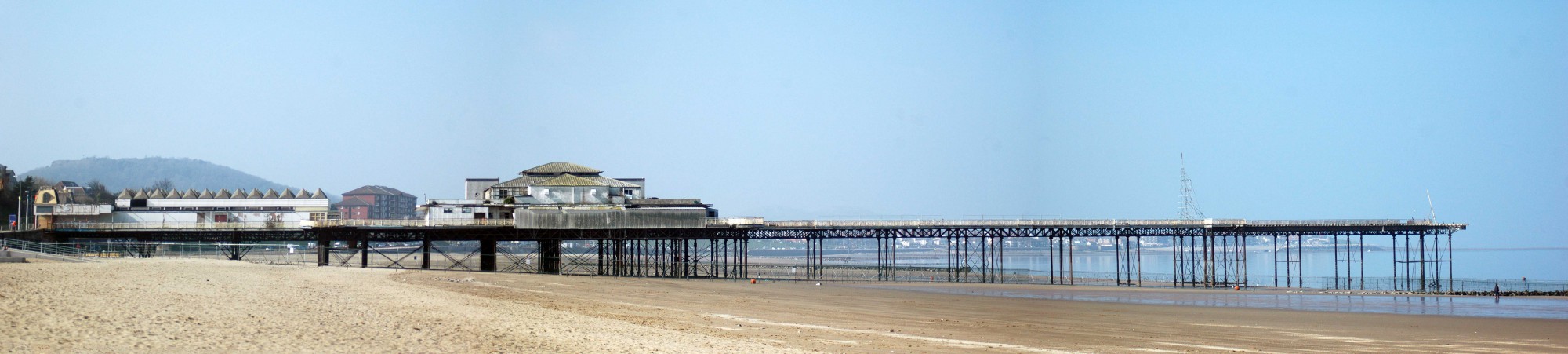
Colwyn Bay Pier, in a sad and dilapidated state

Colwyn Bay’s Victoria Pier, in a sad and dilapidated state

As a result of a long drawn-out dispute over its ownership, the pier is in a sad state of disrepair and dilapidation but there is much ongoing effort locally to save and restore it. It must be a bit of an embarrassment to the local council, particularly as a lot of money has been invested in providing a new sandy beach and in the building of the new water sports centre, known as Porth Eirias, just a stone’s throw away.

The water sports centre at Porth Eirias is finished but not yet occupied..

The water sports centre at Porth Eirias is finished but not yet occupied..it’s meant to look like a ship

From Porth Eirias the path continues as a promenade and cycle path and is my favourite stretch, particularly in the winter when stormy seas send waves crashing into and over the sea wall and flood the road, which may be closed off on exceptionally wild days. On the opposite side of the road the railway track runs parallel atop a high embankment, which provides habitat for an interesting array of wildflowers. There are great views from the trains too.

The view from Porth Eirias that shows the route of the Coast Path  towards Llandulas

The view from Porth Eirias that shows the route of the Coast Path towards Llanddulas

At the end of the promenade is a small parking area from where the path and cycle track continue towards Llanddulas. I had intended to park here and walk, but it was full of works vehicles as yet more work was being carried out on reinforcing the sea defences. Instead I crossed over the road and turned in towards Old Colwyn and stopped by the river at Min-y-Don.

Celandines

Celandines

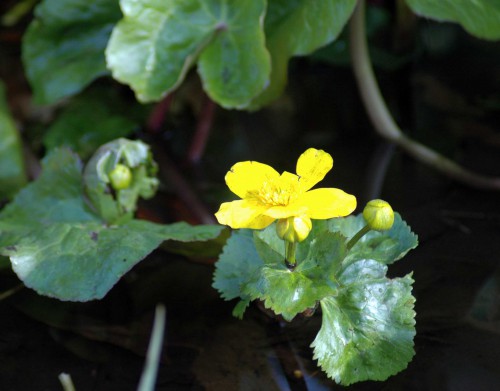
Celandines smothered the grassy bank on the sunny side of the road and King Cups lit up the shadier side of the path along the river.

The river was running fast and at a fairly decent level, although nowhere near full.

150318TG-Old Colwyn- King cup

Golden yellow King Cups

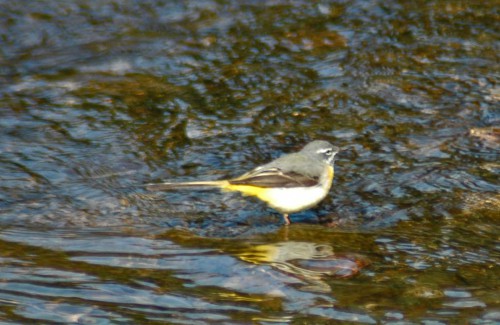
This is a favourite spot for Grey Wagtails and I had timed my visit perfectly as a pair of them flew down from upstream to land almost right in front of me. I watched them for a good while, darting after flies from stones in the water and running along the stone wall.

Grey Wagtail - the female of a pair

Grey Wagtail on the river Colwyn- the female of a pair

150318TG-Wales Coastal Path-Llanddulas- Sign board

I drove on to Llanddulas Point and parked facing out across the flat rocky shore to the sea. The views from here are expansive to say the least, and if you were walking the Coast Path seriously I can imagine it may be rather daunting to be able to see where you are heading and will arrive at in a few hours time.On a sunny and warmish day like today it is pleasant enough and as the land is almost pancake flat, easy walking. I’m not sure if I’d fancy it on a wet day when the wind was blasting you in the face.

Leaving the car park and crossing a small bridge, the path follows the lower stretch of the River Dulas for a short distance until it reaches its end and flows towards the sea.

Path alongside the river

Path alongside the River Dulas

The coast here may appear to stark and empty, but it provides important habitat for a good range of marine plants and the eastern end of Llanddulas beach is designated as a SSI as locally rare plants such as sea kale and yellow horned poppy grow there. It was too early in the season for plants to be flowering, but there are new leaves pushing up through the shale.

New leaves of Sea Holly

New leaves of Sea Holly

New leaves of Yellow Horned Poppy

New leaves of Yellow Horned Poppy

New leaves of Sea Mayweed

New leaves of Sea Mayweed

As I neared the last stretch of the river I heard, then spotted more Grey Wagtails, another pair I’m sure, that were hunting flies from stones near the banks, flitting low across the water from one side to the other. As you round the bend in the path where the river ends the narrow ribbon of trees that follow the line of the cliff reaches the path edge. As I got close to this point a wren flew from the tree cover across to a rock and belted out his song.

Red-brown lichen

Red-brown lichen

I attempted to get a bit closer to him and he moved off, but I was soon distracted by a rock face smothered in a red-brown coloured lichen, I have no idea what it is, and another rock with some sort of quartz trapped in it.

Quartz in limestone

Quartz in limestone

Sheltered on this side of the rocks there was a clump of sea mayweed that appeared to have been blooming for some time as many of the flowers were already beginning to go to seed.

Clump of flowering Sea Mayweed

Clump of flowering Sea Mayweed

A green-bottle fly on Sea Mayweed flower

A green-bottle fly on Sea Mayweed flower

Highlighted by the sun there was a pretty little clump of moss or with seed-heads on a nearby rock too.

Moss or lichen with seedheads

Moss with seedheads

Moving back to the path I spotted two tiny birds flitting about amongst the twiggy tree branches. I thought at first they were wrens, but then excitedly realised they were too small and were actually goldcrests, a definite pair. I watched them for a good while as they continued to forage amongst the lichen-covered twigs, but didn’t have much luck getting a clear enough view for long enough to get a good photograph. The one below is the best I could do but it does confirm the sighting!

A rear view of one of a pair of goldcrest

A rear view of one of a pair of goldcrest

I would never have imagined seeing these delightful little birds here within a metre or two of a busy walkway, but there they were and no-one else seemed to notice them at all. These trees are mostly ash that have been regularly pollarded to prevent them growing high enough to block the view from the wooden chalets that line the clifftop above them and appear to be a popular spot with a variety of other species of birds too. In the short while I was there I saw blackbirds, dunnocks, robin, the wren I already mentioned and blue tits and great tits.

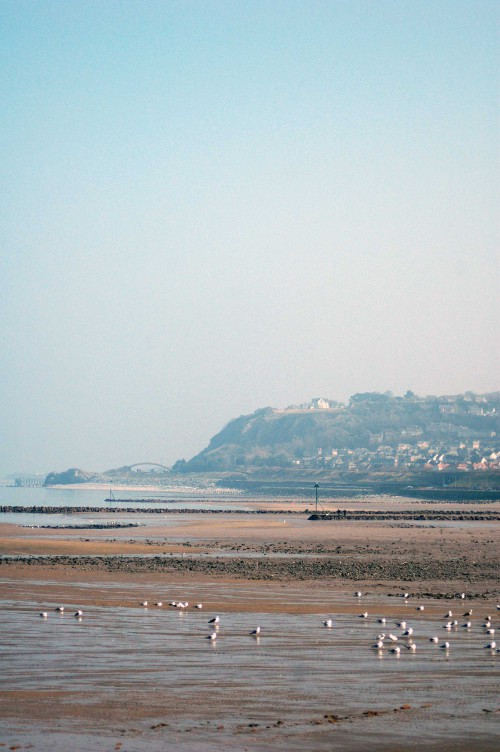
A view of the shore lined with herring gulls

A view of the shore in the direction of Abergele then on to Prestatyn and Rhyl

A few metres away the shoreline was lined with huge numbers of herring gulls. During the winter months, there are oystercatcher, curlew, redshank and turnstone feeding here and some years there are snow buntings.

The shoreline stretches on to Pensarn then on to Prestatyn and Rhyl

The shoreline stretches on to Pensarn then on to Prestatyn and Rhyl

I was surprised to find some little yellow coltsfoot flowers pushing up through the stony ground next to the path here.

Coltsfoot

Coltsfoot

Wooden chalets line the path for a good distance along this section of the path and there were a growing number of people out walking dogs, so I turned round and walked back the way I had come.

Limestone quarry

Limestone quarry

Mist obscured much of the distant views today, but it was still possible to make out the outline of the old limestone quarry which rises up behind the shore, separated from it by the A55 Expressway. For 300 years quarrying was a major occupation in this area, second only to farming and lime kilns dominated the skyline from 1890 to 1940. There is a working quarry operational today and between Llanddulas and Colwyn Bay the path passes a jetty that serves it. There used to be another jetty, closer to Llanddulas where during stormy weather in April 2012 a cargo ship that was loading there was forced on to the rocks and had to be dismantled.This event made the national news and I recall it causing chaos on the A55 as people stopped their cars and got out to have a look or to take photographs.

Linnets on the raised stony sea bank

Linnets on the raised stony sea bank

Final treats were the sight of a small flock of linnets that flew on to the raised stony sea bank to feed on seeds and a lovely pair of mallard by the footbridge.

Mallard pair

Mallard pair


Share this:

  • Click to share on Facebook (Opens in new window) Facebook
  • Click to share on Pinterest (Opens in new window) Pinterest
  • Click to share on X (Opens in new window) X
Like Loading...

Young gull on the roof – the final chapters

26 Friday Jul 2013

Posted by theresagreen in bird behaviour, Nature, Nature of Wales, nature photography, Rhos-on-Sea

≈ 6 Comments

Tags

herring gull, herring gull family behaviour, herring gull juvenile, herring gulls as parents, herring gulls nesting on roofs

July 6th

The young herring gull that fell from the chimney pot nest to land, incredibly unscathed onto our flat roof  some 6 or 7 metres (20ft) below, continued to thrive thanks in part to sheer good fortune but mainly to his attentive parents. With very little in the way of shade he struggled a bit on the hottest of days and I took pity on him, tipping water from the bedroom window onto the roof to create a puddle he could drink from and cool his feet in. Other than that he was very much left to his own devices.

Young gull trying to squeeze into the shade

Young gull trying to squeeze into the shade and opening his wings to release heat from his body

Opening the bill wide is another strategy to release body heat

Opening the bill wide is another strategy to release body heat

He took to standing on the ledge of the lantern, which was perhaps cooler on his feet.

Standing on the ledge of the lantern

Standing on the ledge of the lantern

Our view from beneath him

Our view from beneath him

July 8th

The young gull’s life changed dramatically today when, with all the drama and excitement I have come to expect from our gull residents and announced with a great cacophony of noise from both his parents, his sibling parachuted down to join him from above. Her arrival really was a magical sight to behold and although we are discouraged from anthropomorphising other fauna species, the gulls certainly displayed several ’emotions’. Both adults stood on the edge of next-door’s roof, as I said before making a particularly great deal of noise, which is what prompted me to run upstairs to see what was occurring and I was just in time to capture the moment she dropped in, rather gracefully for a first landing.

Young gull's sister arrives from above

Young gull’s sister arrives from above, squealing excitedly

The new arrival was clearly very excited while ‘our’ little chap looked a bit bemused and maybe a little intimidated. He inched towards her for a closer look while she made several little bouncy leaps, clearly excited and loving the new-found use for her wings although the tail feathers aren’t quite long enough to use for perfect co-ordination yet. The parents remained standing close by, keeping up the aggressive-defensive-protective squawking racket.

He approached for a closer look while she jumped up and down trying out her wings

He approached for a closer look while she jumped up and down trying out her wings

The new arrival settled on the ground and picked up an object from the rooftop, a piece of stick or something similar and offered it to her brother, which he accepted.

First formal introduction

First formal introduction, she offers him a gift encouraged by parents

After a few minutes things began to calm down, the new arrival was clearly enjoying her new-found flying ability and was keen to show it off. Our youngster watched with great interest as she lifted herself into the air and although he had shown little sign of trying his wings before now, suddenly seemed to realise that perhaps he could do that to. So he did.

Continuing to practice her flying

We have lift off

She eventually settled down a little and ventured across onto our roof, looking a little less sure now the excitement had worn off. Having a better look at the newby I’m sure I’m right about referring to it as ‘she’. This bird is slightly smaller than the other and could be a fraction younger as she still has more downy feathers around her face, neck and breast.

The new arrival ventured onto our roof

The new arrival ventured over onto our roof

July 10th

The young gull accepted his sibling immediately and there was no apparent rivalry or squabbling behaviour between them, so is it possible that although separated as young nestlings, they knew they were related? Perhaps they had been able to keep up communication from their separate locations and recognised one another’s voices, or maybe it was the parents’ behaviour towards them both that united them. It was a bit clearer now why ‘our’ young one had apparently spent so much time alone; the parents had two nest locations to cope with and to defend as well as having to share food between the two chicks. They deserve a lot of credit for their dedication and not abandoning either of them.

Practicing a running take-off

Practicing a running take-off

The family reunion brought about a noticeable change in our gull’s behaviour, he seemed to suddenly go up a gear and following his sister’s example began testing his own ability to fly.

Nearly there, just one toe left on the ground

Nearly there, just one toe left on the ground

The parent gulls changed their feeding behaviour today too; rather than the young ones begging and tapping a parent’s beak to bring forth food, the parents now arrived with food which they deposited some distance away from the young ones who then had to ‘find’ it for themselves.

Here's your lunch kids

Here’s your lunch kids

Young gull not too sure about this method of delivery

Young gull not too sure about this method of delivery

The parents were still around but less obviously so, when they were not away searching for food they were keeping look-out from the roof above. The two young ones were rarely more than a metre or so apart now, if one found something interesting to peck at the other was there immediately and they seemed to play with random pieces of stick and stones that they found, picking them up and dropping them, practicing for dealing with future potential food.

The young gulls 'playing' with a stick

The young gulls ‘playing’ with a stick

July 12th

A hot day saw both young gulls uncomfortable and trying to squeeze into small areas of shade. I poured some water from the window onto the roof and ‘our’ gull, used to me doing that came straight over and began to drink. The other one followed more cautiously, but seemed to have no idea what to do with the water or how to go about drinking it. He tried to show her, but this was a new experience for her having been up in a nest on a chimney for most of her short life.

What do you do with this then?

What do you do with this then?

Watch me

Just watch me

Things got a bit hectic for a few days when the gulls from the neighbouring chimney brought their two young ones down too and both sets of parents had some very noisy encounters on occasions, but the sets of young ones didn’t mix much. They continued to strengthen their wings, preen out the remaining down from their feathers, and rest a lot while waiting for those tail feathers to grow.

Just about all grown up

Just about all grown up

July 18th

Every event of the gull family’s time with us had been accompanied with noise and announced with drama, so the young ones’ anticipated departure came as a bit of an anti-climax. We were sitting outside enjoying the late afternoon sunshine when suddenly, first one, then the other took off from the roof, glided over our heads and landed on next door’s lawn. So that’s more or less it with this family of gulls for this year. It’s been interesting, but I shall be glad not to be woken by them at dawn. I’m not looking forward to having to clean off the roof.

Share this:

  • Click to share on Facebook (Opens in new window) Facebook
  • Click to share on Pinterest (Opens in new window) Pinterest
  • Click to share on X (Opens in new window) X
Like Loading...

Little gull on a wet flat roof

08 Monday Jul 2013

Posted by theresagreen in Nature, Nature of Wales, nature photography, Rhos-on-Sea

≈ 5 Comments

Tags

herring gull, herring gull chick

The young gull is growing up fast and despite being home alone for long stretches, being left outside in all weathers and staying up far later than any youngster surely should, he seems to be doing alright. Here he is a couple of weeks ago, on a rainy day, eleven days older than when I first photographed him the day he arrived on the roof.

Working out how to take a drink

19/6/13 Who’s that in there?

There must be an easier way

Is this the only way to get a drink?

Mum doesn't make it look any easier

Mum doesn’t make it look any easier

Perhaps it'll be easier sitting down

Perhaps it’ll be easier sitting down

That's a bit better

That’s a bit better

I wonder if I can float

I wonder if I can float

Dealing with an itch

Dealing with an itch

Nice and clean and cute

Nice and clean and cute

Tucked up taking a nap

Tucked up and taking a nap

Share this:

  • Click to share on Facebook (Opens in new window) Facebook
  • Click to share on Pinterest (Opens in new window) Pinterest
  • Click to share on X (Opens in new window) X
Like Loading...

There’s a new gull on the roof

20 Thursday Jun 2013

Posted by theresagreen in bird behaviour, Nature of Wales, nature photography, Rhos-on-Sea

≈ 2 Comments

Tags

herring gull, herring gull chick, herring gulls in towns, rhos on sea

Herring Gulls have featured in a good few of my posts: they are a characterful part of everyday life here in Rhos-on-Sea and although they make noisy neighbours, are somewhat bossy and seem to delight in covering our cars with their guano, life would be the poorer without them.

A couple of weeks ago, on June 8th to be exact, I was woken at some ridiculously early hour by a great cacophony of gull cries and shrieks being made right outside the bedroom window, which is just a metre above the large flat roof of the kitchen below. I am fairly used to their late spring-early summer, very early- morning territorial proclaiming racket now, but this was not the usual wake-up alarm, which I have learned to almost ignore, so I had to get up to have a look.

The fuss was all about a single, fluffy brown-grey speckled chick. How it arrived on our roof I have no idea, I know there are nesting birds somewhere up on the main roof around next-door’s chimneys, but as far as I am aware there were no nests on any part of the lower flat roofs this year. So, had it fallen from a nest higher up, or even been carried down? If the former, was it OK? I had no way of knowing, just one more thing to worry about! (We have had young gulls here before, but bigger older ones that had left nests deliberately).

New parent, very protective

8 June 2013-Warning – New parent, very protective

Although early in the morning it was already very sunny and the parent birds ‘parked’ the chick in the shade of one of the ‘lanterns’ set into the roof. That possibly explained why they were on our bit, neither neighbour has any shaded areas, although still no clue as to how the chick got there.

Parent watching the sky for trouble

Parent watching the sky for trouble

The fussing, flapping and general hullabaloo continued for some while, but gradually the ruffled feathers smoothed and the excitement mellowed into an uneasy peace.

Once their offspring was settled, one parent stayed on close guard, the female I think, whilst the other either went off to look for food or maybe to sit higher up on the main roof to keep look out. The one that stayed remained wary, keeping a watchful eye on the sky above and patrolling around her chick. She did settle next to it eventually, but was very restless.

The mother settled eventually, but remained alert

The mother settled eventually, but remained alert

Then of course, once she settled down, the chick woke up and stood to stretch its legs. That came as a relief, at least it wasn’t injured and about to expire.

Chick awake and stretching its legs, mother still watching the sky

Chick awake and stretching its legs, mother still watching the sky

The chick was soon keen to investigate the world around him and went for a little wander. Fortunately it chose to wander onto the adjoining next-door roof which is covered with mossy lichen and he was pretty well camouflaged there.

On the adjoining next-door roof, the chick was almost perfectly camouflaged

8/6/13 On the adjoining next-door roof, the chick was almost perfectly camouflaged

After a surprisingly short length of time the parent flew off and left the chick to its own devices, although as I said before it’s possible the other one was watching from above. And food has to be searched for.

Mum back with breakfast

Mum back with breakfast

The adult gulls were very aware of my interest in them and stood immediately in front of the window squawking and giving me distinctly threatening looks.

The female gull watching me, giving me the evil eye

The female gull watching me, giving me the evil eye.

Female Herring Gulls are slightly smaller than the males and have a ‘softer’ look to the eyes (usually), but I’m glad I had glass between us, I would not like to make her angry and be within striking distance of that beak. (All of my photographs are taken through the glass of the window!)

I would not like to be on the receiving end of that beak

I would not like to be on the receiving end of that beak

13th June 

Gull life settled into a bit of a routine over the following few days. The family doesn’t spend the nights on our roof and I can’t see where they go, but they arrive back noisily in the mornings. The chick gets left alone a lot, initially resting in the shade and relative safety of one or other of the lanterns, but now it is bigger it wanders more, investigating anything and everything that looks vaguely edible. The parents are diligent in their feeding, arriving back with regular meals, their arrival always announced with a great deal of vocal noise and exaggerated wing flapping. The young one is already beginning to practice the territorial, concerted squawking, joining in with its parents when they perform to whatever is above them. Herring Gulls are proper drama queens.

13/6/13-One week on and the chick is getting bolder.   Checking out a cable to see if it's edible

13/6/13-One week on and the chick is getting bolder. Checking out a cable to see if it’s edible

13/6/13-Herring Gull chick one week later

13/6/13-Herring Gull chick one week later.

Share this:

  • Click to share on Facebook (Opens in new window) Facebook
  • Click to share on Pinterest (Opens in new window) Pinterest
  • Click to share on X (Opens in new window) X
Like Loading...
← Older posts
Follow everyday nature trails on WordPress.com

Enter your email address to follow this blog and receive notifications of new posts by email.

‘But it is the common species that keep the living world ticking over and provide most of our experiences of wildlife, and I would argue that maintaining the abundance of these is as important a conservation priority as maintaining the existence of rarities’. Richard Mabey

MOST RECENT POSTS

  • A Glimpse of Spring to Come January 22, 2025
  • Hunting the Wren December 28, 2024
  • Oh, Christmas Tree December 18, 2024
  • In and Out of the Ivy February 15, 2024
  • Nature’s Fireworks November 30, 2023
  • Wild Autumn along the Coast Path November 3, 2023

OLDER POSTS

LOOKING FOR SOMETHING IN PARTICULAR?

  • Pretty prickly Thistles
    Pretty prickly Thistles
  • The Foxglove - of Fairytales, Myths & Medicine
    The Foxglove - of Fairytales, Myths & Medicine
  • Fine Dining for Crows
    Fine Dining for Crows
  • Pines and Primroses
    Pines and Primroses
  • Bryn Euryn - a walk of several parts. Part 1
    Bryn Euryn - a walk of several parts. Part 1
  • A Blackthorn Winter
    A Blackthorn Winter
  • Birds and the art of fly catching
    Birds and the art of fly catching
  • Grey Seals on the rocks
    Grey Seals on the rocks
  • What a beautiful day
    What a beautiful day
  • Everyday Birds - The Blue Tit
    Everyday Birds - The Blue Tit

nightingale trails

The Walk of the Monarch Butterfly-Sendero de la Mariposa Monarca

The Walk of the Monarch Butterfly-Sendero de la Mariposa Monarca

MY WILDFLOWER BLOG: where the wildflowers are

Snowdrop

Snowdrop

most recent posts

Follow everyday nature trails on WordPress.com

Social

  • View teresamaygreen’s profile on Twitter

Enter your email address to follow this blog and receive notifications of new posts by email.

Website Built with WordPress.com.

  • Subscribe Subscribed
    • everyday nature trails
    • Join 359 other subscribers
    • Already have a WordPress.com account? Log in now.
    • everyday nature trails
    • Subscribe Subscribed
    • Sign up
    • Log in
    • Report this content
    • View site in Reader
    • Manage subscriptions
    • Collapse this bar
 

Loading Comments...
 

    %d