• Home
  • about
  • about the photographs
  • Local Nature Reserves
    • Bryn Euryn Local Nature Reserve
    • Mynydd Marian
  • Wales Coast Path
    • Grey Seals in North Wales
    • St.Trillo’s Chapel
    • Wildflowers of North Wales Coastal Paths, Cliffs and Dunes

everyday nature trails

everyday nature trails

Category Archives: Wildflowers of Wales

Winter Greens

08 Sunday Feb 2015

Posted by theresagreen in Bryn Euryn Nature Reserve, ferns, Nature, Nature of Wales, woodland walks in Wales

≈ 2 Comments

Tags

evergreen trees, Great Tit, hart's tongue fern, holly, ivy, polypody fern, scots pine, stinking iris, yew

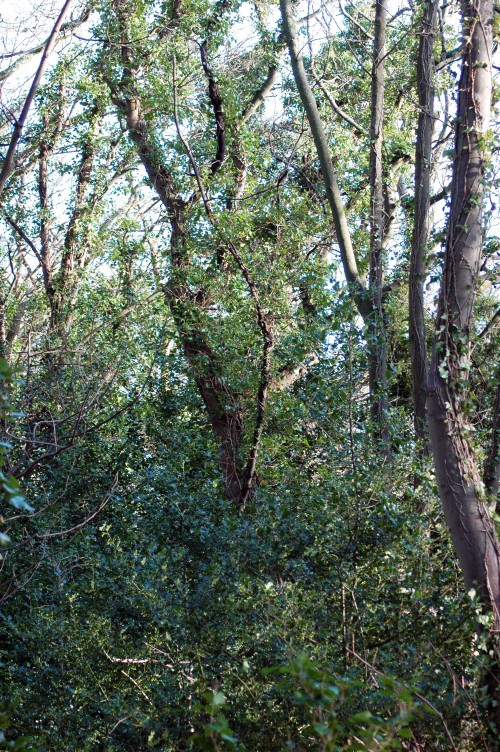
My walks on Bryn Euryn have a different starting point now and it has been interesting to note the differences in the character of the woodland on this eastern to south-eastern aspect of the hill. Firstly, on this particular pathway you are immediately in the woodland and notice there is a difference in the pattern of tree species. I am fairly sure that is because the land that the apartment block that I now live in was formerly the site of a large house, one of several similar ones, most of which are still standing and in use as residential care homes. All have large mature gardens to the fronts and sides and are set back tightly against the rising wooded hillside, so certain of the trees and shrubs, such as laurels and Scots Pines, that you don’t find on the other slopes of the hill, have inevitably escaped. Other evergreens Yew, Holly and Ivy occur throughout the woodland on all sides, but this area seems to have more and larger specimens of them and so appears particularly green.

Sunlight on a path lined with evergreens

Sunlight on a path lined with evergreens-yew, holly & laurel

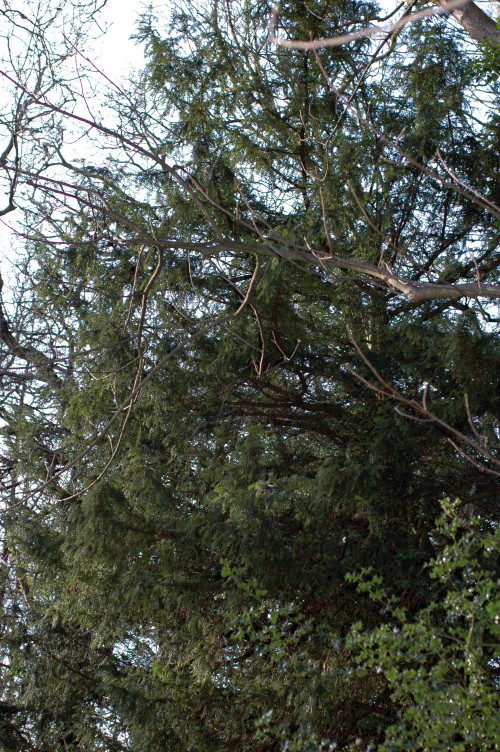
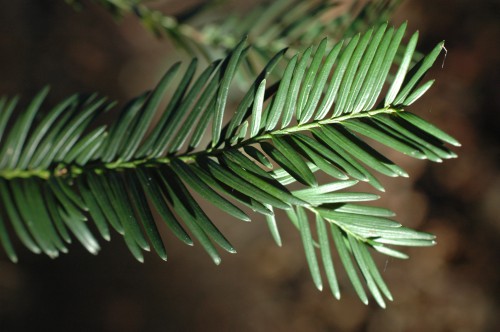
Yew is one of our native species of trees and occurs naturally in the wild in woodlands in several parts of Britain, although it is not as widespread as it used to be.

Yew tree

A large Yew tree

Yew foliage

Yew foliage

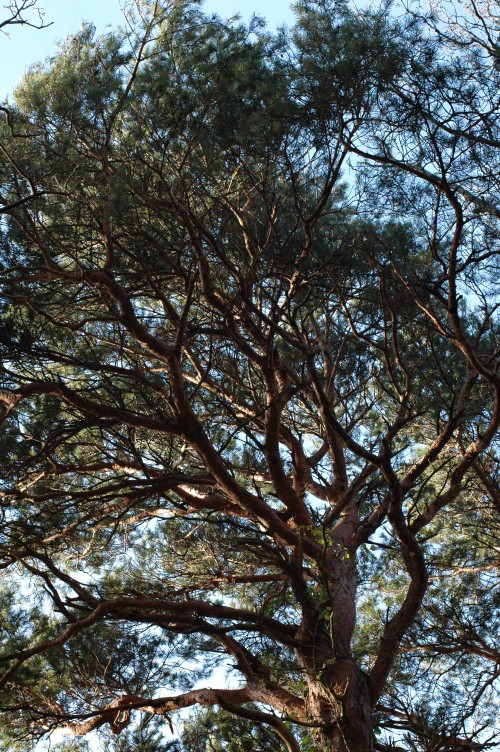
Scots pine (Pinus sylvestris) is an evergreen conifer native to northern Europe, and is one of just three conifers native to the UK.

150104TGFL-Bryn Euryn 12-Scots Pine

A huge Scots Pine

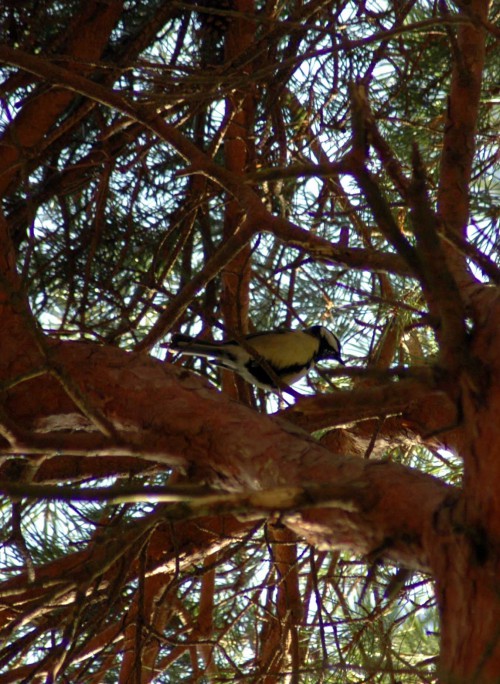
A Great tit in the pine tree

A Great tit in the pine tree

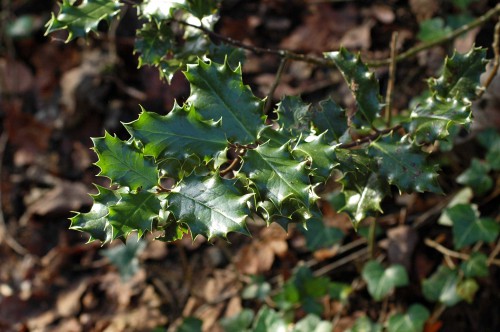
Holly and Ivy

Holly and Ivy

Shiny Holly leaves

Shiny Holly leaves

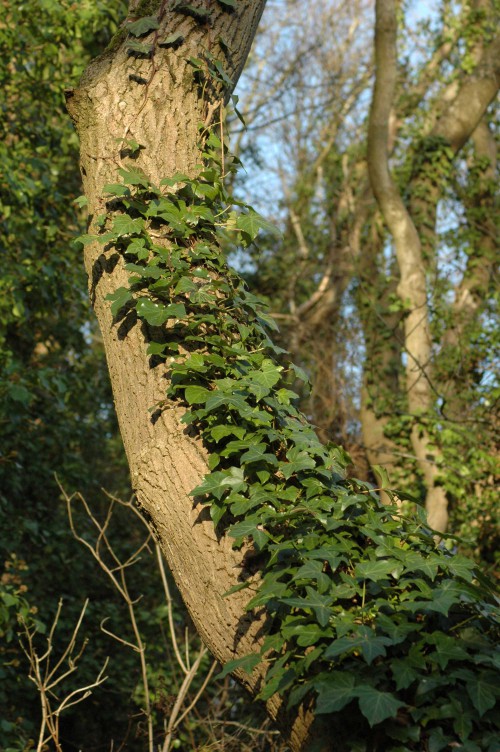
Ivy

Ivy

Sun shining through an ivy leaf

Sun shining through an ivy leaf

Greenery is also abundant on the woodland floor.

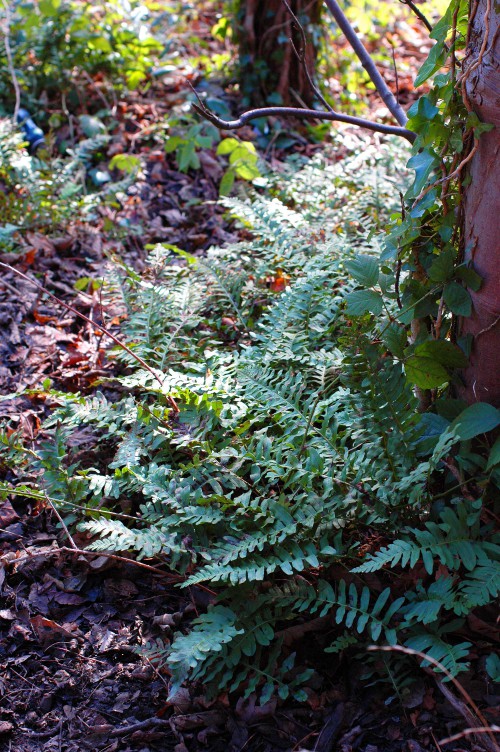
Fern around the base of a tree

Polypody fern around the base of a tree

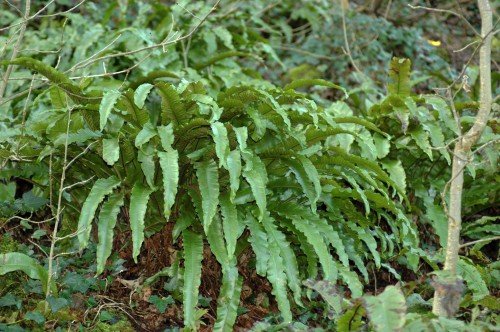
Hart's tongue fern

Hart’s tongue fern

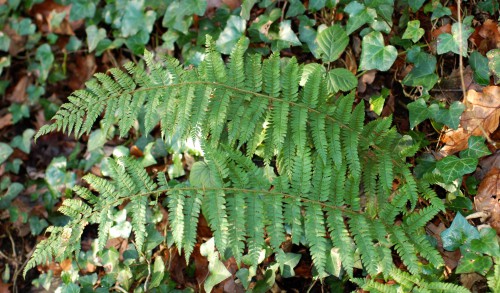
Male fern

Male fern

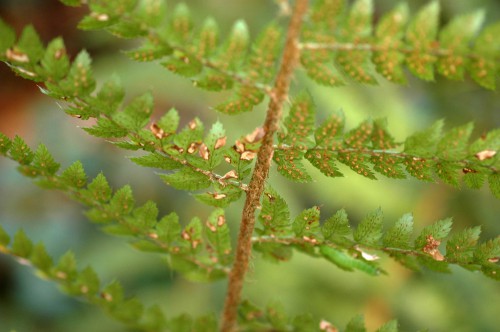
Spores on the back of a fern leaf

Spores (sori) still cling to the back of a fern leaf

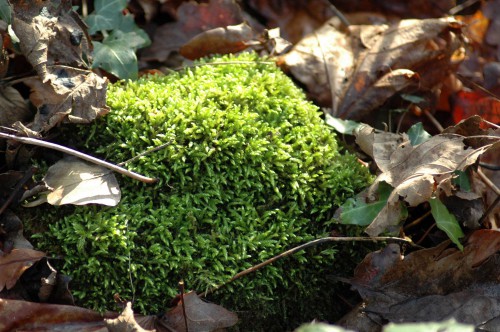
Vibrant green moss amongst dry brown leaves

Vibrant green moss amongst dry brown leaves

Winter is a good time time to see mosses when many are at their best.

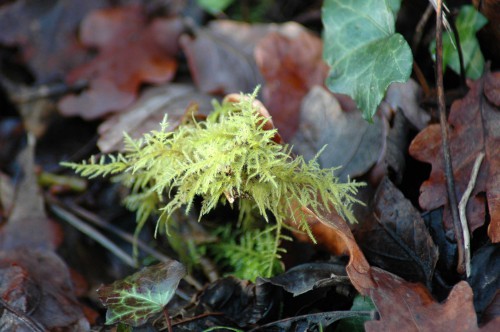
Feather moss

Feather moss

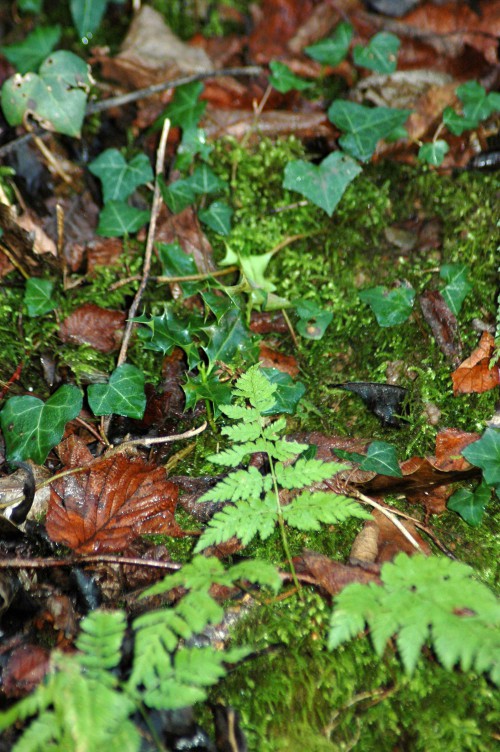
Young fern and holly plants in a mossy bed

Young fern and holly plants in a mossy bed

A few splashes of colour…….

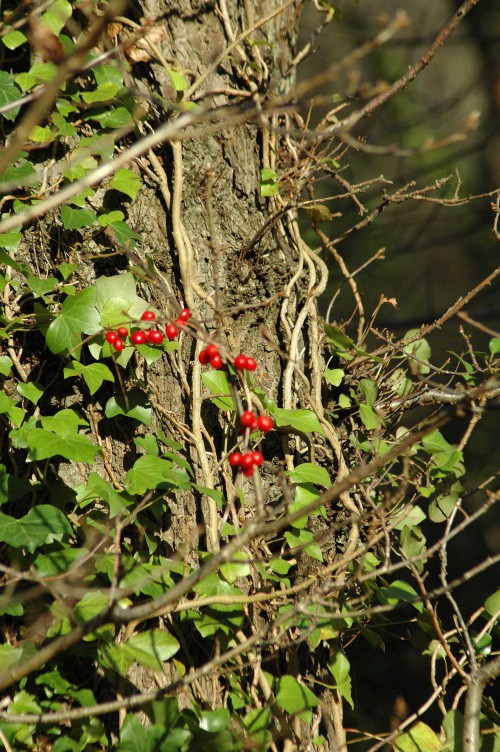
Red berries of nightshade strung like beads around ivy

Red berries of nightshade strung like beads around ivy

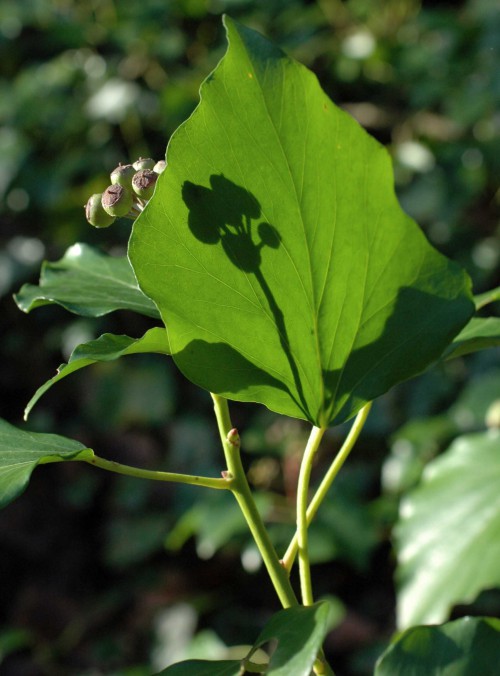
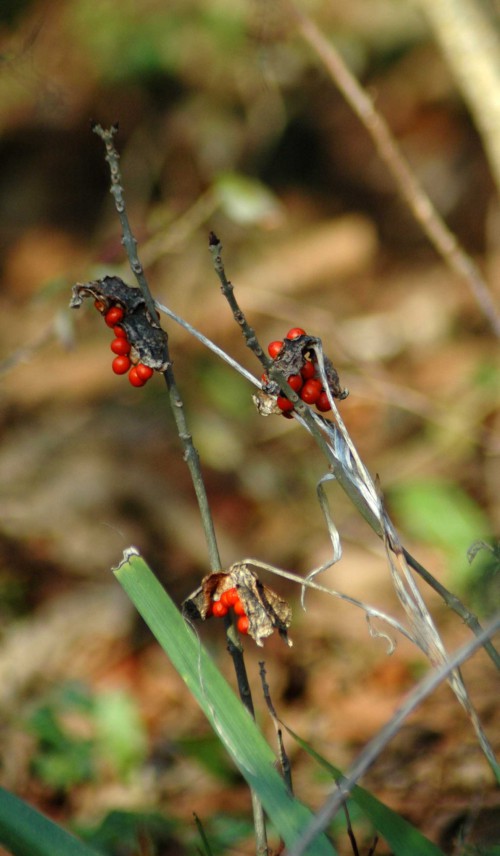
A few berries remain on a 'Stinking Iris'- Iris foetidissma

A few berries remain on a ‘Stinking Iris’- Iris foetidissma


Share this:

  • Share on Facebook (Opens in new window) Facebook
  • Share on Pinterest (Opens in new window) Pinterest
  • Share on X (Opens in new window) X
Like Loading...

Mellow autumn

23 Thursday Oct 2014

Posted by theresagreen in Butterflies of Wales, calcareous grassland, coastal habitat, coastal walks, Nature, Nature of Wales, nature of woodlands, nature photography, Wildflowers of Wales

≈ 5 Comments

Tags

autumn woodland, Bryn Euryn Nature Reserve, common buzzard, eyebright, galls on back of oak leaves, hawthorn berries, silver birch, spangle gall, speckled wood, St John's Wort, wildflowers of Bryn Euryn

Me it delights in mellow autumn tide,                                                                       To mark the pleasaunce that my eye surrounds,                                                 The forest trees like coloured posies pied,                                                            The uplands mealy grey and russet grounds;                                                Seeking for joy where joyaunce most abounds…….                                                                                from Autumn by John Clare

Autumn certainly has been joyous this year and even the blustery tail-end effects of hurricane Gonzalo have failed to provoke most of our habitual complaints about the weather. Temperature-wise, a  walk I took on Bryn Euryn just a couple of weeks ago felt more like early summer than approaching winter and although many of the signs of autumn were in place, there were a surprising number of wildflowers in bloom and butterflies, bees and various flies on the wing.

Quarry-field cliff crowned with autumn colours

Quarry-field cliff crowned with autumn colours

Teasel  seed-heads amongst thistles

A prickly selection – teasel seed-heads amongst thistles

The woodland tracks are covered with layers of dried fallen leaves that rustle when stepped upon and the soft musky scent of their decaying matter fills the air.

Sun-dappled woodland track covered with dry fallen leaves

Sun-dappled woodland track covered with dry fallen leaves

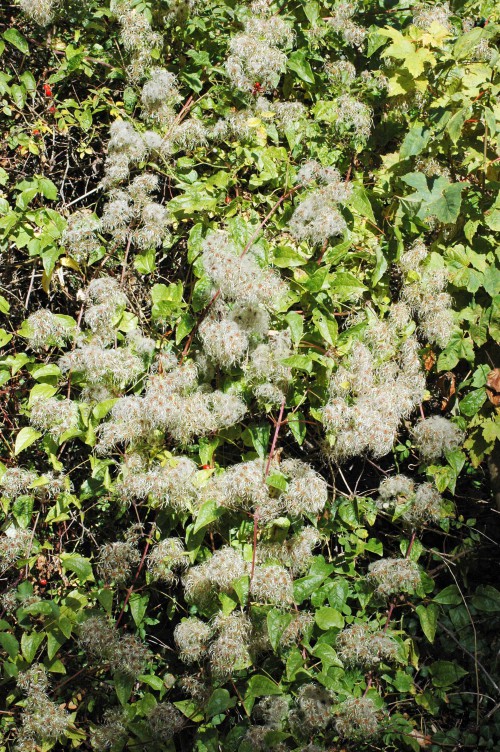
Wild clematis is prolific throughout the reserve and curtains of the fluffy dried seed-heads is draped over vegetation of varying heights and is living up to its common name of Old Man’s Beard.

Fluffy seed heads of wild clematis or 'old man's beard'

Fluffy seed heads of wild clematis or ‘old man’s beard’

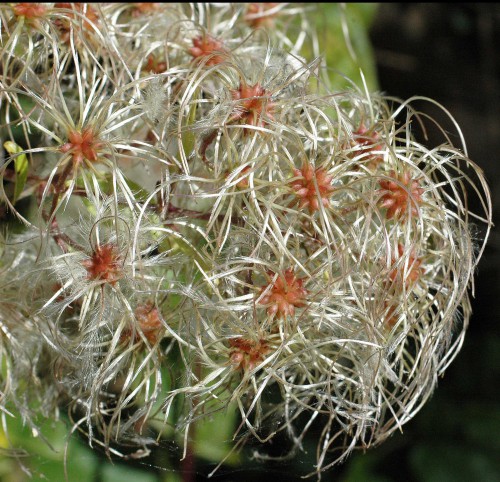
The individual seed-heads are prettily composed and shine silver in the sunlight.

141002(6)TGNW-Bryn Euryn-Old man's beard close-up

Clusters of silvery filaments make up a seed-head of wild clematis

The bountiful crops of haws on the hawthorn trees are still untouched by birds and have turned a rich ruby red.

Rich pickings still to come for hungry birds

Rich pickings still to come for hungry birds

Hawthorn leaves also turning red

Hawthorn leaves also turning red

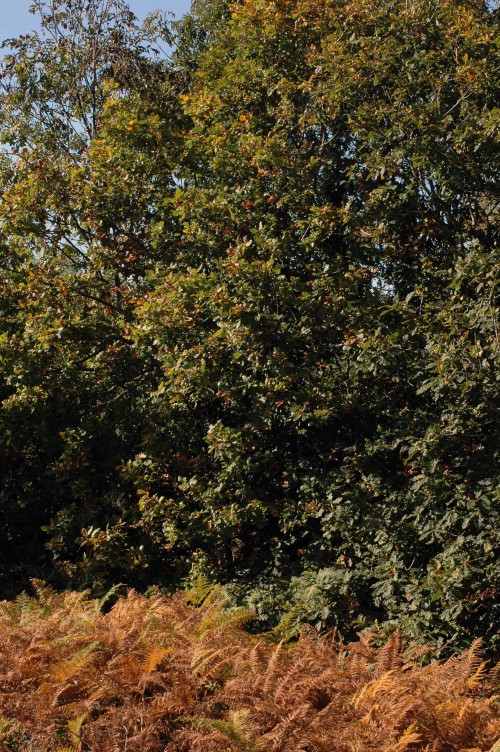
Although there are bountiful berry crops, the oak trees do not seem to have produced many acorns this season.

Oak tree with bracken in the foreground

Oak tree with bracken in the foreground

Oak leaves turning colour

Oak leaves turning colour

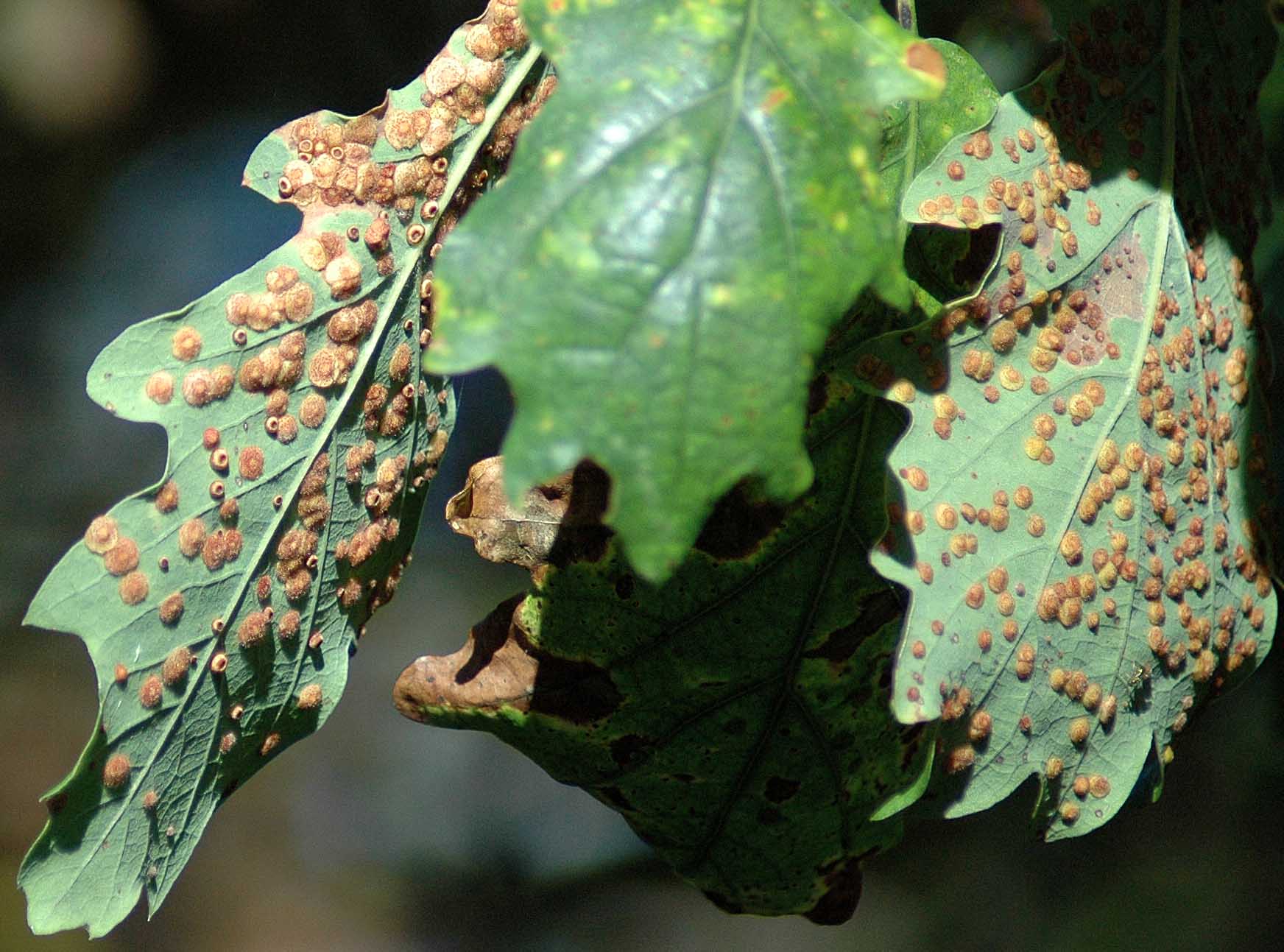
There are ‘crops’ of spangle galls though.

141002(17)TGNW-Bryn Euryn- Spangle galls on oak leaves

Spangle galls on oak leaves

Before climbing up the steep track through the woods on the way to the summit I sat for a few minutes on a rock to note down what I’d seen so far and was scrutinised for a few seconds by a buzzard that flew in over the treetops. This is a favoured spot of the locally resident buzzard, known to local visitors to the site as Lucifer and if you are here for any length of time you have to be quite unlucky not to get at least a glimpse of him here. He was accompanied by his mate today and didn’t linger, moving away in a leisurely circling kind of way towards Penrhyn Hill and the Little Orme.

Buzzards circling Penrhyn Hill

Buzzards circling Penrhyn Hill

I noted: ” I’m sitting on one of my favourite rocks. It’s around noon, the sun is high in a blue sky with just the faintest wash of wispy white cloud and is so hot I can feel it burning my legs through my jeans. The grassy areas have all been cut but a few wildflowers in bloom including rockrose, harebell & a bit of hogweed. There are butterflies, mostly speckled woods, but also a red admiral. Drone flies come to bask on the sun-warmed rocks and several wasps are seeking available food sources. Birds are still fairly quiet, I’ve heard the occasional song of a Robin and Blue and Great Tits calling to one another as they flit around foraging for food, but apart from the ever-present Crows everything else is keeping a low profile.”

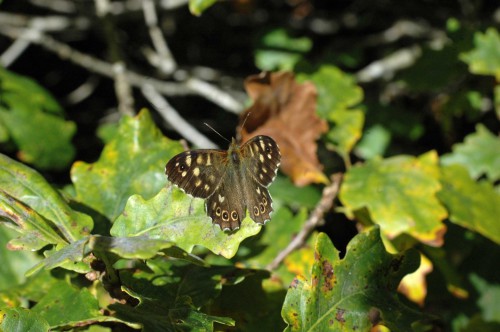
Moving onwards and upwards along the track that leads out onto the ‘downland’ side of the hill I could hear drying leaves crackling in the heat of the sun. On the woodland edge there were several speckled woods flitting about, pausing often to settle on oak leaves. All appeared to be dark in colour and were not fully basking, but holding their wings partially closed.

Speckled Wood basking on an oak leaf

Speckled Wood basking on an oak leaf

I photographed another insect here too: it looked like a small bee but was behaving more like a hoverfly.

Cute insect looking like a small bee and behaving like a hoverfly

Cute insect looking like a small bee and behaving like a hoverfly

There is a beautiful silver birch tree on the woodland edge. Its leaves are beginning to turn colour and it has attractive fruiting catkins that look like a bit like a small slender fir cone from which, during the winter and aided by birds, tiny winged nutlets will be released.

141002(26)TGNW-Bryn Euryn- Silver birch fruits

Silver birch leaves and fruiting bodies

141002(27)TGNW-Bryn Euryn- Silver birch fruit

Close up of fruiting body

The grass has been cut on the hillside too and the ground is criss-crossed with a lattice of bramble stems. There are a few plants of the wild Goldenrod still in flower, while others have gone to seed.

Goldenrod-Solidago virgaurea

The dry flower head with seeds attached looks as pretty as the fresh flower.

Goldenrod gone to seed

Goldenrod gone to seed

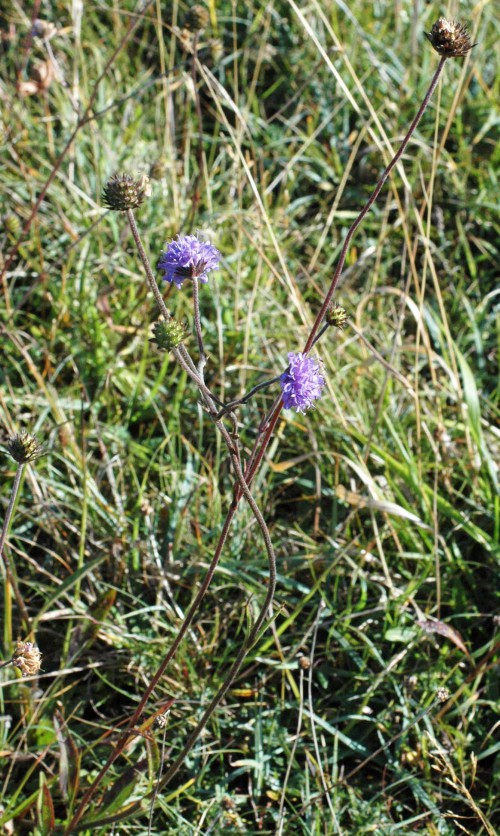
There was a fair amount of scabious still in flower and was attracting a busy little Carder Bee.

Scabious still flowering

Scabious still flowering

There were a few eyebright plants still with their usual white flowers, and one that I came upon had pretty pink-purple edged petals with a yellow patch in the centre.

Eyebright with purple-pink edged petals

Eyebright with purple-pink edged petals

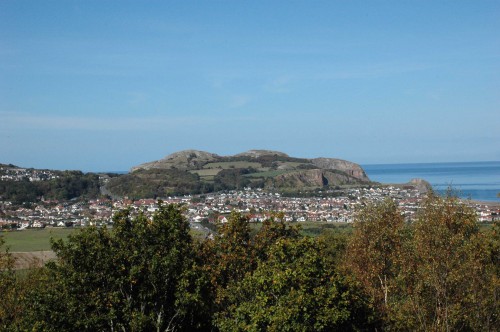
The views from the hillside were outstanding today as it was perfectly clear and bright which rarely happens in the summer months.

Looking down onto woodland across the hillside. Carneddau Mountains in the background

Looking down onto woodland across the hillside. Carneddau Mountains in the background

Little Orme & Penrhyn Bay village

Little Orme & Penrhyn Bay village

The sea was almost flat calm and in as many shades of blue as I have ever seen it.

The sea in many shades of blue

The sea in many shades of blue

Looking down the coast to Abergele & Rhyl

Looking down the coast to Colwyn Bay, Abergele & Rhyl


Share this:

  • Share on Facebook (Opens in new window) Facebook
  • Share on Pinterest (Opens in new window) Pinterest
  • Share on X (Opens in new window) X
Like Loading...

Of a temporary nature

18 Monday Aug 2014

Posted by theresagreen in coastal walks, coastal wildflowers, Nature, Nature of Wales, nature photography, Wildflowers of Wales

≈ 1 Comment

Tags

acorn barnacles, creeping cinquefoil, fat-hen, flowering in August, hedge bindweed, kelp fly, mussel beds, ray's knotgrass, rhos on sea, sea mayweed, sea plantain, seashore walks

Beauty is where you find it and often in the least likely of places, but in nature it may also be fleeting, so needs to be appreciated when the opportunity presents itself. Here are a few images of some things I found beautiful along the way of a short walk I made from home into Rhos-on-Sea village on a windy, sunny-ish morning last week. Some would most definitely not be there if I were to look for them again.

I had set off to see if there was anything interesting to see down on the seashore and walked along the promenade to reach a point from which to access it. The promenade is on a lower level to the road and pavement for a short stretch here and the intervening space between the two is a steep slope covered with grass. This grassy embankment is mowed every now and then, but the times between cuts are often long enough to allow opportunistic weed wildflowers to pop up and bloom and in different seasons I have spotted a good variety of species here.

Reaching the top of the path leading down to the prom I heard first, then saw a man on a sit-on mower working on the flatter grass verge going in the opposite direction towards Penrhyn Bay. This prompted me to get a move on and have a look to see what might be flowering lower down as it clearly would not be there for much longer.

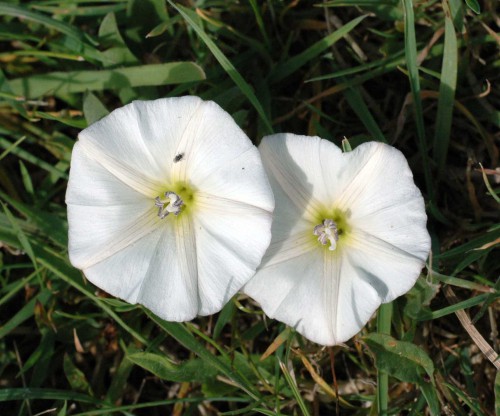
First to catch my eye was a tangle of white-flowered bindweed. Generally similar to the large flowered bindweed that abounds in waste places and on road verges, as well as being the bane of many a gardener’s life, this was the smaller-flowered Hedge Bindweed.

Flowers are smaller than those of Large Bindweed

Flowers are smaller than those of Large Bindweed

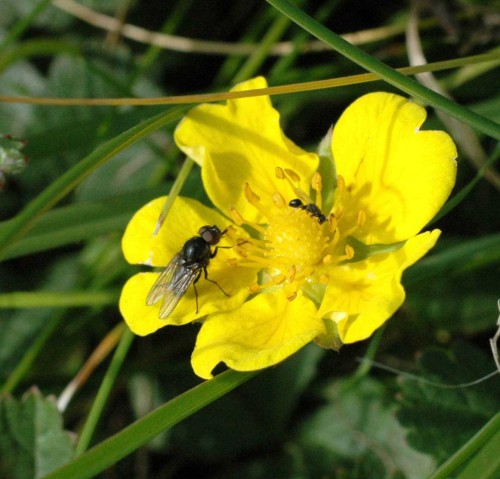
Lower down in the grass there was Creeping Cinquefoil, some of the golden yellow flowers fading around the edges.

Creeping cinquefoil-potentilla reptans

Creeping cinquefoil-potentilla reptans

Small flowers attract small insects

Small flowers attract small insects

There were insects nectaring on most of the available flowers, including bumblebees, hoverflies and various other flies.

I hope they all escaped the blades of the mower that was about two minutes behind me as I took these photographs. I’m glad I got there when I did, otherwise I would not have seen the flowers at all.

The tide was turning and beginning its journey back into the shore and although I could see and hear a lot of birds out on the tide-line, including curlew, redshank & oystercatcher, they were way too far away to see properly.

View across the mussel bed from the shore

View across the mussel bed from the shore. (click for a bigger image)

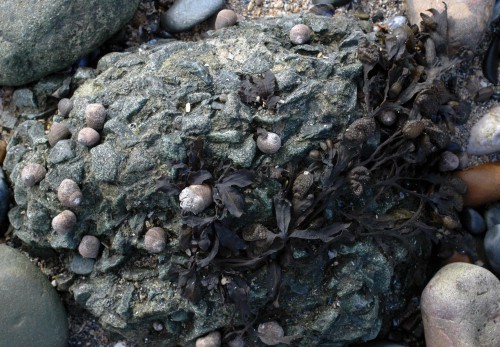
With or without the added interest of birds though, I can meander contentedly  along this rocky seashore at any time, finding the rocks themselves endlessly fascinating.

Perhaps the rounded shapes on this rock were made by molluscs attached to it

Perhaps the rounded shapes on this rock were made by molluscs at one time attached to it

We don’t get much variety in the seashells on the shore here, although not surprisingly there are an awful lot of mussel shells.

Seashell collection amongst the rocks

Seashell collection amongst the rocks

Textures in rock with periwinkles

Textures and patterns in rock with seaweed and periwinkles

Acorn barnacles make a pretty lacy patterns on rocks

Acorn barnacles make  pretty lacy patterns on rocks

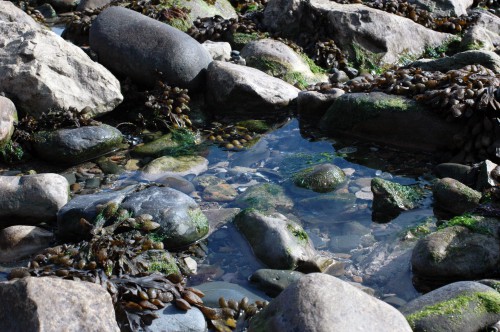
Rock pool

Rock pool

I spent a few minutes watching a cluster of Kelp Flies, appropriately on a length of brown, leathery Kelp seaweed.These are the insects that fly up if you walk through or even past clumps of dryish seaweed. They are quite tiny, so I thought it might be interesting to have a closer look at one. Not beautiful maybe, unless you are another Kelp Fly, but the wings are nice and they have dainty white feet.

Kelp Fly - Coelopa frigida

Kelp Fly – Coelopa frigida

So I travelled slowly along and eventually arrived at the sandy beach area next to the small harbour area of the village. The beach is protected by a barrage of more large rocks that has to be surmounted  to reach it and as I clambered over them I spotted a colourful splash of flowering plants growing at the back of the building that is now a fishing-tackle shop and kayaking centre. This is not a particularly attractive spot and any wind-blown rubbish from the beach tends to get caught up here, but I have come across some interesting plants here, so is always worth a closer look at. 

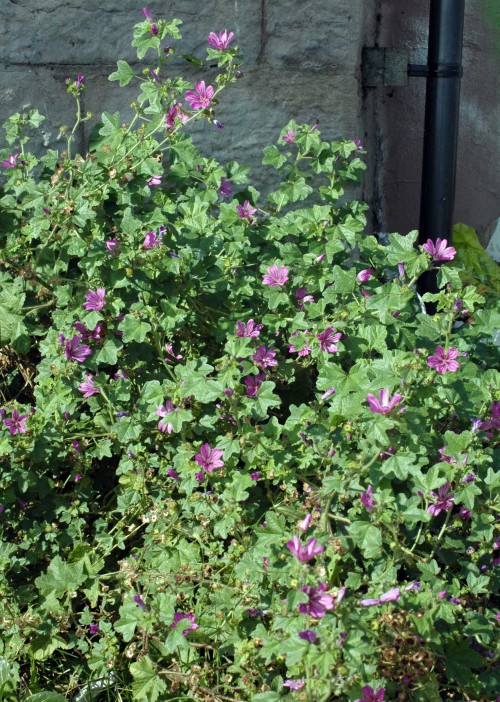
What had caught my eye today was a large clump of Common Mallow that had found shelter in a corner tight against a wall and was clearly thriving there.

A large Common Mallow plant thrives in a sheltered corner

A large Common Mallow plant thrives in a sheltered corner

Another common plant in waste places, especially on sandy soils is Annual Wall-Rocket and there are usually a few of these plants growing around this location.

Annual Wall-Rocket-diplotaxis muralis

Annual Wall-Rocket-diplotaxis muralis

A large specimen of Annual Wall-Rocket

A large specimen of Annual Wall-Rocket

There was a large plant of Fat-hen too, and another one right on the edge of the sand just a short way from the sea.


Fat Hen

Fat Hen- Chenopodium album

Fat Hen flower spike

Fat Hen flower spike

Amongst the commoner plants I was pleased to  find this Ray’s Knotgrass, an annual plant that is most often found on undisturbed coastal sand and shingle beaches.

Ray's Knotgrass- Polygonum oxyspermum

Ray’s Knotgrass- Polygonum oxyspermum

The flowers & fruits of Ray's Knotgrass

The flowers & nut-like fruits of Ray’s Knotgrass

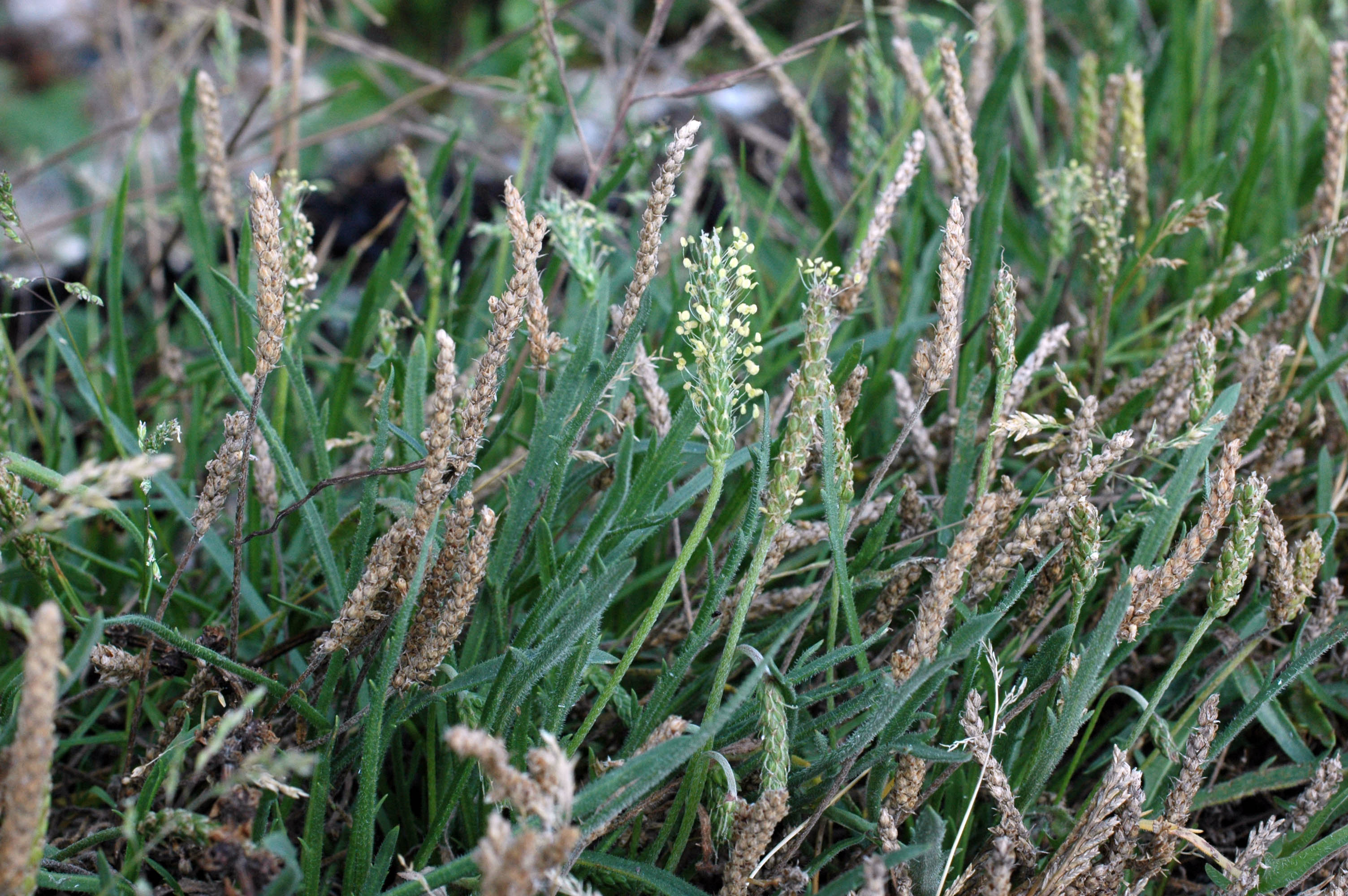
There was Sea Plantain, whose flowers are almost over now.

Sea Plantain-Plantago maritima

Sea Plantain-Plantago maritima

Then the prettiest of them all, the lovely Sea Mayweed.

Sea Mayweed-Tripleurospermum inodorum

Sea Mayweed-Tripleurospermum inodorum

A clump of Sea Mayweed at the beach edge

A clump of Sea Mayweed at the beach edge


Share this:

  • Share on Facebook (Opens in new window) Facebook
  • Share on Pinterest (Opens in new window) Pinterest
  • Share on X (Opens in new window) X
Like Loading...

Life in the long grass

10 Sunday Aug 2014

Posted by theresagreen in Bryn Euryn Nature Reserve, bumblebees, Butterflies of Wales, day-flying moths, hoverflies, Nature, Nature of Wales, nature photography, spiders, wildflowers, Wildflowers of Wales

≈ 2 Comments

Tags

Aricia agestis, Brown Argus, butterflies in long grass, common blue, common knapweed, insects in long grass, keeled garlic, moths in the grass, Nursery Web spider, pisaura mirabilis, Polyammatus icarus, small hoverfly with snout, spider that makes web tents in grass

First week

The weather up here in our part of North Wales has been variable this week. We have had a good bit of rain which has freshened everywhere up and just  about enough warm sunshine to allow us to keep the faith that this is indeed high summer. It may not be the perfect weather for people here on holiday, but the local wildflowers and insects seem to be appreciating it.

Habitat: Long meadow grass

There is a whole other world existing in areas where grass is allowed to grow long and during the past couple of weeks I’ve begun to appreciate its importance as a home and a refuge for wildlife, particularly insects and spiders.

All journeys need a starting point and the following journey of discovery into the dimension of long grass began when I went to Bryn Euryn to see if a particular plant was in flower.

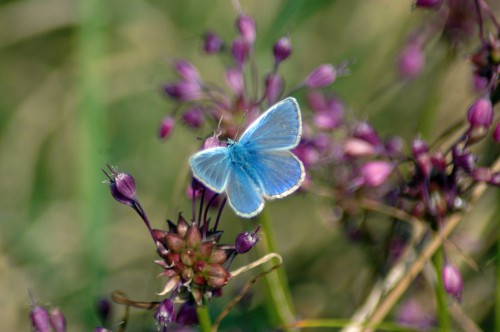
I’ve mentioned before that we have a few less-usual species of wildflowers growing in our locality and on Bryn Euryn this is the time to find one of them; the pink/purple flowered Keeled Garlic. I headed for the spot I had seen it in previous years and there it was, buzzing with bumblebees and more surprisingly attracting several beautiful little Common Blue butterflies.

Keeled Garlic

Keeled Garlic

I wondered at the attraction of this particular flower to the butterflies and thought perhaps they were just resting on the tiny flowers to sunbathe. A little later though I came upon another patch of the flowers with more Common Blues fluttering over and settling upon it, so maybe they were taking nectar from them. I was more than happy to see this many of the butterflies in the same place at the same time; I haven’t seen that for a long time.

Male Common Blue butterfly on Keeled Garlic flower

Male Common Blue butterfly on Keeled Garlic flower

Female Common Blue butterfly, looking a bit more worn

Female Common Blue butterfly, looking a bit more worn

I was not the only one to recognise the attraction of insects to the garlic flowers. Lurking on top of her tent-like web, built to protect her eggs and then babies, sat a long-legged Nursery Web spider.

Nursery-web spider-

Nursery Web spider-

Nursery Web spiders are the spinners of the many web ‘tents’ seen in grassy places at this time of year. They take their common name from the way in which they care for their offspring. The female carries her large egg sac beneath her body, held in her jaws. Before the eggs hatch she spins the silken tent around the egg sac and stands guard over them. She remains on duty until the spiderlings are big enough to live independently. The spiders are active hunters and search for prey amongst grasses and low vegetation.

A neighbouring Nursery-web Spider

A neighbour

Walking carefully through the long grass, every step seems to disturb a dry-grass coloured moth. They are so well camouflaged that should you manage to keep track of where they land, it’s not easy to find them again; then if you manage a picture of sorts identifying them afterwards is even harder. The one below, which landed on the pupa of a 6-Spot Burnet moth which I would otherwise not have spotted, maybe Crambus pascuella (?) As always, I’m more than happy to be corrected.

This one landed on the pupa of a 6-spot Burnet Moth

This one landed on the pupa of a 6-spot Burnet Moth

In places amongst the grass knapweed is beginning to open up it tight dark knots of buds to allow the purple brush-head of petals to escape. Knapweed is a hugely important source of nectar for a wide variety of insects, but more about the plant and its visitors later.

Knapweed

Knapweed in long grass

Long grass on dry slope of ‘downland’

The area of long grass at the bottom of the summit slope on the drier, chalkier downland side of the Bryn has a different character to the flatter, damper meadow area. Some species of butterfly you may see here, although found in other parts of the Reserve, show a definite preference for the conditions it offers and may be more numerous. It is especially good for seeing the smaller species that gain protection from predators amongst the grass stems and include Small Heath, Small Skipper, Common Blue and the less-common Brown Argus.

The larval host plant of the Brown Argus is Rock Rose, which has been prolific in its flowering here this year and the leaves of the plants are still evident in the ‘under-story’ of this grassy forest. I was once again lucky with the timing of my visit this week; after a few minutes of pursuing little butterflies through the tangle of dry grass laced across with long outreaching bramble runners, I spotted a newly emerged Brown Argus balanced on top of a dry stem.

Brown Argus-

5/8/14 – Brown Argus- Aricia agestis

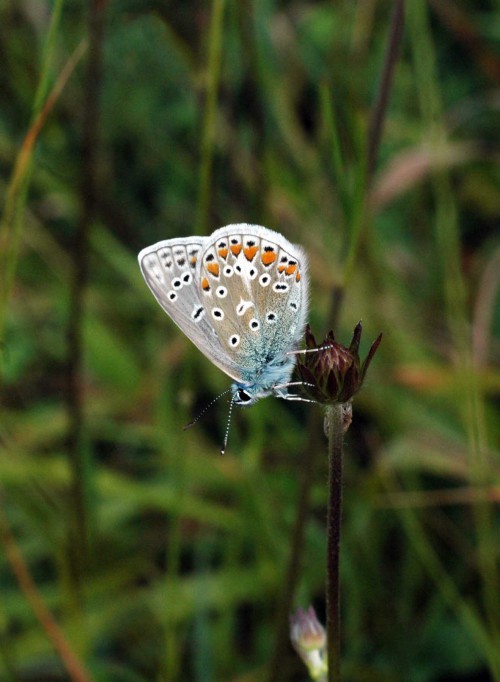
It stayed perfectly still, wings outstretched for quite a long time and made no attempt to fly off although I was very close and holding the camera lens just a few inches from it. I was almost certain this was in fact a Brown Argus and not a female Common Blue, but was compelled to wait and hope it would close its wings for me to see its underside. It eventually obliged and although the angle it presented wasn’t the best, thankfully it did confirm its identity with its diagnostic pattern of spots.

Brown Argus underside with 'figure of 8' spots on forewing

My Brown Argus underside with ‘figure of 8’ spots on hind wing

Common Blue male underside

4/8/14-Common Blue male underside

Spot the difference:

Text & diagram from the UK Butterflies web site demonstrates the differences:

Of the two sexes, it is the female Common Blue that causes most confusion with the Brown Argus. The blue present in a female Common Blue is highly variable, with individuals ranging from almost completely blue through to completely brown. It is this latter colouring that causes the most confusion. Even so, the Brown Argus has no blue scales, but may give off a blue sheen from the wings and the hairs found on the thorax and abdomen. Another diagnostic is that the Brown Argus normally has a prominent dark spot in the centre of the forewings.

Brown Argus - Common Blue undersides

Brown Argus on left & Common Blue on right of image


Share this:

  • Share on Facebook (Opens in new window) Facebook
  • Share on Pinterest (Opens in new window) Pinterest
  • Share on X (Opens in new window) X
Like Loading...

Enchanting evening on the Little Orme

03 Sunday Aug 2014

Posted by theresagreen in Butterflies of Wales, Little Orme, moths, Nature of Wales, nature photography, Rhiwledyn Nature Reserve, The Wales Coast Path, Wildflowers of Wales

≈ 2 Comments

Tags

6-spot Burnet Moth, 6-spot Burnet Moth pupa, Antler moth, cinnabar moth larvae, emerging 6-spot Burnet Moths, mating 6-spot Burnet Moths, small skipper, sulphur beetle

Some days the intention of a walk is at the forefront of my mind, then ‘stuff’ crops up and before I know it the day is almost over and the momentum needed to get me out of the door is fading fast. This was almost one of those days, when at six thirty-something I was still preoccupied with getting things done in the house. Luckily I finally acknowledged the little nagging voice in the back of my mind that was insisting I got out for some fresh air. I almost ignored it, then gave in, grabbed my camera, put on walking shoes and headed out with no real idea where I was heading for.

At around seven I arrived at the Little Orme. I knew before I arrived that by this time in the evening most of the area on this most accessible side of the headland would be in the shadow of its bulk, as the late sun slips down and slides around it to set just about behind its tip. There were quite a few people about too; dog walkers of course, some holidaymakers dressed up for the evening, maybe taking an evening constitutional before dinner & a couple of groups of teenagers, one lot jumping, diving, shouting and laughing from a rocky ledge into the sea.  I quickly judged that this was not a scenario I would normally enter into if hoping to spot any wildlife and on that basis decided this outing would be for the purpose of exercise. So a brisk walk to the cliff edge, an about turn and a concerted effort to get to the top of Rabbit Hill with minimum stops to catch breath, back down again and home ought to do it.

A group of people with two dogs was heading toward me, so to avoid them momentarily I stepped off the main path onto a narrow track that leads around the cliff, skirting what is currently a large patch of long grass. It took less than a minute of being there to spot that a good number of Meadow Brown butterflies were flitting about amongst the grass stems and settling there. It took slightly longer to realise they were there to roost for the night.

Long grass on the clifftop of the Little Orme with view to Rhos-on-Sea & Colwyn Bay behind

Long grass on the clifftop of the Little Orme where the butterflies were roosting. Views to Rhos-on-Sea & Colwyn Bay beyond

I tried to approach several butterflies, treading slowly and carefully through the grass, but I couldn’t get close enough to them to photograph and hadn’t picked up my more powerful zoom lens when I left the house as I didn’t expect to need it. I continued to try until following one individual led me to discover a cluster of Six-spot Burnet Moths on a single grass-head.

Cluster of 6-spot Burnet Moths

Cluster of 6-spot Burnet Moths- Zygaena filipendulae

It was clear that the Moths were in differing conditions, with one n particular looking a bit battered and with most of the colour gone from its wings. I assumed that as with the Meadow Browns the Burnets were also seeking to roost for the night and turned my attention to a passing Small Skipper that settled obligingly on another nearby grass-head.

Small Skipper

Small Skipper- Thymelicus sylvestris

I was happy now, especially as in the cool of the evening the butterflies and moths were not as mobile as they are during the day and were allowing me to get quite close to them with the camera.

Another Small Skipper

Another Small Skipper

As I moved  through the grass and further towards the cliff edge I began seeing more Burnet moths. And more.

6-spot Burnet moths either side of a grasshead

6-spot Burnet moths either side of a grasshead


It slowly dawned upon me that although the butterflies were roosting, the moths were not. They were out intent on mating.

6-spot Burnet moths mating

6-spot Burnet moths mating

I could hardly believe the numbers of moths that were gathered here in this relatively small area of long grass. I have been to visit this reserve many times and felt lucky to see half a dozen individuals on a sunny afternoon, now I was surrounded by them. They were literally everywhere I looked. It still took a further while though to realise that even more amazingly, I had arrived at exactly the time the new moths were almost simultaneously emerging from their cocoons.

6-spot Burnet Moth emerging from its pupa

6-spot Burnet Moth emerging from its pupa

I had begun to spot the yellow cocoons with something black and alien-looking emerging from them, but couldn’t quite imagine it ending up as a moth at all, so at first thought they were something else. I don’t what, just something else.

A closer view of an emerging moth

A closer view of an emerging moth still doesn’t look like one

It was only when I spotted other Burnet moths perched on top of cocoons from which another was emerging that I was convinced that somehow these crumpled black forms would indeed eventually look just like them.

A 6-spot Burnet moth on top of an as-yet unbroken pupa

A 6-spot Burnet moth on top of an as-yet unbroken pupa

I began to wonder then why the moths were sitting on top of the pupae. I’m afraid the only theory I could come up with was that they were male moths staking a claim on emerging females to mate with them as soon as they became viable. Not pretty, but probably not far off the mark. (more about 6-spot Burnet Moth)

Two Burnet moths on top of a pupa from which another is emerging

Two Burnet moths on top of a pupa from which another is emerging

I tried watching an emergence for a while, but it seemed like a lengthy process, so still marvelling at my luck in witnessing this epic event, I left the moths to their nuptials and moved on. I would have been happy to have taken my previously outlined walk now and returned home, but it turned out there were still a few things to see in the gathering dusk.

A sleepy bumblebee curled around a blackberry

A sleepy bumblebee curled around a blackberry

Ragwort is in full vibrant bloom now and I just had to look for black and yellow striped caterpillars of the Cinnabar moth. I was not disappointed, there were plenty in sizes varying from very tiny to very large.

Small Cinnabar moth caterpillar on ragwort flower buds

Small Cinnabar moth caterpillar on ragwort flower buds

A large plump Cinnabar moth caterpillar snaked around a ragwort bud

A large plump Cinnabar moth caterpillar snaked around a ragwort bud while eating it

I was also fortunate to spot a prettily marked moth : this is an Antler moth, so called because of the distinctive antler-shaped markings on its forewings. One of the species that flies in daylight.

An attractive little Antler moth  on ragwort flowers

Antler moth- Cerapteryx graminis

Long grass with cliff wall of the Little Orme behind

Long grass with cliff wall of the Little Orme behind

On the cliff above Angel Bay is another patch of long grass, but here it is mixed with wildflowers such as hogweed, ragwort and a sprinkling of knapweed, all important nectar plants for insects. This evening there were still a few to be found out dining including bumblebees and one little Sulphur beetle.

Sulphur beetle- Cteniopus sulphureus

Sulphur beetle- Cteniopus sulphureus

I left for home happily and exercised – I made it up to the top of Rabbit Hill, admittedly pausing a couple of times, but why wouldn’t you when the view is so spectacular and the sun is setting so beautifully over the sea?

Share this:

  • Share on Facebook (Opens in new window) Facebook
  • Share on Pinterest (Opens in new window) Pinterest
  • Share on X (Opens in new window) X
Like Loading...

The strangely beautiful Carline Thistle

03 Sunday Aug 2014

Posted by theresagreen in Bryn Euryn Nature Reserve, Little Orme, Nature, Nature of Wales, nature photography, Rhiwledyn Nature Reserve, Wildflowers of Wales

≈ 2 Comments

Tags

carlina vulgaris, carline thistle, dry thistle plant, thistle with large dried out flowers, Welsh wildflowers

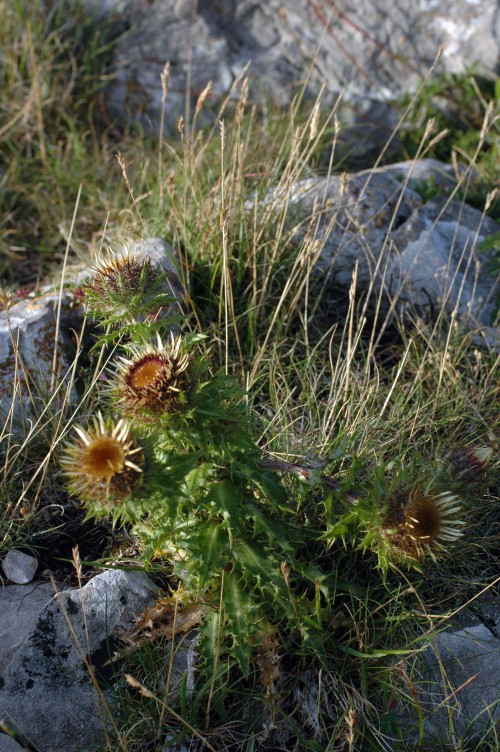
Carline thistle plant growing amongst rocks on Bryn Euryn

Carline thistle plant growing amongst rocks on Bryn Euryn

The Carline thistle is one of a handful of more unusual plants occurring in several of our nature reserves that have areas of dry calcareous grassland. It is a biennial plant so its appearance can be rather unpredictable both in exact location and in numbers of individual plants; it is never what you could call abundant. The plant can be seen throughout most of the year as when it’s finished flowering it persists as a very dry skeletal form of itself.

In past years I have found them on both ‘Ormes’, Little and Great but the best specimens, this year at least, are to be found growing on the top, rocky areas of Bryn Euryn.

Carline Thistle

Carlina vulgaris

Family: Daisy & Dandelion Asteraceae; biennial to 80cm; flowering June to September

Carline thistle with a Thick-thighed beetle on a flower

Carline thistle with a Swollen-thighed beetle on a flower

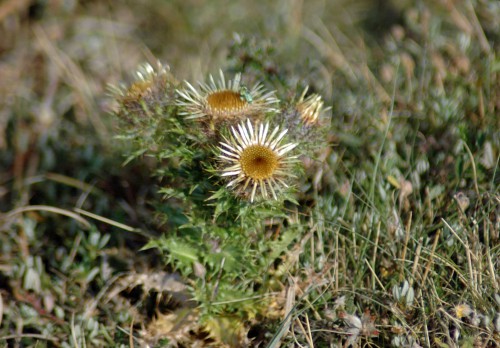
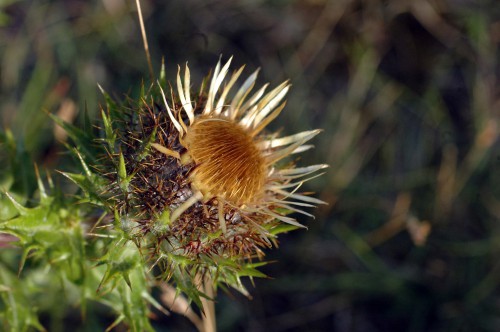
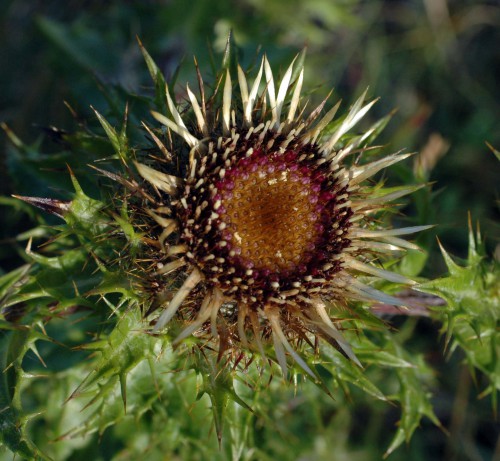
The Common Carline Thistle is a short, stout and prickly little thistle with intriguing  golden-brown-tinged-purple, rayless flowers (15-40mm across) that are surrounded by conspicuous, spiny, sepal-like yellow bracts which spread widely apart beneath. In the bright sunshine, they glisten silver and gold and in wet weather they close up.

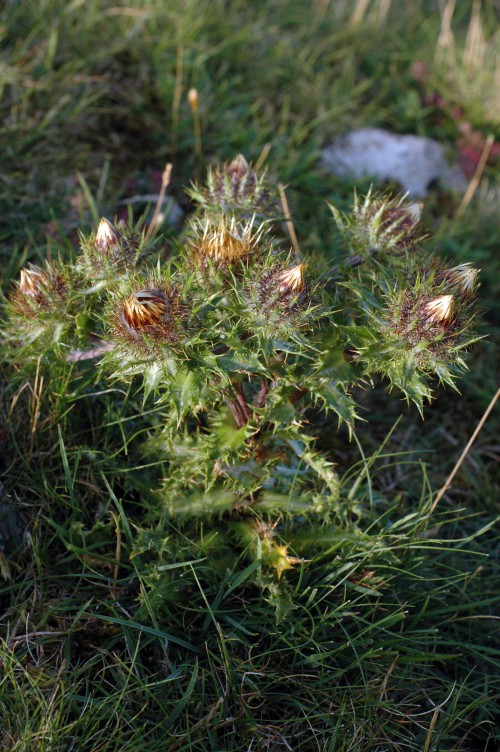
The flowerheads are carried on densely prickly, leafy stems. The oblong leaves have toothed or lobed blades with spiny edges.

An all-over densely prickly plant , buds just beginning to break

An all-over densely prickly plant, buds just beginning to break

In bud the flower is contained by a tight  mass of dark purplish brown or black spines intertwined with a net of white fibres resembling cotton wool.

Carline thistle- Carlina vulgaris

Carline thistle-flowers opening

At  first, the opening heads look rather like dead or dying daisies, but this is their normal appearance.

Flowerhead in profile

Flowerhead in profile

The inner florets are straw yellow at first, but then purple petals start to emerge from the periphery, gradually proceeding towards the centre.

Composite flowerhead of a Carline thistle fully open

Composite flowerhead of a Carline thistle fully open

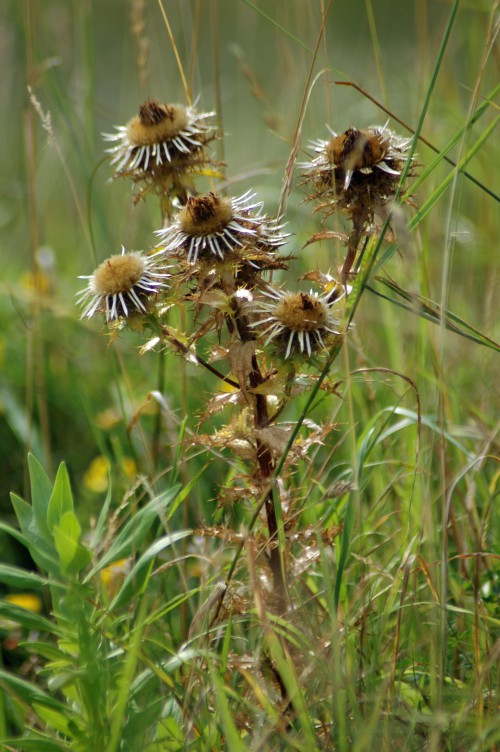
The seed-heads lend the plant a softer appearance.

Seedheads on a plant already drying out

Seed-heads on a plant already drying out

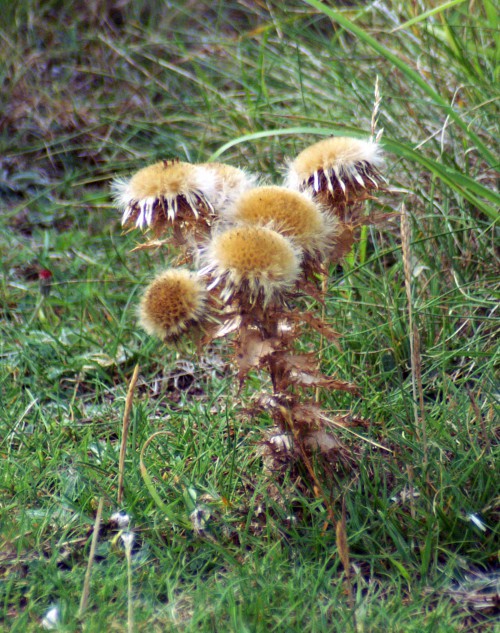
The dead flower, after the season is over, appears much as it did when it was alive.

September-a much-dried plant still maintaining its form

September-a much-dried plant still maintaining its form (Little Orme)

Traditional uses

The flower head was once used as a humidity gauge because the bracts close in the higher humidity typical of impending rain.

This plant had some uses in folk medicine and legend has it that it got its common name ‘Carline’ because the Emperor Charlemagne used the plant to cure his army of pestilence.

Subsequently it has been discovered that both Stemless Carline Thistle(Carlina aucalis) (where it was first found) and Carline Thistle contain the acetylide Carlina Oxide orCarlinoxide (furylbenzylacetylene), the main compound (85% – 90%) of the essential oil from the plant, which has a long history of medicinal use in Europe due to its anti-microbial properties. It is active against two strains of MRSA and a number of other difficult infections. It is stomachic, carminative, diaphoretic and an antibiotic.


Share this:

  • Share on Facebook (Opens in new window) Facebook
  • Share on Pinterest (Opens in new window) Pinterest
  • Share on X (Opens in new window) X
Like Loading...

A summer evening’s walk on the Bryn

20 Sunday Jul 2014

Posted by theresagreen in Bryn Euryn Nature Reserve, Nature, Nature of Wales, nature photography, North Wales, Wildflowers of Wales

≈ 8 Comments

Tags

carline thistle, common soldier beetle, forest bug, harebell, hemp agrimony, hogweed, mating red beetles, Meadow Brown, rowan berries, tapered drone fly

There’s no such thing as a bad time to enjoy a walk on Bryn Euryn, but during the longer daylight hours of the summer, an early evening during the week can be the perfect time to find it quiet and peaceful.

The woodland is almost silent now, with just the occasional rustle from the undergrowth or the flash of a skulking bird to remind you that you are not alone here. It reminds me of such walks in the woods around the cottage I grew up in, at an age when my imagination frequently ran riot and I was convinced I was being watched from every tree and shrub. By what or whom I’m still not sure, but I can clearly remember that feeling  on summer evenings such as this, when the silence is almost tangible.

Out in the open insects are making the most of the late sunshine to stoke up on nectar fuel for the night.  Hogweed is in flower and almost every umbel has at least one pair of mating soldier beetles.

Soldier beetles mating on a hogweed flower

Soldier beetles mating on a hogweed flower

The slightly cooler temperature of an early evening can make it easier to photograph some insects as they are intent on feeding and move a little slower.

A Tapered Drone Fly- Eristalis pertinax on hogweed

A Tapered Drone Fly- Eristalis pertinax  (male) on hogweed

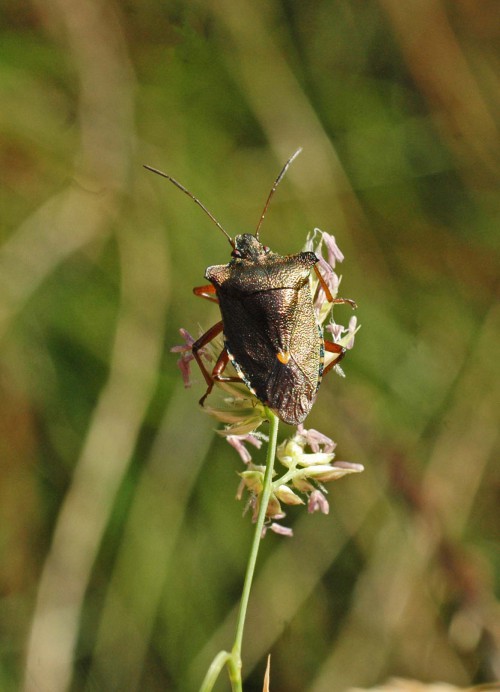
A movement at the top of a long grass stem caught my eye and I found this lovely Forest bug balancing there. It has a lovely bronzy sheen to its wing-cases.

Forest bug- Pentatoma rufipes

Forest bug- Pentatoma rufipes

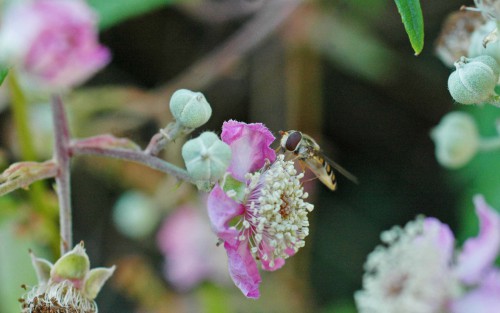
Brambles are beginning to develop berries, but there are still flowers on some bushes attracting bees and hoverflies.

Marmalade fly on a bramble flower

Marmalade fly on a bramble flower

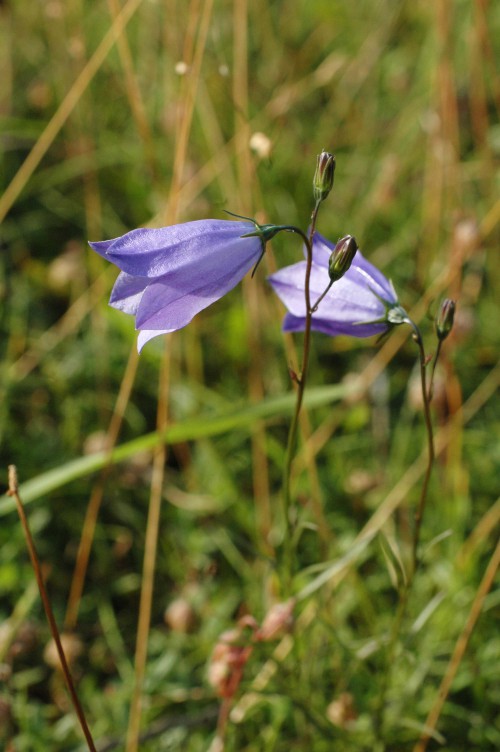
One of my favourite wildflowers, the Harebell is in fresh full bloom now. Sometimes they find themselves growing in goups, caught up amongst long grass stems where they grow longer stems to reach the open air.

Harebells in long grass

Harebells in long grass

I love to see them best growing from shorter turf, their beautiful blue bells held aloft on sturdy wiry stems where they can turn towards the sun and nod and wave freely in the breeze.

Harebell- Campanula rotundifolia

Harebell- Campanula rotundifolia

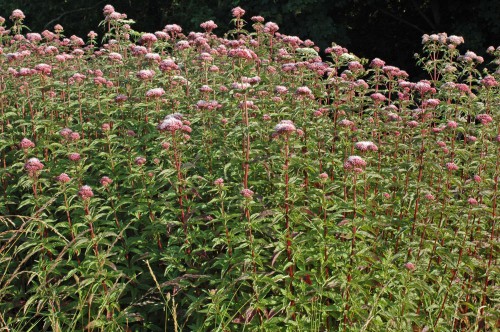
An important summer nectar flower, Hemp Agrimony, whose dusky pink flowers are relished by some species of butterflies is also blooming now. The impressive stand of it in my photograph was in shade this evening, so no visitors; I’ll have to come back earlier on a sunny day.

An impressive stand of Hemp Agrimony

An impressive stand of Hemp Agrimony

While some plants are at the peak of their flowering, others are already beginning to produce their fruits. I mentioned blackberries earlier, which are just beginning to form, but there are wild-growing raspberries here that are perfectly ripe. I couldn’t resist picking and eating a few; sorry birds.

Wild raspberries

Wild raspberries

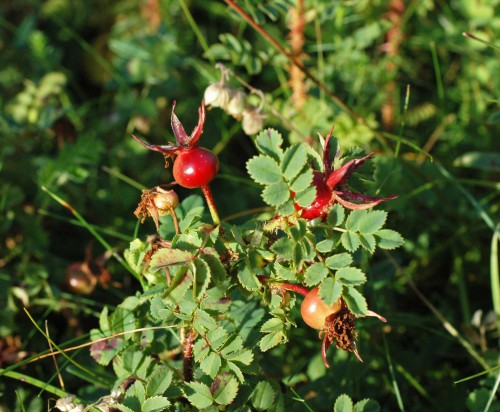
The hips on the Burnet Roses are formingly nicely, already a good size and red in colour, they will get bigger yet and turn black.

Burnet Rose hips forming

Burnet Rose hips forming

There are tiny acorns on the oak trees too.

Tiny acorns forming on the oak trees

Tiny acorns forming on the oak trees

And the Rowan trees have ripening berries.

Ripening Rowan berries

Ripening Rowan berries

Back into the woods for a short while and its very quiet, although I have heard a Chiffchaff as I’ve been walking around and disturbed a young Robin where it was pecking around on the damp earth of the track. Emerging back into the sunshine onto the grassy hillside I also disturbed a rabbit that raced off up the steep hill in front of me. I watched its white cotton tail bobbing away and envying the effortless way it bounded up there. There are a lot of rabbits here that do a great job of grass-keeping in certain areas, but you don’t see them often.

Run, rabbit

Run, rabbit

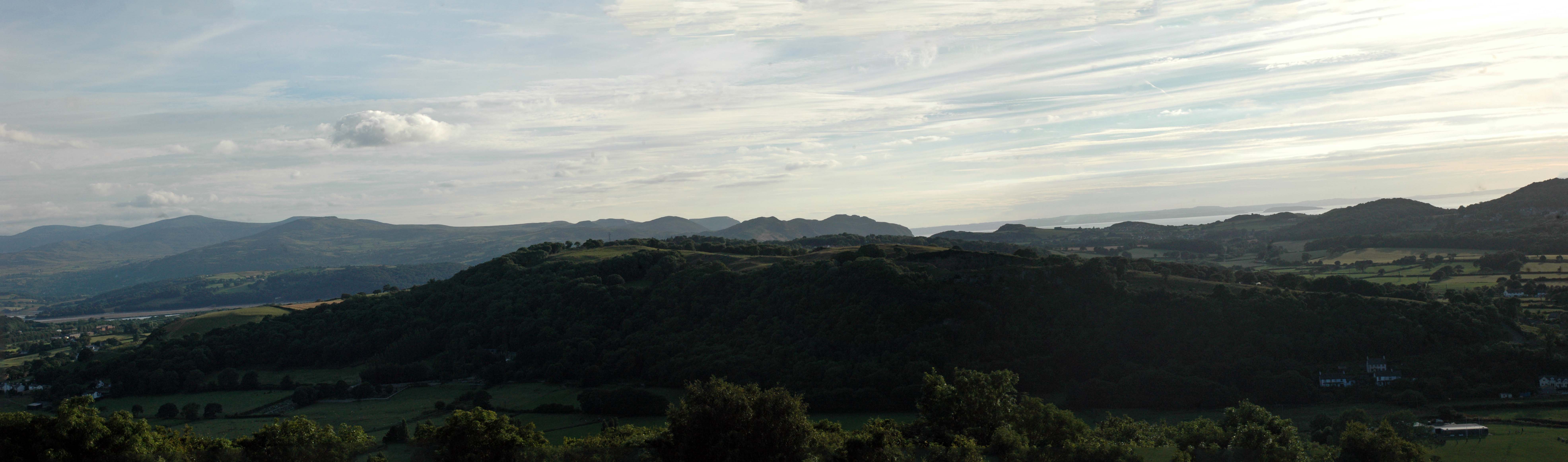
Almost at the top of the hill I stopped to gaze at the view as I always do. That’s not just to catch my breath, although it helps, but it’s a stunning view whatever time of day or year you’re admiring it. I love it when as now the sun is lower in the sky and shadows sculpt the hills. The sky was particularly interesting this evening too.

Evening panorama from Bryn Euryn. (click on image for a better view)

Evening panorama from Bryn Euryn. (click on image for a better view)

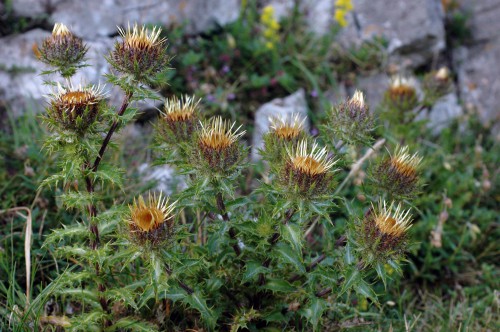
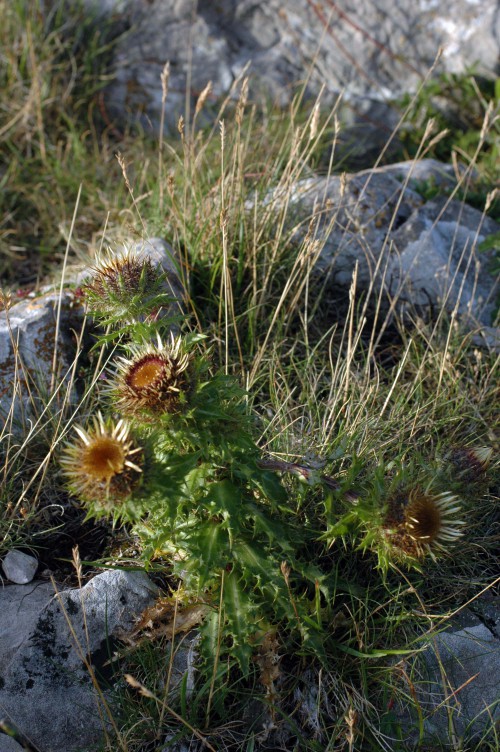
On the rockier summit of the hill, where the soil is thinner and more calcareous, the fascinating Carline thistle thrives. For much of the year you can see the dried out remains of the leaves and flowers, but now is the time to catch it coming into full curious flower. I will go into more detail about this plant in a later post.

Carline thistles growing amongst rocks

Carline thistle growing amongst rocks

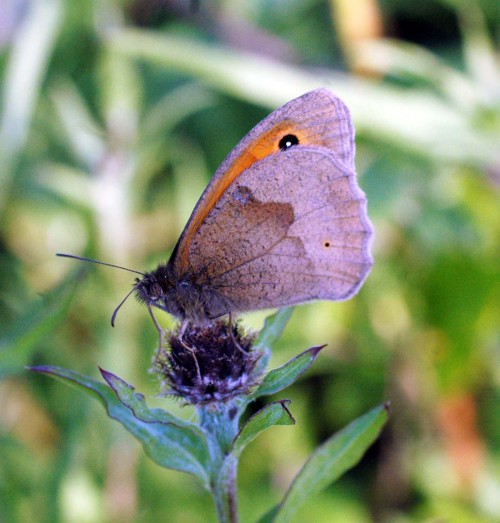
I had seen a few butterflies during the course of my walk, all fluttering around in the long grass. There were a few Small Heaths, but most were Meadow Browns. Just as I was heading back towards a woodland path to head back to the car, this one fluttered into view and landed on the tight bud of a knapweed flower. I was really pleased, as although this is an abundant species here, they are rarely this obliging and views such as this are not often offered.

Meadow Brown butterfly on the bud of a knapweed

Meadow Brown butterfly on the bud of a knapweed


Share this:

  • Share on Facebook (Opens in new window) Facebook
  • Share on Pinterest (Opens in new window) Pinterest
  • Share on X (Opens in new window) X
Like Loading...

Burnet Rose- Rosa pimpinellifolia

28 Wednesday May 2014

Posted by theresagreen in Bryn Euryn Nature Reserve, bumblebees, coastal habitat, Nature, Nature of Wales, nature photography, Wildflowers of Wales

≈ 2 Comments

Tags

burnet rose, low-growing white rose, Phragmidium rosa-pimpinellifoliae, rosa pimpinellifolia

Family: Rosaceae Other English name: Pimpinell Rose Welsh name: Rhosyn Dewi (Rhosyn y Twyni) Irish name: Briúlán

There is a glorious stretch of these lovely and very prickly roses on Bryn Euryn that are fully in flower now.

Beautiful Burnet Roses

Beautiful Burnet Roses

The Burnet Rose is a low-growing species, largely confined to dry sandy places near the sea; it is particularly abundant on dune systems in South Wales. Inland it may be found in calcareous areas, generally chalk downland or limestone pavement.

 Its natural distribution is limited to Europe and Asia except for part of the Atlas Mountain Range in North Africa.

A prickly stem full of blooms

A prickly stem full of blooms


It is a rather low erect deciduous plant usually growing to 20–140 cm high but it can sometimes reach up to 2 metres.

The plant spreads by suckers and can cover large areas. The stems are protected by numerous stiff bristles and many sharp straight prickles. The young stems and prickles and the mature leaves tend to be very red with young growth a bright scarlet and older growth a deep maroon.

 ‘Some people are always grumbling because roses have thorns. I am thankful that thorns have roses’.

  Alphonse Karr (1808-1890)

Burnet Rose

Burnet Rose

The flowers are cream-white although rarely also pale pink and are 2–4 cm in diameter with five petals. prominent golden stamens and they have the sweetest, most delicious scent of any of native roses.

Popular with bumblebees

Visited by bumblebees

Bumblebees seem to love them, perhaps because they do have a hint of honey in their scent.

This small bumblebee was enjoying a really good rummage around

This small bumblebee was enjoying a really good rummage around

Soon the petals fall off the roses but the stamens look pretty too. The leaves are small and oval, very like those of the salad burnet (hence the name).

Without petals

Without petals

And later in the year there will be a crop of  distinctive globular dark purple to black hips.

Rust fungus on Burnet Rose stem

Rust fungus on Burnet Rose stem

A brilliant-orange rust fungus Phragmidium rosa-pimpinellifoliae is also common on the plants.

The plant’s names 

R. spinosissima (pimpinellifolia) has been known by many different local names and it has attracted its own folklore. In some places, people have given it a vernacular name based on the resemblance of the leaves to a Burnet (Sanguisorba ) and therefore, for example, called it the Burnet or Pimpinell Rose in English or Rose Pimprenelle in French. In other places, it was the prickly stems that caused it to be known as Bodicasti Sipek in Slovenia, for example, or Piikkiruusu in Finland. 

Burnet Rose growing alongside the related Salad Burnet

Burnet Rose growing alongside the related Salad Burnet on Bryn Euryn

In Iceland, it has the name pyrinros which literally means ‘Thorny Rose’ but the same Icelandic word means ‘Sleeping Beauty’ and may refer to its early flowering – the beautiful rose waking up after the long dark Icelandic winter! In Norway, this rose is called ‘Trollnype’ – associating it with the trolls of Norwegian folklore. Elsewhere, it is named after the coastal sand-dunes where it grows so, for example, it is Klitrose in Denmark,Duinroos in The Netherlands or Dünen Rose in Germany.

Medicinal uses

The plant  was initially grown in gardens for its herbal properties and it was one of the first roses described and illustrated in 16th  century herbals of Northern Europe. Its hips and leaves have been used to make a tea and, in some places (particularly Denmark) a liqueur is still made from its hips. In recent years, it has been the subject of intense research to investigate its special pharmaceutical properties. The chemical constituents have recently been summarised by Mayland-Quellhorst et al (2012). Its dark purple or black ‘fruits’ (heps) are high in vitamins and antioxidants.

(Extracts from: Rosa spinosissima – aspects of its natural history and associations with people from prehistory to the present day ) by Peter D. A. Boyd


Share this:

  • Share on Facebook (Opens in new window) Facebook
  • Share on Pinterest (Opens in new window) Pinterest
  • Share on X (Opens in new window) X
Like Loading...

Of Gorse, Furze or Whin

02 Sunday Feb 2014

Posted by theresagreen in Nature of Wales, nature photography, Wildflowers of Wales

≈ 11 Comments

Tags

ant disperal of seeds, furze, gorse, Gorse Mill, myrmecochory, shelduck, St.Fagans National Museum, stonechat, traditional uses of gorse, ulex europaea, whin

By whichever name you know it, this prickly shrub smothered in sunshine-yellow blossom is an iconic plant of commonland and rough open spaces, and wherever it grows in quantity it is one of our great landscape plants.

Golden gorse in bloom against a background of blue sea

Golden gorse in bloom against a background of blue sea

“When gorse is in blossom kissing’s in season”  or  “when furze is out of bloom, kissing’s out of fashion” is a traditional saying that once would have been know, one way or the other, throughout Britain and Ireland. Either way, it is another way of saying that the plant can be found flowering to some extent in all months of the year. This is because, with the exception of Scotland, most gorse colonies are a mixture of common gorse – ulex europaea (in flower chiefly from January to June, though often sporadically throughout the year) and either western gorse (July to November) or, in the south and east of England, dwarf gorse (also July to November), so the the likelihood is that at least one species will be in flower.

April-Flowers, spines and the beginnings of seed pods

April-Flowers, spines and the beginnings of seed pods

Gorse is a most sensory plant – the flowers smell deliciously of creamy coconut and the seed pods’ pop and crackle in hot sunshine, but it’s so well protected by those potent spines it’s best admired from a respectful distance.

Common name: Gorse, furze or whin Scientific name: Ulex Europaea Welsh name:Eithinen Ffrengig: Family group: Fabaceae

Flowers of Common Gorse - Ulex Europaea

Flowers of Common Gorse – Ulex Europaea

Common gorse is the only species native to much of western Europe, where it grows in sunny sites, usually on dry, sandy soils. It is also the largest species, reaching 2–3 metres (7–10 ft) in height.

The 15-20mm long flowers, with their wonderful aroma of coconut, are borne on stems of spiny bluish-green spikes. The leaves have been modified over centuries into rigid and furrowed thorns which withstand the harsh conditions of winters at higher altitudes, making the entire bush one mass of prickles and spines. In North Wales these shrubs form hedgerows around our fields, they line our country roads and particularly from February to May, when the flowers are their most abundant, they are a spectacular sight.

Pollination 

Whether gorse flowers supply nectar is a subject of debate, although the opinion of careful observers is that they do at certain times. However, it is for pollen that the plant is mainly of value to Beekeepers.This is produced in abundance and is bright yellow or orange in colour, assuming the darker or duller shade in the bees’ pollen baskets, but bees commonly forsake gorse once other flowers become available.

The spines protect the plant from being eaten

The spines protect the plant from being eaten

The visual intensity of a gorse-dominated heath or common can be dramatic. The pioneering naturalist Carl Linnaeus saw gorse in bloom on London’s Putney Heath whilst on a visit to England. He was reported to have fallen to his knees and wept for joy when he beheld the sight of the heath adorned with its fine yellow flowers. He had tried unsuccessfully to grow gorse in his greenhouse in Uppsala in Sweden, but the winters proved too cold.
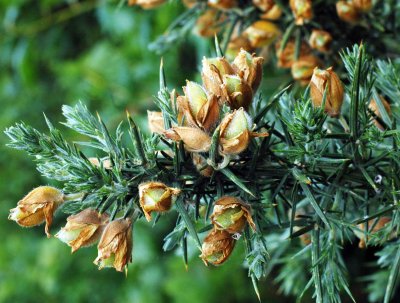
Gorse fruits forming

Gorse fruits forming

The popping, or crackling sound of the gorse plants’ seed pods, as they split to scatter their seeds, is a familiar sound on hot summer days.

Gorse seed-pods

Gorse seed-pods cracking open on a hot summer’s day

Seed dispersal: Most gorse seeds fall directly beneath the parent plant, although some are dispersed through the action of the dehiscent pods, which can eject seeds up to 16 feet (5 m) from the parent plant.Gorse seed dispersal over intermediate distances may be attributable to insects, animals, birds and possibly wind gusts. Most fascinatingly though, is the plant’s interaction with ants.

Ant dispersal of gorse seeds

Myrmecochory (sometimes “Myrmechory“); from Greek myrmeco-: “ant’s” + -chory: “dispersal”) is seed dispersal by ants, an ecologically significant ant-plant interaction with worldwide distribution.

Dwarf gorse growing amongst heather on the Great Orme

Dwarf gorse -Ulex Minor, growing amongst heather on the Great Orme

Gorse is known to be a myrmechochorous plant, meaning that ants assist seed dispersal. The following is an extract from research by the Centre for Ecology & Hydrology:

Dwarf gorse Ulex minor seeds have a small food body, called an elaiosome, which attracts ants of certain species. These ants pick up the seed and take it back to the nest, where the elaiosome is removed and eaten and the seed is then discarded. As well as dispersing the seed, this behaviour may place the seed in improved conditions for germination and seedling establishment. Our work on this system has involved observing and measuring dispersal in the field and studying the chemical ecology of the ant-seed interaction. The latter has shown for the first time that the elaiosome produces a chemical which attracts ants from a distance. http://www.ceh.ac.uk/index.html

ECOLOGY

Patches of gorse are important in both heath and coastal areas, although it may be desirable to control the extent of spread where it excludes other species.
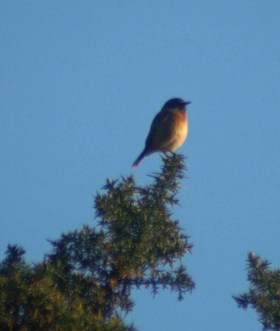
14/1/12 Stonechat - Saxicola torquata perched on gorse-Little Orme

14/1/12 Stonechat – Saxicola torquata  (f) perched on gorse-Little Orme

Gorse is a valuable plant for wildlife, providing dense thorny cover ideal for protecting birds’ nesting and feeding sites, and providing shelter for birds and other animals moving through the countryside.  In Britain, France and Ireland, it is particularly noted for supporting Dartford Warbler (Sylvia undata), Stonechat (Saxicola rubicola), Linnet () and Yellowhammer () and the common name of the Whinchat (Saxicola rubetra) attests to its close association with gorse. The flowers are eaten by some species of moths. 

Gorse provides important habitat for other animals and plants too, including uncommon ones such as dodder, a ‘hemi-parasite’ that grows on gorse foliage. Reptiles such as common lizard, sand lizard, smooth snake, and adder, all favour gorse-dominated environments.

Shelduck are known as furze,or gorse duck in Welsh

In Wales, once Shelduck have paired in the spring they move away from water to the hills, where they search out a large rabbit hole for a nest.

Often these lie beneath old gorse bushes – hence the shelduck’s Welsh name, Hwyaden yr Eithin: the furze or gorse duck.

“Wild Gorse: history, conservation, and management

“It is clear that gorse and its relatives were widely used and often deliberately cultivated until very recently. Now however, the furze fields and the gorse commons lie neglected and abandoned a forgotten artefact of our cultural history. As the plants degenerate through age and a lack of management, natural capacity for regeneration declines.” Ian D. Rotherham, Sheffield Hallam University. 

TRADITIONAL USES OF GORSE

Gorse has a long history of use in the areas of the country where it grows most prolifically and in many areas it was deliberately cultivated as a crop for animal food and as fuel.

Gorse-Bryn Euryn

Gorse-Bryn Euryn

Many places up and down the country refer to the presence of gorse. On Exmoor, where the plant is known locally as furze, it gave rise to Furzebury Brake and Furzehill Common. Most hill farms have their furze break, i.e. gorse-covered hill. In Wales, where place names in Welsh are made up of elements, any place name containing ‘eithin’, the Welsh word for gorse will indicate the plant’s significance there. 

 The importance of gorse for heating ovens for baking is a tradition widely recorded across Britain. The gorse burns rapidly and hot, quickly raising the temperature of the oven to a suitably high temperature. Importantly the gorse produces very little ash, and this is raked out as the bread is placed into the oven. For bread in early times, it was the custom to cut off the base and the four side-crusts to remove the ash that became embedded in the bread.

On commonland there were quite strict rules about when and how much gorse could be cut for fuel: ‘In Cumnor, Oxfordshire, under the 1820 Enclosure Award, parishioners had the right to go to Cumnor Hurst to cut gorse and broom (for burning, often in bread ovens due to the fierce heat) but they were allowed only as much as they could carry on their backs.’
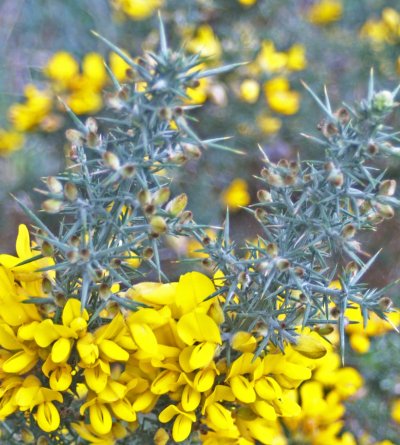
A closer look at those spines

A closer look at those spines

GORSE MILLS

Gorse is highly nutritious; hence its armament of sharp prickles to ward off herbivores. The leaves are generally only eaten in situ in the spring when young and tender. However, the plant was grown to be cut and crushed for winter fodder for horses and cattle. It was used particularly in areas with extensive heath and common, but was also deliberately seeded into areas as a crop to be harvested. In Wales, special mills were constructed to grind down the cut gorse into a moss-like consistency.

‘In Wales many farmers remember gorse mills, and how important a food gorse was, especially for horses. Fields were devoted to growing gorse as a crop, and at least one smallholder in Anglesey made his living cutting gorse for other farmers, at five shillings an acre.” Flora Brittanica, Richard Mabey

There is a reconstructed Gorse Mill at St. Fagans National History Museum, near Cardiff.  I surely passed it by on the several occasions I have visited this genuinely fascinating place, usually in the rain, both with my own children and whilst accompanying parties of small schoolchildren. I can’t say that I remember it, but that was a good few years ago.  

Exterior view of the Gorse Mill  at St Fagans National History Museum

Exterior view of the Gorse Mill at St Fagans National History Museum

A small, stone-built mill (built mid-1840s) that was used to prepare gorse for feeding to horses. From the 18th century to the end of the Second World War, most Welsh farmers used horses to carry out the work of the farm. Because of this it was important to feed horses well, and gorse was an important part of their diet. It was specially grown on a large scale but had to be bruised or crushed to make it fit to eat.

The gorse crushing machine, with heavy metal spikes fixed to the axle, was located on the ground floor and was driven directly off the waterwheel. By about 1850, however, most such mills had been replaced by lighter and cheaper hand-operated or oil-powered machines.

DOMESTIC USES

Folk interviewed by Richard Mabey for his Flora Britannica  recalled the following uses for gorse:

‘Gorse & heather were bound together to make besom brooms, which were then tied with the same jute string used for binding straw bales.’ (Whitby)

“ Some local gardeners place chopped gorse or “fuzz” over germinating or emerging peas to deter mice and pigeons” (Plymouth, also Ashridge).

The ashes of burned Gorse are rich in alkali, and they were formerly sometimes used for washing, either in the form of a solution or lye, or mixed with clay and made into balls, as a substitute for soap.

Another association with washing is that many people used to like to grow a few Gorse bushes near their homesteads, so they could lay their washing on the thorny branches without fear of it blowing away.

Gorse flowers were also used to make wine & a yellow dye.

DYES 

Gorse Dye Recipe from “A Diary of a West Cork Dyer” by Kate Jepson 

16oz Gorse petals, 8 oz wool, 2oz alum, ½ cream of tartar

Soak the petals for two hours. While petals are soaking mordant the wool the same way as for the onionskin dyebath, and allow to cool. Bring petals to simmering point over one hour, and simmer for one hour, drain off liquor and add mordanted wool, bring to simmering and simmer for one hour without letting the dyepan boil. Rinse wool well in water until it runs clear, wash and hang to dry in an airy place. (yellows)

Gorse in popular culture

PERFUME

If you love the scent of gorse as much as I do, you may be interested to know that the monks of Caldy Island (an isle just off the coast near Tenby in South Pembrokeshire), who are reknowned worldwide for producing the very best lavender perfume, also produce a perfume from gorse flowers called ‘Island Gorse’. (To me it doesn’t smell exactly like the flowers do in the wild, somehow it’s not quite coconutty enough (sorry, it must be the aromatherapist in me) but I love it and wear it anyway.)

LITERATURE

There are numerous references to Gorse in modern literature from the misadventures of Winnie the Pooh to Lord of the Rings, but most evocatively in Thomas Hardy’s novel The Return of the Native. When Clym is partially blinded through excessive reading, he becomes a furze-cutter on Egdon Heath, much to the dismay of his wife, Eustacia. The timeless, gorse-covered heath is described in each season of the novel’s year-and-a-day timeline and becomes symbolic of the greater nature of mankind.

George Meredith (1828–1909) caught the essence of the plant in the great gorse stanza in ‘Juggling Jerry’, where he described an old man relishing familiar scenes and scents:

Yonder came smell of the gorse, so nutty,

  Gold-like and warm; it’s the prime of May.

Better than mortar, brick and putty,

  Is God’s house on a blowing day.

Lean me more up on the mound; now I feel it;

  All the old heath-smells! Ain’t it strange?

There’s the world laughing, as if to conceal it,

  But he’s by us, juggling the change.

  From more recent times, I love this report:

Rescued – after two days in gorse bush

• Martin Wainwright, The Guardian -Wednesday 10 August 2005 00.05 BST

An RAF helicopter was scrambled early yesterday to rescue a man who had been stuck in a gorse bush for two days. Winchman Colin Yorke was lowered through thorns into a small opening in the bush on a Yorkshire sea cliff, to attach a cable to the man, who was suffering from hypothermia. He had failed to catch anyone’s attention until shortly before dawn yesterday, after tumbling into the bush on Sunday morning. North Yorkshire police said he managed to alert a woman out on an early walk by repeatedly clicking his cigarette lighter.
A North Yorkshire police spokesman said they received a call at 3.50am on Tuesday.
“The lady who called said he had been there for several hours, but could not give a reason as to why he could not get out,” the spokesman said.
Sergeant Yorke said that the curious operation was “certainly one of our stranger rescues”. His helicopter was dispatched from RAF Leconfield near Beverley, in east Yorkshire, after coastguards and fire officers decided that winching was the safest way out.
“The patch of gorse he was in was 10 feet deep,” said Sgt Yorke, 38, who has been in the RAF for 21 years. “We’ve no idea how he got there. He was right in the middle of the gorse. When we arrived we could just see this hand poking out above the top of the bush. It was like he had been dropped there by a spaceship.”
The man has not been named but is 32 and was described as “a well-known local character” from Hunmanby, near Primrose Valley on the edge of Filey, where he got stuck. Sgt Yorke said: “He had no idea how he got there but he had apparently been out on Saturday night consuming various substances.”
The man was taken to Scarborough hospital and treated for hypothermia and dehydration after telling the helicopter crew that he had no feeling from the waist down. Sgt Yorke said: “He was out if it, really.”
Coastguards and police are looking for a mountain bike which the man recalls riding, and which may have catapulted him in the dark into the middle of the bush.
Share this:

  • Share on Facebook (Opens in new window) Facebook
  • Share on Pinterest (Opens in new window) Pinterest
  • Share on X (Opens in new window) X
Like Loading...
Pretty prickly Thistles

05 Monday Aug 2013

Posted by theresagreen in bumblebees, flower folklore, flower mythology, Nature of Wales, nature photography, plants important to wilflife, wasps, Wildflowers of Wales

≈ 14 Comments

Tags

carduelis carduelis, cirsium arvensis, cirsium vulgare, creeping thistle, Goldfinch, scotch thistle, spear thistle, thistle folklore and mythology

Thistle is the common name of a group of flowering plants typically characterised by leaves bordered with sharp prickles, mostly belonging to the family Asteraceae.  Prickles or spines are not always confined to the margins of leaves, often occurring all over the plant on surfaces such as those of the stem and the flat parts of leaves. These are a defensive adaptation that protects the plant from being eaten by most herbivorous animals.
From an agriculturalist’s point of view, the most common thistles are regarded at best as troublesome weeds and at worst as noxious ones. However, ecologically, the leaves of some species provide a valuable food source to the larvae of a number of lepidopterae species and he flowerheads supply pollen and nectar to an array of adult insect species. Thistle seeds are a favoured food of many members of the finch family Fringillidae, whose genus name, Carduelis, is derived from carduus, the Latin name for thistle and includes goldfinch, greenfinch and linnet.

1- SPEAR THISTLE – Cirsium vulgare

Family: Asteraceae; Flowering: July to September; Habitat: Disturbed and cultivated land such as pastures, meadows, roadsides, arable fields, gardens, brownfield sites and waste ground.

A widespread and common thistle, the Spear Thistle has the classic thistle appearance – purple, fluffy-looking flowers sitting atop a spiny ball and may well have given rise to the Scottish national emblem. As with other thistles, it can become a nuisance on agricultural land and is often considered to be a weed. The spear thistle is usually a biennial plant although the leaf rosettes can survive as long as 4 years before finally flowering. This robust thistle can reach between half and over a metre in height under favourable conditions. The plant is often solitary.

Spear Thistle flowerbud,flowerhead and leaf

Spear thistle

The flowers are lilac or magenta and are larger than creeping or marsh thistle flowers, reaching up to 4 cms in diameter. Stems are winged and spiny. The leaves are spear-shaped, pinnately-lobed and spiny and give the plant its common name. The upper surface ranges from dark green to light grey. The under surface is green. The leaves are waxy and end in sharp “spear-like” prickles which are tipped with yellow.

Spear Thistle flower buds surrounded by yellow-tipped spines

Spear Thistle flower buds surrounded by yellow-tipped spines

The average number of seeds per flower head is around 100 but there can be up to 340. Seed production per plant may vary from 1,600 to 8,400 seeds. More seeds are produced when ample soil moisture is available during the growing season. Seeds are mostly dispersed during August and September.

Spear thistle seeds

Spear thistle seeds

Spear thistle spreads only by seed. Unlike creeping thistle (C. arvense), the feathery pappus remains attached firmly to the seed as an aid to wind dispersal. Most seed is dispersed less than 2 m from the parent plant and only 10% travel more that 32 m after reaching higher air currents.

Single spear thistle seed

Single spear thistle seed

Ecology

Thistle flowers are amongst the favourite nectar sources of the Pearl-bordered Fritillary, Small Pearl-bordered Fritillary, High Brown Fritillary, and Dark Green Fritillary butterflies.

The seeds are attractive to ants that may aid their dispersal and also to finches, particularly goldfinches and linnets.

Thistle seeds are a favourite food of the goldfinch

Thistle seeds are a favourite food of the goldfinch

Spear thistle flowerhead providing a safe haven for a tiny spider

Spear thistle flowerhead providing a safe haven for a tiny spider

Scotland’s National Emblem 

This thistle, seen throughout Scotland and the Western Isles has been Scotland’s national emblem for hundreds of years. There are several versions as to how the thistle became Scotland’s symbol, most are set around the reign of Alexander III (1249-1286) and in particular the events surrounding the Battle of Largs in 1263.

At one time, Scotland was part of the Kingdom of Norway although it attracted very little interest until 1263 when King Alexander III proposed to buy back the Western Isles and Kintyre from the Norse King Haakon IV. That provoked King Haakon of Norway and in the late summer of 1263 he set off for the Scottish coast with a large fleet of long ships, intent on conquering the Scots. Gales and fierce storms forced some of the ships onto the beach at Largs in Ayrshire, and a Norwegian force was landed.

Legend has it that at some point during the invasion the Norsemen tried to surprise the sleeping Scottish Clansmen. In order to move more stealthily under the cover of darkness the Norsemen took off their shoes, but as they crept barefoot they came across an area of ground covered in thistles and one of Haakon’s men unfortunately stood on one and shrieked out in pain, thus alerting the Clansmen to the advancing Norsemen. His shout warned the Scots who defeated the Norsemen at the Battle of Largs, thus saving Scotland from invasion. The important role that the thistle had played was recognised and so was chosen as Scotland’s national emblem.

The Order of The Thistle

In 1470 that King James III ordered that the image of this plant’s flower be placed on silver coins and also then a little later In 1540, King James V established the Order of the Thistle, a high chivalric order of Scotland. He and his 12 knights each wore a badge depicting a star, a thistle and the words “no one harms me without punishment.”

Today the thistle is found in many Scottish symbols and is used as part of the name of several Scottish football clubs. The thistle, crowned with the Scottish crown, was the symbol of seven of the eight former Scottish Police Services (from which a new national Police Service was formed in 2013), the sole exception being the former Northern Constabulary. The thistle is also the emblem of Encyclopaedia Britannica, which originated in Edinburgh, Scotland.

The Thistle is also used to symbolise connections with Scotland overseas. In Canada, it is one of the four floral emblems on the flag of Montreal; in the United States, Carnegie Mellon University features the thistle in its crest in honor of the Scottish heritage of its founder, Andrew Carnegie.

________________________________________________________

2 – CREEPING THISTLE – Cirsium arvense 

Family: Asteraceae; Flowering: June to October; Habitat: rough grassy places : pastures, meadows, roadsides, arable fields, gardens, brownfield sites and waste ground.

Creeping Thistle is a native, perennial, rhizomatous herb, which forms extensive spreading patches and grows up to 2m+ in height. It is one of our most widespread and troublesome weeds and is listed as a noxious weed in Britain under the 1959 Weeds Act, although to little effect. It appears resistant to herbicides and readily regenerates from rhizome fragments caused by ploughing. It is also a very valuable source of nectar, pollen and seed food for many insect specicies.

Flowerheads of Creeping Thistle-Cirsium arvensis

Female flowerbuds are oval  in shape

Flowerheads are pale lilac in colour and up to 2cm across. Female flower buds are oval in shape; male flower buds are slightly more spherical. Bracts are purplish with spreading spiny points. Stems are smooth and spineless. Leaves are very spiny, stiff and wavy.

Pollination

The male flowers produce abundant pollen. The fragrant female flowers are insect pollinated but the pollinators may only visit one type of flower.

Bumblebee on male flowerheads

Bumblebee on male flowerheads which are rounder in shape than female ones

The time from flowering to seeds becoming viable is around 8-10 days. Seeds ripen from June to September and are shed from August onwards. There may be 20 to 200 seeds in each flower head and an average of 680 seeds per stem. The seed number per plant ranges from 1,600 to 50,000.

Creeping thistle plant gone to seed

Creeping thistle plant gone to seed

The seeds are 4–5 mm long, with a feathery pappus which assists in wind dispersal

The seeds are 4–5 mm long, with a feathery pappus which assists in wind dispersal

Ecology

Creeping Thistle foliage is used as a food by over 20 species of Lepidoptera, including the Painted Lady butterfly and the Engrailed, a species of moth, and several species of aphids. The flowerheads provide nectar and pollen for a wide variety of insects.

30/6/13 - cuckoo spit on creeping thistle

30/6/13 – cuckoo spit on creeping thistle

12/7/13-Creeping thistle stem covered with aphids- food for the 7-spot ladybird

12/7/13-Creeping thistle stem covered with aphids- potential food for the 7-spot ladybird

21/7/13-Meadow Brown butterfly on creeping thistle flowers

21/7/13-Meadow Brown butterfly on creeping thistle flowers

11/08/28-wall mason wasps on creeping thistle flower

11/08/28-wall mason wasps on creeping thistle flower

6-spot Burnet Moth on creeping thistle

6-spot Burnet Moth on creeping thistle

3- Marsh Thistle – Cirsium palustre

Family: Asteraceae; Flowering: July to September; Habitat:
Wet habitats, woodland clearings, wet ditches and marshes.

A biennial, medium to tall plant reaching to 1.2 metres, stems spiny-winged to the top, sometimes branched above.

Marsh Thistle

Marsh Thistle

Marsh Thistle flowerheads are a darker purple than those of the creeping thistle

Marsh Thistle flowerheads are a darker purple than those of the creeping thistle

Flower buds are oval and bracts are purplish above and green below – sometimes cottony. Flowerheads are usually purple, 10 to 15 mm across and held in clusters of 2 to 8. Florets are reddish purple and anthers are blue-purple. The stem is winged and spiked. Leaves are linear lanceolate, pinnately lobed and very spiny, mostly unstalked, hairy above.

The pappus is slightly feathery.

This species may be confused with the Welted Thistle – Carduus crispus but can be distinguished by its feathery seeds. Welted Thistle has seeds with down that is unbranched.

Share this:

  • Share on Facebook (Opens in new window) Facebook
  • Share on Pinterest (Opens in new window) Pinterest
  • Share on X (Opens in new window) X
Like Loading...
← Older posts
Newer posts →
Follow everyday nature trails on WordPress.com

Enter your email address to follow this blog and receive notifications of new posts by email.

‘But it is the common species that keep the living world ticking over and provide most of our experiences of wildlife, and I would argue that maintaining the abundance of these is as important a conservation priority as maintaining the existence of rarities’. Richard Mabey

MOST RECENT POSTS

  • A Glimpse of Spring to Come January 22, 2025
  • Hunting the Wren December 28, 2024
  • Oh, Christmas Tree December 18, 2024
  • In and Out of the Ivy February 15, 2024
  • Nature’s Fireworks November 30, 2023
  • Wild Autumn along the Coast Path November 3, 2023

OLDER POSTS

LOOKING FOR SOMETHING IN PARTICULAR?

  • Sights and Sounds from the Little Orme 1
    Sights and Sounds from the Little Orme 1
  • Things Bright and Beautiful
    Things Bright and Beautiful
  • Catchers, a Duck and Divers
    Catchers, a Duck and Divers
  • Following a river to a Fairy Glen
    Following a river to a Fairy Glen
  • May Bee Appearing on Ivy near You
    May Bee Appearing on Ivy near You
  • Shades, Sounds and Scents of the Woods
    Shades, Sounds and Scents of the Woods
  • Fine Dining for Crows
    Fine Dining for Crows
  • Butterflies and more rare treats
    Butterflies and more rare treats
  • The Windhover
    The Windhover
  • A Windy Wildflower Trail
    A Windy Wildflower Trail

nightingale trails

The Walk of the Monarch Butterfly-Sendero de la Mariposa Monarca

The Walk of the Monarch Butterfly-Sendero de la Mariposa Monarca

MY WILDFLOWER BLOG: where the wildflowers are

Snowdrop

Snowdrop

most recent posts

Follow everyday nature trails on WordPress.com

Social

  • View teresamaygreen’s profile on Twitter

Enter your email address to follow this blog and receive notifications of new posts by email.

Website Built with WordPress.com.

  • Subscribe Subscribed
    • everyday nature trails
    • Join 359 other subscribers
    • Already have a WordPress.com account? Log in now.
    • everyday nature trails
    • Subscribe Subscribed
    • Sign up
    • Log in
    • Report this content
    • View site in Reader
    • Manage subscriptions
    • Collapse this bar
 

Loading Comments...
 

    %d