• Home
  • about
  • about the photographs
  • Local Nature Reserves
    • Bryn Euryn Local Nature Reserve
    • Mynydd Marian
  • Wales Coast Path
    • Grey Seals in North Wales
    • St.Trillo’s Chapel
    • Wildflowers of North Wales Coastal Paths, Cliffs and Dunes

everyday nature trails

everyday nature trails

Category Archives: Walking Trails

Everlasting Green

10 Sunday Dec 2017

Posted by theresagreen in bird behaviour, Bryn Euryn Nature Reserve, nature of woodlands, North Wales, plants important to wilflife, woodland birds, woodland walks in Wales

≈ 4 Comments

Tags

blackbird behaviour, Certhia familiaris, evergreen ferns, evergreen trees, garrulus glandarius, goldcrest, holly, holly berries, Jay, long-tailed tit, Regulus regulus, sweet chestnut, the importance of ivy, treecreeper, turdus merula

December 3rd-Woodland Path, Bryn Euryn

The deciduous trees of the woodland have for the most part shed their leaves now and they cover the ground in a thick damp carpet, exuding the evocative earthy aroma that characterises this time of the year. Their falling has opened up the overhead canopy, highlighting the evergreen flora that has merged into the background since the Spring.

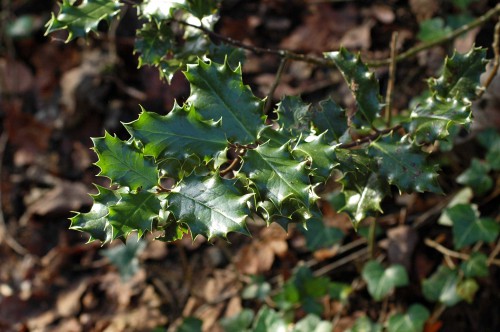
The amount of  permanent greenery always takes me by surprise. Much is in the varying forms of native trees and shrubs; dark dense Yew that fills spaces from the ground upwards, Scot’s Pines with tall trunks and bristly green crowns, glossy spiky Holly, some sprinkled with shiny green berries and of course Ivy, masses of it. There are other non-native residents too, sprawling Laurel being the most evident.

Laurel at the junction of woodland paths

Fallen leaves of sycamore and oak

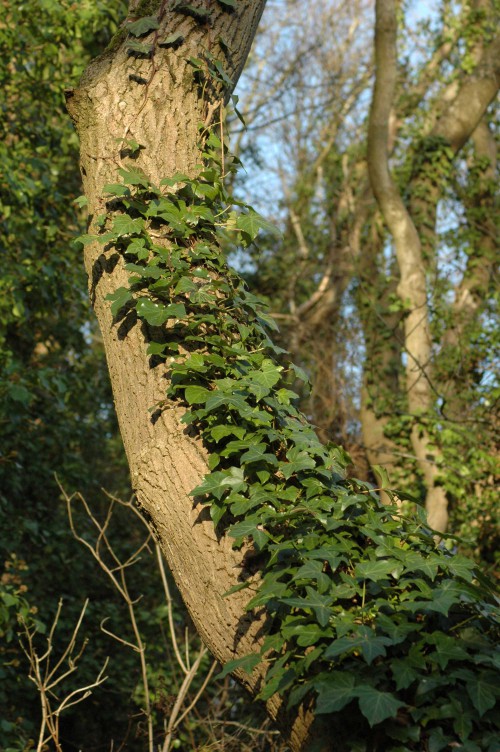
Ivy is a much-maligned native evergreen that was thought to strangle trees as well as spoil their appearance. In the days when this woodland would have been strictly managed it would probably have been regularly stripped away. Now left to its own devices it is without doubt the most dominant of the native evergreens here; scrambling to the tops of even the tallest of trees in its search for light and covering large areas of the understorey too. The benefits of ivy to wildlife are enormous; both its pollen and berries can be an essential source of food for many insects and birds and it provides shelter for invertebrates, birds, small mammals and bats. At this time of year it also gives cover to foraging parties of small birds such as tits and treecreepers whilst they search amongst its stems and leaves for hibernating insects and spiders.
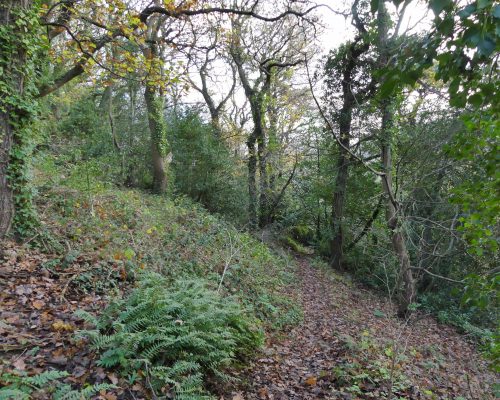
Ivy clambers up almost every tree

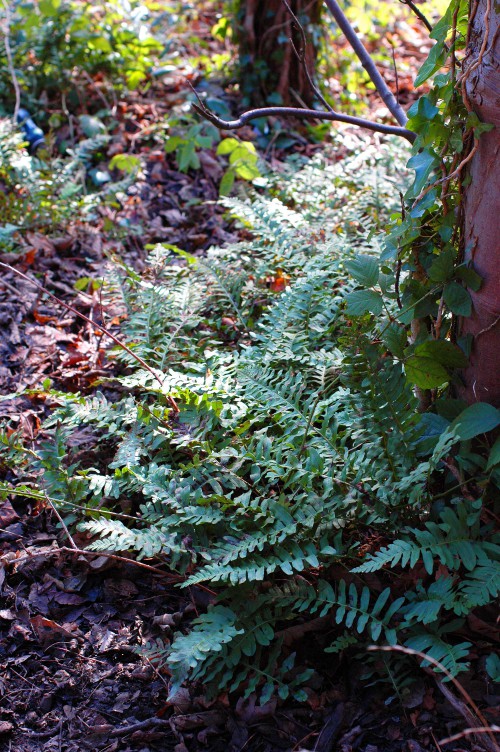
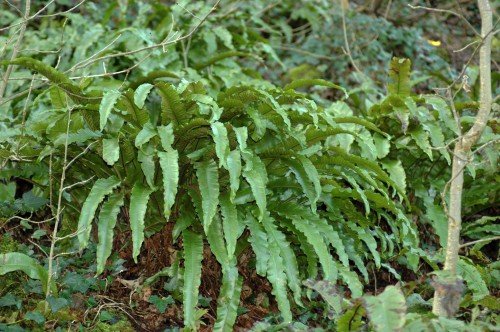
There’s green at ground level too; Polypody and Hart’s Toungue ferns are both evergreen. There are bright green patches of mosses and grey-green lichen is dusted in varying amounts onto most tree trunks and branches.

I love the little ‘scenes’ I find at this time of the year, full of interesting textures,  shapes and forms and coloured in earthy shades of green and brown.  Here the base of an oak tree has bright green moss and grey-green lichen growing on its fissured bark and tendrils of ivy are beginning their climb up. A polypody fern has found a sheltered spot, there’s a tiny new holly plant and the beginnings of a bramble.  

Nearby the fresh green leaves of Alexanders are already showing through the leaf litter.

Without the dressing of leaves the architecture of individual trees is revealed. I must have passed this tree dozens of times as I’ve walked this path but today it caught my attention as the sunlight turned its remaining dried out leaves to coppery gold.

I was unsure of the species of tree; looking upwards I saw it was tall, and also that its trunk and twisted branches appear bleached and much of its covering of bark is missing. Not helpful, but looking properly at the size and shape of the leaves I’m leaning towards Sweet Chestnut, another popularly planted non-native. There’s been no evidence of the prickly chestnuts though, so I’ll have to check to see if it produces flowers next Spring.

Ivy is creeping up the trunk of the tree and it has a backdrop of dense dark green Yew and shiny Holly.
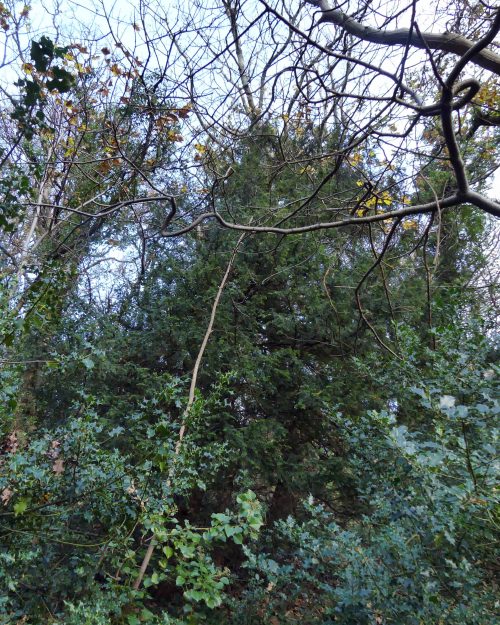
Holly, ivy and yew
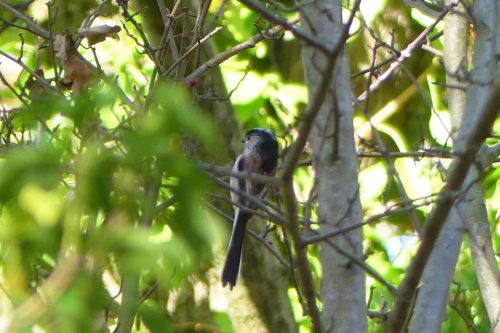
Long-tailed tit

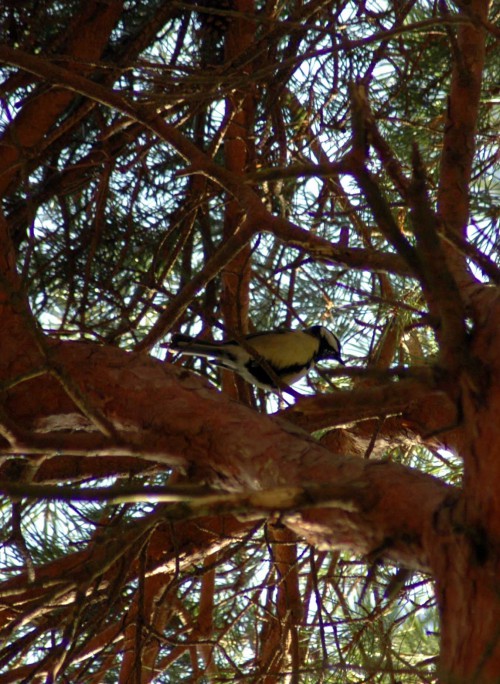
I hear the contact calls of Tits and stand still hoping it means a feeding party are heading my way. It did indeed and now I don’t know where to look first as Long-tailed, Blue and Great Tits swoop and dart around the branches of the nearby trees. Some venture lower down giving me eye-level views. There were less birds in the party than those I saw a few weeks ago, so maybe they’ve split into smaller numbers as the availability of food has diminished. They seem to be travelling faster too, not lingering for long in one spot.

Blue tit

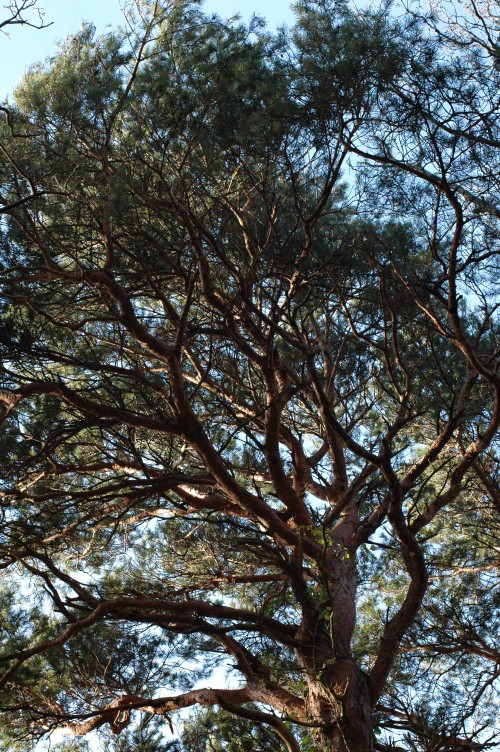
I wasn’t too far from where the Scots pines are gathered. Popular trees with the Tits I wondered if that was where they were headed. The trees are tall and positioned on the edge of the woodland; many have been distorted by exposure to winds and the search for light. With no low branches, their foliage is all on their crowns, so sighting anything as small as a tit is tricky, especially in sunshine. The light is beautiful up there though; I love these upward views of the tree canopy, especially on blue sky days. I’m thinking I would like to see a Coal tit though, haven’t seen one for ages.
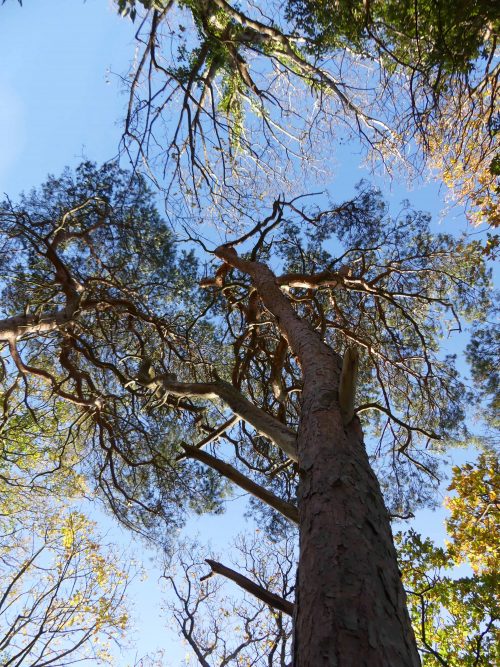
Scots pine

A gathering of Scot’s Pines

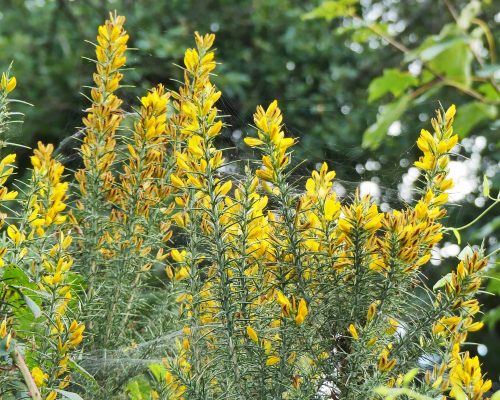
I always stop here and look over the wire fence that marks the boundary of the private woodland and a small field. Trees on its edge although leafless are greened with ivy and gorse, which may well have once been planted as a hedge to contain livestock, has some golden blossom.

The views across the landscape to the Carneddau Mountains on the edge of Snowdonia are ever-changing with the light and the seasons and are always breathtaking.

Woodland Trail

I reach the top of the Woodland Path, and as always take note of the oak tree here at the junction with the Woodland Trail that marks the boundary of the Bryn Euryn Nature Reserve. It still has some leaves clinging on but they are fewer and browner now than a couple of weeks ago.

Oak tree on November 19th
Oak tree on December 3rd

I turn right, then a few metres on turn left onto the narrow unmarked track that leads upwards through the woodland.

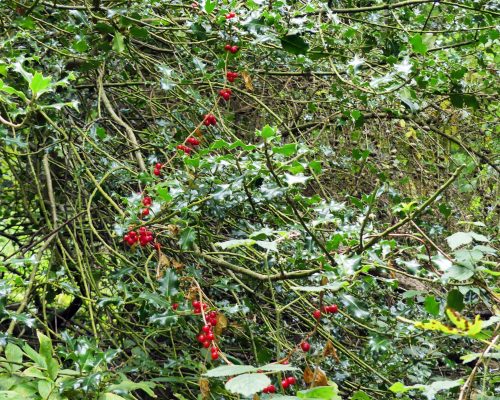
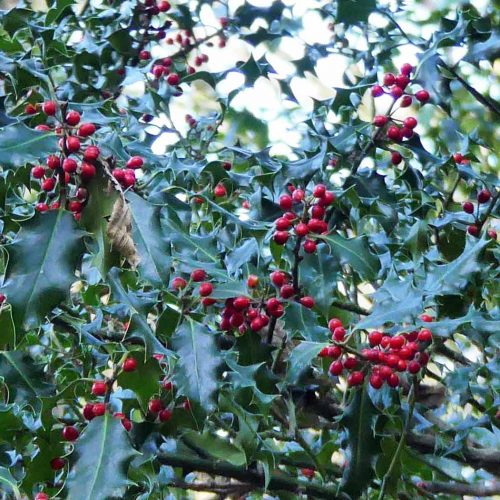
I spot a large holly bush endowed with a generous crop of berries.
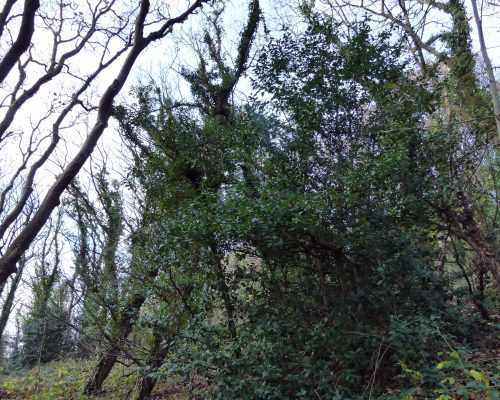
Walking towards it I disturb several Blackbirds from their feasting on the berries on its far side. Confident the hungry birds would come back once they thought the coast was clear, I stopped to wait a short way away, lurking behind a nearby tree.
If you’re looking out for birds, staying still in a likely spot is often more rewarding than any amount of walking and the next few moments bore this out. This part of the wood is favoured by Jays and I heard some screeching to to one another close by. At first I couldn’t locate them, but then saw one progress its way down from a tree to some low vegetation then onto the ground where it began searching for its stash of buried acorns. The green plant in the picture is newly-sprung Dog Mercury.

Brilliant to have such great views of two of these gorgeous and notoriously wary birds. I noticed one of them had what appeared to be an injury to its left side where feathers had been lost; maybe it was from the beak of another bird competing for buried treasure. It seemed OK though and was behaving perfectly normally. Then another treat. The little feeding party I’d seen earlier passed overhead and around me, Long-tailed and Blue tits in tree branches above, then flickering movements in the Holly bush alerted me to the presence of a tiny Goldcrest.

The Goldcrest is Britain’s smallest bird

These tiny jewels of birds, (Britain’s smallest), when on the hunt for insects are constantly moving, flitting deftly through dense foliage, hanging upside down effortlessly and even fluttering frantically to hover like a hummingbird, which must use up a lot of energy. They are delightful and fascinating to watch, but tricky to keep in focus and even trickier to photograph.

A Goldcrest can hover like a hummingbird

Holly is dimorphic, which means it has separate male and female plants, and only female trees bear berries. Traditional country wisdom has it that bountiful crops of berries are a sign of a hard winter to come. More scientific modern reckoning is that it is sign of a good summer past; we certainly had plenty of rain to swell berries this year.  I was surprised that the berries were being taken so early in the season though, I hope it doesn’t mean there’s already a shortage of other food available.

Most of the birds I saw appeared to be juveniles and they do seem to have been taking the fully-ripe berries.

Blackbird-Turdus merula

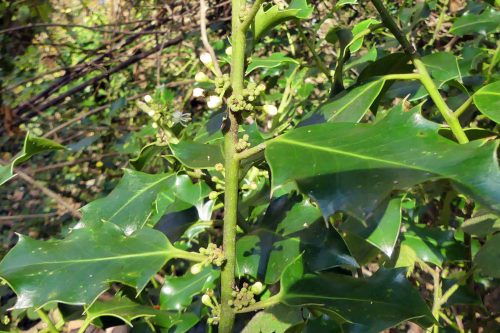
I was also surprised to find flowers on several bushes. They usually come forth around May when they stand a better chance of getting pollinated.
The low sun shines brightly through the trees spotlighting a small spindly tree with golden leaves. Once again I don’t know what species it is but from the size, shape and beautiful colouration of its leaves think it’s fairly safe to say it’s a maple.

“The Holly and the Ivy, Now they are both full grown” …….
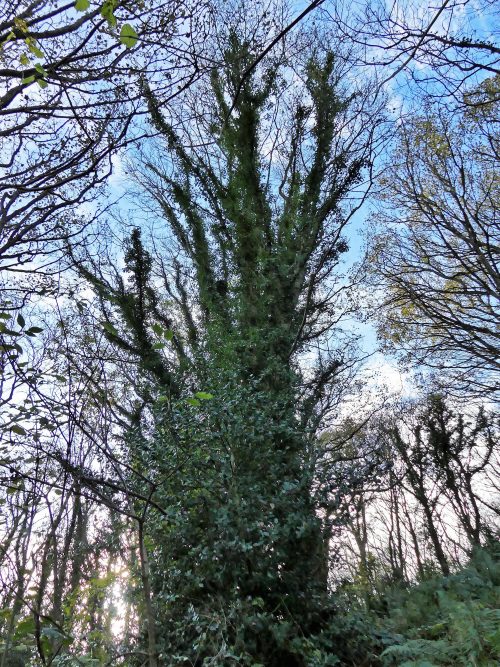
Ivy completely covers a tall tree, Holly in front and a still-green Male fern on the ground

Another interesting little ‘scene’ catches my attention…

I’m never sure about the placement of this commemorative bench. It is weathered, covered with lichen and appears to have been there for decades, but the plaque gives a much more recent date. A reminder how nature is quick to move in given the chance.

It’s a shame the bench doesn’t face the other way as there’s a lovely display of ferns behind it; Hart’s Tongue, Polypody and Male Ferns are there and there’s pretty ferny moss too.

Past the bench the path continues through what I think of as ‘the Dark Wood’. Here the hillside rises steeply upwards on one side and almost as steeply downwards on the other. On the north/north-west side of the Bryn not much sunlight reaches here and there’s a density of Yew trees that also make it seem darker.

A spreading Yew

There are a lot of Silver Birches here too, which you would think would lighten the place up, but at their lower level trunks have darkened and on a few the bark has become strangely thickened and fissured.

From the lower downward slope a mighty tree trunk rises, by far the biggest tree here and that I’ve always assumed was a mighty pine, a Redwood or Sequoia or such-like.
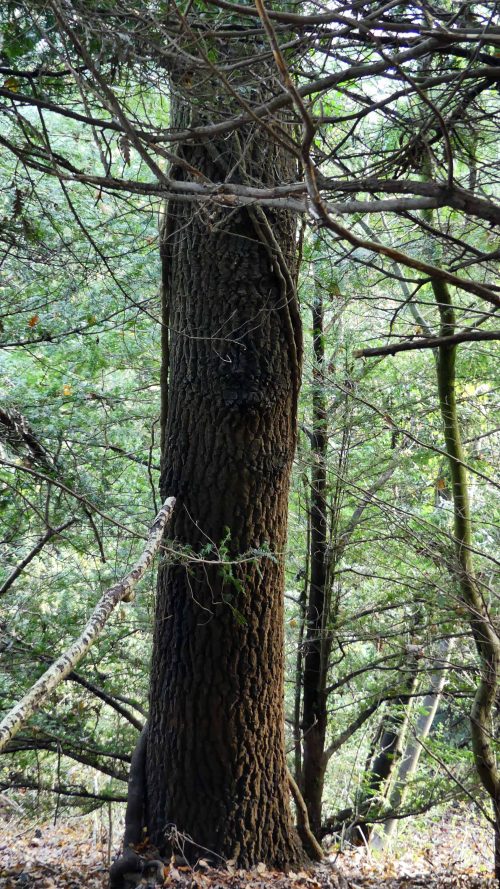
But today I noticed some large fallen leaves that could only have come from it. It would seem then that it’s another Sweet Chestnut, but here a properly magnificent specimen. What a shame to have only restricted views.

On the opposite side of the path a sheer cliff of exposed limestone towers and adds to the atmosphere. I wonder if it was once part of the defences of the ancient hill-fort that was located on the summit.
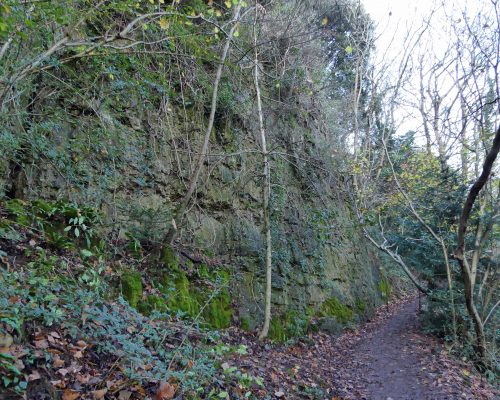
Water often leaks from fissures in the porous rock and moss thrives on its shaded damp surface.

Having a closer look at the moss I found another fern amongst it, a tiny delicate one I’ve not noticed here before; a Maidenhair Spleenwort.

(I’m working on identifying mosses!)
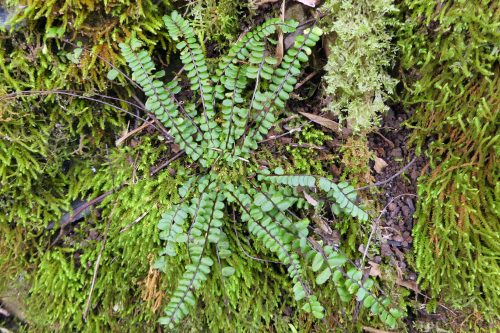
 

Maidenhair spleenwort-Asplenium trichomanes

Past here there are more darkly-ivied trees. Today a movement caught my eye – another sighting of a foraging Goldcrest!
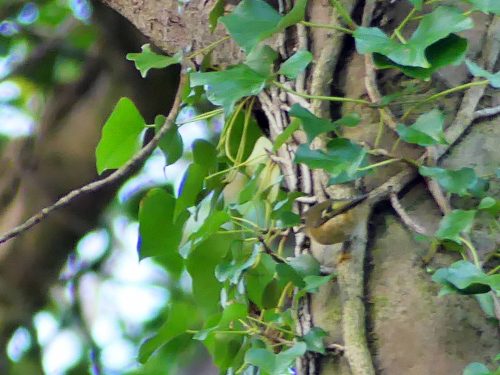
I watched it for what seemed like ages trying to keep it in sight as it flitted from branch-to-trunk-to-branch, in and out of the ivy, now doing its hummingbird impression – and then demonstrating a behaviour I’d read about but never seen; it climbed up the thick ivy stems like a tiny treecreeper. What brilliant little birds they are. I wish I’d had better light for better photographs.

A short way further on you are back out onto the wider brighter more open Woodland Trail.  Going down the wooden steps takes you to the car park, or as I opted, to loop around onto the lower part of the trail to get back to where I started.

As I stood deciding which way to go, one more treat, a Treecreeper making its way up another ivy-clad tree close to the path.

Treecreeper-Certhia familiaris


Share this:

  • Click to share on Facebook (Opens in new window) Facebook
  • Click to share on Pinterest (Opens in new window) Pinterest
  • Click to share on X (Opens in new window) X
Like Loading...

September Woods

22 Friday Sep 2017

Posted by theresagreen in bird behaviour, ferns, Nature of Wales, nature of woodlands, North Wales, woodland birds, woodland walks in Wales

≈ 11 Comments

Tags

black spots on sycamore leaves, Blue tit, grey-green lichen hanging from tree, hart's tongue fern, male fern, Nuthatch

September 8th – Bryn Euryn

Woodland Path

Yet another windy day with intermittent sunshine, so I’m seeking shelter in the woods. It is almost eerily silent and the damp soft earth of the path absorbs the sound of my footsteps. Something detects my presence at the last minute; loud rustling sounds from the undergrowth startle me and a panicked grey squirrel shoots out in front of me, sprints rapidly along the path and launches itself up the trunk of the nearest large tree. It pauses when it feels safely hidden behind foliage, but I spied it through the leaves, its mouth filled with an acorn, still green and unripe.

There are ripe blackberries, but on the early fruiting brambles some are already mouldering, and a feasting greenbottle fly reminds me why I don’t eat too many unwashed wild berries.

Chains of scarlet berries drape shrubbery. This one twined through holly reminded me of a Christmas garland; I wonder if sights such as this sparked the idea for festive decorations?

The berries are those of Black Bryony-Tamus communis, and will continue to ripen until they are black. A perennial plant described as twining, but often it’s more of a scrambler.

Woodland Trail

There are rose hips here

and a bramble whose leaves look as though they are almost ready to drop.

The gorse bushes have fresh golden blossom and clever spiders have spun webs in the hope of capturing flying insects drawn to their nectar and pollen. Gorse flowers throughout most months of the year prompting the old saying, “When gorse is out of flower, Kissing is out of season!”

Summit Trail – backtracking

The last time I walked here I took a slightly different route to the summit of the hill, taking an unmarked track up through the woodland to join the Summit Trail. I hadn’t planned to that, but at the junction of the paths I usually take I’d stopped to try to locate Jays that I’d heard screeching in nearby trees and a man with a dog stopped to ask me what I was looking at. We had an interesting chat comparing notes about what we both see here and where, but I didn’t catch the Jays. I waited to see which way he would go to continue his walk and seeing it was the same way I was headed, decided to go the opposite way. Not that I’m unsociable of course, rather that I see far more on my own and in my own time; and he had a dog! Anyway, the upshot was that I ended up on a narrow upward track through the trees on another windy day that was sunny but still damp from the previous night’s rain.

Spiders’ webs lit by the sunshine filtering down through the leaf canopy caught my eye and I stopped to admire the artistry of their construction and to try to find their makers. Looking more closely I saw most of the webs were broken and apparently abandoned, although this one had captured a beautiful rainbow.

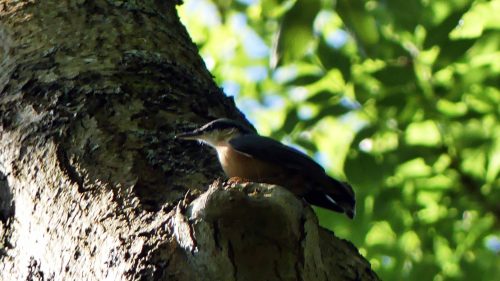
As so often happens, my slow progress and in this instance, last-minute change of route brought forth a magical few moments. Until now the only sounds had been mainly of the wind rushing through the trees, but I began to hear bird calls that got gradually nearer and suddenly I was surrounded on all sides by excited little birds – a travelling feeding party! I had been standing still and they seemed not to notice me; I’ve described a similar experience in a previous post and this was equally as joyous and uplifting. It was a large party too, impossible to count the numbers of birds within it as they scattered amongst the trees, but Blue tits were probably most numerous with at least a dozen Long-tailed tits; Great-tits were there too. I didn’t see Tree-creepers as before, but was thrilled to see a Nuthatch that chose to explore a tree right in front of me.

Nuthatch-Sitta europaea

Taking photographs in the darkness of woods is rarely successful, but a Nuthatch did pause briefly from its foraging near a patch of sunlight, giving me a reasonable chance to record this bird for the first time here. Watching a tiny Blue-tit searching through ivy high up in another tree I realised it was looking for spiders, which are an important part of their diet. Perhaps the birds’ regular forays are the reason I couldn’t find any.

Blue tit seeking spiders

Back to the present 

Sycamore leaf with spots of fungus

There was no feeding party today, but there were other signs of a summer ending. Sycamore leaves, amongst the first to break their buds in the Spring are amongst the first to change colour and fall. Most of those I see nowadays are marked with dark spots; this is Rhytisma acerinum, the Sycamore Tarspot. It doesn’t look attractive, but although it is suspected that the darkened areas reduce the photosynthetic capacity of affected trees, the fungus doesn’t seem to affect the tree’s health and vigour. One consolation of the fungus’ presence is that is shows the air here is fairly clean as it is apparently particularly sensitive to sulphur dioxide air pollution. Trees growing near to industrial centres with high levels of sulphur emissions do not show any sign of the leaf-blackening fungi.

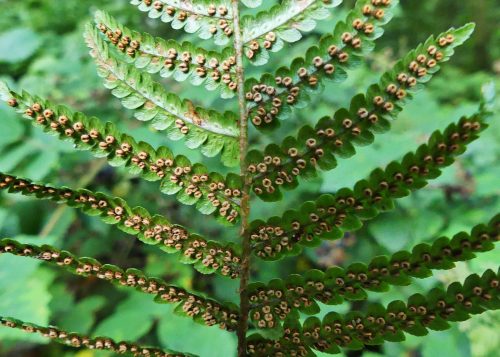
If you look at the undersides of the fronds of most ferns, their seeds, spores or more correctly sori  are now ripe. The Male Fern is the most common fern found growing here; its sori are round and normally run in two parallel rows.

There’s a large patch of Hart’s Tongue Fern growing in damp shade on a steep bank. Its leaves and sori take a different form to those of other fern species. Their ripe sori accentuate the marks on the underside of the leaves and it seemed to the person that named the plant that they resembled the legs of a centipede, so he gave it the scientific name ‘scolopendrium‘, the Latin for centipede.

Hart’s Tongue Fern-Phyllitis scolopendrium

The track passes a sheer cliff of limestone. Its surface is frequently damp, sometimes wet and its base is covered with a lush, bright green shag-pile carpet of moss.

There’s a small grove of Silver Birch trees on this shady, damper side of the Bryn that are also beginning to lose their leaves, which stud the dark mud of the track with specks of bright gold.

Nearing the end of the path the trees thin and give way to scrubbier vegetation, mostly blackthorn and hawthorn. The blackthorn has beautiful purple sloes and its leaves too are beginning to turn colour.

A number of the blackthorn shrubs here also have clumps of pretty grey-green lichens. Some looks like a tangle of moss, which I can’t accurately name.

Other blackthorns have a lichen in a different form, this one, photographed on a nearby shrubby hawthorn tree with dark red fruits (haws), has the appearance of Reindeer moss, but I can’t yet be species-specific.

Emerging from cover onto the exposed summit I braced myself for another confrontation with the wind. The sun had disappeared behind clouds that were shutting out its brightness, leaving the landscape in shadow, dulling its colours. Part of the view across the valley from here takes in buildings and fields that belong to the Welsh Mountain Zoo, located above Colwyn Bay. There are sometimes interesting animals grazing in the fields; today it was some kind of cattle.

With or without sunshine I love this hillside view of small fields bounded with hedges and trees with the mountains in the distance. It reminds me a little of a David Hockney painting.

The mountains are topped with billowing clouds that permitted some sunshine through to lighten slopes here and there and to brighten the water of the river Conwy.

On days like this you can only hope for at least a little sunshine to brighten the rest of a walk…


Share this:

  • Click to share on Facebook (Opens in new window) Facebook
  • Click to share on Pinterest (Opens in new window) Pinterest
  • Click to share on X (Opens in new window) X
Like Loading...

Little Beings of Summer Woods

08 Tuesday Aug 2017

Posted by theresagreen in Bryn Euryn Nature Reserve, Nature of Wales, nature of woodlands, Wildflowers of Wales, woodland walks in Wales

≈ 7 Comments

Tags

black spleenwort, dwarf cream wave, late summer wildflowers, Nature in August, polypody fern, scorpion fly, speckled wood, wild clematis

Sunday July 30th-Bryn Euryn

The Woodland Path

11:00am  It was cooler than I’d anticipated in the woods this morning. The sky was cloudy and gusts of a chilly breeze blustered between the trees of this usually sheltered mid-slope of the Bryn; less than ideal conditions for the insects I was hoping to see. And I wished I’d worn a thicker fleece. But the sun was intermittently winning through the clouds and ever the optimist I assured myself it would get warmer for me and the little creatures. 

There are a few places on my usual trail that I think of as ‘hotspots’ for insects, even on cool days such as this. The first one is an untidy, brambly-nettley spot, where opportunistic plants have filled a gap in the tree line and spread across to the other side of the path too. Dappled sunlight reaches and warms the spot, aphids thrive here, there’s nectar and pollen to be had while the bramble is in flower, followed by its fruits; the perfect ingredients for a hoverfly hangout. If I’m patient and hang around for a few minutes I’m often rewarded with sightings of a few hovering customers and sometimes less expected visitors too.

Hoverfly (syrphus sp) basking on a sunlit hazel leaf

Insects need sunshine to warm up their flight muscles to get them going, so cooler, cloudy days can be surprisingly rewarding for sightings of basking individuals slowed down by the lack of warmth. There were a few hoverflies here today, also other common flies which I’m trying to take notice of and appreciate more; well, at least I’m aiming to put names to some of them. Most of those I saw were common ‘houseflies’, a generic name that covers quite a few different species. I think it’s their habits that most of us dislike; some of them look quite pretty.

House fly
Bluebottle

A long-bodied black insect with pretty iridescent wings scurried erratically over the surfaces of leaves, a wasp I think, definitely a hunting predator, maybe a Digger wasp.

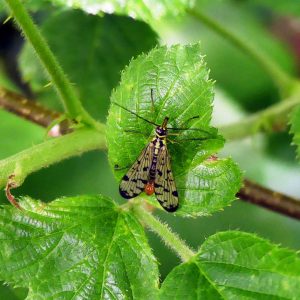
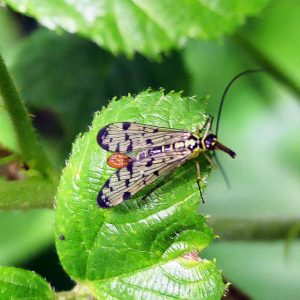
About to move on I spotted a dot of colour in the shade of some leaves. Sitting motionless was another more recognisable predator, a male Scorpion Fly.

Scorpion Fly-There are 3 species of Scorpion Fly in Britain, apparently difficult to separate other by examining genitalia; the most common being Panorpa germanica. They frequent shady places almost everywhere. All are scavenging insects and completely harmless despite the males’s scorpion-like tail. The female’s body lacks the tail, simply tapers to a point. 

Male Scorpion Fly
Male Scorpion Fly

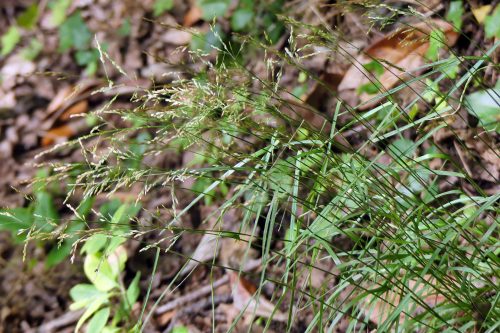
The closed tree canopy excludes most flowers now. An exception is the woodland grass, False Brome, which grows prolifically here and is flowering now.

False Brome-

A splash of colour took me by surprise – a holly tree with red berries!

*************

Perhaps relics of the days when this path was part of the grounds of a Victorian manor house, are large clumps of two attractive ferns. Both species are evergreen, maintaining their green fronds throughout the seasons, but both look particularly fresh and verdant now and the Polypody has new fronds unfurling.

Polypody fern

Black spleenwort


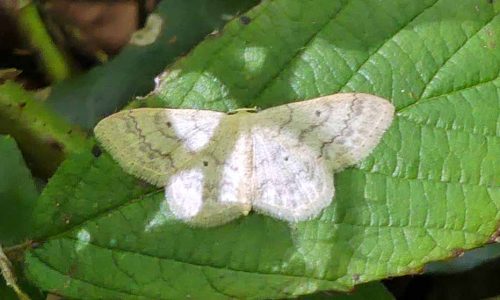
Dwarf Cream Wave-Idaea fuscovenosa

A tiny pale-coloured moth swirled by the breeze spiralled down to land on a bramble leaf low to the ground, settling with wings spread butterfly-like under the shelter of other leaves. It is a Dwarf Cream Wave (photograph probably not far off its actual size)- the lines that show grey-mauve are where its original pale brown scales have been worn, or washed (!) away.


A home in a leaf ….

The pale patch on this holly leaf is probably the result of the work of an insect, the Holly leaf miner Phytomyza ilicis. This is a fly whose larvae burrow into leaves of this specific species of tree and leave characteristic pale trails or mines.

Interestingly, I learnt (from Wikipaedia) that “the holly leaf miner has frequently been used in ecological studies as a system to study food webs. Examination of the leaves can show whether the leaf miner has successfully emerged, been killed by a parasitic wasp, or been predated by blue tits.”

I’m not sure what the perfectly round hole in this one indicates. It could just be the original entry point of the egg-laying adult female’s ovipositor, but maybe too big? It looks too small and neat to be an exit hole and blue tits leave a triangular tear when seizing a miner as prey. Maybe it is the mark of the work of a predatory wasp? 

Speaking of wasps, I spotted another on an ivy leaf – a bit more distinctive than the black one I saw earlier due to its long antennae, so I asked the experts at BWARS and they say it’s a member of the Ichneumonidae family. The whole of this family are parasitoides and most species attack the caterpillars of butterflies and moths. It’s a dangerous life being an insect.

The Woodland Trail, Bryn Euryn Nature Reserve 

A big old oak tree marks the junction of my ‘Woodland Path’ and the Woodland Trail that circuits the Nature Reserve. It’s lost a few of its branches and the big lower branch has a split right through it that provided a safe home to nesting Great tits earlier on in the year.


Happily, the tree seems to be going strong and is currently nurturing some baby acorns. They have stalks, which indicate this is an English, or Pedunculate Oak.


Stepping out from the cover of the trees I realised how windy it had become; windy enough for birds to be able to just hang in the air and ride the air currents with minimum effort. Two buzzards were overhead, mewling and swooping around in the air currents, one being harassed by gulls, poor thing.

The unmistakable bulk of a Buzzard

My second ‘hot-spot’ is almost at the junction of the two tracks. It’s a huge bramble entwined with gorse and over which wild clematis scrambles. That blackberry & wild clematis combination is one of my favourites, even if it is another of the sights that I associate with summer’s approaching end. The clematis is just coming into flower and, the bramble already has ripening fruit, so not much for insects here today.

A lovely Speckled Wood butterfly sat on a smaller bramble nearby which still has flowers. The butterfly let me get very close, hardly moving in the coolness of the day.

There are few flowers along the sides of the Woodland Trail now, due in part I’m sure to their having been strimmed back in June – this part of the path is maintained by the local council who are wont to get these ‘jobs’ done before people complain about paths being overgrown. All kinds of good stuff was cut back, including orchids, and much of the hogweed that would now be giving nectar and pollen to hoverflies et al. I hoped they were finding sustenance nearby.

A few odd plants have survived, or revived, to flower here and others are fruiting. There are a very few hazelnuts that have thus far escaped the jaws of voracious grey squirrels, who usually eat them while they’re still soft and green.

Ragwort
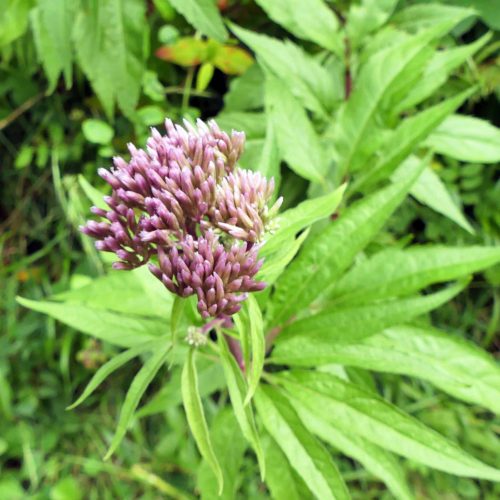
Hemp Agrimony
Honeysuckle

Wild Strawberry flower
Wild strawberry fruit
Seedpods of Stinking Iris

Tutsan berries are darkening
Hazel nuts forming
Blackberries are ripening

Cool windy days may seem unpromising if you’ve set off hoping to see insects, but if you keep paying attention there is never ‘nothing to see’ (pardon my grammar). I spotted a tiny movement on the surface of a leaf and caught sight of an even tinier leaf hopper. As I got closer with the camera lens I noticed another movement under the leaf; a tiny spider had spotted the leaf hopper and was vibrating her web to try to get its attention. The leaf hopper disappeared under the leaf….. I wonder if the spider got her lunch? Apologies for the less-than-good photo, but I’m sure you get the drift!

So, I’ve reached the steps leading up to the field now and looking forward to what it has in store….


Share this:

  • Click to share on Facebook (Opens in new window) Facebook
  • Click to share on Pinterest (Opens in new window) Pinterest
  • Click to share on X (Opens in new window) X
Like Loading...

Autumn

27 Tuesday Oct 2015

Posted by theresagreen in Bryn Euryn Nature Reserve, Bryn Pydew, Nature, Nature of Wales, nature of woodlands, nature photography, North Wales, Wildflowers of Wales, woodland walks in Wales

≈ 7 Comments

Tags

ash leaves, autumn colour, autumn leaves, eristalis pertinax, fallen leaves, goldenrod, hazel leaves, North Wales Wildlife Trust, oak leaves, puffball fungus

Autumn in North Wales is glorious this year thanks to a prolonged sunny and mild spell of weather, as yet broken only occasionally by rain. Walking between the trees in the dappled shade of the woodland along sun-striped paths thickly carpeted with fallen leaves in all the shades of the season, has been truly joyful. As October draws to an end, here are some of my views of the month.

151021-Bryn Euryn Woods 4a-Path sun-striped 151021-Bryn Euryn Woods 5a-Path leaf-strewn

Ivy is flowering now providing vital supplies of pollen and nectar to late-flying insects.

151021-Bryn Euryn Woods 2a- Ivy flower

Ivy is flowering

151021-Bryn Euryn Woods 8a-Woodland Trail

Ash trees leaves have mostly turned to a bright yellow.

151021-Bryn Euryn Woods 7a-Ash tree canopy

Ash tree canopy

Many have already fallen.

151021-Bryn Euryn Woods 10a-Woodland Trail-Ash leaves

Strings of Black bryony berries are strung between stems of lower-storey vegetation

151008-Bryn Pydew (29)

Black Bryony berries

151021-Bryn Euryn Woods 9a-Woodland Trail

151021-Bryn Euryn Woods 6a-Hazel leaves

Hazel leaves fallen

Oak trees are in varying shades, some still retaining a lot of green where they are in shade while those exposed to more sunlight have turned golden.

151008-Bryn Pydew (6a)-Oak leaves turned yellow & blue sky

Last year there was a national shortage of acorns and here at least it doesn’t look as though this year is going to be any more productive.

Sessile Oak and acorns

Sessile Oak and acorns

151008-Bryn Pydew (37a)-Cherry gall under oak leaf

Cherry gall under an oak leaf

Female Yew trees have ripening pink-red berries

151008-Bryn Pydew (53a)-Yew berry

On the woodland edges and in clearings there is still plenty to see.

151008-Bryn Pydew (2a)-Blackberries & clematis

Late blackberries and Old Mans Beard

In a sunny spot I watched a gathering of a dozen or so hoverflies. Some were hovering and darting around, others were attempting to bask in the sunshine but were deliberately disturbed by their dive-bombing peers.

151008-Bryn Pydew (11a)-Eristalis hoverfly

Bryn Pydew-Eristalis pertinax

On limestone pavement I found Herb Robert leaves that have turned beautiful shades of red

151008-Bryn Pydew (43a)-Herb Robert leaves turned red

Goldenrod is a favourite late flowering plant

151008-Bryn Pydew (30a)-Goldenrod flower stem

Goldenrod

although most plants have set seed by now.

Goldenrod seedheads

Goldenrod seedheads

Tucked into a damp sheltered corner where two quarried limestone walls meet, a maidenhair spleenwort fern remains fresh and green.

151008-Bryn Pydew (35a)-Maidenhair Spleenwort

And of course there are fungi, this is one of the few that I recognise!

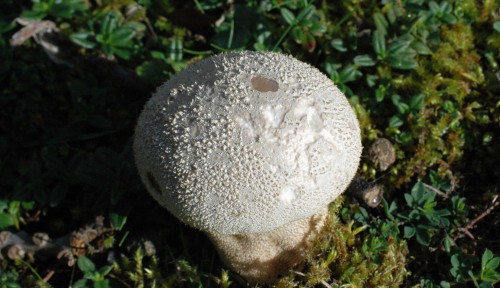
151008-Bryn Pydew (48a)-Puffball

Puffball

And to finish, a corvid feather, just because I liked it.

151008-Bryn Pydew (59a)-Corvid feather


Share this:

  • Click to share on Facebook (Opens in new window) Facebook
  • Click to share on Pinterest (Opens in new window) Pinterest
  • Click to share on X (Opens in new window) X
Like Loading...

Winter Greens

08 Sunday Feb 2015

Posted by theresagreen in Bryn Euryn Nature Reserve, ferns, Nature, Nature of Wales, woodland walks in Wales

≈ 2 Comments

Tags

evergreen trees, Great Tit, hart's tongue fern, holly, ivy, polypody fern, scots pine, stinking iris, yew

My walks on Bryn Euryn have a different starting point now and it has been interesting to note the differences in the character of the woodland on this eastern to south-eastern aspect of the hill. Firstly, on this particular pathway you are immediately in the woodland and notice there is a difference in the pattern of tree species. I am fairly sure that is because the land that the apartment block that I now live in was formerly the site of a large house, one of several similar ones, most of which are still standing and in use as residential care homes. All have large mature gardens to the fronts and sides and are set back tightly against the rising wooded hillside, so certain of the trees and shrubs, such as laurels and Scots Pines, that you don’t find on the other slopes of the hill, have inevitably escaped. Other evergreens Yew, Holly and Ivy occur throughout the woodland on all sides, but this area seems to have more and larger specimens of them and so appears particularly green.

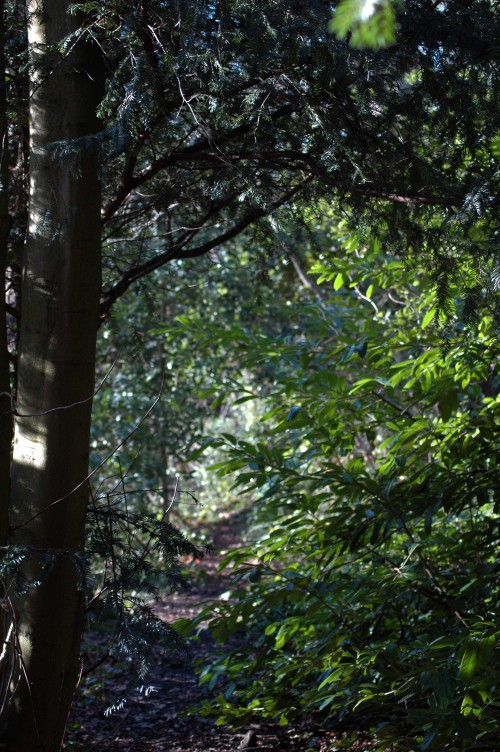
Sunlight on a path lined with evergreens

Sunlight on a path lined with evergreens-yew, holly & laurel

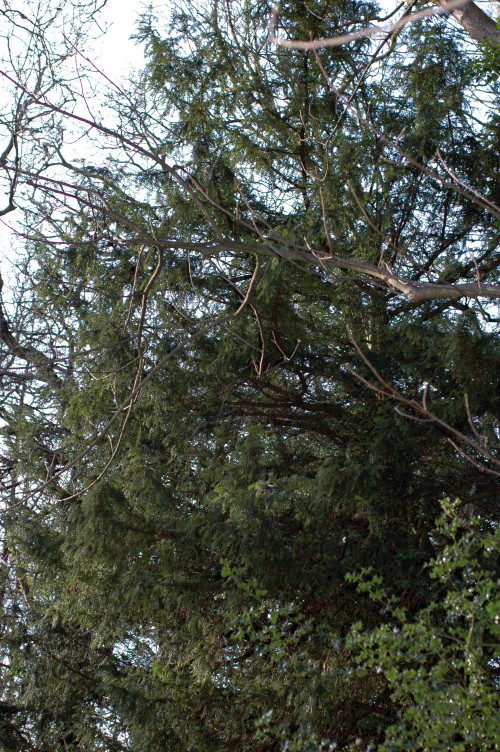
Yew is one of our native species of trees and occurs naturally in the wild in woodlands in several parts of Britain, although it is not as widespread as it used to be.

Yew tree

A large Yew tree

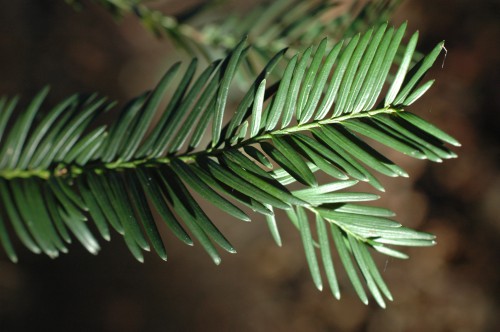
Yew foliage

Yew foliage

Scots pine (Pinus sylvestris) is an evergreen conifer native to northern Europe, and is one of just three conifers native to the UK.

150104TGFL-Bryn Euryn 12-Scots Pine

A huge Scots Pine

A Great tit in the pine tree

A Great tit in the pine tree

Holly and Ivy

Holly and Ivy

Shiny Holly leaves

Shiny Holly leaves

Ivy

Ivy

Sun shining through an ivy leaf

Sun shining through an ivy leaf

Greenery is also abundant on the woodland floor.

Fern around the base of a tree

Polypody fern around the base of a tree

Hart's tongue fern

Hart’s tongue fern

Male fern

Male fern

Spores on the back of a fern leaf

Spores (sori) still cling to the back of a fern leaf

Vibrant green moss amongst dry brown leaves

Vibrant green moss amongst dry brown leaves

Winter is a good time time to see mosses when many are at their best.

Feather moss

Feather moss

Young fern and holly plants in a mossy bed

Young fern and holly plants in a mossy bed

A few splashes of colour…….

Red berries of nightshade strung like beads around ivy

Red berries of nightshade strung like beads around ivy

A few berries remain on a 'Stinking Iris'- Iris foetidissma

A few berries remain on a ‘Stinking Iris’- Iris foetidissma


Share this:

  • Click to share on Facebook (Opens in new window) Facebook
  • Click to share on Pinterest (Opens in new window) Pinterest
  • Click to share on X (Opens in new window) X
Like Loading...

The Brambles: des. res. for Whitethroats, sea views

31 Wednesday Jul 2013

Posted by theresagreen in birds of Wales, Nature, Nature of Wales, Pembrokeshire coastal path, Rhiwledyn Nature Reserve

≈ 6 Comments

Tags

birds nesting in brambles, brown bird with white throat, Little Orme, sylvia communis, whitethroat

On the Little Orme there is a huge bramble tangle set in the middle of a sea of long grass. Surrounded thus, it is some distance from the close-cut grass pathways on the clifftop and as there are other more easily accessed bushes, I may not have approached this particular one if I hadn’t noticed a bird fly across to it.

From the bird’s behaviour and general ‘jizz’ I thought and hoped it may be a Whitethroat, a summer migrant that I have heard before, but never had a close view of in this location.

(Jizz is a term used by birders to describe the overall first impression of a sighted bird, based on such characteristics as shape, posture, flying style or other movements, size and colouration combined with voice, habitat and location.)

As I moved a little closer the bird flew up nearer the top of the bramble, I saw it had an insect in its beak and that it was definitely a lovely male Whitethroat. So, there was a nest in there, confirmed when a female also carrying food made an appearance on the far side of the bush.

Whitethroat trying to hide

Whitethroat trying to hide

Although I was keeping my distance neither bird was happy I was there at all and the male expressed his annoyance by “churring”, raising his crest and puffing his throat out a bit, which showed he was upset. I don’t like upsetting birds,  but it did make for a more interesting photograph.

Common Whitethroat- Sylvia communis

Common Whitethroat- Sylvia communis

Whitethroat– Sylvia communis

Welsh: Llwydfron

The Whitethroat is a summer visitor and passage migrant to Britain that may be seen in all parts of the country and most frequently choose arable land, scrub and reedbeds as nesting sites.  They arrive during April-May and leaving in late September-early October to winter in Africa, some heading as far south as South Africa.

Graph from BTO showing Whitethroat population trend for Wales

Graph from BTO showing Whitethroat population trend for Wales

In 1968, Whitethroats sustained heavy losses as their wintering grounds in sub-Saharan Africa suffered major drought – breeding Whitethroats suffered a 90% drop in the UK. Numbers have not fully recovered yet and the BTO state their Conservation Status as AMBER because of the recent breeding population decline (1969-2007).

A male Whitethroat, Ceibwr, Pemrokeshire

A male Whitethroat, Ceibwr, Pemrokeshire

Description

The Whitethroat is a medium-sized, long-tailed warbler. The male is grey dusted with rust brown above, with bright chestnut brown fringes to the wing feathers, the head is a pale grey, the breast pinkish-buff and the throat is a bright white. The bill is greyish-brown and the legs are pale brown. The eye is pale brown with a white eye ring. Females are similar but brown on the head and nape where the male is grey.

Whitethroats prefer to stay concealed in bushes

Whitethroats prefer to stay concealed in bushes

Behaviour & song

Warblers in general are often described as ‘skulking’, but the Whitethroat is not quite as secretive as some; the male will perch in full view to deliver its brief song with gusto. The song is variously described as sweet, ‘scratchy’  and having a jolty rhythm. They are also very inquisitive birds and will venture to the top of a bush to investigate any intruders, before scolding them with a rapid churring call.

Nesting

The male whitethroat may mate with the first female to cross the territory it immediately stakes out upon his arrival back in Britain. He begins making a number of trial nests, perhaps as many as three. The female then chooses a nest, which will be a deep cup shaped construction located close to the ground in cover, and lines it with hair, down and wool.  4-5  eggs are laid which are about 18 mm by 14 mm, smooth and glossy, pale green or buff in colour with olive-grey speckles. The duties of incubating the eggs are performed by both parents. Both adults feed the young birds. There may be one or two broods raised in a season.

Food

In the breeding season whitethroats eat mainly insects, especially beetles, caterpillars and bugs. They also eat spiders and towards the end of the summer and into the autumn they turn increasingly to fruit and berries, sometimes invading gardens to raid soft fruit crops.

Where to see Whitethroats in Wales

Whitethroats  breed in many areas including woodland edges and clearings, country lanes anywhere they may find brambles, briers, bushes or overgrown hedges. They may also nest in gardens, but avoid urban and mountainous places.

In Wales they frequently find their favoured habitat on clifftops: locally on the Little Orme and I have seen them in various spots when walking along the Pembrokeshire Coastal Path. Another reliable spot for hearing and seeing them has always been in the similarly-vegetated area on the road down to Martin’s Haven, where you get the boat to Skomer Island.

June 11th 2010  

One late afternoon in June, my friends and I set off for a walk along a part of the Pembrokeshire Coastal Path beginning at Ceibwr and heading in the Poppit Sands direction (we’ve never yet made it that far). There were several Whitethroats about, but we didn’t expect to get the close up views we were treated to. Firstly, there was the one in the first two photographs above, that was in amongst a huge tangle of brambles at the back of the beach. Another flew right in front of us as we walked up the pathway to the clifftop.

A whitethroat flew in front of us

A whitethroat flew in front of us

At the top of the upwards part of the path we caught sight of one very close to the edge of it with food in its beak. It clearly wanted to reach its nest on the opposite side of the path but was reluctant to reveal its location, so it stayed put perched on a hogweed stem perhaps hoping we hadn’t seen it.

11/6/10-A whitethroat with food perched on hogweed-Ceibwr, Pembrokeshire

11/6/10-A whitethroat with food perched on hogweed-Ceibwr, Pembrokeshire

We stood still to give it the chance to make a break for it and it crossed to perch on a barbed-wire fence. It was hanging on tightly to the caterpillar in its beak and finally flew off into a shrub a few metres away to present it to its nestlings.

The whitethroat perched   on the wire fence hanging on to its nestling's tea

The whitethroat perched on the wire fence hanging on to its nestlings’ snack

 Similar species : Lesser Whitethroat 

The Common Whitethroat can be distinguished from the smaller Lesser Whitethroat by the absence of the dark mask on their cheeks and the presence of  rusty brown edges to their wing feathers, pinky chest and longer tail.

Read more about whitethroats in Cambridgeshire in Finn Holding’s blog, the Naturephile

http://thenaturephile.com/2013/05/23/whitethroats-and-awards/

53.308051 -3.749941

Share this:

  • Click to share on Facebook (Opens in new window) Facebook
  • Click to share on Pinterest (Opens in new window) Pinterest
  • Click to share on X (Opens in new window) X
Like Loading...

Dale beach and the Gann Estuary

29 Friday Jun 2012

Posted by theresagreen in coastal habitat, Nature, nature photography, Pembrokeshire coastal path

≈ 14 Comments

Tags

brackish lagoon, coastal wildflowers, Dale, gann estuary, kidney vetch, medicinal plants, mute swan, pickleridge lagoon, shingle beach, stonecrop

We returned home via the village of Dale which is situated on the south eastern tip of the Pembrokeshire Heritage coast and is also on the route of the Coastal Path. Its beach is located on the Milford Haven estuary between St Ann’s Head and St Ishmael’s in Pembrokeshire, South Wales. There is a lot of history attached to the village and surrounding area, but we had come to have a quick look  at the unique habitat that lies at the back of its shingle beach.

The view across Dale beach; the refinery at Haverfordwest is just out of sight behind the headland on the left of the photograph

The beach is mainly shingle with some sand at low tide.

The shingle beach is a colourful mixture of red sandstone and grey/green silurian stone

The gritty sand is pink and stones on the beach occur in an infinite variety of shades of pink/red, grey and green

The red soils of the area are derived from old red sandstones seen at Lindsway Bay and Sandy Haven that are some 395 million years old. There are also occasional exposures of even older rocks, aged at 420 million years.  The cliff tops are covered with glacial till made of unconsolidated material dumped by melting ice around 20,000 years ago and fields that have been ploughed are visible for miles as the soil is a bright red in colour.

At the back of the shingle beach is a sand ridge and behind that an area of low lying land and the brackish artificial Pickleridge Lagoon, formed by the flooding of gravel pits that operated between the 1950s and 1980s. This has now become established as a saline lagoon and together with the  extensive salt marsh in the Gann river valley, the area has become a haven for wildlife, particularly for wading birds and plants.

There were very few birds around today, a few Oystercatchers were out on the tide line and a number of Mute Swans on the edges of the lagoons, but other than that we saw only crows, a pair of raven flying overhead and a magpie or two.

A beautiful mute swan on the edge of the lagoon

There are some interesting plants growing here though, including  the largest expanse of yellow flowered Kidney Vetch I have ever seen.

View across the grassy meadow and lagoon

Grasses

The largest expanse of kidney vetch I have seen

Kidney Vetch – Anthyllis vulneraria

Kidney Vetch-Anthyllis vulneraria

The small yellow flowers of  Kidney Vetch are held in a cluster atop little woolly cushions, at first glance resembling a clover. The plant flowers from June to September and is a distinctive feature of sand dunes, chalk grassland and cliffs across the UK where it may spread to cover bare ground if it finds the right conditions.

The flowers are mainly yellow, but can also be found in orange and red forms. Each flower has its own hairy calyx (containing the sepals), giving the flower cluster its woolly appearance. The leaves of Kidney Vetch are divided into narrow leaflets that are silky and white underneath.

Kidney Vetch &  the Small Blue Butterfly

Kidney Vetch is the sole foodplant for the larvae of the Small Blue Butterfly – a seriously declining insect which is classified as a Priority Species in the UK Biodiversity Action Plan. Although Kidney Vetch itself is not threatened, the habitats in which it grows are becoming fragmented and being lost at a rapid rate; for example, it’s estimated that we’ve lost 80% of our chalk grassland over the last 60 years.

Traditional medicine

Kidney Vetch has long been used in herbal medicine as an astringent; the  name ‘vulneraria‘ means wound-healer and applying it to wounds reduces bleeding. As the common name implies it is also used in the treatment of kidney disorders.

A Stonecrop – Sedum caeruleum

Further information:

The habitat formed here and the wildlife it supports have been the subject of several field studies over the years that have included the Feeding Patterns of  Wading Birds on the Gann Flat by the Field Studies Council in 1973 http://www.field-studies-council.org/fieldstudies/documents/vol3.5_91.pdf  that was followed up thirty years afterwards in 1992  http://www.eco-challenge-xtra.org. ; another on invertebrates The Gann Flat, Dale; Studies on the Ecology of a Muddy beach   and another on the flora and ferns http://www.eco-challenge-xtra.org/fieldstudies/documents/vol1.3_18.pdf

Share this:

  • Click to share on Facebook (Opens in new window) Facebook
  • Click to share on Pinterest (Opens in new window) Pinterest
  • Click to share on X (Opens in new window) X
Like Loading...

Not a trip to Skomer but a great day out

21 Thursday Jun 2012

Posted by theresagreen in birds singing, coastal habitat, coastal walks, Nature, Pembrokeshire coastal path

≈ 2 Comments

Tags

barn swallow, birds singing, common dolphin, cormorants flying, gannet, grey seal, herring gull, lesser black-backed gull, Linnet, marloes peninsular, martin's haven, meadow pipit, Northern Wheatear, razorbill, stonechat, wooltack point

The Saturday following the Friday of the terrible weather dawned bright and sunny and apart from a few lurking clouds the sky looked innocently down upon us as though nothing had happened. We were still hoping for a trip over to Skomer Island, so set off to drive the hour or so that it takes to reach Martin’s Haven, from where the boats depart. We were not too hopeful of being able to get to Skomer today; Saturday’s are popular anyway and as no boats would have gone out yesterday, we expected it to be busy. A first sight of the car park, already overflowing onto adjacent land brought that sinking feeling, compounded by the attendant informing us that all 150 of the day’s landing ticket allocation had been sold by 9.30am. We were somewhat taken aback to learn that some people had begun queuing for places at 5.30am; the first boat for the island leaves at 10am. So, no Skomer for us today.

We had made some effort to get here though and determined to make the best of our situation decided to explore the area around the headland instead. The headland is known as the Marloes Peninsular; the land is owned by the National Trust and for some reason we have not managed to establish is named “Deer Park”, although there are no deer here. There are however spectacular rocks, sea views that take in most of the Pembrokeshire Islands, wildflowers and, we were fairly confident, there would be birds.

We set off to walk up to the highest point of the peninsular, Wooltack Point, distinguished by the small white building on the top that is now an active coastwatch point operated by the National Coastwatch Institute.

We were soon distracted by the small birds we began to see around us almost immediately: Stonechats, Linnets and Meadow Pipits, all species that can make homes in this rather bleak windswept habitat, carpeted with grass and heather and furnished only with low-growing tangles of gorse bushes, brambles and generally scrubby vegetation.

The first bird we had a good view of was this little Stonechat female (Saxicola torquata), who was very shortly joined by a male.

The Stonechat male perched just a short distance away from his mate

There were several Linnets flying around and one beautiful male landed quite near us on a bramble and began to sing.

This beautiful male Linnet was singing from atop a dead bramble stem

It was sunny here, but windy too, so it was some consolation to think that those on the boats travelling across to Skomer would probably be feeling the combined effects of the cold wind and choppy sea in a not-too-pleasant way. Yes, very immature, especially as we have actually made the journey in even rougher conditions, survived and gone on to have a spectacular day. Anyway, onwards and upwards to Wooltack Point. The views out over St.Bride’s Bay are truly spectacular, but the sea around this point can be treacherous with concealed rocks and strong currents, hence the presence of the Coastwatch.

The incorrectly marked compass (click to enlarge)

We attempted to work out the layout of the islands we could see, picking out Skomer easily as it was close by and Ramsey Island as we recognised the shape of St. David’s Head, but were guessing at the others. I spotted a compass of sorts on a plinth outside the door of the stone hut and as I leaned in to take a picture of it the coastguard popped out to tell us that its directions are useless as all points are wrong. Apparently even the North marking is incorrect. He was quite amused by the fact that “there is nowhere in the world from which that plaque would be correct” and has no idea why it has never been replaced.

The nearest we got to Skomer Island today, just 2 miles across the Sound

Ramsey Island, 9.5 miles away is located off St David’s Head

Dropping down onto the cliff in front of the hut we discovered it to be sheltered from the wind and much warmer. We sat there for at least an hour watching the array of seabirds flying back and forth or swimming and diving around the rocks below us.

Razorbills were the most numerous birds on the water, but there were a few guillemots and cormorants too.

Razorbills swim on the surface then suddenly make a synchronised dive and disappear underwater for ages, eventually reappearing some distance away

Cormorant flying close to the rocks, low over the water

Herring Gulls passed us by very closely

Lesser Black-backed gulls were another frequent sight

We were delighted by the appearance of Grey Seals in the sea just below us, and even more thrilled when we realised there were dolphins too. The first dolphin we picked up on was following the Skomer boat on its return trip to Martin’s Haven, but soon realised there were at least three in total.

Grey Seal

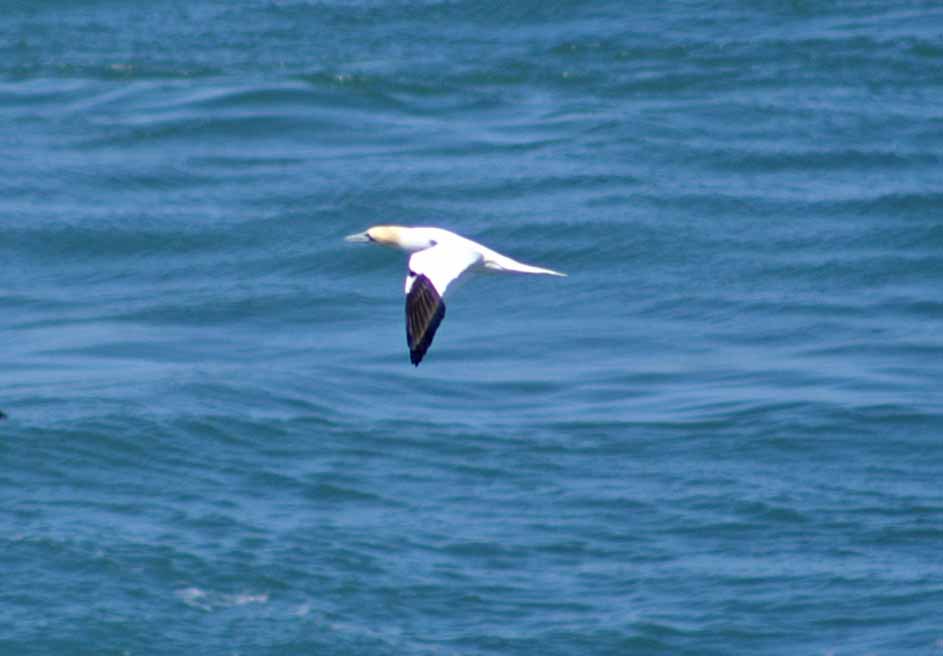
The island of Grassholm is occupied by an enormous colony of breeding Gannets (another highly recommended trip to take) and although it is 10 miles away from where we were today we kept a hopeful look out. We were rewarded with an initially distant sighting of a number of the birds circling and diving, but over the course of twenty minutes or so they gradually worked their way towards us, clearly following the progress of a shoal of fish. This is why the dolphins were there too. It would have been lovely to have had closer views, but both they and the birds were near enough to be seen well through binoculars.

One of a number of Gannets closely following a shoal of fish

The spot we had chosen to settle in seemed to be within the territory of a Pipit. He made several tours of the rocks immediately around us, making some rather disgruntled noises, clearly not happy with us, but otherwise undeterred by our presence.

I think this is a Meadow Pipit, but going on its location, it could be a Rock Pipit

The Pipit demonstrating his ‘parachuting’ display flight whilst singing

This is undoubtedly a tough environment for wildflowers, but there was thrift and sheep’s bit flowering and almost squashed into the short grass several tiny specimens of pretty blue spring squill.

There were bumblebees visiting most of the available flowers

Leaving our sheltered viewpoint we continued our walk around the remainder of the headland then cut back inland towards the car.

Rocky coves with sheltered beaches such as the one below the cliff here on the far side of the peninsular are perfect places to see grey seals and their pups. The land in the top right of the picture is the tip of Skomer.

Next on the agenda was to seek out another sheltered spot in which to eat our lunch. With hindsight we did consider that perhaps if we had not stopped at M & S in Haverfordwest for decent sarnies we may have squeezed onto that boat … ? (Normally we would have made our own, but pinned in by the tree we couldn’t get out to the shops yesterday and had no suitable supplies.) But, on the bright side,  it was more than pleasant here and we had had some very fresh air and some wonderful sights. We located another likely spot to enjoy our food in and settled down. We soon realised we were being watched; a baby bunny was peeking through the grass at the top of a sandy hillock close by that we could now see was above the entrance to a warren.

Baby rabbit on the roof of the family home

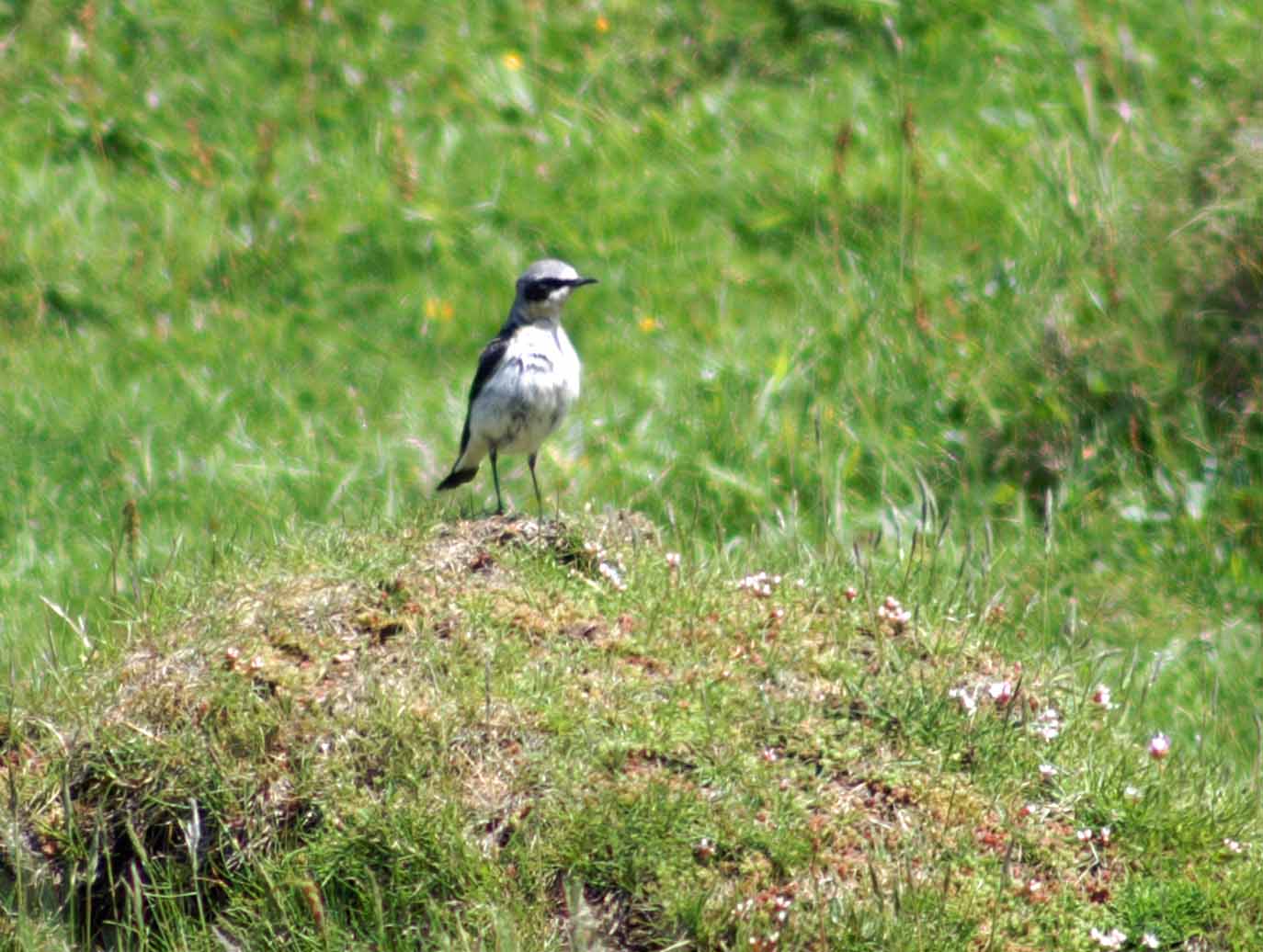
We were thoroughly enjoying our lunch sitting on a grassy bank in a warm and sunny spot, appreciating our beautiful surroundings and reviewing the wealth of sights we had enjoyed, when another bird appeared in front of us. This was a handsome jaunty male Wheatear and once again we seemed to have settled ourselves in the middle of his territory. He seemed to be making a point of travelling around us, settling on rabbit hills, brambles, rocks and the like. We did feel a little guilt but carried on enjoying the sight of him quietly, staying as still as is possible whilst yielding a hefty camera lens.

A female appeared too from the same direction and made a similar circuit, so we surmised that they had a nest located somewhere behind the bank occupied by the rabbits. Beautiful birds.

The very handsome male Wheatear asserting his territory from the top of a rabbit hill

The female Wheatear with her browner plumage is also a very attractive bird

Arriving back at the lane leading to the beach we headed for the loos to find there was an unusual queue to enter the building. A number of Barn Swallows were waiting for people to leave, taking their opportunities to swoop in to their nests built in various places inside.

One of a pair of Barn Swallows waiting to get into the toilet block and back to their nests

Although they are a familiar sight swooping and gliding over the countryside, it’s not often you get such close views of these elegant birds and to appreciate their very glossy plumage.

This bird was taking advantage of the waiting time to thoroughly preen its feathers

I was listening and watching for a sight of a Whitethroat, as we have always seen them here in the past, but not so today. As we made our way up the hill towards the car park we did see another Wheatear and had a quick glimpse of the back of a Dunnock singing from a bramble patch.

A quick glimpse of a Dunnock that was singing from a bramble patch

Not the outing we had planned, but a thoroughly enjoyable few hours spent in a beautiful place and still with a bit more to come….

Share this:

  • Click to share on Facebook (Opens in new window) Facebook
  • Click to share on Pinterest (Opens in new window) Pinterest
  • Click to share on X (Opens in new window) X
Like Loading...
Newer posts →
Follow everyday nature trails on WordPress.com

Enter your email address to follow this blog and receive notifications of new posts by email.

‘But it is the common species that keep the living world ticking over and provide most of our experiences of wildlife, and I would argue that maintaining the abundance of these is as important a conservation priority as maintaining the existence of rarities’. Richard Mabey

MOST RECENT POSTS

  • A Glimpse of Spring to Come January 22, 2025
  • Hunting the Wren December 28, 2024
  • Oh, Christmas Tree December 18, 2024
  • In and Out of the Ivy February 15, 2024
  • Nature’s Fireworks November 30, 2023
  • Wild Autumn along the Coast Path November 3, 2023

OLDER POSTS

LOOKING FOR SOMETHING IN PARTICULAR?

  • The Foxglove - of Fairytales, Myths & Medicine
    The Foxglove - of Fairytales, Myths & Medicine
  • Pretty prickly Thistles
    Pretty prickly Thistles
  • Fine Dining for Crows
    Fine Dining for Crows
  • Pines and Primroses
    Pines and Primroses
  • Birds and the art of fly catching
    Birds and the art of fly catching
  • Grey Seals on the rocks
    Grey Seals on the rocks
  • What a beautiful day
    What a beautiful day
  • Everyday Birds - The Blue Tit
    Everyday Birds - The Blue Tit
  • A trip to Pembrokeshire:Part 2: Flowers in the rain
    A trip to Pembrokeshire:Part 2: Flowers in the rain
  • Parakeets in the Ash Tree
    Parakeets in the Ash Tree

nightingale trails

The Walk of the Monarch Butterfly-Sendero de la Mariposa Monarca

The Walk of the Monarch Butterfly-Sendero de la Mariposa Monarca

MY WILDFLOWER BLOG: where the wildflowers are

Snowdrop

Snowdrop

most recent posts

Follow everyday nature trails on WordPress.com

Social

  • View teresamaygreen’s profile on Twitter

Enter your email address to follow this blog and receive notifications of new posts by email.

Website Built with WordPress.com.

  • Subscribe Subscribed
    • everyday nature trails
    • Join 359 other subscribers
    • Already have a WordPress.com account? Log in now.
    • everyday nature trails
    • Subscribe Subscribed
    • Sign up
    • Log in
    • Report this content
    • View site in Reader
    • Manage subscriptions
    • Collapse this bar
 

Loading Comments...
 

    %d