• Home
  • about
  • about the photographs
  • Local Nature Reserves
    • Bryn Euryn Local Nature Reserve
    • Mynydd Marian
  • Wales Coast Path
    • Grey Seals in North Wales
    • St.Trillo’s Chapel
    • Wildflowers of North Wales Coastal Paths, Cliffs and Dunes

everyday nature trails

everyday nature trails

Category Archives: North Wales

The Birds and the Bee-flies

06 Monday Apr 2020

Posted by theresagreen in Birds, Nature of Wales, North Wales, woodland

≈ 9 Comments

Tags

Blue tit, comma, common buzzard, common carder bee, eristalis pertinax, Great Tit, hoverflies, jackdaw, long-tailed tit, melanism, mistle thrush, peacock butterfly, platycheirus albimanus, Spring, tapered drone fly, treecreeper, wildflowers

Firstly I want to say I sincerely hope that you are keeping safe and well, are making the best of your self-isolation and/or social distancing and, most of all, that you are able to get outside to enjoy this Springtime, if only to your garden. I am desperately missing seeing my family, especially my little grandchildren, but I can honestly say I have never been more grateful for the location of my home! I live on the third floor of a small block of flats that has a communal garden, mostly lawned, but I chose this flat as it is right on the edge of woodland that fringes a Nature Reserve. For the last five years I’ve loved living here and have posted accounts of my local walks many times, but in recent weeks I’ve appreciated even more how lucky I am to be here. I can get outside for my ‘exercise allowance’ and
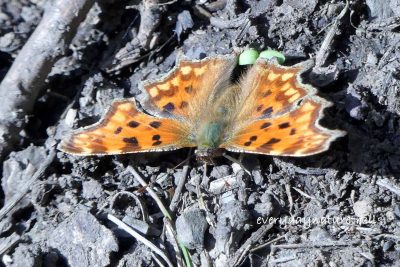
23/03/20-First Comma sighting

Since ‘lockdown’, the range of my outings has been much less than it would be in ‘normal’ times, restricted for now to the woodland I can easily access and wander around. Here I meet only the occasional local dog and their walker using the Public Footpath en route for the wider spaces of the reserve, and as we’re pretty well behaved up here, everyone so far has carefully observed the distancing rule. Tricky at times on these narrow tracks!

The walk, or more like meander, that I’m describing today is a ‘mash-up’ of two outings I took in the last week of March, during the spell of lovely Spring-like weather we had when it was sunny and warmish, and the skies were clear dark blue. Although I didn’t go far at all, there was a lot to see and now I know where to see it, I’ll be following a similar pattern in my meanders to check on the season’s progress.
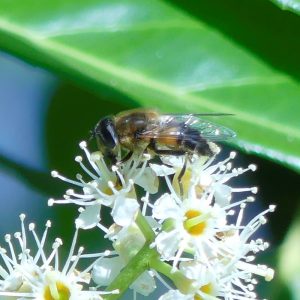
Eristalis pertinax (f)

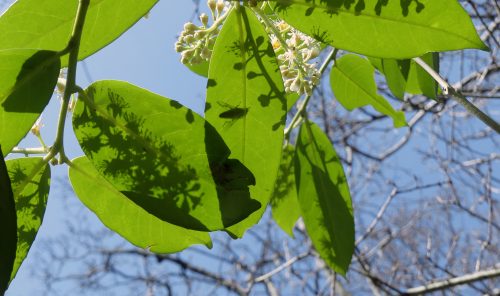
The first part of my path into the woods is dominated along one side by overgrown Cherry Laurels. They are reminders that this was once a shady woodland walk within the grounds of the grand house that stood here, long demolished and replaced much less grandly by flats, in one of which I live. The shrubs, or now small trees, can seem dark and gloomy, but they’re in flower now, lit up with candles of heavily-scented creamy-white blossoms offering up nectar to earlier-emerging insects. On bright sunny days like today, light shining through the leaves creates shadowy reflections of the flower spikes and gives away the presence of hoverflies enjoying basking on their sun-warmed platforms.
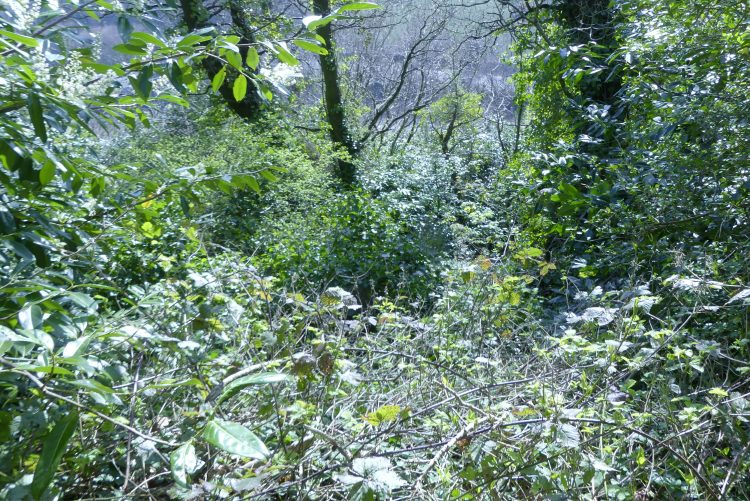
A few metres along the path I reach a patch I know to be a ‘hot-spot’ for insects. I’ve always been slightly mystified as to why it’s such a magnet for them, but I think it’s for a combination of reasons. Firstly, we’re almost 100m above sea level here, on the side of a wooded hill that that faces more or less South. A break in the line of Laurels exposes the view down the steeply-side slope, revealing there are very few large trees for quite a distance down, which has created a version of a woodland clearing. Shrubby trees have taken advantage of the space and light and filled the gaps, creating an understorey jungle of Holly, Hawthorn, brambles and of course ivy.
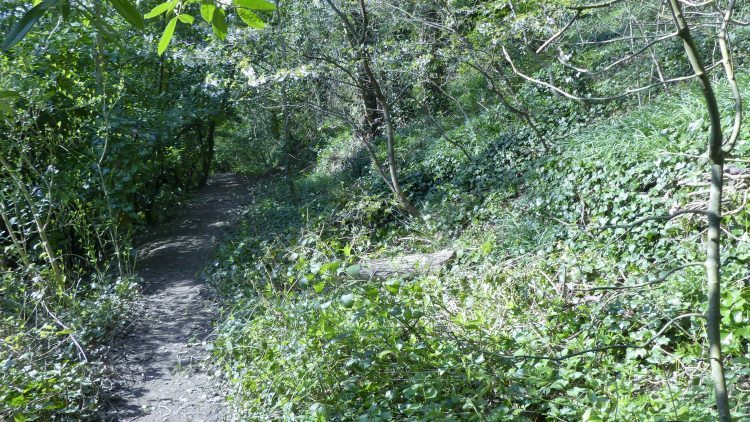
On the other side of the path is another patch clear of trees, about a metre wide, with a retaining bank or perhaps an overgrown wall, at its back. I wonder if this spot was deliberately created as a view point in the old garden and if a seat would have been placed here. It would have been a lovely spot to sit for a while. Facing more or less South, now it gets the benefit of full sun until about midday, after which trees begin to shade it out, but likely there were less then. With less impediments the view would have been across to the other side of the valley of the wooded hills with sloping green meadows. It would have been more peaceful too before the advent of the busy North Wales Expressway running along the length of the valley bottom!

All that I imagine was once here is long gone and the space has slipped into a somewhat scruffy, scrubby strip of rough vegetation that has become a great spot for the peaceful contemplation of an array of insects from early spring to late summer. Today there were a number of large hoverflies, Eristalis pertinax or Tapered Drone Flies, mostly males but there were one or two females too. They were flying briefly, zooming mainly from one sunny resting place to another.

Eristalis pertinax (m)
Hoverfly-Eristalis pertinax (f)

One or two Buff-tailed bumblebee queens flew in low over the vegetation, zooming then off up into the woods; perhaps they were still seeking a good spot to nest, or maybe carrying pollen to stock up one already made. Another emerged briefly, then crawled back under leaf litter and disappeared from view. A Common Carder Bee queen emerged briefly from beneath dry leaves but quickly crawled back and I had a similarly brief view of a Tree Bumblebee. It will be interesting later on to see if there are signs that all, or any of them have made nests here

Bombus pascuorum-Common Carder Bee queen
Bombus pacuorum-Common Carder Bee (queen)

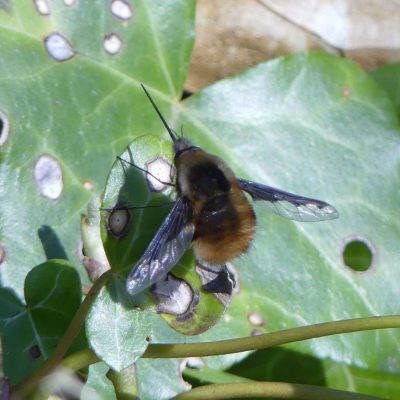
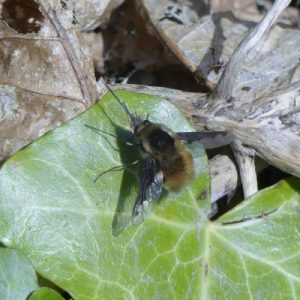
There were other insects too, a number of different species of flies, which I’m working on being able to identify, so maybe more of them in a future post, and the first of one of my favourite insects, a Bee-fly Bombylius major. They look cute and furry, but are actually a sneaky predators of hard-working mining bees.

A Wild Cherry tree marks the far end  of this patch and is now almost in full blossom and looking beautiful against the deep blue cloudless sky. The flowers offer another source of nectar to insects, particularly to bees.
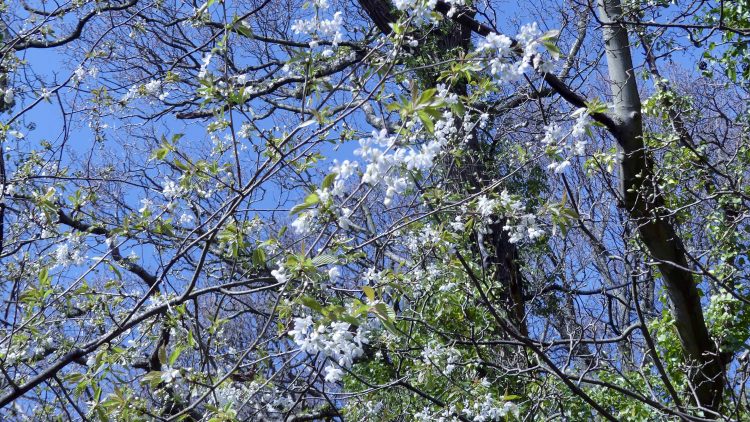
A bit further on, where the path gets steeper for a way, I stopped to listen to a Wren singing and tried to find him. I caught a glimpse as he was perched on a thick branch a couple of metres above the ground, which I was happy with. I love these tiny little birds with loud voices that completely belie their size, and they’re not always easily seen. As I stood a pair of Jackdaws flew into a tree nearby. This is the first year I’ve seen Jackdaws this far up the hill and never in these woods before. Their nesting stronghold is the cliffs of the Little Orme, and then there are others further down the hill towards the village centre that gather around the roofs of houses throughout the winter, but until now our quieter, leafier part of the village hadn’t seemed to appeal. Then a couple of weeks ago I spotted a pair visiting the bird feeders in the garden next door and last week was surprised to see a pair perched together in a tree in the woods not far from where I was seeing them now. This has to be the same pair, and they clearly feel at home, as now they were gathering sticks to make a nest.
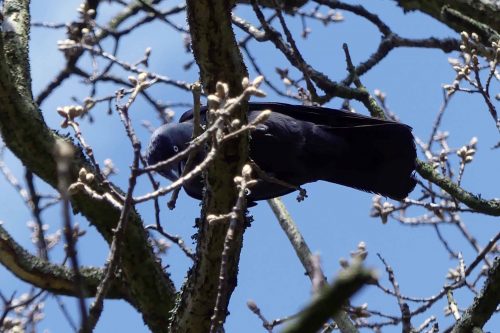
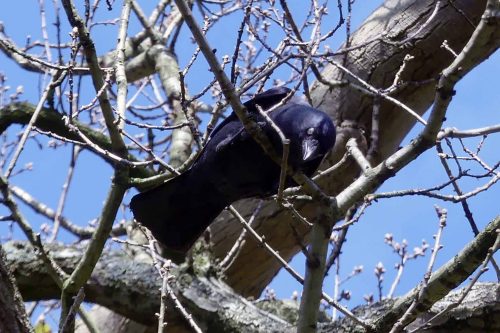
Most nests constructed from sticks look a bit haphazard and maybe a bit untidy, but birds such as corvids and of course Wood Pigeons are actually quite selective in their choice of twig. The Jackdaws were carefully scanning for one that looked right, which they then snipped off and gave further inspection. If they were still happy they carried it away, those that didn’t pass muster were dropped to the ground.
As so often happens when you stop to watch one thing, something else comes in to distract your attention. I spotted more movement high in a tree further back from where the Jackdaws were and it came back to me that I’d spotted a Nuthatch on that tree last year and had hoped it might be planning to nest in the hole there. I was sure some bird had worked on the hole though as it was perfectly round and its edges looked fresh. Maybe a Great Spotted Woodpecker had made it? But there were no further developments and as far as I know it remained empty.
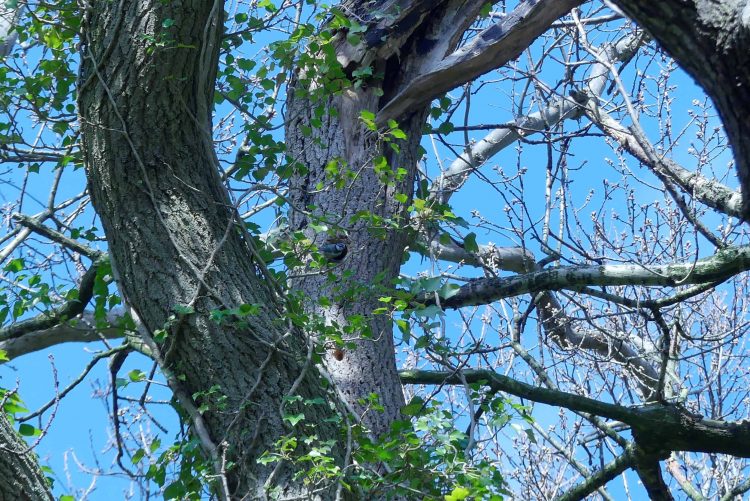
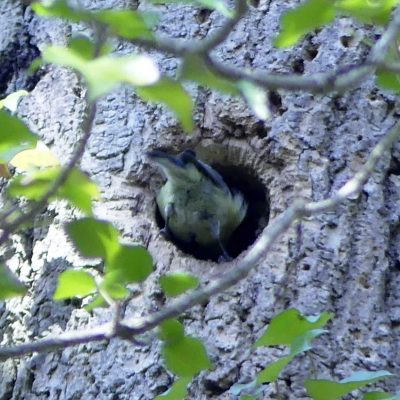
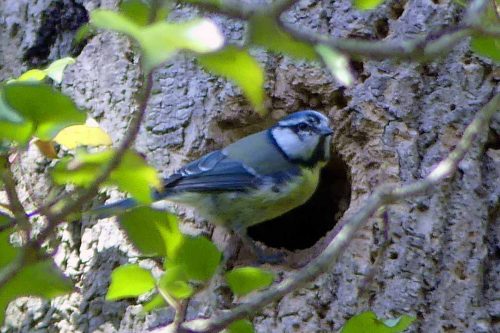
Checking out the hole today was a tiny Blue Tit. Surely it wasn’t contemplating it as a nest site? The hole is way too big! None-the-less it was in and out and pecking around it as though checking its possibilities, but I think it more likely it was just foraging for insects.

I had another surprise flash of déjà-vu  when I got a better look at the Blue Tit; it’s one with a distinctive face pattern, different to the norm, with a white streak in its blue head cap and blue speckles in its face; one I’m sure I recognise as having seen in this very location last year.
Moving on I reached my next insect ‘hot spot’. Completely different in character to the last one, this is a little higher up and at the junction of two well-trodden paths. Still South-facing the downward slope is again open and missing large trees, some of which have succumbed to storms in recent years.
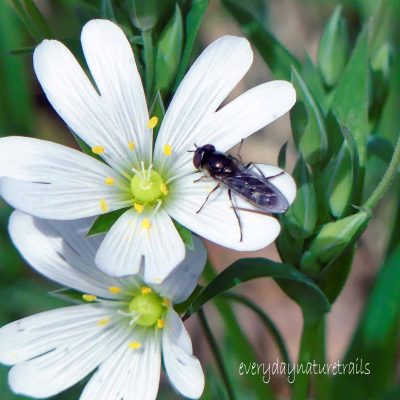
200323-1208-BEWP- (148s)-Platycheirus albimanus (f)

Platycheirus albimanus (f) on Greater Stitchwort

Two days ago I was standing here watching a small black hoverfly on the Greater Stitchwort flowers and from the corner of my eye I saw what I took to be a dog coming down the path towards me. I was preparing to move 2 metres further on as I thought to let its owner pass, when from behind the big Sweet Chestnut tree on the corner of the junction, trotted a Fox! Equally taken by surprise, for a split second our eyes met and we both froze, then it spun to its right and ran away beneath a Yew tree. Amazing! What a lovely animal. From now on I will always think of that path junction as ‘Fox Corner’.

A gorgeous Peacock butterfly landed on the ground in front of me. Another first species sighting of this year.

25/3/20-1st Peacock sighting
Peacock
Peacock


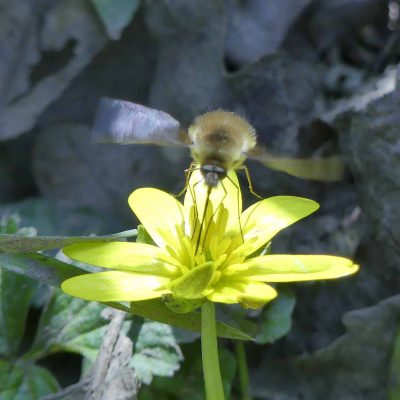
Bee-fly on Lesser celandine

In this spot last year there were mining bees, and where there are mining bees, prowling predatory nomad bees and as before-mentioned, Bee-flies. I supposed that the presence of several Bee-flies here today indicated that they had recently emerged from one of last-year’s mining bee nests. They are fascinating insects to watch.

More about Bee-flies and their relationship with mining bees here: Tawny Mining Bees & the Bee-fly


Bee-fly Bombylius major
Bee-fly-Bombylius major

Orange-tailed Mining Bee-Andrena haemorrhoa

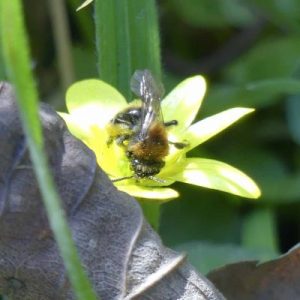
I had a good look around for signs of mining bees and eventually spotted just one feasting on a celandine. It’s difficult to tell from this photograph, but based on what  little I’ve learnt about these tiny bees and help I’ve had with identifying others found in this locality, it’s likely that this is an Orange-tailed Mining Bee.

Carrying on down the path I’m reminded of how much evergreen foliage there is here. In this photograph and just a little further back there is Holly, Ivy, Yew, Evergreen/Holm Oak and Spurge Laurel. I still can’t wait for fresh foliage though.
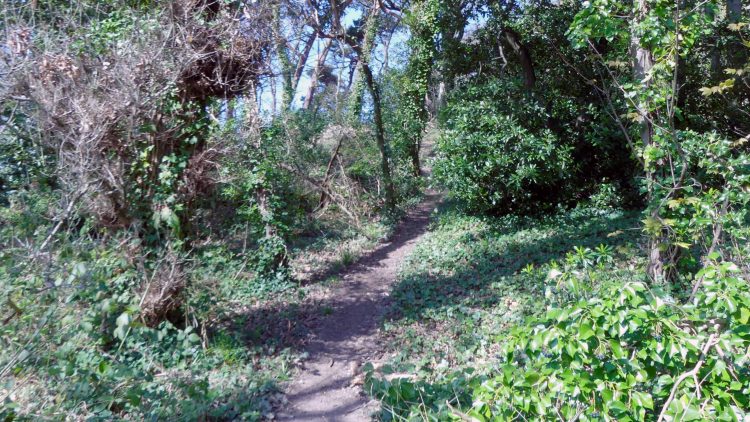
By its nature, a wander has no shape to it, so I can’t describe a trail to you as I often do, and to appreciate one fully takes a particular mindset. They are not for the impatient walker with an aim in mind, or for those whose idea of birdwatching is to see one and tick it off a list!
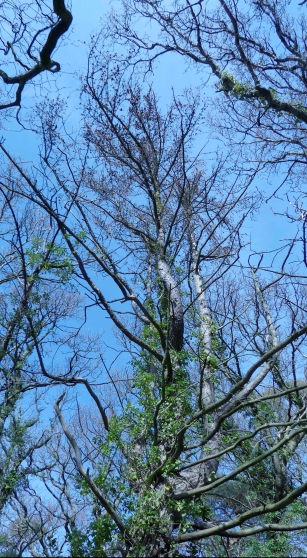
200323-1056-BEWP- (34)-Larch Tree-top laden with tiny cones

Larch-Larix decidua

This is typical of how things go with me: I’m wandering along the path in the photograph above and remember that the other day I noticed for the first time that one of the trees growing at the side of this path is a Larch, not a common tree here. So, as one of my aims this year is to try to identify as many of the different species of tree in this patch of woodland as I can, the tree is in my mind as one to investigate further. Larches are deciduous of course, but is this one, full of cones at the very top, but altogether very dry and brown-looking, alive or dead? Just before I reached it I noticed what I thought was a large branch that had fallen from said Larch, so I detoured slightly onto another path to get a better look.

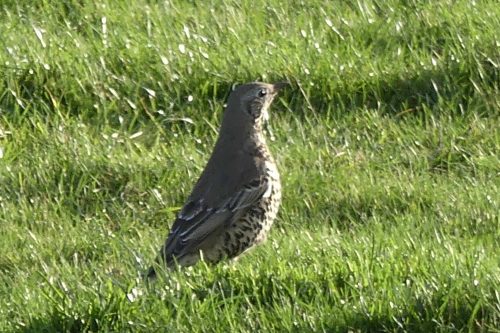
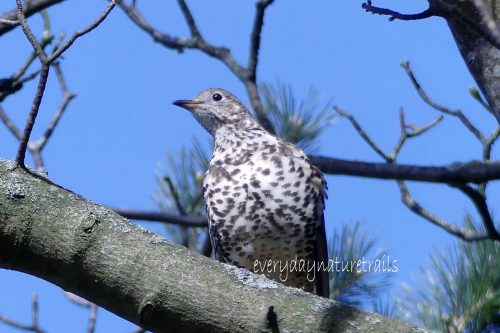
As I was photographing (for future refence) the cones still attached to what is actually a whole, if skinny dead fallen tree, I spotted a bird fly onto the branch a few trees back from where I was standing. I knew straightaway that it was a Mistle Thrush and grabbed a quick snap in case I didn’t get another chance. I moved forward slowly to get a better look and although it had clearly seen me it stayed put. They are handsome birds, their upright posture giving them a strong confident presence, but they are also wary and always on the alert.
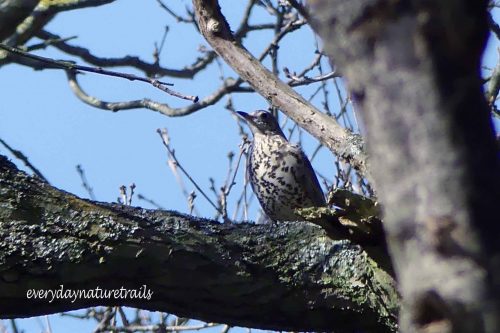
Their colouring and arrangement of their markings is highly effective when it comes to camouflage, sitting perfectly still in dappled shade they blend in perfectly.
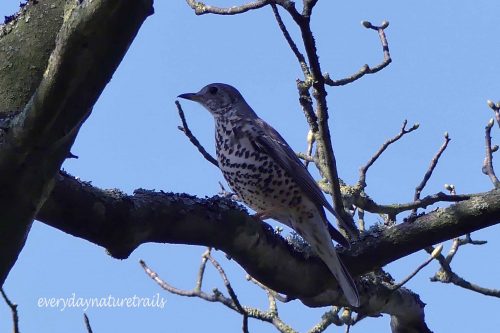
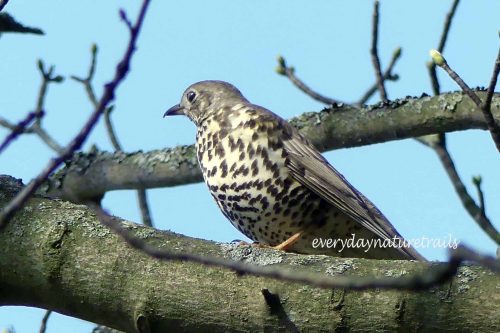
After a few minutes I realised that the thrush had no plans to move far, which led me to think that it may well be nesting somewhere nearby. Mistle Thrushes are early nesters, so this could have been the male of a pair keeping watch over his nest and territory. The bird moved further back again, towards what I think of as the Pine Grove, where a dozen or so tall, wind-contorted Scots Pines are gathered at the edge of this patch of woodland where it meets an open field. Perfect Mistle Thrush nesting territory.
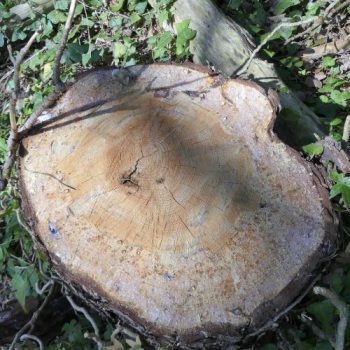
I thought I’d hang around for a while to see if the birds might give me a clue as to where the nest was. I headed for this sawn Scots Pine tree stump as a likely place to sit, but realised just in time that it was oozing beads of resin, so it must have been felled recently. I didn’t sit on it. Counting the rings from my photograph later on I reached somewhere around 60. I wondered why it had been felled as its wood looks quite strong and healthy.
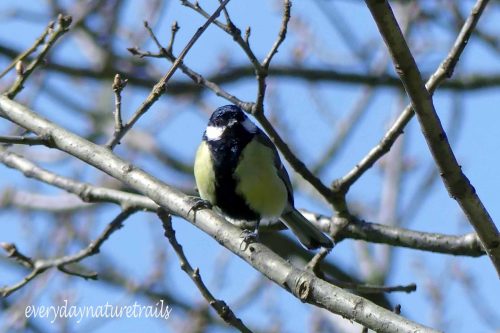
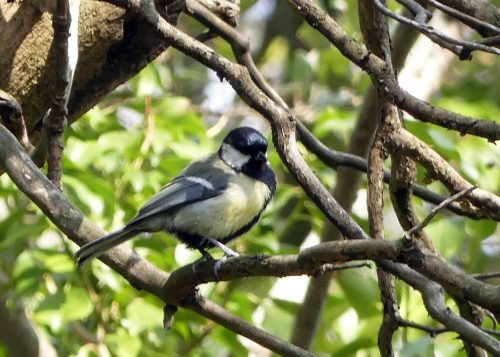
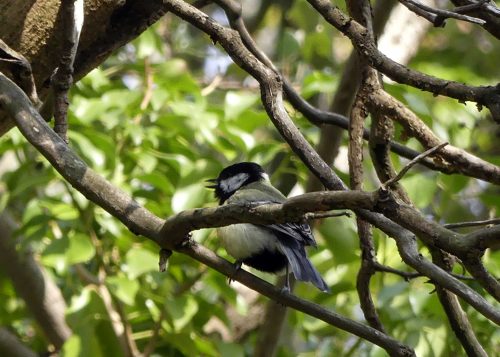
This small patch of the woods is a favourite place of smaller birds too, especially tits and particularly Great Tits. While I was standing still I was treated to a song by the strongly-marked male above. I’m sure I photographed him last year, he’s quite distinctive, or is that heavy black genetic? I had lovely views of two Long-tailed Tits foraging up around the trees and along the field fence.
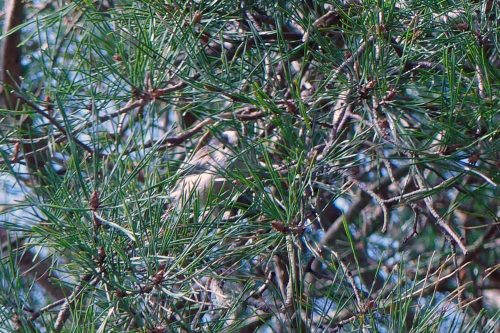
I was hoping to get at least a glimpse of a Nuthatch here, a few days ago there were a pair flitting about here exploring the top branches of the pines; I took a photograph, but  facing into bright sunshine it’s not great, but a record at least. I could hear a male calling persistently and loudly, but try as I might, I couldn’t locate him today. Finding singing or calling birds in trees is definitely not my strong point.
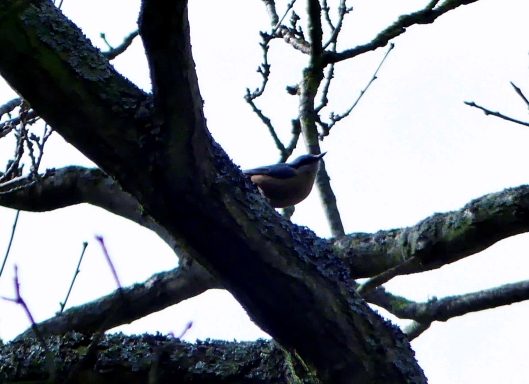
200319-1341-BEDC- (31a)-Nuthatch- 1 of 2 - in Scots Pine

19/3/20 – Nuthatch

Meanwhile, the Mistle Thrush had flown up to a tree branch and sat in full and open view with his chest feathers puffed out, making him look a completely different shape and much bigger; from a distance he looked a bit like a female Sparrowhawk. He was still fully alert though and quickly dashed out when a kafuffle broke out around a neighbouring tree. A Magpie had flown in and perhaps deliberately, must have got close to the nest. I assume the female had been sitting on it and launched herself at the Magpie, which was screeching loudly. Both Mistle Thrushes went on the attack, also calling loudly and saw the Magpie off. Peace resumed and the male went back to his perch, re-fluffed his feathers and sat quietly once more.
I’d been standing still in one spot for a good few minutes, then as I turned to continue along the path I was on to head back home, this lovely little Treecreeper flew onto a pine tree almost right in front of me. It spent a while exploring the bark of the tree, probing into crevices with that long slim wickedly-curved and pointed beak, moving around and slightly up before flying across to another one that had ivy growing up it.

200325-1235-BEWP-(175s)-Treecreeper
200325-1236- BEWP-(178s)-Treecreeper

Between watching the Mistle Thrush and the Treecreeper I’d stood and looked over the fence to see if there was any sign of Buzzards there. Two days ago I’d spotted one circling low over the trees here, that had flown in from across the valley. It was joined then by another and they both flew out over the field, circled around, high and low, then both landed in the big tree in the corner of the field. They didn’t stay for long, but I’m really hoping that they were prospecting for a nesting site and that they might choose one close by.
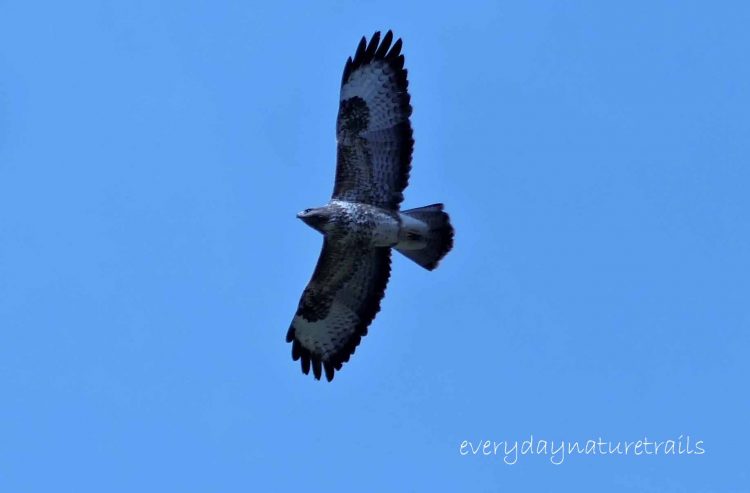
Today it seemed there were no Buzzards to be seen, but then, just as I was walking away one flew in low over the trees. I turned back and walked quickly back to the field edge where I saw it had landed on a tree branch. It was hunched over and peering down intently….
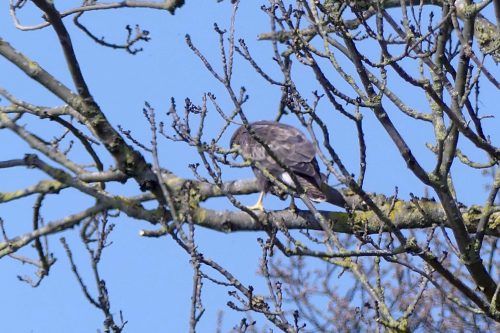
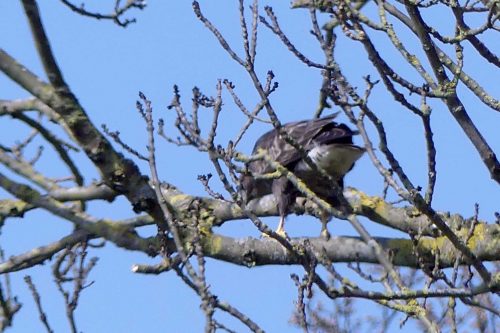
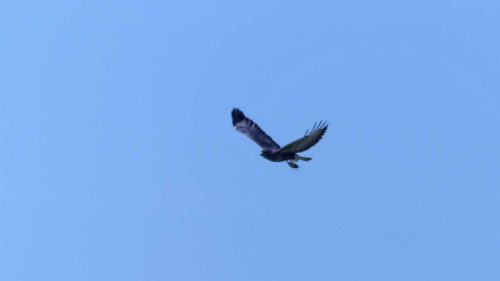
…..then it launched itself from its perch, flew low over the grass and dropped suddenly. It  had landed behind a hillock near the top edge of the field so I couldn’t see it on the ground, but it soon took off again and as it flew in my direction I could see it had something gripped in the talons of one foot. I couldn’t get in close enough to make out what it was, and my photograph doesn’t help with whether it was live prey or carrion. It was interesting that it carried it away too and didn’t eat it where it found it, which made me wonder if it was intended for a mate? Buzzards don’t usually lay till late April, so maybe a bit early for that. Another of life’s little mysteries.So much seen in a small patch of woodland and because I spent longer in each spot I feel the quality of my sightings was good too. Staying away from the main Reserve, where I would have expected to have met more people meant I hadn’t got close to my usual target of 5,000 steps, indeed, I hardly made it to 1,000! But if I’d continued as I would normally have done I’m sure I would have missed a lot of what I saw today. I’m looking forward to more restricted wanderings in the days to come.
Stay safe!


Share this:

  • Share on Facebook (Opens in new window) Facebook
  • Share on Pinterest (Opens in new window) Pinterest
  • Share on X (Opens in new window) X
Like Loading...

Kinmel Dunes-Twyni Cymnel

09 Sunday Feb 2020

Posted by theresagreen in Coastal Nature Reserves, coastal wildflowers, Local Nature Reserves, Nature of Wales, North Wales, North Wales Path, Wildlife of the Wales Coast Path

≈ 10 Comments

Tags

active sand dunes, Alauda arvensis, bird behaviour, Black-headed Gull, Buck's-horn Plantain, cormorants flying, herring gull, kestrel, Kinmel Dunes, moss in sand dunes, sand dunes, Sand-hill Screw Moss, seashells, skylark, tree mallow

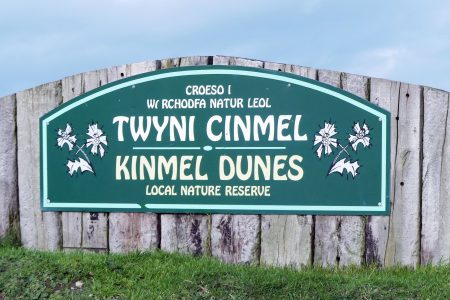
Much of the sand dune system that once stretched along the eastern end of the North Wales coastline has long-since disappeared, flattened to make way for ‘coastal development’, but a small fragment survives at Kinmel Bay, which lies between Rhyl and Towyn on the Wales Coast Path. This active dune area is designated as a Local Nature Reserve, which means that its worth to wildlife is recognised, but that it is also an amenity area for people; a challenging balancing act for those trying to maintain it, particularly so in a small space that is also regularly severely battered by strong winds and powerful tides.

This was my first visit here, and my first impression was that although proudly and prominently signed as Kinmel Dunes Nature Reserve, this is firstly an amenity area for people. The large tarmacked car park placed at the centre of the dune area, effectively dividing the reserve area into two, was the first indication of that. Then there are toilets and a refreshment kiosk at the beach end of it, both firmly closed up for the winter. It is clear though that the Reserve area is valued and cared for and there are several interpretation boards informing about the dunes themselves and the wildlife that may be found there. There are also North Wales Wildlife Trust guides to things you may find on the beach and details of how to record anything you might find.

Later on it struck me that if you were walking the Wales Coast Path you quite possibly wouldn’t realise that you were walking past, or through a Nature Reserve here as there are no signs on the path itself at either end to inform you of that.

To get an ‘overview’ of the Reserve area I followed a track from the carpark to the top of a small hillock topped with picnic tables, which I’m fairly sure would have been man-made as a view point over this otherwise flat and otherwise featureless stretch of coastline.

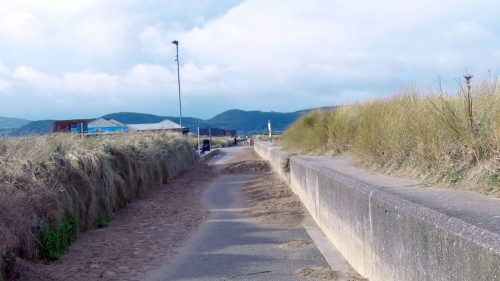
The view above shows the North Wales Path/Wales Coast Path coming in on the right (east), from the direction of Rhyl, then passing the public car park and the beach café, which is currently firmly closed for the winter. In the forefront a surfaced path curves through the dune area, which attempts to encourage people to refrain from trampling across the fragile dune area itself. On the shore edge you can see where the surfaced Coast path has been cut through the dunes for part of its length and where they gradually peter out to be replaced by a shore of shingle.

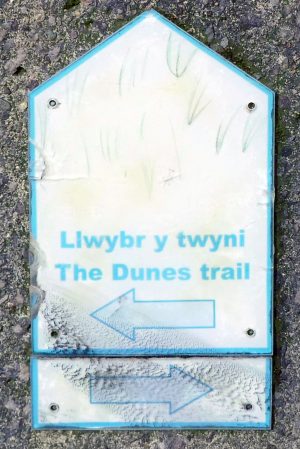
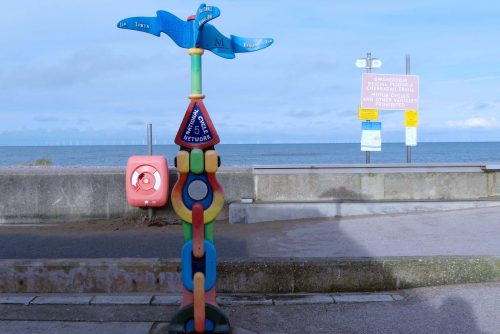
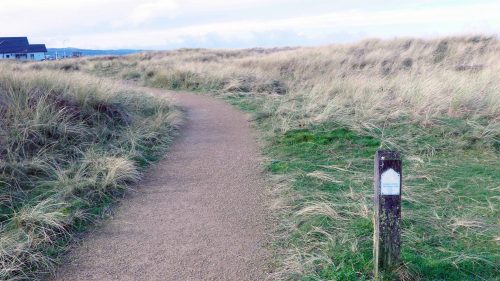
Leaving the viewpoint on the other side, I joined the Coast Path, which is also marked as ‘The Dunes Trail’. Today the path was heavily strewn with sand either washed from the dunes by high seas or rain or blown out by strong winds. Probably a combination of all three. As usual I hadn’t formulated a plan as to what I’d do when I got here, so for no particular reason turned left to head towards Towyn, back past the car park and the firmly-closed refreshment kiosk. There are numerous notices, warning signs about the dangers of the sandy shore area, keep off the sea wall, no dogs from May to September and a life-saving ring.There is also one of the iconic colourful Cycle Network signposts informing me that I am 1¼ miles from Towyn and 1½ miles from Rhyl in the other direction.

It soon becomes clear that signs and warnings are to be significant features of this stretch of path as here too is the more traditional Wales Coast Path sign, informing that Pensarn is 3 miles away.

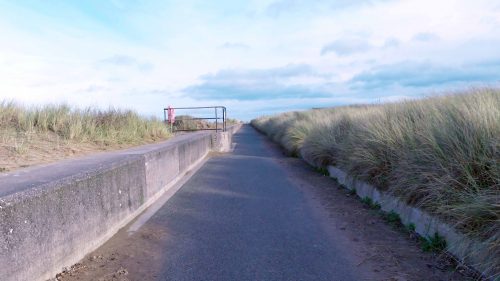
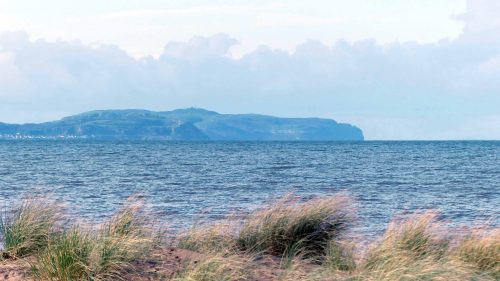
The path is long and straight and bounded by a wide low concrete sea wall. The surrounding landscape appears flat and quite featureless, but in front of you can see the not-too distant hills rising on the horizon and stretching all the way round to the headland of the Great Orme.


Countless numbers of times I have stood and looked at the view from points high and low across the other side of this expanse of sea, so it was interesting to be standing at a point I’ve probably photographed many times.

Out to sea are the turbines of Rhyl Flats Wind Farm, situated in Liverpool Bay. This started out as a modest 25 units back in 2008/9, but the ranks of turbines has since expanded greatly so that now there seems to be continuous lines of them stretching from one side of the bay to the other.

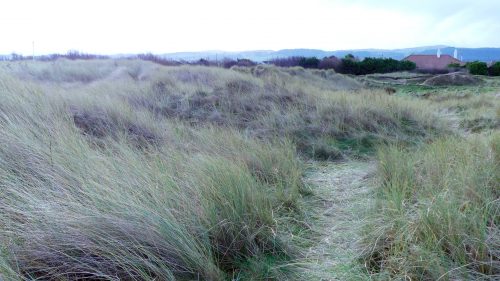
I find it amazing that any wildlife can survive, let alone thrive in harsh, well-trodden  habitats such as this, but it’s also a wild(ish) strip of land on the border between human habitation and the seashore, so although not ‘pure’ sand dune, it can be interesting and well worth exploring. I left the path when I saw the beginning of a sandy path wending its way through and around the dunes.

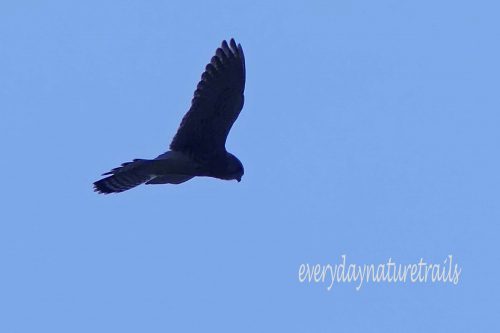
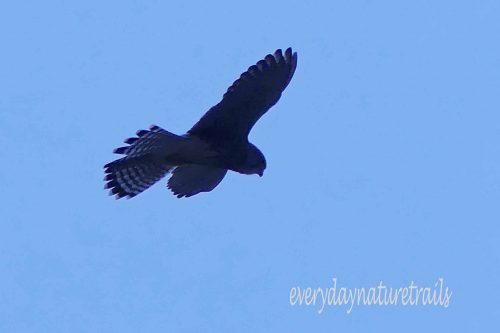
I got off to a good start – a few steps in I spotted a bird flying in towards where I was standing, and was treated to a display by a hovering Kestrel. It may have spotted some movement on the ground below as it lingered for a moment, but there was no downward swoop and it soon moved away.

I was facing into the sunlight, so couldn’t make out all the beautiful details of the bird, but there’s no mistaking that shape and seemingly effortless aviation skills.

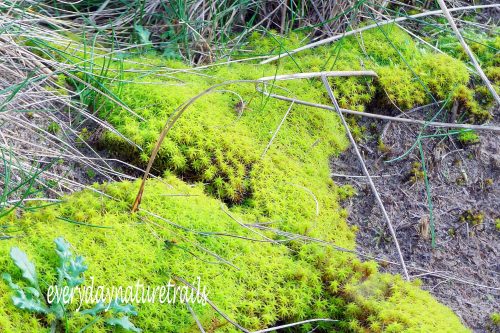
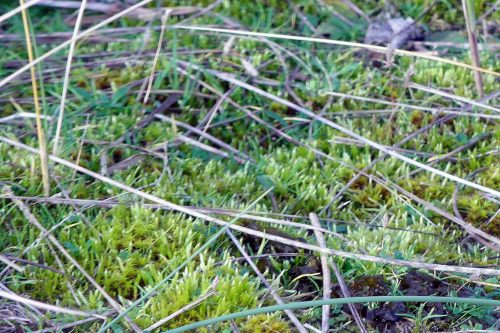
The dominant plant of the dunes is of course Marram grass, of which there is plenty here holding everything together. I’m sure there will be flowering plants in amongst it later on, but today the star plant was, quite unexpectedly, lovely bright green moss. I’d never connected damp-loving mosses with dry sandy dunes, but I’ve since learnt that they are often found on their damp sheltered sides and are important stabilising plants in dune systems. I’ve said before that I’m fairly clueless about bryophytes (mosses & liverworts), but I do love to see and photograph them and am trying to learn to recognise at least a few. Going on its location, i.e. sand dunes, and its distinctive ‘starry’ appearance, this might well be Sand-hill Screw Moss – Syntrichia ruraliformis. Growing close by to this lovely spread was another smaller, similar-looking patch with fruiting bodies, which may (or may not) be Redshank Moss – Ceratodon purpureus. Apparently the two species often do grow close together.

200127-KBLNR- (23a)-Moss in sand dunes
200127-KBLNR- (24a)-moss in sand-dunes fruiting bodies

To add to my identification issues, I found another patch that looked different again, but I think it’s the same Sand-hill Screw Moss, which protects itself from dehydration in dry conditions by rolling up its leaves around its stems, giving it a completely different appearance. I guess it’s this habit that gives the plant its ‘screw moss’ common name.

The path I was on soon met up with the surfaced path that I now realised had started from the car park, also marked as The Dune Trail.

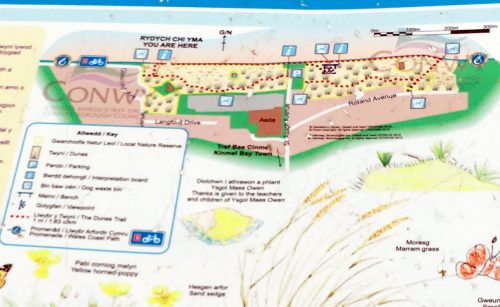
An interpretation board at the end of this short trail, where it rejoins the main path, indicates it as a dotted red line. The board also shows the size and scale of the reserve and the proximity of ‘developments’, such as the Asda supermarket and its carpark.

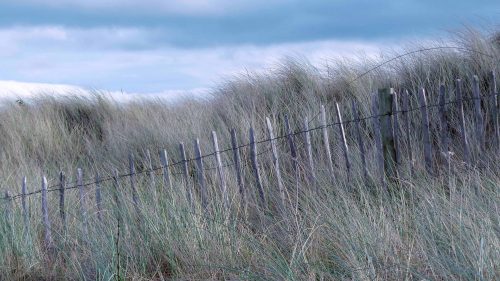
All too soon I’m back on the main path and spot a length of chestnut post and wire fencing, (which in my mind at least, made a connection to my last post about the Sweet Chestnut tree).  I’m not sure if the fencing  is there to help stabilise the dune or to deter people from trampling over it.

Growing in the crevice between the path and the retaining sea wall, a flourishing clump of Buck’s-horn Plantain, clearly showing the leaf shape that gives the plant its common name.

Standing quietly atop the shingle bank behind the sea wall a Black-headed Gull. The birds’ heads are actually white in the winter with just a black spot behind each eye, then approaching the breeding season the head begins to take on colour as this bird’s is, darkening gradually to a rich dark chocolate brown; not actually black as in its name.

Black-headed Gull – Larus ridibundis

Also on the shingle, a patch of new Sea Beet leaves. The plants waxy-leathery leaves give it the protection it needs to withstand the tough conditions here.

More signs! This really can be a dangerous place for the unwary or foolhardy.

This coastline is reknowned for its many hundreds of mobile homes, most of which are actually static and available to occupy for 10 months of the year. I wondered if the intimidating fencing along the boundary of this site was designed to keep people out or in?

As a walk for anything other than fresh air and exercise this section of the Path, at least while the tide is high feels more like a corridor between mobile homes and the hard lines of the sea wall and the defensive rip-rap.

At the next bend I decided to turn around and head back the way I’d come. The backdrop to the houses is the Clwydian Hills.

The tide was beginning to recede. I wasn’t sure if the fisherman on the edge of the shingle bank was setting up or packing up and I wonder if he caught or will catch anything.

On the developed side of the path between the retaining wall and the houses is a wide strip of mown grass. On its edge there’s a patch of Rockrose with Ribwort Plantain growing through it.

Leaves of Common Rockrose & Ribwort Plantain

Lower down, in the sheltered crevice where the wall meets the path, more opportunistic plants are flourishing. A left-over, rather sad flower on Sea Mayweed; freshly flowering Groundsel; leaves of Dove’s-foot Cranesbill surrounded by new Chickweed sprouts and most surprisingly, several plants of Tree Mallow.

Sea Mayweed
Sea Mayweed
Groundsel
Groundsel
Dove's-foot Cranesbill
Dove’s-foot Cranesbill
Tree Mallow
Tree Mallow

And here a lovely aggregation of leaves of wildflowers-to-come in a pretty array of shapes and shades of green, which includes Dove’s-foot Cranesbill, Common Stork’s-bill & Common Chickweed.


I wondered if the origins of the Tree Mallows might be this tall and seemingly well-nourished specimen.

Along part of the edge of wall where it meets the grass a line of Marram Grass has established and left to grow. As it is in a straight line, perhaps it’s been deliberately planted to protect the grass from some of the salt spray and wind. I wonder why they don’t just let it revert to its natural state? It would look so much better and wouldn’t need cutting.


If you look closer, the concrete walls aren’t totally featureless, there are patches of lichens growing there, which I’m not attempting to identify, other than to say some are greyish-white, others yellow or orange.

200127-KBLNR- (55a)-Lichen on path wall
200127-KBLNR- (58)-Lichen on sea wall

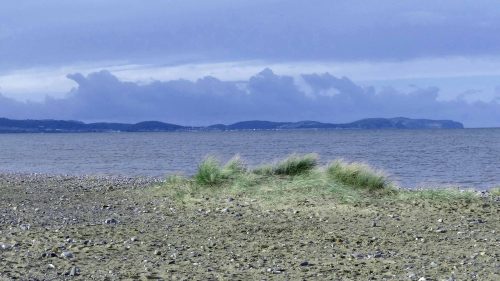
The skies brightened, showing up some of the green on the Little and Great Ormes through a lighter haze.

Sea Holly is another tough but beautiful plant that can handle these harsh conditions, evident for now by patches of dry stems with prickly leaves still attached, held in place amongst Marram stems.

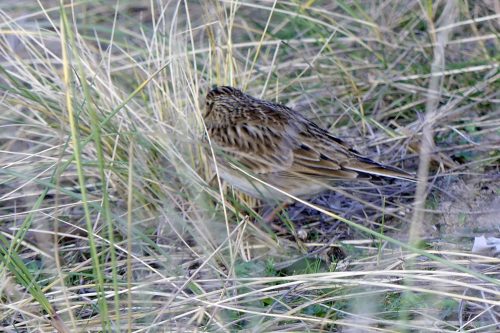
I glimpsed a flash of a bird that dashed from the dune side of the path to land on the shore side, quickly disappearing into the cover of Marram grass. My first impressions were that it was small, brown and maybe a Rock Pipit. Fairly well concealed amongst the dry grass stems it carried on foraging amongst them, in no great hurry, keeping half a wary eye on me and allowing me quick glimpses as it moved further away towards the beach. Possibly because I expected it to be, I had convinced myself this was a Rock Pipit, but I’m very grateful to Tony, who in his comment below has given me the much more exciting identification of a Skylark!

Skylark – Alauda arvensis

I know much less about Skylark behaviour than of Rock Pipits, so it was great to know they are here and to get so close to one. I’ll have to go back later in the year to see if I can catch any singing.

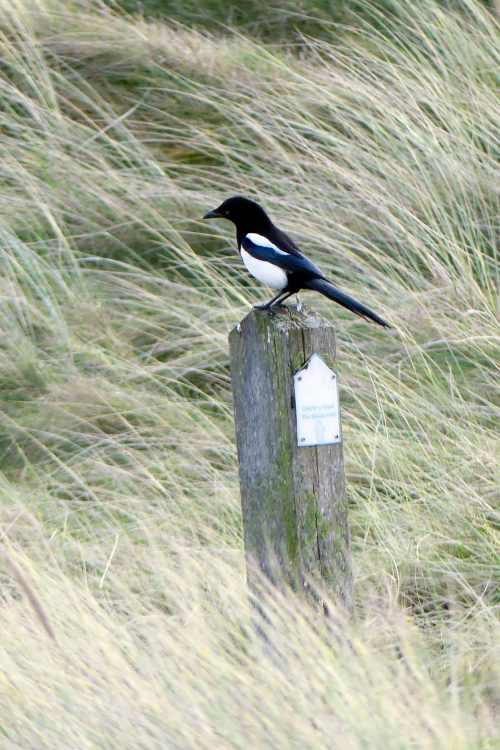
Another bird flew in front of me heading from the shore across to the dunes; a Magpie which landed on top of a Dune Trail marked post. I didn’t realise until I saw the photograph later that I’d caught it having a poo (sorry!); it looks like this might be a favourite perch for the purpose.

The sun continued to shine and as it felt a bit warmer and being in no particular hurry, I decided to carry on for a while and walk towards Rhyl.

At intervals along the path steps, safeguarded with iron railings allow you to cross the sea wall onto the beach.

All of those I’d passed walking in the opposite direction had been closed off, but one here was open. Taking the opportunity to get off the long straight path I thought I’d have a meander along the strand-line to see what I could find.

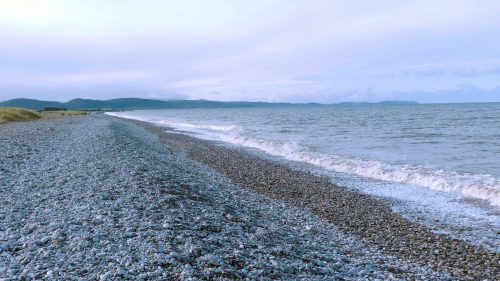
Views along the beach: above towards the Great Orme and below towards Rhyl.

I’m surprised anything survives being pounded by waves against the stony bank, but there were seashells there as well as clumps of Whelk egg cases and the egg case of a Ray.

Whelk egg case cluster
Whelk shell & limpet shell
Razor shell
Razor shell
Peppery Furrow shell
Mussel shell with barnacles
Ray egg case
Ray egg case

More random was a plastic bottle I found on the sea edge full of pebbles that I guessed may have been used to anchor something down and a sea-smoothed fragment of a house brick bearing part of its maker’s name.

200127-KBLNR- (94)-plastic bottle filled with pebbles
200127-KBLNR- (88)-brick fragment


some of my rubbish haul


As always there was the usual rubbish entwined amongst the seaweed, nylon fishing line, dried-out wipes, bottle tops etc. Also the wrapper from a packet of biscuits, nearby Asda store’s own brand & some sticky plastic tape. I picked up as much as I could stuff into my pocket as I’d come without a bag.


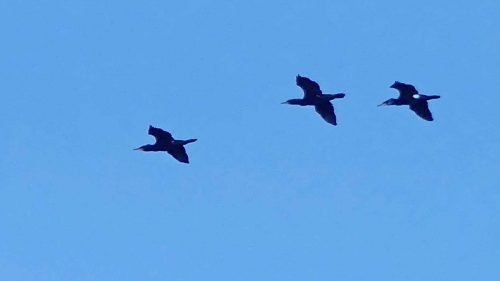
A Cormorant fly-past

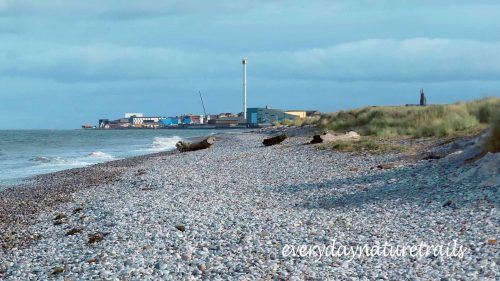
I carried on until I could see Rhyl on the near horizon. The lifeboat was out and ready to go, hopefully not imminently and the landmark ‘Sky Tower’ that is visible from far across the other side of the bay.

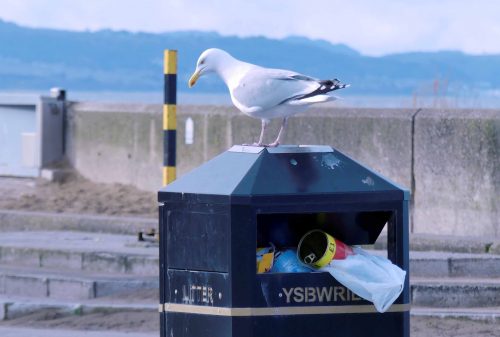
Back in the car park a pair of Herring gulls were investigating the overflowing rubbish bin. They’d pulled out some to study further, but I don’t think there was much there to tempt them. I picked up a few more bits that had blown across the carpark and left them to it.

Share this:

  • Share on Facebook (Opens in new window) Facebook
  • Share on Pinterest (Opens in new window) Pinterest
  • Share on X (Opens in new window) X
Like Loading...

An Appreciation of Trees

17 Sunday Nov 2019

Posted by theresagreen in Colwyn Bay, Nature of Wales, North Wales, woodland walks

≈ 9 Comments

Tags

ancient woodland, autumn, fungi, native trees of Wales, pwllycrochan woods, wanders, woodland

The woodland of Pwllycrochan makes up much of the treescape that forms the beautiful and seasonally changing backdrop to the town of Colwyn Bay. Deceptively small in area, this woodland is long and narrow, surrounded and divided by roads into three islands that together occupy just 21 hectares of land. But what this remnant of ancient woodland lacks in ground area is made up for by the height and grandeur of the beautiful old trees that occupy it. Aged Oaks, Ash and Beech trees soar majestically into the sky, some so tall it’s almost impossible to see their crowns without craning back your neck as far as you can.

This has become one of my favourite places for a wander at any time of the year, but I think Autumn is the perfect time to appreciate the true owners of this woodland: the amazing trees that grow there.

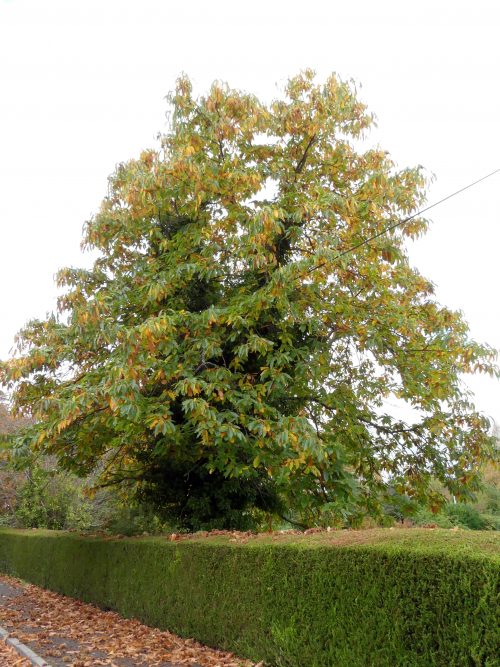
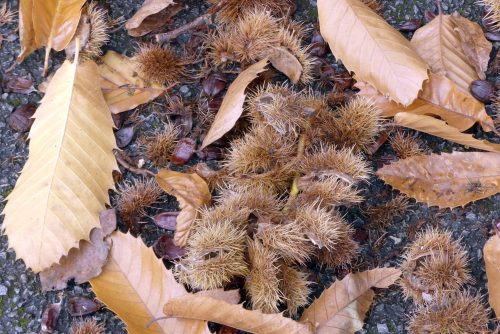
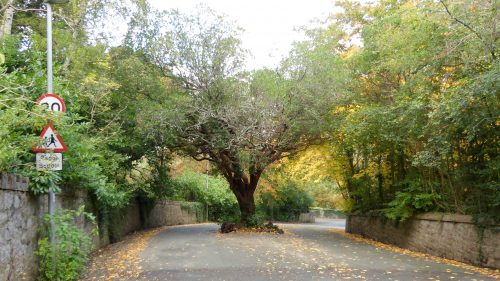
Much of the original woodland that was once the formal parkland of the Pwllycrochan Estate is gone, but a good number of its beautiful old trees still stand, lending grandeur to the roadsides of this west end of Colwyn Bay. A formally clipped yew hedge marks the boundary between the school playing field and Pwllycrochan Avenue and just behind stands a glorious spreading Sweet Chestnut tree. The leaves remaining on the tree are slowly turning colour. Many have already fallen, no doubt  assisted by recent high winds and heavy rain and the pavement beneath is covered with russet-coloured leaves, prickly seed-cases and scattered nuts.Rounding the bend a little further up the sloping road, a sight that I remember took me by surprise the first time I saw it: a tree has been left to grow on a small island in the middle of the road. This is an old Strawberry tree, an exotic survivor from the past glory days of the aforementioned Estate.

Inside the woods it was peaceful and still. For a brief moment nothing moved. Not a breath of air stirred the leaves. There were no road sounds, no trampling chatting people or dogs, no bird sounds, not even a scurrying squirrel. Perfect peace.

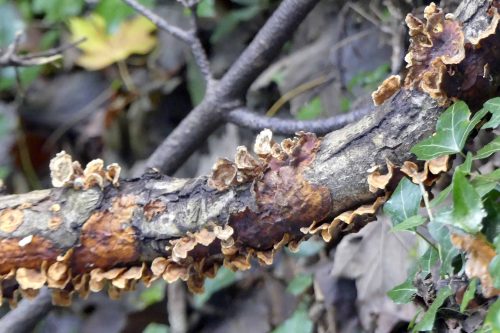
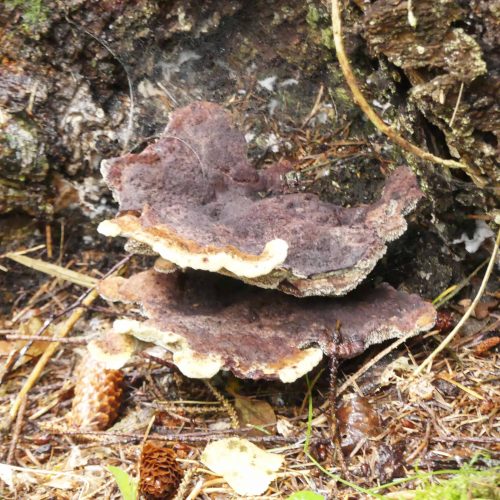
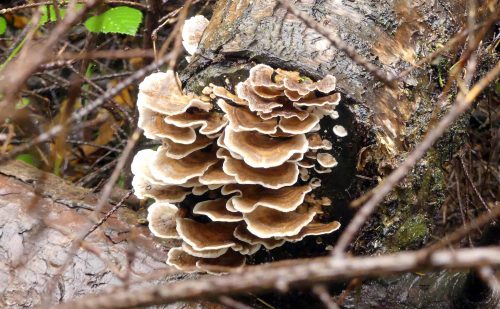
The moment was fleeting, soon broken by a lady walking with her dog, but much appreciated. I wandered a bit further along the path, looking out for fungi. I wondered whether it was a bit late in the season for finding anything, but this has been a good place for them in the past and inspired by our recent foray I was hopeful. Checking a woodpile at the side of the path I found some bracket fungi, some pieces had grown quite large and gone woody. It was faded too, but the largest piece was a pretty scallop shape and there was some darker banding still visible, so it may be Turkey tail, but does it grow that big?

Oak

The ancient trees stand  tall and straight like sentinels on guard. Each stands alone,  reaching the high canopy without need to bend or twist to avoid touching another. Most have lost, or at some time in the past, had their lower branches removed.

As a managed wood historically, that may be for  one of several reasons. Timber was, and is a valuable commodity. As building material for houses or ships and boats, long lengths of straight wood are desirable, so lower branches may be deliberately removed, particularly from Oak trees, for that reason. The woodland would have been managed for game too, birds such as pheasants would have been introduced and shrubs planted between the trees to give them cover, again requiring the removal of low branches to allow sunlight to reach them.

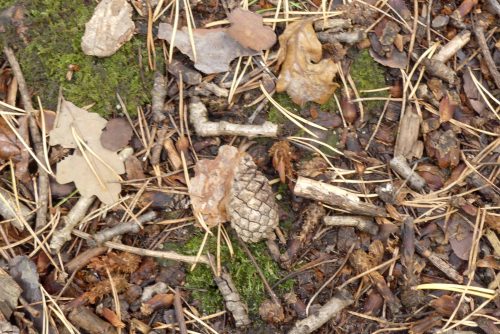
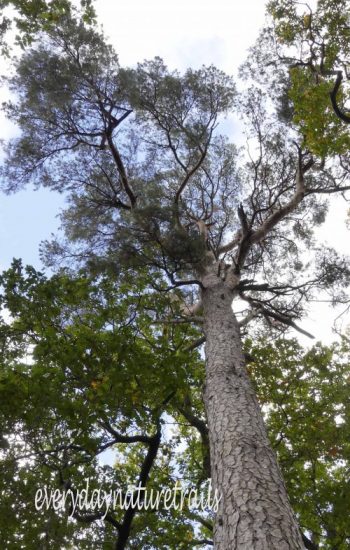
If I hadn’t seen a scattering of small cones on the ground I may have missed the Scots Pine tree they had fallen from, despite the fact that its trunk was almost in front of my eyes. It towered so high into the sky I had to crank my neck back almost painfully to see its few remaining branches way up in the canopy. I find it incredible to think this giant had grown from a tiny seed once encased within a tiny cone such as this.

Scots Pine

There’s something quite magical about a woodland stream and this wood has two that flow down through deep dingles. The sound of this one was clearly audible some distance away; its sound would have been amplified by the rocky walls either side of it, but recent heavy rains have given it power and volume and it tumbled and fell rapidly down the rocky cliff quite dramatically.

Heading towards the pool that gives the woodland its name, the track passes by this tall elegant Oak tree, elevated further by the raised bank it grows from. It is holding firm despite the soil around its roots having been much eroded. It’s mostly Sessile Oaks that grow here, but the only ways I know to tell them apart from the English Oak is that the Sessile’s acorns are stalkless and the leaves have longer stalks. The leafy parts of this tree were way too high to tell and I think by now squirrels and Jays would have made off with any acorns there may have been.

On the shaded path below the tree, at the bottom of the bank, a layer of coppery dry leaves merges with bright green moss.

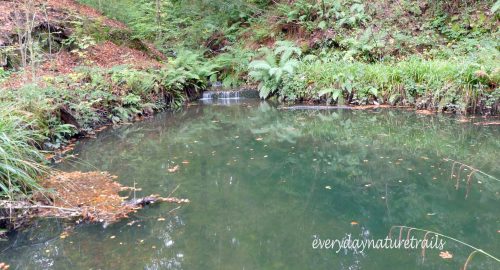
I stood on the bridge crossing the narrow exit end of the pool as I always do, trying to imagine how it may once have been. Pwll is the Welsh word for pool and crochan translates as cauldron. It is said that once the stream flowing into the pool was once much more powerful, causing the water in it to bubble and froth as it would in a boiling pot. I’m ever hopeful that one day the water might at least look a little more animated, especially after a period of heavy rain. But we’ve had that lately and the pool is well-filled, so I imagine changes or diversions of the stream along its course are the reason for the reduction in its force, so it’s unlikely it will.


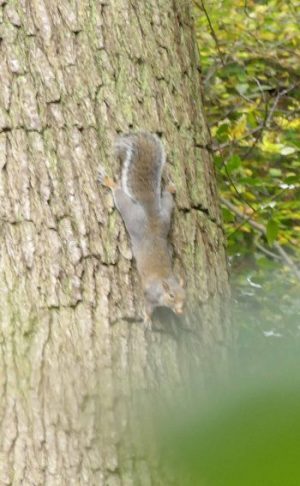
Retracing my steps I spotted movement on a tree trunk some distance ahead. Although half-hidden by the vegetation in front of me, the squirrel that was running vertically down from a great height must have spotted me in the same moment and had frozen still, an acorn wedged firmly between its teeth.

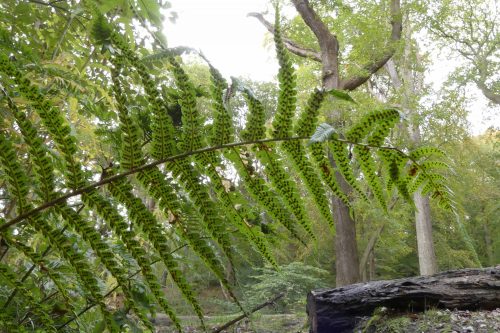
There are some beautiful ferns here, whose fronds gracefully arch out over the paths. This one has ripening sori (seeds) on the back of its fronds and from their shape I believe this is a Scaly Male Fern.

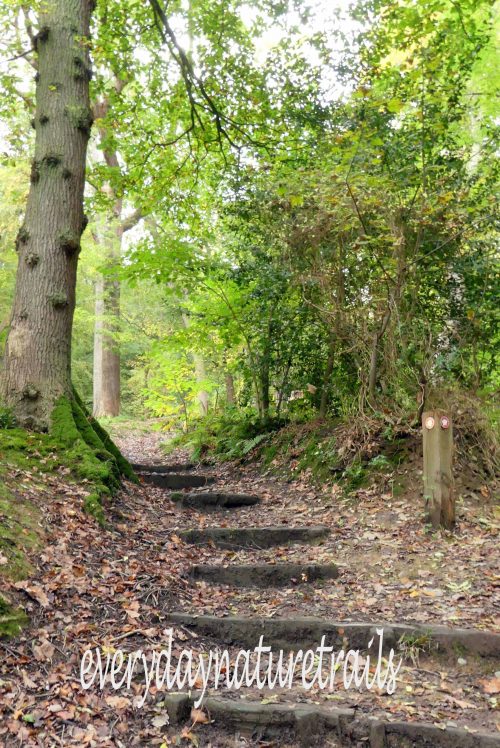
Shallow steps wind their way up to a path on higher ground.

From that higher path there is a view looking down onto the pool showing where the water flows on under the bridge. Some of the water exits naturally as a stream, but some is diverted via pipes from which water pours rather inelegantly.

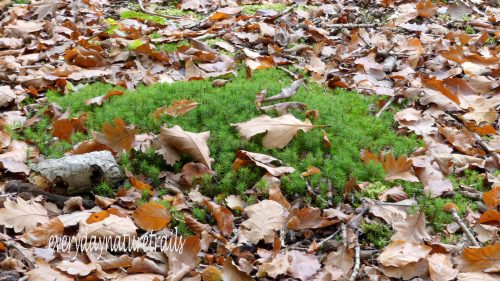
From a coppery sea of dry leaves rose a small bright green island of moss. Close up this particular moss always makes me think of miniature pine trees. Moss identification is not a strong point of mine, but I think this is a Haircap species.

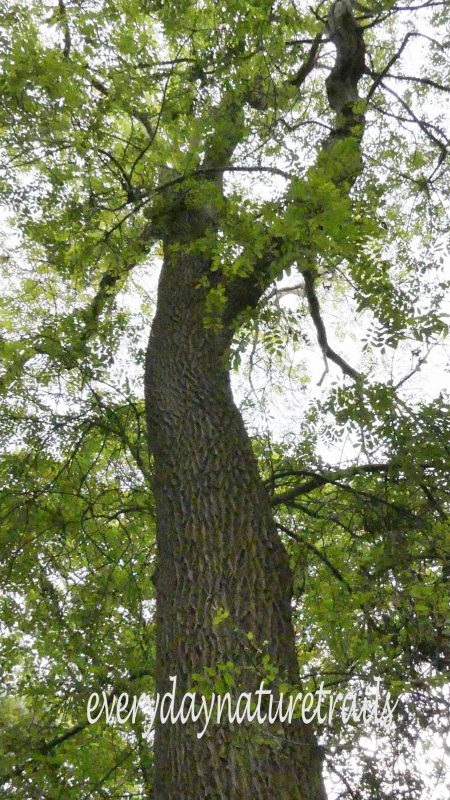
This trail continues upwards till it meets the road. A magnificent Ash tree stands at the edge of the path here. Each time I see an Ash, especially one such as this, I can’t help but think what a tragedy it would be if it were to be targeted by the dreaded Ash die-back disease. Fingers crossed, but at this time it looks strong and healthy

and as ash are often amongst the last to put out their leaves in the Spring, its leaves are still mostly green.

Not wanting to leave the wood here I turned around to walk back downhill. A fly basked in sunlight on a fern frond. Just a Housefly, but I was oddly pleased to see it, especially on a chilly day. Is it just me, or does anyone else think there have been less of them around this year?Bluebottles and Greenbottles have been quite numerous, and I’ve seen the smaller Lesser Houseflies, but not the bigger ones that usually annoyingly invade the house.

Almost hidden behind a larger tree, I would have missed this Rowan if its yellow leaves and scarlet berries hadn’t caught my eye. I wondered if it was deliberately planted or was a gift from a passing bird.

There are a few small Christmas-tree shaped pines in odd places throughout the wood too. This one, very close to the base of another tree surely wasn’t planted there intentionally. I wonder if it’s sprung from a Scots Pine cone buried by a squirrel.

By the side of the path a number of wasps were flying in and out of a space in a pile of Birch logs. Focussing on the wasps I didn’t notice the colony of rounded charred-looking fungi they were flying past until I looked at my photographs. This is one I recognise as King Alfred’s Cakes, memorably named for the incident which is surely one piece of history many of us, including the person that named the fungus, remember from school history lessons. In case not, legend has it that King Alfred the Great (849-899), whilst King of Wessex, sought refuge from Vikings (886) in the cottage of a peasant woman. In return for her hospitality, she charged him with looking after her cakes (small loaves of bread) that were baking on the stove. He supposedly fell asleep, or maybe became distracted worrying about his Kingdom, and let them burn. Unaware of who he was, she apparently gave him a good telling-off. The fungus then is named after those burnt cakes. Tenuous, but memorable.

191027-CWBPWLL- (53)-Wasps heading for nest
191027-CWBPWLL- (54)-King Arthur's Cakes

On the theme of burning, further on is another woodpile, fortunately in a clearing, which someone had clearly set fire to at some point, leaving many of the logs charred black.

Despite the damage to some of the logs I found some interesting fungi here including a nice fresh collection of Turkey tail, or Many-Zoned Polypore as it is also known

Strangely beautiful, I found Candlesnuff fungus growing through feathery green moss.

Venturing beyond the log pile along a track that comes to a sudden end – a rather sinister scene came into view: a tree that has been decapitated, its trunk left standing tall. Clearly rotting and bark peeling away, the trunk is blackened by a sooty ooze and is pierced with thousands of tiny holes. Large brackets of woody fungi project from the trunk; they too are blackened.

191027-CWBPWLL- (82)-blackened bracket fungus
191027-CWBPWLL- (81)-blackened bracket fungus

On a fallen log, looking like a bunch of small deflated balloons, I found a group of spent Stump Puffballs and nearby I found a few more, slightly fresher. Lycoperdon pyriforme to give it its scientific name is the only puffball species we have in Europe that regularly grows on wood.

Stump Puffball - Lycoperdon pyriforme
Stump Puffball – Lycoperdon pyriforme
191027-CWBPWLL- (86)-round fungus with stem

Next to the fallen log a mushroom that looked and smelt like a Field Mushroom. Perhaps that’s what is was, but there’s no way I was going to take it home to try it.

191027-CWBPWLL- (183)
191027-CWBPWLL- (182)

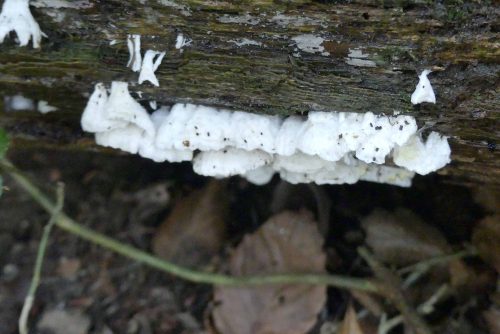
Growing vertically from a split in a log I spotted this odd group of white fungi that to me look a lot like teeth, which I found both interesting and quite amusing: it doesn’t take much. I don’t know what it is, maybe a Coral or a Stagshorn species?

Nearby is one of the few large Horse Chestnut trees found here. I was fascinated by the patterning of its bark.

From the clearing the leaf-strewn trail is sloping and for a while the woodland has a different feel to it. It’s more open, there are noticeably less large trees and more undergrowth and ivy.


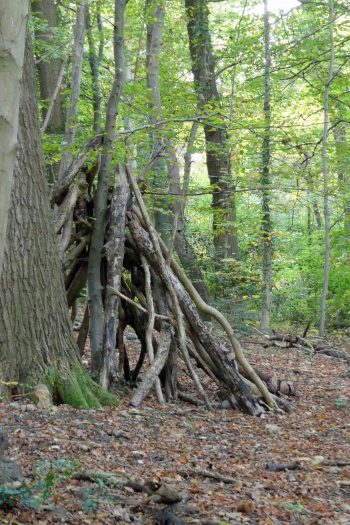
An tent-like arrangement of thin branches propped against a tree brought back memories of ‘camps’ we used to make in the woods around our home when we kids. We built similar tent frameworks, but then covered them with hessian sacks and camouflaged them with dry leaves and twigs, leaving an entrance space so we could get in and out. I can almost recall the earthy smell of damp wood and sacks as I think about it.

Hairy Curtain Crust – Stereum hirsutum


Growing on a branch near the edge of the path was more pretty bracket fungus. It looked similar to Turkey tail, but was more yellow-ochre-brown in colour and its upper surfaces were definitely hairy. Looking it up I’m fairly sure it is Hairy Curtain Crust, aka False Turkey-tail.


Sweet Chestnut

A tall Sweet Chestnut tree, its leaves turning yellow


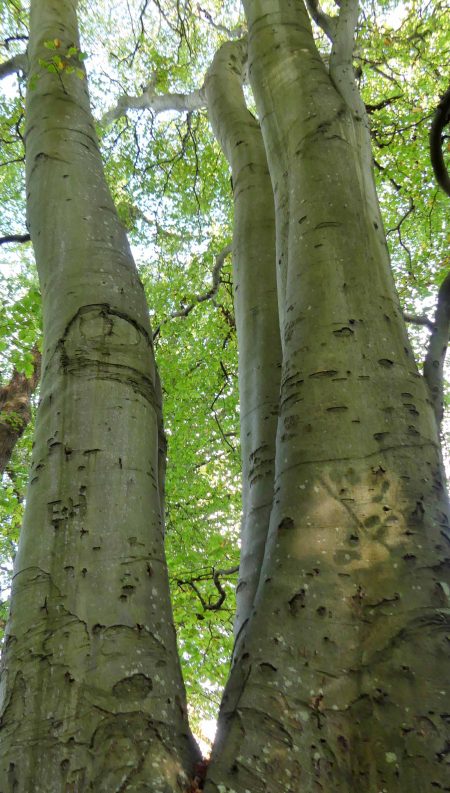
I wandered off the path towards a grove of huge Beech trees. At least one of the trees was multi-trunked and all were mightily  tall.

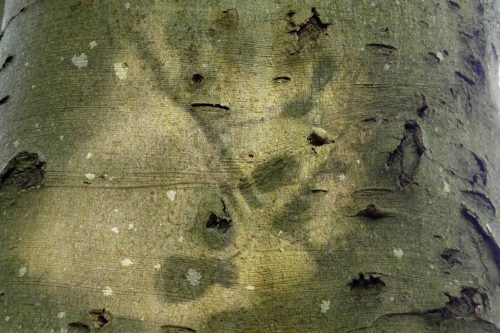
A shafts of sunlight had cast the shadow of the leafy tip of a branch onto one of the almost-smooth trunks


Leaf shadows on Beech bark

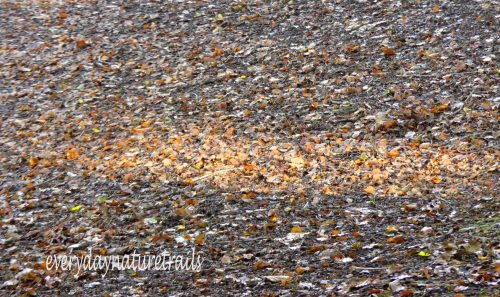
and highlighted patches of the carpet of leaves beneath the trees turning them to burnished copper.

You are on high ground here and through the trees there is a view over the edge of Colwyn Bay town and out over the Bay itself to the wind turbines.

The path begins to slope down; the ground falls steeply away on one side and is lined by a ferny bank on the other. I stopped here for a few minutes to watch a foraging party of Blue Tits, Great Tits and Long-tailed Tits, a few of the latter had come down into the Holly tree in the photograph and stayed within in it for a good few minutes. Other than Wood Pigeons, these were the only birds I saw while I was here.

The Holly had a good crop of berries, which you may interpret to be a warning of a harsh winter to come, or an indication of a good Spring past with rain and sunshine that brought forth plenty of flowers. Maybe both, we’ll soon see.

Enormous ferns arching of the path lend a lush, almost jungly feel to this last part of the path.

This Trail through the woodland comes to an abrupt end and brings you out onto the Old Highway, a short distance down from the entrance to the woods. Another path, raised above road level and parallel to the road takes you back there along the woodland edge, so you don’t have to walk on the road itself. The vegetation along the path is quite varied and I found an eclectic collection of plants still in bloom or bearing fruit. Flowers surprisingly included those at the tip of a very late Foxglove, Herb Robert and a Hogweed. I spotted Wild Raspberries still ripening, a few Blackberries and more Holly berries.

191027-CWBPWLL- (143)
191027-CWBPWLL- (136)
191027-CWBPWLL- (144)
191027-CWBPWLL- (145s)-holly with berries

I’d collected a fair few items of rubbish along my walk and reaching in beneath a bramble to pick up a drinks can I was rewarded with my best fungus specimen of the day; although I don’t yet know its identity.

191027-CWBPWLL- (191)
191027-CWBPWLL- (190)

Then I caught sight of this old sign, now high up above eye level, nailed to the trunk of a large Sycamore tree. The Districts of Colwyn and Aberconwy merged to form Conwy Borough Council in 1996, so it’s at least that old, I would guess at quite a bit older again.

Ending as I began, a length of this path too is strewn with leaves and seed cases from a Sweet Chestnut tree.

191027-CWBPWLL- (154)
191027-CWBPWLL- (153)

More details about Pwllycrochan, including location here.


Share this:

  • Share on Facebook (Opens in new window) Facebook
  • Share on Pinterest (Opens in new window) Pinterest
  • Share on X (Opens in new window) X
Like Loading...

Forest Fungus Foray

26 Saturday Oct 2019

Posted by theresagreen in Conwy Valley, Nature of Wales, Snowdonia, Walking Trails

≈ 10 Comments

Tags

autumn woodland, birch polypore, candlesnuff fungus, dyer's mazegill, fungi in woodland, fungus foray, Gwydir Forest, hare's-ear fungus, honey fungus, North Wales Wildlife Trust, recovering industrial sites, recovering woodland, Trefriw, turkey-tail fungus, wood woolly-foot

October 13th

The annual guided Fungus Forays are very popular guided walks organised by our Conwy Valley Branch of the North Wales Wildlife Trust, and this year there were two, one last weekend and the other today. The venue was the forest above Trefriw, located on the West side of the Conwy Valley and on the edge of the Snowdonia National Park. Trefriw village is popular with tourists, well known for its traditional Welsh Woollen Mill and is part of the Walkers are Welcome network, having several marked trails to follow.

12:45 Driving along the valley towards the village I could see that heavy cloud was obscuring the hills in front of me and by the time I got there they were shedding rain. Justly renowned as an area of great natural beauty and diversity, Snowdonia is equally famous as one of the wettest places in the British Isles and October is also one of the wettest months of the year. Forewarned and so forearmed, i.e clad from head to toe in waterproofs, our intrepid Forayers left the shelter of the veranda in front of the village shops, setting off like a moving rainbow to brave the elements in search of Fungi treasure.

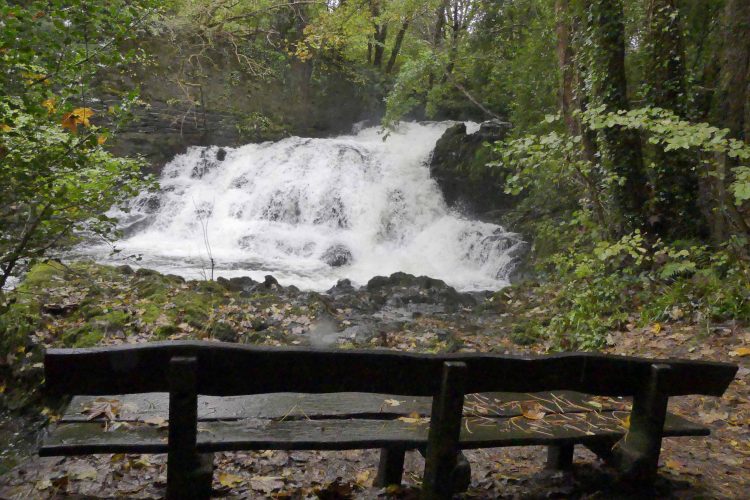
13:15 A good beginning was this view as we crossed the road bridge that spans the tumbling Afon Crafnant. Flowing down from Llyn Crafnant located higher up the hill, it races down a series of falls through the village to join forces with the nearby Afon Conwy.

We turned left onto the road that leads up to the Lakes (Llyn Geirionydd and the afore-mentioned Llyn Crafnant), walked uphill to just past the end of the building in my photograph above, then turned left again onto a Trail that travels upstream alongside the river, approaching the top of the Fairy Falls. A fair bit of rain has already fallen this Autumn, adding to the impact of this series of falls, which become increasingly dramatic as you approach the main rocky drop.

Afon Crafnant – Trefiw

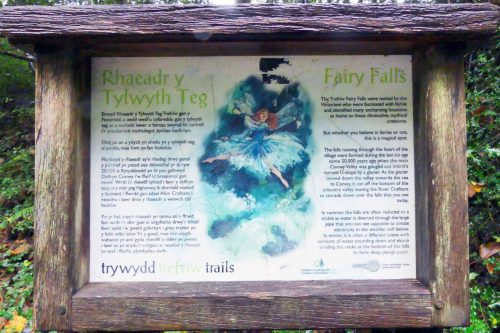
Named the Fairy Falls to appeal to Victorian tourists, who were enchanted by thoughts of fairies, this is one of many such beautiful locations in our area that are so-named. And why not? There is definitely a magical energy in the air surrounding a powerful fall of water.

Fairy Falls -Trefriw

Just beyond the waterfall, near the beginning of the trail that climbs steeply up through the woodland, a pair of sharp young eyes focussed in on our first fungus. Brightly coloured and close to the edge of the path, this was Hare’s Ear, cunningly camouflaged amongst fallen oak leaves. The fungus takes both its common and scientific names from the form in which it grows.

Hare's-ear-Otidea onotica
Hare’s-ear-Otidea onotica
Hare's-ear-Otidea onotica
Hare’s-ear-Otidea onotica

Then at the base of a pine tree, a bracket fungus called Dyer’s Mazegill. This was quite a large one and perhaps a bit past its prime, fresher ones are fleshier and more yellow, turning darker with age. We learn that this is a destructive organism that feeds on the roots of the tree it attaches to that will eventually kill its unfortunate host. The common name Dyer’s Mazegill comes from its use for dyeing yarn; the fungus’ fruitbody produces various shades of yellow, orange and brown, depending on its age and the type of metal used as a fixative. The Mazegill part is reference to the complex, maze-like arrangement of its gills.

Dyer’s Mazegill- Phaeolus schweinitzii

Next, one of the few fungi I recognise and can put a name to, the attractive and decorative Turkeytail, or to give it its more prosaic common name Many-zoned Polypore.

Turkeytail or Many-zoned Polypore – Trametes versicolor

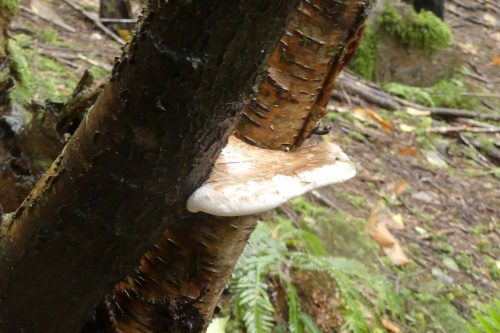
Another bracket fungus, which as its name, Birch Polypore implies, grows on birch tree trunks or branches, whether they’re alive or dead. In the event a host branch falls from the tree, the fungus has the ability to ‘right’ itself, so its gills always remain beneath it and its spores can fall to the ground. Also known as the Razor Strop Fungus, Barbers used to ‘strop’ or sharpen their cut-throat razors on tough, leathery strips cut from the surfaces of these polypores.

Birch Polypore or Razor Strop Fungus – Piptoporus betulinus

Sulphur Tufts are a wood-rotting fungus feeding on both deciduous hardwoods and conifers. Fruiting on fallen trees or decaying stumps or, sometimes in the hollow trunks of living trees, they are often found in a mixed woodland from April through to the first heavy frosts. Gregarious fungi, they tend to appear in large groups so tightly packed that the caps may be unable to expand regularly.

Sulphur Tuft – Hypholoma fasciculare

The name Butter Cap makes our next fungus sound tasty, but then you find out it used often to be referred to as the Greasy Toughshank, which sounds much less appealing. The names refer to the colour and appearance of the cap. It’s a very variable fungus that occurs in all types of woodland, but is mainly associated with coniferous forests on acid soils, growing beneath even the darkest of canopies, often in groups or fairy rings. We came across it fairly frequently during our foray in a variety of sizes, numbers and forms.

Butter Cap – Rhodocollybia butyracea

We continued to climb up through the woodland and the rain continued to fall heavily, in fact it seemed the higher we got the harder it fell. Derek Brockway, everyone’s favourite Welsh Walking Weatherman had warned it would do that until about 3pm, so holding the thought he might be right, and it would eventually stop, we pressed on with our mission. The steeply sloping ground and the free-draining soil beneath a layer of pine needles meant at least the ground wasn’t too slippery underfoot.

More sensible members of our group were using the cameras on their mobile phones to capture images of our finds: I could have done that too, but I’d brought my ‘proper’ camera, carrying it carefully tucked inside my coat, so I persevered with it, hoping it wouldn’t suffer too much. The light in the woods, or rather the lack of it was difficult and raindrops on the lens were a bit of a pain, but I think the wetness of everything did bring an interesting extra dimension to images. Those that I managed to keep in focus, that is.

Obscured by raindrops

I only caught the tail end of the chat about this Oysterling mushroom, so I didn’t hear anything interesting said about it. Looking it up later I read that the genus name Sarcomyxa comes from the Greek word särkō-, meaning flesh, and -myxa (again from Ancient Greek via Latin), meaning mucus or slime. Slimy flesh-like mushroom that does look a bit like a shelled oyster would seem to describe it well enough to remember.

Olive Oysterling – Sarcomyxa serotina

14:04 Apart from the fungi, there was more that caught my eye, in the shape of ferns, lichens and mosses, but that’s not what we were here to see today. I did stop to photograph a Hard Fern, which I don’t come across often and looked nice with shiny wet fronds. Widespread throughout the UK and the rest of Europe, Hard Ferns are most often found in well shaded places, preferring moist, acidic, humus-rich conditions in woodland sites, so it’s very at home here.

Hard Fern-Blechnum spicant

This woodland, named Coed Creigiau feels like it’s always been there, but is actually a recovering woodland and a part of the Gwydir Forest. From 1850 till 1919 the mining of lead and zinc dominated the area and when it stopped it left behind a derelict industrial landscape with sparse natural woodland. The First World War had identified a national shortage in wood production, bringing about the Forestry Act of 1919 and the land was acquired from its former owners by the newly created Forestry Commission: planting of the forest began in 1921. Some natural trees would have been growing on the hills, but the majority of the original planted forest is conifer and includes Sitka spruce, Douglas fir, Japanese larch, Norway spruce and Scots pine. It’s likely that most of those original trees will have been felled as they have a plant-to-harvest cycle of 20-40 years according to the species, so those there now could be a second, third or even fourth generation.  Now managed by Natural Resources Wales, recent years have seen the increased planting of native broadleaf species such as Welsh Oak, beech and ash, but faster-growing conifers are still grown to meet commercial demands for timber.

Spending much of the time looking down to a) look out for fungi b) watch where we were putting our feet and c) avoid getting raindrops or drips from trees in our eyes, I was interested to find the prickly husks of Sweet Chestnuts scattered amongst the pines. I began to pay more attention to the presence of the trees they had come from and realised there are quite a lot of them. Introduced into this country by the Romans, the wood of the Sweet Chestnut is similar to oak but more lightweight and easier to work. Young wood has a straight grain but this spirals in older trees, so trees were coppiced and the new straight trunks used as support poles in mines.

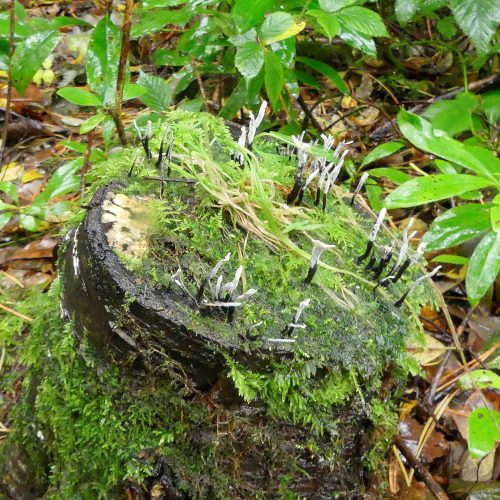
We crossed a hard-surfaced track, and on the edge of the next section of forest, one of my favourite sights of the day, a group of weird and intriguingly named Candlesnuff fungus, growing with moss atop a Birch stump. Its name might imply it is something that once gave light but which has been put out, but I learned that ‘it is a bioluminescent fungus, and in a really dark place it can be seen to emit light continually as phosphorus accumulated within the mycelium reacts with oxygen and other chemicals in the fungus‘. (firstnature.com)

Candlesnuff-Xylaria hypoxylon

Stinkhorn -Phallus-impudicus (egg)

In a nest of pine needles, we spotted the ‘egg’ from which the phallically formed Stinkhorn Fungus will emerge.

Some Victorians were so offended or embarrassed by the appearance of these fungi that they’d go out at dawn and batter them with cudgels to stop them spreading their spores, and to avoid letting the Stinkhorns make a ‘bad impression’ on any  young ladies who might decide to take a morning walk in the woods!

Later on we discovered a fully grown specimen – led to it from some distance away by the truly bad smell it emitted, like that of a dead animal. You definitely wouldn’t confuse that one with anything else!

Stinkhorn-Phallus-impudicus

My main interest lies in the amazing array of shapes, forms and colours of the different species, then how they got their names and of course how photogenic they are. I’m too cowardly and way too inexperienced in the identification of most fungi to risk eating almost any gathered from the wild. However, this next one I do know well as one of the most sought after fungi, much prized by foodies and chefs. Pushing up through pine needles, twigs and cones we came upon this cluster of colourful Chanterelles, one I have eaten and may again, especially witht belt-and-braces id from an expert, as today.

Chanterelle – Cantharellus cibarius

AT THE RISK OF REPEATING MYSELF – PLEASE BEWARE OF THESE!! Around 10% of fungi species are poisonous and there are some you definitely must learn to identify positively if you’re a forager – death from eating any of these fungi would be a horrible way to go!
Growing just a metre or so away from the Chanterelles was a fungus to be avoided at all cost: the Destroying Angel, more likely to be encountered in the more mountainous areas of the British Isles as here, than in the lowlands.

Destroying Angel-Amanita virosa

Funeral Bell

I think (hope!) I’ve matched the right image for this next one as it’s another fungus to be avoided at all costs. The common name for this is Funeral Bell and pro rata its size, we were told it is one of the most poisonous of all fungi growing in the British Isles, containing the same deadly poisonous toxins that occur in the Death Cap. This notorious Funeral Bell appears on conifer stumps and occasionally on the stumps of broadleaf trees.

Back on safer ground, for people that is, the common-and-dreaded-by-gardeners Honey Fungus. I had no idea it could, and clearly does grow this big!

Honey Fungus – Armillaria mellea

There were several large mushrooms up here whose caps looked like they’d been trodden on and were covered in leaf-litter, pine needles and the like. We were told these are Large Rustlers, Russula sp. (I don’t know which one) that apparently push themselves up to the surface fully open, an unusual trait amongst fungi.

Large Rustler – Russula sp

15:10 From this point we made a right turn onto a track through the trees to begin our descent. This is where we smelt the Stinkhorn featured further back and where following our noses to locate it, we found another fascinating species, known as Piggyback fungus, so-called as it parasitizes other species of mushrooms. I’m claiming really bad light and a need to hurry on to catch up again as an excuse for this blurry image. You get the general idea though.

Piggyback fungus

Scurrying downwards we soon emerged from the forest onto a hard-surfaced track and, joy, it stopped raining and gradually, a mere 15 minutes or so later than Derek had predicted, the sun came out!

There were a few more fungi spots including more nice Birch polypores, clearly growing on a living Birch tree.

Birch Polypore or Razor Strop Fungus – Piptoporus betulinus

And to finish there was this attractive little fungus called the Wood Woolly-foot Gymnopus peronatus (syn. Collybia peronata); its common name refers to the lower half of the stem being covered in fine white hairs.

The last part of our walk back to where we started was pleasant, the sunny interlude allowing us time to chat, warm up a little and amble back rather than hurry to get out of the rain. But I hope this account goes to show that good outings can still happen in not-so good weather!

AFTERTHOUGHTS & ACKNOWLEDGMENTS

Led by two of our members, Dave and Joan Prime, I was amazed at the number and variety of species found for us and about which Dave shared his extensive knowledge so generously and in such an entertaining way. This was my first guided Fungus Foray in Wales, many of the species were completely ‘new’ to me and I would have struggled to accurately identify them from reference books. Those I’ve included in this post are mostly the ones I took the clearest or most interesting photographs of and which I’m pretty confident I’ve matched the correct names to. We were actually shown more than I could properly record without missing out on information, a good reason to go back for more next year!

If you are planning to forage for fungi as free wild food, do please make sure you absolutely know without a shadow of a doubt which are the poisonous ones!

References: To find more information, scientific names etc for species I referred frequently to my own reference books, the First Nature website and also to Wikipedia for more general information. As always, if you spot any inaccuracies please let me know and I’ll amend them.


Share this:

  • Share on Facebook (Opens in new window) Facebook
  • Share on Pinterest (Opens in new window) Pinterest
  • Share on X (Opens in new window) X
Like Loading...

Wild and Windy on West Shore

22 Thursday Aug 2019

Posted by theresagreen in coastal habitat, Nature of Wales, Walking, Wildflowers of Wales, Wildlife of the Wales Coast Path

≈ 14 Comments

Tags

Blue Lettuce, coastal wildflowers, Duke of Argyll's Tea Plant, flowering in August, late summer wildflowers, Llandudno, North Wales Wildlife Trust, seashore, West Shore

August 19th

On Sunday, the North Wales Wildlife Trust held their annual August “Go Wild” event at  Llandudno’s West Shore. From the outset a powerful wind brought a truly Wild element to the proceedings, but the sun shone, it wasn’t cold and better still, it didn’t rain! And we’re a hardy and resourceful lot here in North Wales, so marquees, stalls and games were battened down and sheltered behind a windbreak of cars, big NWWT vans & the minibus all parked bumper to bumper, Wild West Wagon style. All well worth the effort as it turned out to be a really successful and enjoyable day, well-attended by a good number of interested and enthusiastic people of all ages.

Having volunteered to guide a Wildlife Wander on the day I’d done an advance recce on Thursday afternoon of the route I had in mind to get an idea of what we might see  and to take photographs that I wouldn’t have chance to do out with a group of people. It was windy then, but even more so on Sunday, so seeking some shelter from it, and in consideration of some young, tiny but very game wanderers we made a bit of a deviation from the original plan, but happily still managed to see most of the species of wildflowers I’d noted on Thursday, plus a couple I didn’t.

August 15th

Sunday’s wander would set out from our pitch next to the Children’s Playground on the Promenade, but at just past two o’clock today, although it was sunny, a strong wind was blowing and as it’s very open and exposed here I started further down, closer to where the dunes begin. A well-used path starts from Trinity Crescent, passes behind the buildings on the site of the Miniature Railway and travels in a fairly straight line to join the Coast Path through an open, grassy area.

On first impressions, this may appear to be an unkempt wasteland but a lot of wildlife loves such habitat and it’s always well worth closer inspection. This particular patch is home to a great variety of wildflowers, which then attracts insects and if you’re lucky, birds too.

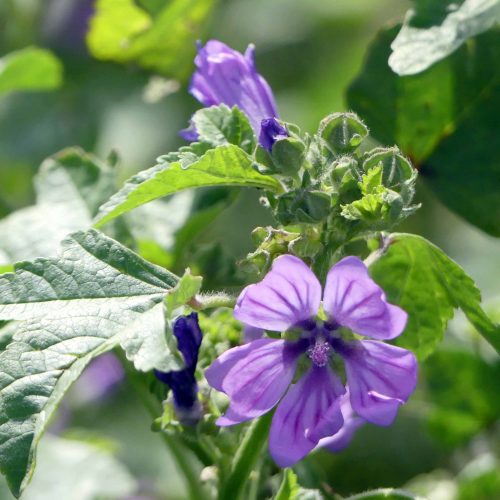
Common Mallow-Malva sylvestris-Hocysen

Some wildflowers are tall and so abundant that you can’t fail to notice them, like Common Mallow. It’s currently in full bloom and full of pretty pink-purple flowers  hoping to catch the attention of any passing pollinators.

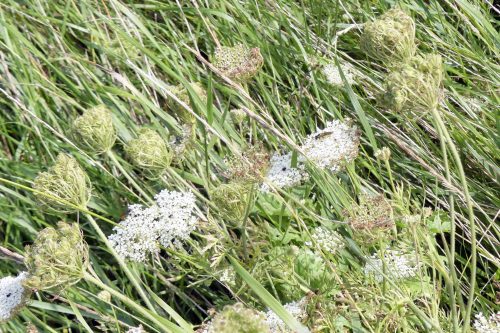
Between stands of Mallow there’s less showy Wild Carrot, largely finished flowering now and setting seed. This is one plant that is definitely in its favoured habitat- rough grassland, on chalky soil and by the sea. It’s a white umbellifer that’s more distinctive than most, as in the centre of the flowerhead is usually a single red-purple flower which is thought to mimic a fly that then attracts insects to assist pollination. After flowering the long umbels fold upwards and inwards to contain the seeds in a sort of cage.

Wild Carrot-Daucus carota-Moron y Maes

I saw an insect on a flowerhead and tried to photograph it, but as you can see the wind was blowing it all over the place and I couldn’t focus on it properly – when I checked the photograph later I saw it was a Sawfly – Rhogogaster viridis. 

190815-LLWS- (30s)-Wild Carrot flowerhead
190815-LLWS- (9b)-Sawfly-Tenthredo on Wild Carrot

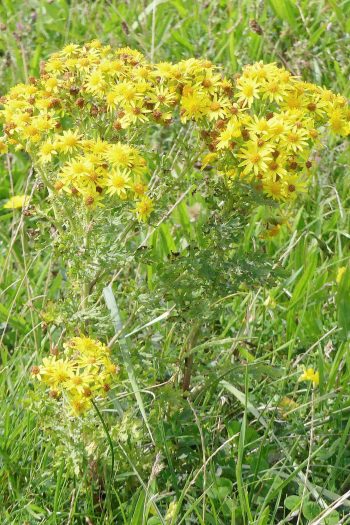
Ragwort-Senecio jacobaea-Creulys lago


There’s a good number of Ragwort plants, many of which were being visited by bees. Most of those I saw were Buff-tailed Bumblebees; big and strong enough to fly between plants on a windy day, although even they weren’t going far.

I checked a lot of plants here looking for the black and yellow caterpillars of the Cinnabar Moth-Tyria jacobeaea, but there were none that were obvious.


190815-LLWS- (20)-Buff-tailed Bumblebee on ragwort
190815-LLWS- (15)-Bumblebee on ragwort flowers

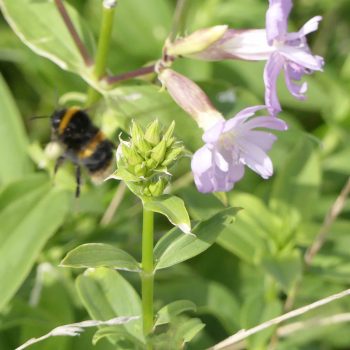
Another abundant flowering plant is Soapwort, which has been left undisturbed and has formed some impressively large patches. It’s in full bloom now and a mass of pretty sugar-pink flowers.

Soapwort-Saponaria officinalis

Bees seem to like these flowers too.


The green leaves and stems of Soapwort were once crushed and boiled in water to make a lathery liquid that was widely used to wash wool and woollen cloth. For that reason it was often grown in fields and gardens close to woollen mills, and the plants growing in the wild today are often found close to places where wool was once woven into cloth.  


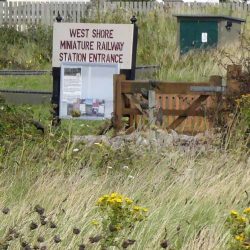
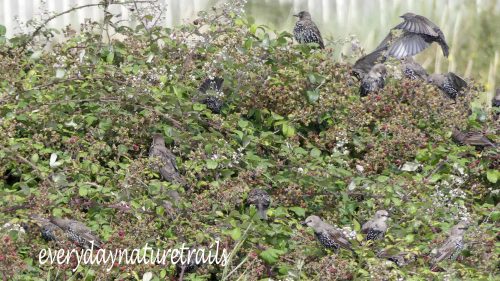
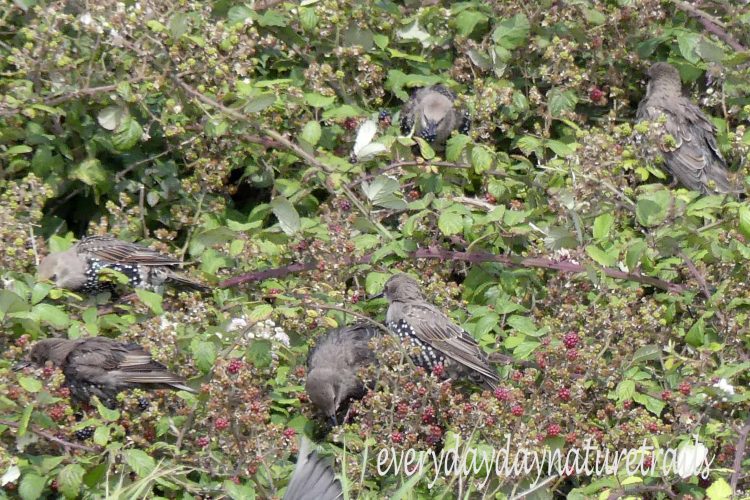
Across the grass at the far end, in front of the Blue Café and next to the entrance to the Miniature Railway is a big tangled bramble bush and my attention was attracted there as a cheerfully noisy flock of birds flew onto it. They were Starlings, most, or maybe all of which I think were juvenile birds, their plumage largely brown with black breast and underparts black with clear white spots.

Common Starling-Sturnus vulgaris-Drudwen

They were clearly enjoying feasting on ripe blackberries.

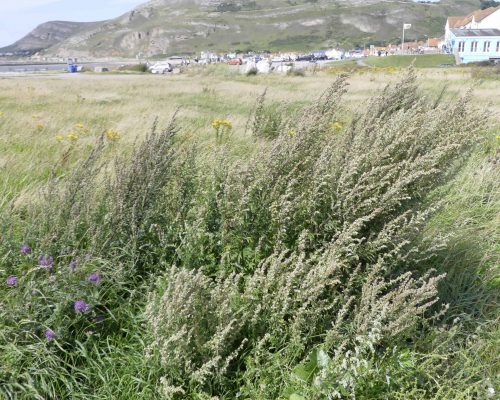
The path leading to the sea is open and exposed to the elements, so plants need to be tough to succeed here. Mugwort is one that both survives and thrives here, it’s not an especially attractive plant to look at, but it’s well adapted to its environment and it also produces aromatic oils, a device to protect itself from being eaten by grazing animals. On Sunday, the general consensus of those that rubbed leaves and tested it was that’s it’s scent is not particularly pleasant, but then it is supposed to repel midges, which may be handy to know….

Mugwort-Artemisia vulgaris

Golden yellow Ragwort and purple Greater Knapweed – the classic colours of late summer and early autumn.

In contrast to the Mugwort, Greater Knapweed is tough and lovely to look at – its open ripe seedheads are as pretty as the flowers.

Greater Knapweed-Centaurea scabiosa

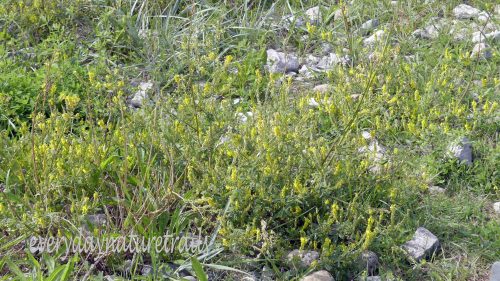
Restharrow


In the grass there was Cat’s-ear Hypochaeris glabra and what was possibly a small  hawkbit – they’re tricky to separate at the best of times. Also small amounts of a white-flowered Common Storksbill, some Restharrow, White Clover, Pale Flax and the odd Dandelion or two were still to be found with flowers.


Where our path met the Coast Path was a lovely spreading patch of the yellow-flowered Ribbed Melilot.

Known as a plant of grassy places and waste ground, it seems to be perfectly happy growing in this sandy stony spot close to the sea.

Ribbed Melilot – Melilotus officinalis

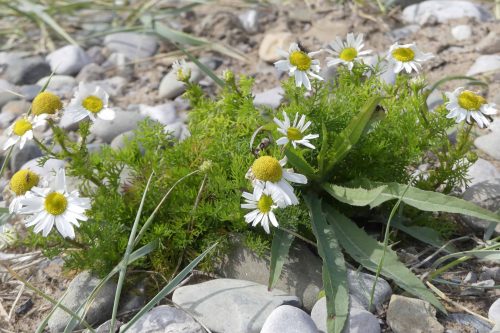
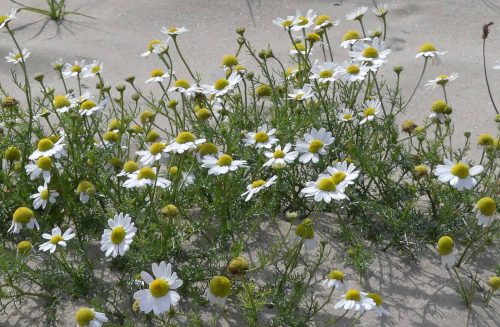
A more common and familiar plant is the Sea Mayweed, a plant of sand and shingle, it can and does pop up in a variety places near to the sea if a seed finds a spot it likes.

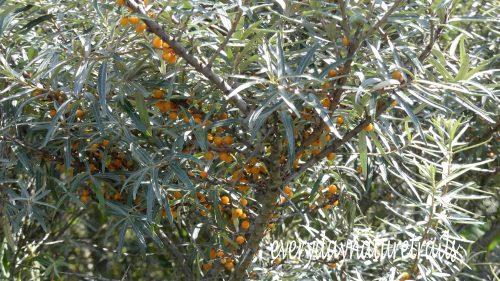
At this end of the path there’s a mass of Sea Buckthorn. This is a thorny shrub with silvery stems and grey-green leaves. It’s flowers are tiny and green and appear before the leaves in the Spring, but now it is now laden with heavy crops of bright orange berries.

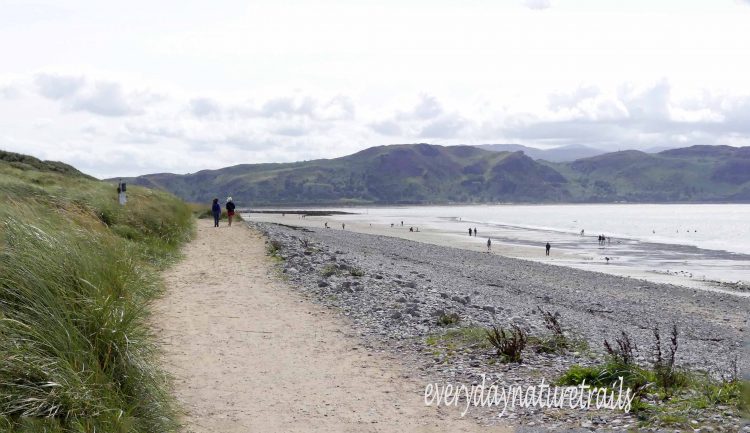
 From here the path, which is also a section of the Wales Coast Path, heads towards the dunes and Deganwy. The views ahead and across the sea to Anglesey and Puffin Island were surprisingly clear today, although there were rainclouds hanging over Snowdonia.

The wind had driven people trying to enjoy a day on the beach into the shelter of the dunes, some camped on the path, so I made a detour around them along the beach.

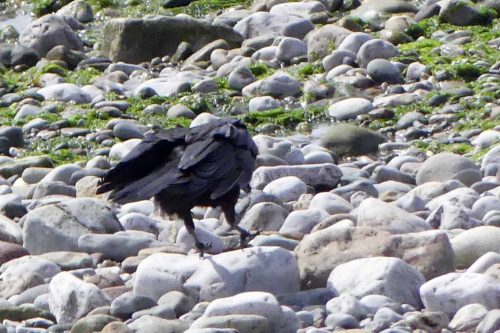
A wind-ruffled Crow foraged among the pebbles on the sea edge

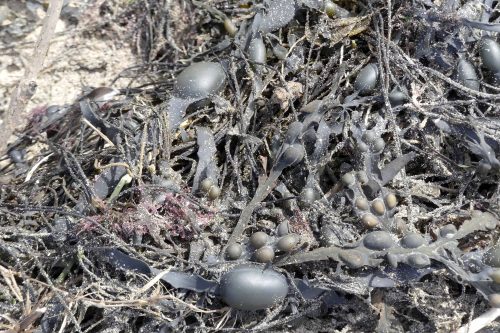
The strandline was strewn with piles of long tangled strands of seaweed: looking a bit like piles of brown spaghetti, this is Thongweed. If I’d been here spending a leisurely afternoon on the beach I would have had to collect some and plait it. In places it was mixed with other seaweeds that had also been wrenched away from their moorings on the submerged rocks.

Flitting around the drying seaweed there were a lot of little flies, perhaps unsurprisingly commonly known as Kelp or Seaweed Flies.

190815-LLWS- (66)-Fly amongst seaweed
190815-LLWS- (61a)-Kelp fly

I photographed a pile of mixed seaweeds which includes Thong Weed, Egg Wrack (the one with big bubbles), Bladderwrack (with smaller bubbles) and some of the reddy-pink Polysiphonia algae that is a parasite of Bladderwrack.

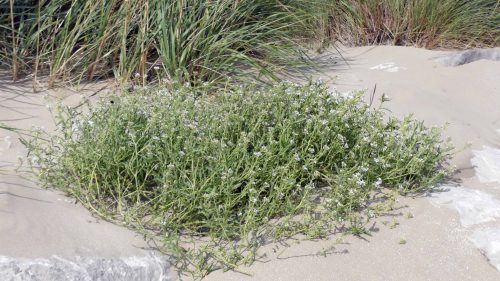
Reaching the stone seabreak I rejoined the dunes, passing a big clump of Sea Rocket, the only one of our seashore plants to have lilac-coloured flowers.

Sea Rocket-Cakile maritima


I love this viewpoint and find it difficult to resist stopping here, and not just for the view: it’s furnished with a semi-circle of cut-stone slabs with lovely tactile polished tops, but it was too windy to hang about for long today. I did stop long enough to photograph the spikily beautiful large Sea Holly plant growing on the edge of the dune below.

Sea Holly-Eryngium maritimum

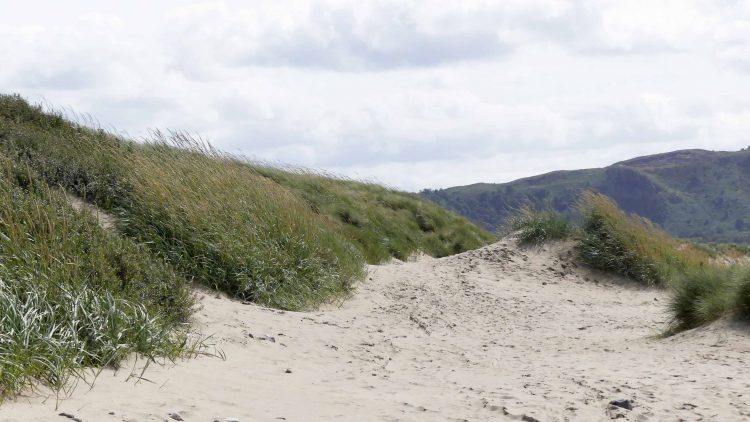
Onwards through the dunes the path was slightly sheltered from the wind, although you can see how the bordering Marram grass was being pressed almost flat against the dune and cliff sides.

Marram grass has ripe, or ripening seedheads now held on tall stems that sway stiffly in the wind. The view is quite clear over to Anglesey.

Marram – Ammophila arenaria

More Sea Holly and a very large clump of Sea Mayweed are flourishing in a sheltered spot.

The dunes end and there opens up the amazing view of the iconic Vadre at Deganwy and the mountains on the far side of the Conwy Estuary.

On the pathside Cat’s Ear is flowering and there is still quite a bit of Bird’s-foot Trefoil available to bees and butterflies, although all I saw today was a single Common Blue.

190815-LLWS- (96a)-Cat's-ear Hypocharis radicata
190815-LLWS- (97a)-Common Blue

Whilst photographing the Cat’s Ear I noticed an insect scuttling about and now and then entering holes made in the sand. Long and black, with a purplish iridescence to its wings and a very narrow ‘waist’, so likely a sand wasp, but I don’t know the species.

190815-LLWS- (86a)-Insect entering hole in sand
190815-LLWS- (91)-Insect 4a

More Sea Rocket, this time growing amongst the stones of the rip-rap. There were bumblebees nectaring on the windswept flowers.

190815-LLWS- (112a)-Sea Rocket
190815-LLWS- (114)-Bumblebee on Sea Rocket flower

On the cliff side of the path there’s more Bird’s-foot Trefoil and quite a lot of Restharrow still flowering.


On the cliffside itself, there’s an impressive spread of Rock Samphire. This is our most distinctive yellow-flowered umbellifer and the only one with fleshy leaves. It grows only by the sea.


Rock Samphire-Crithmum maritimum

And more Sea Mayweed, almost buried by sand.

The path continues to curve around the bay towards Deganwy, but this is where I turned around to walk back.

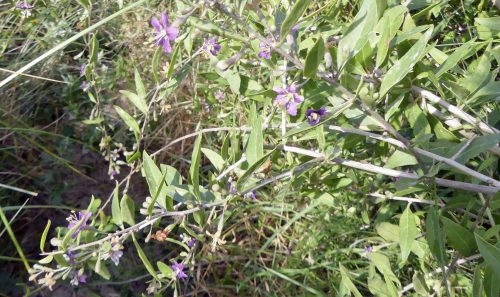
This point on the path is where I first saw the shrubby plant intriguingly named the Duke of Argyll’s Tea Plant. This member of the nightshade family with small purple flowers is not at all a showy plant, but it does have an interesting history.

The story goes that Archibald Campbell, the 3rd Duke of Argyll received this plant, Lycium barbarum together with a tea plant, Camellia sinensis from China in the 1730s. Unfortunately their labels got mixed up, so it was grown under the wrong name in his Middlesex garden and, presumably when the mistake came to light, it subsequently became known as the Duke of Argyll’s Tea Tree or Tea Plant. (From A Dictionary of English Plant Names by Geoffrey Grigson, London 1973.) 


The plant has been used in Britain since the 18th century for hedging, especially in coastal districts. Its red berries are attractive to a wide variety of British birds.


This view back along the path towards the Great Orme is wide and impressive and even better today as now the wind was behind me and the sun at a better angle to light the photograph! I retraced my steps a short way before taking the marked Public Footpath up the cliff, where it continues along the top of the cliff on the edge of the golf course.

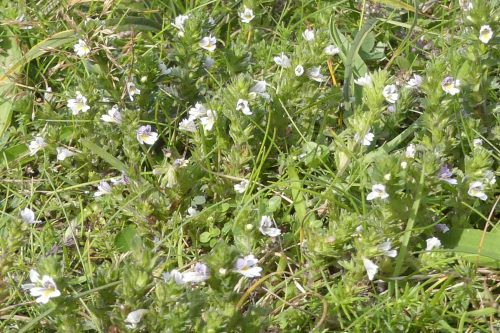
Amongst the grass where the path begins there was a pretty patch of Eyebright,

Eyebright-Euphrasia nemorosa

close by there was Wild Thyme, a smallish umbellifer I’m not sure about and one remaining flower on a Goat’s-beard plant.

mmm

And, at last – a Ragwort plant with Cinnabar Moth caterpillars!

Cinnabar Moth caterpillars
caterpillar of the Cinnabar Moth-Tyria jacobaea

The continuing path is narrow and leads through gorse, taking a brief rest from flowering now, which is taller than me. A prickly path, but well sheltered from the wind and very peaceful.


In parts gorse gives way to equally prickly brambles, some of which are reaching long stems out across the path.

Fruits are developing, a few of them already ripened into blackberries.

This feels like a ‘secret’ path and you never know what treasures you might discover here. In a sunny spot between the banks of brambles, two Gatekeeper butterflies were chasing one another, then settled to bask on leaves. Nearby they were joined by a big Drone Fly.

190815-LLWS- (154)-Gatekeeper butterflies
190815-LLWS- (163)-Eristalis hoverfly

There are a surprising number of wildflowers to be found along here; still with some flowers there was Wood Sage

Wood Sage-Teucrium scorodonia

and Yarrow, which was attracting small black flies, at least one pair of which were mating.

190815-LLWS- (157)-Yarrow with flies
190815-LLWS- (159)-Small black flies mating

With little room for manoeuvre a large Toadflax plant, grown tall and leggy, had leaned out across the track

Common Toadflax – Linaria vulgaris

it was full of flowers and in this sheltered spot was being investigated by a bumblebee.

190815-LLWS- (167)-Toadflax flowers
190815-LLWS- (169a)-Bumblebee on Toadflax

Another plant with mauvy-blue flowers had also grown long and straggly and was leaning out over the path searching for light – I thought at first it was Michaelmas Daisy, but the flowers’ centres were blue, not yellow – I had to wait till Sunday to be pointed in the right direction to identify it after seeing it again then!

There’s quite a bit of Herb Robert here too, there are still a few flowers but most have finished and the beaked seedheads show the plant to be one of the cranesbills. Even in this sheltered spot plants still get showered with sand.

Herb Robert-Geranium robertianum

As well as Blackberry brambles there are also Dewberries. These fruits are similar to blackberries but the segments are bigger and they are covered with a bloom, a bit like a plum is.

Dewberry-Rubus caesius-fruit
190815-LLWS- (177)-Dewberry flowers

The path emerges back out onto the top of the dunes where the vegetation is dominated by Marram, brambles and a lot more Duke of Argyll’s Tea Plant.

I found a plant that shows off the leaves and flowers quite nicely.

Duke of Argyll’s Tea Plant- Lycium barbarum

There was a little more Ragwort here that was being visited by a Meadow Brown Butterfly.

At this point you can either take a path that leads back down through the dunes to the beach or carry on along the open path around the golf course. I took the latter, hoping to find a few more wildflowers to add to my list.

Apart from a bit of Traveller’s Joy amongst Marram and brambles, there wasn’t much to see that was still in flower, but I did find a small amount of Lady’s Bedstraw, a single Bloody Cranesbill flower, and a few Harebells to finish off with.

Bloody Cranesbill
Bloody Cranesbill
Lady's Bedstraw
Lady’s Bedstraw
Harebell
Harebell
Traveller's Joy
Traveller’s Joy

On Sunday, as I already mentioned we took a slightly different route to avoid the wind, but we did see most of the wildflowers that I’ve photographed or named above, which totals to some 40 or more species, and added a couple more. We also found lots of ripe Dewberries and a Cinnabar moth caterpillar on some Ragwort, saw a few bumblebees, but didn’t see a single butterfly.

Pellitory-of-the-Wall

One wildflower that I should have recognised on the day but that was growing in an unexpected place so had become long and straggly (my excuse!) was Pellitory-of-the-Wall.

And there was a lot  more of the blue-flowered ‘mystery’ plant from Thursday’s walk, which turns out to be a rather rare plant in the UK known as Blue Lettuce, or Russian Blue Sowthistle – Lactuca tatarica. I didn’t have time to take good photographs as the group were moving on, but fortunately the one below was good enough for a friend who had seen the plant here herself and researched it, to give me a clue! She later kindly forwarded me the following info from the UKwildflowers website, which is a direct quote:
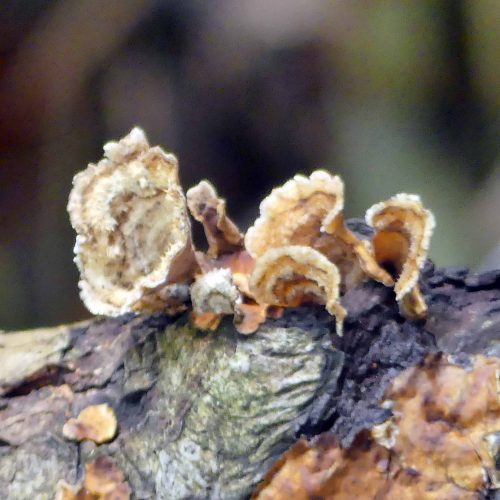
Blue Lettuce-Lactuca tatarica

Known at this site from at least 1963, this introduced plant is also known as Russian Blue Sowthistle. It grows very close to the shore in dunes not far from a car park and is well established now on nearby cliffs. Flowering in late summer it provides an unusual display of many blue/purple flower heads.
L. tatarica is known from very few separate sites throughout England, the Isle of man and the Scillies. This appears to be its only site in Wales, there is none to be found in Scotland and only one site in western Ireland. 


Share this:

  • Share on Facebook (Opens in new window) Facebook
  • Share on Pinterest (Opens in new window) Pinterest
  • Share on X (Opens in new window) X
Like Loading...

Before this Blackthorn Winter

07 Sunday Apr 2019

Posted by theresagreen in birds of Wales, Nature of Wales, North Wales, Wildflowers of Wales

≈ 9 Comments

Tags

Blackcap, Blackthorn winter, comma, hoverflies, March, Nuthatch, woodland wildfowers

Just in case you hadn’t noticed, we are currently experiencing the aforementioned Blackthorn Winter! At least we are in North Wales where the past week or so has been cold, some days extremely windy and we’ve been doused with heavy showers of cold rain and hail. I’m glad I got out for a couple of lovely walks to see some of the newly emerged wildlife before the weather changed. Before getting onto the walks and staying with the Blackthorn theme, I wanted to share this photograph that I took from my kitchen window. This was the first Spring sighting I had of a female Blackcap checking for anything edible on Blackthorn blossom. I have no way of knowing if this is the one that stayed with us over winter or a newly arrived migrant, but either way she brightened up a dull morning.

At this time of year I can’t imagine there being a better place to walk than in woodland, where so much is happening everywhere you look.

March 19th-30th Bryn Euryn Woodland Path

I didn’t have to walk far before starting to see hoverflies; lots of bright shiny new ones, some seeking pollen and nectar, others basking on leaves soaking up the sunshine. There were a few Bumblebees about, big Red-tailed and Buff-tailed queens mainly, flying low over the undergrowth, some maybe seeking nest sites and others beginning to stock theirs with provisions for the next generation of working daughters.


Carder Bee on periwinkle
One of many similar hoverflies

I’d forgotten this tree was a lovely blossoming one; there were a few Bumbles visiting it but none stayed still for long enough for me to see what they were. 

Cherry Laurel was still in full bloom around the middle of the month but going over towards its end.

Greater Stitchwort is one of my favourite Spring flowers,the small starry flowers are the perfect size for the smaller hoverflies and they seem to suit the furry little Bee-flies too – they don’t have to land on flowers, they simply hover in front of them and use their long fixed proboscis to suck up nectar.


190330-BEWP (20)
190330-BEWP (17)

There were a good number of small black hoverflies about too; in the sunlight you can see the silver-grey markings on their long bodies through their dark wings. They were a species of Platycheirus, perhaps Platycheirus albimanus, or White-footed Hoverfly


190330-BEWP (28)
190330-BEWP (23)

I found Wood Anemones

and a few Bluebells have already opened

If you’re a fairly regular birdwatcher then you most likely know that when you hear birdsong or sounds that you don’t recognise, they’re very likely to be coming from a Great Tit! Apart from their recognised ‘teacher-teacher‘ song they have a whole repertoire of other whistles and calls but I still often find myself caught out, scanning branches looking for the source of unrecognised calls and finding once again it’s yet another.  It happened today, it took me a while to locate this trickster up in a tangle of twigs but when I did he gave me a look then turned his back and carried on singing.

His black markings are particularly strongly, especially around his rump and I’m sure I’ve photographed him this past winter from my kitchen window; he’s quite distinctive and I’d say within range. 

As I stood watching and listening to him I heard another, louder whistling call that I hadn’t heard in a long while, but recognised as the calls of a Nuthatch. It sounded close by but I’m not the best at pinpointing where bird sounds are coming from so I edged slowly along the path trying to stay behind trees where possible hoping to see movement. I could hardly believe my luck when he flew onto a tree branch leaning at almost a 90° angle and just high enough above me to see most of him. He put on a wonderful performance, moving first to stage right, lifting his head and stretching his neck skywards, then opening his beak wide and putting his whole self into his song. He repeated this several times, then stopped, had a little rummage about then turned, moved to stage left and repeated the act facing the other direction. I felt very privileged to be his audience and thanked him as he flew off down into the inaccessible lower slope of the woodland.


190330-BEWP (39)
190330-BEWP (42)

This all took place close to the boundary with the open field beyond it, so I looked over as I always do, hoping one day they’ll be something there to see, but again not today and the view was obscured by mist too.

There were more wildflowers to see alongside the path though, a few blooms of dainty Wood Sorrel and Common Dog Violets.


190330-BEWP (55)
190324-BE (25)-Dog violets

WOODLAND TRAIL

Mid month the Blackthorn on this part of the trail was still in bloom, Gorse was fully out as was the pink flowering currant.

I have learnt to approach this area, one of my wildlife ‘hotspots’ with care as you never know what might be there. Again, mid-month I saw this lovely Long-tailed Tit with a large fluffy white feather in its bill, so nest building must have already reached the final lining stage. I guess she may be sitting on eggs by now. 

This is a spot favoured by beautiful Comma butterflies too and moving on from watching the Long-tailed Tit, I disturbed one from its basking on the bare ground of the track. It flew around for a while, had a bit of a scuffle with another that appeared from the other direction, then settled on the Blackthorn to resume his sunbathing.

There were quite a few hoverflies feasting on the blossoms too, mainly yellow and black ones which are species of Syrphus, One or two drone flies and more of the little Platycheirus.


190324-BEWT (35)-Hoverfly on Blackthorn
190324-BE (194)-Eristalis hoverfly on blackthorn
190324-BE (176)-Tiny hoverfly on blackthorn
190324-BE (175)-Hoverfly on blackthorn

The next-door Gorse had a few visitors too, but the richly coloured and scented flowers never seem to attract as many insects as I think it should.


190324-BE (163)-Hoverfly on Gorse
190324-BE (160)-Bumblebee

Down below, I watched one Hoverfly on the bare earth seemingly sucking up something- minerals or maybe just moisture? Others rested basking on leaves soaking up warmth.


190330-BEWT- (1)
190330-BEWP (57)

And every dandelion flower had at least one diner.


190324-BE (216)-Hoverfly on dandelion
190324-BE (211)-Hovefly on dandelion-face view

New Hazel leaves are bright fresh green and still soft and wrinkled.

I found a little bit of Herb Robert and new leaves of Wild Strawberry


190324-BEWT (62)-Herb Robert
190324-BEWT (73)-Wild strawberry leaves

There’s a ‘shortcut’ up to the lower meadow and at its junction with the Woodland Trail white Sweet Violets grow. The plants have spread well over the past few years and although their leaves and flowers tend to get splashed with mud they are still a pretty sight.

There are Common Dog Violets nearby too


190330-BEWT- (9)
190330-BEWT- (8)

and also the subtly different Early Dog Violet

At the top of this steeply sloping track I heard a Robin singing and located him in a Blackthorn that has become a small tree; its blossom is still mostly in bud. This area on the corner of the open meadow is definitely a Robin territory and is well guarded. Last time I passed by there were two birds, one either side of the track and one loudly expressed their disapproval at my intrusion.


190330-BEWT- (13)
190330-BEWT- (14)

The ‘official’ entrance to the meadow, gained via the steps is close by in the opposite corner and I walked around to see the progress of the Cherry Plum tree. There were still a few blossoms, but now the leaves are well grown and a beautiful fresh green.

Gorse on the field edge is smothered in golden blossom, of course I had to walk over to it for my ‘fix’ of delicious coconutty perfume. I wish we were equipped with a scent recall sense!There was  more to come along the Summit Trail, but to finish here, the first of the Cowslip flowers had appeared, but still bent over shyly hiding their tiny faces.

Share this:

  • Share on Facebook (Opens in new window) Facebook
  • Share on Pinterest (Opens in new window) Pinterest
  • Share on X (Opens in new window) X
Like Loading...

Siesta Time On the Saltmarsh

22 Tuesday Jan 2019

Posted by theresagreen in Birdwatching on North Wales coast, Coastal Snowdonia, Local Nature Reserves, Nature of Wales, North Wales, Special Protection Area, Wildlife of the Wales Coast Path

≈ 4 Comments

Tags

Curlew, Goosander, Haematopus ostralegus, Llanfairfechan, mistle thrush, overwintering birds, Oystercatcher, redshank, roosting birds, SSS1, Traeth Lafan

January 6th

11:19- A first view of the Oystercatcher roost. This regular high-tide spectacle was what I was here to see, but though I knew the birds would be there, that first sight always brings mixed feelings. Firstly there’s relief that things are as they should be, which is quickly followed by the delight of witnessing a truly amazing sight. The numbers of overwintering Oystercatchers are the reason that Traeth Lafan holds the status of Special Protection Area (SPA), which in theory means that measures are put in place to protect populations of specific species of birds of European importance. How that works in practise and what the measures taken are, I’m not too sure. According to Natural Resources Wales, there can be somewhere in the region of 5,000 Oystercatchers present over the winter months, which is at least 0.5% of the wintering Europe and North & Western Africa population. On the same basis as the SPA, the birds are also a qualifying component of the site’s SSSI status.

Oystercatchers roost, rest or preen at high tides when their feeding grounds are flooded

As I’ve confessed before, I’m not good at counting large numbers of birds at the best of times and these were packed tightly together with more out of sight over the far side of the raised spit, so I’m sure they number in the low thousands. Oystercatchers don’t always roost tightly packed together, so it was interesting to see how in this photograph a lot of the birds are pressed together and standing neatly in straight horizontal lines, particularly those on the outsides of the flock.

This roost wasn’t entirely about the Oystercatchers either; a number of Curlew were squeezed in amongst them and Redshanks had tagged on too. The Redshanks were the first ones awake and back in action at the very instant the tide turned and the water started to recede. I imagine the Oystercatchers resting more peacefully with Redshanks present which will sound off alarms at any potential threat.

A Shelduck was standing on the sandy edge of the stony spit enjoying a lengthy thorough preening session.

Shelduck – Tadorna tadorna

Once it had finished it too waddled into the shallow water to begin again the endless quest for food. Shelduck are surface feeders, taking mostly animal food from mud or shallow water.

The Redshanks were joined by a flock of Dunlin and Ringed Plovers that flew in and scattered along the freshly exposed sand; quite possibly these were at least some of those that I saw back at the beginning of my walk. 

A little further inland at the back of the Oystercatcher roost I’d spotted three ducks resting on a stony bank. There was one dark-headed male and two with reddy brown heads that I took to be either females or juveniles. They were quite a distance away and as they were sitting I had no idea what they were, then they got up and headed into the water.

On land the birds had seem plump and awkward, but out on the water they became elegant, gliding across the water and diving effortlessly and often. Based on the appearance of the male I thought Goosander, but then doubted myself as this species of diving duck usually prefer freshwater lakes and don’t often swim in the sea. If I’d only seen the females I would probably have thought they were Red-breasted Mergansers, which often swim on the sea and are associated more with this location.  The females of both species look similar, but there’s definitely no red breast on this male.

Goosander – Mergus merganser

The female Goosander has a similar brown head to the Red-breasted Merganser female, but the Goosander has a flatter crown.

Walking back the water had already almost completely drained from the channels that cut through the marshland.


Hearing a Redshank making a loud and insistent racket I walked towards the sound to see what was happening to alarm it. There was nothing I could see, but I was treated to a charming display of it stamping and dancing in the mud, which it accompanied with some loud piping.


A small flock of Wigeon were resting; some on a newly-exposed mud bank and more up in the grass.

A pair of Teal sitting up in the long grass was perhaps my favourite pic of the day.

Curlews were also still resting in the sunshine.

But the sheep were on the move, I met them head on as they were walking in single file back in the direction of the field the Curlew were in. I stood to the side so they could pass in peace, they startle quite easily.

On the seashore a few waders were already out searching for shellfish in the still-soft damp sand.It’s fascinating watching the birds in action, the Curlew with its long curved bill can probe deeply into the sand.


Oystercatchers walk slowly over damp mud or sand probing their bills into the sand right up to the base if necessary in search of shellfish. This one seemed to be doing well; I watched it retrieve several mussels as I watched it. Different individuals use differing techniques to get the animals out of their shells, some like this one, stab the muscle that holds the shell halves together and retain their pointed bill. Others take a less delicate approach and hammer the shell open, often on stones or rocks, which blunts the end of their bills.


Oystercatcher adeptly opening a mussel shell

A Little Egret stalked close to the shore. Gorgeous views of the sunlit bird against the steely blue seawater.

And to finish on dry land, lovely views of a pair of Mistle Thrushes also out hunting, this time on the damp ground of the grassy field. It could well be that they are preparing for nesting; the Mistle Thrush is one of the earliest species to breed, some nest as early as February.

The Mistle Thrush has the most upright stance of all of the thrushes and moves around with bold heavy hops. Unlike the more secretive Song Thrush they like to feed out in the open in large grassy spaces.

Sightings summary over two consecutive days: Goosander; Pintail; Shelduck; Mallard; Mute Swan; Wigeon;Teal; Grey Heron; Little Egret; Curlew; Redshank; Greenshank; Oystercatcher; Turnstone; Dunlin; Ringed Plover; Herring Gull; Black-headed Gull; Carrion Crow; Jackdaw; Mistle Thrush; Chaffinch; Dunnock & a lot of sheep


Share this:

  • Share on Facebook (Opens in new window) Facebook
  • Share on Pinterest (Opens in new window) Pinterest
  • Share on X (Opens in new window) X
Like Loading...

The Difference a Tide Makes

17 Thursday Jan 2019

Posted by theresagreen in Birdwatching on North Wales coast, coastal habitat, Coastal Snowdonia, Local Nature Reserves, Nature, Nature of Public Places, North Wales, Saltmarsh habitat, Wildlife of the Wales Coast Path

≈ 2 Comments

Tags

bird behaviour, Black-headed Gull, conservation grazing, Curlew, ducks and geese, dunlin, flocks of birds, Glan y Mor Elias Nature Reserve, Llanfairfechan, Oystercatcher, pintail, ringed plover, roosting birds, shelduck, teal, Traeth Lafan, Turnstone, wigeon

January 6th

We’ve had a strange winter thus far, so perhaps I shouldn’t have been too surprised by today’s bright sunny morning, but now I just had to get out and enjoy it. Sunday is not my favourite day for heading to places I know are going to be busy, but I was very tempted to repeat yesterday’s walk on a sunny day. Recently my visits to Traeth Lafan at Llanfairfechan have been at times when the tide has been low, so before deciding to head there I checked the tide times and saw that high tide there would be at 10:36 am, so that settled it, I was going back to see what a difference the influx of water made.

 LLANFAIRFECHAN 

10:24- I’d timed my arrival perfectly; almost simultaneously with me reaching the Promenade and looking over the sea wall a flock of small birds flew in and landed neatly, like a ribbon unfurling along the stony sea edge. I am always impressed with their timing and precision, each bird dropping neatly into place only centimetres away from its neighbour. There were an impressive number of birds here, at a rough count around about 200 and strung out in a line so long it was difficult to get them all into the same frame. (click on the image to enlarge it)

A first glance gave Dunlins, looking tiny next to the Oystercatcher that must have been startled to find itself suddenly surrounded by incomers; I wondered if perhaps the flock leaders had made it their landing beacon.

Dunlins, Ringed Plovers and a single Turnstone surrounding an Oystercatcher

Within seconds of setting down many of the birds had switched to rest mode, tucking heads down and one leg up. They were just a few metres away from where I stood and I zoomed in on a small group for a closer look, realising then that there were similarly-sized Ringed Plovers amongst the predominance of Dunlins.

I was momentarily distracted from watching this peaceful scene by the cries and sounds of frantic flapping behind me. A gang of Black-headed Gulls were swooping down towards the edge of the lake where the Swan family had gathered to feast on food thrown in to them by a visitor.

The gulls had no hesitation in diving in amongst the Swans, not at all intimidated by the much larger birds. 

Turning back to the flock of little waders I sought out more Ringed Plovers.

These birds breed here and I could see both adult and juvenile birds, some of which I could see were ringed: I wondered if they’d been born and raised here. There were ringed Dunlins there too.

10:30 It took a while to get to the end of the line, but when I finally reached it I was happy to see the tail-enders were a flock of Turnstones.

Turnstone- Arenaria interpres

I could have stood and watched for longer, although the birds were resting, so not doing much, but I reminded myself that I wanted to make it round to the Oystercatcher roost before the tide turned and they all disappeared, so I tore myself away. Another Black-headed gull floating around on the sea caught my eye – I’m checking them all out in case one turns out to be a Little gull, which sometimes turn up along this coast. They look similar in winter plumage, both species having similar dark face patches, but the Little gull also retains a dark spot on its crown which this one didn’t have.

Black-headed Gull-larus ridibundis

10:38- It really did feel like a completely different place here today. The sunshine and lack of wind made it feel almost warm (the car temperature gauge had said 10º); the tide was high, the sea was blue, calm as a lake and completely covered the sands. It was still quite early, but there were people strolling along the Prom, not speed-walking with heads down against the wind like yesterday. Almost everyone I met smiled and spoke in greeting. 


I must have been doing the head-down-not looking-where- was-going-thing myself yesterday as I failed to notice the pile of huge rocks (rip-rap) that has been piled up and over the sea wall on the corner where the path bends round by the trees. I probably only noticed it today as I spotted the bi-lingual warning signs.

10:46-Almost at the end of the paved section of the path I see a distant flock of birds take to the air; something had disturbed and upped the Oystercatchers from their roost. 

10:48- I try not to dwell on what may have disturbed the birds and concentrate on the scene before me; grazing sheep behind a line of resting birds. Although distant, from the size and colour of them they could only be Curlews. 
10:50-Zooming in on them confirmed they were indeed Curlews, mostly lined up along one side of a deep channel of water. I smiled when I saw the next photograph and saw the two sheep standing face to face looking straight into the albeit-distant lens. It looks like one is whispering in the other’s ear.

I got onto the wide grassy track leading through the saltmarsh which forms one bank of a deep water channel, filled now by the high tide, which took me slightly closer to the birds. The majority of the Curlew were standing, all facing in the same direction with their backs to the water. They weren’t in a tight pack, but rather in small groups or standing alone; I reckoned there were around 40 birds. From this better vantage point I could see that there was a flock of Redshanks there too, standing behind the bigger Curlews and nearer to the water: they too were all facing in the same direction.

The sheep were travelling away, some were sitting down.

The birds are not far from the edge of the Menai Strait; the view behind them is of Anglesey and the town is Beaumaris – you can see Beaumaris Castle in the right of the picture.

A closer look at the Curlew shows most are standing still but not roosting with their heads tucked down. Perhaps these are the ones charged with keeping alert to spot potential dangers.

More of the Redshanks do seem to be sleeping.

The sheep are moving on.

10:58- I spot a pair of Teal rummaging around in the long grass on the far side of the channel I’m walking next to.

The male drake was probing the mud with his bill, digging it in deeply; I didn’t know they did that.

Another pair were foraging along the bankside from the water.

11:01-Across the other side of this channel stood a pair of Wigeon.

They had a good long look around them to make sure it was safe before getting down to preening.

11:02-A Little Egret flew in and landed in the water close to the Wigeon.


The egret stepped out onto the bank, watched by a Redshank.

11:06- A small flock of finch-sized birds passed overhead, twittering as they flew and landed on a patch of small rocks and pebbles. Exactly what Linnets do, which is what they were.

Linnet flock in flight

They are difficult to see amongst the stones.

Linnets favour stony ground

11:10 I have a good clear view of a pair of Teal, their colours in the sunshine showing as they should be.

Teal duck
Teal duck
Teal drake
Teal drake

11:10- A larger duck was sailing along the edge of a channel. He was difficult to see properly as he was in the shade cast by a muddy bank and his dark colours weren’t standing out well. My first thought was Pintail – based solely on its overall elegant appearance and the shape of its tail, which as the name suggests is long and sharply pointed. Could I be that lucky? I had no idea as to whether they might be present here, so hoped the photographs I managed to get would be good enough to help me later.

Pintail-Anas acuta

Checking my reference books at home later on I’m happy my instinct was right and it was indeed a Pintail. I’m so chuffed to have seen it, albeit briefly.

The Welsh for Pintail is Hwyaden Lostfain

11:13- The view over the watery saltmarsh to the sunlit mountains was amazing.

To be continued…


Share this:

  • Share on Facebook (Opens in new window) Facebook
  • Share on Pinterest (Opens in new window) Pinterest
  • Share on X (Opens in new window) X
Like Loading...

Wigeon in Winter

11 Friday Jan 2019

Posted by theresagreen in Birdwatching on North Wales coast, Coastal Snowdonia, Local Nature Reserves, Nature of Public Places, Nature of Wales, North Wales, Saltmarsh habitat, Wildlife of the Wales Coast Path

≈ 10 Comments

Tags

anas penelope, bird behaviour, ducks and geese, Glan y Mor Elias Nature Reserve, Llanfairfechan, maraca penelope, overwintering birds, wigeon

Wigeon are generally known as winter visitors to the UK, although in some places, mainly in Scotland and the north of England, some are established as resident breeders. The birds begin to arrive back in their wintering grounds in the British Isles as early as September. The influx continues through October and November and by December the BTO estimate that they number around 440,000 birds. They gather in spectacular vast flocks mainly in coastal locations, moving inland at dusk to crop the grass in fields and meadows, but some winter inland, in flooded districts and on large lakes and reservoirs. Highly gregarious birds; flocks of Wigeon hundreds strong rest by day on estuaries and mud-flats.

November- Large flocks of Wigeon gathered to graze on the salt-marsh at Llanfairfechan

Wigeon – Maraca penelope (previously Anas penelope) Welsh: Chwiwell

Length: 48 cm: Wingspan: 80 cm: Weight: M: 800 g F: 650 g

Wigeon drake

The Wigeon drake is one of our most handsome ducks. Medium-sized and distinctively shaped, the head is dark chestnut with a wide creamy yellow stripe extending from the base of his short blue-grey bill upwards between the eyes to the crown of his head. The body is softly patterned grey, the chest pinkish-brown, the underbelly is white and the rear end a contrast of black and white. The wings are pointed and in flight he reveals white shoulders and green wing patches. In eclipse plumage (June-October/November), the male resembles a dark female, but with the white forewing. Immature males lack the white shoulders of the adult.

Wigeon duck

Similarly distinctively shaped, females are more subtly attractive, being more uniformly brown than females of other species. They are slimmer and have a more pointed tail than a female Mallard. As the male, they have a high forehead, but the head is a darker chocolate brown and the bill, still blueish, is smaller than the drake’s. Her back is patterned brown, she has a greyish-green wing patch visible in flight and a white belly.

Immature males lack the white shoulders of the adult


Wigeon are lively birds and the whistling of the drakes and low growling, or “purring” of the ducks, which don’t quack as other species do can often be heard when several birds are together.

181102-wigeon 7

DIET

Wigeon are classified as dabbling ducks and are closely related to Mallards, Shovelers, Garganey, Gadwall, Pintail and Teal. But they are unusual amongst ducks as they spend much of their time out of the water, where they graze in waterside grassy areas, rather like geese. Wholly vegetarian, their diet consists mostly of leaves, shoots, rhizomes and also some seeds, which seem to be what those in the photographs above and below are stripping from the grass stems.

Wigeon grazing on grass

The ducks do spend time in the water where they also feed on waterweed, occasionally dipping ‘bottom’s up’ as their cousins do.

Wigeon male, female & juvenile

BREEDING

The first Wigeon’s nest found in the UK was in 1834, in Sunderland. During the early 1900s Wigeon were expanding as a resident breeding British species, but by the late 1960s this came to a halt and there was then no regular breeding south of Yorkshire. The habitats they favour for breeding are lochs, rivers and marshes, especially those in wooded countryside, although they do occasionally nest on coastal marshes. The BTO estimate there may be somewhere in the region of 400 breeding pairs, mainly in Scotland and northern England. Their habitual breeding grounds are in the far north, in Iceland and throughout a wide Arctic and sub-Arctic belt that runs west from Norway across Asia to the Bering Strait.

ETYMOLOGY

The scientific name for the Wigeon as given by the BTO is now Mareco penelope (prev.Anas penelope) The more recent name derives from both Brazilian Portuguese: marréco=a (small) duck and Greek: penelops=a type of duck. The RSPB and bird books show the previous scientific name of Anas penelope.

Wigeon have been recorded in the British Isles since the Mediaeval times of the 16th century. According to the eminent language expert Professor Walter William Skeat, the name was then spelt “Wigion”. In 1767 Gilbert White in his History of Selbourne recorded seeing “multitudes of Widgeon and Teals (which) in hard weather frequent our lakes in the forest“. It is still referred to as “Widgeon” in one of my old nature books that was copyrighted in 1934. In another which is not dated, but titled “Birds of our Country & of the Dominions, Colonies and Dependencies” that must be of a similar age, the author refers to it as Common Wigeon. These days it is commonly known simply as Wigeon, or as Eurasian Wigeon.

Cream head stripe may have given rise to old name of bald pate

The Old English names are much more fun and evocative, most of them originating in Norfolk and the East of England or in Northumberland where historically the birds have wintered in their thousands.     Whew; Whim; Whewer and variations of these such as Pundle-whim and Pandled Whew, are all thought to have come about from the bird’s whistling call. “Whim” equates to whistle, as in the name of the Whimbrel, which translates as Seven Whistlers. I think the Welsh “Chwiwell” also derives from the bird’s musical call. A “pandle” or “pundle”, is a winkle, which it was thought the ducks collected as they fed on bottom-living water plants.

Another old name is “bald pate”, referring to the broad cream crown stripe and “lady fowl” – I’m not sure about that one!

DUCK HUNTING & CONSERVATION STATUS

The collective name for a flock of Wigeon is a Bunch.

Wigeon have long been hunted for eating. I read that historically, Wigeon were easy prey for wildfowlers, which may be why in the 18th Century the name also came to be used for a stupid person. They may not have always been the first choice of the hunters as according to my trusty “Birds of our Country & of the Dominions, Colonies and Dependencies” – They are not the nicest to eat, for they sometimes have an unpleasant fishy taste, although at other times they may be excellent. As with Wild Geese, which are always very ‘fishy’ when they first arrive but rapidly improve upon a diet of British greenstuff, the flavour of the Wigeon varies with its food. 

That prompted me to research current legislation on the hunting of wildfowl and learned that within the designated shooting season, Sep 1 – Feb 20 in England, Wales, Scotland & Northern Ireland, it is legal to shoot Wigeon. I was surprised to see that: I naively assumed that birds’ with an Amber conservation status, which Wigeon have as a species with declining numbers, that they would automatically be protected. Clearly not. It is also permitted to shoot Gadwall, Goldeneye, Mallard, Pintail, Pochard, Shoveler, Teal and Tufted duck. I knew shooting Mallard, the classic Wild Duck, was approved and had my suspicions about Teal, but as for the rest, how does that fit with our horror at our European neighbours that shoot other migrating species of birds? I don’t suppose anyone knows how many ducks are shot in the wild each season, but game shooting is becoming an increasingly popular sport and without its feathers, who knows what you might be eating in a trendy restaurant with Wild Duck on the menu?

Conservation Status of Wigeon: (BTO)
UK: AMBER because Recent Breeding Population Decline (1981-2007), Recent Winter Population Decline (1981-2007), Recent Breeding Range Decline (1981-2010), Recent Winter Range Decline (1981-2010), Important Non-breeding Population
Previous Assessments: 2009-2014 AMBER 2002-2007 AMBER 1996-2001 AMBER

European: Least Concern Global: Least Concern


Share this:

  • Share on Facebook (Opens in new window) Facebook
  • Share on Pinterest (Opens in new window) Pinterest
  • Share on X (Opens in new window) X
Like Loading...

Winter Waterbirds

03 Thursday Jan 2019

Posted by theresagreen in Birdwatching on North Wales coast, Coastal Snowdonia, Nature of Wales, RSPB Reserves, Wales Coast Path, Wildlife of the Wales Coast Path

≈ 10 Comments

Tags

Conwy castle, Conwy estuary, December, ducks and geese, estuary-side habitat, gadwall, goldeneye, Lapwing, little egret, RSPB Conwy, teal

31st December 2018-Conwy RSPB Reserve 

Location:  Llandudno Junction Postcode: LL31 9XZ
Grid ref:  SH797773

Located on the eastern side of the Estuary of the river Conwy, this reserve is a perfect example of how a once industrial site can be reclaimed by and for nature. The reserve  was created in the early 1990s from material dug out from the estuary during the construction of the A55 road tunnel that passes under the River Conwy to bypass the historic town of Conwy. The reserve also incorporates mudflats and saltmarsh, part of the Afon Conwy SSSI, important for migratory waders including curlew, oystercatcher and redshank.

Conwy Castle

I was meeting up with friends this morning and arrived a few minutes early, so I pulled into the parking area in front of the estuary to admire the views across and along the sands and mudflats of the estuary of the River Conwy. This is the eastern side of the estuary, so firstly looking north there are perfect views of Conwy Castle and town with Conwy Mountain behind it.

Most of the land on the opposite western side of the estuary is within Snowdonia National Park. To the south is the town of Glan Conwy.


A Pied Wagtail scuttling over a patch of lime chippings was my first bird of the day.


A flock of metal Lapwing adorn the entrance to the Reserve

As you enter the Reserve there is a man-made mound in front of you that acts as a vantage point from which to get an overview of the site. Circular walks have been created that pass through a variety of habitats such as reedbed, young woodland, grassland and scrub.

There are two lagoons, originally created to hold the sludge from the tunnel excavations; one holds shallow water while the other is much deeper, both of which attract waders and waterbirds, especially from August to March. The lagoons are filled with fresh, not tidal water and are dependant on winter rains to fill them. If they ever need to be topped up, water is taken directly from the nearby river, the Afon Ganol. Islands have been created within them providing havens for roosting and nesting birds. These are best for birds at high tide, when the river covers the mudflats pushing waders to roost and feed on the islands.

At low tide, as now, there are not as many birds to see as there may be when the tide floods back into the estuary, but our first sighting gave me another duck species to add to my list of ones I might recognise when I see them again. We worked out these were a pair of Gadwall, which are quite understated in their appearance, not colourful or flashy, but quite common so likely to be seen again.

Gadwall-Hwyaden Lwyd

11:19-The sun shining through a break in the clouds momentarily created a darkly dramatic, almost monochromatic view of the lagoon and the distant mountains.

We moved on and followed the boardwalk that wends through the reedbeds. Water Rail are resident here and sighted fairly frequently, so we were listening out for their distinctive calls, but all was quiet. We admired the surroundings instead; the dried reed stems glowing golden in the sunlight and reflected in the clear water of the well-filled pools are a beautiful sight.

11:19- A Coot cuts purposefully across the wind-rippled surface of the lagoon temporarily disrupting its pattern.

11:21- A pair of Mallard occupy on the end of a grassy island, the male standing watchfully over the resting female.

Mallard – Hywaden Wyllt

11:29 A Mute Swan glides across the water, wings raised.

11:30- A minute later the peace is shattered as another suddenly rears up in the water with a great deal of splashing and drama and sets off in pursuit of it.

The first Swan turned and travelled away as quickly as it could towards a narrow grassy island, the other in close pursuit and catching up just as it reached the edge of the spit of land.

The pursuer heaved himself from the water and on top of the other, which we now realised must be a female, his weight almost forcing her beneath the water as he positioned himself to mate. Mute Swans mate for life, so we couldn’t be sure if this was consensual or whether the female had been trying to escape or hoping to get onto the firmer ground of the island or just the shallower water at the edge of the island before she was caught. Either way it didn’t look like much fun for her.
Although it all took place in little more than a minute or so, the activity attracted the interest of another individual who sailed up close to the mating pair, its wings raised.

The mating male turned to face the intruder, rearing himself up with the poor female still pinned beneath him and the other mirroring the movement, stretching its neck up towards the other.

Was this a victory display?

Goldeneye (m)

Whilst all this had been going on a black and white duck had been unconcernedly carrying on with the business of searching for food nearby. It was tricky to follow as it spent much of its time below the surface, bobbing up only briefly before dipping down again. I managed only one quick snap of it, fortunately good enough to be identified later on by one of the staff volunteers as a male Goldeneye.

He also identified another mostly brown duck that had been behaving similarly in the water in front of the hide, as a female Tufted Duck.

Tufted Duck- Hywaden Gopog

Another Coot

11:38 – We got back out onto the path and turned off to head towards the eastern edge of the Reserve as indicated by the Magpie that landed on the signpost.


A short way up the path we spent a few minutes being completely charmed by a close encounter with an exceptionally confiding Robin. He, or she, sat on the tip of a bramble stem at the edge of the path, tilting its head to look at us. I think if we had been able to offer it food it may have come to a hand to be fed.


A grounded giant dragonfly

We reached the gate that gives access to the fenced area of wilder scrub vegetation.

This path leads to the Estuary edge.

To the left of the path in a dyke below us, a small party of Teal travelled slowly upstream, stopping frequently to feed.

The bright light and shadows weren’t helpful in showing off the real beauty of the little male, so you’ll have to trust me when I say he was looking splendid in his bright breeding colours.

The female may be brown, but she has her own subtle beauty in her brown-shaded plumage, with each of her feathers edged with white.   

A trail of freshly deposited poo on the path finally led us to the Carneddau mountain ponies that roam the southern section of the reserve where they graze down unwanted vegetation. They will happily munch on brambles, reeds and rushes as well as grass,  which they keep short creating the habitat needed by a wide variety of wildlife.

The sun came out again as we got to this spot, lighting up the Castle and Conwy Mountain behind it.

The bright sunlight also rendered birds feeding on the Estuary mud as silhouettes, most of their colour hidden in shadow. Shelduck are distinctive in size and shape though, and in the way they dip their heads to ‘hoover’ the ground in front of them.

181231-1205-RSPBCWY-50-Shelduck
181231-1208-RSPBCWY-52-Shelduck

The Shelducks were behind a large flock of foraging Redshank. The buildings in the background are in the village of Glan Conwy.

There were more along the edges of a channel of water

A few higher up on the bank made it possible to distinguish their diagnostic orange-red legs.

A solitary Little Egret stood stock still on the mud gazing intently out over the Estuary. Perhaps waiting for the tide to turn and bring in fresh food.

A surprise was this large patch of Sow-thistle in lush green leaf and in full bloom.

A view back into the reserve gave us Canada Geese, Mallard and a Goldeneye male, maybe the same one we saw earlier.

And on a narrow rock-strewn island in front of a hide, one of the iconic birds of the reserve, Lapwings.

They were too distant from where we stood to see them well, but just a few moments later as we continued to walk, something had disturbed them and the whole flock was up in the air.

There is another bird visible in the photograph, but it’s too small and distant to make out whether that could have caused the disturbance. Whatever the cause, a flock of Lapwing flying is always a lovely sight and particularly so today as the sunshine caught the white undersides of their wings turning them silver. Mesmerising.

Back down to earth and a much less glamorous sighting of a Dunnock gave us our final sighting. It had fluttered in front of us, giving the impression of something a bit more exotic – we’d been keeping an eye out for Brambling – but it was a nice sighting none the less and didn’t let us stopping to stare at it put it off having a little snooze in the sun.

181231-1228-RSPBCWY-73-Dunnock
181231-1228-RSPBCWY-72-Dunnock
181231-1228-RSPBCWY-71-Dunnock

The path leads back to the gate at the parking layby I mentioned at the beginning of the post that marks the boundary of the Reserve.


It too is embellished with Lapwing images.

The bars of the kissing gate resemble the wings of a Lapwing

I thought I’d finish as I started, with another view of the Castle, now lit by the sun before we headed to the café to thaw out with soup and a cup of tea.

Thanks to Jill, Pete and Christine for an enjoyable outing on which to end 2018 and a Happy New Year to everyone that reads this!


Share this:

  • Share on Facebook (Opens in new window) Facebook
  • Share on Pinterest (Opens in new window) Pinterest
  • Share on X (Opens in new window) X
Like Loading...
← Older posts
Newer posts →
Follow everyday nature trails on WordPress.com

Enter your email address to follow this blog and receive notifications of new posts by email.

‘But it is the common species that keep the living world ticking over and provide most of our experiences of wildlife, and I would argue that maintaining the abundance of these is as important a conservation priority as maintaining the existence of rarities’. Richard Mabey

MOST RECENT POSTS

  • A Glimpse of Spring to Come January 22, 2025
  • Hunting the Wren December 28, 2024
  • Oh, Christmas Tree December 18, 2024
  • In and Out of the Ivy February 15, 2024
  • Nature’s Fireworks November 30, 2023
  • Wild Autumn along the Coast Path November 3, 2023

OLDER POSTS

LOOKING FOR SOMETHING IN PARTICULAR?

  • Sights and Sounds from the Little Orme 1
    Sights and Sounds from the Little Orme 1
  • Things Bright and Beautiful
    Things Bright and Beautiful
  • Catchers, a Duck and Divers
    Catchers, a Duck and Divers
  • May Bee Appearing on Ivy near You
    May Bee Appearing on Ivy near You
  • Following a river to a Fairy Glen
    Following a river to a Fairy Glen
  • Shades, Sounds and Scents of the Woods
    Shades, Sounds and Scents of the Woods
  • A Windy Wildflower Trail
    A Windy Wildflower Trail
  • Fine Dining for Crows
    Fine Dining for Crows
  • The Windhover
    The Windhover
  • A Window on the Woods-Winter 1
    A Window on the Woods-Winter 1

nightingale trails

The Walk of the Monarch Butterfly-Sendero de la Mariposa Monarca

The Walk of the Monarch Butterfly-Sendero de la Mariposa Monarca

MY WILDFLOWER BLOG: where the wildflowers are

Snowdrop

Snowdrop

most recent posts

Follow everyday nature trails on WordPress.com

Social

  • View teresamaygreen’s profile on Twitter

Enter your email address to follow this blog and receive notifications of new posts by email.

Website Built with WordPress.com.

  • Subscribe Subscribed
    • everyday nature trails
    • Join 359 other subscribers
    • Already have a WordPress.com account? Log in now.
    • everyday nature trails
    • Subscribe Subscribed
    • Sign up
    • Log in
    • Report this content
    • View site in Reader
    • Manage subscriptions
    • Collapse this bar
 

Loading Comments...
 

    %d