• Home
  • about
  • about the photographs
  • Local Nature Reserves
    • Bryn Euryn Local Nature Reserve
    • Mynydd Marian
  • Wales Coast Path
    • Grey Seals in North Wales
    • St.Trillo’s Chapel
    • Wildflowers of North Wales Coastal Paths, Cliffs and Dunes

everyday nature trails

everyday nature trails

Category Archives: Birds

Young gull on the roof – the final chapters

26 Friday Jul 2013

Posted by theresagreen in bird behaviour, Nature, Nature of Wales, nature photography, Rhos-on-Sea

≈ 6 Comments

Tags

herring gull, herring gull family behaviour, herring gull juvenile, herring gulls as parents, herring gulls nesting on roofs

July 6th

The young herring gull that fell from the chimney pot nest to land, incredibly unscathed onto our flat roof  some 6 or 7 metres (20ft) below, continued to thrive thanks in part to sheer good fortune but mainly to his attentive parents. With very little in the way of shade he struggled a bit on the hottest of days and I took pity on him, tipping water from the bedroom window onto the roof to create a puddle he could drink from and cool his feet in. Other than that he was very much left to his own devices.

Young gull trying to squeeze into the shade

Young gull trying to squeeze into the shade and opening his wings to release heat from his body
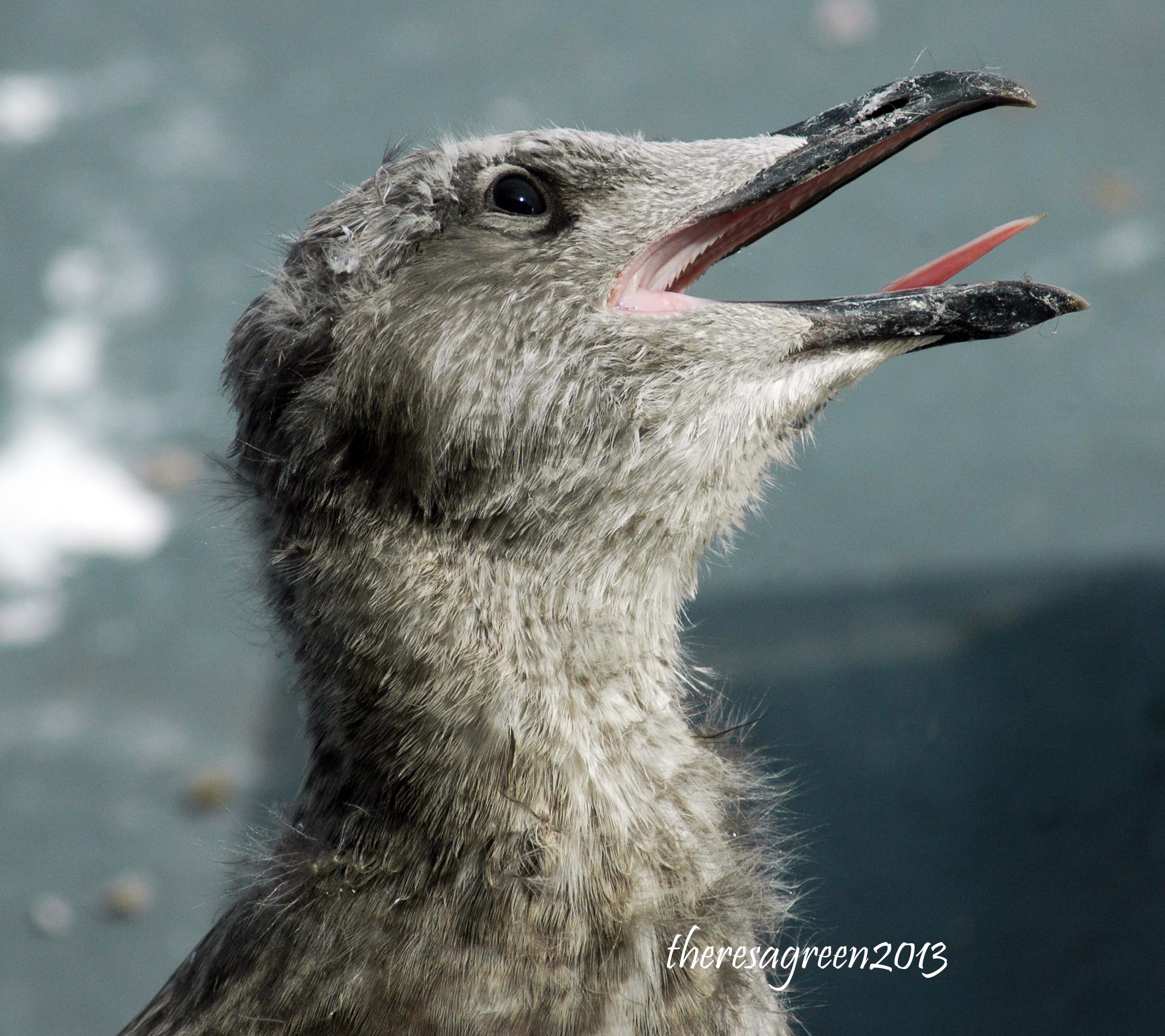
Opening the bill wide is another strategy to release body heat

Opening the bill wide is another strategy to release body heat

He took to standing on the ledge of the lantern, which was perhaps cooler on his feet.

Standing on the ledge of the lantern

Standing on the ledge of the lantern

Our view from beneath him

Our view from beneath him

July 8th

The young gull’s life changed dramatically today when, with all the drama and excitement I have come to expect from our gull residents and announced with a great cacophony of noise from both his parents, his sibling parachuted down to join him from above. Her arrival really was a magical sight to behold and although we are discouraged from anthropomorphising other fauna species, the gulls certainly displayed several ’emotions’. Both adults stood on the edge of next-door’s roof, as I said before making a particularly great deal of noise, which is what prompted me to run upstairs to see what was occurring and I was just in time to capture the moment she dropped in, rather gracefully for a first landing.

Young gull's sister arrives from above

Young gull’s sister arrives from above, squealing excitedly

The new arrival was clearly very excited while ‘our’ little chap looked a bit bemused and maybe a little intimidated. He inched towards her for a closer look while she made several little bouncy leaps, clearly excited and loving the new-found use for her wings although the tail feathers aren’t quite long enough to use for perfect co-ordination yet. The parents remained standing close by, keeping up the aggressive-defensive-protective squawking racket.
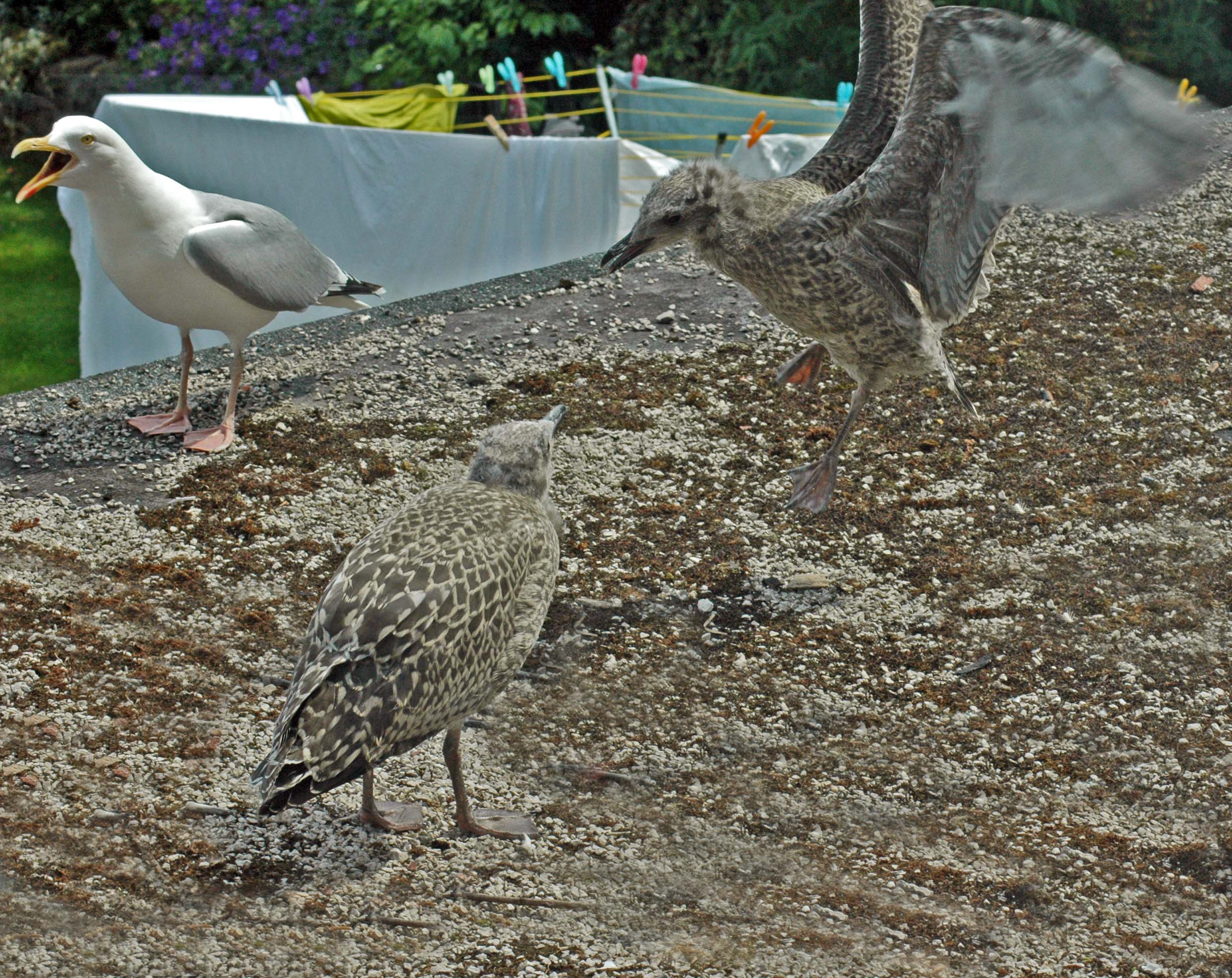
He approached for a closer look while she jumped up and down trying out her wings

He approached for a closer look while she jumped up and down trying out her wings

The new arrival settled on the ground and picked up an object from the rooftop, a piece of stick or something similar and offered it to her brother, which he accepted.
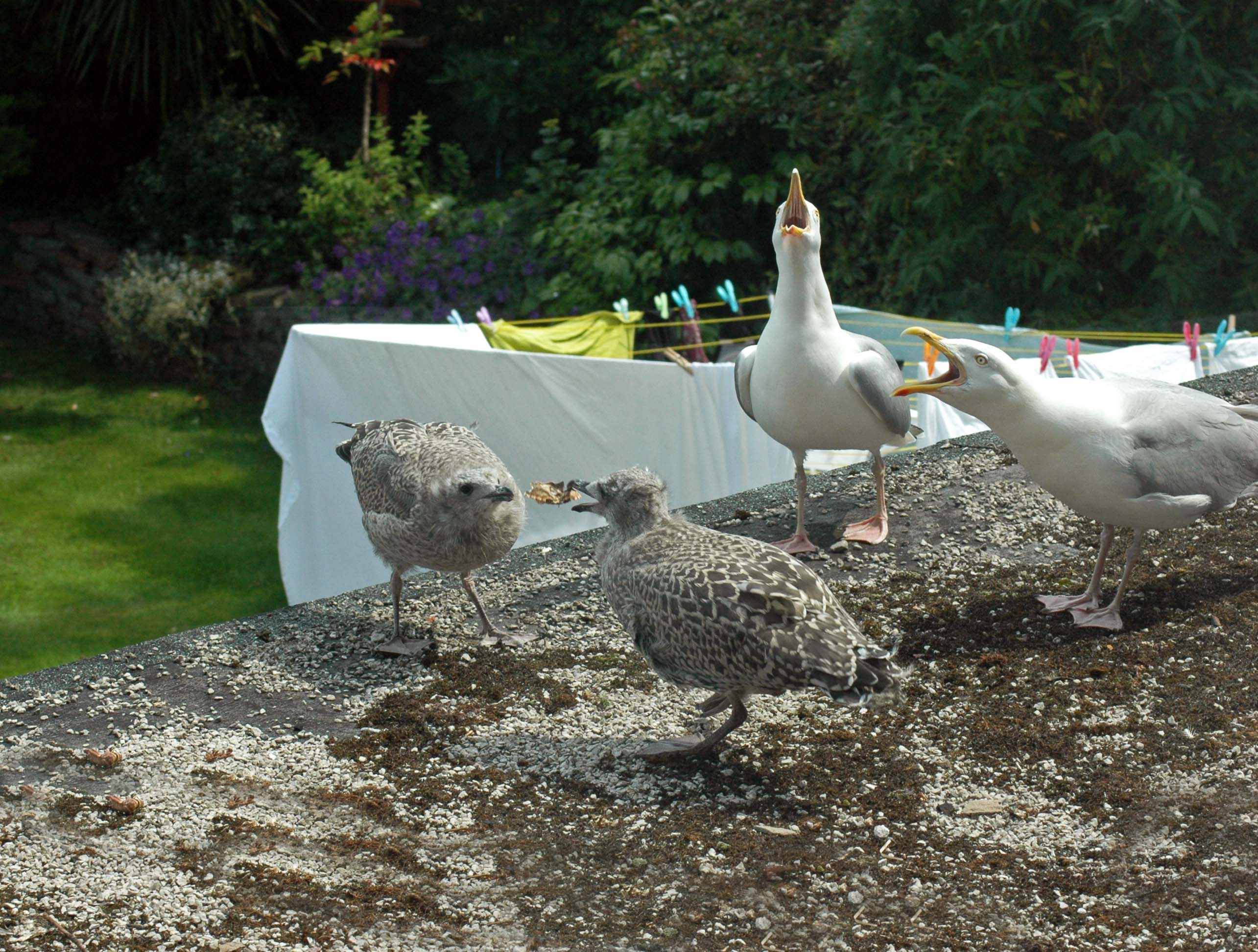
First formal introduction

First formal introduction, she offers him a gift encouraged by parents

After a few minutes things began to calm down, the new arrival was clearly enjoying her new-found flying ability and was keen to show it off. Our youngster watched with great interest as she lifted herself into the air and although he had shown little sign of trying his wings before now, suddenly seemed to realise that perhaps he could do that to. So he did.

Continuing to practice her flying

We have lift off

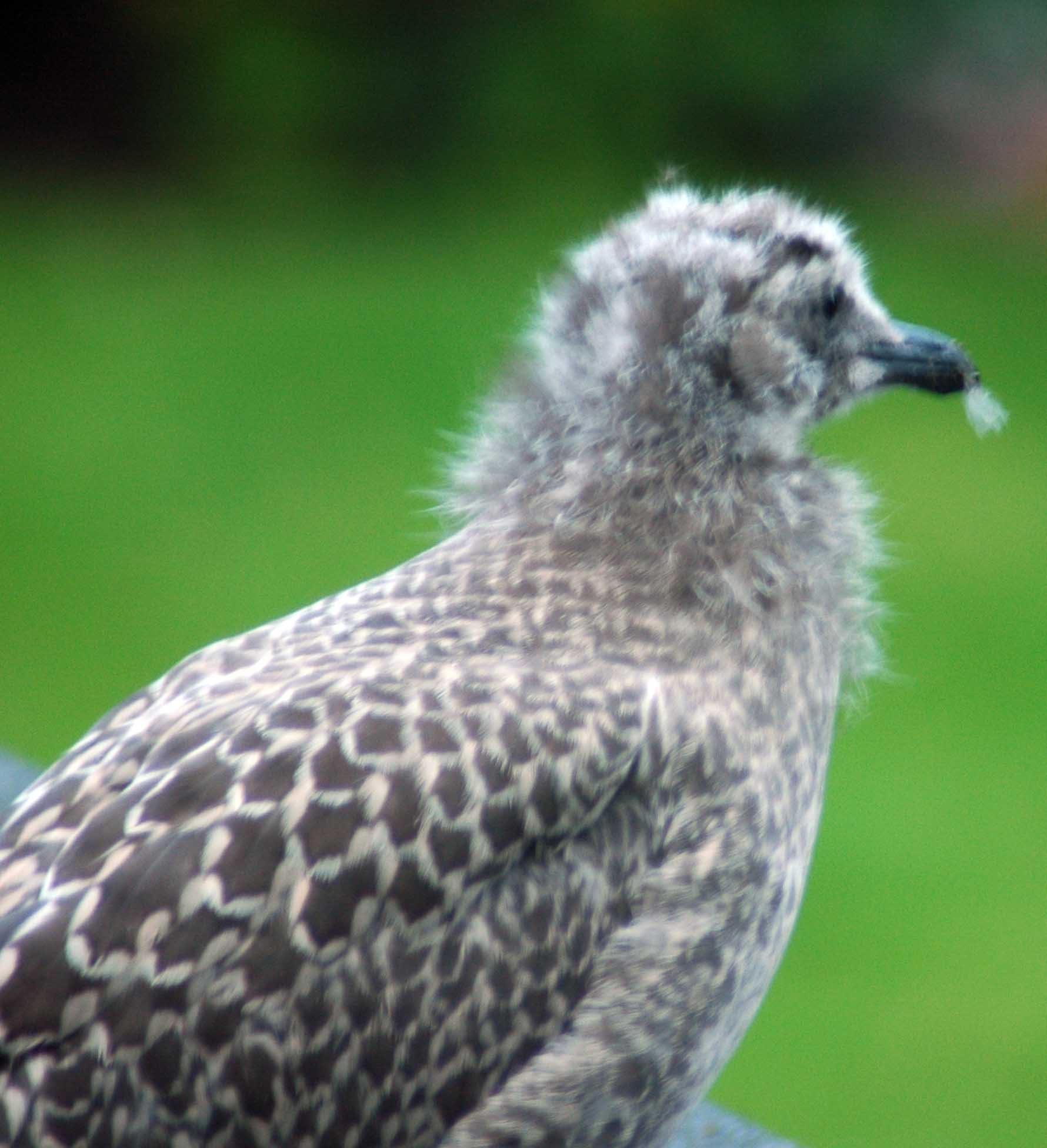
She eventually settled down a little and ventured across onto our roof, looking a little less sure now the excitement had worn off. Having a better look at the newby I’m sure I’m right about referring to it as ‘she’. This bird is slightly smaller than the other and could be a fraction younger as she still has more downy feathers around her face, neck and breast.

The new arrival ventured onto our roof

The new arrival ventured over onto our roof

July 10th

The young gull accepted his sibling immediately and there was no apparent rivalry or squabbling behaviour between them, so is it possible that although separated as young nestlings, they knew they were related? Perhaps they had been able to keep up communication from their separate locations and recognised one another’s voices, or maybe it was the parents’ behaviour towards them both that united them. It was a bit clearer now why ‘our’ young one had apparently spent so much time alone; the parents had two nest locations to cope with and to defend as well as having to share food between the two chicks. They deserve a lot of credit for their dedication and not abandoning either of them.

Practicing a running take-off

Practicing a running take-off

The family reunion brought about a noticeable change in our gull’s behaviour, he seemed to suddenly go up a gear and following his sister’s example began testing his own ability to fly.

Nearly there, just one toe left on the ground

Nearly there, just one toe left on the ground

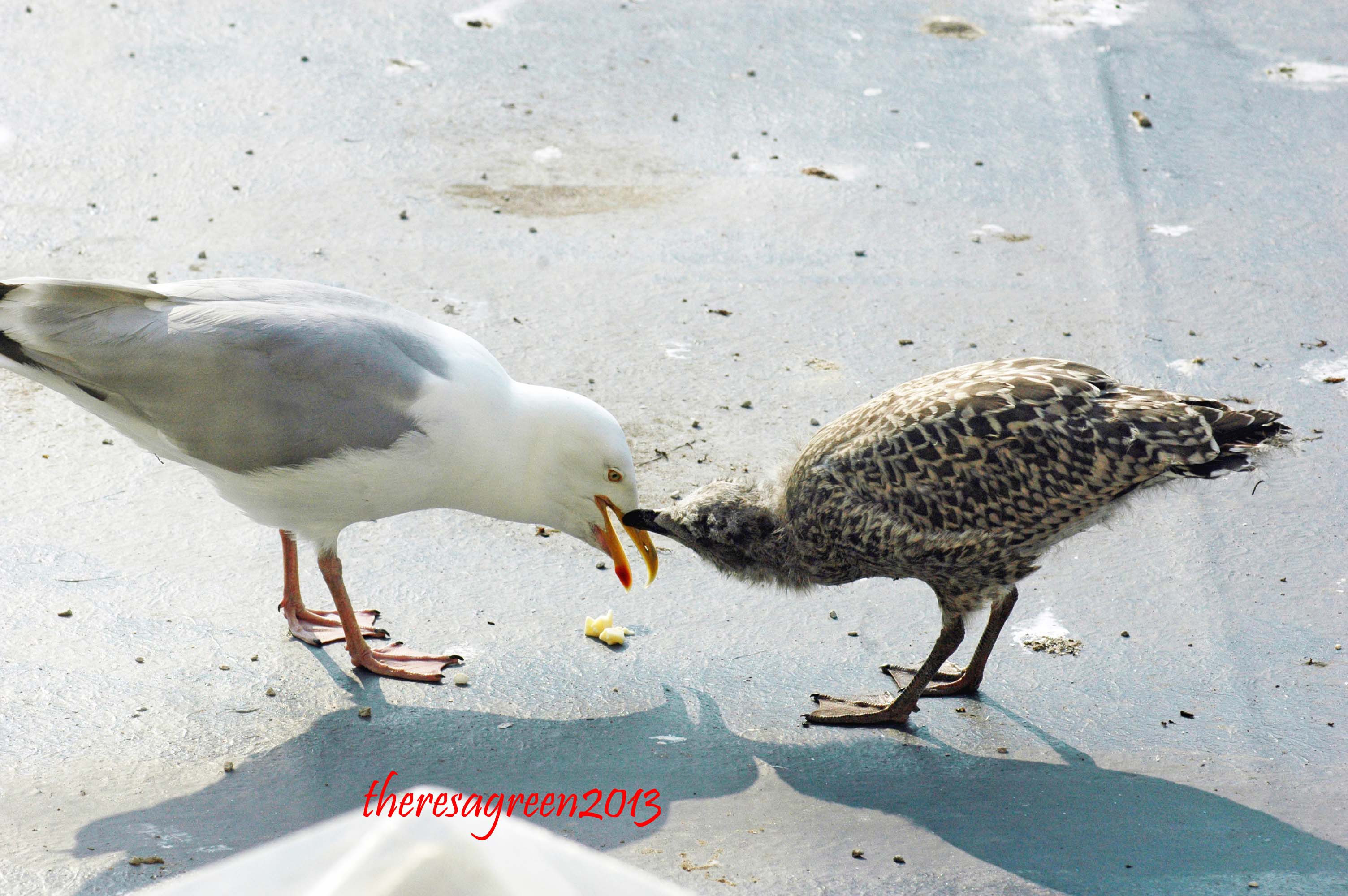
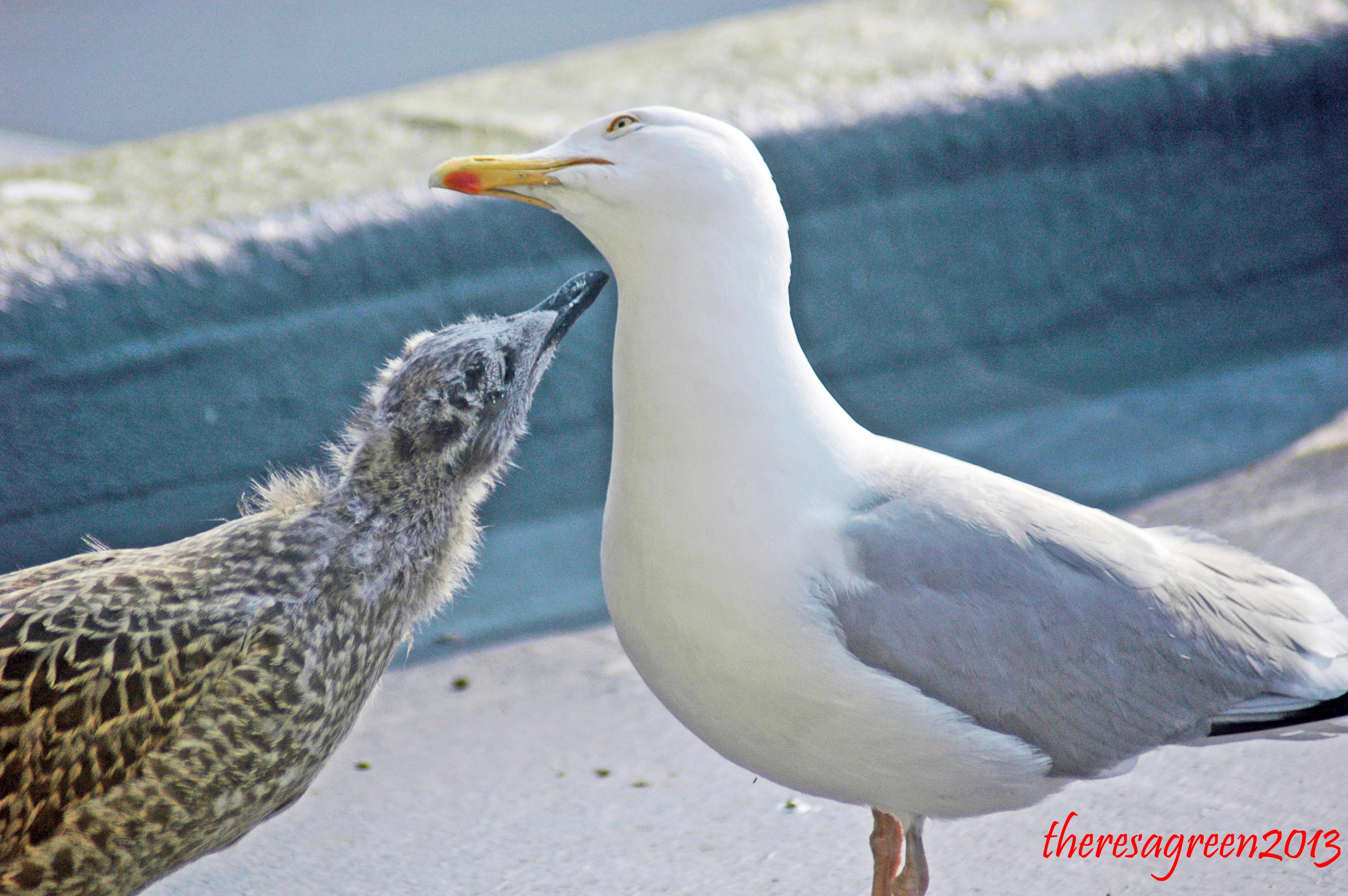
The parent gulls changed their feeding behaviour today too; rather than the young ones begging and tapping a parent’s beak to bring forth food, the parents now arrived with food which they deposited some distance away from the young ones who then had to ‘find’ it for themselves.

Here's your lunch kids

Here’s your lunch kids

Young gull not too sure about this method of delivery

Young gull not too sure about this method of delivery

The parents were still around but less obviously so, when they were not away searching for food they were keeping look-out from the roof above. The two young ones were rarely more than a metre or so apart now, if one found something interesting to peck at the other was there immediately and they seemed to play with random pieces of stick and stones that they found, picking them up and dropping them, practicing for dealing with future potential food.
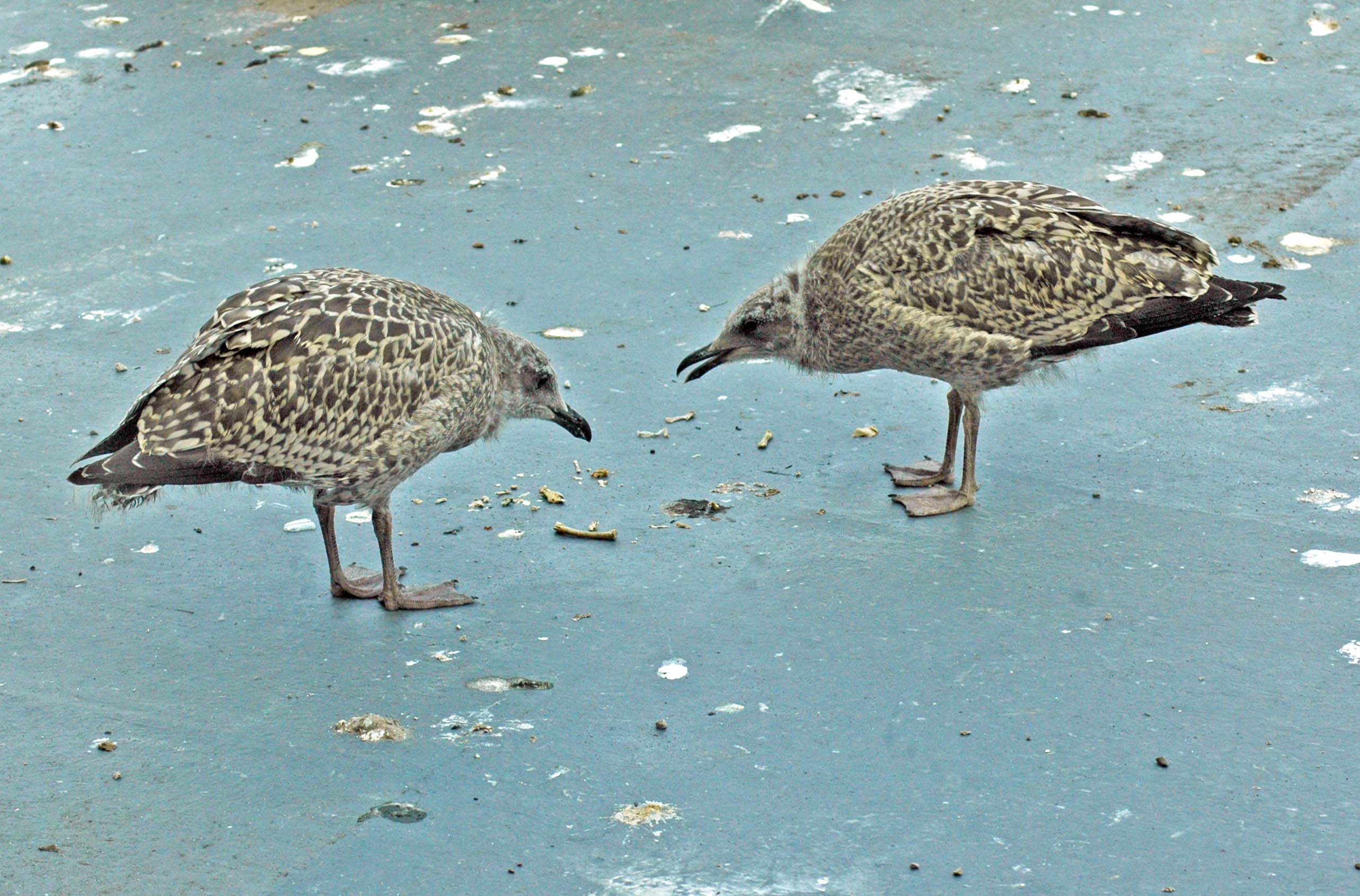
The young gulls 'playing' with a stick

The young gulls ‘playing’ with a stick

July 12th

A hot day saw both young gulls uncomfortable and trying to squeeze into small areas of shade. I poured some water from the window onto the roof and ‘our’ gull, used to me doing that came straight over and began to drink. The other one followed more cautiously, but seemed to have no idea what to do with the water or how to go about drinking it. He tried to show her, but this was a new experience for her having been up in a nest on a chimney for most of her short life.

What do you do with this then?

What do you do with this then?

Watch me

Just watch me

Things got a bit hectic for a few days when the gulls from the neighbouring chimney brought their two young ones down too and both sets of parents had some very noisy encounters on occasions, but the sets of young ones didn’t mix much. They continued to strengthen their wings, preen out the remaining down from their feathers, and rest a lot while waiting for those tail feathers to grow.
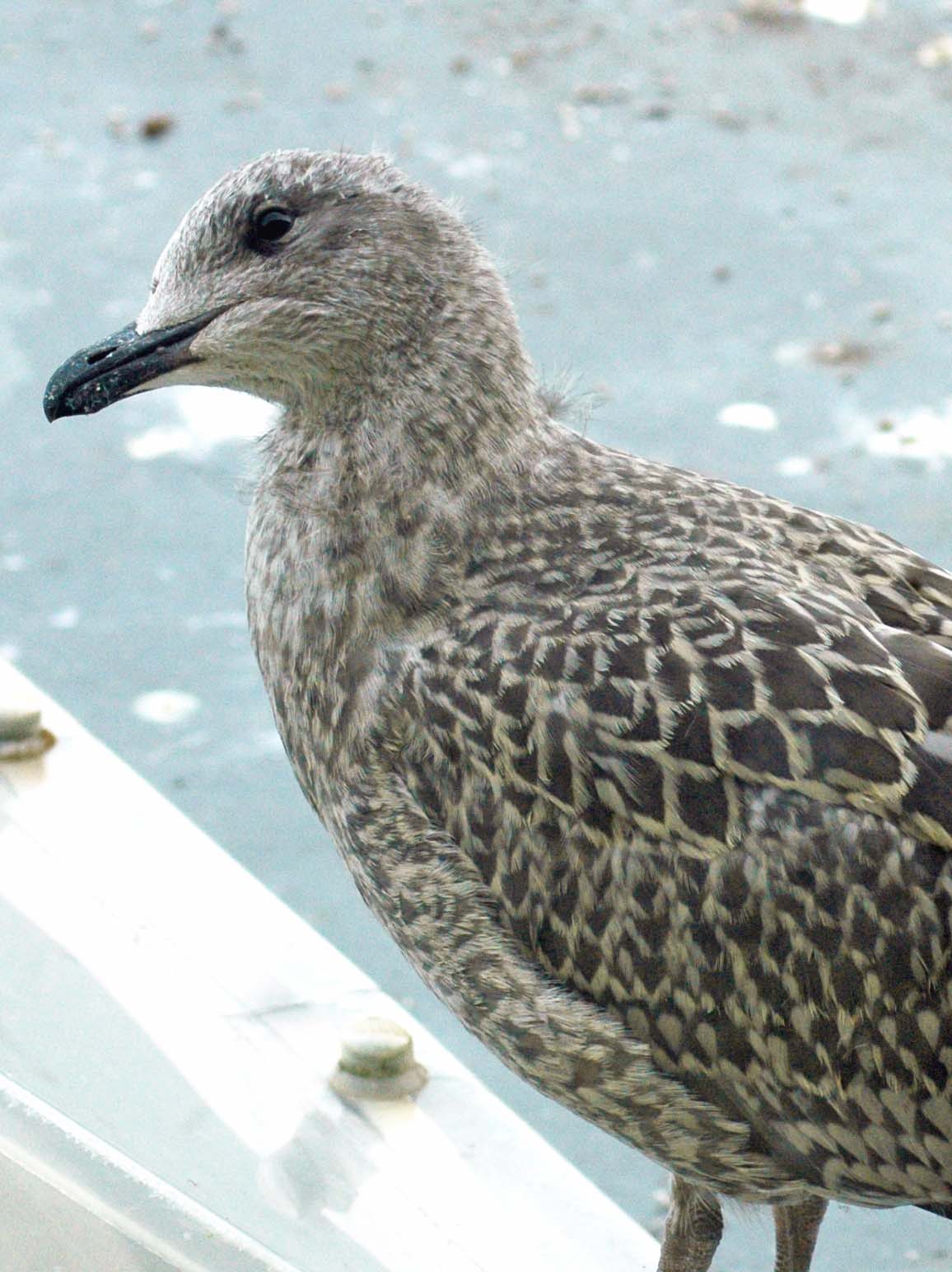
Just about all grown up

Just about all grown up

July 18th

Every event of the gull family’s time with us had been accompanied with noise and announced with drama, so the young ones’ anticipated departure came as a bit of an anti-climax. We were sitting outside enjoying the late afternoon sunshine when suddenly, first one, then the other took off from the roof, glided over our heads and landed on next door’s lawn. So that’s more or less it with this family of gulls for this year. It’s been interesting, but I shall be glad not to be woken by them at dawn. I’m not looking forward to having to clean off the roof.

Share this:

  • Share on Facebook (Opens in new window) Facebook
  • Share on Pinterest (Opens in new window) Pinterest
  • Share on X (Opens in new window) X
Like Loading...

How to feed a growing gull

11 Thursday Jul 2013

Posted by theresagreen in bird behaviour, Nature, Nature of Wales, nature photography

≈ 4 Comments

Another chapter in the story of the Herring Gull chick that fell from the nest and landed on our flat roof…

5th July 2013

It’s almost a month now since the little herring gull chick arrived on the roof and lived to tell the tale. He’s changed a lot since that day (June 8th) and although he’s still got a bit of his baby fluff, he has almost a full set of his juvenile feathers. He’s still fully dependent on his parents for food and he gets regular top-ups, mainly from his mother. Goodness knows where she goes to find his food, although some of it is recognisable as human left-overs (never ours, that would be asking for trouble), more likely chips and chunks of bread. Seems to me a parent Herring Gull has similar problems to the rest of us when it comes to providing a healthy, balanced diet (or not) for their offspring.

Lunch has just arrived

Lunch has just arrived

I hope you've cleaned your beak

I hope you’ve cleaned your beak

Help yourself

Help yourself

Only chips again

Only chips again

OK, last one

Just a bit more, please..

Just a bit more, please..

But I'm still hungry

But I’m still hungry

That's it then, might as well have a nap

That’s it then, might as well have a nap

Share this:

  • Share on Facebook (Opens in new window) Facebook
  • Share on Pinterest (Opens in new window) Pinterest
  • Share on X (Opens in new window) X
Like Loading...

There’s a new gull on the roof

20 Thursday Jun 2013

Posted by theresagreen in bird behaviour, Nature of Wales, nature photography, Rhos-on-Sea

≈ 2 Comments

Tags

herring gull, herring gull chick, herring gulls in towns, rhos on sea

Herring Gulls have featured in a good few of my posts: they are a characterful part of everyday life here in Rhos-on-Sea and although they make noisy neighbours, are somewhat bossy and seem to delight in covering our cars with their guano, life would be the poorer without them.

A couple of weeks ago, on June 8th to be exact, I was woken at some ridiculously early hour by a great cacophony of gull cries and shrieks being made right outside the bedroom window, which is just a metre above the large flat roof of the kitchen below. I am fairly used to their late spring-early summer, very early- morning territorial proclaiming racket now, but this was not the usual wake-up alarm, which I have learned to almost ignore, so I had to get up to have a look.

The fuss was all about a single, fluffy brown-grey speckled chick. How it arrived on our roof I have no idea, I know there are nesting birds somewhere up on the main roof around next-door’s chimneys, but as far as I am aware there were no nests on any part of the lower flat roofs this year. So, had it fallen from a nest higher up, or even been carried down? If the former, was it OK? I had no way of knowing, just one more thing to worry about! (We have had young gulls here before, but bigger older ones that had left nests deliberately).

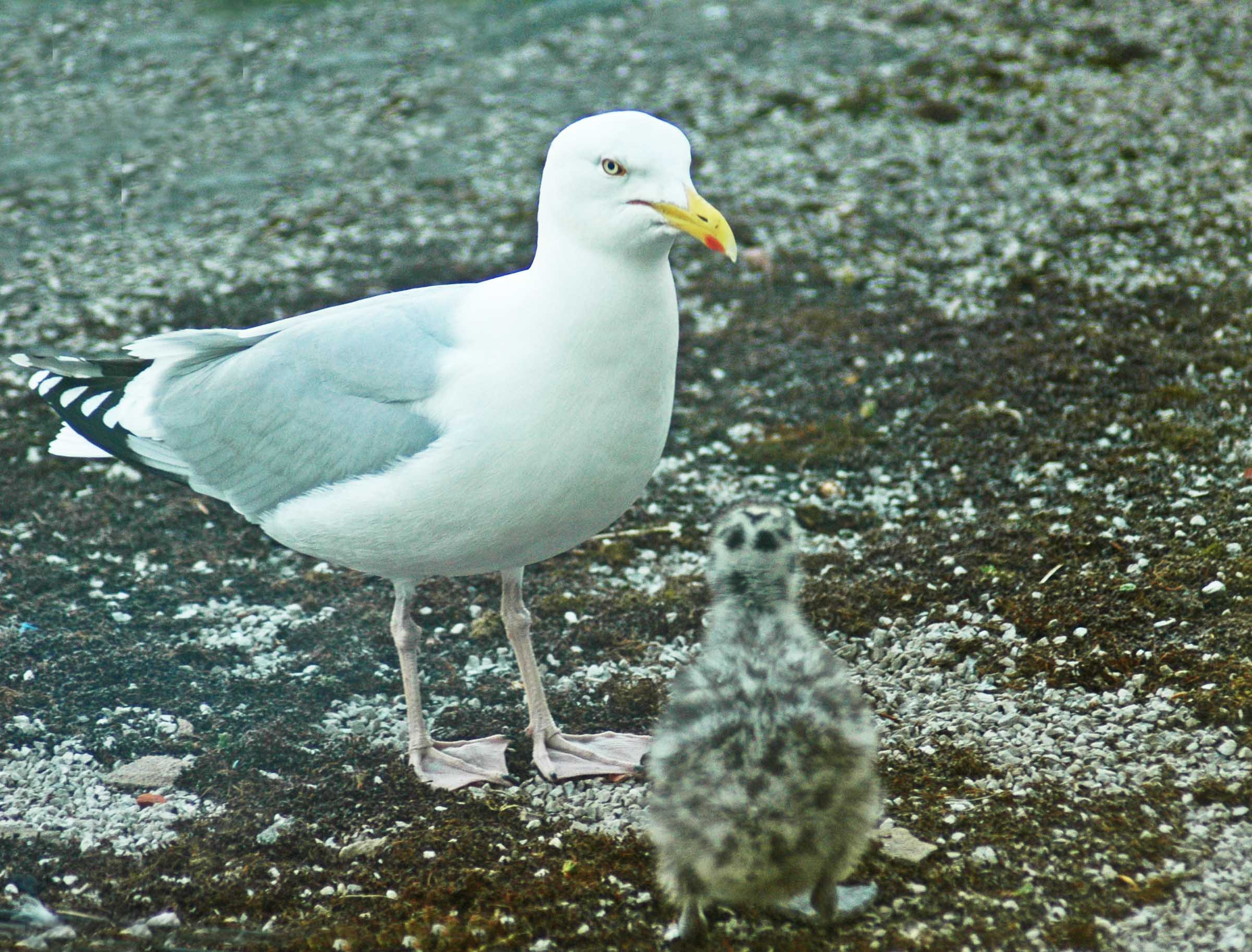
New parent, very protective

8 June 2013-Warning – New parent, very protective

Although early in the morning it was already very sunny and the parent birds ‘parked’ the chick in the shade of one of the ‘lanterns’ set into the roof. That possibly explained why they were on our bit, neither neighbour has any shaded areas, although still no clue as to how the chick got there.

Parent watching the sky for trouble

Parent watching the sky for trouble

The fussing, flapping and general hullabaloo continued for some while, but gradually the ruffled feathers smoothed and the excitement mellowed into an uneasy peace.

Once their offspring was settled, one parent stayed on close guard, the female I think, whilst the other either went off to look for food or maybe to sit higher up on the main roof to keep look out. The one that stayed remained wary, keeping a watchful eye on the sky above and patrolling around her chick. She did settle next to it eventually, but was very restless.

The mother settled eventually, but remained alert

The mother settled eventually, but remained alert

Then of course, once she settled down, the chick woke up and stood to stretch its legs. That came as a relief, at least it wasn’t injured and about to expire.

Chick awake and stretching its legs, mother still watching the sky

Chick awake and stretching its legs, mother still watching the sky

The chick was soon keen to investigate the world around him and went for a little wander. Fortunately it chose to wander onto the adjoining next-door roof which is covered with mossy lichen and he was pretty well camouflaged there.

On the adjoining next-door roof, the chick was almost perfectly camouflaged

8/6/13 On the adjoining next-door roof, the chick was almost perfectly camouflaged

After a surprisingly short length of time the parent flew off and left the chick to its own devices, although as I said before it’s possible the other one was watching from above. And food has to be searched for.

Mum back with breakfast

Mum back with breakfast

The adult gulls were very aware of my interest in them and stood immediately in front of the window squawking and giving me distinctly threatening looks.

The female gull watching me, giving me the evil eye

The female gull watching me, giving me the evil eye.

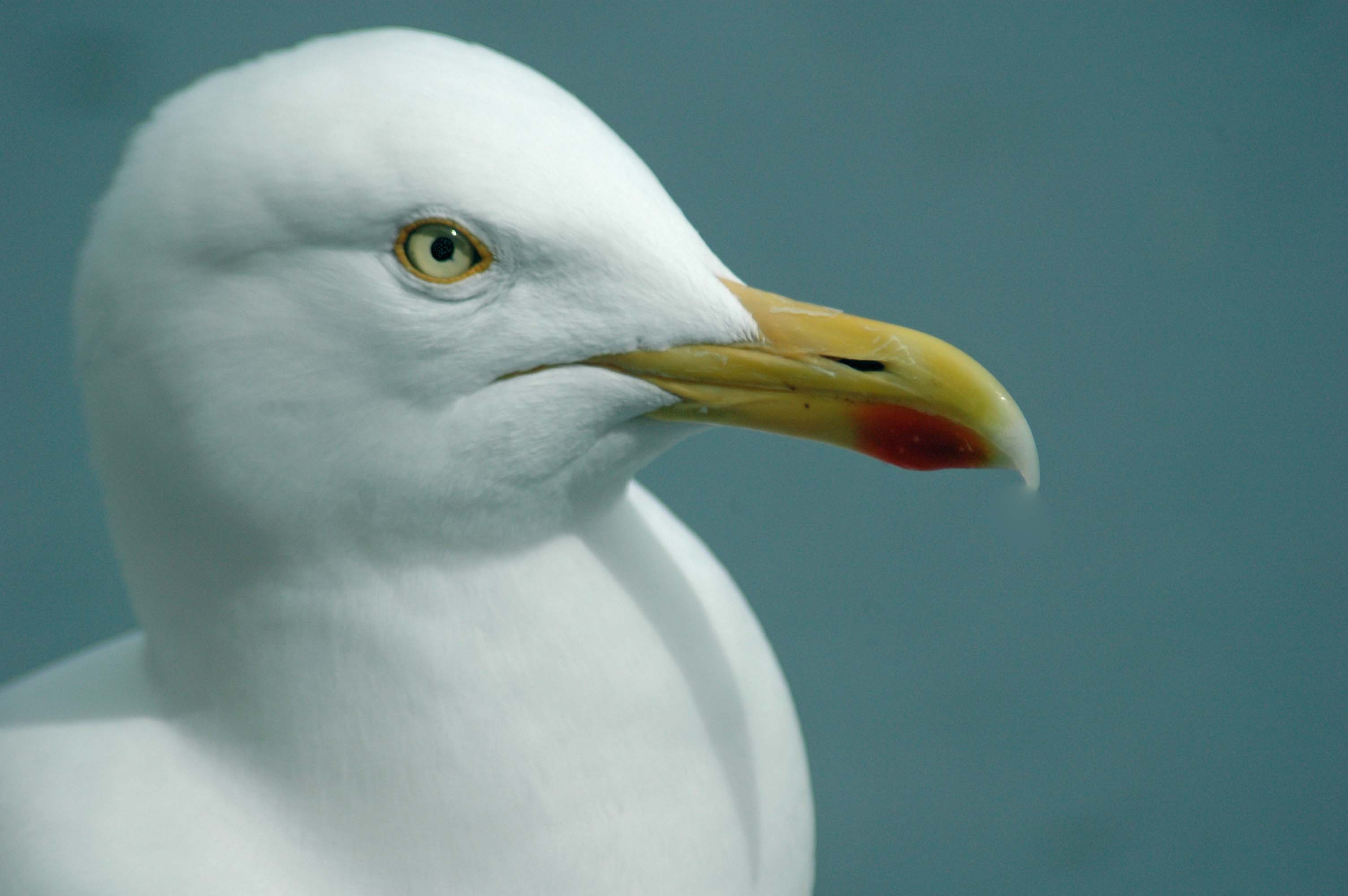
Female Herring Gulls are slightly smaller than the males and have a ‘softer’ look to the eyes (usually), but I’m glad I had glass between us, I would not like to make her angry and be within striking distance of that beak. (All of my photographs are taken through the glass of the window!)

I would not like to be on the receiving end of that beak

I would not like to be on the receiving end of that beak

13th June 

Gull life settled into a bit of a routine over the following few days. The family doesn’t spend the nights on our roof and I can’t see where they go, but they arrive back noisily in the mornings. The chick gets left alone a lot, initially resting in the shade and relative safety of one or other of the lanterns, but now it is bigger it wanders more, investigating anything and everything that looks vaguely edible. The parents are diligent in their feeding, arriving back with regular meals, their arrival always announced with a great deal of vocal noise and exaggerated wing flapping. The young one is already beginning to practice the territorial, concerted squawking, joining in with its parents when they perform to whatever is above them. Herring Gulls are proper drama queens.

13/6/13-One week on and the chick is getting bolder.   Checking out a cable to see if it's edible

13/6/13-One week on and the chick is getting bolder. Checking out a cable to see if it’s edible

13/6/13-Herring Gull chick one week later

13/6/13-Herring Gull chick one week later.

Share this:

  • Share on Facebook (Opens in new window) Facebook
  • Share on Pinterest (Opens in new window) Pinterest
  • Share on X (Opens in new window) X
Like Loading...

Bryn Euryn – a walk of several parts. Part 1

03 Monday Jun 2013

Posted by theresagreen in bird's nests, Bryn Euryn Nature Reserve, Nature, Nature of Wales, nature photography, woodland birds

≈ 4 Comments

Tags

Aegithalos caudatus, ash tree keys, bird's nests, Bryn Euryn Nature Reserve, cuckoo flower, lady's smock, long-tailed tit, long-tailed tit's nest

We had one day of decent weather last week and I grabbed the opportunity to walk up to and around ‘the Bryn‘. I hadn’t been there for ages and I knew if I didn’t get there soon I would miss the Early Purple Orchids and Cowslips that grace this special place at this time of the year. It was sunny but a north wind kept the ambient air temperature cool to outright chilly in the open, but in more sheltered spots it was pleasant and almost felt spring-like. The open grassy meadow area in front of the car park was just such a spot today and there were actually butterflies to watch, all whites, definitely some small and some green-veined whites, but as there was also a solitary male orange-tip making territorial laps at speed, it is possible there were females of that species too, they don’t have the distinctive orange wing tips so are harder to identify in flight.

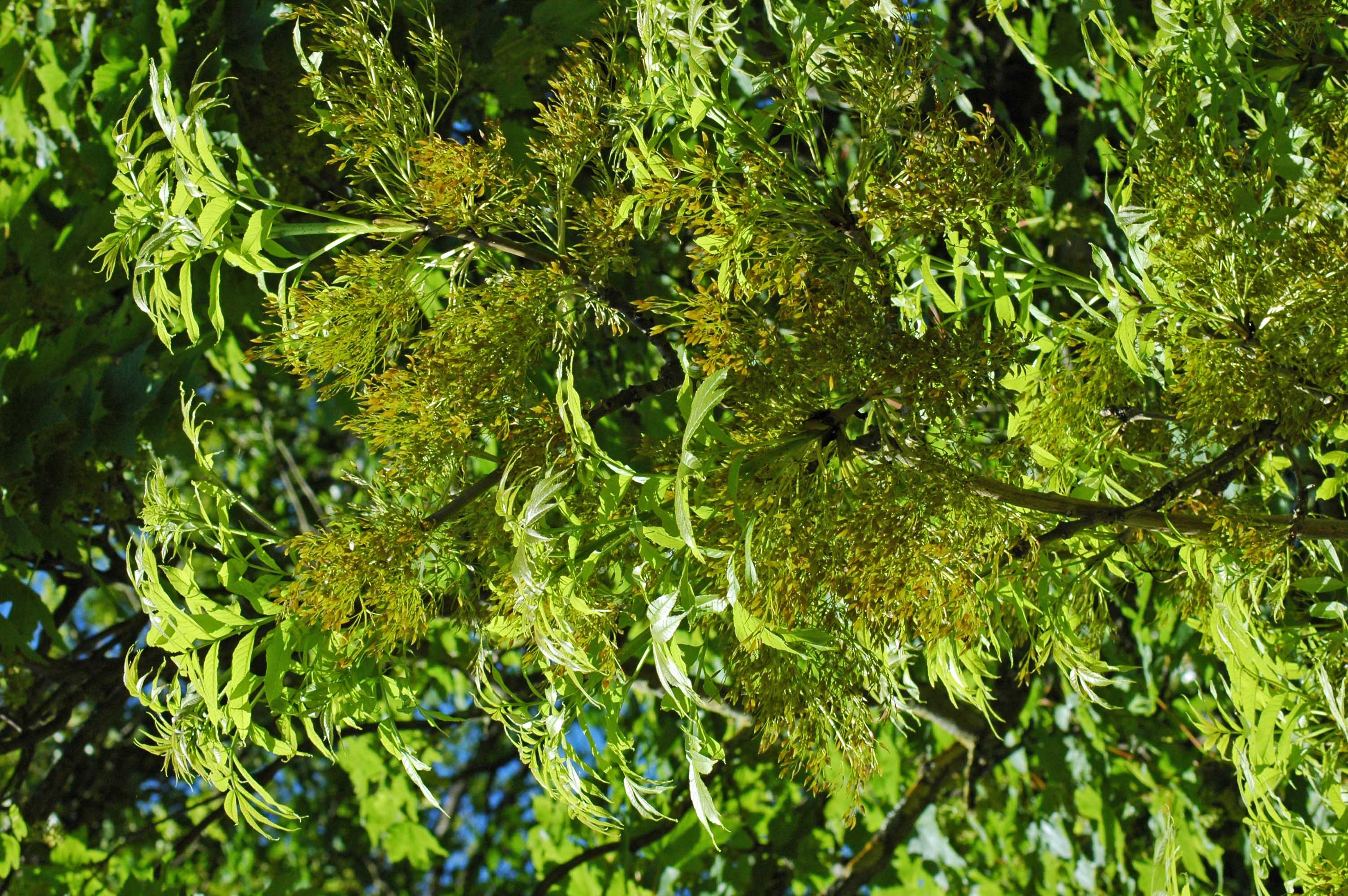
Bunches of Ash Keys already forming

Bunches of ‘keys’ are already forming on this tree and the leaves are well grown

I hoped the Orange Tip would stop long enough to have his picture taken, so whilst waiting for him to come back to this part of his circuit, which he did several times, I wandered along the field edge to see what progress the plants were making. There are many Ash trees in the woodland of this site and it is interesting to note the difference in the rate of growth of new foliage on trees which can vary significantly, even on trees that are quite close together. I am paying more attention to Ash trees now, knowing that they are under threat from the killer fungus chalara fraxinea, appreciating their  beauty while I still have the chance while dreading that they may be stricken with it.

This link shows the signs of the disease to look out for: http://visitwoods.org.uk/en/visit-woods/for-nature/Documents/symptoms-chalara-dieback-ash.pdf

White-flowered Valerian

White-flowered Valerian

The vegetation along the field edge is already tall, with much on the point of flowering, although there was little of interest to waylay the speeding Orange Tip. He was almost tempted by what I think was a white flowered Valerian, settling on it for a few seconds only before spotting a Small White in his airspace and rocketing after it.  I felt sure he’d stop to rest or feed eventually, watching and waiting for quite a while hoping for a photo opportunity, but he was clearly on duty and intent on seeing off all interlopers. I hadn’t realised how territorial and feisty this species was until now. I got tired way before he did, but thought it worth looking for some Lady’s Smock flowers, a foodplant of the species’ larva and one of the few flowers the adults do sometimes pause to take nectar from. I did find some, but only a couple of stems of flowers and no sign of the butterfly anywhere near.

Lady's Smock, Cuckoo Flower-Cardamine pratensis

Lady’s Smock, Cuckoo Flower-Cardamine pratensis

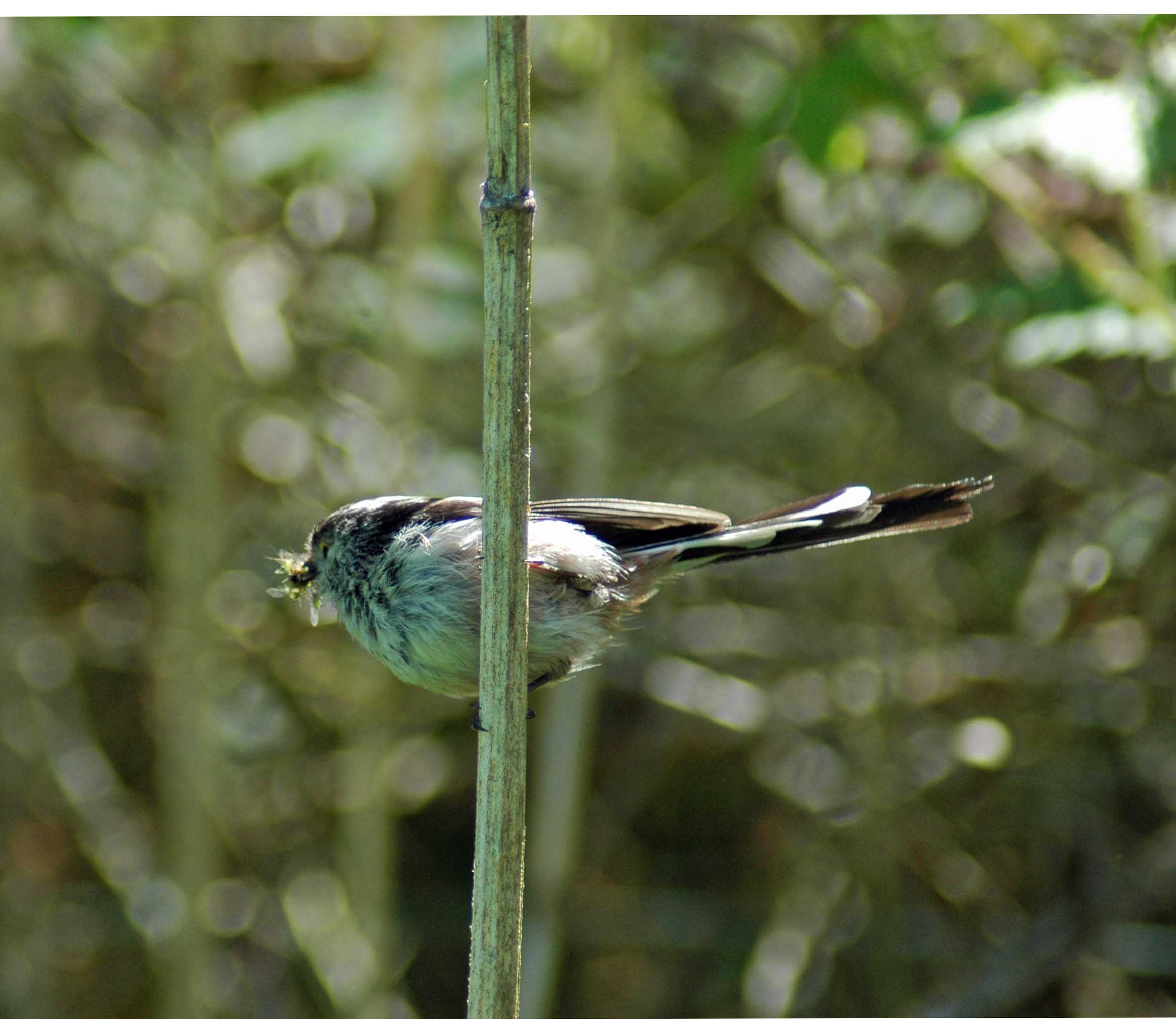
As I bent down to get an image of the flower I caught a glimpse of a bird passing me by very closely and stood up to see a lovely Long-tailed Tit at just about my eye-level (not very high then), perched on a dried stem about 2 metres or less in front of me and with its beak full of small flies.

A Long-tailed Tit with her beak full of small flies

A Long-tailed Tit with her beak full of small flies

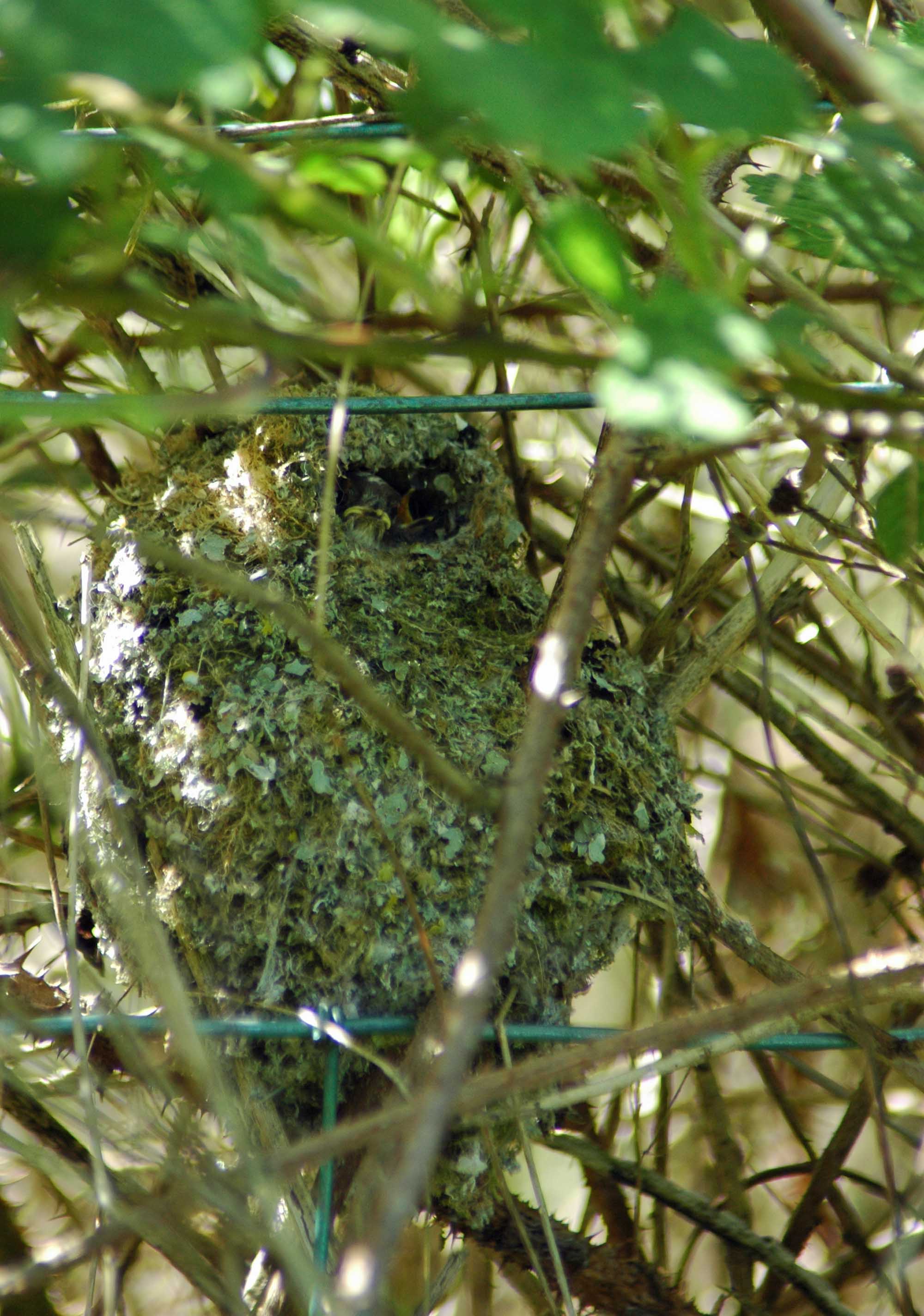
To be honest, the encounter took me so much by surprise that it took a moment for it to register that it was indeed Long-tailed Tit, let alone for it to occur to me that the poor bird was agitated by my presence because the flies were intended to be fed her nestlings. I stood still and she flitted over to the cover of a nearby small tree, then after a moment or two began to make her way to the back of the wire fence, then through a tangle of brambles to the most beautiful nest. I was thrilled to see it as I’d never seen one closely before; they are usually deeper into a tangle of brambles, so at the same time I felt concern at the location of this one; it seemed very vulnerable and if I spotted it fairly easily then so could potential predators. Long-tailed tit nests are known to suffer high rates of predation with only 17% of them being successful.

The Long-tailed Tit at the nest

The Long-tailed Tit at the nest

Long-tailed Tits make magical nests from materials you could almost imagine being called for in a spell; spider egg cocoons and moss, lichen and feathers, some 6,000 tiny pieces required for the average construction. The moss and spider silk provide the structural stability, they are pieced together to form a mesh with the tiny leaves of the moss acting as hooks and the spider silk of the egg cocoons providing the loops, which has been described as working in a similar way to velcro. The outside of the nest is covered with hundreds of flakes of pale green-grey lichens to provide camouflage and the inside lined with around 2,000 downy feathers to insulate the nest.  The end result is a lightweight elastic sac with a small, round entrance placed at the top, which is suspended either low in a gorse or bramble bush, less than 3m off the ground, or occasionally high up in the forks of tree branches.

Despite its apparent fragility the nest is strong due to the spider silk and the elasticity of the structure allows it to expand as the nestlings grow, so is always the perfect size. This nest was fairly bulging, so I imagine the young ones were quite well grown and that there were several of them in there.

A close view of the exquisite nest and young ones peeking out

I stood rooted to the spot watching as both parent birds hunted for food for their young ones. they were not travelling far, one was mainly foraging in the lower branches of a tree within a few metres of one side of the nest and the other in another tree a similar distance away to the other side. That same one, which is the one I photographed also seemed to be flying up from the fence pursuing flies on the wing.

A Long-tailed Tit with a beak full of small flies waiting a short distance from the nest

I would have loves to have stayed and watched for longer, but although the birds carried on about their work despite me, they were clearly wary and I left them in peace to carry on while I continued with my walk.

Hungry Long-tailed Tit nestlings looking quite well-grown

Hungry Long-tailed Tit nestlings looking quite well-grown

This link is to a wonderful video of a Long-tailed Tit nest and narrative from Iolo Williams’  Secret Life of Birds.

http://www.bbc.co.uk/nature/life/Long-tailed_Tit#p00dxvfq

Share this:

  • Share on Facebook (Opens in new window) Facebook
  • Share on Pinterest (Opens in new window) Pinterest
  • Share on X (Opens in new window) X
Like Loading...

The craft and artistry of nest building

08 Wednesday May 2013

Posted by theresagreen in bird's nests, nature of woodlands, nature photography

≈ 8 Comments

Tags

bird's nests, blackbird nest, Blue tit nest, chaffinch nest, robin's nest, Serin, Wren, wren's nest

Every spring I watch various species of bird select oddments of dried grass, leaves, feathers and a variety of other bits and bobs and am awed that they are going to put them all together and fashion them into a perfect home for their future family. How on earth do they know how, when and where to begin? I mean, I am pretty dexterous with my hands and can put together items by sewing, knitting, crocheting etc., but I wasn’t born knowing how to do that; I’ve had to learn how to do things and then practice to perfect the techniques over years. And I have two hands, eight fingers and two opposable thumbs to work with. A bird has one beak. Furthermore the whole process is often completed within the space of a few days, and each and every nest perfectly conforms to the design that is unique to the species of its builder, with no instruction needed. Amazing.

I still recall the thrill of finding birds’ nests when I was young and exploring the hedgerows and woods around our home, but didn’t really think much about how the nest had been put together then, being more curious about which bird had built it and how many beautiful eggs were in it. Now I take a much keener interest in the nest-building process and in the structures themselves and love to take advantage of opportunities to have a closer look at the structures of those I have found.

The first two photographs below were taken in Spain and are of a nest blown out of position during the winter following its successful use. It was built by Blackbirds in the fork of a yucca tree just a couple of metres from the kitchen window and in which three young ones were successfully raised.

A blackbird's nest blown from a tree branch

A blackbird’s nest blown from a tree branch

Blackbirds build classic archetypal cup-shaped nests utilising the natural materials available to them. Partially concealed from my view I couldn’t see exactly how the work was done on this one, but I did watch both the male and the female of the pair carry in materials, long strips of dry palm leaves, twigs and leaves to begin with, which made up a substantial base. Once that was in place the bird would have built up layers of finer materials, working each strand into place, working around herself, turning and weaving each one into place to build up the sides of the cup. The turning action keeps the inside of the cup smooth and well compacted, then when it is completed she will strengthen it further with mud.

You can see that the layers of grass become progressively finer from the outside inwards. The bottom of the nest looks rough and messy, but the bulk of material provided a substantial base, filling out the space in the fork of the tree. It is also thought that birds may deliberately leave the outsides of their nests untidy as a method of camouflage, hoping a prospective predator may mistake it for a pile of debris.

The bottom of the nest

The bottom of the nest

Chaffinches also build a cup-shaped nest and once again I had excellent views of a beautiful nest built on a branch of a cork oak tree that overhung the garden wall and was on a level with and very close to a first floor bathroom window. Honeysuckle had climbed up into the tree providing extra  cover, but the most impressive camouflage was in the use of the blue-green lichen on the outside of the nest. Taking pictures was quite challenging, I was in the bath beneath the window, trying to get a view first through the vertical window bars, then through the branches and foliage.

The beautifully crafted nest of a pair of chaffinch. This was the last of 3 chicks to fledge and was reluctant to leave.

The beautifully crafted nest of a pair of chaffinch. The occupant was the last of 3 chicks to fledge and was reluctant to leave its cosy home.

We found the goldfinch nest on the ground beneath pine trees around a picnic area of the Sierra de Nieves Natural Park, near Ronda, Andalucia, whilst out walking there. We knew it belonged to a goldfinch as, sadly, we also found a couple of partially-feathered dead nestlings close by too. Maybe it had been blown out of the tree, but it is also possible a jay may have raided it, there are plenty of them thereabouts. It was such a delicate but cosy little nest too.

A goldfinch nest, cosily lined but dislodged from  a tree

A goldfinch nest, cosily lined but dislodged from a tree

I love wrens and had the privilege of their close company during much of the time I lived in Spain, they seem much more ‘confiding’ there for some reason and are often happy to use the facilities people provide for their own use as nest sites. In our case a terracotta light fitting, fixed in a covered area between the kitchen and garage doors was used for two successive years with the male using it as a roosting place when vacated by his family.

An adult wren at the entrance to the nest in the light fitting

An adult wren at the entrance to the nest in the light fitting

Male wrens are the nest builders and will construct a number of basic nests in several locations which he then shows off to prospective mates. ‘Our’ little chap began work on the light fitting nest early in a February, carrying in leaves and dried grass, then used it as a night-time roost for himself until April. I thought he’d left then , but one morning he reappeared and set about making some improvements, working hard over a period of days carrying in leaves and dried grass, until the space looked stuffed to capacity. Shortly afterwards he performed quite a spectacular and noisy display on a roof beam close by, clearly to impress a female. She subsequently appeared, inspected the nest, approved it and set about making the place more comfortable by lining it with moss she pulled out from our lawn. I helped her out a bit by pulling out more moss and putting it on the leaves of a large house plant below the site. My contributions were accepted happily and carried up to the nest, much to my delight. Some days later, a sneaky peek with the telescopic lens of a pocket camera revealed 4 eggs nestled amongst moss and feathers plucked from her own body.

Interior of the wren's nest inside our light fitting

the inside of the nest lined with moss and feathers

In more natural situations the wren’s nest is quite an elaborate, dome shaped construction, often placed against a wall or as in the one below, against a rock face and amongst vegetation (photographed in Gibraltar).

The elaborate domed nest of a tiny Wren

The elaborate domed nest of a tiny Wren built amongst vegetation on a rocky cliff in woodland

Another wren’s nest I found on the ground when out walking around the area local to our home in Spain had been constructed using a lot of leaves and moss, dried grasses and lengths of paper material. I would have loved to see the little bird carrying that and working it in. The photograph is of the back of the nest which is flat from having been built against a wall.

A wren's nest using lengths of paper material on the outside

A wren’s nest using lengths of paper material on the outside

Blue Tits are naturally cavity-nesting birds, but they liked our light fittings too and several years we had a family in a particular one, again very close to the house, but this time under the covered front terrace. Their nest was a much lighter affair than the wren’s, perhaps partly because its position got a lot more sun, but it was still cosy inside, lined with fine grass, moss, feathers and quite amusingly, some of the long dark hairs from our Yorkshire Terrier (we used to brush him and clip his hair outside). I couldn’t see into the nest without the aid of my little camera’s telescopic lens, so couldn’t believe my lucky timing for this shot, taken as soon as I spotted the female exit for a few minutes. The three hatchlings were very recent and you can see fine cracks in two of the remaining eggs.

Inside the blue tit's nest in a light fitting-Sotogrande, Spain

Inside the blue tit’s nest in a light fitting-Sotogrande, Spain

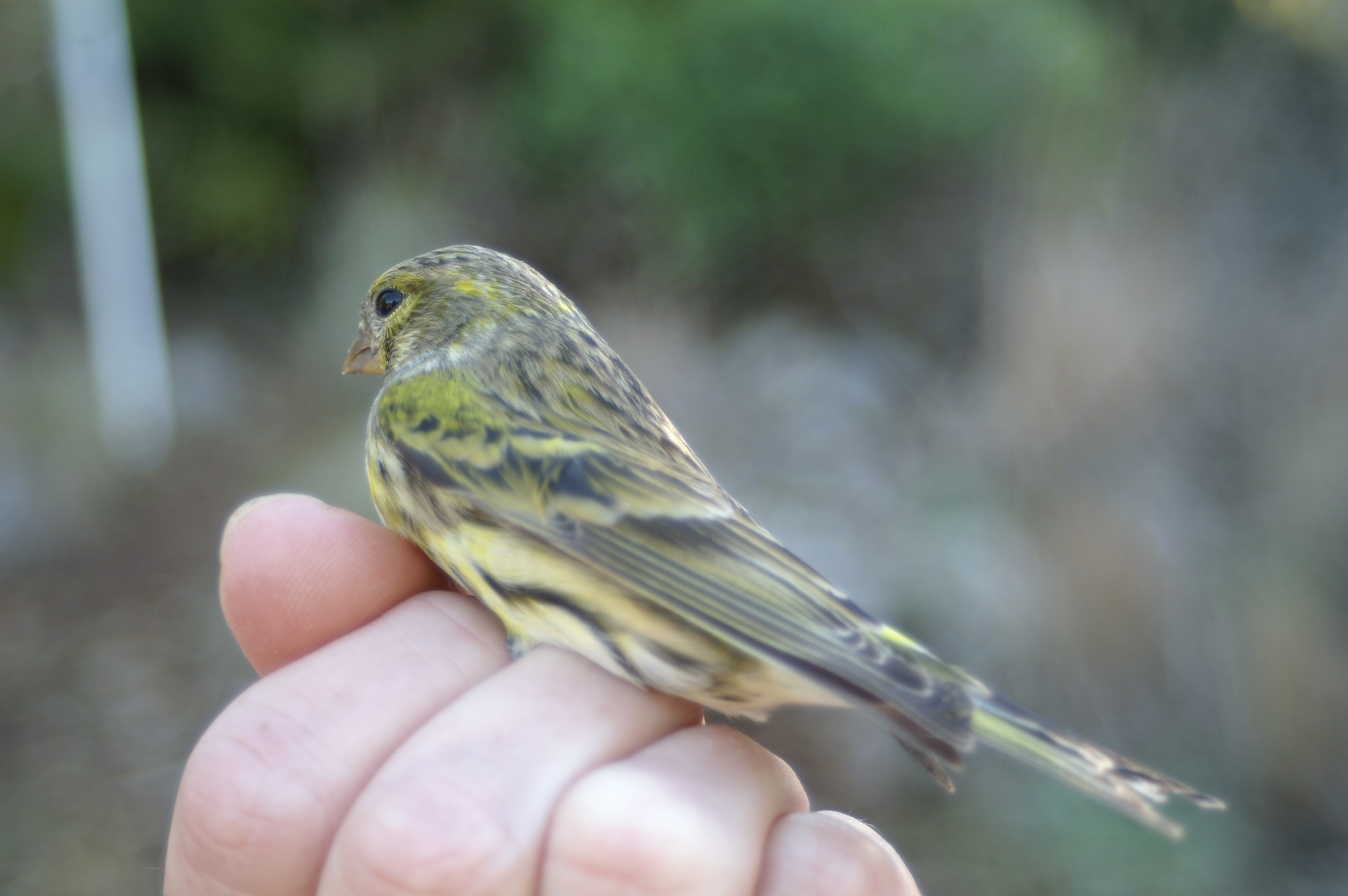
The next nest was built by a pair of Serin, tiny finches that are common in Spain. They built it high up in a very tall cypress fir tree and they too successfully raised a family in it. I found it on the ground beneath the tree long after they had left it and was amazed at how light and flimsy-looking it was, constructed mainly from fine grass and spent flower tassels dropped from  neighbouring cork oak trees. At first I wasn’t sure who had built the nest as they and a pair of  Short-toed Treecreepers were nesting at the same time in trees next to each other, but then I spotted the white feather in the lining and remembered spotting and photographing the female Serin with it in her beak, months before.

The nest of a pair of tiny Serin blown down from a tree, Sotogrande, Spain

The nest of a pair of tiny Serin blown down from a tree, Sotogrande, Spain

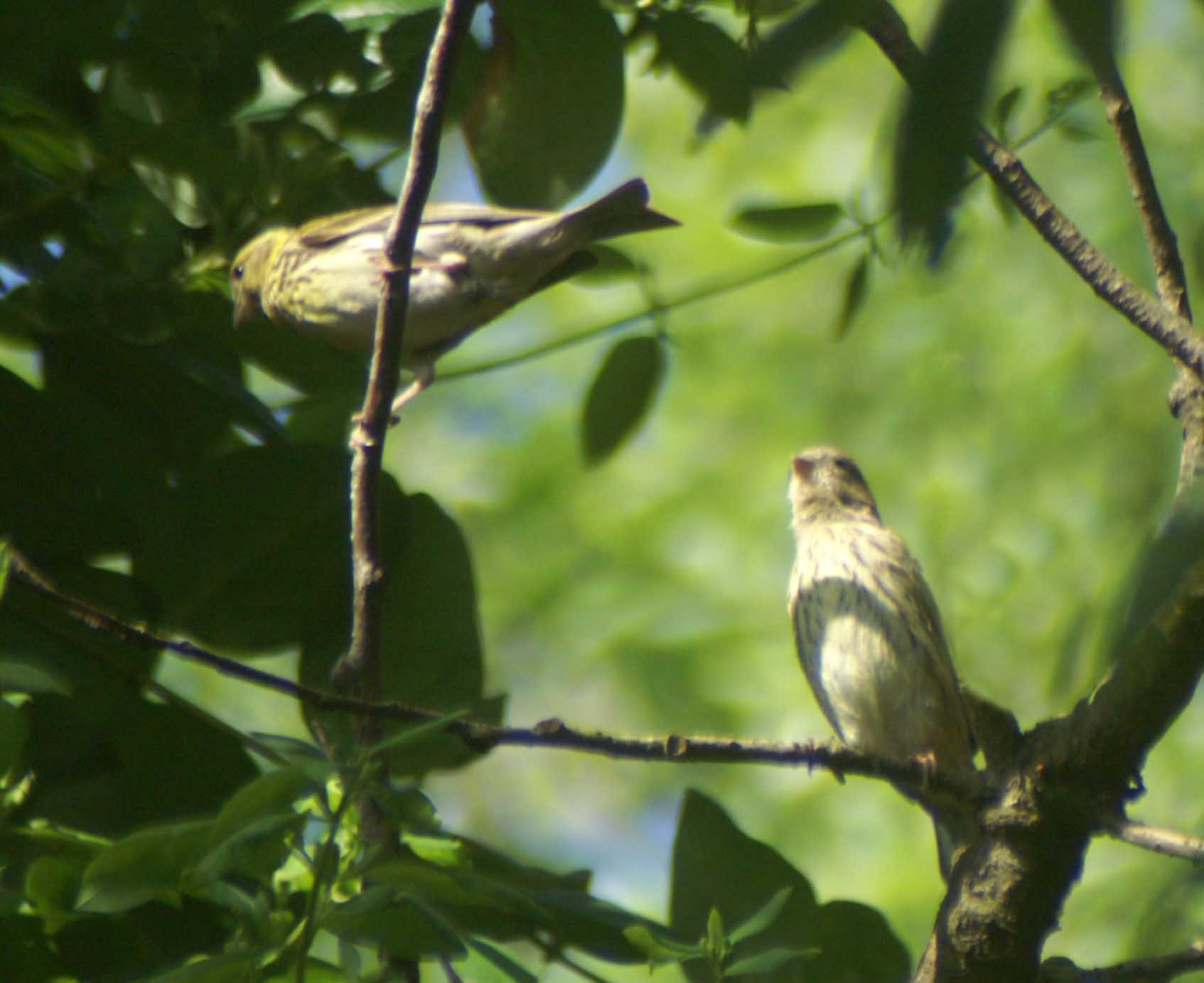
I’ve put in a couple of pictures of Serin here, to show what I’m talking about and because I like them a lot (the birds that is).

These young Serin in a cork oak tree may well be from 'my nest' family

These young Serin in a cork oak tree may well be from ‘my nest’ family

A male Serin held in a ringer’s hand shows how tiny they are

The final picture for this post is a British Robin’s nest, built in the wood pile of my friend’s house in Nevern, Pembrokeshire. It was not very far off the ground as you can see, but was so well camouflaged we walked past it for a couple of days before noticing it.

A mossy Robin's nest built in the wood pile, Nevern, Pembrokeshire

A mossy Robin’s nest built in the wood pile, Nevern, Pembrokeshire

Share this:

  • Share on Facebook (Opens in new window) Facebook
  • Share on Pinterest (Opens in new window) Pinterest
  • Share on X (Opens in new window) X
Like Loading...

This is definitely a Chiffchaff

21 Sunday Apr 2013

Posted by theresagreen in nature of woodlands, nature photography, woodland birds

≈ Leave a comment

Tags

Chiffchaff, fall of migrating warblers, migrant birds, min-y-don, river Colwyn, willow warbler

Since writing the last post this morning I’ve been wondering and reading about chiffchaffs and willow warblers and thought it might be worth nipping back down to Min-y-Don to see if there might be any of those I saw on Friday still hanging around. To my surprise and delight there were little warblers everywhere, almost every tree had at least one amongst its twigs and leaf buds and there were birds darting out after flies all over the place. They are so mobile and active that counting them was not really an option, but there are a good many. That doesn’t make identifying them any easier, but what I will say is that there is definitely a mix of the two species, indisputably so after hearing songs from both this afternoon and the fact that they are still here must indicate that they are all finding plenty to eat.

When I came to look more closely at my photographs I spotted that the one below has a leg ring – anyone recognise it? The tag I mean, not the bird!

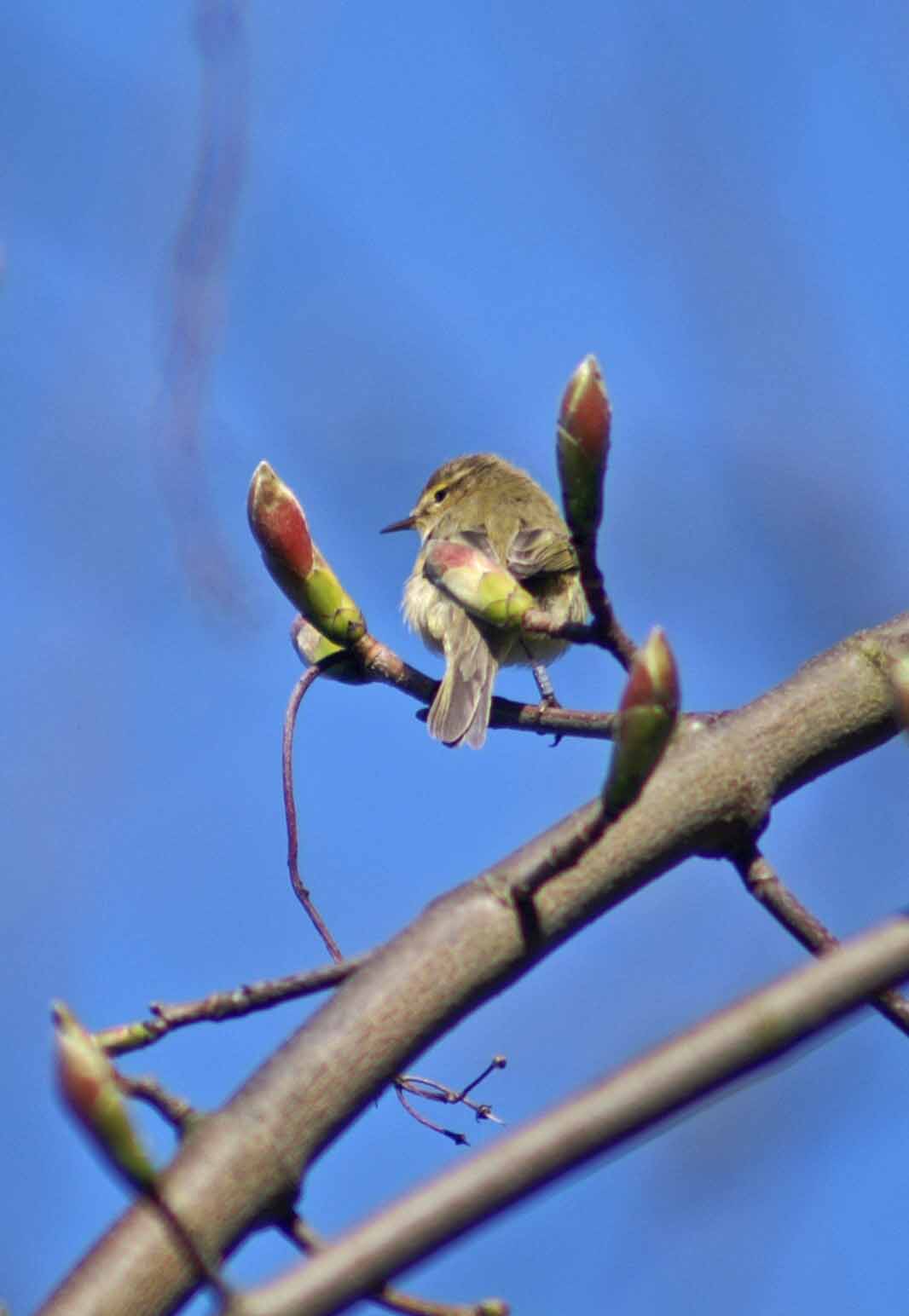
Chiffchaff or willow warbler between buds of a sycamore.

Willow warbler between buds of a sycamore. This bird is ringed, anyone recognise it?

Getting views of the birds is not a problem at all, as I said they are all over the place, but getting sight of an individual for more than a second or two is something else. They are not too bothered about people being around, one surprised me by popping up over the wall alongside the river right in front of me: it was chasing after a fly which I saw escaped, more’s the pity as it looked like a mosquito. 

I followed the path alongside the river and just the other side of the bend heard a chiffchaff singing very close by. I located it quite easily, on the branch of a tree quite surprisingly low down, but it moved away when it saw me. He didn’t go far though and reappeared on a branch overhanging the path with a good view over the water. He sang a few phrases, then suddenly dashed down to the water and swooped straight back up again with a sizeable fly in his beak.

The chiffchaff with his prize - a good-sized fly

The chiffchaff with his prize – a good-sized fly

He ate it and sat for a while longer before flying off over the river and the road to trees on the other side.

The chiffchaff after polishing off his meal. He certainly looks well-fed and healthy

The chiffchaff after polishing off his meal. He certainly looks well-fed and healthy

I don’t suppose they will be around in these numbers for much longer, but what a joy it has been to see them and I hope they all thrive throughout the rest of the spring and summer wherever they go.

Share this:

  • Share on Facebook (Opens in new window) Facebook
  • Share on Pinterest (Opens in new window) Pinterest
  • Share on X (Opens in new window) X
Like Loading...

An enchanting encounter with chiffchaffs (and/or willow warblers!)

21 Sunday Apr 2013

Posted by theresagreen in nature of woodlands, nature photography, woodland birds

≈ 7 Comments

Tags

Chiffchaff, fall of migrating warblers, leaf warblers, migrant birds, min-y-don, Phylloscopus collybita, phylloscopus trochilus, river Colwyn, willow warbler

Friday was a beautiful day and during my lunch hour I thought I’d take some photographs of dandelions, daisies and primroses which I wanted for the next blog I intended to write. There is a lovely grassy bank alongside the road I take back to work, which is currently smothered with gold and white wildflowers and just what I wanted, so I stopped alongside and got out of the car. But, as I opened the car door, I heard a chiffchaff calling from somewhere high up in a tree, a sound I have been waiting to hear this spring, so flowers were quickly forgotten and instead I walked down the hill towards the river and the trees of Min-y-Don listening and trying to work out where he was.

(This spot is just a stone’s throw away from the sea and the point at which the little River Colwyn runs into it and the area known as Min-y-Don is a remnant of the old woodland that used once to cover the whole area, so an oasis for resident and birds on migration with water and potential food.)

As I approached the footbridge over the river I spotted two small birds on the water’s edge that were perching briefly on overhanging plant stems then darting out and flitting over the water, clearly chasing after small flying insects. I have watched Chiffchaffs do this many times in Spain, both over water and from the tall palms in our garden there when they were fruiting and attracting insects there. The tiny birds are amazingly agile in the air and watching numbers of them performing their aerobatics was always magical and enormously entertaining. I know they were doing it to feed themselves, but I could never help feeling they were enjoying the chases and taking the opportunity to show off their skills to their companions; surely the amount of energy they put into the pursuits must have burnt off any calorific value they gained from the flies they actually managed to catch?

I digress, I know, but still being able to hear one as well, you can see why Chiffchaffs came to the front of my mind as soon as I saw them.

Taking a second to spot potential prey

Chiffchaff, or is it a willow warbler.

I attempted a few photographs of the birds in the very brief intervals they paused from their pursuits, one or two of which came out OK, but the more I looked at them through the long lens, the more I began to question my identification and to think they might actually be Willow Warblers. I think the problem arose from the fact that although I am very familiar with chiffchaffs, I am not so au fait with willow warblers, something I clearly need to sort out.

KONICA MINOLTA DIGITAL CAMERA

On the point of take off

I enjoyed watching these two birds for several minutes before they were joined there by the footbridge by another, then another, then another two. I realised then that I must have happened upon a little flock of migrants that were taking the opportunity to ‘fuel up’ before continuing their journeys to their breeding places. I was already more than happy with this encounter with the birds, so when I walked further along the footpath to where it bends around to follow the river’s edge and saw even more, I was delighted. It’s at times like this when you wish you had someone with you to share the experience, so you could stand or walk along in a public place clutching a camera with a long lens and smiling without feeling self-conscious. And so you have someone to confirm or offer alternative suggestions to your identification of tricky warblers. I guess that is why we blog- I would definitely appreciate opinions on this one, especially the first photograph.

A sunlit Willow Warbler

A sunlit Willow Warbler. This bird’s front is much paler and ‘cleaner’ and it has pink legs.

Willow warbler perched on stems overhanging the river

Willow warbler perched on stems overhanging the river

This stretch of the river was lit by the sunshine and benefits from having trees closer to its edge as well as plenty of other perching points for the fly-catching warblers. I’m not sure if it was the better light here or just something about the general appearance of the birds, but I was more or less certain straight away that these were not chiffchaffs, so willow warblers then. These two species can be easily confused when based on appearance only, in fact the one diagnostic I remember is to look at the legs, the willow warbler’s are usually, but not always flesh-coloured, while the chiffchaff’s are darker.If only one of them had stopped to sing it would have made things easier, but no. I know mixed flocks of birds do migrate together, but do these two species join up and travel together?

KONICA MINOLTA DIGITAL CAMERA

Willow Warbler-Phylloscopus trochilus

Points of difference:

Chiffchaff – Phylloscopus collybita

Less tinged green and yellow than willow warbler; legs & feet always dark. Bill is also dark. The supercillium is drab and there is a distinct crescent under eye. Wings are also shorter than willow warbler’s.

Willow Warbler – Phylloscopus trochilus

The commonest warbler over much of northern Europe. Underparts are tinged yellow, especially in juveniles. Legs may be dark brown to flesh-coloured. Supercillium is fairly prominent and longer and there is a bright lower eye crescent. Wing feathers are longer than those of chiffchaff.
KONICA MINOLTA DIGITAL CAMERA

I deliberately haven’s zoomed in on this bird to give more of a sense of scale; these birds are tiny

I posted a blog about Chiffchaffs around this time last year, which contains a lot more information, see it at  https://theresagreen.wordpress.com/2012/04/26/bird-study-a-chiffchaffs-year/ or just click on April 2012 in the ‘older posts’ to find it from here.

Share this:

  • Share on Facebook (Opens in new window) Facebook
  • Share on Pinterest (Opens in new window) Pinterest
  • Share on X (Opens in new window) X
Like Loading...

From blustery beach to sheltered woods

17 Wednesday Apr 2013

Posted by theresagreen in Colwyn Bay, nature of woodlands, woodland birds

≈ Leave a comment

Tags

blackbird, coal tit, coastal birds, Collared Doves, dunnock, Fairy Glen, herring gull, magpie, wood pigeon

I had driven along to Colwyn Bay to have a closer look at the beach-building, not because I am lazy, more to do with there being a bitterly cold wind blowing with too few  compensating warm sunny intervals to make it a pleasant place to be. I did stop for few minutes though and bought a mug of tea from one of the snack shacks to warm me up a bit while I stood perusing the beach, which I’m glad I did. Over the last few days I have spotted a few small flocks of small birds flying in across the sea and there were more as I watched then; finches by their up and down bouncy flight and I’m pretty sure goldfinch by the contact calls they were making. I never have binoculars when I need them, which was a shame today as I also had sights of incoming house martins; fortunately very close ones, so no doubts there. There’s nothing like the first sight of these amazing little migrants, it is always uplifting and hopeful.

As I drank my tea I was entertained by a courting couple of herring gull, both looking bright eyed and beautiful in immaculate plumage and freshly coloured beaks.

Herring gull pair bonding

Herring gull pair bonding

Female begging for food

Female begging for food

She was quite insistent but he was not sharing

She was quite insistent but he was not sharing

A nice pose from the pair showing the difference in sizes

A nice pose from the pair showing the difference in their size

One of the best aspects of living here is that within a very short time and distance you can move into a completely different environment, so as I was close by I headed up to Fairy Glen to seek out some wildlife in the shelter of its trees. As I’ve said before this small local nature reserve within the bounds of Old Colwyn village can be a bit scruffy when viewed through human eyes, but the presence of the fast-flowing stream of water and a well-established variety of trees, shrubs and woodland plants combine to make this the perfect oasis for an impressive number of woodland bird species as well as those that have learned to live amongst people.

First to attract my attention was a Collared Dove that was pottering around on the ground by the side of the river before fluttering down onto a rock to take a drink. There are usually a pair of these pretty doves here, but as there was just the one today I hope the other was sitting on a nest.

A collared dove on a rock in the river

A collared dove on a rock in the river

Next to come into view was a pair of magpie, which I had never seen actually within the woodland before. This is another opportunistic bird species that gets bad press and is not much liked by a lot of people, but they are elegant birds, strikingly handsome in appearance and in common with most members of the crow family, clever and characterful.

One of a pair of magpie on the handrail of the walkway

One of a pair of magpie on the handrail of the walkway

KONICA MINOLTA DIGITAL CAMERA

A wary wood pigeon taking a drink

There were numerous blue tits out hunting for food, minutely examining twigs and leaf buds for insects as they do. Blue tits have the inexplicable knack of timing their egg-laying to coincide the hatching of their young with the emergence of caterpillars. This cold but rather dry spring may well have set them back by a few weeks this year; I have only seen one butterfly so far this spring. There were great tits too, in lesser numbers as always, and I was pleased to see a coal tit, always one of my ‘target’ birds here and generally to be spotted in the same spot, close by to where there are a number of large conifer trees, some type of cypress, maybe overgrown leylandii.

A dunnock drying itself off after taking a dip

A dunnock drying itself off after taking a dip

I heard several birds singing, blackbird, robin and wren most frequently and one short and sweet tune of a dunnock. I spotted a dunnock bathing in shallow water at the edge of the ditch that runs along the side of the footpath and collects run-off water from the high bank above it. It flew into some brambly scrub to dry off and sat for some minutes shaking water from its feathers and preening them back into shape.

There were some wildflowers to be seen, lesser celandines, one or two wood violets, a single stem of kingcups on the boggy part of the riverbank and on a sheltered bank under the trees, the first primroses.

I had been looking out for grey wagtails; I know they have returned as I’ve seen them around the houses in the vicinity of the lower end of the river, so on my way back to the car I walked along the lower end of the river down to where it flows into the sea. Although I was watching for them, the grey wagtails saw me first and took off from the water up and away. At least I saw them, if only briefly. To compensate though I heard a bird ‘singing’ that I didn’t immediately recognise and traced it to a large evergreen tree; I could see several small birds, I think four, that I first took to be blue tits feeding in the top of the adjacent tree, but they and the singer were coal tits.

A coal tit feeding at the top of a tree

A coal tit feeding at the top of a tree

I think perhaps my favourite sight of the day though was of crow attempting to pick twigs from a small tree. It was having big problems trying to balance on the slender branches and despite valiant efforts the twigs were too well attached to snap off easily, but fair play to the bird it kept on trying.

The precariously balance crow trying its best to break off a twig

The precariously balance crow trying its best to break off a twig

Share this:

  • Share on Facebook (Opens in new window) Facebook
  • Share on Pinterest (Opens in new window) Pinterest
  • Share on X (Opens in new window) X
Like Loading...

The not-so-common House Sparrow

06 Saturday Apr 2013

Posted by theresagreen in bird behaviour, Nature, nature photography

≈ 6 Comments

Tags

garden birds, house sparrows, world sparrow day

Our local ‘gang’ of House Sparrows are currently livening up the neighbourhood with their cheerful chirpings and chatterings as they go about industriously sprucing up their nests. A few pairs have located theirs very close to the house but tucked safely within the depths of the fiercely prickly pyracantha hedge, then at least one or two others are sited in the loftier location of the eaves of the front of the house from where they must have wonderful views to the Little Orme and right across Colwyn Bay and the Irish Sea.

KONICA MINOLTA DIGITAL CAMERA

A pair of House Sparrows surveying their territory from the elder tree

I have always loved House Sparrows and in these days of generally lesser numbers of them, I consider myself very fortunate to have had their company everywhere I have ever lived and truly hope it continues that way. My affection for these charismatic little birds grew from sharing a home with them, quite literally, during the ’60s when our family lived in a thatched cottage on a country estate in Northamptonshire. Back then house sparrow numbers were much greater and along with jays, crows, wood pigeons and foxes were considered as pests and used as target practice by the estate’s gamekeeper, or indeed anyone of any age with access to even a simple air rifle. Admittedly the birds did have a tendency to make a bit of a mess of the thatch by extracting reeds to construct their nests, but how were they supposed to know our roof was not just a convenient pile of grass stalks? Besides which, their similar activities throughout the estate probably helped keep the local thatcher in steady employment.

In gardens, sparrows have an unexplained habit of tearing the petals off flowers, particularly yellow or orange ones such as crocuses. In my old garden in South Wales they would decimate first my yellow crocuses, then the berberis blossom and then later the red-hot pokers….

A male House Sparrow atop the pyracantha hedge

A male House Sparrow atop the pyracantha hedge

The first reference to a sparrow in Britain is by the Venerable Bede (?673-735) in his History of the EnglishChurch and People: “O King, the present life of men on earth is like the flight of a single sparrow through the hall where, in winter, you sit with your captains and ministers.”

Female House Sparrow with feather

Female House Sparrow with feather

on the menu

Sparrows have often been eaten and in some places still are. Sparrow pie was a common rural dish in Britain up to the time of the First World War, and even later: a sparrow pie containing 100 sparrows was served on 16 January 1967 at the Rose Inn at Peldon, near Colchester, perhaps for the remaining members of one of the “sparrow clubs” that were once common for trapping the birds.

On the Continent, where small songbirds are still a prized delicacy, sparrows are sometimes illegally imported in great numbers from China: a consignment of 1,263,000 plucked and frozen sparrows was confiscated by customs in Antwerp on 28 January 1997, and a consignment of nearly 2 million frozen tree sparrows was seized by customs in Rotterdam in November 1993, in transit for Italy.

endangered

In 2002 in the UK, the house sparrow was added to the red list for endangered species. In 2004 it was added to the Worldwide International Union for Conservation of Nature Red List. According to the RSPB we have lost 50 HOUSE SPARROWS EVERY HOUR FOR 46 YEARS!

The State of the UK’s Birds 2012 report charts the ups and downs of our bird populations over the last few decades. Although still abundant, the house sparrow has seen one of the greatest losses of any bird in the UK. From an estimated 30 million individual birds in 1966, the UK house sparrow population plummeted to 10 million in 2009, a loss of 20 million sparrows in 43 years.

Dr Mark Eaton is an RSPB scientist who worked on the report. Commenting on the figures, he said: “It is shocking to think that we’ve lost one in five of the individual birds that we had in the 1960s. That loss is equivalent to the whole human population of England and Wales.”

A number of reasons for the decline have been found, including predation by domestic cats, but first and foremost is the changes in farming practices, where more farms are using pesticides and herbicides and sowing seeds at different times of the year: adult birds eat grains and seeds, but they gather thousands of insects to feed their young.

cockney sparrows

The sparrow population in London has plummeted by 68 per cent in the past 15 years, mirroring severe declines in numbers of the bird across the UK’s cities. Research has indicated that changes to urban areas including increases in traffic, paving over gardens, removing trees and developing green spaces have led to a lack of seeds and insects which has left sparrows struggling to survive.

Territorial male, feathers puffed out to make himself look intimidating

Territorial male, feathers puffed out to make himself look intimidating

In the past the house sparrow’s likeness for crops resulted in farmers attempting to control their numbers. In the 18th century, sparrow clubs existed to destroy as many sparrows as possible and money was paid to do so until the late 19th century.

world citizen

The house sparrow’s problems have by no means been restricted to the UK. The Sparrow has followed man to most parts of the globe where they have adapted to a whole range of differing environments and habitats. Wherever they have found themselves they have quickly settled in acclimatised, found food and nesting sites. They are true world citizens, but have not always found acceptance or integration easy; they have often been the subjects of much prejudice and discrimination.

A certain traveler who knew many continents was asked what he found most remarkable of all.
He replied: the ubiquity of sparrows.
Adam Zagajewski, Another Beauty, 2002

In Europe, in the 1700s, local governments called for the extermination of house sparrows and other animals associated with agriculture. In parts of Russia, your taxes would be lowered in proportion to the number of sparrow heads you turned in.

In China, the Great Leader Mao Tse-Tung decided in 1958 to get rid of sparrows, calculating that each bird (the tree sparrow) consumed 4.5kg of grain each year and that for every million sparrows killed, there would be food for 60,000 people.

He mobilised the population to kill the birds, to great effect: at least 2.8 million sparrows were killed in Shantung province alone. But what Mao had not taken into account was the number of noxious insects the sparrows consumed when rearing their young. When the sparrows were killed, crop production increased, at least initially. But with time, something else happened. Pests of rice and other staple foods erupted in densities never seen before. The crops were mowed down and, partly as a consequence of starvation due to crop failure, 35 million Chinese people died. That is when a few scientists in China began to notice a paper published by a Chinese ornithologist before the sparrows were killed. The ornithologist had found that while adult tree sparrows mostly eat grains, their babies, like those of house sparrows, tend to be fed insects. In killing the sparrows, Mao and the Chinese had saved the crops from the sparrows, but appear to have left them to the insects. And so Mao, in 1960, ordered sparrows to be conserved (replacing them on the list of four pests with bedbugs).

It is sometimes only when a species is removed that we see clearly its value. When sparrows are rare, we often see their benefits; when they are common, we see their curse.

  •  Rob Dunn; Smithsonian.com, March 02, 2012,
Who's a pretty girl then

Who’s a pretty girl then

good news 

Conservationists have launched a scheme to turn parts of London’s parks into meadows in an attempt to reverse the decline of the once-common house sparrow. The £170,000 scheme is being funded by the SITA Trust which manages funding raised through taxes on rubbish sent to landfill.The conservation charity has teamed up with a number of partners across Greater London to run a three-year project to try and provide food-rich habitats for the birds. Tim Webb, spokesman for the RSPB, said the plan was to sow areas of more than 20 parks in the capital with wild grasses and flowers to provide seeds and attract insects.

Many chicks are dying in the nest of dehydration or starvation because there are not enough moisture-rich insects for them to eat.

In India, where the birds have also suffered a serious decline in numbers in recent years, there are campaigns to raise public awareness of the birds and their plight, and in 2010, the date of March 20th was nominated as “World Sparrow Day”, henceforth to be celebrated annually.

world sparrow day image

World Sparrow Day is a day designated to raise awareness of the House Sparrow and other common birds to urban environments, and of threats to their populations, observed on 20 March. It is an international initiative by the Nature Forever Society of India in collaboration with the Eco-Sys Action Foundation (France) and numerous other national and international organisations across the world.

The Nature Forever Society was started by Mohammed Dilawar, an Indian conservationist who started his work helping the House Sparrow in Nashik, and who was named one of the “Heroes of the Environment” for 2008 by Time for his efforts. The idea of marking a World Sparrow Day came up during an informal discussion at the Nature Forever Society’s office. The idea was to earmark a day for the House Sparrow to convey the message of conservation of the House Sparrow and other common birds and also mark a day of celebration to appreciate the beauty of the common biodiversity which is taken so much for granted. The first World Sparrow Day was celebrated in 2010 in different parts of the world. The day was celebrated by carrying out different various kinds of activities and events like art competitions, awareness campaigns, and sparrow processions as well as interactions with media.

World Sparrow Day also has a broader vision to provide a platform where people who are working on the conservation of the House Sparrow and other common birds can network, collaborate and exchange conservation ideas which will lead to better science and improved results. It aims to provide a meeting ground for people from different parts of the world to come together and form a force that can play an important role in advocacy and in spreading the awareness on the need of conserving common biodiversity or species of lower conservation status.

NEW DELHI, October 6, 2012

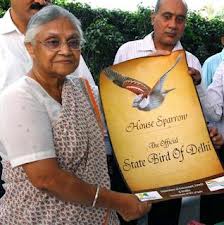
House Sparrow made state bird of Delhi

House Sparrow made state bird of Delhi

The humble house sparrow has become the State bird of Delhi with the issue of a notification to this effect, Chief Minister Sheila Dikshit announced o Friday.

Addressing school children at her residence during a function organised to celebrate Wildlife Week, Ms. Dikshit said the idea behind making the house sparrow the State bird was to protect it.

She said the number of house sparrows in the city had declined sharply due to rapid urbanisation.

“I can tell you that when sparrows are rare, we tend to like them, and when they are common, we tend to hate them. Our fondness is fickle and predictable and says far more about us than them. They are just sparrows. They are neither lovely nor terrible, but instead just birds  searching for sustenance and finding it again and again where we live.”

                                                            Rob Dunn

Share this:

  • Share on Facebook (Opens in new window) Facebook
  • Share on Pinterest (Opens in new window) Pinterest
  • Share on X (Opens in new window) X
Like Loading...

Playing host to some noisy summer visitors

03 Monday Sep 2012

Posted by theresagreen in bird behaviour, Nature, nature photography, Rhos-on-Sea

≈ 6 Comments

Tags

coastal birds, herring gull, herring gull breeding behaviour, herring gull young, herring gulls calling, herring gulls in towns, herring gulls nesting on roofs

The sight and sound of Herring gulls are an integral part of the local community here and as I wrote last year, you either love them or you loathe them. Personally I rather like them, but having just endured this year’s breeding season and had them as very close boarders, I may have gone off them slightly! The Edwardian building we occupy the centre part of played host to two nesting pairs this year, one pair on either side of us, each settling into the top of a tall terracotta chimney pot. I can see the appeal for them, quiet neighbourhood, excellent panoramic penthouse views, just a minute’s flap from the sea, a wide variety of eating opportunities close by. .. Unfortunately from a landlady’s viewpoint, they were not the ideal ‘guests’ and the noise levels were, frankly, unsociable. Stuck in the middle of the two nests sites we were subjected to frequent sessions of raucous territorial shrieking in stereo. Requests to pipe down a bit fell on deaf ears.

Once the offspring hatched the sessions became even more frequent, then reached their peak once the youngsters fledged. That was when they  moved down onto our flat roof, which is just below my bedroom window, and really made their presence heard.

A very newly fledged gull, the offspring of pair number two

Herring gulls herald the crack of dawn very loudly, which at the time was around 4.30am, so that’s when I woke up too. They are much louder than cockerels and even less tuneful.

Even persistent rain does not dampen the desire to squawk

The proximity of the gulls definitely disturbed the usual peace of the neighbourhood, but on the positive side it also literally gave me a window into part of their daily lives. I soon realised that the bouts of loud calling are not a random act, the birds use their powerful voices to call to their partners and offspring as well as to declare their possession of a territory and to warn off intruders. As the youngsters grow in confidence and flying ability improves they leave their ‘home’ area to explore, but parents still return there with food and summon them back to eat it.

The adults always called loudly before delivering food to their young, perhaps it stimulates regurgitation?

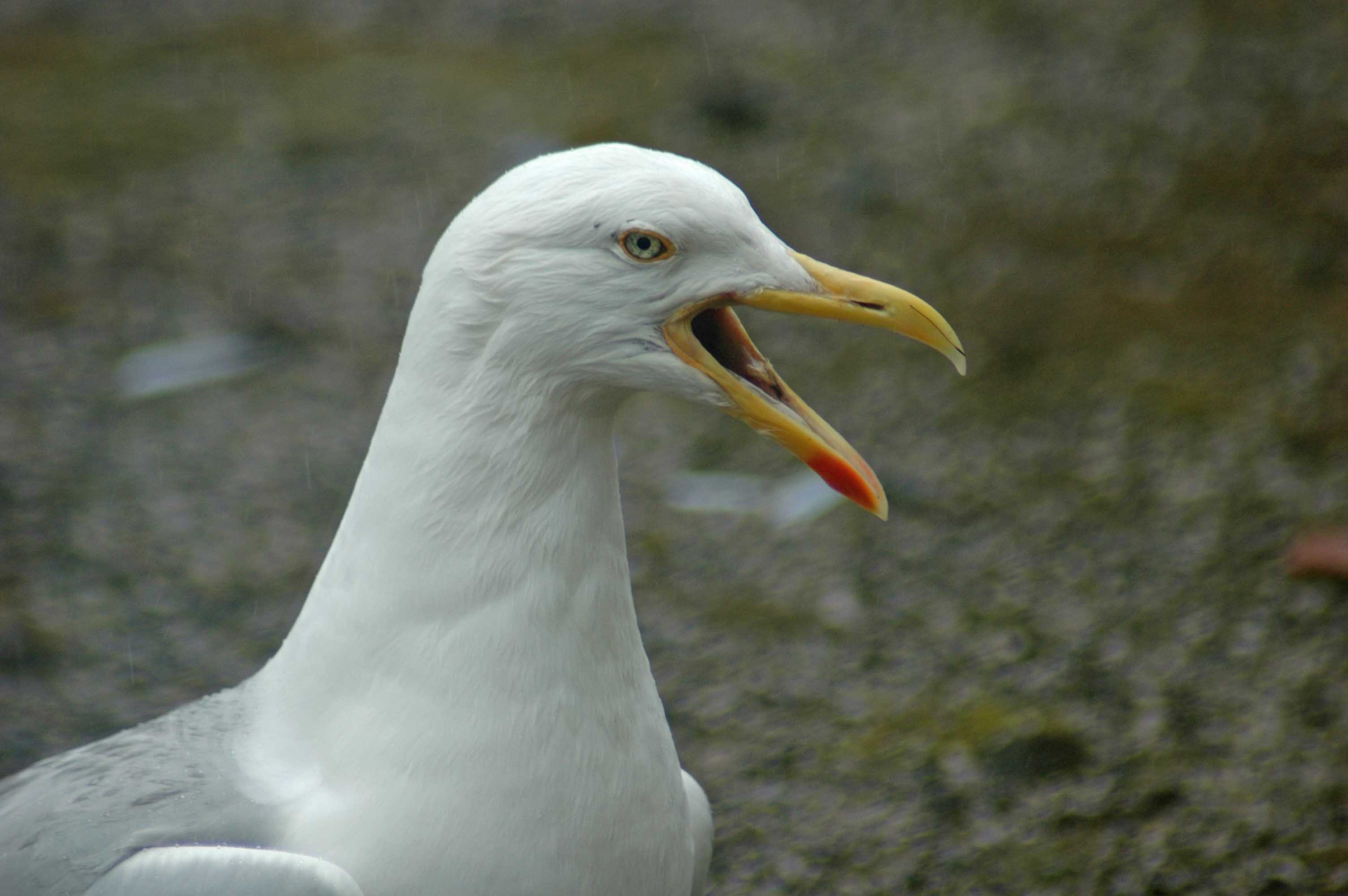
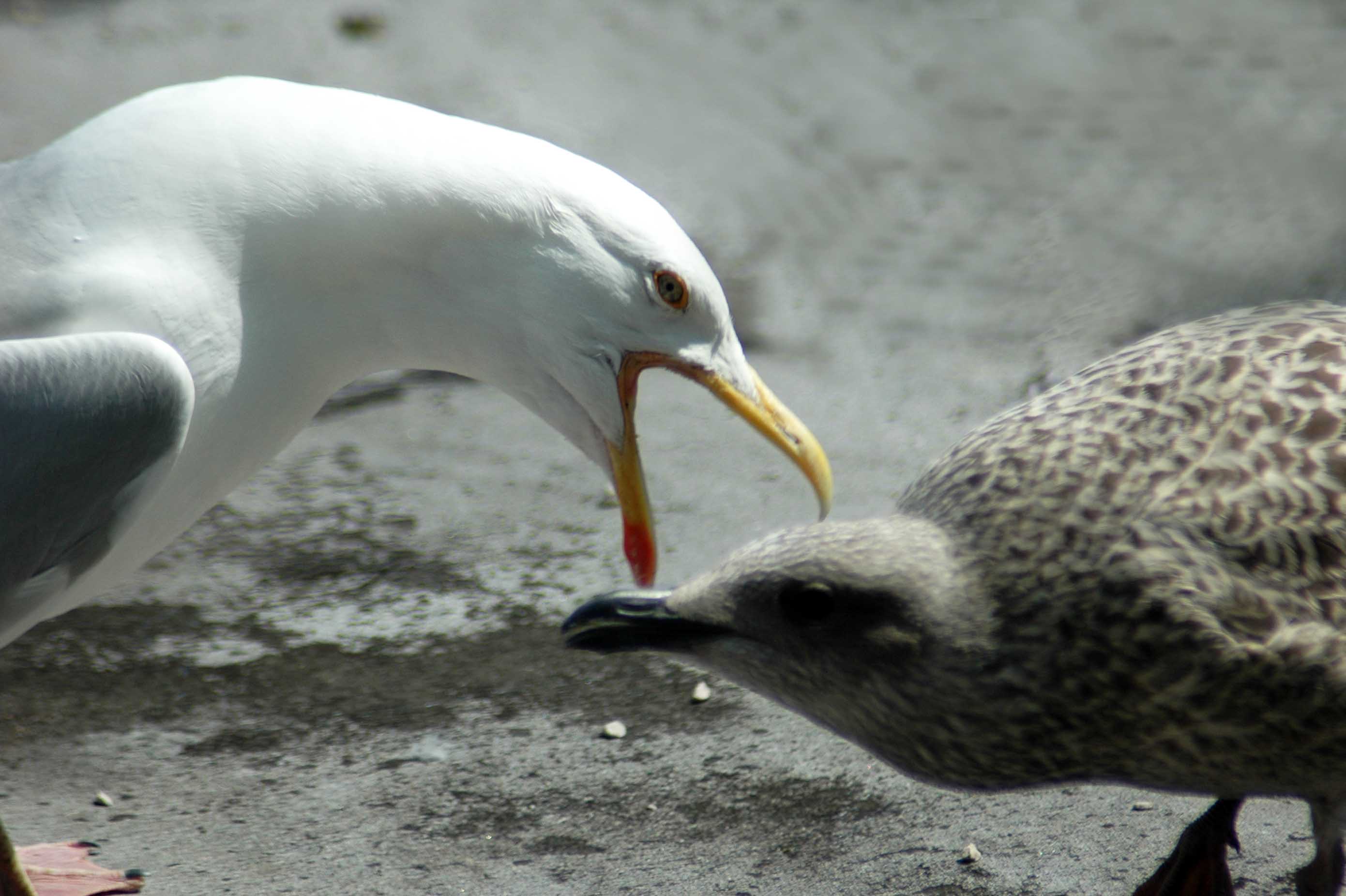
The adults had a ritual; each time they arrived back with food they began calling loudly, starting off with their heads lowered, then raising them, cranking up the volume until they reached a crescendo with head thrown back and beak opened fully.

You would not want to be on the sharp end of that beak

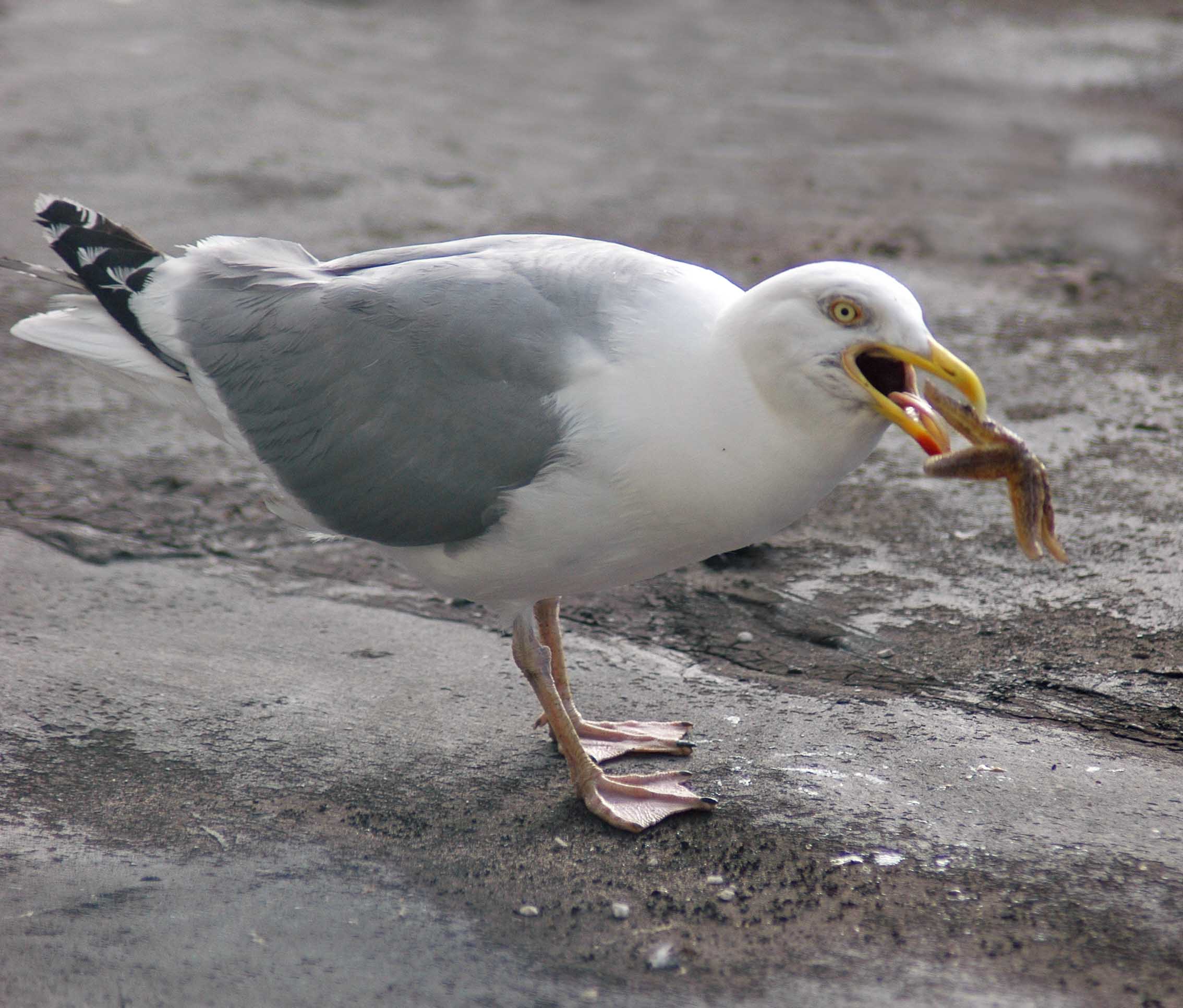
They are vigilant and attentive parents and deal patiently with  harassment by their young ones that persistently beg  for food. I’m not sure they are very well versed in nutrition though; ever the opportunists I saw them bring forth a variety of foodstuffs, including french fries, raw chicken, bits of crab and a still-wriggling starfish.

This starfish was definitely fresh, still wriggling in fact

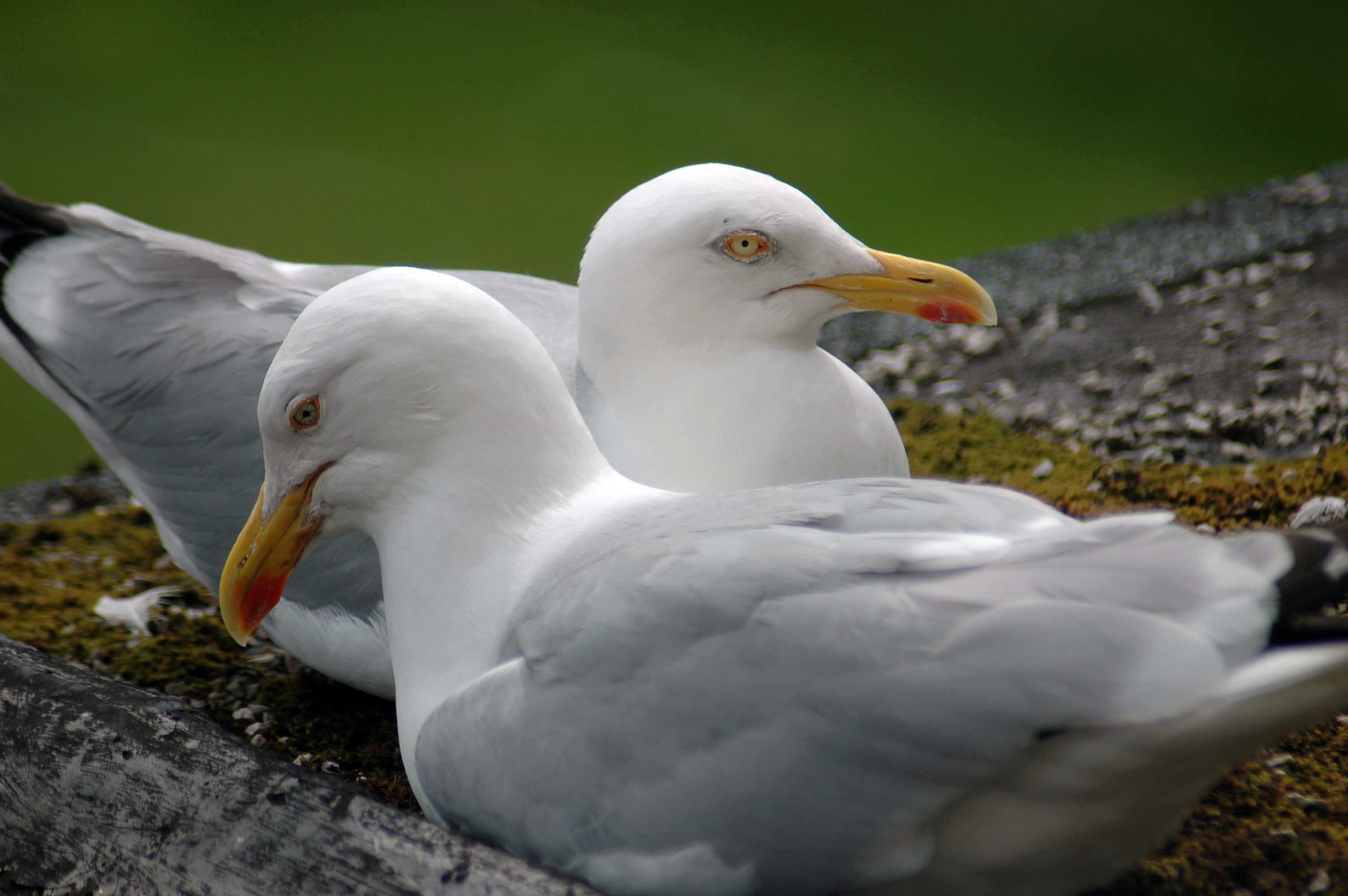
The gulls took time out in the afternoons to rest together, the pair work together to raise their young and appear to be well bonded. Although they would appear to be relaxed, they were ever-vigilant and well aware of the presence of other birds in their airspace, taking it in turns to issue warnings.

The male of the pair starting off vocal proceedings . *note the sunlight show through the thin membrane below his beak

Your turn dear …..

All squawked out

Teaching junior how its done – a family session

A postcard to our summer visitors: “Thank you for an interesting and educational few weeks, but I’m glad you’re no longer here. Perhaps you might enjoy trying a new location next year? I understand the chips are rather good in Llandudno, or how about Rhyl …..?”

Share this:

  • Share on Facebook (Opens in new window) Facebook
  • Share on Pinterest (Opens in new window) Pinterest
  • Share on X (Opens in new window) X
Like Loading...
← Older posts
Newer posts →
Follow everyday nature trails on WordPress.com

Enter your email address to follow this blog and receive notifications of new posts by email.

‘But it is the common species that keep the living world ticking over and provide most of our experiences of wildlife, and I would argue that maintaining the abundance of these is as important a conservation priority as maintaining the existence of rarities’. Richard Mabey

MOST RECENT POSTS

  • A Glimpse of Spring to Come January 22, 2025
  • Hunting the Wren December 28, 2024
  • Oh, Christmas Tree December 18, 2024
  • In and Out of the Ivy February 15, 2024
  • Nature’s Fireworks November 30, 2023
  • Wild Autumn along the Coast Path November 3, 2023

OLDER POSTS

LOOKING FOR SOMETHING IN PARTICULAR?

  • Sights and Sounds from the Little Orme 1
    Sights and Sounds from the Little Orme 1
  • Things Bright and Beautiful
    Things Bright and Beautiful
  • Following a river to a Fairy Glen
    Following a river to a Fairy Glen
  • Catchers, a Duck and Divers
    Catchers, a Duck and Divers
  • Fine Dining for Crows
    Fine Dining for Crows
  • A Windy Wildflower Trail
    A Windy Wildflower Trail
  • A Window on the Woods-Winter 1
    A Window on the Woods-Winter 1
  • Butterflies and more rare treats
    Butterflies and more rare treats
  • Shades, Sounds and Scents of the Woods
    Shades, Sounds and Scents of the Woods
  • Bird study: Blackcap
    Bird study: Blackcap

nightingale trails

The Walk of the Monarch Butterfly-Sendero de la Mariposa Monarca

The Walk of the Monarch Butterfly-Sendero de la Mariposa Monarca

MY WILDFLOWER BLOG: where the wildflowers are

Snowdrop

Snowdrop

most recent posts

Follow everyday nature trails on WordPress.com

Social

  • View teresamaygreen’s profile on Twitter

Enter your email address to follow this blog and receive notifications of new posts by email.

Website Built with WordPress.com.

  • Subscribe Subscribed
    • everyday nature trails
    • Join 359 other subscribers
    • Already have a WordPress.com account? Log in now.
    • everyday nature trails
    • Subscribe Subscribed
    • Sign up
    • Log in
    • Report this content
    • View site in Reader
    • Manage subscriptions
    • Collapse this bar
 

Loading Comments...
 

    %d