• Home
  • about
  • about the photographs
  • Local Nature Reserves
    • Bryn Euryn Local Nature Reserve
    • Mynydd Marian
  • Wales Coast Path
    • Grey Seals in North Wales
    • St.Trillo’s Chapel
    • Wildflowers of North Wales Coastal Paths, Cliffs and Dunes

everyday nature trails

everyday nature trails

Category Archives: Birds

Waders v Weather

23 Wednesday Nov 2016

Posted by theresagreen in bird behaviour, Birdwatching on North Wales coast, Nature of Wales, nature photography, Rhos Point, The Wales Coast Path, wading birds

≈ 17 Comments

Tags

coastal birds, Curlew, great black-backed gull, Oystercatcher, redshank, Rhos Point, Turnstone, turnstone flock

Colwyn Bay, on the Irish Sea, has big tides and at some high tides water levels can rise by 8 metres or more. On windy days big waves are driven in and as the tide reaches its highest point they crash dramatically, in places causing spray to rise and splash over the sea defences. Regardless of the weather, for the gulls and wading birds that feed here it is business as usual. For people, walking along the promenade on such days can be hard work and exhilarating, but for the birds that feed here on Rhos Point it has to be business as usual and whatever the weather or state of the tide the birds know instinctively exactly when to arrive and depart to best take advantage of fresh deliveries or deposits of food.

Interested to see how the birds responded to challenging conditions, I took these photographs on an exceptionally windy day when the incoming tide was set to be particularly high.

12:51 – Curlews begin to leave.

161005-1251-rhos-point-curlew

12:52 – Most of the oystercatchers that feed here don’t travel far, passing the time between the tide-turns gathered together on the rocks of the seabreak in Rhos Harbour, a short flight away. Some linger longer than others.

161005-1252-oystercatchers

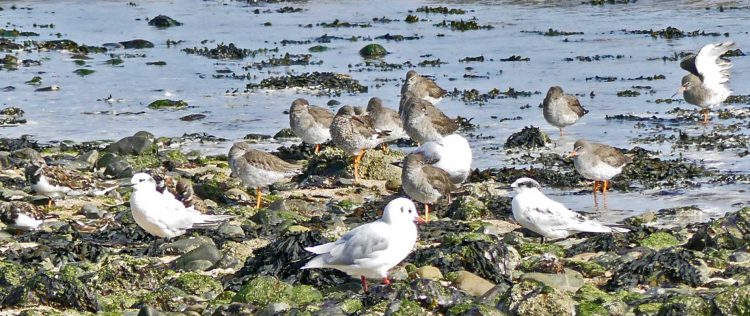
Herring gull, Oystercatchers, Turnstones and Redshanks
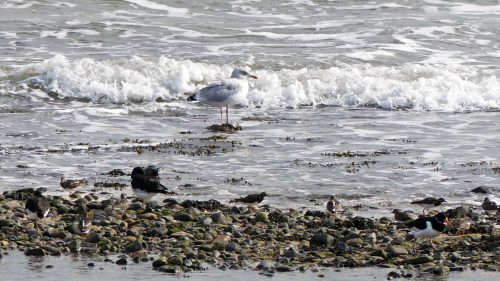
161005-1253-mixed-waders-gull

12:53 – A group of Turnstones all facing towards the incoming water

161005-1253-turnstones-on-rock-island

12:54- Big and bulky, Greater Black-backed gulls seem impervious to the rough conditions.

161005-1254-gt-blk-backed-gull

161005-1255-gt-blk-backed-gulls

12:57 – This photograph of an adult and juvenile Great Black-backed gulls cries out for a caption doesn’t it? I’m leaving it to your own imaginations though.

161005-1258-gt-blk-backed-gulls-one-having-a-poo

12:58 – Turnstones on the sea edge, most standing on stones to keep their feet out of the water.
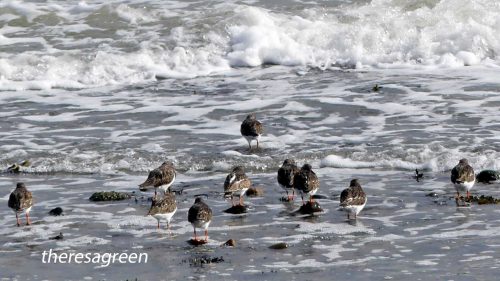
161005-1257-turnstones

12:59- Another Curlew leaves, calling to announce its departure.

161005-1259-curlew-taking-off

12:59- Turnstones and Oystercatchers. Interesting that they are all facing towards the incoming water but weren’t actively foraging for food. I think they are all facing into the wind, which would make them more aerodynamic and streamlined so they don’t get blown over.

161005-1259-turnstones-oystercatchers

13:00 –

161005-1300-turnstones-oystercatcher-preening

13:03- Smoothing feathers ruffled by the wind back into place.

161005-1303-oystercatchers-preening-resting

13:05 – A Turnstone takes a bath, or is that a jacuzzi?

161005-1305-turnstone-bathing-1161005-1305-turnstone-bathing-2161005-1305-turnstone-bathing

Turnstone rock- hopping to higher ground

161005-1305-turnstones

13:07- The Turnstones are more-or-less gathered together now. They are difficult to count as they merge so well into the background of small rocks, but I got up to about 56 individuals and I’m sure there were others behind rocks and one another, so the actual number is probably 60 plus.

161005-1307-oystercatchers-turnstones

13:08- Some Oystercatchers are getting restless, preparing to go while others seem in no hurry

161005-1308-oystercatchers-turnstone

161005-1309-oystercatchers-turnstone

13:12

161005-1312-oystercatcher-1

13:18- As the tide encroaches some begin to leave

161005-1318-oystercatchers-taking-off

But the turnstones stay put, despite the rising water

161005-1318-turnstones-left-alone

161005-1321-turnstones

13:21- A Crow arrives and announces his presence loudly

161005-1321-crow-arrives

13:23- Another Oystercatcher is ready for the off.

161005-1323-oystercatcher-stretching-wings-turnstones

Some stay and scrutinise the water for any last-minute tidbits

161005-1323-turnstones-oystercatchers

13:25: The Turnstones seem unperturbed by the water rising up around their small rock islands
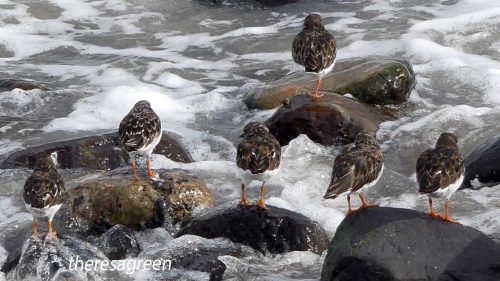
161005-1325-turnstones-1

and are the last birds standing.

161005-1325-turnstones

13:45- The water has covered the Point.
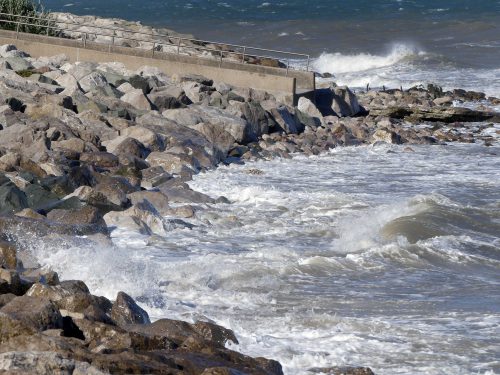
161005-1345-rhos-point-almost-high-tide

13:46

161005-1346-rhos-point-almost-high-tide

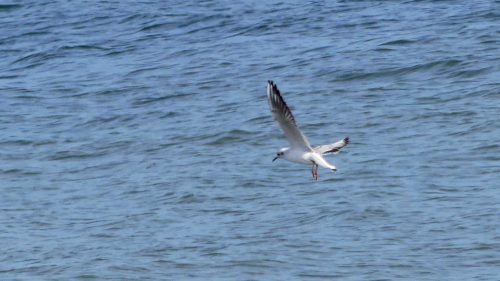
Black-headed gulls are the only birds still flying. Low to the surface they seem to positively enjoy the rough conditions.

161005-1346-rhos-point-blk-hded-gull-over-stormy-sea

13:50

161005-1350-rhos-point-blk-hded-gull-over-stormy-sea

13:53 – The bigger gulls are unphased by the rush of the incoming tide and rather than fly away simply allowed themselves to be launched onto the water and rode the waves.

161005-1353-rhos-point-great-blk-bckd-gulls

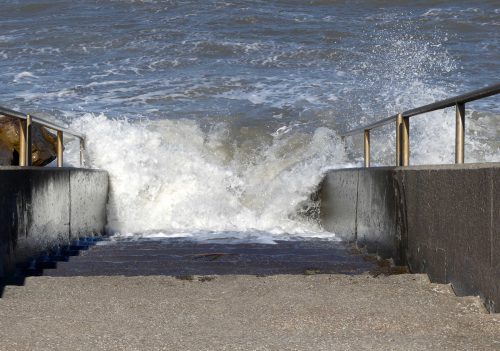
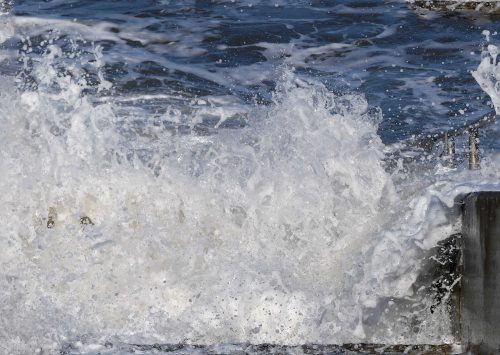
13:54- Wind-driven waves smash onto a flight of concrete steps and shows how high the water would reach if the rip-rap defences were not there; those steps below the middle are worn smooth and their edges rounded by the regular scouring of the waves.

161005-1354-rhos-point-blk-hded-gull-over-stormy-sea161005-1356-rhos-point-sea-mounting-steps161005-1357-rhos-point-sea-mounting-steps161005-1358-rhos-point-sea-smashing-onto-steps161005-1359-rhos-point-sea-smashing-onto-steps


Share this:

  • Share on Facebook (Opens in new window) Facebook
  • Share on Pinterest (Opens in new window) Pinterest
  • Share on X (Opens in new window) X
Like Loading...

Catchers, a Duck and Divers

28 Wednesday Sep 2016

Posted by theresagreen in bird behaviour, birds of the seashore, Birdwatching on North Wales coast, coastal walks, Nature of Wales, nature photography, Rhos Point, Rhos-on-Sea, The Wales Coast Path, wading birds

≈ 23 Comments

Tags

Cormorant, Crows on seashore, gavia stellata, mergus serrator, migrant birds, mussel bed, Oystercatcher, phalacrocorax carbo, red-breasted merganser, red-throated diver, redshank, Rhos Point, ringed plover, sandwich tern

September 10th-A brilliant day for birds continued….

As the tide began to return to the shore, every exposed rock in Penrhyn Bay was occupied by beady-eyed Cormorants.

160910-rprc-cormorants-in-penrhyn-bay-1

Black-headed gulls also waited.

160910-rprc-black-headed-gulls-in-penrhyn-bay-2a

It seemed Rhos Point was the place to be for seabirds and waders today. In the time I have lived here I have never seen as many here all at once. I got there an hour or so before high tide, which is one of the best times to get close views of the birds waiting for their evening meal to be delivered. But as  there were also such a large number of terns and gulls swimming on the sea’s surface and flying low over it, there must have been fish there drawing them in, perhaps a shoal of small fish, sprats or whitebait¹.

The tideline at Rhos Point was crowded with Herring Gulls, Black-headed gulls and Sandwich Terns. A woman arrived with two dogs and stood and watched as they chased along close to the water’s edge, sending many of the birds skywards. I will resist having a rant about that, but it troubles me that people think it’s OK to allow their dogs to do that.

160910-rprc-rhos-point1a-upped-gulls-terns

Whilst waiting to see if the upped birds would return and re-settle I scanned along the sea edge to see what else might be waiting there. There were a whole host of Oystercatchers, trickier to see when their bright orange-red bills are tucked away whilst they rest. A few little Turnstones were dotted amongst them and then a larger bird at the back of this group, fast asleep with its head tucked well down – a duck for sure, maybe a female Red-breasted Merganser? Identifying ducks is not one of my strong points even when I have a good view of them.

160910-rprc-rhos-point9a-oystercatchersherring-gull-merganser-duck

Standing in the shallow water were a good number of Redshanks

160910-rprc-rhos-point11a-oystercatchersherring-gullturnstoneredshanks

and more Black-headed gulls.

160910-rprc-rhos-point17a-redshanks-gulls

A few Sandwich Terns were in amongst this group of Redshank, Turnstones & black-headed gulls.

160910-rprc-rhos-point26a-redshanks-sandwich-terns-turnstone

I found only one Ringed Plover, although there could well have been more.

160910-rprc-rhos-point19a-ringed-plover

A large number of Sandwich Terns occupied a finger of exposed rocks with a few Oystercatchers and gulls, with many more gulls bobbing around on the surrounding sea.

160910-rprc-rhos-point16-sandwich-terns-gulls

The Sandwich Terns, here in large number today were noisy and excitable, with groups taking off and settling again in spots a few metres away along the shoreline. Some will remain here for the autumn and winter, but others will move on.

160910-rprc-rhos-point23a-terns-flying

Their association with Black-headed Gulls is one I’ve seen many times.

160910-rprc-rhos-point24a-black-headed-gull-flying

There’s usually a crow or two waiting for the tide’s incoming feeding opportunities too.

160910-rprc-rhos-point18a-crow-white-patch

Amongst the multitude of gulls swimming around were several Red-throated Divers – difficult to keep in sight as they dive frequently and disappear just as you think you may have one in focus, but a man close by with a brilliant telescope patiently located them and let me have a close-up look. Still not easy as you can’t predict where they’re going to pop up again, but I managed a couple of spots – what an exciting treat. At one point I thought I may have got lucky with a view of a group of six birds, also swimming and frequently diving and disappearing beneath the surface, but they turned out to be Razorbills, not quite as ‘special’, but still lovely to see.

160910-rprc-rhos-point6a-red-throated-divers

They separated and mostly stayed too far out to see well without the aid of binoculars or a telescope, but as the tide progressed inwards, so also did one of the birds, allowing me a much better view of it.

160910-rprc-rhos-point21a-diver


160910-rprc-rhos-point27a-diver

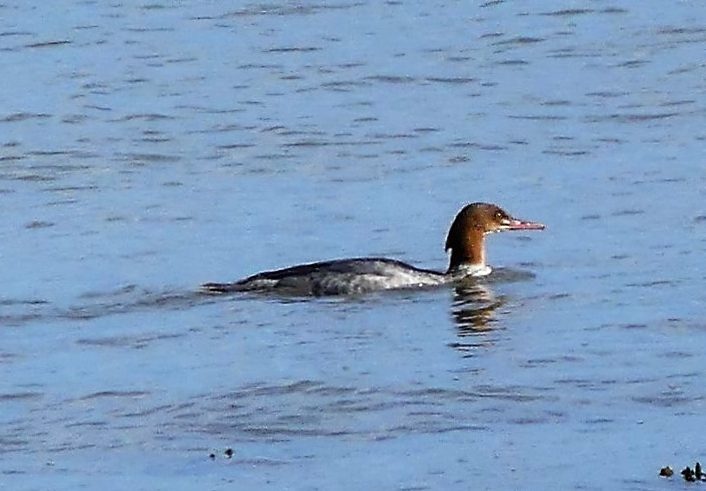
As I watched the razorbill, the duck also took to the water.

160910-rprc-rhos-point-20a-merganser-duck-diver-gull

I’m fairly confident it was  a female Red-breasted Merganser. (The female Goosander looks similar but brown colour of head extends around neck leaving just a white chin). On this bird the white of the throat seems to extend down the front of the neck.

¹ Whitebait is a collective term for the immature fry of fish, typically between 25 and 50 millimetres long. Such young fish often travel together in schools along the coast, and move into estuaries and sometimes up rivers.


Share this:

  • Share on Facebook (Opens in new window) Facebook
  • Share on Pinterest (Opens in new window) Pinterest
  • Share on X (Opens in new window) X
Like Loading...

A Brilliant Day for Birds

12 Monday Sep 2016

Posted by theresagreen in bird behaviour, birds of Wales, Birdwatching on North Wales coast, Nature of Wales, nature photography, North Wales, North Wales Wildlife Trust, Rhiwledyn Nature Reserve

≈ 12 Comments

Tags

alca torda, bird migration, Black-headed Gull, coastal birds, Cormorant, gavia stellata, larus ridibundus, Northern Wheatear, oenanthe oenanthe, phalacrocorax carb, razorbill, red-throated diver, saxicola torquata, stonechat

September 10th – Little Orme, Rhiwledyn Nature Reserve

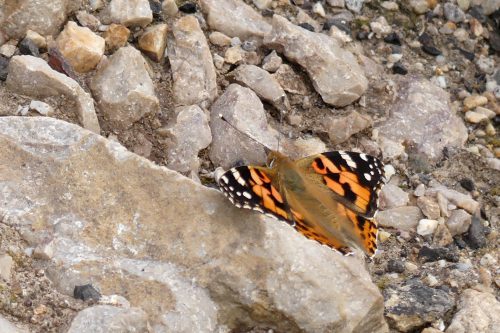
Taking the old cliff path around to Angel Bay, I disturbed a beautiful fresh(ly) Painted Lady butterfly. It circuited round a bit before settling on a stony patch, pressing its wings tightly against small sun-warmed limestone rocks.

160910-lorc3-painted-lady

A small crowd of people gathered on the cliff edge above Angel Bay looked promising; maybe there was something exciting to see down there? But alas, no. They were simply chatting and the beach was empty. This convinced me that as I suspected, female seals don’t give birth to their pups here; if they did they would surely be here by now. There were seals here, but only two, both swimming lazily around in the water. On this cool, misty-damp morning I suspect it was warmer in the water than out. One was hanging in the water with just its face above the water, showing off a lovely set of whiskers.

160910-lorc8-grey-seals-nose

Another was simply cruising around peacefully.

160910-lorc10-grey-seal-on-its-back

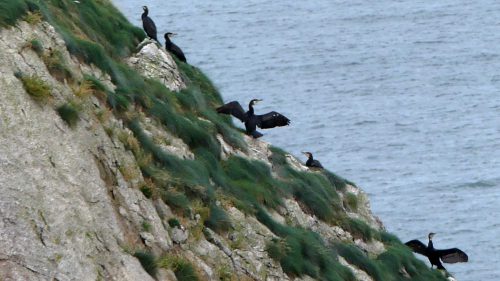
There is a thriving breeding population of Cormorants here on the Little Orme, so there is never a shortage of these brilliant birds to see, especially around their nesting site on the cliffs further around the headland. At this time of year and through the winter months, their numbers are boosted greatly and the steeply sloping cliff face that forms one side of Angel Bay is punctuated with a multitude of black dots and dashes. This is now Cormorant Central; the volume and frequency of arrivals and departures of birds rivalling that of aeroplanes into and out of a busy airport.

160910-lorc7-cormorants-on-cliff-edge

I wonder how they work out their perching places? Do early arrivals get the prime spots and do they now have their own patch, or is it up for grabs if they leave to fish for lunch? Do they stick to family or colony groups?

160910-lorc7a-cormorants-on-cliff-edge

Whilst pondering on the whys and wherefores of Cormorant society, I was distracted by two little shapes down in the Bay – definitely birds but I was, of course, on the wrong side to see them properly. It’s not uncommon to get the occasional Guillemot or Razorbill here once the breeding season is over, so I didn’t really think further than that. Winter-plumaged Red-throated Divers didn’t enter my head at the time, but that is what they were. Birds we get around this coast during the autumn and winter, but most often much further out that you need powerful optical assistance to spot.

160910-lorc11-divers-in-angel-bay

I must get back into the habit of taking binoculars out with me instead of relying on my camera’s zoom; sometimes it’s not enough. In this instance a glimpse and a snapshot was all I got anyway; these birds are for once aptly named as they do dive – a lot, reappearing nowhere near where they went under. I walked around to the other side of the rocky hump on the Penrhyn Bay side of the headland as from there you get good uninterrupted views of a wide expanse of sea. Birds fly low past here, keeping close in to the cliff, so some good views of whatever is travelling by; mostly Herring gulls and a few Black-headed gulls today.

160910-lorc15a-black-headed-gull

Black-headed gull–Larus ridibundus

160910-lorc15-black-headed-gull

There was a Cormorant swimming around on the sea’s surface, giving a good view of the strong hooked beak.

160910-lorc14a-cormorant-swimming

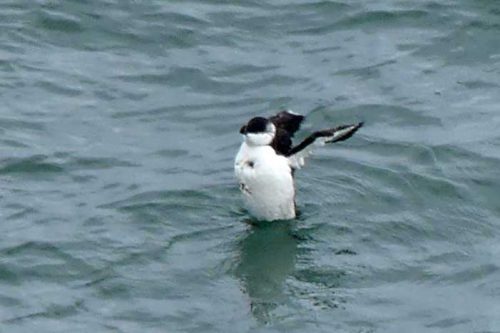
A small black and white bird bobbed into view and this really was a Razorbill Alca torda. It was a good way out to sea, but close enough that I could see, through the camera lens, that it was in the process of changing from summer to winter plumage. The plumage of the throat and sides of the neck change from black to white in the winter – the side of this one’s head is still a mix of the two.

160910-lorc17a-razor-bill

It was in no hurry to move away and intent on having a good grooming session.

160910-lorc19a-razor-bill

Members of the Auk family, to which both Razorbills and Puffins belong, look a little like penguins, although they are not closely related. The next few images show some of the similarities between them; species of both have black-and-white colours, an upright posture and share some of their habits.

160910-lorc20a-razor-bill

160910-lorc27a-razor-bill

160910-lorc28a-razor-bill

‘bye ‘bye little Razorbill, thank you for the photographs. Have a good winter.

160910-lorc29a-razor-bill

160910-lorc30a-razor-bill

160910-lorc31a-large-white-bfly-caterpillar

Now a perfect example of how my mind skips around. Although tuned into ‘bird mode’, I spotted a wild cabbage plant and thought ‘maybe there’ll be a Large White butterfly’s caterpillar on those leaves’. And there was, so a gap in my  last-but-one post can be filled in!

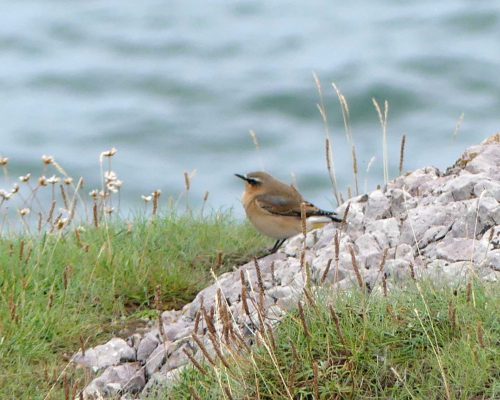
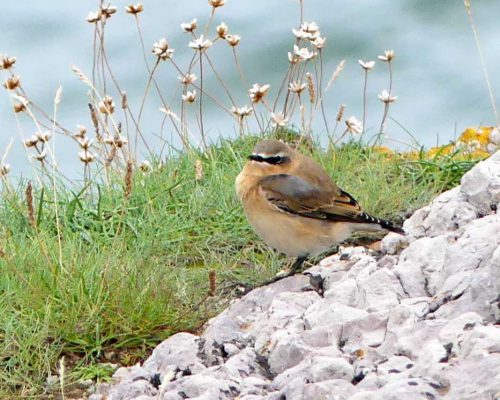
I was watching the Razorbill et al for a good half an hour, maybe more, then walked back around the cliff to have a last look around Angel Bay. The seals had gone, but the movement of a smallish bird on the cliff edge caught my eye. Rock Pipit came to mind, but no, it was a much lovelier Northern Wheatear. It was either waiting for the weather to improve or taking in some food before continuing on his long migration back to warmer climes; perhaps both.

160910-lorc34-northern-wheatear

Northern Wheatear – Oenanthe oenanthe

160910-lorc33a-northern-wheatear

I’m not certain whether this was a male or female as when males are in their winter plumage both sexes appear similar. I’m edging towards male as there seems to be a slate-grey patch remaining at the top of the wing. The bird’s common name of ‘Wheatear’ has nothing to do with its food preferences or its ears, but refers to its white rump (i.e white a**e)!

160910-lorc36a-northern-wheatear

More people arrived at the cliff edge and my bird flew away, down onto the big rocks on the beach.

160910-lorc43-bramble-leaves

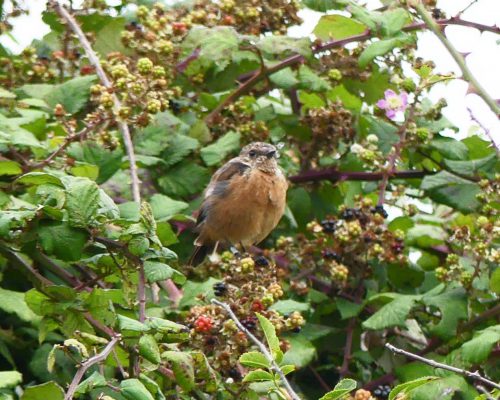
I began heading in the general direction of the ‘way out’, but hearing a Stonechat nearby diverted to see if I could find it. They’re one of my favourite birds and are often obliging in terms of appearing in the open. I wasn’t disappointed; as I passed by one perched up on top of a bramble, within whose tangled depths a pair have regularly nested.

160910-lorc37-stonechat

At first I thought this was an adult female , but as I got a closer look I could see it still has a speckled head, so it’s probably a juvenile of this year’s brood.

160910-lorc38a-stonechat

Robins were out singing all around the site today, but more wary now of being seen than when they sing in the spring. The one I finally got close enough to photograph was perched on a bracken frond keeping a beady eye out for movements on the ground below, ready to pounce.

160910-lorc40a-robin-on-bracken

160910-lorc41arobin-on-bracken


Share this:

  • Share on Facebook (Opens in new window) Facebook
  • Share on Pinterest (Opens in new window) Pinterest
  • Share on X (Opens in new window) X
Like Loading...

A Secluded Spot for Sunbathers

20 Saturday Aug 2016

Posted by theresagreen in bird behaviour, Birds, birds of Wales, Nature, nature photography, North Wales, woodland birds

≈ 10 Comments

Tags

bird parasites, birds preening, birds sunbathing, birds sunning, blackbird, dunnock, garden birds, Robin, why do birds sunbathe, Wren

“The perfect spot for sunbathing, in a peaceful woodland edge location, offers privacy and safety in which to relax or indulge in some leisurely grooming  preening. No charge for use of facilities”. 

160718-KW (3)-Blackbird sunning

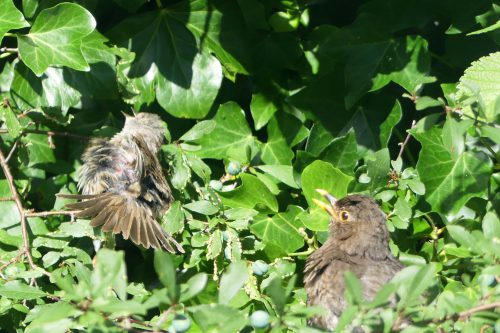
This summer this ideal location, set conveniently for me just a few metres from my kitchen and bedroom windows, has been a popular spot with some of the local birds, particularly some of the younger ones.They come to make the most of this sheltered sun-trap to sunbathe, also known as ‘sunning’ in application to birds. Sunning birds may become so absorbed in the activity that they are easily approached, which can make them vulnerable to predators. They are safer here; there is no easy access to this spot from any angle, although a savvy Sparrowhawk may possibly be able to make a strike if it got its timing right so as not to cast a shadow.

160803-KW (3)-Blackbird & dunnock sunning

Dunnock and Blackbird sunning together

Most commonly we see Blackbirds and sometimes Robins sunning in gardens , but other species indulge too in slightly different ways.

160617-KW (17)-Blackbird 'sunning'

Sunbathing Blackbirds are a fairly common sight in parks and gardens

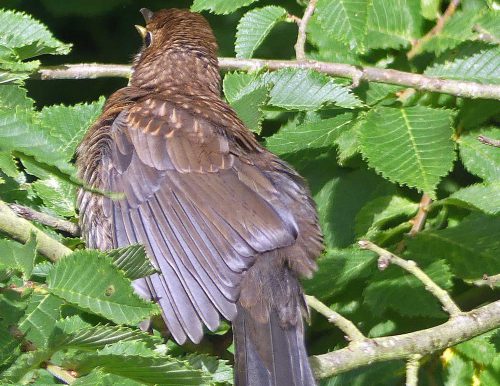
To begin sunning, birds orient themselves to expose the maximum amount of their plumage to the sun. The classic sunning posture is thus: head and body feathers are fluffed up and out and depending on available space and/or sense of security felt, one or both wings are held out from the body with feathers spread; the tail is sometimes fanned out too. The bird may keep the same position throughout a sunning session, or it may change positions to expose different parts of its body to the sun.

160718-KW (6)-Blackbird wing feathers

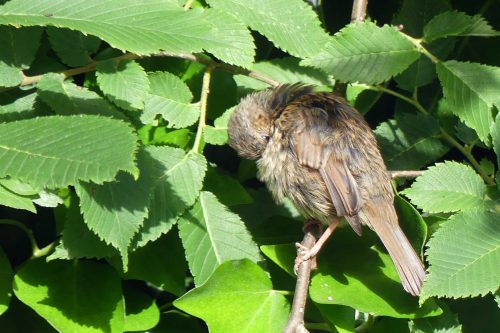
Sunning is often a precursor to preening, vital to a bird’s feather maintenance, and in this instance it is thought this has two effects; one is that the sun’s heat helps to spread preening oil across the feathers. The other is that it drives out parasites from within the plumage that can then be more easily dislodged as the bird preens.

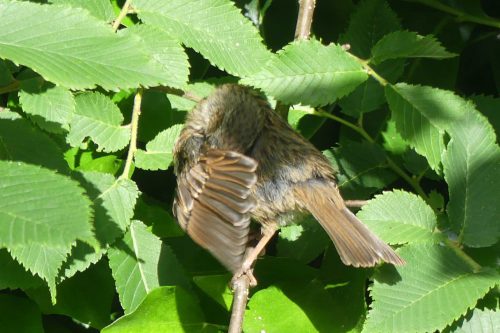
Sunning and Preening demonstrated by a Dunnock

I’m fairly sure this session was more concerned with pest control than anything else.

Firstly, adopt the sunning pose: fluff out feathers and spread tail and wing feathers. Well, alright just the tail feathers will do for now.

160701-KW (4)-Dunnock sunning

Secondly, begin preening with any particularly itchy spots caused by unwelcome hitchhikers.

160701-KW (9)-Dunnock preening

Pay attention to armpits

160701-KW (5)-Dunnock preening

Some areas such as the head and around the eyes and bill can only be serviced by extending and lifting the leg and having a good old scratch.

160701-KW (13)-Dunnock scratching

It helps to have a flexible neck.

160701-KW (15)-Dunnock preening

That will have to do for now, it’s getting a bit shady here.Time to go.

160701-KW (28)-Young dunnock

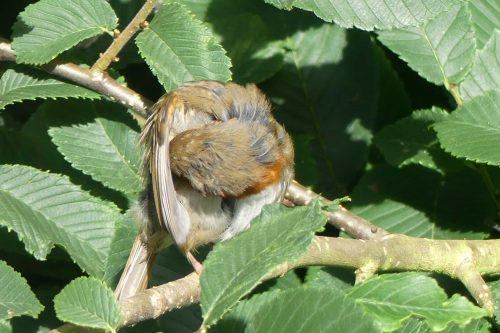
The young Robin in the following sequence of images seems to be similarly afflicted with ‘lumps’ apparent on its neck.

160713-KW (7)-Young robin sunning

160713-KW (19)-Robin preening

160713-KW (29)-robin preening

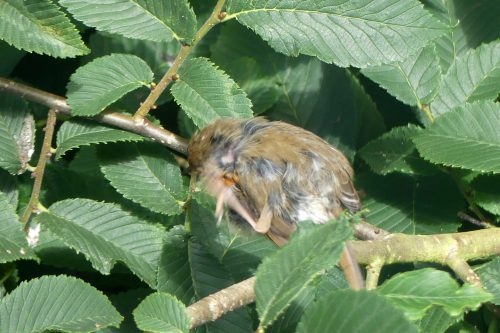
The head and neck are areas birds are unable to reach with their bills and have to scratch with a foot.

160713-KW (10)-Robin preening-with ticks

The other side needs attention too.

160713-KW (34)-robin preening

160713-KW (33)-robin preening

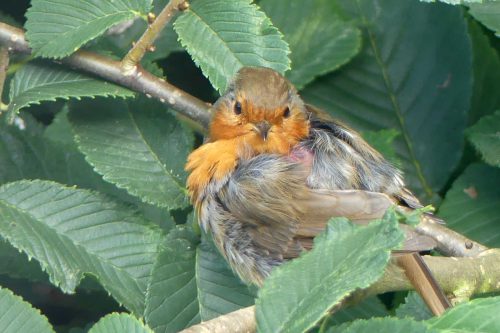
It looks as though the bird’s frantic scratching has created a bald spot. And is that another lump under its eye?

160713-KW (22)-Robin preening

During sunning sessions birds often have their bills open. This is because the warmth of the sun raises their body temperature and as they can’t release heat by perspiration, they have to regulate it some other way, so will gape and sometimes pant in order to lose heat.

160617-KW (1)-Robin 'sunning'

To sum up, no-one knows for certain the reasons birds sunbathe, although several theories have been proposed.

  • To maintain the bird’s feathers in good condition. Exactly how sunning assists with this is not known, despite being widely studied. All birds have a gland on the rump, called an oil gland. The ‘preen-oil’ that this gland produces helps to keep the feathers flexible and hygienic. As preening usually occurs directly after sunning, it has been suggested that the sun affects the preen-oil in the feathers in some beneficial manner, or that it helps to synthesize the Vitamin D  and helping to regulate it’s temperature.
  • The heat from the sun may stimulate activity in parasites within the feathers, making them more accessible when the bird starts to preen.
  • Birds also make use of the sun’s heat to increase their body temperature or prevent heat loss. This form of ‘sunning’ is also used when the bird dries itself after bathing.
  • They do it simply because they enjoy it.
160803-KW (12)-Wren sunbathing 2

A tiny Wren enjoying a quick sunbathe on a laurel leaf


Share this:

  • Share on Facebook (Opens in new window) Facebook
  • Share on Pinterest (Opens in new window) Pinterest
  • Share on X (Opens in new window) X
Like Loading...

Birds by the sea

02 Saturday Jul 2016

Posted by theresagreen in birds of the seashore, Birdwatching on North Wales coast, mussel beds, Nature of Wales, Rhos Point, wading birds

≈ 7 Comments

Tags

Curlew, European Herring Gull, mussel beds, Oystercatcher, Rhos Point, sandwich tern

June 20th-Rhos Point

13.34- A sunny day with a strong breeze made it feel cold, but I was in need of some quick-fix fresh air and for that, Rhos Point is the perfect spot. It’s also one of my favourite spots for watching wading birds, although I don’t visit it much during the breeding season as it is almost deserted by birds and becomes uncannily quiet. Today I arrived as the tide was coming in and I spotted a small group of Oystercatchers waiting patiently for today’s incoming lunch, so I waited too to see if they would be joined by others.

As I made my way down nearer to the shore I heard some lively chirruping emanating from a shrub that has taken hold on the promenade edge, then a few House Sparrows flew out and headed for the shore below to forage amongst the exposed rocks.

160620-Rhos Point 1334-House Sparrow

Two elegant Sandwich Terns flew low over the sea, close to its edge.

160620-Rhos Point 1335-Sandwich Terns flying

13.37 pm – Oystercatchers on the sea edge use the waiting time to rest or preen.

160620-Rhos Point 1337-Oystercatchers 160620-Rhos Point 1337b-Oystercatchers

Oystercatchers are high on the list of my most favourite birds, they have great character and charisma and the more I learn more about them the more fascinating they become. They are large wading birds and when not resting are noisy. They sport large long orange or red bills, which they use for smashing or prying open molluscs.

The diet of coastal oystercatchers is varied, although dependent upon coast type; on this rocky shore with its extensive mussel beds, they will prey upon mussels of course, and also on limpets and gastropods. They also take advantage of whatever the tides bring in such as small fish and crabs.

160620-Rhos Point 1339b-Oystercatcher with blunt beak

The shape of this bird’s bill shows it to be a ‘hammerer’

The bill shape varies according to the diet. ‘Stabbers’ feed by jabbing their laterally compressed bill tips in between the valves of a mussel’s shell, while ‘hammerers’ crack open mussel shells by pounding on them. Those birds with blade-like bill tips pry open or smash mollusc shells, and those with pointed bill tips tend to probe for worms.

13.40 – The Oystercatchers were joined by a beautiful Sandwich Tern.

160620-Rhos Point 1342-Oystercatchers & Sandwich Tern 2

The Sandwich tern is a summer breeding visitor, returning to north-west Wales & Anglesey from late March to September. In the UK, many of the important colonies survive because they are on nature reserves.

This is a very white tern, which in summer breeding plumage had a full black cap on its head. The bill is long and black with a diagnostic yellow tip. The legs are short and black and the tail short and forked. In flight it shows grey wedges on its wings tips.

160620-Rhos Point 1340a-Sandwich Tern

13.44- A small number of Curlews flew in to land on the rocky sea edge, where their cryptic plumage allows them to all but disappear.

I took this short video as the Curlews arrived – coudn’t avoid the wind noise!

160620-Rhos Point 1344-Curlews foraging

160620-Rhos Point 1347-Curlews foraging on sea edge

The curlew is the largest European wading bird, instantly recognisable on winter estuaries or summer moors by its long, downcurved bill, brown upperparts, long legs and evocative call.

160620-Rhos Point 1349-Curlew

160620-Rhos Point 1346-Oystercatchers & Curlews

13.47- The mysterious moment that suddenly galvanises waiting wading birds into action arrived and triggered most, though not all of the Oystercatchers to begin foraging in earnest.

160620-Rhos Point 1347-Oystercatcher (2)

160620-Rhos Point 1346-Oystercatcher bathing

13.48- A Herring gull arrived to join the party.

160620-Rhos Point 1348-Oystercatchers, Curlews & Herring Gull

13.52- A second Sandwich Tern flew in, closely followed by a third.

160620-Rhos Point 1352-Sandwich Terns

The terns also settled down to preen.

160620-Rhos Point 1352-SandwichTerns preening & Curlew

13.59- A Cormorant flew past at speed.

160620-Rhos Point 1359-Cormorant flying

14.04- A Herring gull- it’s good to see them down here, where away from the rooftops, rubbish tips and promenades they are not upsetting anyone!

160620-Rhos Point 1404-Herring Gull 1

160620-Rhos Point 1404-Herring Gull

160620-Rhos Point 1410-Herring Gull 2


Share this:

  • Share on Facebook (Opens in new window) Facebook
  • Share on Pinterest (Opens in new window) Pinterest
  • Share on X (Opens in new window) X
Like Loading...

House sparrows & Starlings at home

19 Tuesday Apr 2016

Posted by theresagreen in bird behaviour, birds of Wales, garden wildlife, Nature, Nature of Wales, nature photography, Rhos-on-Sea

≈ 17 Comments

Tags

birds of conservation concern, garden birds, house sparrow, house sparrows taking pampas grass, passer domesticus, starling

I was pleased to see House sparrows once again topped this year’s list of the RSPB Big Garden Bird Watch in England, Wales and Scotland, but we shouldn’t get complacent, they’re still on the ‘Red List’ of birds requiring the highest conservation priority, along with other species needing urgent action.

Over the past couple of weeks I have spent some afternoons dog-sitting for my daughter, which has given me the opportunity to catch up with the little flock that regard her garden, together with those of the immediate neighbours’ as their territory.

160222-Nat's garden-House sparrow after bathing

House sparrows love to bathe and sit on the fence to dry out

I don’t blame them for settling here, they have everything they need to live as easy and productive life as it is possible for birds to enjoy. Throughout the year they come and go throughout the day, enjoying the bounty of well-stocked bird feeders, a pond in which to bathe and hedges to provide cover and perching places. Every evening the whole community returns to roost safely within the prickly pyracantha hedge. Now they are well into the throws of nesting. Earlier on they began refurbishing last year’s nests or rebuilding any lost through winter pruning. There are perhaps 4-5 nests, sited close together, although the level of noise that emanates from within sounds like there should be more. A couple more pairs prefer the loftier location of the eaves above the third floor at the front of the house.

160222-Nat's garden-House sparrow after bathing 1

In the breeding season the dominant birds leave the safety of the hedges and perch prominently on the highest points of shrubs to proclaim their territory, although the individual territory of the male House Sparrow really only consists of the nesting hole and a very small area around it, which is defended vigorously.

160403-Nat's garden-House sparrow male

Dominant males have larger, darker feather ‘bib’ patches

Females judge males on the vigor of his behaviour and also by his plumage. The black bib and how it is displayed is hugely important for him and size matters. Apparently males with small bibs can be induced to behave more boldly if they have bigger and blacker bibs painted on them!

160403-Nat's garden-House sparrow male 1

160403-Nat's garden-House sparrow on elder

A younger male with only a semblance of a bib

160222-Nat's garden-House sparrow female perched

Dominant females join their partners, but tend to stay slightly lower down and prefer a little more cover

160222-Nat's garden-House sparrows eating greens

Female House sparrows eating fresh greenery

Every year, when the nests are built or refurbished, the sparrows systematically strip the soft fluffy seed heads of the pampas grass that grows in a neighbouring garden. I spent ages one afternoon watching them as they returned repeatedly to strip the stems and carry off the fronds. I assume they use the fluffy parts to line their nests, but wonder if there are seeds to eat too? I find this behaviour fascinating and have witnessed it in South Wales where pampas was growing and also in our garden in Spain. In each location they begin working on the plant on the same day, arriving sometimes in numbers, males and females and set to, detaching the fronds and carrying them off a beakful at time. The harvest continues over a few days until the stems are left bare.

160403-Nat's garden-House sparrows collecting pampas grass

160403-Nat's garden 2-House sparrows collecting pampas grass

160403-Nat's garden3-House sparrow female with beak full of pampas

A Starling pair are nesting in one of the chimney pots and they too enjoy the feeding and bathing facilities, also pausing to dry out on perched on the fence or at the top of the hedge. Still one of our commonest garden birds, its decline elsewhere makes it too a Red List species.

The bird in the photographs below is the male of the pair, identified by the blue colouration at the base of his bill; the female has a similar patch that is coloured pink.

160403-Nat's garden-Starling male in privet hedge

160403-Nat's garden-Starling male in privet hedge 1

160222-Nat's garden-Starling taking off

The male sings beautifully, sometimes from up on the roof but also from the fence and the top of the hedge. His mate doesn’t get out much at the moment, so must be sitting on eggs.

The starling was singing, hence the fluffed out throat feathers

The starling was singing, hence the fluffed out throat feathers

STARLING (f)-Sturnus Vulgaris

Starling female has a pink patch at the base of her bill

PS: The pampas grass is now just a collection of bare dry stems!


Share this:

  • Share on Facebook (Opens in new window) Facebook
  • Share on Pinterest (Opens in new window) Pinterest
  • Share on X (Opens in new window) X
Like Loading...

Welcome back to the Mistle Thrush

05 Friday Feb 2016

Posted by theresagreen in birds of Wales, Bryn Euryn Nature Reserve, Nature, Nature of Wales, nature of woodlands

≈ 8 Comments

Tags

birds of conservation concern, Conservation issues, mistle thrush, turdus viscivorus

At 7.10 am it was barely light, but from high in a cherry tree, easily piercing the double glazing of my living room window, a Mistle thrush exuberantly proclaimed his return. He sang long and loud for at least the next hour before crossing the building to announce his presence from the woodland edge behind us. I was out for most of the day, but arriving home at 5 pm, again in the fading light, he was back in the same place reinforcing his presence.

Mistle thrush singing from ash tree

Mistle thrush singing from ash tree 

I could barely see him, so much to dark to photograph him, so the photograph is one from last year that I took of a bird in the neighbouring tree that arrived here on a similar date and behaved in a very similar way. I would like to believe it was the same bird returning to reclaim his breeding territory, especially as the Mistle thrush has moved from the amber list to red-listed status as a bird of conservation concern, with 170,000 breeding territories recorded.

Mistle thrushes are early nesters and many nests are built in late February. typically they favour sites in woodland as high as 30ft up on the top of a snapped-off tree. Each pair raises two or occasionally three broods and they may sometimes use the same nest. To my knowledge at least one pair bred successfully here on Bryn Euryn last year and similarly the previous year, so this is clearly a well-established breeding site – fingers crossed for this year too.

Read more about the Mistle thrush here.


Share this:

  • Share on Facebook (Opens in new window) Facebook
  • Share on Pinterest (Opens in new window) Pinterest
  • Share on X (Opens in new window) X
Like Loading...

Secret passage behind the sea wall 2

17 Saturday Oct 2015

Posted by theresagreen in Birds, birds of the seashore, birds of Wales, coastal walks, Nature, Nature of Wales, nature photography, Rhos Point, Rhos-on-Sea, Wales Coast Path

≈ 4 Comments

Tags

Crows on seashore, curlew flying, herring gull, meadow pipit, mussel bed, Rhos Point

An hour or so later the walk back to Rhos Point was quite different. The going was easier too as the strong wind was behind me now and not taking my breath away. Almost immediately I caught sight of a bird hopping around on the rocks. I waited hoping it would come into view, which it did, just as a woman with a dog approached and chose that moment to break into a run. The bird flew away. Again it was a pipit, possibly the same one I’d seen back on the beach. The legs are pinkish and plumage brown so maybe a Meadow Pipit?

151007TGNW- Penrhyn Bay-Pipit on rocks 3

151007TGNW- Penrhyn Bay-Pipit on rocks 4

A small sedum plants looks at home in a pocket eroded in a limestone rock.

151007TGNW- Penrhyn Bay-Sedum

Small pools of rainwater are held briefly, lasting longer in the hard granite rocks.

151007TGNW-6d-Rock pool 2

The garden snail must have found it hard going sliding over the rough surface of the sea wall.

151007TGNW-15-Sea wall- Garden snail

151007TGNW-Rock with moss

151007TGNW--Penrhyn Bay-Wasp

151007TGNW- Penrhyn Bay-sign at top of ramp

There is a wide concrete ramp reaching from the road down to the shore which probably gave access to heavy construction vehicles when the huge boulders of the sea defences originally were put in place. The lower section is being absorbed back into the shore, it is strewn with pebbles and small rocks and slippery with seaweed. Limpets are embedded into the wall itself as well as in large rocks on the shore at the bottom of the ramp.

151007TGNW-Limpets embedded in rock

I love the textured ‘lacy’ look of this rock almost covered with barnacles.

151007TGNW-Rock covered with barnacles & limpets

The sea is often at its most beautiful on these sunny windy days, its surface whipped up roughened and flecked with foam-edged ripples and the colour of the water ranging from deepest inky dark blue to pale turquoise-green. Large areas are stained brown by dredged up sand.

151007TGNW- Penrhyn Bay-Back to Rhos-Sea colours 1

Sun, shade and curves make this man-made construction interesting.

151007TGNW- Penrhyn Bay-Back to Rhos

The white marks highlighting the curved sea wall are mineral, maybe lime leached from the concrete?

151007TGNW-5-Wall markings-Rhos-on-Sea promenade

The parapet floor has an interesting pattern and texture and is spotted with patches of white lichen.

151007TGNW- Penrhyn Bay-Back to Rhos-Concrete floor3

As I got nearer to the Point I knew the tide was further in by the increased bird activity; the excitement it generates is almost tangible. Gulls take to the air and fly back and forth along the shoreline. Oystercatchers and other waders scuttle about, heads down, beaks probing for anything edible brought in on the waves.

151007TGNW- Penrhyn Bay-Back to Rhos-Herring gull

151007TGNW- Penrhyn Bay-Back to Rhos-Herring gull young 1

Crows head shorewards too, the one in my picture landed on a lampost towering above me, cawing loudly. They forage amongst the rocks along with the waders and are often seen picking up a shellfish then flying up with and dropping it onto the rocks below to crack it open.

151007TGNW- Penrhyn Bay-Back to Rhos-Crow 1

Even the curlews were excited. Most often seen stalking sedately around rocks and pools, now there were several flying along at speed, skimming low over the rocks on the shore below me. A couple of them may have been in pursuit of the one I managed to capture a shot of; it was travelling so fast I didn’t realise it had food in its beak until I saw the photograph.

151007TGNW- Penrhyn Bay-Back to Rhos-Curlew

On the Point the incoming tide approaches from either side of the mussel bed, where I assume different currents merge. The birds have an infallible instinct for the tidal changes and in the hour before and after high tide their numbers increase dramatically. They are brought closer to the shore then too and absorbed with foraging and eating, are easier to see.

151007TGNW- Penrhyn Bay-Back to Rhos-Sea colours on point

151007TGNW- Penrhyn Bay-Back to Rhos-Oystercatchers active

It was too cold and windy to hang around and wait today though, so I had a quick peek into the chapel, which I can never resist. There are only 6 seats inside, so I wonder if they’ve lined up these memorial benches on the promenade outside to serve as overflow pews?

151007TGNW- Penrhyn Bay-Back to Rhos-benches 2

Many young Herring gulls wander around the village at this time of year, often screeching for the attention of a parent. They have no road sense and sadly quite a few are killed by cars.

151007TGNW- Penrhyn Bay-Back to Rhos-Herring gull young on road edge

Share this:

  • Share on Facebook (Opens in new window) Facebook
  • Share on Pinterest (Opens in new window) Pinterest
  • Share on X (Opens in new window) X
Like Loading...

Secret passage behind the sea wall

15 Thursday Oct 2015

Posted by theresagreen in birds of the seashore, coastal habitat, coastal walks, coastal wildflowers, Nature, Nature of Wales, nature photography, wading birds, Wales Coast Path, Wildflowers of Wales

≈ 4 Comments

Tags

coastal birds, Linnet, migrant birds, Northern Wheatear, penrhyn bay, rhos on sea, Rhos Point, rocky seashores, seashore walks

On a sunny day last week I intended to spend some time checking out the birdlife on Rhos Point to see what treats the autumn migration had already brought to us. I started out on the roadside where there’s a posh new sign on the roadside above the bijou St Trillo’s Chapel, the favoured starting point for many of my seashore posts.

151007TGNW-1-St Trillo Chapel plaque-Rhos-on-Sea

St Trillo's Chapel, Rhos on Sea

St Trillo’s Chapel, Rhos on Sea

It was windy here and decidedly chilly as it can be when the tide is coming in. A quick look and listen from the promenade revealed a good number of cormorants, gulls, oystercatchers, redshanks and curlews, but all still too far out on the tideline on the mussel bed to see easily.

151007TGNW-2-Tide coming in-Rhos-on-Sea

I picked up a few seashells of some of the most commonly occurring species here.

151007TGNW-3a-Some seashells-Rhos-on-Sea 1

Despite the sunshine, this was definitely not a day to hang around on the shore, so I turned to walk along to Penrhyn Bay, hoping I might find a Rock Pipit or two amongst the huge rocks of the seabreak.

Fox -and-cubs on the embankment

Fox -and-cubs flowers on the grassy embankment bending in the wind

151007TGNW-Fox-and-cubs

This view of the Little Orme clearly shows the tiers formed by quarrying.

151007TGNW-4-Promenade towards Little Orme 1

151007TGNW-4bb-Promenade sign 1

I soon knew I wasn’t going to enjoy battling along against the cold headwind, so at the earliest opportunity dropped down onto the parapet of the seawall where a passageway is formed between the wall and the seabreak rocks. It was still windy here but not quite as strongly, besides which this passageway fascinates me as a habitat for an ever-increasing collection of plants and at this time of year it can be a good place to spot rock pipits and pied wagtails. And the rocks themselves are endlessly fascinating.

151007TGNW-6a-Rock 1

151007TGNW-6b-Rock with turquoise stripe

The turquoise green of the vein in the rock above puts me in mind of the verdigris you get on copper. The one below has sparkly white and pink crystal-like parts held within it.

151007TGNW-6e-Rock -pink with crystals

151007TGNW-13-Rocks & spider's web

A spider’s web screens a space between rocks

I spotted a bird on the rocks close to these steps and went down to see if I could find it again.

151007TGNW-8-Sea wall- Steps going down

Steps going down to the seashore

I managed a quick shot before it disappeared. Definitely a pipit.

151007TGNW-7-Pipit-Rhos-on-Sea promenade

In the winter and in rough windy weather the sea reaches the top of these steps; the bottom few are bleached almost white, their edges smoothed, curved and shaped to form channels by seawater covering them and cascading back down.

151007TGNW-9-Sea wall- Steps going up 1Continuing along there’s a stretch that is particularly flowery. There’s a lot of red valerian interspersed with an array of wild plants and garden escapées.

151007TGNW-10-Sea wall path-Towards Penrhyn Bay

Sea mayweedhugs the curve of the sea wall

Sea mayweed hugs the curve of the sea wall

ivy-leaved toadflax

Ivy-leaved toadflax

151007TGNW- Penrhyn Bay-Plant with laarge glossy green leaves

Sunlit fern in a rocky crevice

Sunlit fern in a rocky crevice

marigold escaped from a garden

Marigold escaped from a garden

Tree mallow flower

Tree mallow flower

Penrhyn Bay

151007TGNW- Rock covered with seaweed

151007TGNW-Penrhyn Bay-Breakwater & sign

Between the breakwater and the rocky shore there is a patch of flowery grass

151007TGNW-Little Orme & Penrhyn Bay-grassy patch

151007TGNW- Penrhyn Bay-grassy patch

and behind the rocks scrubby shore plants grow amongst the sand and stone chippings. This is the best place I know for fairly reliable sightings of linnets that come to forage for seeds. There were linnets there when I arrived, which I realised when they all took off and headed off across the road towards the golf course. From past experience I thought if I sat and waited on the steps beneath the sea wall they may well come back. Sitting quietly I realised there were still birds close by that gradually came back into the open in front of me which turned out to be a Northern wheatear and a pipit. I want to say it was a Rock pipit as this is a likely spot to find them, but it had an olive-green tinge to its plumage and may have been a Meadow pipit.
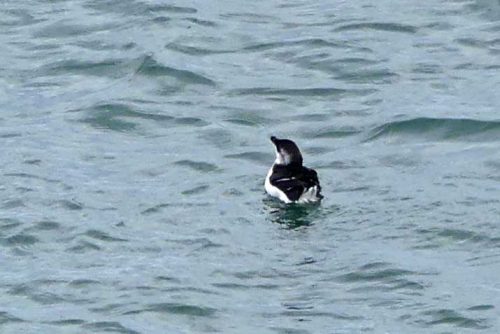
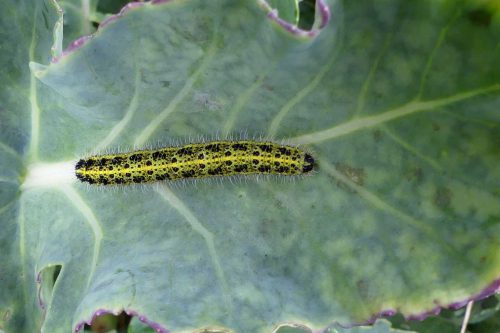
Northern wheatear with pipit

Northern wheatear with pipit

Lovely wheatear though.

151007TGNW- Penrhyn Bay-Northern Wheatear 1

As hoped the linnets came back too, a small flock of 10 or 12 birds, albeit too far away to photograph well.

151007TGNW- Penrhyn Bay-Linnets feeding 4

151007TGNW- Penrhyn Bay-Linnets feeding 1

151007TGNW- Penrhyn Bay-Linnet 1

151007TGNW- Penrhyn Bay-Linnet on rock 1

Share this:

  • Share on Facebook (Opens in new window) Facebook
  • Share on Pinterest (Opens in new window) Pinterest
  • Share on X (Opens in new window) X
Like Loading...

Ravens of the Little Orme

05 Monday Oct 2015

Posted by theresagreen in bird behaviour, bird mythology, Birds, birds of Wales, Little Orme, Nature, Nature of Wales, nature photography, Rhiwledyn Nature Reserve

≈ 8 Comments

Tags

coastal birds, corvus corax, raven, raven folklore

Ravens once scavenged on the streets of London and other British towns and cities, but were gradually pushed further and further away to the west and north of the country, until the majority of those remaining were residing in the mountains of Scotland and Wales. At one time, due to persecution, their numbers were  reduced to around 1,000 pairs and they became birds much associated with upland wild places. However, the ravens fortunes have turned and over the last twenty years their numbers have increased dramatically and they have repopulated much of Britain, including some urban areas. There are now over 12,000 breeding pairs.
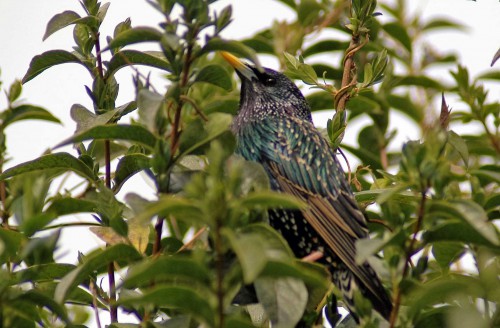
Newborough  forest  on the Isle of Anglesey is famed for its huge raven roost, where up to 2,000 birds have been recorded, making it the second largest raven roost in the world.

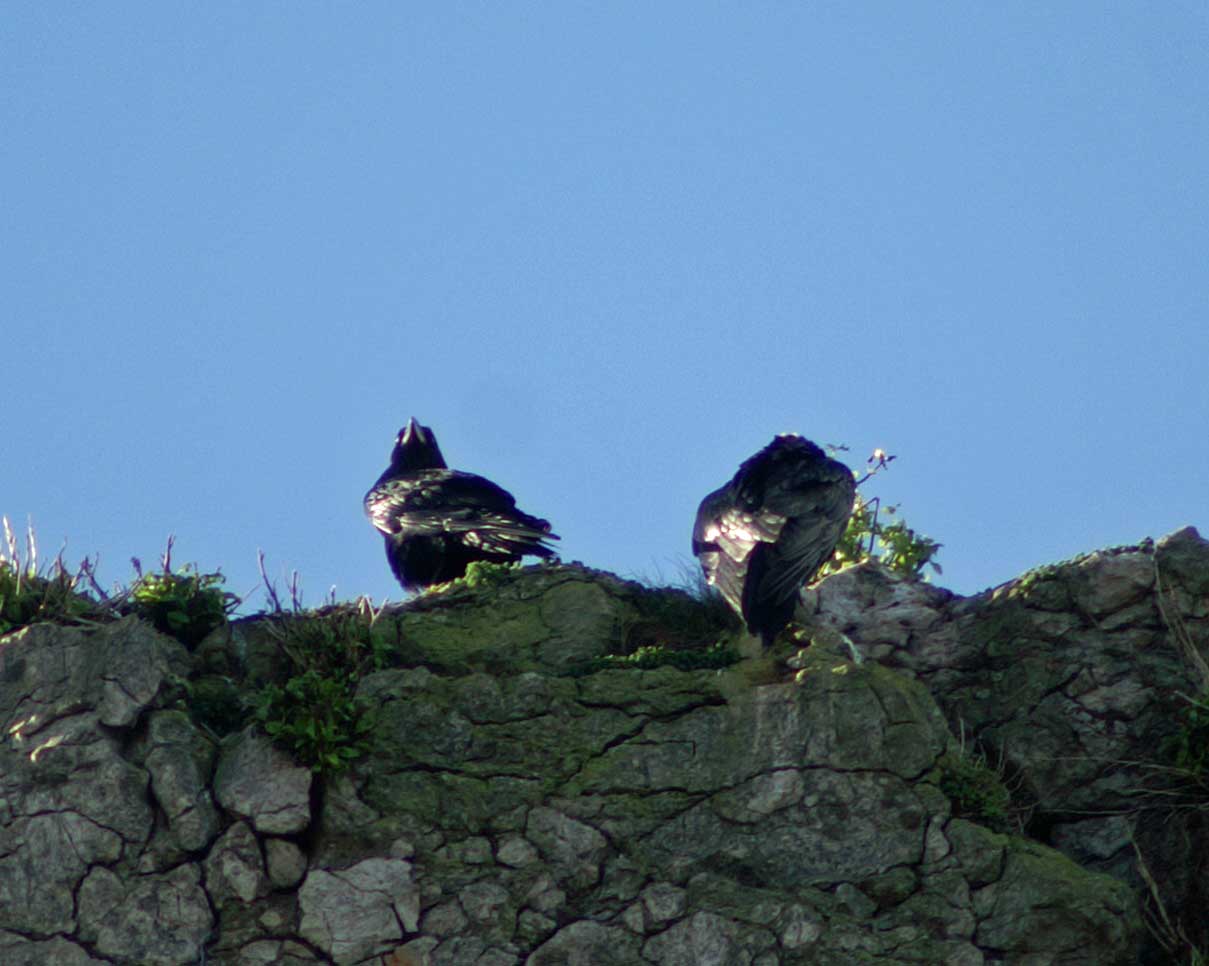
Ravens are also found around the Welsh coast, where they nest on sea cliffs. In my local area of North Wales we are lucky in having a resident breeding pair on the Little Orme and for me, a visit there is not complete without seeing what these charismatic corvids are up to.

Raven-Corvus corax

Raven-Corvus corax

RAVEN – Welsh name: BRAN – Scientific name: Corvus corax

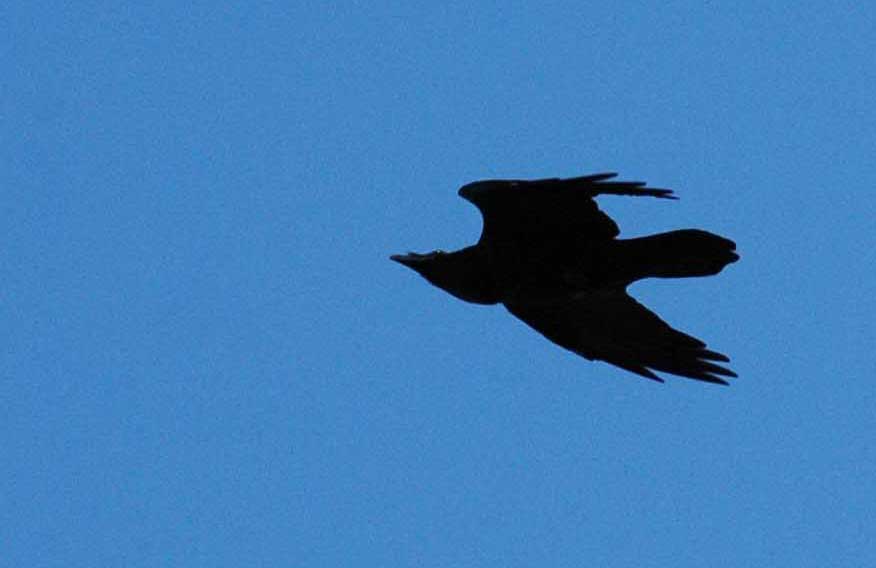
The raven is Britain’s largest corvid (crow). Plumage is black and highly glossy in appearance, with bright sunlight bringing forth purple and green highlights; the tail is wedge-shaped. The bill is massive; adapted to pull apart raw flesh it’s an essential tool for a bird which scavenges on dead animals.

A flying raven showing the wedge-shaped tail and dead-mans fingers at wing tips

A flying raven showing the wedge-shaped tail and dead-mans fingers at wing tips

VOICE

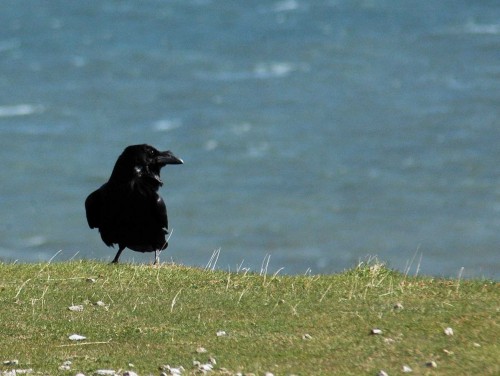
Their call is distinctive, a deep croaking sound, known as ‘gronking’ which often alerts me to look up to watch one flying overhead and that is surely one of the most evocative sounds of Britain’s uplands.

Raven calling whilst flying

Raven calling while flying

TERRITORY

The Little Orme’s resident ravens are the avian monarchs of this cliff. They are often seen sitting together on the cliff edge from where they survey their realm, gleaming regally in the sunshine, occasionally lifting their heads to gronk at passing birds or at the empty sky. They have no need to defend their territory as the mere physical presence of these powerful birds is enough to establish their claim to it. But as with other species of birds, when nesting they may become more defensive and will attack anything they perceive to be a threat.

Raven pair in a favoured spot on the clifftop

Raven pair in a favoured spot on the clifftop

When they are not ensconced there, another favoured spot for perching is further up towards the summit atop a rocky ridge. They can sometimes be found flying along the cliffs and across the summit.

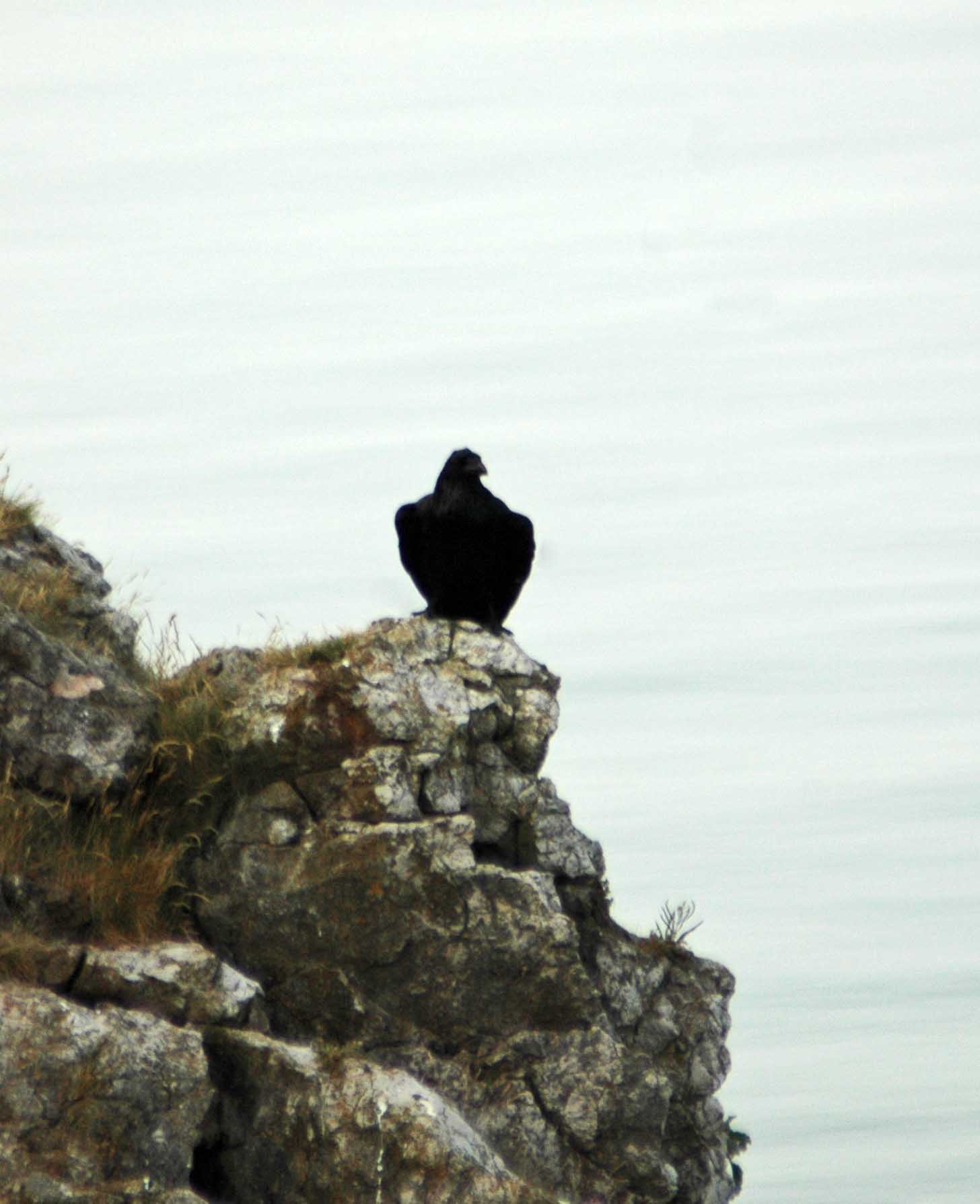
The male of the pair may also be found at the sea edge of the cliffs where he spends long minutes hunched on a ledge gazing out to sea watching for potential invaders.

July- Raven looking out to sea

July- Raven looking out to sea

FLIGHT

The everyday flight of the raven is direct, strong and steady, but it can also glide and soar freely and put on an impressive aerobatic display. In spring particularly, pairs of ravens tumble together high in the air, wings half-closed, rolling over sideways and nose-diving. They also have the trick of flying upside down for short distances. Perhaps these aerobics are part of the raven’s courtship display, but they may also perform for the joy of it and just because they can.

16/9/15-Raven flying sideways

16/9/15-Raven soaring sideways

FOOD

Ravens are sometimes regarded as the vultures of sheep country as they patrol in a pair or as a family group, searching for carrion or an ailing sheep or deer which they will watch and wait to die. They will eat almost anything, mainly carrion and small animals, but also insects, shellfish and even grain and acorns.

NESTING

The Little Orme’s ravens return to the same nest each year, adding new material to renovate it as they need to. In the years I have watched them, they have raised only one or two young each year.

Both sexes build a nest of sticks cemented together with mud and bound and lined with moss and sheep’s wool or whatever is available locally, it is shaped into a deep cup, preferably on a ledge or in a crevice. They are amongst the earliest of birds to produce eggs, between February & April. There may be 4-6 eggs, pale green or blue with dark markings. Incubation, by the female only, takes about 19 days. Nestlings are fed by both parents until they leave at about 6 weeks.

31/5/14-Young raven on the nest almost ready to leave

31/5/14-Young raven on the nest almost ready to leave-Little Orme

MYTHOLOGY & FOLKLORE    

The raven is probably one of the world’s most intelligent and playful bird. Modern experiments have shown that they can count up to 8. Our hunter-gatherer ancestors would have observed the keen intelligence of this bird. It has a well-documented habit of deliberately revealing the whereabouts of deer, so that hunting wolves can find their quarry and leave spoils, which the ravens could eat. Even modern deer-stalkers have reported ravens helping them to locate deer, as the birds know that they will receive the ‘gralloch’ or guts after the deer is killed.

Paradoxically it has also been regarded as a bird of ill-omen. The old collective noun for a group of ravens is an ‘unkindness’, perhaps because of its harsh call and its presence as a scavenger at scenes of death.

150428TGLO-Raven on cliff edge 2

In the Old Testament of the Bible, the raven was the first bird Noah sent to look for land, and Elijah is described as being provided for by ravens. They are used as a symbol of God’s providence in both the New Testament and in Christian art.

There is probably more folklore concerning the raven than any other bird in Britain.

In Welsh folklore, Bran the Blessed, the brother of Branwen (Bran is Welsh for raven) is a deity and a guardian of Britain whose totem is a raven. According to the Mabinogion, Bran ordered for his own head to be cut off,  after which it could still speak words of prophecy. Eventually it was said to have been buried beneath Tower Hill, at the Tower of London as a talisman against invasion.

The presence of ravens at the Tower is an echo of this legend and the prophecy says that if the ravens ever leave the tower, the Kingdom of England will fall, hence their wings are clipped as a precaution. It is thought that there have been at least six ravens in residence at the tower for centuries. Charles II reputedly ordered their removal following complaints from John Flamsteed, the Royal Astronomer. However, they were not removed as Charles was then told of the legend. Charles, following the time of the English Civil War, superstition or not, was not prepared to take the chance, and instead had the observatory moved to Greenwich.

Odin, the chief of the Norse gods, was accompanied by a pair of ravens, Hugin (thought) and Munin (memory), who would fly far and wide to bring news to Odin. One of Odin’s names, Hrafnagud, means the ‘Raven God’.

Share this:

  • Share on Facebook (Opens in new window) Facebook
  • Share on Pinterest (Opens in new window) Pinterest
  • Share on X (Opens in new window) X
Like Loading...
← Older posts
Newer posts →
Follow everyday nature trails on WordPress.com

Enter your email address to follow this blog and receive notifications of new posts by email.

‘But it is the common species that keep the living world ticking over and provide most of our experiences of wildlife, and I would argue that maintaining the abundance of these is as important a conservation priority as maintaining the existence of rarities’. Richard Mabey

MOST RECENT POSTS

  • A Glimpse of Spring to Come January 22, 2025
  • Hunting the Wren December 28, 2024
  • Oh, Christmas Tree December 18, 2024
  • In and Out of the Ivy February 15, 2024
  • Nature’s Fireworks November 30, 2023
  • Wild Autumn along the Coast Path November 3, 2023

OLDER POSTS

LOOKING FOR SOMETHING IN PARTICULAR?

  • Sights and Sounds from the Little Orme 1
    Sights and Sounds from the Little Orme 1
  • Things Bright and Beautiful
    Things Bright and Beautiful
  • Catchers, a Duck and Divers
    Catchers, a Duck and Divers
  • Following a river to a Fairy Glen
    Following a river to a Fairy Glen
  • Fine Dining for Crows
    Fine Dining for Crows
  • A Windy Wildflower Trail
    A Windy Wildflower Trail
  • A Window on the Woods-Winter 1
    A Window on the Woods-Winter 1
  • Butterflies and more rare treats
    Butterflies and more rare treats
  • Shades, Sounds and Scents of the Woods
    Shades, Sounds and Scents of the Woods
  • Bird study: Blackcap
    Bird study: Blackcap

nightingale trails

The Walk of the Monarch Butterfly-Sendero de la Mariposa Monarca

The Walk of the Monarch Butterfly-Sendero de la Mariposa Monarca

MY WILDFLOWER BLOG: where the wildflowers are

Snowdrop

Snowdrop

most recent posts

Follow everyday nature trails on WordPress.com

Social

  • View teresamaygreen’s profile on Twitter

Enter your email address to follow this blog and receive notifications of new posts by email.

Website Built with WordPress.com.

  • Subscribe Subscribed
    • everyday nature trails
    • Join 359 other subscribers
    • Already have a WordPress.com account? Log in now.
    • everyday nature trails
    • Subscribe Subscribed
    • Sign up
    • Log in
    • Report this content
    • View site in Reader
    • Manage subscriptions
    • Collapse this bar
 

Loading Comments...
 

    %d