• Home
  • about
  • about the photographs
  • Local Nature Reserves
    • Bryn Euryn Local Nature Reserve
    • Mynydd Marian
  • Wales Coast Path
    • Grey Seals in North Wales
    • St.Trillo’s Chapel
    • Wildflowers of North Wales Coastal Paths, Cliffs and Dunes

everyday nature trails

everyday nature trails

Category Archives: coastal walks

The Goats of the Great Orme

09 Saturday Apr 2016

Posted by theresagreen in coastal walks, Great Orme, Llandudno, Nature, Nature of Wales, nature photography, North Wales

≈ 17 Comments

Tags

cashmere, Conservation issues, goat mascot of Royal Welsh Fusiliers, goats of the Great Orme, Kashmiri goats

The herd of goats that roam Llandudno’s Great Orme is famous far and wide and for many visitors a sighting of them is a highlight of their trip. Sightings are often  distant and to an extent dependent on the time of year, but they do wander as they browse and graze and can appear almost anywhere. I like to see them browsing on the steep limestone cliffs and watch them negotiate the narrow ledges with amazing and sometimes breath-taking agility. Up there they remind me that although their home is in a public Country Park, they are still wild animals within it.

These are Kashmiri goats, whose ancestors once roamed the mountains of Northern India. Their soft undercoats are the material that cashmere wool is spun from. The word cashmere is an old spelling of the Kashmir region in northern India and Pakistan.
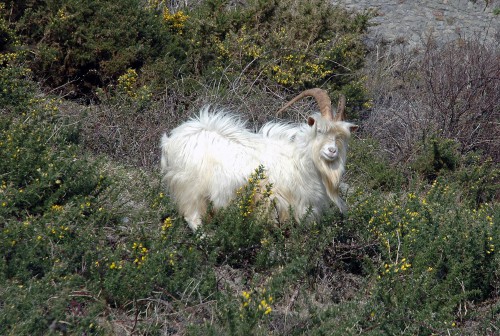
160328-Llandudno6-Goats on west side of Gt Orme

Kashmiri nanny goat

The origin of the Great Orme goats and their arrival in Britain is attributed to Squire Christopher Tower, from Brentwood in Essex, who discovered a large herd which had recently been imported from Kashmir into France in the early part of the last century. His idea was to create a profitable woollen industry, so he purchased a pair of the goats, and took them to Weald Park in Brentwood. The goats flourished, and soon produced kids, from which the Squire was, eventually, able to manufacture a cashmere shawl. George IV was highly impressed by this article, and was happy to accept a pair of the goats presented to him by Squire Tower. So began the Windsor herd, which increased rapidly, and in the reign of Queen Victoria, cashmere shawls became extremely fashionable. It is often said that Queen Victoria was presented with the goats by the Shah of Persia, and it may be that these were added to the already existing herd.

160328-Llandudno7-2 Goats on west side of Gt Orme

Later in the Century, Major General Sir Savage Mostyn acquired two of the Windsor goats, and took them to the grounds of Gloddaeth Hall. It is possible that they were found to be unsuitable as park animals and the goats were transferred to the Great Orme. Over a period of almost a hundred years, these animals have existed virtually in isolation, and have evolved into the unique breed they now are. They have reverted to a wild state, and are now regarded as wild animals.

The size of the herd is said to be maintained at about 60, which is based on the optimum number of animals for the size of the territory available to them. The  herd is made up of full grown billies, juvenile billies, nannies and kids. For most of the year, the nannies browse on the side of the mountain with their youngest offspring while the mature and immature billies roam in small groups away from them. They don’t mix until the Autumn rut.

160328-Llandudno11-2 Goats in gorse on west side of Gt Orme

A mature billy has enormous horns that curve backwards, almost touching the nape of his neck. A shaggy fringe covers the forehead and he sports a long beard. The horns are crenulated, with large ridges unevenly spaced along their length. It is possible to estimate the age of a billy by the ridges on its horns as each section represents one year’s growth. The horns of the young billies and the nannies are slim and delicate, curving gently backwards. In the nannies, the ridges are less obvious and ageing them is not so easy. Barring accidents, the goats will live for about nine years.

I believe the group I came across were nannies with a couple of new kids visible in the distance near the summit.
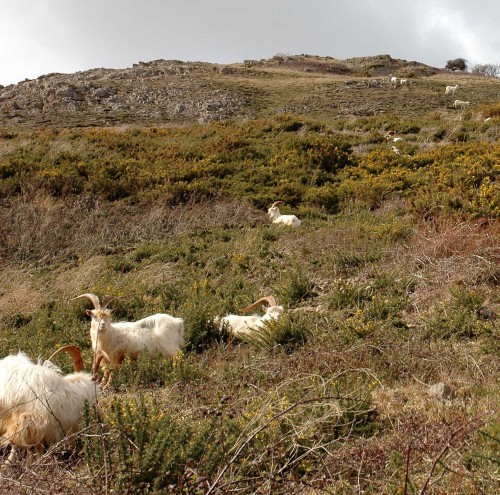
160328-Llandudno8-Goat flock on west side of Gt Orme

Goats will reputedly eat anything, but given choice, which these privileged individuals have, they can afford to be a bit choosier. Their vegetation species of choice are gorse, hawthorn, elder, bracken, bramble, ivy, stinging nettles and privet, according to the season. In the Autumn, they will browse on the grass, moving to the slopes where they can find a plentiful supply.
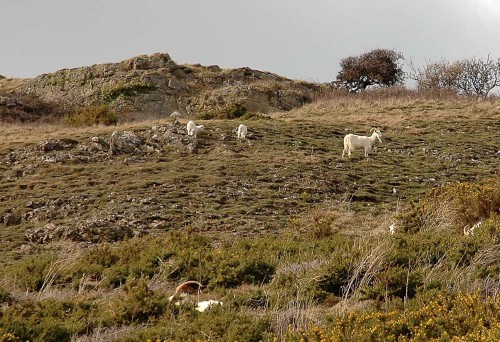
160328-Llandudno10-Goat & kids on west side of Gt Orme

The most distant goats may well be this year’s kids

Although technically an alien, or introduced species to Great Britain, the goats are considered by many to be an integral part of the Great Orme environment and nowadays their grazing plays a part in maintaing the flora for which the headland is renowned. Not everyone appreciates them however, particularly when they wander into the garden areas on the lower slopes, or even into the town itself.

Their population has to be kept in check to ensure that competition for resources is not too great. This involves administering contraception to nannies to control the number of kids born each year, which appears to be working. Relocation of small groups to assist conservation in other areas of the country is carried out when the opportunity arises. In recent years 6 animals were relocated to Bristol’s Avon Gorge and 2 to a SSI on Anglesey.

Mascot of the Royal Welsh Fusiliers

A select few billy goats from the Great Orme herd have acheived fame as they have been chosen as the mascot of the Royal Welsh Fusiliers. Records suggest that The Royal Welch Fusiliers were parading a goat as early as 1777. Whenever possible the goats are selected from the royal herd which was started at Windsor in the time of Queen Victoria, who gave 23rd Foot their first ‘royal’ goat in 1844. This herd is now located at Whipsnade Animal Park. In recent times, when no goat was available from the royal herd, the Queen has been pleased to present a wild goat from the mountains of North Wales, where a herd still exists on the Great Orme at Llandudno. This herd is known to have some Windsor blood in its ancestry.

taffy-4

Royal Welsh regimental goat Lance Corporal Gwillam Jenkins

Lance Corporal Gwillam ‘Taffy VI’ Jenkins, died in May 2015 after nine years of dedicated service. Following his passing, Her Majesty the Queen was informed and her permission sought to select and recruit a new Regimental goat. Permission was kindly granted and the selection process started. His replacement, Llywelyn was recruited from the Great Orme in Llandudno, North Wales on the 23 November 2015. Only the most prominent and impressive young billy kid goat is considered for selection. Following an arduous survey of the wild herd, one particular Goat stood out and demonstrated more promise than the others – this was Llywelyn.
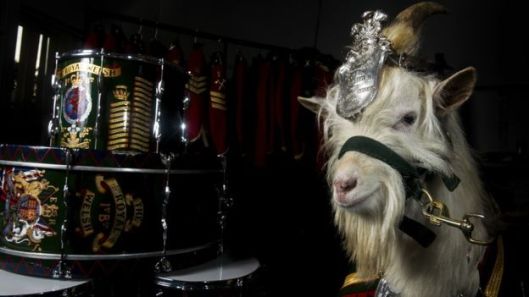
_87825995_llywelyngoat

Llywelyn will lead the 1st Battalion The Royal Welsh on all ceremonial duties, leading parades through Welsh towns and cities during Freedom Parades, Medals parades and Armed Forces Day events. He has already been invited to parade in London as part of the Queen’s 90th Birthday celebrations and will also be detached to B (Rorke’s Drift) Company for the summer as part of the guard at Buckingham Palace.

  • Information in this post is from various sources, but mostly derives from the booklet, Aliens on the Great Orme by Eve Parry.

Share this:

  • Click to share on Facebook (Opens in new window) Facebook
  • Click to share on Pinterest (Opens in new window) Pinterest
  • Click to share on X (Opens in new window) X
Like Loading...

St David’s Day – Dydd Dewi Sant

29 Monday Feb 2016

Posted by theresagreen in coastal walks, Colwyn Bay, Nature of Wales, Saints of Wales, Welsh culture and mythology

≈ 9 Comments

Tags

Patron Saint of Wales, St David, St David's Cathedral, St David's Day, St David's Day celebrations, St David's Day traditions, Tenby daffodil, Welsh, welsh emblems, welsh flag

Happy St David’s Day! Dydd Gwŷl Dewi (Sant) hapus!

welsh_flagVisit Wales on March 1 and you can’t help but notice it’s a special day here with many opportunities to witness displays and celebrations of Welsh national pride. The Red Dragon flags are flying and hosts of golden daffodils adorn shop windows and homes. Folks will pin a felt leek or a daffodil to their lapels while children dress up in traditional costume. Celebratory parades and concerts are held in towns and villages throughout the country.

All is in honour of Dewi Sant – St David – but not much is actually known about the patron saint himself.

St David – Patron Saint of Wales

Dewi Sant or St David lived in the sixth century and died on 1 March 589AD. He was a Celtic monk, abbot and bishop.

Dewi is said to have been of royal lineage. His father, Sant, was the son of Ceredig, who was prince of Ceredigion, a region in South-West Wales. His mother, Non, was the daughter of a local chieftain and legend has it that she was also a niece of King Arthur.

He was born near Capel Non (Non’s chapel) on the South-West Wales coast near the present city of Saint David. He was educated in a monastery called Hen Fynyw, in Cardiganshire, his teacher being Paulinus, a blind monk and stayed there for some years before setting out with a party of followers on his missionary travels, founding religious centres across Wales and England, including one at Glastonbury along the way. He travelled as far as Jerusalem, where he was made an archbishop. During his life, he was the archbishop of Wales, and he was one of many early saints who helped to spread Christianity among the pagan Celtic tribes of western Britain.

He eventually settled at Glyn Rhosyn, now St. Davids, in south west Wales, where he established a religious community. Many miracles have been attributed to him. The most incredible being when he caused the ground to rise beneath him when preaching so that everyone could see and hear him.

It is claimed that Dewi lived for over 100 years, and it is generally accepted that he died in 589.  His last words to his followers were in a sermon on the previous Sunday. Rhigyfarch transcribes these as ‘Be joyful, and keep your faith and your creed. Do the little things that you have seen me do and heard about. I will walk the path that our fathers have trod before us.’

‘Do the little things’ (‘Gwnewch y pethau bychain’) is today a very well-known phrase in Welsh, and has proved an inspiration to many.

KONICA MINOLTA DIGITAL CAMERA

St David’s Cathedral

St David’s remains are buried within the Cathedral of St David in the lovely coastal town of St David’s in Pembrokeshire, south west Wales, which is the smallest city in Britain.  The location became a popular place of pilgrimage and it was said that two pilgrimages to St Davids equalled one to Rome and three equalled one to Jerusalem. The most well-known medieval pilgrimage route begins at Holywell, Flintshire North Wales and ends at St Davids.

National emblems

To mark the Saint’s day, Welsh people around the world wear one or both of our national emblems – a daffodil or leek.

The Leek

The connection between Wales and the leek is obscure.  Most researchers trying to trace the link are met with one or other of the legends that show it was used by the Welsh as a cap badge in battle to show friend from foe.

One version is that on the eve of a battle with the Saxons, St David himself advised the Britons to wear leeks in their caps so that they could easily distinguish friend from foe. This apparently helped to secure a great victory. A variation of that is that the leek is worn to celebrate the battle as it was won in a field of leeks.
Another version has the same thing happening at the Battle of Agincourt in 1415 where Welsh archers fought with Henry V against the French. Again, leeks worn in their caps distinguished them from their enemies.

By 1536, when Henry VIII gave a leek to his daughter on 1 March, the leek was already associated with St David’s Day. It is possible that the green and white family colours adopted by the Tudors were taken from their liking for the leek.

Since the 6th Century Welsh soldiers have worn a leek in their caps to distinguish themselves from their foes in battle. Welsh soldiers today still have cap badges and buttons with leeks on and it is a surviving tradition that soldiers in the Welsh regiments eat a raw leek on St David’s Day.

THE DAFFODIL

If the link between the leek and the Welsh is obscure, then that with the Daffodil is even more so. It is possible that the reason the daffodil is used as an emblem is that the word for daffodil and for leek are the same in Welsh  (Cenhinen = Leek, Cenhinen Pedr =Daffodil ). This confusion means that both have been adopted as national emblems and the use of one over the other is down to personal preference.

In comparison with the ancient Welsh associations of the leek, the daffodil has only recently assumed a position of national importance. It is said by some that the daffodil was encouraged more by the English government, as it does not have the nationalistic overtones that the leek has, with its association with the defeat of Saxons.

The Victorians are reputed to have introduced the alternative daffodils we pin to our lapels instead of leeks on St David’s Day. A common vegetable such as the leek wasn’t considered glamorous enough to be the Welsh national emblem and the daffodil, whose flowering coincides with the Welsh patron saint’s holiday, seemed like a fitting replacement.

An increasingly popular flower during the 19th century, especially among women, its status was elevated by the Welsh-born prime minister David Lloyd George, who wore it on St David’s Day and used it in ceremonies in 1911 to mark the investiture of the then Prince of Wales at Caernarfon.

Welsh and Tenby daffodils

There are types of daffodil unique to Wales – the Welsh daffodil or Lent lily and the Tenby daffodil, although there is still debate as to whether the Tenby Daffodil is naturalised or introduced. The only other true British native daffodil, Narcissus pseudonarcissus, also found mainly in south Wales is known as the Lent Lily because it flowers through February, March and sometimes early April, therefore over the period of lent.

Tenby daffodil-Narcissus pseudonarcissus obvallaris

Tenby daffodil-Narcissus pseudonarcissus obvallaris

The diminuitive  little Tenby daffodil, growing to just 20cm (8″) tall is all one colour. It is so called because it is mostly found growing wild around the Tenby area. It can also be found in other areas of Pembrokeshire, Carmarthenshire and Ceredigion but is scarce.

The Tenby daffodil suffered in Victorian times from being too popular as they were regularly dug up and became quite scarce but replanting has helped and nowadays you’ll see plenty in the spring time around Tenby.

A version of the Tenby Daffodil has been cultivated since medieval times and the Royal Horticultural Society have now given it their prestigious Award of Garden Merit (AGM) in recognition of its outstanding excellence. 

Coed y Bwl wild daffodil woods, near St. Brides Major by Richard Marks

Coed y Bwl wild daffodil woods, near St. Brides Major. photograph by Richard Marks

The Welsh variety is more widespread, but still scarce. The Welsh daffodil or Lenten lily is two toned in colour with a different shade of yellow/ orange on the trumpet to that of the petals.

One of the biggest displays of Welsh daffodils can be seen at Coed y Bwl Wood, at Castle Upon Alun, near Bridgend.

Both species have suffered decline over the years as a result of property development on land where they once thrived.

celebrations of the day

The tradition of celebrating St. David’s day is still much alive throughout Wales and in many parts of the world where there are communities of people with Welsh origins.

Towns all over Wales celebrate with special meetings, parades, concerts and a myriad of other events. The National St David’s Day Parade across the centre of Cardiff, features all sorts of fiery performances from giant dragons and theatrical groups finishing with a rousing mass rendition of the national anthem, Hen Wlad Fy Nhadau outside St David’s Hall. A special gala concert from the BBC National Orchestra of Wales is traditionally held in the evening.  Male voice choirs are flown to all corners of the globe on St. David’s Day, to entertain Welsh communities.

Many of the country’s castles and heritage sites open their doors for free on the day, including  St David’s Bishop’s Palace, and the surrounding streets are the scenes for a fitting mini-festival in honour of their holiest former resident. Led by clergy, the annual Pilgrims’ Walk leads to the illumination of the St David’s Day Stone, ending at the Oriel y Parc, where you can wander around a traditional Welsh market or dance to live bands.

Schools throughout the country celebrate the day. My own children attended Welsh Medium schools in South Wales and St. David’s Day, particulary at their primary school was a looked-forward to special event.

Traditional Welsh Girls Costume

A modern take on the girl’s traditional Welsh costume

Pupils went to school dressed in Welsh costumes. The girls wore variations on the traditional pais a betgwn – a petticoat and overcoat, made of Welsh flannel, and a felt beaver hat, worn over a frilled white bonnet.

Welsh Girls Costume Bonnet

Traditional Girls Costume Bonnet


Boys Traditional Tweed Dai Cap - Welsh National Costume

Boys Traditional Tweed Dai Cap

Boys were persuaded to wear a white shirt with a a Welsh flannel waistcoat, black breeches, long woollen socks, black shoes and a traditional Dai cap, although in these more modern times others favoured their Welsh rugby shirts.

The day would include a walk to the local chapel for a religious service. Later in the day a mini-Eisteddford (concert) took place, where traditional songs and dances were performed and poems read. A photographer from the local newspaper visited all the local schools took photographs of each class of children which were subsequently printed in the next edition as souvenir supplements. Happy days!


Share this:

  • Click to share on Facebook (Opens in new window) Facebook
  • Click to share on Pinterest (Opens in new window) Pinterest
  • Click to share on X (Opens in new window) X
Like Loading...

Secret passage behind the sea wall 2

17 Saturday Oct 2015

Posted by theresagreen in Birds, birds of the seashore, birds of Wales, coastal walks, Nature, Nature of Wales, nature photography, Rhos Point, Rhos-on-Sea, Wales Coast Path

≈ 4 Comments

Tags

Crows on seashore, curlew flying, herring gull, meadow pipit, mussel bed, Rhos Point

An hour or so later the walk back to Rhos Point was quite different. The going was easier too as the strong wind was behind me now and not taking my breath away. Almost immediately I caught sight of a bird hopping around on the rocks. I waited hoping it would come into view, which it did, just as a woman with a dog approached and chose that moment to break into a run. The bird flew away. Again it was a pipit, possibly the same one I’d seen back on the beach. The legs are pinkish and plumage brown so maybe a Meadow Pipit?

151007TGNW- Penrhyn Bay-Pipit on rocks 3

151007TGNW- Penrhyn Bay-Pipit on rocks 4

A small sedum plants looks at home in a pocket eroded in a limestone rock.

151007TGNW- Penrhyn Bay-Sedum

Small pools of rainwater are held briefly, lasting longer in the hard granite rocks.

151007TGNW-6d-Rock pool 2

The garden snail must have found it hard going sliding over the rough surface of the sea wall.

151007TGNW-15-Sea wall- Garden snail

151007TGNW-Rock with moss

151007TGNW--Penrhyn Bay-Wasp

151007TGNW- Penrhyn Bay-sign at top of ramp

There is a wide concrete ramp reaching from the road down to the shore which probably gave access to heavy construction vehicles when the huge boulders of the sea defences originally were put in place. The lower section is being absorbed back into the shore, it is strewn with pebbles and small rocks and slippery with seaweed. Limpets are embedded into the wall itself as well as in large rocks on the shore at the bottom of the ramp.

151007TGNW-Limpets embedded in rock

I love the textured ‘lacy’ look of this rock almost covered with barnacles.

151007TGNW-Rock covered with barnacles & limpets

The sea is often at its most beautiful on these sunny windy days, its surface whipped up roughened and flecked with foam-edged ripples and the colour of the water ranging from deepest inky dark blue to pale turquoise-green. Large areas are stained brown by dredged up sand.

151007TGNW- Penrhyn Bay-Back to Rhos-Sea colours 1

Sun, shade and curves make this man-made construction interesting.

151007TGNW- Penrhyn Bay-Back to Rhos

The white marks highlighting the curved sea wall are mineral, maybe lime leached from the concrete?

151007TGNW-5-Wall markings-Rhos-on-Sea promenade

The parapet floor has an interesting pattern and texture and is spotted with patches of white lichen.

151007TGNW- Penrhyn Bay-Back to Rhos-Concrete floor3

As I got nearer to the Point I knew the tide was further in by the increased bird activity; the excitement it generates is almost tangible. Gulls take to the air and fly back and forth along the shoreline. Oystercatchers and other waders scuttle about, heads down, beaks probing for anything edible brought in on the waves.

151007TGNW- Penrhyn Bay-Back to Rhos-Herring gull

151007TGNW- Penrhyn Bay-Back to Rhos-Herring gull young 1

Crows head shorewards too, the one in my picture landed on a lampost towering above me, cawing loudly. They forage amongst the rocks along with the waders and are often seen picking up a shellfish then flying up with and dropping it onto the rocks below to crack it open.

151007TGNW- Penrhyn Bay-Back to Rhos-Crow 1

Even the curlews were excited. Most often seen stalking sedately around rocks and pools, now there were several flying along at speed, skimming low over the rocks on the shore below me. A couple of them may have been in pursuit of the one I managed to capture a shot of; it was travelling so fast I didn’t realise it had food in its beak until I saw the photograph.

151007TGNW- Penrhyn Bay-Back to Rhos-Curlew

On the Point the incoming tide approaches from either side of the mussel bed, where I assume different currents merge. The birds have an infallible instinct for the tidal changes and in the hour before and after high tide their numbers increase dramatically. They are brought closer to the shore then too and absorbed with foraging and eating, are easier to see.

151007TGNW- Penrhyn Bay-Back to Rhos-Sea colours on point

151007TGNW- Penrhyn Bay-Back to Rhos-Oystercatchers active

It was too cold and windy to hang around and wait today though, so I had a quick peek into the chapel, which I can never resist. There are only 6 seats inside, so I wonder if they’ve lined up these memorial benches on the promenade outside to serve as overflow pews?

151007TGNW- Penrhyn Bay-Back to Rhos-benches 2

Many young Herring gulls wander around the village at this time of year, often screeching for the attention of a parent. They have no road sense and sadly quite a few are killed by cars.

151007TGNW- Penrhyn Bay-Back to Rhos-Herring gull young on road edge

Share this:

  • Click to share on Facebook (Opens in new window) Facebook
  • Click to share on Pinterest (Opens in new window) Pinterest
  • Click to share on X (Opens in new window) X
Like Loading...

Secret passage behind the sea wall

15 Thursday Oct 2015

Posted by theresagreen in birds of the seashore, coastal habitat, coastal walks, coastal wildflowers, Nature, Nature of Wales, nature photography, wading birds, Wales Coast Path, Wildflowers of Wales

≈ 4 Comments

Tags

coastal birds, Linnet, migrant birds, Northern Wheatear, penrhyn bay, rhos on sea, Rhos Point, rocky seashores, seashore walks

On a sunny day last week I intended to spend some time checking out the birdlife on Rhos Point to see what treats the autumn migration had already brought to us. I started out on the roadside where there’s a posh new sign on the roadside above the bijou St Trillo’s Chapel, the favoured starting point for many of my seashore posts.

151007TGNW-1-St Trillo Chapel plaque-Rhos-on-Sea

St Trillo's Chapel, Rhos on Sea

St Trillo’s Chapel, Rhos on Sea

It was windy here and decidedly chilly as it can be when the tide is coming in. A quick look and listen from the promenade revealed a good number of cormorants, gulls, oystercatchers, redshanks and curlews, but all still too far out on the tideline on the mussel bed to see easily.

151007TGNW-2-Tide coming in-Rhos-on-Sea

I picked up a few seashells of some of the most commonly occurring species here.

151007TGNW-3a-Some seashells-Rhos-on-Sea 1

Despite the sunshine, this was definitely not a day to hang around on the shore, so I turned to walk along to Penrhyn Bay, hoping I might find a Rock Pipit or two amongst the huge rocks of the seabreak.

Fox -and-cubs on the embankment

Fox -and-cubs flowers on the grassy embankment bending in the wind

151007TGNW-Fox-and-cubs

This view of the Little Orme clearly shows the tiers formed by quarrying.

151007TGNW-4-Promenade towards Little Orme 1

151007TGNW-4bb-Promenade sign 1

I soon knew I wasn’t going to enjoy battling along against the cold headwind, so at the earliest opportunity dropped down onto the parapet of the seawall where a passageway is formed between the wall and the seabreak rocks. It was still windy here but not quite as strongly, besides which this passageway fascinates me as a habitat for an ever-increasing collection of plants and at this time of year it can be a good place to spot rock pipits and pied wagtails. And the rocks themselves are endlessly fascinating.

151007TGNW-6a-Rock 1

151007TGNW-6b-Rock with turquoise stripe

The turquoise green of the vein in the rock above puts me in mind of the verdigris you get on copper. The one below has sparkly white and pink crystal-like parts held within it.

151007TGNW-6e-Rock -pink with crystals

151007TGNW-13-Rocks & spider's web

A spider’s web screens a space between rocks

I spotted a bird on the rocks close to these steps and went down to see if I could find it again.

151007TGNW-8-Sea wall- Steps going down

Steps going down to the seashore

I managed a quick shot before it disappeared. Definitely a pipit.

151007TGNW-7-Pipit-Rhos-on-Sea promenade

In the winter and in rough windy weather the sea reaches the top of these steps; the bottom few are bleached almost white, their edges smoothed, curved and shaped to form channels by seawater covering them and cascading back down.

151007TGNW-9-Sea wall- Steps going up 1Continuing along there’s a stretch that is particularly flowery. There’s a lot of red valerian interspersed with an array of wild plants and garden escapées.

151007TGNW-10-Sea wall path-Towards Penrhyn Bay

Sea mayweedhugs the curve of the sea wall

Sea mayweed hugs the curve of the sea wall

ivy-leaved toadflax

Ivy-leaved toadflax

151007TGNW- Penrhyn Bay-Plant with laarge glossy green leaves

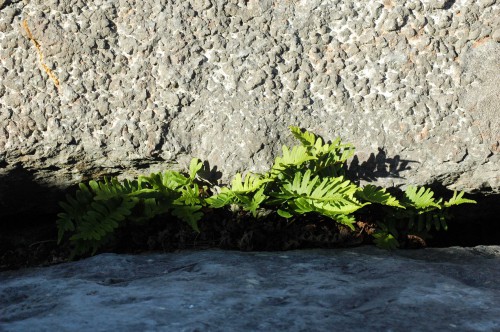
Sunlit fern in a rocky crevice

Sunlit fern in a rocky crevice

marigold escaped from a garden

Marigold escaped from a garden

Tree mallow flower

Tree mallow flower

Penrhyn Bay

151007TGNW- Rock covered with seaweed

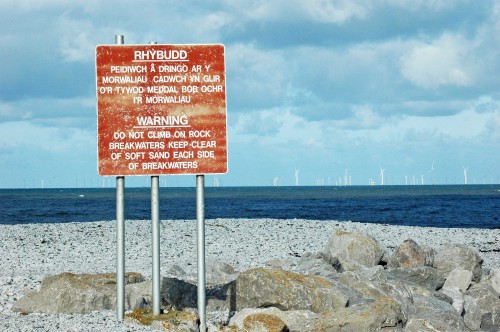
151007TGNW-Penrhyn Bay-Breakwater & sign

Between the breakwater and the rocky shore there is a patch of flowery grass

151007TGNW-Little Orme & Penrhyn Bay-grassy patch

151007TGNW- Penrhyn Bay-grassy patch

and behind the rocks scrubby shore plants grow amongst the sand and stone chippings. This is the best place I know for fairly reliable sightings of linnets that come to forage for seeds. There were linnets there when I arrived, which I realised when they all took off and headed off across the road towards the golf course. From past experience I thought if I sat and waited on the steps beneath the sea wall they may well come back. Sitting quietly I realised there were still birds close by that gradually came back into the open in front of me which turned out to be a Northern wheatear and a pipit. I want to say it was a Rock pipit as this is a likely spot to find them, but it had an olive-green tinge to its plumage and may have been a Meadow pipit.

Northern wheatear with pipit

Northern wheatear with pipit

Lovely wheatear though.

151007TGNW- Penrhyn Bay-Northern Wheatear 1

As hoped the linnets came back too, a small flock of 10 or 12 birds, albeit too far away to photograph well.

151007TGNW- Penrhyn Bay-Linnets feeding 4

151007TGNW- Penrhyn Bay-Linnets feeding 1

151007TGNW- Penrhyn Bay-Linnet 1

151007TGNW- Penrhyn Bay-Linnet on rock 1

Share this:

  • Click to share on Facebook (Opens in new window) Facebook
  • Click to share on Pinterest (Opens in new window) Pinterest
  • Click to share on X (Opens in new window) X
Like Loading...

Wales Coast Path – Little Orme

24 Sunday May 2015

Posted by theresagreen in birds of Wales, Birdwatching on North Wales coast, coastal walks, coastal wildflowers, Little Orme, Nature of Wales, Rhiwledyn Nature Reserve, The Wales Coast Path, Wildflowers of Wales

≈ 3 Comments

Tags

Cormorant, cormorants nesting, fulmar, fulmar nesting, ground ivy, jackdaw, sea campion, The Wales Coast Path-Little Orme

The Little Orme is a highlight of both the northern Wales Coast Path and the North Wales Path; it is a Nature Reserve with diverse habitats and wildlife and is popular with visitors and locals. I walk here often throughout the year but thought I would photograph this walk, taken at the end of April, as though I was following the Path, while meandering around as I usually do admiring the views and the special wildlife.

The Coast Path follows the promenade from Rhos-on-Sea around the Point and up to Penrhyn Bay. To reach the Little Orme turn off the main road and walk along Beach Road, which ends in a cul-de-sac where there are steps up to the site. Turn right at the top of the path from the steps to continue on the route.

In late winter to early spring Fulmars return to their nest sites here. They are noisy birds and vocalise loudly in the first weeks of their return as they sort out who is nesting where. Now, in late April they have quietened down and are settled into their nest sites on the more sheltered sides of the cliffs. There are currently five pairs on the more inland cliff and three or four more pairs on the lee sides of the cliff faces nearest to the sea. Their numbers are few but seem to be reasonably consistent year on year.

Fulmar nest on cliff nearer the sea

Fulmar nest on cliff nearer the sea

Fulmar pair sitting on cliff edge

Fulmar pair sitting on cliff edge

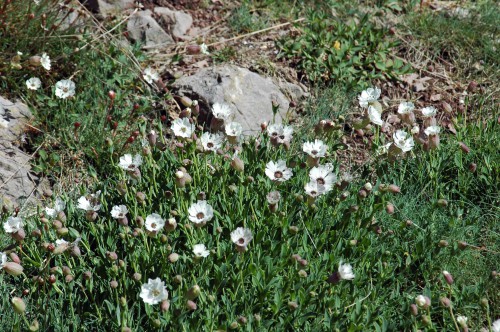
At the base of the cliff forming one side of Angel Bay, Sea Campion is flowering.

Sea Campion

Sea Campion-Silene maritima

I usually head for the cliff edge overlooking Angel Bay to see if there are any Grey Seals about. Today there were just two young ones swimming close to the rocks. The path to the summit involves an initial steep climb up an incline locally known as ‘Rabbit Hill’. It looks a gentle slope in the photograph, but it really isn’t, especially when you are as unfit as I was after my marathon-long virus! I had to stop twice today, but who cares when there are stunning views to look back at.

The Coast Path continues up steeply sloping 'Rabbit Hill'

The Coast Path continues up steeply sloping ‘Rabbit Hill’

Jackdaws are numerous residents and pairs of the characterful birds are nesting in nooks and crannies all over the cliffs. It’s always good to see them nesting communally in their ‘proper’ habitat rather than in the chimneys of houses in towns and villages. There are a particularly large number of them nesting up on the cliff at the back of the flat quarried-out grassy area at the top of Rabbit Hill and as I reached there I watched them as they used their numbers to chase off two Herring Gulls that were probably speculating for unguarded eggs.

Cliff face of the old quarry  that is now inhabitated by Jackdaws

Cliff face of the old quarry that is now inhabitated by Jackdaws

Jackdaw foraging at the base of the cliff

Jackdaw foraging at the base of the cliff

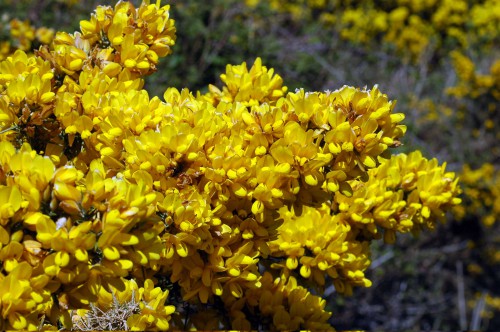
Onwards and upwards from the rock-strewn quarry field the track is bordered by gorse bushes and the air was perfumed with its wonderful coconut scent. Every bush was smothered with thousands of tightly packed golden flowers, a truly glorious treat for both eyes and nose. The grass is kept closely cropped by both rabbits and wandering sheep and a variety of birds including blackbirds, robins, chaffinches, goldfinches and dunnocks all forage here on the ground or amongst the scrubby shrubbery.

A baby bunny dozing in a sunny spot at the side of the track

A baby bunny dozing in a sunny spot at the side of the track

The track upwards bends to the right now and passes by an enclosed rough pasture grazed by  sheep and is frequented by Jackdaws. It’s always worth checking to see if any of the black birds are actually Chough.

A sheep pauses from grazing in the enclosed field to admire the view

A sheep pauses from grazing in the enclosed field to admire the view

At the top of the field the track turns sharply left and continues bordered by more gorse, blackthorn and hawthorn. Today walking through the fragrant gorse and blackthorn blossom was blissful.

The  trail winds through a thicket of gorse and blackthorn

The trail winds through a thicket of gorse and blackthorn

Every gorse bush was packed tight with blossoms

Every gorse bush was packed tight with fragrant blossoms

Eristalis Hoverfly nectaring on gorse flower

Eristalis Hoverfly nectaring on gorse flower

If you had been walking the Coast Path, there is a perfect view from the top of this section of the track of where you have walked if coming from the direction of Abergele, or of where you will be walking if going the other way.

View from the cliff edge showing the route of the Coast Path from Abergele, past Lladdulas and around Colwyn Bay and Rhos Point

View from the cliff edge showing the route of the Coast Path from Abergele, past Lladdulas and around Colwyn Bay and Rhos Point

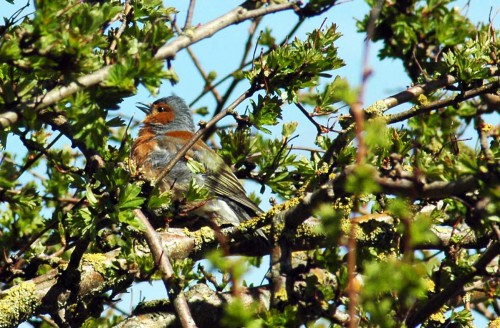
I could hear a Chaffinch singing so diverted from the main track here along one made by sheep to try to find him. It wasn’t long before I spotted him in a hawthorn tree preening himself and intermittently responding to the song of another male somewhere nearby.

Male Chaffinch singing and preening

Male Chaffinch singing and preening

Ground Ivy

Ground Ivy

The track continues upwards towards the top

The track continues upwards towards the top waymarked Wales Coast Path and North Wales Path

One of the reasons for taking this walk today was to check up on the Cormorants that nest on the sea cliffs of the headland. I wouldn’t recommend making this diversion to the cliff edge if you have children or a dog not on a lead with you, or if you are of a nervous disposition as to get a good view of the birds you do have to go carefully down a slope which has no barrier between its edge and the drop down. It was windy today too, as you can see by the ruffled sea.

A ewe with her lamb on the slope of the cliff edge

A ewe with her lamb on the slope of the cliff edge

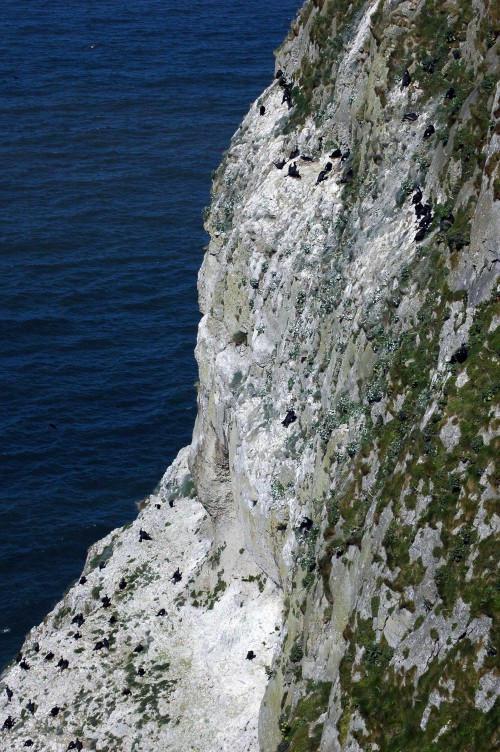
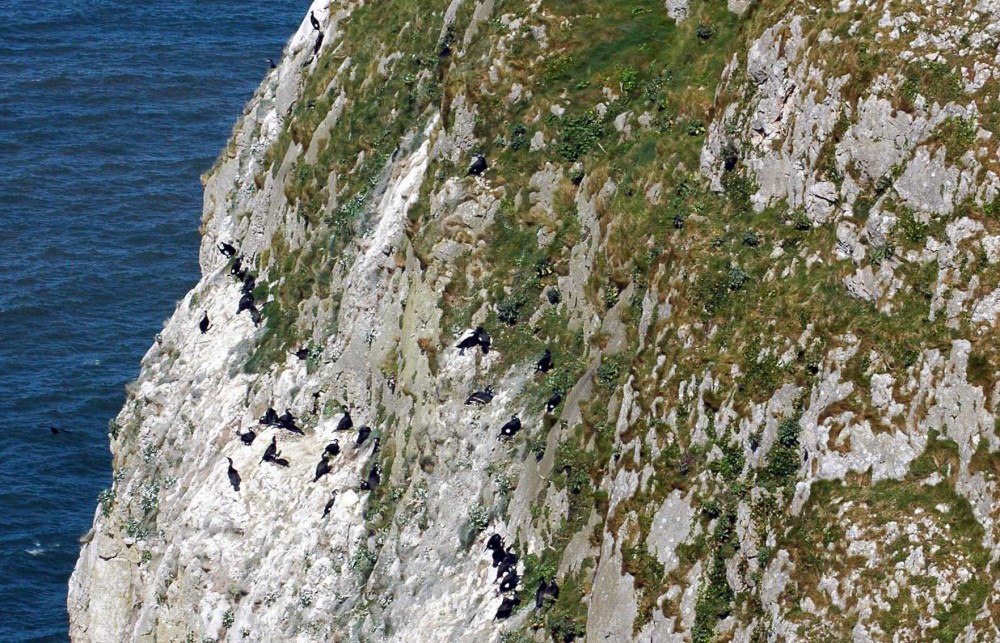
There are large numbers of Cormorants here all year round and in Welsh the bird is known as ‘llanc llandudno’. I’m sure they have nest sites all around the headland, but this is the only one I know of that is reasonably visible from the cliffs. The limestone rock is smooth and sheer so it is amazing that the Cormorants, quite large birds, find safe places to site their nests here.

A view of the nest site on the almost-sheer cliff face

An overview of the nest site on the almost-sheer cliff face

There are three areas the birds are gathered in, an area at the top, a middle section and a few on a shelf quite near the bottom.

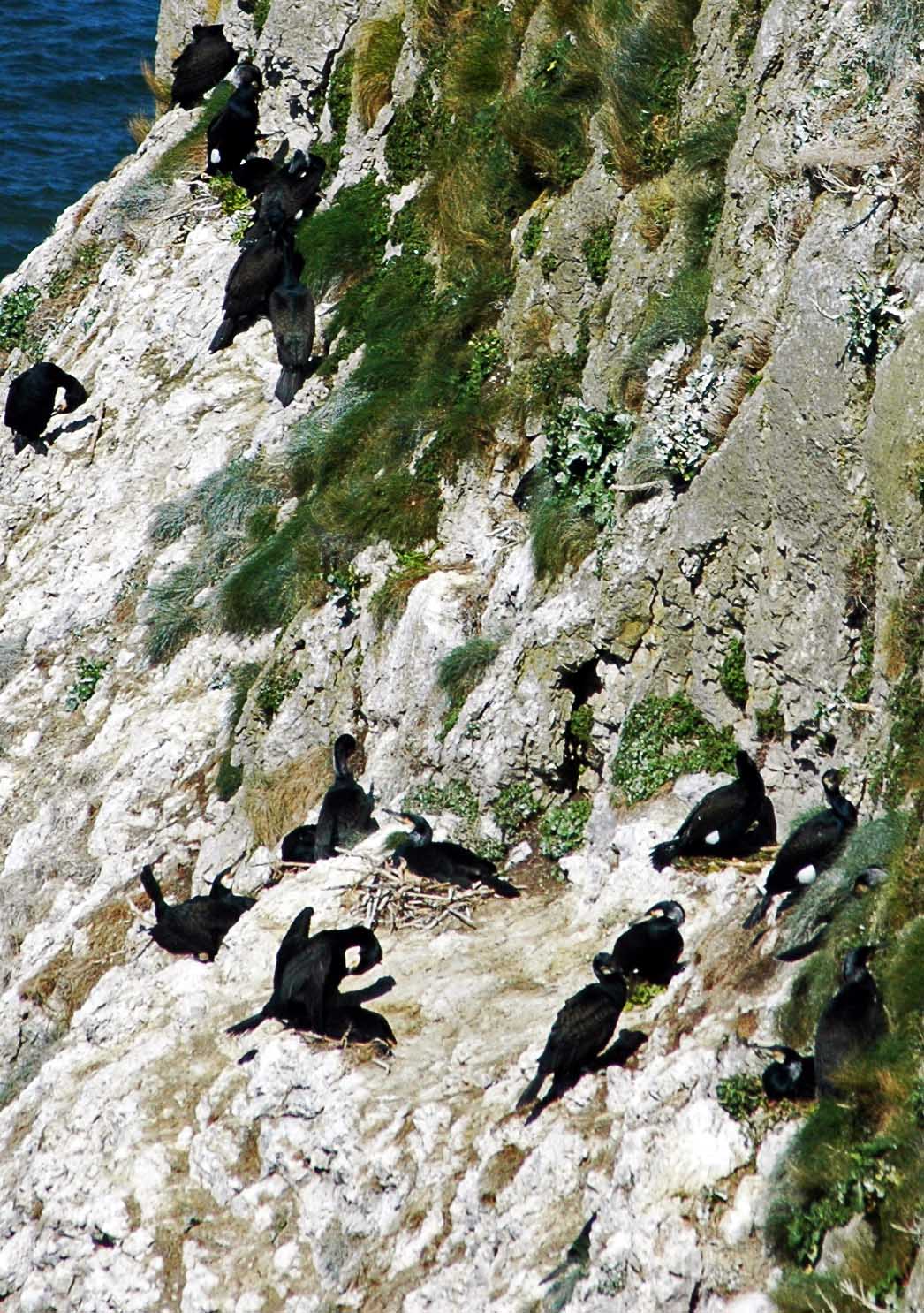
A closer view of the area most of the birds were gathered in

A closer view of the top-level area some of the birds were gathered in

A few birds wwere sitting on nests while others, probably males, sat with their backs to the sea

A few birds were sitting on nests while others sat with their backs to the sea

Cormorants sitting against the cliff with backs to the sea

Cormorants sitting against the cliff with backs to the sea

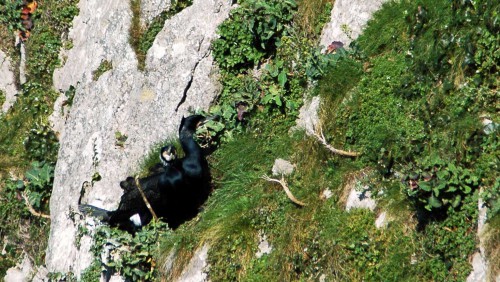
A pair of birds nesting amongst wild cabbage plants

A pair of birds nesting amongst wild cabbage plants

Another pair on a sloping rocky ledge

Another pair on a sloping rocky ledge

Cormorant flying past cliff

Cormorant flying past cliff

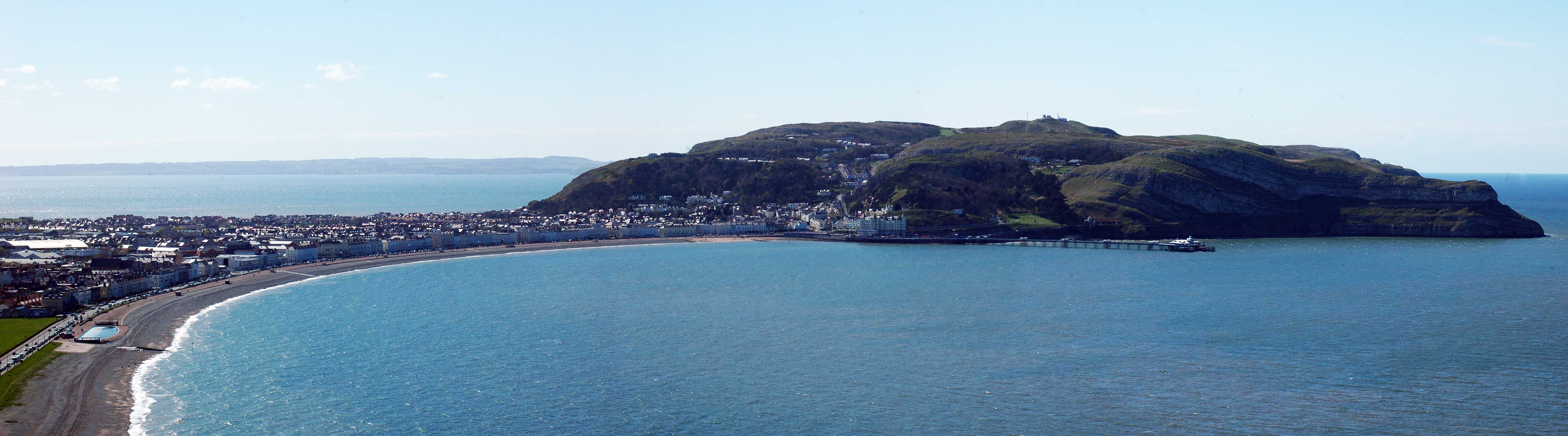
Fascinating as the Cormorants were, it was chilly here on the windy cliff, so I went back up and along the cliff edge to the part below the summit which was sheltered from the wind and from where there are stunning views across the bay to Llandudno’s Victoria Pier and Little Orme’s big brother, the Great Orme. In the background is the Isle of Anglesey.This view shows the route of the ongoing Coast Path around Llandudno Bay.

Panoramic view of Llandudno, the pier and Great Orme with Anglesey in the background (click to enlarge)

Panoramic view of Llandudno, the pier and Great Orme with Anglesey in the background (click to enlarge)

Cormorants race past and Herring Gulls are always to be seen flying or gliding around this part of the cliff, and there is occasionally a Kestrel, but today I was surprised to see two Buzzards flying out over the sea and a Sparrowhawk flying in and heading towards the Great Orme.

The ongoing Coast Path

The ongoing Coast Path passes around Llandudno and on to Deganwy and Conwy

It is possible to go up a little further to reach the trig point on the summit but the views are no better from there so I don’t often get that far and turn around to go back the way I came. If you were following the Coast Path though you would follow the track that takes you down to rejoin the main road at Craigside and continue towards Llandudno.

Share this:

  • Click to share on Facebook (Opens in new window) Facebook
  • Click to share on Pinterest (Opens in new window) Pinterest
  • Click to share on X (Opens in new window) X
Like Loading...

Mellow autumn

23 Thursday Oct 2014

Posted by theresagreen in Butterflies of Wales, calcareous grassland, coastal habitat, coastal walks, Nature, Nature of Wales, nature of woodlands, nature photography, Wildflowers of Wales

≈ 5 Comments

Tags

autumn woodland, Bryn Euryn Nature Reserve, common buzzard, eyebright, galls on back of oak leaves, hawthorn berries, silver birch, spangle gall, speckled wood, St John's Wort, wildflowers of Bryn Euryn

Me it delights in mellow autumn tide,                                                                       To mark the pleasaunce that my eye surrounds,                                                 The forest trees like coloured posies pied,                                                            The uplands mealy grey and russet grounds;                                                Seeking for joy where joyaunce most abounds…….                                                                                from Autumn by John Clare

Autumn certainly has been joyous this year and even the blustery tail-end effects of hurricane Gonzalo have failed to provoke most of our habitual complaints about the weather. Temperature-wise, a  walk I took on Bryn Euryn just a couple of weeks ago felt more like early summer than approaching winter and although many of the signs of autumn were in place, there were a surprising number of wildflowers in bloom and butterflies, bees and various flies on the wing.

Quarry-field cliff crowned with autumn colours

Quarry-field cliff crowned with autumn colours

Teasel  seed-heads amongst thistles

A prickly selection – teasel seed-heads amongst thistles

The woodland tracks are covered with layers of dried fallen leaves that rustle when stepped upon and the soft musky scent of their decaying matter fills the air.

Sun-dappled woodland track covered with dry fallen leaves

Sun-dappled woodland track covered with dry fallen leaves

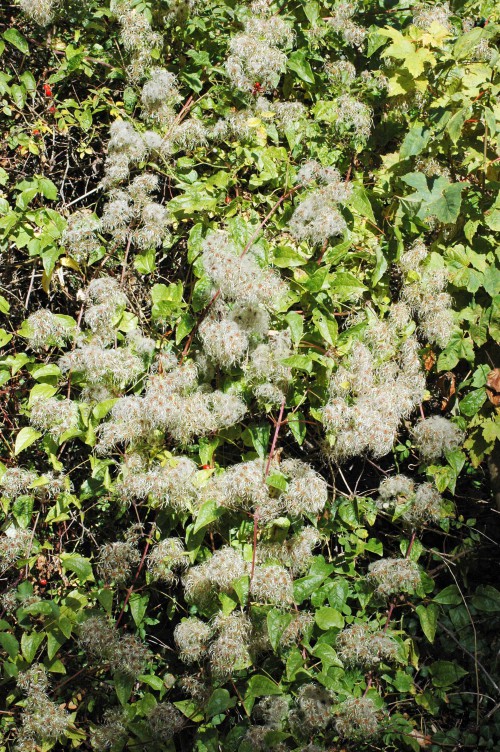
Wild clematis is prolific throughout the reserve and curtains of the fluffy dried seed-heads is draped over vegetation of varying heights and is living up to its common name of Old Man’s Beard.

Fluffy seed heads of wild clematis or 'old man's beard'

Fluffy seed heads of wild clematis or ‘old man’s beard’

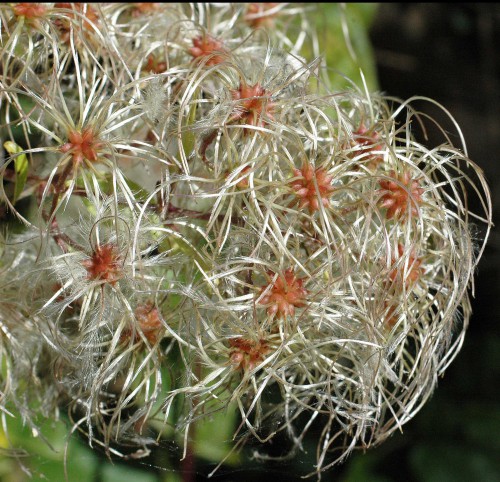
The individual seed-heads are prettily composed and shine silver in the sunlight.

141002(6)TGNW-Bryn Euryn-Old man's beard close-up

Clusters of silvery filaments make up a seed-head of wild clematis

The bountiful crops of haws on the hawthorn trees are still untouched by birds and have turned a rich ruby red.

Rich pickings still to come for hungry birds

Rich pickings still to come for hungry birds

Hawthorn leaves also turning red

Hawthorn leaves also turning red

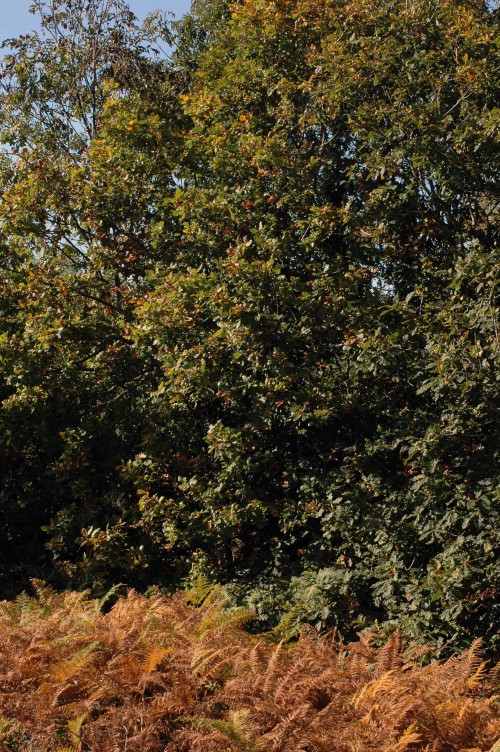
Although there are bountiful berry crops, the oak trees do not seem to have produced many acorns this season.

Oak tree with bracken in the foreground

Oak tree with bracken in the foreground

Oak leaves turning colour

Oak leaves turning colour

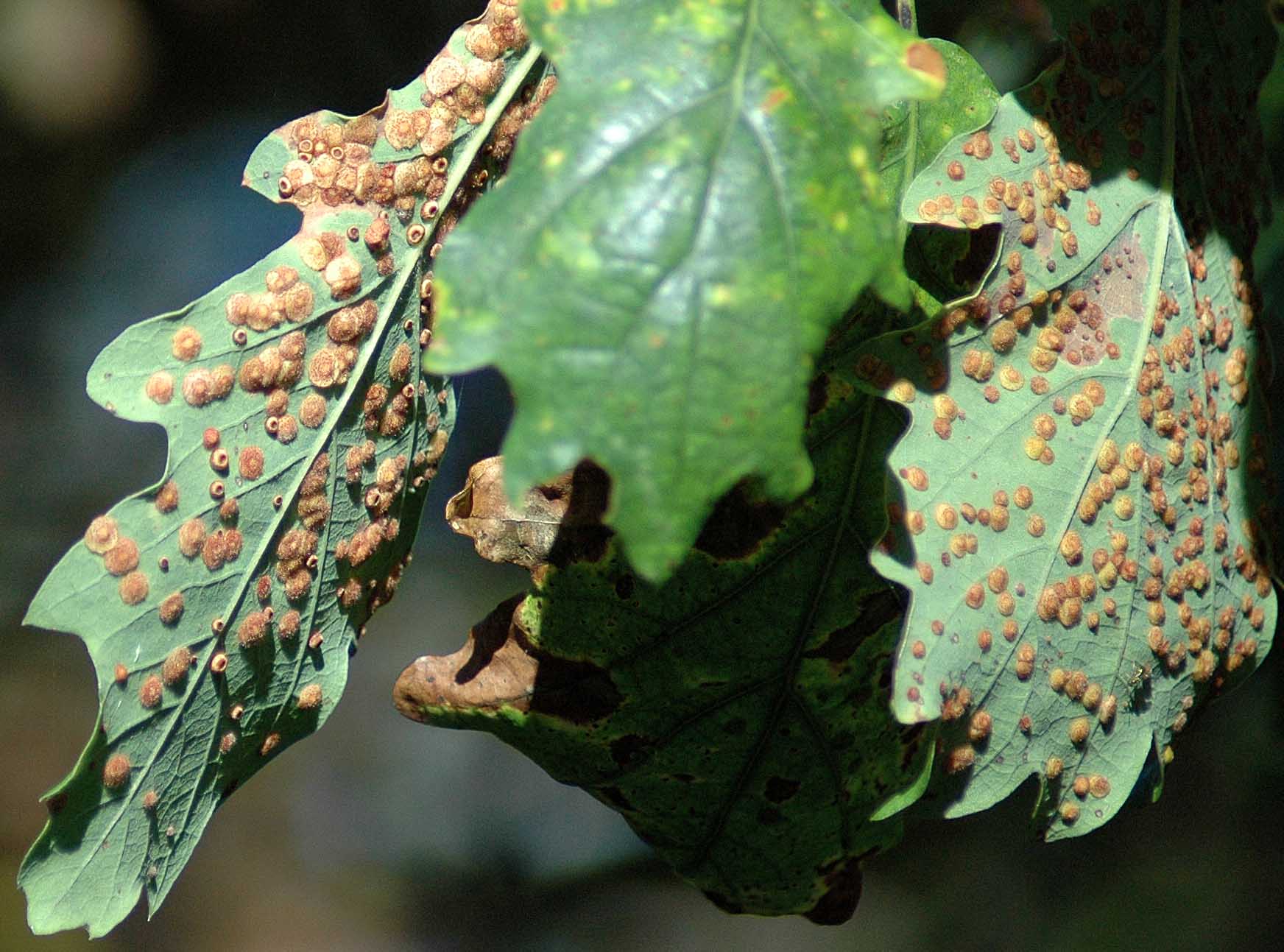
There are ‘crops’ of spangle galls though.

141002(17)TGNW-Bryn Euryn- Spangle galls on oak leaves

Spangle galls on oak leaves

Before climbing up the steep track through the woods on the way to the summit I sat for a few minutes on a rock to note down what I’d seen so far and was scrutinised for a few seconds by a buzzard that flew in over the treetops. This is a favoured spot of the locally resident buzzard, known to local visitors to the site as Lucifer and if you are here for any length of time you have to be quite unlucky not to get at least a glimpse of him here. He was accompanied by his mate today and didn’t linger, moving away in a leisurely circling kind of way towards Penrhyn Hill and the Little Orme.

Buzzards circling Penrhyn Hill

Buzzards circling Penrhyn Hill

I noted: ” I’m sitting on one of my favourite rocks. It’s around noon, the sun is high in a blue sky with just the faintest wash of wispy white cloud and is so hot I can feel it burning my legs through my jeans. The grassy areas have all been cut but a few wildflowers in bloom including rockrose, harebell & a bit of hogweed. There are butterflies, mostly speckled woods, but also a red admiral. Drone flies come to bask on the sun-warmed rocks and several wasps are seeking available food sources. Birds are still fairly quiet, I’ve heard the occasional song of a Robin and Blue and Great Tits calling to one another as they flit around foraging for food, but apart from the ever-present Crows everything else is keeping a low profile.”

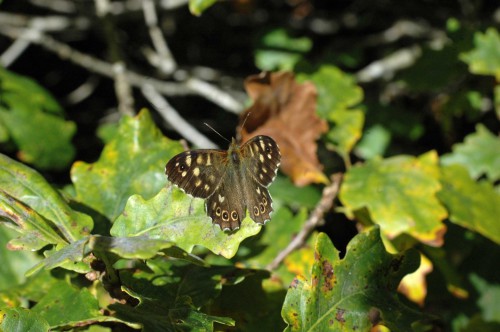
Moving onwards and upwards along the track that leads out onto the ‘downland’ side of the hill I could hear drying leaves crackling in the heat of the sun. On the woodland edge there were several speckled woods flitting about, pausing often to settle on oak leaves. All appeared to be dark in colour and were not fully basking, but holding their wings partially closed.

Speckled Wood basking on an oak leaf

Speckled Wood basking on an oak leaf

I photographed another insect here too: it looked like a small bee but was behaving more like a hoverfly.

Cute insect looking like a small bee and behaving like a hoverfly

Cute insect looking like a small bee and behaving like a hoverfly

There is a beautiful silver birch tree on the woodland edge. Its leaves are beginning to turn colour and it has attractive fruiting catkins that look like a bit like a small slender fir cone from which, during the winter and aided by birds, tiny winged nutlets will be released.

141002(26)TGNW-Bryn Euryn- Silver birch fruits

Silver birch leaves and fruiting bodies

141002(27)TGNW-Bryn Euryn- Silver birch fruit

Close up of fruiting body

The grass has been cut on the hillside too and the ground is criss-crossed with a lattice of bramble stems. There are a few plants of the wild Goldenrod still in flower, while others have gone to seed.

Goldenrod-Solidago virgaurea

The dry flower head with seeds attached looks as pretty as the fresh flower.

Goldenrod gone to seed

Goldenrod gone to seed

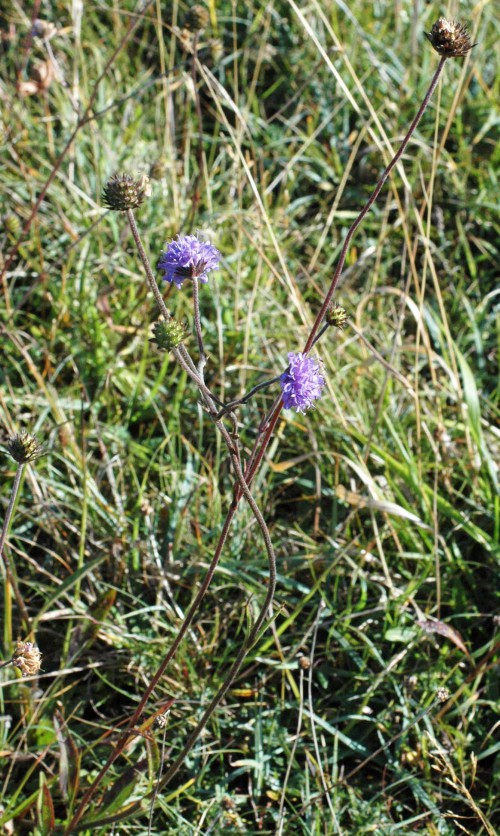
There was a fair amount of scabious still in flower and was attracting a busy little Carder Bee.

Scabious still flowering

Scabious still flowering

There were a few eyebright plants still with their usual white flowers, and one that I came upon had pretty pink-purple edged petals with a yellow patch in the centre.

Eyebright with purple-pink edged petals

Eyebright with purple-pink edged petals

The views from the hillside were outstanding today as it was perfectly clear and bright which rarely happens in the summer months.

Looking down onto woodland across the hillside. Carneddau Mountains in the background

Looking down onto woodland across the hillside. Carneddau Mountains in the background

Little Orme & Penrhyn Bay village

Little Orme & Penrhyn Bay village

The sea was almost flat calm and in as many shades of blue as I have ever seen it.

The sea in many shades of blue

The sea in many shades of blue

Looking down the coast to Abergele & Rhyl

Looking down the coast to Colwyn Bay, Abergele & Rhyl


Share this:

  • Click to share on Facebook (Opens in new window) Facebook
  • Click to share on Pinterest (Opens in new window) Pinterest
  • Click to share on X (Opens in new window) X
Like Loading...

Of a temporary nature

18 Monday Aug 2014

Posted by theresagreen in coastal walks, coastal wildflowers, Nature, Nature of Wales, nature photography, Wildflowers of Wales

≈ 1 Comment

Tags

acorn barnacles, creeping cinquefoil, fat-hen, flowering in August, hedge bindweed, kelp fly, mussel beds, ray's knotgrass, rhos on sea, sea mayweed, sea plantain, seashore walks

Beauty is where you find it and often in the least likely of places, but in nature it may also be fleeting, so needs to be appreciated when the opportunity presents itself. Here are a few images of some things I found beautiful along the way of a short walk I made from home into Rhos-on-Sea village on a windy, sunny-ish morning last week. Some would most definitely not be there if I were to look for them again.

I had set off to see if there was anything interesting to see down on the seashore and walked along the promenade to reach a point from which to access it. The promenade is on a lower level to the road and pavement for a short stretch here and the intervening space between the two is a steep slope covered with grass. This grassy embankment is mowed every now and then, but the times between cuts are often long enough to allow opportunistic weed wildflowers to pop up and bloom and in different seasons I have spotted a good variety of species here.

Reaching the top of the path leading down to the prom I heard first, then saw a man on a sit-on mower working on the flatter grass verge going in the opposite direction towards Penrhyn Bay. This prompted me to get a move on and have a look to see what might be flowering lower down as it clearly would not be there for much longer.

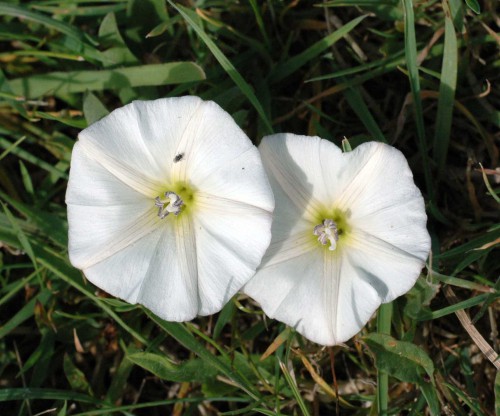
First to catch my eye was a tangle of white-flowered bindweed. Generally similar to the large flowered bindweed that abounds in waste places and on road verges, as well as being the bane of many a gardener’s life, this was the smaller-flowered Hedge Bindweed.

Flowers are smaller than those of Large Bindweed

Flowers are smaller than those of Large Bindweed

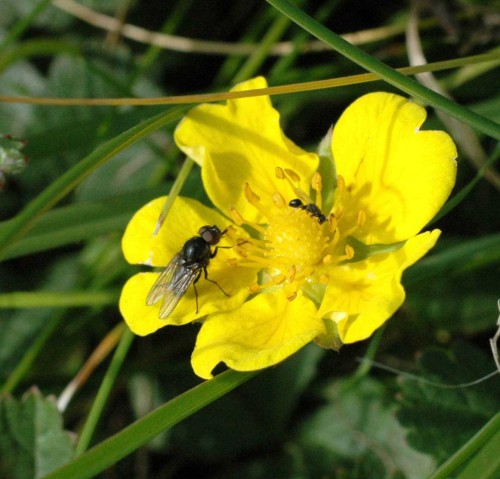
Lower down in the grass there was Creeping Cinquefoil, some of the golden yellow flowers fading around the edges.

Creeping cinquefoil-potentilla reptans

Creeping cinquefoil-potentilla reptans

Small flowers attract small insects

Small flowers attract small insects

There were insects nectaring on most of the available flowers, including bumblebees, hoverflies and various other flies.

I hope they all escaped the blades of the mower that was about two minutes behind me as I took these photographs. I’m glad I got there when I did, otherwise I would not have seen the flowers at all.

The tide was turning and beginning its journey back into the shore and although I could see and hear a lot of birds out on the tide-line, including curlew, redshank & oystercatcher, they were way too far away to see properly.

View across the mussel bed from the shore

View across the mussel bed from the shore. (click for a bigger image)

With or without the added interest of birds though, I can meander contentedly  along this rocky seashore at any time, finding the rocks themselves endlessly fascinating.

Perhaps the rounded shapes on this rock were made by molluscs attached to it

Perhaps the rounded shapes on this rock were made by molluscs at one time attached to it

We don’t get much variety in the seashells on the shore here, although not surprisingly there are an awful lot of mussel shells.

Seashell collection amongst the rocks

Seashell collection amongst the rocks

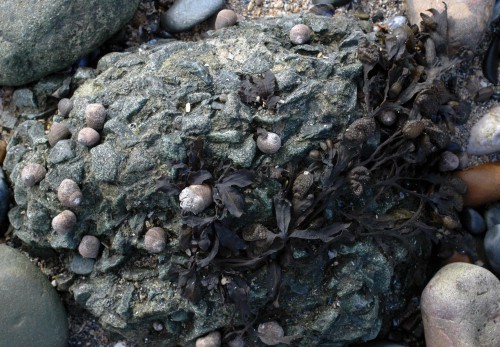
Textures in rock with periwinkles

Textures and patterns in rock with seaweed and periwinkles

Acorn barnacles make a pretty lacy patterns on rocks

Acorn barnacles make  pretty lacy patterns on rocks

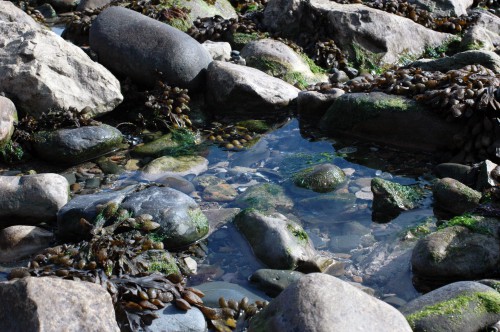
Rock pool

Rock pool

I spent a few minutes watching a cluster of Kelp Flies, appropriately on a length of brown, leathery Kelp seaweed.These are the insects that fly up if you walk through or even past clumps of dryish seaweed. They are quite tiny, so I thought it might be interesting to have a closer look at one. Not beautiful maybe, unless you are another Kelp Fly, but the wings are nice and they have dainty white feet.

Kelp Fly - Coelopa frigida

Kelp Fly – Coelopa frigida

So I travelled slowly along and eventually arrived at the sandy beach area next to the small harbour area of the village. The beach is protected by a barrage of more large rocks that has to be surmounted  to reach it and as I clambered over them I spotted a colourful splash of flowering plants growing at the back of the building that is now a fishing-tackle shop and kayaking centre. This is not a particularly attractive spot and any wind-blown rubbish from the beach tends to get caught up here, but I have come across some interesting plants here, so is always worth a closer look at. 

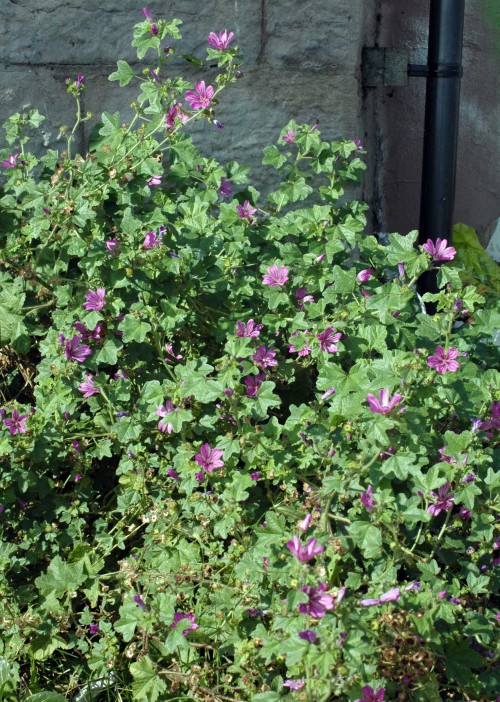
What had caught my eye today was a large clump of Common Mallow that had found shelter in a corner tight against a wall and was clearly thriving there.

A large Common Mallow plant thrives in a sheltered corner

A large Common Mallow plant thrives in a sheltered corner

Another common plant in waste places, especially on sandy soils is Annual Wall-Rocket and there are usually a few of these plants growing around this location.

Annual Wall-Rocket-diplotaxis muralis

Annual Wall-Rocket-diplotaxis muralis

A large specimen of Annual Wall-Rocket

A large specimen of Annual Wall-Rocket

There was a large plant of Fat-hen too, and another one right on the edge of the sand just a short way from the sea.


Fat Hen

Fat Hen- Chenopodium album

Fat Hen flower spike

Fat Hen flower spike

Amongst the commoner plants I was pleased to  find this Ray’s Knotgrass, an annual plant that is most often found on undisturbed coastal sand and shingle beaches.

Ray's Knotgrass- Polygonum oxyspermum

Ray’s Knotgrass- Polygonum oxyspermum

The flowers & fruits of Ray's Knotgrass

The flowers & nut-like fruits of Ray’s Knotgrass

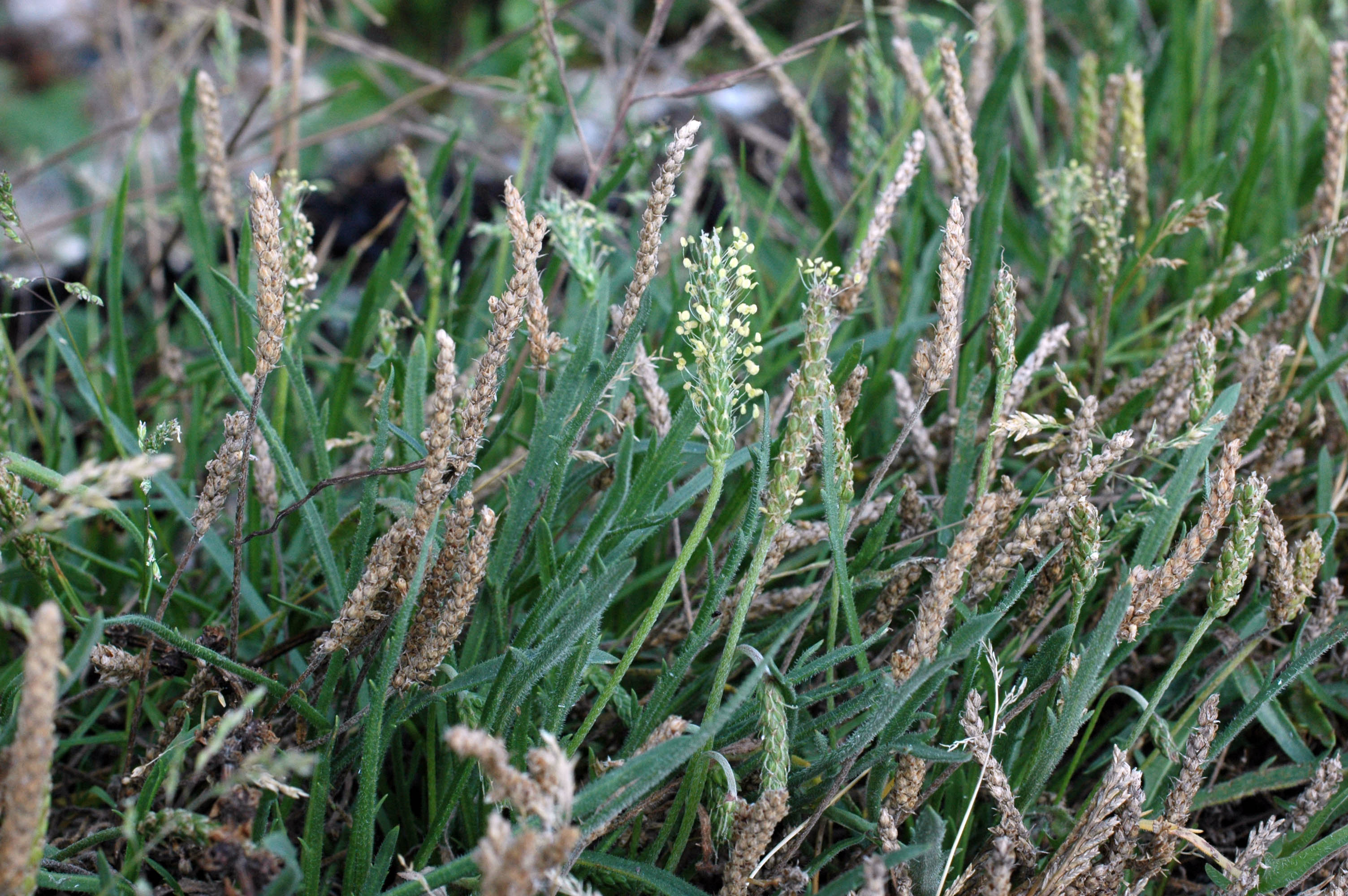
There was Sea Plantain, whose flowers are almost over now.

Sea Plantain-Plantago maritima

Sea Plantain-Plantago maritima

Then the prettiest of them all, the lovely Sea Mayweed.

Sea Mayweed-Tripleurospermum inodorum

Sea Mayweed-Tripleurospermum inodorum

A clump of Sea Mayweed at the beach edge

A clump of Sea Mayweed at the beach edge


Share this:

  • Click to share on Facebook (Opens in new window) Facebook
  • Click to share on Pinterest (Opens in new window) Pinterest
  • Click to share on X (Opens in new window) X
Like Loading...

Late summer wildflowers and insects of the Little Orme

11 Tuesday Sep 2012

Posted by theresagreen in butterflies, coastal habitat, coastal walks, Little Orme, Nature, nature photography, Rhiwledyn Nature Reserve, wildflowers

≈ 7 Comments

Tags

6-spot Burnet Moth, black & yellow striped caterpillars, black butterfly or moth with red spots, cinnabar moth larvae, eristalis arbustorum, eristalis pertinax, eyebright, hoverflies, large black slug, meadow grasshopper, sawfly, small skipper, toadflax, vervain

The weather took its toll on the cliff-top flora and fauna of the Little Orme   too, although I think perhaps it’s not so much that the insects were not there, more that they were less able to be  mobile,  so were not as visible as they are in warmer, drier conditions. I took the following pictures on a warmish, sunny but fairly windy day just past the middle of August when everywhere was still damp from rain.

Ragwort is blooming strongly and every plant is supporting a colony of cinnabar moth caterpillars.

The Cinnabar moth larvae are growing fat on ragwort

The flowers of the ragwort are much in demand too, particularly by hungry hoverflies.

Eristalis interruptus (f) on ragwort

2 drone flies, Eristalis pertinax on ragwort

A smaller eristalis species – Eristalis arbustorum

Mating pair of soldier beetles

I was still on the lookout for soldier beetles and did eventually manage to find one pair; there were dozens of them this time last year. I didn’t even manage a very good photograph as the wind was blowing the ragwort stem they were on.

I walked towards the cliff edge above Angel Bay, drawn by a large patch of sunny yellow birds-foot trefoil mixed in amongst long grasses.

Flowery clifftop, most birds-foot trefoil mixed in amongst long grass

Long grass and birds-foot trefoil

As I had hoped, this flowery area turned out to be quite productive in terms of insects. I first spotted a Common Blue butterfly very low down on a grass stem, then followed a Small Skipper until it too came to rest on a flower.

Small Skipper –

That was followed by a first sighting of a Burnet Moth fluttering across the grass and flowers, and once I had ‘got my eye in’, I soon realised there were a good few more.

6-spot Burnet moth –

The Burnet moths were mostly attracted to the thistle flowers growing at the side of the pathway; at one point I found four of them all on the same plant.

3 of 4 Burnet moths that were all nectaring on a single thistle flowerhead

Stopping to photograph the single moth I was distracted by the chirping ‘song’ of a grasshopper, which I found on a grass stem just behind me. I am not great at identifying grasshoppers, but I think this was most likely a Meadow Grasshopper – Chorthippus brunneus.

Little grasshopper chirping from a grass stem

Walking along a narrow track through the long grass I saw an insect I did not immediately recognise on a thistle flower. It took little notice of me taking photographs of it, just carried on working its way around the flowerhead. To identify it I searched my favourite website for insect identification http://www.naturespot.org.uk, which is a Leicestershire site but usually comes up trumps for me. From that I believe my mystery insect may be of the Sawfly species, Tenthredo notha – but as always I am more than happy to be corrected.

Sawfly- Tenthredo notha

At the bottom of the steep grassy track that takes you higher up on the cliff, a decent number of butterflies were dancing around the bramble flowers. There is red valerian growing there too which is also a favourite nectar plant of butterflies and more ragwort attracting hoverflies. Butterflies included Large, Small and Green-veined Whites, Meadow Browns, Gatekeepers and a Tortoishell.

Green-veined White (m) on a valerian flower

I stopped half-way up the incline to draw breath and to take a  photograph of the view.

The view from the Little Orme across Rhos Point, then the headland of Abergele beyond which are Rhyl & Prestatyn and the coastline of the Wirral (click to enlarge)

At the top there is a flat grassy area, popular with Jackdaws that nest on the cliffs and grazed by sheep, where the remains of some sort of winding mechanism still stands as a memorial to the quarrying that is responsible for the shape of the Little Orme.

Sheep grazing and resting in the sun around old winding gear

Back down at the bottom and a quick scout around before heading home produced more flowering plants:

Eyebright – Euphrasia nemorosa

Toadflax- Linaria vulgaris

Vervain-Veronica officinalis

Lesser Burdock-Arctium minus

Another grasshopper, which I think is a Mottled one as it has curved antennae, but if not then its a Field one.

A mottled, or maybe a field grasshopper

Then finally, as testament to all the recent rainfall, a big fat slug…

Although this slug is black, it is a Large Red Slug-Arion ater, which has a range of colour forms.

Share this:

  • Click to share on Facebook (Opens in new window) Facebook
  • Click to share on Pinterest (Opens in new window) Pinterest
  • Click to share on X (Opens in new window) X
Like Loading...

Not a trip to Skomer but a great day out

21 Thursday Jun 2012

Posted by theresagreen in birds singing, coastal habitat, coastal walks, Nature, Pembrokeshire coastal path

≈ 2 Comments

Tags

barn swallow, birds singing, common dolphin, cormorants flying, gannet, grey seal, herring gull, lesser black-backed gull, Linnet, marloes peninsular, martin's haven, meadow pipit, Northern Wheatear, razorbill, stonechat, wooltack point

The Saturday following the Friday of the terrible weather dawned bright and sunny and apart from a few lurking clouds the sky looked innocently down upon us as though nothing had happened. We were still hoping for a trip over to Skomer Island, so set off to drive the hour or so that it takes to reach Martin’s Haven, from where the boats depart. We were not too hopeful of being able to get to Skomer today; Saturday’s are popular anyway and as no boats would have gone out yesterday, we expected it to be busy. A first sight of the car park, already overflowing onto adjacent land brought that sinking feeling, compounded by the attendant informing us that all 150 of the day’s landing ticket allocation had been sold by 9.30am. We were somewhat taken aback to learn that some people had begun queuing for places at 5.30am; the first boat for the island leaves at 10am. So, no Skomer for us today.

We had made some effort to get here though and determined to make the best of our situation decided to explore the area around the headland instead. The headland is known as the Marloes Peninsular; the land is owned by the National Trust and for some reason we have not managed to establish is named “Deer Park”, although there are no deer here. There are however spectacular rocks, sea views that take in most of the Pembrokeshire Islands, wildflowers and, we were fairly confident, there would be birds.

We set off to walk up to the highest point of the peninsular, Wooltack Point, distinguished by the small white building on the top that is now an active coastwatch point operated by the National Coastwatch Institute.

We were soon distracted by the small birds we began to see around us almost immediately: Stonechats, Linnets and Meadow Pipits, all species that can make homes in this rather bleak windswept habitat, carpeted with grass and heather and furnished only with low-growing tangles of gorse bushes, brambles and generally scrubby vegetation.

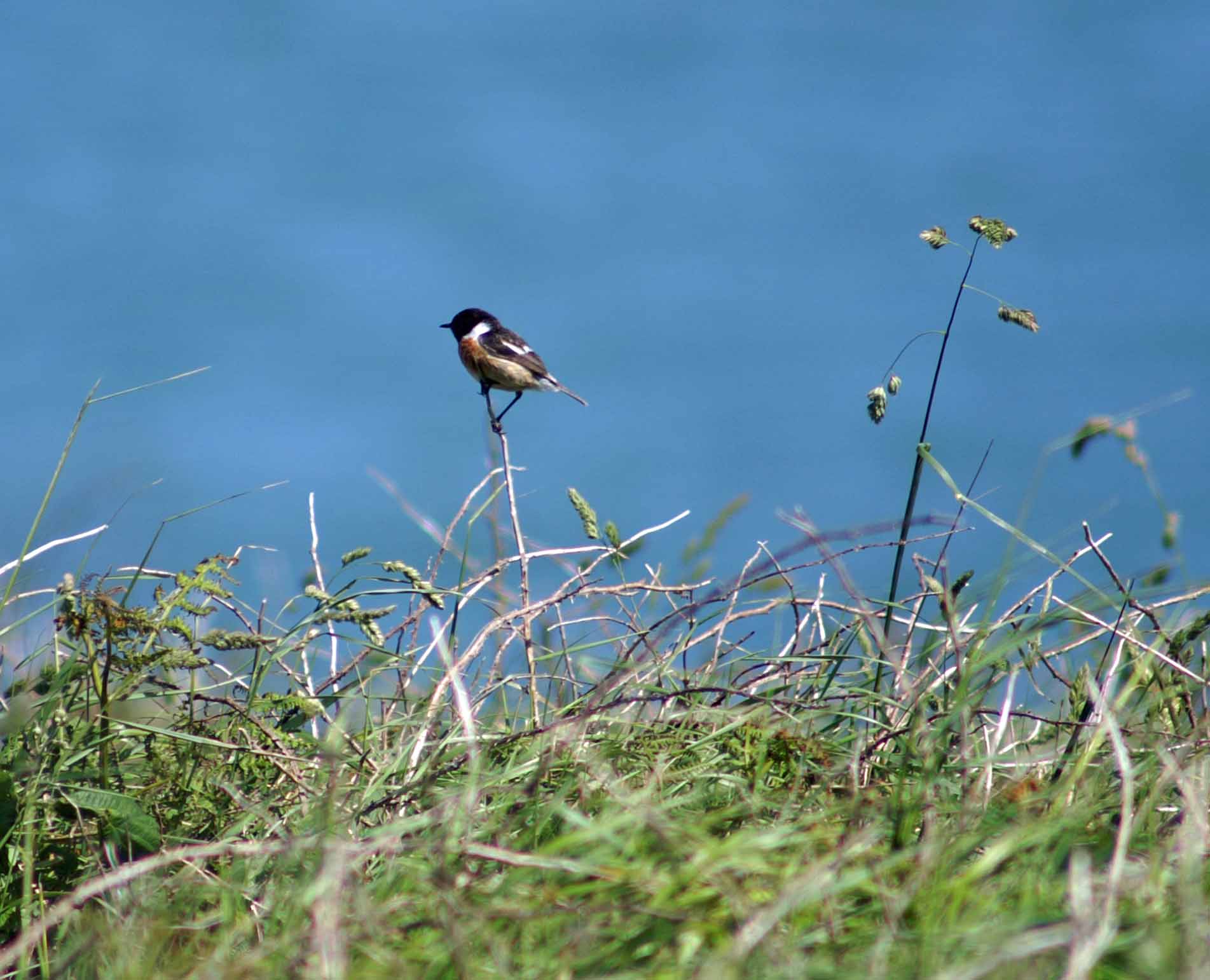
The first bird we had a good view of was this little Stonechat female (Saxicola torquata), who was very shortly joined by a male.

The Stonechat male perched just a short distance away from his mate

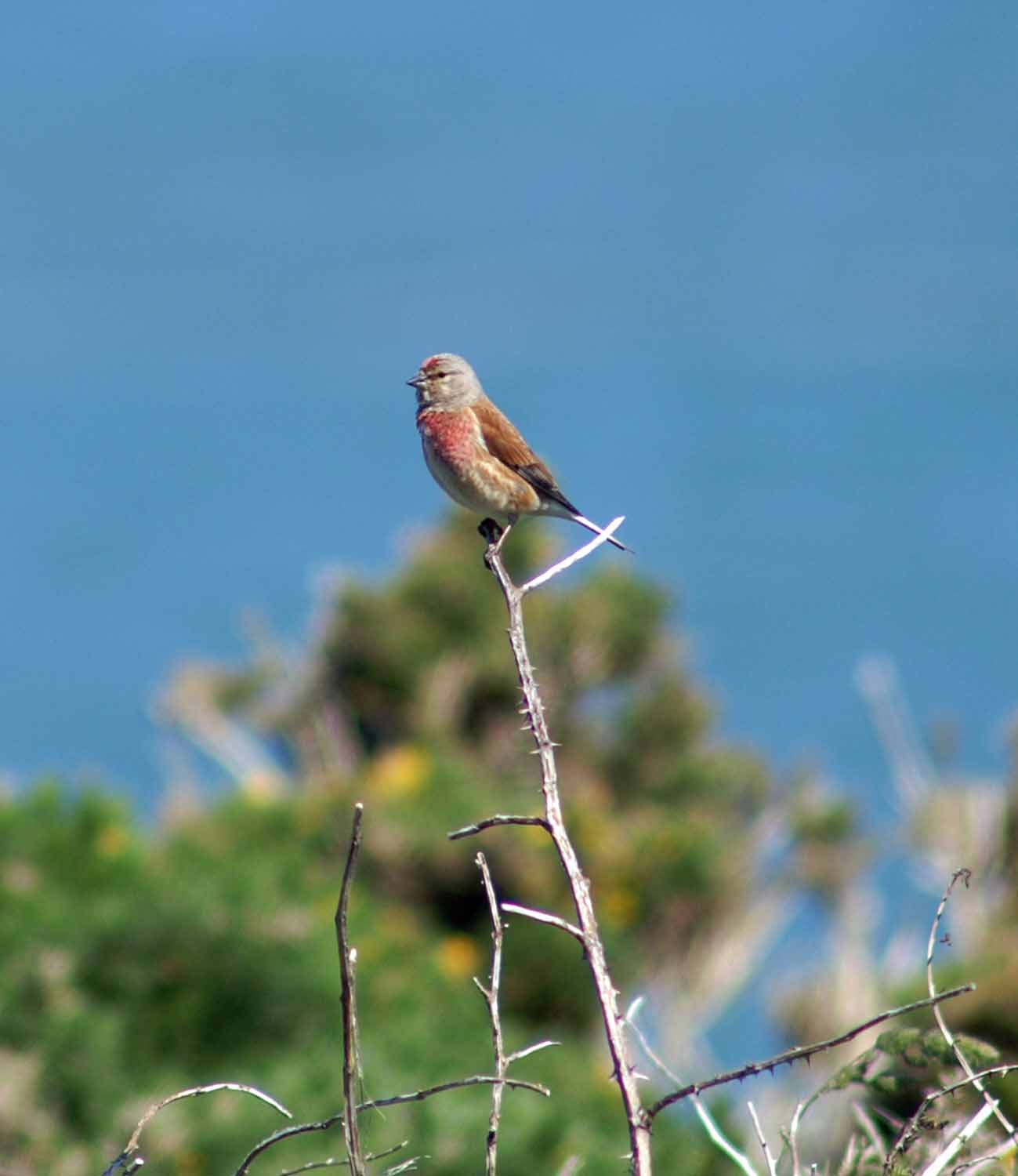
There were several Linnets flying around and one beautiful male landed quite near us on a bramble and began to sing.

This beautiful male Linnet was singing from atop a dead bramble stem

It was sunny here, but windy too, so it was some consolation to think that those on the boats travelling across to Skomer would probably be feeling the combined effects of the cold wind and choppy sea in a not-too-pleasant way. Yes, very immature, especially as we have actually made the journey in even rougher conditions, survived and gone on to have a spectacular day. Anyway, onwards and upwards to Wooltack Point. The views out over St.Bride’s Bay are truly spectacular, but the sea around this point can be treacherous with concealed rocks and strong currents, hence the presence of the Coastwatch.

The incorrectly marked compass (click to enlarge)

We attempted to work out the layout of the islands we could see, picking out Skomer easily as it was close by and Ramsey Island as we recognised the shape of St. David’s Head, but were guessing at the others. I spotted a compass of sorts on a plinth outside the door of the stone hut and as I leaned in to take a picture of it the coastguard popped out to tell us that its directions are useless as all points are wrong. Apparently even the North marking is incorrect. He was quite amused by the fact that “there is nowhere in the world from which that plaque would be correct” and has no idea why it has never been replaced.

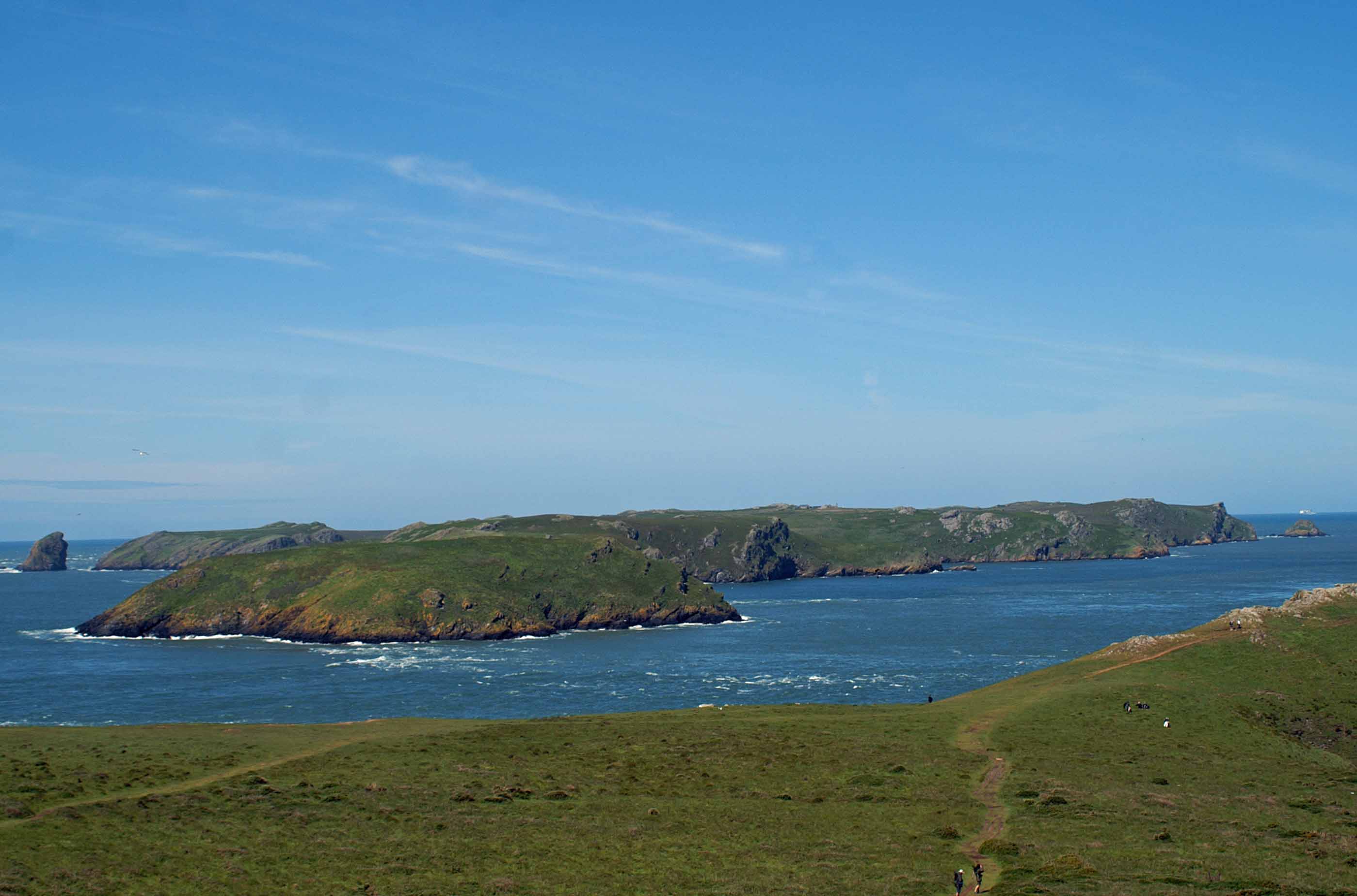
The nearest we got to Skomer Island today, just 2 miles across the Sound

Ramsey Island, 9.5 miles away is located off St David’s Head

Dropping down onto the cliff in front of the hut we discovered it to be sheltered from the wind and much warmer. We sat there for at least an hour watching the array of seabirds flying back and forth or swimming and diving around the rocks below us.

Razorbills were the most numerous birds on the water, but there were a few guillemots and cormorants too.

Razorbills swim on the surface then suddenly make a synchronised dive and disappear underwater for ages, eventually reappearing some distance away

Cormorant flying close to the rocks, low over the water

Herring Gulls passed us by very closely

Lesser Black-backed gulls were another frequent sight

We were delighted by the appearance of Grey Seals in the sea just below us, and even more thrilled when we realised there were dolphins too. The first dolphin we picked up on was following the Skomer boat on its return trip to Martin’s Haven, but soon realised there were at least three in total.

Grey Seal

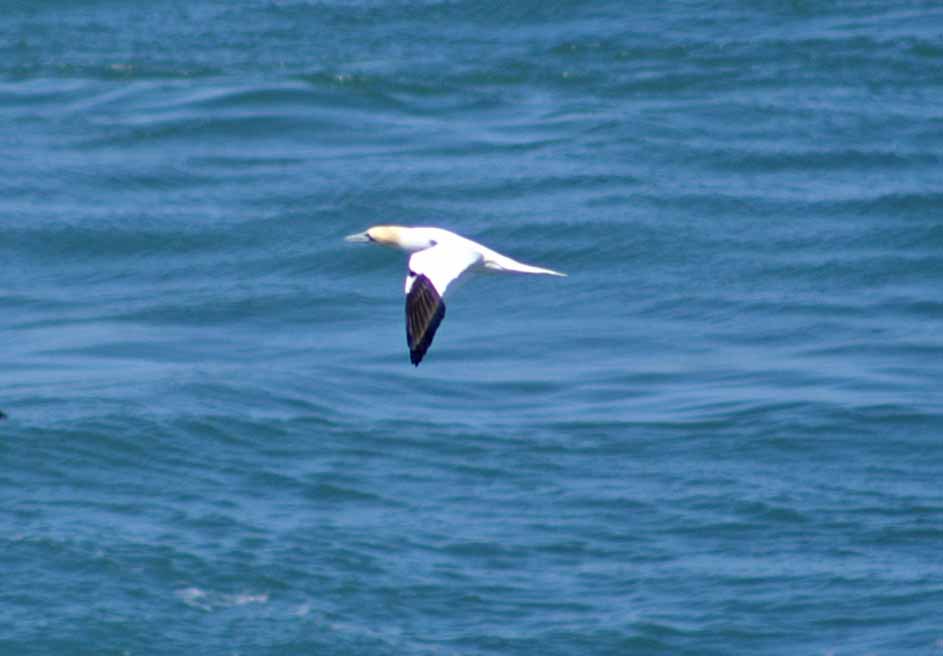
The island of Grassholm is occupied by an enormous colony of breeding Gannets (another highly recommended trip to take) and although it is 10 miles away from where we were today we kept a hopeful look out. We were rewarded with an initially distant sighting of a number of the birds circling and diving, but over the course of twenty minutes or so they gradually worked their way towards us, clearly following the progress of a shoal of fish. This is why the dolphins were there too. It would have been lovely to have had closer views, but both they and the birds were near enough to be seen well through binoculars.

One of a number of Gannets closely following a shoal of fish

The spot we had chosen to settle in seemed to be within the territory of a Pipit. He made several tours of the rocks immediately around us, making some rather disgruntled noises, clearly not happy with us, but otherwise undeterred by our presence.

I think this is a Meadow Pipit, but going on its location, it could be a Rock Pipit

The Pipit demonstrating his ‘parachuting’ display flight whilst singing

This is undoubtedly a tough environment for wildflowers, but there was thrift and sheep’s bit flowering and almost squashed into the short grass several tiny specimens of pretty blue spring squill.

There were bumblebees visiting most of the available flowers

Leaving our sheltered viewpoint we continued our walk around the remainder of the headland then cut back inland towards the car.

Rocky coves with sheltered beaches such as the one below the cliff here on the far side of the peninsular are perfect places to see grey seals and their pups. The land in the top right of the picture is the tip of Skomer.

Next on the agenda was to seek out another sheltered spot in which to eat our lunch. With hindsight we did consider that perhaps if we had not stopped at M & S in Haverfordwest for decent sarnies we may have squeezed onto that boat … ? (Normally we would have made our own, but pinned in by the tree we couldn’t get out to the shops yesterday and had no suitable supplies.) But, on the bright side,  it was more than pleasant here and we had had some very fresh air and some wonderful sights. We located another likely spot to enjoy our food in and settled down. We soon realised we were being watched; a baby bunny was peeking through the grass at the top of a sandy hillock close by that we could now see was above the entrance to a warren.

Baby rabbit on the roof of the family home

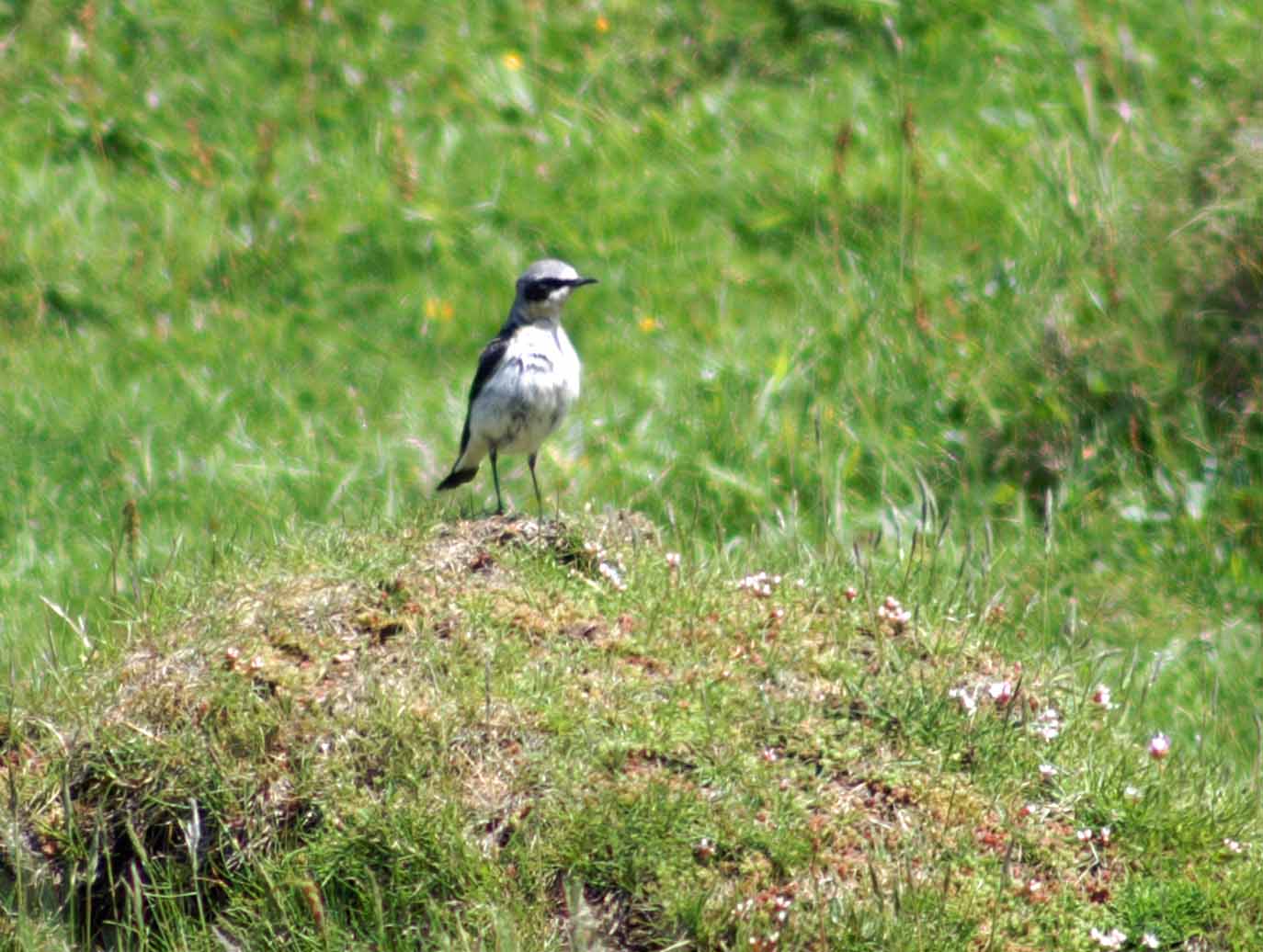
We were thoroughly enjoying our lunch sitting on a grassy bank in a warm and sunny spot, appreciating our beautiful surroundings and reviewing the wealth of sights we had enjoyed, when another bird appeared in front of us. This was a handsome jaunty male Wheatear and once again we seemed to have settled ourselves in the middle of his territory. He seemed to be making a point of travelling around us, settling on rabbit hills, brambles, rocks and the like. We did feel a little guilt but carried on enjoying the sight of him quietly, staying as still as is possible whilst yielding a hefty camera lens.

A female appeared too from the same direction and made a similar circuit, so we surmised that they had a nest located somewhere behind the bank occupied by the rabbits. Beautiful birds.

The very handsome male Wheatear asserting his territory from the top of a rabbit hill

The female Wheatear with her browner plumage is also a very attractive bird

Arriving back at the lane leading to the beach we headed for the loos to find there was an unusual queue to enter the building. A number of Barn Swallows were waiting for people to leave, taking their opportunities to swoop in to their nests built in various places inside.

One of a pair of Barn Swallows waiting to get into the toilet block and back to their nests

Although they are a familiar sight swooping and gliding over the countryside, it’s not often you get such close views of these elegant birds and to appreciate their very glossy plumage.

This bird was taking advantage of the waiting time to thoroughly preen its feathers

I was listening and watching for a sight of a Whitethroat, as we have always seen them here in the past, but not so today. As we made our way up the hill towards the car park we did see another Wheatear and had a quick glimpse of the back of a Dunnock singing from a bramble patch.

A quick glimpse of a Dunnock that was singing from a bramble patch

Not the outing we had planned, but a thoroughly enjoyable few hours spent in a beautiful place and still with a bit more to come….

Share this:

  • Click to share on Facebook (Opens in new window) Facebook
  • Click to share on Pinterest (Opens in new window) Pinterest
  • Click to share on X (Opens in new window) X
Like Loading...

The Foxglove – of Fairytales, Myths & Medicine

20 Wednesday Jun 2012

Posted by theresagreen in coastal walks, flower folklore, flower mythology, Nature, nature photography, The Wales Coast Path, wildflowers, Wildlife of the Wales Coast Path

≈ 22 Comments

Tags

digitalis purpurea, foxglove, medicinal plants, Pembrokeshire coastal path, plants associated with fairies, poisonous wildflowers

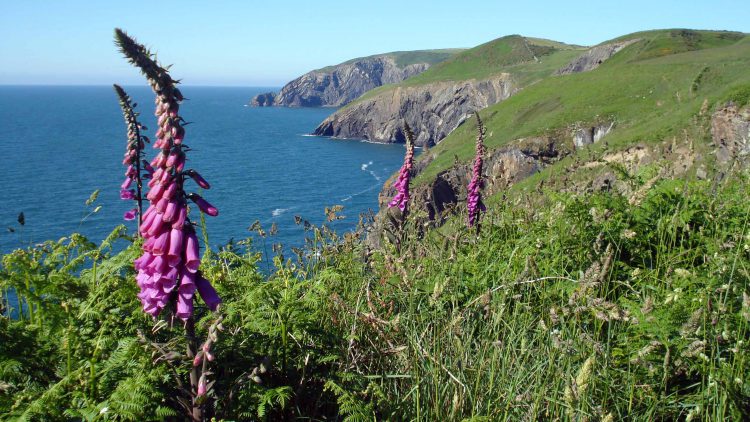
June is the month when elegant Foxgloves are at their best in many parts of Wales. I took most of the photographs in this post in Pembrokeshire where they adorn woodlands, roadsides and cliffs of the mainland and some of the offshore islands. Beautiful to behold, poisonous in the wrong hands yet life-saving when used for good, they have a long-held and fascinating place in our natural history.

Foxglove-Digitalis purpuraea


Foxglove–Digitalis purpurea – Welsh – Ffion or Maneg Ellyllyn — The Good People’s Glove

The graceful Foxglove is a downy biennial herb that thrives in acidic soils in a wide range of habitats. In their first year large downy basal leaves are produced, followed in their second year by impressive flower spikes from 3-6 feet (1-2m) tall. The plants die once they have seeded, but if the flowers are picked before they go to seed, the basal leaves will last another year and they will attempt to seed again.


Flowers open first at the base of the stem and graduates upwards

A stand of Foxgloves in a Pembrokeshire woodland

Three basic colours self-seed – pink, purple & white. They can come true to the parent plant where colour forms are isolated, but they cross-pollinate freely & many stands of foxgloves include all three shades.

In a Pembrokeshire woodland


In Wales the Foxglove  is a characteristic plant of early summer, thriving on acidic soil in the shady conditions of open woods, woodland clearings and hedge banks. But it also tolerates the open and exposed habitats of moorland and heath margins, sea-cliffs and rocky mountain slopes.

It may also  appear where  ground has been disturbed, such as in newly cleared woodland, or where the old vegetation has been burnt.


Pembrokeshire Coastal Path

ORIGIN OF THE NAME

There have been many suggestions for the derivation of the name “foxglove”. It is an ancient name and exists in a list of plants as old as the time of Edward III (King of England from 1327-1377). The prefix ‘fox‘ has most likely been commuted over time from “folks”, who to our fourteenth century ancestors were the fairies, but so-called as to speak of them  explicitly was believed to get their attention & cause them to do mischief.  ‘Glove‘ may have come from the Anglo-Saxon gliew, which was the name for a musical instrument consisting of many small bells. So, put the two together and you could make it ‘Fairy Bells’. However it came about, Foxglove is the English  common name we all know and love it by.

There appear to be two Welsh names for the Foxglove, one is Ffion, from which the popular Welsh female name is taken and the other Maneg Ellyllyn which translate as  “The Good People’s Glove.” Similar then to Folk’s Glove and its association with fairies.

In Gaelic they were Lus Mor, the Great Herb, for being the most magical of all herbs.

Plants that are widespread & medicinally potent invariably acquire a large number of folk-names, & the foxglove’s many names are a case study in our ancestor’s imaginations.

A whole host of alternative common names reflect the association with fairies Fairy Caps, Fairy Gloves, Fairy Thimbles, Fairy Herb, Fairybells, Fairy-fingers, Goblin Gloves, Fairy Petticoats, Fairyweed.

Another name, Dead Man’s Bells served to warn of the plant’s poisonous disposition.

The names Flopdock, Floppydock, Flop-a-Dock, Flapdock, Popdock, Flop-poppy, Flop-top, Cowflop, Gooseflops, Rabbit’s Flowers or Bunny Rabbits all allude to the foxglove’s large soft downy leaves.

Mythology and legends

One story has it that fairies would hide themselves inside the flowers. Mischievous children, wanting to hear fairy thunder, would hold one of the flower bell then strike the other end on their hand. The poor fairy, rightly upset and probably rather cross, would make a snapping sound, a clap of fairy thunder, while she escaped from her retreat.

Another Welsh legend explains why foxgloves bend and sway so gracefully. It has nothing to do with the wind, but that as the flower is sacred to the fairies, it has the power of recognising them, and indeed all spiritual beings who pass by, and that it bows in deference to them as they waft along.

Foxgloves supposedly bowed to Fairies

IN ENGLISH LITERATURE

At least two great poets, Wordsworth and Tennyson were moved to immortalise the foxglove in words; the former clearly aware of  the deadly qualities of the plant. In The Borderers, a tragedy, a woman describes a dream she had:

“My poor Babe
Was crying, as I thought, crying for bread
When I had none to give him; whereupon,
I put a slip of foxglove in his hand,
Which pleased him so, that he was hushed at once:
When, into one of those same spotted bells
A bee came darting, which the Child with joy
Imprisoned there, & held it to his ear,
And suddenly grew black, as he would die.”

Sounds more like a nightmare to me!

Tennyson names the flower in the poem ‘In Memoriam’ –

” …. Bring orchis, bring the foxglove spire…”

and also in ‘The Two Voices’ –

”  ….The foxglove cluster dappled bells …”

MODERN MEDICINAL USES

Foxglove-digitalis purpurea. A plant that is beautiful on the outside but toxic at its heart. All parts of the plant are poisonous.

Foxglove is the source of  digitalis, derived from several cardiac glycosides produced by the plant, and widely used as a heart medication. It is used to increase cardiac contractility and as an antiarrhythmic agent to control the heart rate, particularly in individuals affected by irregular (and often fast) atrial fibrillation and especially if they have been diagnosed with congestive heart failure. Which basically translates to it regulates the heartbeat.

The use of Digitalis purpurea extract containing cardiac glycosides for the treatment of heart conditions was first described in English language medical literature by William Withering, in 1785, which is considered the beginning of modern therapeutics.

With careful usage and expert pharmaceutical  guidance, doctors have subsequently used digitalis and saved thousands of lives, but it is at the same time a dangerously toxic plant. Used wrongly it can cause heart palpitations, delirium, hallucinations, vomiting, & possibly death.

TRADITIONAL, FOLK & HERBAL MEDICINE

Modern-day herbalists have largely abandoned the use of digitalis because of its narrow therapeutic index and the difficulty of determining the amount of active drug in herbal preparations. Once the usefulness of digitalis in regulating the human pulse was understood, it was employed for a variety of purposes, including the treatment of epilepsy and other seizure disorders, which are now considered to be inappropriate treatments.

The Doctrine of Signatures

The openings of the bells were thought to resemble an open animal’s mouth

Foxglove flowers were supposed to look like an animal’s open mouth. Within the doctrine of signatures this meant it must have some medicinal value in treatment of injuries of the mouth & throat. The speckles in the mouth of the flower were, according to the Doctrine symbolic of inflammation of the throat. Another array of folk-names reflect foxglove’s association with the mouth: Throatwort, Rabbit’s Mouth, Bunny Mouths, Tiger’s Mouth, Duck’s Mouth, Gap-Mouth, & Dragon’s Mouth.

Another, less charming name of Scabbit Dock came about as in Culpepper’s day Foxglove was used in an ointment or shampoo for treating impetigo or “scabby head”.

Midwifery

An association with midwifery probably gave rise to the names Granny’s Gloves or Granny’s Bonnets, & Witch’s or Witches’ Gloves. Witches & grannies, or at least midwives & other herbal practitioners, had many uses for this plant. Dr William Withering, the aforementioned man credited with discovering digitalis as a heart remedy circa 1775, apparently learned of its potency from an unnamed midwife.

September – The dried seedhead of a Foxglove still stands-Conwy Mountain


Share this:

  • Click to share on Facebook (Opens in new window) Facebook
  • Click to share on Pinterest (Opens in new window) Pinterest
  • Click to share on X (Opens in new window) X
Like Loading...
← Older posts
Newer posts →
Follow everyday nature trails on WordPress.com

Enter your email address to follow this blog and receive notifications of new posts by email.

‘But it is the common species that keep the living world ticking over and provide most of our experiences of wildlife, and I would argue that maintaining the abundance of these is as important a conservation priority as maintaining the existence of rarities’. Richard Mabey

MOST RECENT POSTS

  • A Glimpse of Spring to Come January 22, 2025
  • Hunting the Wren December 28, 2024
  • Oh, Christmas Tree December 18, 2024
  • In and Out of the Ivy February 15, 2024
  • Nature’s Fireworks November 30, 2023
  • Wild Autumn along the Coast Path November 3, 2023

OLDER POSTS

LOOKING FOR SOMETHING IN PARTICULAR?

  • Pretty prickly Thistles
    Pretty prickly Thistles
  • The Foxglove - of Fairytales, Myths & Medicine
    The Foxglove - of Fairytales, Myths & Medicine
  • Fine Dining for Crows
    Fine Dining for Crows
  • Pines and Primroses
    Pines and Primroses
  • Grey Seals in North Wales
    Grey Seals in North Wales
  • Bryn Euryn - a walk of several parts. Part 1
    Bryn Euryn - a walk of several parts. Part 1
  • A Blackthorn Winter
    A Blackthorn Winter
  • Birds and the art of fly catching
    Birds and the art of fly catching
  • Grey Seals on the rocks
    Grey Seals on the rocks
  • What a beautiful day
    What a beautiful day

nightingale trails

The Walk of the Monarch Butterfly-Sendero de la Mariposa Monarca

The Walk of the Monarch Butterfly-Sendero de la Mariposa Monarca

MY WILDFLOWER BLOG: where the wildflowers are

Snowdrop

Snowdrop

most recent posts

Follow everyday nature trails on WordPress.com

Social

  • View teresamaygreen’s profile on Twitter

Enter your email address to follow this blog and receive notifications of new posts by email.

Website Built with WordPress.com.

  • Subscribe Subscribed
    • everyday nature trails
    • Join 359 other subscribers
    • Already have a WordPress.com account? Log in now.
    • everyday nature trails
    • Subscribe Subscribed
    • Sign up
    • Log in
    • Report this content
    • View site in Reader
    • Manage subscriptions
    • Collapse this bar
 

Loading Comments...
 

    %d