• Home
  • about
  • about the photographs
  • Local Nature Reserves
    • Bryn Euryn Local Nature Reserve
    • Mynydd Marian
  • Wales Coast Path
    • Grey Seals in North Wales
    • St.Trillo’s Chapel
    • Wildflowers of North Wales Coastal Paths, Cliffs and Dunes

everyday nature trails

everyday nature trails

Category Archives: North Wales

An Ancient Yew

11 Monday Jan 2016

Posted by theresagreen in Nature, Nature of Wales, North Wales, Welsh culture and mythology

≈ 18 Comments

Tags

Ancient Trees, ancient yew trees, Llangernyw Yew, St Digain's Church, taxus baccata

There are just three species of conifer that are true natives of Britain; the Yew-Taxus baccata, the Juniper-Juniperus communis and the Scots Pine-Pinus sylvestris. All of them are found growing ‘in the wild’ in this part of North Wales, but of the three species it is the Yew that predominates.

150104TGFL-Bryn Euryn 4-Yew leavesThe Yew tree is a familiar sight in many churchyards throughout Great Britain and some are even older than the Christian faith itself due to their ability to regenerate and regrow. Wales is one of the most significant places in Europe for ancient and veteran yew trees and most are found in churchyards. Sacred to Druids and Celts, yews would have marked venerated places in pre-history, many of which became Christian sites later on. Our wet climate and lower light levels led to a deeper veneration of one of the few native evergreen plants.

The subject of this post is the most ancient of them all. It is located in the churchyard of St. Digain’s in the small village of Llangernyw, sited in the Elwy Valley in Conwy county, which I went to see on a lovely day at the end of last autumn.

This amazing tree is recognised as the oldest known tree in Wales and England and furthermore, at an estimated 4,000 years old  as one of the oldest living things in the world. There are no barriers or signs prohibiting you from approaching or touching the tree, which is a rare privilege in itself, but to be in the presence of a living entity that may have begun its life in what was the Bronze Age in Britain is incredible.
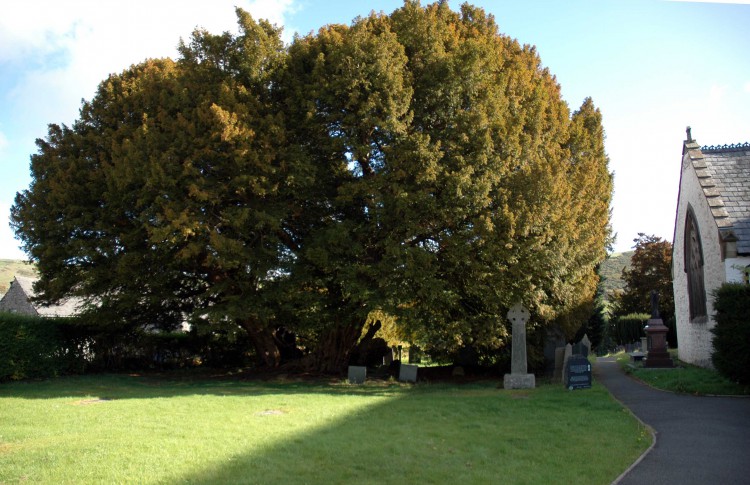
The Old Yew Tree St Digain's, Llangernyw

The Old Yew Tree, St Digain’s, Llangernyw

151022-Llangernyw-Ancient Yew 4a

The tree is male, so bears no berries. The body of the tree is fragmented; its core part has been lost, leaving several enormous offshoots growing from its base, still thriving despite not always being treated with the respect it commands now. In the mid-1990s the church oil tank stood in the space between the two trunk fragments and much of the dead wood was removed  from the site when the tank was built, which made dating the age of the tree more difficult for experts in the field (known as dendrochronologists). Thankfully the tank was removed when it was realised that the tree was ancient.

The fragmented trunk of the tree

The fragmented trunk of the tree

In 1995 a plaque was erected by the Tree Council giving the estimated age of the tree as just over 4,000 years; the age being determined by a calculation using a formula based on the girth if the tree, which is a mighty 12.5 metres, or 41 feet at ground level.
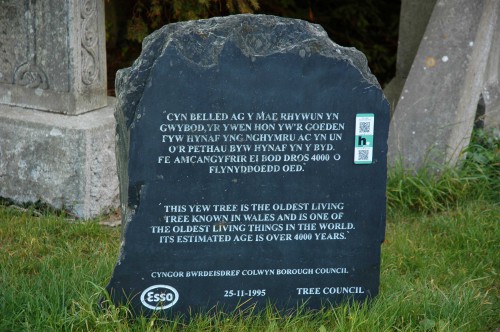
151022-Llangernyw-Ancient Yew monument stone 1

In June 2002, the tree was granted more recogntion by the Tree Council, in celebration of the Golden Jubilee of Queen Elizabeth II, it designated the Llangernyw Yew tree one of the Fifty Great British trees in recognition of its place in national heritage.

Looking up into the canopy

Looking up into the canopy

According to a survey by the Ancient Yew Group, the Church in Wales owns 334 yew trees which are more than 500-years-old, which they equate to owning 95% of all the Grade 1 listed buildings in Wales.

Celtic cross memorial stone

Celtic cross memorial stone

The original church was founded here by Digain, son of Cystenyn Gorneu, a Saint of the 5th Century. Parts of the attractive building now standing date back to the early 15th century, including the roof construction, an interior door and the stoup.
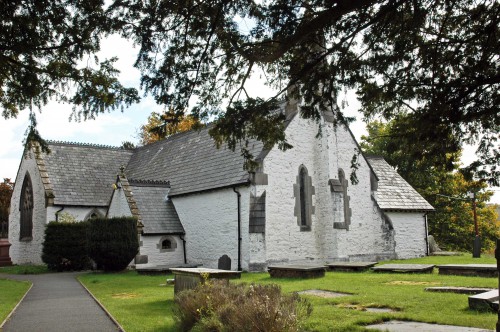
St Digain's Church, Llangernyw, in the parish of St Asaph

St Digain’s Church, Llangernyw, in the parish of St Asaph

There are  other yew trees growing within the site and the church is framed in the photograph above by trees that flank the lych gate.

151022-Llangernyw-Church lych gate and yew trees 1

Lych gate and yew trees

The lych gate was erected in 1745 at a cost of three pounds, fifteen shillings and sixpence in old money; £3.76p now.
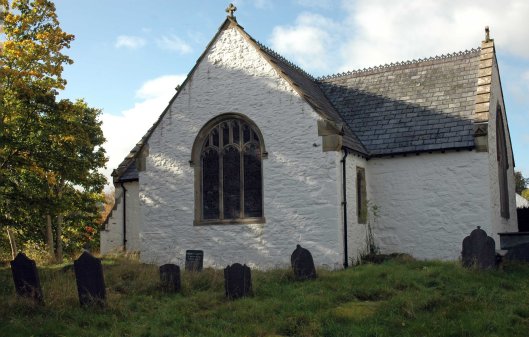
151022-Llangernyw-Church from the back 1

The church from the back

Some interesting pieces from the church interior:

151022-Llangernyw-Church inside 2a
The font
The font
151022-Llangernyw-Church organ 1
151022-Llangernyw-Church furniture 1
151022-Llangernyw-Church stained glass window 1
151022-Llangernyw-Church stained glass window 2a
151022-Llangernyw-Church window 1

It’s well worth visiting Llangernyw for the wonderful scenery surrounding the village – the road from Abergele to Llanwrst is rightfully designated a ‘scenic route’.

(click on images for a  better view)

151022-Llangernyw-Llanwrst view 4a151022-Llangernyw-Llanwrst view 5a151022-Llangernyw-Llanwrst view 9a

Before I go, I’d like to wish everyone a happy, healthy, peaceful 2016 and to thank all of those that have followed, commented and/or liked posts and pages on this blog during 2015. Thank you for your loyalty too; the recent lack of posts are due to a challenging health issue that presented itself in the last months of 2015, with no warning (!), that will demand a few months more of treatment and may commute my meanderings to ‘potterings’. Posts may be erratic for a while, but the best therapy for me is getting out and about, so as and when weather permits I will be checking on what’s happening around me and keeping things current. Meanwhile I have a whole library of photographs to draw on and look forward to seeing and hearing what you are all up to.
 

Share this:

  • Share on Facebook (Opens in new window) Facebook
  • Share on Pinterest (Opens in new window) Pinterest
  • Share on X (Opens in new window) X
Like Loading...

Autumn

27 Tuesday Oct 2015

Posted by theresagreen in Bryn Euryn Nature Reserve, Bryn Pydew, Nature, Nature of Wales, nature of woodlands, nature photography, North Wales, Wildflowers of Wales, woodland walks in Wales

≈ 7 Comments

Tags

ash leaves, autumn colour, autumn leaves, eristalis pertinax, fallen leaves, goldenrod, hazel leaves, North Wales Wildlife Trust, oak leaves, puffball fungus

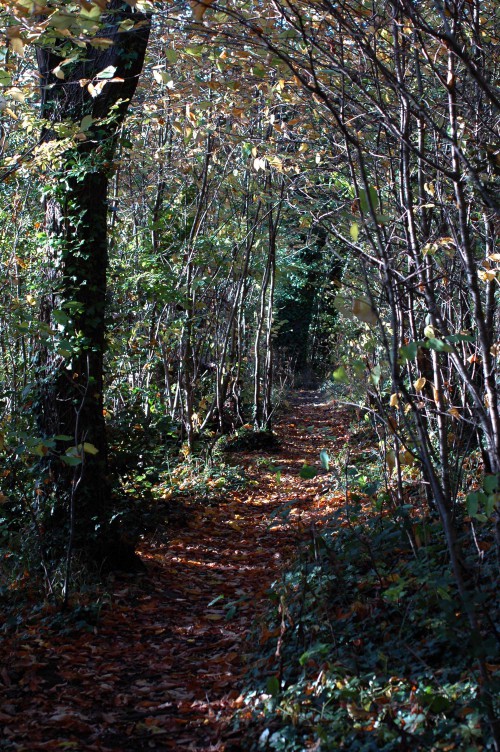
Autumn in North Wales is glorious this year thanks to a prolonged sunny and mild spell of weather, as yet broken only occasionally by rain. Walking between the trees in the dappled shade of the woodland along sun-striped paths thickly carpeted with fallen leaves in all the shades of the season, has been truly joyful. As October draws to an end, here are some of my views of the month.

151021-Bryn Euryn Woods 4a-Path sun-striped 151021-Bryn Euryn Woods 5a-Path leaf-strewn

Ivy is flowering now providing vital supplies of pollen and nectar to late-flying insects.

151021-Bryn Euryn Woods 2a- Ivy flower

Ivy is flowering

151021-Bryn Euryn Woods 8a-Woodland Trail

Ash trees leaves have mostly turned to a bright yellow.

151021-Bryn Euryn Woods 7a-Ash tree canopy

Ash tree canopy

Many have already fallen.

151021-Bryn Euryn Woods 10a-Woodland Trail-Ash leaves

Strings of Black bryony berries are strung between stems of lower-storey vegetation

151008-Bryn Pydew (29)

Black Bryony berries

151021-Bryn Euryn Woods 9a-Woodland Trail

151021-Bryn Euryn Woods 6a-Hazel leaves

Hazel leaves fallen

Oak trees are in varying shades, some still retaining a lot of green where they are in shade while those exposed to more sunlight have turned golden.

151008-Bryn Pydew (6a)-Oak leaves turned yellow & blue sky

Last year there was a national shortage of acorns and here at least it doesn’t look as though this year is going to be any more productive.

Sessile Oak and acorns

Sessile Oak and acorns

151008-Bryn Pydew (37a)-Cherry gall under oak leaf

Cherry gall under an oak leaf

Female Yew trees have ripening pink-red berries

151008-Bryn Pydew (53a)-Yew berry

On the woodland edges and in clearings there is still plenty to see.

151008-Bryn Pydew (2a)-Blackberries & clematis

Late blackberries and Old Mans Beard

In a sunny spot I watched a gathering of a dozen or so hoverflies. Some were hovering and darting around, others were attempting to bask in the sunshine but were deliberately disturbed by their dive-bombing peers.

151008-Bryn Pydew (11a)-Eristalis hoverfly

Bryn Pydew-Eristalis pertinax

On limestone pavement I found Herb Robert leaves that have turned beautiful shades of red

151008-Bryn Pydew (43a)-Herb Robert leaves turned red

Goldenrod is a favourite late flowering plant

151008-Bryn Pydew (30a)-Goldenrod flower stem

Goldenrod

although most plants have set seed by now.

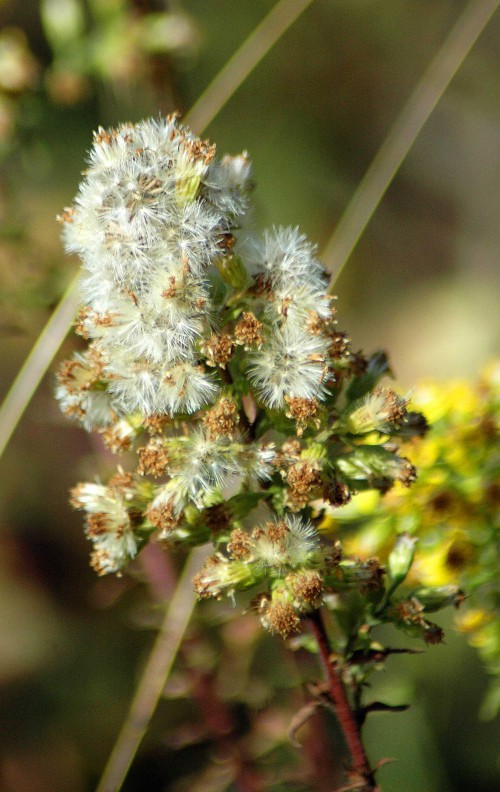
Goldenrod seedheads

Goldenrod seedheads

Tucked into a damp sheltered corner where two quarried limestone walls meet, a maidenhair spleenwort fern remains fresh and green.

151008-Bryn Pydew (35a)-Maidenhair Spleenwort

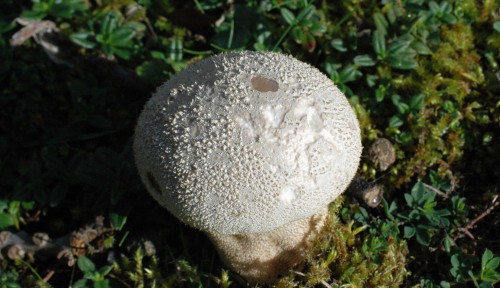
And of course there are fungi, this is one of the few that I recognise!

151008-Bryn Pydew (48a)-Puffball

Puffball

And to finish, a corvid feather, just because I liked it.

151008-Bryn Pydew (59a)-Corvid feather


Share this:

  • Share on Facebook (Opens in new window) Facebook
  • Share on Pinterest (Opens in new window) Pinterest
  • Share on X (Opens in new window) X
Like Loading...

Secret passage behind the sea wall 2

17 Saturday Oct 2015

Posted by theresagreen in Birds, birds of the seashore, birds of Wales, coastal walks, Nature, Nature of Wales, nature photography, Rhos Point, Rhos-on-Sea, Wales Coast Path

≈ 4 Comments

Tags

Crows on seashore, curlew flying, herring gull, meadow pipit, mussel bed, Rhos Point

An hour or so later the walk back to Rhos Point was quite different. The going was easier too as the strong wind was behind me now and not taking my breath away. Almost immediately I caught sight of a bird hopping around on the rocks. I waited hoping it would come into view, which it did, just as a woman with a dog approached and chose that moment to break into a run. The bird flew away. Again it was a pipit, possibly the same one I’d seen back on the beach. The legs are pinkish and plumage brown so maybe a Meadow Pipit?

151007TGNW- Penrhyn Bay-Pipit on rocks 3

151007TGNW- Penrhyn Bay-Pipit on rocks 4

A small sedum plants looks at home in a pocket eroded in a limestone rock.

151007TGNW- Penrhyn Bay-Sedum

Small pools of rainwater are held briefly, lasting longer in the hard granite rocks.

151007TGNW-6d-Rock pool 2

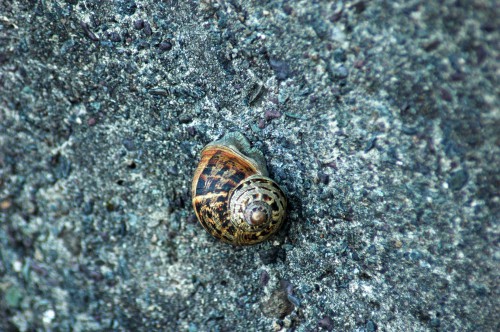
The garden snail must have found it hard going sliding over the rough surface of the sea wall.

151007TGNW-15-Sea wall- Garden snail

151007TGNW-Rock with moss

151007TGNW--Penrhyn Bay-Wasp

151007TGNW- Penrhyn Bay-sign at top of ramp

There is a wide concrete ramp reaching from the road down to the shore which probably gave access to heavy construction vehicles when the huge boulders of the sea defences originally were put in place. The lower section is being absorbed back into the shore, it is strewn with pebbles and small rocks and slippery with seaweed. Limpets are embedded into the wall itself as well as in large rocks on the shore at the bottom of the ramp.

151007TGNW-Limpets embedded in rock

I love the textured ‘lacy’ look of this rock almost covered with barnacles.

151007TGNW-Rock covered with barnacles & limpets

The sea is often at its most beautiful on these sunny windy days, its surface whipped up roughened and flecked with foam-edged ripples and the colour of the water ranging from deepest inky dark blue to pale turquoise-green. Large areas are stained brown by dredged up sand.

151007TGNW- Penrhyn Bay-Back to Rhos-Sea colours 1

Sun, shade and curves make this man-made construction interesting.

151007TGNW- Penrhyn Bay-Back to Rhos

The white marks highlighting the curved sea wall are mineral, maybe lime leached from the concrete?

151007TGNW-5-Wall markings-Rhos-on-Sea promenade

The parapet floor has an interesting pattern and texture and is spotted with patches of white lichen.

151007TGNW- Penrhyn Bay-Back to Rhos-Concrete floor3

As I got nearer to the Point I knew the tide was further in by the increased bird activity; the excitement it generates is almost tangible. Gulls take to the air and fly back and forth along the shoreline. Oystercatchers and other waders scuttle about, heads down, beaks probing for anything edible brought in on the waves.

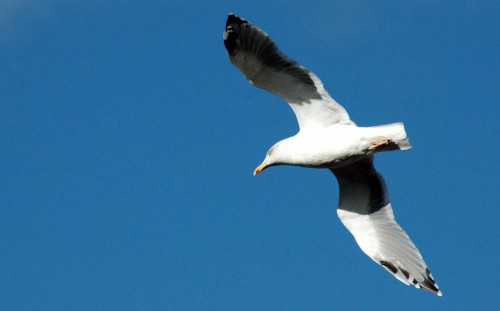
151007TGNW- Penrhyn Bay-Back to Rhos-Herring gull

151007TGNW- Penrhyn Bay-Back to Rhos-Herring gull young 1

Crows head shorewards too, the one in my picture landed on a lampost towering above me, cawing loudly. They forage amongst the rocks along with the waders and are often seen picking up a shellfish then flying up with and dropping it onto the rocks below to crack it open.

151007TGNW- Penrhyn Bay-Back to Rhos-Crow 1

Even the curlews were excited. Most often seen stalking sedately around rocks and pools, now there were several flying along at speed, skimming low over the rocks on the shore below me. A couple of them may have been in pursuit of the one I managed to capture a shot of; it was travelling so fast I didn’t realise it had food in its beak until I saw the photograph.

151007TGNW- Penrhyn Bay-Back to Rhos-Curlew

On the Point the incoming tide approaches from either side of the mussel bed, where I assume different currents merge. The birds have an infallible instinct for the tidal changes and in the hour before and after high tide their numbers increase dramatically. They are brought closer to the shore then too and absorbed with foraging and eating, are easier to see.

151007TGNW- Penrhyn Bay-Back to Rhos-Sea colours on point

151007TGNW- Penrhyn Bay-Back to Rhos-Oystercatchers active

It was too cold and windy to hang around and wait today though, so I had a quick peek into the chapel, which I can never resist. There are only 6 seats inside, so I wonder if they’ve lined up these memorial benches on the promenade outside to serve as overflow pews?

151007TGNW- Penrhyn Bay-Back to Rhos-benches 2

Many young Herring gulls wander around the village at this time of year, often screeching for the attention of a parent. They have no road sense and sadly quite a few are killed by cars.

151007TGNW- Penrhyn Bay-Back to Rhos-Herring gull young on road edge

Share this:

  • Share on Facebook (Opens in new window) Facebook
  • Share on Pinterest (Opens in new window) Pinterest
  • Share on X (Opens in new window) X
Like Loading...

Llechwedd Slate Caverns

25 Tuesday Aug 2015

Posted by theresagreen in Nature of Wales, North Wales

≈ 4 Comments

Tags

Llechwedd Slate Caverns, slate, slate mining in North Wales

Thus far this week the weather has been damp and grey with only intermittent bursts of sunshine, so I opted for a couple of days of not going out walking and instead spending some time sorting through a backlog of photographs. It’s been interesting, not least because some of them are from this time last year and guess what? The weather was damp and grey with only intermittent bursts of sunshine.

140826TGNW-Llechwedd Slate Mine (42)

My family were visiting at the time and were keen to try out the then newly-opened giant underground trampoline  that is located within the Llechwedd Slate Caverns at Blaenau Ffestiniog. The idea of the bouncing didn’t much appeal to me, but it’s been a few years since I visited the site and as an extra car + driver was needed I was happy to oblige and to wander around while they all sought underground thrills.

Llechwedd Slate Mines

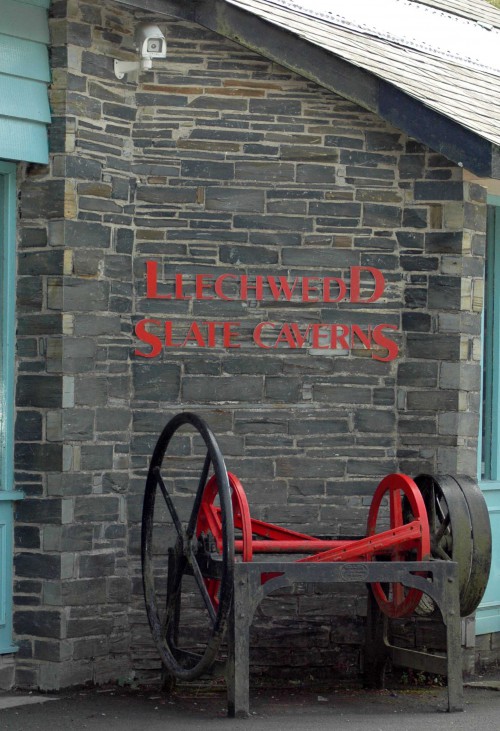
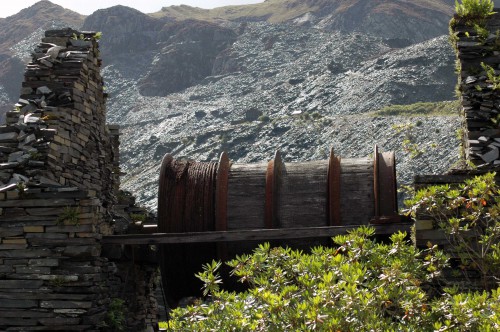
The former Llechwedd Slate Caverns underground slate workings extend deep below the ground and most consist of huge caverns. Several of those near to the surface have been adapted to create one of the most popular visitor attractions in Wales.

140826TGNW-Llechwedd Slate Mine (43)

In late Victorian times the slate mining industry was largely confined to a few slate mines in North Wales. J.W.Greaves began extracting slate from the Llechwedd mines in 1836.  Since that time the high quality blue-grey slate is still in demand in many corners of the world. The company still produce a range of slate  products sold in the on-site shop and a range of architectural products sold throughout the country and within the European market place.

140826TGNW-Llechwedd Slate Mine (18)

The slate quarried at Llechwedd is blue-grey and of high quality

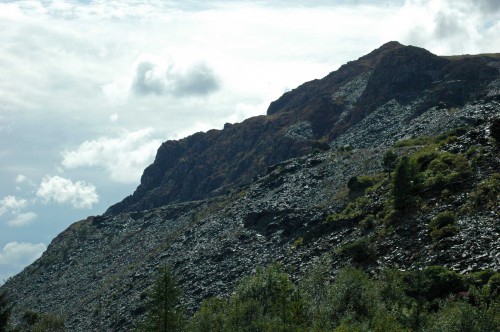
The evidence of slate quarrying and mining dominates the landscape of this whole area; it rains a lot here and when grey skies and blue-grey slate merge together it can create a somewhat depressing atmosphere. But it has great drama and when the sun does shine through the clouds it adds highlights and brings forth textures that change constantly.

140826TGNW-Llechwedd Slate Mine (12)

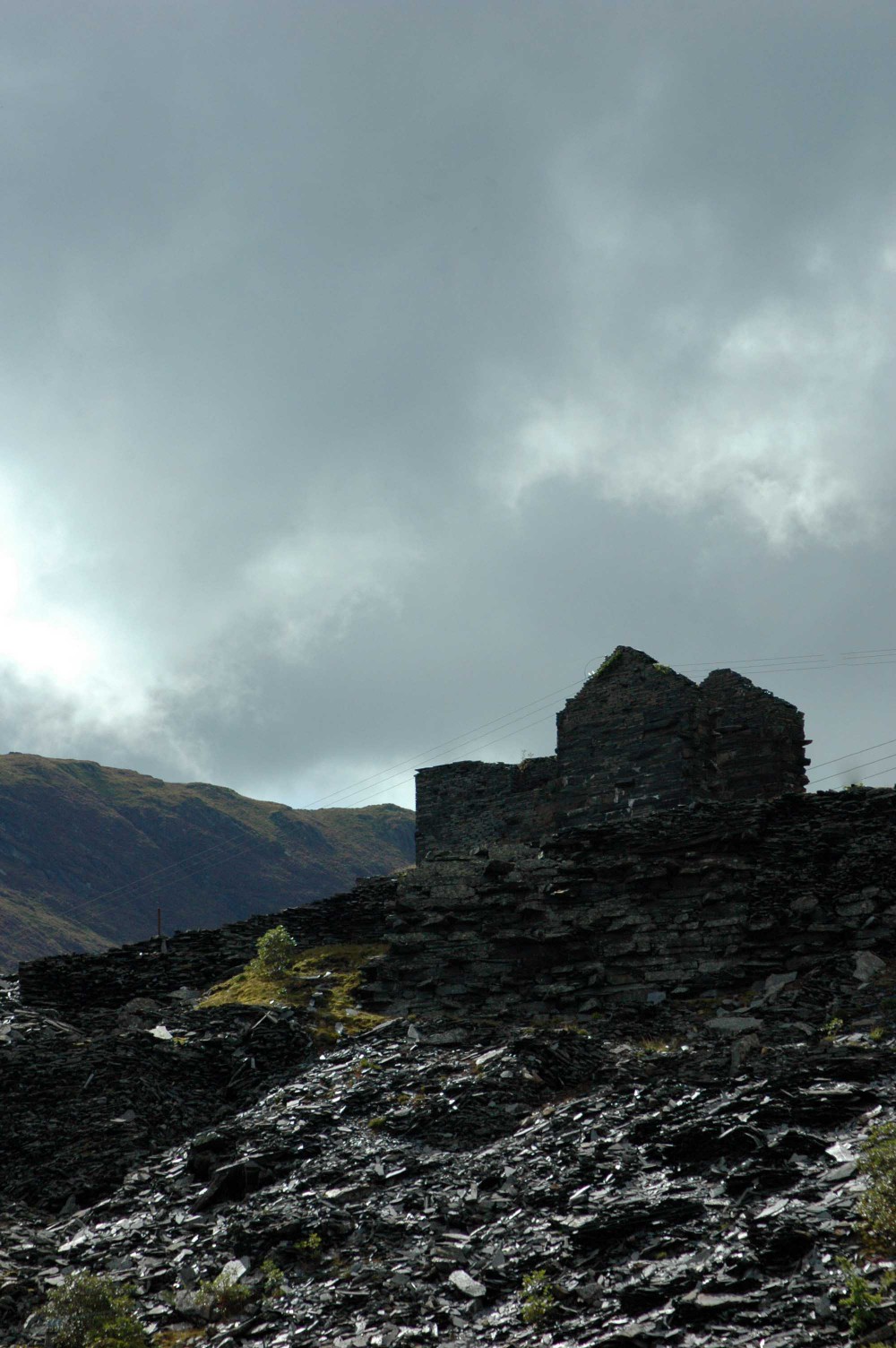
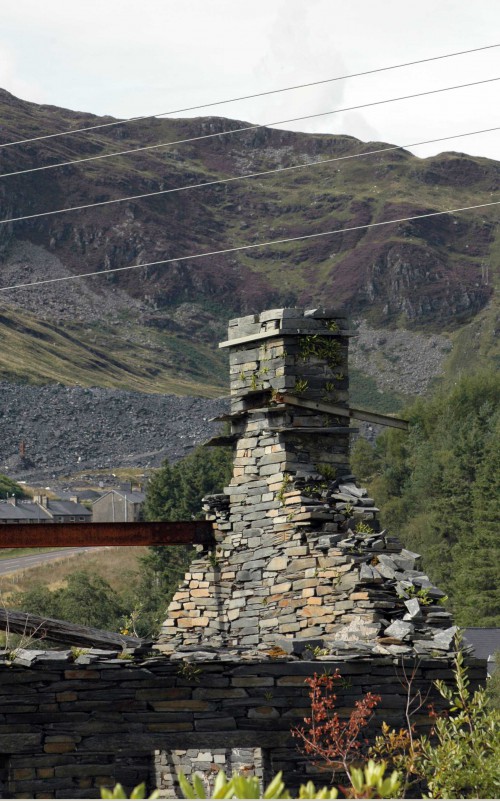
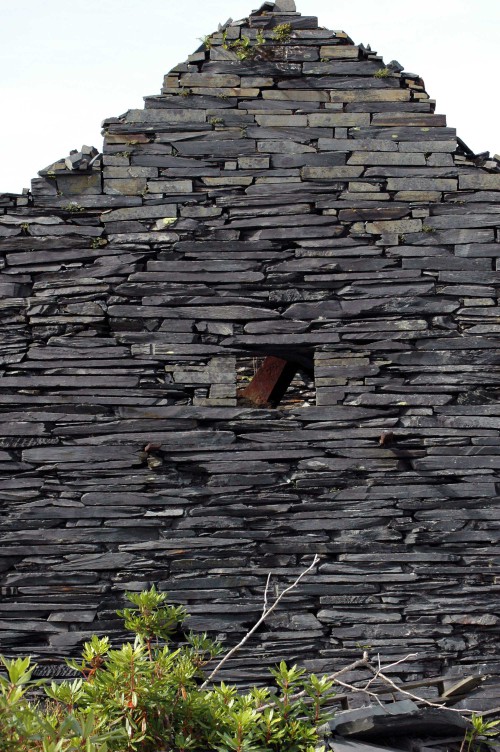
Buildings and boundary walls are constructed from slate and seem to have grown organically from the mountain and those no longer in use are simply being slowly re-absorbed.

140826TGNW-Llechwedd Slate Mine (10)

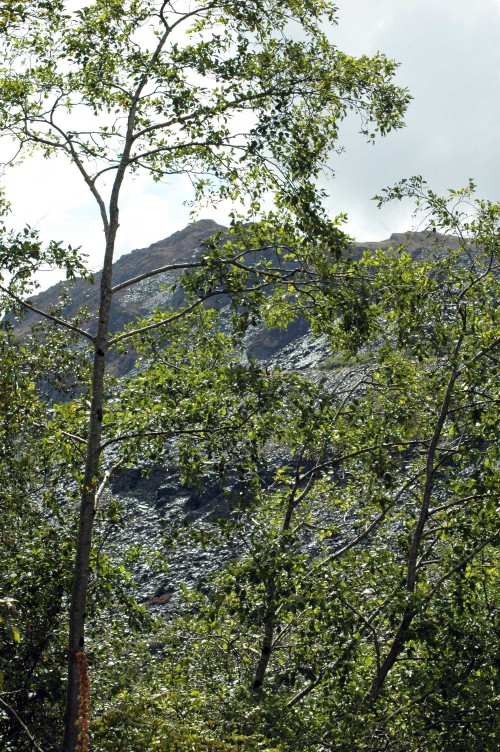
I liked the contrast of the graceful trees in front of the hard background of the hard slatey mountainside.

140826TGNW-Llechwedd Slate Mine (7)

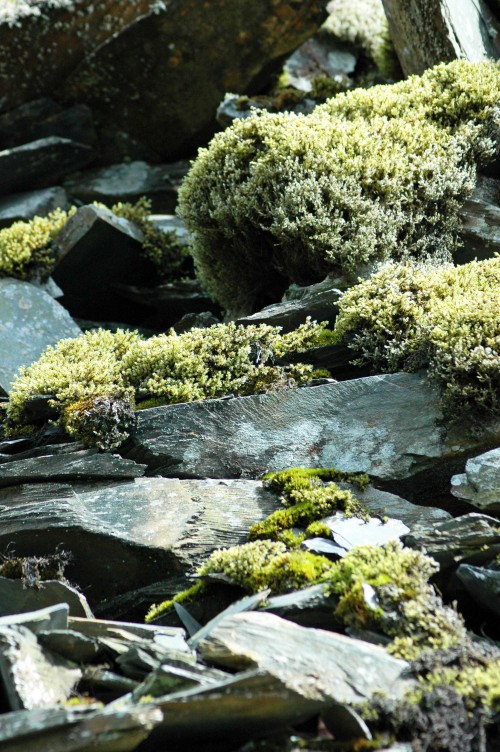
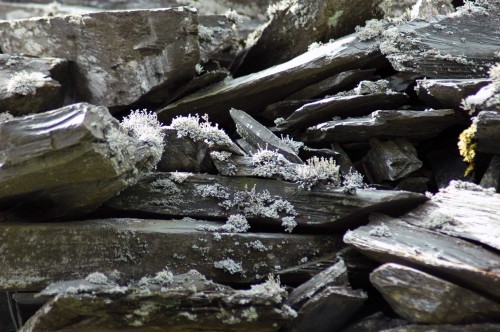
When left undisturbed mosses and lichens establish themselves on old slate piles.

140826TGNW-Llechwedd Slate Mine (1)

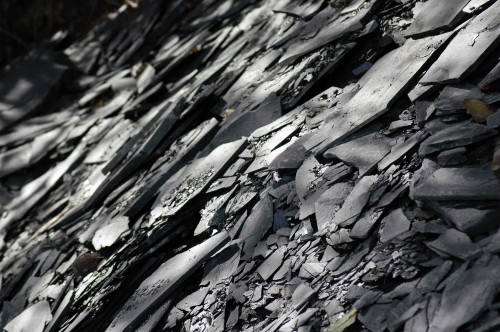
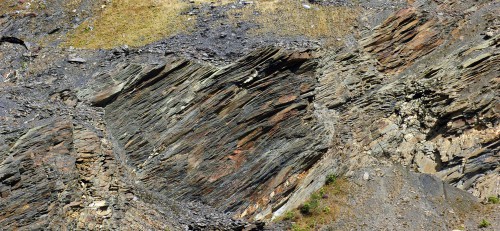
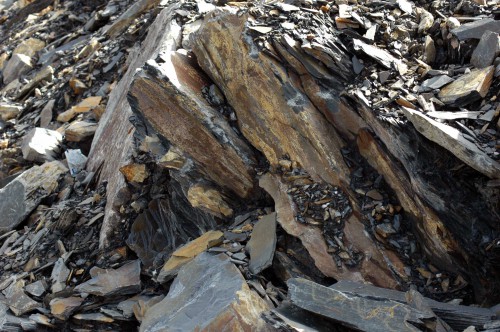
Slate is a fine-grained, foliated, homogeneous metamorphic rock derived from an original shale-type sedimentary rock composed of clay or volcanic ash through low-grade regional metamorphism. It is the finest grained foliated metamorphic rock.

140826TGNW-Llechwedd Slate Mine (6)

Foliation may not correspond to the original sedimentary layering, but instead is in planes perpendicular to the direction of metamorphic compression.

140826TGNW-Llechwedd Slate Mine (21)

Slate occurs in a variety of colors even from a single locality; slate from North Wales can be found in many shades of grey, from pale to dark, and may also be purple, green or cyan.

140826TGNW-Llechwedd Slate Mine (17)

Buildings on the site are deteriorating.

140826TGNW-Llechwedd Slate Mine (32)

140826TGNW-Llechwedd Slate Mine (35)

140826TGNW-Llechwedd Slate Mine (25)

140826TGNW-Llechwedd Slate Mine (36)

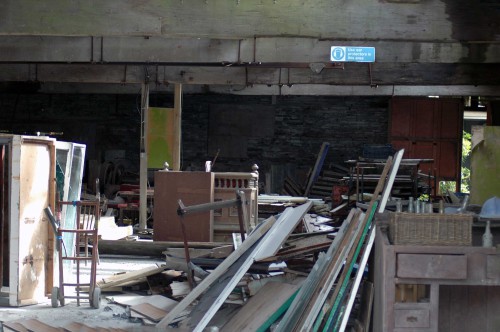
Inside a large shed – an eclectic collection of stuff gathering dust

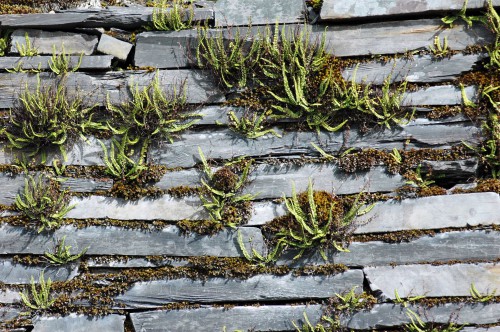
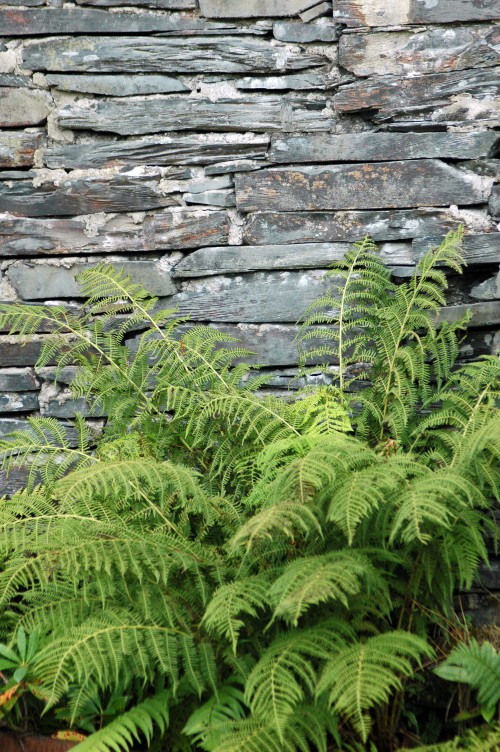
And outside a beautiful fern softens the slate wall

And outside a beautiful fern softens the slate wall

140826TGNW-Llechwedd Slate Mine (20)

A poignant reminder that this was once the workplace of a large number of men and boys who spent long hours underground.

140826TGNW-Llechwedd Slate Mine (15) 140826TGNW-Llechwedd Slate Mine (14)

A Ffestiniog Railway brake truck would have been loaded with slates and transported to Porthmadog

A Ffestiniog Railway brake truck that would have been loaded with slates and transported to Porthmadog

140826TGNW-Llechwedd Slate Mine (39)

Evidence of a further modern attraction of the site appears in some of the photographs – zip lines stretching over 8km on which riders can reach speeds up to 70mph over moor, mountain and mine.

140826TGNW-Llechwedd Slate Mine (31)

Now that looks exhilarating!

Share this:

  • Share on Facebook (Opens in new window) Facebook
  • Share on Pinterest (Opens in new window) Pinterest
  • Share on X (Opens in new window) X
Like Loading...

Late Summer Specials

17 Monday Aug 2015

Posted by theresagreen in British hoverflies, Bryn Euryn Nature Reserve, butterflies, Butterflies of Wales, calcareous grassland, day-flying moths, Nature of Wales, nature photography, plants important to wilflife, Rhos-on-Sea, Wildflowers of Wales

≈ 2 Comments

Tags

ash keys, bee mimic hoverfly, cheilosa illustrata, common ragwort, ferdinandea cuprea, green-veined white, hawthorn berries, mating gatekeeper butterflies, Nature in August, purple hairstreak

August so far has brought mixed weather, days have been mostly warm, but many have been cloudy or overcast and occasionally there’s been some sunshine.

Looking across to Conwy Estuary

Looking across to Conwy Estuary from Bryn Euryn

It’s only been a week or two since my last visit to Bryn Euryn, but now rapidly approaching late summer, much has already changed. Many plants are setting seed, there are ripe wild raspberries, a few ripe blackberries and sloes, still as hard as bullets.

Purple sloes are swelling on Blackthorn

Purple sloes are swelling on Blackthorn

Last year there were sparse crops of acorns and sloes, this year may be more bountiful.

3/8/15-Wood avens seedhead

3/8/15-Wood avens seedhead

Large fruit capsules of the Stinking Iris

Large fruit capsules of the Stinking Iris

On a last hogweed flowerhead, a new-to-me, furry little hoverfly; it  is one of a number of species referred to as a bee mimic, but it  doesn’t really look like one.

Hoverfly-cheilosa illustrata- a bee mimic

Hoverfly-cheilosa illustrata- a bee mimic

Another hoverfly caught my eye, it was basking on a bramble leaf and as the sun caught it, the insect shone a bright metallic golden bronze colour.

Hoverfly-ferdinandea cuprea

Hoverfly-ferdinandea cuprea

About to enter the meadow, I caught sight of a Speckled wood butterfly basking on an Oak leaf. I moved in to take a photograph as I haven’t had many good opportunities with this species so far this year, then caught sight of another butterfly sitting on a leaf slightly higher up.

7/8/15 - Purple Hairstreak

7/8/15 – Purple Hairstreak

I moved in a little closer and realised this was a butterfly I had never seen before other than in pictures, a Purple Hairstreak. A species that spends most of its time in and around the tops of Oak trees, I was surprised and delighted to see it and tried not  to alarm it as I focussed the camera. It moved a little to reveal two small orange eyespots on its hindwing, but just as I had it back in focus the Speckled wood flew up and chased it away. I waited a while to see if it would return, but no luck. At least I know to look out for them here again!

The colours of the landscape are changing subtly. Hay has been cut and in many places baled and put safely under cover. Meadows of seeding long grass left standing have taken on a golden hue and on our limestone hill, the wildflowers typical of late summer are at the peak of their flowering. Most are ‘tough’ plants, Knapweed, Hemp agrimony & Ragwort, which are all imortant nectar sources for insects.

Late summer long grass and wildflowers

Late summer long grass and wildflowers, mostly hedge parsley and harebells

7/8/15-Knapweed with a view

It’s been a while since I had a good opportunity to photograph a Green-veined White, so I was pleased to see this fresh one on a Knapweed flowerhead.

3/8/15-Bryn Euryn

3/8/15-Bryn Euryn

Knapweed and Hemp Agrmony

Knapweed and Hemp Agrmony

Burnet moth on knapweed

Burnet moth on knapweed- wings faded and almost transparent

Also clinging to a knapweed plant was a pair of mating Gatekeepers; a perfect opportunity to see the difference between the male and female of the species, as helpfully, the female opened her wings to show the plainer upperside to her wings.

Mating Gatekeeper butterflies - female above male

Mating Gatekeeper butterflies – female above male

A good opportnity to show the upperside of the female

A good opportunity to show the upperside of the female

As anticipated by the abundance of flowers back in the spring, Ash trees are bearing thick bunches of ‘keys’.

Ash trees have heavy bunches of 'keys'

Ash trees have heavy bunches of ‘keys’

Acorns forming on Pedunculate Oak

Acorns forming on Pedunculate Oak

Haws are ripening and leaves beginning to take on colour

Haws are ripening and leaves beginning to take on colour

Walking close to gorse bushes the air is filled with the gentle sound of pods crackling as they open to release seeds.

Gorse pods crackle as they open to release seeds

Gorse pods crackle as they open to release seeds

Higher up on the steep slope near to the summit there is a stand of Ragwort growing with thistles.

Ragwort and thistles

Ragwort and thistles

And further round more Ragwort, this time interspersed with tall spikes of velvety Mullein.

Ragwort and Mullein

Ragwort and Mullein

The seedpods of Bird's-foot Trefoil are from where it takes it name

The seedpods of Bird’s-foot Trefoil are from where it takes it name

And a final shot of a Speckled Wood next to hypericum berries sums up the season, I think.

Speckled Wood & hypericum berries

Speckled Wood & hypericum berries

Share this:

  • Share on Facebook (Opens in new window) Facebook
  • Share on Pinterest (Opens in new window) Pinterest
  • Share on X (Opens in new window) X
Like Loading...

A sea-shore in waiting

11 Tuesday Aug 2015

Posted by theresagreen in Birdwatching on North Wales coast, coastal habitat, mussel beds, Nature, Nature of Wales, nature photography, North Wales, Rhos Point, Rhos-on-Sea, wading birds, Wales Coast Path

≈ Leave a comment

Tags

acorn barnacles, barnacle, common mussel, great black-backed gull, herring gull, mussel bed, mussel beds, mussel beds of Rhos-on-sea, Nature in August, periwinkle, Rhos Point, seashore in August, winkle

Rhos Point from the Little Orme

Rhos Point from the Little Orme

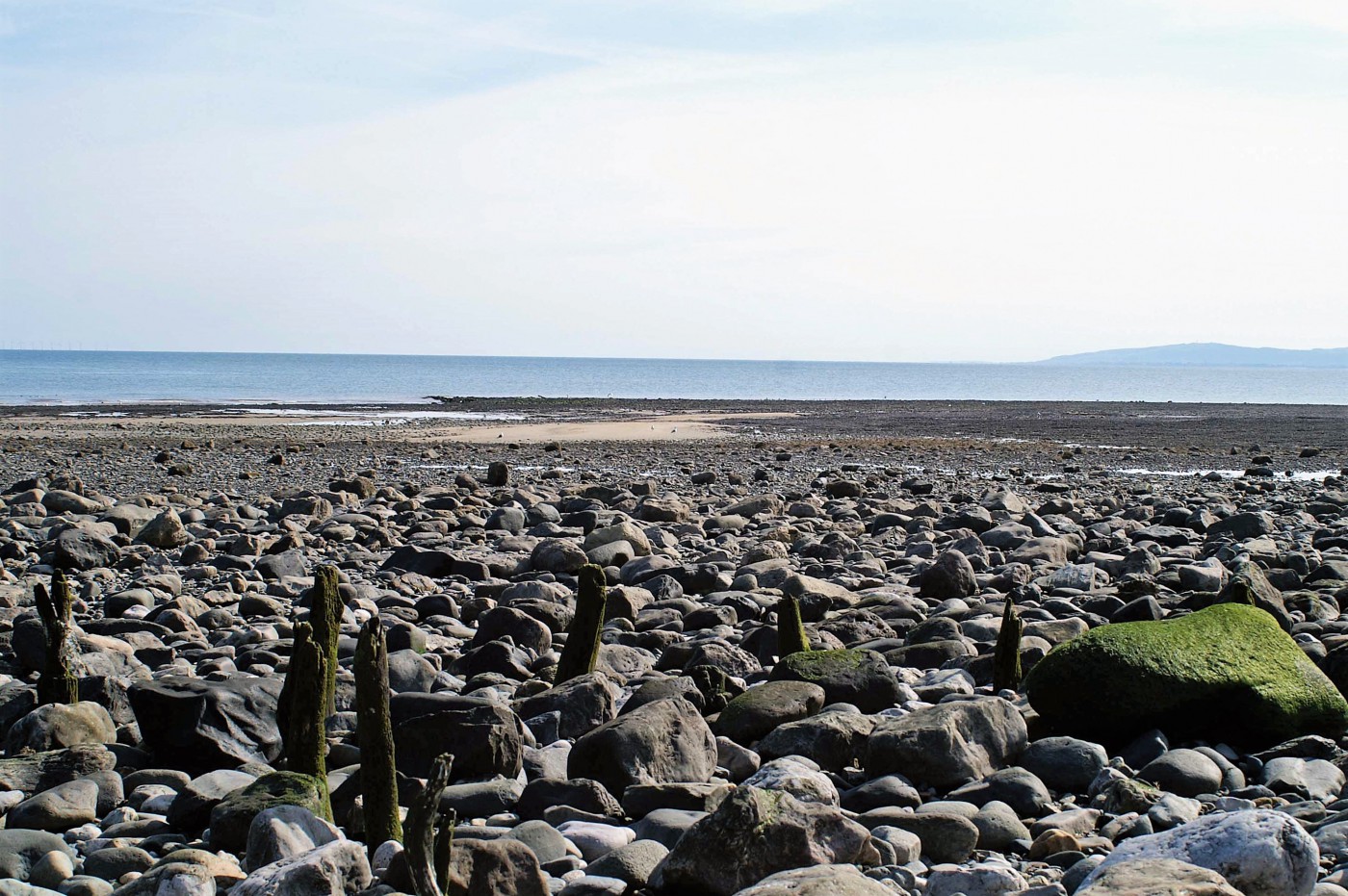
Rhos-on-Sea is a popular seaside venue that is busy with people visiting most of the year round, particularly at weekends and when the sun shines, but they don’t come here for its beach. The seashore, wrapped around the flat fortified headland of Rhos Point, is not the most beautiful in North Wales: a general first impression may well be of an expanse of flat shoreline littered with variously sized brown-coloured rocks and boulders. No easy strolling or picnicking here.

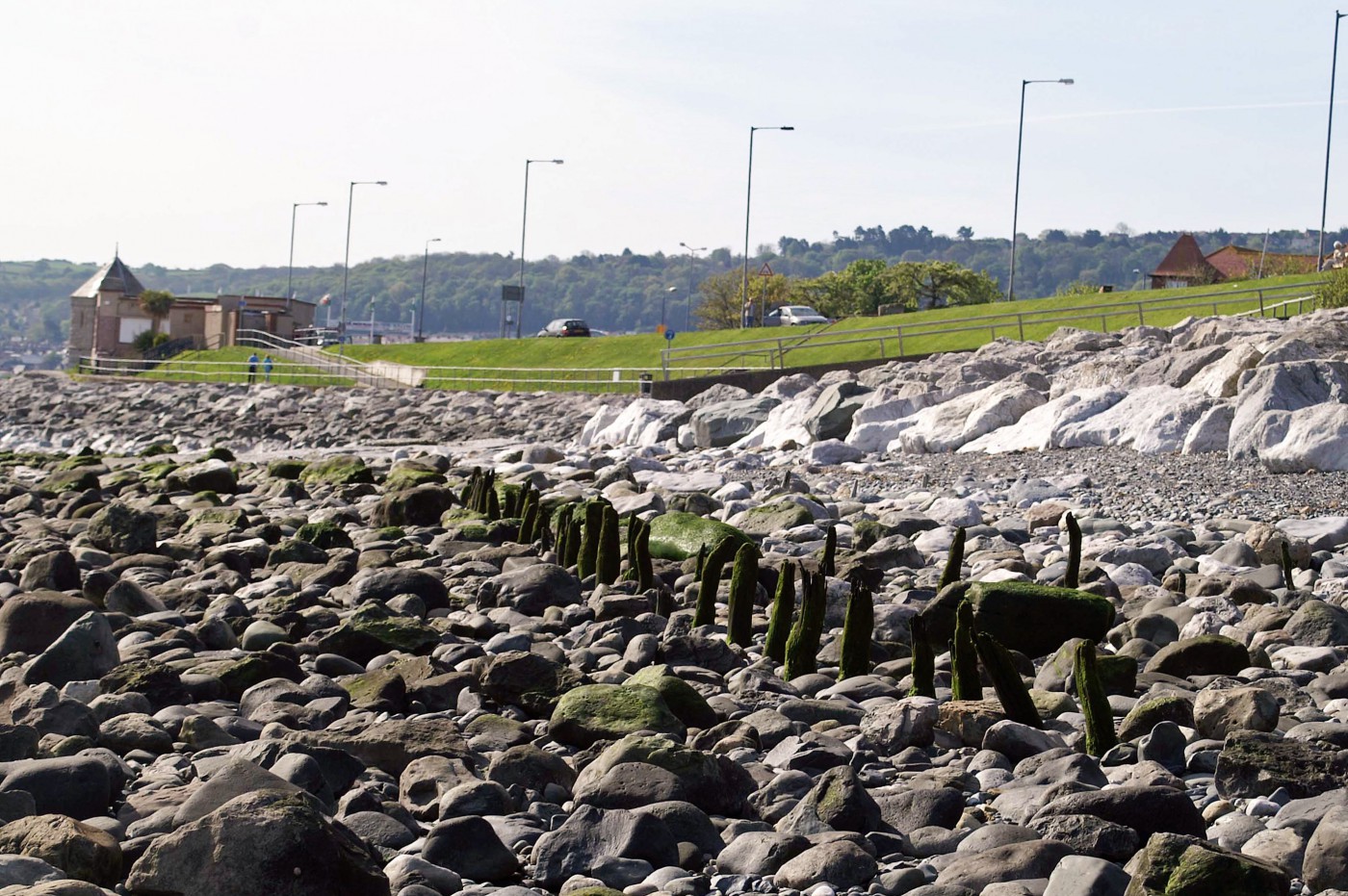
The stumps of posts are the remains of an ancient fishing weir

Rhos Point shore looking towards Colwyn Bay-the stumps of posts are the remains of an ancient fishing weir

The rocky shore of Rhos Point from Penrhyn Bay

The rocky shore of Rhos Point from Penrhyn Bay

However, between the rocky shore and the sea lies an expanse of long-established Mussel beds which is highly attractive to visitors – of the avian variety. Large numbers of a variety of species of sea and shore birds will be returning here this month from their summer breeding grounds to spend the autumn and winter to feast on the gourmet seafood on offer here.

Rhos Point across the rock strewn shore to the mussel beds

Rhos Point across the rock strewn shore to the mussel beds

Part of the expanse of mussel bed beyond the rocks

Part of the expanse of mussel bed beyond the rocks on a sunny day

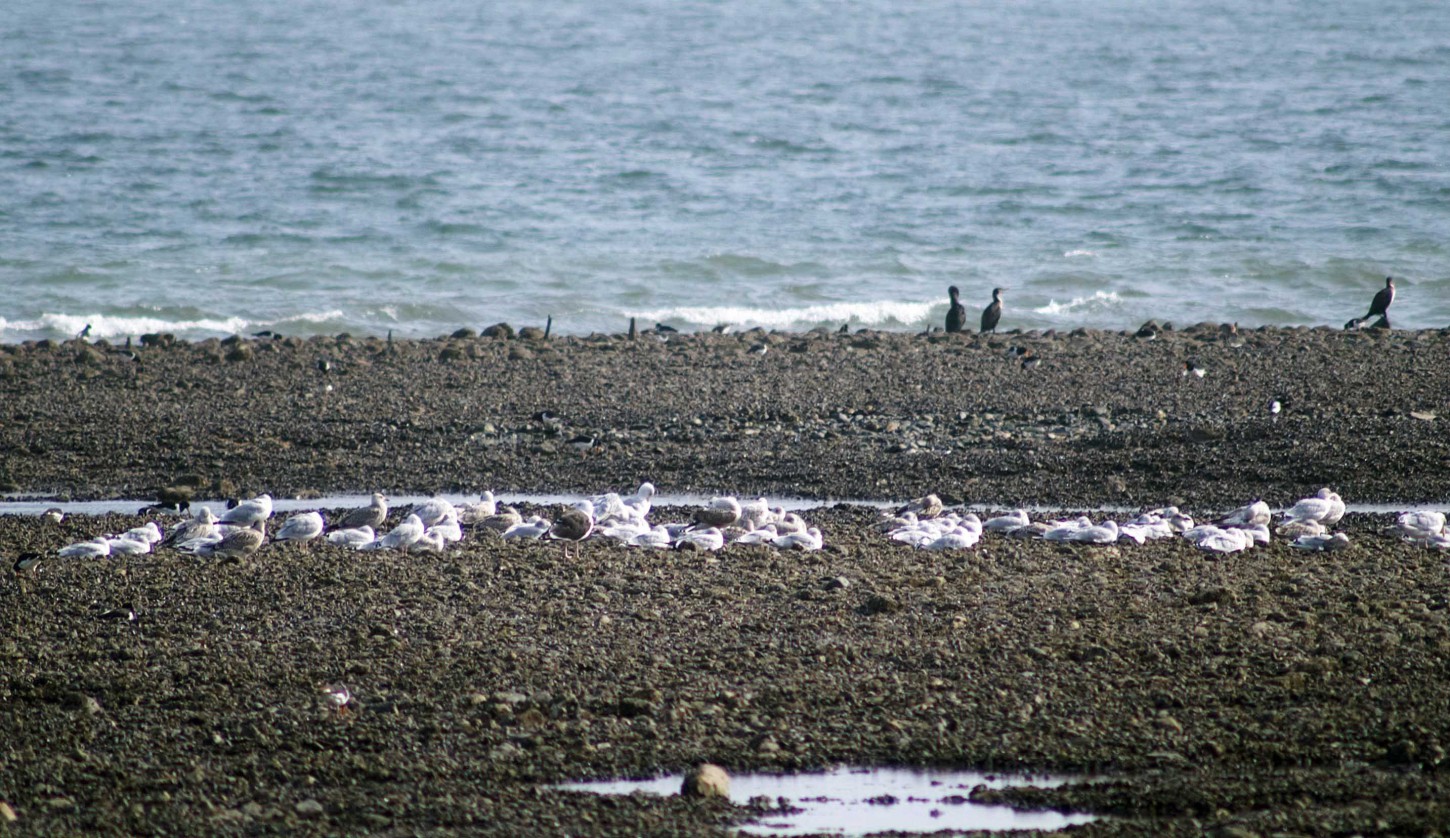
There may be a few early arrivals, maybe a Turnstone or two, but for now, approaching mid-August, the resident breeding birds, the Herring gulls, a smallish number of Lesser Black-backed gulls, Cormorants, plus a few Oystercatchers have the place more or less to themselves.

KONICA MINOLTA DIGITAL CAMERA

Great Black-backed gulls, adults & juveniles, Herring gull & Oystercatchers

Rhos Point shoreline with fishing weir posts cormorants & gulls

Rhos Point mussel bed, juv. cormorants, oystercatchers & gulls

Soon they will be joined by large numbers of Curlews, Redshanks, more Oystercatchers, Turnstones, Dunlins, Ringed Plovers and Sandwich Terns. If we are lucky there may be a few Purple Sandpipers in the mix, and there will doubtless be a few temporary visitors stopping to feed before escaping to warmer climes. There will be Rock Pipits and Pied Wagtails amongst the huge rocks of the sea defences. So much to look  forward to!

Without the movement and cries of the absent birds the landscape appears harsh, a sombrely coloured, barren place devoid of life. But look more closely and you’ll see it is in fact a living landscape, richly populated by hosts of small sea creatures, which is of course why the birds head here for the winter.

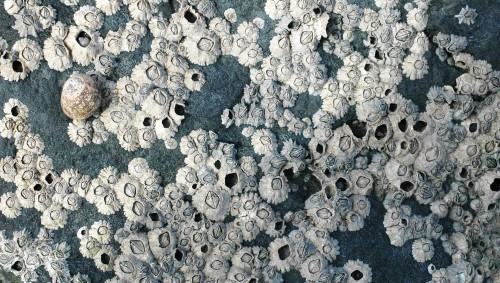
On close inspection, the rocks that appear a uniform brown colour from a distance are actually encrusted with colonies of barnacles, millions of them.

Barnacles and winkles cover the surface of a rock

Barnacles cover the surfaces of rocks

Acorn barnacles

Acorn barnacles

Barnacles and winkles

Barnacles and winkles

Turnstones camouflaged amongst the barnacle-covered rocks

Turnstones will be perfectly camouflaged amongst the barnacle-covered rocks

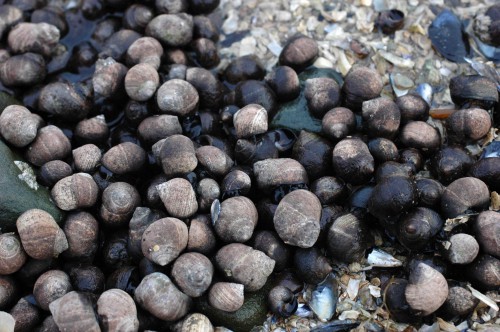
Winkles, or periwinkles are numerous too.

Winkles

Common periwinkle or Winkle-Littorina littorea

At low tide, cross the rocks, skirting the pools of shallow water left behind

Rock pool

Rock pool with more winkles

A flower of the sea -Beadlet anemone - Actinia equina

A flower of the sea -Beadlet anemone – Actinia equina

and soon the crunch of shells accompanies every footstep, as you are literally walking across the surface of a dense mass of living Mussels. It’s a very strange feeling.

Live mussels

The Mussel bed – live mussels amongst empty shells

You realise now why you see mussel shells everywhere.

Mussel shells under water

Mussel shells under water

141017TGNW4-Seashells mixed & crab legs

Live mussels & a live cockle amongst empty shells and crab claws

Mussel shells on the tide line of Rhos Harbour beach

Mussel shells on the tide line of Rhos Harbour beach

All is ready for the avian invasion.


Share this:

  • Share on Facebook (Opens in new window) Facebook
  • Share on Pinterest (Opens in new window) Pinterest
  • Share on X (Opens in new window) X
Like Loading...

Beetles, bugs and spiders

03 Monday Aug 2015

Posted by theresagreen in Beetles, Bryn Euryn Nature Reserve, Insects, Nature, Nature of Wales, nature photography, North Wales, plants important to wilflife, spiders, Wildflowers of Wales

≈ 7 Comments

Tags

crab spider, flowering in July, froghopper, green shield bug, harebell, hogweed, mating red beetles on flowers, Nursery Web spider, red soldier beetle, red-legged shield bug, spider that makes web tents in grass, strangalia maculata, sulphur beetle, wild thyme, yellow and black beetle

July 15th

In the woods I spotted this extremely tiny froghopper, but only because he was struggling to extricate himself from a spider’s web built in ivy climbing up a tree trunk.

Tiny froghopper
Tiny froghopper
Tiny froghopper enlarged

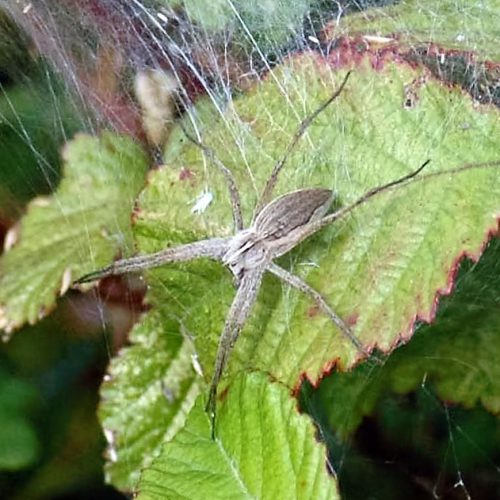
150712TG-Bryn Euryn-Adder's Field (10)-Nursery-web spider 1In the meadow, the Nursery-web spider would probably have escaped my notice too if I hadn’t been trying to get closer to a butterfly in the brambles. More used to seeing this species web ‘tents’ on the ground in the grass, I wouldn’t have realised who had built this one if I hadn’t seen her guarding it.

Nursery web spider on brambles

There are some lovely wildflowers in bloom in the meadow amongst the grass, my current favourite are the delicate-looking harebells,

150710tg-Bryn Euryn-flwr-Harebells 1

although I have always been fond of the sunshine yellow Lady’s Bedstraw

150712-46-Bryn Euryn-lady's bedstraw patch

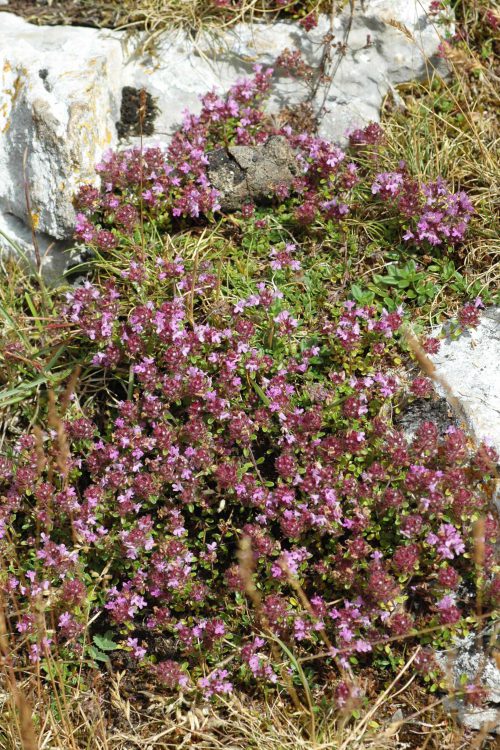
but then there’s the Wild Thyme that is looking spectacular this year where a large patch of it cascades down the limestone rocks.

150710tg-Bryn Euryn-flwr-Wild Thyme 1

There’s a Cat’s Ear plant near that spot too, which nicely demonstrates both the flowers and the seedhead ‘clocks’ simultaneously.

150710tg-Bryn Euryn-flwr-Cat's Ear 1

Hogweed works at another level and is an invaluable food source for a whole host of insects from beetles to butterflies.

150710tg-Bryn Euryn-flwr&vw-hogweed in long grass

Some of the insects feasting on the flowers today were Sulphur beetles, including dozens of tiny ‘baby’ ones

150712TG-Bryn Euryn-Adder's Field (15)-Small Sulphur beetles on hogweed 1
150712TG-Bryn Euryn-Adder's Field (19)-Sulphur beetle cloe-up
150712TG-Bryn Euryn-Adder's Field (21)-Sulphur beetle on hogweed

A 7-spot ladybird, a so-far un-named brown beetle

150712TG-Bryn Euryn-7-spot ladybird-Coccinella 7-punctata (3a)
150712TG-Bryn Euryn-Adder's Field (22)-no ID beetle

There were dozens of Red Soldier Beetles, many in the act of procreation as these beetles always seem to be. There was a little moth there with them, but again I haven’t discovered what it is yet.

150712TG-Bryn Euryn-Adder's Field (24)-Red soldier beetle
150712TG-Bryn Euryn-btl-Red soldier beetle-Rhagonycha fulva (7a)
150712TG-Bryn Euryn-btl-Red soldier beetle-Rhagonycha fulva (3a)
150712TG-Bryn Euryn-btl-Red soldier beetle-Rhagonycha fulva mating

150712TG-Bryn Euryn-Crab spider victim trussed up

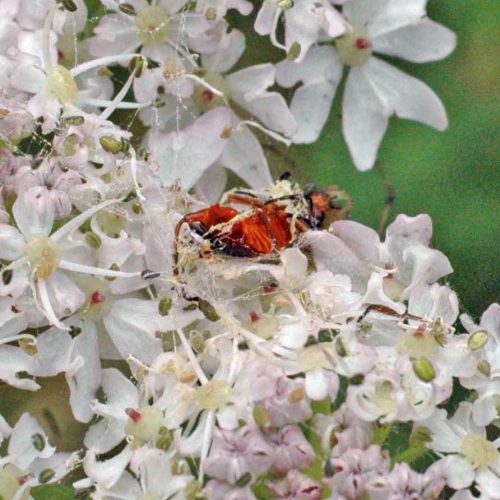
Whilst photographing a pair of mating Red soldier beetles, I noticed another beetle caught up in spider’s webbing. As I looked closer I spotted the head and front legs of a spider creeping up over the edge of the flower, then she darted out and begin to drag her victim backwards to where she had appeared from. This was a Crab spider, mistress of camouflage and deadly to insects that stray into her path regardless of their size. Cruel, but fascinating and quite a feat as the beetle was as least equal in size to her.

150712TG-Bryn Euryn-Adder's Field (26)-Crab spider dragging victim to edge of flower
150712TG-Bryn Euryn-Adder's Field (27)-Crab spider with victim 1

Crab spiders are able to change their body colour to match their background. The process can take a few days, but they can appear white, yellow or green. The  irony of this scene struck me; a beetle life ended in full view of a pair of his kind in the act of procreating the species….

150712TG-Bryn Euryn-Adder's Field (29)-Crab Spider rear view
150712TG-Bryn Euryn-Adder's Field (28)-Spider crab securing victim

The Crab spider show would take some beating, but my ‘discovery of the day’ was quite definitely a splendid large yellow and black beetle, Strangalia maculata, that surprisingly doesn’t appear to have a common name.

150712TG-Bryn Euryn-btl-Strangalia maculata (1a)
150712TG-Bryn Euryn-btl-Strangalia maculata (10a)
150712TG-Bryn Euryn-btl-Strangalia maculata (7a)
150712TG-Bryn Euryn-btl-Yellow & black beetles 1

On another flowerhead another spider lurked, this time a small brown one, much enlarged in the photograph.

150710tg-Bryn Euryn-bug-Shield bug 1In the long grass I spotted an insect flying and managed to keep an eye on where it landed, otherwise I would never have found it; a Gorse Shieldbug.

A bright fresh bronzy-coloured forest bug was more easily spotted.

150712TG-Bryn Euryn -bug-Forest bug-Red-legged ShieldbugPentatoma rufipes (1a)

Red-legged shield bug-Pentatoma rufipes

A peek at the oak trees revealed tiny acorns. The ones I photographed belonges to a  Sessile Oak – the acorns sit flat rather than hanging on stems as those of the Pedunculate Oak. Hopefully this will be a better year for them than last year was.

150710tg-Bryn Euryn-tree- Sessile Oak-baby acorns

Rain clouds were gathering – is it really summer?

150712TG-Bryn Euryn-view (3)

Highlighted text for Shieldbugs are links to more details about these insects in my ‘Species Collections’.

Share this:

  • Share on Facebook (Opens in new window) Facebook
  • Share on Pinterest (Opens in new window) Pinterest
  • Share on X (Opens in new window) X
Like Loading...

Beauty and the Bullfinch

24 Wednesday Jun 2015

Posted by theresagreen in bird behaviour, Birds, birds of Wales, Bryn Euryn Nature Reserve, Nature, Nature of Wales, nature photography, North Wales, woodland birds

≈ 2 Comments

Tags

Bullfinch, bullfinch eating tree seeds, colourful British birds, Eurasian Bullfinch, pyrrhula pyrrhula

The Bullfinch, Common Bullfinch or Eurasian Bullfinch (Pyrrhula pyrrhula) is a small passerine bird in the finch family Fringillidae that breeds across Europe and temperate Asia and is classified as a Woodland Bird. Pyrrhula pyrrhula Eurasian Bullfinch -48 -1 ↓ -16 -2 ↓ sd

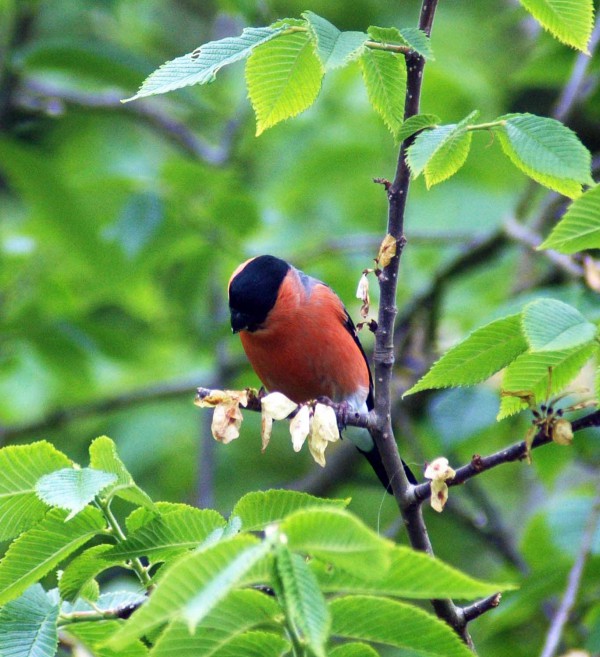
The male Bullfinch is surely one of our most strikingly beautiful and exotic-looking birds and a good sighting of one is always a treat, even if that does involve a certain amount of sacrifice of buds borne by your favourite fruit-tree. In the wild they tend to be more elusive, as despite their showy appearance the Bullfinch is a quiet, secretive character that usually spends its time among the branches and dense undergrowth of woodlands; often the only sight of one will have been a flash of a white rump retreating back into cover. Bullfinches are mainly sedentary or short-distance migratory birds and are relatively non-territorial, more likely to be seen in pairs or small family groups; they rarely flock as do other finches such as  Goldfinches and Chaffinches.

I’ve had some wonderful sightings of Bullfinches this year and I haven’t had to work for them at all as they have been from my kitchen window and courtesy the tree directly in front of that window. A female appeared first, back in February and I included her in a blog at the time. I had a couple of glimpses of her subsequently and hoped she had a mate somewhere close by.

3/2/15-Bullfinch female

3/2/15-Bullfinch female

My first proper sighting of a male was much later on in May when he visited to dine on the seeds of the tree directly in front of the window.

13/5/15-Male Bullfinch

13/5/15-Male Bullfinch

Based on that sighting and the species habit of not travelling far to find food,  I hoped that he was paired with the earlier female and that they were nesting  somewhere nearby. A couple of weeks later I saw him again and was able to watch him gorging on the tree seeds for a good few minutes; maybe the seeds were riper and more palatable.

Bullfinch male

25/5/15-Bullfinch male back for more seeds

DESCRIPTION

The Bullfinch most likely takes its common name from its shape, as they are plump-to-heavily-built and somewhat ‘bull-necked’. Both sexes have a stout grey-black bill, black wings, nape, crown and chin, and a white rump, under-tail coverts and wing-bar which are striking in flight. The tail is slightly forked and the legs are brown.

The Bullfinch was here to eat

The Bullfinch has a beak perfectly adapted to remove and eat seeds

The adult male has a slate blue-grey back and a glorious deep rose-pink breast, belly and cheeks. The female has a brown back and  pink-tinged grey-buff underparts. The juveniles are similar to the adult female, but do not have black caps.

The female Bullfinch has a pink-buff coloured breast

The female Bullfinch has pink tinged grey-buff coloured breast and underparts


VOICE

The song of this unobtrusive bird contains fluted whistles that is often described as sad or mournful. In Victorian times Bullfinches were a desired captive bird because of their beautiful plumage and call. It was believed that the caged bird could be trained to mimic music and it became a popular pastime to play a special flute to the bird.

HABITAT & BREEDING

Bullfinches usually nest in shrubs or bushes, such as blackthorn and hawthorn, in woodland, orchards, agricultural farmland or large gardens. The nest is a flimsy, loose structure of twigs and moss lined with fine roots and hair, which is built by the female. She lays and incubates eggs that are smooth, glossy and light blue with purplish markings at one end. The eggs are about 20 mm by 15 mm. Both parents feed the young after they have hatched.

DIET

In the late autumn Bullfinches range a little more freely foraging for food and feed largely on the seeds of herbaceous plants, but as winter sets in their attention turns to tree seeds, particularly those of the ash. In the spring tree buds, including hawthorn, blackthorn and sallow, as well as the buds of fruit trees, become the birds’ staple diet and it is this aspect of their lifestyle that in the past brought them into serious conflict with fruit farmers: a single bullfinch can easily remove 30 or more buds in a minute.

Not noted for its agility, the Bullfinch managed to reach and eat rather a lot

Not noted for its agility, the Bullfinch managed to reach and eat rather a lot

STATUS & CONSERVATION

In the UK the Bullfinch is mainly a year-round resident, but many northern (Scandinavian) birds migrate further south in the winter when our British population numbers may be temporarily swelled.

Bullfinch numbers increased enormously in the 1950s which brought about a serious problem for Brtain’s fruit-growing industry. The birds’ dietary preference put them into conflict with commercial growers and thousands were killed each year. Although trapping and culling reduced the damage the fact that catches continued year after year showed that it had no sustained effect on bullfinch numbers. But then gradually, from the mid 1970s, bullfinches became scarcer again and catches on most farms steadily declined.

A good view of the birds black cap and bill

A good view of the male’s black cap and bill

Subsequently, the Bullfinch was a Red List species for many years as their breeding population had declined by more than half. This was attributed to a reduction in quantity and quality of woodland margins and hedgerows and increased grazing by deer. However, their numbers have recovered once more (and continue to do so) and they are currently classified in the UK as an Amber List species under the Birds of Conservation Concern review.

ETYMOLOGY

There are several theories as to why the Bullfinch is so called. Most favour the bird’s shape as the key, but there is also the possibility it may once have been a ‘bud-finch’ referring to its Spring feeding habits and to the time of year when the birds are their most visible.

According to Mark Cocker & Richard Mabey 2005 (Birds Britannica):

“W. B. Lockwood feels that the explanation for the name (Bullfinch), which in medieval times was simply shortened to “bull”, ‘remains elusive’. Yet one cannot help thinking that the bird’s globular bill and neckless rotundity are the key. As in ‘bulldog’ or ‘bullfrog’, the name was intended to convey the creature’s front-heavy – literally bull-headed – construction.”

Francesca Greenoak 1997 (British Birds – their Folklore, Names & Literature) concurs: “from its large head and stocky form”.

But Greenoak also gives as other British names:

  • from its large head & stocky form: Bull Flinch (Yorks), Bull Head, Bulldog, Bull Spink, Bully (Yorks), Thick Bill (Lancs)
  • from ‘Alpe’ the old name for the bird: Alpe, Hoop, Hope (SW), Tope, Hoof, Cock Hoop (Hereford), Olf (E Suffolk), Nope (Staffs/Salop), Mwope (Dorset), Mawp (Lancs), Pope (Dorset)
  • colour names: Red Hoop (m, Dorset), Blood Olp (m, Surrey/Norfolk), Tawny (f, Somerset), Tony Hoop, Tonnihood (f, Somerset), Black Cap (Lincs), Billy Black Cap, Black Nob (Salop), Monk
  • from its partiality to fruit buds: Bud Bird, Bud Finch, Bud Picker (Devon), Budding Bird (Hereford), Plum Bird, Lum Budder (Salop)


Share this:

  • Share on Facebook (Opens in new window) Facebook
  • Share on Pinterest (Opens in new window) Pinterest
  • Share on X (Opens in new window) X
Like Loading...

Wales Coast Path-Colwyn Bay to Pensarn

05 Tuesday May 2015

Posted by theresagreen in Nature of Wales, North Wales, Wales Coast Path

≈ 8 Comments

Tags

colwyn bay pier, goldcrest, grey wagtail, herring gull, Llanddulas Point, Old Colwyn, sea holly, sea mayweed, seashore walks, yellow horned poppy

One of my ambitions for this year is to walk more of the North Wales section of the  Wales Coast Path, which begins, or ends depending on which way you’re walking at Chester and continues around to Caernarfon. Some of the walks I do fairly regularly are part of the Coast Path, and there are other bits within reasonable striking distance that I could do fairly easily and I am keen to see more of the wildlife found along this amazing and varied coastline. On a sunny day back in the middle of March I set off in the opposite direction to that of my usual routes planning to walk the section from Colwyn Bay to Pensarn, the seaside part of Abergele. I cheated a bit as I have done the Colwyn Bay part so many times before, and drove to the pier to take some updated photos of the route along the promenade.

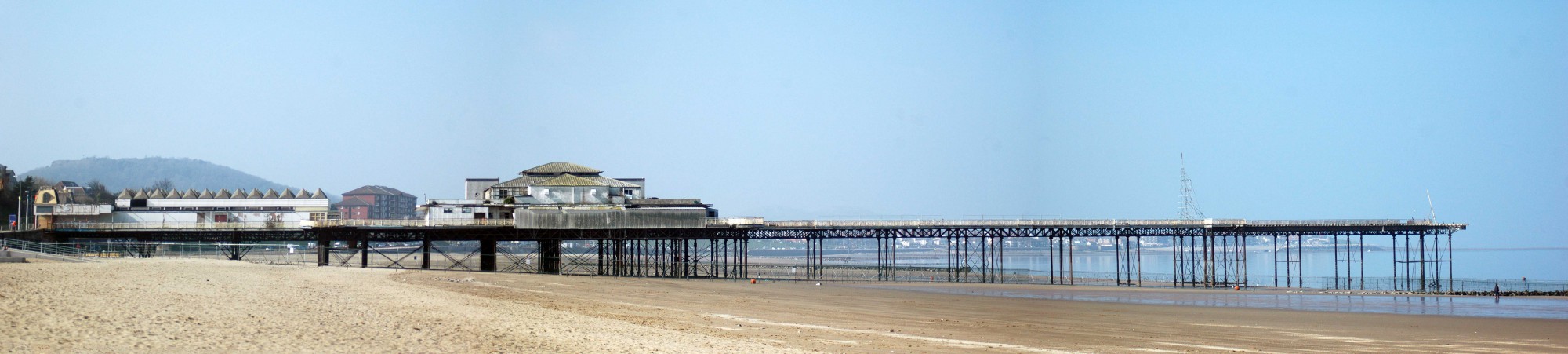
Colwyn Bay Pier, in a sad and dilapidated state

Colwyn Bay’s Victoria Pier, in a sad and dilapidated state

As a result of a long drawn-out dispute over its ownership, the pier is in a sad state of disrepair and dilapidation but there is much ongoing effort locally to save and restore it. It must be a bit of an embarrassment to the local council, particularly as a lot of money has been invested in providing a new sandy beach and in the building of the new water sports centre, known as Porth Eirias, just a stone’s throw away.

The water sports centre at Porth Eirias is finished but not yet occupied..

The water sports centre at Porth Eirias is finished but not yet occupied..it’s meant to look like a ship

From Porth Eirias the path continues as a promenade and cycle path and is my favourite stretch, particularly in the winter when stormy seas send waves crashing into and over the sea wall and flood the road, which may be closed off on exceptionally wild days. On the opposite side of the road the railway track runs parallel atop a high embankment, which provides habitat for an interesting array of wildflowers. There are great views from the trains too.
The view from Porth Eirias that shows the route of the Coast Path  towards Llandulas

The view from Porth Eirias that shows the route of the Coast Path towards Llanddulas

At the end of the promenade is a small parking area from where the path and cycle track continue towards Llanddulas. I had intended to park here and walk, but it was full of works vehicles as yet more work was being carried out on reinforcing the sea defences. Instead I crossed over the road and turned in towards Old Colwyn and stopped by the river at Min-y-Don.

Celandines

Celandines

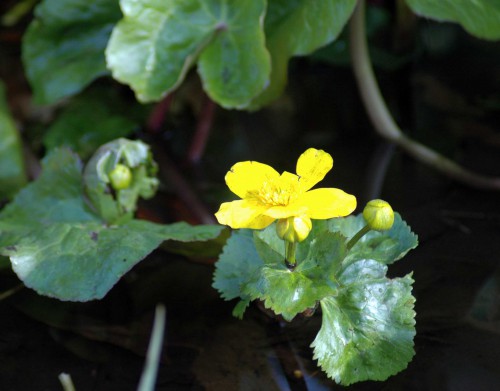
Celandines smothered the grassy bank on the sunny side of the road and King Cups lit up the shadier side of the path along the river.

The river was running fast and at a fairly decent level, although nowhere near full.

150318TG-Old Colwyn- King cup

Golden yellow King Cups

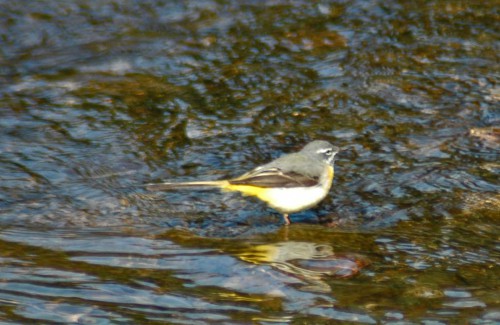
This is a favourite spot for Grey Wagtails and I had timed my visit perfectly as a pair of them flew down from upstream to land almost right in front of me. I watched them for a good while, darting after flies from stones in the water and running along the stone wall.

Grey Wagtail - the female of a pair

Grey Wagtail on the river Colwyn- the female of a pair

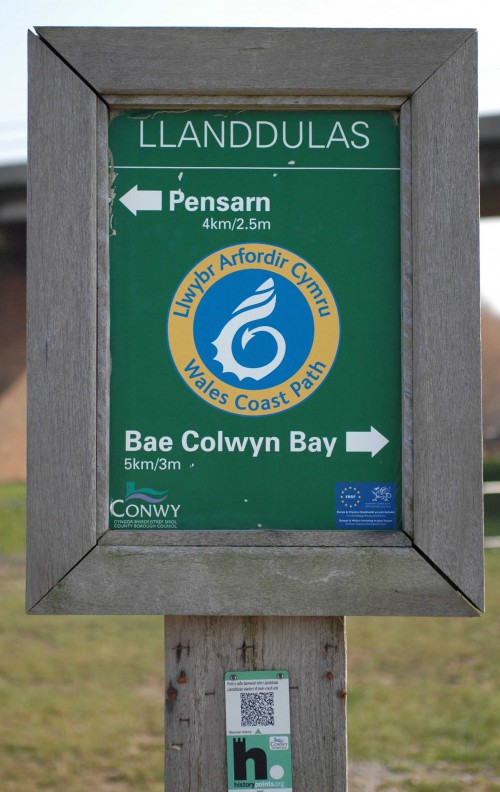
150318TG-Wales Coastal Path-Llanddulas- Sign board

I drove on to Llanddulas Point and parked facing out across the flat rocky shore to the sea. The views from here are expansive to say the least, and if you were walking the Coast Path seriously I can imagine it may be rather daunting to be able to see where you are heading and will arrive at in a few hours time.On a sunny and warmish day like today it is pleasant enough and as the land is almost pancake flat, easy walking. I’m not sure if I’d fancy it on a wet day when the wind was blasting you in the face.

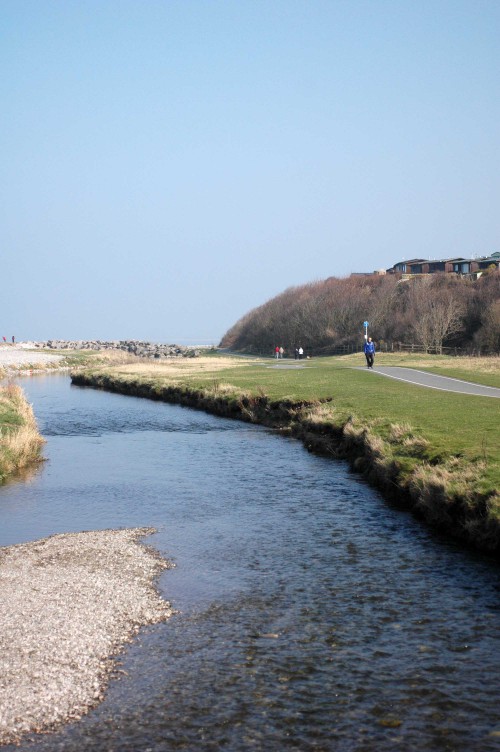
Leaving the car park and crossing a small bridge, the path follows the lower stretch of the River Dulas for a short distance until it reaches its end and flows towards the sea.

Path alongside the river

Path alongside the River Dulas

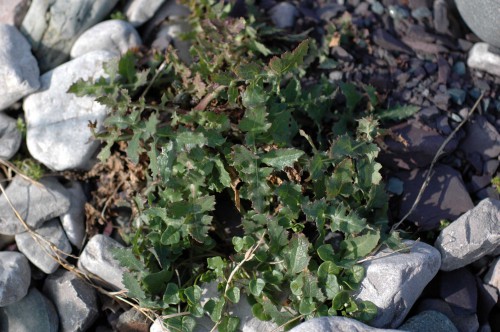
The coast here may appear to stark and empty, but it provides important habitat for a good range of marine plants and the eastern end of Llanddulas beach is designated as a SSI as locally rare plants such as sea kale and yellow horned poppy grow there. It was too early in the season for plants to be flowering, but there are new leaves pushing up through the shale.

New leaves of Sea Holly

New leaves of Sea Holly

New leaves of Yellow Horned Poppy

New leaves of Yellow Horned Poppy

New leaves of Sea Mayweed

New leaves of Sea Mayweed

As I neared the last stretch of the river I heard, then spotted more Grey Wagtails, another pair I’m sure, that were hunting flies from stones near the banks, flitting low across the water from one side to the other. As you round the bend in the path where the river ends the narrow ribbon of trees that follow the line of the cliff reaches the path edge. As I got close to this point a wren flew from the tree cover across to a rock and belted out his song.

Red-brown lichen

Red-brown lichen

I attempted to get a bit closer to him and he moved off, but I was soon distracted by a rock face smothered in a red-brown coloured lichen, I have no idea what it is, and another rock with some sort of quartz trapped in it.

Quartz in limestone

Quartz in limestone

Sheltered on this side of the rocks there was a clump of sea mayweed that appeared to have been blooming for some time as many of the flowers were already beginning to go to seed.

Clump of flowering Sea Mayweed

Clump of flowering Sea Mayweed

A green-bottle fly on Sea Mayweed flower

A green-bottle fly on Sea Mayweed flower

Highlighted by the sun there was a pretty little clump of moss or with seed-heads on a nearby rock too.

Moss or lichen with seedheads

Moss with seedheads

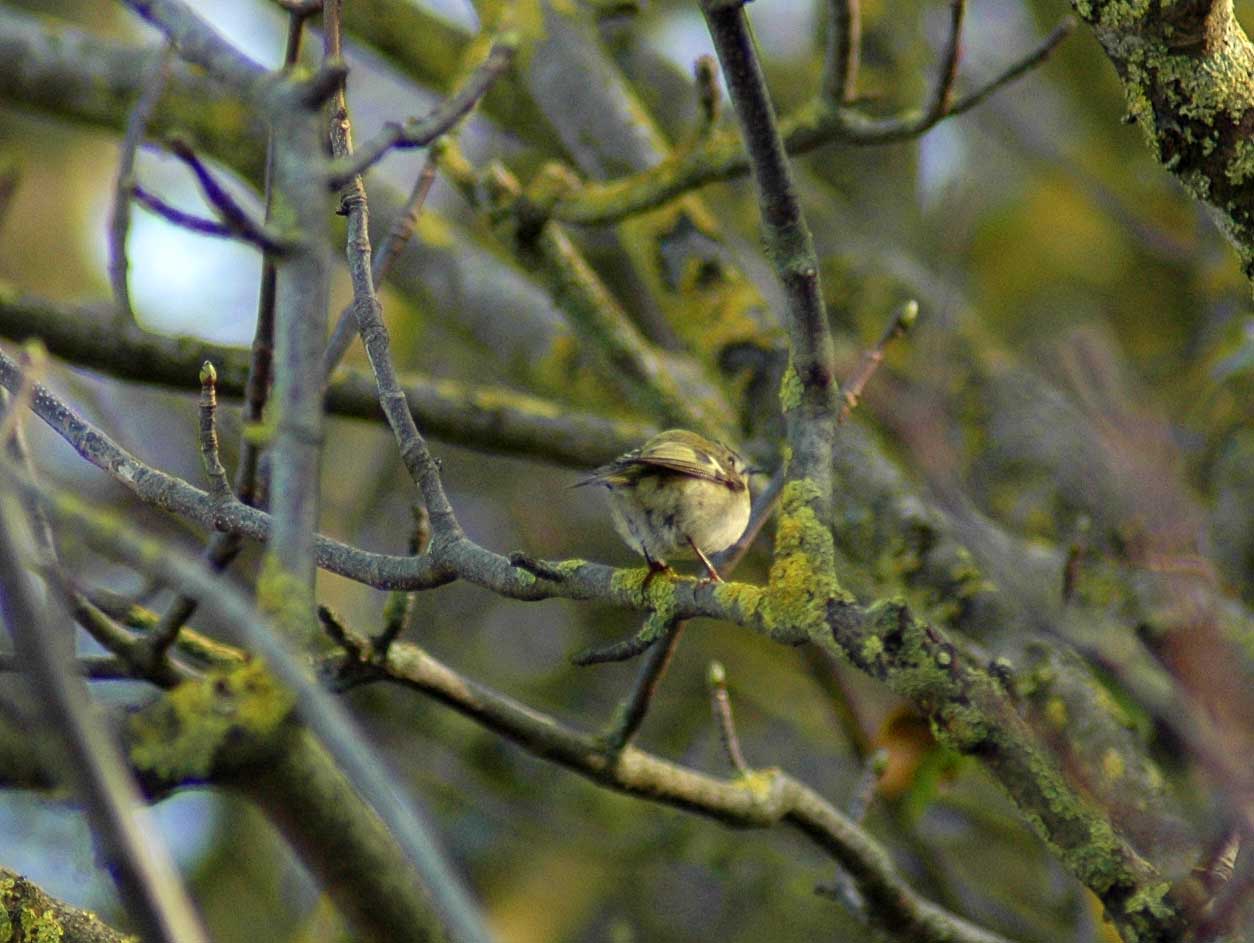
Moving back to the path I spotted two tiny birds flitting about amongst the twiggy tree branches. I thought at first they were wrens, but then excitedly realised they were too small and were actually goldcrests, a definite pair. I watched them for a good while as they continued to forage amongst the lichen-covered twigs, but didn’t have much luck getting a clear enough view for long enough to get a good photograph. The one below is the best I could do but it does confirm the sighting!

A rear view of one of a pair of goldcrest

A rear view of one of a pair of goldcrest

I would never have imagined seeing these delightful little birds here within a metre or two of a busy walkway, but there they were and no-one else seemed to notice them at all. These trees are mostly ash that have been regularly pollarded to prevent them growing high enough to block the view from the wooden chalets that line the clifftop above them and appear to be a popular spot with a variety of other species of birds too. In the short while I was there I saw blackbirds, dunnocks, robin, the wren I already mentioned and blue tits and great tits.

A view of the shore lined with herring gulls

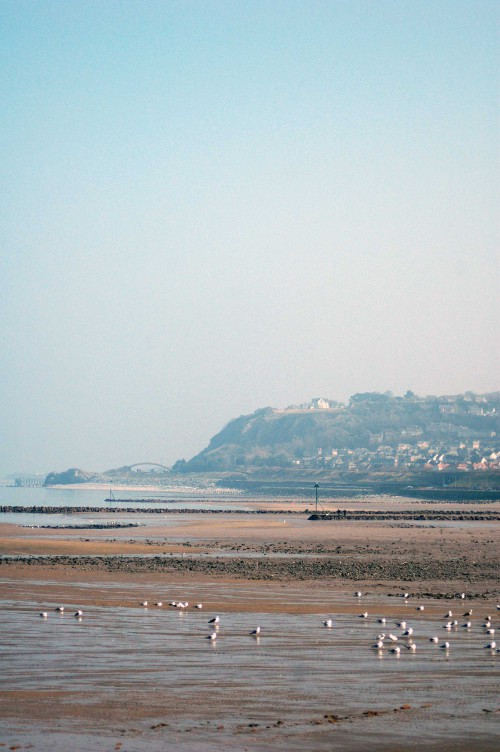
A view of the shore in the direction of Abergele then on to Prestatyn and Rhyl

A few metres away the shoreline was lined with huge numbers of herring gulls. During the winter months, there are oystercatcher, curlew, redshank and turnstone feeding here and some years there are snow buntings.

The shoreline stretches on to Pensarn then on to Prestatyn and Rhyl

The shoreline stretches on to Pensarn then on to Prestatyn and Rhyl

I was surprised to find some little yellow coltsfoot flowers pushing up through the stony ground next to the path here.

Coltsfoot

Coltsfoot

Wooden chalets line the path for a good distance along this section of the path and there were a growing number of people out walking dogs, so I turned round and walked back the way I had come.

Limestone quarry

Limestone quarry

Mist obscured much of the distant views today, but it was still possible to make out the outline of the old limestone quarry which rises up behind the shore, separated from it by the A55 Expressway. For 300 years quarrying was a major occupation in this area, second only to farming and lime kilns dominated the skyline from 1890 to 1940. There is a working quarry operational today and between Llanddulas and Colwyn Bay the path passes a jetty that serves it. There used to be another jetty, closer to Llanddulas where during stormy weather in April 2012 a cargo ship that was loading there was forced on to the rocks and had to be dismantled.This event made the national news and I recall it causing chaos on the A55 as people stopped their cars and got out to have a look or to take photographs.

Linnets on the raised stony sea bank

Linnets on the raised stony sea bank

Final treats were the sight of a small flock of linnets that flew on to the raised stony sea bank to feed on seeds and a lovely pair of mallard by the footbridge.

Mallard pair

Mallard pair


Share this:

  • Share on Facebook (Opens in new window) Facebook
  • Share on Pinterest (Opens in new window) Pinterest
  • Share on X (Opens in new window) X
Like Loading...

Bodnant Gardens

13 Friday Feb 2015

Posted by theresagreen in Nature of Wales, North Wales

≈ 6 Comments

Tags

Bodnant Gardens, Bodnant Gardens in winter, laburnum arch, mossy rocks, National Trust, snowdrops, streams, winter-flowering plants, woodland streams

Bodnant Gardens has all the elements I would choose for my own perfect garden; a steeply wooded valley with beautiful trees, a waterfall and a large pond, streams that cascade down the hillside, ferns and mosses, glorious flowering shrubs, interesting nooks and crannies, a wildflower meadow and of course its famous and glorious laburnum arch.

No matter the time of year you visit, there is always plenty to enjoy and the following photographs are just a few of the things that caught my attention during the first visit of the year towards the end of January.  I often visit here on my own, but this time it was lovely to be accompanied by a friend who was seeing the gardens for the first time.

Background of snowy mountains

Background of snowy mountains

It was a cold, snow-on-the -hills, rather overcast day, not too conducive for lingering and gloves were needed between photographs to thaw out fingers, so I didn’t made notes of the species of plants, just enjoyed them.

Wych Hazel underplanted with black grass and snowdrops

Wych Hazel under-planted with Black Grass (Ophiopogon) and snowdrops

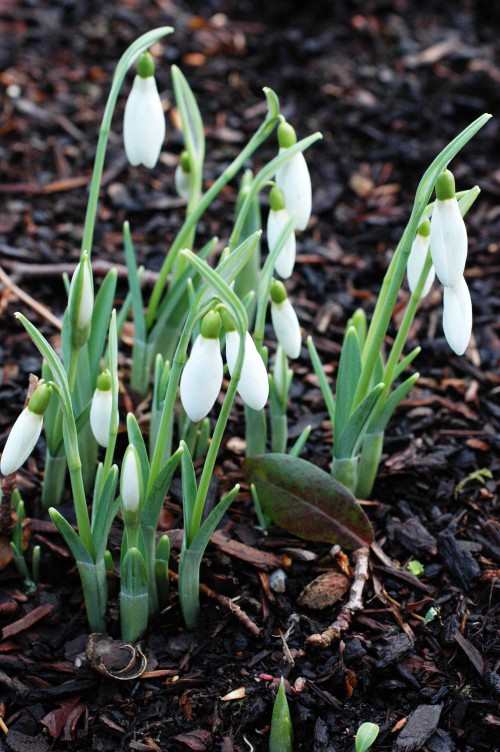
Snowdrops almost out

Snowdrops almost out

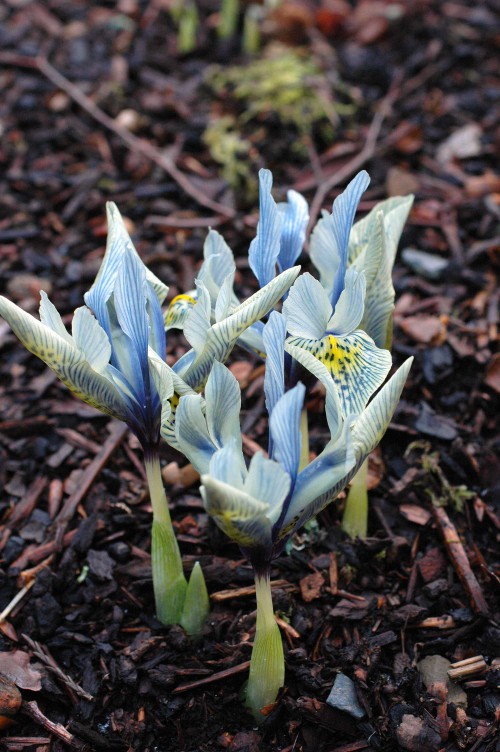
Iris

Iris

Bodnant House is not open to the public

Bodnant House is not open to the public

Anothe Wych Hazel, a golden yellow almost orange

Another Wych Hazel, a golden yellow, almost orange

Rhododendron, also past its best

Rhododendron, alas past its best


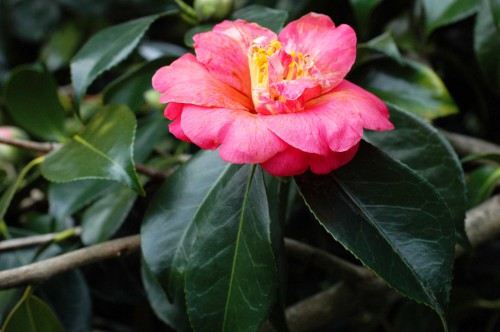
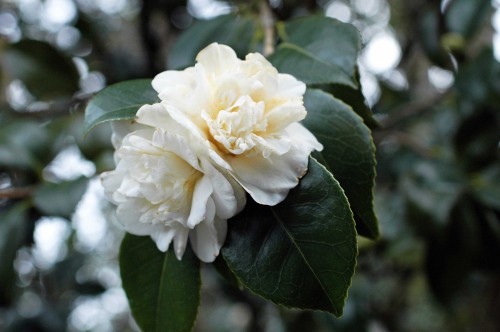
I was surprised by the numbers of rhododendron and camellias in full bloom, but even this early in the year many are already past their best and the ground beneath was strewn with fallen petals.

A pink camellia, past its best but still beautiful

A pink camellia, also past its best but still beautiful

A gorgeous creamy white camellia

A gorgeous creamy white camellia

Looking down into the Dell, onto the waterfall

Looking down into the Dell, onto the waterfall

Cascading streams and mossy rocks….

150120TG-Bodnant 10-Water

150120TG-Bodnant 12-Stream & falling water

150120TG-Bodnant 22-Mossy stones by water150120TG-Bodnant 21-Mossy stones by water

A close-up of  a fern-like moss

A close-up of a fern-like moss

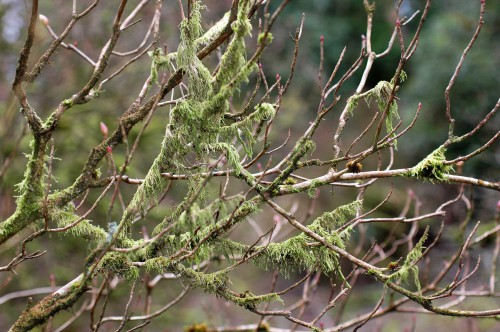
Lichen draped along twiggy branches

Lichen draped along twiggy branches

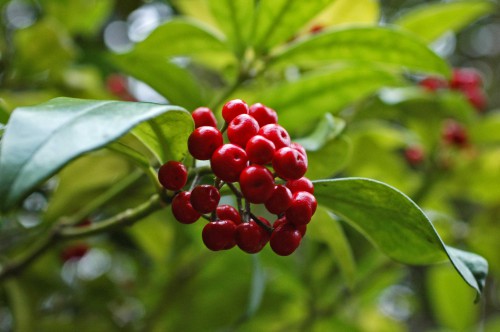
Red berries of

Red berries

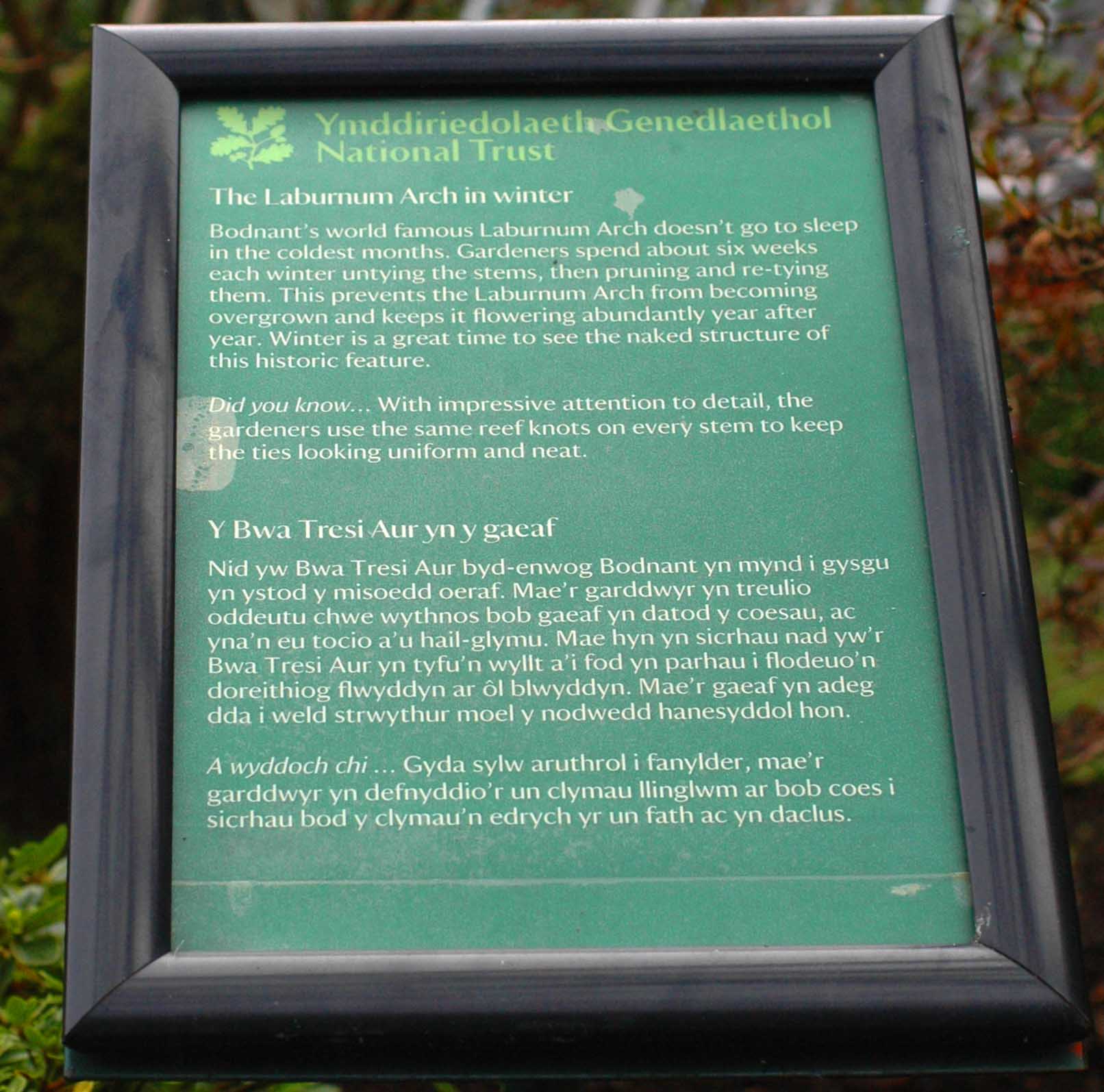
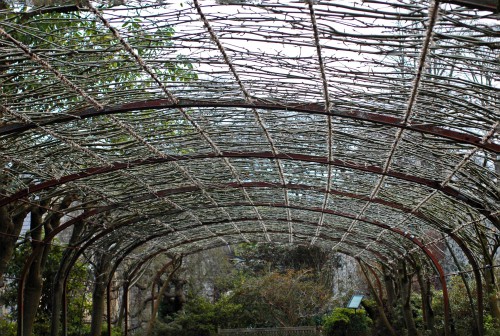
As I mentioned earlier, Bodnant is famed for its beautiful and impressive laburnum arch. At this time every year the arch is painstakingly pruned and the branches that will produce this year’s blossoms are individually tied into place. On the day of our visit we spoke to the ladies doing the work, which they assured us is a real labour of love and that its repetitive nature is peaceful and ‘zen-like’. Good to hear as the process takes around six weeks to complete. For visitors the end result is a neat and orderly, beautifully crafted structure that will support thousands of panicles of glorious yellow flowers this coming spring.

Pruning the laburnam arch

Pruning the laburnum arch

The narrative board that explains the pruning process

The narrative board that explains the pruning process

Still a way to go- the un-pruned half

Still a way to go – the un-pruned half

This is a photograph taken of the arch on a visit in mid-June when the blossoms were almost, but not fully out.

The laburnum arch, not quite at its best but you can see the potential

The laburnum arch, not quite at its best but you can see the potential


Share this:

  • Share on Facebook (Opens in new window) Facebook
  • Share on Pinterest (Opens in new window) Pinterest
  • Share on X (Opens in new window) X
Like Loading...
← Older posts
Newer posts →
Follow everyday nature trails on WordPress.com

Enter your email address to follow this blog and receive notifications of new posts by email.

‘But it is the common species that keep the living world ticking over and provide most of our experiences of wildlife, and I would argue that maintaining the abundance of these is as important a conservation priority as maintaining the existence of rarities’. Richard Mabey

MOST RECENT POSTS

  • A Glimpse of Spring to Come January 22, 2025
  • Hunting the Wren December 28, 2024
  • Oh, Christmas Tree December 18, 2024
  • In and Out of the Ivy February 15, 2024
  • Nature’s Fireworks November 30, 2023
  • Wild Autumn along the Coast Path November 3, 2023

OLDER POSTS

LOOKING FOR SOMETHING IN PARTICULAR?

  • Sights and Sounds from the Little Orme 1
    Sights and Sounds from the Little Orme 1
  • Things Bright and Beautiful
    Things Bright and Beautiful
  • Following a river to a Fairy Glen
    Following a river to a Fairy Glen
  • Catchers, a Duck and Divers
    Catchers, a Duck and Divers
  • May Bee Appearing on Ivy near You
    May Bee Appearing on Ivy near You
  • Shades, Sounds and Scents of the Woods
    Shades, Sounds and Scents of the Woods
  • Fine Dining for Crows
    Fine Dining for Crows
  • Butterflies and more rare treats
    Butterflies and more rare treats
  • The Windhover
    The Windhover
  • A Windy Wildflower Trail
    A Windy Wildflower Trail

nightingale trails

The Walk of the Monarch Butterfly-Sendero de la Mariposa Monarca

The Walk of the Monarch Butterfly-Sendero de la Mariposa Monarca

MY WILDFLOWER BLOG: where the wildflowers are

Snowdrop

Snowdrop

most recent posts

Follow everyday nature trails on WordPress.com

Social

  • View teresamaygreen’s profile on Twitter

Enter your email address to follow this blog and receive notifications of new posts by email.

Website Built with WordPress.com.

  • Subscribe Subscribed
    • everyday nature trails
    • Join 359 other subscribers
    • Already have a WordPress.com account? Log in now.
    • everyday nature trails
    • Subscribe Subscribed
    • Sign up
    • Log in
    • Report this content
    • View site in Reader
    • Manage subscriptions
    • Collapse this bar
 

Loading Comments...
 

    %d