• Home
  • about
  • about the photographs
  • Local Nature Reserves
    • Bryn Euryn Local Nature Reserve
    • Mynydd Marian
  • Wales Coast Path
    • Grey Seals in North Wales
    • St.Trillo’s Chapel
    • Wildflowers of North Wales Coastal Paths, Cliffs and Dunes

everyday nature trails

everyday nature trails

Category Archives: Nature of Wales

Spring has finally arrived in Fairy Glen

18 Saturday May 2013

Posted by theresagreen in Local Nature Reserves, Nature of Wales, nature of woodlands, nature photography

≈ 6 Comments

Tags

cuckoo pint, dog violet, Fairy Glen, horsetail, ivy-leaved toadflax, marsh marigold, min-y-don, osmia rufa, Pied Wagtail, ramsons, red mason bee, river Colwyn, song thrush, spring flowers

Last Friday was a day typical of our Spring so far this year, overcast, showery and cool, but as I began driving home at lunchtime the sun came out, so I stopped by the little bridge at Min-y-Don woods as I often do, just to have a quick look at whatever is about. Today that was small birds flying back and forth across the river that I thought may have been Chiffchaff, but turned out to be House Sparrows taking drinks and chasing flies over the water. Then near the bend in the river I caught another flash of bird movement that made me think ‘grey wagtail’. Of course I had to follow it, being ever hopeful of a good photo opportunity. I finally caught up with the bird and saw it was actually a Pied Wagtail that was by now intent enough on catching insects not to be too disturbed by my presence.

A Pied Wagtail adeptly catching flies

A Pied Wagtail adeptly catching flies

Maybe he has a nest nearby and was out hunting for food to feed young ones, or maybe because he was alone, perhaps has a mate still sitting on eggs and he was feeding her, or, maybe he was simply feeding himself. Whatever his aims, he was very entertaining to watch and seemed to be catching plenty of insects.

Pied Wagtail - Motacilla yarellii

Pied Wagtail – Motecilla yarellii

A couple passing by stopped to see what I was photographing and told me they had seen the grey wagtails further upstream, so I had to carry on walking then, just in case.

On the way up to Fairy Glen my eye was caught by a mass of bright green liverwort at the mouth of a drainpipe, giving the impression it was cascading out like water.

Liverwort at the mouth of a drain pipe

Liverwort at the mouth of a drain pipe

Flowers are generally late this year, but they are making up for lost time now. On the stone walls bounding the river and roadside, the pretty, albeit non-native Ivy-leaved Toadflax flourishes.

Ivy-leaved Toadflax- cymbalaria muralis. A native of Mediterranean Europe, but widely naturalised elsewhere

And here and there the darker purple-blue blooms of the Common Dog Violet peeked out.

Common dog-violet

Common dog-violet – Viola riviana with its pretty  heart-shaped leaves

Garlic mustard is beginning to show its modest white flowers; I love the shape and texture of its leaves too.

Garlic Mustard

Garlic Mustard – Alliaria petiolata

Just inside the woodland of the Glen a few stands of graceful bluebells arch up through the masses of  almost-done lesser celandines, surrounded by encroaching wild garlic.

Bluebell -

Bluebell – Hyacynthoides non-scripta

Further into the woodland the air was filled with the pungent scent of masses of ramsons, or wild-garlic, just reaching the peak of its flowering. Great swathes of it flow down the sloping riverbank and it carpets much of the ground beneath the trees too, to the apparent delight of a host of nectar-seeking insects.

130510TGNJ4-wild garlic-fairy glen

Ramsons, Wild Garlic – Allium ursinum

Ramsons flowers and buds

Ramsons flowers and buds

I watched big beautiful bumblebees, several different species of hoverfly and some little bees that I didn’t recognise visiting the starry white flowers. Looking afterwards at the photographs and checking several identification books and websites, I have ended up with mason bees. If anyone knows better, please let me know.

One of a number of tiny mason bees feasting on the nectar of the wild garlic flowers

One of a number of tiny mason bees feasting on the nectar of the wild garlic flowers

Red Mason Bee – Osmia rufa
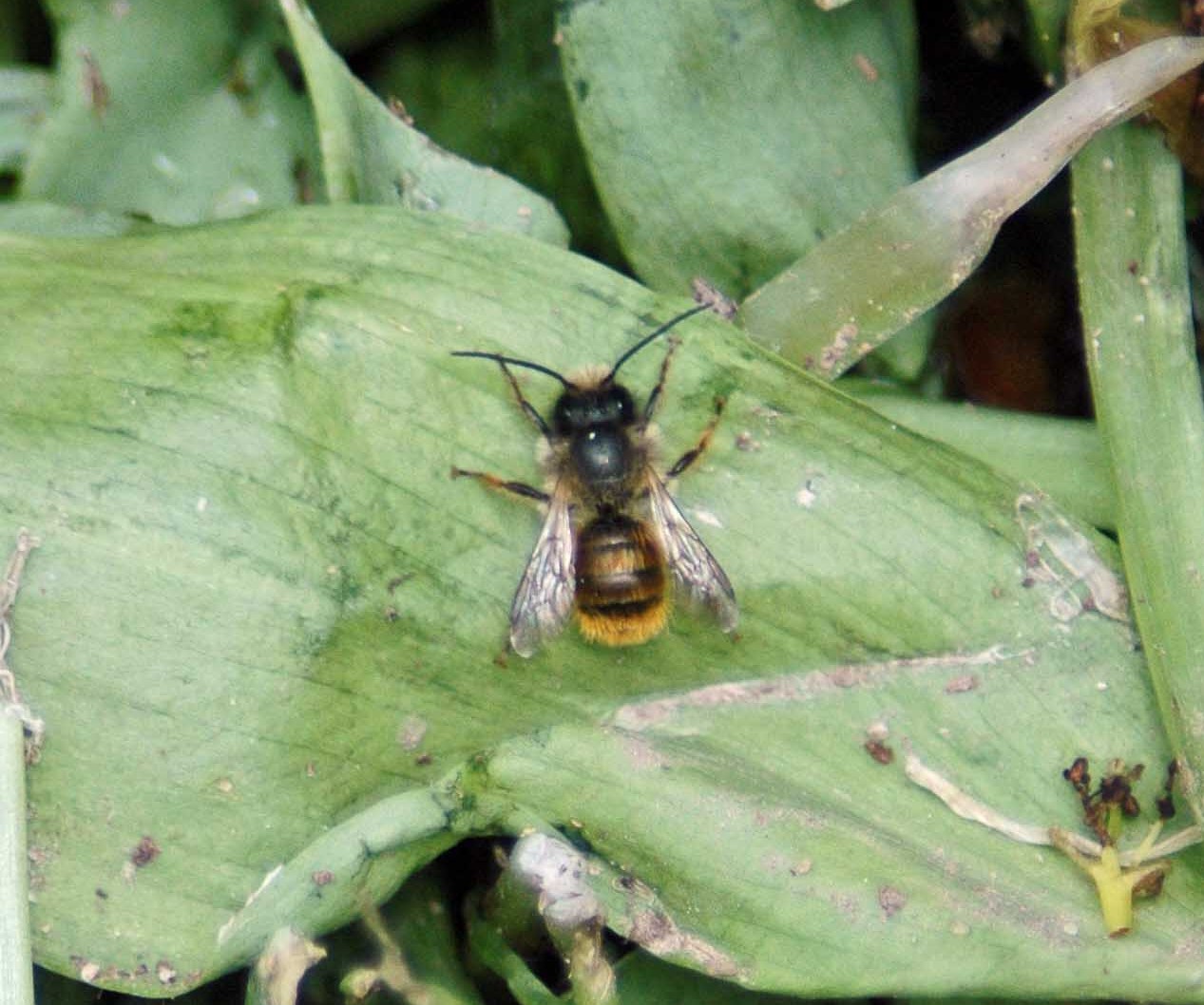
One of the little bees (male), pausing briefly to soak up some warmth

One of the little bees (male), pausing briefly to soak up some warmth

 Description: 

The male bees

are smaller than the females at

just 6 -11 mm long. Both

sexes

are covered in dense gingery hairs, the male with white tufts on the head while the female’s head is black.

Habitat: 

Around suitable nesting sites. 

The Red Mason Bee is active from early spring, the male being the first to appear when the weather becomes mild in March, the female emerging later. Like all bees it feeds on pollen.

 Life History: This is a solitary bee, each nest being the work of a single female working alone. They nest in pre-existing cavities such as hollow plant stems, old garden canes, air bricks, and even old nail holes in fence posts, lining the inside of the cavity with mud.

There were birds singing, I heard chiffchaff, blackbird, robin and wren, but most of those I saw, including blue tits, great tits and a coal tit seemed more intent on hunting for insects, so I imagine there are gaping little beaks to fill.
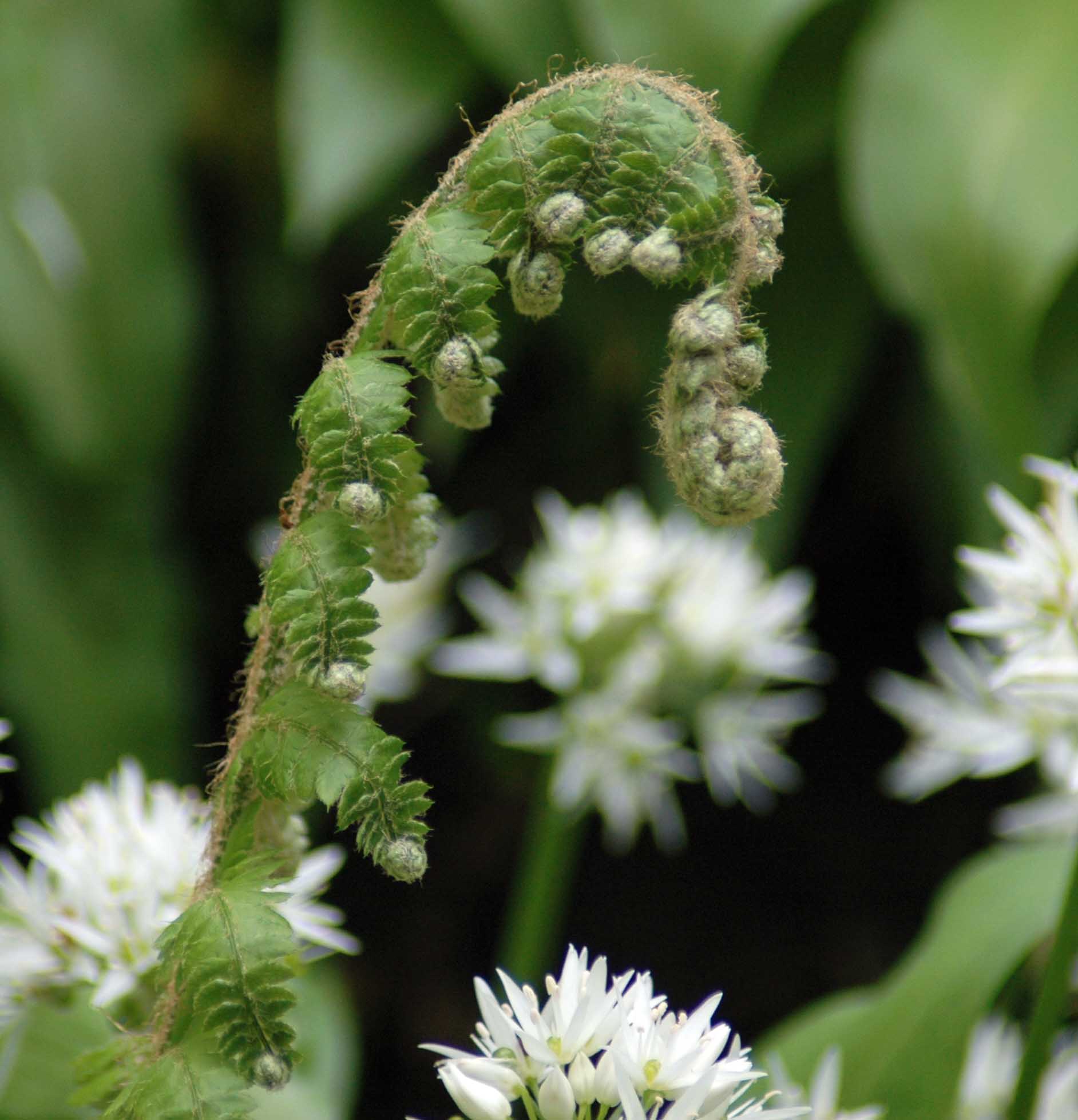
fern frond unfurling

fern frond unfurling amongst the wild garlic

An hour had passed by without me even noticing and I could have stayed even longer, but there began to be quite a few people about keeping the wildlife more discreet in their activities, so I started to make tracks back; I would have missed the sight of a lovely song thrush if I’d kept going.

Song Thrush with what I think is a worm

Walking back towards Min-y-Don I took a detour up and around one of the other paths and found yet more interesting plants to distract me.
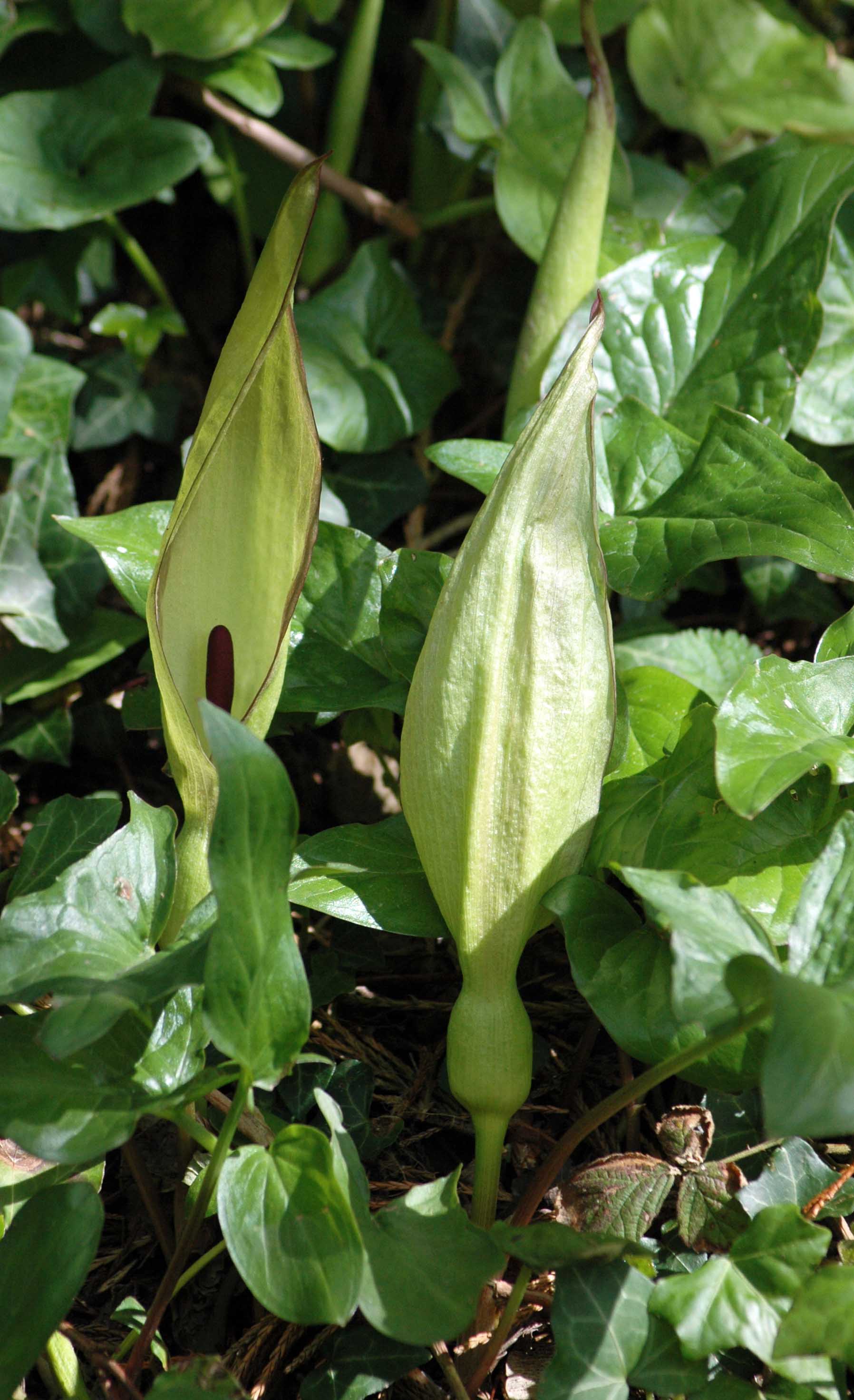
Arum -

A strange plant with many names-Lords & Ladies, Jack-in-the-Pulpit,Cuckoo Pint or Wild Arum – Arum maculatum

Horsetail

Horsetail- Equisetum

An almost-orange Welsh Poppy

Sunlight catching the  almost-orange petals of a Welsh Poppy-Mecanopsis cambrica

Kingcups, or marsh maraigolds reflected in a pool of water

Golden kingcups, or Marsh Marigolds-Calthea palustris reflected in a pool of water

And finally an impressive clump of dock that has found purchase in mud on the shallow edge of the river. I know it’s not a desirable plant, but it looked quite well there with its big shapely leaves.

Curled dock

Dock

A crow strutting along the river-wall, feathers gleaming with shades of purple and green

a crow strutting along the river-wall, feathers gleaming with shades of purple and green

Two hours after setting off for one photograph I was on the way back home, but couldn’t resist the sight of rabbits amongst the mass of primroses on the embankment, which is where the current page header came from.

bunnies amongst the primroses

bunnies amongst the primroses

Back at home a large white butterfly was nectaring on a dandelion, the first I’ve seen so far this year. Large white that is, not dandelion, whose population seems to have boomed this year. I have never seen so many.
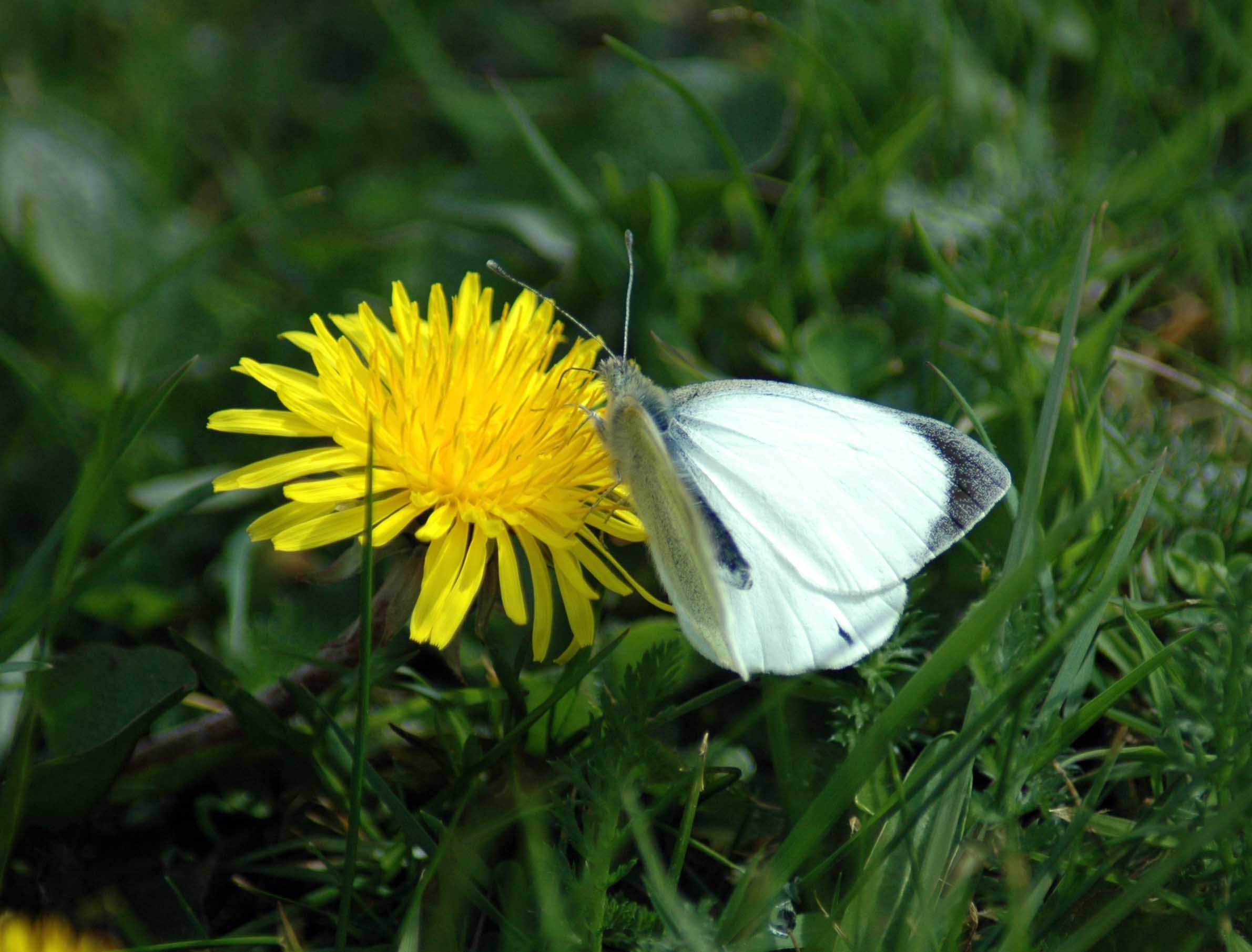
large white taking nectar from a dandelion

large white taking nectar from a dandelion
Share this:

  • Share on Facebook (Opens in new window) Facebook
  • Share on Pinterest (Opens in new window) Pinterest
  • Share on X (Opens in new window) X
Like Loading...

The Cockchafer or Maybug

29 Tuesday May 2012

Posted by theresagreen in Beetles, garden wildlife, Nature, Nature of Wales, nature photography

≈ 7 Comments

Tags

cockchafer, large beetle attracted to lights, maybug, melolontha melonontha

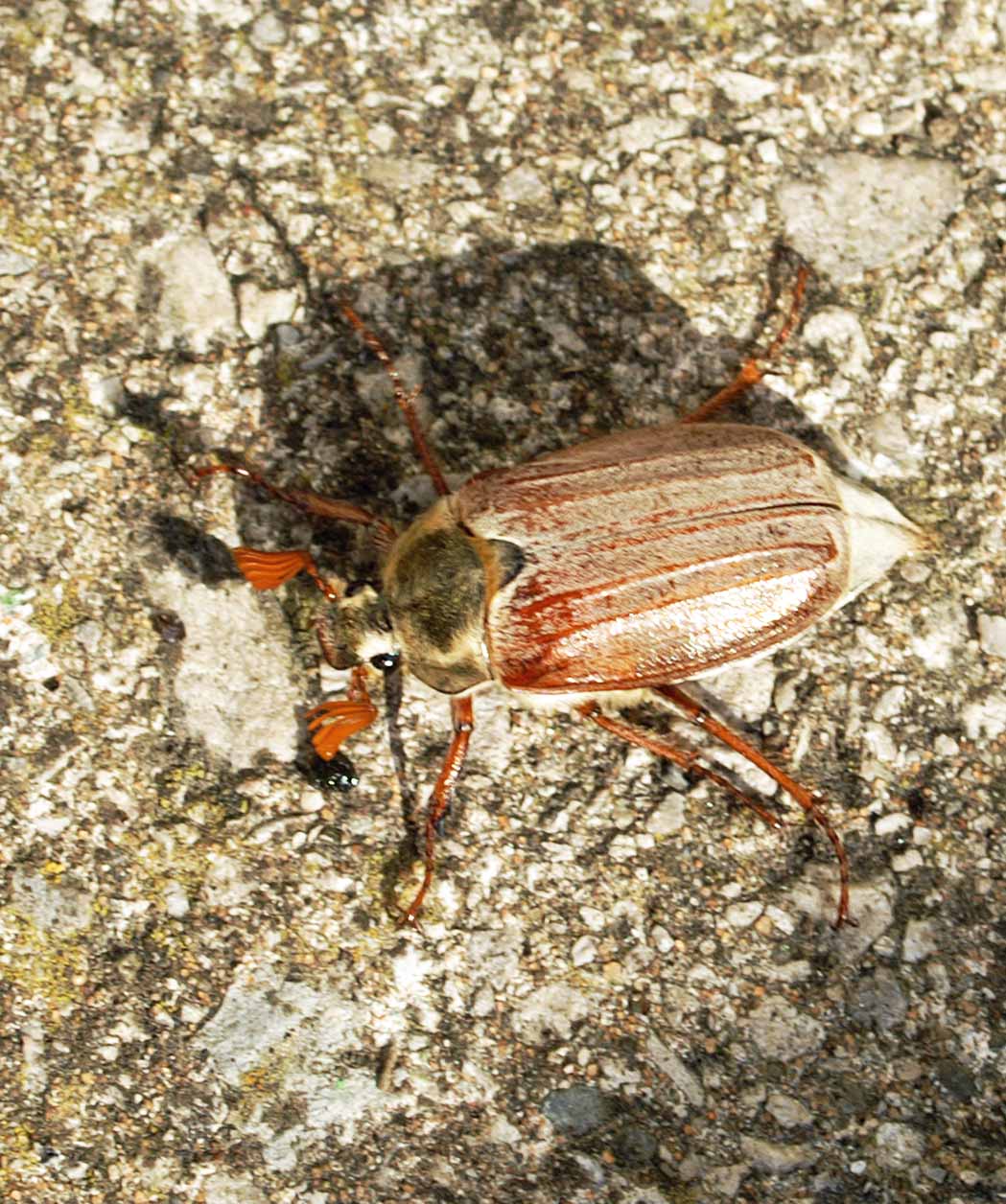
One morning last week I carried my early cup of tea outside to enjoy some early morning sunshine and discovered a big fat Maybug on its back on the chair. No amount of struggling was effecting him righting himself, he just lay there frantically waving his legs in the air, poor thing. Of course I helped him after I had taken advantage of his plight to photograph him, allowing him to hook his feet around my finger and placing him on the ground from where he took off rapidly and headed for the sycamore tree.

Maybug on its back showing the very furry body

Maybug, Cockchafer–Melolontha melolontha The Cockchafer is one of the more familiar large beetles as it is often encountered flying noisily about on warm evenings of the early summer, when it may crash into windows, attracted there by lights. It is also known as the May Bug as this is the month in which it most commonly appears. It is common and widespread throughout Britain and Europe except in the far north, occurring in grassy and lightly wooded places.

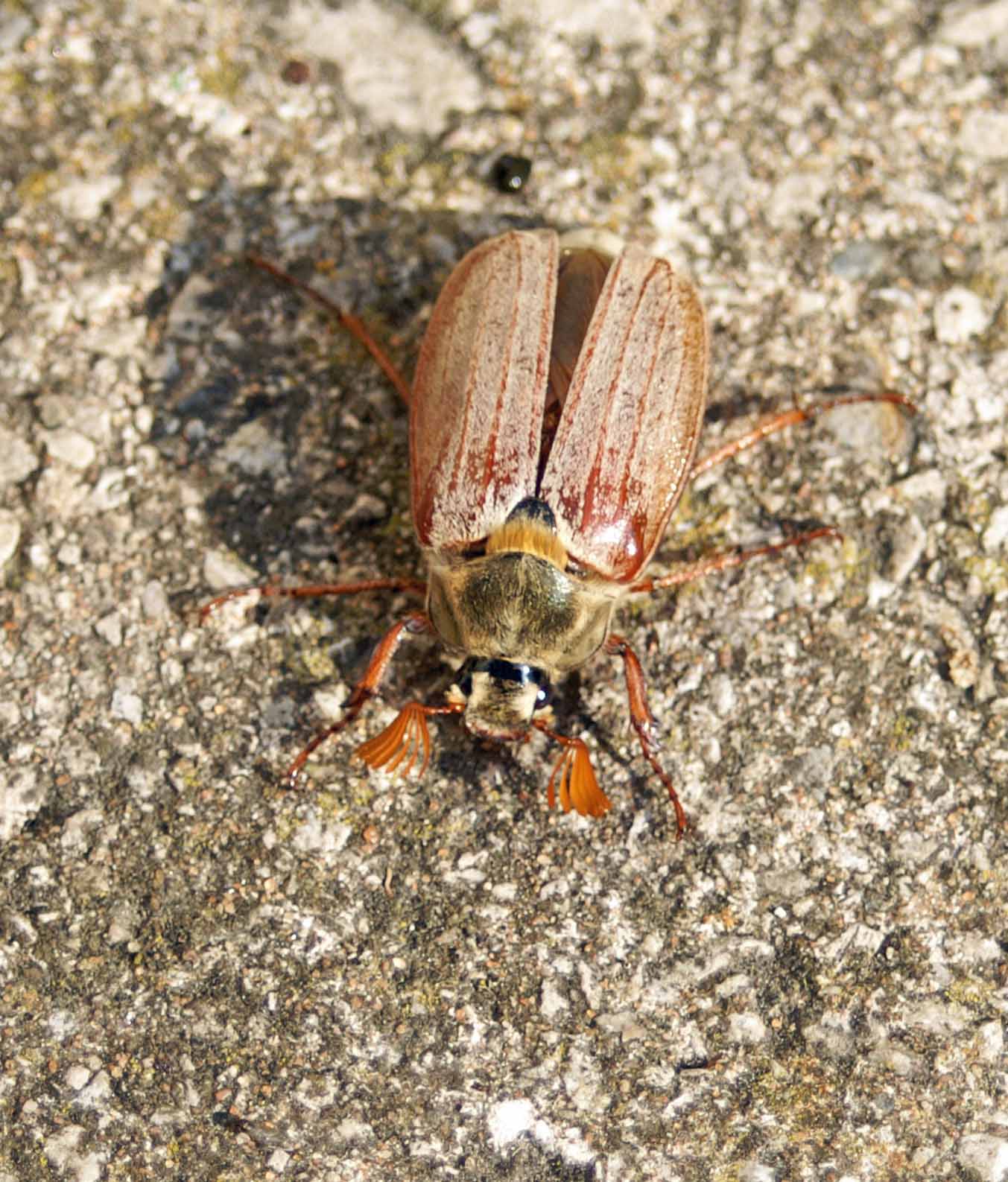
Cockchafers have a black head and thorax and brown sculptured elytra (wing-cases).

The larvae live on the roots of grasses and other plants in areas kept as permanent pasture and once were so abundant they were regarded as a pest species.

The beetle, particularly the male, has large impressive feathery antennae that open like a fan

Share this:

  • Share on Facebook (Opens in new window) Facebook
  • Share on Pinterest (Opens in new window) Pinterest
  • Share on X (Opens in new window) X
Like Loading...

Thrift -Armeria maritima

28 Monday May 2012

Posted by theresagreen in Little Orme, Nature, Nature of Wales, nature photography, Rhiwledyn Nature Reserve, Wildflowers of Wales

≈ 4 Comments

Tags

armeria maritima, Ceibwr Bay, clifftop flora, Pembrokeshire coastal path, sea pink, thrift, thrift on old three pence coin, wildflowers with pink flowers

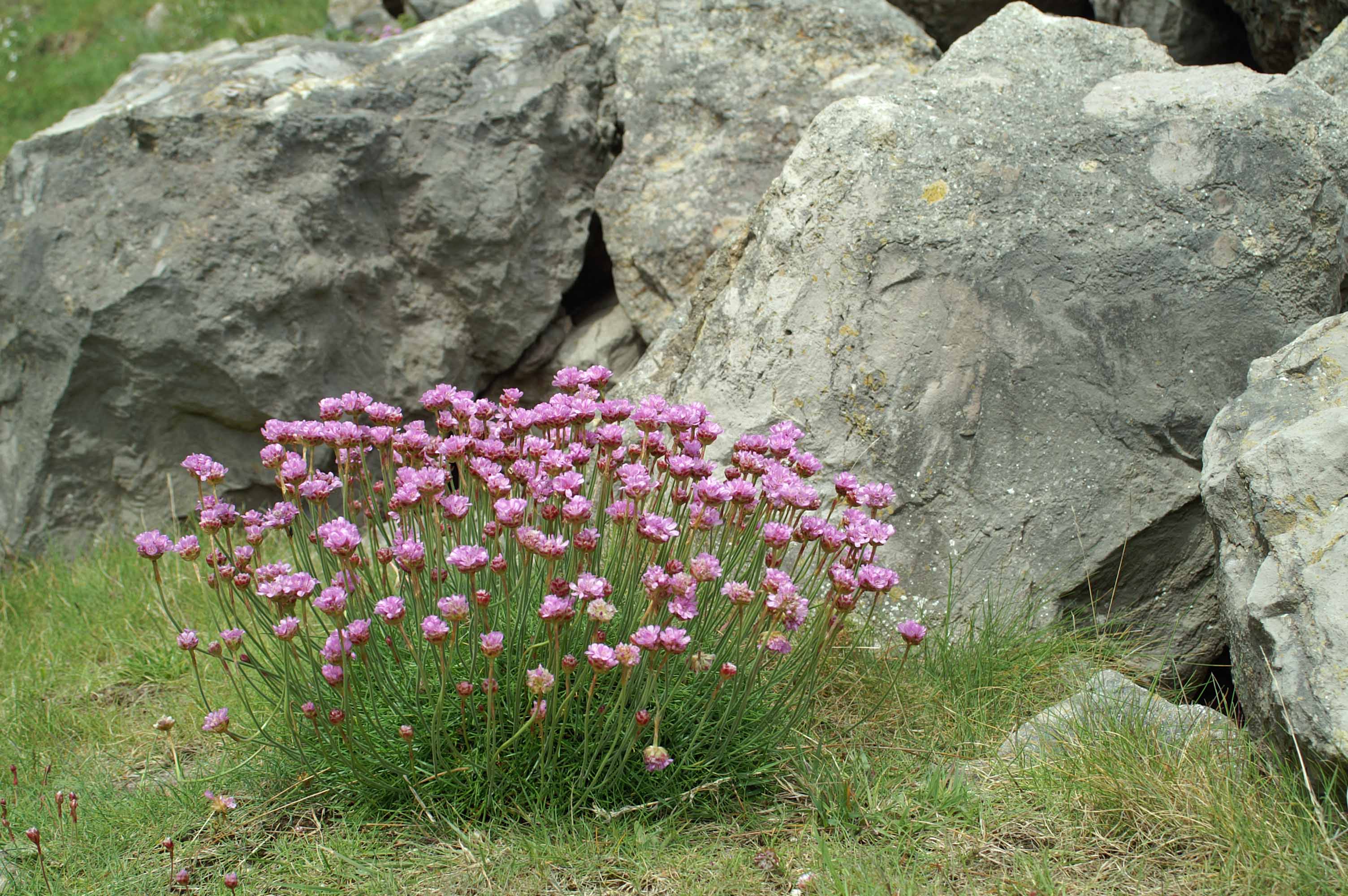
Thrift – Armeria maritima, Rhiwledyn Nature Reserve, Little Orme, North Wales

Thrift

Thrift or Sea Pink, Rock Rose, Our Lady’s Pillow – Armeria maritima, begins flowering in April and carries on gloriously well into July. It is a low growing perennial plant that forms dense neat tussocks  of linear leaves and produces generous numbers of fragrant button-shaped flowers. The plant has very shallow roots and takes its common name of ‘thrift’ from its ability to make the most of any available nutrients in the thinnest of soils of cliffs and rocks.

Thrift creates wonderful displays on    wild, coastal areas throughout the UK – especially south-west Wales and Scotland, but as well as rocky cliffs, Thrift can also be commonly found brightening up saltmarshes and other sandy areas.

11/6/10-A wonderful display of thrift on the cliffs at Ceibwr on the Pembrokeshire Coastal Path, West Wales

The Welsh name for thrift is clustog Fair, which translates as Mary’s pillow. In Gaelic it is known as tonna chladaich, meaning ‘beach wave’.  It is the county flower of Bute, the Isles of Scilly and Pembrokeshire/Sir Benfro.

11/6/10- An old stone wall with a colony of thrift flowers – Pembokeshire Coastal Path

The threepenny coin was embossed with a portrait of Edward VIII and a reverse design of a thrift plant by Frances Madge Kitchener

Thrift was used as an emblem on the threepenny-bit between 1937 and 1953 – no doubt as a clever and light-hearted pun at a time in our British history when saving, making and mending and general ‘thrift’ were a part of everyday life.

Share this:

  • Share on Facebook (Opens in new window) Facebook
  • Share on Pinterest (Opens in new window) Pinterest
  • Share on X (Opens in new window) X
Like Loading...

Daffodils and leeks

01 Thursday Mar 2012

Posted by theresagreen in Nature, Nature of Wales, nature photography

≈ Leave a comment

Tags

leek, lent lily, narcissus pseudonarcissus, narcissus pseudonarcissus ob vallaris, St David's Day, Tenby daffodil, Welsh daffodil, Welsh leek

Today is Saint David’s Day (Welsh: Dydd Gŵyl Dewi)- the feast day of  the patron saint of Wales, which falls on March 1st each year. This date was chosen in remembrance of the death of Saint David as tradition holds that he died on that day in 589. The date was declared a national day of celebration within Wales in the 18th century.

Many Welsh people wear one or both of the national emblems of Wales on their lapel to celebrate St. David: the daffodil, a generic Welsh symbol which is in season during March or the leek, Saint David’s personal symbol on this day. The association between leeks and daffodils is strengthened by the fact that they have similar names in Welsh, Cenhinen (leek) and Cenhinen Pedr (daffodil, literally “Peter’s leek”).

There are several slightly varying versions of exactly how the leek came to be recognised as the emblem of Wales, but the general theme is that it was worn on the caps of  Welshmen in battle to distinguish them from their foes. Nowadays the leek, in various forms, is often sported by welsh rugby supporters and is featured on the reverse of the pound coin issued between 1985-1990.

 1985 One Pound Coin 1985
1990
Leek and royal diadem representing Wales.Edge Inscription:
PLEIDIOL WYF I’M GWLAD

Designed by:
Leslie Durbin

(The edge inscription roughly translates as ‘I am true to my roots’).

Welsh and Tenby daffodils

The adoption of the daffodil as a national emblem is more recent and may be that  during the Victorian era, a common vegetable such as the leek wasn’t considered glamorous enough to be the Welsh national emblem and the daffodil, whose flowering coincides with the Welsh patron saint’s holiday, seemed like a fitting replacement.

There are two varieties of daffodil unique to Wales – the Tenby and the Welsh or Lent daffodil. Both species have suffered decline over the years as a result of property development on land where they once thrived.

Tenby daffodil-Narcissus pseudonarcissus obvallaris

Tenby daffodils suffered in Victorian times from being too popular as they were regularly dug up and became quite scarce but replanting has helped and nowadays you’ll see plenty in the spring time around Tenby,  South Pembrokeshire, and also in Carmarthenshire and parts of Ceredigion. One of the biggest displays of Welsh daffodils can be seen at Coed y Bwl Wood, at Castle Upon Alun, St.Brides Major in the Vale of Glamorgan, South Wales. The Welsh variety is more widespread, but still scarce.

This little daffodil only grows about 8″ or 30cm high and can be found growing wild around Tenby in Wales, hence the name. It seems no-one is quite sure if the Tenby daffodil was introduced to this country, or whether it could be a natural variation of our only truly native daffodil, Narcissus pseudonarcissus, also known as the Lent Lily as it usually flowers during the period of Lent, through February and March.

Lent lily – Narcissus pseudonarcissus

The Lent Lily is a similar tiny size and shape, but the outer petals are paler than the yellow trumpet, or corona, whereas the Tenby Daffodil has both a yellow trumpet and outer petals. Both have sword-like grey-green leaves and the plants are perennials. The species is native to Western Europe from Spain and Portugal east to Germany and north to England and Wales. It is commonly grown in gardens and populations have become established in many other parts of Europe. Wild plants grow in woods, grassland and on rocky ground. In Britain native populations have decreased substantially since the 19th century due to intensification of agriculture, clearance of woodland and uprooting of the bulbs for use in gardens.

Share this:

  • Share on Facebook (Opens in new window) Facebook
  • Share on Pinterest (Opens in new window) Pinterest
  • Share on X (Opens in new window) X
Like Loading...

Hungry Herring Gulls

21 Wednesday Sep 2011

Posted by theresagreen in birds of the seashore, Birdwatching on North Wales coast, Nature, Nature of Wales, Rhos-on-Sea

≈ 2 Comments

Tags

colwyn bay beach, herring gull, herring gull feeding behaviour, herring gull juveniles begging for food, larus argentus

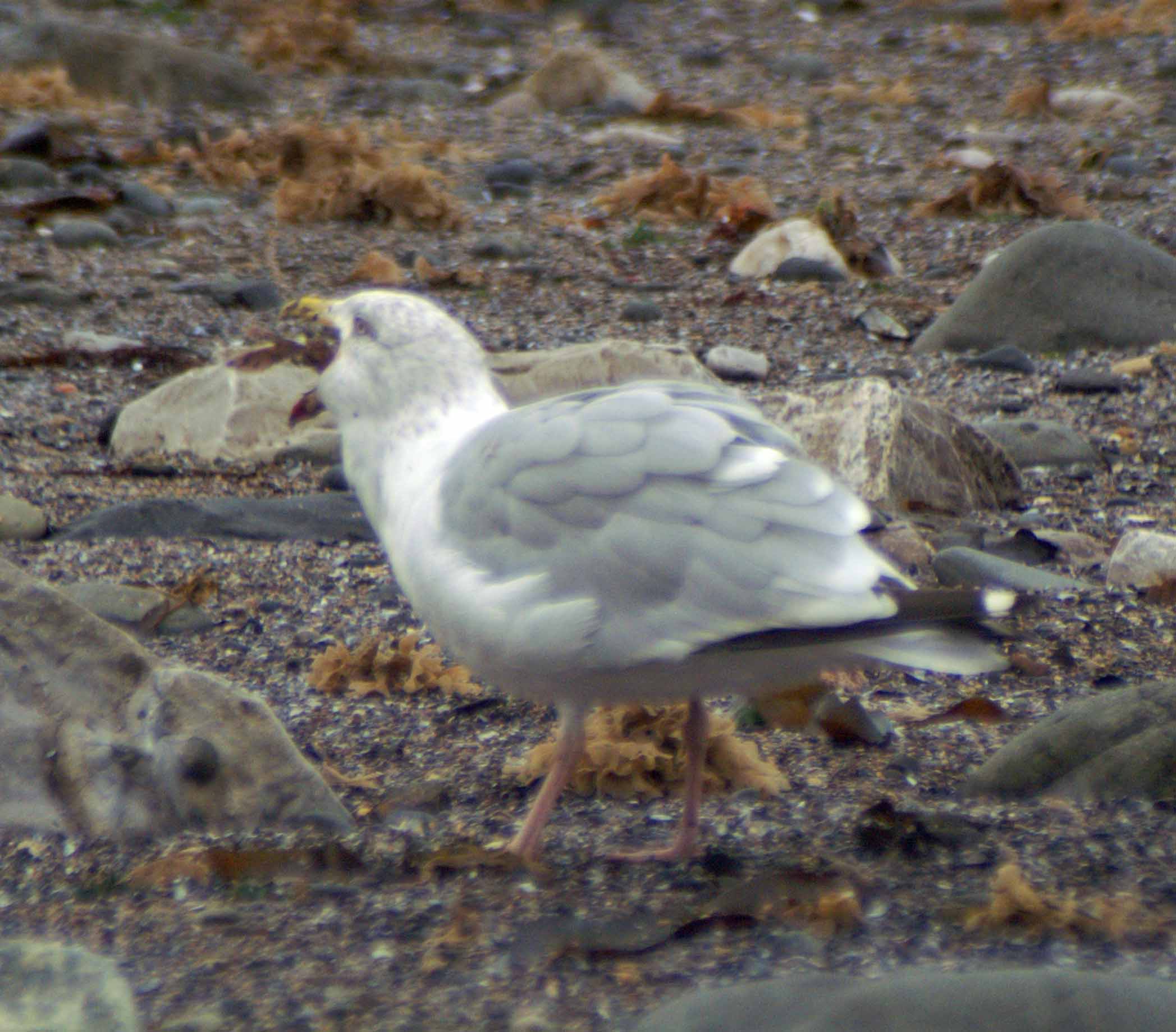
Walking along the sea shore the other day I came across a Herring Gull in the process of eating a fish. I have no idea what species of fish it was, all I can say is that it was a flat fish and either whole or almost-whole, either way, large enough for me to be amazed that a bird could even attempt swallow it.

17/9/11-The gull with most of the fish in its gullet

17/9/11- It was not going down easily, so it had to come back up again

17/9/11-A second attempt -and this time the fish disappeared

17/9/11- All that remained was a lump in the gull's crop - it should keep him going till at least lunchtime

Herring Gulls are  omnivores and opportunists like most Larus gulls, and will scavenge from rubbish dumps, landfill sites, and sewage outflows; food obtained this way may comprise up to half of the bird’s diet. Despite their name, they have no special preference for herrings — in fact, examinations have shown that echinoderms and crustaceans comprised a greater portion of these gulls’ stomach contents than fish.

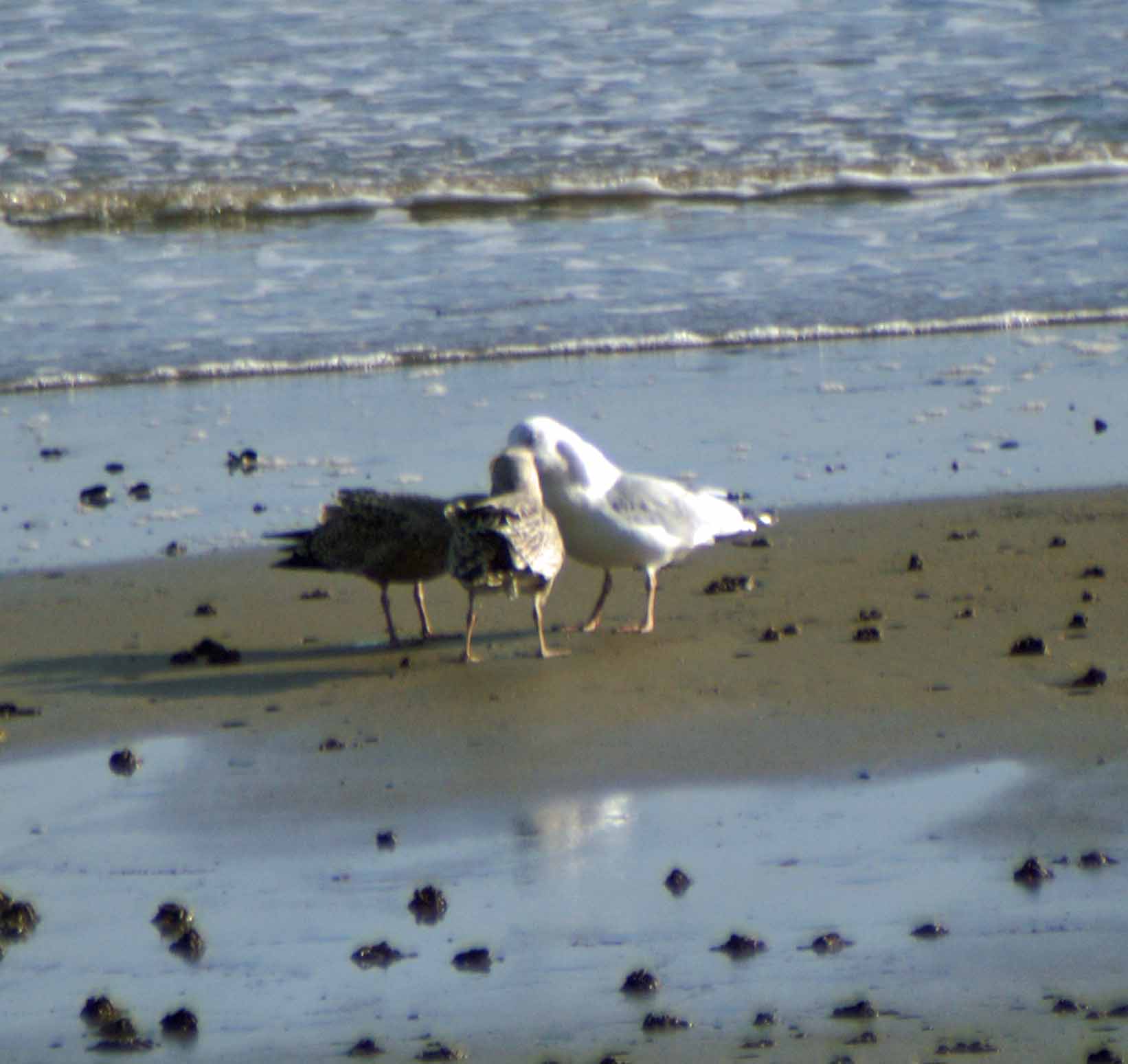
On Colwyn Bay seashore I witnessed more gull feeding behaviour, this time two juveniles were begging an adult, presumably a parent, to feed them.

Young Herring gulls persuading a parent to feed them

Juveniles use their beaks to “knock” on the red spot on the beaks of adults to indicate hunger. Parents typically disgorge food for their offspring when they are “knocked”.

Parent gulls will feed their offspring for up to 6months if they continue to beg

Chicks are generally fed by their parents until they are 11–12 weeks old but the feeding may continue up to six months of age, if the young gull continues to beg. The male feeds the chick more often than the female before fledging, the female more often post-fledging.

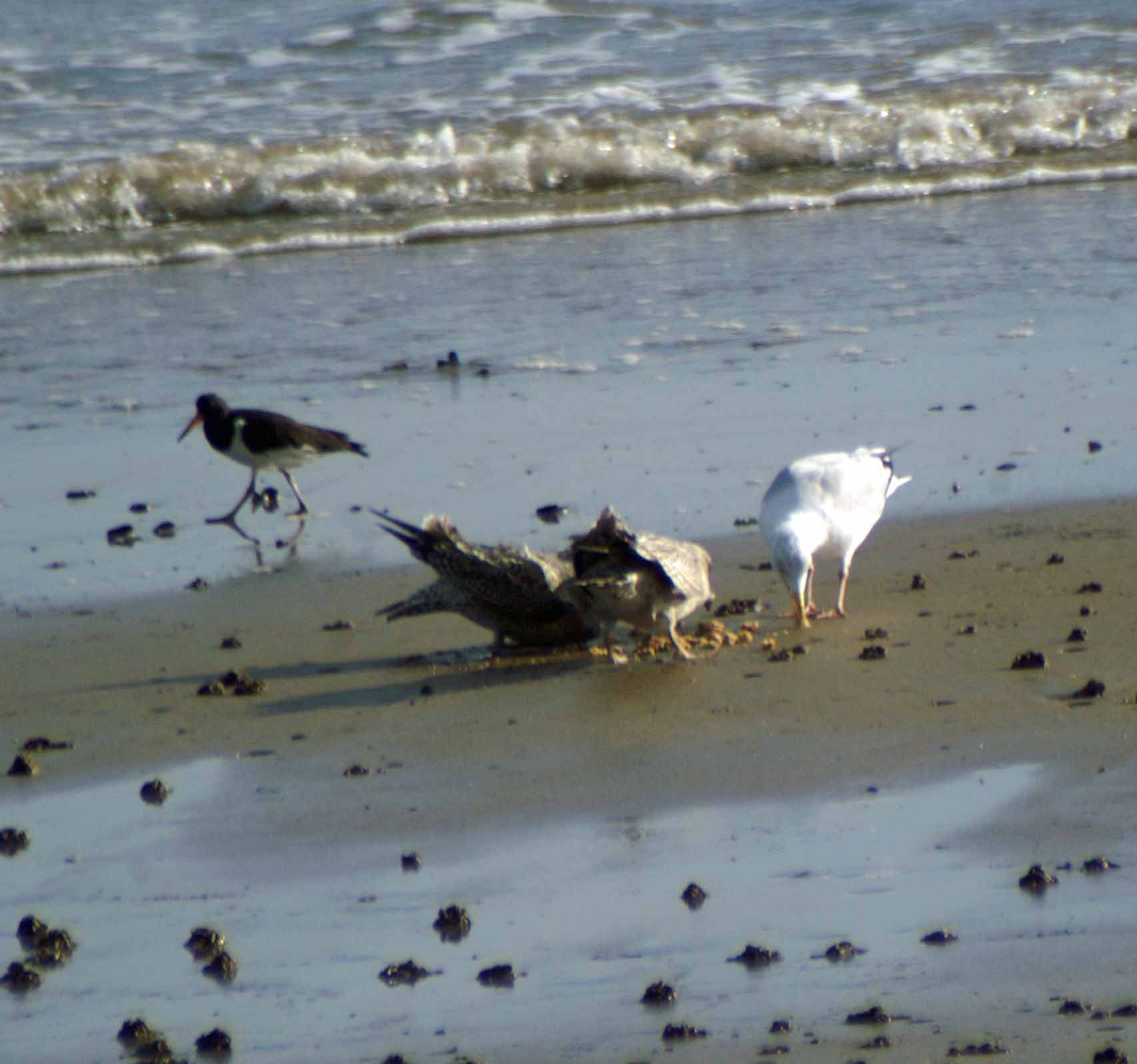
The adult was persuaded to disgorge what it had eaten onto the sand

The young birds begging did the trick and the adult disgorged whatever it had eaten onto the beach, which did not look at all appetising from where I was standing, but the three birds seemed to be happy with it.

Share this:

  • Share on Facebook (Opens in new window) Facebook
  • Share on Pinterest (Opens in new window) Pinterest
  • Share on X (Opens in new window) X
Like Loading...

Seaside life, cloudy skies and other views

03 Saturday Sep 2011

Posted by theresagreen in Nature of Wales, Rhos-on-Sea

≈ Leave a comment

Tags

catching crabs, cloudy skies, daisies growing on the beach, herring gull, Little Orme, mussel beds of Rhos-on-sea, red-tailed bumblebee

The weather throughout August has been unsettled and changeable. Rainy and sometimes windy days have curtailed outdoor activities, but when there have been dry spells and even occasional warm sunny ones, beautiful cloud formations have added an extra dimension to the views of sea and land.

A breezy but sunny afternoon:

9/8/11-Clouds over Rhyl

Catching crabs,( or ‘crabbing), is a popular form of entertainment in this part of the world. The only equipment required are a length of line with a hook to hold the bait, which is often a small piece of bacon and a bucket full of water to hold your catch – specially marked buckets are sold locally. When you’ve caught enough crabs to make you happy, you  simply return them all to their rightful home unharmed, where they can continue to grow. I’m sure there are many canny crabs lining up for an easy meal.

9/8/11-Crabbing from the jetty, Rhos-on-Sea

9/8/11-On the village part of the promenade a clever woven wicker sculpture, crafted from live willow, of a person holding a fish

 A warm evening just before sunset:

4/8/11-Rhos harbour at evening low tide

4/8/11-Evening view of seashore to Colwyn pier

4/8/11-White daisies growing at the back of the beach photograph better in the low light of evening

4/8/11-Gulls gathered and resting at evening low tide

4/8/11-A Herring Gull reflected

4/8/11-Rhos mussel beds just before sunset

4/8/11-A bumblebee was out late visiting lavatera flowers outside St Trillo's chapel

4/8/11-The Little Orme at sunset

Share this:

  • Share on Facebook (Opens in new window) Facebook
  • Share on Pinterest (Opens in new window) Pinterest
  • Share on X (Opens in new window) X
Like Loading...

Red-berry trail

31 Wednesday Aug 2011

Posted by theresagreen in Bryn Euryn Nature Reserve, Nature of Wales, nature of woodlands

≈ Leave a comment

Tags

cotoneaster in the wild, cuckoo pint, haws, hawthorn, hawthorn berries, poisonous berries, red berries, wild arum

11th August

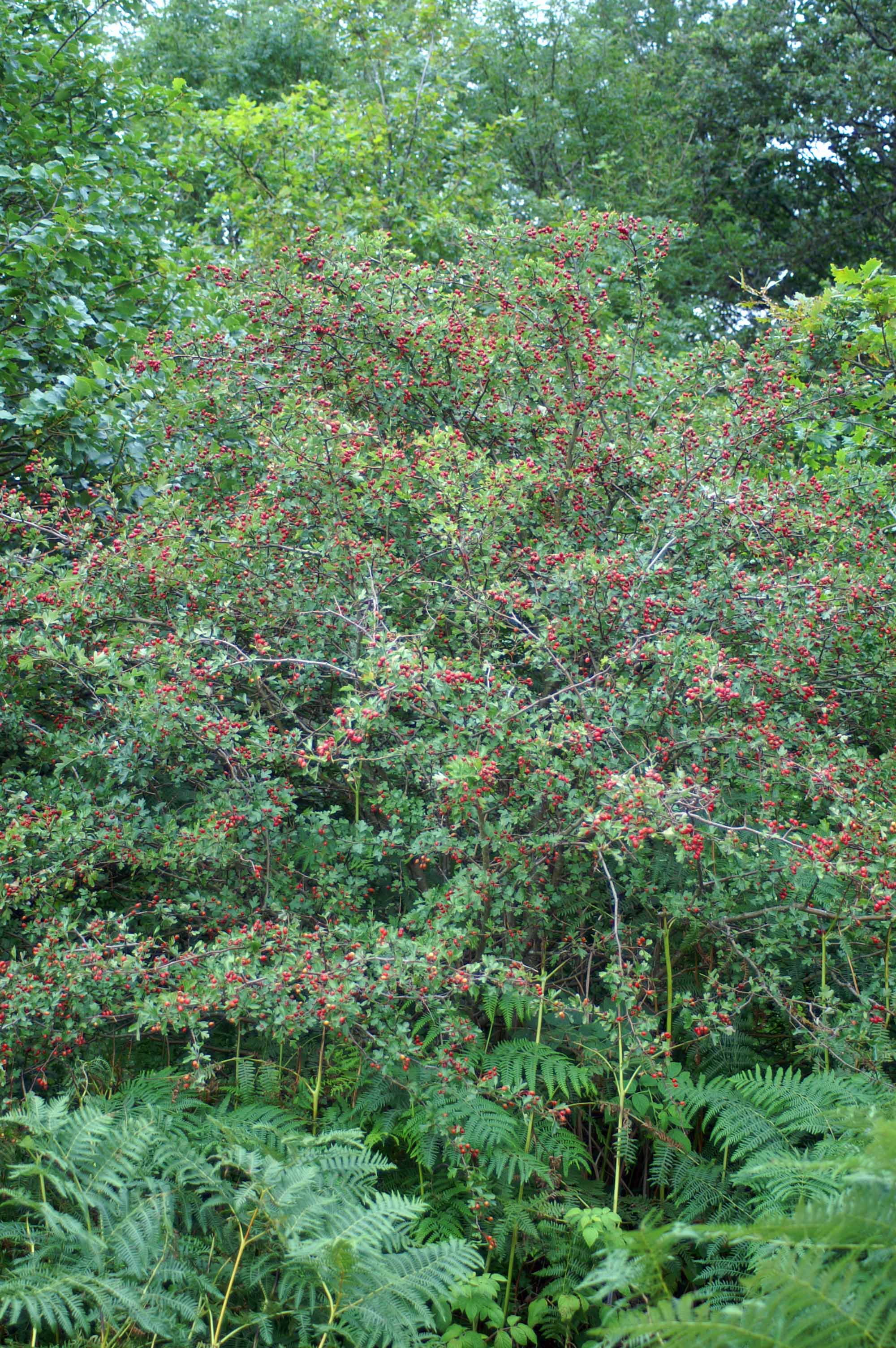
I resumed my woodland walk, passing by a Hawthorn tree laden with red berries.

11/8/11-Common Hawthorn -Crataegus monogyna, fully laden with a crop of berries

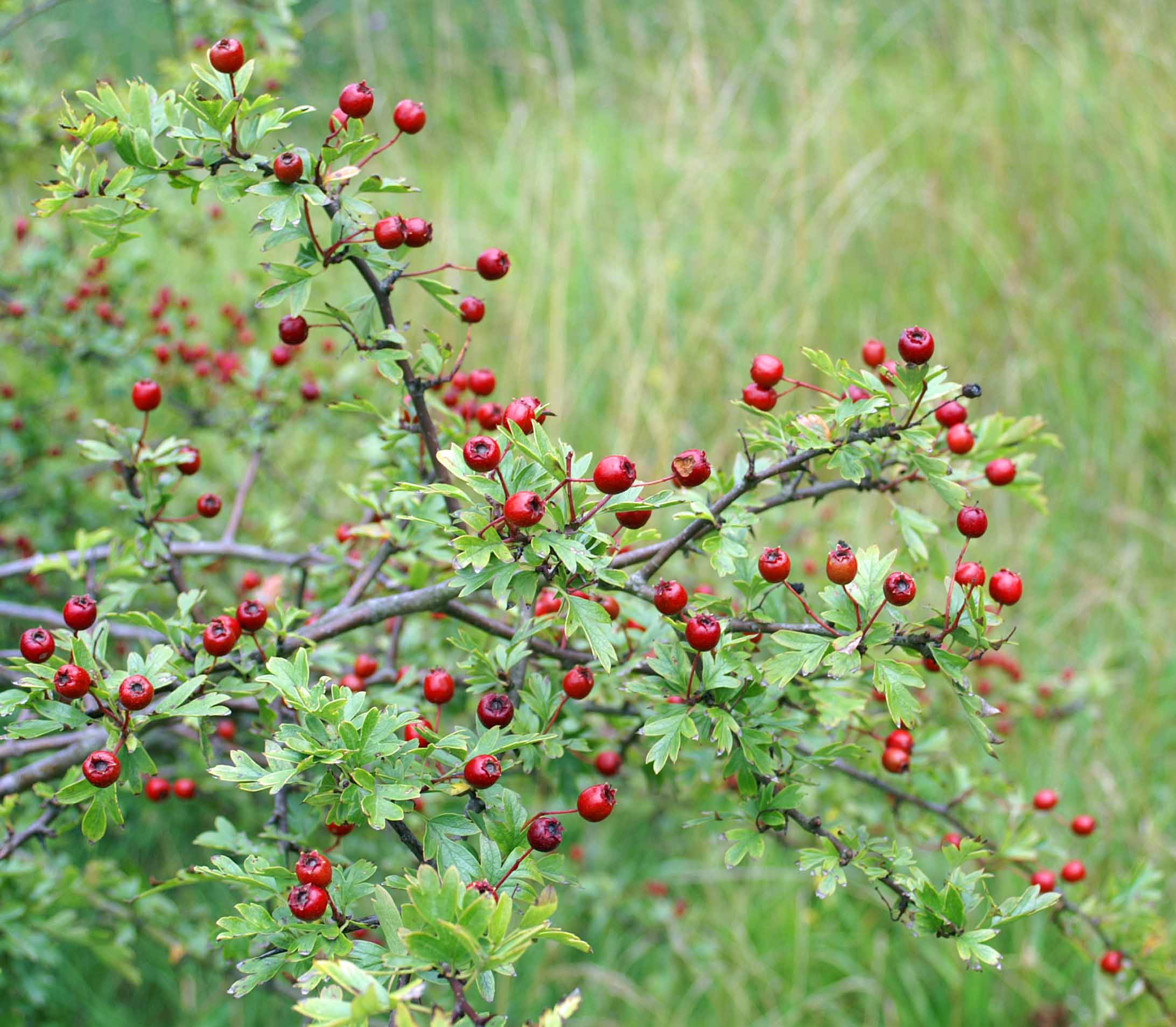
Crataegus commonly called hawthorn or thornapple, is a large genus of shrubs and trees in the rose family, Rosaceae, native to temperate regions of the Northern Hemisphere in Europe, Asia and North America.  They are shrubs or small trees, mostly growing to 5–15 m tall, with small pome fruit and (usually) thorny branches. The thorns are small sharp-tipped branches that arise either from other branches or from the trunk, and are typically 1–3 cm long.  The fruit, sometimes known as a “haw”, is berry-like, but structurally a pome containing from 1 to 5 pyrenes that resemble the “stones” of plums, peaches, etc.

11/8/11-Hawthorn berries, or haws

Hawthorns provide food and shelter for many species of birds and mammals, and the flowers are important for many nectar-feeding insects. Hawthorns are also used as food plants by the larvae of a large number of Lepidoptera species and haws are important for wildlife in winter, particularly thrushes and waxwings.

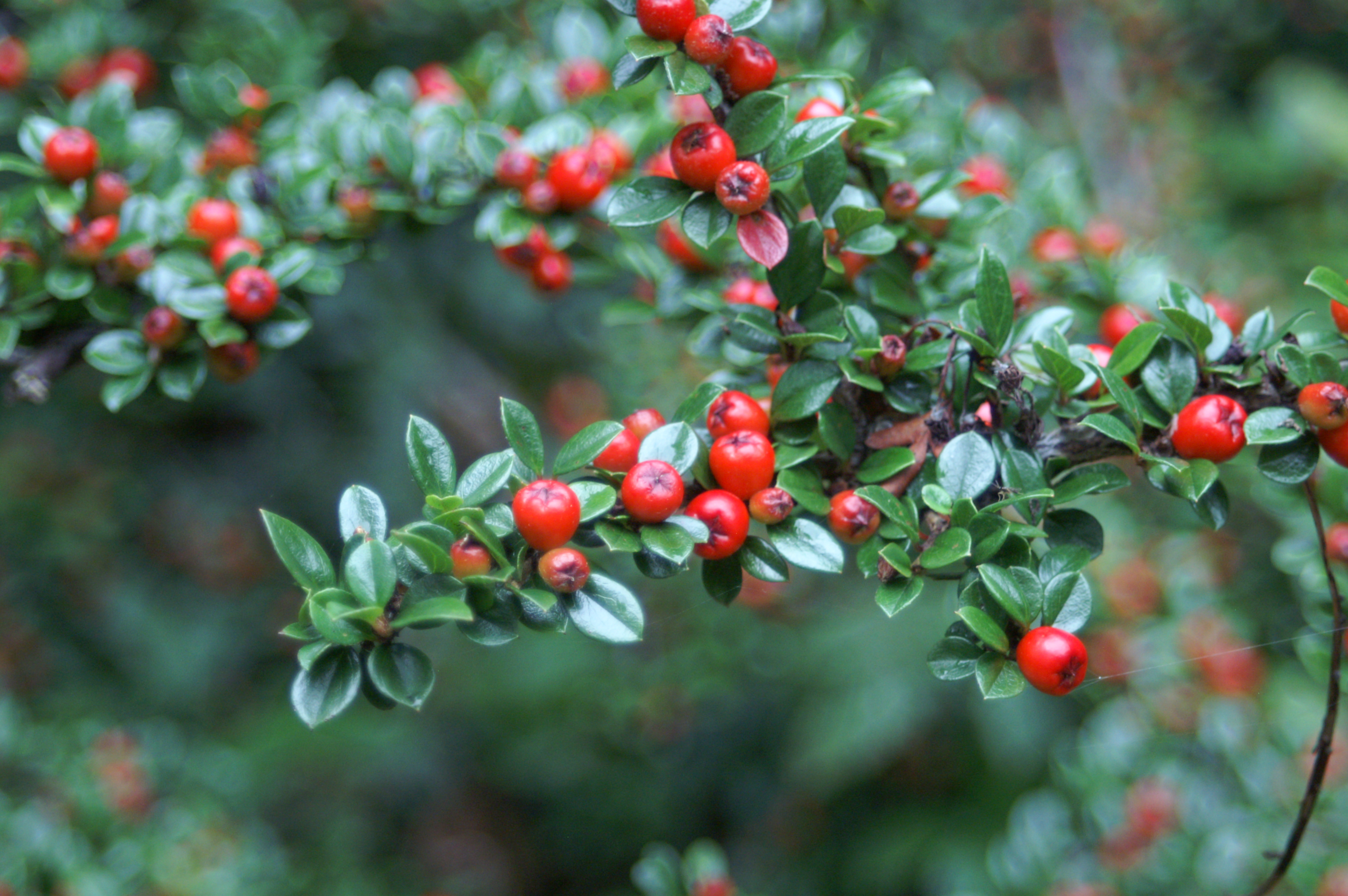
I have noted several cotoneaster shrubs growing throughout this site, which I have assumed to have arrived there via bird droppings as the shrub is not generally a native of Britain, but is widely planted in gardens.

11/8/11-Berries of Cotoneaster horizontalis

* * There is an indiginous native cotoneaster that is found growing only on the Great Orme: Cotoneaster cambricus (Wild Cotoneaster;  Welsh: Creigafal y Gogarth “rock apple of Gogath”) is a species of Cotoneaster endemic to the Great Orme peninsula in north Wales. It is the only species of Cotoneaster native to the British Isles. It has never been found naturally at any other location.

______________________________________________________

I very recently came upon the following on the ‘Plantlife’ website on the very subject of ‘escapee cotoneasters’:

Cotoneaster species

Non-native invasive plants.

Cotoneasters provide an important reminder that even with the best intentions of gardeners, the wind, birds and other animals can help plants to ‘escape over the garden wall’.

Plantlife is particularly concerned about four types of cotoneaster:

  • Hollyberry cotoneaster (C. bullatus)
  • Wall cotoneaster (C. horizontalis)
  • Small-leaved cotoneasters (C. microphyllus agg.)
  • Himalayan cotoneaster (C. simonsii).

What’s the problem?

These popular garden and landscaping shrubs are also popular with birds who enjoy the berries and spread the seed. This can spread cotoneasters in the wild, where they can be difficult to eradicate.

What are we doing about it?

Find out more about Plantlife’s invasive plant programme by clicking here

_____________________________________________________

Another probable garden escape is Hypericum – St. John’s Wort, also growing in various spots throughout the site and also now bearing red berries.

11/8/11-berries of St John's Wort-Hypericum

A native plant, the Arum lily or as I know it, Cuckoo Pint or Lords and Ladies, is also bearing bright scarlet berries now. I found them in a few places, mostly tucked almost out of sight beneath other shrubbery.

11/8/11-The poisonous berries of the Wild arum

Arum maculatum is a common woodland plant species of the Araceae family. It is widespread across temperate northern Europe and is known by an abundance of common names including Wild arum, Lords and Ladies, Devils and Angels,Cows and Bulls, Cuckoo-Pint, Adam and Eve, Bobbins, Naked Boys, Starch-Root and Wake Robin.

Share this:

  • Share on Facebook (Opens in new window) Facebook
  • Share on Pinterest (Opens in new window) Pinterest
  • Share on X (Opens in new window) X
Like Loading...

Conwy castle, harbour and gulls

27 Saturday Aug 2011

Posted by theresagreen in Nature of Wales, North Wales

≈ 2 Comments

Tags

Black-headed Gull, Black-headed Gull in winter plumage, Conwy castle, Conwy estuary, herring gull, herring gull juvenile, smallest house in Great Britain, Welsh Castles

I love the town of Conwy and  have been intending to visit since I arrived here, partly to have a walk around the castle and is walls, but mainly to check up on how the Herring Gulls are behaving down in the harbour. Conwy has a large population of Herring Gulls and they can be seen and heard throughout the town at all times of the day and often much of the night too!

I arrived quite late on a variably grey, showery and sunny day, a good day for taking photographs as I think clouds add an interesting dimension and reflect the true character of Welsh summer weather. I walked around the castle and along a short section of the wall, then to the bridge and from there down to the harbour. I took just a few photographs of the castle and am adding a very brief account of it; there are plenty of really good sites on the internet for anyone interested in learning more about this fascinating place. (This is a very detailed one  http://www.castlewales.com)

Conwy is regarded as one Europe’s finest surviving medieval towns, a status that is attributed to the preservation of both its castle and the intact town walls. It is also beautifully situated on the Conwy estuary.

The history of the castle is very well documented, but words on a page and the best photographs cannot properly do justice to its grandeur and presence. The guidebook published by CADW, the Welsh Historic Trust, simply states: “Conwy is by any standards one of the great fortresses of medieval Europe.”

6/8/11- Two of the eight castle towers, as seen from the harbour

Conwy along with Harlech is probably the most impressive of all the Welsh castles. Both were designed by Edward I’s master castle builder James of St. George, and while Harlech has a more storied past, Conwy’s eight massive towers and high curtain wall are more impressive than those at Harlech.

6/8/11-Conway castle walls-view through a firing position opening

The walls of Conwy are judged the finest in Britain. They are completely intact and still give the impression of enclosing and protecting the town. It is possible to walk around the town along the wall. The circuit of the wall is 3/4 of a mile in length, with 21 towers at regular intervals of about 46m. The wall is 1.68m thick and 9m high, with towers rising to 15m. 

6/8/11-Conwy estuary at high tide, viewed from the bridge
6/8/11-The harbour viewed from the bridge
6/8/11-Conwy castle, bridge and harbour under grey rainclouds
6/8/11-Sculpture ‘Mytilus edulis’ by Graeme Mitcheson; carved in Kilkenny limestone

Conwy is famous for its Mussels and there is a ‘factory’ here in the harbour, not a very attractive one I might add, where the shellfish are processed. I love the sculpture, it looks beautiful and is very tactile.

6/8/11- A Herring Gull keeps lookout over the harbour

There were very few Herring Gulls around and about in the harbour area this afternoon and those there were on the whole very quiet and well-behaved. There were a few brief outbursts amongst them, all of them involving adult birds chasing away young ones.

An adult Herring Gull calming down after a chase
6/8/11- A young Herring Gull watching me over it shoulder

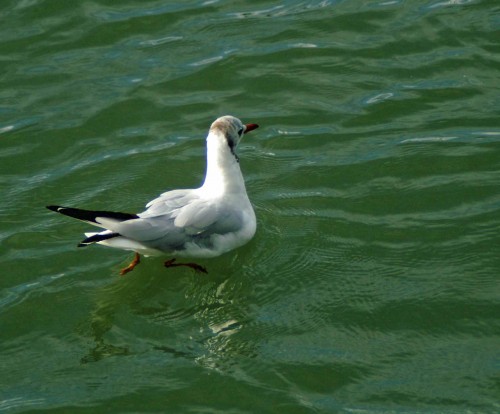
There were quite a number of Black-headed Gulls here, initially all swimming about on the water close to the harbour wall, but then one by one becoming restless and taking off and flying around the moored boats before returning.

6/8/11-Black-headed Gull with traces of dark head plumage remaining

They are attractive little gulls and look almost dainty compared to the big Herring Gulls. Most of them here have taken on or are in the process of losing the dark heads of their summer/breeding plumage and have just the dark spots either side of the head. Their red legs are clearly visible as they paddled around in the water of the harbour.

6/8/11-An individual with traces of dark head still visible
6/8/11-Black-headed Gull with completely white head and dark spots of non-breeding plumage

I could not resist one last photograph of the Smallest House in Great Britain, another of Conwy’s claims to fame. It’s usually almost impossible to see as when it is open it has people around it, as well as a lady dressed in traditional Welsh costume standing outside.

6/8/11- Another Conwy claim to fame; the Smallest House in Great Britain

Share this:

  • Share on Facebook (Opens in new window) Facebook
  • Share on Pinterest (Opens in new window) Pinterest
  • Share on X (Opens in new window) X
Like Loading...

Come rain, come shine

27 Saturday Aug 2011

Posted by theresagreen in frogs & toads, garden wildlife, Nature, Nature of Wales, Rhos-on-Sea

≈ Leave a comment

Tags

common frog, house sparrow, limacus flavus, rana temporaria, wood pigeon, yellow slug

Days of unsettled weather have limited my outdoor activities, but during dry spells and the occasional half-hours of sunshine, the local wildlife has been quick to take advantage of opportunities to venture out of hiding.

Some people have lions or pineapples decorating their gateposts ;we have woodpigeons
When not on sentry duty, the wood pigeons scour the lawn for freshly sprouted dandelion leaves

I tidied up the hedge recently, but was careful to leave the crop of berries along the top untouched. Now, although they still don’t appear to me to be ripe, the House Sparrows arrive several times a day to check for any that are edible.

The House Sparrows come several times a day to check for any berries that may be ripe enough to eat

The House Sparrows are still together in quite a sizable flock and although the young birds seem to stick together as one group and the adults appear in smaller groups, they are all within reach of one another.

Other garden birds have reappeared following their ‘summer breaks’ too. During a sunny spell of a recent early morning I was watching a young Crow pecking at fruit on the neighbouring apple tree; it was joined by three young Blue Tits that arrived to forage around the branches and they were followed by two adults and then a family of Great Tits. A Coal Tit was exploring the woodwork of the garden shed, no doubt looking for spiders or other sheltering insects. A Wren arrived and sang briefly from the garden fence, Dunnocks foraged along the bottom of the hedge and both a male and a female Blackbird put in an appearance.

Insects need warm sunshine to get them going:

A Small White butterfly basking on a privet leaf
A basking Speckled Wood from the front, ready for lift-off
5/8/11-A Marmalade hoverfly warming up in a spot of sunshine

Then there are those creatures that prefer the cooler, damper weather:

A Garden Snail enjoying a cool damp spell
I discovered this unusual Yellow Slug-limacus flavus whilst gardening. 

Limacus flavus, sometimes called the Yellow slug, is a medium to large species of air-breathing land slug, a terrestrial pulmonate gastropod mollusc in the family Limacidae.The yellow slug is common in England, Wales and Ireland as well as most of southern and western Europe. Feeding mostly on fungi, decaying matter or vegetables, this species is strongly associated with human habitation, and is usually found in damp areas such as cellars, kitchens, and gardens. Generally speaking it is only seen at night, because it is nocturnal. Thus it often goes unnoticed and people are unaware of how (relatively) common the species is.

I know it’s a slug, but it is quite an attractive one

I filled four recycling bags with hedge-cuttings and other garden debris and when I began to move them to put them out for collection a few days later, I was removing the hiding place of a rather lovely frog.

Common Frog-Rana temporaria

Common Frog – Rana temporaria

Identification:

  • Tailless amphibian – Smooth skin
  • Tends to jump not walk
  • Horizontal ovoid pupil
  • Dorsal surface and flanks are very variable in colour, typically yellowish brown, but may be olive-green coloured and some individuals have a reddish or yellow appearance. Variably spotted or striped.
  • Ventral surface (underside) of males may be dirty white or pale yellow, speckled with grey or brown; females pale yellow to orange
  • The most consistent markings are the dark patch behind the eye and the strong barring on the hind limbs.
  • Length: 6 – 9 cm
This lovely fat frog was hiding between the garden waste recycling bags

Share this:

  • Share on Facebook (Opens in new window) Facebook
  • Share on Pinterest (Opens in new window) Pinterest
  • Share on X (Opens in new window) X
Like Loading...

A walk on the Great Orme

27 Saturday Aug 2011

Posted by theresagreen in coastal walks, Great Orme, Nature, Nature of Wales, North Wales, North Wales Wildlife Trust, Wildflowers of Wales

≈ Leave a comment

Tags

bell heather, carline thistle, heather in bloom, jackdaw, limestone heath, ling, Little Orme, rabbit, views of Llandudno

The Great Orme is a prominent headland, which lies at the north-western tip of the Creuddyn Peninsula near Llandudno. Conwy County Borough Council as a Country Park and Local Nature Reserve manages most of the site, and this comprises a headland of Carboniferous limestone of some 291 hectares (719 acres) which rises from sea level to 207m (679 feet) at the summit.

5/8/11-The Great Orme under a beautiful sky

The weather has been very unpredictable lately, so I took advantage of a mostly sunny afternoon to explore some of the Little Orme’s big brother – the Great Orme. This much larger promontory has a very different character and has a fascinating history. Parts of it are used commercially to provide leisure activities for visitors to Llandudno town, but most of the Great Orme is designated a Special Area of Conservation (SAC) as it contains habitats and species which are considered to be rare or threatened within Europe. It is also a Site of Special Scientific Interest (SSSI) and is included in both the Nature Conservation Review and Geological Conservation Review, indicating its national importance. The site is also designated a Heritage Coast, a definition denoting a landscape quality of national importance.

5/8/11-A welsh rabbit out in the afternoon sun

From the car park at the top where the ‘toboggan run’ is located, I walked across to the path that takes you up onto the open clifftops to admire the views over Llandudno towards the Little Orme and out across the Irish Sea.

5/8/11-A view of Llandudno curving around the bay and the hills beyond
5/8/11-Llandudno Pier and across to the Little Orme
5/8/11-The Little Orme’s best side

Quarrying activity on the Little Orme was restricted to the Rhos-on-Sea side of it so as not to spoil the view from the resort of Llandudno, as I have mentioned before. I have photographed it often from that side, but less so from its natural, unspoilt side, which looks very different.

There wasn’t much to be found on the clifftops today, I saw just one Meadow Brown butterfly, but I did come across a Carline Thistle. It was just a small specimen, but the only one I’ve come across in the area so far.

Carline Thistle

Carline Thistle is interesting as its flower heads expand in dry weather and close in moist weather. The dried flowers will continue to do this for a long time and they thus form a basic hygrometer for use in weather forecasting.

There is a choice of paths to follow, including one to the summit, but I decided to walk in the direction of St. Tudno’s church. It was beautiful walking in the bright late afternoon sunshine on the grassy track through heathland that is presently a living patchwork of green, purple and gold. It was peaceful too – I was the only person there and the only other sign of life I had was a Meadow Pipit that flew up from near the edge of the track and startled me.

Limestone Heath

The heathland on the Great Orme is of international importance and occupies approximately one quarter of the site. Dominant species are the dwarf shrubs; Heather, Bell Heather and Western Gorse.

5/8/11-Great Orme -Heather-Calluna vulgaris& Western Gorse-Ulex gallii

About one third of the heathland is species-rich and amongst the dwarf shrubs many lime-lime-loving (calcicolous) herbs grow, such as Common Rockrose, Dropwort, Wild Thyme and Birds-foot Trefoil. This species-rich heath tends to be short (35cm height or lower). Another third of the heath is less species-rich, supporting herbs such as Tormentil and Harebell.

5/8/11-In places the heather & gorse extends to the edge of the cliffs

It was too late to walk all the way to the church today, but I will definitely be back to complete the route soon.

Share this:

  • Share on Facebook (Opens in new window) Facebook
  • Share on Pinterest (Opens in new window) Pinterest
  • Share on X (Opens in new window) X
Like Loading...
← Older posts
Newer posts →
Follow everyday nature trails on WordPress.com

Enter your email address to follow this blog and receive notifications of new posts by email.

‘But it is the common species that keep the living world ticking over and provide most of our experiences of wildlife, and I would argue that maintaining the abundance of these is as important a conservation priority as maintaining the existence of rarities’. Richard Mabey

MOST RECENT POSTS

  • A Glimpse of Spring to Come January 22, 2025
  • Hunting the Wren December 28, 2024
  • Oh, Christmas Tree December 18, 2024
  • In and Out of the Ivy February 15, 2024
  • Nature’s Fireworks November 30, 2023
  • Wild Autumn along the Coast Path November 3, 2023

OLDER POSTS

LOOKING FOR SOMETHING IN PARTICULAR?

  • Following a river to a Fairy Glen
    Following a river to a Fairy Glen
  • The life of a Yellow Dung-fly
    The life of a Yellow Dung-fly
  • Shades, Sounds and Scents of the Woods
    Shades, Sounds and Scents of the Woods
  • Catchers, a Duck and Divers
    Catchers, a Duck and Divers
  • Pretty prickly Thistles
    Pretty prickly Thistles
  • Llanddwyn Island & Newborough Warren
    Llanddwyn Island & Newborough Warren
  • May Bee Appearing on Ivy near You
    May Bee Appearing on Ivy near You
  • Fine Dining for Crows
    Fine Dining for Crows
  • Llanfairfechan 2
    Llanfairfechan 2
  • The Foxglove - of Fairytales, Myths & Medicine
    The Foxglove - of Fairytales, Myths & Medicine

nightingale trails

The Walk of the Monarch Butterfly-Sendero de la Mariposa Monarca

The Walk of the Monarch Butterfly-Sendero de la Mariposa Monarca

MY WILDFLOWER BLOG: where the wildflowers are

Snowdrop

Snowdrop

most recent posts

Follow everyday nature trails on WordPress.com

Social

  • View teresamaygreen’s profile on Twitter

Enter your email address to follow this blog and receive notifications of new posts by email.

Website Built with WordPress.com.

  • Subscribe Subscribed
    • everyday nature trails
    • Join 358 other subscribers
    • Already have a WordPress.com account? Log in now.
    • everyday nature trails
    • Subscribe Subscribed
    • Sign up
    • Log in
    • Report this content
    • View site in Reader
    • Manage subscriptions
    • Collapse this bar
 

Loading Comments...
 

    %d