• Home
  • about
  • about the photographs
  • Local Nature Reserves
    • Bryn Euryn Local Nature Reserve
    • Mynydd Marian
  • Wales Coast Path
    • Grey Seals in North Wales
    • St.Trillo’s Chapel
    • Wildflowers of North Wales Coastal Paths, Cliffs and Dunes

everyday nature trails

everyday nature trails

Category Archives: Bryn Euryn Nature Reserve

Life in the long grass

10 Sunday Aug 2014

Posted by theresagreen in Bryn Euryn Nature Reserve, bumblebees, Butterflies of Wales, day-flying moths, hoverflies, Nature, Nature of Wales, nature photography, spiders, wildflowers, Wildflowers of Wales

≈ 2 Comments

Tags

Aricia agestis, Brown Argus, butterflies in long grass, common blue, common knapweed, insects in long grass, keeled garlic, moths in the grass, Nursery Web spider, pisaura mirabilis, Polyammatus icarus, small hoverfly with snout, spider that makes web tents in grass

First week

The weather up here in our part of North Wales has been variable this week. We have had a good bit of rain which has freshened everywhere up and just  about enough warm sunshine to allow us to keep the faith that this is indeed high summer. It may not be the perfect weather for people here on holiday, but the local wildflowers and insects seem to be appreciating it.

Habitat: Long meadow grass

There is a whole other world existing in areas where grass is allowed to grow long and during the past couple of weeks I’ve begun to appreciate its importance as a home and a refuge for wildlife, particularly insects and spiders.

All journeys need a starting point and the following journey of discovery into the dimension of long grass began when I went to Bryn Euryn to see if a particular plant was in flower.

I’ve mentioned before that we have a few less-usual species of wildflowers growing in our locality and on Bryn Euryn this is the time to find one of them; the pink/purple flowered Keeled Garlic. I headed for the spot I had seen it in previous years and there it was, buzzing with bumblebees and more surprisingly attracting several beautiful little Common Blue butterflies.

Keeled Garlic

Keeled Garlic

I wondered at the attraction of this particular flower to the butterflies and thought perhaps they were just resting on the tiny flowers to sunbathe. A little later though I came upon another patch of the flowers with more Common Blues fluttering over and settling upon it, so maybe they were taking nectar from them. I was more than happy to see this many of the butterflies in the same place at the same time; I haven’t seen that for a long time.
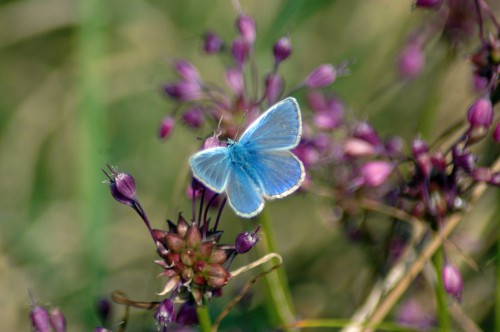
Male Common Blue butterfly on Keeled Garlic flower

Male Common Blue butterfly on Keeled Garlic flower

Female Common Blue butterfly, looking a bit more worn

Female Common Blue butterfly, looking a bit more worn

I was not the only one to recognise the attraction of insects to the garlic flowers. Lurking on top of her tent-like web, built to protect her eggs and then babies, sat a long-legged Nursery Web spider.

Nursery-web spider-

Nursery Web spider-

Nursery Web spiders are the spinners of the many web ‘tents’ seen in grassy places at this time of year. They take their common name from the way in which they care for their offspring. The female carries her large egg sac beneath her body, held in her jaws. Before the eggs hatch she spins the silken tent around the egg sac and stands guard over them. She remains on duty until the spiderlings are big enough to live independently. The spiders are active hunters and search for prey amongst grasses and low vegetation.

A neighbouring Nursery-web Spider

A neighbour

Walking carefully through the long grass, every step seems to disturb a dry-grass coloured moth. They are so well camouflaged that should you manage to keep track of where they land, it’s not easy to find them again; then if you manage a picture of sorts identifying them afterwards is even harder. The one below, which landed on the pupa of a 6-Spot Burnet moth which I would otherwise not have spotted, maybe Crambus pascuella (?) As always, I’m more than happy to be corrected.

This one landed on the pupa of a 6-spot Burnet Moth

This one landed on the pupa of a 6-spot Burnet Moth

In places amongst the grass knapweed is beginning to open up it tight dark knots of buds to allow the purple brush-head of petals to escape. Knapweed is a hugely important source of nectar for a wide variety of insects, but more about the plant and its visitors later.

Knapweed

Knapweed in long grass

Long grass on dry slope of ‘downland’

The area of long grass at the bottom of the summit slope on the drier, chalkier downland side of the Bryn has a different character to the flatter, damper meadow area. Some species of butterfly you may see here, although found in other parts of the Reserve, show a definite preference for the conditions it offers and may be more numerous. It is especially good for seeing the smaller species that gain protection from predators amongst the grass stems and include Small Heath, Small Skipper, Common Blue and the less-common Brown Argus.

The larval host plant of the Brown Argus is Rock Rose, which has been prolific in its flowering here this year and the leaves of the plants are still evident in the ‘under-story’ of this grassy forest. I was once again lucky with the timing of my visit this week; after a few minutes of pursuing little butterflies through the tangle of dry grass laced across with long outreaching bramble runners, I spotted a newly emerged Brown Argus balanced on top of a dry stem.

Brown Argus-

5/8/14 – Brown Argus- Aricia agestis

It stayed perfectly still, wings outstretched for quite a long time and made no attempt to fly off although I was very close and holding the camera lens just a few inches from it. I was almost certain this was in fact a Brown Argus and not a female Common Blue, but was compelled to wait and hope it would close its wings for me to see its underside. It eventually obliged and although the angle it presented wasn’t the best, thankfully it did confirm its identity with its diagnostic pattern of spots.

Brown Argus underside with 'figure of 8' spots on forewing

My Brown Argus underside with ‘figure of 8’ spots on hind wing
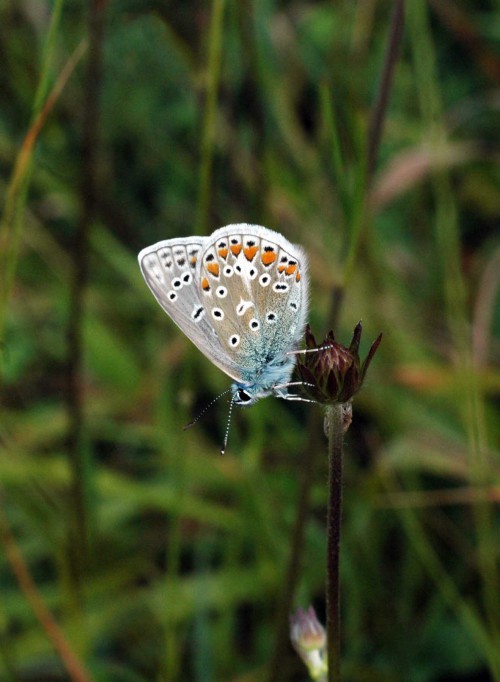
Common Blue male underside

4/8/14-Common Blue male underside

Spot the difference:

Text & diagram from the UK Butterflies web site demonstrates the differences:

Of the two sexes, it is the female Common Blue that causes most confusion with the Brown Argus. The blue present in a female Common Blue is highly variable, with individuals ranging from almost completely blue through to completely brown. It is this latter colouring that causes the most confusion. Even so, the Brown Argus has no blue scales, but may give off a blue sheen from the wings and the hairs found on the thorax and abdomen. Another diagnostic is that the Brown Argus normally has a prominent dark spot in the centre of the forewings.

Brown Argus - Common Blue undersides

Brown Argus on left & Common Blue on right of image
 

Share this:

  • Share on Facebook (Opens in new window) Facebook
  • Share on Pinterest (Opens in new window) Pinterest
  • Share on X (Opens in new window) X
Like Loading...

The strangely beautiful Carline Thistle

03 Sunday Aug 2014

Posted by theresagreen in Bryn Euryn Nature Reserve, Little Orme, Nature, Nature of Wales, nature photography, Rhiwledyn Nature Reserve, Wildflowers of Wales

≈ 2 Comments

Tags

carlina vulgaris, carline thistle, dry thistle plant, thistle with large dried out flowers, Welsh wildflowers

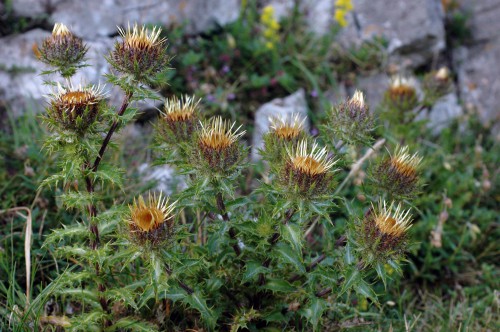
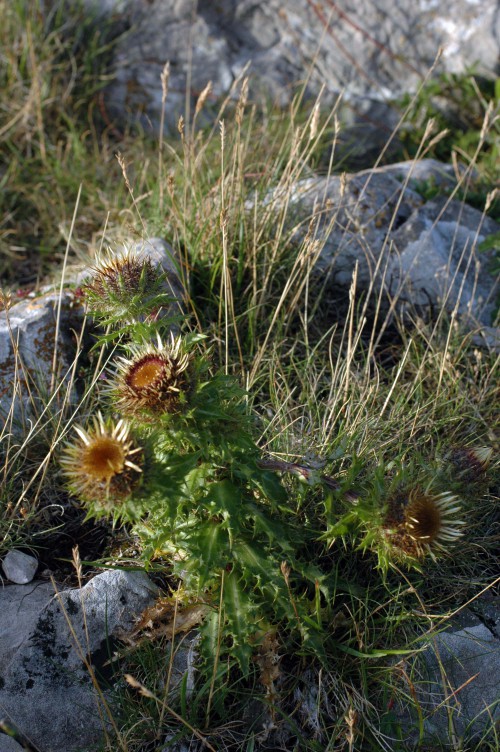
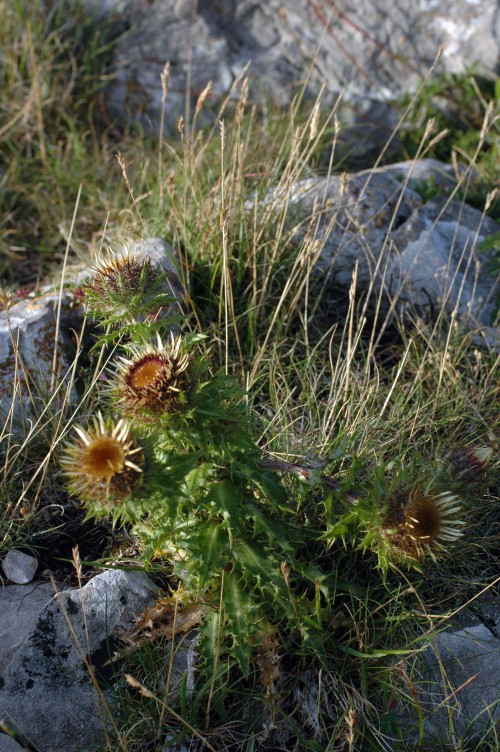
Carline thistle plant growing amongst rocks on Bryn Euryn

Carline thistle plant growing amongst rocks on Bryn Euryn

The Carline thistle is one of a handful of more unusual plants occurring in several of our nature reserves that have areas of dry calcareous grassland. It is a biennial plant so its appearance can be rather unpredictable both in exact location and in numbers of individual plants; it is never what you could call abundant. The plant can be seen throughout most of the year as when it’s finished flowering it persists as a very dry skeletal form of itself.

In past years I have found them on both ‘Ormes’, Little and Great but the best specimens, this year at least, are to be found growing on the top, rocky areas of Bryn Euryn.

Carline Thistle

Carlina vulgaris

Family: Daisy & Dandelion Asteraceae; biennial to 80cm; flowering June to September

Carline thistle with a Thick-thighed beetle on a flower

Carline thistle with a Swollen-thighed beetle on a flower

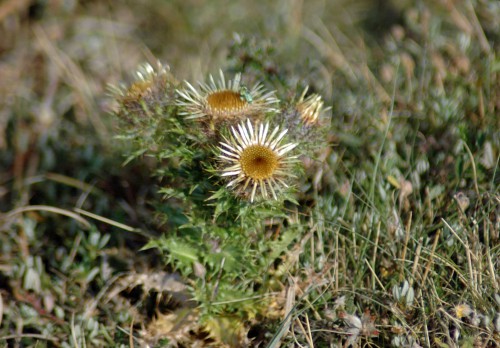
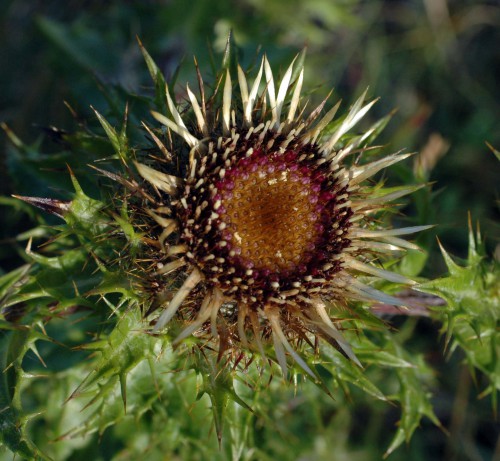
The Common Carline Thistle is a short, stout and prickly little thistle with intriguing  golden-brown-tinged-purple, rayless flowers (15-40mm across) that are surrounded by conspicuous, spiny, sepal-like yellow bracts which spread widely apart beneath. In the bright sunshine, they glisten silver and gold and in wet weather they close up.

The flowerheads are carried on densely prickly, leafy stems. The oblong leaves have toothed or lobed blades with spiny edges.

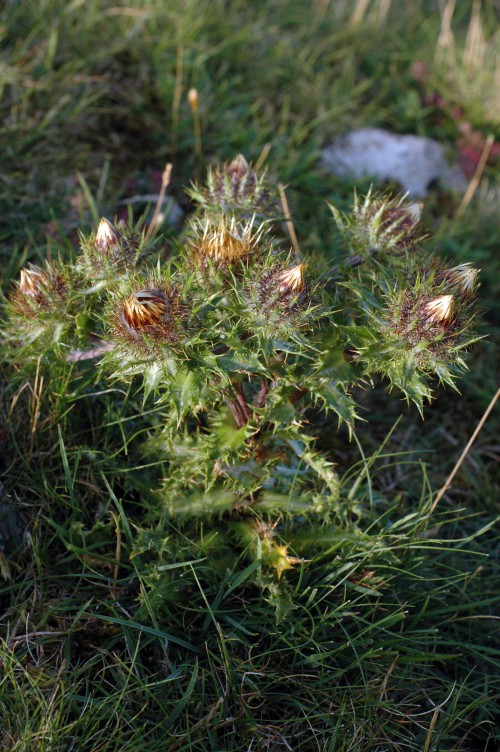
An all-over densely prickly plant , buds just beginning to break

An all-over densely prickly plant, buds just beginning to break

In bud the flower is contained by a tight  mass of dark purplish brown or black spines intertwined with a net of white fibres resembling cotton wool.

Carline thistle- Carlina vulgaris

Carline thistle-flowers opening

At  first, the opening heads look rather like dead or dying daisies, but this is their normal appearance.

Flowerhead in profile

Flowerhead in profile

The inner florets are straw yellow at first, but then purple petals start to emerge from the periphery, gradually proceeding towards the centre.

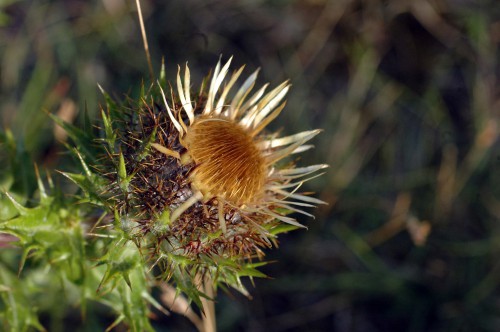
Composite flowerhead of a Carline thistle fully open

Composite flowerhead of a Carline thistle fully open

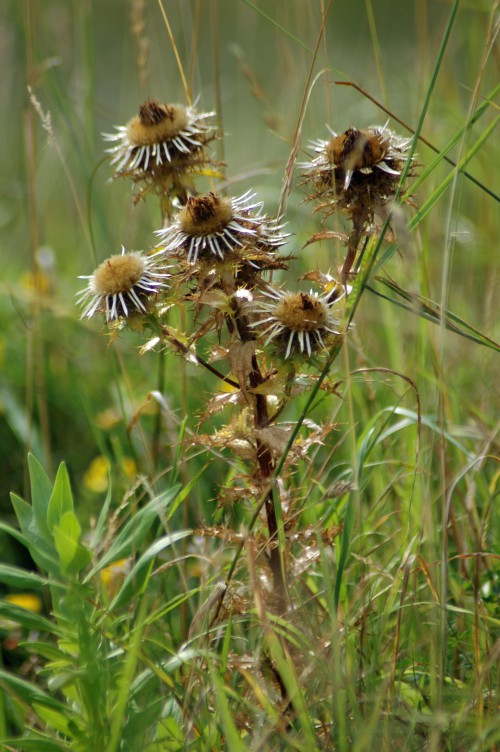
The seed-heads lend the plant a softer appearance.

Seedheads on a plant already drying out

Seed-heads on a plant already drying out

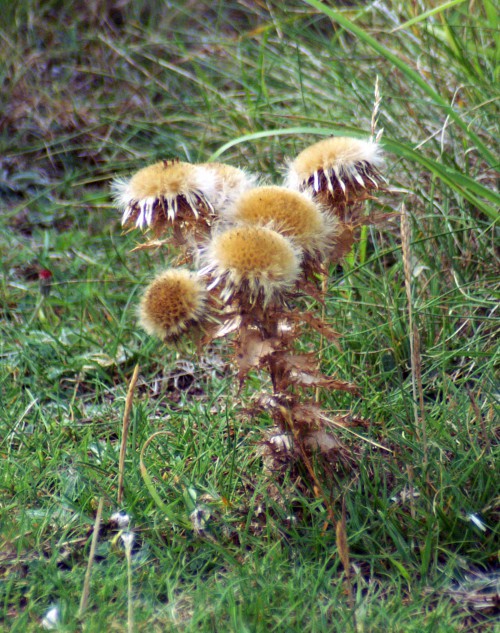
The dead flower, after the season is over, appears much as it did when it was alive.

September-a much-dried plant still maintaining its form

September-a much-dried plant still maintaining its form (Little Orme)

Traditional uses

The flower head was once used as a humidity gauge because the bracts close in the higher humidity typical of impending rain.

This plant had some uses in folk medicine and legend has it that it got its common name ‘Carline’ because the Emperor Charlemagne used the plant to cure his army of pestilence.

Subsequently it has been discovered that both Stemless Carline Thistle(Carlina aucalis) (where it was first found) and Carline Thistle contain the acetylide Carlina Oxide orCarlinoxide (furylbenzylacetylene), the main compound (85% – 90%) of the essential oil from the plant, which has a long history of medicinal use in Europe due to its anti-microbial properties. It is active against two strains of MRSA and a number of other difficult infections. It is stomachic, carminative, diaphoretic and an antibiotic.


Share this:

  • Share on Facebook (Opens in new window) Facebook
  • Share on Pinterest (Opens in new window) Pinterest
  • Share on X (Opens in new window) X
Like Loading...

Celebrating new lives

26 Saturday Jul 2014

Posted by theresagreen in bird behaviour, birds of Wales, Bryn Euryn Nature Reserve, frogs & toads, Little Orme, Nature, Nature of Wales, Rhiwledyn Nature Reserve

≈ 2 Comments

Tags

common frog, house sparrow, kestrel, rabbit, raven

It seems to have been a good year for our local wildlife so far and the following are some of the photographs I have taken of a few new young lives.

Ravens nest early in the year, so firstly here is an image of this year’s Little Orme young one quite well grown but still in the nest at the end of May.
140531TG-Raven young in nest 2-Little Orme

31st May: Young Raven in nest on Little Orme

I was lucky enough to catch up with him/her on the summit of the Bryn a few weeks later, now looking extremely fit and handsome in glossy black plumage.

June: Young Raven on the summit of Bryn Euryn

June 15th: Young Raven on the summit of Bryn Euryn

June: A fine high place with plenty of open sky to practise flying skills

June 15th: A fine high place with plenty of open sky to practise flying skills

Back to May again. Whilst the Raven was still in the nest, a young Kestrel was already out practising their manoeuvring skills over the rocky cliff at the top of the Little Orme. When I spotted it first I thought I’d been fortunate to spot a bird out hunting, but as I got closer it kept up its position and made no attempt to fly away at my approach. I realised then it was a young bird out honing its skills. It was wonderful to be allowed to watch so closely

May 31st

May 31st: Young Kestrel practising hunting techniques above the Little Orme

May 31st: The length of time the bird held its position was impressive

May 31st: The length of time the bird held its position was impressive

May 31st: Swooping and diving

May 31st: Swooping and diving

The Kestrel disappeared over the headland for a few minutes then reappeared flying out over the sea. As it passed where I stood on the cliff edge it looked in my direction. Perhaps to make sure I was still watching and was suitably impressed.

Flying past the cliff edge where I stood

Flying past the cliff edge where I stood

May 31st: Out over the sea, maybe using the gull to focus on

May 31st: Out over the sea, maybe using the gull to focus on

Still on the Little Orme it was apparent there has been a proliferation of cute baby rabbits this year too:

May 31st: Baby rabbit on the Little Orme

May 31st: Baby rabbit on the Little Orme

On the first of July we discovered a Dunnock’s nest in the garden with tiny new chicks with enormous gapes.

July 1st: Hungry baby Dunnocks

July 1st: Hungry baby Dunnocks

Then there was a miniature frog that I just happened to spot struggling through the damp grass on the lawn, possibly heading for nest door’s lovely pond. I caught it in my hand and transferred it to a glass for a few minutes so I could photograph it.

20th July: A tiny froglet

20th July: A tiny froglet

It had no trouble at all climbing to the top of the glass. The froglet was less than an inch (2.5cm) long, but completely perfect.

July 20th: A rare view of the speckled underside

July 20th: A rare view of the speckled underside

I didn’t keep it for long before releasing it back where I found it.

July 20th: Then I let him go again

July 20th: Then I let him go again

Last weekend I sat outside to drink a cup of tea and was kept entertained by a family of House sparrows that had brought their latest brood out for their first outing. The young birds were wobbly and fluttery while trying to perch on twiggy branches of the recently drastically cut privet hedge and still begging their parents for food.

July 20th: A very young House sparrow out for a first outing

July 20th: A very young House sparrow out for a first outing

Dad seemed to be on feeding duty, popping back and forth with bits and pieces.

Dad seemed to be the one in charge of feeding this morning

Dad seemed to be the one in charge of feeding this morning

I caught him feeding one of the offspring with something that I’m sure mum would definitely have disapproved of.

Not quite on target

Not quite on target

Something lurid pink about to be passed on

Something lurid pink about to be passed on

Down the hatch

Down the hatch

Whatever it was, it was certainly sticky. Cake icing maybe?

Whatever it was, it was certainly sticky. Cake icing maybe?

I wonder if the hard working parents will get a rest now?


Share this:

  • Share on Facebook (Opens in new window) Facebook
  • Share on Pinterest (Opens in new window) Pinterest
  • Share on X (Opens in new window) X
Like Loading...

A summer evening’s walk on the Bryn

20 Sunday Jul 2014

Posted by theresagreen in Bryn Euryn Nature Reserve, Nature, Nature of Wales, nature photography, North Wales, Wildflowers of Wales

≈ 8 Comments

Tags

carline thistle, common soldier beetle, forest bug, harebell, hemp agrimony, hogweed, mating red beetles, Meadow Brown, rowan berries, tapered drone fly

There’s no such thing as a bad time to enjoy a walk on Bryn Euryn, but during the longer daylight hours of the summer, an early evening during the week can be the perfect time to find it quiet and peaceful.

The woodland is almost silent now, with just the occasional rustle from the undergrowth or the flash of a skulking bird to remind you that you are not alone here. It reminds me of such walks in the woods around the cottage I grew up in, at an age when my imagination frequently ran riot and I was convinced I was being watched from every tree and shrub. By what or whom I’m still not sure, but I can clearly remember that feeling  on summer evenings such as this, when the silence is almost tangible.

Out in the open insects are making the most of the late sunshine to stoke up on nectar fuel for the night.  Hogweed is in flower and almost every umbel has at least one pair of mating soldier beetles.

Soldier beetles mating on a hogweed flower

Soldier beetles mating on a hogweed flower

The slightly cooler temperature of an early evening can make it easier to photograph some insects as they are intent on feeding and move a little slower.

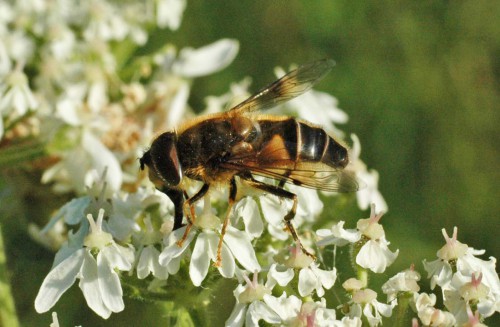
A Tapered Drone Fly- Eristalis pertinax on hogweed

A Tapered Drone Fly- Eristalis pertinax  (male) on hogweed

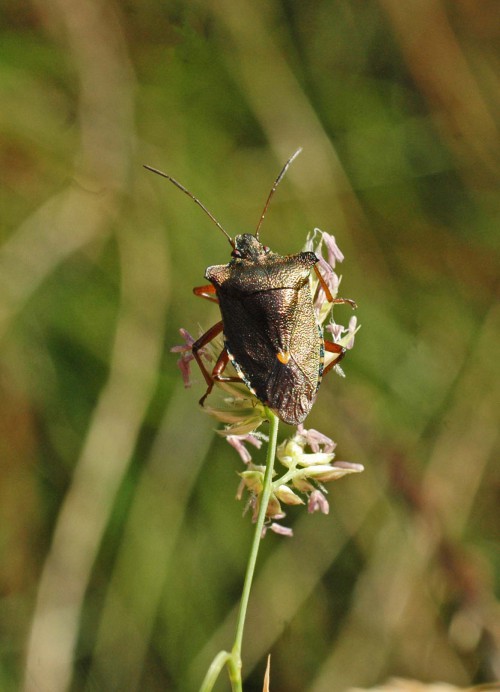
A movement at the top of a long grass stem caught my eye and I found this lovely Forest bug balancing there. It has a lovely bronzy sheen to its wing-cases.

Forest bug- Pentatoma rufipes

Forest bug- Pentatoma rufipes

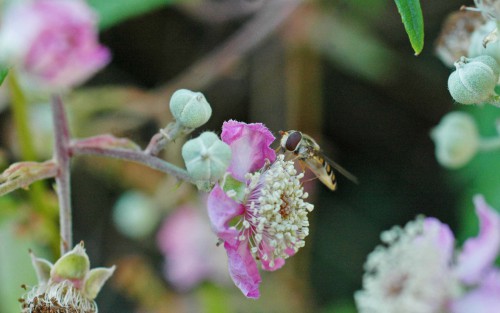
Brambles are beginning to develop berries, but there are still flowers on some bushes attracting bees and hoverflies.

Marmalade fly on a bramble flower

Marmalade fly on a bramble flower

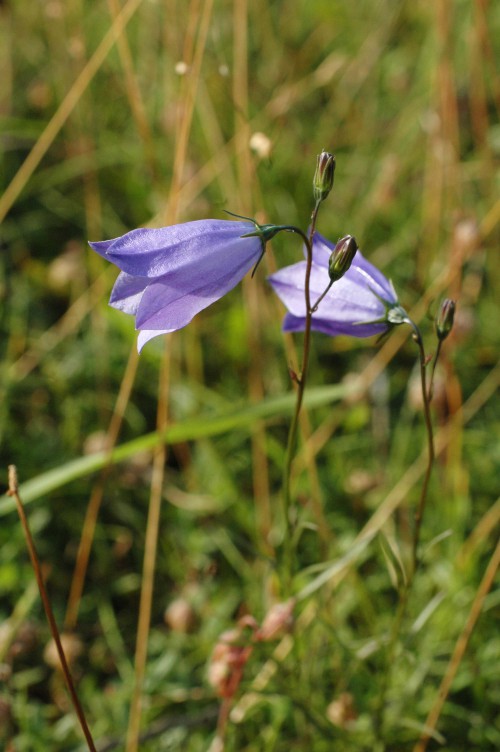
One of my favourite wildflowers, the Harebell is in fresh full bloom now. Sometimes they find themselves growing in goups, caught up amongst long grass stems where they grow longer stems to reach the open air.

Harebells in long grass

Harebells in long grass

I love to see them best growing from shorter turf, their beautiful blue bells held aloft on sturdy wiry stems where they can turn towards the sun and nod and wave freely in the breeze.

Harebell- Campanula rotundifolia

Harebell- Campanula rotundifolia

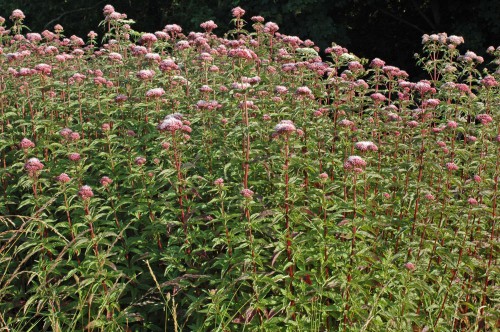
An important summer nectar flower, Hemp Agrimony, whose dusky pink flowers are relished by some species of butterflies is also blooming now. The impressive stand of it in my photograph was in shade this evening, so no visitors; I’ll have to come back earlier on a sunny day.

An impressive stand of Hemp Agrimony

An impressive stand of Hemp Agrimony

While some plants are at the peak of their flowering, others are already beginning to produce their fruits. I mentioned blackberries earlier, which are just beginning to form, but there are wild-growing raspberries here that are perfectly ripe. I couldn’t resist picking and eating a few; sorry birds.

Wild raspberries

Wild raspberries

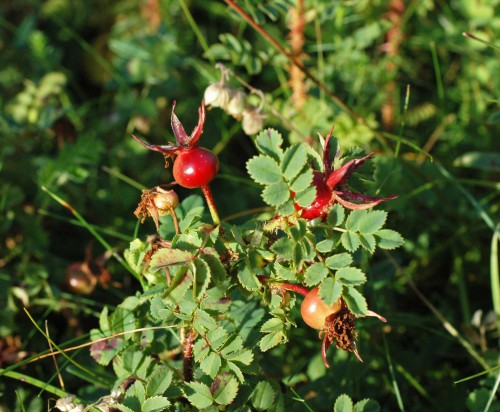
The hips on the Burnet Roses are formingly nicely, already a good size and red in colour, they will get bigger yet and turn black.

Burnet Rose hips forming

Burnet Rose hips forming

There are tiny acorns on the oak trees too.

Tiny acorns forming on the oak trees

Tiny acorns forming on the oak trees

And the Rowan trees have ripening berries.

Ripening Rowan berries

Ripening Rowan berries

Back into the woods for a short while and its very quiet, although I have heard a Chiffchaff as I’ve been walking around and disturbed a young Robin where it was pecking around on the damp earth of the track. Emerging back into the sunshine onto the grassy hillside I also disturbed a rabbit that raced off up the steep hill in front of me. I watched its white cotton tail bobbing away and envying the effortless way it bounded up there. There are a lot of rabbits here that do a great job of grass-keeping in certain areas, but you don’t see them often.

Run, rabbit

Run, rabbit

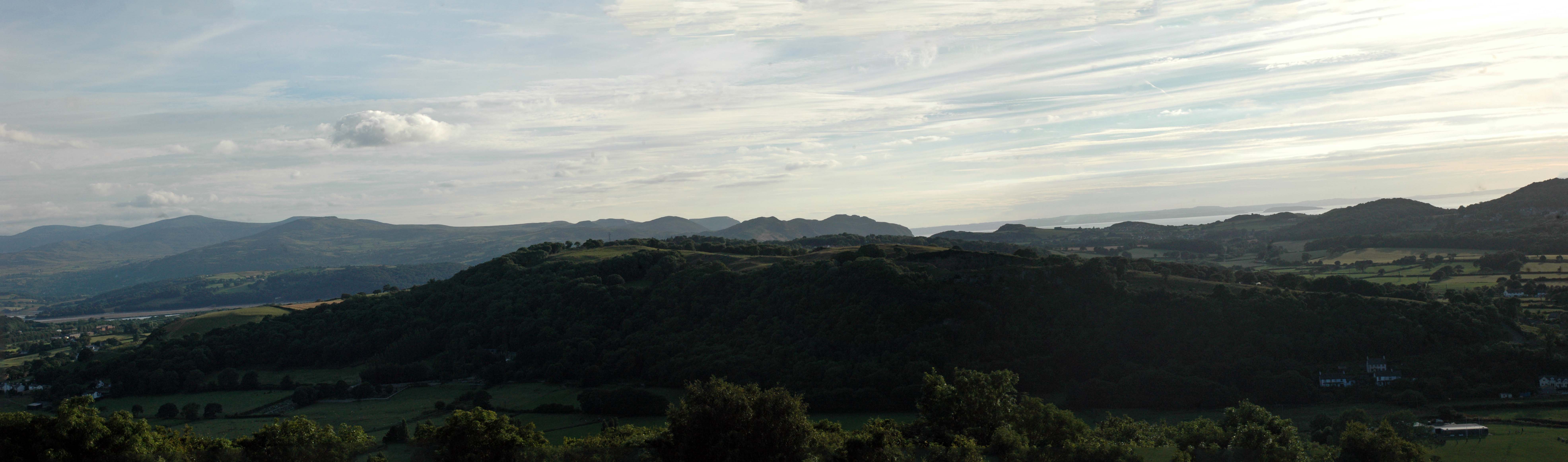
Almost at the top of the hill I stopped to gaze at the view as I always do. That’s not just to catch my breath, although it helps, but it’s a stunning view whatever time of day or year you’re admiring it. I love it when as now the sun is lower in the sky and shadows sculpt the hills. The sky was particularly interesting this evening too.

Evening panorama from Bryn Euryn. (click on image for a better view)

Evening panorama from Bryn Euryn. (click on image for a better view)
On the rockier summit of the hill, where the soil is thinner and more calcareous, the fascinating Carline thistle thrives. For much of the year you can see the dried out remains of the leaves and flowers, but now is the time to catch it coming into full curious flower. I will go into more detail about this plant in a later post.

Carline thistles growing amongst rocks

Carline thistle growing amongst rocks

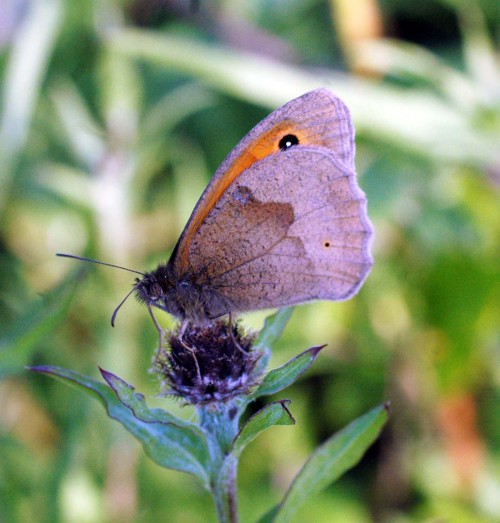
I had seen a few butterflies during the course of my walk, all fluttering around in the long grass. There were a few Small Heaths, but most were Meadow Browns. Just as I was heading back towards a woodland path to head back to the car, this one fluttered into view and landed on the tight bud of a knapweed flower. I was really pleased, as although this is an abundant species here, they are rarely this obliging and views such as this are not often offered.

Meadow Brown butterfly on the bud of a knapweed

Meadow Brown butterfly on the bud of a knapweed


Share this:

  • Share on Facebook (Opens in new window) Facebook
  • Share on Pinterest (Opens in new window) Pinterest
  • Share on X (Opens in new window) X
Like Loading...

Burnet Rose- Rosa pimpinellifolia

28 Wednesday May 2014

Posted by theresagreen in Bryn Euryn Nature Reserve, bumblebees, coastal habitat, Nature, Nature of Wales, nature photography, Wildflowers of Wales

≈ 2 Comments

Tags

burnet rose, low-growing white rose, Phragmidium rosa-pimpinellifoliae, rosa pimpinellifolia

Family: Rosaceae Other English name: Pimpinell Rose Welsh name: Rhosyn Dewi (Rhosyn y Twyni) Irish name: Briúlán

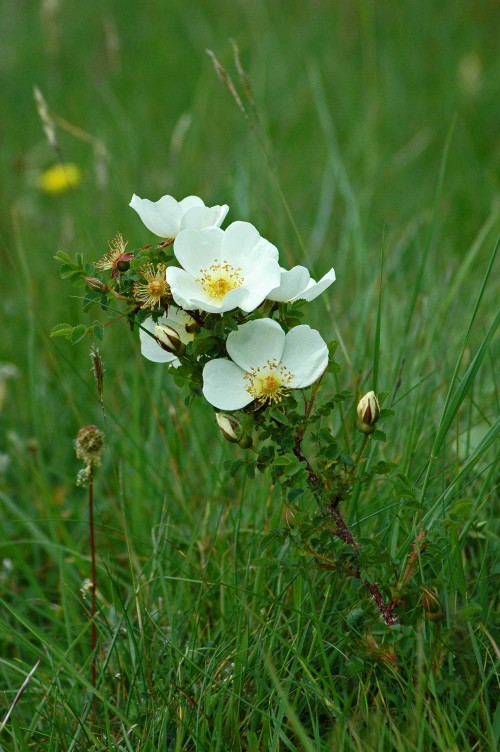
There is a glorious stretch of these lovely and very prickly roses on Bryn Euryn that are fully in flower now.

Beautiful Burnet Roses

Beautiful Burnet Roses

The Burnet Rose is a low-growing species, largely confined to dry sandy places near the sea; it is particularly abundant on dune systems in South Wales. Inland it may be found in calcareous areas, generally chalk downland or limestone pavement.

 Its natural distribution is limited to Europe and Asia except for part of the Atlas Mountain Range in North Africa.

A prickly stem full of blooms

A prickly stem full of blooms


It is a rather low erect deciduous plant usually growing to 20–140 cm high but it can sometimes reach up to 2 metres.

The plant spreads by suckers and can cover large areas. The stems are protected by numerous stiff bristles and many sharp straight prickles. The young stems and prickles and the mature leaves tend to be very red with young growth a bright scarlet and older growth a deep maroon.

 ‘Some people are always grumbling because roses have thorns. I am thankful that thorns have roses’.

  Alphonse Karr (1808-1890)

Burnet Rose

Burnet Rose

The flowers are cream-white although rarely also pale pink and are 2–4 cm in diameter with five petals. prominent golden stamens and they have the sweetest, most delicious scent of any of native roses.

Popular with bumblebees

Visited by bumblebees

Bumblebees seem to love them, perhaps because they do have a hint of honey in their scent.

This small bumblebee was enjoying a really good rummage around

This small bumblebee was enjoying a really good rummage around

Soon the petals fall off the roses but the stamens look pretty too. The leaves are small and oval, very like those of the salad burnet (hence the name).

Without petals

Without petals

And later in the year there will be a crop of  distinctive globular dark purple to black hips.

Rust fungus on Burnet Rose stem

Rust fungus on Burnet Rose stem

A brilliant-orange rust fungus Phragmidium rosa-pimpinellifoliae is also common on the plants.

The plant’s names 

R. spinosissima (pimpinellifolia) has been known by many different local names and it has attracted its own folklore. In some places, people have given it a vernacular name based on the resemblance of the leaves to a Burnet (Sanguisorba ) and therefore, for example, called it the Burnet or Pimpinell Rose in English or Rose Pimprenelle in French. In other places, it was the prickly stems that caused it to be known as Bodicasti Sipek in Slovenia, for example, or Piikkiruusu in Finland. 

Burnet Rose growing alongside the related Salad Burnet

Burnet Rose growing alongside the related Salad Burnet on Bryn Euryn

In Iceland, it has the name pyrinros which literally means ‘Thorny Rose’ but the same Icelandic word means ‘Sleeping Beauty’ and may refer to its early flowering – the beautiful rose waking up after the long dark Icelandic winter! In Norway, this rose is called ‘Trollnype’ – associating it with the trolls of Norwegian folklore. Elsewhere, it is named after the coastal sand-dunes where it grows so, for example, it is Klitrose in Denmark,Duinroos in The Netherlands or Dünen Rose in Germany.

Medicinal uses

The plant  was initially grown in gardens for its herbal properties and it was one of the first roses described and illustrated in 16th  century herbals of Northern Europe. Its hips and leaves have been used to make a tea and, in some places (particularly Denmark) a liqueur is still made from its hips. In recent years, it has been the subject of intense research to investigate its special pharmaceutical properties. The chemical constituents have recently been summarised by Mayland-Quellhorst et al (2012). Its dark purple or black ‘fruits’ (heps) are high in vitamins and antioxidants.

(Extracts from: Rosa spinosissima – aspects of its natural history and associations with people from prehistory to the present day ) by Peter D. A. Boyd


Share this:

  • Share on Facebook (Opens in new window) Facebook
  • Share on Pinterest (Opens in new window) Pinterest
  • Share on X (Opens in new window) X
Like Loading...

Mistle Thrush

25 Sunday May 2014

Posted by theresagreen in birds of Wales, Bryn Euryn Nature Reserve, Nature, Nature of Wales, nature of woodlands

≈ 10 Comments

Tags

mistle thrush, turdus viscivorus

Following on from my butterfly hunt I followed the track through the lower woodland of the Bryn and again had arrived at a perfect moment; the air was filled with birdsong. Blackbirds and robins provided melody that was accented by chiffchaff, wren, blue tit, great tit and chaffinch. But all were relegated to background accompanists by the loud, unmistakable ringing song of a Mistle Thrush. From the sheer volume of the delivery it was clear the singer was close by, but though standing for a good fifteen minutes trying to spot him up amongst the complex tracery of tree branches and leaves, I couldn’t  locate him. When the singing stopped I carried on walking upwards and as I neared the top of the track it began again. The thrush had clearly flown to another spot and once more I stood scanning the vegetation, but still could not see him. I resigned myself to being content with having been treated to the singing performances, which alone were rather special, but then I recalled that one late afternoon last year, wandering around this side of the top of the hill, intent on photographing rockroses, I met a mistle thrush out hunting on a narrow track around the rocky cliff edge.

I  headed off in that direction now, reckoning on this being an established mistle thrush territory and on that basis they could be out and about in any part of it.  I could hardly believe my luck then, when I spotted two largish birds flying towards a tree on the edge of the wooded slope below, near the bottom of the hill. One landed at the very top and from its size and overall grey-brown appearance I was pretty sure this bird at least was indeed a Mistle thrush.

Thrush landed at the top of a tree

Although some distance away I could see that the birds had been drawn to the tree by ivy berries and I was able to watch them for a good few minutes while they stayed to feed on them.

Mistle Thrush with ivy berry

Mistle thrush with ivy berry – showing pale tip to the tail feathers

140421TGNW-Bryn Euryn-Mistle thrush at top of tree 1

The other of the two, better showing the breast

Flying away

Flying away

I sat on a rock, a damp one as I realised when I stood up, and watched the birds for some time until they flew away.

________________________________________________________________________________

Mistle Thrush – Turdus viscivorus 

Other traditional names: Missel Thrush; Storm Cock Welsh: Brych y coed

The mistle thrush was first described by Linnaeus in his Systema naturae  in 1758 under its current scientific name. The bird’s fondness for mistletoe berries is indicated by both its English and scientific names: Turdus  is the Latin for “thrush”, and viscivorus, “mistletoe eater”, comes from viscum “mistletoe” and vorare, “to devour”.

Description

The largest thrush native to Europe, the Mistle thrush is a large greyish thrush, with larger breast spots than the Song thrush, from which it is also distinguishable in flight by the flash of whitish underwing. The long tail has white tips on the outer feathers. There are no plumage differences between the sexes; juveniles are similar to adults, but have paler upperparts with creamy centres to many of the feathers and smaller spots on the yellowish underparts. By their first winter they are very similar to adults, although the underparts are usually more buff-toned.

The mistle thrush is quite terrestrial, hopping with its head held up and body erect; when excited, it will flick its wings and tail. The flight consists of undulating bounds interspersed with glides.

Voice

One of the finest songs of our resident birds, the male mistle thrush has a loud melodious ringing song with fluted whistles that are repeated three to six times, and used to advertise his territory, attract a mate and maintain the pair bond. He doesn’t have much of a song, just a reiteration of a few notes, but those are rich and deep in tone, and delivered with great energy and enthusiasm. Compared to its relatives, the song thrush and the blackbird, the repertoire is less varied, lacking the mellow fluting of the blackbird and the elegantly repeated phrases of the song thrush. The delivery is slower too, however the song is much louder, often audible up to 2 km (2,000 yds) away and can be sustained for up to an hour in a single performance.

The song is given from a treetop or other elevated position and welcomed as it comes early in the year before the other birds are in full song. The song may be heard in any month, although mainly between February and May/June, as being an early nester it is one of the first of the songbirds to fall quiet.

The mistle thrush has another traditional name too, the storm cock, attributed to the bird for the way in which it will sing from a tree top in all weathers, even in the teeth of a fierce winter gale-force wind. Unlike most other birds, who seek shelter from stormy weather, the Mistle Thrush actually seems to be stimulated by approaching storms and will sing or call lustily before and through bad weather.

 The main call, given by both sexes, is a dry chattering krrrr, louder when it is alarmed or excited. It is often likened to the sound of a football rattle. There is also a squeaky tuk contact call.

Ecology

Generally found in cultivated country, farmland, gardens, parks,orchards and where there are scattered trees.

The mistle thrush feeds on a wide variety of invertebrates, seeds and berries. Its preferred fruits including those of the mistletoe, holly and yew.  Mistletoe is favoured where it is available. An interesting behavioural trait  displayed by Mistle Thrushes in winter is resource guarding, when one or sometimes two birds will vigorously defend a food source such as mistletoe clumps, holly, yew or nowadays even a cotoneaster. This is defended against all-comers, the vigilant bird trying to ensure that food resources are maintained for itself throughout the winter. It has been shown that resource guarding birds have bigger and earlier clutches than birds that do not do it. 

Mistle thrushes are found as individuals or pairs for much of the year, although families forage together in late summer, and groups may merge to form flocks of several tens of birds and it is not uncommon for up to 50 thrushes to feed together at that time of year. They roost at night in trees or bushes, again typically as individuals or pairs, but with families roosting together in autumn.
The nest

Breeding typically commences in mid-March in the south and west of Europe and late February in Britain.

The nest is built by the female, although the male may help. The thrush’s nest is a large bulky cup of sticks, dry grass, roots and moss, coated on the inside with a layer of mud and lined with fine grass and leaves and frequently ‘decorated’ with white scraps of paper or rag. It is usually built 10-40 feet up in a tree, often in an exposed position, but not uncommonly lower down and occasionally in a hedge or bush or on a ledge of a cliff or a building.

Typically the breeding season of the mistle thrush is March to early June, but the nest may contain eggs as early as February, long before there are any leaves to offer any protection. Nests built early in the breeding season are sometimes destroyed by bad weather. 3-5 eggs are laid and are incubated by the hen only, hatching within 13-14 days and nestlings then leave after about 15 days. There is often a second brood. 

During this time the mistle thrush may display aggression; it may even attack a person or another bird should they venture too near its nest and has been known to swoop down to threaten a cat.

The common chaffinch often nests close to a mistle thrush, the vigilance of the finch and the aggressive behaviour of the thrush benefiting both species.

__________________________________________________________________________________

I turned and walked back and up towards the hill’s summit to look for orchids and other flora, and once again the song of the thrush rang out from the trees below. I still couldn’t find him though and had resigned myself to being contented with the singing and the sightings I had already enjoyed. Then as I walked slowly back down the track, still keeping half an eye out for a glimpse of the songster, the singing stopped. At the same moment a largish bird flew to an ash tree and there finally I had sight of a  mistle thrush, although I wasn’t convinced it was the one that had been singing.

Finallly, a better view

Finallly, a better view

The sun by now was lower and shining directly behind the bird, so I wasn’t hopeful of getting a good shot, but it turned out to be good enough as a front view. Even better, as I reached the bottom of the track the singing began again and this time from a slightly higher vantage point than on the way into the woods earlier on, I managed to locate the singer high up on a leafy branch. The markings on this bird were much heavier.

A well-marked, singing mistle thrush

A well-marked, singing mistle thrush

I was pleased I’d had these opportunities to hear and see the mistle thrushes, as returning a week later there were none to be heard, although I did catch sight of one out hunting amongst the rockroses in the meadow. It was some distance away from me, but good to see it away from the trees and demonstrating the birds characteristic upright posture.

A mistle thrush out hunting

A mistle thrush out hunting amongst the rockroses


Share this:

  • Share on Facebook (Opens in new window) Facebook
  • Share on Pinterest (Opens in new window) Pinterest
  • Share on X (Opens in new window) X
Like Loading...

Winter walking on the Bryn

01 Saturday Feb 2014

Posted by theresagreen in Bryn Euryn Nature Reserve, Nature, Nature of Wales, nature photography

≈ 4 Comments

Tags

blackbird, Bullfinch, Great Tit, grey-green lichen hanging from tree, ivy berries, moss on rock, signs of spring, woodland birds singing, Wren

January 28th

Dry, clear-skied sunny days are too much of a gift to ignore, so at the earliest opportunity today I headed up to Bryn Euryn. It’s rained quite a lot here lately, although nothing like as much as ‘down south’, and the weather has been mild so I was particularly interested in looking out for more signs of a very early Spring. I anticipated that taking the form of plant growth, so was taken completely by surprise when leaving my car I was greeted by a chorus of birdsong. And I do mean a chorus, as in several species all singing at the same time.

Great Tit- Parus major

Great Tit- Parus major

Standing by the car just listening I could pick out the songs of blackbird, robin, wren, blue tit and great tit. It was lovely and made lovelier by the appearance of a robin hunting around the rubbish bin, a very handsome blackbird landing on the ground right next to me, a pair of great tits in a nearby tree, several blue tits seemingly everywhere at once and a pair of magpie up in a tall ash tree.

Blackbird- Turdus merula

Blackbird- Turdus merula

Berries of Iris foetidissima - Stinking Iris

Berries of Iris foetidissima – Stinking Iris

I had clearly arrived at just the right time. As more cars arrived in the car park and people got out with dogs I headed off to walk around the field edge. The blue tits accompanied me, flitting along through the shrubs and trees all the way to the top end of the field. I heard another Wren singing here and stopped and located it, but try as I might, I couldn’t spot the Song Thrush I could also hear singing, his song amplified by the high rock wall.

Early daffodils

Early daffodils

140128TGROS-BE7-Arum leaves are well grown

Arum leaves are well grown

The stone steps

Up the stone steps

A wood pigeon and maybe a jay

Stopped to try to get a better look at the bird to the right of the wood pigeon, hoping it’s a jay

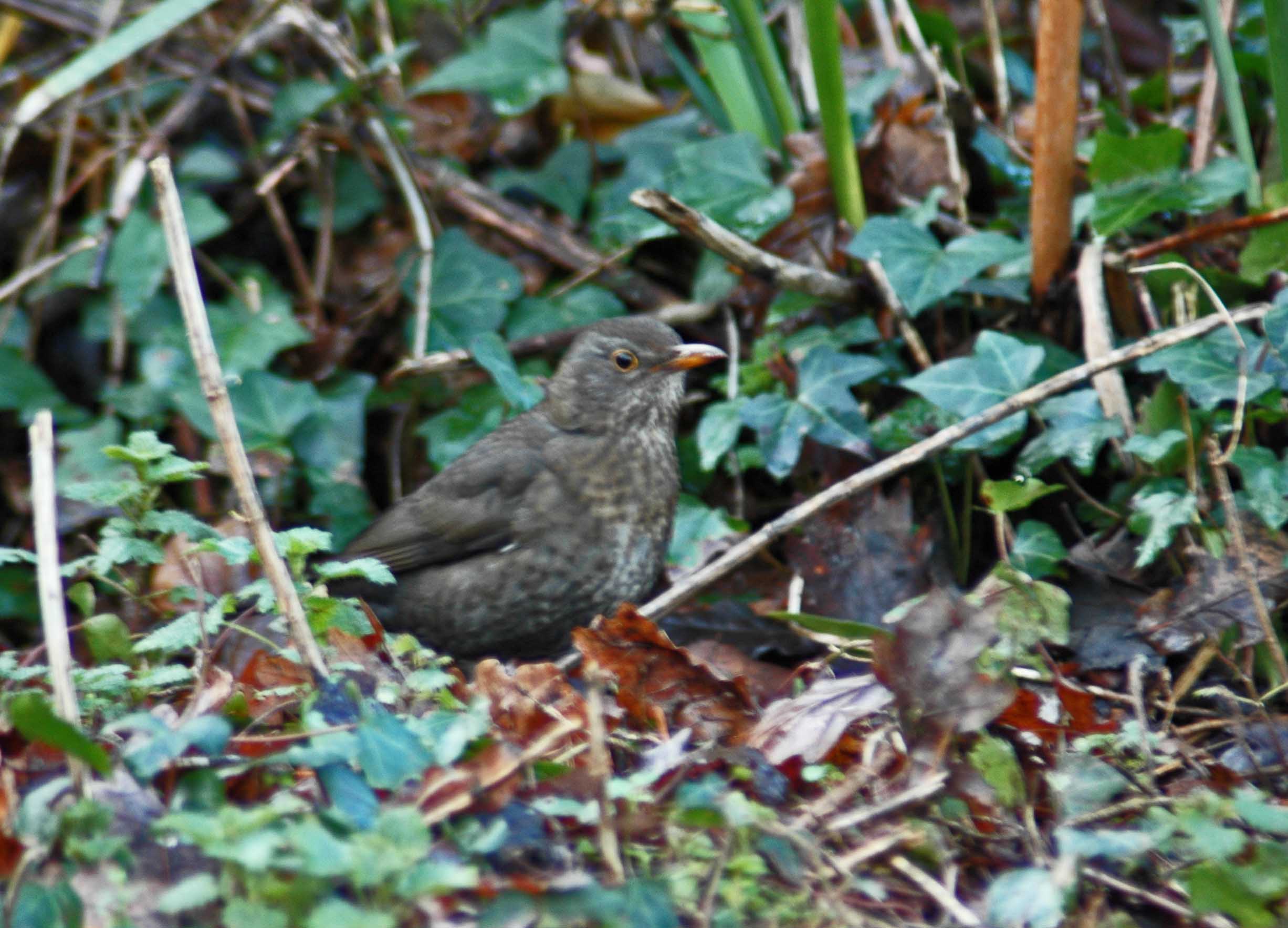
Turned right at the top of the steps, paddled through a big puddle to get through the gate, then stopped for a while to watch a female blackbird rummaging around on the side of the track, hunting for insects. I love watching them pick up leaves and toss them aside to expose anything hiding beneath them, then tilt their heads to have a close-up look.

Female Blackbird rummaging around in dead leaves

Female Blackbird rummaging around in dead leaves

I turned left off the track, stopped to watch chaffinches and blue tits in one of the small oak trees, walked a short way along the edge of the grassy meadow, then turned off again to arrive at the bottom of the steep grass slope of the open heath and headed up to the summit.

Catkins

Catkins

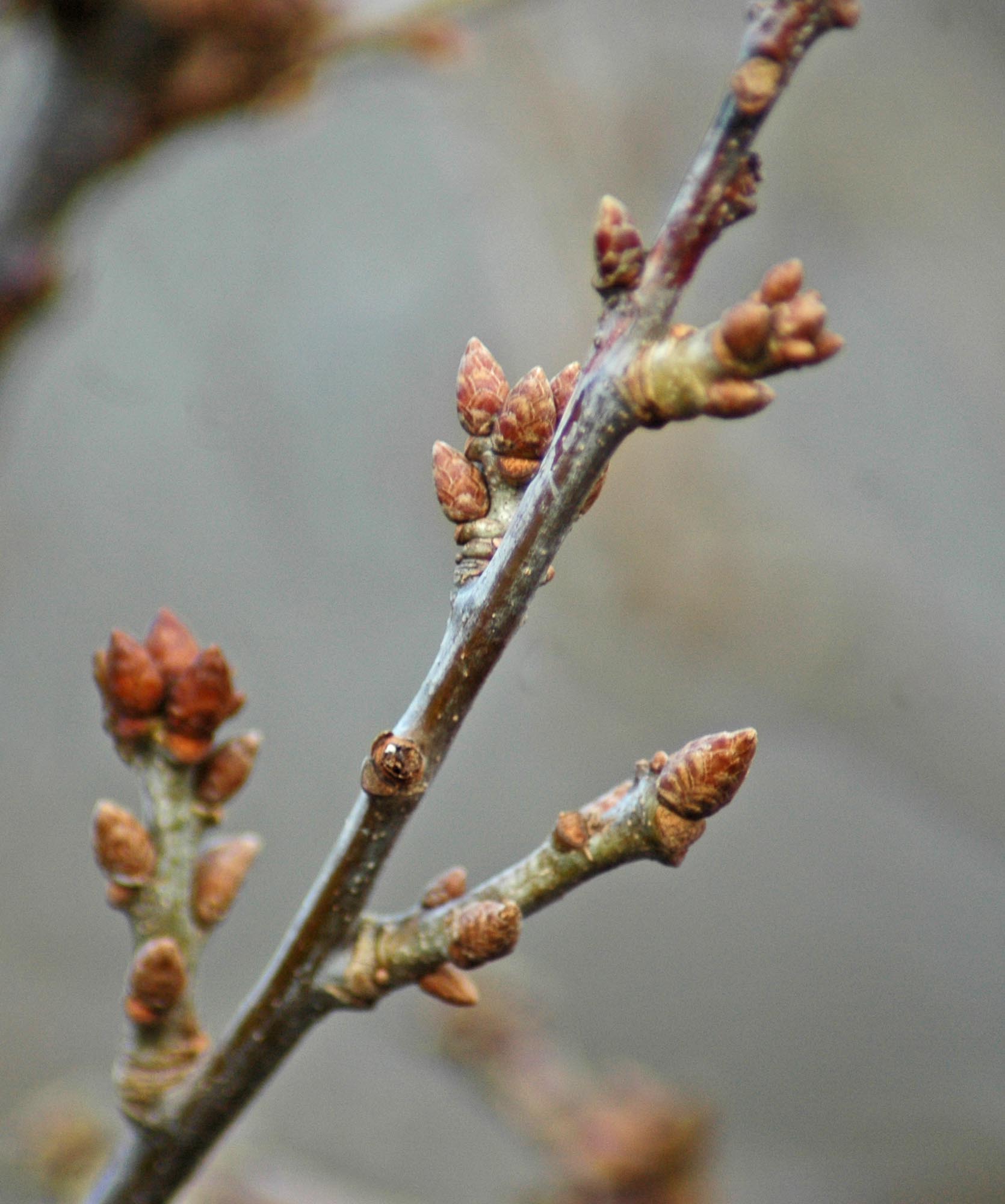
Swelling leaf buds

Swelling leaf buds look like miniature pine cones

As always, well worth the effort for the spectacular views in every direction.

Winter birches

Winter birches front a fantastic view

View from the summit

View from the summit

Looking down on the flooded field where curlew, oystercatchers, redshank may be seen feeding amongst sheep

Looking down on the flooded field where curlew, oystercatchers, redshank may be seen feeding amongst sheep

Rhos Point and the ever-growing array of wind-turbines

Rhos Point and the ever-growing array of wind-turbines

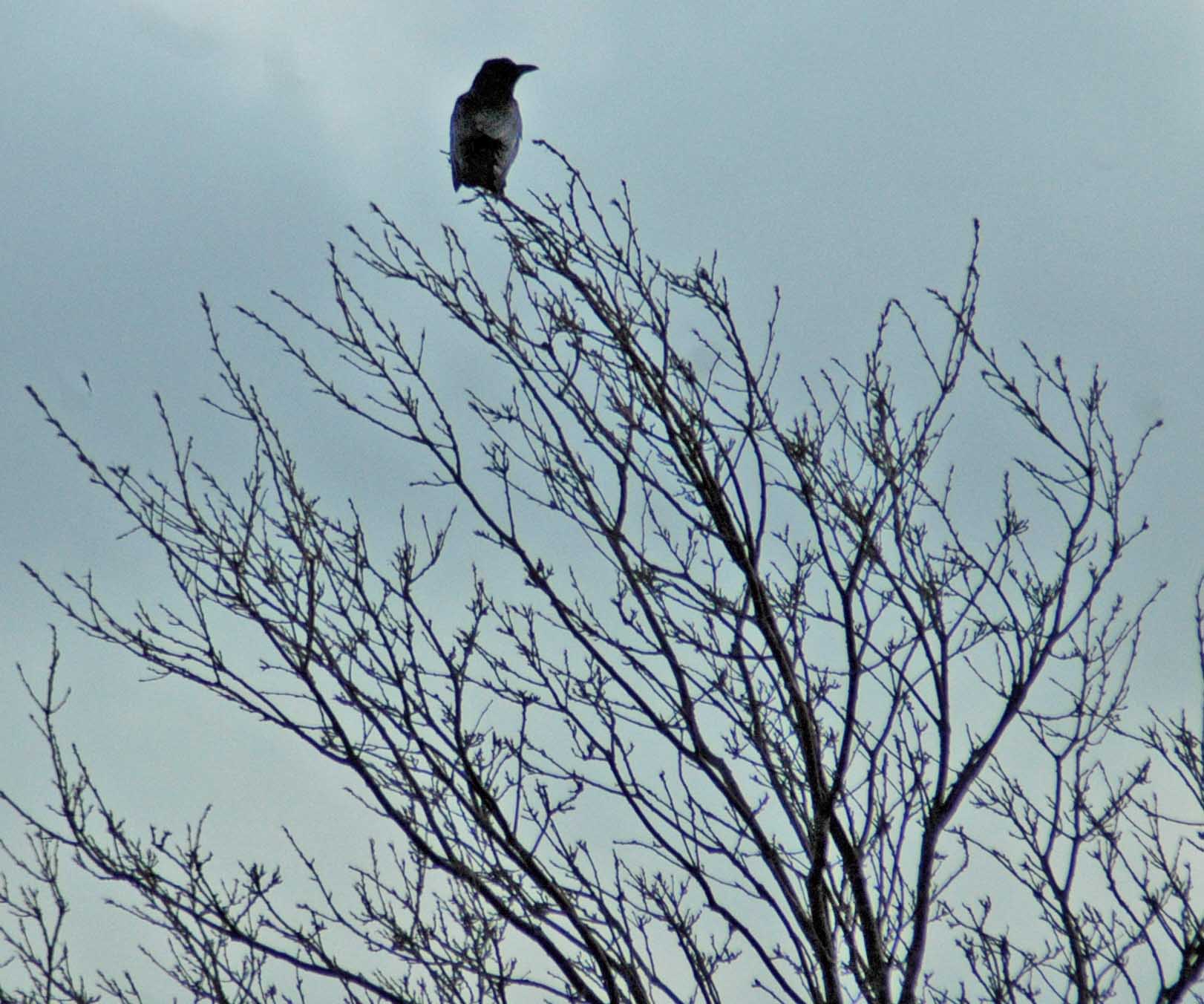
The only company I had up there today was a pair of Crows. It’s such a privilege to have all this

Crow with the highest vantage point possible at the top of a tree near the summit

Crow with the highest vantage point possible – at the top of a tree near the summit

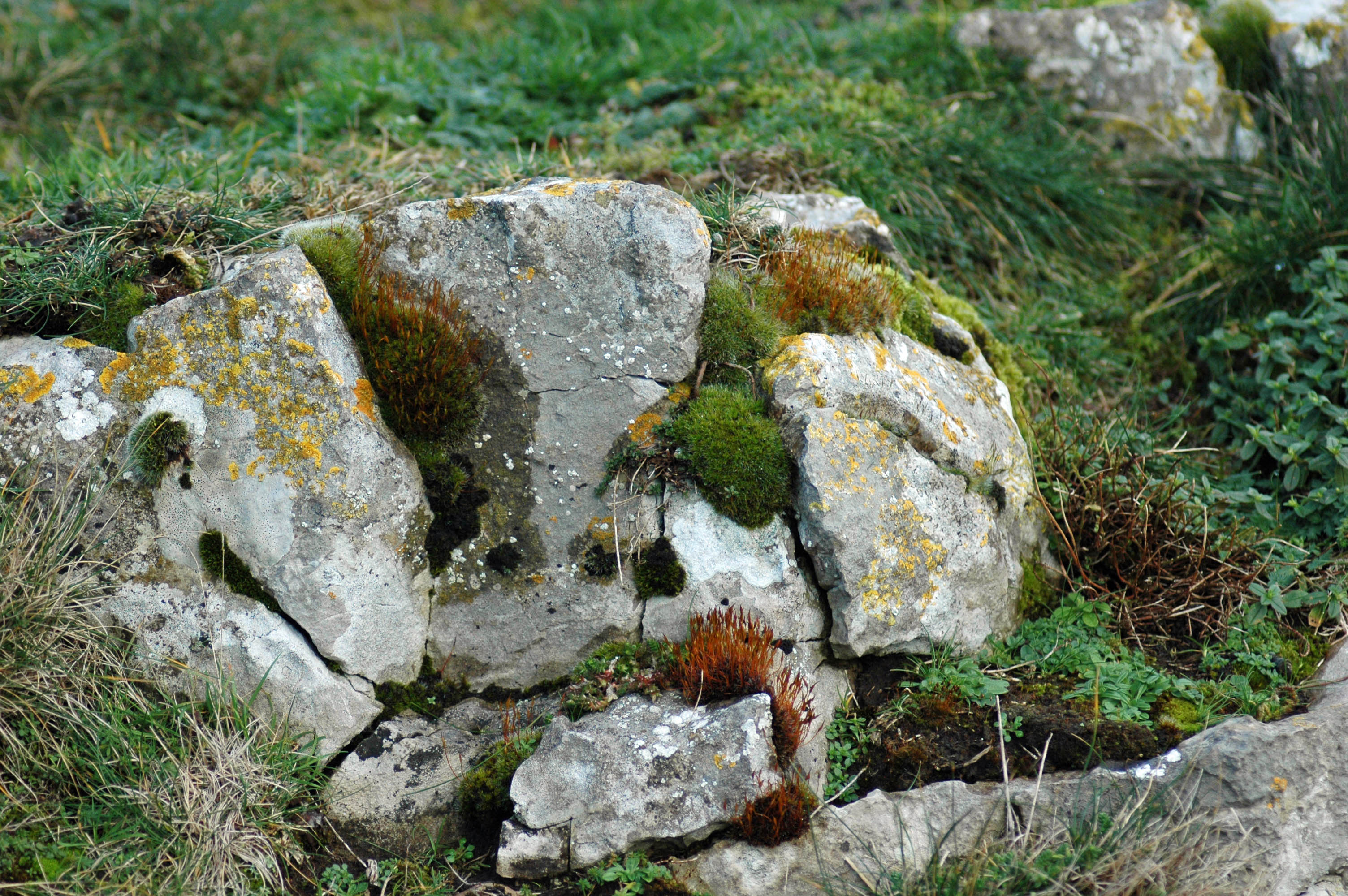
When there are no leaves or wildflowers attention is drawn to the colour and textures of lichens and mosses.

Bright green lichen on elder

Bright green lichen on elder

Tracery of blackthorn hung with small bunches of grey-green lichen

Tracery of blackthorn hung with small bunches of grey-green lichen

Close up of lichen

Close up of lichen

Robin's pincushion

Robin’s pincushion

Rocky outcrop with cushions of moss

Rocky outcrop with a whole variety of lichens and cushions of moss

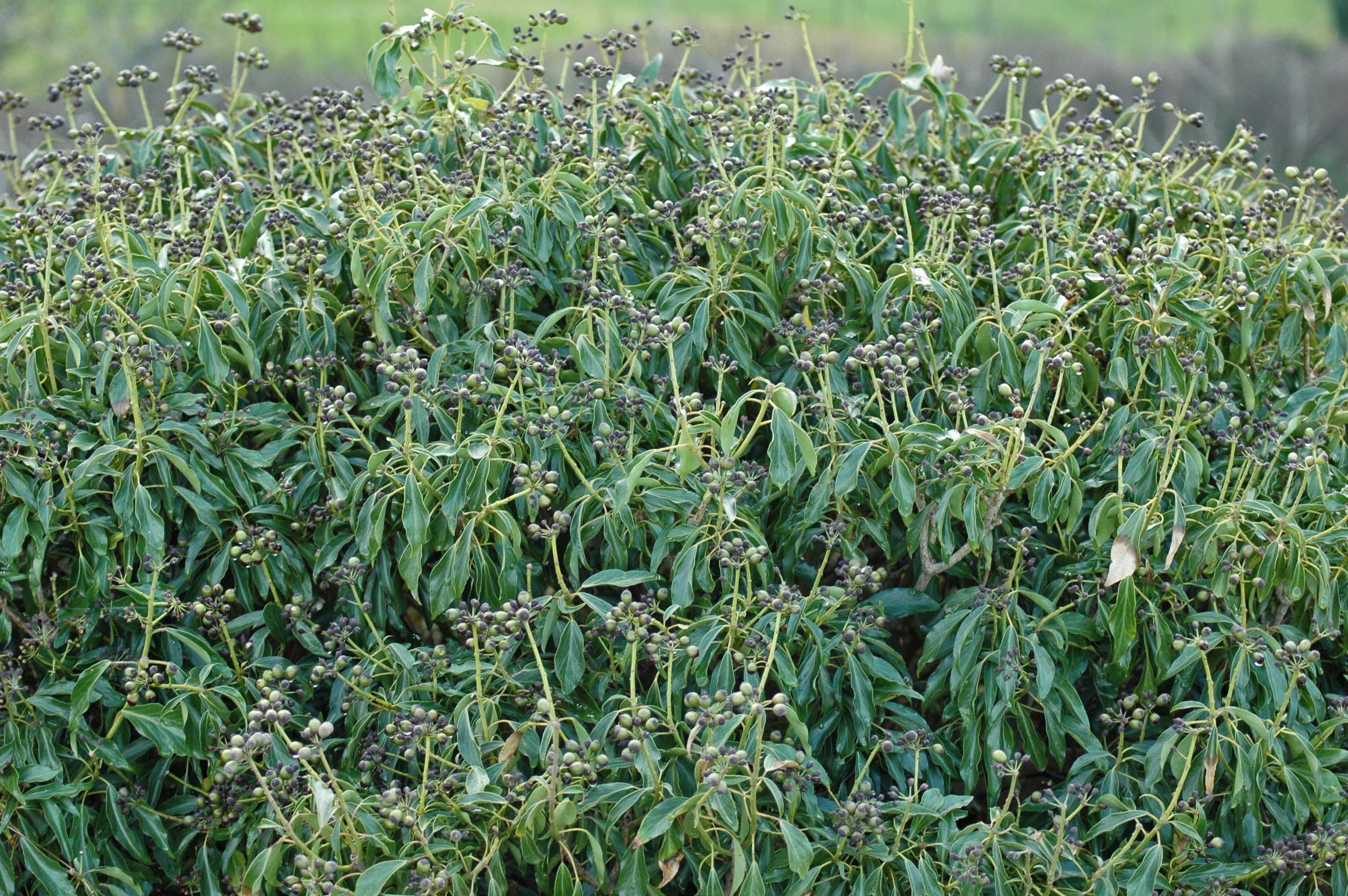
A bountiful crop of ivy berries

A bountiful crop of ivy berries

Going back  down the hill, a flash of bright colour caught my eye and I followed the flight path of what I thought was a male chaffinch until it perched in a small tree. I wasn’t quick enough to focus on it and lowered the camera as it flew away, almost missing the female that replaced it on the same perch. I realised then that these were bullfinch, not chaffinch, a species I haven’t seen here before. I just wish I had been quick enough to get some better images. The one below is just another ‘proof-of-view’! Sorry.

Female bullfinch

Female bullfinch

More lichen

More beautiful lichen

The downhill track was muddy and very slippery so I was more than glad I had the support of my spiky walking pole!

Mossy stones

Mossy stones

Back in the car park I heard a wren singing again, probably the one I’d heard earlier. I managed to get near enough to see him quite clearly and watch his little performance; a burst of song in one direction, then a spin around and a burst the opposite way, then repeat.

Wren singing in the car park

Wren singing in the car park

Spring is definitely on the way, let’s hope it’s not pushing its luck.

Share this:

  • Share on Facebook (Opens in new window) Facebook
  • Share on Pinterest (Opens in new window) Pinterest
  • Share on X (Opens in new window) X
Like Loading...

The Gatekeeper

10 Saturday Aug 2013

Posted by theresagreen in Bryn Euryn Nature Reserve, Butterflies of Wales, Nature of Wales, nature photography

≈ 8 Comments

Tags

gatekeeper butterfly, pyronia tythonus

Scientific name: Pyronia tithonus  (LINNAEUS, 1771) 

Family – NYMPHALIDAE; subfamily – SATYRINAE ;Wingspan range (male to female) – 40-47mm

Flight period: There is only one generation of this butterfly each year; adults begin to emerge in July, and populations peak in early August with only a few adults remaining by the end of the month.

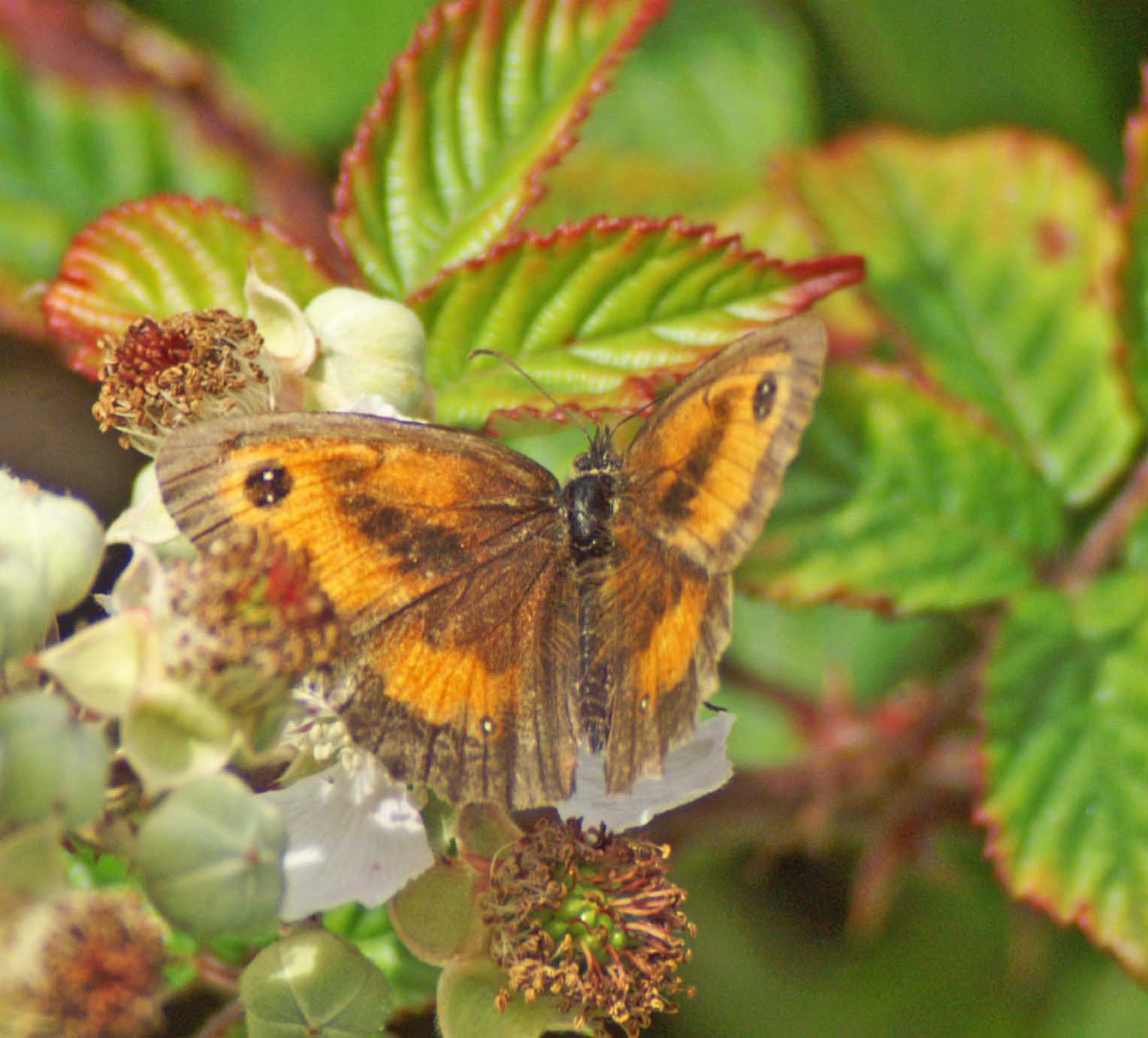
21/7/12-Gatekeeper - Pyronia tithonus

21/7/12-Gatekeeper – Pyronia tithonus (male)

Habitat 

Found where tall grasses grow close to hedges, trees or scrub. Typical habitats are along hedgerows and in woodland rides but the butterfly also occurs in habitats such as undercliffs and on heathland and downland where there are patches of scrub.

The name

The Gatekeeper is also known by the name Hedge Brown, and at various stages in history has also been called the Small Meadow Brown and Hedge Eye.  As suggested by its alternate name, Hedge Brown, the Gatekeeper butterfly favours the habitat of meadow margins and hedges. The butterflies frequently occurred near the open spaces around gates placed in hedges to give access to fields, and as they have the habit of flying up when disturbed it would appear that they were ‘gate-keeping’, such as men were employed to do at toll gates and at the entrances to country estates in the eighteenth and nineteenth centuries.

Description

21/7/13-First sighting of a Gatekeeper this year-Little Orme

21/7/13-First sighting of a Gatekeeper this year-Little Orme

Orange  and brown, with black eyespot on forewing tip, eyespots have two white pupils. Males are noticeably smaller than females and have a dark brown patch of scent-producing (androconal) scales on the forewing, used to attract females during courtship. The colour and patterning of the wings are variable.

110722tgbfly-gatekeeper underside

22/7/11 – Gatekeeper underside (female)

Lifecycle

The first adults emerge in July and lay their eggs singly on grasses beneath bramble, hawthorn and blackthorn bushes where the grass stems grow tall and are not grazed by animals. They hatch after about 14 days and the larvae feed at night on various species of grass, with a preference for fine grasses such as bents, fescues, and meadow-grasses. Common Couch is also used. The full range of other species used is not known. They hibernate during September while they are quite small and re-awaken in March and April feeding slowly and reach maturity by late May – early June.

17/8/11 - Gatekeeper (female)- Rhos--on-Sea garden

17/8/11 – Gatekeeper (female)- Rhos–on-Sea garden

Adult behaviour

This butterfly spends much of its time basking with wings open, when the sexes are easy to tell apart – only the male has the distinctive sex brands on the forewings. Males set up small territories, often based on a particular shrub or bush, and readily fly up from their perch to investigate passing butterflies regardless of their species, in the hope of finding a mate.

17/8/11-Gatekeeper basking on ivy leaf-Rhos-on-Sea garden

17/8/11-Gatekeeper basking on ivy leaf-Rhos-on-Sea garden

Nectar sources

22/7/11 - Gatekeeper (m) nectaring on bramble flowers

22/7/11 – Gatekeeper (m) nectaring on bramble flowers

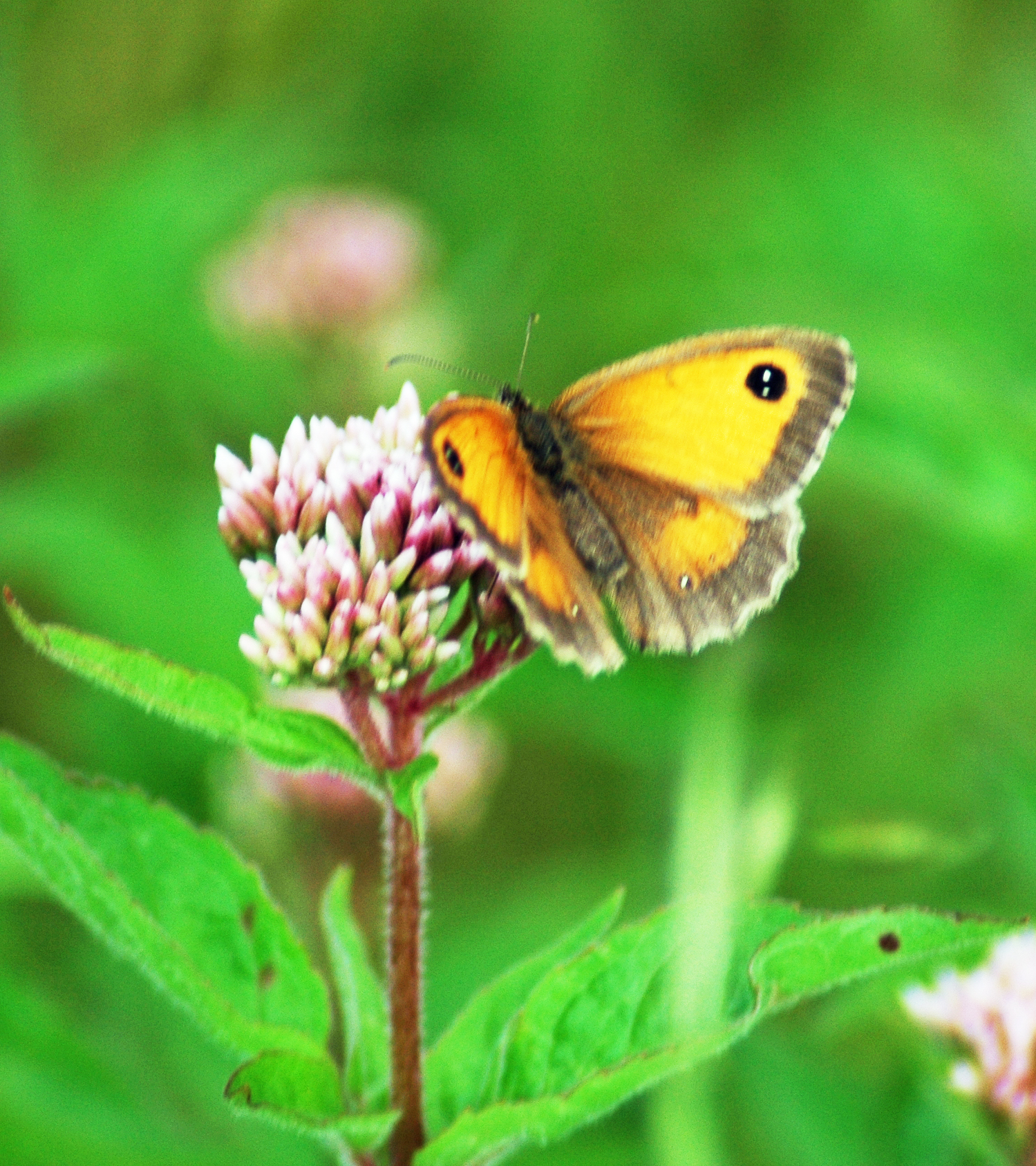
Adults favour Bramble, Ragwort, Scabious, Fleabane , Hemp Agrimony, Privet, Red Clover, Thistles and Thyme.

13/8/12 - Gatekeeper on Hemp Agrimony - Bryn Euryn

13/8/12 – Gatekeeper on Hemp Agrimony – Bryn Euryn

Distribution: The Gatekeeper is a common and widespread butterfly in England and Wales; found south of a line between Westmorland and South-east Yorkshire in the east. In Ireland it is confined to coastal areas of the south and south-east counties. The butterfly is also found in the Channel Islands, but is absent from Scotland and the Isle of Man.

Similar species

Meadow Brown on bramble flowers-Little Orme

Meadow Brown on bramble flowers-Little Orme

Meadow Brown; the two species may be difficult to distinguish with closed wings as the underwing markings are  similar. However, the Gatekeeper tends to rest with its wings open, whereas the Meadow Brown usually rests with its wings closed. The Gatekeeper is also smaller and more orange than the Meadow Brown and has double pupils on its eyespots.


Share this:

  • Share on Facebook (Opens in new window) Facebook
  • Share on Pinterest (Opens in new window) Pinterest
  • Share on X (Opens in new window) X
Like Loading...

Into the woods, led by the nose

24 Wednesday Jul 2013

Posted by theresagreen in Bryn Euryn Nature Reserve, Nature of Wales, nature of woodlands, nature photography, Wildflowers of Wales

≈ 4 Comments

Tags

common shrew, common spotted orchid, greenbottle flies on shrew carcass, greenbottle fly, honeysuckle, medicinal plants, Pyramidal Orchid

Bryn Euryn’s woodland trail is a circular route that travels more or less around the circumference of the bottom of the hill and is a good one to follow if you want a ‘proper’ walk without too many distractions. That’s not to say there isn’t anything to see; on my walks there is always something that catches my eye, or as happened on one particular evening, my nose!

I had rejoined this trail after my diversion onto the more open hillside where I had earlier watched the butterflies, and by the time I reached there it was late afternoon and a little cooler; just the time to catch the intermittent scent of honeysuckle, which for me is the absolutely perfect fragrance. The fresh perfume of the honeysuckle takes me back to walking through shady summer woods as a child when the heavenly scent brought the plant to my attention and I would always have to find it and inhale more of it. In fact I still do that; I just cannot resist it.

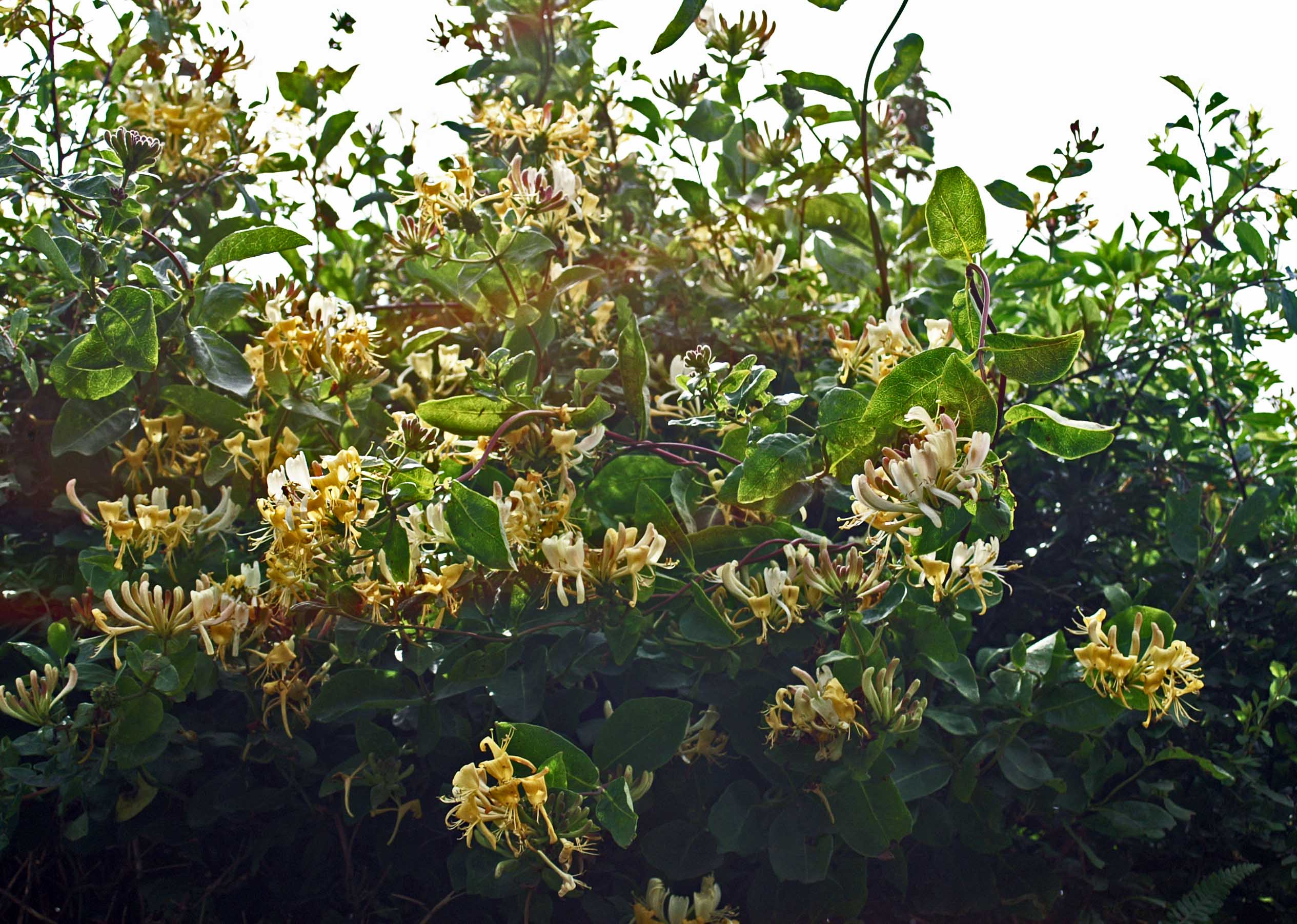
Honeysuckle – Lonicera periclymenum

Honeysuckle clambering up a tall holly shrub

Honeysuckle clambering up a tall holly shrub

Therapeutic and medicinal uses

I remember being very disappointed when, training as an aromatherapist, I learnt that Honeysuckle is not an essential oil that is practical to use for therapeutic massage. It is very difficult to extract the oil on a commercial basis, so it ends up being very expensive and difficult to obtain in an ‘absolute’ or pure form; any you buy is likely to have been mixed with something else.  It is more widely used as a component of perfume. Shame, because the essential oil supposedly has some wonderful properties and if it had been practical to use I probably could have used it by the bucketful!

“Honeysuckle aids one to get past mental regrets, and move forward freely in life. It’s captivating scent is able to instil love and beauty, and banish any fear and sadness brought about by such events as divorce, death, and loneliness. The oil allows one to overcome harshness, indulge in self-renewal, and inspires hope, progress, freedom, and unity.”

Honeysuckle lit by evening sun in a hedgerow, Nevern, Pembrokeshire

Honeysuckle lit by evening sun in a hedgerow, Nevern, Pembrokeshire

Honeysuckle has been used medicinally for thousands of years to treat respiratory conditions, diarrhoea, ease childbirth, and stimulate the flow of energy throughout the body. Aromadendrene, a terpenoid, is a constituent of honeysuckle essential oil, which contributes to the oil’s antimicrobial properties. The terpenoid inhibits growth of micro-organisms, such as, bacteria, fungi, and protozoans. Eugenol, a phenylpropene, which is known to be a restorative and has a palliative effect, meaning it relieves pain and prevents further suffering.

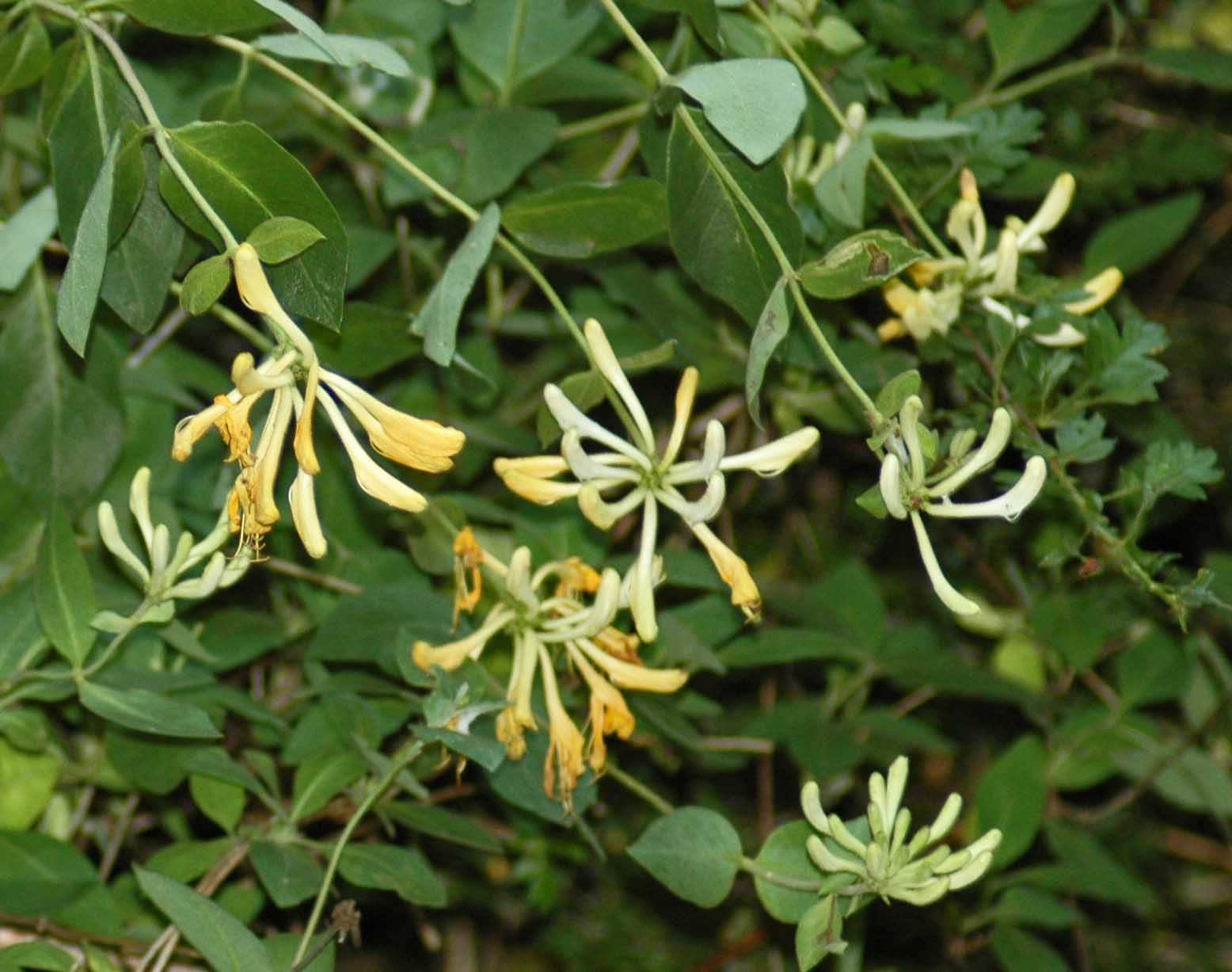
Honeysuckle blossoms

Honeysuckle blossoms

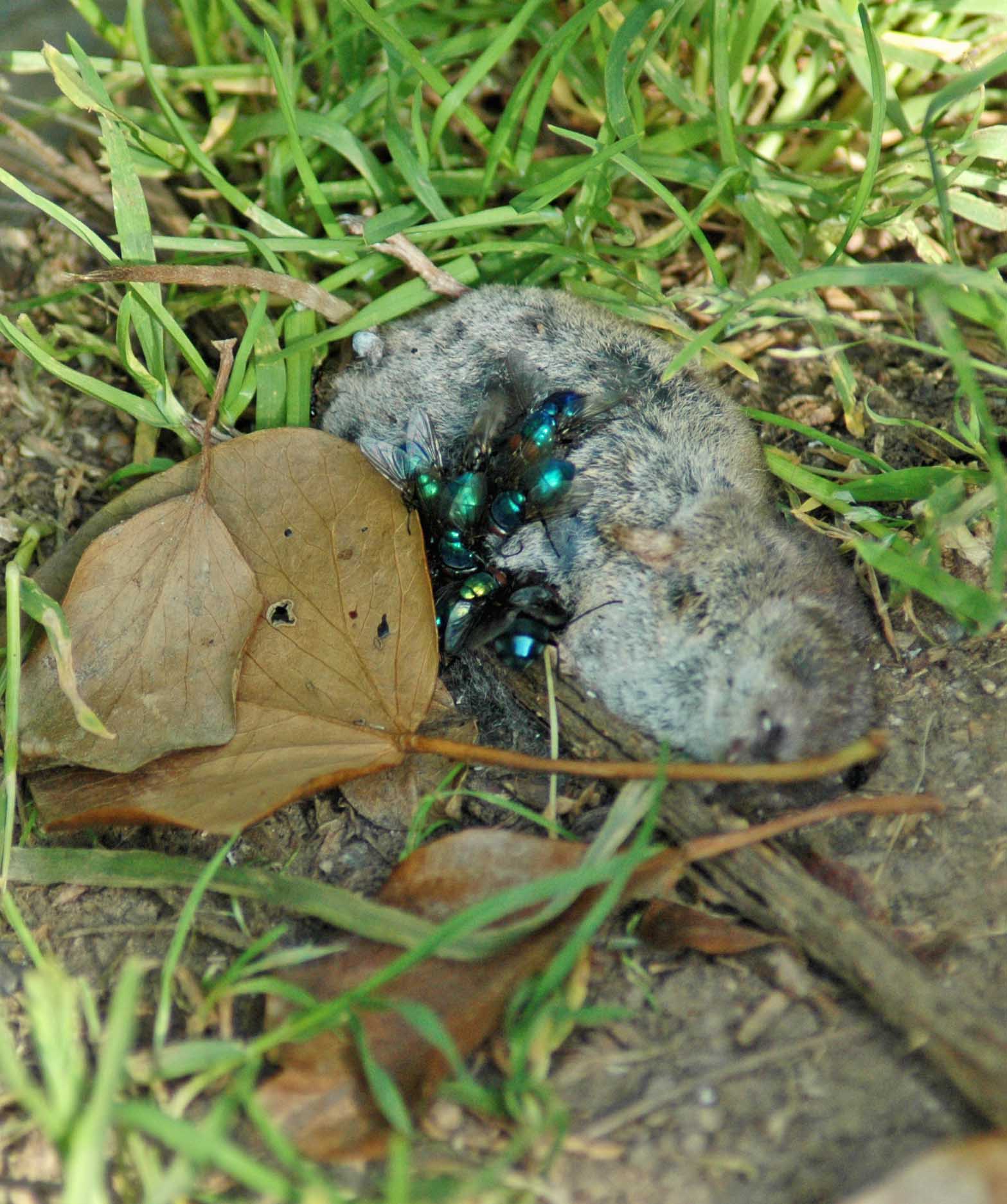
I was soon snapped out of my state of  pleasant reminiscence brought about by the aromatic honeysuckle as my olfactory sense was assailed by a far less pleasant smell, immediately recognisable as that arising from something that has died. Never one to shirk the responsibility of  recording all aspects of the nature I come across on my wanderings, I followed my nose regardless, although trying not to breathe through it. I soon found the source of the stench: another little shrew had passed away; probably murdered by another cat. It was creating a mighty smell for something so tiny in life, but it would have attracted my attention anyway as there were a dozen or more Greenbottle flies swarming over its tiny body. (Those of a squeamish nature should probably look away now!)

Greenbottle flies on the carcass of a dead shrew

Greenbottle flies on the carcass of a dead shrew

I know it’s not nice, but we all know that nature is not always about pretty flowers, butterflies and birds singing. Everything dies and it is actually interesting to see what benefits from that; it is often insects that are responsible for completing the circle of life. And, sorry, I do find Greenbottle flies very interesting.

Greenbottle Fly- Lucilia sericata

The Common Green bottle fly is a blow-fly, a member of the family Calliphoridae, is the most well-known of the numerous green bottle fly species and found in most areas of the world. It is 10–14 mm long, slightly larger than a housefly, and has brilliant, metallic, blue-green or golden colouration with black markings. It has short, sparse black bristles (setae) and three cross-grooves on the thorax. The wings are clear with light brown veins, and the legs and antennae are black.

Common Greenbottle Fly

Common Greenbottle Fly-Rhos-on-Sea garden

The  fly is found feeding on flowers, but is also a common visitor to carrion and faeces. The female greenbottle lays a mass of eggs in a wound, a carcass or corpse, or in necrotic or decaying tissue. (A single female typically lays 150-200 eggs per batch and may produce 2,000 to 3,000 eggs in its lifetime.)  The eggs hatch out in about 8–10 hours in warm moist weather, but may take as long as three days in cooler weather.

Greenbottle flies

Greenbottle flies were most numerous on the corpse, but there are two other species there too

Forensic science

Like most Calliphorids, the insect has been heavily studied and its life cycle and habits well documented and L. sericata is an important species to forensic entomologists. One of the first insects to colonise a corpse, the stage of the insect’s development is used to calculate the period of colonization, so that it can be used to aid in determining the time of death of the victim.

Veterinary importance

L. sericata, along with other species of blowfly also makes an impact in a veterinary sense. In the UK and Australia it is commonly referred to as the “sheep blowfly” since sheep are its primary, although not sole host.

In Northern Europe, the fly will lay its eggs in sheep wool. The larvae then migrate down the wool to feed directly on the surface of the animal’s skin, which can cause massive lesions and secondary bacterial infections. In the UK, it is estimated that blowfly strike affects 1 million sheep as well as 80% of sheep farms each year. This causes a huge economic impact in these regions: it costs money to treat infected animals and to take measures to control L. sericata populations.

To end on a pleasanter note, here are some more flowers I found along the woodland trail that same evening:

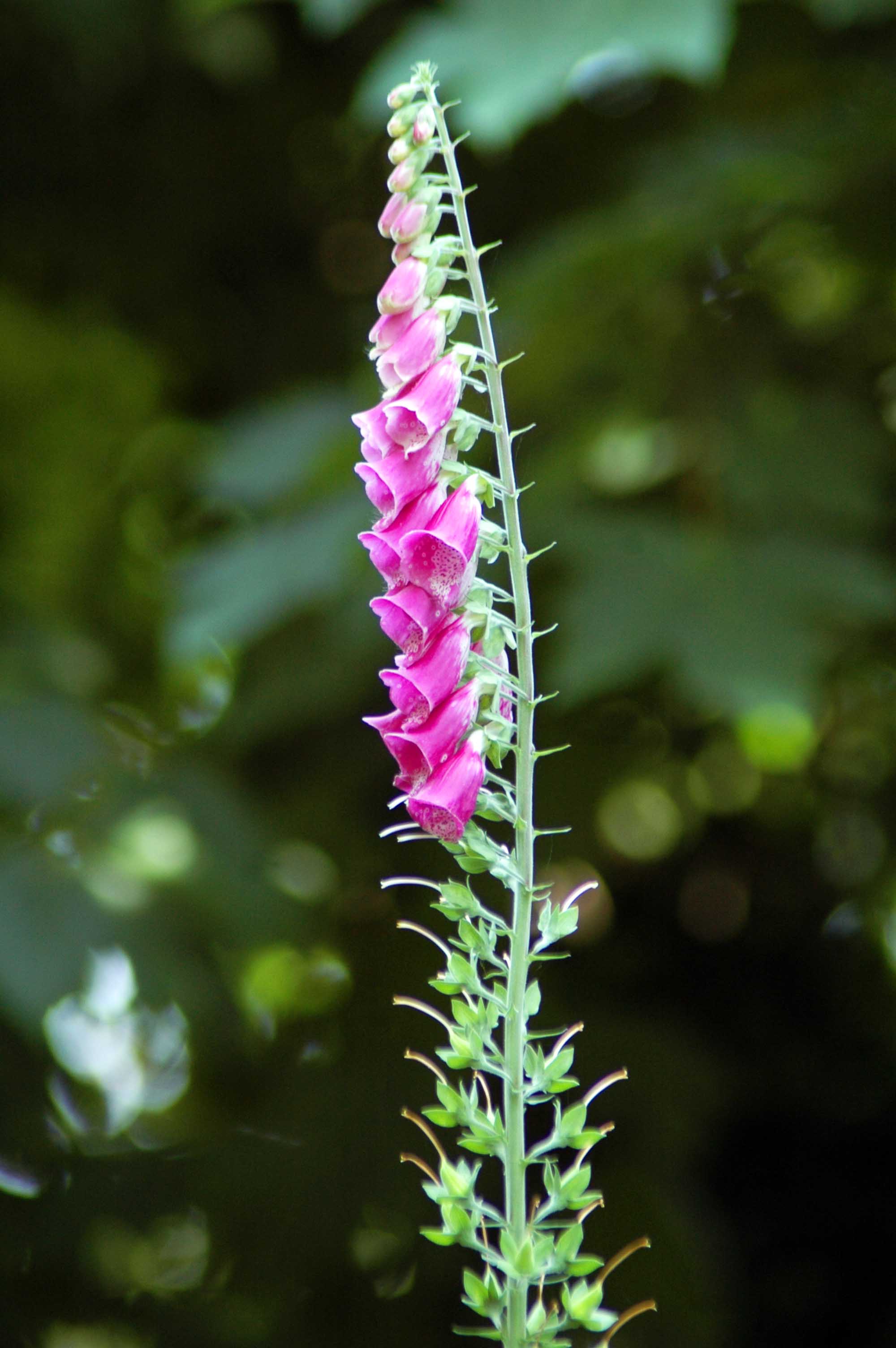
Foxgloves are not common here, but there were a couple of stems of them; tall now and maybe a little more than half-way to being finished.

Foxgloves are about half-way to being over

Foxgloves are about half-way to being over

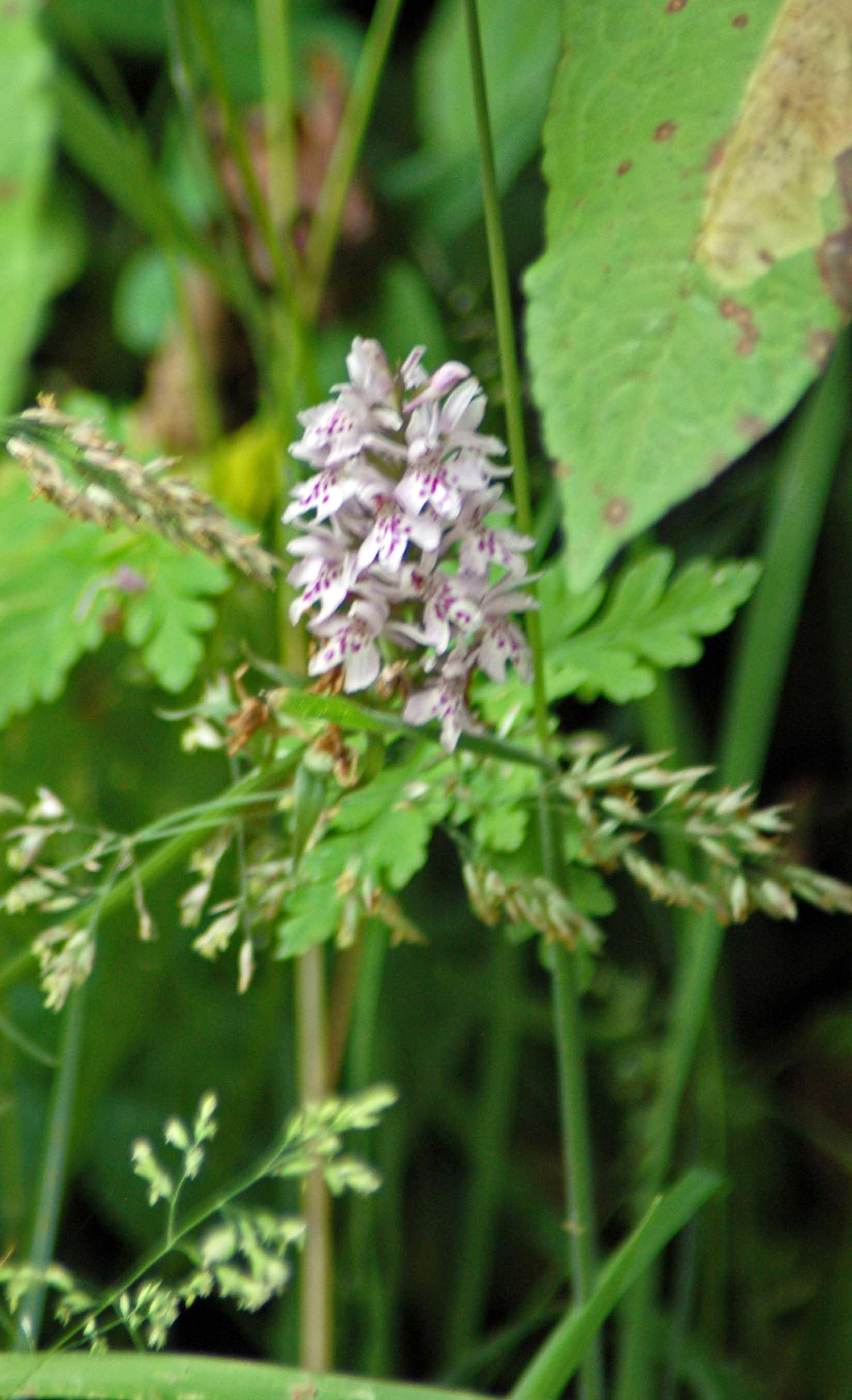
Amongst the grass and other tougher plants on the path edge a pretty Common Spotted  Orchid pushed through.

A Common Spotted Orchid on the side of the trail

A Common Spotted Orchid on the side of the trail

Further along, in quite deep shade I was surprised to find another Pyramidal Orchid.

Another Pyramidal Orchid

Another Pyramidal Orchid

Share this:

  • Share on Facebook (Opens in new window) Facebook
  • Share on Pinterest (Opens in new window) Pinterest
  • Share on X (Opens in new window) X
Like Loading...

All is bright and beautiful at the top of the Bryn

20 Saturday Jul 2013

Posted by theresagreen in Bryn Euryn Nature Reserve, Butterflies of Wales, Nature, Nature of Wales, nature photography, Wildflowers of Wales

≈ 8 Comments

Tags

carline thistle, dark green fritillary, fox, grayling, myathropa florea, sulphur beetle

I had thought about venturing a bit further afield today, maybe over to Anglesey, but weekends are never good for travelling any distances in this popular holiday location, and the North Wales Expressway (the A55) is the route to and from the ferry port of Holyhead too, so unless you leave early you can end up spending an uncomfortably long time in your car. So I decided on Bryn Euryn instead, where I was hoping to get a glimpse of a particularly lovely butterfly.

There were people picnicking in the field, so I headed straight for the top of the hill today, half expecting to find more people up there too, but there was no one at all. Most people head for the beach when its this hot. The view from here is always amazing as I’ve said so many times before and today’s gives an overview of the progress of summer. So, queen of the castle for a short while, I surveyed the land below and around me. There was a bit of a haze over the horizon, hay has been cut, dried out and rolled into big shredded-wheats ( for those who are wondering, that’s a British breakfast cereal), grass meadows are turning brown in the dry heat, wheat is ripening and trees and hedges add shape and texture to the landscape in a myriad shades of green. You also get a good view of the express-way from up here: I was so glad I wasn’t on it, it was very busy.     

Summer view from the top of Bryn Euryn

Summer view from the top of Bryn Euryn (click to enlarge)

A patchwork of treetops viewed from above

A patchwork of treetops viewed from above (click to enlarge)

There are not many wildflowers that can survive the dry rocky summer conditions on this edge of the hill, where the rockroses bloomed so prolifically a few weeks ago, but one that can is the strangely attractive Carline Thistle, which looks as though it’s going to seed, but in fact its flowers are brown. This species of thistle is found in several locations locally, but is a biennial and a bit unpredictable in its appearances.

Carline Thistle

Carline Thistle-Carlina vulgaris

There were Small Tortoishell butterflies flitting about up here, basking briefly on rocks before disappearing over the cliff edge. Looking down I could see a number of them, maybe a dozen or so, very restless and taunting and chasing each other; at one point a group of seven of them flew up in a flurry, whirling around like mad things.

Scabious is beginning to put forward much-needed flowers; their nectar and pollen is always gratefully received by butterflies and bees.

First flowers of scabious with a bumblebee

First flowers of scabious with a bumblebee

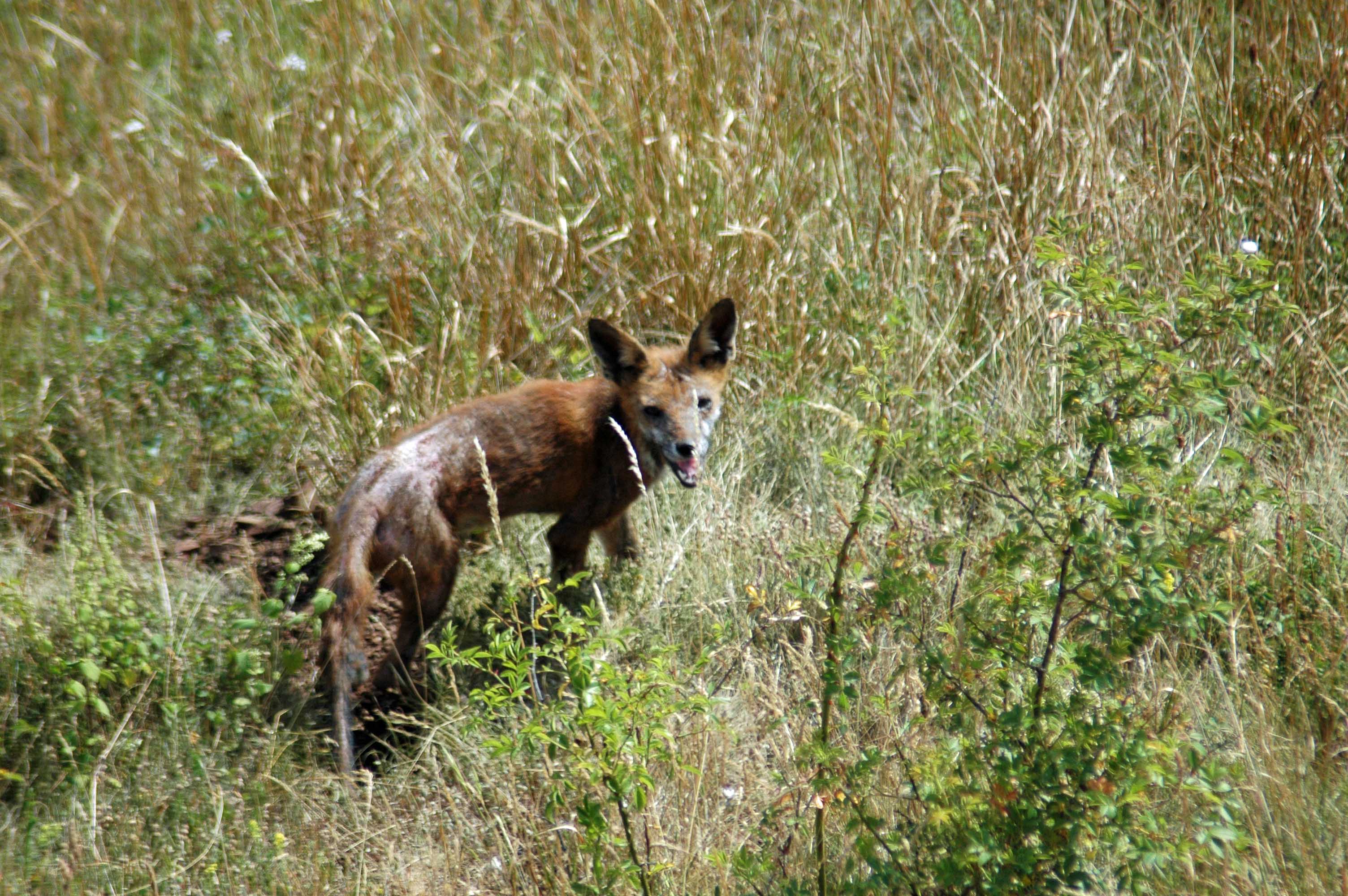
As I was peering over the edge of the cliff to watch the butterflies, I sudddenly realised someone was looking up at me; a fox, panting in the heat couldn’t decide if I was a threat or not so dived back into its den just to be sure.

130714TGNR-Fox looking up at me-Bryn Euryn

Little fox looking up at me

Fox disappearing into its earth

Fox disappearing into its earth

I couldn’t decide if it was a young animal or an adult, but either way it was not looking good. Apart from dealing with the heat it looked thin and its rear end and tail were devoid of fur, poor thing. Does it have some horrible condition like mange?

130714TGNR-Fox not looking too good-Bryn Euryn

the fox’s back and normally bushy tail were bare of fur

I moved on a little further back from the edge to where the grass is long and some ‘scrubby’ wild plants have been left to grow, perfect habitat for insects.

A flowery patch amongst long grass with hogweed, ragwort, wood sage,  lady's bedstraw & more

A flowery patch amongst long grass with hogweed, ragwort, wood sage, lady’s bedstraw & more

And  lo and behold, the first butterfly to catch my eye was the one I had been hoping to see, a gorgeous Dark Green Fritillary, drawn by nothing more exotic than red valerian flowers.

Perfect Dark Green Fritillary nectaring on valerian

Perfect Dark Green Fritillary nectaring on valerian

There were two of the beautiful insects flying around; these are fast, powerful fliers that can cover a large area in a short time. They don’t tend to leave their breeding areas, so once you know where to find them, providing conditions are good, you will more than likely see them there again. I didn’t see any last year, so was delighted to see some today and it was a bonus that they were ‘new’ and perfect.

A glimpse of an underside

A glimpse of an underside

The butterflies were very mobile,  and with no need to bask, not staying anywhere for long. I had no time for considered portraits,  these were very much opportunities grabbed, but I was more than happy just to watch them.

Wood Sage- Teucrium scorodonia

Wood Sage- Teucrium scorodonia. Aromatic and attractive to bumblebees

Hogweed is continuing to show me new visitors to its flowers:

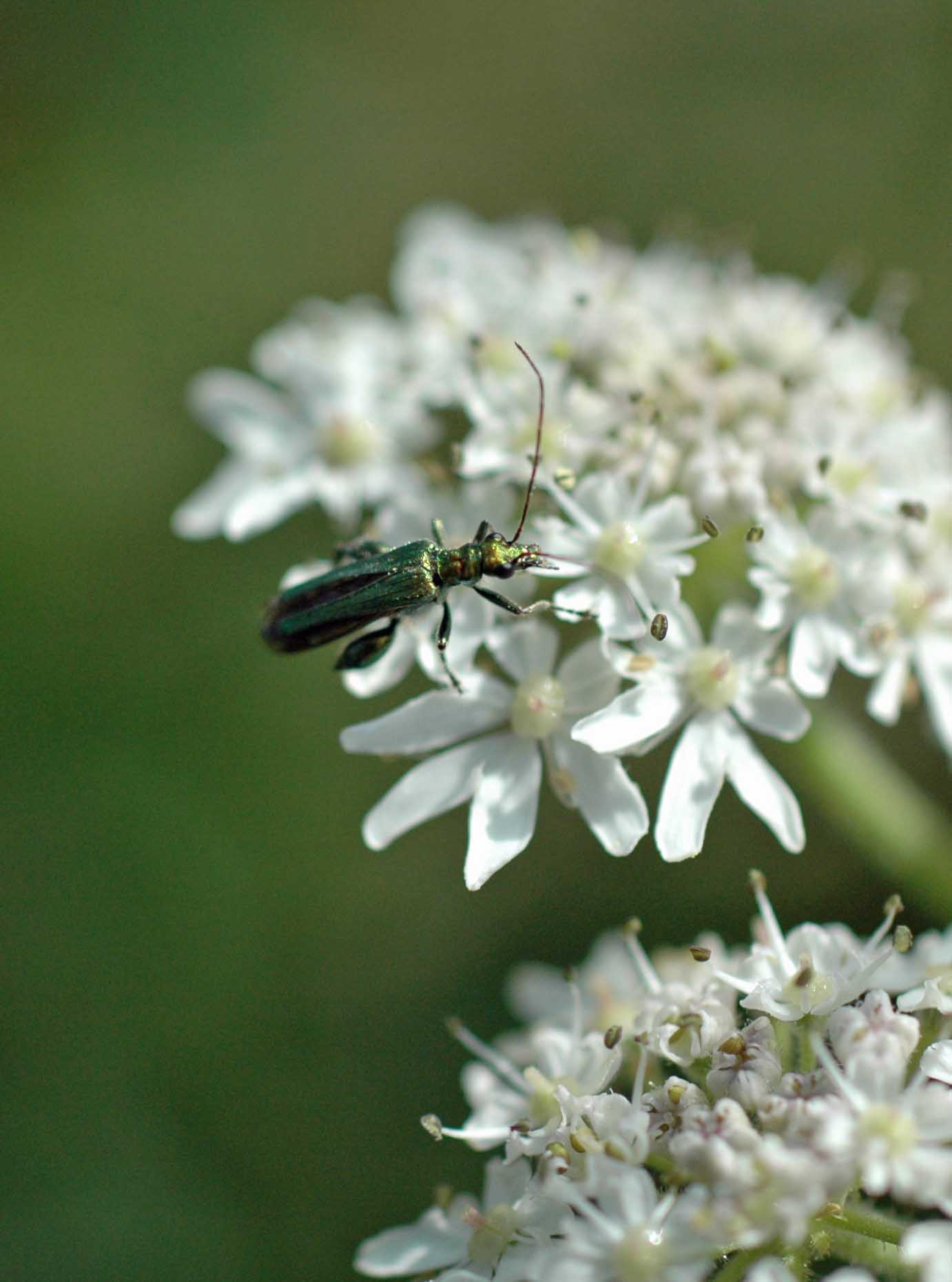
A glamorous beetle with a clumsy common name  of  'Swollen-thighed Beetle' - Oedemera nobilis

A glamorous beetle with a clumsy common name of ‘Swollen-thighed Beetle’ – Oedemera nobilis

A ‘new’ hoverfly for my collection, which I hope I have identified correctly

Hoverfly-Myathropa florea

Hoverfly-Myathropa florea (I think)

and two little sulphur beetles, Britain’s only yellow beetle and another new one for me.

Sulphur beetle-Cteniopus sulphureus

Sulphur beetle-Cteniopus sulphureus

There were a lot of Meadow Brown butterflies in this area, and also Small Heath’s flitting along the pathways and low amongst the grass stems.

Small Heath

Small Heath

Lovely blue harebells

Harebells grow in long grass as well as on short turf

Harebells grow in long grass as well as on short turf

Meadow Brown basking on a path through the grass

Meadow Brown basking on a path through the grass

I headed towards the proper summit of the hill and as luck would have it, was followed by a cute little dog and its owner, so took a diversion on a very narrow path around the rocks that I wouldn’t normally have done. My reward was another lovely butterfly; this one not so colourful but a master, or mistress of camouflage, a Grayling.

Grayling perched on a rock

Grayling-Hipparchia semele perched on a rock

Part two to follow….


53.308051 -3.749941

Share this:

  • Share on Facebook (Opens in new window) Facebook
  • Share on Pinterest (Opens in new window) Pinterest
  • Share on X (Opens in new window) X
Like Loading...
← Older posts
Newer posts →
Follow everyday nature trails on WordPress.com

Enter your email address to follow this blog and receive notifications of new posts by email.

‘But it is the common species that keep the living world ticking over and provide most of our experiences of wildlife, and I would argue that maintaining the abundance of these is as important a conservation priority as maintaining the existence of rarities’. Richard Mabey

MOST RECENT POSTS

  • A Glimpse of Spring to Come January 22, 2025
  • Hunting the Wren December 28, 2024
  • Oh, Christmas Tree December 18, 2024
  • In and Out of the Ivy February 15, 2024
  • Nature’s Fireworks November 30, 2023
  • Wild Autumn along the Coast Path November 3, 2023

OLDER POSTS

LOOKING FOR SOMETHING IN PARTICULAR?

  • Sights and Sounds from the Little Orme 1
    Sights and Sounds from the Little Orme 1
  • Things Bright and Beautiful
    Things Bright and Beautiful
  • Catchers, a Duck and Divers
    Catchers, a Duck and Divers
  • Following a river to a Fairy Glen
    Following a river to a Fairy Glen
  • May Bee Appearing on Ivy near You
    May Bee Appearing on Ivy near You
  • Shades, Sounds and Scents of the Woods
    Shades, Sounds and Scents of the Woods
  • Fine Dining for Crows
    Fine Dining for Crows
  • A Windy Wildflower Trail
    A Windy Wildflower Trail
  • The Windhover
    The Windhover
  • Butterflies and more rare treats
    Butterflies and more rare treats

nightingale trails

The Walk of the Monarch Butterfly-Sendero de la Mariposa Monarca

The Walk of the Monarch Butterfly-Sendero de la Mariposa Monarca

MY WILDFLOWER BLOG: where the wildflowers are

Snowdrop

Snowdrop

most recent posts

Follow everyday nature trails on WordPress.com

Social

  • View teresamaygreen’s profile on Twitter

Enter your email address to follow this blog and receive notifications of new posts by email.

Website Built with WordPress.com.

  • Subscribe Subscribed
    • everyday nature trails
    • Join 359 other subscribers
    • Already have a WordPress.com account? Log in now.
    • everyday nature trails
    • Subscribe Subscribed
    • Sign up
    • Log in
    • Report this content
    • View site in Reader
    • Manage subscriptions
    • Collapse this bar
 

Loading Comments...
 

    %d