• Home
  • about
  • about the photographs
  • Local Nature Reserves
    • Bryn Euryn Local Nature Reserve
    • Mynydd Marian
  • Wales Coast Path
    • Grey Seals in North Wales
    • St.Trillo’s Chapel
    • Wildflowers of North Wales Coastal Paths, Cliffs and Dunes

everyday nature trails

everyday nature trails

Category Archives: HABITATS

Sleeping Seals and Stonechats

02 Saturday Apr 2016

Posted by theresagreen in coastal habitat, Little Orme, Nature, Nature of Wales, nature photography, Rhiwledyn Nature Reserve, Rhos-on-Sea, Seals, The Wales Coast Path, Wildflowers of Wales

≈ 14 Comments

Tags

alexanders, dunnock, grey seals, grey seals in Angel Bay, jackdaw, jackdaws on cliff, stonechat

A brightly sunny day, too good to miss, so I headed for the Little Orme which offers reliable sightings of a wide variety of wildlife in a relatively compact area with little effort required. Well-used by local people and visitors to the area and part of the route of both the Wales Coast Path and the North Wales Path, the pathways of the lower part of the reserve particularly are often very busy. Opportunities for uninterrupted attempts to photograph the more wary small woodland birds may be limited, but despite close human proximity the birds carry on regardless and largely unnoticed.

I use the entrance to the reserve sited at the back end of a residential area. Today the lawns of the unfenced front gardens were providing foraging for jackdaws and a few Pied wagtails. Outside the breeding season wagtails gather here in the evenings before setting off to roost comunally for the night. On the roofs were perched gulls, Wood pigeons and Magpies and a singing Greenfinch. There’s a thriving House sparrow population here too and cheerful chirruping greeted me as I  climbed the steps up to the reserve, where they frequent the tangle of brambles and shrubs there.

160310-1-Little Orme

The Fulmars have returned to their nest sites high on the cliffs. Although a small colony of just 10 or so pairs they draw attention to themselves by noisily proclaiming their territories and can be heard as soon as you enter the site. I looked out for Ravens that have used the same nest site up on the cliff for many years, but I didn’t see or hear them today.

I was pleased to see a pair of Stonechat though, one of my favourite little birds. They were in the same area within which a pair successfully raised a family last year, so I like to think this may be the same pair. I couldn’t get close enough to them to get good photographs, but I prefer to use ‘real time’ images whenever possible, so these were today’s best record shots.

Stonechat male

Stonechat -Saxicola rubicans -male

Stonechat female

Stonechat female

The biggest draw to the reserve are the Grey Seals that at this time of year can be fairly reliably seen, when the tide is out, hauled up on the stony beach of Angel Bay. Today there were about 20 females and their rapidly growing pups, a few in the water, the rest sleeping blending perfectly into the background of stones and rocks.

Grey Seals in Angel Bay, Little Orme

Grey Seals in Angel Bay, Little Orme

160310-9-Little Orme-Grey Seals on edge of sea

160310-11-Little Orme-Grey Seal sleeping on rock pillow

160310-7-Little Orme-Grey Seals on edge of sea

160310-12-Little Orme-Grey Seal sleeping on rock pillow

160310-4-Little Orme-Grey Seal on edge of sea

Jackdaws are without doubt the most numerous birds here and a great number gather here to breed, nesting on the rocky cliff faces. They spread throughout the site to feed and also separate into small flocks that venture back and forth to forage in a wide variety of places locally, arriving back noisily to land on the cliffs where they site their nests. It is good to see them foraging and nesting in their natural cliff habitat rather than in villages roosting on roofs and nesting in chimneypots.

Jackdaw

Jackdaw

Jackdaws in their natural habitat

Jackdaws in their natural breeding habitat

160310-23a-Little Orme-Jackdaws on cliff

Blackbirds are another numerous bird here as are Robins and Dunnocks, with males singing from shrubs throughout the site. Close to the backs of houses trees and shrubs are frequented by good numbers of birds. The House sparrows are nesting close to a busy path here and a chorus of chirrupings emanated loudly from within the shrubs, but despite being audible from some distance away, they stayed well hidden. Also seen and heard singing here were Chaffinch, Greenfinch, Wren, Great Tit and Blue Tit.

Dunnock male

Dunnock male singing from a wild rose stem with numerous Robins pincushion galls

Wildflowers appear a little later on this windswept clifftop than in more sheltered areas, but there’s plenty of the early flowering Alexanders on show.

Alexanders

Alexanders

Elder leaves are well grown too.

160310-26a-Little Orme-Magpie in Elder tree

Magpie well concealed in an Elder tree

Share this:

  • Share on Facebook (Opens in new window) Facebook
  • Share on Pinterest (Opens in new window) Pinterest
  • Share on X (Opens in new window) X
Like Loading...

Secret passage behind the sea wall

15 Thursday Oct 2015

Posted by theresagreen in birds of the seashore, coastal habitat, coastal walks, coastal wildflowers, Nature, Nature of Wales, nature photography, wading birds, Wales Coast Path, Wildflowers of Wales

≈ 4 Comments

Tags

coastal birds, Linnet, migrant birds, Northern Wheatear, penrhyn bay, rhos on sea, Rhos Point, rocky seashores, seashore walks

On a sunny day last week I intended to spend some time checking out the birdlife on Rhos Point to see what treats the autumn migration had already brought to us. I started out on the roadside where there’s a posh new sign on the roadside above the bijou St Trillo’s Chapel, the favoured starting point for many of my seashore posts.

151007TGNW-1-St Trillo Chapel plaque-Rhos-on-Sea

St Trillo's Chapel, Rhos on Sea

St Trillo’s Chapel, Rhos on Sea

It was windy here and decidedly chilly as it can be when the tide is coming in. A quick look and listen from the promenade revealed a good number of cormorants, gulls, oystercatchers, redshanks and curlews, but all still too far out on the tideline on the mussel bed to see easily.

151007TGNW-2-Tide coming in-Rhos-on-Sea

I picked up a few seashells of some of the most commonly occurring species here.

151007TGNW-3a-Some seashells-Rhos-on-Sea 1

Despite the sunshine, this was definitely not a day to hang around on the shore, so I turned to walk along to Penrhyn Bay, hoping I might find a Rock Pipit or two amongst the huge rocks of the seabreak.

Fox -and-cubs on the embankment

Fox -and-cubs flowers on the grassy embankment bending in the wind

151007TGNW-Fox-and-cubs

This view of the Little Orme clearly shows the tiers formed by quarrying.

151007TGNW-4-Promenade towards Little Orme 1

151007TGNW-4bb-Promenade sign 1

I soon knew I wasn’t going to enjoy battling along against the cold headwind, so at the earliest opportunity dropped down onto the parapet of the seawall where a passageway is formed between the wall and the seabreak rocks. It was still windy here but not quite as strongly, besides which this passageway fascinates me as a habitat for an ever-increasing collection of plants and at this time of year it can be a good place to spot rock pipits and pied wagtails. And the rocks themselves are endlessly fascinating.

151007TGNW-6a-Rock 1

151007TGNW-6b-Rock with turquoise stripe

The turquoise green of the vein in the rock above puts me in mind of the verdigris you get on copper. The one below has sparkly white and pink crystal-like parts held within it.

151007TGNW-6e-Rock -pink with crystals

151007TGNW-13-Rocks & spider's web

A spider’s web screens a space between rocks

I spotted a bird on the rocks close to these steps and went down to see if I could find it again.

151007TGNW-8-Sea wall- Steps going down

Steps going down to the seashore

I managed a quick shot before it disappeared. Definitely a pipit.

151007TGNW-7-Pipit-Rhos-on-Sea promenade

In the winter and in rough windy weather the sea reaches the top of these steps; the bottom few are bleached almost white, their edges smoothed, curved and shaped to form channels by seawater covering them and cascading back down.

151007TGNW-9-Sea wall- Steps going up 1Continuing along there’s a stretch that is particularly flowery. There’s a lot of red valerian interspersed with an array of wild plants and garden escapées.

151007TGNW-10-Sea wall path-Towards Penrhyn Bay

Sea mayweedhugs the curve of the sea wall

Sea mayweed hugs the curve of the sea wall

ivy-leaved toadflax

Ivy-leaved toadflax

151007TGNW- Penrhyn Bay-Plant with laarge glossy green leaves

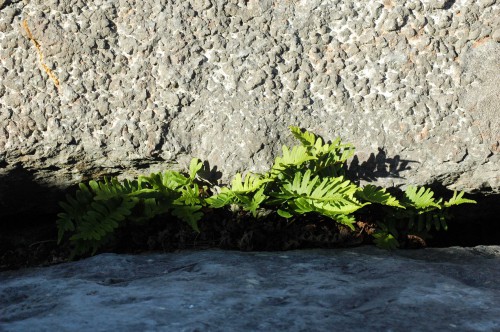
Sunlit fern in a rocky crevice

Sunlit fern in a rocky crevice

marigold escaped from a garden

Marigold escaped from a garden

Tree mallow flower

Tree mallow flower

Penrhyn Bay

151007TGNW- Rock covered with seaweed

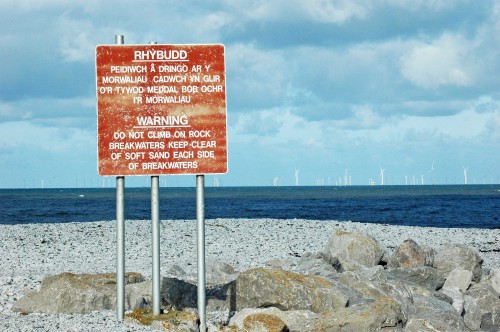
151007TGNW-Penrhyn Bay-Breakwater & sign

Between the breakwater and the rocky shore there is a patch of flowery grass

151007TGNW-Little Orme & Penrhyn Bay-grassy patch

151007TGNW- Penrhyn Bay-grassy patch

and behind the rocks scrubby shore plants grow amongst the sand and stone chippings. This is the best place I know for fairly reliable sightings of linnets that come to forage for seeds. There were linnets there when I arrived, which I realised when they all took off and headed off across the road towards the golf course. From past experience I thought if I sat and waited on the steps beneath the sea wall they may well come back. Sitting quietly I realised there were still birds close by that gradually came back into the open in front of me which turned out to be a Northern wheatear and a pipit. I want to say it was a Rock pipit as this is a likely spot to find them, but it had an olive-green tinge to its plumage and may have been a Meadow pipit.

Northern wheatear with pipit

Northern wheatear with pipit

Lovely wheatear though.

151007TGNW- Penrhyn Bay-Northern Wheatear 1

As hoped the linnets came back too, a small flock of 10 or 12 birds, albeit too far away to photograph well.

151007TGNW- Penrhyn Bay-Linnets feeding 4

151007TGNW- Penrhyn Bay-Linnets feeding 1

151007TGNW- Penrhyn Bay-Linnet 1

151007TGNW- Penrhyn Bay-Linnet on rock 1

Share this:

  • Share on Facebook (Opens in new window) Facebook
  • Share on Pinterest (Opens in new window) Pinterest
  • Share on X (Opens in new window) X
Like Loading...

Late Summer Specials

17 Monday Aug 2015

Posted by theresagreen in British hoverflies, Bryn Euryn Nature Reserve, butterflies, Butterflies of Wales, calcareous grassland, day-flying moths, Nature of Wales, nature photography, plants important to wilflife, Rhos-on-Sea, Wildflowers of Wales

≈ 2 Comments

Tags

ash keys, bee mimic hoverfly, cheilosa illustrata, common ragwort, ferdinandea cuprea, green-veined white, hawthorn berries, mating gatekeeper butterflies, Nature in August, purple hairstreak

August so far has brought mixed weather, days have been mostly warm, but many have been cloudy or overcast and occasionally there’s been some sunshine.

Looking across to Conwy Estuary

Looking across to Conwy Estuary from Bryn Euryn

It’s only been a week or two since my last visit to Bryn Euryn, but now rapidly approaching late summer, much has already changed. Many plants are setting seed, there are ripe wild raspberries, a few ripe blackberries and sloes, still as hard as bullets.

Purple sloes are swelling on Blackthorn

Purple sloes are swelling on Blackthorn

Last year there were sparse crops of acorns and sloes, this year may be more bountiful.

3/8/15-Wood avens seedhead

3/8/15-Wood avens seedhead

Large fruit capsules of the Stinking Iris

Large fruit capsules of the Stinking Iris

On a last hogweed flowerhead, a new-to-me, furry little hoverfly; it  is one of a number of species referred to as a bee mimic, but it  doesn’t really look like one.

Hoverfly-cheilosa illustrata- a bee mimic

Hoverfly-cheilosa illustrata- a bee mimic

Another hoverfly caught my eye, it was basking on a bramble leaf and as the sun caught it, the insect shone a bright metallic golden bronze colour.

Hoverfly-ferdinandea cuprea

Hoverfly-ferdinandea cuprea

About to enter the meadow, I caught sight of a Speckled wood butterfly basking on an Oak leaf. I moved in to take a photograph as I haven’t had many good opportunities with this species so far this year, then caught sight of another butterfly sitting on a leaf slightly higher up.

7/8/15 - Purple Hairstreak

7/8/15 – Purple Hairstreak

I moved in a little closer and realised this was a butterfly I had never seen before other than in pictures, a Purple Hairstreak. A species that spends most of its time in and around the tops of Oak trees, I was surprised and delighted to see it and tried not  to alarm it as I focussed the camera. It moved a little to reveal two small orange eyespots on its hindwing, but just as I had it back in focus the Speckled wood flew up and chased it away. I waited a while to see if it would return, but no luck. At least I know to look out for them here again!

The colours of the landscape are changing subtly. Hay has been cut and in many places baled and put safely under cover. Meadows of seeding long grass left standing have taken on a golden hue and on our limestone hill, the wildflowers typical of late summer are at the peak of their flowering. Most are ‘tough’ plants, Knapweed, Hemp agrimony & Ragwort, which are all imortant nectar sources for insects.

Late summer long grass and wildflowers

Late summer long grass and wildflowers, mostly hedge parsley and harebells

7/8/15-Knapweed with a view

It’s been a while since I had a good opportunity to photograph a Green-veined White, so I was pleased to see this fresh one on a Knapweed flowerhead.

3/8/15-Bryn Euryn

3/8/15-Bryn Euryn

Knapweed and Hemp Agrmony

Knapweed and Hemp Agrmony

Burnet moth on knapweed

Burnet moth on knapweed- wings faded and almost transparent

Also clinging to a knapweed plant was a pair of mating Gatekeepers; a perfect opportunity to see the difference between the male and female of the species, as helpfully, the female opened her wings to show the plainer upperside to her wings.

Mating Gatekeeper butterflies - female above male

Mating Gatekeeper butterflies – female above male

A good opportnity to show the upperside of the female

A good opportunity to show the upperside of the female

As anticipated by the abundance of flowers back in the spring, Ash trees are bearing thick bunches of ‘keys’.

Ash trees have heavy bunches of 'keys'

Ash trees have heavy bunches of ‘keys’

Acorns forming on Pedunculate Oak

Acorns forming on Pedunculate Oak

Haws are ripening and leaves beginning to take on colour

Haws are ripening and leaves beginning to take on colour

Walking close to gorse bushes the air is filled with the gentle sound of pods crackling as they open to release seeds.

Gorse pods crackle as they open to release seeds

Gorse pods crackle as they open to release seeds

Higher up on the steep slope near to the summit there is a stand of Ragwort growing with thistles.

Ragwort and thistles

Ragwort and thistles

And further round more Ragwort, this time interspersed with tall spikes of velvety Mullein.

Ragwort and Mullein

Ragwort and Mullein

The seedpods of Bird's-foot Trefoil are from where it takes it name

The seedpods of Bird’s-foot Trefoil are from where it takes it name

And a final shot of a Speckled Wood next to hypericum berries sums up the season, I think.

Speckled Wood & hypericum berries

Speckled Wood & hypericum berries

Share this:

  • Share on Facebook (Opens in new window) Facebook
  • Share on Pinterest (Opens in new window) Pinterest
  • Share on X (Opens in new window) X
Like Loading...

A sea-shore in waiting

11 Tuesday Aug 2015

Posted by theresagreen in Birdwatching on North Wales coast, coastal habitat, mussel beds, Nature, Nature of Wales, nature photography, North Wales, Rhos Point, Rhos-on-Sea, wading birds, Wales Coast Path

≈ Leave a comment

Tags

acorn barnacles, barnacle, common mussel, great black-backed gull, herring gull, mussel bed, mussel beds, mussel beds of Rhos-on-sea, Nature in August, periwinkle, Rhos Point, seashore in August, winkle

Rhos Point from the Little Orme

Rhos Point from the Little Orme

Rhos-on-Sea is a popular seaside venue that is busy with people visiting most of the year round, particularly at weekends and when the sun shines, but they don’t come here for its beach. The seashore, wrapped around the flat fortified headland of Rhos Point, is not the most beautiful in North Wales: a general first impression may well be of an expanse of flat shoreline littered with variously sized brown-coloured rocks and boulders. No easy strolling or picnicking here.

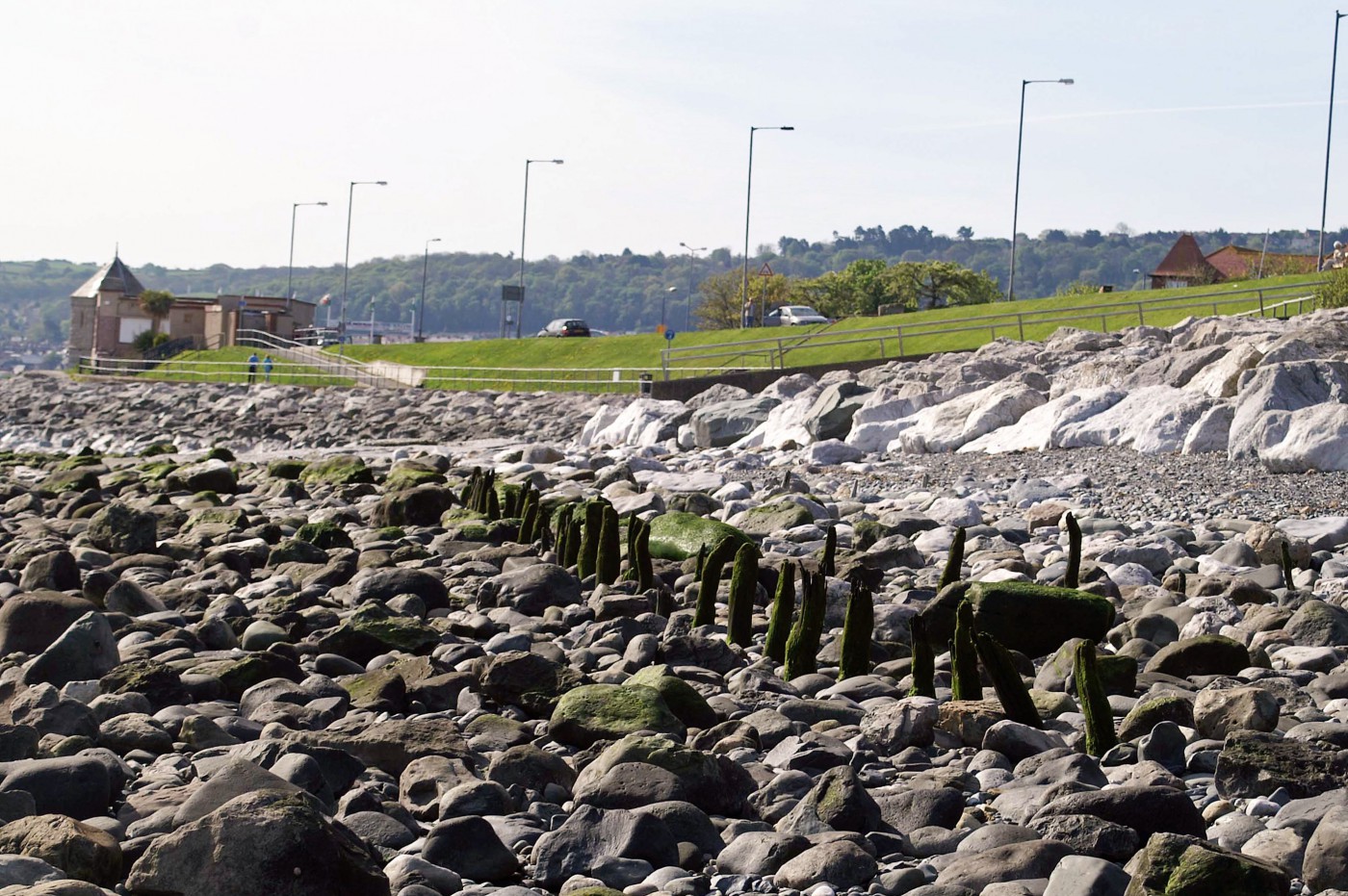
The stumps of posts are the remains of an ancient fishing weir

Rhos Point shore looking towards Colwyn Bay-the stumps of posts are the remains of an ancient fishing weir

The rocky shore of Rhos Point from Penrhyn Bay

The rocky shore of Rhos Point from Penrhyn Bay

However, between the rocky shore and the sea lies an expanse of long-established Mussel beds which is highly attractive to visitors – of the avian variety. Large numbers of a variety of species of sea and shore birds will be returning here this month from their summer breeding grounds to spend the autumn and winter to feast on the gourmet seafood on offer here.

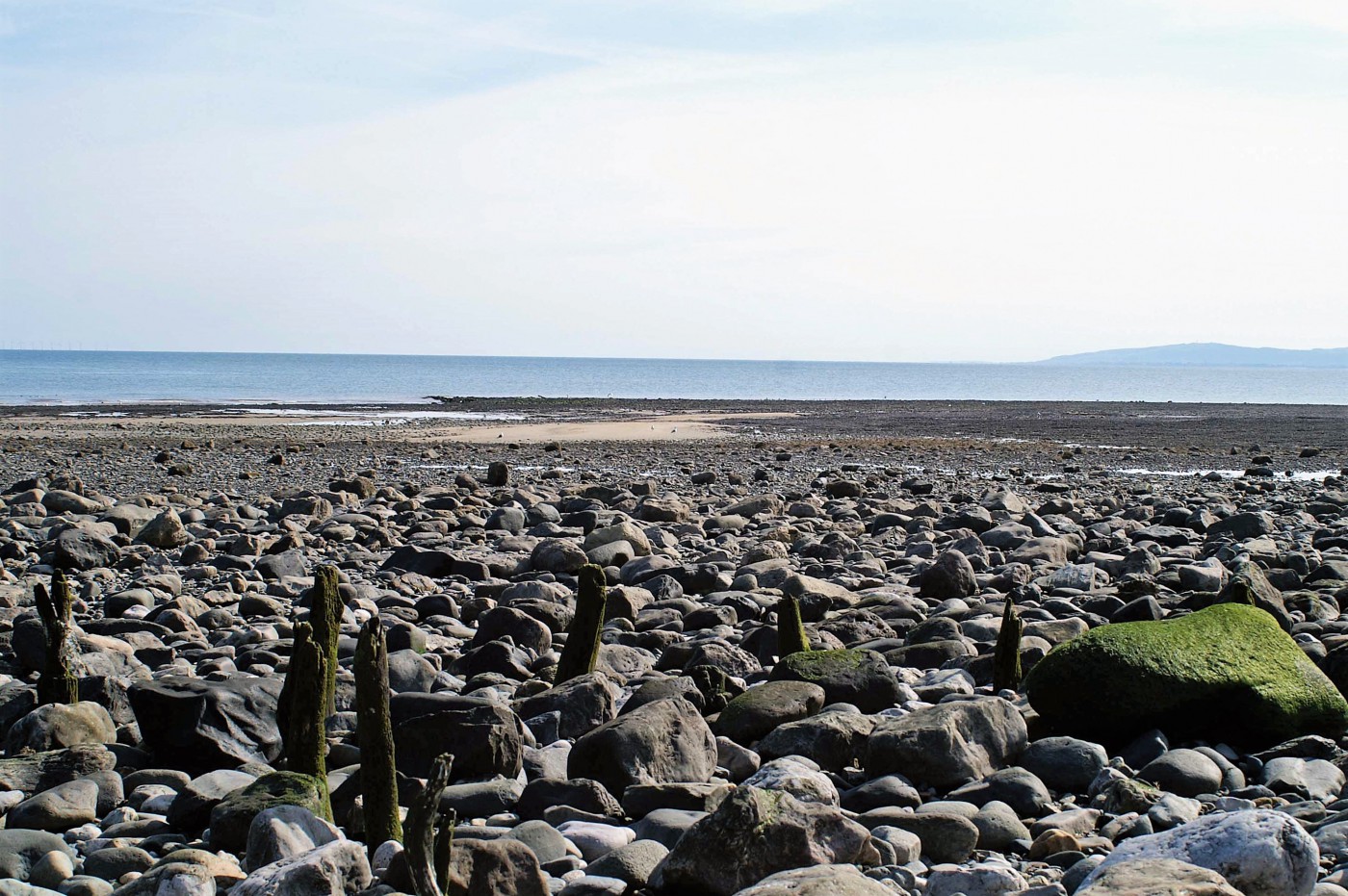
Rhos Point across the rock strewn shore to the mussel beds

Rhos Point across the rock strewn shore to the mussel beds

Part of the expanse of mussel bed beyond the rocks

Part of the expanse of mussel bed beyond the rocks on a sunny day

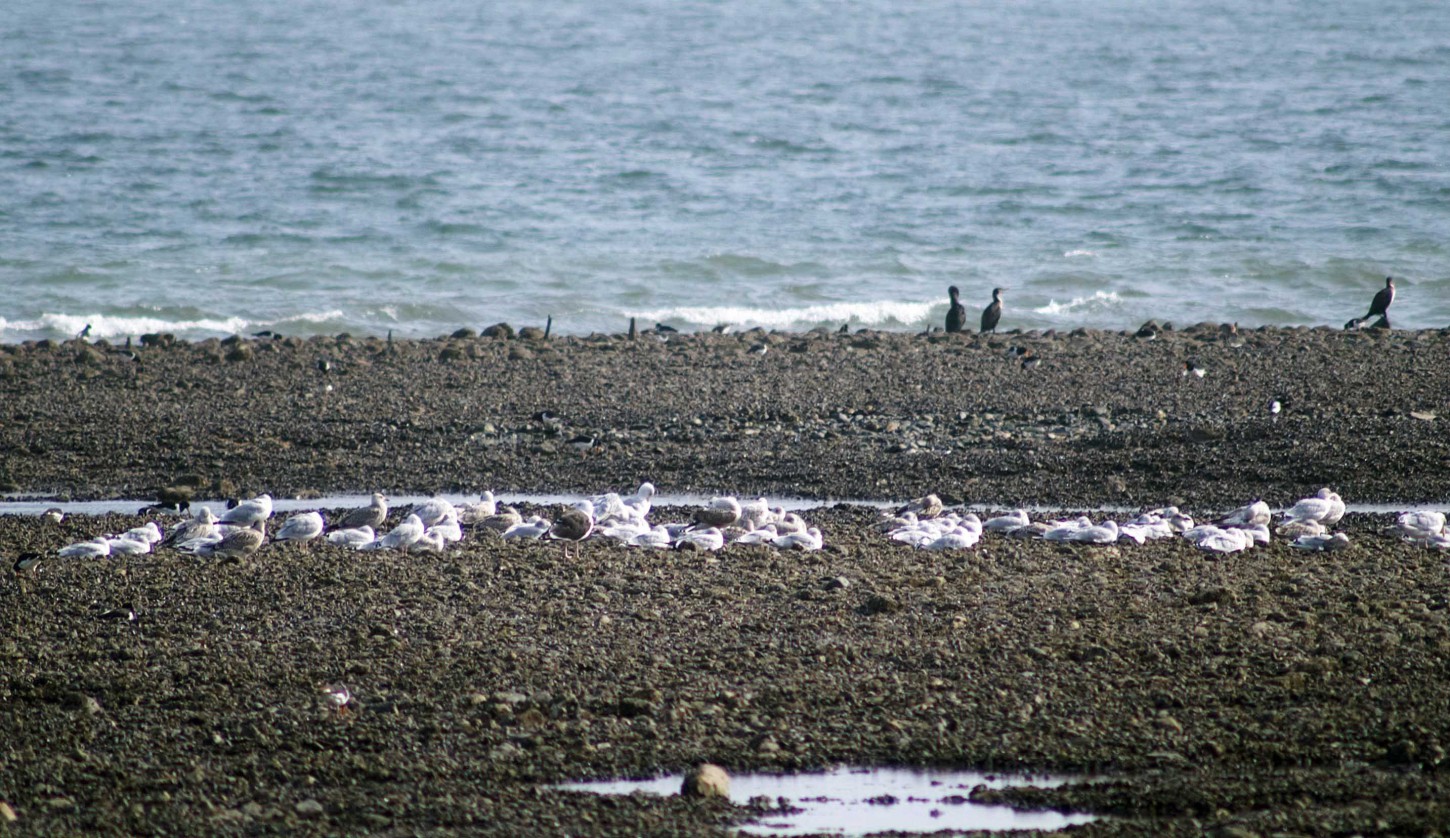
There may be a few early arrivals, maybe a Turnstone or two, but for now, approaching mid-August, the resident breeding birds, the Herring gulls, a smallish number of Lesser Black-backed gulls, Cormorants, plus a few Oystercatchers have the place more or less to themselves.

KONICA MINOLTA DIGITAL CAMERA

Great Black-backed gulls, adults & juveniles, Herring gull & Oystercatchers

Rhos Point shoreline with fishing weir posts cormorants & gulls

Rhos Point mussel bed, juv. cormorants, oystercatchers & gulls

Soon they will be joined by large numbers of Curlews, Redshanks, more Oystercatchers, Turnstones, Dunlins, Ringed Plovers and Sandwich Terns. If we are lucky there may be a few Purple Sandpipers in the mix, and there will doubtless be a few temporary visitors stopping to feed before escaping to warmer climes. There will be Rock Pipits and Pied Wagtails amongst the huge rocks of the sea defences. So much to look  forward to!

Without the movement and cries of the absent birds the landscape appears harsh, a sombrely coloured, barren place devoid of life. But look more closely and you’ll see it is in fact a living landscape, richly populated by hosts of small sea creatures, which is of course why the birds head here for the winter.

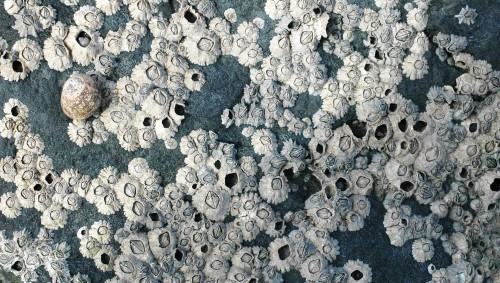
On close inspection, the rocks that appear a uniform brown colour from a distance are actually encrusted with colonies of barnacles, millions of them.

Barnacles and winkles cover the surface of a rock

Barnacles cover the surfaces of rocks

Acorn barnacles

Acorn barnacles

Barnacles and winkles

Barnacles and winkles

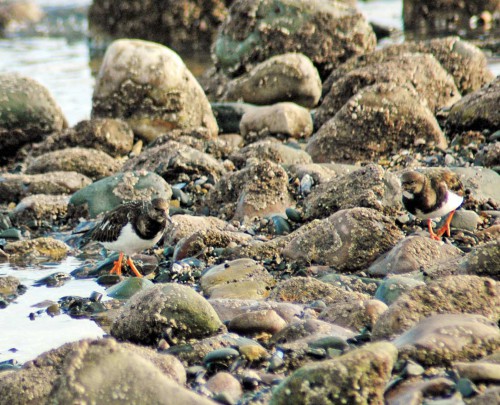
Turnstones camouflaged amongst the barnacle-covered rocks

Turnstones will be perfectly camouflaged amongst the barnacle-covered rocks

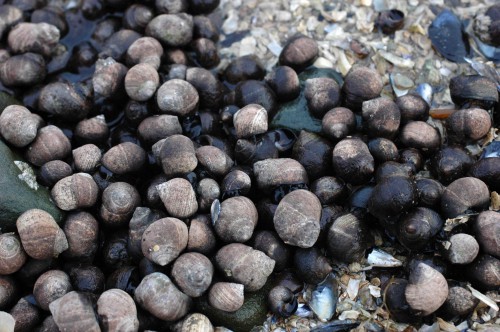
Winkles, or periwinkles are numerous too.

Winkles

Common periwinkle or Winkle-Littorina littorea

At low tide, cross the rocks, skirting the pools of shallow water left behind

Rock pool

Rock pool with more winkles

A flower of the sea -Beadlet anemone - Actinia equina

A flower of the sea -Beadlet anemone – Actinia equina

and soon the crunch of shells accompanies every footstep, as you are literally walking across the surface of a dense mass of living Mussels. It’s a very strange feeling.

Live mussels

The Mussel bed – live mussels amongst empty shells

You realise now why you see mussel shells everywhere.

Mussel shells under water

Mussel shells under water

141017TGNW4-Seashells mixed & crab legs

Live mussels & a live cockle amongst empty shells and crab claws

Mussel shells on the tide line of Rhos Harbour beach

Mussel shells on the tide line of Rhos Harbour beach

All is ready for the avian invasion.


Share this:

  • Share on Facebook (Opens in new window) Facebook
  • Share on Pinterest (Opens in new window) Pinterest
  • Share on X (Opens in new window) X
Like Loading...

Mellow autumn

23 Thursday Oct 2014

Posted by theresagreen in Butterflies of Wales, calcareous grassland, coastal habitat, coastal walks, Nature, Nature of Wales, nature of woodlands, nature photography, Wildflowers of Wales

≈ 5 Comments

Tags

autumn woodland, Bryn Euryn Nature Reserve, common buzzard, eyebright, galls on back of oak leaves, hawthorn berries, silver birch, spangle gall, speckled wood, St John's Wort, wildflowers of Bryn Euryn

Me it delights in mellow autumn tide,                                                                       To mark the pleasaunce that my eye surrounds,                                                 The forest trees like coloured posies pied,                                                            The uplands mealy grey and russet grounds;                                                Seeking for joy where joyaunce most abounds…….                                                                                from Autumn by John Clare

Autumn certainly has been joyous this year and even the blustery tail-end effects of hurricane Gonzalo have failed to provoke most of our habitual complaints about the weather. Temperature-wise, a  walk I took on Bryn Euryn just a couple of weeks ago felt more like early summer than approaching winter and although many of the signs of autumn were in place, there were a surprising number of wildflowers in bloom and butterflies, bees and various flies on the wing.

Quarry-field cliff crowned with autumn colours

Quarry-field cliff crowned with autumn colours

Teasel  seed-heads amongst thistles

A prickly selection – teasel seed-heads amongst thistles

The woodland tracks are covered with layers of dried fallen leaves that rustle when stepped upon and the soft musky scent of their decaying matter fills the air.

Sun-dappled woodland track covered with dry fallen leaves

Sun-dappled woodland track covered with dry fallen leaves

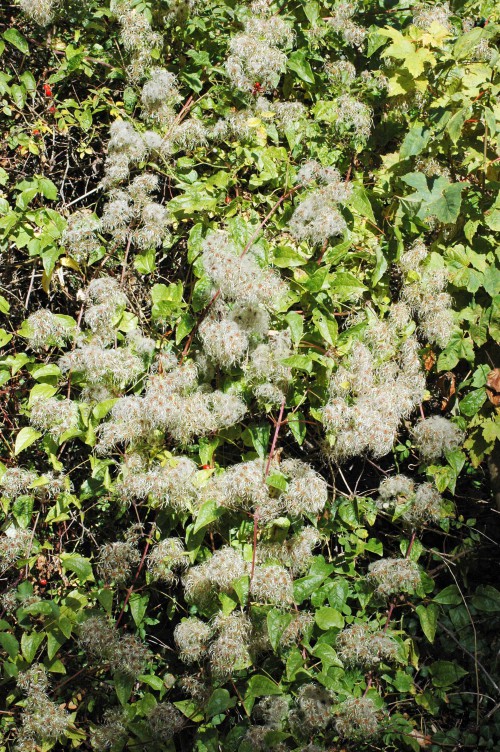
Wild clematis is prolific throughout the reserve and curtains of the fluffy dried seed-heads is draped over vegetation of varying heights and is living up to its common name of Old Man’s Beard.

Fluffy seed heads of wild clematis or 'old man's beard'

Fluffy seed heads of wild clematis or ‘old man’s beard’

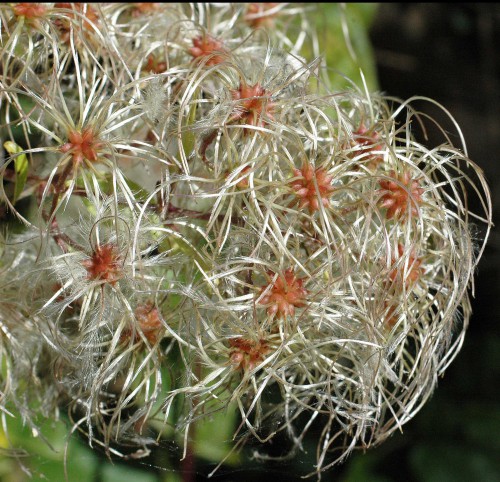
The individual seed-heads are prettily composed and shine silver in the sunlight.

141002(6)TGNW-Bryn Euryn-Old man's beard close-up

Clusters of silvery filaments make up a seed-head of wild clematis

The bountiful crops of haws on the hawthorn trees are still untouched by birds and have turned a rich ruby red.

Rich pickings still to come for hungry birds

Rich pickings still to come for hungry birds

Hawthorn leaves also turning red

Hawthorn leaves also turning red

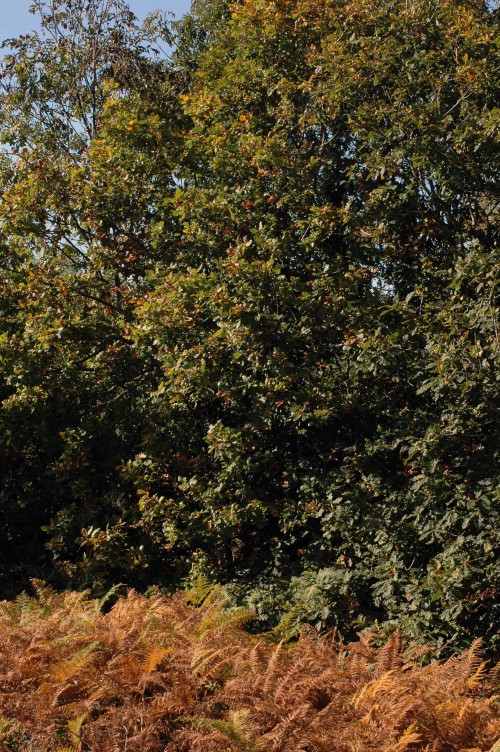
Although there are bountiful berry crops, the oak trees do not seem to have produced many acorns this season.

Oak tree with bracken in the foreground

Oak tree with bracken in the foreground

Oak leaves turning colour

Oak leaves turning colour

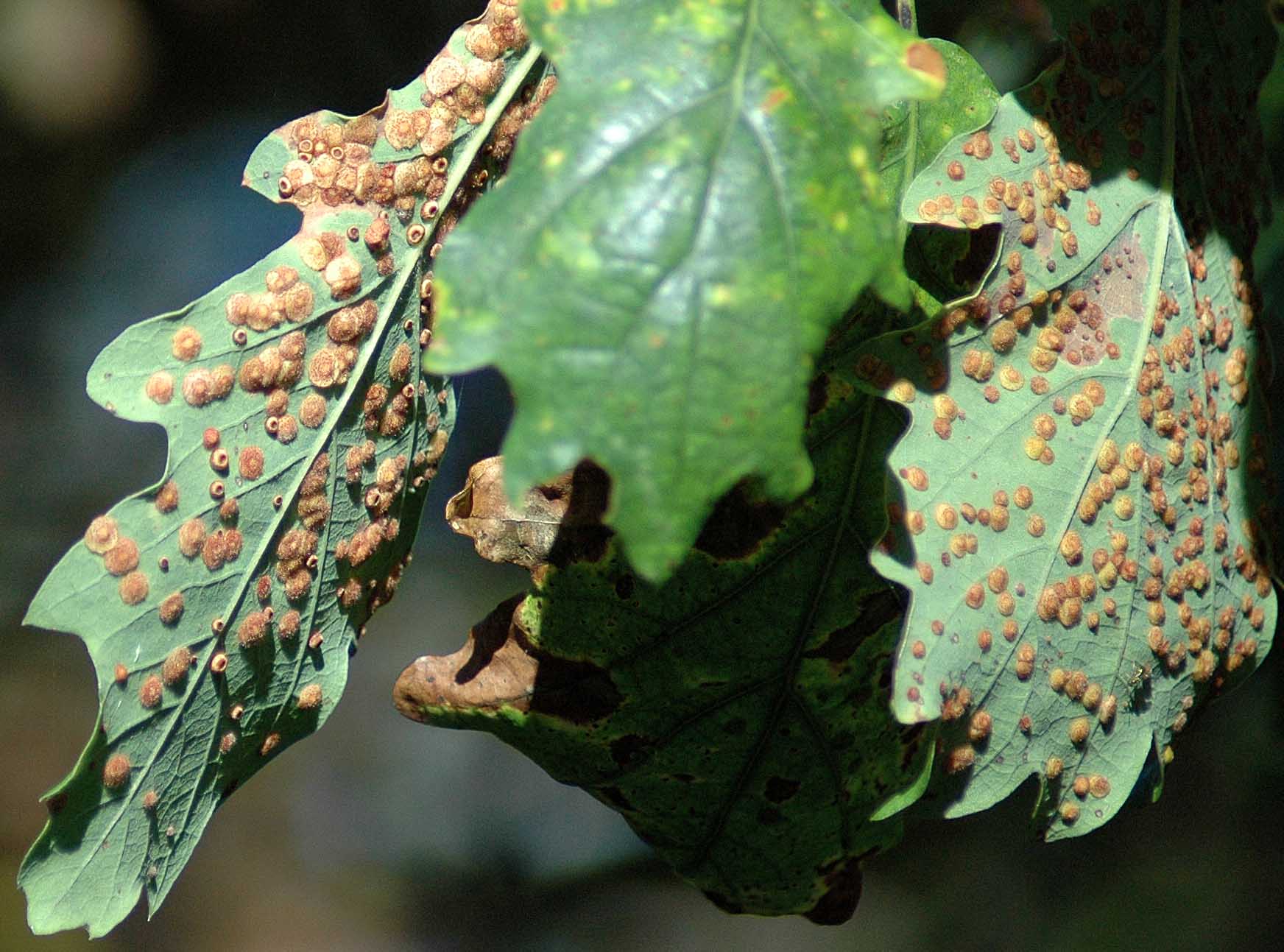
There are ‘crops’ of spangle galls though.

141002(17)TGNW-Bryn Euryn- Spangle galls on oak leaves

Spangle galls on oak leaves

Before climbing up the steep track through the woods on the way to the summit I sat for a few minutes on a rock to note down what I’d seen so far and was scrutinised for a few seconds by a buzzard that flew in over the treetops. This is a favoured spot of the locally resident buzzard, known to local visitors to the site as Lucifer and if you are here for any length of time you have to be quite unlucky not to get at least a glimpse of him here. He was accompanied by his mate today and didn’t linger, moving away in a leisurely circling kind of way towards Penrhyn Hill and the Little Orme.

Buzzards circling Penrhyn Hill

Buzzards circling Penrhyn Hill

I noted: ” I’m sitting on one of my favourite rocks. It’s around noon, the sun is high in a blue sky with just the faintest wash of wispy white cloud and is so hot I can feel it burning my legs through my jeans. The grassy areas have all been cut but a few wildflowers in bloom including rockrose, harebell & a bit of hogweed. There are butterflies, mostly speckled woods, but also a red admiral. Drone flies come to bask on the sun-warmed rocks and several wasps are seeking available food sources. Birds are still fairly quiet, I’ve heard the occasional song of a Robin and Blue and Great Tits calling to one another as they flit around foraging for food, but apart from the ever-present Crows everything else is keeping a low profile.”

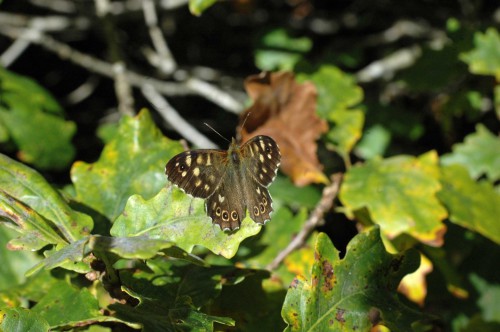
Moving onwards and upwards along the track that leads out onto the ‘downland’ side of the hill I could hear drying leaves crackling in the heat of the sun. On the woodland edge there were several speckled woods flitting about, pausing often to settle on oak leaves. All appeared to be dark in colour and were not fully basking, but holding their wings partially closed.

Speckled Wood basking on an oak leaf

Speckled Wood basking on an oak leaf

I photographed another insect here too: it looked like a small bee but was behaving more like a hoverfly.

Cute insect looking like a small bee and behaving like a hoverfly

Cute insect looking like a small bee and behaving like a hoverfly

There is a beautiful silver birch tree on the woodland edge. Its leaves are beginning to turn colour and it has attractive fruiting catkins that look like a bit like a small slender fir cone from which, during the winter and aided by birds, tiny winged nutlets will be released.

141002(26)TGNW-Bryn Euryn- Silver birch fruits

Silver birch leaves and fruiting bodies

141002(27)TGNW-Bryn Euryn- Silver birch fruit

Close up of fruiting body

The grass has been cut on the hillside too and the ground is criss-crossed with a lattice of bramble stems. There are a few plants of the wild Goldenrod still in flower, while others have gone to seed.

Goldenrod-Solidago virgaurea

The dry flower head with seeds attached looks as pretty as the fresh flower.

Goldenrod gone to seed

Goldenrod gone to seed

There was a fair amount of scabious still in flower and was attracting a busy little Carder Bee.

Scabious still flowering

Scabious still flowering

There were a few eyebright plants still with their usual white flowers, and one that I came upon had pretty pink-purple edged petals with a yellow patch in the centre.

Eyebright with purple-pink edged petals

Eyebright with purple-pink edged petals

The views from the hillside were outstanding today as it was perfectly clear and bright which rarely happens in the summer months.

Looking down onto woodland across the hillside. Carneddau Mountains in the background

Looking down onto woodland across the hillside. Carneddau Mountains in the background

Little Orme & Penrhyn Bay village

Little Orme & Penrhyn Bay village

The sea was almost flat calm and in as many shades of blue as I have ever seen it.

The sea in many shades of blue

The sea in many shades of blue

Looking down the coast to Abergele & Rhyl

Looking down the coast to Colwyn Bay, Abergele & Rhyl


Share this:

  • Share on Facebook (Opens in new window) Facebook
  • Share on Pinterest (Opens in new window) Pinterest
  • Share on X (Opens in new window) X
Like Loading...

Burnet Rose- Rosa pimpinellifolia

28 Wednesday May 2014

Posted by theresagreen in Bryn Euryn Nature Reserve, bumblebees, coastal habitat, Nature, Nature of Wales, nature photography, Wildflowers of Wales

≈ 2 Comments

Tags

burnet rose, low-growing white rose, Phragmidium rosa-pimpinellifoliae, rosa pimpinellifolia

Family: Rosaceae Other English name: Pimpinell Rose Welsh name: Rhosyn Dewi (Rhosyn y Twyni) Irish name: Briúlán

There is a glorious stretch of these lovely and very prickly roses on Bryn Euryn that are fully in flower now.

Beautiful Burnet Roses

Beautiful Burnet Roses

The Burnet Rose is a low-growing species, largely confined to dry sandy places near the sea; it is particularly abundant on dune systems in South Wales. Inland it may be found in calcareous areas, generally chalk downland or limestone pavement.

 Its natural distribution is limited to Europe and Asia except for part of the Atlas Mountain Range in North Africa.

A prickly stem full of blooms

A prickly stem full of blooms


It is a rather low erect deciduous plant usually growing to 20–140 cm high but it can sometimes reach up to 2 metres.

The plant spreads by suckers and can cover large areas. The stems are protected by numerous stiff bristles and many sharp straight prickles. The young stems and prickles and the mature leaves tend to be very red with young growth a bright scarlet and older growth a deep maroon.

 ‘Some people are always grumbling because roses have thorns. I am thankful that thorns have roses’.

  Alphonse Karr (1808-1890)

Burnet Rose

Burnet Rose

The flowers are cream-white although rarely also pale pink and are 2–4 cm in diameter with five petals. prominent golden stamens and they have the sweetest, most delicious scent of any of native roses.

Popular with bumblebees

Visited by bumblebees

Bumblebees seem to love them, perhaps because they do have a hint of honey in their scent.

This small bumblebee was enjoying a really good rummage around

This small bumblebee was enjoying a really good rummage around

Soon the petals fall off the roses but the stamens look pretty too. The leaves are small and oval, very like those of the salad burnet (hence the name).

Without petals

Without petals

And later in the year there will be a crop of  distinctive globular dark purple to black hips.

Rust fungus on Burnet Rose stem

Rust fungus on Burnet Rose stem

A brilliant-orange rust fungus Phragmidium rosa-pimpinellifoliae is also common on the plants.

The plant’s names 

R. spinosissima (pimpinellifolia) has been known by many different local names and it has attracted its own folklore. In some places, people have given it a vernacular name based on the resemblance of the leaves to a Burnet (Sanguisorba ) and therefore, for example, called it the Burnet or Pimpinell Rose in English or Rose Pimprenelle in French. In other places, it was the prickly stems that caused it to be known as Bodicasti Sipek in Slovenia, for example, or Piikkiruusu in Finland. 

Burnet Rose growing alongside the related Salad Burnet

Burnet Rose growing alongside the related Salad Burnet on Bryn Euryn

In Iceland, it has the name pyrinros which literally means ‘Thorny Rose’ but the same Icelandic word means ‘Sleeping Beauty’ and may refer to its early flowering – the beautiful rose waking up after the long dark Icelandic winter! In Norway, this rose is called ‘Trollnype’ – associating it with the trolls of Norwegian folklore. Elsewhere, it is named after the coastal sand-dunes where it grows so, for example, it is Klitrose in Denmark,Duinroos in The Netherlands or Dünen Rose in Germany.

Medicinal uses

The plant  was initially grown in gardens for its herbal properties and it was one of the first roses described and illustrated in 16th  century herbals of Northern Europe. Its hips and leaves have been used to make a tea and, in some places (particularly Denmark) a liqueur is still made from its hips. In recent years, it has been the subject of intense research to investigate its special pharmaceutical properties. The chemical constituents have recently been summarised by Mayland-Quellhorst et al (2012). Its dark purple or black ‘fruits’ (heps) are high in vitamins and antioxidants.

(Extracts from: Rosa spinosissima – aspects of its natural history and associations with people from prehistory to the present day ) by Peter D. A. Boyd


Share this:

  • Share on Facebook (Opens in new window) Facebook
  • Share on Pinterest (Opens in new window) Pinterest
  • Share on X (Opens in new window) X
Like Loading...

How to build a beach

14 Sunday Apr 2013

Posted by theresagreen in coastal habitat, Colwyn Bay, nature photography, North Wales

≈ 6 Comments

Tags

colwyn bay beach, dredging sand, herring gull, herring gull feeding behaviour, sea defences

The beautiful but rugged coastline of North Wales is subject to some serious battering by  winds and waves throughout the year and although we love to live and holiday here, of course we prefer it to be on our terms and so demand protection from the elements too. We also need to make a living and as this whole area is designated as an outstanding area of natural beauty, capitalising on those natural assets by way of tourism is the way things are set to go forward. Great lengths of piled up rocks are already in place reinforcing the defences of the sea wall from Rhos on Sea to Penrhyn Bay, but now work has begun to improve the defences of Colwyn Bay.

misc 2013-sony camera 035

A section of the Colwyn Bay promenade being battered by the sea, March 2013

Colwyn Bay was one of the North Wales holiday resorts popularised by the Victorians. It was accessible to them by way of the railway line between the ferry port of Holyhead on the Isle of Anglesey, and London, that was built to facilitate the transport of mail between the two places and onwards to Ireland by sea. It remained popular as a holiday destination for several decades following, my own parents spent their honeymoon here in 1946, but began to go into decline during the late ’80s, in common with many other British seaside resorts.

In 2010 a ‘masterplan’ was revealed to regenerate the area which includes plans for a new sandy beach to be constructed  to improve sea defences and to allow people access to the shore throughout all tidal states: currently you can only walk on the shore at low tides.

As reported at the time by The Weekly Post, this build-a-beach project is not going to come cheap.

“Conwy County Council’s cabinet voted to pledge £667,000 to secure a grant of £2m from the Welsh Government to improve the town’s sea defences. The authority had already secured an additional £1m of funding from the Welsh Government for the Colwyn Bay Waterfront coastal defence scheme by offering up £333,000 of supported borrowing from this year’s capital programme. By agreeing to pay the £667,000 from next year’s (2013) budget the council…will see beach sand material imported onto Colwyn Bay seashore which is now mostly pebbled. This will result in 50m of sand to help protect the promenade.”

Work began on building the new beach on 21st March and the major project of engineering is proving to be quite fascinating. To begin with two lengths of steel pipeline were constructed on an unobstructed stretch of Pensarn beach, one a kilometre long, the other about 400m long. The two sections were then floated out at high tide, lined up and welded together. The pipeline was then connected to the steel dry-line which is pumping the sand onto the beach. A rubber floater line was also connected to the sea end of the steel pipeline, and this section of pipe will connect to the dredging vessel.

Picture copied from Daily Post

Sand begins to pour from the pipeline against the existing sea wall. Picture from Daily Post.

The dredging ship, the Barent Zanen, sailed here from Rotterdam and prepared to dredge sand from the seabed of a site 20 nautical miles north of Colwyn Bay, located within  Liverpool Bay. The ship is taking the sand from the sea bed approximately 20 miles north of Colwyn Bay, and then sailing in and anchoring about a kilometre offshore. Around 10,000 tons of material is brought in each trip and it is estimated that the beach will be topped up at a rate of 25-30,000 tons a day.

KONICA MINOLTA DIGITAL CAMERA

The Barent Zanen off Rhos Point, connected to a smaller tug that connects the two ends of piping together

The sand and sea-water mix is blasted onto the beach during periods of low tide and attracts a huge amount of interest from a large number of gulls that arrive to take advantage of seafood, freshly delivered from the seabed. As far as I am aware, no mention has been made of any potential damage the dredging may be doing to the flora and fauna of the seabed in the dredging site, but I can’t help wondering.

13-4-1-TGROS-Building a beach 1

The dredged sand and seawater mix arriving on the shore brings about a frenzy of gull activity

Following each delivery of sand, which is deposited in one large pile, it is distributed by mechanical diggers and bulldozers. The work often attracts groups of interested onlookers, and no doubt at least some of the big boys watching would love to be having a go.

KONICA MINOLTA DIGITAL CAMERA

A closer view of some of the machinery involved in the beach construction; here moving the steel pipeline into a new position

6th April, the new beach so far

6th April, the new beach so far

The operation will take place 24 hours a day, seven days a week and should last for a period of up to four weeks, depending on the weather, which thus far has been pretty wild. Many local people are wondering how long the beach sand will stay put and how much it’s going to cost them…..?

Share this:

  • Share on Facebook (Opens in new window) Facebook
  • Share on Pinterest (Opens in new window) Pinterest
  • Share on X (Opens in new window) X
Like Loading...

Late summer wildflowers and insects of the Little Orme

11 Tuesday Sep 2012

Posted by theresagreen in butterflies, coastal habitat, coastal walks, Little Orme, Nature, nature photography, Rhiwledyn Nature Reserve, wildflowers

≈ 7 Comments

Tags

6-spot Burnet Moth, black & yellow striped caterpillars, black butterfly or moth with red spots, cinnabar moth larvae, eristalis arbustorum, eristalis pertinax, eyebright, hoverflies, large black slug, meadow grasshopper, sawfly, small skipper, toadflax, vervain

The weather took its toll on the cliff-top flora and fauna of the Little Orme   too, although I think perhaps it’s not so much that the insects were not there, more that they were less able to be  mobile,  so were not as visible as they are in warmer, drier conditions. I took the following pictures on a warmish, sunny but fairly windy day just past the middle of August when everywhere was still damp from rain.

Ragwort is blooming strongly and every plant is supporting a colony of cinnabar moth caterpillars.

The Cinnabar moth larvae are growing fat on ragwort

The flowers of the ragwort are much in demand too, particularly by hungry hoverflies.

Eristalis interruptus (f) on ragwort

2 drone flies, Eristalis pertinax on ragwort

A smaller eristalis species – Eristalis arbustorum

Mating pair of soldier beetles

I was still on the lookout for soldier beetles and did eventually manage to find one pair; there were dozens of them this time last year. I didn’t even manage a very good photograph as the wind was blowing the ragwort stem they were on.

I walked towards the cliff edge above Angel Bay, drawn by a large patch of sunny yellow birds-foot trefoil mixed in amongst long grasses.

Flowery clifftop, most birds-foot trefoil mixed in amongst long grass

Long grass and birds-foot trefoil

As I had hoped, this flowery area turned out to be quite productive in terms of insects. I first spotted a Common Blue butterfly very low down on a grass stem, then followed a Small Skipper until it too came to rest on a flower.

Small Skipper –

That was followed by a first sighting of a Burnet Moth fluttering across the grass and flowers, and once I had ‘got my eye in’, I soon realised there were a good few more.

6-spot Burnet moth –

The Burnet moths were mostly attracted to the thistle flowers growing at the side of the pathway; at one point I found four of them all on the same plant.

3 of 4 Burnet moths that were all nectaring on a single thistle flowerhead

Stopping to photograph the single moth I was distracted by the chirping ‘song’ of a grasshopper, which I found on a grass stem just behind me. I am not great at identifying grasshoppers, but I think this was most likely a Meadow Grasshopper – Chorthippus brunneus.

Little grasshopper chirping from a grass stem

Walking along a narrow track through the long grass I saw an insect I did not immediately recognise on a thistle flower. It took little notice of me taking photographs of it, just carried on working its way around the flowerhead. To identify it I searched my favourite website for insect identification http://www.naturespot.org.uk, which is a Leicestershire site but usually comes up trumps for me. From that I believe my mystery insect may be of the Sawfly species, Tenthredo notha – but as always I am more than happy to be corrected.

Sawfly- Tenthredo notha

At the bottom of the steep grassy track that takes you higher up on the cliff, a decent number of butterflies were dancing around the bramble flowers. There is red valerian growing there too which is also a favourite nectar plant of butterflies and more ragwort attracting hoverflies. Butterflies included Large, Small and Green-veined Whites, Meadow Browns, Gatekeepers and a Tortoishell.

Green-veined White (m) on a valerian flower

I stopped half-way up the incline to draw breath and to take a  photograph of the view.

The view from the Little Orme across Rhos Point, then the headland of Abergele beyond which are Rhyl & Prestatyn and the coastline of the Wirral (click to enlarge)

At the top there is a flat grassy area, popular with Jackdaws that nest on the cliffs and grazed by sheep, where the remains of some sort of winding mechanism still stands as a memorial to the quarrying that is responsible for the shape of the Little Orme.

Sheep grazing and resting in the sun around old winding gear

Back down at the bottom and a quick scout around before heading home produced more flowering plants:

Eyebright – Euphrasia nemorosa

Toadflax- Linaria vulgaris

Vervain-Veronica officinalis

Lesser Burdock-Arctium minus

Another grasshopper, which I think is a Mottled one as it has curved antennae, but if not then its a Field one.

A mottled, or maybe a field grasshopper

Then finally, as testament to all the recent rainfall, a big fat slug…

Although this slug is black, it is a Large Red Slug-Arion ater, which has a range of colour forms.

Share this:

  • Share on Facebook (Opens in new window) Facebook
  • Share on Pinterest (Opens in new window) Pinterest
  • Share on X (Opens in new window) X
Like Loading...

August on the Little Orme

19 Sunday Aug 2012

Posted by theresagreen in coastal habitat, Little Orme, Nature, nature photography, Rhiwledyn Nature Reserve, Wildflowers of Wales

≈ 4 Comments

Tags

black & yellow striped caterpillars, blackstonia perfoliata, Centaurium erythraea, centaury, common ragwort, robin's pincushion, tortoiseshell butterfly, wildflowers of the Little Orme, yellow-wort

You probably do not need me to tell you that the weather this month has, so far, been rather un-summery, particularly in this part of the country, so I won’t bore you with unnecessary details. However it has impacted on the opportunities I have had to get out and about and record the effects it has had on the local wildlife, if any. That’s not to say I haven’t been keeping my eyes open and looking for opportunities to record what I am seeing, but rainy and windy days are not very conducive to taking photographs of insects or indeed flowers that are being buffeted by the weather.

An expanse of long grass on the clifftop blown by the wind against a background of very blue sea

The first day of August brought a mixed bag of weather conditions, but I  tried to make the most of a sunny spell towards the end of the afternoon by visiting the Little Orme. It was windy up there, but there were a few butterflies out feeding in odd places sheltered from the wind. In the majority were Meadow Browns, staying well down in the long grass, but there were a few Gatekeepers enjoying the abundance of bramble flowers, but not settling for long enough to photograph, one of two whites and one gorgeous Tortoiseshell. There were hardly any bees or hoverflies or indeed any insects flying.

A beautiful Tortoiseshell butterfly on bramble flowers

A large white (f) butterfly settled on a bramble stem very low to the ground. I love the mossy background.

Ragwort is flowering now; this somewhat contentious plant is an invaluable source of nectar for a myriad of insects and the host plant of the unmistakeable black and yellow striped larvae of the Cinnabar Moth, many plants are already supporting numbers of them.

Ragwort flowers with Cinnabar Moth caterpillars

Ragwort flowers with insects

There are some interesting plants flowering here at the moment; one is the pink-flowered Centaury and the other is Yellow-wort-Blackstonia, neither of which were showing open flowers today.

Common Centaury – Centaurium erythraea. Welsh, Bustl yr daear

Centaury flowers tightly closed

A member of the family Gentianaceae, common centaury thrives in dry grassy places and is especially common on stable sand dunes and on dune slacks.

A small plant of the gentian family, with flat-clusters of  star-shaped rose pink flowers, which open only when the sun shines. The stem is four-cornered and grows to a height of 4-20 inches (10-50 cm).

Etymology & traditional medicinal uses

Centaury takes its name from the Greek centaur, Chiron, who was half  man, half horse. Chiron was a teacher of the gods and skilled in the uses of medicinal herbs, and legend has it that when he was shot accidentally by Hercules with a poison arrow, he healed himself using common centaury.

This is a truly versatile herb that apparently may be used for nearly any problem. It is a bitter-tasting herb, which Culpeper noted “Tis very wholesome; but not very toothsome.”  It is used for a variety of digestive problems, including colic, bloating, heartburn, dyspepsia, to stimulate appetite, ease constipation, and to aid the proper assimilation and digestion of food. An extract prepared with vodka (!) is given for high blood pressure, liver and gall bladder problems. Lotions containing centaury have been used on the skin to remove different kinds of blemishes. It is used as a treatment for muscular rheumatism, gout, convulsions, tuberculosis, cramps and snakebites.

Externally, the juice applied to the eyes will clear the vision, and applied to wounds, ulcers, old sores, bruises, will help promote healing.  It kills worms as do most bitters and a decoction externally applied will destroy lice and other parasites in the hair.

Bach Flower remedy

I am familiar with Centaury through my work as an Holistic therapist, having studied and extensively used the Bach Flower remedies. It was one of Dr Edward Bach’s original ’12 Healers’.

The Centaury remedy is for people who find it difficult to say ‘no’ to others, usually  kind, gentle souls who like to help that may find themselves being taken advantage of and becoming resentful. The willing servant ending up the slave of another’s wishes. The remedy doesn’t harden or make us callous,rather it supports the development of courage and self-determination. We are better able to draw a line and make space where we can be ourselves, free of the desires and commands of others.

Yellow-wort – Blackstonia perfoliata. Welsh, Canri felen

Yellow-wort keeps its flowers tightly closed when the sun is not shining

A distinctive plant with grey-green leaves arranged in pairs to form ‘cups’ up the stem and bright yellow flowers that only open in the brightest sunshine. Yellow-wort is lime-loving and in Wales occurs in the greatest numbers dunes along the northern and southern coastal strips, particularly on marshy dune slacks. It generally flowers from June to October in Britain where it is widespread but not common.

In common with the afore-mentioned Centaury, Yellow-wort is a member of the family Gentianaceae, but is distinguished from all other family members, which have flowers with either four or five petals, by having six or even eight flower petals. It is tricky to catch the flowers open as even on the brightest, sunniest days they close very quickly if as much as a cloud passes over them.

Etymology & use

Yellow is self-explanatory as the colour of the flowers of the plant and wort was commonly used in the names of plants and herbs, especially those used formerly as food or medicinally. In this particular case I have been unable to discover any history of the plant being used medicinally, but a yellow dye can be obtained from the plant extract, so that may cover it.

The Latin Blackstonia refers to the 18th Century botanist and apothecary John Blackstone. Perfoliata.. through-leaved .. referring to the leaves which are fused together at the base with the stem threading its way through.

John Blackstone (1712–1753).  Blackstone worked in London and spent his holidays at Harefield, north Middlesex.  His major work was Fasciculus Plantarum circa Harefield sponte nascentium. Cum Appendice, ad Loci Historiam spectante which catalogued plants he found in Harefield and included the precise location of the rarer plants.  He was working on a second work when he died prematurely aged 41.

Robin’s Pincushion

Robin’s Pincushion

The Rose bedeguar gall, Robin’s pincushion gall, or Moss gall develops as ” a chemically induced distortion of an unopened leaf axillary or terminal buds” occurring most commonly on Field Rose (Rosa arvensis) or Dog rose (Rosa canina) shrubs. This fascinating distortion is caused by the parthenogenetic hymenopteran gall wasp (Diplolepis rosae (Linnaeus, 1758))

To find a wasp you would have to look around the new green leaf buds in late May as it prepares to lay its eggs. Then the female diplolepis lay up to sixty eggs within each leaf bud using her ovipositor. The asexual wasps emerge in the spring; less than one percent are males.

The bedeguar gall is surrounded by a dense mass of sticky branched filaments, giving the appearance of a ball of moss. Its filaments start off green, gradually becoming pink that turns crimson and ages to a reddish brown. They are at their most attractive from about now to September, as from then they begin to lose their hairs, although they remain in place until the new gall wasps emerge in the spring.  A large specimen can achieve up to 10 cm in width.

Etymology 

The term ‘Bedeguar, Bedegar or Bedequar’ comes from a French word, bédegar, but that originated from the Persian, bād-āwar, meaning ‘wind-brought.’

The Robin in ‘Robin’s pincushion’ refers to the woodland sprite of English folklore, Robin Goodfellow, otherwise known as Will o’ the wisp and Puck.

Folklore & traditional medicinal uses

Folklore tells us that if a Robin’s Pincushion is placed under one’s pillow it aids sleep and the gall was therefore known as the ‘Sleep Apple’.

The galls have apparently been used in the treatment of whooping cough and carried as an amulet to ward off toothache.
Share this:

  • Share on Facebook (Opens in new window) Facebook
  • Share on Pinterest (Opens in new window) Pinterest
  • Share on X (Opens in new window) X
Like Loading...

Dale beach and the Gann Estuary

29 Friday Jun 2012

Posted by theresagreen in coastal habitat, Nature, nature photography, Pembrokeshire coastal path

≈ 14 Comments

Tags

brackish lagoon, coastal wildflowers, Dale, gann estuary, kidney vetch, medicinal plants, mute swan, pickleridge lagoon, shingle beach, stonecrop

We returned home via the village of Dale which is situated on the south eastern tip of the Pembrokeshire Heritage coast and is also on the route of the Coastal Path. Its beach is located on the Milford Haven estuary between St Ann’s Head and St Ishmael’s in Pembrokeshire, South Wales. There is a lot of history attached to the village and surrounding area, but we had come to have a quick look  at the unique habitat that lies at the back of its shingle beach.

The view across Dale beach; the refinery at Haverfordwest is just out of sight behind the headland on the left of the photograph

The beach is mainly shingle with some sand at low tide.

The shingle beach is a colourful mixture of red sandstone and grey/green silurian stone

The gritty sand is pink and stones on the beach occur in an infinite variety of shades of pink/red, grey and green

The red soils of the area are derived from old red sandstones seen at Lindsway Bay and Sandy Haven that are some 395 million years old. There are also occasional exposures of even older rocks, aged at 420 million years.  The cliff tops are covered with glacial till made of unconsolidated material dumped by melting ice around 20,000 years ago and fields that have been ploughed are visible for miles as the soil is a bright red in colour.
At the back of the shingle beach is a sand ridge and behind that an area of low lying land and the brackish artificial Pickleridge Lagoon, formed by the flooding of gravel pits that operated between the 1950s and 1980s. This has now become established as a saline lagoon and together with the  extensive salt marsh in the Gann river valley, the area has become a haven for wildlife, particularly for wading birds and plants.

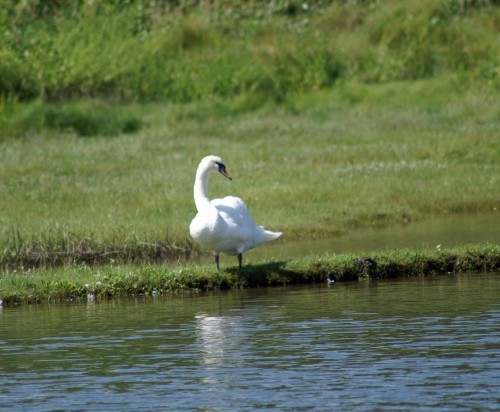
There were very few birds around today, a few Oystercatchers were out on the tide line and a number of Mute Swans on the edges of the lagoons, but other than that we saw only crows, a pair of raven flying overhead and a magpie or two.

A beautiful mute swan on the edge of the lagoon

There are some interesting plants growing here though, including  the largest expanse of yellow flowered Kidney Vetch I have ever seen.

View across the grassy meadow and lagoon

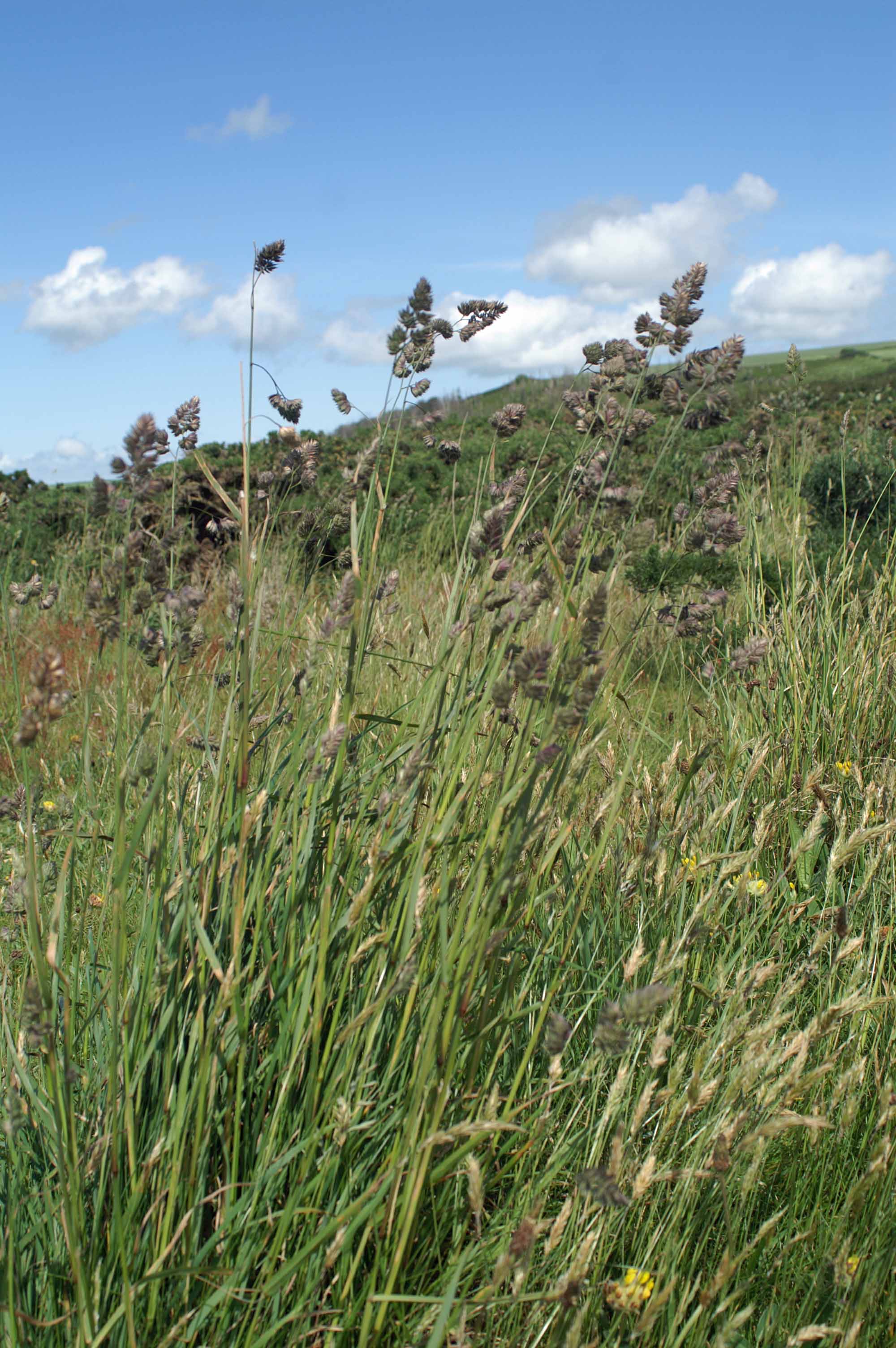
Grasses

The largest expanse of kidney vetch I have seen

Kidney Vetch – Anthyllis vulneraria

Kidney Vetch-Anthyllis vulneraria

The small yellow flowers of  Kidney Vetch are held in a cluster atop little woolly cushions, at first glance resembling a clover. The plant flowers from June to September and is a distinctive feature of sand dunes, chalk grassland and cliffs across the UK where it may spread to cover bare ground if it finds the right conditions.

The flowers are mainly yellow, but can also be found in orange and red forms. Each flower has its own hairy calyx (containing the sepals), giving the flower cluster its woolly appearance. The leaves of Kidney Vetch are divided into narrow leaflets that are silky and white underneath.
Kidney Vetch &  the Small Blue Butterfly

Kidney Vetch is the sole foodplant for the larvae of the Small Blue Butterfly – a seriously declining insect which is classified as a Priority Species in the UK Biodiversity Action Plan. Although Kidney Vetch itself is not threatened, the habitats in which it grows are becoming fragmented and being lost at a rapid rate; for example, it’s estimated that we’ve lost 80% of our chalk grassland over the last 60 years.

Traditional medicine

Kidney Vetch has long been used in herbal medicine as an astringent; the  name ‘vulneraria‘ means wound-healer and applying it to wounds reduces bleeding. As the common name implies it is also used in the treatment of kidney disorders.

A Stonecrop – Sedum caeruleum

Further information:

The habitat formed here and the wildlife it supports have been the subject of several field studies over the years that have included the Feeding Patterns of  Wading Birds on the Gann Flat by the Field Studies Council in 1973 http://www.field-studies-council.org/fieldstudies/documents/vol3.5_91.pdf  that was followed up thirty years afterwards in 1992  http://www.eco-challenge-xtra.org. ; another on invertebrates The Gann Flat, Dale; Studies on the Ecology of a Muddy beach   and another on the flora and ferns http://www.eco-challenge-xtra.org/fieldstudies/documents/vol1.3_18.pdf

Share this:

  • Share on Facebook (Opens in new window) Facebook
  • Share on Pinterest (Opens in new window) Pinterest
  • Share on X (Opens in new window) X
Like Loading...
← Older posts
Newer posts →
Follow everyday nature trails on WordPress.com

Enter your email address to follow this blog and receive notifications of new posts by email.

‘But it is the common species that keep the living world ticking over and provide most of our experiences of wildlife, and I would argue that maintaining the abundance of these is as important a conservation priority as maintaining the existence of rarities’. Richard Mabey

MOST RECENT POSTS

  • A Glimpse of Spring to Come January 22, 2025
  • Hunting the Wren December 28, 2024
  • Oh, Christmas Tree December 18, 2024
  • In and Out of the Ivy February 15, 2024
  • Nature’s Fireworks November 30, 2023
  • Wild Autumn along the Coast Path November 3, 2023

OLDER POSTS

LOOKING FOR SOMETHING IN PARTICULAR?

  • Catchers, a Duck and Divers
    Catchers, a Duck and Divers
  • Sights and Sounds from the Little Orme 1
    Sights and Sounds from the Little Orme 1
  • A Windy Wildflower Trail
    A Windy Wildflower Trail
  • Butterflies and more rare treats
    Butterflies and more rare treats
  • Shades, Sounds and Scents of the Woods
    Shades, Sounds and Scents of the Woods
  • The Foxglove - of Fairytales, Myths & Medicine
    The Foxglove - of Fairytales, Myths & Medicine
  • Following a river to a Fairy Glen
    Following a river to a Fairy Glen
  • Beautiful blooms and some rare treats (1)
    Beautiful blooms and some rare treats (1)
  • Love your weeds - Red Deadnettle
    Love your weeds - Red Deadnettle
  • Things Bright and Beautiful
    Things Bright and Beautiful

nightingale trails

The Walk of the Monarch Butterfly-Sendero de la Mariposa Monarca

The Walk of the Monarch Butterfly-Sendero de la Mariposa Monarca

MY WILDFLOWER BLOG: where the wildflowers are

Snowdrop

Snowdrop

most recent posts

Follow everyday nature trails on WordPress.com

Social

  • View teresamaygreen’s profile on Twitter

Enter your email address to follow this blog and receive notifications of new posts by email.

Website Built with WordPress.com.

  • Subscribe Subscribed
    • everyday nature trails
    • Join 358 other subscribers
    • Already have a WordPress.com account? Log in now.
    • everyday nature trails
    • Subscribe Subscribed
    • Sign up
    • Log in
    • Report this content
    • View site in Reader
    • Manage subscriptions
    • Collapse this bar
 

Loading Comments...
 

    %d