Of Gorse, Furze or Whin

Tags

, , , , , , , , , ,

By whichever name you know it, this prickly shrub smothered in sunshine-yellow blossom is an iconic plant of commonland and rough open spaces, and wherever it grows in quantity it is one of our great landscape plants.

Golden gorse in bloom against a background of blue sea

Golden gorse in bloom against a background of blue sea

“When gorse is in blossom kissing’s in season”  or  “when furze is out of bloom, kissing’s out of fashion” is a traditional saying that once would have been know, one way or the other, throughout Britain and Ireland. Either way, it is another way of saying that the plant can be found flowering to some extent in all months of the year. This is because, with the exception of Scotland, most gorse colonies are a mixture of common gorse – ulex europaea (in flower chiefly from January to June, though often sporadically throughout the year) and either western gorse (July to November) or, in the south and east of England, dwarf gorse (also July to November), so the the likelihood is that at least one species will be in flower.

April-Flowers, spines and the beginnings of seed pods

April-Flowers, spines and the beginnings of seed pods

Gorse is a most sensory plant – the flowers smell deliciously of creamy coconut and the seed pods’ pop and crackle in hot sunshine, but it’s so well protected by those potent spines it’s best admired from a respectful distance.

Common name: Gorse, furze or whin Scientific name: Ulex Europaea Welsh name:Eithinen Ffrengig: Family group: Fabaceae

Flowers of Common Gorse - Ulex Europaea

Flowers of Common Gorse – Ulex Europaea

Common gorse is the only species native to much of western Europe, where it grows in sunny sites, usually on dry, sandy soils. It is also the largest species, reaching 2–3 metres (7–10 ft) in height.

The 15-20mm long flowers, with their wonderful aroma of coconut, are borne on stems of spiny bluish-green spikes. The leaves have been modified over centuries into rigid and furrowed thorns which withstand the harsh conditions of winters at higher altitudes, making the entire bush one mass of prickles and spines. In North Wales these shrubs form hedgerows around our fields, they line our country roads and particularly from February to May, when the flowers are their most abundant, they are a spectacular sight.

Pollination 

Whether gorse flowers supply nectar is a subject of debate, although the opinion of careful observers is that they do at certain times. However, it is for pollen that the plant is mainly of value to Beekeepers.This is produced in abundance and is bright yellow or orange in colour, assuming the darker or duller shade in the bees’ pollen baskets, but bees commonly forsake gorse once other flowers become available.

The spines protect the plant from being eaten

The spines protect the plant from being eaten

The visual intensity of a gorse-dominated heath or common can be dramatic. The pioneering naturalist Carl Linnaeus saw gorse in bloom on London’s Putney Heath whilst on a visit to England. He was reported to have fallen to his knees and wept for joy when he beheld the sight of the heath adorned with its fine yellow flowers. He had tried unsuccessfully to grow gorse in his greenhouse in Uppsala in Sweden, but the winters proved too cold.

Gorse fruits forming

Gorse fruits forming

The popping, or crackling sound of the gorse plants’ seed pods, as they split to scatter their seeds, is a familiar sound on hot summer days.

Gorse seed-pods

Gorse seed-pods cracking open on a hot summer’s day

Seed dispersal: Most gorse seeds fall directly beneath the parent plant, although some are dispersed through the action of the dehiscent pods, which can eject seeds up to 16 feet (5 m) from the parent plant.Gorse seed dispersal over intermediate distances may be attributable to insects, animals, birds and possibly wind gusts. Most fascinatingly though, is the plant’s interaction with ants.

Ant dispersal of gorse seeds

Myrmecochory (sometimes “Myrmechory“); from Greek myrmeco-: “ant’s” + -chory: “dispersal”) is seed dispersal by ants, an ecologically significant ant-plant interaction with worldwide distribution.

Dwarf gorse growing amongst heather on the Great Orme

Dwarf gorse -Ulex Minor, growing amongst heather on the Great Orme

Gorse is known to be a myrmechochorous plant, meaning that ants assist seed dispersal. The following is an extract from research by the Centre for Ecology & Hydrology:

Dwarf gorse Ulex minor seeds have a small food body, called an elaiosome, which attracts ants of certain species. These ants pick up the seed and take it back to the nest, where the elaiosome is removed and eaten and the seed is then discarded. As well as dispersing the seed, this behaviour may place the seed in improved conditions for germination and seedling establishment. Our work on this system has involved observing and measuring dispersal in the field and studying the chemical ecology of the ant-seed interaction. The latter has shown for the first time that the elaiosome produces a chemical which attracts ants from a distance. http://www.ceh.ac.uk/index.html

ECOLOGY

Patches of gorse are important in both heath and coastal areas, although it may be desirable to control the extent of spread where it excludes other species.

14/1/12 Stonechat - Saxicola torquata perched on gorse-Little Orme

14/1/12 Stonechat – Saxicola torquata  (f) perched on gorse-Little Orme

Gorse is a valuable plant for wildlife, providing dense thorny cover ideal for protecting birds’ nesting and feeding sites, and providing shelter for birds and other animals moving through the countryside.  In Britain, France and Ireland, it is particularly noted for supporting Dartford Warbler (Sylvia undata), Stonechat (Saxicola rubicola), Linnet () and Yellowhammer () and the common name of the Whinchat (Saxicola rubetra) attests to its close association with gorse. The flowers are eaten by some species of moths. 

Gorse provides important habitat for other animals and plants too, including uncommon ones such as dodder, a ‘hemi-parasite’ that grows on gorse foliage. Reptiles such as common lizard, sand lizard, smooth snake, and adder, all favour gorse-dominated environments.

Shelduck are known as furze,or gorse duck in Welsh

In Wales, once Shelduck have paired in the spring they move away from water to the hills, where they search out a large rabbit hole for a nest.

Often these lie beneath old gorse bushes – hence the shelduck’s Welsh name, Hwyaden yr Eithin: the furze or gorse duck.

Wild Gorse: history, conservation, and management

“It is clear that gorse and its relatives were widely used and often deliberately cultivated until very recently. Now however, the furze fields and the gorse commons lie neglected and abandoned a forgotten artefact of our cultural history. As the plants degenerate through age and a lack of management, natural capacity for regeneration declines.” Ian D. Rotherham, Sheffield Hallam University. 

TRADITIONAL USES OF GORSE

Gorse has a long history of use in the areas of the country where it grows most prolifically and in many areas it was deliberately cultivated as a crop for animal food and as fuel.

Gorse-Bryn Euryn

Gorse-Bryn Euryn

Many places up and down the country refer to the presence of gorse. On Exmoor, where the plant is known locally as furze, it gave rise to Furzebury Brake and Furzehill Common. Most hill farms have their furze break, i.e. gorse-covered hill. In Wales, where place names in Welsh are made up of elements, any place name containing ‘eithin’, the Welsh word for gorse will indicate the plant’s significance there. 

 The importance of gorse for heating ovens for baking is a tradition widely recorded across Britain. The gorse burns rapidly and hot, quickly raising the temperature of the oven to a suitably high temperature. Importantly the gorse produces very little ash, and this is raked out as the bread is placed into the oven. For bread in early times, it was the custom to cut off the base and the four side-crusts to remove the ash that became embedded in the bread.

On commonland there were quite strict rules about when and how much gorse could be cut for fuel: ‘In Cumnor, Oxfordshire, under the 1820 Enclosure Award, parishioners had the right to go to Cumnor Hurst to cut gorse and broom (for burning, often in bread ovens due to the fierce heat) but they were allowed only as much as they could carry on their backs.’

A closer look at those spines

A closer look at those spines

GORSE MILLS

Gorse is highly nutritious; hence its armament of sharp prickles to ward off herbivores. The leaves are generally only eaten in situ in the spring when young and tender. However, the plant was grown to be cut and crushed for winter fodder for horses and cattle. It was used particularly in areas with extensive heath and common, but was also deliberately seeded into areas as a crop to be harvested. In Wales, special mills were constructed to grind down the cut gorse into a moss-like consistency.

‘In Wales many farmers remember gorse mills, and how important a food gorse was, especially for horses. Fields were devoted to growing gorse as a crop, and at least one smallholder in Anglesey made his living cutting gorse for other farmers, at five shillings an acre.” Flora Brittanica, Richard Mabey

There is a reconstructed Gorse Mill at St. Fagans National History Museum, near Cardiff.  I surely passed it by on the several occasions I have visited this genuinely fascinating place, usually in the rain, both with my own children and whilst accompanying parties of small schoolchildren. I can’t say that I remember it, but that was a good few years ago.  

Exterior view of the Gorse Mill  at St Fagans National History Museum

Exterior view of the Gorse Mill at St Fagans National History Museum

A small, stone-built mill (built mid-1840s) that was used to prepare gorse for feeding to horses. From the 18th century to the end of the Second World War, most Welsh farmers used horses to carry out the work of the farm. Because of this it was important to feed horses well, and gorse was an important part of their diet. It was specially grown on a large scale but had to be bruised or crushed to make it fit to eat.

The gorse crushing machine, with heavy metal spikes fixed to the axle, was located on the ground floor and was driven directly off the waterwheel. By about 1850, however, most such mills had been replaced by lighter and cheaper hand-operated or oil-powered machines.

DOMESTIC USES

Folk interviewed by Richard Mabey for his Flora Britannica  recalled the following uses for gorse:

‘Gorse & heather were bound together to make besom brooms, which were then tied with the same jute string used for binding straw bales.’ (Whitby)

“ Some local gardeners place chopped gorse or “fuzz” over germinating or emerging peas to deter mice and pigeons” (Plymouth, also Ashridge).

The ashes of burned Gorse are rich in alkali, and they were formerly sometimes used for washing, either in the form of a solution or lye, or mixed with clay and made into balls, as a substitute for soap.

Another association with washing is that many people used to like to grow a few Gorse bushes near their homesteads, so they could lay their washing on the thorny branches without fear of it blowing away.

Gorse flowers were also used to make wine & a yellow dye.

DYES 

Gorse Dye Recipe from “A Diary of a West Cork Dyer” by Kate Jepson 

16oz Gorse petals, 8 oz wool, 2oz alum, ½ cream of tartar

Soak the petals for two hours. While petals are soaking mordant the wool the same way as for the onionskin dyebath, and allow to cool. Bring petals to simmering point over one hour, and simmer for one hour, drain off liquor and add mordanted wool, bring to simmering and simmer for one hour without letting the dyepan boil. Rinse wool well in water until it runs clear, wash and hang to dry in an airy place. (yellows)

Gorse in popular culture

PERFUME

If you love the scent of gorse as much as I do, you may be interested to know that the monks of Caldy Island (an isle just off the coast near Tenby in South Pembrokeshire), who are reknowned worldwide for producing the very best lavender perfume, also produce a perfume from gorse flowers called ‘Island Gorse’. (To me it doesn’t smell exactly like the flowers do in the wild, somehow it’s not quite coconutty enough (sorry, it must be the aromatherapist in me) but I love it and wear it anyway.)

LITERATURE

There are numerous references to Gorse in modern literature from the misadventures of Winnie the Pooh to Lord of the Rings, but most evocatively in Thomas Hardy’s novel The Return of the Native. When Clym is partially blinded through excessive reading, he becomes a furze-cutter on Egdon Heath, much to the dismay of his wife, Eustacia. The timeless, gorse-covered heath is described in each season of the novel’s year-and-a-day timeline and becomes symbolic of the greater nature of mankind.

George Meredith (1828–1909) caught the essence of the plant in the great gorse stanza in ‘Juggling Jerry’, where he described an old man relishing familiar scenes and scents:

Yonder came smell of the gorse, so nutty,

  Gold-like and warm; it’s the prime of May.

Better than mortar, brick and putty,

  Is God’s house on a blowing day.

Lean me more up on the mound; now I feel it;

  All the old heath-smells! Ain’t it strange?

There’s the world laughing, as if to conceal it,

  But he’s by us, juggling the change.

  From more recent times, I love this report:

Rescued – after two days in gorse bush

• Martin Wainwright, The Guardian -Wednesday 10 August 2005 00.05 BST

An RAF helicopter was scrambled early yesterday to rescue a man who had been stuck in a gorse bush for two days. Winchman Colin Yorke was lowered through thorns into a small opening in the bush on a Yorkshire sea cliff, to attach a cable to the man, who was suffering from hypothermia. He had failed to catch anyone’s attention until shortly before dawn yesterday, after tumbling into the bush on Sunday morning. North Yorkshire police said he managed to alert a woman out on an early walk by repeatedly clicking his cigarette lighter.
A North Yorkshire police spokesman said they received a call at 3.50am on Tuesday.
“The lady who called said he had been there for several hours, but could not give a reason as to why he could not get out,” the spokesman said.
Sergeant Yorke said that the curious operation was “certainly one of our stranger rescues”. His helicopter was dispatched from RAF Leconfield near Beverley, in east Yorkshire, after coastguards and fire officers decided that winching was the safest way out.
“The patch of gorse he was in was 10 feet deep,” said Sgt Yorke, 38, who has been in the RAF for 21 years. “We’ve no idea how he got there. He was right in the middle of the gorse. When we arrived we could just see this hand poking out above the top of the bush. It was like he had been dropped there by a spaceship.”
The man has not been named but is 32 and was described as “a well-known local character” from Hunmanby, near Primrose Valley on the edge of Filey, where he got stuck. Sgt Yorke said: “He had no idea how he got there but he had apparently been out on Saturday night consuming various substances.”
The man was taken to Scarborough hospital and treated for hypothermia and dehydration after telling the helicopter crew that he had no feeling from the waist down. Sgt Yorke said: “He was out if it, really.”
Coastguards and police are looking for a mountain bike which the man recalls riding, and which may have catapulted him in the dark into the middle of the bush.

Winter walking on the Bryn

Tags

, , , , , , , ,

January 28th

Dry, clear-skied sunny days are too much of a gift to ignore, so at the earliest opportunity today I headed up to Bryn Euryn. It’s rained quite a lot here lately, although nothing like as much as ‘down south’, and the weather has been mild so I was particularly interested in looking out for more signs of a very early Spring. I anticipated that taking the form of plant growth, so was taken completely by surprise when leaving my car I was greeted by a chorus of birdsong. And I do mean a chorus, as in several species all singing at the same time.

Great Tit- Parus major

Great Tit- Parus major

Standing by the car just listening I could pick out the songs of blackbird, robin, wren, blue tit and great tit. It was lovely and made lovelier by the appearance of a robin hunting around the rubbish bin, a very handsome blackbird landing on the ground right next to me, a pair of great tits in a nearby tree, several blue tits seemingly everywhere at once and a pair of magpie up in a tall ash tree.

Blackbird- Turdus merula

Blackbird- Turdus merula

Berries of Iris foetidissima - Stinking Iris

Berries of Iris foetidissima – Stinking Iris

I had clearly arrived at just the right time. As more cars arrived in the car park and people got out with dogs I headed off to walk around the field edge. The blue tits accompanied me, flitting along through the shrubs and trees all the way to the top end of the field. I heard another Wren singing here and stopped and located it, but try as I might, I couldn’t spot the Song Thrush I could also hear singing, his song amplified by the high rock wall.

Early daffodils

Early daffodils

140128TGROS-BE7-Arum leaves are well grown

Arum leaves are well grown

The stone steps

Up the stone steps

A wood pigeon and maybe a jay

Stopped to try to get a better look at the bird to the right of the wood pigeon, hoping it’s a jay

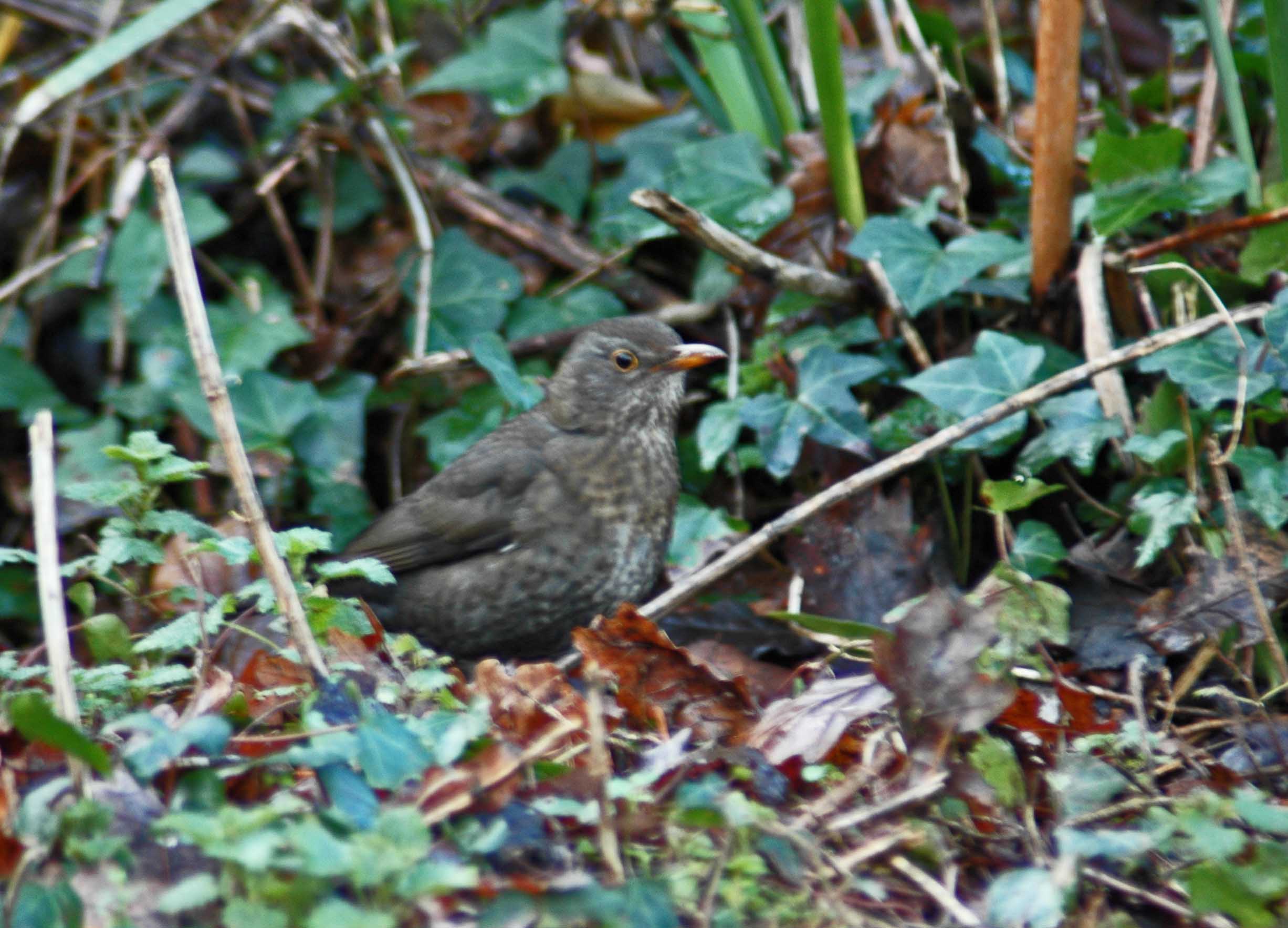
Turned right at the top of the steps, paddled through a big puddle to get through the gate, then stopped for a while to watch a female blackbird rummaging around on the side of the track, hunting for insects. I love watching them pick up leaves and toss them aside to expose anything hiding beneath them, then tilt their heads to have a close-up look.

Female Blackbird rummaging around in dead leaves

Female Blackbird rummaging around in dead leaves

I turned left off the track, stopped to watch chaffinches and blue tits in one of the small oak trees, walked a short way along the edge of the grassy meadow, then turned off again to arrive at the bottom of the steep grass slope of the open heath and headed up to the summit.

Catkins

Catkins

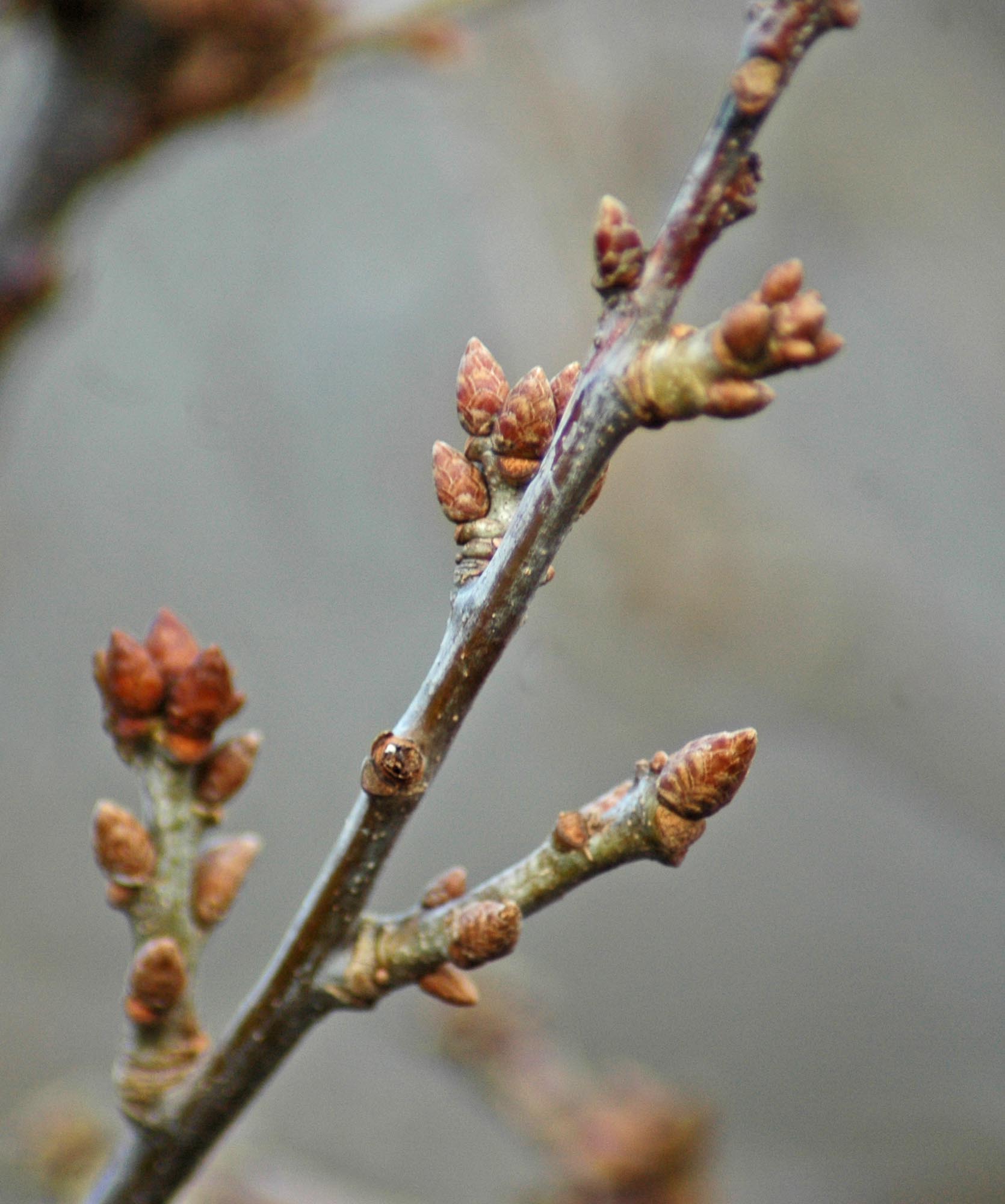
Swelling leaf buds

Swelling leaf buds look like miniature pine cones

As always, well worth the effort for the spectacular views in every direction.

Winter birches

Winter birches front a fantastic view

View from the summit

View from the summit

Looking down on the flooded field where curlew, oystercatchers, redshank may be seen feeding amongst sheep

Looking down on the flooded field where curlew, oystercatchers, redshank may be seen feeding amongst sheep

Rhos Point and the ever-growing array of wind-turbines

Rhos Point and the ever-growing array of wind-turbines

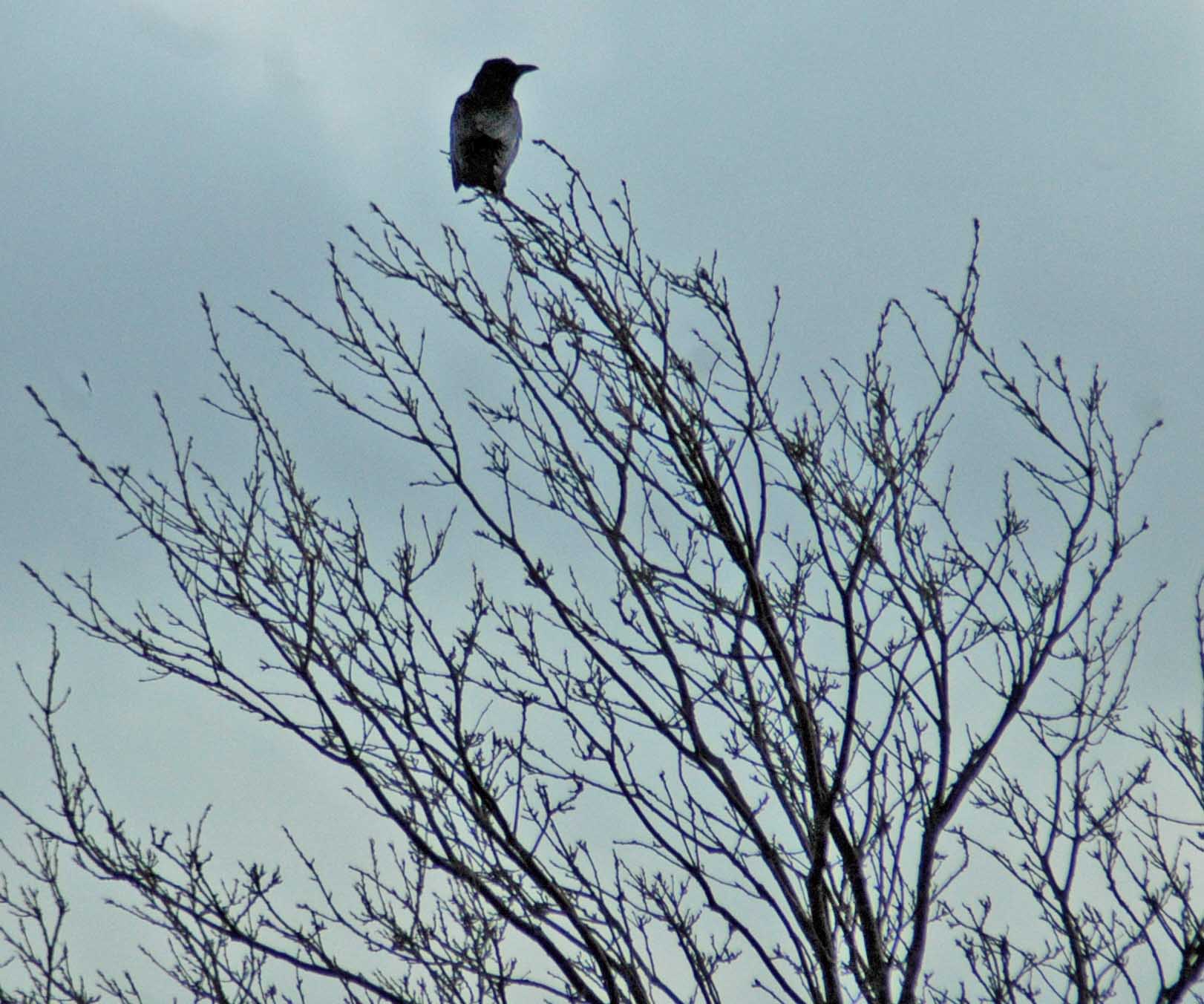
The only company I had up there today was a pair of Crows. It’s such a privilege to have all this

Crow with the highest vantage point possible at the top of a tree near the summit

Crow with the highest vantage point possible – at the top of a tree near the summit

When there are no leaves or wildflowers attention is drawn to the colour and textures of lichens and mosses.

Bright green lichen on elder

Bright green lichen on elder

Tracery of blackthorn hung with small bunches of grey-green lichen

Tracery of blackthorn hung with small bunches of grey-green lichen

Close up of lichen

Close up of lichen

Robin's pincushion

Robin’s pincushion

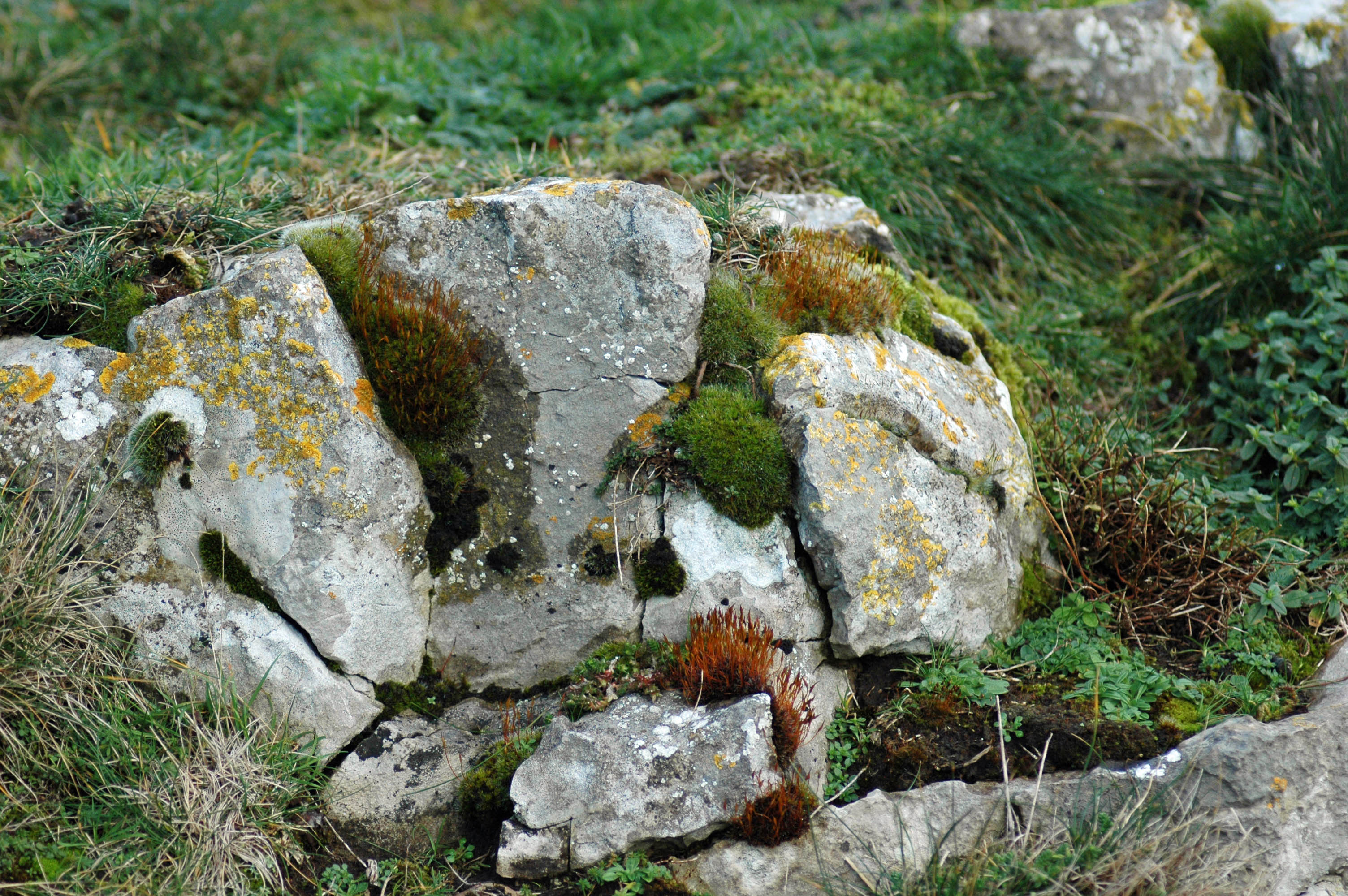
Rocky outcrop with cushions of moss

Rocky outcrop with a whole variety of lichens and cushions of moss

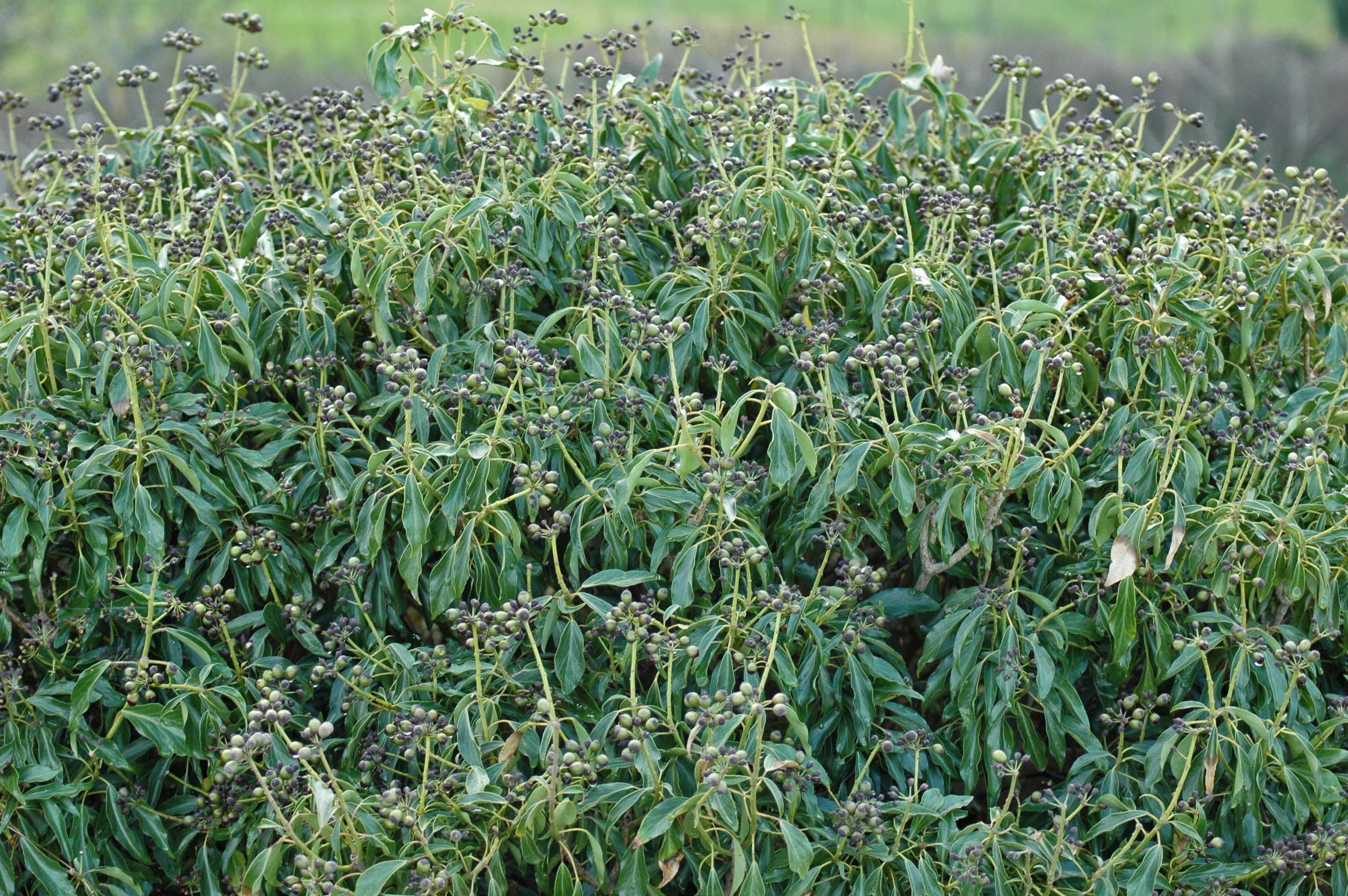
A bountiful crop of ivy berries

A bountiful crop of ivy berries

Going back  down the hill, a flash of bright colour caught my eye and I followed the flight path of what I thought was a male chaffinch until it perched in a small tree. I wasn’t quick enough to focus on it and lowered the camera as it flew away, almost missing the female that replaced it on the same perch. I realised then that these were bullfinch, not chaffinch, a species I haven’t seen here before. I just wish I had been quick enough to get some better images. The one below is just another ‘proof-of-view’! Sorry.

Female bullfinch

Female bullfinch

More lichen

More beautiful lichen

The downhill track was muddy and very slippery so I was more than glad I had the support of my spiky walking pole!

Mossy stones

Mossy stones

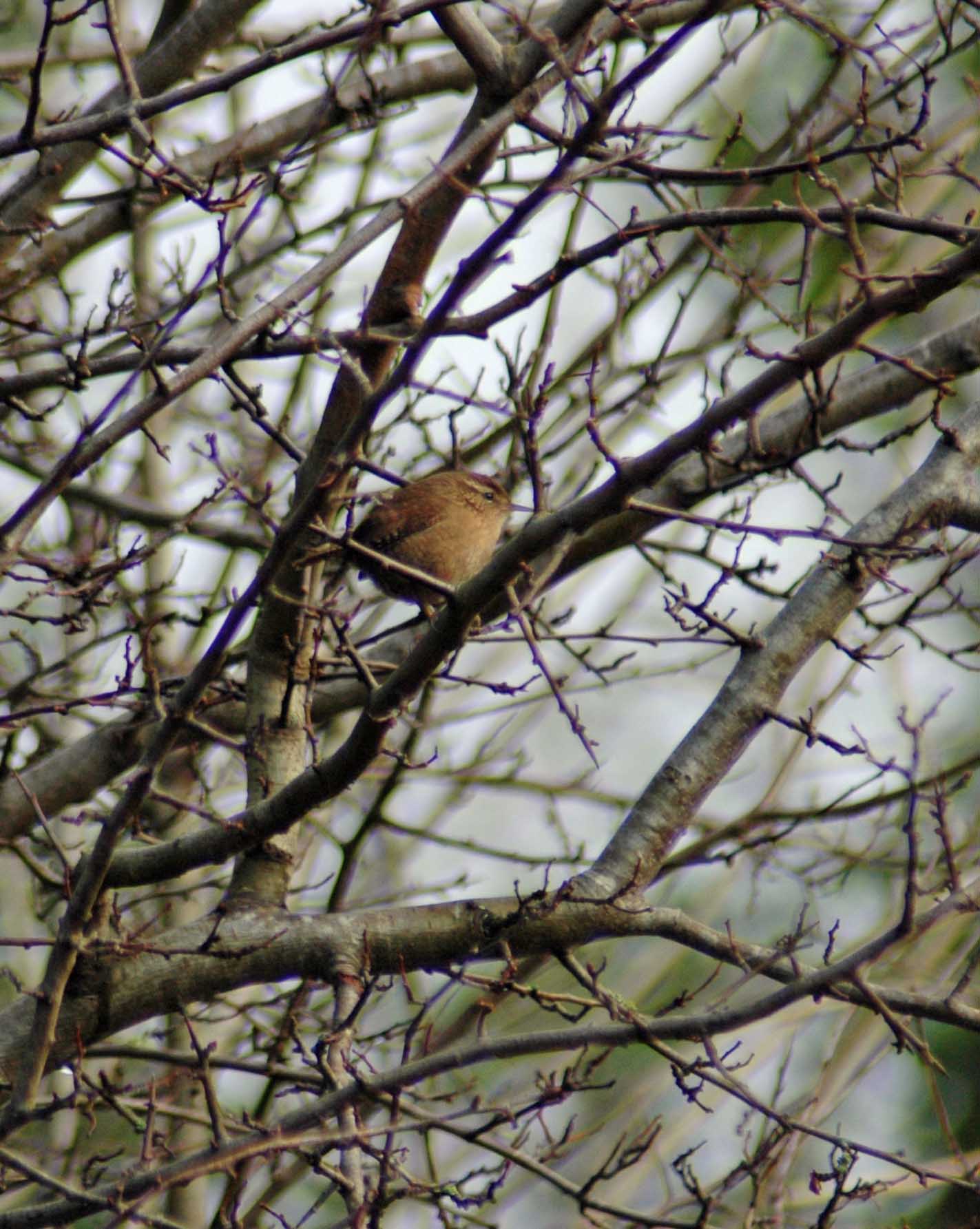
Back in the car park I heard a wren singing again, probably the one I’d heard earlier. I managed to get near enough to see him quite clearly and watch his little performance; a burst of song in one direction, then a spin around and a burst the opposite way, then repeat.

Wren singing in the car park

Wren singing in the car park

Spring is definitely on the way, let’s hope it’s not pushing its luck.

…and back down again

Tags

, , , , , , ,

January 11th, last leg of the walk on the Little Orme

The winter months offer an opportunity to see places as they really are. Stripped of leaves and layers of foliage, without the colourful distractions of wildflowers and the movements of their insect visitors to draw the eyes, this is the time to appreciate the structure, the bare bones of a place. Walking back down from the top of the Little Orme, not only are the views spectacular, but you also see more clearly the layout of the reserve. On this scale you get a sense of how the patchwork of differing habitats mesh together and create the synergy that has resulted in the rich variety of wildlife that make this such a special place.

140111TG-Little Orme-View from near the top

A myriad of textures in one small patch of land

The sun, lower in the sky now reveals the true contours of a landscape. You realise a surface which til now has appeared smooth and rounded, is actually textured with a multitude of dips and hollows that are revealed by back-light and shadows.

Going down-a view of the pastures on the Little Orme

Further down a view of the enclosed pastures on the Little Orme that add yet another layer of texture

There is some farming activity on the lower slopes of the reserve where small fields are cultivated for crops and pastureland is enclosed with hedges or small walls and used for grazing sheep. Sheep are also free to range and graze other parts of the reserve too; they are an effective way to keep areas of grass shorn and clear of too much shrubbery and are aided and abetted in their mission by a healthy population of rabbits.

Despite what I wrote earlier about their being less distractions from the bigger picture of a place, I should probably know myself better and accept that I will always find distractions in the details whatever the season. Like a leafless, gnarly, knobbly hawthorn twig softened with lichen and highlighted by the sun.

Lichen on a sunlit hawthorn twig

Lichen on a sunlit hawthorn twig

Going back down Rabbit Hill was trickier than going up as it turned out, as it was quite wet and muddy and slippery underfoot. There was a dunnock so intent on feeding himself before going to roost for the night that he allowed me quite close before shooting off into cover. He wasn’t presenting his best side now, but its good to see things from a different angle now and then. I felt sorry for my disturbance, I know how hard it is for birds to find enough food to keep them going in the winter, especially through the cold nights.

A dunnock feeding on the slope of the downhill track

A dunnock feeding on the slope of the downhill track

At the bottom the Robin was still about too, adopting the classic hunting method of the species by perching up off the ground and scanning the ground beneath them, then pouncing down onto potential prey.

Robin scanning the ground beneath for something edible

Robin scanning the ground beneath for something edible

This little tree is testament to the strength of the prevailing winds

This little tree is testament to the strength of the prevailing winds

I had the thought of finishing off my walk along the quarried-out gorge that ends, or begins near one of the entrances to the reserve, but to my surprise much of its floor was covered by a pool of water several inches deep. My reason for wanting to go that way was to see if there may be a Song Thrush hunting for snails along the rocky wall there. Last year I spotted a pair nesting there and watched them as they hammered a succession of snails into palatable food for their young ones.

Song Thrush, photographed last July. One of a nesting pair.

Song Thrush, photographed last July. One of a nesting pair.

Instead I carried along in the same direction, but around the top towards the large, sculptural lump of limestone that always puts me in mind of the Sugar Loaf Mountain, but in miniature of course. Sort of, with a bit of imagination? Regardless, I love that rock and have often wondered how it ended up there. 

The limestone rock in context

The limestone rock in context- you can just see the edge of the man-man quarried gorge in the foreground (click on to enlarge)

I am referring to the Sugar-loaf Mountain in Rio de Janeiro here, not the one in Wales that has the same name!

The rock baclit by the sun and the gorgeous view behind it

The rock backlit by the sun and the gorgeous view behind it (click on to enlarge)

One last thing, are there really green leaf buds on this tree already?

Signs of buds bursting

Signs of buds bursting

To the top of the Little Orme ….

Tags

, , , , , ,

January 11th- (after the seal-watch)

The Grey Seals seemed to have put on as much of a show as they were going to for the time being and it was cold sitting on my rocky perch on the cliffside. It was a bright sunny day, but until now the bay had been held in the shade by the bulk of the headland and as the sun was only just beginning to highlight the tallest of the rocks below, it was move on or seize up.

Sunlight highlights the top of a rock

Sunlight highlights the top of a rock

Jackdaws are resident here on the Little Orme and nest colonially up on the cliff above Angel Bay. Outside the breeding season they continue to use the nesting-site as a roost, gathering back there in the late afternoon-early evening, but are a frequent sight throughout the reserve at most times of the day. Sometimes they are on their own or in pairs but often they congregate in small flocks that forage on the flattened grassy clifftop or fly around calling to one another. Like all corvids they are characterful birds with glossy black feathers but are easily distinguished by their grey head and steely ice-blue eyes.

Jackdaw

Jackdaw

In need of some proper exercise I had already decided that the only way was up today, so I turned towards the steep uphill track of ‘Rabbit Hill’. At the bottom a Robin was feeding on the muddy grass and close by in a sheltered spot amongst the shrubbery a Dunnock was enjoying the sunshine.

A dunnock making the most of a sunny spot

A dunnock making the most of a sunny spot

Last summer I was fit enough to walk up here without stopping for breath, but that was then and from past experience I anticipated today’s effort would require a minimum of two stops! Fortunately, when you have a camera in your hand you can stop and turn round and take a photograph as and when necessary, appearing to be capturing the view whilst waiting for your heart to stop pounding.

View from first breath collection point on Rabbit Hill

View from first breath collection point on Rabbit Hill

I love this view, which has Penrhyn Bay immediately below, then Colwyn Bay behind the finger of land that is Rhos Point.

Same view from higher up

It’s even better from higher up

I managed to reach the top of the track with just one more stop, which I would have made anyway (!) to photograph some golden gorse which is already quite well advanced in its flowering.

Gorse in flower

Gorse in flower

Gorse – Ulex europaeus is the first shrub to brighten the winter months with its sunshine-yellow blossom. I love its coconut scent.

A closer look

A closer look

I carried on the uphill track, which was quite damp, muddy and slippery in places. The limestone was not quarried higher up (in case it spoilt the view from the Llandudno side) and forms craggy walls and ridges which are the domain of the Ravens. There was one there today, sitting with his back turned, perhaps soaking up some warmth from the sun. I love to see and hear  the deep, croaking calls of these big black birds up here, their presence makes the place seem wilder, higher and more expansive than it really is.

Ravens often sit with their backs turned

Ravens often sit with their backs turned to the sun

Up nearer the summit is a grassy area where you often encounter grazing sheep, but none today. Looking over the cliff edge here you are seeing the rocky headland on the other side of which is Angel Bay. This is a place favoured by Cormorants at certain times of the year and I was quite disappointed that there wasn’t a single one there today. The most exciting thing I could come up with here today was a mushroom! It was nicely lit by the sun though.

A mushroom, or toadstool

A mushroom, or toadstool

Whatever you see or don’t see here really doesn’t matter once you climb one more short slope and have the full expanse of the view across Llandudno Bay in front of you.

View across the bay to the Great Orme

Panoramic View acround Llandudno bay to the Great Orme (click on picture to get full effect)

The town of Llandudno with its elegant Victorian facade sweeps around the curve of the bay and is sheltered by the bulk of the headland that is the Great Orme.

Foreground is part of the summit of the Little Orme, then beyond the town down the coast the Conwy Estuary, Anglesey and the Menai Strait

In case you’re interested, I’ve put this next photo in that I took from the Great Orme looking towards the Little Orme. This unspoilt side must look similar to how ‘our’ side would have been before it was quarried.

The view from the Great Orme to the Little Orme and beyond

The view from the Great Orme to the Little Orme and beyond

Up here on this side of the headland it was much colder and exposed to the full force of the wind so I didn’t hang around admiring the wonderful views for long, but did turn around to take one last photograph of ‘our’ side of the Little Orme from this higher vantage point before heading back down.

View from the top of the Little Orme across Rhos-on-Sea

View from near the summit of the Little Orme in the Colwyn Bay direction

Grey Seal Spot

Tags

, , , ,

2014 – January 11th

The Little Orme is a fascinating site to visit at any time of year as it holds a variety of habitats in a relatively small area and there is always something to see, but the winter months are the perfect time to see some of its special visitors, charismatic Grey Seals. There are never many, but the pebbly beach of Angel Bay regularly attracts a number of new mothers and pups that come to haul out to rest on the shore of this sheltered little cove. They are pretty much undisturbed there as the beach is only accessible by a steep narrow track down the cliff. They don’t seem to mind interested people watching them from above too much, even those armed with cameras, although they definitely know you’re there and may keep a wary eye on you to make sure you stay put.

Today I was pleased to discover there were indeed grey seals here; five adults in a group, seemingly dozing, while three tiny young ones were practicing their swimming techniques in the waves.

Grey seals on the shingle shore of Angel Bay, Little Orme

Grey seals on the shingle shore of Angel Bay, Little Orme

The adults appeared not to be too concerned for the safety of the youngsters; grey seal pups have to grow up fast and must be able to start fending for themselves at about a month old, so they grow and put on weight rapidly and quickly shed the pretty white fur coats they are born with. The little ones seemed quite happy in the water, although getting back in, fighting against the incoming waves seemed to present more of a challenge.

Two of the three young seals taking a break from swimming practice on the sea edge

Two of the three young seals taking a break from swimming practice on the sea edge

The adult’s apparent slumber came to an abrupt end when something seemed to alarm them and they travelled surprisingly quickly down to the sea edge.

The seals suddenly decided to move towards the sea edge

The seals suddenly decided to move towards the sea edge

A few metres on they stopped again

A few metres on they stopped again

They were heading towards a young one, making me wonder if they had perhaps been summoned by it, but then as it watched from the surf of the sea edge they simultaneously stopped and flopped down again, seemingly unimpressed.

The adult seals moved down towards a young one on the sea edge

The adult seals moved down towards a young one on the sea edge

From November onwards female grey seals return to their favourite beaches to give birth and mate again. The milk of the grey seal is very rich enabling the pups to put on weight quickly. They have to grow fast as their mothers stay with them for only three weeks before returning to the sea. The mother does not feed herself whilst feeding her pup, so hunger soon drives her back to the sea.  Young seal pups are covered in white fur when they’re born. Within a month or so they shed the pup fur, grow dense waterproof adult fur, and leave for the sea to learn to fish for themselves. The pup soon follows and must teach itself to hunt for food.

I have posted about grey seals several times before, my favourite being a post about the rescue of a very young pup  from beneath the sea-break boulders at Rhos Point by some of the caring keepers from the Welsh Mountain Zoo. The photograph below is from that post.

Alone on the seashore the baby seal looked very small and vulnerable

Alone on the seashore the baby seal looked very small and vulnerable

Waiting for the tide to turn

Tags

, , , , , , , ,

Several months and a whole season have come and gone since I posted anything on this blog. It’s been a sad time for me and all of my family as my beloved Dad reached the end of a very long life last September. He was the one that noticed and encouraged my early interests in the nature around us and taught me the names of common wildflowers, butterflies and most particularly birds. He didn’t claim to know everything, but more importantly he gave me the gift of noticing what was there and the encouragement to find information I wanted for myself. He never really got the concept of blogs, or indeed anything to do with computers, but was always interested to hear what I had seen and where I’d been, particularly about the places here in North Wales that he took my sisters and me to spend time in when we were young. Some of those places have remained very special to me and I’m sure that when I visit them, that’s where I’ll always find him.

______________________________________________________________________________

Thank you all for your patience and sticking with me and thank you to new readers that have signed up who must be wondering where I’d disappeared to. While Dad was ill I was spending a lot of time down in my old haunts in Northamptonshire, where my sisters still live, and it was reassuringly familiar and not too greatly changed in the decades I’ve been away. I may do a post or two about our walks there if I am unable to come up with anything more current, but for the time being the so-far mild winter is giving me plenty of opportunity to get out and ideas for posts, starting with this one about the  wading birds that are about now on our local rocky seashore.

2nd January 2104 

A brilliantly sunny day winkled me out of my cosy shell this morning and I set off, camera to hand to see what I could see from the promenade. I realised I had lost track of the ebb and flow of the tides and had no idea of its current state, so was initially quite disappointed to see that it was fully in and very high. That meant there would be no waders to be seen picking their ways through the rocks that strew the shoreline of Rhos Point pecking and probing the muddy sand in search of food. But I’d made the effort to get myself out and I wasn’t about to go home with nothing, so I thought I’d at least walk for a way for some much-needed exercise and if nothing else there may be a Rock Pipit or two on the rocks or the sea wall. The sea was as blue as the sky and ruffled by what I was feeling as a bitingly cold breeze. I hadn’t walked far when I noticed a largish bird swimming around on the water, meandering randomly and frequently diving and disappearing under the surface for minutes at a time.

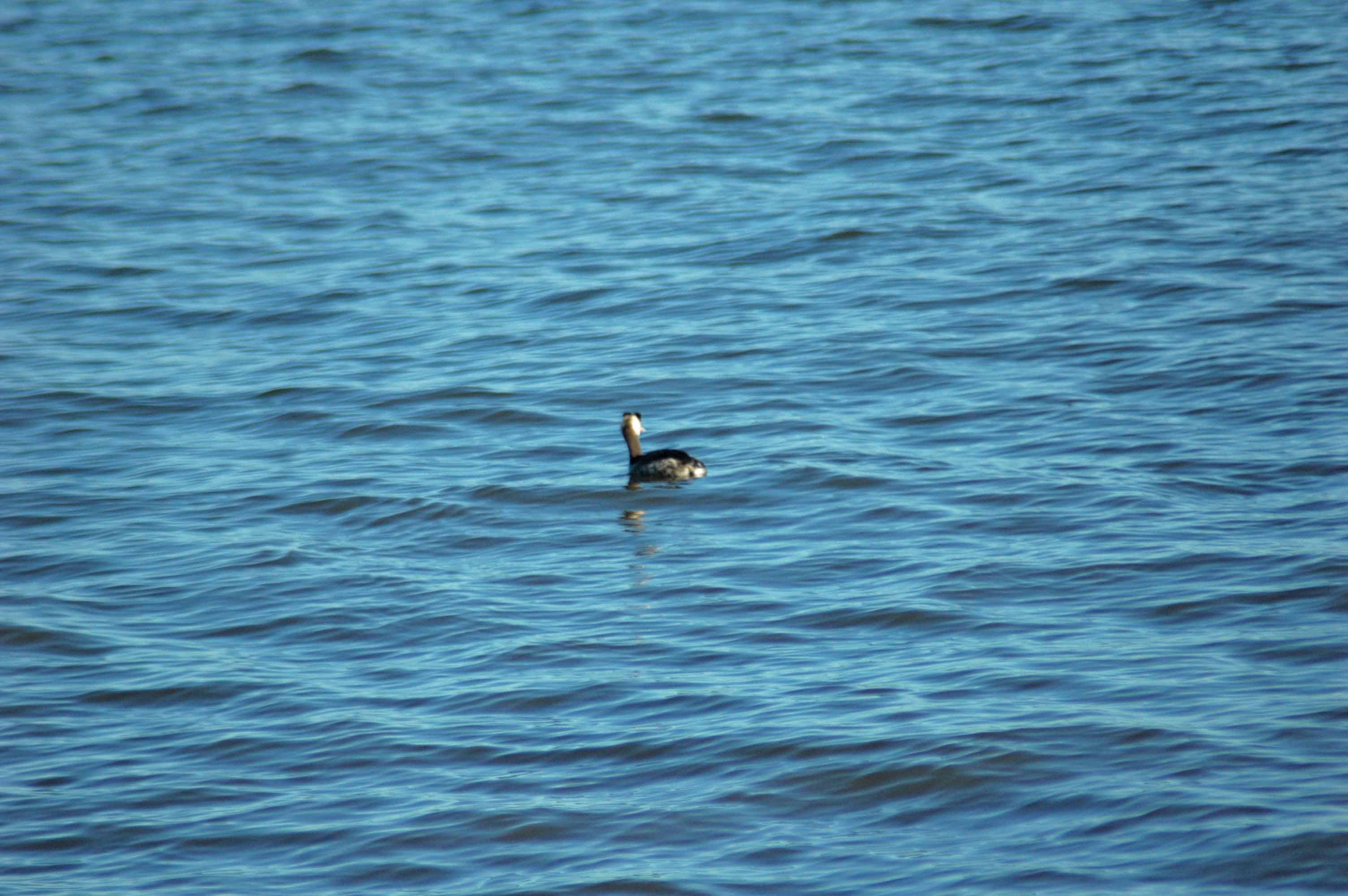
Great Crested Grebe

Podiceps Cristatus-Great Crested Grebe

Needless to say, I hadn’t picked up my binoculars and couldn’t properly see what I was looking at, even with the assistance of the camera lens, but from its general ‘giz’, and the fact I’ve seen them here in previous years, I decided it was most likely a Great Crested Grebe. It wasn’t alone either, although individuals were spread quite widely apart, at one time I counted ten of them. I could not get a decent image of any one of them though, so this one is a token effort to verify the sighting! 

” In winter, Great Crested Grebes show a marked shift from inland waters to the sea, although on the continent large numbers remain on inland lakes, e.g. in Switzerland (Cramp 1977). In normal winters, Britain and Ireland receive birds from continental western Europe. During severe winter weather, birds move through Britain in search of milder conditions either to the west in Ireland, or southwards to France (Lack 1986).” http://jncc.defra.gov.uk/pdf/UKSPA/UKSPA-A6-4B.pdf

High tide- sea flooding steps

High tide- sea flooding steps

I walked quite a distance towards Penrhyn Bay, stopping now and then to try to get a better image of a Grebe. I spotted one a little further in and got a slightly better view from the top of a set of steps that lead down to the beach. You get an idea of how far the water reaches regularly as the bottom treads are worn smooth by the repetitive scouring of salty waves climbing them and retreating with some force.

I wasn’t enjoying walking into the cold wind so I turned around and walked back, but carrying on towards the village. Just past the tiny St. Trillo’s Chapel I caught a glimpse of a bird flying down on to the big rocks below the promenade; a Turnstone. It landed out of eyesight, hidden amongst the huge boulders, but as I searched for it, up it popped onto a rock very close by.

Turnstone-Arenaria interpres

Turnstone-Arenaria interpres

Turnstones are common winter visitors to all our British coasts and gather in the greatest numbers on rocky and stony beaches, as here in Rhos-on-Sea. I was very happy to see it, as they are perhaps my favourite small wading bird, and because they are rarely alone I was confident there would be more to see.

Why stand when you can sit

Why stand when you can sit

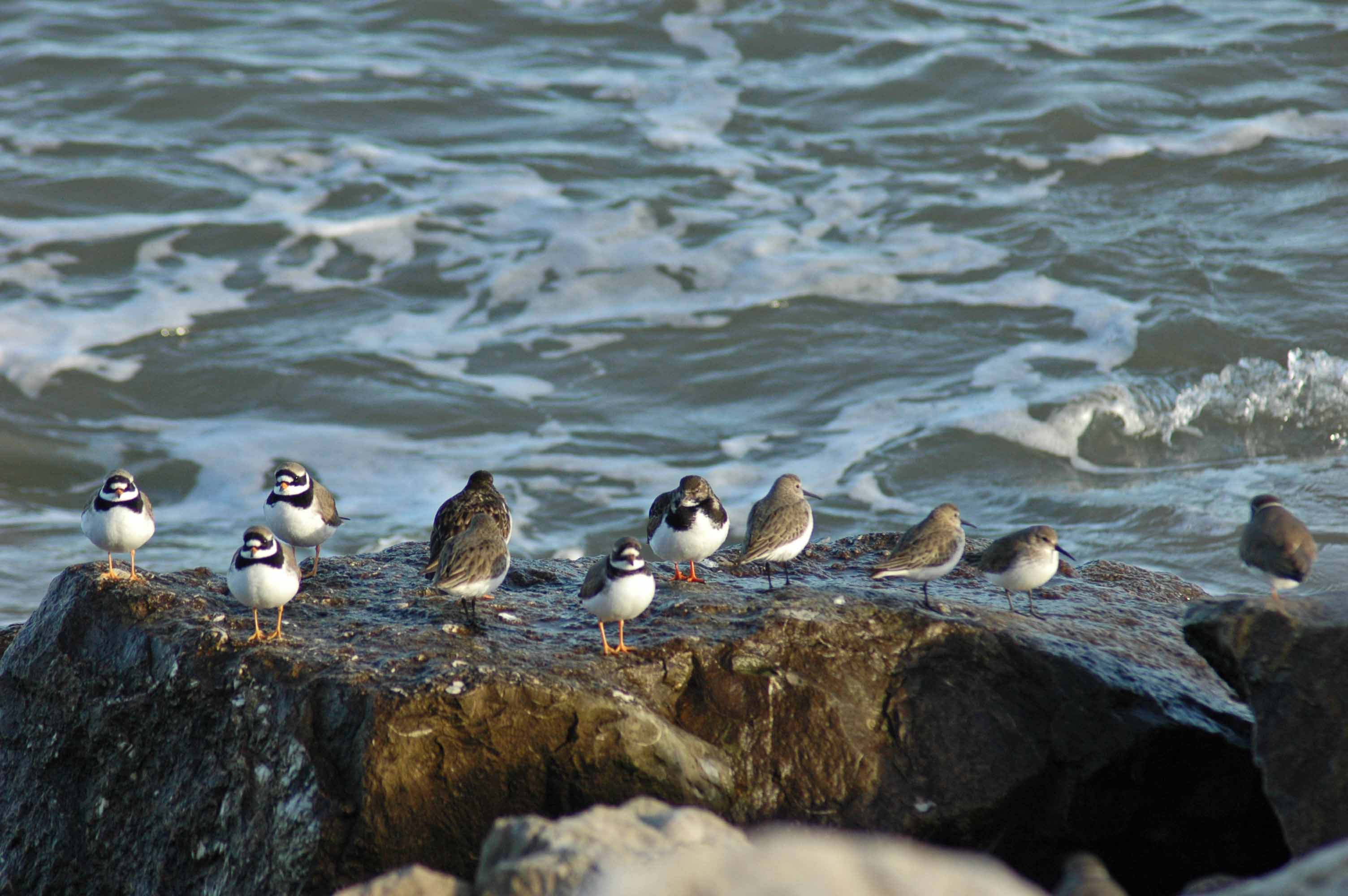
In previous years I have seen small groups of mixed species of  waders on the rocks here, so I was hopeful there would be more to see. I didn’t have to go far before spotting another little group waiting for the tide to turn and leave their lunch, this time Ringed Plover and Dunlin.

Ringed Plovers and Dunlin watching the water

Ringed Plovers and Dunlin watching the water

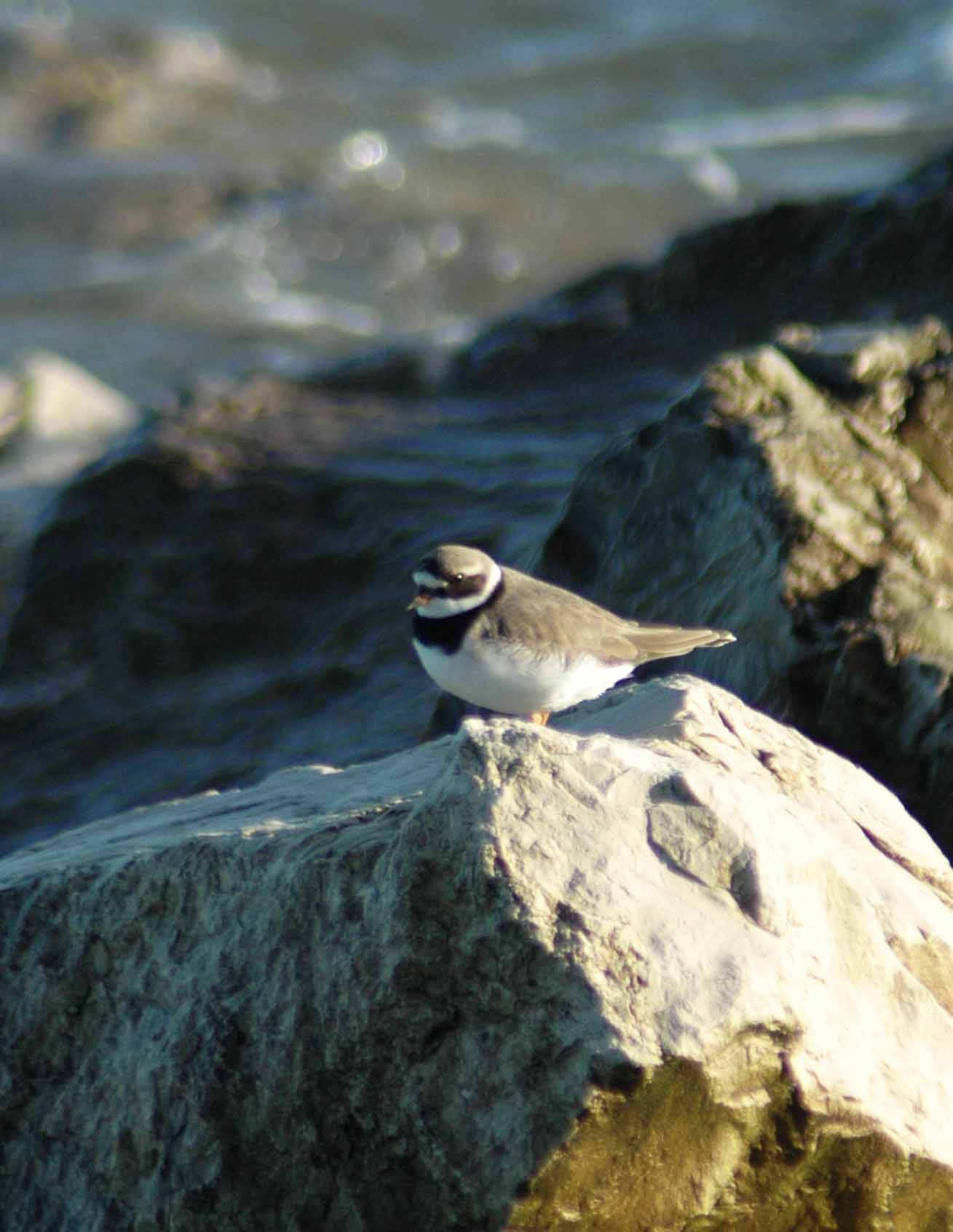
Ringed Plover- Charadrius  hiaticula

Ringed Plover- Charadrius hiaticula

Ringed Plovers are amongst the most common of our shore birds, although the increase in building in seaside localities and our intrusion onto beaches that were once remote, where they traditionally used to breed, have taken their toll on populations.

Ringed Plovers

Ringed Plovers 

A Dunlin & a Turnstone together shows the size difference between them

A Dunlin & a Turnstone together shows the size difference between them

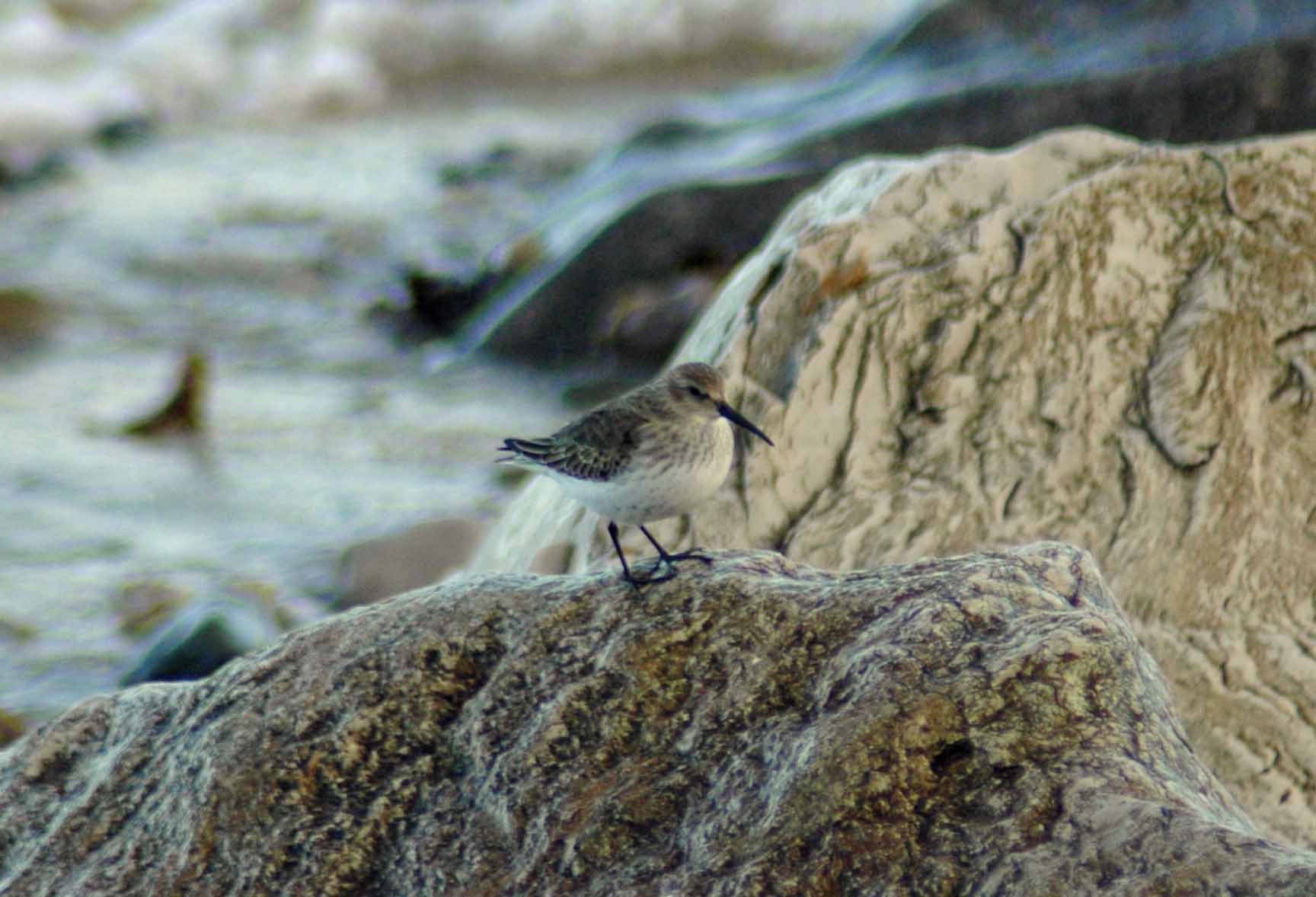
Dunlin are amongst the smallest of our shore birds. Some are present in Britain all year round, and as with Curlews, they winter on coasts and breed mainly on upland moors. Numbers are swelled when sizeable flocks come for the winter.

Dunlin-Calidris alpina

Dunlin-Calidris alpina

Dunlin were known to wildfowlers of old by a diverse variety of names, including ox-bird, ploverspage, sea snipe and stint.

Dunlin flying in to land

Dunlin flying in to land

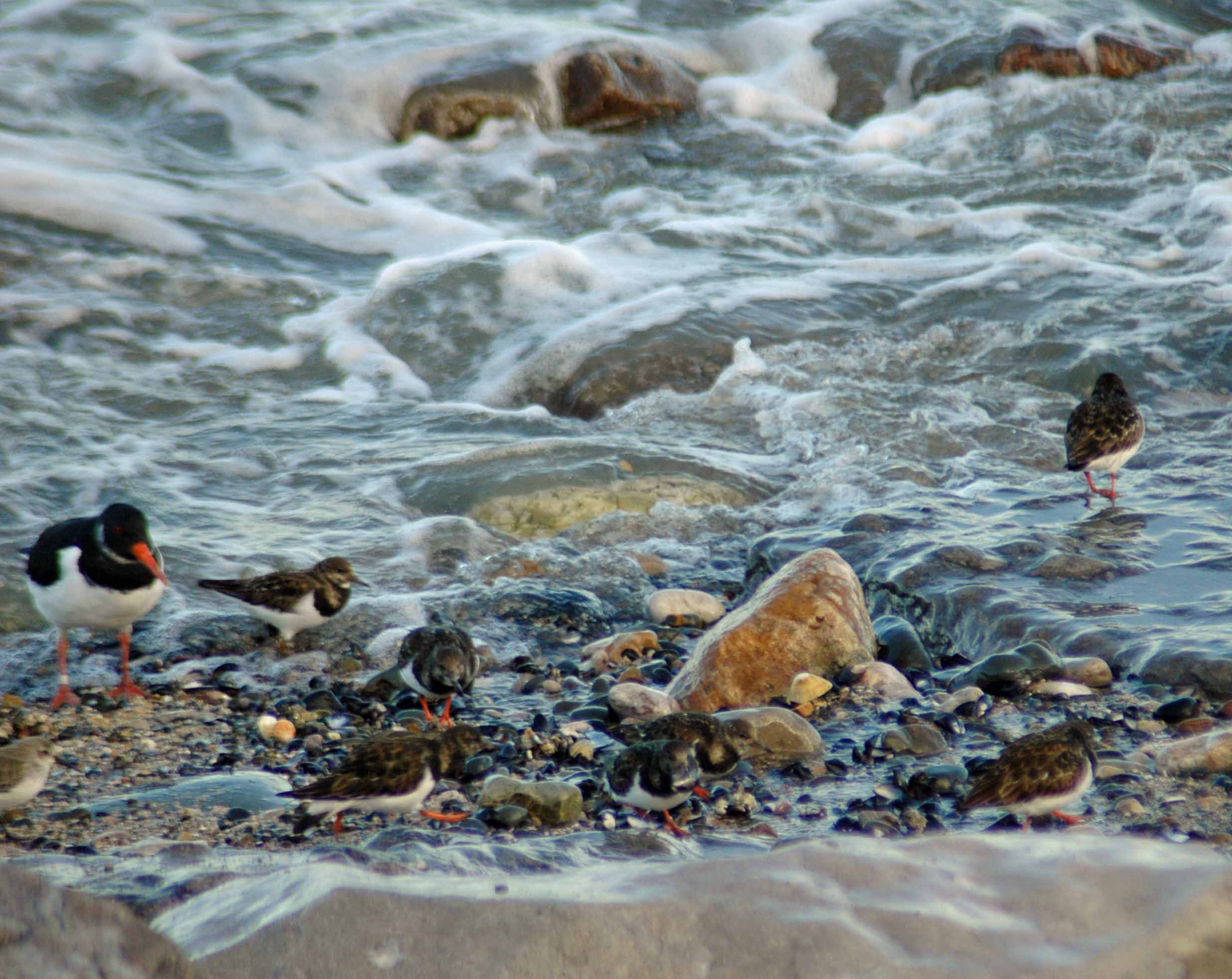
Dunlin, Ringed Plovers & Turnstones

Dunlin, Ringed Plovers & Turnstones

As I watched them I had to wonder how these birds know when the tide is about to turn? It’s definitely not just a lucky guess! When I first began to watch them they were all quite still and quiet, but then in a heartbeat something changed and they became suddenly more animated. Up till that moment they had ignored the close proximity of people walking and me pointing a camera at them, but now people passing by with a dog or cyclists triggered off the Dunlin and Plovers and theytook off as one in a tight little flock out over the sea towards the harbour breakwater, then looped back, showering down to land a few feet further along the rocks. The Turnstones woke up too and were the first to venture nearer to the water, ready to get down onto the first uncovered patches of sand.

As the tide’s turning became more imminent, Oystercatchers began to arrive. They too had been waiting, but a bit further away on top of the harbour breakwater alongside the herring gulls.

Oystercatchers lined up along the harbour breakwater

Oystercatchers lined up along the harbour breakwater

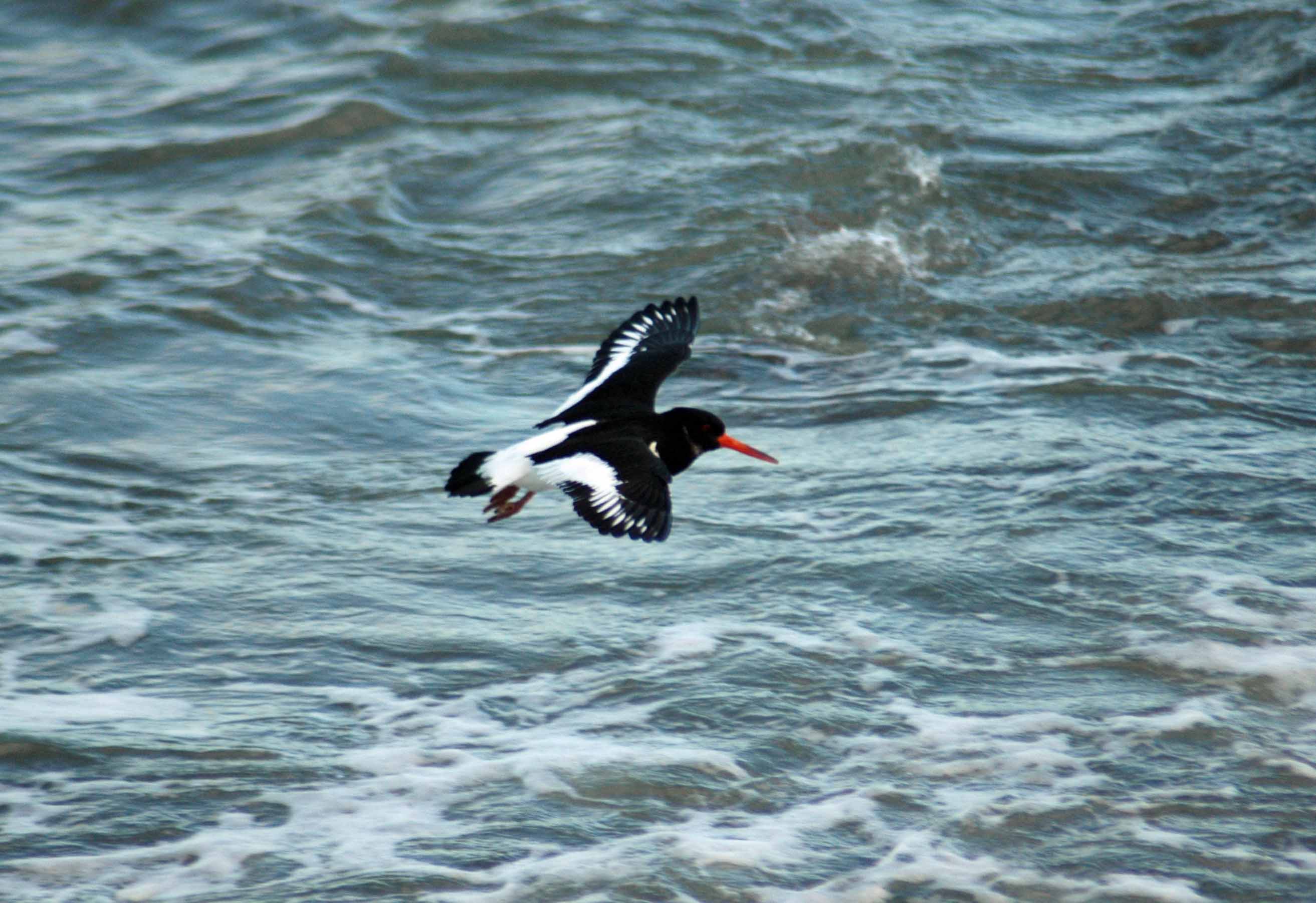
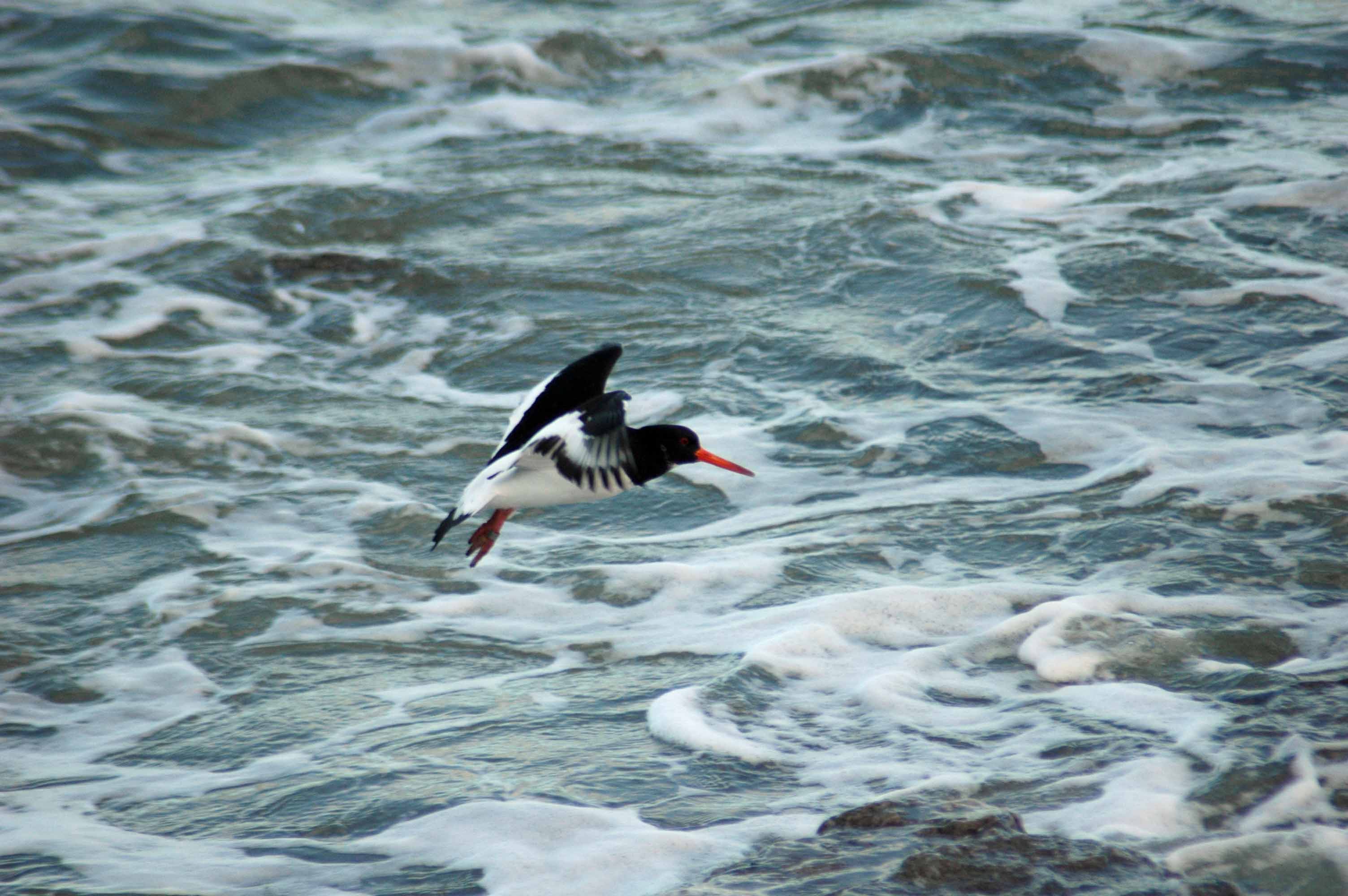
Most of the Oystercatchers headed straight out to the far end of the Point, but a few chose to join the Turnstones, Dunlins and Plovers. Oystercatchers are the most numerous and conspicuous of the waders here and are a familiar sight on the mussel beds, on the rocky shorelines and in small groups flying low across the sea. They are noisy and gregarious and wonderful, but usually some distance away, so it was lovely to get this opportunity to see them more closely for a while.

Oystercatcher flying in to land

Oystercatcher flying in to land

Oystercatcher about to land

Oystercatcher about to land

Landed and waiting for the perfect moment to begin the hunt for food

Landed and waiting for the perfect moment to begin the hunt for food

Joined by another

Joined by another

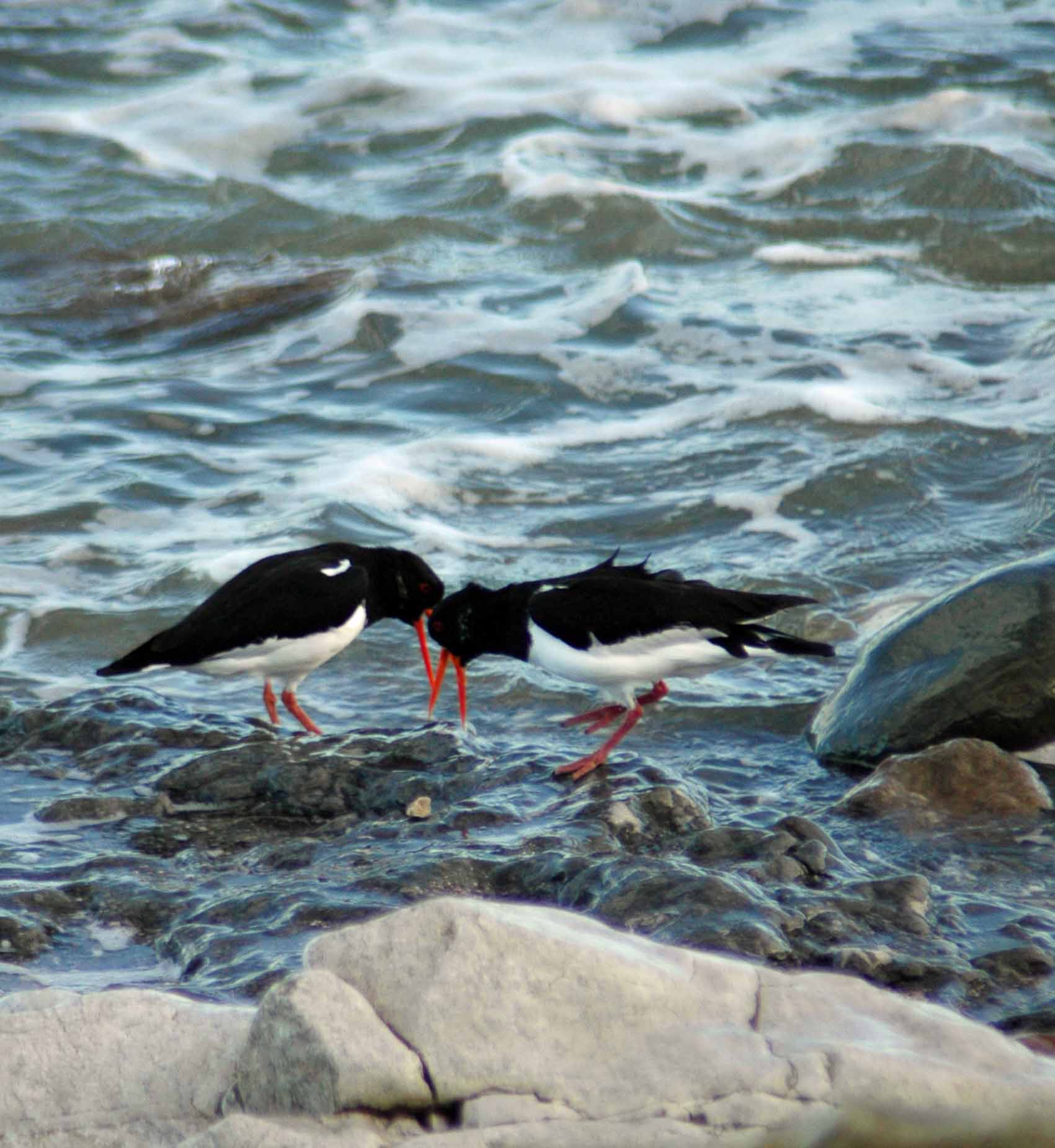
The shrill calls of the Oystercatchers often ring out from where they spend most of their time feeding or as they fly, but I hadn’t realised they also use it to greet other birds. I watched and listened, fascinated, as a pair performed a little greeting ritual in front of me.

A noisy and demonstrative reunion

A noisy and demonstrative reunion

Their performance reminded me of the Herring Gull pair that raised their family on our roof last year and involved ‘bowing’ to one another, beaks open and pointed towards the ground whilst emitting their shrill call, rather ear-piercing at this distance. I am assuming they were a mating pair, and that is something else that is mind boggling; how on earth do they recognise one another in a crowd?

Turnstones are the first of the small waders onto the shore

Turnstones are the first of the small waders onto the shore

The magical moment arrived when the sea had retreated just enough to expose small patches of the seabed. The larger Oystercatchers were first in, followed closely by the Turnstones, then the smaller Dunlin and Ringed Plovers, once they were confident they wouldn’t be caught out by a rogue returning wave with nowhere to run to.

The tide comes in and goes out quickly and by the time I turned to walk back much of the rocky shore of the Point was revealed and already heavily sprinkled with Oystercatchers.

Oystercatchers as I most often see them, spread out at the far end of the seashore

Oystercatchers as I most often see them, spread out at the far end of the seashore

I hadn’t noticed any Curlew fly in, but hearing one I looked more closely and caught sight of one that had just picked up something to eat, very closely observed by a couple of Oystercatchers, who are certainly not averse to stealing should another take its eye off its prize.

A supremely well-camouglaged Curlew with food

A supremely well-camouglaged Curlew with food-Oystercatchers homing in

A curlew with food watched by Oystercatchers

The Curlew watched closely by Oystercatchers

*Missing from today’s tally of waders were Redshank, and Purple Sandpipers that I have seen previously together with Turnstones, Dunlin & Plovers. Click on link to post with more photographs.

Purple Sandpiper-Calidris maritima

Purple Sandpiper-Calidris maritima (January 2012)

And to finish, a young herring gull, to show they are often where they are supposed to be!

Juvenile herring gull

Juvenile herring gull

The Gatekeeper

Tags

,

Scientific name: Pyronia tithonus  (LINNAEUS, 1771) 

FamilyNYMPHALIDAE; subfamilySATYRINAE ;Wingspan range (male to female) – 40-47mm

Flight period: There is only one generation of this butterfly each year; adults begin to emerge in July, and populations peak in early August with only a few adults remaining by the end of the month.

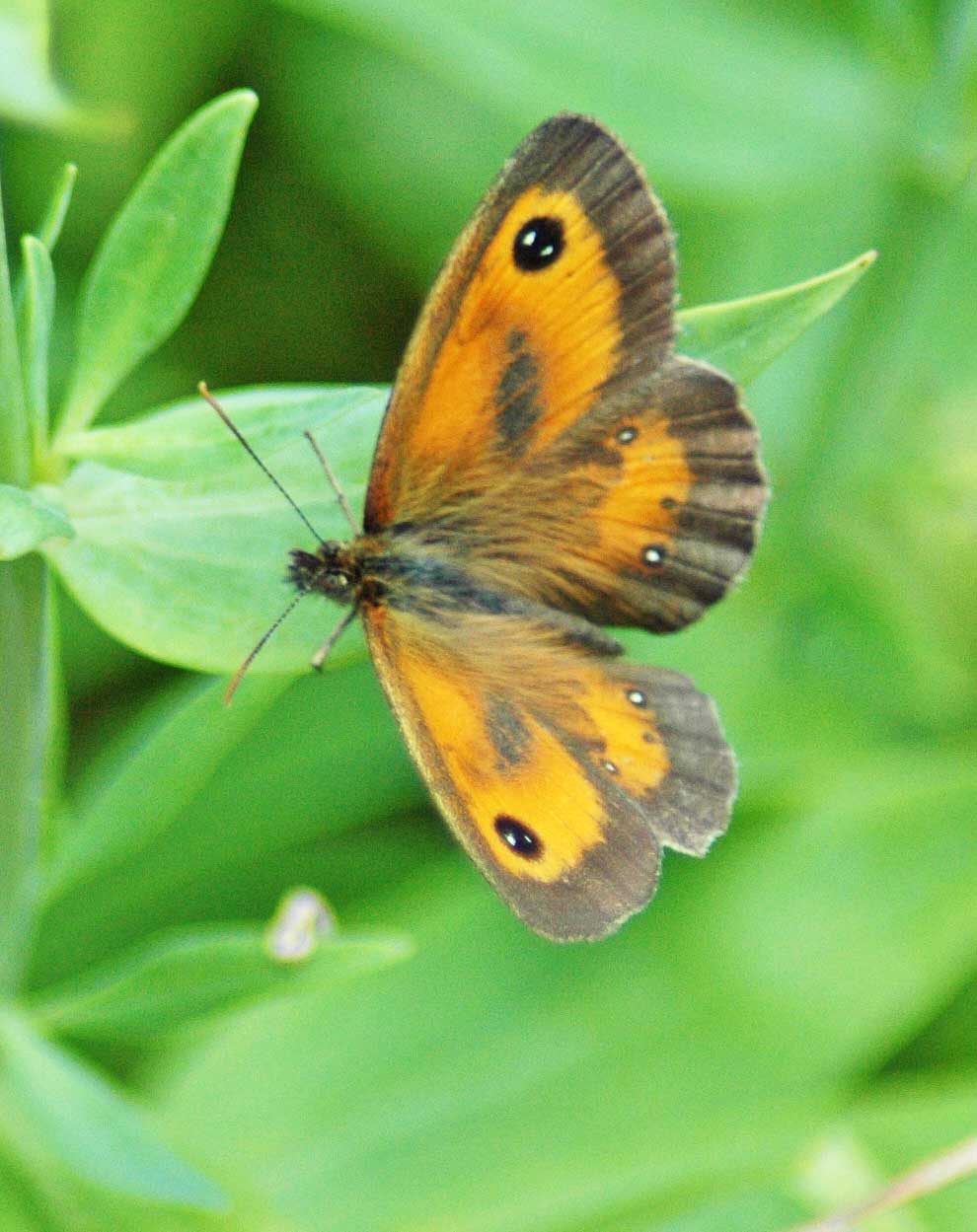
21/7/12-Gatekeeper - Pyronia tithonus

21/7/12-Gatekeeper – Pyronia tithonus (male)

Habitat 

Found where tall grasses grow close to hedges, trees or scrub. Typical habitats are along hedgerows and in woodland rides but the butterfly also occurs in habitats such as undercliffs and on heathland and downland where there are patches of scrub.

The name

The Gatekeeper is also known by the name Hedge Brown, and at various stages in history has also been called the Small Meadow Brown and Hedge Eye.  As suggested by its alternate name, Hedge Brown, the Gatekeeper butterfly favours the habitat of meadow margins and hedges. The butterflies frequently occurred near the open spaces around gates placed in hedges to give access to fields, and as they have the habit of flying up when disturbed it would appear that they were ‘gate-keeping’, such as men were employed to do at toll gates and at the entrances to country estates in the eighteenth and nineteenth centuries.

Description

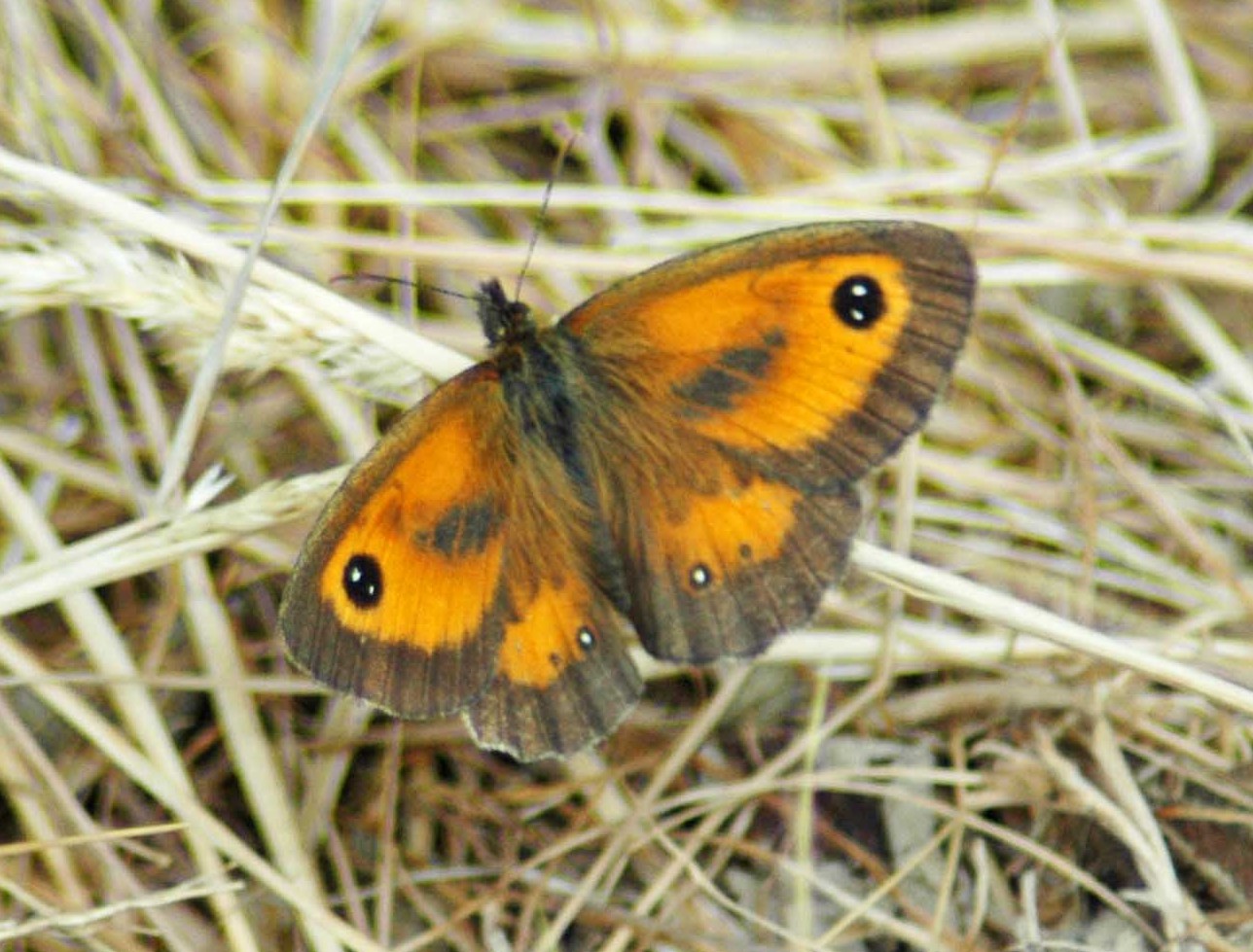
21/7/13-First sighting of a Gatekeeper this year-Little Orme

21/7/13-First sighting of a Gatekeeper this year-Little Orme

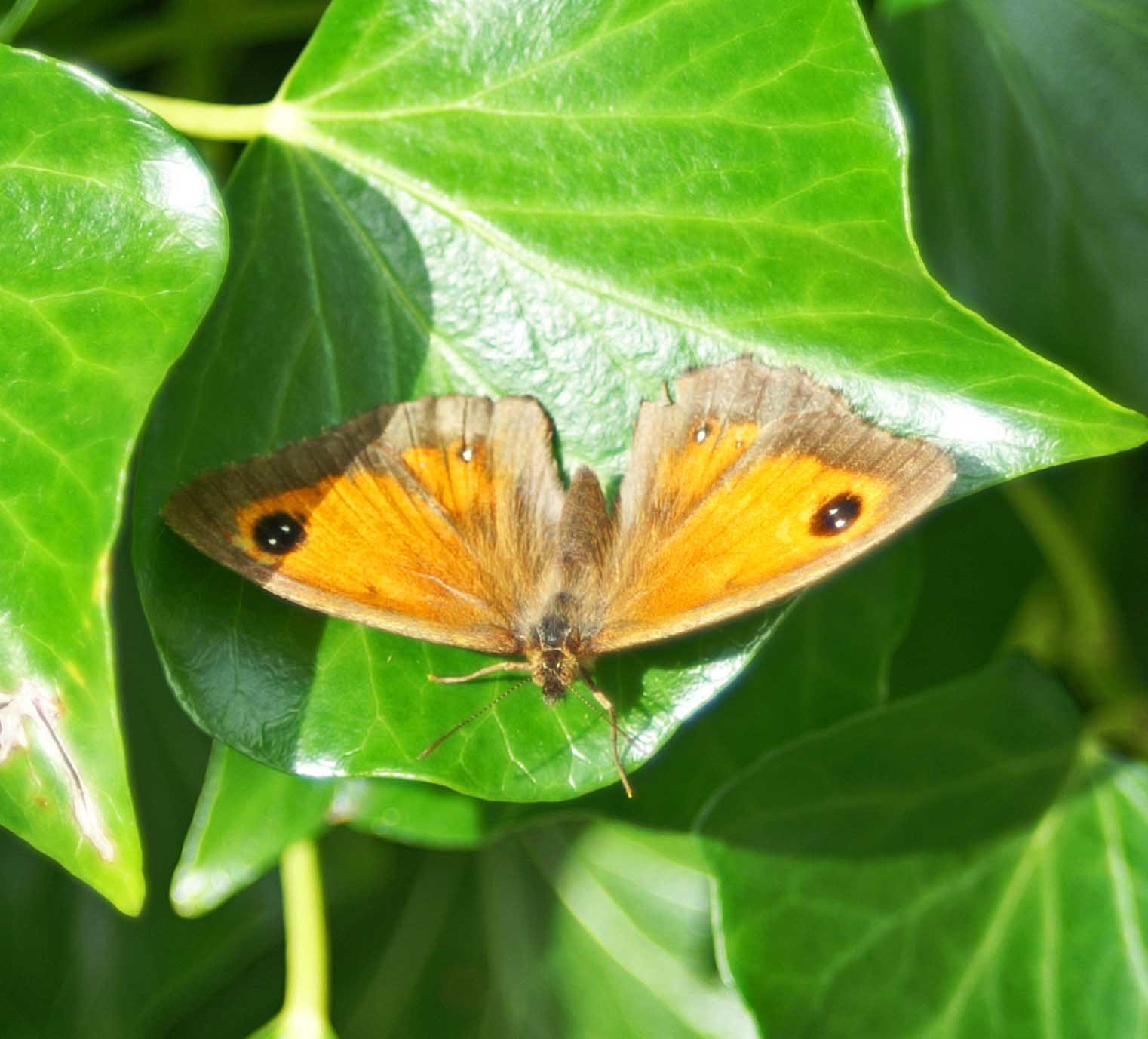
Orange  and brown, with black eyespot on forewing tip, eyespots have two white pupils. Males are noticeably smaller than females and have a dark brown patch of scent-producing (androconal) scales on the forewing, used to attract females during courtship. The colour and patterning of the wings are variable.

110722tgbfly-gatekeeper underside

22/7/11 – Gatekeeper underside (female)

Lifecycle

The first adults emerge in July and lay their eggs singly on grasses beneath bramble, hawthorn and blackthorn bushes where the grass stems grow tall and are not grazed by animals. They hatch after about 14 days and the larvae feed at night on various species of grass, with a preference for fine grasses such as bents, fescues, and meadow-grasses. Common Couch is also used. The full range of other species used is not known. They hibernate during September while they are quite small and re-awaken in March and April feeding slowly and reach maturity by late May – early June.

17/8/11 - Gatekeeper (female)- Rhos--on-Sea garden

17/8/11 – Gatekeeper (female)- Rhos–on-Sea garden

Adult behaviour

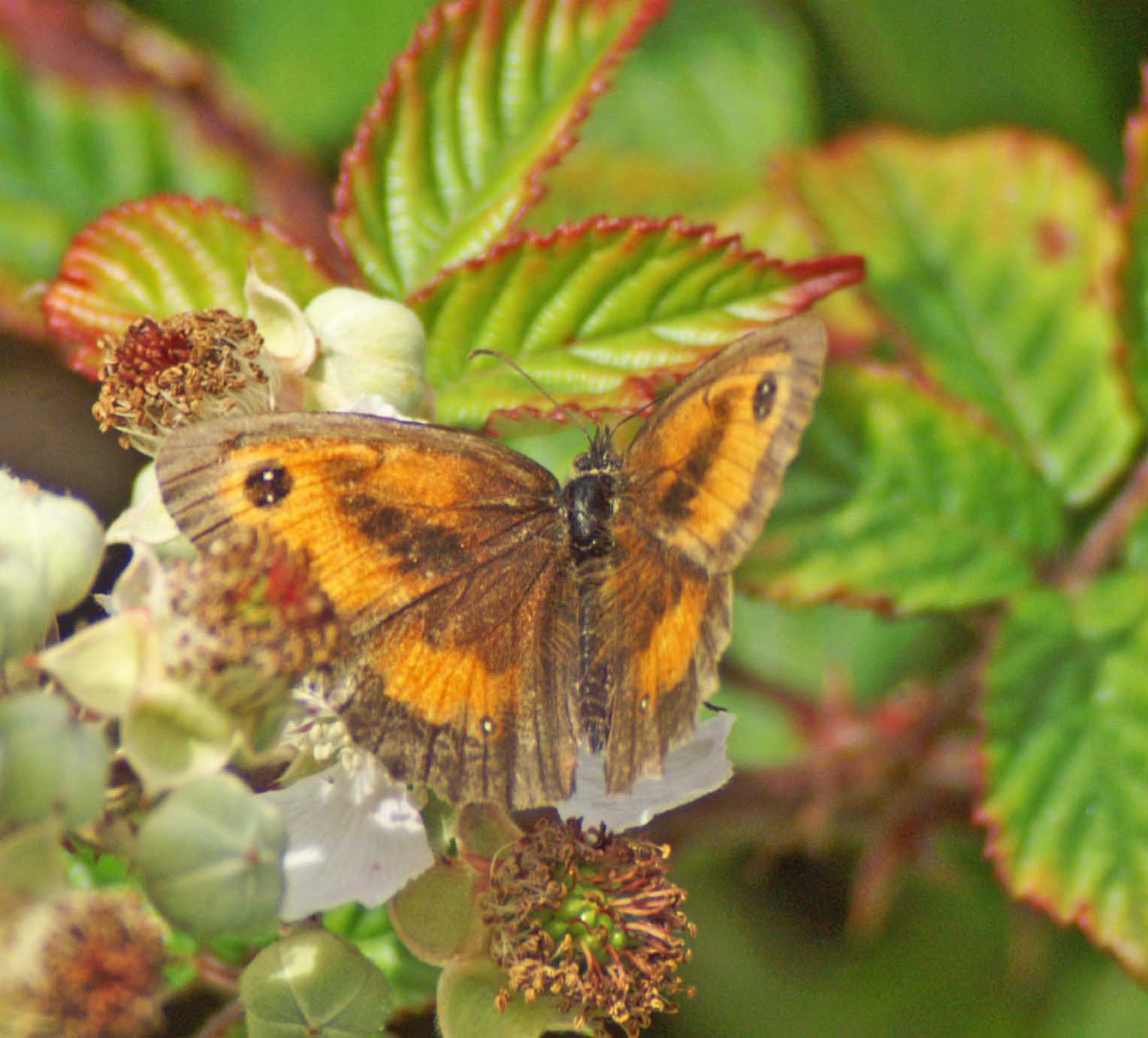
This butterfly spends much of its time basking with wings open, when the sexes are easy to tell apart – only the male has the distinctive sex brands on the forewings. Males set up small territories, often based on a particular shrub or bush, and readily fly up from their perch to investigate passing butterflies regardless of their species, in the hope of finding a mate.

17/8/11-Gatekeeper basking on ivy leaf-Rhos-on-Sea garden

17/8/11-Gatekeeper basking on ivy leaf-Rhos-on-Sea garden

Nectar sources

22/7/11 - Gatekeeper (m) nectaring on bramble flowers

22/7/11 – Gatekeeper (m) nectaring on bramble flowers

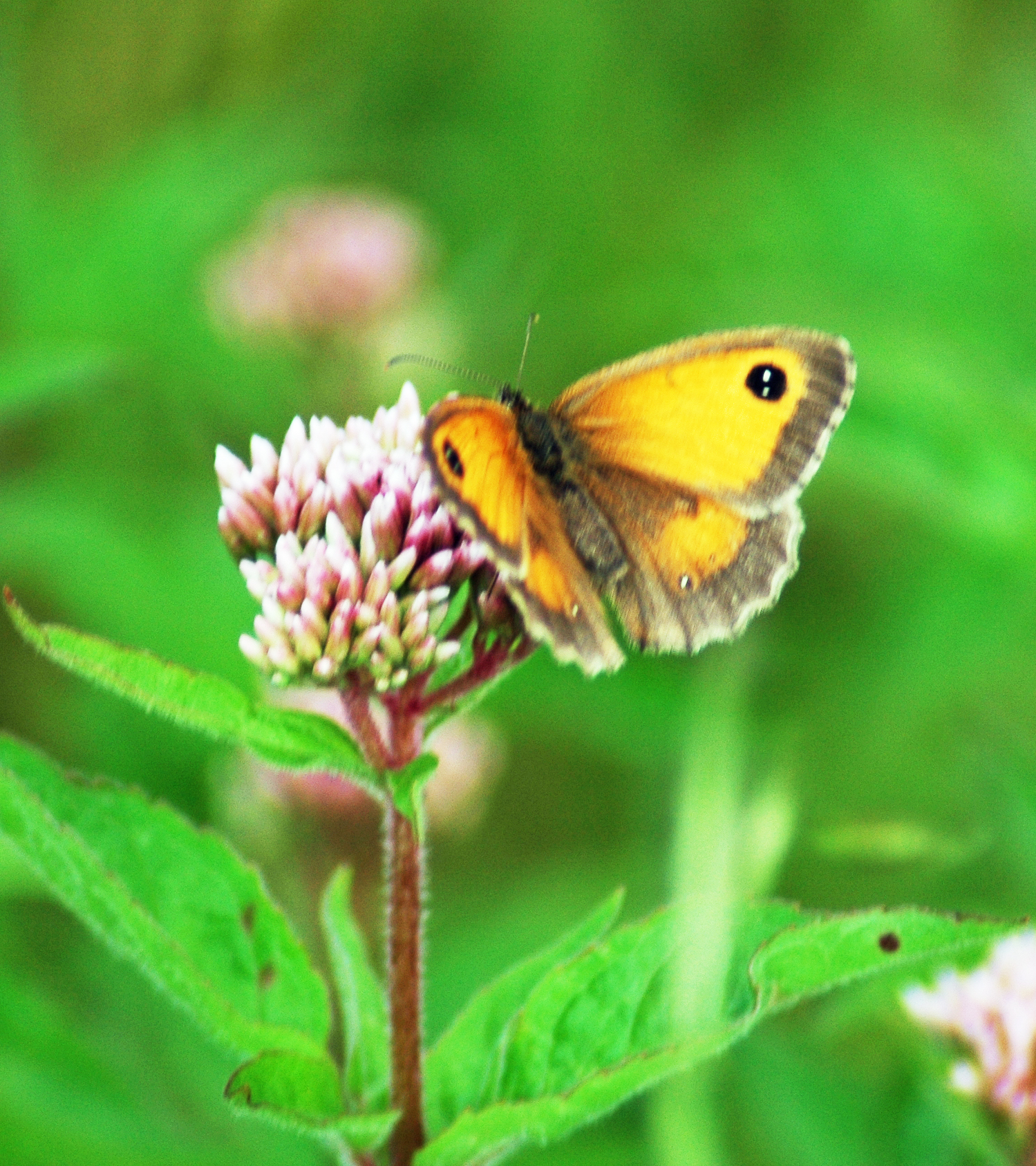
Adults favour Bramble, Ragwort, Scabious, Fleabane , Hemp Agrimony, Privet, Red Clover, Thistles and Thyme.

13/8/12 - Gatekeeper on Hemp Agrimony - Bryn Euryn

13/8/12 – Gatekeeper on Hemp Agrimony – Bryn Euryn

Distribution: The Gatekeeper is a common and widespread butterfly in England and Wales; found south of a line between Westmorland and South-east Yorkshire in the east. In Ireland it is confined to coastal areas of the south and south-east counties. The butterfly is also found in the Channel Islands, but is absent from Scotland and the Isle of Man.

Similar species

Meadow Brown on bramble flowers-Little Orme

Meadow Brown on bramble flowers-Little Orme

Meadow Brown; the two species may be difficult to distinguish with closed wings as the underwing markings are  similar. However, the Gatekeeper tends to rest with its wings open, whereas the Meadow Brown usually rests with its wings closed. The Gatekeeper is also smaller and more orange than the Meadow Brown and has double pupils on its eyespots.


Pretty prickly Thistles

Tags

, , , , , , ,

Thistle is the common name of a group of flowering plants typically characterised by leaves bordered with sharp prickles, mostly belonging to the family Asteraceae.  Prickles or spines are not always confined to the margins of leaves, often occurring all over the plant on surfaces such as those of the stem and the flat parts of leaves. These are a defensive adaptation that protects the plant from being eaten by most herbivorous animals.

From an agriculturalist’s point of view, the most common thistles are regarded at best as troublesome weeds and at worst as noxious ones. However, ecologically, the leaves of some species provide a valuable food source to the larvae of a number of lepidopterae species and he flowerheads supply pollen and nectar to an array of adult insect species. Thistle seeds are a favoured food of many members of the finch family Fringillidae, whose genus name, Carduelis, is derived from carduus, the Latin name for thistle and includes goldfinch, greenfinch and linnet.

1- SPEAR THISTLE – Cirsium vulgare

Family: Asteraceae; Flowering: July to September; Habitat: Disturbed and cultivated land such as pastures, meadows, roadsides, arable fields, gardens, brownfield sites and waste ground.

A widespread and common thistle, the Spear Thistle has the classic thistle appearance – purple, fluffy-looking flowers sitting atop a spiny ball and may well have given rise to the Scottish national emblem. As with other thistles, it can become a nuisance on agricultural land and is often considered to be a weed. The spear thistle is usually a biennial plant although the leaf rosettes can survive as long as 4 years before finally flowering. This robust thistle can reach between half and over a metre in height under favourable conditions. The plant is often solitary.

Spear Thistle flowerbud,flowerhead and leaf

Spear thistle

The flowers are lilac or magenta and are larger than creeping or marsh thistle flowers, reaching up to 4 cms in diameter. Stems are winged and spiny. The leaves are spear-shaped, pinnately-lobed and spiny and give the plant its common name. The upper surface ranges from dark green to light grey. The under surface is green. The leaves are waxy and end in sharp “spear-like” prickles which are tipped with yellow.

Spear Thistle flower buds surrounded by yellow-tipped spines

Spear Thistle flower buds surrounded by yellow-tipped spines

The average number of seeds per flower head is around 100 but there can be up to 340. Seed production per plant may vary from 1,600 to 8,400 seeds. More seeds are produced when ample soil moisture is available during the growing season. Seeds are mostly dispersed during August and September.

Spear thistle seeds

Spear thistle seeds

Spear thistle spreads only by seed. Unlike creeping thistle (C. arvense), the feathery pappus remains attached firmly to the seed as an aid to wind dispersal. Most seed is dispersed less than 2 m from the parent plant and only 10% travel more that 32 m after reaching higher air currents.

Single spear thistle seed

Single spear thistle seed

Ecology

Thistle flowers are amongst the favourite nectar sources of the Pearl-bordered Fritillary, Small Pearl-bordered Fritillary, High Brown Fritillary, and Dark Green Fritillary butterflies.

The seeds are attractive to ants that may aid their dispersal and also to finches, particularly goldfinches and linnets.

Thistle seeds are a favourite food of the goldfinch

Thistle seeds are a favourite food of the goldfinch

Spear thistle flowerhead providing a safe haven for a tiny spider

Spear thistle flowerhead providing a safe haven for a tiny spider

Scotland’s National Emblem 

This thistle, seen throughout Scotland and the Western Isles has been Scotland’s national emblem for hundreds of years. There are several versions as to how the thistle became Scotland’s symbol, most are set around the reign of Alexander III (1249-1286) and in particular the events surrounding the Battle of Largs in 1263.

At one time, Scotland was part of the Kingdom of Norway although it attracted very little interest until 1263 when King Alexander III proposed to buy back the Western Isles and Kintyre from the Norse King Haakon IV. That provoked King Haakon of Norway and in the late summer of 1263 he set off for the Scottish coast with a large fleet of long ships, intent on conquering the Scots. Gales and fierce storms forced some of the ships onto the beach at Largs in Ayrshire, and a Norwegian force was landed.

Legend has it that at some point during the invasion the Norsemen tried to surprise the sleeping Scottish Clansmen. In order to move more stealthily under the cover of darkness the Norsemen took off their shoes, but as they crept barefoot they came across an area of ground covered in thistles and one of Haakon’s men unfortunately stood on one and shrieked out in pain, thus alerting the Clansmen to the advancing Norsemen. His shout warned the Scots who defeated the Norsemen at the Battle of Largs, thus saving Scotland from invasion. The important role that the thistle had played was recognised and so was chosen as Scotland’s national emblem.

The Order of The Thistle

In 1470 that King James III ordered that the image of this plant’s flower be placed on silver coins and also then a little later In 1540, King James V established the Order of the Thistle, a high chivalric order of Scotland. He and his 12 knights each wore a badge depicting a star, a thistle and the words “no one harms me without punishment.”

Today the thistle is found in many Scottish symbols and is used as part of the name of several Scottish football clubs. The thistle, crowned with the Scottish crown, was the symbol of seven of the eight former Scottish Police Services (from which a new national Police Service was formed in 2013), the sole exception being the former Northern Constabulary. The thistle is also the emblem of Encyclopaedia Britannica, which originated in Edinburgh, Scotland.

The Thistle is also used to symbolise connections with Scotland overseas. In Canada, it is one of the four floral emblems on the flag of Montreal; in the United States, Carnegie Mellon University features the thistle in its crest in honor of the Scottish heritage of its founder, Andrew Carnegie.

________________________________________________________

2 – CREEPING THISTLECirsium arvense 

Family: Asteraceae; Flowering: June to October; Habitatrough grassy places : pastures, meadows, roadsides, arable fields, gardens, brownfield sites and waste ground.

Creeping Thistle is a native, perennial, rhizomatous herb, which forms extensive spreading patches and grows up to 2m+ in height. It is one of our most widespread and troublesome weeds and is listed as a noxious weed in Britain under the 1959 Weeds Act, although to little effect. It appears resistant to herbicides and readily regenerates from rhizome fragments caused by ploughing. It is also a very valuable source of nectar, pollen and seed food for many insect specicies.

Flowerheads of Creeping Thistle-Cirsium arvensis

Female flowerbuds are oval  in shape

Flowerheads are pale lilac in colour and up to 2cm across. Female flower buds are oval in shape; male flower buds are slightly more spherical. Bracts are purplish with spreading spiny points. Stems are smooth and spineless. Leaves are very spiny, stiff and wavy.

Pollination

The male flowers produce abundant pollen. The fragrant female flowers are insect pollinated but the pollinators may only visit one type of flower.

Bumblebee on male flowerheads

Bumblebee on male flowerheads which are rounder in shape than female ones

The time from flowering to seeds becoming viable is around 8-10 days. Seeds ripen from June to September and are shed from August onwards. There may be 20 to 200 seeds in each flower head and an average of 680 seeds per stem. The seed number per plant ranges from 1,600 to 50,000.

Creeping thistle plant gone to seed

Creeping thistle plant gone to seed

The seeds are 4–5 mm long, with a feathery pappus which assists in wind dispersal

The seeds are 4–5 mm long, with a feathery pappus which assists in wind dispersal

Ecology

Creeping Thistle foliage is used as a food by over 20 species of Lepidoptera, including the Painted Lady butterfly and the Engrailed, a species of moth, and several species of aphids. The flowerheads provide nectar and pollen for a wide variety of insects.

30/6/13 - cuckoo spit on creeping thistle

30/6/13 – cuckoo spit on creeping thistle

12/7/13-Creeping thistle stem covered with aphids- food for the 7-spot ladybird

12/7/13-Creeping thistle stem covered with aphids- potential food for the 7-spot ladybird

21/7/13-Meadow Brown butterfly on creeping thistle flowers

21/7/13-Meadow Brown butterfly on creeping thistle flowers

11/08/28-wall mason wasps on creeping thistle flower

11/08/28-wall mason wasps on creeping thistle flower

6-spot Burnet Moth on creeping thistle

6-spot Burnet Moth on creeping thistle

3- Marsh ThistleCirsium palustre

Family: Asteraceae; Flowering: July to September; Habitat:
Wet habitats, woodland clearings, wet ditches and marshes.

A biennial, medium to tall plant reaching to 1.2 metres, stems spiny-winged to the top, sometimes branched above.

Marsh Thistle

Marsh Thistle

Marsh Thistle flowerheads are a darker purple than those of the creeping thistle

Marsh Thistle flowerheads are a darker purple than those of the creeping thistle

Flower buds are oval and bracts are purplish above and green below – sometimes cottony. Flowerheads are usually purple, 10 to 15 mm across and held in clusters of 2 to 8. Florets are reddish purple and anthers are blue-purple. The stem is winged and spiked. Leaves are linear lanceolate, pinnately lobed and very spiny, mostly unstalked, hairy above.

The pappus is slightly feathery.

This species may be confused with the Welted Thistle – Carduus crispus but can be distinguished by its feathery seeds. Welted Thistle has seeds with down that is unbranched.

The Brambles: des. res. for Whitethroats, sea views

Tags

, , , ,

On the Little Orme there is a huge bramble tangle set in the middle of a sea of long grass. Surrounded thus, it is some distance from the close-cut grass pathways on the clifftop and as there are other more easily accessed bushes, I may not have approached this particular one if I hadn’t noticed a bird fly across to it.

From the bird’s behaviour and general ‘jizz’ I thought and hoped it may be a Whitethroat, a summer migrant that I have heard before, but never had a close view of in this location.

(Jizz is a term used by birders to describe the overall first impression of a sighted bird, based on such characteristics as shape, posture, flying style or other movements, size and colouration combined with voice, habitat and location.)

As I moved a little closer the bird flew up nearer the top of the bramble, I saw it had an insect in its beak and that it was definitely a lovely male Whitethroat. So, there was a nest in there, confirmed when a female also carrying food made an appearance on the far side of the bush.

Whitethroat trying to hide

Whitethroat trying to hide

Although I was keeping my distance neither bird was happy I was there at all and the male expressed his annoyance by “churring”, raising his crest and puffing his throat out a bit, which showed he was upset. I don’t like upsetting birds,  but it did make for a more interesting photograph.

Common Whitethroat- Sylvia communis

Common Whitethroat- Sylvia communis

Whitethroat– Sylvia communis

Welsh: Llwydfron

The Whitethroat is a summer visitor and passage migrant to Britain that may be seen in all parts of the country and most frequently choose arable land, scrub and reedbeds as nesting sites.  They arrive during April-May and leaving in late September-early October to winter in Africa, some heading as far south as South Africa.

Graph from BTO showing Whitethroat population trend for Wales

Graph from BTO showing Whitethroat population trend for Wales

In 1968, Whitethroats sustained heavy losses as their wintering grounds in sub-Saharan Africa suffered major drought – breeding Whitethroats suffered a 90% drop in the UK. Numbers have not fully recovered yet and the BTO state their Conservation Status as AMBER because of the recent breeding population decline (1969-2007).

A male Whitethroat, Ceibwr, Pemrokeshire

A male Whitethroat, Ceibwr, Pemrokeshire

Description

The Whitethroat is a medium-sized, long-tailed warbler. The male is grey dusted with rust brown above, with bright chestnut brown fringes to the wing feathers, the head is a pale grey, the breast pinkish-buff and the throat is a bright white. The bill is greyish-brown and the legs are pale brown. The eye is pale brown with a white eye ring. Females are similar but brown on the head and nape where the male is grey.

Whitethroats prefer to stay concealed in bushes

Whitethroats prefer to stay concealed in bushes

Behaviour & song

Warblers in general are often described as ‘skulking’, but the Whitethroat is not quite as secretive as some; the male will perch in full view to deliver its brief song with gusto. The song is variously described as sweet, ‘scratchy’  and having a jolty rhythm. They are also very inquisitive birds and will venture to the top of a bush to investigate any intruders, before scolding them with a rapid churring call.

Nesting

The male whitethroat may mate with the first female to cross the territory it immediately stakes out upon his arrival back in Britain. He begins making a number of trial nests, perhaps as many as three. The female then chooses a nest, which will be a deep cup shaped construction located close to the ground in cover, and lines it with hair, down and wool.  4-5  eggs are laid which are about 18 mm by 14 mm, smooth and glossy, pale green or buff in colour with olive-grey speckles. The duties of incubating the eggs are performed by both parents. Both adults feed the young birds. There may be one or two broods raised in a season.

Food

In the breeding season whitethroats eat mainly insects, especially beetles, caterpillars and bugs. They also eat spiders and towards the end of the summer and into the autumn they turn increasingly to fruit and berries, sometimes invading gardens to raid soft fruit crops.

Where to see Whitethroats in Wales

Whitethroats  breed in many areas including woodland edges and clearings, country lanes anywhere they may find brambles, briers, bushes or overgrown hedges. They may also nest in gardens, but avoid urban and mountainous places.

In Wales they frequently find their favoured habitat on clifftops: locally on the Little Orme and I have seen them in various spots when walking along the Pembrokeshire Coastal Path. Another reliable spot for hearing and seeing them has always been in the similarly-vegetated area on the road down to Martin’s Haven, where you get the boat to Skomer Island.

June 11th 2010  

One late afternoon in June, my friends and I set off for a walk along a part of the Pembrokeshire Coastal Path beginning at Ceibwr and heading in the Poppit Sands direction (we’ve never yet made it that far). There were several Whitethroats about, but we didn’t expect to get the close up views we were treated to. Firstly, there was the one in the first two photographs above, that was in amongst a huge tangle of brambles at the back of the beach. Another flew right in front of us as we walked up the pathway to the clifftop.

A whitethroat flew in front of us

A whitethroat flew in front of us

At the top of the upwards part of the path we caught sight of one very close to the edge of it with food in its beak. It clearly wanted to reach its nest on the opposite side of the path but was reluctant to reveal its location, so it stayed put perched on a hogweed stem perhaps hoping we hadn’t seen it.

11/6/10-A whitethroat with food perched on hogweed-Ceibwr, Pembrokeshire

11/6/10-A whitethroat with food perched on hogweed-Ceibwr, Pembrokeshire

We stood still to give it the chance to make a break for it and it crossed to perch on a barbed-wire fence. It was hanging on tightly to the caterpillar in its beak and finally flew off into a shrub a few metres away to present it to its nestlings.

The whitethroat perched   on the wire fence hanging on to its nestling's tea

The whitethroat perched on the wire fence hanging on to its nestlings’ snack

 Similar species : Lesser Whitethroat 

The Common Whitethroat can be distinguished from the smaller Lesser Whitethroat by the absence of the dark mask on their cheeks and the presence of  rusty brown edges to their wing feathers, pinky chest and longer tail.

Read more about whitethroats in Cambridgeshire in Finn Holding’s blog, the Naturephile

http://thenaturephile.com/2013/05/23/whitethroats-and-awards/

The blackberry bramble

Tags

, , , ,

Brambles have been flowering for a while now, but in the last couple of weeks they have reached a peak and many of the tangled shrubs are smothered with blossom. This is wonderful for insects that can gorge themselves on nectar without the need to expend energy flitting between different plants.

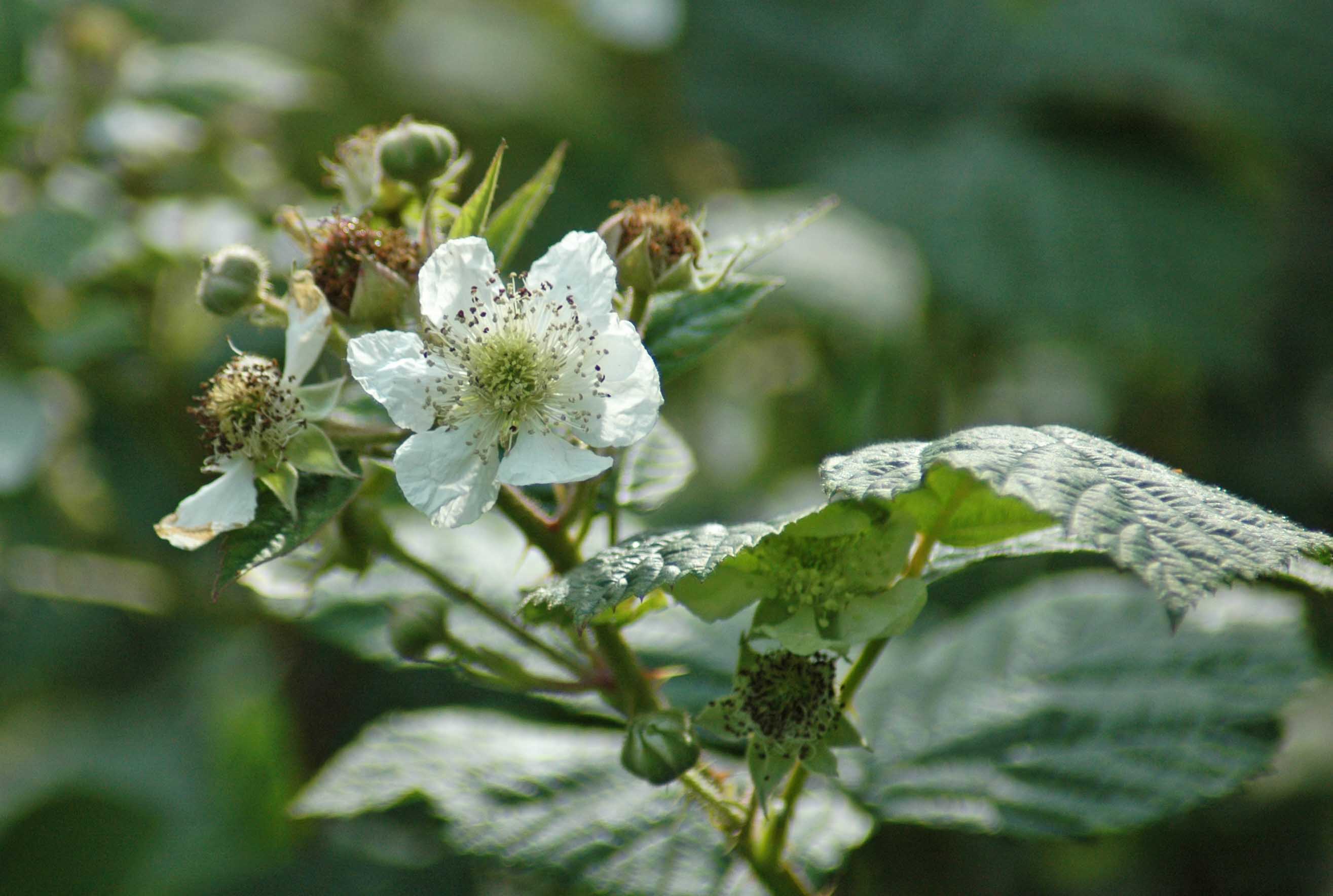
Bramble flower

Bramble flower

In the British Isles the term brambles is used to describe any rough,  tangled prickly shrub, but more specifically applies to the Blackberry bush –Rubus fruticosa.

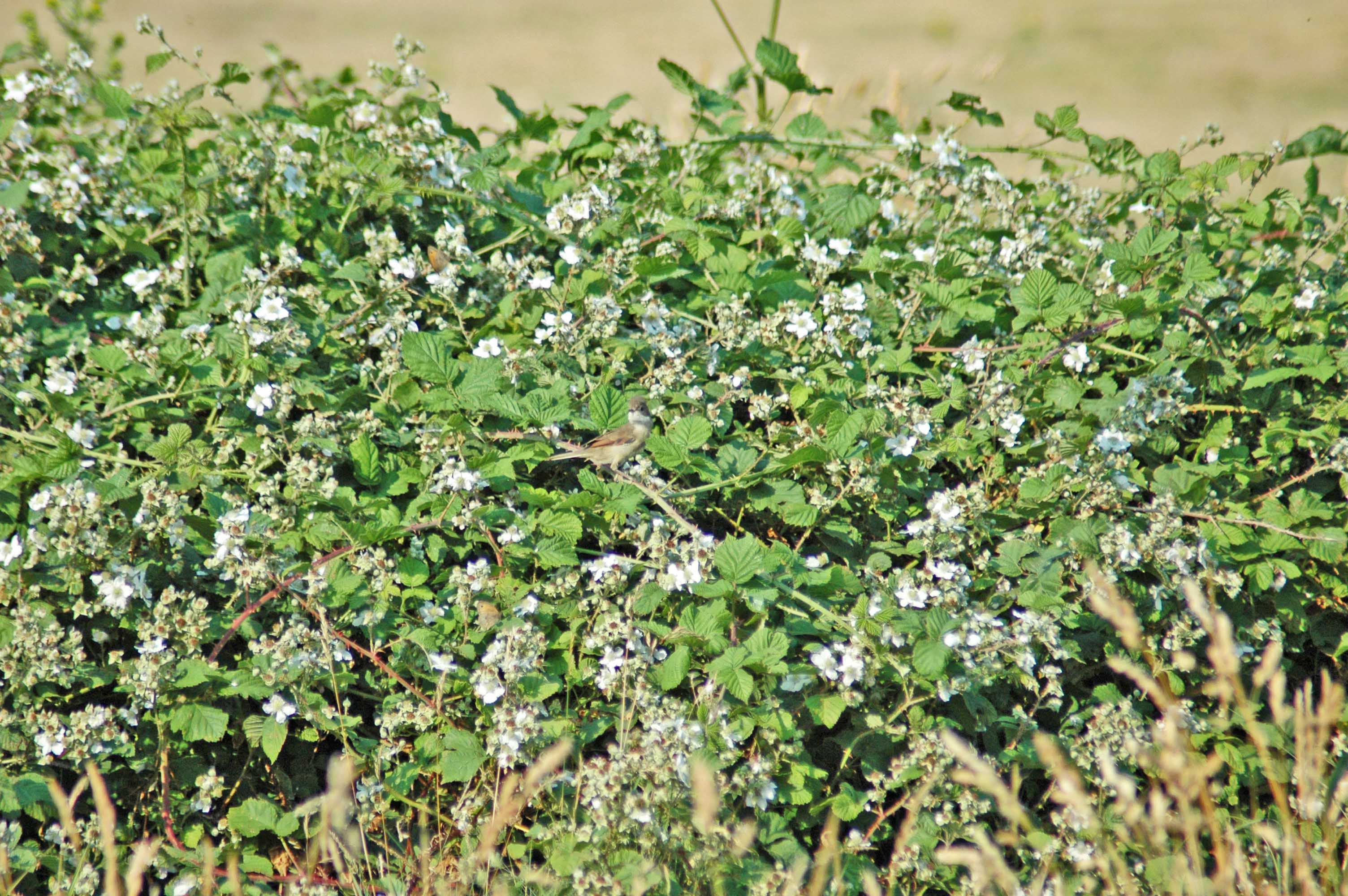
A huge bramble smothered with blossoms

A huge bramble smothered with blossoms – Little Orme. Click for a larger picture-the bird is a Whitethroat

Bramble bushes have a distinctive growth form. They send up long, arching canes that do not flower or set fruit until the second year of growth. The shrub can easily become a nuisance in gardens, sending down its strong suckering roots amongst hedges and shrubs, but in the wild it has great importance for its conservation and wildlife value.

The flowers attract nectar-feeding butterflies, bees and hoverflies, and the leaves are important food plants for the larvae of several species of Lepidoptera.

A beautiful Tortoiseshell butterfly on bramble flowers

A beautiful Tortoiseshell butterfly on bramble flowers

Small skipper (male) on bramble flowers-Bryn Euryn

Small skipper (male) on bramble flowers-Bryn Euryn

6-Spot Burnet Moth on bramble flowers

6-Spot Burnet Moth on bramble flowers

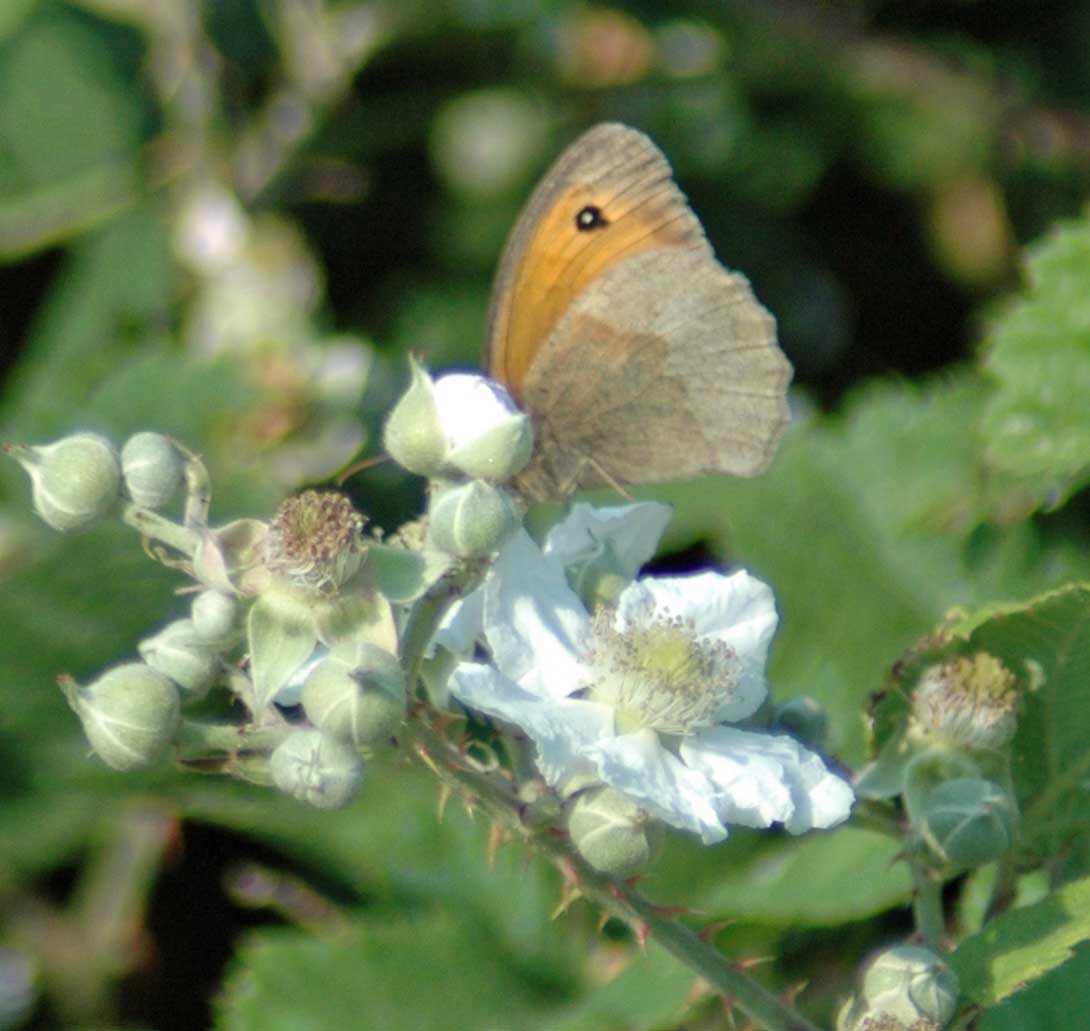
Meadow Brown feeding on bramble

Meadow Brown nectaring on bramble

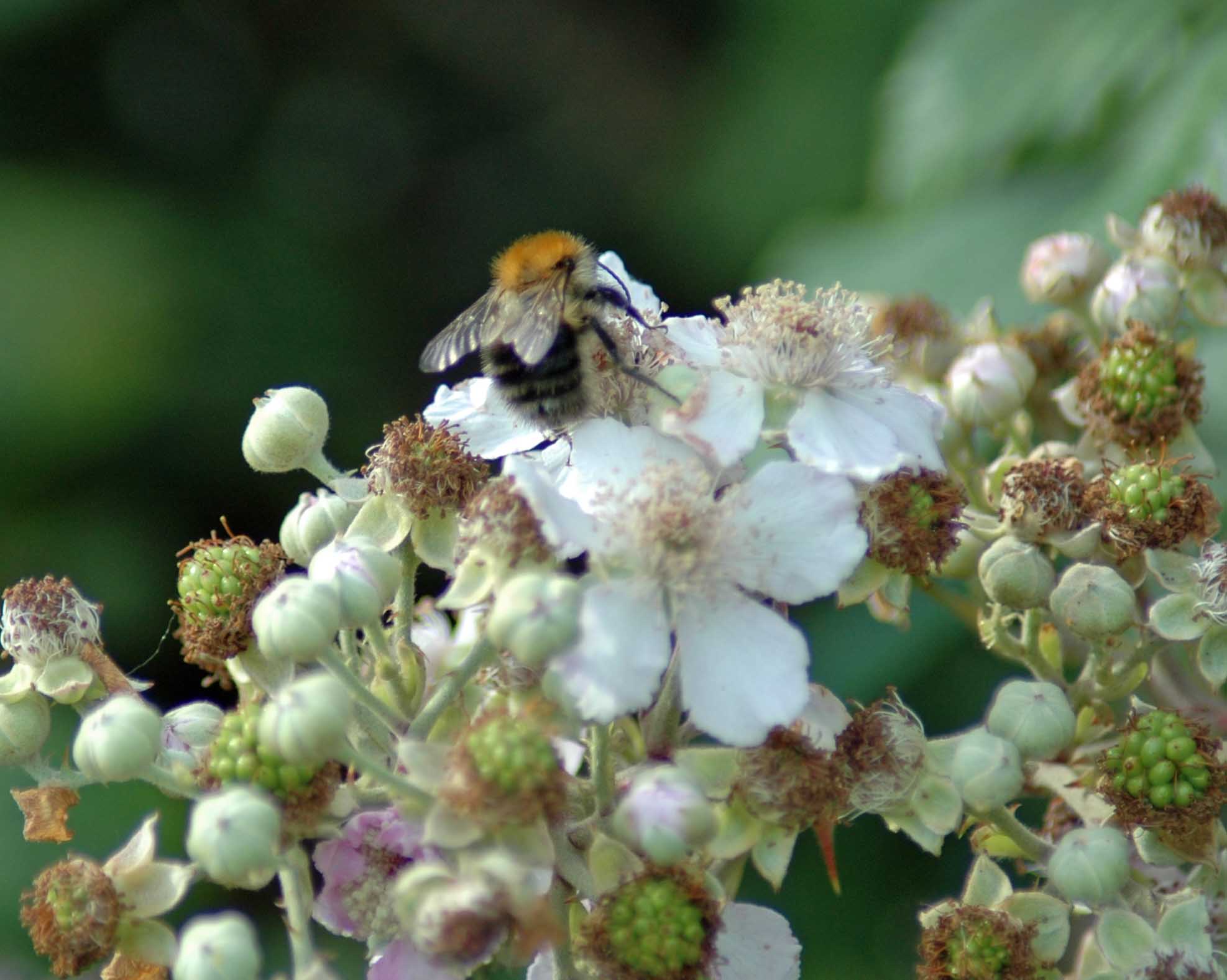
Common Carder Bee on bramble flowers

Common Carder Bee on bramble flowers

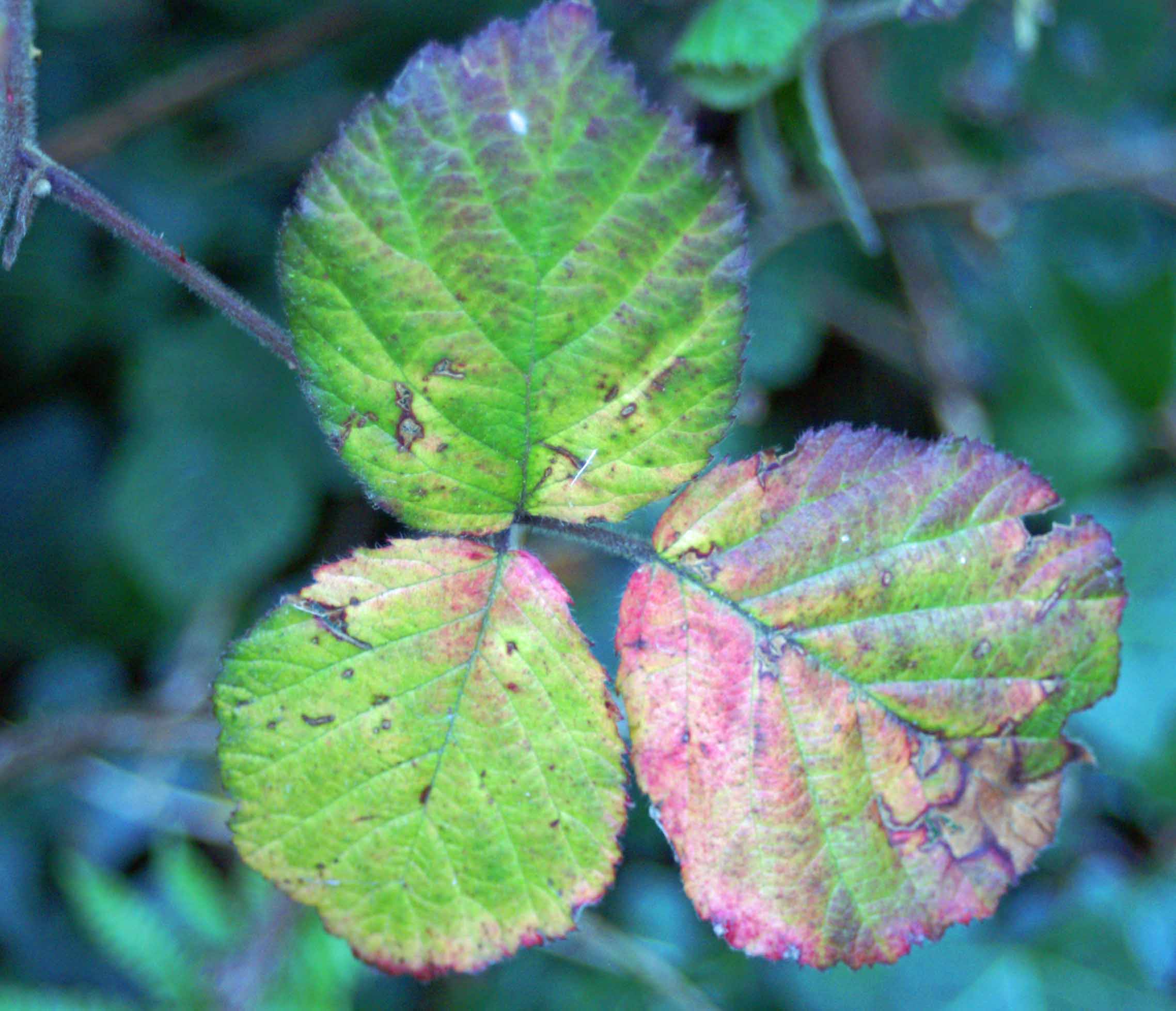
Bramble leaves usually have trifoliate or palmately-compound leaves. Old leaves often remain on the stems throughout the winter until new shoots are produced.

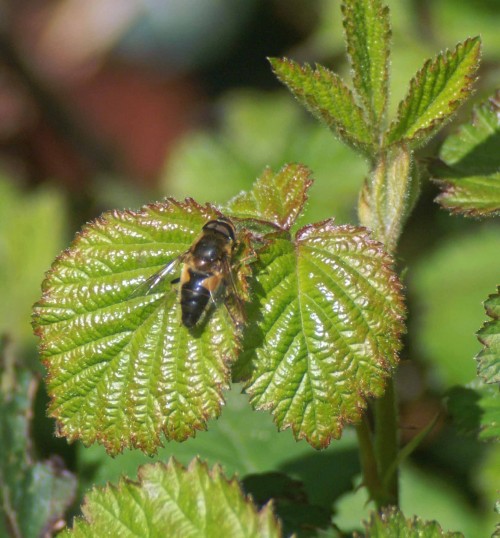
Eristalis basking on new leaves of bramble - rubus

April -Eristalis basking on new leaves of bramble

September - Bramble leaves

September – Bramble leaves

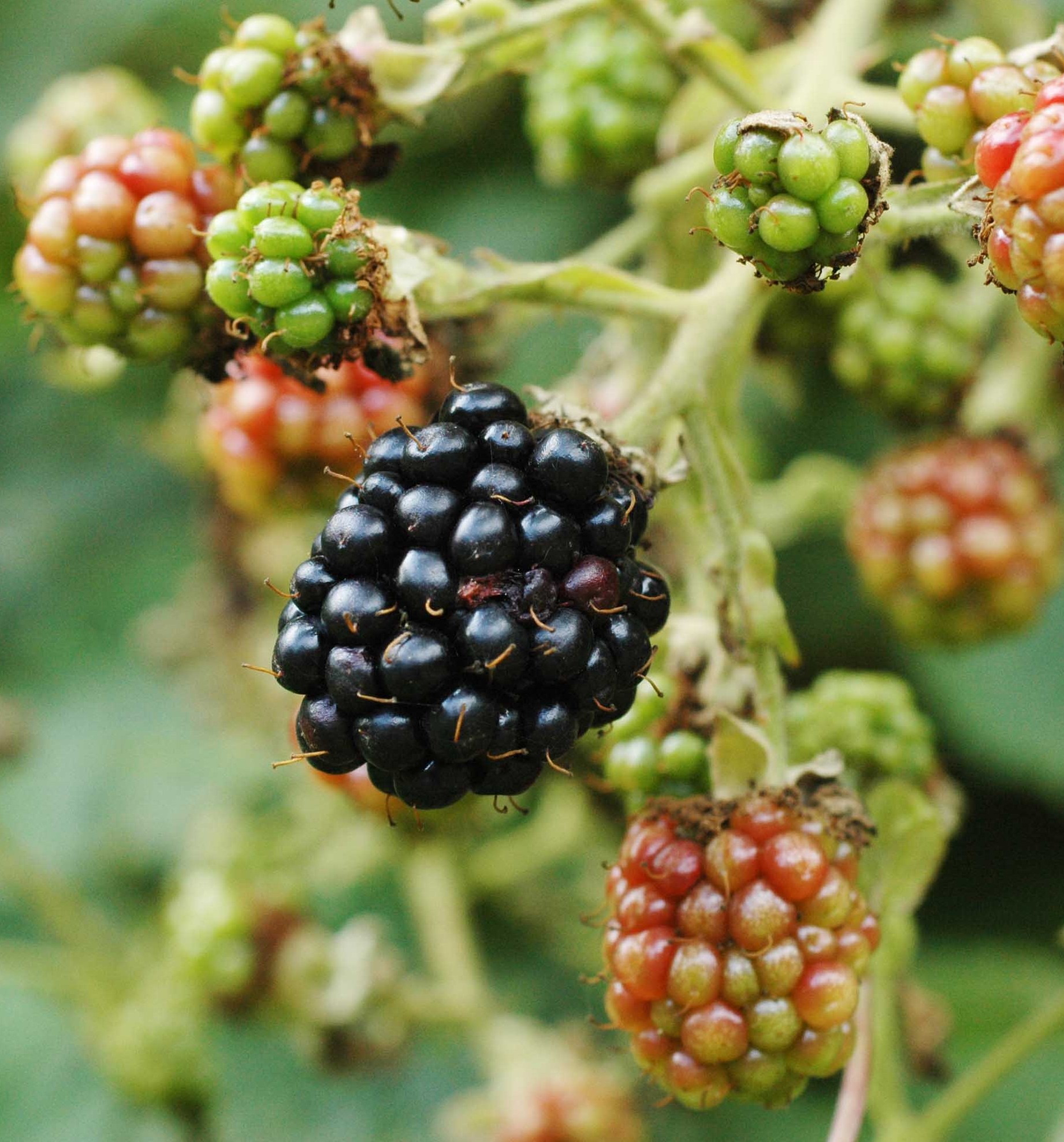
A ripe blackberry

A ripe blackberry


Bramble fruits are aggregate fruits and each small round berry is called a drupelet. The blackberry flower receptacle is elongate and part of the ripe fruit, making the blackberry an aggregate-accessory fruit.

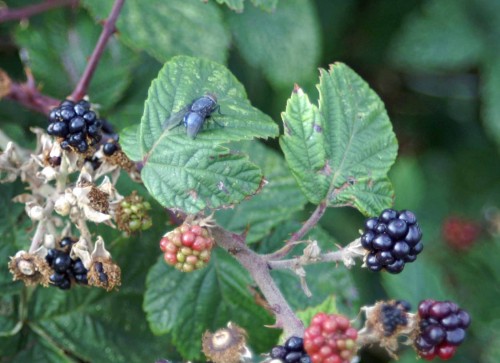
22/8/11-Bluebottle fly on blackberries

22/8/11-Bluebottle fly on blackberries- a case for washing them before eating!

Traditional medicinal uses

A child afflicted with whooping, or chin-cough may have been passed through a  blackberry or bramble shoot that had rooted naturally at either end; this was a gesture symbolic of rebirth in a perfect state. Herefordshire this treatment was enhanced: the Lord’s Prayer was recited whilst the patient, eating bread and butter, was passed nine times under the bramble arch. Sometimes a rhyme was added:

                                        Under the briar and over the briar,                                                                                             I wish to leave the chincough here.

On the journey home the remains of the bread and butter were given to a passing animal or bird – “but never to a Christian”- and, as the bread was consumed, the cough would disappear. Other childhood diseases, rheumatism and boils were also cured with this procedure.

Another blackberry cure of repute was a burn lotion, made by floating 9 blackberry leaves in water from a holy well.

Mythology and legend

What is probably the earliest recorded parable is Jotham’s parable of “The trees choosing a King.” The first tree to be offered this distinction was the Olive, but the Olive was concerned with the business of producing oil, and so the Vine was approached. The Vine was too busy producing wine, and eventually the Bramble was requested to accept the offer, and the Bramble having nothing better to do, affably agreed.

Blackberries have multiple meanings across religious, ethnic and mythological realms. In all Celtic countries taboos attend the picking of blackberries; mid-Mediterranean folklore claims that Christ’s Crown of Thorns was made of blackberry runners.  The deep colour of the berries represents Christ’s blood. They have been used in Christian art to symbolize spiritual neglect or ignorance. 

In many English counties blackberries are never picked after Michaelmas Day on September 29th. Legend has it that the blackberry was once beautiful, but was cursed by Lucifer when he fell into the bush when he was forced out of heaven. Every September 30th, with the ripening and darkening of the berries, he is said to variously ‘wave his club over them’, ‘spit on them’, ‘curse them’ or ‘put his cloven hoof on them’.

Some folklore associates the blackberry with bad omens. European stories have claimed they are death fruits with ties to Wicca. They can also symbolize sorrow. In an old proverb they signify haste. A man is so excited to pick the berries that he jumps into the bush and the thorns cause him to lose his eyesight. He regains it, however, upon jumping back out of the bush.

Greek mythology contains a legend similar to this. When Bellerophon, a mortal, tries to ride Pegasus to Olympus, he falls and becomes blind and injured upon landing in a thorny bush. This is his punishment for trying to take the power of the gods. Therefore, the fruit also symbolizes arrogance.

Other Uses

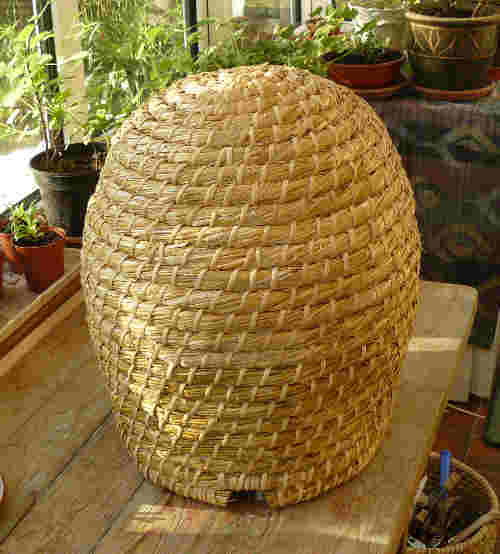
Split bramble stems are traditionally used as binding material for straw in the production of lip work basketry, such as lip work chairs and bee skeps, and sometimes used to protect other fruits (strawberries).

Lip work is a technique where wheat straw is made into coils or ropes and then bound into shape with strips of bramble. In addition to tall backed chairs which protected the occupant from draughts, beehives, corn measures, baskets and trays were made. The photograph of the beautiful traditional straw skep beehive below is from the website of Martin Newton, a present-day maker of lip work basketry pieces.  http://www.martinatnewton.com/page2.htm

A traditional lip work bee skep

A traditional lip work bee skep