• Home
  • about
  • about the photographs
  • Local Nature Reserves
    • Bryn Euryn Local Nature Reserve
    • Mynydd Marian
  • Wales Coast Path
    • Grey Seals in North Wales
    • St.Trillo’s Chapel
    • Wildflowers of North Wales Coastal Paths, Cliffs and Dunes

everyday nature trails

everyday nature trails

Category Archives: Wildflowers of Wales

On a Perfect Spring Day

03 Thursday May 2018

Posted by theresagreen in birds singing, British hoverflies, Bryn Euryn Nature Reserve, Butterflies of Wales, Local Nature Reserves, Nature of Wales, North Wales, Wildflowers of Wales, woodland birds, woodland walks, woodland wildflowers

≈ 11 Comments

Tags

ashy mining bee, Bee-fly, Blackcap, blackthorn blossom, Chiffchaff, comma, cowslip, Greater Spotted Woodpecker, hairy-footed flower bee, tawny mining bee, tree bumblebee

April 19th – Bryn Euryn

Today was the middle day of the three consecutively warm sunny days that tantalised us with the notion that Spring had truly arrived, and judging by the activity here today it had a lot of our wildlife fooled too. The sky was clear and that almost-unbelievable shade of deep blue, the birds were singing and best of all, it was warm!

WOODLAND PATH

A few metres along the Woodland Path of my patch is an untidy-looking stretch, divided by the narrow path, where missing trees have opened up the canopy, letting in the light and warmth of the sun. Somewhat mysteriously, it holds great allure for diverse species of insects, some of which at certain times can be found here in surprising numbers. At the right time on the right day, ten minutes spent in this  ‘hotspot’ can be as productive as two hours spent ranging over the rest of the site.

11:44 Today I was here at the right time to see a surprising amount of insects. Most prolific were hoverflies in all shapes and sizes from big and bulky to teeny-tiny and dainty.

Eristalis sp hoverfly
180419-BEWP- (6)-1148

Syrphus sp.

There were few flowers here for nectaring upon, so that wasn’t the attraction for the majority of the hoverflies; I caught just one on the tiny flowers of Dog’s mercury. There were dozens of this small black and yellow striped species here, all very fresh and shiny and mostly basking on the sun-warmed leaves of brambles and nettles.

One side of the ‘hotspot’ is open to sunlight, clear of trees but sheltered by those standing behind it and by large shrubs of laurel and holly on either side. A large tangle of bramble fills the gap in the vegetation and is the only barrier between you and the Expressway below at the bottom of an almost-vertical slope. (Only joking, there’d be plenty of trees to stop you if you fell!) On the other side is a large patch of nettles, the aforementioned Dog’s mercury, more bramble and a pretty patch of periwinkle, all growing through a ground-covering of ivy.

Periwinkle
Periwinkle
Dog's Mercury
Dog’s Mercury

A lone Tree bumblebee flew in, visited a couple of the periwinkle flowers then stopped to bask on a last-year’s half-eaten bramble leaf. I think it was a male (no pollen baskets) and was looking a bit the worse for wear. He seemed to have a burden of mites and I wondered if exposing them to warm sun might dislodge them. I’ve seen birds do that.

180419-BEWP- (4)-1146
180419-BEWP- (18)-1155

A smaller bee caught my eye as it came to rest on an ivy leaf. I didn’t realise what it was until I saw my photograph, then was excited to see it was a Hairy-footed Flower Bee, this one a male and my first record of this species here.

Hairy-footed Flower Bee – Anthophora plumipes (male)

Hairy-footed Flower Bee (m)-Anthophora plumipes

A species common and widespread in much of England and Wales, especially in towns, cities and villages. Often nests in the soft mortar and exposed cob of old walls, but occasionally will nest in the ground, preferring bare compacted clay soils. Flies from late February to mid-June, and is particularly partial to Lungwort (Pulmonaria) flowers.

Males and females look very different from one another: the female resembles a small, black bumblebee with orange-red hairs on the hind leg and a rapid-darting flight; she’ll  often approach a flower with her long tongue extended. Males are mostly brown with a dark tail (fresh specimens are gingery). Cream markings on face distinguish it from all bumblebees.They are often among the first bees of the year to emerge and often hover in front of flowers and when pursuing females.

Another little bee came to rest on a nettle leaf, this one I recognised as an Ashy mining bee and another male.

Ashy mining bee – Andrena cineraria (male)

Ashy mining bee (m)-Andrena cineraria 

A distinctive and obvious spring-flying solitary bee. Females are black, and have two broad ashy-grey hairbands across the thorax. Males emerge well before the females. They look similar, but their thorax is entirely covered with less dense grey hairs, and there’s a pronounced tuft of white hairs on the lower face. Species has a single flight period each year from early April until early June. Nests are constructed in the ground; entrances are surrounded by a volcano-like mound of excavated spoil; often in dense aggregations in  lawns, flower beds, mown banks and in field margins.

And where there are mining bees there are those who would prey upon them….. Bee-flies: quirkily-cute in appearance but not good to know if you’re a hard-working mining bee; they’ll spy out your nest-hole and craftily kick their eggs inside with those long legs, then later their hatched larvae will feast on yours.

Bee-fly-Bombilius major
180419-BEWP- (15)-1150-

Wasps were out on the prowl too; I didn’t get a clear enough image to tell if this was a German or Common Wasp – the latter have a distinctive anchor mark on their face; this image is a bit fuzzy.

180419-BEWP- (26)-1203
180419-BEWP- (28)-1203

12:07 I could have lingered longer, but birds were singing, I’d been serenaded by a Song thrush and a Robin as I stood watching insects, Blue tits twittered on all sides and I was keen to see what else was happening.

Bluebells are beginning to flower and offer nectar to those that can reach it, there’s also Greater Stitchwort and lots of Dog Violets. A male Orange-tip butterfly raced past me over the bluebells and through the trees, clearly on the trail of a female and not stopping for an instant.

180419-BEWP- (39)
180419-BEWP- (39)-1217

Greater Stitchwort – Stellaria holostea

There are masses of glorious glossy golden yellow lesser celandines shining in the sunlight too.

I stopped to admire the celandines lining a section of the path and not at all concerned by my presence, a Blue tit perched above me and began to sing.

180419-BEWP- (48)
180419-BEWP- (44)

Beneath him dozens of shiny new flies arrived to bask on soft sun-warmed new bramble leaves.

There’s one special spot I know where Wood Anemones light up the woodland floor like fallen stars, turning their faces to the sun

180419-BEWP- (56)
180419-BEWP- (57)

and another where those of the shamrock-leaved Wood sorrel shyly hide theirs.

Over the boundary fence, the formidable thorny boundary hedge of gorse and blackthorn is softened now with their fragrant gold and white blossoms.

I heard a bird singing, a short loud burst of notes that I thought at first was a Wren, but it wasn’t quite right. I’d forgotten that another tiny bird, the Goldcrest also has a disproportionately loud song, remembering when he broke cover and flitted about in shrubbery in front of me. He wasn’t going to oblige me with a photograph, much too busy! So I stood gazing upwards for a while – you can’t get too much beautiful blue sky…

… or pretty blossom, can you?

WOODLAND TRAIL

12:58 There’s another hotspot around the junction of my Woodland Path with the reserve’s Woodland Trail, this one for birds. Here there is a territory of both Blackcap and Chiffchaff so there is the possibility of hearing if not seeing both species here. Today I was lucky; I heard the Blackcap’s song as I approached and walking slowly and as quietly as I was able I spotted him. He continued to sing but moved restlessly through the branches as I got nearer then flew off across the other side of the track.

While he sang from behind foliage over there I watched a pretty female Tawny mining bee feast on Blackthorn blossom.

180419-BEWP- (73)
180419-BEWP- (71)

Then the Blackcap came back to where he’d started, so I think perhaps his red-headed mate may be on their nest somewhere close by.

This gorgeous gorse is below his singing tree. It would make a safe place to nest and the flowers would attract insects for dinner.

I had heard a Chiffchaff singing nearby too but was pleasantly surprised when he appeared, continuing his song while flitting about amongst the twiggy branches searching for insects.

13:21 Further along the trail I spotted a flutter of orange – a lovely fresh Comma butterfly  basking on dry leaves at the edge of the path. As I watched it moved, (look away now if you’re squeamish) onto a thankfully dryish dog poo deposit. I had to take the picture as it nicely presented its underside showing off the distinctive white mark for which it is named.

180419-BEWP- (85)
180419-BEWP- (86)

The disturbed ground of the pathsides supports some of the ‘weedier’ wildflowers like dandelions which provide important nectar when there’s not much else in flower.

You’d be very unlucky not to hear and see a Robin singing along here, there seems to be one at regularly spaced intervals. They sit and watch out over the track then dart out to pounce on any potential prey they may spot. This one had been singing but stopped to watch me.

I waited to see if he’d start singing again and was distracted by a bird whistling loudly. I scanned around searching for whatever was making the sound, one I didn’t recognise at all but that sounded to be being made by quite a large bird. After a few minutes the whistler appeared and to my amusement turned out to be …. a Great Tit! Of course it was, one of the basics of birdsong recognition is ‘when you don’t recognise it or haven’t heard it before, chances are it’ll be a Great Tit’; they have an incredible repertoire of sounds to call upon. I was thankful to him for keeping me in that spot though, as this gorgeous Greater Spotted Woodpecker flew onto a tree trunk literally right in front of me.

The Woodpecker stayed there, keeping a watchful eye on me. This bird is a female and is holding something small in her beak, so I imagine she has a nest nearby and was unwilling to reveal it. I moved away quickly, thanking her for the photo opportunity as I did.

Great Spotted Woodpeckers are about the same size as Starlings. Their plumage denotes their age and sex. Juvenile birds have red foreheads that are replaced by black as they moult in the autumn. Adult males then have a red nape while females have no red on their head at all.


The Lesser Celandines have been late flowering this Spring but are glorious now and more prolific than I’ve seen them before. It’s not just the flowers that are prolific, so too were hoverflies and Bee-flies seemed to be everywhere.

180419-BEWP- (106)
180419-BEWP- (103)

Approaching the entrance to the meadow another Robin, which looks as though it is singing, but was actually ‘ticking me off’, let me know it didn’t appreciate my disturbing it.

THE UPPER MEADOW (ADDER’S FIELD)

The grass of the meadow was cut back hard last autumn and so far there’s not much happening there yet, but the grass is beginning to grow and the cowslips are starting to come out. They’ll be later on the more exposed ‘downland’ side of the hill.

180419-BEWP- (115)
180419-BEWP- (120)

Another Bee-fly settled on an exposed rock in the pathway, fluttering its wings rapidly and making flicking movements with its legs as they do when depositing their eggs, but there was no sign of a mining bee nest anywhere near, so not sure what it was doing.

Summer Rainfall Prediction:

If oak is out before the ash, there’ll be a splash ; if ash is out before the oak there’ll be a soak…

180419-BEWP- (121)
180419-BEWP- (117)

Keep the brollies handy, looks like ash is furthest on so far….!

Wriggling across the still-damp ground on the way to the Summit Trail was an earthworm. Double jeopardy came to mind – exposure to warm sunshine and hungry birds; foolish worm.

Last year I noticed spots along the trail here where Mining Bees were making nests. having seen a few about today I kept an eye out for more signs of their activity and spotted these little ‘volcanoes’, evidence of their presence. I waited a while but no bees showed, so I don’t know which species had made them, but I think maybe Tawny Mining Bees.

180419-BEWP- (128)
180419-BEWP- (126)

THE SUMMIT

It was cooler and breezier up here. I walked carefully, hoping there may be Small Tortoiseshell butterflies basking on the bare earth of the path, but not today, although I did see two busily chasing one another at speed as they disappeared over the edge of the cliff.

The mountains and the distant Conwy valley were veiled by a misty haze.

The blackthorn is smothered with blossom and looking beautiful. It will be interesting to see how much of it gets pollinated and develops as fruit this autumn. Sloe gin comes to mind.

Blackthorn – Prunus spinosa

The path back down to the Woodland Trail felt almost bridal with falling petals showering down onto the ground like confetti. A pretty way to end this account of a lovely walk.

Share this:

  • Share on Facebook (Opens in new window) Facebook
  • Share on Pinterest (Opens in new window) Pinterest
  • Share on X (Opens in new window) X
Like Loading...

Little Orme

21 Saturday Apr 2018

Posted by theresagreen in birds of Wales, Birdwatching on North Wales coast, coastal walks, Industrial sites reclaimed by Nature, Little Orme, Nature of Wales, North Wales, North Wales Path, Wales Coast Path, Walking Trails, Wildflowers of Wales

≈ 12 Comments

Tags

Cormorant, Cormorant breeding plumage, cormorant with white head, fulmar, Great cormorant, grey seals, Northern Wheatear, phalocrocorax carbo, shag

April 5th

I’m home for a few days and feel the need to catch up on what’s happening here before setting off again at the weekend. I decided to head for the Little Orme, the best place I know locally to see a great variety of wildlife in a short space of time. Spring is generally late arriving this year and usually comes even later here than to other more sheltered sites, so I hoped I wouldn’t have missed too much.

The blend of habits on this limestone headland make it special, if not unique as it provides for the needs of diverse species of birds from House sparrows to Chough and Fulmars and it supports some lovely lime-loving wildflowers. The human influence on the site is most evident in its dramatic reshaping by quarrying, there is also a farm with some enclosed fields and sheep that are allowed to range freely. Houses butt closely up against its Penrhyn Bay boundary and it is rare to come here and not see people out walking. Today I noticed that someone has hung a bird-feeder up in a small tree just inside the site. There was a Great tit and several House sparrows taking the seed on offer, but not surprisingly they were seen off by Jackdaws.

Great tit at feeder
Great tit at feeder
Jackdaw at feeder
Jackdaw at feeder

It’s the Easter holidays, so as I’d expected there were a good few people here, families enjoying the fresh air and sunshine, the usual dog-walkers and a few dog-less ones too. 

There were people clambering on the rock beside Angel Bay. Below them a trio of Herring gulls set up a raucous racket. I couldn’t be sure what had set them off, but maybe they were objecting to people invading their space.

On a rock jutting out into Angel Bay another pair sat calmly, heads turned towards the group of grey seals down below them, some of which were also making a bit of noise.

They were a lovely little group of adults with their young ones. Some were trying their best to relax while others were restlessly in and out of the water. At least two more were swimming around out in the bay.

Grey seals

Grey seals slumbering

A single Guillemot was also cruising around on the water but didn’t stay visible for long, soon diving and swimming away underwater hunting fish.

Guillemot

When I first entered the site I was surprised not to see or hear Fulmars on the high cliff that usually has several pairs nesting, or preparing to nest on its ledges by this time. There were one or two flying around the cliffs nearer to the sea though, so I set off up the steep path to the old quarry field to see if there were signs of nesting there.

Fulmars are distinctive in flight holding wings stiff and straight out

I’m sure this upward slope gets steeper each time I climb it! I have to remind myself it wasn’t built for walking up. Back in the days when quarrying was in full swing there were rails from its bottom end up to what was a quarry face; trucks were loaded with stone then lowered down and returned empty using heavy-duty winding gear – the remains of which still stands as a monument to past industry at the top of the track. Care is needed when using this track, it’s slippery when wet and dry, especially going down.

Steep slope of old quarry truck-run

Remains of old quarry truck winding gear

I was pleased to have a few excuses to stop for breath to photograph celandines and primroses nestled down amongst the dead stems of grass and fronds of bracken. There were daisies on the grassy slopes nearer the top, one with a fly sunbathing in its centre.

Lesser celandine-
Lesser celandine-
Primrose-
Primrose-
Daisy with fly
Daisy with fly
Common daisy-bellis perennis

One of the limestone specialist plants, the Carline thistle still holds it shape perfectly, seedheads still intact, although it is completely dry and colourless.

Phew! Finally at the top. I walked around the cliff edge, not too close as I could see that the winter weather has further eroded away the softer layers of soil and loose stone that covers the bedrock.

Signs of recent erosion

Two Fulmars sat quietly in a sheltered recess in the cliff-face. I’m fairly sure they were a pair as they were sitting close together and occasionally touching one another, I’m loathe to say affectionately, but it did look that way!

Fulmars

Fulmars are noisy birds though and it wasn’t long before something set them off. I imagine their spot is a good one and probably coveted by others, so will take a fair amount of defending.

They have a visitor who clings onto the rock nearby and stays for a while despite being squawked at. Perhaps the noise was by way of a greeting.

I was surprised it managed to cling on with those flat webbed feet. It was a lovely view for me though, they are such pretty gulls to look at. Shame about the raucous voice and the habit of snorting out salt water and other debris down their tubular noses!

Another bird made several close aerial passes but didn’t stop. I left them to it; seems like they’ve got enough to contend with.

I take the ‘short-cut’ scramble up the rocks to reach the higher level of the cliffs: not the recommended route, especially for grandmothers encumbered with cameras in hand that should know better! I got there unscathed though and enjoyed a good view back down onto the quarry from the top.

View down into the former quarry

I was heading for the outcrops of the headland used as nest sites by the Cormorant and Guillemot colonies, although I suspected I may be a bit early. I like the view over to the Great Orme from here; it looks like an island.

TREASURE IN THE GRASS

Although grazed by sheep and rabbits and exposed to the worst of the elements here, wildflowers can be found tucked down in the turf particularly around exposed rock. I spotted this little patch of white flowers, which on closer inspection turned out to be two different species. I couldn’t name either, but very kindly Suzanne posted a comment and suggested the  tiny one with red-tinged fleshy leaves may be Rue-leaved saxifrage and the bigger more droopy one with fine stems as Common Whitlow grass. I will go back and get some better photographs of the little treasures.

180405-LO (76a)

Common Whitlow grass-Erophila verna

I disturbed a flock of Jackdays that had been foraging in the clifftop grass. In my picture the buildings on the top of the hill in the background are on the Great Orme Summit.

Looking over the edge of the cliff for signs of my target birds I saw what I thought were Cormorants until I saw the raised crest of one and realised they were Shags.They were far below me, so the quality of the image is not great, but you can see what they are from it.

There were no signs of either Cormorants or Guillemots on this side of the cliff so I carried on walking towards its other more easily visible side. I hadn’t gone far when I spotted a bird flitting about between rocks near the edge; a handsome male Northern Wheatear. It was slightly below me behind a bit of a ridge, so partly hidden from its view I managed to watch it for some time with out disturbing it.

Northern Wheatear
Northern Wheatear
Northern Wheatear
Northern Wheatear

CORMORANT COLONY

As I’d thought it was a bit early for the Cormorants to have begun nesting, but there were a a few birds hanging around on the cliff.

Two birds higher up on a ledge definitely have their breeding plumage – the white patches on their thighs is clearly visible. They also have white heads which is more unusual amongst the Cormorants we usually see here. They were adopting some strange poses too, but may just have been making the most of a warm spot.

Cormorant or Great Cormorant- Phalocrocorax carbo

I went back down the hill following the paths to complete the circuit of this side of the headland. I realised I hadn’t met a single sheep out on the cliffs when I saw the first ones with lambs still in the field.

The gorse is coming into full golden bloom now and as always I couldn’t resist stopping several times to inhale its gorgeous uplifting scent.

 I heard a Robin singing and did spied him framed by prickly branches.

Picking my way carefully down the rocky slope past the sheep field I heard a Greenfinch singing from within the tangle of shrubby vegetation. Tauntingly close by, I stood and searched for a while but couldn’t pinpoint him. It was good to hear him though; as I said in the most recent post about the Great Orme, Greenfinches are not that common nowadays.

The hawthorn tree that marks the junction of paths going up, down or on towards the Rhiwleddyn Reserve, is still without leaves but green with lichen. It’s a lovely tree, having a perfect full rounded shape and spreading evenly in all directions; unusual here where the hawthorns are mostly forced into some weird and wonderful shapes by exposure to the strong winds.

The slope going down safely negotiated, I walked towards the way out, stopping only to debate whether to walk through the man-made ‘gorge’ that leads through to another way in/out at its far end. It can be a good place to spot Stonechats, which I hadn’t seen today, but there were quite a few big puddles of water and it looked muddy, so I gave it a miss.

Looking down into the ‘gorge’ from the path above, I stopped to listen to a Blackbird singing from a small ash tree growing down there. They have such a wonderful laid-back, tuneful and fluent song that is so easy on the ear.

Several Jackdaws were more intent on foraging for their supper.

A rotund little Dunnock singing his pretty little song from amongst the tangle of bramble stems at the side of the steps finished off my walk perfectly.

Dunnock

Weather: Sunny but cool

Birds: Herring gull; Fulmar; Guillemot; Cormorant; Shag; Carrion crow; Magpie; Wood pigeon; Jackdaw; Blackbird; Robin; Greenfinch (singing); House sparrow; Dunnock; Great tit; Wren; Northern Wheatear

Insects: Very few; too cold for butterflies

Wildflowers: Alexanders; Gorse; Primrose; Common Daisy; Lesser celandine; Carline thistle (dried); Common Whitlow grass

Share this:

  • Share on Facebook (Opens in new window) Facebook
  • Share on Pinterest (Opens in new window) Pinterest
  • Share on X (Opens in new window) X
Like Loading...

Wild in Eastville Park

07 Saturday Apr 2018

Posted by theresagreen in Birds, Nature, Nature of Public Places, nature of woodlands, river walks, Walking Trails, woodland walks, woodland wildflowers

≈ 8 Comments

Tags

April, Bristol parks, Chiffchaff, Eastville Park, Frome Valley Walk, hidden rivers, kingfisher, lost rivers, public parks, River Frome

April 1st 2018

Two days ago I had boarded a train at Colwyn Bay in sunshine to arrive in Bristol four hours later in pouring rain. In these Isles we expect April Showers, but to time with my visit here to the South-West rain had been predicted for no less than 11 days straight! For the past two days the weather had done its best to fulfil that prediction, then lo and behold, this morning it gave us a reprieve and blessed the morning of the first day of this new month with welcome sunshine. Quick to take advantage of the opportunity to escape the confines of the house, my son and daughter-in-law bundled their respective visiting mothers and two daughters into the car and drove us all to Eastville Park for some fresh air and exercise before the rain swept back in.

River Frome looking downstream

We approached the Park along Broom Hill, parking at the side of the road just before the turning signposted to Snuff Mills.  Leaving the car we crossed the road bridge over the River Frome, then after a short way turned right onto the path alongside the river, which is a  section of the Frome Valley Walk. (The entire walk is 18 miles long and follows the river from the River Avon in the centre of Bristol to the Cotswold
Hills in South Gloucestershire.)

WICKHAM GLEN

This initial part of our walk follows the river through Wickham Glen; there is woodland on the far bank and on the path side it passes by Wickham Allotments. Following the recent heavy rain the river was full, and its fast flowing waters muddy brown. The path was wet and stickily muddy in places, but the sun was shining, there was fresh new greenery and birds were singing; the perfect Spring morning. Against the far bank a Mallard Drake dabbled next to a piece of disintegrating black plastic that looked like the remains of planting pots, possibly blown there from the nearby allotments.

An Alder tree stretched branches bearing cones and catkins out over the river.

Alder – Alnus glutinosa

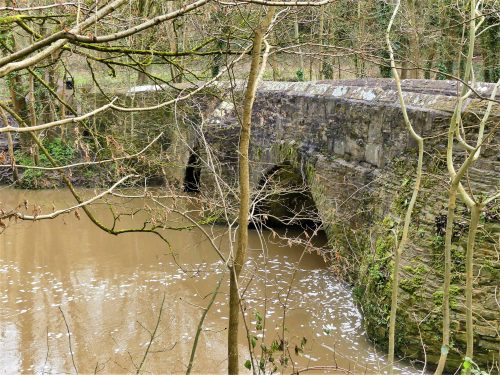
To continue along the Frome Valley Walkway from here you would follow the signpost in the direction of Frenchay and Snuff Mills. We were heading for Eastville Park though, so turned right to cross the historic Wickham Bridge, a lovely medieval stone bridge which is Bristol’s oldest bridge and reputedly used by Oliver Cromwell, It is now Grade 11 listed.

Wickham Bridge, looking downstream

River Frome flowing downstream from Wickham Bridge

The river falls dramatically, more than 50 feet, between Frenchay Bridge and Eastville Park which made it perfect for operating water mills. There were once six mills along this stretch of the Frome Valley, most of them working as corn mills. Now all that remains as evidence of their presence are the weirs.

River Frome looking upstream from Wickham Bridge

eastville park

Eastville Park is a large Public Park that extends over some 70 acres of land, and is located just to the east of the M32. The land was originally agricultural land of the Heath House Estate owned by Sir John Greville Smyth of Ashton Court and was purchased from him by the Council for £30,000 in 1889 in order to provide a ‘People’s Park’ – a green space for those living in St Philips and the eastern suburbs of the city, where social and environmental conditions were poor.

Creating the Park was a huge undertaking begun in 1889 and taking around five years till 1894, to complete. Existing hedges were taken out, boundary walls repaired, paths laid out and a hundred seats installed. Wisely, existing mature trees were retained and walkways were lined with further plantings of limes, horse chestnuts and fast-growing London planes. Interestingly, the grass areas were managed by a mixture of sheep grazing and mowing, a common practise at that time that is still used today in some Nature Reserves.

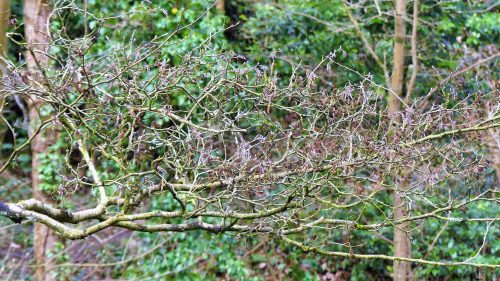
Twisted Hazel
Twisted Hazel
180401-1055-BSEP (29)

A narrow footbridge crosses over water

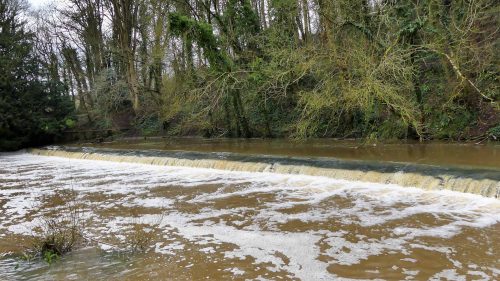
then leads past the impressive Colston Weir. There have been recent reports of an Otter being sighted here.

Colston Weir

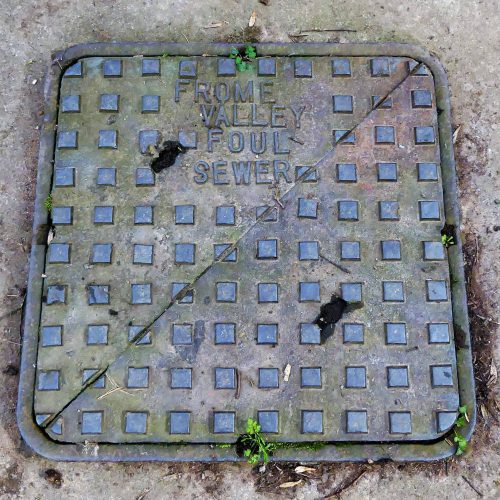
Not a pleasant thought in such a beautiful place, but this drain cover reminds that the Frome Valley Sewer follows closely alongside the river before finally ending at the Bristol Sewage treatment works at Avonmouth.

A pleasanter sight was a clump of White Deadnettle, although it had clearly taking a bit of a battering as its petals were torn and its leaves mud-spattered. Before the flowers appear the plant looks a little like the Common Nettle, but a closer look shows there are no stinging hairs hence the ‘dead nettle’ in the name. The lack of sting is also thought to have brought the plant’s other common name of White Archangel.

White Deadnettle, White Archangel – Lamium album

We heard a Wren and watched it as it flitted around in vegetation very close to the water. Another Alder tree gave me the opportunity to get a closer look. The tree’s flowers are on catkins which appear between February and April. Alder is monoecious, that is both male and female flowers are found on the same tree. Male catkins are yellow and pendulous, measuring 2–6cm. Female catkins are green and oval-shaped, and grouped in numbers of three to eight on each stalk. Once pollinated by wind, the female catkins gradually become woody and appear as tiny, cone-like fruits in winter. They open up to release seeds, which are dispersed by both wind and water. The small brown cones stay on the tree all year round.

THE LAKE

The lake was added as a feature a few years after the Park was opened. It was dug out in 1908 and 1909 from an existing water meadow with labour provided by ‘unemployed applicants’, under the Distress Committee’s Labour Bureau. It was constructed to a Serpentine plan, a design made popular by the famous landscape gardener, Capability Brown. The intrigue of its shape is such that wherever you stand on its edge, you can’t see the lake completely; there is always some part snaking out of view. Nowadays it is considered to be one of the best public park lakes in the country. 

The lake is not just attractive for people to look at, it’s presence also draws in a good variety of species of birds. First to attract attention was a flock of noisy Corvids that flew into the trees to left of the lake.

At first I wondered if they might be Rooks as there were a good number of them, but a closer look made them Carrion Crows, maybe juvenile, non-breeding birds.

There’s a densely planted small island in the centre of the widest part of the lake, and as we passed a little brown bird darting in and out from a tree branch reaching over the water caught my attention. Clearly a warbler, it was either a Chiffchaff or a Willow Warbler, most likely the former, but either way my first sighting so far this year.

If I hadn’t zoomed in on the warbler I may have missed a rare treat, despite his jewel-bright colours– a Kingfisher! It was quite a distance away and was sitting perfectly still on the branch of a willow tree, intently studying the water below. 

What a beautiful bird!

After a moment or two it changed position, moving towards the end of the branch to scan the water immediately below, his long dagger-like beak pointing down, preparing to dive.

It dived so fast I missed it! I caught the splash as it entered the water, then a split second later it was back up on a branch with a sizeable fish clamped in its beak. It sat for a few seconds more, jiggling the fish a little to secure its grip, but it clearly wasn’t going to eat it there and then: Kingfishers always consume fish head-first. Perhaps it intended to enjoy its meal somewhere less public, or maybe it had a mate that needed feeding; the birds’ first clutch of 6-7 eggs is usually laid late in March or early in April.
Either way it took off carrying its prize in the direction of the river.

KINGFISHER – Alcedo atthis

UK conservation status: Amber – because of their unfavourable conservation status in Europe. They are vulnerable to hard winters and habitat degradation through pollution or unsympathetic management of watercourses.

Widespread throughout central and southern England, but less common further north, Kingfishers are small but spectacular and unmistakable birds mostly found close to slow moving or still water such as lakes, canals and rivers in lowland areas. They fly fast and low over water, hunting fish from riverside perches.

In total contrast, in plain black and white and far more common, my next spot was a Coot.

Coot – Fulica atra

Then a preening Canada Goose spied through tree branches with bursting buds.

Further down the lakeside someone had scattered some grain on the paving, attracting the attention of some hungry birds. Two more Canada Geese raced in

Canada goose-Branta canadensis

A Crow rushed past a female Mallard and a Swan

to join a group of his peers that were already tucking in.

What would a Park be without a flock of Pigeons? A male Mallard paddled in to see what they had.

He turned and joined his mate and they clearly decided there was nothing in it for them so set off to dabble elsewhere, passing a juvenile Mute Swan on its way in.

Mute Swans are, perhaps surprisingly, also Amber listed as birds of conservation concern. According to the RSPB “The population in the UK has increased recently, perhaps due to better protection of this species. The problem of lead poisoning on lowland rivers has also largely been solved by a ban on the sale of lead fishing weights.”

Mute swan – Cygnus olor

A late-coming Moorhen paddles in rapidly creating an impressive wake for such a small bird. Cousins of the Coots, Moorhens are smaller and are a little more colourful with a bright red and yellow beak and long, green legs.

Moorhen – Gallinula chloropus

The list of birds recorded within the Park is impressive:

A beautiful Weeping willow tree cascades down gracefully to touch the surface of the water. Often planted inappropriately, it was nice to see one in the ‘right’ place. I think this one may be a Golden weeping willow, which is so named for its bright yellow twigs.

Weeping willow – Salix alba

We walked around the curve of the bottom of the lake and up along the other side. At the top once more there were more Chiffchaffs darting out after insects, with one obligingly confirming its identity with its distinctive song; a wonderful sound that for me announces that Spring is here.

Chiffchaff – Phylloscopus collybita

Chiffchaff – Phylloscopus collybita

A signpost with a touch of humour that I’d missed on the way to the Park informs that Fishponds is quite nice! No doubt enhanced by the proximity of this lovely green space. 

Celandines were one of the few wildflowers I saw blooming.

A view of Colston Weir from its other end.

Leaves of Arum and Wild garlic are well-grown.

Crossing back over the footbridge I noticed copper pipes running along its side, attractively encrusted with lichen and turquoise blue verdigris.

Back in the Glen, Wild garlic extends beneath the trees. Already releasing its pungent aroma, it won’t be long before it’s in flower.

Cow parsley and more Arum leaves form a prettily contrasting patch of leaves.

Crossing the bridge to get back to the car we stopped to look upstream over its side. There’s an interesting piece of winding gear here that probably operates a sluice. I’m always attracted by such pieces of machinery, probably because I had an engineer for a Father who loved to explain how things worked!

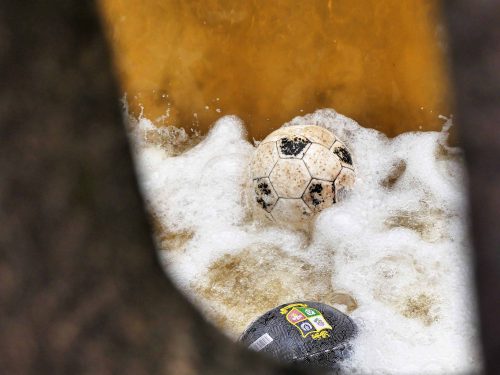
I also have a Son with an eye for the quirky – he spotted this random scene of a football and a rugby ball trapped against the stonework of the bridge and forced to play together in the foamy water.

It seems more fitting to finish this post as I started it though, with a view of the Frome, looking upriver this time.

Footnote: The River Frome is sometimes also called Bristol’s Lost River – certainly much of its final length from the M32 and through the city centre is Hidden. The link below is an account of a walk following the Frome Valley Walk:

www.bristol247.com/news-and-features/features/following-the-frome-bristol/

Share this:

  • Share on Facebook (Opens in new window) Facebook
  • Share on Pinterest (Opens in new window) Pinterest
  • Share on X (Opens in new window) X
Like Loading...

Winter Woodland

16 Tuesday Jan 2018

Posted by theresagreen in Bryn Euryn Nature Reserve, Nature of Wales, Wildflowers of Wales, woodland walks in Wales

≈ 8 Comments

Tags

alexanders, sweet chestnut, winter walks

January 1st 2018

The early morning was sunny and bright. Perfect for my first walk in the woods of this new year, I thought. Ha! I hadn’t got far when I realised it may not be quite as perfect as I had anticipated. By the time I got outside at around midday the sun had disappeared behind a thick veil of misty cloud, I felt cold despite thermal layers, my new three-way all-weather jacket and walking boots. The track was muddy and a bit slippery; thankfully for once I’d remembered to pick up my pointy-ended light-weight walking stick. This wasn’t what I’d hoped for, but as I want to try to follow the progress of the seasons more closely this year it had to be done. I reminded myself of my double-negatively phrased mantra, “there’s never nothing to see”, crossed my already frozen fingers and trusted that would work.
180101-1143-Blackbird
180101-1145-Squirrel 1

11:43 – Watching a handsome male blackbird rootling in the ground-covering ivy was a good start; then a grey squirrel with a scruffy sparsely-furred tail made me wonder what it takes to keep them in? It was freezing cold, damp and now getting windy, perfect conditions for a spot of hibernation I’d have thought; they must be too hungry to sleep.

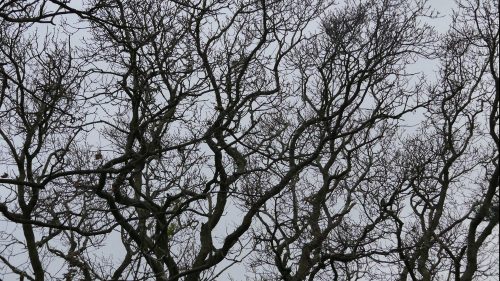
Grey sky through bare branches

I do love to see the sky through the tracery of bare branches and twigs on days like this when they are almost in monochrome.

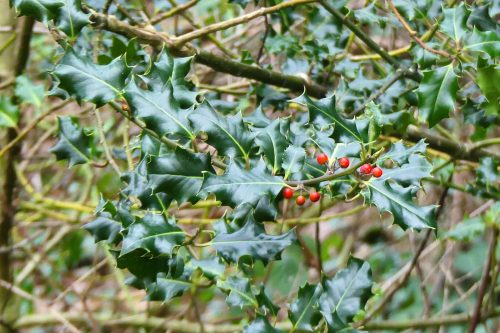
Holly has a strong presence year-round, but it struck me today that even on dull days it shines out, seeming to catch any available light touching its leaves and reflecting it back. There were a few berries remaining on this plant but I’m sure they won’t be there for long.

Alexanders – Smyrnium olusatrum

Clumps of bright green leaves of Alexanders started to reappear back in December. Here on the edge of the woodland path they are sheltered by the trees and protected by leaf litter. I’m always surprised it doesn’t get eaten. It was introduced into this country by the Romans; having a delicate celery-like taste, they  used it as a culinary herb. Rarely growing more than about four miles from the sea, here it’s at its most prolific on the lower level of the Little Orme and along the Llandudno Road. It’s spreading quite quickly here in this part of the woods too. I wonder how it got here originally?

11:57 – The view from the boundary fence was obscured by the dense misty cloud which seemed to be approaching fast. I could still see part of the River Conwy, but the Carneddau mountains beyond had all but disappeared. The A55, or the North Wales Expressway as it is officially known, is busy with traffic whatever the day. The main route westward and up through Anglesey to the Irish ferry port at Holyhead, it is also heavily used by locals for short commutes and  holidaymakers and tourists all year round. The railway line runs alongside it too. Running along the valley bottom, vehicle noise is amplified and rises up to become the background sound to my walks, even the mist hardly muffles it. It is so continuous though that your mind soon ceases to register it.

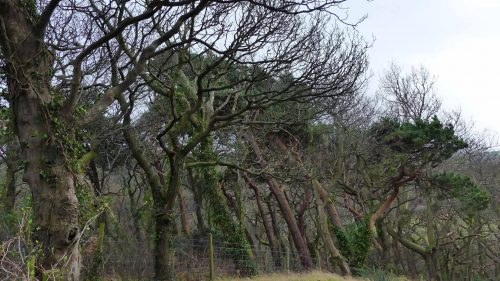
The Scots Pines are at their most numerous in this spot. On the woodland boundary and exposed to strong west winds their trunks are angled backwards and branches are contorted and twisted into some weird and wonderful shapes.

Woodland Trail

A sprinkling of golden gorse flowers brightened the greyness of the day and a quick inhale of its gorgeous coconut fragrance gave me a boost and the will to continue! 

It’s less sheltered up on the Woodland Trail, which is for the most part a corridor through the trees, so deciding which way to go was easy; a right turn and then up, back into the closer shelter of trees. I passed by the big holly tree, hardly any berries remained and there were no birds to see there. There are good crops of ivy berries this year, but they seem to be ripening sporadically and slowly. I often come across plants throughout the woods that have escaped from gardens. I hadn’t spotted this mahonia before though – it’s preparing to flower which will no doubt be gratefully received by the red & the buff-tailed bumblebee queens when they emerge in a few short weeks time.

180101-1205-Ivy berries ripening
180101-1209-Mahonia grden escape flower buds

12:11 – It started to rain heavily. I was fairly protected by the trees so decided to carry on. A party of Long-tailed tits flew above me, calling to one another as they moved quickly through the high tree branches. Tiny birds, they clearly have to keep searching for food but surely need to keep warm and dry too; not easy when there are no leaves.

The wind picked up. On the north side of the hill and gradually getting higher, it was noticeably colder too. If I had sense I’d probably have gone home now, but I really wanted to get to the top of the hill today. At least this weather suits blackbirds foraging in deep leaf litter.

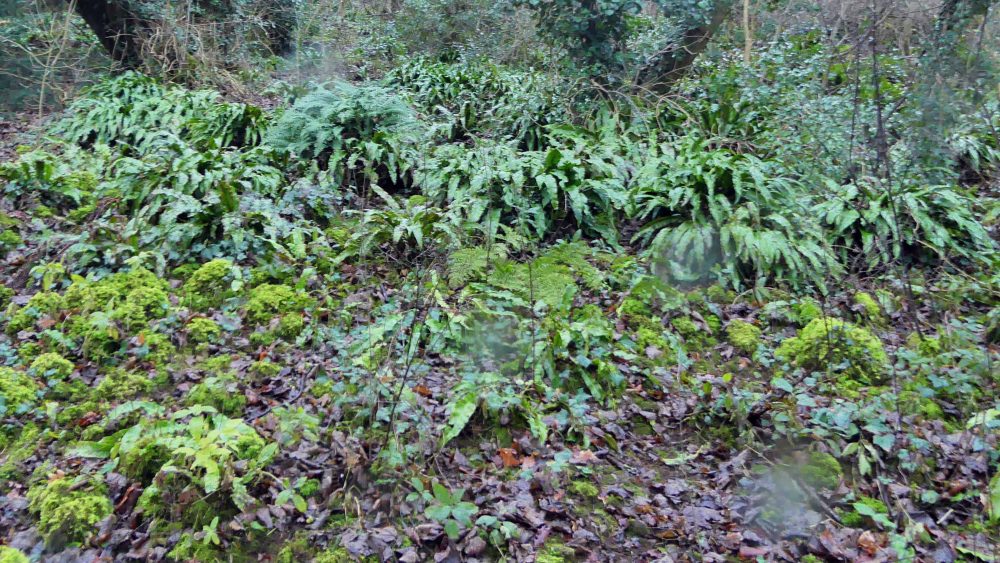
I passed the ‘fernery’ – the open slope that is lushly covered with predominantly Hart’s Tongue fern growing between moss-covered stones. If it was warmer it may feel quite tropical. The smudges are raindrops on the camera lens!

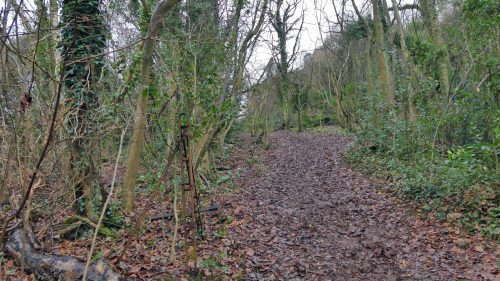
I was glad to reach the part of the trail I think of as the ‘Dark Wood’. It is sheltered by the rising bulk of the hillside and some tall old trees, including a good few Yews, which all combine to block out the sunlight and today some of the rain.

At the end of the tree tunnel is a particularly large evergreen tree, one of several that I know throughout the woodland. I’m trying to work out what they are, so any ideas would be gratefully received.

For some reason I can’t begin to guess at, an iron gate stands at the side of the track just past here. There’s no sign of any fencing on either side of it. It’s just a gate to nowhere.

Gate to nowhere

It does stand near to the junction of a track leading up to the summit though, making it easier to remember where its start is. Covered with leaves it doesn’t stand out and is easy to miss.

The muddy leaf-covered upward track is easily missed

12:26 – The upward track was muddy and slippery and I was glad I had my spiky walking stick, otherwise progress could easily have been a painful step forward and a slide back. It was still raining, my fingers were freezing and I was the only person trekking to the top. Can’t think why. The flash of a colourful Bullfinch disturbed from a bramble patch, eating what remains of blackberries really brightened my day. He disappeared into the scrub of hazel and blackthorn. Hazel catkins start growing at the end of the summer or early autumn and are making steady progress; these are the male flowers, the tiny red female flowers will appear a little later on when the male flowers are fully mature.

Hazel catkins

The twiggy branches of the blackthorns are well-covered with lichen, including clumps of the beautiful silver-green ferny one that feels velvety to the touch. It is a lichen, but confusingly called Oak Moss.

Oak Moss-Evernia prunestri on blackthorn

12:42 – Emerging onto the hill top was breathtaking. Quite literally – it was raining hard, blowing a hooley and bitingly cold. I took a couple of snaps while the wind tried to wrench the camera out of my hands and the rain obscured the view further by dropping onto the lens. There was no way I was going to carry on up to the summit proper.

The sea is out there somewhere

12:50 – I turned and scurried back to the comparative shelter of the track, stopping only because I couldn’t resist this gnarly tree trunk decorated with moss and lichen.

Then there was an extremely tall tree painted with both orange and green lichens and daubed with cushion-like moss. I couldn’t resist that either.

I spot a small Elder that already has quite well-grown new leaves.

13:04 – I watched a blackbird that was having great success finding worms in the mud. I watched it pull out and eat two or three.

It had finally stopped raining and the sun was shining through the trees. It was still really cold though and although only early afternoon, gloomy and dark.

I took a slightly different route back to where I started as it’s a higher, less well used and still covered with leaves and much less slippery. It also cuts across the slope that is part of the view from my kitchen window and is a good place to be to see some of the birds that descend from here down to our bird feeders. No birds today, but I did realise that two of the trees up here are big old Sweet Chestnuts. They have beautifully coloured and textured bark.

Sweet Chestnut-Castania sativa
Sweet chestnut bark
Sweet chestnut bark

13:22 – One last splash of colour – rust-red leaves remaining on a small tree, I’m assuming Copper beech that has found its way here from someone’s garden.


13:39 – I’m home, hands wrapped around a mug of  defrosting tea, watching some of the birds I didn’t see whilst out. They’d doubtless think it bonkers to go out on a day like this when you really don’t have to.


Share this:

  • Share on Facebook (Opens in new window) Facebook
  • Share on Pinterest (Opens in new window) Pinterest
  • Share on X (Opens in new window) X
Like Loading...

September Hillside

24 Sunday Sep 2017

Posted by theresagreen in British hoverflies, Bryn Euryn Nature Reserve, Butterflies of Wales, calcareous grassland, hoverflies, Nature of Wales, North Wales, slugs & snails, Wildflowers of Wales

≈ 7 Comments

Tags

Arion flagellus, common carder bee, common knapweed, eyebright, green-soled slug, hemp agrimony, robin's pincushion, scabious, speckled wood, volucella zonaria, yarrow

September 8th-Bryn Euryn

As I’ve already said, it was mighty windy out here on the not-quite-summit of the hill; not the day for hanging around gazing at the views, no matter how stunning they may be.

Windswept not-quite-summit of Bryn Euryn

A quick look around showed there to be little left in the way wildflowers in bloom, but there was colour on a wild rose – a whole colony of bright red Robin’s Pincushion galls. I don’t recall ever having seen as many on a single plant. The fuzzy growths will gradually fade to brown and the little wasps that cause the growths will emerge in June. If I’m lucky, one of these days I’ll catch them coming out, although the galls also attract ‘squatters’ and there can be a dozen or more species lodging in there!

I was to keen to keep moving, but when I spotted this lovely patch of Eyebright I couldn’t resist stopping again.

The dip between this part of the hill and the slope up to the summit is usually sheltered and offers a brief respite from the wind and the noise of traffic from the A55 below, but not so today. Yarrow likes this spot and there was quite a good large patch of it still in flower here. As with Eyebright, Yarrow is a plant designed to withstand tough growing conditions and is pretty persistent, as anyone that has tried to eliminate it from a lawn will testify; you cut it down and it grows right back! Personally I prefer the ferny-leaved Yarrow to the boring grass! Funny how we discriminate against certain plants, this wildflower Yarrow’s taller-growing golden-yellow flowered relative, Achillea, is a cherished garden plant!

Some insects rather like its flowers too, I found a tiny bee motionless on a flower today and recalled I’d seen a similar looking insect on Yarrow in the Rhiwleddyn reserve a few weeks ago.

Tiny bee on Yarrow – enlarged

On the summit a patch of purple Knapweed was fuelling a few Common Carder bees that were managing to cling on and fly short distances despite the best efforts of the wind to dislodge them. The little bees had varying appearances; some were practically perfect, others a bit more battered, their ‘fur’ worn away and at least one that had a bleached appearance like it had spent too long out in the sun.

Common carder bee-practically perfect
Common carder bee-a little faded
Common carder bee-fur worn from back
Common carder bee-bleached

There was another lovely clump of Eyebright up here, this one framed by the distinctively-arranged pods that give the Bird’s-foot trefoil its name.

More Yarrow too, this plant sheltering a tiny fly.

I was hoping that the other side of the hill would be a bit more protected from the wind, but alas, most of it wasn’t. The sun was putting in sporadic appearances though, so at least it felt a bit warmer. Ironically, the sea looked to be calm, was coloured in shades of beautiful blue and its surface merely ruffled. The blades of the wind turbines were motionless.

Looking over in the opposite direction to te sea, the view to the oddly-shaped hill at Deganwy, was fairly clear, although beyond it, Anglesey and the Menai Strait were shrouded in a light haze. I’m not sure if I’ve mentioned it before, but the hill is named the Vardre and gets its unusual appearance from having two rocky summits. It has a little less height than Bryn Euryn, it being 108m, (354 feet) while the Bryn is 131m (365 feet). It was once home to fortifications that included Deganwy Castle.

On the woodland edge leaves are beginning to change colour. Hawthorn is one of the first to go

along with Silver birch as I mentioned in the previous post. Out here in the open it was easier to appreciate the combination of yellow leaves against a clear blue sky.

Next to the Silver birch is a single Whitebeam, which bears berries. The berries are orange in colour now but will gradually turn red.

In the short grass there are still a few Rock-roses in flower and here and there are big fat ‘penny-bun’, or Bolete mushrooms. At least they would have been big and fat before they were nibbled away. I like the different shades and textures such nibbling has left on this one; there was a little black spider on it too.

I have often wondered what nibbled the mushrooms. A picture I took a few weeks ago, at the end of July may have the answer. The sight amused me and I wondered if it was a romantic al-fresco lunch for two? Of course there is more to slugs than meets the eye. No gardener is ever going to welcome them onto their plot, but out in the wild they are another important cog in the wheel of the natural waste-disposal system. Although one slug may look rather like another, there are rather a lot of different species of them in our British Isles. I submitted this image to the very helpful folk that run the Slugs and Snails of the British Isles Facebook Group, who responded that to be accurate they need to see the undersides of the slugs too, but from other features that it is likely they are juvenile Arion flagellus – the Green-soled slug.

poss. Arion flagellus- the Green-soled slug

The bottom of the grassy ‘downland’ hill was still flowery with Hemp Agrimony, Knapweed, touches of Scabious and a sprinkling of Ragwort.

I walked down to where it meets with the woodland edge and lo and behold, for a few glorious minutes the sun came out. Suddenly it was warm and bright and the scene came alive with a whole host of insects vying with one another for the best blossoms.

Speckled wood on Hemp agrimony

I hardly knew where to look first, but then couldn’t resist the sight of a pristine Speckled wood feasting on Hemp agrimony. There were several of them, all looking freshly beautiful; most were nectaring on various flowers while some rested on the leaves of nearby trees basking in the sunshine. The only other butterflies in evidence were Red Admirals which unusually stayed out of range of the camera.

Speckled wood on ragwort

There was a good variety of hoverflies,large and small, a Common wasp and more Common carder bees too.

Hoverfly - Eristalis sp
Hoverfly – Eristalis sp
Hoverfly - Eristalis sp
Hoverfly – Eristalis sp
Hoverfly-Helophilus sp
Common wasp
Common wasp

Common Carder bee on Scabious

Volucella zonaria

A beautiful cast of insects, but the star of today’s show was a big handsome hoverfly, which surprisingly doesn’t have a common name, but whose scientific name, Volucella zonaria makes it sound a bit like an Italian pasta dish. This is the largest British hoverfly and is quite a recent addition to our native list, appearing on the south coast of England during the late 1930s. According to my Hoverfly bible, from there it has spread upwards and outwards across the country as far as Cheshire and Humberside and South Wales in the West. We’re not so far from the Cheshire border here, so they must still be spreading, this is the second one I’ve seen this year, the other was in my daughter’s garden a few weeks ago.

170908-1510-BEICT-Hoverfly-Volucella zonaria 3
170908-1510-BEICT-Hoverfly-Volucella zonaria 5

The spell of sunshine didn’t last long and the wind was still blowing relentlessly; time to set off in the direction of home.

Wind-blown ash tree


Share this:

  • Share on Facebook (Opens in new window) Facebook
  • Share on Pinterest (Opens in new window) Pinterest
  • Share on X (Opens in new window) X
Like Loading...

September Woods

22 Friday Sep 2017

Posted by theresagreen in bird behaviour, ferns, Nature of Wales, nature of woodlands, North Wales, woodland birds, woodland walks in Wales

≈ 11 Comments

Tags

black spots on sycamore leaves, Blue tit, grey-green lichen hanging from tree, hart's tongue fern, male fern, Nuthatch

September 8th – Bryn Euryn

Woodland Path

Yet another windy day with intermittent sunshine, so I’m seeking shelter in the woods. It is almost eerily silent and the damp soft earth of the path absorbs the sound of my footsteps. Something detects my presence at the last minute; loud rustling sounds from the undergrowth startle me and a panicked grey squirrel shoots out in front of me, sprints rapidly along the path and launches itself up the trunk of the nearest large tree. It pauses when it feels safely hidden behind foliage, but I spied it through the leaves, its mouth filled with an acorn, still green and unripe.

There are ripe blackberries, but on the early fruiting brambles some are already mouldering, and a feasting greenbottle fly reminds me why I don’t eat too many unwashed wild berries.

Chains of scarlet berries drape shrubbery. This one twined through holly reminded me of a Christmas garland; I wonder if sights such as this sparked the idea for festive decorations?

The berries are those of Black Bryony-Tamus communis, and will continue to ripen until they are black. A perennial plant described as twining, but often it’s more of a scrambler.

Woodland Trail

There are rose hips here

and a bramble whose leaves look as though they are almost ready to drop.

The gorse bushes have fresh golden blossom and clever spiders have spun webs in the hope of capturing flying insects drawn to their nectar and pollen. Gorse flowers throughout most months of the year prompting the old saying, “When gorse is out of flower, Kissing is out of season!”

Summit Trail – backtracking

The last time I walked here I took a slightly different route to the summit of the hill, taking an unmarked track up through the woodland to join the Summit Trail. I hadn’t planned to that, but at the junction of the paths I usually take I’d stopped to try to locate Jays that I’d heard screeching in nearby trees and a man with a dog stopped to ask me what I was looking at. We had an interesting chat comparing notes about what we both see here and where, but I didn’t catch the Jays. I waited to see which way he would go to continue his walk and seeing it was the same way I was headed, decided to go the opposite way. Not that I’m unsociable of course, rather that I see far more on my own and in my own time; and he had a dog! Anyway, the upshot was that I ended up on a narrow upward track through the trees on another windy day that was sunny but still damp from the previous night’s rain.

Spiders’ webs lit by the sunshine filtering down through the leaf canopy caught my eye and I stopped to admire the artistry of their construction and to try to find their makers. Looking more closely I saw most of the webs were broken and apparently abandoned, although this one had captured a beautiful rainbow.

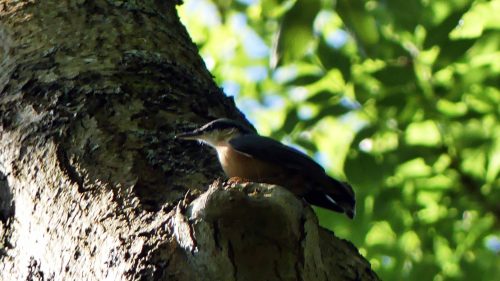
As so often happens, my slow progress and in this instance, last-minute change of route brought forth a magical few moments. Until now the only sounds had been mainly of the wind rushing through the trees, but I began to hear bird calls that got gradually nearer and suddenly I was surrounded on all sides by excited little birds – a travelling feeding party! I had been standing still and they seemed not to notice me; I’ve described a similar experience in a previous post and this was equally as joyous and uplifting. It was a large party too, impossible to count the numbers of birds within it as they scattered amongst the trees, but Blue tits were probably most numerous with at least a dozen Long-tailed tits; Great-tits were there too. I didn’t see Tree-creepers as before, but was thrilled to see a Nuthatch that chose to explore a tree right in front of me.

Nuthatch-Sitta europaea

Taking photographs in the darkness of woods is rarely successful, but a Nuthatch did pause briefly from its foraging near a patch of sunlight, giving me a reasonable chance to record this bird for the first time here. Watching a tiny Blue-tit searching through ivy high up in another tree I realised it was looking for spiders, which are an important part of their diet. Perhaps the birds’ regular forays are the reason I couldn’t find any.

Blue tit seeking spiders

Back to the present 

Sycamore leaf with spots of fungus

There was no feeding party today, but there were other signs of a summer ending. Sycamore leaves, amongst the first to break their buds in the Spring are amongst the first to change colour and fall. Most of those I see nowadays are marked with dark spots; this is Rhytisma acerinum, the Sycamore Tarspot. It doesn’t look attractive, but although it is suspected that the darkened areas reduce the photosynthetic capacity of affected trees, the fungus doesn’t seem to affect the tree’s health and vigour. One consolation of the fungus’ presence is that is shows the air here is fairly clean as it is apparently particularly sensitive to sulphur dioxide air pollution. Trees growing near to industrial centres with high levels of sulphur emissions do not show any sign of the leaf-blackening fungi.

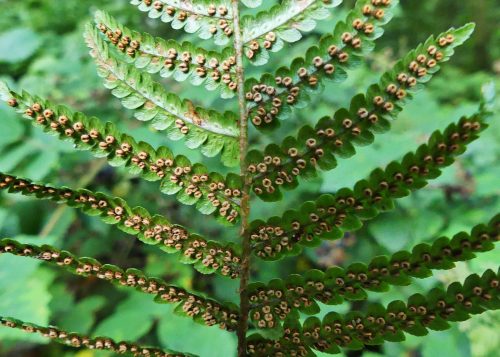
If you look at the undersides of the fronds of most ferns, their seeds, spores or more correctly sori  are now ripe. The Male Fern is the most common fern found growing here; its sori are round and normally run in two parallel rows.

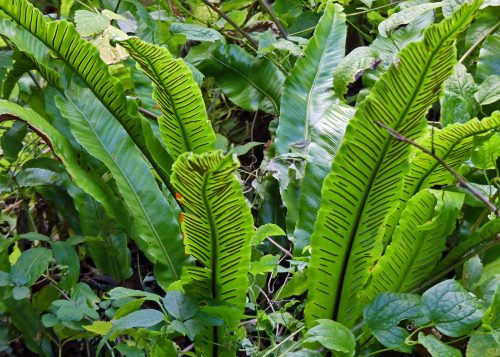
There’s a large patch of Hart’s Tongue Fern growing in damp shade on a steep bank. Its leaves and sori take a different form to those of other fern species. Their ripe sori accentuate the marks on the underside of the leaves and it seemed to the person that named the plant that they resembled the legs of a centipede, so he gave it the scientific name ‘scolopendrium‘, the Latin for centipede.

Hart’s Tongue Fern-Phyllitis scolopendrium

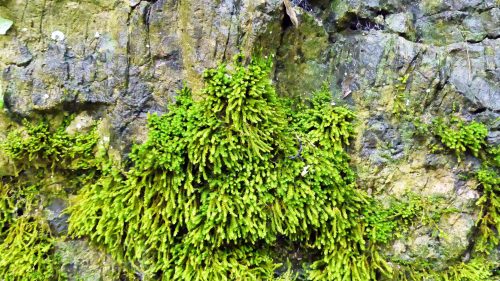
The track passes a sheer cliff of limestone. Its surface is frequently damp, sometimes wet and its base is covered with a lush, bright green shag-pile carpet of moss.

There’s a small grove of Silver Birch trees on this shady, damper side of the Bryn that are also beginning to lose their leaves, which stud the dark mud of the track with specks of bright gold.

Nearing the end of the path the trees thin and give way to scrubbier vegetation, mostly blackthorn and hawthorn. The blackthorn has beautiful purple sloes and its leaves too are beginning to turn colour.

A number of the blackthorn shrubs here also have clumps of pretty grey-green lichens. Some looks like a tangle of moss, which I can’t accurately name.

Other blackthorns have a lichen in a different form, this one, photographed on a nearby shrubby hawthorn tree with dark red fruits (haws), has the appearance of Reindeer moss, but I can’t yet be species-specific.

Emerging from cover onto the exposed summit I braced myself for another confrontation with the wind. The sun had disappeared behind clouds that were shutting out its brightness, leaving the landscape in shadow, dulling its colours. Part of the view across the valley from here takes in buildings and fields that belong to the Welsh Mountain Zoo, located above Colwyn Bay. There are sometimes interesting animals grazing in the fields; today it was some kind of cattle.

With or without sunshine I love this hillside view of small fields bounded with hedges and trees with the mountains in the distance. It reminds me a little of a David Hockney painting.

The mountains are topped with billowing clouds that permitted some sunshine through to lighten slopes here and there and to brighten the water of the river Conwy.

On days like this you can only hope for at least a little sunshine to brighten the rest of a walk…


Share this:

  • Share on Facebook (Opens in new window) Facebook
  • Share on Pinterest (Opens in new window) Pinterest
  • Share on X (Opens in new window) X
Like Loading...

A Windy Wildflower Trail – completion

18 Monday Sep 2017

Posted by theresagreen in Butterflies of Wales, calcareous grassland, coastal walks, nationally scarce wildflowers, Nature of Wales, North Wales Wildlife Trust, plants important to wilflife, Rhiwledyn Nature Reserve, Wales Coast Path, wildflowers on limestone

≈ 11 Comments

Tags

Banded burdock fly, Brown Argus, comma, dropwort, Horehound moth, Spiked speedwell, Veronica spicata, White horehound

August 3rd

Part 3 – Rhiwleddyn Nature Reserve

It is wonderful to wander through places that have been left alone and to find indigenous plants that could have been growing there for hundreds of years, or in some cases, even thousands. But areas that have in one way or another been ‘disturbed’ often bring forth species of flora and fauna not seen in areas that haven’t, as in the next part of my wander around the reserve.

Brambles and nettles threaten to take over this small, scrubby area in the midst of the reserve, but there are plants tough enough to hold their own there, one being Common Sorrel.

Common Sorrel Rumex acetosa

The tall stately Great Mullein with its large beautiful grey-green velvety leaves sometimes graces a disturbed scrubby patch. It’s a biennial plant, so flowers appear during each plant’s second year. It is a locally common plant, but its appearance in a specific area each year is not predictable; which makes it more of a treat when you do find it. Each plant usually produces a single flowering spike; one with multiple spikes may indicate that it was nibbled by rabbits in the early stages of its growth.

Great Mullein – Verbascum thrapsis

White horehound, is one of the scarcer plants to be found within the reserve. Its presence here is tenuous year on year, as it is constantly under threat of being out-competed by rampant ‘coarse’ vegetation such as nettles and brambles; its survival largely dependent upon diligent scrub-clearing and management by the reserve management team and Wildlife Trust volunteers. The plant is also found, in greater amounts, on the Great Orme.

June 2017-larva of the Horehound Moth – Wheeleria spilodactylus on foodplant

White horehound is important as it is the only food plant of the larvae of the Horehound Moth Wheeleria spilodactylus. Inhabiting chalky soils, this is a localised species of plume moth, largely confined to the Isle of Wight and a few scattered localities in Wales and Southern England. The exceptionally well-camouflaged caterpillars appeared on plants here earlier in the year when I took this photograph; they are evidence that the battle to maintain its ongoing presence is important to this species of moth.

I haven’t seen the moth myself, but found this perfect picture of one, appropriately taken on the foodplant on the Great Orme by John Martin. Respecting the copyright of the image, this is the link to it. http://www.ukmoths.org.uk/species/wheeleria-spilodactylus/adult-on-foodplant-2/

A little grasshopper sat basking, sheltered from the wind and very well camouflaged on a bramble leaf. I doubt I’d have seen him if I’d not caught sight of him land there.

Grasshopper on bramble leaf

This is him/her greatly enlarged

Grasshopper on bramble leaf (enlarged)

Another tough plant here is the Lesser Burdock. I like the plant with its round prickly flower heads and tufts of purple flowers that will soon dry into ‘burrs’ and stick to anything that brushes against them. I approached the plant to photograph it; as I did so, I got excited to see that a little butterfly had the same idea and had only my second sighting so far this year of a perfect little Brown Argus.

Brown Argus Aricia argestis

The poor thing was fighting to stay put in the strong wind and I was struggling to keep my camera lens focussed on it. I was vaguely aware of a small fly sharing the same space on the plant as the butterfly, but was too intent on the matter in hand to pay much heed to it. It was small and yellowish and flitting about a fair bit, but at the time it didn’t click that this might be a fly I’d been hoping to find for the past few years that is a burdock specialist.

Brown Argus & Banded burdock fly

Banded burdock fly-Terellia tussilaginis

It wasn’t until the next day, when I looked at my images properly that I realised this little fly was indeed most likely a Banded burdock fly-Terellia tussilaginis and that I’d almost missed it!

At least it gives me good reason to show more images of the lovely little butterfly.

Brown Argus & Banded burdock fly

I was getting a bit fed up with the wind now but battled on towards the top as I wanted to get an image of the stunning view of Llandudno that you get from this side of the Little Orme headland. It was only when I got there I remembered that I had actually been somewhat sheltered from the full force of the wind! it was still so strong it took my breath away and I had to lean against a rock to brace myself, not only to steady the camera but also myself. Worth it though, what a view!

I didn’t stay to lingeringly admire the view, and was quickly on the way back down to seek a calmer spot. Facing now in the other direction and looking down onto the fields below I had the random sight of a male Pheasant, not a bird I see often. He was looking a bit bedraggled and was clearly limping. Had he been been shot and survived, hit by a car, or even attacked by a fox or dog? Fortunately he seemed still to be able to fly well enough.

Limping pheasant

A little further on I spotted a little splash of blue in the short grass in front of me and much to my surprise here was one of the Reserve’s special treasures – a single stem of the lovely little Spiked Speedwell. This is a plant that is cultivated and grown in gardens, but only grows in the wild in the Breckland grasslands of East Anglia and very locally in Wales and Western England.

Spiked Speedwell-Veronica spicata

A few metres away, standing a little taller, a single flower stem of Dropwort, another specialist of calcareous grassland, this one being bent almost to the ground by the strength of the wind.

Dropwort – Filipendula vulgaris

Hawthorn is one of the few species of tree that is not nibbled by rabbits or sheep in its early stages and that can also withstand exposure to the strong, salt-laden winds the headland is subject to. Most are contorted into weird and wonderful shapes, but this one, although short has grown large and spread fairly evenly.

I met up with the young Robin again on my way back down.

Young Robin

And a beautiful Comma butterfly landed on the bare earth of the track.

Comma

The sheep were where I’d left them, settled down comfortably now for an afternoon siesta in the sunshine.

Looking up from the track below I saw they were still watching me, with definite smug, self-satisfied smiles on their faces.

I was more than happy with my final wildflower tally for this walk, which included (in no particular order!): Common calamint; Common rock-rose; Black horehound; White horehound; Hedge woundwort; Water mint; Lady’s bedstraw; Spiked speedwell; Dropwort; Wild thyme; Common cinquefoil; Centaury; Carline thistle; Goldenrod; Lesser burdock; Common sorrel; Great mullein; Harebell; Perforate St John’s Wort; Wild clematis; Yellow-wort; Wild fennel; Marjoram; Wild carrot; Hemlock; Ragwort; Ploughman’s spikenard; Yarrow


Share this:

  • Share on Facebook (Opens in new window) Facebook
  • Share on Pinterest (Opens in new window) Pinterest
  • Share on X (Opens in new window) X
Like Loading...

A Windy Wildflower Walk II

27 Sunday Aug 2017

Posted by theresagreen in Butterflies of Wales, calcareous grassland, coastal walks, Nature of Wales, North Wales Wildlife Trust, Rhiwledyn Nature Reserve, Wales Coast Path, Wildflowers of Wales, wildflowers on limestone, Wildlife of the Wales Coast Path

≈ 3 Comments

Tags

black horehound, common rockrose, harebell, hedge woundwort, Lady's bedstraw, Nature in August, Perforate St John's Wort, speckled wood, water mint, yellow dung fly

August 3rd

Part 2 – Rhiwledyn Nature Reserve -The main track

Onwards and upwards; a flight of shallow stone steps make a steep rocky section of the path a little easier to climb (except when it’s wet & they get a bit slippery).

Pause here to admire the views back down onto the road and the many shades of green of the fields and woodland on its opposite side.

Looking down onto the road into Llandudno

Facing around to the way I’m going, the views to the right of me, seen over a rampant tangle of brambles and wild clematis on the reserve boundary, are extensive and stunning. At once pastoral and contained and wild and open to the elements.

On the other side of the track is the biggest and best patch of harebells that I have seen for years, a truly beautiful sight.

Harebell- Campanula rotundifolia

I can’t resist sitting to watch them being blown and rippled by the wind and am captivated by their charm. For me this little flower has it all. Beautiful in colour and form, they have delicacy and fragility but also great adaptability and resilience to an often hostile environment. Each flower had turned its bell back to the wind to reduce its impact; their slender but tough and wiry stems having the flexibility to bend to the wind, not break. A life lesson in a wildflower!

There were yet more of the little beauties a little higher up on the slope contrasting delightfully in colour and form with frothy lemon-yellow Lady’s bedstraw. I clambered up rather inelegantly to take a closer look. Amongst other plants, these had grown taller and in a more sheltered spot, their bells were turned to the light rather than away from the wind.

Before going back down to the track, I take another look at the glorious view across the bays to the Clwydian Hills and with sheep where they are supposed be.

click to enlarge

Back on track there is a change in ambience and habitat. There are small trees and shrubs on the boundary with the farmland sufficient to cast shade, and the sloping ground on the other side provides a windbreak. The trees are mostly hawthorn, prevalent throughout the headland as its one of the few plants not grazed by sheep or rabbits and again, tough enough to withstand exposure to fierce salty winds.

I spot a movement and see a small Grasshopper jump onto a lichen speckled rock catching dappled sunlight; the perfect place to soak up a little warmth whilst staying camouflaged.

I round a bend in the track and see – sheep! Five naughty trespassing sheep! They are strictly banned from the reserve unless invited in as their indiscriminate grazing may damage or even destroy the rarer wildflowers that grow here. Fencing prevents them wandering into the higher part of the reserve from the rest of the Little Orme where they are not restricted, so I think they got in at this field level, no doubt irresistibly tempted by the sight of the lush long grass over here. I tell them they should return to their field, but can’t see where they may have got through and they pay me no heed anyway, just amble away showing me their bottoms.

I let them get ahead, the last thing I want to do is frighten them and send them scattering and concentrate on the patch of golden flowers I see amongst the long grass on the slope. I thought at first it may be Goldenrod as I’d seen some on the roadside earlier, but soon realised it was a Hypericum – St.John’s Wort.

Another plant with several species that share the same common name, but this is the one I am most familiar with and has all the right features to be Perforate St John’s Wort – Hypericum perforatum.

St John’s Wort-Hypericum perforatum

click to enlarge

Black horehound – Ballota nigra

I apologise, but need to digress a little here to explain the significance of my next plant. Earlier on in the summer a group of NWWT members were treated to a walk around this reserve guided by its manager, Rob and a guest expert botanist, Nigel. It was a brilliant walk on many levels and we learnt a lot about our special flora and its history, about its fauna and the trials and tribulations of modern Reserve management. Typically as on any walk, even guided group ones, I lagged behind snapping interesting stuff and in a rough bramble-and- nettle patch (in the pic above), spotted the plant to the right, which is still going strong. Yet another minty-looking one I didn’t recognise. I took hasty photographs and hurried after the rest of the group. No-one else immediately recognised it either, so Nigel suggested I email the pics to him later on so he could have a better look. From them his best guess was that it was Black Horehound, reservations having been that this was a vigorous, tall specimen of a plant that usually is, in his words, ‘much scruffier-looking’ He also mentioned it smells unpleasant, so this time I had a closer look and bruised and smelt a leaf. It definitely did not smell pleasant and as all its other important bits match the botanical specs, I’m taking that as another one to add to my list of wildflowers-I-will-know-how-to-identify in the future. (Unless anyone has a different idea……?)

It’s amazing what you can see in five minutes along a short shady stretch of track. I watched a dragonfly patrol up and down at speed, pausing only in his labour several times to ‘buzz’ me and let me know I was in his space. I was hoping he’d stop so I could at least see what he was, but no, much too busy. There was yet more mint here, and one I recognised from the distinctive scent of a crushed leaf – this is Water Mint-Mentha aquatic. A similar-looking plant is Corn Mint, but it grows shorter than this and doesn’t have a ‘terminal’ flowerhead (one that crowns the top of the stalk).

Water mint-Mentha aquatica

A fresh-looking Speckled Wood rested on a sun-warmed stone on the path

Speckled Wood

and a Red Admiral flew across to seek out the nectar of bramble flowers

Red Admiral – Vanessa atalanta

There is a farm gate here which I checked for security, but tightly closed there would have been no exit for sheep. Another great Clematis-framed view from here, considerably enhanced by the clouds I think, although they were blocking out the sun at this point.

click to enlarge

At the side of the gate another member of the Lamiceae (mints & dead-nettles) family, this one I know well, the Hedge Woundwort Stachys arvensis.

Yellow Dung Fly – Scathophaga stercoraria

I moved on and round the next bend found evidence I was still on the trail of the errant sheep; a smallish neat and fairly recent deposit of fresh dung. And where there is dung there may be Dung-flies, one of my favourite insects, although I’m not exactly sure why. Perhaps because I’m keen on recycling? As I hoped, a single male Yellow Dung Fly had laid claim to the heap of treasure and was intent on guarding it. A bit of a drama then ensued, but I’m saving that for later.

To the top

I had reached the Reserve boundary, marked by a gate through which the two marked ‘Trails’ continue on to cross the rest of the Little Orme headland. There is no marked official track up to the top reaches of the reserve from here though, so getting up there is a matter of a)wanting to; b) paying attention to where you are putting your feet; c)taking care not to slip on damp grass and d) watching out for rabbit holes.

Rock-roses are still fresh and lovely up here, as is the fragrant Lady’s Bedstraw.

I followed the path chosen by the sheep; they almost always know how to find the best way upwards. They were up there now, all standing facing the view. I may have thought they were admiring it, but one of them who seemed to be in charge, maybe the mother of some of them, was bleating loudly, eliciting a response from the field below. Was she calling to her friends telling them about the feast to be had on this side and inviting them over?

Once more I reminded them they were not welcome here, but Mrs Boss Sheep just gave me ‘the look’ that clearly said “mind your own business and what are you doing up here yourself?” Once past them it became more overgrown and not as clear where to head, but I kept going in the general direction of where I wanted to be and hoped for the best. I heard a bird making some squeaky sounds and spotted him as he perched atop a gorse bush, a speckly young Robin beginning to get his adult feathers. I realised this was the first bird I’d seen and heard so far on this walk apart from gulls and the occasional cormorant flying overhead.

I also realised it was lunchtime, so time to find a sheltered spot, take a break and sit and admire the sheep’s-eye view.


Share this:

  • Share on Facebook (Opens in new window) Facebook
  • Share on Pinterest (Opens in new window) Pinterest
  • Share on X (Opens in new window) X
Like Loading...

A Windy Wildflower Trail

25 Friday Aug 2017

Posted by theresagreen in Butterflies of Wales, calcareous grassland, Nature of Wales, North Wales, North Wales Wildlife Trust, Rhiwledyn Nature Reserve, Wildflowers of Wales, Wildlife of the Wales Coast Path

≈ 15 Comments

Tags

carline thistle, centaury, common blue, common calamint, Gatekeeper, goldenrod, harebell, montbretia, Nature in August, ploughman's spikenard, wild carrot, wild fennel, yellow-wort

August 3rd – Weather – intermittently sunny, warm but with a very strong cooling wind. 

As August began I wanted to get out to see wildflowers. This is one of my favourite times of year for that, when there is every chance that there may be earlier flowering plants still around and the late-summer bloomers should be at or reaching their best. Most of the sites I visit regularly are good for wildflowers, but as they are mostly located on hills or headlands and exposed to the elements, they would not be particularly enjoyable on a strongly windy day like today and taking photographs would be difficult. I decided on Rhiwledyn Nature Reserve, one of my favourites as it covers a range of interesting habitats within its 12 acre site and as it is located on the eastern side of the Little Orme there was a chance that much of it would be sheltered from the worst of the wind.

There are three ways to access the reserve, all of which require a bit of an uphill hike. One route is from Llandudno, another from the other side of the Little Orme, but for me the most interesting route to its main entrance is along the path at the base of a section of the Orme that runs up Penrhyn Hill. Marked as a 10% gradient, this is a steepish stretch to walk, but worth the effort as the rock supports an array of plants, both wildflowers and some garden escapees, and is a nature trail in itself. This provides me with the perfect excuse to amble up the hill and take frequent excusable pauses for breath rather than stride purposefully along.

Looking back along Penrhyn Hill towards Penrhyn Bay. The hill in the centre background is Bryn Euryn

Part 1 – Penrhyn Hill roadside to the reserve

My first sighting was of a male Common blue butterfly taking a break from his battle with the wind on the flower of a hop trefoil, low down in the vegetation. Amongst long grass and ivy, a grey leaved Yellow-wort; this is an annual favouring short calcareous grassland but is found in a variety of spots throughout the headland.

Common blue
Common blue
Yellow wort-Blackstonia perfoliata

There were several clumps of a plant that was definitely a member of the mint family with strongly aromatic leaves. I don’t know what it is yet.

  • since publishing this Suzanne has kindly suggested in a comment that it is Common calamint Clinopodium ascendens. This is a mint that grows in dry grassland, hedgerows and verges, often on chalk or limestone soils, so habitat fits perfectly.

Common calamint – Clinopodium ascendens

And another aromatic plant – Wild Fennel, growing as tall as me, in front of gorse.

A pretty snail clung to the leaf of a Valerian plant; I lifted it gently to check the colour of its underside lip – brown – then replaced it. A few bees were braving the breeze, mostly Buff-tailed bumblebees. I photographed one on marjoram, which may or may not be a wild plant.

Brown-lipped snail
Buff-tailed bumblebee on marjoram

There is Wild Carrot in various stages of flowering from tight buds to maturing seedheads. Most often found in rough grassland, near the sea and again mostly on chalky soil. This is one of the easier of the white umbellifers to identify, with feathery leaves and bracts beneath the flowerheads and always a red flower in its centre.

Wild Carrot-Daucus carota

Windy days are not good for butterflies, but I did see a couple of Gatekeepers. Both sticking close within the vegetation, one found Marjoram to nectar on, the other attempted to bask on a Wild Clematis leaf. Both were faded and looking a little the worse for wear.

Gatekeeper on Marjoram- fruits of Herb Robert behind
Gatekeeper
Gatekeeper

A flowering Goldenrod plant sprawled out across the edge of the path.

Goldenrod – Solidago virgaurea

So too a sprawling patch of Montbretia

Montbretia

and this one with its flowers like small dandelions, which I think may be one of the Hawkweeds. Another one to work on.

A stone wall marking the boundary of the farm’s land breaks the vegetated path edge, but behind it the small field is golden with Ragwort and long seeding grass. There were butterflies in there, mostly Whites, but it’s off-limits so couldn’t get a closer look.

Trees on the edge of the small wood in the background of the photograph now cast shade over the path and its edge and there are less flowering plants. There is plenty of ivy, Wild Clematis a flourishing Wild Cabbage, more of the not yet id’d mint and a clump of the usually sun-seeking Rockrose.

Rhiwledyn Nature Reserve

Half an hour after parking my car I finally reach the entrance to the reserve. The sun is shining and a fly basks in the warmth reflected by the glass of the narrative board.

A pretty clump of Marjoram flowers at its base.

I turned left to first walk the short length of the path at the base of the headland where it meets Llandudno Bay. The strength of the wind here took my breath away and walking into it head on was a challenge, but now I’d got this far I wanted to carry on to the far end of this eastern side of the headland as far as I could. 

Up on the cliff a patch of harebells gave a rare opportunity to get close to these lovely little flowers without having to lie on the ground. They look delicate and their thin stems seem fragile, but they are tougher than they look and were holding their own in today’s wind.

Spiky starry Carline thistles caught my eye. Kneeling to photograph them I see they are growing amongst bird’s-foot trefoil and that there is another little star there too – a tiny white flower of Pearlwort.

There is Yellow-wort flowering next to Wood sage which is setting seed.

Another Carline thistle, this time with Eyebright and an unwelcome invader, cotoneaster, one of the banes of the lives of hard-pressed reserve managers.

Nearby, more Harebells with a little pink Centaury and the grey felty leaves of Mouse-eared Hawkweed.

I was almost relieved to reach the end of the track and be blown back to retrace my steps to the beginning of the upward track.

First I went ‘off piste’ a little to reach a stand of golden yellow Ploughman’s Spikenard.

Ploughman’s Spikenard – Inula conyzae

Then a scramble back down to the start of the track proper. A badged wooden post here reassures you that you are officially following both the Wales Coast Path and the North Wales Path.


Share this:

  • Share on Facebook (Opens in new window) Facebook
  • Share on Pinterest (Opens in new window) Pinterest
  • Share on X (Opens in new window) X
Like Loading...

Little Beings of Summer Woods

08 Tuesday Aug 2017

Posted by theresagreen in Bryn Euryn Nature Reserve, Nature of Wales, nature of woodlands, Wildflowers of Wales, woodland walks in Wales

≈ 7 Comments

Tags

black spleenwort, dwarf cream wave, late summer wildflowers, Nature in August, polypody fern, scorpion fly, speckled wood, wild clematis

Sunday July 30th-Bryn Euryn

The Woodland Path

11:00am  It was cooler than I’d anticipated in the woods this morning. The sky was cloudy and gusts of a chilly breeze blustered between the trees of this usually sheltered mid-slope of the Bryn; less than ideal conditions for the insects I was hoping to see. And I wished I’d worn a thicker fleece. But the sun was intermittently winning through the clouds and ever the optimist I assured myself it would get warmer for me and the little creatures. 

There are a few places on my usual trail that I think of as ‘hotspots’ for insects, even on cool days such as this. The first one is an untidy, brambly-nettley spot, where opportunistic plants have filled a gap in the tree line and spread across to the other side of the path too. Dappled sunlight reaches and warms the spot, aphids thrive here, there’s nectar and pollen to be had while the bramble is in flower, followed by its fruits; the perfect ingredients for a hoverfly hangout. If I’m patient and hang around for a few minutes I’m often rewarded with sightings of a few hovering customers and sometimes less expected visitors too.

Hoverfly (syrphus sp) basking on a sunlit hazel leaf

Insects need sunshine to warm up their flight muscles to get them going, so cooler, cloudy days can be surprisingly rewarding for sightings of basking individuals slowed down by the lack of warmth. There were a few hoverflies here today, also other common flies which I’m trying to take notice of and appreciate more; well, at least I’m aiming to put names to some of them. Most of those I saw were common ‘houseflies’, a generic name that covers quite a few different species. I think it’s their habits that most of us dislike; some of them look quite pretty.

House fly
Bluebottle

A long-bodied black insect with pretty iridescent wings scurried erratically over the surfaces of leaves, a wasp I think, definitely a hunting predator, maybe a Digger wasp.

About to move on I spotted a dot of colour in the shade of some leaves. Sitting motionless was another more recognisable predator, a male Scorpion Fly.

Scorpion Fly-There are 3 species of Scorpion Fly in Britain, apparently difficult to separate other by examining genitalia; the most common being Panorpa germanica. They frequent shady places almost everywhere. All are scavenging insects and completely harmless despite the males’s scorpion-like tail. The female’s body lacks the tail, simply tapers to a point. 

Male Scorpion Fly
Male Scorpion Fly

The closed tree canopy excludes most flowers now. An exception is the woodland grass, False Brome, which grows prolifically here and is flowering now.

False Brome-

A splash of colour took me by surprise – a holly tree with red berries!

*************

Perhaps relics of the days when this path was part of the grounds of a Victorian manor house, are large clumps of two attractive ferns. Both species are evergreen, maintaining their green fronds throughout the seasons, but both look particularly fresh and verdant now and the Polypody has new fronds unfurling.

Polypody fern

Black spleenwort


Dwarf Cream Wave-Idaea fuscovenosa

A tiny pale-coloured moth swirled by the breeze spiralled down to land on a bramble leaf low to the ground, settling with wings spread butterfly-like under the shelter of other leaves. It is a Dwarf Cream Wave (photograph probably not far off its actual size)- the lines that show grey-mauve are where its original pale brown scales have been worn, or washed (!) away.


A home in a leaf ….

The pale patch on this holly leaf is probably the result of the work of an insect, the Holly leaf miner Phytomyza ilicis. This is a fly whose larvae burrow into leaves of this specific species of tree and leave characteristic pale trails or mines.

Interestingly, I learnt (from Wikipaedia) that “the holly leaf miner has frequently been used in ecological studies as a system to study food webs. Examination of the leaves can show whether the leaf miner has successfully emerged, been killed by a parasitic wasp, or been predated by blue tits.”

I’m not sure what the perfectly round hole in this one indicates. It could just be the original entry point of the egg-laying adult female’s ovipositor, but maybe too big? It looks too small and neat to be an exit hole and blue tits leave a triangular tear when seizing a miner as prey. Maybe it is the mark of the work of a predatory wasp? 

Speaking of wasps, I spotted another on an ivy leaf – a bit more distinctive than the black one I saw earlier due to its long antennae, so I asked the experts at BWARS and they say it’s a member of the Ichneumonidae family. The whole of this family are parasitoides and most species attack the caterpillars of butterflies and moths. It’s a dangerous life being an insect.

The Woodland Trail, Bryn Euryn Nature Reserve 

A big old oak tree marks the junction of my ‘Woodland Path’ and the Woodland Trail that circuits the Nature Reserve. It’s lost a few of its branches and the big lower branch has a split right through it that provided a safe home to nesting Great tits earlier on in the year.


Happily, the tree seems to be going strong and is currently nurturing some baby acorns. They have stalks, which indicate this is an English, or Pedunculate Oak.


Stepping out from the cover of the trees I realised how windy it had become; windy enough for birds to be able to just hang in the air and ride the air currents with minimum effort. Two buzzards were overhead, mewling and swooping around in the air currents, one being harassed by gulls, poor thing.

The unmistakable bulk of a Buzzard

My second ‘hot-spot’ is almost at the junction of the two tracks. It’s a huge bramble entwined with gorse and over which wild clematis scrambles. That blackberry & wild clematis combination is one of my favourites, even if it is another of the sights that I associate with summer’s approaching end. The clematis is just coming into flower and, the bramble already has ripening fruit, so not much for insects here today.

A lovely Speckled Wood butterfly sat on a smaller bramble nearby which still has flowers. The butterfly let me get very close, hardly moving in the coolness of the day.

There are few flowers along the sides of the Woodland Trail now, due in part I’m sure to their having been strimmed back in June – this part of the path is maintained by the local council who are wont to get these ‘jobs’ done before people complain about paths being overgrown. All kinds of good stuff was cut back, including orchids, and much of the hogweed that would now be giving nectar and pollen to hoverflies et al. I hoped they were finding sustenance nearby.

A few odd plants have survived, or revived, to flower here and others are fruiting. There are a very few hazelnuts that have thus far escaped the jaws of voracious grey squirrels, who usually eat them while they’re still soft and green.

Ragwort
Hemp Agrimony
Honeysuckle

Wild Strawberry flower
Wild strawberry fruit
Seedpods of Stinking Iris

Tutsan berries are darkening
Hazel nuts forming
Blackberries are ripening

Cool windy days may seem unpromising if you’ve set off hoping to see insects, but if you keep paying attention there is never ‘nothing to see’ (pardon my grammar). I spotted a tiny movement on the surface of a leaf and caught sight of an even tinier leaf hopper. As I got closer with the camera lens I noticed another movement under the leaf; a tiny spider had spotted the leaf hopper and was vibrating her web to try to get its attention. The leaf hopper disappeared under the leaf….. I wonder if the spider got her lunch? Apologies for the less-than-good photo, but I’m sure you get the drift!

So, I’ve reached the steps leading up to the field now and looking forward to what it has in store….


Share this:

  • Share on Facebook (Opens in new window) Facebook
  • Share on Pinterest (Opens in new window) Pinterest
  • Share on X (Opens in new window) X
Like Loading...
← Older posts
Newer posts →
Follow everyday nature trails on WordPress.com

Enter your email address to follow this blog and receive notifications of new posts by email.

‘But it is the common species that keep the living world ticking over and provide most of our experiences of wildlife, and I would argue that maintaining the abundance of these is as important a conservation priority as maintaining the existence of rarities’. Richard Mabey

MOST RECENT POSTS

  • A Glimpse of Spring to Come January 22, 2025
  • Hunting the Wren December 28, 2024
  • Oh, Christmas Tree December 18, 2024
  • In and Out of the Ivy February 15, 2024
  • Nature’s Fireworks November 30, 2023
  • Wild Autumn along the Coast Path November 3, 2023

OLDER POSTS

LOOKING FOR SOMETHING IN PARTICULAR?

  • Sights and Sounds from the Little Orme 1
    Sights and Sounds from the Little Orme 1
  • Things Bright and Beautiful
    Things Bright and Beautiful
  • Catchers, a Duck and Divers
    Catchers, a Duck and Divers
  • May Bee Appearing on Ivy near You
    May Bee Appearing on Ivy near You
  • Following a river to a Fairy Glen
    Following a river to a Fairy Glen
  • Shades, Sounds and Scents of the Woods
    Shades, Sounds and Scents of the Woods
  • A Windy Wildflower Trail
    A Windy Wildflower Trail
  • Fine Dining for Crows
    Fine Dining for Crows
  • The Windhover
    The Windhover
  • Butterflies and more rare treats
    Butterflies and more rare treats

nightingale trails

The Walk of the Monarch Butterfly-Sendero de la Mariposa Monarca

The Walk of the Monarch Butterfly-Sendero de la Mariposa Monarca

MY WILDFLOWER BLOG: where the wildflowers are

Snowdrop

Snowdrop

most recent posts

Follow everyday nature trails on WordPress.com

Social

  • View teresamaygreen’s profile on Twitter

Enter your email address to follow this blog and receive notifications of new posts by email.

Website Built with WordPress.com.

  • Subscribe Subscribed
    • everyday nature trails
    • Join 359 other subscribers
    • Already have a WordPress.com account? Log in now.
    • everyday nature trails
    • Subscribe Subscribed
    • Sign up
    • Log in
    • Report this content
    • View site in Reader
    • Manage subscriptions
    • Collapse this bar
 

Loading Comments...
 

    %d