• Home
  • about
  • about the photographs
  • Local Nature Reserves
    • Bryn Euryn Local Nature Reserve
    • Mynydd Marian
  • Wales Coast Path
    • Grey Seals in North Wales
    • St.Trillo’s Chapel
    • Wildflowers of North Wales Coastal Paths, Cliffs and Dunes

everyday nature trails

everyday nature trails

Category Archives: North Wales

Following a river to a Fairy Glen

15 Thursday Mar 2018

Posted by theresagreen in Fairy Glen, Local Nature Reserves, Nature of Wales, North Wales Path, Old Colwyn, Rivers of Wales

≈ 18 Comments

Tags

Afon Colwyn, grey wagtail, river Colwyn, robin singing

The myriad of little rivers and streams that run from our mountains and hills come alive following prolonged rainfall or when filled with melted snow. Many of them are inaccessible and flow through privately owned land, so we are privileged here to be able to enjoy close access to the sights and sounds of one such waterway: the river that flows through the village of Old Colwyn and ends at Colwyn Bay, both of which take its name – the river or in Welsh afon, Colwyn.

This walk follows a length of the river Colwyn upstream from where it reaches the sea  at Colwyn Bay at the end of the Promenade, takes the scenic route through the oldest part of the village of Old Colwyn then continues to the far end of the wooded dingle of Fairy Glen and back again. It’s not a long walk and mostly fairly easy going. It follows a section of the North Wales Path and is also part of the Old Colwyn Heritage Trail so combines a bit of local history with nature and wildlife, which ticks all of the boxes for the perfect winter walk for me. 

Splash Point of the river Colwyn into Colwyn Bay. Snow-capped Clwyddian Mountains on the far horizon.

The last few metres of the river’s length are contained and manipulated by stone and concrete to direct its waters under roads, bridges and the viaduct, then finally a culvert beneath the Promenade channels it to its end at a Splash Point from where it cascades into the sea.
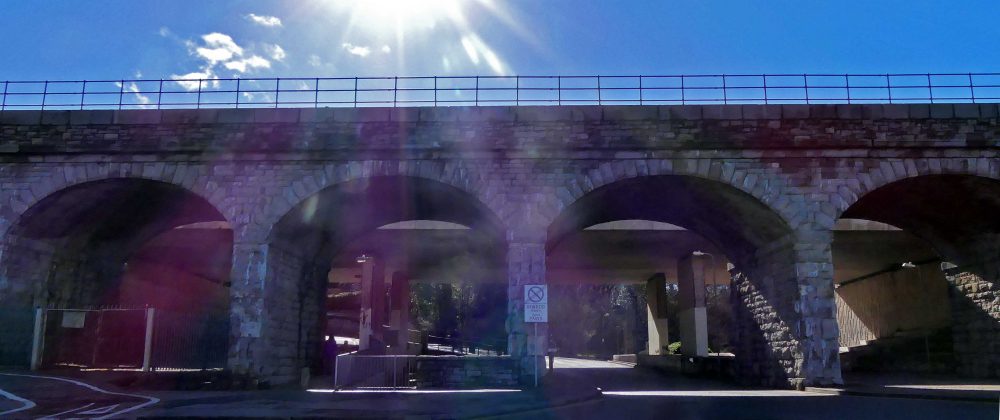
The viaduct was built in 1847 as part of the Chester-Holyhead railway line engineered by Robert Louis Stephenson. The bridge behind it carries the A55 North Wales Expressway

Beneath the viaduct, know locally as ‘The Arches’, the surface of the water is textured as it rushes over its stony bed and its sound amplified by the stone walls that contain it, still audible above the noise of traffic and the occasional train passing overhead.

Once beneath the bridges and on the path past Myn y Coed woodland calm is restored and the sounds of the river and birds singing fill the air.

180308-OCWYN-River Colwyn 20-Daffodils
180308-OCWYN-River Colwyn 19-Cliff Prout memorial

I stopped on the footbridge to listen and to check for Grey Wagtails that sometimes hunt along this stretch of the river; none here today but I know they have other favoured spots.

upstream from the footbridge at Myn y Coed

The path upstream curves around the corner to run parallel to Beach Road, passing in front of the building that was once the Coachhouse to the Myn y Don Mansion. The river races down the slope here, carrying with it bits of shrubbery from somewhere along its path.

Lovely to see a few Spring wildflowers here.

180223-OCWN-1434-Tan y Bryn Gds-Daisies
180223-OCWN-1441-Myn y Don-Celandine
180223-OCWN-1441-Myn y Don-Primroses

Near the beginning of Tan y Bryn Gardens is a weir with blocks of stone either side that look as though they may once perhaps have had sluice gates?

There’s an interesting variety of native and more exotic trees here with an under-storey of shrubs and plants that is perfect for birds. Today Blackbirds seemed to be everywhere, singing from variously elevated spots or rummaging around in leaf litter. There were at least three males in close proximity to one another, resulting in much chasing. The one in my photograph had been singing until I arrived and put him off his stroke.

Carrying on through the gardens there were robins singing from several spots too and I finally caught one in action.

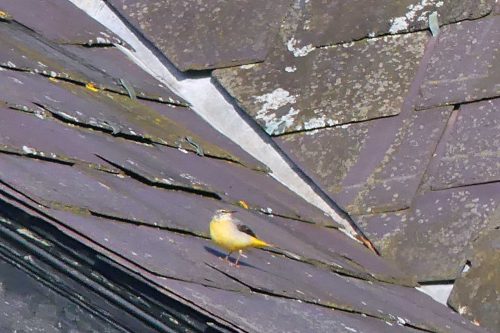
Almost at the end of the Garden path I was thinking I still hadn’t seen a Grey wagtail and that sometimes I’ve had better luck seeing them hunting on the nearby rooftops… then a bird skimmed past just over my head making that familiar rattling call. A wagtail that, lo and behold, carried on over the water to the very rooftops I was standing looking at. Although some distance away, it was a lovely colourful one with bright yellow breast and rump, that stood out nicely against the blue-grey slates and patches of lichen.
I had reached the tunnels beneath the buildings that allow people and the river to pass through them.
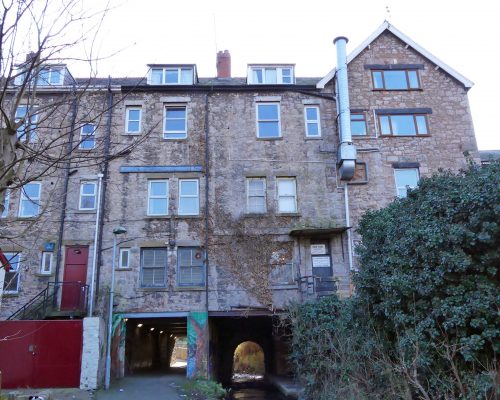
The tunnel is short, lit artificially and its walls are decorated with colourful professional-looking graffiti. It’s not my favourite part of the walk though, especially when as today it was littered with rubbish and doggy deposits. Such a shame as the path to here was spotless.

I usually walk through here at speed, admiring the wall art out of the side of my eye as I pass it, but today I stopped to photograph my favourite part of it. It depicts the buildings above where they front onto Abergele Road, harking back to the days when the tram was running. Next to that image is one of the viaduct before it was obscured by the Expressway bridge.

At the other end of the tunnel a sign indicates the way back to the beach and the North Wales Path logos are beneath it.

The path stays by the river through this attractive little area, named Llawr Pentre which is the oldest part of the village, then leaves it for a short while as you take the steps you find on your left. At the top follow the signs that point right to Fairy Glen and the North Wales Path.

FAIRY GLEN

The Local Nature Reserve of Fairy Glen in Old Colwyn is one of several places locally known as ‘dingles’. Dingle is a charming and evocative noun used to describe a small, narrow or enclosed, usually wooded valley or a deep hollow or dell. Fairy Glen was once more manicured and a much favoured place for holidaying Victorians to take in the fresh air on a leisurely riverside stroll. Today the pathway is on the route of the North Wales Path, but is mostly used locally as a shortcut to the village centre or by folks walking their dogs. It may not appear as groomed as it once did, but this fragment of a once-extensive ancient woodland is cared for and appreciated and it provides a habitat for a good variety of wildlife, particularly woodland birds. There are some lovely big old trees and shrubs here, but the greatest draw and asset for wildlife is surely the fresh clean accessible water. 

At the base of a tree I found golden-yellow Lesser celandines, some of them already ‘going over’.

Most of the length of the path is fenced allowing flora and fauna to remain undisturbed. The fence rails are a great place to spot birds too; many use it as a perch and some as a place to forage for insects amongst the ivy.

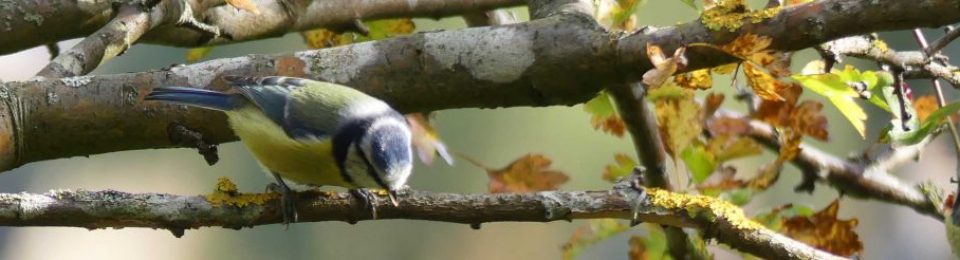
There were a number of Blue tits foraging in the trees around and overhead me and I heard Great tits singing. The songs of Robins rang out at regular intervals, each one pausing occasionally to listen to others nearby then responding. I always thought that this might have been why the ’round Robin’ style of singing we learnt at school was so-named, but apparently not – it relates to much more boring things like circularised documents. I prefer my own version! There were Blackbirds all over the place here too. This one took to the fence while I passed but soon resumed his hunt for worms in the leaf litter below.

Wild garlic is growing fast and the warm sunshine was already drawing out its distinctive aroma.

The damp shady conditions here are perfect for ferns.

I had a lovely close encounter with a small flock of charming Long-tailed tits.

180223-OCWN-1353-Fairy Glen-Long-tailed tit 1
180223-OCWN-1353-Fairy Glen-Long-tailed tit

Rainwater channels into the river at this weir adding to its volume creating a considerable foamy ‘race’ down its length.

This stand of tall old pine trees is a good spot to look out for Coal tits; I’ve seen them here on several occasions, but not today.

At the base of tree a collection of new Spring greenery of varying shades and leaf forms; ferny Cow parsley, elegant Arum and the round leaves of some pervading Winter heliotrope which seems to be popping up all over the place lately. There are also a few leaves of Nettle and the ubiquitous Ivy.

The path through the Glen ends at Pen y Bryn Road. As at the beginning of the path at Myn y Don there is a plaque commemorating a local man named Cliff Prout who did a tremendous amount of work improving the public local green spaces on behalf of this community. The world needs more Cliff Prouts – he did a great job.

THE WAY BACK

There’s much to be said for a circular walk, but I find it can be just as interesting to go back the way I came. I often see things I missed on the way through being distracted by something I spot; the perspective is different, the light is different and of course the time is different. I tend to ‘save’ things that aren’t likely to move for a closer look on the way back too, such as these trees. I liked the contrast of shapes and shades of the evergreens seen through the more delicate catkin laden Hazel in the foreground and all set off beautifully by that beautiful deep blue winter sky.

I met the Blackbird again, still hunting worms successfully, he’d just swallowed one as I took his picture.

I had a closer look at this felled tree which I think from the bark may be a Sweet chestnut. It’s wood has been left to integrate into the fabric of the woodland floor to provide habitat for invertebrates etc. I hope it gets left alone and is not purloined by someone with a wood-burner to feed.

This was a huge tree, a section of its trunk would easily make a small dining table.

A flowering Dandelion and more shoots of Wild garlic.

This enormous Oak tree near the entrance/exit to the Glen fascinates me. It has stabilised itself in an almost-perpendicular position with a complex network of roots that are as thick and sturdy as branches, right on the edge of a steep bank. Beneath it are hollows you can see straight through. Perhaps this is where the fairies live.  

A last look at another stand of elegant, pale-barked trees whose top branches turned silver in the sunlight.

And then the river on its way out of the Glen.

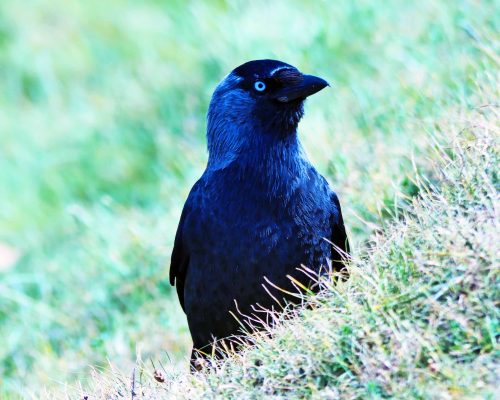
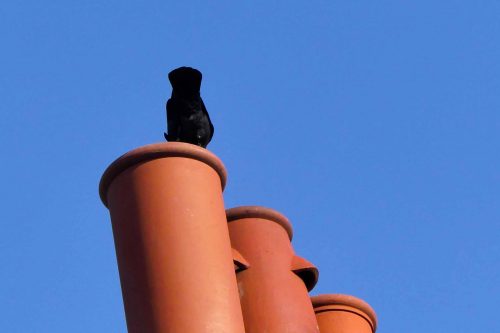
Leaving the Glen and walking back past the cottages I stopped to watch Jackdaws  gathered on the chimney pots. I’m not sure what they were doing, possibly checking for any insects or spiders that may have been hiding in them, or maybe prospecting for nest sites; whatever they were doing they were disappearing right into them.
 

Back in the Gardens I stopped to admire  the flowers; clumps of snowdrops, daffodils and a stunning display of richly coloured hellebores all enjoying the sunshine. No insects yet  though.


I couldn’t resist taking this shot of a perfectly matched couple walking hand in hand ahead of me. I hope they don’t mind.

The view towards the end of the gardens with the Coachman’s cottage in the bottom left corner.

All overlooked by the tower of the Folly up on the hill.

I am ever in awe at the size of some of the pine trees that grow here

so I was sad to see that the foliage of one of them looks has turned brown as though it may be dead.

A Robin checked out a dramatic dried seed head

while a Wood pigeon investigated a mossy rooftop.

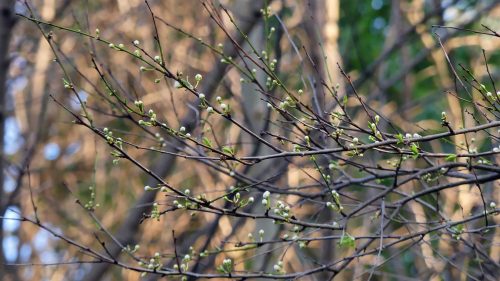
Then to finish, a promise of imminent Spring: a Wild Cherry tree with new green leaves and blossom buds about to burst.
 

Share this:

  • Share on Facebook (Opens in new window) Facebook
  • Share on Pinterest (Opens in new window) Pinterest
  • Share on X (Opens in new window) X
Like Loading...

Winter Promenades

22 Monday Jan 2018

Posted by theresagreen in birds of the seashore, Birdwatching on North Wales coast, coastal walks, Nature of Wales, North Wales, Rhos Point, Wales Coast Path

≈ 10 Comments

Tags

birds of conservation concern, black-headed gull changing plumage, Curlew, dunlin, dunnock, overwintering birds, purple sandpiper, Rhos Point, ringed plover, Robin, rock pipit, winter wildflowers

January 2nd 2018 

The Promenade runs unbroken from Old Colwyn at one end to Penrhyn Bay at the other, following the contours of Colwyn Bay, Rhos Point and the seashore of the aforementioned Penrhyn Bay. It is well-used, particularly so in the warmer seasons and weekends, but also on sunny days throughtout the year; it’s also a part of the Wales Coast Path and is both a walking and a cycling route. The section I walk most often these days starts close to the tiny St.Trillo’s chapel, passes Rhos Point and continues into Rhos on Sea village.

St Trillo’s Chapel, Rhos-on-Sea

This strip of coastline is fascinating. The Promenade and the busy road that runs alongside it form a corridor between land claimed for human habitation, travel and recreation and a rugged seashore and mussel bed, regularly washed over by the Irish Sea, that provides for a variety of species of wildlife, including large numbers of over-wintering wading birds. There is also an interesting ‘cross-over’ by some birds that have learnt to utilise the opportunities offered on both sides of the corridor.

This morning I’d visited my daughter & grandchildren who live just a couple of hundred metres from the Prom and I thought while I was this close I’d check up quickly on a very special winter visitor – a Purple Sandpiper. I knew there was one here as I’d found it in the same spot on the rocks frequented by one lone individual last winter. (I posted about it earlier last year as The Lonely Purple Sandpiper.) The times whilst the tide is high and for a short while as it begins to go out again are the best times to get close-up views of them.

23/12/17-1432-Purple sandpiper

Walking down the slope near the chapel I couldn’t fail to notice a huge photographic lens fitted to a camera on a tripod angled down onto the rocks below, with a man standing behind it. I guessed all would be aimed at the Purple sandpiper, and so it was, but rather than there being the one bird I’d expected to see, there were six. Four were out in the open, tucked up and fast asleep, but the photographer said there were at least two more a bit lower down behind rocks. These lovely little winter visitors are famous and people travel here from miles around in hope of seeing them. This guy had come from Wigan and here on his third visit in recent weeks to attempt to see them. There was no way he was leaving until he’d got shots of them doing something more interesting. He  was also willing the sun to come out to light them up better against the dark rocks. You really do have to catch these birds at high tide when they rest up on the rocks of the rip-rap, as once the tide goes out, so do they and you’ve lost them.

2/01/18-1105-Rhos Point-Purple Sandpipers

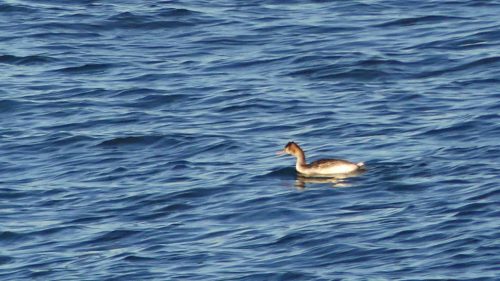
Great Crested Grebes regularly cruise the bay and there was one out there now. Although not appearing to be travelling at speed, they are tricky to catch an image of; you just get them in focus and they dive. I get a lot of images of  empty sea. They can travel good distances underwater in pursuit of fish so you can’t predict where they’ll pop up again.

Following last night’s Super Moon, there was a Spring Tide this morning, at its highest at 10:40am (the Spring Tides are the highest ones). It was windy here as it is at most high tides, but not blowing in across the sea, so its surface was barely rippled. At just past 12 noon, the water was beginning to recede but it would be a while before the sandpipers responded and became active; they’re used to arctic conditons, but it was way too cold for me to stand still. I wondered about the lone bird I’d seen before Christmas. Was it now part of this little group? Surely it was, but I walked the short distance along to where I’d seen it before to make certain. No sign of it, but I did see the biggest jellyfish I’ve ever seen stranded on top of a rock by the tide. It looked a bit battered but don’t know how you tell a live one from a dead one when they’re out of the water.

I walked as far as the steep concrete steps that go down to the shore that are becoming increasingly smoother and their edges more rounded year on year. They were wet right to the top showing how high the water level must have reached earlier on.

180102-1209-RP-Steps 1
180102-1209-RP-Steps 2

Now I’d seen the Sandpipers and knowing I could come back and see them again I thought I’d get into my car out of the cold and go home. But then there might be more to see, I was here now and at least it wasn’t raining like it was yesterday. I also had the luxury of being able to walk here without a grandchild in a pram as I often do, so could stop as often as I liked without protest from a little companion. I walked on towards the village.

It’s not only birds that have ‘crossed-over’ to the wild side of the road. The huge, predominantly limestone rocks of the rip-rap support an increasing variety of plants too. They are mostly garden escapes such as buddleiah and michaelmas daisies and just past the chapel is a bushy shrub. This established bush is sometimes full of one of the local House sparrow tribes adding their cheerful chirping to the more expected sounds of the seashore. There are often House sparrows foraging amongst the rocks of the seashore, especially when they’re nesting and have young to feed. They come after it’s rained too, to drink from small pools of fresh water briefly held by the limestone rip rap.

1/10/17-Rhos Point-A bush full of House sparrows

The bush has shed its leaves now and there were no sparrows today. Someone has put up a bird feeder filled with nuts, maybe for them or maybe for the Robin that is also often around here.

The sea had begun to recede here on the Point, so I began to walk down the  ramp to see if any birds had arrived to forage in its wake and was surprised by a Dunnock that popped out from the base of the bush.

2/1/18-1218-Rhos Point-Dunnock

It moved back down to the rocks beneath

and was joined by a Robin.

The big patch of Winter Heliotrope on the grassy embankment is flowering prolifically now as it has been since last December. This is another plant that started out as a garden plant that escaped and is now also accepted as a wildflower. It’s widespread around the village but this location, facing straight out to sea is not its usual habitat; it’s supposed to go for damp shady places, often under trees. It is thriving here though, this patch is now huge. It’s perhaps not the most beautiful of plants, but it’s a joy to see anything in flower at this time of year and the flowers have a delicious scent, heliotrope is widely used in the perfume industry, but you have to get down to their level to check that out!

Winter heliotrope –  

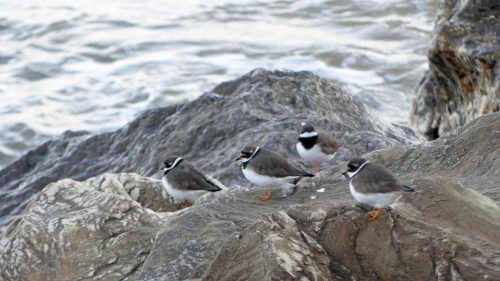
Round about this spot I’d seen a little party of Ringed Plovers on Christmas Eve, when walking into the village with my own family party. There’d been a group of about 15 gathered on the rocks waiting for the tide to turn (birds that is, not family members). No sign of them now, so this is an image I got that day.

24/12/17-Rhos Point-Ringed Plovers

There was a single Dunlin there then too, resting with its head tucked under its wing just peeping out to check it was safe to carry on napping.

24/12/17-Rhos Point-Dunlin

Reaching the harbour the calm appearance of the sea belied the fact that it was actually quite windy and with no sunshine still really cold, not a day for sustained birdwatching from one spot. I loved the view though in these misty muted winter shades.

The harbour wall provides the perfect place for birds the sit out the high tides to wait close by for that magical moment when as it recedes it reaches the perfect point for them to make the short flight back to the shore. There are always oystercatchers and often gulls and a crow or two. A couple seeking shelter from the biting cold against a wall were viewing it with binoculars; they’d seen Ringed Plovers there too. At the far end sat a group of Cormorants; in my photograph you can see Colwyn Bay’s sadly dilapidated Victoria Pier behind them.

Across the road is the park which has a children’s play area, a good old-fashioned paddling pool, empty now of course and open grassy areas that is currently wet and muddy, perfect for blackbirds, thrushes and starlings digging for worms. Here with my slightly bigger granddaughter a few days ago there were two Mistle thrushes in addition to today’s blackbirds and starlings.

Starling – juvenile

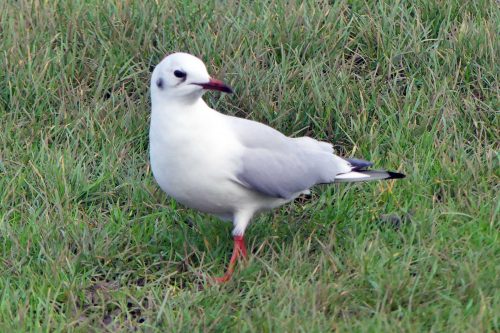
I watched a Black-headed gull, its head is just beginning to show the beginnings of darkening to the chocolate-brown of the birds breeding plumage. It too was digging successfully for worms in the soft mud. I like these neat little gulls with their red bills and legs.

Black-headed gull

Heading back down the slope to walk back I was pleased to see a rock Pipit hopping and flitting between the rocks and the Prom edge before disappearing into plants on the grassy embankment

2/1/18-Rock Pipit

A Robin popped up too – maybe the one I’d seen earlier further along by the bush. He/she was quite likely warning off the Rock Pipit.

2/1/18-Rhos Point-Robin

Daisies are flowering, only a few bravely showing their faces, but a reminder that despite their dainty fragile looks they are as tough as old boots!

2/1/18-Rhos Point-Daisy

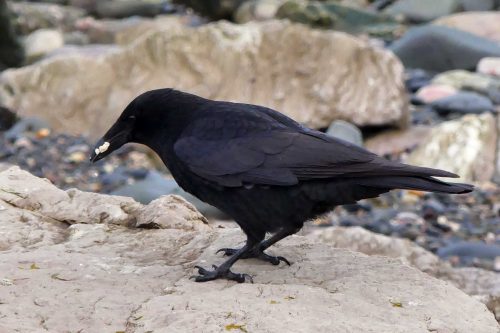
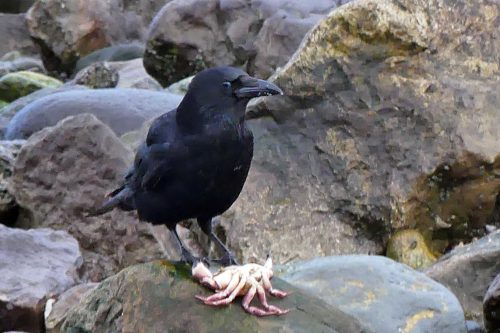
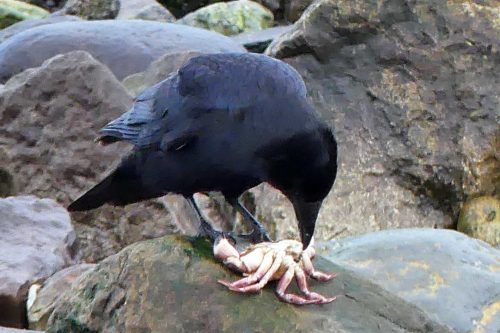
Canny Crows are frequent visitors to the rocky shore and search amongst the rocks for anything edible from scraps of left-over food left by visitors to accessible shellfish.

This one had found the remains of a sizeable crab and that look in its eye says it wasn’t about to share it!

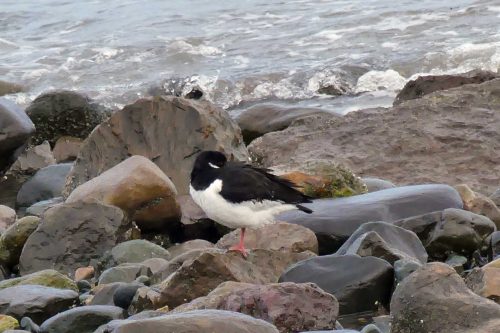
The tide was a little further out now and oystercatchers were beginning to arrive back. They didn’t begin foraging though, instead they quickly settled and resumed their rests.

The two in the pictures below have pointed beaks so would probably be waiting for the softer ground to be revealed in which they probe for their food. Those that hammer away at shellfish have bills that are blunter and more squared off.

The people with the binoculars told me they’d come down here via Penrhyn Bay where it was apparently even colder than here. They reported seeing a Grey plover there on one of the breakwaters, so I decided to go that way home and stop and have a look. I didn’t hold out much hope of seeing anything without binoculars and had no idea which breakwater it might have been on either. It was definitely colder here, and I was not going to hang about, but I was really pleased to discover that this is where the Redshanks come to roost between tides! I’ve often wondered where they go and here they were; dozens of them tucked up in the shelter of the rocks.

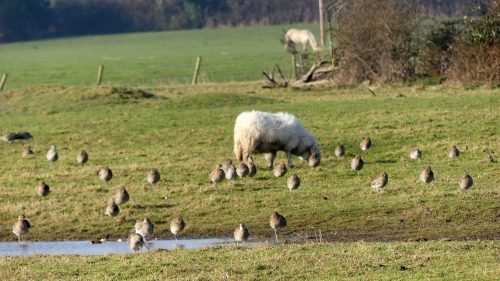
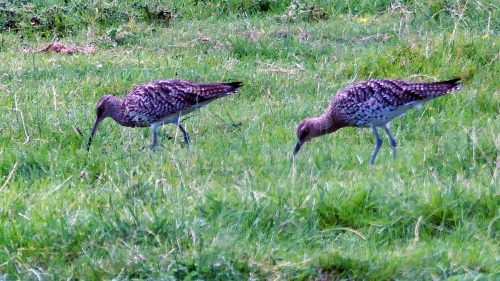
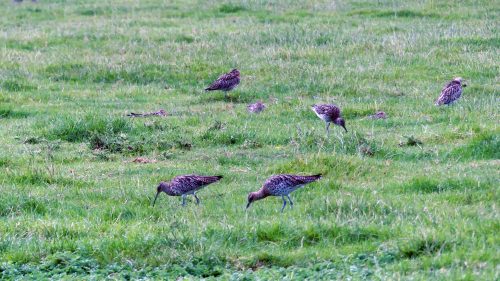
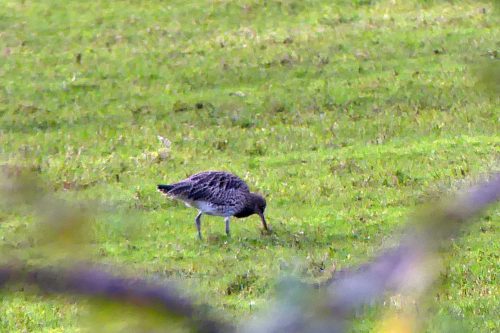
Seeing the Redshanks still waiting for the signal to make their move back to the Point made me hope that Curlews would also be in the field they frequent when not on the seashore. They were! And they come with the added bonus that you can stop on the roadside and watch them from inside your car. The brambly hedge on the field boundary gets in the way of the camera lens somewhat, and they were a distance away, but in this setting they are a wonderful sight.


Curlew bathing


Share this:

  • Share on Facebook (Opens in new window) Facebook
  • Share on Pinterest (Opens in new window) Pinterest
  • Share on X (Opens in new window) X
Like Loading...

Everlasting Green

10 Sunday Dec 2017

Posted by theresagreen in bird behaviour, Bryn Euryn Nature Reserve, nature of woodlands, North Wales, plants important to wilflife, woodland birds, woodland walks in Wales

≈ 4 Comments

Tags

blackbird behaviour, Certhia familiaris, evergreen ferns, evergreen trees, garrulus glandarius, goldcrest, holly, holly berries, Jay, long-tailed tit, Regulus regulus, sweet chestnut, the importance of ivy, treecreeper, turdus merula

December 3rd-Woodland Path, Bryn Euryn

The deciduous trees of the woodland have for the most part shed their leaves now and they cover the ground in a thick damp carpet, exuding the evocative earthy aroma that characterises this time of the year. Their falling has opened up the overhead canopy, highlighting the evergreen flora that has merged into the background since the Spring.

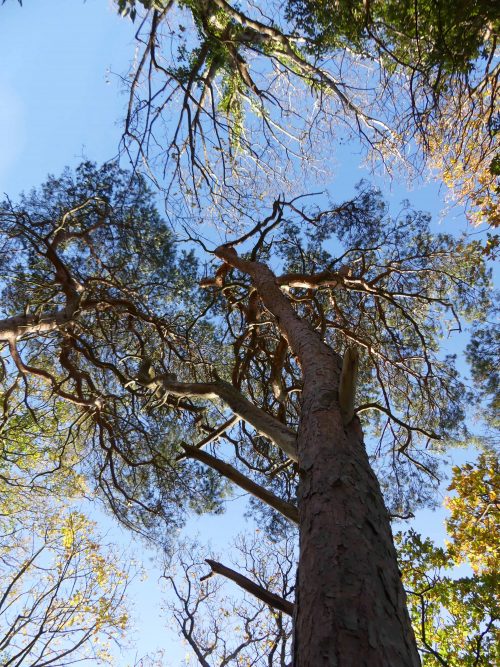
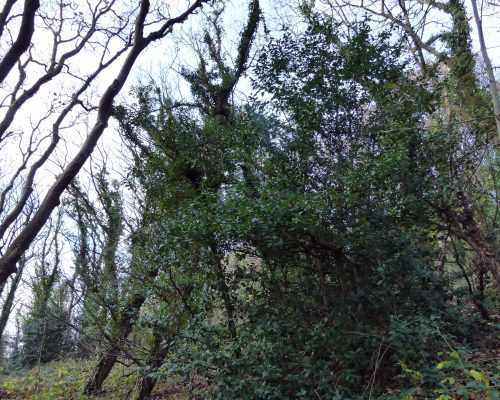
The amount of  permanent greenery always takes me by surprise. Much is in the varying forms of native trees and shrubs; dark dense Yew that fills spaces from the ground upwards, Scot’s Pines with tall trunks and bristly green crowns, glossy spiky Holly, some sprinkled with shiny green berries and of course Ivy, masses of it. There are other non-native residents too, sprawling Laurel being the most evident.

Laurel at the junction of woodland paths

Fallen leaves of sycamore and oak

Ivy is a much-maligned native evergreen that was thought to strangle trees as well as spoil their appearance. In the days when this woodland would have been strictly managed it would probably have been regularly stripped away. Now left to its own devices it is without doubt the most dominant of the native evergreens here; scrambling to the tops of even the tallest of trees in its search for light and covering large areas of the understorey too. The benefits of ivy to wildlife are enormous; both its pollen and berries can be an essential source of food for many insects and birds and it provides shelter for invertebrates, birds, small mammals and bats. At this time of year it also gives cover to foraging parties of small birds such as tits and treecreepers whilst they search amongst its stems and leaves for hibernating insects and spiders.

Ivy clambers up almost every tree

There’s green at ground level too; Polypody and Hart’s Toungue ferns are both evergreen. There are bright green patches of mosses and grey-green lichen is dusted in varying amounts onto most tree trunks and branches.

I love the little ‘scenes’ I find at this time of the year, full of interesting textures,  shapes and forms and coloured in earthy shades of green and brown.  Here the base of an oak tree has bright green moss and grey-green lichen growing on its fissured bark and tendrils of ivy are beginning their climb up. A polypody fern has found a sheltered spot, there’s a tiny new holly plant and the beginnings of a bramble.  

Nearby the fresh green leaves of Alexanders are already showing through the leaf litter.

Without the dressing of leaves the architecture of individual trees is revealed. I must have passed this tree dozens of times as I’ve walked this path but today it caught my attention as the sunlight turned its remaining dried out leaves to coppery gold.

I was unsure of the species of tree; looking upwards I saw it was tall, and also that its trunk and twisted branches appear bleached and much of its covering of bark is missing. Not helpful, but looking properly at the size and shape of the leaves I’m leaning towards Sweet Chestnut, another popularly planted non-native. There’s been no evidence of the prickly chestnuts though, so I’ll have to check to see if it produces flowers next Spring.

Ivy is creeping up the trunk of the tree and it has a backdrop of dense dark green Yew and shiny Holly.

Holly, ivy and yew

Long-tailed tit

I hear the contact calls of Tits and stand still hoping it means a feeding party are heading my way. It did indeed and now I don’t know where to look first as Long-tailed, Blue and Great Tits swoop and dart around the branches of the nearby trees. Some venture lower down giving me eye-level views. There were less birds in the party than those I saw a few weeks ago, so maybe they’ve split into smaller numbers as the availability of food has diminished. They seem to be travelling faster too, not lingering for long in one spot.

Blue tit

I wasn’t too far from where the Scots pines are gathered. Popular trees with the Tits I wondered if that was where they were headed. The trees are tall and positioned on the edge of the woodland; many have been distorted by exposure to winds and the search for light. With no low branches, their foliage is all on their crowns, so sighting anything as small as a tit is tricky, especially in sunshine. The light is beautiful up there though; I love these upward views of the tree canopy, especially on blue sky days. I’m thinking I would like to see a Coal tit though, haven’t seen one for ages.

Scots pine

A gathering of Scot’s Pines

I always stop here and look over the wire fence that marks the boundary of the private woodland and a small field. Trees on its edge although leafless are greened with ivy and gorse, which may well have once been planted as a hedge to contain livestock, has some golden blossom.

The views across the landscape to the Carneddau Mountains on the edge of Snowdonia are ever-changing with the light and the seasons and are always breathtaking.

Woodland Trail

I reach the top of the Woodland Path, and as always take note of the oak tree here at the junction with the Woodland Trail that marks the boundary of the Bryn Euryn Nature Reserve. It still has some leaves clinging on but they are fewer and browner now than a couple of weeks ago.

Oak tree on November 19th
Oak tree on December 3rd

I turn right, then a few metres on turn left onto the narrow unmarked track that leads upwards through the woodland.

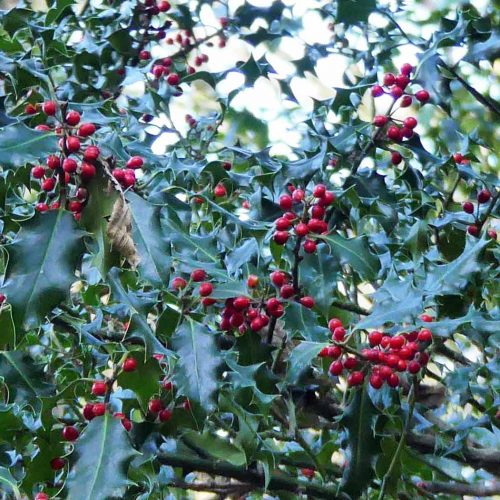
I spot a large holly bush endowed with a generous crop of berries.

Walking towards it I disturb several Blackbirds from their feasting on the berries on its far side. Confident the hungry birds would come back once they thought the coast was clear, I stopped to wait a short way away, lurking behind a nearby tree.

If you’re looking out for birds, staying still in a likely spot is often more rewarding than any amount of walking and the next few moments bore this out. This part of the wood is favoured by Jays and I heard some screeching to to one another close by. At first I couldn’t locate them, but then saw one progress its way down from a tree to some low vegetation then onto the ground where it began searching for its stash of buried acorns. The green plant in the picture is newly-sprung Dog Mercury.

Brilliant to have such great views of two of these gorgeous and notoriously wary birds. I noticed one of them had what appeared to be an injury to its left side where feathers had been lost; maybe it was from the beak of another bird competing for buried treasure. It seemed OK though and was behaving perfectly normally. Then another treat. The little feeding party I’d seen earlier passed overhead and around me, Long-tailed and Blue tits in tree branches above, then flickering movements in the Holly bush alerted me to the presence of a tiny Goldcrest.

The Goldcrest is Britain’s smallest bird

These tiny jewels of birds, (Britain’s smallest), when on the hunt for insects are constantly moving, flitting deftly through dense foliage, hanging upside down effortlessly and even fluttering frantically to hover like a hummingbird, which must use up a lot of energy. They are delightful and fascinating to watch, but tricky to keep in focus and even trickier to photograph.

A Goldcrest can hover like a hummingbird

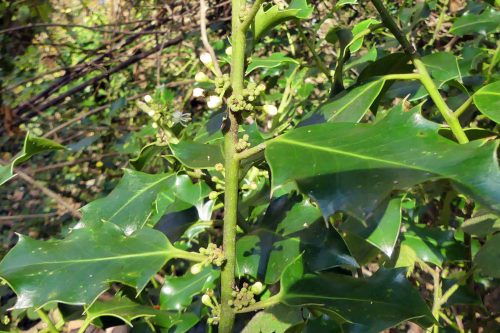
Holly is dimorphic, which means it has separate male and female plants, and only female trees bear berries. Traditional country wisdom has it that bountiful crops of berries are a sign of a hard winter to come. More scientific modern reckoning is that it is sign of a good summer past; we certainly had plenty of rain to swell berries this year.  I was surprised that the berries were being taken so early in the season though, I hope it doesn’t mean there’s already a shortage of other food available.

Most of the birds I saw appeared to be juveniles and they do seem to have been taking the fully-ripe berries.

Blackbird-Turdus merula

I was also surprised to find flowers on several bushes. They usually come forth around May when they stand a better chance of getting pollinated.

The low sun shines brightly through the trees spotlighting a small spindly tree with golden leaves. Once again I don’t know what species it is but from the size, shape and beautiful colouration of its leaves think it’s fairly safe to say it’s a maple.

“The Holly and the Ivy, Now they are both full grown” …….

Ivy completely covers a tall tree, Holly in front and a still-green Male fern on the ground

Another interesting little ‘scene’ catches my attention…

I’m never sure about the placement of this commemorative bench. It is weathered, covered with lichen and appears to have been there for decades, but the plaque gives a much more recent date. A reminder how nature is quick to move in given the chance.

It’s a shame the bench doesn’t face the other way as there’s a lovely display of ferns behind it; Hart’s Tongue, Polypody and Male Ferns are there and there’s pretty ferny moss too.

Past the bench the path continues through what I think of as ‘the Dark Wood’. Here the hillside rises steeply upwards on one side and almost as steeply downwards on the other. On the north/north-west side of the Bryn not much sunlight reaches here and there’s a density of Yew trees that also make it seem darker.

A spreading Yew

There are a lot of Silver Birches here too, which you would think would lighten the place up, but at their lower level trunks have darkened and on a few the bark has become strangely thickened and fissured.

From the lower downward slope a mighty tree trunk rises, by far the biggest tree here and that I’ve always assumed was a mighty pine, a Redwood or Sequoia or such-like.

But today I noticed some large fallen leaves that could only have come from it. It would seem then that it’s another Sweet Chestnut, but here a properly magnificent specimen. What a shame to have only restricted views.
On the opposite side of the path a sheer cliff of exposed limestone towers and adds to the atmosphere. I wonder if it was once part of the defences of the ancient hill-fort that was located on the summit.

Water often leaks from fissures in the porous rock and moss thrives on its shaded damp surface.

Having a closer look at the moss I found another fern amongst it, a tiny delicate one I’ve not noticed here before; a Maidenhair Spleenwort.

(I’m working on identifying mosses!)


Maidenhair spleenwort-Asplenium trichomanes

Past here there are more darkly-ivied trees. Today a movement caught my eye – another sighting of a foraging Goldcrest!

I watched it for what seemed like ages trying to keep it in sight as it flitted from branch-to-trunk-to-branch, in and out of the ivy, now doing its hummingbird impression – and then demonstrating a behaviour I’d read about but never seen; it climbed up the thick ivy stems like a tiny treecreeper. What brilliant little birds they are. I wish I’d had better light for better photographs.

A short way further on you are back out onto the wider brighter more open Woodland Trail.  Going down the wooden steps takes you to the car park, or as I opted, to loop around onto the lower part of the trail to get back to where I started.

As I stood deciding which way to go, one more treat, a Treecreeper making its way up another ivy-clad tree close to the path.

Treecreeper-Certhia familiaris


Share this:

  • Share on Facebook (Opens in new window) Facebook
  • Share on Pinterest (Opens in new window) Pinterest
  • Share on X (Opens in new window) X
Like Loading...

To The Summit of the Great Orme

30 Thursday Nov 2017

Posted by theresagreen in Great Orme, Nature of Wales, North Wales, Wales Coast Path

≈ 12 Comments

Tags

coastal drives, coastal walks, goats of the Great Orme, Great Orme cable car, Kashmiri goats, Llandudno, Marine Drive, North Wales Wildlife Trust, sheep of the Great Orme

November 1st

From April this year I have spent almost every Wednesday afternoon working as a volunteer in the NWWT shop situated within the Visitor Centre on the summit of the Great Orme. Meeting visitors from places all over the UK and beyond has been interesting and enjoyable, I have loved learning where they were visiting from and found I have a particularly soft spot for the older people who tell me they came up here as children, some several decades ago. It’s good to hear that the place has stood the test of time and still lives up to their happy memories. A fair few people came in seeking information too, most relating to the Great Orme itself and some regarding the local area, things to see, places to go etc. Initially I had to research things, now I feel I can give enough information for the average day visitor’s needs and in the process have learned a lot about this iconic headland.

The shop’s opening season ends this weekend, so today was my last day until next April. I am going to miss my weekly journey to and from the Summit, which have been highlights of my weeks, it’s been a real privilege to have had such a scenic drive to and from work! Today’s drive was particularly stunning as it was one of only a handful of fair weather Wednesdays this season; most have been cool to the point of cold, wet and extremely windy. The shop has sold boxes full of gloves and woolly hats to unprepared visitors!

Marine Drive

There are a number of ways to reach the summit of the Great Orme but my route of choice is via Marine Drive, also known as the Toll Road as there is a charge to drive this way (currently £3 per car that includes free parking at the summit). You can walk this route too and the length of Marine Drive is an inclusive section of the Wales Coast Path.

Approaching the toll house

Leaving the toll house you are soon confronted with this dramatic view; I love the zig-zag of angles created by the road, the limestone cliff and the stone wall.

There are a few spots where it is possible to pull in and park briefly to admire the views such as this one looking back over Ormes Bay to the ‘good’ unquarried side of the Little Orme.

A limestone cliff towers high above the road level blocking out the low sun

 casting its shadow onto the rippled surface of the sea.

Looking ahead to the tip of the headland and down onto a rocky cove.

Eventually the road forks and I take the upwards route which winds its way via a series of hairpin bends to the summit. The trickiest of these bends is just past the beautiful little St Tudno’s Church where there are stone walls either side of the single track; with no forward view of anything oncoming it helps if you can reverse your car accurately.


Unless I am running particularly late I pull into the small parking area opposite the church. On wild days I contemplate the view from my car but on days such as today I get out, breathe in the air and generally take in the glorious landscape and beyond it across the Irish Sea. The shape of the hawthorn trees here gives you a clue as to the regularity and strength of the prevailing wind.

Two sheep were ambling along the road in front of the church wall. Not an unusual sight, but what was unusual was that both had their long tails and also seem to have escaped this year’s shearing. I wonder where they’ve been hiding?

The National Trust famously took over the farm on the headland a few years ago and the farmer has since built up sizeable flocks of a variety of sheep breeds. Carefully chosen for their differing grazing habits they are free to wander and help maintain the conditions needed for the special flora and fauna that grace this special place.

Some are Herdwick sheep, a breed of native to the Lake District of North West England. Herdwicks are prized for their robust health, their ability to live solely on foraged food, and their tendency to be territorial and not to stray too far from their home base.

A Herdwick sheep smiling for the camera

A sighting of some of the herd of resident Kashmir goats is always a highlight of the drive. They too are free to wander and graze on the tougher vegetation and they can and do, pop up almost anywhere. I was happy to see a little party in the same field as the sheep; a couple of ‘Nannies’ (females), with this years growing kids.

A sign of fair weather is to see the cable cars gliding quietly high above you to and from the summit. This cable car system, opened in June 1969, is famously the longest passenger cable car system in Britain and I’m assured the panoramic views it offers are truly amazing. I’ve yet to try it myself, but it is on my list of must-dos. Needless to say it hasn’t run frequently this year due to strong winds; not surprising when you learn it travels about a mile and its highest point is about 80 feet (24.3 metres) off the ground!

Another way to reach the summit is by tram. Much more reliable it can travel up in most weathers, although it was forced, (in compliance with insurance requirements), to stop a few Wednesdays ago when winds were gusting at 48mph! I remember it well as that day I could hardly open the car door and almost got blown off my feet in the car park. The tram route is a journey in two parts, requiring a break at the aptly named Half-Way Station where you swap cars to continue to the Summit.

The Half-Way Station  

Reaching the road junction by the Half-Way Station I turn right to carry on up to the Summit (left takes you back down into town following parallel to the tram track). I pass the entrance to the Bronze Age Mines. I haven’t been down there either and may not. I can do heights much better than closed-in depths, no matter how fascinating.

From the car park the view is stunning. Not entirely clear but the sun shining through clouds had turned the lightly rippled sea to molten silver.

Although not obvious from the sea’s surface it was still windy enough to support this young Herring gull allowing it to hang in the air and parachute down to make a soft landing.

I’m coming in and there’s another one behind

The shop closes at 4pm since the clocks went back. The summit was almost deserted and the last tram departed as I left. The sun was already setting behind Anglesey and veiled by light misty cloud was casting a glorious soft golden glow over the entire landscape, even colour-washing the white-painted summit building.

In the gathering dusk I drove back down the way I had come to the junction with Marine drive, which from this point once again becomes a one-way only road leading down to the West Shore side of the headland. The road passes by the old Lighthouse, the subdued light suitably accentuating the gothic-castellated building perched bleakly on this exposed point of the headland.

The Lighthouse, now a ’boutique’ b&b, was originally constructed in 1862 by the Mersey Docks and Harbour Company who built the fortress-like building using “dressed limestone and vast bulks of Canadian pitch pine”. The beacon remained as a continuous warning to mariners until March 22nd 1985 when the optic was removed. It is now on view within the Visitor Centre on the summit. 

Past the lighthouse I just had to stop and get out of the car to photograph these pink-washed limestone cliffs before continuing on down. Then stopped again to take in the view out over the West Shore and the Conwy estuary. On a clear day you can see Conwy castle and the road bridges and follow the curve of the river back way beyond to the mountains of Snowdonia.

A few minutes later I am almost home, driving along the Llandudno sea front and admiring the almost-full moon in the darkening sky.

This must surely be one of the most scenic routes to and from a workplace that a person could wish for.

Share this:

  • Share on Facebook (Opens in new window) Facebook
  • Share on Pinterest (Opens in new window) Pinterest
  • Share on X (Opens in new window) X
Like Loading...

September Hillside

24 Sunday Sep 2017

Posted by theresagreen in British hoverflies, Bryn Euryn Nature Reserve, Butterflies of Wales, calcareous grassland, hoverflies, Nature of Wales, North Wales, slugs & snails, Wildflowers of Wales

≈ 7 Comments

Tags

Arion flagellus, common carder bee, common knapweed, eyebright, green-soled slug, hemp agrimony, robin's pincushion, scabious, speckled wood, volucella zonaria, yarrow

September 8th-Bryn Euryn

As I’ve already said, it was mighty windy out here on the not-quite-summit of the hill; not the day for hanging around gazing at the views, no matter how stunning they may be.

Windswept not-quite-summit of Bryn Euryn

A quick look around showed there to be little left in the way wildflowers in bloom, but there was colour on a wild rose – a whole colony of bright red Robin’s Pincushion galls. I don’t recall ever having seen as many on a single plant. The fuzzy growths will gradually fade to brown and the little wasps that cause the growths will emerge in June. If I’m lucky, one of these days I’ll catch them coming out, although the galls also attract ‘squatters’ and there can be a dozen or more species lodging in there!

I was to keen to keep moving, but when I spotted this lovely patch of Eyebright I couldn’t resist stopping again.

The dip between this part of the hill and the slope up to the summit is usually sheltered and offers a brief respite from the wind and the noise of traffic from the A55 below, but not so today. Yarrow likes this spot and there was quite a good large patch of it still in flower here. As with Eyebright, Yarrow is a plant designed to withstand tough growing conditions and is pretty persistent, as anyone that has tried to eliminate it from a lawn will testify; you cut it down and it grows right back! Personally I prefer the ferny-leaved Yarrow to the boring grass! Funny how we discriminate against certain plants, this wildflower Yarrow’s taller-growing golden-yellow flowered relative, Achillea, is a cherished garden plant!

Some insects rather like its flowers too, I found a tiny bee motionless on a flower today and recalled I’d seen a similar looking insect on Yarrow in the Rhiwleddyn reserve a few weeks ago.

Tiny bee on Yarrow – enlarged

On the summit a patch of purple Knapweed was fuelling a few Common Carder bees that were managing to cling on and fly short distances despite the best efforts of the wind to dislodge them. The little bees had varying appearances; some were practically perfect, others a bit more battered, their ‘fur’ worn away and at least one that had a bleached appearance like it had spent too long out in the sun.

Common carder bee-practically perfect
Common carder bee-a little faded
Common carder bee-fur worn from back
Common carder bee-bleached

There was another lovely clump of Eyebright up here, this one framed by the distinctively-arranged pods that give the Bird’s-foot trefoil its name.

More Yarrow too, this plant sheltering a tiny fly.

I was hoping that the other side of the hill would be a bit more protected from the wind, but alas, most of it wasn’t. The sun was putting in sporadic appearances though, so at least it felt a bit warmer. Ironically, the sea looked to be calm, was coloured in shades of beautiful blue and its surface merely ruffled. The blades of the wind turbines were motionless.

Looking over in the opposite direction to te sea, the view to the oddly-shaped hill at Deganwy, was fairly clear, although beyond it, Anglesey and the Menai Strait were shrouded in a light haze. I’m not sure if I’ve mentioned it before, but the hill is named the Vardre and gets its unusual appearance from having two rocky summits. It has a little less height than Bryn Euryn, it being 108m, (354 feet) while the Bryn is 131m (365 feet). It was once home to fortifications that included Deganwy Castle.

On the woodland edge leaves are beginning to change colour. Hawthorn is one of the first to go

along with Silver birch as I mentioned in the previous post. Out here in the open it was easier to appreciate the combination of yellow leaves against a clear blue sky.

Next to the Silver birch is a single Whitebeam, which bears berries. The berries are orange in colour now but will gradually turn red.

In the short grass there are still a few Rock-roses in flower and here and there are big fat ‘penny-bun’, or Bolete mushrooms. At least they would have been big and fat before they were nibbled away. I like the different shades and textures such nibbling has left on this one; there was a little black spider on it too.

I have often wondered what nibbled the mushrooms. A picture I took a few weeks ago, at the end of July may have the answer. The sight amused me and I wondered if it was a romantic al-fresco lunch for two? Of course there is more to slugs than meets the eye. No gardener is ever going to welcome them onto their plot, but out in the wild they are another important cog in the wheel of the natural waste-disposal system. Although one slug may look rather like another, there are rather a lot of different species of them in our British Isles. I submitted this image to the very helpful folk that run the Slugs and Snails of the British Isles Facebook Group, who responded that to be accurate they need to see the undersides of the slugs too, but from other features that it is likely they are juvenile Arion flagellus – the Green-soled slug.

poss. Arion flagellus- the Green-soled slug

The bottom of the grassy ‘downland’ hill was still flowery with Hemp Agrimony, Knapweed, touches of Scabious and a sprinkling of Ragwort.

I walked down to where it meets with the woodland edge and lo and behold, for a few glorious minutes the sun came out. Suddenly it was warm and bright and the scene came alive with a whole host of insects vying with one another for the best blossoms.

Speckled wood on Hemp agrimony

I hardly knew where to look first, but then couldn’t resist the sight of a pristine Speckled wood feasting on Hemp agrimony. There were several of them, all looking freshly beautiful; most were nectaring on various flowers while some rested on the leaves of nearby trees basking in the sunshine. The only other butterflies in evidence were Red Admirals which unusually stayed out of range of the camera.

Speckled wood on ragwort

There was a good variety of hoverflies,large and small, a Common wasp and more Common carder bees too.

Hoverfly - Eristalis sp
Hoverfly – Eristalis sp
Hoverfly - Eristalis sp
Hoverfly – Eristalis sp
Hoverfly-Helophilus sp
Common wasp
Common wasp

Common Carder bee on Scabious

Volucella zonaria

A beautiful cast of insects, but the star of today’s show was a big handsome hoverfly, which surprisingly doesn’t have a common name, but whose scientific name, Volucella zonaria makes it sound a bit like an Italian pasta dish. This is the largest British hoverfly and is quite a recent addition to our native list, appearing on the south coast of England during the late 1930s. According to my Hoverfly bible, from there it has spread upwards and outwards across the country as far as Cheshire and Humberside and South Wales in the West. We’re not so far from the Cheshire border here, so they must still be spreading, this is the second one I’ve seen this year, the other was in my daughter’s garden a few weeks ago.

170908-1510-BEICT-Hoverfly-Volucella zonaria 3
170908-1510-BEICT-Hoverfly-Volucella zonaria 5

The spell of sunshine didn’t last long and the wind was still blowing relentlessly; time to set off in the direction of home.

Wind-blown ash tree


Share this:

  • Share on Facebook (Opens in new window) Facebook
  • Share on Pinterest (Opens in new window) Pinterest
  • Share on X (Opens in new window) X
Like Loading...

September Woods

22 Friday Sep 2017

Posted by theresagreen in bird behaviour, ferns, Nature of Wales, nature of woodlands, North Wales, woodland birds, woodland walks in Wales

≈ 11 Comments

Tags

black spots on sycamore leaves, Blue tit, grey-green lichen hanging from tree, hart's tongue fern, male fern, Nuthatch

September 8th – Bryn Euryn

Woodland Path

Yet another windy day with intermittent sunshine, so I’m seeking shelter in the woods. It is almost eerily silent and the damp soft earth of the path absorbs the sound of my footsteps. Something detects my presence at the last minute; loud rustling sounds from the undergrowth startle me and a panicked grey squirrel shoots out in front of me, sprints rapidly along the path and launches itself up the trunk of the nearest large tree. It pauses when it feels safely hidden behind foliage, but I spied it through the leaves, its mouth filled with an acorn, still green and unripe.

There are ripe blackberries, but on the early fruiting brambles some are already mouldering, and a feasting greenbottle fly reminds me why I don’t eat too many unwashed wild berries.

Chains of scarlet berries drape shrubbery. This one twined through holly reminded me of a Christmas garland; I wonder if sights such as this sparked the idea for festive decorations?

The berries are those of Black Bryony-Tamus communis, and will continue to ripen until they are black. A perennial plant described as twining, but often it’s more of a scrambler.

Woodland Trail

There are rose hips here

and a bramble whose leaves look as though they are almost ready to drop.

The gorse bushes have fresh golden blossom and clever spiders have spun webs in the hope of capturing flying insects drawn to their nectar and pollen. Gorse flowers throughout most months of the year prompting the old saying, “When gorse is out of flower, Kissing is out of season!”

Summit Trail – backtracking

The last time I walked here I took a slightly different route to the summit of the hill, taking an unmarked track up through the woodland to join the Summit Trail. I hadn’t planned to that, but at the junction of the paths I usually take I’d stopped to try to locate Jays that I’d heard screeching in nearby trees and a man with a dog stopped to ask me what I was looking at. We had an interesting chat comparing notes about what we both see here and where, but I didn’t catch the Jays. I waited to see which way he would go to continue his walk and seeing it was the same way I was headed, decided to go the opposite way. Not that I’m unsociable of course, rather that I see far more on my own and in my own time; and he had a dog! Anyway, the upshot was that I ended up on a narrow upward track through the trees on another windy day that was sunny but still damp from the previous night’s rain.

Spiders’ webs lit by the sunshine filtering down through the leaf canopy caught my eye and I stopped to admire the artistry of their construction and to try to find their makers. Looking more closely I saw most of the webs were broken and apparently abandoned, although this one had captured a beautiful rainbow.

As so often happens, my slow progress and in this instance, last-minute change of route brought forth a magical few moments. Until now the only sounds had been mainly of the wind rushing through the trees, but I began to hear bird calls that got gradually nearer and suddenly I was surrounded on all sides by excited little birds – a travelling feeding party! I had been standing still and they seemed not to notice me; I’ve described a similar experience in a previous post and this was equally as joyous and uplifting. It was a large party too, impossible to count the numbers of birds within it as they scattered amongst the trees, but Blue tits were probably most numerous with at least a dozen Long-tailed tits; Great-tits were there too. I didn’t see Tree-creepers as before, but was thrilled to see a Nuthatch that chose to explore a tree right in front of me.

Nuthatch-Sitta europaea

Taking photographs in the darkness of woods is rarely successful, but a Nuthatch did pause briefly from its foraging near a patch of sunlight, giving me a reasonable chance to record this bird for the first time here. Watching a tiny Blue-tit searching through ivy high up in another tree I realised it was looking for spiders, which are an important part of their diet. Perhaps the birds’ regular forays are the reason I couldn’t find any.

Blue tit seeking spiders

Back to the present 

Sycamore leaf with spots of fungus

There was no feeding party today, but there were other signs of a summer ending. Sycamore leaves, amongst the first to break their buds in the Spring are amongst the first to change colour and fall. Most of those I see nowadays are marked with dark spots; this is Rhytisma acerinum, the Sycamore Tarspot. It doesn’t look attractive, but although it is suspected that the darkened areas reduce the photosynthetic capacity of affected trees, the fungus doesn’t seem to affect the tree’s health and vigour. One consolation of the fungus’ presence is that is shows the air here is fairly clean as it is apparently particularly sensitive to sulphur dioxide air pollution. Trees growing near to industrial centres with high levels of sulphur emissions do not show any sign of the leaf-blackening fungi.

If you look at the undersides of the fronds of most ferns, their seeds, spores or more correctly sori  are now ripe. The Male Fern is the most common fern found growing here; its sori are round and normally run in two parallel rows.

There’s a large patch of Hart’s Tongue Fern growing in damp shade on a steep bank. Its leaves and sori take a different form to those of other fern species. Their ripe sori accentuate the marks on the underside of the leaves and it seemed to the person that named the plant that they resembled the legs of a centipede, so he gave it the scientific name ‘scolopendrium‘, the Latin for centipede.

Hart’s Tongue Fern-Phyllitis scolopendrium

The track passes a sheer cliff of limestone. Its surface is frequently damp, sometimes wet and its base is covered with a lush, bright green shag-pile carpet of moss.

There’s a small grove of Silver Birch trees on this shady, damper side of the Bryn that are also beginning to lose their leaves, which stud the dark mud of the track with specks of bright gold.

Nearing the end of the path the trees thin and give way to scrubbier vegetation, mostly blackthorn and hawthorn. The blackthorn has beautiful purple sloes and its leaves too are beginning to turn colour.

A number of the blackthorn shrubs here also have clumps of pretty grey-green lichens. Some looks like a tangle of moss, which I can’t accurately name.

Other blackthorns have a lichen in a different form, this one, photographed on a nearby shrubby hawthorn tree with dark red fruits (haws), has the appearance of Reindeer moss, but I can’t yet be species-specific.

Emerging from cover onto the exposed summit I braced myself for another confrontation with the wind. The sun had disappeared behind clouds that were shutting out its brightness, leaving the landscape in shadow, dulling its colours. Part of the view across the valley from here takes in buildings and fields that belong to the Welsh Mountain Zoo, located above Colwyn Bay. There are sometimes interesting animals grazing in the fields; today it was some kind of cattle.

With or without sunshine I love this hillside view of small fields bounded with hedges and trees with the mountains in the distance. It reminds me a little of a David Hockney painting.

The mountains are topped with billowing clouds that permitted some sunshine through to lighten slopes here and there and to brighten the water of the river Conwy.

On days like this you can only hope for at least a little sunshine to brighten the rest of a walk…


Share this:

  • Share on Facebook (Opens in new window) Facebook
  • Share on Pinterest (Opens in new window) Pinterest
  • Share on X (Opens in new window) X
Like Loading...

A Windy Wildflower Trail

25 Friday Aug 2017

Posted by theresagreen in Butterflies of Wales, calcareous grassland, Nature of Wales, North Wales, North Wales Wildlife Trust, Rhiwledyn Nature Reserve, Wildflowers of Wales, Wildlife of the Wales Coast Path

≈ 15 Comments

Tags

carline thistle, centaury, common blue, common calamint, Gatekeeper, goldenrod, harebell, montbretia, Nature in August, ploughman's spikenard, wild carrot, wild fennel, yellow-wort

August 3rd – Weather – intermittently sunny, warm but with a very strong cooling wind. 

As August began I wanted to get out to see wildflowers. This is one of my favourite times of year for that, when there is every chance that there may be earlier flowering plants still around and the late-summer bloomers should be at or reaching their best. Most of the sites I visit regularly are good for wildflowers, but as they are mostly located on hills or headlands and exposed to the elements, they would not be particularly enjoyable on a strongly windy day like today and taking photographs would be difficult. I decided on Rhiwledyn Nature Reserve, one of my favourites as it covers a range of interesting habitats within its 12 acre site and as it is located on the eastern side of the Little Orme there was a chance that much of it would be sheltered from the worst of the wind.

There are three ways to access the reserve, all of which require a bit of an uphill hike. One route is from Llandudno, another from the other side of the Little Orme, but for me the most interesting route to its main entrance is along the path at the base of a section of the Orme that runs up Penrhyn Hill. Marked as a 10% gradient, this is a steepish stretch to walk, but worth the effort as the rock supports an array of plants, both wildflowers and some garden escapees, and is a nature trail in itself. This provides me with the perfect excuse to amble up the hill and take frequent excusable pauses for breath rather than stride purposefully along.

Looking back along Penrhyn Hill towards Penrhyn Bay. The hill in the centre background is Bryn Euryn

Part 1 – Penrhyn Hill roadside to the reserve

My first sighting was of a male Common blue butterfly taking a break from his battle with the wind on the flower of a hop trefoil, low down in the vegetation. Amongst long grass and ivy, a grey leaved Yellow-wort; this is an annual favouring short calcareous grassland but is found in a variety of spots throughout the headland.

Common blue
Common blue
Yellow wort-Blackstonia perfoliata

There were several clumps of a plant that was definitely a member of the mint family with strongly aromatic leaves. I don’t know what it is yet.

  • since publishing this Suzanne has kindly suggested in a comment that it is Common calamint Clinopodium ascendens. This is a mint that grows in dry grassland, hedgerows and verges, often on chalk or limestone soils, so habitat fits perfectly.

Common calamint – Clinopodium ascendens

And another aromatic plant – Wild Fennel, growing as tall as me, in front of gorse.

A pretty snail clung to the leaf of a Valerian plant; I lifted it gently to check the colour of its underside lip – brown – then replaced it. A few bees were braving the breeze, mostly Buff-tailed bumblebees. I photographed one on marjoram, which may or may not be a wild plant.

Brown-lipped snail
Buff-tailed bumblebee on marjoram

There is Wild Carrot in various stages of flowering from tight buds to maturing seedheads. Most often found in rough grassland, near the sea and again mostly on chalky soil. This is one of the easier of the white umbellifers to identify, with feathery leaves and bracts beneath the flowerheads and always a red flower in its centre.

Wild Carrot-Daucus carota

Windy days are not good for butterflies, but I did see a couple of Gatekeepers. Both sticking close within the vegetation, one found Marjoram to nectar on, the other attempted to bask on a Wild Clematis leaf. Both were faded and looking a little the worse for wear.

Gatekeeper on Marjoram- fruits of Herb Robert behind
Gatekeeper
Gatekeeper

A flowering Goldenrod plant sprawled out across the edge of the path.

Goldenrod – Solidago virgaurea

So too a sprawling patch of Montbretia

Montbretia

and this one with its flowers like small dandelions, which I think may be one of the Hawkweeds. Another one to work on.

A stone wall marking the boundary of the farm’s land breaks the vegetated path edge, but behind it the small field is golden with Ragwort and long seeding grass. There were butterflies in there, mostly Whites, but it’s off-limits so couldn’t get a closer look.

Trees on the edge of the small wood in the background of the photograph now cast shade over the path and its edge and there are less flowering plants. There is plenty of ivy, Wild Clematis a flourishing Wild Cabbage, more of the not yet id’d mint and a clump of the usually sun-seeking Rockrose.

Rhiwledyn Nature Reserve

Half an hour after parking my car I finally reach the entrance to the reserve. The sun is shining and a fly basks in the warmth reflected by the glass of the narrative board.

A pretty clump of Marjoram flowers at its base.

I turned left to first walk the short length of the path at the base of the headland where it meets Llandudno Bay. The strength of the wind here took my breath away and walking into it head on was a challenge, but now I’d got this far I wanted to carry on to the far end of this eastern side of the headland as far as I could. 

Up on the cliff a patch of harebells gave a rare opportunity to get close to these lovely little flowers without having to lie on the ground. They look delicate and their thin stems seem fragile, but they are tougher than they look and were holding their own in today’s wind.

Spiky starry Carline thistles caught my eye. Kneeling to photograph them I see they are growing amongst bird’s-foot trefoil and that there is another little star there too – a tiny white flower of Pearlwort.

There is Yellow-wort flowering next to Wood sage which is setting seed.

Another Carline thistle, this time with Eyebright and an unwelcome invader, cotoneaster, one of the banes of the lives of hard-pressed reserve managers.

Nearby, more Harebells with a little pink Centaury and the grey felty leaves of Mouse-eared Hawkweed.

I was almost relieved to reach the end of the track and be blown back to retrace my steps to the beginning of the upward track.

First I went ‘off piste’ a little to reach a stand of golden yellow Ploughman’s Spikenard.

Ploughman’s Spikenard – Inula conyzae

Then a scramble back down to the start of the track proper. A badged wooden post here reassures you that you are officially following both the Wales Coast Path and the North Wales Path.


Share this:

  • Share on Facebook (Opens in new window) Facebook
  • Share on Pinterest (Opens in new window) Pinterest
  • Share on X (Opens in new window) X
Like Loading...

Curlews are Back in the Field

05 Saturday Aug 2017

Posted by theresagreen in bird behaviour, Birdwatching on North Wales coast, Nature of Wales, North Wales, Rhos-on-Sea, Rivers of Wales, wading birds

≈ 10 Comments

Tags

Afon Ganol, Curlew, curlew flock

July 17th 

Curlews are back. That is to say I’ve just noticed some in the field as I drove past, I don’t know when they got there exactly. There were just a few for now, a lot of Curlew that return here will have been breeding, or bred in Iceland, but their return here following a few months away each year is one of the signs that summer is rapidly coming to an end.

More used to seeing these wading birds solitarily stalking amongst the rocks of Rhos Point, I was amazed the first time I saw them gathered together in a significant number in this field, although it did go some way to enlighten me as to where birds go when the tide’s in. That initial sighting was was back in 2011 when I came here to live and each year since I’ve looked out for them, hoping they’ve had a successful breeding season and that their numbers will be good. (Not that I know what would be classed as a good number; nowadays the curlew is a threatened species, and I have no idea how present day numbers compare with historical ones for this site.) I’m not confident counting birds, but last year by my reckoning there were somewhere around 80-100 of them here at any one time.

17th July 2017-Curlews and cows

I’ve wondered about the attraction of this particular site as a gathering place. In the present day, as fields go this is not a particularly large one and it probably qualifies as ‘rough pastureland’ having coarse grass, a generous sprinkling of thistles and not too much else. It is farmland, so the birds often have to share the space with large grazing animals; presently it’s cows, earlier in the year it was sheep. It is bounded on one side by the Llandudno Road, by houses on another two with another field fenced off behind it.

February 2017-Sharing with sheep

On the plus side, it’s conveniently close to the shore & a short flight gets them them there in minutes.The ground here is probably rich in invertebrates as the animals keep the ground well manured, and much of it it floods easily and holds the moisture, keeping it soft for probing with their long bills. 

The birds must feel safe here too, when not foraging the flock takes time out  to rest and preen their feathers.

Curlew resting, preening & bathing

They seem to be here during times of high tide when there is no accessible shoreline for foraging. They seem to instinctively know the exact moment the tide is optimally in or out and some trigger suddenly alerts them to take off as one and head back there.

Heading back to the shore

Maybe that’s all there is to their choosing this spot, but it could also be connected to the past history of the land within which the field is located. Going back to the beginning, a clue lies in the meaning of the name of the village, Rhos-on-Sea, or more properly Llandrillo-yn-Rhos: the Welsh word rhos, translating as ‘marsh’. In the distant past, before the construction of sturdy sea defences, high tides would have reached further inland than now and flooded much of the low-lying ground here between it and the hills, forming an extensive salt marsh. The flat area between the Little Orme and Bryn Euryn, from where I took the photograph below is the northern end of the valley of the Afon (river) Ganol, once a significant river which flowed into Penrhyn Bay and also into the tidal river Conwy at its southern end. Along its length several small streams also fed into the river. 

July 2017-Looking down onto the ‘curlew field’ from Bryn Euryn

Looking down onto the well-ordered village of Penrhyn Bay with its network of roads and the modern-day golf course, it’s hard to visualise the wild place this once was, although following sustained heavy rainfall it is easier to see how wet it must have been.

January 2014 -Looking down on the flooded field where curlew, oystercatchers, redshank may be seen feeding amongst sheep

The Afon Ganol was by all accounts a dangerous tidal strait, and it formed a natural barrier rendering the land beyond the valley, then known at the Creuddyn Peninsular far more more isolated. Crossings were difficult; the river could be forded here, although the area was extremely marshy. Then in the 1800s, embankments were built at either end of the valley to allow land reclamation.

The effort and work undertaken to drain the marsh must have been massive, and hugely expensive, but by 1912 the OS map shows the Afon Ganol as being culverted under the Llandudno Road to the golf links, with a culvert going out to sea, but with still a large marshy area remaining. The establishment of the golf links then required further improvements to drainage and a new outlet for the diverted river was constructed. Dug 2′ below the bed of the river and the link’s ornamental lakes, this outlet then enabled the river and the lakes to be emptied during intervals between tides, keeping the golf course dry.

Today the Afon Ganol remains as a culvert with tidal outfall structure, which was updated in 2011 to decrease the risk of flooding.

A section of a remaining water course bends around the back of the rugby field

Interestingly, although the original river is now just a meandering waterway and ditch, in part diverted and culverted, it remains still the county boundary between Conwy and Denbigh.

Welcome back Curlews, the place is not the same without you.


Share this:

  • Share on Facebook (Opens in new window) Facebook
  • Share on Pinterest (Opens in new window) Pinterest
  • Share on X (Opens in new window) X
Like Loading...

Little Orme Level 2 and Higher

23 Friday Jun 2017

Posted by theresagreen in bird's nests, Birdwatching on North Wales coast, coastal wildflowers, Little Orme, Nature of Wales, North Wales, Rhiwledyn Nature Reserve, Wildflowers of Wales, wildflowers on limestone

≈ 10 Comments

Tags

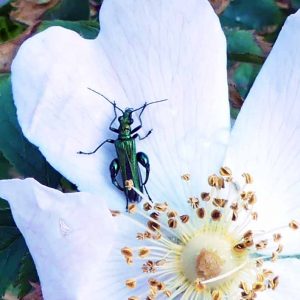
bird's nests, Cormorant, cormorant colony, cormorants nesting, guillemot, moon daisy, ox-eye daisy, sea campion, swollen-thighed beetle, yellow dung fly

Cormorants flying overhead refocussed my attention and I began the climb up the steep slope to the next level of the cliff.

I didn’t get far before stopping to watch the Whitethroat I had been heading for pre-Chough. He was singing from an old bramble stem close by and was nicely visible apart from being seemingly garotted by a twiggy branch. Song done, he flew across the track into the base of a huge bramble shortly followed in by his mate coming from the other direction, carrying food in her beak. So this is where they are nesting, no doubt tucked low down in the protective thorny thicket.

About half-way up I welcomed the excuse to pause, granted by the sight of another Swollen-thighed Beetle, this time a male sporting a splendid pair of said swollen thighs.

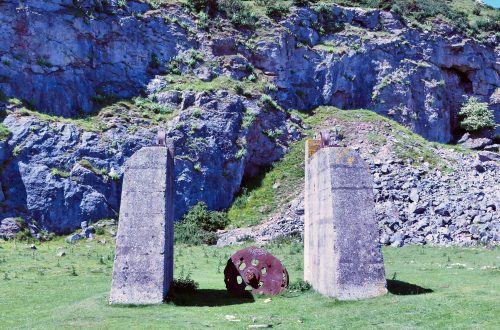
At the top is a reminder that the slope’s purpose was not originally as a walking track. Here stand the remains of supports and cogs for winding gear, once employed to steady trucks full of quarried stone on tracks down the steep slope, then to haul back empty ones.

TGLOVW-Winding gear remains at top of slope

This quarry face accommodates many nesting pairs of Jackdaws, whose cries often echo loudly around the bare stone cliffs. They were quiet today, the only sound made by a sheep bleating from the edge of the wall towering above. Clearly a mother, she may have been calling for her young one; I hoped he hadn’t been hauled off to market to end up as Welsh Spring Lamb in a butcher’s shop.

I took a very quick look at nesting Fulmars, didn’t want to disturb them so stayed well back.

Attractive birds with an elegant stiff-winged flight, it’s hard to believe they produce such a loud, rather harsh cry and that their tube-like nostrils are designed to allow them, inelegantly, to snort out salty water.

From up here you can look down on the flat quarried-out ‘Level 1’ of the site, with the cove of Angel Bay at its edge. The dry grassed areas are already showing signs of wear and tear.

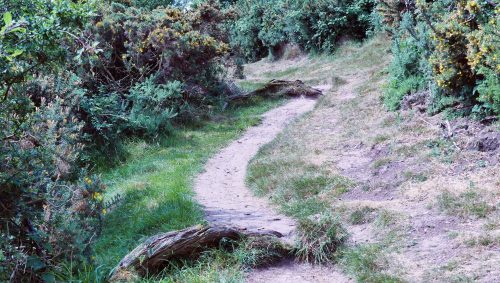
Onwards and upwards, following the track that is both on the routes of the North Wales Coastal Path and the national Wales Coast Path. It is heavily eroded in parts, and bridged by gnarled old roots, (or branches?) of gorse.

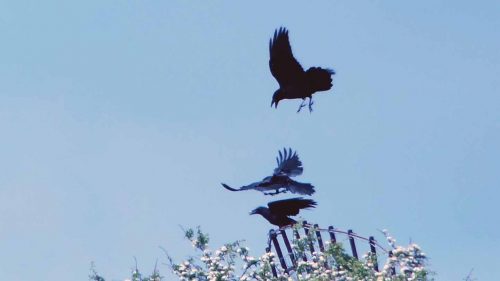
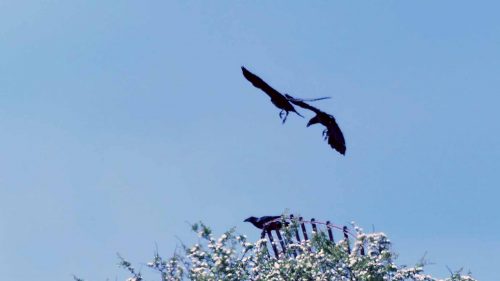
Ravens had made me aware of their presence since arriving here today, being more mobile and noisier than usual and as I ambled along this part of the track an outburst of their calls broke out from somewhere ahead of me. I had just seen birds harrassing what I assumed to be a Buzzard and thought that may have escalated into a bit more of an incident. Getting closer I saw three birds having a bit of a to-do; two of them seemed to be attacking a third that was sitting atop a fence. Not a Buzzard.

I was still too far away to see properly, but this may have been a pair of Raven upset with an intruding one. Does it have something in its beak in the first picture, an egg maybe? I have no idea but they took off from here and continued to express their annoyance from the field below for some time.

None the wiser as to what I’d witnessed I carried on, scanning the track ahead of me, as I am wont to do at this time of year, checking for sheep poo; you never know when there may be something interesting dining out thereon. I got lucky, a fairly fresh deposit yielded a little male Yellow Dung-fly. In an awkward spot to photograph, I had no option than to kneel down in front of the dung, then almost had my nose in it to get him in close up without using the lens zoom, quietly hoping no-one came along the path to witness my odd behaviour. It was worth it; I realised he hadn’t flown off as he was otherwise occupied with a lady Dung-fly. Females are far fewer in number than males, so there was no chance he was leaving, whatever I was doing.

Yellow Dung-fly pair mating
Same image but bigger

THE CORMORANT COLONY

Reputedly the largest Cormorant breeding colony in the British Isles, this is an impressive sight, even from this distance and this is only a part of it; it continues around to the other side of the rocky outcrop in the photograph below, where there are even more of them.

I’ve shown this aspect of the Cormorant colony several times before, but this is the first time I’ve visited it at the right time to catch the birds on their nests. I was thrilled to get a glimpse of young birds in some of the nests; Cormorants usually lay 2-3 eggs, and from those I could see most seem to have hatched and grown successfully, so there must be plenty of food available locally to keep offspring and parents well fed.

Some of the young birds seemed a bit more advanced than others and were already out of the nest exercising their wings, but many birds were still sitting.

The bulk of the colony is not as easy to see, and viewing the birds involves a bit of rambling up and down the uneven cliff top, then peering down from cliff edge, but it is well worth the effort. The photograph below shows the colony to be situated well out of reach of nosy people.

Around the rock I was now upwind of the birds, so as well as amazing sights and sounds I was greeted with the equally amazing smell produced by a large number of fish-eating birds confined to a relatively small space. I wish I could share it with you!

But pungent aromas aside,the colony on this side holds another treat; right in its centre is another smaller colony – of smart little penguin-like Guillemots. Surrounded by the much bigger Cormorants I imagine it is a safe haven for them from potential predators such as gulls and the Cormorants seem perfectly accepting of them.

Cormorants and Guillemots sharing fishing space on the rocks below. There were many more birds of both species flying back and forth and hunting and diving in the water too. Cormorants stay separate but Guillemots often join together in ‘rafts’ floating on the surface of the sea.

These two birds, who I fancied were enjoying some fresher air away from the colony, is my favourite Cormorant image from the day. The birds weren’t making a sound; they gape their beaks as a means of cooling down their bodies, but it seems like they’re commenting on something out at sea. Possibly the ever-encroaching turbines of the wind farm, or maybe they were sureying for likely fishing spots. 

It was a sunny day with some cloud and really strongly windy, particularly noticeable up here at the top of the headland on its sea-facing edge, but the elements’ combined effects on the water was breathtaking. I sat for some time watching the ever-changing patterns of light and shade on the surface of the blue sea as the wind rippled across its surface and clouds cast shadows above it. It really was the colour of the photograph below and quite mesmerising.

View from the Little Orme across Llandudno Bay to the Great Orme

Birds flew past the cliff at eye level; mostly Herring Gulls, but one Greater Black-backed gull too, and a Raven gronked a greeting as he passed by; all strong birds gliding effortlessly on the wind and thermals created by the cliff face. A Rock pipit popped up over the edge briefly but popped down again when he spotted me. A Jackdaw also appeared over a ridge, but disregarded me completely and carried on foraging within touching distance, even posing for a portrait.   

THE CLIFFTOP

Returning to the main track I passed a ewe and her lambs who had found a shady and sheltered place to rest with her lambs.

I watched a 7-spot ladybird scrambling through the mossy turf. Grazed by sheep and rabbits, baked by the sun and exposed regularly to strong, salt-laden winds anything that survives here has to be tough, especially the flora. Amongst the toughest of our native flora are the thistles, the two most common species of which thrive here.

The Creeping thistle has already begun flowering and even up here was being visited by bumblebees and a wind-blown Red Admiral butterfly.

The other is the fierce-looking Spear thistle with its aptly-named long sharp spikes protecting its every part, which has flower buds almost on the point of opening now.

170527-TGLOFW-Spear thistle fierce leaves
170527-TGLOFW-Spear thistle flower buds

On the ledge beneath an overhanging rocky outcrop I was surprised to spot a clump of white-flowered plants. Getting closer I saw they were Sea campion and also Moon (Ox-eye) daisies with one of the best specimens of Salad burnet I’ve seen anywhere so far this Spring. I wonder how they got there?

Sea campion – Silene maritima

Going back down I took a photograph to remind me to say that although fading fast there is still gorse in flower and also hawthorn, but the main blossom plant now is the creamy white elder.

And another to remind myself that I can never tired of looking at this view across Penrhyn and Colwyn Bays, even when on hot days like this one much of the distance is lost in a haze.


Share this:

  • Share on Facebook (Opens in new window) Facebook
  • Share on Pinterest (Opens in new window) Pinterest
  • Share on X (Opens in new window) X
Like Loading...

Tawny Mining Bees & the Bee-fly

09 Sunday Apr 2017

Posted by theresagreen in garden wildlife, Insects, Nature, Nature of Wales, nature photography, North Wales

≈ 16 Comments

Tags

adrena fulva, bee nesting in lawn, Bee-fly, Bombylius major, important pollinating insect, mining bees, small furry bee, solitary bee, tawny mining bee

April 1st – Garden, Rhos on Sea

In the late afternoon sunshine a number of little bees were zooming around in a corner of the front garden, pausing frequently but briefly on the warmed surfaces of ivy leaves. I have seen similar ones here each spring for the last five years, so was pretty sure they were male Tawny Mining Bees, but I had to wait a while for a prettier and more distintinctive female to take a breather from her nest-building labours to be sure. Males significantly outnumbered females here this afternoon, probably because they don’t contribute in any way to constructing nests or to raising offspring, so once mating is accomplished by a lucky few, they are free agents.

Tawny Mining Bee – Andrena fulva

The rich fox-brown colour and furry coat of the lovely little Tawny Mining-bee (Andrena fulva) makes it the most distinctive and obvious of all the Spring-flying solitary bee species.  It is a common bee in much of England and Wales, which nests underground and leaves a little volcano-like mound of soil around the mouth of its burrow. Nests can often be seen in lawns and flowerbeds in gardens and parks, or in mown banks and field margins in farmland and orchards.

Description

Size: Females 10 to 12 mm and males 8 to 10 mm long.

The Tawny Mining Bee is a small rich gingery-orange coloured bee that can often be seen visiting its nest in grassy areas such as lawns during the springtime.

Females are larger than males and covered in a dense layer of fox-red/orange hairs. Their underside is black.

Tawny Mining Bee female
170401-ROSGD-1612-Tawny Mining bee (2)

The males are quite different to the females. They are much slimmer, covered in less dense orangey brown hair and have a distinguishing pronounced moustache-like tuft of white hairs on the lower face. They play no part in nest building or providing for their offspring.

Tawny Mining Bee male
170401-ROSGD-1619-Tawny Mining bee 6

When to see it

The bee has a single flight period each year and is on the wing from early April until early June; the males emerging well before the females.

Peak activity coincides with the flowering periods of fruit trees such as Pear, Cherry and Apple and also of fruiting shrubs such as currants, gooseberries and other Ribes species and are important pollinators. The female collects pollen and nectar for the larvae which develop underground, each in a single ‘cell’ of the nest, and hibernate as pupae over winter.

Habitat

Tawny Mining Bee feeding on Alexanders

The bee is common in gardens, parks, calcareous grassland, orchards and on the edges of cropped agricultural land.

Andrena fulva nests are constructed in the ground, and the nest entrances are surrounded by a volcano-like mound of excavated spoil. Nests are often in loose aggregations in tended lawns, flower beds, mown banks and in sparsely vegetated field margins. Pollen is collected from a wide range of plants including flowering trees and shrubs, weeds and garden species. 

Life History

Having hibernated through the Winter, Tawny Mining Bees emerge in Spring as adults; the males emerging well before the females. After mating, the female seeks a place to make a nest. The bees’ tunnelling throws up small heaps of waste soil, that look like tiny molehills or volcanos with the entrance/exit hole at its summit. You may notice these little heaps in your lawn without associating them with the bees. They won’t spoil your lawn! The nests are short lived and do not damage plants or harm earthworms. 

The bee’s mining throws up small ‘volcano-like’ heaps of soil with an entrance at the summit

Nests will often consist of one small, main tunnel, with perhaps 5 or so branches, each containing an egg cell. The nest is a vertical shaft 200 to 300 mm (8 to 12 in) with several brood cells branching off it. The female fills these cells with a mixture of nectar and pollen, on which she lays one egg in each cell. The larva hatches within a few days, grows quickly and pupates within a few weeks to repeat the cycle as new adults emerging the following spring after hibernation.


Sometimes more than a hundred females build nests in a few square metres but the Tawny Mining Bee normally does not create a colony: each female has her own nest. 

Distribution in Europe

According to BWARS, the Tawny Mining Bee is common across most of England and Wales, there is only a single confirmed Scottish record, and only old, tantalizing records from Co. Kilkenny in Ireland. On continental Europe, the species is widespread and common from Britain eastwards across central Europe. It is not found in Scandinavia and is restricted in the Mediterranean region. 

April 7th

Checking up on the Tawny Mining Bees today I noticed a number of the diagnostic little ‘volcanos’ have appeared in the bare line of earth between the lawn edge and the ivy-covered front wall.

170407-TGGD-1436a-Tawn Mining Bee nest entrance
170407-TGGD-1436-Tawn Mining Bee nest entrance

Female Tawny Mining Bee covered with dusty earth from her nest

I spotted females going in a few times and there are still males hanging around close to the nest sites. I photographed one female as she had emerged from her nest, her legs, head and furry body coated with a layer of dusty earth.

As this garden is having a bit of an overhaul at the moment, there are very few flowering plants for the bees to nectar on, so they are having to seek food elsewhere. Poor things must be worn out, all that digging, producing eggs and having to fly across the road to find food.

An Enemy in the Camp

The bees carried on industriously, seemingly unaware they were being watched by a potential murderer of their offspring. The sinister character, a Bee-mimic, looks a little strange; it has a long rigid proboscis at the front of its head which it uses to tke nectar from flowers while hovering over them and long trailing legs. They are also quite cute, furry, lovely to see and entertaining to watch – this was a Bee-fly Bombylius major.


Bombylius major has several host species, including beetle larvae and the brood of solitary wasps and bees particularly digging bees such as Andrena, like our Tawny Mining Bees.

Bee-fly approaching Tawny Mining Bee's nest
Bee-fly approaching Tawny Mining Bee’s nest
Bee-fly using its long legs to flick her eggs into the Tawny Mining Bee's nest
Bee-fly using its long legs to flick her eggs into the Tawny Mining Bee’s nest

The Bee-flies mimic bees to allow them to get close to the bees nest entrance. When close enough, the female will flick her eggs into or near the nests of the host insects. The larvae will then hatch in the nest and feed on the food stored, as well as on the young solitary bees or wasps.

I knew this is how Bee-flies behaved, but hadn’t witnessed their egg-flicking behaviour before today. I have to admit it is fascinating, while feeling a bit sad about the possible outcome for some of the poor hard-working Miners. But then I like to see the Bee-flies too…..


Share this:

  • Share on Facebook (Opens in new window) Facebook
  • Share on Pinterest (Opens in new window) Pinterest
  • Share on X (Opens in new window) X
Like Loading...
← Older posts
Newer posts →
Follow everyday nature trails on WordPress.com

Enter your email address to follow this blog and receive notifications of new posts by email.

‘But it is the common species that keep the living world ticking over and provide most of our experiences of wildlife, and I would argue that maintaining the abundance of these is as important a conservation priority as maintaining the existence of rarities’. Richard Mabey

MOST RECENT POSTS

  • A Glimpse of Spring to Come January 22, 2025
  • Hunting the Wren December 28, 2024
  • Oh, Christmas Tree December 18, 2024
  • In and Out of the Ivy February 15, 2024
  • Nature’s Fireworks November 30, 2023
  • Wild Autumn along the Coast Path November 3, 2023

OLDER POSTS

LOOKING FOR SOMETHING IN PARTICULAR?

  • Sights and Sounds from the Little Orme 1
    Sights and Sounds from the Little Orme 1
  • Things Bright and Beautiful
    Things Bright and Beautiful
  • Catchers, a Duck and Divers
    Catchers, a Duck and Divers
  • May Bee Appearing on Ivy near You
    May Bee Appearing on Ivy near You
  • Following a river to a Fairy Glen
    Following a river to a Fairy Glen
  • Shades, Sounds and Scents of the Woods
    Shades, Sounds and Scents of the Woods
  • A Windy Wildflower Trail
    A Windy Wildflower Trail
  • The Windhover
    The Windhover
  • Fine Dining for Crows
    Fine Dining for Crows
  • A Window on the Woods-Winter 1
    A Window on the Woods-Winter 1

nightingale trails

The Walk of the Monarch Butterfly-Sendero de la Mariposa Monarca

The Walk of the Monarch Butterfly-Sendero de la Mariposa Monarca

MY WILDFLOWER BLOG: where the wildflowers are

Snowdrop

Snowdrop

most recent posts

Follow everyday nature trails on WordPress.com

Social

  • View teresamaygreen’s profile on Twitter

Enter your email address to follow this blog and receive notifications of new posts by email.

Website Built with WordPress.com.

  • Subscribe Subscribed
    • everyday nature trails
    • Join 359 other subscribers
    • Already have a WordPress.com account? Log in now.
    • everyday nature trails
    • Subscribe Subscribed
    • Sign up
    • Log in
    • Report this content
    • View site in Reader
    • Manage subscriptions
    • Collapse this bar
 

Loading Comments...
 

    %d