• Home
  • about
  • about the photographs
  • Local Nature Reserves
    • Bryn Euryn Local Nature Reserve
    • Mynydd Marian
  • Wales Coast Path
    • Grey Seals in North Wales
    • St.Trillo’s Chapel
    • Wildflowers of North Wales Coastal Paths, Cliffs and Dunes

everyday nature trails

everyday nature trails

Category Archives: Rhos-on-Sea

Getting to know my new neighbours

07 Saturday Feb 2015

Posted by theresagreen in Bryn Euryn Nature Reserve, Nature, Nature of Wales, nature photography, Rhos-on-Sea, woodland birds

≈ 4 Comments

Tags

blackbird, Blackcap, Blue tit, Bullfinch, coal tit, dunnock, Great Tit, grey squirrel, redwing, Robin, wood pigeon

The beginning of this year has been a busy one and I’ve been distracted and often frustrated by the myriad of mostly mundane issues involved in moving home, but it’s all done and dusted now and at last I can get back to more enjoyable activities. I haven’t moved far and I know my new location is going to be the perfect base from which to carry on discovering more about the rich and varied habitats and wildlife of this part of North Wales.

A good few of my posts have related to the nature reserve of Bryn Euryn, the big bulky hill around whose base much of Rhos on Sea is built and my new home, on its eastern slope couldn’t have put me into closer contact with it. The beginning of a public footpath leading up onto the Bryn’s Woodland Trail is within a few metres of the entrance to the apartment block I live in now.

Early morning view

Early morning view to the east across Colwyn Bay

The views from the living room of my top-floor flat, although partially screened by trees, are ones I have photographed many times, albeit from higher up on the hilltop and then from the kitchen window the steeply rising wooded hillside is just a few metres away. Thanks to residents on the ground floor who put food out for the birds, I have a wonderful eye-level view of an array of woodland birds making the most of the food on offer.

There are almost always wood pigeons somewhere close by, most often perched up high surveying the busy little birds flitting about below. Pigeons nest pretty much all year round and on several occasions in the past weeks I have seen birds carrying sticks, probably for running repairs.

Wood Pigeons keep an eye on an approaching Grey Squirrel

Wood Pigeons keep an eye on an approaching Grey Squirrel

Sometimes they descend from their lofty perches allowing a closer look at their lovely softly-shaded plumage.

A handsome Wood Pigeon

A handsome Wood Pigeon

Other larger birds I see on a regular basis are a pair of crows and a pair of magpies, who also strut around on the lawn and there have been a few glimpses of jays.

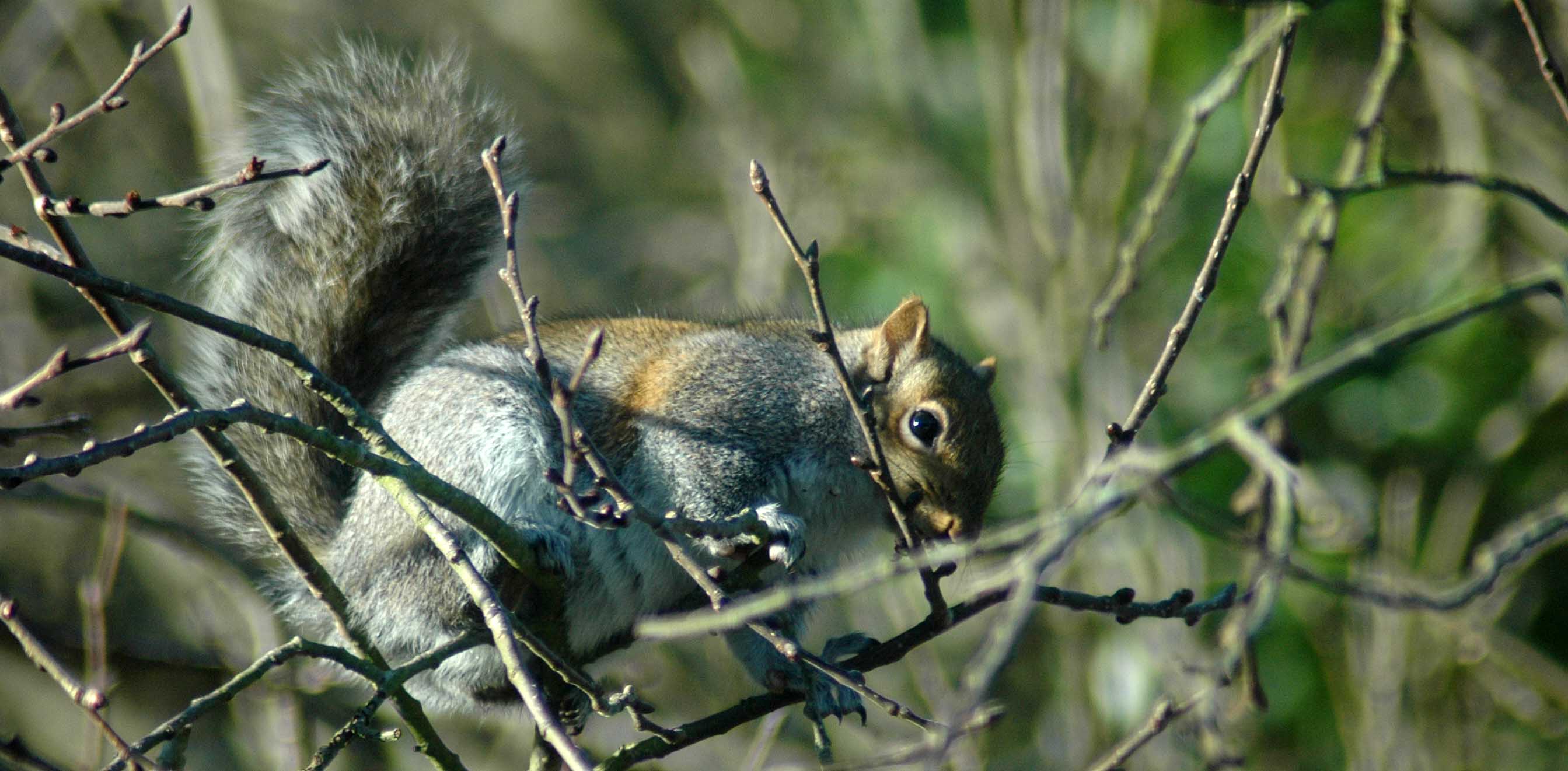
Where there is food on offer then there are bound to be opportunistic grey squirrels, there are several that scamper about amongst the trees here on the woodland edge. They generally get a bad press, but I love watching them, they are entertaining and clever and you have to admire their incredible agility. They are rather photogenic too.
One of the squirrels nibbling on a twig

One of the squirrels nibbling on a twig

A photogenic Grey squirrel

A photogenic Grey squirrel

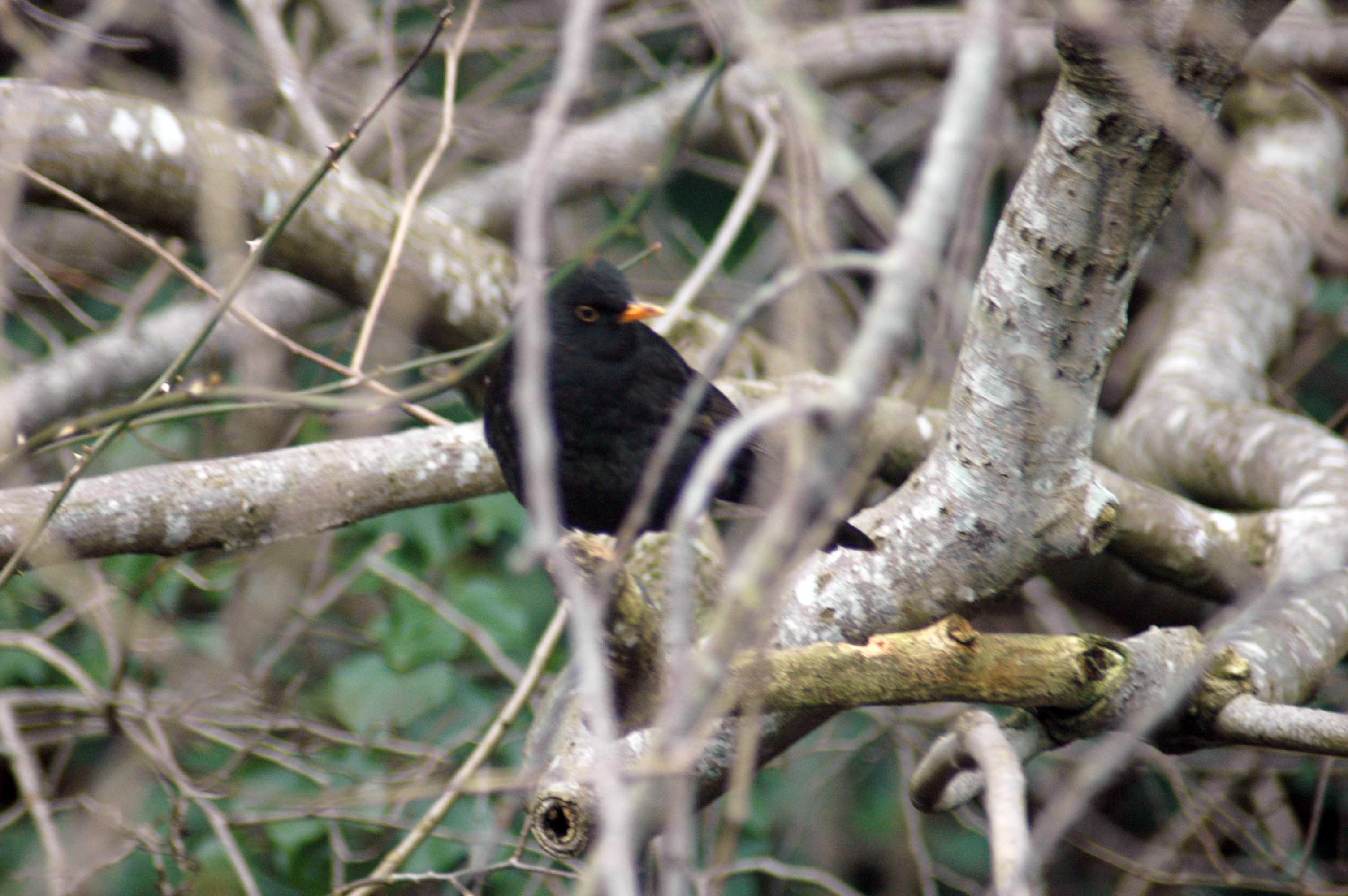
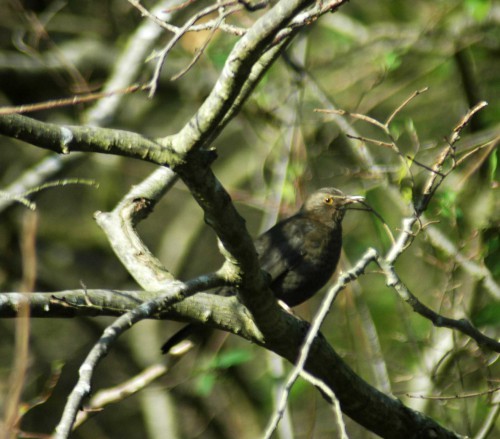
There are always blackbirds of course and recently both males and females have become more territorial. Males are singing and there are many chases amongst those that arrive for food;  first arrivals see off those that may follow. I have no idea which, if any, are regular visitors, particularly since I watched the piece on TV about the Holt Blackbird Project, where the blackbirds are fitted with different combinations of coloured leg tags and residents monitor their comings and goings. To quote from the published results:  One of the really incredible outcomes of the project is an understanding of the sheer number of birds that use the garden during the breeding season. The greatest number of individuals recorded on one day was 74, and even then there were some unringed birds still present. So, next time you see ‘your’ pair of Blackbirds in the garden, remember that they may not be exactly who you think they are!  Who knew? I always knew there were a good few of them around, but as you only really see them singly or in twos or threes when they’re establishing territory, those numbers seem incredible. I have given a link to the article about the project, which makes fascinating reading.
Male blackbird

Male blackbird

Female blackbird

A dark and well-marked female blackbird
A lighter female blending perfectly in amongst the sunlit twiggy tree branches

A lighter female blending perfectly in amongst the sunlit twiggy tree branches

There are thrushes about too, or at least one anyway. Back in early January I heard one singing early one morning from a tree in the front grounds, when it was barely light. I thought it was most likely to be a mistle thrush as they are early nesters, but I am not at all sure and was even less sure when I heard more singing at 7.25am in the morning a week later, this time at the back of the building and looked out of the bedroom window to see him singing away illuminated by a nearby security light.

150109TG-Thrush singing (1) -Bryn Euryn (DC)

9th January – A thrush singing from high in a tree

Robins have been singing for a few weeks now too and as with the blackbirds, there is no peace for those that venture in for food; as soon as one perches another is almost sure to swoop in and there are frequent chases through the vegetation.
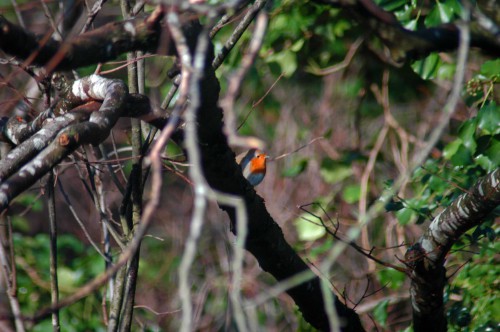
A robin enjoying a rare moment of peace in the sun

A robin enjoying a rare moment of peace in the sun

So far, the finches I have seen here have been goldfinches and chaffinches, but on Tuesday a lovely female bullfinch was here for a while. I was expecting to see a male with her, but alas no sign of one, so perhaps it was a young one that hasn’t got a mate yet.

3/2/15-Bullfinch female

3/2/15-Bullfinch female

There are no house sparrows and I miss their noisy chirping and cheeping, and no starlings either, but I still have contact with both when I go back down the hill to visit my daughter. There are dunnocks though. Male dunnocks are singing now too.

Of the frequent visitors, Blue tits are the most numerous and there can be several here at any one time. They seem to have an orderly queuing system, each one taking food then taking leave or sometimes carrying it back to a nearby branch to eat it. There are more feeders in the garden next door and there is much commuting back and forth.

150203TG-Kitchen window-Blue Tit

Blue tit

There are only ever two Great tits present at any one time, a male and a female. They have a  more business-like approach to their feeding and although they make regular visits, they do not hang around once they have what they came for.

Female great tit

Female great tit

There are one, or perhaps two delightful little Coal tits too. Their approach in to the feeding site is more discreet than that of the Blue tits, made via the lower twiggy branches of the shrubby trees. They are also quick to leave once they have taken food.

Coal tit

Coal tit

A small flock of glorious Long-tailed tits flutter in intermittently as they make their rounds, but I haven’t managed to photograph them here yet.

One morning I looked  out of the window and saw a bird that I didn’t immediately recognise, although it did look a bit thrush-like. I ran to get my camera and got just one image, through the glass, that I hoped would help with my identification. I had a feeling it was a redwing, but I hadn’t seen one for some years and couldn’t quite make the image I had fit with those in my books. I thought then maybe it was a sparrowhawk- right place, similar stance on the branch…? Anyway, I have been put right by fellow blogger Tony, who despite the not-so-brilliant quality of the image, immediately spotted it was indeed a redwing! I’m delighted – it’s another species to add to my list and to look out for again and I’m sure a sparrowhawk will be along any time soon.

150104TGBRD-Kitchen view 12- Sparrowhawk

Redwing-Turdus iliacus

Tuesday this week (the day I saw the bullfinch) was a glorious sunny day and a few of the birds took advantage of the warmth to take brief respite from their hectic feeding schedules to sit in the sunshine. I looked across to the laurel hedge and spotted a bird nestled into a small space framed by leaves. My eye was drawn by its pale-coloured breast, but it wasn’t until I looked through the camera lens that it occurred to me it was a blackcap, a female.

4/2/15-First glimpse of the female blackcap

4/2/15-First glimpse of the female blackcap

She ventured out onto a twig in the sunshine

She ventured out onto a twig in the sunshine

150204TGDC-Blackcap female first sighting this year (4)

She sat in the sunshine for a short while before flying off

She stayed around for a good few minutes, then moved across to an evergreen shrub in the neighbouring garden for a while before flying off. I expected to see a male somewhere near her, but as with the bullfinch there was no sign of one. More about blackcaps here.

Thursday morning was again gloriously sunny and a much warmer day too and a few minutes spent watching the usual comings and goings brought forth two more additions to my list. Firstly a glimpse of a greater spotted woodpecker high up in a tree, half-hiding behind a branch, then even more excitingly a tiny goldcrest. I was fairly sure I’d seen one here flitting about in the vegetation on a couple of occasions previously, and I stopped to watch one on my walk on Tuesday, but this was a really good, though brief sighting that confirmed my previous sightings weren’t just wishful thinking. We have a good number of conifer trees close by, which they like to use as nest sites, so I’m hoping to see more.

Share this:

  • Share on Facebook (Opens in new window) Facebook
  • Share on Pinterest (Opens in new window) Pinterest
  • Share on X (Opens in new window) X
Like Loading...

Young gull on the roof – the final chapters

26 Friday Jul 2013

Posted by theresagreen in bird behaviour, Nature, Nature of Wales, nature photography, Rhos-on-Sea

≈ 6 Comments

Tags

herring gull, herring gull family behaviour, herring gull juvenile, herring gulls as parents, herring gulls nesting on roofs

July 6th

The young herring gull that fell from the chimney pot nest to land, incredibly unscathed onto our flat roof  some 6 or 7 metres (20ft) below, continued to thrive thanks in part to sheer good fortune but mainly to his attentive parents. With very little in the way of shade he struggled a bit on the hottest of days and I took pity on him, tipping water from the bedroom window onto the roof to create a puddle he could drink from and cool his feet in. Other than that he was very much left to his own devices.

Young gull trying to squeeze into the shade

Young gull trying to squeeze into the shade and opening his wings to release heat from his body

Opening the bill wide is another strategy to release body heat

Opening the bill wide is another strategy to release body heat

He took to standing on the ledge of the lantern, which was perhaps cooler on his feet.

Standing on the ledge of the lantern

Standing on the ledge of the lantern

Our view from beneath him

Our view from beneath him

July 8th

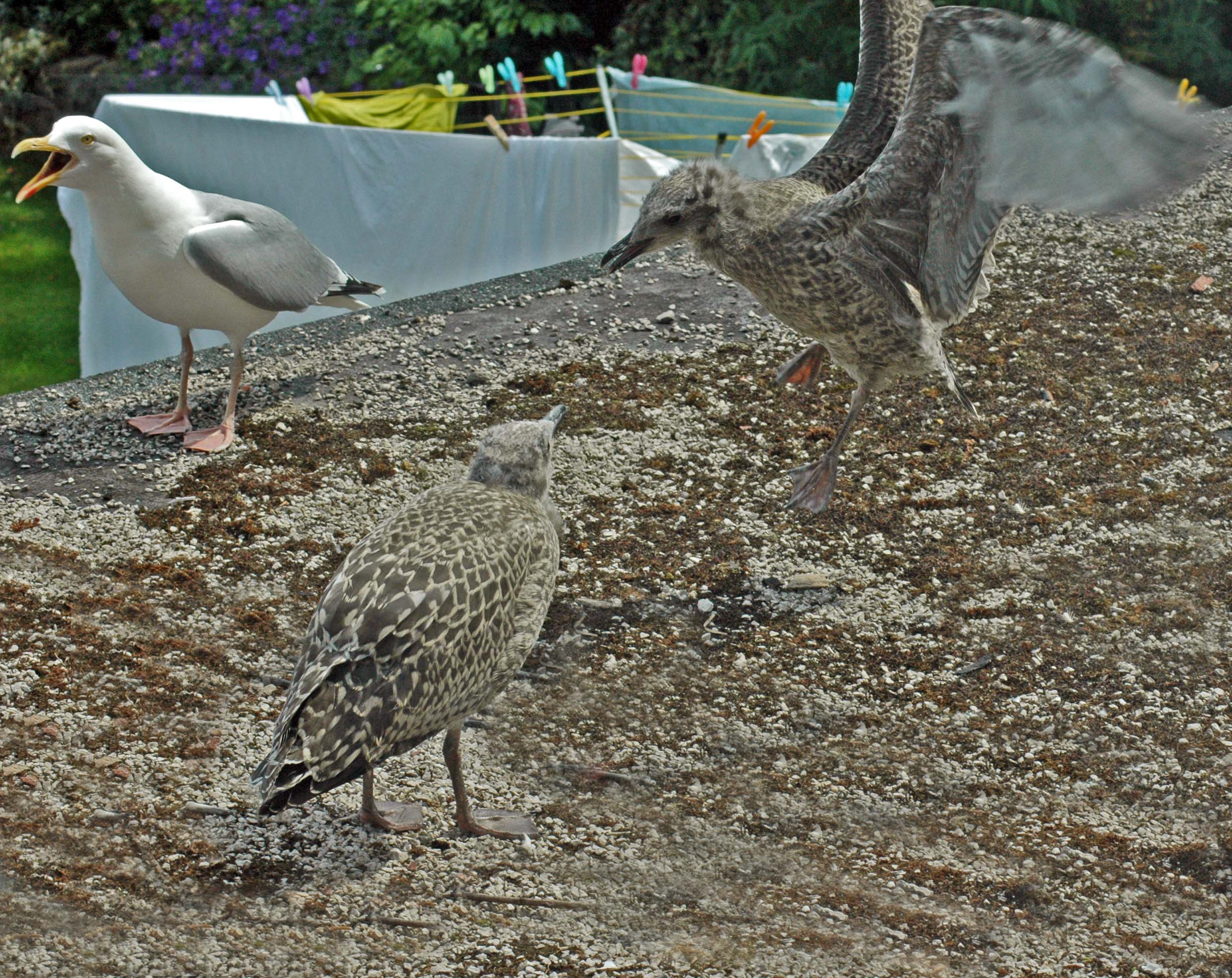
The young gull’s life changed dramatically today when, with all the drama and excitement I have come to expect from our gull residents and announced with a great cacophony of noise from both his parents, his sibling parachuted down to join him from above. Her arrival really was a magical sight to behold and although we are discouraged from anthropomorphising other fauna species, the gulls certainly displayed several ’emotions’. Both adults stood on the edge of next-door’s roof, as I said before making a particularly great deal of noise, which is what prompted me to run upstairs to see what was occurring and I was just in time to capture the moment she dropped in, rather gracefully for a first landing.

Young gull's sister arrives from above

Young gull’s sister arrives from above, squealing excitedly

The new arrival was clearly very excited while ‘our’ little chap looked a bit bemused and maybe a little intimidated. He inched towards her for a closer look while she made several little bouncy leaps, clearly excited and loving the new-found use for her wings although the tail feathers aren’t quite long enough to use for perfect co-ordination yet. The parents remained standing close by, keeping up the aggressive-defensive-protective squawking racket.

He approached for a closer look while she jumped up and down trying out her wings

He approached for a closer look while she jumped up and down trying out her wings

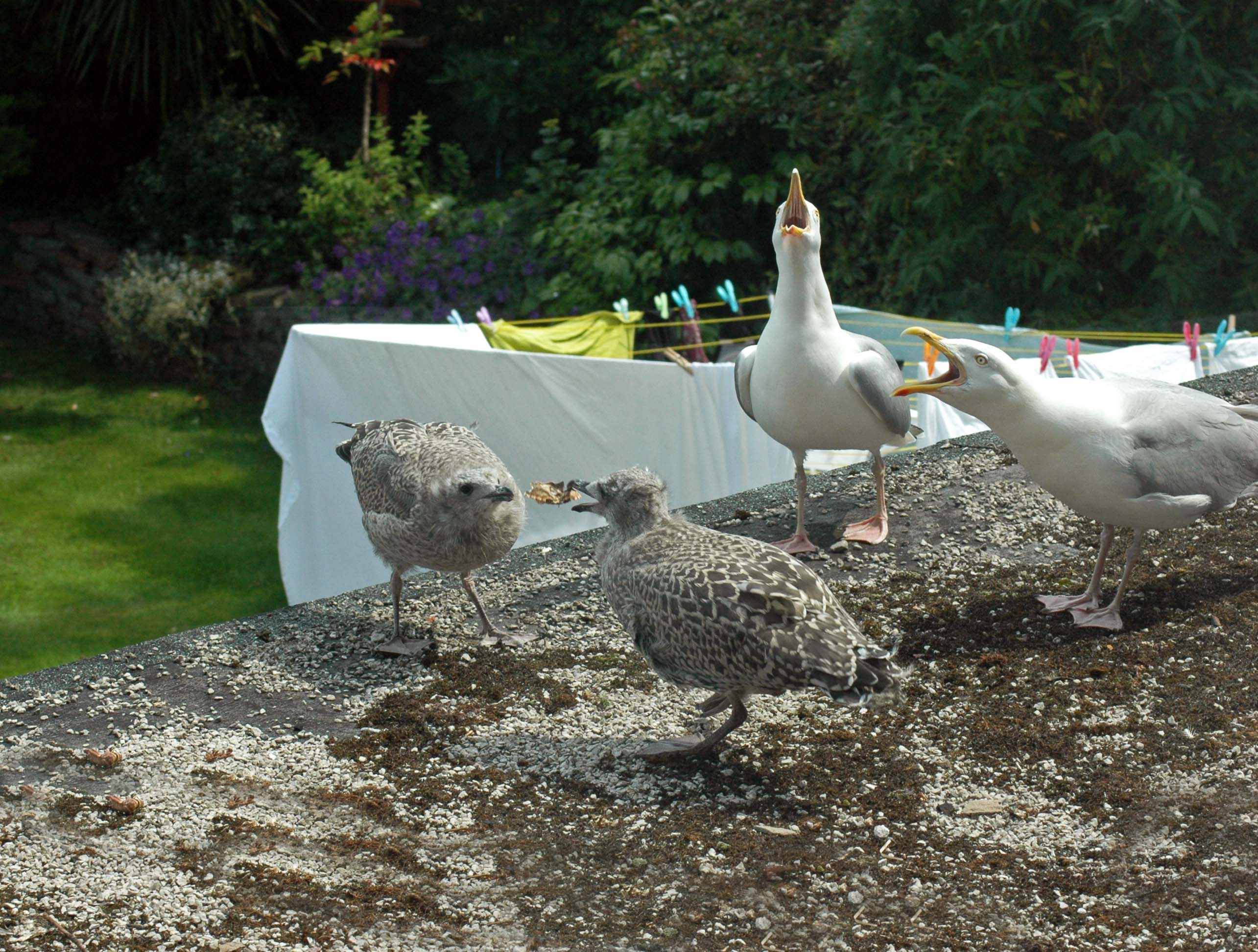
The new arrival settled on the ground and picked up an object from the rooftop, a piece of stick or something similar and offered it to her brother, which he accepted.

First formal introduction

First formal introduction, she offers him a gift encouraged by parents

After a few minutes things began to calm down, the new arrival was clearly enjoying her new-found flying ability and was keen to show it off. Our youngster watched with great interest as she lifted herself into the air and although he had shown little sign of trying his wings before now, suddenly seemed to realise that perhaps he could do that to. So he did.

Continuing to practice her flying

We have lift off

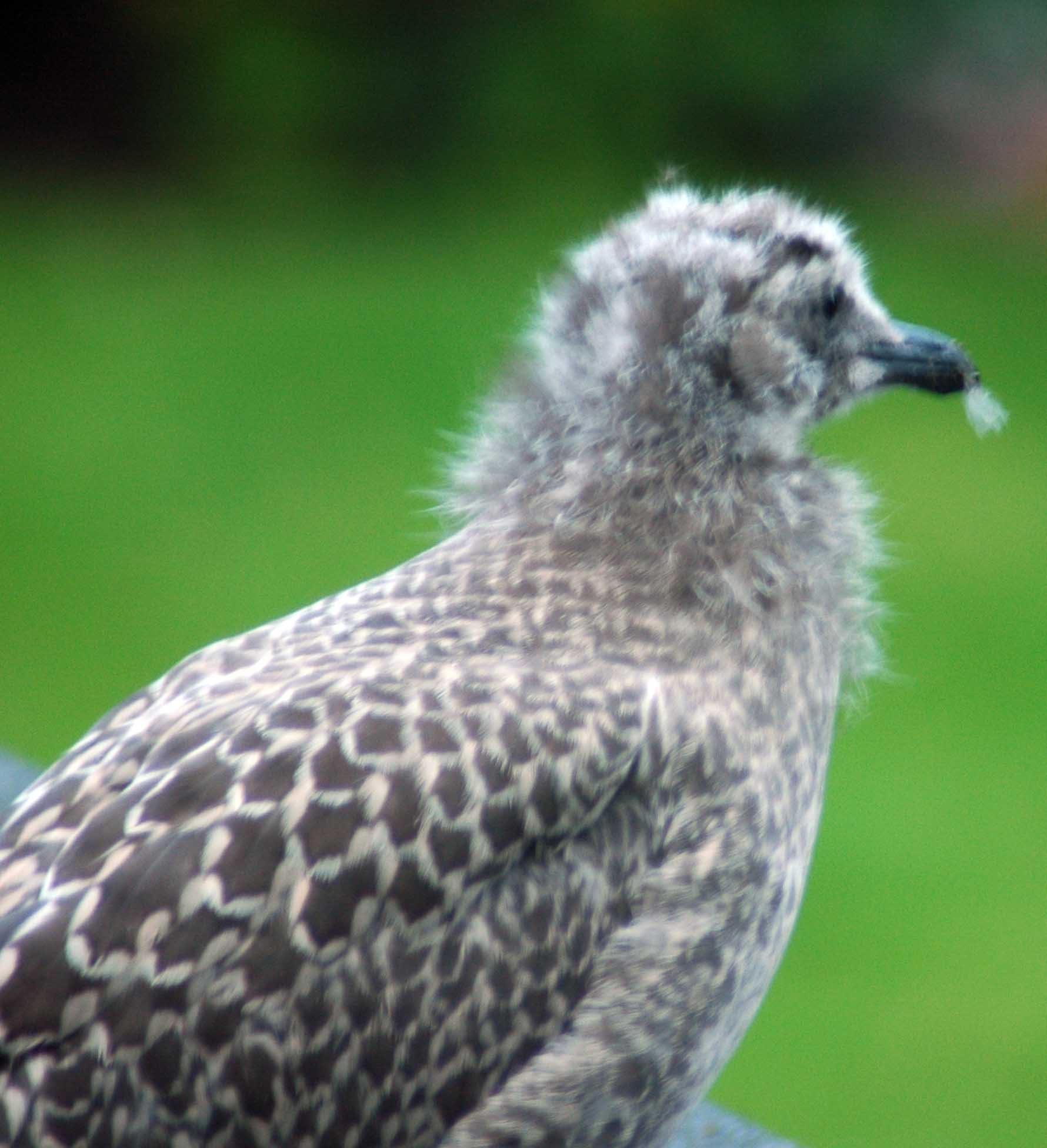
She eventually settled down a little and ventured across onto our roof, looking a little less sure now the excitement had worn off. Having a better look at the newby I’m sure I’m right about referring to it as ‘she’. This bird is slightly smaller than the other and could be a fraction younger as she still has more downy feathers around her face, neck and breast.

The new arrival ventured onto our roof

The new arrival ventured over onto our roof

July 10th

The young gull accepted his sibling immediately and there was no apparent rivalry or squabbling behaviour between them, so is it possible that although separated as young nestlings, they knew they were related? Perhaps they had been able to keep up communication from their separate locations and recognised one another’s voices, or maybe it was the parents’ behaviour towards them both that united them. It was a bit clearer now why ‘our’ young one had apparently spent so much time alone; the parents had two nest locations to cope with and to defend as well as having to share food between the two chicks. They deserve a lot of credit for their dedication and not abandoning either of them.

Practicing a running take-off

Practicing a running take-off

The family reunion brought about a noticeable change in our gull’s behaviour, he seemed to suddenly go up a gear and following his sister’s example began testing his own ability to fly.

Nearly there, just one toe left on the ground

Nearly there, just one toe left on the ground

The parent gulls changed their feeding behaviour today too; rather than the young ones begging and tapping a parent’s beak to bring forth food, the parents now arrived with food which they deposited some distance away from the young ones who then had to ‘find’ it for themselves.

Here's your lunch kids

Here’s your lunch kids

Young gull not too sure about this method of delivery

Young gull not too sure about this method of delivery

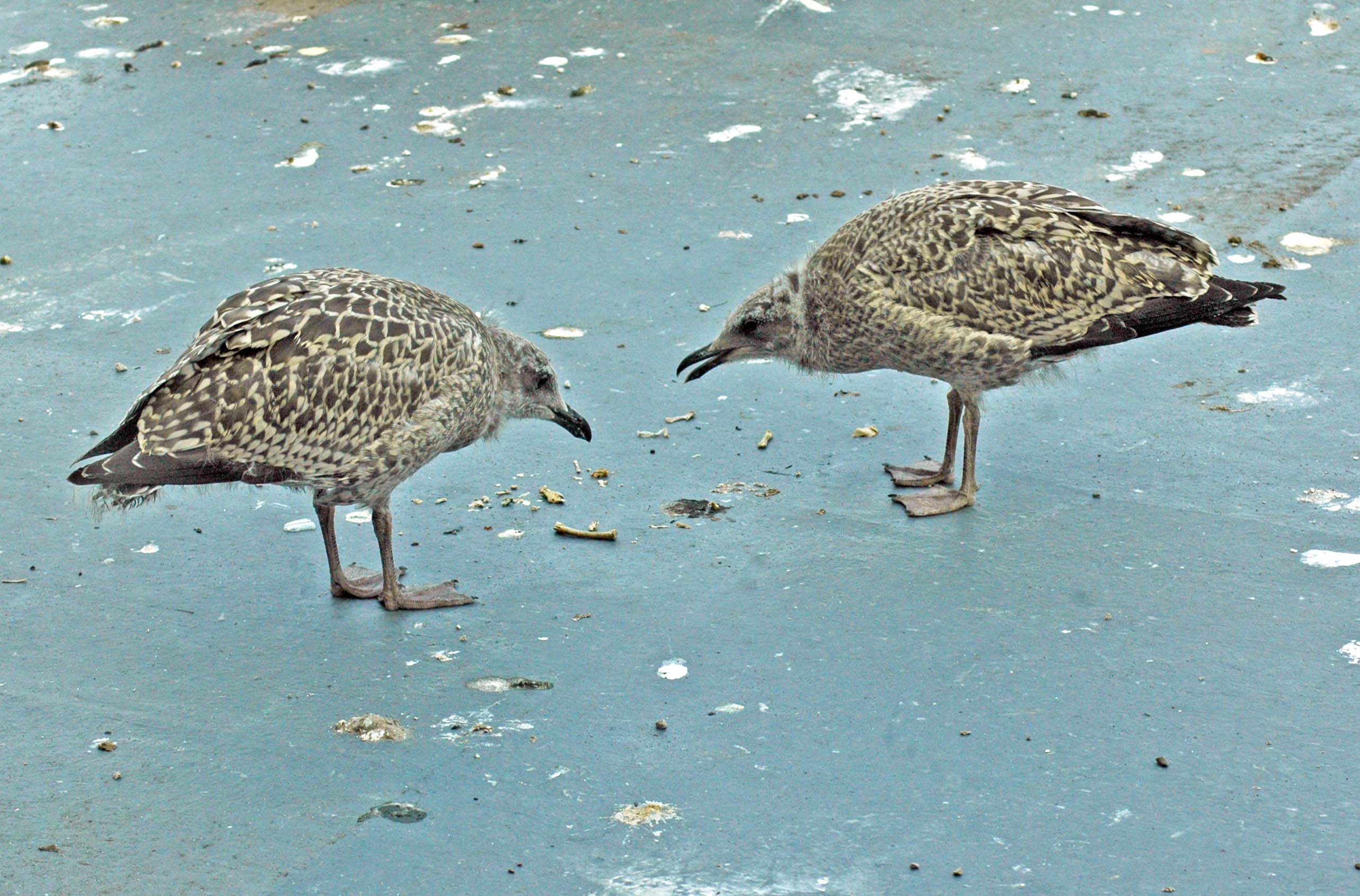
The parents were still around but less obviously so, when they were not away searching for food they were keeping look-out from the roof above. The two young ones were rarely more than a metre or so apart now, if one found something interesting to peck at the other was there immediately and they seemed to play with random pieces of stick and stones that they found, picking them up and dropping them, practicing for dealing with future potential food.

The young gulls 'playing' with a stick

The young gulls ‘playing’ with a stick

July 12th

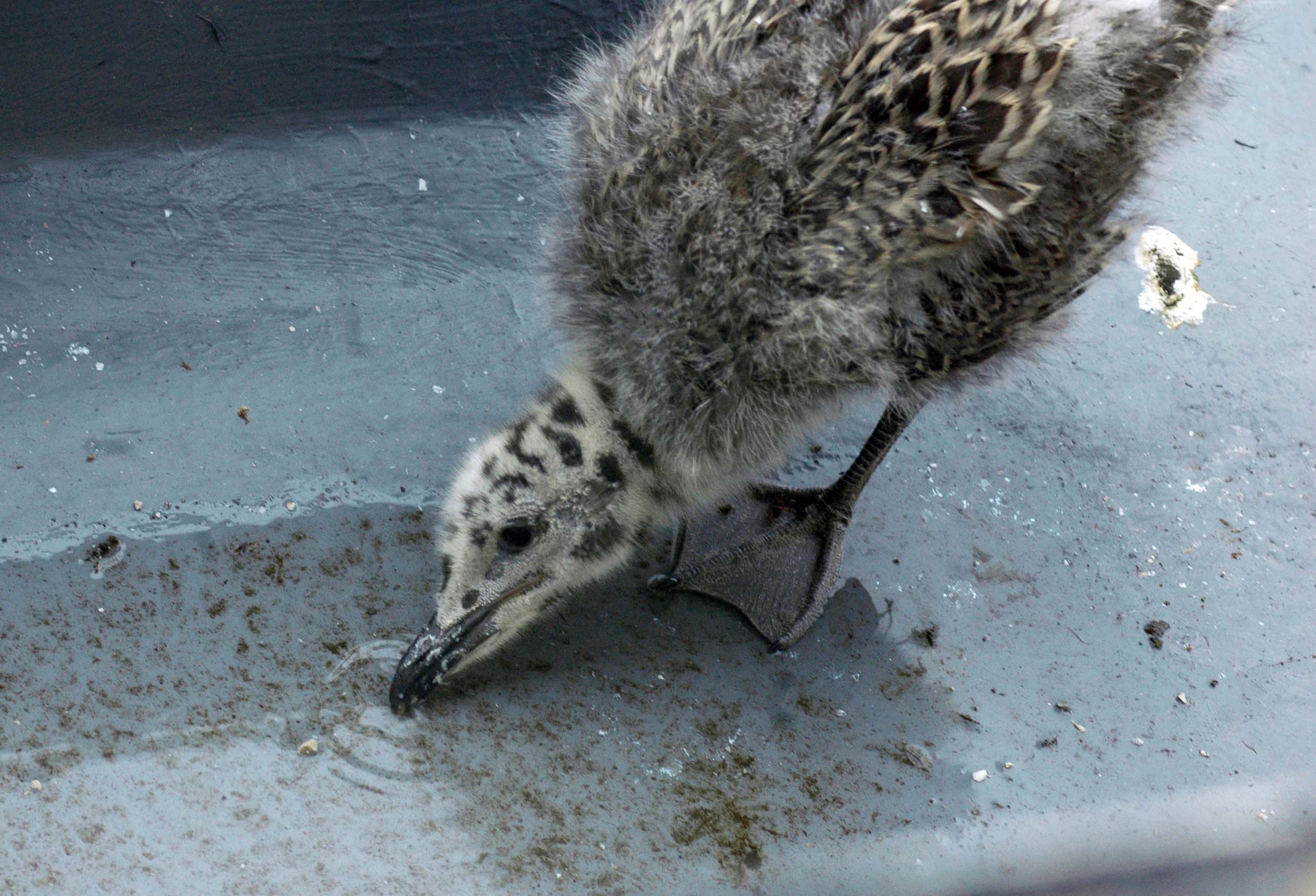
A hot day saw both young gulls uncomfortable and trying to squeeze into small areas of shade. I poured some water from the window onto the roof and ‘our’ gull, used to me doing that came straight over and began to drink. The other one followed more cautiously, but seemed to have no idea what to do with the water or how to go about drinking it. He tried to show her, but this was a new experience for her having been up in a nest on a chimney for most of her short life.

What do you do with this then?

What do you do with this then?

Watch me

Just watch me

Things got a bit hectic for a few days when the gulls from the neighbouring chimney brought their two young ones down too and both sets of parents had some very noisy encounters on occasions, but the sets of young ones didn’t mix much. They continued to strengthen their wings, preen out the remaining down from their feathers, and rest a lot while waiting for those tail feathers to grow.

Just about all grown up

Just about all grown up

July 18th

Every event of the gull family’s time with us had been accompanied with noise and announced with drama, so the young ones’ anticipated departure came as a bit of an anti-climax. We were sitting outside enjoying the late afternoon sunshine when suddenly, first one, then the other took off from the roof, glided over our heads and landed on next door’s lawn. So that’s more or less it with this family of gulls for this year. It’s been interesting, but I shall be glad not to be woken by them at dawn. I’m not looking forward to having to clean off the roof.

Share this:

  • Share on Facebook (Opens in new window) Facebook
  • Share on Pinterest (Opens in new window) Pinterest
  • Share on X (Opens in new window) X
Like Loading...

Little gull on a wet flat roof

08 Monday Jul 2013

Posted by theresagreen in Nature, Nature of Wales, nature photography, Rhos-on-Sea

≈ 5 Comments

Tags

herring gull, herring gull chick

The young gull is growing up fast and despite being home alone for long stretches, being left outside in all weathers and staying up far later than any youngster surely should, he seems to be doing alright. Here he is a couple of weeks ago, on a rainy day, eleven days older than when I first photographed him the day he arrived on the roof.

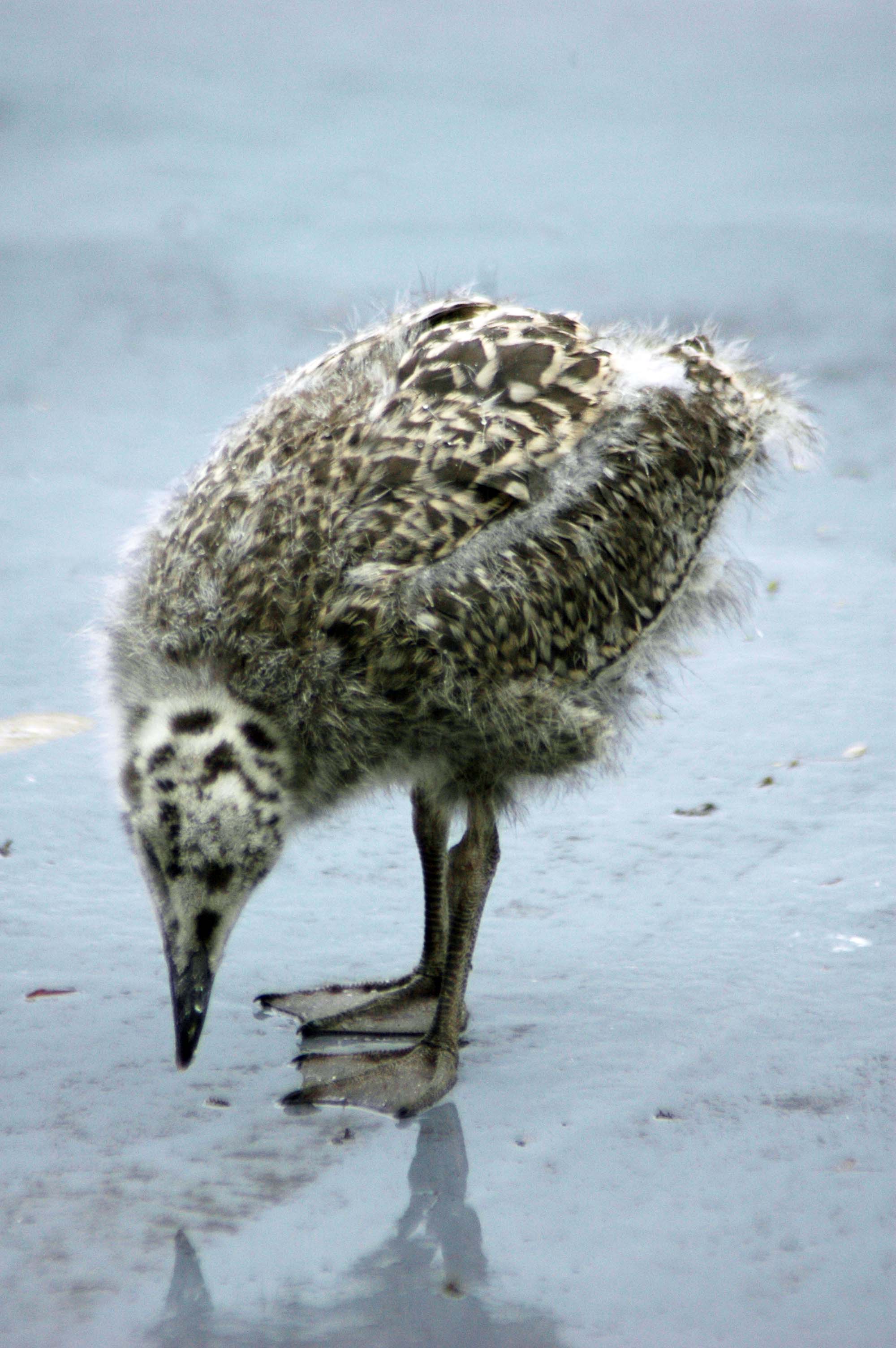
Working out how to take a drink

19/6/13 Who’s that in there?

There must be an easier way

Is this the only way to get a drink?

Mum doesn't make it look any easier

Mum doesn’t make it look any easier

Perhaps it'll be easier sitting down

Perhaps it’ll be easier sitting down

That's a bit better

That’s a bit better

I wonder if I can float

I wonder if I can float

Dealing with an itch

Dealing with an itch

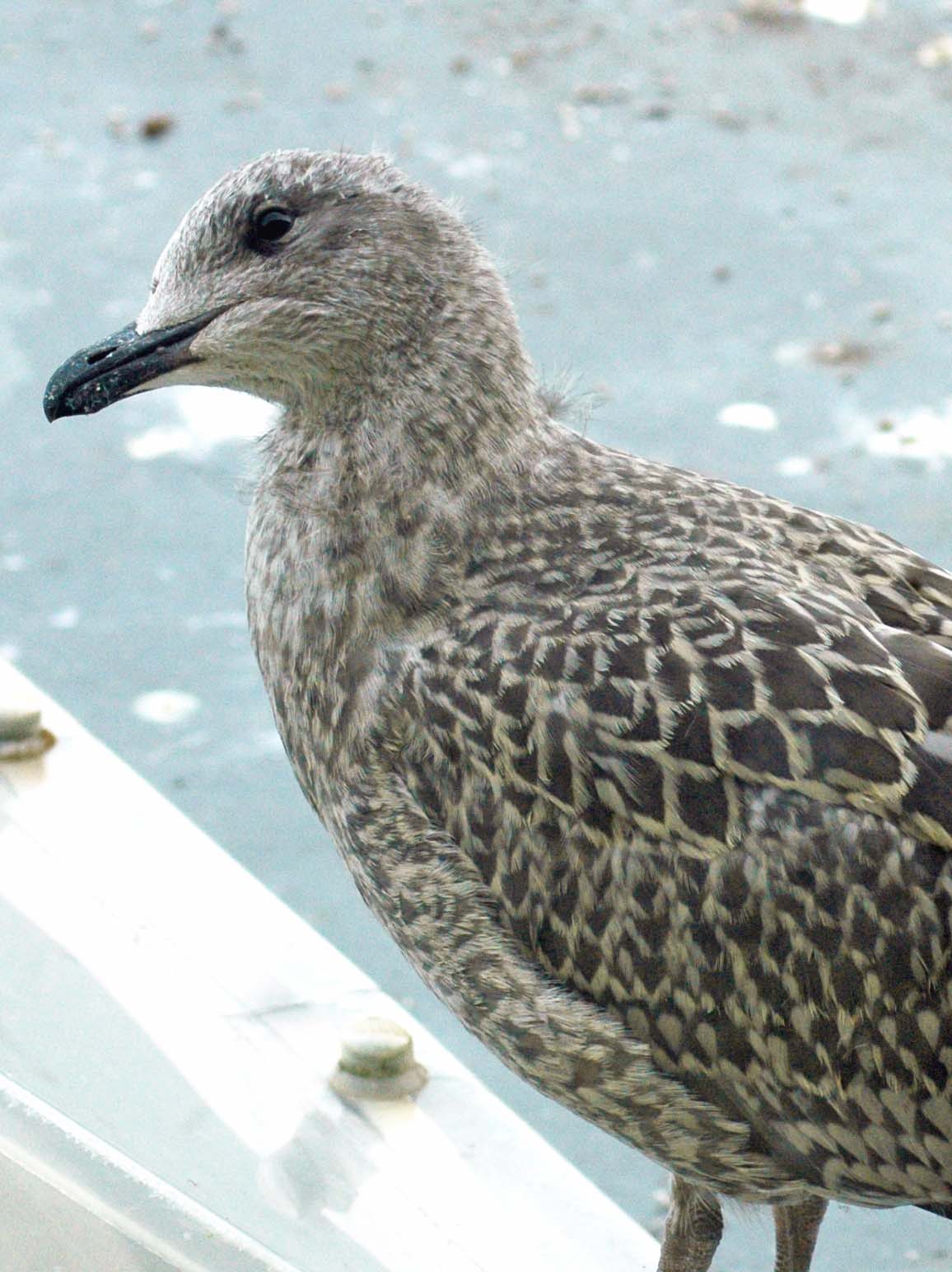
Nice and clean and cute

Nice and clean and cute

Tucked up taking a nap

Tucked up and taking a nap

Share this:

  • Share on Facebook (Opens in new window) Facebook
  • Share on Pinterest (Opens in new window) Pinterest
  • Share on X (Opens in new window) X
Like Loading...

There’s a new gull on the roof

20 Thursday Jun 2013

Posted by theresagreen in bird behaviour, Nature of Wales, nature photography, Rhos-on-Sea

≈ 2 Comments

Tags

herring gull, herring gull chick, herring gulls in towns, rhos on sea

Herring Gulls have featured in a good few of my posts: they are a characterful part of everyday life here in Rhos-on-Sea and although they make noisy neighbours, are somewhat bossy and seem to delight in covering our cars with their guano, life would be the poorer without them.

A couple of weeks ago, on June 8th to be exact, I was woken at some ridiculously early hour by a great cacophony of gull cries and shrieks being made right outside the bedroom window, which is just a metre above the large flat roof of the kitchen below. I am fairly used to their late spring-early summer, very early- morning territorial proclaiming racket now, but this was not the usual wake-up alarm, which I have learned to almost ignore, so I had to get up to have a look.

The fuss was all about a single, fluffy brown-grey speckled chick. How it arrived on our roof I have no idea, I know there are nesting birds somewhere up on the main roof around next-door’s chimneys, but as far as I am aware there were no nests on any part of the lower flat roofs this year. So, had it fallen from a nest higher up, or even been carried down? If the former, was it OK? I had no way of knowing, just one more thing to worry about! (We have had young gulls here before, but bigger older ones that had left nests deliberately).

New parent, very protective

8 June 2013-Warning – New parent, very protective

Although early in the morning it was already very sunny and the parent birds ‘parked’ the chick in the shade of one of the ‘lanterns’ set into the roof. That possibly explained why they were on our bit, neither neighbour has any shaded areas, although still no clue as to how the chick got there.

Parent watching the sky for trouble

Parent watching the sky for trouble

The fussing, flapping and general hullabaloo continued for some while, but gradually the ruffled feathers smoothed and the excitement mellowed into an uneasy peace.

Once their offspring was settled, one parent stayed on close guard, the female I think, whilst the other either went off to look for food or maybe to sit higher up on the main roof to keep look out. The one that stayed remained wary, keeping a watchful eye on the sky above and patrolling around her chick. She did settle next to it eventually, but was very restless.

The mother settled eventually, but remained alert

The mother settled eventually, but remained alert

Then of course, once she settled down, the chick woke up and stood to stretch its legs. That came as a relief, at least it wasn’t injured and about to expire.

Chick awake and stretching its legs, mother still watching the sky

Chick awake and stretching its legs, mother still watching the sky

The chick was soon keen to investigate the world around him and went for a little wander. Fortunately it chose to wander onto the adjoining next-door roof which is covered with mossy lichen and he was pretty well camouflaged there.

On the adjoining next-door roof, the chick was almost perfectly camouflaged

8/6/13 On the adjoining next-door roof, the chick was almost perfectly camouflaged

After a surprisingly short length of time the parent flew off and left the chick to its own devices, although as I said before it’s possible the other one was watching from above. And food has to be searched for.

Mum back with breakfast

Mum back with breakfast

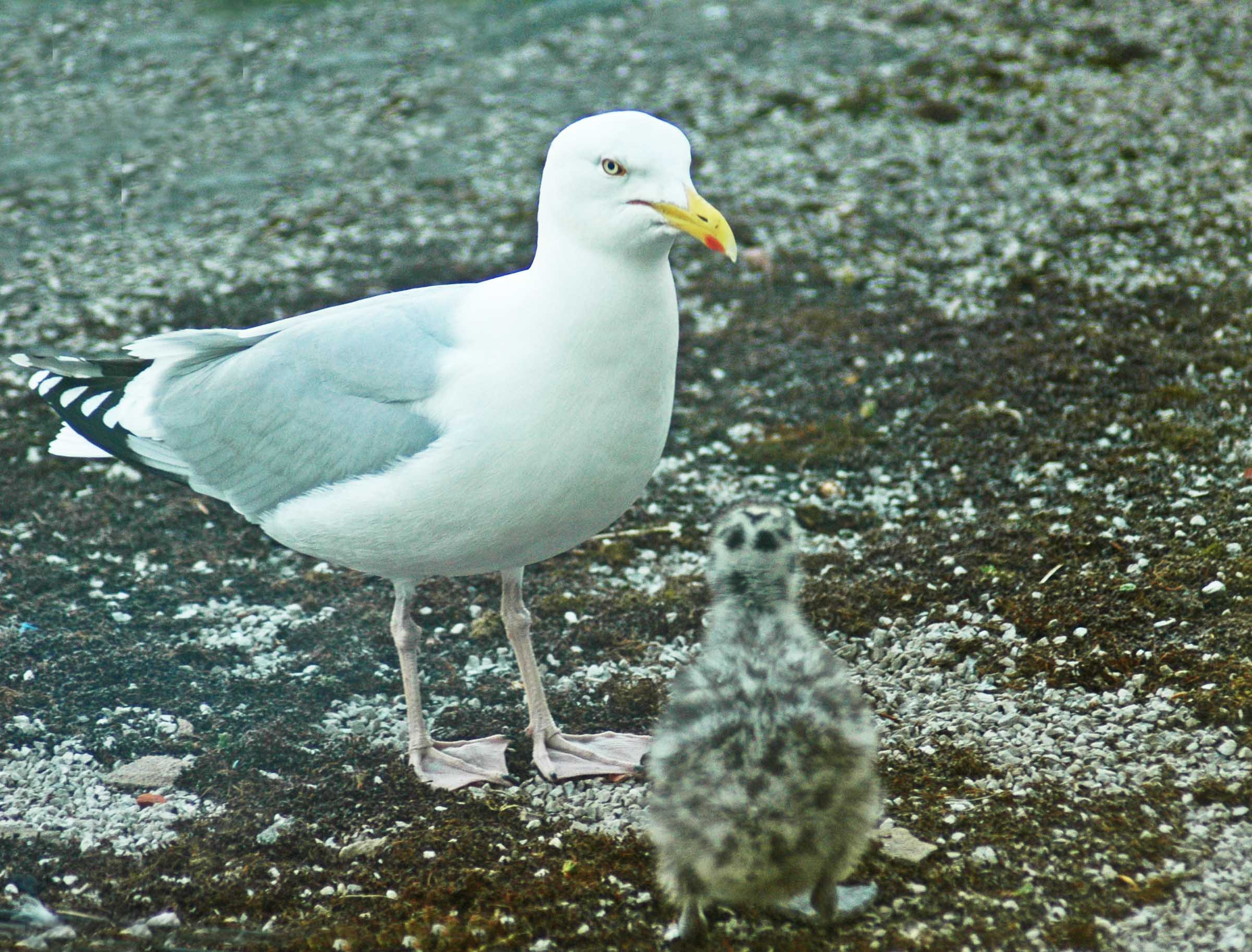
The adult gulls were very aware of my interest in them and stood immediately in front of the window squawking and giving me distinctly threatening looks.

The female gull watching me, giving me the evil eye

The female gull watching me, giving me the evil eye.

Female Herring Gulls are slightly smaller than the males and have a ‘softer’ look to the eyes (usually), but I’m glad I had glass between us, I would not like to make her angry and be within striking distance of that beak. (All of my photographs are taken through the glass of the window!)

I would not like to be on the receiving end of that beak

I would not like to be on the receiving end of that beak

13th June 

Gull life settled into a bit of a routine over the following few days. The family doesn’t spend the nights on our roof and I can’t see where they go, but they arrive back noisily in the mornings. The chick gets left alone a lot, initially resting in the shade and relative safety of one or other of the lanterns, but now it is bigger it wanders more, investigating anything and everything that looks vaguely edible. The parents are diligent in their feeding, arriving back with regular meals, their arrival always announced with a great deal of vocal noise and exaggerated wing flapping. The young one is already beginning to practice the territorial, concerted squawking, joining in with its parents when they perform to whatever is above them. Herring Gulls are proper drama queens.

13/6/13-One week on and the chick is getting bolder.   Checking out a cable to see if it's edible

13/6/13-One week on and the chick is getting bolder. Checking out a cable to see if it’s edible

13/6/13-Herring Gull chick one week later

13/6/13-Herring Gull chick one week later.

Share this:

  • Share on Facebook (Opens in new window) Facebook
  • Share on Pinterest (Opens in new window) Pinterest
  • Share on X (Opens in new window) X
Like Loading...

Playing host to some noisy summer visitors

03 Monday Sep 2012

Posted by theresagreen in bird behaviour, Nature, nature photography, Rhos-on-Sea

≈ 6 Comments

Tags

coastal birds, herring gull, herring gull breeding behaviour, herring gull young, herring gulls calling, herring gulls in towns, herring gulls nesting on roofs

The sight and sound of Herring gulls are an integral part of the local community here and as I wrote last year, you either love them or you loathe them. Personally I rather like them, but having just endured this year’s breeding season and had them as very close boarders, I may have gone off them slightly! The Edwardian building we occupy the centre part of played host to two nesting pairs this year, one pair on either side of us, each settling into the top of a tall terracotta chimney pot. I can see the appeal for them, quiet neighbourhood, excellent panoramic penthouse views, just a minute’s flap from the sea, a wide variety of eating opportunities close by. .. Unfortunately from a landlady’s viewpoint, they were not the ideal ‘guests’ and the noise levels were, frankly, unsociable. Stuck in the middle of the two nests sites we were subjected to frequent sessions of raucous territorial shrieking in stereo. Requests to pipe down a bit fell on deaf ears.

Once the offspring hatched the sessions became even more frequent, then reached their peak once the youngsters fledged. That was when they  moved down onto our flat roof, which is just below my bedroom window, and really made their presence heard.

A very newly fledged gull, the offspring of pair number two

Herring gulls herald the crack of dawn very loudly, which at the time was around 4.30am, so that’s when I woke up too. They are much louder than cockerels and even less tuneful.

Even persistent rain does not dampen the desire to squawk

The proximity of the gulls definitely disturbed the usual peace of the neighbourhood, but on the positive side it also literally gave me a window into part of their daily lives. I soon realised that the bouts of loud calling are not a random act, the birds use their powerful voices to call to their partners and offspring as well as to declare their possession of a territory and to warn off intruders. As the youngsters grow in confidence and flying ability improves they leave their ‘home’ area to explore, but parents still return there with food and summon them back to eat it.

The adults always called loudly before delivering food to their young, perhaps it stimulates regurgitation?

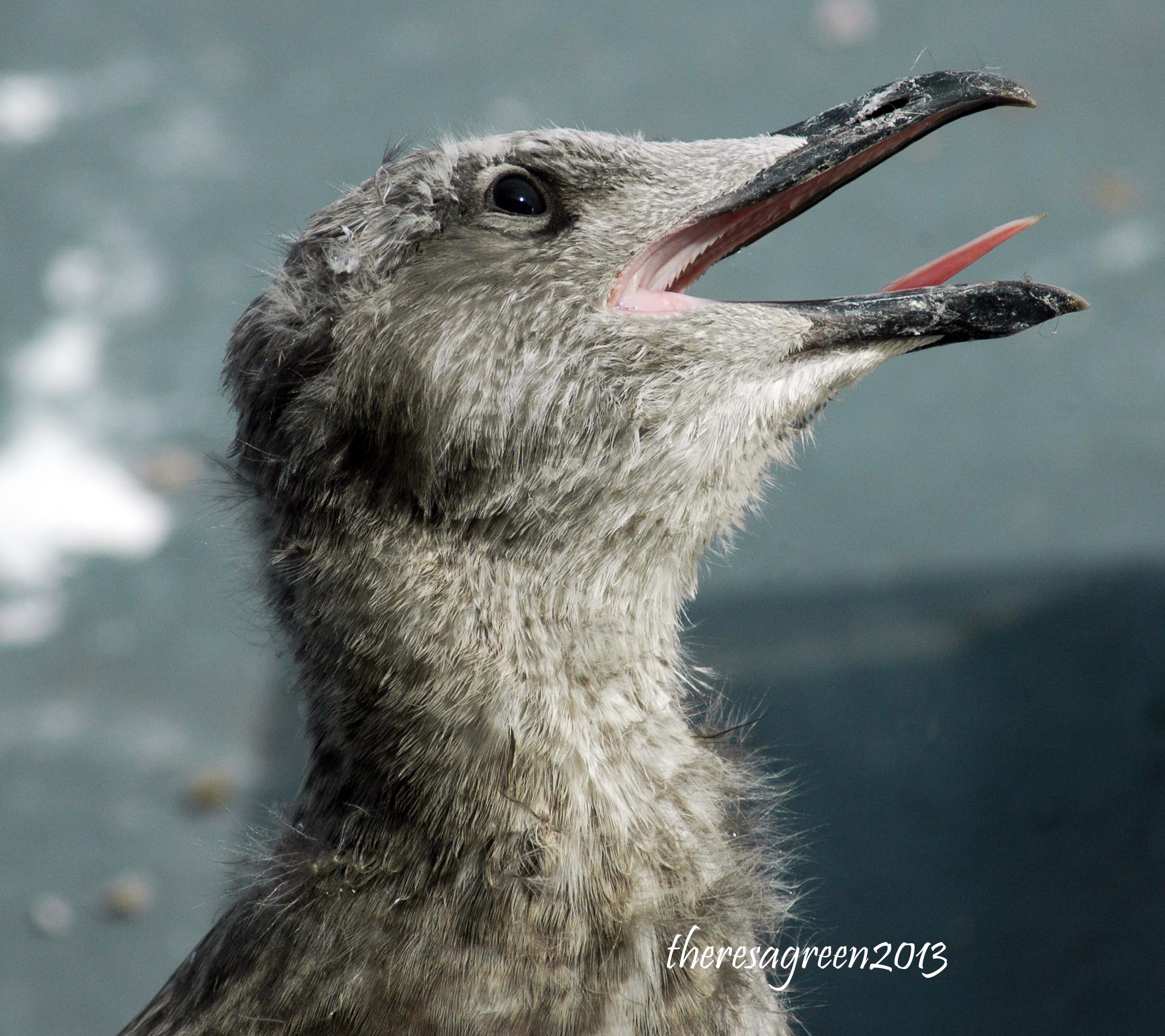
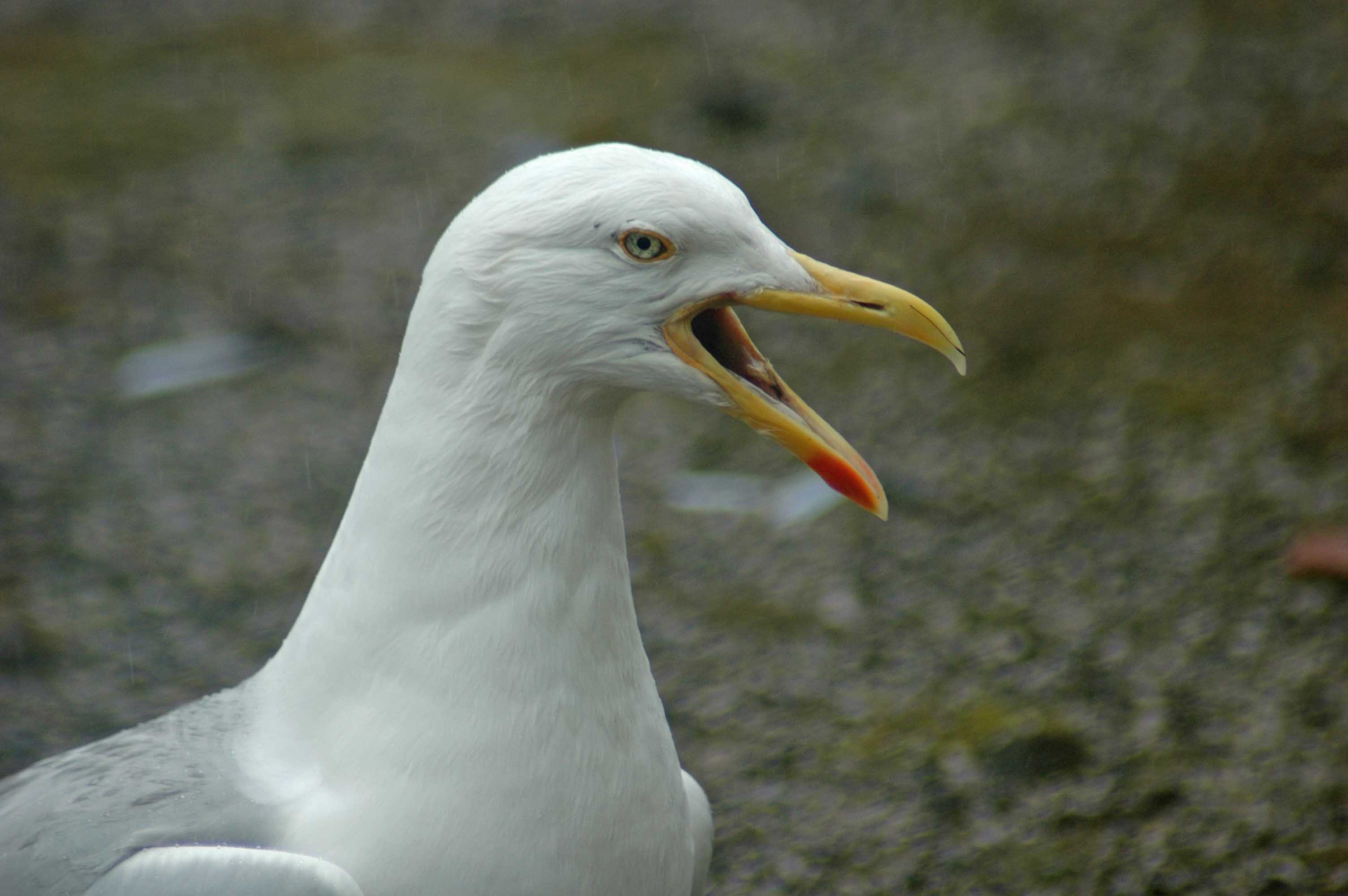
The adults had a ritual; each time they arrived back with food they began calling loudly, starting off with their heads lowered, then raising them, cranking up the volume until they reached a crescendo with head thrown back and beak opened fully.

You would not want to be on the sharp end of that beak

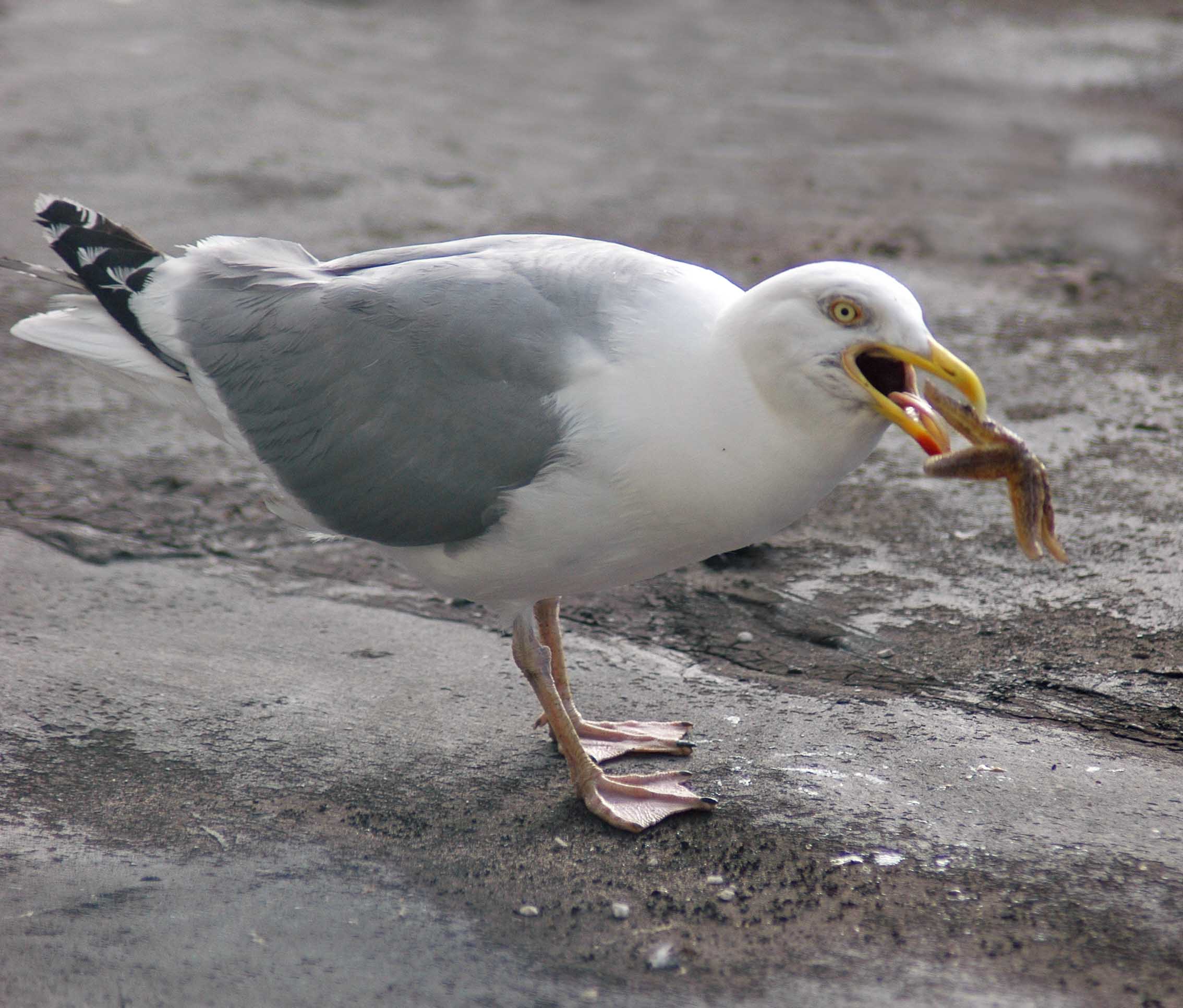
They are vigilant and attentive parents and deal patiently with  harassment by their young ones that persistently beg  for food. I’m not sure they are very well versed in nutrition though; ever the opportunists I saw them bring forth a variety of foodstuffs, including french fries, raw chicken, bits of crab and a still-wriggling starfish.

This starfish was definitely fresh, still wriggling in fact

The gulls took time out in the afternoons to rest together, the pair work together to raise their young and appear to be well bonded. Although they would appear to be relaxed, they were ever-vigilant and well aware of the presence of other birds in their airspace, taking it in turns to issue warnings.

The male of the pair starting off vocal proceedings . *note the sunlight show through the thin membrane below his beak

Your turn dear …..

All squawked out

Teaching junior how its done – a family session

A postcard to our summer visitors: “Thank you for an interesting and educational few weeks, but I’m glad you’re no longer here. Perhaps you might enjoy trying a new location next year? I understand the chips are rather good in Llandudno, or how about Rhyl …..?”

Share this:

  • Share on Facebook (Opens in new window) Facebook
  • Share on Pinterest (Opens in new window) Pinterest
  • Share on X (Opens in new window) X
Like Loading...

Cold weather and bird behaviour

07 Tuesday Feb 2012

Posted by theresagreen in bird behaviour, birds of the seashore, Nature, nature photography, Rhos-on-Sea

≈ 2 Comments

Tags

black-headed gull changing plumage, crow perched in the rain, herring gull catching earthworms, herring gull foot-paddling, oystercatcher in the rain

In common with the rest of the country we  had a week of proper winter weather last week, although we have so far missed out on any snow. The compensation  for below- freezing temperatures was that for three days the skies were clear and the sun shone. The mornings are lighter earlier now and when I leave the house the air is full of the sounds of birds. The tides have changed too and by 8.30am the sea has receded and the rocky shore and beach are already busy with foraging birds. The daylight hours are gradually lengthening too and it is now staying light till just past 5pm; it’s amazing how much better that makes you  feel.

My drive back and forth to work follows the coast closely; the road runs alongside the promenade all the way from the far end of Colwyn Bay, through Rhos on Sea and reaching almost as far as the Little Orme at the end of Penrhyn Bay. It is a treat to have such a scenic journey, especially as each day brings a different view depending on the state of the tide and the light. It hasn’t been a great week  for getting out and about, so this week’s observations are a bit limited and have been made from the shelter of the car at points along the route I drive.

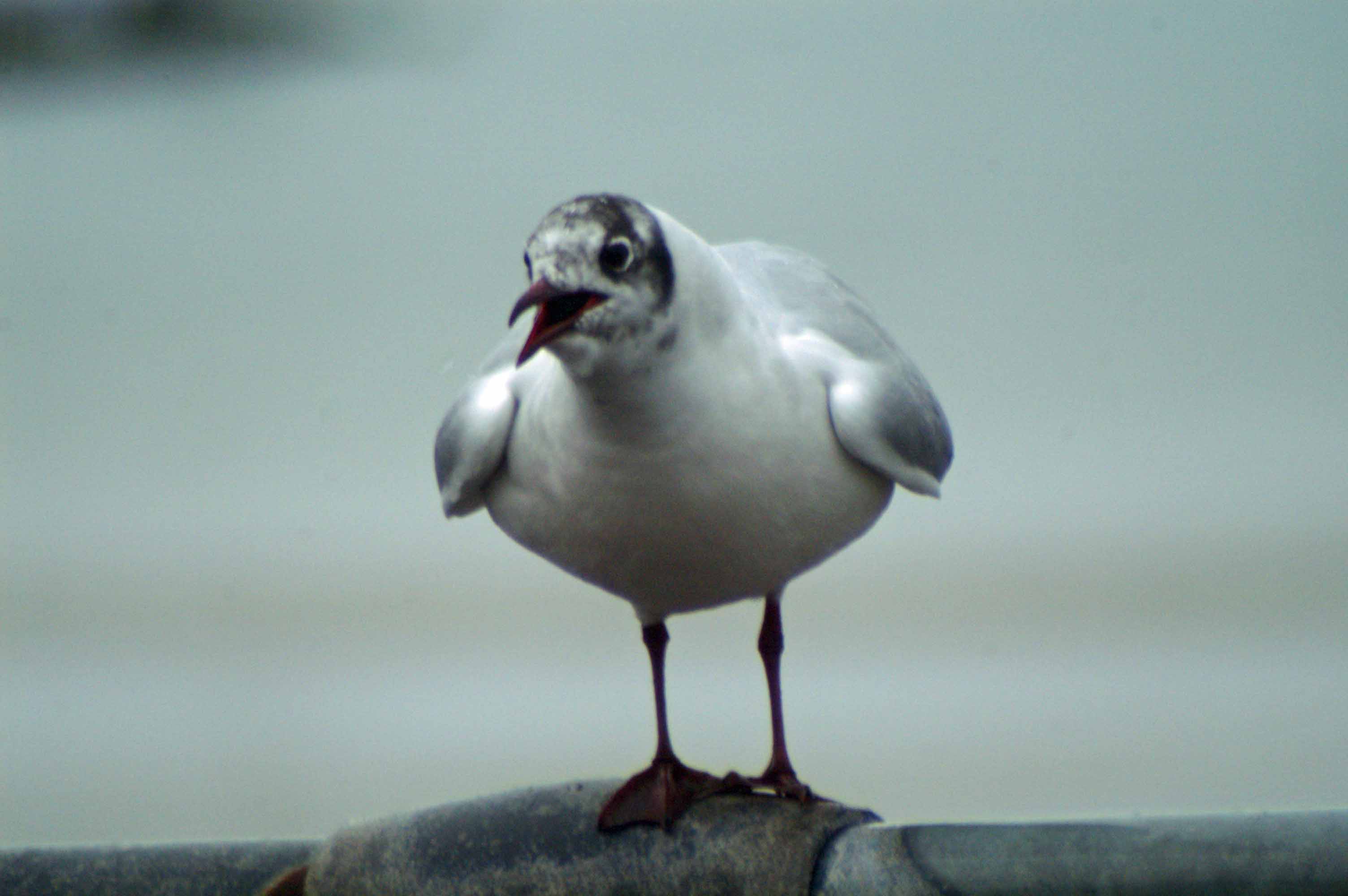
Saturday began cold with a light frost and by noon, where others were being snowed upon, we had some very cold rain instead. But whatever the weather, life along the seashore carries on pretty much as usual; birds simply have to eat. On my way home at lunch time I pulled in alongside the promenade at the Old Colwyn end  of the promenade to have a look at how the rain was affecting the birds. A few black-headed gulls are regularly perched on the railings here and as I stopped two birds obligingly flew in, probably hoping or some food to be thrown to them. One of them was well on his way to regaining his characteristic dark head plumage, looking a bit strange at the moment, but it won’t be long before he’s back to his handsome best. He was behaving territorially, squawking loudly at the approach of the other bird both on the ground and from the apparently desirable perch on the railings.

Black-headed gull with his head noticeably turning darker

Black-headed gull squawking from his perch

Down on the rain-lashed beach a lone oyster catcher was  running around foraging, periodically probing the sand with its bill. It  found a mussel and scuttled off at speed. I don’t know what it was running away  from, it had the whole beach practically to itself.

Oystercatcher foraging in the`rain on the sandy shore of Colwyn Bay

The Oystercatcher found himself a mussel and scuttled off along the beach with it in his bill

Crows are regular visitors to the seashore here and can often be seen perched on the railings and on the wall on the opposite side of the road or  foraging on the steep grass bank behind it. They have also learnt that the hard surface of the  promenade is helpful in breaking open mussel shells and they can be watched dropping the shellfish and picking them up repetitively until the soft body inside can be reached and eaten.

Crow sitting on the wall, hunched against the rain

Crow looking down his beak at me

Herring gulls are master opportunists when it comes to  finding  food, and they too are often seen foraging on the steep grassy banks along the coast road.  It is only very recently that I’ve  noticed one or two birds ‘ foot-paddling’ on the ground, a technique gulls and some other waders use to bring marine invertebrates to the surface. It is  fascinating to watch the birds dance on the spot, rhythmically drumming the ground with their big webbed feet; it seems to do the trick too, the one I photographed pulled out and ate several earthworms as I watched.

Herring gull ' foot-paddling' for worms


The Herring gull eating a worm

Share this:

  • Share on Facebook (Opens in new window) Facebook
  • Share on Pinterest (Opens in new window) Pinterest
  • Share on X (Opens in new window) X
Like Loading...

New Year catch up part 11

22 Sunday Jan 2012

Posted by theresagreen in bird behaviour, birds of the seashore, Nature, nature photography, Rhos-on-Sea, wading birds

≈ 3 Comments

Tags

curlew camouflage, oyster catcher, redshank, Turnstone

The variety of  wading bird species regularly foraging on the seashores of Rhos-on-Sea and Colwyn Bay remains pretty much the same as reported in the late summer/autumn of last year; i.e in the main, curlew, oystercatcher, redshank and turnstone. The numbers of  individuals of some species has decreased, but there are still plenty to be seen and in respect of studying the birds more closely, I find that less is more. With fewer numbers to distract my attention I concentrate more on watching individual birds and pick up on aspects of their behaviour, the way they move, how they feed  and such like.  I seem to find this the most effective way to assimilate information about a species and how I learn to identify them more quickly in different settings by means of what practised birdwatchers call the bird´s ´giss´ (general impression size and shape).
Oystercatchers are resident here and there are always plentiful numbers to be seen and heard in a variety of places along the seashore. They are very distinctive in their appearance and its long orange bill make it unlikely to be confused with any other large pied wader .

Oystercatcher- Haematopus ostralegus

Two oystercatchers (one ringed) and a redshank also with a leg-ring

Oystercatchers flying along the sea edge with wind turbines in the background

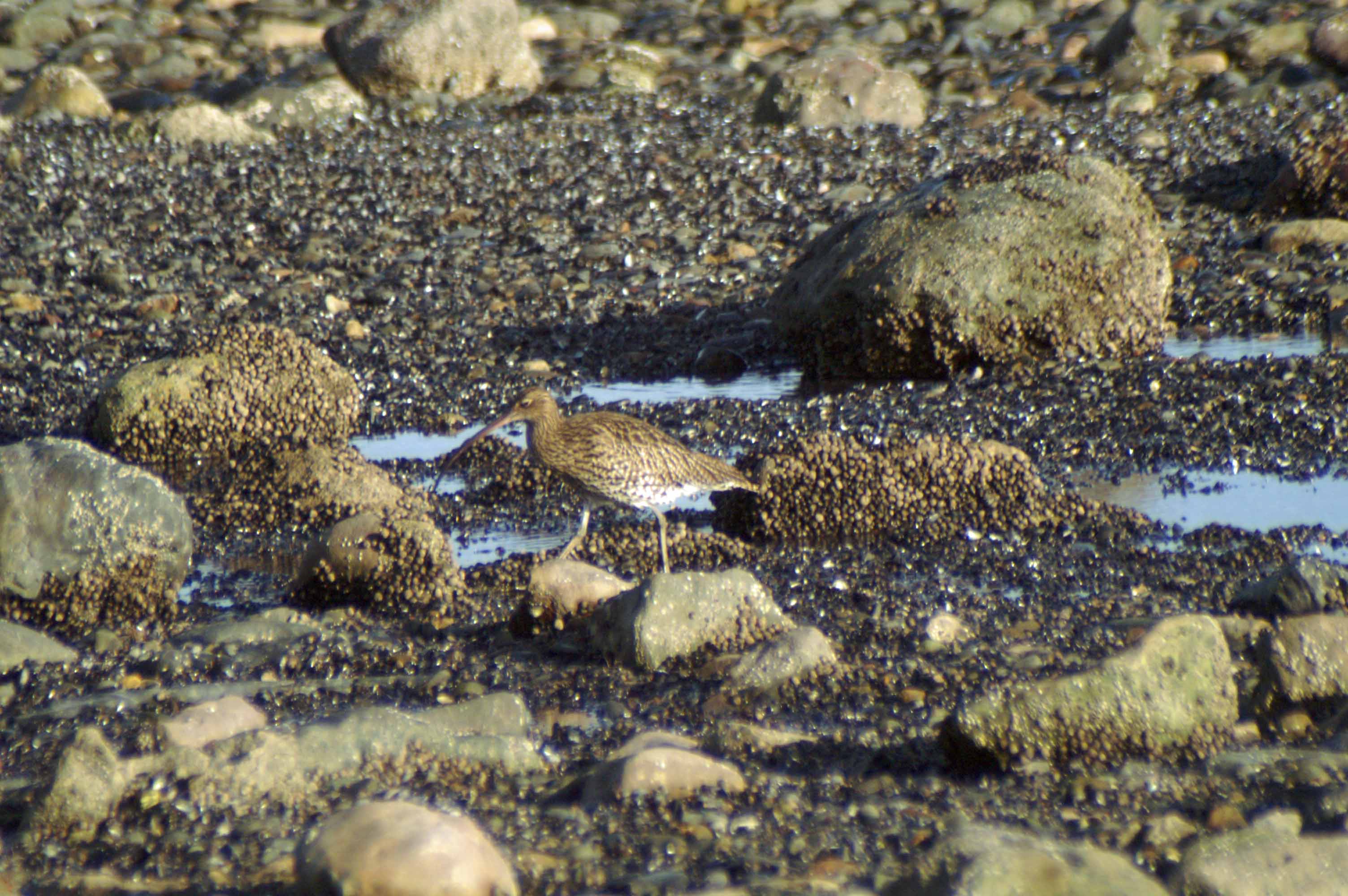
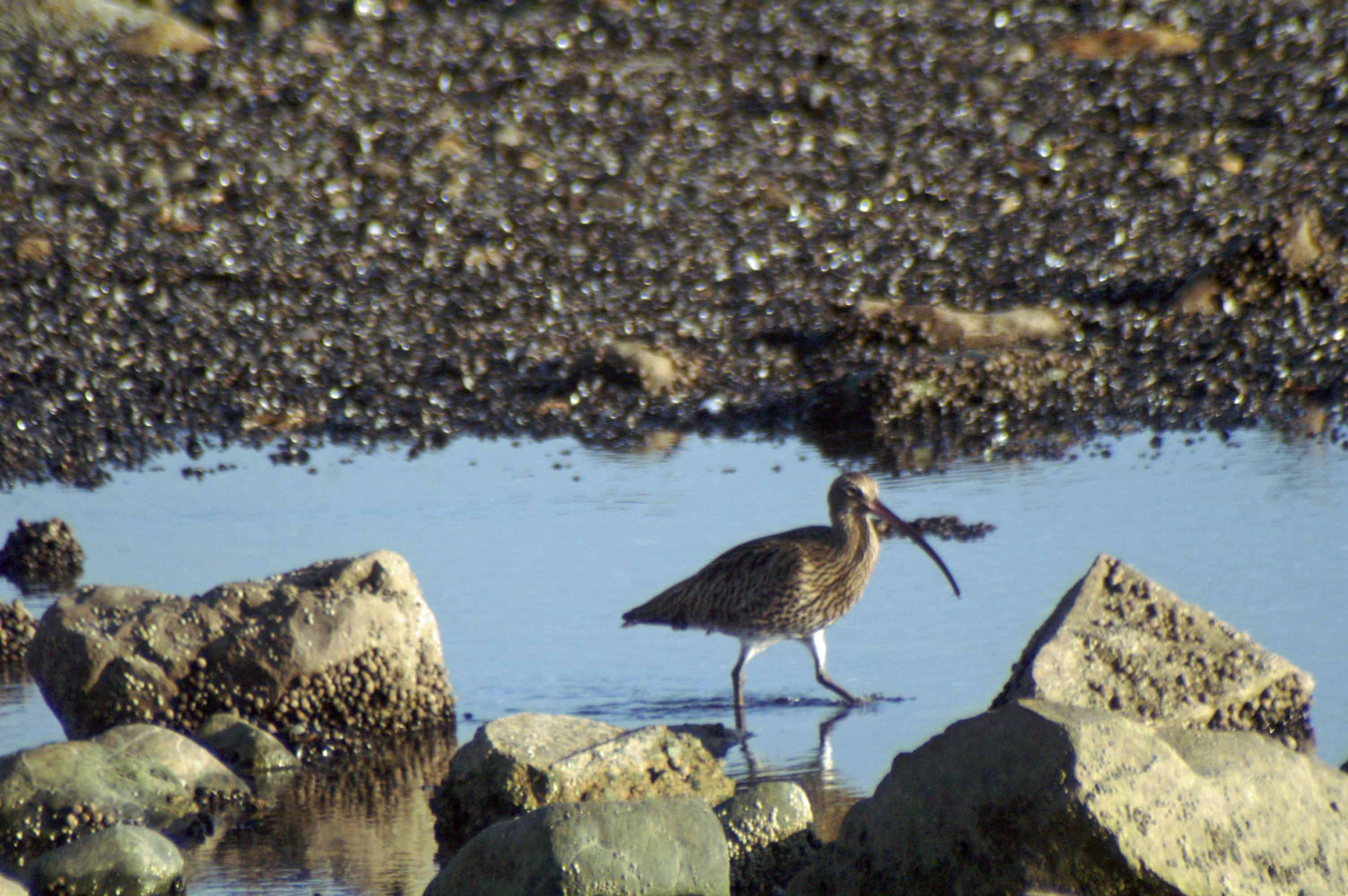
Curlews are best seen once the tide is quite well out as they arrive to forage around the exposed rocks and shallow pools. Despite their size and bulk, their cryptic camouflage is so effective that they can be difficult to pick out against the background of rocks, particularly those that host colonies of periwinkles. Once you have spotted one, more seem to magically appear, rather like those 3D pictures that were fashionable a few years ago that required your eyes to go slightly out of of focus before the image was revealed.

At low tide curlews are perfectly camouflaged against the rocks studded with periwinkles

Curlew-Numenius arquata

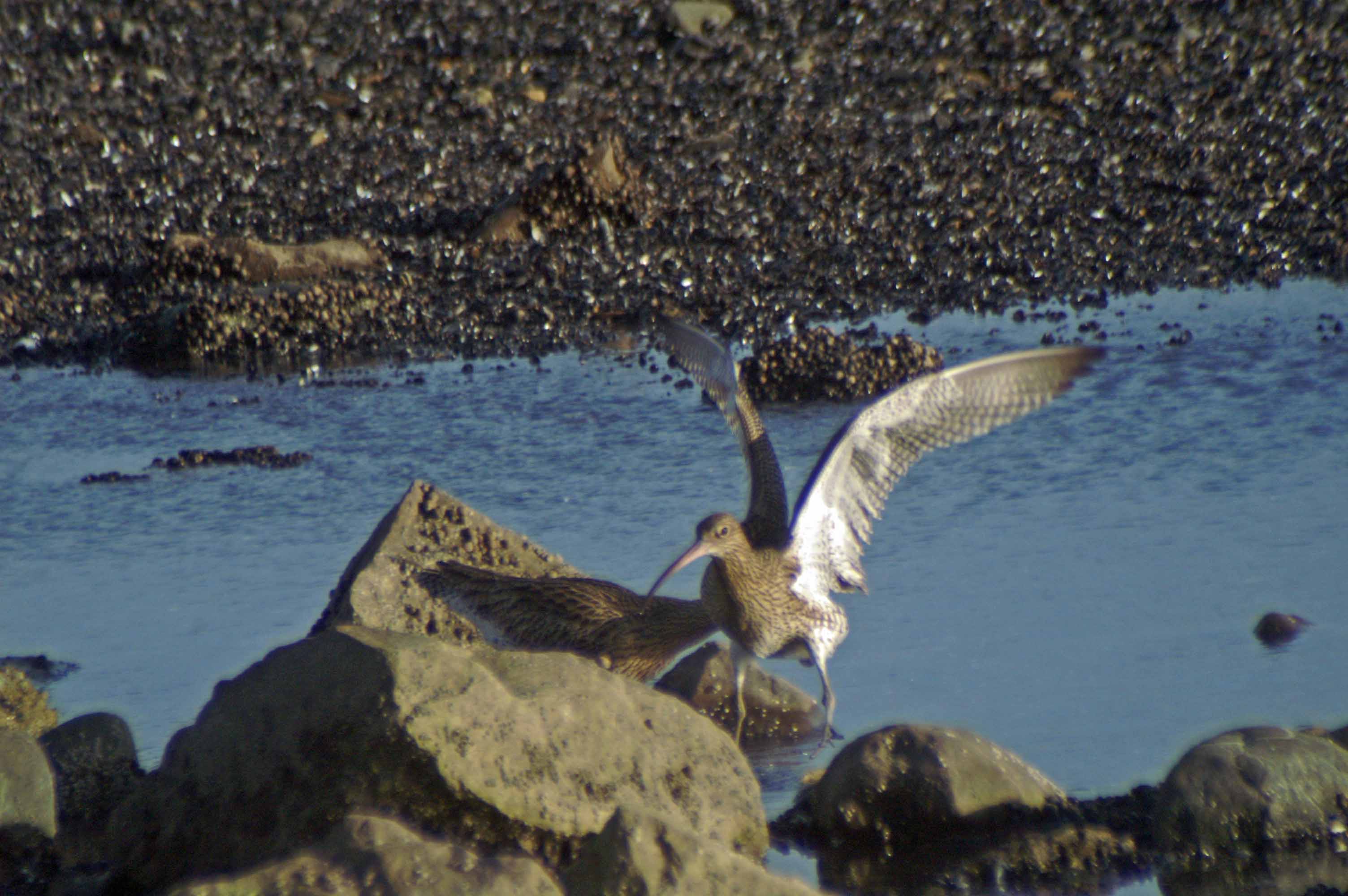
There is plenty of space here and the birds range widely across it. Often they may be spotted foraging independently and sometimes in small groups of two or three. I have only once witnessed an altercation between two individuals when one decided to oust the other from what was clearly a prime pool.

A skirmish between two curlew resulted in a great view of the bird's outstretched wings

Turnstones waiting for the tide to turn take the opportunity to rest quietly on the big rocks of the breakwater, springing into action as soon as the first strip of the shoreline is revealed by the retreating water.

Turnstones resting and preening in the winter sunshine waiting for the tide to turn

The particular spot I photographed the birds in is a favourite roosting spot quite close to the edge of the promenade, but they are not in the least perturbed by passing people or dogs. They know exactly when the water will begin to retreat and some of the birds move nearer to the sea edge to wait despite being splashed by waves.

Turnstone on a sea-splashed rock

Occasionally the cold shower pays dividends and a stray shellfish may be thrown up nearby.

A Turnstone seizes a mussel thrown up by a wave

Those on the alert quickly move further down the shore to be the first to explore the first areas to be exposed by the retreating water.

A closer look at the undersides of a Turnstone as it flies away

Share this:

  • Share on Facebook (Opens in new window) Facebook
  • Share on Pinterest (Opens in new window) Pinterest
  • Share on X (Opens in new window) X
Like Loading...

New year nature part 1

15 Sunday Jan 2012

Posted by theresagreen in Nature, nature photography, Rhos-on-Sea

≈ 4 Comments

Tags

birds`with brown plumage, blackbird, feeding birds, garden birds, house sparrow, rhos on sea, starling

I’d like to begin by wishing a belated but very sincere happy new year to everyone taking the  time and trouble to read this blog. It seems like an age since I posted my last offering, but other commitments, including our daughter’s wedding on Boxing Day and my venturing out of more-or-less retirement back into the world of work for the forthcoming next three months, have taken up much of my time and most of my energy.  As a consequence, for the last few months most of my nature watching has been glimpsed through glass, either from the house or the car, but I’m still aware of what’s happening around me, although with less time to record it.

(To avoid confusion I should probably mention at this point that I am back in Rhos-on-Sea, North Wales)

I have been restricted in my freedom to roam thus far, but I thought that I  would make that into an opportunity to have a closer look at some of the birds that are conspicuously present, but whose numbers or commonness we tend to take for granted.

The mild winter temperatures we have experienced during the first two weeks of January have given grace to the garden visiting birds to forage for natural food and there have been regular sightings of blackbird, robin, dunnock, house sparrows, great tit and blue tit doing just that. There were also a few visits from a beautiful song thrush earlier in the month, but I haven’t seen it lately. In the nearby trees there are regularly chaffinch, wood pigeon, collared dove,magpie and carrion crow. Then of course there are the herring gulls that regularly patrol the skies on the look out for a snack. They do make you think twice before putting out additional food for the garden birds, so is probably better offered confined to wire hanging feeders.

In the garden at the back of the house I often see two female blackbirds together that I think may be mother and daughter. This is the younger one with more mottled plumage. There is a male around, but I don't see him as often.

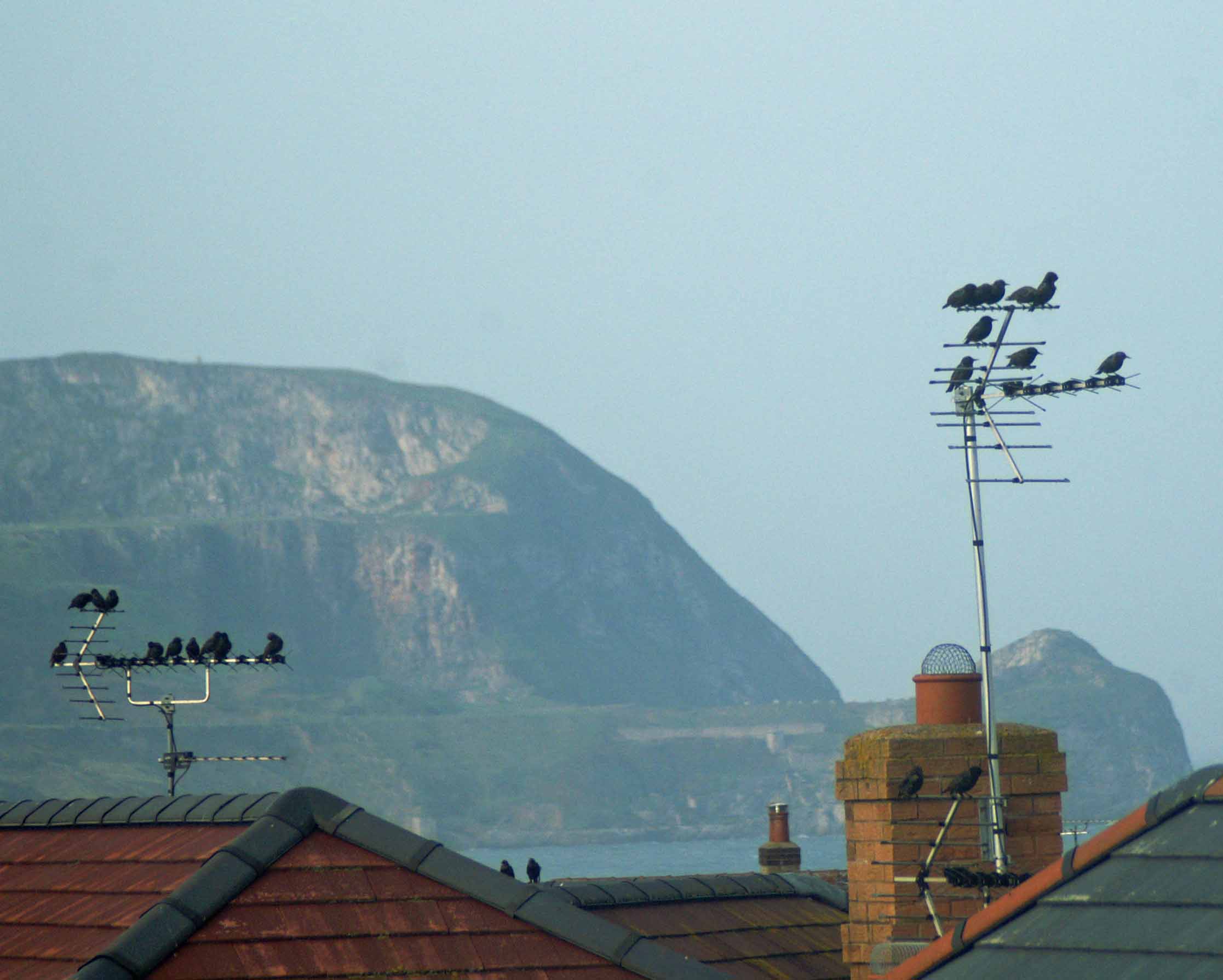
Starlings are everywhere, mostly sticking together in small flocks that travel around the area gathering in trees and on rooftops where they perch high on TV ariels  and chimney pots. They also frequent the rocks of the breakwaters in the harbour to forage amongst the rocks.

Starlings with an 'ariel' view of the Little Orme

Hanging up a feeder filled with fat balls has given me some lovely close up views of  the colourful and complexly marked plumage of individual birds.

The beautiful plumage of a starling feeding in the garden

European Starling – Sturnus vulgaris

Convervation status: Red

Still one of the commonest of UK garden birds, its decline elsewhere makes it a Red List species.

Family – Starlings (Sturnidae)

Smaller than blackbirds, Starlings are neatly shaped birds that have a short tail, a rather pointed head and triangular shaped wings. They appear to be coloured black at a distance, but when seen more closely they are in fact very glossy with an iridescent sheen of purples and greens. In fresh winter plumage they are brown, covered in brilliant white spots.

Their flight is fast and direct and they walk and run confidently on the ground. Noisy and gregarious, starlings spend a lot of the year in flocks.

Food and foraging behaviour

The European Starling is insectivorous, and typically consumes insects including caterpillars and moths, and also spiders. While the consumption of invertebrates is necessary for successful breeding, starlings are omnivorous and can also eat grains, seeds, fruits, nectars, and even rubbish, if the opportunity arises. There are several methods by which they forage for their food; but for the most part, they forage from or near the ground, taking insects from or beneath the surface of the soil by probing with their strong pointed bills. The bird plunges its beak into the ground randomly and repetitively until an insect has been found. Probing is often accompanied by bill gaping, where the bird opens its beak while probing to enlarge a dirt hole or to separate a lump of grass.  Generally, starlings prefer foraging amongst short-cropped grasses and are often found between and on top of grazing animals out to pasture.
Starlings are also adept at grabbing invertebrates directly from the air.

Song & calls

The Common Starling is a noisy bird uttering a wide variety of both melodic and mechanical-sounding sounds, including a distinctive “wolf-whistle”. Starlings are mimics, like many of its family.

Songs are more commonly sung by males, although females also sing. Songs consist of a mixture of mimicry, clicks, wheezes, chattering, whistles, rattles, and piping notes. Even when a flock of starlings is completely silent, the synchronized movements of the flock make a distinctive whooshing sound that can be heard hundreds of metres away.

Starlings are resident all year round in the UK, with their population boosted by large numbers of migrants that  arrive in autumn to spend the winter here.
As the shorter autumn/winter days draw to an end the birds head for their night-time roosts, gathering together in large numbers. Huge roosts may be found in a variety of locations including reed beds and city centres. In this area they head for the old pier at Colwyn Bay, performing their wonderful aerobatic display nightly and completely free of charge.
House Sparrow -Passer domesticus

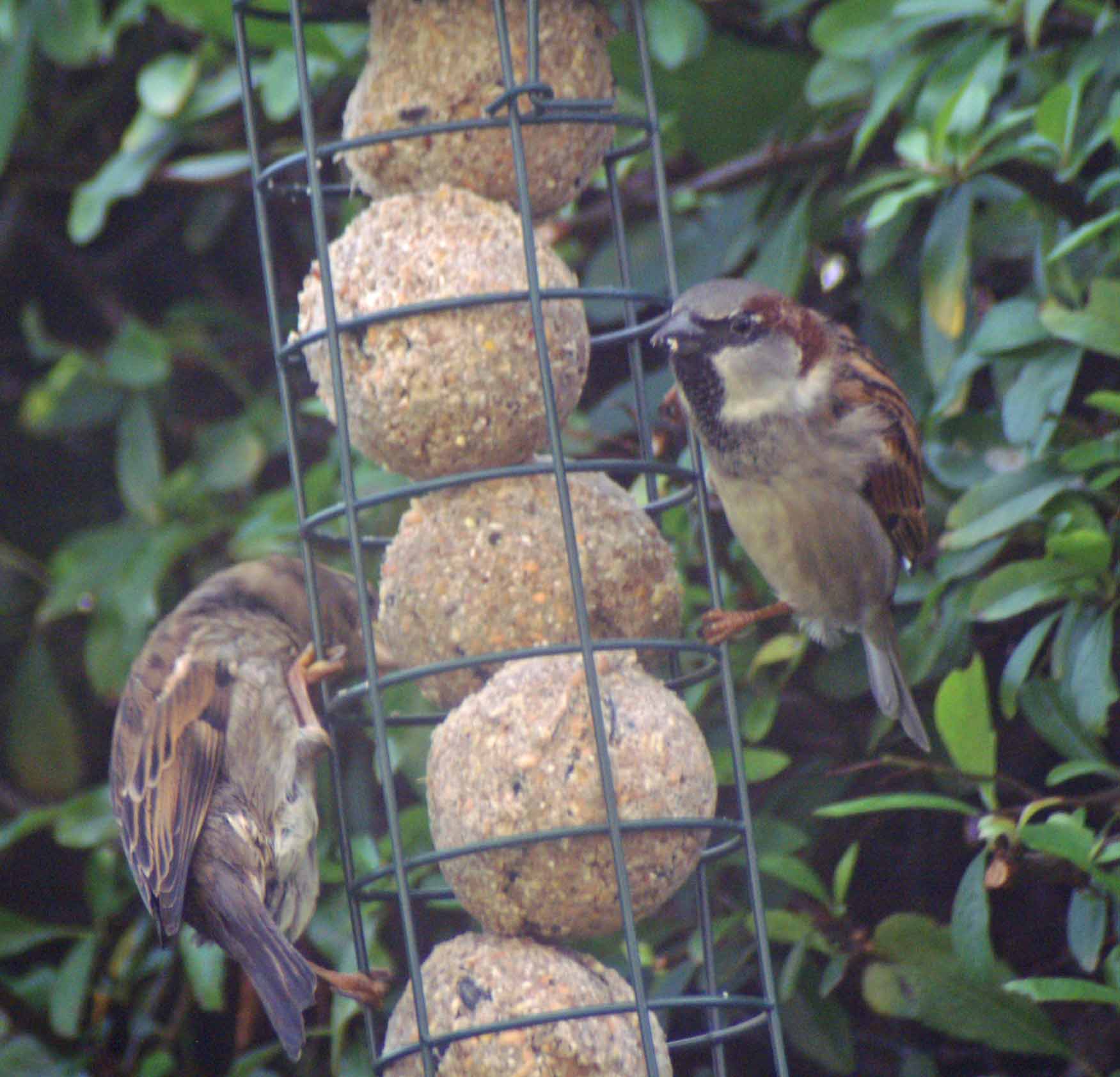
House sparrow male

House Sparrows have always held a special place in my heart and I consider myself lucky that in each place I have lived there has been a little colony living alongside us, often literally sharing the building.  The local House Sparrow population here seem to be thriving; they had a successful breeding season last year and on several occasions towards the end of last summer I counted up to thirty birds feeding on the berries of the pyracantha hedge. Their plumage also merits a closer look, the shades of brown range from almost black, chocolate and chestnut to creamy white on the male, with females necessarily being restricted to more subtle shades, but still attractively marked.

The male is duller in fresh non-breeding plumage, with buff tips on many feathers. Wear and preening expose bright markings of brown and black, including a throat and chest patch, called a “bib” or a “badge”. This patch is variable in width and general size, and some scientists have suggested that patches signal social status or fitness,  although studies have only conclusively shown that patches increase in size with age. In breeding plumage, the male has a grey crown, and is marked with black on its throat and beneath the crown. The cheeks and underparts are pale grey. The female has no black on head or throat, nor a grey crown and its upperparts are streaked with brown. The juvenile is deeper brown, and the white is replaced by buff; the beak is pink to dull yellow.

House Sparrow female

The House Sparrow is a bird of the sparrow family Passeridae, found in most parts of the world occuring naturally in most of Europe, the Mediterranean region, and much of Asia. Its intentional or accidental introductions to many regions, including parts of Australia, Africa, and the Americas, make it the most widely distributed wild bird. A small bird, it has a length of 16 centimetres (6.3 in) and a weight of 24–39.5 grams (0.85–1.39 oz).

The House Sparrow is a very social bird. It is gregarious at all seasons when feeding, often forming flocks with other types of bird. It also roosts communally, its nests are usually grouped together in clumps, and it engages in a number of social activities, such as dust and water bathing, and “social singing”, in which birds call together in bushes. The House Sparrow feeds mostly on the ground, but it flocks in trees and bushes. For the larger part it is sedentary, rarely moving more than a few kilometres. Non-breeding House Sparrows roost in large groups in trees, gathering some time before and calling together.

At feeding stations and nests, females are dominant despite their smaller size

The House Sparrow is strongly associated with human habitations, and can live in urban or rural settings. They have been much persecuted in the past for helping themselves to our domestic crops and their numbers in towns and cities have declined massively. However, the intelligent little birds continue to adapt to our generally messy eating habits as sources of easy pickings and are often found around the areas where food is consumed outside, they inhabit zoos and wildlife parks; others gain access to the inside spaces of supermarkets and some birds have even learned how to operate the automatic doors.

To many people across the world, the House Sparrow is the most familiar wild animal. One of the reasons for the introduction of House Sparrows throughout the world was their association with the European homeland of many immigrants. Often it is regarded as a pest, since it consumes agricultural products and is blamed for the spread of disease to humans and their domestic animals. In most of the world the House Sparrow is not protected by law and attempts to control their numbers still include the trapping, poisoning, or shooting of adults; the destruction of their nests and eggs; or less directly, blocking nest holes and scaring off sparrows with noise, glue, or porcupine wire. However, attempts at the large-scale control of the House Sparrow have failed.

I came across this nature bulletin several years ago when researching the status of house sparrows introduced into other countries and loved it, so am passing it on.


Share this:

  • Share on Facebook (Opens in new window) Facebook
  • Share on Pinterest (Opens in new window) Pinterest
  • Share on X (Opens in new window) X
Like Loading...

Hungry Herring Gulls

21 Wednesday Sep 2011

Posted by theresagreen in birds of the seashore, Birdwatching on North Wales coast, Nature, Nature of Wales, Rhos-on-Sea

≈ 2 Comments

Tags

colwyn bay beach, herring gull, herring gull feeding behaviour, herring gull juveniles begging for food, larus argentus

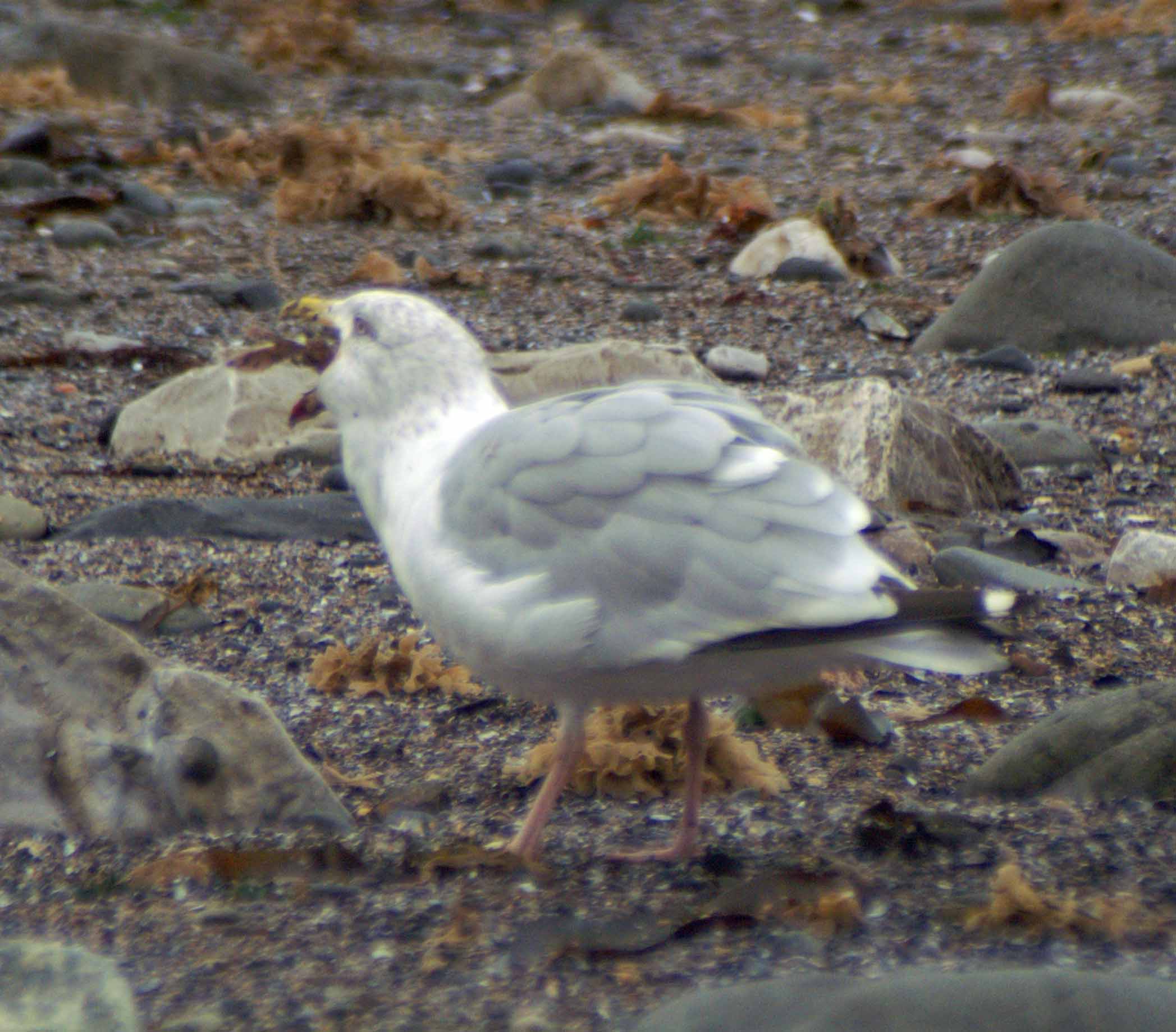
Walking along the sea shore the other day I came across a Herring Gull in the process of eating a fish. I have no idea what species of fish it was, all I can say is that it was a flat fish and either whole or almost-whole, either way, large enough for me to be amazed that a bird could even attempt swallow it.

17/9/11-The gull with most of the fish in its gullet

17/9/11- It was not going down easily, so it had to come back up again

17/9/11-A second attempt -and this time the fish disappeared

17/9/11- All that remained was a lump in the gull's crop - it should keep him going till at least lunchtime

Herring Gulls are  omnivores and opportunists like most Larus gulls, and will scavenge from rubbish dumps, landfill sites, and sewage outflows; food obtained this way may comprise up to half of the bird’s diet. Despite their name, they have no special preference for herrings — in fact, examinations have shown that echinoderms and crustaceans comprised a greater portion of these gulls’ stomach contents than fish.

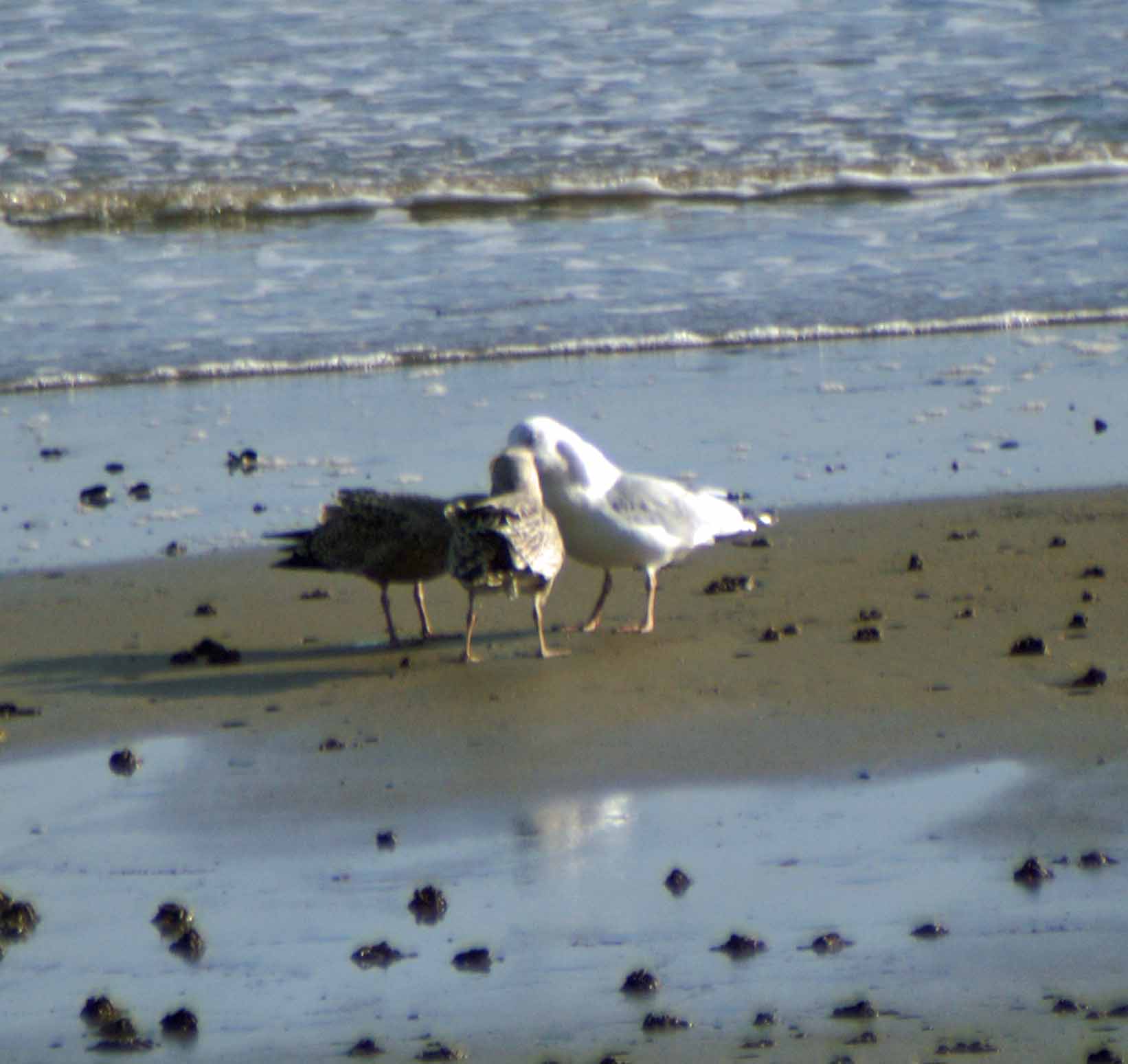
On Colwyn Bay seashore I witnessed more gull feeding behaviour, this time two juveniles were begging an adult, presumably a parent, to feed them.

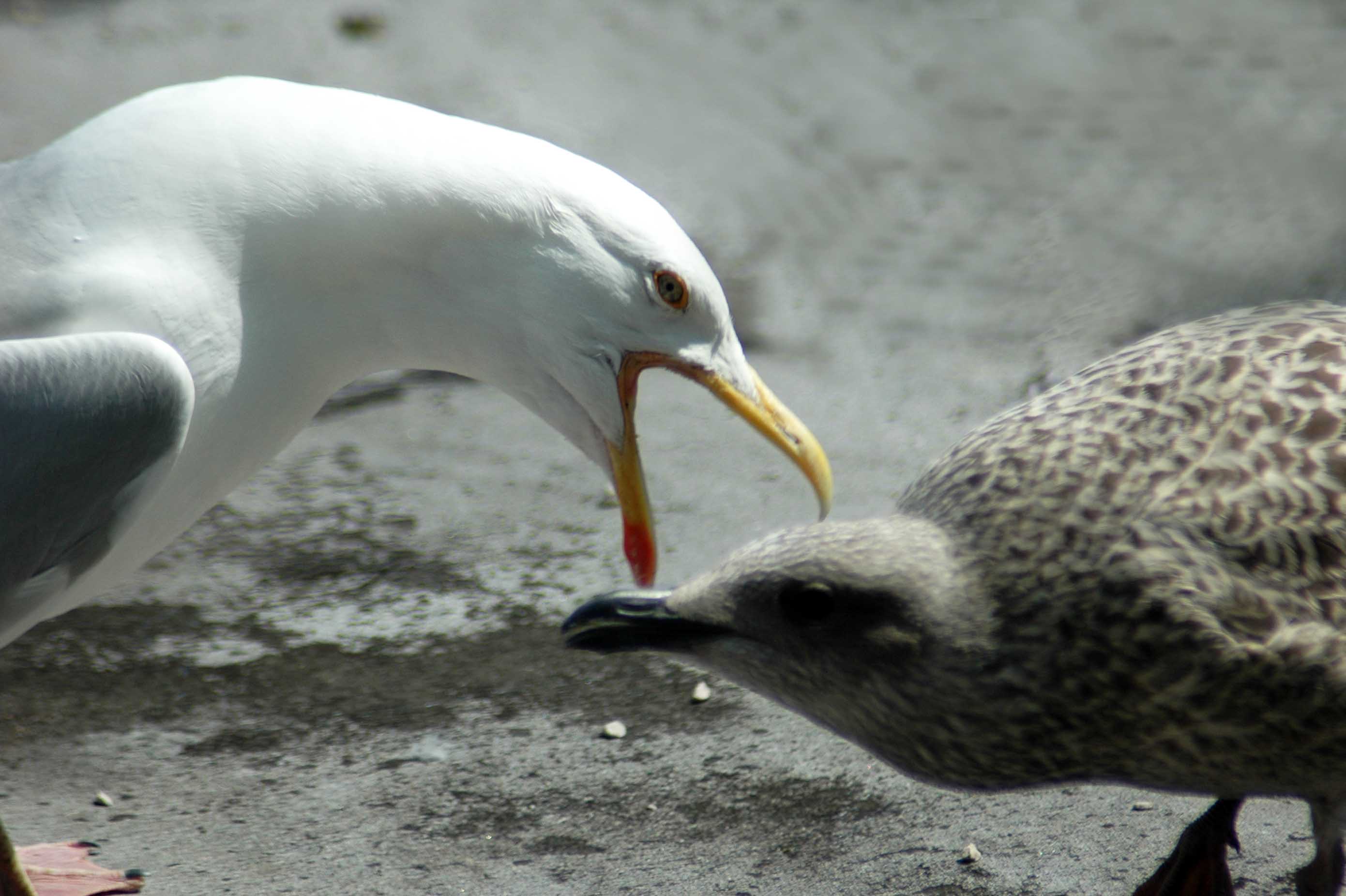
Young Herring gulls persuading a parent to feed them

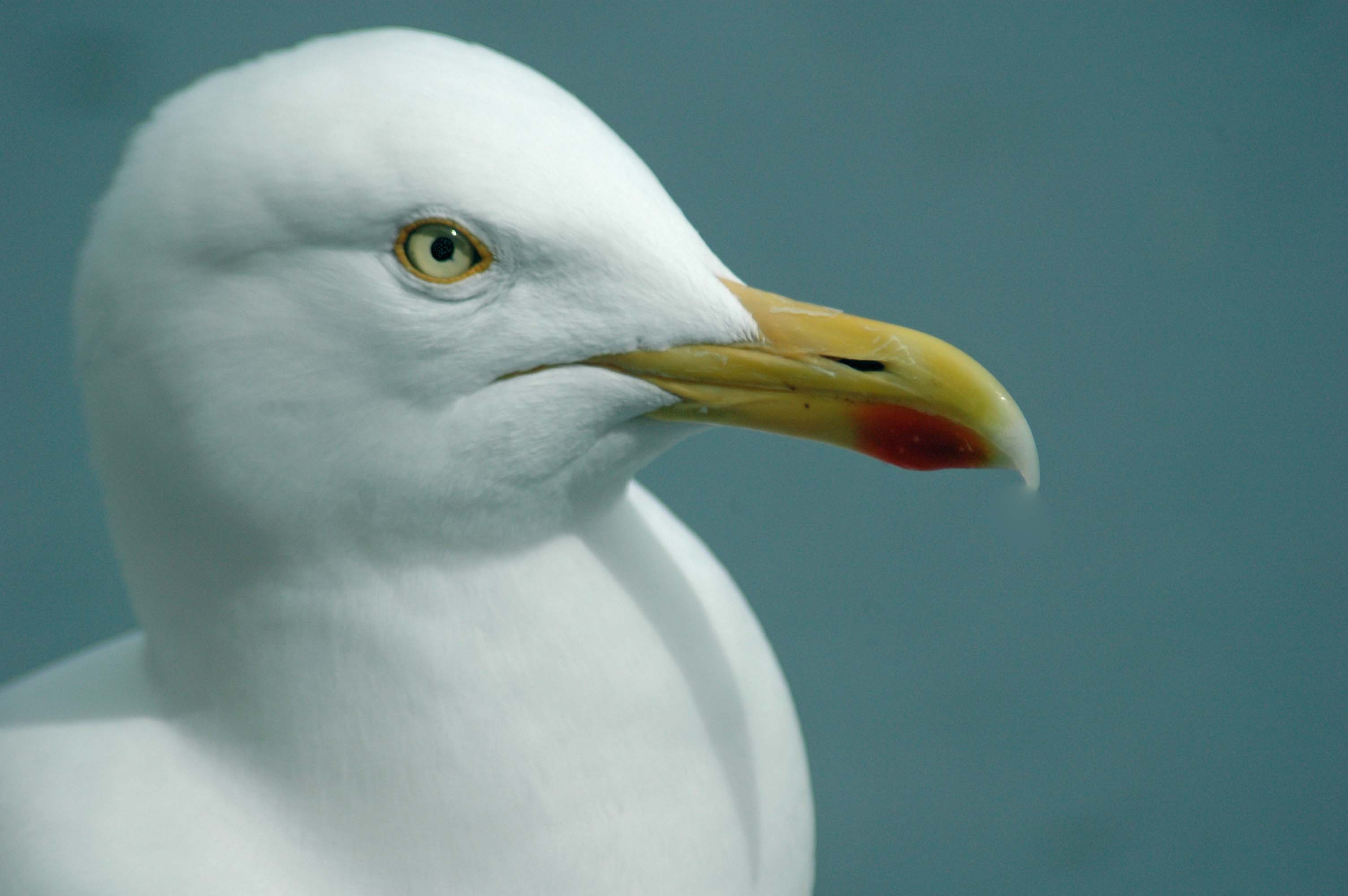
Juveniles use their beaks to “knock” on the red spot on the beaks of adults to indicate hunger. Parents typically disgorge food for their offspring when they are “knocked”.

Parent gulls will feed their offspring for up to 6months if they continue to beg

Chicks are generally fed by their parents until they are 11–12 weeks old but the feeding may continue up to six months of age, if the young gull continues to beg. The male feeds the chick more often than the female before fledging, the female more often post-fledging.

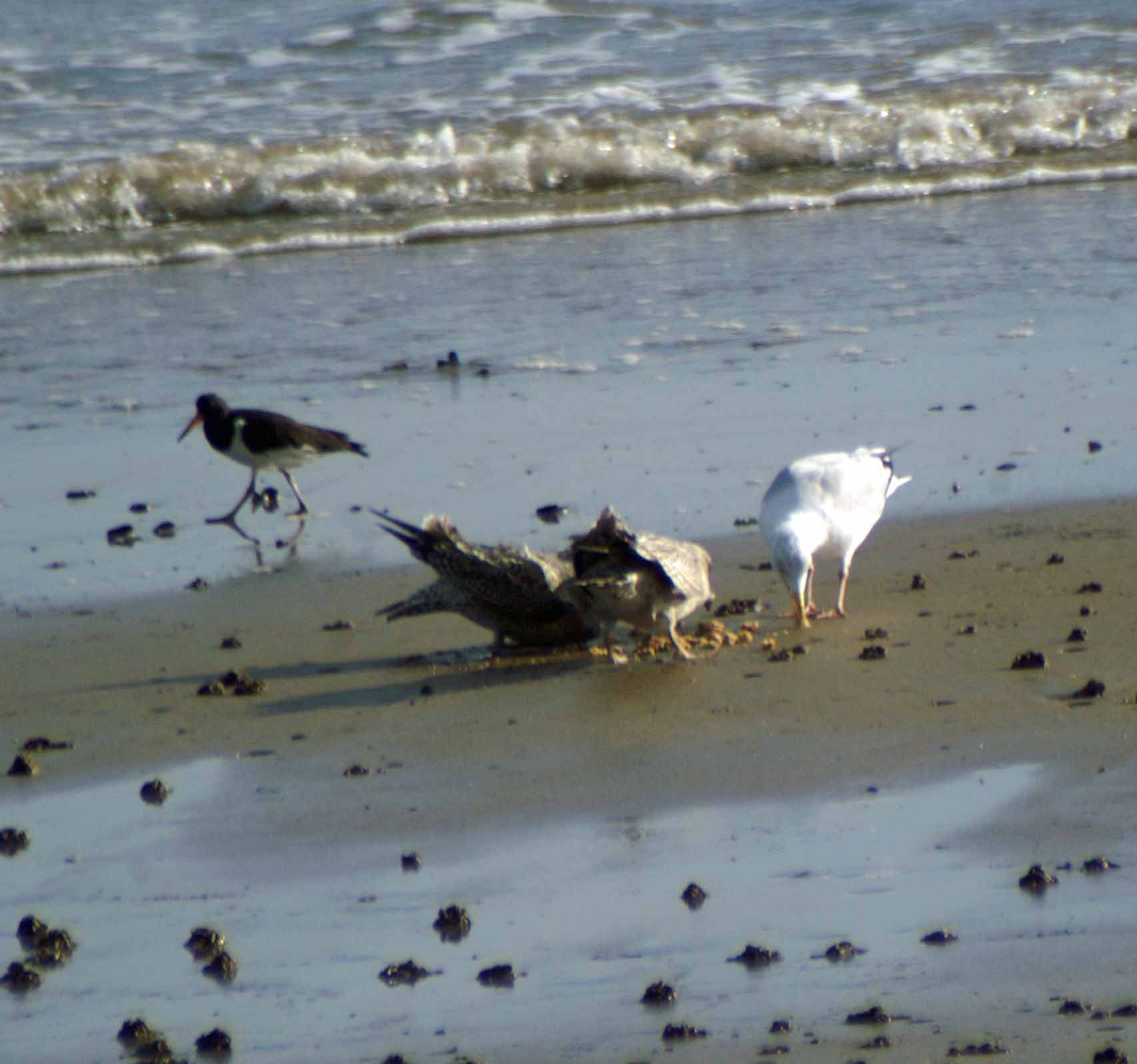
The adult was persuaded to disgorge what it had eaten onto the sand

The young birds begging did the trick and the adult disgorged whatever it had eaten onto the beach, which did not look at all appetising from where I was standing, but the three birds seemed to be happy with it.

Share this:

  • Share on Facebook (Opens in new window) Facebook
  • Share on Pinterest (Opens in new window) Pinterest
  • Share on X (Opens in new window) X
Like Loading...

Baby seal rescue

19 Monday Sep 2011

Posted by theresagreen in Nature, nature photography, Rhos-on-Sea, Seals

≈ 1 Comment

Tags

grey seals, observing seals, seals, seals around welsh coasts, welsh mountain zoo, white baby seals, white baby seals on seashore

The insistent barking of his dog alerted its owner to the plight of a young Grey Seal trapped beneath the huge boulders of the extra sea defence in front of the promenade wall at Rhos-on-Sea on Thursday morning. He put in a call that resulted in the arrival of a team from the Welsh Mountain Zoo Seal Rescue Unit to assess the situation; they will only intervene when it is absolutely crucial to the survival or well-being of an animal.

In this instance help was needed as the hapless youngster had worked its way through spaces between the rocks, ultimately becoming trapped. It was clear that the seal was unable to retrace its path back to the shore and was therefore also out of the reach of its mother. Someone said that the mother, spotted swimming offshore earlier, had been frightened away by a jet-skier, but in any case she would not have approached her baby whilst we were anywhere nearby.

The baby seal was still on shore level, but due to the slope of the boulders, from a rescue perspective he was at the bottom of a deep hole and underneath a rock. One of the team, Michelle, was small enough to squeeze down to reach the seal, but getting him out was another matter. A baby Grey Seal is born weighing in at around 14-15kg (30lbs), so no lightweight and the awkwardness of this one’s position further added to the problem. With no lifting equipment available, some creative thinking was called for and someone had the inspiration to try improvising a hoist from dog leads. There were plenty available amongst the small crowd of concerned onlookers that had stayed to offer moral support throughout the rescue and although not ideal, Michelle managed to loop one around the seal’s well-padded body and pass it up to the girls at the top, who carefully hauled him out.

The baby was finally lifted out

It was unharmed and seemed fit and healthy, but the fresh appearance of his still-attached umbilical cord indicated that it was very young – probably no more than a day or so old.

The baby seal was carefully lifted

It was placed carefully on a rock

The fresh umbilical cord shows the baby is no more than a day or so old

The baby was placed at the sea edge in the hope that its mother would return to it

It was hoped that by placing him on the shore close to the rocks that the mother would soon find him.

Alone on the seashore the baby seal looked very small and vulnerable

A LITTLE LATER

Passing the spot a short time later I heard him calling and spotted him in the water where he appeared to be struggling and was being knocked against the rocks by the waves of the incoming tide. There was still no sign of the mother; although she may have been nearby, any sight she had of people would be perceived as dangerous to her baby or herself and she would not approach, so the area needed to be very quiet.

LATE AFTERNOON

Later again I returned to the promenade and heard the loud and plaintive calls of the baby seal as I crossed the road. They seemed to be coming from very close to the spot he had originally been rescued from and as I couldn’t see him from above, I walked along the shore edge to try to find where he was exactly.  I was pleased to see Michelle who had received another call reporting that the seal was still there and sounding distressed. She climbed up onto the rocks and had a look around, but the seal had now stopped calling and could have been anywhere. She told me the RSPCA would return on Friday morning and if the seal was still there that they would take it to the Seal Sanctuary to be cared for.

THE NEXT DAY

I heard from Michelle, who is Head Keeper at the Welsh Mountain Zoo who had carried out the hard part of the first rescue attempt, she said:

” This rescue was one I’ll never forget. My muscles ache, I have bruises in odd places after climbing down the rocks into a small dark place. But it was worth it! I went down again after work (about 8pm), located it and with help from passers by and this time a catch pole that I brought with me, we got the seal out. It was in the wrong place and weaker than in the morning, so I brought it back to the seal unit where it is now much quieter as it’s not hungry anymore”.

Michelle Pywell

Welsh Mountain Zoo – National Zoo of Wales

Colwyn Bay, Conwy LL28 5UY

ABOUT THE NORTH WALES SEA RESCUE CENTRE

Since the zoo opened in 1962 a wide variety of injured and orphaned native species have been brought in for care and rehabilitation. Most of this care, in recent years, has concentrated on young grey and occasionally common seals.

This work is carried out in collaboration with the RSPCA, and in 1997 the North Wales Seal Rescue Centre was opened at the zoo. The centre has two filtered pools and an indoor intensive care unit. This development, funded by zoo friends and supporters, has resulted in an improvement in the care given, and an increase in the number of animals treated, before their release back into the sea.

The RSPCA has advice on what to do if you think you may have spotted a baby seal in trouble: http://www.rspca.org.uk/utilities/faq/-/question/ENQWADStrandedSealPupsOnOwn


Share this:

  • Share on Facebook (Opens in new window) Facebook
  • Share on Pinterest (Opens in new window) Pinterest
  • Share on X (Opens in new window) X
Like Loading...
← Older posts
Newer posts →
Follow everyday nature trails on WordPress.com

Enter your email address to follow this blog and receive notifications of new posts by email.

‘But it is the common species that keep the living world ticking over and provide most of our experiences of wildlife, and I would argue that maintaining the abundance of these is as important a conservation priority as maintaining the existence of rarities’. Richard Mabey

MOST RECENT POSTS

  • A Glimpse of Spring to Come January 22, 2025
  • Hunting the Wren December 28, 2024
  • Oh, Christmas Tree December 18, 2024
  • In and Out of the Ivy February 15, 2024
  • Nature’s Fireworks November 30, 2023
  • Wild Autumn along the Coast Path November 3, 2023

OLDER POSTS

LOOKING FOR SOMETHING IN PARTICULAR?

  • Sights and Sounds from the Little Orme 1
    Sights and Sounds from the Little Orme 1
  • Things Bright and Beautiful
    Things Bright and Beautiful
  • Following a river to a Fairy Glen
    Following a river to a Fairy Glen
  • Catchers, a Duck and Divers
    Catchers, a Duck and Divers
  • Fine Dining for Crows
    Fine Dining for Crows
  • A Window on the Woods-Winter 1
    A Window on the Woods-Winter 1
  • A Windy Wildflower Trail
    A Windy Wildflower Trail
  • Butterflies and more rare treats
    Butterflies and more rare treats
  • Shades, Sounds and Scents of the Woods
    Shades, Sounds and Scents of the Woods
  • Bird study: Blackcap
    Bird study: Blackcap

nightingale trails

The Walk of the Monarch Butterfly-Sendero de la Mariposa Monarca

The Walk of the Monarch Butterfly-Sendero de la Mariposa Monarca

MY WILDFLOWER BLOG: where the wildflowers are

Snowdrop

Snowdrop

most recent posts

Follow everyday nature trails on WordPress.com

Social

  • View teresamaygreen’s profile on Twitter

Enter your email address to follow this blog and receive notifications of new posts by email.

Website Built with WordPress.com.

  • Subscribe Subscribed
    • everyday nature trails
    • Join 359 other subscribers
    • Already have a WordPress.com account? Log in now.
    • everyday nature trails
    • Subscribe Subscribed
    • Sign up
    • Log in
    • Report this content
    • View site in Reader
    • Manage subscriptions
    • Collapse this bar
 

Loading Comments...
 

    %d