• Home
  • about
  • about the photographs
  • Local Nature Reserves
    • Bryn Euryn Local Nature Reserve
    • Mynydd Marian
  • Wales Coast Path
    • Grey Seals in North Wales
    • St.Trillo’s Chapel
    • Wildflowers of North Wales Coastal Paths, Cliffs and Dunes

everyday nature trails

everyday nature trails

Category Archives: Nature

Winter Greens

08 Sunday Feb 2015

Posted by theresagreen in Bryn Euryn Nature Reserve, ferns, Nature, Nature of Wales, woodland walks in Wales

≈ 2 Comments

Tags

evergreen trees, Great Tit, hart's tongue fern, holly, ivy, polypody fern, scots pine, stinking iris, yew

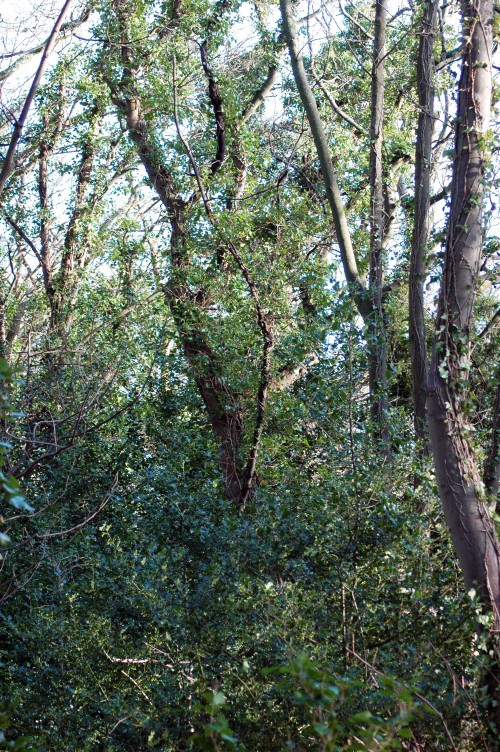
My walks on Bryn Euryn have a different starting point now and it has been interesting to note the differences in the character of the woodland on this eastern to south-eastern aspect of the hill. Firstly, on this particular pathway you are immediately in the woodland and notice there is a difference in the pattern of tree species. I am fairly sure that is because the land that the apartment block that I now live in was formerly the site of a large house, one of several similar ones, most of which are still standing and in use as residential care homes. All have large mature gardens to the fronts and sides and are set back tightly against the rising wooded hillside, so certain of the trees and shrubs, such as laurels and Scots Pines, that you don’t find on the other slopes of the hill, have inevitably escaped. Other evergreens Yew, Holly and Ivy occur throughout the woodland on all sides, but this area seems to have more and larger specimens of them and so appears particularly green.

Sunlight on a path lined with evergreens

Sunlight on a path lined with evergreens-yew, holly & laurel

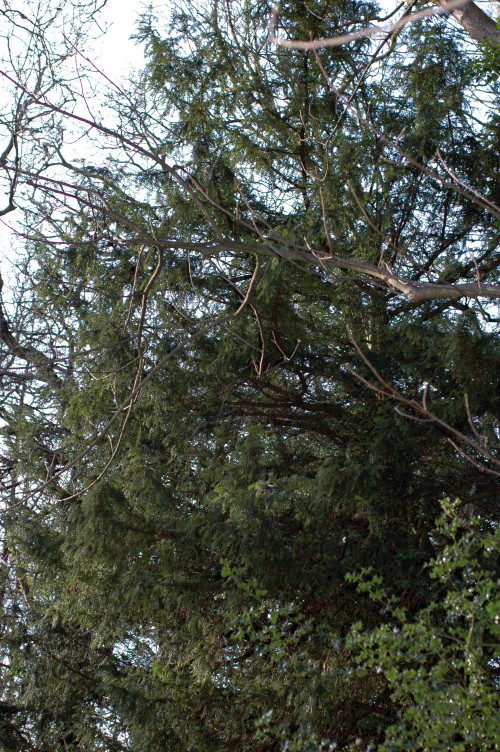
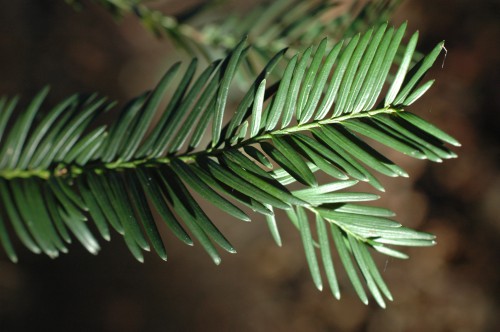
Yew is one of our native species of trees and occurs naturally in the wild in woodlands in several parts of Britain, although it is not as widespread as it used to be.

Yew tree

A large Yew tree

Yew foliage

Yew foliage

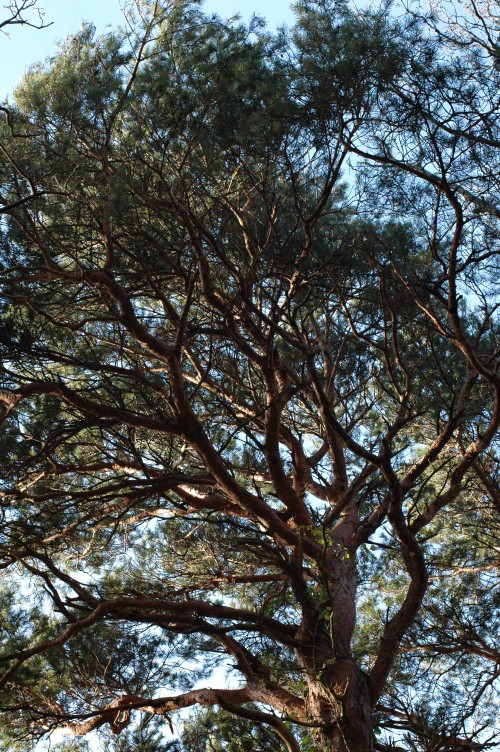
Scots pine (Pinus sylvestris) is an evergreen conifer native to northern Europe, and is one of just three conifers native to the UK.

150104TGFL-Bryn Euryn 12-Scots Pine

A huge Scots Pine

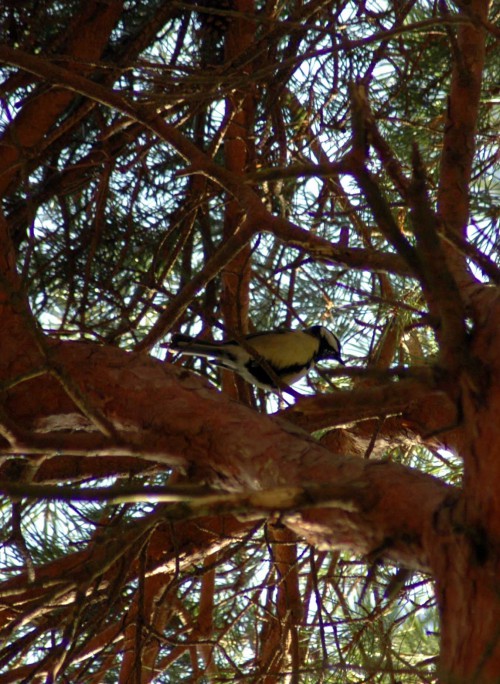
A Great tit in the pine tree

A Great tit in the pine tree

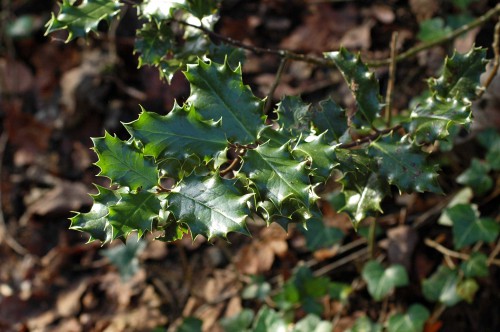
Holly and Ivy

Holly and Ivy

Shiny Holly leaves

Shiny Holly leaves

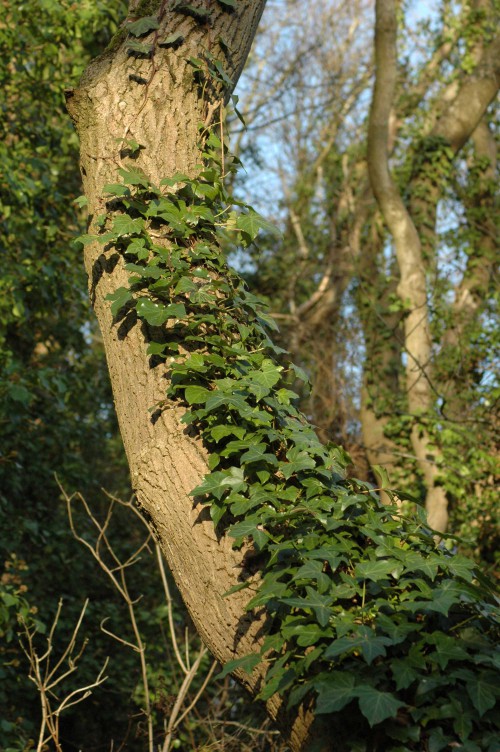
Ivy

Ivy

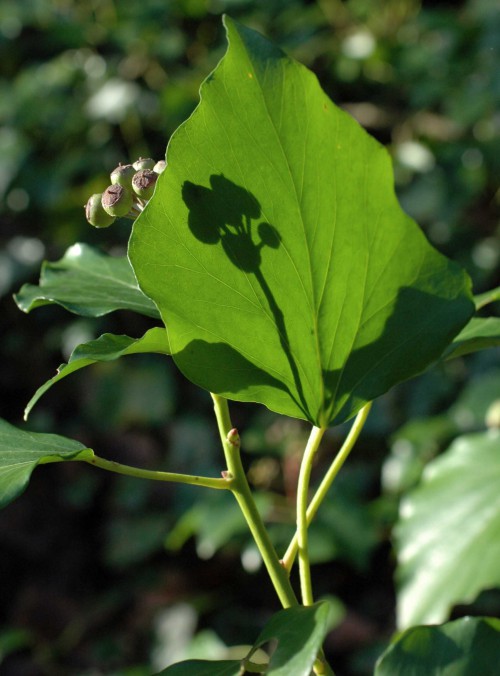
Sun shining through an ivy leaf

Sun shining through an ivy leaf

Greenery is also abundant on the woodland floor.

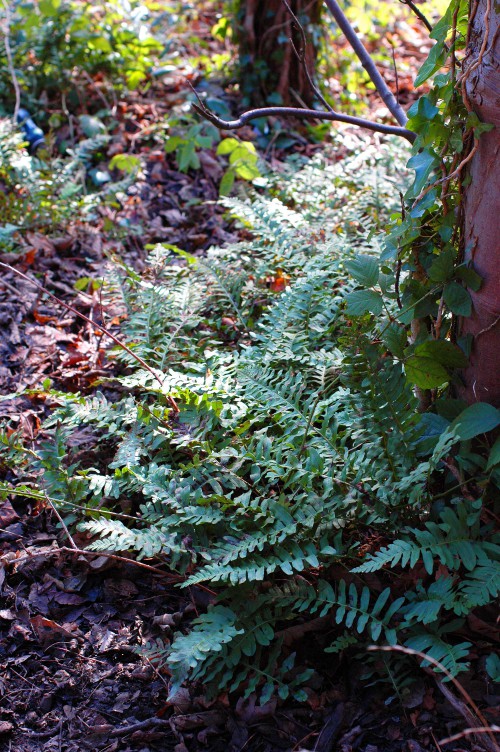
Fern around the base of a tree

Polypody fern around the base of a tree

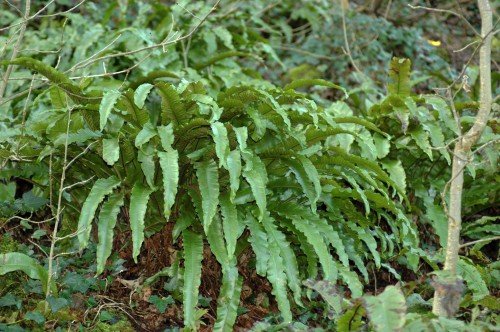
Hart's tongue fern

Hart’s tongue fern

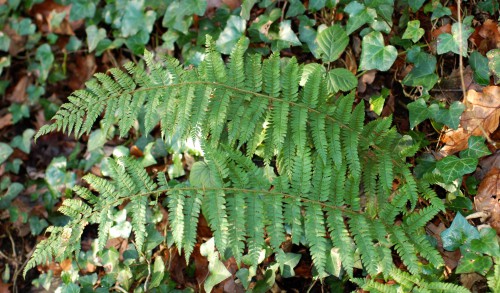
Male fern

Male fern

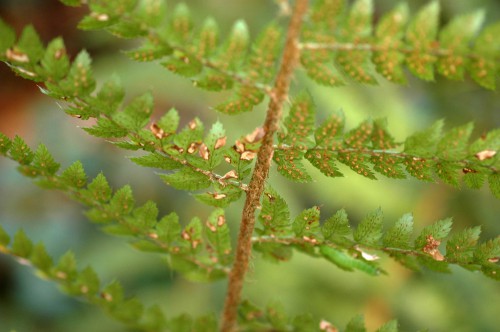
Spores on the back of a fern leaf

Spores (sori) still cling to the back of a fern leaf

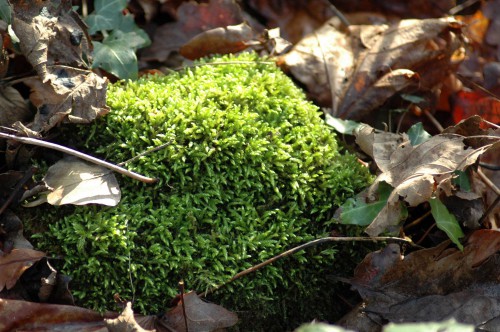
Vibrant green moss amongst dry brown leaves

Vibrant green moss amongst dry brown leaves

Winter is a good time time to see mosses when many are at their best.

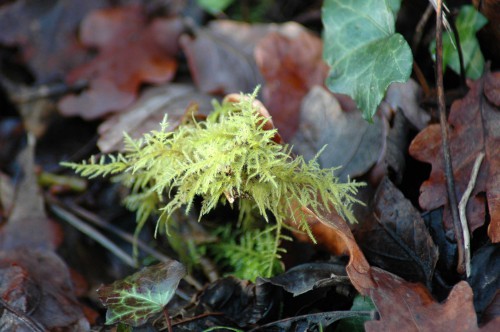
Feather moss

Feather moss

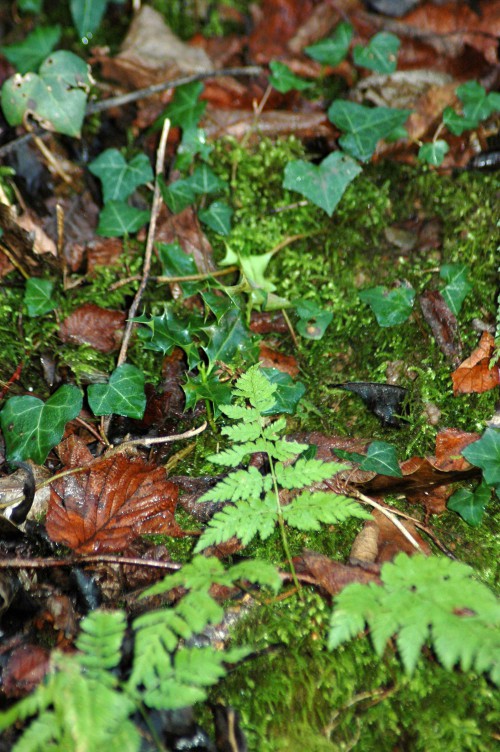
Young fern and holly plants in a mossy bed

Young fern and holly plants in a mossy bed

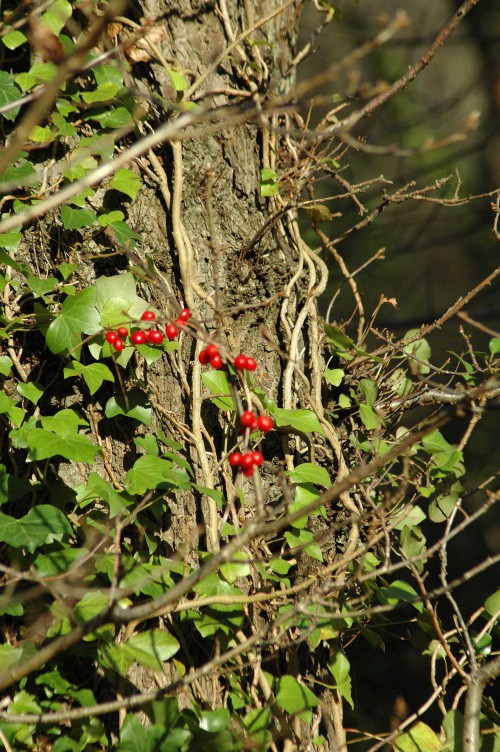
A few splashes of colour…….

Red berries of nightshade strung like beads around ivy

Red berries of nightshade strung like beads around ivy

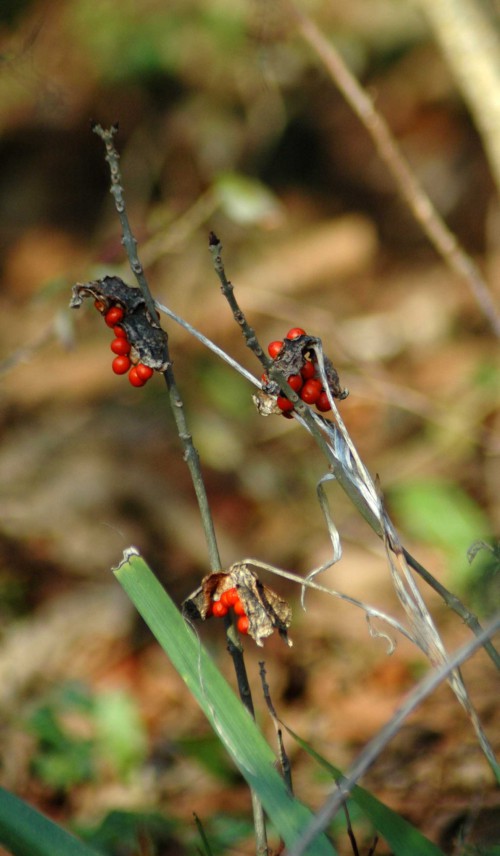
A few berries remain on a 'Stinking Iris'- Iris foetidissma

A few berries remain on a ‘Stinking Iris’- Iris foetidissma


Share this:

  • Share on Facebook (Opens in new window) Facebook
  • Share on Pinterest (Opens in new window) Pinterest
  • Share on X (Opens in new window) X
Like Loading...

Getting to know my new neighbours

07 Saturday Feb 2015

Posted by theresagreen in Bryn Euryn Nature Reserve, Nature, Nature of Wales, nature photography, Rhos-on-Sea, woodland birds

≈ 4 Comments

Tags

blackbird, Blackcap, Blue tit, Bullfinch, coal tit, dunnock, Great Tit, grey squirrel, redwing, Robin, wood pigeon

The beginning of this year has been a busy one and I’ve been distracted and often frustrated by the myriad of mostly mundane issues involved in moving home, but it’s all done and dusted now and at last I can get back to more enjoyable activities. I haven’t moved far and I know my new location is going to be the perfect base from which to carry on discovering more about the rich and varied habitats and wildlife of this part of North Wales.

A good few of my posts have related to the nature reserve of Bryn Euryn, the big bulky hill around whose base much of Rhos on Sea is built and my new home, on its eastern slope couldn’t have put me into closer contact with it. The beginning of a public footpath leading up onto the Bryn’s Woodland Trail is within a few metres of the entrance to the apartment block I live in now.

Early morning view

Early morning view to the east across Colwyn Bay

The views from the living room of my top-floor flat, although partially screened by trees, are ones I have photographed many times, albeit from higher up on the hilltop and then from the kitchen window the steeply rising wooded hillside is just a few metres away. Thanks to residents on the ground floor who put food out for the birds, I have a wonderful eye-level view of an array of woodland birds making the most of the food on offer.

There are almost always wood pigeons somewhere close by, most often perched up high surveying the busy little birds flitting about below. Pigeons nest pretty much all year round and on several occasions in the past weeks I have seen birds carrying sticks, probably for running repairs.

Wood Pigeons keep an eye on an approaching Grey Squirrel

Wood Pigeons keep an eye on an approaching Grey Squirrel

Sometimes they descend from their lofty perches allowing a closer look at their lovely softly-shaded plumage.

A handsome Wood Pigeon

A handsome Wood Pigeon

Other larger birds I see on a regular basis are a pair of crows and a pair of magpies, who also strut around on the lawn and there have been a few glimpses of jays.

Where there is food on offer then there are bound to be opportunistic grey squirrels, there are several that scamper about amongst the trees here on the woodland edge. They generally get a bad press, but I love watching them, they are entertaining and clever and you have to admire their incredible agility. They are rather photogenic too.

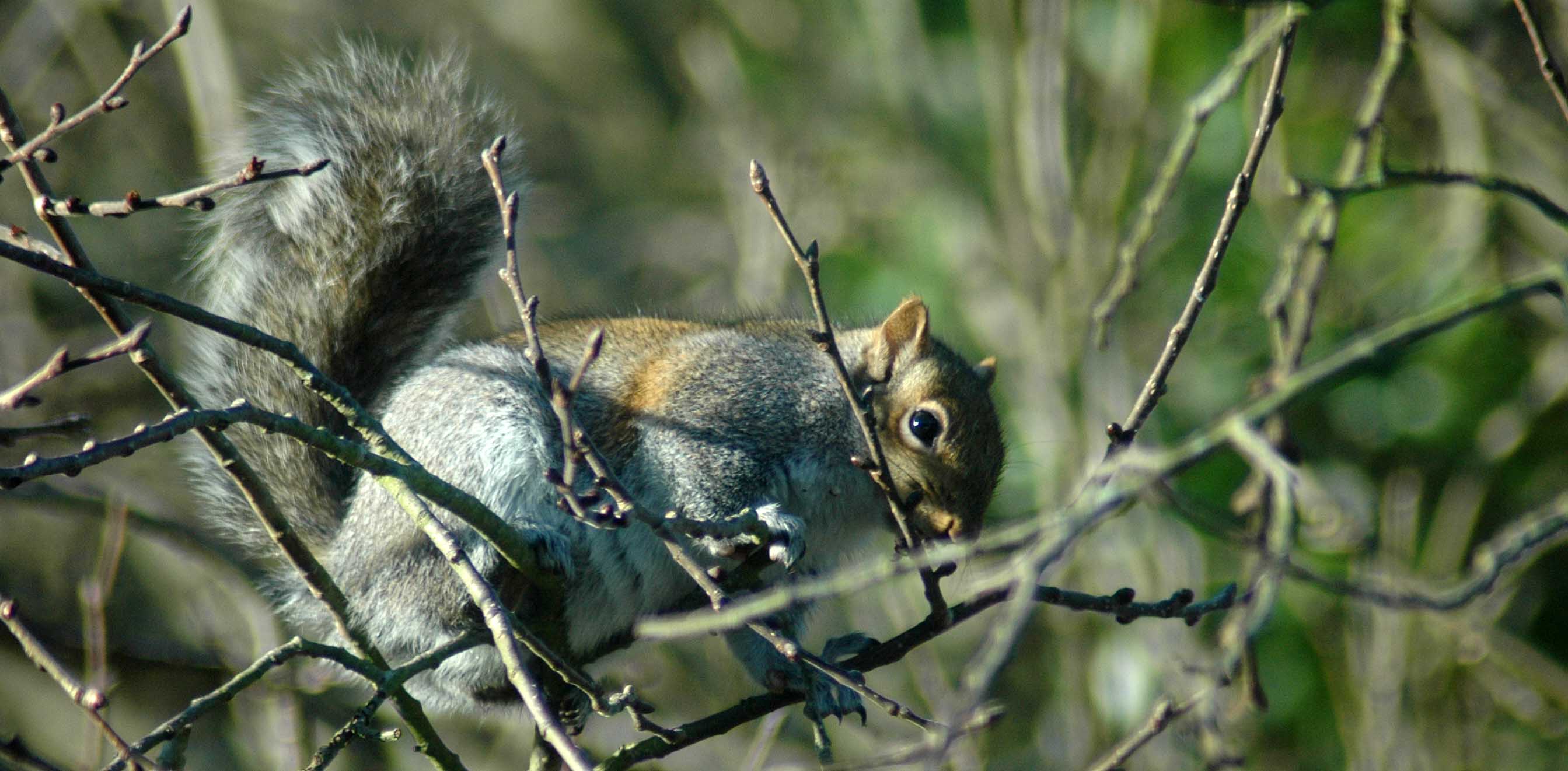
One of the squirrels nibbling on a twig
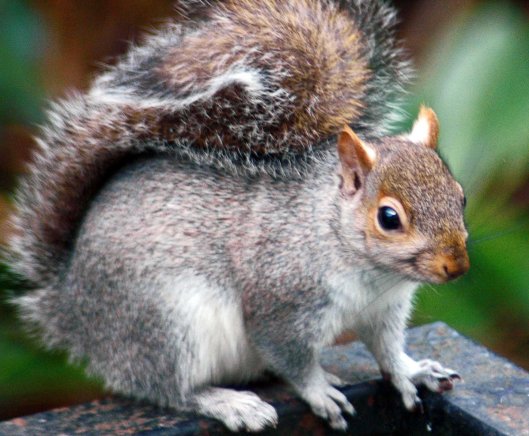
One of the squirrels nibbling on a twig

A photogenic Grey squirrel

A photogenic Grey squirrel

There are always blackbirds of course and recently both males and females have become more territorial. Males are singing and there are many chases amongst those that arrive for food;  first arrivals see off those that may follow. I have no idea which, if any, are regular visitors, particularly since I watched the piece on TV about the Holt Blackbird Project, where the blackbirds are fitted with different combinations of coloured leg tags and residents monitor their comings and goings. To quote from the published results:  One of the really incredible outcomes of the project is an understanding of the sheer number of birds that use the garden during the breeding season. The greatest number of individuals recorded on one day was 74, and even then there were some unringed birds still present. So, next time you see ‘your’ pair of Blackbirds in the garden, remember that they may not be exactly who you think they are!  Who knew? I always knew there were a good few of them around, but as you only really see them singly or in twos or threes when they’re establishing territory, those numbers seem incredible. I have given a link to the article about the project, which makes fascinating reading.

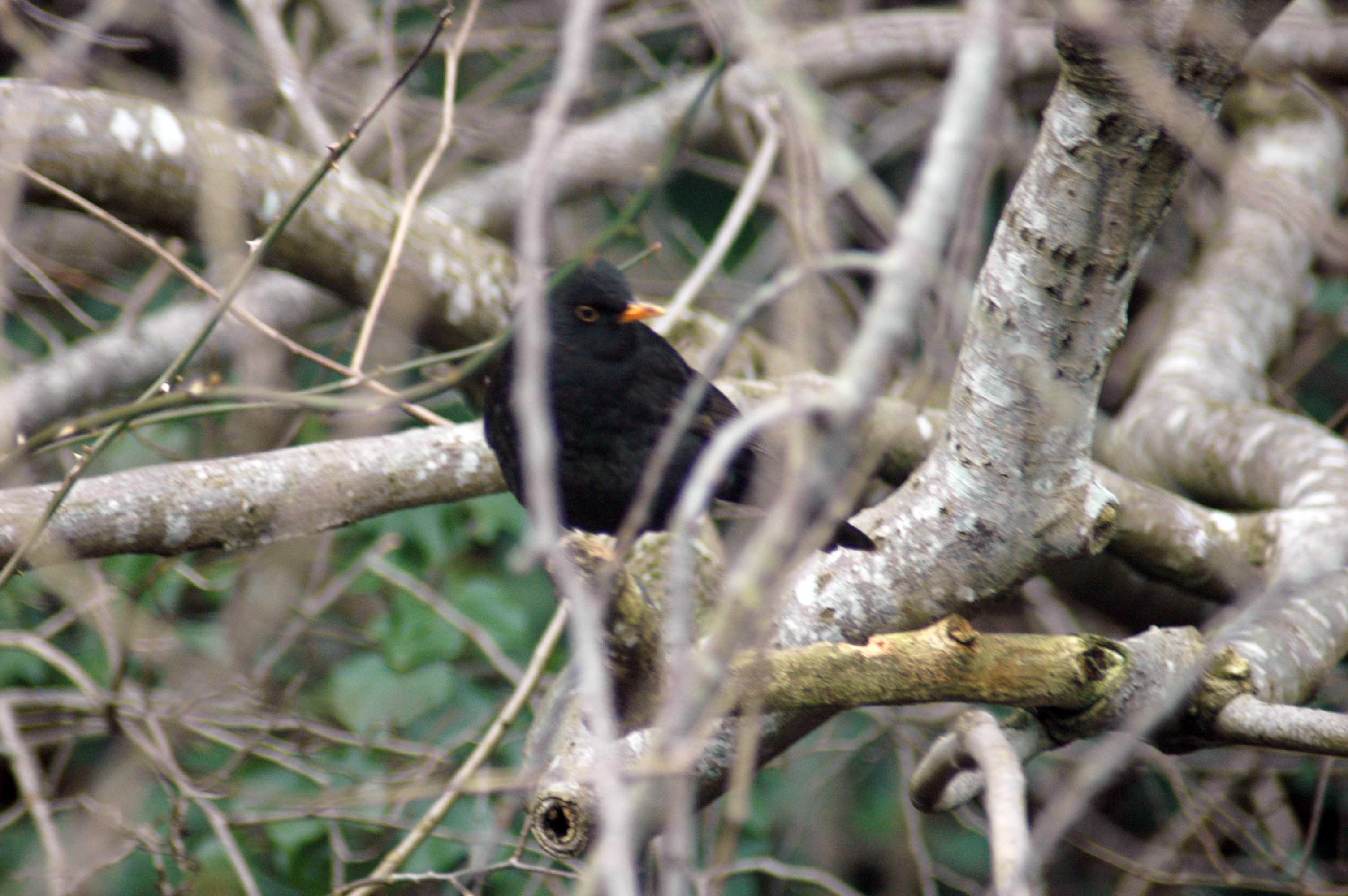
Male blackbird

Male blackbird

Female blackbird

A dark and well-marked female blackbird
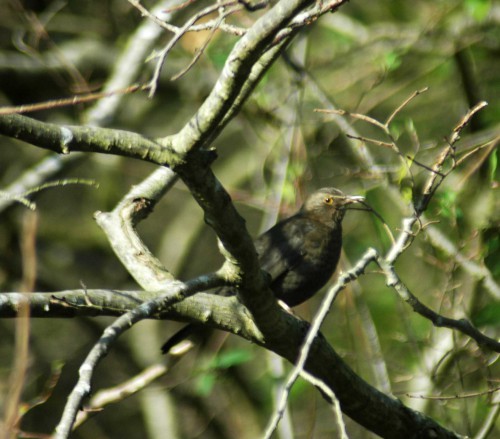
A lighter female blending perfectly in amongst the sunlit twiggy tree branches

A lighter female blending perfectly in amongst the sunlit twiggy tree branches

There are thrushes about too, or at least one anyway. Back in early January I heard one singing early one morning from a tree in the front grounds, when it was barely light. I thought it was most likely to be a mistle thrush as they are early nesters, but I am not at all sure and was even less sure when I heard more singing at 7.25am in the morning a week later, this time at the back of the building and looked out of the bedroom window to see him singing away illuminated by a nearby security light.

150109TG-Thrush singing (1) -Bryn Euryn (DC)

9th January – A thrush singing from high in a tree

Robins have been singing for a few weeks now too and as with the blackbirds, there is no peace for those that venture in for food; as soon as one perches another is almost sure to swoop in and there are frequent chases through the vegetation.

A robin enjoying a rare moment of peace in the sun

A robin enjoying a rare moment of peace in the sun

So far, the finches I have seen here have been goldfinches and chaffinches, but on Tuesday a lovely female bullfinch was here for a while. I was expecting to see a male with her, but alas no sign of one, so perhaps it was a young one that hasn’t got a mate yet.
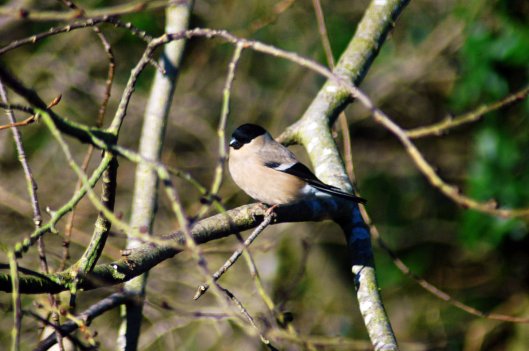
3/2/15-Bullfinch female

3/2/15-Bullfinch female

There are no house sparrows and I miss their noisy chirping and cheeping, and no starlings either, but I still have contact with both when I go back down the hill to visit my daughter. There are dunnocks though. Male dunnocks are singing now too.

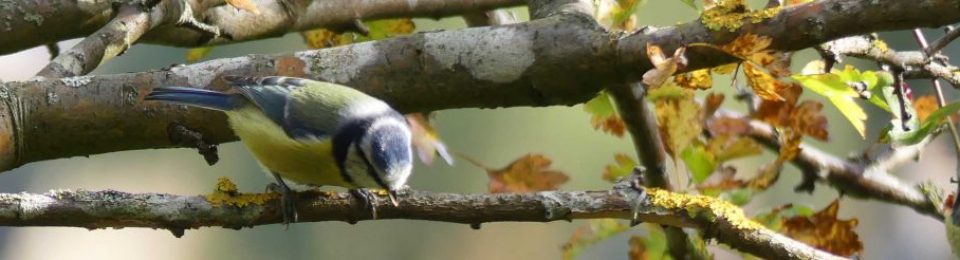
Of the frequent visitors, Blue tits are the most numerous and there can be several here at any one time. They seem to have an orderly queuing system, each one taking food then taking leave or sometimes carrying it back to a nearby branch to eat it. There are more feeders in the garden next door and there is much commuting back and forth.

150203TG-Kitchen window-Blue Tit

Blue tit

There are only ever two Great tits present at any one time, a male and a female. They have a  more business-like approach to their feeding and although they make regular visits, they do not hang around once they have what they came for.

Female great tit

Female great tit

There are one, or perhaps two delightful little Coal tits too. Their approach in to the feeding site is more discreet than that of the Blue tits, made via the lower twiggy branches of the shrubby trees. They are also quick to leave once they have taken food.
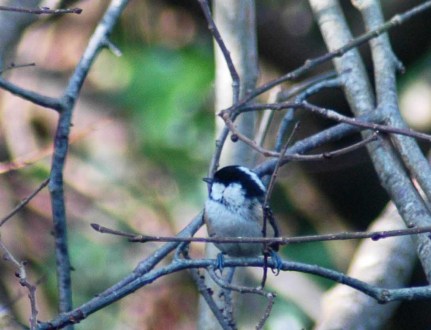
Coal tit

Coal tit

A small flock of glorious Long-tailed tits flutter in intermittently as they make their rounds, but I haven’t managed to photograph them here yet.

One morning I looked  out of the window and saw a bird that I didn’t immediately recognise, although it did look a bit thrush-like. I ran to get my camera and got just one image, through the glass, that I hoped would help with my identification. I had a feeling it was a redwing, but I hadn’t seen one for some years and couldn’t quite make the image I had fit with those in my books. I thought then maybe it was a sparrowhawk- right place, similar stance on the branch…? Anyway, I have been put right by fellow blogger Tony, who despite the not-so-brilliant quality of the image, immediately spotted it was indeed a redwing! I’m delighted – it’s another species to add to my list and to look out for again and I’m sure a sparrowhawk will be along any time soon.
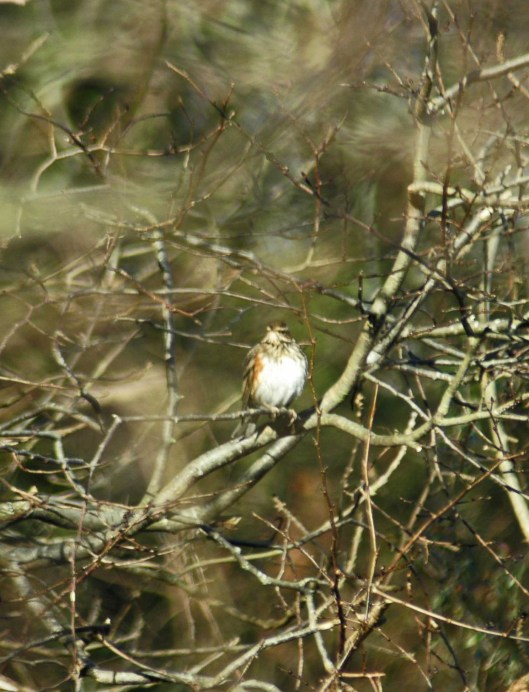
150104TGBRD-Kitchen view 12- Sparrowhawk

Redwing-Turdus iliacus

Tuesday this week (the day I saw the bullfinch) was a glorious sunny day and a few of the birds took advantage of the warmth to take brief respite from their hectic feeding schedules to sit in the sunshine. I looked across to the laurel hedge and spotted a bird nestled into a small space framed by leaves. My eye was drawn by its pale-coloured breast, but it wasn’t until I looked through the camera lens that it occurred to me it was a blackcap, a female.

4/2/15-First glimpse of the female blackcap

4/2/15-First glimpse of the female blackcap

She ventured out onto a twig in the sunshine

She ventured out onto a twig in the sunshine

150204TGDC-Blackcap female first sighting this year (4)

She sat in the sunshine for a short while before flying off

She stayed around for a good few minutes, then moved across to an evergreen shrub in the neighbouring garden for a while before flying off. I expected to see a male somewhere near her, but as with the bullfinch there was no sign of one. More about blackcaps here.

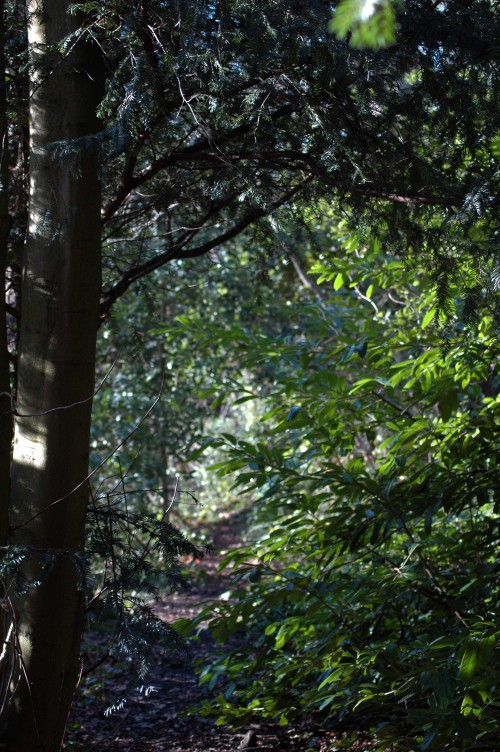
Thursday morning was again gloriously sunny and a much warmer day too and a few minutes spent watching the usual comings and goings brought forth two more additions to my list. Firstly a glimpse of a greater spotted woodpecker high up in a tree, half-hiding behind a branch, then even more excitingly a tiny goldcrest. I was fairly sure I’d seen one here flitting about in the vegetation on a couple of occasions previously, and I stopped to watch one on my walk on Tuesday, but this was a really good, though brief sighting that confirmed my previous sightings weren’t just wishful thinking. We have a good number of conifer trees close by, which they like to use as nest sites, so I’m hoping to see more.
Share this:

  • Share on Facebook (Opens in new window) Facebook
  • Share on Pinterest (Opens in new window) Pinterest
  • Share on X (Opens in new window) X
Like Loading...

Where are all the acorns?

25 Saturday Oct 2014

Posted by theresagreen in Nature of Wales

≈ 3 Comments

Tags

shortage of acorns 2014

On recent walks in North Wales and in Northamptonshire I’ve noticed there are very few acorns to be found. I commented on this in my previous blog and had a reply from Annie, who is also located in ‘middle England’, saying she had noticed it too. Some quick research on Google came up with a few articles on the very subject and it would seem that it is a nationwide problem. I would have posted the Forestry Commission article but had a warning it contained malware, so didn’t proceed. This is a link to an article in the Guardian quoting the organisation http://www.theguardian.com/environment/2014/sep/25/acorns-in-short-supply-say-forestry-commission-and-naturalists?CMP=fb_gu

Look forward to your own observations!

Share this:

  • Share on Facebook (Opens in new window) Facebook
  • Share on Pinterest (Opens in new window) Pinterest
  • Share on X (Opens in new window) X
Like Loading...

Mellow autumn

23 Thursday Oct 2014

Posted by theresagreen in Butterflies of Wales, calcareous grassland, coastal habitat, coastal walks, Nature, Nature of Wales, nature of woodlands, nature photography, Wildflowers of Wales

≈ 5 Comments

Tags

autumn woodland, Bryn Euryn Nature Reserve, common buzzard, eyebright, galls on back of oak leaves, hawthorn berries, silver birch, spangle gall, speckled wood, St John's Wort, wildflowers of Bryn Euryn

Me it delights in mellow autumn tide,                                                                       To mark the pleasaunce that my eye surrounds,                                                 The forest trees like coloured posies pied,                                                            The uplands mealy grey and russet grounds;                                                Seeking for joy where joyaunce most abounds…….                                                                                from Autumn by John Clare

Autumn certainly has been joyous this year and even the blustery tail-end effects of hurricane Gonzalo have failed to provoke most of our habitual complaints about the weather. Temperature-wise, a  walk I took on Bryn Euryn just a couple of weeks ago felt more like early summer than approaching winter and although many of the signs of autumn were in place, there were a surprising number of wildflowers in bloom and butterflies, bees and various flies on the wing.

Quarry-field cliff crowned with autumn colours

Quarry-field cliff crowned with autumn colours

Teasel  seed-heads amongst thistles

A prickly selection – teasel seed-heads amongst thistles

The woodland tracks are covered with layers of dried fallen leaves that rustle when stepped upon and the soft musky scent of their decaying matter fills the air.

Sun-dappled woodland track covered with dry fallen leaves

Sun-dappled woodland track covered with dry fallen leaves

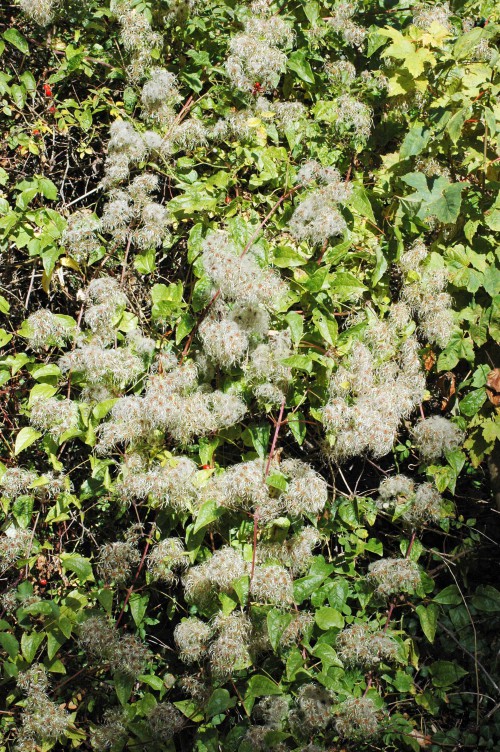
Wild clematis is prolific throughout the reserve and curtains of the fluffy dried seed-heads is draped over vegetation of varying heights and is living up to its common name of Old Man’s Beard.

Fluffy seed heads of wild clematis or 'old man's beard'

Fluffy seed heads of wild clematis or ‘old man’s beard’

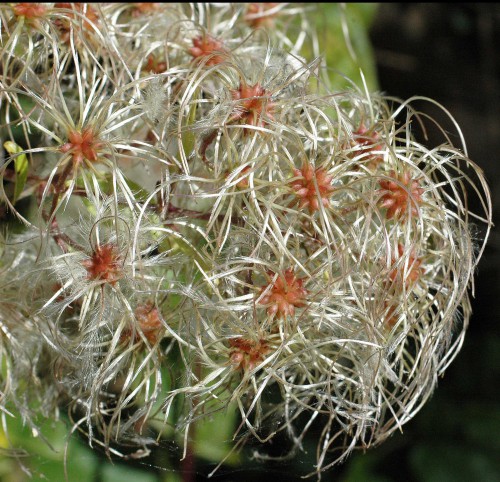
The individual seed-heads are prettily composed and shine silver in the sunlight.

141002(6)TGNW-Bryn Euryn-Old man's beard close-up

Clusters of silvery filaments make up a seed-head of wild clematis

The bountiful crops of haws on the hawthorn trees are still untouched by birds and have turned a rich ruby red.

Rich pickings still to come for hungry birds

Rich pickings still to come for hungry birds

Hawthorn leaves also turning red

Hawthorn leaves also turning red

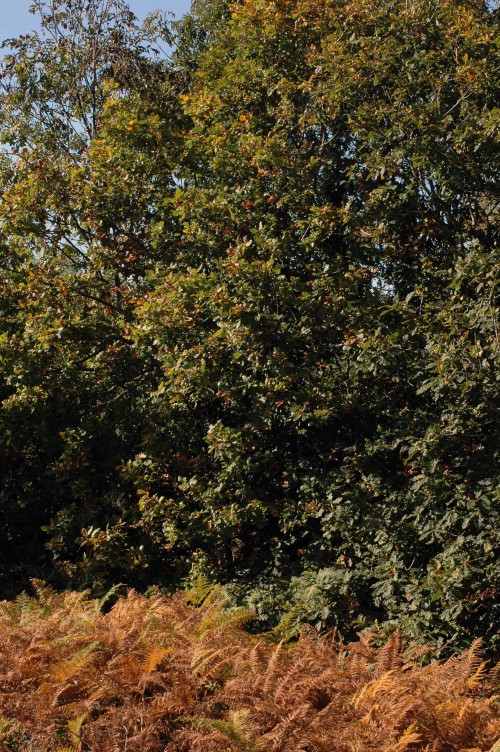
Although there are bountiful berry crops, the oak trees do not seem to have produced many acorns this season.

Oak tree with bracken in the foreground

Oak tree with bracken in the foreground

Oak leaves turning colour

Oak leaves turning colour

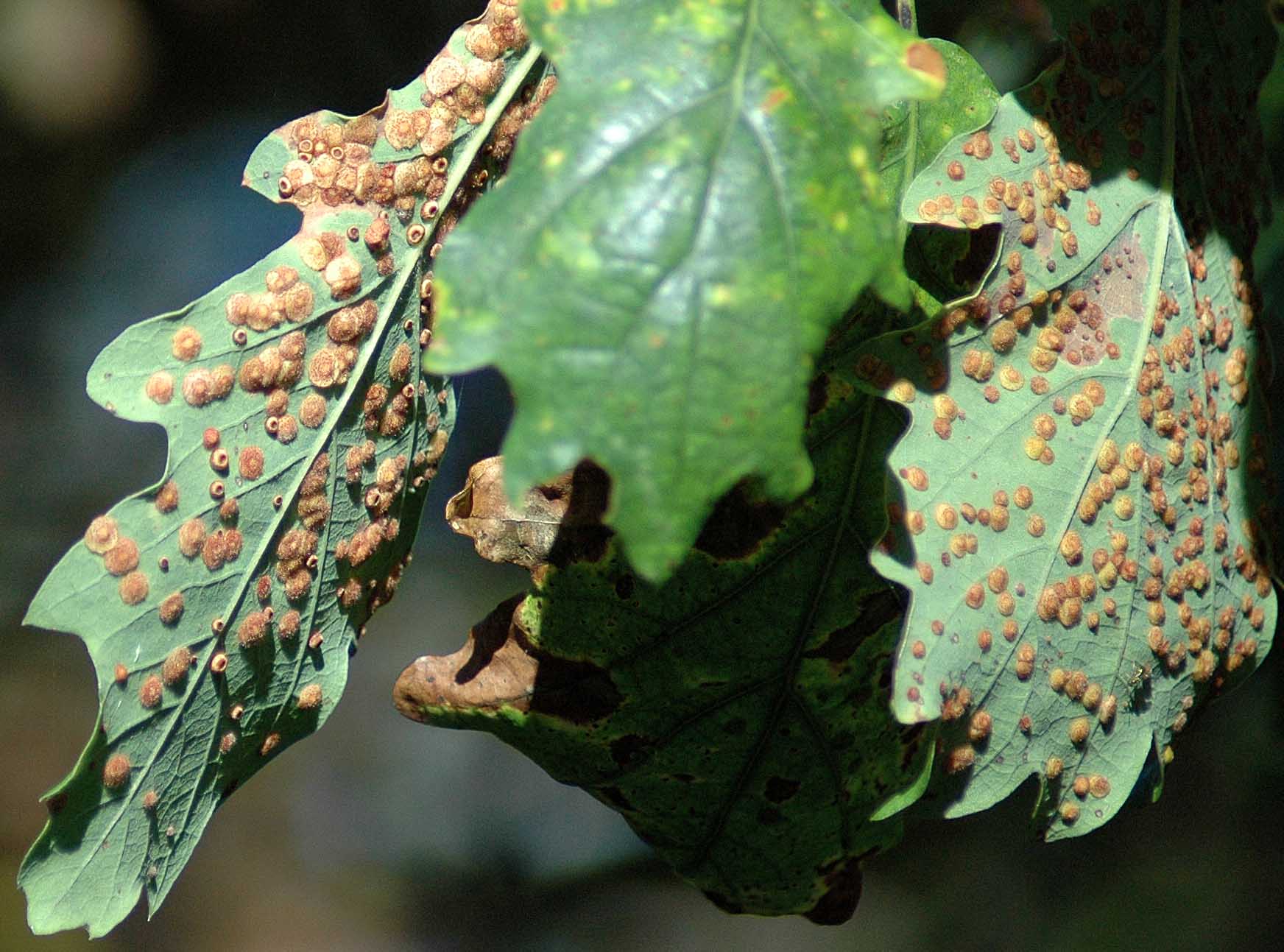
There are ‘crops’ of spangle galls though.

141002(17)TGNW-Bryn Euryn- Spangle galls on oak leaves

Spangle galls on oak leaves

Before climbing up the steep track through the woods on the way to the summit I sat for a few minutes on a rock to note down what I’d seen so far and was scrutinised for a few seconds by a buzzard that flew in over the treetops. This is a favoured spot of the locally resident buzzard, known to local visitors to the site as Lucifer and if you are here for any length of time you have to be quite unlucky not to get at least a glimpse of him here. He was accompanied by his mate today and didn’t linger, moving away in a leisurely circling kind of way towards Penrhyn Hill and the Little Orme.

Buzzards circling Penrhyn Hill

Buzzards circling Penrhyn Hill

I noted: ” I’m sitting on one of my favourite rocks. It’s around noon, the sun is high in a blue sky with just the faintest wash of wispy white cloud and is so hot I can feel it burning my legs through my jeans. The grassy areas have all been cut but a few wildflowers in bloom including rockrose, harebell & a bit of hogweed. There are butterflies, mostly speckled woods, but also a red admiral. Drone flies come to bask on the sun-warmed rocks and several wasps are seeking available food sources. Birds are still fairly quiet, I’ve heard the occasional song of a Robin and Blue and Great Tits calling to one another as they flit around foraging for food, but apart from the ever-present Crows everything else is keeping a low profile.”

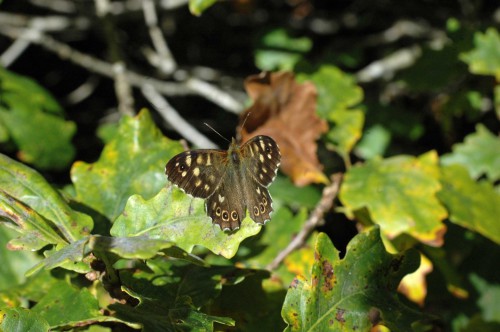
Moving onwards and upwards along the track that leads out onto the ‘downland’ side of the hill I could hear drying leaves crackling in the heat of the sun. On the woodland edge there were several speckled woods flitting about, pausing often to settle on oak leaves. All appeared to be dark in colour and were not fully basking, but holding their wings partially closed.

Speckled Wood basking on an oak leaf

Speckled Wood basking on an oak leaf

I photographed another insect here too: it looked like a small bee but was behaving more like a hoverfly.

Cute insect looking like a small bee and behaving like a hoverfly

Cute insect looking like a small bee and behaving like a hoverfly

There is a beautiful silver birch tree on the woodland edge. Its leaves are beginning to turn colour and it has attractive fruiting catkins that look like a bit like a small slender fir cone from which, during the winter and aided by birds, tiny winged nutlets will be released.

141002(26)TGNW-Bryn Euryn- Silver birch fruits

Silver birch leaves and fruiting bodies

141002(27)TGNW-Bryn Euryn- Silver birch fruit

Close up of fruiting body

The grass has been cut on the hillside too and the ground is criss-crossed with a lattice of bramble stems. There are a few plants of the wild Goldenrod still in flower, while others have gone to seed.

Goldenrod-Solidago virgaurea

The dry flower head with seeds attached looks as pretty as the fresh flower.

Goldenrod gone to seed

Goldenrod gone to seed

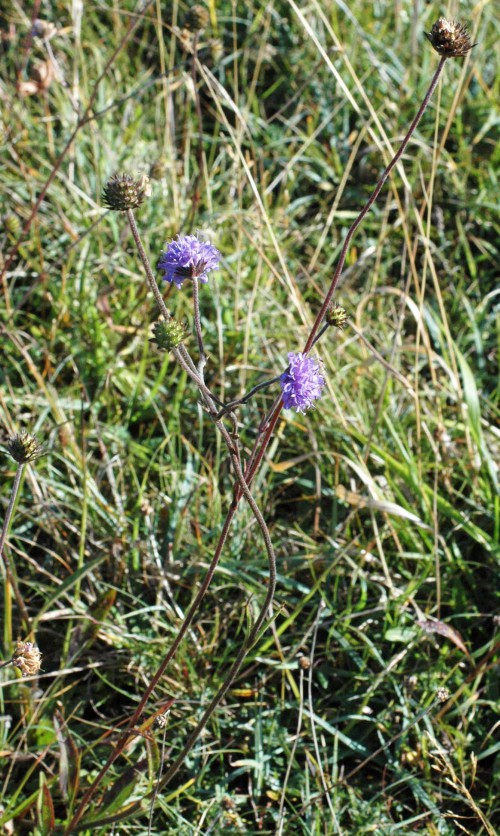
There was a fair amount of scabious still in flower and was attracting a busy little Carder Bee.

Scabious still flowering

Scabious still flowering

There were a few eyebright plants still with their usual white flowers, and one that I came upon had pretty pink-purple edged petals with a yellow patch in the centre.

Eyebright with purple-pink edged petals

Eyebright with purple-pink edged petals

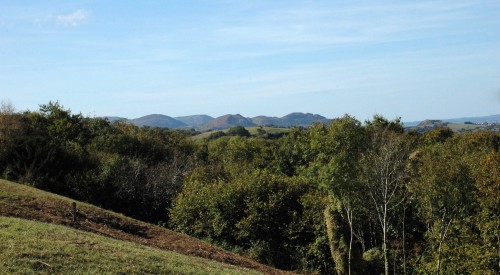
The views from the hillside were outstanding today as it was perfectly clear and bright which rarely happens in the summer months.

Looking down onto woodland across the hillside. Carneddau Mountains in the background

Looking down onto woodland across the hillside. Carneddau Mountains in the background

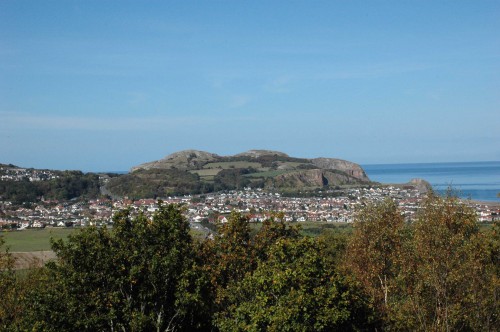
Little Orme & Penrhyn Bay village

Little Orme & Penrhyn Bay village

The sea was almost flat calm and in as many shades of blue as I have ever seen it.

The sea in many shades of blue

The sea in many shades of blue

Looking down the coast to Abergele & Rhyl

Looking down the coast to Colwyn Bay, Abergele & Rhyl


Share this:

  • Share on Facebook (Opens in new window) Facebook
  • Share on Pinterest (Opens in new window) Pinterest
  • Share on X (Opens in new window) X
Like Loading...

Of a temporary nature

18 Monday Aug 2014

Posted by theresagreen in coastal walks, coastal wildflowers, Nature, Nature of Wales, nature photography, Wildflowers of Wales

≈ 1 Comment

Tags

acorn barnacles, creeping cinquefoil, fat-hen, flowering in August, hedge bindweed, kelp fly, mussel beds, ray's knotgrass, rhos on sea, sea mayweed, sea plantain, seashore walks

Beauty is where you find it and often in the least likely of places, but in nature it may also be fleeting, so needs to be appreciated when the opportunity presents itself. Here are a few images of some things I found beautiful along the way of a short walk I made from home into Rhos-on-Sea village on a windy, sunny-ish morning last week. Some would most definitely not be there if I were to look for them again.

I had set off to see if there was anything interesting to see down on the seashore and walked along the promenade to reach a point from which to access it. The promenade is on a lower level to the road and pavement for a short stretch here and the intervening space between the two is a steep slope covered with grass. This grassy embankment is mowed every now and then, but the times between cuts are often long enough to allow opportunistic weed wildflowers to pop up and bloom and in different seasons I have spotted a good variety of species here.

Reaching the top of the path leading down to the prom I heard first, then saw a man on a sit-on mower working on the flatter grass verge going in the opposite direction towards Penrhyn Bay. This prompted me to get a move on and have a look to see what might be flowering lower down as it clearly would not be there for much longer.

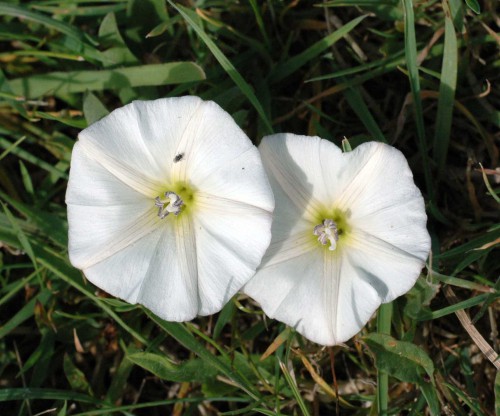
First to catch my eye was a tangle of white-flowered bindweed. Generally similar to the large flowered bindweed that abounds in waste places and on road verges, as well as being the bane of many a gardener’s life, this was the smaller-flowered Hedge Bindweed.

Flowers are smaller than those of Large Bindweed

Flowers are smaller than those of Large Bindweed

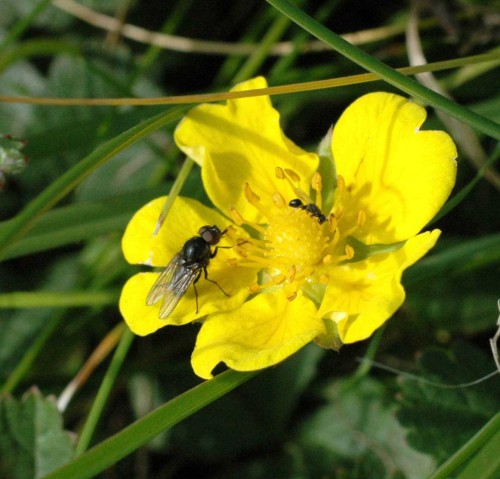
Lower down in the grass there was Creeping Cinquefoil, some of the golden yellow flowers fading around the edges.

Creeping cinquefoil-potentilla reptans

Creeping cinquefoil-potentilla reptans

Small flowers attract small insects

Small flowers attract small insects

There were insects nectaring on most of the available flowers, including bumblebees, hoverflies and various other flies.

I hope they all escaped the blades of the mower that was about two minutes behind me as I took these photographs. I’m glad I got there when I did, otherwise I would not have seen the flowers at all.

The tide was turning and beginning its journey back into the shore and although I could see and hear a lot of birds out on the tide-line, including curlew, redshank & oystercatcher, they were way too far away to see properly.

View across the mussel bed from the shore

View across the mussel bed from the shore. (click for a bigger image)

With or without the added interest of birds though, I can meander contentedly  along this rocky seashore at any time, finding the rocks themselves endlessly fascinating.

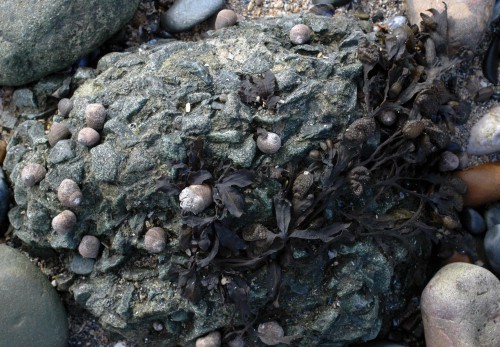
Perhaps the rounded shapes on this rock were made by molluscs attached to it

Perhaps the rounded shapes on this rock were made by molluscs at one time attached to it

We don’t get much variety in the seashells on the shore here, although not surprisingly there are an awful lot of mussel shells.

Seashell collection amongst the rocks

Seashell collection amongst the rocks

Textures in rock with periwinkles

Textures and patterns in rock with seaweed and periwinkles

Acorn barnacles make a pretty lacy patterns on rocks

Acorn barnacles make  pretty lacy patterns on rocks

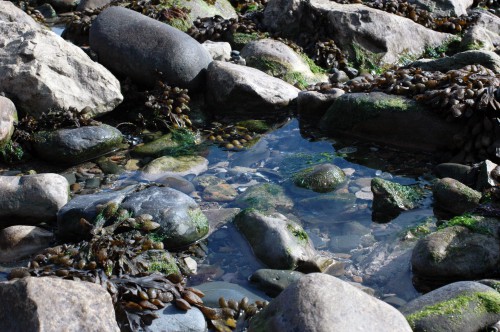
Rock pool

Rock pool

I spent a few minutes watching a cluster of Kelp Flies, appropriately on a length of brown, leathery Kelp seaweed.These are the insects that fly up if you walk through or even past clumps of dryish seaweed. They are quite tiny, so I thought it might be interesting to have a closer look at one. Not beautiful maybe, unless you are another Kelp Fly, but the wings are nice and they have dainty white feet.

Kelp Fly - Coelopa frigida

Kelp Fly – Coelopa frigida

So I travelled slowly along and eventually arrived at the sandy beach area next to the small harbour area of the village. The beach is protected by a barrage of more large rocks that has to be surmounted  to reach it and as I clambered over them I spotted a colourful splash of flowering plants growing at the back of the building that is now a fishing-tackle shop and kayaking centre. This is not a particularly attractive spot and any wind-blown rubbish from the beach tends to get caught up here, but I have come across some interesting plants here, so is always worth a closer look at. 

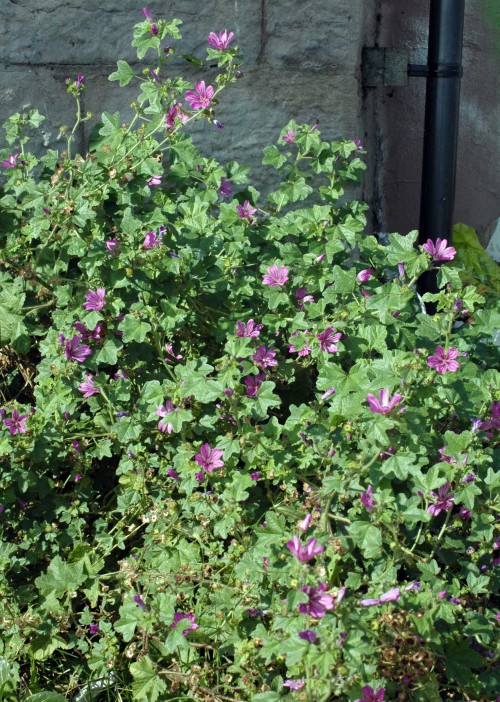
What had caught my eye today was a large clump of Common Mallow that had found shelter in a corner tight against a wall and was clearly thriving there.

A large Common Mallow plant thrives in a sheltered corner

A large Common Mallow plant thrives in a sheltered corner

Another common plant in waste places, especially on sandy soils is Annual Wall-Rocket and there are usually a few of these plants growing around this location.

Annual Wall-Rocket-diplotaxis muralis

Annual Wall-Rocket-diplotaxis muralis

A large specimen of Annual Wall-Rocket

A large specimen of Annual Wall-Rocket

There was a large plant of Fat-hen too, and another one right on the edge of the sand just a short way from the sea.


Fat Hen

Fat Hen- Chenopodium album

Fat Hen flower spike

Fat Hen flower spike

Amongst the commoner plants I was pleased to  find this Ray’s Knotgrass, an annual plant that is most often found on undisturbed coastal sand and shingle beaches.

Ray's Knotgrass- Polygonum oxyspermum

Ray’s Knotgrass- Polygonum oxyspermum

The flowers & fruits of Ray's Knotgrass

The flowers & nut-like fruits of Ray’s Knotgrass

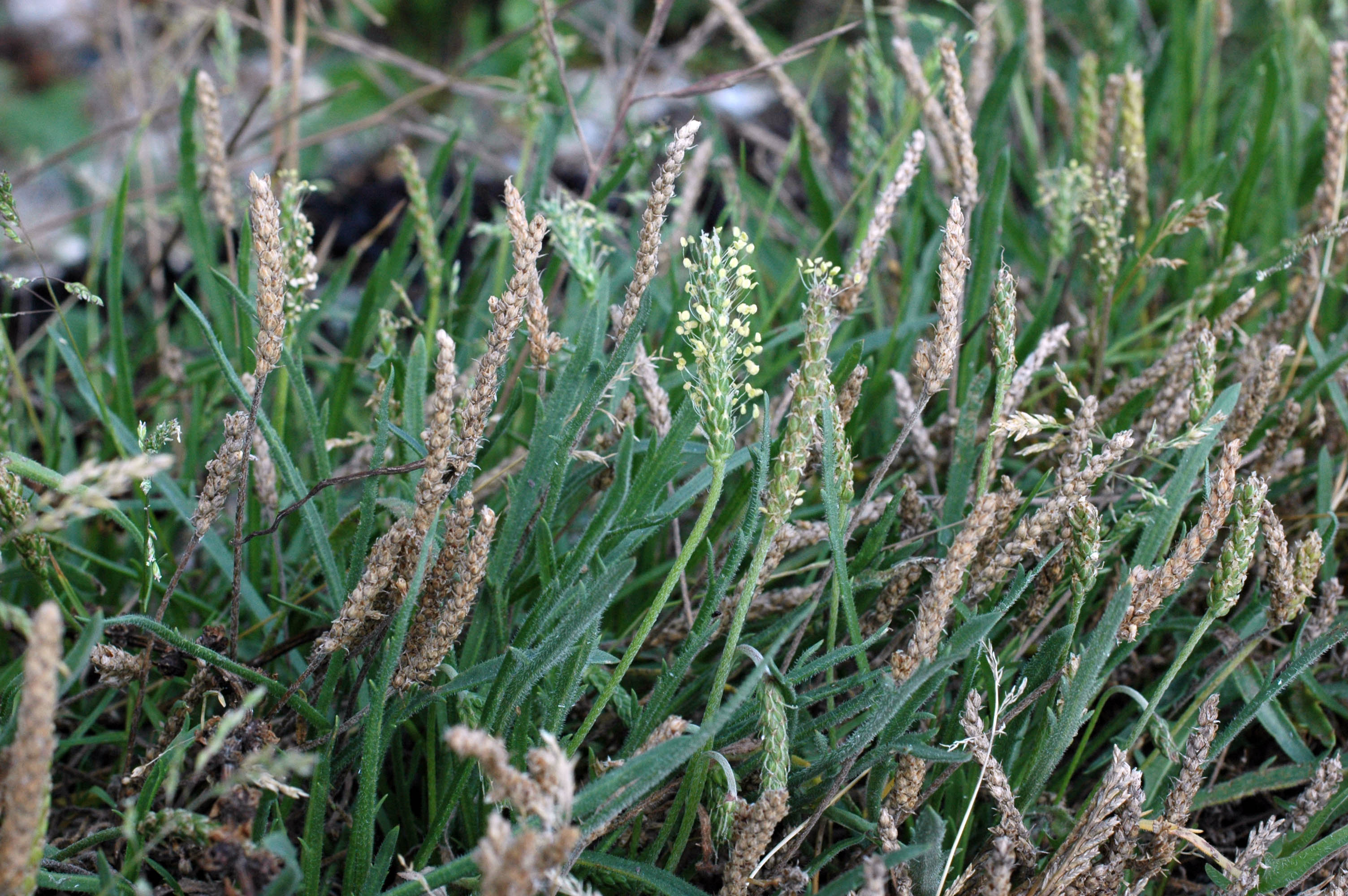
There was Sea Plantain, whose flowers are almost over now.

Sea Plantain-Plantago maritima

Sea Plantain-Plantago maritima

Then the prettiest of them all, the lovely Sea Mayweed.

Sea Mayweed-Tripleurospermum inodorum

Sea Mayweed-Tripleurospermum inodorum

A clump of Sea Mayweed at the beach edge

A clump of Sea Mayweed at the beach edge


Share this:

  • Share on Facebook (Opens in new window) Facebook
  • Share on Pinterest (Opens in new window) Pinterest
  • Share on X (Opens in new window) X
Like Loading...

Life in the long grass

10 Sunday Aug 2014

Posted by theresagreen in Bryn Euryn Nature Reserve, bumblebees, Butterflies of Wales, day-flying moths, hoverflies, Nature, Nature of Wales, nature photography, spiders, wildflowers, Wildflowers of Wales

≈ 2 Comments

Tags

Aricia agestis, Brown Argus, butterflies in long grass, common blue, common knapweed, insects in long grass, keeled garlic, moths in the grass, Nursery Web spider, pisaura mirabilis, Polyammatus icarus, small hoverfly with snout, spider that makes web tents in grass

First week

The weather up here in our part of North Wales has been variable this week. We have had a good bit of rain which has freshened everywhere up and just  about enough warm sunshine to allow us to keep the faith that this is indeed high summer. It may not be the perfect weather for people here on holiday, but the local wildflowers and insects seem to be appreciating it.

Habitat: Long meadow grass

There is a whole other world existing in areas where grass is allowed to grow long and during the past couple of weeks I’ve begun to appreciate its importance as a home and a refuge for wildlife, particularly insects and spiders.

All journeys need a starting point and the following journey of discovery into the dimension of long grass began when I went to Bryn Euryn to see if a particular plant was in flower.

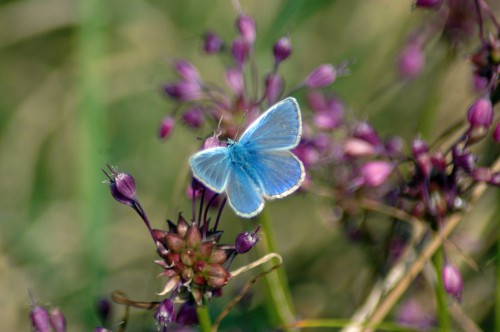
I’ve mentioned before that we have a few less-usual species of wildflowers growing in our locality and on Bryn Euryn this is the time to find one of them; the pink/purple flowered Keeled Garlic. I headed for the spot I had seen it in previous years and there it was, buzzing with bumblebees and more surprisingly attracting several beautiful little Common Blue butterflies.

Keeled Garlic

Keeled Garlic

I wondered at the attraction of this particular flower to the butterflies and thought perhaps they were just resting on the tiny flowers to sunbathe. A little later though I came upon another patch of the flowers with more Common Blues fluttering over and settling upon it, so maybe they were taking nectar from them. I was more than happy to see this many of the butterflies in the same place at the same time; I haven’t seen that for a long time.

Male Common Blue butterfly on Keeled Garlic flower

Male Common Blue butterfly on Keeled Garlic flower

Female Common Blue butterfly, looking a bit more worn

Female Common Blue butterfly, looking a bit more worn

I was not the only one to recognise the attraction of insects to the garlic flowers. Lurking on top of her tent-like web, built to protect her eggs and then babies, sat a long-legged Nursery Web spider.

Nursery-web spider-

Nursery Web spider-

Nursery Web spiders are the spinners of the many web ‘tents’ seen in grassy places at this time of year. They take their common name from the way in which they care for their offspring. The female carries her large egg sac beneath her body, held in her jaws. Before the eggs hatch she spins the silken tent around the egg sac and stands guard over them. She remains on duty until the spiderlings are big enough to live independently. The spiders are active hunters and search for prey amongst grasses and low vegetation.

A neighbouring Nursery-web Spider

A neighbour

Walking carefully through the long grass, every step seems to disturb a dry-grass coloured moth. They are so well camouflaged that should you manage to keep track of where they land, it’s not easy to find them again; then if you manage a picture of sorts identifying them afterwards is even harder. The one below, which landed on the pupa of a 6-Spot Burnet moth which I would otherwise not have spotted, maybe Crambus pascuella (?) As always, I’m more than happy to be corrected.

This one landed on the pupa of a 6-spot Burnet Moth

This one landed on the pupa of a 6-spot Burnet Moth

In places amongst the grass knapweed is beginning to open up it tight dark knots of buds to allow the purple brush-head of petals to escape. Knapweed is a hugely important source of nectar for a wide variety of insects, but more about the plant and its visitors later.

Knapweed

Knapweed in long grass

Long grass on dry slope of ‘downland’

The area of long grass at the bottom of the summit slope on the drier, chalkier downland side of the Bryn has a different character to the flatter, damper meadow area. Some species of butterfly you may see here, although found in other parts of the Reserve, show a definite preference for the conditions it offers and may be more numerous. It is especially good for seeing the smaller species that gain protection from predators amongst the grass stems and include Small Heath, Small Skipper, Common Blue and the less-common Brown Argus.

The larval host plant of the Brown Argus is Rock Rose, which has been prolific in its flowering here this year and the leaves of the plants are still evident in the ‘under-story’ of this grassy forest. I was once again lucky with the timing of my visit this week; after a few minutes of pursuing little butterflies through the tangle of dry grass laced across with long outreaching bramble runners, I spotted a newly emerged Brown Argus balanced on top of a dry stem.

Brown Argus-

5/8/14 – Brown Argus- Aricia agestis

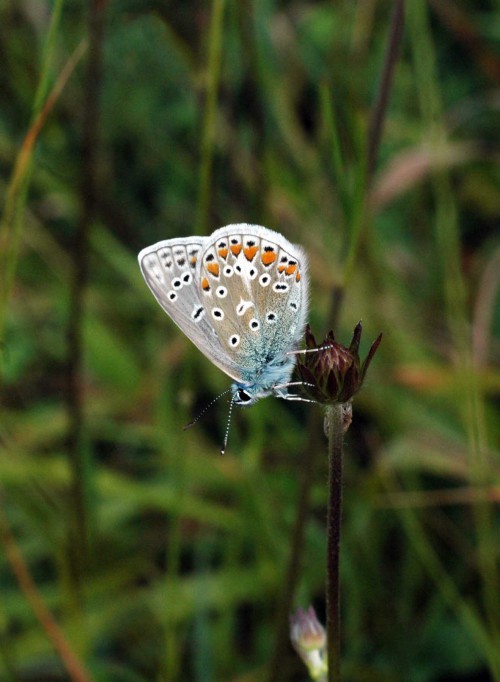
It stayed perfectly still, wings outstretched for quite a long time and made no attempt to fly off although I was very close and holding the camera lens just a few inches from it. I was almost certain this was in fact a Brown Argus and not a female Common Blue, but was compelled to wait and hope it would close its wings for me to see its underside. It eventually obliged and although the angle it presented wasn’t the best, thankfully it did confirm its identity with its diagnostic pattern of spots.

Brown Argus underside with 'figure of 8' spots on forewing

My Brown Argus underside with ‘figure of 8’ spots on hind wing

Common Blue male underside

4/8/14-Common Blue male underside

Spot the difference:

Text & diagram from the UK Butterflies web site demonstrates the differences:

Of the two sexes, it is the female Common Blue that causes most confusion with the Brown Argus. The blue present in a female Common Blue is highly variable, with individuals ranging from almost completely blue through to completely brown. It is this latter colouring that causes the most confusion. Even so, the Brown Argus has no blue scales, but may give off a blue sheen from the wings and the hairs found on the thorax and abdomen. Another diagnostic is that the Brown Argus normally has a prominent dark spot in the centre of the forewings.

Brown Argus - Common Blue undersides

Brown Argus on left & Common Blue on right of image


Share this:

  • Share on Facebook (Opens in new window) Facebook
  • Share on Pinterest (Opens in new window) Pinterest
  • Share on X (Opens in new window) X
Like Loading...

Enchanting evening on the Little Orme

03 Sunday Aug 2014

Posted by theresagreen in Butterflies of Wales, Little Orme, moths, Nature of Wales, nature photography, Rhiwledyn Nature Reserve, The Wales Coast Path, Wildflowers of Wales

≈ 2 Comments

Tags

6-spot Burnet Moth, 6-spot Burnet Moth pupa, Antler moth, cinnabar moth larvae, emerging 6-spot Burnet Moths, mating 6-spot Burnet Moths, small skipper, sulphur beetle

Some days the intention of a walk is at the forefront of my mind, then ‘stuff’ crops up and before I know it the day is almost over and the momentum needed to get me out of the door is fading fast. This was almost one of those days, when at six thirty-something I was still preoccupied with getting things done in the house. Luckily I finally acknowledged the little nagging voice in the back of my mind that was insisting I got out for some fresh air. I almost ignored it, then gave in, grabbed my camera, put on walking shoes and headed out with no real idea where I was heading for.

At around seven I arrived at the Little Orme. I knew before I arrived that by this time in the evening most of the area on this most accessible side of the headland would be in the shadow of its bulk, as the late sun slips down and slides around it to set just about behind its tip. There were quite a few people about too; dog walkers of course, some holidaymakers dressed up for the evening, maybe taking an evening constitutional before dinner & a couple of groups of teenagers, one lot jumping, diving, shouting and laughing from a rocky ledge into the sea.  I quickly judged that this was not a scenario I would normally enter into if hoping to spot any wildlife and on that basis decided this outing would be for the purpose of exercise. So a brisk walk to the cliff edge, an about turn and a concerted effort to get to the top of Rabbit Hill with minimum stops to catch breath, back down again and home ought to do it.

A group of people with two dogs was heading toward me, so to avoid them momentarily I stepped off the main path onto a narrow track that leads around the cliff, skirting what is currently a large patch of long grass. It took less than a minute of being there to spot that a good number of Meadow Brown butterflies were flitting about amongst the grass stems and settling there. It took slightly longer to realise they were there to roost for the night.

Long grass on the clifftop of the Little Orme with view to Rhos-on-Sea & Colwyn Bay behind

Long grass on the clifftop of the Little Orme where the butterflies were roosting. Views to Rhos-on-Sea & Colwyn Bay beyond

I tried to approach several butterflies, treading slowly and carefully through the grass, but I couldn’t get close enough to them to photograph and hadn’t picked up my more powerful zoom lens when I left the house as I didn’t expect to need it. I continued to try until following one individual led me to discover a cluster of Six-spot Burnet Moths on a single grass-head.

Cluster of 6-spot Burnet Moths

Cluster of 6-spot Burnet Moths- Zygaena filipendulae

It was clear that the Moths were in differing conditions, with one n particular looking a bit battered and with most of the colour gone from its wings. I assumed that as with the Meadow Browns the Burnets were also seeking to roost for the night and turned my attention to a passing Small Skipper that settled obligingly on another nearby grass-head.

Small Skipper

Small Skipper- Thymelicus sylvestris

I was happy now, especially as in the cool of the evening the butterflies and moths were not as mobile as they are during the day and were allowing me to get quite close to them with the camera.

Another Small Skipper

Another Small Skipper

As I moved  through the grass and further towards the cliff edge I began seeing more Burnet moths. And more.

6-spot Burnet moths either side of a grasshead

6-spot Burnet moths either side of a grasshead


It slowly dawned upon me that although the butterflies were roosting, the moths were not. They were out intent on mating.

6-spot Burnet moths mating

6-spot Burnet moths mating

I could hardly believe the numbers of moths that were gathered here in this relatively small area of long grass. I have been to visit this reserve many times and felt lucky to see half a dozen individuals on a sunny afternoon, now I was surrounded by them. They were literally everywhere I looked. It still took a further while though to realise that even more amazingly, I had arrived at exactly the time the new moths were almost simultaneously emerging from their cocoons.

6-spot Burnet Moth emerging from its pupa

6-spot Burnet Moth emerging from its pupa

I had begun to spot the yellow cocoons with something black and alien-looking emerging from them, but couldn’t quite imagine it ending up as a moth at all, so at first thought they were something else. I don’t what, just something else.

A closer view of an emerging moth

A closer view of an emerging moth still doesn’t look like one

It was only when I spotted other Burnet moths perched on top of cocoons from which another was emerging that I was convinced that somehow these crumpled black forms would indeed eventually look just like them.

A 6-spot Burnet moth on top of an as-yet unbroken pupa

A 6-spot Burnet moth on top of an as-yet unbroken pupa

I began to wonder then why the moths were sitting on top of the pupae. I’m afraid the only theory I could come up with was that they were male moths staking a claim on emerging females to mate with them as soon as they became viable. Not pretty, but probably not far off the mark. (more about 6-spot Burnet Moth)

Two Burnet moths on top of a pupa from which another is emerging

Two Burnet moths on top of a pupa from which another is emerging

I tried watching an emergence for a while, but it seemed like a lengthy process, so still marvelling at my luck in witnessing this epic event, I left the moths to their nuptials and moved on. I would have been happy to have taken my previously outlined walk now and returned home, but it turned out there were still a few things to see in the gathering dusk.

A sleepy bumblebee curled around a blackberry

A sleepy bumblebee curled around a blackberry

Ragwort is in full vibrant bloom now and I just had to look for black and yellow striped caterpillars of the Cinnabar moth. I was not disappointed, there were plenty in sizes varying from very tiny to very large.

Small Cinnabar moth caterpillar on ragwort flower buds

Small Cinnabar moth caterpillar on ragwort flower buds

A large plump Cinnabar moth caterpillar snaked around a ragwort bud

A large plump Cinnabar moth caterpillar snaked around a ragwort bud while eating it

I was also fortunate to spot a prettily marked moth : this is an Antler moth, so called because of the distinctive antler-shaped markings on its forewings. One of the species that flies in daylight.

An attractive little Antler moth  on ragwort flowers

Antler moth- Cerapteryx graminis

Long grass with cliff wall of the Little Orme behind

Long grass with cliff wall of the Little Orme behind

On the cliff above Angel Bay is another patch of long grass, but here it is mixed with wildflowers such as hogweed, ragwort and a sprinkling of knapweed, all important nectar plants for insects. This evening there were still a few to be found out dining including bumblebees and one little Sulphur beetle.

Sulphur beetle- Cteniopus sulphureus

Sulphur beetle- Cteniopus sulphureus

I left for home happily and exercised – I made it up to the top of Rabbit Hill, admittedly pausing a couple of times, but why wouldn’t you when the view is so spectacular and the sun is setting so beautifully over the sea?

Share this:

  • Share on Facebook (Opens in new window) Facebook
  • Share on Pinterest (Opens in new window) Pinterest
  • Share on X (Opens in new window) X
Like Loading...

The strangely beautiful Carline Thistle

03 Sunday Aug 2014

Posted by theresagreen in Bryn Euryn Nature Reserve, Little Orme, Nature, Nature of Wales, nature photography, Rhiwledyn Nature Reserve, Wildflowers of Wales

≈ 4 Comments

Tags

carlina vulgaris, carline thistle, dry thistle plant, thistle with large dried out flowers, Welsh wildflowers

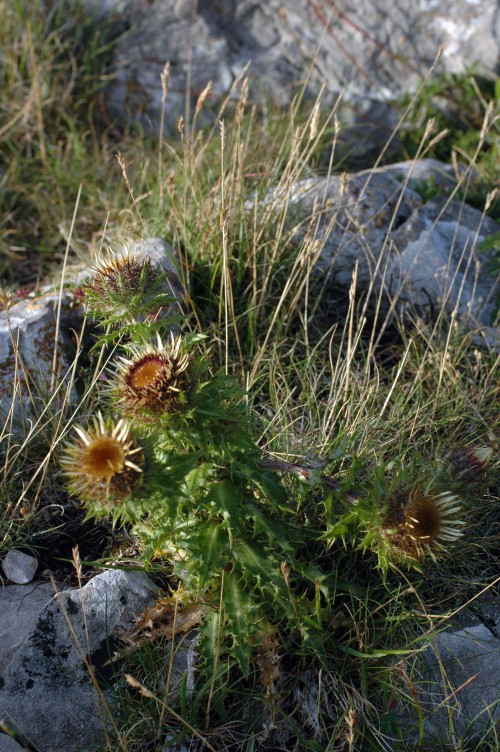
Carline thistle plant growing amongst rocks on Bryn Euryn

Carline thistle plant growing amongst rocks on Bryn Euryn

The Carline thistle is one of a handful of more unusual plants occurring in several of our nature reserves that have areas of dry calcareous grassland. It is a biennial plant so its appearance can be rather unpredictable both in exact location and in numbers of individual plants; it is never what you could call abundant. The plant can be seen throughout most of the year as when it’s finished flowering it persists as a very dry skeletal form of itself.

In past years I have found them on both ‘Ormes’, Little and Great but the best specimens, this year at least, are to be found growing on the top, rocky areas of Bryn Euryn.

Carline Thistle

Carlina vulgaris

Family: Daisy & Dandelion Asteraceae; biennial to 80cm; flowering June to September

Carline thistle with a Thick-thighed beetle on a flower

Carline thistle with a Swollen-thighed beetle on a flower

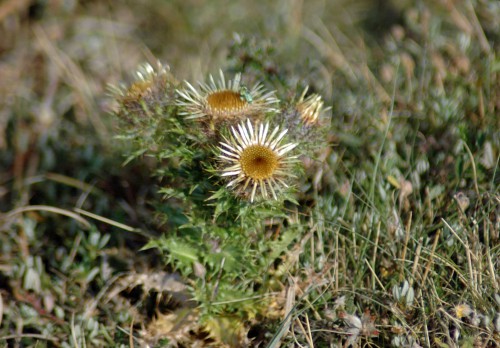
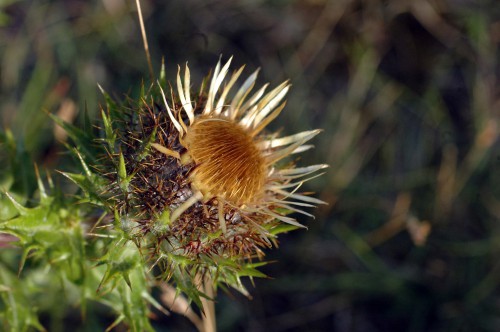
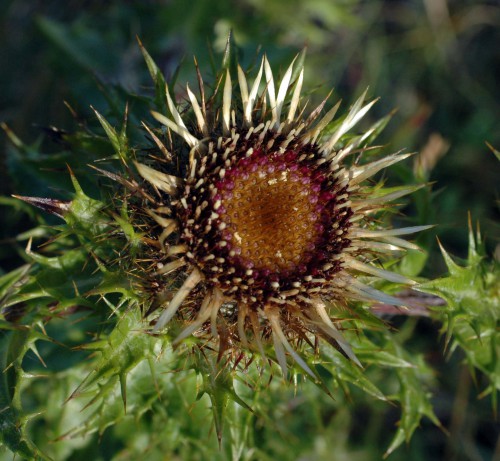
The Common Carline Thistle is a short, stout and prickly little thistle with intriguing  golden-brown-tinged-purple, rayless flowers (15-40mm across) that are surrounded by conspicuous, spiny, sepal-like yellow bracts which spread widely apart beneath. In the bright sunshine, they glisten silver and gold and in wet weather they close up.

The flowerheads are carried on densely prickly, leafy stems. The oblong leaves have toothed or lobed blades with spiny edges.

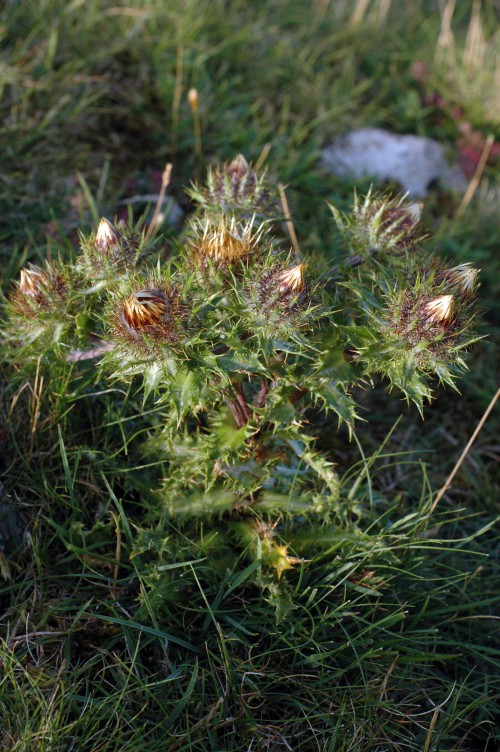
An all-over densely prickly plant , buds just beginning to break

An all-over densely prickly plant, buds just beginning to break

In bud the flower is contained by a tight  mass of dark purplish brown or black spines intertwined with a net of white fibres resembling cotton wool.

Carline thistle- Carlina vulgaris

Carline thistle-flowers opening

At  first, the opening heads look rather like dead or dying daisies, but this is their normal appearance.

Flowerhead in profile

Flowerhead in profile

The inner florets are straw yellow at first, but then purple petals start to emerge from the periphery, gradually proceeding towards the centre.

Composite flowerhead of a Carline thistle fully open

Composite flowerhead of a Carline thistle fully open

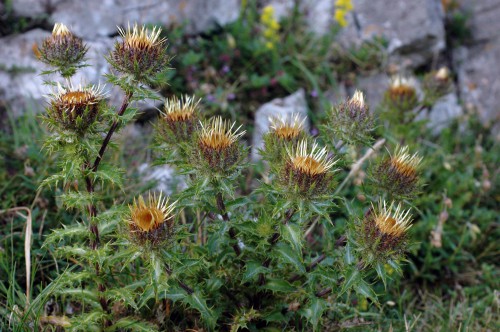
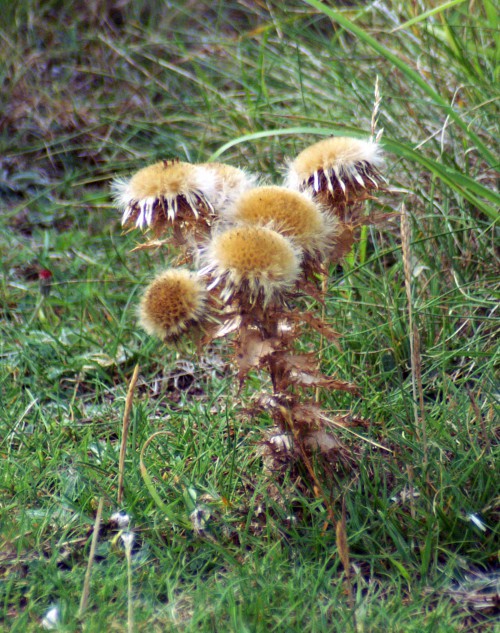
The seed-heads lend the plant a softer appearance.

Seedheads on a plant already drying out

Seed-heads on a plant already drying out

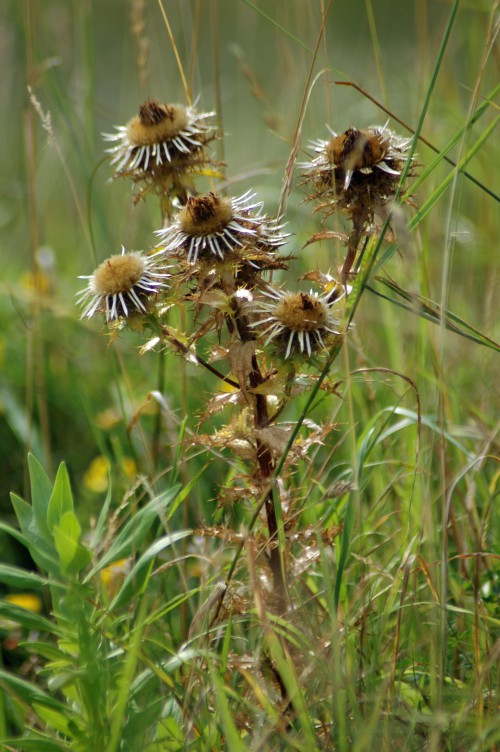
The dead flower, after the season is over, appears much as it did when it was alive.

September-a much-dried plant still maintaining its form

September-a much-dried plant still maintaining its form (Little Orme)

Traditional uses

The flower head was once used as a humidity gauge because the bracts close in the higher humidity typical of impending rain.

This plant had some uses in folk medicine and legend has it that it got its common name ‘Carline’ because the Emperor Charlemagne used the plant to cure his army of pestilence.

Subsequently it has been discovered that both Stemless Carline Thistle(Carlina aucalis) (where it was first found) and Carline Thistle contain the acetylide Carlina Oxide orCarlinoxide (furylbenzylacetylene), the main compound (85% – 90%) of the essential oil from the plant, which has a long history of medicinal use in Europe due to its anti-microbial properties. It is active against two strains of MRSA and a number of other difficult infections. It is stomachic, carminative, diaphoretic and an antibiotic.


Share this:

  • Share on Facebook (Opens in new window) Facebook
  • Share on Pinterest (Opens in new window) Pinterest
  • Share on X (Opens in new window) X
Like Loading...

Celebrating new lives

26 Saturday Jul 2014

Posted by theresagreen in bird behaviour, birds of Wales, Bryn Euryn Nature Reserve, frogs & toads, Little Orme, Nature, Nature of Wales, Rhiwledyn Nature Reserve

≈ 2 Comments

Tags

common frog, house sparrow, kestrel, rabbit, raven

It seems to have been a good year for our local wildlife so far and the following are some of the photographs I have taken of a few new young lives.

Ravens nest early in the year, so firstly here is an image of this year’s Little Orme young one quite well grown but still in the nest at the end of May.

140531TG-Raven young in nest 2-Little Orme

31st May: Young Raven in nest on Little Orme

I was lucky enough to catch up with him/her on the summit of the Bryn a few weeks later, now looking extremely fit and handsome in glossy black plumage.

June: Young Raven on the summit of Bryn Euryn

June 15th: Young Raven on the summit of Bryn Euryn

June: A fine high place with plenty of open sky to practise flying skills

June 15th: A fine high place with plenty of open sky to practise flying skills

Back to May again. Whilst the Raven was still in the nest, a young Kestrel was already out practising their manoeuvring skills over the rocky cliff at the top of the Little Orme. When I spotted it first I thought I’d been fortunate to spot a bird out hunting, but as I got closer it kept up its position and made no attempt to fly away at my approach. I realised then it was a young bird out honing its skills. It was wonderful to be allowed to watch so closely

May 31st

May 31st: Young Kestrel practising hunting techniques above the Little Orme

May 31st: The length of time the bird held its position was impressive

May 31st: The length of time the bird held its position was impressive

May 31st: Swooping and diving

May 31st: Swooping and diving

The Kestrel disappeared over the headland for a few minutes then reappeared flying out over the sea. As it passed where I stood on the cliff edge it looked in my direction. Perhaps to make sure I was still watching and was suitably impressed.

Flying past the cliff edge where I stood

Flying past the cliff edge where I stood

May 31st: Out over the sea, maybe using the gull to focus on

May 31st: Out over the sea, maybe using the gull to focus on

Still on the Little Orme it was apparent there has been a proliferation of cute baby rabbits this year too:

May 31st: Baby rabbit on the Little Orme

May 31st: Baby rabbit on the Little Orme

On the first of July we discovered a Dunnock’s nest in the garden with tiny new chicks with enormous gapes.

July 1st: Hungry baby Dunnocks

July 1st: Hungry baby Dunnocks

Then there was a miniature frog that I just happened to spot struggling through the damp grass on the lawn, possibly heading for nest door’s lovely pond. I caught it in my hand and transferred it to a glass for a few minutes so I could photograph it.

20th July: A tiny froglet

20th July: A tiny froglet

It had no trouble at all climbing to the top of the glass. The froglet was less than an inch (2.5cm) long, but completely perfect.

July 20th: A rare view of the speckled underside

July 20th: A rare view of the speckled underside

I didn’t keep it for long before releasing it back where I found it.

July 20th: Then I let him go again

July 20th: Then I let him go again

Last weekend I sat outside to drink a cup of tea and was kept entertained by a family of House sparrows that had brought their latest brood out for their first outing. The young birds were wobbly and fluttery while trying to perch on twiggy branches of the recently drastically cut privet hedge and still begging their parents for food.

July 20th: A very young House sparrow out for a first outing

July 20th: A very young House sparrow out for a first outing

Dad seemed to be on feeding duty, popping back and forth with bits and pieces.

Dad seemed to be the one in charge of feeding this morning

Dad seemed to be the one in charge of feeding this morning

I caught him feeding one of the offspring with something that I’m sure mum would definitely have disapproved of.

Not quite on target

Not quite on target

Something lurid pink about to be passed on

Something lurid pink about to be passed on

Down the hatch

Down the hatch

Whatever it was, it was certainly sticky. Cake icing maybe?

Whatever it was, it was certainly sticky. Cake icing maybe?

I wonder if the hard working parents will get a rest now?


Share this:

  • Share on Facebook (Opens in new window) Facebook
  • Share on Pinterest (Opens in new window) Pinterest
  • Share on X (Opens in new window) X
Like Loading...

A summer evening’s walk on the Bryn

20 Sunday Jul 2014

Posted by theresagreen in Bryn Euryn Nature Reserve, Nature, Nature of Wales, nature photography, North Wales, Wildflowers of Wales

≈ 8 Comments

Tags

carline thistle, common soldier beetle, forest bug, harebell, hemp agrimony, hogweed, mating red beetles, Meadow Brown, rowan berries, tapered drone fly

There’s no such thing as a bad time to enjoy a walk on Bryn Euryn, but during the longer daylight hours of the summer, an early evening during the week can be the perfect time to find it quiet and peaceful.

The woodland is almost silent now, with just the occasional rustle from the undergrowth or the flash of a skulking bird to remind you that you are not alone here. It reminds me of such walks in the woods around the cottage I grew up in, at an age when my imagination frequently ran riot and I was convinced I was being watched from every tree and shrub. By what or whom I’m still not sure, but I can clearly remember that feeling  on summer evenings such as this, when the silence is almost tangible.

Out in the open insects are making the most of the late sunshine to stoke up on nectar fuel for the night.  Hogweed is in flower and almost every umbel has at least one pair of mating soldier beetles.

Soldier beetles mating on a hogweed flower

Soldier beetles mating on a hogweed flower

The slightly cooler temperature of an early evening can make it easier to photograph some insects as they are intent on feeding and move a little slower.

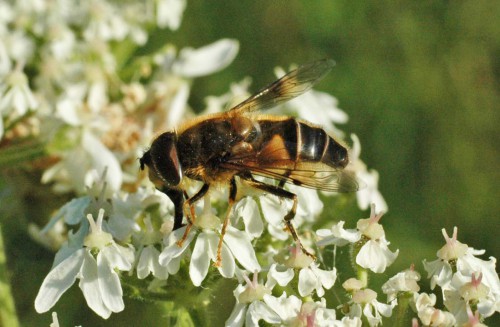
A Tapered Drone Fly- Eristalis pertinax on hogweed

A Tapered Drone Fly- Eristalis pertinax  (male) on hogweed

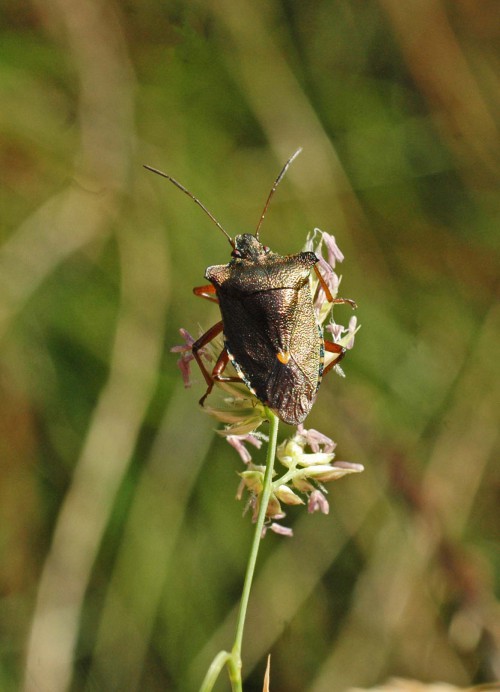
A movement at the top of a long grass stem caught my eye and I found this lovely Forest bug balancing there. It has a lovely bronzy sheen to its wing-cases.

Forest bug- Pentatoma rufipes

Forest bug- Pentatoma rufipes

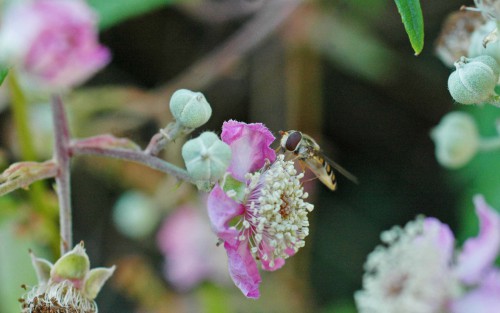
Brambles are beginning to develop berries, but there are still flowers on some bushes attracting bees and hoverflies.

Marmalade fly on a bramble flower

Marmalade fly on a bramble flower

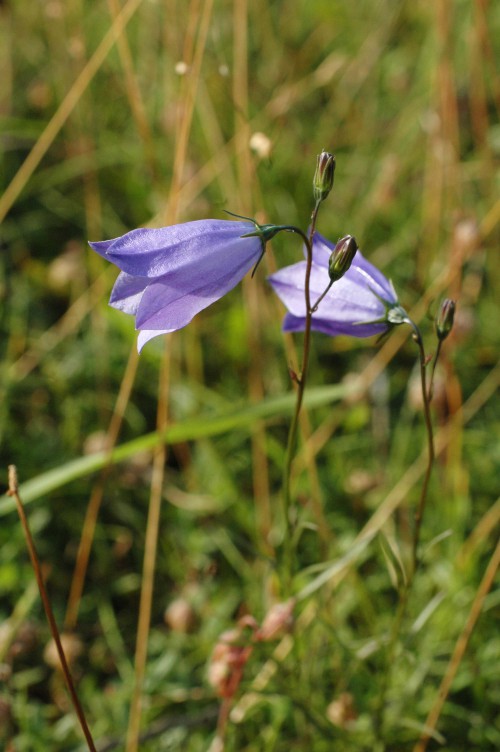
One of my favourite wildflowers, the Harebell is in fresh full bloom now. Sometimes they find themselves growing in goups, caught up amongst long grass stems where they grow longer stems to reach the open air.

Harebells in long grass

Harebells in long grass

I love to see them best growing from shorter turf, their beautiful blue bells held aloft on sturdy wiry stems where they can turn towards the sun and nod and wave freely in the breeze.

Harebell- Campanula rotundifolia

Harebell- Campanula rotundifolia

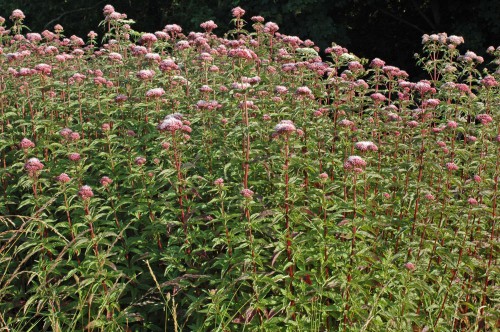
An important summer nectar flower, Hemp Agrimony, whose dusky pink flowers are relished by some species of butterflies is also blooming now. The impressive stand of it in my photograph was in shade this evening, so no visitors; I’ll have to come back earlier on a sunny day.

An impressive stand of Hemp Agrimony

An impressive stand of Hemp Agrimony

While some plants are at the peak of their flowering, others are already beginning to produce their fruits. I mentioned blackberries earlier, which are just beginning to form, but there are wild-growing raspberries here that are perfectly ripe. I couldn’t resist picking and eating a few; sorry birds.

Wild raspberries

Wild raspberries

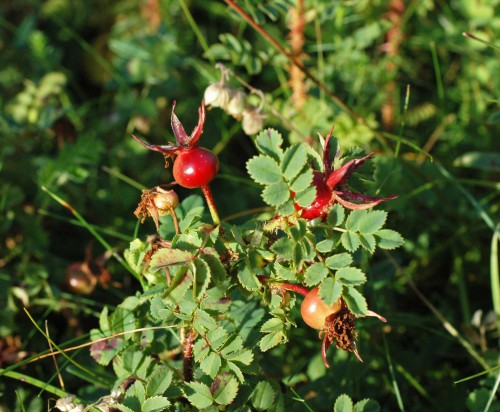
The hips on the Burnet Roses are formingly nicely, already a good size and red in colour, they will get bigger yet and turn black.

Burnet Rose hips forming

Burnet Rose hips forming

There are tiny acorns on the oak trees too.

Tiny acorns forming on the oak trees

Tiny acorns forming on the oak trees

And the Rowan trees have ripening berries.

Ripening Rowan berries

Ripening Rowan berries

Back into the woods for a short while and its very quiet, although I have heard a Chiffchaff as I’ve been walking around and disturbed a young Robin where it was pecking around on the damp earth of the track. Emerging back into the sunshine onto the grassy hillside I also disturbed a rabbit that raced off up the steep hill in front of me. I watched its white cotton tail bobbing away and envying the effortless way it bounded up there. There are a lot of rabbits here that do a great job of grass-keeping in certain areas, but you don’t see them often.

Run, rabbit

Run, rabbit

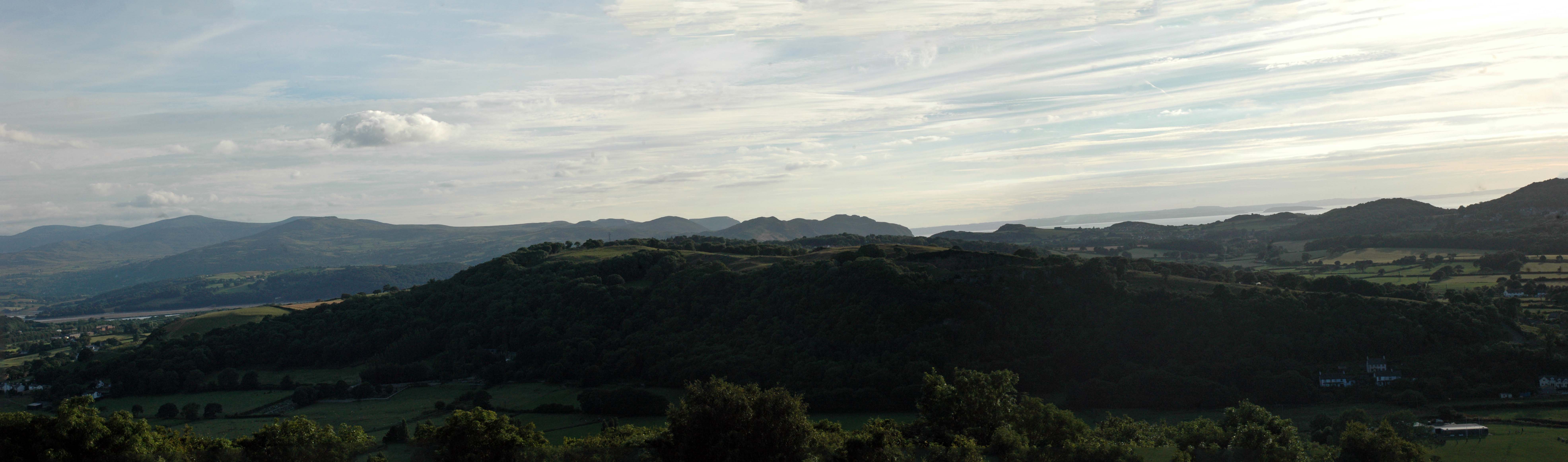
Almost at the top of the hill I stopped to gaze at the view as I always do. That’s not just to catch my breath, although it helps, but it’s a stunning view whatever time of day or year you’re admiring it. I love it when as now the sun is lower in the sky and shadows sculpt the hills. The sky was particularly interesting this evening too.

Evening panorama from Bryn Euryn. (click on image for a better view)

Evening panorama from Bryn Euryn. (click on image for a better view)

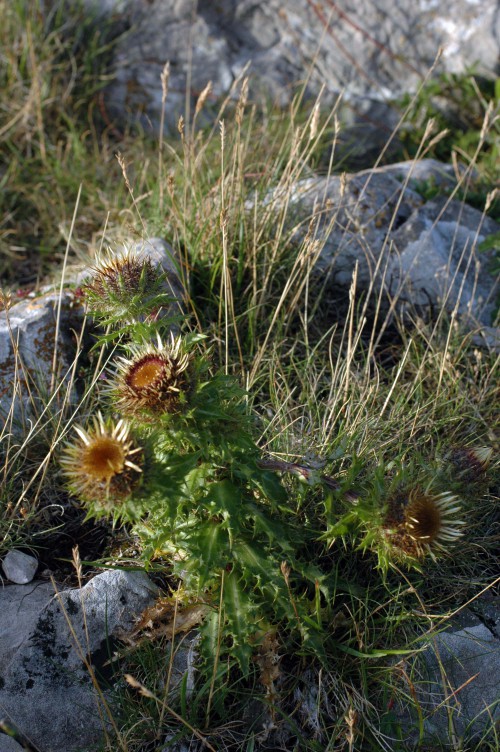
On the rockier summit of the hill, where the soil is thinner and more calcareous, the fascinating Carline thistle thrives. For much of the year you can see the dried out remains of the leaves and flowers, but now is the time to catch it coming into full curious flower. I will go into more detail about this plant in a later post.

Carline thistles growing amongst rocks

Carline thistle growing amongst rocks

I had seen a few butterflies during the course of my walk, all fluttering around in the long grass. There were a few Small Heaths, but most were Meadow Browns. Just as I was heading back towards a woodland path to head back to the car, this one fluttered into view and landed on the tight bud of a knapweed flower. I was really pleased, as although this is an abundant species here, they are rarely this obliging and views such as this are not often offered.

Meadow Brown butterfly on the bud of a knapweed

Meadow Brown butterfly on the bud of a knapweed


Share this:

  • Share on Facebook (Opens in new window) Facebook
  • Share on Pinterest (Opens in new window) Pinterest
  • Share on X (Opens in new window) X
Like Loading...
← Older posts
Newer posts →
Follow everyday nature trails on WordPress.com

Enter your email address to follow this blog and receive notifications of new posts by email.

‘But it is the common species that keep the living world ticking over and provide most of our experiences of wildlife, and I would argue that maintaining the abundance of these is as important a conservation priority as maintaining the existence of rarities’. Richard Mabey

MOST RECENT POSTS

  • A Glimpse of Spring to Come January 22, 2025
  • Hunting the Wren December 28, 2024
  • Oh, Christmas Tree December 18, 2024
  • In and Out of the Ivy February 15, 2024
  • Nature’s Fireworks November 30, 2023
  • Wild Autumn along the Coast Path November 3, 2023

OLDER POSTS

LOOKING FOR SOMETHING IN PARTICULAR?

  • Sights and Sounds from the Little Orme 1
    Sights and Sounds from the Little Orme 1
  • Following a river to a Fairy Glen
    Following a river to a Fairy Glen
  • Shades, Sounds and Scents of the Woods
    Shades, Sounds and Scents of the Woods
  • Fine Dining for Crows
    Fine Dining for Crows
  • Catchers, a Duck and Divers
    Catchers, a Duck and Divers
  • Butterflies and more rare treats
    Butterflies and more rare treats
  • Things Bright and Beautiful
    Things Bright and Beautiful
  • A Windy Wildflower Trail
    A Windy Wildflower Trail
  • Bird study: Blackcap
    Bird study: Blackcap
  • Woodland plants may be pungent, prickly and even poisonous
    Woodland plants may be pungent, prickly and even poisonous

nightingale trails

The Walk of the Monarch Butterfly-Sendero de la Mariposa Monarca

The Walk of the Monarch Butterfly-Sendero de la Mariposa Monarca

MY WILDFLOWER BLOG: where the wildflowers are

Snowdrop

Snowdrop

most recent posts

Follow everyday nature trails on WordPress.com

Social

  • View teresamaygreen’s profile on Twitter

Enter your email address to follow this blog and receive notifications of new posts by email.

Website Built with WordPress.com.

  • Subscribe Subscribed
    • everyday nature trails
    • Join 358 other subscribers
    • Already have a WordPress.com account? Log in now.
    • everyday nature trails
    • Subscribe Subscribed
    • Sign up
    • Log in
    • Report this content
    • View site in Reader
    • Manage subscriptions
    • Collapse this bar

Loading Comments...

    %d