• Home
  • about
  • about the photographs
  • Local Nature Reserves
    • Bryn Euryn Local Nature Reserve
    • Mynydd Marian
  • Wales Coast Path
    • Grey Seals in North Wales
    • St.Trillo’s Chapel
    • Wildflowers of North Wales Coastal Paths, Cliffs and Dunes

everyday nature trails

everyday nature trails

Category Archives: nature photography

A trip to Pembrokeshire:Part 2: Flowers in the rain

15 Friday Jun 2012

Posted by theresagreen in Nature, nature of woodlands, nature photography, wildflowers

≈ 2 Comments

Tags

dog rose, foxglove, poisonous wildflowers, red campion, wayside flowers, woodland flowers, woody nightshade

As we surveyed the ash tree the tree surgeon arrived and quickly assessed the work involved in removing the obstruction, estimating that it would take him about two hours to clear. The rain and wind persisted, but had eased at that point, so as we had piled on waterproofs anyway, we wandered back towards the house stopping to see how the saturated wildflowers had fared.

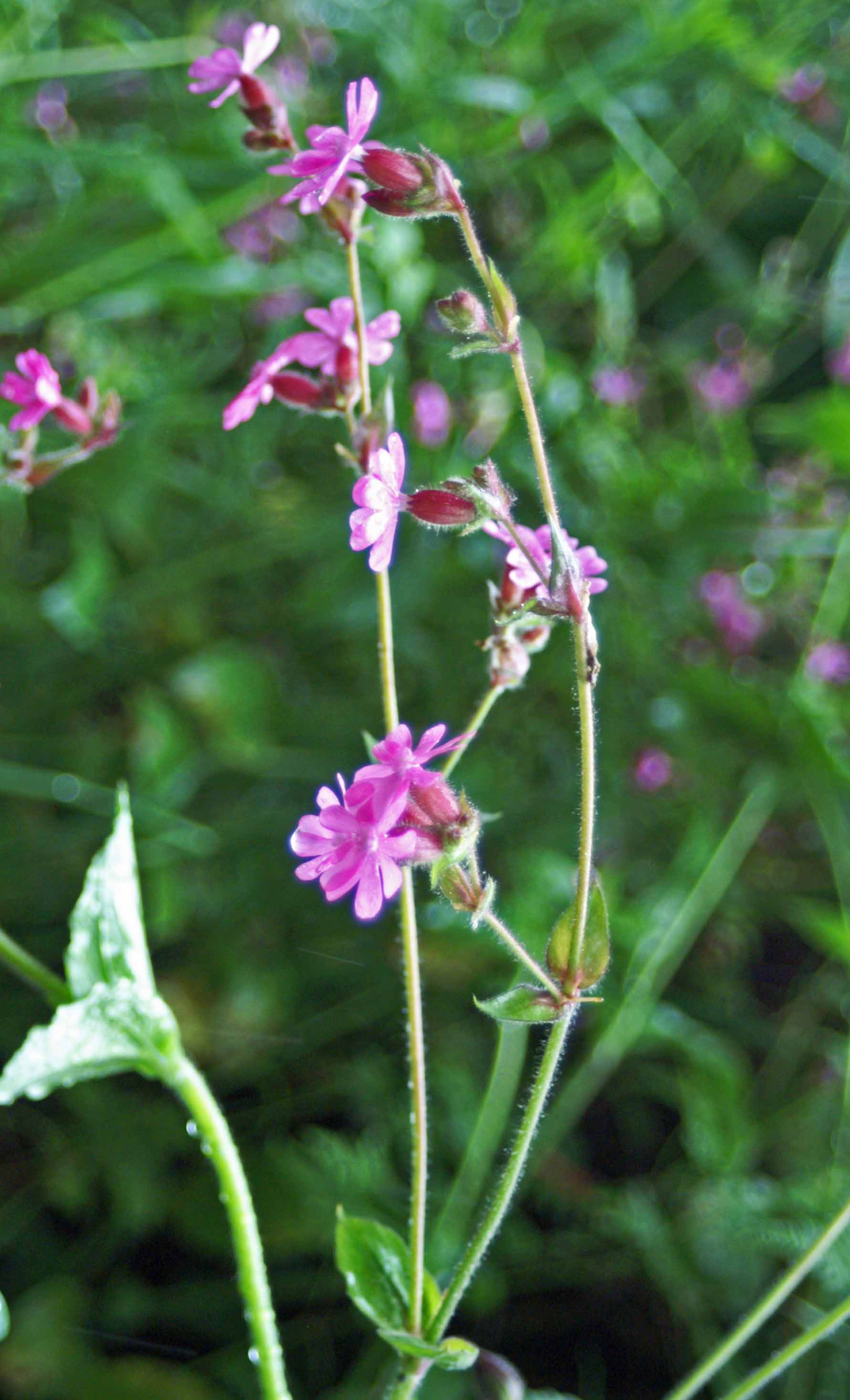
At this time of year Red Campion-Silene dioica is a familiar sight on the banks of Welsh lanes, along the roadsides and on woodland edges. Its flowering season is quite a lengthy one, beginning in May when it accompanies bluebells and continuing on through the summer and into September. Individually, the plants are rather straggly and untidy, but beautiful en masse at the peak of  its blooming when it can colour large swathes of ground.

Red campion – Silene dioica

Foxgloves typify June in most parts of Wales, appearing in a wide variety of habitats from the lanes and woodlands to clifftops and mountains. This morning some of the more exposed blooms were  looking a little the worse for wear in the aftermath of their night’s battering, but even those with bent stems still managed to look graceful and elegant beaded with droplets of rain.

Foxglove bent by the wind & rain

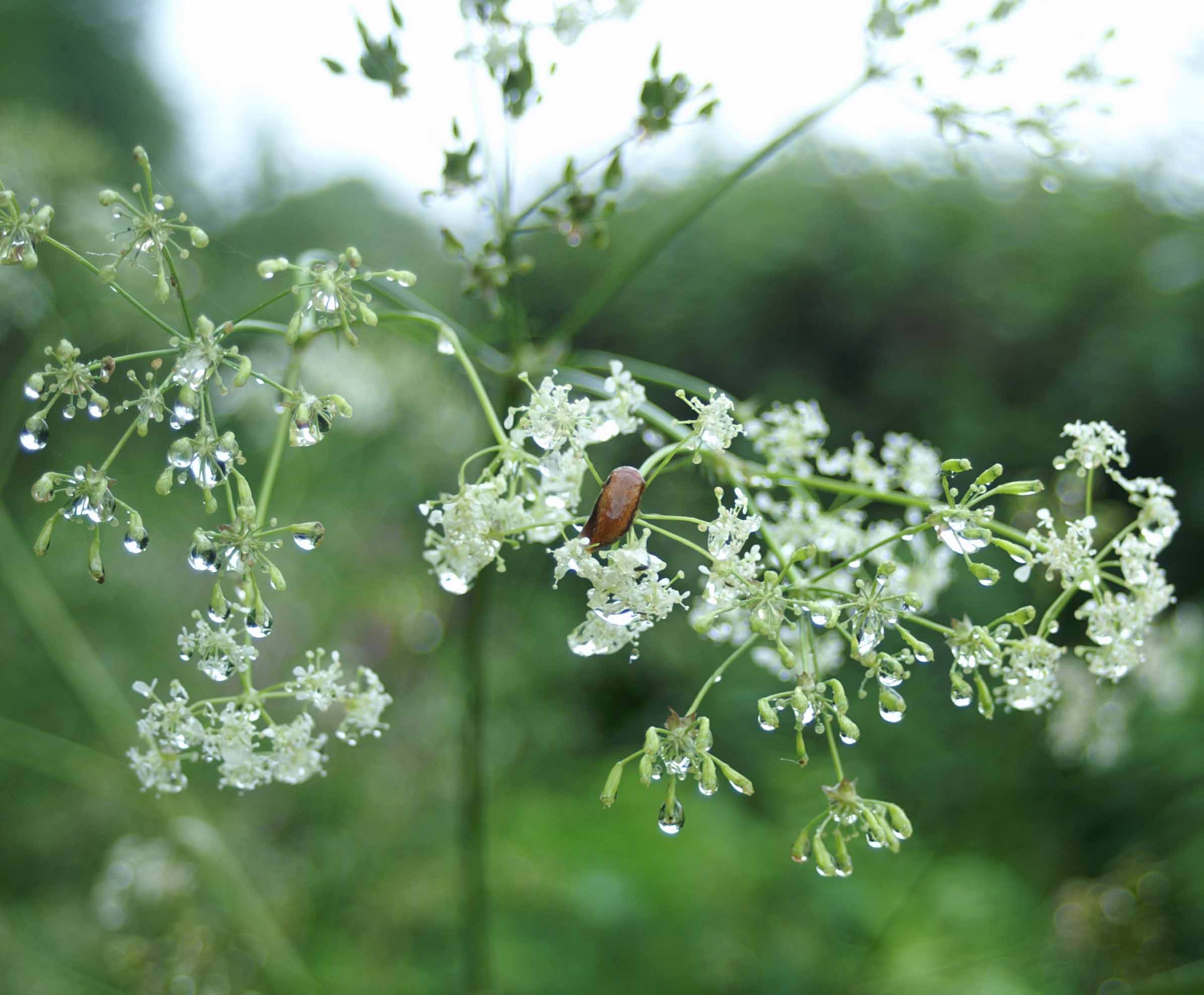
Cow Parsley flowerheads were drenched, but the drooping buds, each adorned with a droplet of water at their tips looked so pretty, like miniature chandeliers adorned with clear crystal beads. The presence of the little slug on the flowerhead in my photograph spoils that metaphor slightly, but it was quite attractive in its own way.

Cow parsley being investigated by a small brown slug

In the hedgerow I came across a few flowering trusses of purple Woody Nightshade, or Bittersweet – Solanum dulcamara. The plant stems grow long, but are not equipped with any climbing aids such as hooks, nor do they twine, they simply leans on other plants for support. A member of the potato family, the plant’s purple flowers with yellow centres are attractive, but I grew up in fear of it, being strongly warned to stay well away from it as it was very poisonous; in fact we knew it as deadly nightshade, although that name really applies to another member of the family, Belladonna.

The attractive, but potentially poisonous flowers of woody nightshade, alternatively named or bittersweet

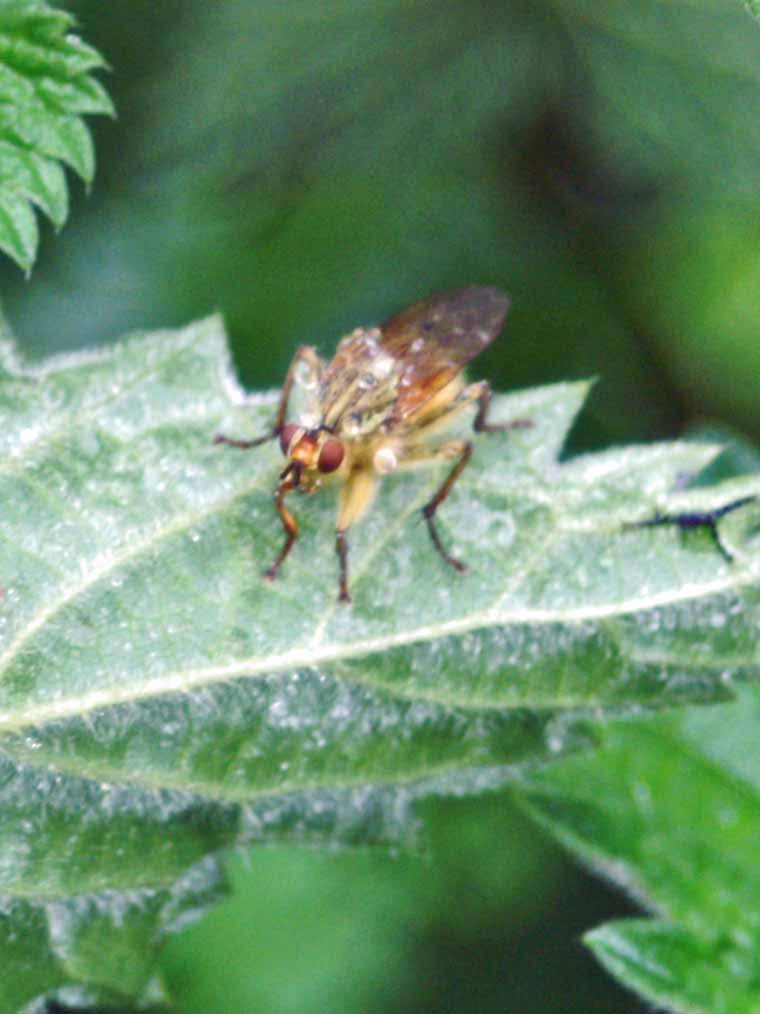
There were a surprising number of insects around, particularly flies of various kinds. I noticed quite a few of the species in the photograph below, most sitting on leaves rather than flying around and wondered if they were sucking up tiny droplets of water from their surfaces. I’m not sure what they are, but think they may be dung flies; if anyone knows I’d love to know for sure.

There were a lot of these flies sitting around on various leaves, this one on the reverse, or stinging side of a nettle leaf. With its proboscis extended down to the leaf’s surface, was it drinking?

The Dog Roses are spectacular this year with shrubs smothered with  pink-flushed blooms; the after-effects of their being subjected to the heavy rain will probably be apparent in a day or two’s time, but at the moment they are gorgeous.

Dog Rose-Rosa canina

Share this:

  • Share on Facebook (Opens in new window) Facebook
  • Share on Pinterest (Opens in new window) Pinterest
  • Share on X (Opens in new window) X
Like Loading...

Conwy Mountain

31 Thursday May 2012

Posted by theresagreen in nature of woodlands, nature photography

≈ 2 Comments

Tags

bilberry, Conwy mountain, mountain lake, Pensychnant Nature Reserve, rowan tree blossom, stonechat, water horsetail, wood sorrel

We ave few opportunities for family outings these days as the ‘kids’ are grown up now and getting on with their lives in Bristol, London and up here in North Wales. As I think I have mentioned before, despite my best efforts throughout all their lives, still none of them get as excited as I do at the prospect of a wildlife spotting expedition, but at least all may be persuaded fairly easily to get out into the fresh air for a walk. During my  recent birthday weekend clan gathering, they all agreed to indulge me in my strangeness and we headed for the nearest mountains before they could change their minds. The addition of a new Labrador puppy to my daughter’s family gave added incentive to the outing as this was to be her first venture into the countryside.

The actual Conwy Mountain –  in Welsh Mynydd y Dref  (“Mountain of the Town”) is the remains of an ancient volcano that erupted about 450 million years ago  and lies within the foothills of the Carneddau range of Mountains; however, the whole of the  hilly area to the west of the town of Conwy, is locally referred to as Conwy Mountain.

View from Conwy Mountain down to Conwy castle and estuary (click on photo for better view)

We drove from Conwy town along Sychnant Pass as far as the pull-in area near the Pensychnant Nature Resere were we parked and left the car to walk, or rather amble, stopping frequently to indulge the curiosity of the puppy. As always when walking with a group of  people, and particularly in a popular walking spot, most birds make themselves scarce, although there were a few Stonechats about, a Kestrel quartered the mountain slope close to were we stood admiring the view,  a pair of Raven flew overhead and a family of Buzzard circled in the thermals high above the valley beneath.

Freely grazing ponies are a frequent sight on the mountainside.

We walked around the lake towards the entrance to the nature reserve

The shallow water at the edge of the lake was full of crowds of large tadpoles

Vegetation in the lake is Water Horsetail – Equisetum fluviatile

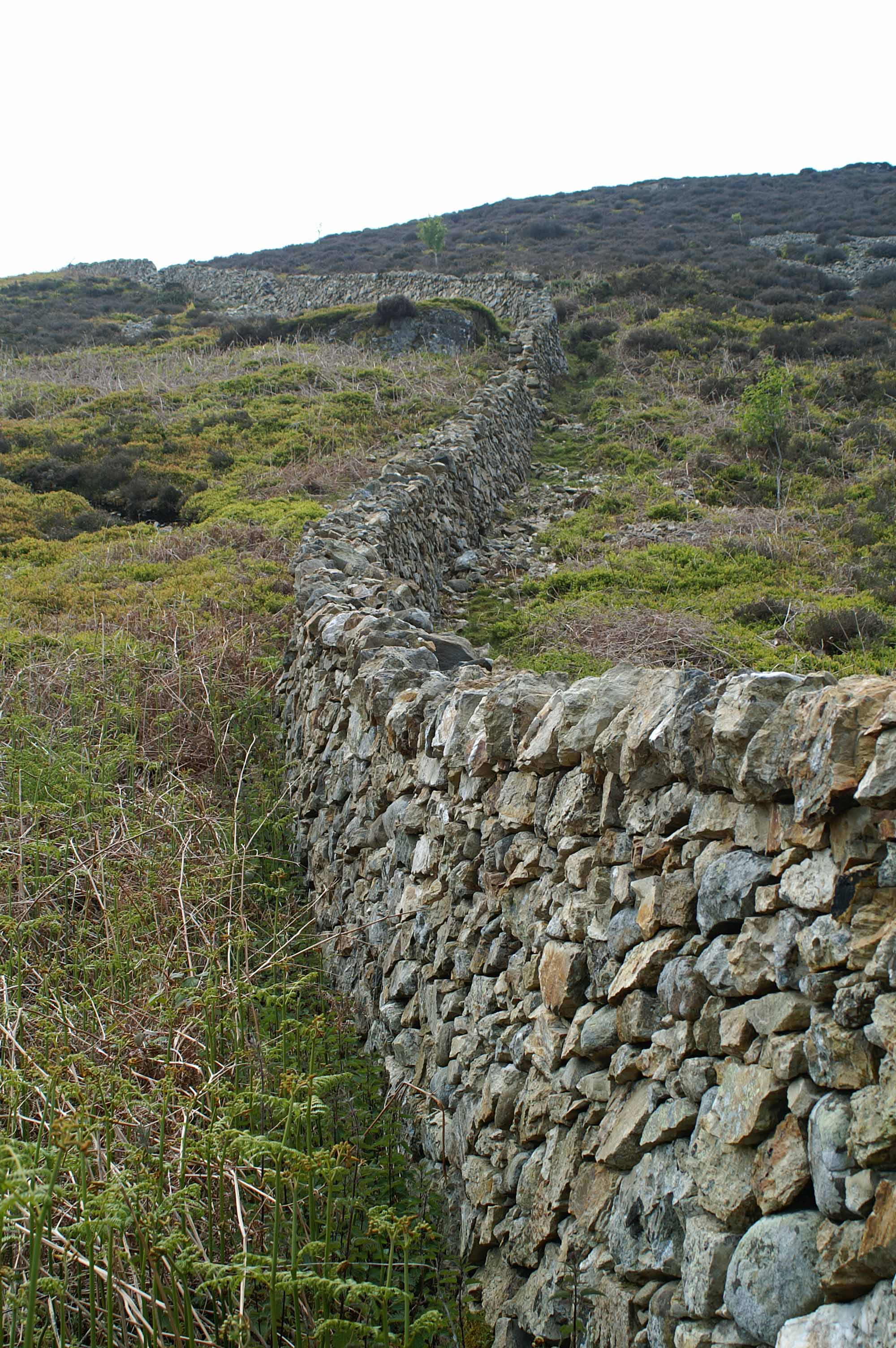
The dry stone wall that bounds the nature reserve

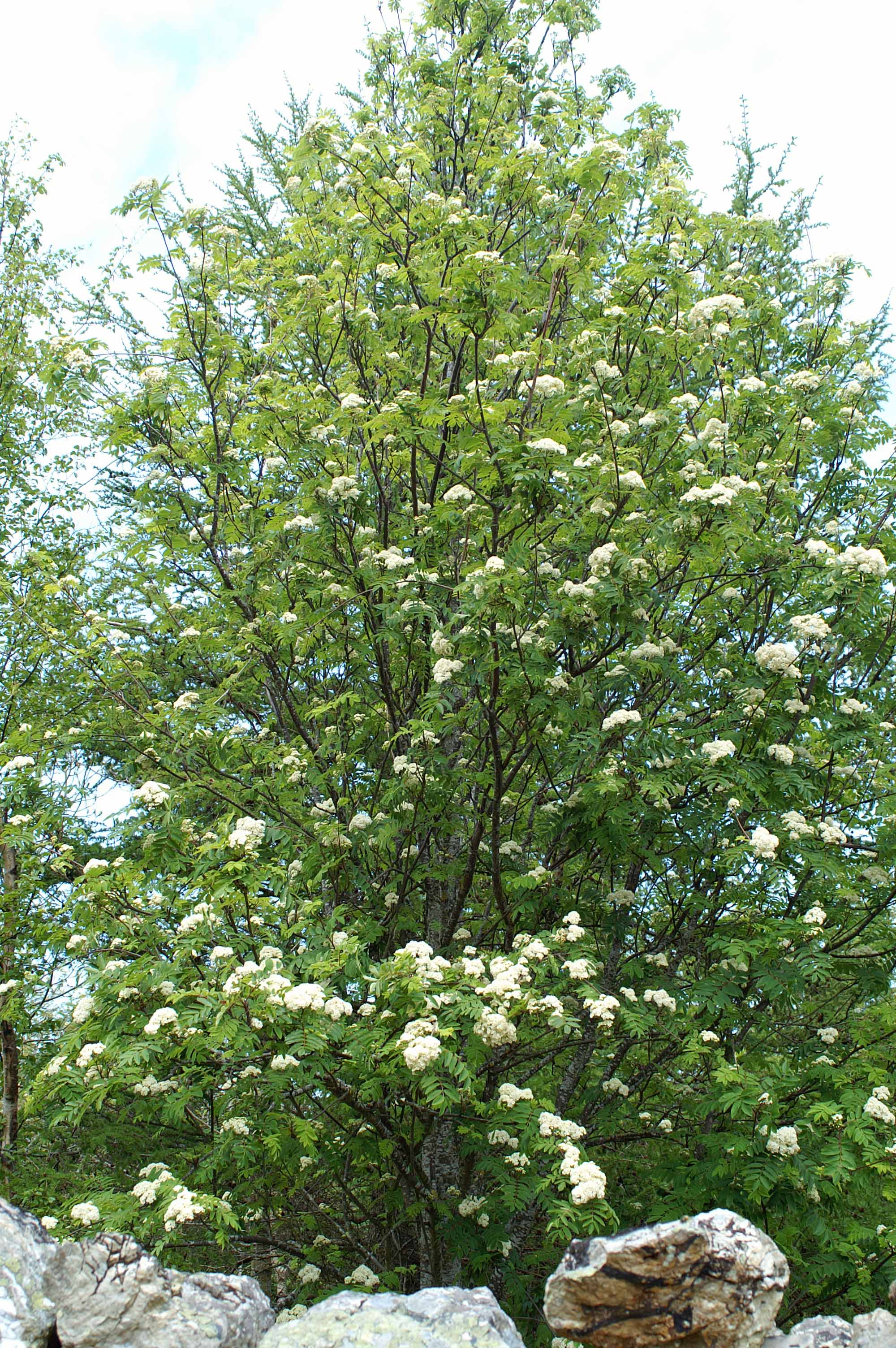
A Rowan tree in full blossom

Bilberry – vaccinium myrtillus

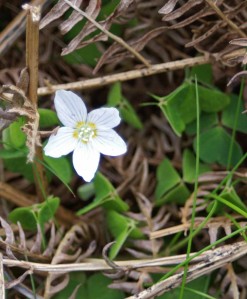
My favourite discovery of the day was definitely this lovely little Wood Sorrel plant growing on a shady mossy bank at the side of the track through the nature reserve.

Wood-sorrel-oxalis-acetosella

The flowers are solitary, each having five narrow sepals; five broad white petals delicately veined with lilac; 10 stamens and five styles.

Wood Sorrel –Oxalis acetosella – A charming and delicate herb, from the genus Oxalis, that is common in most of Europe and parts of Asia. The binomial name is Oxalis acetosella, owing to its sour taste.

The leaves are fresh green, heart-shaped, folded down the middle and held in groups of three drooping down atop a slender reddish-brown stem.

During the night or when it rains both flowers and leaves contract.


Share this:

  • Share on Facebook (Opens in new window) Facebook
  • Share on Pinterest (Opens in new window) Pinterest
  • Share on X (Opens in new window) X
Like Loading...

Bumblebee in red clover

29 Tuesday May 2012

Posted by theresagreen in bumblebees, flower folklore, Nature, nature photography, Old Colwyn, Wildflowers of Wales

≈ 5 Comments

Tags

bombus terrestris, buff-tailed bumblebee, meadow flowers, medicinal plants, red clover, trifolium pratense, wayside flowers

There is a beautiful patch of red clover growing alongside the road leaving Old Colwyn and I just had to stop and have a closer look on my way home on Friday before it is past its best.

Red Clover- Trifolium pratense

Red Clover –Trifolium pratense  is a species of clover that is native to Europe, Western Asia and northwest Africa, but widely planted and naturalised in many other regions.

Red clover is said to be the national flower of Denmark, although apparently not officially designated . It is however the state flower of Vermont. “No. 159 of the Acts of 1894, effective February 1, 1895, designated the Red Clover as the official State Flower. Both an integral part of many a cultivated hay field and a common sight along numerous Vermont roadsides, the Red Clover is symbolic of Vermont’s scenic countryside generally and of its dairy farms in particular. Oddly enough, however, Trifolium pratense is not a native of Vermont but was “naturalized” from Europe”.  http://www.50states.com

The dark pink/purple flowers are held in dense rounded heads and have two leaves just below the top of the peduncle

An herbaceous, short-lived perennial plant, with hairy erect stems; variable in height, growing to 20–80 cm tall. The leaves are alternate, trifoliate (with three leaflets), each leaflet 15–30 mm long and 8–15 mm broad, green with a characteristic pale crescent in the outer half of the leaf; the petiole is 1–4 cm long, with two basal stipules.

The plant was named Trifolium pratense by Carolus Linnaeus in 1753. Trifolium  simply means ‘three-leaves’ and Pratense is the Latin for “of meadows”.

Agricultural uses

High in vegetable protein, red clover is widely grown as a forage crop and is also valued for its nitrogen fixation, which increases soil fertility and is used as a green manure crop. It has become naturalised in many temperate areas, including the Americas and Australasia as an escape from cultivation.

Medicinal uses

Red clover has been reported to be used for a variety of medicinal purposes, such as the treatment of bronchitis, burns, cancers, ulcers, sedation, asthma, and syphilis. These days its use may be recommended to alleviate symptoms of menopause; red clover contains isoflavones (oestrogen-like compounds) which may relieve the discomfort of ‘hot flushes’.

Folklore

Clover was an ancient protective herb. The Druids considered the trefoils, symbolic of the eternal verities of Earth, Sea and Sky. The Celts saw the clover as a sacred, magical plant. A 4-leafed clover is a sign of good luck and is a charm against snakes, witches, the devil and other dangerous creatures. It is also said to give the gift of second sight, enabling one to see fairies. In the language of flowers clover means “think of me”  or “be mine”.

Pollinator plant

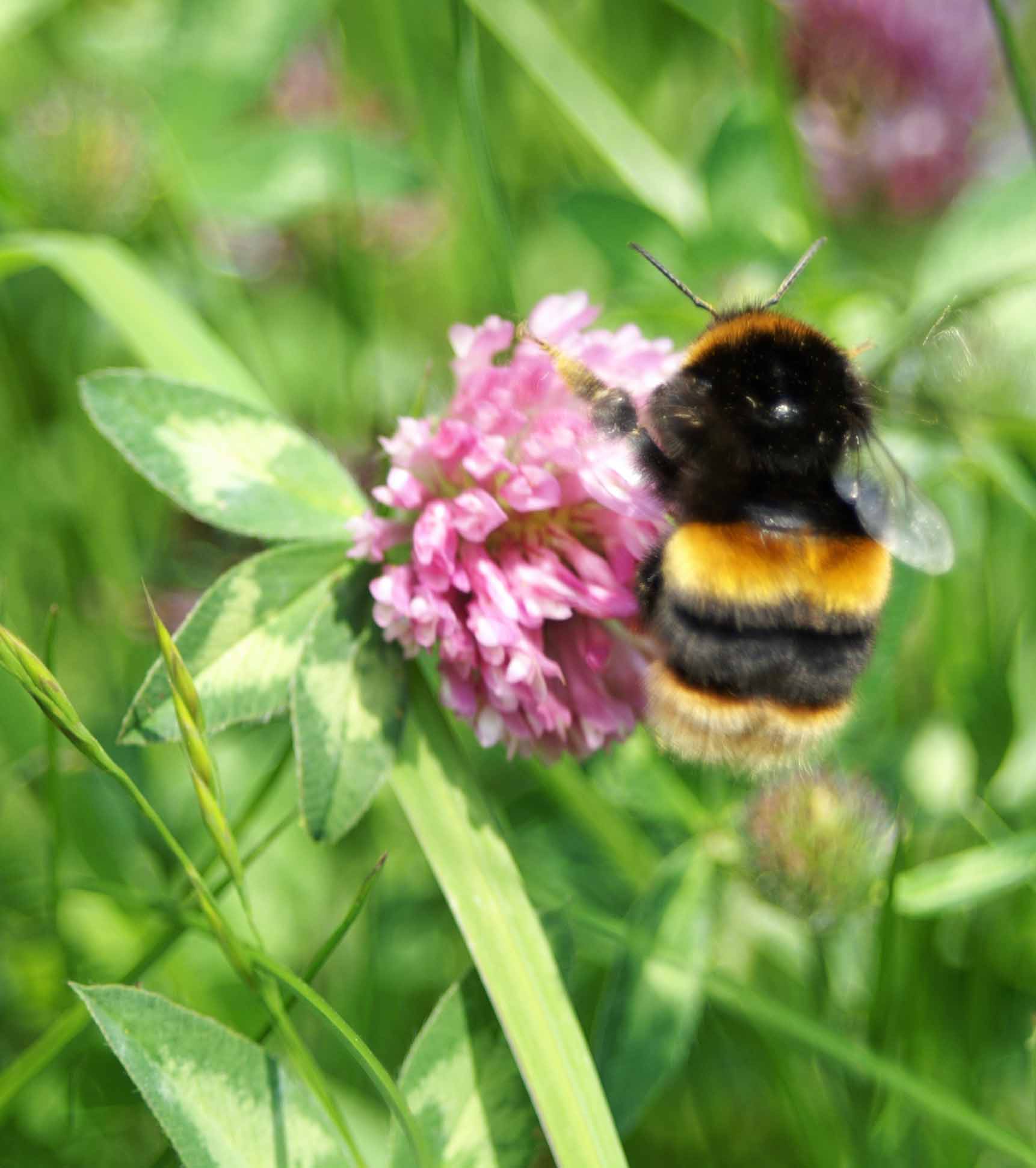
Buff-tailed Bumblebee – Bombus terrestris

Buff-tailed Bumblebee-Bombus terrestris on red clover

Share this:

  • Share on Facebook (Opens in new window) Facebook
  • Share on Pinterest (Opens in new window) Pinterest
  • Share on X (Opens in new window) X
Like Loading...

The Cockchafer or Maybug

29 Tuesday May 2012

Posted by theresagreen in Beetles, garden wildlife, Nature, Nature of Wales, nature photography

≈ 7 Comments

Tags

cockchafer, large beetle attracted to lights, maybug, melolontha melonontha

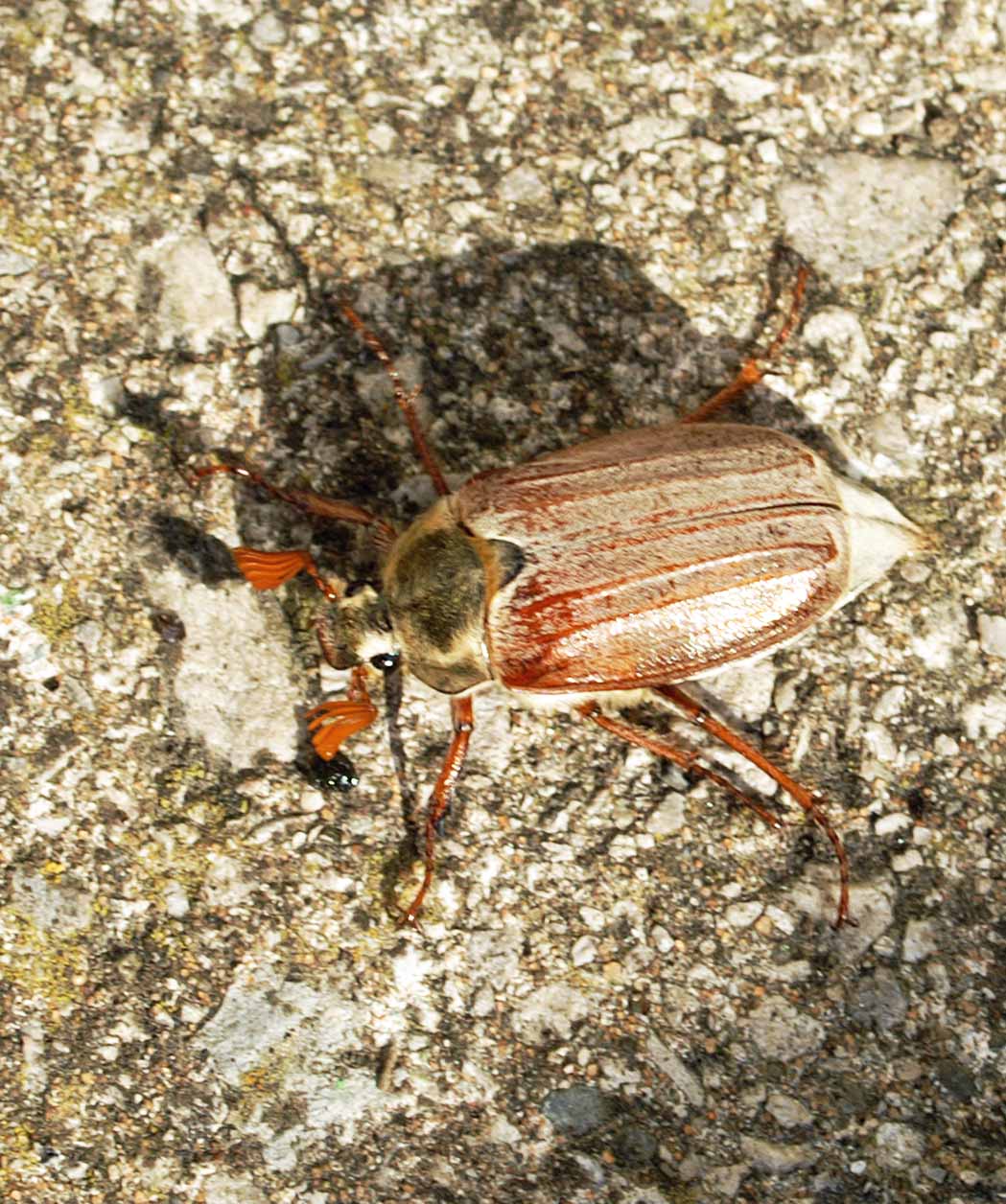
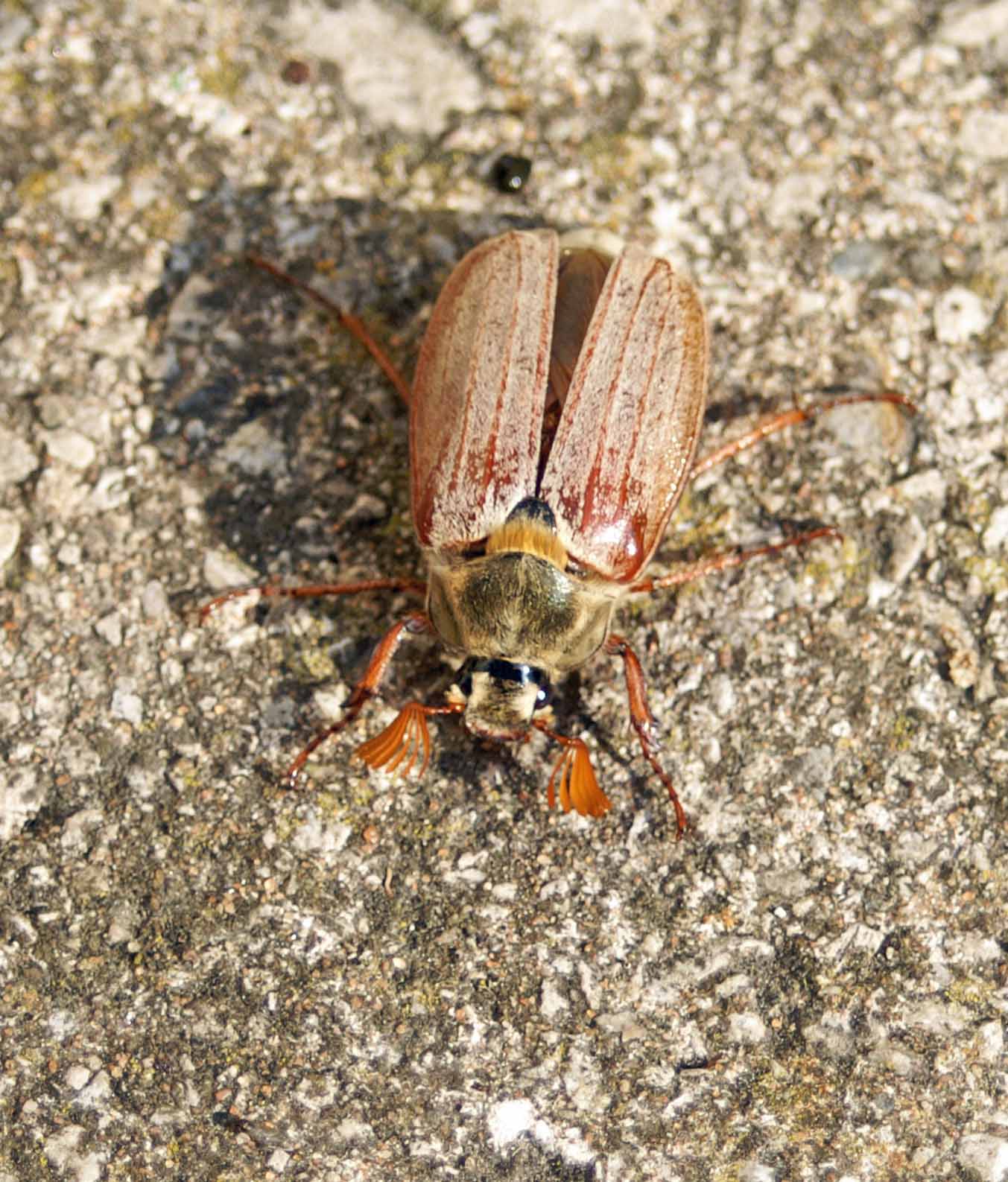
One morning last week I carried my early cup of tea outside to enjoy some early morning sunshine and discovered a big fat Maybug on its back on the chair. No amount of struggling was effecting him righting himself, he just lay there frantically waving his legs in the air, poor thing. Of course I helped him after I had taken advantage of his plight to photograph him, allowing him to hook his feet around my finger and placing him on the ground from where he took off rapidly and headed for the sycamore tree.

Maybug on its back showing the very furry body

Maybug, Cockchafer–Melolontha melolontha The Cockchafer is one of the more familiar large beetles as it is often encountered flying noisily about on warm evenings of the early summer, when it may crash into windows, attracted there by lights. It is also known as the May Bug as this is the month in which it most commonly appears. It is common and widespread throughout Britain and Europe except in the far north, occurring in grassy and lightly wooded places.

Cockchafers have a black head and thorax and brown sculptured elytra (wing-cases).

The larvae live on the roots of grasses and other plants in areas kept as permanent pasture and once were so abundant they were regarded as a pest species.

The beetle, particularly the male, has large impressive feathery antennae that open like a fan

Share this:

  • Share on Facebook (Opens in new window) Facebook
  • Share on Pinterest (Opens in new window) Pinterest
  • Share on X (Opens in new window) X
Like Loading...

Thrift -Armeria maritima

28 Monday May 2012

Posted by theresagreen in Little Orme, Nature, Nature of Wales, nature photography, Rhiwledyn Nature Reserve, Wildflowers of Wales

≈ 4 Comments

Tags

armeria maritima, Ceibwr Bay, clifftop flora, Pembrokeshire coastal path, sea pink, thrift, thrift on old three pence coin, wildflowers with pink flowers

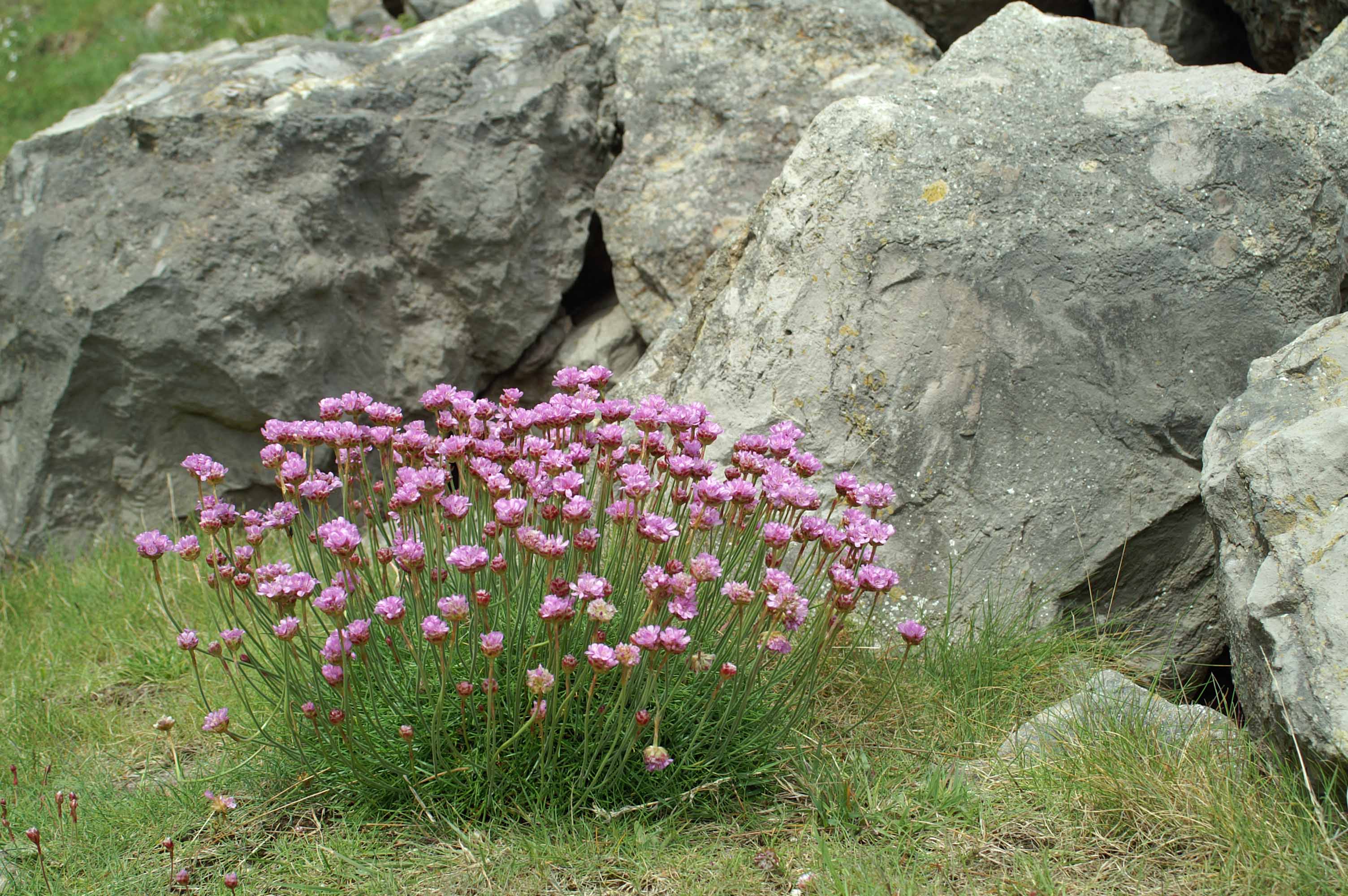
Thrift – Armeria maritima, Rhiwledyn Nature Reserve, Little Orme, North Wales

Thrift

Thrift or Sea Pink, Rock Rose, Our Lady’s Pillow – Armeria maritima, begins flowering in April and carries on gloriously well into July. It is a low growing perennial plant that forms dense neat tussocks  of linear leaves and produces generous numbers of fragrant button-shaped flowers. The plant has very shallow roots and takes its common name of ‘thrift’ from its ability to make the most of any available nutrients in the thinnest of soils of cliffs and rocks.

Thrift creates wonderful displays on    wild, coastal areas throughout the UK – especially south-west Wales and Scotland, but as well as rocky cliffs, Thrift can also be commonly found brightening up saltmarshes and other sandy areas.

11/6/10-A wonderful display of thrift on the cliffs at Ceibwr on the Pembrokeshire Coastal Path, West Wales

The Welsh name for thrift is clustog Fair, which translates as Mary’s pillow. In Gaelic it is known as tonna chladaich, meaning ‘beach wave’.  It is the county flower of Bute, the Isles of Scilly and Pembrokeshire/Sir Benfro.

11/6/10- An old stone wall with a colony of thrift flowers – Pembokeshire Coastal Path

The threepenny coin was embossed with a portrait of Edward VIII and a reverse design of a thrift plant by Frances Madge Kitchener

Thrift was used as an emblem on the threepenny-bit between 1937 and 1953 – no doubt as a clever and light-hearted pun at a time in our British history when saving, making and mending and general ‘thrift’ were a part of everyday life.

Share this:

  • Share on Facebook (Opens in new window) Facebook
  • Share on Pinterest (Opens in new window) Pinterest
  • Share on X (Opens in new window) X
Like Loading...

Bird study: Blackcap

14 Monday May 2012

Posted by theresagreen in bird behaviour, Nature, nature of woodlands, nature photography, woodland birds

≈ 14 Comments

Tags

Blackcap, breeding warblers, Gibraltar, migrant birds, nature, sylvia atricapella, woodland birds

As soon as I heard the notes of its lovely melodious song, I knew I was looking out for a  blackcap amongst the trees growing by the river in Fairy Glen. Often singing from a perch in deep cover, I was quite surprised to find him quickly and easily, openly warbling from a branch in a smallish sycamore.

A blackcap singing beautifully from a tree next to the river, Fairy Glen

Blackcap– Sylvia atricapilla. The majority of  Northern European breeders winter in southern Europe and north Africa, where the local populations are resident. I enjoy the close company of these birds all round when in Spain as once established in a territory they tend to stay within it to live and breed.

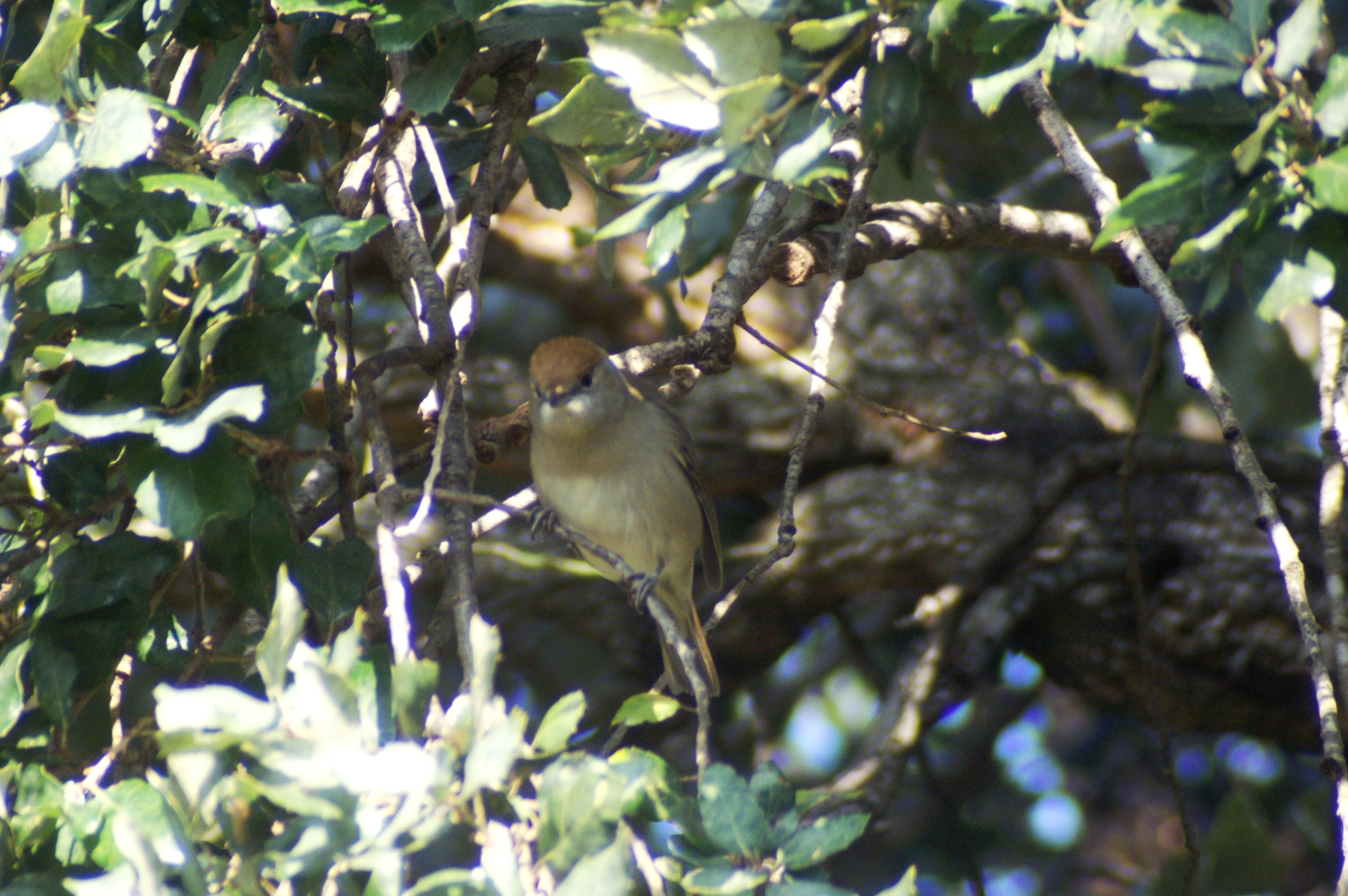
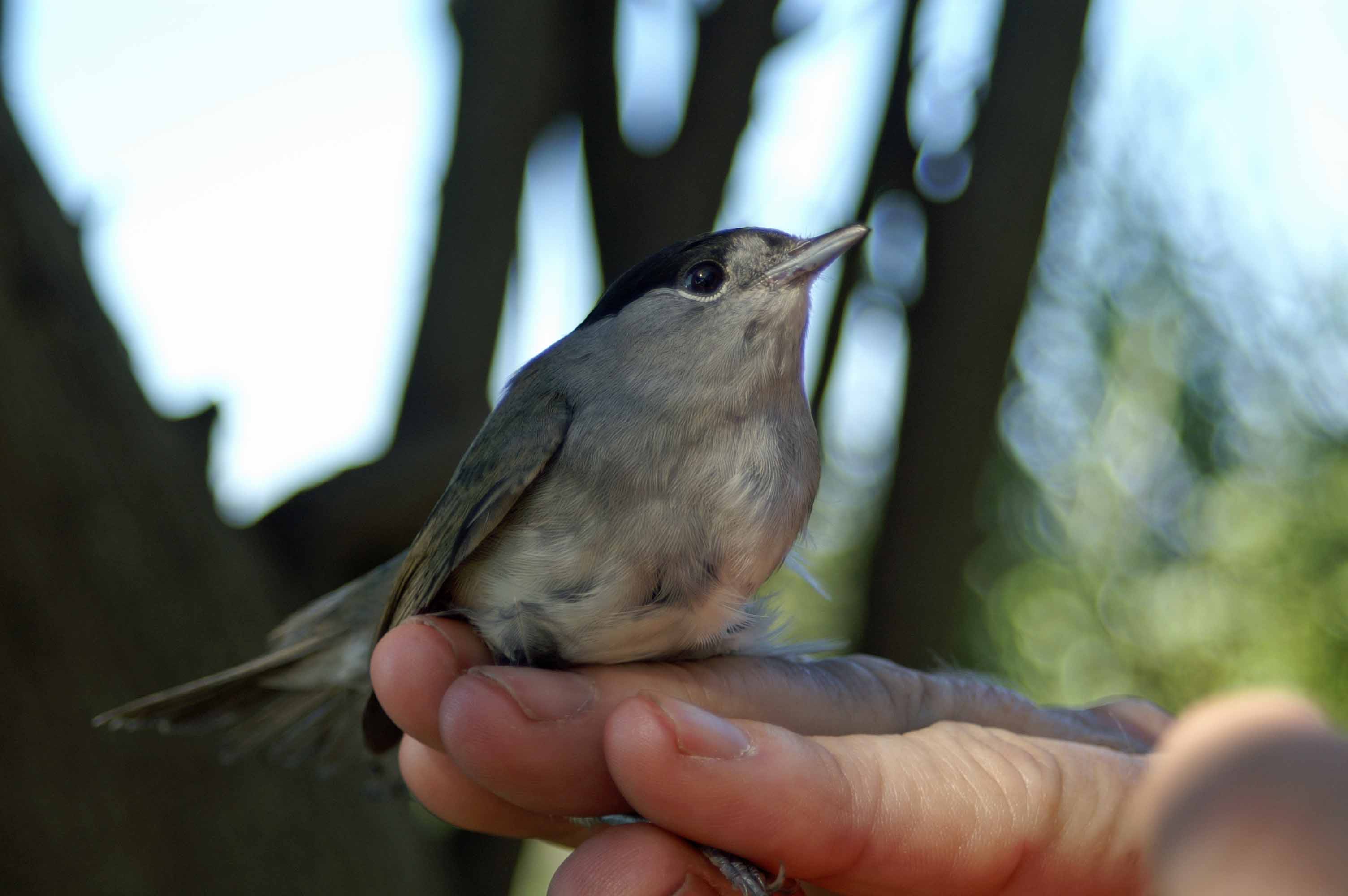
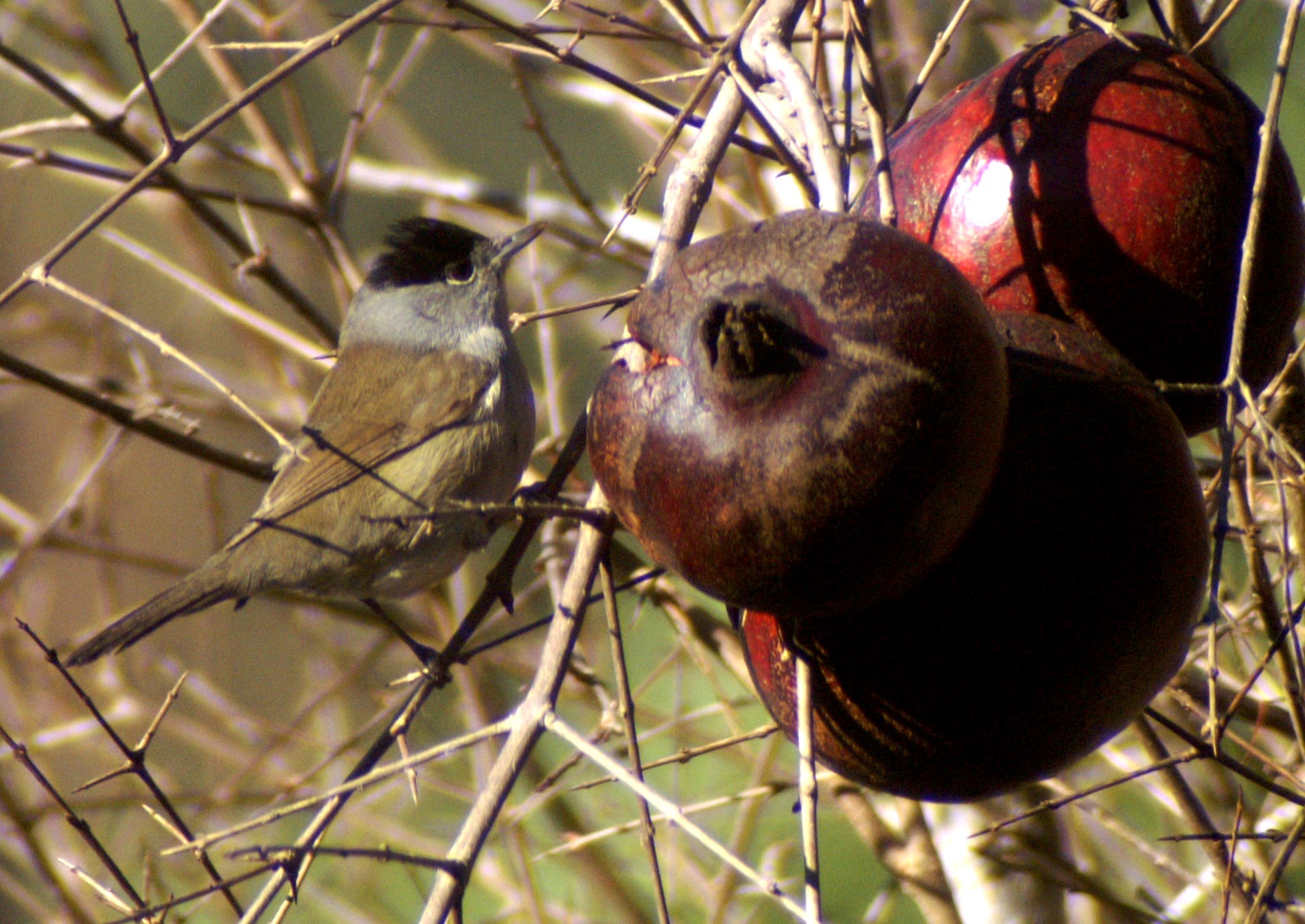
This must be one of the easiest species of British breeding warblers to identify due to their distinctive caps; this is glossy black in the male but rusty red-brown in the female, so as usual the male gets precedence in the naming; even the latin ‘atricapilla‘ translates as black-haired. The birds’ upper parts are grey-olive brown and the underparts are a paler grey-buff. The other main distinguishing feature is its lovely clear melodious song which brought about its reputation in Britain as the ‘northern nightingale’.

The majority of  blackcaps we hear and see in Britain are summer visitors that arrive during April to breed in most parts of England and Wales, with sparser numbers venturing into Scotland and Ireland, then leaving again in October. (Although it has been recorded that blackcaps from Germany and north-east Europe are increasingly spending the winter in the UK, mainly in England.)

In common with other warbler species, other than when the male is singing, they may be difficult to spot as in general they spend much of their time hidden amongst shrubs and bushes within which they forage for food. When changing location they emerge abruptly from the cover of one bush and make a short, low jerky flight to another. Their presence is often given away by their call-notes, a rather harsh ‘churr’, also used as a contact call between a pair or parent and young and an excited ‘tac-tac’ rapidly repeated if the bird is alarmed.

A female in a cork oak tree in the garden in Sotogrande,Spain

Blackcaps nest in woods, on heaths and sometimes gardens where there is a good density of undergrowth or coarse vegetation within which to build their nest and to ensure a reliable supply of food. The nest is a surprisingly frail construction for such a sturdy bird; built mainly by the hen of dried grass and lined with hair and other fine material, it is attached to the surrounding vegetation with ‘basket handles’. Both parents  will incubate the eggs and both will also feed the nestlings.

Caps of young birds begin brown as those of the female, males gradually turn black. Plant is American poke-weed, blackcaps love feasting on its ripe berries. Sotogrande, Spain.

The Blackcap is hardier than most other warblers, partly because of its adaptation to a more variable diet. Food is mostly flies, caterpillars and other insects, but they also avidly consume a wide variety of  fruit and berries as and when it beomes available.

The blackcaps wait for the pomegranate fruit to ripen and split then gorge themselves on the fleshy seeds until all that remains is the husk. Sotogrande, Spain

20/2/10-Feasting on nectar from aloes growing in the garden, Sotogrande, Spain

The Blackcap in other countries

Gibraltar – where they count and ring them on migration…

21/10/11-A very healthy blackcap enroute to Africa, ringed, weighed and measured and about to be released

Cyprus – where they eat them ….

The blackcap has been considered a culinary delicacy from the Middle Ages and to this date thousands of them fall victim to the lime-sticks set out by the villagers. John Locke, an Englishman who visited the island in 1553, makes the first reference to the trade in pickled or marinated “Becaficoes”, which was well established even in those days; he adds that “they annually send almost 1200 jarres of pots to Venice”. Many subsequent writers refer to this article of diet, still a favorite dainty. In 1576, the well educated traveller Porcacchi notes:… “there are birds of all kinds: in most esteem are those found nowhere else as certain little birds called vine-birds”. Keeping an itinerary of his visit to Cyprus between September 1598 and March 1599, Ioannes Cotovicus, a Professor at the University of Utrecht writes about the famous birds: “Infinite numbers of them are preserved in jars with vinegar and savory herbs and sent for (950 725 B.C.) Cyprus Museum sale to Venice, making a dainty dish greatly in request with princes and lords throughout Italy”. Later on, Pietro Della Valle recording his visit to Ayia Napa in September 1625 writes: “We found and ate in this place a large quantity of beccafichi, called by the Greeks sykalidia which at this season are caught in such abundance that besides the numbers that are consumed in the island itself, thousands are exported in vinegar to Venice and elsewhere” (Excerpta Cypria, pages 72, 166, 200, 213).

Over the last years the number of blackcaps has dropped dramatically, as they keep falling prey of lime-sticks or nets.

http://www.kypros.org/Cyprus/cap.html

Finland – where they are celebrated in poetry ….

The official song: Sylvia´s song

Once upon a time, a poet spent his summer at the beautiful Franssila manor in Kangasala, Finland. Sitting on the veranda, he heard a small bird sing. It was the blackcap (Sylvia atricapilla) that inspired Zachary Tope-lius, the poet and writer of children´s fiction, to write the poem “Sylvia´s son”, known today as “A Summer´s Day in Kangasala”. Put to music, the poem became Finland´s best-loved song and choral work and the official song of the Tampere Region. The “Harjula Ridge” of the song is today´s Haralanharju, a place of pilgrimage for every lover of scenic beauty. http://www.pirkanmaa.fi/en/tampere-region/emblems-tampere-region

Share this:

  • Share on Facebook (Opens in new window) Facebook
  • Share on Pinterest (Opens in new window) Pinterest
  • Share on X (Opens in new window) X
Like Loading...

Blooming Bryn Euryn

11 Friday May 2012

Posted by theresagreen in Bryn Euryn Nature Reserve, flower folklore, Local Nature Reserves, Nature, nature of woodlands, nature photography, Wildflowers of Wales

≈ 4 Comments

Tags

cowslip, Dandelion, early purple orchid, flower folklore about cowslip, hart's tongue fern, hawthorn in flower, welsh poppy, white-tailed bumblebee, wild strawberry, wildflowers of Bryn Euryn, woodland flowers, woodruff

The local nature reserve on Bryn Euryn is a popular venue for a wide variety of walkers and is not usually the place I head for if I fancy a long peaceful walk. But, if you happen to get the timing right there are occasions when you can meander around and almost have the place to yourself. So it was on a damp afternoon a couple of weeks ago when I went there just to see what there was to see.

The small meadow next to car park was golden with dandelions that were attracting the attention of a number of bumblebees.

Dandelion – taraxacum officinale -visited by a white-tailed bumblebee

Some of the flowers have already gone to seed.

Dandelion seed head

Harts Tongue ferns are a feature of the local woodlands here and already quite well grown.

Harts tongue fern. The plants grow on neutral and lime-rich substrates, including moist soil and damp crevices in old walls, most commonly in shaded situations but occasionally in full sun.
The new leaves are a bright shiny green

Harts Tongue Fern – Phyllitis scolopendrium. The plants are unusual in the genus of ferns as they have  simple, undivided fronds. The leaves are 10–60 cm long and 3–6 cm broad, with sori (A sorus (pl. sori) is a cluster of sporangia (structures producing and containing spores) that are arranged in rows perpendicular to the rachis. ) In plants a rachis is the main axis of the inflorescence or spike. In ferns it is also the part of the axis to which the pinnae are attached.

The plant’s common name derives from the shape of its fronds, being thought to resemble a deer’s tongue: hart was an alternative  word for “stag”, from the Old English heorot, “deer”. The sori pattern is reminiscent of a centipede’s legs, and scolopendrium is Latin for “centipede”. 

This fern was recommended as a medicinal plant in folk medicine as a spleen tonic and for other uses.

Whilst still in the cover of woodland I spotted a Long-tailed Tit foraging amongst tree branches and a Song Thrush out on the  path also hunting. I saw and heard several Robins, Blue and Great Tits and Chiffchaff. A family of Magpie were also out and about, five of them up near the summit and there were Greenfinch lower down around the carpark.

I changed my route slightly today, mainly to avoid the uphill track through the woodland which was very muddy and quite slippery, choosing instead a surfaced one that leads around the base of the Bryn (hill). Happily, being more open and less shaded, there were plants growing here I would otherwise have missed.

Wild strawberry plants growing along the edge of a woodland track

Wild strawberry – Fragaria vesca very much resembles a miniature garden strawberry and similarly produces delicious tiny sweet berries. It is a very common plant throughout the British Isles and Western Europe found growing on all but strongly acid or waterlogged soils.
Hairy stalks bear 3 oval leaflets, also hairy and a bright shiny green. The leaflets have strong side veins, are broadest above the middle with sharp marginal teeth.

There is a similar-looking plant, the Barren Strawberry, which has duller grey-green leaves.

I was really pleased to find a Welsh poppy in flower along here, I used to have them in my garden when we lived in South Wales and loved them, especially where they seeded themselves amongst blue forget-me-nots.

Welsh Poppy -papaver cambricum

The Welsh Poppy has been adopted as the logo of the Welsh political party, Plaid Cymru

The Welsh poppy (Meconopsis cambrica) is a perennial plant native to south-western England, Wales, Ireland and Western Europe. Its favoured habitat is damp, shady places on rocky ground, and although its common name is ‘welsh poppy’, it is also native to south-western England, Wales, Ireland and Western Europe. In its most westerly locations, it is increasingly found on more open ground with less cover. It is also especially well adapted to colonising gaps and crevices in rocks and stones, which has enabled it to colonise urban environments, sometimes growing between paving slabs and at the edges of walls.

A grey squirrel paused in its tracks on a tree branch, keeping one eye fixed on me

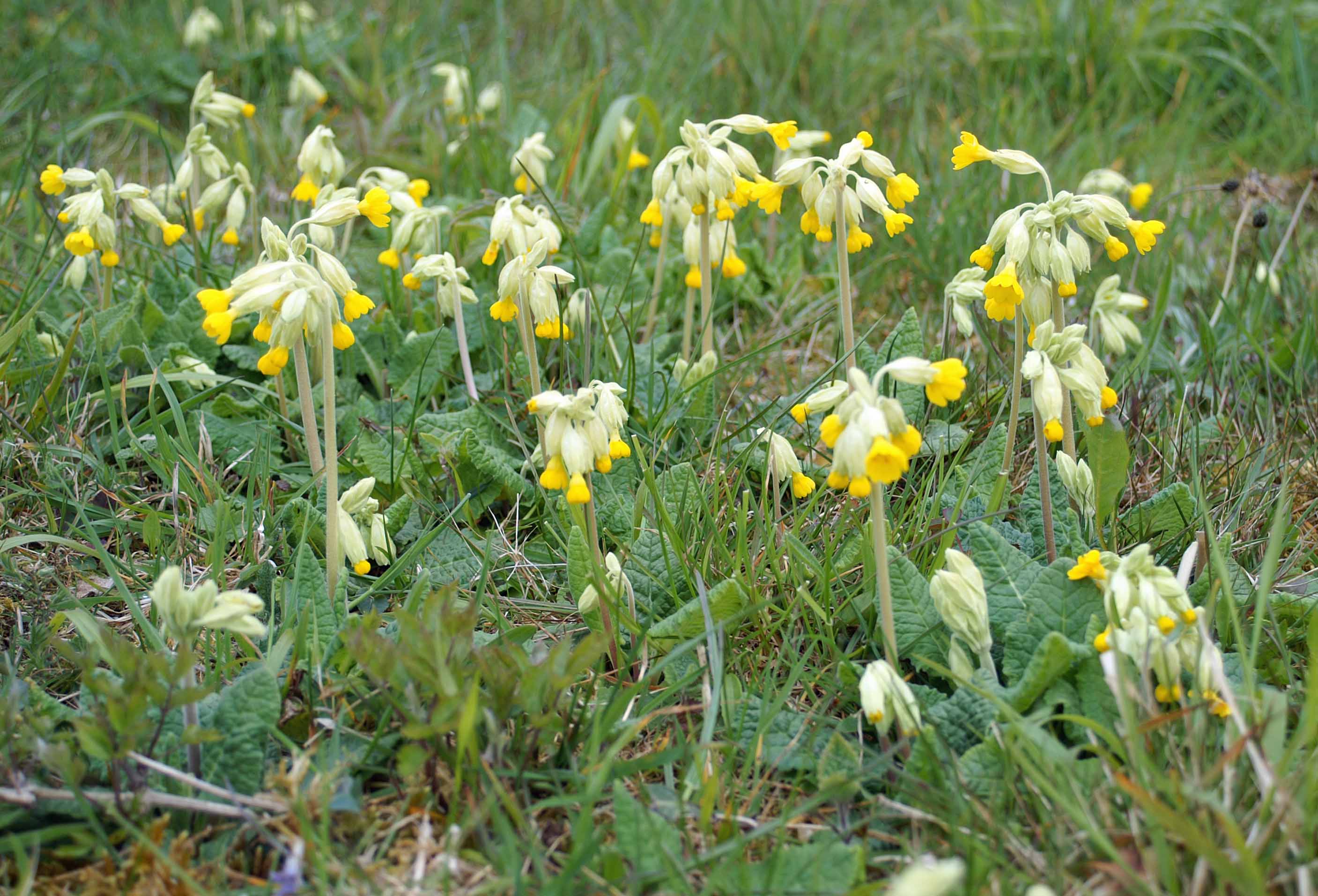
Another favourite plant from my childhood, the cowslip, was also present here growing along the path edges, so I was sure there would be more once I reached the grassy slope of the lower hillside. I was not disappointed, there were beautiful masses of them.

Part of a mass of flowering cowslips

Cowslip – Primula veris

Cowslip – Primula veris, also variously known as Herb Peter, Paigle, Peggle, Key Flower, Key of Heaven, Fairy Cups, Petty Mulleins, Crewel, Buckles, Palsywort, Plumrocks.

According to folklore, cowslips first grew from the ground where St Peter dropped his keys and this is recorded in the French, German, and Old English names (clef de Saint Pierre, Schlusselblumen, and Key of Heaven respectively). The name cowslip, on the other hand, derives from the old English name, cūslyppe  or cowslop, because the plant used to grow best in meadows frequented by herds of cows.

The species name vēris means “of spring”.

Despite its pungent choice of habitat, the flowers of the cowslip have a lovely, almost-apricot scent and not so long ago were sufficiently and reliably abundant to allow them to be picked and used to make deliciously fragrant cowslip wine. (Now of course it is illegal to pick flowers from the wild so if you want to try it you’d have to find an alternative supply.) Cowslip is frequently found on more open ground than Primula vulgaris (primrose) including open fields, meadows, and coastal dunes and clifftops. Nowadays the seeds are often included in wild-flower seed mixes used to landscape motorway banks and similar civil engineering earth-works where the plants may be seen in dense stands.

Herbal medicine

The traditional medicinal uses of cowslip are widespread and the different parts of the plant are still commonly used to treat a variety of complaints as wide ranging as lung disorders, insomnia, gout,arthritis and anxiety. The herb is also reputed to have beneficial effects on the heart . (Active ingredients include saponin glycosides, including primulic acid, primulaveroside, and primveroside; volatile oil; tannins; flavonoids, including luteolin, apigenin, kaempferol, and quercetin; phenolic glycosides). Its flowers and leaves are rich in vitamin C and beta-carotene, potassium, calcium, sodium and salicylates which help strengthen the immune system through its antioxidant properties and by lowering the cholesterol level.

Cowslip can effectively alleviate headaches but is not recommended to those who are allergic to aspirins, because of its high quantity of salicylates (the main basis for aspirin).

This herb is also used in cosmetics, used as an ingredient in face creams for its regenerating effects.

The cowslips were wonderful, but an even bigger treat were the orchids, masses of pretty early purple ones.

Orchids are always a special sight, especially the first ones to flower, the Early Purple Orchid

Early Purple Orchid-Orchis mascula

Finally lifting my eyes from ground level and the flowers, I was surprised to realise that the highest peak in our view from here across to the mountains of Snowdonia actually had snow on it.

The view to the snow-capped peaks of the Carneddau Mountains

Hawthorn blossom flowering in a sheltered spot

New oak leaves

Amongst some shrubby bushes, including the hawthorn, I came across a little flower I had almost forgotten about as it is so long since I saw it last, the delicate white-flowered Woodruff.

Woodruff- Galium odoratum

Woodruff –Galium odoratum is an herbaceous perennial plant  native to Europe, North Africa and Western Asia. Other common names include woodruff, sweet woodruff, and wild baby’s breath.

It grows to 30-50 cm (12-20 ins.) high but it is a weak-stemmed that is often found lying flat along the ground or supported by other plants it  prefers partial to full shade in moist, rich soils.

The flowers sweet smell is due to the presence of the odiferous agent coumarin; this scent intensifies as the plant wilts that persists on drying, and the dried plant is traditionally used in pot-pourri and as a moth deterrent. It is also used, mainly in Germany, to flavour May wine (called “Maiwein” or “Maibowle” in German), syrup for beer (Berliner Weisse), ice cream, and medicinally as a herbal tea with gentle sedative properties, but beware, high doses can cause headaches, due to the toxicity of coumarin.

A final view of Bluebells & Wild Garlic
Share this:

  • Share on Facebook (Opens in new window) Facebook
  • Share on Pinterest (Opens in new window) Pinterest
  • Share on X (Opens in new window) X
Like Loading...

Woodland plants may be pungent, prickly and even poisonous

03 Thursday May 2012

Posted by theresagreen in nature of woodlands, nature photography, woodlands

≈ 7 Comments

Tags

black hairstreak butterfly, blackthorn, bluebell, herb robert, medicinal plants, Patrick Barkham, poisonous wildflowers, ramsons, wild garlic, woodland flowers

Spring is progressing rapidly and now at the end of April, the great majority of  woodland plants have come into flower, racing to achieve the maximum amount of light possible before the leaf canopy thickens and blots it out. In a more ‘normal’ year, they would reach their peak in May in southern England and a little later further north, but this year everything seems to be happening that bit earlier.

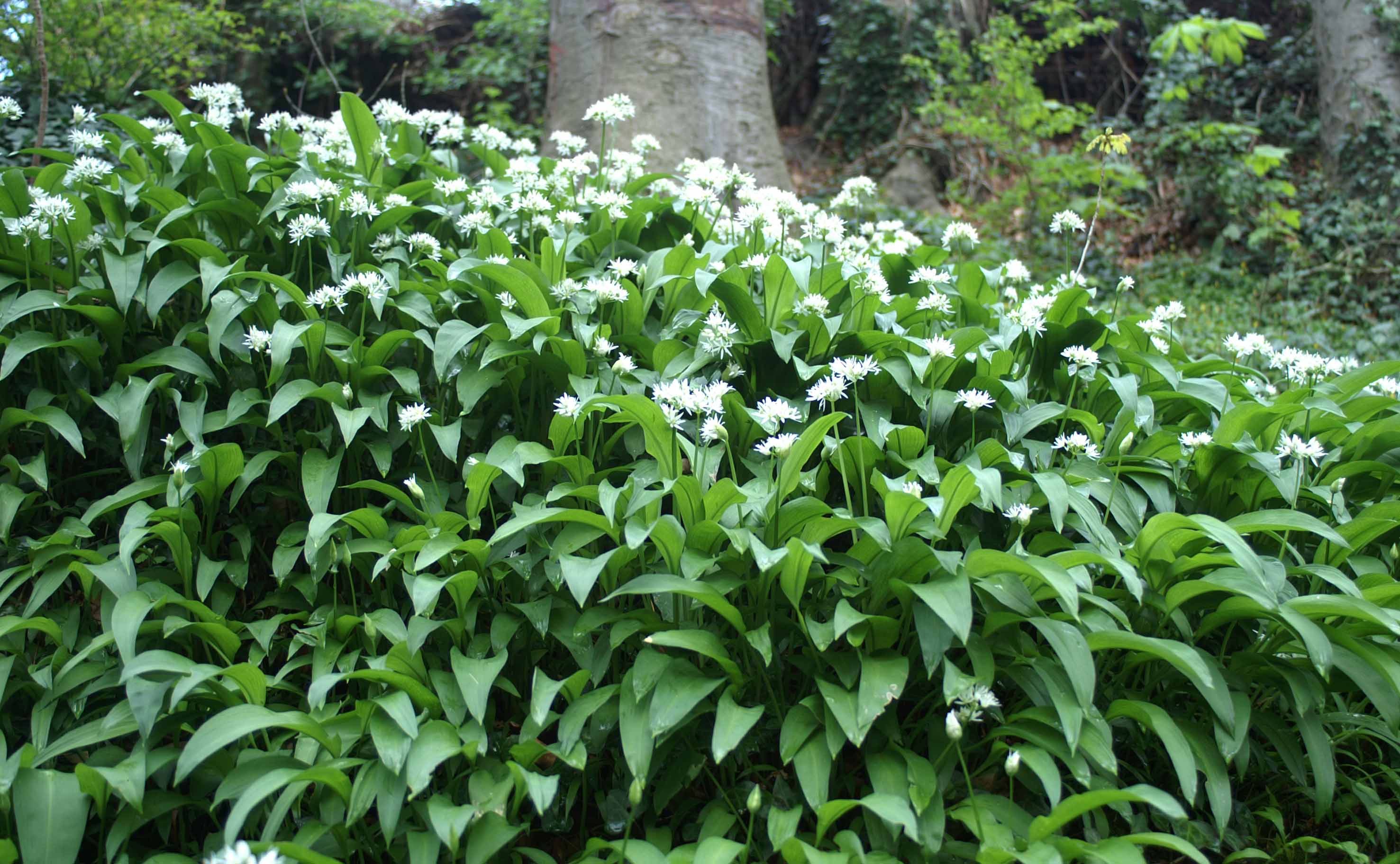
In local woodlands Ramsons, or wild Garlic has been showing blooms for several weeks now and is fast approaching its flowering peak. A wild relative of chives, all parts of the plant have a characteristic garlic or onion scent, and where there are masses of them their pungent scent fills the air; you can often smell their presence before seeing them.

Ramsons, Wild Garlic – Alium ursinum -Fairy Glen, Old Colwyn

Ramsons, Wild Garlic – Allium ursinum

Other common names include  buckrams, wild garlic, broad-leaved garlic, wood garlic, bear leek, and bear’s garlic

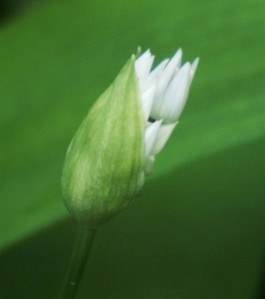
The flower heads are enclosed within a papery two-lobed spathe

Native to Europe and Asia, Ramsons may be found growing  in deciduous woodlands with moist soils, preferring slightly acidic conditions. It is a perennial herb, growing from a narrow white bulb that produces two or three oval-elliptic leaves with pointed tips and long stalks that twist through 180 degrees. The leaves are similar to those of the lily of the valley and where the two plants are known to grow together, care must be taken not to confuse them should you be picking them to eat; those of the lily of the valley are highly poisonous.

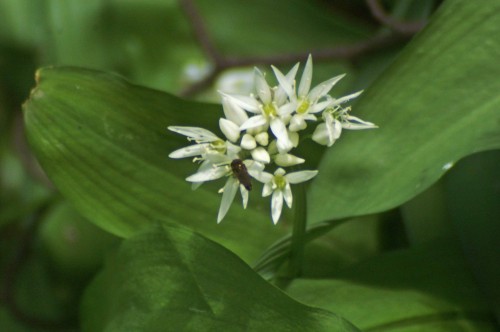
A Ramsons flower visited by a tiny hoverfly. The flower-heads consist of six to twenty white star-like flowers held in dense flat-topped umbels atop a bare triangular scape (stem). Each flower is 16-20mm across and has six stamens.

Ramsons leaves are edible and are fashionable currently as ‘foraged food’; they have been traditionally used as an addition to a green salad,  boiled as a vegetable, added to soup, or as an ingredient for pestoin lieu of basil.  The bulbs and flowers are also very tasty.

A pretty clump of Bluebells – hyacintha non-scripta

A bluebell is visited by a small hoverfly

Bluebells are probably the most characteristic of all woodland flowers. The magnificent carpet of blue its massed blooms  produce, sometimes spreading throughout an entire woodland is a glorious spectacle. It epitomises spring woodlands, but is also a special feature of the British Isles and a rarity over most of continental Europe, either because the winters are too cold or the summers are too hot and dry.

The flowers are indisputably beautiful and release a lovely perfume, but the small bulbs they spring from are rather poisonous if eaten. Traditional medicinal uses of the bulb are based upon their diuretic and styptic properties. The toxic substances they contain also made them useful for a more unusual and practical purpose, as a source of glue used in bookbinding; apparently the toxins discouraged silverfish from eating them.  The toxicity may also be the origin of the superstitious belief that anyone who wanders into a ring of bluebells will fall under fairy enchantment and die soon after. Now I must confess that last little snippet of superstition was passed down in country areas well into my childhood- we lived on the edge of a wood, part of which was (happily still is) carpeted with bluebells in May and I spent many happy hours wandering through them. I was always very careful to make sure there were none growing in a ring.

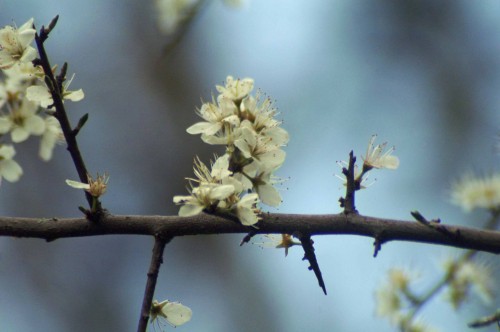
Shrubs and bushes form the under-story level below the trees – they are woody but not normally tall enough to reach the woodland canopy. The blackthorn and hawthorn are two closely related shrubs, both members of the rose family and both contributing a great deal to our countryside. The blackthorn is usually the first of the two to flower and is familiar for its mass of white flowers produced in early spring before the leaves appear and for the purple sloes in autumn.

Sloe, Blackthorn – Prunus spinosa

The Blackthorn or sloe – Prunus spinosa  is native to Europe, western Asia, and locally in northwest Africa. It is also locally naturalised in New Zealand and eastern North America.

It  is a deciduous large shrub or small tree growing to 5 m tall, with blackish bark and dense, stiff, spiny branches. The shrub protects itself from animal consumption with particularly long and very tough thorns, which has led to a long traditional use as boundary hedging around fields in Northern Europe and Britain, to contain animals.

The flowers are 1.5 cm diameter, with five creamy-white petals; they are produced shortly before the leaves in early spring, and are hermaphroditic and insect-pollinated.

The leaves are oval, 2 – 4.5cm long and 1.2-2cm across, with a serrated margin.

Blackthorn is the larval food plant of several butterflies, including the Black Hairstreak (Strymondia pruni), which feeds on both the leaf buds and mature leaves of the shrub. This butterfly is a rare species in Britain, restricted only to ‘a narrow belt of mature woodland areas, between Oxford and Peterborough.’  Diversifying a little, there’s a fascinating account of one man’s quest to find this butterfly, together with the rest of our British species in a book I have in my collection titled ‘The Butterfly Isles – A Summer in Search of our Emperors and Admirals’, written by Patrick Barkham. I’d love to know if anyone else has read it; I really enjoyed it, but it seems to have had mixed reviews.

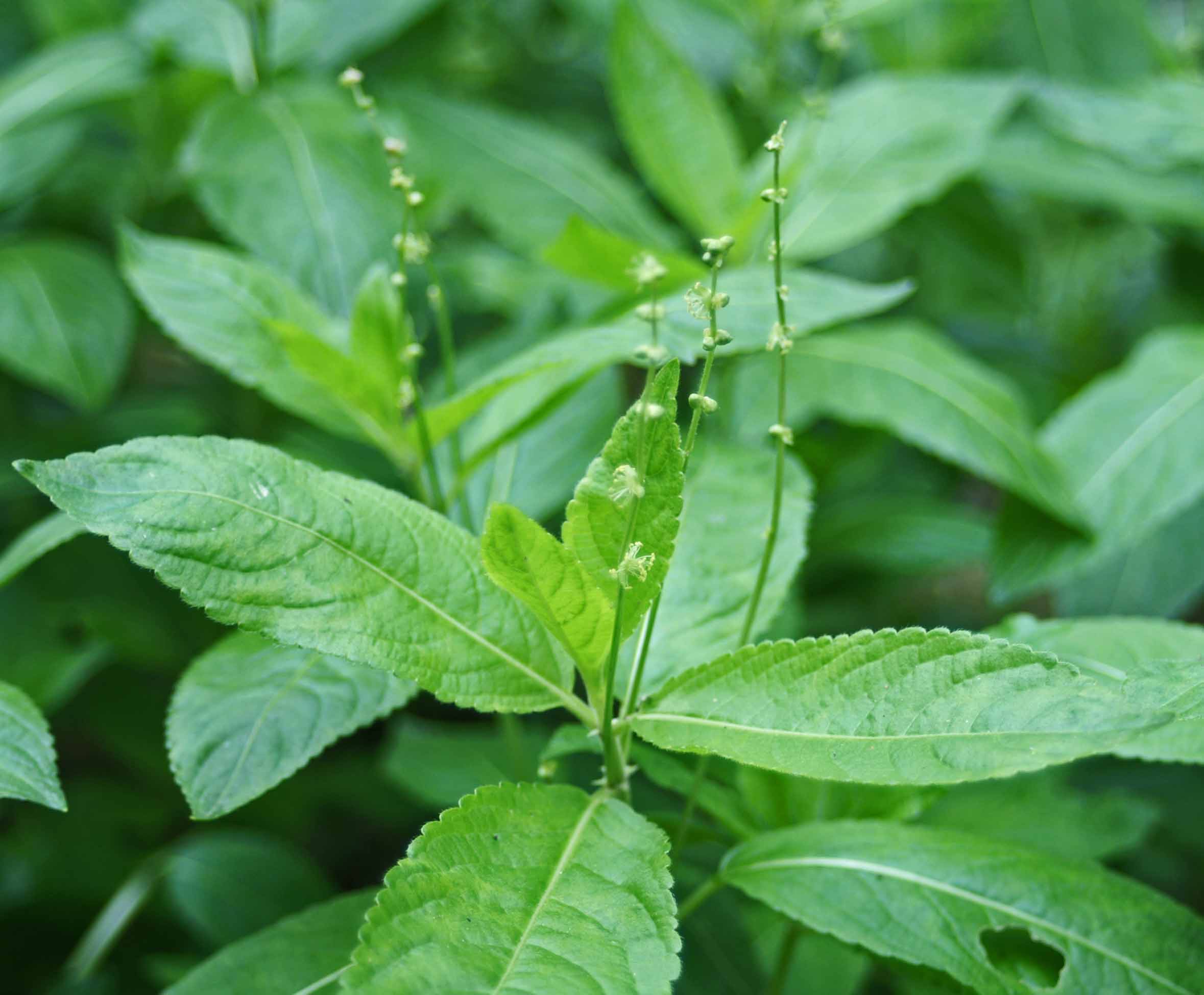
Back to the plants. I’ve mentioned Dog’s Mercury in an earlier post, but didn’t say anything about it. It is actually quite an interesting one as its a bit of a beast appearing alongside the host of beauties featuring in our woodlands at this time of year.

To begin with the name, a  ‘dog’s’ plant is traditionally one with no medicinal uses and it may have obtained this name to contrast it with annual mercury which was used in cleansing enemas. Other slightly less common names are ‘Adder’s Meat’ and ‘Lasting Mercury’. The Mercurialis is open to some debate, although most sources I have come across favour Pliny who said the plant is named after Mercury, the messenger of the gods, who discovered it. The word ‘mercury’ itself is, however, said to be related to ‘merx’ meaning ‘wares’. With its alleged property of being able to determine the sex of an unborn child, it may be that this plant was traded and was ‘merx’.

29/4/12 – Dog’s mercury is fully grown now and flowering

The plant is poisonous; it contains methylamine, trimethylamine, saponins and a volatile oil. This would give it  emetic and purgative properties, meaning consumption would most probably lead to nausea, vomiting and diarrhoea. Larger doses cause lethargy, jaundice, painful urination (apparently by making the urine acid) and coma before death. Reported instances of poisoning are few, perhaps because the plant is not particularly attractive and also because it had no tradition of medicinal use.

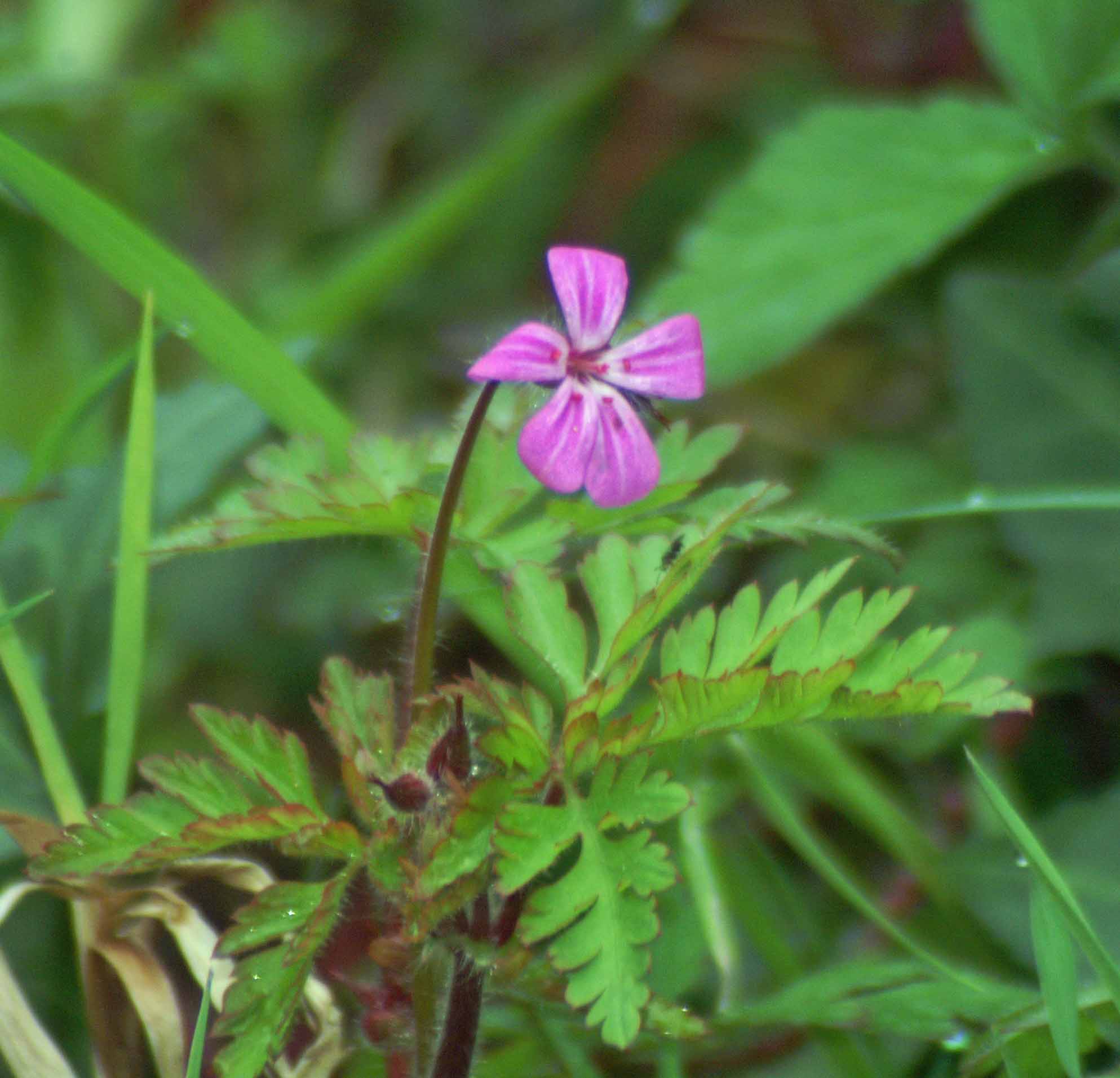
Pretty pink-flowered Herb Robert – geranium robertianum

Another of my all-time favourite little woodland plants is also beginning to appear, the pretty delicate and highly aromatic little Herb Robert. It is a common species of cranesbill in Europe, Asia, North America, and North Africa, and in Britain it is by no means confined to woodlands and may turn up anywhere it can get a hold, even on stony seashores.

The pungent aroma of the leaves is said to act as an insect deterrent and it does seem to be that no insect pest bothers it;  it has traditionally been used in bedding for animals for that reason.

Herb Robert is known to have many medicinal qualities, it is astringent, antibiotic, antiviral, styptic, tonic, diuretic, digestive, sedative and antioxidant. Of these properties, the main action of the herb is regarded to be astringent, which gives it the ability to treat external conditions such as bruises and skin irritations. From medieval times the herb has been applied as a compress to stop bleeding and heal wounds and because of its astringency it is also used to treat diarrhoea.

Share this:

  • Share on Facebook (Opens in new window) Facebook
  • Share on Pinterest (Opens in new window) Pinterest
  • Share on X (Opens in new window) X
Like Loading...

Bird study : A Chiffchaff’s year

26 Thursday Apr 2012

Posted by theresagreen in Nature, nature of woodlands, nature photography, woodland birds

≈ 5 Comments

Tags

birds singing, Chiffchaff, Fairy Glen, Gibraltar, migrant birds, migrant birds, Phylloscopus collybita, warblers

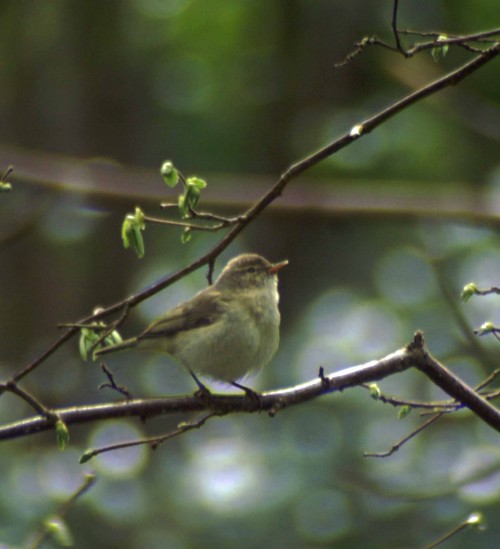
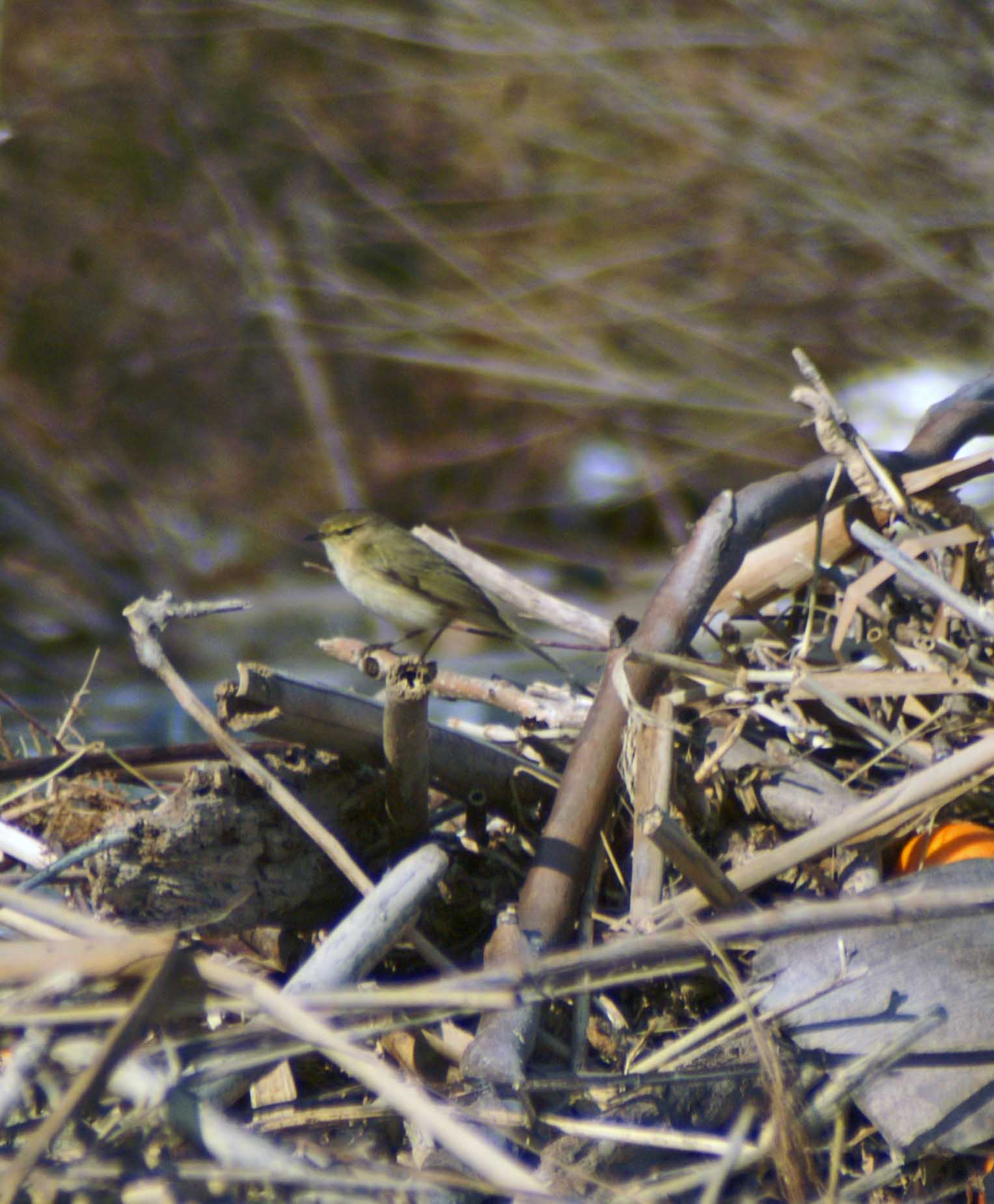
I spotted my first returned migrant Chiffchaff of this year about three weeks ago, flitting about in low vegetation by the side of the river Colwyn. Since then I have heard the unmistakeable call several times in various places, but didn’t have a good sighting of one until last Thursday in the Fairy Glen. They may not be the most colourful or tuneful of our woodland birds, but their return and the sound of their repetitive and cheerful chiff-chaff  is, for many of us, confirmation that spring has truly arrived.

19/4/12 -Chiffchaff singing. The song is unmistakeable, a cheerful repetitive chiff-chaff. Call is a short 'hweet'.

The Chiffchaff, or Common Chiffchaff (Phylloscopus collybita) is a common and widespread leaf-warbler which breeds in open woodlands throughout northern and temperate Europe and Asia.

April to August – North Wales

Chiffchaffs are insect eaters, so most of the chiffchaffs we see in Britain are migratory, arriving here during late March and April, remaining throughout the spring and summer to breed, then leaving in late August/September to winter in the warmer locations of southern and western Europe, southern Asia and north Africa.

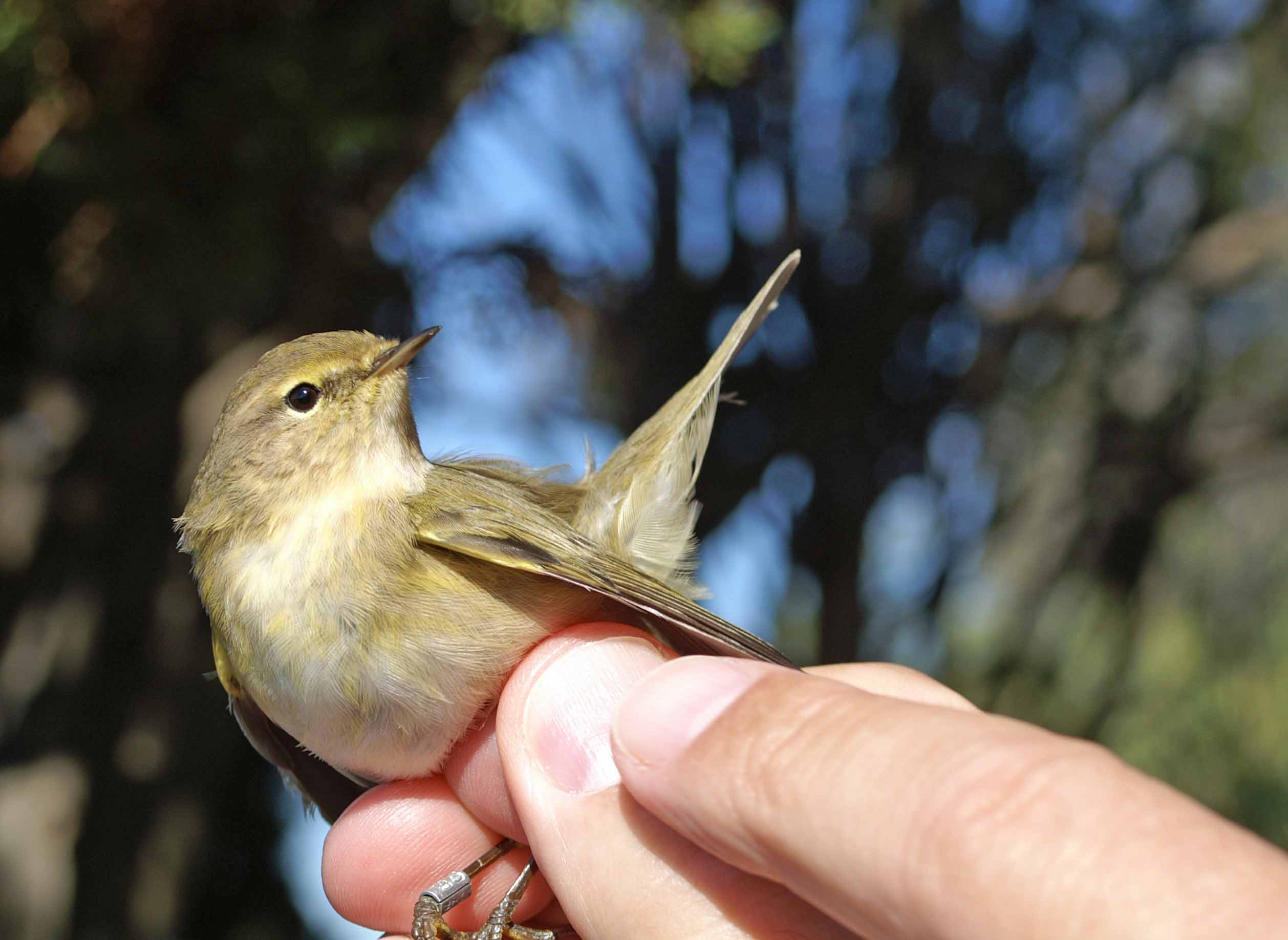
The chiffchaff is a small bird with olive green/brown upperparts, buff/off-white underparts becoming yellowish on the flanks and an off-white supercilium (eye-stripe). The beak is fine, generally dark and legs are always dark-coloured.

Habitat and breeding

The male Chiffchaff returns to his breeding territory two or three weeks before the female and immediately starts singing to establish ownership and attract a female. When a likely female is located, the male shows off his considerable aeronautical techniques, performing a slow butterfly-like flight as part of the courtship ritual. It is considered unlikely that chiffchaff select the same mate more than once, even though males and females return to the same areas each spring; but once a pair-bond has been established, any other females will be driven from the territory.

The birds’  favoured breeding habitat is open woodland with some taller trees and ground cover for nesting purposes. The preferred trees are typically at least 5 metres (16 ft) high and have an undergrowth that is an open, but consisting of a poor to  medium somewhat scrubby mix of grasses, bracken, nettles or similar plants.

The construction of the nest is carried out by the female who selects a site on or near the ground that is concealed amongst brambles, nettles or  other dense, low-growing vegetation. The outer layers of the nest are constructed from coarse materials such as dried grasses and leaves with inner layers woven of finer materials and finally an insulating layer of feathers. The nest is built in a domed shape with a side entrance and is typically 12.5 centimetres (5 in) high and 11 centimetres (4 in) across.

The male has little involvement in the nesting process, but he becomes  highly territorial during the breeding season and will fiercely defend his space against other males. Inquisitive and fearless, the feisty little male has been known to attack  even dangerous predators such as the stoat if they approach the nest, as well as large and notorious avian egg-thieves such as magpies and jays.

The chiffchaff is insectivorous, moving restlessly though foliage, constantly flicking the wings and tail, occasionally darting out to take insects on the wing. Its diet consists mainly of flies, along with other small and medium-sized invertebrates. It will take the eggs and larvae of butterflies and moths, particularly those of the Winter Moth.

After breeding has finished, this species abandons its territory, and may join small flocks including other warblers prior to migration. At this time the birds also go through a  prolonged and complete moult.  A newly fledged juvenile is browner above than the adult, with yellow-white underparts, but moults about 10 weeks after acquiring its first plumage. After moulting, both the adult and the juvenile have brighter and greener upperparts and a paler supercilium.

Etymology

The bird’s common English name is onomatopoeic, derived  from its simple and distinctive ‘chiff-chaff’  song. The Welsh common name is very similar, being ‘siff-saff’.

The binomial name, Phylloscopus collybita, is of Greek origin; Phylloscopus comes from phyllon, translating as ‘leaf’ , and skopeo ‘to look at’ or ‘to see’, presumably referring to the fact that the species spends most of their time feeding in trees, where they pick insects from leaves: collybita is a corruption of kollubistes, or ‘money changer’, with the song being likened to the jingling of coins.

September to March – Southern Spain

Although there is an increasing tendency amongst the species to winter in western Europe, well north of the traditional areas, especially in coastal southern England and the mild urban microclimate of London, the majority of chiffchaff  breeding in northern Europe migrate to the warmer climes of western and southern Europe, southern Asia and north Africa.

One of the joys of living in the south of Spain is to have the privilege of the company of some of the migratory bird species that breed in the north of the continent at the other end of their journey, during the autumn and winter months. Chiffchaff are one such species, arriving in great numbers from around the middle of September. Many are just passing through on their way to north Africa, pausing in their journey to take advantage of local feeding opportunities, but for others the area is their winter home and they can regularly be spotted in a wide range of habitats from gardens and woodland to reedbeds, scrubland and even on beaches where they are backed by  vegetation.

11/9/06-Chiffchaff on fennel plant picking off small insects; Manilva, Southern Spain

The appearance of newly arrived individuals often varies considerably; some have noticeably more yellow in their colouration, particularly in the underparts, but in general all appear sleek and well-fed.

October 09-A chiffchaff, most likely a juvenile. My garden, Sotogrande, Southern Spain

The behaviour of the birds outside the pressurised breeding season is quite different; in my garden they will readily leave the trees and cover of shrubs, venturing down  to pursue insects at ground-level. This is delightful to watch as they skip and flutter across the grass in an almost butterfly-like manner.

November - A particularly 'yellow' chiffchaff on the lawn in my Spanish garden

I have also been entertained by as many as 9 or 10 of the little birds at once that have perched on palm leaves then launched themselves off to pursue insects demonstrating their considerable aeronautical skills. Clouds of gnats are another target for them and they fly at the tightly packed circling insects, hovering in the air to pick them off.

They are keen bathers too, regularly using the bird bath in the garden as well as any available puddles. In shallow water they drench themselves, flicking and fluttering wings and tail, but if the water is too deep for them they flutter delicately across the surface, splashing themselves as best as they can. After their ablutions they sit on a nearby perch to dry themselves and preen meticulously.

30/1/08-Chiffchaff come to the birdbath regularly to drink and to bathe; Sotogrande, Spain

The local reserve, where an extensive reedbed backs the beach, is always  popular with chiffchaff . Many roost here amongst the reeds and use the area as a ‘staging post’ before making the relatively short flight across to North Africa. It is impossible to tell whether the birds you see regularly are on passage or here for the winter, but the spots I see them in are pretty consistent.

1/1/08 - Chiffchaff on Sotogrande beach, perched on debris washed up by a winter storm

Migration

The flow of migration is spread throughout the autumn months as birds in no particular hurry take feeding opportunities as and when they are presented along their route. Many of the birds leaving northern Europe at the end of August or beginning of September may not make the crossing to North Africa until November. Chiffchaff are amongst the most numerous birds to be caught and logged by ringers working at the bird observatory on the Rock of Gibraltar. The majority of those crossing the Strait to Africa on this route will have originated in Scandinavia, with maybe a few from Great Britain.

311011-A newly-ringed chiffchaff about to be released-bird observatory, Gibraltar

The return migration begins as early as January – the following is an extract from the gonhs recent records:

18 Jan:  After a few days with some heavy rain showers the weather cleared a bit but temperatures had dropped substantially and an influx of Chiffchaffs arrived on the Rock with many birds seen in the Botanic Gardens feeding on the nectar of flowering Aloes.

Iberian Chiffchaff

It would be remiss of me not to mention that Spain is also home to a similar but distinct species of chiffchaff, the Iberian Chiffchaff. This species breeds in Iberia and has been noted quite frequently on our outings with the Gibraltar Ornithological & Natural History Society, although most of us would confess that recognition is mostly on song and  known breeding areas.

P. ibericus, the Iberian Chiffchaff is brighter, greener on the rump, and yellower below than P. collybita and has a tit-tit-tit-tswee-tswee song.  This species is found in Portugal and Spain, west of a line stretching roughly from the western Pyrenees via the mountains of central Spain to the Mediterranean; the Iberian and Common Chiffchaffs co-occur in a narrow band along this line. Apart from the northernmost section, the precise course of the contact zone is not well documented. A long-distance migrant, this species winters in western Africa. It differs from P. c. collybita in vocalisations, external morphology, and mtDNA sequences. There is hybridization in the contact zone, almost always between male P. ibericus and female P. c. collybita, and hybrids apparently show much decreased fitness; hybrid females appear to be sterile according to Haldane’s Rule. Regarding the latter aspect, it is interesting to note that the Iberian Chiffchaff apparently is the oldest lineage of chiffchaffs and quite distinct from the Common Chiffchaff.(extract from wikipedia)

Share this:

  • Share on Facebook (Opens in new window) Facebook
  • Share on Pinterest (Opens in new window) Pinterest
  • Share on X (Opens in new window) X
Like Loading...

Spring greens

20 Friday Apr 2012

Posted by theresagreen in Local Nature Reserves, Nature, nature of woodlands, nature photography, wildflowers

≈ 2 Comments

Tags

common ash, dog mercury, eristalis pertinax, Fairy Glen, fern fronds, garlic mustard, horse chestnut, sycamore leaves, tapered drone fly, wild arum, woodland flowers, woodland wildflowers

Recent rainfall has given a boost to the growth of  new vegetation and in the woodlands fresh greenery, in a myriad of shades and forms abounds….

Perfect new leaves of Sycamore - Acer pseudoplatanus

Oak before ash, in for a splash

Ash before oak, in for a soak ..

Leaves of the Ash tree are breaking from their tight buds

Horse chestnut trees seem to be in differing stages of growth; some still have new leaves breaking from their ‘sticky-buds’, others are in full leaf , while yet others are flowering.

Horse chestnut leaves breaking from their 'sticky-bud'

A fully open horse chestnut leaf

Horse chestnut tree with flower buds

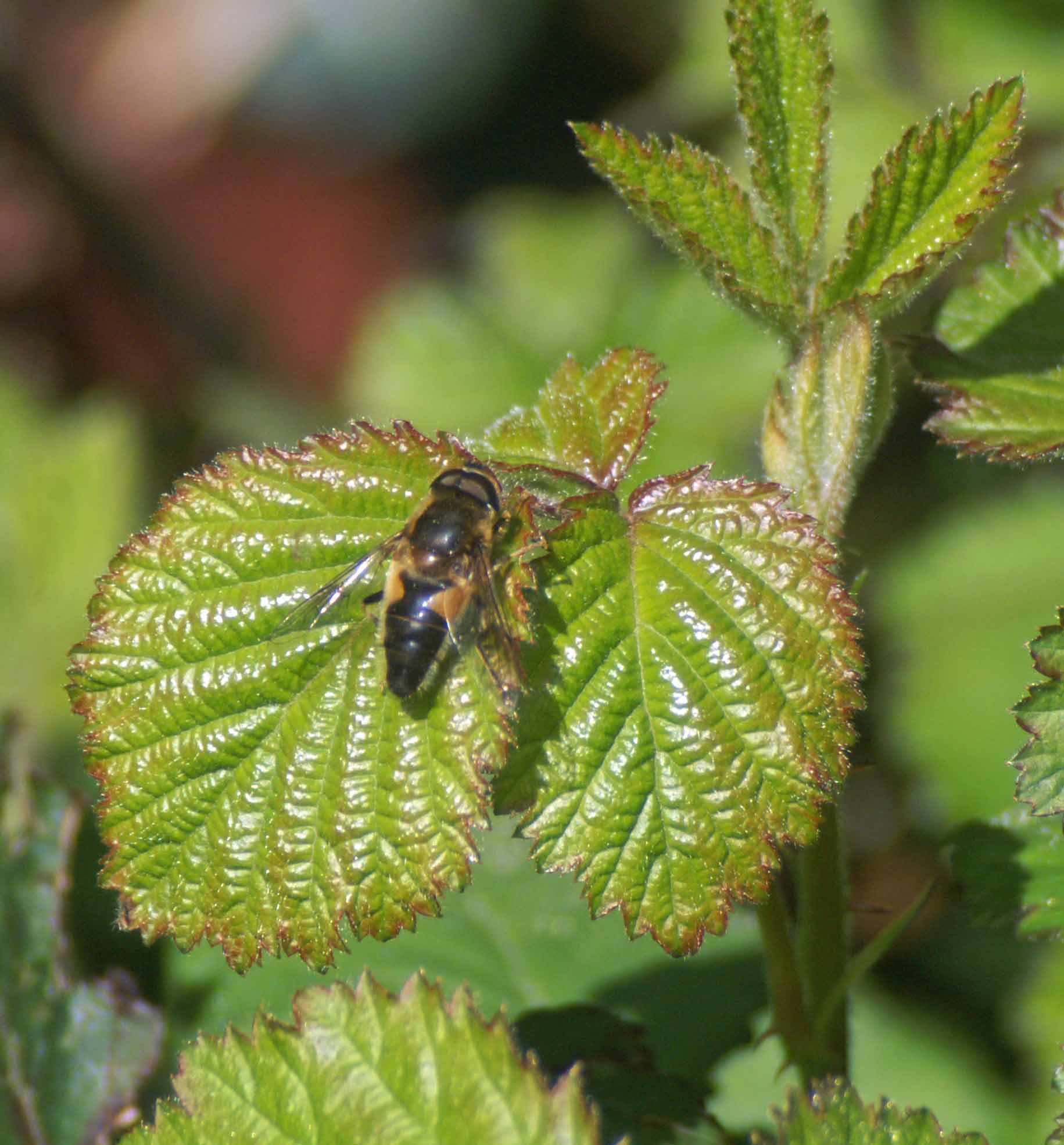
Eristalis pertinax -Tapered drone fly - basking on new leaves of bramble - rubus

A fern frond unfurling

Another 'garlicky' plant; Garlic mustard -Alliara petiolara is an erect herb of open woodlands and disturbed soil that has dark green, heart-shaped, scallop-edged, deeply veined, long-stalked basal leaves that grow up to 5" across. Leaves are a food plant of the Orange Tip butterfly larvae.

Garlic mustard flower buds
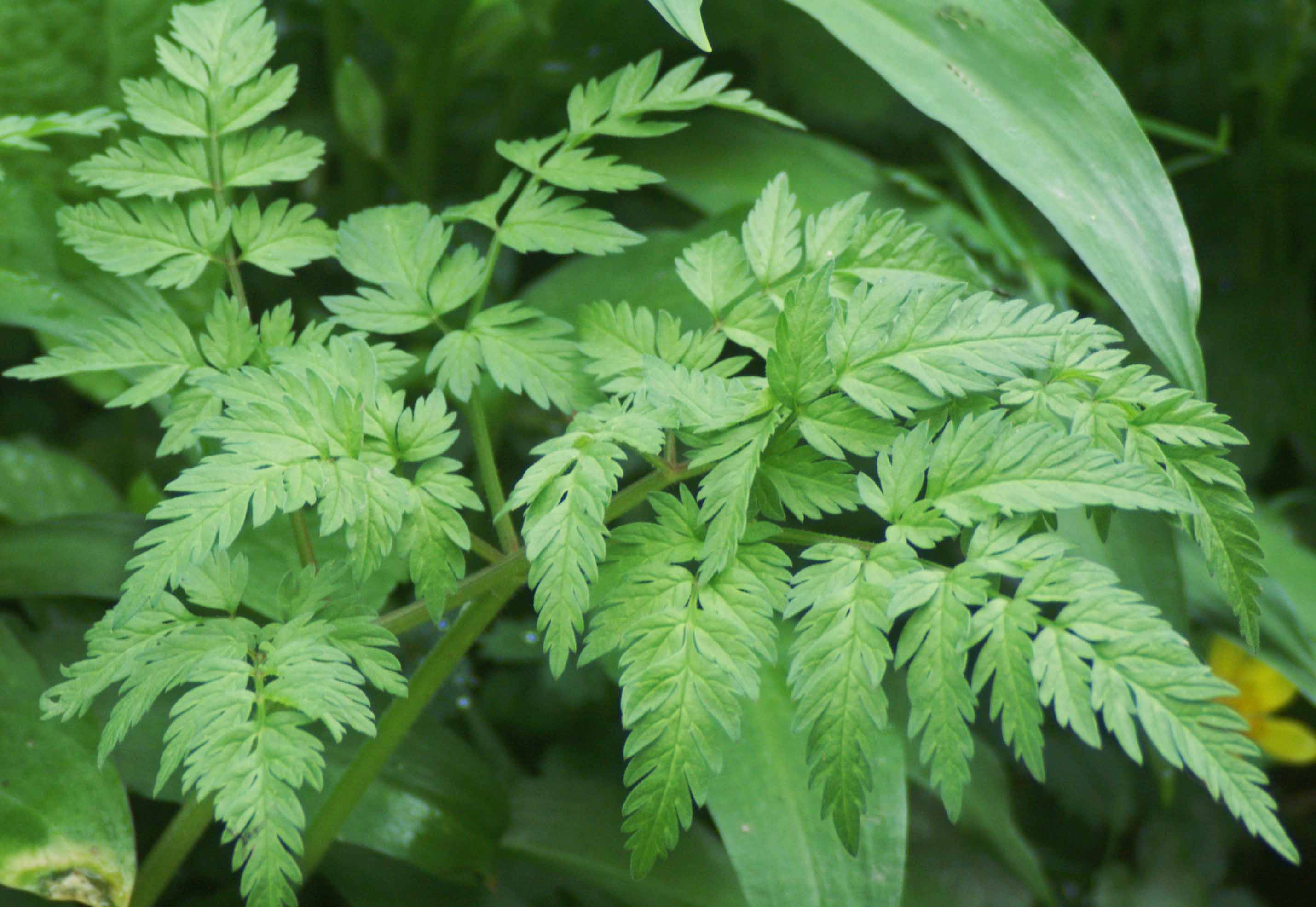
Ferny leaf of Cow parsley - Anthriscus sylvestris

Dog's mercury-mercurialis perennis

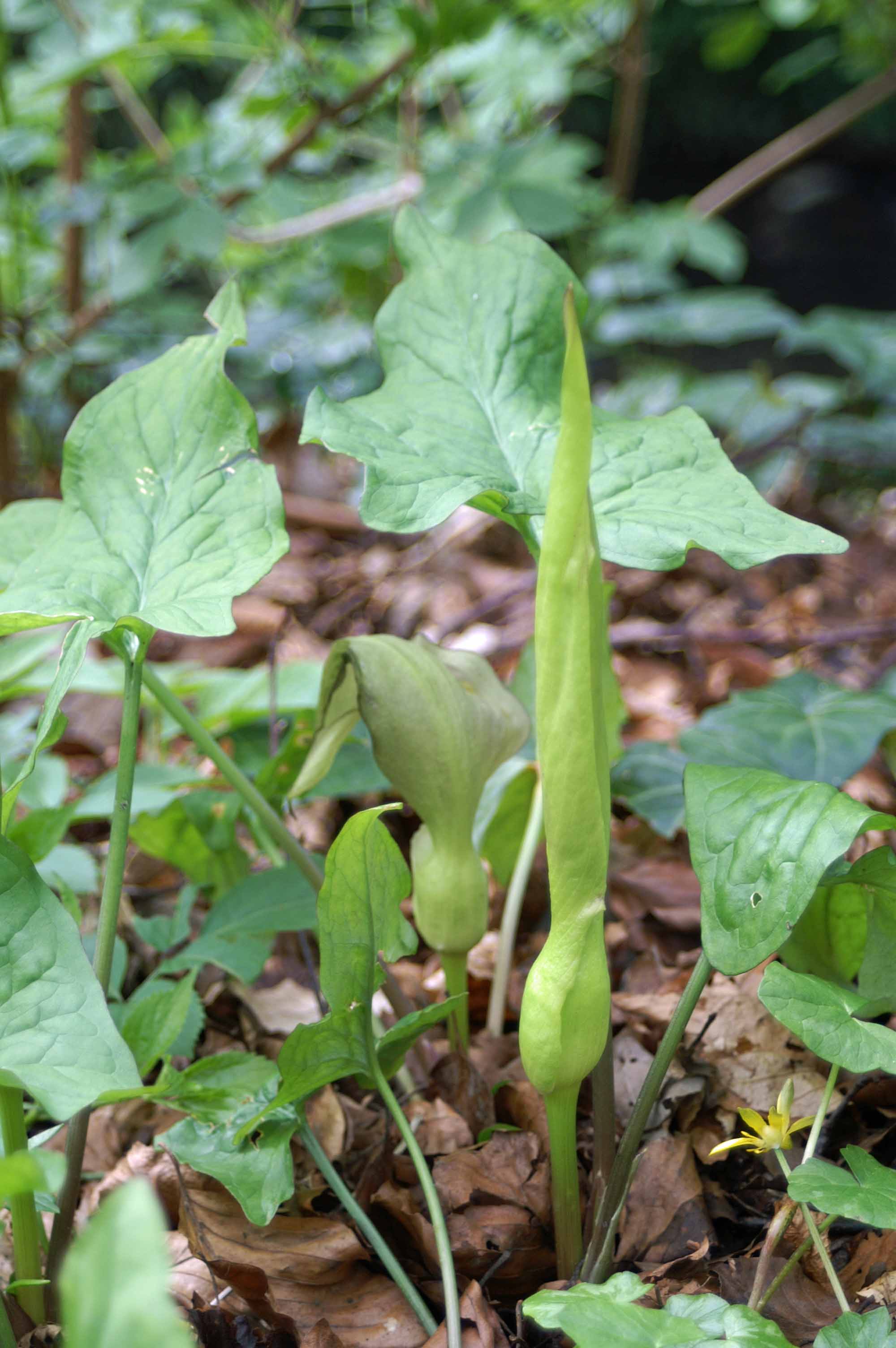
The furled green spathe of a wild arum (cuckoo pint, lords & ladies)

The green spathe unfurls to reveal the purple spadex

Share this:

  • Share on Facebook (Opens in new window) Facebook
  • Share on Pinterest (Opens in new window) Pinterest
  • Share on X (Opens in new window) X
Like Loading...
← Older posts
Newer posts →
Follow everyday nature trails on WordPress.com

Enter your email address to follow this blog and receive notifications of new posts by email.

‘But it is the common species that keep the living world ticking over and provide most of our experiences of wildlife, and I would argue that maintaining the abundance of these is as important a conservation priority as maintaining the existence of rarities’. Richard Mabey

MOST RECENT POSTS

  • A Glimpse of Spring to Come January 22, 2025
  • Hunting the Wren December 28, 2024
  • Oh, Christmas Tree December 18, 2024
  • In and Out of the Ivy February 15, 2024
  • Nature’s Fireworks November 30, 2023
  • Wild Autumn along the Coast Path November 3, 2023

OLDER POSTS

LOOKING FOR SOMETHING IN PARTICULAR?

  • Sights and Sounds from the Little Orme 1
    Sights and Sounds from the Little Orme 1
  • The Foxglove - of Fairytales, Myths & Medicine
    The Foxglove - of Fairytales, Myths & Medicine
  • Following a river to a Fairy Glen
    Following a river to a Fairy Glen
  • Butterflies and more rare treats
    Butterflies and more rare treats
  • May Bee Appearing on Ivy near You
    May Bee Appearing on Ivy near You
  • Shades, Sounds and Scents of the Woods
    Shades, Sounds and Scents of the Woods
  • A Windy Wildflower Trail - completion
    A Windy Wildflower Trail - completion
  • Pretty prickly Thistles
    Pretty prickly Thistles
  • Everyday Birds - The Blue Tit
    Everyday Birds - The Blue Tit
  • The Windhover
    The Windhover

nightingale trails

The Walk of the Monarch Butterfly-Sendero de la Mariposa Monarca

The Walk of the Monarch Butterfly-Sendero de la Mariposa Monarca

MY WILDFLOWER BLOG: where the wildflowers are

Snowdrop

Snowdrop

most recent posts

Follow everyday nature trails on WordPress.com

Social

  • View teresamaygreen’s profile on Twitter

Enter your email address to follow this blog and receive notifications of new posts by email.

Website Built with WordPress.com.

  • Subscribe Subscribed
    • everyday nature trails
    • Join 358 other subscribers
    • Already have a WordPress.com account? Log in now.
    • everyday nature trails
    • Subscribe Subscribed
    • Sign up
    • Log in
    • Report this content
    • View site in Reader
    • Manage subscriptions
    • Collapse this bar
 

Loading Comments...
 

    %d