• Home
  • about
  • about the photographs
  • Local Nature Reserves
    • Bryn Euryn Local Nature Reserve
    • Mynydd Marian
  • Wales Coast Path
    • Grey Seals in North Wales
    • St.Trillo’s Chapel
    • Wildflowers of North Wales Coastal Paths, Cliffs and Dunes

everyday nature trails

everyday nature trails

Category Archives: nature of woodlands

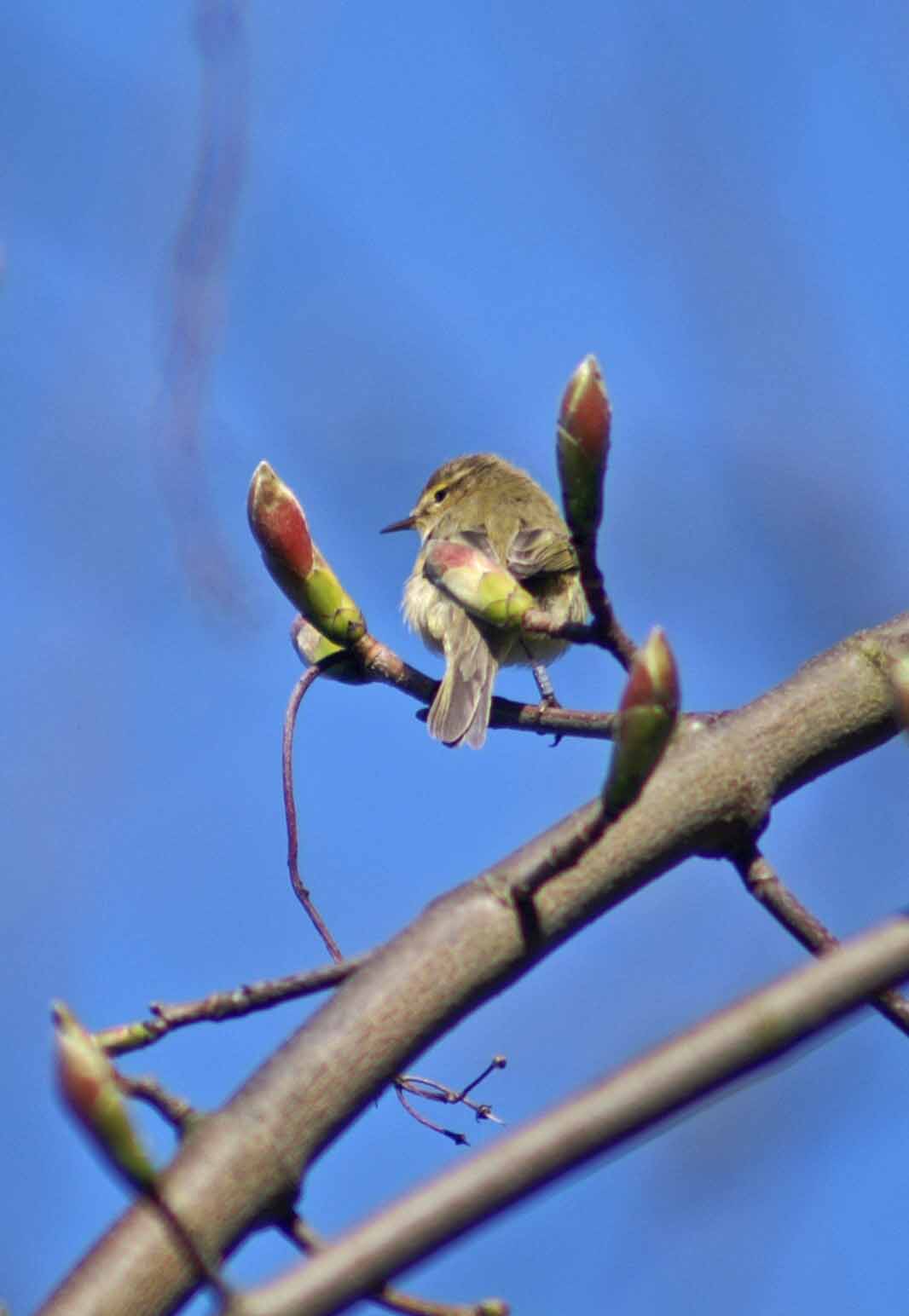
This is definitely a Chiffchaff

21 Sunday Apr 2013

Posted by theresagreen in nature of woodlands, nature photography, woodland birds

≈ Leave a comment

Tags

Chiffchaff, fall of migrating warblers, migrant birds, min-y-don, river Colwyn, willow warbler

Since writing the last post this morning I’ve been wondering and reading about chiffchaffs and willow warblers and thought it might be worth nipping back down to Min-y-Don to see if there might be any of those I saw on Friday still hanging around. To my surprise and delight there were little warblers everywhere, almost every tree had at least one amongst its twigs and leaf buds and there were birds darting out after flies all over the place. They are so mobile and active that counting them was not really an option, but there are a good many. That doesn’t make identifying them any easier, but what I will say is that there is definitely a mix of the two species, indisputably so after hearing songs from both this afternoon and the fact that they are still here must indicate that they are all finding plenty to eat.

When I came to look more closely at my photographs I spotted that the one below has a leg ring – anyone recognise it? The tag I mean, not the bird!

Chiffchaff or willow warbler between buds of a sycamore.

Willow warbler between buds of a sycamore. This bird is ringed, anyone recognise it?

Getting views of the birds is not a problem at all, as I said they are all over the place, but getting sight of an individual for more than a second or two is something else. They are not too bothered about people being around, one surprised me by popping up over the wall alongside the river right in front of me: it was chasing after a fly which I saw escaped, more’s the pity as it looked like a mosquito. 

I followed the path alongside the river and just the other side of the bend heard a chiffchaff singing very close by. I located it quite easily, on the branch of a tree quite surprisingly low down, but it moved away when it saw me. He didn’t go far though and reappeared on a branch overhanging the path with a good view over the water. He sang a few phrases, then suddenly dashed down to the water and swooped straight back up again with a sizeable fly in his beak.

The chiffchaff with his prize - a good-sized fly

The chiffchaff with his prize – a good-sized fly

He ate it and sat for a while longer before flying off over the river and the road to trees on the other side.

The chiffchaff after polishing off his meal. He certainly looks well-fed and healthy

The chiffchaff after polishing off his meal. He certainly looks well-fed and healthy

I don’t suppose they will be around in these numbers for much longer, but what a joy it has been to see them and I hope they all thrive throughout the rest of the spring and summer wherever they go.

Share this:

  • Share on Facebook (Opens in new window) Facebook
  • Share on Pinterest (Opens in new window) Pinterest
  • Share on X (Opens in new window) X
Like Loading...

An enchanting encounter with chiffchaffs (and/or willow warblers!)

21 Sunday Apr 2013

Posted by theresagreen in nature of woodlands, nature photography, woodland birds

≈ 7 Comments

Tags

Chiffchaff, fall of migrating warblers, leaf warblers, migrant birds, min-y-don, Phylloscopus collybita, phylloscopus trochilus, river Colwyn, willow warbler

Friday was a beautiful day and during my lunch hour I thought I’d take some photographs of dandelions, daisies and primroses which I wanted for the next blog I intended to write. There is a lovely grassy bank alongside the road I take back to work, which is currently smothered with gold and white wildflowers and just what I wanted, so I stopped alongside and got out of the car. But, as I opened the car door, I heard a chiffchaff calling from somewhere high up in a tree, a sound I have been waiting to hear this spring, so flowers were quickly forgotten and instead I walked down the hill towards the river and the trees of Min-y-Don listening and trying to work out where he was.

(This spot is just a stone’s throw away from the sea and the point at which the little River Colwyn runs into it and the area known as Min-y-Don is a remnant of the old woodland that used once to cover the whole area, so an oasis for resident and birds on migration with water and potential food.)

As I approached the footbridge over the river I spotted two small birds on the water’s edge that were perching briefly on overhanging plant stems then darting out and flitting over the water, clearly chasing after small flying insects. I have watched Chiffchaffs do this many times in Spain, both over water and from the tall palms in our garden there when they were fruiting and attracting insects there. The tiny birds are amazingly agile in the air and watching numbers of them performing their aerobatics was always magical and enormously entertaining. I know they were doing it to feed themselves, but I could never help feeling they were enjoying the chases and taking the opportunity to show off their skills to their companions; surely the amount of energy they put into the pursuits must have burnt off any calorific value they gained from the flies they actually managed to catch?

I digress, I know, but still being able to hear one as well, you can see why Chiffchaffs came to the front of my mind as soon as I saw them.

Taking a second to spot potential prey

Chiffchaff, or is it a willow warbler.

I attempted a few photographs of the birds in the very brief intervals they paused from their pursuits, one or two of which came out OK, but the more I looked at them through the long lens, the more I began to question my identification and to think they might actually be Willow Warblers. I think the problem arose from the fact that although I am very familiar with chiffchaffs, I am not so au fait with willow warblers, something I clearly need to sort out.

KONICA MINOLTA DIGITAL CAMERA

On the point of take off

I enjoyed watching these two birds for several minutes before they were joined there by the footbridge by another, then another, then another two. I realised then that I must have happened upon a little flock of migrants that were taking the opportunity to ‘fuel up’ before continuing their journeys to their breeding places. I was already more than happy with this encounter with the birds, so when I walked further along the footpath to where it bends around to follow the river’s edge and saw even more, I was delighted. It’s at times like this when you wish you had someone with you to share the experience, so you could stand or walk along in a public place clutching a camera with a long lens and smiling without feeling self-conscious. And so you have someone to confirm or offer alternative suggestions to your identification of tricky warblers. I guess that is why we blog- I would definitely appreciate opinions on this one, especially the first photograph.

A sunlit Willow Warbler

A sunlit Willow Warbler. This bird’s front is much paler and ‘cleaner’ and it has pink legs.

Willow warbler perched on stems overhanging the river

Willow warbler perched on stems overhanging the river

This stretch of the river was lit by the sunshine and benefits from having trees closer to its edge as well as plenty of other perching points for the fly-catching warblers. I’m not sure if it was the better light here or just something about the general appearance of the birds, but I was more or less certain straight away that these were not chiffchaffs, so willow warblers then. These two species can be easily confused when based on appearance only, in fact the one diagnostic I remember is to look at the legs, the willow warbler’s are usually, but not always flesh-coloured, while the chiffchaff’s are darker.If only one of them had stopped to sing it would have made things easier, but no. I know mixed flocks of birds do migrate together, but do these two species join up and travel together?

KONICA MINOLTA DIGITAL CAMERA

Willow Warbler-Phylloscopus trochilus

Points of difference:

Chiffchaff – Phylloscopus collybita

Less tinged green and yellow than willow warbler; legs & feet always dark. Bill is also dark. The supercillium is drab and there is a distinct crescent under eye. Wings are also shorter than willow warbler’s.

Willow Warbler – Phylloscopus trochilus

The commonest warbler over much of northern Europe. Underparts are tinged yellow, especially in juveniles. Legs may be dark brown to flesh-coloured. Supercillium is fairly prominent and longer and there is a bright lower eye crescent. Wing feathers are longer than those of chiffchaff.

KONICA MINOLTA DIGITAL CAMERA

I deliberately haven’s zoomed in on this bird to give more of a sense of scale; these birds are tiny

I posted a blog about Chiffchaffs around this time last year, which contains a lot more information, see it at  https://theresagreen.wordpress.com/2012/04/26/bird-study-a-chiffchaffs-year/ or just click on April 2012 in the ‘older posts’ to find it from here.

Share this:

  • Share on Facebook (Opens in new window) Facebook
  • Share on Pinterest (Opens in new window) Pinterest
  • Share on X (Opens in new window) X
Like Loading...

From blustery beach to sheltered woods

17 Wednesday Apr 2013

Posted by theresagreen in Colwyn Bay, nature of woodlands, woodland birds

≈ Leave a comment

Tags

blackbird, coal tit, coastal birds, Collared Doves, dunnock, Fairy Glen, herring gull, magpie, wood pigeon

I had driven along to Colwyn Bay to have a closer look at the beach-building, not because I am lazy, more to do with there being a bitterly cold wind blowing with too few  compensating warm sunny intervals to make it a pleasant place to be. I did stop for few minutes though and bought a mug of tea from one of the snack shacks to warm me up a bit while I stood perusing the beach, which I’m glad I did. Over the last few days I have spotted a few small flocks of small birds flying in across the sea and there were more as I watched then; finches by their up and down bouncy flight and I’m pretty sure goldfinch by the contact calls they were making. I never have binoculars when I need them, which was a shame today as I also had sights of incoming house martins; fortunately very close ones, so no doubts there. There’s nothing like the first sight of these amazing little migrants, it is always uplifting and hopeful.

As I drank my tea I was entertained by a courting couple of herring gull, both looking bright eyed and beautiful in immaculate plumage and freshly coloured beaks.

Herring gull pair bonding

Herring gull pair bonding

Female begging for food

Female begging for food

She was quite insistent but he was not sharing

She was quite insistent but he was not sharing

A nice pose from the pair showing the difference in sizes

A nice pose from the pair showing the difference in their size

One of the best aspects of living here is that within a very short time and distance you can move into a completely different environment, so as I was close by I headed up to Fairy Glen to seek out some wildlife in the shelter of its trees. As I’ve said before this small local nature reserve within the bounds of Old Colwyn village can be a bit scruffy when viewed through human eyes, but the presence of the fast-flowing stream of water and a well-established variety of trees, shrubs and woodland plants combine to make this the perfect oasis for an impressive number of woodland bird species as well as those that have learned to live amongst people.

First to attract my attention was a Collared Dove that was pottering around on the ground by the side of the river before fluttering down onto a rock to take a drink. There are usually a pair of these pretty doves here, but as there was just the one today I hope the other was sitting on a nest.

A collared dove on a rock in the river

A collared dove on a rock in the river

Next to come into view was a pair of magpie, which I had never seen actually within the woodland before. This is another opportunistic bird species that gets bad press and is not much liked by a lot of people, but they are elegant birds, strikingly handsome in appearance and in common with most members of the crow family, clever and characterful.

One of a pair of magpie on the handrail of the walkway

One of a pair of magpie on the handrail of the walkway

KONICA MINOLTA DIGITAL CAMERA

A wary wood pigeon taking a drink

There were numerous blue tits out hunting for food, minutely examining twigs and leaf buds for insects as they do. Blue tits have the inexplicable knack of timing their egg-laying to coincide the hatching of their young with the emergence of caterpillars. This cold but rather dry spring may well have set them back by a few weeks this year; I have only seen one butterfly so far this spring. There were great tits too, in lesser numbers as always, and I was pleased to see a coal tit, always one of my ‘target’ birds here and generally to be spotted in the same spot, close by to where there are a number of large conifer trees, some type of cypress, maybe overgrown leylandii.

A dunnock drying itself off after taking a dip

A dunnock drying itself off after taking a dip

I heard several birds singing, blackbird, robin and wren most frequently and one short and sweet tune of a dunnock. I spotted a dunnock bathing in shallow water at the edge of the ditch that runs along the side of the footpath and collects run-off water from the high bank above it. It flew into some brambly scrub to dry off and sat for some minutes shaking water from its feathers and preening them back into shape.

There were some wildflowers to be seen, lesser celandines, one or two wood violets, a single stem of kingcups on the boggy part of the riverbank and on a sheltered bank under the trees, the first primroses.

I had been looking out for grey wagtails; I know they have returned as I’ve seen them around the houses in the vicinity of the lower end of the river, so on my way back to the car I walked along the lower end of the river down to where it flows into the sea. Although I was watching for them, the grey wagtails saw me first and took off from the water up and away. At least I saw them, if only briefly. To compensate though I heard a bird ‘singing’ that I didn’t immediately recognise and traced it to a large evergreen tree; I could see several small birds, I think four, that I first took to be blue tits feeding in the top of the adjacent tree, but they and the singer were coal tits.

A coal tit feeding at the top of a tree

A coal tit feeding at the top of a tree

I think perhaps my favourite sight of the day though was of crow attempting to pick twigs from a small tree. It was having big problems trying to balance on the slender branches and despite valiant efforts the twigs were too well attached to snap off easily, but fair play to the bird it kept on trying.

The precariously balance crow trying its best to break off a twig

The precariously balance crow trying its best to break off a twig

Share this:

  • Share on Facebook (Opens in new window) Facebook
  • Share on Pinterest (Opens in new window) Pinterest
  • Share on X (Opens in new window) X
Like Loading...

Snowdrops at Chirk Castle

13 Wednesday Mar 2013

Posted by theresagreen in flower folklore, Nature, nature of woodlands, wildflowers

≈ 10 Comments

Tags

Chirk Castle, National Trust, snowdrop, snowdrop displays, woodland flowers

I know it has been an age since I published my last post, but too many other things have needed my attention and something had to give. I have been keeping an eye on things though and taking comfort from the fact that while we fill our lives with complications, nature is much more straightforward and the seasons’ events have unfolded as they should, without fuss. It would be fair to say that any posts I might have made would have been very similar to those from last winter, so I’ve been thinking how I can make this year’s a bit different.

I’ve done a fair amount of travelling this winter, making the train journey from Colwyn Bay down to Leicester and back again several times. It is a long journey, taking about 4 hours each way to complete, but the route is interesting, and takes you through some wonderful scenery. I have become intrigued by some of the places the train stops at or passes through, so I thought I might try to visit some of them this coming year and find out a bit more about them and their surrounding area. I joined the National Trust last autumn too and would like to get as much as possible from my membership, so as there is a rich variety of Trust properties around this England/Wales border country, that should not be too difficult, providing I can find the time to make the trips. 

One of the station halts is at Chirk, which I knew to be famous for its castle, but there my knowledge ended. It has a nice little station that is dwarfed by and juxtaposed with an enormous wood-processing plant whose chimneys belch out great streams of  thick white steam, or is it smoke? Now to go off at a bit of a tangent, I was researching places where I might find a good display of Snowdrops and by a happy sort-of coincidence, it happens that there is such a thing in the gardens surrounding Chirk Castle, that is owned by the National Trust and is within reasonable driving distance of here so a visit there would tick off at least three of my boxes in a single day. The Snowdrops would be at their best in February, so that gave impetus to making the effort, which is what is needed sometimes, especially in the winter.

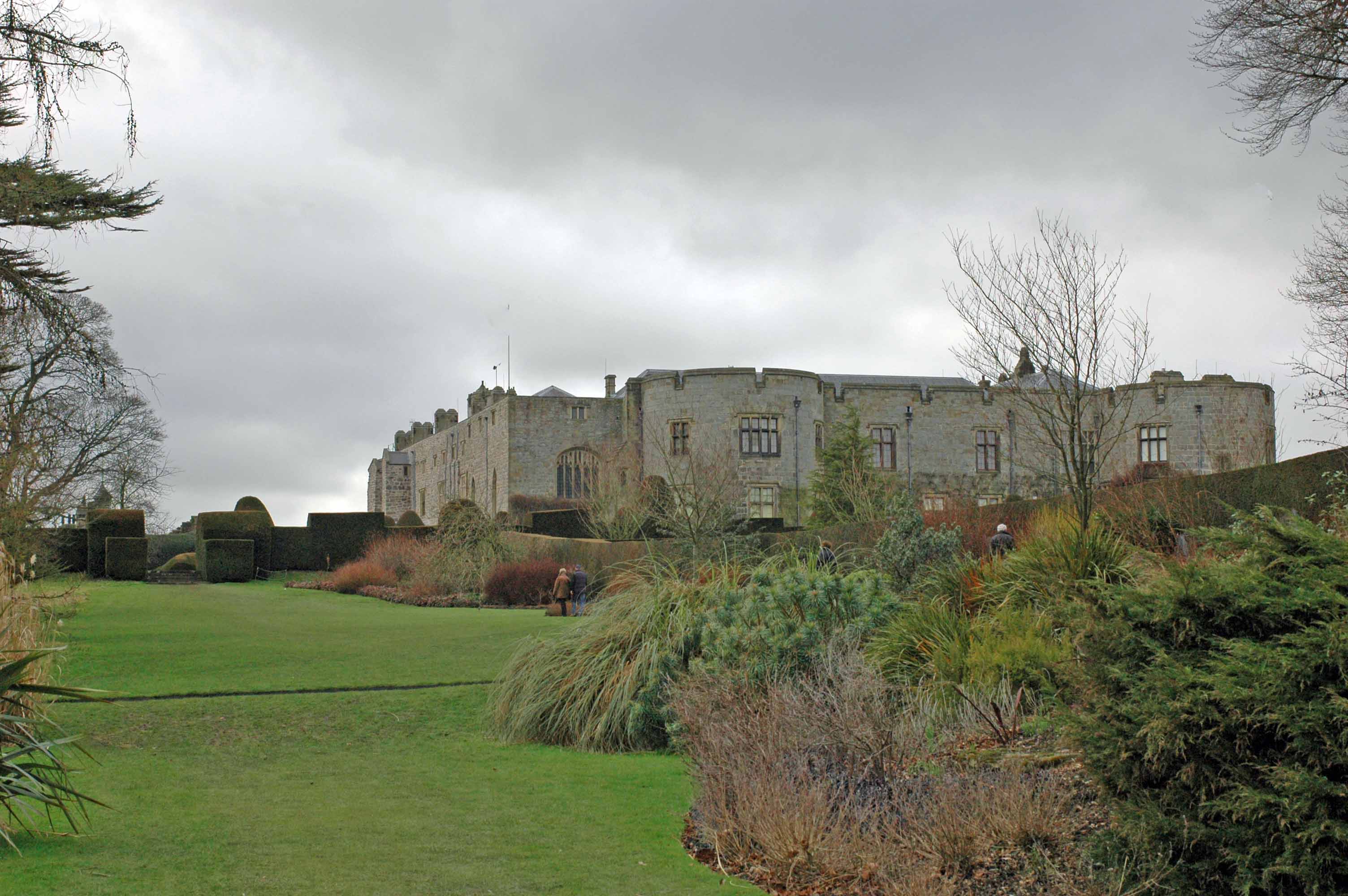
Chirk Castle from the gardens

Chirk Castle from the gardens

Completed in 1310, Chirk is the last Welsh castle from the reign of Edward I that’s still lived in today. Features from its 700 years include the medieval tower and dungeon, 17th-century Long Gallery, grand 18th-century state apartments, servants’ hall and historic laundry.

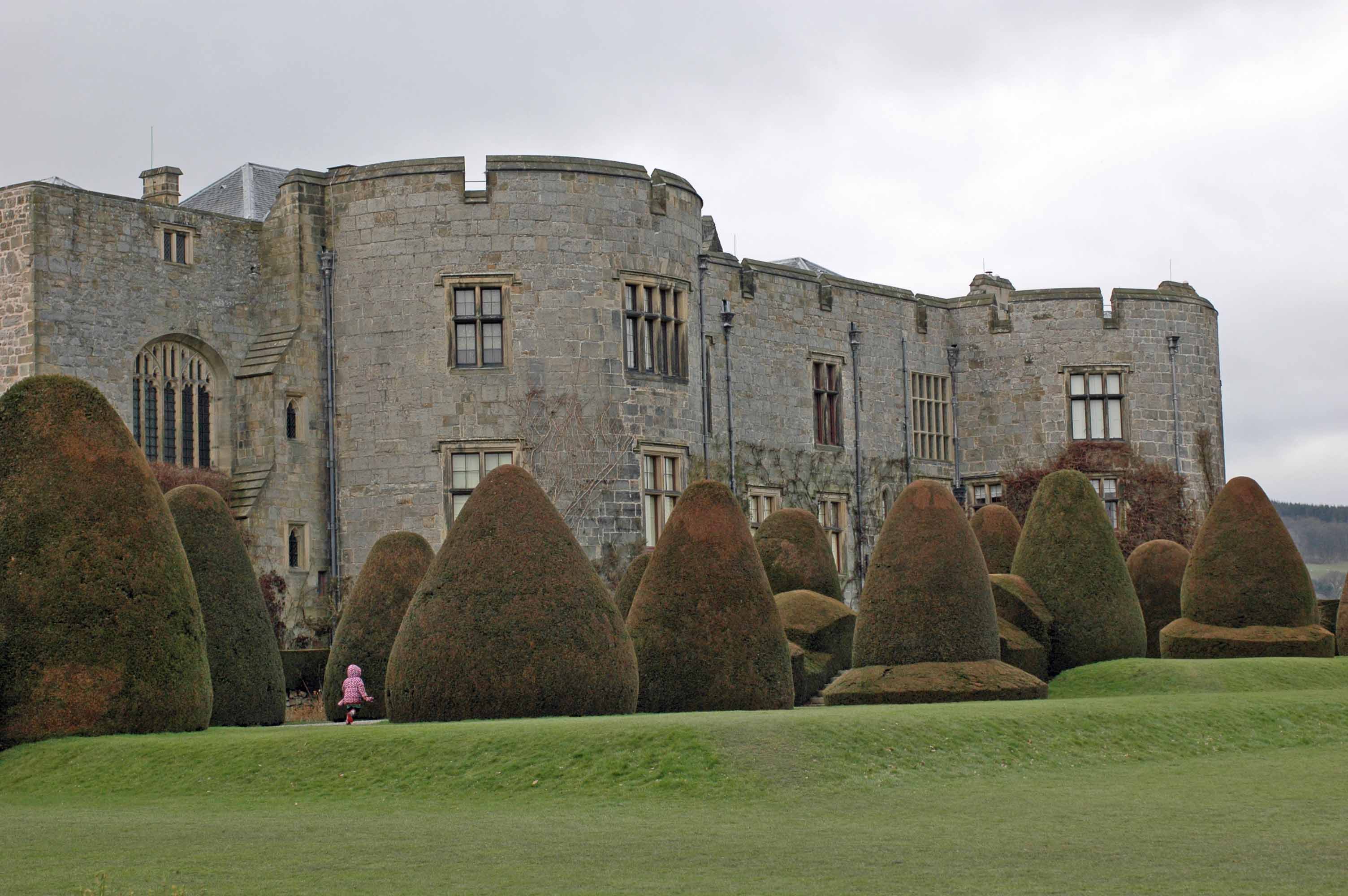
The gardens feature beautifully clipped yews

The gardens feature beautifully clipped yews

The award-winning gardens contain clipped yews, herbaceous borders, shrub and rock gardens. A terrace with stunning views looks out over the Cheshire and Salop plains.

Part of the extensive clipped yew hedge with woodland beyond framing the breathtaking views

Part of the extensive clipped yew hedge with woodland beyond framing the breathtaking views

We had a look around the parts of the castle that were open today, had a pleasant lunch, de rigeur when visiting a National Trust property with one’s other half who would prefer to be at home watching the football on a Saturday afternoon, then headed for the gardens. The Snowdrops were beautiful, well worth the effort to go to see.

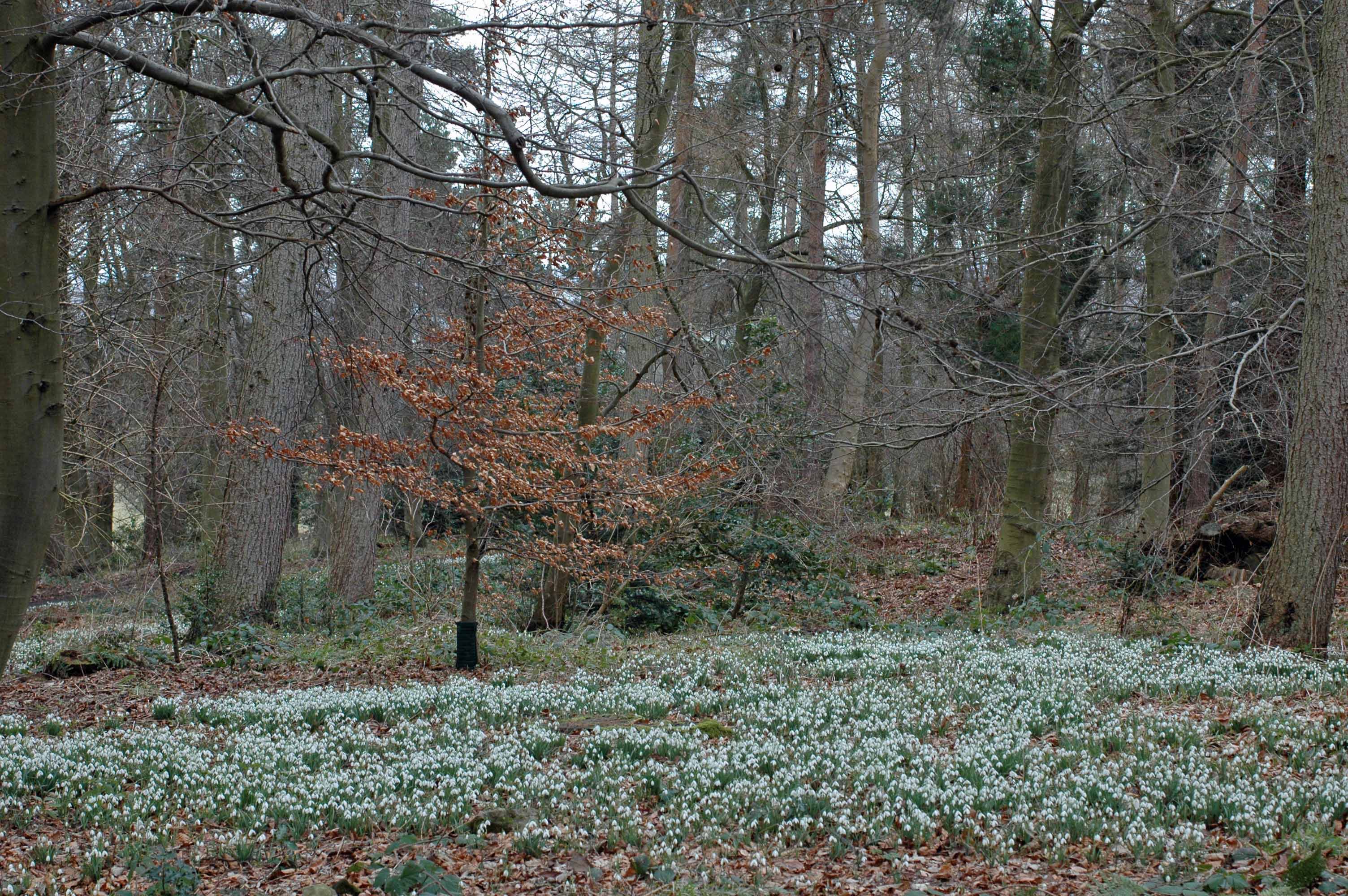
A carpet of Snowdrops beneath the trees

A carpet of Snowdrops beneath the trees

A beautiful sight

A  closer view of a beautiful sight

Reflections

Snowdrop reflections

Sheltering amongst tree roots

Sheltering amongst tree roots

Snowdrop 

Snowdrops are iconic flowers that traditionally herald the ending of winter and are surely too well known to need a description.

Scientific name: Galanthus nivalis L.

Conservation status: Rated as Near Threatened (NT) according to IUCN Red List criteria.

Origin of botanical name: From Greek, gala, milk and anthos, a flower; nivalis, snowy

Other common names: Candlemas bells, Mary’s taper, Snow-piercer, February fairmaids, Dingle-dangle

Snowdrop-Galanthus nivalis

Snowdrop-Galanthus nivalis

Flowering : February to March

Habitat: On the European continent Snowdrops grow in wild habitats, in damp woods and meadows up to 1,600 metres; the leaf tips are specially hardened for breaking through frozen ground. In Britain, Snowdrops are possibly both native and naturalised and were not recorded as growing wild here until the 1770s. It is very likely that many of our colonies of wild Snowdrops originated with ecclesiastical plantings. The pure white blooms of the Snowdrop have long been accepted by the Catholic Church as a symbol of Candlemas, celebrated on February 2nd, the Feast of the Purification of the Virgin Mary, and their association with monastic sites is apparent right across Britain.

Folklore

Although the flowers are sanctified for Candlemas, the snowdrop is one of the many white blossoms that are still regarded as being unlucky if brought into the house. In parts of Northumberland, Westmorland and Hampshire, single flowers particularly are still viewed as ‘death-tokens’. This may be as one Victorian explanation was that the flower “looked for all the world like a corpse in its shroud”. According to the ‘language of the flowers’, the snowdrop was an emblem for virginity, and a few blooms enclosed in an envelope were often used to warn off over-ardent wooers. In a similar vein, in Yorkshire there was an old custom, again celebrated on Candlemas, for village maidens to gather bunches of snowdrops and wear them as symbols of purity. (extracts from Flora Britannica, Richard Mabey)

Key uses

Ornamental. Medicinal. Insecticide.

The alkaloid Galantamine, which was initially isolated from snowdrops, has been used in treatments for Alzheimer’s disease, neuritis and neuralgia. In parts of eastern Europe, rubbing snowdrops on the forehead was a folk remedy used for pain relief.

Known hazards: Snowdrops and their bulbs are poisonous to humans and can cause nausea, diarrhoea and vomiting if eaten in large quantities.


Share this:

  • Share on Facebook (Opens in new window) Facebook
  • Share on Pinterest (Opens in new window) Pinterest
  • Share on X (Opens in new window) X
Like Loading...

Willsbridge Mill, Bristol

12 Friday Oct 2012

Posted by theresagreen in Local Nature Reserves, Nature, nature of woodlands, nature photography, woodlands

≈ 4 Comments

Tags

ash keys, catscliffe woods, dark bush cricket, feather moss, haws, red berries, siston brook, spider's webs, willsbridge mill, woodland walks

I am currently staying in Bristol with my son and family, and as they always do when I am here, they make great efforts to take me out to places they know that both I and the children will enjoy.

Avon Wildlife Trust takes responsibility for 35 reserves within the Avon area, with a good few clustered closely around the city.

On Sunday we drove out to Willsbridge Mill, a Local Nature Reserve, which the website describes as  ” Set in a peaceful valley on the edge of Bristol, Willsbridge Mill is an impressively restored 19th Century Corn Mill and Long Barn, located within a stunning 22 acre nature reserve.” It continues ” This green oasis, which was once a bustling industrial site, now supports an amazing array of wildlife habitats – woodland, ponds, meadows, scrub, quarries and a demonstration wildlife garden, running along the fast – flowing Siston Brook. The reserve is home to kingfishers, dippers, owls, foxes, badgers, and bats.”

Dragonfly plaque

After several days of rain and general dampness, the ground in the wildlife garden was soggy and its plants bedraggled, there were a few pond skaters skimming over the surfaces of the ponds and a robin piping a few phrases of song, but apart from that there was little movement.

One of the trails around the reserve is the Sculpture Trail, which features ” striking environmental sculptures made from local materials”. There is also a sequence of attractive brass leaf-shaped plaques bearing different designs, which today were the only indicators of the wildlife that frequents the reserve in spring and summer.

Leaves are beginning to change colour and fall

The Ash tree – Fraxinus excelsior, bears its large single-winged seeds – also commonly known as keys, in large bunches

We followed the pathway to Hawthorns are laden with good crops of haws, but there were no signs of these particular ones being eaten yet.

Haws – the fruits of the Hawthorn

On the wooded side of the pathway, on a bramble leaf in a patch of sunshine a Dark Bush Cricket sat having a meal.

Dark Bush Cricket – Pholidoptera griseoaptera

The Dark Bush cricket is a common animal across the southern half of England, occurring in gardens, hedgerows and on woodland edges, where they can often be seen in quite large numbers sunbathing on bramble patches. Males are very aggressive, fiercely defending their territories against intruders. Females lay their eggs in late summer in rotting wood or bark crevices; the young crickets emerge 18 months later, so odd-year and even-year dark bush-crickets never meet.

Bramble festooned with gauzy spiders’ webs – a classic feature of damp autumn days

The pathway through Catscliffe Woods

Common Feather- moss-Kindbergia praelonga growing on a tree trunk

The stream that flows through the woodland is Siston Brook; it flows fast here and its energy once powered Willsbridge Mill’s water wheel. The stream rises five miles away at St. Anne’s Well, just south of the village of Siston and is a tributary of the River Avon, joining it at Londonderry Wharf, near Keynsham.

A fallen tree spanning the brook

A tree has fallen on one side of the stream bank arcing gracefully over the water to form a natural bridge. It has continued to grow, pushing out branches that now grow vertically from the original trunk; those that touch the ground have probably put down roots and appear to be growing as independent trees.

Steps lead temptingly to a higher woodland trail

Share this:

  • Share on Facebook (Opens in new window) Facebook
  • Share on Pinterest (Opens in new window) Pinterest
  • Share on X (Opens in new window) X
Like Loading...

A hill not too far – part 2

21 Friday Sep 2012

Posted by theresagreen in Bryn Pydew, butterflies, Limestone Pavement, Nature, nature of woodlands, nature photography

≈ 6 Comments

Tags

common blue, dropwort, filipendula vulgaris, juniper, limestone pavement, Meadow Brown, scabious, scarlet pimpernel, small tortoiseshell, taxus baccata, wildflowers and insects, yew

Limestone Pavement

Limestone pavement is very scarce and only covers 2600ha in Britain, but it is a habitat with a high geological interest. The following is an extract from the Limestone Pavement Conservation website: http://www.limestone-pavements.org.uk/geology.html which explains their formation much better than I could, so I am quoting it here:

“The formation of limestone pavements in the UK and Ireland began with the scouring of the limestone by glaciers during the last ice age. The weight of the ice removed the soil that lay over the limestone, and also fractured the limestone along existing horizontal surfaces of weakness known as bedding planes. Fractured rocks were stripped away leaving level platforms of limestone on which a thick layer of boulder clay (glacial till) was deposited as the glaciers retreated. Wind blown material was then deposited on top of the boulder clay. This external material is particularly important for soil formation, as limestone does not weather down into soil which would mean if there had been no glacial deposits, there would have been no soil development. From the flat limestone surfaces, the characteristic features of limestone pavement have been formed by water in the glacially deposited soil exploiting cracks and fissures in the rock.”

Part of the limestone pavement at Bryn Pydew (my photograph)

On the website linked above there is a lot more information, including a photograph taken here, labelled ‘Sheltered wooded pavement’. under the heading ‘flora’.

I had a potter around the rocky pavement and found a few little plants still flowering, but it is a bit late in the season for most species of the wildflowers that could potentially be found here to be blooming, so I will have to come back in the spring for another look.

Scarlet Pimpernel – Anagallis arvensis

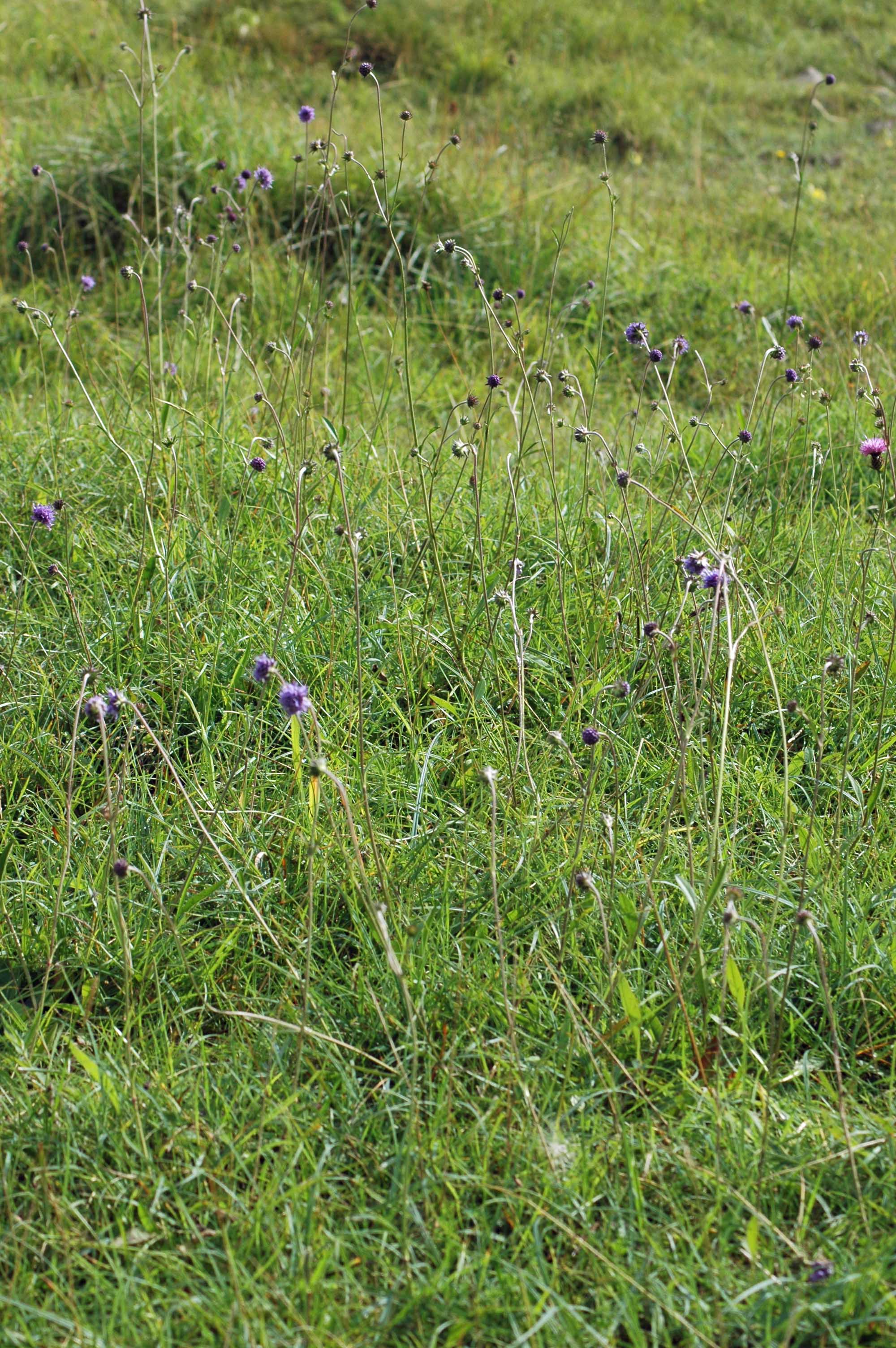
Below the pavement, loose gravelly ground slopes away and merges into a grassy area. Following recent rainfall shallow streams of run-off water were trickling down, making the bare ground muddy and the grassy area quite marshy, so any plants here would be well watered. There were some pretty groups of scabious, (not sure which species) flowering here, that were proving of great interest to a variety of insects including several species of hoverfly and a few butterflies.

Scabious is still flowering strongly

Common Blue (f)-Polyommatus icarus

A Common Drone Fly-Eristalis tenax- on scabious giving a better view of the pretty flower

Meadow Brown

During the time I was here I had the whole place to myself and as I was muddling around I suddenly realised that there were  sizeable chunks of time when there was absolute peace and quiet. Not a single sound from a bird, a car, a plane, an animal or a person. It was so blissful I had to sit down on a rock to better enjoy it together with the wonderful views across to the hills  in front of me and Penrhyn Bay, the sea and the Little Orme beyond.

The view over the treetops to Penrhyn Bay and the Little Orme (click to enlarge)

My peaceful reverie was suddenly broken by intermittent rather muffled but quite loud voices. I thought at first that it must be people that had arrived to picnic somewhere close by as the level of the sound didn’t change as it would had they been walking around. Then the penny dropped; what I was hearing was the disembodied commentary from the ‘fun dog show’ just down the road in the village hall. It was a breezy afternoon too which meant the instructions being delivered, amplified by a PA system being used none too expertly, were probably clearer to me half  a mile away than they were to the dog owners. It amused me to picture the scenes from the little village hall and hoped dogs and owners really were having fun.

There are some interesting trees and shrubs growing around the perimeter of the pavement area, including two of our three British native conifers, juniper and yew. Juniper is now a threatened plant species in Britain. Plantlife have warned that it is  in serious trouble  in Britain and with some southern counties having lost 70 per cent of their populations, the species is facing extinction across lowland England within 50 years. The loss of juniper would represent more than the loss of a single species – it supports more than 40 species of insect and fungus that cannot survive without it.

Juniper shrub

Junipers have been part of Britain’s landscape for thousands of years, and were one of the first trees to colonise Britain after the last Ice Age. Their aromatic berries are used in cooking and medicine, and are the key ingredient of gin.

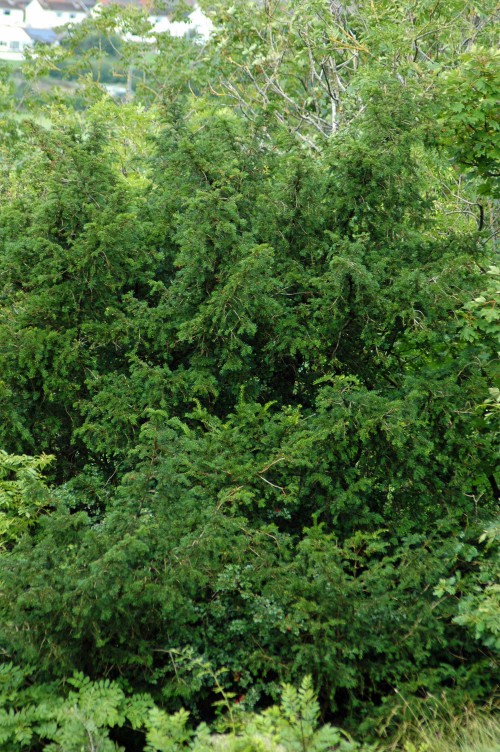
I have mentioned already that there were yew trees growing in the woodland, but this one out in the open was easier to photograph.

Yew-taxus baccata

Yew–Taxus baccata; Welsh: Ywen

Native to Britain and Ireland, the evergreen coniferous yew tree tolerates a wide range of conditions including the dense shading of woodland. It often grows singularly in woods but in groves elsewhere. It has long been planted in parks, gardens and has a long association with churchyards.

The leaves are highly toxic, as too is the seed inside the red berries owing to the presence of toxicantin and consuming as little as 50 to 100 grams of chopped leaves would be fatal to an adult.

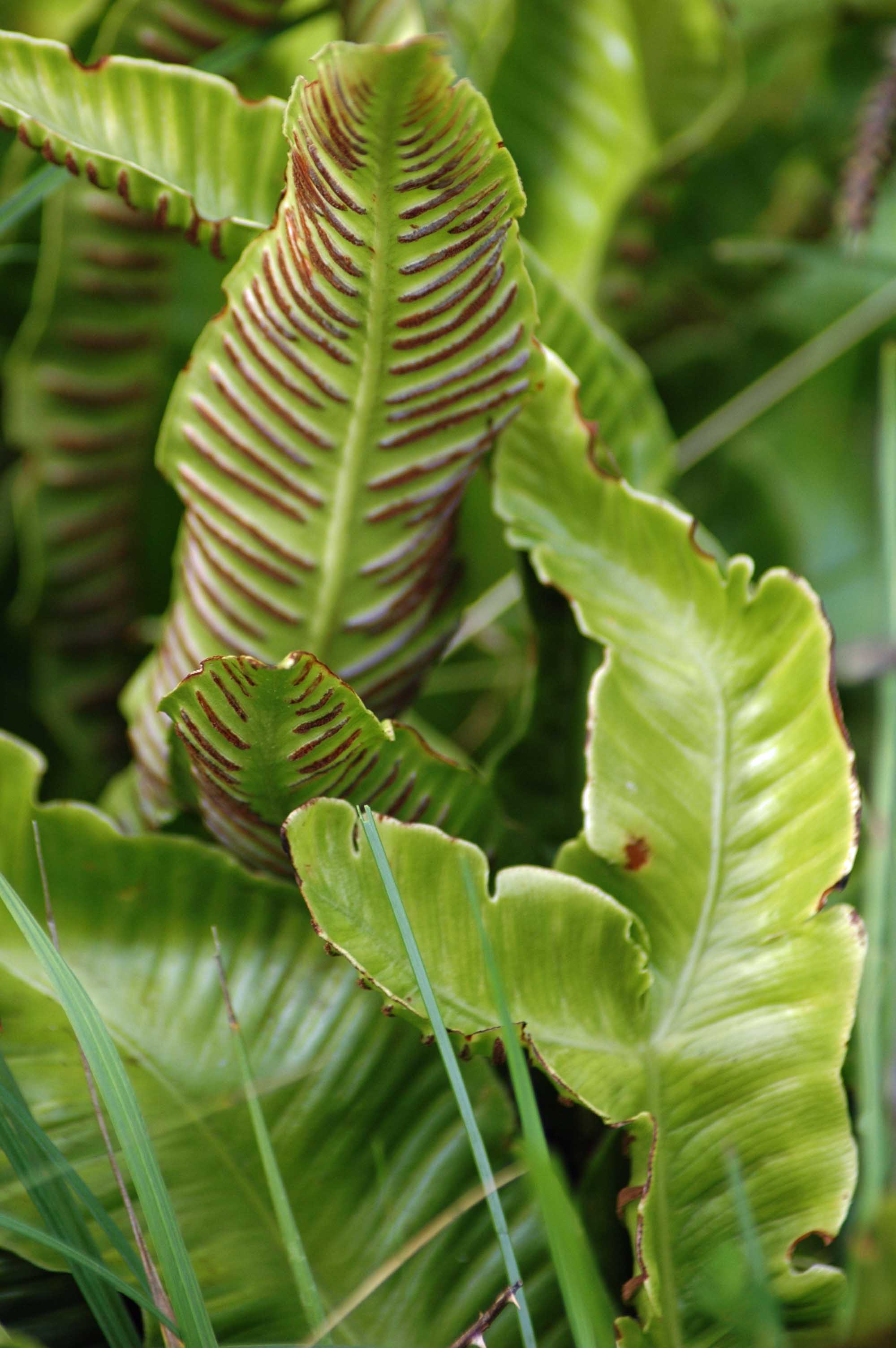
Hart’s Tongue Fern – Asplenium scolopendrium.The sori (spore) pattern is reminiscent of a centipede’s legs, and scolopendrium is Latin for “centipede”.

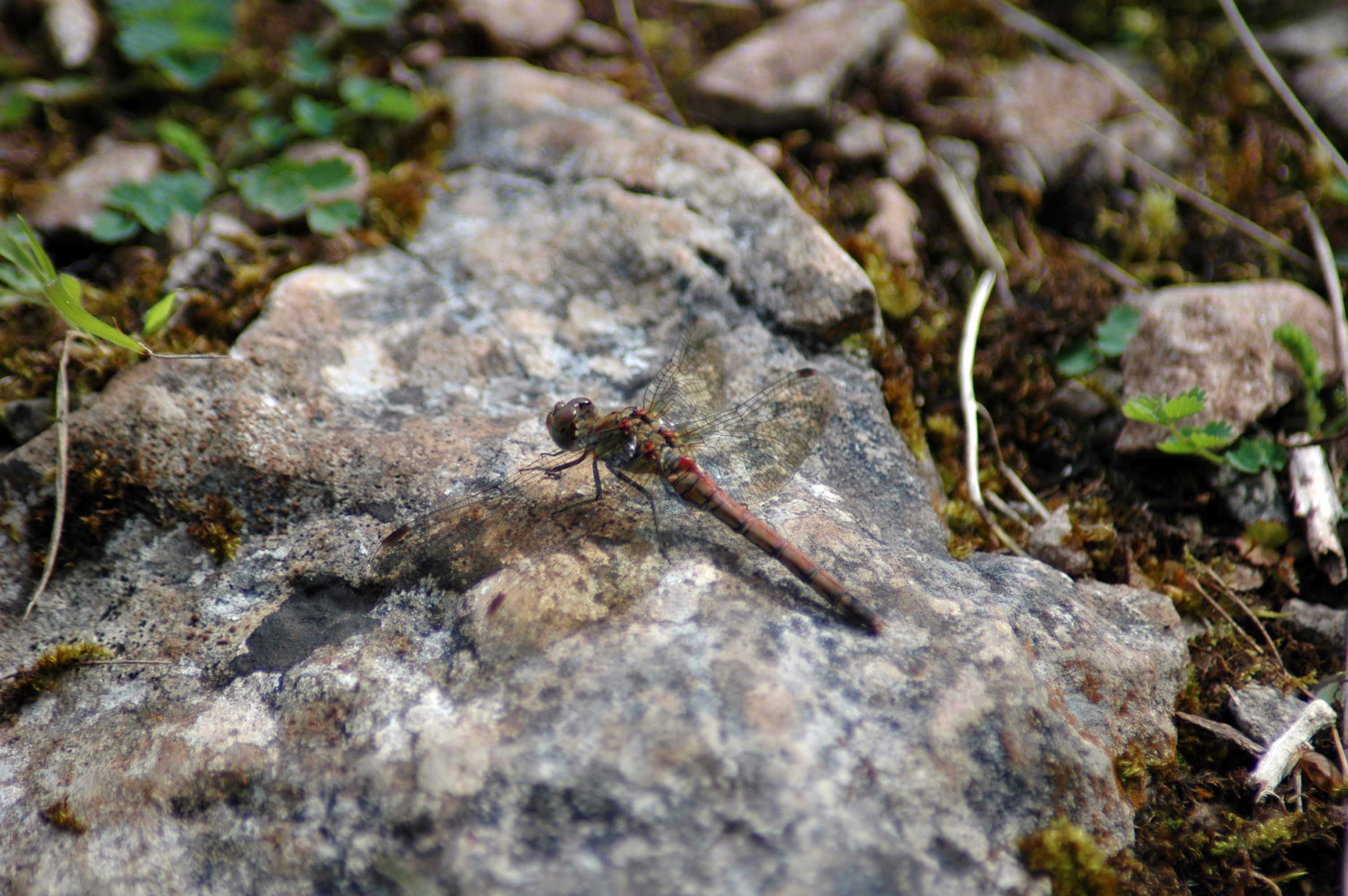
Heading back across the limestone pavement I stopped to photograph a female Common Darter dragonfly that was basking in a sunny spot.

Common Darter (female) on limestone pavement

The information board describes the marked route around the reserve as ‘circular’, so I walked around the woodland edge to see if that meant there was another track to walk back on. As I was looking  I spotted a plant with white flowers tucked in amongst some oak seedlings and long grass stems.

Dropwort flower tucked in between oak seedlings. This is a late-flowering stem, there are others around it that are going to seed.

The plant is Dropwort – Filipendula vulgaris, and is related to Meadowsweet (it is in the same Genus). The flowers are larger than those of Meadowsweet, and the plant is much shorter, typically less than half the size. Dropwort also prefers a chalky or limestone grassland whereas Meadowsweet likes to grow on damp ground or near water. This was a late-flowering stem, its main flowering time being June-August, so I was lucky to find it. There were other stems close by going to seed, but I doubt I would have noticed them it the flowers hadn’t caught my eye.

This Dropwort  is not a relation to Water Dropworts which are mostly extremely poisonous to people, and in this instance the name of the plant does not mean that if it is eaten they will ‘drop down’; it refers to the large pea-sized drop-like tubers on its roots. However, the leaves and roots do contain  Methyl Salicylate, which serves to attract beneficial insects but to kill any that dare try to eat it, as it is toxic. Due to the presence of the chemical, if the leaves or root are crushed they do smell faintly of oil of Wintergreen.

Dropwort – Filipendula vulgaris

I walked back through the woods and back out into the sunshine. There were a number of  little dragonflies flitting about on the woodland edge, again Common Darters. Amongst them a pretty red adult male that obliging ‘perched’ for just long enough for me to photograph him.

Common Darter male

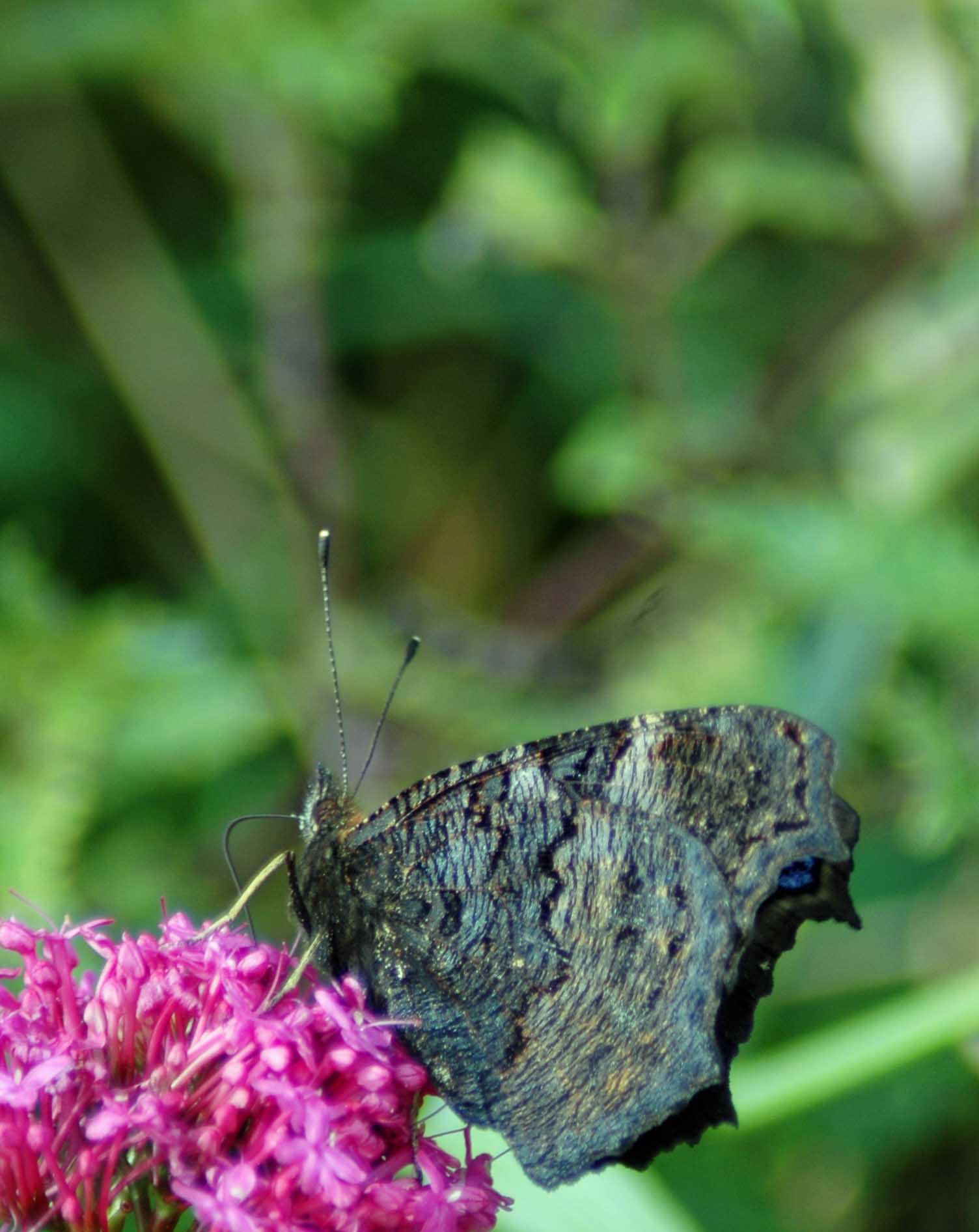
The flowery bit of land I described in the first part of this post was still busy with insects, but now they were joined by butterflies, a Meadow Brown, Large White, a couple of Small Tortoishells and an absolutely gorgeous Peacock.

Peacock and Small Tortoiseshell butterflies on red valerian

Small Tortoishell – Aglais urticae

Peacock-iInachis io

The beautifully textured underside of the Peacock

Share this:

  • Share on Facebook (Opens in new window) Facebook
  • Share on Pinterest (Opens in new window) Pinterest
  • Share on X (Opens in new window) X
Like Loading...

A hill not too far – part 1

15 Saturday Sep 2012

Posted by theresagreen in Bryn Pydew, fungi, hoverflies, Nature, nature of woodlands, nature photography, woodlands

≈ 6 Comments

Tags

buff-tailed bumblebee, common darter, common green grasshopper, eristalis, hoverflies, inula conyza, leucozona lucorum, ploughman's spikenard, tar spot fungus, traveller's joy

The first day of September was gloriously sunny and warm in the way that only our late summer days can be. In preparation for just such a day I had done a bit of research into other nature reserves that may be nearby and was surprised to discover there is indeed such a one, almost on our doorstep on another landmark hill just beyond Bryn Euryn, called Bryn Pydew. The land is leased and managed by the  North Wales Wildlife Trust (NWWT), and just had to be explored not only because of its proximity, but also because it has within in it an area of Limestone Pavement that I have been keen to add to my round of  habitats to visit.

To quote the Bryn Pydw entry on the First Nature website:

Bryn Pydew SSSI; RIGS site : “This reserve lies on carboniferous limestone and has woodland, grassland, limestone pavement and two disused quarries providing a wide variety of habitats.”

I could hardly believe it was so close by and I had never heard of it, but when I set off to find it, following the directions on the website, I did have some problems finding the ‘entrance’ to the reserve. (I must get myself an ordnance survey map and re-learn to use grid references !)  I knew I was on the Bryn, it’s huge, so hard to miss, and drove up, down around and along a few lanes in the indicated direction, then through the village of Bryn Pydew and back again, finally stopping to ask for directions from a lady carrying a basket heading for the village hall. She didn’t really know either, but suggested it might be the “flat bit further on where they have been digging”. It was clear that there was little room for parking on the lane, so I asked if I should park outside the hall and walk, she said “Oh no, please don’t, we have a fun Dog Show here this afternoon, so we need all the parking space we have for that.” Not wishing to upset anyone or their dog, I drove a bit further and duly came to said ‘flat bit’ at the side of the lane, pulled onto it and got out of the car.

Woodland edge

It seemed likely that the reserve was in the general area as I was now looking at woodland to one side on the lower slope of the hill, then across the lane, a grassy slope with some scrubby vegetation leading to the summit of the Bryn.  Next to where I had parked there was a mound of earth and stones, becoming vegetated with grass, with the addition of  clumps of vervain, verbascum and other wild plants, which made me think this may have been a bit of a dumping ground for the village gardeners. Behind this ‘tump’  there was a ‘path’ cobbled with small pieces of limestone between it and the woodland edge, bordered on either side with wildflowers, predominantly ragwort, but also marsh hemp, cat’s ear, traveller’s joy (wild clematis), hogweed etc.

A beautiful fresh ‘Sun Fly’, also known as ‘The Footballer’ – Helophilus pendulus

The sheltered spot was buzzing with hoverflies, bees and bumblebees and even a few butterflies. Most of the hoverflies were of the larger eristalis species, some of which I have already featured photographs of in recent posts, but there were others too.

Eristalis interruptus on ragwort

Eristalis on Hemp Agrimony

The most familiar of hoverflies, the exquisite little Marmalade Fly – Episyrphus balteatus

I was also an attractive hoverfly, Leucozona lucorum, which is a new one for my collection of photographs.

Leucozona lucorum. There is a similar-looking insect – Volucella pellucens which is much shinier and does not have the orange-yellow scutellum (the triangular patch at the base of the thorax)

Buff-tailed Bumblebee- Bombus terrestris on Traveller’s Joy-Clematis vitalba

Welsh Poppy with small flies

I was really pleased to find Ploughman’s Spikenard growing here. It is a plant quite  unprepossessing in its appearance, looking a bit like a giant groundsel or ragwort that is going to seed, so may be easily overlooked, but it is another of my favourite type of plant, one with a history of traditional use as a medicinal herb and that has some great alternative common names; Cinnamon-root, Great Fleabane, Horseheal and Lady’s-gloves.

Ploughman’s Spikenard – Inula Conyza (the seeds on the leaves are from nearby thistles)

Honeybee on Ploughman’s Spikenard

It was really peaceful here, so I sat down on the ground for a while to enjoy the sunshine and properly take notice of what was around me. I love to do that sometimes, to just sit still and lose myself in the moment, and feel connected to the real world. Stillness often brings other rewards too, things I may have missed if I’d been standing and wandering around. A dragonfly came to settle close by on the warm stones, as did a grasshopper and there were birds about too, a Robin came out of the woods to hop around close by and so did a Dunnock.

Common Darter Dragonfly- Sympetrum striolatum (immature male)

Common Green Grasshopper-Omocestus viridulus

A fresh-plumaged Dunnock spied through tall grass

Into the woods

Still not sure of where I was I decided to walk towards the woods to see if there may be a track I could walk on. Lo and behold as I walked towards the trees, set just inside the edge of the woodland was the information board for the reserve. It looks quite faded so has clearly been there for some years, so maybe it was originally more visible from the lane?

Information board about the Bryn Pydew Reserve- click to enlarge

There is a track, way-marked with red marks on some of the tree trunks.

Woodland trail, Bryn Pydew

The trees, mostly silver birch, as, some oak, sycamore and unusually a good many yew grow closely together, so it was quite dark and shady in there with occasional shafts of sunlight breaking through the leaf canopy.   Most of the sycamore leaves I could see were sprinkled wit large black spots, the result of  an infection of Tar Spot fungus.

Tar spot is a fungal disease characterised by raised, black spots on leaves, caused by the fungus Rhytisma acerinum. The tar-like spot is a fruiting structure of the fungus that survives the winter on fallen leaves. In the spring mature spores of the fungus, which have a sticky coating, are released and blown by wind to newly emerging leaves.

The undersides of the leaves appear cupped directly beneath the tar spots. This is a much-enlarged image of a tiny snail and another minute insect.

In a clearing in the woodland where there was a little more light I photographed Hart’s Tongue fern growing amongst ivy on an old stone wall and Lady Fern.

Hart’s Tongue Fern and ivy on an old stone wall

Lady Fern

On the other side of the wall where shrubby plants have colonised the clearing I watched five Speckled Wood butterflies chase one another around in the sun-dapples space. These are very territorial little butterflies that will tackle anything that tries to invade its territory; today each time one settled on a leaf to bask it was dive-bombed by another, so it took a while to get an image. It was good watching them though, this is the most I have seen together in one place for a long while and judging by their fresh appearance, I would say they were newly-emerged.

A pristine Speckled Wood-Pararge aegeria
Share this:

  • Share on Facebook (Opens in new window) Facebook
  • Share on Pinterest (Opens in new window) Pinterest
  • Share on X (Opens in new window) X
Like Loading...

A trip to Pembrokeshire:Part 2: Flowers in the rain

15 Friday Jun 2012

Posted by theresagreen in Nature, nature of woodlands, nature photography, wildflowers

≈ 2 Comments

Tags

dog rose, foxglove, poisonous wildflowers, red campion, wayside flowers, woodland flowers, woody nightshade

As we surveyed the ash tree the tree surgeon arrived and quickly assessed the work involved in removing the obstruction, estimating that it would take him about two hours to clear. The rain and wind persisted, but had eased at that point, so as we had piled on waterproofs anyway, we wandered back towards the house stopping to see how the saturated wildflowers had fared.

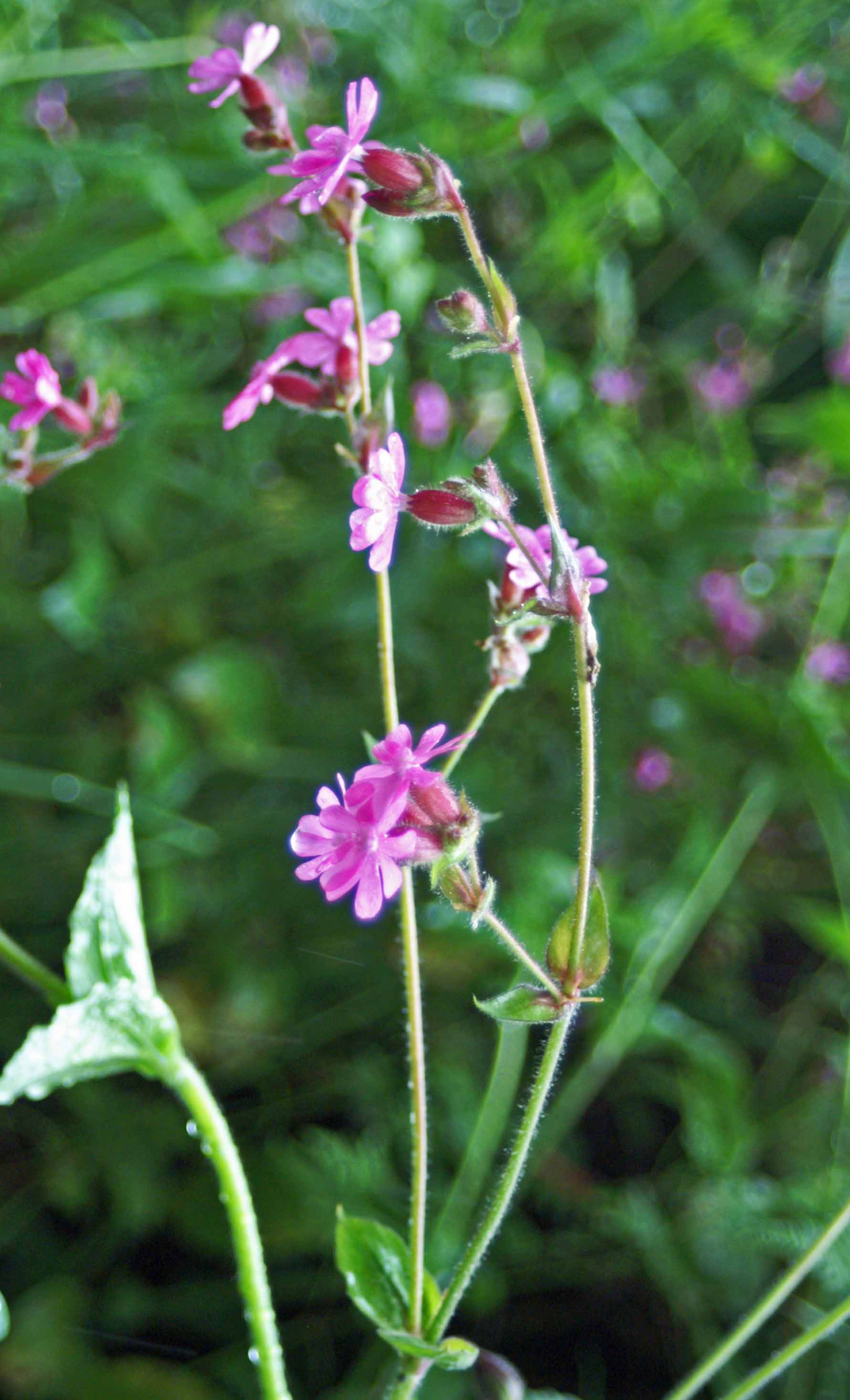
At this time of year Red Campion-Silene dioica is a familiar sight on the banks of Welsh lanes, along the roadsides and on woodland edges. Its flowering season is quite a lengthy one, beginning in May when it accompanies bluebells and continuing on through the summer and into September. Individually, the plants are rather straggly and untidy, but beautiful en masse at the peak of  its blooming when it can colour large swathes of ground.

Red campion – Silene dioica

Foxgloves typify June in most parts of Wales, appearing in a wide variety of habitats from the lanes and woodlands to clifftops and mountains. This morning some of the more exposed blooms were  looking a little the worse for wear in the aftermath of their night’s battering, but even those with bent stems still managed to look graceful and elegant beaded with droplets of rain.

Foxglove bent by the wind & rain

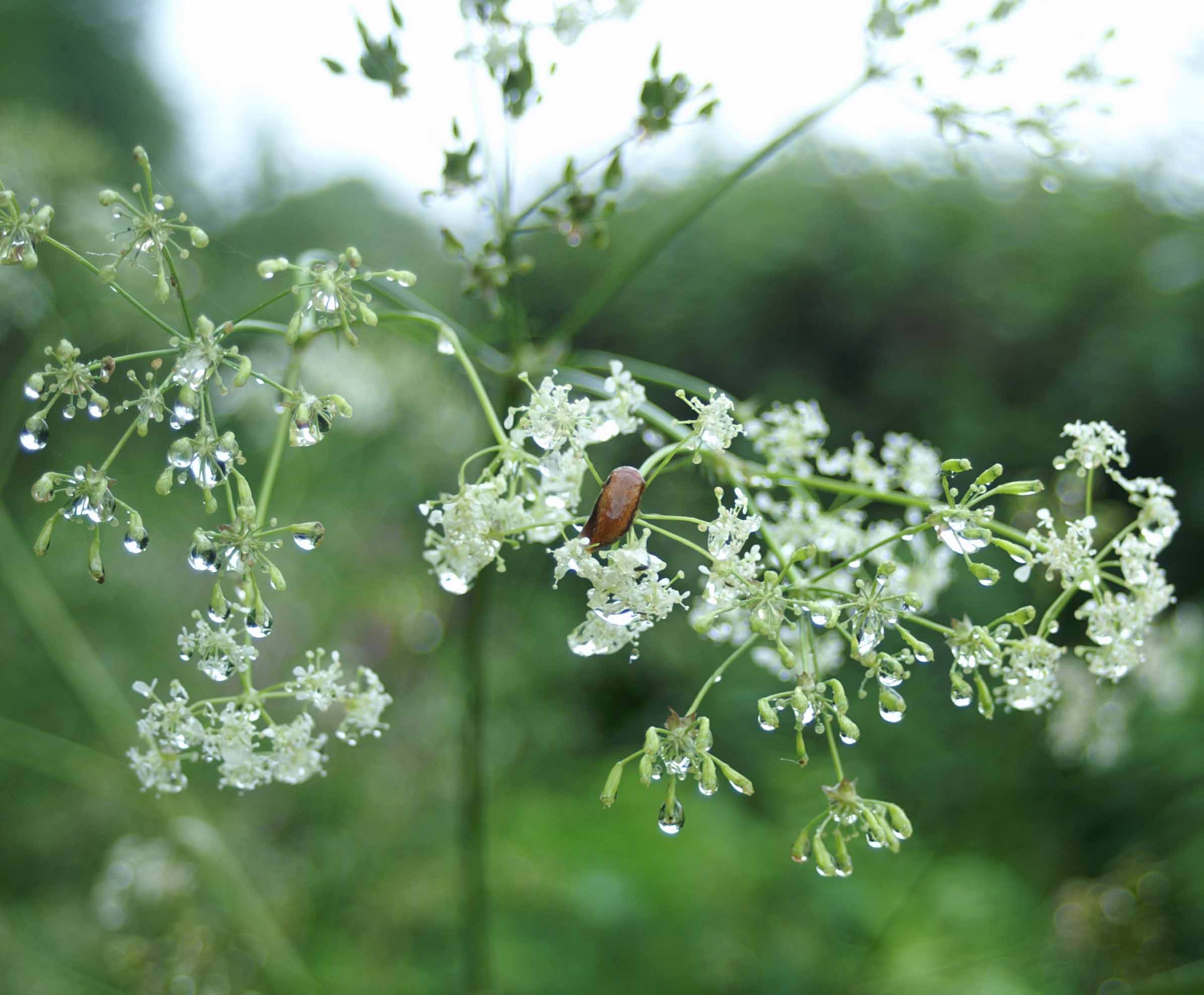
Cow Parsley flowerheads were drenched, but the drooping buds, each adorned with a droplet of water at their tips looked so pretty, like miniature chandeliers adorned with clear crystal beads. The presence of the little slug on the flowerhead in my photograph spoils that metaphor slightly, but it was quite attractive in its own way.

Cow parsley being investigated by a small brown slug

In the hedgerow I came across a few flowering trusses of purple Woody Nightshade, or Bittersweet – Solanum dulcamara. The plant stems grow long, but are not equipped with any climbing aids such as hooks, nor do they twine, they simply leans on other plants for support. A member of the potato family, the plant’s purple flowers with yellow centres are attractive, but I grew up in fear of it, being strongly warned to stay well away from it as it was very poisonous; in fact we knew it as deadly nightshade, although that name really applies to another member of the family, Belladonna.

The attractive, but potentially poisonous flowers of woody nightshade, alternatively named or bittersweet

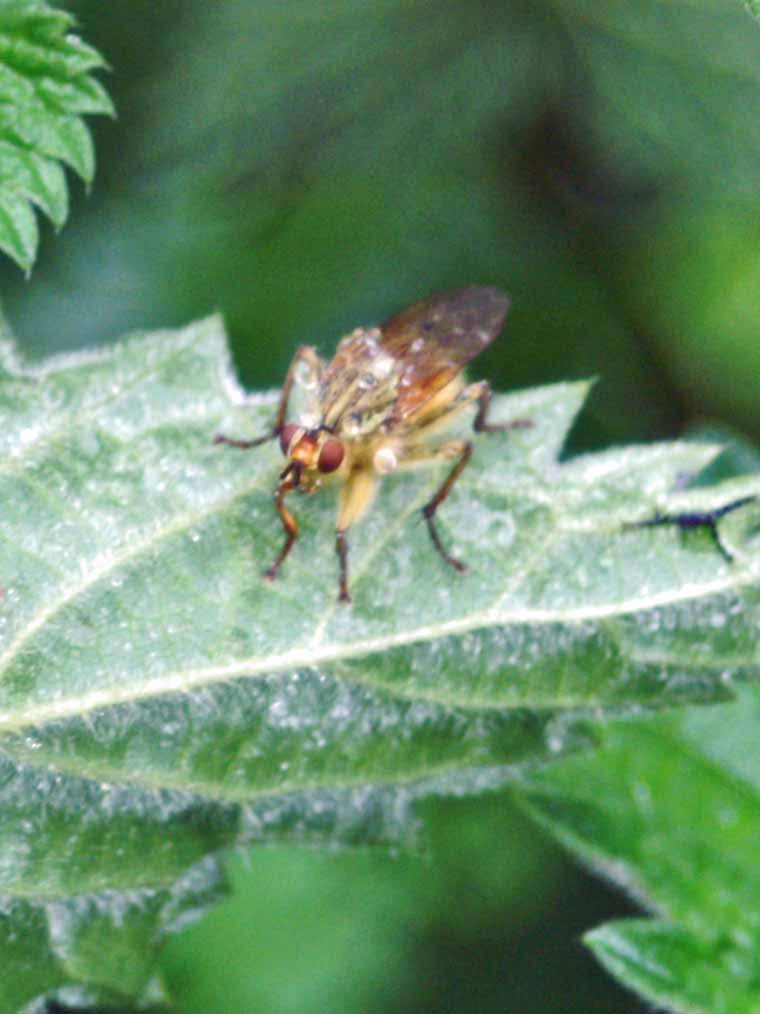
There were a surprising number of insects around, particularly flies of various kinds. I noticed quite a few of the species in the photograph below, most sitting on leaves rather than flying around and wondered if they were sucking up tiny droplets of water from their surfaces. I’m not sure what they are, but think they may be dung flies; if anyone knows I’d love to know for sure.

There were a lot of these flies sitting around on various leaves, this one on the reverse, or stinging side of a nettle leaf. With its proboscis extended down to the leaf’s surface, was it drinking?

The Dog Roses are spectacular this year with shrubs smothered with  pink-flushed blooms; the after-effects of their being subjected to the heavy rain will probably be apparent in a day or two’s time, but at the moment they are gorgeous.

Dog Rose-Rosa canina

Share this:

  • Share on Facebook (Opens in new window) Facebook
  • Share on Pinterest (Opens in new window) Pinterest
  • Share on X (Opens in new window) X
Like Loading...

A trip to Pembrokeshire: Part 1: The weather drama

14 Thursday Jun 2012

Posted by theresagreen in Nature, nature of woodlands

≈ 6 Comments

Tags

fallen tree, gale and floods in Pembrokeshire, large beech tree, River Nevern, woodland stream

It  had been my intention to make a trip down to Pembrokeshire sometime during May, mainly because it is one of the best months in which to visit Skomer Island, but for various reasons I didn’t get around to it. Mentioning this to my good friend who also alternates living in Wales and Spain, she generously invited me to stay with her last week so we could make the outing together. (I have mentioned this friend before; she is the one with the beautiful house set in 12 acres of woodland beside the River Nevern). Since 2006 it had become a bit of a tradition that she, myself and another good friend from our Gibraltar/Spain ex-pat circle escape there for a few days almost each spring for some girls-only birding, exploring and walking. Sadly our number three was unable to make it this year and was much missed, so I hope the following blogs will remind her of some of the wonderful excursions we have made in past years.

The drive from Rhos-on-Sea in the north-east of Wales to Nevern, Nr. Newport, located on the west coast of the country in north Pembrokeshire is, according to the AA route map some 133.8 miles long and should take just 3hrs and 6 minutes to make. It took me nearer 4½ hours. The roads are ‘A’ class and not bad at all really, apart from the current array of roadworks with traffic lights and extra half-term holiday vehicles. Although it was a straightforward route, I confused the sat nav by taking a wrong turning somewhere around the old slate-mining area of Blaenau Ffestiniog after searching the town fruitlessly for a petrol station (there isn’t one) and it failed to pick up my error until I had driven some 7  miles across misty moorland. I also took a couple of short breaks during torrential downpours of rain in the mountains, had I but known it, early indicators of the dramatic events that were to ensue later on.

At the very end of the journey I spent a good twenty minutes trying to remember the turnings into lanes and farm tracks leading to the house as they all look very similar. It’s two years since I was there last and then I was always a passenger, so didn’t pay the proper attention you do when you drive. I was also again hampered by the sat nav., that kept insisting I turn around at the earliest possible opportunity when I was in fact only a few hundred metres away from my destination. I had no phone signal either, so just had to persevere and try all the permutations until I arrived more by luck than judgement.

Despite the frustrating bits, this must be one of the most scenic journeys you could ever make anywhere in the world. The road cuts right across the middle of the Snowdonia National Park, winding through verdant woodlands, along lush river valleys and steep-sided rocky passes then climbing to reveal panoramic vistas of  mountains with bare rocky peaks and bleak upland moorlands clothing their sides. It  takes you through, or closely by-passes the small market towns of  Betwys-y-Coed, Dolgellau, Llangollen and Machynlleth, (it also passes the entrance to the Ynys Hir reserve where the BBc’s Springwatch is being filmed), before dropping down to the university city of Aberystwyth and the flatter coastal plains of Pembrokeshire laid out beneath the vast open skies of Cardigan Bay.

Friday, 8th June

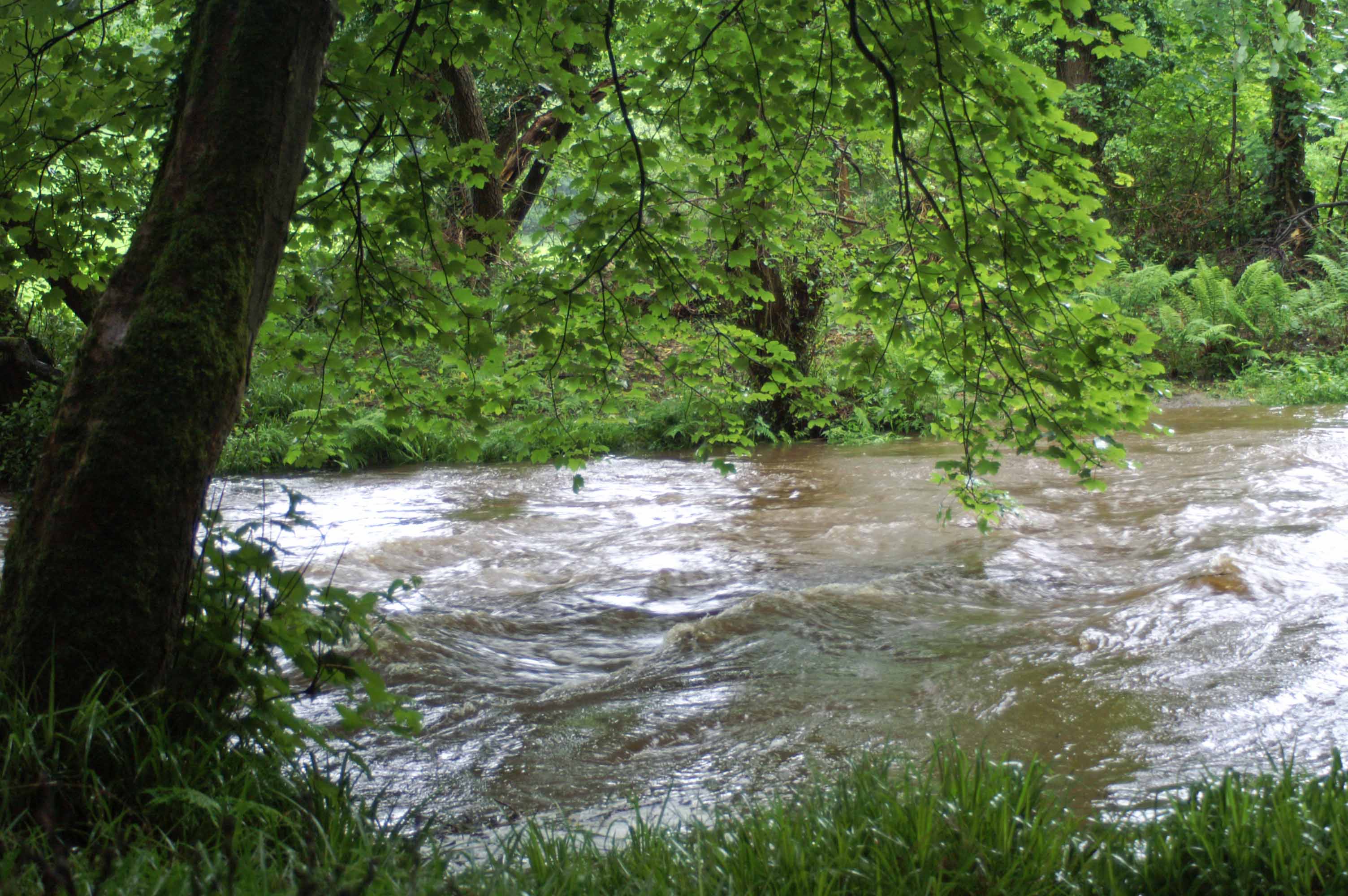
The weather events of last night that continued into much of today have already passed into legend. Gale force winds gusting at as much as 80mph and torrential rain were brought upon us here in West Wales by the Jet Stream passing over here when it should have been somewhere over the north of Scotland. It wreaked havoc in some of the areas I had recently driven through. Strong winds and rain continued throughout much of today and some rivers, already swollen with 185mm of rain that fell over a period of just 48 hours, were then unable to discharge excess water into the sea as their low-lying estuaries were already filled by two high incoming Spring tides. When the two bodies of water met this caused back-flows upriver and having nowhere to go, rivers burst their banks which resulted in extensive flooding, the worst here since 1973.

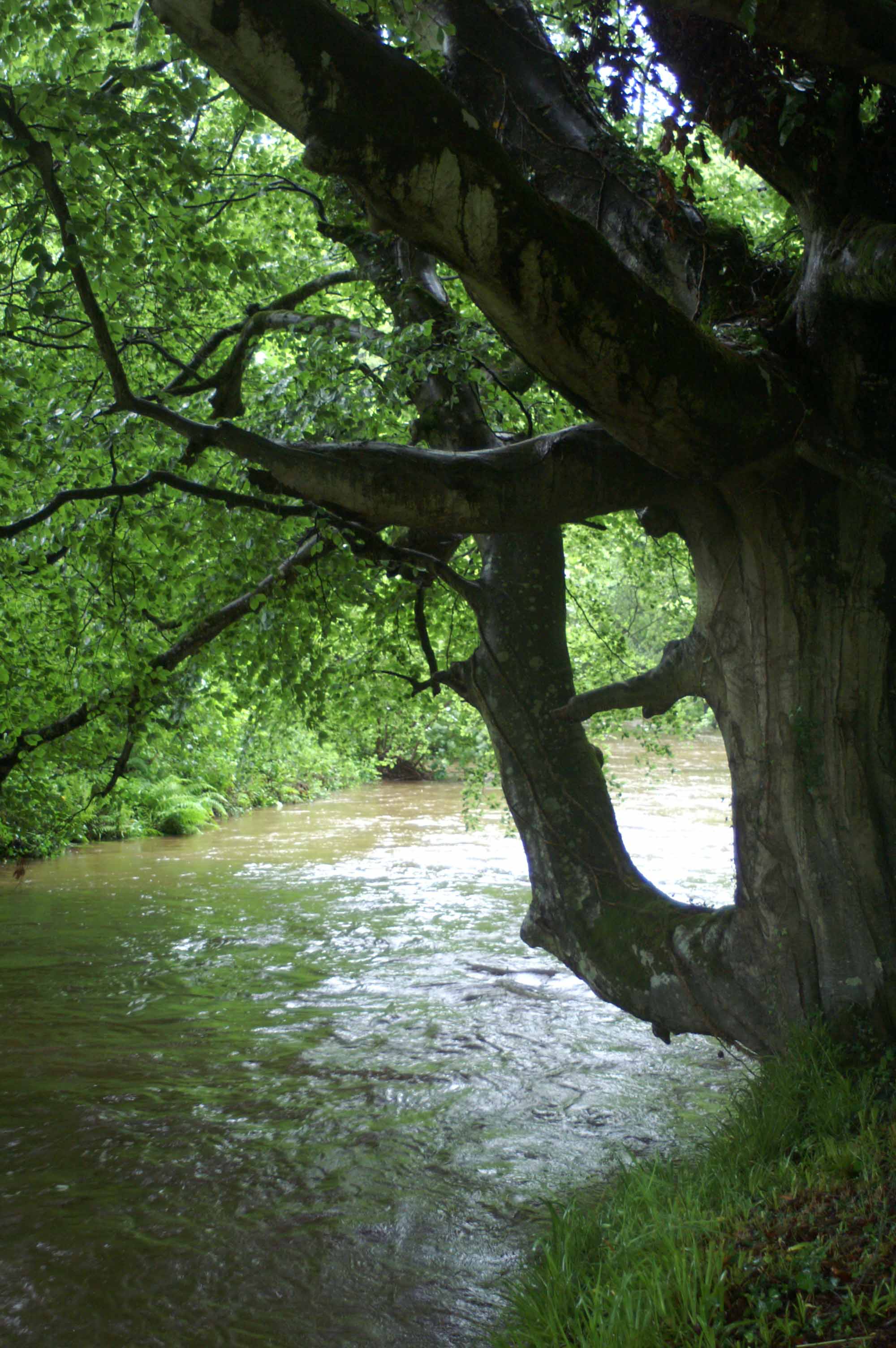
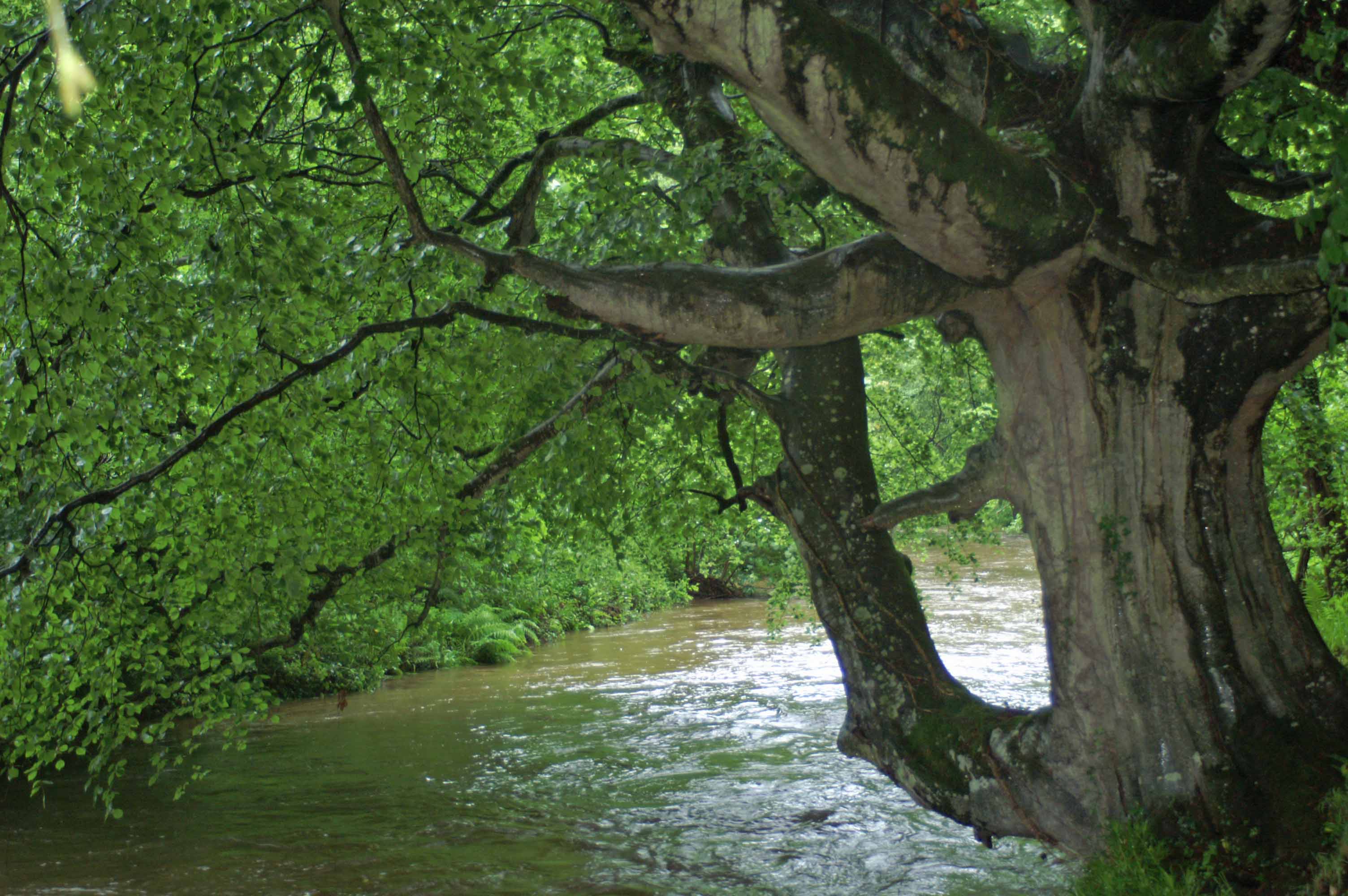
The house is very close to the edge of the river Nevern, but fortunately it had previously been at a fairly low level and although it was now very full and flowing rapidly, it remained contained by its banks and hurtled on past for the last few miles of its journey to the Nevern Estuary at Newport.

Clearly there was to be no chance of a boat-trip out to Skomer today, but we were confined to the grounds anyway as the larger section of  a divided-trunk ash tree had succumbed to the gale and fallen across the access track. An SOS was sent out to the local tree-surgeon and whilst waiting for him we took advantage of  a calmer interlude and ventured out for a look at the damage.

13.35pm; the sizeable section of ash tree that completely blocked the access track

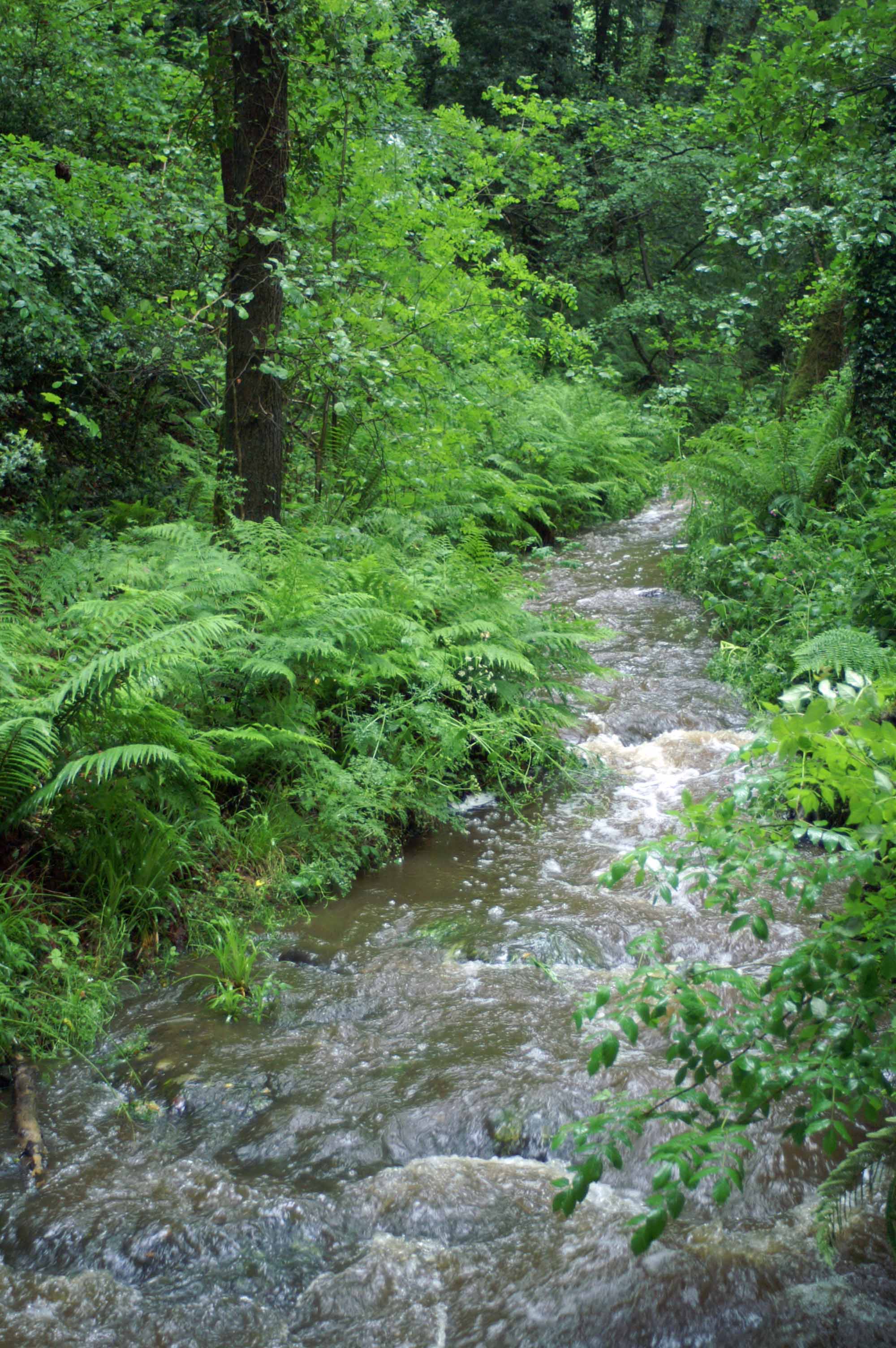
Just before the entrance to the driveway of the house,  a small bridge spans a stream that joins the river here. Usually this is little more than a few inches deep and flows at a steady trickle, but it was quite dramatic today.

The fern-lined stream racing beneath the bridge is usually shallow and flowing at a mere trickle

The swollen river flowing past the house, its muddied water almost reaching the base of a large beech tree on the bank

Another view of the river showing more of the beautiful old beech tree. (Click to enlarge)

A little further down-river the speed of the river’s flow was more apparent as it travelled over large rocks that are usually visible above the surface. (Click to enlarge)

A view of the river from higher ground, looking upstream through the trees

Share this:

  • Share on Facebook (Opens in new window) Facebook
  • Share on Pinterest (Opens in new window) Pinterest
  • Share on X (Opens in new window) X
Like Loading...

Conwy Mountain

31 Thursday May 2012

Posted by theresagreen in nature of woodlands, nature photography

≈ 2 Comments

Tags

bilberry, Conwy mountain, mountain lake, Pensychnant Nature Reserve, rowan tree blossom, stonechat, water horsetail, wood sorrel

We ave few opportunities for family outings these days as the ‘kids’ are grown up now and getting on with their lives in Bristol, London and up here in North Wales. As I think I have mentioned before, despite my best efforts throughout all their lives, still none of them get as excited as I do at the prospect of a wildlife spotting expedition, but at least all may be persuaded fairly easily to get out into the fresh air for a walk. During my  recent birthday weekend clan gathering, they all agreed to indulge me in my strangeness and we headed for the nearest mountains before they could change their minds. The addition of a new Labrador puppy to my daughter’s family gave added incentive to the outing as this was to be her first venture into the countryside.

The actual Conwy Mountain –  in Welsh Mynydd y Dref  (“Mountain of the Town”) is the remains of an ancient volcano that erupted about 450 million years ago  and lies within the foothills of the Carneddau range of Mountains; however, the whole of the  hilly area to the west of the town of Conwy, is locally referred to as Conwy Mountain.

View from Conwy Mountain down to Conwy castle and estuary (click on photo for better view)

We drove from Conwy town along Sychnant Pass as far as the pull-in area near the Pensychnant Nature Resere were we parked and left the car to walk, or rather amble, stopping frequently to indulge the curiosity of the puppy. As always when walking with a group of  people, and particularly in a popular walking spot, most birds make themselves scarce, although there were a few Stonechats about, a Kestrel quartered the mountain slope close to were we stood admiring the view,  a pair of Raven flew overhead and a family of Buzzard circled in the thermals high above the valley beneath.

Freely grazing ponies are a frequent sight on the mountainside.

We walked around the lake towards the entrance to the nature reserve

The shallow water at the edge of the lake was full of crowds of large tadpoles

Vegetation in the lake is Water Horsetail – Equisetum fluviatile

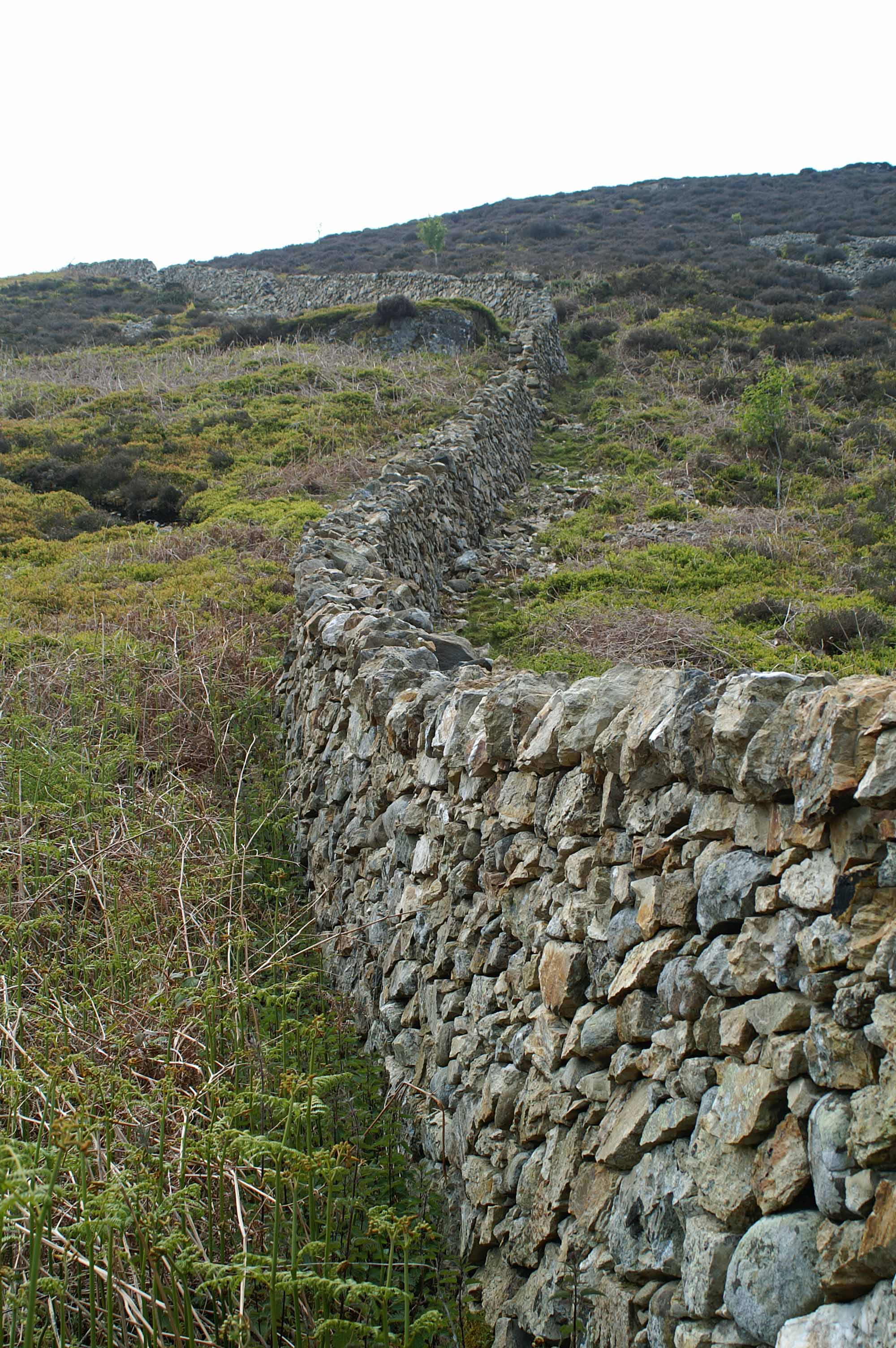
The dry stone wall that bounds the nature reserve

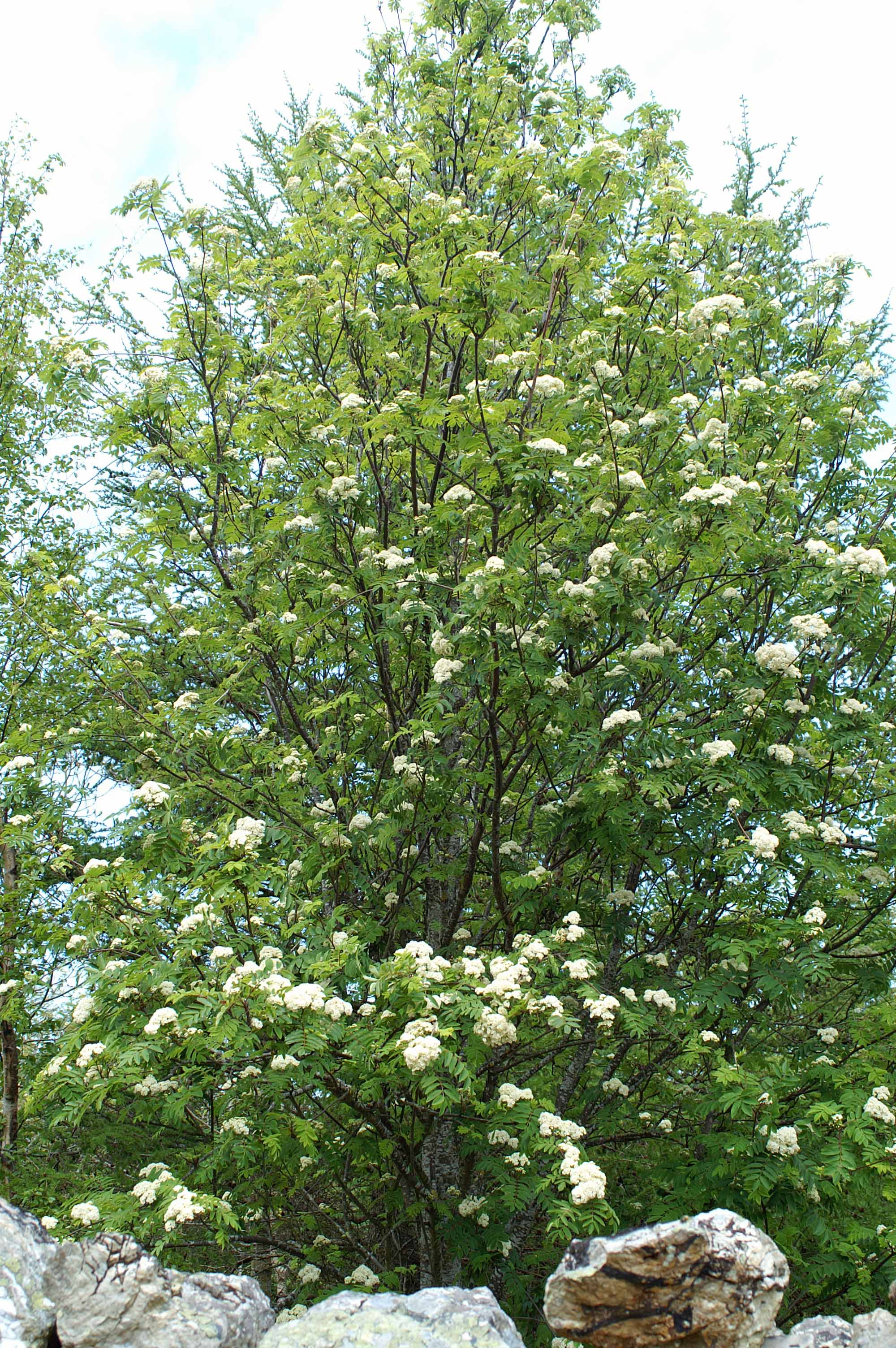
A Rowan tree in full blossom

Bilberry – vaccinium myrtillus

My favourite discovery of the day was definitely this lovely little Wood Sorrel plant growing on a shady mossy bank at the side of the track through the nature reserve.

Wood-sorrel-oxalis-acetosella

The flowers are solitary, each having five narrow sepals; five broad white petals delicately veined with lilac; 10 stamens and five styles.

Wood Sorrel –Oxalis acetosella – A charming and delicate herb, from the genus Oxalis, that is common in most of Europe and parts of Asia. The binomial name is Oxalis acetosella, owing to its sour taste.

The leaves are fresh green, heart-shaped, folded down the middle and held in groups of three drooping down atop a slender reddish-brown stem.

During the night or when it rains both flowers and leaves contract.


Share this:

  • Share on Facebook (Opens in new window) Facebook
  • Share on Pinterest (Opens in new window) Pinterest
  • Share on X (Opens in new window) X
Like Loading...
← Older posts
Newer posts →
Follow everyday nature trails on WordPress.com

Enter your email address to follow this blog and receive notifications of new posts by email.

‘But it is the common species that keep the living world ticking over and provide most of our experiences of wildlife, and I would argue that maintaining the abundance of these is as important a conservation priority as maintaining the existence of rarities’. Richard Mabey

MOST RECENT POSTS

  • A Glimpse of Spring to Come January 22, 2025
  • Hunting the Wren December 28, 2024
  • Oh, Christmas Tree December 18, 2024
  • In and Out of the Ivy February 15, 2024
  • Nature’s Fireworks November 30, 2023
  • Wild Autumn along the Coast Path November 3, 2023

OLDER POSTS

LOOKING FOR SOMETHING IN PARTICULAR?

  • Sights and Sounds from the Little Orme 1
    Sights and Sounds from the Little Orme 1
  • Things Bright and Beautiful
    Things Bright and Beautiful
  • Following a river to a Fairy Glen
    Following a river to a Fairy Glen
  • Catchers, a Duck and Divers
    Catchers, a Duck and Divers
  • A Windy Wildflower Trail
    A Windy Wildflower Trail
  • A Window on the Woods-Winter 1
    A Window on the Woods-Winter 1
  • Fine Dining for Crows
    Fine Dining for Crows
  • May Bee Appearing on Ivy near You
    May Bee Appearing on Ivy near You
  • Shades, Sounds and Scents of the Woods
    Shades, Sounds and Scents of the Woods
  • The Windhover
    The Windhover

nightingale trails

The Walk of the Monarch Butterfly-Sendero de la Mariposa Monarca

The Walk of the Monarch Butterfly-Sendero de la Mariposa Monarca

MY WILDFLOWER BLOG: where the wildflowers are

Snowdrop

Snowdrop

most recent posts

Follow everyday nature trails on WordPress.com

Social

  • View teresamaygreen’s profile on Twitter

Enter your email address to follow this blog and receive notifications of new posts by email.

Website Built with WordPress.com.

  • Subscribe Subscribed
    • everyday nature trails
    • Join 359 other subscribers
    • Already have a WordPress.com account? Log in now.
    • everyday nature trails
    • Subscribe Subscribed
    • Sign up
    • Log in
    • Report this content
    • View site in Reader
    • Manage subscriptions
    • Collapse this bar
 

Loading Comments...
 

    %d