• Home
  • about
  • about the photographs
  • Local Nature Reserves
    • Bryn Euryn Local Nature Reserve
    • Mynydd Marian
  • Wales Coast Path
    • Grey Seals in North Wales
    • St.Trillo’s Chapel
    • Wildflowers of North Wales Coastal Paths, Cliffs and Dunes

everyday nature trails

everyday nature trails

Category Archives: Nature of Wales

Shades, Sounds and Scents of the Woods

22 Thursday Feb 2018

Posted by theresagreen in birds of Wales, Nature of Wales, woodland birds

≈ 17 Comments

Tags

alexanders, Blue tit, Bryn Euryn Nature Reserve, colour in winter woods, fragrant wild flowers, Great Spotted Woodpecker, Great Tit, hazel catkins, lamb's tails, lesser periwinkle, mosses & liverworts, Robin, snowdrop, Spurge laurel, treecreeper, woodland flowers

February 18th-Bryn Euryn-Woodland Path

A bit fed up with dull drab winter days, a sunny start to the day inspired me to go out and seek signs of the coming Spring and hopefully some colour. A Robin sang from a tree branch at the beginning of the Woodland Path, then minutes later the delightful and uplifting sight of a bank of Snowdrops in full flower made the perfect start.

Our Snowdrop display may not be on the scale of that of those boasted by our local National Trust gardens, but it is no less beautiful and uplifting; and I didn’t have to drive anywhere to see it. 

Lesser Periwinkle- Vinca minor

Nearby, peeping out shyly from beneath a bramble, the bright blue face of a Periwinkle.

A Barberry shrub arches gracefully over the pathway, its golden-orange flowers not yet quite open. I thought it was a bit early for it to be flowering? Barberry- Berberis vulgaris is a native plant, but it is scarce in the wild although widely naturalised.  This one, or an ancestor of it may have been planted when this woodland was part of the grounds of the house that used to stand where our apartment building is now. Either way it’s pretty and a splash more colour to add to my collection.   

Another shrub I found flowering, Mahonia, has also likely arrived here from a garden. Its bright yellow flowers also look good and smell lovely.

Barberry-Berberis vulgaris
Mahonia-Mahonia japonica

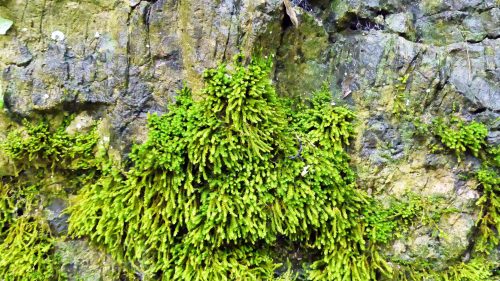
Of course green is still the predominant colour, but there are splashes of bright fresh shades breaking up the dark evergreens. Mosses are at their best at this time of year, brightening the shady woodland floor, smothering rocks and the bases of tree trunks with patches of vivid green. I have yet to learn to identify the different species, so for now I think of this one as ‘looking like a forest of miniature pine trees’!

Although I walk this path often I can still see things I’ve not spotted before, like this pretty clump of Navelwort. Its pretty round leaves, dimpled in the centre and with  frilled edges look a bit like green flowers.
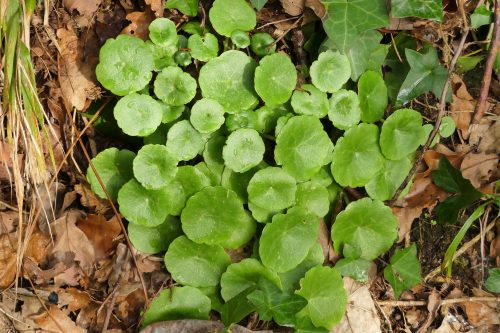
Navelwort-Umbillicus rupestris

There are a number of Spurge laurel plants in this part of the woods and they too are flowering now. The flowers are a subtle lime green-yellow colour but they are pretty and in common with those of other members of the daphne family they are deliciously scented, with an aroma that really is like warm honey.

Spurge laurel-Daphne laureola
Fully opened flowers

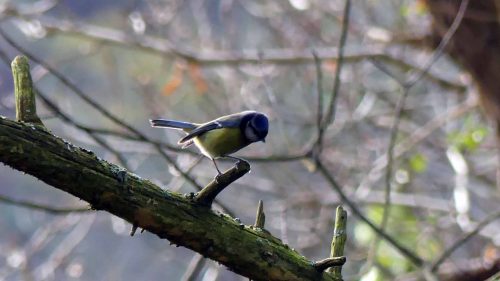
It’s wonderful to hear the woods full of bird sounds again. Throughout most of this walk I was surrounded by the sounds of birds, mostly the cheerful chirps and chatter of tits keeping contact with one another. Blue tits were everywhere, up high in trees and lower down in the shrubs, investigating every nook, cranny and leaf for potential food. They are bright colourful little birds, but still blend surprisingly well into the woodland background.

Great tits are also about, but their favoured place is around the Scots Pines where there are often several. They are more easily heard than seen and have a huge repertoire of calls and phrases at their disposal. Years ago I learnt from a bird-watching master that if you hear a bird sound you don’t recognise the chances are it will be a Great Tit!
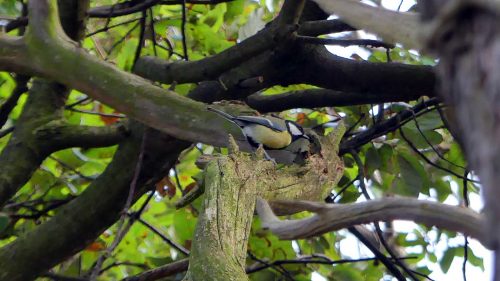
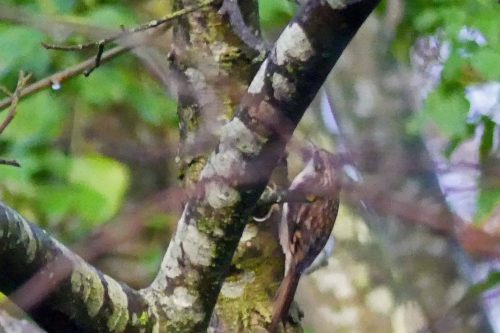
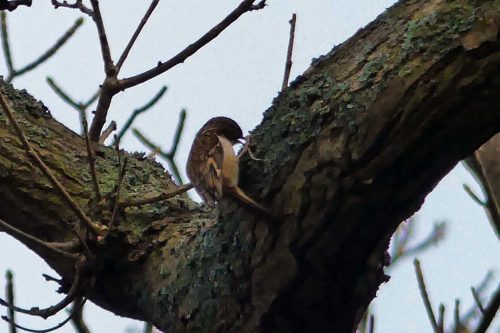
I stood and watched them there for a few minutes until my neck ached from craning upwards.Thankfully I was distracted by a Treecreeper up in a big sycamore tree nearby.

It was exceptionally well-camouflaged against the shaded, heavily textured bark and hard to see when not mobile and flashing its white undersides. It was fascinating to watch as it contorted itself, using its tail to steady itself to probe its beak into its deep fissures. From this spot I also heard the screeching of Jays and caught a glimpse of one before it sped off through the trees.
I passed by the remains of the Scots Pine that was sadly felled in a storm two years ago. Much of it has been sawn and removed; what’s left is being gradually absorbed back into the fabric of the woodland. I liked its rich colour and texture.

Looking across the boundary fence here the colours of the landscape in general are still predominantly brown and green, but taking time to look properly you appreciate the are a myriad of shades of those colours. And I’m sure the grass is getting greener by the day!

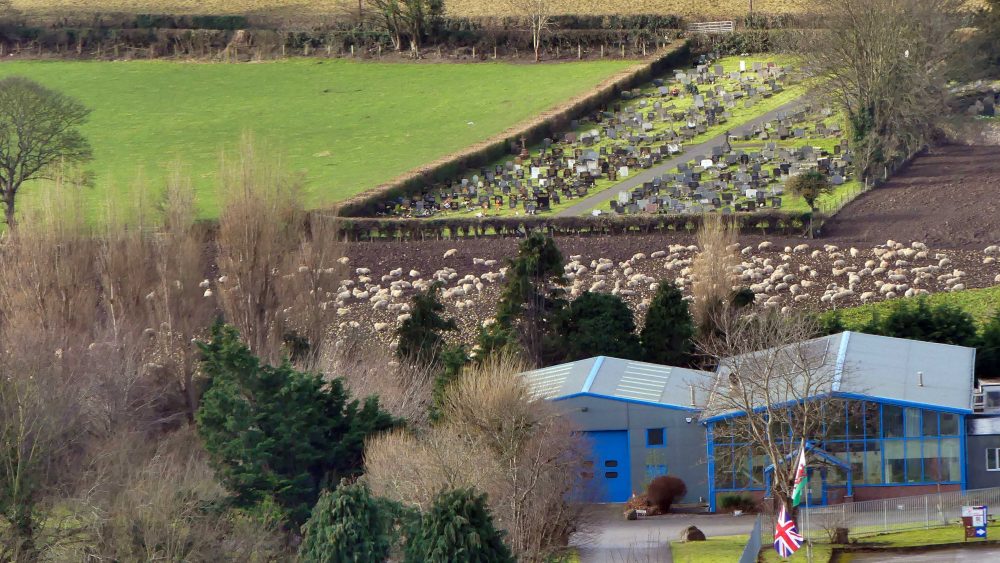
I usually concentrate on the more scenic aspects of this view, but zooming in and down onto an edge of the far landscape reveals an interesting slice of a community. An interesting juxtaposition caught my eye – Modern Industry and a Final Resting Place separated by a field full of sheep turned out to eat turnips!
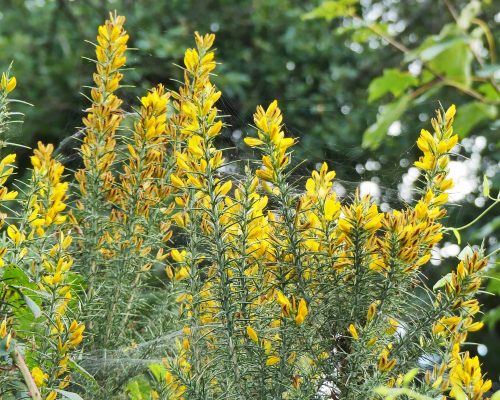
On the field-woodland boundary is more colour. Gorse is blooming bringing forth its warm golden glow. I think this line of gorse was probably planted here as a boundary hedge. This was a common and effective practice in Wales to prevent animals wandering and remnants of such hedges can still be found in the countryside, particularly in Anglesey.

I heard a Robin singing and noticed bird movement amongst the Gorse. Zooming in I found the rusty-red of two Robins there, one being the source of the song. I wonder if they were mates prospecting for a nest site or rivals claiming territory?

Two birds in a bush

Honeysuckle twining up the wire boundary fence has well-grown fresh leaves already; quite surprising in this exposed spot.
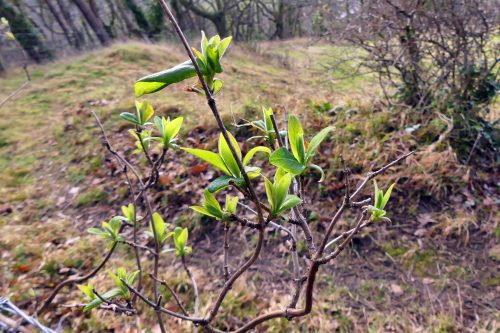
Honeysuckle leaves are well-grown

Amongst leaf litter, ivy and feathery moss, Wood Sorrel has shown some of its bright green shamrock-like leaves throughout the winter. It will be flowering soon.

Leaves of Wood Sorrel

The top end of this path is becoming increasingly lined with Alexanders’ plants. Most are well-grown now, particularly those sheltered against tree trunks. They will flower soon; last year their flowers were much appreciated by some of the earlier hoverflies.

Alexanders-Smyrnium olusatrum

Woodland – Summit Trail

Emerging from the beneath the canopy of the woods onto the  open Woodland Trail the first colour I noticed was the blue of the sky!

Heading towards the track that leads up to the Summit Trail I heard a Woodpecker tapping. I’ve had several good sightings of Great Spotted Woodpeckers in the past few weeks, the latest one just this morning as it came down almost as far as our bird feeders. I scanned the trees for a sight of it but no luck. A Raven flew overhead, ‘cronking’ as it travelled to alert all to its presence.

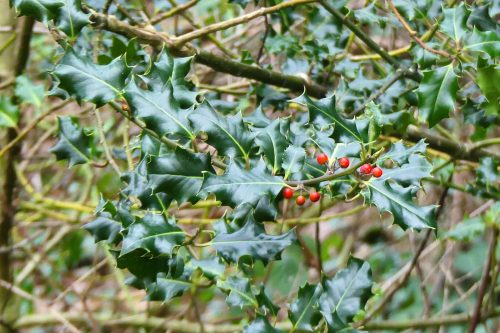
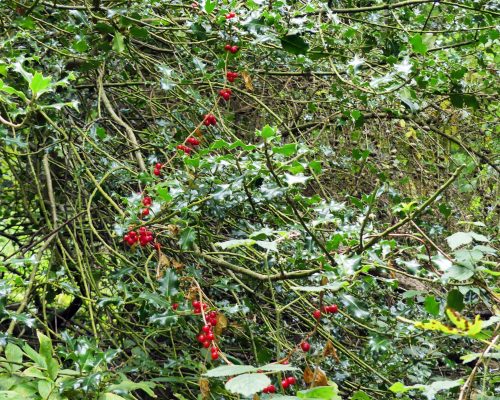
Surprisingly there were a few bright red berries left on the big Holly bush; there are so many Blackbirds about I thought every last one would be gone by now. Perhaps they can’t reach those left at the end of branches. Many holly leaves have been ‘mined’ by insects so display bright pale splashes where there is now no chlorophyll.

180218-BEWT-1220-Holly leaf with miner
180218-BEWT-1155-Holly with few berries left

As I said earlier, Blackbirds were numerous and have turned their attentions to the Ivy berries, many of which are finally ripe. Everywhere there were berries there were birds from low down to the tops of trees. They rustle noisily around seeking the bunches of berries using a variety of techniques to reach the fruits. Their familiar scolding and alarm calls ring out from almost every tree as they chase away competitors.
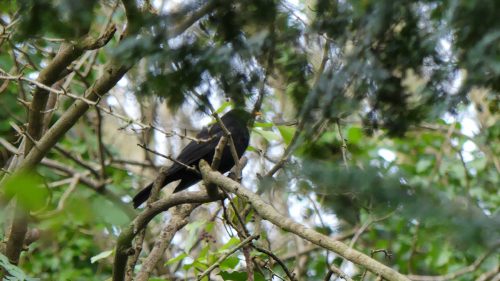
 

Hazel catkins have been present since the autumn, gradually lengthening and maturing. Now their soft golden tassels are long and fluffy, resembling the ‘lamb’s tails’, which gave rise to the old country name for catkins.
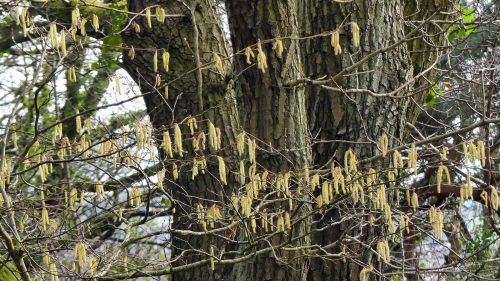
Common Hazel (Corylus avellana)

Catkins are the male flowers of the plant, producing pollen to fertilise the tiny red female flowers that sit tightly on the twigs.

180218-BEWT-1334-Catkins
180218-BEWT-1316-Catkins & flower

I heard the Woodpecker again, this time drumming loudly on a tree trunk. It was too far away to try to locate it, but was good to hear. The males don’t have a song with which to claim ownership of their chosen patch of woodland, so they use the tool they have, their powerful bill to drum on dead trees. They can be clever in their choice of drumming spot, often choosing a site where the sound is amplified by surrounding features. A Thrush was singing nearby too, so I stopped to listen. Then two birds making sounds I didn’t recognise at all crashed into the top of a tree in front of me on the other side of the track. With the sun behind them they were drained of colour, but there was no mistaking their outlines – two Woodpeckers! I have no idea if they were a pair or two rivals chasing, but they left without a sound, one behind the other.

After the activity of the woods the almost-summit was surprisingly calm. This must be the first time for months that there has been not even a breath of wind and it was actually enjoyable to be up there! The sea of Colwyn Bay seemingly flat calm and mirroring the sky, now sunless, was a most unusual shade of blue-grey.
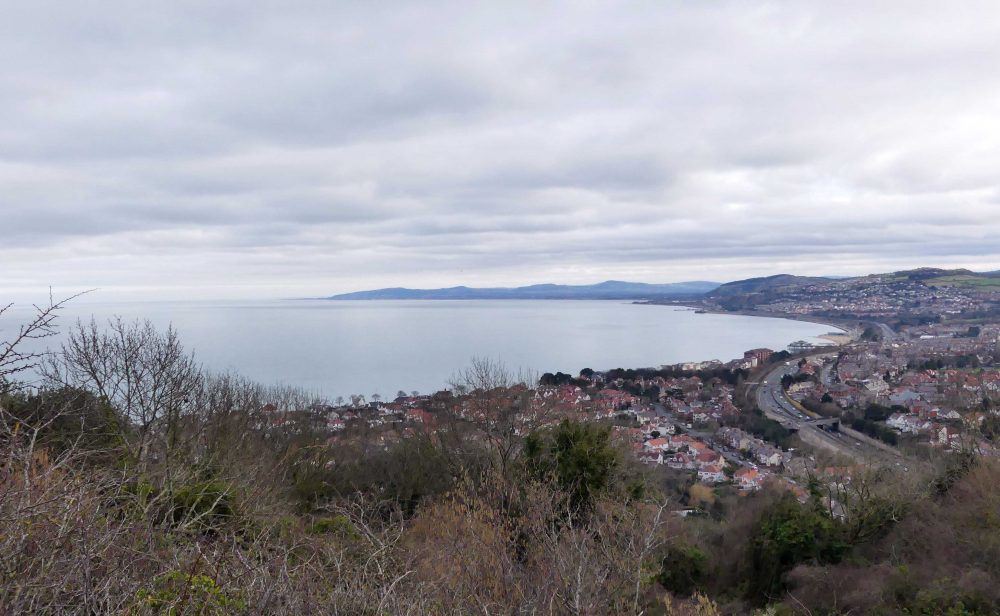
Swinging around to my right the snow-capped higher peaks of the Carneddau mountains rising above the river Conwy show remind that there is some Winter still to go.

Continuing up to the Summit you pass thickets of blackthorn; they take on a completely different appearance in the winter as their leafless black twigs and branches are richly encrusted with gold and silver-grey lichens.

180218-BEWT-1344-Lichens on blackthorn
180218-BEWT-1343-Lichens on blackthorn

Crossing to the North-facing side of the hill the view is down the coast along Penrhyn Bay to the Little Orme; the sea is still calm but more blue. The field (on the opposite side of the road to the golf course) has a lot if standing water and I could see there were gulls and Oystercatchers feeding there. This is the ‘Curlew field’ that I’ve mentioned many times. I couldn’t make out if there were any Curlew there, but I did hear one and the tide appears to be in, so there most likely were.
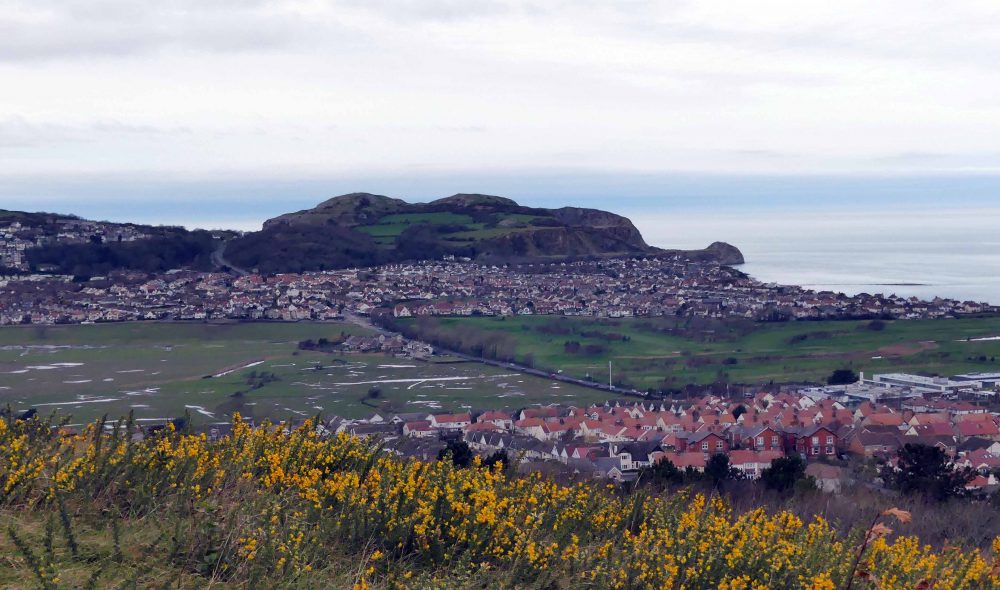
Below is a panoramic view starting from past the Little Orme on the right of the image and travelling along to the hills at the end of the Carneddau. Anglesey lies on the horizon behind the stretch of water which is the Menai Strait. It would have looked better if the sun had still been out, but it’s still pretty spectacular.

click for bigger image

Going down, the Gorse on the hillside is in full golden flower. It was only planted in recent years but has quickly thickened and grown taller.

I walked home across the field where a Long-tailed tit flew in front of me: it was so close I could almost have touched it. They are so pretty. It was one of a party but the others took a more cautious route around the field via the trees rather than the direct crossing.

I completed the circuit of the Bryn walking back along the Woodland Trail. It was much quieter now but I did get one last look of two Great Spotted Woodpeckers together, so fingers crossed they are a pair. I’ll be keeping an eye out.

Share this:

  • Share on Facebook (Opens in new window) Facebook
  • Share on Pinterest (Opens in new window) Pinterest
  • Share on X (Opens in new window) X
Like Loading...

A Window on the Woods-Winter 1

09 Friday Feb 2018

Posted by theresagreen in bird behaviour, birds of Wales, Nature of Wales, woodland birds

≈ 14 Comments

Tags

Blue tit, coal tit, goldcrest, Great Tit, long-tailed tit, melanism in Blue tit, mixed-species feeding flocks, treecreeper, woodland edge

My kitchen window looks directly onto a short section of the edge of the woodland on one side of Bryn Euryn, my local ‘patch’, that has been the subject of many of my blog posts. Perhaps it’s a bit scruffy-looking, but the good variety of species of trees and shrubby undergrowth offer a habitat that seems to suit a good mix of bird species and gives me the privilege of some close-up everyday bird watching. I have my own personal woodland ‘hide’ with the benefits of central heating and tea-making facilities within arm’s length. I’ve seen a wonderful array of birds on a fairly regular basis this winter thanks in part to their endless quest for food, with the added bonuses of clearer, longer sightings and have had the chance to gain fascinating insights into their habits and behaviour first-hand.

Mixed species feeding flocks

Mixed-species flocks, or ‘feeding parties’ of small birds roam the woods and we seem to be one of the regular re-fuelling spots for at least some of them. Flock sizes and the numbers and the different species of birds travelling within them varies, but their core elements are invariably Blue tits. Usually at the forefront they are first to the feeders, with no hanging back.

Blue Tit – Parus caeruleus

Blue tits are by far the most numerous visitors to the bird feeders. Most mornings they are the first birds I see and also the last in the late afternoon when it’s almost dark. Their numbers vary at different times of the day according to which of the roaming tribes they are allied to.

Blue tit - Parus caeruleus
Blue tit – Parus caeruleus
171204-BEDC-1348-Blue tit

At first glance one Blue tit appears much like another, but with regular watching and focussing in closely to take a lot of photographs, I know that although there is a ‘blue print’ for the perfect bird, (Blue tit print?), there are a lot of individuals about that deviate from the norm. A surprising number are affected by melanism or leucism (more dark or white feathers than the norm) in varying degrees which has helped me recognise individuals. A couple have leg rings, one of which looks ‘normal’, while the other has a band of darker feathers above its beak. A selection of some of those I see regularly enough to recognise on sight now are shown below:

Blue tit with white in crown & freckled face
Blue tit with white 'nostrils' above beak
Blue tit with white ‘nostrils’ above beak
Blue tit with dark feathers on right side
Blue tit with dark 'frown' above bill
Blue tit with dark ‘frown’ above bill
'Normal' Blue tit with leg-ring
‘Normal’ Blue tit with leg-ring
Blue tit with severe feather problem

It seems that several of the distinct ones arrive together, so I imagine that may mean they are related. When I finally get around to collating my photographs I’m hoping it will show which families or flocks they belong to or travel with.

Great Tit-Parus major

There are a good number of Great tits too; occasionally appearing alone they are more often in twos or in small family groups. Sometimes there are as many as 6-8 at any one time in a party with other tits. There’s quite a bit of variation in their appearances too, mostly regarding the extent of the dark stripe down their breasts and continuing underparts. One or two are so heavily marked with black it makes them instantly recognisable, another has something odd about one of its eyes.

Great Tit – Parus major

171207-BEDC-1457-Gt tit
171204-BEDC-1249-Great tit 2
171210-BEDC-1439a-Gt tit - dk & scruffy
171222-0828a-Great tit
180103-BEDC-Great tit
171209-BEDC-1122-Gt tit v heavy marks 1

Coal Tit-Parus ater

There are a small number of Coal tits; I’d say I might be seeing four at the most. Their visits are less predictable; sometimes one will appear on its own, most often one arrives together with a party of other tits and occasionally they have been here all together.

The smallest of our British breeding tits, Coal tits behave quite differently to other tits. Initially they’re not quite as bold in approaching feeders and then once food is taken they take it a distance away to eat it.

Coal tit-Parus ater
Coal tit-Parus ater
180112-BEDC-Coal tit 2

A couple of times I’ve been amused by one individual who rather than come forth and take his own food innocently approached blue tits with food, sat close by them, then dashed in and snatched their meal from their claws! The photographs below are of the tiny thief.

Coal tit with Blue tit

Coal tit approaching blue tit with intent to rob

Coal tit snatching food from Blue tit

Long-tailed Tit-Aegithalos caudatus

Then there are the delightful fairy-like Long-tailed tits, they arrive in a small family group most often following behind the rest of the mixed party they have allied to. Oddly though there is one that travels alone but in the company of a party of Blue & Great tits and a Coal Tit. It’s very unusual to see a Long-tailed tit alone, so I can’t begin to guess why this one is, unless it is the only surviving member of a family?

The Long-tailed tits mostly stay slightly higher up than their travelling companions, foraging amongst the tree branches while the others visit the feeders, but occasionally they give me a treat and come closer.

180107-BEDC-Long-tailed tit
180117-BEDC- Long-tailed tit 4

Goldcrest-Regulus regulus

Goldcrest-Regulus regulus

I see Goldcrests around and about fairly often, more particularly from my front window where they favour the big conifer trees. On a few occasions though  I’ve spotted them travelling along with mixed flocks too. They don’t often make their way down as far as their companions that are here for the food on offer, preferring to forage for themselves in the evergreen shrubs such as holly and laurel. I’ve had  some lovely views of them, but taking good photographs of these flitting flickering little birds is tricky, so I’ve resorted to one I took in the right place but back in November 2017.

Treecreeper-Certhia familiaris

Treecreepers are the final regular members of our travelling mixed flocks but from my kitchen window vantage point I have seen one only once. It wasn’t a particularly good close sighting, but I did manage to get a photo of it arriving at the same time as one of the flocks, although it stopped at one of the trees further up the slope.


Share this:

  • Share on Facebook (Opens in new window) Facebook
  • Share on Pinterest (Opens in new window) Pinterest
  • Share on X (Opens in new window) X
Like Loading...

Winter Promenades

22 Monday Jan 2018

Posted by theresagreen in birds of the seashore, Birdwatching on North Wales coast, coastal walks, Nature of Wales, North Wales, Rhos Point, Wales Coast Path

≈ 10 Comments

Tags

birds of conservation concern, black-headed gull changing plumage, Curlew, dunlin, dunnock, overwintering birds, purple sandpiper, Rhos Point, ringed plover, Robin, rock pipit, winter wildflowers

January 2nd 2018 

The Promenade runs unbroken from Old Colwyn at one end to Penrhyn Bay at the other, following the contours of Colwyn Bay, Rhos Point and the seashore of the aforementioned Penrhyn Bay. It is well-used, particularly so in the warmer seasons and weekends, but also on sunny days throughtout the year; it’s also a part of the Wales Coast Path and is both a walking and a cycling route. The section I walk most often these days starts close to the tiny St.Trillo’s chapel, passes Rhos Point and continues into Rhos on Sea village.

St Trillo’s Chapel, Rhos-on-Sea

This strip of coastline is fascinating. The Promenade and the busy road that runs alongside it form a corridor between land claimed for human habitation, travel and recreation and a rugged seashore and mussel bed, regularly washed over by the Irish Sea, that provides for a variety of species of wildlife, including large numbers of over-wintering wading birds. There is also an interesting ‘cross-over’ by some birds that have learnt to utilise the opportunities offered on both sides of the corridor.

This morning I’d visited my daughter & grandchildren who live just a couple of hundred metres from the Prom and I thought while I was this close I’d check up quickly on a very special winter visitor – a Purple Sandpiper. I knew there was one here as I’d found it in the same spot on the rocks frequented by one lone individual last winter. (I posted about it earlier last year as The Lonely Purple Sandpiper.) The times whilst the tide is high and for a short while as it begins to go out again are the best times to get close-up views of them.

23/12/17-1432-Purple sandpiper

Walking down the slope near the chapel I couldn’t fail to notice a huge photographic lens fitted to a camera on a tripod angled down onto the rocks below, with a man standing behind it. I guessed all would be aimed at the Purple sandpiper, and so it was, but rather than there being the one bird I’d expected to see, there were six. Four were out in the open, tucked up and fast asleep, but the photographer said there were at least two more a bit lower down behind rocks. These lovely little winter visitors are famous and people travel here from miles around in hope of seeing them. This guy had come from Wigan and here on his third visit in recent weeks to attempt to see them. There was no way he was leaving until he’d got shots of them doing something more interesting. He  was also willing the sun to come out to light them up better against the dark rocks. You really do have to catch these birds at high tide when they rest up on the rocks of the rip-rap, as once the tide goes out, so do they and you’ve lost them.

2/01/18-1105-Rhos Point-Purple Sandpipers

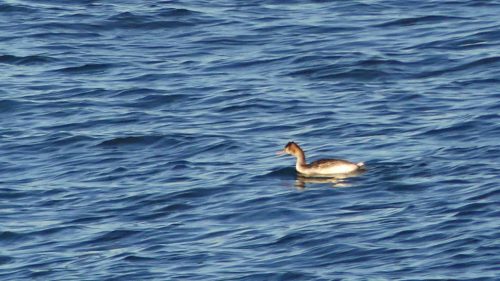
Great Crested Grebes regularly cruise the bay and there was one out there now. Although not appearing to be travelling at speed, they are tricky to catch an image of; you just get them in focus and they dive. I get a lot of images of  empty sea. They can travel good distances underwater in pursuit of fish so you can’t predict where they’ll pop up again.

Following last night’s Super Moon, there was a Spring Tide this morning, at its highest at 10:40am (the Spring Tides are the highest ones). It was windy here as it is at most high tides, but not blowing in across the sea, so its surface was barely rippled. At just past 12 noon, the water was beginning to recede but it would be a while before the sandpipers responded and became active; they’re used to arctic conditons, but it was way too cold for me to stand still. I wondered about the lone bird I’d seen before Christmas. Was it now part of this little group? Surely it was, but I walked the short distance along to where I’d seen it before to make certain. No sign of it, but I did see the biggest jellyfish I’ve ever seen stranded on top of a rock by the tide. It looked a bit battered but don’t know how you tell a live one from a dead one when they’re out of the water.

I walked as far as the steep concrete steps that go down to the shore that are becoming increasingly smoother and their edges more rounded year on year. They were wet right to the top showing how high the water level must have reached earlier on.

180102-1209-RP-Steps 1
180102-1209-RP-Steps 2

Now I’d seen the Sandpipers and knowing I could come back and see them again I thought I’d get into my car out of the cold and go home. But then there might be more to see, I was here now and at least it wasn’t raining like it was yesterday. I also had the luxury of being able to walk here without a grandchild in a pram as I often do, so could stop as often as I liked without protest from a little companion. I walked on towards the village.

It’s not only birds that have ‘crossed-over’ to the wild side of the road. The huge, predominantly limestone rocks of the rip-rap support an increasing variety of plants too. They are mostly garden escapes such as buddleiah and michaelmas daisies and just past the chapel is a bushy shrub. This established bush is sometimes full of one of the local House sparrow tribes adding their cheerful chirping to the more expected sounds of the seashore. There are often House sparrows foraging amongst the rocks of the seashore, especially when they’re nesting and have young to feed. They come after it’s rained too, to drink from small pools of fresh water briefly held by the limestone rip rap.

1/10/17-Rhos Point-A bush full of House sparrows

The bush has shed its leaves now and there were no sparrows today. Someone has put up a bird feeder filled with nuts, maybe for them or maybe for the Robin that is also often around here.

The sea had begun to recede here on the Point, so I began to walk down the  ramp to see if any birds had arrived to forage in its wake and was surprised by a Dunnock that popped out from the base of the bush.

2/1/18-1218-Rhos Point-Dunnock

It moved back down to the rocks beneath

and was joined by a Robin.

The big patch of Winter Heliotrope on the grassy embankment is flowering prolifically now as it has been since last December. This is another plant that started out as a garden plant that escaped and is now also accepted as a wildflower. It’s widespread around the village but this location, facing straight out to sea is not its usual habitat; it’s supposed to go for damp shady places, often under trees. It is thriving here though, this patch is now huge. It’s perhaps not the most beautiful of plants, but it’s a joy to see anything in flower at this time of year and the flowers have a delicious scent, heliotrope is widely used in the perfume industry, but you have to get down to their level to check that out!

Winter heliotrope –  

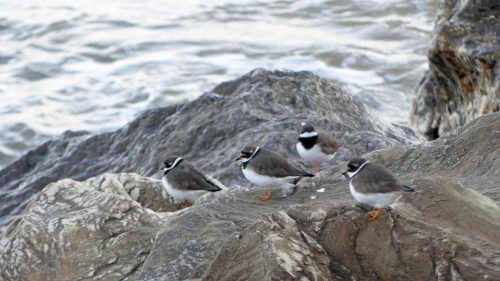
Round about this spot I’d seen a little party of Ringed Plovers on Christmas Eve, when walking into the village with my own family party. There’d been a group of about 15 gathered on the rocks waiting for the tide to turn (birds that is, not family members). No sign of them now, so this is an image I got that day.

24/12/17-Rhos Point-Ringed Plovers

There was a single Dunlin there then too, resting with its head tucked under its wing just peeping out to check it was safe to carry on napping.

24/12/17-Rhos Point-Dunlin

Reaching the harbour the calm appearance of the sea belied the fact that it was actually quite windy and with no sunshine still really cold, not a day for sustained birdwatching from one spot. I loved the view though in these misty muted winter shades.

The harbour wall provides the perfect place for birds the sit out the high tides to wait close by for that magical moment when as it recedes it reaches the perfect point for them to make the short flight back to the shore. There are always oystercatchers and often gulls and a crow or two. A couple seeking shelter from the biting cold against a wall were viewing it with binoculars; they’d seen Ringed Plovers there too. At the far end sat a group of Cormorants; in my photograph you can see Colwyn Bay’s sadly dilapidated Victoria Pier behind them.

Across the road is the park which has a children’s play area, a good old-fashioned paddling pool, empty now of course and open grassy areas that is currently wet and muddy, perfect for blackbirds, thrushes and starlings digging for worms. Here with my slightly bigger granddaughter a few days ago there were two Mistle thrushes in addition to today’s blackbirds and starlings.

Starling – juvenile

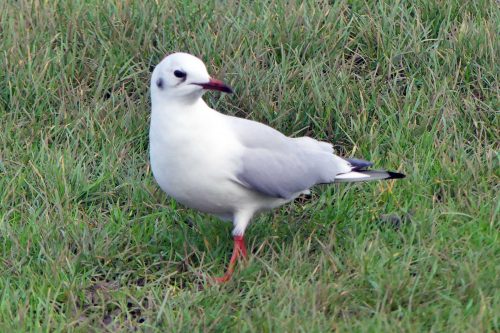
I watched a Black-headed gull, its head is just beginning to show the beginnings of darkening to the chocolate-brown of the birds breeding plumage. It too was digging successfully for worms in the soft mud. I like these neat little gulls with their red bills and legs.

Black-headed gull

Heading back down the slope to walk back I was pleased to see a rock Pipit hopping and flitting between the rocks and the Prom edge before disappearing into plants on the grassy embankment

2/1/18-Rock Pipit

A Robin popped up too – maybe the one I’d seen earlier further along by the bush. He/she was quite likely warning off the Rock Pipit.

2/1/18-Rhos Point-Robin

Daisies are flowering, only a few bravely showing their faces, but a reminder that despite their dainty fragile looks they are as tough as old boots!

2/1/18-Rhos Point-Daisy

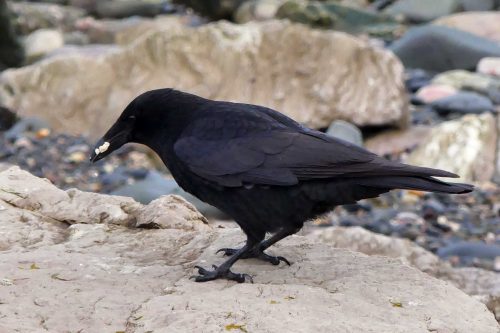
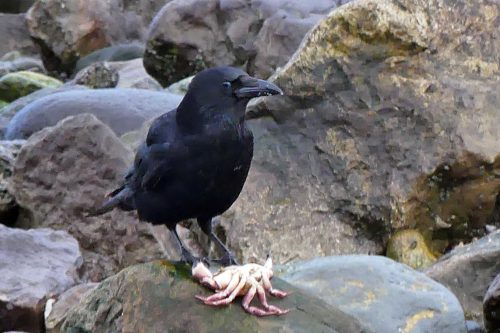
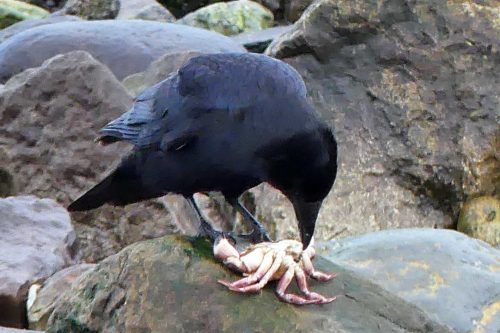
Canny Crows are frequent visitors to the rocky shore and search amongst the rocks for anything edible from scraps of left-over food left by visitors to accessible shellfish.

This one had found the remains of a sizeable crab and that look in its eye says it wasn’t about to share it!

The tide was a little further out now and oystercatchers were beginning to arrive back. They didn’t begin foraging though, instead they quickly settled and resumed their rests.

The two in the pictures below have pointed beaks so would probably be waiting for the softer ground to be revealed in which they probe for their food. Those that hammer away at shellfish have bills that are blunter and more squared off.

The people with the binoculars told me they’d come down here via Penrhyn Bay where it was apparently even colder than here. They reported seeing a Grey plover there on one of the breakwaters, so I decided to go that way home and stop and have a look. I didn’t hold out much hope of seeing anything without binoculars and had no idea which breakwater it might have been on either. It was definitely colder here, and I was not going to hang about, but I was really pleased to discover that this is where the Redshanks come to roost between tides! I’ve often wondered where they go and here they were; dozens of them tucked up in the shelter of the rocks.

Seeing the Redshanks still waiting for the signal to make their move back to the Point made me hope that Curlews would also be in the field they frequent when not on the seashore. They were! And they come with the added bonus that you can stop on the roadside and watch them from inside your car. The brambly hedge on the field boundary gets in the way of the camera lens somewhat, and they were a distance away, but in this setting they are a wonderful sight.


Curlew bathing


Share this:

  • Share on Facebook (Opens in new window) Facebook
  • Share on Pinterest (Opens in new window) Pinterest
  • Share on X (Opens in new window) X
Like Loading...

Winter Woodland

16 Tuesday Jan 2018

Posted by theresagreen in Bryn Euryn Nature Reserve, Nature of Wales, Wildflowers of Wales, woodland walks in Wales

≈ 8 Comments

Tags

alexanders, sweet chestnut, winter walks

January 1st 2018

The early morning was sunny and bright. Perfect for my first walk in the woods of this new year, I thought. Ha! I hadn’t got far when I realised it may not be quite as perfect as I had anticipated. By the time I got outside at around midday the sun had disappeared behind a thick veil of misty cloud, I felt cold despite thermal layers, my new three-way all-weather jacket and walking boots. The track was muddy and a bit slippery; thankfully for once I’d remembered to pick up my pointy-ended light-weight walking stick. This wasn’t what I’d hoped for, but as I want to try to follow the progress of the seasons more closely this year it had to be done. I reminded myself of my double-negatively phrased mantra, “there’s never nothing to see”, crossed my already frozen fingers and trusted that would work.

180101-1143-Blackbird
180101-1145-Squirrel 1

11:43 – Watching a handsome male blackbird rootling in the ground-covering ivy was a good start; then a grey squirrel with a scruffy sparsely-furred tail made me wonder what it takes to keep them in? It was freezing cold, damp and now getting windy, perfect conditions for a spot of hibernation I’d have thought; they must be too hungry to sleep.

Grey sky through bare branches

I do love to see the sky through the tracery of bare branches and twigs on days like this when they are almost in monochrome.

Holly has a strong presence year-round, but it struck me today that even on dull days it shines out, seeming to catch any available light touching its leaves and reflecting it back. There were a few berries remaining on this plant but I’m sure they won’t be there for long.

Alexanders – Smyrnium olusatrum

Clumps of bright green leaves of Alexanders started to reappear back in December. Here on the edge of the woodland path they are sheltered by the trees and protected by leaf litter. I’m always surprised it doesn’t get eaten. It was introduced into this country by the Romans; having a delicate celery-like taste, they  used it as a culinary herb. Rarely growing more than about four miles from the sea, here it’s at its most prolific on the lower level of the Little Orme and along the Llandudno Road. It’s spreading quite quickly here in this part of the woods too. I wonder how it got here originally?

11:57 – The view from the boundary fence was obscured by the dense misty cloud which seemed to be approaching fast. I could still see part of the River Conwy, but the Carneddau mountains beyond had all but disappeared. The A55, or the North Wales Expressway as it is officially known, is busy with traffic whatever the day. The main route westward and up through Anglesey to the Irish ferry port at Holyhead, it is also heavily used by locals for short commutes and  holidaymakers and tourists all year round. The railway line runs alongside it too. Running along the valley bottom, vehicle noise is amplified and rises up to become the background sound to my walks, even the mist hardly muffles it. It is so continuous though that your mind soon ceases to register it.

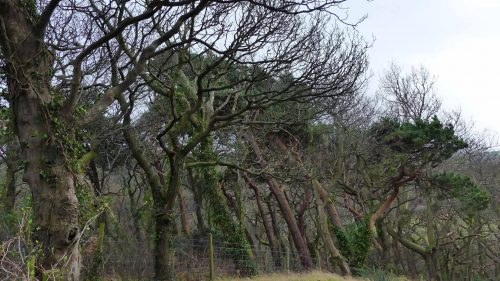
The Scots Pines are at their most numerous in this spot. On the woodland boundary and exposed to strong west winds their trunks are angled backwards and branches are contorted and twisted into some weird and wonderful shapes.

Woodland Trail

A sprinkling of golden gorse flowers brightened the greyness of the day and a quick inhale of its gorgeous coconut fragrance gave me a boost and the will to continue! 

It’s less sheltered up on the Woodland Trail, which is for the most part a corridor through the trees, so deciding which way to go was easy; a right turn and then up, back into the closer shelter of trees. I passed by the big holly tree, hardly any berries remained and there were no birds to see there. There are good crops of ivy berries this year, but they seem to be ripening sporadically and slowly. I often come across plants throughout the woods that have escaped from gardens. I hadn’t spotted this mahonia before though – it’s preparing to flower which will no doubt be gratefully received by the red & the buff-tailed bumblebee queens when they emerge in a few short weeks time.

180101-1205-Ivy berries ripening
180101-1209-Mahonia grden escape flower buds

12:11 – It started to rain heavily. I was fairly protected by the trees so decided to carry on. A party of Long-tailed tits flew above me, calling to one another as they moved quickly through the high tree branches. Tiny birds, they clearly have to keep searching for food but surely need to keep warm and dry too; not easy when there are no leaves.

The wind picked up. On the north side of the hill and gradually getting higher, it was noticeably colder too. If I had sense I’d probably have gone home now, but I really wanted to get to the top of the hill today. At least this weather suits blackbirds foraging in deep leaf litter.

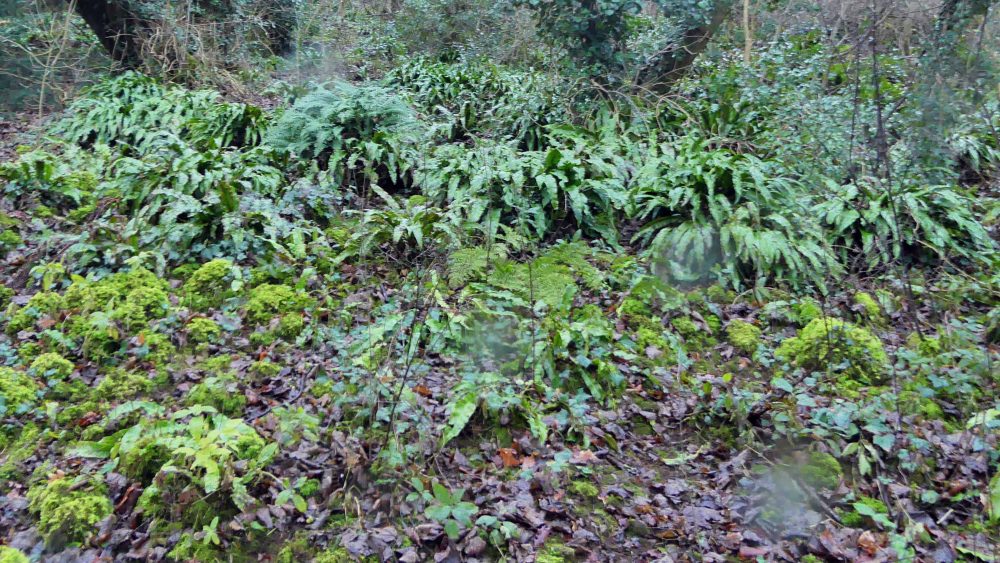
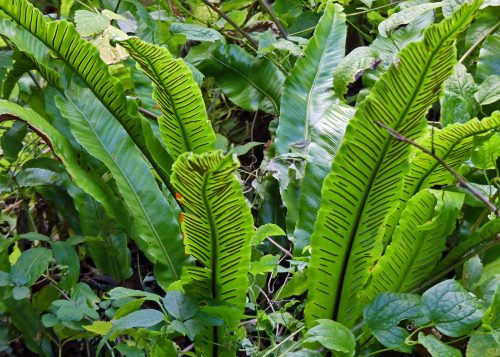
I passed the ‘fernery’ – the open slope that is lushly covered with predominantly Hart’s Tongue fern growing between moss-covered stones. If it was warmer it may feel quite tropical. The smudges are raindrops on the camera lens!

I was glad to reach the part of the trail I think of as the ‘Dark Wood’. It is sheltered by the rising bulk of the hillside and some tall old trees, including a good few Yews, which all combine to block out the sunlight and today some of the rain.

At the end of the tree tunnel is a particularly large evergreen tree, one of several that I know throughout the woodland. I’m trying to work out what they are, so any ideas would be gratefully received.

For some reason I can’t begin to guess at, an iron gate stands at the side of the track just past here. There’s no sign of any fencing on either side of it. It’s just a gate to nowhere.

Gate to nowhere

It does stand near to the junction of a track leading up to the summit though, making it easier to remember where its start is. Covered with leaves it doesn’t stand out and is easy to miss.

The muddy leaf-covered upward track is easily missed

12:26 – The upward track was muddy and slippery and I was glad I had my spiky walking stick, otherwise progress could easily have been a painful step forward and a slide back. It was still raining, my fingers were freezing and I was the only person trekking to the top. Can’t think why. The flash of a colourful Bullfinch disturbed from a bramble patch, eating what remains of blackberries really brightened my day. He disappeared into the scrub of hazel and blackthorn. Hazel catkins start growing at the end of the summer or early autumn and are making steady progress; these are the male flowers, the tiny red female flowers will appear a little later on when the male flowers are fully mature.

Hazel catkins

The twiggy branches of the blackthorns are well-covered with lichen, including clumps of the beautiful silver-green ferny one that feels velvety to the touch. It is a lichen, but confusingly called Oak Moss.

Oak Moss-Evernia prunestri on blackthorn

12:42 – Emerging onto the hill top was breathtaking. Quite literally – it was raining hard, blowing a hooley and bitingly cold. I took a couple of snaps while the wind tried to wrench the camera out of my hands and the rain obscured the view further by dropping onto the lens. There was no way I was going to carry on up to the summit proper.

The sea is out there somewhere

12:50 – I turned and scurried back to the comparative shelter of the track, stopping only because I couldn’t resist this gnarly tree trunk decorated with moss and lichen.

Then there was an extremely tall tree painted with both orange and green lichens and daubed with cushion-like moss. I couldn’t resist that either.

I spot a small Elder that already has quite well-grown new leaves.

13:04 – I watched a blackbird that was having great success finding worms in the mud. I watched it pull out and eat two or three.

It had finally stopped raining and the sun was shining through the trees. It was still really cold though and although only early afternoon, gloomy and dark.

I took a slightly different route back to where I started as it’s a higher, less well used and still covered with leaves and much less slippery. It also cuts across the slope that is part of the view from my kitchen window and is a good place to be to see some of the birds that descend from here down to our bird feeders. No birds today, but I did realise that two of the trees up here are big old Sweet Chestnuts. They have beautifully coloured and textured bark.

Sweet Chestnut-Castania sativa
Sweet chestnut bark
Sweet chestnut bark

13:22 – One last splash of colour – rust-red leaves remaining on a small tree, I’m assuming Copper beech that has found its way here from someone’s garden.


13:39 – I’m home, hands wrapped around a mug of  defrosting tea, watching some of the birds I didn’t see whilst out. They’d doubtless think it bonkers to go out on a day like this when you really don’t have to.


Share this:

  • Share on Facebook (Opens in new window) Facebook
  • Share on Pinterest (Opens in new window) Pinterest
  • Share on X (Opens in new window) X
Like Loading...

To The Summit of the Great Orme

30 Thursday Nov 2017

Posted by theresagreen in Great Orme, Nature of Wales, North Wales, Wales Coast Path

≈ 12 Comments

Tags

coastal drives, coastal walks, goats of the Great Orme, Great Orme cable car, Kashmiri goats, Llandudno, Marine Drive, North Wales Wildlife Trust, sheep of the Great Orme

November 1st

From April this year I have spent almost every Wednesday afternoon working as a volunteer in the NWWT shop situated within the Visitor Centre on the summit of the Great Orme. Meeting visitors from places all over the UK and beyond has been interesting and enjoyable, I have loved learning where they were visiting from and found I have a particularly soft spot for the older people who tell me they came up here as children, some several decades ago. It’s good to hear that the place has stood the test of time and still lives up to their happy memories. A fair few people came in seeking information too, most relating to the Great Orme itself and some regarding the local area, things to see, places to go etc. Initially I had to research things, now I feel I can give enough information for the average day visitor’s needs and in the process have learned a lot about this iconic headland.

The shop’s opening season ends this weekend, so today was my last day until next April. I am going to miss my weekly journey to and from the Summit, which have been highlights of my weeks, it’s been a real privilege to have had such a scenic drive to and from work! Today’s drive was particularly stunning as it was one of only a handful of fair weather Wednesdays this season; most have been cool to the point of cold, wet and extremely windy. The shop has sold boxes full of gloves and woolly hats to unprepared visitors!

Marine Drive

There are a number of ways to reach the summit of the Great Orme but my route of choice is via Marine Drive, also known as the Toll Road as there is a charge to drive this way (currently £3 per car that includes free parking at the summit). You can walk this route too and the length of Marine Drive is an inclusive section of the Wales Coast Path.

Approaching the toll house

Leaving the toll house you are soon confronted with this dramatic view; I love the zig-zag of angles created by the road, the limestone cliff and the stone wall.

There are a few spots where it is possible to pull in and park briefly to admire the views such as this one looking back over Ormes Bay to the ‘good’ unquarried side of the Little Orme.

A limestone cliff towers high above the road level blocking out the low sun

 casting its shadow onto the rippled surface of the sea.

Looking ahead to the tip of the headland and down onto a rocky cove.

Eventually the road forks and I take the upwards route which winds its way via a series of hairpin bends to the summit. The trickiest of these bends is just past the beautiful little St Tudno’s Church where there are stone walls either side of the single track; with no forward view of anything oncoming it helps if you can reverse your car accurately.


Unless I am running particularly late I pull into the small parking area opposite the church. On wild days I contemplate the view from my car but on days such as today I get out, breathe in the air and generally take in the glorious landscape and beyond it across the Irish Sea. The shape of the hawthorn trees here gives you a clue as to the regularity and strength of the prevailing wind.

Two sheep were ambling along the road in front of the church wall. Not an unusual sight, but what was unusual was that both had their long tails and also seem to have escaped this year’s shearing. I wonder where they’ve been hiding?

The National Trust famously took over the farm on the headland a few years ago and the farmer has since built up sizeable flocks of a variety of sheep breeds. Carefully chosen for their differing grazing habits they are free to wander and help maintain the conditions needed for the special flora and fauna that grace this special place.

Some are Herdwick sheep, a breed of native to the Lake District of North West England. Herdwicks are prized for their robust health, their ability to live solely on foraged food, and their tendency to be territorial and not to stray too far from their home base.

A Herdwick sheep smiling for the camera

A sighting of some of the herd of resident Kashmir goats is always a highlight of the drive. They too are free to wander and graze on the tougher vegetation and they can and do, pop up almost anywhere. I was happy to see a little party in the same field as the sheep; a couple of ‘Nannies’ (females), with this years growing kids.

A sign of fair weather is to see the cable cars gliding quietly high above you to and from the summit. This cable car system, opened in June 1969, is famously the longest passenger cable car system in Britain and I’m assured the panoramic views it offers are truly amazing. I’ve yet to try it myself, but it is on my list of must-dos. Needless to say it hasn’t run frequently this year due to strong winds; not surprising when you learn it travels about a mile and its highest point is about 80 feet (24.3 metres) off the ground!

Another way to reach the summit is by tram. Much more reliable it can travel up in most weathers, although it was forced, (in compliance with insurance requirements), to stop a few Wednesdays ago when winds were gusting at 48mph! I remember it well as that day I could hardly open the car door and almost got blown off my feet in the car park. The tram route is a journey in two parts, requiring a break at the aptly named Half-Way Station where you swap cars to continue to the Summit.

The Half-Way Station  

Reaching the road junction by the Half-Way Station I turn right to carry on up to the Summit (left takes you back down into town following parallel to the tram track). I pass the entrance to the Bronze Age Mines. I haven’t been down there either and may not. I can do heights much better than closed-in depths, no matter how fascinating.

From the car park the view is stunning. Not entirely clear but the sun shining through clouds had turned the lightly rippled sea to molten silver.

Although not obvious from the sea’s surface it was still windy enough to support this young Herring gull allowing it to hang in the air and parachute down to make a soft landing.

I’m coming in and there’s another one behind

The shop closes at 4pm since the clocks went back. The summit was almost deserted and the last tram departed as I left. The sun was already setting behind Anglesey and veiled by light misty cloud was casting a glorious soft golden glow over the entire landscape, even colour-washing the white-painted summit building.

In the gathering dusk I drove back down the way I had come to the junction with Marine drive, which from this point once again becomes a one-way only road leading down to the West Shore side of the headland. The road passes by the old Lighthouse, the subdued light suitably accentuating the gothic-castellated building perched bleakly on this exposed point of the headland.

The Lighthouse, now a ’boutique’ b&b, was originally constructed in 1862 by the Mersey Docks and Harbour Company who built the fortress-like building using “dressed limestone and vast bulks of Canadian pitch pine”. The beacon remained as a continuous warning to mariners until March 22nd 1985 when the optic was removed. It is now on view within the Visitor Centre on the summit. 

Past the lighthouse I just had to stop and get out of the car to photograph these pink-washed limestone cliffs before continuing on down. Then stopped again to take in the view out over the West Shore and the Conwy estuary. On a clear day you can see Conwy castle and the road bridges and follow the curve of the river back way beyond to the mountains of Snowdonia.

A few minutes later I am almost home, driving along the Llandudno sea front and admiring the almost-full moon in the darkening sky.

This must surely be one of the most scenic routes to and from a workplace that a person could wish for.

Share this:

  • Share on Facebook (Opens in new window) Facebook
  • Share on Pinterest (Opens in new window) Pinterest
  • Share on X (Opens in new window) X
Like Loading...

Michaelmas Day

29 Friday Sep 2017

Posted by theresagreen in Nature of Wales

≈ 19 Comments

Tags

Folklore of the British Isles, Michaelmas, michaelmas daisy

September 29th

Today is Michaelmas Day; the feast day of Saint Michael and All Angels. For many of us the significance of this date will most probably have faded into the mist of times past, but there are ancient customs, traditions, festivals and folklore surrounding it that I find fascinating.

The Archangel St. Michael is the patron saint of the warrior, who Catholics have designated as the protector of those who strive to preserve security, safety and peace.

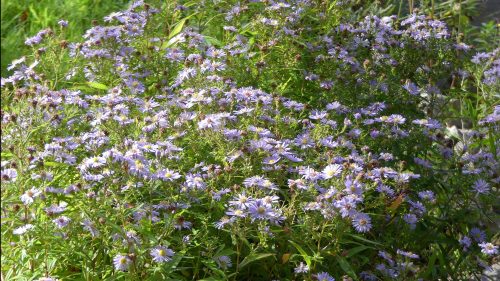
Michaelmas Daisies

HARVEST

In the British Isles the harvest season used to begin on the first day of August, which was called Lammas, meaning ‘loaf Mass’. Farmers made loaves of bread made from the first of their new wheat crop which they then gave to their local church. This custom ended when Henry V111 broke away from the Catholic Church and instead it became tradition to hold Harvest Festivals at the end of the season close to Michaelmas Day, which traditionally marked the last day of the harvest season.

QUARTER DAYS

Michaelmas Day is one of the four “Quarter Days” of the year. They are spaced three months apart on religious festivals close to the solstices or equinoxes: Lady Day is the first on 25th March, then Midsummer on 24th June, Michaelmas is on September 29th and the final one is Christmas on 25th December. These four dates marked the days on which rents were due and bills had to be paid up. Michaelmas, or Goose Fairs were ‘Hiring Fairs’, attended by both those seeking employment and to hire new staff. On the day after Michaelmas every year, agricultural labourers presented themselves, along with their tools, at the nearest market townto offer themselves for hire for the coming year. Here too Geese were brought to market for sale and tenants seeking a delay of payment traditionally bought a goose as a present for their landlord to help seek his indulgence.

GOOSE DAY

The old saying goes:

“Eat a goose on Michaelmas Day, Want not for money all the year”.

Michaelmas Day is sometimes also called Goose Day, when particularly in northern England and Ireland, it was thought that if you ate goose at Michaelmas you would have good luck for the rest of the year and a fat roast goose was the traditional Michaelmas treat. This was supposedly the best time of the year to eat goose, when the birds had feasted on the stubble of the harvested wheat fields but had not yet put on the fat they needed to get them through the winter. Goose was eaten to protect against financial need in the family for the next year another saying is:

“He who eats goose on Michaelmas day shan’t money lack for debts to pay”.

Goose Fairs

Goose Fairs are still held in some English towns, but geese are no longer sold. The most famous Michaelmas fair is the Nottingham Goose Fair which was originally held in September on St Matthew’s Day, but moved to early October in 1752. The Goose Fair goes back so far in history that no one knows for sure how it got its name, but it’s probably from the hundreds of geese which were driven there from all over Lincolnshire to be sold in Nottingham. Most historians agree the fair probably started just after 1284 when the Charter of King Edward I referred to city fairs in Nottingham.  Goose Fair started as a trade event, although nowadays it is better known for its fairground rides and games.

OLD MICHAELMAS DAY or ‘DEVIL SPITS DAY’

After the calendar reform of 1752, some activities traditionally associated with Michaelmas Day (29th September) moved forward eleven days to October 10, which is sometimes called ‘Old Michaelmas Day’. Old Michaelmas Day used also to be called “Devil Spits Day”, which according to old British folklore, is the last day that blackberries should be picked. It was said that the Devil was kicked out of heaven on St Michael’s Feast Day, falling from the skies onto a blackberry bush. Already rather cross, he then proceeded to curse the fruit, scorching them with his fiery breath, then according to where you’re from, he either stamped on them or spat on them, thus ensuring they were unfit to eat! Legend has it that he renews his curse annually on Michaelmas Day and therefore it is very unlucky to gather blackberries after this date. An old Irish proverb says:

“On Michaelmas Day the Devil puts his foot on blackberries”

This particular piece of folklore certainly persisted into my Northamptonshire 1950s-60s childhood, when we were warned by my mother to be sure not to pick or eat blackberries after the end of September as “the Devil spits on them”. I wouldn’t have dared risk it and I’ve told my children the same thing! I do hope they remember and pass it on. I must remember to tell the grandchildren myself, and will keep the date as I know it, even though I now know that it’s safe to pick and eat them for another ten days. Although in my experience they’re usually past their pick-by date by now anyway, being a bit blown or mouldy or even maggoty.

MICHAELMAS DAISY

Late summer and early autumn wouldn’t be the same without Michaelmas Daisies. Ours have been flowering in the garden for a few weeks now and as always at this time of year are doing a brilliant job of supplying pollen and nectar to a range of insects still out seeking it.

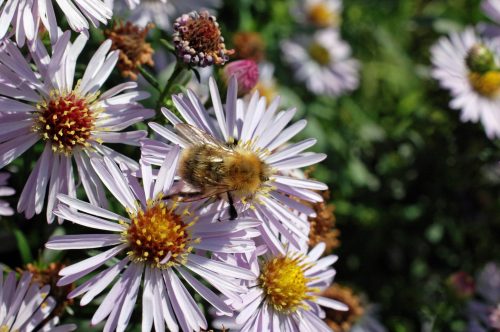
Michaelmas Daisy-Aster amellus with Common Carder bee

Michaelmas daisies were first introduced into Britain from North America around the beginning of the eighteenth century. The Victorian’s love of wilder gardens encouraged their wider planting and from there they escaped into the wild, becoming naturalised in an array of habitats.

The Michaelmas Daisies, among dede weeds,
Bloom for St Michael’s valorous deeds.
And seems the last of flowers that stood,
Till the feast of St. Simon and St. Jude.

(The Feast of St. Simon and Jude is 28 October)

In the language of flowers, the Michaelmas-daisy symbolizes a farewell or a departure.The act of giving a Michaelmas Daisy symbolises saying farewell, perhaps as Michaelmas Day is seen to say farewell to the productive year.

MICHAELMAS WEATHER-LORE

‘If St Michael brings many acorns, Christmas will cover the fields with snow.’

If the breast bones of the goose are brown after roasting the following winter should be mild, but if the bones are white or have a slight blue hue then the winter will be severe.

‘A dark Michaelmas, a light Christmas.’

The Victorians believed that trees planted on this day would grow especially well.

Curfew

Michaelmas used to be a popular day for the winter night curfew to begin – the first hint that winter was on the way. Curfew took the form of a tolling of the church bell, usually one strike for each of the days of the month that had passed in the current year and was generally rung at 9pm.

Share this:

  • Share on Facebook (Opens in new window) Facebook
  • Share on Pinterest (Opens in new window) Pinterest
  • Share on X (Opens in new window) X
Like Loading...

September Hillside

24 Sunday Sep 2017

Posted by theresagreen in British hoverflies, Bryn Euryn Nature Reserve, Butterflies of Wales, calcareous grassland, hoverflies, Nature of Wales, North Wales, slugs & snails, Wildflowers of Wales

≈ 7 Comments

Tags

Arion flagellus, common carder bee, common knapweed, eyebright, green-soled slug, hemp agrimony, robin's pincushion, scabious, speckled wood, volucella zonaria, yarrow

September 8th-Bryn Euryn

As I’ve already said, it was mighty windy out here on the not-quite-summit of the hill; not the day for hanging around gazing at the views, no matter how stunning they may be.

Windswept not-quite-summit of Bryn Euryn

A quick look around showed there to be little left in the way wildflowers in bloom, but there was colour on a wild rose – a whole colony of bright red Robin’s Pincushion galls. I don’t recall ever having seen as many on a single plant. The fuzzy growths will gradually fade to brown and the little wasps that cause the growths will emerge in June. If I’m lucky, one of these days I’ll catch them coming out, although the galls also attract ‘squatters’ and there can be a dozen or more species lodging in there!

I was to keen to keep moving, but when I spotted this lovely patch of Eyebright I couldn’t resist stopping again.

The dip between this part of the hill and the slope up to the summit is usually sheltered and offers a brief respite from the wind and the noise of traffic from the A55 below, but not so today. Yarrow likes this spot and there was quite a good large patch of it still in flower here. As with Eyebright, Yarrow is a plant designed to withstand tough growing conditions and is pretty persistent, as anyone that has tried to eliminate it from a lawn will testify; you cut it down and it grows right back! Personally I prefer the ferny-leaved Yarrow to the boring grass! Funny how we discriminate against certain plants, this wildflower Yarrow’s taller-growing golden-yellow flowered relative, Achillea, is a cherished garden plant!

Some insects rather like its flowers too, I found a tiny bee motionless on a flower today and recalled I’d seen a similar looking insect on Yarrow in the Rhiwleddyn reserve a few weeks ago.

Tiny bee on Yarrow – enlarged

On the summit a patch of purple Knapweed was fuelling a few Common Carder bees that were managing to cling on and fly short distances despite the best efforts of the wind to dislodge them. The little bees had varying appearances; some were practically perfect, others a bit more battered, their ‘fur’ worn away and at least one that had a bleached appearance like it had spent too long out in the sun.

Common carder bee-practically perfect
Common carder bee-a little faded
Common carder bee-fur worn from back
Common carder bee-bleached

There was another lovely clump of Eyebright up here, this one framed by the distinctively-arranged pods that give the Bird’s-foot trefoil its name.

More Yarrow too, this plant sheltering a tiny fly.

I was hoping that the other side of the hill would be a bit more protected from the wind, but alas, most of it wasn’t. The sun was putting in sporadic appearances though, so at least it felt a bit warmer. Ironically, the sea looked to be calm, was coloured in shades of beautiful blue and its surface merely ruffled. The blades of the wind turbines were motionless.

Looking over in the opposite direction to te sea, the view to the oddly-shaped hill at Deganwy, was fairly clear, although beyond it, Anglesey and the Menai Strait were shrouded in a light haze. I’m not sure if I’ve mentioned it before, but the hill is named the Vardre and gets its unusual appearance from having two rocky summits. It has a little less height than Bryn Euryn, it being 108m, (354 feet) while the Bryn is 131m (365 feet). It was once home to fortifications that included Deganwy Castle.

On the woodland edge leaves are beginning to change colour. Hawthorn is one of the first to go

along with Silver birch as I mentioned in the previous post. Out here in the open it was easier to appreciate the combination of yellow leaves against a clear blue sky.

Next to the Silver birch is a single Whitebeam, which bears berries. The berries are orange in colour now but will gradually turn red.

In the short grass there are still a few Rock-roses in flower and here and there are big fat ‘penny-bun’, or Bolete mushrooms. At least they would have been big and fat before they were nibbled away. I like the different shades and textures such nibbling has left on this one; there was a little black spider on it too.

I have often wondered what nibbled the mushrooms. A picture I took a few weeks ago, at the end of July may have the answer. The sight amused me and I wondered if it was a romantic al-fresco lunch for two? Of course there is more to slugs than meets the eye. No gardener is ever going to welcome them onto their plot, but out in the wild they are another important cog in the wheel of the natural waste-disposal system. Although one slug may look rather like another, there are rather a lot of different species of them in our British Isles. I submitted this image to the very helpful folk that run the Slugs and Snails of the British Isles Facebook Group, who responded that to be accurate they need to see the undersides of the slugs too, but from other features that it is likely they are juvenile Arion flagellus – the Green-soled slug.

poss. Arion flagellus- the Green-soled slug

The bottom of the grassy ‘downland’ hill was still flowery with Hemp Agrimony, Knapweed, touches of Scabious and a sprinkling of Ragwort.

I walked down to where it meets with the woodland edge and lo and behold, for a few glorious minutes the sun came out. Suddenly it was warm and bright and the scene came alive with a whole host of insects vying with one another for the best blossoms.

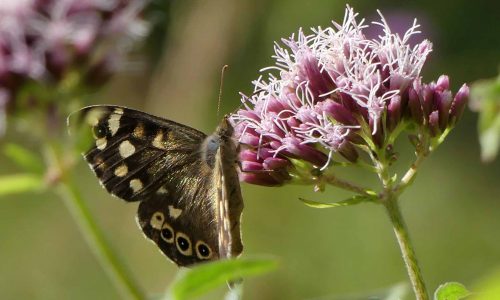
Speckled wood on Hemp agrimony

I hardly knew where to look first, but then couldn’t resist the sight of a pristine Speckled wood feasting on Hemp agrimony. There were several of them, all looking freshly beautiful; most were nectaring on various flowers while some rested on the leaves of nearby trees basking in the sunshine. The only other butterflies in evidence were Red Admirals which unusually stayed out of range of the camera.

Speckled wood on ragwort

There was a good variety of hoverflies,large and small, a Common wasp and more Common carder bees too.

Hoverfly - Eristalis sp
Hoverfly – Eristalis sp
Hoverfly - Eristalis sp
Hoverfly – Eristalis sp
Hoverfly-Helophilus sp
Common wasp
Common wasp

Common Carder bee on Scabious

Volucella zonaria

A beautiful cast of insects, but the star of today’s show was a big handsome hoverfly, which surprisingly doesn’t have a common name, but whose scientific name, Volucella zonaria makes it sound a bit like an Italian pasta dish. This is the largest British hoverfly and is quite a recent addition to our native list, appearing on the south coast of England during the late 1930s. According to my Hoverfly bible, from there it has spread upwards and outwards across the country as far as Cheshire and Humberside and South Wales in the West. We’re not so far from the Cheshire border here, so they must still be spreading, this is the second one I’ve seen this year, the other was in my daughter’s garden a few weeks ago.

170908-1510-BEICT-Hoverfly-Volucella zonaria 3
170908-1510-BEICT-Hoverfly-Volucella zonaria 5

The spell of sunshine didn’t last long and the wind was still blowing relentlessly; time to set off in the direction of home.

Wind-blown ash tree


Share this:

  • Share on Facebook (Opens in new window) Facebook
  • Share on Pinterest (Opens in new window) Pinterest
  • Share on X (Opens in new window) X
Like Loading...

September Woods

22 Friday Sep 2017

Posted by theresagreen in bird behaviour, ferns, Nature of Wales, nature of woodlands, North Wales, woodland birds, woodland walks in Wales

≈ 11 Comments

Tags

black spots on sycamore leaves, Blue tit, grey-green lichen hanging from tree, hart's tongue fern, male fern, Nuthatch

September 8th – Bryn Euryn

Woodland Path

Yet another windy day with intermittent sunshine, so I’m seeking shelter in the woods. It is almost eerily silent and the damp soft earth of the path absorbs the sound of my footsteps. Something detects my presence at the last minute; loud rustling sounds from the undergrowth startle me and a panicked grey squirrel shoots out in front of me, sprints rapidly along the path and launches itself up the trunk of the nearest large tree. It pauses when it feels safely hidden behind foliage, but I spied it through the leaves, its mouth filled with an acorn, still green and unripe.

There are ripe blackberries, but on the early fruiting brambles some are already mouldering, and a feasting greenbottle fly reminds me why I don’t eat too many unwashed wild berries.

Chains of scarlet berries drape shrubbery. This one twined through holly reminded me of a Christmas garland; I wonder if sights such as this sparked the idea for festive decorations?

The berries are those of Black Bryony-Tamus communis, and will continue to ripen until they are black. A perennial plant described as twining, but often it’s more of a scrambler.

Woodland Trail

There are rose hips here

and a bramble whose leaves look as though they are almost ready to drop.

The gorse bushes have fresh golden blossom and clever spiders have spun webs in the hope of capturing flying insects drawn to their nectar and pollen. Gorse flowers throughout most months of the year prompting the old saying, “When gorse is out of flower, Kissing is out of season!”

Summit Trail – backtracking

The last time I walked here I took a slightly different route to the summit of the hill, taking an unmarked track up through the woodland to join the Summit Trail. I hadn’t planned to that, but at the junction of the paths I usually take I’d stopped to try to locate Jays that I’d heard screeching in nearby trees and a man with a dog stopped to ask me what I was looking at. We had an interesting chat comparing notes about what we both see here and where, but I didn’t catch the Jays. I waited to see which way he would go to continue his walk and seeing it was the same way I was headed, decided to go the opposite way. Not that I’m unsociable of course, rather that I see far more on my own and in my own time; and he had a dog! Anyway, the upshot was that I ended up on a narrow upward track through the trees on another windy day that was sunny but still damp from the previous night’s rain.

Spiders’ webs lit by the sunshine filtering down through the leaf canopy caught my eye and I stopped to admire the artistry of their construction and to try to find their makers. Looking more closely I saw most of the webs were broken and apparently abandoned, although this one had captured a beautiful rainbow.

As so often happens, my slow progress and in this instance, last-minute change of route brought forth a magical few moments. Until now the only sounds had been mainly of the wind rushing through the trees, but I began to hear bird calls that got gradually nearer and suddenly I was surrounded on all sides by excited little birds – a travelling feeding party! I had been standing still and they seemed not to notice me; I’ve described a similar experience in a previous post and this was equally as joyous and uplifting. It was a large party too, impossible to count the numbers of birds within it as they scattered amongst the trees, but Blue tits were probably most numerous with at least a dozen Long-tailed tits; Great-tits were there too. I didn’t see Tree-creepers as before, but was thrilled to see a Nuthatch that chose to explore a tree right in front of me.

Nuthatch-Sitta europaea

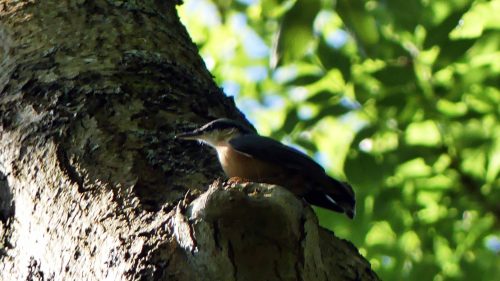
Taking photographs in the darkness of woods is rarely successful, but a Nuthatch did pause briefly from its foraging near a patch of sunlight, giving me a reasonable chance to record this bird for the first time here. Watching a tiny Blue-tit searching through ivy high up in another tree I realised it was looking for spiders, which are an important part of their diet. Perhaps the birds’ regular forays are the reason I couldn’t find any.

Blue tit seeking spiders

Back to the present 

Sycamore leaf with spots of fungus

There was no feeding party today, but there were other signs of a summer ending. Sycamore leaves, amongst the first to break their buds in the Spring are amongst the first to change colour and fall. Most of those I see nowadays are marked with dark spots; this is Rhytisma acerinum, the Sycamore Tarspot. It doesn’t look attractive, but although it is suspected that the darkened areas reduce the photosynthetic capacity of affected trees, the fungus doesn’t seem to affect the tree’s health and vigour. One consolation of the fungus’ presence is that is shows the air here is fairly clean as it is apparently particularly sensitive to sulphur dioxide air pollution. Trees growing near to industrial centres with high levels of sulphur emissions do not show any sign of the leaf-blackening fungi.

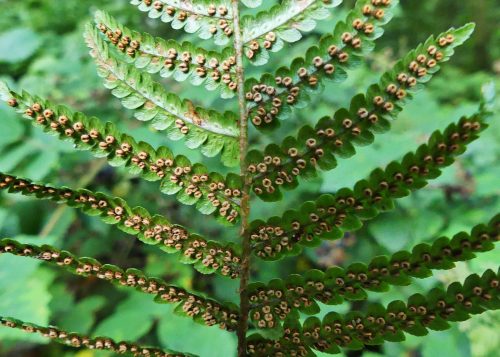
If you look at the undersides of the fronds of most ferns, their seeds, spores or more correctly sori  are now ripe. The Male Fern is the most common fern found growing here; its sori are round and normally run in two parallel rows.

There’s a large patch of Hart’s Tongue Fern growing in damp shade on a steep bank. Its leaves and sori take a different form to those of other fern species. Their ripe sori accentuate the marks on the underside of the leaves and it seemed to the person that named the plant that they resembled the legs of a centipede, so he gave it the scientific name ‘scolopendrium‘, the Latin for centipede.

Hart’s Tongue Fern-Phyllitis scolopendrium

The track passes a sheer cliff of limestone. Its surface is frequently damp, sometimes wet and its base is covered with a lush, bright green shag-pile carpet of moss.

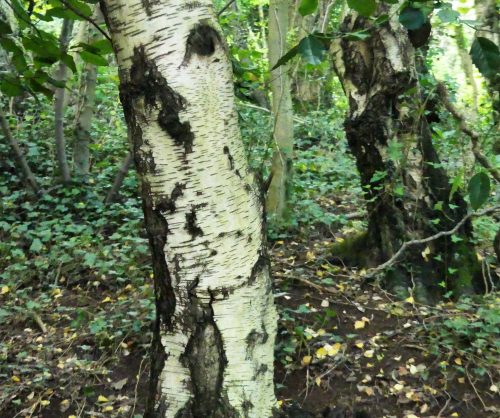
There’s a small grove of Silver Birch trees on this shady, damper side of the Bryn that are also beginning to lose their leaves, which stud the dark mud of the track with specks of bright gold.

Nearing the end of the path the trees thin and give way to scrubbier vegetation, mostly blackthorn and hawthorn. The blackthorn has beautiful purple sloes and its leaves too are beginning to turn colour.

A number of the blackthorn shrubs here also have clumps of pretty grey-green lichens. Some looks like a tangle of moss, which I can’t accurately name.

Other blackthorns have a lichen in a different form, this one, photographed on a nearby shrubby hawthorn tree with dark red fruits (haws), has the appearance of Reindeer moss, but I can’t yet be species-specific.

Emerging from cover onto the exposed summit I braced myself for another confrontation with the wind. The sun had disappeared behind clouds that were shutting out its brightness, leaving the landscape in shadow, dulling its colours. Part of the view across the valley from here takes in buildings and fields that belong to the Welsh Mountain Zoo, located above Colwyn Bay. There are sometimes interesting animals grazing in the fields; today it was some kind of cattle.

With or without sunshine I love this hillside view of small fields bounded with hedges and trees with the mountains in the distance. It reminds me a little of a David Hockney painting.

The mountains are topped with billowing clouds that permitted some sunshine through to lighten slopes here and there and to brighten the water of the river Conwy.

On days like this you can only hope for at least a little sunshine to brighten the rest of a walk…


Share this:

  • Share on Facebook (Opens in new window) Facebook
  • Share on Pinterest (Opens in new window) Pinterest
  • Share on X (Opens in new window) X
Like Loading...

A Windy Wildflower Trail – completion

18 Monday Sep 2017

Posted by theresagreen in Butterflies of Wales, calcareous grassland, coastal walks, nationally scarce wildflowers, Nature of Wales, North Wales Wildlife Trust, plants important to wilflife, Rhiwledyn Nature Reserve, Wales Coast Path, wildflowers on limestone

≈ 11 Comments

Tags

Banded burdock fly, Brown Argus, comma, dropwort, Horehound moth, Spiked speedwell, Veronica spicata, White horehound

August 3rd

Part 3 – Rhiwleddyn Nature Reserve

It is wonderful to wander through places that have been left alone and to find indigenous plants that could have been growing there for hundreds of years, or in some cases, even thousands. But areas that have in one way or another been ‘disturbed’ often bring forth species of flora and fauna not seen in areas that haven’t, as in the next part of my wander around the reserve.

Brambles and nettles threaten to take over this small, scrubby area in the midst of the reserve, but there are plants tough enough to hold their own there, one being Common Sorrel.

Common Sorrel Rumex acetosa

The tall stately Great Mullein with its large beautiful grey-green velvety leaves sometimes graces a disturbed scrubby patch. It’s a biennial plant, so flowers appear during each plant’s second year. It is a locally common plant, but its appearance in a specific area each year is not predictable; which makes it more of a treat when you do find it. Each plant usually produces a single flowering spike; one with multiple spikes may indicate that it was nibbled by rabbits in the early stages of its growth.

Great Mullein – Verbascum thrapsis

White horehound, is one of the scarcer plants to be found within the reserve. Its presence here is tenuous year on year, as it is constantly under threat of being out-competed by rampant ‘coarse’ vegetation such as nettles and brambles; its survival largely dependent upon diligent scrub-clearing and management by the reserve management team and Wildlife Trust volunteers. The plant is also found, in greater amounts, on the Great Orme.

June 2017-larva of the Horehound Moth – Wheeleria spilodactylus on foodplant

White horehound is important as it is the only food plant of the larvae of the Horehound Moth Wheeleria spilodactylus. Inhabiting chalky soils, this is a localised species of plume moth, largely confined to the Isle of Wight and a few scattered localities in Wales and Southern England. The exceptionally well-camouflaged caterpillars appeared on plants here earlier in the year when I took this photograph; they are evidence that the battle to maintain its ongoing presence is important to this species of moth.

I haven’t seen the moth myself, but found this perfect picture of one, appropriately taken on the foodplant on the Great Orme by John Martin. Respecting the copyright of the image, this is the link to it. http://www.ukmoths.org.uk/species/wheeleria-spilodactylus/adult-on-foodplant-2/

A little grasshopper sat basking, sheltered from the wind and very well camouflaged on a bramble leaf. I doubt I’d have seen him if I’d not caught sight of him land there.

Grasshopper on bramble leaf

This is him/her greatly enlarged

Grasshopper on bramble leaf (enlarged)

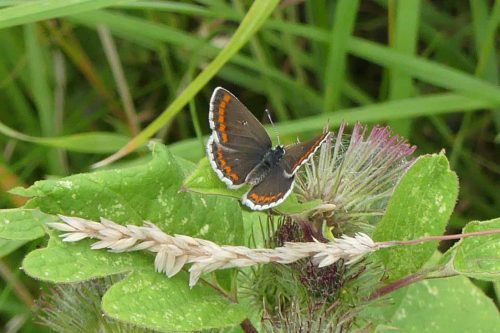
Another tough plant here is the Lesser Burdock. I like the plant with its round prickly flower heads and tufts of purple flowers that will soon dry into ‘burrs’ and stick to anything that brushes against them. I approached the plant to photograph it; as I did so, I got excited to see that a little butterfly had the same idea and had only my second sighting so far this year of a perfect little Brown Argus.

Brown Argus Aricia argestis

The poor thing was fighting to stay put in the strong wind and I was struggling to keep my camera lens focussed on it. I was vaguely aware of a small fly sharing the same space on the plant as the butterfly, but was too intent on the matter in hand to pay much heed to it. It was small and yellowish and flitting about a fair bit, but at the time it didn’t click that this might be a fly I’d been hoping to find for the past few years that is a burdock specialist.

Brown Argus & Banded burdock fly

Banded burdock fly-Terellia tussilaginis

It wasn’t until the next day, when I looked at my images properly that I realised this little fly was indeed most likely a Banded burdock fly-Terellia tussilaginis and that I’d almost missed it!

At least it gives me good reason to show more images of the lovely little butterfly.

Brown Argus & Banded burdock fly

I was getting a bit fed up with the wind now but battled on towards the top as I wanted to get an image of the stunning view of Llandudno that you get from this side of the Little Orme headland. It was only when I got there I remembered that I had actually been somewhat sheltered from the full force of the wind! it was still so strong it took my breath away and I had to lean against a rock to brace myself, not only to steady the camera but also myself. Worth it though, what a view!

I didn’t stay to lingeringly admire the view, and was quickly on the way back down to seek a calmer spot. Facing now in the other direction and looking down onto the fields below I had the random sight of a male Pheasant, not a bird I see often. He was looking a bit bedraggled and was clearly limping. Had he been been shot and survived, hit by a car, or even attacked by a fox or dog? Fortunately he seemed still to be able to fly well enough.

Limping pheasant

A little further on I spotted a little splash of blue in the short grass in front of me and much to my surprise here was one of the Reserve’s special treasures – a single stem of the lovely little Spiked Speedwell. This is a plant that is cultivated and grown in gardens, but only grows in the wild in the Breckland grasslands of East Anglia and very locally in Wales and Western England.

Spiked Speedwell-Veronica spicata

A few metres away, standing a little taller, a single flower stem of Dropwort, another specialist of calcareous grassland, this one being bent almost to the ground by the strength of the wind.

Dropwort – Filipendula vulgaris

Hawthorn is one of the few species of tree that is not nibbled by rabbits or sheep in its early stages and that can also withstand exposure to the strong, salt-laden winds the headland is subject to. Most are contorted into weird and wonderful shapes, but this one, although short has grown large and spread fairly evenly.

I met up with the young Robin again on my way back down.

Young Robin

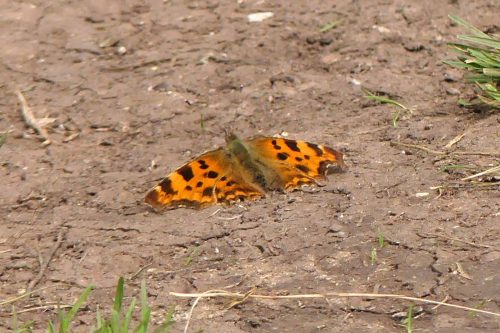
And a beautiful Comma butterfly landed on the bare earth of the track.

Comma

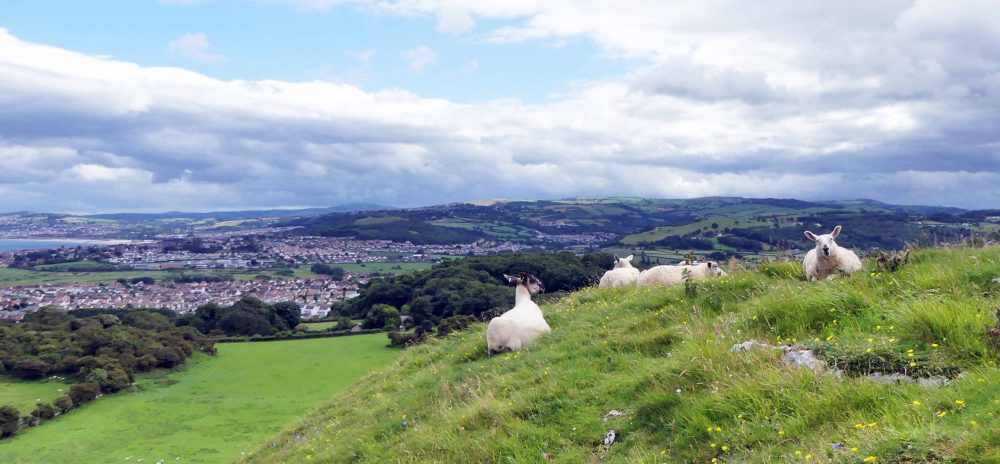
The sheep were where I’d left them, settled down comfortably now for an afternoon siesta in the sunshine.

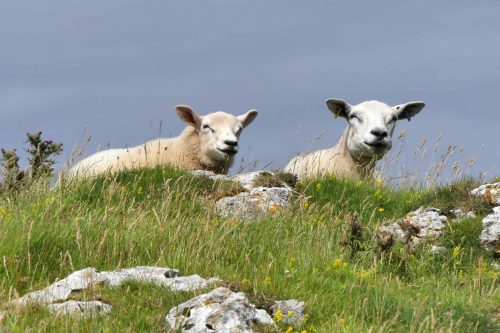
Looking up from the track below I saw they were still watching me, with definite smug, self-satisfied smiles on their faces.

I was more than happy with my final wildflower tally for this walk, which included (in no particular order!): Common calamint; Common rock-rose; Black horehound; White horehound; Hedge woundwort; Water mint; Lady’s bedstraw; Spiked speedwell; Dropwort; Wild thyme; Common cinquefoil; Centaury; Carline thistle; Goldenrod; Lesser burdock; Common sorrel; Great mullein; Harebell; Perforate St John’s Wort; Wild clematis; Yellow-wort; Wild fennel; Marjoram; Wild carrot; Hemlock; Ragwort; Ploughman’s spikenard; Yarrow


Share this:

  • Share on Facebook (Opens in new window) Facebook
  • Share on Pinterest (Opens in new window) Pinterest
  • Share on X (Opens in new window) X
Like Loading...

The life of a Yellow Dung-fly

05 Tuesday Sep 2017

Posted by theresagreen in Insects, Nature, Nature of Wales, Wildlife of the Wales Coast Path

≈ 12 Comments

Tags

dung flies, golden dung fly, insects seen on animal dung, Scathophaga stercoraria, yellow dung fly

This post is possibly not one for the squeamish, but lately I’ve become more aware of these bright little flies and given thought to the vital role they and their kind play in maintaining balance in our environment, so decided it was time to learn more about them. Yellow dung-flies are one of the most familiar and abundant flies here in the United Kingdom and indeed throughout much of the Northern Hemisphere. They are out and about from March to November and at their peak in the summer. Anyone that walks in the countryside, particularly in areas where there are large mammals will undoubtedly have seen them. They may look a little fearsome close up, but are harmless to us, they do not sting or bite people or other animals!

Common Yellow dung-fly or Golden dung-fly – Scathophaga stercoraria

Yellow -dung-fly male

As its common name suggests, the life of a Yellow dung-fly, particularly that of the males is centred on, yes you’ve guessed it … dung! They spend most of their lives either upon it, or looking for it. They favour cow pats, but are adaptable and will settle for the dung of other large mammals such as horses, deer or wild boar if that’s what’s available. Unsurprisingly here in Wales they mostly have to settle for that of sheep.


Male and female yellow dung-flies

Dung-flies belong to the Scathophagidae family of flies which are integral within the animal kingdom in the role of  assisting in the process of the natural decomposition of dung in fields and grasslands. 

Description: 5-11mm long. Average lifespan is 1-2 months. Sexually dimorphic, males are golden-yellow with orange-yellow fur on their front legs and are larger than the females. Females are generally duller in appearance, more of a green-brown colour and have no brightly coloured fur on their front legs.

Behaviour 

Males and females are attracted to fresh dung by its scent and actually approach deposits flying into the wind. Males spend most of their time on the dung waiting for females to mate with and being predatory insects, sometimes feeding on other insects that visit the dung, such as blow flies. Females on the other hand spend most of their time foraging in vegetation and only visit dung to mate and subsequently deposit her eggs.

Reproduction 

Rival male dive-bombing a mating pair

The male-female ratio of flies on a dung pat is typically heavily biased towards males. Often several males can be seen waiting for a female to arrive, so if and when one does, competition to mate is high: the smaller, outnumbered females don’t have much say in choosing their mate.

The act of copulation lasts 20 to 50 minutes during which the couple may be subject to aerial attacks from rival males attempting to dislodge the male. When the act is completed, the male attempts to guard the female from the attentions of other males, although both males and females often mate with several individuals.

Life-cycle

The adult dung-fly is mainly carnivorous, catching and eating smaller insects, but they also eat nectar. After mating females lay their eggs on the dung, where she selects small ‘hills’ on its surface, deliberately avoiding depressions and sharper pointed areas. This strategy is aimed at preventing desiccation and drowning thus giving eggs and offspring the greatest chance of survival. Depending on ambient temperature eggs hatch into larvae after 1-2 days. Larvae burrow quickly into the dung for their protection and proceed to feed on it; they also predate on other insect larvae also living in the dung. They grow rapidly and after 10-20 days the larvae burrow into the soil around and beneath the dung where they pupate.

Environmental influences 

The Yellow dung-fly has a short life cycle, a factors that has made them of interest to scientists, who have been able to study not only the insects themselves but also the effects various environmental factors has on them. For example:

The viability of a clutch of eggs depends strongly on the environment. In warmer climates a sharp drop in population occurs during the summer when temperatures increase to 28° or above. This does not happen in places with a colder climate such as Iceland, Finland and the north of Britain, nor at higher elevations.

The health of juvenile dung flies is in turn affected by the quality of the dung they inhabit, factors such as water content, nutritional quality, the presence of parasites & drugs and chemicals given to the animal that excreted it may all contribute.


Share this:

  • Share on Facebook (Opens in new window) Facebook
  • Share on Pinterest (Opens in new window) Pinterest
  • Share on X (Opens in new window) X
Like Loading...
← Older posts
Newer posts →
Follow everyday nature trails on WordPress.com

Enter your email address to follow this blog and receive notifications of new posts by email.

‘But it is the common species that keep the living world ticking over and provide most of our experiences of wildlife, and I would argue that maintaining the abundance of these is as important a conservation priority as maintaining the existence of rarities’. Richard Mabey

MOST RECENT POSTS

  • A Glimpse of Spring to Come January 22, 2025
  • Hunting the Wren December 28, 2024
  • Oh, Christmas Tree December 18, 2024
  • In and Out of the Ivy February 15, 2024
  • Nature’s Fireworks November 30, 2023
  • Wild Autumn along the Coast Path November 3, 2023

OLDER POSTS

LOOKING FOR SOMETHING IN PARTICULAR?

  • May Bee Appearing on Ivy near You
    May Bee Appearing on Ivy near You
  • Catchers, a Duck and Divers
    Catchers, a Duck and Divers
  • Sights and Sounds from the Little Orme 1
    Sights and Sounds from the Little Orme 1
  • Following a river to a Fairy Glen
    Following a river to a Fairy Glen
  • Butterflies and more rare treats
    Butterflies and more rare treats
  • The Windhover
    The Windhover
  • The life of a Yellow Dung-fly
    The life of a Yellow Dung-fly
  • A Windy Wildflower Trail
    A Windy Wildflower Trail
  • A Window on the Woods-Winter 1
    A Window on the Woods-Winter 1
  • Shades, Sounds and Scents of the Woods
    Shades, Sounds and Scents of the Woods

nightingale trails

The Walk of the Monarch Butterfly-Sendero de la Mariposa Monarca

The Walk of the Monarch Butterfly-Sendero de la Mariposa Monarca

MY WILDFLOWER BLOG: where the wildflowers are

Snowdrop

Snowdrop

most recent posts

Follow everyday nature trails on WordPress.com

Social

  • View teresamaygreen’s profile on Twitter

Enter your email address to follow this blog and receive notifications of new posts by email.

Website Built with WordPress.com.

  • Subscribe Subscribed
    • everyday nature trails
    • Join 358 other subscribers
    • Already have a WordPress.com account? Log in now.
    • everyday nature trails
    • Subscribe Subscribed
    • Sign up
    • Log in
    • Report this content
    • View site in Reader
    • Manage subscriptions
    • Collapse this bar
 

Loading Comments...
 

    %d