• Home
  • about
  • about the photographs
  • Local Nature Reserves
    • Bryn Euryn Local Nature Reserve
    • Mynydd Marian
  • Wales Coast Path
    • Grey Seals in North Wales
    • St.Trillo’s Chapel
    • Wildflowers of North Wales Coastal Paths, Cliffs and Dunes

everyday nature trails

everyday nature trails

Category Archives: Local Nature Reserves

Hogweed days

12 Friday Jul 2013

Posted by theresagreen in Bryn Euryn Nature Reserve, butterflies, Nature, Nature of Wales, nature photography, Rhiwledyn Nature Reserve, Wildflowers of Wales

≈ 14 Comments

Tags

comma, cow parsnip, heracleum sphondylium, hogweed, medicinal uses of hogweed, medicinal uses of plants, Rose Chafer, small tortoiseshell

The most significant nectar provider for a whole host of insects at the moment is Hogweed, or Cow Parsnip if you prefer. In common with many species of wildflowers it seems to be having a bumper season and is flowering profusely in a lot of locations. The photographs here were mostly taken in the last couple of weeks, either in the Rhiwledyn Nature Reserve on the Little Orme or on Bryn Euryn. 

Hogweed, Cow Parsnip – Heracleum sphondylium  

Family: Carrot; Umbelliferae Habitat: Rough grassland verges, light woodland. The most usual late autumn umbellifer in flower.

Flowering:  (May) June – September Seeds: Winged Height: averages 50–120 cms (20–47 in), can reach 2 metres (6 ft 7 in)

Hogweed is an herbaceous perennial or sometimes biennial plant, native to Europe and Asia. It is an umbelliferous plant, in the same group as plants such as fennel, cow parsley and ground elder.
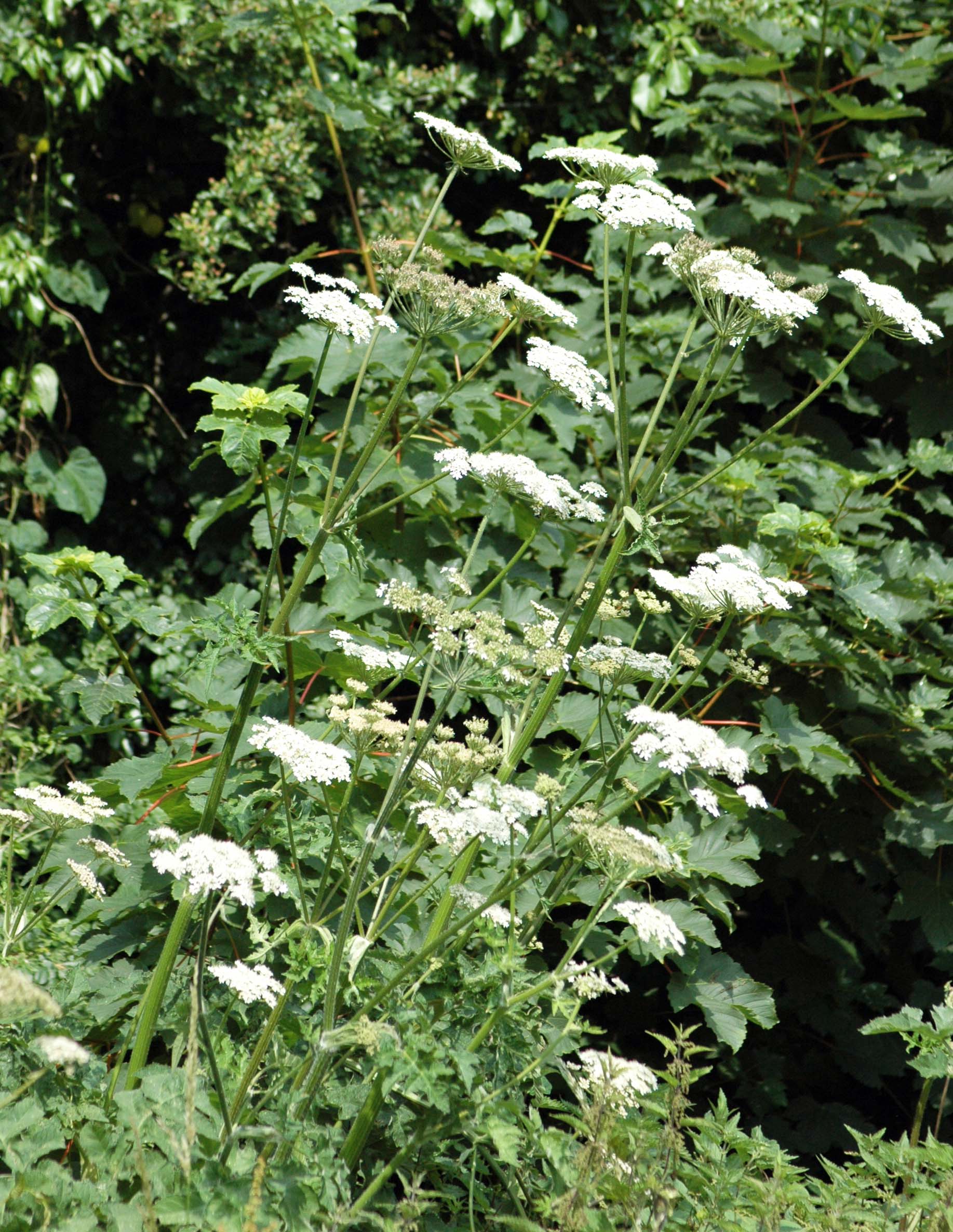
Hogweed-Heracleum spondylium

Hogweed-Heracleum spondylium

etymology

The common name of Hogweed refers to the characteristic pig-like smell of the flowers. The genus name Heracleum derives from the Greek “herákleion” and refers to the mythologic hero Heracles, who is reputed to have used the plant medicinally. The species name sphondylium, meaning “vertebrae”, refers to the shape of the segmented stem.

The leaves are large and can reach 50 cms (20 in) in length. They are pinnate, hairy and serrated, divided into 3-5 lobed segments.

Hogweed leaves

Hogweed leaves

A snail tucked into hogweed stems

A snail tucked into hogweed stems

The roots of the plant are large, rhizomatous and reddish in colour. The stem is hollow and striated with bristly hairs.

The flowers are  white, sometimes pinkish and each has 5 petals. They are arranged in large umbels of up to 20 cm of diameter with 15 to 30 rays. The peripheral flowers having a radial symmetry.

The inflorescence of a Hogweed plant

The inflorescence of a Hogweed plant

The hogweed is one of a number of plants that have foregone the use of a sweet scent to attract pollinating insects. The plant has adopted the more unusual strategy of mimicking the scent of pigs, not that noticeable to us, but to flies it is like a magnet and flies are the main pollinators of this plant.

A tachinid fly nectaring on hogweed

A tachinid fly nectaring on hogweed

The small fruits are flattened and winged, elliptical to rounded in shape and glabrous (smooth, free from hair or down) up to 1 cm long. The seed dispersal is by wind.
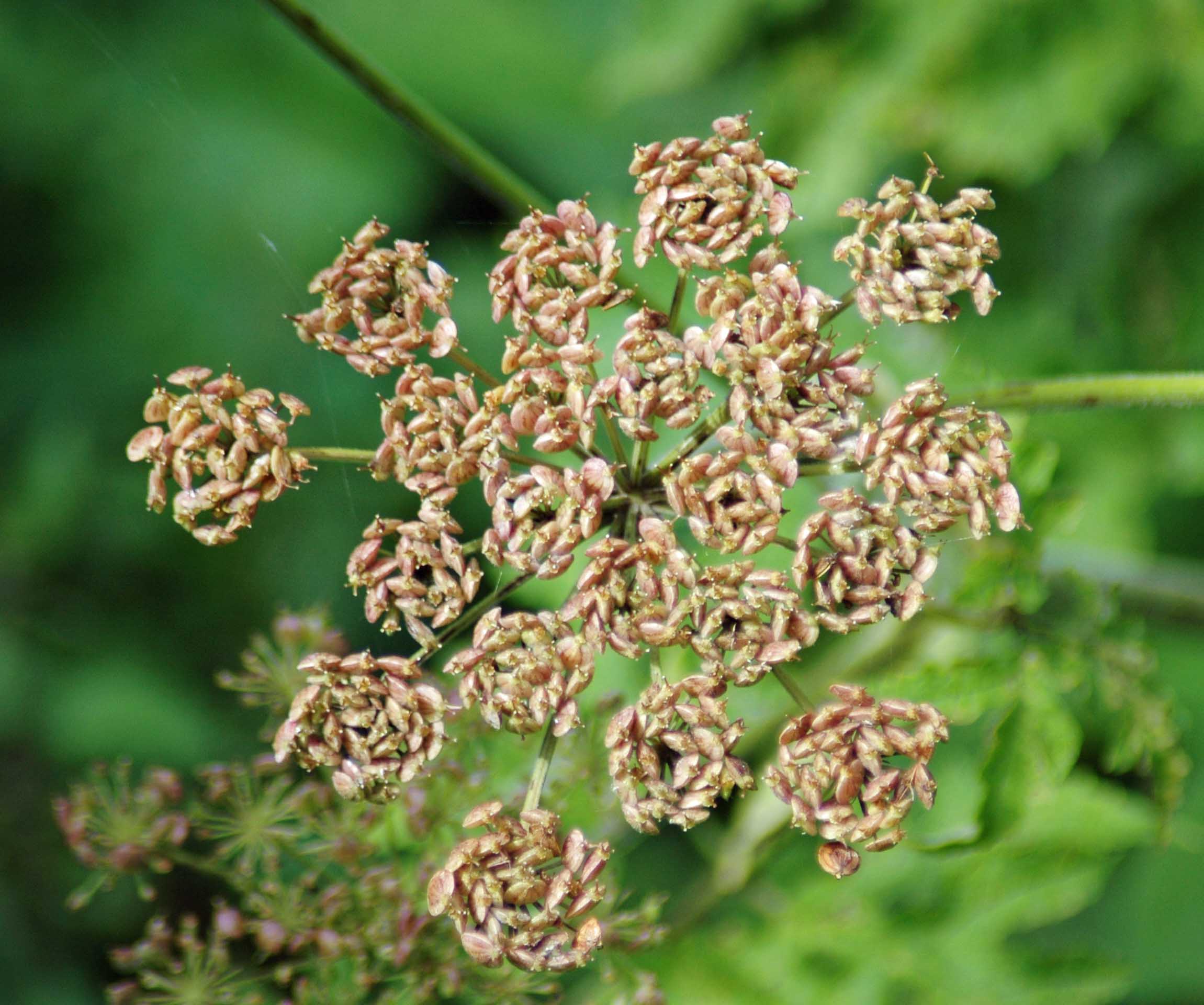
Hogweed seedhead

Hogweed seedhead

1/9/12 - Hogweed seeds

1/9/12 – Hogweed seed cases

traditional medicinal and culinary uses

Common hogweed was once employed in medicine, although its use has been long out of favour. Long ago the seeds were boiled in oil that was then recommended for application to running sores and to treat the rash associated with shingles. Culpeper recommended a decoction of the seeds to be applied to running ears.

Hogweed shoots have  a high vitamin C content and the plant is still eaten in some places. The young shoots are collected early in the season and the  tender young stems, cut into pieces about 15cm long may be boiled in salted water for about 15 minutes, then drained and served with butter. Apparently they make an ideal accompaniment to meat dishes.

(WARNING!  This family of plants contains many poisonous species and correct identification is essential before even thinking about eating them.)

hogweed and insects

Although its main pollinators are flies, many insects of other species can be seen helping them out whilst helping themselves to the nectar. It is not uncommon to see numbers of insects vying for a space on the same hogweed flowerhead.

A pair of soldier beetles mating, a green shield bug, a small black beetle and a fly of some sort all on one small flowerhead, oh and there's a spider's web

A pair of soldier beetles mating, a green shield bug, a small black beetle and a fly of some sort all on one small flowerhead, oh and there’s a spider’s web

30/6/13-Small Tortoiseshell on hogweed-Little Orme

30/6/13-Small Tortoiseshell on hogweed-Little Orme

30/6/13-Bumblebee on Hogweed flowers, Little Orme

30/6/13-Bumblebee-Bombus hortorium on Hogweed flowers, Little Orme

30/6/12-Greenbottle fly on hogweed - Little Orme

30/6/12-Greenbottle fly on hogweed – Little Orme

At Bryn Euryn the first insect I spotted on Hogweed flowers was a Comma butterfly. It was looking a bit worse for wear, faded and with chunks missing from its wings,but is a first tick for a sighting of this species this year.

8/7/13 -Comma butterfly

8/7/13 -Comma butterfly

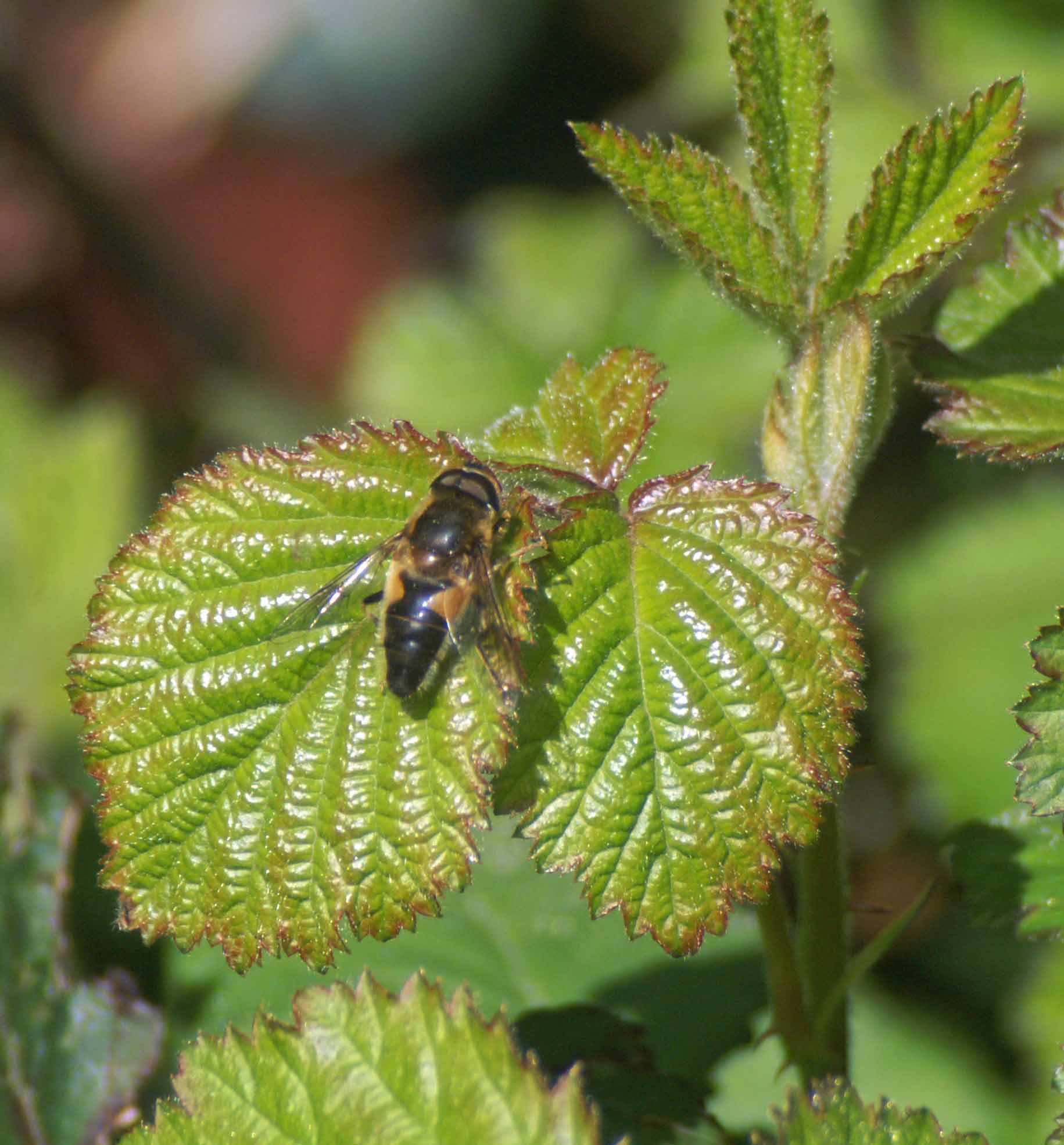
There were also a number of soldier beetles, greenbottle flies, bumblebees and hoverflies there. I thought I’d taken a picture of a honeybee too, but taking a closer look at the photograph I realised the insect had only two wings. I don’t know for sure what it is, more research  needed, but most probably a hoverfly ; an Eristalis species. Interestingly in respect of honeybees, a loved this observation on Adventure’s in Beeland’s blog  whats flowering now: early july   ” They (honeybees) appear to get very little pollen from these flowers, but instead swish their proboscis enthusiastically about in the nectar like a watercolour artist swirling their brush.” I’ll envisage that now, if I chance upon a honeybee on hogweed…
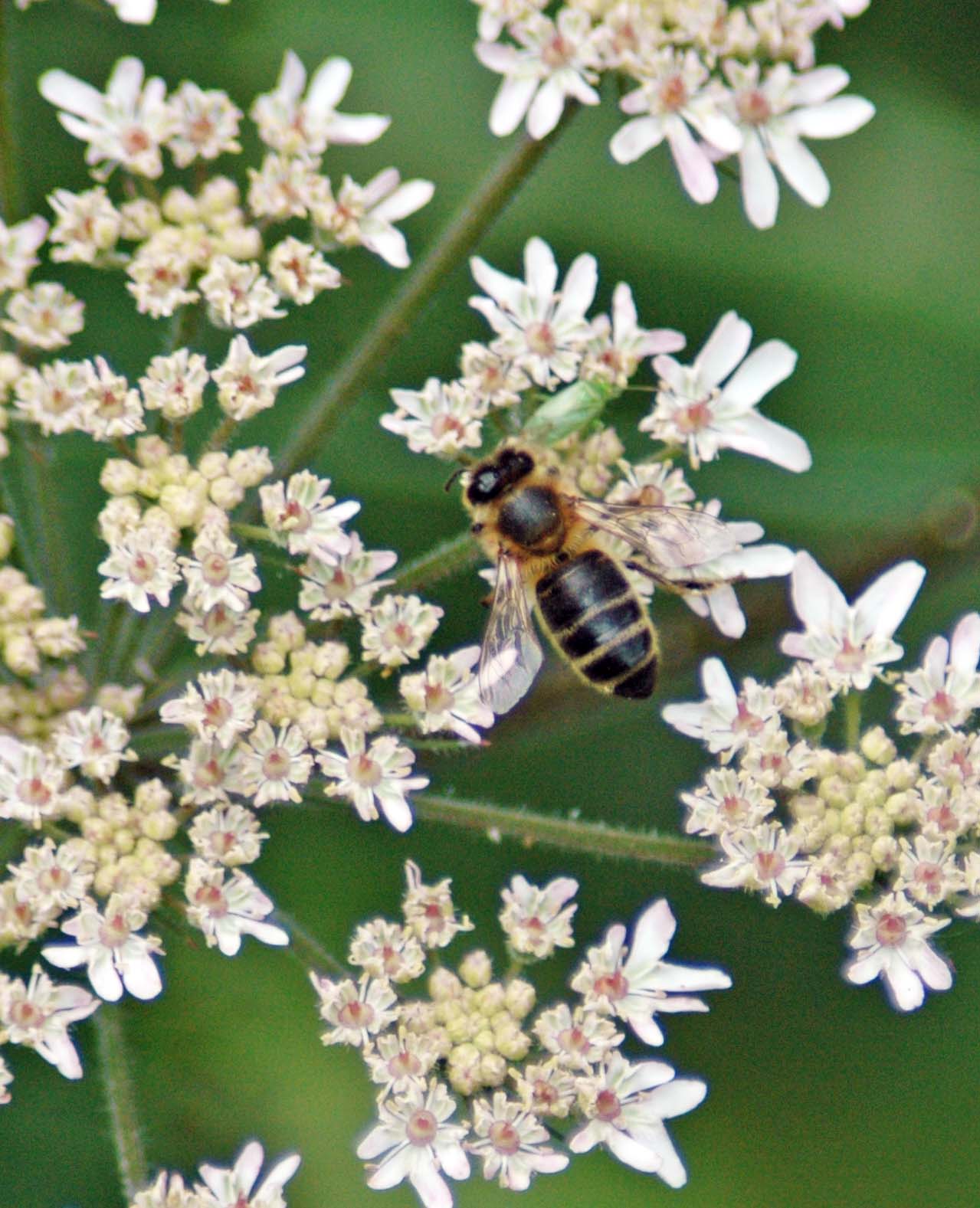
Probably a hoverfly an Eristalis species

Probably a hoverfly an Eristalis species

A 7-spot ladybird heading up a hogweed stem - there's prey up there - greenfly aphids

A 7-spot ladybird heading up a hogweed stem – there’s prey up there – greenfly aphids

One of my favourite photographs of an insect on hogweed is this one of a Rose Chafer, taken somewhere along the Pembrokeshire Coastal Path.

2/7/08-Rose Chafer on Hogweed - Pembrokeshire Coastal Path

2/7/08-Rose Chafer on Hogweed – Pembrokeshire Coastal Path

Picture from Naturespot: Graham Calow - Sapcote - 26 April 2012

There is an insect that I am aware of but haven’t noticed yet, actually named  for the plant; the Hogweed picture-wing fly. It is a small picture-winged fly Euleia heraclei. Also known as the Celery fly, it is a species of tephritid or fruit fly and is a pest of celery and parsnips, where it damages the vegetables by leaf mining. Males display on the upper surfaces of leaves on sunny days during May and mating takes place when a female arrives.  In Britain, the species is distributed widely across southern and central England; in Wales records are mainly near the coast. (The picture is taken from one of my favourite ID sites http://www.naturespot.org.uk/)

53.308051 -3.749941

Share this:

  • Share on Facebook (Opens in new window) Facebook
  • Share on Pinterest (Opens in new window) Pinterest
  • Share on X (Opens in new window) X
Like Loading...

Dare we cast a clout now May is out?

09 Sunday Jun 2013

Posted by theresagreen in Bryn Euryn Nature Reserve, Nature of Wales, nature photography, Wildflowers of Wales

≈ 4 Comments

Tags

Bryn Euryn Nature Reserve, buff-tailed bumblebee, germander speedwell, grey-green lichen hanging from tree, hairy rock cress, hawthorn in flower, may blossom, salad burnet, wildflowers of Bryn Euryn

The last day of May was overcast and cool but I wanted to go back to the Bryn to photograph a plant I had spotted there on the rocky cliffs amongst the rockroses but forgot about until I got home. I took a different route up to the top today, passing through the grassy meadow area to see what I could find there.

Cow parsley -Anthriscus sylvestris

Cow parsley -Anthriscus sylvestris

A first bloom of Common Vetch-Vicia sativa

A first bloom of Common Vetch-Vicia sativa

There’s a lot of Ribwort Plantain, whose flowerheads I find fascinating, every one seems slightly different to the other.

Ribwort Plantain flowerhead

Ribwort Plantain flowerhead

The star of the flower show today was definitely the May, the blossom of the Hawthorn. Perhaps we can all ‘cast a clout’, now that May is out, both the blossom and the month.

A beautiful spray of May blossom, or Hawthorn, looks like a bridal bouquet

A beautiful spray of May blossom, or Hawthorn, looks like a bridal bouquet

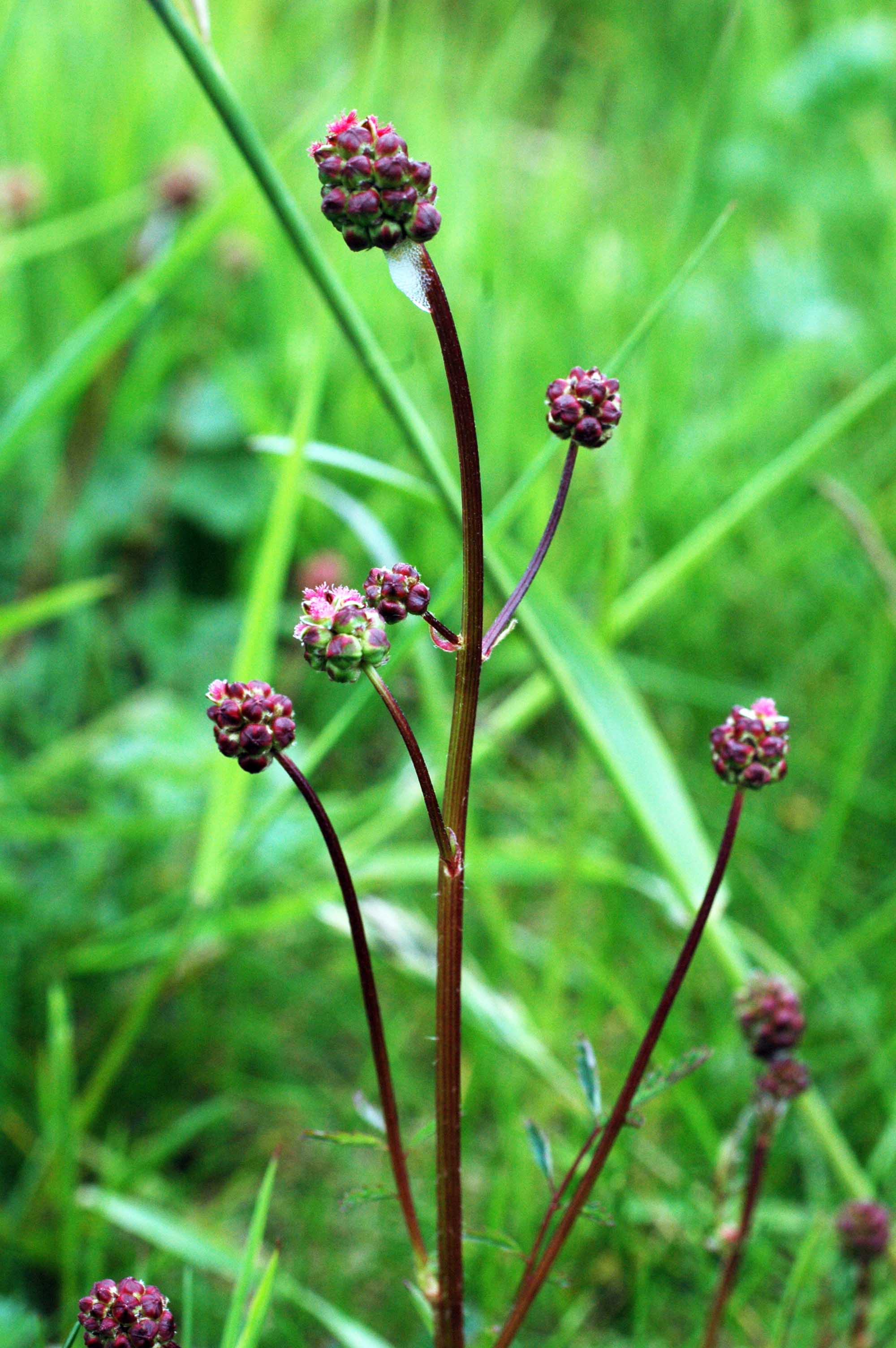
Close to where I stopped to photograph the May blossom I noticed the more unusual Salad Burnet plant. This is one of those plants that is very easy to overlook as it seems to really blend in to its surroundings, but once you have it in your mind’s eye you then notice them in other places.

Salad Burnet-Sanguisorba minor

Salad Burnet-Sanguisorba minor

The leaves are very pretty, and as the plant’s name suggests, are edible.

Salad Burnet has very pretty, pinnate leaves

Salad Burnet has very pretty, pinnate leaves

The Oak trees are fresh-coloured and in just about full leaf now.

Oak tree

Oak tree

Fresh new oak leaves

Fresh new oak leaves

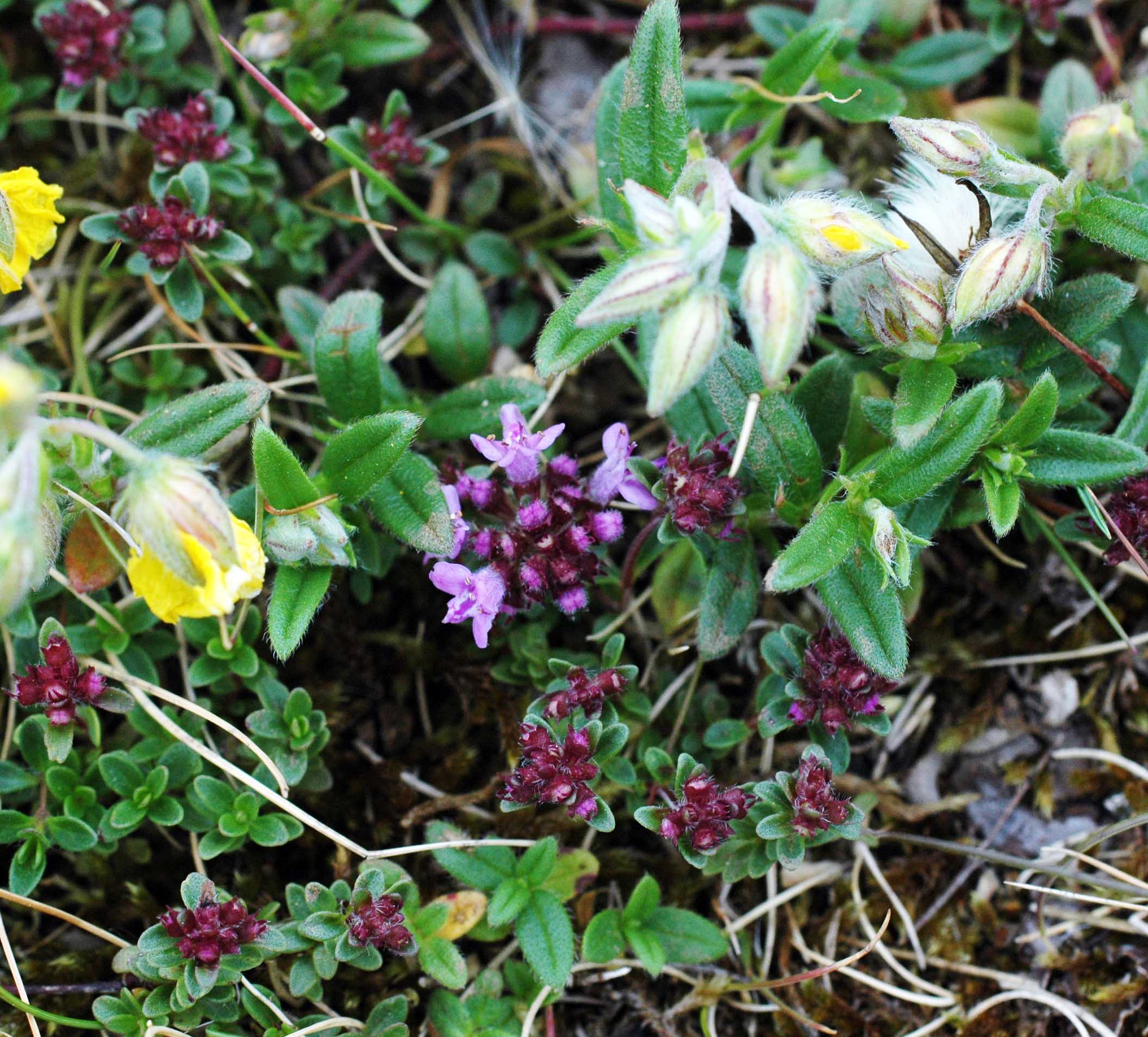
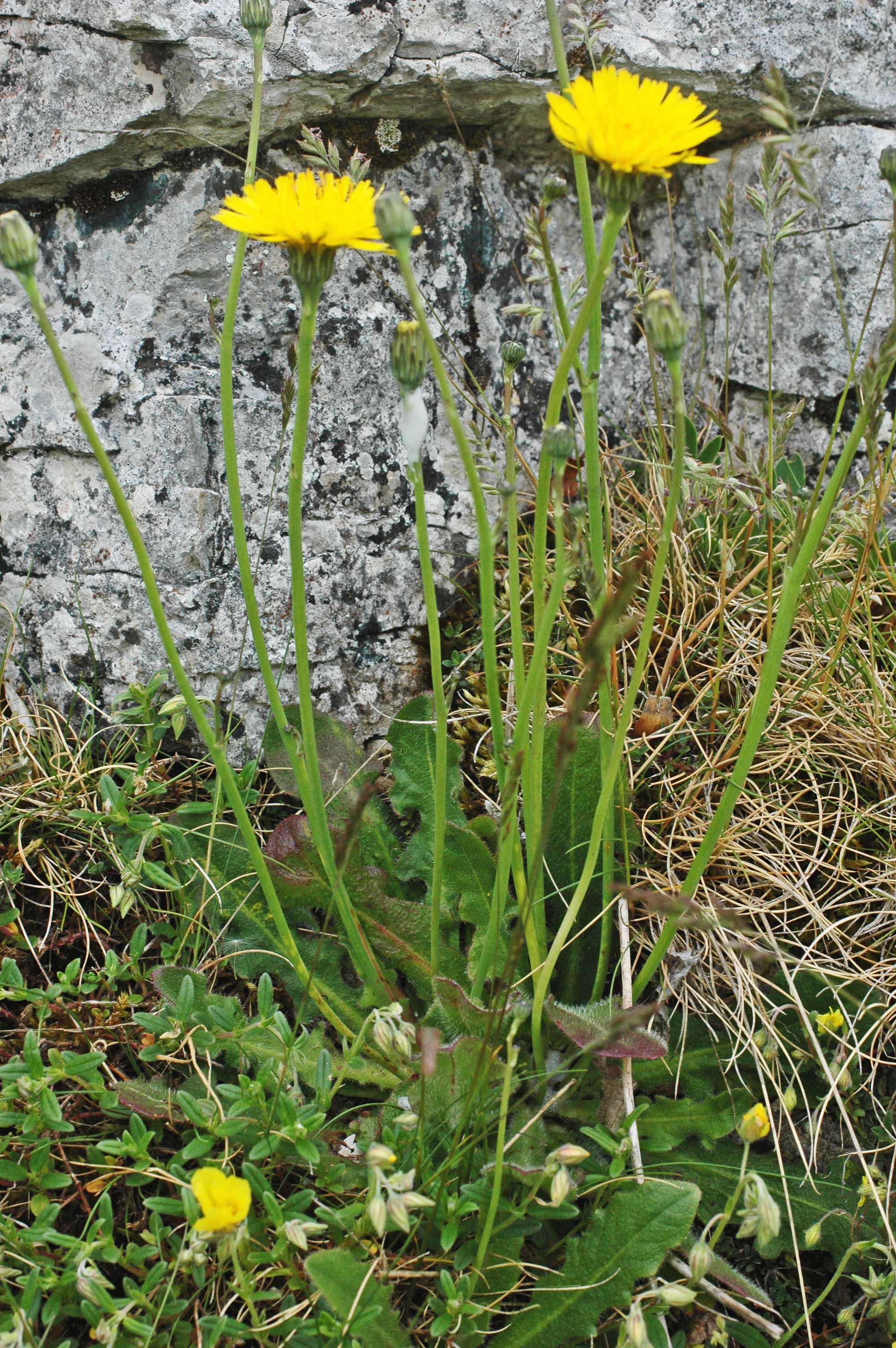
On a rocky outcrop there were low-growing common rockroses, bird’s foot trefoil, kidney vetch, almost over but attracting the attention of a number of little ginger-headed bumblebees, small patches of wild thyme and taller-growing hawksbit flowers.

Wild Thyme growing with Common Rockrose

Wild Thyme growing with Common Rockrose

I wasn’t able to get a particularly good photograph of a bee, but I  liked the lichen-covered rock in this one.

A small ginger bumblebee on Kidney Vetch

A small ginger bumblebee on Kidney Vetch

The patch of bird’s-foot trefoil had obligingly placed itself near the edge of a rock, so taking an eye-level picture was a nice option. I didn’t notice the ‘Cuckoo-spit’ until I looked at the photograph. I’d forgotten about Cuckoo-spit. I must remind myself what generates it, some kind of thrip, I think.

Bird's-foot Trefoil with Cuckoo Spit

Bird’s-foot Trefoil with Cuckoo Spit

Hawksbit against limestone rock

Hawksbit against limestone rock

There seem to be masses of the beautiful blue Germander Speedwell here this year, I don’t remember it being this prolific before.

Germander Speedwell-Veronica chamaedrys

Germander Speedwell-Veronica chamaedrys

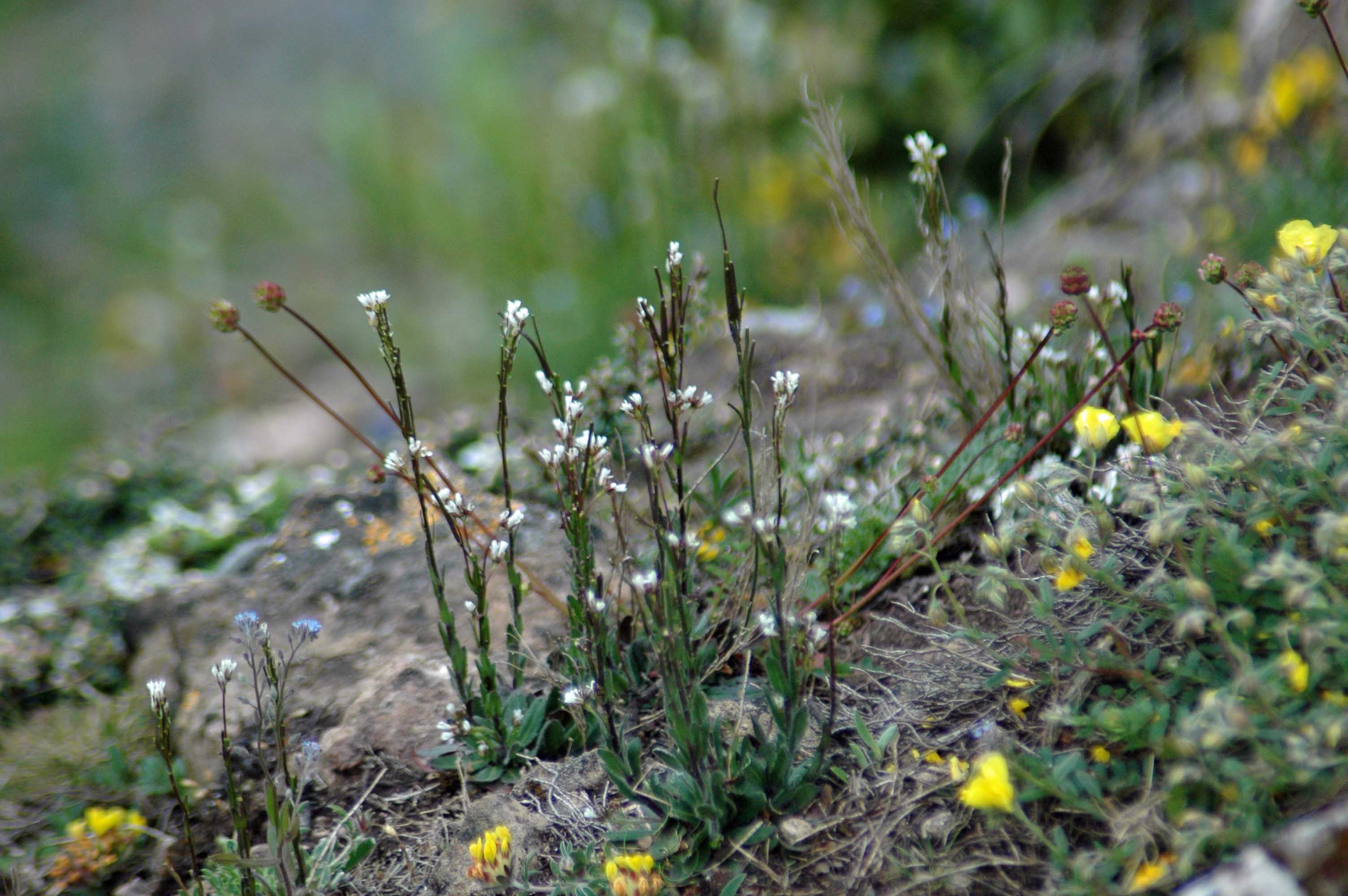
I finally got up and around to where the plant I had come to find was located; probably not as exciting as you’d expected, but I was pleased to find it. The plant is Hairy Rock Cress, an under-stated little plant with tiny white flowers like most members of the cress family, not at all showy like its golden-bloomed neighbours, but none the less interesting. Even though it’s flower’s are almost over and it’s going to seed.

Hairy Rock Cress. Also in picture are kidney vetch, salad burnet & rockrose

Hairy Rock Cress. Also in picture are kidney vetch, salad burnet & rockrose

The scientific name for Rockrose, helianthemum, means sun-flower. They don’t bother to open up on dull or damp days, particularly the little blooms of the Hoary Rockrose.

Flowers of Hoary Rockrose close on dull, sunless days

Flowers of Hoary Rockrose close on dull, sunless days

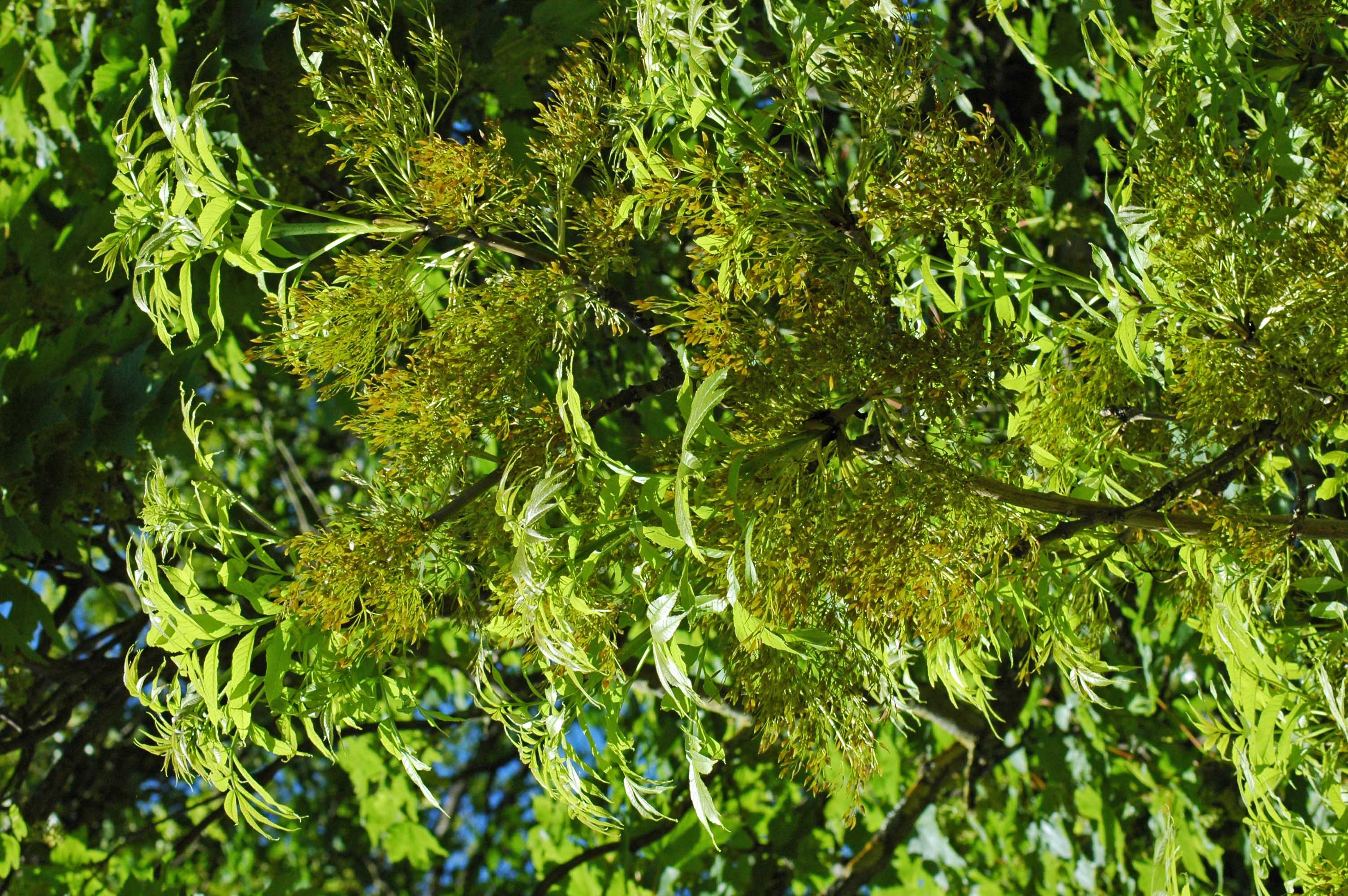
It was getting quite late on now, but there was one more distraction to waylay me before heading back down the hill. A Mistle Thrush was out hunting on the path around the edge of the rocks, which I had to stay and watch as I’d not seen one here before. When it flew off with its gatherings I took a photograph of the top of a lovely Ash tree which has houses of Rhos-on-Sea below and peeking through its leaves.

Ash tree on Bryn Euryn, Rhos-on-Sea behind

Ash tree on Bryn Euryn, Rhos-on-Sea behind

On the way down through the woods I spotted some very pretty Oak Moss lichen hanging from some twiggy branches; I don’t know why I’ve not noticed it before, there’s quite a lot of it.

Oak Moss lichen- Usnea florida

Oak Moss lichen- Usnea florida

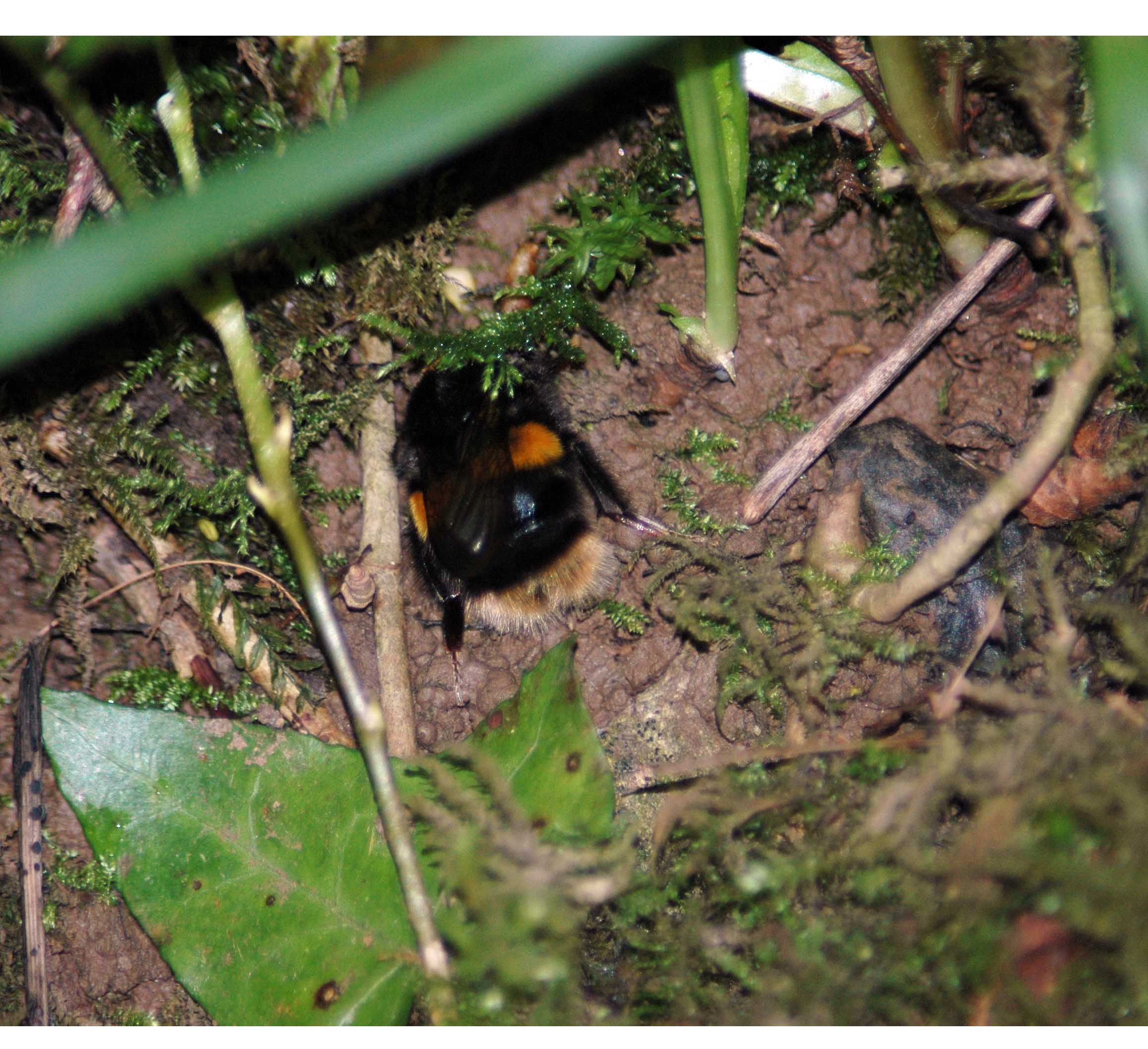
Almost at the bottom of  the hill, I couldn’t resist taking a final picture of a Buff-tailed Bumblebee that was either excavating a hole or looking for an existing one to spend the night in.

Buff-tailed Bumblebee making or seeking a hole

Buff-tailed Bumblebee making or seeking a hole

Share this:

  • Share on Facebook (Opens in new window) Facebook
  • Share on Pinterest (Opens in new window) Pinterest
  • Share on X (Opens in new window) X
Like Loading...

Bryn Euryn walk continued: Part 3

08 Saturday Jun 2013

Posted by theresagreen in Bryn Euryn Nature Reserve, Local Nature Reserves, Nature of Wales, Wildflowers of Wales

≈ 2 Comments

Tags

Bryn Euryn Nature Reserve, cowslip, early purple orchid, orchis mascula, primula veris, rhos on sea, views from Bryn Euryn, wildflowers of Bryn Euryn

The views from the Bryn are always worth the steep climb up to the top and change according to the season, the weather and the time of day. The southerly side overlooks part of Rhos-on-Sea and part of Colwyn Bay town, divided by the duel-carriageway of the A55, whose traffic noise can be loud and rather intrusive, so not the spot to  seek peace and quiet. Beyond is Colwyn Bay and inland a patchwork of woodlands, golden gorse and neat farmed fields set upon rolling hillsides sloping around and down to the Conwy river and estuary.

Panoramic view from the south of the summit of Bryn Euryn

The gorgeous view from the south side of Bryn Euryn (click to enlarge)

I was heading now towards the true summit, where the not-too-beautiful triangulation (trig) point marks the highest point.

The trig point on the summit of Bryn Euryn looking south-south-easterly (ish)

The trig point on the summit of Bryn Euryn looking south to south-easterly (ish)

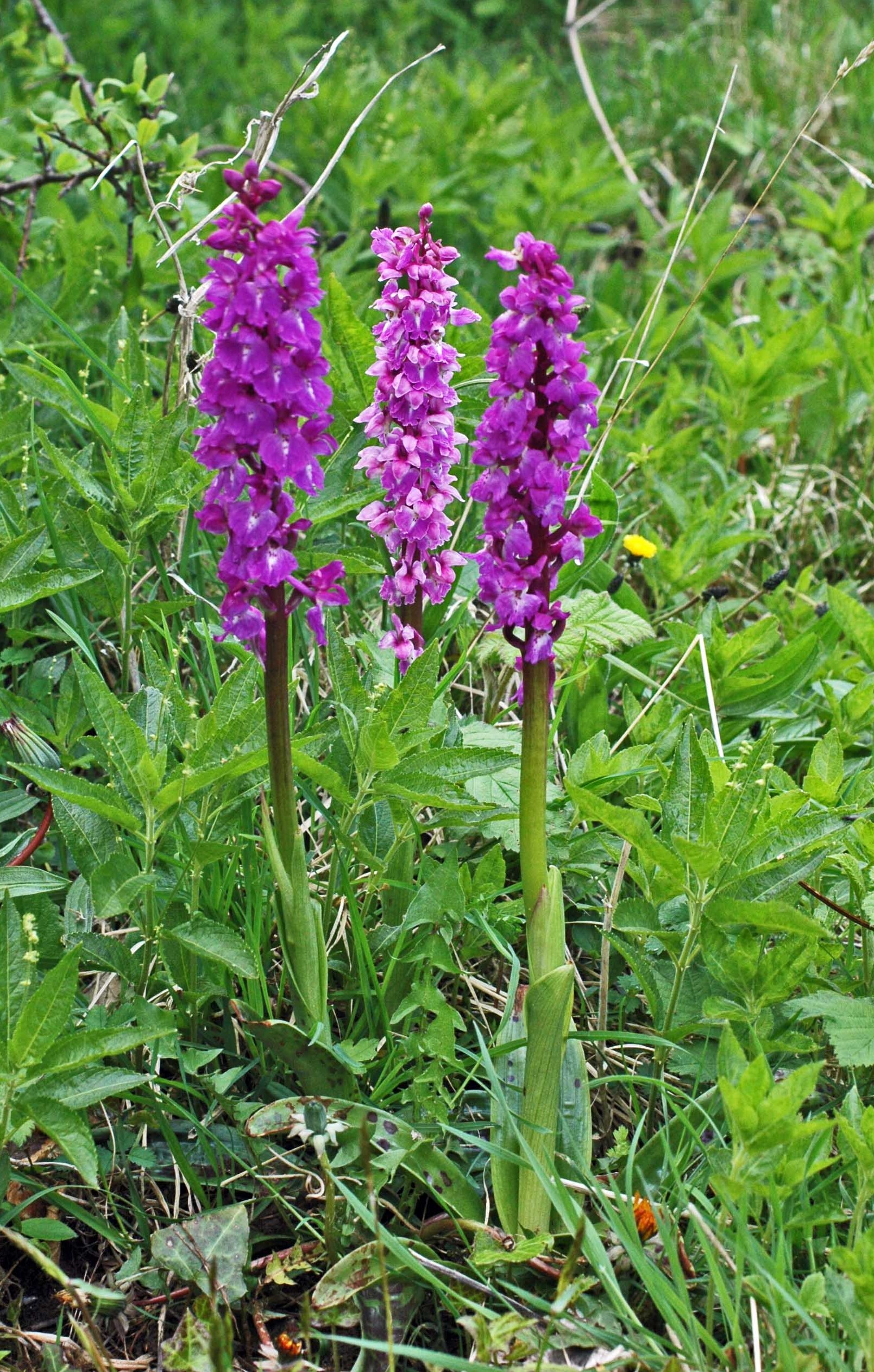
Last year there was an impressive patch of at least a hundred Early Purple Orchids on the approaching grassy slope (behind  the other side of the rocky bit in the photograph), but this year although there are still a good number there are a lot less. Having said that, those I saw are beautiful specimens, of good height and their stems thick with flowers. The success of Orchids is affected by seasonal weather, they are affected by drought, numbers may vary even in areas they otherwise frequent, which is part of their allure of course.Their less than predictable appearance and their wonderfully exotic beauty combine to make each discovery just as exciting as it was last year or the year before.

_______________________________________________________

I can still remember the excitement of discovering my first Early Purple Orchid, growing exactly where it should be, on the floor of the old woodland next to our house. I was probably about aged ten at the time and had no idea what it was, but it looked very special to me and I couldn’t wait to look it up in my ‘Observer’s Book of Wild Flowers’, which I still treasure because I love the descriptions written by the lady author of the book. I would quote it here but it’s currently in a box in a storage unit in Spain, so I’ll have to manage without for now.

Early Purple Orchid –  Orchis mascula

Early Purple Orchids-Orchis mascula

Early Purple Orchids-Orchis mascula

In flower from April to June, the Early Purple Orchid is a species of old broadleaved woodlands, where they are generally widespread, but they also occur in rich grasslands, on road verges, on limestone pavement and on heathy ground in the South and West of the British Isles.

‘Therewith fantastic garlands did she make

Of crow-flowers, nettles, daisies and long purples

That liberal shepherds give a grosser name’

But our cull-cold maids do dead-men’s fingers call them’.

It is claimed that when William Shakespeare wrote those lines in Hamlet, his ‘long purples’ referred to the Early-purple Orchid.  The lines were spoken by Gertrude and referred to the coronet which Ophelia was wearing when she drowned.

A short-medium perennial that can reach 40cm, the stem is also often flushed with purple. There are usually 3-5 unstalked basal leaves, oblong in shape, pointed, parallel-veined and glossy green blotched with purple.

Flower colour can vary in shade from quite a dark purplish-red to pink or even white and are distributed in  dense or loose spikes of between 10-30 flowers. Each flower has a narrow purple bract, purplish-grey ovary, three sepals and three petals.

Flowers of Early Purple Orchid

Flowers of Early Purple Orchid

Side sepals spread backwards, upper one joins to the upper two petals to form a hood; lower petal forms tri-lobed spurred crimson-dotted lip, 8-12mm long. At the back of the flower one unstalked anther holds two pollen masses on stalks that adhere to heads of visiting insects for cross-pollination; below the anther the stigma surface receives pollen brought from other flowers.

_______________________________________________________

A few minutes taking in the view more or less east towards the mountains on the edge of Snowdonia , then onwards and downwards via the grassy slope on the north side of the hill.

The A55 snakes towards  the Conwy Estuary with view of Snowdonia beyond

The A55 snakes towards the Conwy River & Estuary with views of Snowdonia beyond

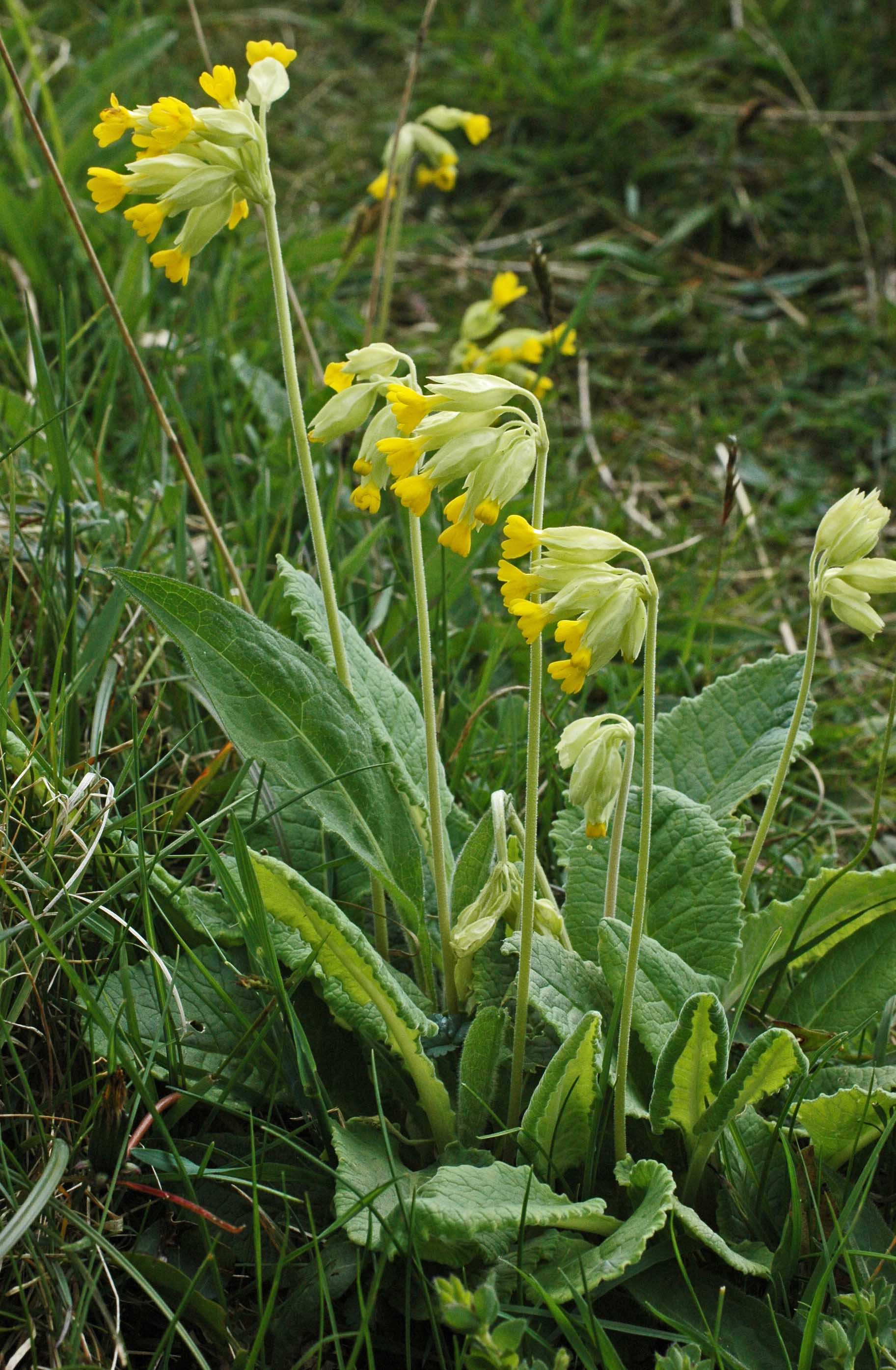
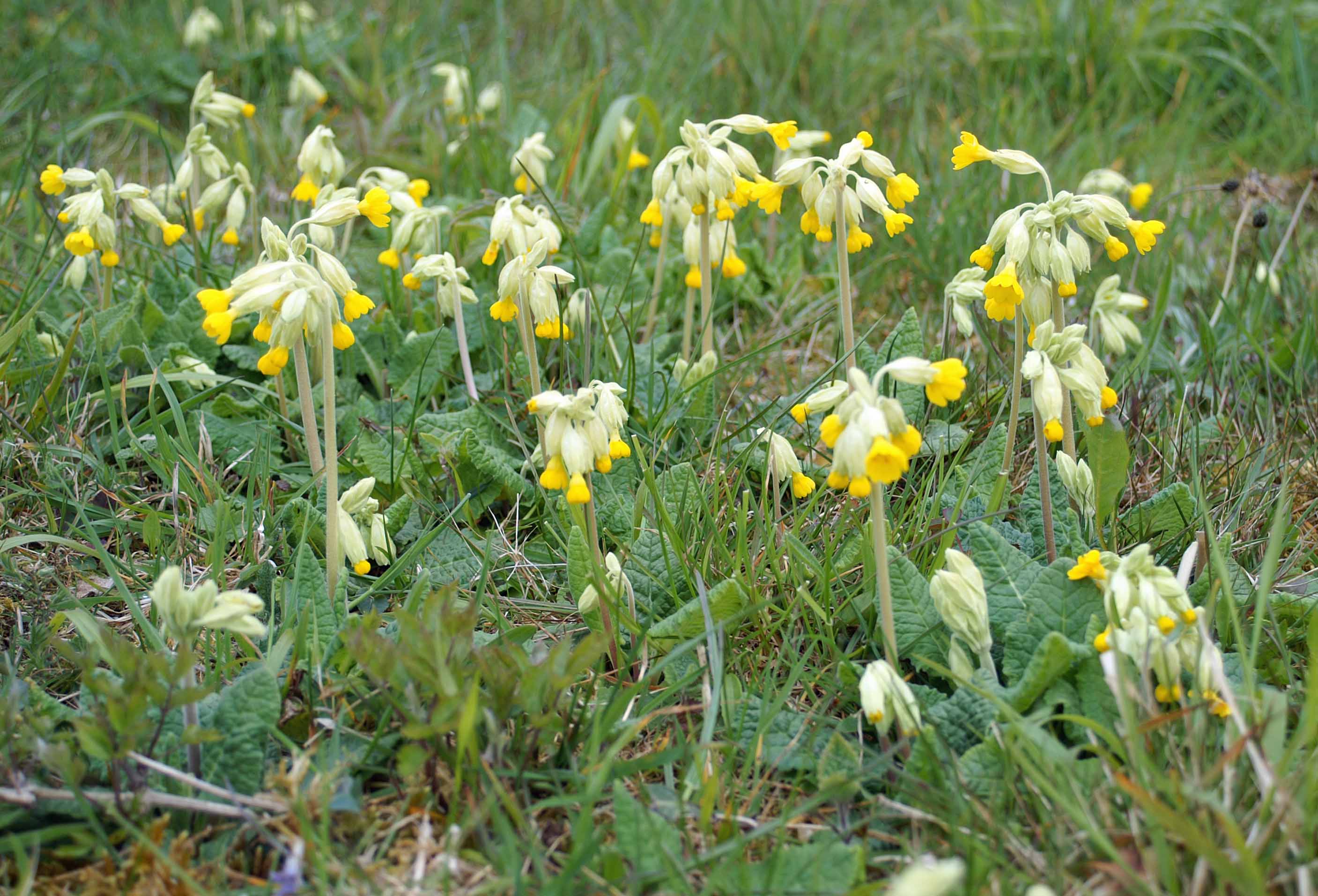
The rough grassy area was, as I’d hoped, generously sprinkled with Cowslips. Not as showy as the Orchids or as bright as the Rockroses, but with a special understated beauty of their own. I was slightly concerned I may have missed them at their best as they are flowers I associate more with late April-early May, but thanks to the late start to Spring this year I caught them just in time before they start to ‘go over’.

A field full of Cowslip

A field full of Cowslips, their heads held aloft on stiff stems were dancing in the wind like little flags

Cowslip -Primula veris

I have a great affection for Cowslips and seeing them growing in numbers in a grassy meadow takes me back to my childhood in an instant. In Northamptonshire, where I grew up in the 50s and 60s, lovely golden-yellow cowslips were numerous, particularly in the damper grass meadows grazed by cows. One of life’s little treats back in the day was to pull a flower from its little green sack and suck the nectar from the base of the tube. And before it became necessary to ban the picking of wild flowers, we used to pick bunches of them for the house  as they have nice long stems and looked lovely in a jam jar on the kitchen windowsill. We picked them to add to garlands and to decorate  the ‘throne’ for the May Queen during our school’s Mayday celebrations. Occasionally we even got to pick lots of them to be made into Cowslip wine.

Cowslip- Primula veris

Cowslip- Primula veris

I assure you though, it wasn’t our picking that caused the Cowslip’s serious decline, we couldn’t possibly have picked even all of those growing in a single field. It had much more to do with the rise of intensive farming and old grassland being ploughed over to create more space for growing other crops.

Thankfully the plant’s numbers are on the rise again, partly due to raised awareness but probably owing  more to the sowing of seed on roadside verges and in wildflower meadows. So once again the Cowslip can raise its  graceful nodding heads above the grass blades and be counted in generous numbers once again. I won’t be picking any though, just taking photographs.

130522TGLNR-flr-Cowslip flowerhead with fly-Bryn Euryn (4)

The leaves of the Cowslip are wrinkly and hairy and form a basal rosette, similar to those of the Primrose. 

The yellow-orange flowers (8-15mm) are held in a one-sided umbel which is borne on a softly hairy, sturdy stem.  The individual flowers are comprised of five joined petals, each flower bearing orange spots in the centre, and are deliciously scented.

Cowslips and plaintains

Cowslips and plaintains

A final gaze at the view from here over the tops of the trees below, across the golf course to Penrhyn Bay and on the horizon the Little Orme skirted on its left side by the road to Llandudno climbing Penrhyn Hill.

View from the north side of Bryn Euryn

View from the north side of Bryn Euryn

Share this:

  • Share on Facebook (Opens in new window) Facebook
  • Share on Pinterest (Opens in new window) Pinterest
  • Share on X (Opens in new window) X
Like Loading...

Bryn Euryn a walk of several parts. Part 2 – Rare Rockroses

04 Tuesday Jun 2013

Posted by theresagreen in Bryn Euryn Nature Reserve, Nature, Nature of Wales, nature photography, Wildflowers of Wales

≈ 1 Comment

Tags

Bryn Euryn Nature Reserve, common rockrose, helianthemum canum, helianthemum chemaecistus, hoary rockrose, wildflowers of Bryn Euryn, wildflowers with yellow flowers

I reluctantly left the Long-tailed Tits to their labours and headed up though the woods towards the summit.

Emerging from the shelter of the trees near the summit of the hill I was confronted by a chilly breeze and on another day would have headed for the more sheltered side, but I wanted to see the Rockroses, which are at their best and most prolific on the exposed limestone cliff on this side. Happily the reward was well worth putting up with a bit of discomfort for; the sunshine yellow flowers on the edge of the cliff and cascading down the rocky hillside were spectacular.

The stiff breeze made focusing on the flowers in the following photographs a bit tricky though. The Latin name Helianthemum translates as sun flower, which refers to the flower’s habit of opening up on sunny days and closing on sunless ones. Being very sunny today there was a profusion of blooms but those out in the open were waving about, so I tried for ones in the shelter of rocks which were then shaded.

Cliff smothered with golden rockroses-Bryn Euryn, North Wales

Large clumps of Rockroses spilling down the exposed limestone

There are two species of Rockrose found here; one is the Common Rockrose –Helianthemum nummularium and the other is a species more common to the Mediterranean than the UK, the Hoary Rockrose Helianthemun canum, which is one of the specialty plants of this reserve.

Common Rockrose-Helianthemum chemaecistus

Common Rockrose-Helianthemum chemaecistus

The Common Rockrose is an evergreen plant, an undershrub, usually prostrate and spreading. The small leaves are a dark grey-green above and grey-white and woolly-hairy beneath. Flowering from April-July, it is common on chalk downs and an occasional plant in other types of grassland, but always on dry and base-rich soil.

Rockrose flower with two tiny and one minuscule beetle

Rockrose flower dotted with two tiny and one minuscule beetle

The flowers of the native Rockrose are usually bright sunshine yellow, but may also be darker gold or even pale orange. Flowers are 12-20mm across, with 5 slightly crinkled petals. Each flower last only a day, but there are many of them. In the flower centre is a tight cluster of stamens.

Common Rockrose is a good provider of nectar for various species of bee and is also the foodplant of several species of moths and butterflies such as the Brown Argus, Green Hairstreak and the rare Silver-studded Blue. Many of the flowers I looked closely at today were playing host to at least one, usually more tiny little beetles.

Hoary Rockrose – Helianthemum canum (L.) Baumg

Status: scarce

Hoary Rockrose flowers

Hoary Rockrose flowers

As I already mentioned, the Hoary Rockrose is one of the specialty plants growing on Bryn Euryn and its major British stronghold is located just a few miles away on the Great Orme in Llandudno. The plant is restricted to Carboniferous limestone. It is found on rocky outcrops and on the face of scars and cliffs, often on the upper parts of outcrops and in sparse vegetation on shallow soil near the edges of cliffs. It can be very abundant on steep, rocky, exposed, often south to west-facing sites, of 0-540m, which are prone to summer drought, which fits the location in which plants are most prolific here on the Bryn.

Hoary Rockrose-Helianthemum canum

Hoary Rockrose-Helianthemum canum

H. canum is a shrubby, mat-forming perennial. Plants flower freely and set abundant seed unless they are subjected to particularly heavy grazing. There is no specialised means of dispersal. Seeds produced in one summer germinate gradually over a long period but the successful establishment of seedlings requires a period of damp weather long enough for young plants to develop a root system which will withstand subsequent drought (Griffiths & Proctor 1956).

Hoary Rockrose flowers

Hoary Rockrose flowers

The flowers are smaller than those of the Common Rockrose, just 8-15mm across, but there are many more of them.

There are five slightly crinkled petals and at the centre of each flower there is a crowded cluster of golden stamens.

Factual extracts are from : The Online Atlas of the British and Irish Flora http://www.brc.ac.uk/plantatlas/index.php?q=plant/helianthemum-oelandicum

Share this:

  • Share on Facebook (Opens in new window) Facebook
  • Share on Pinterest (Opens in new window) Pinterest
  • Share on X (Opens in new window) X
Like Loading...

Bryn Euryn – a walk of several parts. Part 1

03 Monday Jun 2013

Posted by theresagreen in bird's nests, Bryn Euryn Nature Reserve, Nature, Nature of Wales, nature photography, woodland birds

≈ 4 Comments

Tags

Aegithalos caudatus, ash tree keys, bird's nests, Bryn Euryn Nature Reserve, cuckoo flower, lady's smock, long-tailed tit, long-tailed tit's nest

We had one day of decent weather last week and I grabbed the opportunity to walk up to and around ‘the Bryn‘. I hadn’t been there for ages and I knew if I didn’t get there soon I would miss the Early Purple Orchids and Cowslips that grace this special place at this time of the year. It was sunny but a north wind kept the ambient air temperature cool to outright chilly in the open, but in more sheltered spots it was pleasant and almost felt spring-like. The open grassy meadow area in front of the car park was just such a spot today and there were actually butterflies to watch, all whites, definitely some small and some green-veined whites, but as there was also a solitary male orange-tip making territorial laps at speed, it is possible there were females of that species too, they don’t have the distinctive orange wing tips so are harder to identify in flight.

Bunches of Ash Keys already forming

Bunches of ‘keys’ are already forming on this tree and the leaves are well grown

I hoped the Orange Tip would stop long enough to have his picture taken, so whilst waiting for him to come back to this part of his circuit, which he did several times, I wandered along the field edge to see what progress the plants were making. There are many Ash trees in the woodland of this site and it is interesting to note the difference in the rate of growth of new foliage on trees which can vary significantly, even on trees that are quite close together. I am paying more attention to Ash trees now, knowing that they are under threat from the killer fungus chalara fraxinea, appreciating their  beauty while I still have the chance while dreading that they may be stricken with it.

This link shows the signs of the disease to look out for: http://visitwoods.org.uk/en/visit-woods/for-nature/Documents/symptoms-chalara-dieback-ash.pdf

White-flowered Valerian

White-flowered Valerian

The vegetation along the field edge is already tall, with much on the point of flowering, although there was little of interest to waylay the speeding Orange Tip. He was almost tempted by what I think was a white flowered Valerian, settling on it for a few seconds only before spotting a Small White in his airspace and rocketing after it.  I felt sure he’d stop to rest or feed eventually, watching and waiting for quite a while hoping for a photo opportunity, but he was clearly on duty and intent on seeing off all interlopers. I hadn’t realised how territorial and feisty this species was until now. I got tired way before he did, but thought it worth looking for some Lady’s Smock flowers, a foodplant of the species’ larva and one of the few flowers the adults do sometimes pause to take nectar from. I did find some, but only a couple of stems of flowers and no sign of the butterfly anywhere near.

Lady's Smock, Cuckoo Flower-Cardamine pratensis

Lady’s Smock, Cuckoo Flower-Cardamine pratensis

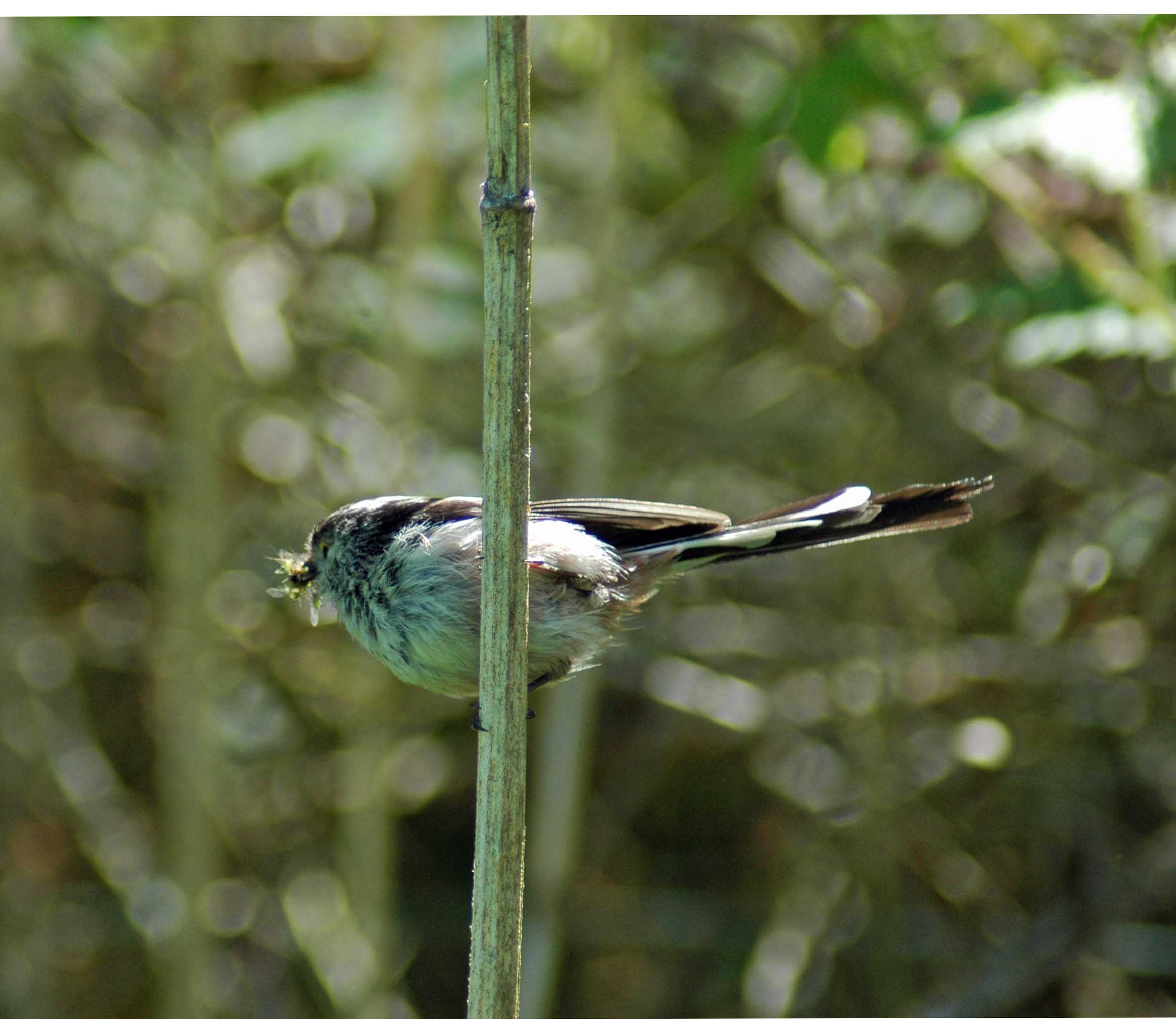
As I bent down to get an image of the flower I caught a glimpse of a bird passing me by very closely and stood up to see a lovely Long-tailed Tit at just about my eye-level (not very high then), perched on a dried stem about 2 metres or less in front of me and with its beak full of small flies.

A Long-tailed Tit with her beak full of small flies

A Long-tailed Tit with her beak full of small flies

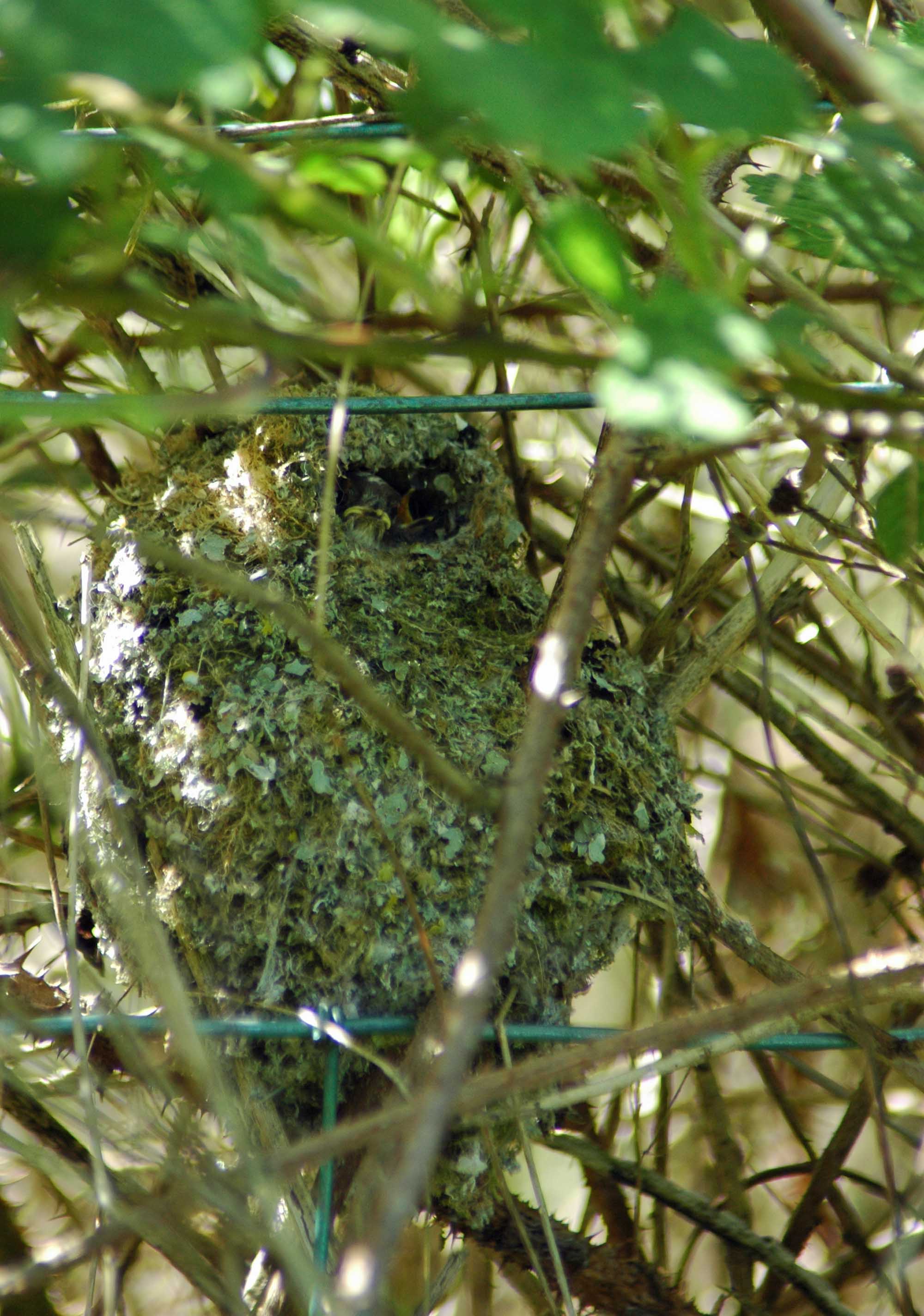
To be honest, the encounter took me so much by surprise that it took a moment for it to register that it was indeed Long-tailed Tit, let alone for it to occur to me that the poor bird was agitated by my presence because the flies were intended to be fed her nestlings. I stood still and she flitted over to the cover of a nearby small tree, then after a moment or two began to make her way to the back of the wire fence, then through a tangle of brambles to the most beautiful nest. I was thrilled to see it as I’d never seen one closely before; they are usually deeper into a tangle of brambles, so at the same time I felt concern at the location of this one; it seemed very vulnerable and if I spotted it fairly easily then so could potential predators. Long-tailed tit nests are known to suffer high rates of predation with only 17% of them being successful.

The Long-tailed Tit at the nest

The Long-tailed Tit at the nest

Long-tailed Tits make magical nests from materials you could almost imagine being called for in a spell; spider egg cocoons and moss, lichen and feathers, some 6,000 tiny pieces required for the average construction. The moss and spider silk provide the structural stability, they are pieced together to form a mesh with the tiny leaves of the moss acting as hooks and the spider silk of the egg cocoons providing the loops, which has been described as working in a similar way to velcro. The outside of the nest is covered with hundreds of flakes of pale green-grey lichens to provide camouflage and the inside lined with around 2,000 downy feathers to insulate the nest.  The end result is a lightweight elastic sac with a small, round entrance placed at the top, which is suspended either low in a gorse or bramble bush, less than 3m off the ground, or occasionally high up in the forks of tree branches.

Despite its apparent fragility the nest is strong due to the spider silk and the elasticity of the structure allows it to expand as the nestlings grow, so is always the perfect size. This nest was fairly bulging, so I imagine the young ones were quite well grown and that there were several of them in there.

A close view of the exquisite nest and young ones peeking out

I stood rooted to the spot watching as both parent birds hunted for food for their young ones. they were not travelling far, one was mainly foraging in the lower branches of a tree within a few metres of one side of the nest and the other in another tree a similar distance away to the other side. That same one, which is the one I photographed also seemed to be flying up from the fence pursuing flies on the wing.

A Long-tailed Tit with a beak full of small flies waiting a short distance from the nest

I would have loves to have stayed and watched for longer, but although the birds carried on about their work despite me, they were clearly wary and I left them in peace to carry on while I continued with my walk.

Hungry Long-tailed Tit nestlings looking quite well-grown

Hungry Long-tailed Tit nestlings looking quite well-grown

This link is to a wonderful video of a Long-tailed Tit nest and narrative from Iolo Williams’  Secret Life of Birds.

http://www.bbc.co.uk/nature/life/Long-tailed_Tit#p00dxvfq

Share this:

  • Share on Facebook (Opens in new window) Facebook
  • Share on Pinterest (Opens in new window) Pinterest
  • Share on X (Opens in new window) X
Like Loading...

Spring has finally arrived in Fairy Glen

18 Saturday May 2013

Posted by theresagreen in Local Nature Reserves, Nature of Wales, nature of woodlands, nature photography

≈ 6 Comments

Tags

cuckoo pint, dog violet, Fairy Glen, horsetail, ivy-leaved toadflax, marsh marigold, min-y-don, osmia rufa, Pied Wagtail, ramsons, red mason bee, river Colwyn, song thrush, spring flowers

Last Friday was a day typical of our Spring so far this year, overcast, showery and cool, but as I began driving home at lunchtime the sun came out, so I stopped by the little bridge at Min-y-Don woods as I often do, just to have a quick look at whatever is about. Today that was small birds flying back and forth across the river that I thought may have been Chiffchaff, but turned out to be House Sparrows taking drinks and chasing flies over the water. Then near the bend in the river I caught another flash of bird movement that made me think ‘grey wagtail’. Of course I had to follow it, being ever hopeful of a good photo opportunity. I finally caught up with the bird and saw it was actually a Pied Wagtail that was by now intent enough on catching insects not to be too disturbed by my presence.

A Pied Wagtail adeptly catching flies

A Pied Wagtail adeptly catching flies

Maybe he has a nest nearby and was out hunting for food to feed young ones, or maybe because he was alone, perhaps has a mate still sitting on eggs and he was feeding her, or, maybe he was simply feeding himself. Whatever his aims, he was very entertaining to watch and seemed to be catching plenty of insects.

Pied Wagtail - Motacilla yarellii

Pied Wagtail – Motecilla yarellii

A couple passing by stopped to see what I was photographing and told me they had seen the grey wagtails further upstream, so I had to carry on walking then, just in case.

On the way up to Fairy Glen my eye was caught by a mass of bright green liverwort at the mouth of a drainpipe, giving the impression it was cascading out like water.

Liverwort at the mouth of a drain pipe

Liverwort at the mouth of a drain pipe

Flowers are generally late this year, but they are making up for lost time now. On the stone walls bounding the river and roadside, the pretty, albeit non-native Ivy-leaved Toadflax flourishes.

Ivy-leaved Toadflax- cymbalaria muralis. A native of Mediterranean Europe, but widely naturalised elsewhere

And here and there the darker purple-blue blooms of the Common Dog Violet peeked out.

Common dog-violet

Common dog-violet – Viola riviana with its pretty  heart-shaped leaves

Garlic mustard is beginning to show its modest white flowers; I love the shape and texture of its leaves too.

Garlic Mustard

Garlic Mustard – Alliaria petiolata

Just inside the woodland of the Glen a few stands of graceful bluebells arch up through the masses of  almost-done lesser celandines, surrounded by encroaching wild garlic.

Bluebell -

Bluebell – Hyacynthoides non-scripta

Further into the woodland the air was filled with the pungent scent of masses of ramsons, or wild-garlic, just reaching the peak of its flowering. Great swathes of it flow down the sloping riverbank and it carpets much of the ground beneath the trees too, to the apparent delight of a host of nectar-seeking insects.

130510TGNJ4-wild garlic-fairy glen

Ramsons, Wild Garlic – Allium ursinum

Ramsons flowers and buds

Ramsons flowers and buds

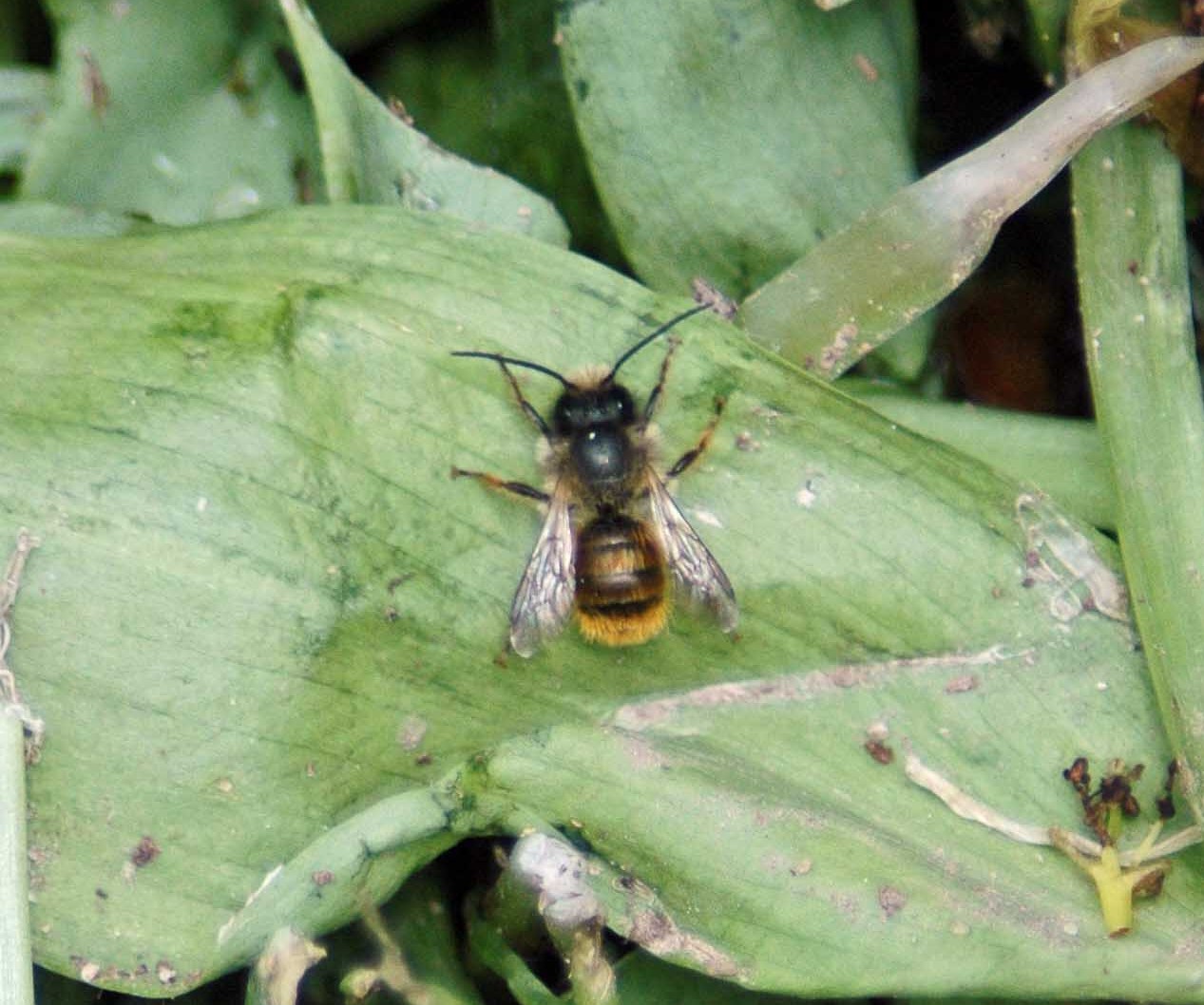
I watched big beautiful bumblebees, several different species of hoverfly and some little bees that I didn’t recognise visiting the starry white flowers. Looking afterwards at the photographs and checking several identification books and websites, I have ended up with mason bees. If anyone knows better, please let me know.

One of a number of tiny mason bees feasting on the nectar of the wild garlic flowers

One of a number of tiny mason bees feasting on the nectar of the wild garlic flowers

Red Mason Bee – Osmia rufa

One of the little bees (male), pausing briefly to soak up some warmth

One of the little bees (male), pausing briefly to soak up some warmth

 Description: 

The male bees

are smaller than the females at

just 6 -11 mm long. Both

sexes

are covered in dense gingery hairs, the male with white tufts on the head while the female’s head is black.

Habitat: 

Around suitable nesting sites. 

The Red Mason Bee is active from early spring, the male being the first to appear when the weather becomes mild in March, the female emerging later. Like all bees it feeds on pollen.

 Life History: This is a solitary bee, each nest being the work of a single female working alone. They nest in pre-existing cavities such as hollow plant stems, old garden canes, air bricks, and even old nail holes in fence posts, lining the inside of the cavity with mud.

There were birds singing, I heard chiffchaff, blackbird, robin and wren, but most of those I saw, including blue tits, great tits and a coal tit seemed more intent on hunting for insects, so I imagine there are gaping little beaks to fill.

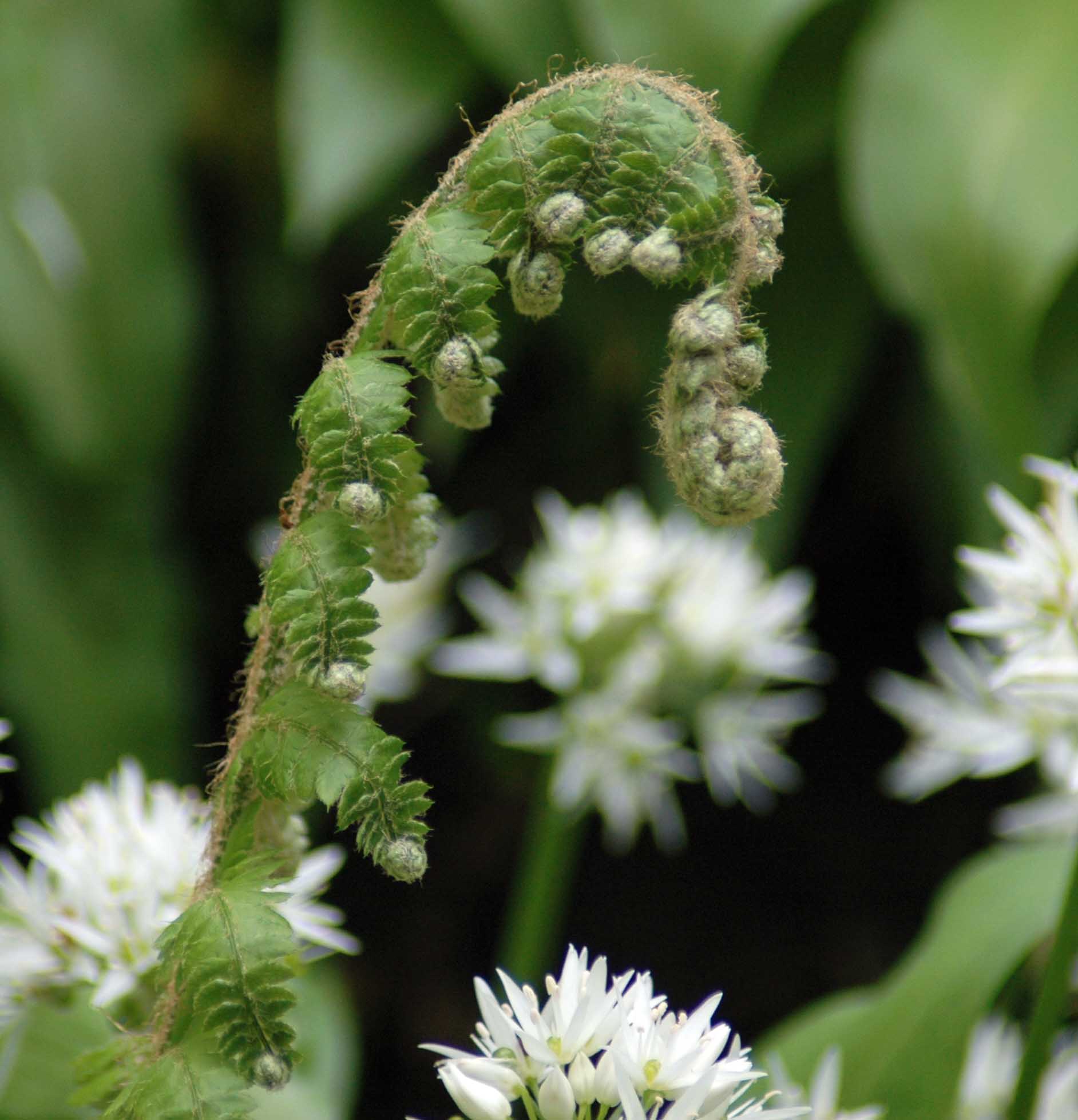
fern frond unfurling

fern frond unfurling amongst the wild garlic

An hour had passed by without me even noticing and I could have stayed even longer, but there began to be quite a few people about keeping the wildlife more discreet in their activities, so I started to make tracks back; I would have missed the sight of a lovely song thrush if I’d kept going.

Song Thrush with what I think is a worm

Walking back towards Min-y-Don I took a detour up and around one of the other paths and found yet more interesting plants to distract me.

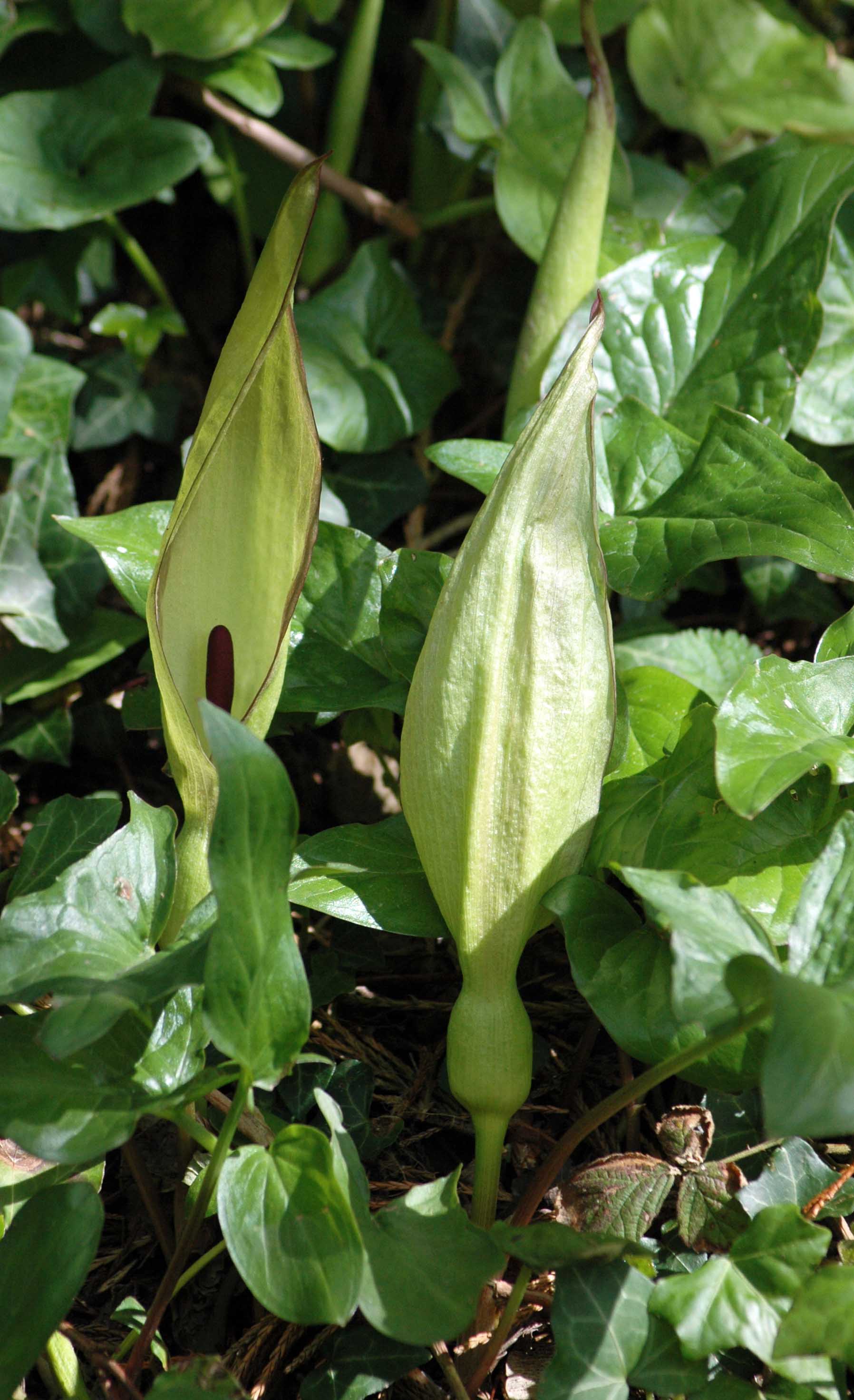
Arum -

A strange plant with many names-Lords & Ladies, Jack-in-the-Pulpit,Cuckoo Pint or Wild Arum – Arum maculatum

Horsetail

Horsetail- Equisetum

An almost-orange Welsh Poppy

Sunlight catching the  almost-orange petals of a Welsh Poppy-Mecanopsis cambrica

Kingcups, or marsh maraigolds reflected in a pool of water

Golden kingcups, or Marsh Marigolds-Calthea palustris reflected in a pool of water

And finally an impressive clump of dock that has found purchase in mud on the shallow edge of the river. I know it’s not a desirable plant, but it looked quite well there with its big shapely leaves.

Curled dock

Dock

A crow strutting along the river-wall, feathers gleaming with shades of purple and green

a crow strutting along the river-wall, feathers gleaming with shades of purple and green

Two hours after setting off for one photograph I was on the way back home, but couldn’t resist the sight of rabbits amongst the mass of primroses on the embankment, which is where the current page header came from.

bunnies amongst the primroses

bunnies amongst the primroses

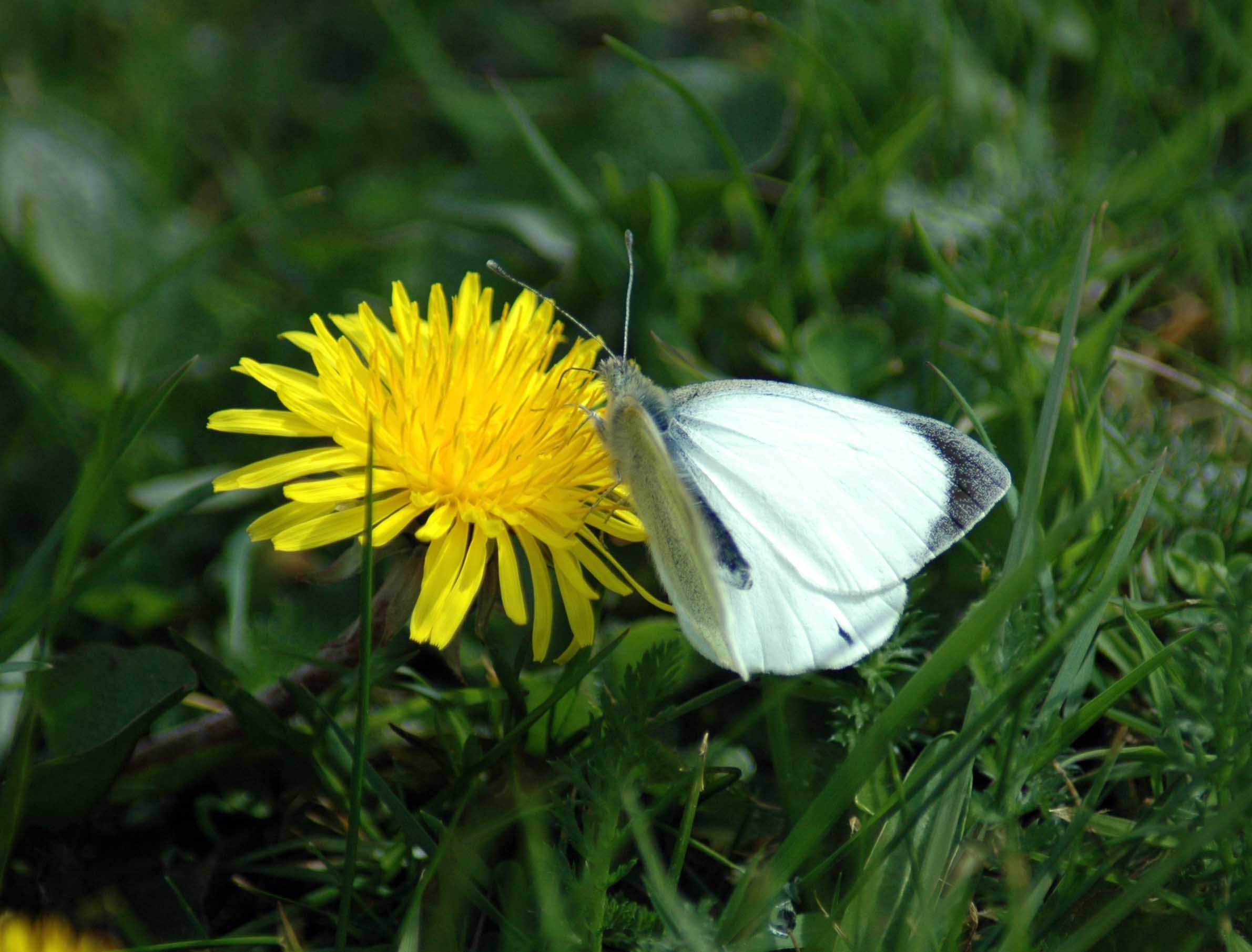
Back at home a large white butterfly was nectaring on a dandelion, the first I’ve seen so far this year. Large white that is, not dandelion, whose population seems to have boomed this year. I have never seen so many.

large white taking nectar from a dandelion

large white taking nectar from a dandelion

Share this:

  • Share on Facebook (Opens in new window) Facebook
  • Share on Pinterest (Opens in new window) Pinterest
  • Share on X (Opens in new window) X
Like Loading...

Willsbridge Mill, Bristol

12 Friday Oct 2012

Posted by theresagreen in Local Nature Reserves, Nature, nature of woodlands, nature photography, woodlands

≈ 4 Comments

Tags

ash keys, catscliffe woods, dark bush cricket, feather moss, haws, red berries, siston brook, spider's webs, willsbridge mill, woodland walks

I am currently staying in Bristol with my son and family, and as they always do when I am here, they make great efforts to take me out to places they know that both I and the children will enjoy.

Avon Wildlife Trust takes responsibility for 35 reserves within the Avon area, with a good few clustered closely around the city.

On Sunday we drove out to Willsbridge Mill, a Local Nature Reserve, which the website describes as  ” Set in a peaceful valley on the edge of Bristol, Willsbridge Mill is an impressively restored 19th Century Corn Mill and Long Barn, located within a stunning 22 acre nature reserve.” It continues ” This green oasis, which was once a bustling industrial site, now supports an amazing array of wildlife habitats – woodland, ponds, meadows, scrub, quarries and a demonstration wildlife garden, running along the fast – flowing Siston Brook. The reserve is home to kingfishers, dippers, owls, foxes, badgers, and bats.”

Dragonfly plaque

After several days of rain and general dampness, the ground in the wildlife garden was soggy and its plants bedraggled, there were a few pond skaters skimming over the surfaces of the ponds and a robin piping a few phrases of song, but apart from that there was little movement.

One of the trails around the reserve is the Sculpture Trail, which features ” striking environmental sculptures made from local materials”. There is also a sequence of attractive brass leaf-shaped plaques bearing different designs, which today were the only indicators of the wildlife that frequents the reserve in spring and summer.

Leaves are beginning to change colour and fall

The Ash tree – Fraxinus excelsior, bears its large single-winged seeds – also commonly known as keys, in large bunches

We followed the pathway to Hawthorns are laden with good crops of haws, but there were no signs of these particular ones being eaten yet.

Haws – the fruits of the Hawthorn

On the wooded side of the pathway, on a bramble leaf in a patch of sunshine a Dark Bush Cricket sat having a meal.

Dark Bush Cricket – Pholidoptera griseoaptera

The Dark Bush cricket is a common animal across the southern half of England, occurring in gardens, hedgerows and on woodland edges, where they can often be seen in quite large numbers sunbathing on bramble patches. Males are very aggressive, fiercely defending their territories against intruders. Females lay their eggs in late summer in rotting wood or bark crevices; the young crickets emerge 18 months later, so odd-year and even-year dark bush-crickets never meet.

Bramble festooned with gauzy spiders’ webs – a classic feature of damp autumn days

The pathway through Catscliffe Woods

Common Feather- moss-Kindbergia praelonga growing on a tree trunk

The stream that flows through the woodland is Siston Brook; it flows fast here and its energy once powered Willsbridge Mill’s water wheel. The stream rises five miles away at St. Anne’s Well, just south of the village of Siston and is a tributary of the River Avon, joining it at Londonderry Wharf, near Keynsham.

A fallen tree spanning the brook

A tree has fallen on one side of the stream bank arcing gracefully over the water to form a natural bridge. It has continued to grow, pushing out branches that now grow vertically from the original trunk; those that touch the ground have probably put down roots and appear to be growing as independent trees.

Steps lead temptingly to a higher woodland trail

Share this:

  • Share on Facebook (Opens in new window) Facebook
  • Share on Pinterest (Opens in new window) Pinterest
  • Share on X (Opens in new window) X
Like Loading...

Late summer on Bryn Euryn

08 Saturday Sep 2012

Posted by theresagreen in Bryn Euryn Nature Reserve, bumblebees, Local Nature Reserves, Nature, nature photography, Wildflowers of Wales

≈ 4 Comments

Tags

agrimony, black knapweed, Bryn Euryn Nature Reserve, carder bumblebee, gatekeeper butterfly, hemp agrimony, hoverflies, Meadow Brown, nodding wild onion, peacock butterfly, ragwort, red-tailed bumblebee, self-heal, wildflowers of Bryn Euryn

The soggy conditions created by the rainfall this year have not been ideal for many late summer wildflowers and, perhaps as a result of that, it seems to me that there has been a drop in some insect populations. I was on the lookout for flower beetles, in particular soldier beetles, which in  previous years have been prolific, and struggled to find many at all.

I spent a couple of hours roaming the pathways of Bryn Euryn on one sunny afternoon in mid-August, ignoring grey clouds rolling in at my peril, getting caught right at the top in a proper downpour. There is  almost always something interesting to photograph here whatever the weather though, and these are my offerings for that day.

There were very few plants still flowering on the lower field edge, but the first one, the Great Willowherb, often mistaken for Rosebay Willowherb, is one I’ve wanted to mention for a while and will do at greater length soon.

Great willowherb is often mistaken for rosebay willowherb

Common Mallow-Malva sylvestris

banded Snail on a bindweed leaf

Greenbottle fly-Lucilia caesar on Hogweed flowers

Most of the hogweed plants are setting seed


Self-heal- Prunella vulgaris

In the clearing at the top of the steps that cut through the lower woodland is a bramble patch that always seems to attract an array of nectar-seeking insects. Today there were a good number of hoverflies, most the one photographed below, but there were a few other Eristalis species too.

This attractive hoverfly is Helophilus pendulus, common names are Sun Fly as it does enjoy basking in sunny patches, and The Footballer referring to its colours and stripy patterning

Eristalis on Wild Carrot- Daucus carota

I headed a bit round to the open grassy area that this time last year was covered in purple flowered knapweed and buzzing with dozens of insects,  but now was looking quite bedraggled and bereft of colourful blooms. There was some knapweed, but hardly enough to go around apparently as most of the flowers had more than one bumblebee or hoverfly competing for its bounty.

Black Knapweed-Centaurea nigra

Red-tailed Bumblebee on knapweed flower

Common Carder bee on knapweed

In amongst the long damp grass was a pink flower that I recognised from last year but didn’t get around to identifying. This (I believe/hope) is an unusual plant of the allium family, common name Nodding Wild Onion or Allium. The pink bell-shaped flowers are  tiny and have protruding stamens; very pretty.

Nodding Wild Onion-Allium Cernuum tangled in amongst the long damp grass

A closer look at the pretty little flowers

There were a few plants of Agrimony – Agrimoniia eupatoria

The other staple of late summer nectar, Ragwort, is also flowering of course. I can’t not include it here, so thought I’d just put in a close-up of an individual flower to show how pretty they really are.

Close up of Ragwort flowers

One flowering plant that is relishing the damp conditions and flowering prolifically here was Hemp Agrimony. Its flat, open flowers are very attractive to insects; great for butterflies.

Hemp Agrimony-Eupatorium cannabinum

A partially-open flower head of hemp agrimony

There were a few butterflies about, but as the clouds came over and the air cooled those that were out and about were not very mobile. Meadow Browns were most numerous but most were fluttering about low down in the long grass. I spotted one on Hemp Agrimony, also a single Gatekeeper and was taken by surprise when a Peacock (butterfly!) flew right in front of my face. I did photograph them all, but by now it was minutes away from the onset of the downpour and quite dark, so the resulting images are a bit grainy, but there for the record.

Meadow Brown on Hemp Agrimony

Gatekeeper – Pyronia tithonus

Peacock – Nymphalis io, looking a bit faded and worn, on hemp agrimony

Tiny acorns are beginning to show on the oak trees

Share this:

  • Share on Facebook (Opens in new window) Facebook
  • Share on Pinterest (Opens in new window) Pinterest
  • Share on X (Opens in new window) X
Like Loading...

Blooming Bryn Euryn

11 Friday May 2012

Posted by theresagreen in Bryn Euryn Nature Reserve, flower folklore, Local Nature Reserves, Nature, nature of woodlands, nature photography, Wildflowers of Wales

≈ 4 Comments

Tags

cowslip, Dandelion, early purple orchid, flower folklore about cowslip, hart's tongue fern, hawthorn in flower, welsh poppy, white-tailed bumblebee, wild strawberry, wildflowers of Bryn Euryn, woodland flowers, woodruff

The local nature reserve on Bryn Euryn is a popular venue for a wide variety of walkers and is not usually the place I head for if I fancy a long peaceful walk. But, if you happen to get the timing right there are occasions when you can meander around and almost have the place to yourself. So it was on a damp afternoon a couple of weeks ago when I went there just to see what there was to see.

The small meadow next to car park was golden with dandelions that were attracting the attention of a number of bumblebees.

Dandelion – taraxacum officinale -visited by a white-tailed bumblebee

Some of the flowers have already gone to seed.

Dandelion seed head

Harts Tongue ferns are a feature of the local woodlands here and already quite well grown.

Harts tongue fern. The plants grow on neutral and lime-rich substrates, including moist soil and damp crevices in old walls, most commonly in shaded situations but occasionally in full sun.

The new leaves are a bright shiny green

Harts Tongue Fern – Phyllitis scolopendrium. The plants are unusual in the genus of ferns as they have  simple, undivided fronds. The leaves are 10–60 cm long and 3–6 cm broad, with sori (A sorus (pl. sori) is a cluster of sporangia (structures producing and containing spores) that are arranged in rows perpendicular to the rachis. ) In plants a rachis is the main axis of the inflorescence or spike. In ferns it is also the part of the axis to which the pinnae are attached.

The plant’s common name derives from the shape of its fronds, being thought to resemble a deer’s tongue: hart was an alternative  word for “stag”, from the Old English heorot, “deer”. The sori pattern is reminiscent of a centipede’s legs, and scolopendrium is Latin for “centipede”. 

This fern was recommended as a medicinal plant in folk medicine as a spleen tonic and for other uses.

Whilst still in the cover of woodland I spotted a Long-tailed Tit foraging amongst tree branches and a Song Thrush out on the  path also hunting. I saw and heard several Robins, Blue and Great Tits and Chiffchaff. A family of Magpie were also out and about, five of them up near the summit and there were Greenfinch lower down around the carpark.

I changed my route slightly today, mainly to avoid the uphill track through the woodland which was very muddy and quite slippery, choosing instead a surfaced one that leads around the base of the Bryn (hill). Happily, being more open and less shaded, there were plants growing here I would otherwise have missed.

Wild strawberry plants growing along the edge of a woodland track

Wild strawberry – Fragaria vesca very much resembles a miniature garden strawberry and similarly produces delicious tiny sweet berries. It is a very common plant throughout the British Isles and Western Europe found growing on all but strongly acid or waterlogged soils.

Hairy stalks bear 3 oval leaflets, also hairy and a bright shiny green. The leaflets have strong side veins, are broadest above the middle with sharp marginal teeth.

There is a similar-looking plant, the Barren Strawberry, which has duller grey-green leaves.

I was really pleased to find a Welsh poppy in flower along here, I used to have them in my garden when we lived in South Wales and loved them, especially where they seeded themselves amongst blue forget-me-nots.

Welsh Poppy -papaver cambricum

The Welsh Poppy has been adopted as the logo of the Welsh political party, Plaid Cymru

The Welsh poppy (Meconopsis cambrica) is a perennial plant native to south-western England, Wales, Ireland and Western Europe. Its favoured habitat is damp, shady places on rocky ground, and although its common name is ‘welsh poppy’, it is also native to south-western England, Wales, Ireland and Western Europe. In its most westerly locations, it is increasingly found on more open ground with less cover. It is also especially well adapted to colonising gaps and crevices in rocks and stones, which has enabled it to colonise urban environments, sometimes growing between paving slabs and at the edges of walls.

A grey squirrel paused in its tracks on a tree branch, keeping one eye fixed on me

Another favourite plant from my childhood, the cowslip, was also present here growing along the path edges, so I was sure there would be more once I reached the grassy slope of the lower hillside. I was not disappointed, there were beautiful masses of them.

Part of a mass of flowering cowslips

Cowslip – Primula veris

Cowslip – Primula veris, also variously known as Herb Peter, Paigle, Peggle, Key Flower, Key of Heaven, Fairy Cups, Petty Mulleins, Crewel, Buckles, Palsywort, Plumrocks.

According to folklore, cowslips first grew from the ground where St Peter dropped his keys and this is recorded in the French, German, and Old English names (clef de Saint Pierre, Schlusselblumen, and Key of Heaven respectively). The name cowslip, on the other hand, derives from the old English name, cūslyppe  or cowslop, because the plant used to grow best in meadows frequented by herds of cows.

The species name vēris means “of spring”.

Despite its pungent choice of habitat, the flowers of the cowslip have a lovely, almost-apricot scent and not so long ago were sufficiently and reliably abundant to allow them to be picked and used to make deliciously fragrant cowslip wine. (Now of course it is illegal to pick flowers from the wild so if you want to try it you’d have to find an alternative supply.) Cowslip is frequently found on more open ground than Primula vulgaris (primrose) including open fields, meadows, and coastal dunes and clifftops. Nowadays the seeds are often included in wild-flower seed mixes used to landscape motorway banks and similar civil engineering earth-works where the plants may be seen in dense stands.

Herbal medicine

The traditional medicinal uses of cowslip are widespread and the different parts of the plant are still commonly used to treat a variety of complaints as wide ranging as lung disorders, insomnia, gout,arthritis and anxiety. The herb is also reputed to have beneficial effects on the heart . (Active ingredients include saponin glycosides, including primulic acid, primulaveroside, and primveroside; volatile oil; tannins; flavonoids, including luteolin, apigenin, kaempferol, and quercetin; phenolic glycosides). Its flowers and leaves are rich in vitamin C and beta-carotene, potassium, calcium, sodium and salicylates which help strengthen the immune system through its antioxidant properties and by lowering the cholesterol level.

Cowslip can effectively alleviate headaches but is not recommended to those who are allergic to aspirins, because of its high quantity of salicylates (the main basis for aspirin).

This herb is also used in cosmetics, used as an ingredient in face creams for its regenerating effects.

The cowslips were wonderful, but an even bigger treat were the orchids, masses of pretty early purple ones.

Orchids are always a special sight, especially the first ones to flower, the Early Purple Orchid

Early Purple Orchid-Orchis mascula

Finally lifting my eyes from ground level and the flowers, I was surprised to realise that the highest peak in our view from here across to the mountains of Snowdonia actually had snow on it.

The view to the snow-capped peaks of the Carneddau Mountains

Hawthorn blossom flowering in a sheltered spot

New oak leaves

Amongst some shrubby bushes, including the hawthorn, I came across a little flower I had almost forgotten about as it is so long since I saw it last, the delicate white-flowered Woodruff.

Woodruff- Galium odoratum

Woodruff –Galium odoratum is an herbaceous perennial plant  native to Europe, North Africa and Western Asia. Other common names include woodruff, sweet woodruff, and wild baby’s breath.

It grows to 30-50 cm (12-20 ins.) high but it is a weak-stemmed that is often found lying flat along the ground or supported by other plants it  prefers partial to full shade in moist, rich soils.

The flowers sweet smell is due to the presence of the odiferous agent coumarin; this scent intensifies as the plant wilts that persists on drying, and the dried plant is traditionally used in pot-pourri and as a moth deterrent. It is also used, mainly in Germany, to flavour May wine (called “Maiwein” or “Maibowle” in German), syrup for beer (Berliner Weisse), ice cream, and medicinally as a herbal tea with gentle sedative properties, but beware, high doses can cause headaches, due to the toxicity of coumarin.

A final view of Bluebells & Wild Garlic

Share this:

  • Share on Facebook (Opens in new window) Facebook
  • Share on Pinterest (Opens in new window) Pinterest
  • Share on X (Opens in new window) X
Like Loading...

Spring greens

20 Friday Apr 2012

Posted by theresagreen in Local Nature Reserves, Nature, nature of woodlands, nature photography, wildflowers

≈ 2 Comments

Tags

common ash, dog mercury, eristalis pertinax, Fairy Glen, fern fronds, garlic mustard, horse chestnut, sycamore leaves, tapered drone fly, wild arum, woodland flowers, woodland wildflowers

Recent rainfall has given a boost to the growth of  new vegetation and in the woodlands fresh greenery, in a myriad of shades and forms abounds….

Perfect new leaves of Sycamore - Acer pseudoplatanus

Oak before ash, in for a splash

Ash before oak, in for a soak ..

Leaves of the Ash tree are breaking from their tight buds

Horse chestnut trees seem to be in differing stages of growth; some still have new leaves breaking from their ‘sticky-buds’, others are in full leaf , while yet others are flowering.

Horse chestnut leaves breaking from their 'sticky-bud'

A fully open horse chestnut leaf

Horse chestnut tree with flower buds

Eristalis pertinax -Tapered drone fly - basking on new leaves of bramble - rubus

A fern frond unfurling

Another 'garlicky' plant; Garlic mustard -Alliara petiolara is an erect herb of open woodlands and disturbed soil that has dark green, heart-shaped, scallop-edged, deeply veined, long-stalked basal leaves that grow up to 5" across. Leaves are a food plant of the Orange Tip butterfly larvae.

Garlic mustard flower buds

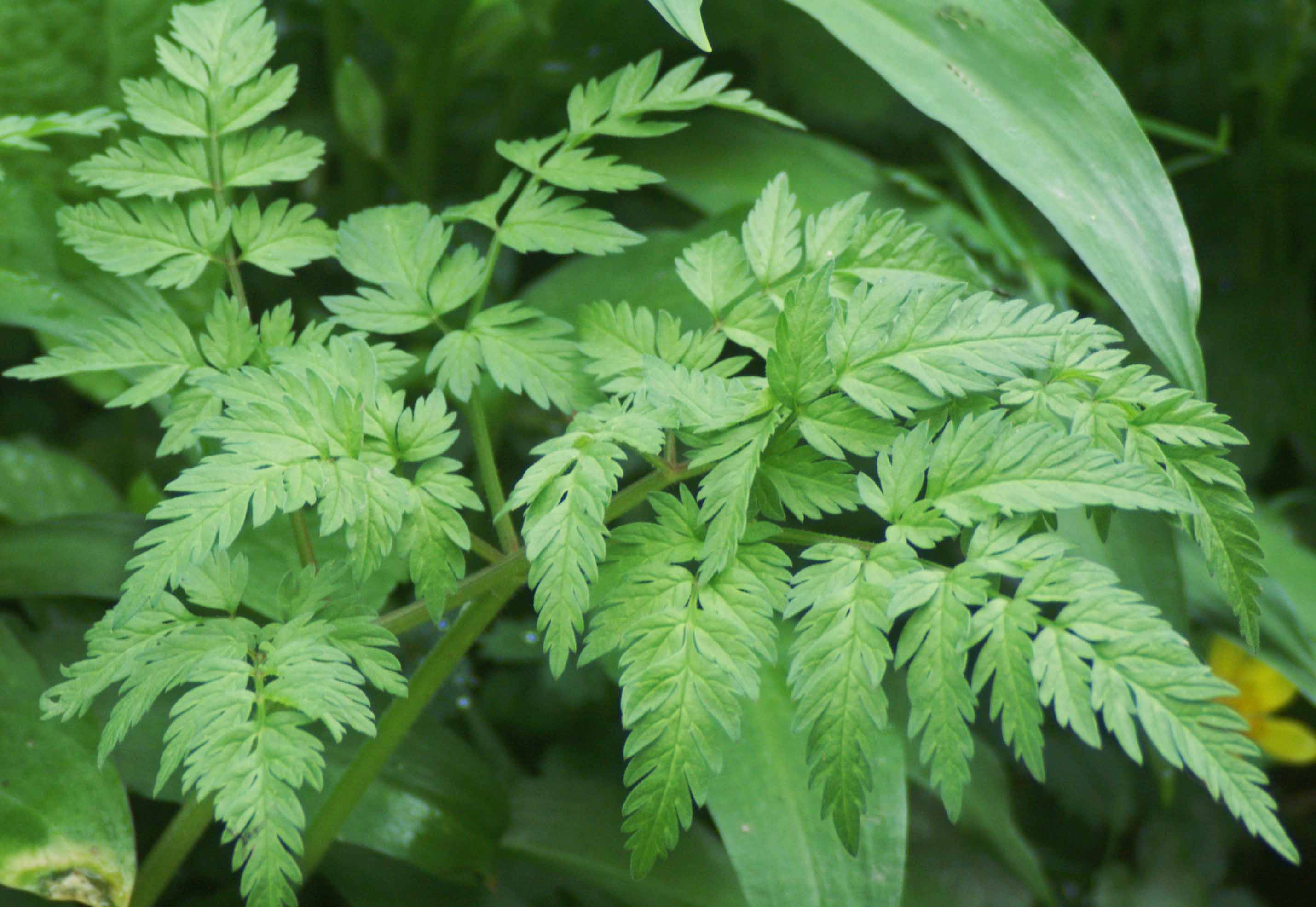
Ferny leaf of Cow parsley - Anthriscus sylvestris

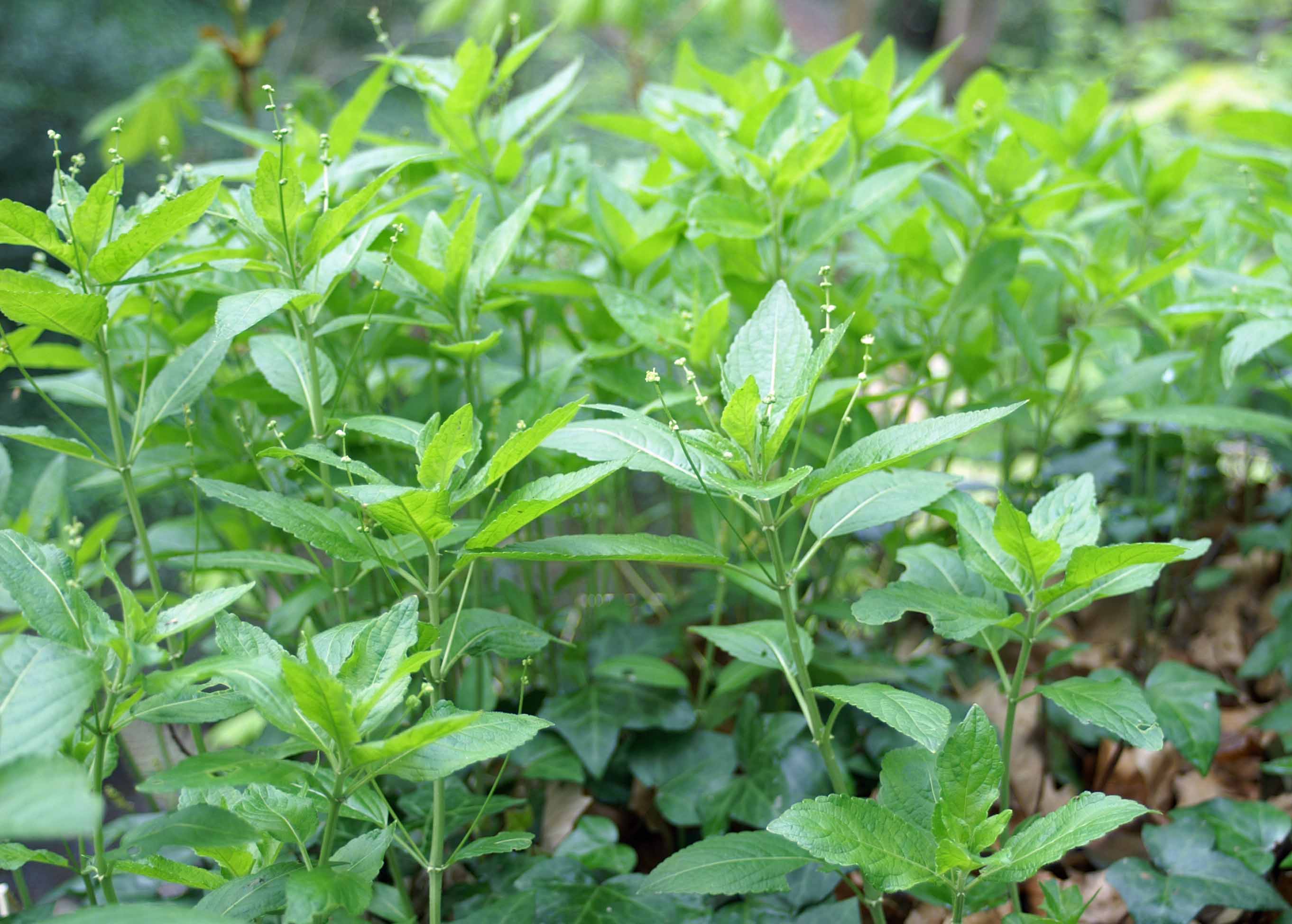
Dog's mercury-mercurialis perennis

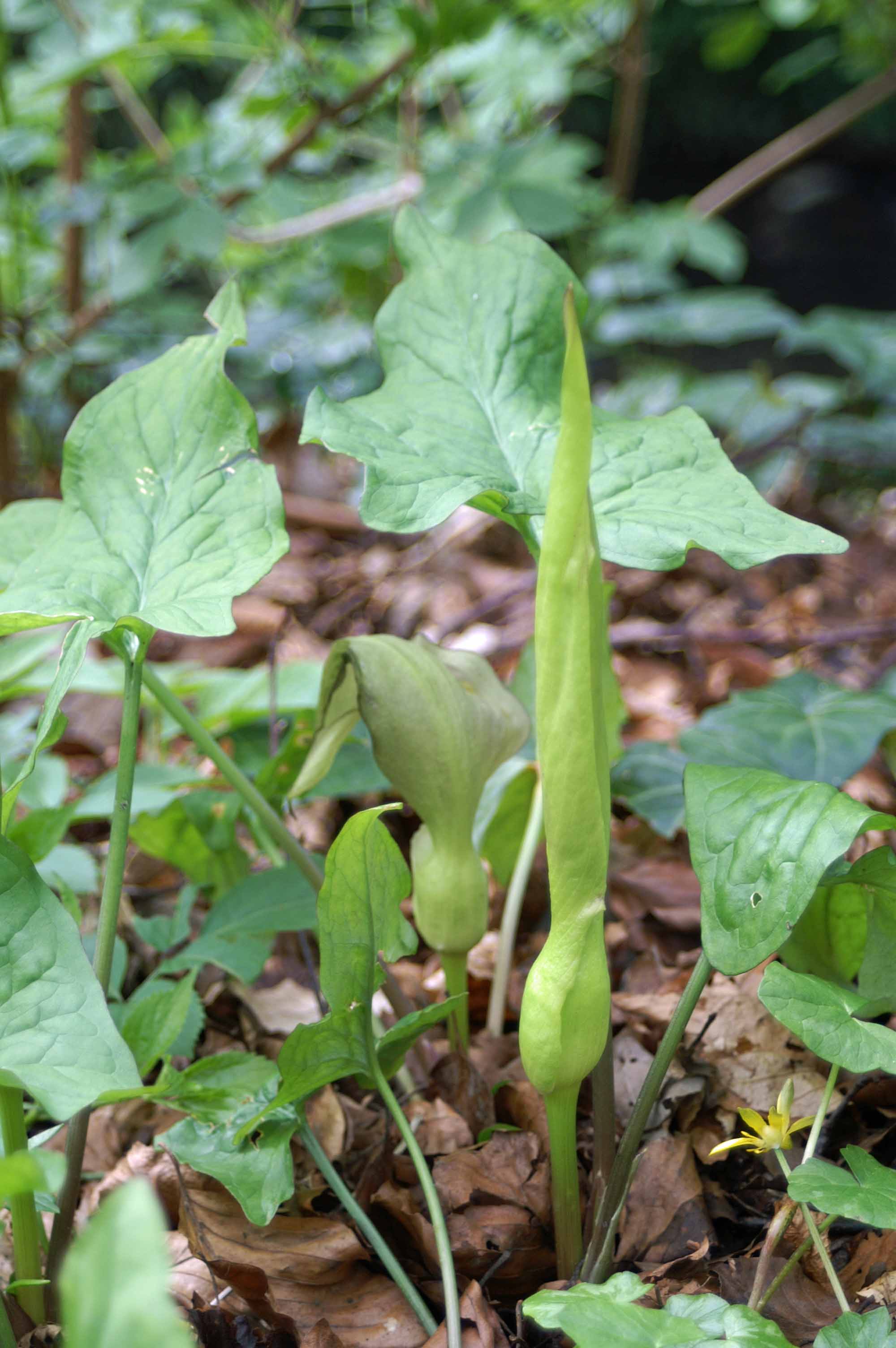
The furled green spathe of a wild arum (cuckoo pint, lords & ladies)

The green spathe unfurls to reveal the purple spadex

Share this:

  • Share on Facebook (Opens in new window) Facebook
  • Share on Pinterest (Opens in new window) Pinterest
  • Share on X (Opens in new window) X
Like Loading...
← Older posts
Newer posts →
Follow everyday nature trails on WordPress.com

Enter your email address to follow this blog and receive notifications of new posts by email.

‘But it is the common species that keep the living world ticking over and provide most of our experiences of wildlife, and I would argue that maintaining the abundance of these is as important a conservation priority as maintaining the existence of rarities’. Richard Mabey

MOST RECENT POSTS

  • A Glimpse of Spring to Come January 22, 2025
  • Hunting the Wren December 28, 2024
  • Oh, Christmas Tree December 18, 2024
  • In and Out of the Ivy February 15, 2024
  • Nature’s Fireworks November 30, 2023
  • Wild Autumn along the Coast Path November 3, 2023

OLDER POSTS

LOOKING FOR SOMETHING IN PARTICULAR?

  • Sights and Sounds from the Little Orme 1
    Sights and Sounds from the Little Orme 1
  • The Foxglove - of Fairytales, Myths & Medicine
    The Foxglove - of Fairytales, Myths & Medicine
  • Following a river to a Fairy Glen
    Following a river to a Fairy Glen
  • Butterflies and more rare treats
    Butterflies and more rare treats
  • May Bee Appearing on Ivy near You
    May Bee Appearing on Ivy near You
  • A Windy Wildflower Trail - completion
    A Windy Wildflower Trail - completion
  • Shades, Sounds and Scents of the Woods
    Shades, Sounds and Scents of the Woods
  • Fine Dining for Crows
    Fine Dining for Crows
  • Everyday Birds - The Blue Tit
    Everyday Birds - The Blue Tit
  • Catchers, a Duck and Divers
    Catchers, a Duck and Divers

nightingale trails

The Walk of the Monarch Butterfly-Sendero de la Mariposa Monarca

The Walk of the Monarch Butterfly-Sendero de la Mariposa Monarca

MY WILDFLOWER BLOG: where the wildflowers are

Snowdrop

Snowdrop

most recent posts

Follow everyday nature trails on WordPress.com

Social

  • View teresamaygreen’s profile on Twitter

Enter your email address to follow this blog and receive notifications of new posts by email.

Website Built with WordPress.com.

  • Subscribe Subscribed
    • everyday nature trails
    • Join 358 other subscribers
    • Already have a WordPress.com account? Log in now.
    • everyday nature trails
    • Subscribe Subscribed
    • Sign up
    • Log in
    • Report this content
    • View site in Reader
    • Manage subscriptions
    • Collapse this bar
 

Loading Comments...
 

    %d