• Home
  • about
  • about the photographs
  • Local Nature Reserves
    • Bryn Euryn Local Nature Reserve
    • Mynydd Marian
  • Wales Coast Path
    • Grey Seals in North Wales
    • St.Trillo’s Chapel
    • Wildflowers of North Wales Coastal Paths, Cliffs and Dunes

everyday nature trails

everyday nature trails

Category Archives: Local Nature Reserves

To The Summit of the Great Orme

30 Thursday Nov 2017

Posted by theresagreen in Great Orme, Nature of Wales, North Wales, Wales Coast Path

≈ 12 Comments

Tags

coastal drives, coastal walks, goats of the Great Orme, Great Orme cable car, Kashmiri goats, Llandudno, Marine Drive, North Wales Wildlife Trust, sheep of the Great Orme

November 1st

From April this year I have spent almost every Wednesday afternoon working as a volunteer in the NWWT shop situated within the Visitor Centre on the summit of the Great Orme. Meeting visitors from places all over the UK and beyond has been interesting and enjoyable, I have loved learning where they were visiting from and found I have a particularly soft spot for the older people who tell me they came up here as children, some several decades ago. It’s good to hear that the place has stood the test of time and still lives up to their happy memories. A fair few people came in seeking information too, most relating to the Great Orme itself and some regarding the local area, things to see, places to go etc. Initially I had to research things, now I feel I can give enough information for the average day visitor’s needs and in the process have learned a lot about this iconic headland.

The shop’s opening season ends this weekend, so today was my last day until next April. I am going to miss my weekly journey to and from the Summit, which have been highlights of my weeks, it’s been a real privilege to have had such a scenic drive to and from work! Today’s drive was particularly stunning as it was one of only a handful of fair weather Wednesdays this season; most have been cool to the point of cold, wet and extremely windy. The shop has sold boxes full of gloves and woolly hats to unprepared visitors!

Marine Drive

There are a number of ways to reach the summit of the Great Orme but my route of choice is via Marine Drive, also known as the Toll Road as there is a charge to drive this way (currently £3 per car that includes free parking at the summit). You can walk this route too and the length of Marine Drive is an inclusive section of the Wales Coast Path.

Approaching the toll house

Leaving the toll house you are soon confronted with this dramatic view; I love the zig-zag of angles created by the road, the limestone cliff and the stone wall.

There are a few spots where it is possible to pull in and park briefly to admire the views such as this one looking back over Ormes Bay to the ‘good’ unquarried side of the Little Orme.
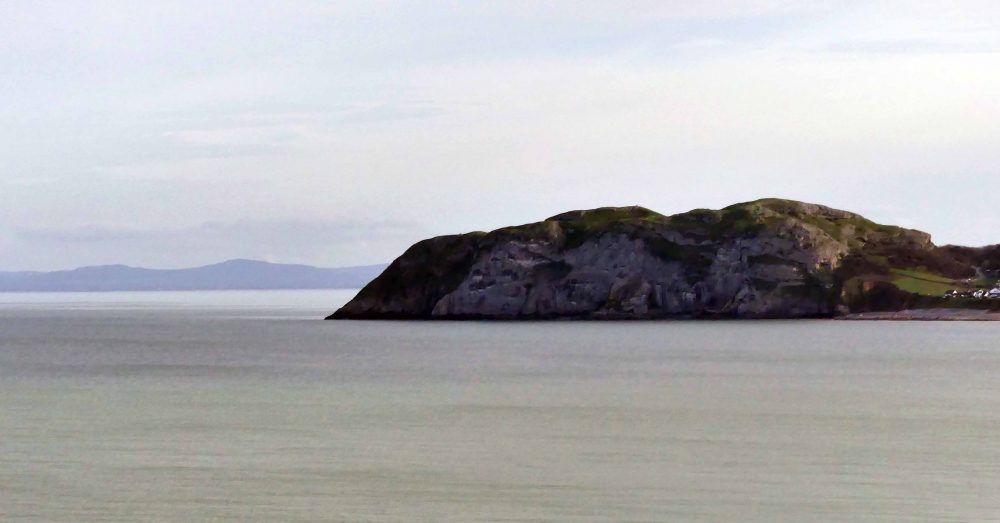
A limestone cliff towers high above the road level blocking out the low sun

 casting its shadow onto the rippled surface of the sea.

Looking ahead to the tip of the headland and down onto a rocky cove.
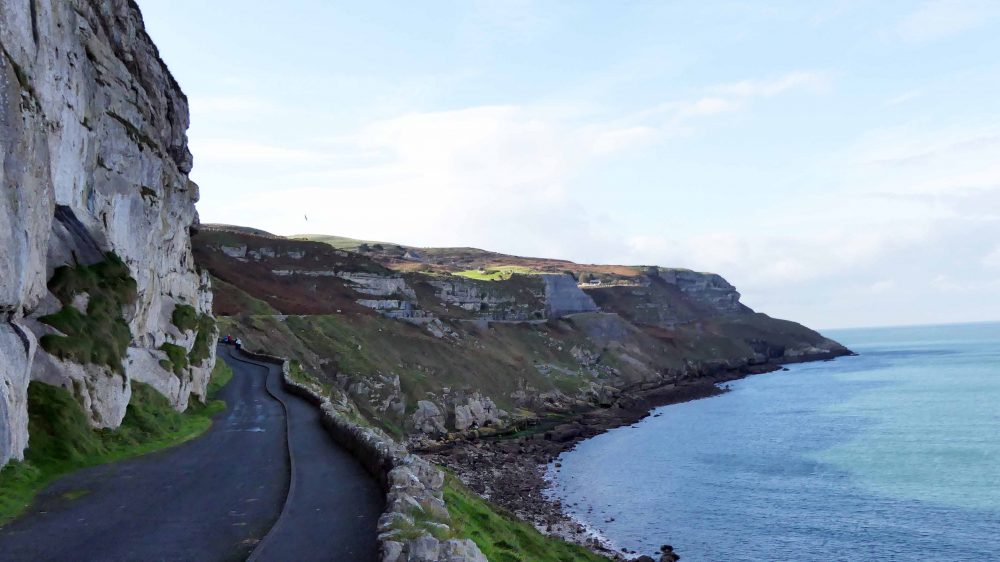
Eventually the road forks and I take the upwards route which winds its way via a series of hairpin bends to the summit. The trickiest of these bends is just past the beautiful little St Tudno’s Church where there are stone walls either side of the single track; with no forward view of anything oncoming it helps if you can reverse your car accurately.


Unless I am running particularly late I pull into the small parking area opposite the church. On wild days I contemplate the view from my car but on days such as today I get out, breathe in the air and generally take in the glorious landscape and beyond it across the Irish Sea. The shape of the hawthorn trees here gives you a clue as to the regularity and strength of the prevailing wind.

Two sheep were ambling along the road in front of the church wall. Not an unusual sight, but what was unusual was that both had their long tails and also seem to have escaped this year’s shearing. I wonder where they’ve been hiding?

The National Trust famously took over the farm on the headland a few years ago and the farmer has since built up sizeable flocks of a variety of sheep breeds. Carefully chosen for their differing grazing habits they are free to wander and help maintain the conditions needed for the special flora and fauna that grace this special place.

Some are Herdwick sheep, a breed of native to the Lake District of North West England. Herdwicks are prized for their robust health, their ability to live solely on foraged food, and their tendency to be territorial and not to stray too far from their home base.

A Herdwick sheep smiling for the camera

A sighting of some of the herd of resident Kashmir goats is always a highlight of the drive. They too are free to wander and graze on the tougher vegetation and they can and do, pop up almost anywhere. I was happy to see a little party in the same field as the sheep; a couple of ‘Nannies’ (females), with this years growing kids.

A sign of fair weather is to see the cable cars gliding quietly high above you to and from the summit. This cable car system, opened in June 1969, is famously the longest passenger cable car system in Britain and I’m assured the panoramic views it offers are truly amazing. I’ve yet to try it myself, but it is on my list of must-dos. Needless to say it hasn’t run frequently this year due to strong winds; not surprising when you learn it travels about a mile and its highest point is about 80 feet (24.3 metres) off the ground!

Another way to reach the summit is by tram. Much more reliable it can travel up in most weathers, although it was forced, (in compliance with insurance requirements), to stop a few Wednesdays ago when winds were gusting at 48mph! I remember it well as that day I could hardly open the car door and almost got blown off my feet in the car park. The tram route is a journey in two parts, requiring a break at the aptly named Half-Way Station where you swap cars to continue to the Summit.

The Half-Way Station  

Reaching the road junction by the Half-Way Station I turn right to carry on up to the Summit (left takes you back down into town following parallel to the tram track). I pass the entrance to the Bronze Age Mines. I haven’t been down there either and may not. I can do heights much better than closed-in depths, no matter how fascinating.

From the car park the view is stunning. Not entirely clear but the sun shining through clouds had turned the lightly rippled sea to molten silver.

Although not obvious from the sea’s surface it was still windy enough to support this young Herring gull allowing it to hang in the air and parachute down to make a soft landing.

I’m coming in and there’s another one behind

The shop closes at 4pm since the clocks went back. The summit was almost deserted and the last tram departed as I left. The sun was already setting behind Anglesey and veiled by light misty cloud was casting a glorious soft golden glow over the entire landscape, even colour-washing the white-painted summit building.

In the gathering dusk I drove back down the way I had come to the junction with Marine drive, which from this point once again becomes a one-way only road leading down to the West Shore side of the headland. The road passes by the old Lighthouse, the subdued light suitably accentuating the gothic-castellated building perched bleakly on this exposed point of the headland.

The Lighthouse, now a ’boutique’ b&b, was originally constructed in 1862 by the Mersey Docks and Harbour Company who built the fortress-like building using “dressed limestone and vast bulks of Canadian pitch pine”. The beacon remained as a continuous warning to mariners until March 22nd 1985 when the optic was removed. It is now on view within the Visitor Centre on the summit. 
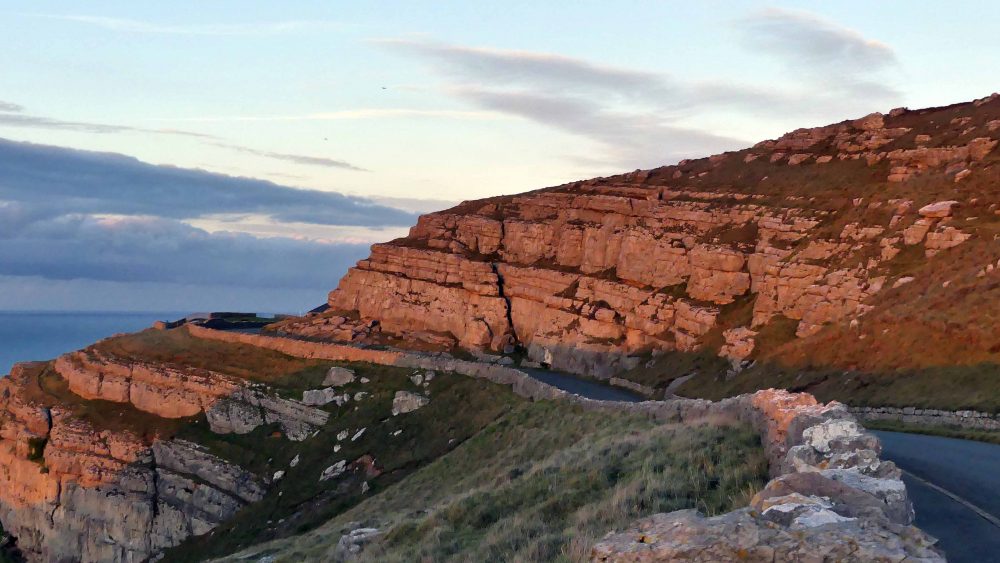
Past the lighthouse I just had to stop and get out of the car to photograph these pink-washed limestone cliffs before continuing on down. Then stopped again to take in the view out over the West Shore and the Conwy estuary. On a clear day you can see Conwy castle and the road bridges and follow the curve of the river back way beyond to the mountains of Snowdonia.

A few minutes later I am almost home, driving along the Llandudno sea front and admiring the almost-full moon in the darkening sky.
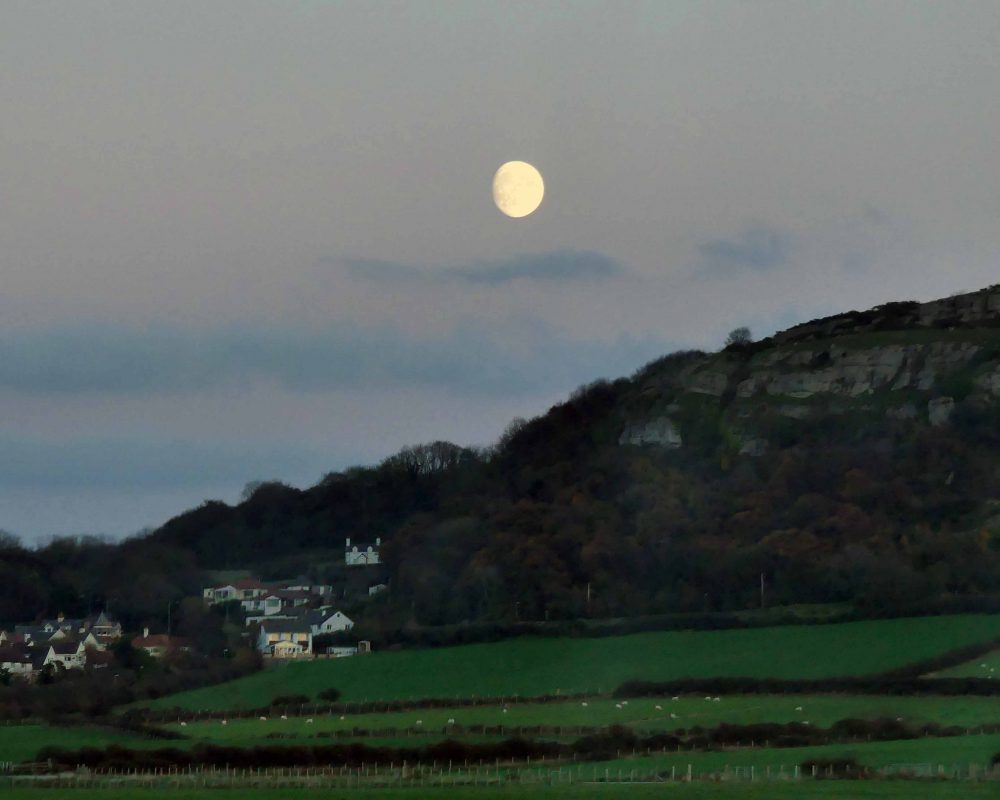
This must surely be one of the most scenic routes to and from a workplace that a person could wish for.

Share this:

  • Share on Facebook (Opens in new window) Facebook
  • Share on Pinterest (Opens in new window) Pinterest
  • Share on X (Opens in new window) X
Like Loading...

September Hillside

24 Sunday Sep 2017

Posted by theresagreen in British hoverflies, Bryn Euryn Nature Reserve, Butterflies of Wales, calcareous grassland, hoverflies, Nature of Wales, North Wales, slugs & snails, Wildflowers of Wales

≈ 7 Comments

Tags

Arion flagellus, common carder bee, common knapweed, eyebright, green-soled slug, hemp agrimony, robin's pincushion, scabious, speckled wood, volucella zonaria, yarrow

September 8th-Bryn Euryn

As I’ve already said, it was mighty windy out here on the not-quite-summit of the hill; not the day for hanging around gazing at the views, no matter how stunning they may be.

Windswept not-quite-summit of Bryn Euryn

A quick look around showed there to be little left in the way wildflowers in bloom, but there was colour on a wild rose – a whole colony of bright red Robin’s Pincushion galls. I don’t recall ever having seen as many on a single plant. The fuzzy growths will gradually fade to brown and the little wasps that cause the growths will emerge in June. If I’m lucky, one of these days I’ll catch them coming out, although the galls also attract ‘squatters’ and there can be a dozen or more species lodging in there!

I was to keen to keep moving, but when I spotted this lovely patch of Eyebright I couldn’t resist stopping again.

The dip between this part of the hill and the slope up to the summit is usually sheltered and offers a brief respite from the wind and the noise of traffic from the A55 below, but not so today. Yarrow likes this spot and there was quite a good large patch of it still in flower here. As with Eyebright, Yarrow is a plant designed to withstand tough growing conditions and is pretty persistent, as anyone that has tried to eliminate it from a lawn will testify; you cut it down and it grows right back! Personally I prefer the ferny-leaved Yarrow to the boring grass! Funny how we discriminate against certain plants, this wildflower Yarrow’s taller-growing golden-yellow flowered relative, Achillea, is a cherished garden plant!

Some insects rather like its flowers too, I found a tiny bee motionless on a flower today and recalled I’d seen a similar looking insect on Yarrow in the Rhiwleddyn reserve a few weeks ago.

Tiny bee on Yarrow – enlarged

On the summit a patch of purple Knapweed was fuelling a few Common Carder bees that were managing to cling on and fly short distances despite the best efforts of the wind to dislodge them. The little bees had varying appearances; some were practically perfect, others a bit more battered, their ‘fur’ worn away and at least one that had a bleached appearance like it had spent too long out in the sun.

Common carder bee-practically perfect
Common carder bee-a little faded
Common carder bee-fur worn from back
Common carder bee-bleached

There was another lovely clump of Eyebright up here, this one framed by the distinctively-arranged pods that give the Bird’s-foot trefoil its name.

More Yarrow too, this plant sheltering a tiny fly.

I was hoping that the other side of the hill would be a bit more protected from the wind, but alas, most of it wasn’t. The sun was putting in sporadic appearances though, so at least it felt a bit warmer. Ironically, the sea looked to be calm, was coloured in shades of beautiful blue and its surface merely ruffled. The blades of the wind turbines were motionless.
Looking over in the opposite direction to te sea, the view to the oddly-shaped hill at Deganwy, was fairly clear, although beyond it, Anglesey and the Menai Strait were shrouded in a light haze. I’m not sure if I’ve mentioned it before, but the hill is named the Vardre and gets its unusual appearance from having two rocky summits. It has a little less height than Bryn Euryn, it being 108m, (354 feet) while the Bryn is 131m (365 feet). It was once home to fortifications that included Deganwy Castle.

On the woodland edge leaves are beginning to change colour. Hawthorn is one of the first to go

along with Silver birch as I mentioned in the previous post. Out here in the open it was easier to appreciate the combination of yellow leaves against a clear blue sky.

Next to the Silver birch is a single Whitebeam, which bears berries. The berries are orange in colour now but will gradually turn red.

In the short grass there are still a few Rock-roses in flower and here and there are big fat ‘penny-bun’, or Bolete mushrooms. At least they would have been big and fat before they were nibbled away. I like the different shades and textures such nibbling has left on this one; there was a little black spider on it too.

I have often wondered what nibbled the mushrooms. A picture I took a few weeks ago, at the end of July may have the answer. The sight amused me and I wondered if it was a romantic al-fresco lunch for two? Of course there is more to slugs than meets the eye. No gardener is ever going to welcome them onto their plot, but out in the wild they are another important cog in the wheel of the natural waste-disposal system. Although one slug may look rather like another, there are rather a lot of different species of them in our British Isles. I submitted this image to the very helpful folk that run the Slugs and Snails of the British Isles Facebook Group, who responded that to be accurate they need to see the undersides of the slugs too, but from other features that it is likely they are juvenile Arion flagellus – the Green-soled slug.

poss. Arion flagellus- the Green-soled slug

The bottom of the grassy ‘downland’ hill was still flowery with Hemp Agrimony, Knapweed, touches of Scabious and a sprinkling of Ragwort.

I walked down to where it meets with the woodland edge and lo and behold, for a few glorious minutes the sun came out. Suddenly it was warm and bright and the scene came alive with a whole host of insects vying with one another for the best blossoms.

Speckled wood on Hemp agrimony

I hardly knew where to look first, but then couldn’t resist the sight of a pristine Speckled wood feasting on Hemp agrimony. There were several of them, all looking freshly beautiful; most were nectaring on various flowers while some rested on the leaves of nearby trees basking in the sunshine. The only other butterflies in evidence were Red Admirals which unusually stayed out of range of the camera.

Speckled wood on ragwort

There was a good variety of hoverflies,large and small, a Common wasp and more Common carder bees too.

Hoverfly - Eristalis sp
Hoverfly – Eristalis sp
Hoverfly - Eristalis sp
Hoverfly – Eristalis sp
Hoverfly-Helophilus sp
Common wasp
Common wasp

Common Carder bee on Scabious

Volucella zonaria

A beautiful cast of insects, but the star of today’s show was a big handsome hoverfly, which surprisingly doesn’t have a common name, but whose scientific name, Volucella zonaria makes it sound a bit like an Italian pasta dish. This is the largest British hoverfly and is quite a recent addition to our native list, appearing on the south coast of England during the late 1930s. According to my Hoverfly bible, from there it has spread upwards and outwards across the country as far as Cheshire and Humberside and South Wales in the West. We’re not so far from the Cheshire border here, so they must still be spreading, this is the second one I’ve seen this year, the other was in my daughter’s garden a few weeks ago.

170908-1510-BEICT-Hoverfly-Volucella zonaria 3
170908-1510-BEICT-Hoverfly-Volucella zonaria 5

The spell of sunshine didn’t last long and the wind was still blowing relentlessly; time to set off in the direction of home.

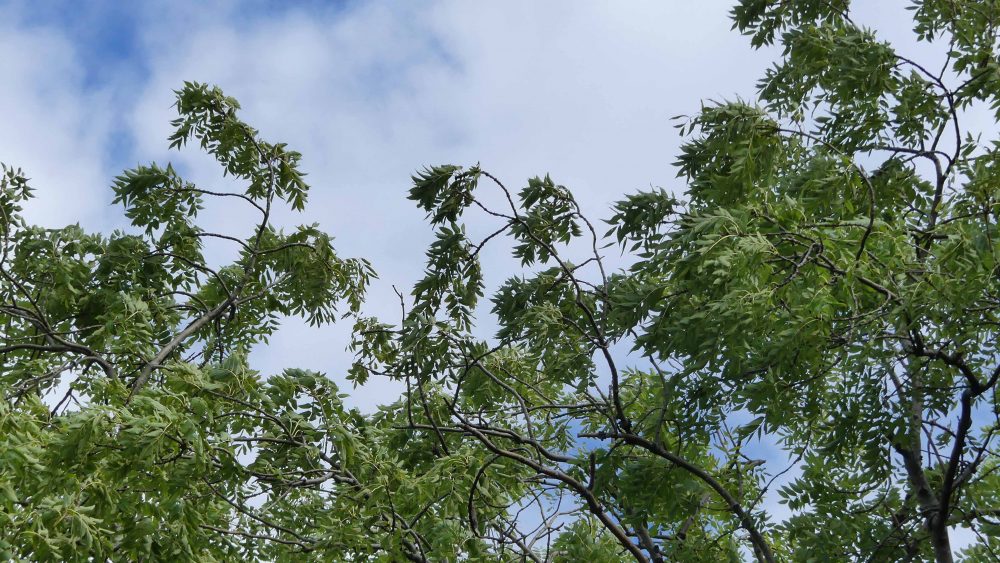
Wind-blown ash tree


Share this:

  • Share on Facebook (Opens in new window) Facebook
  • Share on Pinterest (Opens in new window) Pinterest
  • Share on X (Opens in new window) X
Like Loading...

Little Beings of Summer Woods

08 Tuesday Aug 2017

Posted by theresagreen in Bryn Euryn Nature Reserve, Nature of Wales, nature of woodlands, Wildflowers of Wales, woodland walks in Wales

≈ 7 Comments

Tags

black spleenwort, dwarf cream wave, late summer wildflowers, Nature in August, polypody fern, scorpion fly, speckled wood, wild clematis

Sunday July 30th-Bryn Euryn

The Woodland Path

11:00am  It was cooler than I’d anticipated in the woods this morning. The sky was cloudy and gusts of a chilly breeze blustered between the trees of this usually sheltered mid-slope of the Bryn; less than ideal conditions for the insects I was hoping to see. And I wished I’d worn a thicker fleece. But the sun was intermittently winning through the clouds and ever the optimist I assured myself it would get warmer for me and the little creatures. 

There are a few places on my usual trail that I think of as ‘hotspots’ for insects, even on cool days such as this. The first one is an untidy, brambly-nettley spot, where opportunistic plants have filled a gap in the tree line and spread across to the other side of the path too. Dappled sunlight reaches and warms the spot, aphids thrive here, there’s nectar and pollen to be had while the bramble is in flower, followed by its fruits; the perfect ingredients for a hoverfly hangout. If I’m patient and hang around for a few minutes I’m often rewarded with sightings of a few hovering customers and sometimes less expected visitors too.

Hoverfly (syrphus sp) basking on a sunlit hazel leaf

Insects need sunshine to warm up their flight muscles to get them going, so cooler, cloudy days can be surprisingly rewarding for sightings of basking individuals slowed down by the lack of warmth. There were a few hoverflies here today, also other common flies which I’m trying to take notice of and appreciate more; well, at least I’m aiming to put names to some of them. Most of those I saw were common ‘houseflies’, a generic name that covers quite a few different species. I think it’s their habits that most of us dislike; some of them look quite pretty.

House fly
Bluebottle

A long-bodied black insect with pretty iridescent wings scurried erratically over the surfaces of leaves, a wasp I think, definitely a hunting predator, maybe a Digger wasp.

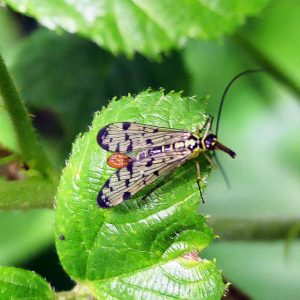
About to move on I spotted a dot of colour in the shade of some leaves. Sitting motionless was another more recognisable predator, a male Scorpion Fly.

Scorpion Fly-There are 3 species of Scorpion Fly in Britain, apparently difficult to separate other by examining genitalia; the most common being Panorpa germanica. They frequent shady places almost everywhere. All are scavenging insects and completely harmless despite the males’s scorpion-like tail. The female’s body lacks the tail, simply tapers to a point. 

Male Scorpion Fly
Male Scorpion Fly

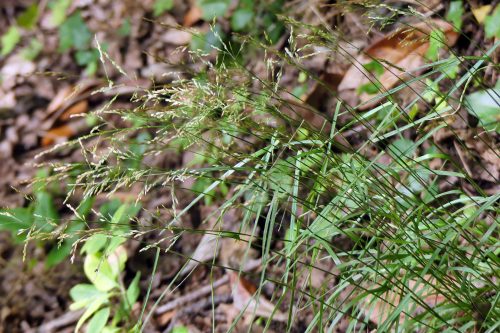
The closed tree canopy excludes most flowers now. An exception is the woodland grass, False Brome, which grows prolifically here and is flowering now.

False Brome-

A splash of colour took me by surprise – a holly tree with red berries!

*************

Perhaps relics of the days when this path was part of the grounds of a Victorian manor house, are large clumps of two attractive ferns. Both species are evergreen, maintaining their green fronds throughout the seasons, but both look particularly fresh and verdant now and the Polypody has new fronds unfurling.

Polypody fern

Black spleenwort


Dwarf Cream Wave-Idaea fuscovenosa

A tiny pale-coloured moth swirled by the breeze spiralled down to land on a bramble leaf low to the ground, settling with wings spread butterfly-like under the shelter of other leaves. It is a Dwarf Cream Wave (photograph probably not far off its actual size)- the lines that show grey-mauve are where its original pale brown scales have been worn, or washed (!) away.


A home in a leaf ….

The pale patch on this holly leaf is probably the result of the work of an insect, the Holly leaf miner Phytomyza ilicis. This is a fly whose larvae burrow into leaves of this specific species of tree and leave characteristic pale trails or mines.

Interestingly, I learnt (from Wikipaedia) that “the holly leaf miner has frequently been used in ecological studies as a system to study food webs. Examination of the leaves can show whether the leaf miner has successfully emerged, been killed by a parasitic wasp, or been predated by blue tits.”

I’m not sure what the perfectly round hole in this one indicates. It could just be the original entry point of the egg-laying adult female’s ovipositor, but maybe too big? It looks too small and neat to be an exit hole and blue tits leave a triangular tear when seizing a miner as prey. Maybe it is the mark of the work of a predatory wasp? 

Speaking of wasps, I spotted another on an ivy leaf – a bit more distinctive than the black one I saw earlier due to its long antennae, so I asked the experts at BWARS and they say it’s a member of the Ichneumonidae family. The whole of this family are parasitoides and most species attack the caterpillars of butterflies and moths. It’s a dangerous life being an insect.

The Woodland Trail, Bryn Euryn Nature Reserve 

A big old oak tree marks the junction of my ‘Woodland Path’ and the Woodland Trail that circuits the Nature Reserve. It’s lost a few of its branches and the big lower branch has a split right through it that provided a safe home to nesting Great tits earlier on in the year.


Happily, the tree seems to be going strong and is currently nurturing some baby acorns. They have stalks, which indicate this is an English, or Pedunculate Oak.


Stepping out from the cover of the trees I realised how windy it had become; windy enough for birds to be able to just hang in the air and ride the air currents with minimum effort. Two buzzards were overhead, mewling and swooping around in the air currents, one being harassed by gulls, poor thing.

The unmistakable bulk of a Buzzard

My second ‘hot-spot’ is almost at the junction of the two tracks. It’s a huge bramble entwined with gorse and over which wild clematis scrambles. That blackberry & wild clematis combination is one of my favourites, even if it is another of the sights that I associate with summer’s approaching end. The clematis is just coming into flower and, the bramble already has ripening fruit, so not much for insects here today.

A lovely Speckled Wood butterfly sat on a smaller bramble nearby which still has flowers. The butterfly let me get very close, hardly moving in the coolness of the day.

There are few flowers along the sides of the Woodland Trail now, due in part I’m sure to their having been strimmed back in June – this part of the path is maintained by the local council who are wont to get these ‘jobs’ done before people complain about paths being overgrown. All kinds of good stuff was cut back, including orchids, and much of the hogweed that would now be giving nectar and pollen to hoverflies et al. I hoped they were finding sustenance nearby.

A few odd plants have survived, or revived, to flower here and others are fruiting. There are a very few hazelnuts that have thus far escaped the jaws of voracious grey squirrels, who usually eat them while they’re still soft and green.

Ragwort
Hemp Agrimony
Honeysuckle

Wild Strawberry flower
Wild strawberry fruit
Seedpods of Stinking Iris

Tutsan berries are darkening
Hazel nuts forming
Blackberries are ripening

Cool windy days may seem unpromising if you’ve set off hoping to see insects, but if you keep paying attention there is never ‘nothing to see’ (pardon my grammar). I spotted a tiny movement on the surface of a leaf and caught sight of an even tinier leaf hopper. As I got closer with the camera lens I noticed another movement under the leaf; a tiny spider had spotted the leaf hopper and was vibrating her web to try to get its attention. The leaf hopper disappeared under the leaf….. I wonder if the spider got her lunch? Apologies for the less-than-good photo, but I’m sure you get the drift!

So, I’ve reached the steps leading up to the field now and looking forward to what it has in store….


Share this:

  • Share on Facebook (Opens in new window) Facebook
  • Share on Pinterest (Opens in new window) Pinterest
  • Share on X (Opens in new window) X
Like Loading...

Little Orme Level 1

12 Monday Jun 2017

Posted by theresagreen in Birdwatching on North Wales coast, calcareous grassland, coastal walks, coastal wildflowers, Little Orme, Local Nature Reserves, Nature of Wales, North Wales Wildlife Trust, Rhiwledyn Nature Reserve

≈ 16 Comments

Tags

chough, Cormorant, jackdaw, nomad bees, Nomada goodeniana, raven

May 27th

The Little Orme was physically scarred and shaped by human demands and quarrying activities during the first half of the last century. Subsequently handed back to nature and a testiment to its incredible ability to regenerate, an interlocking patchwork of habitats packed into a compact space on varying levels have become a haven for a diversity of wildlife, particularly wildflowers, birds and insects. Now in part a Local Nature Reserve with areas set aside as SSSIs, its wildlife may again be under pressure as the headland is an increasingly popular recreational area for local people and visitors and is also crossed by walkers following the Wales Coastal Path or the North Wales Coast Path. 

I was here today with the intention of taking some photographs of the Cormorant colony in mind. The birds are well into their breeding season now and have well-grown offspring in their nests and I wanted to catch them there before they fledged. I thought I was focussed on the job in hand, but as anyone that has ever been out walking with me would have guessed, it took less than two minutes for me to be distracted from my mission; firstly by a Harlequin ladybird guzzling aphids on the going-to-seed Alexanders, then by a lovely shiny metallic green female Swollen-thighed Beetle – Oedemera nobilis, who confusingly doesn’t have Swollen thighs at all, it’s the males that sport them as emblems of their maleness, the thicker the better in their bid to secure mates. She was perfectly displayed in the cup of a perfect dog rose, like a little jewel.

Harlequin ladybird on Alexanders
Thick-thighed beetle (f)

The cliff path along to Angel Bay took a while to negotiate too. Its sea edge is lined with masses of Red Valerian in all of its shades from deep carmine through pinks to white and it looks lovely.

I know it’s not a native and crops up anywhere and everywhere, but here it doesn’t look out of place and it is great for insects like the Painted Lady I found nectaring there.

Painted Lady on red valerian
Small White (f) on valerian leaves
Buff-tailed bumblebee on valerian

There are native wildflowers on this cliff edge too, including some good sized patches of Wild Thyme and the pretty pale lemon-yellow Mouse-ear which has colonised a large patch of the crumbly downslope of the cliff.

Wild thyme
Wild thyme
Mouse-ear Hawkweed
Mouse-ear Hawkweed

There’s a lot of Horsetail here too, I’m not sure of the species. It also cascades down the cliff where it looks a bit like a new plantation of tiny Christmas trees. A bit further in from the edge was a large patch of what I thought was Ground Ivy, but am now not sure about; very short-stemmed here on the dry exposed cliff and a mass of purple flowers, I will go back and check.

Horsetail
Horsetail
Ground Ivy
Ground Ivy

The Little Orme is the place to visit if you love your Corvids as I do. Ravens, Crows, Magpies, Jackdaws and occasionally Chough are all here. Seeing or even hearing ravens early on in a visit here always sets the mood for me, reminding me that despite the fact that this is now a place much used for recreation by people and their pets, it is still clinging on as a wild habitat. A pair flew overhead, ‘gronking’ as they did so and landed high up on the edge of the cliff, in the centre of the image above, one of their habitual lookouts for surveying their Kingdom.

Next a Magpie caught my attention as it landed on a bramble patch on the cliff edge, leaving quickly with an insect in its beak.

Then Jackdaws, great numbers of them nest in close colonies on the quarried-out cliff faces. Once breeding is over they disperse during the day, although plenty stay and forage around the grassy clifftops and it’s a safe haven to head back to and roost at night.

Jackdaw amongst bird’s-foot trefoil

At the sea end of this first flat level there’s a little bit of original rock remaining, separating Angel Bay from Penrhyn Bay and forming one side of the little cove that is the haven of the Grey Seals often mentioned in my posts. The sea-facing ledge behind said rock can be a good place to look out for birds at sea, especially in the autumn and winter, but today it was bees I found there. I have to admit I thought they were wasps as there were several that were flying around, and once or twice, in and out of holes made by mining bees. A quick check with the wise ones at BWARS (Bee,Wasp & Ant Recording Society) though, told me they are nomad bees, Nomada goodeniana, that seek out other bee’s nests in which to lay their eggs. They are apparently quite a common species, but a first for me.

Nomada goodeniana
Nomada goodeniana
Nomada goodeniana
Nomada goodeniana

A local speciality (botanically that is, not on menus!), Wild cabbage grows here, there have been bluebells on the cliff slopes and I spotted the bees as I stopped to photograph a pretty Bloody Cranesbill flower.

Wild cabbage
Wild cabbage
Bloody Cranesbill
Bloody Cranesbill

Looking out over the cove, there were just a couple of seals in the water and a sizeable gang of cormorants perched up at the sea end of the headland.


The sight of those Cormorants spurred me on to get back on track towards their nesting site. But first a stop to admire the Thrift, perhaps my favourite coastal wildflower which despite all the hazards is thriving here.

I am finally almost at the bottom of the steep slope up to the next level of the old quarry. I was following the sound of a Whitethroat singing when from close by a black bird took off and flew away from me back in the direction of the site entrance. Something in its gis made me watch carefully to see where it would land; its upturned wingtips showed this wasn’t a crow or a jackdaw and then that distinctive call confirmed I was chasing a Chough.

Chough fly with upturned wing tips

It landed a short distance away and set about digging in the short turfy ground in pursuit of food with its long curved bill. It was a ringed bird, banded on both legs, but perhaps not quite an adult as its beak was a dark orange colour rather than the bright red of a mature adult.

Chough eat worms, caterpillars, ants and are particularly partial to the larvae of dung beetles

The bird had picked a productive spot and was so settled into its feeding it took no notice of me sitting watching it from a conveniently sited bench. But foraging close to the junction of two of the main tracks across the clifftop it was inevitable that it would be disturbed sooner rather than later, and so it was, taking off and flying off over the sea and around the headland. That was definitely my best ever Chough encounter here in North Wales; certainly the closest. And I would have missed it if it wasn’t for my slow- walking meandering habit.

Next Level of this trail to follow shortly…. there will be Cormorants!


Share this:

  • Share on Facebook (Opens in new window) Facebook
  • Share on Pinterest (Opens in new window) Pinterest
  • Share on X (Opens in new window) X
Like Loading...

The Redwing

18 Wednesday Jan 2017

Posted by theresagreen in bird behaviour, birds of Wales, Bryn Euryn Nature Reserve, Nature, Nature of Wales, North Wales

≈ 14 Comments

Tags

Coch Dan-aden, grey squirrel, migrant birds, overwintering birds, redwing, Turdus ileacus

For a few magical days earlier this month I enjoyed the privilege of close sightings of Redwings as they travelled around our local woodland foraging for food. Special sightings indeed, and better still I didn’t even need to leave my flat: all but one of the  following photographs were taken from my kitchen window.

December 31st 2016 

09:10 Thrilled to see Redwings this morning – several flew through the cover of the trees and shrubbery behind the building, with one pausing briefly in view of the kitchen window. There was a flurry of bird activity around that time; they were preceded by a mixed group of small birds, including Long-tailed, Great & Blue tits and seemed to have a variety of blackbirds travelling with them, so may have been a thrush feeding party following a tit feeding. The light was poor and I only managed to get one not-so-good photograph, but at least it is a record of the sighting.

161231-berc-0907-redwing-1b

English name: Redwing Scientific name: Turdus ileacus Welsh: Coch Dan-aden Status in the UK: RED Redwings are red-listed in the UK as although the majority are autumn-winter residents, we have a very small breeding population, restricted in range to the northern third of Scotland.

Other local names: Swinepipe, Wind Thrush  Scientific name from: Latin: turdus=a thrush and Latin: iliacus=of the flanks (from ile=flank)

Redwings are Autumn-Winter residents of the UK and the smallest and daintiest of our thrushes. Smaller than the Song thrush, they are often shy, but a close view reveals a prominent whitish supercilium (eye stripe), warm rust red patches on the flanks and under the wings and cool grey-brown upperparts. Males and females are alike.

January 2nd

This was the day of my encounter with the flock during my walk in the woods, already described in the previous post. There were blackbirds with them then too and I went on to see the mixed small-bird feeding party just minutes later.

170102-berc-01-redwing-in-the-woods

The Redwing’s diet is mainly composed of invertebrates, supplemented with berries in autumn and winter. Wintering Redwings may be seen together with Fieldfares foraging in open fields, but they also feed with other thrushes in grassy paddocks or in woodland. Visits to gardens may be brief and are usually prompted by harsh weather.

January 5th

A frost last night left the ground hard and sparkling white this morning, and it remained cold for much of the day despite the bright sunshine. The hard ground may have driven the Redwings to seek easier food sources. This was brilliant for me as from early morning a small flock of them arrived intermittently throughout the day to pick at ripening ivy berries. So once again from my window I had a succession of fairly close-up views of them, although most of the time they were at least partially hidden behind tree twigs or within ivy foliage.

170105-berc-redwing-and-ivy-berries-1b

The majority of Redwings arrive into the UK during  September and October as birds cross the North Sea from Scandinavia and Russia. Those arriving into Wales and other western areas are most probably Icelandic birds. Redwings are night-time migrants, and if you are lucky and listen out on dark clear autumn and early winter nights, particularly in the east of the country, you may hear the thin ‘tseep‘ of  a flock overhead.  As winter arrives Redwings will have largely finished their journeys, settling in the warmer and relatively frost-free areas away from the east coast. They stay with us till March, although hard weather may force them to migrate further, with Scandinavian/Russian birds (the iliacus race) continuing westwards to Ireland or southwards into southern Europe. 

Taking a few minutes to rest in the warm sunshine:

170105-berc-redwing-and-ivy-berries-5a

“Any attempt to estimate the size of the wintering population of Redwings in Britain and Ireland meets with the same problem as for the Fieldfare: the numbers vary from year to year, and also in the course of a single winter, and major shifts of population may take place in response to weather and feeding conditions. “

( David Snow 1987 – The Atlas of Wintering Birds in Britain and Ireland, edited by Peter Lack)

170105-berc-04-redwing-after-ivy-berries

170105-berc-05-redwing-after-ivy-berries
170105-berc-06-redwing-after-ivy-berries
170105-berc-07-redwing-after-ivy-berries

Another interesting observation I made today was of a Grey squirrel that seemed to be ‘guarding’ the ivy berries. I watched it chase away another squirrel several times, but also noticed it was chasing the Redwings away too, charging at them by running along branches towards them at speed, tail all fluffed out!

170105-berc-grey-squirrel-guarding-ivy-berries-1

170105-berc-grey-squirrel-guarding-ivy-berries-2

January 6th

Milder temperatures may have allowed the Redwings to move on in their constant search for food and today I saw just one bird from my window. It wasn’t in the usual hurry and lingered for a few moments, not moving far and presenting itself to me from various angles so I got some lovely views of different aspects of its plumage and general ‘giz’. They really are beautiful birds.

170106-berc04-redwing
170106-berc06-redwing

I saved the best for last.

170106-berc03c-redwing

Share this:

  • Share on Facebook (Opens in new window) Facebook
  • Share on Pinterest (Opens in new window) Pinterest
  • Share on X (Opens in new window) X
Like Loading...

Wintergreens and Birds in the Woods

06 Friday Jan 2017

Posted by theresagreen in bird behaviour, birds of Wales, Bryn Euryn Nature Reserve, woodland birds

≈ 11 Comments

Tags

bird migration, Blue tit, coal tit, ferns that stay green in winter, goldcrest, Great Tit, long-tailed tit, redwing, the importance of ivy, treecreeper, wintergreens

January 2nd – Bryn Euryn 

Clear blue skies and frosted grass sparkling in brilliant sunshine were too much to resist, this had to be the perfect day for my first long walk of the New Year. Less than five minutes along my path into the woods I knew this was set to be a slow walk when I stopped to photograph berries on a holly tree. I was surprised to find so many remaining uneaten and noted ripe ones fallen and peppering the ground beneath. If not for that I may well have missed the flock of beautiful redwings that burst from the trees on the steep lower slope of the Bryn, exploding from their cover and rapidly scattering like shot from a gun, targeting branches of trees close by. There were a number of them, but impossible to count as once landed they are really difficult to spot. I was thrilled to see them and to be able to watch them and delighted that I got any photographs at all, so of two, this was the best.

170102-berc-4-redwing

Redwing – Turdus iliacus

I knew there were redwings around as I’d been fortunate enough to see some from my kitchen window on the morning of New Year’s Eve and one a couple  of days before that, but I had no idea whether they were just passing through or were here to stay. I’m not certain, but I think they were searching through ivy for ripe berries. Now I am hopeful they will stay for a while, at least while they are finding food.

Ivy berries are in varying stages of ripeness

Ivy berries are in varying stages of ripeness

170102-berc-3a-polypody-fern

Polypody fern

The majority of deciduous trees are bare now, but there is much that is green. Here we have our native holly, copious amounts of ivy, yew, a few Scots pines that are a native but that were most probably introduced, and rather a lot of laurel, once much beloved by Victorian gardeners.

170102-berc-6-scots-pine

At ground level there are ferns, the polypody in the photograph above, and also hart’s tongue and male ferns.

170102-berc-58-harts-tongue-male-ferns

Hart’s tongue & a small male fern

And there’s lots of moss.

170102-berc-22-mossy-stones

Then my reward for wandering slowly and numb fingers on my gloveless right hand, left free to focus and press the shutter button on the camera; suddenly I was surrounded by the joyous energy and excited sounds of a number of small birds. A feeding party, a collective of a variety of species of small woodland birds united in the eternal search for food.

It’s impossible to say who arrived first, I didn’t sense that there were leaders and followers, more that the flock was operating as a single entity arriving at a pre-determined spot with potential for all members. Of course there were blue tits, also great tits and a couple of coal tits.

170102-berc-7-blue-tit

Blue tit

An encounter with a feeding party of birds is a magical, uplifting and energising experience. The birds themselves exude excitement and energy, seeming to delight in the thrill of being part of a gang.

170102-berc-18-great-tit-or-coal-tit

Coal tit

The enchanting long-tailed tits were there too.

170102-berc-17-long-tailed-tit

Long-tailed tit

Once arrived they quickly settled to foraging amongst the trees and shrubbery, splitting back into their families or species groups. I would have been happy with the company of just the exuberant tits, but have to admit my attention was stolen from them when I noticed the treecreepers. Often included as members of a feeding party, there were two on a tree in front of me and then another two, closer to the side. What a treat to have that many of these gorgeous little birds so close and not only in range of the camera but with the added bonus of bright sunlight too.

170102-berc-13-treecreeper

Treecreeper

170102-berc-9-treecreeper

170102-berc-11-treecreeper

I lost track of time watching the birds, but they gradually moved away and passing people walking a dog and chatting  broke the spell and I too turned to continue my walk. But there was one more little treat to come – two tiny goldcrests, that may or may not have been with the feeding party, were working their way through a small holly bush nearby. I watched them for a good while, but they eluded capture by my camera, they are much too quick especially when trying to contend with foreground vegetation. The shot below was the best one I got!

170102-berc-5-goldcrest

Goldcrest

Before heading on to the trail around the Bryn I had a look at the view over the boundary fence. The higher peaks of the Carneddau mountains have snow with clouds above them that look to be holding more. The warming sunshine had them shrouded in a light veil of mist, with more rising from the Conwy river in the valley below.

170102-berc-19-snow-on-the-mountains

Share this:

  • Share on Facebook (Opens in new window) Facebook
  • Share on Pinterest (Opens in new window) Pinterest
  • Share on X (Opens in new window) X
Like Loading...

More Signs of Summer Passing

14 Sunday Aug 2016

Posted by theresagreen in British hoverflies, Bryn Euryn Nature Reserve, Butterflies of Wales, calcareous grassland, Nature of Wales, North Wales, plants important to wilflife, Wildflowers of Wales

≈ 7 Comments

Tags

Gatekeeper, Leucozona glaucia, Leucozona laternaria, lords & ladies berries, Meadow Brown, myathropa florea, Nature in August, Red bartsia, views from Bryn Euryn, views of Colwyn Bay

August 3rd

Did I mention the strong west wind that was pushing the rain clouds across the mountains towards us? Only once I’d left the shelter of the trees to continue upwards did I realise how strong it was, with sustained gusts forcing the long grasses and wildflowers to bend to its will.

160805-Bryn Euryn (78a)-View

The grassy edges of the lower summit are full of wildflowers. On the exposed side there is mostly Knapweed, with touches of Ragwort and a white umbellifer I think is Upright Hedge Parsley. There was more Red Bartsia, just one plant as far as I could see, but a better one to see properly than the one lower down. On the other side, sheltered by a belt of Blackthorn, the red berries of Lords and Ladies, Cuckoo Pint if you prefer or plain old Wild Arum.

Red Bartsia
Red Bartsia
Berries of Lords & Ladies

I didn’t take this exposed path to the summit today, but ‘turned left’ to continue into the sheltered hollow where I thought there may be more insect activity.

160805-Bryn Euryn (84a)-Summit Trail

A  wasp clung on to a lone Hogweed flowerhead swaying in the wind amidst a sea of waving long grass.

160805-Bryn Euryn (103)-Hogweed in a sea of grass

There was a sizeable patch of  the umbellifer that may be Upright Hedge Parsley amongst dry  long grass, but as I photographed the flower it was visited only by a single, quite faded Sun Fly hoverfly.

Upright Hedge Parsley
Sun fly-Helophilus pendulus (f)

There were a few Meadow Brown butterflies doing what they do – suddenly flying up in front of you from where they had been basking on the warm earth of the track and heading into the safety of the grass. There were a couple of Gatekeepers too, sheltering from the wind to bask low in the brambles. The one  I photographed had a wing-tip missing; maybe a narrow escape from a predator, but such damage can be one of the hazards of territorial scraps and of frequenting thorny brambles.

Meadow Brown
Meadow Brown
Gatekeeper amongst brambles

And just for some colour, Rosebay willowherb, which I always think is quite out of context here, even if it does look pretty. Today at least it was giving nectar to a few little bumblebees.

160805-Bryn Euryn (94)-Rosebay willowherb flower

From the summit the views are always spectacular and today you could clearly see the low clouds skimming the tops of the higher Carneddau mountains to the west and heading our way.

160805-Bryn Euryn (101)-Incoming weather

The effect on the seascape was strangely beautiful too. Looking to what is roughly the south-east across Colwyn Bay, the  distant hills were obscured by a mist hazeand although the sea appears to be flat calm; the wind was rippling back the surface, giving it texture, while the moving clouds created dynamic areas of light and shade. Mesmerising.

160805-Bryn Euryn (99)-View-Colwyn Bay

160805-Bryn Euryn (102)-Shaded sea

Back to earth I headed across the hilltop to make my way back down the other side. Mushrooms continue to pop up from the short turf and are still being nibbled. I’ve done a bit of research and from their shape I think they are a species of Boletus. This one was encircled by another of my favourite wildflowers of late summer, the lovely and semi-parasitic Eyebright. There are two variations here – plants with flowers blotched wih purple and others the more usual white with yellow centres.

160805-Bryn Euryn (110a)-Mushroom with Eyebright-Euphrasia micrantha

Further down the slope where Knapweed grows in the longer grass, there were a few nectaring insects. A Common Carder bumblebee, a male Red-tailed Bumblebee and a few hoverflies. There was also a badly-damaged Burnet moth that had somehow managed to haul itself up a flower stem to feed, despite having lost at least half of all of its wings.

Red-tailed bumblebee (male)
160805-Bryn Euryn (113)-Helophilus (f) on knapweed
Syrphus sp hoverfly
Syrphus sp hoverfly
Syrphus sp hoverfly
Syrphus sp hoverfly
Common Carder bumblebee
Burnet moth badly damaged

As I reached the bottom of the hill I stopped by a patch of Hogweed growing right on the edge of the woodland. The clouds finally cleared the way for some sun to shine through, which encouraged out a little flush of hoverflies. There was a lovely fresh female Myathropa florea – mentioned in a previous post as having the memorable and distinguishing ‘batman logo’ marking on its thorax. It was extremely mobile, but clearly hungry and from a distance I managed to get some images showing it from several angles.

Myathropa florea face-on view
Myathropa florea from the side

Then a treat to end the walk – a petite and dainty hoverfly with black and white markings, another new-to-me species.

160805-Bryn Euryn (184)-Leucozona on Hogweed

This insect was tiny, highly mobile and flying frequently between adjacent flowerheads, so my photo opportunities were few and some of the images I did get were a bit blurry. I’m not sure if its a Leucozona glaucia or similar looking Leucozona laternaria. My book tells me the former are ‘abundant’ in this part of the country and the latter more so here than further east.

160805-Bryn Euryn (189)-hfly Leucozona
160805-Bryn Euryn (183)-hfly Leucozona
160805-Bryn Euryn (187)-hfly Leucozona sp
160805-Bryn Euryn (188)-hfly Leucozona sp

If you are interested in finding out more about Eyebright, I have posted more info and pictures of it in my new blog which will be dedicated mostly to wild flora in their habitats, called, funnily enough ‘where the wildflowers are’.


Share this:

  • Share on Facebook (Opens in new window) Facebook
  • Share on Pinterest (Opens in new window) Pinterest
  • Share on X (Opens in new window) X
Like Loading...

Signs of Summer Passing

12 Friday Aug 2016

Posted by theresagreen in Bryn Euryn Nature Reserve, bumblebees, Butterflies of Wales, calcareous grassland, Nature of Wales, North Wales, plants important to wilflife, spiders, Wildflowers of Wales

≈ 15 Comments

Tags

gatekeeper butterfly, hazelnuts, hemp agrimony, male bumblebees, Nature in August, Nursery Web spider, Odontites vernus, Red Admiral, Red bartsia, tree bumblebee, white-tailed bumblebee

Historically August can be quite a wet month and is statistically less likely to have long spells of sunny holiday weather than July. This August of 2016 is certainly following the trend.

August is the traditional month for the harvest in the British Isles, which is the reason it became the main school holiday month. In the past village children were recruited to help with the then labour-intensive process and the first general Education Acts drawn up in Victorian times, providing general primary education for all, took this into account. Even the youngest child could play a useful role in keeping the pigeons and crows away from the gleanings (spilt grains). 

060712-Cornfield & Poppies

August 5th

Finally, this mid-afternoon, having waited patiently all day for an interval of more than half-an-hour without signs of imminent rain, I seized my moment and headed for the hill. Not confident the break in the rain would last long, I didn’t linger on the pathway up through the woods, only stopping to photograph a Sycamore leaf afflicted with Tar-Spot fungus …..

160805-Bryn Euryn (1)-Sycamore leaf with tar fungus

…. and those of a shrubby plant I don’t recognise, well-patterned by leaf mines.

160805-Bryn Euryn (10)-leaves with leaf mines

A quick look over the fence on the wood’s edge didn’t look too promising; the Carneddau mountains to the west were veiled heavily by approaching rain clouds.

160805-Bryn Euryn (7)

Incoming rain

I reached the Woodland Trail in record time for me,  again stopping only briefly by the big bramble to note any activity on the late flush of newly-opening flowers. Just a male Tree bumblebee and a Meadow Brown butterfly. (It’s fairly easy to spot male bumblebees as they have no pollen baskets and no real purpose other than to eat to stay alive for as long as possible, so they don’t rush about like workers).

Tree Bumblebee (male)
Meadow Brown butterfly

I had reached the line of used-to-be-coppiced Hazels when the rain arrived. Fortunately the foliage of the tree canopy is so dense there that hardly a drop got through, so I was kept dry even minus a waterproof. The Hazels here produce few nuts; perhaps because they know their efforts will be squandered by Grey Squirrels; they take them while still green, have a quick nibble to reach the soft kernel inside, then cast them to the ground when they are done.

160805-Bryn Euryn-Hazelnuts (not ripe)

160805-Bryn Euryn (18)-ground littered with hazelnuts

I waited until I could no longer hear rain on the tree leaves and carried on walking, noting how surprisingly green and fresh-looking the greenery was for this time of year.

160805-Bryn Euryn (23)-steps up to field

However, despite the greenery there are sure signs that this summer is past its peak. In Adder’s Field the Burnet roses are bearing fruits; the hips already dark red although not yet as dark as they will become. The Wild onion flowers are coming to an end and they too are producing fruits;  tiny bulbils which will sprout in situ, then drop to the ground and produce roots ready to grow into a new plant.

Hips of Burnet Rose
Flowers of Wild Onion
Fruits of Wild Onion are tiny bulbils

Stretched vertically between the rose stems was the tightly woven web-tent of a Nursery-web Spider. Peering down to its base I tracked down the weaver to where she was hiding, only some of her legs properly visible. These spiders are quite big and clumsy-looking yet produce such surprisingly fine web fabric; it’s like a piece of silk organza. (Arachnaphobes maybe scroll down quickly now!)

160805-Bryn Euryn (40b)-Nursery web spider160805-Bryn Euryn (40a)-Nursery web spider on web

The Wild clematis, or Old-man’s Beard as it will become, is in flower too, another signaller of the slide into Autumn.

160805-Bryn Euryn (34)-Wild clematis flowers

On the opposite side of the field the swathe of Hemp Agrimony is in full flower and after the rain, the warming sunshine was drawing out a crowd of insects, literally buzzing with excitement at the abundance of nectar and pollen on offer.

160805-Bryn Euryn (60)-stand of Hemp Agrimony

Again, takers were mostly male bumblebees with a few hoverflies and butterflies.

Bumblebee dusted with pollen
Eristalis sp hoverfly
Helophilus sp. hoverfly

160805-Bryn Euryn (62a)-Gatekeeper

Sightings of Gatekeeper butterflies were top of my wish-list for today. I had already seen a few flying about in the last few days, but was pleased to find my first photographable one of this year. Its tiny size was emphasized by  the proximity of a large Red Admiral on a neighbouring flower.

160805-Bryn Euryn (61)-Red Admiral front view

Nearby, ragwort was also working to attract pollinators. A damaged 6-spot Burnet had taken respite on a flowerhead and was still there hours later when I passed it on my way home. There were more male bumblebees, hoverflies and a tiny black-and-white striped bee.

Damaged 6-spot Burnet
Male bombus praetorum
Small striped flower bee

At the top end of the field a patch of umbellifers – tall Hogweed amongst  shorter Upright Hedge Parsley.

160805-Bryn Euryn-Umbellifers

In previous years I have found a few stems of Red bartsia in flower amongst the long grass at this end of the field; this year there is a significantly larger patch of this interesting semi-parasitic plant.

160805-Bryn Euryn (73)-Red Bartsia-Odontites vernus

Given a week or two to finish ripening, a good crop of berries on the Rowan tree should keep the blackbirds going for a while.

160805-Bryn Euryn (74)-Rowan tree

Break here to sit on my favourite rock (still slightly damp), have a drink of water, eat a peach and scribble down notes before heading up towards the summit.

Click for more info within this blog about:  Nursery Web Spider : Gatekeeper butterfly


Share this:

  • Share on Facebook (Opens in new window) Facebook
  • Share on Pinterest (Opens in new window) Pinterest
  • Share on X (Opens in new window) X
Like Loading...

Butterflies of the Great Orme

31 Sunday Jul 2016

Posted by theresagreen in Butterflies of Wales, coastal habitat, Great Orme, Nature of Wales, North Wales Wildlife Trust, Wildflowers of Wales, Wildlife of the Wales Coast Path, y Gogarth

≈ 8 Comments

Tags

Cinnabar moth, Conservation issues, crickets, dark green fritillary, grayling, Grayling (ssp. Thyone), hipparchia semele ssp.Thyone, Plejebus argus ssp. Caernensis, Red Admiral, Silver-studded Blue, Silver-studded Blue (spp.caernensis), small tortoiseshell, y Gogarth

July 14th – Great Orme

The great bulk of the west face of the Great Orme rises steeply from the shore of the Irish Sea; its scarred and fissured face testament to centuries of the relentless onslaught of invading weather fronts. Glancing upwards from its base it looks intimidating, barren save for a few patches of eroded grass and seemingly hostile as habitat for anything save the odd nimble Kashmiri goat. However, as in the best tradition of myths, legends and fairystories, looks can be deceptive and here-upon, not too far away, lies a magical kingdom populated by tiny beautiful creatures.

160714-Gt Orme 3-West Beach-Cliff face & toll house

The toll house on Marine Drive marks the beginning (or end) of the cliff path

The creatures take the form of butterflies. Two diverse species have evolved and adapted themselves to survival in this unlikely place and have been recognised and classified as ‘sub-species’. One is a variant of the rare Silver-studded Blue, classified as Plejebus argus ssp. Caernensis and the other a variant of Hipparchia semele (Grayling), classified as (ssp.Thyone). Both are ‘dwarf races’ and considered to be endemic to the site.

The ‘butterfly kingdom’ spills into the Great Orme or y Gogarth Reserve owned and managed by the North Wales Wildlife Trust, which has no paths, but there is a narrow stony path along a ledge cut about a third of the way up the cliff, which is indicated on the photograph above as a line of wire netting that both marks its edge and keeps people safe and goats in. I walked alongside the West Shore from the town end and joined the path at the back of the Toll House, but if you are coming down from the other direction, the other end of the track is waymarked to your left. A word of caution – this is a very narrow, unevenly surfaced track, so take care.

The day was sunny but windy, conditions which bring out the butterflies but often keeps them low to the ground or amongst long grass stems. I wasn’t expecting to start seeing the little Silver-studded Blues as easily as I did, but there on a patch of red valerian below the ‘dangerous cliffs’ sign I spotted my first ones. Most were looking rather worn and a bit tatty, but I was happy to see them at all.

First sight of a worn and battered female
Mating pair attracted others

As I watched I spotted a pair coupled together who were then joined by two others with another fresher-looking male also heading their way. Unlike their cousins, the Common Blues, these smaller butterflies don’t zoom away at speed just as you’re about to press the shutter button, but flutter gently from place to place, tending not to fly any distance away. They seem to bask quite frequently.

Silver-studded Blue male
Silver-studded Blue female

The uppersides of males are a glorious vivid blue with a dark border. Females’ uppersides are browner with a row of orange spots; in this sub-species they also have a variable flush of blue that extends over the hindwings and the base of the forewings. The Silver-studded Blue takes its name from the light blue reflective scales found on the underside of most adults and which are quite visible when light reflects off them in fresh butterflies, but they wear off quite quickly as the butterfly ages and can be quite difficult to see. In the main, the undersides are a brownish-grey with black spots, a row of orange spots, and small greenish flecks on the outer margin.  Males are similar to the Common Blue, which lacks greenish spots.

160714-GO-Silver studded blue underside (s) 3
160714-GO-Silver-studded Blue on nettle

Weathered male mating with a fresher female

The Silver-studded Blue is a Priority Biodiversity Action Plan (BAP) species.

Generally they are found in close-knit colonies, most containing less than a thousand adults. Here on the Orme numbers fluctuate over the season, but may rise to a peak of a thousand or more. Today I met a warden and an assistant on the path that were assessing current numbers – in one spot alone they had counted 130 individuals, so despite the recent inclement weather, they appear to be doing OK.

The number of Graylings I saw also took me by surprise; in other locations I’ve been more than happy to come across the occasional one; along this path I encountered a good few patrolling the path. I’m hesitant to give a number as I have no idea how many times I might have seen the same one as it circumnavigated a territory. It could well be that the same one or two were circling me!

160714-Gt Orme 50a-West Shore-Grayling

Hipparchia semele ssp. Thyone (Thompson, 1944)

H. semele ssp. Thyone flies earlier than is usual with other races of Grayling, being on the wing towards the third week in June, and disappearing by the end of July.

160714-Gt Orme 57a-West Shore-Grayling

I am not practised enough to be able to recognise subtle differences between species & sub-species of butterflies and have no desire to catch any to compare them, so I have taken points from Mr Thompson’s comparisons:

Hipparchia semele ssp. Thyone

♂ Strikingly smaller than any other British race of semele. Coloration is more uniform than in typical semele, with the pale areas more ochreous. Forewing spots are smaller than in other races, with the lower of the two frequently absent. Underside coloration duller and less contrasting than in the type, with the white areas of hindwings tinged with ochre. ♀ Also smaller than other races. Spots are smaller than in normal specimens.

The special butterflies were not alone here. In  a small sheltered quarried out area at the side of the track more red valerian was attracting some larger visitors. I was most thrilled to see a Small Tortoishell, only the second I’ve seen this year and the first to stay put long enough to photograph.

There was a Red Admiral there too, a few Meadow Browns and a single Dark Green Fritillary that was repeatedly chased away by Graylings.

Small Tortoishell
Small Tortoishell
Red Admiral
Red Admiral
Dark Green Fritillary-Argynnis aglaja
Grayling
Grayling
Cinnabar Moth

Cinnabar Moth


Another first sighting for this year was a Cinnabar Moth. I was musing just the other day about why I rarely see the adult moths when the distinctive yellow and black caterpillars are so numerous at this time of year; perhaps they don’t over-winter well? It was tricky to get even this less-than-brilliant image as it was fighting against the wind trying to stay on the cliff edge.

Jackdaw

Jackdaw

Wildflowers of the day:

Dewberry
Dewberry
Silver-studded Blue (f) on dewberry flower
Centaury
Centaury
Restharrow
Restharrow
Bloody Cranesbill
Bloody Cranesbill
Pyramidal Orchid
Pyramidal Orchid

Other insects

Common Green Grasshopper
Speckled Bush Cricket


Share this:

  • Share on Facebook (Opens in new window) Facebook
  • Share on Pinterest (Opens in new window) Pinterest
  • Share on X (Opens in new window) X
Like Loading...

Things Bright and Beautiful

18 Monday Jul 2016

Posted by theresagreen in Beetles, British hoverflies, Bryn Euryn Nature Reserve, Butterflies of Wales, calcareous grassland, flower folklore, Nature, Nature of Wales, Wildflowers of Wales, wildflowers on limestone

≈ 15 Comments

Tags

Briwydd felen, common milkwort, dark green fritillary, eyebright, Galium verum, Great Pied hoverfly, Lady's bedstraw, meadow wildflowers, Sicus ferrugineus, strangalia maculata, sulphur beetle, thick-headed flies, wild thyme

July 3rd – Bryn Euryn

Adder’s Field

Frothy sunshine-yellow Lady’s Bedstraw brightens the grass and on this warm sunny day scents the air with the delicate fragrance of fresh-cut hay.

160703-Bryn Euryn (19)-Lady's Bedstraw

160703-Bryn Euryn-Lady's Bedstraw

Lady’s Bedstraw-Galium verum; Welsh-Briwydd felen

Flowering: June to September

Medieval legend has it that the Virgin Mary lay on a bed of Lady’s Bedstraw in the stable of the inn in Bethlehem, as the donkeys had eaten all the other fodder. It is from this legend that the common name for the plant was taken, and also led to the belief that a woman lying on Lady’s Bedstraw would have a safe and easy childbirth.

Lady’s Bedstraw is a plant of dry grassland, dry banks, downs and old established sand-dunes.  On warm sunny days the air surrounding the frothy yellow flowerheads is deliciously fragranced with the scent of lightly perfumed fresh hay. Lady’s bedstraw is a food source for the huge Elephant hawk-moth caterpillar, then is favoured by the adult moths as a rich source of nectar. The migrant Humming-bird Hawk Moths are attracted to it too.

Lady’s Bedstraw was once one of the most useful of the meadow flowers; it was commonly used as a ‘strewing herb’, a natural form of air-freshening and for stuffing mattresses.  In the north of England the yellow flowers were once used to curdle milk, giving rise to several associated names such as cheese rennet and cheese renning. The leaves and stems yield a yellow dye and the roots a red dye; it was said that when cattle feed on it, it reddens their bones.

Lady’s Bedstraw contains the chemical coumarin, used in the drug dicouramol, which will prevent the blood clotting. In herbal medicine it was claimed the herb was a remedy for for urinary diseases, epilepsy and gout.

Keeled garlic, whose flowers attract Common Blue butterflies and the long stand of Hemp Agrimony on the woodland edge are in bud.

Keeled Garlic
Keeled Garlic
Hemp Agrimony
Hemp Agrimony

There are tiny acorns on the Oaks; stalked ones on the Pedunculate Oaks and tight-to-the-twig ones on the Sessile Oaks.

Stalked acorns of Pedunculate Oak
Unstalked acorns of Sessile Oak

Summit Cliffs

Up here on the near-summit rocky cliffs I spot a single lovely Grayling. It settles on a warmed rock close by and I manage to catch it before it folds away the orange markings on its upper wings.

Grayling --Ana

Grayling –Hipparchia semele

160703-46-Bryn Euryn-Grayling on my shoeI am fascinated by the butterfly’s cryptic camouflage, its ability to melt into the rocks it settles on to bask. If I take my eyes off it I have to wait until it flits off again to relocate it. Unless it lands on my shoe!

160703-46-Bryn Euryn-Grayling on summit cliffs 6

Eyebright with purple leaves

Eyebright with purple leaves

I was keen to get a good number of shots of this obliging subject, as in this location at least their appearances are not always predictable.This year I’ve had a few sightings, last year none at all. After a few minutes of following it from rock to rock I realised the butterfly had no immediate plans to go far, so I relaxed a little and sat for a while on a patch of grass.

There’s a whole other realm cuched down in these often- dry grassy-rocky areas. In the little patch where I chose to sit Common Milkwort was growing through Wild Thyme in a rocky crevice and nearby the tiny yellow dots of a creeping Hop Trefoil marked its presence, punctuated with taller purple-leaved Eyebright.

Wild thyme, Common milkwort & Hop trefoil

Wild thyme, Common milkwort & Hop trefoil

I spotted a bright yellow-green beetle scurrying through the vegetation, thinking this must appear to him to be a veritable jungle. I had wondered what Sulphur beetles got up to when not gorging on hogweed.

Sulphur beetle scurrying through short grass

Sulphur beetle scurrying through the jungle of short grass and thatch

Downland slope

There were large mushroom-like fungi growing amongst the grass here. Many were clearly being eaten by something – voles, mice? Maybe even slugs or snails.

160703-55-Bryn Euryn-Mushroom, lady's bedstraw, salad burnet going to seed

Mushroom-type fungus, partly eaten. Amongst Lady’s Bedstraw & Salad Burnet seedheads

A neat hole right through the cap
This one was turning unpleasantly slimy
Someone had turned this one over to reveal the 'spongy' underside
Someone had turned this one over to reveal the ‘spongy’ underside

Then, further down the slope, the very thing I had been crossing my fingers hoping to see- a flash of orange that was a Dark Green Fritillary taking off vertically from a Common Orchid.

160703-108-Bryn Euryn-46-Dk Green Fritillary leaving Common Orchid

160703-55-Bryn Euryn-Dk Green Fritillary underside

Dark Green Fritillary-Argynnis aglaja

There is a small colony of these lovely fritillaries here; the most I’ve ever seen at the same time in a season was 10-12. That year the Knapweed and Scabious they prefer to nectar on, were more fully in flower than now . Thus far I have seen only two at the same time. Today there was just the one. I hope there are a few more to come. The butterfly returned to nectar on one of a few Knapweed flowers fully opened. It shared the space with a chunky insect I am trying to find the identity of.

160703-Bryn Euryn-Dk Green Fritillary & fly on knapweed 1

160703-Bryn Euryn-Knapweed with sicus ferrugineus

A thick-headed fly-Sicus ferrugineus

The fritillaries are large, fast flying and tricky to approach. Sensibly they have also based themselves within a particularly brambly, steep and uneven part of the hill that restricts access. That means grabbing images as and when you can – but I like that, it keeps them ‘real’, so you see the butterfly as I did – mostly through a grass curtain.

160703-Bryn Euryn-Dk Green Fritillary & fly on knapweed 3

160703-46-Bryn Euryn-Dk Green Fritillary 1

160703-46-Bryn Euryn-Dk Green Fritillary on Knapweed 1

From the Fritillary patch to the bramble patch and sightings of Small Heath, a couple of Ringlets, a Large Skipper, Speckled Woods and hoverflies.

Ringlet-Aphantopus hyperantus
Ringlet
Ringlet
Small Heath
Small Heath
Pellucid Fly
Pellucid Fly
Sun Fly or The Footballer
Sarcophagus or Flesh fly-

And to finish with a flourish, one of my favourite beetles, Strangalia maculata.

Strangalia maculata

Strangalia maculata

Share this:

  • Share on Facebook (Opens in new window) Facebook
  • Share on Pinterest (Opens in new window) Pinterest
  • Share on X (Opens in new window) X
Like Loading...
← Older posts
Newer posts →
Follow everyday nature trails on WordPress.com

Enter your email address to follow this blog and receive notifications of new posts by email.

‘But it is the common species that keep the living world ticking over and provide most of our experiences of wildlife, and I would argue that maintaining the abundance of these is as important a conservation priority as maintaining the existence of rarities’. Richard Mabey

MOST RECENT POSTS

  • A Glimpse of Spring to Come January 22, 2025
  • Hunting the Wren December 28, 2024
  • Oh, Christmas Tree December 18, 2024
  • In and Out of the Ivy February 15, 2024
  • Nature’s Fireworks November 30, 2023
  • Wild Autumn along the Coast Path November 3, 2023

OLDER POSTS

LOOKING FOR SOMETHING IN PARTICULAR?

  • Sights and Sounds from the Little Orme 1
    Sights and Sounds from the Little Orme 1
  • Things Bright and Beautiful
    Things Bright and Beautiful
  • Following a river to a Fairy Glen
    Following a river to a Fairy Glen
  • Catchers, a Duck and Divers
    Catchers, a Duck and Divers
  • A Windy Wildflower Trail
    A Windy Wildflower Trail
  • A Window on the Woods-Winter 1
    A Window on the Woods-Winter 1
  • Fine Dining for Crows
    Fine Dining for Crows
  • May Bee Appearing on Ivy near You
    May Bee Appearing on Ivy near You
  • Butterflies and more rare treats
    Butterflies and more rare treats
  • Shades, Sounds and Scents of the Woods
    Shades, Sounds and Scents of the Woods

nightingale trails

The Walk of the Monarch Butterfly-Sendero de la Mariposa Monarca

The Walk of the Monarch Butterfly-Sendero de la Mariposa Monarca

MY WILDFLOWER BLOG: where the wildflowers are

Snowdrop

Snowdrop

most recent posts

Follow everyday nature trails on WordPress.com

Social

  • View teresamaygreen’s profile on Twitter

Enter your email address to follow this blog and receive notifications of new posts by email.

Website Built with WordPress.com.

  • Subscribe Subscribed
    • everyday nature trails
    • Join 359 other subscribers
    • Already have a WordPress.com account? Log in now.
    • everyday nature trails
    • Subscribe Subscribed
    • Sign up
    • Log in
    • Report this content
    • View site in Reader
    • Manage subscriptions
    • Collapse this bar
 

Loading Comments...
 

    %d