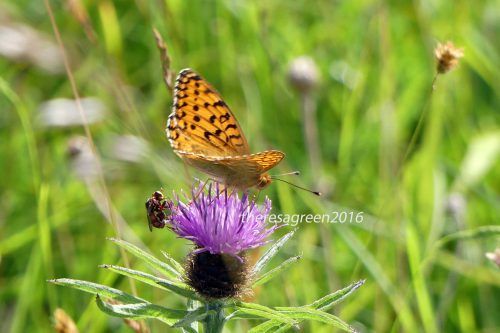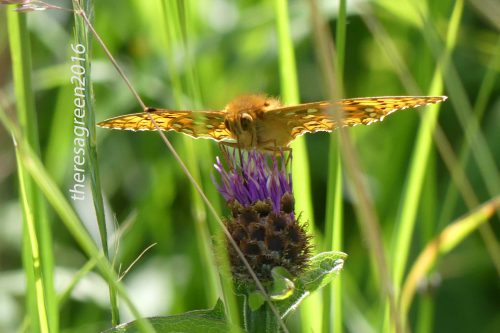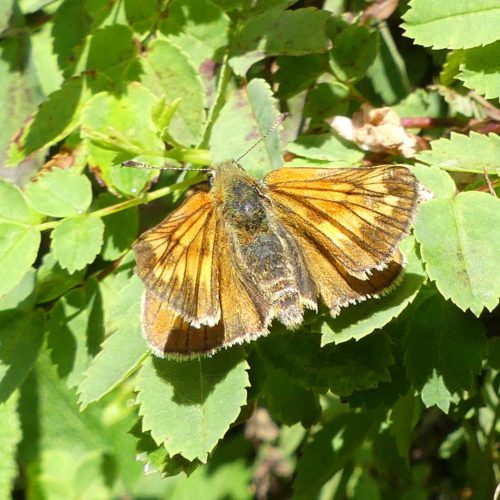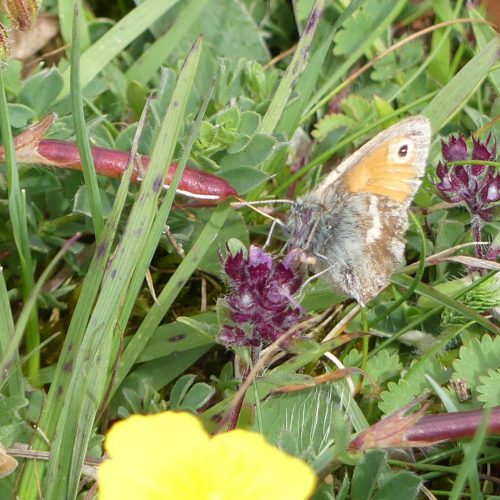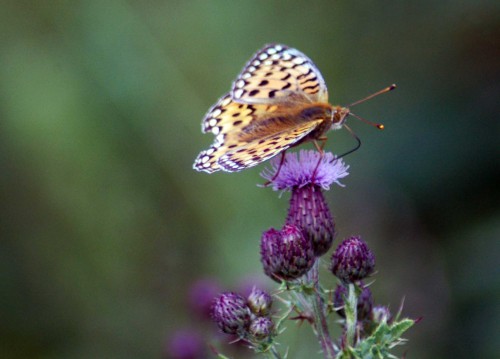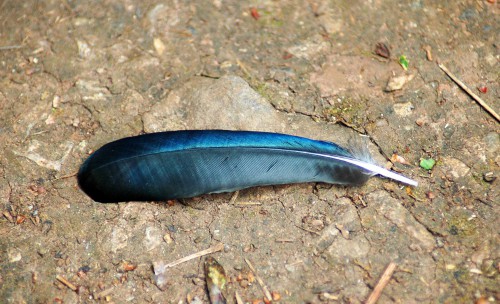
• Home
  • about
  • about the photographs
  • Local Nature Reserves
    • Bryn Euryn Local Nature Reserve
    • Mynydd Marian
  • Wales Coast Path
    • Grey Seals in North Wales
    • St.Trillo’s Chapel
    • Wildflowers of North Wales Coastal Paths, Cliffs and Dunes

everyday nature trails

everyday nature trails

Category Archives: Butterflies of Wales

Butterflies of the Great Orme

31 Sunday Jul 2016

Posted by theresagreen in Butterflies of Wales, coastal habitat, Great Orme, Nature of Wales, North Wales Wildlife Trust, Wildflowers of Wales, Wildlife of the Wales Coast Path, y Gogarth

≈ 8 Comments

Tags

Cinnabar moth, Conservation issues, crickets, dark green fritillary, grayling, Grayling (ssp. Thyone), hipparchia semele ssp.Thyone, Plejebus argus ssp. Caernensis, Red Admiral, Silver-studded Blue, Silver-studded Blue (spp.caernensis), small tortoiseshell, y Gogarth

July 14th – Great Orme

The great bulk of the west face of the Great Orme rises steeply from the shore of the Irish Sea; its scarred and fissured face testament to centuries of the relentless onslaught of invading weather fronts. Glancing upwards from its base it looks intimidating, barren save for a few patches of eroded grass and seemingly hostile as habitat for anything save the odd nimble Kashmiri goat. However, as in the best tradition of myths, legends and fairystories, looks can be deceptive and here-upon, not too far away, lies a magical kingdom populated by tiny beautiful creatures.
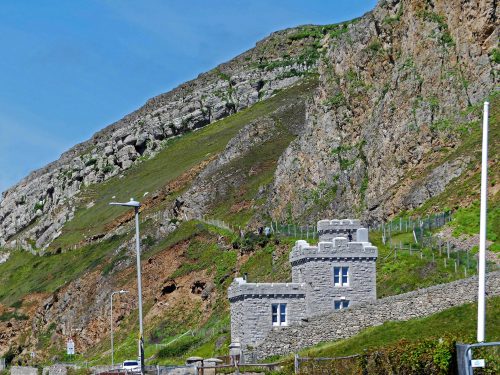
160714-Gt Orme 3-West Beach-Cliff face & toll house

The toll house on Marine Drive marks the beginning (or end) of the cliff path

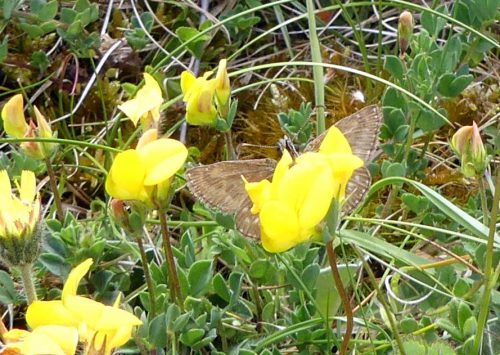
The creatures take the form of butterflies. Two diverse species have evolved and adapted themselves to survival in this unlikely place and have been recognised and classified as ‘sub-species’. One is a variant of the rare Silver-studded Blue, classified as Plejebus argus ssp. Caernensis and the other a variant of Hipparchia semele (Grayling), classified as (ssp.Thyone). Both are ‘dwarf races’ and considered to be endemic to the site.

The ‘butterfly kingdom’ spills into the Great Orme or y Gogarth Reserve owned and managed by the North Wales Wildlife Trust, which has no paths, but there is a narrow stony path along a ledge cut about a third of the way up the cliff, which is indicated on the photograph above as a line of wire netting that both marks its edge and keeps people safe and goats in. I walked alongside the West Shore from the town end and joined the path at the back of the Toll House, but if you are coming down from the other direction, the other end of the track is waymarked to your left. A word of caution – this is a very narrow, unevenly surfaced track, so take care.

The day was sunny but windy, conditions which bring out the butterflies but often keeps them low to the ground or amongst long grass stems. I wasn’t expecting to start seeing the little Silver-studded Blues as easily as I did, but there on a patch of red valerian below the ‘dangerous cliffs’ sign I spotted my first ones. Most were looking rather worn and a bit tatty, but I was happy to see them at all.

First sight of a worn and battered female
Mating pair attracted others

As I watched I spotted a pair coupled together who were then joined by two others with another fresher-looking male also heading their way. Unlike their cousins, the Common Blues, these smaller butterflies don’t zoom away at speed just as you’re about to press the shutter button, but flutter gently from place to place, tending not to fly any distance away. They seem to bask quite frequently.

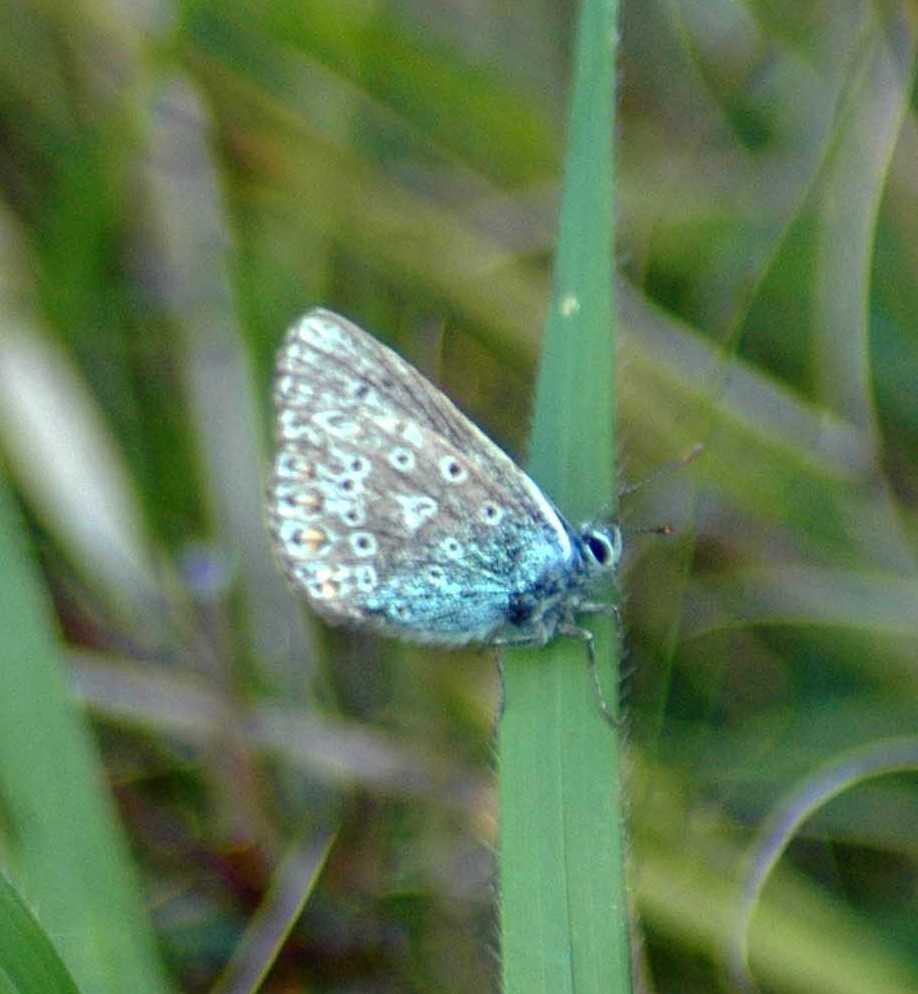
Silver-studded Blue male
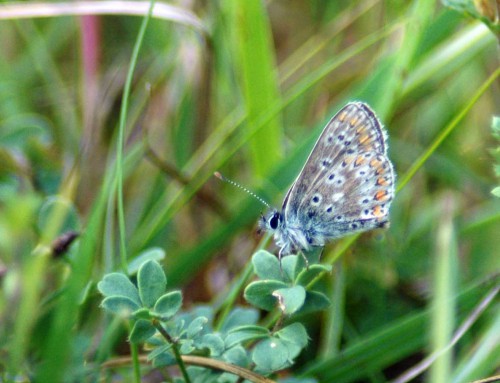
Silver-studded Blue female

The uppersides of males are a glorious vivid blue with a dark border. Females’ uppersides are browner with a row of orange spots; in this sub-species they also have a variable flush of blue that extends over the hindwings and the base of the forewings. The Silver-studded Blue takes its name from the light blue reflective scales found on the underside of most adults and which are quite visible when light reflects off them in fresh butterflies, but they wear off quite quickly as the butterfly ages and can be quite difficult to see. In the main, the undersides are a brownish-grey with black spots, a row of orange spots, and small greenish flecks on the outer margin.  Males are similar to the Common Blue, which lacks greenish spots.

160714-GO-Silver studded blue underside (s) 3
160714-GO-Silver-studded Blue on nettle

Weathered male mating with a fresher female

The Silver-studded Blue is a Priority Biodiversity Action Plan (BAP) species.

Generally they are found in close-knit colonies, most containing less than a thousand adults. Here on the Orme numbers fluctuate over the season, but may rise to a peak of a thousand or more. Today I met a warden and an assistant on the path that were assessing current numbers – in one spot alone they had counted 130 individuals, so despite the recent inclement weather, they appear to be doing OK.

The number of Graylings I saw also took me by surprise; in other locations I’ve been more than happy to come across the occasional one; along this path I encountered a good few patrolling the path. I’m hesitant to give a number as I have no idea how many times I might have seen the same one as it circumnavigated a territory. It could well be that the same one or two were circling me!

160714-Gt Orme 50a-West Shore-Grayling

Hipparchia semele ssp. Thyone (Thompson, 1944)

H. semele ssp. Thyone flies earlier than is usual with other races of Grayling, being on the wing towards the third week in June, and disappearing by the end of July.

160714-Gt Orme 57a-West Shore-Grayling

I am not practised enough to be able to recognise subtle differences between species & sub-species of butterflies and have no desire to catch any to compare them, so I have taken points from Mr Thompson’s comparisons:

Hipparchia semele ssp. Thyone

♂ Strikingly smaller than any other British race of semele. Coloration is more uniform than in typical semele, with the pale areas more ochreous. Forewing spots are smaller than in other races, with the lower of the two frequently absent. Underside coloration duller and less contrasting than in the type, with the white areas of hindwings tinged with ochre. ♀ Also smaller than other races. Spots are smaller than in normal specimens.

The special butterflies were not alone here. In  a small sheltered quarried out area at the side of the track more red valerian was attracting some larger visitors. I was most thrilled to see a Small Tortoishell, only the second I’ve seen this year and the first to stay put long enough to photograph.

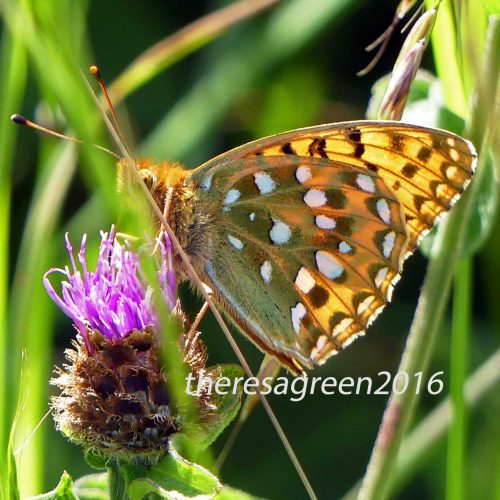
There was a Red Admiral there too, a few Meadow Browns and a single Dark Green Fritillary that was repeatedly chased away by Graylings.

Small Tortoishell
Small Tortoishell
Red Admiral
Red Admiral
Dark Green Fritillary-Argynnis aglaja
Grayling
Grayling
Cinnabar Moth

Cinnabar Moth


Another first sighting for this year was a Cinnabar Moth. I was musing just the other day about why I rarely see the adult moths when the distinctive yellow and black caterpillars are so numerous at this time of year; perhaps they don’t over-winter well? It was tricky to get even this less-than-brilliant image as it was fighting against the wind trying to stay on the cliff edge.
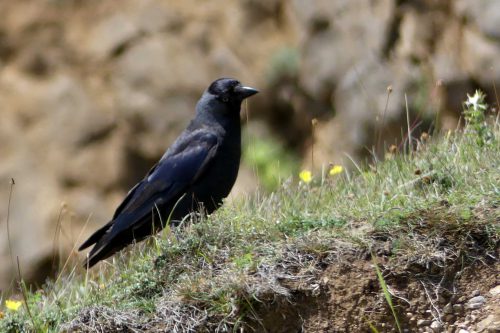
Jackdaw

Jackdaw

Wildflowers of the day:

Dewberry
Dewberry
Silver-studded Blue (f) on dewberry flower
Centaury
Centaury
Restharrow
Restharrow
Bloody Cranesbill
Bloody Cranesbill
Pyramidal Orchid
Pyramidal Orchid

Other insects
Common Green Grasshopper
Speckled Bush Cricket


Share this:

  • Share on Facebook (Opens in new window) Facebook
  • Share on Pinterest (Opens in new window) Pinterest
  • Share on X (Opens in new window) X
Like Loading...

Things Bright and Beautiful

18 Monday Jul 2016

Posted by theresagreen in Beetles, British hoverflies, Bryn Euryn Nature Reserve, Butterflies of Wales, calcareous grassland, flower folklore, Nature, Nature of Wales, Wildflowers of Wales, wildflowers on limestone

≈ 15 Comments

Tags

Briwydd felen, common milkwort, dark green fritillary, eyebright, Galium verum, Great Pied hoverfly, Lady's bedstraw, meadow wildflowers, Sicus ferrugineus, strangalia maculata, sulphur beetle, thick-headed flies, wild thyme

July 3rd – Bryn Euryn

Adder’s Field

Frothy sunshine-yellow Lady’s Bedstraw brightens the grass and on this warm sunny day scents the air with the delicate fragrance of fresh-cut hay.

160703-Bryn Euryn (19)-Lady's Bedstraw

160703-Bryn Euryn-Lady's Bedstraw

Lady’s Bedstraw-Galium verum; Welsh-Briwydd felen

Flowering: June to September

Medieval legend has it that the Virgin Mary lay on a bed of Lady’s Bedstraw in the stable of the inn in Bethlehem, as the donkeys had eaten all the other fodder. It is from this legend that the common name for the plant was taken, and also led to the belief that a woman lying on Lady’s Bedstraw would have a safe and easy childbirth.

Lady’s Bedstraw is a plant of dry grassland, dry banks, downs and old established sand-dunes.  On warm sunny days the air surrounding the frothy yellow flowerheads is deliciously fragranced with the scent of lightly perfumed fresh hay. Lady’s bedstraw is a food source for the huge Elephant hawk-moth caterpillar, then is favoured by the adult moths as a rich source of nectar. The migrant Humming-bird Hawk Moths are attracted to it too.

Lady’s Bedstraw was once one of the most useful of the meadow flowers; it was commonly used as a ‘strewing herb’, a natural form of air-freshening and for stuffing mattresses.  In the north of England the yellow flowers were once used to curdle milk, giving rise to several associated names such as cheese rennet and cheese renning. The leaves and stems yield a yellow dye and the roots a red dye; it was said that when cattle feed on it, it reddens their bones.

Lady’s Bedstraw contains the chemical coumarin, used in the drug dicouramol, which will prevent the blood clotting. In herbal medicine it was claimed the herb was a remedy for for urinary diseases, epilepsy and gout.

Keeled garlic, whose flowers attract Common Blue butterflies and the long stand of Hemp Agrimony on the woodland edge are in bud.

Keeled Garlic
Keeled Garlic
Hemp Agrimony
Hemp Agrimony

There are tiny acorns on the Oaks; stalked ones on the Pedunculate Oaks and tight-to-the-twig ones on the Sessile Oaks.

Stalked acorns of Pedunculate Oak
Unstalked acorns of Sessile Oak

Summit Cliffs

Up here on the near-summit rocky cliffs I spot a single lovely Grayling. It settles on a warmed rock close by and I manage to catch it before it folds away the orange markings on its upper wings.

Grayling --Ana

Grayling –Hipparchia semele

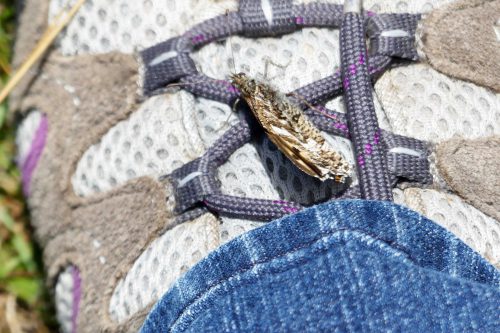
160703-46-Bryn Euryn-Grayling on my shoeI am fascinated by the butterfly’s cryptic camouflage, its ability to melt into the rocks it settles on to bask. If I take my eyes off it I have to wait until it flits off again to relocate it. Unless it lands on my shoe!

160703-46-Bryn Euryn-Grayling on summit cliffs 6

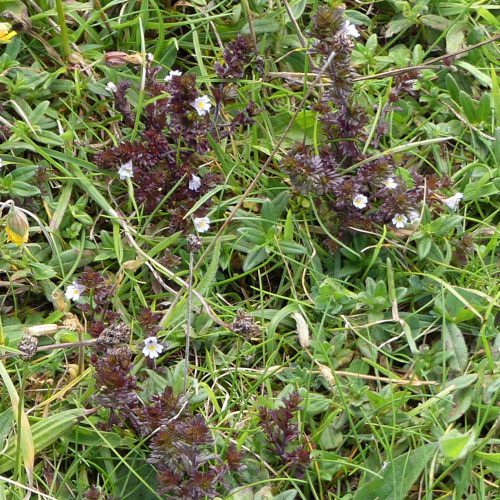
Eyebright with purple leaves

Eyebright with purple leaves

I was keen to get a good number of shots of this obliging subject, as in this location at least their appearances are not always predictable.This year I’ve had a few sightings, last year none at all. After a few minutes of following it from rock to rock I realised the butterfly had no immediate plans to go far, so I relaxed a little and sat for a while on a patch of grass.

There’s a whole other realm cuched down in these often- dry grassy-rocky areas. In the little patch where I chose to sit Common Milkwort was growing through Wild Thyme in a rocky crevice and nearby the tiny yellow dots of a creeping Hop Trefoil marked its presence, punctuated with taller purple-leaved Eyebright.

Wild thyme, Common milkwort & Hop trefoil

Wild thyme, Common milkwort & Hop trefoil

I spotted a bright yellow-green beetle scurrying through the vegetation, thinking this must appear to him to be a veritable jungle. I had wondered what Sulphur beetles got up to when not gorging on hogweed.

Sulphur beetle scurrying through short grass

Sulphur beetle scurrying through the jungle of short grass and thatch

Downland slope

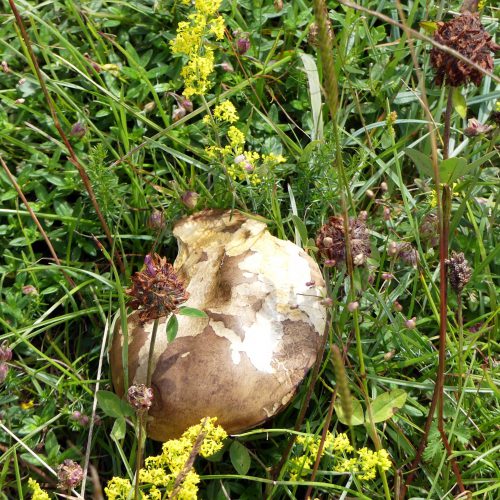
There were large mushroom-like fungi growing amongst the grass here. Many were clearly being eaten by something – voles, mice? Maybe even slugs or snails.

160703-55-Bryn Euryn-Mushroom, lady's bedstraw, salad burnet going to seed

Mushroom-type fungus, partly eaten. Amongst Lady’s Bedstraw & Salad Burnet seedheads

A neat hole right through the cap
This one was turning unpleasantly slimy
Someone had turned this one over to reveal the 'spongy' underside
Someone had turned this one over to reveal the ‘spongy’ underside

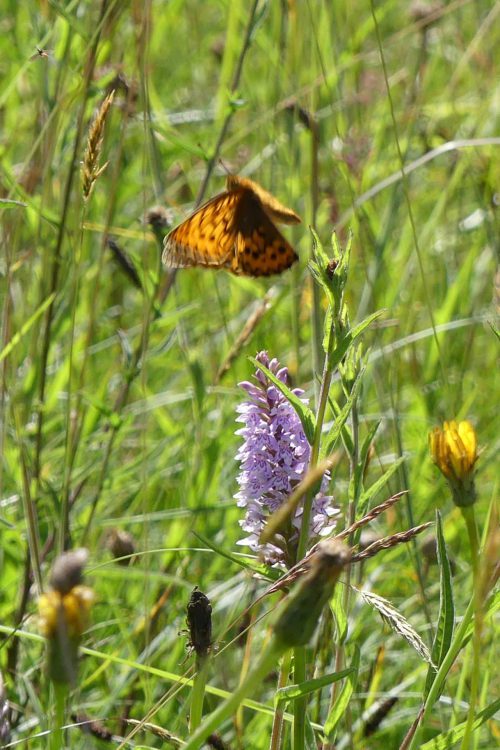
Then, further down the slope, the very thing I had been crossing my fingers hoping to see- a flash of orange that was a Dark Green Fritillary taking off vertically from a Common Orchid.

160703-108-Bryn Euryn-46-Dk Green Fritillary leaving Common Orchid

160703-55-Bryn Euryn-Dk Green Fritillary underside

Dark Green Fritillary-Argynnis aglaja

There is a small colony of these lovely fritillaries here; the most I’ve ever seen at the same time in a season was 10-12. That year the Knapweed and Scabious they prefer to nectar on, were more fully in flower than now . Thus far I have seen only two at the same time. Today there was just the one. I hope there are a few more to come. The butterfly returned to nectar on one of a few Knapweed flowers fully opened. It shared the space with a chunky insect I am trying to find the identity of.

160703-Bryn Euryn-Dk Green Fritillary & fly on knapweed 1

160703-Bryn Euryn-Knapweed with sicus ferrugineus

A thick-headed fly-Sicus ferrugineus

The fritillaries are large, fast flying and tricky to approach. Sensibly they have also based themselves within a particularly brambly, steep and uneven part of the hill that restricts access. That means grabbing images as and when you can – but I like that, it keeps them ‘real’, so you see the butterfly as I did – mostly through a grass curtain.

160703-Bryn Euryn-Dk Green Fritillary & fly on knapweed 3

160703-46-Bryn Euryn-Dk Green Fritillary 1

160703-46-Bryn Euryn-Dk Green Fritillary on Knapweed 1

From the Fritillary patch to the bramble patch and sightings of Small Heath, a couple of Ringlets, a Large Skipper, Speckled Woods and hoverflies.

Ringlet-Aphantopus hyperantus
Ringlet
Ringlet
Small Heath
Small Heath
Pellucid Fly
Pellucid Fly
Sun Fly or The Footballer
Sarcophagus or Flesh fly-

And to finish with a flourish, one of my favourite beetles, Strangalia maculata.

Strangalia maculata

Strangalia maculata

Share this:

  • Share on Facebook (Opens in new window) Facebook
  • Share on Pinterest (Opens in new window) Pinterest
  • Share on X (Opens in new window) X
Like Loading...

Brambles, Bumbles and Butterflies

10 Sunday Jul 2016

Posted by theresagreen in British hoverflies, Bryn Euryn Nature Reserve, bumblebees, Butterflies of Wales, Insects, Nature of Wales, nature of woodlands, nature photography, plants important to wilflife

≈ 9 Comments

Tags

bombus hypnorum, bombus pratorum, coenonympha pamphilus, Early Bumblebee, grayling, Great Pied hoverfly, hipparchia semele, importance of bramble flowers to insects, Large Skipper, Meadow Brown, myathropa florea, pararge aegeria, Pellucid fly, Red Admiral, small heath, speckled wood, syrphus species of hoverfly, tree bumblebee, Volucella pellucans

June 23rd- Bryn Euryn

Bramble flowers are an important source of nectar and pollen for many species of insects and today, a large tangled patch of blackberry brambles in a sunny spot on the sheltered Woodland Trail was alive with an array of bumblebees and hoverflies.

23/6/16-Bryn Euryn on bramble

23/6/16-Pellucid fly-Volucella pellucens on bramble flower

Hoverflies

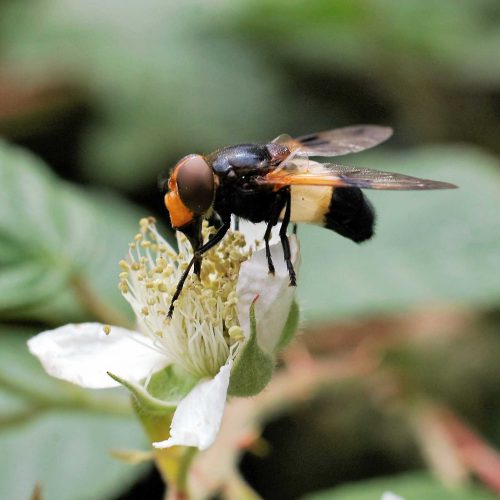
Since living here I have begun to recognise the most obvious and more commonly-occurring species of hoverflies, and they don’t come much bigger or more obvious than the handsome Pellucid Fly (Volucella pellucens), aka the Great Pied Hoverfly. This is one of the largest most obvious and recognisable of our British hoverflies.

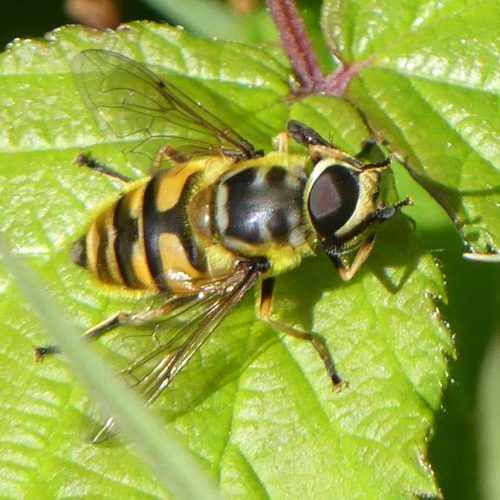
myathropa florea

Myathropa florea

Yellow-and-black stripes are the well-used livery of many hoverfly species and sorting out the different species accurately, especially the small ones, requires more skill and knowledge than I have at the moment, or at least some crystal clear images of certain parts of them.

Bigger yellow and black species are a little easier, especially if they have good clear markings, such as sported by this new-to-me, or at least newly identified  Myathropa florea (no common name). I was aided and amused in this ID by a tip from the author of my Hoverfly bible¹, who suggests that the lower marking on the thoracic dorsum (part behind the head) resembles the Batman logo. Well, in a nice fresh clearly marked individual it does!

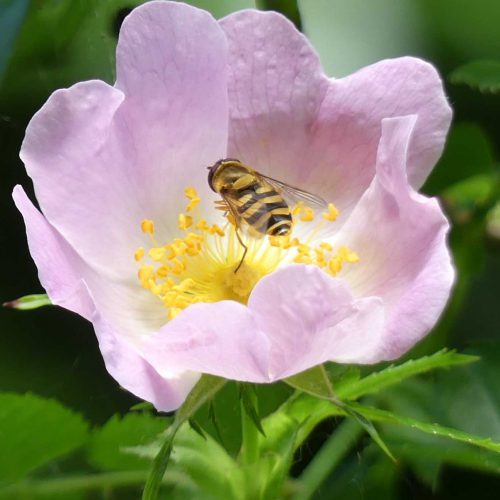
160703-Bryn Euryn-55-Hoverfly in dog rose flower

Syrphus sp hoverfly in a Dog Rose

160623-Bryn Euryn-55-Hoverfly hovering

One of the only small hoverflies that is unique and distinctive in its markings and has earned a common name is the  Marmalade Fly Episyrphus Baltaetus. This one was hovering at just about my head height, darting hither and thither in a patch of sunlight in defence of his territory. The image of him in the photograph is still bigger than he was.

Bumblebees 

There were bumblebees aplenty, mostly Red-tailed, White tailed and Common Carders, but also Tree Bumblebees and a few little Early Bumblebee workers.

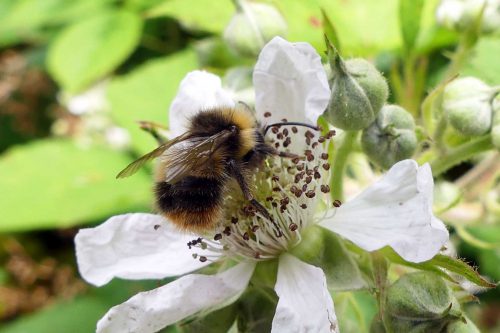
Tree bumblebee

Tree bumblebee-Bombus hypnorum

The number of Tree Bumblebees here has increased greatly over the last few years. I used to see them mainly in early Spring in the Quarry field on Green Alkanet flowers, and maybe the odd one or two further afield. Now they are present in all parts of the site and can be spotted on an array of flowers through to the end of the summer.


160623-Bryn Euryn-Early Bumblebee workers

Early Bumblebee- Bombus pratorum (worker)

Butterflies

160623-Bryn Euryn-55-Meadow Brown

Meadow Brown-Maniola jurtina

160623-Bryn Euryn-55-Speckled Wood 1

Speckled Wood-Pararge aegeria 

Large Skipper (male)

Large Skipper-Ochlodes venatus (male)

3/7/16-Bryn Euryn-Large Skipper (f)

Bryn Euryn-Large Skipper (female)

Not bramble related, but a special treat was a very brief encounter with a Grayling. On the track up to the summit it literally landed in front of me, sat on a small rock for a few seconds then took off into the breeze.

Grayling

Grayling-Hipparchia semele

The same strong breeze that carried away the Grayling was keeping the Small Heaths tucked down in the grass, but I finally managed to get an almost-clear view of one feeding on Wild Thyme.

Small Heath-Coenonympha pamphilus

Small Heath-Coenonympha pamphilus

Walking back down through the woods on the way home, a Red Admiral startled me when it flew up from a bramble at the side of the track. It settled back down when I stopped, then flew out again – the feisty thing was deliberately warning me to get out of his space! He sat brazenly on a leaf at about my eye level and reared up defiantly as I approached with the camera, not giving an inch and I’m sure trying to stare me down! Loved his attitude.

Red Admiral-Vanessa atalanta

Red Admiral-Vanessa atalanta

160623-Bryn Euryn-55-Red Admiral 5

____________________________________________________________________________________

References: ¹ Britain’s Hoverflies  – Stuart Ball and Roger Morris


Share this:

  • Share on Facebook (Opens in new window) Facebook
  • Share on Pinterest (Opens in new window) Pinterest
  • Share on X (Opens in new window) X
Like Loading...

Butterflies and more rare treats

29 Wednesday Jun 2016

Posted by theresagreen in Bryn Euryn Nature Reserve, bumblebees, Butterflies of Wales, calcareous grassland, day-flying moths, Insects, nationally scarce wildflowers, Nature of Wales, Wildflowers of Wales

≈ 15 Comments

Tags

Adscita geryon, Cistus Forester moth, common blue, common rockrose, Cryptocephalus hypochaeridis, Dingy Skipper, Jewel beetles, Nottingham Catchfly, Pyramidal Orchid, salad burnet, Silene nutans, small heath, small shiny metallic green beetle, speckled wood

June 5th

One of the most fascinating, and sometimes a little frustrating thing about observing wildlife is that no two days, even in the same location are ever the same. I know that, but I had to retrace yesterday’s steps in the hope of further sightings of a Dingy Skipper or two didn’t I?

Along the Woodland Trail, Speckled Woods seemed  even more numerous than yesterday, and a little more willing to bask with open or partially open wings.

Speckled Wood

Speckled Wood and shadow

Leaving the shelter of the trees and entering the open meadow there was a fairly strong, cool breeze blowing – not the best of conditions for photographing butterflies that tend to stay low in the grass on such days, despite today’s sunshine. That didn’t deter me from stubbornly attempting to get some images of a lovely fresh male Common Blue. It was highly mobile, but during their frantic circuiting, these butterflies frequently return to the same spot to settle for a breather and luckily this was the case with this beauty; he favoured this particular grass stem or a nearby head of clover, so I waited there and eventually caught him during moments when the breeze briefly stilled. Not as sharp an image as I’d like, but a record.

Common Blue male upperside

Common Blue male upperside

Common Blue male underside

Common Blue male underside

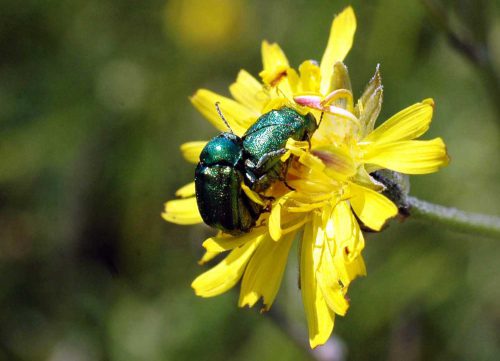
I wondered if I might see the little green jewel beetle again. Last night, looking for information about this species I read they favour yellow compositeae flowers and remembered there were a few hawkweed plants close to where I found it yesterday. Lo and behold, I found not just one there, but a mating pair. I’ve put in two images of them, one to show their real size and another enlarged one to show how beautiful they are.

160605-BE26-Green metallic beetles-mating pair

Mating pair of Cryptocephalus aureolus

160605-BE33a-Green metallic beetles-mating pair

After a few minutes of photographing the obligingly oblivious pair I noticed a female Swollen-thighed Beetle -Oedemera nobilis (females don’t have the swollen thighs of the male) that had landed on a nearby flowerhead.

160605-BE31-Green metallic beetles-mating pair

She decided to take a closer look at what the mating pair were up to. (Sorry about blurry image-swaying flower stem!)

160605-BE39-Green metallic beetles-mating pair

Mating pair of Cryptocephalus aureolus observed by a female Oedemera nobilis

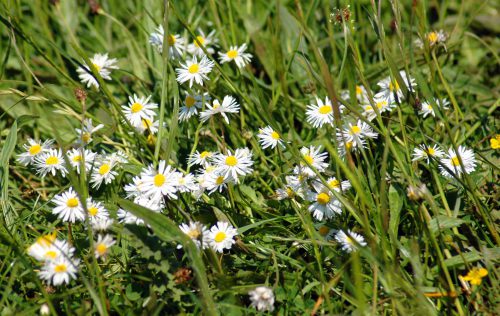
I couldn’t resist this patch of pretty Common Daisies in the long grass.

160605-BE-Daisies

A slight variation on yesterdays route took me up the track that comes out the other side of the hill. It was even breezier up there, but there were insects about taking advantage of the nectar and pollen on offer from the abundant wildflowers, mainly Rock-roses and clovers.
A Carder bumblebee in action on red and then white clover:

160605-BE42-Bee approaching clover160605-BE43-Bee on clover160605-BE44-Bee on clover160605-BE46-Bee on clover160605-BE45-Bee on clover

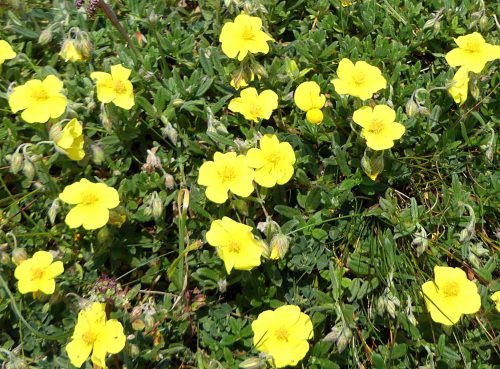
This side of the hill’s summit was looking beautiful, carpeted with sunshine yellow Rock-rose and Bird’s-foot Trefoil.

160605-BE1305-Rock-roses on summit

Summit carpeted with the sunshine yellow blooms of Rockroses and Bird’s-foot Trefoil (click on image to enlarge)

I stood still for a few minutes scanning the flowers for butterflies. Small Heaths  were most numerous, but I did spot a single Dingy Skipper. Living up to its name, it was skipping around randomly at speed, too fast and mobile for a photograph, but at least I’d seen it. I had more luck with a lovely little iridescent green Forester Moth that landed on a Salad Burnet flowerhead and stayed there.

160605-BEMTH-Forester moth on Salad Burnet 3a160605-BEMTH-Forester moth on Salad Burnet 1

There are three similar species of Forester Moth in Britain that can be difficult to tell apart, but I think this one is a Cistus Forester-Adscita geryon. According to the Butterfly Conservation info: “This species is generally smaller than the Forester or Scarce Forester and the presence of good quantities of the Cistus Forester’s foodplant, Common Rock-rose, can be a useful indication of this species.”

Now for the ‘rare treat’! Since I came  to live here, I have been looking out for a ‘Nationally Scarce’ plant that is recorded as growing here, the fascinating Nottingham Catchfly-Silene nutans. I’d only seen pictures and read about it, imagining I would find it in a rocky place on the cliffs or in bare ground. But, much to my amazement and delight, I found it today well-hidden amongst lush long grasses near the edge of a track. Getting my eye in, I saw there were several smaller clumps of the plant further back from the track edge, so clearly a good year for it. Difficult to photograph in the strong breeze, I’ve edited and sharpened my images a little so the plant is more visible than it was on the day!

160605-BE1256-Nottingham Catchfly (5)

Nottingham Catchfly amongst swaying long grasses

The plant is so-named because it was first found on the walls of Nottingham Castle. It no longer grows there as the site was destroyed during work done on the site in the 19th century. The flower remains the County Flower for Nottinghamshire though.

160605-BE1256-Nottingham Catchfly (4)

The plant is vespertine like many of the catchflies. This means that the flowers tend to stay closed in the daytime and open in the evening or at night, when they release a heavy scent into the evening air in order to attract night-flying insects and moths.
160605-BE1256-Nottingham Catchfly (3)

Flowers are drooping, in very open clusters and all usually pointing one way. Petals white above, greenish or pinkish beneath.

Each flower opens over three successive nights revealing one whorl of stamens on the first night and another on the second and the styles on the third. This is thought to prevent self fertilisation.

160605-BE1256-Nottingham Catchfly (2)

Moving on up to the summit I found my first Pyramidal Orchid of the year, still tightly in bud.

First Pyramidal Orchid

First Pyramidal Orchid-Anacamptis pyramidalis amongst Common Rock-rose

Back in the same spot as yesterday I got another brief glimpse of a Dingy Skipper nectaring on Bird’s-foot Trefoil.

160605-BEBFY-Dingy Skipper 1b

Dingy Skipper on Birds-foot Trefoil

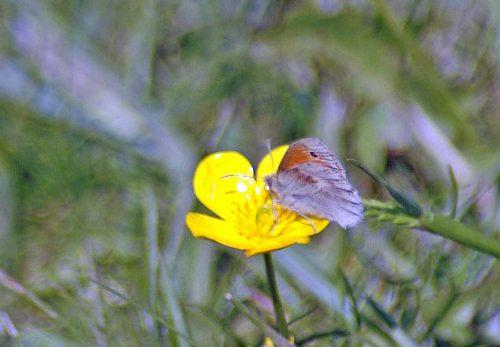
At the bottom of the ‘downland’ slope I finally caught up with a Small Heath on a buttercup.

160605-BEBFLY-Small Heath on buttercup 1a

And to finish, a female Common Blue.

160605-BEBFLY-Common Blue (f) upperside 1 160605-BEBFY-Common Blue (f) 1


Share this:

  • Share on Facebook (Opens in new window) Facebook
  • Share on Pinterest (Opens in new window) Pinterest
  • Share on X (Opens in new window) X
Like Loading...

Beautiful blooms and some rare treats (1)

26 Sunday Jun 2016

Posted by theresagreen in Beetles, Bryn Euryn Nature Reserve, Butterflies of Wales, calcareous grassland, grasses, Insects, Nature, Nature of Wales, nature photography, North Wales, Wildflowers of Wales

≈ 12 Comments

Tags

brachypodium sylvaticum, burnet rose, common rockrose, Cryptocephalus hypochaeridis, Dingy Skipper, Erynnis tages, false brome, foxglove, hoary rockrose, Jewel beetles, small shiny metallic green beetle, speckled wood

160604-BE6-View across field

160604-BE15-Foxgloves

Foxglove-Digitalis

The first week of June was full of the promise of a glorious summer to come. A  run of warm sunny days had brought forth perfect and prolific blooms and began to coax out the butterflies.

June 4th

Along the woodland trail that circuits the lower slopes of the Bryn Euryn Nature Reserve, the early summer wildflowers are peaking. Foxgloves are at their perfect best, with stems full of open blooms graduating upwards to buds. There are not many plants on this site, but they seem to be gradually increasing in number year on year.

Honeysuckle is blooming prolifically, the best I have ever seen it and it smells heavenly.

160604-BE19-Honeysuckle


The wild strawberry patch is also full of flowers, promising a bumper crop to come,although it is in danger of becoming overwhelmed by encroaching ivy and other vegetation.

160604-BE23-Wild strawberry flowers

Wild Strawberry


Birds were heard but not seen, concealed by the dense foliage of the tree canopy; Chiffchaff, Wren, and Blackbirds were all still singing between nesting duties.


160604-BE20-Blackbird

A Blackbird male paused from singing to hunt  on the woodland track

False Brome-Brachypodium sylvaticum

False Brome-Brachypodium sylvaticum


Some of the clumps of grass that grow along the woodland tracks are flowering now. This is False Brome-Brachypodium sylvaticum, a perennial grass common in woodlands where it prefers the shade of the canopy.


160604-BE3-Sunlit False Brome

Flowering False Brome

Oak leaves are already being eaten

Oak leaves are already being eaten

One of the more severe winter storms brought down three Scots Pines. Two have been sawn up and cleared away but the largest has been left where it fell and poignantly continues to live, now producing new cones.

New cones on fallen Scots Pine

New cones on fallen Scots Pine

New leaves on Yew tree

New leaves on Yew tree

Beautiful fresh Speckled Wood butterflies were out in number and busy patrolling territories or sitting on leaves, wings closed in wait for intruders or potential mates.

160604-BE22-Speckled wood on ash

Speckled Wood on Ash leaf

Up the steps and into the small open meadow the first impression was of lush greenery. The grass is growing long and closer inspection reveals it is studded with purple and white clovers, yellow Common Rock-rose and buttercups and the curiously flowered salad burnet.

160604-BE24-Adder's field

160604-BE30-Grasses

A variety of meadow grasses with Common rockrose and Salad burnet

Along the edge of the tree-line another burnet, the beautiful Burnet Rose (visible centre left of the photograph above) is also in full flower. It too smells divine and was absolutely buzzing with a variety of bumblebee species revelling in the pollen and nectar bounty on offer.

160604-BE27-Burnet rose patch

Burnet rose with Tree bumblebee

Burnet rose with Tree bumblebee

In previous years I have noted that the Burnet roses have played host to a bright orange fungus, this is Rust fungus Phragmidium rosa-pimpinellifoliae. It doesn’t appear to harm the plants, but this year the fungus is almost as prolific as the blooms themselves.

160604-BE26a-Burnet rose with fungus

Burnet roses with Rust fungus

On the small rocky outcrop at the top end of the field there are pretty clumps of Common Rock-rose-Helianthemum nummularium.

160604-BE37-Hoary rockrose

160604-BE31-Shiny emerald beetle

Cryptocephalus aureolus

A glint of emerald green drew my attention to a tiny shiny beetle in the centre of a Rock-rose flower. This little Jewel beetle doesn’t appear to have a Common name, so is known by its Scientific name of Cryptocephalus aureolus. The generic name of the beetle and its relatives refers to the insects’ heads being hidden under the pronotum. This is a new species recording for me here on the Bryn, which is not to say they haven’t always been here, just that I hadn’t seen one till now

I saw some little butterflies from here, a couple of Common Blues and Small Heaths, but all flying low in the long grass and in no mood to settle to pose for portraits.

Onwards and upwards along the Summit Trail, taking the track that comes out at the bottom of the steep ‘downland’ slope. This is often a good place to find Common Blue and Brown Argus butterflies, but not today, although there were a good number of Small Heaths to be seen, again not settling for me.

160604-BE38a-Summit Trail woodland

Summit Trail

I progressed fairly slowly up the steep slope and near the summit was  attracted to a sheltered corner backed by trees, bordered by raspberry brambles and where the ground was covered by Common Rock-rose and Bird’s-foot Trefoil flowers. I was drawn there by the sight of a small brown butterfly, which I hoped may be a Brown Argus, but which turned out to be a female Common Blue.

160604-BE42c-Dingy skipper on bramble

Then I noticed a slightly larger brown flutterer that I thought at first was a moth. A closer view changed my mind, this was a butterfly and although it was rather faded and a bit tattered round the wing-edges, was the right size and shape for a Skipper. Old records for the site indicate the presence of the Dingy Skipper-Erynnis tages, whose common name may not inspire much excitement, but this is a fairly uncommon butterfly in the UK, with recorded sightings at sites in North Wales not exceeding low single figures. I hope now my ID is right – if anyone knows better, please let me know!

Dingy Skipper

Dingy Skipper from a distance

I’m sure I’m not alone here, but I get nervous when I’m confronted by a new-to-me species of anything; especially when I’m aware this may be my one and only chance to record a sighting. So, I find I hold my breath, begin to panic slightly that I won’t get a photograph that will help me confirm its identity back at home and pray no-one will pass close by and disturb my target. My ‘technique’ thereafter is quite basic – to start from a distance and gradually move in closer, capturing as many images as I can before my subject takes off!

160604-BE44-Dingy skipper

Dingy Skipper-Erynnis tages

This particular butterfly was not making things easy and was restlessly flitting about amongst the flowers, staying low to the ground and frequently hidden amongst the plants. I felt quite dizzy staying focussed and following it around, probably down to lack of oxygen intake from the not-breathing. As ever, I would have liked more opportunities for photographs, but did manage to get a couple of fairly clear images that at least have given me my sighting record.

160604-BE45b-Dingy skipper underside

Dingy Skipper underside

After a few moments the butterfly took off away down the hill and I lost track of it. The camera battery also chose that moment to expire and as this had been a spur of the moment, travel light walk, I had no spare with me!

I have written detailed posts about many of the subjects mentioned in this one, so rather than repeat myself, I have added links to click onto if you would like to see more about any of them. For more about the Dingy Skipper, go to http://butterfly-conservation.org/679-1101/dingy-skipper.html


Share this:

  • Share on Facebook (Opens in new window) Facebook
  • Share on Pinterest (Opens in new window) Pinterest
  • Share on X (Opens in new window) X
Like Loading...

Last of the butterfly days

21 Wednesday Oct 2015

Posted by theresagreen in Bryn Pydew, butterflies, Butterflies of Wales, Insects, Nature, nature photography

≈ 2 Comments

Tags

butterflies on sea cliffs, common blue, lassiomata megera, Red Admiral, silver y moth, speckled wood, Wall, Wall butterfly

October generally sees the last of the butterflies on the wing, but it would seem that records of species emerging earlier and flying later are increasing, which may or may not be attributable to global warming. I was surprised to learn that as many as thirteen species have been recorded as being out and about throughout the UK in this month of the year: it is rated as a ‘low-flight period’ for them, whose duration must surely be dependent on the local weather conditions and available food supplies.

The species on the list of those that may be seen this month are Brimstone, Large White, Small White, Small Tortoishell, Red Admiral, Peacock, Painted Lady, Comma, Wall, Speckled Wood, Small Heath, Small Copper and Brown Hairstreak. 

My own list of butterfly species photographed here in North Wales in October is significantly shorter, to date comprising only two mentioned on the above list; the hardy Speckled Wood and the Red Admiral. I have yet to see a Brimstone, let alone a Brown Hairstreak in any month here, and the latest I’ve recorded Small Copper and Small Heath has been during early-mid September. I may well have seen glimpses of some of the others but not on a regular basis.

2/10/15-Speckled Wood on oak leaves

2/10/15-Speckled Wood on oak leaves

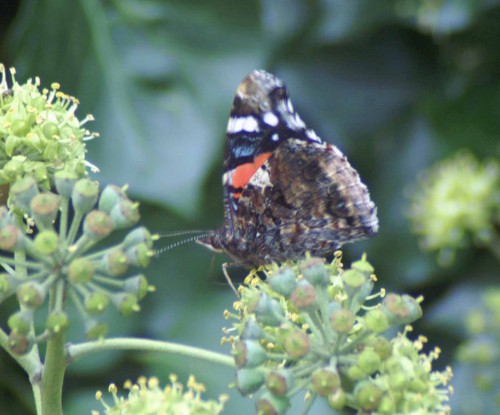
13/10/11-Red Admiral on ivy flowers

13/10/11-Red Admiral on ivy flowers

18/10/14-Red Admiral basking on a muddy woodland ride

18/10/14-Red Admiral basking on a muddy woodland ride

8/10/15-Common Blue-Bryn Pydew

8/10/15-Common Blue-Bryn Pydew

Probably due to this year’s glorious mild and sunny autumn, I do have one to add this year and that is a Blue. At Bryn Pydew there were several, probably Common Blues but as they were all in varying degrees of faded, it was difficult to say for sure. They were not really actively flying around, but rather keeping low in the grass either perched or flitting short distances amongst the low-growing plants then perching again.

8/10/15-Common Blue-Bryn Pydew

There was a more mobile Silver Y moth there too, who ended up landing on a bunch of ash keys dangling high above my head.

Silver Y moth on Ash keys

8/10/15-Silver Y moth on Ash keys-Bryn Pydew

Now, before our beautiful butterflies fade from our summer memories completely, I wanted to bring special attention to one of those that is on the list of 13 that I encountered on the Little Orme in September of this year; a Wall, or Wall Brown.

This was my first and, to date, only sighting of a Wall, Lasiommata megera, in North Wales and seeing it was an unexpected treat for me, particularly as I later learned that this species is far less common that it used to be. Quoted from the UK Butterflies website: “There has been a severe and worrying decline of inland populations of the species, with most remaining populations now being found in coastal areas. This species is therefore a priority for conservation efforts.” It doesn’t appear to be numerous on the coast either, at least not here.

150916-Little Orme 6a-Wall Brown on eyebright (2)

150916-Little Orme-Wall Brown- Lasiommata megera on eyebright

The day of my sighting I was walking on a path on the edge of the clifftop of the Little Orme. The day was beautifully sunny but with a strong cold wind blowing in off the Irish Sea, which may well have brought the butterfly here. It was in an almost-perfect condition and flying low to take nectar from various tiny eyebright and cranesbill flowers.

150916-Little Orme-Wall Brown 2

It stayed around for just long enough to allow me to get some images of it in various poses (the butterfly and me as it was so low on the ground) before it took off, probably in search of a more substantial meal.

150916-Little Orme 11a-Wall Brown on cranesbill

(More info on this butterfly:  https://theresagreen.me/about-the-blog/species-lists/butterflies-of-wales/ )

PS – I’d love to hear if you have more October species to add from other parts of the country.

Share this:

  • Share on Facebook (Opens in new window) Facebook
  • Share on Pinterest (Opens in new window) Pinterest
  • Share on X (Opens in new window) X
Like Loading...

Late Summer Specials

17 Monday Aug 2015

Posted by theresagreen in British hoverflies, Bryn Euryn Nature Reserve, butterflies, Butterflies of Wales, calcareous grassland, day-flying moths, Nature of Wales, nature photography, plants important to wilflife, Rhos-on-Sea, Wildflowers of Wales

≈ 2 Comments

Tags

ash keys, bee mimic hoverfly, cheilosa illustrata, common ragwort, ferdinandea cuprea, green-veined white, hawthorn berries, mating gatekeeper butterflies, Nature in August, purple hairstreak

August so far has brought mixed weather, days have been mostly warm, but many have been cloudy or overcast and occasionally there’s been some sunshine.

Looking across to Conwy Estuary

Looking across to Conwy Estuary from Bryn Euryn

It’s only been a week or two since my last visit to Bryn Euryn, but now rapidly approaching late summer, much has already changed. Many plants are setting seed, there are ripe wild raspberries, a few ripe blackberries and sloes, still as hard as bullets.

Purple sloes are swelling on Blackthorn

Purple sloes are swelling on Blackthorn

Last year there were sparse crops of acorns and sloes, this year may be more bountiful.

3/8/15-Wood avens seedhead

3/8/15-Wood avens seedhead

Large fruit capsules of the Stinking Iris

Large fruit capsules of the Stinking Iris

On a last hogweed flowerhead, a new-to-me, furry little hoverfly; it  is one of a number of species referred to as a bee mimic, but it  doesn’t really look like one.

Hoverfly-cheilosa illustrata- a bee mimic

Hoverfly-cheilosa illustrata- a bee mimic

Another hoverfly caught my eye, it was basking on a bramble leaf and as the sun caught it, the insect shone a bright metallic golden bronze colour.

Hoverfly-ferdinandea cuprea

Hoverfly-ferdinandea cuprea

About to enter the meadow, I caught sight of a Speckled wood butterfly basking on an Oak leaf. I moved in to take a photograph as I haven’t had many good opportunities with this species so far this year, then caught sight of another butterfly sitting on a leaf slightly higher up.

7/8/15 - Purple Hairstreak

7/8/15 – Purple Hairstreak

I moved in a little closer and realised this was a butterfly I had never seen before other than in pictures, a Purple Hairstreak. A species that spends most of its time in and around the tops of Oak trees, I was surprised and delighted to see it and tried not  to alarm it as I focussed the camera. It moved a little to reveal two small orange eyespots on its hindwing, but just as I had it back in focus the Speckled wood flew up and chased it away. I waited a while to see if it would return, but no luck. At least I know to look out for them here again!

The colours of the landscape are changing subtly. Hay has been cut and in many places baled and put safely under cover. Meadows of seeding long grass left standing have taken on a golden hue and on our limestone hill, the wildflowers typical of late summer are at the peak of their flowering. Most are ‘tough’ plants, Knapweed, Hemp agrimony & Ragwort, which are all imortant nectar sources for insects.

Late summer long grass and wildflowers

Late summer long grass and wildflowers, mostly hedge parsley and harebells

7/8/15-Knapweed with a view

It’s been a while since I had a good opportunity to photograph a Green-veined White, so I was pleased to see this fresh one on a Knapweed flowerhead.

3/8/15-Bryn Euryn

3/8/15-Bryn Euryn

Knapweed and Hemp Agrmony

Knapweed and Hemp Agrmony

Burnet moth on knapweed

Burnet moth on knapweed- wings faded and almost transparent

Also clinging to a knapweed plant was a pair of mating Gatekeepers; a perfect opportunity to see the difference between the male and female of the species, as helpfully, the female opened her wings to show the plainer upperside to her wings.

Mating Gatekeeper butterflies - female above male

Mating Gatekeeper butterflies – female above male

A good opportnity to show the upperside of the female

A good opportunity to show the upperside of the female

As anticipated by the abundance of flowers back in the spring, Ash trees are bearing thick bunches of ‘keys’.

Ash trees have heavy bunches of 'keys'

Ash trees have heavy bunches of ‘keys’

Acorns forming on Pedunculate Oak

Acorns forming on Pedunculate Oak

Haws are ripening and leaves beginning to take on colour

Haws are ripening and leaves beginning to take on colour

Walking close to gorse bushes the air is filled with the gentle sound of pods crackling as they open to release seeds.

Gorse pods crackle as they open to release seeds

Gorse pods crackle as they open to release seeds

Higher up on the steep slope near to the summit there is a stand of Ragwort growing with thistles.

Ragwort and thistles

Ragwort and thistles

And further round more Ragwort, this time interspersed with tall spikes of velvety Mullein.

Ragwort and Mullein

Ragwort and Mullein

The seedpods of Bird's-foot Trefoil are from where it takes it name

The seedpods of Bird’s-foot Trefoil are from where it takes it name

And a final shot of a Speckled Wood next to hypericum berries sums up the season, I think.

Speckled Wood & hypericum berries

Speckled Wood & hypericum berries

Share this:

  • Share on Facebook (Opens in new window) Facebook
  • Share on Pinterest (Opens in new window) Pinterest
  • Share on X (Opens in new window) X
Like Loading...

Butterfly meadow

02 Sunday Aug 2015

Posted by theresagreen in Bryn Euryn Nature Reserve, butterflies, Butterflies of Wales, Nature, Nature of Wales, nature of woodlands, nature photography, Wildflowers of Wales, woodland wildflowers

≈ 5 Comments

Tags

aphantopus hyperantus, argynnis aglaja, dark green fritillary, Gatekeeper, maniola jurtina, Meadow Brown, pyronia tythonus, Ringlet, small skipper, thymelicus sylvestris

In the meadow the grass is long and beginning to turn golden brown as it sets seed.

The meadow grass is long , brightened by patches of yellow Lady's Bedstraw

The meadow grass is long , brightened by patches of yellow Lady’s Bedstraw

Bright golden yellow patches of Lady’s Bedstraw, scented like new mown hay catch my eye.

Lady's Bedstraw-Galium verum

Lady’s Bedstraw-Galium verum

At this end of the field there are more brambles and I spot several dark brown butterflies flying low down along the length of them. It was a while before any settled for long enough to see properly what they were. As I hoped, some were dark, chocolatey brown Ringlets.

Ringlet butterfly on bramble leaf

Ringlet butterfly on bramble leaf – wings of butterflies that frequent brambles often get torn on prickles

One Ringlet male was clearly patrolling a territory. The brambles fill a corner of the field; he was flying to one ‘end’ of the patch, turning around, flying to the other end, then where the bramble curves around the corner he cut across to the other side of the track, flitted a short way through the long grass then back across the track to the brambles. Occasionally he paused for rest or to skirmish with intruders.

An undamaged Ringlet

As well as Ringlets there were Meadow Browns, some of which were also coloured dark brown, hence my initial hesitation identifying the Ringlets. It’s quite unusual to see Meadow Browns resting with their wings fully open and it is interesting to see how variable this species is in size and colouring.

A dark coloured Meadow Brown

The male  Meadow Brown is darker brown than the female and may not have orange patches

A lighter shaded Meadow Brown

A lighter shaded female Meadow Brown

Medow Brown underside

Meadow Brown (male) underside showing orange underwing and eyespots

More usual view of a Meadow Brown underside

Meadow Brown underside-female

I was pleased to see a lovely fresh Gatekeeper here too, my first one for this year. This one was a male;  he has dark scent scale patches in the centre of the forewings which females don’t have.

Gatekeeper

Gatekeeper-Pyronia tithonus

In the opposite corner of the field there are more brambles; there were more Meadow Browns here and little golden brown Skippers that happily are abundant here and that also occur in other nearby locations, particularly on the Little Orme.

Small Skipper has orange-brown tips to antennae

Small Skipper (male) has a line of  black scent scales on forewings

There were a good number of these lovely little butterflies flitting about, expertly manoeuvering at speed between the long grass stems.

Small,or possibly Essex Skipper

Small Skipper-Thymelicus sylvestris

Ringlets are not widespread throughout the site, but rather occur in colonies in a few different locations. I walked on up past the top end of the field where I have found them in previous years, again on brambles. I was pleased to see there were; maybe half a dozen individuals, mostly flying around in the long grass in front of the brambles. Finally one flew up to feed on one of the last remaining flowers.

Ringlet

Ringlet feeding on the last of the bramble flowers

I was wondering what there was for the butterflies to feed on here now the bramble flowers are over, then saw one fly up onto a nearby oak tree. A closer look revealed it appeared to be feeding on something on a leaf surface, or maybe there were a few drops of moisture there.

  Last year I didn’t see any Ringlets at all, perhaps I missed their rather short season, which is just July-August, or maybe there were only a few which I overlooked. As they are here now there must have been some to generate this year’s brood. Now I wanted to know if there were any to be found in yet another spot I found them in the year before last, which is at the bottom of the ‘downland’ slope that leads up to the summit of the hill. Happily, there were indeed some there too. So, a good year for Ringlets.

Emerging from the woodland onto the steep slope I had caught sight of a flash of orange flying over a stand of Rosebay Willow Herb, so headed off now to investigate that. It wasn’t long before I saw more orange flashes of speeding Dark Green Fritillaries, the most special butterfly treats of this reserve. This patch of the hillside and sometimes a spot on the other side of the hill are the only places I have seen them, Colonies are more plentifully populated some years than others.

Dark green Fritillary

Dark green Fritillary- Argynnis aglaja

The fritillaries were feeding mainly on thistles, for want of anthing much else. They would also feed on knapweed, but it’s not quite out yet and scabious, of which there is only a little flowering nearby.

150712TG-Bryn Euryn-bfly-Dk green fritillary 2

An older, more faded butterfly

There were perhaps 10-12 individuals, some faded, others much fresher.

150712TG-Bryn Euryn-bfly-Dk green fritillary 11

They are strong, fast flyers and glide on flat wings.

150712TG-Bryn Euryn-bfly-Dk green fritillary 13

On the hindwings there are silver spots on a dark green background

Share this:

  • Share on Facebook (Opens in new window) Facebook
  • Share on Pinterest (Opens in new window) Pinterest
  • Share on X (Opens in new window) X
Like Loading...

Summer along a Welsh Woodland Trail

30 Thursday Jul 2015

Posted by theresagreen in British hoverflies, Bryn Euryn Nature Reserve, bumblebees, butterflies, Butterflies of Wales, hoverflies, Insects, Nature, Nature of Wales, nature photography, wildflowers, Wildflowers of Wales

≈ 6 Comments

Tags

ash tree, episyrphus balteatus, eristalis pertinax, flesh-eating fly, hedge woundwort, helophilus pendulus, hypericum montanum, large pied hoverfly, marmalade fly, Pale St John's Wort, sarcophoga carnaria, Stinking Iris-Iris foetidissima, syrphus ribesii, tapered drone fly, volucella zonaria, wild strawberry fruit, woodland flowers

Variable summer weather is perhaps more the norm here in North Wales than in some other parts of the UK, although we still feel hard done to when yet another day dawns doomed to be overcast. There are many compensations though, one of which is that when the odd sunny, or partially sunny day occurs, the insects come out in force in search of sustenance. I photographed all of the following along Bryn Euryn’s Woodland Trail during a fleeting sunny spell a couple of weeks ago.
The woodland trail

The shady woodland trail

On the edge of the trail a substantial bramble was still flowering and literally buzzing with insects, mostly hoverflies and bees. There were two butterflies, a Red Admiral and a Comma that were flying around rather frantically, both of which briefly (and separately) landed on my arm. Poor things were clearly overcome by the presence of both sun and nectar. I would have liked a more conventional shot of the Comma, this being the first I’d seen here this year, but it was taunting me from high over my head so this was my best view. I rather like it and it’s clear from the outline that it is a Comma.

The Comma insisted on playing hide and seek

The Comma insisted on playing hide and seek

The hoverflies were very active, not pausing for long but these are the ones I could get to fairly easily:

Volucella pellucens-Pellucid fly is the largest fly in Great Britain

Volucella pellucens- sometimes called the Pellucid fly, this is the largest fly of Great Britain

150712TG-Bryn Euryn-hvfly-Volucella pellucens (7)

A gorgeous Volucella zonaria

A gorgeous Volucella zonaria – my first sighting here

A Tapered drone fly-eristalis pertinax grooming its legs
A Tapered drone fly – Eristalis pertinax

Eristalis nemorum (interruptus)

Eristalis nemorum (interruptus)

A more distant view of a Helophilus pendulus

A more distant view of a Helophilus pendulus

A Syrphus sp hoverfly-Syrphus ribesii - one of the most common species

A Syrphus sp hoverfly-Syrphus ribesii – one of the most commonly seen species

A tiny Marmalade fly-Episyrphus balteatus, probably our most common hoverfly

A tiny Marmalade fly-Episyrphus balteatus, probably our most common hoverfly

There were bees too, including lots of tiny red-tailed and buff-tailed worker bumblebees that were way too quick for me to focus on.
Honey bee

Honey bee

A less charming insect to many, I find the Flesh-eating fly-Sarcophaga carnaria rather attractive to look at. I think the white feet complete the look, makes it look rather dapper.

Flesh-eating fly-Sarcophoga carnaria

Flesh-eating fly-Sarcophoga carnaria

The trees are still green and fresh-looking thanks to the rain and cooler weather, although those in the top right of the next picture are looking quite lacy.

150712TG-Bryn Euryn-looking up into an ash tree

Looking up into an Ash tree

Continuing along the trail I hear a few birds letting the world know they are still about, Chiffchaff song bursts were fairly frequent, I heard Wrens and the contact calls of Blue Tits and plenty of corvid cawings. I found this feather too, maybe once belonging to a Magpie, it gleamed shades of almost peacock-blue in the dappled sunlight.

A corvid feather

A corvid feather

Honeysuckle is in flower now on the trail’s  edge and I couldn’t resist stopping to inhale its clean, fresh fragrance.

Lovely scented honeysuckle

Lovely scented honeysuckle

There is purple Hedge woundwort too, which has an earthy pungent, nettle-like scent.

Pungently scented Hedge Woundwort

Pungently scented Hedge Woundwort

Foxgloves are almost over-flowering reduced to the tips of the long bent-over  stems

Foxgloves are almost over-flowering reduced to the tips of the long bent-over stems

Wood sage-Teucrium scorodonia

Wood sage-Teucrium scorodonia

And a St John’s Wort I’d not spotted before, which I think is hypericum montanum, but happy to be corrected as always.

Pale St John's Wort-Hypericum montanum

Pale St John’s Wort-Hypericum montanum

A rather unusual plant grows here in the shady woodland, delightfully named the Stinking Iris and sometimes the ‘Roast-beef Plant’, both names allude to the sweetly acrid smell, like ‘high’ meat. This is one of just two Iris species native to the UK; the other is the Yellow Flag Iris.

The charmingly-named Stinking Iris-Iris foetidissima

The delightfully-named Stinking Iris-Iris foetidissima

Closer look at an Iris flower

Closer look at an Iris flower which is a greyish-mauve tinged with a brownish-pink

The much more common Nipplewort

The much more common Nipplewort-Lapsana communis

A Nipplewort leaf showing the path of a leaf-miner

A Nipplewort leaf showing the path of a leaf-miner

I picked a couple of ripe wild wild strawberries, trying not to think about the fly sitting on a leaf above them and their proximity to the path along which there is a regular procession of loose dogs….. They were delicious, regardless.

Sweet-tasting Wild Strawberries

Sweet-tasting Wild Strawberries

Turned off and took the steps up to Adder’s Field

Steps leading up to the meadow

Steps leading up to the meadow

more treats were in store there but there’s far too much to cram into one post, so will be continued….

Share this:

  • Share on Facebook (Opens in new window) Facebook
  • Share on Pinterest (Opens in new window) Pinterest
  • Share on X (Opens in new window) X
Like Loading...

Spring on the Bryn-part II

11 Monday May 2015

Posted by theresagreen in Bryn Euryn Nature Reserve, butterflies, Butterflies of Wales, Nature of Wales, nature of woodlands, Wildflowers of Wales

≈ 2 Comments

Tags

blackthorn, blackthorn blossom, Blue tit, dog violet, Great Tit, mistle thrush, orange tip, peacock butterfly, rabbit, small tortoiseshell, speckled wood, wild strawberry, woodland flowers

Walking further up through the field the local buzzard pair circled overhead, then just a few minutes later a sparrowhawk appeared from somewhere close by and startled me as it flew just a few feet over my head, then continued towards the direction from which I had come.

Gorse fully in flower

Gorse fully in flower

A bit further on I stopped for a while and sat on one of my favourite rocks savouring the warm sun and the peace and quiet; that rarely lasts long just here as its at a sort of junction of trails so there are passing dogs, usually well ahead of their owners that invariably come over to see what I’m up to. I watched two peacock butterflies vying for the best spot on a sun-warmed rock. The winner opened its slightly faded, but still beautiful wings and basked for a few short minutes undisturbed.

Peacock butterfly

Peacock butterfly

Moving off my rock to photograph the butterflies I noticed a patch of Wild Strawberry in flower. Tucked back against the rock it is sheltered and in a sunny spot, perfect for ripening berries.

Wild Strawberry plant in flower

Wild Strawberry-Fragaria vesca in flower

Back in the woods to walk up towards the summit I disturbed a large foraging bird. It flew up to a tree branch where it blended well into the dappled shade. It had to be a Mistle Thrush but I wasn’t entirely sure until it flew back down to the ground giving a better view.

A Mistle Thrush blending into the dappled shade of the wood

A Mistle Thrush blending into the dappled shade of the wood

Unmistakably a Mistle Thrush

Unmistakably a Mistle Thrush

At the top of the track there was a single Speckled Wood butterfly, a lovely ‘fresh’ one. It was intent on finding somewhere to bask in the sun and flitting and zig-zagging about low over the track. You have to keep an eye on them because once they settle they can be difficult to spot. I had to make do with this view as it still wasn’t happy and shot off quickly.

Speckled Wood butterfly

Speckled Wood butterfly

Back out in the open and continuing upwards I almost stepped on a Small Tortoiseshell butterfly also sunning itself on the bare earth of the track.

Small tortoiseshell- Aglais urticae

Small tortoiseshell- Aglais urticae

A little clump of Dog Violets growing in the grass at the side of the track caught my eye; the bee-fly zoomed in just as I pressed the shutter and was gone again before I could refocus on it.

Common Dog Violet- Viola riviniana

Common Dog Violet- Viola riviniana

Blackthorn, of which there is a generous amount up here, has been flowering for a short while now but is at its beautiful peak now. Last year was a sparse one in respect of the amount of sloes on the shrubs here, but if the masses of blossom on them now are anything to go by, this could be a bumper year.

Blackthorn with a view

Blackthorn with a view

The flowers of blackthorn appear before the leaves and these are just beginning to break from their buds.

Blackthorn-Prunus spinosa

Blackthorn-Prunus spinosa

Blackthorn blossom against a clear blue sky

Blackthorn blossom against a clear blue sky

Another male Orange Tip butterfly was racing along the boundary of the blackthorn scrub. He didn’t stop, but as my first sighting of this species this year was a few days earlier of one nectaring on blackthorn, I’m using one of the photographs I took then.

Orange Tip- Anthocharis cardamines

Orange Tip- Anthocharis cardamines

Following the path around to go up to the summit I noticed two Small Tortoiseshell butterflies on the ground. I thought at first they were mating, or about to do so and they did change their positions a few times, but nothing happened during the time I watched them. One was more fresh-looking than the other, but they were both perfectly intact and gorgeous.

150424TG-BE336-Two tortoiseshells150424TG-BE337-Two tortoiseshells150424TG-BE335-Two tortoiseshells

The grass up around the summit of the hill is kept short, constantly cropped by grazing rabbits. I think it’s highly likely that this particular part of the hill covers a maze of warrens and tunnels. You don’t often get to see them , especially during the daytime, but there are baby ones around now and not yet wise they can be seen out in the open.

Young bunnies

Young bunnies

Ground Ivy-Glechoma hederacea

Ground Ivy-Glechoma hederacea

I cut back into the woods here from the track the bunnies were on, hearing a chiffchaff a short way in. I spotted Great Tits foraging in the trees close to the track that flew over to the scrubby wild clematis-covered scrub on the other side.

Great Tit

Great Tit

Where I stopped to take the picture there were a large number of smallish hoverflies darting about, resting briefly on leaves or many on the ground, all shiny and fresh looking as the ones I saw lower down earlier in the afternoon.

There were Blue Tits out foraging too and I think its likely that a pair have a nest site quite high in a tree with ivy growing up through it.

Foraging Blue Tits

Foraging Blue Tits

At the bottom of the track I stopped for a few minutes to listen to a Mistle Thrush singing. This was a déjà vu moment as I recall doing this exact same thing last year, more or less in the exact same spot, scanning the trees for the singer. I found him then, but couldn’t spot him today, so here’s last year’s picture to be going on with. What a lovely bird and how lovely to see him again. (More about the Mistle Thrush here)

A well-marked, singing mistle thrush

A well-marked, singing Mistle Thrush


Share this:

  • Share on Facebook (Opens in new window) Facebook
  • Share on Pinterest (Opens in new window) Pinterest
  • Share on X (Opens in new window) X
Like Loading...
← Older posts
Newer posts →
Follow everyday nature trails on WordPress.com

Enter your email address to follow this blog and receive notifications of new posts by email.

‘But it is the common species that keep the living world ticking over and provide most of our experiences of wildlife, and I would argue that maintaining the abundance of these is as important a conservation priority as maintaining the existence of rarities’. Richard Mabey

MOST RECENT POSTS

  • A Glimpse of Spring to Come January 22, 2025
  • Hunting the Wren December 28, 2024
  • Oh, Christmas Tree December 18, 2024
  • In and Out of the Ivy February 15, 2024
  • Nature’s Fireworks November 30, 2023
  • Wild Autumn along the Coast Path November 3, 2023

OLDER POSTS

LOOKING FOR SOMETHING IN PARTICULAR?

  • Sights and Sounds from the Little Orme 1
    Sights and Sounds from the Little Orme 1
  • Things Bright and Beautiful
    Things Bright and Beautiful
  • Catchers, a Duck and Divers
    Catchers, a Duck and Divers
  • Following a river to a Fairy Glen
    Following a river to a Fairy Glen
  • Fine Dining for Crows
    Fine Dining for Crows
  • A Windy Wildflower Trail
    A Windy Wildflower Trail
  • A Window on the Woods-Winter 1
    A Window on the Woods-Winter 1
  • Butterflies and more rare treats
    Butterflies and more rare treats
  • Shades, Sounds and Scents of the Woods
    Shades, Sounds and Scents of the Woods
  • Bird study: Blackcap
    Bird study: Blackcap

nightingale trails

The Walk of the Monarch Butterfly-Sendero de la Mariposa Monarca

The Walk of the Monarch Butterfly-Sendero de la Mariposa Monarca

MY WILDFLOWER BLOG: where the wildflowers are

Snowdrop

Snowdrop

most recent posts

Follow everyday nature trails on WordPress.com

Social

  • View teresamaygreen’s profile on Twitter

Enter your email address to follow this blog and receive notifications of new posts by email.

Website Built with WordPress.com.

  • Subscribe Subscribed
    • everyday nature trails
    • Join 359 other subscribers
    • Already have a WordPress.com account? Log in now.
    • everyday nature trails
    • Subscribe Subscribed
    • Sign up
    • Log in
    • Report this content
    • View site in Reader
    • Manage subscriptions
    • Collapse this bar
 

Loading Comments...
 

    %d