• Home
  • about
  • about the photographs
  • Local Nature Reserves
    • Bryn Euryn Local Nature Reserve
    • Mynydd Marian
  • Wales Coast Path
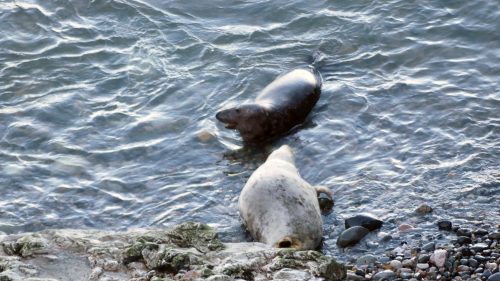
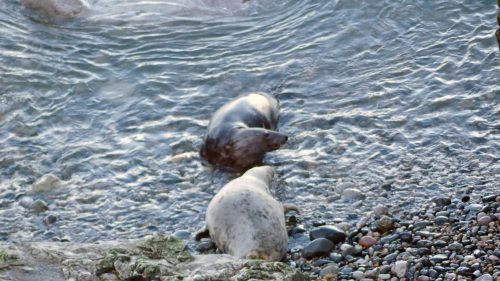
    • Grey Seals in North Wales
    • St.Trillo’s Chapel
    • Wildflowers of North Wales Coastal Paths, Cliffs and Dunes

everyday nature trails

everyday nature trails

Category Archives: Birdwatching on North Wales coast

Keeping up with the Herring Gulls

10 Friday Feb 2017

Posted by theresagreen in bird behaviour, Birdwatching on North Wales coast, Nature of Wales, Rhos-on-Sea

≈ 9 Comments

Tags

birds of conservation concern, European Herring Gull, Gwylan y Penwaig, herring gull, herring gull breeding behaviour, herring gull foot-paddling, herring gulls nesting on roofs, larus argentatus

January 9th – Chimney Pots, Rhos-on-Sea

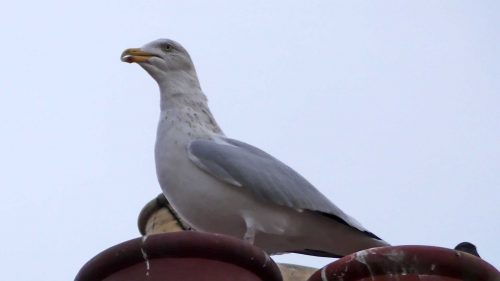
After a few months of being relatively quiet and peaceful, our Herring gull neighbours are back and making their presence heard and seen throughout the village. Pairs stake out their territories early in the year and will defend them vigorously and vociferously from now until nesting begins, continuing to do so until this year’s offspring have grown and are mature enough to leave the site. It all looks and sounds like a lot of effort and hard work, but that is the price this pair are prepared to pay for a prime high-rise site.

170109-rosrc05-herring-gull-pair-defending-nest-site

These particular chimney pots are atop my daughter’s 3 storey house, offering well-elevated accommodation and boasting unrivalled 360° views extending over rooftops and the surrounding landscape, which includes the sea. It is a mere two-minute, maybe less, flight to the seashore. Both the male and female of the pair take responsibility for defending the site, sometimes together and sometimes on their own. They must need to take frequent breaks to restore their energy levels after a bout of meaningful squawking at the sky.

10: 29 – Female flies to roof edge, has a quick look around then takes off,

170109-rosrc03-herring-gull-on-roof-edge

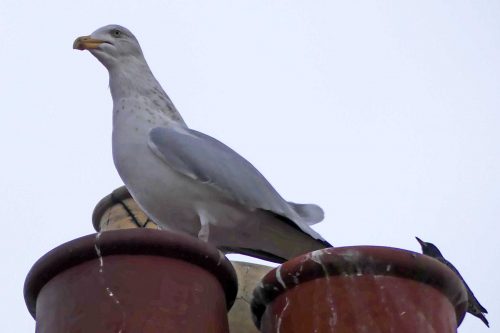
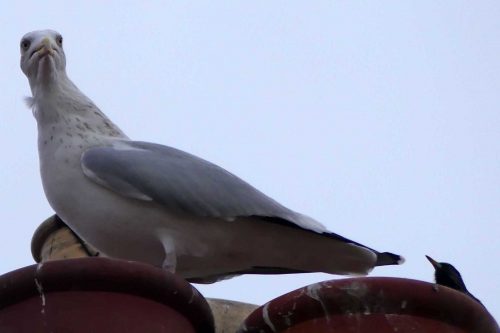
leaving the male in charge. I didn’t notice while I was taking these photographs, but he was not left entirely alone. To my amusement, a male Starling had his back. He has located his family home in the eaves of the adjoining property.

170109-rosrc09-herring-gull-male-starling

He seemed to have his work cut out, although from where I was standing in the garden I couldn’t see what or who he was directing his attention towards.

170109-rosrc06a-herring-gull-male

I couldn’t quite catch him in full squawk this morning, but he was making plenty of noise. He is still sporting his winter plumage and appears to be in pretty good shape, but he’s not a young bird. When I looked at my images I recognised him by his eyes, or rather by the lack of feathers around his eyes as the male of a pair I spent a lot of time watching back in the spring and summer of 2012.

170109-rosrc06c-herring-gull-male

As you can tell from the next couple of images he is looking a bit scrawny around the neck area, not as plump and well-filled out as he was back in the day.

170109-rosrc07-herring-gull-male-starling

Herring gulls breed for the first time at age 4 and a typical lifespan is 12 years. The oldest recorded Herring gull (from ringing records) was  32 years 9 months and 25 days old. This record was set in 2013. 

170109-rosrc08-herring-gull-male-starling

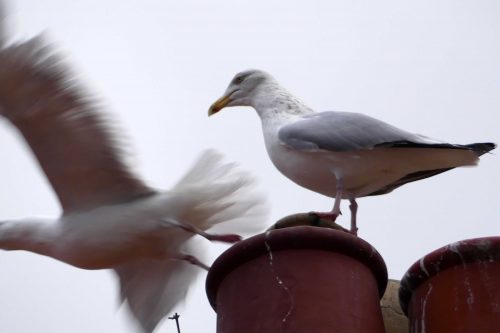
10.39am – the female arrives back with a flourish and lends her voice to the warning-off aria.

170109-rosrc12-herring-gull-pair

he may be older, but clearly still has got what it takes to attract a mate and this one appears younger. It must be something to do with the status of his domain.

170109-rosrc13-herring-gull-pair

170109-rosrc14-herring-gull-pair

10.40 – She’s a bit on edge though and leaves again a minute later, I think she was chasing off another gull from their airspace, perhaps a rival female. It started to rain quite heavily then and he left shortly afterwards too.

170109-rosrc15-herring-gull-pair

Then and now

This is a head shot of the male showing his ‘scabby’ eyes taken this January

170109-rosrc06c-herring-gull-male-scabby-eye

and below is one I took on July 24th 2012. He’s in his brighter summer/breeding plumage here, but had the ‘scabby’ eyes even then. It’s too much of a coincidence for it not to be the same bird isn’t it? He was considerably better-padded then too. If 2012 was his first year of breeding he would have been 4 plus the 5 years from then till now would make him 9, but I think he could be older.

7-1912tgnw-adult-gull-front-view

This was him and his mate in full squawk back then, after they had successfully reared a chick that had fallen out of the chimneypot nest and landed on the flat roof below. More about that here:   https://theresagreen.me/2013/06/20/theres-a-new-gull-on-the-roof

7-1912tgnw-adult-pair-one-squawking-one-sitting

He was and I’m sure, still is a brilliant and attentive parent, bringing regular and diverse meals back to his hungry youngster. Including a starfish and regurgitated chips.

7-2412tgnw-adult-gull-with-starfish-2

January 24th 2017

Back to the present. I was out taking my baby granddaughter for a walk along the prom and spotted this chap paddling for worms on the grass embankment. Old scabby eyes himself.

170124-rosprm-herring-gull-paddling-for-worms-scabby-eye-2

The Herring gull remains on the RED list of European threatened birds and it is illegal to harm them or damage or remove their eggs from nests.


Share this:

  • Share on Facebook (Opens in new window) Facebook
  • Share on Pinterest (Opens in new window) Pinterest
  • Share on X (Opens in new window) X
Like Loading...

Sights & Sounds of the Little Orme (2)

08 Wednesday Feb 2017

Posted by theresagreen in birds of Wales, Birdwatching on North Wales coast, Little Orme, Llandudno, Nature, nature photography, North Wales, North Wales Wildlife Trust, Rhiwledyn Nature Reserve, The Wales Coast Path

≈ 7 Comments

Tags

common buzzard, disease in wild rabbits, hawthorn, jackdaws on cliff, kestrel, mobbing of buzzards, Myxomatosis, rabbit, raven

January 20th – Little Orme – Upper reaches

I‘d spent longer watching the seals than I had intended, so almost talked myself out of doing some proper walking and heading up to the summit. It was cold, the sun was already sinking lower in the sky and I knew the upward tracks were going to be muddy. But one of my aims for this outing had been to check to see whether or not the cormorants had begun nesting yet, so onwards and upwards it was.

At the bottom of the steep upward slope, Rabbit Hill to locals, a bird sat perfectly still at the top of a smallish ash tree. The sun in my eyes was so bright I could only see it as a black shape, so made another assumption that as this is about the highest point on this windswept clifftop and a favoured perch for crows, magpies and jackdaws, that it was a corvid. Only when I lightened up the photograph I took did I realise it had been a Kestrel.

170120-lo-75-1533-kestrel-1a

The bracken and brambles that covered the slope to the landward side of the track have been cut back hard; this vegetation provides cover for a variety of small birds, including resident Stonechats and Whitethroats that come here for the breeding season. I’m sure it will have grown up again by the time they arrive.

170120-lo-130-bracken-scrub-cut-back

I was right about the mud! It was almost take one step forward and slide back two. I pictured my walking pole lying uselessly in the boot of my car. I should use it more often, but it gets in the way when I want to stop and take a photograph. I took a breather to turn and photograph the view; no matter the number of times I have done it, it’s just so amazing I can’t resist. The spit of land projecting finger-like into the sea is Rhos Point and despite the hefty sea defences I know it has in place, it looks so vulnerable from here, perhaps more so to me because it’s where my daughter and her family lives and I can pick their house out from here!

170120-lo-76-rhos-point-from-the-orme-1a

At the top of the slippery slope is a levelled area where much of the stone was quarried out. The cliff wall at the back of this now grassy area is Jackdaw city, with many pairs of birds nesting in its nooks and crannies. You realise how many of them there are when the Buzzards glide into the airspace above and numbers of them suddenly zoom up and surround them, determinedly driving it away while making a heck of a racket.

170120-lo-74-gulls-jackdaws-upped-1a

(click on image to enlarge)

Herring gulls often join in the mobbing party too; it may seem that they prefer roofs and chimneys to nest on, but some do prefer the more traditional option of a bit of cliff. It’s interesting that although they may rob other birds of their eggs and chicks, they’ll join forces to drive off  any potential predators of theirs. It’s not too clear from my photograph who’s who, but one Buzzard is very slightly left of centre  and the other approaching the far left, with defending birds approaching mainly from the right. Poor old Buzzards, every other bird picks on them, even much smaller Starlings!
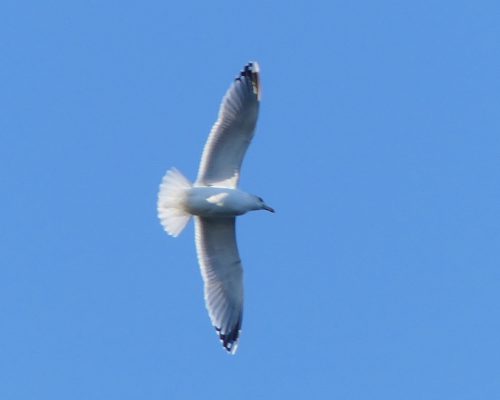
170120-lo-72-gull

The edge of the cliff is crumbly and eroding but is a favourite spot for Jackdaws to sit and look down on the lower levels of the headland. There were several pairs sitting doing just that this afternoon, probably ones with nest sites nearby on the cliffs of the lower level.
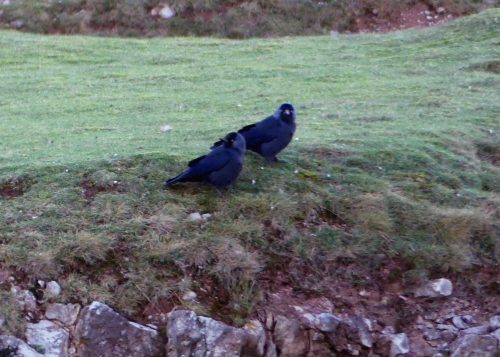
170120-lo-80-jackdaw-pair-on-cliff-edge-1a

I took a photograph looking down into Angel Bay from up here; it looked as though quite a number had moved off.

170120-lo-73-a-higher-view-into-the-bayOne of my favourite sights is golden gorse flowering against the background of a blue sea.
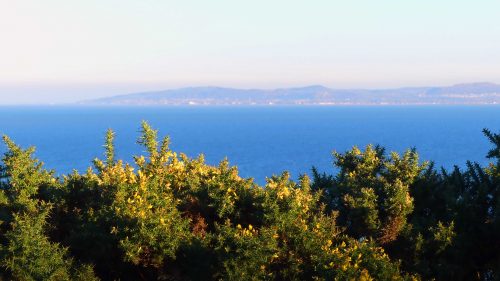
170120-lo-82-1544-gorse-view-1a

It’s always sad when a tree dies, but the skeleton of this Elder is now beautifully adorned with lichens and a fungus, which I’m sure is now past its peak. I’m not great on fungi, but I do know the one most closely associated with the Elder is Jew’s ear or jelly ear Auricularia auricular-judae; is it that Annie? I wish I’d seen it earlier.

170120-lo-83-fungus-and-lichen-on-old-elder-tree-1a

The grass up here is grazed by sheep and further nibbled by rabbits, so is always neat and well-groomed. The path curves into this small clearing that looks almost like a cleverly landscaped wild garden designed to lead you to the stunning vista.

170120-lo-87-clifftop-path-view-1a

click on image to enlarge

The nearest rounded hill is Bryn Euryn which I’ve walked you around many times and shown views from there to here, but you can see they would be a fairly short flight away from one another for Buzzards, which nest on Bryn Euryn, and Ravens which regularly overfly both.

170120-lo-92-1557-bryn-euryn-from-little-orme-1a

Some of the hawthorns here still have good crops of berries.

170120-lo-88-hawthorn-berries-and-sea-1a

And there is lots of glorious golden fragrant gorse.
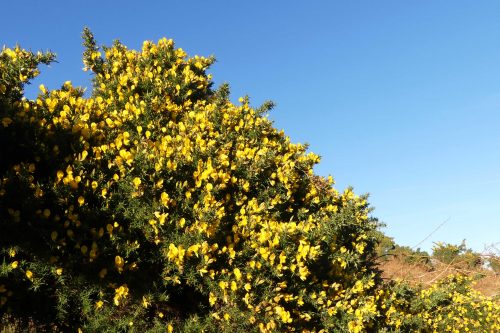
170120-lo-93-glorious-gorse-1a

Another wider view from higher up over Colwyn Bay and towards the Clwydian Range of mountains where Offa’s Dyke begins.

170120-lo-95-view-from-little-orme-over-rhos-and-surrounding-area-1a

click to enlarge

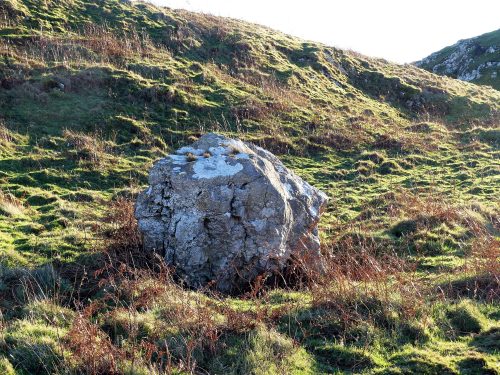
The low sun gives a wonderful texture to the rough grass and rocks. I always wonder how rocks such as this one arrived where they are, but this one I use this one to recognise the point where I leave the path and approach the cliff edge, extremely cautiously, to get a better view of the site of the cormorants’ colonial nesting site.

170120-lo-96-rock-on-cliff-path-1a

They don’t appear to be doing much yet, in fact there were just two there when I first looked, although a few more did fly in to join them as I watched.
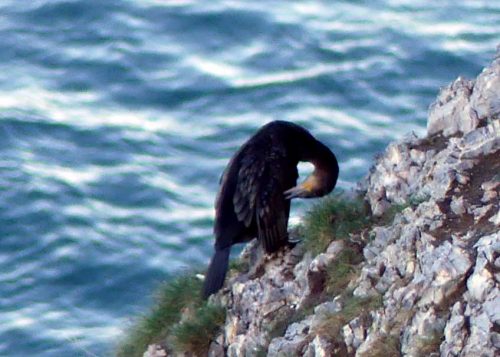
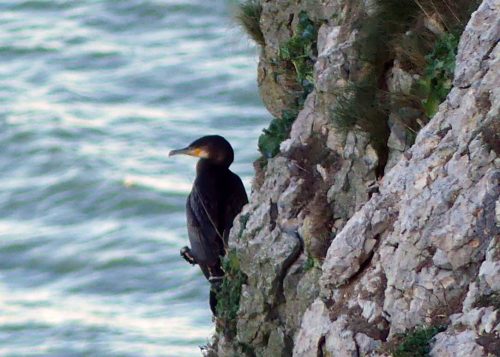
170120-lo-98-1605-cormorant-on-cliff-1a

170120-lo-100-cormorant-on-cliff-face-1a

170120-lo-107-great-orme-pier

The Great Orme – click to enlarge

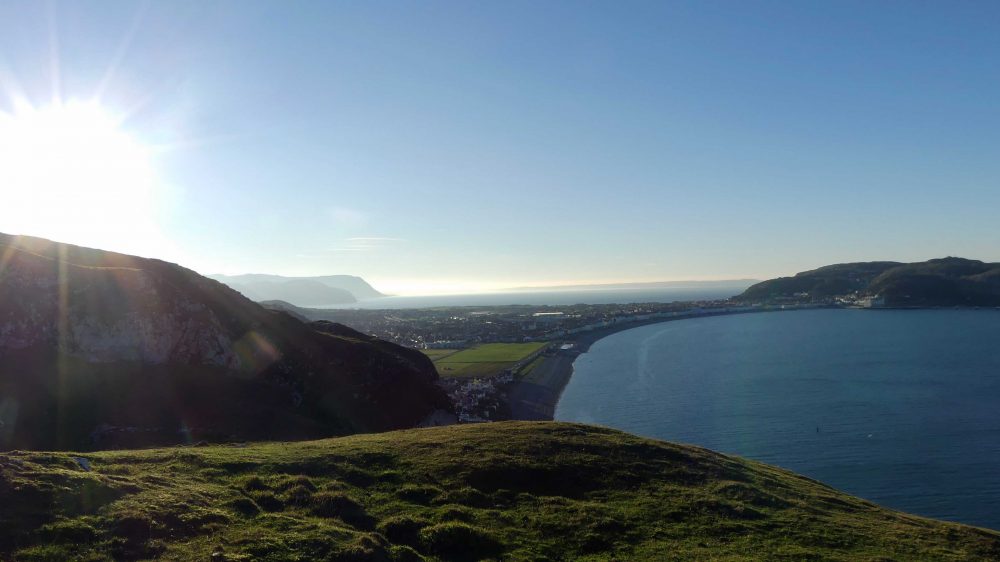
I climbed up a bit higher to admire the view across Llandudno Bay to the Great Orme. The pier looks toy-like against its great bulk.

The sun had dropped further and was almost hidden by the highest part of this headland to my left. The view from here is across Llandudno town to Anglesey and the bulky headland of Penmaenmawr. If you were looking at this as a walker of the Wales Coast Path travelling in this westerly direction, you could roughly trace your onward path and see where you would be in a day or so’s time.

170120-lo-108-great-orme-penmaenmawr

Llandudno Bay, town and beyond – click to enlarge

Low light lends a different atmosphere to this place, especially when you’re alone and have an imagination such as mine. Rocks cast shadows and a solidity not as apparent in bright sunlight. I wonder how it looked before its bulk was reduced by quarrying? Are these squared off rocks remnants from that time or were they deliberately placed before then for some other purpose.
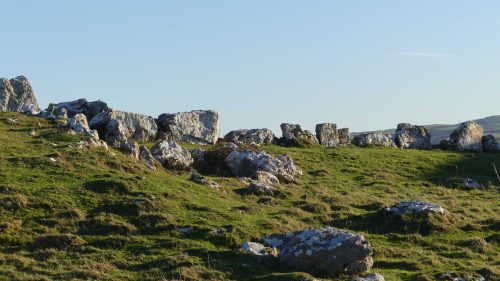
170120-lo-111-stone-blocks-near-summit

170120-lo-112-stone-blocks-at-top-of-orme

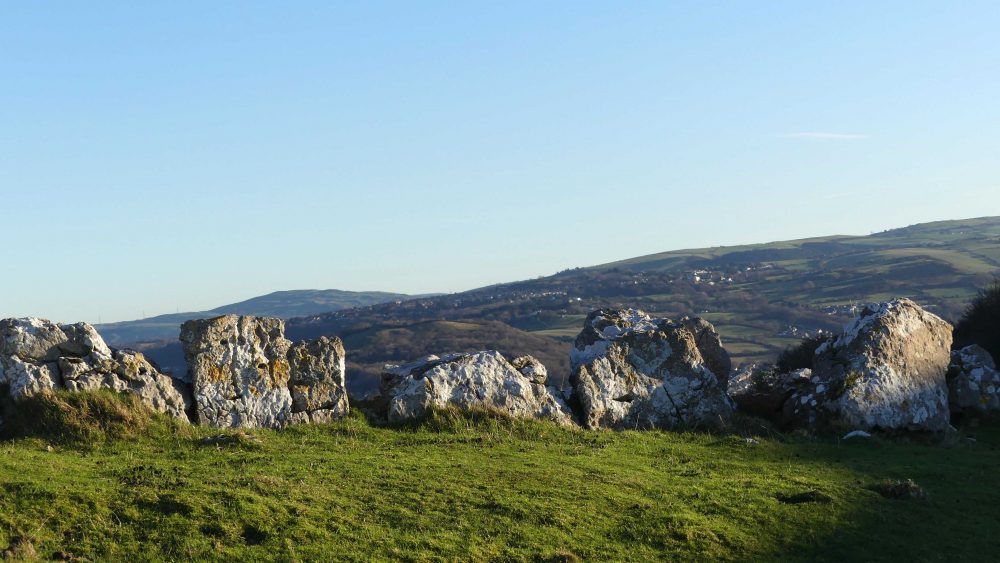
The remnants of  a dry stone wall lead the eye to the wonderful view.

170120-lo-113-stone-wall-view-from-top-of-orme-1

click to enlarge

Then  there are Hawthorn trees, contorted into wonderful shapes by the strong prevailing winds and features long associated with tales of witches and magic……

170120-lo-114-hawthorn-tree

Even in broad daylight I wonder about the spot in the image below. I can easily imagine as some kind of mystical meeting place guarded by the trees and I know that as a child I’d have found a way around the fencing and sat on the top of that little hummock letting my imagination run riot, most probably giving myself nightmares.

170120-lo-126-hawthorn-stand

I fancy other mystical markers – a  hawthorn branch heavily covered with lichen that reaches out over the track and frames the view.

170120-lo-127-lichen-covered-hawthorn-twig

and a little tree well covered with lichens and further embellished with sheep’s wool.

170120-lo-122-hawthorn-wwith-lichens-sheeps-wool

The atmosphere is further enhanced by a pair of Ravens, companions of witches and wizards,  ‘gronking’ as they passed overhead.
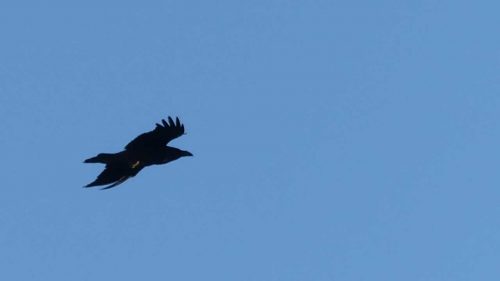
170120-lo-117-raven-flying

And a rabbit, moving strangely slowly around behind the wire fence. It didn’t bounce away from me like rabbits usually do and I wasn’t sure if it was just old or not well; its eyes looked strange and it may not have been seeing properly, if at all. It put me in mind of rabbits we used to see years ago with Mixomatosis, but is that still around? (see footnote)

170120-lo-115-poorly-bunny

A chaffinch foraging around in the gorse and blackthorn scrub led my eye to this sunlit spider’s web and distracted me from further over-imaginative thoughts!

170120-lo-119-spiders-web-on-gorse-1

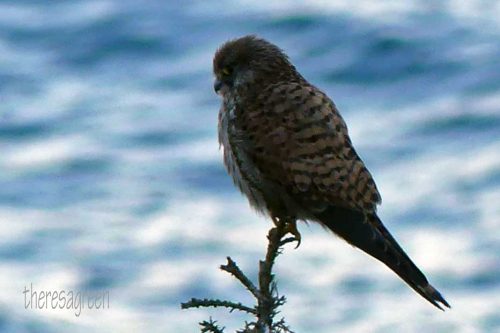
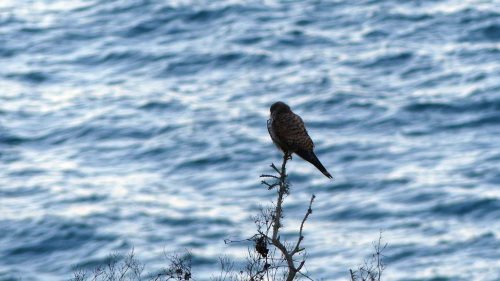
Had a bit of a slithery walk down Rabbit Hill then headed back to leave the site. I took the path closest to the cliff edge to avoid oncoming late afternoon dog-walkers and spotted this bird sitting on the top of a gorse bush seemingly looking out to sea. Once again the sun was obscuring it from proper view but there was no mistaking this was a Kestrel, a young one I think. It was very cold now but the bird was sitting perfectly still with its feathers fluffed out.
170120-lo-131-kestrel-looking-out-to-sea

I risked walking back around to get some better lighting, expecting it to fly off, but although I think it was aware of me it stayed put. I did get to a point with a better view – and the camera battery died! Time to go.

170120-lo-138-kestrel-looking-out-to-sea-2

More about Myxomatosis

When I wrote this post and mentioned the ‘poorly’ rabbit I had seen, I hadn’t realised that the horrible disease,  Myxomatosis, was still present and affecting rabbit populations in the UK. As a country-bred child back in the ’60s, I remember seeing many affected rabbits which I found distressing, and as the poor rabbits were sick they were easily caught by our cats, who didn’t kill them, but did bring them home. I also didn’t know then that it could be passed on to pet rabbits; now they must be vaccinated against the disease.

The disease called Myxomatosis reached the UK in 1953, where the first outbreak to be officially confirmed was in Bough Beech, Kent in September 1953. It was encouraged in the UK as an effective rabbit bio-control measure; this was done by placing sick rabbits in burrows, though this is now illegal. As a result, it is understood that more than 99% of rabbits in the UK were killed by the outbreak. However, by 2005 – fifty years later – a survey of 16,000 ha (40,000 acres) reported that the rabbit populations had increased three-fold every two years, likely as a result of increasing genetic resistance, or acquired immunity to the Myxomatosis virus. Despite this, it still appears regularly at rabbit warrens.

If you’ve never seen an affected rabbit, I can’t stress how awful it is. Initially the disease may be is visible as lumps (myxomata) and puffiness around the head and genitals, which progresses to acute conjunctivitis and possibly blindness; this also may be the first visible symptom of the disease. The rabbits become listless, lose appetite, and develop a fever. Secondary bacterial infections occur in most cases, which cause pneumonia and purulent inflammation of the lungs. In cases where the rabbit has little or no resistance, death may take place rapidly, often in as little as 48 hours; most cases result in death within 14 days. Not a good way to die.

Wild rabbits tend to recover quickly once the disease has passed; a certain density of rabbits is needed to keep the disease going and once the number of rabbits drops below that level the disease will disappear until the rabbit numbers increase again.
Share this:

  • Share on Facebook (Opens in new window) Facebook
  • Share on Pinterest (Opens in new window) Pinterest
  • Share on X (Opens in new window) X
Like Loading...

Sights and Sounds from the Little Orme 1

03 Friday Feb 2017

Posted by theresagreen in Birdwatching on North Wales coast, coastal walks, Nature, Nature of Wales, nature photography, North Wales, North Wales Wildlife Trust, Rhiwledyn Nature Reserve, The Wales Coast Path

≈ 26 Comments

Tags

blackbird, chough, Great tit singing, grey seals, grey seals from the Little Orme, grey seals in Angel Bay, grey seals mating behaviour, phalocrocorax aristotelis, raven, Robin, shag

January 20th – Little Orme, lower level

When the first sound I hear on my approach to the Little Orme is that of a Raven gronking, I take it as an omen that this is going to be a good walk! And so it was today – the old Raven perched high on the edge of the cliff, proclaiming his territorial rights, his distinctive call echoing off the surrounding rock. As yet there were no signs of Fulmars having returned to begin claiming nesting spots on the cliff below him. Notoriously noisy, they too would have been heard before being seen for sure.

170120-lo-11-great-tit-singing-2

Ears being more effective than eyes on this bright winter afternoon, I heard birdsong emanating from a small nearby tree. I didn’t recognise the song at first and with sun shining directly into my eyes, it took a couple of minutes for me to recognise that the singer was a Great tit. I edged slowly towards him, circling to try to reach a point where the sun was less blinding, expecting him to spot me and take off any second, but he was confident and intent on his purpose and chose  to ignore me. I was delighted, I don’t recall ever being this close to a singing Great tit before and was impressed by his tuneful renderings.

He was indeed handsome and as the test of a male Great tit’s virility is displayed in the strength of the black markings that run from his throat to his nether regions, this one looks like he’d be quite a catch.

170120-lo-12-blackbird-1

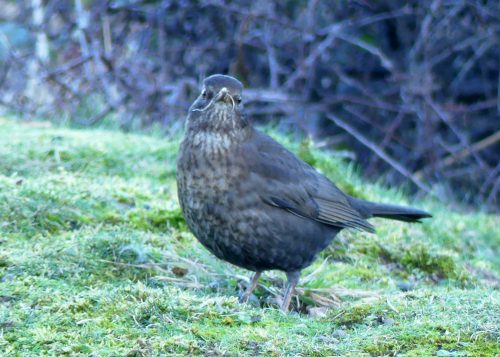
The ground here was frosted and in shaded places the grass was crunchy underfoot, but a pair of blackbirds, feathers fluffed out against the cold had found a more insulated mossy spot and were out hunting worms. I wasn’t sure if the female was deliberately collecting nesting material or if I’d disturbed her whilst probing and the grass had stuck to her bill.

170120-lo-19-blackbird-f-with-grass-in-beak-1

Close by a Robin was singing quietly, almost to itself as it perched low and spied, head cocked, for insect movements on the ground below.

170120-lo-16-robin-singing-quietly-1

170120-lo-17-robin-on-the-ground-1

Reaching the cliff edge which overlooks Penrhyn Bay, all I spied was a distant single cormorant. (Well, I assumed it was a cormorant, but a sharp-eyed friend pointed out it was actually a Shag – so really happy about that as I see far fewer of them.)

170120-lo-2-cormorant-1a

A closer look shows the Shag has a narrow bill and a steeper forehead than a Cormorant and also lacks the white cheeks patches of the latter. A lesson learned, I will look closer in the future and not make assumptions!

170120-lo-2-shag-on-rock

Sitting atop the rocky mound that forms one edge of Angel Bay were a pair of large black birds. One had his back to me, looking out to sea – Ravens, surely? As I approached they flew down almost to the base of the rock.

170120-lo-24-crow-2-shadow-1

Feathers gleaming with shades of purple and green they are magnificent birds, but you wouldn’t want to be on the receiving end of that enormous dagger-like bill.

170120-lo-26-crow-2-1

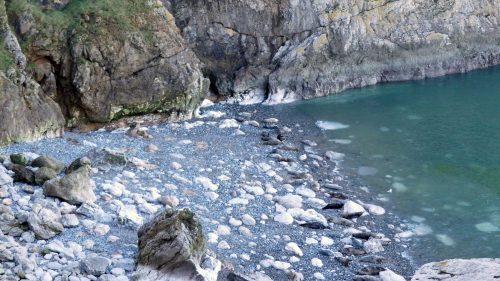
As well as local folk, people come here from miles around in the hope of a sighting of the Grey Seals that have claimed Angel Bay as their own. Today I was one of a small crowd of spectators that were given a real treat; there must have been at least 40 of them ranged along the tide-line the whole length of the little cove.

170120-lo-54-looking-down-into-cove-1a

Perfectly camouflaged to blend with the rocks and  pebbles here, it takes a few minutes to get your eye in and work out which shapes are animal and which mineral. I make a total of 20 in the image below.

170120-lo-28-1504-grey-seals-in-angel-bay-30-1a

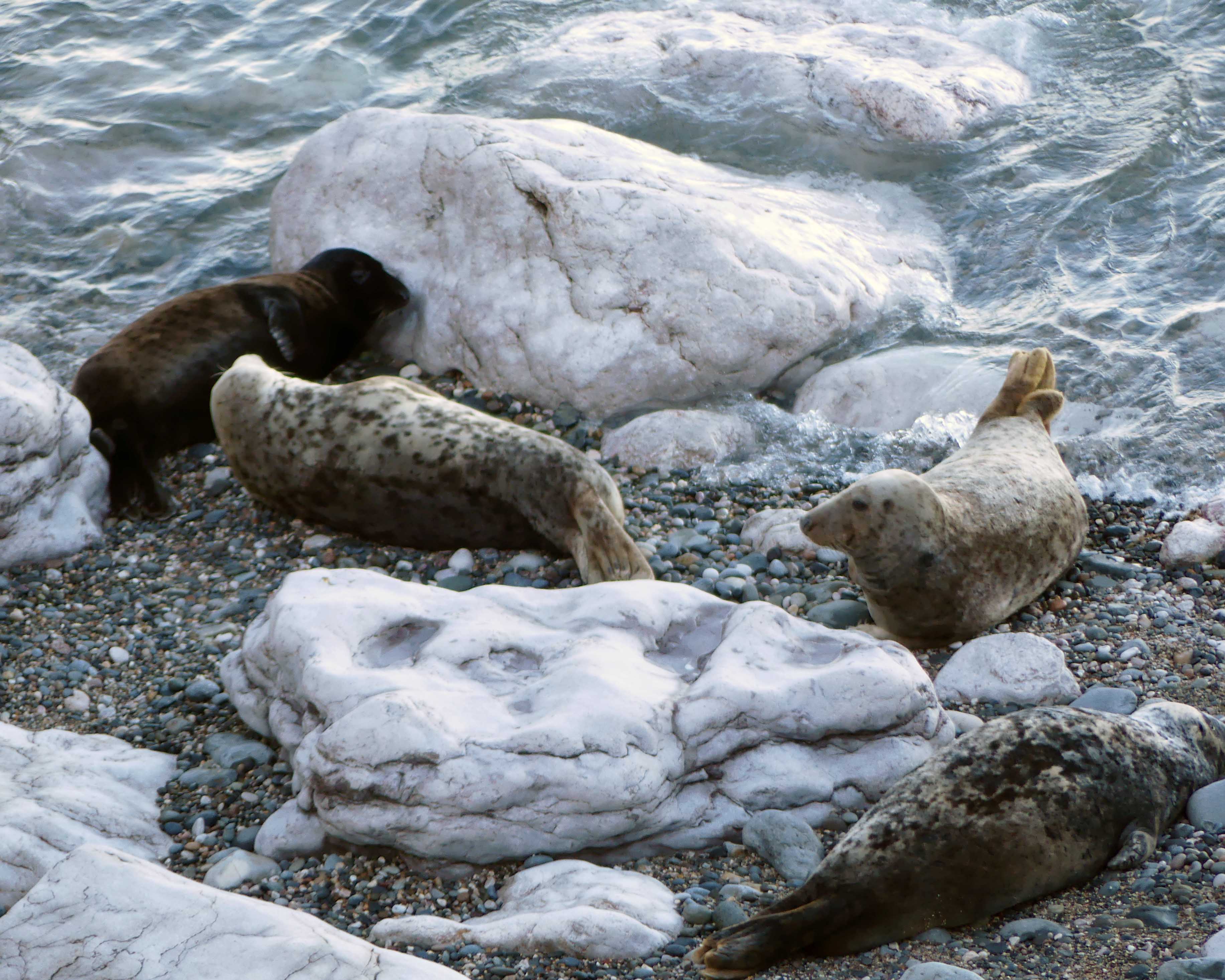
At first glance there didn’t seem to be much activity other than sleeping going on, but sounds arising and a closer look reveals that here and there things were not entirely tranquil.

170120-lo-36-some-were-vocal-and-maybe-a-little-aggressive-1

170120-lo-60-1519-small-group-with-very-dark-baby-1a

Some see rocks as a sun-warmed resting place

170120-lo-33-grey-seal-poses-1

while to others they are just obstacles to be overcome; going over the top must be easier than getting someone to move.

170120-lo-35-wriggling-over-rocks-1

These two took to the water, they could be a male and a female as one appears smaller than the other.

170120-lo-38-grey-seal-interaction-1a

They started off peacefully enough,

170120-lo-40-grey-seal-interaction-3a

but things soon started to get a bit rough

170120-lo-39-grey-seal-interaction-2a

and developed into what appeared to be a serious display of aggression or power assertion of some kind. ( I wasn’t entirely off-track here, but it has been pointed out that this was quite likely mating behaviour. I thought that mating happened sooner after the birth of the pups.)

170120-lo-47-grey-seal-interaction-8a

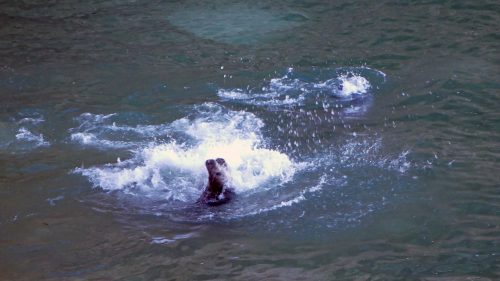
Their interaction was quickly dissipated though when several more seals lumbered from the shore, showing  a surprising turn of speed, and entered the water with much deliberate splashing.

170120-lo-46-grey-seal-interaction-7a

Then sped off with purpose, keeping their heads above the water

170120-lo-48-swimming-out-to-kayakers-1

to check out two kayakers that had paddled into the bay. The guys in the boats must have been thrilled to have had a close encounter with at least eight curious seals.

170120-lo-51-checking-out-the-kayakers-1

Back on the shore another pair having a bit of argy-bargy

170120-lo-59-more-interaction-2a

this time more vocal than physical.

170120-lo-58-more-interaction-1a

170120-lo-57-more-interaction-1a

And that is where I left them to get on with their day while I got moving to warm up, with one quick last look over the edge of the cliff from the other side of the bay.

170120-lo-61-last-look-from-higher-up-1a

On the far side of the bay I scanned the cliff for any signs that the Ravens may be re-using the nest site that has been occupied for years. There was nothing I could see, but there were plenty of pairs of Jackdaws that seem to have already claimed or reclaimed holes and ledges on the cliff wall. Jackdaws are so numerous here that a black bird of a certain size usually registers subconsciously as such, but again it was hearing different sounds called by a small group of four black birds flying up that alerted me to the presence of the far less common Chough.

170120-lo-63-1524-chough-at-cliff-base-1a

More wary than the resident Jackdaws, the presence of Chough, probably visiting from the Great Orme that forms the other side of Llandudno Bay, always takes me by surprise and that is my excuse for failing to get a decent photograph! That and the fact they soon spotted me standing out in the open pointing a long lens at them, so they took off and disappeared over the cliff edge. I have seen and photographed the pair below feeding here before, quite distinctive with all their leg bling, but the one above has none yet. Is that because it’s a young one I wonder? Please tell me if you know.

170120-lo-70-jackdaw-at-base-of-cliff

I couldn’t leave this lower level of the reserve without a nod to a Jackdaw, whose home this really is, so snatched this just before a dog followed by its owner sent him off too.


Share this:

  • Share on Facebook (Opens in new window) Facebook
  • Share on Pinterest (Opens in new window) Pinterest
  • Share on X (Opens in new window) X
Like Loading...

Waders v Weather

23 Wednesday Nov 2016

Posted by theresagreen in bird behaviour, Birdwatching on North Wales coast, Nature of Wales, nature photography, Rhos Point, The Wales Coast Path, wading birds

≈ 17 Comments

Tags

coastal birds, Curlew, great black-backed gull, Oystercatcher, redshank, Rhos Point, Turnstone, turnstone flock

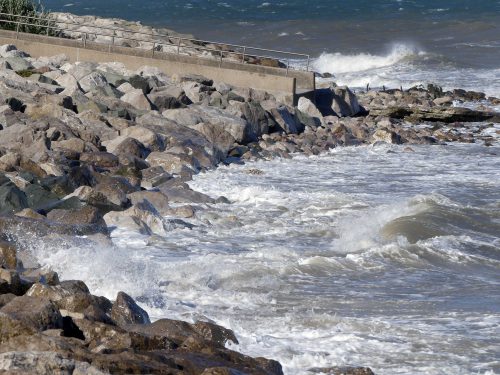
Colwyn Bay, on the Irish Sea, has big tides and at some high tides water levels can rise by 8 metres or more. On windy days big waves are driven in and as the tide reaches its highest point they crash dramatically, in places causing spray to rise and splash over the sea defences. Regardless of the weather, for the gulls and wading birds that feed here it is business as usual. For people, walking along the promenade on such days can be hard work and exhilarating, but for the birds that feed here on Rhos Point it has to be business as usual and whatever the weather or state of the tide the birds know instinctively exactly when to arrive and depart to best take advantage of fresh deliveries or deposits of food.

Interested to see how the birds responded to challenging conditions, I took these photographs on an exceptionally windy day when the incoming tide was set to be particularly high.

12:51 – Curlews begin to leave.

161005-1251-rhos-point-curlew

12:52 – Most of the oystercatchers that feed here don’t travel far, passing the time between the tide-turns gathered together on the rocks of the seabreak in Rhos Harbour, a short flight away. Some linger longer than others.

161005-1252-oystercatchers

Herring gull, Oystercatchers, Turnstones and Redshanks

161005-1253-mixed-waders-gull

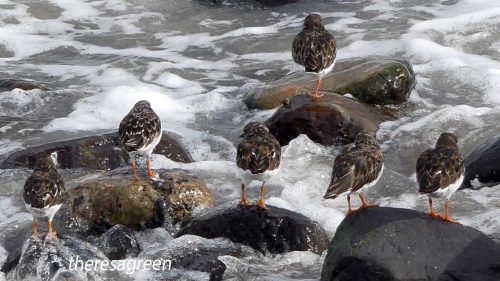
12:53 – A group of Turnstones all facing towards the incoming water

161005-1253-turnstones-on-rock-island

12:54- Big and bulky, Greater Black-backed gulls seem impervious to the rough conditions.

161005-1254-gt-blk-backed-gull

161005-1255-gt-blk-backed-gulls

12:57 – This photograph of an adult and juvenile Great Black-backed gulls cries out for a caption doesn’t it? I’m leaving it to your own imaginations though.

161005-1258-gt-blk-backed-gulls-one-having-a-poo

12:58 – Turnstones on the sea edge, most standing on stones to keep their feet out of the water.

161005-1257-turnstones

12:59- Another Curlew leaves, calling to announce its departure.

161005-1259-curlew-taking-off

12:59- Turnstones and Oystercatchers. Interesting that they are all facing towards the incoming water but weren’t actively foraging for food. I think they are all facing into the wind, which would make them more aerodynamic and streamlined so they don’t get blown over.

161005-1259-turnstones-oystercatchers

13:00 –

161005-1300-turnstones-oystercatcher-preening

13:03- Smoothing feathers ruffled by the wind back into place.

161005-1303-oystercatchers-preening-resting

13:05 – A Turnstone takes a bath, or is that a jacuzzi?

161005-1305-turnstone-bathing-1161005-1305-turnstone-bathing-2161005-1305-turnstone-bathing

Turnstone rock- hopping to higher ground

161005-1305-turnstones

13:07- The Turnstones are more-or-less gathered together now. They are difficult to count as they merge so well into the background of small rocks, but I got up to about 56 individuals and I’m sure there were others behind rocks and one another, so the actual number is probably 60 plus.

161005-1307-oystercatchers-turnstones

13:08- Some Oystercatchers are getting restless, preparing to go while others seem in no hurry

161005-1308-oystercatchers-turnstone

161005-1309-oystercatchers-turnstone

13:12

161005-1312-oystercatcher-1

13:18- As the tide encroaches some begin to leave

161005-1318-oystercatchers-taking-off

But the turnstones stay put, despite the rising water

161005-1318-turnstones-left-alone

161005-1321-turnstones

13:21- A Crow arrives and announces his presence loudly

161005-1321-crow-arrives

13:23- Another Oystercatcher is ready for the off.

161005-1323-oystercatcher-stretching-wings-turnstones

Some stay and scrutinise the water for any last-minute tidbits

161005-1323-turnstones-oystercatchers

13:25: The Turnstones seem unperturbed by the water rising up around their small rock islands

161005-1325-turnstones-1

and are the last birds standing.

161005-1325-turnstones

13:45- The water has covered the Point.

161005-1345-rhos-point-almost-high-tide

13:46

161005-1346-rhos-point-almost-high-tide

Black-headed gulls are the only birds still flying. Low to the surface they seem to positively enjoy the rough conditions.

161005-1346-rhos-point-blk-hded-gull-over-stormy-sea

13:50

161005-1350-rhos-point-blk-hded-gull-over-stormy-sea

13:53 – The bigger gulls are unphased by the rush of the incoming tide and rather than fly away simply allowed themselves to be launched onto the water and rode the waves.

161005-1353-rhos-point-great-blk-bckd-gulls

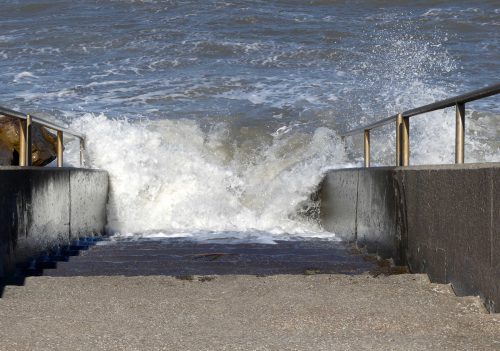
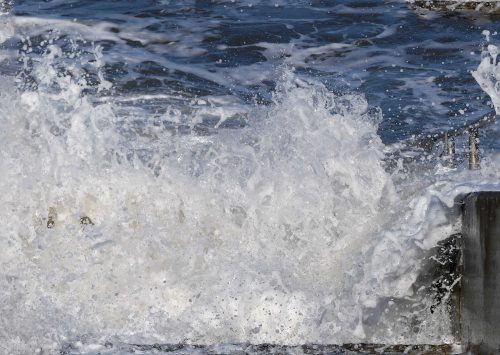
13:54- Wind-driven waves smash onto a flight of concrete steps and shows how high the water would reach if the rip-rap defences were not there; those steps below the middle are worn smooth and their edges rounded by the regular scouring of the waves.

161005-1354-rhos-point-blk-hded-gull-over-stormy-sea161005-1356-rhos-point-sea-mounting-steps161005-1357-rhos-point-sea-mounting-steps161005-1358-rhos-point-sea-smashing-onto-steps161005-1359-rhos-point-sea-smashing-onto-steps


Share this:

  • Share on Facebook (Opens in new window) Facebook
  • Share on Pinterest (Opens in new window) Pinterest
  • Share on X (Opens in new window) X
Like Loading...

Catchers, a Duck and Divers

28 Wednesday Sep 2016

Posted by theresagreen in bird behaviour, birds of the seashore, Birdwatching on North Wales coast, coastal walks, Nature of Wales, nature photography, Rhos Point, Rhos-on-Sea, The Wales Coast Path, wading birds

≈ 23 Comments

Tags

Cormorant, Crows on seashore, gavia stellata, mergus serrator, migrant birds, mussel bed, Oystercatcher, phalacrocorax carbo, red-breasted merganser, red-throated diver, redshank, Rhos Point, ringed plover, sandwich tern

September 10th-A brilliant day for birds continued….

As the tide began to return to the shore, every exposed rock in Penrhyn Bay was occupied by beady-eyed Cormorants.

160910-rprc-cormorants-in-penrhyn-bay-1

Black-headed gulls also waited.

160910-rprc-black-headed-gulls-in-penrhyn-bay-2a

It seemed Rhos Point was the place to be for seabirds and waders today. In the time I have lived here I have never seen as many here all at once. I got there an hour or so before high tide, which is one of the best times to get close views of the birds waiting for their evening meal to be delivered. But as  there were also such a large number of terns and gulls swimming on the sea’s surface and flying low over it, there must have been fish there drawing them in, perhaps a shoal of small fish, sprats or whitebait¹.

The tideline at Rhos Point was crowded with Herring Gulls, Black-headed gulls and Sandwich Terns. A woman arrived with two dogs and stood and watched as they chased along close to the water’s edge, sending many of the birds skywards. I will resist having a rant about that, but it troubles me that people think it’s OK to allow their dogs to do that.

160910-rprc-rhos-point1a-upped-gulls-terns

Whilst waiting to see if the upped birds would return and re-settle I scanned along the sea edge to see what else might be waiting there. There were a whole host of Oystercatchers, trickier to see when their bright orange-red bills are tucked away whilst they rest. A few little Turnstones were dotted amongst them and then a larger bird at the back of this group, fast asleep with its head tucked well down – a duck for sure, maybe a female Red-breasted Merganser? Identifying ducks is not one of my strong points even when I have a good view of them.

160910-rprc-rhos-point9a-oystercatchersherring-gull-merganser-duck

Standing in the shallow water were a good number of Redshanks

160910-rprc-rhos-point11a-oystercatchersherring-gullturnstoneredshanks

and more Black-headed gulls.

160910-rprc-rhos-point17a-redshanks-gulls

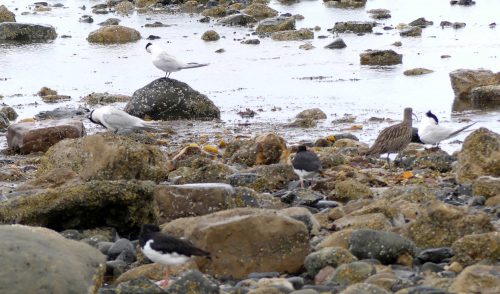
A few Sandwich Terns were in amongst this group of Redshank, Turnstones & black-headed gulls.

160910-rprc-rhos-point26a-redshanks-sandwich-terns-turnstone

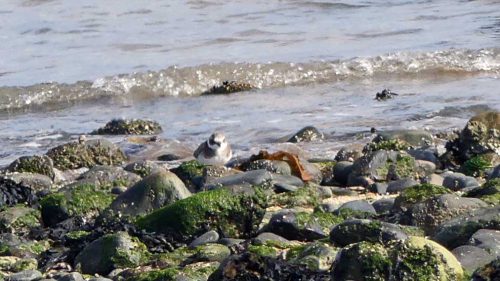
I found only one Ringed Plover, although there could well have been more.

160910-rprc-rhos-point19a-ringed-plover

A large number of Sandwich Terns occupied a finger of exposed rocks with a few Oystercatchers and gulls, with many more gulls bobbing around on the surrounding sea.

160910-rprc-rhos-point16-sandwich-terns-gulls

The Sandwich Terns, here in large number today were noisy and excitable, with groups taking off and settling again in spots a few metres away along the shoreline. Some will remain here for the autumn and winter, but others will move on.

160910-rprc-rhos-point23a-terns-flying

Their association with Black-headed Gulls is one I’ve seen many times.

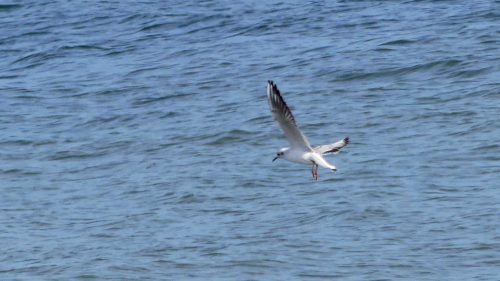
160910-rprc-rhos-point24a-black-headed-gull-flying

There’s usually a crow or two waiting for the tide’s incoming feeding opportunities too.

160910-rprc-rhos-point18a-crow-white-patch

Amongst the multitude of gulls swimming around were several Red-throated Divers – difficult to keep in sight as they dive frequently and disappear just as you think you may have one in focus, but a man close by with a brilliant telescope patiently located them and let me have a close-up look. Still not easy as you can’t predict where they’re going to pop up again, but I managed a couple of spots – what an exciting treat. At one point I thought I may have got lucky with a view of a group of six birds, also swimming and frequently diving and disappearing beneath the surface, but they turned out to be Razorbills, not quite as ‘special’, but still lovely to see.

160910-rprc-rhos-point6a-red-throated-divers

They separated and mostly stayed too far out to see well without the aid of binoculars or a telescope, but as the tide progressed inwards, so also did one of the birds, allowing me a much better view of it.

160910-rprc-rhos-point21a-diver


160910-rprc-rhos-point27a-diver

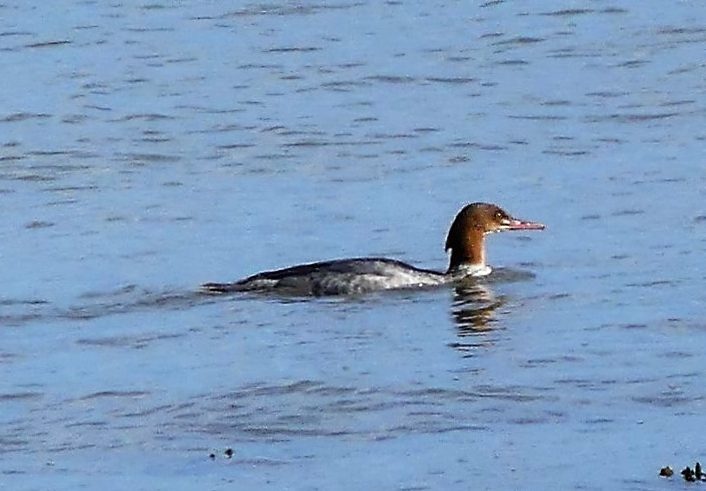
As I watched the razorbill, the duck also took to the water.

160910-rprc-rhos-point-20a-merganser-duck-diver-gull

I’m fairly confident it was  a female Red-breasted Merganser. (The female Goosander looks similar but brown colour of head extends around neck leaving just a white chin). On this bird the white of the throat seems to extend down the front of the neck.

¹ Whitebait is a collective term for the immature fry of fish, typically between 25 and 50 millimetres long. Such young fish often travel together in schools along the coast, and move into estuaries and sometimes up rivers.


Share this:

  • Share on Facebook (Opens in new window) Facebook
  • Share on Pinterest (Opens in new window) Pinterest
  • Share on X (Opens in new window) X
Like Loading...

A Brilliant Day for Birds

12 Monday Sep 2016

Posted by theresagreen in bird behaviour, birds of Wales, Birdwatching on North Wales coast, Nature of Wales, nature photography, North Wales, North Wales Wildlife Trust, Rhiwledyn Nature Reserve

≈ 12 Comments

Tags

alca torda, bird migration, Black-headed Gull, coastal birds, Cormorant, gavia stellata, larus ridibundus, Northern Wheatear, oenanthe oenanthe, phalacrocorax carb, razorbill, red-throated diver, saxicola torquata, stonechat

September 10th – Little Orme, Rhiwledyn Nature Reserve

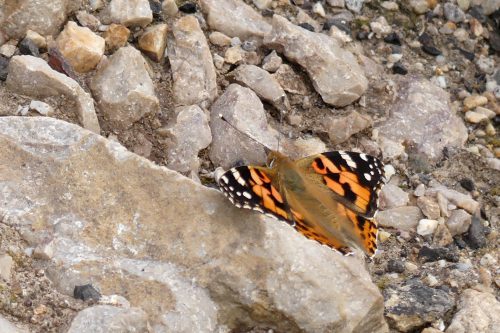
Taking the old cliff path around to Angel Bay, I disturbed a beautiful fresh(ly) Painted Lady butterfly. It circuited round a bit before settling on a stony patch, pressing its wings tightly against small sun-warmed limestone rocks.

160910-lorc3-painted-lady

A small crowd of people gathered on the cliff edge above Angel Bay looked promising; maybe there was something exciting to see down there? But alas, no. They were simply chatting and the beach was empty. This convinced me that as I suspected, female seals don’t give birth to their pups here; if they did they would surely be here by now. There were seals here, but only two, both swimming lazily around in the water. On this cool, misty-damp morning I suspect it was warmer in the water than out. One was hanging in the water with just its face above the water, showing off a lovely set of whiskers.

160910-lorc8-grey-seals-nose

Another was simply cruising around peacefully.

160910-lorc10-grey-seal-on-its-back

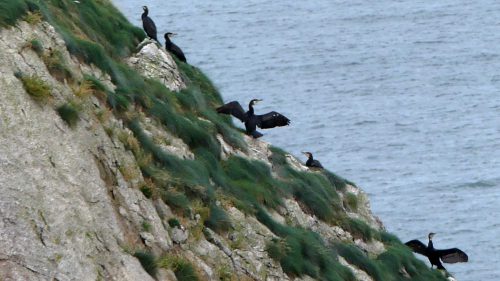
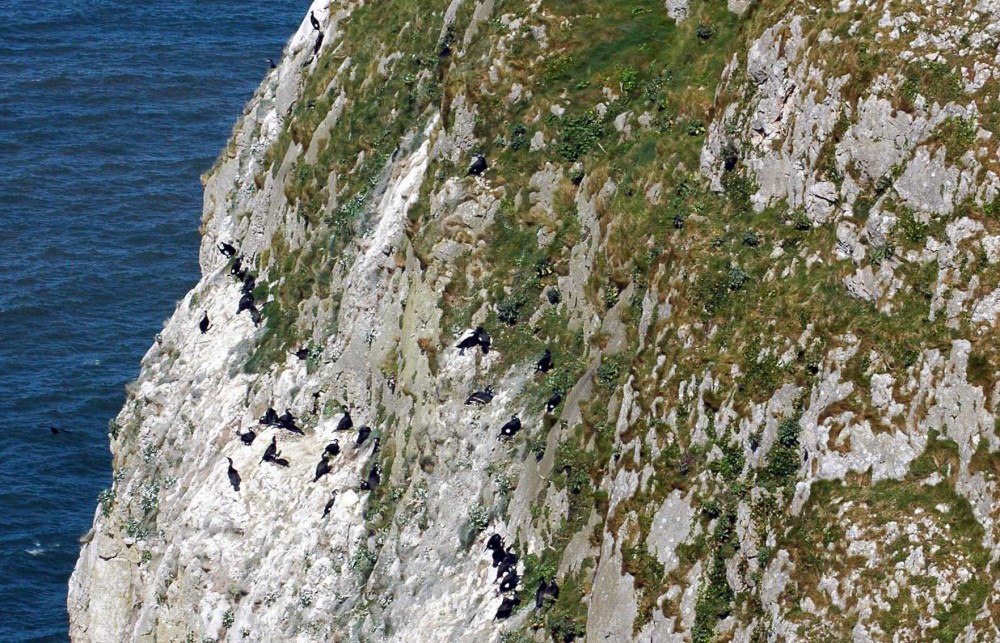
There is a thriving breeding population of Cormorants here on the Little Orme, so there is never a shortage of these brilliant birds to see, especially around their nesting site on the cliffs further around the headland. At this time of year and through the winter months, their numbers are boosted greatly and the steeply sloping cliff face that forms one side of Angel Bay is punctuated with a multitude of black dots and dashes. This is now Cormorant Central; the volume and frequency of arrivals and departures of birds rivalling that of aeroplanes into and out of a busy airport.

160910-lorc7-cormorants-on-cliff-edge

I wonder how they work out their perching places? Do early arrivals get the prime spots and do they now have their own patch, or is it up for grabs if they leave to fish for lunch? Do they stick to family or colony groups?

160910-lorc7a-cormorants-on-cliff-edge

Whilst pondering on the whys and wherefores of Cormorant society, I was distracted by two little shapes down in the Bay – definitely birds but I was, of course, on the wrong side to see them properly. It’s not uncommon to get the occasional Guillemot or Razorbill here once the breeding season is over, so I didn’t really think further than that. Winter-plumaged Red-throated Divers didn’t enter my head at the time, but that is what they were. Birds we get around this coast during the autumn and winter, but most often much further out that you need powerful optical assistance to spot.

160910-lorc11-divers-in-angel-bay

I must get back into the habit of taking binoculars out with me instead of relying on my camera’s zoom; sometimes it’s not enough. In this instance a glimpse and a snapshot was all I got anyway; these birds are for once aptly named as they do dive – a lot, reappearing nowhere near where they went under. I walked around to the other side of the rocky hump on the Penrhyn Bay side of the headland as from there you get good uninterrupted views of a wide expanse of sea. Birds fly low past here, keeping close in to the cliff, so some good views of whatever is travelling by; mostly Herring gulls and a few Black-headed gulls today.

160910-lorc15a-black-headed-gull

Black-headed gull–Larus ridibundus

160910-lorc15-black-headed-gull

There was a Cormorant swimming around on the sea’s surface, giving a good view of the strong hooked beak.

160910-lorc14a-cormorant-swimming

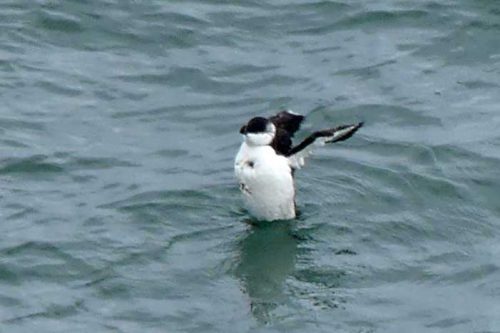
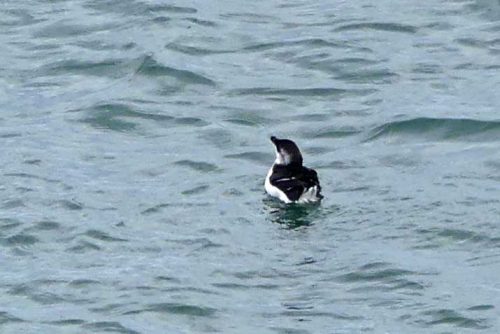
A small black and white bird bobbed into view and this really was a Razorbill Alca torda. It was a good way out to sea, but close enough that I could see, through the camera lens, that it was in the process of changing from summer to winter plumage. The plumage of the throat and sides of the neck change from black to white in the winter – the side of this one’s head is still a mix of the two.

160910-lorc17a-razor-bill

It was in no hurry to move away and intent on having a good grooming session.

160910-lorc19a-razor-bill

Members of the Auk family, to which both Razorbills and Puffins belong, look a little like penguins, although they are not closely related. The next few images show some of the similarities between them; species of both have black-and-white colours, an upright posture and share some of their habits.

160910-lorc20a-razor-bill

160910-lorc27a-razor-bill

160910-lorc28a-razor-bill

‘bye ‘bye little Razorbill, thank you for the photographs. Have a good winter.

160910-lorc29a-razor-bill

160910-lorc30a-razor-bill

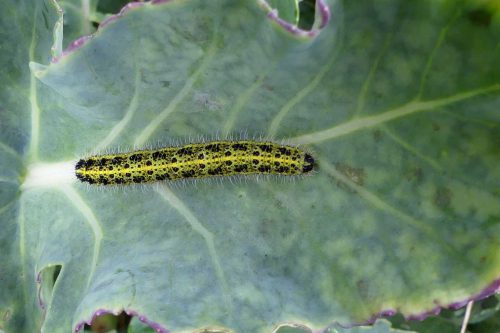
160910-lorc31a-large-white-bfly-caterpillar

Now a perfect example of how my mind skips around. Although tuned into ‘bird mode’, I spotted a wild cabbage plant and thought ‘maybe there’ll be a Large White butterfly’s caterpillar on those leaves’. And there was, so a gap in my  last-but-one post can be filled in!

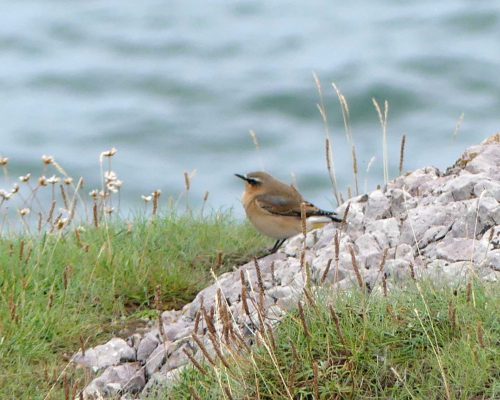
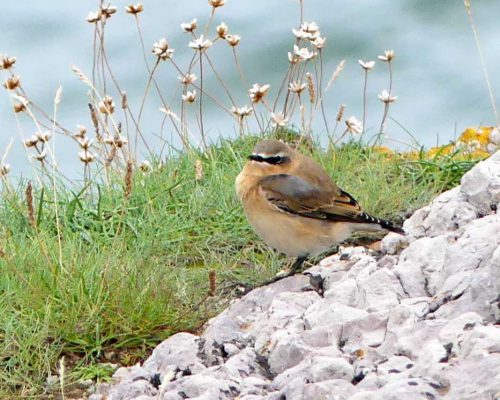
I was watching the Razorbill et al for a good half an hour, maybe more, then walked back around the cliff to have a last look around Angel Bay. The seals had gone, but the movement of a smallish bird on the cliff edge caught my eye. Rock Pipit came to mind, but no, it was a much lovelier Northern Wheatear. It was either waiting for the weather to improve or taking in some food before continuing on his long migration back to warmer climes; perhaps both.

160910-lorc34-northern-wheatear

Northern Wheatear – Oenanthe oenanthe

160910-lorc33a-northern-wheatear

I’m not certain whether this was a male or female as when males are in their winter plumage both sexes appear similar. I’m edging towards male as there seems to be a slate-grey patch remaining at the top of the wing. The bird’s common name of ‘Wheatear’ has nothing to do with its food preferences or its ears, but refers to its white rump (i.e white a**e)!

160910-lorc36a-northern-wheatear

More people arrived at the cliff edge and my bird flew away, down onto the big rocks on the beach.

160910-lorc43-bramble-leaves

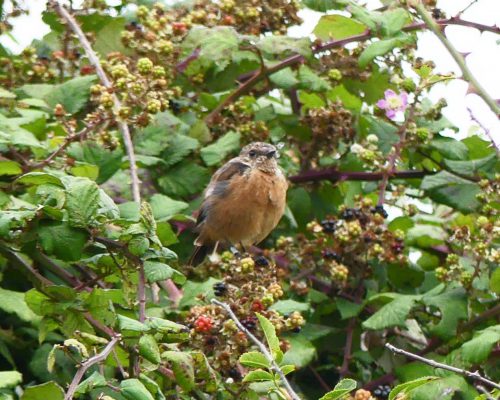
I began heading in the general direction of the ‘way out’, but hearing a Stonechat nearby diverted to see if I could find it. They’re one of my favourite birds and are often obliging in terms of appearing in the open. I wasn’t disappointed; as I passed by one perched up on top of a bramble, within whose tangled depths a pair have regularly nested.

160910-lorc37-stonechat

At first I thought this was an adult female , but as I got a closer look I could see it still has a speckled head, so it’s probably a juvenile of this year’s brood.

160910-lorc38a-stonechat

Robins were out singing all around the site today, but more wary now of being seen than when they sing in the spring. The one I finally got close enough to photograph was perched on a bracken frond keeping a beady eye out for movements on the ground below, ready to pounce.

160910-lorc40a-robin-on-bracken

160910-lorc41arobin-on-bracken


Share this:

  • Share on Facebook (Opens in new window) Facebook
  • Share on Pinterest (Opens in new window) Pinterest
  • Share on X (Opens in new window) X
Like Loading...

Birds by the sea

02 Saturday Jul 2016

Posted by theresagreen in birds of the seashore, Birdwatching on North Wales coast, mussel beds, Nature of Wales, Rhos Point, wading birds

≈ 7 Comments

Tags

Curlew, European Herring Gull, mussel beds, Oystercatcher, Rhos Point, sandwich tern

June 20th-Rhos Point

13.34- A sunny day with a strong breeze made it feel cold, but I was in need of some quick-fix fresh air and for that, Rhos Point is the perfect spot. It’s also one of my favourite spots for watching wading birds, although I don’t visit it much during the breeding season as it is almost deserted by birds and becomes uncannily quiet. Today I arrived as the tide was coming in and I spotted a small group of Oystercatchers waiting patiently for today’s incoming lunch, so I waited too to see if they would be joined by others.

As I made my way down nearer to the shore I heard some lively chirruping emanating from a shrub that has taken hold on the promenade edge, then a few House Sparrows flew out and headed for the shore below to forage amongst the exposed rocks.

160620-Rhos Point 1334-House Sparrow

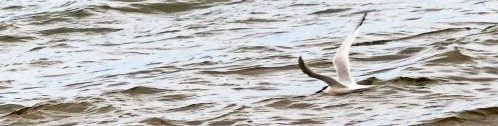
Two elegant Sandwich Terns flew low over the sea, close to its edge.

160620-Rhos Point 1335-Sandwich Terns flying

13.37 pm – Oystercatchers on the sea edge use the waiting time to rest or preen.

160620-Rhos Point 1337-Oystercatchers 160620-Rhos Point 1337b-Oystercatchers

Oystercatchers are high on the list of my most favourite birds, they have great character and charisma and the more I learn more about them the more fascinating they become. They are large wading birds and when not resting are noisy. They sport large long orange or red bills, which they use for smashing or prying open molluscs.

The diet of coastal oystercatchers is varied, although dependent upon coast type; on this rocky shore with its extensive mussel beds, they will prey upon mussels of course, and also on limpets and gastropods. They also take advantage of whatever the tides bring in such as small fish and crabs.

160620-Rhos Point 1339b-Oystercatcher with blunt beak

The shape of this bird’s bill shows it to be a ‘hammerer’

The bill shape varies according to the diet. ‘Stabbers’ feed by jabbing their laterally compressed bill tips in between the valves of a mussel’s shell, while ‘hammerers’ crack open mussel shells by pounding on them. Those birds with blade-like bill tips pry open or smash mollusc shells, and those with pointed bill tips tend to probe for worms.

13.40 – The Oystercatchers were joined by a beautiful Sandwich Tern.

160620-Rhos Point 1342-Oystercatchers & Sandwich Tern 2

The Sandwich tern is a summer breeding visitor, returning to north-west Wales & Anglesey from late March to September. In the UK, many of the important colonies survive because they are on nature reserves.

This is a very white tern, which in summer breeding plumage had a full black cap on its head. The bill is long and black with a diagnostic yellow tip. The legs are short and black and the tail short and forked. In flight it shows grey wedges on its wings tips.

160620-Rhos Point 1340a-Sandwich Tern

13.44- A small number of Curlews flew in to land on the rocky sea edge, where their cryptic plumage allows them to all but disappear.

I took this short video as the Curlews arrived – coudn’t avoid the wind noise!

160620-Rhos Point 1344-Curlews foraging

160620-Rhos Point 1347-Curlews foraging on sea edge

The curlew is the largest European wading bird, instantly recognisable on winter estuaries or summer moors by its long, downcurved bill, brown upperparts, long legs and evocative call.

160620-Rhos Point 1349-Curlew

160620-Rhos Point 1346-Oystercatchers & Curlews

13.47- The mysterious moment that suddenly galvanises waiting wading birds into action arrived and triggered most, though not all of the Oystercatchers to begin foraging in earnest.

160620-Rhos Point 1347-Oystercatcher (2)

160620-Rhos Point 1346-Oystercatcher bathing

13.48- A Herring gull arrived to join the party.

160620-Rhos Point 1348-Oystercatchers, Curlews & Herring Gull

13.52- A second Sandwich Tern flew in, closely followed by a third.

160620-Rhos Point 1352-Sandwich Terns

The terns also settled down to preen.

160620-Rhos Point 1352-SandwichTerns preening & Curlew

13.59- A Cormorant flew past at speed.

160620-Rhos Point 1359-Cormorant flying

14.04- A Herring gull- it’s good to see them down here, where away from the rooftops, rubbish tips and promenades they are not upsetting anyone!

160620-Rhos Point 1404-Herring Gull 1

160620-Rhos Point 1404-Herring Gull

160620-Rhos Point 1410-Herring Gull 2


Share this:

  • Share on Facebook (Opens in new window) Facebook
  • Share on Pinterest (Opens in new window) Pinterest
  • Share on X (Opens in new window) X
Like Loading...

A sea-shore in waiting

11 Tuesday Aug 2015

Posted by theresagreen in Birdwatching on North Wales coast, coastal habitat, mussel beds, Nature, Nature of Wales, nature photography, North Wales, Rhos Point, Rhos-on-Sea, wading birds, Wales Coast Path

≈ Leave a comment

Tags

acorn barnacles, barnacle, common mussel, great black-backed gull, herring gull, mussel bed, mussel beds, mussel beds of Rhos-on-sea, Nature in August, periwinkle, Rhos Point, seashore in August, winkle

Rhos Point from the Little Orme

Rhos Point from the Little Orme

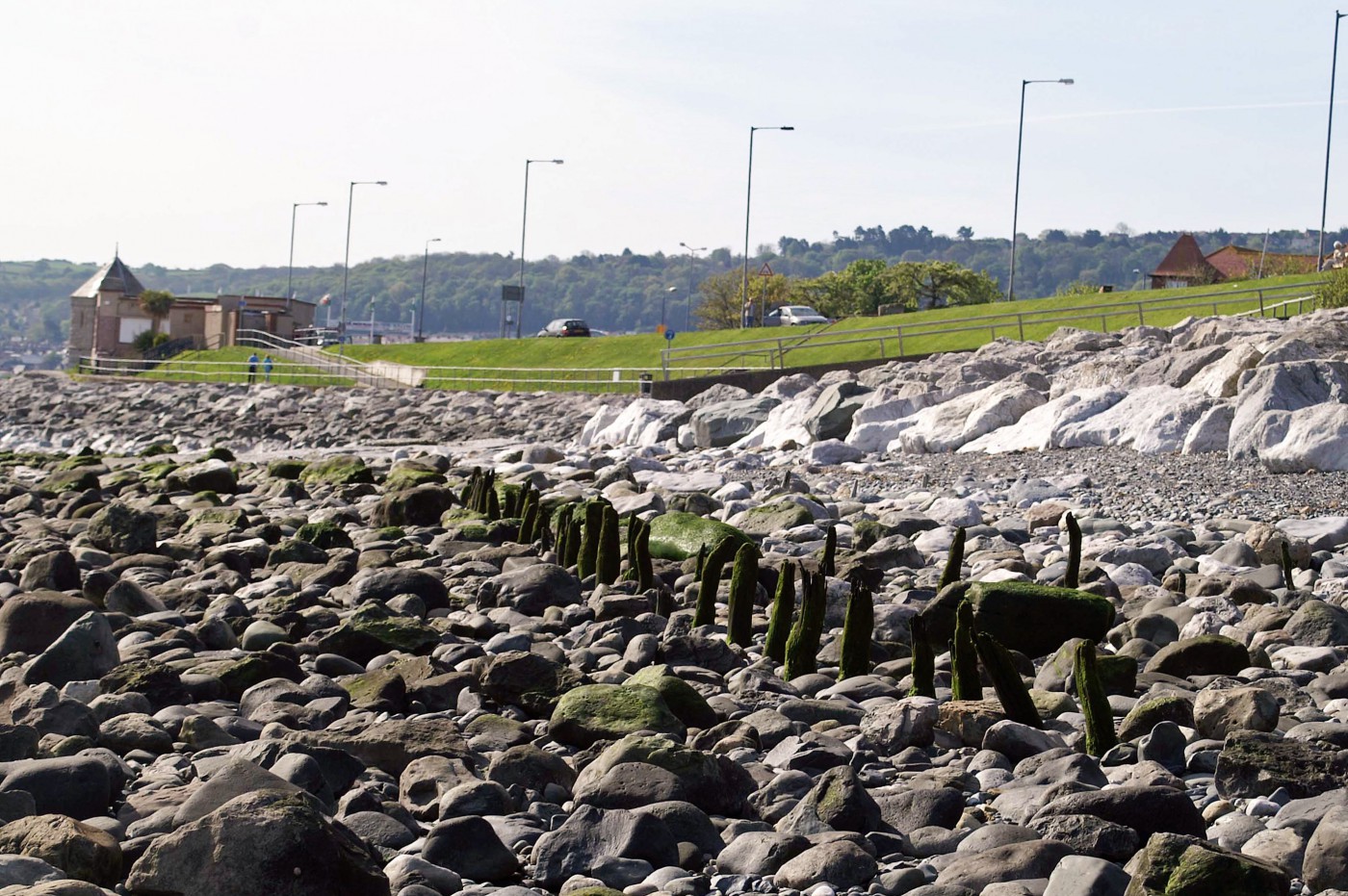
Rhos-on-Sea is a popular seaside venue that is busy with people visiting most of the year round, particularly at weekends and when the sun shines, but they don’t come here for its beach. The seashore, wrapped around the flat fortified headland of Rhos Point, is not the most beautiful in North Wales: a general first impression may well be of an expanse of flat shoreline littered with variously sized brown-coloured rocks and boulders. No easy strolling or picnicking here.

The stumps of posts are the remains of an ancient fishing weir

Rhos Point shore looking towards Colwyn Bay-the stumps of posts are the remains of an ancient fishing weir

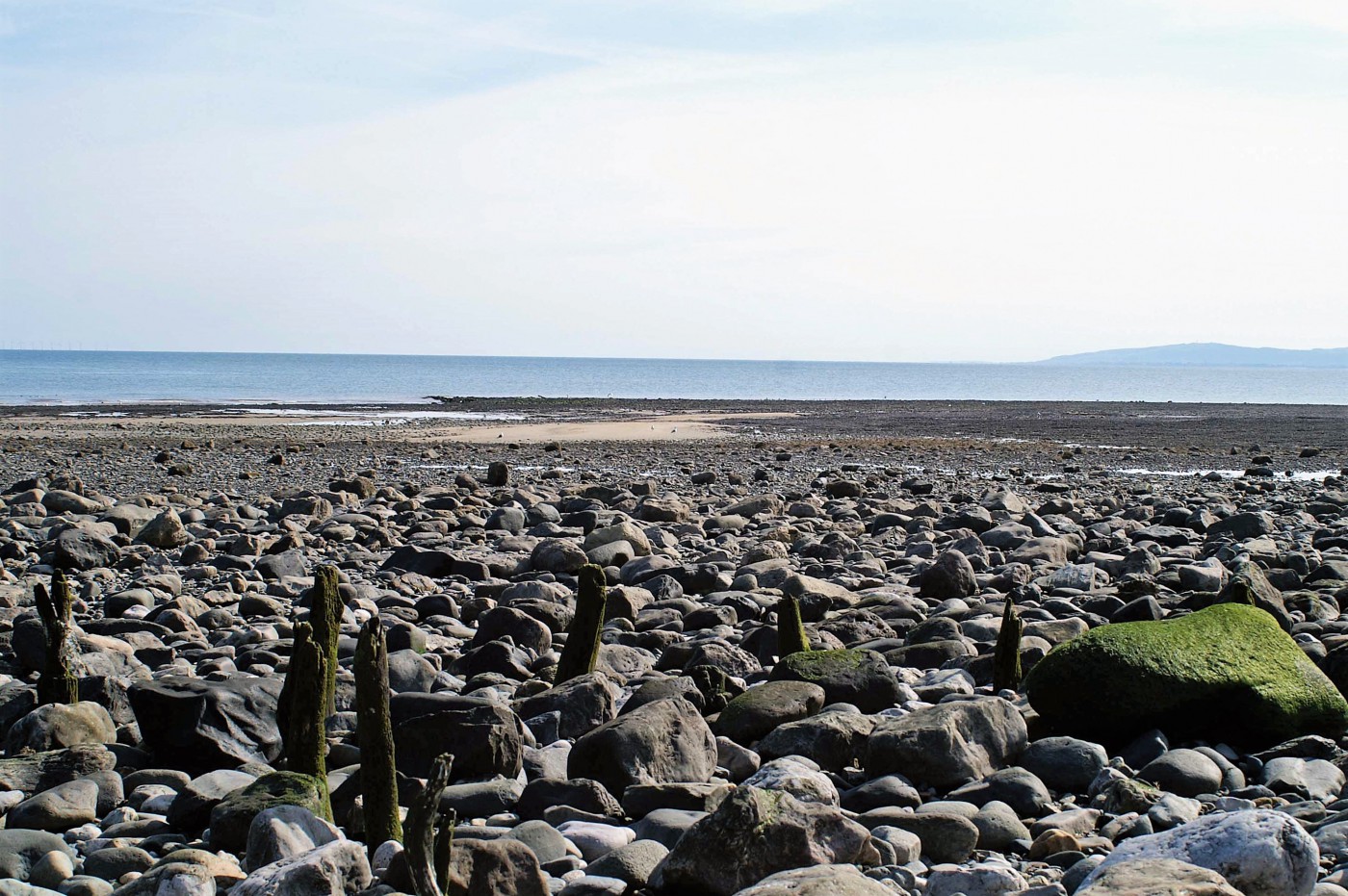
The rocky shore of Rhos Point from Penrhyn Bay

The rocky shore of Rhos Point from Penrhyn Bay

However, between the rocky shore and the sea lies an expanse of long-established Mussel beds which is highly attractive to visitors – of the avian variety. Large numbers of a variety of species of sea and shore birds will be returning here this month from their summer breeding grounds to spend the autumn and winter to feast on the gourmet seafood on offer here.

Rhos Point across the rock strewn shore to the mussel beds

Rhos Point across the rock strewn shore to the mussel beds

Part of the expanse of mussel bed beyond the rocks

Part of the expanse of mussel bed beyond the rocks on a sunny day

There may be a few early arrivals, maybe a Turnstone or two, but for now, approaching mid-August, the resident breeding birds, the Herring gulls, a smallish number of Lesser Black-backed gulls, Cormorants, plus a few Oystercatchers have the place more or less to themselves.

KONICA MINOLTA DIGITAL CAMERA

Great Black-backed gulls, adults & juveniles, Herring gull & Oystercatchers

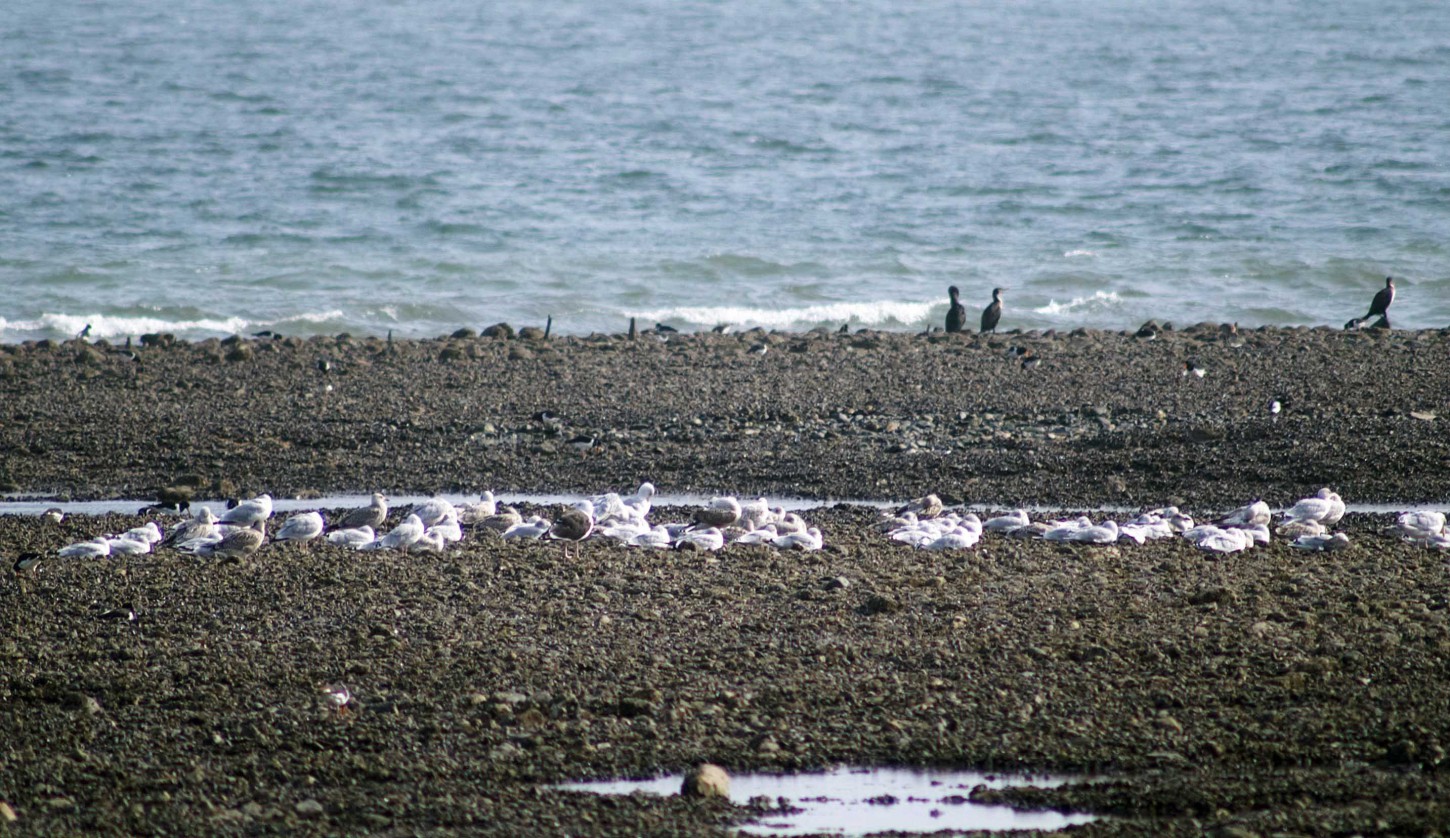
Rhos Point shoreline with fishing weir posts cormorants & gulls

Rhos Point mussel bed, juv. cormorants, oystercatchers & gulls

Soon they will be joined by large numbers of Curlews, Redshanks, more Oystercatchers, Turnstones, Dunlins, Ringed Plovers and Sandwich Terns. If we are lucky there may be a few Purple Sandpipers in the mix, and there will doubtless be a few temporary visitors stopping to feed before escaping to warmer climes. There will be Rock Pipits and Pied Wagtails amongst the huge rocks of the sea defences. So much to look  forward to!

Without the movement and cries of the absent birds the landscape appears harsh, a sombrely coloured, barren place devoid of life. But look more closely and you’ll see it is in fact a living landscape, richly populated by hosts of small sea creatures, which is of course why the birds head here for the winter.

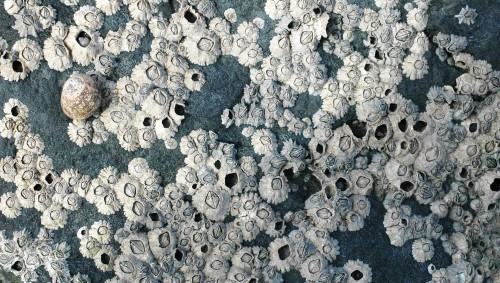
On close inspection, the rocks that appear a uniform brown colour from a distance are actually encrusted with colonies of barnacles, millions of them.

Barnacles and winkles cover the surface of a rock

Barnacles cover the surfaces of rocks

Acorn barnacles

Acorn barnacles

Barnacles and winkles

Barnacles and winkles

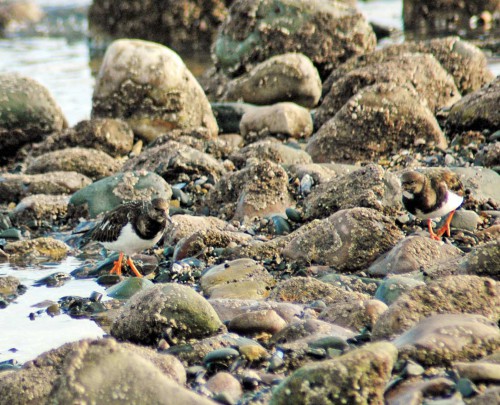
Turnstones camouflaged amongst the barnacle-covered rocks

Turnstones will be perfectly camouflaged amongst the barnacle-covered rocks

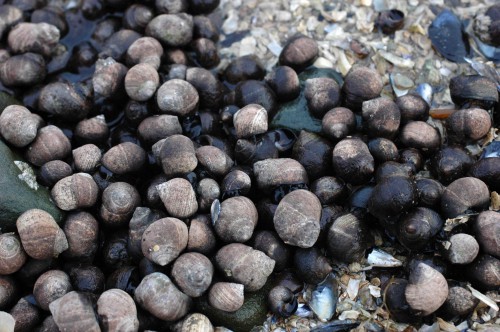
Winkles, or periwinkles are numerous too.

Winkles

Common periwinkle or Winkle-Littorina littorea

At low tide, cross the rocks, skirting the pools of shallow water left behind

Rock pool

Rock pool with more winkles

A flower of the sea -Beadlet anemone - Actinia equina

A flower of the sea -Beadlet anemone – Actinia equina

and soon the crunch of shells accompanies every footstep, as you are literally walking across the surface of a dense mass of living Mussels. It’s a very strange feeling.

Live mussels

The Mussel bed – live mussels amongst empty shells

You realise now why you see mussel shells everywhere.

Mussel shells under water

Mussel shells under water

141017TGNW4-Seashells mixed & crab legs

Live mussels & a live cockle amongst empty shells and crab claws

Mussel shells on the tide line of Rhos Harbour beach

Mussel shells on the tide line of Rhos Harbour beach

All is ready for the avian invasion.


Share this:

  • Share on Facebook (Opens in new window) Facebook
  • Share on Pinterest (Opens in new window) Pinterest
  • Share on X (Opens in new window) X
Like Loading...

Wales Coast Path – Little Orme

24 Sunday May 2015

Posted by theresagreen in birds of Wales, Birdwatching on North Wales coast, coastal walks, coastal wildflowers, Little Orme, Nature of Wales, Rhiwledyn Nature Reserve, The Wales Coast Path, Wildflowers of Wales

≈ 3 Comments

Tags

Cormorant, cormorants nesting, fulmar, fulmar nesting, ground ivy, jackdaw, sea campion, The Wales Coast Path-Little Orme

The Little Orme is a highlight of both the northern Wales Coast Path and the North Wales Path; it is a Nature Reserve with diverse habitats and wildlife and is popular with visitors and locals. I walk here often throughout the year but thought I would photograph this walk, taken at the end of April, as though I was following the Path, while meandering around as I usually do admiring the views and the special wildlife.

The Coast Path follows the promenade from Rhos-on-Sea around the Point and up to Penrhyn Bay. To reach the Little Orme turn off the main road and walk along Beach Road, which ends in a cul-de-sac where there are steps up to the site. Turn right at the top of the path from the steps to continue on the route.

In late winter to early spring Fulmars return to their nest sites here. They are noisy birds and vocalise loudly in the first weeks of their return as they sort out who is nesting where. Now, in late April they have quietened down and are settled into their nest sites on the more sheltered sides of the cliffs. There are currently five pairs on the more inland cliff and three or four more pairs on the lee sides of the cliff faces nearest to the sea. Their numbers are few but seem to be reasonably consistent year on year.

Fulmar nest on cliff nearer the sea

Fulmar nest on cliff nearer the sea

Fulmar pair sitting on cliff edge

Fulmar pair sitting on cliff edge

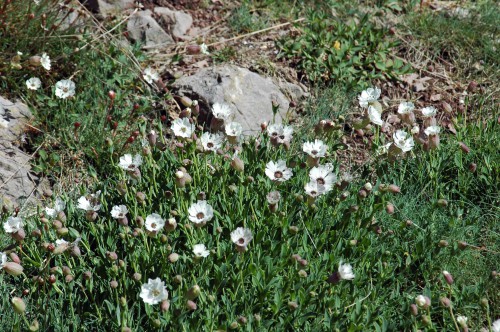
At the base of the cliff forming one side of Angel Bay, Sea Campion is flowering.

Sea Campion

Sea Campion-Silene maritima

I usually head for the cliff edge overlooking Angel Bay to see if there are any Grey Seals about. Today there were just two young ones swimming close to the rocks. The path to the summit involves an initial steep climb up an incline locally known as ‘Rabbit Hill’. It looks a gentle slope in the photograph, but it really isn’t, especially when you are as unfit as I was after my marathon-long virus! I had to stop twice today, but who cares when there are stunning views to look back at.

The Coast Path continues up steeply sloping 'Rabbit Hill'

The Coast Path continues up steeply sloping ‘Rabbit Hill’

Jackdaws are numerous residents and pairs of the characterful birds are nesting in nooks and crannies all over the cliffs. It’s always good to see them nesting communally in their ‘proper’ habitat rather than in the chimneys of houses in towns and villages. There are a particularly large number of them nesting up on the cliff at the back of the flat quarried-out grassy area at the top of Rabbit Hill and as I reached there I watched them as they used their numbers to chase off two Herring Gulls that were probably speculating for unguarded eggs.

Cliff face of the old quarry  that is now inhabitated by Jackdaws

Cliff face of the old quarry that is now inhabitated by Jackdaws

Jackdaw foraging at the base of the cliff

Jackdaw foraging at the base of the cliff

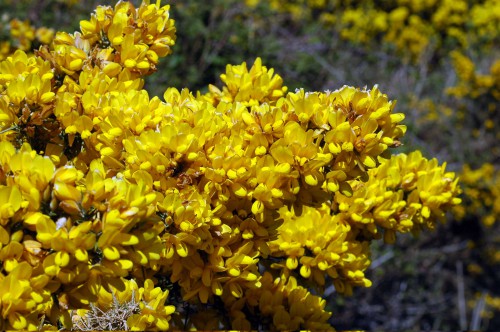
Onwards and upwards from the rock-strewn quarry field the track is bordered by gorse bushes and the air was perfumed with its wonderful coconut scent. Every bush was smothered with thousands of tightly packed golden flowers, a truly glorious treat for both eyes and nose. The grass is kept closely cropped by both rabbits and wandering sheep and a variety of birds including blackbirds, robins, chaffinches, goldfinches and dunnocks all forage here on the ground or amongst the scrubby shrubbery.

A baby bunny dozing in a sunny spot at the side of the track

A baby bunny dozing in a sunny spot at the side of the track

The track upwards bends to the right now and passes by an enclosed rough pasture grazed by  sheep and is frequented by Jackdaws. It’s always worth checking to see if any of the black birds are actually Chough.

A sheep pauses from grazing in the enclosed field to admire the view

A sheep pauses from grazing in the enclosed field to admire the view

At the top of the field the track turns sharply left and continues bordered by more gorse, blackthorn and hawthorn. Today walking through the fragrant gorse and blackthorn blossom was blissful.

The  trail winds through a thicket of gorse and blackthorn

The trail winds through a thicket of gorse and blackthorn

Every gorse bush was packed tight with blossoms

Every gorse bush was packed tight with fragrant blossoms

Eristalis Hoverfly nectaring on gorse flower

Eristalis Hoverfly nectaring on gorse flower

If you had been walking the Coast Path, there is a perfect view from the top of this section of the track of where you have walked if coming from the direction of Abergele, or of where you will be walking if going the other way.

View from the cliff edge showing the route of the Coast Path from Abergele, past Lladdulas and around Colwyn Bay and Rhos Point

View from the cliff edge showing the route of the Coast Path from Abergele, past Lladdulas and around Colwyn Bay and Rhos Point

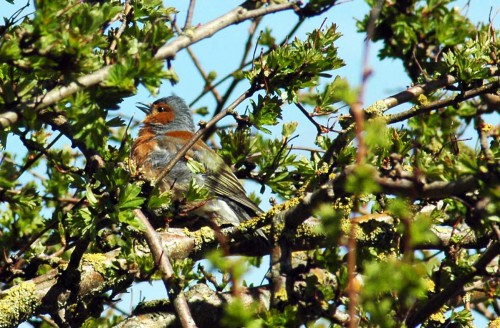
I could hear a Chaffinch singing so diverted from the main track here along one made by sheep to try to find him. It wasn’t long before I spotted him in a hawthorn tree preening himself and intermittently responding to the song of another male somewhere nearby.

Male Chaffinch singing and preening

Male Chaffinch singing and preening

Ground Ivy

Ground Ivy

The track continues upwards towards the top

The track continues upwards towards the top waymarked Wales Coast Path and North Wales Path

One of the reasons for taking this walk today was to check up on the Cormorants that nest on the sea cliffs of the headland. I wouldn’t recommend making this diversion to the cliff edge if you have children or a dog not on a lead with you, or if you are of a nervous disposition as to get a good view of the birds you do have to go carefully down a slope which has no barrier between its edge and the drop down. It was windy today too, as you can see by the ruffled sea.

A ewe with her lamb on the slope of the cliff edge

A ewe with her lamb on the slope of the cliff edge

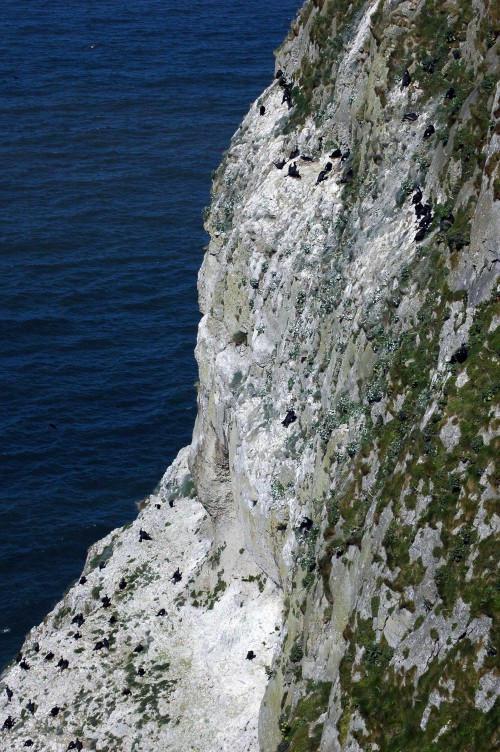
There are large numbers of Cormorants here all year round and in Welsh the bird is known as ‘llanc llandudno’. I’m sure they have nest sites all around the headland, but this is the only one I know of that is reasonably visible from the cliffs. The limestone rock is smooth and sheer so it is amazing that the Cormorants, quite large birds, find safe places to site their nests here.

A view of the nest site on the almost-sheer cliff face

An overview of the nest site on the almost-sheer cliff face

There are three areas the birds are gathered in, an area at the top, a middle section and a few on a shelf quite near the bottom.

A closer view of the area most of the birds were gathered in

A closer view of the top-level area some of the birds were gathered in

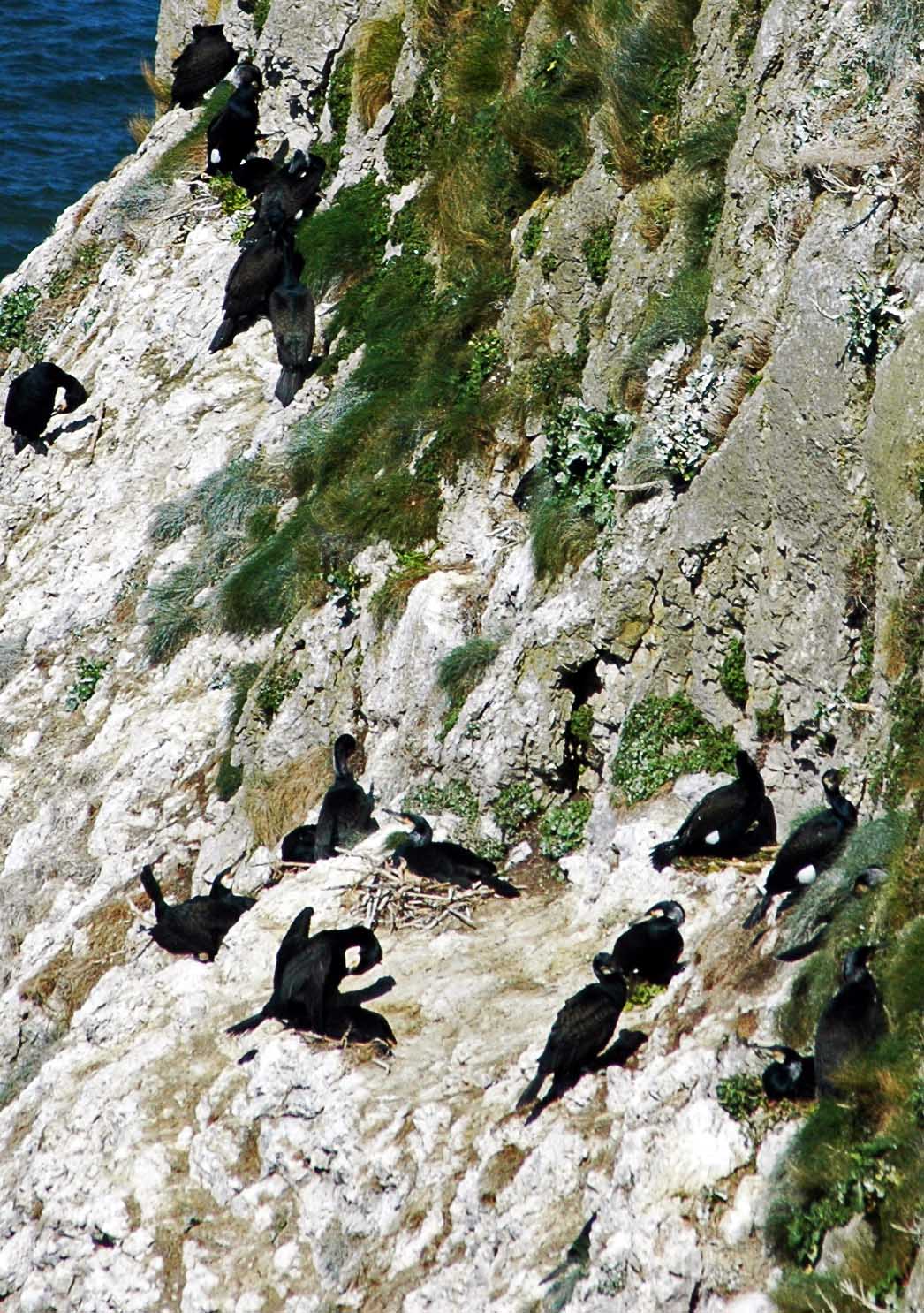
A few birds wwere sitting on nests while others, probably males, sat with their backs to the sea

A few birds were sitting on nests while others sat with their backs to the sea

Cormorants sitting against the cliff with backs to the sea

Cormorants sitting against the cliff with backs to the sea

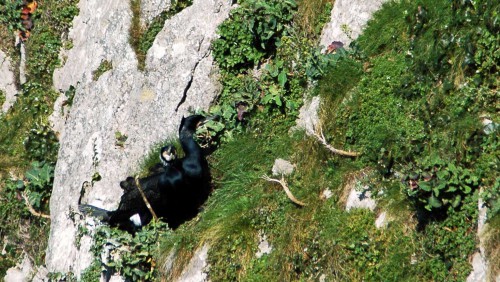
A pair of birds nesting amongst wild cabbage plants

A pair of birds nesting amongst wild cabbage plants

Another pair on a sloping rocky ledge

Another pair on a sloping rocky ledge

Cormorant flying past cliff

Cormorant flying past cliff

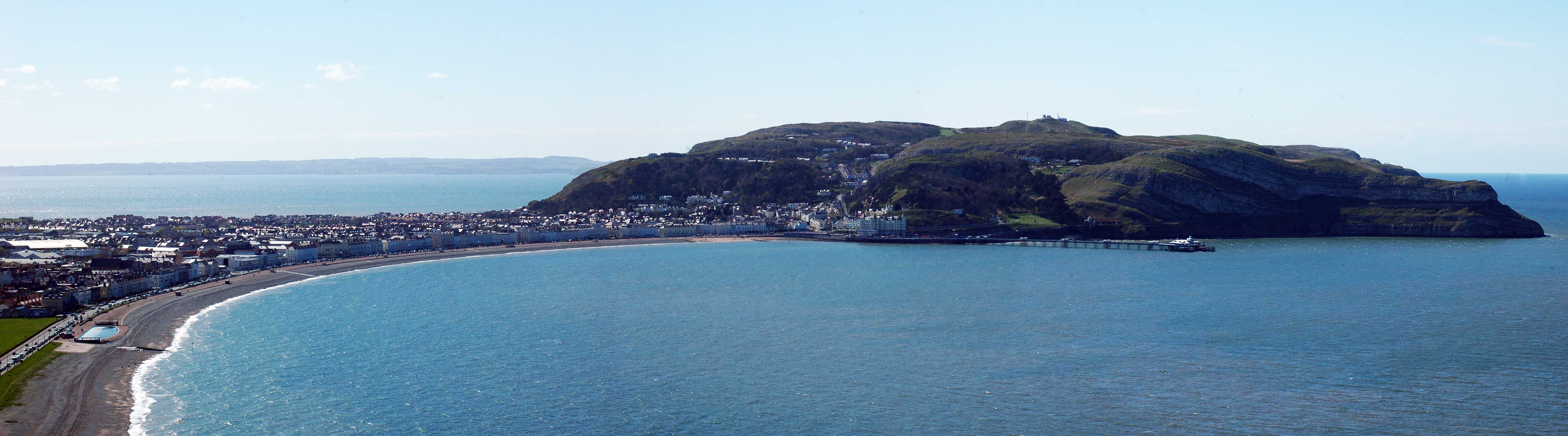
Fascinating as the Cormorants were, it was chilly here on the windy cliff, so I went back up and along the cliff edge to the part below the summit which was sheltered from the wind and from where there are stunning views across the bay to Llandudno’s Victoria Pier and Little Orme’s big brother, the Great Orme. In the background is the Isle of Anglesey.This view shows the route of the ongoing Coast Path around Llandudno Bay.

Panoramic view of Llandudno, the pier and Great Orme with Anglesey in the background (click to enlarge)

Panoramic view of Llandudno, the pier and Great Orme with Anglesey in the background (click to enlarge)

Cormorants race past and Herring Gulls are always to be seen flying or gliding around this part of the cliff, and there is occasionally a Kestrel, but today I was surprised to see two Buzzards flying out over the sea and a Sparrowhawk flying in and heading towards the Great Orme.

The ongoing Coast Path

The ongoing Coast Path passes around Llandudno and on to Deganwy and Conwy

It is possible to go up a little further to reach the trig point on the summit but the views are no better from there so I don’t often get that far and turn around to go back the way I came. If you were following the Coast Path though you would follow the track that takes you down to rejoin the main road at Craigside and continue towards Llandudno.

Share this:

  • Share on Facebook (Opens in new window) Facebook
  • Share on Pinterest (Opens in new window) Pinterest
  • Share on X (Opens in new window) X
Like Loading...

Waiting for the tide to turn

19 Sunday Jan 2014

Posted by theresagreen in Birds, Birdwatching on North Wales coast, Nature of Wales, nature photography, North Wales

≈ 14 Comments

Tags

birds on the seashore, Curlew, dunlin, Oystercatcher, purple sandpiper, rhos on sea, ringed plover, Turnstone, wading birds

Several months and a whole season have come and gone since I posted anything on this blog. It’s been a sad time for me and all of my family as my beloved Dad reached the end of a very long life last September. He was the one that noticed and encouraged my early interests in the nature around us and taught me the names of common wildflowers, butterflies and most particularly birds. He didn’t claim to know everything, but more importantly he gave me the gift of noticing what was there and the encouragement to find information I wanted for myself. He never really got the concept of blogs, or indeed anything to do with computers, but was always interested to hear what I had seen and where I’d been, particularly about the places here in North Wales that he took my sisters and me to spend time in when we were young. Some of those places have remained very special to me and I’m sure that when I visit them, that’s where I’ll always find him.

______________________________________________________________________________

Thank you all for your patience and sticking with me and thank you to new readers that have signed up who must be wondering where I’d disappeared to. While Dad was ill I was spending a lot of time down in my old haunts in Northamptonshire, where my sisters still live, and it was reassuringly familiar and not too greatly changed in the decades I’ve been away. I may do a post or two about our walks there if I am unable to come up with anything more current, but for the time being the so-far mild winter is giving me plenty of opportunity to get out and ideas for posts, starting with this one about the  wading birds that are about now on our local rocky seashore.

2nd January 2104 

A brilliantly sunny day winkled me out of my cosy shell this morning and I set off, camera to hand to see what I could see from the promenade. I realised I had lost track of the ebb and flow of the tides and had no idea of its current state, so was initially quite disappointed to see that it was fully in and very high. That meant there would be no waders to be seen picking their ways through the rocks that strew the shoreline of Rhos Point pecking and probing the muddy sand in search of food. But I’d made the effort to get myself out and I wasn’t about to go home with nothing, so I thought I’d at least walk for a way for some much-needed exercise and if nothing else there may be a Rock Pipit or two on the rocks or the sea wall. The sea was as blue as the sky and ruffled by what I was feeling as a bitingly cold breeze. I hadn’t walked far when I noticed a largish bird swimming around on the water, meandering randomly and frequently diving and disappearing under the surface for minutes at a time.

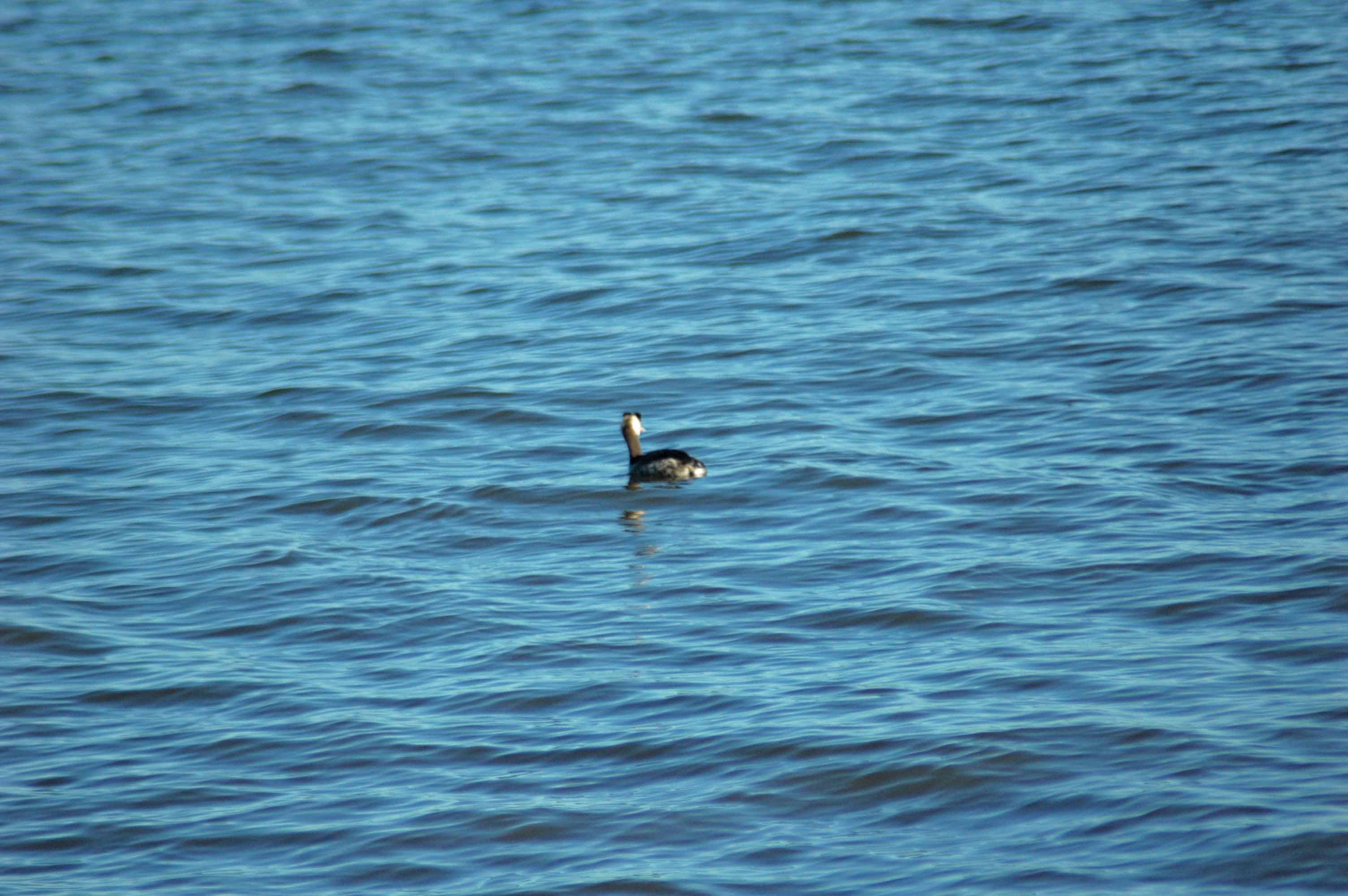
Great Crested Grebe

Podiceps Cristatus-Great Crested Grebe

Needless to say, I hadn’t picked up my binoculars and couldn’t properly see what I was looking at, even with the assistance of the camera lens, but from its general ‘giz’, and the fact I’ve seen them here in previous years, I decided it was most likely a Great Crested Grebe. It wasn’t alone either, although individuals were spread quite widely apart, at one time I counted ten of them. I could not get a decent image of any one of them though, so this one is a token effort to verify the sighting! 

” In winter, Great Crested Grebes show a marked shift from inland waters to the sea, although on the continent large numbers remain on inland lakes, e.g. in Switzerland (Cramp 1977). In normal winters, Britain and Ireland receive birds from continental western Europe. During severe winter weather, birds move through Britain in search of milder conditions either to the west in Ireland, or southwards to France (Lack 1986).” http://jncc.defra.gov.uk/pdf/UKSPA/UKSPA-A6-4B.pdf

High tide- sea flooding steps

High tide- sea flooding steps

I walked quite a distance towards Penrhyn Bay, stopping now and then to try to get a better image of a Grebe. I spotted one a little further in and got a slightly better view from the top of a set of steps that lead down to the beach. You get an idea of how far the water reaches regularly as the bottom treads are worn smooth by the repetitive scouring of salty waves climbing them and retreating with some force.

I wasn’t enjoying walking into the cold wind so I turned around and walked back, but carrying on towards the village. Just past the tiny St. Trillo’s Chapel I caught a glimpse of a bird flying down on to the big rocks below the promenade; a Turnstone. It landed out of eyesight, hidden amongst the huge boulders, but as I searched for it, up it popped onto a rock very close by.

Turnstone-Arenaria interpres

Turnstone-Arenaria interpres

Turnstones are common winter visitors to all our British coasts and gather in the greatest numbers on rocky and stony beaches, as here in Rhos-on-Sea. I was very happy to see it, as they are perhaps my favourite small wading bird, and because they are rarely alone I was confident there would be more to see.

Why stand when you can sit

Why stand when you can sit

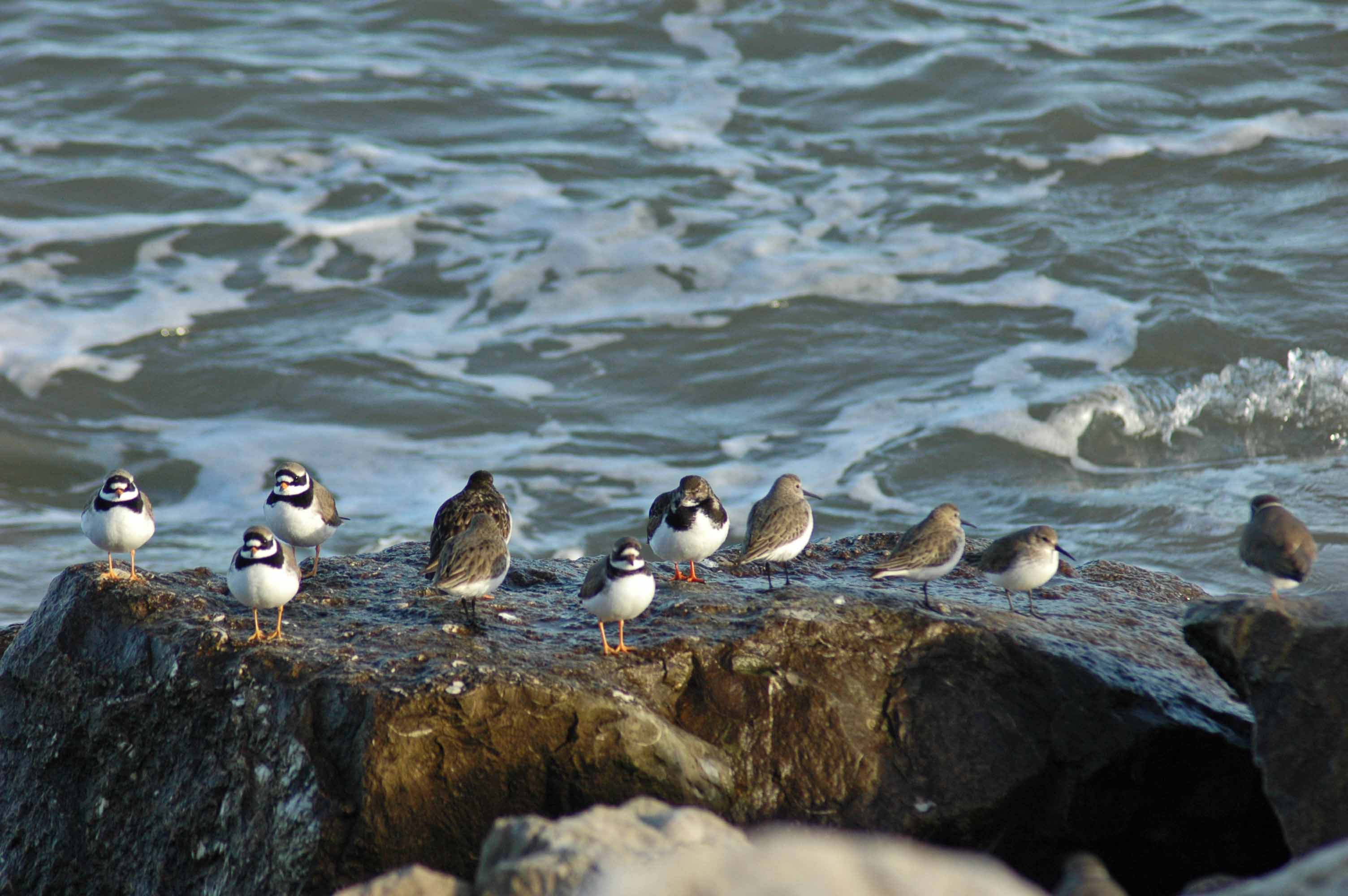
In previous years I have seen small groups of mixed species of  waders on the rocks here, so I was hopeful there would be more to see. I didn’t have to go far before spotting another little group waiting for the tide to turn and leave their lunch, this time Ringed Plover and Dunlin.

Ringed Plovers and Dunlin watching the water

Ringed Plovers and Dunlin watching the water

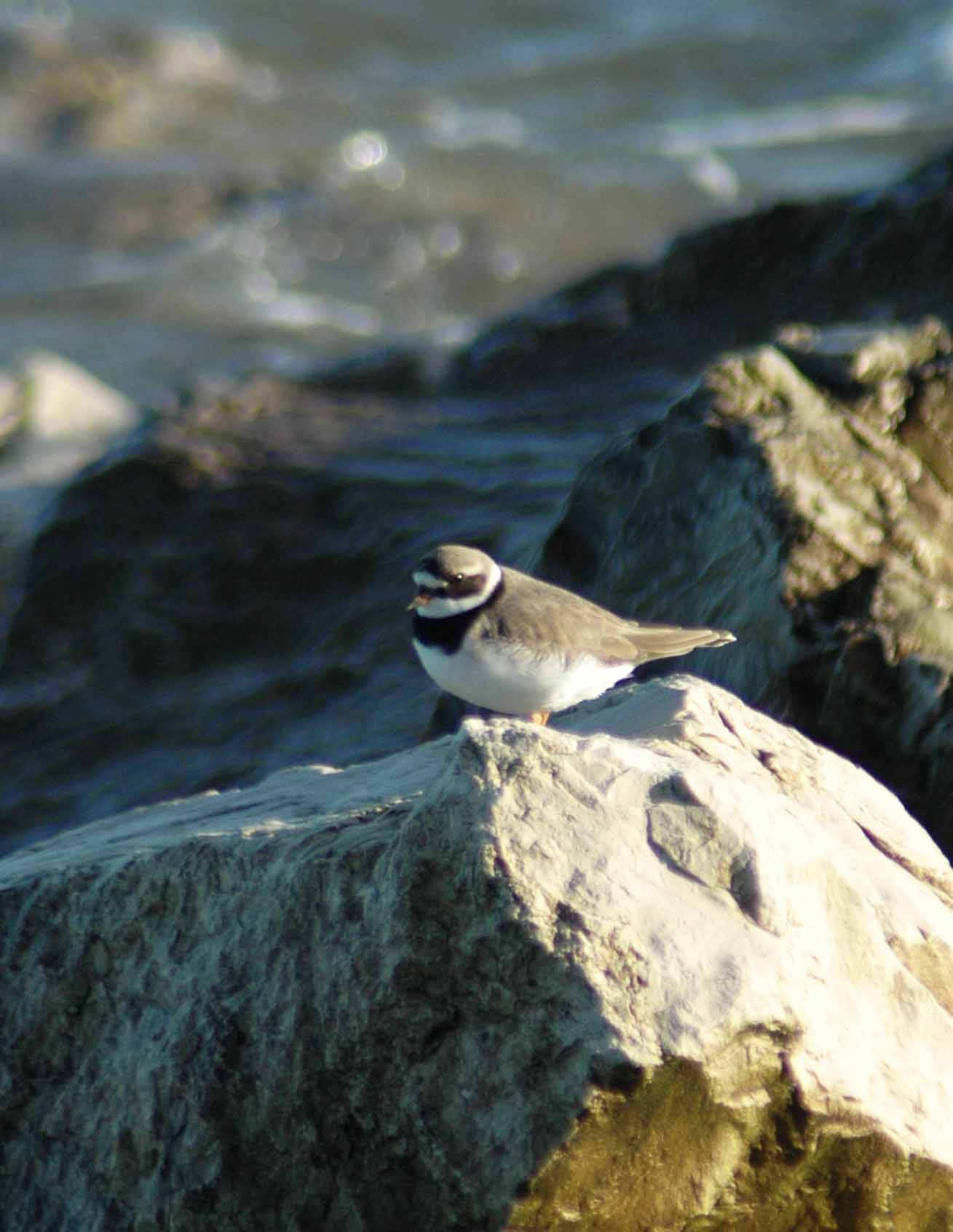
Ringed Plover- Charadrius  hiaticula

Ringed Plover- Charadrius hiaticula

Ringed Plovers are amongst the most common of our shore birds, although the increase in building in seaside localities and our intrusion onto beaches that were once remote, where they traditionally used to breed, have taken their toll on populations.

Ringed Plovers

Ringed Plovers 

A Dunlin & a Turnstone together shows the size difference between them

A Dunlin & a Turnstone together shows the size difference between them

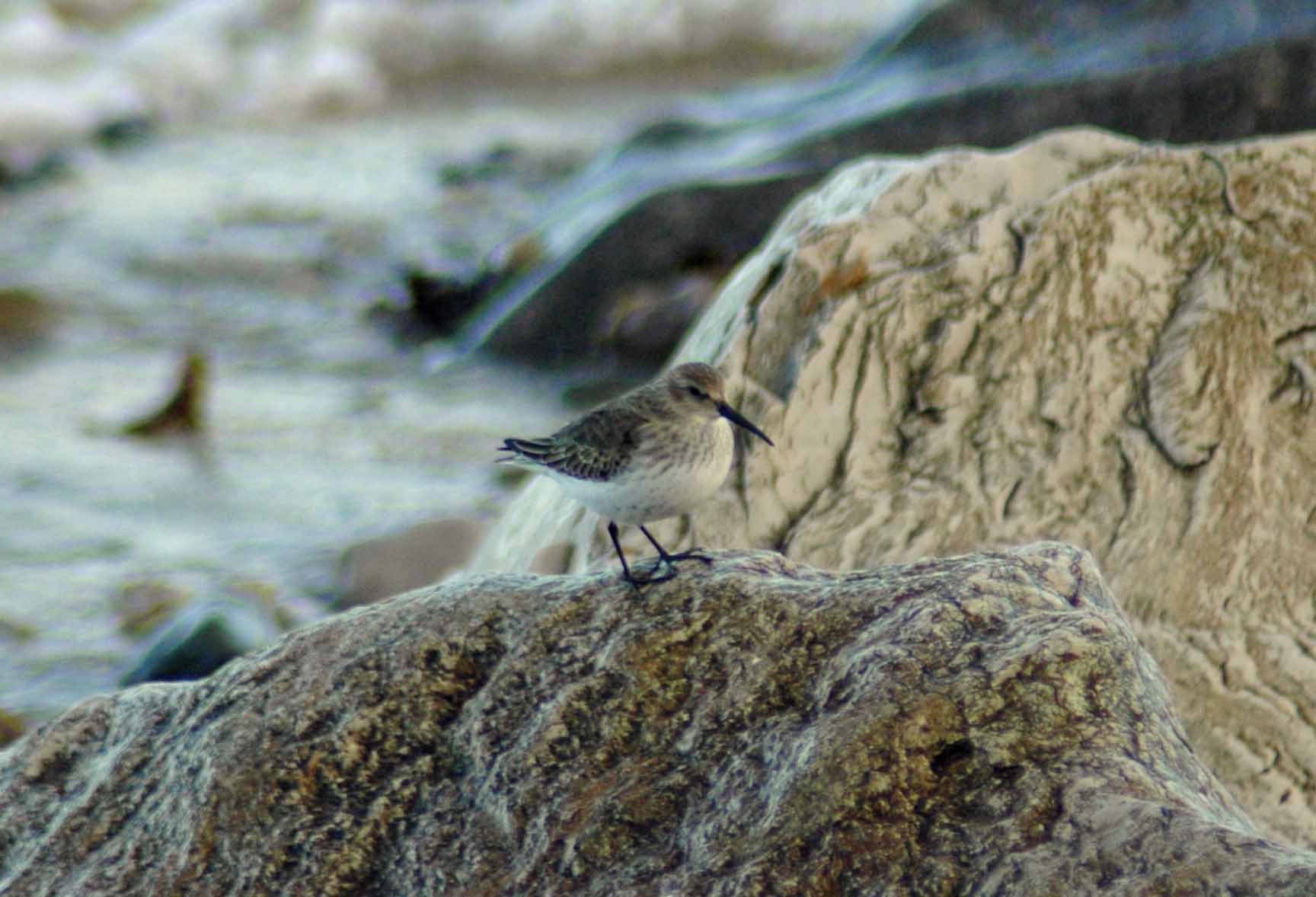
Dunlin are amongst the smallest of our shore birds. Some are present in Britain all year round, and as with Curlews, they winter on coasts and breed mainly on upland moors. Numbers are swelled when sizeable flocks come for the winter.

Dunlin-Calidris alpina

Dunlin-Calidris alpina

Dunlin were known to wildfowlers of old by a diverse variety of names, including ox-bird, ploverspage, sea snipe and stint.

Dunlin flying in to land

Dunlin flying in to land

Dunlin, Ringed Plovers & Turnstones

Dunlin, Ringed Plovers & Turnstones

As I watched them I had to wonder how these birds know when the tide is about to turn? It’s definitely not just a lucky guess! When I first began to watch them they were all quite still and quiet, but then in a heartbeat something changed and they became suddenly more animated. Up till that moment they had ignored the close proximity of people walking and me pointing a camera at them, but now people passing by with a dog or cyclists triggered off the Dunlin and Plovers and theytook off as one in a tight little flock out over the sea towards the harbour breakwater, then looped back, showering down to land a few feet further along the rocks. The Turnstones woke up too and were the first to venture nearer to the water, ready to get down onto the first uncovered patches of sand.

As the tide’s turning became more imminent, Oystercatchers began to arrive. They too had been waiting, but a bit further away on top of the harbour breakwater alongside the herring gulls.

Oystercatchers lined up along the harbour breakwater

Oystercatchers lined up along the harbour breakwater

Most of the Oystercatchers headed straight out to the far end of the Point, but a few chose to join the Turnstones, Dunlins and Plovers. Oystercatchers are the most numerous and conspicuous of the waders here and are a familiar sight on the mussel beds, on the rocky shorelines and in small groups flying low across the sea. They are noisy and gregarious and wonderful, but usually some distance away, so it was lovely to get this opportunity to see them more closely for a while.

Oystercatcher flying in to land

Oystercatcher flying in to land

Oystercatcher about to land

Oystercatcher about to land

Landed and waiting for the perfect moment to begin the hunt for food

Landed and waiting for the perfect moment to begin the hunt for food

Joined by another

Joined by another

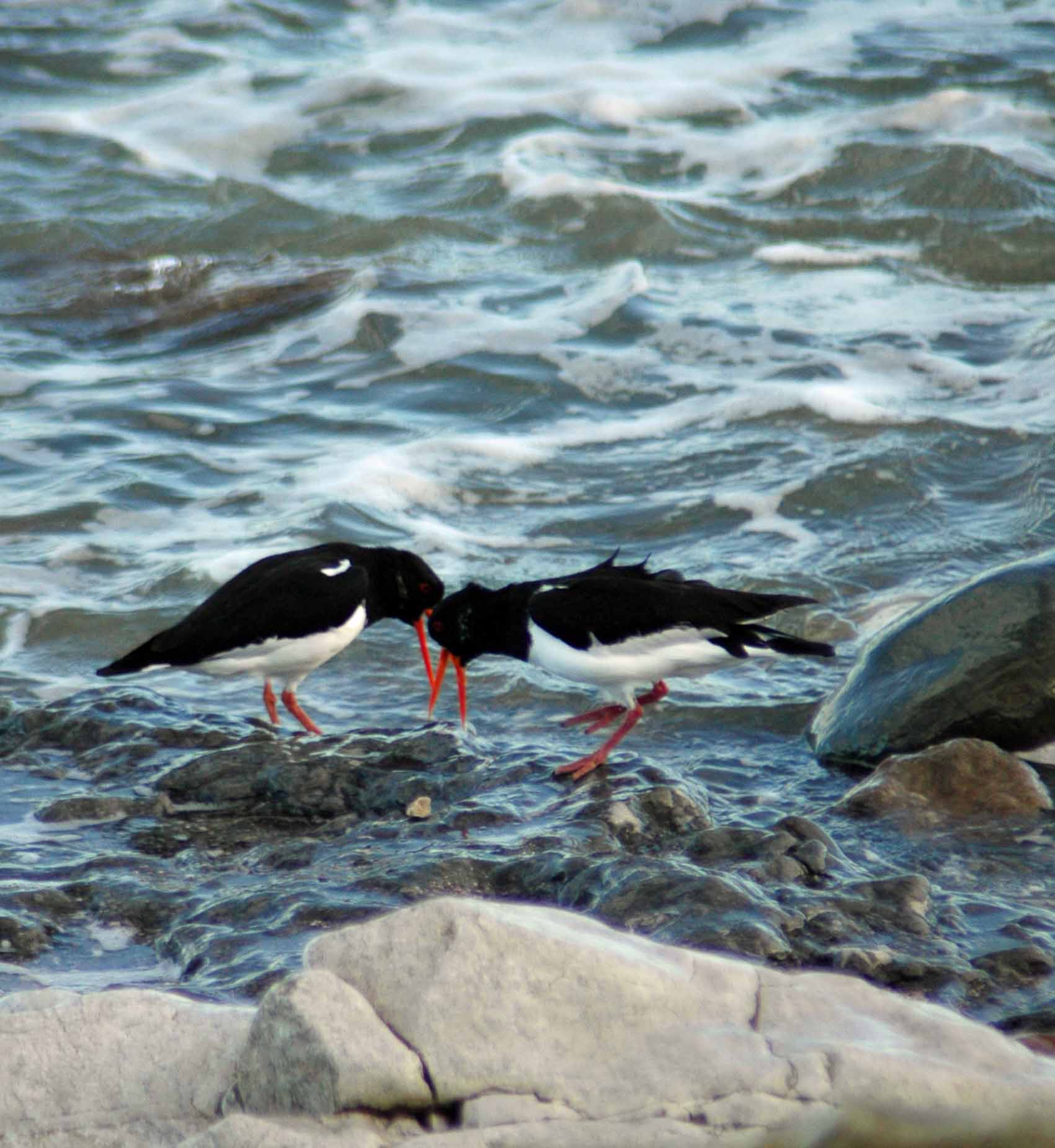
The shrill calls of the Oystercatchers often ring out from where they spend most of their time feeding or as they fly, but I hadn’t realised they also use it to greet other birds. I watched and listened, fascinated, as a pair performed a little greeting ritual in front of me.

A noisy and demonstrative reunion

A noisy and demonstrative reunion

Their performance reminded me of the Herring Gull pair that raised their family on our roof last year and involved ‘bowing’ to one another, beaks open and pointed towards the ground whilst emitting their shrill call, rather ear-piercing at this distance. I am assuming they were a mating pair, and that is something else that is mind boggling; how on earth do they recognise one another in a crowd?

Turnstones are the first of the small waders onto the shore

Turnstones are the first of the small waders onto the shore

The magical moment arrived when the sea had retreated just enough to expose small patches of the seabed. The larger Oystercatchers were first in, followed closely by the Turnstones, then the smaller Dunlin and Ringed Plovers, once they were confident they wouldn’t be caught out by a rogue returning wave with nowhere to run to.

The tide comes in and goes out quickly and by the time I turned to walk back much of the rocky shore of the Point was revealed and already heavily sprinkled with Oystercatchers.

Oystercatchers as I most often see them, spread out at the far end of the seashore

Oystercatchers as I most often see them, spread out at the far end of the seashore

I hadn’t noticed any Curlew fly in, but hearing one I looked more closely and caught sight of one that had just picked up something to eat, very closely observed by a couple of Oystercatchers, who are certainly not averse to stealing should another take its eye off its prize.

A supremely well-camouglaged Curlew with food

A supremely well-camouglaged Curlew with food-Oystercatchers homing in

A curlew with food watched by Oystercatchers

The Curlew watched closely by Oystercatchers

*Missing from today’s tally of waders were Redshank, and Purple Sandpipers that I have seen previously together with Turnstones, Dunlin & Plovers. Click on link to post with more photographs.

Purple Sandpiper-Calidris maritima

Purple Sandpiper-Calidris maritima (January 2012)

And to finish, a young herring gull, to show they are often where they are supposed to be!

Juvenile herring gull

Juvenile herring gull

Share this:

  • Share on Facebook (Opens in new window) Facebook
  • Share on Pinterest (Opens in new window) Pinterest
  • Share on X (Opens in new window) X
Like Loading...
← Older posts
Newer posts →
Follow everyday nature trails on WordPress.com

Enter your email address to follow this blog and receive notifications of new posts by email.

‘But it is the common species that keep the living world ticking over and provide most of our experiences of wildlife, and I would argue that maintaining the abundance of these is as important a conservation priority as maintaining the existence of rarities’. Richard Mabey

MOST RECENT POSTS

  • A Glimpse of Spring to Come January 22, 2025
  • Hunting the Wren December 28, 2024
  • Oh, Christmas Tree December 18, 2024
  • In and Out of the Ivy February 15, 2024
  • Nature’s Fireworks November 30, 2023
  • Wild Autumn along the Coast Path November 3, 2023

OLDER POSTS

LOOKING FOR SOMETHING IN PARTICULAR?

  • Catchers, a Duck and Divers
    Catchers, a Duck and Divers
  • Following a river to a Fairy Glen
    Following a river to a Fairy Glen
  • Things Bright and Beautiful
    Things Bright and Beautiful
  • A Windy Wildflower Trail
    A Windy Wildflower Trail
  • Sights and Sounds from the Little Orme 1
    Sights and Sounds from the Little Orme 1
  • May Bee Appearing on Ivy near You
    May Bee Appearing on Ivy near You
  • Fine Dining for Crows
    Fine Dining for Crows
  • The life of a Yellow Dung-fly
    The life of a Yellow Dung-fly
  • Sleeping Seals and Stonechats
    Sleeping Seals and Stonechats
  • Shades, Sounds and Scents of the Woods
    Shades, Sounds and Scents of the Woods

nightingale trails

The Walk of the Monarch Butterfly-Sendero de la Mariposa Monarca

The Walk of the Monarch Butterfly-Sendero de la Mariposa Monarca

MY WILDFLOWER BLOG: where the wildflowers are

Snowdrop

Snowdrop

most recent posts

Follow everyday nature trails on WordPress.com

Social

  • View teresamaygreen’s profile on Twitter

Enter your email address to follow this blog and receive notifications of new posts by email.

Website Built with WordPress.com.

  • Subscribe Subscribed
    • everyday nature trails
    • Join 358 other subscribers
    • Already have a WordPress.com account? Log in now.
    • everyday nature trails
    • Subscribe Subscribed
    • Sign up
    • Log in
    • Report this content
    • View site in Reader
    • Manage subscriptions
    • Collapse this bar
 

Loading Comments...
 

    %d