• Home
  • about
  • about the photographs
  • Local Nature Reserves
    • Bryn Euryn Local Nature Reserve
    • Mynydd Marian
  • Wales Coast Path
    • Grey Seals in North Wales
    • St.Trillo’s Chapel
    • Wildflowers of North Wales Coastal Paths, Cliffs and Dunes

everyday nature trails

everyday nature trails

Category Archives: Birds

Curlews are Back in the Field

05 Saturday Aug 2017

Posted by theresagreen in bird behaviour, Birdwatching on North Wales coast, Nature of Wales, North Wales, Rhos-on-Sea, Rivers of Wales, wading birds

≈ 10 Comments

Tags

Afon Ganol, Curlew, curlew flock

July 17th 

Curlews are back. That is to say I’ve just noticed some in the field as I drove past, I don’t know when they got there exactly. There were just a few for now, a lot of Curlew that return here will have been breeding, or bred in Iceland, but their return here following a few months away each year is one of the signs that summer is rapidly coming to an end.

More used to seeing these wading birds solitarily stalking amongst the rocks of Rhos Point, I was amazed the first time I saw them gathered together in a significant number in this field, although it did go some way to enlighten me as to where birds go when the tide’s in. That initial sighting was was back in 2011 when I came here to live and each year since I’ve looked out for them, hoping they’ve had a successful breeding season and that their numbers will be good. (Not that I know what would be classed as a good number; nowadays the curlew is a threatened species, and I have no idea how present day numbers compare with historical ones for this site.) I’m not confident counting birds, but last year by my reckoning there were somewhere around 80-100 of them here at any one time.

17th July 2017-Curlews and cows

I’ve wondered about the attraction of this particular site as a gathering place. In the present day, as fields go this is not a particularly large one and it probably qualifies as ‘rough pastureland’ having coarse grass, a generous sprinkling of thistles and not too much else. It is farmland, so the birds often have to share the space with large grazing animals; presently it’s cows, earlier in the year it was sheep. It is bounded on one side by the Llandudno Road, by houses on another two with another field fenced off behind it.
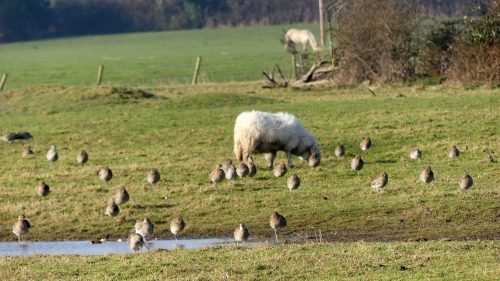
February 2017-Sharing with sheep

On the plus side, it’s conveniently close to the shore & a short flight gets them them there in minutes.The ground here is probably rich in invertebrates as the animals keep the ground well manured, and much of it it floods easily and holds the moisture, keeping it soft for probing with their long bills. 
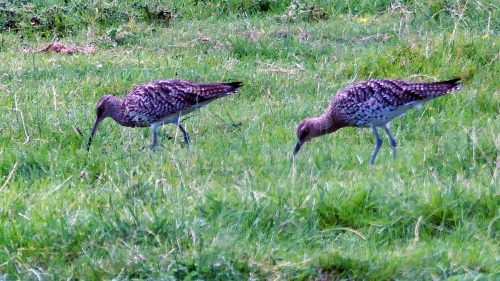
The birds must feel safe here too, when not foraging the flock takes time out  to rest and preen their feathers.

Curlew resting, preening & bathing

They seem to be here during times of high tide when there is no accessible shoreline for foraging. They seem to instinctively know the exact moment the tide is optimally in or out and some trigger suddenly alerts them to take off as one and head back there.

Heading back to the shore

Maybe that’s all there is to their choosing this spot, but it could also be connected to the past history of the land within which the field is located. Going back to the beginning, a clue lies in the meaning of the name of the village, Rhos-on-Sea, or more properly Llandrillo-yn-Rhos: the Welsh word rhos, translating as ‘marsh’. In the distant past, before the construction of sturdy sea defences, high tides would have reached further inland than now and flooded much of the low-lying ground here between it and the hills, forming an extensive salt marsh. The flat area between the Little Orme and Bryn Euryn, from where I took the photograph below is the northern end of the valley of the Afon (river) Ganol, once a significant river which flowed into Penrhyn Bay and also into the tidal river Conwy at its southern end. Along its length several small streams also fed into the river. 

July 2017-Looking down onto the ‘curlew field’ from Bryn Euryn

Looking down onto the well-ordered village of Penrhyn Bay with its network of roads and the modern-day golf course, it’s hard to visualise the wild place this once was, although following sustained heavy rainfall it is easier to see how wet it must have been.

January 2014 -Looking down on the flooded field where curlew, oystercatchers, redshank may be seen feeding amongst sheep

The Afon Ganol was by all accounts a dangerous tidal strait, and it formed a natural barrier rendering the land beyond the valley, then known at the Creuddyn Peninsular far more more isolated. Crossings were difficult; the river could be forded here, although the area was extremely marshy. Then in the 1800s, embankments were built at either end of the valley to allow land reclamation.

The effort and work undertaken to drain the marsh must have been massive, and hugely expensive, but by 1912 the OS map shows the Afon Ganol as being culverted under the Llandudno Road to the golf links, with a culvert going out to sea, but with still a large marshy area remaining. The establishment of the golf links then required further improvements to drainage and a new outlet for the diverted river was constructed. Dug 2′ below the bed of the river and the link’s ornamental lakes, this outlet then enabled the river and the lakes to be emptied during intervals between tides, keeping the golf course dry.
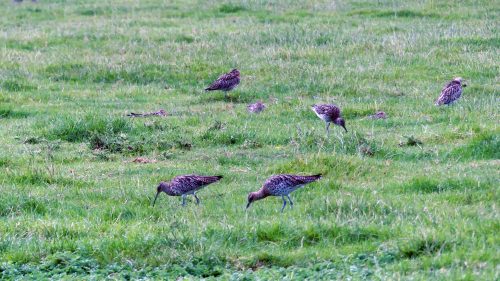
Today the Afon Ganol remains as a culvert with tidal outfall structure, which was updated in 2011 to decrease the risk of flooding.

A section of a remaining water course bends around the back of the rugby field

Interestingly, although the original river is now just a meandering waterway and ditch, in part diverted and culverted, it remains still the county boundary between Conwy and Denbigh.

Welcome back Curlews, the place is not the same without you.


Share this:

  • Share on Facebook (Opens in new window) Facebook
  • Share on Pinterest (Opens in new window) Pinterest
  • Share on X (Opens in new window) X
Like Loading...

Parakeets in the Ash Tree

25 Tuesday Jul 2017

Posted by theresagreen in bird behaviour, Birds, Nature, Nature of Wales, nature photography

≈ 9 Comments

Tags

green parakeets in London area, Psittacula krameri, ring-necked parakeet, rosy-ringed parakeet

July 4th – Long Ditton, Surrey

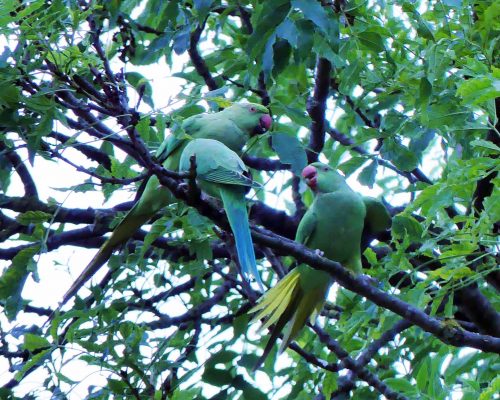
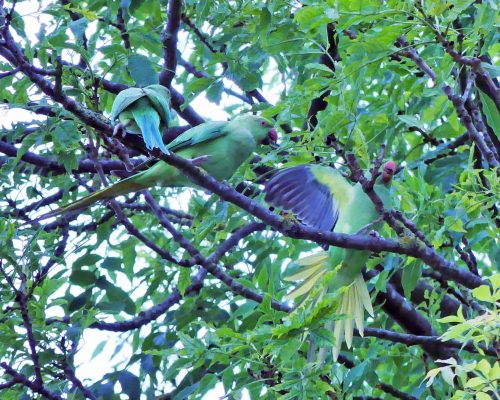
My granddaughter and I were in the garden playing in her new sandpit when we heard raucous calls and squawks coming from somewhere up high in a neighbouring ash tree. Despite the racket they were making it took a minute to visually locate the perfectly camouflaged trio of bright green parakeets that had landed there. I’m not sure what the commotion was about, but they seemed to be a family, I think an adult female with two young ones demanding food.

Nowadays, sightings of these ring-necked, or more prettily named rosy-ringed parakeets, are commonplace throughout the county of Surrey, particularly in those leafy suburbs of Greater London lying closest to the river Thames.

Tales of how they first arrived and set about colonising the area are as colourful and as exotic as the birds themselves. One tells of a small number of the birds escaping from a film set at Shepperton Studios in 1951, during the making of ‘The African Queen.’ (which starred Humphrey Bogart and Katharine Hepburn, in case you’re way too young to remember that one!).

Another, less likely perhaps, but more appealing to me, is that they were released back in the 60’s by the legendary rock guitarist Jimi Hendrix, who allegedly brought them to Britain and released them, ‘ to bring some psychedelic colour to London’s skyline’, (perhaps whilst playing ‘Little Wing’?).

Then for our younger viewers, it is rumoured that a pair were released by the Blue Peter cast into the Blue Peter garden as recently as the 1990’s.

The truth of their introduction to British wildlife is likely to be far more prosaic and plausible. Parakeets have been popular pets since Victorian times and inevitably many birds will have escaped or even been deliberately released over the years, although the latter is technically illegal. A number of them are known to have escaped from aviaries across the south of England. During the Great Storm of 1987, some made their getaway from Northdown Park, in Kent, and it is rumoured that a piece of a plane’s fuselage dropped onto an aviary near Gatwick, giving more the chance to fly the coop.

Ring-necked Parakeet or Rosy-ringed Parakeet Psittacula krameri : Welsh: Paracit torchog

There is no doubt the parakeets are now well established in Britain and are recorded as our only naturalised parrot. In January 2017 the BTO estimate was of 8,600 breeding pairs and their status given as ‘introduced breeder’. The greatest concentration of numbers are in Greater London and Kent, with smaller numbers in Birmingham and Oxford and further north in Manchester. They are especially common in suburban parks, large gardens and orchards, where food supply is more reliable. The birds feed on a wide variety of fruit, berries, nuts, seeds and grain, have discovered bird feeders in gardens and have few natural predators here.

Until recently, the parakeets were generally considered a welcome addition to the county’s wildlife, and though their squawking and squabbling may have caused consternation to some, most people have enjoyed the sight of the colourful birds flying around. However, concerns have arisen about their population explosion and its potentially damaging effects on the country’s indigenous bird species, which has led to calls for stricter control over the colourful newcomers. In 2009, Natural England added the species, the UK’s only naturalised parrot – to its “general license”, meaning it can be culled, in certain circumstances – such as if they are causing damage to crops. The change gives them the same legal status as pigeons, crows and magpies.

As an occasional visitor to London, I love to see and hear them and they’re big, noisy, colourful and pretty to look at – a great way to get my two year old granddaughter to start noticing the local wildlife!

Parakeet spotting: Most likely places

Bushy Park, Richmond; Hampton Court, East Molesey; Kew Gardens, Kew; Nonsuch Park, Ewell; Richmond Park, Richmond; River Thames at Chertsey; River Thames at Staines; River Thames at Walton on Thames; Selsdon Park, Sanderstead 


Share this:

  • Share on Facebook (Opens in new window) Facebook
  • Share on Pinterest (Opens in new window) Pinterest
  • Share on X (Opens in new window) X
Like Loading...

A Warbling Whitethroat

23 Friday Jun 2017

Posted by theresagreen in birds singing, Birdwatching on North Wales coast, Little Orme, Nature of Wales, Wildlife of the Wales Coast Path

≈ 10 Comments

Tags

birds singing, Llwydfron, sylvia communis, whitethroat

I saved this treat from the end of my walk on the Little Orme as I thought it would be better enjoyed on its own.

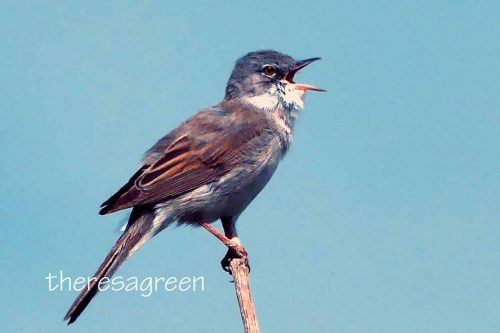
I heard the Whitethroat singing from somewhere in front of me, obscured from immediate view by gorse bushes and a bend in the track. I walked forward slowly and there he was, at the top of another bare stem, this time of Elder. A perfect, close, unrestricted view of him warbling away, declaring himself king of all he could survey, which is a great deal from where he was perched, to whom-so-ever it may concern.

The Whitethroat is a summer visitor and passage migrant to Britain that may be seen in all parts of the country and most frequently choose arable land, scrub and reedbeds as nesting sites.  They arrive during April-May and leaving in late September-early October to winter in Africa, some heading as far south as South Africa.

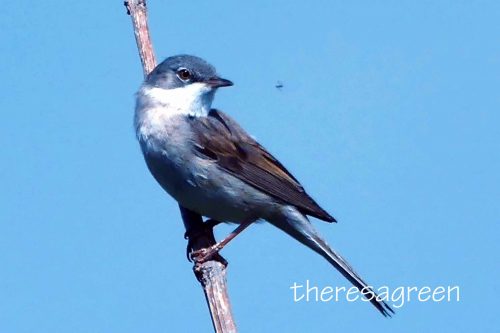
Whitethroat- Sylvia communis Welsh: Llwydfron

A medium-sized, long-tailed warbler, the male is grey, dusted with rust brown above, with bright chestnut-brown fringes to the wing feathers, the head is a pale grey, the breast pinkish-buff and the throat a bright white. The bill is greyish-brown and the legs are pale brown. The eye is pale brown with a white eye ring. Females are similar but brown on the head and nape where the male is grey.

Whitethroat singing

Warblers in general are often described as ‘skulking’, but the Whitethroat is not quite as secretive as some; the male will perch in full view to deliver its brief song with gusto.

I could see flies in the air around him, but he made no attempt to catch any of them, he was far more intent on singing although he did take a few short breaks to do a bit of preening. I think he had a bit of an itch.

I watched and listened for some time and took a few photographs before risking taking this short video, which is not the most professional you’ll have ever seen, but it gives more of the bird’s personality than a still. It’s better on full screen too.

The song is variously described as sweet, ‘scratchy’  and having a jolty rhythm. They are also very inquisitive birds and will venture to the top of a bush to investigate any intruders, before scolding them with a rapid churring call.

I hope you enjoy it as much as I did. You even got to share the atmosphere of the sunny, windy day!


Share this:

  • Share on Facebook (Opens in new window) Facebook
  • Share on Pinterest (Opens in new window) Pinterest
  • Share on X (Opens in new window) X
Like Loading...

Little Orme Level 2 and Higher

23 Friday Jun 2017

Posted by theresagreen in bird's nests, Birdwatching on North Wales coast, coastal wildflowers, Little Orme, Nature of Wales, North Wales, Rhiwledyn Nature Reserve, Wildflowers of Wales, wildflowers on limestone

≈ 10 Comments

Tags

bird's nests, Cormorant, cormorant colony, cormorants nesting, guillemot, moon daisy, ox-eye daisy, sea campion, swollen-thighed beetle, yellow dung fly

Cormorants flying overhead refocussed my attention and I began the climb up the steep slope to the next level of the cliff.

I didn’t get far before stopping to watch the Whitethroat I had been heading for pre-Chough. He was singing from an old bramble stem close by and was nicely visible apart from being seemingly garotted by a twiggy branch. Song done, he flew across the track into the base of a huge bramble shortly followed in by his mate coming from the other direction, carrying food in her beak. So this is where they are nesting, no doubt tucked low down in the protective thorny thicket.

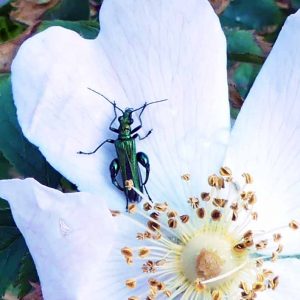
About half-way up I welcomed the excuse to pause, granted by the sight of another Swollen-thighed Beetle, this time a male sporting a splendid pair of said swollen thighs.

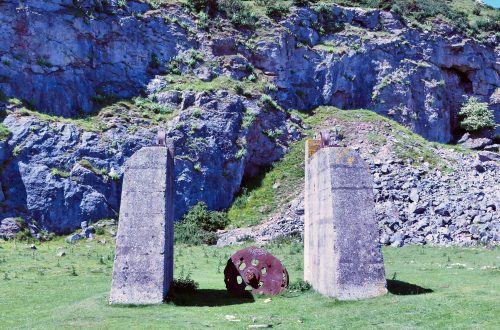
At the top is a reminder that the slope’s purpose was not originally as a walking track. Here stand the remains of supports and cogs for winding gear, once employed to steady trucks full of quarried stone on tracks down the steep slope, then to haul back empty ones.

TGLOVW-Winding gear remains at top of slope

This quarry face accommodates many nesting pairs of Jackdaws, whose cries often echo loudly around the bare stone cliffs. They were quiet today, the only sound made by a sheep bleating from the edge of the wall towering above. Clearly a mother, she may have been calling for her young one; I hoped he hadn’t been hauled off to market to end up as Welsh Spring Lamb in a butcher’s shop.

I took a very quick look at nesting Fulmars, didn’t want to disturb them so stayed well back.

Attractive birds with an elegant stiff-winged flight, it’s hard to believe they produce such a loud, rather harsh cry and that their tube-like nostrils are designed to allow them, inelegantly, to snort out salty water.

From up here you can look down on the flat quarried-out ‘Level 1’ of the site, with the cove of Angel Bay at its edge. The dry grassed areas are already showing signs of wear and tear.

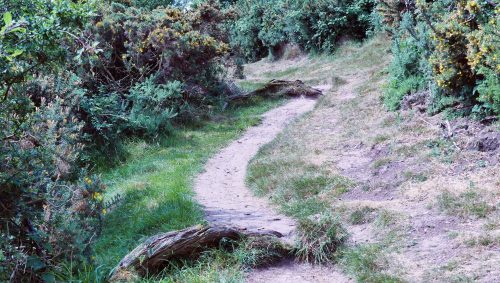
Onwards and upwards, following the track that is both on the routes of the North Wales Coastal Path and the national Wales Coast Path. It is heavily eroded in parts, and bridged by gnarled old roots, (or branches?) of gorse.

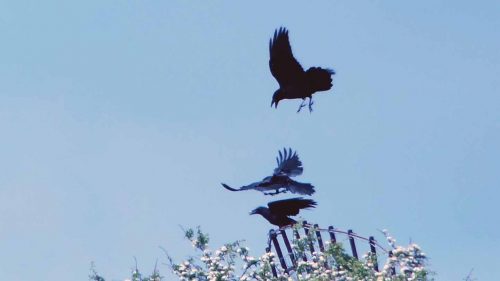
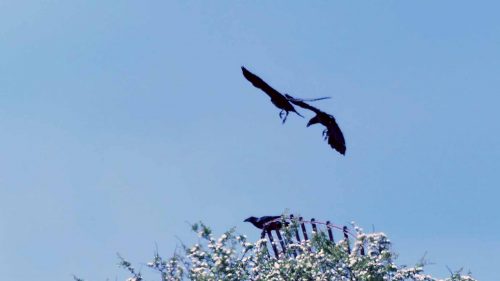
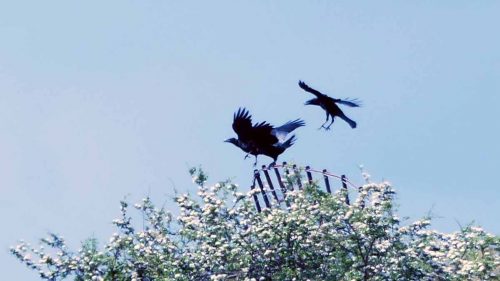
Ravens had made me aware of their presence since arriving here today, being more mobile and noisier than usual and as I ambled along this part of the track an outburst of their calls broke out from somewhere ahead of me. I had just seen birds harrassing what I assumed to be a Buzzard and thought that may have escalated into a bit more of an incident. Getting closer I saw three birds having a bit of a to-do; two of them seemed to be attacking a third that was sitting atop a fence. Not a Buzzard.

I was still too far away to see properly, but this may have been a pair of Raven upset with an intruding one. Does it have something in its beak in the first picture, an egg maybe? I have no idea but they took off from here and continued to express their annoyance from the field below for some time.

None the wiser as to what I’d witnessed I carried on, scanning the track ahead of me, as I am wont to do at this time of year, checking for sheep poo; you never know when there may be something interesting dining out thereon. I got lucky, a fairly fresh deposit yielded a little male Yellow Dung-fly. In an awkward spot to photograph, I had no option than to kneel down in front of the dung, then almost had my nose in it to get him in close up without using the lens zoom, quietly hoping no-one came along the path to witness my odd behaviour. It was worth it; I realised he hadn’t flown off as he was otherwise occupied with a lady Dung-fly. Females are far fewer in number than males, so there was no chance he was leaving, whatever I was doing.

Yellow Dung-fly pair mating
Same image but bigger

THE CORMORANT COLONY

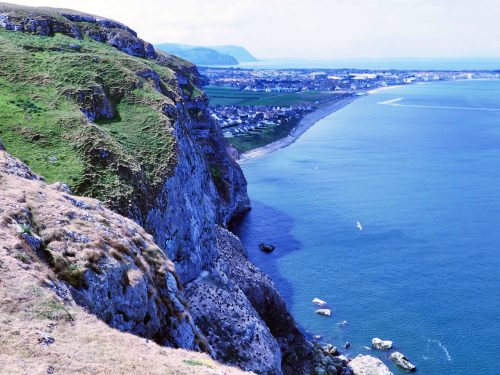
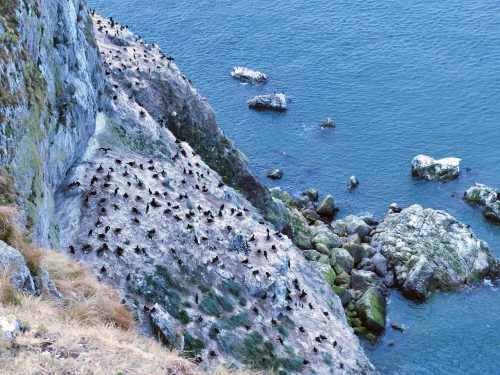
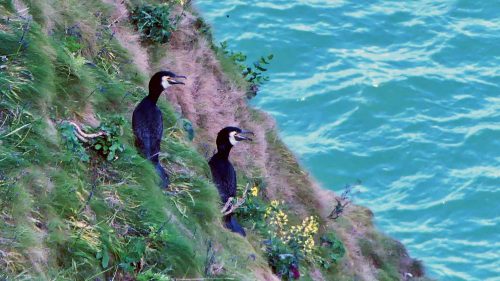
Reputedly the largest Cormorant breeding colony in the British Isles, this is an impressive sight, even from this distance and this is only a part of it; it continues around to the other side of the rocky outcrop in the photograph below, where there are even more of them.

I’ve shown this aspect of the Cormorant colony several times before, but this is the first time I’ve visited it at the right time to catch the birds on their nests. I was thrilled to get a glimpse of young birds in some of the nests; Cormorants usually lay 2-3 eggs, and from those I could see most seem to have hatched and grown successfully, so there must be plenty of food available locally to keep offspring and parents well fed.

Some of the young birds seemed a bit more advanced than others and were already out of the nest exercising their wings, but many birds were still sitting.

The bulk of the colony is not as easy to see, and viewing the birds involves a bit of rambling up and down the uneven cliff top, then peering down from cliff edge, but it is well worth the effort. The photograph below shows the colony to be situated well out of reach of nosy people.

Around the rock I was now upwind of the birds, so as well as amazing sights and sounds I was greeted with the equally amazing smell produced by a large number of fish-eating birds confined to a relatively small space. I wish I could share it with you!

But pungent aromas aside,the colony on this side holds another treat; right in its centre is another smaller colony – of smart little penguin-like Guillemots. Surrounded by the much bigger Cormorants I imagine it is a safe haven for them from potential predators such as gulls and the Cormorants seem perfectly accepting of them.

Cormorants and Guillemots sharing fishing space on the rocks below. There were many more birds of both species flying back and forth and hunting and diving in the water too. Cormorants stay separate but Guillemots often join together in ‘rafts’ floating on the surface of the sea.

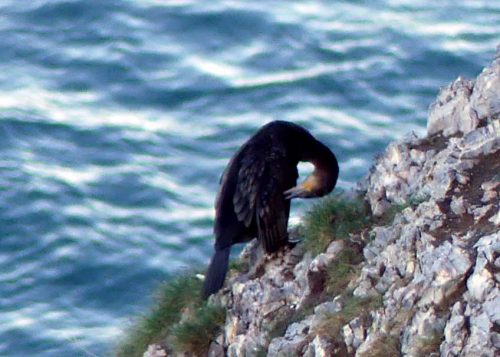
These two birds, who I fancied were enjoying some fresher air away from the colony, is my favourite Cormorant image from the day. The birds weren’t making a sound; they gape their beaks as a means of cooling down their bodies, but it seems like they’re commenting on something out at sea. Possibly the ever-encroaching turbines of the wind farm, or maybe they were sureying for likely fishing spots. 

It was a sunny day with some cloud and really strongly windy, particularly noticeable up here at the top of the headland on its sea-facing edge, but the elements’ combined effects on the water was breathtaking. I sat for some time watching the ever-changing patterns of light and shade on the surface of the blue sea as the wind rippled across its surface and clouds cast shadows above it. It really was the colour of the photograph below and quite mesmerising.

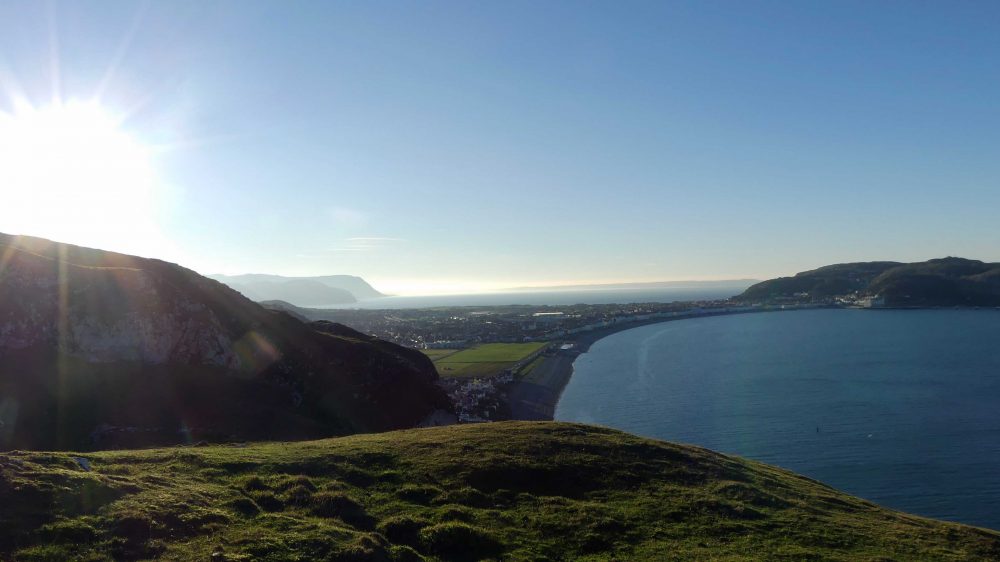
View from the Little Orme across Llandudno Bay to the Great Orme

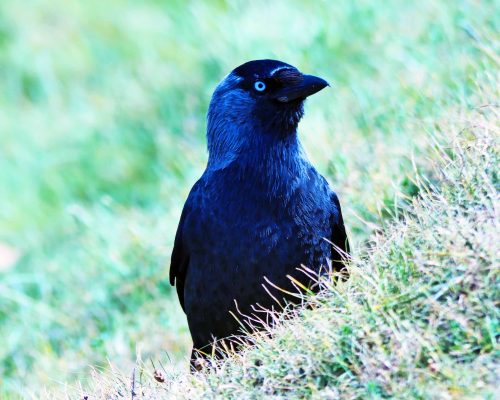
Birds flew past the cliff at eye level; mostly Herring Gulls, but one Greater Black-backed gull too, and a Raven gronked a greeting as he passed by; all strong birds gliding effortlessly on the wind and thermals created by the cliff face. A Rock pipit popped up over the edge briefly but popped down again when he spotted me. A Jackdaw also appeared over a ridge, but disregarded me completely and carried on foraging within touching distance, even posing for a portrait.   

THE CLIFFTOP

Returning to the main track I passed a ewe and her lambs who had found a shady and sheltered place to rest with her lambs.

I watched a 7-spot ladybird scrambling through the mossy turf. Grazed by sheep and rabbits, baked by the sun and exposed regularly to strong, salt-laden winds anything that survives here has to be tough, especially the flora. Amongst the toughest of our native flora are the thistles, the two most common species of which thrive here.

The Creeping thistle has already begun flowering and even up here was being visited by bumblebees and a wind-blown Red Admiral butterfly.

The other is the fierce-looking Spear thistle with its aptly-named long sharp spikes protecting its every part, which has flower buds almost on the point of opening now.

170527-TGLOFW-Spear thistle fierce leaves
170527-TGLOFW-Spear thistle flower buds

On the ledge beneath an overhanging rocky outcrop I was surprised to spot a clump of white-flowered plants. Getting closer I saw they were Sea campion and also Moon (Ox-eye) daisies with one of the best specimens of Salad burnet I’ve seen anywhere so far this Spring. I wonder how they got there?

Sea campion – Silene maritima

Going back down I took a photograph to remind me to say that although fading fast there is still gorse in flower and also hawthorn, but the main blossom plant now is the creamy white elder.

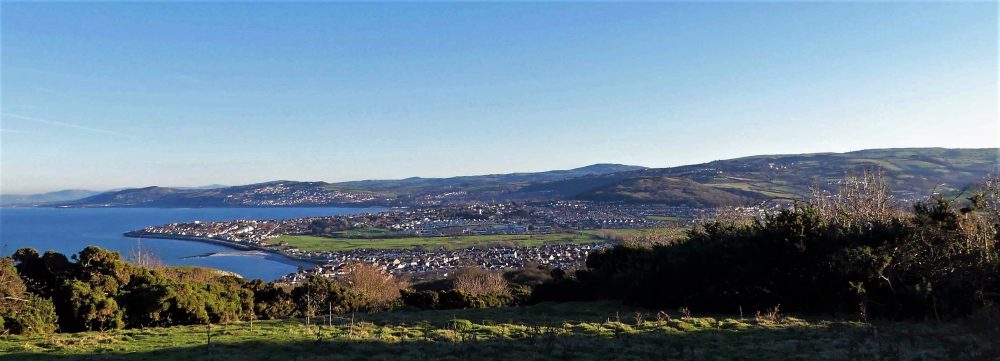
And another to remind myself that I can never tired of looking at this view across Penrhyn and Colwyn Bays, even when on hot days like this one much of the distance is lost in a haze.


Share this:

  • Share on Facebook (Opens in new window) Facebook
  • Share on Pinterest (Opens in new window) Pinterest
  • Share on X (Opens in new window) X
Like Loading...

The Lonely Purple Sandpiper

14 Tuesday Mar 2017

Posted by theresagreen in bird behaviour, Birdwatching on North Wales coast, Nature of Wales, nature photography, Rhos Point, Wales Coast Path

≈ 8 Comments

Tags

calidris maritima, dunlin, overwintering birds, Pibydd Du, purple sandpiper, purple sandpiper at rhos-on-sea, redshank, Rhos Point, Turnstone

February 17th

Rhos Point will soon become a quieter place as the wading birds that arrived during last late Summer and the Autumn leave us and head back to their more northerly breeding grounds. Each year Turnstones come in a fairly consistently sized flock of about 60 birds and I think it’s likely that a more unusual visitor – one that draws birdwatchers here to search for it – arrives amongst them; the Purple Sandpiper. I’d met people claiming to have seen them here earlier in the winter, but I hadn’t had even a glimpse. Until today. Taking my baby granddaughter out for some very fresh air on the Promenade, as always with one eye scanning the shoreline and one watching where I was steering the pushchair, I’d noted the tide was on the turn. Only a strip of the rocky shore below us was exposed and yet there were two people walking along it, chatting and following behind their loose and randomly wandering dog. I wasn’t thinking kindly about this as a) I don’t understand why anyone would risk their dog injuring itself on the slippery uneven surface and b) why they don’t notice or seem to care about the disturbance to any feeding birds. But in this instance they were quickly forgiven as the dog flushed a single elusive Purple Sandpiper from where it had probably been resting on the lower rocks of the rip-rap sea break.

It didn’t go far, just across to the smaller rocks on the edge ot the water where it stayed.March 1st

Having now seen where the Purple Sandpiper had been lurking during high tides I went back to try to see it again and whether there may be more of them. I’d waited until the tide was at its highest and soon spotted the Turnstone flock quite high up on the rocks

I enjoyed the lovely close sighting of these gorgeous little birds, but really wanted to see Purple Sandpipers. And there he was, on the edge of the group and still apparently alone.

A lonely little Purple Sandpiper. I stayed and watched for a while in case any others popped up, but no. He was the only one. I walked a little further on, still searching, but found only two Redshanks. Again, lovely close up view of great birds, but not the colour I was looking for.

PURPLE SANDPIPER – Calidris maritima; Welsh: Pibydd Du

The Purple Sandpiper is a winter visitor to almost any rocky coast in Britain and Ireland. They are widely distributed around the coast though they are most abundant in the northern isles – Orkney and Shetland and along the east coast of Scotland, north-eastern England and Devon and Cornwall and scarce elsewhere.

The Purple Sandpiper is a medium-sized wading bird, slightly larger, stockier and darker than a Dunlin. It is mainly dark grey above and whitish below. It has a slight down-curved beak and distinctive short bright orange legs. In flight it shows a thin white wing-stripe on otherwise dark wings.

Above photo: January 28th 2012-Purple Sandpiper with Dunlin – Rhos on Sea

World Distribution: BREEDS Arctic & Subarctic Eurasia & North America, WINTERS: south to S Europe and Southern US.

Diet: Invertebrates, also some plant material, often feeds on rocks near tide edge.

March 2nd

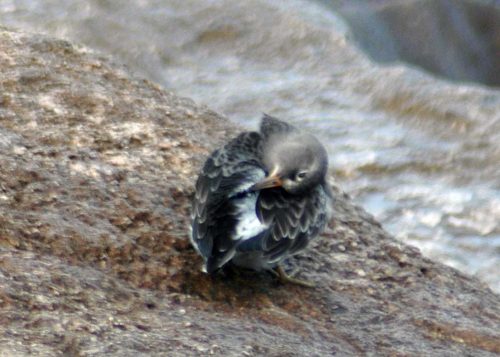
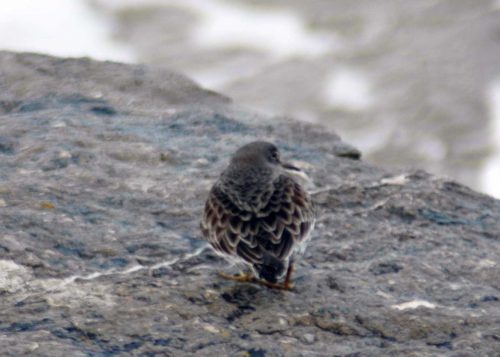
Back again for another look. I didn’t even have to search for myself as a serious photographer, in full camouflage kit and sporting a super-long lens had him in his sights, saving me the effort. Today he was completely alone, with not even a Turnstone for company. He was quite lively though, having a good preen then skipping around the rocks, splashed by sea spray and totally in his element. Still sad to see him all alone though.

Closer views of the active bird today better show the purplish tint to the plumage that gives the species its name.

Maybe next year he’ll bring some friends.

Purple Sandpiper is currently AMBER listed in the Birds of Conservation list based on a Non-breeding Population decline by more than 25% but less than 50% and a UK breeding population of less than 300 pairs.


Share this:

  • Share on Facebook (Opens in new window) Facebook
  • Share on Pinterest (Opens in new window) Pinterest
  • Share on X (Opens in new window) X
Like Loading...

Keeping up with the Herring Gulls

10 Friday Feb 2017

Posted by theresagreen in bird behaviour, Birdwatching on North Wales coast, Nature of Wales, Rhos-on-Sea

≈ 9 Comments

Tags

birds of conservation concern, European Herring Gull, Gwylan y Penwaig, herring gull, herring gull breeding behaviour, herring gull foot-paddling, herring gulls nesting on roofs, larus argentatus

January 9th – Chimney Pots, Rhos-on-Sea

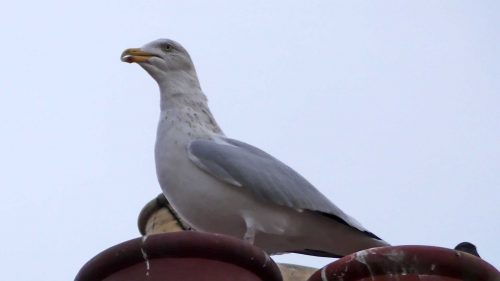
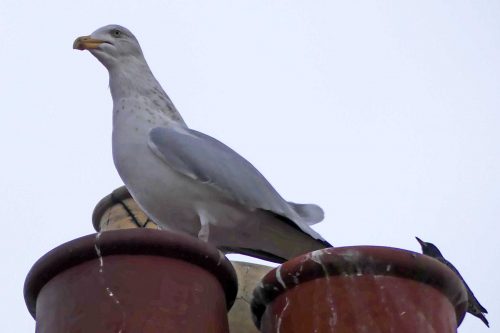
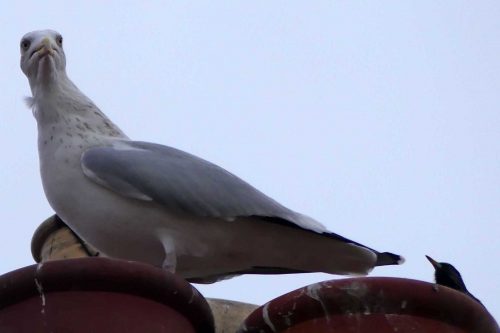
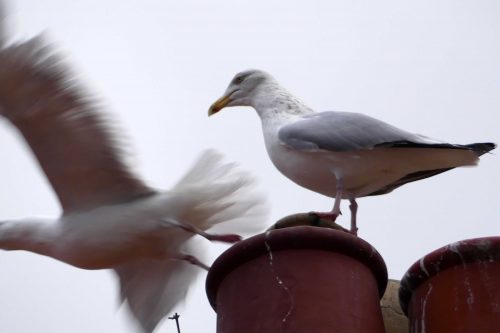
After a few months of being relatively quiet and peaceful, our Herring gull neighbours are back and making their presence heard and seen throughout the village. Pairs stake out their territories early in the year and will defend them vigorously and vociferously from now until nesting begins, continuing to do so until this year’s offspring have grown and are mature enough to leave the site. It all looks and sounds like a lot of effort and hard work, but that is the price this pair are prepared to pay for a prime high-rise site.

170109-rosrc05-herring-gull-pair-defending-nest-site

These particular chimney pots are atop my daughter’s 3 storey house, offering well-elevated accommodation and boasting unrivalled 360° views extending over rooftops and the surrounding landscape, which includes the sea. It is a mere two-minute, maybe less, flight to the seashore. Both the male and female of the pair take responsibility for defending the site, sometimes together and sometimes on their own. They must need to take frequent breaks to restore their energy levels after a bout of meaningful squawking at the sky.

10: 29 – Female flies to roof edge, has a quick look around then takes off,

170109-rosrc03-herring-gull-on-roof-edge

leaving the male in charge. I didn’t notice while I was taking these photographs, but he was not left entirely alone. To my amusement, a male Starling had his back. He has located his family home in the eaves of the adjoining property.

170109-rosrc09-herring-gull-male-starling

He seemed to have his work cut out, although from where I was standing in the garden I couldn’t see what or who he was directing his attention towards.

170109-rosrc06a-herring-gull-male

I couldn’t quite catch him in full squawk this morning, but he was making plenty of noise. He is still sporting his winter plumage and appears to be in pretty good shape, but he’s not a young bird. When I looked at my images I recognised him by his eyes, or rather by the lack of feathers around his eyes as the male of a pair I spent a lot of time watching back in the spring and summer of 2012.

170109-rosrc06c-herring-gull-male

As you can tell from the next couple of images he is looking a bit scrawny around the neck area, not as plump and well-filled out as he was back in the day.

170109-rosrc07-herring-gull-male-starling

Herring gulls breed for the first time at age 4 and a typical lifespan is 12 years. The oldest recorded Herring gull (from ringing records) was  32 years 9 months and 25 days old. This record was set in 2013. 

170109-rosrc08-herring-gull-male-starling

10.39am – the female arrives back with a flourish and lends her voice to the warning-off aria.

170109-rosrc12-herring-gull-pair

he may be older, but clearly still has got what it takes to attract a mate and this one appears younger. It must be something to do with the status of his domain.

170109-rosrc13-herring-gull-pair

170109-rosrc14-herring-gull-pair

10.40 – She’s a bit on edge though and leaves again a minute later, I think she was chasing off another gull from their airspace, perhaps a rival female. It started to rain quite heavily then and he left shortly afterwards too.

170109-rosrc15-herring-gull-pair

Then and now

This is a head shot of the male showing his ‘scabby’ eyes taken this January

170109-rosrc06c-herring-gull-male-scabby-eye

and below is one I took on July 24th 2012. He’s in his brighter summer/breeding plumage here, but had the ‘scabby’ eyes even then. It’s too much of a coincidence for it not to be the same bird isn’t it? He was considerably better-padded then too. If 2012 was his first year of breeding he would have been 4 plus the 5 years from then till now would make him 9, but I think he could be older.

7-1912tgnw-adult-gull-front-view

This was him and his mate in full squawk back then, after they had successfully reared a chick that had fallen out of the chimneypot nest and landed on the flat roof below. More about that here:   https://theresagreen.me/2013/06/20/theres-a-new-gull-on-the-roof

7-1912tgnw-adult-pair-one-squawking-one-sitting

He was and I’m sure, still is a brilliant and attentive parent, bringing regular and diverse meals back to his hungry youngster. Including a starfish and regurgitated chips.

7-2412tgnw-adult-gull-with-starfish-2

January 24th 2017

Back to the present. I was out taking my baby granddaughter for a walk along the prom and spotted this chap paddling for worms on the grass embankment. Old scabby eyes himself.

170124-rosprm-herring-gull-paddling-for-worms-scabby-eye-2

The Herring gull remains on the RED list of European threatened birds and it is illegal to harm them or damage or remove their eggs from nests.


Share this:

  • Share on Facebook (Opens in new window) Facebook
  • Share on Pinterest (Opens in new window) Pinterest
  • Share on X (Opens in new window) X
Like Loading...

Sights & Sounds of the Little Orme (2)

08 Wednesday Feb 2017

Posted by theresagreen in birds of Wales, Birdwatching on North Wales coast, Little Orme, Llandudno, Nature, nature photography, North Wales, North Wales Wildlife Trust, Rhiwledyn Nature Reserve, The Wales Coast Path

≈ 7 Comments

Tags

common buzzard, disease in wild rabbits, hawthorn, jackdaws on cliff, kestrel, mobbing of buzzards, Myxomatosis, rabbit, raven

January 20th – Little Orme – Upper reaches

I‘d spent longer watching the seals than I had intended, so almost talked myself out of doing some proper walking and heading up to the summit. It was cold, the sun was already sinking lower in the sky and I knew the upward tracks were going to be muddy. But one of my aims for this outing had been to check to see whether or not the cormorants had begun nesting yet, so onwards and upwards it was.

At the bottom of the steep upward slope, Rabbit Hill to locals, a bird sat perfectly still at the top of a smallish ash tree. The sun in my eyes was so bright I could only see it as a black shape, so made another assumption that as this is about the highest point on this windswept clifftop and a favoured perch for crows, magpies and jackdaws, that it was a corvid. Only when I lightened up the photograph I took did I realise it had been a Kestrel.

170120-lo-75-1533-kestrel-1a

The bracken and brambles that covered the slope to the landward side of the track have been cut back hard; this vegetation provides cover for a variety of small birds, including resident Stonechats and Whitethroats that come here for the breeding season. I’m sure it will have grown up again by the time they arrive.

170120-lo-130-bracken-scrub-cut-back

I was right about the mud! It was almost take one step forward and slide back two. I pictured my walking pole lying uselessly in the boot of my car. I should use it more often, but it gets in the way when I want to stop and take a photograph. I took a breather to turn and photograph the view; no matter the number of times I have done it, it’s just so amazing I can’t resist. The spit of land projecting finger-like into the sea is Rhos Point and despite the hefty sea defences I know it has in place, it looks so vulnerable from here, perhaps more so to me because it’s where my daughter and her family lives and I can pick their house out from here!

170120-lo-76-rhos-point-from-the-orme-1a

At the top of the slippery slope is a levelled area where much of the stone was quarried out. The cliff wall at the back of this now grassy area is Jackdaw city, with many pairs of birds nesting in its nooks and crannies. You realise how many of them there are when the Buzzards glide into the airspace above and numbers of them suddenly zoom up and surround them, determinedly driving it away while making a heck of a racket.

170120-lo-74-gulls-jackdaws-upped-1a

(click on image to enlarge)

Herring gulls often join in the mobbing party too; it may seem that they prefer roofs and chimneys to nest on, but some do prefer the more traditional option of a bit of cliff. It’s interesting that although they may rob other birds of their eggs and chicks, they’ll join forces to drive off  any potential predators of theirs. It’s not too clear from my photograph who’s who, but one Buzzard is very slightly left of centre  and the other approaching the far left, with defending birds approaching mainly from the right. Poor old Buzzards, every other bird picks on them, even much smaller Starlings!

170120-lo-72-gull

The edge of the cliff is crumbly and eroding but is a favourite spot for Jackdaws to sit and look down on the lower levels of the headland. There were several pairs sitting doing just that this afternoon, probably ones with nest sites nearby on the cliffs of the lower level.

170120-lo-80-jackdaw-pair-on-cliff-edge-1a

I took a photograph looking down into Angel Bay from up here; it looked as though quite a number had moved off.

170120-lo-73-a-higher-view-into-the-bayOne of my favourite sights is golden gorse flowering against the background of a blue sea.

170120-lo-82-1544-gorse-view-1a

It’s always sad when a tree dies, but the skeleton of this Elder is now beautifully adorned with lichens and a fungus, which I’m sure is now past its peak. I’m not great on fungi, but I do know the one most closely associated with the Elder is Jew’s ear or jelly ear Auricularia auricular-judae; is it that Annie? I wish I’d seen it earlier.

170120-lo-83-fungus-and-lichen-on-old-elder-tree-1a

The grass up here is grazed by sheep and further nibbled by rabbits, so is always neat and well-groomed. The path curves into this small clearing that looks almost like a cleverly landscaped wild garden designed to lead you to the stunning vista.

170120-lo-87-clifftop-path-view-1a

click on image to enlarge

The nearest rounded hill is Bryn Euryn which I’ve walked you around many times and shown views from there to here, but you can see they would be a fairly short flight away from one another for Buzzards, which nest on Bryn Euryn, and Ravens which regularly overfly both.

170120-lo-92-1557-bryn-euryn-from-little-orme-1a

Some of the hawthorns here still have good crops of berries.

170120-lo-88-hawthorn-berries-and-sea-1a

And there is lots of glorious golden fragrant gorse.

170120-lo-93-glorious-gorse-1a

Another wider view from higher up over Colwyn Bay and towards the Clwydian Range of mountains where Offa’s Dyke begins.

170120-lo-95-view-from-little-orme-over-rhos-and-surrounding-area-1a

click to enlarge

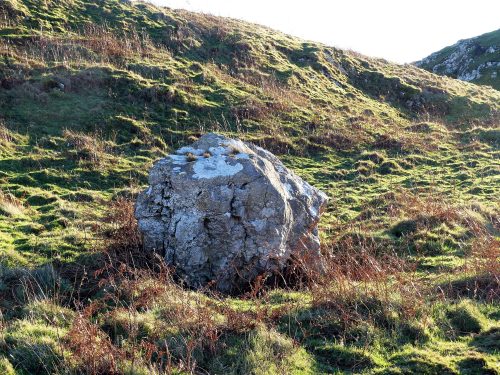
The low sun gives a wonderful texture to the rough grass and rocks. I always wonder how rocks such as this one arrived where they are, but this one I use this one to recognise the point where I leave the path and approach the cliff edge, extremely cautiously, to get a better view of the site of the cormorants’ colonial nesting site.

170120-lo-96-rock-on-cliff-path-1a

They don’t appear to be doing much yet, in fact there were just two there when I first looked, although a few more did fly in to join them as I watched.

170120-lo-98-1605-cormorant-on-cliff-1a

170120-lo-100-cormorant-on-cliff-face-1a

170120-lo-107-great-orme-pier

The Great Orme – click to enlarge

I climbed up a bit higher to admire the view across Llandudno Bay to the Great Orme. The pier looks toy-like against its great bulk.

The sun had dropped further and was almost hidden by the highest part of this headland to my left. The view from here is across Llandudno town to Anglesey and the bulky headland of Penmaenmawr. If you were looking at this as a walker of the Wales Coast Path travelling in this westerly direction, you could roughly trace your onward path and see where you would be in a day or so’s time.

170120-lo-108-great-orme-penmaenmawr

Llandudno Bay, town and beyond – click to enlarge

Low light lends a different atmosphere to this place, especially when you’re alone and have an imagination such as mine. Rocks cast shadows and a solidity not as apparent in bright sunlight. I wonder how it looked before its bulk was reduced by quarrying? Are these squared off rocks remnants from that time or were they deliberately placed before then for some other purpose.

170120-lo-111-stone-blocks-near-summit

170120-lo-112-stone-blocks-at-top-of-orme

The remnants of  a dry stone wall lead the eye to the wonderful view.

170120-lo-113-stone-wall-view-from-top-of-orme-1

click to enlarge

Then  there are Hawthorn trees, contorted into wonderful shapes by the strong prevailing winds and features long associated with tales of witches and magic……

170120-lo-114-hawthorn-tree

Even in broad daylight I wonder about the spot in the image below. I can easily imagine as some kind of mystical meeting place guarded by the trees and I know that as a child I’d have found a way around the fencing and sat on the top of that little hummock letting my imagination run riot, most probably giving myself nightmares.

170120-lo-126-hawthorn-stand

I fancy other mystical markers – a  hawthorn branch heavily covered with lichen that reaches out over the track and frames the view.

170120-lo-127-lichen-covered-hawthorn-twig

and a little tree well covered with lichens and further embellished with sheep’s wool.

170120-lo-122-hawthorn-wwith-lichens-sheeps-wool

The atmosphere is further enhanced by a pair of Ravens, companions of witches and wizards,  ‘gronking’ as they passed overhead.

170120-lo-117-raven-flying

And a rabbit, moving strangely slowly around behind the wire fence. It didn’t bounce away from me like rabbits usually do and I wasn’t sure if it was just old or not well; its eyes looked strange and it may not have been seeing properly, if at all. It put me in mind of rabbits we used to see years ago with Mixomatosis, but is that still around? (see footnote)

170120-lo-115-poorly-bunny

A chaffinch foraging around in the gorse and blackthorn scrub led my eye to this sunlit spider’s web and distracted me from further over-imaginative thoughts!

170120-lo-119-spiders-web-on-gorse-1

Had a bit of a slithery walk down Rabbit Hill then headed back to leave the site. I took the path closest to the cliff edge to avoid oncoming late afternoon dog-walkers and spotted this bird sitting on the top of a gorse bush seemingly looking out to sea. Once again the sun was obscuring it from proper view but there was no mistaking this was a Kestrel, a young one I think. It was very cold now but the bird was sitting perfectly still with its feathers fluffed out.

170120-lo-131-kestrel-looking-out-to-sea

I risked walking back around to get some better lighting, expecting it to fly off, but although I think it was aware of me it stayed put. I did get to a point with a better view – and the camera battery died! Time to go.

170120-lo-138-kestrel-looking-out-to-sea-2

More about Myxomatosis

When I wrote this post and mentioned the ‘poorly’ rabbit I had seen, I hadn’t realised that the horrible disease,  Myxomatosis, was still present and affecting rabbit populations in the UK. As a country-bred child back in the ’60s, I remember seeing many affected rabbits which I found distressing, and as the poor rabbits were sick they were easily caught by our cats, who didn’t kill them, but did bring them home. I also didn’t know then that it could be passed on to pet rabbits; now they must be vaccinated against the disease.

The disease called Myxomatosis reached the UK in 1953, where the first outbreak to be officially confirmed was in Bough Beech, Kent in September 1953. It was encouraged in the UK as an effective rabbit bio-control measure; this was done by placing sick rabbits in burrows, though this is now illegal. As a result, it is understood that more than 99% of rabbits in the UK were killed by the outbreak. However, by 2005 – fifty years later – a survey of 16,000 ha (40,000 acres) reported that the rabbit populations had increased three-fold every two years, likely as a result of increasing genetic resistance, or acquired immunity to the Myxomatosis virus. Despite this, it still appears regularly at rabbit warrens.

If you’ve never seen an affected rabbit, I can’t stress how awful it is. Initially the disease may be is visible as lumps (myxomata) and puffiness around the head and genitals, which progresses to acute conjunctivitis and possibly blindness; this also may be the first visible symptom of the disease. The rabbits become listless, lose appetite, and develop a fever. Secondary bacterial infections occur in most cases, which cause pneumonia and purulent inflammation of the lungs. In cases where the rabbit has little or no resistance, death may take place rapidly, often in as little as 48 hours; most cases result in death within 14 days. Not a good way to die.

Wild rabbits tend to recover quickly once the disease has passed; a certain density of rabbits is needed to keep the disease going and once the number of rabbits drops below that level the disease will disappear until the rabbit numbers increase again.

Share this:

  • Share on Facebook (Opens in new window) Facebook
  • Share on Pinterest (Opens in new window) Pinterest
  • Share on X (Opens in new window) X
Like Loading...

Everyday Birds – The Blue Tit

29 Sunday Jan 2017

Posted by theresagreen in bird behaviour, bird folklore, birds of Wales, Nature of Wales, woodland birds

≈ 19 Comments

Tags

Blue tit, Blue tits taking milk from bottles, folk names for Blue tit, garden birds, melanism in Blue tit, Titw Tomos Las

Although blessed with visitors from a good range of species, Blue tits are without doubt the mainstay of my window birdwatching and  have given me hours of viewing pleasure. There are few moments in the day when there are not at least one or two to see and at certain times there can be a good few more; counting them accurately is tricky, they’re too quick and mobile. I admit I hadn’t noticed any difference in the numbers of birds I’ve been seeing this year compared to previous years, so I was surprised to learn that according to BTO records, on a national scale there are significantly less of them this winter.

170111-tgbd2-blue-tit

Throughout the UK Blue tits have always ranked amongst the most numerous of our garden feeder visitors, but last November (2016) BTO Garden BirdWatchers reported the lowest numbers of Blue Tits in gardens since 2003.  They say:

” The explanation for our missing birds can be found by looking back to the early summer. The wet weather across the breeding season, particularly in June, would have made it difficult for the adults to feed themselves and their chicks. Normally we would expect to see large numbers of newly fledged young come into gardens to seek food, but this year BTO Garden BirdWatch results show the lowest numbers of Blue Tits in August for eight years. This indicates that fewer young birds survived than usual this year and these findings are supported by the preliminary results from the BTO Nest Record Scheme (NRS) and Constant Effort Sites Scheme (CES) which found that Blue Tits had their worst breeding season on record, thought to be due to a lack of young birds this year.”

All the more reason to appreciate these endearing little birds and continue to help them out where we can.

161230-tgbd-blue-tit-looking-face-on

English name Blue tit Scientific name Cyanistes caeruleus (formerly Parus caeruleus), Linnaeus, 1758; Other names Eurasian Blue tit, European Blue tit Welsh Titw Tomos Las Conservation Status: UK: GREEN

161012-blue-tit-2

Blue tits are tiny birds, measuring 12 cm (5″- 6″) long and weighing in at just 11 grams.

Blue tits are small. acrobatic birds with a gregarious nature, they have short legs and a sturdy bill which suits their omnivorous diet of mostly insects and spiders in the summer and a wide range of fruit and berries in autumn and winter.

The wings and tail feathers are bright blue and the back is olive-green. The underparts are yellow with a greyish-black stripe running down the belly which is usually narrow, but can vary. The cap, or crown, is a stunning bright blue. The face is a clean bright white accented by a narrow black stripe that runs through the eyes, there is a black chinstrap and a small black ‘bib’ under the bill. Males and females are the same, but males show brighter blue than females. Like all birds, Blue Tits can see ultra-violet light: the bright blue feathers on the front of their heads glows brightly under UV light and it is the quality of this feature that is thought to be the deciding factor in the females’ choice of partner.

170111-berc06-blue-tit

It may seem to us that only a dozen or so Blue Tits use our garden feeding stations in the winter, but the truth is there could easily be many times this number passing through during the course of a single day. Blue Tits are largely sedentary in their habits, but studies of the local movements of British and Irish Blue Tits have shown that birds range over an area and move around in small flocks, or feeding parties, that often include other tit species, Goldcrest, Nuthatch, Treecreeper and even the occasional wintering Chiffchaff.

161115-dcrc-blue-tit-2

A Stranger Passing through

As one Blue tit looks pretty much like another, it’s almost impossible to tell who is who, so spotting through-visitors is tricky. But earlier this week  I happened to spot an individual that looked ‘different’ to the ones I usually see.

250117-blue-tit-with-dark-brow-9a

Looking at him through the camera lens I could see he had an unusual dark patch of feathers above his beak and between his eyes and also a band of darker feathers around the top of the breast, giving it a slightly dirty appearance. This is the first Blue tit I have seen with darkened plumage, but the condition, known as melanism is apparently not that uncommon, although more common in the related Great tit. He didn’t stay for long as he was chased away by other Blue Tits. He must have stood out to them as looking ‘different’. (The BTO keep records of birds reported with abnormal plumage shown here.)

250117-blue-tit-with-dark-brow-4

 Acrobats

For the past couple of weeks I have been entertained by their acrobatic prowess as the small overhanging tree-of-unknown-species in front of my window has buds that are beginning to swell. This is their tree of choice in which to wait their turn for the birdfeeders down at ground level, to which they return to eat their snatched prize. Now they often have quick forage around the twiggy branches seeking out any lurking insects or larvae that may be hiding in them.

161015-berc-blue-tit-1

Blue tits are brilliant acrobats and can hang upside down from branches to search underneath them for insects. This agility and their light weight also enables them to search to the very tips of twigs.

250117-blue-tit-front

170111-berc043-blue-tit-finding-insects

The males are singing too – I photographed my first singer of this year on January 23rd.

170116-tgbd-blue-tit-singing

Blue tits and us

The Blue tit and other tit species were long known as the Titmice, a name taken from Middle English (Icelandic) ttr = small,  and mouse – in Old English mase=small bird. ‘Tit’ referred to any small object or creature and is of pre-7th century Norse origin. The first known use of ‘titmouse’ has been dated back to the 14th century and ‘Tom titmouse’ to around the 17th century. ‘Titmouse’ was used for this genus by most old authors, but Yarrell in his first edition shortened the name to ‘Tit’ and his example has been followed by many later authors.

The sheer number and variety of common and local variations of names bestowed upon them is a good indication that Blue tits have long featured in the lives of man. There is Blue Cap, Blue Bonnet (Shropshire & Scotland); Blue Ox-eye, Blue Spick (N Devon); Nun; Pedn-play, tree babbler (Cornwall); Pinchem (Bedfordshire); Tinnock, Yaup; Bee Bird (Hampshire); Willow Biter, Billy Biter (Midlands); Pickcheese (Norfolk); Tom Tit, Hickmall, Heckymal; Titmal (West Country.

161122-tgbe-blue-tit

Blue tits excel at problem-solving. Faced with intelligence test apparatus contrived by researchers, modern-day Blue tits have learnt to pull out a series of pegs or open matchbox ‘drawers’ to get at food. They have adapted readily to man and have been seizing opportunities to benefit from our lifestyles and habits for hundreds of years; sometimes this has worked out well for them but sometimes their opportunism has put them in harm’s way.

In the seminal account of English nature, The Natural History of Selbourne, which was  first published in 1788, Gilbert White records his observations on the tactics local birds used to survive (or in some cases not) during harsh winters:-

“The blue titmouse, or nun, is a great frequenter of houses, and a general devourer. Beside insects, it is very fond of flesh; for it frequently picks bones on dung hills. It is a vast admirer of suet, and haunts butcher’s shops. When a boy, I have known twenty in a morning caught with snap mousetraps, baited with tallow or suet. It will also pick holes in apples left on the ground, and be well entertained with the seeds on the head of a sunflower. The blue, marsh and great titmice will, in very severe weather, carry away barley and oat straws from the sides of ricks.”

161122-tgbe-2-blue-tits

Friend or foe?

It’s hard to imagine that Blue tits have not always been regarded with fondness and affection by everyone and were actually once thought of as ‘foes’ by many gardeners with fruit orchards. The following is an extract from one of my favourite old nature books, which according to the inscription in the front was given as a birthday gift in 1923. The chapter is entitled ” Attracting Wild Birds to Gardens” and written by Oliver G.Pike FZS, FRPS who was clearly already spotting the signs that our wildlife was in need of our support.

“I have watched the Blue Tit  and its mate busy on one of my apple trees in the month of April; they were carefully searching the branches for buds which contained insects, and these were quickly destroyed – that is, both bud and insect. They seemed to be doing a lot of harm, but I allowed them to continue, and later on in the year that same tree had a fine crop of excellent apples. So many gardeners see a bird destroying buds and immediately jump to the conclusion that it is a pest and ought to be destroyed. I knew one gardener who in the course of one season trapped and destroyed over fifty Blue Tits. He quite overlooked the fact that by doing this he was allowing for the increase of 100s of 1,000s of insects which would do far more harm to the crops. One pair of Blue Tits which succeed in bringing up their family of, say ten young, will during the period of feeding them account for not less than 10,000 insects, the majority of which are very injurious to many garden crops and flowers, and every one of these will be captured within 100 yards of the nest.”

150529dc-blue-tit-with-caterpillars-1

The successful breeding of chicks is dependent on sufficient supply of green caterpillars as well as satisfactory weather. Breeding seasons may be affected badly if the weather is cold and wet between May and July, particularly if this coincides with the emergence of the caterpillars on which the nestlings are fed.

Infamous behaviour

But Blue tits are perhaps most well known, amongst our older generations at least, for raiding milk bottles. It was first noticed in Southampton in the late 1920s that the local Blue tits had somehow learnt to remove the caps of milk bottles that had been delivered by the milkman each morning. The birds pierced and tore the lid, sometimes removing it completely, then helped themselves to the rich cream that had floated to the top.

blue-tit-drinking-from-milk-bottle

Even though blue tits rarely travel farther than a few kilometres from where they’re born, they learned this behaviour from each other by watching their neighbours. Thus, by 1935, the Blue tits living in London were regularly stealing cream, too. The behaviour soon radiated outwards and became familiar nationwide to anyone that had milk delivered to their doorsteps. I’m sure if the delivery service was still available, the cheeky little birds would be helping themselves to this day, they certainly were still taking mine back in the late 1990s/early 2000s. It had to be milk with cream that rose to the top of the bottle though; they can’t digest milk, so the skimmed stuff is no good!


Share this:

  • Share on Facebook (Opens in new window) Facebook
  • Share on Pinterest (Opens in new window) Pinterest
  • Share on X (Opens in new window) X
Like Loading...

The Redwing

18 Wednesday Jan 2017

Posted by theresagreen in bird behaviour, birds of Wales, Bryn Euryn Nature Reserve, Nature, Nature of Wales, North Wales

≈ 14 Comments

Tags

Coch Dan-aden, grey squirrel, migrant birds, overwintering birds, redwing, Turdus ileacus

For a few magical days earlier this month I enjoyed the privilege of close sightings of Redwings as they travelled around our local woodland foraging for food. Special sightings indeed, and better still I didn’t even need to leave my flat: all but one of the  following photographs were taken from my kitchen window.

December 31st 2016 

09:10 Thrilled to see Redwings this morning – several flew through the cover of the trees and shrubbery behind the building, with one pausing briefly in view of the kitchen window. There was a flurry of bird activity around that time; they were preceded by a mixed group of small birds, including Long-tailed, Great & Blue tits and seemed to have a variety of blackbirds travelling with them, so may have been a thrush feeding party following a tit feeding. The light was poor and I only managed to get one not-so-good photograph, but at least it is a record of the sighting.

161231-berc-0907-redwing-1b

English name: Redwing Scientific name: Turdus ileacus Welsh: Coch Dan-aden Status in the UK: RED Redwings are red-listed in the UK as although the majority are autumn-winter residents, we have a very small breeding population, restricted in range to the northern third of Scotland.

Other local names: Swinepipe, Wind Thrush  Scientific name from: Latin: turdus=a thrush and Latin: iliacus=of the flanks (from ile=flank)

Redwings are Autumn-Winter residents of the UK and the smallest and daintiest of our thrushes. Smaller than the Song thrush, they are often shy, but a close view reveals a prominent whitish supercilium (eye stripe), warm rust red patches on the flanks and under the wings and cool grey-brown upperparts. Males and females are alike.

January 2nd

This was the day of my encounter with the flock during my walk in the woods, already described in the previous post. There were blackbirds with them then too and I went on to see the mixed small-bird feeding party just minutes later.

170102-berc-01-redwing-in-the-woods

The Redwing’s diet is mainly composed of invertebrates, supplemented with berries in autumn and winter. Wintering Redwings may be seen together with Fieldfares foraging in open fields, but they also feed with other thrushes in grassy paddocks or in woodland. Visits to gardens may be brief and are usually prompted by harsh weather.

January 5th

A frost last night left the ground hard and sparkling white this morning, and it remained cold for much of the day despite the bright sunshine. The hard ground may have driven the Redwings to seek easier food sources. This was brilliant for me as from early morning a small flock of them arrived intermittently throughout the day to pick at ripening ivy berries. So once again from my window I had a succession of fairly close-up views of them, although most of the time they were at least partially hidden behind tree twigs or within ivy foliage.

170105-berc-redwing-and-ivy-berries-1b

The majority of Redwings arrive into the UK during  September and October as birds cross the North Sea from Scandinavia and Russia. Those arriving into Wales and other western areas are most probably Icelandic birds. Redwings are night-time migrants, and if you are lucky and listen out on dark clear autumn and early winter nights, particularly in the east of the country, you may hear the thin ‘tseep‘ of  a flock overhead.  As winter arrives Redwings will have largely finished their journeys, settling in the warmer and relatively frost-free areas away from the east coast. They stay with us till March, although hard weather may force them to migrate further, with Scandinavian/Russian birds (the iliacus race) continuing westwards to Ireland or southwards into southern Europe. 

Taking a few minutes to rest in the warm sunshine:

170105-berc-redwing-and-ivy-berries-5a

“Any attempt to estimate the size of the wintering population of Redwings in Britain and Ireland meets with the same problem as for the Fieldfare: the numbers vary from year to year, and also in the course of a single winter, and major shifts of population may take place in response to weather and feeding conditions. “

( David Snow 1987 – The Atlas of Wintering Birds in Britain and Ireland, edited by Peter Lack)

170105-berc-04-redwing-after-ivy-berries

170105-berc-05-redwing-after-ivy-berries
170105-berc-06-redwing-after-ivy-berries
170105-berc-07-redwing-after-ivy-berries

Another interesting observation I made today was of a Grey squirrel that seemed to be ‘guarding’ the ivy berries. I watched it chase away another squirrel several times, but also noticed it was chasing the Redwings away too, charging at them by running along branches towards them at speed, tail all fluffed out!

170105-berc-grey-squirrel-guarding-ivy-berries-1

170105-berc-grey-squirrel-guarding-ivy-berries-2

January 6th

Milder temperatures may have allowed the Redwings to move on in their constant search for food and today I saw just one bird from my window. It wasn’t in the usual hurry and lingered for a few moments, not moving far and presenting itself to me from various angles so I got some lovely views of different aspects of its plumage and general ‘giz’. They really are beautiful birds.

170106-berc04-redwing
170106-berc06-redwing

I saved the best for last.

170106-berc03c-redwing

Share this:

  • Share on Facebook (Opens in new window) Facebook
  • Share on Pinterest (Opens in new window) Pinterest
  • Share on X (Opens in new window) X
Like Loading...

Wintergreens and Birds in the Woods

06 Friday Jan 2017

Posted by theresagreen in bird behaviour, birds of Wales, Bryn Euryn Nature Reserve, woodland birds

≈ 11 Comments

Tags

bird migration, Blue tit, coal tit, ferns that stay green in winter, goldcrest, Great Tit, long-tailed tit, redwing, the importance of ivy, treecreeper, wintergreens

January 2nd – Bryn Euryn 

Clear blue skies and frosted grass sparkling in brilliant sunshine were too much to resist, this had to be the perfect day for my first long walk of the New Year. Less than five minutes along my path into the woods I knew this was set to be a slow walk when I stopped to photograph berries on a holly tree. I was surprised to find so many remaining uneaten and noted ripe ones fallen and peppering the ground beneath. If not for that I may well have missed the flock of beautiful redwings that burst from the trees on the steep lower slope of the Bryn, exploding from their cover and rapidly scattering like shot from a gun, targeting branches of trees close by. There were a number of them, but impossible to count as once landed they are really difficult to spot. I was thrilled to see them and to be able to watch them and delighted that I got any photographs at all, so of two, this was the best.

170102-berc-4-redwing

Redwing – Turdus iliacus

I knew there were redwings around as I’d been fortunate enough to see some from my kitchen window on the morning of New Year’s Eve and one a couple  of days before that, but I had no idea whether they were just passing through or were here to stay. I’m not certain, but I think they were searching through ivy for ripe berries. Now I am hopeful they will stay for a while, at least while they are finding food.

Ivy berries are in varying stages of ripeness

Ivy berries are in varying stages of ripeness

170102-berc-3a-polypody-fern

Polypody fern

The majority of deciduous trees are bare now, but there is much that is green. Here we have our native holly, copious amounts of ivy, yew, a few Scots pines that are a native but that were most probably introduced, and rather a lot of laurel, once much beloved by Victorian gardeners.

170102-berc-6-scots-pine

At ground level there are ferns, the polypody in the photograph above, and also hart’s tongue and male ferns.

170102-berc-58-harts-tongue-male-ferns

Hart’s tongue & a small male fern

And there’s lots of moss.

170102-berc-22-mossy-stones

Then my reward for wandering slowly and numb fingers on my gloveless right hand, left free to focus and press the shutter button on the camera; suddenly I was surrounded by the joyous energy and excited sounds of a number of small birds. A feeding party, a collective of a variety of species of small woodland birds united in the eternal search for food.

It’s impossible to say who arrived first, I didn’t sense that there were leaders and followers, more that the flock was operating as a single entity arriving at a pre-determined spot with potential for all members. Of course there were blue tits, also great tits and a couple of coal tits.

170102-berc-7-blue-tit

Blue tit

An encounter with a feeding party of birds is a magical, uplifting and energising experience. The birds themselves exude excitement and energy, seeming to delight in the thrill of being part of a gang.

170102-berc-18-great-tit-or-coal-tit

Coal tit

The enchanting long-tailed tits were there too.

170102-berc-17-long-tailed-tit

Long-tailed tit

Once arrived they quickly settled to foraging amongst the trees and shrubbery, splitting back into their families or species groups. I would have been happy with the company of just the exuberant tits, but have to admit my attention was stolen from them when I noticed the treecreepers. Often included as members of a feeding party, there were two on a tree in front of me and then another two, closer to the side. What a treat to have that many of these gorgeous little birds so close and not only in range of the camera but with the added bonus of bright sunlight too.

170102-berc-13-treecreeper

Treecreeper

170102-berc-9-treecreeper

170102-berc-11-treecreeper

I lost track of time watching the birds, but they gradually moved away and passing people walking a dog and chatting  broke the spell and I too turned to continue my walk. But there was one more little treat to come – two tiny goldcrests, that may or may not have been with the feeding party, were working their way through a small holly bush nearby. I watched them for a good while, but they eluded capture by my camera, they are much too quick especially when trying to contend with foreground vegetation. The shot below was the best one I got!

170102-berc-5-goldcrest

Goldcrest

Before heading on to the trail around the Bryn I had a look at the view over the boundary fence. The higher peaks of the Carneddau mountains have snow with clouds above them that look to be holding more. The warming sunshine had them shrouded in a light veil of mist, with more rising from the Conwy river in the valley below.

170102-berc-19-snow-on-the-mountains

Share this:

  • Share on Facebook (Opens in new window) Facebook
  • Share on Pinterest (Opens in new window) Pinterest
  • Share on X (Opens in new window) X
Like Loading...
← Older posts
Newer posts →
Follow everyday nature trails on WordPress.com

Enter your email address to follow this blog and receive notifications of new posts by email.

‘But it is the common species that keep the living world ticking over and provide most of our experiences of wildlife, and I would argue that maintaining the abundance of these is as important a conservation priority as maintaining the existence of rarities’. Richard Mabey

MOST RECENT POSTS

  • A Glimpse of Spring to Come January 22, 2025
  • Hunting the Wren December 28, 2024
  • Oh, Christmas Tree December 18, 2024
  • In and Out of the Ivy February 15, 2024
  • Nature’s Fireworks November 30, 2023
  • Wild Autumn along the Coast Path November 3, 2023

OLDER POSTS

LOOKING FOR SOMETHING IN PARTICULAR?

  • Sights and Sounds from the Little Orme 1
    Sights and Sounds from the Little Orme 1
  • Things Bright and Beautiful
    Things Bright and Beautiful
  • Catchers, a Duck and Divers
    Catchers, a Duck and Divers
  • Following a river to a Fairy Glen
    Following a river to a Fairy Glen
  • Fine Dining for Crows
    Fine Dining for Crows
  • A Windy Wildflower Trail
    A Windy Wildflower Trail
  • A Window on the Woods-Winter 1
    A Window on the Woods-Winter 1
  • Butterflies and more rare treats
    Butterflies and more rare treats
  • Shades, Sounds and Scents of the Woods
    Shades, Sounds and Scents of the Woods
  • May Bee Appearing on Ivy near You
    May Bee Appearing on Ivy near You

nightingale trails

The Walk of the Monarch Butterfly-Sendero de la Mariposa Monarca

The Walk of the Monarch Butterfly-Sendero de la Mariposa Monarca

MY WILDFLOWER BLOG: where the wildflowers are

Snowdrop

Snowdrop

most recent posts

Follow everyday nature trails on WordPress.com

Social

  • View teresamaygreen’s profile on Twitter

Enter your email address to follow this blog and receive notifications of new posts by email.

Website Built with WordPress.com.

  • Subscribe Subscribed
    • everyday nature trails
    • Join 359 other subscribers
    • Already have a WordPress.com account? Log in now.
    • everyday nature trails
    • Subscribe Subscribed
    • Sign up
    • Log in
    • Report this content
    • View site in Reader
    • Manage subscriptions
    • Collapse this bar
 

Loading Comments...
 

    %d