• Home
  • about
  • about the photographs
  • Local Nature Reserves
    • Bryn Euryn Local Nature Reserve
    • Mynydd Marian
  • Wales Coast Path
    • Grey Seals in North Wales
    • St.Trillo’s Chapel
    • Wildflowers of North Wales Coastal Paths, Cliffs and Dunes

everyday nature trails

everyday nature trails

Category Archives: Wildflowers of Wales

The blackberry bramble

29 Monday Jul 2013

Posted by theresagreen in flower folklore, flower mythology, Nature, Nature of Wales, nature photography, Wildflowers of Wales

≈ 12 Comments

Tags

blackberry bramble, bramble flowers, bramble use in lip work basketry, importance of bramble flowers to insects, insects feeding on bramble flowers

Brambles have been flowering for a while now, but in the last couple of weeks they have reached a peak and many of the tangled shrubs are smothered with blossom. This is wonderful for insects that can gorge themselves on nectar without the need to expend energy flitting between different plants.
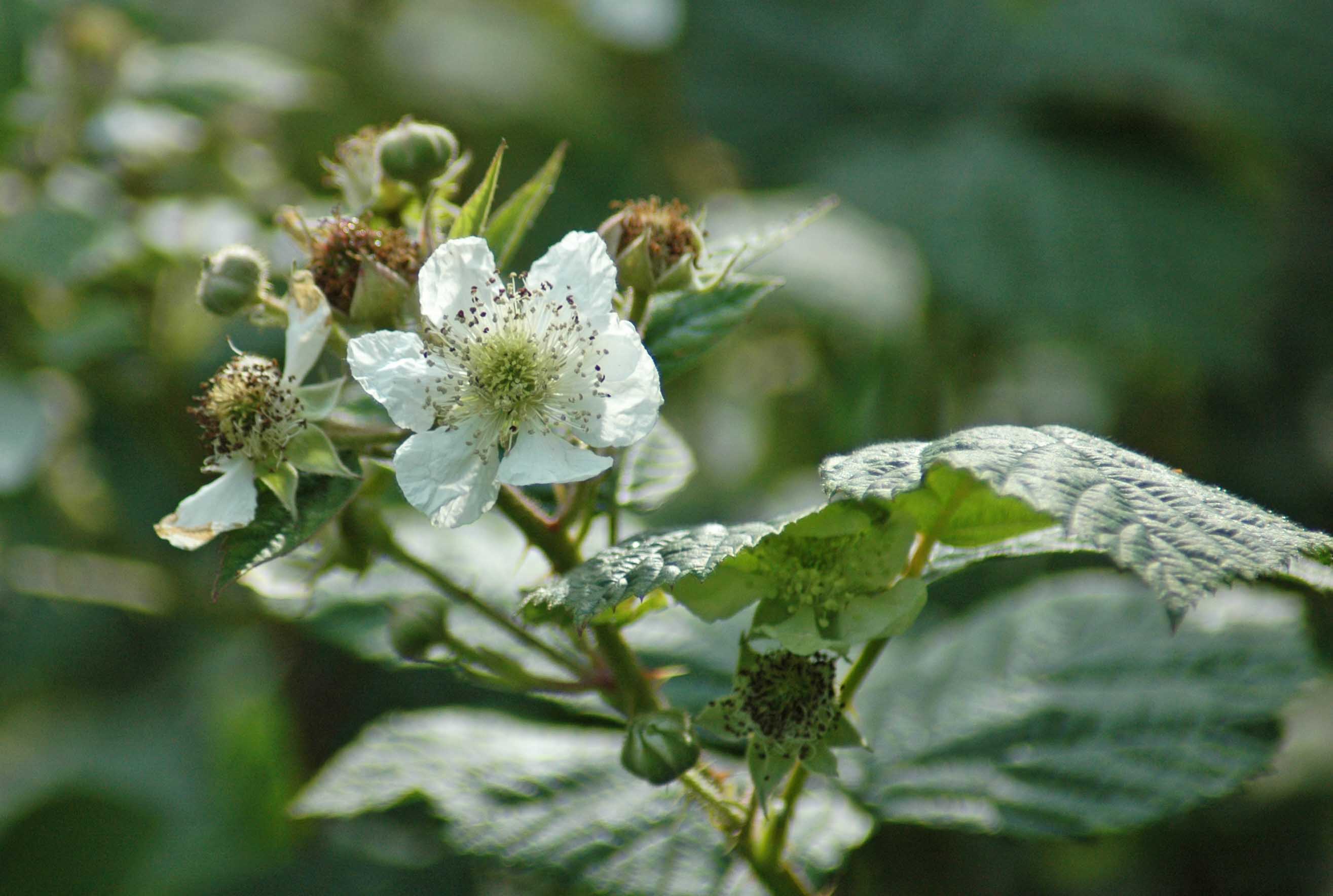
Bramble flower

Bramble flower

In the British Isles the term brambles is used to describe any rough,  tangled prickly shrub, but more specifically applies to the Blackberry bush –Rubus fruticosa.
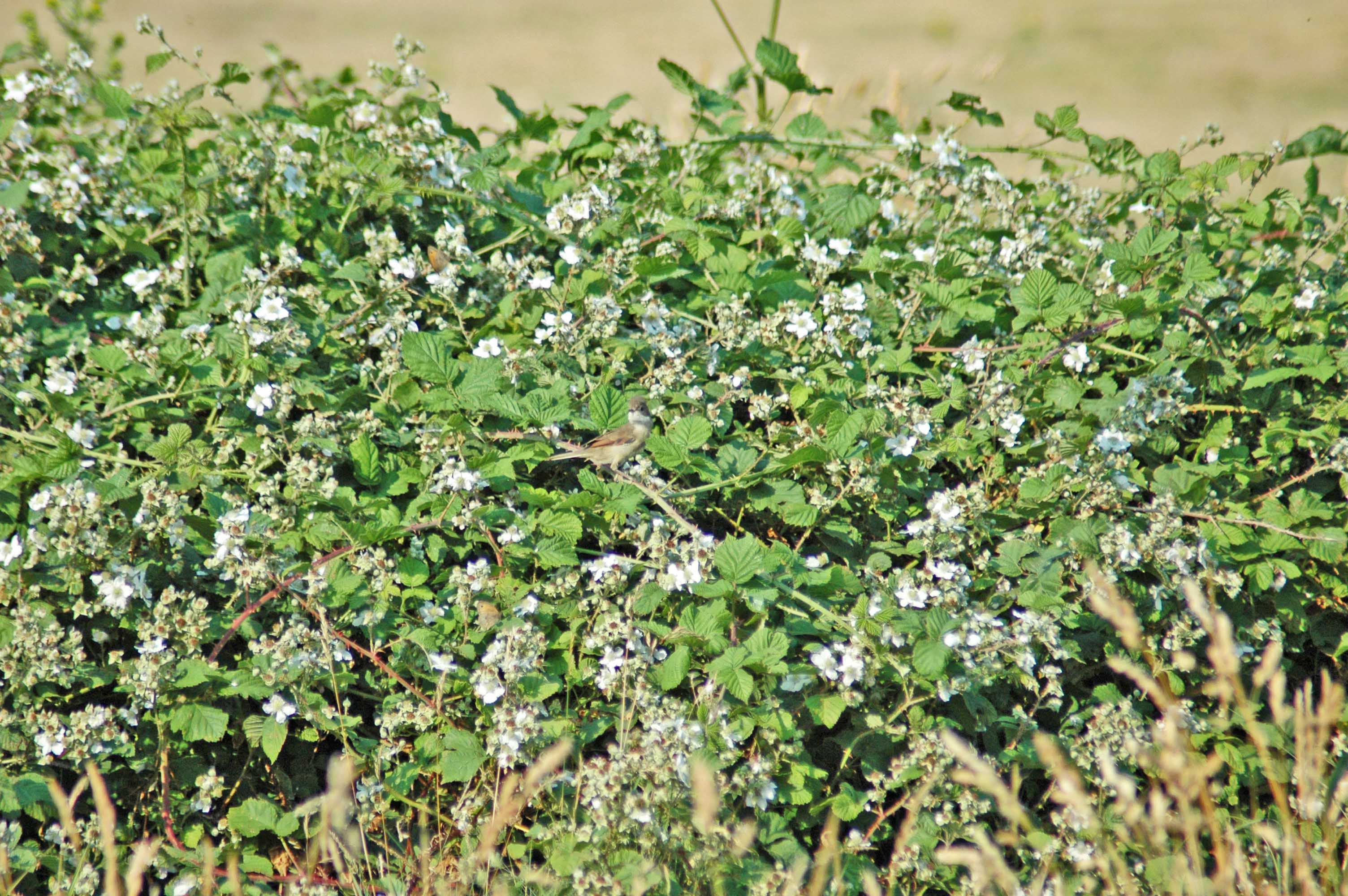
A huge bramble smothered with blossoms

A huge bramble smothered with blossoms – Little Orme. Click for a larger picture-the bird is a Whitethroat

Bramble bushes have a distinctive growth form. They send up long, arching canes that do not flower or set fruit until the second year of growth. The shrub can easily become a nuisance in gardens, sending down its strong suckering roots amongst hedges and shrubs, but in the wild it has great importance for its conservation and wildlife value.

The flowers attract nectar-feeding butterflies, bees and hoverflies, and the leaves are important food plants for the larvae of several species of Lepidoptera.

A beautiful Tortoiseshell butterfly on bramble flowers

A beautiful Tortoiseshell butterfly on bramble flowers

Small skipper (male) on bramble flowers-Bryn Euryn

Small skipper (male) on bramble flowers-Bryn Euryn

6-Spot Burnet Moth on bramble flowers
6-Spot Burnet Moth on bramble flowers

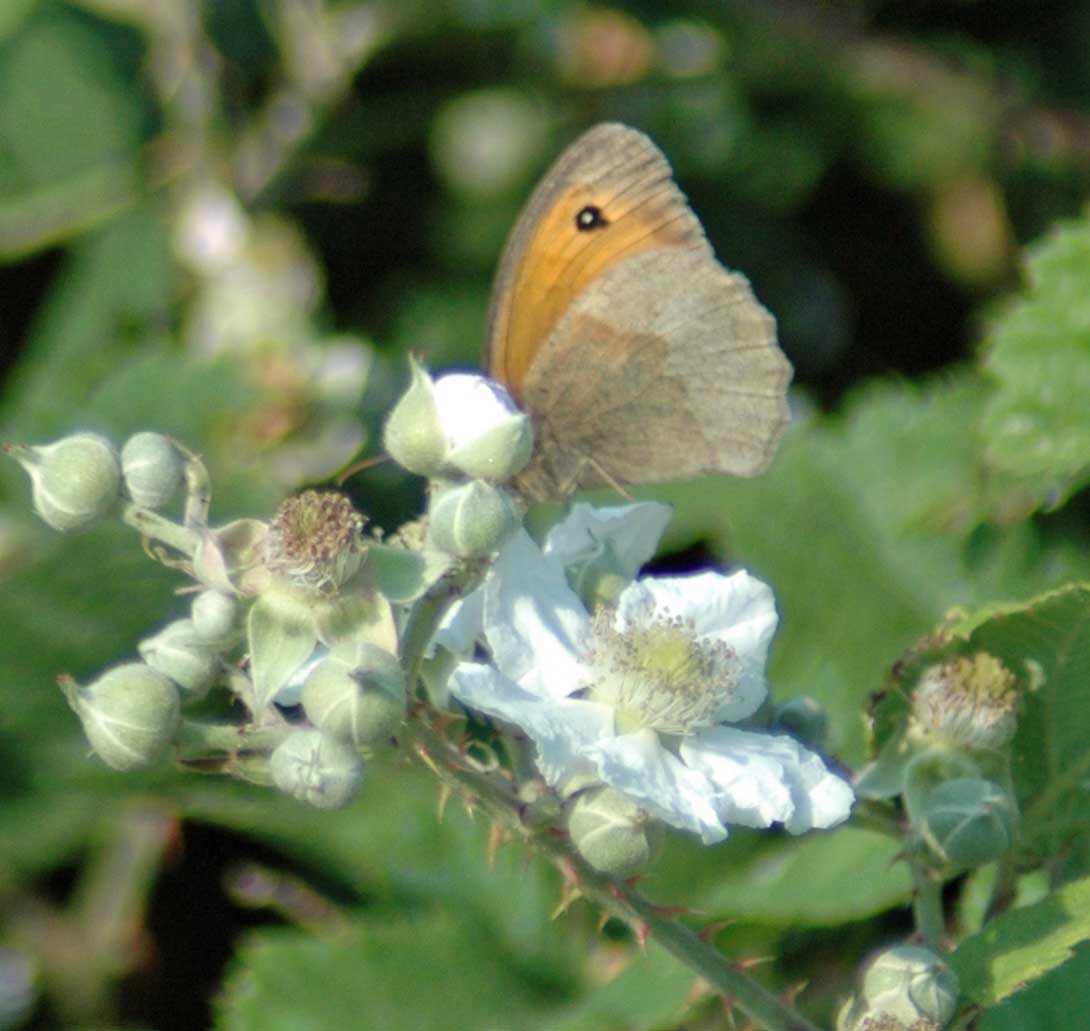
Meadow Brown feeding on bramble

Meadow Brown nectaring on bramble

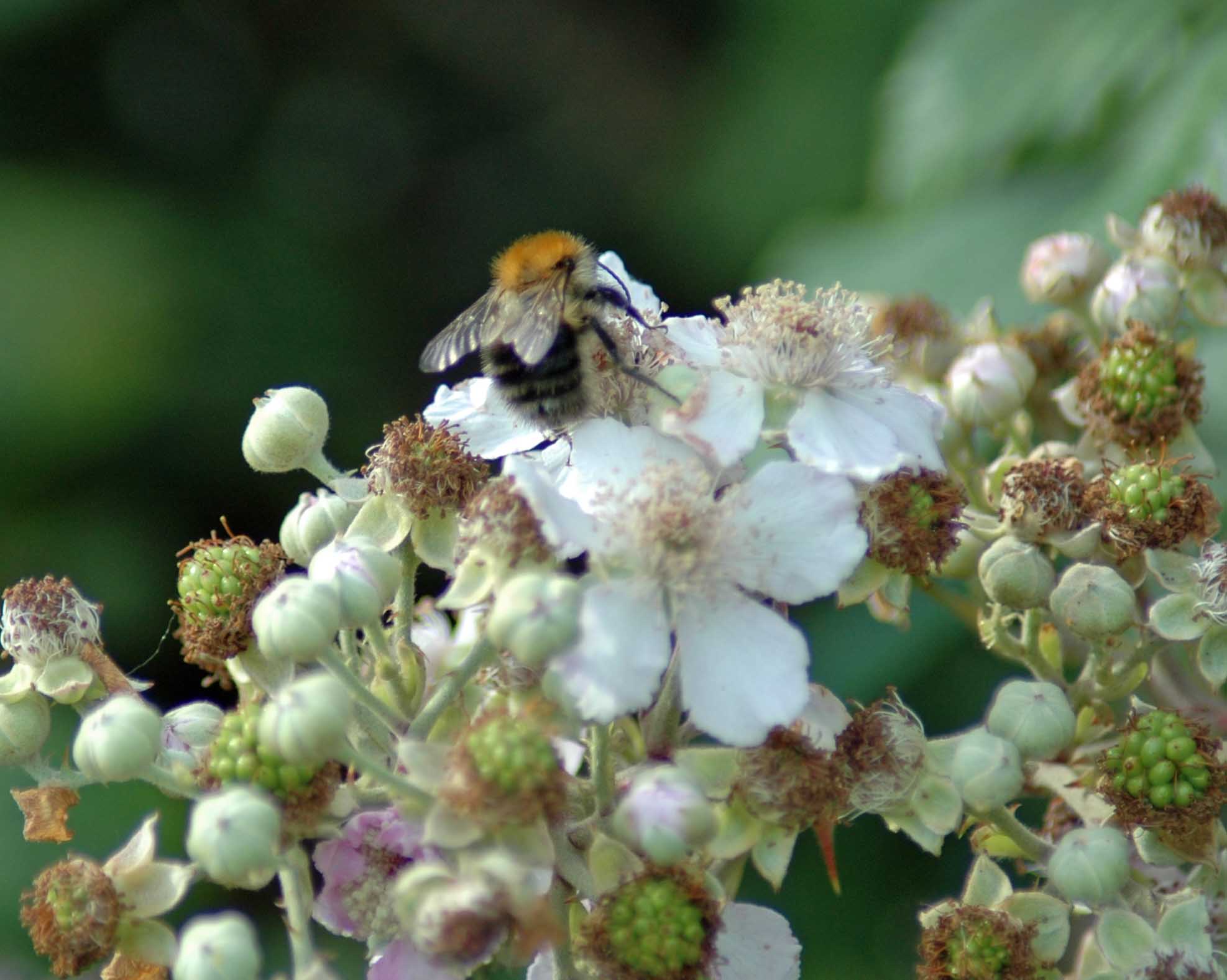
Common Carder Bee on bramble flowers

Common Carder Bee on bramble flowers

Bramble leaves usually have trifoliate or palmately-compound leaves. Old leaves often remain on the stems throughout the winter until new shoots are produced.
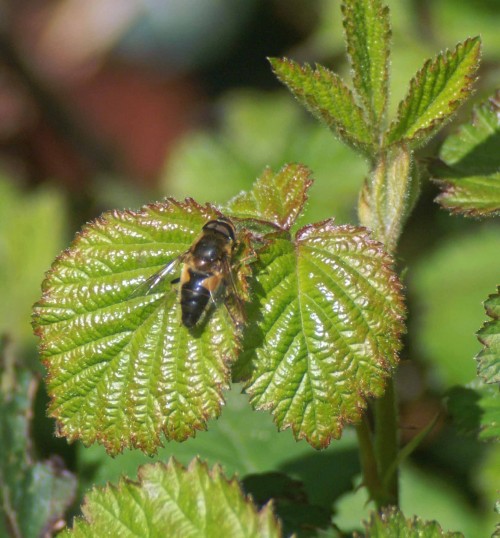
Eristalis basking on new leaves of bramble - rubus
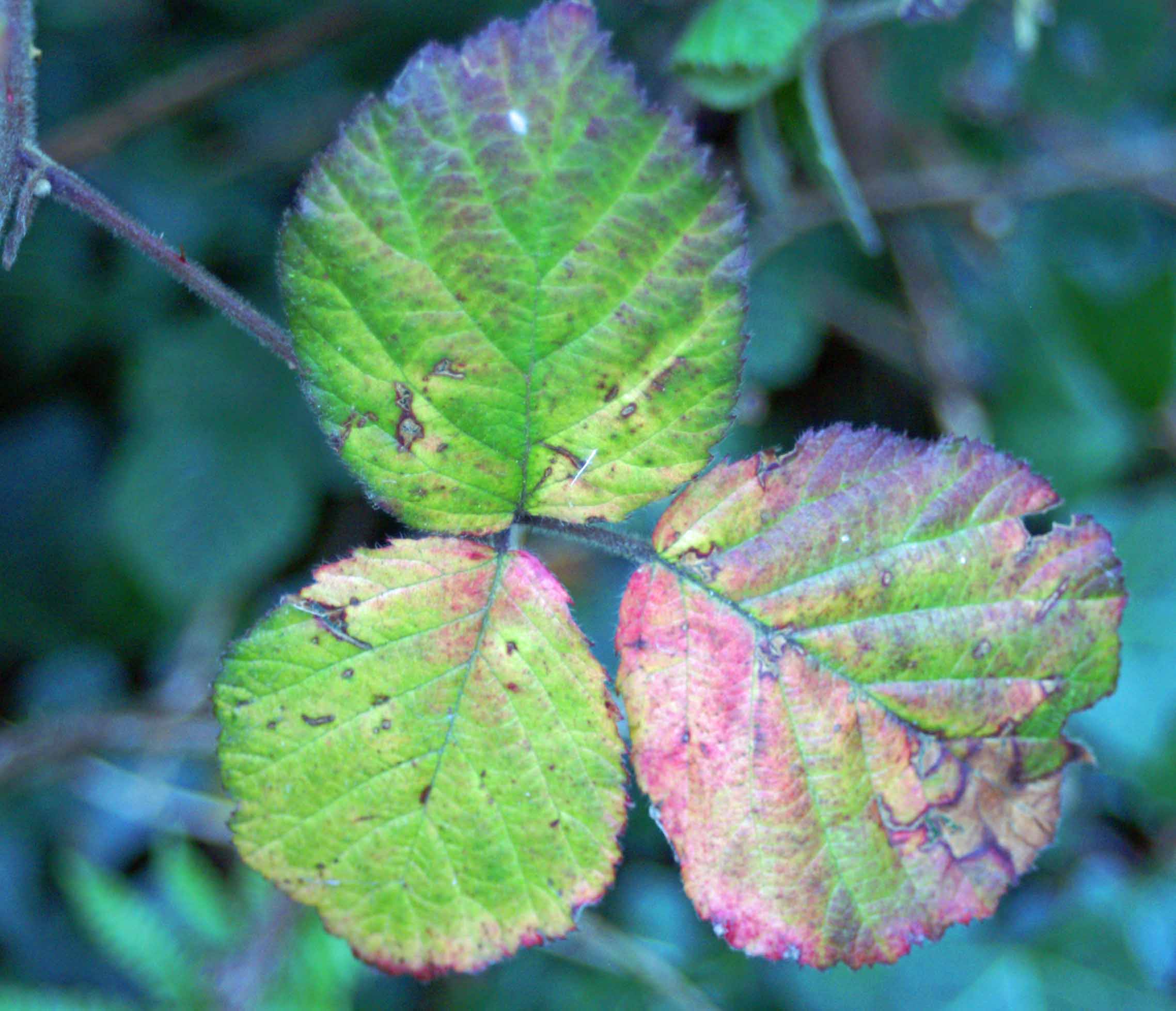
April -Eristalis basking on new leaves of bramble

September - Bramble leaves

September – Bramble leaves

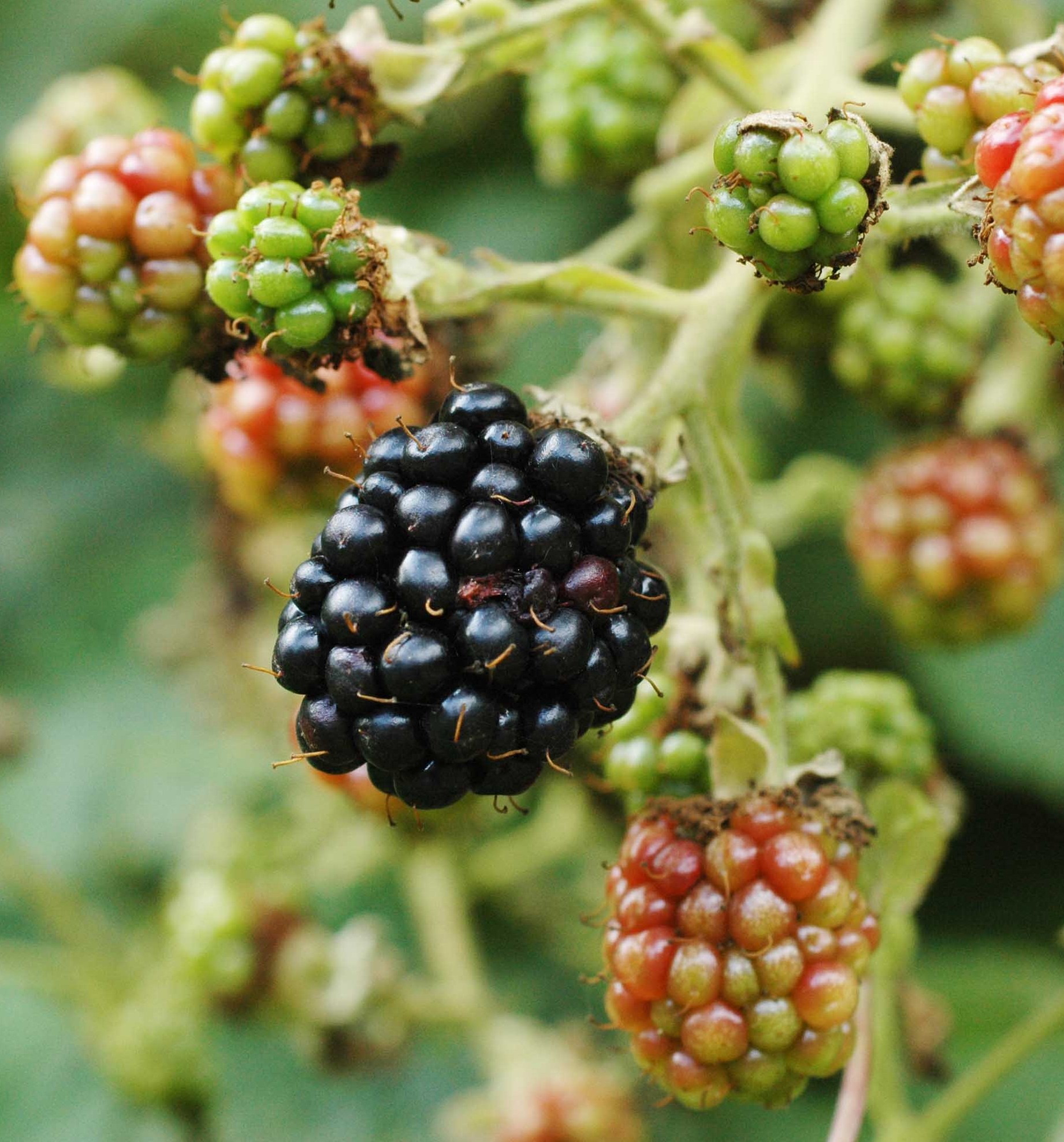
A ripe blackberry

A ripe blackberry


Bramble fruits are aggregate fruits and each small round berry is called a drupelet. The blackberry flower receptacle is elongate and part of the ripe fruit, making the blackberry an aggregate-accessory fruit.
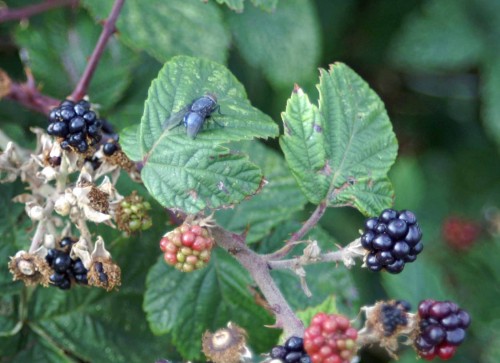
22/8/11-Bluebottle fly on blackberries

22/8/11-Bluebottle fly on blackberries- a case for washing them before eating!

Traditional medicinal uses

A child afflicted with whooping, or chin-cough may have been passed through a  blackberry or bramble shoot that had rooted naturally at either end; this was a gesture symbolic of rebirth in a perfect state. Herefordshire this treatment was enhanced: the Lord’s Prayer was recited whilst the patient, eating bread and butter, was passed nine times under the bramble arch. Sometimes a rhyme was added:

                                        Under the briar and over the briar,                                                                                             I wish to leave the chincough here.

On the journey home the remains of the bread and butter were given to a passing animal or bird – “but never to a Christian”- and, as the bread was consumed, the cough would disappear. Other childhood diseases, rheumatism and boils were also cured with this procedure.

Another blackberry cure of repute was a burn lotion, made by floating 9 blackberry leaves in water from a holy well.

Mythology and legend

What is probably the earliest recorded parable is Jotham’s parable of “The trees choosing a King.” The first tree to be offered this distinction was the Olive, but the Olive was concerned with the business of producing oil, and so the Vine was approached. The Vine was too busy producing wine, and eventually the Bramble was requested to accept the offer, and the Bramble having nothing better to do, affably agreed.

Blackberries have multiple meanings across religious, ethnic and mythological realms. In all Celtic countries taboos attend the picking of blackberries; mid-Mediterranean folklore claims that Christ’s Crown of Thorns was made of blackberry runners.  The deep colour of the berries represents Christ’s blood. They have been used in Christian art to symbolize spiritual neglect or ignorance. 

In many English counties blackberries are never picked after Michaelmas Day on September 29th. Legend has it that the blackberry was once beautiful, but was cursed by Lucifer when he fell into the bush when he was forced out of heaven. Every September 30th, with the ripening and darkening of the berries, he is said to variously ‘wave his club over them’, ‘spit on them’, ‘curse them’ or ‘put his cloven hoof on them’.

Some folklore associates the blackberry with bad omens. European stories have claimed they are death fruits with ties to Wicca. They can also symbolize sorrow. In an old proverb they signify haste. A man is so excited to pick the berries that he jumps into the bush and the thorns cause him to lose his eyesight. He regains it, however, upon jumping back out of the bush.

Greek mythology contains a legend similar to this. When Bellerophon, a mortal, tries to ride Pegasus to Olympus, he falls and becomes blind and injured upon landing in a thorny bush. This is his punishment for trying to take the power of the gods. Therefore, the fruit also symbolizes arrogance.

Other Uses

Split bramble stems are traditionally used as binding material for straw in the production of lip work basketry, such as lip work chairs and bee skeps, and sometimes used to protect other fruits (strawberries).

Lip work is a technique where wheat straw is made into coils or ropes and then bound into shape with strips of bramble. In addition to tall backed chairs which protected the occupant from draughts, beehives, corn measures, baskets and trays were made. The photograph of the beautiful traditional straw skep beehive below is from the website of Martin Newton, a present-day maker of lip work basketry pieces.  http://www.martinatnewton.com/page2.htm
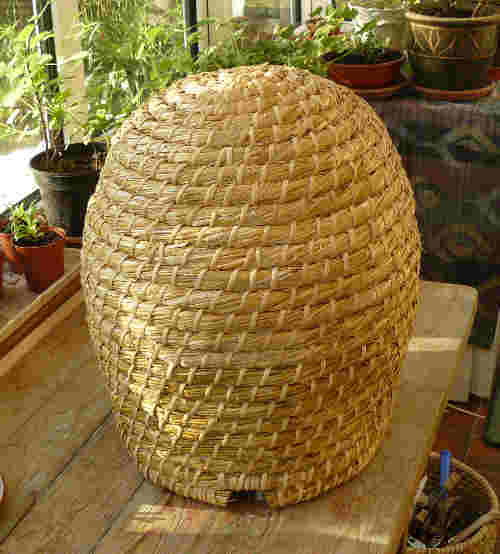
A traditional lip work bee skep

A traditional lip work bee skep
Share this:

  • Share on Facebook (Opens in new window) Facebook
  • Share on Pinterest (Opens in new window) Pinterest
  • Share on X (Opens in new window) X
Like Loading...

Into the woods, led by the nose

24 Wednesday Jul 2013

Posted by theresagreen in Bryn Euryn Nature Reserve, Nature of Wales, nature of woodlands, nature photography, Wildflowers of Wales

≈ 4 Comments

Tags

common shrew, common spotted orchid, greenbottle flies on shrew carcass, greenbottle fly, honeysuckle, medicinal plants, Pyramidal Orchid

Bryn Euryn’s woodland trail is a circular route that travels more or less around the circumference of the bottom of the hill and is a good one to follow if you want a ‘proper’ walk without too many distractions. That’s not to say there isn’t anything to see; on my walks there is always something that catches my eye, or as happened on one particular evening, my nose!

I had rejoined this trail after my diversion onto the more open hillside where I had earlier watched the butterflies, and by the time I reached there it was late afternoon and a little cooler; just the time to catch the intermittent scent of honeysuckle, which for me is the absolutely perfect fragrance. The fresh perfume of the honeysuckle takes me back to walking through shady summer woods as a child when the heavenly scent brought the plant to my attention and I would always have to find it and inhale more of it. In fact I still do that; I just cannot resist it.

Honeysuckle – Lonicera periclymenum

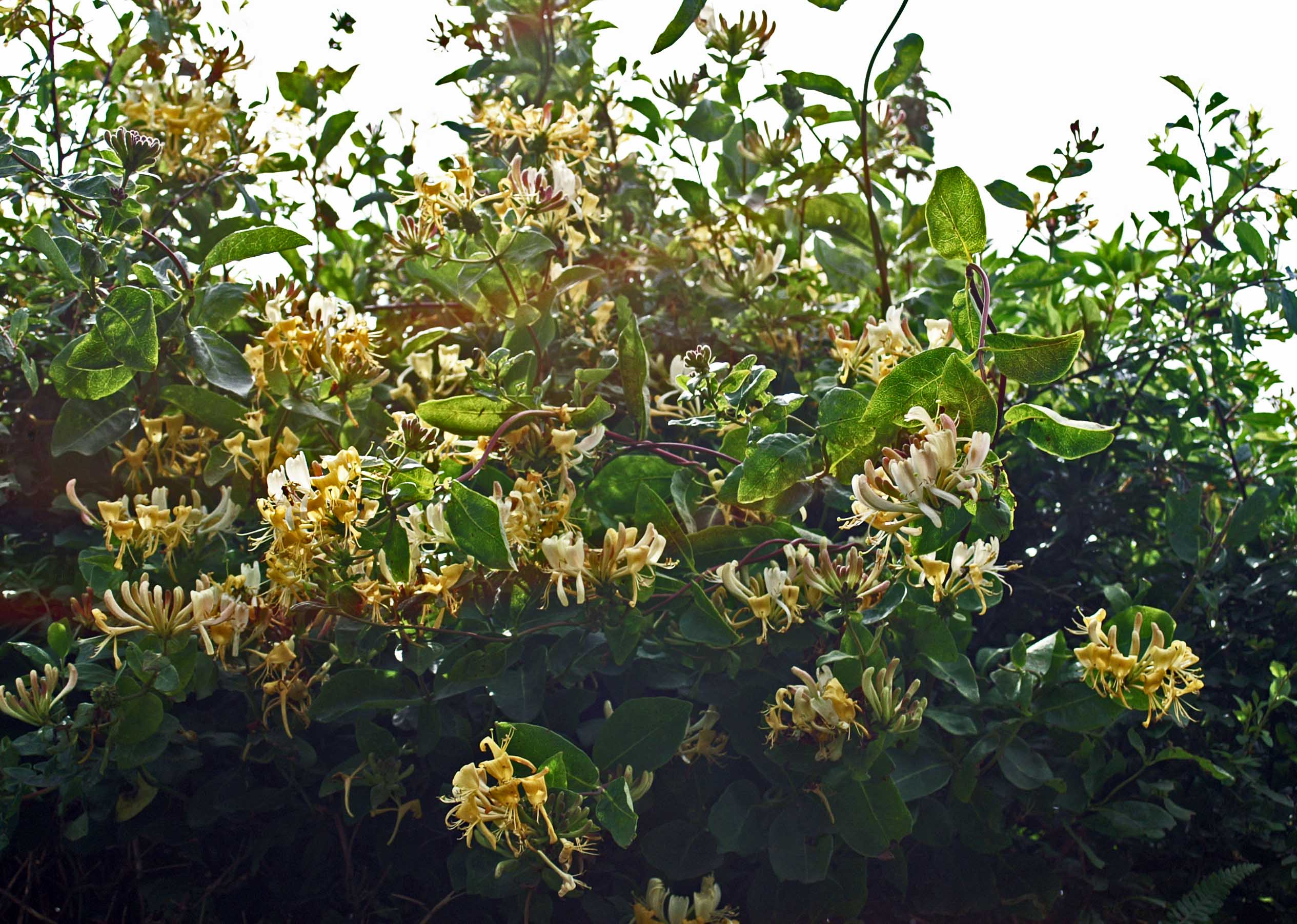
Honeysuckle clambering up a tall holly shrub

Honeysuckle clambering up a tall holly shrub

Therapeutic and medicinal uses

I remember being very disappointed when, training as an aromatherapist, I learnt that Honeysuckle is not an essential oil that is practical to use for therapeutic massage. It is very difficult to extract the oil on a commercial basis, so it ends up being very expensive and difficult to obtain in an ‘absolute’ or pure form; any you buy is likely to have been mixed with something else.  It is more widely used as a component of perfume. Shame, because the essential oil supposedly has some wonderful properties and if it had been practical to use I probably could have used it by the bucketful!

“Honeysuckle aids one to get past mental regrets, and move forward freely in life. It’s captivating scent is able to instil love and beauty, and banish any fear and sadness brought about by such events as divorce, death, and loneliness. The oil allows one to overcome harshness, indulge in self-renewal, and inspires hope, progress, freedom, and unity.”

Honeysuckle lit by evening sun in a hedgerow, Nevern, Pembrokeshire

Honeysuckle lit by evening sun in a hedgerow, Nevern, Pembrokeshire

Honeysuckle has been used medicinally for thousands of years to treat respiratory conditions, diarrhoea, ease childbirth, and stimulate the flow of energy throughout the body. Aromadendrene, a terpenoid, is a constituent of honeysuckle essential oil, which contributes to the oil’s antimicrobial properties. The terpenoid inhibits growth of micro-organisms, such as, bacteria, fungi, and protozoans. Eugenol, a phenylpropene, which is known to be a restorative and has a palliative effect, meaning it relieves pain and prevents further suffering.

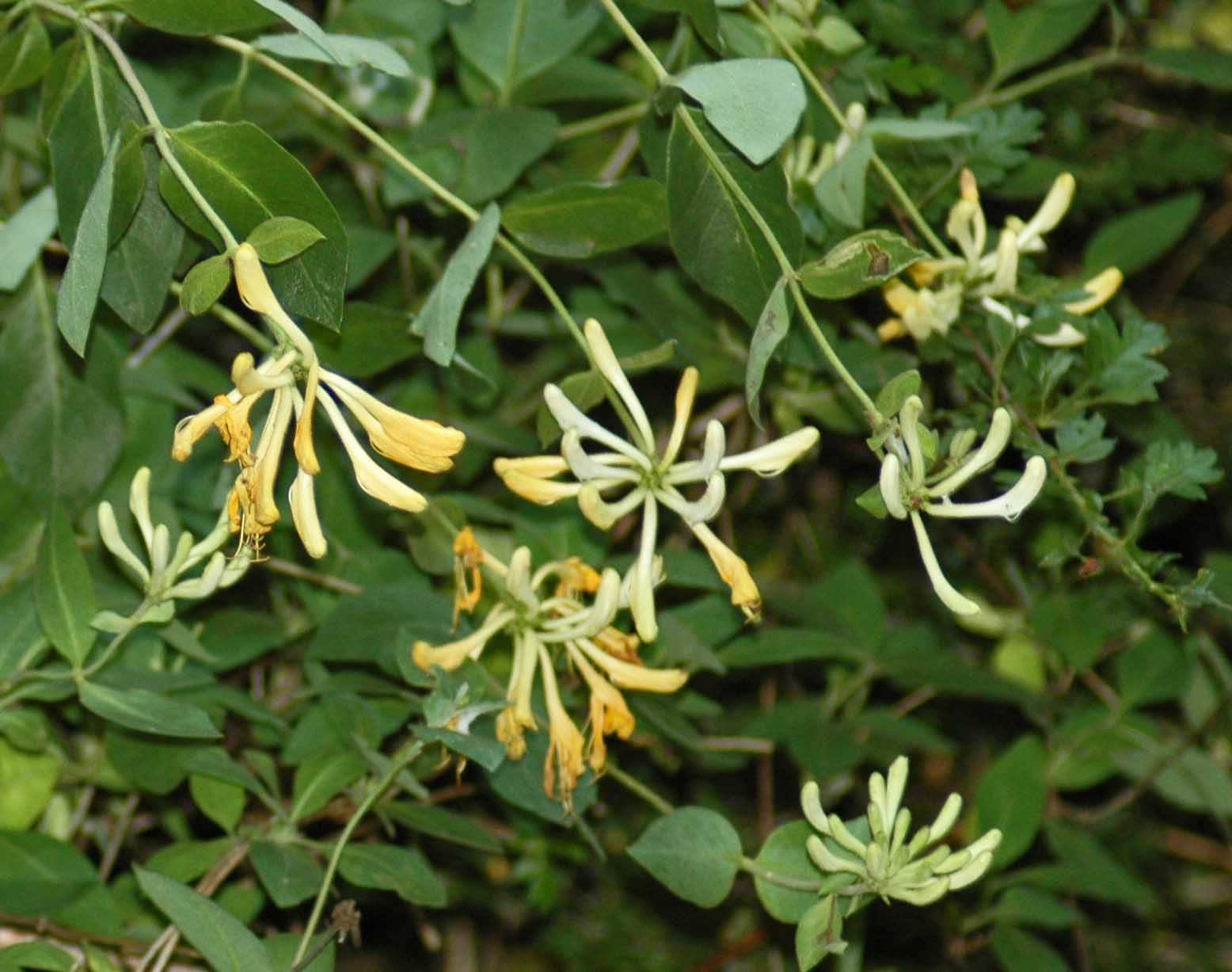
Honeysuckle blossoms

Honeysuckle blossoms

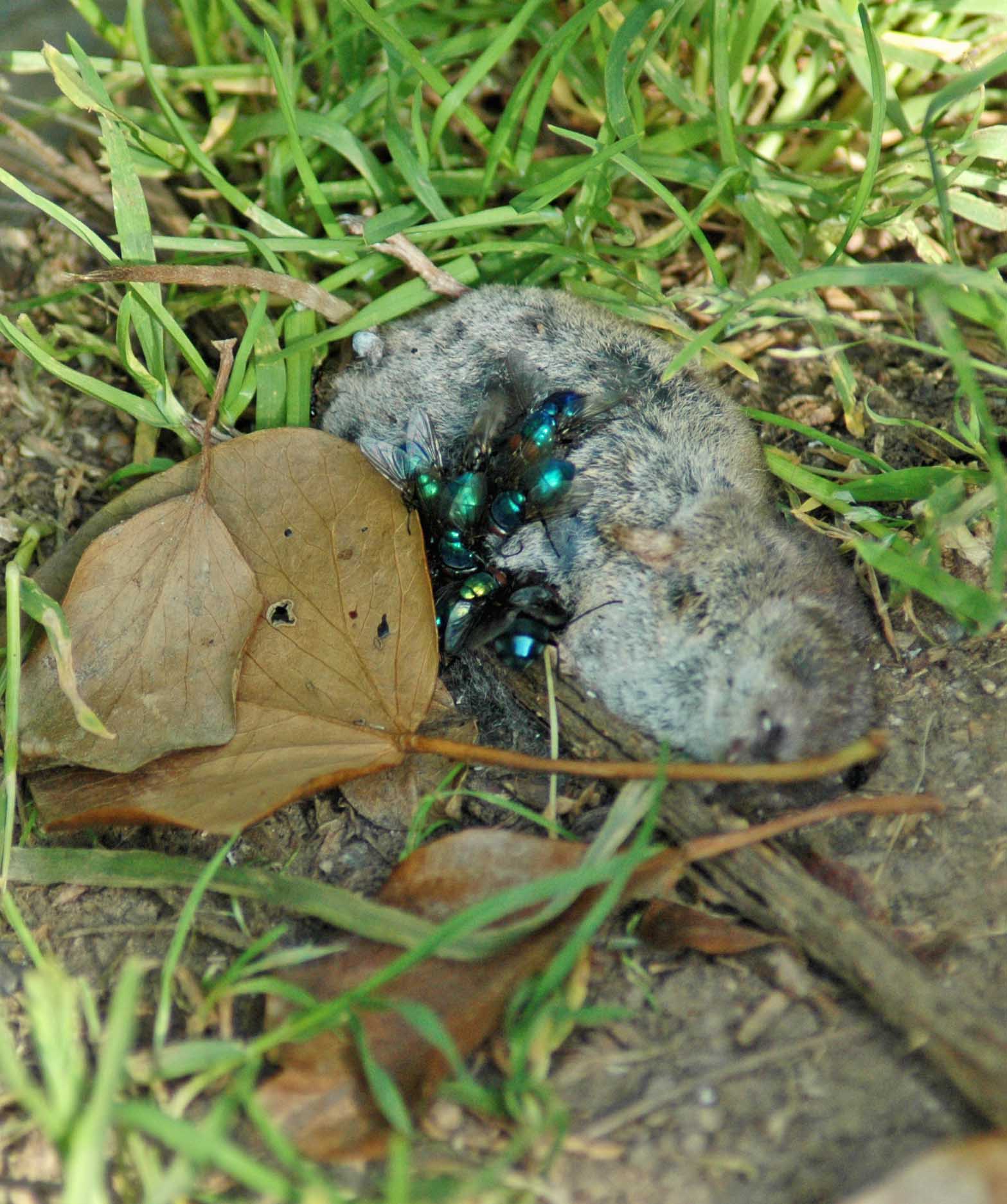
I was soon snapped out of my state of  pleasant reminiscence brought about by the aromatic honeysuckle as my olfactory sense was assailed by a far less pleasant smell, immediately recognisable as that arising from something that has died. Never one to shirk the responsibility of  recording all aspects of the nature I come across on my wanderings, I followed my nose regardless, although trying not to breathe through it. I soon found the source of the stench: another little shrew had passed away; probably murdered by another cat. It was creating a mighty smell for something so tiny in life, but it would have attracted my attention anyway as there were a dozen or more Greenbottle flies swarming over its tiny body. (Those of a squeamish nature should probably look away now!)

Greenbottle flies on the carcass of a dead shrew

Greenbottle flies on the carcass of a dead shrew

I know it’s not nice, but we all know that nature is not always about pretty flowers, butterflies and birds singing. Everything dies and it is actually interesting to see what benefits from that; it is often insects that are responsible for completing the circle of life. And, sorry, I do find Greenbottle flies very interesting.

Greenbottle Fly- Lucilia sericata

The Common Green bottle fly is a blow-fly, a member of the family Calliphoridae, is the most well-known of the numerous green bottle fly species and found in most areas of the world. It is 10–14 mm long, slightly larger than a housefly, and has brilliant, metallic, blue-green or golden colouration with black markings. It has short, sparse black bristles (setae) and three cross-grooves on the thorax. The wings are clear with light brown veins, and the legs and antennae are black.

Common Greenbottle Fly

Common Greenbottle Fly-Rhos-on-Sea garden

The  fly is found feeding on flowers, but is also a common visitor to carrion and faeces. The female greenbottle lays a mass of eggs in a wound, a carcass or corpse, or in necrotic or decaying tissue. (A single female typically lays 150-200 eggs per batch and may produce 2,000 to 3,000 eggs in its lifetime.)  The eggs hatch out in about 8–10 hours in warm moist weather, but may take as long as three days in cooler weather.

Greenbottle flies

Greenbottle flies were most numerous on the corpse, but there are two other species there too

Forensic science

Like most Calliphorids, the insect has been heavily studied and its life cycle and habits well documented and L. sericata is an important species to forensic entomologists. One of the first insects to colonise a corpse, the stage of the insect’s development is used to calculate the period of colonization, so that it can be used to aid in determining the time of death of the victim.

Veterinary importance

L. sericata, along with other species of blowfly also makes an impact in a veterinary sense. In the UK and Australia it is commonly referred to as the “sheep blowfly” since sheep are its primary, although not sole host.
In Northern Europe, the fly will lay its eggs in sheep wool. The larvae then migrate down the wool to feed directly on the surface of the animal’s skin, which can cause massive lesions and secondary bacterial infections. In the UK, it is estimated that blowfly strike affects 1 million sheep as well as 80% of sheep farms each year. This causes a huge economic impact in these regions: it costs money to treat infected animals and to take measures to control L. sericata populations.

To end on a pleasanter note, here are some more flowers I found along the woodland trail that same evening:

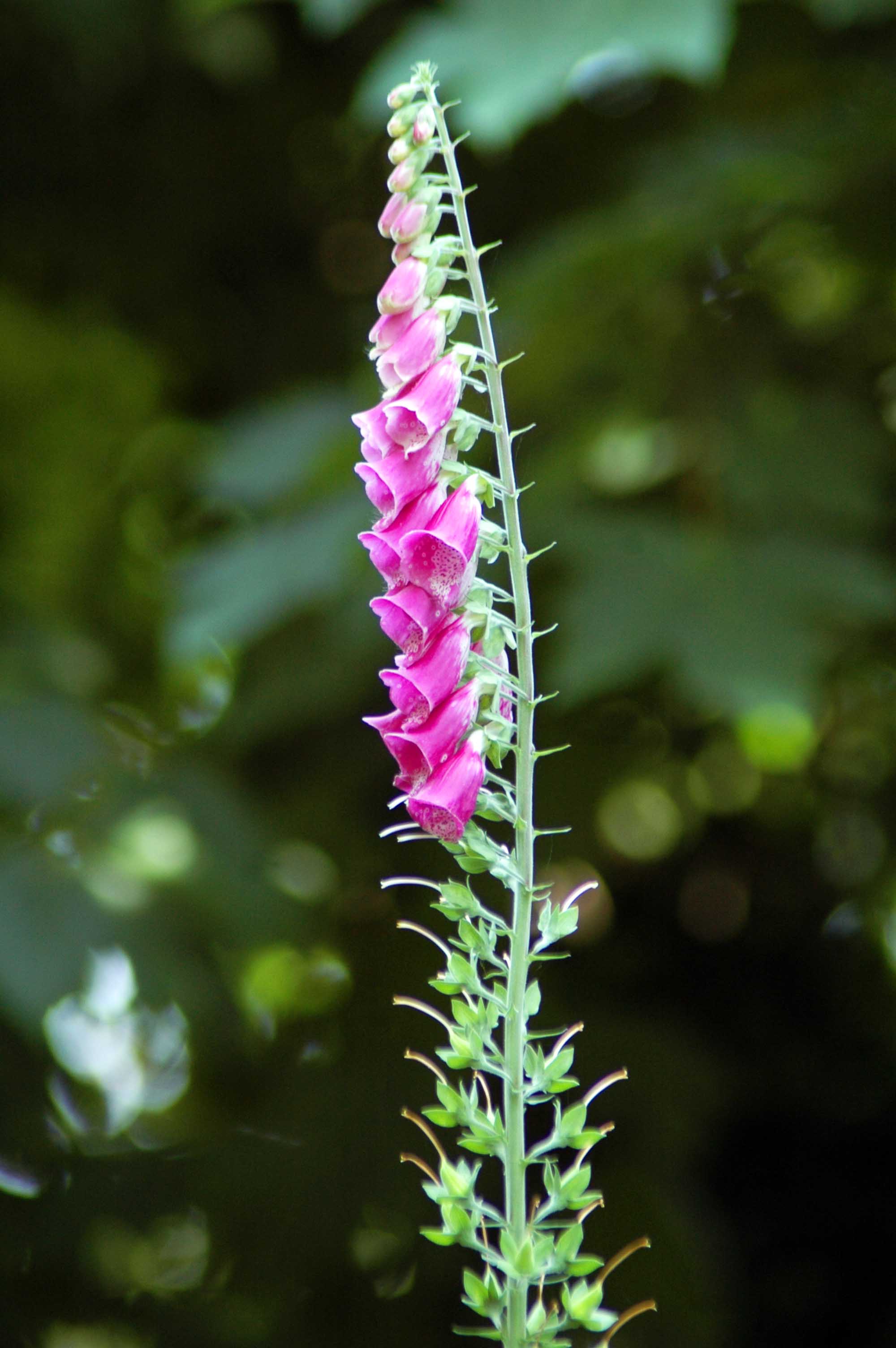
Foxgloves are not common here, but there were a couple of stems of them; tall now and maybe a little more than half-way to being finished.

Foxgloves are about half-way to being over

Foxgloves are about half-way to being over

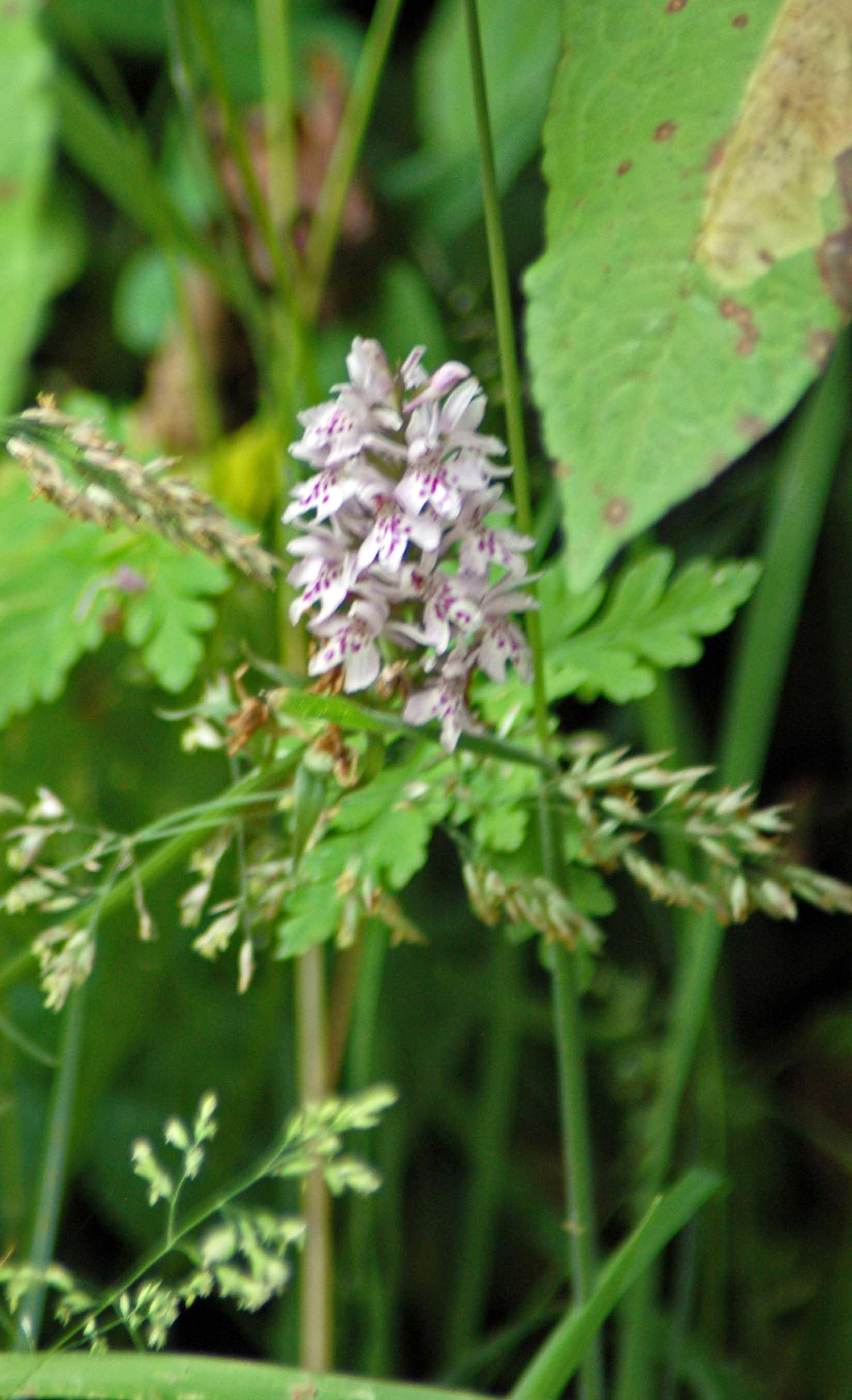
Amongst the grass and other tougher plants on the path edge a pretty Common Spotted  Orchid pushed through.

A Common Spotted Orchid on the side of the trail

A Common Spotted Orchid on the side of the trail

Further along, in quite deep shade I was surprised to find another Pyramidal Orchid.

Another Pyramidal Orchid

Another Pyramidal Orchid

Share this:

  • Share on Facebook (Opens in new window) Facebook
  • Share on Pinterest (Opens in new window) Pinterest
  • Share on X (Opens in new window) X
Like Loading...

All is bright and beautiful at the top of the Bryn

20 Saturday Jul 2013

Posted by theresagreen in Bryn Euryn Nature Reserve, Butterflies of Wales, Nature, Nature of Wales, nature photography, Wildflowers of Wales

≈ 8 Comments

Tags

carline thistle, dark green fritillary, fox, grayling, myathropa florea, sulphur beetle

I had thought about venturing a bit further afield today, maybe over to Anglesey, but weekends are never good for travelling any distances in this popular holiday location, and the North Wales Expressway (the A55) is the route to and from the ferry port of Holyhead too, so unless you leave early you can end up spending an uncomfortably long time in your car. So I decided on Bryn Euryn instead, where I was hoping to get a glimpse of a particularly lovely butterfly.

There were people picnicking in the field, so I headed straight for the top of the hill today, half expecting to find more people up there too, but there was no one at all. Most people head for the beach when its this hot. The view from here is always amazing as I’ve said so many times before and today’s gives an overview of the progress of summer. So, queen of the castle for a short while, I surveyed the land below and around me. There was a bit of a haze over the horizon, hay has been cut, dried out and rolled into big shredded-wheats ( for those who are wondering, that’s a British breakfast cereal), grass meadows are turning brown in the dry heat, wheat is ripening and trees and hedges add shape and texture to the landscape in a myriad shades of green. You also get a good view of the express-way from up here: I was so glad I wasn’t on it, it was very busy.     

Summer view from the top of Bryn Euryn

Summer view from the top of Bryn Euryn (click to enlarge)

A patchwork of treetops viewed from above

A patchwork of treetops viewed from above (click to enlarge)

There are not many wildflowers that can survive the dry rocky summer conditions on this edge of the hill, where the rockroses bloomed so prolifically a few weeks ago, but one that can is the strangely attractive Carline Thistle, which looks as though it’s going to seed, but in fact its flowers are brown. This species of thistle is found in several locations locally, but is a biennial and a bit unpredictable in its appearances.

Carline Thistle

Carline Thistle-Carlina vulgaris

There were Small Tortoishell butterflies flitting about up here, basking briefly on rocks before disappearing over the cliff edge. Looking down I could see a number of them, maybe a dozen or so, very restless and taunting and chasing each other; at one point a group of seven of them flew up in a flurry, whirling around like mad things.

Scabious is beginning to put forward much-needed flowers; their nectar and pollen is always gratefully received by butterflies and bees.

First flowers of scabious with a bumblebee

First flowers of scabious with a bumblebee

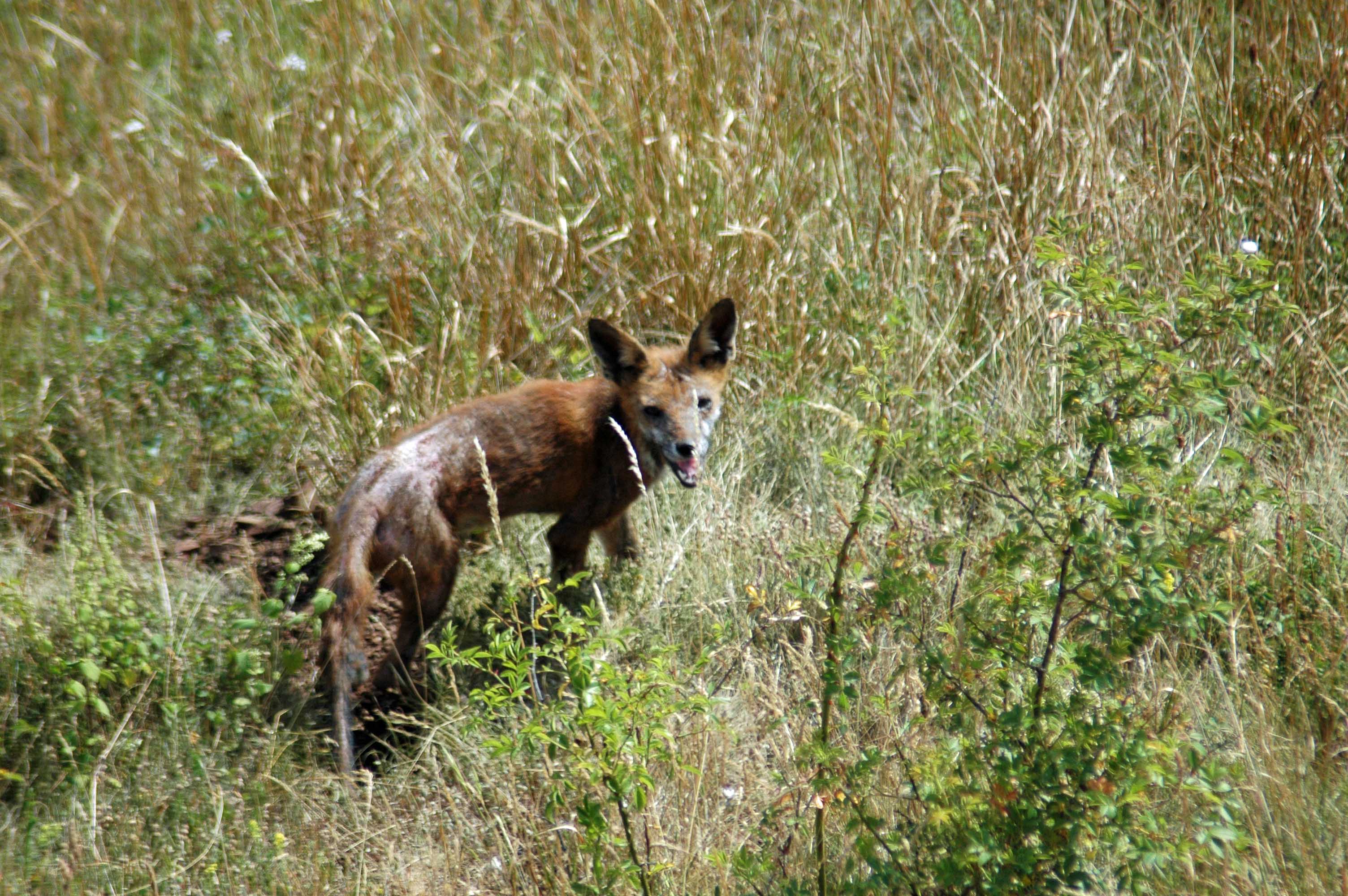
As I was peering over the edge of the cliff to watch the butterflies, I sudddenly realised someone was looking up at me; a fox, panting in the heat couldn’t decide if I was a threat or not so dived back into its den just to be sure.

130714TGNR-Fox looking up at me-Bryn Euryn

Little fox looking up at me

Fox disappearing into its earth

Fox disappearing into its earth

I couldn’t decide if it was a young animal or an adult, but either way it was not looking good. Apart from dealing with the heat it looked thin and its rear end and tail were devoid of fur, poor thing. Does it have some horrible condition like mange?

130714TGNR-Fox not looking too good-Bryn Euryn

the fox’s back and normally bushy tail were bare of fur

I moved on a little further back from the edge to where the grass is long and some ‘scrubby’ wild plants have been left to grow, perfect habitat for insects.

A flowery patch amongst long grass with hogweed, ragwort, wood sage,  lady's bedstraw & more

A flowery patch amongst long grass with hogweed, ragwort, wood sage, lady’s bedstraw & more

And  lo and behold, the first butterfly to catch my eye was the one I had been hoping to see, a gorgeous Dark Green Fritillary, drawn by nothing more exotic than red valerian flowers.

Perfect Dark Green Fritillary nectaring on valerian

Perfect Dark Green Fritillary nectaring on valerian

There were two of the beautiful insects flying around; these are fast, powerful fliers that can cover a large area in a short time. They don’t tend to leave their breeding areas, so once you know where to find them, providing conditions are good, you will more than likely see them there again. I didn’t see any last year, so was delighted to see some today and it was a bonus that they were ‘new’ and perfect.

A glimpse of an underside

A glimpse of an underside

The butterflies were very mobile,  and with no need to bask, not staying anywhere for long. I had no time for considered portraits,  these were very much opportunities grabbed, but I was more than happy just to watch them.

Wood Sage- Teucrium scorodonia

Wood Sage- Teucrium scorodonia. Aromatic and attractive to bumblebees

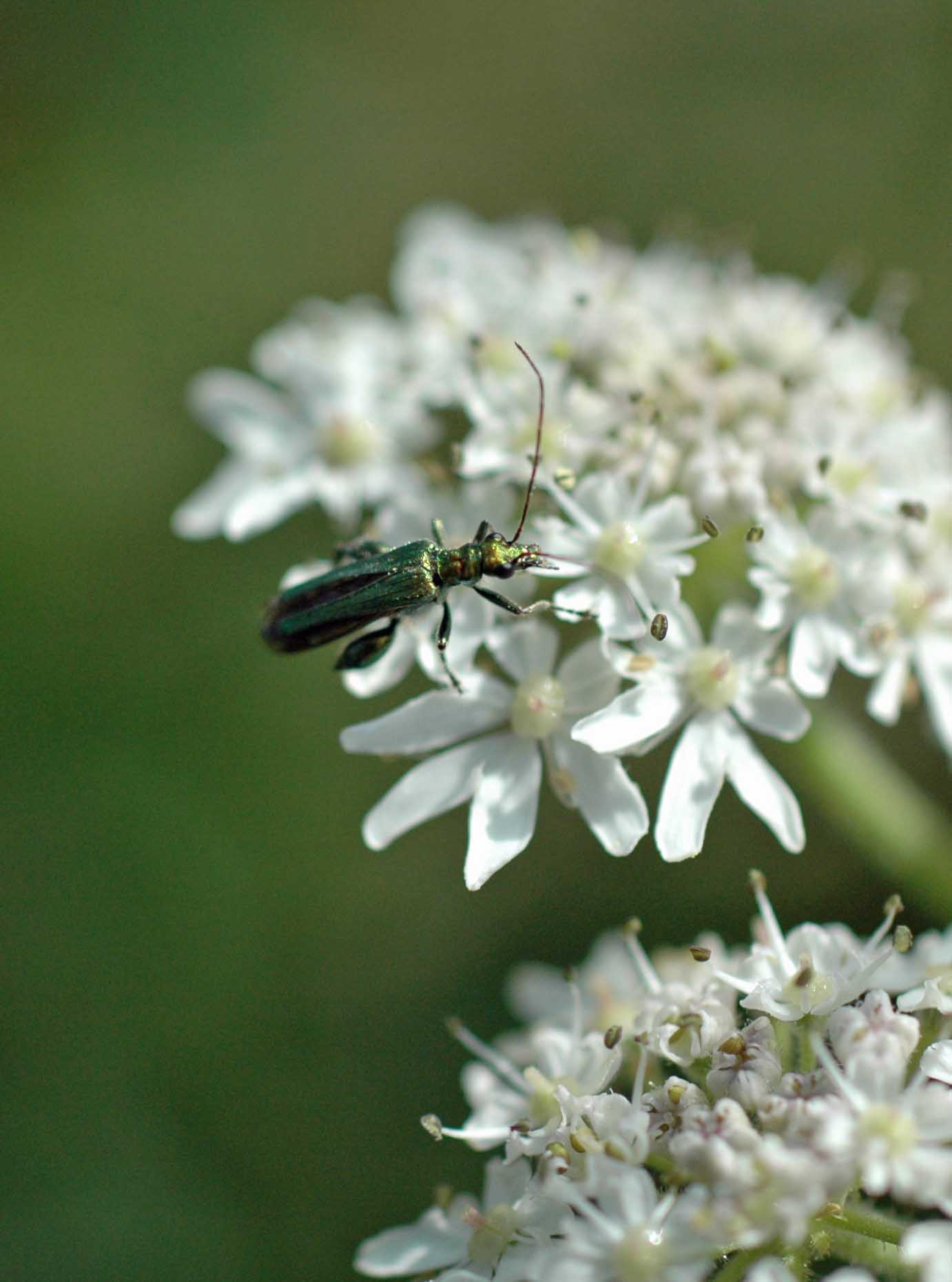
Hogweed is continuing to show me new visitors to its flowers:

A glamorous beetle with a clumsy common name  of  'Swollen-thighed Beetle' - Oedemera nobilis

A glamorous beetle with a clumsy common name of ‘Swollen-thighed Beetle’ – Oedemera nobilis

A ‘new’ hoverfly for my collection, which I hope I have identified correctly

Hoverfly-Myathropa florea

Hoverfly-Myathropa florea (I think)

and two little sulphur beetles, Britain’s only yellow beetle and another new one for me.

Sulphur beetle-Cteniopus sulphureus

Sulphur beetle-Cteniopus sulphureus

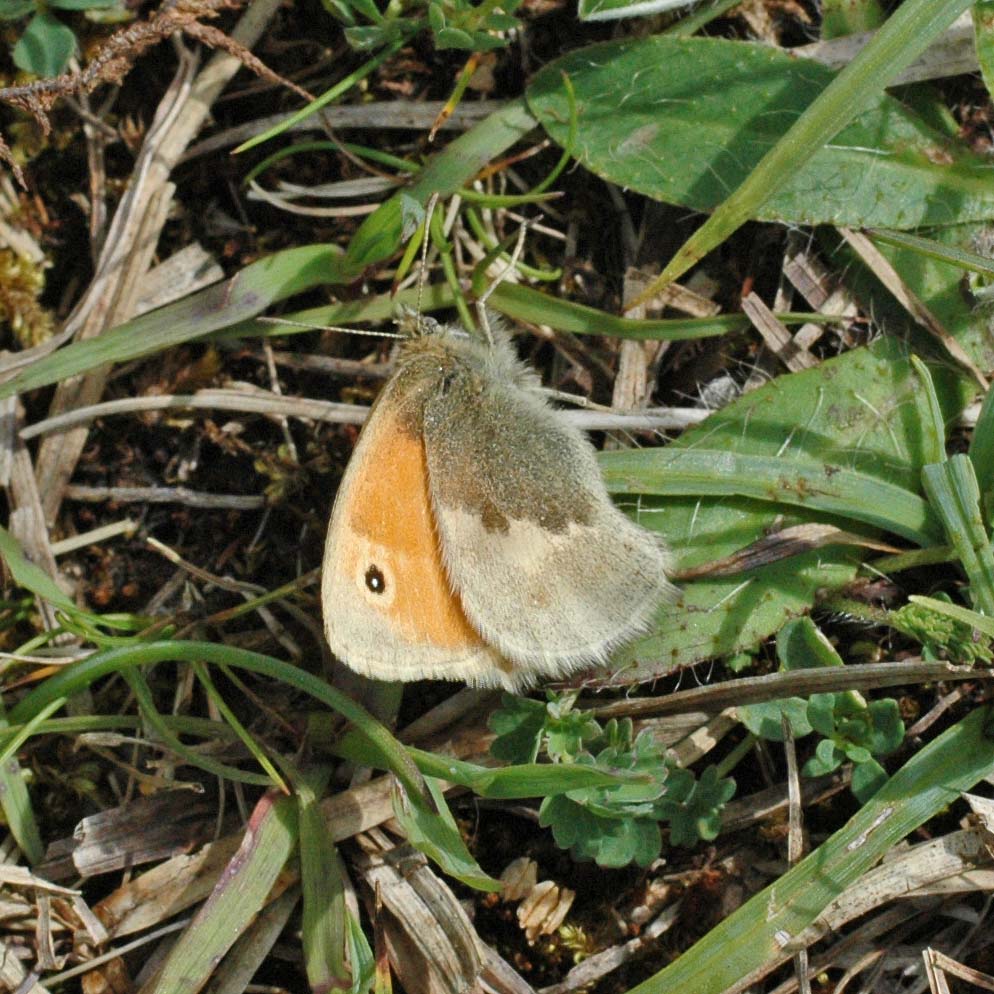
There were a lot of Meadow Brown butterflies in this area, and also Small Heath’s flitting along the pathways and low amongst the grass stems.

Small Heath

Small Heath

Lovely blue harebells

Harebells grow in long grass as well as on short turf

Harebells grow in long grass as well as on short turf

Meadow Brown basking on a path through the grass

Meadow Brown basking on a path through the grass

I headed towards the proper summit of the hill and as luck would have it, was followed by a cute little dog and its owner, so took a diversion on a very narrow path around the rocks that I wouldn’t normally have done. My reward was another lovely butterfly; this one not so colourful but a master, or mistress of camouflage, a Grayling.

Grayling perched on a rock

Grayling-Hipparchia semele perched on a rock

Part two to follow….


53.308051 -3.749941

Share this:

  • Share on Facebook (Opens in new window) Facebook
  • Share on Pinterest (Opens in new window) Pinterest
  • Share on X (Opens in new window) X
Like Loading...

Summer on the woodland edge

16 Tuesday Jul 2013

Posted by theresagreen in Bryn Euryn Nature Reserve, Nature, Nature of Wales, nature photography, Wildflowers of Wales

≈ 1 Comment

Tags

aphantopus hyperantus, bramble flowers, dark brown butterfly with rings on its wings, dark red flowers with leaves like nettle, hedge woundwort, Pyramidal Orchid, Ringlet, wildflowers of Bryn Euryn

I almost always begin my walks within this site with a meander around the edge of the grassy area in front of the car park, both of which are located on the bottom of what was once a quarry. The old excavations have left the small field sheltered by limestone ‘cliffs’ on two sides and it is bordered on all sides with trees, mostly ash and sycamore. Along one long side there is a border of mixed shrubby and herbaceous vegetation creating a stretch of my favourite habitat; woodland edge.

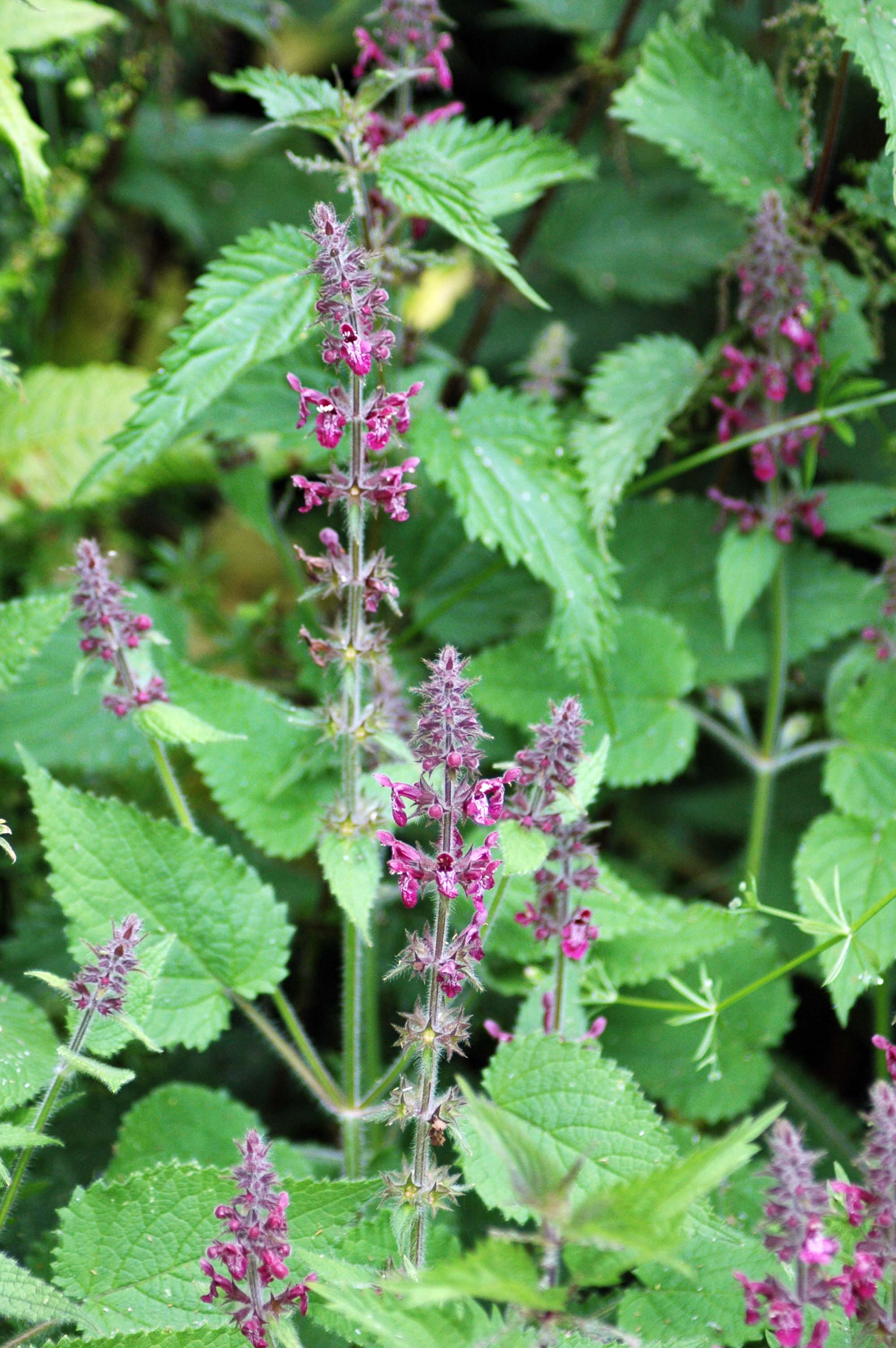
The wildflowers that grow here are not spectacular and tend towards the robust end of the plant spectrum, but they support a diverse number of insect species so are great hunting grounds for the likes of me, armed with a camera. There’s plenty of hogweed here, already featured in the last post, then there are nettles, dock, the sticky green cleavers or goosegrass and new this month, the magenta spikes of Hedge, or Wood Woundwort. It often grows in the company of nettles and having similar leaves it blends in with them until the flowers show; the photograph below shows both plants.

Hedge or Wood Woundwort

Hedge or Wood Woundwort-Stachys sylvatica growing amongst stinging nettles

Growing in hedgerows, on woodland edges, roadside verges and various shady places, Hedge Woundwort is not a particularly stand-out plant as far as its looks are concerned. A member of the mint family, Labiateae, it has a distinct aroma, one of those that is hard to describe, but which most wildflower guides refer to as ‘unpleasant, particularly when crushed or bruised’. I must have a strangely developed sense of smell; maybe as a result of working with essential oils, but I don’t find it offensive at all.

A brown-lipped snail was hiding under a dock leaf

A brown-lipped snail was hiding under a dock leaf

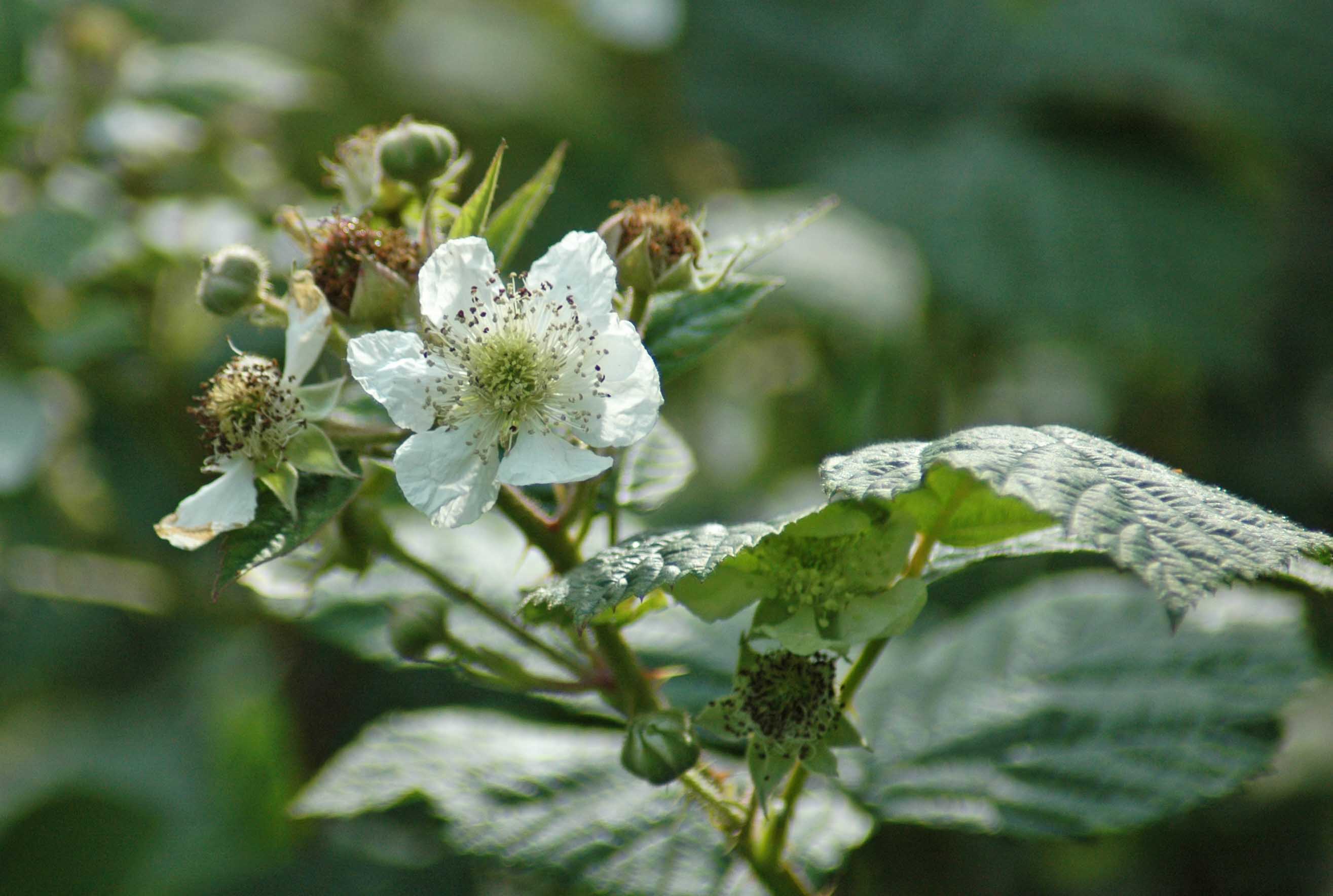
Brambles are often a component plant of the woodland edge flora. They are  flowering now too and are also sought after by a wide variety of insects.

Bramble flower

Bramble flower

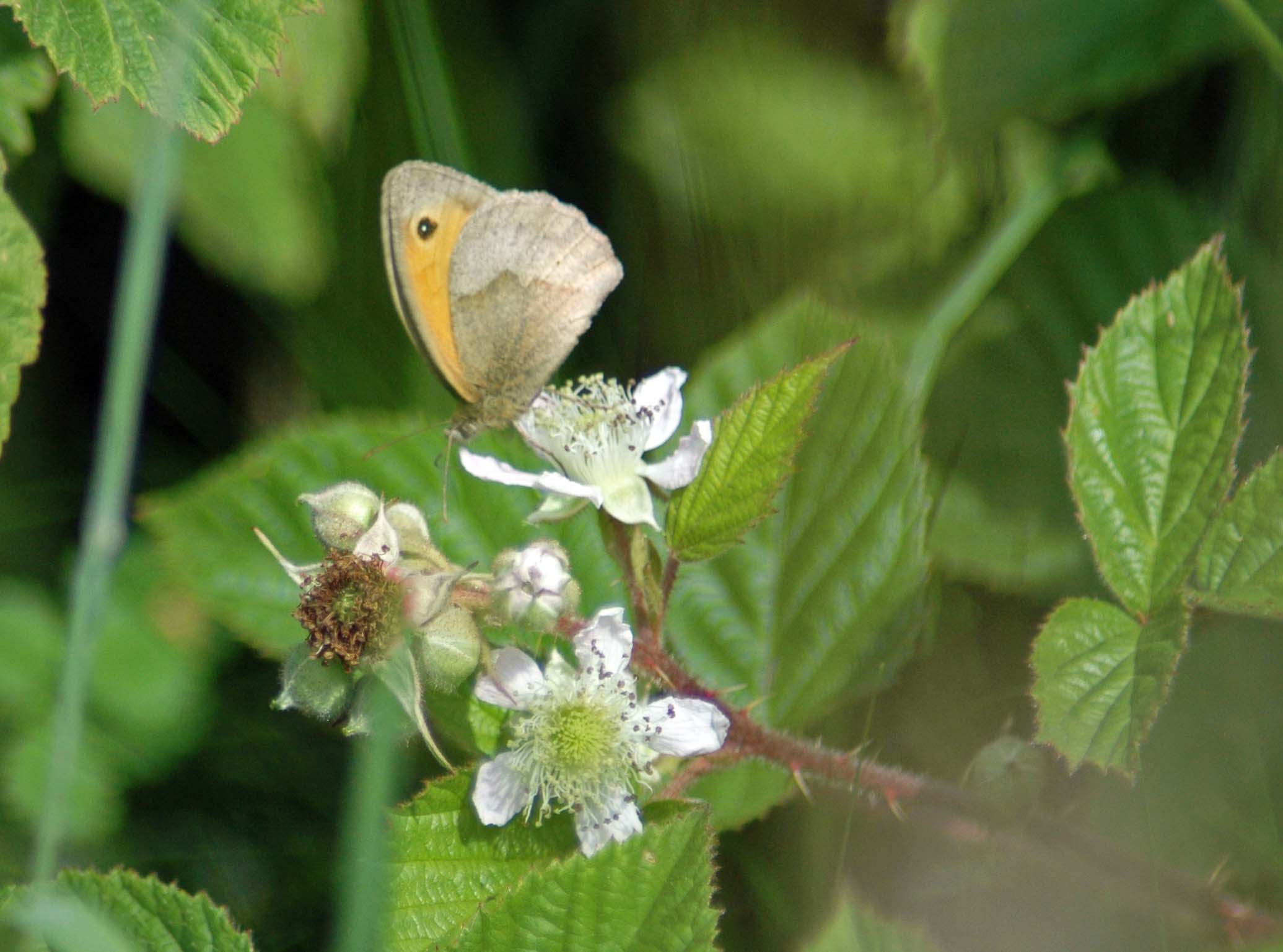
From the field I walked up the steps following the ‘woodland trail’, making a diversion around the border of another meadow area. I stopped at a spot where there were several brown butterflies fluttering around amongst the long grass and shrubbery. My first assumption was that they were Meadow Browns as I’m used to seeing them throughout most of the site at this time of year, but stopping to watch properly I realised that although there were Meadow Browns there, most were actually Ringlets.

A Meadow Brown nectaring on bramble flower

A Meadow Brown nectaring on bramble flower

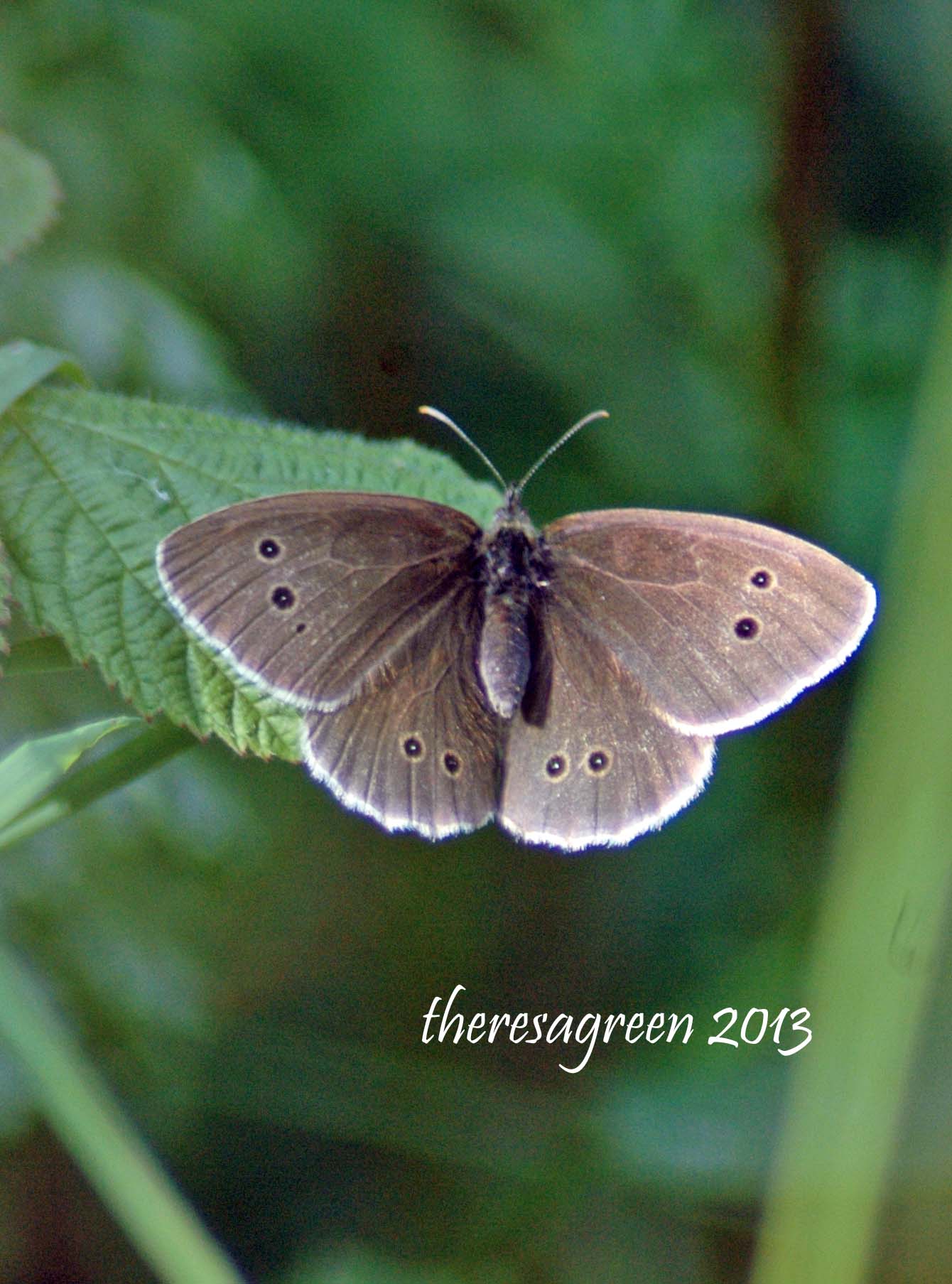
The Ringlets were very mobile and fluttering around mainly within the stems of the long grass, as they characteristically do. On the occasions when one paused in its circuiting to take nectar from bramble flowers or to rest low down on a leaf or grass stem, the insect would either be obscured by grass stems or disturbed by the dive-bombing of another butterfly or a bee. I waited patiently for ages, just watching them until I got the opportunity to grab a shot of one on bramble leaf. It posed nicely, but turned out to have chunks missing from its wings, poor thing.

Ringlet with damaged wings

Ringlet with damaged wings

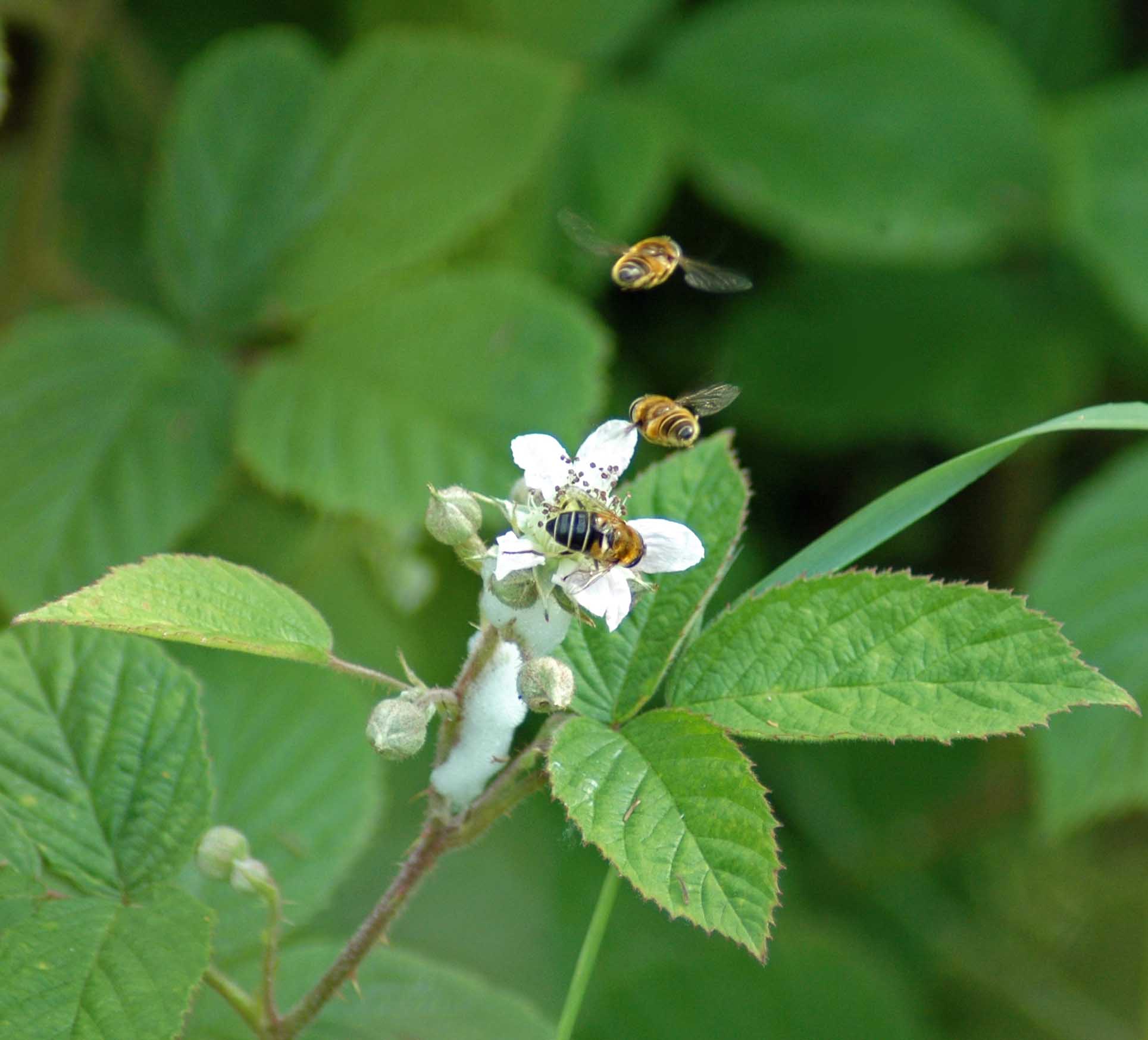
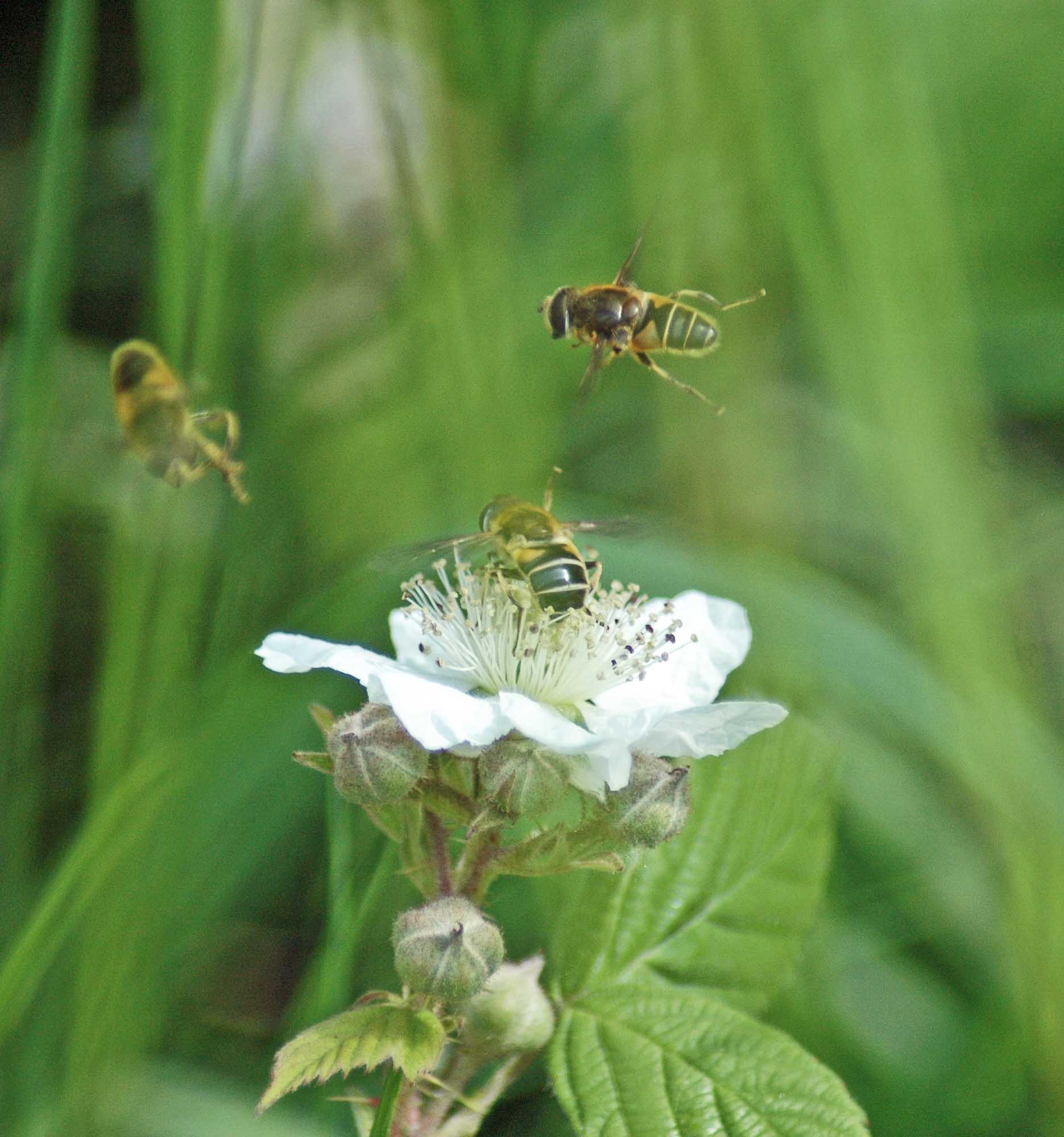
I wasn’t giving up now though, and standing around in the warm sunshine in this peaceful spot, surrounded by lush greenery and time to watch the insect world go by was not exactly a hardship. Every now and then the butterflies disappeared from view for a few minutes, most probably touring another part of their territory, but while waiting there were other insects to watch. One particularly interesting performance was provided by three hoverflies. The two smaller ones were hovering around and bothering the larger one on the bramble flower; two males competing for the attention of a female who eventually got tired of them and saw them both off. The hoverflies are of a small Eristalis species, but the photographs aren’t good enough to determine which one.

Two male and one female eristalis hoverflies

Two male and one female eristalis hoverflies

Two male hoverflies expressing interest in a female

Two male hoverflies expressing interest in a female

Another chance of a Ringlet arose, this time a perfect subject, but a bit further away and hiding its head and body behind the bramble’s stamens. I got the ring pattern this time though.

Ringlet - Aphantopus hyperantus

Ringlet – Aphantopus hyperantus

Standing around in the direct sun was starting to get uncomfortable, so I left the Ringlets to their chasing to find a bit of shade. As luck would have it I soon came upon more of them and one posed beautifully on a bramble leaf in the dappled shade of an oak tree.

Ringlet resting with wings open

Ringlet resting with wings open

Ringlet – Aphantopus hyperantus

The rings on the hindwings give this butterfly its common name and make it unmistakeable when seen at rest. The uppersides are a uniform chocolate brown that distinguish this butterfly from the closely-related Meadow Brown that can often be found flying within the same areas. A newly-emerged adult Ringlet is a surprisingly beautiful insect, the velvety wings providing a striking contrast with the delicate white fringes found on the wing edges. The dark colouring also allows this butterfly to quickly warm up – this butterfly being one of the few that flies on overcast days.

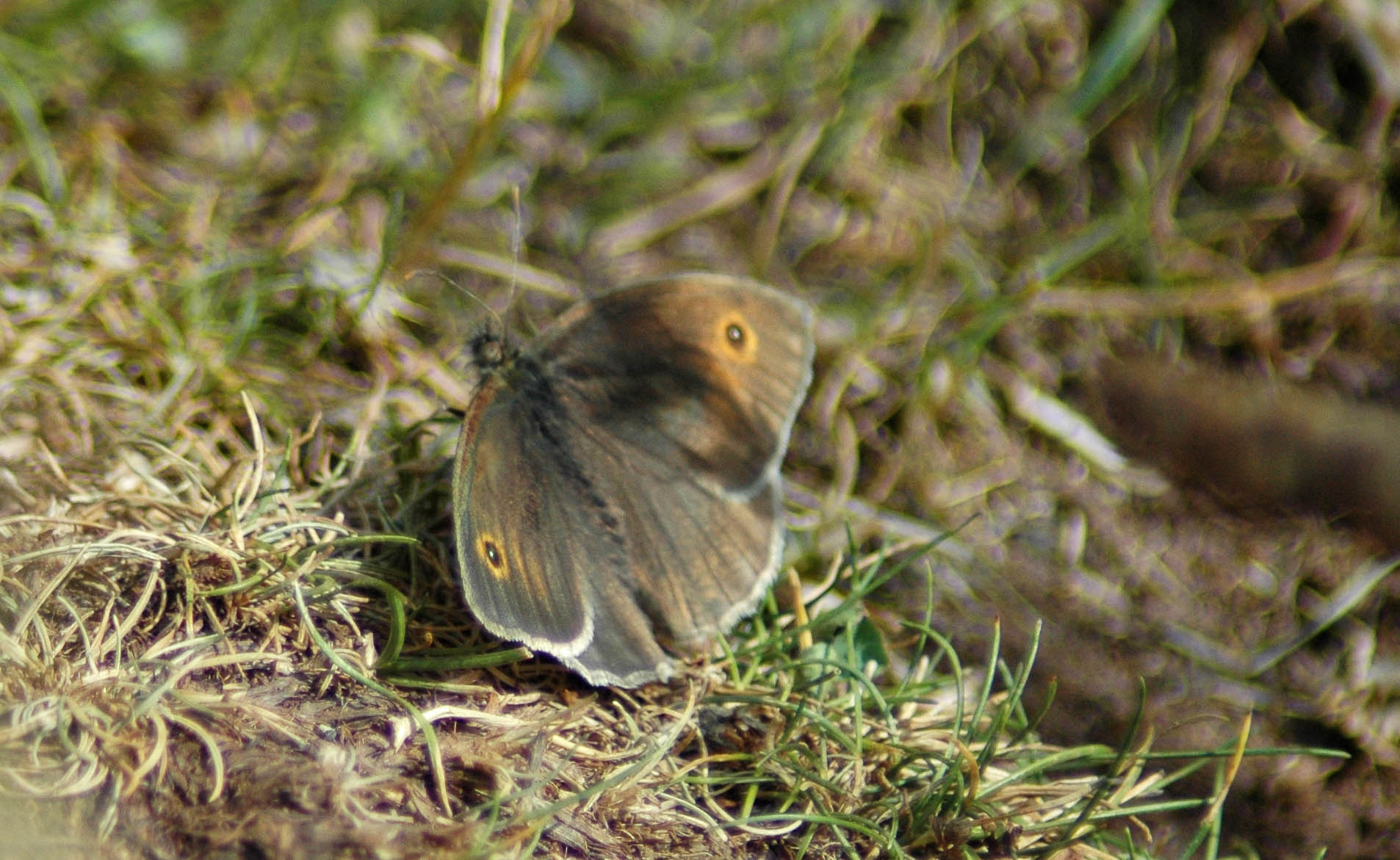
14/7/13-Meadow Brown-Bryn Euryn

The Meadow Brown also has a dark brown upperside, but eyespots are ringed with orange

Dog Roses-another shrub often found on a woodland edge

Dog Rose – another shrub often found on a woodland edge

Walking out into what is effectively a large clearing in the woodland I came upon another two butterflies, one a rather faded female Common Blue, the other a much fresher Small Heath.

Female Common Blue

Female Common Blue

Small Heath

Small Heath

A surprise find here and a pretty note on which to end this section of my walk was a single Pyramidal Orchid, the first one I’ve seen here on Bryn Euryn.

Pyramidal Orchid

Pyramidal Orchid


53.308051 -3.749941

Share this:

  • Share on Facebook (Opens in new window) Facebook
  • Share on Pinterest (Opens in new window) Pinterest
  • Share on X (Opens in new window) X
Like Loading...

Hogweed days

12 Friday Jul 2013

Posted by theresagreen in Bryn Euryn Nature Reserve, butterflies, Nature, Nature of Wales, nature photography, Rhiwledyn Nature Reserve, Wildflowers of Wales

≈ 14 Comments

Tags

comma, cow parsnip, heracleum sphondylium, hogweed, medicinal uses of hogweed, medicinal uses of plants, Rose Chafer, small tortoiseshell

The most significant nectar provider for a whole host of insects at the moment is Hogweed, or Cow Parsnip if you prefer. In common with many species of wildflowers it seems to be having a bumper season and is flowering profusely in a lot of locations. The photographs here were mostly taken in the last couple of weeks, either in the Rhiwledyn Nature Reserve on the Little Orme or on Bryn Euryn. 

Hogweed, Cow Parsnip – Heracleum sphondylium  

Family: Carrot; Umbelliferae Habitat: Rough grassland verges, light woodland. The most usual late autumn umbellifer in flower.

Flowering:  (May) June – September Seeds: Winged Height: averages 50–120 cms (20–47 in), can reach 2 metres (6 ft 7 in)

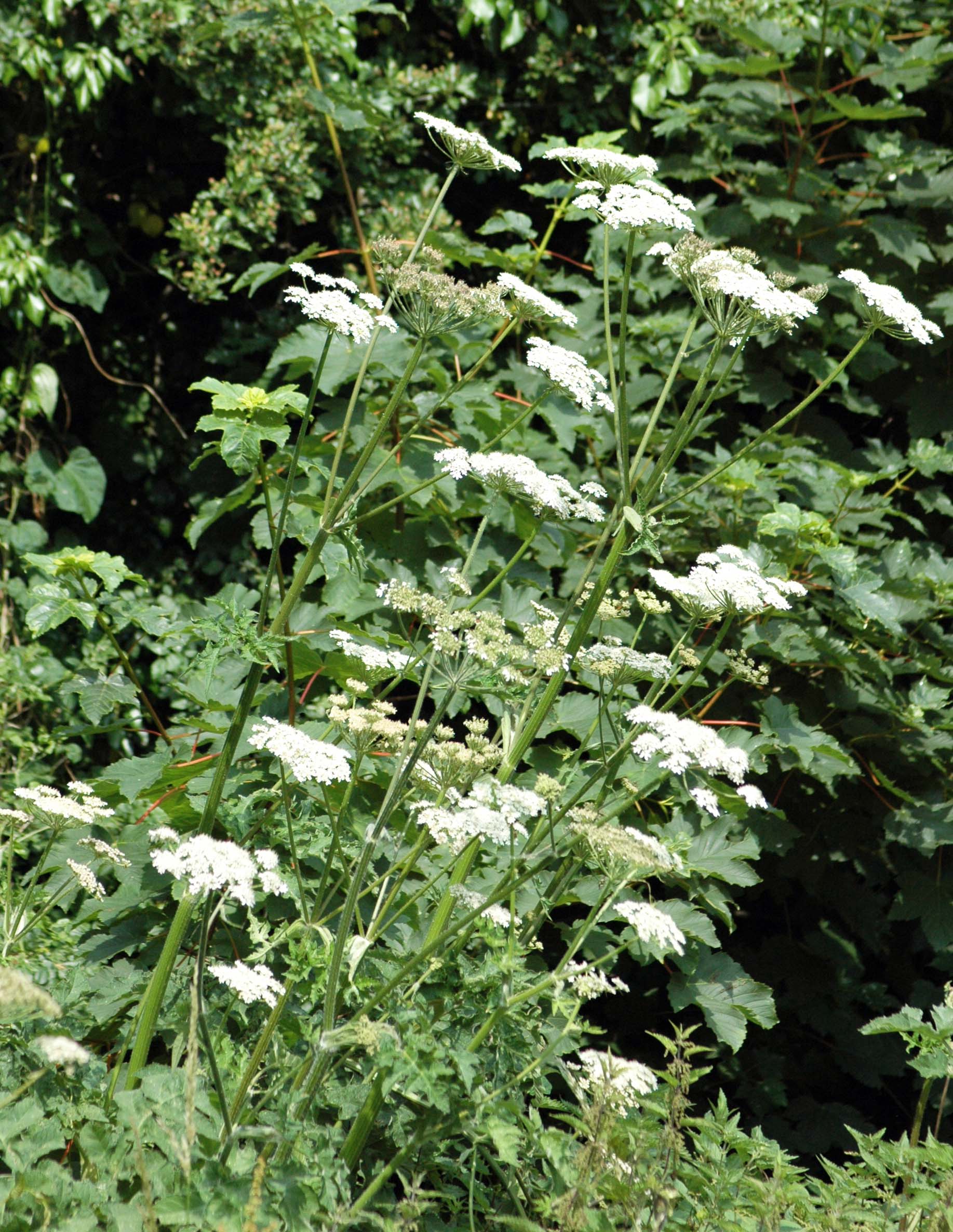
Hogweed is an herbaceous perennial or sometimes biennial plant, native to Europe and Asia. It is an umbelliferous plant, in the same group as plants such as fennel, cow parsley and ground elder.

Hogweed-Heracleum spondylium

Hogweed-Heracleum spondylium

etymology

The common name of Hogweed refers to the characteristic pig-like smell of the flowers. The genus name Heracleum derives from the Greek “herákleion” and refers to the mythologic hero Heracles, who is reputed to have used the plant medicinally. The species name sphondylium, meaning “vertebrae”, refers to the shape of the segmented stem.

The leaves are large and can reach 50 cms (20 in) in length. They are pinnate, hairy and serrated, divided into 3-5 lobed segments.

Hogweed leaves

Hogweed leaves

A snail tucked into hogweed stems

A snail tucked into hogweed stems

The roots of the plant are large, rhizomatous and reddish in colour. The stem is hollow and striated with bristly hairs.

The flowers are  white, sometimes pinkish and each has 5 petals. They are arranged in large umbels of up to 20 cm of diameter with 15 to 30 rays. The peripheral flowers having a radial symmetry.

The inflorescence of a Hogweed plant

The inflorescence of a Hogweed plant

The hogweed is one of a number of plants that have foregone the use of a sweet scent to attract pollinating insects. The plant has adopted the more unusual strategy of mimicking the scent of pigs, not that noticeable to us, but to flies it is like a magnet and flies are the main pollinators of this plant.

A tachinid fly nectaring on hogweed

A tachinid fly nectaring on hogweed

The small fruits are flattened and winged, elliptical to rounded in shape and glabrous (smooth, free from hair or down) up to 1 cm long. The seed dispersal is by wind.

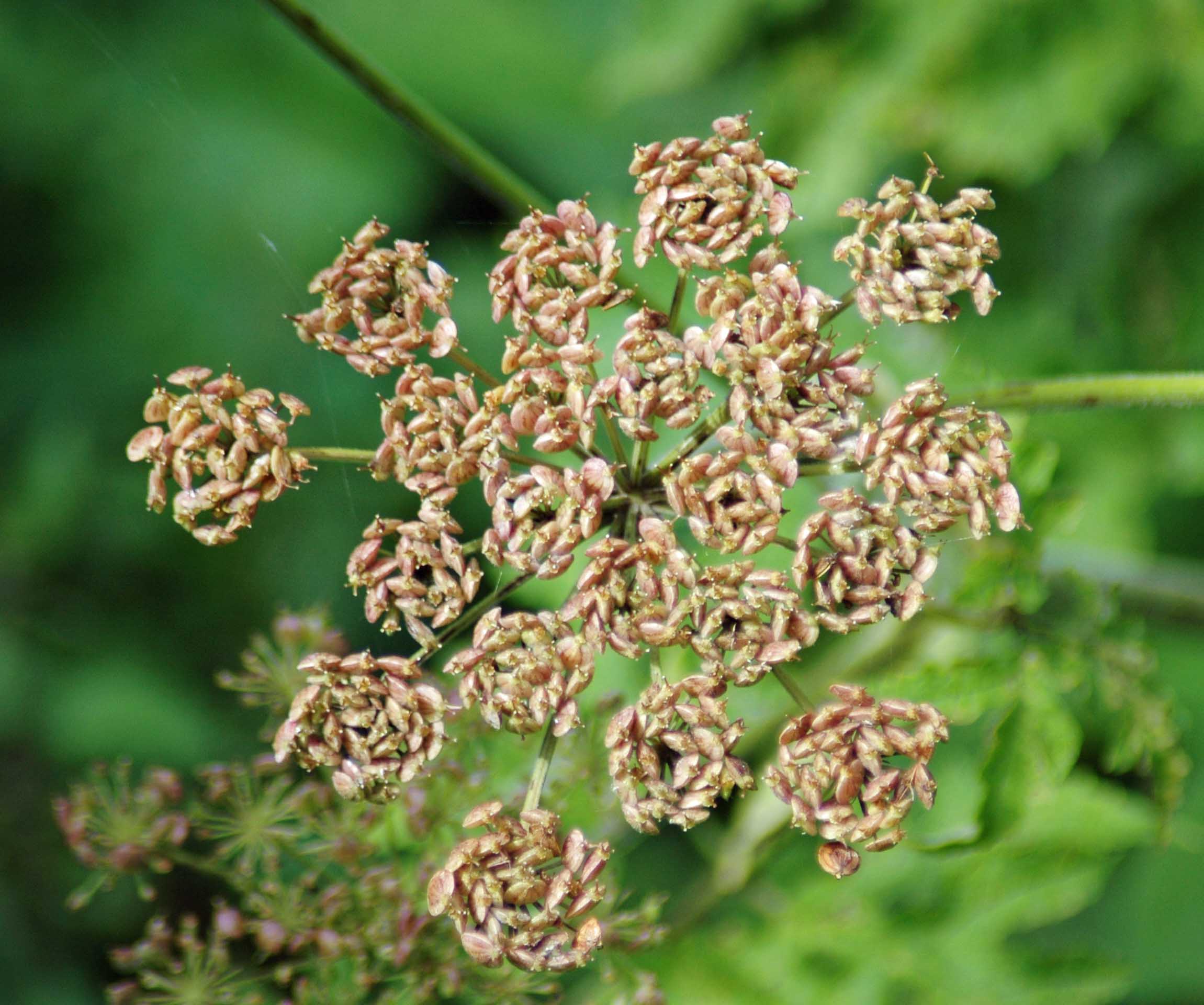
Hogweed seedhead

Hogweed seedhead

1/9/12 - Hogweed seeds

1/9/12 – Hogweed seed cases

traditional medicinal and culinary uses

Common hogweed was once employed in medicine, although its use has been long out of favour. Long ago the seeds were boiled in oil that was then recommended for application to running sores and to treat the rash associated with shingles. Culpeper recommended a decoction of the seeds to be applied to running ears.

Hogweed shoots have  a high vitamin C content and the plant is still eaten in some places. The young shoots are collected early in the season and the  tender young stems, cut into pieces about 15cm long may be boiled in salted water for about 15 minutes, then drained and served with butter. Apparently they make an ideal accompaniment to meat dishes.

(WARNING!  This family of plants contains many poisonous species and correct identification is essential before even thinking about eating them.)

hogweed and insects

Although its main pollinators are flies, many insects of other species can be seen helping them out whilst helping themselves to the nectar. It is not uncommon to see numbers of insects vying for a space on the same hogweed flowerhead.

A pair of soldier beetles mating, a green shield bug, a small black beetle and a fly of some sort all on one small flowerhead, oh and there's a spider's web

A pair of soldier beetles mating, a green shield bug, a small black beetle and a fly of some sort all on one small flowerhead, oh and there’s a spider’s web

30/6/13-Small Tortoiseshell on hogweed-Little Orme

30/6/13-Small Tortoiseshell on hogweed-Little Orme

30/6/13-Bumblebee on Hogweed flowers, Little Orme

30/6/13-Bumblebee-Bombus hortorium on Hogweed flowers, Little Orme

30/6/12-Greenbottle fly on hogweed - Little Orme

30/6/12-Greenbottle fly on hogweed – Little Orme

At Bryn Euryn the first insect I spotted on Hogweed flowers was a Comma butterfly. It was looking a bit worse for wear, faded and with chunks missing from its wings,but is a first tick for a sighting of this species this year.

8/7/13 -Comma butterfly

8/7/13 -Comma butterfly

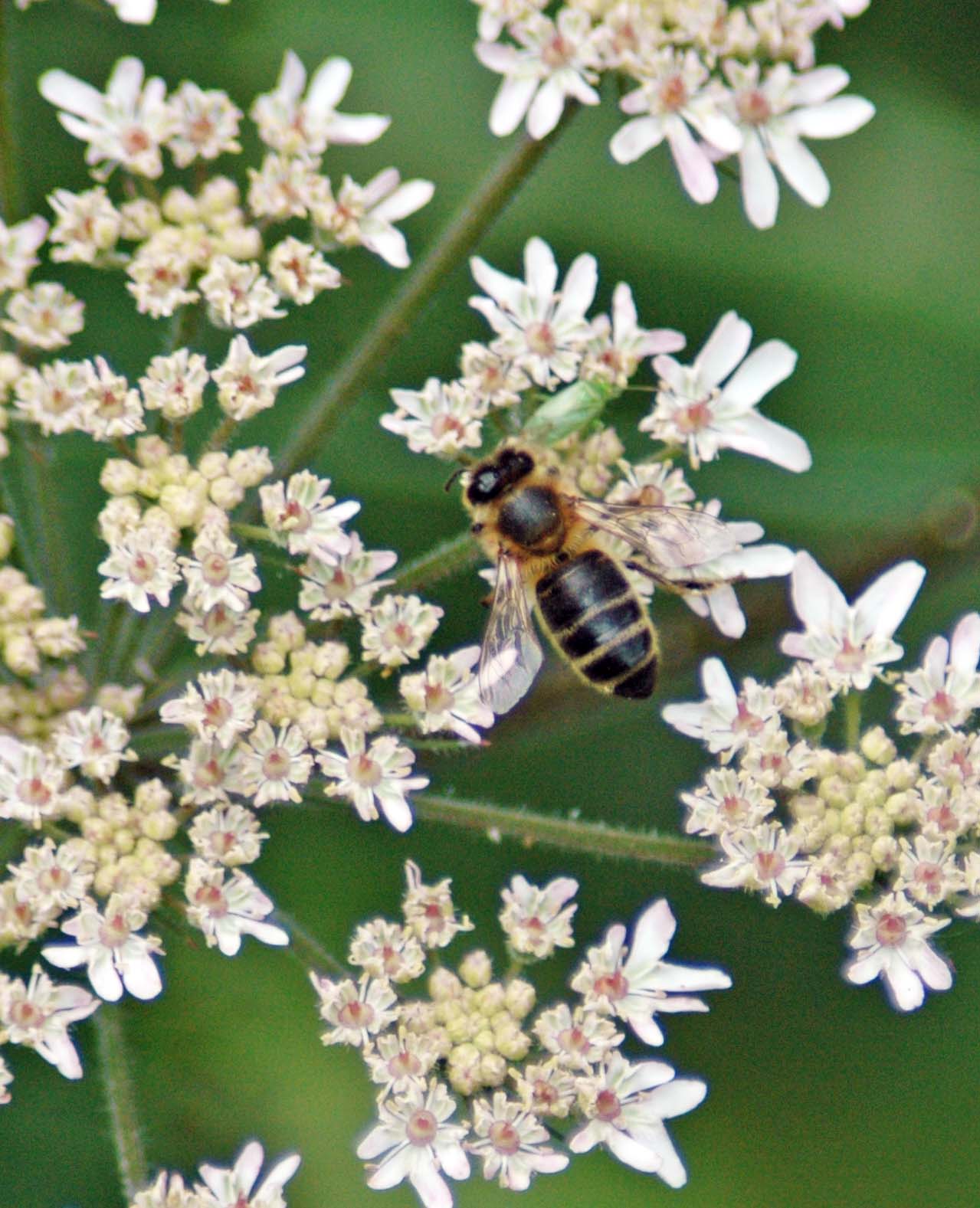
There were also a number of soldier beetles, greenbottle flies, bumblebees and hoverflies there. I thought I’d taken a picture of a honeybee too, but taking a closer look at the photograph I realised the insect had only two wings. I don’t know for sure what it is, more research  needed, but most probably a hoverfly ; an Eristalis species. Interestingly in respect of honeybees, a loved this observation on Adventure’s in Beeland’s blog  whats flowering now: early july   ” They (honeybees) appear to get very little pollen from these flowers, but instead swish their proboscis enthusiastically about in the nectar like a watercolour artist swirling their brush.” I’ll envisage that now, if I chance upon a honeybee on hogweed…

Probably a hoverfly an Eristalis species

Probably a hoverfly an Eristalis species

A 7-spot ladybird heading up a hogweed stem - there's prey up there - greenfly aphids

A 7-spot ladybird heading up a hogweed stem – there’s prey up there – greenfly aphids

One of my favourite photographs of an insect on hogweed is this one of a Rose Chafer, taken somewhere along the Pembrokeshire Coastal Path.

2/7/08-Rose Chafer on Hogweed - Pembrokeshire Coastal Path

2/7/08-Rose Chafer on Hogweed – Pembrokeshire Coastal Path

Picture from Naturespot: Graham Calow - Sapcote - 26 April 2012

There is an insect that I am aware of but haven’t noticed yet, actually named  for the plant; the Hogweed picture-wing fly. It is a small picture-winged fly Euleia heraclei. Also known as the Celery fly, it is a species of tephritid or fruit fly and is a pest of celery and parsnips, where it damages the vegetables by leaf mining. Males display on the upper surfaces of leaves on sunny days during May and mating takes place when a female arrives.  In Britain, the species is distributed widely across southern and central England; in Wales records are mainly near the coast. (The picture is taken from one of my favourite ID sites http://www.naturespot.org.uk/)

53.308051 -3.749941

Share this:

  • Share on Facebook (Opens in new window) Facebook
  • Share on Pinterest (Opens in new window) Pinterest
  • Share on X (Opens in new window) X
Like Loading...

Wildflowers on a Limestone pavement

27 Thursday Jun 2013

Posted by theresagreen in Bryn Pydew, Butterflies of Wales, Limestone Pavement, Nature, Nature of Wales, nature photography, North Wales Wildlife Trust, Wildflowers of Wales

≈ 11 Comments

Tags

bloody cranesbill, Brown Argus, common blue, common rockrose, common shrew, dropwort, heath-spotted orchid, limestone pavement, North Wales Wildlife Trust, salad burnet, small heath, wildflowers of Bryn Pydew

The North Wales Wildlife Trust reserve at Bryn Pydew is becoming one of my new favourite places to visit, especially to see some of our less-common wildflowers and a variety of insects.

The first thing to attract my attention today was a Small Heath butterfly.  Fluttering along low to the ground it kept disappearing from my sight as it landed amongst the stems of long grass, but I managed to follow it along the woodland edge for a short way until I was distracted by the corpse of a little shrew. It didn’t appear to have been there for long, but there were puncture wounds around its back so had clearly been caught by something with sharp teeth and the fact that it had not been eaten suggests a domestic cat; they don’t like the taste of shrew and often leave their victims lying at the side of paths etc.

A Pygmy Shrew (dead)

Common Shrew  – Sorex araneus  Welsh: Llyg Cyffredin

British shrews are protected by the Wildlife and Countryside Act 1981, and it is an offence to kill them without a special licence.

Description: As with all  shrews, the common shrew has a long, flexible snout, small eyes and tiny ears.  They have dark brown fur on their backs, paler sides and an even paler underside.  Their heads are not as domed in shape as that of the even smaller pygmy shrew and the tail is proportionately shorter than that of the smaller species.

Food: All shrews have voracious appetites; they need to feed every 2-3 hours and consume up to 90% of their body weight in any 24 hour period. They eat most terrestrial insects, but also take worms, slugs and snails; they have a good sense of smell and feeling, but they do not dig for their prey.They lack the fat reserves to see them though the winter so do not hibernate and can be seen all year round.  Apart from those killed by cats, shrew corpses may also be those of animals that have not been able to find enough food.

Behaviour: They are solitary, territorial animals and often fight when they come into contact with their neighbours.  The high pitched squeaking sound that they make can often be heard as you walk along footpaths; they are most active at night and during dawn and dusk and intersperse periods of intense activity with resting.

Reproduction

Shrews build nests below the ground or under dense vegetation. After a gestation period of 22-25 days, females give birth to 4-7 young, which are weaned after 22 days. They breed from April to October, with a peak in the summer.

_______________________________________________________

I lost the butterfly but was soon compensated with a lovely bright metallic green beetle rummaging around in the stamens of a Welsh poppy.

Oedemera nobilis feeding on pollen

Oedemera nobilis feeding on pollen

This was the first, rather hasty photograph I took of the handsome beetle and followed it with a number of what I thought would be much better shots, but when I downloaded the day’s bounty I discovered all of them were unreadable, so goodness knows what happened there. Hopefully I will find more another day.

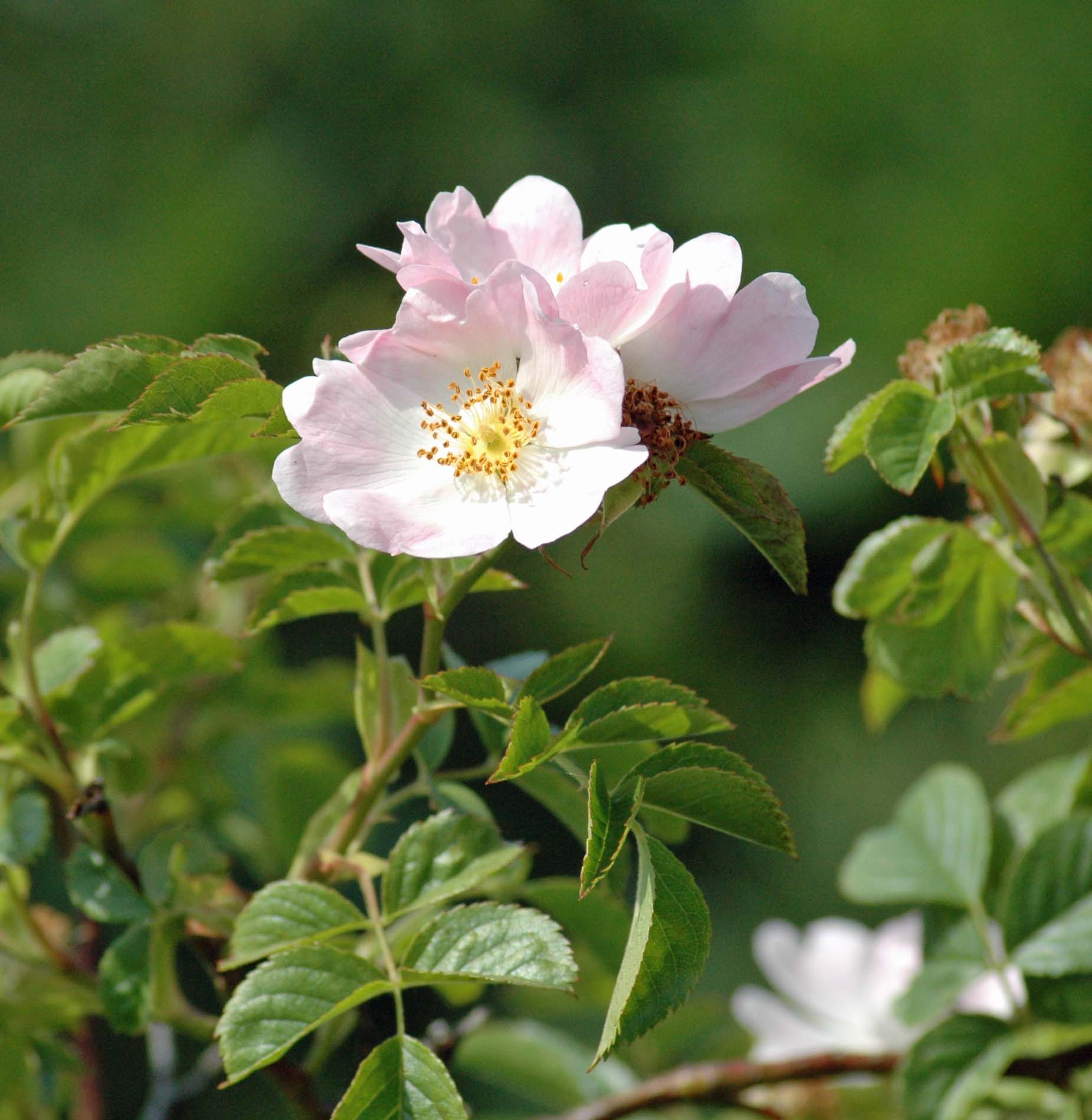
Dog Rose- Rosa canina

Dog Rose- Rosa canina

The open patch of ground just inside the site boundary is lovely now, lush with a mix of tall meadow grasses swaying gently in the day’s light breeze and catching the sunlight. Dog rose shrubs are in glorious full bloom.

A lush display of tall meadow grasses

A lush display of tall meadow grasses

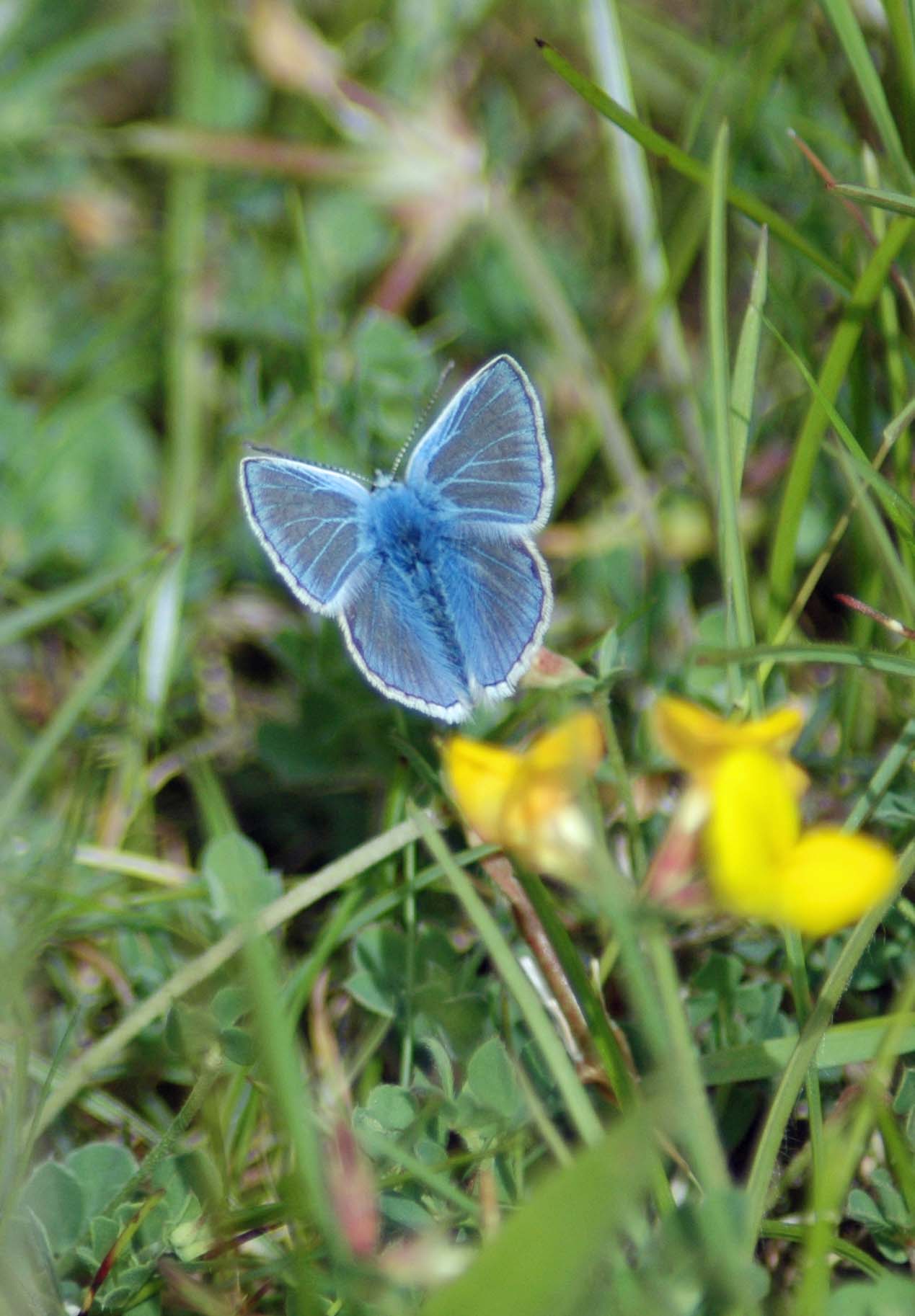
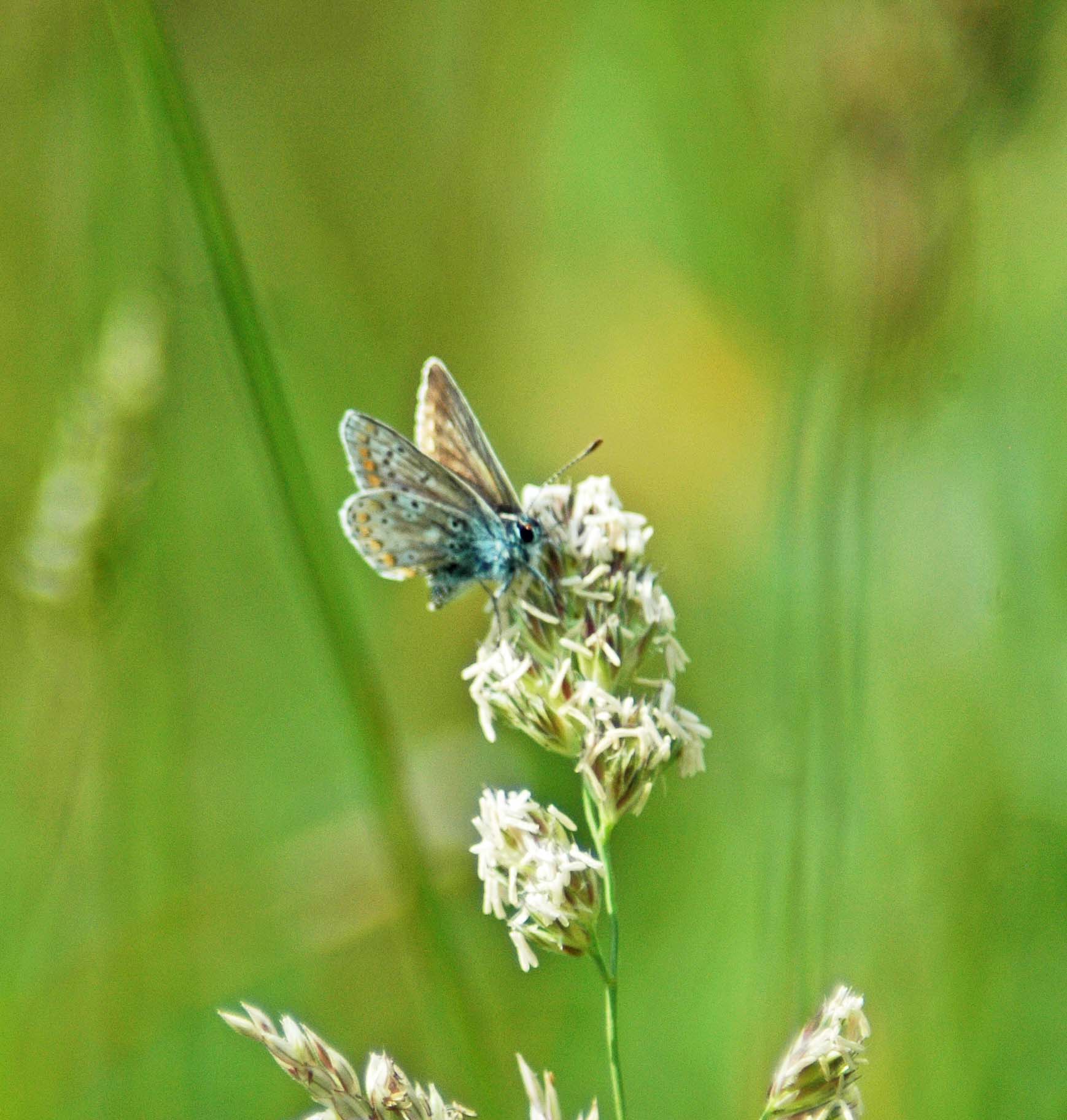
In a sunny patch of shorter turf where there was Red Clover and Bird’s-foot Trefoil growing I stopped to watch Common Blue and Brown Argus butterflies and bumblebees. Both species of butterfly are territorial despite their tiny size and were chasing off anything and everything that dared enter their airspace.

A Common Blue male taking off from Bird's-foot Trefoil

A Common Blue male taking off from Bird’s-foot Trefoil

Brown Argus

Common Carder Bee on red clover

Common Carder Bee on red clover

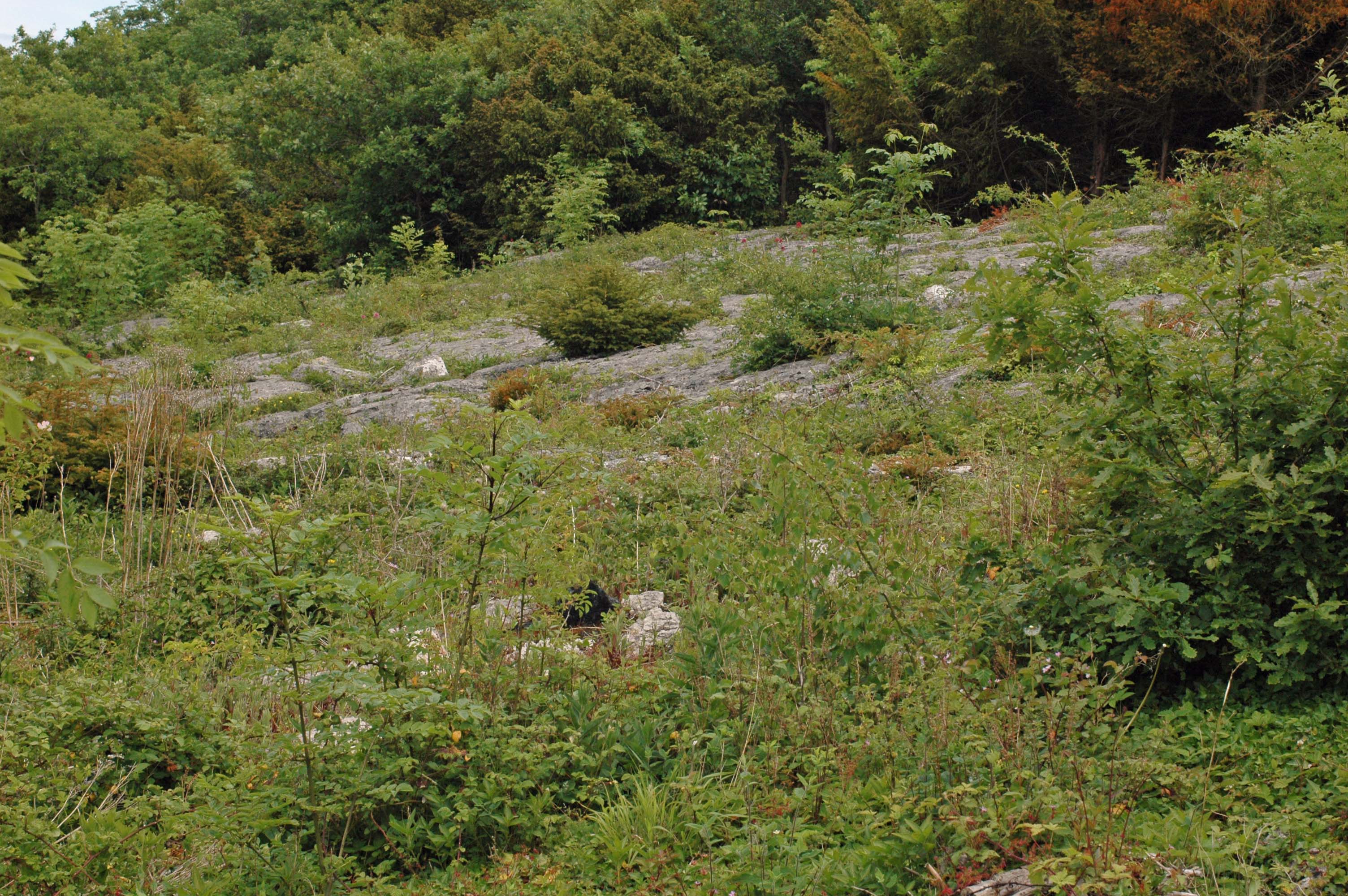
There’s not much to see in the woodland here, the trees, including a good number of yews grow closely together, shutting out much of the sunlight, so it is very dark and quiet in there. I did spot a young Wren demanding attention from a parent though, calling loudly and flapping its wings wildly to try to maintain its balance on a fence post. It is only a short downhill walk to take before reaching the open area of Limestone Pavement. It’s a little more overgrown now than the last time I saw it, with quite a few tree saplings and brambles getting a foothold. I know little or nothing about how you would go about maintaining a limestone pavement though, so have no idea what would be removed, or when, but there are some lovely wildflowers here currently and it would be a shame if they were smothered by brambles.

The main expanse of Limestone Pavement

The main expanse of Limestone Pavement

Common Rockrose

Common Rockrose

There is quite a bit of rockrose, interspersed with salad burnet with its curious flowerheads.

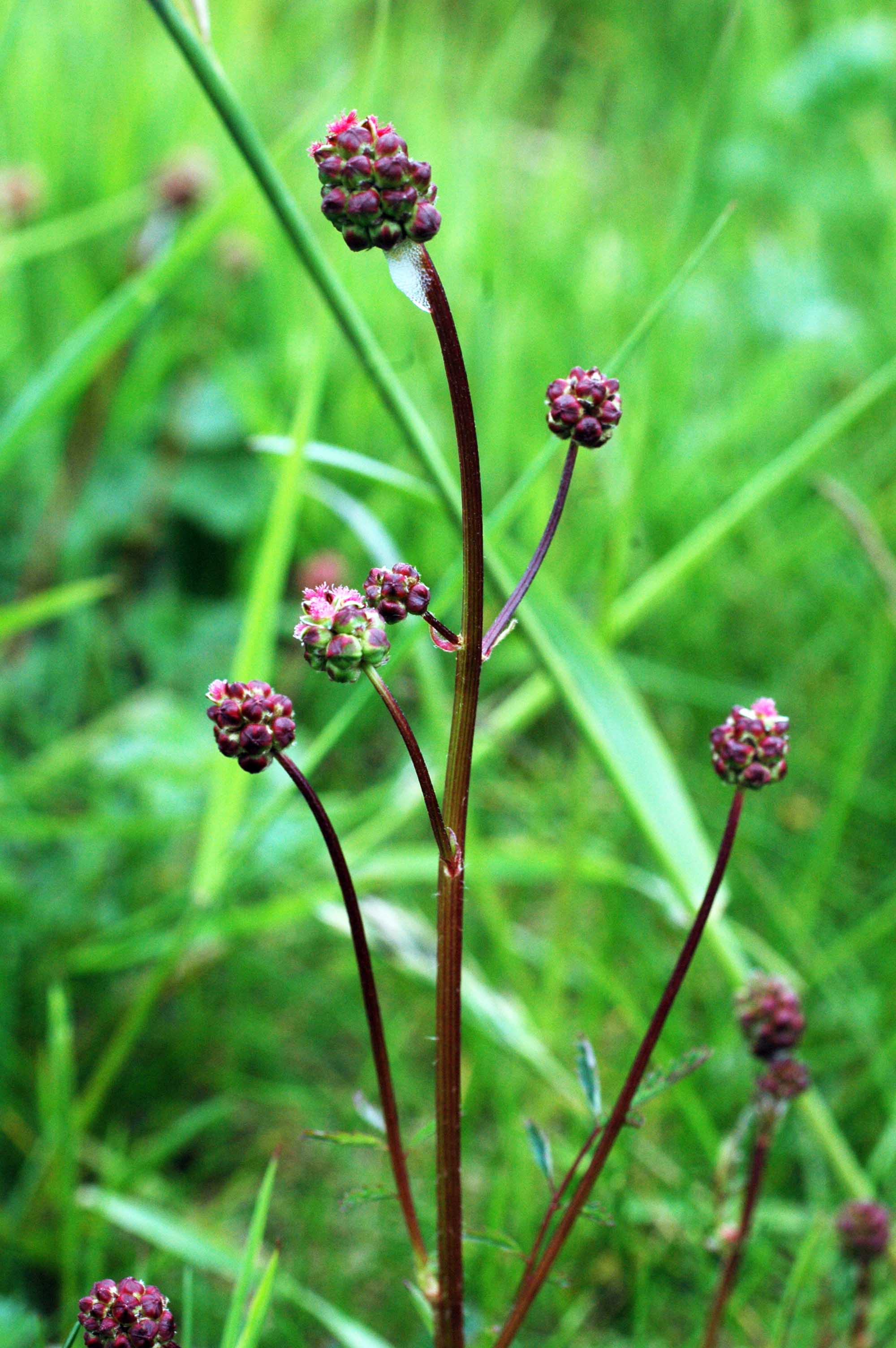
Salad Burnet– Sanguisorba minor is a low-growing herb of chalk and limestone grasslands which produces rounded, reddish flower heads from May to September. The leaves of Salad Burnet comprise up to 12 pairs of rounded, toothed leaflets, and form a rosette at the base of the flower stem. The rounded flower heads are reddish and speckled.

Salad Burnet flower

Salad Burnet flower

The leaves are famous for smelling of cucumber if crushed or walked upon, and this plant lives up to its name as a popular addition to salads and summer drinks.

The leaves of Salad Burnet comprise up to 12 pairs of rounded, toothed leaflets, and form a rosette at the base of the flower stem.

The leaves of Salad Burnet comprise up to 12 pairs of rounded, toothed leaflets, and form a rosette at the base of the flower stem.

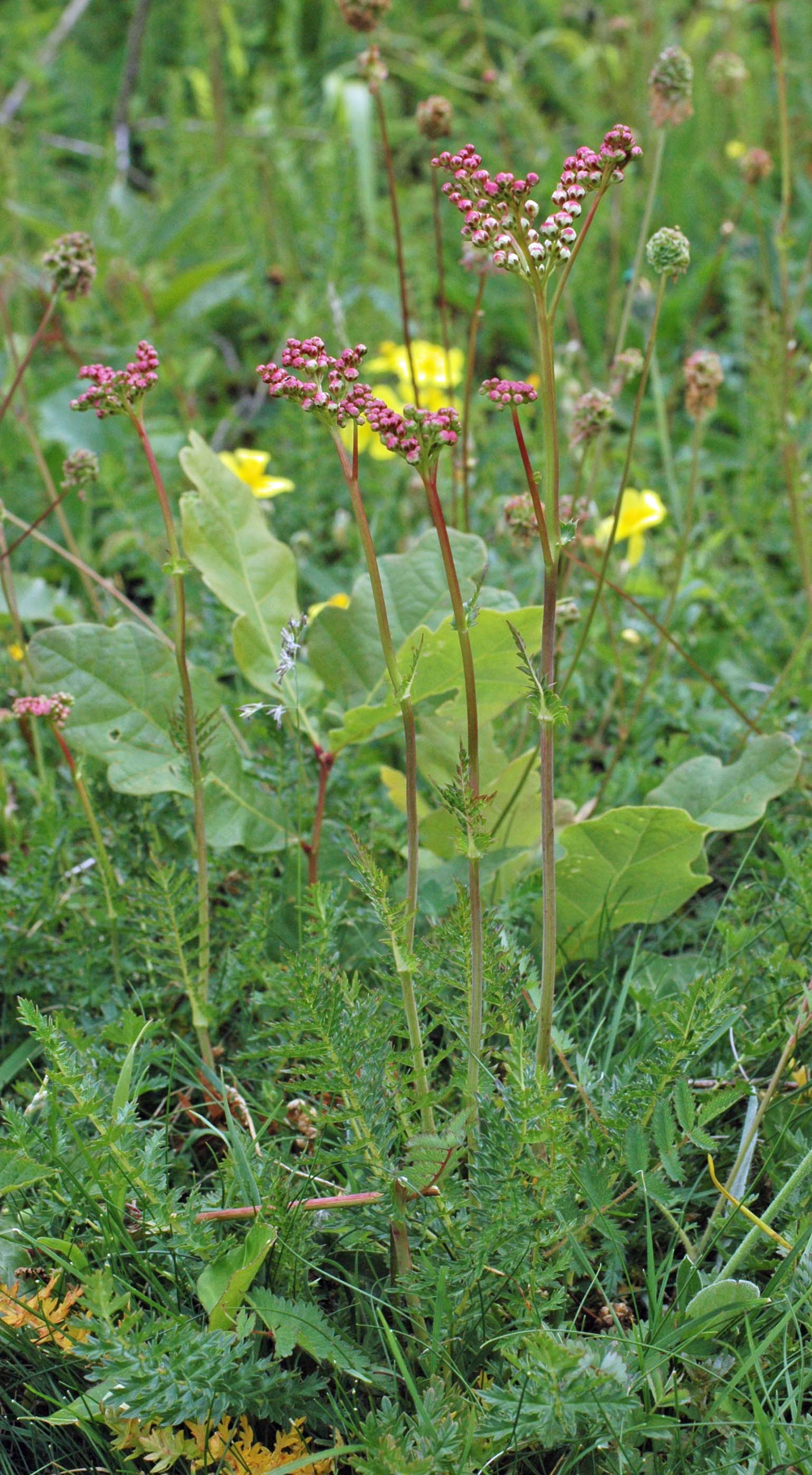
I try not to plan my outings too much, preferring to take things as they come at the time, but I was hoping to find one of this site’s ‘special’ plants in flower today. Dropwort-filipendula vulgaris is a clumsy (pardon the pun) name for a very elegant and rather ‘frothy’ plant. I found a couple of stems at the end of their flowering late last summer, but hoped to find more today. I was pleased then to find the first ones, which I recognised by the pretty fern-like leaves, but alas the flowers were still tightly budded. Once I had spotted one I found more, but all were tightly closed.

Dropwort in bud

Dropwort in bud

Again there was compensation for not finding what I was hoping for; this time it was Bloody Cranesbill –Geranium Sanguinem, which is not at all a common plant and in Wales restricted to a few limestone-rich coastal areas. It grows also on the Great Orme, a few miles away in Llandudno and I have also seen it on Llanddwyn Island in Anglesey.

Bloody Cranesbill-Geranium sanguinem

Bloody Cranesbill-Geranium sanguinem growing in a ‘gryke’ of the limestone pavement

There are many colour variations of this plant species, but it takes the ‘Bloody’ part of its name from the blood-red sepals that remain after the petals have fallen.

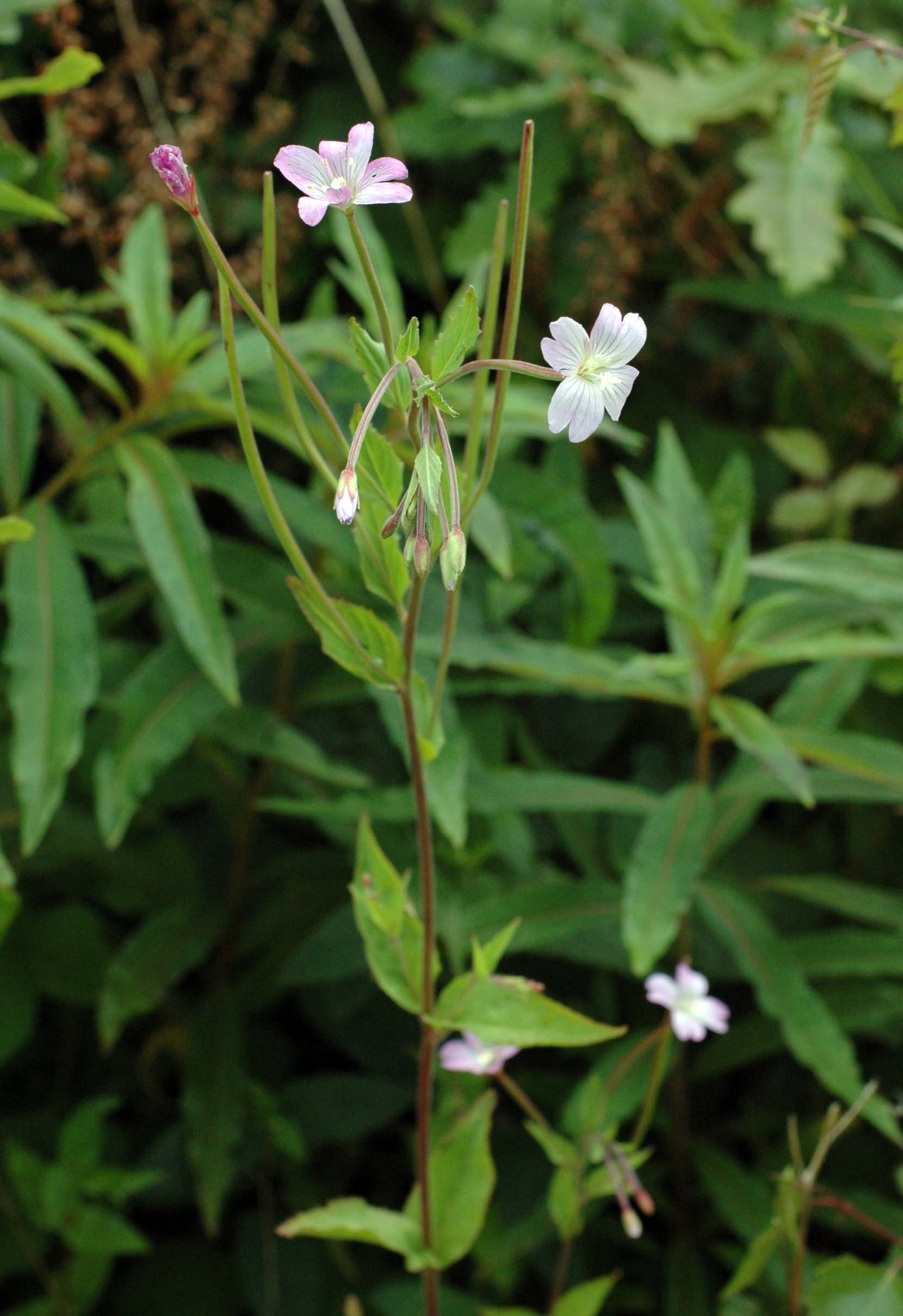
Broad-leaved Willowherb

Broad-leaved Willowherb, one of the more ‘ordinary’ wildflowers to be found here

Wood Avens

Wood Avens

Leaving this main area of the limestone pavement and continuing downhill through a narrow belt of woodland you emerge into an open grassy area that is so pretty I was half-expecting Bambi and friends to pop out. There were a few Purple Spotted Orchids here, very nearly finished, an impressive group of Bloody Cranesbill and more Rockroses.

At the far end of this small woodland glade is another smaller section of pavement, which is where I found the Dropwort last year. There was no sign of the plant in the exact same place, but I did spot a couple of little pale pink orchids. Once again, as I got my eye in, I found more of them, most not quite fully out yet.

Heath-spotted Orchid- Dactylorhiza maculata

Heath-spotted Orchid- Dactylorhiza maculata

I sat in the sunshine on the edge of the rocky pavement for a while, admiring the view across to Penrhyn Bay and watching more Small Heath butterflies fluttering over the stony ground where they settled to bask occasionally. I realised then that the reason I was finding it difficult to spot them earlier was because they settle very low to the ground, almost horizontal to it. As I got up to leave one fluttered along the grass in front of me, settling some metres ahead, so I took a series of photographs as I inched towards it, each one a little closer. It allowed me to get very close before flying off from here.

Small Heath - Coenonympha pamphilus

Small Heath – Coenonympha pamphilus

Quite unexpectedly then, just a short distance away from the butterfly I glanced up to see the flower I was hoping for in peachy pink and creamy white frothy glory. A Dropwort in almost full glorious bloom. What a treat.

Dropwort in full peaches and cream frothy glory

Dropwort in full peaches and cream frothy glory

Dropwort (Filipendula vulgaris), also known as Fern-leaf Dropwort, is a perennial herb of the family Rosaceae and closely related to Meadowsweet. It is found in dry pastures across much of Europe and central and northern Asia, preferring full sun to partial shade and is more tolerant of dry conditions than most other members of its genus.

It has finely-cut, radical leaves, fern-like in appearance, and an erect stem 20–50 centimetres (8–20 in) tall. The tiny creamy white flowers appear in dense clusters from late spring to mid summer. The crushed leaves and roots have a scent of oil of wintergreen (Methyl salicylate).

Share this:

  • Share on Facebook (Opens in new window) Facebook
  • Share on Pinterest (Opens in new window) Pinterest
  • Share on X (Opens in new window) X
Like Loading...

Little Orme in early June

14 Friday Jun 2013

Posted by theresagreen in Little Orme, Nature, Nature of Wales, nature photography, Rhiwledyn Nature Reserve, Wildflowers of Wales

≈ 6 Comments

Tags

alexanders, ash tree, pink wildflowers, robin's pincushion gall wasp, sea campion, walk on the Little Orme, white wildflowers, wild thyme, wildflowers of the Little Orme

I made Wild Cabbages the main floral event of my recent walk on the Little Orme, giving them a post of their own, simply because they are not an everyday plant and because the number of plants there are and the profusion of their flowers this year would have made them difficult to miss. But of course there was much more to see there.

June 4th

As late spring slips into early summer there is a blending of fading and fresh flowers and foliage. My first glimpse of the fresh was a lovely clump, (an inelegant word to use to describe such delicate flowers), of Greater Stitchwort. They were tucked tightly against a tangle of bramble, using it to support their rather weak, brittle stems.

Greater Stitchwort-Stellaria holostea

Greater Stitchwort-Stellaria holostea

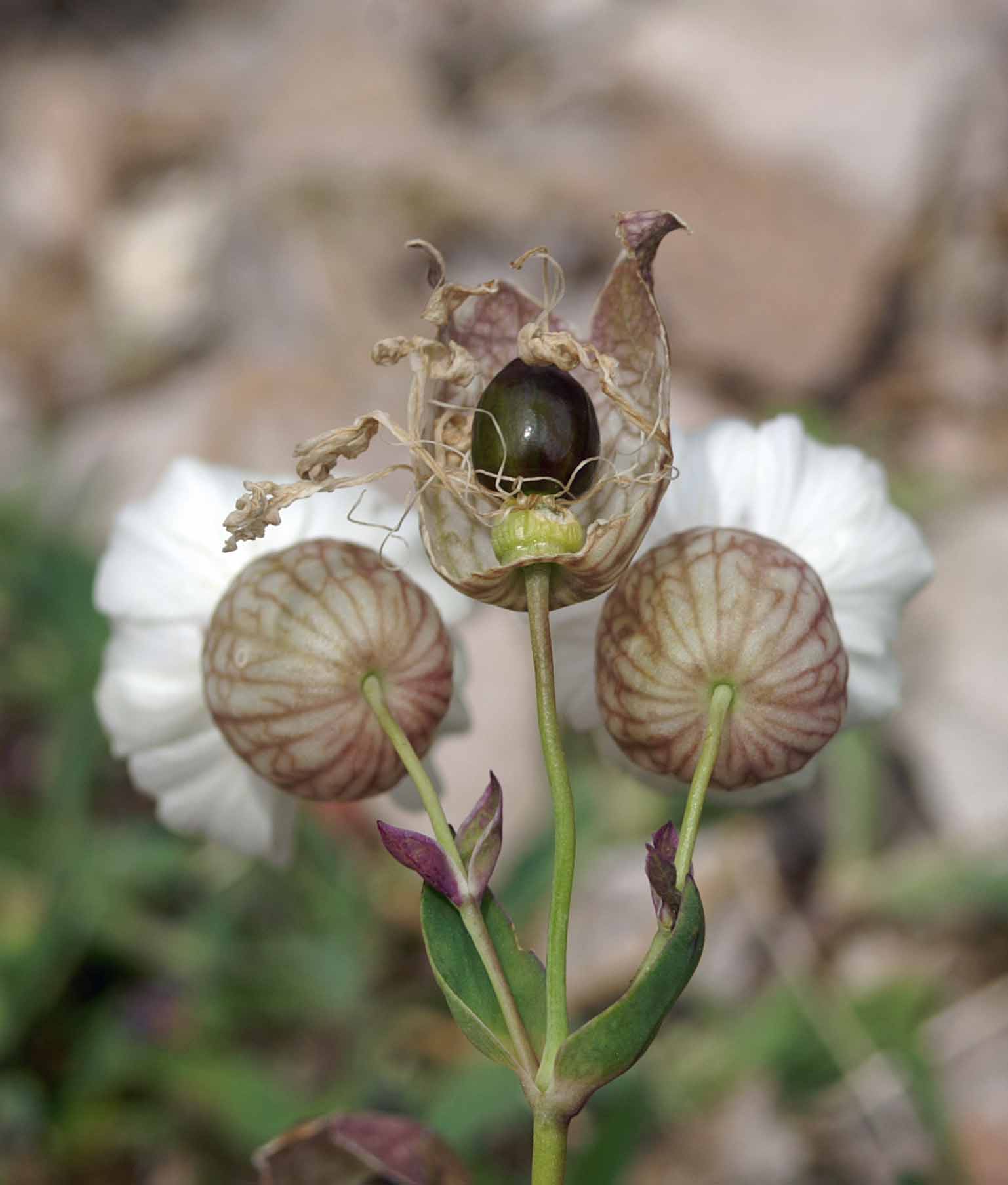
On the edge of the cliff there is a smattering of Thrift and some Sea Campion, both with fading flowers. I searched for a while to find Thrift that still looked fairly fresh, but find being able to see the seeds forming within the ‘bladders’ of the Sea Campion interesting.

Thrift and Sea Campion on a scree slope at the bottom of a cliff wall

Thrift and Sea Campion on a scree slope at the bottom of a cliff wall

Thrift-Armeria maritima

Thrift-Armeria maritima

A fairly fresh flower of Sea Campion-Silene vulgaris ssp. maritima

A fairly fresh flower of Sea Campion-Silene vulgaris ssp. maritima

Sea Campion-Silene vulgaris ssp. maritima-seed developing

Sea Campion-Silene vulgaris ssp. maritima-seed developing

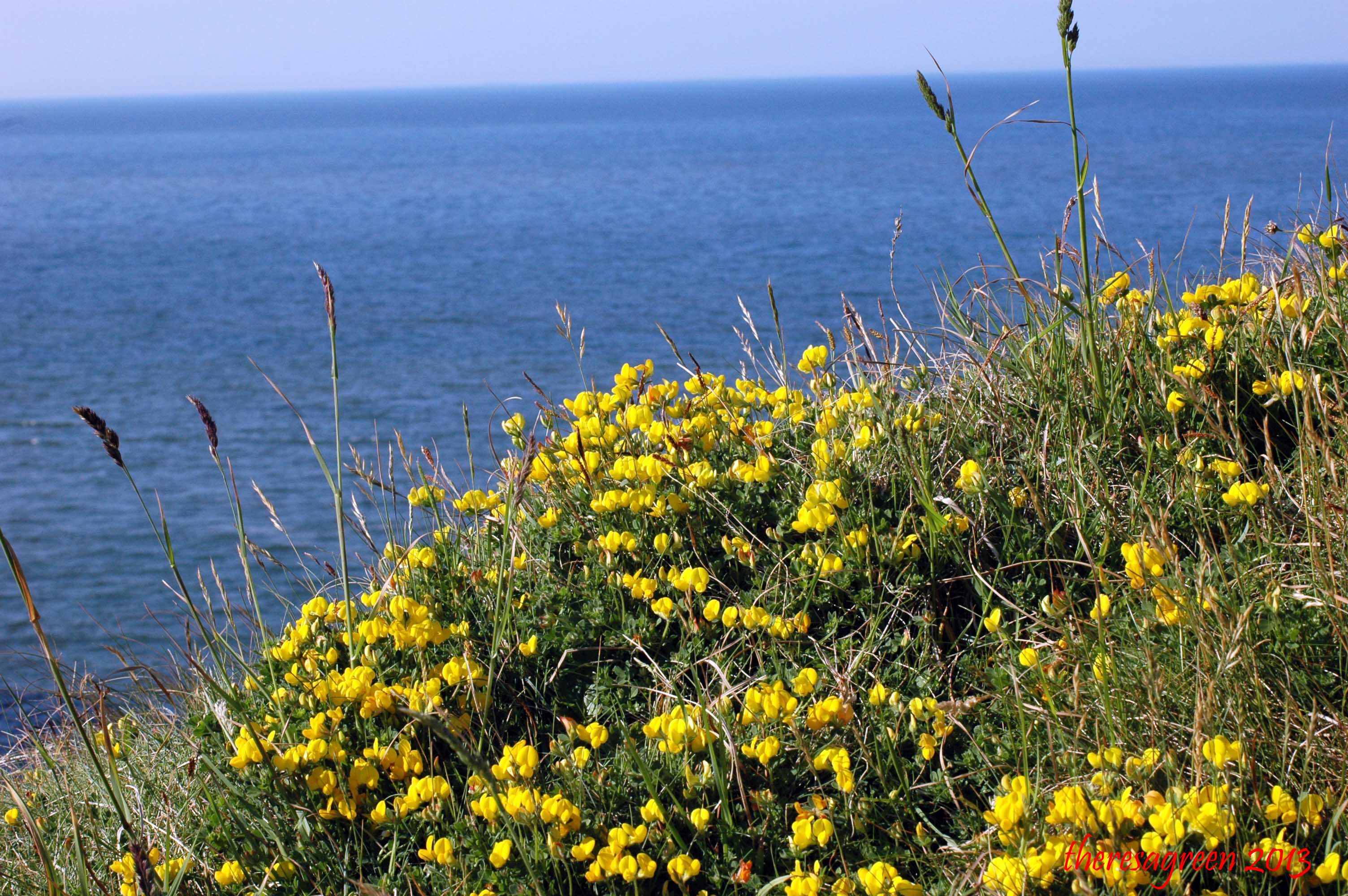
The most prolific wildflower here currently is Bird’s Foot Trefoil, which will carry on throughout the summer, providing nourishment for a whole host of fauna; a veritable live food manufacturing plant that looks beautiful too. I sat on a rock near this spot gazing at the view, contemplating life and enjoying the warmth of the late afternoon sun.

What could be prettier? Golden Bird's-foot Trefoil against a background of blue sea and sky

What could be prettier? Golden Bird’s-foot Trefoil against a background of blue sea and sky

There was a lot of Cormorant traffic travelling to and fro the tip of the headland, some in small groups, others alone. There are a large number of them here and their outlines can often be seen against the sky, the birds perched at regular intervals down the rock descending to the sea.

Turning back from the cliff I thought I might walk up the steep grass incline to the top of the hill, but I got halfway up and decided it might be a bit late in the day for rambling around up there, so stopped to take a photograph and walked down again.

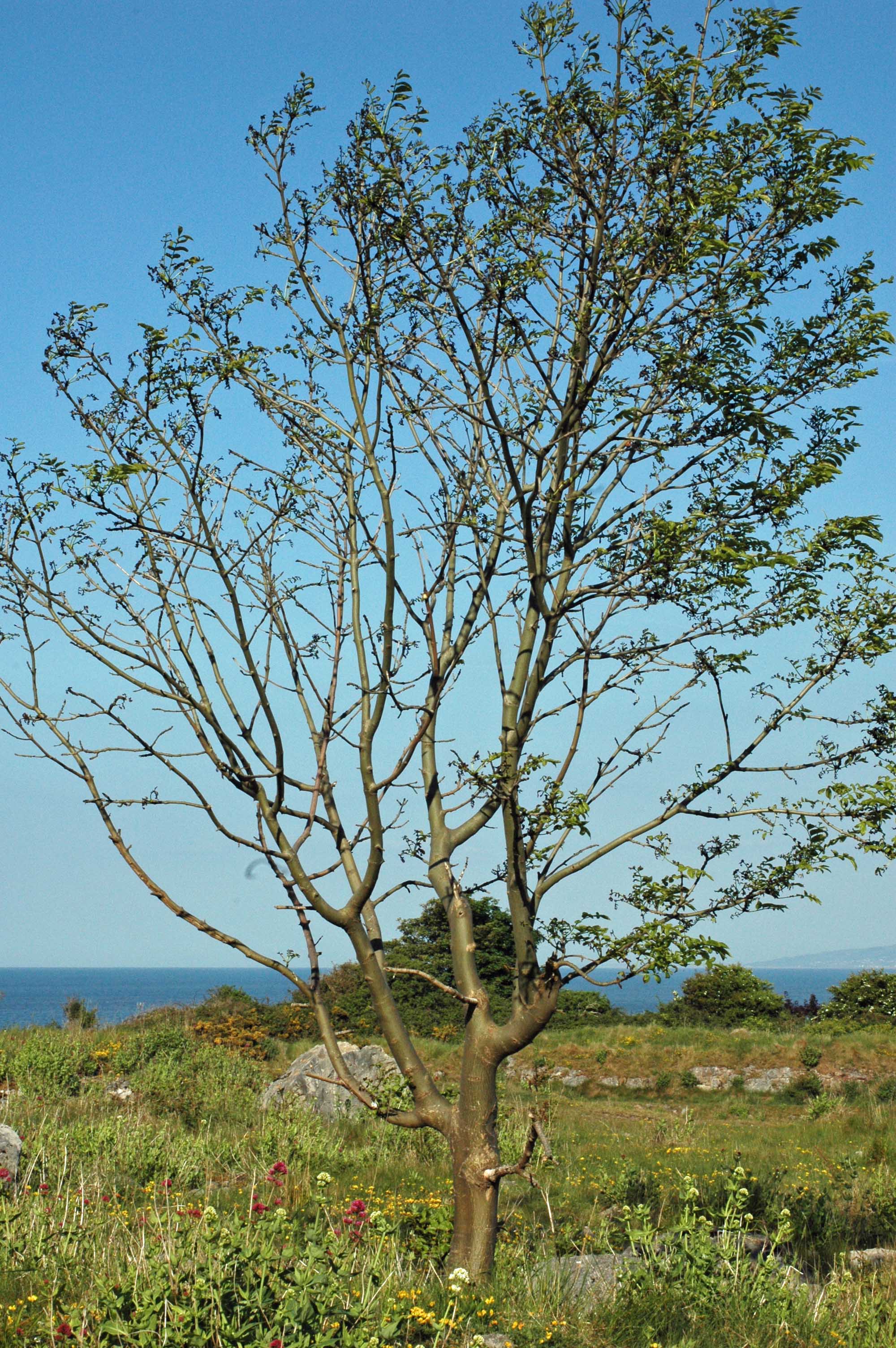
Ash tree with a view of Rhos-on-Sea and beyond

Ash tree with a view across Penrhyn Bay to Rhos-on-Sea and Colwyn bay beyond

Upholding my promise to myself to pay more attention to Ash trees I had already looked at a couple of small ones before taking this photograph. All, including this one, were less fully-leaved than those inland and all had leaves that were brown and shrivelled around their edges. I was alarmed when I first noticed that, but don’t think it’s anything more sinister than the leaves being ‘burned’ by the very cold and salt-laden winds they have been subjected to this whilst young and tender. I hope that’s all it is, there are a lot of Ash trees on the site of the Little Orme and their loss would be significant.

A smaller, younger Ash tree

A smaller, younger Ash tree had sparse foliage and ‘burnt’ leaves

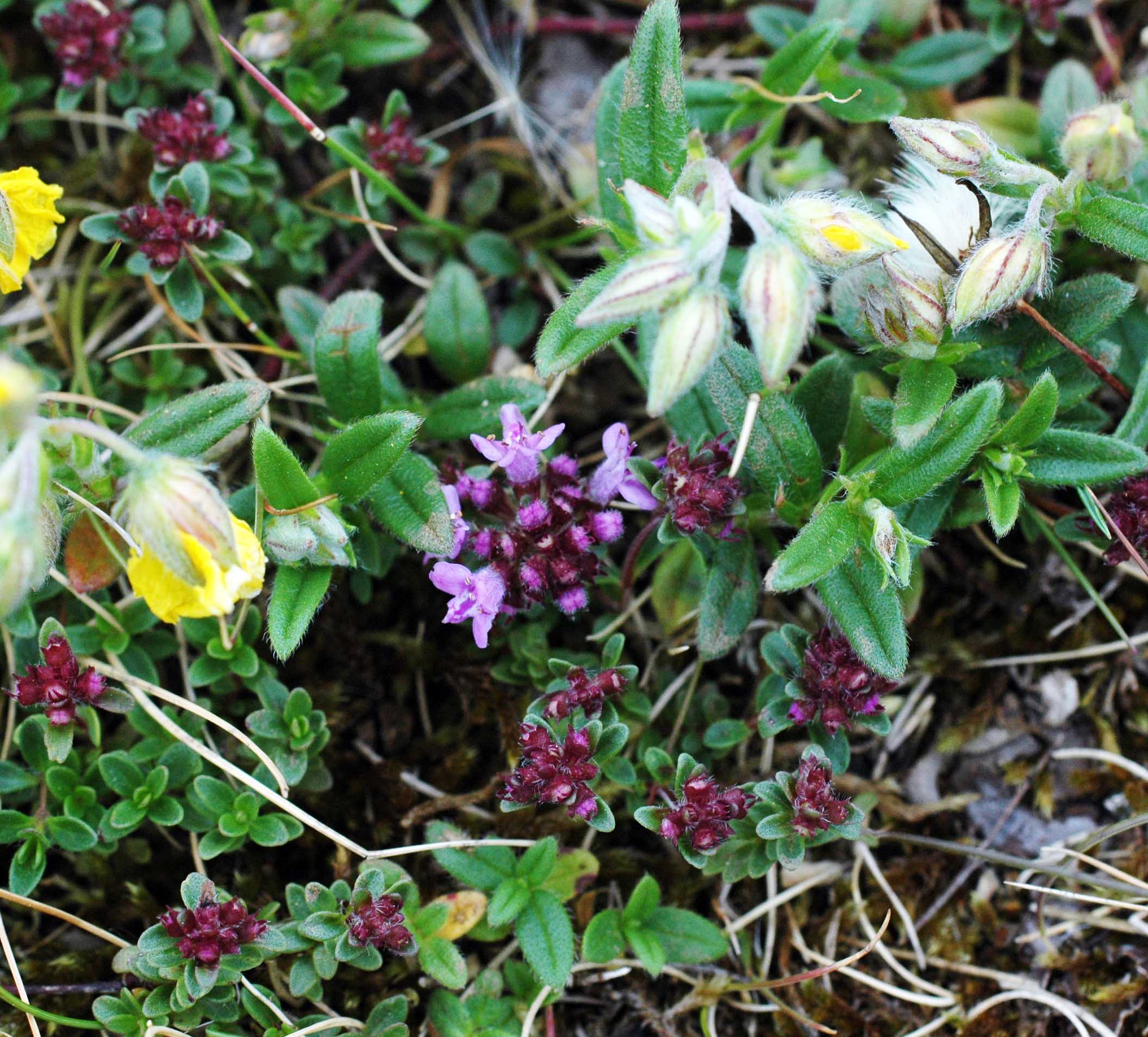
I walked back following the pathway at the base of  the towering rock face, leaving the surfaced track to search the grass at its side for any smaller, less showy wildflowers. There was plenty more Bird’s-foot Trefoil with a few little bumblebees rushing around hunting for nectar and little patches of Wild Thyme, just beginning to open. There were quite a few little flowers, yellow with pink-flushed buds, that looked similar to Cat’s Ear, but not quite, so more research needed there.

A small patch of newly-opened Wild Thyme

A small patch of newly-opened Wild Thyme

I carried on walking, diverting over to the big patch of cabbages to take photographs as seen in previous post, following the edge of the deeper quarried-out bit (all of the section of the Little Orme I have been describing above is flat as a result of quarrying activity). Where the edge of this meets the cliff wall the only way to continue is to scramble down a rocky slope. If you ever find yourself doing this, be careful as hundreds of pairs of feet taking this way down, or up, over the years have worn the exposed rock to a shiny smoothness that can be quite slippery, even when dry.

The area at the bottom of the slope has a completely different character, more along the lines of an urban wasteland than a coastal clifftop. It does back onto houses and there is an access path in from the residential area, so the ground was probably disturbed during the building process. It’s not a very large area and can appear a bit scruffy, but there is always something to see here. There’s lots of Valerian flowering now, but the plant that has gone a bit crazy and is threatening to dominate all, is Alexanders. According to Richard Mabey in his brilliant book ‘Weeds’, this Roman introduction to Great Britain has apparently nationally fallen from grace recently, having suddenly altered its demeanor from that of well-behaved and fondly thought-of immigrant edible wildflower, to that of a rampant weed.

Alexanders lines the pathway for several metres

Alexanders – Smyrnium olustrum ,lines the pathway for several metres

Alexanders is one of the earliest plants to put out greenery in the early spring and most of the plants here are past their best. A stately and attractive all-over yellow-green coloured plant, it was introduced here by the Romans for use as a pot-herb, having a mild celery flavour. Its culinary use continued for hundreds of years until it was replaced by cultivated celery. Perhaps this is a plant we should go back to foraging to help keep it under control rather than destroy it.

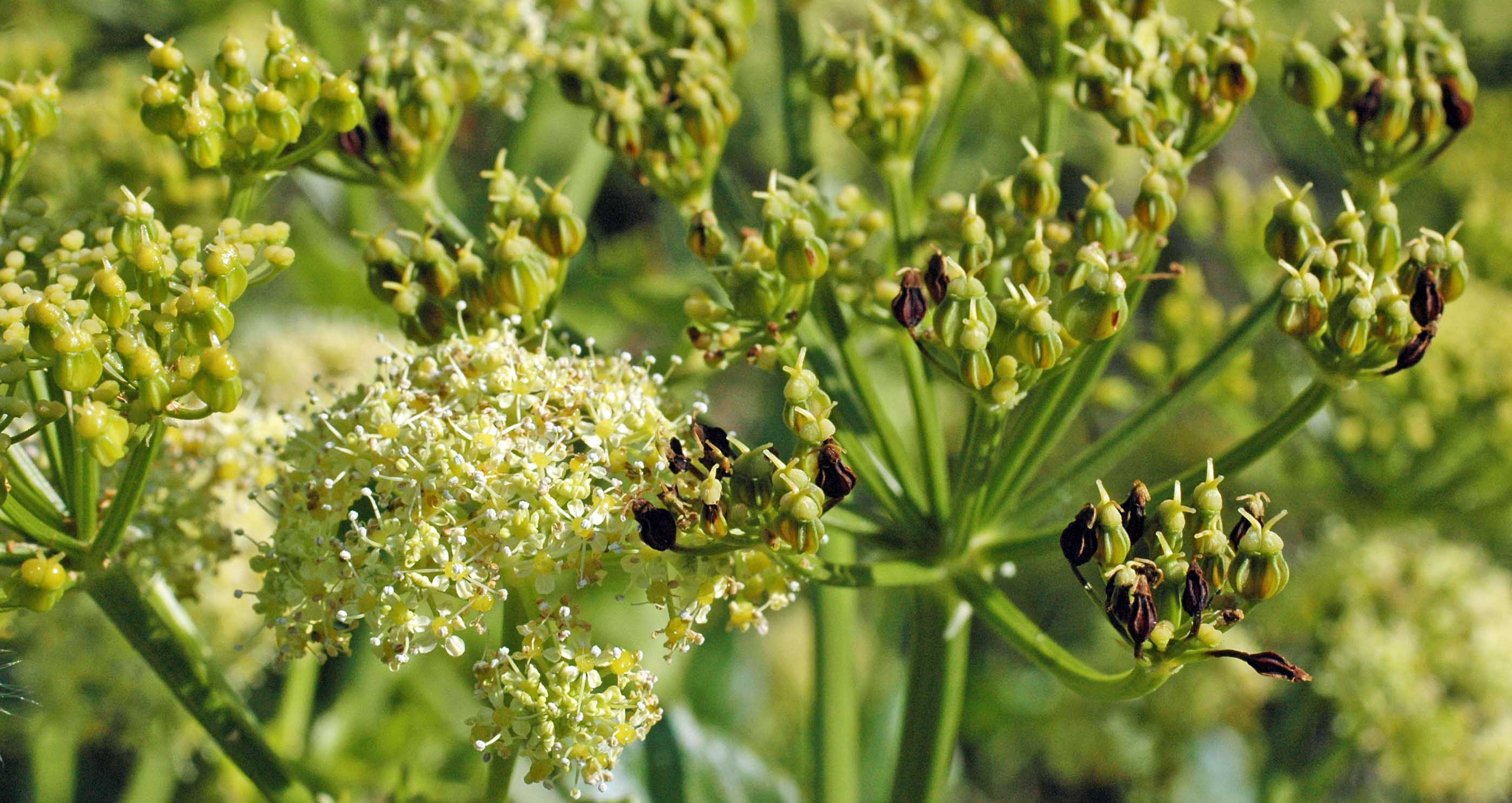
Alexanders is going to seed now, but there are still flowers

Alexanders is going to seed now, but there are still flowers

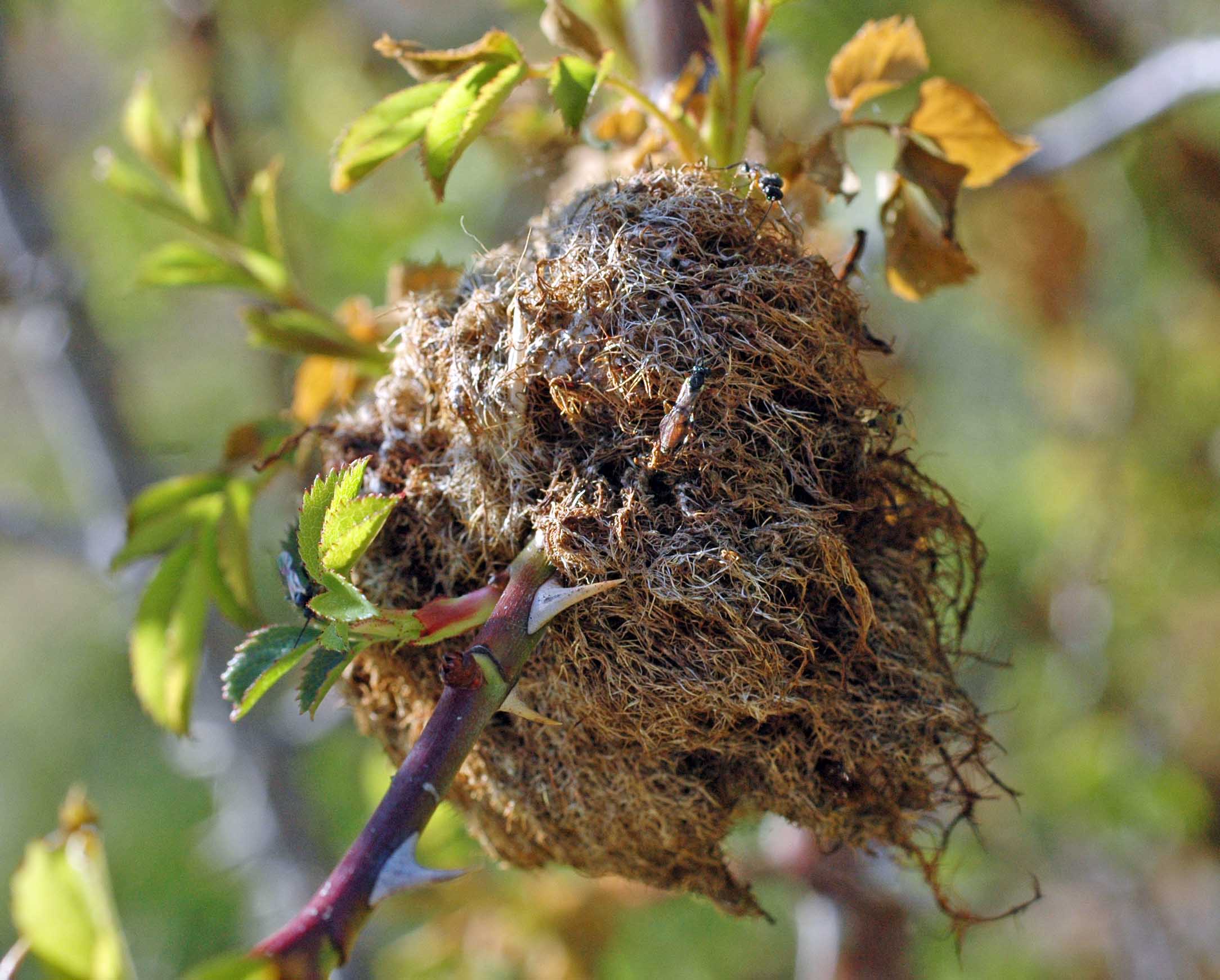
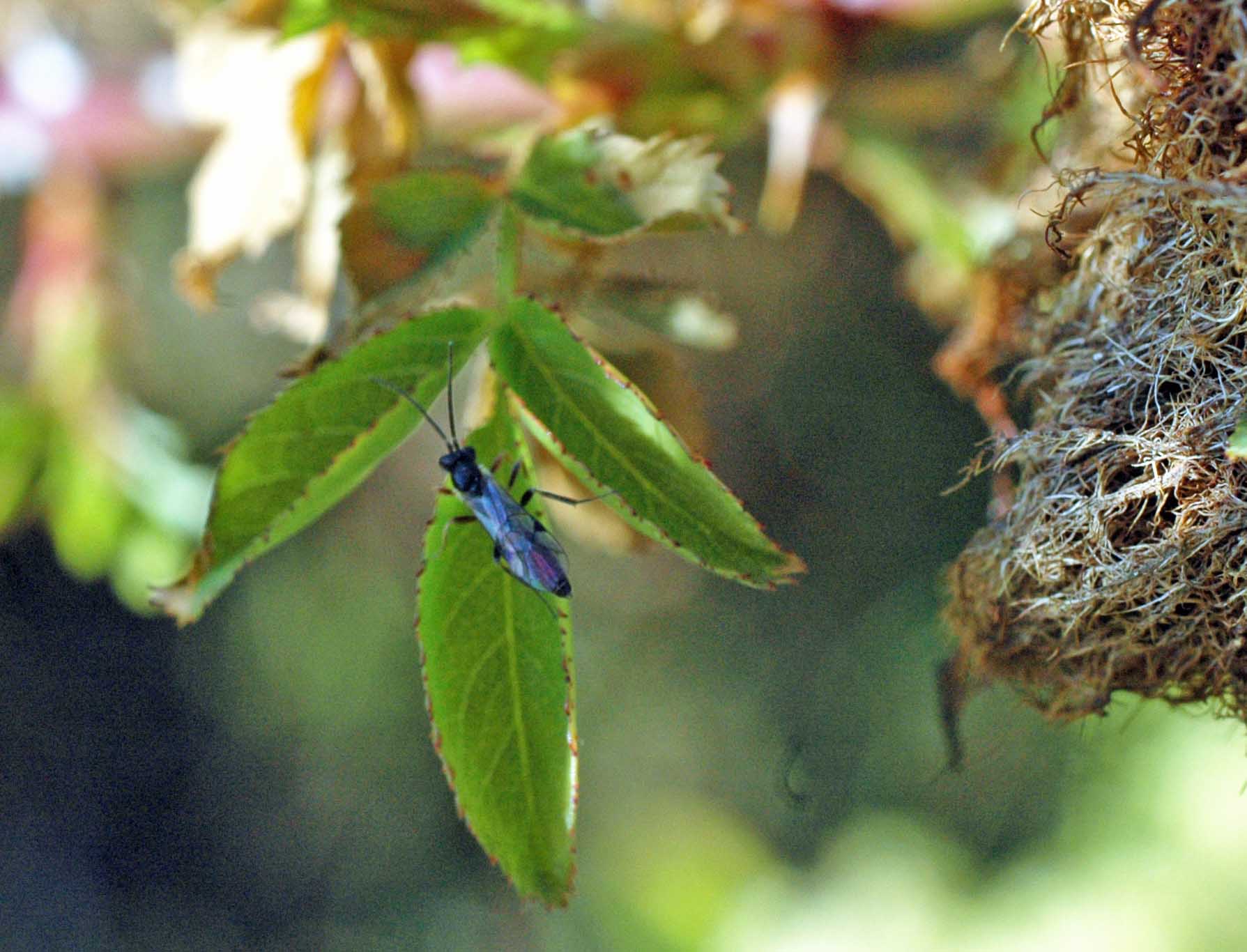
While I was prowling around the Alexanders plants I spotted a wild rose shrub in their midst and suddenly made a mental connection with a blog post from last August, which included a bit about the Robin’s Pincushion galls that appear on these plants. I mentioned in it that while the completed growth begins as bright red in colour, over the months they fade to a dark red-brown before the new adult wasps emerge in the spring and thought I’d try to find one. I remembered where the gall I photographed then was located, but thought I’d have a quick look at this one on the way to it. As luck would have it, there was a nice fat dark gall there too. As I got close with the camera, even more luck – there were a number of tiny little wasps crawling around on the gall and flying on and off, back and forth between it and rose leaves just a few centimetres away.

Dry Robin's Pincushion with little wasps on the surface

Dry Robin’s Pincushion with little wasps on the surface

I am not claiming that these are the wasps, scientific name, Diplolepsis rosae, that cause the growth of the gall to house their larvae. Having looked at other people’s images, I rather think that although the colouration is similar, the abdomens of the ones in my pictures are more elongated and tapered than those in  images of the ‘right’ one. I thought perhaps the insects were just emerging from the gall, but that also didn’t help as I learnt that the original larvae are subject to parasitism by other species of wasp and they in turn may be got at by yet another species. They may have just been seeking prey, or maybe somewhere to locate their own eggs, or even just roosting for the night. I am sure they are some species of wasp though. If anyone can help with identification I’d be delighted.

Tiny wasp from gall, resting on a nearby rose leaf

Wasp from gall, resting on a nearby rose leaf. Size increased many times, these insects were really tiny.

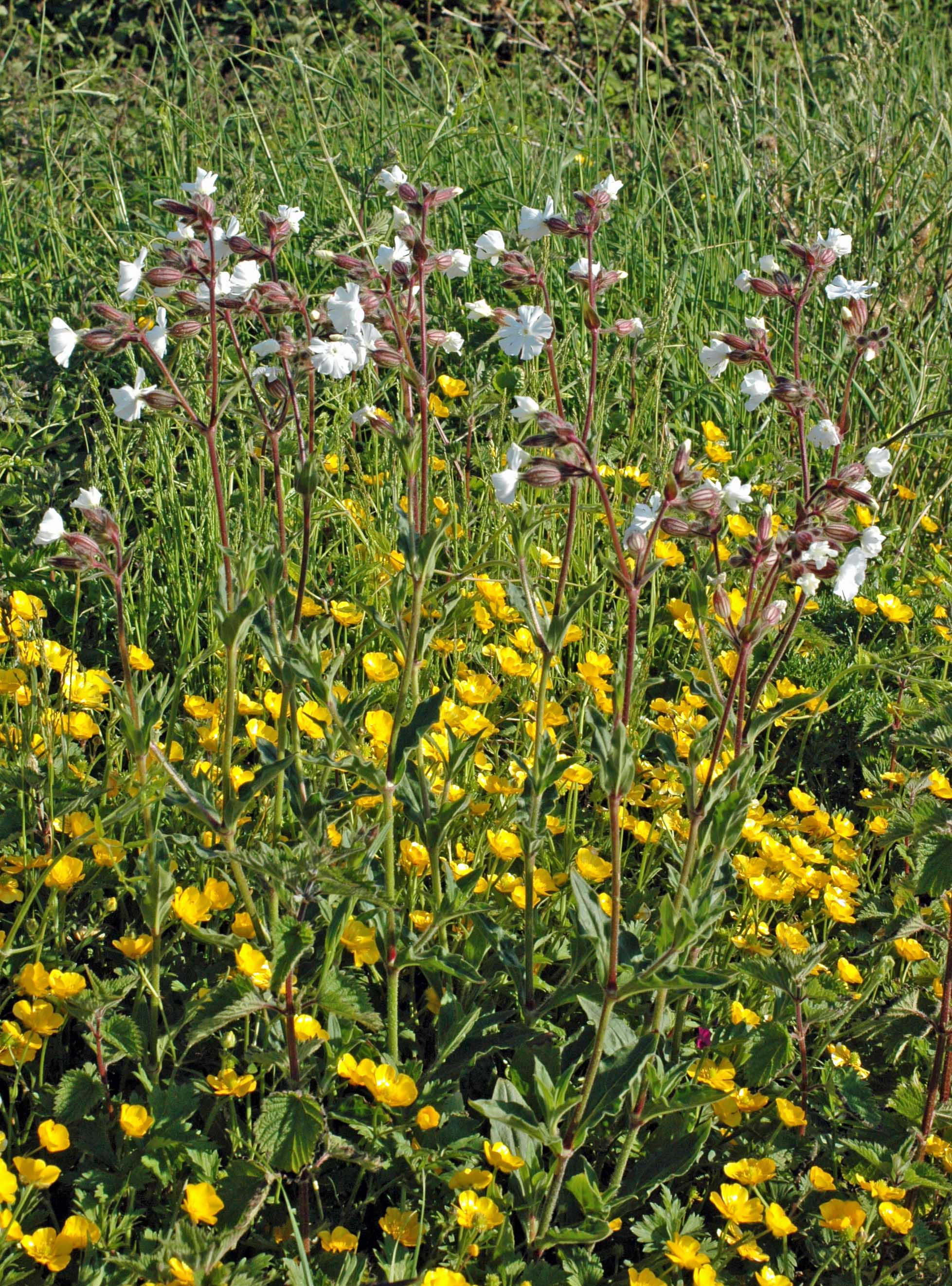
It was almost half-past six by the time I thought I should be getting home and the sun was beginning to sink behind the mass of the headland. It was creating a lovely glowing effect on the landscape and casting an interesting light upon a beautiful patch of buttercups that had pretty White Campion growing up through it.

130604TGNR- White Campion & Buttercups - Little Orme, North Wales

Golden yellow buttercups and white campion

Little Orme in the early evening

Little Orme in the golden early evening

Share this:

  • Share on Facebook (Opens in new window) Facebook
  • Share on Pinterest (Opens in new window) Pinterest
  • Share on X (Opens in new window) X
Like Loading...

Spot the ‘greens’ on the Little Orme, but please don’t eat them!

10 Monday Jun 2013

Posted by theresagreen in Little Orme, Nature of Wales, nature photography, Rhiwledyn Nature Reserve, Wildflowers of Wales

≈ 4 Comments

Tags

brassica olaracea, Little Orme, wild cabbage

The Little Orme is close in distance to Bryn Euryn, but quite different in character, so a walk around there can add a host of different flora species within the space of half-an-hour or so; it also has its specialty plants and I set off to find at least one of them on a late afternoon last week.

Right now while the rocks of the Bryn are splashed gold with dainty rockroses, the Little Orme has its yellow-flowered cabbages. This year, rather a lot of them and not just any old cabbage, but the rather rare Wild Cabbage Brassica oleracea.

Wild Cabbage-Brassica olearacea

12/06/04-Wild Cabbage-Brassica olearacea at the base of a cliff, Little Orme

The Wild Cabbage (Brassica oleracea), also sometimes known as Sea Cabbage,  is regarded as scarce by botanists as it is found in only 100 x10km squares in the UK.  Where it does occur, the plant is found on maritime cliffs, usually of limestone or chalk, typically growing on or near to cliff tops or cliff bases, often on ledges containing other mixed herb communities. The Little Orme and Great Orme in North Wales and the Gower Peninsular in South Wales are strongholds of the plant.

A tall red cliff-face on the Little Orme which has wild cabbage plants growing on ledges almost from top to bottom

A tall red cliff-face on the Little Orme which has wild cabbage plants growing on ledges almost from top to bottom

Brassica oleracea is a biennial, sometimes perennial, relatively short-lived (20 years), evergreen plant that can withstand frost. Plants can grow to a height of 1.2m (4ft), but that can vary, as can the size and to an extent, the shape of the leaves. It is in flower from May to August, and the seeds ripen from Jul to September. The flowers are hermaphrodite (have both male and female organs) and are pollinated by a range of insects, including bees and hoverflies; the plant is self-fertile.

Flowers of the wild cabbage

Flowers of the wild cabbage

It is probable that the Wild Cabbage, which occurs widely around the Mediterranean, is not a true native to Britain and that it was yet another introduction made by the Romans and is the forebear to our more robust modern cultivated cabbages.

Leaf of Wild Cabbage

Leaf of Wild Cabbage

I have seen sites advocating foraging wild cabbage as an edible wild plant, which of course it is,  but while the plant itself does not have any specific legal protection under the Wildlife & Countryside Act 1981 (as amended), most of the locations where it’s found along the North Wales Coast are designated as Sites of Special Scientific Interests. Damaging, uprooting or removing the plant either deliberately or recklessly could be regarded as a criminal act, so perhaps not a good idea to chance it.

A wild cabbage plant growing on a more exposed grassy cliff of the Little Orme (Sept 2011)

A wild cabbage plant growing on a more exposed grassy cliff of the Little Orme (Sept 2011). This was one of my first sightings (and photographs) of the species.

I took this photograph last May (2012)

I took this photograph around the middle of last May (2012), before the flowers opened

Share this:

  • Share on Facebook (Opens in new window) Facebook
  • Share on Pinterest (Opens in new window) Pinterest
  • Share on X (Opens in new window) X
Like Loading...

Dare we cast a clout now May is out?

09 Sunday Jun 2013

Posted by theresagreen in Bryn Euryn Nature Reserve, Nature of Wales, nature photography, Wildflowers of Wales

≈ 4 Comments

Tags

Bryn Euryn Nature Reserve, buff-tailed bumblebee, germander speedwell, grey-green lichen hanging from tree, hairy rock cress, hawthorn in flower, may blossom, salad burnet, wildflowers of Bryn Euryn

The last day of May was overcast and cool but I wanted to go back to the Bryn to photograph a plant I had spotted there on the rocky cliffs amongst the rockroses but forgot about until I got home. I took a different route up to the top today, passing through the grassy meadow area to see what I could find there.

Cow parsley -Anthriscus sylvestris

Cow parsley -Anthriscus sylvestris

A first bloom of Common Vetch-Vicia sativa

A first bloom of Common Vetch-Vicia sativa

There’s a lot of Ribwort Plantain, whose flowerheads I find fascinating, every one seems slightly different to the other.

Ribwort Plantain flowerhead

Ribwort Plantain flowerhead

The star of the flower show today was definitely the May, the blossom of the Hawthorn. Perhaps we can all ‘cast a clout’, now that May is out, both the blossom and the month.

A beautiful spray of May blossom, or Hawthorn, looks like a bridal bouquet

A beautiful spray of May blossom, or Hawthorn, looks like a bridal bouquet

Close to where I stopped to photograph the May blossom I noticed the more unusual Salad Burnet plant. This is one of those plants that is very easy to overlook as it seems to really blend in to its surroundings, but once you have it in your mind’s eye you then notice them in other places.

Salad Burnet-Sanguisorba minor

Salad Burnet-Sanguisorba minor

The leaves are very pretty, and as the plant’s name suggests, are edible.

Salad Burnet has very pretty, pinnate leaves

Salad Burnet has very pretty, pinnate leaves

The Oak trees are fresh-coloured and in just about full leaf now.

Oak tree

Oak tree

Fresh new oak leaves

Fresh new oak leaves

On a rocky outcrop there were low-growing common rockroses, bird’s foot trefoil, kidney vetch, almost over but attracting the attention of a number of little ginger-headed bumblebees, small patches of wild thyme and taller-growing hawksbit flowers.

Wild Thyme growing with Common Rockrose

Wild Thyme growing with Common Rockrose

I wasn’t able to get a particularly good photograph of a bee, but I  liked the lichen-covered rock in this one.

A small ginger bumblebee on Kidney Vetch

A small ginger bumblebee on Kidney Vetch

The patch of bird’s-foot trefoil had obligingly placed itself near the edge of a rock, so taking an eye-level picture was a nice option. I didn’t notice the ‘Cuckoo-spit’ until I looked at the photograph. I’d forgotten about Cuckoo-spit. I must remind myself what generates it, some kind of thrip, I think.

Bird's-foot Trefoil with Cuckoo Spit

Bird’s-foot Trefoil with Cuckoo Spit

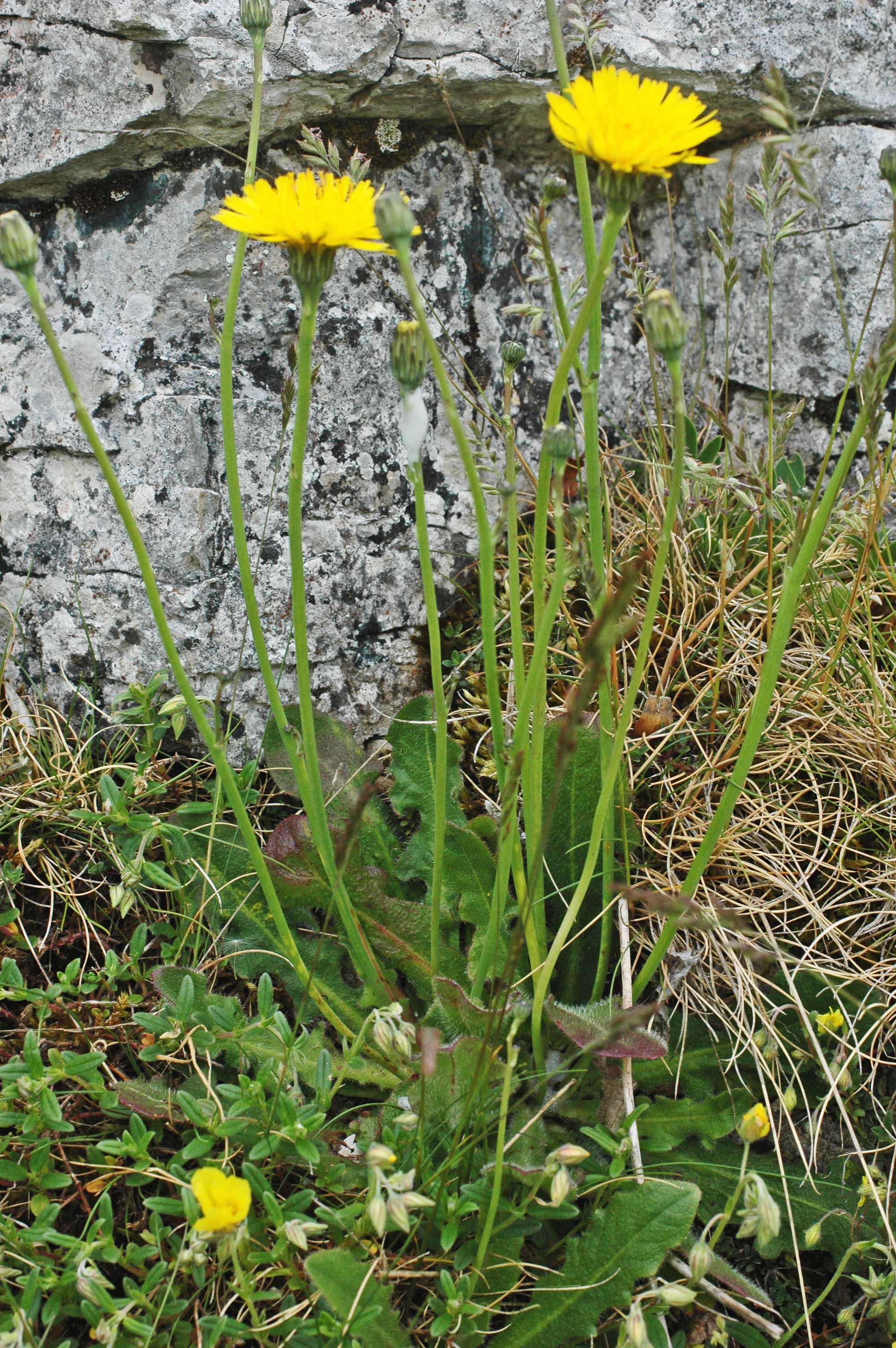
Hawksbit against limestone rock

Hawksbit against limestone rock

There seem to be masses of the beautiful blue Germander Speedwell here this year, I don’t remember it being this prolific before.

Germander Speedwell-Veronica chamaedrys

Germander Speedwell-Veronica chamaedrys

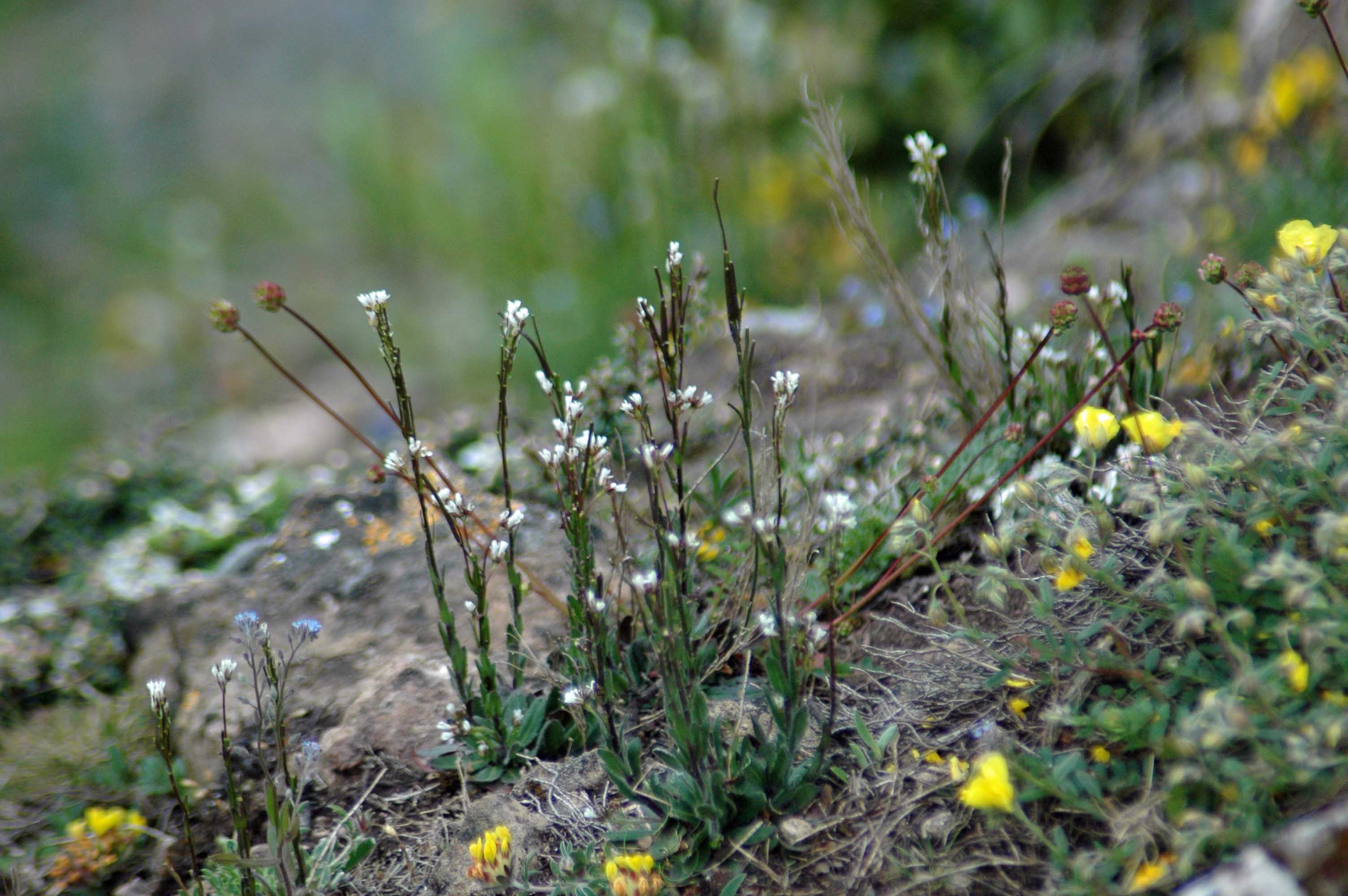
I finally got up and around to where the plant I had come to find was located; probably not as exciting as you’d expected, but I was pleased to find it. The plant is Hairy Rock Cress, an under-stated little plant with tiny white flowers like most members of the cress family, not at all showy like its golden-bloomed neighbours, but none the less interesting. Even though it’s flower’s are almost over and it’s going to seed.

Hairy Rock Cress. Also in picture are kidney vetch, salad burnet & rockrose

Hairy Rock Cress. Also in picture are kidney vetch, salad burnet & rockrose

The scientific name for Rockrose, helianthemum, means sun-flower. They don’t bother to open up on dull or damp days, particularly the little blooms of the Hoary Rockrose.

Flowers of Hoary Rockrose close on dull, sunless days

Flowers of Hoary Rockrose close on dull, sunless days

It was getting quite late on now, but there was one more distraction to waylay me before heading back down the hill. A Mistle Thrush was out hunting on the path around the edge of the rocks, which I had to stay and watch as I’d not seen one here before. When it flew off with its gatherings I took a photograph of the top of a lovely Ash tree which has houses of Rhos-on-Sea below and peeking through its leaves.

Ash tree on Bryn Euryn, Rhos-on-Sea behind

Ash tree on Bryn Euryn, Rhos-on-Sea behind

On the way down through the woods I spotted some very pretty Oak Moss lichen hanging from some twiggy branches; I don’t know why I’ve not noticed it before, there’s quite a lot of it.

Oak Moss lichen- Usnea florida

Oak Moss lichen- Usnea florida

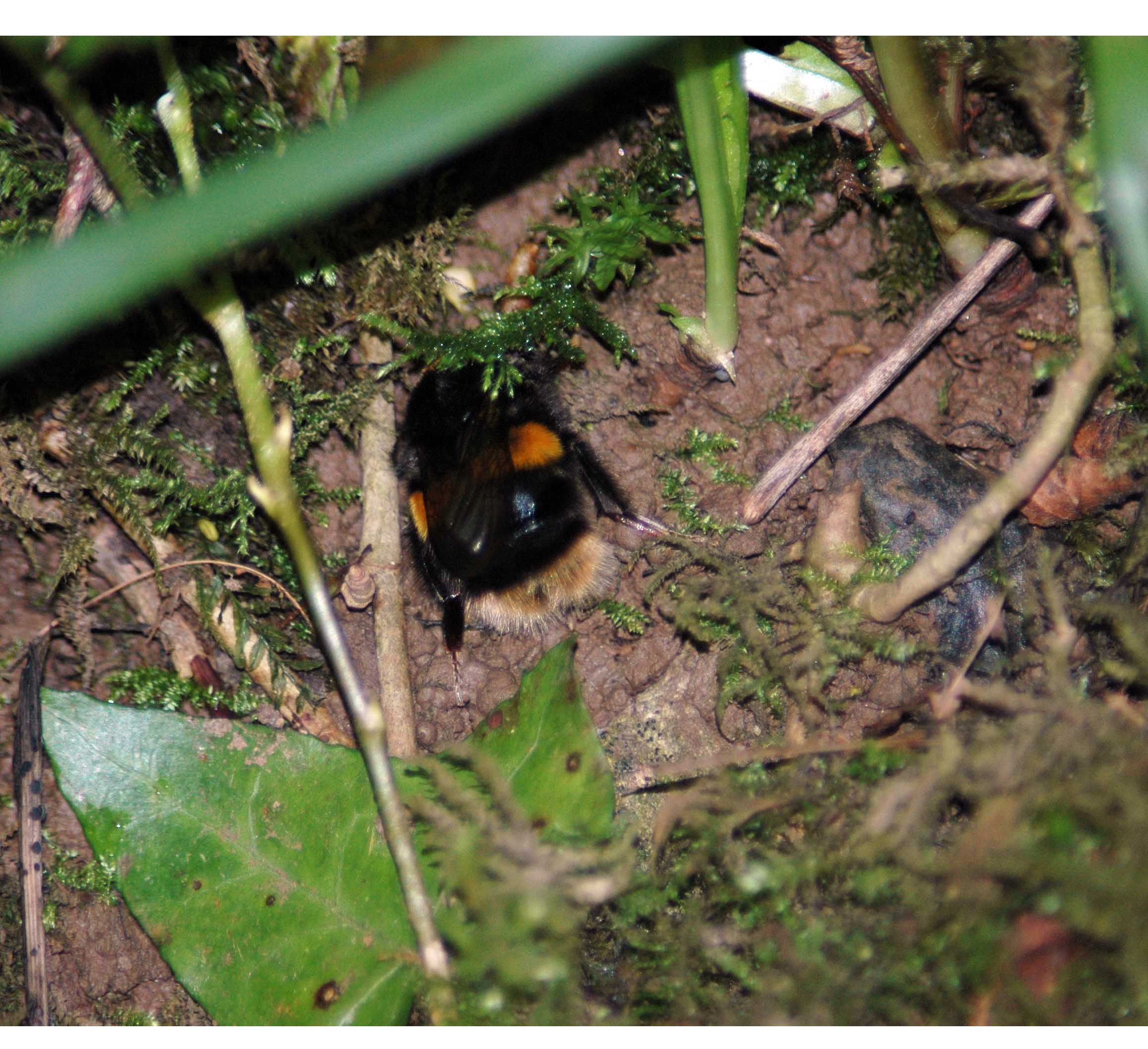
Almost at the bottom of  the hill, I couldn’t resist taking a final picture of a Buff-tailed Bumblebee that was either excavating a hole or looking for an existing one to spend the night in.

Buff-tailed Bumblebee making or seeking a hole

Buff-tailed Bumblebee making or seeking a hole

Share this:

  • Share on Facebook (Opens in new window) Facebook
  • Share on Pinterest (Opens in new window) Pinterest
  • Share on X (Opens in new window) X
Like Loading...

Bryn Euryn walk continued: Part 3

08 Saturday Jun 2013

Posted by theresagreen in Bryn Euryn Nature Reserve, Local Nature Reserves, Nature of Wales, Wildflowers of Wales

≈ 2 Comments

Tags

Bryn Euryn Nature Reserve, cowslip, early purple orchid, orchis mascula, primula veris, rhos on sea, views from Bryn Euryn, wildflowers of Bryn Euryn

The views from the Bryn are always worth the steep climb up to the top and change according to the season, the weather and the time of day. The southerly side overlooks part of Rhos-on-Sea and part of Colwyn Bay town, divided by the duel-carriageway of the A55, whose traffic noise can be loud and rather intrusive, so not the spot to  seek peace and quiet. Beyond is Colwyn Bay and inland a patchwork of woodlands, golden gorse and neat farmed fields set upon rolling hillsides sloping around and down to the Conwy river and estuary.

Panoramic view from the south of the summit of Bryn Euryn

The gorgeous view from the south side of Bryn Euryn (click to enlarge)

I was heading now towards the true summit, where the not-too-beautiful triangulation (trig) point marks the highest point.

The trig point on the summit of Bryn Euryn looking south-south-easterly (ish)

The trig point on the summit of Bryn Euryn looking south to south-easterly (ish)

Last year there was an impressive patch of at least a hundred Early Purple Orchids on the approaching grassy slope (behind  the other side of the rocky bit in the photograph), but this year although there are still a good number there are a lot less. Having said that, those I saw are beautiful specimens, of good height and their stems thick with flowers. The success of Orchids is affected by seasonal weather, they are affected by drought, numbers may vary even in areas they otherwise frequent, which is part of their allure of course.Their less than predictable appearance and their wonderfully exotic beauty combine to make each discovery just as exciting as it was last year or the year before.

_______________________________________________________

I can still remember the excitement of discovering my first Early Purple Orchid, growing exactly where it should be, on the floor of the old woodland next to our house. I was probably about aged ten at the time and had no idea what it was, but it looked very special to me and I couldn’t wait to look it up in my ‘Observer’s Book of Wild Flowers’, which I still treasure because I love the descriptions written by the lady author of the book. I would quote it here but it’s currently in a box in a storage unit in Spain, so I’ll have to manage without for now.

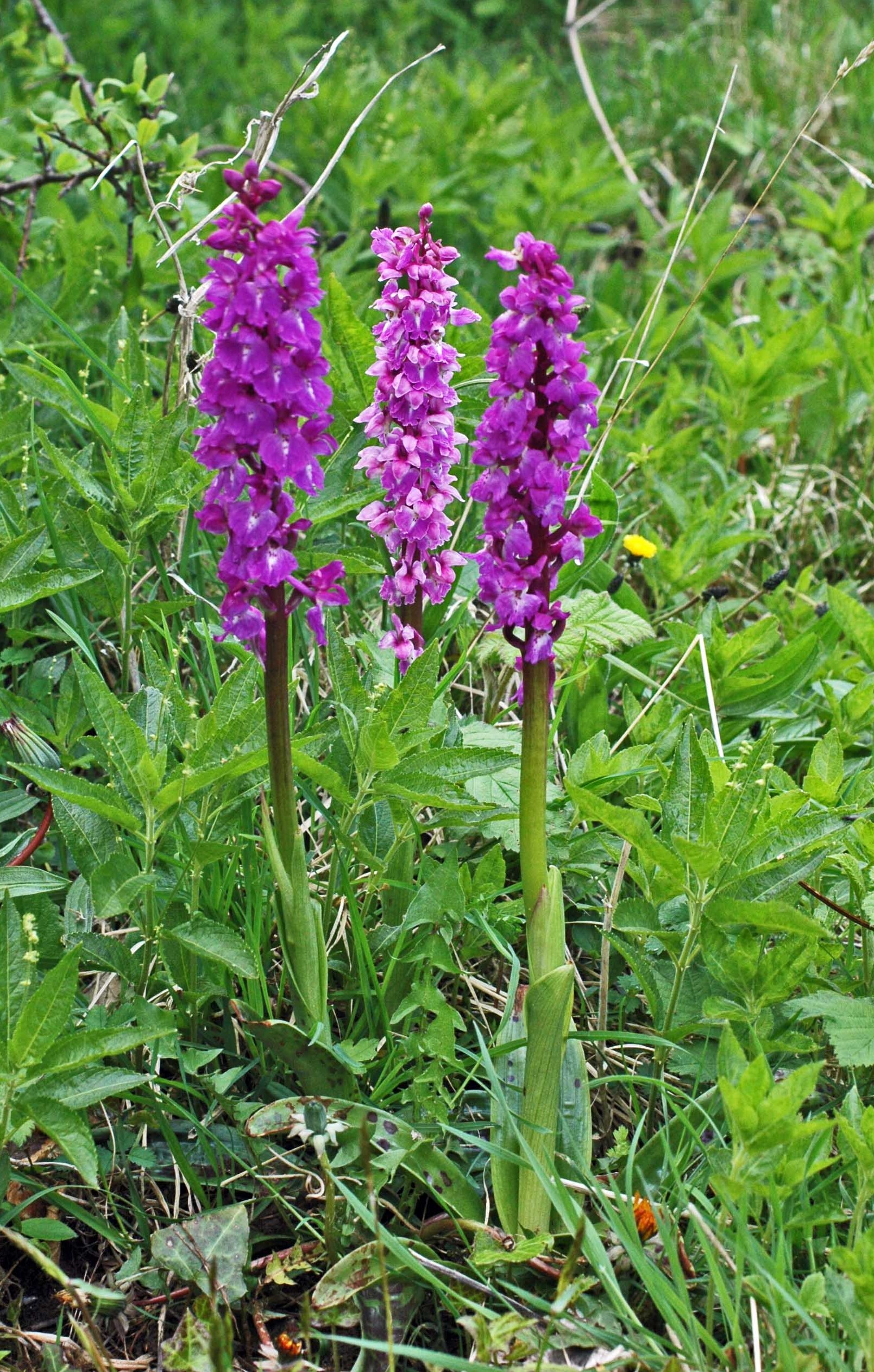
Early Purple Orchid –  Orchis mascula

Early Purple Orchids-Orchis mascula

Early Purple Orchids-Orchis mascula

In flower from April to June, the Early Purple Orchid is a species of old broadleaved woodlands, where they are generally widespread, but they also occur in rich grasslands, on road verges, on limestone pavement and on heathy ground in the South and West of the British Isles.

‘Therewith fantastic garlands did she make

Of crow-flowers, nettles, daisies and long purples

That liberal shepherds give a grosser name’

But our cull-cold maids do dead-men’s fingers call them’.

It is claimed that when William Shakespeare wrote those lines in Hamlet, his ‘long purples’ referred to the Early-purple Orchid.  The lines were spoken by Gertrude and referred to the coronet which Ophelia was wearing when she drowned.

A short-medium perennial that can reach 40cm, the stem is also often flushed with purple. There are usually 3-5 unstalked basal leaves, oblong in shape, pointed, parallel-veined and glossy green blotched with purple.

Flower colour can vary in shade from quite a dark purplish-red to pink or even white and are distributed in  dense or loose spikes of between 10-30 flowers. Each flower has a narrow purple bract, purplish-grey ovary, three sepals and three petals.

Flowers of Early Purple Orchid

Flowers of Early Purple Orchid

Side sepals spread backwards, upper one joins to the upper two petals to form a hood; lower petal forms tri-lobed spurred crimson-dotted lip, 8-12mm long. At the back of the flower one unstalked anther holds two pollen masses on stalks that adhere to heads of visiting insects for cross-pollination; below the anther the stigma surface receives pollen brought from other flowers.

_______________________________________________________

A few minutes taking in the view more or less east towards the mountains on the edge of Snowdonia , then onwards and downwards via the grassy slope on the north side of the hill.

The A55 snakes towards  the Conwy Estuary with view of Snowdonia beyond

The A55 snakes towards the Conwy River & Estuary with views of Snowdonia beyond

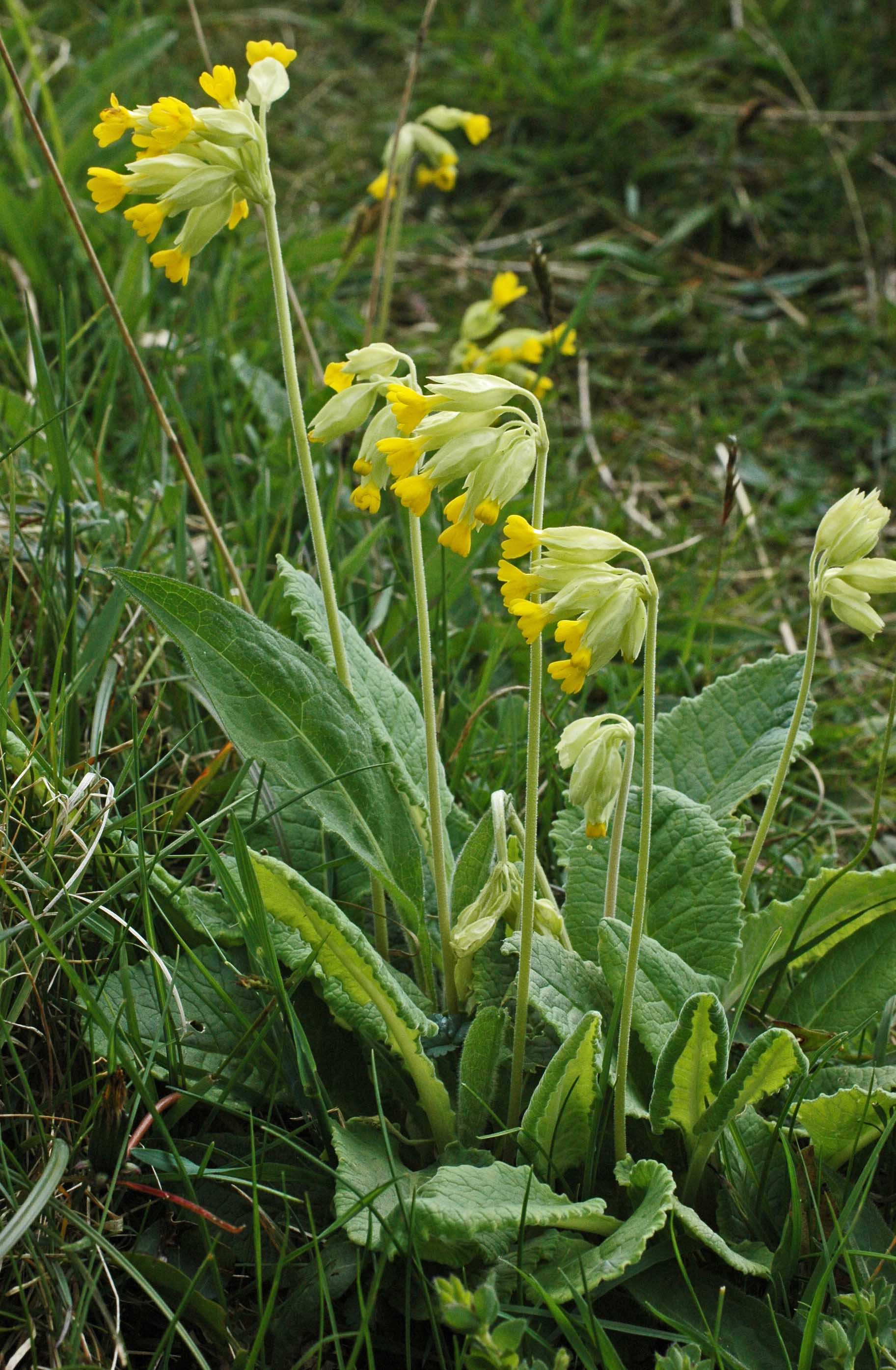
The rough grassy area was, as I’d hoped, generously sprinkled with Cowslips. Not as showy as the Orchids or as bright as the Rockroses, but with a special understated beauty of their own. I was slightly concerned I may have missed them at their best as they are flowers I associate more with late April-early May, but thanks to the late start to Spring this year I caught them just in time before they start to ‘go over’.

A field full of Cowslip

A field full of Cowslips, their heads held aloft on stiff stems were dancing in the wind like little flags

Cowslip -Primula veris

I have a great affection for Cowslips and seeing them growing in numbers in a grassy meadow takes me back to my childhood in an instant. In Northamptonshire, where I grew up in the 50s and 60s, lovely golden-yellow cowslips were numerous, particularly in the damper grass meadows grazed by cows. One of life’s little treats back in the day was to pull a flower from its little green sack and suck the nectar from the base of the tube. And before it became necessary to ban the picking of wild flowers, we used to pick bunches of them for the house  as they have nice long stems and looked lovely in a jam jar on the kitchen windowsill. We picked them to add to garlands and to decorate  the ‘throne’ for the May Queen during our school’s Mayday celebrations. Occasionally we even got to pick lots of them to be made into Cowslip wine.

Cowslip- Primula veris

Cowslip- Primula veris

I assure you though, it wasn’t our picking that caused the Cowslip’s serious decline, we couldn’t possibly have picked even all of those growing in a single field. It had much more to do with the rise of intensive farming and old grassland being ploughed over to create more space for growing other crops.

Thankfully the plant’s numbers are on the rise again, partly due to raised awareness but probably owing  more to the sowing of seed on roadside verges and in wildflower meadows. So once again the Cowslip can raise its  graceful nodding heads above the grass blades and be counted in generous numbers once again. I won’t be picking any though, just taking photographs.

130522TGLNR-flr-Cowslip flowerhead with fly-Bryn Euryn (4)

The leaves of the Cowslip are wrinkly and hairy and form a basal rosette, similar to those of the Primrose. 

The yellow-orange flowers (8-15mm) are held in a one-sided umbel which is borne on a softly hairy, sturdy stem.  The individual flowers are comprised of five joined petals, each flower bearing orange spots in the centre, and are deliciously scented.

Cowslips and plaintains

Cowslips and plaintains

A final gaze at the view from here over the tops of the trees below, across the golf course to Penrhyn Bay and on the horizon the Little Orme skirted on its left side by the road to Llandudno climbing Penrhyn Hill.

View from the north side of Bryn Euryn

View from the north side of Bryn Euryn

Share this:

  • Share on Facebook (Opens in new window) Facebook
  • Share on Pinterest (Opens in new window) Pinterest
  • Share on X (Opens in new window) X
Like Loading...
← Older posts
Newer posts →
Follow everyday nature trails on WordPress.com

Enter your email address to follow this blog and receive notifications of new posts by email.

‘But it is the common species that keep the living world ticking over and provide most of our experiences of wildlife, and I would argue that maintaining the abundance of these is as important a conservation priority as maintaining the existence of rarities’. Richard Mabey

MOST RECENT POSTS

  • A Glimpse of Spring to Come January 22, 2025
  • Hunting the Wren December 28, 2024
  • Oh, Christmas Tree December 18, 2024
  • In and Out of the Ivy February 15, 2024
  • Nature’s Fireworks November 30, 2023
  • Wild Autumn along the Coast Path November 3, 2023

OLDER POSTS

LOOKING FOR SOMETHING IN PARTICULAR?

  • Sights and Sounds from the Little Orme 1
    Sights and Sounds from the Little Orme 1
  • Things Bright and Beautiful
    Things Bright and Beautiful
  • Following a river to a Fairy Glen
    Following a river to a Fairy Glen
  • Catchers, a Duck and Divers
    Catchers, a Duck and Divers
  • May Bee Appearing on Ivy near You
    May Bee Appearing on Ivy near You
  • Shades, Sounds and Scents of the Woods
    Shades, Sounds and Scents of the Woods
  • Fine Dining for Crows
    Fine Dining for Crows
  • Butterflies and more rare treats
    Butterflies and more rare treats
  • The Windhover
    The Windhover
  • A Windy Wildflower Trail
    A Windy Wildflower Trail

nightingale trails

The Walk of the Monarch Butterfly-Sendero de la Mariposa Monarca

The Walk of the Monarch Butterfly-Sendero de la Mariposa Monarca

MY WILDFLOWER BLOG: where the wildflowers are

Snowdrop

Snowdrop

most recent posts

Follow everyday nature trails on WordPress.com

Social

  • View teresamaygreen’s profile on Twitter

Enter your email address to follow this blog and receive notifications of new posts by email.

Website Built with WordPress.com.

  • Subscribe Subscribed
    • everyday nature trails
    • Join 359 other subscribers
    • Already have a WordPress.com account? Log in now.
    • everyday nature trails
    • Subscribe Subscribed
    • Sign up
    • Log in
    • Report this content
    • View site in Reader
    • Manage subscriptions
    • Collapse this bar
 

Loading Comments...
 

    %d