• Home
  • about
  • about the photographs
  • Local Nature Reserves
    • Bryn Euryn Local Nature Reserve
    • Mynydd Marian
  • Wales Coast Path
    • Grey Seals in North Wales
    • St.Trillo’s Chapel
    • Wildflowers of North Wales Coastal Paths, Cliffs and Dunes

everyday nature trails

everyday nature trails

Category Archives: Rhos-on-Sea

Activity and new arrivals on the seashore

16 Friday Sep 2011

Posted by theresagreen in birds of the seashore, Birdwatching on North Wales coast, Nature, Rhos-on-Sea

≈ Leave a comment

Tags

cormorants flying, Oystercatcher, redshank, ringed plover, sandwich, Turnstone

The summer is rapidly coming to an end and many species of birds are on the move, some returning to their winter feeding grounds in this country, others flying in from the north and others taking off to return to the warmer regions of Southern Europe and Africa. During the past few weeks I have already noted that the numbers of Oystercatchers and Sandwich Terns have increased dramatically here at Rhos-on-Sea on the North Wales coast and that Curlews have become a regular sight foraging on the seashore.

24th August

There was a lot of activity on the seashore late in the afternoon as the tide turned. I’m not the best at counting large numbers of birds, especially when they’re mobile, but there are definitely several hundred Sandwich Terns here presently and even more Oystercatchers. Mixed flocks of the birds line up along the sea edge, moving closer inshore as the water encroaches the rocky beach.

24/8/11-Sandwich Terns and Oystercatchers line up expectantly along the sea edge as the tide comes in

The Terns are restless; there are a lot of to-ings and fro-ings between their various groups and occasionally a whole flock takes off in unison, only to return to the same spot seconds later. The Oystercatchers take little notice of their flighty companions and continue to wait or forage patiently.
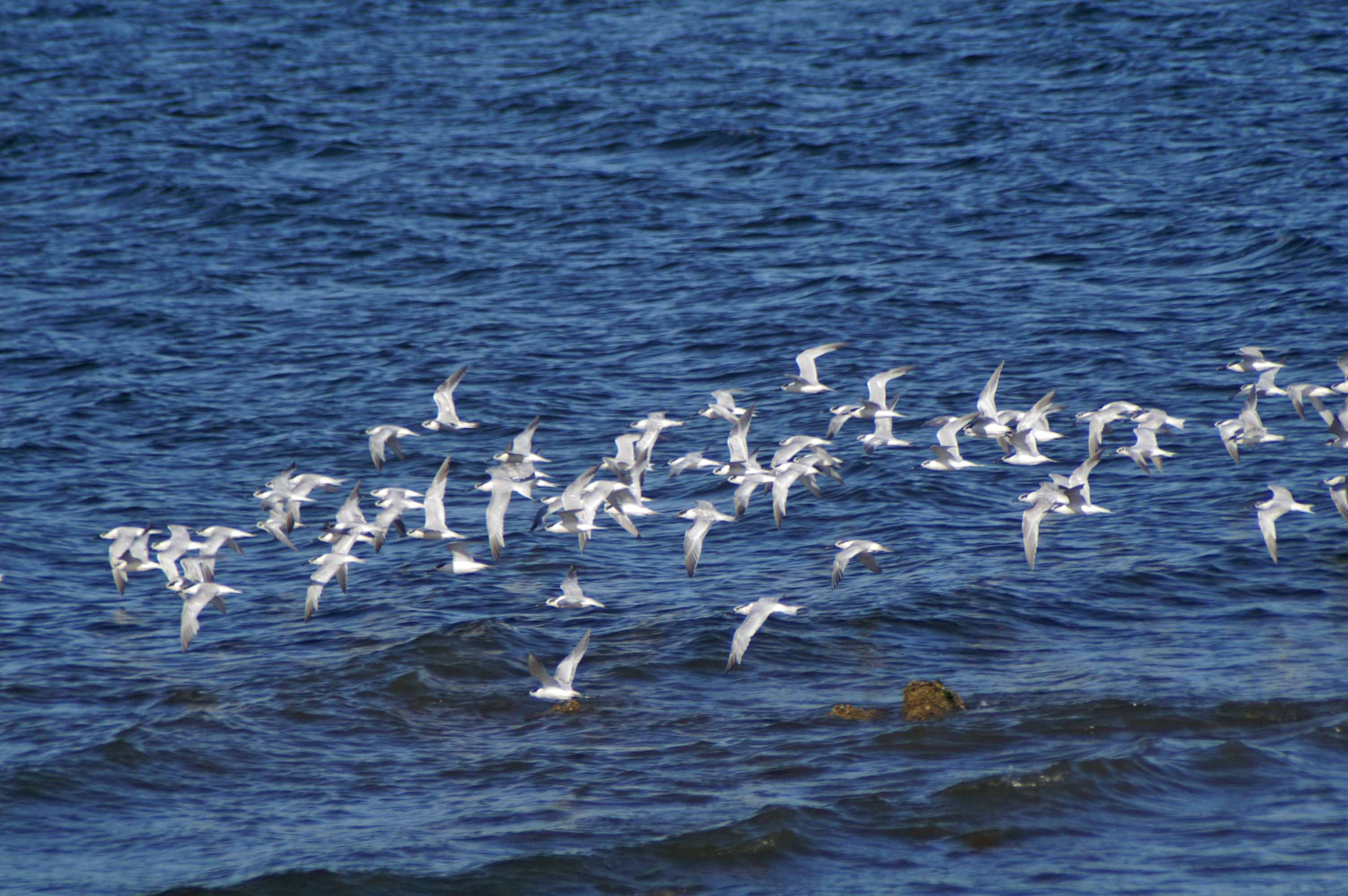
24/8/11- Sandwich Terns take off in unison

24/8/11-Terns settling back down amongst Oystercatchers

I was content watching the Tern displays, then noticed a couple of other waders well-camouflaged against the greys and browns of the shore; the bright red legs that give the birds their name gave away Redshanks that had infiltrated the ranks of Oystercatchers. The proximity of the two species shows the contrast in size. The Redshanks were quite distant, but now I have seen them I hope for better views another time.
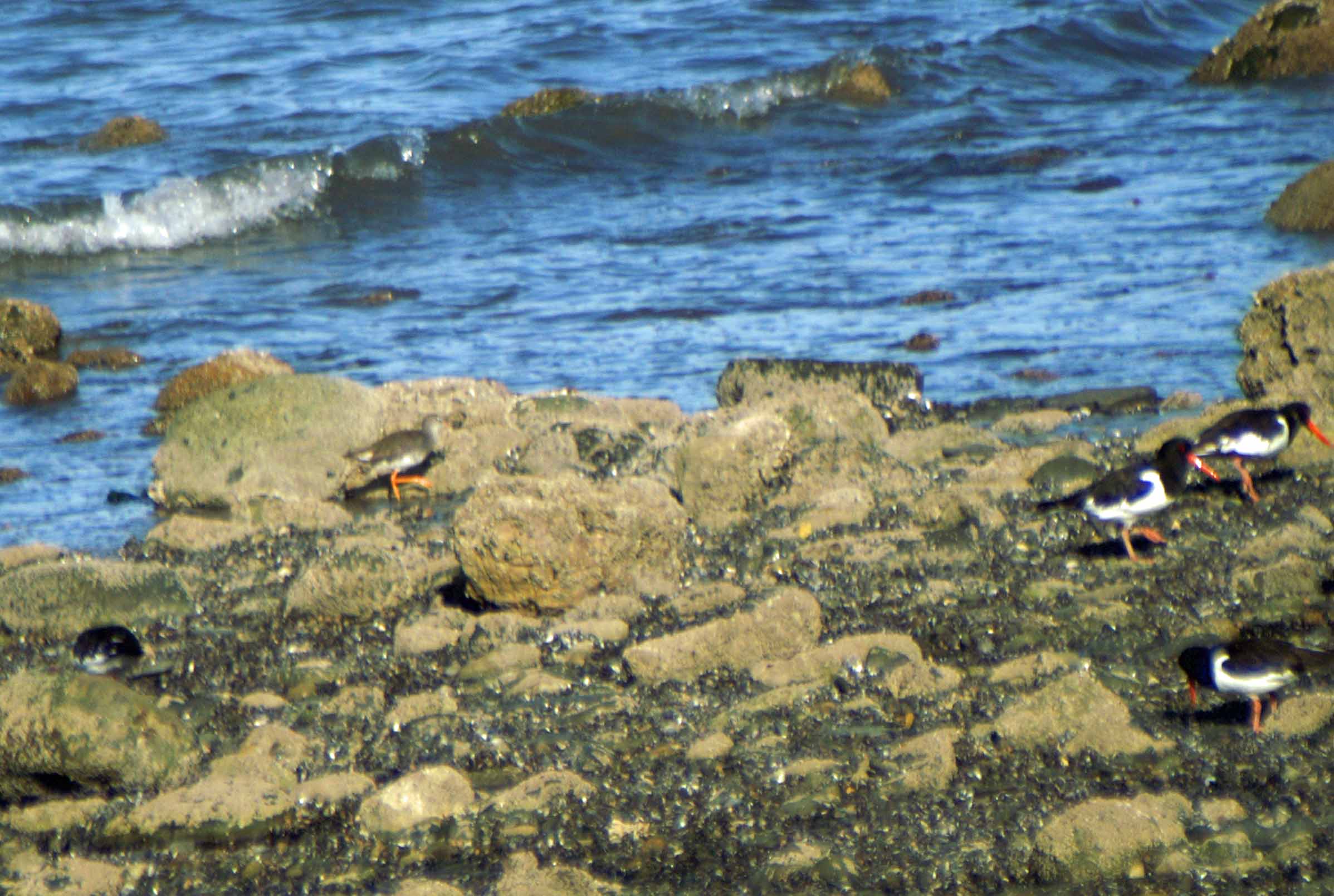
24/8/11-Redshanks amongst Oystercatchers

I was feeling pleased to have Redshank to add to my sightings list, then spotted two separate flocks of smallish birds fly in almost simultaneously and was delighted to witness the arrival of both Turnstones and Ringed Plovers. The individuals of both flocks landed on rocks at the sea edge that were surrounded by water, then stayed put for a few minutes before venturing on to the shore to forage. I estimated that there were around 20 birds in each flock.

24/8/11-Turnstones arrived with Ringed Plovers

24/8/11- Turnstone flock flying away
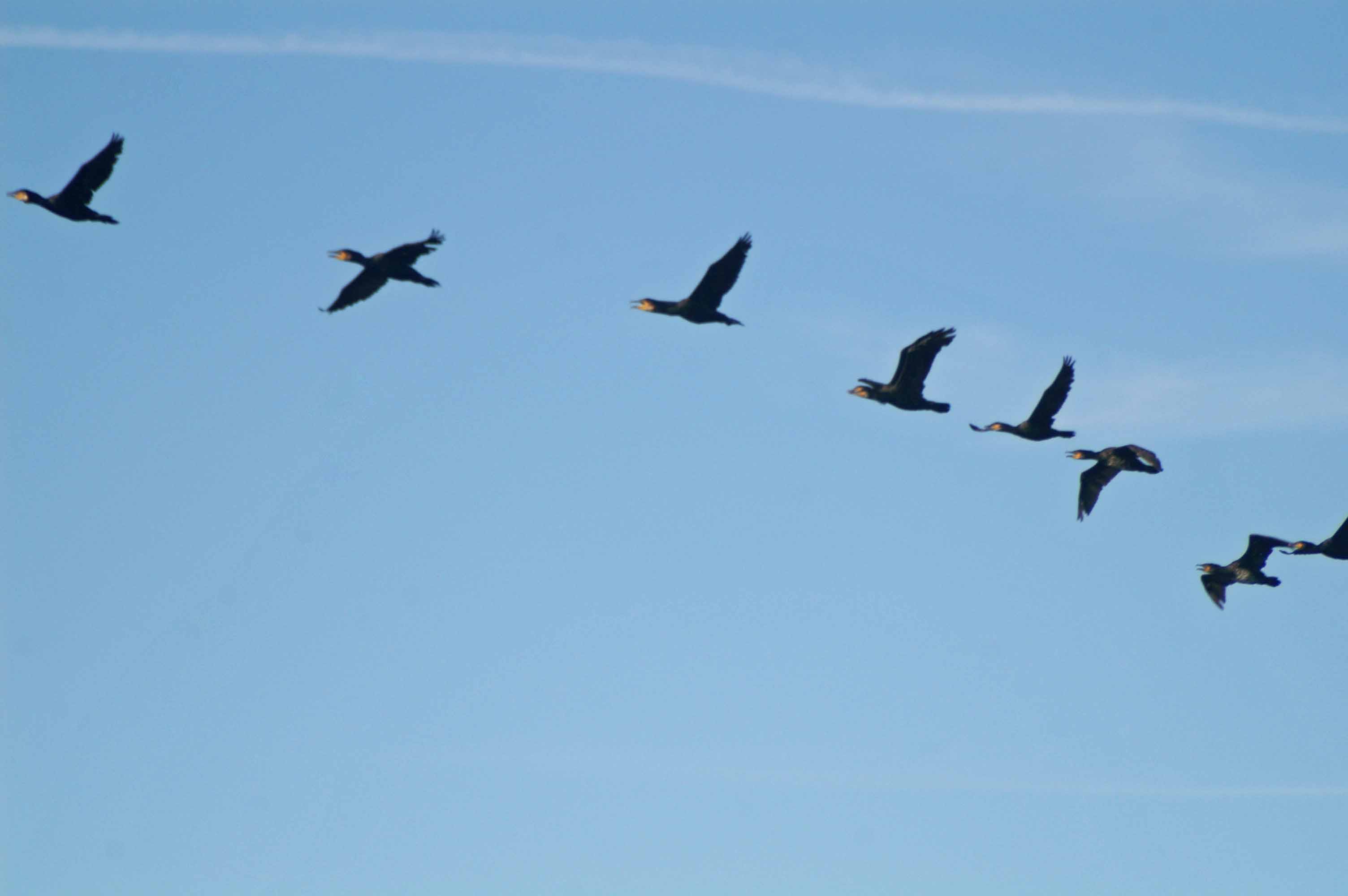
24/8/11-Cormorants flying toward the Little Orme, calling as they flew

24/8/11-Black-headed Gull flying

Birds to be seen currently on the shore at Rhos-on-Sea:

Cormorant – Phalacrocorax carbo, Oystercatcher – Haematopus ostralagus,  Ringed Plover – Charadrius hiaticula, Turnstone – Arenaria interpres, Redshank –  Tringa totanus, Curlew – Numenius arquata,Black-headed Gull – Larus ridibundus, Herring Gull – Larus argenatus, Lesser Black-backed Gull – Larus fuscus, Sandwich Tern – Sterna sandvicencis, Pied Wagtail – Motacilla alba, yarellii

Share this:

  • Share on Facebook (Opens in new window) Facebook
  • Share on Pinterest (Opens in new window) Pinterest
  • Share on X (Opens in new window) X
Like Loading...

Seaside life, cloudy skies and other views

03 Saturday Sep 2011

Posted by theresagreen in Nature of Wales, Rhos-on-Sea

≈ Leave a comment

Tags

catching crabs, cloudy skies, daisies growing on the beach, herring gull, Little Orme, mussel beds of Rhos-on-sea, red-tailed bumblebee

The weather throughout August has been unsettled and changeable. Rainy and sometimes windy days have curtailed outdoor activities, but when there have been dry spells and even occasional warm sunny ones, beautiful cloud formations have added an extra dimension to the views of sea and land.

A breezy but sunny afternoon:

9/8/11-Clouds over Rhyl

Catching crabs,( or ‘crabbing), is a popular form of entertainment in this part of the world. The only equipment required are a length of line with a hook to hold the bait, which is often a small piece of bacon and a bucket full of water to hold your catch – specially marked buckets are sold locally. When you’ve caught enough crabs to make you happy, you  simply return them all to their rightful home unharmed, where they can continue to grow. I’m sure there are many canny crabs lining up for an easy meal.

9/8/11-Crabbing from the jetty, Rhos-on-Sea

9/8/11-On the village part of the promenade a clever woven wicker sculpture, crafted from live willow, of a person holding a fish

 A warm evening just before sunset:

4/8/11-Rhos harbour at evening low tide

4/8/11-Evening view of seashore to Colwyn pier

4/8/11-White daisies growing at the back of the beach photograph better in the low light of evening

4/8/11-Gulls gathered and resting at evening low tide

4/8/11-A Herring Gull reflected

4/8/11-Rhos mussel beds just before sunset

4/8/11-A bumblebee was out late visiting lavatera flowers outside St Trillo's chapel

4/8/11-The Little Orme at sunset

Share this:

  • Share on Facebook (Opens in new window) Facebook
  • Share on Pinterest (Opens in new window) Pinterest
  • Share on X (Opens in new window) X
Like Loading...

Come rain, come shine

27 Saturday Aug 2011

Posted by theresagreen in frogs & toads, garden wildlife, Nature, Nature of Wales, Rhos-on-Sea

≈ Leave a comment

Tags

common frog, house sparrow, limacus flavus, rana temporaria, wood pigeon, yellow slug

Days of unsettled weather have limited my outdoor activities, but during dry spells and the occasional half-hours of sunshine, the local wildlife has been quick to take advantage of opportunities to venture out of hiding.

Some people have lions or pineapples decorating their gateposts ;we have woodpigeons
When not on sentry duty, the wood pigeons scour the lawn for freshly sprouted dandelion leaves

I tidied up the hedge recently, but was careful to leave the crop of berries along the top untouched. Now, although they still don’t appear to me to be ripe, the House Sparrows arrive several times a day to check for any that are edible.

The House Sparrows come several times a day to check for any berries that may be ripe enough to eat

The House Sparrows are still together in quite a sizable flock and although the young birds seem to stick together as one group and the adults appear in smaller groups, they are all within reach of one another.

Other garden birds have reappeared following their ‘summer breaks’ too. During a sunny spell of a recent early morning I was watching a young Crow pecking at fruit on the neighbouring apple tree; it was joined by three young Blue Tits that arrived to forage around the branches and they were followed by two adults and then a family of Great Tits. A Coal Tit was exploring the woodwork of the garden shed, no doubt looking for spiders or other sheltering insects. A Wren arrived and sang briefly from the garden fence, Dunnocks foraged along the bottom of the hedge and both a male and a female Blackbird put in an appearance.

Insects need warm sunshine to get them going:

A Small White butterfly basking on a privet leaf
A basking Speckled Wood from the front, ready for lift-off
5/8/11-A Marmalade hoverfly warming up in a spot of sunshine

Then there are those creatures that prefer the cooler, damper weather:

A Garden Snail enjoying a cool damp spell
I discovered this unusual Yellow Slug-limacus flavus whilst gardening. 

Limacus flavus, sometimes called the Yellow slug, is a medium to large species of air-breathing land slug, a terrestrial pulmonate gastropod mollusc in the family Limacidae.The yellow slug is common in England, Wales and Ireland as well as most of southern and western Europe. Feeding mostly on fungi, decaying matter or vegetables, this species is strongly associated with human habitation, and is usually found in damp areas such as cellars, kitchens, and gardens. Generally speaking it is only seen at night, because it is nocturnal. Thus it often goes unnoticed and people are unaware of how (relatively) common the species is.

I know it’s a slug, but it is quite an attractive one

I filled four recycling bags with hedge-cuttings and other garden debris and when I began to move them to put them out for collection a few days later, I was removing the hiding place of a rather lovely frog.

Common Frog-Rana temporaria

Common Frog – Rana temporaria

Identification:

  • Tailless amphibian – Smooth skin
  • Tends to jump not walk
  • Horizontal ovoid pupil
  • Dorsal surface and flanks are very variable in colour, typically yellowish brown, but may be olive-green coloured and some individuals have a reddish or yellow appearance. Variably spotted or striped.
  • Ventral surface (underside) of males may be dirty white or pale yellow, speckled with grey or brown; females pale yellow to orange
  • The most consistent markings are the dark patch behind the eye and the strong barring on the hind limbs.
  • Length: 6 – 9 cm
This lovely fat frog was hiding between the garden waste recycling bags

Share this:

  • Share on Facebook (Opens in new window) Facebook
  • Share on Pinterest (Opens in new window) Pinterest
  • Share on X (Opens in new window) X
Like Loading...
Newer posts →
Follow everyday nature trails on WordPress.com

Enter your email address to follow this blog and receive notifications of new posts by email.

‘But it is the common species that keep the living world ticking over and provide most of our experiences of wildlife, and I would argue that maintaining the abundance of these is as important a conservation priority as maintaining the existence of rarities’. Richard Mabey

MOST RECENT POSTS

  • A Glimpse of Spring to Come January 22, 2025
  • Hunting the Wren December 28, 2024
  • Oh, Christmas Tree December 18, 2024
  • In and Out of the Ivy February 15, 2024
  • Nature’s Fireworks November 30, 2023
  • Wild Autumn along the Coast Path November 3, 2023

OLDER POSTS

LOOKING FOR SOMETHING IN PARTICULAR?

  • Sights and Sounds from the Little Orme 1
    Sights and Sounds from the Little Orme 1
  • Things Bright and Beautiful
    Things Bright and Beautiful
  • Following a river to a Fairy Glen
    Following a river to a Fairy Glen
  • Catchers, a Duck and Divers
    Catchers, a Duck and Divers
  • Fine Dining for Crows
    Fine Dining for Crows
  • A Window on the Woods-Winter 1
    A Window on the Woods-Winter 1
  • Butterflies and more rare treats
    Butterflies and more rare treats
  • Shades, Sounds and Scents of the Woods
    Shades, Sounds and Scents of the Woods
  • A Windy Wildflower Trail
    A Windy Wildflower Trail
  • Bird study: Blackcap
    Bird study: Blackcap

nightingale trails

The Walk of the Monarch Butterfly-Sendero de la Mariposa Monarca

The Walk of the Monarch Butterfly-Sendero de la Mariposa Monarca

MY WILDFLOWER BLOG: where the wildflowers are

Snowdrop

Snowdrop

most recent posts

Follow everyday nature trails on WordPress.com

Social

  • View teresamaygreen’s profile on Twitter

Enter your email address to follow this blog and receive notifications of new posts by email.

Website Built with WordPress.com.

  • Subscribe Subscribed
    • everyday nature trails
    • Join 359 other subscribers
    • Already have a WordPress.com account? Log in now.
    • everyday nature trails
    • Subscribe Subscribed
    • Sign up
    • Log in
    • Report this content
    • View site in Reader
    • Manage subscriptions
    • Collapse this bar
 

Loading Comments...
 

    %d