• Home
  • about
  • about the photographs
  • Local Nature Reserves
    • Bryn Euryn Local Nature Reserve
    • Mynydd Marian
  • Wales Coast Path
    • Grey Seals in North Wales
    • St.Trillo’s Chapel
    • Wildflowers of North Wales Coastal Paths, Cliffs and Dunes

everyday nature trails

everyday nature trails

Category Archives: Rhiwledyn Nature Reserve

Hogweed days

12 Friday Jul 2013

Posted by theresagreen in Bryn Euryn Nature Reserve, butterflies, Nature, Nature of Wales, nature photography, Rhiwledyn Nature Reserve, Wildflowers of Wales

≈ 14 Comments

Tags

comma, cow parsnip, heracleum sphondylium, hogweed, medicinal uses of hogweed, medicinal uses of plants, Rose Chafer, small tortoiseshell

The most significant nectar provider for a whole host of insects at the moment is Hogweed, or Cow Parsnip if you prefer. In common with many species of wildflowers it seems to be having a bumper season and is flowering profusely in a lot of locations. The photographs here were mostly taken in the last couple of weeks, either in the Rhiwledyn Nature Reserve on the Little Orme or on Bryn Euryn. 

Hogweed, Cow Parsnip – Heracleum sphondylium  

Family: Carrot; Umbelliferae Habitat: Rough grassland verges, light woodland. The most usual late autumn umbellifer in flower.

Flowering:  (May) June – September Seeds: Winged Height: averages 50–120 cms (20–47 in), can reach 2 metres (6 ft 7 in)

Hogweed is an herbaceous perennial or sometimes biennial plant, native to Europe and Asia. It is an umbelliferous plant, in the same group as plants such as fennel, cow parsley and ground elder.
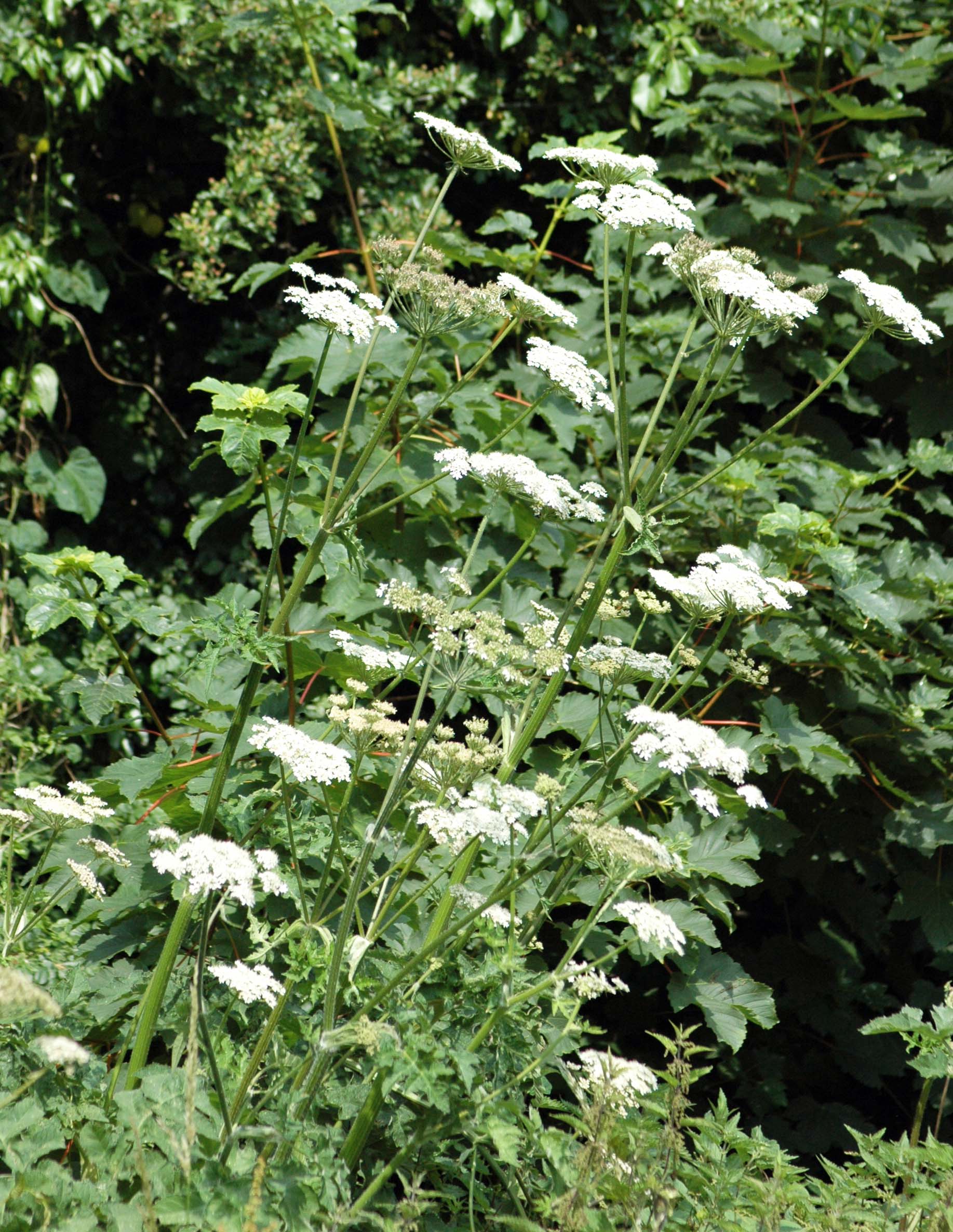
Hogweed-Heracleum spondylium

Hogweed-Heracleum spondylium

etymology

The common name of Hogweed refers to the characteristic pig-like smell of the flowers. The genus name Heracleum derives from the Greek “herákleion” and refers to the mythologic hero Heracles, who is reputed to have used the plant medicinally. The species name sphondylium, meaning “vertebrae”, refers to the shape of the segmented stem.

The leaves are large and can reach 50 cms (20 in) in length. They are pinnate, hairy and serrated, divided into 3-5 lobed segments.

Hogweed leaves

Hogweed leaves

A snail tucked into hogweed stems

A snail tucked into hogweed stems

The roots of the plant are large, rhizomatous and reddish in colour. The stem is hollow and striated with bristly hairs.

The flowers are  white, sometimes pinkish and each has 5 petals. They are arranged in large umbels of up to 20 cm of diameter with 15 to 30 rays. The peripheral flowers having a radial symmetry.

The inflorescence of a Hogweed plant

The inflorescence of a Hogweed plant

The hogweed is one of a number of plants that have foregone the use of a sweet scent to attract pollinating insects. The plant has adopted the more unusual strategy of mimicking the scent of pigs, not that noticeable to us, but to flies it is like a magnet and flies are the main pollinators of this plant.

A tachinid fly nectaring on hogweed

A tachinid fly nectaring on hogweed

The small fruits are flattened and winged, elliptical to rounded in shape and glabrous (smooth, free from hair or down) up to 1 cm long. The seed dispersal is by wind.
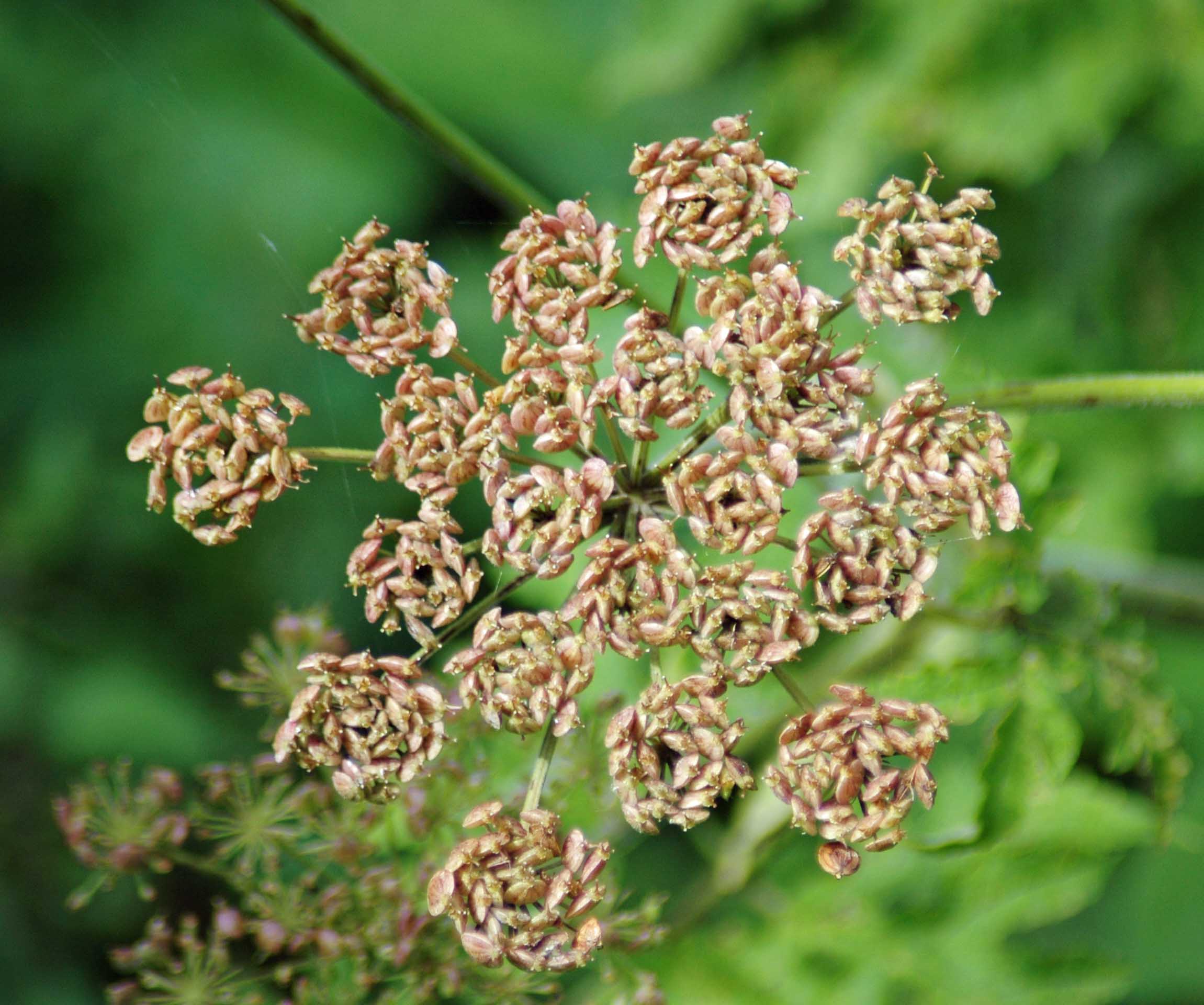
Hogweed seedhead

Hogweed seedhead

1/9/12 - Hogweed seeds

1/9/12 – Hogweed seed cases

traditional medicinal and culinary uses

Common hogweed was once employed in medicine, although its use has been long out of favour. Long ago the seeds were boiled in oil that was then recommended for application to running sores and to treat the rash associated with shingles. Culpeper recommended a decoction of the seeds to be applied to running ears.

Hogweed shoots have  a high vitamin C content and the plant is still eaten in some places. The young shoots are collected early in the season and the  tender young stems, cut into pieces about 15cm long may be boiled in salted water for about 15 minutes, then drained and served with butter. Apparently they make an ideal accompaniment to meat dishes.

(WARNING!  This family of plants contains many poisonous species and correct identification is essential before even thinking about eating them.)

hogweed and insects

Although its main pollinators are flies, many insects of other species can be seen helping them out whilst helping themselves to the nectar. It is not uncommon to see numbers of insects vying for a space on the same hogweed flowerhead.

A pair of soldier beetles mating, a green shield bug, a small black beetle and a fly of some sort all on one small flowerhead, oh and there's a spider's web

A pair of soldier beetles mating, a green shield bug, a small black beetle and a fly of some sort all on one small flowerhead, oh and there’s a spider’s web

30/6/13-Small Tortoiseshell on hogweed-Little Orme

30/6/13-Small Tortoiseshell on hogweed-Little Orme

30/6/13-Bumblebee on Hogweed flowers, Little Orme

30/6/13-Bumblebee-Bombus hortorium on Hogweed flowers, Little Orme

30/6/12-Greenbottle fly on hogweed - Little Orme

30/6/12-Greenbottle fly on hogweed – Little Orme

At Bryn Euryn the first insect I spotted on Hogweed flowers was a Comma butterfly. It was looking a bit worse for wear, faded and with chunks missing from its wings,but is a first tick for a sighting of this species this year.

8/7/13 -Comma butterfly

8/7/13 -Comma butterfly

There were also a number of soldier beetles, greenbottle flies, bumblebees and hoverflies there. I thought I’d taken a picture of a honeybee too, but taking a closer look at the photograph I realised the insect had only two wings. I don’t know for sure what it is, more research  needed, but most probably a hoverfly ; an Eristalis species. Interestingly in respect of honeybees, a loved this observation on Adventure’s in Beeland’s blog  whats flowering now: early july   ” They (honeybees) appear to get very little pollen from these flowers, but instead swish their proboscis enthusiastically about in the nectar like a watercolour artist swirling their brush.” I’ll envisage that now, if I chance upon a honeybee on hogweed…
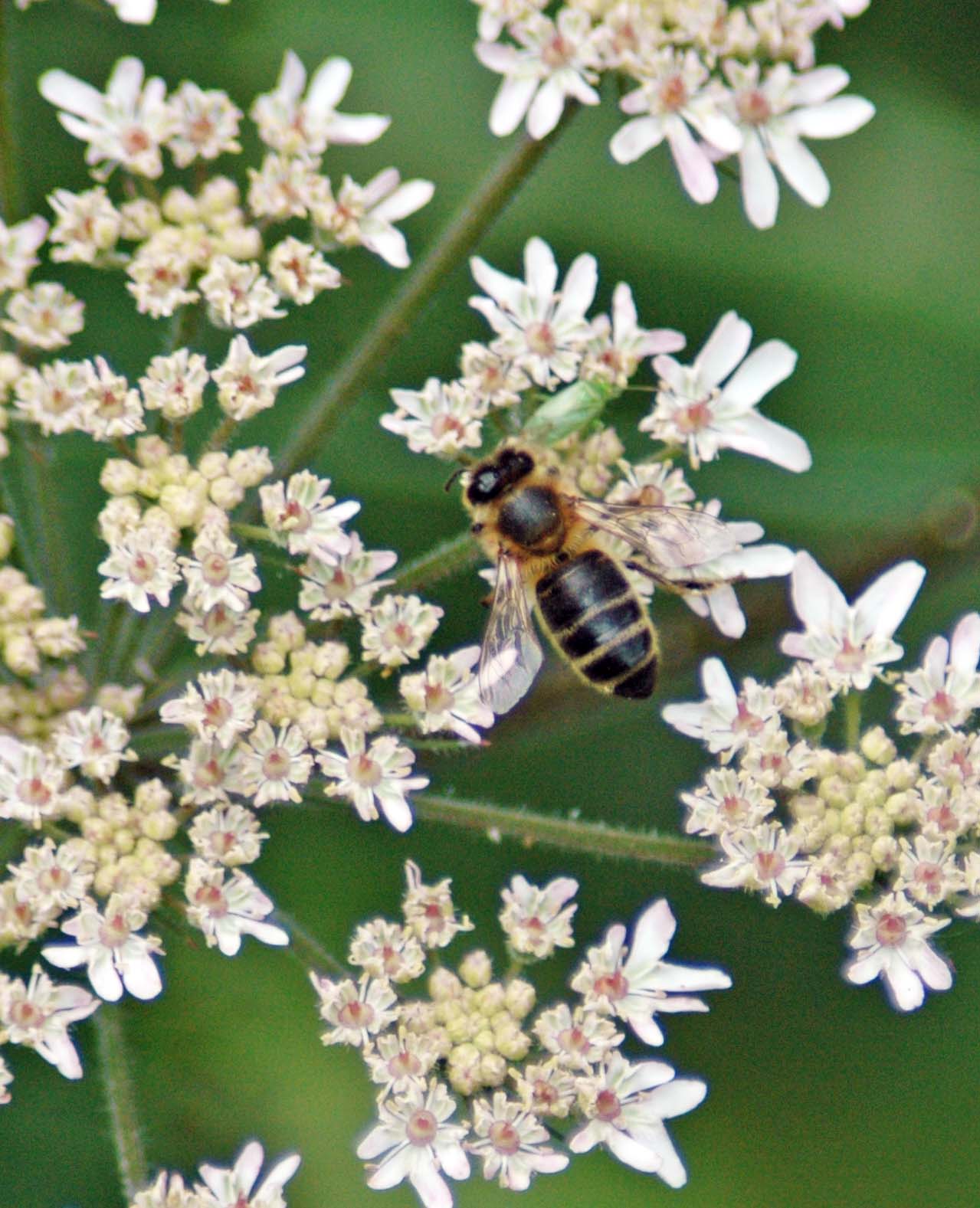
Probably a hoverfly an Eristalis species

Probably a hoverfly an Eristalis species

A 7-spot ladybird heading up a hogweed stem - there's prey up there - greenfly aphids

A 7-spot ladybird heading up a hogweed stem – there’s prey up there – greenfly aphids

One of my favourite photographs of an insect on hogweed is this one of a Rose Chafer, taken somewhere along the Pembrokeshire Coastal Path.

2/7/08-Rose Chafer on Hogweed - Pembrokeshire Coastal Path

2/7/08-Rose Chafer on Hogweed – Pembrokeshire Coastal Path

Picture from Naturespot: Graham Calow - Sapcote - 26 April 2012

There is an insect that I am aware of but haven’t noticed yet, actually named  for the plant; the Hogweed picture-wing fly. It is a small picture-winged fly Euleia heraclei. Also known as the Celery fly, it is a species of tephritid or fruit fly and is a pest of celery and parsnips, where it damages the vegetables by leaf mining. Males display on the upper surfaces of leaves on sunny days during May and mating takes place when a female arrives.  In Britain, the species is distributed widely across southern and central England; in Wales records are mainly near the coast. (The picture is taken from one of my favourite ID sites http://www.naturespot.org.uk/)

53.308051 -3.749941

Share this:

  • Share on Facebook (Opens in new window) Facebook
  • Share on Pinterest (Opens in new window) Pinterest
  • Share on X (Opens in new window) X
Like Loading...

Little Orme in early June

14 Friday Jun 2013

Posted by theresagreen in Little Orme, Nature, Nature of Wales, nature photography, Rhiwledyn Nature Reserve, Wildflowers of Wales

≈ 6 Comments

Tags

alexanders, ash tree, pink wildflowers, robin's pincushion gall wasp, sea campion, walk on the Little Orme, white wildflowers, wild thyme, wildflowers of the Little Orme

I made Wild Cabbages the main floral event of my recent walk on the Little Orme, giving them a post of their own, simply because they are not an everyday plant and because the number of plants there are and the profusion of their flowers this year would have made them difficult to miss. But of course there was much more to see there.

June 4th

As late spring slips into early summer there is a blending of fading and fresh flowers and foliage. My first glimpse of the fresh was a lovely clump, (an inelegant word to use to describe such delicate flowers), of Greater Stitchwort. They were tucked tightly against a tangle of bramble, using it to support their rather weak, brittle stems.

Greater Stitchwort-Stellaria holostea

Greater Stitchwort-Stellaria holostea

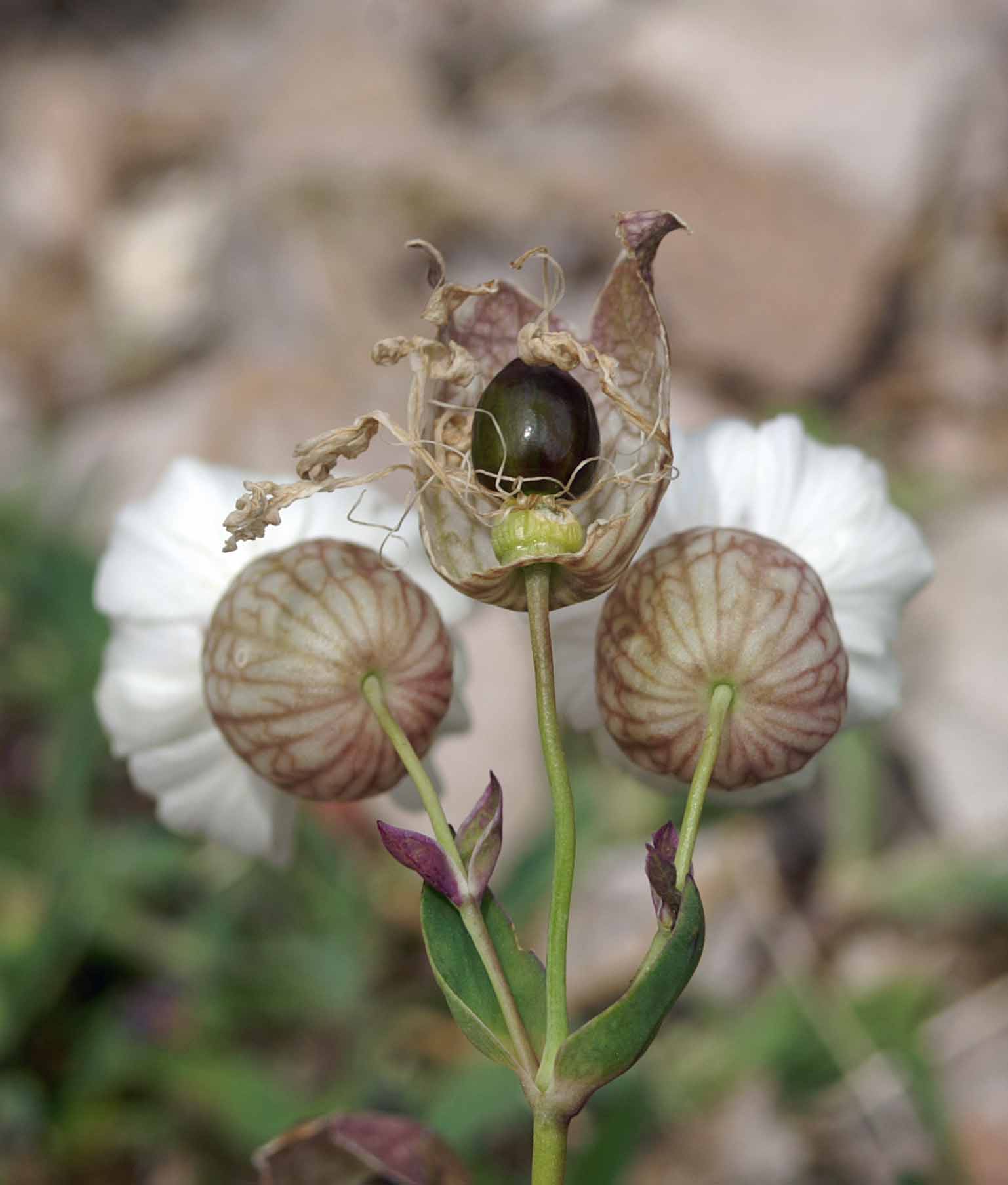
On the edge of the cliff there is a smattering of Thrift and some Sea Campion, both with fading flowers. I searched for a while to find Thrift that still looked fairly fresh, but find being able to see the seeds forming within the ‘bladders’ of the Sea Campion interesting.

Thrift and Sea Campion on a scree slope at the bottom of a cliff wall

Thrift and Sea Campion on a scree slope at the bottom of a cliff wall

Thrift-Armeria maritima

Thrift-Armeria maritima

A fairly fresh flower of Sea Campion-Silene vulgaris ssp. maritima

A fairly fresh flower of Sea Campion-Silene vulgaris ssp. maritima

Sea Campion-Silene vulgaris ssp. maritima-seed developing

Sea Campion-Silene vulgaris ssp. maritima-seed developing

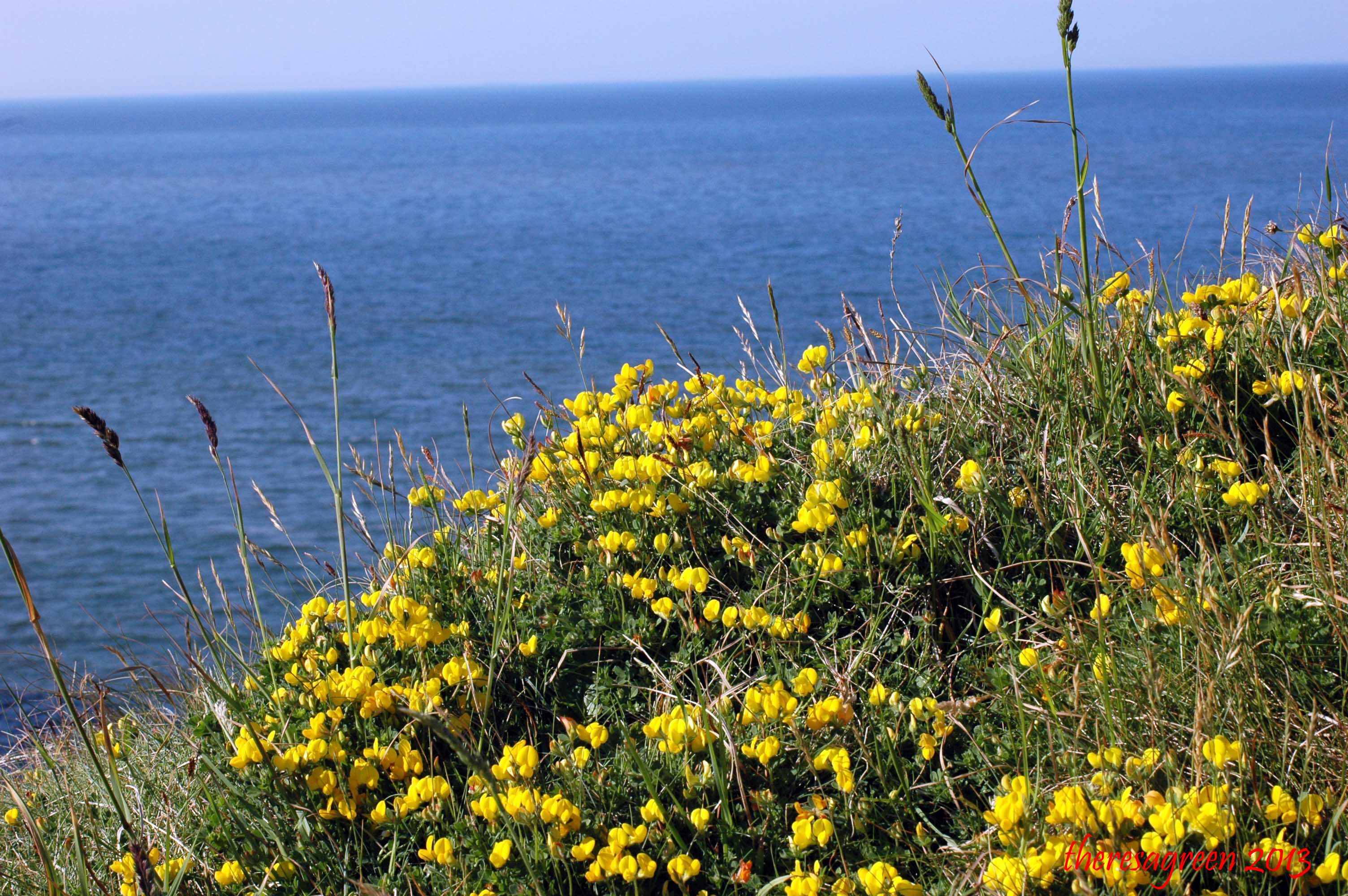
The most prolific wildflower here currently is Bird’s Foot Trefoil, which will carry on throughout the summer, providing nourishment for a whole host of fauna; a veritable live food manufacturing plant that looks beautiful too. I sat on a rock near this spot gazing at the view, contemplating life and enjoying the warmth of the late afternoon sun.

What could be prettier? Golden Bird's-foot Trefoil against a background of blue sea and sky

What could be prettier? Golden Bird’s-foot Trefoil against a background of blue sea and sky

There was a lot of Cormorant traffic travelling to and fro the tip of the headland, some in small groups, others alone. There are a large number of them here and their outlines can often be seen against the sky, the birds perched at regular intervals down the rock descending to the sea.

Turning back from the cliff I thought I might walk up the steep grass incline to the top of the hill, but I got halfway up and decided it might be a bit late in the day for rambling around up there, so stopped to take a photograph and walked down again.

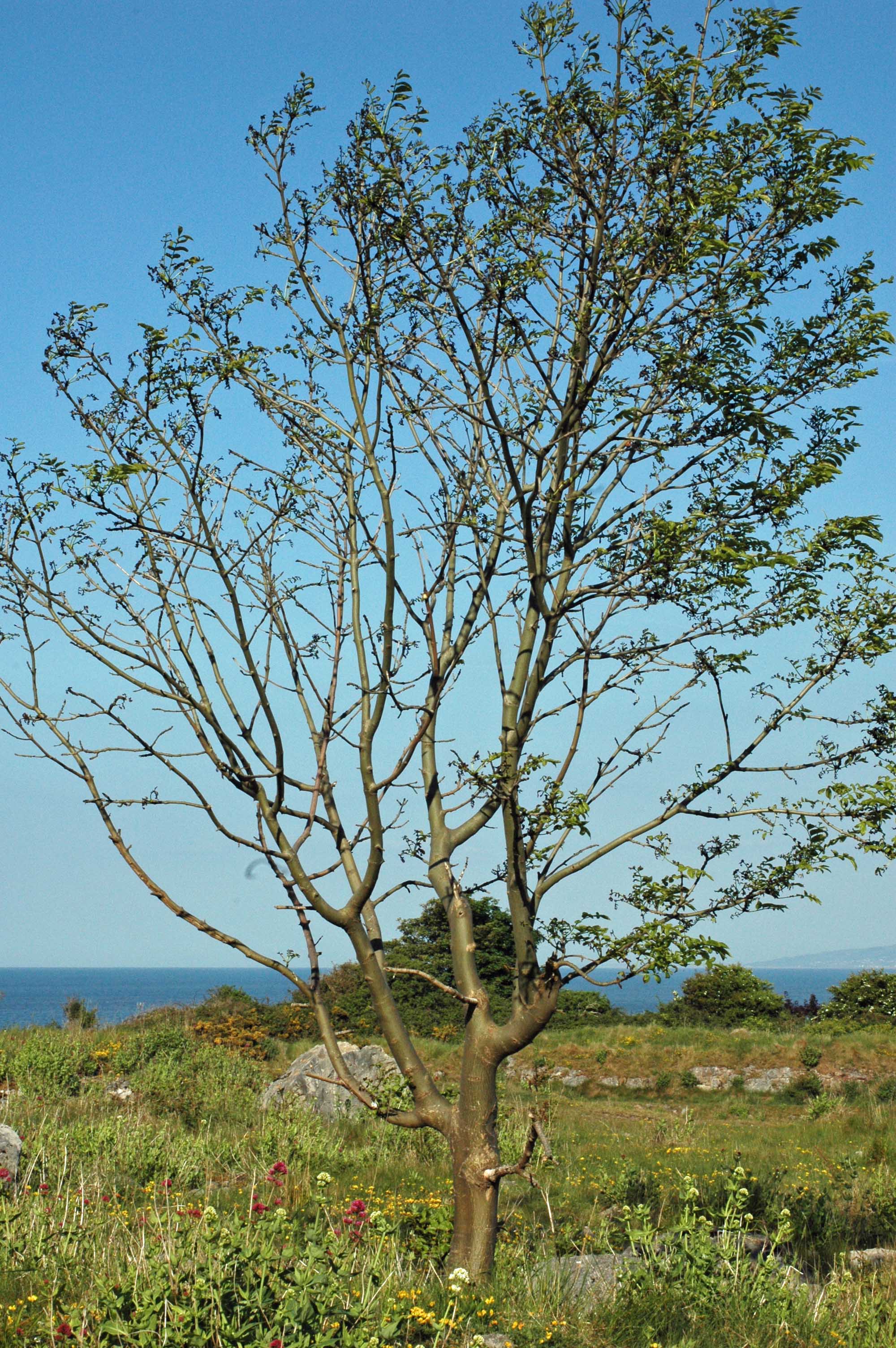
Ash tree with a view of Rhos-on-Sea and beyond

Ash tree with a view across Penrhyn Bay to Rhos-on-Sea and Colwyn bay beyond

Upholding my promise to myself to pay more attention to Ash trees I had already looked at a couple of small ones before taking this photograph. All, including this one, were less fully-leaved than those inland and all had leaves that were brown and shrivelled around their edges. I was alarmed when I first noticed that, but don’t think it’s anything more sinister than the leaves being ‘burned’ by the very cold and salt-laden winds they have been subjected to this whilst young and tender. I hope that’s all it is, there are a lot of Ash trees on the site of the Little Orme and their loss would be significant.

A smaller, younger Ash tree

A smaller, younger Ash tree had sparse foliage and ‘burnt’ leaves

I walked back following the pathway at the base of  the towering rock face, leaving the surfaced track to search the grass at its side for any smaller, less showy wildflowers. There was plenty more Bird’s-foot Trefoil with a few little bumblebees rushing around hunting for nectar and little patches of Wild Thyme, just beginning to open. There were quite a few little flowers, yellow with pink-flushed buds, that looked similar to Cat’s Ear, but not quite, so more research needed there.

A small patch of newly-opened Wild Thyme

A small patch of newly-opened Wild Thyme

I carried on walking, diverting over to the big patch of cabbages to take photographs as seen in previous post, following the edge of the deeper quarried-out bit (all of the section of the Little Orme I have been describing above is flat as a result of quarrying activity). Where the edge of this meets the cliff wall the only way to continue is to scramble down a rocky slope. If you ever find yourself doing this, be careful as hundreds of pairs of feet taking this way down, or up, over the years have worn the exposed rock to a shiny smoothness that can be quite slippery, even when dry.

The area at the bottom of the slope has a completely different character, more along the lines of an urban wasteland than a coastal clifftop. It does back onto houses and there is an access path in from the residential area, so the ground was probably disturbed during the building process. It’s not a very large area and can appear a bit scruffy, but there is always something to see here. There’s lots of Valerian flowering now, but the plant that has gone a bit crazy and is threatening to dominate all, is Alexanders. According to Richard Mabey in his brilliant book ‘Weeds’, this Roman introduction to Great Britain has apparently nationally fallen from grace recently, having suddenly altered its demeanor from that of well-behaved and fondly thought-of immigrant edible wildflower, to that of a rampant weed.

Alexanders lines the pathway for several metres

Alexanders – Smyrnium olustrum ,lines the pathway for several metres

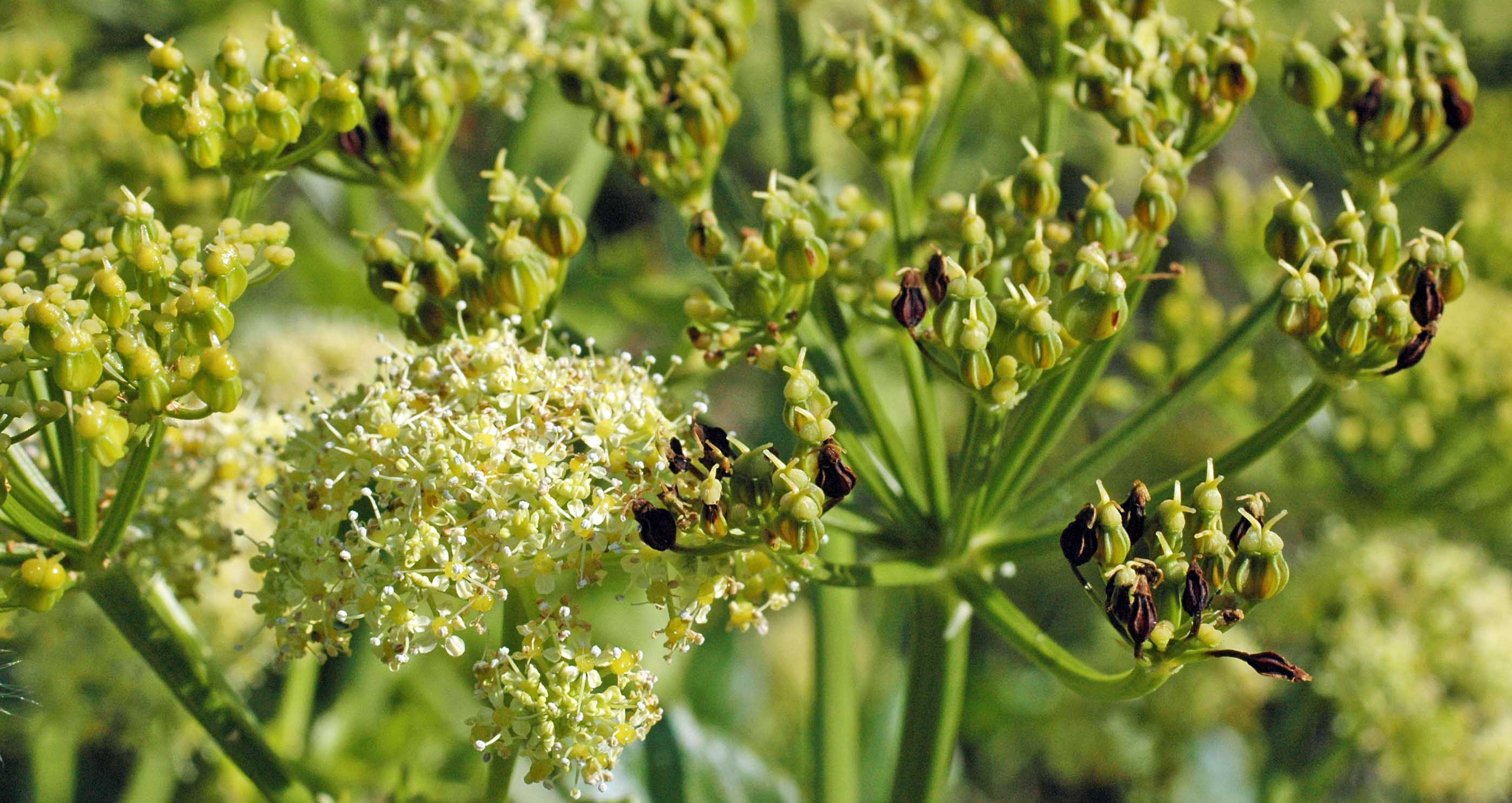
Alexanders is one of the earliest plants to put out greenery in the early spring and most of the plants here are past their best. A stately and attractive all-over yellow-green coloured plant, it was introduced here by the Romans for use as a pot-herb, having a mild celery flavour. Its culinary use continued for hundreds of years until it was replaced by cultivated celery. Perhaps this is a plant we should go back to foraging to help keep it under control rather than destroy it.

Alexanders is going to seed now, but there are still flowers

Alexanders is going to seed now, but there are still flowers

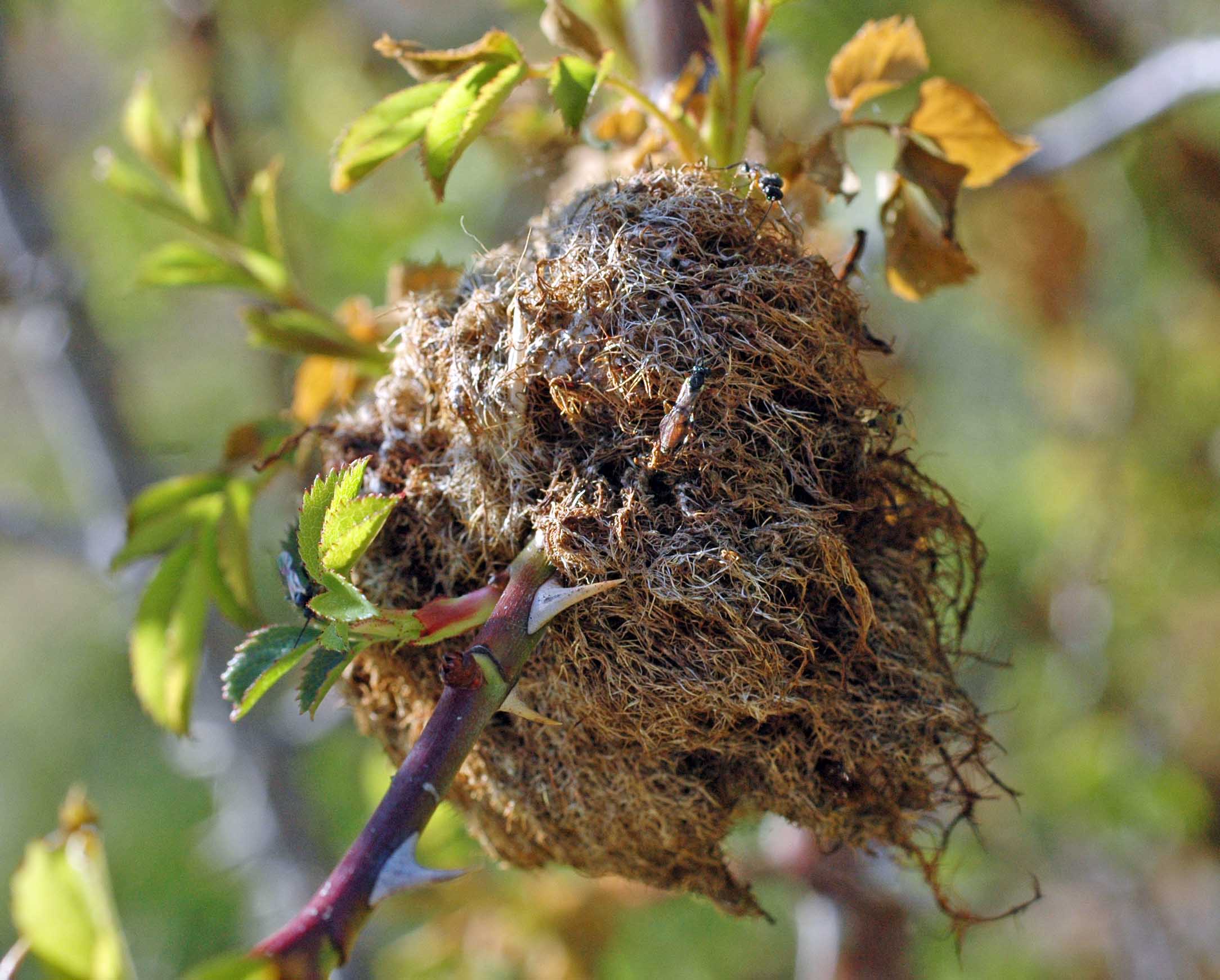
While I was prowling around the Alexanders plants I spotted a wild rose shrub in their midst and suddenly made a mental connection with a blog post from last August, which included a bit about the Robin’s Pincushion galls that appear on these plants. I mentioned in it that while the completed growth begins as bright red in colour, over the months they fade to a dark red-brown before the new adult wasps emerge in the spring and thought I’d try to find one. I remembered where the gall I photographed then was located, but thought I’d have a quick look at this one on the way to it. As luck would have it, there was a nice fat dark gall there too. As I got close with the camera, even more luck – there were a number of tiny little wasps crawling around on the gall and flying on and off, back and forth between it and rose leaves just a few centimetres away.

Dry Robin's Pincushion with little wasps on the surface

Dry Robin’s Pincushion with little wasps on the surface

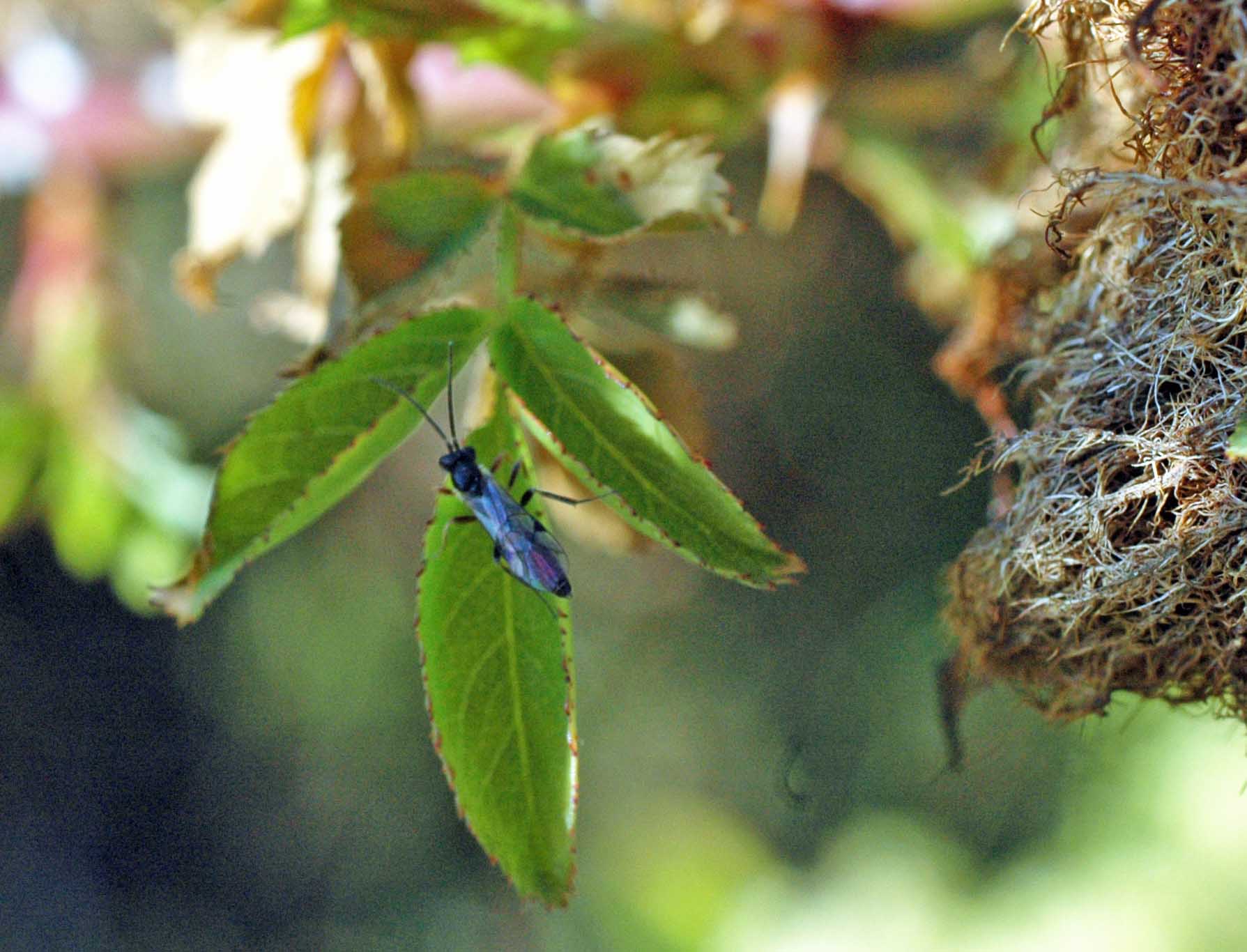
I am not claiming that these are the wasps, scientific name, Diplolepsis rosae, that cause the growth of the gall to house their larvae. Having looked at other people’s images, I rather think that although the colouration is similar, the abdomens of the ones in my pictures are more elongated and tapered than those in  images of the ‘right’ one. I thought perhaps the insects were just emerging from the gall, but that also didn’t help as I learnt that the original larvae are subject to parasitism by other species of wasp and they in turn may be got at by yet another species. They may have just been seeking prey, or maybe somewhere to locate their own eggs, or even just roosting for the night. I am sure they are some species of wasp though. If anyone can help with identification I’d be delighted.

Tiny wasp from gall, resting on a nearby rose leaf

Wasp from gall, resting on a nearby rose leaf. Size increased many times, these insects were really tiny.

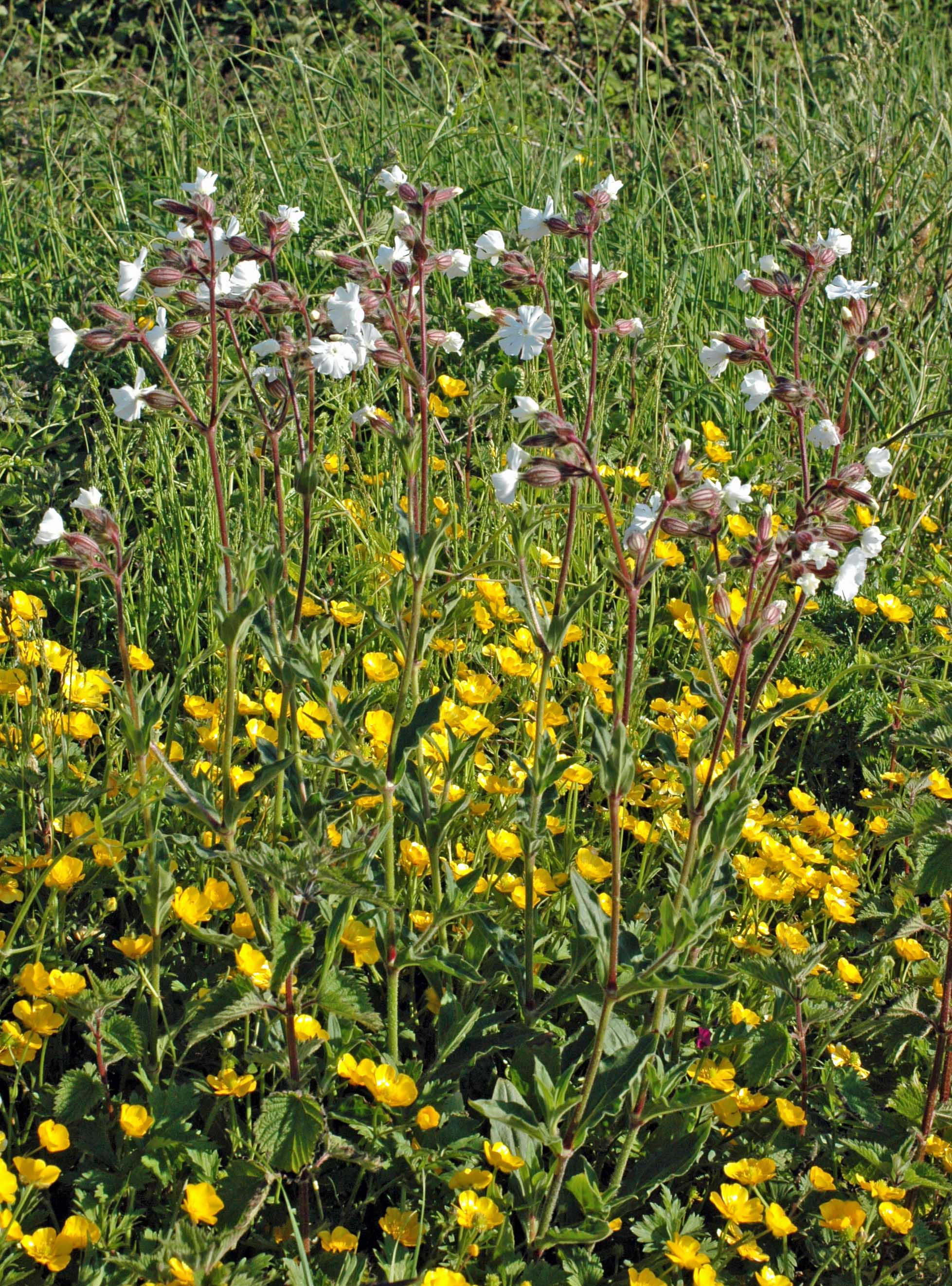
It was almost half-past six by the time I thought I should be getting home and the sun was beginning to sink behind the mass of the headland. It was creating a lovely glowing effect on the landscape and casting an interesting light upon a beautiful patch of buttercups that had pretty White Campion growing up through it.

130604TGNR- White Campion & Buttercups - Little Orme, North Wales

Golden yellow buttercups and white campion

Little Orme in the early evening

Little Orme in the golden early evening

Share this:

  • Share on Facebook (Opens in new window) Facebook
  • Share on Pinterest (Opens in new window) Pinterest
  • Share on X (Opens in new window) X
Like Loading...

Spot the ‘greens’ on the Little Orme, but please don’t eat them!

10 Monday Jun 2013

Posted by theresagreen in Little Orme, Nature of Wales, nature photography, Rhiwledyn Nature Reserve, Wildflowers of Wales

≈ 4 Comments

Tags

brassica olaracea, Little Orme, wild cabbage

The Little Orme is close in distance to Bryn Euryn, but quite different in character, so a walk around there can add a host of different flora species within the space of half-an-hour or so; it also has its specialty plants and I set off to find at least one of them on a late afternoon last week.

Right now while the rocks of the Bryn are splashed gold with dainty rockroses, the Little Orme has its yellow-flowered cabbages. This year, rather a lot of them and not just any old cabbage, but the rather rare Wild Cabbage Brassica oleracea.

Wild Cabbage-Brassica olearacea

12/06/04-Wild Cabbage-Brassica olearacea at the base of a cliff, Little Orme

The Wild Cabbage (Brassica oleracea), also sometimes known as Sea Cabbage,  is regarded as scarce by botanists as it is found in only 100 x10km squares in the UK.  Where it does occur, the plant is found on maritime cliffs, usually of limestone or chalk, typically growing on or near to cliff tops or cliff bases, often on ledges containing other mixed herb communities. The Little Orme and Great Orme in North Wales and the Gower Peninsular in South Wales are strongholds of the plant.

A tall red cliff-face on the Little Orme which has wild cabbage plants growing on ledges almost from top to bottom

A tall red cliff-face on the Little Orme which has wild cabbage plants growing on ledges almost from top to bottom

Brassica oleracea is a biennial, sometimes perennial, relatively short-lived (20 years), evergreen plant that can withstand frost. Plants can grow to a height of 1.2m (4ft), but that can vary, as can the size and to an extent, the shape of the leaves. It is in flower from May to August, and the seeds ripen from Jul to September. The flowers are hermaphrodite (have both male and female organs) and are pollinated by a range of insects, including bees and hoverflies; the plant is self-fertile.

Flowers of the wild cabbage

Flowers of the wild cabbage

It is probable that the Wild Cabbage, which occurs widely around the Mediterranean, is not a true native to Britain and that it was yet another introduction made by the Romans and is the forebear to our more robust modern cultivated cabbages.

Leaf of Wild Cabbage

Leaf of Wild Cabbage

I have seen sites advocating foraging wild cabbage as an edible wild plant, which of course it is,  but while the plant itself does not have any specific legal protection under the Wildlife & Countryside Act 1981 (as amended), most of the locations where it’s found along the North Wales Coast are designated as Sites of Special Scientific Interests. Damaging, uprooting or removing the plant either deliberately or recklessly could be regarded as a criminal act, so perhaps not a good idea to chance it.

A wild cabbage plant growing on a more exposed grassy cliff of the Little Orme (Sept 2011)

A wild cabbage plant growing on a more exposed grassy cliff of the Little Orme (Sept 2011). This was one of my first sightings (and photographs) of the species.

I took this photograph last May (2012)

I took this photograph around the middle of last May (2012), before the flowers opened

Share this:

  • Share on Facebook (Opens in new window) Facebook
  • Share on Pinterest (Opens in new window) Pinterest
  • Share on X (Opens in new window) X
Like Loading...

Late summer wildflowers and insects of the Little Orme

11 Tuesday Sep 2012

Posted by theresagreen in butterflies, coastal habitat, coastal walks, Little Orme, Nature, nature photography, Rhiwledyn Nature Reserve, wildflowers

≈ 7 Comments

Tags

6-spot Burnet Moth, black & yellow striped caterpillars, black butterfly or moth with red spots, cinnabar moth larvae, eristalis arbustorum, eristalis pertinax, eyebright, hoverflies, large black slug, meadow grasshopper, sawfly, small skipper, toadflax, vervain

The weather took its toll on the cliff-top flora and fauna of the Little Orme   too, although I think perhaps it’s not so much that the insects were not there, more that they were less able to be  mobile,  so were not as visible as they are in warmer, drier conditions. I took the following pictures on a warmish, sunny but fairly windy day just past the middle of August when everywhere was still damp from rain.

Ragwort is blooming strongly and every plant is supporting a colony of cinnabar moth caterpillars.

The Cinnabar moth larvae are growing fat on ragwort

The flowers of the ragwort are much in demand too, particularly by hungry hoverflies.

Eristalis interruptus (f) on ragwort

2 drone flies, Eristalis pertinax on ragwort

A smaller eristalis species – Eristalis arbustorum

Mating pair of soldier beetles

I was still on the lookout for soldier beetles and did eventually manage to find one pair; there were dozens of them this time last year. I didn’t even manage a very good photograph as the wind was blowing the ragwort stem they were on.

I walked towards the cliff edge above Angel Bay, drawn by a large patch of sunny yellow birds-foot trefoil mixed in amongst long grasses.

Flowery clifftop, most birds-foot trefoil mixed in amongst long grass

Long grass and birds-foot trefoil

As I had hoped, this flowery area turned out to be quite productive in terms of insects. I first spotted a Common Blue butterfly very low down on a grass stem, then followed a Small Skipper until it too came to rest on a flower.

Small Skipper –

That was followed by a first sighting of a Burnet Moth fluttering across the grass and flowers, and once I had ‘got my eye in’, I soon realised there were a good few more.

6-spot Burnet moth –

The Burnet moths were mostly attracted to the thistle flowers growing at the side of the pathway; at one point I found four of them all on the same plant.

3 of 4 Burnet moths that were all nectaring on a single thistle flowerhead

Stopping to photograph the single moth I was distracted by the chirping ‘song’ of a grasshopper, which I found on a grass stem just behind me. I am not great at identifying grasshoppers, but I think this was most likely a Meadow Grasshopper – Chorthippus brunneus.

Little grasshopper chirping from a grass stem

Walking along a narrow track through the long grass I saw an insect I did not immediately recognise on a thistle flower. It took little notice of me taking photographs of it, just carried on working its way around the flowerhead. To identify it I searched my favourite website for insect identification http://www.naturespot.org.uk, which is a Leicestershire site but usually comes up trumps for me. From that I believe my mystery insect may be of the Sawfly species, Tenthredo notha – but as always I am more than happy to be corrected.

Sawfly- Tenthredo notha

At the bottom of the steep grassy track that takes you higher up on the cliff, a decent number of butterflies were dancing around the bramble flowers. There is red valerian growing there too which is also a favourite nectar plant of butterflies and more ragwort attracting hoverflies. Butterflies included Large, Small and Green-veined Whites, Meadow Browns, Gatekeepers and a Tortoishell.

Green-veined White (m) on a valerian flower

I stopped half-way up the incline to draw breath and to take a  photograph of the view.

The view from the Little Orme across Rhos Point, then the headland of Abergele beyond which are Rhyl & Prestatyn and the coastline of the Wirral (click to enlarge)

At the top there is a flat grassy area, popular with Jackdaws that nest on the cliffs and grazed by sheep, where the remains of some sort of winding mechanism still stands as a memorial to the quarrying that is responsible for the shape of the Little Orme.

Sheep grazing and resting in the sun around old winding gear

Back down at the bottom and a quick scout around before heading home produced more flowering plants:

Eyebright – Euphrasia nemorosa

Toadflax- Linaria vulgaris

Vervain-Veronica officinalis

Lesser Burdock-Arctium minus

Another grasshopper, which I think is a Mottled one as it has curved antennae, but if not then its a Field one.

A mottled, or maybe a field grasshopper

Then finally, as testament to all the recent rainfall, a big fat slug…

Although this slug is black, it is a Large Red Slug-Arion ater, which has a range of colour forms.

Share this:

  • Share on Facebook (Opens in new window) Facebook
  • Share on Pinterest (Opens in new window) Pinterest
  • Share on X (Opens in new window) X
Like Loading...

August on the Little Orme

19 Sunday Aug 2012

Posted by theresagreen in coastal habitat, Little Orme, Nature, nature photography, Rhiwledyn Nature Reserve, Wildflowers of Wales

≈ 4 Comments

Tags

black & yellow striped caterpillars, blackstonia perfoliata, Centaurium erythraea, centaury, common ragwort, robin's pincushion, tortoiseshell butterfly, wildflowers of the Little Orme, yellow-wort

You probably do not need me to tell you that the weather this month has, so far, been rather un-summery, particularly in this part of the country, so I won’t bore you with unnecessary details. However it has impacted on the opportunities I have had to get out and about and record the effects it has had on the local wildlife, if any. That’s not to say I haven’t been keeping my eyes open and looking for opportunities to record what I am seeing, but rainy and windy days are not very conducive to taking photographs of insects or indeed flowers that are being buffeted by the weather.

An expanse of long grass on the clifftop blown by the wind against a background of very blue sea

The first day of August brought a mixed bag of weather conditions, but I  tried to make the most of a sunny spell towards the end of the afternoon by visiting the Little Orme. It was windy up there, but there were a few butterflies out feeding in odd places sheltered from the wind. In the majority were Meadow Browns, staying well down in the long grass, but there were a few Gatekeepers enjoying the abundance of bramble flowers, but not settling for long enough to photograph, one of two whites and one gorgeous Tortoiseshell. There were hardly any bees or hoverflies or indeed any insects flying.

A beautiful Tortoiseshell butterfly on bramble flowers

A large white (f) butterfly settled on a bramble stem very low to the ground. I love the mossy background.

Ragwort is flowering now; this somewhat contentious plant is an invaluable source of nectar for a myriad of insects and the host plant of the unmistakeable black and yellow striped larvae of the Cinnabar Moth, many plants are already supporting numbers of them.

Ragwort flowers with Cinnabar Moth caterpillars

Ragwort flowers with insects

There are some interesting plants flowering here at the moment; one is the pink-flowered Centaury and the other is Yellow-wort-Blackstonia, neither of which were showing open flowers today.

Common Centaury – Centaurium erythraea. Welsh, Bustl yr daear

Centaury flowers tightly closed

A member of the family Gentianaceae, common centaury thrives in dry grassy places and is especially common on stable sand dunes and on dune slacks.

A small plant of the gentian family, with flat-clusters of  star-shaped rose pink flowers, which open only when the sun shines. The stem is four-cornered and grows to a height of 4-20 inches (10-50 cm).

Etymology & traditional medicinal uses

Centaury takes its name from the Greek centaur, Chiron, who was half  man, half horse. Chiron was a teacher of the gods and skilled in the uses of medicinal herbs, and legend has it that when he was shot accidentally by Hercules with a poison arrow, he healed himself using common centaury.

This is a truly versatile herb that apparently may be used for nearly any problem. It is a bitter-tasting herb, which Culpeper noted “Tis very wholesome; but not very toothsome.”  It is used for a variety of digestive problems, including colic, bloating, heartburn, dyspepsia, to stimulate appetite, ease constipation, and to aid the proper assimilation and digestion of food. An extract prepared with vodka (!) is given for high blood pressure, liver and gall bladder problems. Lotions containing centaury have been used on the skin to remove different kinds of blemishes. It is used as a treatment for muscular rheumatism, gout, convulsions, tuberculosis, cramps and snakebites.

Externally, the juice applied to the eyes will clear the vision, and applied to wounds, ulcers, old sores, bruises, will help promote healing.  It kills worms as do most bitters and a decoction externally applied will destroy lice and other parasites in the hair.

Bach Flower remedy

I am familiar with Centaury through my work as an Holistic therapist, having studied and extensively used the Bach Flower remedies. It was one of Dr Edward Bach’s original ’12 Healers’.

The Centaury remedy is for people who find it difficult to say ‘no’ to others, usually  kind, gentle souls who like to help that may find themselves being taken advantage of and becoming resentful. The willing servant ending up the slave of another’s wishes. The remedy doesn’t harden or make us callous,rather it supports the development of courage and self-determination. We are better able to draw a line and make space where we can be ourselves, free of the desires and commands of others.

Yellow-wort – Blackstonia perfoliata. Welsh, Canri felen

Yellow-wort keeps its flowers tightly closed when the sun is not shining

A distinctive plant with grey-green leaves arranged in pairs to form ‘cups’ up the stem and bright yellow flowers that only open in the brightest sunshine. Yellow-wort is lime-loving and in Wales occurs in the greatest numbers dunes along the northern and southern coastal strips, particularly on marshy dune slacks. It generally flowers from June to October in Britain where it is widespread but not common.

In common with the afore-mentioned Centaury, Yellow-wort is a member of the family Gentianaceae, but is distinguished from all other family members, which have flowers with either four or five petals, by having six or even eight flower petals. It is tricky to catch the flowers open as even on the brightest, sunniest days they close very quickly if as much as a cloud passes over them.

Etymology & use

Yellow is self-explanatory as the colour of the flowers of the plant and wort was commonly used in the names of plants and herbs, especially those used formerly as food or medicinally. In this particular case I have been unable to discover any history of the plant being used medicinally, but a yellow dye can be obtained from the plant extract, so that may cover it.

The Latin Blackstonia refers to the 18th Century botanist and apothecary John Blackstone. Perfoliata.. through-leaved .. referring to the leaves which are fused together at the base with the stem threading its way through.

John Blackstone (1712–1753).  Blackstone worked in London and spent his holidays at Harefield, north Middlesex.  His major work was Fasciculus Plantarum circa Harefield sponte nascentium. Cum Appendice, ad Loci Historiam spectante which catalogued plants he found in Harefield and included the precise location of the rarer plants.  He was working on a second work when he died prematurely aged 41.

Robin’s Pincushion

Robin’s Pincushion

The Rose bedeguar gall, Robin’s pincushion gall, or Moss gall develops as ” a chemically induced distortion of an unopened leaf axillary or terminal buds” occurring most commonly on Field Rose (Rosa arvensis) or Dog rose (Rosa canina) shrubs. This fascinating distortion is caused by the parthenogenetic hymenopteran gall wasp (Diplolepis rosae (Linnaeus, 1758))

To find a wasp you would have to look around the new green leaf buds in late May as it prepares to lay its eggs. Then the female diplolepis lay up to sixty eggs within each leaf bud using her ovipositor. The asexual wasps emerge in the spring; less than one percent are males.

The bedeguar gall is surrounded by a dense mass of sticky branched filaments, giving the appearance of a ball of moss. Its filaments start off green, gradually becoming pink that turns crimson and ages to a reddish brown. They are at their most attractive from about now to September, as from then they begin to lose their hairs, although they remain in place until the new gall wasps emerge in the spring.  A large specimen can achieve up to 10 cm in width.

Etymology 

The term ‘Bedeguar, Bedegar or Bedequar’ comes from a French word, bédegar, but that originated from the Persian, bād-āwar, meaning ‘wind-brought.’

The Robin in ‘Robin’s pincushion’ refers to the woodland sprite of English folklore, Robin Goodfellow, otherwise known as Will o’ the wisp and Puck.

Folklore & traditional medicinal uses

Folklore tells us that if a Robin’s Pincushion is placed under one’s pillow it aids sleep and the gall was therefore known as the ‘Sleep Apple’.

The galls have apparently been used in the treatment of whooping cough and carried as an amulet to ward off toothache.

Share this:

  • Share on Facebook (Opens in new window) Facebook
  • Share on Pinterest (Opens in new window) Pinterest
  • Share on X (Opens in new window) X
Like Loading...

Thrift -Armeria maritima

28 Monday May 2012

Posted by theresagreen in Little Orme, Nature, Nature of Wales, nature photography, Rhiwledyn Nature Reserve, Wildflowers of Wales

≈ 4 Comments

Tags

armeria maritima, Ceibwr Bay, clifftop flora, Pembrokeshire coastal path, sea pink, thrift, thrift on old three pence coin, wildflowers with pink flowers

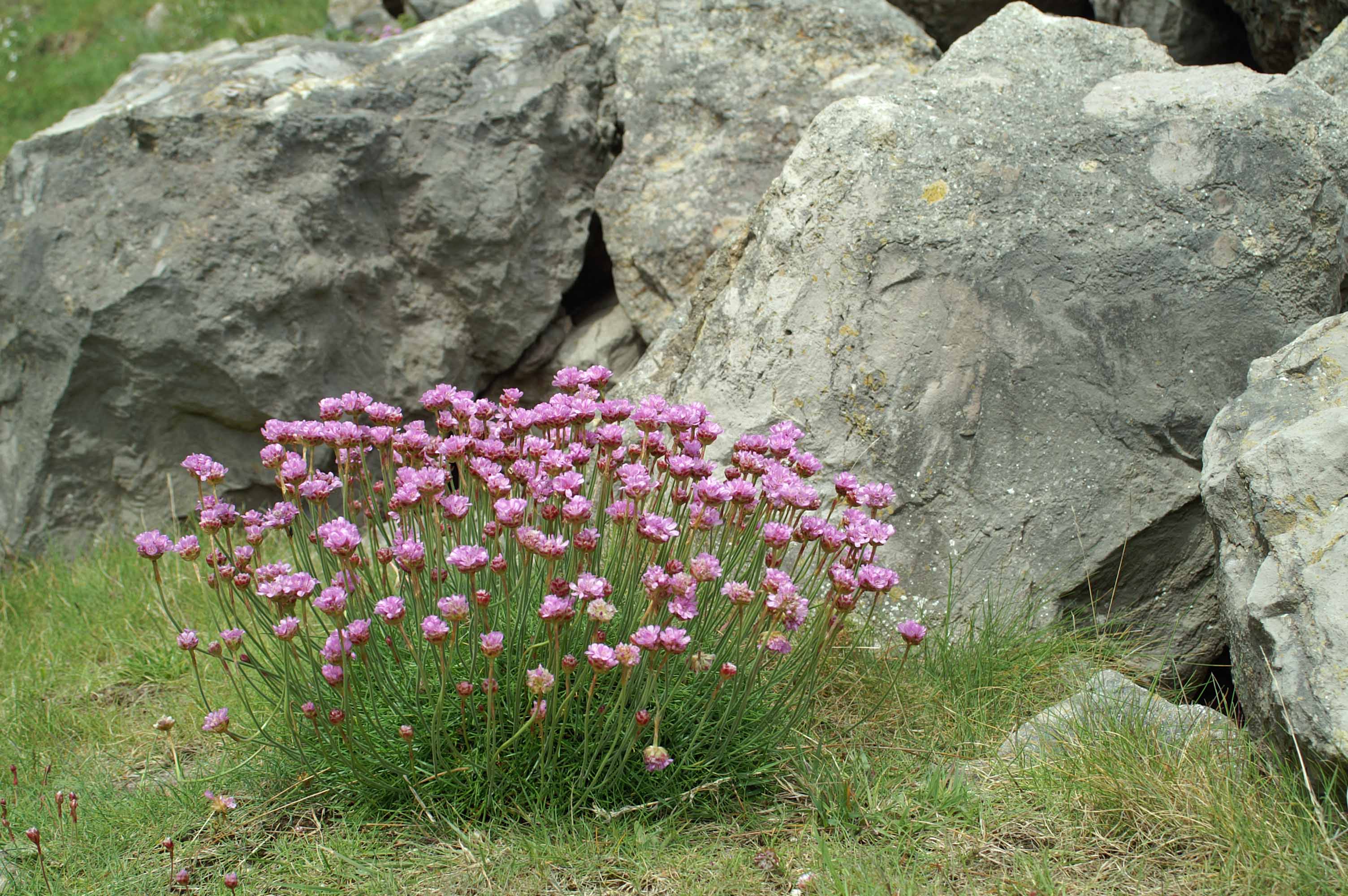
Thrift – Armeria maritima, Rhiwledyn Nature Reserve, Little Orme, North Wales

Thrift

Thrift or Sea Pink, Rock Rose, Our Lady’s Pillow – Armeria maritima, begins flowering in April and carries on gloriously well into July. It is a low growing perennial plant that forms dense neat tussocks  of linear leaves and produces generous numbers of fragrant button-shaped flowers. The plant has very shallow roots and takes its common name of ‘thrift’ from its ability to make the most of any available nutrients in the thinnest of soils of cliffs and rocks.

Thrift creates wonderful displays on    wild, coastal areas throughout the UK – especially south-west Wales and Scotland, but as well as rocky cliffs, Thrift can also be commonly found brightening up saltmarshes and other sandy areas.

11/6/10-A wonderful display of thrift on the cliffs at Ceibwr on the Pembrokeshire Coastal Path, West Wales

The Welsh name for thrift is clustog Fair, which translates as Mary’s pillow. In Gaelic it is known as tonna chladaich, meaning ‘beach wave’.  It is the county flower of Bute, the Isles of Scilly and Pembrokeshire/Sir Benfro.

11/6/10- An old stone wall with a colony of thrift flowers – Pembokeshire Coastal Path

The threepenny coin was embossed with a portrait of Edward VIII and a reverse design of a thrift plant by Frances Madge Kitchener

Thrift was used as an emblem on the threepenny-bit between 1937 and 1953 – no doubt as a clever and light-hearted pun at a time in our British history when saving, making and mending and general ‘thrift’ were a part of everyday life.

Share this:

  • Share on Facebook (Opens in new window) Facebook
  • Share on Pinterest (Opens in new window) Pinterest
  • Share on X (Opens in new window) X
Like Loading...

Winter treats on the Little Orme

23 Monday Jan 2012

Posted by theresagreen in bird behaviour, Birdwatching on North Wales coast, Little Orme, Nature, nature photography, Rhiwledyn Nature Reserve

≈ Leave a comment

Tags

chough, chough in North Wales, flowering gorse, raven, stonechat

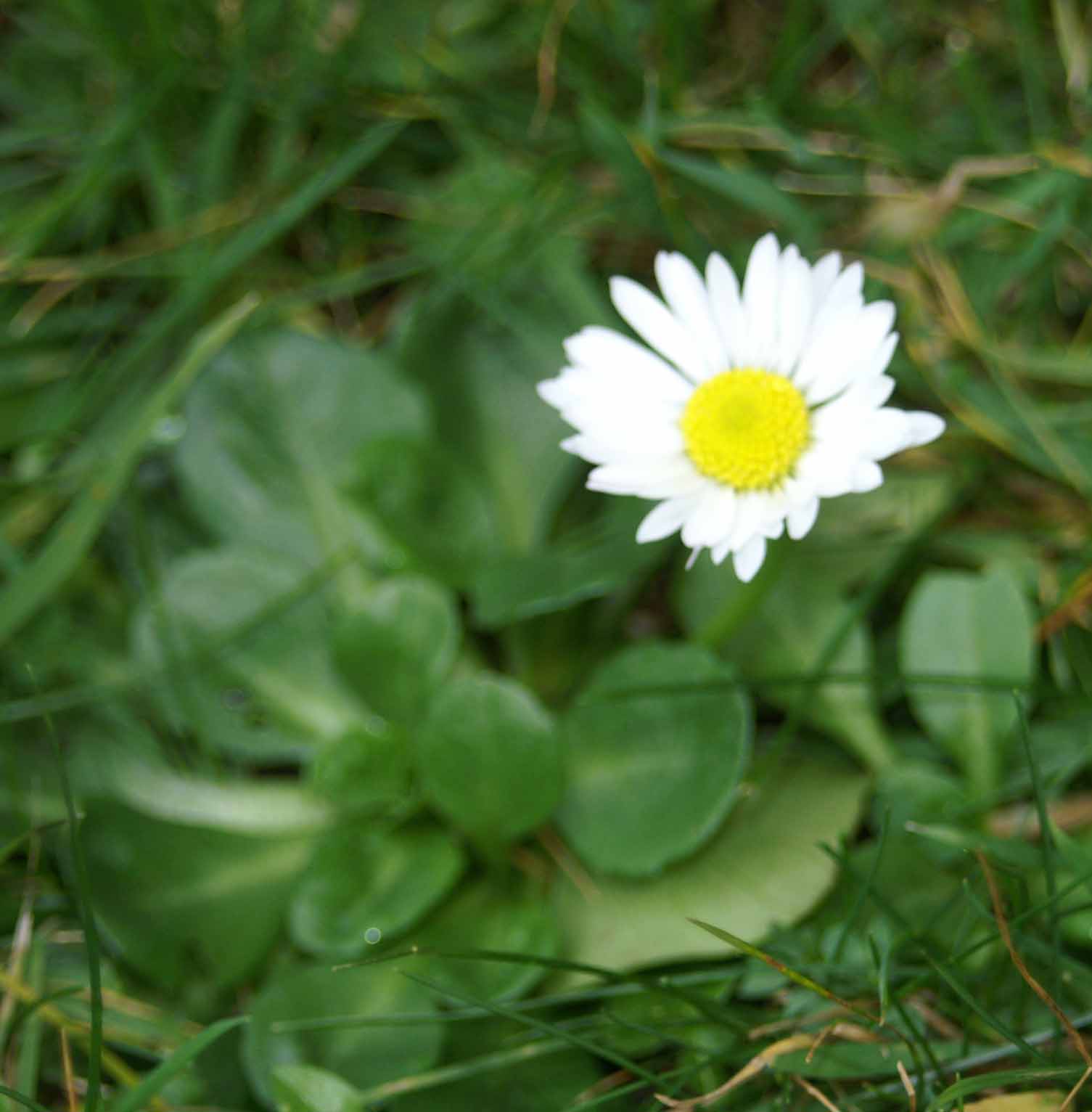
10th January - Daisy in the lawn

In common with the rest of Britain, we have experienced a mixed bag of winter weather on the North Wales coast so far this year and last week brought the whole selection together in its 7 day span. There were gale force winds, dull grey overcast days and some clear bright sunny days that darkened into clear night skies  full of brilliant stars. Of  course the clear nights brought forth morning frost and freezing temperatures, but they did not last for long.

Wood pigeon perched on the frosted roof

I usually try to avoid popular local walking spots on high days and holidays, but a need for some quick-fix fresh air and exercise on a cold but sunny Sunday afternoon found me heading for the nearby nature reserve on the headland of the Little Orme. When I first arrived I was pleasantly surprised by how few other people were there and set off towards the cliff edge to look out across the small bay. There were a few cormorants flying back and forth with a few more diving off the  tip of the headland. I watched a pair of fulmar flying around close to the cliff face, but that was it for sea birds; even the gulls were otherwise occupied elsewhere.

I turned around to walk back and heard the distinctive ‘barking’ call of a raven that I tracked to the top of the rockface. The bird was perched, hunched down with its head and neck pointed upwards and with its feathers bristling out around  its body. At that point I couldn’t see any other birds around that may have been provoking its behaviour, but a little later I heard it calling again from the cliff edge slightly further inland and looked up to see two buzzards circling closely above it, so maybe they were the objects of his annoyance.

Disgruntled raven

I already mentioned that this was a sunny day, but not yet that the sky was blue and – wait for it – so was the sea. One of the things I had come out hoping to photograph was gorse in bloom and luckily there were several bushes with flowers, but this picture of sunshine-golden gorse against a background of a blue Irish Sea had to be the one I included. It reminded me so much of Spain – apart from the sharp cold air that is.

Golden gorse in bloom against a background of blue sea

In total contrast I was then drawn to a patch of what from a distance I took to be low-growing white flowers but that was actually frosted moss.

a patch of frosted moss

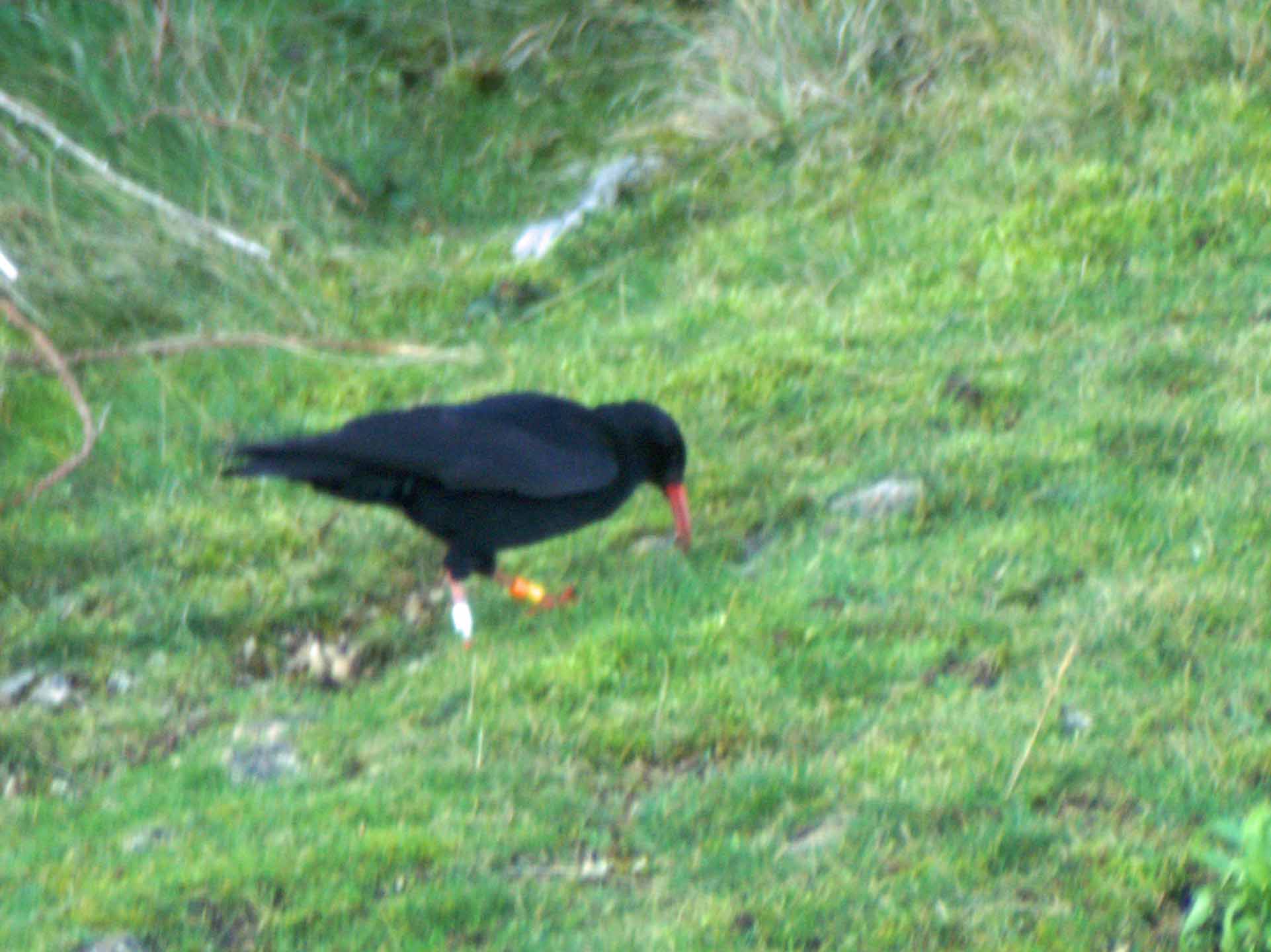
I had been meandering around rather than walking with any purpose and stood for a moment looking around trying to decide which direction to head in, or as the place suddenly seemed to be filling up with people and their dogs, whether to  leave and move on somewhere else. Just then a small flock of jackdaw flew in very close to me and landed on the short grass at the base of the cliff. I am very fond  of these intelligent and sociable birds, and for want of much else to photograph I decided to approach them and try for some close shots.  I got within a few metres, began to slowly raise the camera so as not to spook them, then almost dropped it when I realised that foraging alongside the jackdaws there were two chough. I was excited by the completely unexpected sighting of these much rarer birds, and panicking too as I could see a couple with a loose dog heading straight for me. I managed to get two shots only, one that was too out of focus to present and this one that is a long way from brilliant but does record the event.

A lucky glimpse of a Chough (Pyrrhocorax pyrrhocorax) on the Little Orme

I got my shots with just seconds to spare as the dog spotted the birds and bounded towards them, deliberately chasing them away. I watched disappointedly as they flew away, but sadly the dog owners smiled at me as they passed, probably amused by their dog’s ‘playfulness’. I was not at all amused. I had a long enough look to see that one of the chough had quite a collection of leg rings of varying colours, so it is obviously one that has been well monitored and it  should be possible to find out where it came from. Most probable is the nearby Great Orme, but South Stack on  Anglesey is another possibility. If anyone recognises the rings, I’d be very interested to hear from them.

Stonechat - Saxicola torquata

I considered the possibility that the birds may return, so to while away a few minutes I walked down the sloping path into the valley created by past removal of limestone rock. It was sunnier there and almost immediately a small bird perched on a gorse bush caught my eye. Its general size, shape and familiar behaviour  immediately brought stonechat to mind, but this is another bird I’d yet to see here, so I was pleased to confirm that as I focussed the camera lens on  it.

Stonechat (m) in ash tree

As I was leaving the site I had another glimpse of the Stonechat where it was perched in a small ash tree. It was joined there by another bird which I initially thought may have been a female, but was actually a Dunnock.

Dunnock

Share this:

  • Share on Facebook (Opens in new window) Facebook
  • Share on Pinterest (Opens in new window) Pinterest
  • Share on X (Opens in new window) X
Like Loading...
Newer posts →
Follow everyday nature trails on WordPress.com

Enter your email address to follow this blog and receive notifications of new posts by email.

‘But it is the common species that keep the living world ticking over and provide most of our experiences of wildlife, and I would argue that maintaining the abundance of these is as important a conservation priority as maintaining the existence of rarities’. Richard Mabey

MOST RECENT POSTS

  • A Glimpse of Spring to Come January 22, 2025
  • Hunting the Wren December 28, 2024
  • Oh, Christmas Tree December 18, 2024
  • In and Out of the Ivy February 15, 2024
  • Nature’s Fireworks November 30, 2023
  • Wild Autumn along the Coast Path November 3, 2023

OLDER POSTS

LOOKING FOR SOMETHING IN PARTICULAR?

  • Sights and Sounds from the Little Orme 1
    Sights and Sounds from the Little Orme 1
  • Things Bright and Beautiful
    Things Bright and Beautiful
  • Following a river to a Fairy Glen
    Following a river to a Fairy Glen
  • Catchers, a Duck and Divers
    Catchers, a Duck and Divers
  • A Windy Wildflower Trail
    A Windy Wildflower Trail
  • Fine Dining for Crows
    Fine Dining for Crows
  • A Window on the Woods-Winter 1
    A Window on the Woods-Winter 1
  • Shades, Sounds and Scents of the Woods
    Shades, Sounds and Scents of the Woods
  • The Windhover
    The Windhover
  • Butterflies and more rare treats
    Butterflies and more rare treats

nightingale trails

The Walk of the Monarch Butterfly-Sendero de la Mariposa Monarca

The Walk of the Monarch Butterfly-Sendero de la Mariposa Monarca

MY WILDFLOWER BLOG: where the wildflowers are

Snowdrop

Snowdrop

most recent posts

Follow everyday nature trails on WordPress.com

Social

  • View teresamaygreen’s profile on Twitter

Enter your email address to follow this blog and receive notifications of new posts by email.

Website Built with WordPress.com.

  • Subscribe Subscribed
    • everyday nature trails
    • Join 359 other subscribers
    • Already have a WordPress.com account? Log in now.
    • everyday nature trails
    • Subscribe Subscribed
    • Sign up
    • Log in
    • Report this content
    • View site in Reader
    • Manage subscriptions
    • Collapse this bar
 

Loading Comments...
 

    %d