• Home
  • about
  • about the photographs
  • Local Nature Reserves
    • Bryn Euryn Local Nature Reserve
    • Mynydd Marian
  • Wales Coast Path
    • Grey Seals in North Wales
    • St.Trillo’s Chapel
    • Wildflowers of North Wales Coastal Paths, Cliffs and Dunes

everyday nature trails

everyday nature trails

Category Archives: Nature

Come rain, come shine

27 Saturday Aug 2011

Posted by theresagreen in frogs & toads, garden wildlife, Nature, Nature of Wales, Rhos-on-Sea

≈ Leave a comment

Tags

common frog, house sparrow, limacus flavus, rana temporaria, wood pigeon, yellow slug

Days of unsettled weather have limited my outdoor activities, but during dry spells and the occasional half-hours of sunshine, the local wildlife has been quick to take advantage of opportunities to venture out of hiding.

Some people have lions or pineapples decorating their gateposts ;we have woodpigeons
When not on sentry duty, the wood pigeons scour the lawn for freshly sprouted dandelion leaves

I tidied up the hedge recently, but was careful to leave the crop of berries along the top untouched. Now, although they still don’t appear to me to be ripe, the House Sparrows arrive several times a day to check for any that are edible.

The House Sparrows come several times a day to check for any berries that may be ripe enough to eat

The House Sparrows are still together in quite a sizable flock and although the young birds seem to stick together as one group and the adults appear in smaller groups, they are all within reach of one another.

Other garden birds have reappeared following their ‘summer breaks’ too. During a sunny spell of a recent early morning I was watching a young Crow pecking at fruit on the neighbouring apple tree; it was joined by three young Blue Tits that arrived to forage around the branches and they were followed by two adults and then a family of Great Tits. A Coal Tit was exploring the woodwork of the garden shed, no doubt looking for spiders or other sheltering insects. A Wren arrived and sang briefly from the garden fence, Dunnocks foraged along the bottom of the hedge and both a male and a female Blackbird put in an appearance.

Insects need warm sunshine to get them going:

A Small White butterfly basking on a privet leaf
A basking Speckled Wood from the front, ready for lift-off
5/8/11-A Marmalade hoverfly warming up in a spot of sunshine

Then there are those creatures that prefer the cooler, damper weather:

A Garden Snail enjoying a cool damp spell
I discovered this unusual Yellow Slug-limacus flavus whilst gardening. 

Limacus flavus, sometimes called the Yellow slug, is a medium to large species of air-breathing land slug, a terrestrial pulmonate gastropod mollusc in the family Limacidae.The yellow slug is common in England, Wales and Ireland as well as most of southern and western Europe. Feeding mostly on fungi, decaying matter or vegetables, this species is strongly associated with human habitation, and is usually found in damp areas such as cellars, kitchens, and gardens. Generally speaking it is only seen at night, because it is nocturnal. Thus it often goes unnoticed and people are unaware of how (relatively) common the species is.

I know it’s a slug, but it is quite an attractive one

I filled four recycling bags with hedge-cuttings and other garden debris and when I began to move them to put them out for collection a few days later, I was removing the hiding place of a rather lovely frog.

Common Frog-Rana temporaria

Common Frog – Rana temporaria

Identification:

  • Tailless amphibian – Smooth skin
  • Tends to jump not walk
  • Horizontal ovoid pupil
  • Dorsal surface and flanks are very variable in colour, typically yellowish brown, but may be olive-green coloured and some individuals have a reddish or yellow appearance. Variably spotted or striped.
  • Ventral surface (underside) of males may be dirty white or pale yellow, speckled with grey or brown; females pale yellow to orange
  • The most consistent markings are the dark patch behind the eye and the strong barring on the hind limbs.
  • Length: 6 – 9 cm
This lovely fat frog was hiding between the garden waste recycling bags

Share this:

  • Share on Facebook (Opens in new window) Facebook
  • Share on Pinterest (Opens in new window) Pinterest
  • Share on X (Opens in new window) X
Like Loading...

A walk on the Great Orme

27 Saturday Aug 2011

Posted by theresagreen in coastal walks, Great Orme, Nature, Nature of Wales, North Wales, North Wales Wildlife Trust, Wildflowers of Wales

≈ Leave a comment

Tags

bell heather, carline thistle, heather in bloom, jackdaw, limestone heath, ling, Little Orme, rabbit, views of Llandudno

The Great Orme is a prominent headland, which lies at the north-western tip of the Creuddyn Peninsula near Llandudno. Conwy County Borough Council as a Country Park and Local Nature Reserve manages most of the site, and this comprises a headland of Carboniferous limestone of some 291 hectares (719 acres) which rises from sea level to 207m (679 feet) at the summit.

5/8/11-The Great Orme under a beautiful sky

The weather has been very unpredictable lately, so I took advantage of a mostly sunny afternoon to explore some of the Little Orme’s big brother – the Great Orme. This much larger promontory has a very different character and has a fascinating history. Parts of it are used commercially to provide leisure activities for visitors to Llandudno town, but most of the Great Orme is designated a Special Area of Conservation (SAC) as it contains habitats and species which are considered to be rare or threatened within Europe. It is also a Site of Special Scientific Interest (SSSI) and is included in both the Nature Conservation Review and Geological Conservation Review, indicating its national importance. The site is also designated a Heritage Coast, a definition denoting a landscape quality of national importance.

5/8/11-A welsh rabbit out in the afternoon sun

From the car park at the top where the ‘toboggan run’ is located, I walked across to the path that takes you up onto the open clifftops to admire the views over Llandudno towards the Little Orme and out across the Irish Sea.

5/8/11-A view of Llandudno curving around the bay and the hills beyond
5/8/11-Llandudno Pier and across to the Little Orme
5/8/11-The Little Orme’s best side

Quarrying activity on the Little Orme was restricted to the Rhos-on-Sea side of it so as not to spoil the view from the resort of Llandudno, as I have mentioned before. I have photographed it often from that side, but less so from its natural, unspoilt side, which looks very different.

There wasn’t much to be found on the clifftops today, I saw just one Meadow Brown butterfly, but I did come across a Carline Thistle. It was just a small specimen, but the only one I’ve come across in the area so far.

Carline Thistle

Carline Thistle is interesting as its flower heads expand in dry weather and close in moist weather. The dried flowers will continue to do this for a long time and they thus form a basic hygrometer for use in weather forecasting.

There is a choice of paths to follow, including one to the summit, but I decided to walk in the direction of St. Tudno’s church. It was beautiful walking in the bright late afternoon sunshine on the grassy track through heathland that is presently a living patchwork of green, purple and gold. It was peaceful too – I was the only person there and the only other sign of life I had was a Meadow Pipit that flew up from near the edge of the track and startled me.

Limestone Heath

The heathland on the Great Orme is of international importance and occupies approximately one quarter of the site. Dominant species are the dwarf shrubs; Heather, Bell Heather and Western Gorse.

5/8/11-Great Orme -Heather-Calluna vulgaris& Western Gorse-Ulex gallii

About one third of the heathland is species-rich and amongst the dwarf shrubs many lime-lime-loving (calcicolous) herbs grow, such as Common Rockrose, Dropwort, Wild Thyme and Birds-foot Trefoil. This species-rich heath tends to be short (35cm height or lower). Another third of the heath is less species-rich, supporting herbs such as Tormentil and Harebell.

5/8/11-In places the heather & gorse extends to the edge of the cliffs

It was too late to walk all the way to the church today, but I will definitely be back to complete the route soon.

Share this:

  • Share on Facebook (Opens in new window) Facebook
  • Share on Pinterest (Opens in new window) Pinterest
  • Share on X (Opens in new window) X
Like Loading...

A close-up on insects of the Little Orme

27 Saturday Aug 2011

Posted by theresagreen in Little Orme, moths, Nature

≈ Leave a comment

Tags

6-spot Burnet Moth, 7-spot ladybird, common blue, honeybee, small skipper

A late afternoon walk around the Little Orme did have some purpose today, I was hoping to see a Burnet Moth and to find some insects to photograph in close-up. I was lucky on both counts: Burnet Moths were flying around visiting the wildflowers growing near the edge of the clifftop in some numbers and I found a few models willing to allow me to get close them.

27/7/11-Six-spot Burnet moth


6-Spot Burnet – Zygaena filipendulae

Wingspan: 30-38mm

Flight period-Mid-June to September

The commonest of Britain’s day-flying moths, the 6-Spot Burnet is found throughout Europe in habitats such as unimproved meadows, woodland clearings and sea cliffs.

27/7/11-Close-up of 7-spot Ladybird-Little Orme, N Wales

Seven-spot Ladybird– Coccinella 7-punctata

This is the most familiar of ladybirds and the one generally thought of as the typical ladybird. Common & widespread throughout most of Britain & Europe.

27/7/11-Common Greenbottle Fly

Common Greenbottle Fly (Lucilia sericata)  A common blow-fly found in most areas of the world, and the most well-known of the numerous green bottle fly species. It is 10–14 mm long, slightly larger than a housefly, and has brilliant, metallic, blue-green or golden coloration with black markings. It has black bristle-like hair and three cross-grooves on the thorax. The wings are clear with light brown veins, and the legs and antennae are black. The maggots (larvae) of the fly are used for maggot therapy. (Wikipedia)

27/7/11-Garden Bumblebee-Bombus hortorum on scotch thistle flower
27/7/11-Caterpillar of the Cinnabar Moth

At the bottom of the steep path leading up to the top of the cliffs I spotted a beautiful Common Blue male butterfly pursuing a female. He caught up with her a couple of times but she finally eluded him and he settled midway down a long grass stem.

27/7/11-Common Blue-Polyommats icarus (male)
27/7/11-Underside of the Common Blue male

There were Small Skippers flitting amongst the long grass stems too and I had a lovely front view of one of a face and furry body.

27/7/11-Front view of a Small Skipper on a red clover head

I had a brief sighting of a Small Copper butterfly here too, but it was gone before I could get to it. I walked slowly up the track, partly because it’s very steep and I probably couldn’t have gone any quicker, and partly because I was watching out for gulls that were gathering on the cliffs and flying about noisily and very low over my head. They may well have been gathering together for the night, but making quite a performance of it.

27/7/11-Herring Gull juvenile
27/7/11-Black-headed Gull, looking a bit shabby

I made it to the top of the hill and discovered it to have been well worth the effort for the views you have from up there.

27/7/11-The view from the top of the path of Penrhyn Bay & Rhos-on-Sea 

At the top I watched a white butterfly flying rather awkwardly, which  I realised was hardly surprising, as looking more closely it was actually a pair coupled together.

27/7/11-Small White butterflies mating 

On the way down I caught sight of a Whitethroat flying about the tops of the bracken and stopped hoping for better views of it. It disappeared into the depths of a bramble though and I only had brief glimpses as it worked its way through the tangle of stems. A flash of an orange butterfly caught my eye though as it came to settle on the track in front of me, wings outstretched and flattened against the bare earth – a gorgeous Comma, unfortunately not in the greatest position to photograph well, but at least I’ve recorded it now.

27/7/11-Comma – Polygonia c-album

Back at the bottom of the hill a bramble, in various stages of flowering and fruiting was attracting a lot of attention from what I’m pretty sure were Honeybees – I have seen so few since I’ve been here I was taken by surprise to see so many in one place; maybe someone has a hive locally.

27/7/11-Honeybee-Apis mellifera

Cormorants were flying in for the night too, some individuals, some in twos and threes and more in larger numbers , one behind the other.

27/7/11-Cormorants flying in for the night

Before leaving I wanted to get an image of the view from the Little Orme across to Bryn Euryn as I’ve taken the picture several times the other way round.

27/7/11-View to Bryn Euryn

Close to this spot there was a wild clematis plant covered with pretty greenish-cream flowers.

27/7/11-Wild Clematis flowers

My last interesting spot was of a Grayling butterfly; it was flying low over an area of large stone chippings upon which it came to rest. It soon moved on and I watched it go down amongst the stones, but even though I thought I’d kept my eye on it, it took me several minutes to locate it. It was perfectly camouflaged, squeezed down tightly, its wings firmly shut and it was leaning to one side, pressed against a stone. Very safe and snug, drawing heat from the sun-warmed rock, unless it rained I would guess.

27/7/11-Grayling butterfly pressed amongst stone chippings

Share this:

  • Share on Facebook (Opens in new window) Facebook
  • Share on Pinterest (Opens in new window) Pinterest
  • Share on X (Opens in new window) X
Like Loading...

Rhos-on-Sea- seashore surprises

24 Wednesday Aug 2011

Posted by theresagreen in birds of the seashore, Nature, Nature of Wales

≈ Leave a comment

Tags

Crow dropping shellfish onto rocks, Curlew, curlew on seashore, intelligent behaviour of crow, migrant hoverfly, rhos-on-sea

Walk from Penrhyn Bay to Abbey Road, Rhos-on-Sea

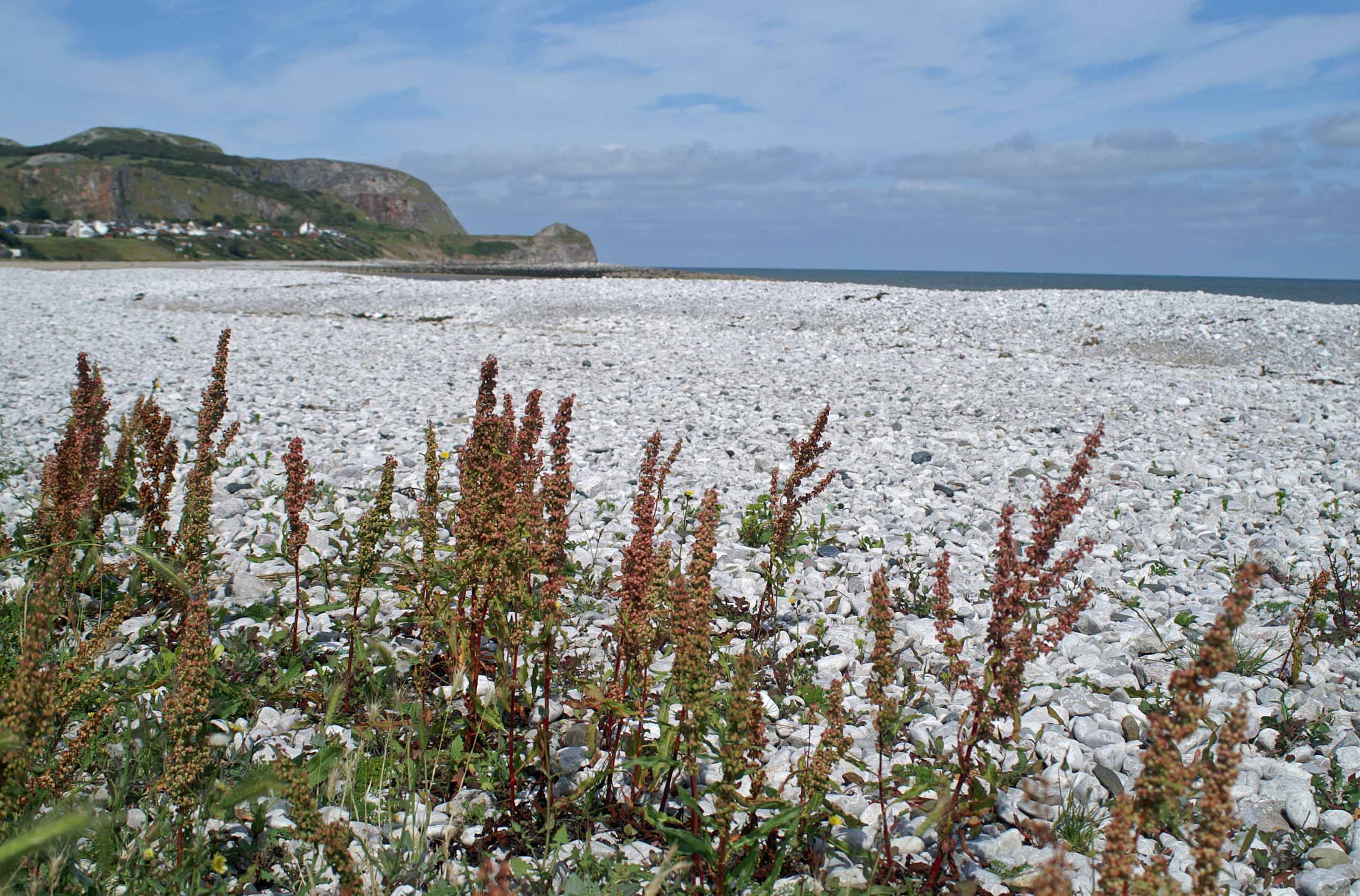
The beach of Penrhyn Bay is mostly made up of shingle, a hostile environment for plants, but some tough species have gained a hold there, spreading forward from the base of the sea wall.

24/7/11-Dock plants growing on the seashore with the Little Orme in the background

Shingle as a habitat

Shingle plants will begin to colonise above the high tide mark. Below this the moving pebbles will prevent any seedlings getting a stable hold. The plants that grow on the shingle usually have long and tough roots able to withstand the friction of the pebbles that will be disturbed by storms. Often referred to as a desert-like environment, plants like dock have water-retaining leaves that enable them to be one of the larger colonisers of this unique habitat, while smaller plants may be able to harness the water that collects on the surface of the pebbles.

24/7/11-Penrhyn Bay beach-Common Mallow growing on the shingle was attracting insects
24/7/11-Penrhyn Bay beach -a Migrant Hoverfly resting on a mallow leaf

I left the beach where the shingle  gives way to the rocky shore of Rhos-on-Sea, keeping an eye on the beach from the promenade. A Black-headed Gull caught my attention and I stopped to have a closer look. The gull was standing on a patch of muddy sand and I was intrigued to see the tops of car tyres protruding above the sand behind it. The way they were placed seemed to be deliberate, so I wondered if they are being used to reinforce the sea-break or stabilise the sand? They must have been there for a good while as some have seaweed growing over them.

24/7/11-Black-headed Gull with tyres bedded in the sand behind it

Focusing my attention on the gull and the tyres, I had half-noticed a brownish coloured bird against the rocks behind them that I thought was a young Herring Gull. When I gave it proper attention I had a pleasant surprise; it was actually a wader, either a Whimbrel or a Curlew, that was foraging around the rocks, probing its long curved beak into the the muddy sand.It was so well camouflaged against the rocks it was difficult to keep track of it, but I got a better view when it spent a couple of minutes in a more open pool of water.

24/7/11-Curlew on the sea shore
27/7/11-The Curlew blended perfectly into its surroundings

The wader disappeared from sight amongst the rocks and I carried on with my walk. I didn’t get far before I stopped again to watch a Crow that was acting strangely, flying up into the air then diving down again. It took a few minutes to realise that what it was doing: it was searching for a shellfish, picking it up in its beak, flying up then dropping it onto the rocks hoping to break it and diving down after it.

24/7/11-The shellfish does not drop straight down, so the crow has to follow it quickly or lose sight of it. 
24/7/11-The crow is surprisingly agile and turns quickly to make a steep dive
24/7/11-Diving Crow keeping its eyes on the landing position of its snack

There was quite a gap between each performance which I thought may have been either because the shellfish needed to be a particular size or species, or perhaps needed to be partially open, or  simply that each mouthful obtained this way required so much effort – it may well take more than one drop to smash a shell. I was fascinated by their behaviour and very impressed with their ingenuity; clever things.

There were quite a few gulls about; Lesser Black-backed gulls, Herring gull adults and juveniles and a few more Black-headed gulls. Herring gulls frequently chase other birds they see flying with food in their bills, hoping to steal it if possible. During an interlude in the Crow entertainment I spotted a mottled brown and white bird that I took to be a juvenile Herring gull being chased by an adult; as it broke away and flew towards me I was surprised again to see that it was another Curlew carrying something quite large in its bill; a crab I think.

24/7/11-Curlew flying with food

The Curlew flew back along the sea edge towards Penrhyn Bay, landing a short distance away from me amongst a cluster of rocks. Watching it closely I could see other Curlews gathered there, difficult to count as they are very hard to see, but at least another three.

It’s amazing what you see sometimes when you don’t set out to look! 

Share this:

  • Share on Facebook (Opens in new window) Facebook
  • Share on Pinterest (Opens in new window) Pinterest
  • Share on X (Opens in new window) X
Like Loading...

The Ragwort controversy rages

24 Wednesday Aug 2011

Posted by theresagreen in Nature, wildflowers

≈ Leave a comment

Tags

black & yellow striped caterpillars, cinnabar moth larvae, common ragwort, ragwort, ragwort and animals, senecio jacobaea, wildflower poetry

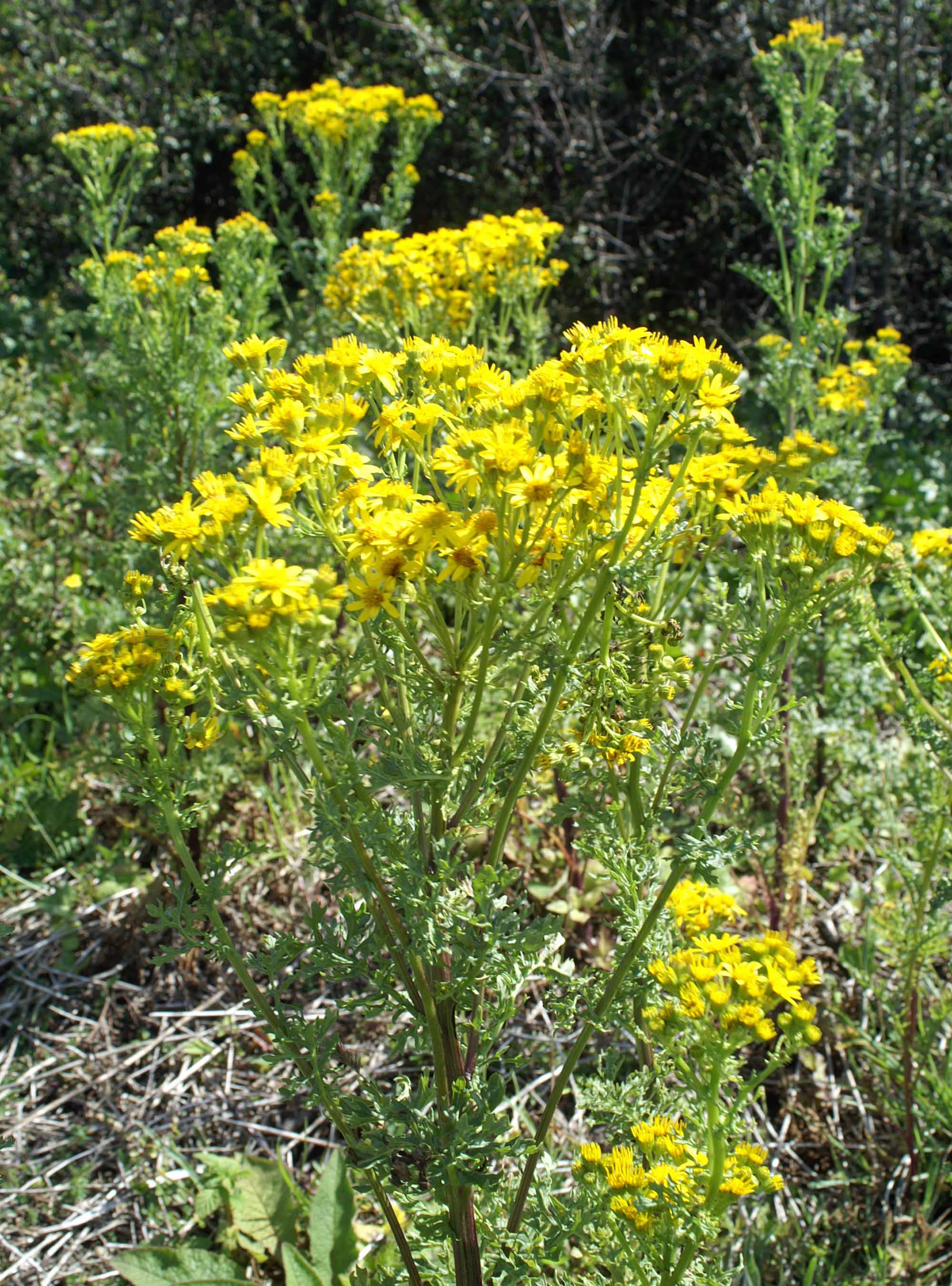
I thought I’d start the week’s posts with a look at the controversial Ragwort plant. It’s in full bloom now and its golden flowers are very noticeable in a wide variety of habitats, on roadsides and railway embankments, on waste ground and clifftops, but it also occurs in fields and pastures, which is where its troubles begin.

Botany

Common Ragwort – Senecio jacobaea;Family: Compositae

Other names: Ragweed, Tansy Ragwort, Staggerweed, Stinking Willie, Stinking Nanny, Dog Standard, Cankerwort, Stammerwort.

The New Atlas of the Flora of Britain and Ireland (2002) shows Ragwort as native and states that ‘the distribution of S. jacobaea is unchanged from the map in the 1962 Atlas’.

Common Ragwort is generally known as a biennial plant that overwinters as seeds or as leaf rosettes, but in certain conditions it may survive as a perennial.

Ragwort leaf with Red Soldier beetle

The leaves may be light-dark green and are attractively deeply cut and lobed. The plant grows from 30-100cm in height, with woody stems coloured red at their base. The upper part if the stem is branched, bearing golden yellow flower heads in large, dense terminal clusters that are almost always rayed and daisy-like.

Ragwort flowers and nectaring bumblebee

The issues with ragwort arise from the fact that the plant contains poisons that may be lethal to domesticated grazing animals if sufficient quantities are ingested over a period of time. For this reason ragwort is one of a very few plants listed in the Weeds Act (1959). Opinions concerning the dangers to livestock presented by the presence of the plant have long differed and continue to do so; there is sustained pressure from some quarters that wish to see the plant eradicated, but more recently there is also a strong counter-argument from conservationists for its retention, as its importance has been recognised as a food plant for a number of insect species.

There is a great deal of information and argument concerning the plant to be found on a variety of websites on the internet. The first of the following pieces was written 94 years ago, giving some indication of how long this controversy has raged. I found it interesting and it explains how the plant may be inadvertently fed to animals as a component of hay, and the very unpleasant effects that may have on them.

From the report of the Board of Agriculture’s Chief  Veterinary Officer (1917):

“It is not generally recognized that the common British Ragwort is poisonous to cattle. This probably arises from the fact that poisoning under natural conditions is a slow process, that is to say, an animal does not receive, and could not eat enough of the weed at one meal to cause acute poisoning. On the other hand, the poison is cumulative in its action; with continuous doses the amount of poison which becomes available is sufficient in time to cause very serious symptoms which often end in death….. The following represent broadly the circumstances of the cases which have recently come to the notice of the Board. Pastures containing a considerable proportion of the weed were cropped in the hope that the comparatively early cropping might help to get rid of it. The crop was made into hay, and owing to the prolonged spell of cold weather and the scarcity of other feeding stuffs, this was fed later and in considerable amount to animals at pasture.
…. Some of the animals fed on the Ragwort died in a few days after the first appearance of definite symptoms. In others the symptoms continued for a month or more and deaths occurred at later dates. It would appear also that although animals which had received a toxic amount of Ragwort over a certain period may seem healthy at the time when feeding on the material is discontinued, they nevertheless develop active symptoms of poisoning and die at a later period. Thus in the cases investigated some of the animals did not show definite symptoms until twelve days or more after the feeding with Ragwort had been discontinued. In the early stages the animals have the appearance of being hide-bound. Later, they walk with a staggering gait, some appearing to be partially blind or heedless of where they go. Later they may become very excitable, and will charge at anyone who approaches them.  … There is no cure, and prevention resolves itself into removing the Ragwort from the forage, or eradicating it from the pastures.”

Much more up to date, the following points are extracts from a very detailed and compelling report on the importance of the plant to conservation from Buglife – the Invertebrate Conservation Trust. 

1. At least 30 species of insects and other invertebrates are totally dependent on Ragwort as their food.

2. Many other species of insects which eat Ragwort, or require the nectar and pollen from the flowers, can also use alternative plants. However, Ragwort is often significant in supporting viable populations, especially in districts where such alternative plants may be absent or too scarce.

It must be emphasised that Ragwort is a major nectar source for many insects, especially:-

  • Solitary bees (at least 30 species: 38 cited in one list).*
  • Solitary wasps (at least 18 species; not the sort to harm people).
  • Hoverflies (many species).
  • Conopid flies (parasitic on solitary bees and bumblebees).
  • Butterflies (Small Copper, particularly where other flowers may be scarce)
  • Moths at night (including at least 40 noctuid moths).3. Ragwort is among the select few plants listed in the Weeds Act (1959). The listing was primarily concerned with control where agricultural production may be affected by its presence, especially its toxicity to grazing stock.
  • 4. Since 2003, the Ragwort Control Bill has been going through parliament. A Defra code of practice has been produced that will be backed by enforcement of Ragwort control where toxicity is perceived as sufficient risk. In particular, this covers land grazed by horses and hay fields supplying their fodder (these days largely a recreational rather than agricultural issue).
  • 5. Both insect faunas and horses (and other farm animals) can co-exist provided control measures are targeted where really needed. In many situations Ragwort is doing no harm.
  • 6. If the richness of the fauna is to have a future, the current over-reaction, indeed hysteria in some quarters, needs to be defused. Public and other bodies are seemingly being pressured beyond limits of tangible problems, and the horse fraternity and general public are encouraged to eliminate Ragwort, which in practice often means any plant that looks vaguely similar.It’s amazing:- The future of so many species is now dependent on an understanding of sustainability: how to make use of the countryside and town whilst maintaining biodiversity.Ragwort Control1. In some circumstances Ragwort does need control but more widely the issue can be hyped-up to result in over-reaction. The purpose here is to look at the facts, especially in relation to the high profile concern over toxicity to horses.2. The toxins (pyrrolizidine alkaloids) in Ragwort can cause liver poisoning. It is a cumulative poison, eventually leading to the rather rapid onset of symptoms which precede rapid death. The plant has the alternative name Stagger Weed, referring to one of the more obvious symptoms. The lethal volume of Ragwort is said to be 7% of body weight for horses. Cattle are prone, sheep apparently less so (although it is difficult to find solid evidence of any fatal effects on other livestock). Young plants are less toxic than well grown ones.Biocontrol
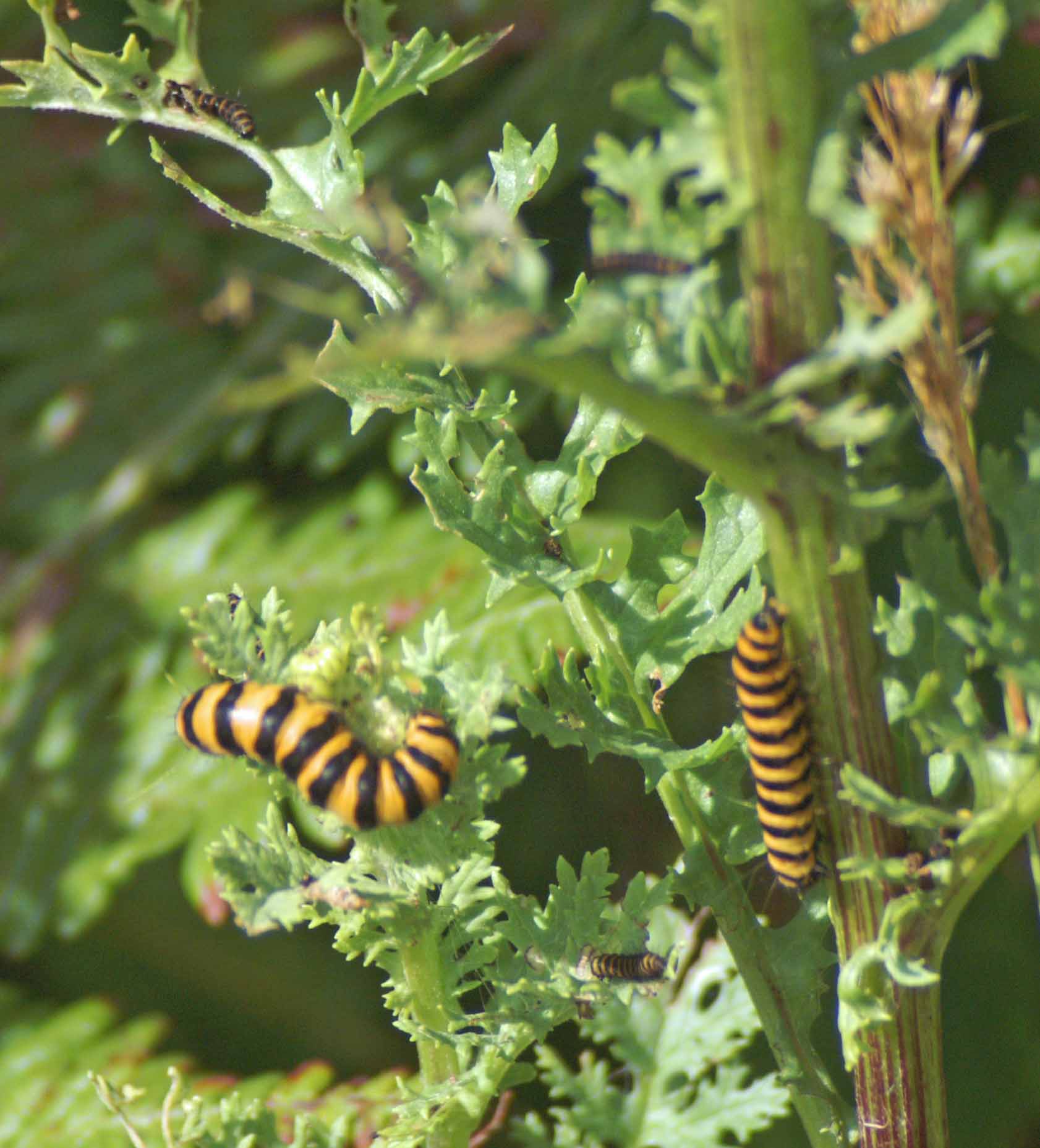
    The main insects that can devastate populations of Ragwort are the Cinnabar moth and the flea beetle Longitarsus jacobaeae. Some of the fly larvae and moth caterpillars have the capacity to cause loss in seed production. The remaining fauna collectively impact upon the health and vigor of Ragwort, though the significance will depend on local circumstances. On the whole, districts where Ragwort is always present should have the most complete insect faunas, thus best balanced to continuously effect control. It is usually where poor land management allows excessive colonisation by Ragwort seed that the man-made problems arise.
22/7/11-Cinnabar Moth larvae on ragwort leaves-Little Orme, Rhos-on-Sea

Traditional uses of Ragwort in herbal medicine

Ragwort was formerly much employed medicinally for various purposes. The leaves are used in the country for emollient poultices and yield a good green dye, not, however, permanent. The flowers boiled in water give a fair yellow dye to wool previously impregnated with alum. The whole plant is bitter and aromatic, of an acrid sharpness, but the juice is cooling and astringent, and of use as a wash in burns, inflammations of the eye, and also in sores and cancerous ulcers – hence one of its old names, Cankerwort. It is used with success in relieving rheumatism, sciatica and gout, a poultice of the green leaves being applied to painful joints and reducing the inflammation and swelling. It makes a good gargle for ulcerated throat and mouth, and is said to take away the pain caused by the sting of bees. A decoction of the root has been reputed good for inward bruises and wounds. In some parts of the country Ragwort is accredited with the power of preventing infection.

Culpepper says it is ‘under the command of Dame Venus, and cleanses, digests, and discusses. In Sussex we call it Ragweed.’

The poet John Clare also had a positive opinion of the plant, as revealed in this poem of 1831:

Ragwort thou humble flower with tattered leaves

I love to see thee come & litter gold…

Thy waste of shining blossoms richly shields

The sun tanned sward in splendid hues that burn

So bright & glaring that the very light

Of the rich sunshine doth to paleness turn

& seems but very shadows in thy sight.

Share this:

  • Share on Facebook (Opens in new window) Facebook
  • Share on Pinterest (Opens in new window) Pinterest
  • Share on X (Opens in new window) X
Like Loading...

Discoveries on the Little Orme’s snail trails

22 Monday Aug 2011

Posted by theresagreen in Little Orme, Nature, Nature of Wales

≈ Leave a comment

Tags

banded snail, black & yellow striped caterpillars, fuzzy growth on wild rose, garden snail, Gatekeeper, hummingbird hawkmoth, robin's pincushion

The Little Orme and Rhiwledyn Nature Reserve are a popular venue and much-frequented by local people and by visitors to the area, but despite that it remains a great haven for a wide variety of wildlife species.

I love wandering around here because as with the Bryn Euryn Reserve, there are a variety of habitats and many possibilities of sightings within a relatively small area. I do try to have a ‘target list’ when I set off to explore any area as I’m very prone to distraction by anything that looks interesting; today a Gatekeeper butterfly was at the top of the list. Missing from my recent Bryn Euryn list, which I was more than pleased with anyway, I felt sure there must be some of these very attractive little butterflies around close by. Lo and behold, almost as soon as I entered the site from the top of the steps, there were my Gatekeepers, several of them fluttering around a bramble. Then, as so often happens, something else caught my eye – a Hummingbird Hawkmoth was hovering around a patch of red valerian flowers. A common sight for me in southern Spain, I recognised it immediately although here it was above me at the top of a slope – too far away and too quick to photograph well, but I don’t want anyone to think I was imagining it!

22/7/11-A Hummingbird Hawkmoth taking nectar from valerian

The little Gatekeepers quickly regained my attention; all the individuals I saw, and there were plenty today, were pristine, so maybe all very recently newly emerged which could be why I hadn’t seen one before now.

22/7/11-A Gatekeeper- Pyronia tithonus resting on a nettle
22/7/11-Gatekeeper underside, on bramble leaf

Well, as they say, that was easy and I headed for the clifftop to sit and watch the seabirds for a while. Cormorants were dashing to and fro the rocky tip of the promontory, there were a few Fulmars tucked onto rocky ledges and a number of Herring Gulls flying around, making less noise here than they do in the town. Gazing down at the water I noticed a head pop up above the surface, which I though at first belonged to a diver, but through my binoculars it was clearly a Grey Seal.

22/7/11-Head of a Grey Seal-the choppy water indicates the strength of the wind that’s been cooling down our days lately

It was very pleasant sitting there, but I soon got restless and set off in search of the next specimen on my list.

22/7/11- View towards the cliff edge

Now I was looking for the distinctive black and yellow striped caterpillars of the Cinnabar Moth, that feed on Ragwort. I had inspected the ragwort plants growing on Bryn Euryn for them without success, but didn’t have to look far to find them here.

22/7/11-Cinnabar Moth caterpillars

I’ve always been fascinated by these fat creatures in their wasp-coloured skins and still wonder how on earth they transform into a delicate and smart scarlet- red and black moth. I only caught a brief sight of the back of one Cinnabar moth as it flew away from me from a ragwort plant –  I’ll have to come back for a picture another day.

22/7/11-A banded snail tucked up under a valerian leaf

Another striped creature was hiding from the sunshine beneath a leaf; a strikingly marked Banded Snail – Cepaea nemoralis.

I was aware that research has been carried out on this species of snail-something to do with the evolution of regional variations in colouration and the effects Song Thrush predation have on their populations,I think. During the course of looking for more information I learned that a big survey of the species population has been conducted and results are now available fromhttp://www.evolutionmegalab.org. I think the survey may be ongoing.

22/7/11-Another quite differently patterned Banded snail, although it bears similar shades of brown, there is also more pink in the shell

There is also a downloadable PDF available from the Open University’s called ‘How to hunt for snails’ for details. That might keep the kids amused for a while on a rainy afternoon.(If you’re interested, I’ve put the link in my blogroll). I might even do that myself on my next visit to the Little Orme.

While snails were on my mind I started to notice empty shells of the larger, darker Garden Snail-Helix aspersa. There were dozens of them, no two patterned alike and all quite beautiful. The thought crossed my mind that if they had been lying on a beach people would probably gather them up and keep them, but perhaps because most of us have been traumatised by the damage these voracious eaters can wreak on our gardens, we don’t give them a second glance. I made a collection of photographs for myself; I think they are well worth looking at.

22/7/11-A few specimens from my Garden Snail shell collection

Walking along the upper edge of the deep ‘valley’ created by the quarrying of limestone I happened to look down and spot two Grayling butterflies fluttering around the rocks below. I stopped  to have a closer look and peering over the ledge I discovered a very pretty fern growing from the rock just below me.

22/7/11-Maidenhair Spleenwort-Aplenium tichomanes

Shifting around to get a better look and a photograph, I then saw there was a clump of another species growing just a short way from it.This one is called Rusty-backed fern, although not rusty with spores at the moment. I didn’t spot the delicate Wall Rue   growing beneath it until I downloaded my photographs. What a treasure-trove that bit of rock turned out to be – there’s lichen growing on it too.

22/7/11-Rusty-backed fern -Ceterach officinarum with Wall Rue-Asplenium ruta-muralis tucked underneath 

I walked around and down into the quarry to see if I could find the Graylings, but by now the sun was lower and the rocky cliffs casting shadows, so they were either long gone or tucked up for the night. I was probably more pleased to find this Robin’s Pincushion anyway; I haven’t seen one of these fascinating fluffy-looking galls for ages: they are caused by the tiny black and red gall wasp,Diplolepis rosa, that is rarely seen.

22/7/11-Robin’s pincushion

Share this:

  • Share on Facebook (Opens in new window) Facebook
  • Share on Pinterest (Opens in new window) Pinterest
  • Share on X (Opens in new window) X
Like Loading...

North Wales to middle England via a few gardens

22 Monday Aug 2011

Posted by theresagreen in Nature, wasps

≈ Leave a comment

Tags

buff-tailed bumblebee, bumblebee, calystegia sepium, greater bindweed, grey heron in a tree, leicester botanical gardens, potter wasp, sculptures of flowers and leaves

When I was last in Rhos-on-Sea birds were just getting going with raising this year’s families; arriving back at the beginning of July, I was pleased to see that all seems to have gone well and the numbers of House Sparrows and Starlings in particular have swelled considerably. The House Sparrows were still sticking together in a large flock of adults and young and although I did see the Starling family together, the juveniles from around the whole area also gathered together into sizable flocks in the evenings.

An adult Starling with three young ones

As a very novice gardener, my daughter was thrilled at the appearance of the lovely white flowers of bindweed clambering through the hedge, blissfully unaware that most people spend hours trying to eradicate this invasive plant from their territory.( I always left a patch in the wilder part of my garden in South Wales too, as bumblebees love them, so she probably just assumed they were ‘proper’ flowers.) Happily, bumblebees find them very attractive here too, so I won’t be hacking the plants down till they’ve finished flowering either.

Garden Bumblebee- Bombus hortorum, heading into the depths of a beautiful bindweed flower. 

Calystegia sepium  (formerly Convolvulus sepium) –Larger Bindweed, Hedge Bindweed, or Rutland beauty  is a species of bindweed, with a subcosmopolitan distribution throughout the temperate Northern Hemisphere in Europe, Asia, northwestern Africa, and North America, and in the temperate Southern Hemisphere inAustralia, and Argentina in South America.

It is a herbaceous perennial that twines around other plants, in a counter-clockwise direction, to a height of up to 2-4 m, rarely 5 m. The leaves are arranged spirally, simple, pointed at the tip and arrowhead shaped, 5-10 cm long and 3-7 cm broad.

The showy flowers are produced from late spring to the end of summer. In the bud, they are covered by large bracts which remain and continue to cover sepals. The open flowers are trumpet-shaped, 3-7 cm diameter, white, or pale pink with white stripes. After flowering the fruit develops as an almost spherical capsule 1 cm diameter containing two to four large, black seeds that are shaped like quartered oranges. The seeds disperse and thrive in fields, borders, roadsides and open woods.

Despite the beauty of its flowers, the quick growth and clinging vines of the plant can overwhelm and pull down cultivated plants including shrubs and small trees. Its aggressive self-seeding (seeds can remain viable as long as 30 years) and the success of its creeping roots (they can be as long as 3-4 m) cause it to be a persistent weed and have led to its classification as a noxious weed. The suggested method of eradicating Calystegia sepiumis is by vigilant hand weeding.

___________________________________________________

Privet blossom is also out and providing nectar for bees and hoverflies. There are two or three species of bumblebee around, small red-tailed ones are the most numerous and larger white-tailed ones slightly less so. As I have said before, I am very fond of bumblebees and during this trip I will be working on my bumblebee identification skills, so there may be quite a few mentions of these lovely little insects in the weeks to come, and hopefully I will be adding to my id guide.

I’ve been using the Bumblebee Conservation Trust’s excellent website for information and  identification http://www.bumblebeeconservation.org.uk

Buff-tailed Bumblebee-Bombus terrestris on privet flower

There are a few different species of wasps  and hoverflies around too, including the one below, a Potter Wasp – Ancistrocerus parietum

A wasp hunting on bindweed leaves

There were no butterflies on the wing here – I didn’t see a single one.

Botanical Garden, Leicester

The University of Leicester Harold Martin Botanic Garden is a botanic garden close to the halls of residence for the University of Leicester in Oadby, Leicestershire, England. Founded in 1921, the garden was established on the present 16-acre (65,000 m2) site in 1947. The garden is used for research purposes by the university’s Biology Department and features events such as sculpture and art exhibitions, music performances and plant sales. It is open to the public.

My dad and one side of the glorious herbaceous border

The gardens have been a favourite place of mine since I was a teenager when a friend working there introduced me to them. My dad then moved to within walking distance of them and it has become one of his favourite places too, although he doesn’t get around as well as he used to and hadn’t been for a good while.

Garden Bumblebee- Bombus hortorum

A sunny Sunday afternoon presented a perfect opportunity to persuade him to take a leisurely stroll around the lovely landscaped grounds. Always immaculately kept, all parts of the garden are lovely, but presently the herb gardens and long herbaceous borders are glorious and buzzing with more bumblebees than I can ever remember seeing in one place. We were also fascinated to watch a little brown mouse climbing through plant stems to reach ripe seeds in the flower border.

There has been a sculpture exhibition in the gardens each summer for around a decade now, I believe this year’s may be the tenth, which added another dimension to the visit – here are a couple of appropriate ones that caught my eye:

A flower sculpted in oxidised metal
A beautifully shaped sculpture of a gingko leaf
Gingko leaf – I would love to have this in my garden

The mature gardens and large trees are a haven for all kinds of wildlife, but we were quite surprised to watch a Grey Heron fly in and land quite high up in a pine tree. It clearly had its sights set on the inhabitants of the large fishpond that we were also admiring at the time.

A Grey Heron surveying the carp in the large fishpond from a branch of a Monterey Pine tree

Share this:

  • Share on Facebook (Opens in new window) Facebook
  • Share on Pinterest (Opens in new window) Pinterest
  • Share on X (Opens in new window) X
Like Loading...

Rowan tree

21 Sunday Aug 2011

Posted by theresagreen in Nature

≈ Leave a comment

Tags

Bullfinch, bullfinch pair, bullfinches eating berries, red berries, rowan tree, rowan tree berries, rowan tree folklore & mythology, rowan tree poem, rowan tree traditional song

July

I’ve been in the UK since the beginning of the month and have quite a lot to add to the blog that I now have the time to begin. In the course of visiting some members of my scattered family so far, I have travelled from North Wales to Bristol via Leicester and back again and had a mix of weather – a typical British summer really and for me, much easier to cope with than the intense heat that Spain is experiencing now.

Since arriving, my first impressions have been of how beautiful and abundant the summer flowers are this year, both in gardens and in the wild and was surprised by how early some trees and plants are producing ripe fruit, particularly Rowan trees in both Leicester and Bristol that were laden with berries and, also in Bristol, lots of ripe blackberries. I’ve already got quite a lot to share, but I thought I’d get going with a bit about the Rowan Tree.

Rowan– Sorbus aucuparia L.edulis

Gaelic name: Caorthann

Family : Rosaceae

The Rowan tree has been one of my favourite trees since I was very young, having all the qualities I could wish for from a tree; in a garden it looks good all year round, it doesn’t get too big, keeps a good shape, has attractive green ash-type leaves that take on lovely autumn colours and creamy blossoms, but it comes into its own in the late summer -early autumn when it is laden with bright orange-red berries that birds love. It also has some fascinating mythology attached to it, and had at least one song written about it, what more could you possibly want?

10/6/10 -A wild Rowan tree photographed in the Gwaun Valley, Pembrokeshire last June, its flowers just beginning to go over

The name “rowan” is derived from the Old Norse name for the tree, raun. Today the Rowan may also commonly be known as Mountain Ash, although it is not related to the ash family, but through the ages it has been known by a myriad of other names. The following is a list fromwikipedia:  Delight of the eye (Luisliu), Mountain ash, Quickbane, Quickbeam, Quicken (tree), Quickenbeam, Ran tree, Roan tree, Roden-quicken, Roden-quicken-royan, Round wood, Round tree, Royne tree, Rune tree, Sorb apple, Thor’s helper, Whispering tree, Whitty, Wicken-tree, Wiggin, Wiggy, Wiky, Witch wood, Witchbane, Witchen, Witchen Wittern tree. Many of these can be easily linked to the mythology and folklore surrounding the tree. In Gaelic, it is caorann, or Rudha-an (red one, pronounced similarly to English “rowan”)

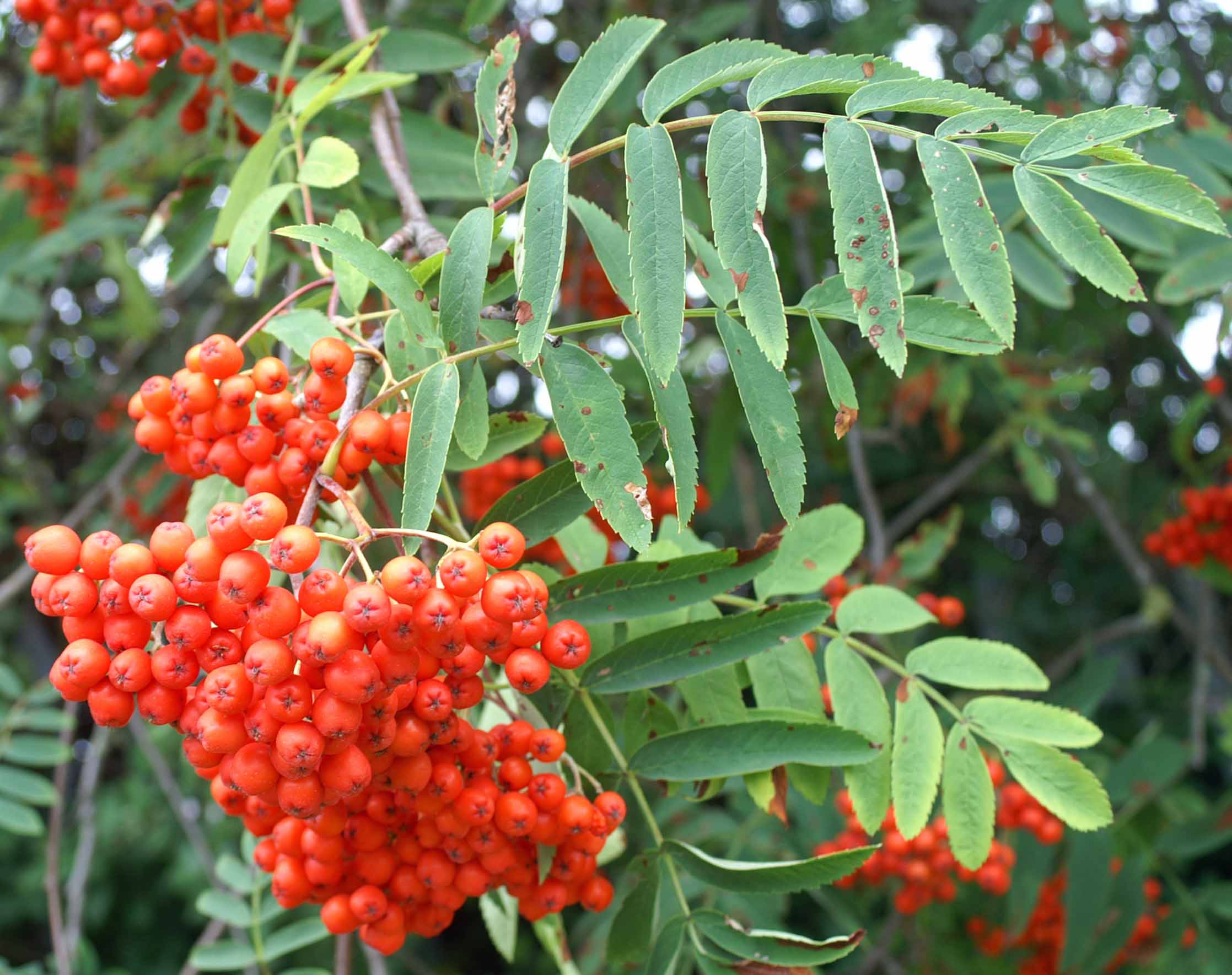
13/7/11-Bristol-Rowan tree laden with berries

Botany

Rowans are mostly small deciduous trees 10–20 m tall, though a few are shrubs. The leaves are arranged alternately, and are pinnate, with (7-)11-35 leaflets; a terminal leaflet is always present. The flowers are borne in dense corymbs; each flower is creamy white, and 5–10 mm across with five petals. The fruit is a small pome 4–8 mm diameter, bright orange or red in most species.(Due to their small size the fruits are often referred to as berries, but a berry is a simple fruit produced from a single ovary, whereas a pome is an accessory fruit.)

It seems to be an exceptional year for berries

Food for birds & insects

10/7/11-Leicester-Male Bullfinch feasting on rowan berries

The fruit are soft and juicy, which makes them a very good food for birds, particularly waxwings and thrushes, which then distribute the seeds in their droppings. Whilst in Leicester I was delighted to spot a pair of Bullfinch visit a neighbouring tree to enjoy the bountiful crop of fruits there, returning several times during each of the days I was there. (The quality of the photographs is not great, sorry, but I was taking them through a bedroom window!)

The female bullfinch with a berry in her beak

Blackbirds were also feeding avidly and very frequently, but the only other bird I saw taking an interest was a young Chaffinch.

Rowan is also used as a food plant by the larvae of  some Lepidoptera species.

Food & medicinal uses 

Traditionally the berries from the Rowan were processed for jams, pies, and bittersweet wines. It was also made into a tea to treat urinary tract problems, haemorhoids and diarrhea. The fresh juice of the berries is a mild laxative, and helps to soothe inflammed mucous membranes as a gargle. Containing high concentrations of Vitamin C, the berries were also ingested to cure scurvy – a Vitamin C deficiency disease. Even today, one of the sugars in the fruit is sometimes given intravenously to reduce pressure in an eyeball with glaucoma.

Caution : Do not eat raw berries!

Caution, however, must be taken when using the berries. They are reported to contain a cancer-causing compound, parasorbic acid. The poisonous elements are neutralized by cooking the berries though.

Mythology, magic & folklore

The European rowan (S. aucuparia) has a long tradition in European mythology and folklore. It was thought to be a magical tree and protection against malevolent beings. In Celtic mythology the rowan is called the Traveller’s Tree because it prevents those on a journey from getting lost.

Rowan was used in all protection spells particularly from fire, or lightning. In Ireland it was hung in the house to prevent fire charming, hung around the necks of hounds to increase their speed, and used to keep the dead from rising. It also had the power to protect people and animals from evil spirits.  The IrishDruids held it in particular esteem, for its physical healing as well as its magical properties.

The density of the rowan wood made it very usable for walking sticks and magician’s staves. Druid staffs have traditionally been made out of rowan wood, and its branches were often used in dowsing rods and magic wands. Rowan was carried on sea-going vessels to avoid storms, kept in houses to guard against lightning, and even planted on graves to keep the deceased from haunting. It was also used to protect one from witches.

A Poem about the Rowan Tree:

Beneath the green and berry red
They flutter about
Making a melody with each wing strum
Magical lil’ creatures

Beauties of the forest
Fairies they are called by some
Protecting and guarding against the darkness
Bringing well being to babe’s milk

Sweet Rowan tree
Grace my land and grow
Ward off evil spirits
And remind me of my heritage of long ago

Dance with me in moonlight May
And I shall honor you
With my nurturing hands
And the remembrance of the one who holds my smile

Patricia Gale

And here’s the song, with music so you can sing along…..

Scottish Folk Song: Rowan Tree

Rowan Tree Song

Oh rowan tree, oh rowan tree, thoul’t aye be dear to me,
Entwin’d thou art wi’ mony ties, o’ hame and infancy.
Thy leaves were aye the first o’ spring, thy flowr’s the simmer’s pride
There was nae sic a bonnie tree, in all the country side.
Oh rowan tree.

How fair wert thou in simmer time, wi’ all thy clusters white.
Now rich and gay thy autumn dress, wi’ berries red and bright
On thy fair stem were mony names which now nae mair I see.
But there engraven on my heart, forgot they ne’er can be.
Oh rowan tree.

We sat aneath thy spreading shade, the bairnies round thee ran
They pu’d thy bonnie berries red and necklaces they strang.
My mither, oh, I see her still, she smil’d our sports to see,
Wi’ little Jeannie on her lap, wi’ Jamie at her knee.
Oh rowan tree.

Oh, there arose my father’s pray’r in holy evening’s calm,
How sweet was then my mither’s voice in the martyr’s psalm
Now a’ are gane! we met nae mair aneathe the rowan tree,
But hallowed thoughts around thee twine o’ hame and infancy,
Oh rowan tree.
Share this:

  • Share on Facebook (Opens in new window) Facebook
  • Share on Pinterest (Opens in new window) Pinterest
  • Share on X (Opens in new window) X
Like Loading...

Oystercatchers, and more on the seashore

21 Sunday Aug 2011

Posted by theresagreen in Nature, Nature of Wales

≈ Leave a comment

Tags

3-pronged Bristletail, birds of North Wales, birds on the seashore, large jellyfish, motacilla yarellii, Oystercatcher, oystercatchers flying, petrobius maritimus, Pied Wagtail, rhos-on-sea

28 April

I was leaving sunny Rhos-on-Sea to start heading back to rainy Spain this evening (with a few days in London first), so a last walk along the promenade and seashore was a must this morning. It was a good day to leave on, the morning was bright sunny and warmish, cooled by a bit of a breeze that made for a pleasant temperature for walking.

My first stop was at the rocky breakwater, where I was hoping there may be some birds foraging, but there were only Herring Gulls. As I was about to move on though I heard the familiar ‘tschissick’ call of a Pied Wagtail and one duly arrived, landing just a couple of metres away from me. I’d had a couple of previous sightings of the birds, around the golf course area and a male ‘singing’ from a rooftop, but this was a perfect view of a female. The male bird is all black above and has sooty-grey flanks; female is dark grey on mantle/back but has black crown, rump and uppertail-coverts. Slightly different in appearance to the race of Motacilla alba we see in Spain and the rest of Europe, this is Motacilla alba yarrellii that occurs in Britain and Ireland and locally on adjacent Continental coasts.

Pied Wagtail – Motacilla alba yarrellii (female)
A Carrion Crow flew down to forage on the newly exposed seashore

The tide was on its way out exposing a narrow strip of pebble beach, so I walked down to it via a concrete ramp to see if anything interesting may have been left by the receding sea. On the walls of the ramp, nicely warmed by the sun I noticed several little insect-things scuttling about, which on closer inspection turned out to be Bristletails – of the 3-Pronged variety.

3-pronged Bristletail – Petrobius maritimus

The insects belong to a primitive group of wingless insects (Apterygota) that are dependent on humid conditions. The 3-Pronged Bristletails belong to a small order ( Thysanura), all the members of which have 3 ‘tails’, comprising 2 cerci and a central projection known as the epiproct. The most familiar member of the group is the Silverfish. I am open to correction on this, but from my research and based on their location I am assuming the ones I saw to bePetrobius maritimus:

Description: A slender brown insect, up to 15mm long, with antennae that are almost as long as the body. Central ‘tail’ distinctly longer than the 2 side tails. Habitat: Close to high watermark on rocky coasts and short distance inland in crevices. Status and distribution: Common and locally common throughout in suitable habitats.

I’ve seen very similar-looking  insects to this on our covered terrace walls in Spain, but we are a  kilometre or so  inland from the sea, so perhaps we were closer once upon a time and they got marooned and have adapted. I must try to find one and compare them.

Reaching the beach I disturbed a group of Herring Gulls that had been foraging on the sea edge. They flew up and began circling around, voicing their objection loudly and their proximity gave me a moment of anxiety as I visualised a scene from Alfred Hitchcock’s ‘The Birds’. Then it occurred to me that they may have been alarmed by my long camera lens, so if they thought it may be a gun I was quite safe from attack. Phew.

I was soon distracted by birds I had been hoping to see, a number of Oystercatchers, very handsome in their immaculate black and white plumage, were standing on rocks at the sea edge looking down at the receding water and anything edible it may be leaving behind.

Oystercatcher – Haematopus ostralegus

Oystercatchers waiting for the tide to go out
The birds’ comings and goings gave the opportunity to see their outstretched wings
The birds grouped together to await a feeding opportunity
A few minutes later the birds began to venture into the shallow receding water
A bird probing the sea bed
The back of an Oystercatcher flying away, showing white rump and black tail-band

I became absorbed by the sight and was enjoying my close-up views of the birds, so the arrival of  a man with his dog startled me. He  stopped to chat to me and I told him I was watching the Oystercatchers – the camera with a big lens may have given him a clue I was taking photographs too, but he carried on walking straight towards them anyway. Needless to say they all took off to look for somewhere more peaceful.

Oystercatchers flying away

The expansive mussel beds located here attract large numbers of Oystercatchers, although they also feed on cockles, limpets, small crabs, shrimps and worms. Breeding takes place after the wintering flocks have broken up, in mid-April in the south and May or June further north.

I turned to retrace my steps up to the promenade, almost stepping on this huge stranded lump of a jellyfish.

A stranded jellyfish – the only big one I know is a Portugese Man o’ War, but I’m not sure what this is . I don’t imagine the hot sun would do it much good.
Common limpets- Patella vulgata and an edible periwinkle- Littorina littorea
Pebble beach

Share this:

  • Share on Facebook (Opens in new window) Facebook
  • Share on Pinterest (Opens in new window) Pinterest
  • Share on X (Opens in new window) X
Like Loading...

Bryn Euryn Nature Reserve

19 Friday Aug 2011

Posted by theresagreen in Bryn Euryn Nature Reserve, Butterflies of Wales, Nature, Nature of Wales, nature photography, Wildflowers of Wales

≈ Leave a comment

Tags

ash tree, Bryn Euryn Nature Reserve, common rockrose, early purple orchid, hoary rockrose, wildflowers of Bryn Euryn

27th April

I haven’t seen much of the countryside since I’ve  been here in North Wales, other than through a car window, and I was very keen to see some spring flowers and fresh greenery. I know the wildflowers in Spain will be amazing when I get back there next week, but the native British wildflowers have an altogether gentler and more subtle beauty that I love. I have been planning to make a trip to the local nature reserve on Bryn Euryn, and as I will only be in the locality for a couple more days I decided to head there this morning.

Bryn Euryn is a limestone hill rising to 131metres (365 ft) above sea level and a well-loved local landmark of Rhos-on-Sea that is now a Local Nature Reserve. Its slopes are clothed with a mixture of woodland and grassland, part of which has been declared a Site of Special Scientific Interest. From its summit their are extensive panoramic views over Rhos-on-Sea and Colwyn Bay and across to the mountains of Snowdonia in the west. 

I parked in the small car park that is surrounded by trees, and as soon as I got out of the car I heard a Chiffchaff ‘singing’. I couldn’t see him,but as I tried to locate his whereabouts a Robin flew into a nearby tree and also began to sing. Moving off towards the beginning of the track that leads up to the summit of the hill I stopped to watch a Song Thrush hunting on the woodland edge where it borders a grassed area.

I soon came upon a patch of bluebells growing alongside some wild garlic whose flowers are almost finished. There were a few wood anemones still flowering, but they too are all but over; wild strawberry plants were flowering along a length of the path edge in dry shade, they have a long flowering period beginning in April and continuing until October, with fruits appearing throughout the summer. It was lovely walking in the dappled shade of the woodland, listening to the birds singing and coming across flowers that gave me the opportunity to make a stop on the fairly steep upward climb. A special find was a sunlit Early Spotted Orchid growing beneath the trees. The presence of this delightful bloom, together with that of bluebells and wood anemones is a sign of an ‘old wood’,  indicating that this area has never been anything other than woodland.

Purple Spotted Orchid

Dog Violet

There was a pretty patch of little blue/purple dog violets and the surprise of a Cowslip plant on a steep bank; this one must have strayed from the grassy downland on the other side of the hill; the more usual habitat of Cowslips.

Cowslip

Rock Rose

At the top of the hill you emerge from the woodland onto a surprisingly large expanse of open grassy heathland. There were large patches of yellow flowers growing here, taking a closer look I saw there were of two separate species; I recognised rock rose, but was unfamiliar with the other. Looking it up when I got home I realised it was Hoary Rockrose, one of the plants named on the information board in the car park that is apparently very scarce in the British Isles.

Hoary Rockrose – Helianthemum canum

The views from the top here are truly spectacular, extending from the Little Orme around and across Rhos-on-Sea and Colwyn Bay with the mountains of Snowdonia to the west. The only downside, at least from this side of the hilltop, was the traffic noise arising from the busy A55.

A panoramic view of Rhos-on-Sea and Colwyn Bay

View from Bryn Euryn summit – mountains of Snowdonia on far horizon

View across summit of Bryn Euryn to Conwy Estuary and beyond to Snowdonia

Germander Speedwell

Buff-tailed Bumblebee

Turning around I walked across to the other side of the summit, passing through a shrubby area, the woodland edge, where there are shrubs and small trees growing. Here, Hawthorn is in full bloom and I stopped to watch a furry bumblebee as she burrowed into the leafy debris on the ground beneath.

Hawthorn, or May blossom

I discovered another early purple orchid plant here, this one had an earlier, or perhaps even last year’s, dried flower spike attached.

I reached the true summit of the hill, which has a concrete trig point on it that is part of the nationwide network built by the Ordnance survey to create their maps of the UK in the old days before computers.There is also a board depicting how the ancient hill fort may have looked. I was very surprised to come across an extensive patch of orchids here, I roughly counted them and estimated at least 100 flowers.

Summit of Bryn Euryn with Trig point & mass of purple spotted orchids in the foreground

The Fort

The summit of Bryn Euryn was once occupied by a small but strong fortification. This may have been the ‘Bear’s Den’ mentioned by Gidas the Wise and thought to have been a stronghold of Cynlas the ‘Red Butcher’, king in Rhos around the middle of the sixth century. Only the faint traces of the limestone rampart’s foundations are  visible today, protruding through the turf and ringing the summit of the hill, to remind us of its former importance.

It was much quieter and more peaceful on this side of the hill and I sat for a while enjoying the sunshine and the view out to sea and across to the Little Orme.  Two Red Admiral butterflies were flying around the nearby shrubbery, one kept attempting to sun itself on a bramble leaf, the other kept disturbing it, the basking one chased after its disturber then returned to the same spot etc. etc. It took a lot of patience to get the photograph.

Red Admiral basking on new bramble leaf

Speckled Wood on a leaf on the ground

Even trickier to photograph was this Speckled Wood. Once again there were two of the insects chasing one another – these little butterflies are especially territorial, but I wanted to get a photograph as they were much paler in colour than the ones I had been seeing in the garden. That made getting the photograph even harder, as when they did land it was on dried leaves and they were so well camouflaged I couldn’t find them through the lens.

There are some beautiful trees growing here, including Ash, whose leaves are quite well grown now.

new ash leaves

They brought to mind the old country rhyme about their predicting the forthcoming summer weather:-

“Ash before oak, look for a soak, oak before ash, look for a splash”

I had a quick look at a neighbouring oak and would say they were pretty much on a level, so hopefully that means some rain, but not too much.

Share this:

  • Share on Facebook (Opens in new window) Facebook
  • Share on Pinterest (Opens in new window) Pinterest
  • Share on X (Opens in new window) X
Like Loading...
← Older posts
Newer posts →
Follow everyday nature trails on WordPress.com

Enter your email address to follow this blog and receive notifications of new posts by email.

‘But it is the common species that keep the living world ticking over and provide most of our experiences of wildlife, and I would argue that maintaining the abundance of these is as important a conservation priority as maintaining the existence of rarities’. Richard Mabey

MOST RECENT POSTS

  • A Glimpse of Spring to Come January 22, 2025
  • Hunting the Wren December 28, 2024
  • Oh, Christmas Tree December 18, 2024
  • In and Out of the Ivy February 15, 2024
  • Nature’s Fireworks November 30, 2023
  • Wild Autumn along the Coast Path November 3, 2023

OLDER POSTS

LOOKING FOR SOMETHING IN PARTICULAR?

  • Sights and Sounds from the Little Orme 1
    Sights and Sounds from the Little Orme 1
  • Things Bright and Beautiful
    Things Bright and Beautiful
  • Catchers, a Duck and Divers
    Catchers, a Duck and Divers
  • Fine Dining for Crows
    Fine Dining for Crows
  • Shades, Sounds and Scents of the Woods
    Shades, Sounds and Scents of the Woods
  • Following a river to a Fairy Glen
    Following a river to a Fairy Glen
  • May Bee Appearing on Ivy near You
    May Bee Appearing on Ivy near You
  • Beautiful blooms and some rare treats (1)
    Beautiful blooms and some rare treats (1)
  • Keeping up with the Herring Gulls
    Keeping up with the Herring Gulls
  • The Windhover
    The Windhover

nightingale trails

The Walk of the Monarch Butterfly-Sendero de la Mariposa Monarca

The Walk of the Monarch Butterfly-Sendero de la Mariposa Monarca

MY WILDFLOWER BLOG: where the wildflowers are

Snowdrop

Snowdrop

most recent posts

Follow everyday nature trails on WordPress.com

Social

  • View teresamaygreen’s profile on Twitter

Enter your email address to follow this blog and receive notifications of new posts by email.

Website Built with WordPress.com.

  • Subscribe Subscribed
    • everyday nature trails
    • Join 358 other subscribers
    • Already have a WordPress.com account? Log in now.
    • everyday nature trails
    • Subscribe Subscribed
    • Sign up
    • Log in
    • Report this content
    • View site in Reader
    • Manage subscriptions
    • Collapse this bar

Loading Comments...

    %d