• Home
  • about
  • about the photographs
  • Local Nature Reserves
    • Bryn Euryn Local Nature Reserve
    • Mynydd Marian
  • Wales Coast Path
    • Grey Seals in North Wales
    • St.Trillo’s Chapel
    • Wildflowers of North Wales Coastal Paths, Cliffs and Dunes

everyday nature trails

everyday nature trails

Category Archives: Nature of Wales

A Windy Wildflower Walk II

27 Sunday Aug 2017

Posted by theresagreen in Butterflies of Wales, calcareous grassland, coastal walks, Nature of Wales, North Wales Wildlife Trust, Rhiwledyn Nature Reserve, Wales Coast Path, Wildflowers of Wales, wildflowers on limestone, Wildlife of the Wales Coast Path

≈ 3 Comments

Tags

black horehound, common rockrose, harebell, hedge woundwort, Lady's bedstraw, Nature in August, Perforate St John's Wort, speckled wood, water mint, yellow dung fly

August 3rd

Part 2 – Rhiwledyn Nature Reserve -The main track

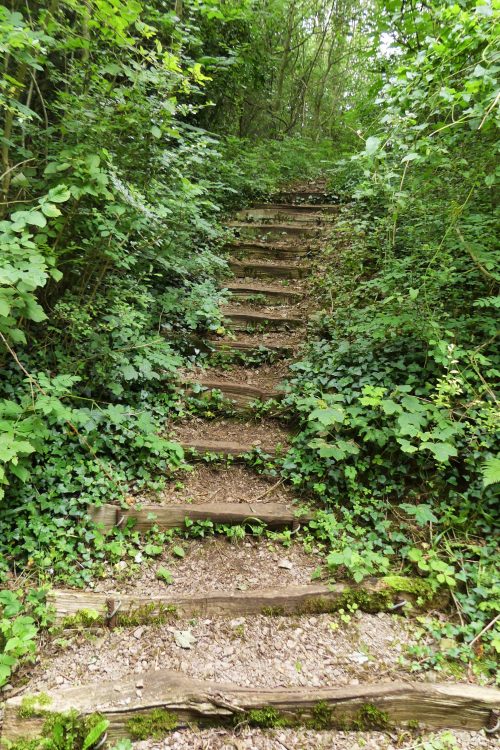
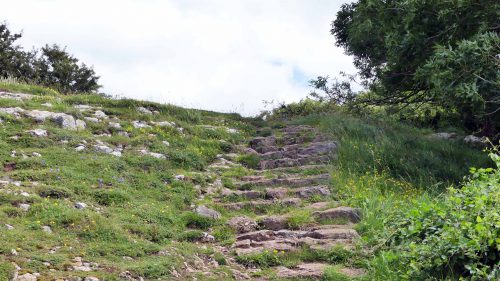
Onwards and upwards; a flight of shallow stone steps make a steep rocky section of the path a little easier to climb (except when it’s wet & they get a bit slippery).
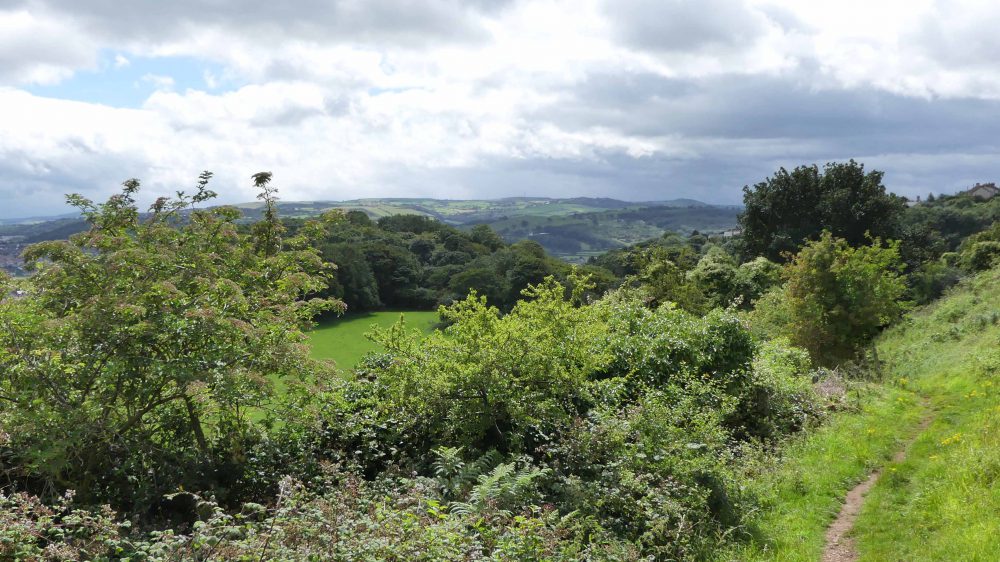
Pause here to admire the views back down onto the road and the many shades of green of the fields and woodland on its opposite side.
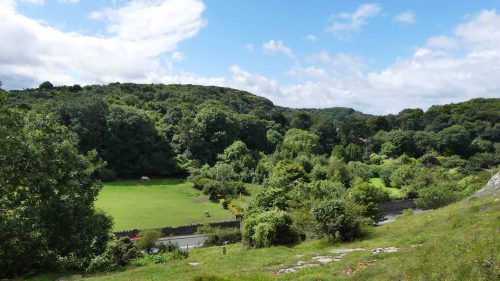
Looking down onto the road into Llandudno

Facing around to the way I’m going, the views to the right of me, seen over a rampant tangle of brambles and wild clematis on the reserve boundary, are extensive and stunning. At once pastoral and contained and wild and open to the elements.

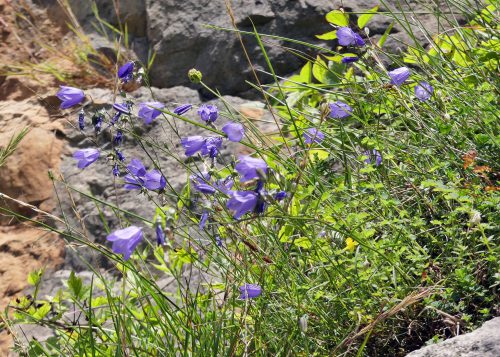
On the other side of the track is the biggest and best patch of harebells that I have seen for years, a truly beautiful sight.

Harebell- Campanula rotundifolia

I can’t resist sitting to watch them being blown and rippled by the wind and am captivated by their charm. For me this little flower has it all. Beautiful in colour and form, they have delicacy and fragility but also great adaptability and resilience to an often hostile environment. Each flower had turned its bell back to the wind to reduce its impact; their slender but tough and wiry stems having the flexibility to bend to the wind, not break. A life lesson in a wildflower!

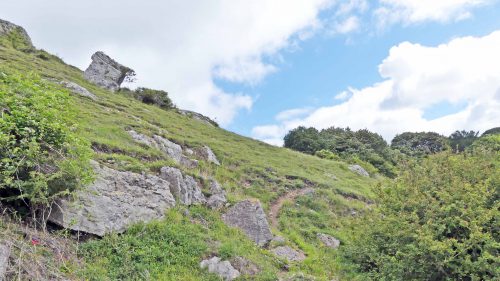
There were yet more of the little beauties a little higher up on the slope contrasting delightfully in colour and form with frothy lemon-yellow Lady’s bedstraw. I clambered up rather inelegantly to take a closer look. Amongst other plants, these had grown taller and in a more sheltered spot, their bells were turned to the light rather than away from the wind.

Before going back down to the track, I take another look at the glorious view across the bays to the Clwydian Hills and with sheep where they are supposed be.

click to enlarge

Back on track there is a change in ambience and habitat. There are small trees and shrubs on the boundary with the farmland sufficient to cast shade, and the sloping ground on the other side provides a windbreak. The trees are mostly hawthorn, prevalent throughout the headland as its one of the few plants not grazed by sheep or rabbits and again, tough enough to withstand exposure to fierce salty winds.

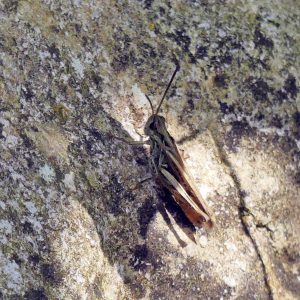
I spot a movement and see a small Grasshopper jump onto a lichen speckled rock catching dappled sunlight; the perfect place to soak up a little warmth whilst staying camouflaged.

I round a bend in the track and see – sheep! Five naughty trespassing sheep! They are strictly banned from the reserve unless invited in as their indiscriminate grazing may damage or even destroy the rarer wildflowers that grow here. Fencing prevents them wandering into the higher part of the reserve from the rest of the Little Orme where they are not restricted, so I think they got in at this field level, no doubt irresistibly tempted by the sight of the lush long grass over here. I tell them they should return to their field, but can’t see where they may have got through and they pay me no heed anyway, just amble away showing me their bottoms.

I let them get ahead, the last thing I want to do is frighten them and send them scattering and concentrate on the patch of golden flowers I see amongst the long grass on the slope. I thought at first it may be Goldenrod as I’d seen some on the roadside earlier, but soon realised it was a Hypericum – St.John’s Wort.
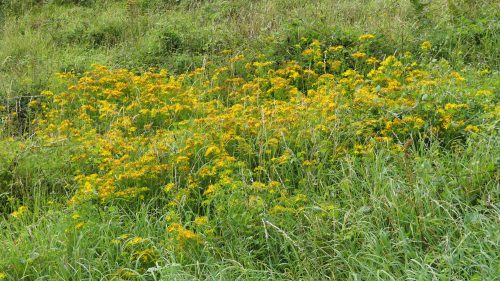
Another plant with several species that share the same common name, but this is the one I am most familiar with and has all the right features to be Perforate St John’s Wort – Hypericum perforatum.

St John’s Wort-Hypericum perforatum
click to enlarge

Black horehound – Ballota nigra

I apologise, but need to digress a little here to explain the significance of my next plant. Earlier on in the summer a group of NWWT members were treated to a walk around this reserve guided by its manager, Rob and a guest expert botanist, Nigel. It was a brilliant walk on many levels and we learnt a lot about our special flora and its history, about its fauna and the trials and tribulations of modern Reserve management. Typically as on any walk, even guided group ones, I lagged behind snapping interesting stuff and in a rough bramble-and- nettle patch (in the pic above), spotted the plant to the right, which is still going strong. Yet another minty-looking one I didn’t recognise. I took hasty photographs and hurried after the rest of the group. No-one else immediately recognised it either, so Nigel suggested I email the pics to him later on so he could have a better look. From them his best guess was that it was Black Horehound, reservations having been that this was a vigorous, tall specimen of a plant that usually is, in his words, ‘much scruffier-looking’ He also mentioned it smells unpleasant, so this time I had a closer look and bruised and smelt a leaf. It definitely did not smell pleasant and as all its other important bits match the botanical specs, I’m taking that as another one to add to my list of wildflowers-I-will-know-how-to-identify in the future. (Unless anyone has a different idea……?)
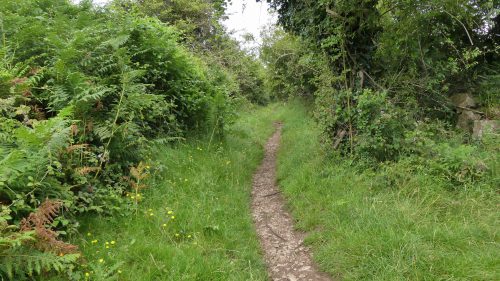
It’s amazing what you can see in five minutes along a short shady stretch of track. I watched a dragonfly patrol up and down at speed, pausing only in his labour several times to ‘buzz’ me and let me know I was in his space. I was hoping he’d stop so I could at least see what he was, but no, much too busy. There was yet more mint here, and one I recognised from the distinctive scent of a crushed leaf – this is Water Mint-Mentha aquatic. A similar-looking plant is Corn Mint, but it grows shorter than this and doesn’t have a ‘terminal’ flowerhead (one that crowns the top of the stalk).
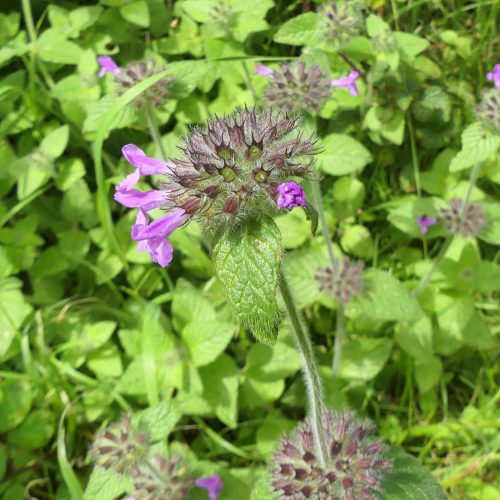
Water mint-Mentha aquatica

A fresh-looking Speckled Wood rested on a sun-warmed stone on the path

Speckled Wood

and a Red Admiral flew across to seek out the nectar of bramble flowers
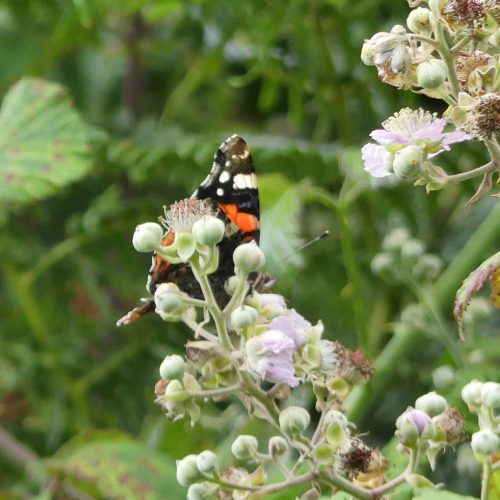
Red Admiral – Vanessa atalanta

There is a farm gate here which I checked for security, but tightly closed there would have been no exit for sheep. Another great Clematis-framed view from here, considerably enhanced by the clouds I think, although they were blocking out the sun at this point.

click to enlarge

At the side of the gate another member of the Lamiceae (mints & dead-nettles) family, this one I know well, the Hedge Woundwort Stachys arvensis.

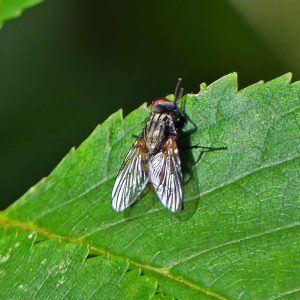
Yellow Dung Fly – Scathophaga stercoraria

I moved on and round the next bend found evidence I was still on the trail of the errant sheep; a smallish neat and fairly recent deposit of fresh dung. And where there is dung there may be Dung-flies, one of my favourite insects, although I’m not exactly sure why. Perhaps because I’m keen on recycling? As I hoped, a single male Yellow Dung Fly had laid claim to the heap of treasure and was intent on guarding it. A bit of a drama then ensued, but I’m saving that for later.

To the top

I had reached the Reserve boundary, marked by a gate through which the two marked ‘Trails’ continue on to cross the rest of the Little Orme headland. There is no marked official track up to the top reaches of the reserve from here though, so getting up there is a matter of a)wanting to; b) paying attention to where you are putting your feet; c)taking care not to slip on damp grass and d) watching out for rabbit holes.

Rock-roses are still fresh and lovely up here, as is the fragrant Lady’s Bedstraw.

I followed the path chosen by the sheep; they almost always know how to find the best way upwards. They were up there now, all standing facing the view. I may have thought they were admiring it, but one of them who seemed to be in charge, maybe the mother of some of them, was bleating loudly, eliciting a response from the field below. Was she calling to her friends telling them about the feast to be had on this side and inviting them over?
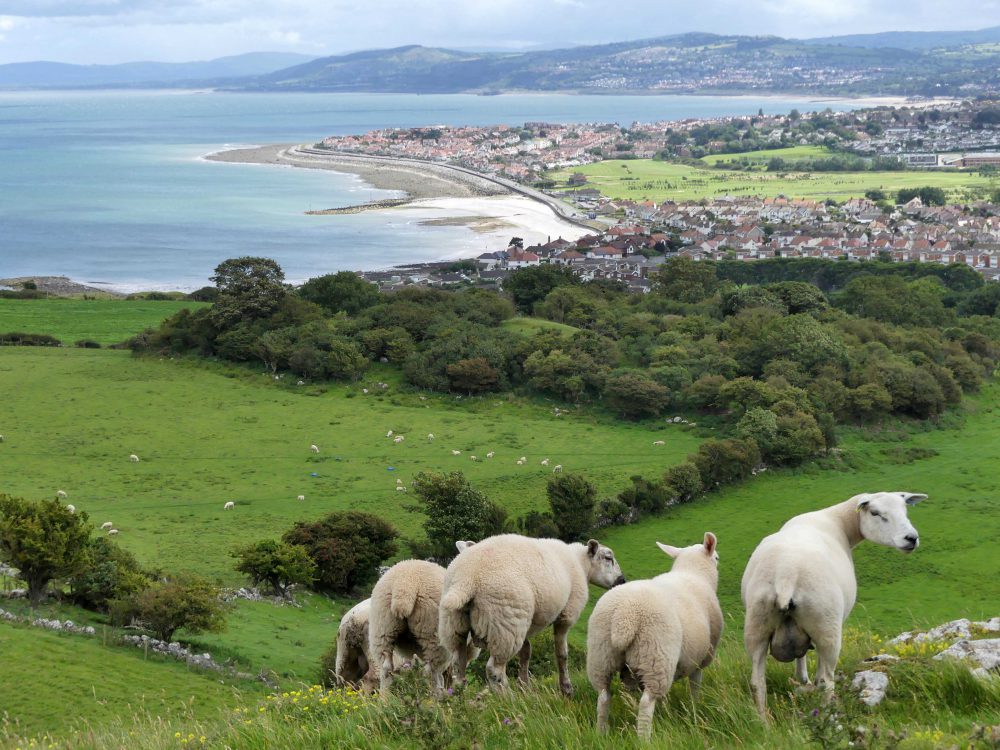
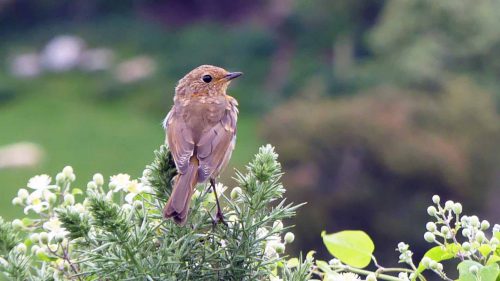
Once more I reminded them they were not welcome here, but Mrs Boss Sheep just gave me ‘the look’ that clearly said “mind your own business and what are you doing up here yourself?” Once past them it became more overgrown and not as clear where to head, but I kept going in the general direction of where I wanted to be and hoped for the best. I heard a bird making some squeaky sounds and spotted him as he perched atop a gorse bush, a speckly young Robin beginning to get his adult feathers. I realised this was the first bird I’d seen and heard so far on this walk apart from gulls and the occasional cormorant flying overhead.
I also realised it was lunchtime, so time to find a sheltered spot, take a break and sit and admire the sheep’s-eye view.


Share this:

  • Share on Facebook (Opens in new window) Facebook
  • Share on Pinterest (Opens in new window) Pinterest
  • Share on X (Opens in new window) X
Like Loading...

A Windy Wildflower Trail

25 Friday Aug 2017

Posted by theresagreen in Butterflies of Wales, calcareous grassland, Nature of Wales, North Wales, North Wales Wildlife Trust, Rhiwledyn Nature Reserve, Wildflowers of Wales, Wildlife of the Wales Coast Path

≈ 15 Comments

Tags

carline thistle, centaury, common blue, common calamint, Gatekeeper, goldenrod, harebell, montbretia, Nature in August, ploughman's spikenard, wild carrot, wild fennel, yellow-wort

August 3rd – Weather – intermittently sunny, warm but with a very strong cooling wind. 

As August began I wanted to get out to see wildflowers. This is one of my favourite times of year for that, when there is every chance that there may be earlier flowering plants still around and the late-summer bloomers should be at or reaching their best. Most of the sites I visit regularly are good for wildflowers, but as they are mostly located on hills or headlands and exposed to the elements, they would not be particularly enjoyable on a strongly windy day like today and taking photographs would be difficult. I decided on Rhiwledyn Nature Reserve, one of my favourites as it covers a range of interesting habitats within its 12 acre site and as it is located on the eastern side of the Little Orme there was a chance that much of it would be sheltered from the worst of the wind.

There are three ways to access the reserve, all of which require a bit of an uphill hike. One route is from Llandudno, another from the other side of the Little Orme, but for me the most interesting route to its main entrance is along the path at the base of a section of the Orme that runs up Penrhyn Hill. Marked as a 10% gradient, this is a steepish stretch to walk, but worth the effort as the rock supports an array of plants, both wildflowers and some garden escapees, and is a nature trail in itself. This provides me with the perfect excuse to amble up the hill and take frequent excusable pauses for breath rather than stride purposefully along.

Looking back along Penrhyn Hill towards Penrhyn Bay. The hill in the centre background is Bryn Euryn

Part 1 – Penrhyn Hill roadside to the reserve

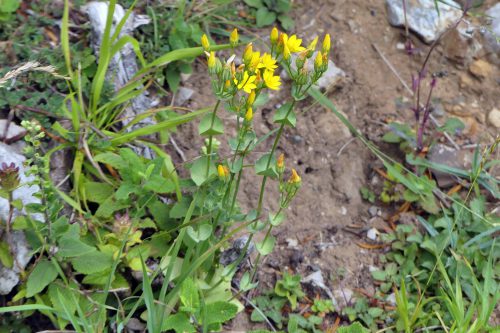
My first sighting was of a male Common blue butterfly taking a break from his battle with the wind on the flower of a hop trefoil, low down in the vegetation. Amongst long grass and ivy, a grey leaved Yellow-wort; this is an annual favouring short calcareous grassland but is found in a variety of spots throughout the headland.

Common blue
Common blue
Yellow wort-Blackstonia perfoliata

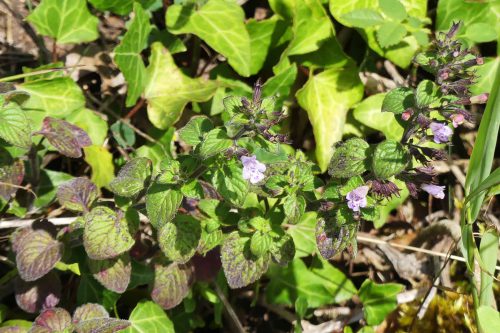
There were several clumps of a plant that was definitely a member of the mint family with strongly aromatic leaves. I don’t know what it is yet.

  • since publishing this Suzanne has kindly suggested in a comment that it is Common calamint Clinopodium ascendens. This is a mint that grows in dry grassland, hedgerows and verges, often on chalk or limestone soils, so habitat fits perfectly.

Common calamint – Clinopodium ascendens

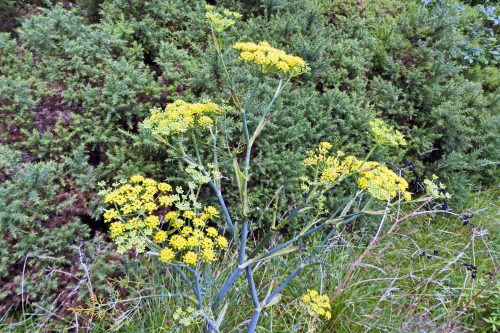
And another aromatic plant – Wild Fennel, growing as tall as me, in front of gorse.

A pretty snail clung to the leaf of a Valerian plant; I lifted it gently to check the colour of its underside lip – brown – then replaced it. A few bees were braving the breeze, mostly Buff-tailed bumblebees. I photographed one on marjoram, which may or may not be a wild plant.

Brown-lipped snail
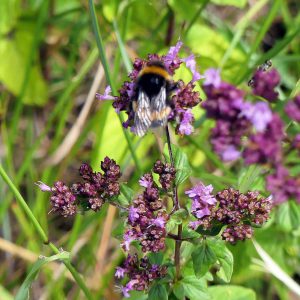
Buff-tailed bumblebee on marjoram

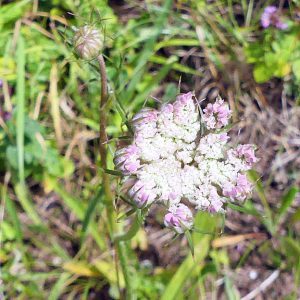
There is Wild Carrot in various stages of flowering from tight buds to maturing seedheads. Most often found in rough grassland, near the sea and again mostly on chalky soil. This is one of the easier of the white umbellifers to identify, with feathery leaves and bracts beneath the flowerheads and always a red flower in its centre.

Wild Carrot-Daucus carota

Windy days are not good for butterflies, but I did see a couple of Gatekeepers. Both sticking close within the vegetation, one found Marjoram to nectar on, the other attempted to bask on a Wild Clematis leaf. Both were faded and looking a little the worse for wear.

Gatekeeper on Marjoram- fruits of Herb Robert behind
Gatekeeper
Gatekeeper

A flowering Goldenrod plant sprawled out across the edge of the path.

Goldenrod – Solidago virgaurea

So too a sprawling patch of Montbretia

Montbretia

and this one with its flowers like small dandelions, which I think may be one of the Hawkweeds. Another one to work on.

A stone wall marking the boundary of the farm’s land breaks the vegetated path edge, but behind it the small field is golden with Ragwort and long seeding grass. There were butterflies in there, mostly Whites, but it’s off-limits so couldn’t get a closer look.

Trees on the edge of the small wood in the background of the photograph now cast shade over the path and its edge and there are less flowering plants. There is plenty of ivy, Wild Clematis a flourishing Wild Cabbage, more of the not yet id’d mint and a clump of the usually sun-seeking Rockrose.

Rhiwledyn Nature Reserve

Half an hour after parking my car I finally reach the entrance to the reserve. The sun is shining and a fly basks in the warmth reflected by the glass of the narrative board.

A pretty clump of Marjoram flowers at its base.

I turned left to first walk the short length of the path at the base of the headland where it meets Llandudno Bay. The strength of the wind here took my breath away and walking into it head on was a challenge, but now I’d got this far I wanted to carry on to the far end of this eastern side of the headland as far as I could. 

Up on the cliff a patch of harebells gave a rare opportunity to get close to these lovely little flowers without having to lie on the ground. They look delicate and their thin stems seem fragile, but they are tougher than they look and were holding their own in today’s wind.

Spiky starry Carline thistles caught my eye. Kneeling to photograph them I see they are growing amongst bird’s-foot trefoil and that there is another little star there too – a tiny white flower of Pearlwort.

There is Yellow-wort flowering next to Wood sage which is setting seed.

Another Carline thistle, this time with Eyebright and an unwelcome invader, cotoneaster, one of the banes of the lives of hard-pressed reserve managers.

Nearby, more Harebells with a little pink Centaury and the grey felty leaves of Mouse-eared Hawkweed.

I was almost relieved to reach the end of the track and be blown back to retrace my steps to the beginning of the upward track.

First I went ‘off piste’ a little to reach a stand of golden yellow Ploughman’s Spikenard.

Ploughman’s Spikenard – Inula conyzae

Then a scramble back down to the start of the track proper. A badged wooden post here reassures you that you are officially following both the Wales Coast Path and the North Wales Path.


Share this:

  • Share on Facebook (Opens in new window) Facebook
  • Share on Pinterest (Opens in new window) Pinterest
  • Share on X (Opens in new window) X
Like Loading...

Little Beings of Summer Woods

08 Tuesday Aug 2017

Posted by theresagreen in Bryn Euryn Nature Reserve, Nature of Wales, nature of woodlands, Wildflowers of Wales, woodland walks in Wales

≈ 7 Comments

Tags

black spleenwort, dwarf cream wave, late summer wildflowers, Nature in August, polypody fern, scorpion fly, speckled wood, wild clematis

Sunday July 30th-Bryn Euryn

The Woodland Path

11:00am  It was cooler than I’d anticipated in the woods this morning. The sky was cloudy and gusts of a chilly breeze blustered between the trees of this usually sheltered mid-slope of the Bryn; less than ideal conditions for the insects I was hoping to see. And I wished I’d worn a thicker fleece. But the sun was intermittently winning through the clouds and ever the optimist I assured myself it would get warmer for me and the little creatures. 

There are a few places on my usual trail that I think of as ‘hotspots’ for insects, even on cool days such as this. The first one is an untidy, brambly-nettley spot, where opportunistic plants have filled a gap in the tree line and spread across to the other side of the path too. Dappled sunlight reaches and warms the spot, aphids thrive here, there’s nectar and pollen to be had while the bramble is in flower, followed by its fruits; the perfect ingredients for a hoverfly hangout. If I’m patient and hang around for a few minutes I’m often rewarded with sightings of a few hovering customers and sometimes less expected visitors too.

Hoverfly (syrphus sp) basking on a sunlit hazel leaf

Insects need sunshine to warm up their flight muscles to get them going, so cooler, cloudy days can be surprisingly rewarding for sightings of basking individuals slowed down by the lack of warmth. There were a few hoverflies here today, also other common flies which I’m trying to take notice of and appreciate more; well, at least I’m aiming to put names to some of them. Most of those I saw were common ‘houseflies’, a generic name that covers quite a few different species. I think it’s their habits that most of us dislike; some of them look quite pretty.

House fly
Bluebottle

A long-bodied black insect with pretty iridescent wings scurried erratically over the surfaces of leaves, a wasp I think, definitely a hunting predator, maybe a Digger wasp.

About to move on I spotted a dot of colour in the shade of some leaves. Sitting motionless was another more recognisable predator, a male Scorpion Fly.

Scorpion Fly-There are 3 species of Scorpion Fly in Britain, apparently difficult to separate other by examining genitalia; the most common being Panorpa germanica. They frequent shady places almost everywhere. All are scavenging insects and completely harmless despite the males’s scorpion-like tail. The female’s body lacks the tail, simply tapers to a point. 

Male Scorpion Fly
Male Scorpion Fly

The closed tree canopy excludes most flowers now. An exception is the woodland grass, False Brome, which grows prolifically here and is flowering now.
False Brome-

A splash of colour took me by surprise – a holly tree with red berries!

*************

Perhaps relics of the days when this path was part of the grounds of a Victorian manor house, are large clumps of two attractive ferns. Both species are evergreen, maintaining their green fronds throughout the seasons, but both look particularly fresh and verdant now and the Polypody has new fronds unfurling.

Polypody fern

Black spleenwort


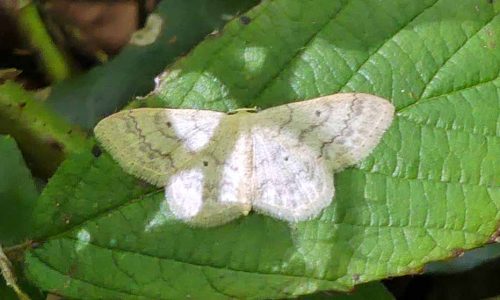
Dwarf Cream Wave-Idaea fuscovenosa

A tiny pale-coloured moth swirled by the breeze spiralled down to land on a bramble leaf low to the ground, settling with wings spread butterfly-like under the shelter of other leaves. It is a Dwarf Cream Wave (photograph probably not far off its actual size)- the lines that show grey-mauve are where its original pale brown scales have been worn, or washed (!) away.


A home in a leaf ….

The pale patch on this holly leaf is probably the result of the work of an insect, the Holly leaf miner Phytomyza ilicis. This is a fly whose larvae burrow into leaves of this specific species of tree and leave characteristic pale trails or mines.

Interestingly, I learnt (from Wikipaedia) that “the holly leaf miner has frequently been used in ecological studies as a system to study food webs. Examination of the leaves can show whether the leaf miner has successfully emerged, been killed by a parasitic wasp, or been predated by blue tits.”

I’m not sure what the perfectly round hole in this one indicates. It could just be the original entry point of the egg-laying adult female’s ovipositor, but maybe too big? It looks too small and neat to be an exit hole and blue tits leave a triangular tear when seizing a miner as prey. Maybe it is the mark of the work of a predatory wasp? 

Speaking of wasps, I spotted another on an ivy leaf – a bit more distinctive than the black one I saw earlier due to its long antennae, so I asked the experts at BWARS and they say it’s a member of the Ichneumonidae family. The whole of this family are parasitoides and most species attack the caterpillars of butterflies and moths. It’s a dangerous life being an insect.

The Woodland Trail, Bryn Euryn Nature Reserve 

A big old oak tree marks the junction of my ‘Woodland Path’ and the Woodland Trail that circuits the Nature Reserve. It’s lost a few of its branches and the big lower branch has a split right through it that provided a safe home to nesting Great tits earlier on in the year.


Happily, the tree seems to be going strong and is currently nurturing some baby acorns. They have stalks, which indicate this is an English, or Pedunculate Oak.


Stepping out from the cover of the trees I realised how windy it had become; windy enough for birds to be able to just hang in the air and ride the air currents with minimum effort. Two buzzards were overhead, mewling and swooping around in the air currents, one being harassed by gulls, poor thing.

The unmistakable bulk of a Buzzard

My second ‘hot-spot’ is almost at the junction of the two tracks. It’s a huge bramble entwined with gorse and over which wild clematis scrambles. That blackberry & wild clematis combination is one of my favourites, even if it is another of the sights that I associate with summer’s approaching end. The clematis is just coming into flower and, the bramble already has ripening fruit, so not much for insects here today.

A lovely Speckled Wood butterfly sat on a smaller bramble nearby which still has flowers. The butterfly let me get very close, hardly moving in the coolness of the day.

There are few flowers along the sides of the Woodland Trail now, due in part I’m sure to their having been strimmed back in June – this part of the path is maintained by the local council who are wont to get these ‘jobs’ done before people complain about paths being overgrown. All kinds of good stuff was cut back, including orchids, and much of the hogweed that would now be giving nectar and pollen to hoverflies et al. I hoped they were finding sustenance nearby.

A few odd plants have survived, or revived, to flower here and others are fruiting. There are a very few hazelnuts that have thus far escaped the jaws of voracious grey squirrels, who usually eat them while they’re still soft and green.

Ragwort
Hemp Agrimony
Honeysuckle

Wild Strawberry flower
Wild strawberry fruit
Seedpods of Stinking Iris

Tutsan berries are darkening
Hazel nuts forming
Blackberries are ripening

Cool windy days may seem unpromising if you’ve set off hoping to see insects, but if you keep paying attention there is never ‘nothing to see’ (pardon my grammar). I spotted a tiny movement on the surface of a leaf and caught sight of an even tinier leaf hopper. As I got closer with the camera lens I noticed another movement under the leaf; a tiny spider had spotted the leaf hopper and was vibrating her web to try to get its attention. The leaf hopper disappeared under the leaf….. I wonder if the spider got her lunch? Apologies for the less-than-good photo, but I’m sure you get the drift!

So, I’ve reached the steps leading up to the field now and looking forward to what it has in store….


Share this:

  • Share on Facebook (Opens in new window) Facebook
  • Share on Pinterest (Opens in new window) Pinterest
  • Share on X (Opens in new window) X
Like Loading...

Curlews are Back in the Field

05 Saturday Aug 2017

Posted by theresagreen in bird behaviour, Birdwatching on North Wales coast, Nature of Wales, North Wales, Rhos-on-Sea, Rivers of Wales, wading birds

≈ 10 Comments

Tags

Afon Ganol, Curlew, curlew flock

July 17th 

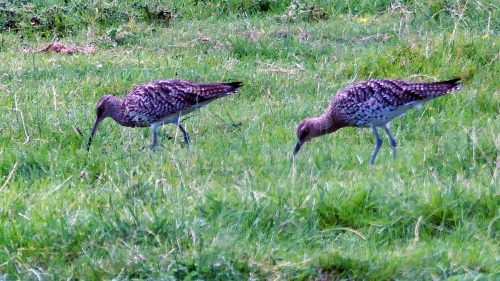
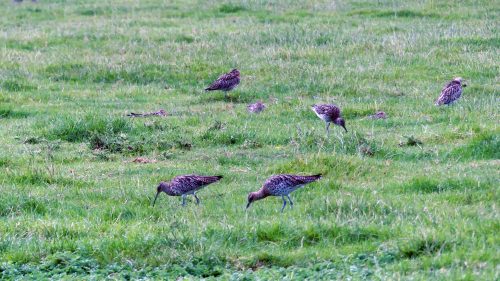
Curlews are back. That is to say I’ve just noticed some in the field as I drove past, I don’t know when they got there exactly. There were just a few for now, a lot of Curlew that return here will have been breeding, or bred in Iceland, but their return here following a few months away each year is one of the signs that summer is rapidly coming to an end.

More used to seeing these wading birds solitarily stalking amongst the rocks of Rhos Point, I was amazed the first time I saw them gathered together in a significant number in this field, although it did go some way to enlighten me as to where birds go when the tide’s in. That initial sighting was was back in 2011 when I came here to live and each year since I’ve looked out for them, hoping they’ve had a successful breeding season and that their numbers will be good. (Not that I know what would be classed as a good number; nowadays the curlew is a threatened species, and I have no idea how present day numbers compare with historical ones for this site.) I’m not confident counting birds, but last year by my reckoning there were somewhere around 80-100 of them here at any one time.

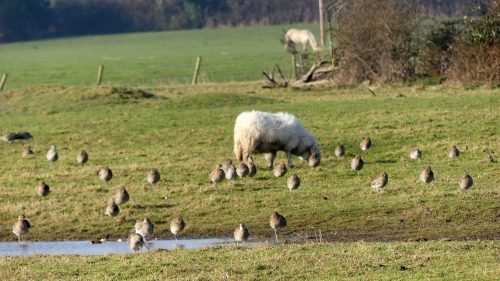
17th July 2017-Curlews and cows

I’ve wondered about the attraction of this particular site as a gathering place. In the present day, as fields go this is not a particularly large one and it probably qualifies as ‘rough pastureland’ having coarse grass, a generous sprinkling of thistles and not too much else. It is farmland, so the birds often have to share the space with large grazing animals; presently it’s cows, earlier in the year it was sheep. It is bounded on one side by the Llandudno Road, by houses on another two with another field fenced off behind it.

February 2017-Sharing with sheep

On the plus side, it’s conveniently close to the shore & a short flight gets them them there in minutes.The ground here is probably rich in invertebrates as the animals keep the ground well manured, and much of it it floods easily and holds the moisture, keeping it soft for probing with their long bills. 

The birds must feel safe here too, when not foraging the flock takes time out  to rest and preen their feathers.

Curlew resting, preening & bathing

They seem to be here during times of high tide when there is no accessible shoreline for foraging. They seem to instinctively know the exact moment the tide is optimally in or out and some trigger suddenly alerts them to take off as one and head back there.

Heading back to the shore

Maybe that’s all there is to their choosing this spot, but it could also be connected to the past history of the land within which the field is located. Going back to the beginning, a clue lies in the meaning of the name of the village, Rhos-on-Sea, or more properly Llandrillo-yn-Rhos: the Welsh word rhos, translating as ‘marsh’. In the distant past, before the construction of sturdy sea defences, high tides would have reached further inland than now and flooded much of the low-lying ground here between it and the hills, forming an extensive salt marsh. The flat area between the Little Orme and Bryn Euryn, from where I took the photograph below is the northern end of the valley of the Afon (river) Ganol, once a significant river which flowed into Penrhyn Bay and also into the tidal river Conwy at its southern end. Along its length several small streams also fed into the river. 

July 2017-Looking down onto the ‘curlew field’ from Bryn Euryn

Looking down onto the well-ordered village of Penrhyn Bay with its network of roads and the modern-day golf course, it’s hard to visualise the wild place this once was, although following sustained heavy rainfall it is easier to see how wet it must have been.

January 2014 -Looking down on the flooded field where curlew, oystercatchers, redshank may be seen feeding amongst sheep

The Afon Ganol was by all accounts a dangerous tidal strait, and it formed a natural barrier rendering the land beyond the valley, then known at the Creuddyn Peninsular far more more isolated. Crossings were difficult; the river could be forded here, although the area was extremely marshy. Then in the 1800s, embankments were built at either end of the valley to allow land reclamation.

The effort and work undertaken to drain the marsh must have been massive, and hugely expensive, but by 1912 the OS map shows the Afon Ganol as being culverted under the Llandudno Road to the golf links, with a culvert going out to sea, but with still a large marshy area remaining. The establishment of the golf links then required further improvements to drainage and a new outlet for the diverted river was constructed. Dug 2′ below the bed of the river and the link’s ornamental lakes, this outlet then enabled the river and the lakes to be emptied during intervals between tides, keeping the golf course dry.

Today the Afon Ganol remains as a culvert with tidal outfall structure, which was updated in 2011 to decrease the risk of flooding.

A section of a remaining water course bends around the back of the rugby field

Interestingly, although the original river is now just a meandering waterway and ditch, in part diverted and culverted, it remains still the county boundary between Conwy and Denbigh.

Welcome back Curlews, the place is not the same without you.


Share this:

  • Share on Facebook (Opens in new window) Facebook
  • Share on Pinterest (Opens in new window) Pinterest
  • Share on X (Opens in new window) X
Like Loading...

Parakeets in the Ash Tree

25 Tuesday Jul 2017

Posted by theresagreen in bird behaviour, Birds, Nature, Nature of Wales, nature photography

≈ 9 Comments

Tags

green parakeets in London area, Psittacula krameri, ring-necked parakeet, rosy-ringed parakeet

July 4th – Long Ditton, Surrey

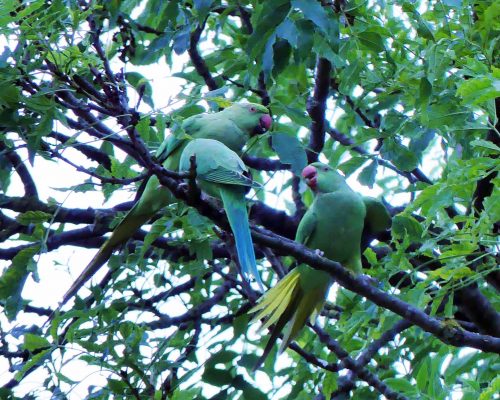
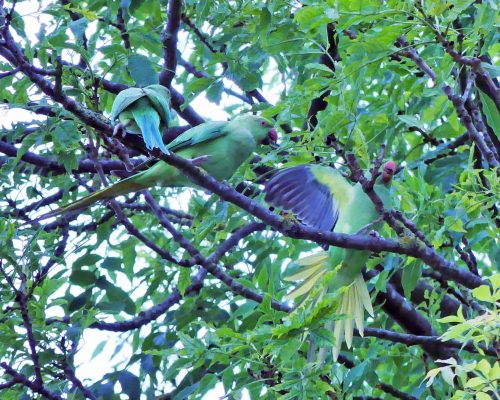
My granddaughter and I were in the garden playing in her new sandpit when we heard raucous calls and squawks coming from somewhere up high in a neighbouring ash tree. Despite the racket they were making it took a minute to visually locate the perfectly camouflaged trio of bright green parakeets that had landed there. I’m not sure what the commotion was about, but they seemed to be a family, I think an adult female with two young ones demanding food.

Nowadays, sightings of these ring-necked, or more prettily named rosy-ringed parakeets, are commonplace throughout the county of Surrey, particularly in those leafy suburbs of Greater London lying closest to the river Thames.

Tales of how they first arrived and set about colonising the area are as colourful and as exotic as the birds themselves. One tells of a small number of the birds escaping from a film set at Shepperton Studios in 1951, during the making of ‘The African Queen.’ (which starred Humphrey Bogart and Katharine Hepburn, in case you’re way too young to remember that one!).

Another, less likely perhaps, but more appealing to me, is that they were released back in the 60’s by the legendary rock guitarist Jimi Hendrix, who allegedly brought them to Britain and released them, ‘ to bring some psychedelic colour to London’s skyline’, (perhaps whilst playing ‘Little Wing’?).

Then for our younger viewers, it is rumoured that a pair were released by the Blue Peter cast into the Blue Peter garden as recently as the 1990’s.

The truth of their introduction to British wildlife is likely to be far more prosaic and plausible. Parakeets have been popular pets since Victorian times and inevitably many birds will have escaped or even been deliberately released over the years, although the latter is technically illegal. A number of them are known to have escaped from aviaries across the south of England. During the Great Storm of 1987, some made their getaway from Northdown Park, in Kent, and it is rumoured that a piece of a plane’s fuselage dropped onto an aviary near Gatwick, giving more the chance to fly the coop.

Ring-necked Parakeet or Rosy-ringed Parakeet Psittacula krameri : Welsh: Paracit torchog

There is no doubt the parakeets are now well established in Britain and are recorded as our only naturalised parrot. In January 2017 the BTO estimate was of 8,600 breeding pairs and their status given as ‘introduced breeder’. The greatest concentration of numbers are in Greater London and Kent, with smaller numbers in Birmingham and Oxford and further north in Manchester. They are especially common in suburban parks, large gardens and orchards, where food supply is more reliable. The birds feed on a wide variety of fruit, berries, nuts, seeds and grain, have discovered bird feeders in gardens and have few natural predators here.

Until recently, the parakeets were generally considered a welcome addition to the county’s wildlife, and though their squawking and squabbling may have caused consternation to some, most people have enjoyed the sight of the colourful birds flying around. However, concerns have arisen about their population explosion and its potentially damaging effects on the country’s indigenous bird species, which has led to calls for stricter control over the colourful newcomers. In 2009, Natural England added the species, the UK’s only naturalised parrot – to its “general license”, meaning it can be culled, in certain circumstances – such as if they are causing damage to crops. The change gives them the same legal status as pigeons, crows and magpies.

As an occasional visitor to London, I love to see and hear them and they’re big, noisy, colourful and pretty to look at – a great way to get my two year old granddaughter to start noticing the local wildlife!

Parakeet spotting: Most likely places

Bushy Park, Richmond; Hampton Court, East Molesey; Kew Gardens, Kew; Nonsuch Park, Ewell; Richmond Park, Richmond; River Thames at Chertsey; River Thames at Staines; River Thames at Walton on Thames; Selsdon Park, Sanderstead 


Share this:

  • Share on Facebook (Opens in new window) Facebook
  • Share on Pinterest (Opens in new window) Pinterest
  • Share on X (Opens in new window) X
Like Loading...

A Warbling Whitethroat

23 Friday Jun 2017

Posted by theresagreen in birds singing, Birdwatching on North Wales coast, Little Orme, Nature of Wales, Wildlife of the Wales Coast Path

≈ 10 Comments

Tags

birds singing, Llwydfron, sylvia communis, whitethroat

I saved this treat from the end of my walk on the Little Orme as I thought it would be better enjoyed on its own.

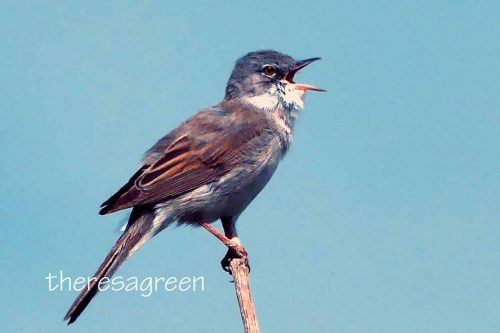
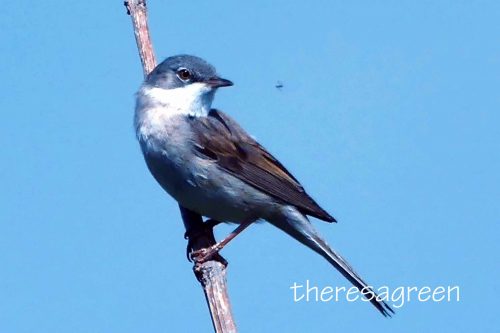
I heard the Whitethroat singing from somewhere in front of me, obscured from immediate view by gorse bushes and a bend in the track. I walked forward slowly and there he was, at the top of another bare stem, this time of Elder. A perfect, close, unrestricted view of him warbling away, declaring himself king of all he could survey, which is a great deal from where he was perched, to whom-so-ever it may concern.

The Whitethroat is a summer visitor and passage migrant to Britain that may be seen in all parts of the country and most frequently choose arable land, scrub and reedbeds as nesting sites.  They arrive during April-May and leaving in late September-early October to winter in Africa, some heading as far south as South Africa.

Whitethroat- Sylvia communis Welsh: Llwydfron

A medium-sized, long-tailed warbler, the male is grey, dusted with rust brown above, with bright chestnut-brown fringes to the wing feathers, the head is a pale grey, the breast pinkish-buff and the throat a bright white. The bill is greyish-brown and the legs are pale brown. The eye is pale brown with a white eye ring. Females are similar but brown on the head and nape where the male is grey.

Whitethroat singing

Warblers in general are often described as ‘skulking’, but the Whitethroat is not quite as secretive as some; the male will perch in full view to deliver its brief song with gusto.

I could see flies in the air around him, but he made no attempt to catch any of them, he was far more intent on singing although he did take a few short breaks to do a bit of preening. I think he had a bit of an itch.

I watched and listened for some time and took a few photographs before risking taking this short video, which is not the most professional you’ll have ever seen, but it gives more of the bird’s personality than a still. It’s better on full screen too.

The song is variously described as sweet, ‘scratchy’  and having a jolty rhythm. They are also very inquisitive birds and will venture to the top of a bush to investigate any intruders, before scolding them with a rapid churring call.

I hope you enjoy it as much as I did. You even got to share the atmosphere of the sunny, windy day!


Share this:

  • Share on Facebook (Opens in new window) Facebook
  • Share on Pinterest (Opens in new window) Pinterest
  • Share on X (Opens in new window) X
Like Loading...

Little Orme Level 2 and Higher

23 Friday Jun 2017

Posted by theresagreen in bird's nests, Birdwatching on North Wales coast, coastal wildflowers, Little Orme, Nature of Wales, North Wales, Rhiwledyn Nature Reserve, Wildflowers of Wales, wildflowers on limestone

≈ 10 Comments

Tags

bird's nests, Cormorant, cormorant colony, cormorants nesting, guillemot, moon daisy, ox-eye daisy, sea campion, swollen-thighed beetle, yellow dung fly

Cormorants flying overhead refocussed my attention and I began the climb up the steep slope to the next level of the cliff.

I didn’t get far before stopping to watch the Whitethroat I had been heading for pre-Chough. He was singing from an old bramble stem close by and was nicely visible apart from being seemingly garotted by a twiggy branch. Song done, he flew across the track into the base of a huge bramble shortly followed in by his mate coming from the other direction, carrying food in her beak. So this is where they are nesting, no doubt tucked low down in the protective thorny thicket.

About half-way up I welcomed the excuse to pause, granted by the sight of another Swollen-thighed Beetle, this time a male sporting a splendid pair of said swollen thighs.

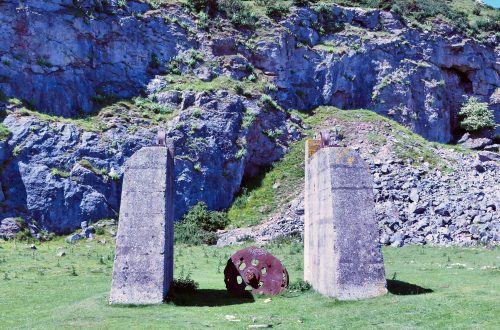
At the top is a reminder that the slope’s purpose was not originally as a walking track. Here stand the remains of supports and cogs for winding gear, once employed to steady trucks full of quarried stone on tracks down the steep slope, then to haul back empty ones.

TGLOVW-Winding gear remains at top of slope

This quarry face accommodates many nesting pairs of Jackdaws, whose cries often echo loudly around the bare stone cliffs. They were quiet today, the only sound made by a sheep bleating from the edge of the wall towering above. Clearly a mother, she may have been calling for her young one; I hoped he hadn’t been hauled off to market to end up as Welsh Spring Lamb in a butcher’s shop.

I took a very quick look at nesting Fulmars, didn’t want to disturb them so stayed well back.

Attractive birds with an elegant stiff-winged flight, it’s hard to believe they produce such a loud, rather harsh cry and that their tube-like nostrils are designed to allow them, inelegantly, to snort out salty water.

From up here you can look down on the flat quarried-out ‘Level 1’ of the site, with the cove of Angel Bay at its edge. The dry grassed areas are already showing signs of wear and tear.

Onwards and upwards, following the track that is both on the routes of the North Wales Coastal Path and the national Wales Coast Path. It is heavily eroded in parts, and bridged by gnarled old roots, (or branches?) of gorse.

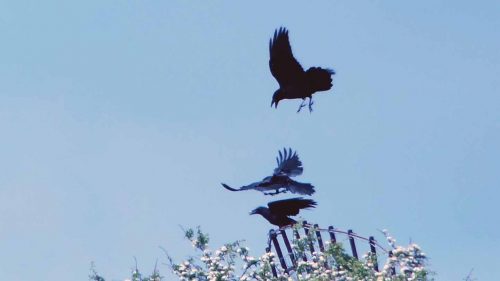
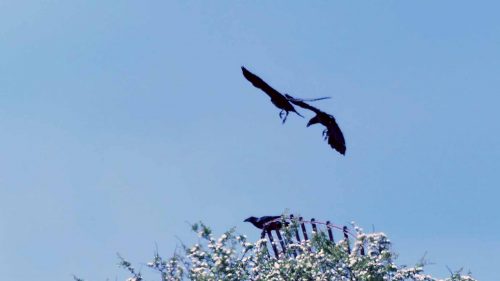
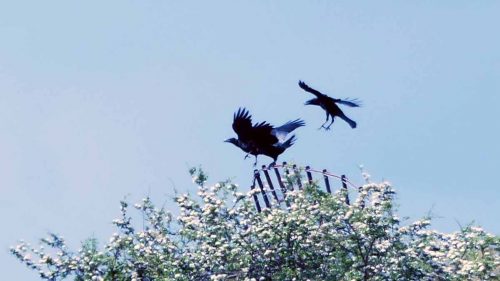
Ravens had made me aware of their presence since arriving here today, being more mobile and noisier than usual and as I ambled along this part of the track an outburst of their calls broke out from somewhere ahead of me. I had just seen birds harrassing what I assumed to be a Buzzard and thought that may have escalated into a bit more of an incident. Getting closer I saw three birds having a bit of a to-do; two of them seemed to be attacking a third that was sitting atop a fence. Not a Buzzard.

I was still too far away to see properly, but this may have been a pair of Raven upset with an intruding one. Does it have something in its beak in the first picture, an egg maybe? I have no idea but they took off from here and continued to express their annoyance from the field below for some time.

None the wiser as to what I’d witnessed I carried on, scanning the track ahead of me, as I am wont to do at this time of year, checking for sheep poo; you never know when there may be something interesting dining out thereon. I got lucky, a fairly fresh deposit yielded a little male Yellow Dung-fly. In an awkward spot to photograph, I had no option than to kneel down in front of the dung, then almost had my nose in it to get him in close up without using the lens zoom, quietly hoping no-one came along the path to witness my odd behaviour. It was worth it; I realised he hadn’t flown off as he was otherwise occupied with a lady Dung-fly. Females are far fewer in number than males, so there was no chance he was leaving, whatever I was doing.

Yellow Dung-fly pair mating
Same image but bigger

THE CORMORANT COLONY

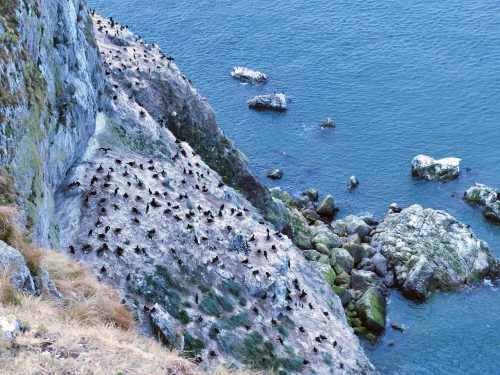
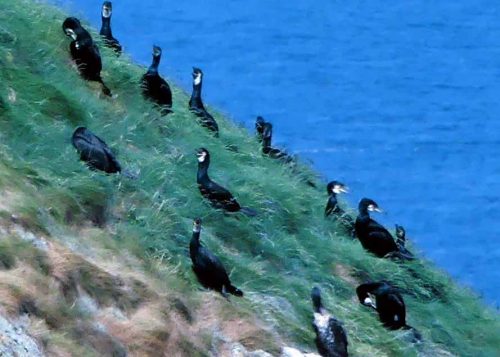
Reputedly the largest Cormorant breeding colony in the British Isles, this is an impressive sight, even from this distance and this is only a part of it; it continues around to the other side of the rocky outcrop in the photograph below, where there are even more of them.

I’ve shown this aspect of the Cormorant colony several times before, but this is the first time I’ve visited it at the right time to catch the birds on their nests. I was thrilled to get a glimpse of young birds in some of the nests; Cormorants usually lay 2-3 eggs, and from those I could see most seem to have hatched and grown successfully, so there must be plenty of food available locally to keep offspring and parents well fed.

Some of the young birds seemed a bit more advanced than others and were already out of the nest exercising their wings, but many birds were still sitting.

The bulk of the colony is not as easy to see, and viewing the birds involves a bit of rambling up and down the uneven cliff top, then peering down from cliff edge, but it is well worth the effort. The photograph below shows the colony to be situated well out of reach of nosy people.

Around the rock I was now upwind of the birds, so as well as amazing sights and sounds I was greeted with the equally amazing smell produced by a large number of fish-eating birds confined to a relatively small space. I wish I could share it with you!

But pungent aromas aside,the colony on this side holds another treat; right in its centre is another smaller colony – of smart little penguin-like Guillemots. Surrounded by the much bigger Cormorants I imagine it is a safe haven for them from potential predators such as gulls and the Cormorants seem perfectly accepting of them.

Cormorants and Guillemots sharing fishing space on the rocks below. There were many more birds of both species flying back and forth and hunting and diving in the water too. Cormorants stay separate but Guillemots often join together in ‘rafts’ floating on the surface of the sea.
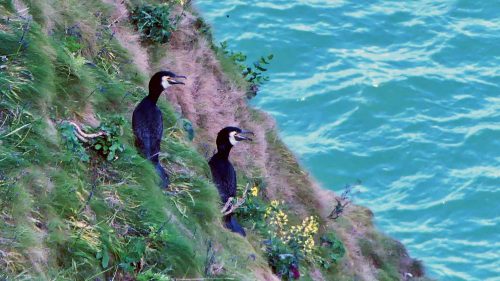
These two birds, who I fancied were enjoying some fresher air away from the colony, is my favourite Cormorant image from the day. The birds weren’t making a sound; they gape their beaks as a means of cooling down their bodies, but it seems like they’re commenting on something out at sea. Possibly the ever-encroaching turbines of the wind farm, or maybe they were sureying for likely fishing spots. 

It was a sunny day with some cloud and really strongly windy, particularly noticeable up here at the top of the headland on its sea-facing edge, but the elements’ combined effects on the water was breathtaking. I sat for some time watching the ever-changing patterns of light and shade on the surface of the blue sea as the wind rippled across its surface and clouds cast shadows above it. It really was the colour of the photograph below and quite mesmerising.

View from the Little Orme across Llandudno Bay to the Great Orme

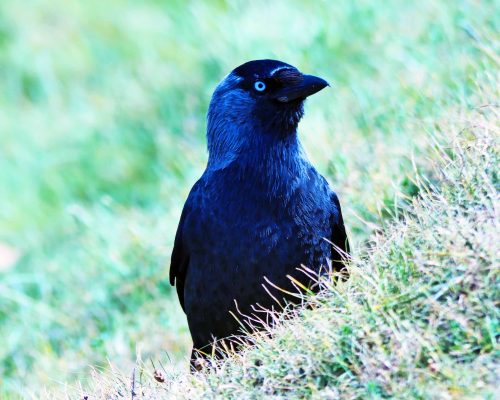
Birds flew past the cliff at eye level; mostly Herring Gulls, but one Greater Black-backed gull too, and a Raven gronked a greeting as he passed by; all strong birds gliding effortlessly on the wind and thermals created by the cliff face. A Rock pipit popped up over the edge briefly but popped down again when he spotted me. A Jackdaw also appeared over a ridge, but disregarded me completely and carried on foraging within touching distance, even posing for a portrait.   

THE CLIFFTOP

Returning to the main track I passed a ewe and her lambs who had found a shady and sheltered place to rest with her lambs.

I watched a 7-spot ladybird scrambling through the mossy turf. Grazed by sheep and rabbits, baked by the sun and exposed regularly to strong, salt-laden winds anything that survives here has to be tough, especially the flora. Amongst the toughest of our native flora are the thistles, the two most common species of which thrive here.

The Creeping thistle has already begun flowering and even up here was being visited by bumblebees and a wind-blown Red Admiral butterfly.

The other is the fierce-looking Spear thistle with its aptly-named long sharp spikes protecting its every part, which has flower buds almost on the point of opening now.

170527-TGLOFW-Spear thistle fierce leaves
170527-TGLOFW-Spear thistle flower buds

On the ledge beneath an overhanging rocky outcrop I was surprised to spot a clump of white-flowered plants. Getting closer I saw they were Sea campion and also Moon (Ox-eye) daisies with one of the best specimens of Salad burnet I’ve seen anywhere so far this Spring. I wonder how they got there?

Sea campion – Silene maritima

Going back down I took a photograph to remind me to say that although fading fast there is still gorse in flower and also hawthorn, but the main blossom plant now is the creamy white elder.

And another to remind myself that I can never tired of looking at this view across Penrhyn and Colwyn Bays, even when on hot days like this one much of the distance is lost in a haze.


Share this:

  • Share on Facebook (Opens in new window) Facebook
  • Share on Pinterest (Opens in new window) Pinterest
  • Share on X (Opens in new window) X
Like Loading...

Little Orme Level 1

12 Monday Jun 2017

Posted by theresagreen in Birdwatching on North Wales coast, calcareous grassland, coastal walks, coastal wildflowers, Little Orme, Local Nature Reserves, Nature of Wales, North Wales Wildlife Trust, Rhiwledyn Nature Reserve

≈ 16 Comments

Tags

chough, Cormorant, jackdaw, nomad bees, Nomada goodeniana, raven

May 27th

The Little Orme was physically scarred and shaped by human demands and quarrying activities during the first half of the last century. Subsequently handed back to nature and a testiment to its incredible ability to regenerate, an interlocking patchwork of habitats packed into a compact space on varying levels have become a haven for a diversity of wildlife, particularly wildflowers, birds and insects. Now in part a Local Nature Reserve with areas set aside as SSSIs, its wildlife may again be under pressure as the headland is an increasingly popular recreational area for local people and visitors and is also crossed by walkers following the Wales Coastal Path or the North Wales Coast Path. 

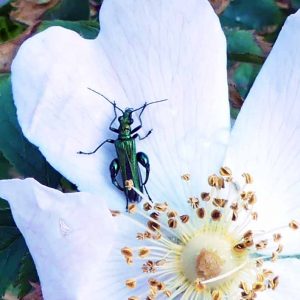
I was here today with the intention of taking some photographs of the Cormorant colony in mind. The birds are well into their breeding season now and have well-grown offspring in their nests and I wanted to catch them there before they fledged. I thought I was focussed on the job in hand, but as anyone that has ever been out walking with me would have guessed, it took less than two minutes for me to be distracted from my mission; firstly by a Harlequin ladybird guzzling aphids on the going-to-seed Alexanders, then by a lovely shiny metallic green female Swollen-thighed Beetle – Oedemera nobilis, who confusingly doesn’t have Swollen thighs at all, it’s the males that sport them as emblems of their maleness, the thicker the better in their bid to secure mates. She was perfectly displayed in the cup of a perfect dog rose, like a little jewel.

Harlequin ladybird on Alexanders
Thick-thighed beetle (f)

The cliff path along to Angel Bay took a while to negotiate too. Its sea edge is lined with masses of Red Valerian in all of its shades from deep carmine through pinks to white and it looks lovely.

I know it’s not a native and crops up anywhere and everywhere, but here it doesn’t look out of place and it is great for insects like the Painted Lady I found nectaring there.

Painted Lady on red valerian
Small White (f) on valerian leaves
Buff-tailed bumblebee on valerian

There are native wildflowers on this cliff edge too, including some good sized patches of Wild Thyme and the pretty pale lemon-yellow Mouse-ear which has colonised a large patch of the crumbly downslope of the cliff.

Wild thyme
Wild thyme
Mouse-ear Hawkweed
Mouse-ear Hawkweed

There’s a lot of Horsetail here too, I’m not sure of the species. It also cascades down the cliff where it looks a bit like a new plantation of tiny Christmas trees. A bit further in from the edge was a large patch of what I thought was Ground Ivy, but am now not sure about; very short-stemmed here on the dry exposed cliff and a mass of purple flowers, I will go back and check.

Horsetail
Horsetail
Ground Ivy
Ground Ivy

The Little Orme is the place to visit if you love your Corvids as I do. Ravens, Crows, Magpies, Jackdaws and occasionally Chough are all here. Seeing or even hearing ravens early on in a visit here always sets the mood for me, reminding me that despite the fact that this is now a place much used for recreation by people and their pets, it is still clinging on as a wild habitat. A pair flew overhead, ‘gronking’ as they did so and landed high up on the edge of the cliff, in the centre of the image above, one of their habitual lookouts for surveying their Kingdom.

Next a Magpie caught my attention as it landed on a bramble patch on the cliff edge, leaving quickly with an insect in its beak.

Then Jackdaws, great numbers of them nest in close colonies on the quarried-out cliff faces. Once breeding is over they disperse during the day, although plenty stay and forage around the grassy clifftops and it’s a safe haven to head back to and roost at night.

Jackdaw amongst bird’s-foot trefoil

At the sea end of this first flat level there’s a little bit of original rock remaining, separating Angel Bay from Penrhyn Bay and forming one side of the little cove that is the haven of the Grey Seals often mentioned in my posts. The sea-facing ledge behind said rock can be a good place to look out for birds at sea, especially in the autumn and winter, but today it was bees I found there. I have to admit I thought they were wasps as there were several that were flying around, and once or twice, in and out of holes made by mining bees. A quick check with the wise ones at BWARS (Bee,Wasp & Ant Recording Society) though, told me they are nomad bees, Nomada goodeniana, that seek out other bee’s nests in which to lay their eggs. They are apparently quite a common species, but a first for me.

Nomada goodeniana
Nomada goodeniana
Nomada goodeniana
Nomada goodeniana

A local speciality (botanically that is, not on menus!), Wild cabbage grows here, there have been bluebells on the cliff slopes and I spotted the bees as I stopped to photograph a pretty Bloody Cranesbill flower.

Wild cabbage
Wild cabbage
Bloody Cranesbill
Bloody Cranesbill

Looking out over the cove, there were just a couple of seals in the water and a sizeable gang of cormorants perched up at the sea end of the headland.


The sight of those Cormorants spurred me on to get back on track towards their nesting site. But first a stop to admire the Thrift, perhaps my favourite coastal wildflower which despite all the hazards is thriving here.

I am finally almost at the bottom of the steep slope up to the next level of the old quarry. I was following the sound of a Whitethroat singing when from close by a black bird took off and flew away from me back in the direction of the site entrance. Something in its gis made me watch carefully to see where it would land; its upturned wingtips showed this wasn’t a crow or a jackdaw and then that distinctive call confirmed I was chasing a Chough.

Chough fly with upturned wing tips

It landed a short distance away and set about digging in the short turfy ground in pursuit of food with its long curved bill. It was a ringed bird, banded on both legs, but perhaps not quite an adult as its beak was a dark orange colour rather than the bright red of a mature adult.

Chough eat worms, caterpillars, ants and are particularly partial to the larvae of dung beetles

The bird had picked a productive spot and was so settled into its feeding it took no notice of me sitting watching it from a conveniently sited bench. But foraging close to the junction of two of the main tracks across the clifftop it was inevitable that it would be disturbed sooner rather than later, and so it was, taking off and flying off over the sea and around the headland. That was definitely my best ever Chough encounter here in North Wales; certainly the closest. And I would have missed it if it wasn’t for my slow- walking meandering habit.

Next Level of this trail to follow shortly…. there will be Cormorants!


Share this:

  • Share on Facebook (Opens in new window) Facebook
  • Share on Pinterest (Opens in new window) Pinterest
  • Share on X (Opens in new window) X
Like Loading...

Tawny Mining Bees & the Bee-fly

09 Sunday Apr 2017

Posted by theresagreen in garden wildlife, Insects, Nature, Nature of Wales, nature photography, North Wales

≈ 16 Comments

Tags

adrena fulva, bee nesting in lawn, Bee-fly, Bombylius major, important pollinating insect, mining bees, small furry bee, solitary bee, tawny mining bee

April 1st – Garden, Rhos on Sea

In the late afternoon sunshine a number of little bees were zooming around in a corner of the front garden, pausing frequently but briefly on the warmed surfaces of ivy leaves. I have seen similar ones here each spring for the last five years, so was pretty sure they were male Tawny Mining Bees, but I had to wait a while for a prettier and more distintinctive female to take a breather from her nest-building labours to be sure. Males significantly outnumbered females here this afternoon, probably because they don’t contribute in any way to constructing nests or to raising offspring, so once mating is accomplished by a lucky few, they are free agents.

Tawny Mining Bee – Andrena fulva

The rich fox-brown colour and furry coat of the lovely little Tawny Mining-bee (Andrena fulva) makes it the most distinctive and obvious of all the Spring-flying solitary bee species.  It is a common bee in much of England and Wales, which nests underground and leaves a little volcano-like mound of soil around the mouth of its burrow. Nests can often be seen in lawns and flowerbeds in gardens and parks, or in mown banks and field margins in farmland and orchards.

Description

Size: Females 10 to 12 mm and males 8 to 10 mm long.

The Tawny Mining Bee is a small rich gingery-orange coloured bee that can often be seen visiting its nest in grassy areas such as lawns during the springtime.

Females are larger than males and covered in a dense layer of fox-red/orange hairs. Their underside is black.

Tawny Mining Bee female
170401-ROSGD-1612-Tawny Mining bee (2)

The males are quite different to the females. They are much slimmer, covered in less dense orangey brown hair and have a distinguishing pronounced moustache-like tuft of white hairs on the lower face. They play no part in nest building or providing for their offspring.

Tawny Mining Bee male
170401-ROSGD-1619-Tawny Mining bee 6

When to see it

The bee has a single flight period each year and is on the wing from early April until early June; the males emerging well before the females.

Peak activity coincides with the flowering periods of fruit trees such as Pear, Cherry and Apple and also of fruiting shrubs such as currants, gooseberries and other Ribes species and are important pollinators. The female collects pollen and nectar for the larvae which develop underground, each in a single ‘cell’ of the nest, and hibernate as pupae over winter.

Habitat

Tawny Mining Bee feeding on Alexanders

The bee is common in gardens, parks, calcareous grassland, orchards and on the edges of cropped agricultural land.

Andrena fulva nests are constructed in the ground, and the nest entrances are surrounded by a volcano-like mound of excavated spoil. Nests are often in loose aggregations in tended lawns, flower beds, mown banks and in sparsely vegetated field margins. Pollen is collected from a wide range of plants including flowering trees and shrubs, weeds and garden species. 

Life History

Having hibernated through the Winter, Tawny Mining Bees emerge in Spring as adults; the males emerging well before the females. After mating, the female seeks a place to make a nest. The bees’ tunnelling throws up small heaps of waste soil, that look like tiny molehills or volcanos with the entrance/exit hole at its summit. You may notice these little heaps in your lawn without associating them with the bees. They won’t spoil your lawn! The nests are short lived and do not damage plants or harm earthworms. 

The bee’s mining throws up small ‘volcano-like’ heaps of soil with an entrance at the summit

Nests will often consist of one small, main tunnel, with perhaps 5 or so branches, each containing an egg cell. The nest is a vertical shaft 200 to 300 mm (8 to 12 in) with several brood cells branching off it. The female fills these cells with a mixture of nectar and pollen, on which she lays one egg in each cell. The larva hatches within a few days, grows quickly and pupates within a few weeks to repeat the cycle as new adults emerging the following spring after hibernation.


Sometimes more than a hundred females build nests in a few square metres but the Tawny Mining Bee normally does not create a colony: each female has her own nest. 

Distribution in Europe

According to BWARS, the Tawny Mining Bee is common across most of England and Wales, there is only a single confirmed Scottish record, and only old, tantalizing records from Co. Kilkenny in Ireland. On continental Europe, the species is widespread and common from Britain eastwards across central Europe. It is not found in Scandinavia and is restricted in the Mediterranean region. 

April 7th

Checking up on the Tawny Mining Bees today I noticed a number of the diagnostic little ‘volcanos’ have appeared in the bare line of earth between the lawn edge and the ivy-covered front wall.

170407-TGGD-1436a-Tawn Mining Bee nest entrance
170407-TGGD-1436-Tawn Mining Bee nest entrance

Female Tawny Mining Bee covered with dusty earth from her nest

I spotted females going in a few times and there are still males hanging around close to the nest sites. I photographed one female as she had emerged from her nest, her legs, head and furry body coated with a layer of dusty earth.

As this garden is having a bit of an overhaul at the moment, there are very few flowering plants for the bees to nectar on, so they are having to seek food elsewhere. Poor things must be worn out, all that digging, producing eggs and having to fly across the road to find food.

An Enemy in the Camp

The bees carried on industriously, seemingly unaware they were being watched by a potential murderer of their offspring. The sinister character, a Bee-mimic, looks a little strange; it has a long rigid proboscis at the front of its head which it uses to tke nectar from flowers while hovering over them and long trailing legs. They are also quite cute, furry, lovely to see and entertaining to watch – this was a Bee-fly Bombylius major.


Bombylius major has several host species, including beetle larvae and the brood of solitary wasps and bees particularly digging bees such as Andrena, like our Tawny Mining Bees.

Bee-fly approaching Tawny Mining Bee's nest
Bee-fly approaching Tawny Mining Bee’s nest
Bee-fly using its long legs to flick her eggs into the Tawny Mining Bee's nest
Bee-fly using its long legs to flick her eggs into the Tawny Mining Bee’s nest

The Bee-flies mimic bees to allow them to get close to the bees nest entrance. When close enough, the female will flick her eggs into or near the nests of the host insects. The larvae will then hatch in the nest and feed on the food stored, as well as on the young solitary bees or wasps.

I knew this is how Bee-flies behaved, but hadn’t witnessed their egg-flicking behaviour before today. I have to admit it is fascinating, while feeling a bit sad about the possible outcome for some of the poor hard-working Miners. But then I like to see the Bee-flies too…..


Share this:

  • Share on Facebook (Opens in new window) Facebook
  • Share on Pinterest (Opens in new window) Pinterest
  • Share on X (Opens in new window) X
Like Loading...

The Lonely Purple Sandpiper

14 Tuesday Mar 2017

Posted by theresagreen in bird behaviour, Birdwatching on North Wales coast, Nature of Wales, nature photography, Rhos Point, Wales Coast Path

≈ 8 Comments

Tags

calidris maritima, dunlin, overwintering birds, Pibydd Du, purple sandpiper, purple sandpiper at rhos-on-sea, redshank, Rhos Point, Turnstone

February 17th

Rhos Point will soon become a quieter place as the wading birds that arrived during last late Summer and the Autumn leave us and head back to their more northerly breeding grounds. Each year Turnstones come in a fairly consistently sized flock of about 60 birds and I think it’s likely that a more unusual visitor – one that draws birdwatchers here to search for it – arrives amongst them; the Purple Sandpiper. I’d met people claiming to have seen them here earlier in the winter, but I hadn’t had even a glimpse. Until today. Taking my baby granddaughter out for some very fresh air on the Promenade, as always with one eye scanning the shoreline and one watching where I was steering the pushchair, I’d noted the tide was on the turn. Only a strip of the rocky shore below us was exposed and yet there were two people walking along it, chatting and following behind their loose and randomly wandering dog. I wasn’t thinking kindly about this as a) I don’t understand why anyone would risk their dog injuring itself on the slippery uneven surface and b) why they don’t notice or seem to care about the disturbance to any feeding birds. But in this instance they were quickly forgiven as the dog flushed a single elusive Purple Sandpiper from where it had probably been resting on the lower rocks of the rip-rap sea break.

It didn’t go far, just across to the smaller rocks on the edge ot the water where it stayed.March 1st

Having now seen where the Purple Sandpiper had been lurking during high tides I went back to try to see it again and whether there may be more of them. I’d waited until the tide was at its highest and soon spotted the Turnstone flock quite high up on the rocks

I enjoyed the lovely close sighting of these gorgeous little birds, but really wanted to see Purple Sandpipers. And there he was, on the edge of the group and still apparently alone.

A lonely little Purple Sandpiper. I stayed and watched for a while in case any others popped up, but no. He was the only one. I walked a little further on, still searching, but found only two Redshanks. Again, lovely close up view of great birds, but not the colour I was looking for.

PURPLE SANDPIPER – Calidris maritima; Welsh: Pibydd Du

The Purple Sandpiper is a winter visitor to almost any rocky coast in Britain and Ireland. They are widely distributed around the coast though they are most abundant in the northern isles – Orkney and Shetland and along the east coast of Scotland, north-eastern England and Devon and Cornwall and scarce elsewhere.

The Purple Sandpiper is a medium-sized wading bird, slightly larger, stockier and darker than a Dunlin. It is mainly dark grey above and whitish below. It has a slight down-curved beak and distinctive short bright orange legs. In flight it shows a thin white wing-stripe on otherwise dark wings.

Above photo: January 28th 2012-Purple Sandpiper with Dunlin – Rhos on Sea

World Distribution: BREEDS Arctic & Subarctic Eurasia & North America, WINTERS: south to S Europe and Southern US.

Diet: Invertebrates, also some plant material, often feeds on rocks near tide edge.

March 2nd

Back again for another look. I didn’t even have to search for myself as a serious photographer, in full camouflage kit and sporting a super-long lens had him in his sights, saving me the effort. Today he was completely alone, with not even a Turnstone for company. He was quite lively though, having a good preen then skipping around the rocks, splashed by sea spray and totally in his element. Still sad to see him all alone though.

Closer views of the active bird today better show the purplish tint to the plumage that gives the species its name.

Maybe next year he’ll bring some friends.

Purple Sandpiper is currently AMBER listed in the Birds of Conservation list based on a Non-breeding Population decline by more than 25% but less than 50% and a UK breeding population of less than 300 pairs.


Share this:

  • Share on Facebook (Opens in new window) Facebook
  • Share on Pinterest (Opens in new window) Pinterest
  • Share on X (Opens in new window) X
Like Loading...
← Older posts
Newer posts →
Follow everyday nature trails on WordPress.com

Enter your email address to follow this blog and receive notifications of new posts by email.

‘But it is the common species that keep the living world ticking over and provide most of our experiences of wildlife, and I would argue that maintaining the abundance of these is as important a conservation priority as maintaining the existence of rarities’. Richard Mabey

MOST RECENT POSTS

  • A Glimpse of Spring to Come January 22, 2025
  • Hunting the Wren December 28, 2024
  • Oh, Christmas Tree December 18, 2024
  • In and Out of the Ivy February 15, 2024
  • Nature’s Fireworks November 30, 2023
  • Wild Autumn along the Coast Path November 3, 2023

OLDER POSTS

LOOKING FOR SOMETHING IN PARTICULAR?

  • May Bee Appearing on Ivy near You
    May Bee Appearing on Ivy near You
  • Catchers, a Duck and Divers
    Catchers, a Duck and Divers
  • Sights and Sounds from the Little Orme 1
    Sights and Sounds from the Little Orme 1
  • Following a river to a Fairy Glen
    Following a river to a Fairy Glen
  • Butterflies and more rare treats
    Butterflies and more rare treats
  • The Windhover
    The Windhover
  • The life of a Yellow Dung-fly
    The life of a Yellow Dung-fly
  • A Windy Wildflower Trail
    A Windy Wildflower Trail
  • Fine Dining for Crows
    Fine Dining for Crows
  • A Window on the Woods-Winter 1
    A Window on the Woods-Winter 1

nightingale trails

The Walk of the Monarch Butterfly-Sendero de la Mariposa Monarca

The Walk of the Monarch Butterfly-Sendero de la Mariposa Monarca

MY WILDFLOWER BLOG: where the wildflowers are

Snowdrop

Snowdrop

most recent posts

Follow everyday nature trails on WordPress.com

Social

  • View teresamaygreen’s profile on Twitter

Enter your email address to follow this blog and receive notifications of new posts by email.

Website Built with WordPress.com.

  • Subscribe Subscribed
    • everyday nature trails
    • Join 358 other subscribers
    • Already have a WordPress.com account? Log in now.
    • everyday nature trails
    • Subscribe Subscribed
    • Sign up
    • Log in
    • Report this content
    • View site in Reader
    • Manage subscriptions
    • Collapse this bar
 

Loading Comments...
 

    %d