• Home
  • about
  • about the photographs
  • Local Nature Reserves
    • Bryn Euryn Local Nature Reserve
    • Mynydd Marian
  • Wales Coast Path
    • Grey Seals in North Wales
    • St.Trillo’s Chapel
    • Wildflowers of North Wales Coastal Paths, Cliffs and Dunes

everyday nature trails

everyday nature trails

Category Archives: Nature of Wales

Rhos-on-Sea- seashore surprises

24 Wednesday Aug 2011

Posted by theresagreen in birds of the seashore, Nature, Nature of Wales

≈ Leave a comment

Tags

Crow dropping shellfish onto rocks, Curlew, curlew on seashore, intelligent behaviour of crow, migrant hoverfly, rhos-on-sea

Walk from Penrhyn Bay to Abbey Road, Rhos-on-Sea

The beach of Penrhyn Bay is mostly made up of shingle, a hostile environment for plants, but some tough species have gained a hold there, spreading forward from the base of the sea wall.
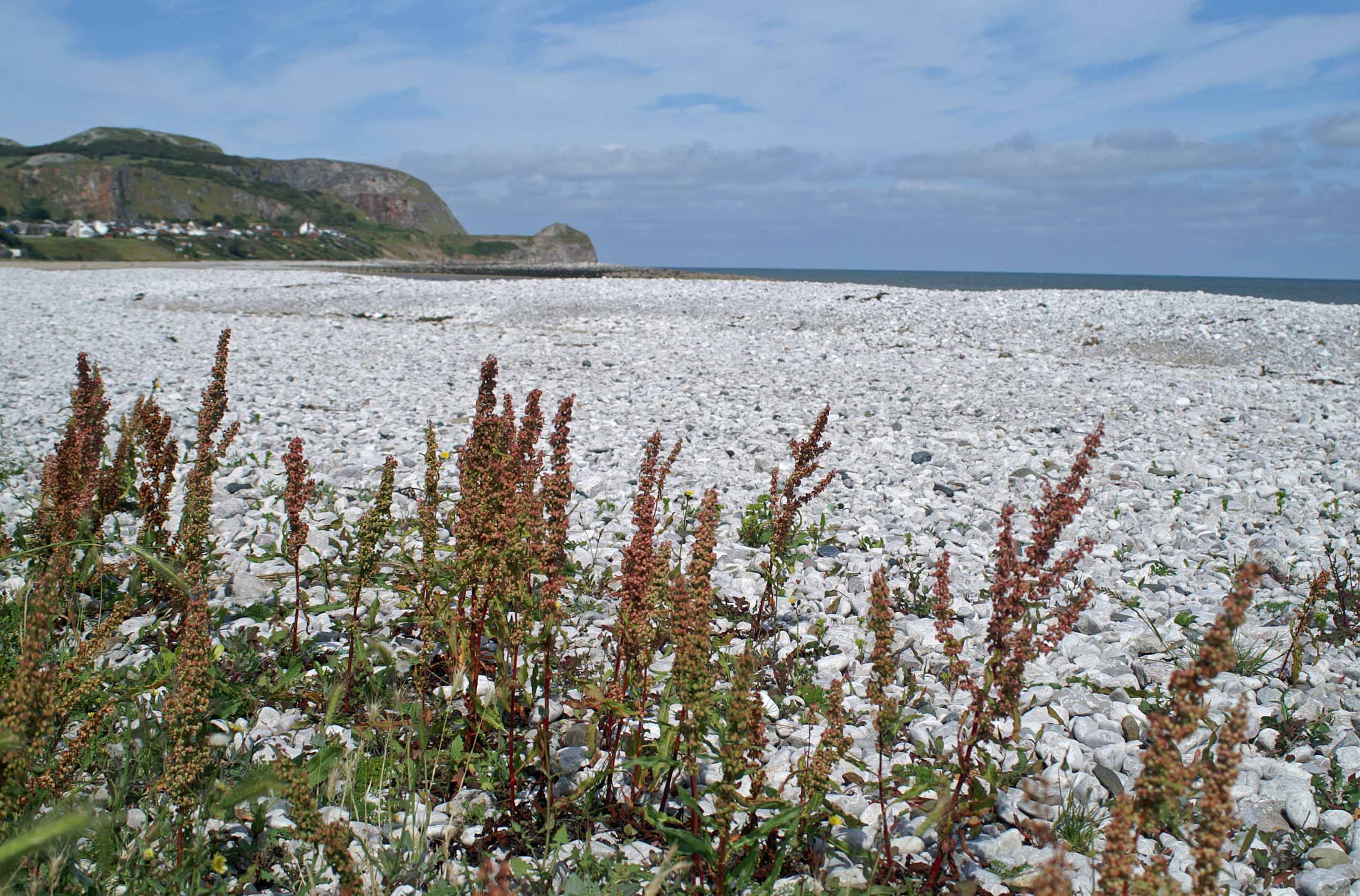
24/7/11-Dock plants growing on the seashore with the Little Orme in the background

Shingle as a habitat

Shingle plants will begin to colonise above the high tide mark. Below this the moving pebbles will prevent any seedlings getting a stable hold. The plants that grow on the shingle usually have long and tough roots able to withstand the friction of the pebbles that will be disturbed by storms. Often referred to as a desert-like environment, plants like dock have water-retaining leaves that enable them to be one of the larger colonisers of this unique habitat, while smaller plants may be able to harness the water that collects on the surface of the pebbles.

24/7/11-Penrhyn Bay beach-Common Mallow growing on the shingle was attracting insects
24/7/11-Penrhyn Bay beach -a Migrant Hoverfly resting on a mallow leaf

I left the beach where the shingle  gives way to the rocky shore of Rhos-on-Sea, keeping an eye on the beach from the promenade. A Black-headed Gull caught my attention and I stopped to have a closer look. The gull was standing on a patch of muddy sand and I was intrigued to see the tops of car tyres protruding above the sand behind it. The way they were placed seemed to be deliberate, so I wondered if they are being used to reinforce the sea-break or stabilise the sand? They must have been there for a good while as some have seaweed growing over them.

24/7/11-Black-headed Gull with tyres bedded in the sand behind it

Focusing my attention on the gull and the tyres, I had half-noticed a brownish coloured bird against the rocks behind them that I thought was a young Herring Gull. When I gave it proper attention I had a pleasant surprise; it was actually a wader, either a Whimbrel or a Curlew, that was foraging around the rocks, probing its long curved beak into the the muddy sand.It was so well camouflaged against the rocks it was difficult to keep track of it, but I got a better view when it spent a couple of minutes in a more open pool of water.

24/7/11-Curlew on the sea shore
27/7/11-The Curlew blended perfectly into its surroundings

The wader disappeared from sight amongst the rocks and I carried on with my walk. I didn’t get far before I stopped again to watch a Crow that was acting strangely, flying up into the air then diving down again. It took a few minutes to realise that what it was doing: it was searching for a shellfish, picking it up in its beak, flying up then dropping it onto the rocks hoping to break it and diving down after it.

24/7/11-The shellfish does not drop straight down, so the crow has to follow it quickly or lose sight of it. 
24/7/11-The crow is surprisingly agile and turns quickly to make a steep dive
24/7/11-Diving Crow keeping its eyes on the landing position of its snack

There was quite a gap between each performance which I thought may have been either because the shellfish needed to be a particular size or species, or perhaps needed to be partially open, or  simply that each mouthful obtained this way required so much effort – it may well take more than one drop to smash a shell. I was fascinated by their behaviour and very impressed with their ingenuity; clever things.

There were quite a few gulls about; Lesser Black-backed gulls, Herring gull adults and juveniles and a few more Black-headed gulls. Herring gulls frequently chase other birds they see flying with food in their bills, hoping to steal it if possible. During an interlude in the Crow entertainment I spotted a mottled brown and white bird that I took to be a juvenile Herring gull being chased by an adult; as it broke away and flew towards me I was surprised again to see that it was another Curlew carrying something quite large in its bill; a crab I think.

24/7/11-Curlew flying with food

The Curlew flew back along the sea edge towards Penrhyn Bay, landing a short distance away from me amongst a cluster of rocks. Watching it closely I could see other Curlews gathered there, difficult to count as they are very hard to see, but at least another three.

It’s amazing what you see sometimes when you don’t set out to look! 

Share this:

  • Share on Facebook (Opens in new window) Facebook
  • Share on Pinterest (Opens in new window) Pinterest
  • Share on X (Opens in new window) X
Like Loading...

Discoveries on the Little Orme’s snail trails

22 Monday Aug 2011

Posted by theresagreen in Little Orme, Nature, Nature of Wales

≈ Leave a comment

Tags

banded snail, black & yellow striped caterpillars, fuzzy growth on wild rose, garden snail, Gatekeeper, hummingbird hawkmoth, robin's pincushion

The Little Orme and Rhiwledyn Nature Reserve are a popular venue and much-frequented by local people and by visitors to the area, but despite that it remains a great haven for a wide variety of wildlife species.

I love wandering around here because as with the Bryn Euryn Reserve, there are a variety of habitats and many possibilities of sightings within a relatively small area. I do try to have a ‘target list’ when I set off to explore any area as I’m very prone to distraction by anything that looks interesting; today a Gatekeeper butterfly was at the top of the list. Missing from my recent Bryn Euryn list, which I was more than pleased with anyway, I felt sure there must be some of these very attractive little butterflies around close by. Lo and behold, almost as soon as I entered the site from the top of the steps, there were my Gatekeepers, several of them fluttering around a bramble. Then, as so often happens, something else caught my eye – a Hummingbird Hawkmoth was hovering around a patch of red valerian flowers. A common sight for me in southern Spain, I recognised it immediately although here it was above me at the top of a slope – too far away and too quick to photograph well, but I don’t want anyone to think I was imagining it!

22/7/11-A Hummingbird Hawkmoth taking nectar from valerian

The little Gatekeepers quickly regained my attention; all the individuals I saw, and there were plenty today, were pristine, so maybe all very recently newly emerged which could be why I hadn’t seen one before now.

22/7/11-A Gatekeeper- Pyronia tithonus resting on a nettle
22/7/11-Gatekeeper underside, on bramble leaf

Well, as they say, that was easy and I headed for the clifftop to sit and watch the seabirds for a while. Cormorants were dashing to and fro the rocky tip of the promontory, there were a few Fulmars tucked onto rocky ledges and a number of Herring Gulls flying around, making less noise here than they do in the town. Gazing down at the water I noticed a head pop up above the surface, which I though at first belonged to a diver, but through my binoculars it was clearly a Grey Seal.

22/7/11-Head of a Grey Seal-the choppy water indicates the strength of the wind that’s been cooling down our days lately

It was very pleasant sitting there, but I soon got restless and set off in search of the next specimen on my list.

22/7/11- View towards the cliff edge

Now I was looking for the distinctive black and yellow striped caterpillars of the Cinnabar Moth, that feed on Ragwort. I had inspected the ragwort plants growing on Bryn Euryn for them without success, but didn’t have to look far to find them here.

22/7/11-Cinnabar Moth caterpillars

I’ve always been fascinated by these fat creatures in their wasp-coloured skins and still wonder how on earth they transform into a delicate and smart scarlet- red and black moth. I only caught a brief sight of the back of one Cinnabar moth as it flew away from me from a ragwort plant –  I’ll have to come back for a picture another day.

22/7/11-A banded snail tucked up under a valerian leaf

Another striped creature was hiding from the sunshine beneath a leaf; a strikingly marked Banded Snail – Cepaea nemoralis.

I was aware that research has been carried out on this species of snail-something to do with the evolution of regional variations in colouration and the effects Song Thrush predation have on their populations,I think. During the course of looking for more information I learned that a big survey of the species population has been conducted and results are now available fromhttp://www.evolutionmegalab.org. I think the survey may be ongoing.

22/7/11-Another quite differently patterned Banded snail, although it bears similar shades of brown, there is also more pink in the shell

There is also a downloadable PDF available from the Open University’s called ‘How to hunt for snails’ for details. That might keep the kids amused for a while on a rainy afternoon.(If you’re interested, I’ve put the link in my blogroll). I might even do that myself on my next visit to the Little Orme.

While snails were on my mind I started to notice empty shells of the larger, darker Garden Snail-Helix aspersa. There were dozens of them, no two patterned alike and all quite beautiful. The thought crossed my mind that if they had been lying on a beach people would probably gather them up and keep them, but perhaps because most of us have been traumatised by the damage these voracious eaters can wreak on our gardens, we don’t give them a second glance. I made a collection of photographs for myself; I think they are well worth looking at.

22/7/11-A few specimens from my Garden Snail shell collection

Walking along the upper edge of the deep ‘valley’ created by the quarrying of limestone I happened to look down and spot two Grayling butterflies fluttering around the rocks below. I stopped  to have a closer look and peering over the ledge I discovered a very pretty fern growing from the rock just below me.

22/7/11-Maidenhair Spleenwort-Aplenium tichomanes

Shifting around to get a better look and a photograph, I then saw there was a clump of another species growing just a short way from it.This one is called Rusty-backed fern, although not rusty with spores at the moment. I didn’t spot the delicate Wall Rue   growing beneath it until I downloaded my photographs. What a treasure-trove that bit of rock turned out to be – there’s lichen growing on it too.

22/7/11-Rusty-backed fern -Ceterach officinarum with Wall Rue-Asplenium ruta-muralis tucked underneath 

I walked around and down into the quarry to see if I could find the Graylings, but by now the sun was lower and the rocky cliffs casting shadows, so they were either long gone or tucked up for the night. I was probably more pleased to find this Robin’s Pincushion anyway; I haven’t seen one of these fascinating fluffy-looking galls for ages: they are caused by the tiny black and red gall wasp,Diplolepis rosa, that is rarely seen.

22/7/11-Robin’s pincushion

Share this:

  • Share on Facebook (Opens in new window) Facebook
  • Share on Pinterest (Opens in new window) Pinterest
  • Share on X (Opens in new window) X
Like Loading...

Oystercatchers, and more on the seashore

21 Sunday Aug 2011

Posted by theresagreen in Nature, Nature of Wales

≈ Leave a comment

Tags

3-pronged Bristletail, birds of North Wales, birds on the seashore, large jellyfish, motacilla yarellii, Oystercatcher, oystercatchers flying, petrobius maritimus, Pied Wagtail, rhos-on-sea

28 April

I was leaving sunny Rhos-on-Sea to start heading back to rainy Spain this evening (with a few days in London first), so a last walk along the promenade and seashore was a must this morning. It was a good day to leave on, the morning was bright sunny and warmish, cooled by a bit of a breeze that made for a pleasant temperature for walking.

My first stop was at the rocky breakwater, where I was hoping there may be some birds foraging, but there were only Herring Gulls. As I was about to move on though I heard the familiar ‘tschissick’ call of a Pied Wagtail and one duly arrived, landing just a couple of metres away from me. I’d had a couple of previous sightings of the birds, around the golf course area and a male ‘singing’ from a rooftop, but this was a perfect view of a female. The male bird is all black above and has sooty-grey flanks; female is dark grey on mantle/back but has black crown, rump and uppertail-coverts. Slightly different in appearance to the race of Motacilla alba we see in Spain and the rest of Europe, this is Motacilla alba yarrellii that occurs in Britain and Ireland and locally on adjacent Continental coasts.

Pied Wagtail – Motacilla alba yarrellii (female)
A Carrion Crow flew down to forage on the newly exposed seashore

The tide was on its way out exposing a narrow strip of pebble beach, so I walked down to it via a concrete ramp to see if anything interesting may have been left by the receding sea. On the walls of the ramp, nicely warmed by the sun I noticed several little insect-things scuttling about, which on closer inspection turned out to be Bristletails – of the 3-Pronged variety.

3-pronged Bristletail – Petrobius maritimus

The insects belong to a primitive group of wingless insects (Apterygota) that are dependent on humid conditions. The 3-Pronged Bristletails belong to a small order ( Thysanura), all the members of which have 3 ‘tails’, comprising 2 cerci and a central projection known as the epiproct. The most familiar member of the group is the Silverfish. I am open to correction on this, but from my research and based on their location I am assuming the ones I saw to bePetrobius maritimus:

Description: A slender brown insect, up to 15mm long, with antennae that are almost as long as the body. Central ‘tail’ distinctly longer than the 2 side tails. Habitat: Close to high watermark on rocky coasts and short distance inland in crevices. Status and distribution: Common and locally common throughout in suitable habitats.

I’ve seen very similar-looking  insects to this on our covered terrace walls in Spain, but we are a  kilometre or so  inland from the sea, so perhaps we were closer once upon a time and they got marooned and have adapted. I must try to find one and compare them.

Reaching the beach I disturbed a group of Herring Gulls that had been foraging on the sea edge. They flew up and began circling around, voicing their objection loudly and their proximity gave me a moment of anxiety as I visualised a scene from Alfred Hitchcock’s ‘The Birds’. Then it occurred to me that they may have been alarmed by my long camera lens, so if they thought it may be a gun I was quite safe from attack. Phew.

I was soon distracted by birds I had been hoping to see, a number of Oystercatchers, very handsome in their immaculate black and white plumage, were standing on rocks at the sea edge looking down at the receding water and anything edible it may be leaving behind.

Oystercatcher – Haematopus ostralegus

Oystercatchers waiting for the tide to go out
The birds’ comings and goings gave the opportunity to see their outstretched wings
The birds grouped together to await a feeding opportunity
A few minutes later the birds began to venture into the shallow receding water
A bird probing the sea bed
The back of an Oystercatcher flying away, showing white rump and black tail-band

I became absorbed by the sight and was enjoying my close-up views of the birds, so the arrival of  a man with his dog startled me. He  stopped to chat to me and I told him I was watching the Oystercatchers – the camera with a big lens may have given him a clue I was taking photographs too, but he carried on walking straight towards them anyway. Needless to say they all took off to look for somewhere more peaceful.

Oystercatchers flying away

The expansive mussel beds located here attract large numbers of Oystercatchers, although they also feed on cockles, limpets, small crabs, shrimps and worms. Breeding takes place after the wintering flocks have broken up, in mid-April in the south and May or June further north.

I turned to retrace my steps up to the promenade, almost stepping on this huge stranded lump of a jellyfish.

A stranded jellyfish – the only big one I know is a Portugese Man o’ War, but I’m not sure what this is . I don’t imagine the hot sun would do it much good.
Common limpets- Patella vulgata and an edible periwinkle- Littorina littorea
Pebble beach

Share this:

  • Share on Facebook (Opens in new window) Facebook
  • Share on Pinterest (Opens in new window) Pinterest
  • Share on X (Opens in new window) X
Like Loading...

Bryn Euryn Nature Reserve

19 Friday Aug 2011

Posted by theresagreen in Bryn Euryn Nature Reserve, Butterflies of Wales, Nature, Nature of Wales, nature photography, Wildflowers of Wales

≈ Leave a comment

Tags

ash tree, Bryn Euryn Nature Reserve, common rockrose, early purple orchid, hoary rockrose, wildflowers of Bryn Euryn

27th April

I haven’t seen much of the countryside since I’ve  been here in North Wales, other than through a car window, and I was very keen to see some spring flowers and fresh greenery. I know the wildflowers in Spain will be amazing when I get back there next week, but the native British wildflowers have an altogether gentler and more subtle beauty that I love. I have been planning to make a trip to the local nature reserve on Bryn Euryn, and as I will only be in the locality for a couple more days I decided to head there this morning.

Bryn Euryn is a limestone hill rising to 131metres (365 ft) above sea level and a well-loved local landmark of Rhos-on-Sea that is now a Local Nature Reserve. Its slopes are clothed with a mixture of woodland and grassland, part of which has been declared a Site of Special Scientific Interest. From its summit their are extensive panoramic views over Rhos-on-Sea and Colwyn Bay and across to the mountains of Snowdonia in the west. 

I parked in the small car park that is surrounded by trees, and as soon as I got out of the car I heard a Chiffchaff ‘singing’. I couldn’t see him,but as I tried to locate his whereabouts a Robin flew into a nearby tree and also began to sing. Moving off towards the beginning of the track that leads up to the summit of the hill I stopped to watch a Song Thrush hunting on the woodland edge where it borders a grassed area.

I soon came upon a patch of bluebells growing alongside some wild garlic whose flowers are almost finished. There were a few wood anemones still flowering, but they too are all but over; wild strawberry plants were flowering along a length of the path edge in dry shade, they have a long flowering period beginning in April and continuing until October, with fruits appearing throughout the summer. It was lovely walking in the dappled shade of the woodland, listening to the birds singing and coming across flowers that gave me the opportunity to make a stop on the fairly steep upward climb. A special find was a sunlit Early Spotted Orchid growing beneath the trees. The presence of this delightful bloom, together with that of bluebells and wood anemones is a sign of an ‘old wood’,  indicating that this area has never been anything other than woodland.

Purple Spotted Orchid

Dog Violet

There was a pretty patch of little blue/purple dog violets and the surprise of a Cowslip plant on a steep bank; this one must have strayed from the grassy downland on the other side of the hill; the more usual habitat of Cowslips.

Cowslip

Rock Rose

At the top of the hill you emerge from the woodland onto a surprisingly large expanse of open grassy heathland. There were large patches of yellow flowers growing here, taking a closer look I saw there were of two separate species; I recognised rock rose, but was unfamiliar with the other. Looking it up when I got home I realised it was Hoary Rockrose, one of the plants named on the information board in the car park that is apparently very scarce in the British Isles.

Hoary Rockrose – Helianthemum canum

The views from the top here are truly spectacular, extending from the Little Orme around and across Rhos-on-Sea and Colwyn Bay with the mountains of Snowdonia to the west. The only downside, at least from this side of the hilltop, was the traffic noise arising from the busy A55.

A panoramic view of Rhos-on-Sea and Colwyn Bay

View from Bryn Euryn summit – mountains of Snowdonia on far horizon

View across summit of Bryn Euryn to Conwy Estuary and beyond to Snowdonia

Germander Speedwell

Buff-tailed Bumblebee

Turning around I walked across to the other side of the summit, passing through a shrubby area, the woodland edge, where there are shrubs and small trees growing. Here, Hawthorn is in full bloom and I stopped to watch a furry bumblebee as she burrowed into the leafy debris on the ground beneath.

Hawthorn, or May blossom

I discovered another early purple orchid plant here, this one had an earlier, or perhaps even last year’s, dried flower spike attached.

I reached the true summit of the hill, which has a concrete trig point on it that is part of the nationwide network built by the Ordnance survey to create their maps of the UK in the old days before computers.There is also a board depicting how the ancient hill fort may have looked. I was very surprised to come across an extensive patch of orchids here, I roughly counted them and estimated at least 100 flowers.

Summit of Bryn Euryn with Trig point & mass of purple spotted orchids in the foreground

The Fort

The summit of Bryn Euryn was once occupied by a small but strong fortification. This may have been the ‘Bear’s Den’ mentioned by Gidas the Wise and thought to have been a stronghold of Cynlas the ‘Red Butcher’, king in Rhos around the middle of the sixth century. Only the faint traces of the limestone rampart’s foundations are  visible today, protruding through the turf and ringing the summit of the hill, to remind us of its former importance.

It was much quieter and more peaceful on this side of the hill and I sat for a while enjoying the sunshine and the view out to sea and across to the Little Orme.  Two Red Admiral butterflies were flying around the nearby shrubbery, one kept attempting to sun itself on a bramble leaf, the other kept disturbing it, the basking one chased after its disturber then returned to the same spot etc. etc. It took a lot of patience to get the photograph.

Red Admiral basking on new bramble leaf

Speckled Wood on a leaf on the ground

Even trickier to photograph was this Speckled Wood. Once again there were two of the insects chasing one another – these little butterflies are especially territorial, but I wanted to get a photograph as they were much paler in colour than the ones I had been seeing in the garden. That made getting the photograph even harder, as when they did land it was on dried leaves and they were so well camouflaged I couldn’t find them through the lens.

There are some beautiful trees growing here, including Ash, whose leaves are quite well grown now.

new ash leaves

They brought to mind the old country rhyme about their predicting the forthcoming summer weather:-

“Ash before oak, look for a soak, oak before ash, look for a splash”

I had a quick look at a neighbouring oak and would say they were pretty much on a level, so hopefully that means some rain, but not too much.

Share this:

  • Share on Facebook (Opens in new window) Facebook
  • Share on Pinterest (Opens in new window) Pinterest
  • Share on X (Opens in new window) X
Like Loading...

Herring Gulls-love them or loathe them

19 Friday Aug 2011

Posted by theresagreen in birds of the seashore, birds of Wales, garden wildlife, Nature, Nature of Wales

≈ 2 Comments

Tags

herring gull, herring gull nuisance, herring gull status, herring gulls in towns, herring gulls nesting on roofs, larus argentus

April 2011

A pair of Herring Gulls are regularly visiting the flat roof immediately below the window of the bedroom I am staying in. At the moment they are not roosting here overnight, but they arrive back early each morning, announcing their arrival with much raucous calling and strutting around. I have been very aware of Herring gulls locally, flying around, perching on rooftops and up amongst the chimney pots, but put it down to being so close to the seashore where there appears to be plenty of natural food. However it would seem that a number of pairs have claimed several of the chimney-rich sites as nest locations. Their strongly territorial and aggressive-defensive behaviour makes them difficult and, sadly, dreaded birds to have as close neighbours, which is a  pity as when viewed closely and unemotionally, they are very clean-looking and handsome birds, if a touch arrogant in demeanour.

European Herring Gull – Larus argentatus

Length 55-67cm; Wingspan 130-158cm

The Herring Gull is one of the commonest gulls of Northern European coasts, bigger than a Common Gull it has rather fierce-looking pale eyes with a yellow iris and pink legs and feet.

A visit to the seaside wouldn’t be the same without the sound of gulls, but when they are intent on sharing your house, you rather wish they’d turn the volume down.  A very noisy bird it makes a variety of squealing notes, sometimes sounding like it may be chuckling and also producing some quite dog-like yelping and ‘barking’ sounds.

A Herring Gull peacefully resting in the sun

The male gull brought in some strange ‘tokens’ for his chosen mate, a turkey-leg bone and a fairly large piece of stone amongst them, and they began to display bonding behaviour, the female ‘begging’ for food, and greeting one another vocally and with body contact.

I am very interested in the ways in which wildlife interacts  (and learns to exploit) people and although I had no previous experience of living this closely to them, I was aware that herring gulls had a reputation for some anti-social behavioural traits. We had a chat with the next-door neighbour, who related her previous experiences with locally nesting gulls  that could have come from the Hitchcock horror story. She alleged attacks made against herself, her visitors and particularly her dog, whilst minding their own business in their own garden! She had rung the RSPCA who had told her there was nothing she could do as the birds were protected, and that the nuisance would only last for seven weeks while the birds were nesting!

A herring gull nest built on a flat roof

A herring gull nest built on a flat roof

I was keen to learn more, so  began to research the subject, beginning by checking out the status of the gulls. Surprisingly perhaps, the herring gull has been accorded red status by the RSPB,  the highest conservation priority, as its numbers have declined dramatically in its former haunts, disappearing completely from some areas. (There are 40% less herring gulls now than in 1970) To quote from a page on their website , this means that:

” Gulls, like all UK wild bird species, are protected under the Wildlife and Countryside Act 1981. This makes it a criminal offence to kill, injure or take a gull; or to take, damage or destroy its nest whilst the nest is in use or being built. It is also a criminal offence to take or destroy their eggs.”

The best general information I found concerning the bird-human interaction was on Wikipedia and thought it worth reading in full:

” The European Herring Gull is an increasingly common roof-nesting bird in urban areas of the UK. The Clean Air Act of 1956 forbade the burning of refuse at landfill sites, providing the European Herring Gull with a regular and plentiful source of food. As a direct result of this, European Herring Gull populations in Britain sky-rocketed. Faced with a lack of space at their traditional colonies, the gulls ventured inland in search of new breeding grounds. Dwindling fish stocks in the seas around Britain may also have been a significant factor in the gulls’ move inland.

The gulls are found all year round in the streets and gardens of Britain, due to the presence of street lighting, (which allows the gulls to forage at night), discarded food in streets, food waste contained in easy-to-tear plastic bin bags, food intentionally left out for other birds (or the gulls themselves), the relative lack of predators and readily available, convenient, warm and undisturbed rooftop nesting space in towns and cities. Particularly large urban gull colonies (composed primarily of European Herring Gulls and Lesser Black-backed gulls are now present in the cities of Cardiff, Bristol, Gloucester and Aberdeen to name but a few.

The survival rate for urban gulls is much higher than their counterparts in coastal areas, with an annual adult mortality rate of less than 5%. It is also common for each European Herring Gull pair to successfully rear three chicks per year. This, when combined with the long-lived nature of European Herring Gulls, has resulted in a massive increase in numbers over a relatively short period of time and has brought the species into conflict with humans.

Once familiar with humans, urban European Herring Gulls show little hesitation in swooping down to steal food from the hands of humans. During the breeding season, the gulls will also aggressively ‘dive bomb’ and attempt to strike with claws and wings (sometimes spraying faeces or vomit at the same time) at humans that they perceive to be a threat to their eggs and chicks — often innocent passers-by or residents of the buildings on which they have constructed their nests. Large amounts of gull excrement deposited on property and the noise from courting pairs and begging chicks in the summer months is also considered to be a nuisance by humans living alongside the European Herring Gull. Non-lethal attempts to deter the gulls from nesting in urban areas have been largely unsuccessful. The European Herring Gull is intelligent and will completely ignore most ‘bird-scaring’ technology after determining that it poses no threat. Rooftop spikes, tensioned wires, netting and similar are also generally ineffective against this species, as it has large, wide feet with thick, leathery skin which affords the seagull excellent weight distribution and protection from sharp objects (the bird may simply balance itself on top of these obstacles with little apparent concern). If nests are removed and eggs are taken, broken, or oiled, the gulls will simply rebuild and/or re-lay, or choose another nest site in the same area and start again.

Attempts to scare the gulls away using raptors are similarly ineffective. Although they are intimidated by birds of prey, European Herring Gulls, in addition to being social birds with strength in numbers, are large, powerful and aggressive as individuals and are more than capable of fighting back against the potential predator, particularly if they consider their chicks to be at risk. European Herring Gulls are also naturally accustomed to predators (such as Skuas and Great Black-backed Gulls) living in the vicinity of their nest sites in the ‘wild’ and are not particularly discouraged from breeding by their presence.

Despite the increasing number of urban European Herring Gulls in the UK, the species, when taken as a whole is declining significantly across the country, its population having decreased by 50% in 25 years. In 2009, the RSPB placed the European Herring Gull on its ‘Red List’ of threatened bird species, affording it the highest possible conservation status. In response, Natural England in January 2010, following a public consultation, removed the European Herring Gull from the list of species covered by its general licenses, which had previously permitted authorized persons (e.g. landowners or occupiers) to kill the birds under certain circumstances (e.g. to prevent serious damage to crops or livestock, to prevent disease, or to preserve public health or safety) without requiring additional permission. ”

It would seem that there is no easy quick-fix solution to the problem and currently not a lot you can do if the birds take a fancy to nesting on your roof, there doesn’t seem to be a great deal of advice or help available to householders either, a bit worrying bearing in mind that many of them won’t be aware of the law.

Related newspaper article:  http://www.telegraph.co.uk/earth/outdoors/7818115/Seabirds-Quick-fix-isonly-for-the-gull-ible.html

A LOCALLY-RELATED SNIPPET FROM THE ABOVE ARTICLE:

  • During the late 1800s a man in Llandudno constructed wings from gull feathers and string and tried to fly. He failed.

Share this:

  • Share on Facebook (Opens in new window) Facebook
  • Share on Pinterest (Opens in new window) Pinterest
  • Share on X (Opens in new window) X
Like Loading...
Newer posts →
Follow everyday nature trails on WordPress.com

Enter your email address to follow this blog and receive notifications of new posts by email.

‘But it is the common species that keep the living world ticking over and provide most of our experiences of wildlife, and I would argue that maintaining the abundance of these is as important a conservation priority as maintaining the existence of rarities’. Richard Mabey

MOST RECENT POSTS

  • A Glimpse of Spring to Come January 22, 2025
  • Hunting the Wren December 28, 2024
  • Oh, Christmas Tree December 18, 2024
  • In and Out of the Ivy February 15, 2024
  • Nature’s Fireworks November 30, 2023
  • Wild Autumn along the Coast Path November 3, 2023

OLDER POSTS

LOOKING FOR SOMETHING IN PARTICULAR?

  • Following a river to a Fairy Glen
    Following a river to a Fairy Glen
  • The life of a Yellow Dung-fly
    The life of a Yellow Dung-fly
  • Shades, Sounds and Scents of the Woods
    Shades, Sounds and Scents of the Woods
  • Catchers, a Duck and Divers
    Catchers, a Duck and Divers
  • Pretty prickly Thistles
    Pretty prickly Thistles
  • Llanddwyn Island & Newborough Warren
    Llanddwyn Island & Newborough Warren
  • The Foxglove - of Fairytales, Myths & Medicine
    The Foxglove - of Fairytales, Myths & Medicine
  • The Windhover
    The Windhover
  • May Bee Appearing on Ivy near You
    May Bee Appearing on Ivy near You
  • Fine Dining for Crows
    Fine Dining for Crows

nightingale trails

The Walk of the Monarch Butterfly-Sendero de la Mariposa Monarca

The Walk of the Monarch Butterfly-Sendero de la Mariposa Monarca

MY WILDFLOWER BLOG: where the wildflowers are

Snowdrop

Snowdrop

most recent posts

Follow everyday nature trails on WordPress.com

Social

  • View teresamaygreen’s profile on Twitter

Enter your email address to follow this blog and receive notifications of new posts by email.

Website Built with WordPress.com.

  • Subscribe Subscribed
    • everyday nature trails
    • Join 358 other subscribers
    • Already have a WordPress.com account? Log in now.
    • everyday nature trails
    • Subscribe Subscribed
    • Sign up
    • Log in
    • Report this content
    • View site in Reader
    • Manage subscriptions
    • Collapse this bar
 

Loading Comments...
 

    %d