• Home
  • about
  • about the photographs
  • Local Nature Reserves
    • Bryn Euryn Local Nature Reserve
    • Mynydd Marian
  • Wales Coast Path
    • Grey Seals in North Wales
    • St.Trillo’s Chapel
    • Wildflowers of North Wales Coastal Paths, Cliffs and Dunes

everyday nature trails

everyday nature trails

Category Archives: HABITATS

Midsummer Woods

05 Sunday Jul 2020

Posted by theresagreen in birds of Wales, Butterflies of Wales, Insects, Local Nature Reserves, Nature of Wales, nature of woodlands, Walking, Wildflowers of Wales, woodland

≈ 12 Comments

Tags

Bryn Euryn Nature Reserve, buteo buteo, common buzzard, common lizard, Early Bumblebee, Great Pied hoverfly, longhorn beetle, pollinating insects, Red Admiral, rutpela maculata, slow walking, speckled wood, strangalia maculata, tree bumblebee, Viviparous lizard, yellow and black beetle

It had been a good while since I’d spent the best part of a day meandering around the whole rich patchwork of varying habitats that make up my local nature reserve of Bryn Euryn, so a sunny morning that was forecast to stay that way into the afternoon offered the perfect opportunity to spend a day outdoors.

09:59 – Woodland Path
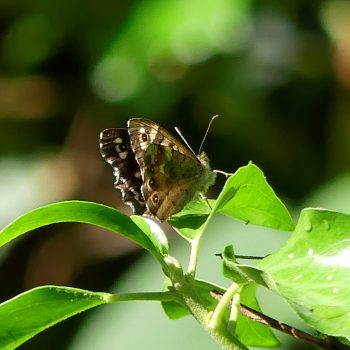
Once outside I realised it wasn’t quite as warm as I’d thought it was going to be, but the air felt fresh, if slightly humid. The copious rainfalls of previous days have done wonders; plants that had looked sad and wilted a few days ago were perked upright and the leaves of the trees washed of dust and good as new. A Speckled Wood butterfly on ivy and the chirpy calls of foraging Blue Tits greeted me at the beginning of the path, which has also benefitted from the dust-settling cleansing rain.
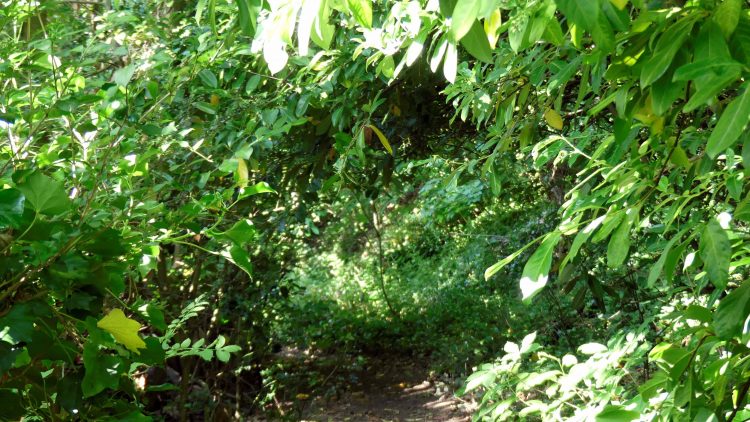
The specialist woodland wildflowers of the early Spring have long-since finished flowering now and are directing their energies into producing seeds. There are a few later-flowering plants that can cope with the reduced sunlight though, including the beautiful Honeysuckle, one of my lifetime favourite plants whose fresh perfume I would happily fill my home with, if only someone could capture it perfectly.

An arch of Honeysuckle

It’s been a good year for this  fragrant twining-climbing plant which has given me cause to make even more frequent stops on my walks; the scent of it in the air, particularly in the cooler mornings and evenings is as much a highlight as anything I might see or hear. It has maybe passed its peak of flowering now, but there’ll be occasional blooms to enjoy for a while to come.

Also happy in partial shade and flowering now are Navelwort, which is usually more easily recognised by its distinctive round fleshy leaves and Wood Sage, which despite its name is not confined to woodland paths; it’s a tough plant that is equally as happy growing out on exposed heaths and coastal cliffs.

Wood Sage-Teucrium scorodonia
Navelwort-Umbilicus rupestris

10:12 Covered with white blossoms and well-refreshed the bramble patch at the top of the first rise of the path, was my first stop this morning. Gradually being lit and warmed by sunshine, it was already busy with a variety of insects.

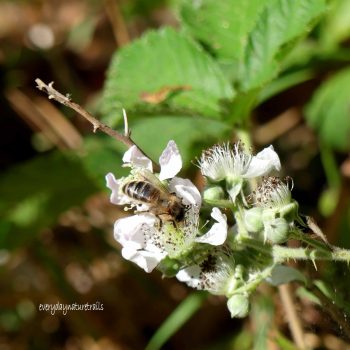
Honeybee on bramble blossom

A Blackbird was singing from a tree somewhere close by, his melodic, relaxed song lending an element of calm to the scene of frenetic insect activity. There were bumblebees: Tree Bumbles  definitely the most numerous, some looking fresh, their heads and thoraxes bright deep tawny brown others faded to a pale blonde, perhaps bleached out by the sun. A few smaller Buff-tailed workers are busy between them and there are a small number of Honeybees, some of the first I’ve seen this year.

Faded Tree Bumblebee
Fresh Tree Bumblebee

Butterflies joined the party, two Speckled Woods, which must have been a male and a female as they behaved amicably together, feeding almost side by side until disappearing together to the privacy of the leaves of an overhanging Sycamore. A Large White scooted over but didn’t stop, but a Red Admiral, missing a piece from a hind wing stayed for the whole length of time I was there, only moving short distances between flowers.

Speckled Wood
Speckled Wood
Red Admiral
Red Admiral

Most interesting of all were the big yellow-and-black beetles, that for some reason don’t seem to have a standardised common name, so are  known to me as Strangalia maculata, (which is apparently no longer correct as they’ve changed it to Rutpela maculata!). In the midst of the tangle of bramble, honeysuckle and ivy stands the remains of a tree, which was snapped in a storm a few winters ago. I wonder if it’s within its damaged fabric that they spent their larval stage and from which they have emerged. For a while now I’ve seen them here each time I’ve passed by, several at a time. Until now all of my past and more recent sightings of these lovely beetles have been of them calmly feeding on flowers, so it was interesting to see them very active this morning, flying rather clumsily from flower to flower, not lingering for long on any.

Yellow and black beetle- Rutpela maculata
Yellow and black beetle-Rutpela maculata

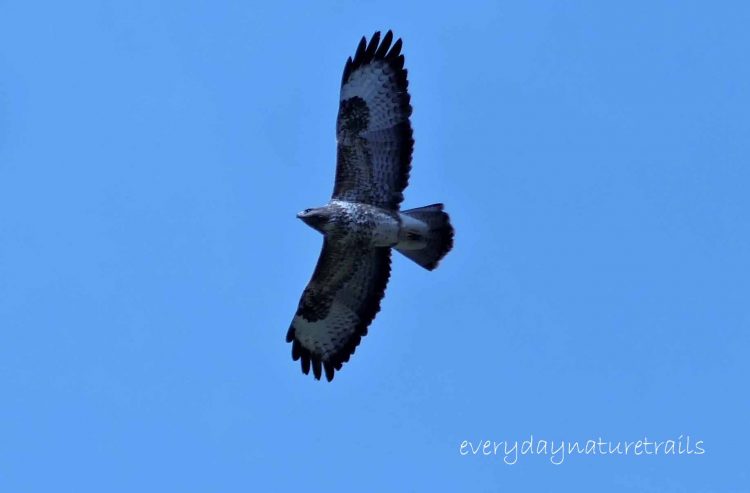
The distant mewling of a Buzzard calling from above diverted my attention and I caught glimpses of it as it circled high above the trees.
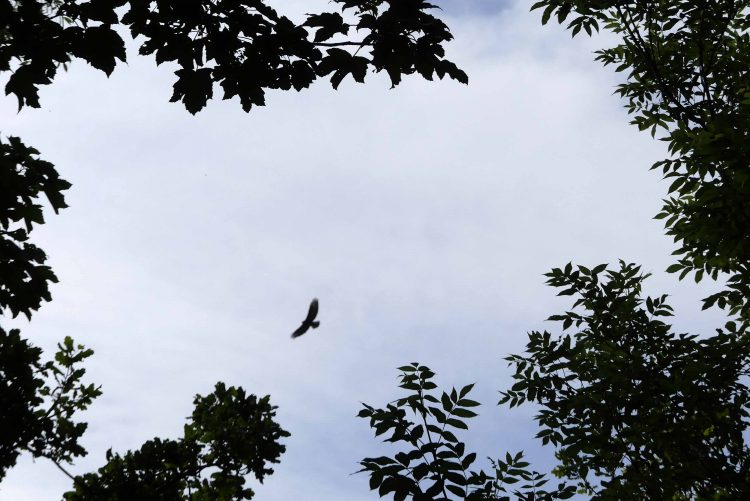
This was the first one I’d seen in a while, so I wondered if it might appear back over the field, perhaps with its family, so moved on in that direction. It was a sun-in-and-out morning, surprisingly cool on the shady path when the breeze picked up.
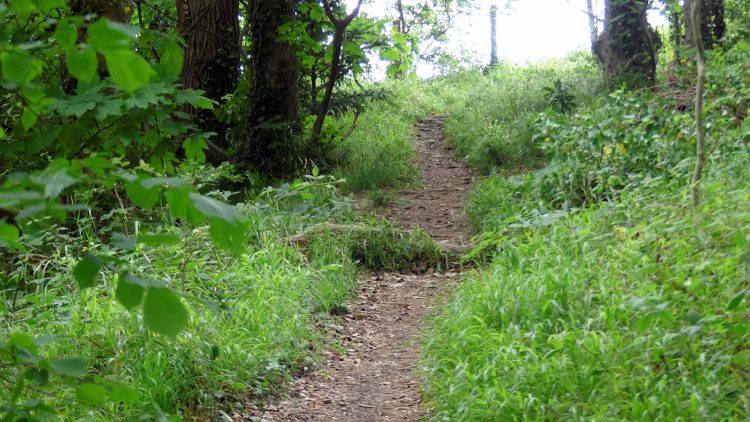
Path edged with False Brome

Paths are edged with grasses, which are flowering now. False Brome predominates, covering large swathes of the woodland floor in places throughout this site, and there are lesser amounts of other species such as the distinctive Cock’s-foot.

Cock's-foot-Dactylis glomerata
Cock’s-foot-Dactylis glomerata
False Brome-Brachypodium sylvaticum


10:40 There was nothing to see at this edge of the woodland except the wind rippling over the long grass of the meadow, and it was too cool to linger.

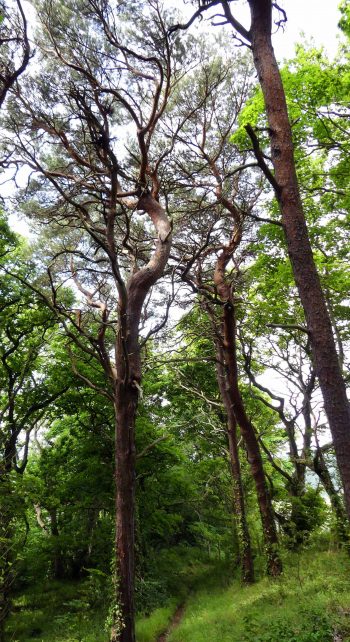
The sun came out again as I walked between the pine trees. This has become one of my favourite parts of the woods. I love the characterful Scots Pine trees with their tall, straight trunks crowned on high with heavy, strangely twisted branches in all seasons; but today with their rust-red bark still slightly damp and darkened by rain and highlighted by filtered sunlight they had a special glow.

There were no birds to be seen and for a while no sound of them either, until their silence was briefly broken once again by the Buzzard and the familiar contact calls of more Blue Tits working their way through the trees.

PATH EDGES
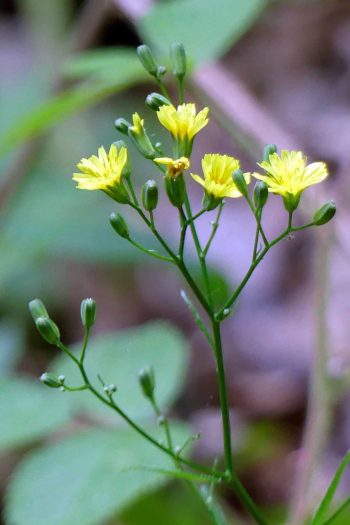
Nipplewort-lapsana-communis

Opportunistic wildflowers crop up randomly along the path edges, mostly of those species that seem to travel alongside the blackberry brambles, accompanying them wherever they go. In flower now are nettles, dock and delicate-looking Nipplewort.

All have value to insects in their way, either as sources of pollen and nectar or via their leaves which are either eaten from the outside or mined and eaten from the inside.

Curled Dock
Curled Dock
Common Nettle
Common Nettle

10:47 – My next stop is at the brambly-scrubby patch at the junction of three woodland paths. In recent weeks this has been buzzing with a variety of bees, in particular Tree Bumblebees that clearly have a nest nearby, or there may even be two. There have been a lot of Early Bumblebees too, but lesser numbers of other common species and so far I’ve only seen one or two Red-tailed bumblebee queens; no workers.
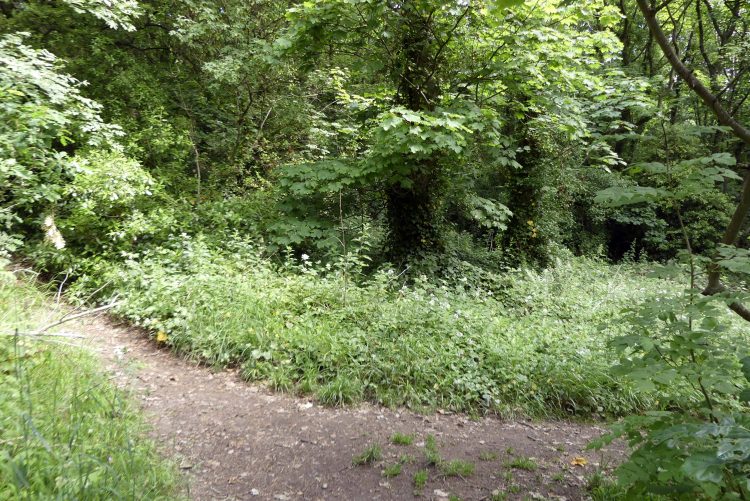
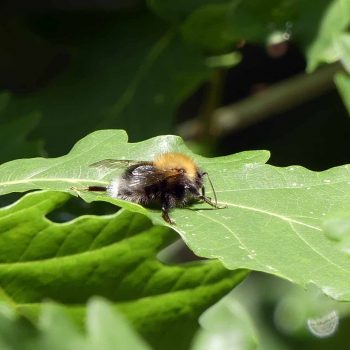
Predominately a raspberry bramble patch, which flowers earlier than blackberry, there is less blossom here now so is less of a draw for foraging insects now. There were a few Tree bumblebees about though, some working, one or two taking short rests on nearby sun-warmed leaves; poor things have probably already been out working for hours. This has been a great spot for hoverflies this Spring too, where I’ve  added a few ‘new’ species to my list. It was starting to get warmer, which doesn’t seem to bother bees, but hoverflies often seek shade under leaves, so I wasn’t too surprised there were few to see. Then I spotted one of the largest of our UK hoverflies, a Great Pied Hoverfly (Volucella pellucens) on some more shaded brambles. Not a new species for me, but I’d not seen one in this spot before. In contrast there were also a few of one of our smallest and commonest hoverflies about, little Marmalade Flies (Episyrphus balteatus).

Gt Pied Hoverfly-Volucella pellucens
Marmalade Fly-Episyrphus bateatus

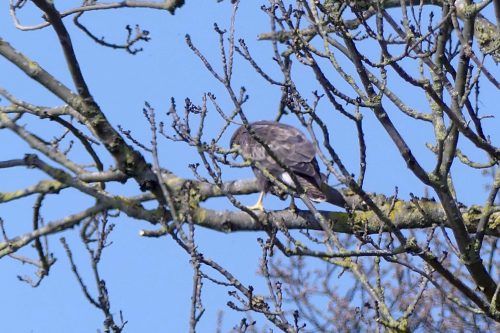
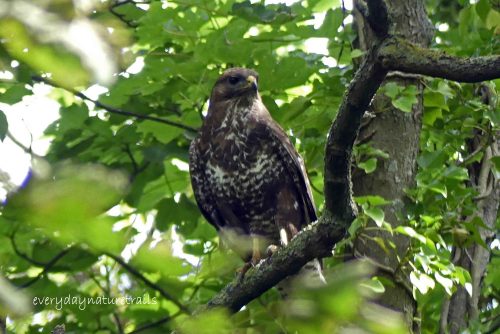
10:46 A bird landed in an Oak tree a few metres behind the Sycamore tree, on first impressions quite big,heavy-ish landing so probably a Wood Pigeon. I almost didn’t take any more notice, but then it came to mind that this is a good spot to see Jays, which I am always keen to try to photograph as they are quite elusive, so I focussed on it and was excited to see it was neither Wood Pigeon nor Jay, but a dark handsome Buzzard. What a beautiful bird, and posing so nicely too.
The Woodland Trail

11:10 As I walked on, I remember thinking that the sighting of the Buzzard and managing to get a half-decent photograph of it was going to be the main highlight of my day. But then you just can’t predict what you may or may not see on any given day in this treasure trove of nature, as I later discovered.
Reaching the Woodland Trail, I crossed it to sit on the bench for a few minutes to enjoy the sunshine and to listen to what was around me whilst I wrote some notes. I’m always fully aware of the soundtrack of my walks, but unless I get lucky and can photograph or record a singing bird can’t always properly recall what I heard. This is what I wrote here ” … for 30 seconds, maybe a little longer there are no extraneous sounds; no noise from the road, no dogs barking, no human voices, only the sounds of twittering birds – most likely Blue Tits reassure me I haven’t gone suddenly deaf! A Robin’s just flown into the tree above me. It sits and looks at me for a few seconds before flying into the woods I’ve just left. I see a Small Heath butterfly; it lands but I didn’t spot it in time and it flew off, surprisingly rapidly for such a tiny butterfly, ditto a Meadow Brown!”

As I got up to carry on I caught sight of a small gingery-furry bee flying over a fallen tree branch, which I thought might have been a Tawny Mining bee. I tried to focus in on it, but it was flying and although I pressed the shutter a couple of times I knew the bee wouldn’t be in focus, but may do as record shots. I can’t even begin to describe my feelings when I looked at those photographs on my computer later that evening. Expecting to see an out of focus bee, there too was also an almost perfectly in-focus lizard lying motionless and perfectly camouflaged along the length of the fallen branch which the bee was flying over. It had probably been watching me and wondering whether it should stay still or risk making a move. I’m grateful it chose the latter option.
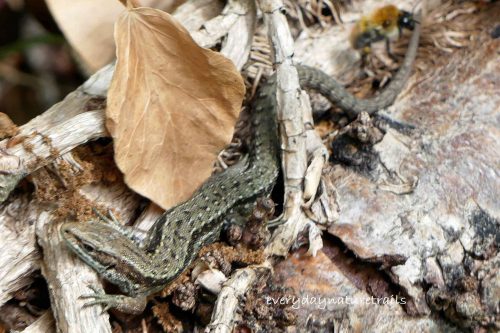
Part of me was glad I hadn’t noticed the lizard, which is a Common or Viviperous Lizard, as I’m sure I’d have been so excited to see one in a position where I might get a photograph that I’d have fumbled with the camera and likely have missed it. But then I think it would have been nice to get a proper look at one rather than just a glimpse of a disappearing one, which is all I’ve managed so far in my years of tramping this hill! Mainly I’m just more than happy to know it was there and I have a photograph, however I managed it!
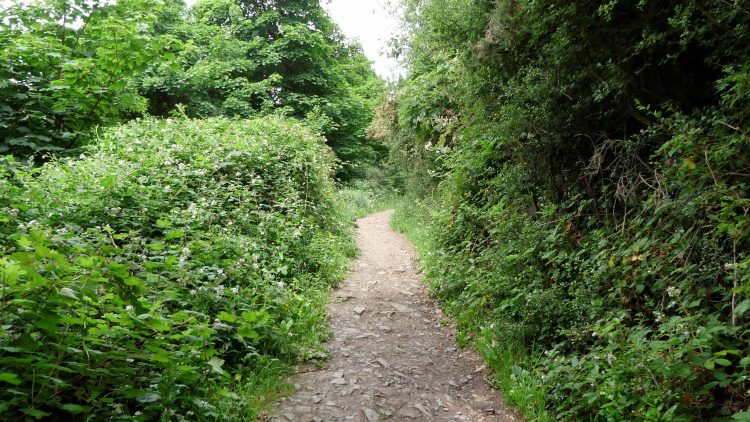
Being oblivious at this point to my lizard ‘capture’, and back in insect-seeking mode, I wandered along to the huge bramble tangle that once in flower has always been a brilliant place to spot a good variety of insects in a relatively short space of time with minimal effort. Years ago, this was the first place on the reserve that I recognised as an insect ‘hotspot’. There was a fair amount of activity here this morning, mostly from bumblebees, but there was also another Gt Pied Hoverfly, a Red Admiral butterfly, a Strangalia maculata beetle that only showed me its antennae and legs and a few different species of flies. Getting photographs was tricky, insects were constantly moving, the sun was shiningly brightly, but probably more to the point the path was getting busy with people and dogs and I got fed up having to keep moving to let them pass at a ‘safe distance’.

Volucella pellucens
Volucella pellucens
200615-1126-BEWT (122b)-Bumblebee no id
Tiny Tree bumblebee
Tiny Tree bumblebee
Early bumblebee
Early bumblebee
200615-1122-BEWT (110a)-Fly
200615-1116-BEWP (102a)-Fly

Tutsan growing alongside the bramble already has ripening berries. Its flowers hadn’t the same degree of appeal to insects as bramble, but I did catch a little Marmalade Fly visiting it.

Tutsan with berries
Episyrphus balteatus

The woodland is at the peak of perfection now, leaves are fully grown, in a myriad of shapes and uncountable shades of fresh green; climbers and ramblers are not yet over-reaching themselves to become sprawling and untidy and the plants along the path edges are not yet spilling over it.

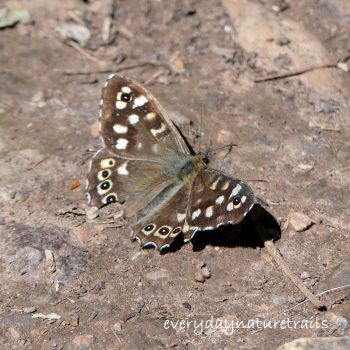
 

Speckled Wood butterflies were stationed every few metres along the path, whether basking on the ground or perched on leaves overhanging the path. Constantly on alert, they readily explode into action to see off any intruders into their territory.


Trees arch across the path creating shady leafy tunnels
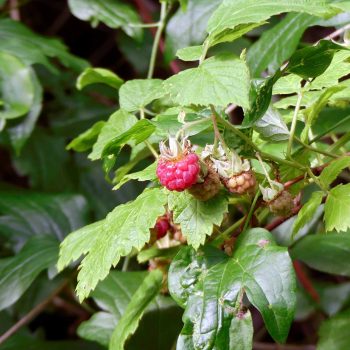
First wild raspberry

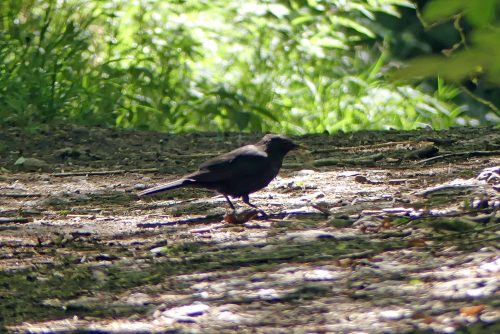
Generally birds are much quieter these days, apart from the Blackbird I heard earlier the only ones still singing to any extent are our summer breeders-Chiffchaff and Blackcap.

The closed canopy makes it too shady for there to be much in the way of ground-level plants for a while, so there are few distractions, other than Speckled Wood butterflies of course and the occasional sight of a Blackbird foraging in the safety of the dappled shade.
No matter how often I walk along this Trail, several times a week sometimes, each time I see it with fresh eyes. Looking up there are places where trees on opposite sides seem to avoid contact, leaving fascinating space between their contrasting leaves.
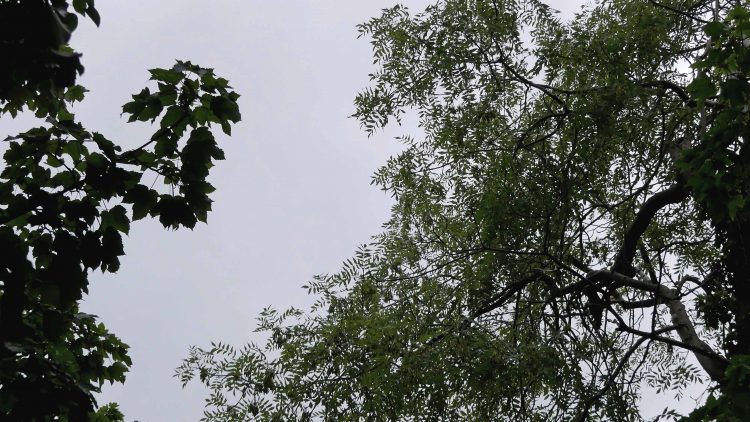
The same scenery changes according to the lighting effects; the varying cloud cover and the angle of the sun at different times of the day as the seasons progress all contribute, as do the weather conditions, particularly on days when there’s wind and how strong it is. On the ground, complex shadow patterns may be cast on the uneven canvas of the bare-earth path.

12:05: The steps up from the shady sheltered Woodland Trail lead into what could be an entirely different dimension….
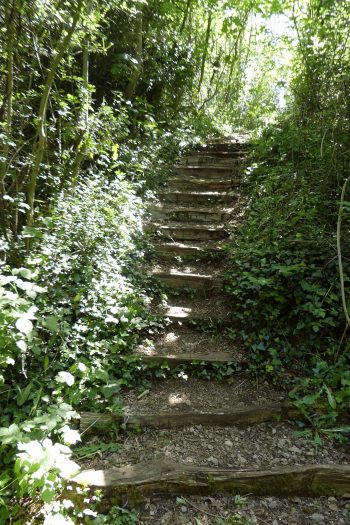
a good place to take a break..
Share this:

  • Share on Facebook (Opens in new window) Facebook
  • Share on Pinterest (Opens in new window) Pinterest
  • Share on X (Opens in new window) X
Like Loading...
The Birds and the Bee-flies

06 Monday Apr 2020

Posted by theresagreen in Birds, Nature of Wales, North Wales, woodland

≈ 9 Comments

Tags

Blue tit, comma, common buzzard, common carder bee, eristalis pertinax, Great Tit, hoverflies, jackdaw, long-tailed tit, melanism, mistle thrush, peacock butterfly, platycheirus albimanus, Spring, tapered drone fly, treecreeper, wildflowers

Firstly I want to say I sincerely hope that you are keeping safe and well, are making the best of your self-isolation and/or social distancing and, most of all, that you are able to get outside to enjoy this Springtime, if only to your garden. I am desperately missing seeing my family, especially my little grandchildren, but I can honestly say I have never been more grateful for the location of my home! I live on the third floor of a small block of flats that has a communal garden, mostly lawned, but I chose this flat as it is right on the edge of woodland that fringes a Nature Reserve. For the last five years I’ve loved living here and have posted accounts of my local walks many times, but in recent weeks I’ve appreciated even more how lucky I am to be here. I can get outside for my ‘exercise allowance’ and
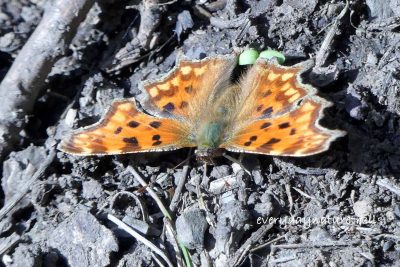
23/03/20-First Comma sighting

Since ‘lockdown’, the range of my outings has been much less than it would be in ‘normal’ times, restricted for now to the woodland I can easily access and wander around. Here I meet only the occasional local dog and their walker using the Public Footpath en route for the wider spaces of the reserve, and as we’re pretty well behaved up here, everyone so far has carefully observed the distancing rule. Tricky at times on these narrow tracks!

The walk, or more like meander, that I’m describing today is a ‘mash-up’ of two outings I took in the last week of March, during the spell of lovely Spring-like weather we had when it was sunny and warmish, and the skies were clear dark blue. Although I didn’t go far at all, there was a lot to see and now I know where to see it, I’ll be following a similar pattern in my meanders to check on the season’s progress.

Eristalis pertinax (f)

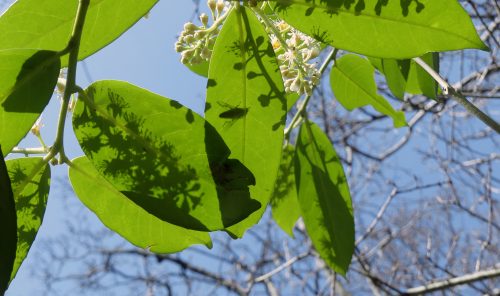
The first part of my path into the woods is dominated along one side by overgrown Cherry Laurels. They are reminders that this was once a shady woodland walk within the grounds of the grand house that stood here, long demolished and replaced much less grandly by flats, in one of which I live. The shrubs, or now small trees, can seem dark and gloomy, but they’re in flower now, lit up with candles of heavily-scented creamy-white blossoms offering up nectar to earlier-emerging insects. On bright sunny days like today, light shining through the leaves creates shadowy reflections of the flower spikes and gives away the presence of hoverflies enjoying basking on their sun-warmed platforms.

A few metres along the path I reach a patch I know to be a ‘hot-spot’ for insects. I’ve always been slightly mystified as to why it’s such a magnet for them, but I think it’s for a combination of reasons. Firstly, we’re almost 100m above sea level here, on the side of a wooded hill that that faces more or less South. A break in the line of Laurels exposes the view down the steeply-side slope, revealing there are very few large trees for quite a distance down, which has created a version of a woodland clearing. Shrubby trees have taken advantage of the space and light and filled the gaps, creating an understorey jungle of Holly, Hawthorn, brambles and of course ivy.

On the other side of the path is another patch clear of trees, about a metre wide, with a retaining bank or perhaps an overgrown wall, at its back. I wonder if this spot was deliberately created as a view point in the old garden and if a seat would have been placed here. It would have been a lovely spot to sit for a while. Facing more or less South, now it gets the benefit of full sun until about midday, after which trees begin to shade it out, but likely there were less then. With less impediments the view would have been across to the other side of the valley of the wooded hills with sloping green meadows. It would have been more peaceful too before the advent of the busy North Wales Expressway running along the length of the valley bottom!

All that I imagine was once here is long gone and the space has slipped into a somewhat scruffy, scrubby strip of rough vegetation that has become a great spot for the peaceful contemplation of an array of insects from early spring to late summer. Today there were a number of large hoverflies, Eristalis pertinax or Tapered Drone Flies, mostly males but there were one or two females too. They were flying briefly, zooming mainly from one sunny resting place to another.

Eristalis pertinax (m)
Hoverfly-Eristalis pertinax (f)

One or two Buff-tailed bumblebee queens flew in low over the vegetation, zooming then off up into the woods; perhaps they were still seeking a good spot to nest, or maybe carrying pollen to stock up one already made. Another emerged briefly, then crawled back under leaf litter and disappeared from view. A Common Carder Bee queen emerged briefly from beneath dry leaves but quickly crawled back and I had a similarly brief view of a Tree Bumblebee. It will be interesting later on to see if there are signs that all, or any of them have made nests here

Bombus pascuorum-Common Carder Bee queen
Bombus pacuorum-Common Carder Bee (queen)

There were other insects too, a number of different species of flies, which I’m working on being able to identify, so maybe more of them in a future post, and the first of one of my favourite insects, a Bee-fly Bombylius major. They look cute and furry, but are actually a sneaky predators of hard-working mining bees.

A Wild Cherry tree marks the far end  of this patch and is now almost in full blossom and looking beautiful against the deep blue cloudless sky. The flowers offer another source of nectar to insects, particularly to bees.

A bit further on, where the path gets steeper for a way, I stopped to listen to a Wren singing and tried to find him. I caught a glimpse as he was perched on a thick branch a couple of metres above the ground, which I was happy with. I love these tiny little birds with loud voices that completely belie their size, and they’re not always easily seen. As I stood a pair of Jackdaws flew into a tree nearby. This is the first year I’ve seen Jackdaws this far up the hill and never in these woods before. Their nesting stronghold is the cliffs of the Little Orme, and then there are others further down the hill towards the village centre that gather around the roofs of houses throughout the winter, but until now our quieter, leafier part of the village hadn’t seemed to appeal. Then a couple of weeks ago I spotted a pair visiting the bird feeders in the garden next door and last week was surprised to see a pair perched together in a tree in the woods not far from where I was seeing them now. This has to be the same pair, and they clearly feel at home, as now they were gathering sticks to make a nest.

Most nests constructed from sticks look a bit haphazard and maybe a bit untidy, but birds such as corvids and of course Wood Pigeons are actually quite selective in their choice of twig. The Jackdaws were carefully scanning for one that looked right, which they then snipped off and gave further inspection. If they were still happy they carried it away, those that didn’t pass muster were dropped to the ground.

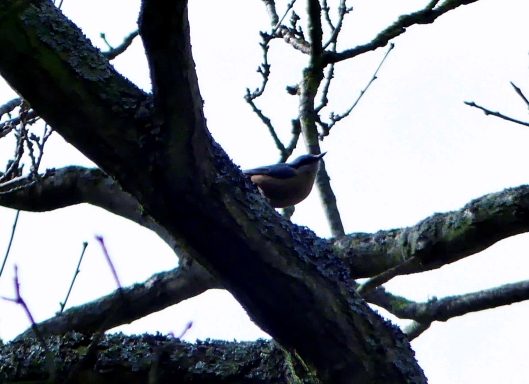
As so often happens when you stop to watch one thing, something else comes in to distract your attention. I spotted more movement high in a tree further back from where the Jackdaws were and it came back to me that I’d spotted a Nuthatch on that tree last year and had hoped it might be planning to nest in the hole there. I was sure some bird had worked on the hole though as it was perfectly round and its edges looked fresh. Maybe a Great Spotted Woodpecker had made it? But there were no further developments and as far as I know it remained empty.

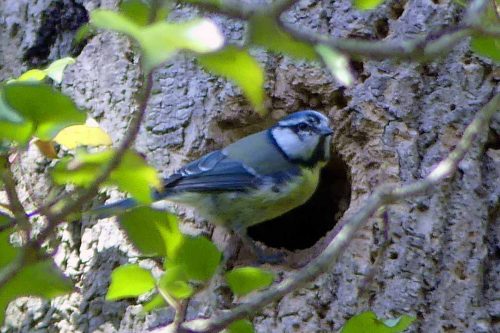
Checking out the hole today was a tiny Blue Tit. Surely it wasn’t contemplating it as a nest site? The hole is way too big! None-the-less it was in and out and pecking around it as though checking its possibilities, but I think it more likely it was just foraging for insects.

I had another surprise flash of déjà-vu  when I got a better look at the Blue Tit; it’s one with a distinctive face pattern, different to the norm, with a white streak in its blue head cap and blue speckles in its face; one I’m sure I recognise as having seen in this very location last year.

Moving on I reached my next insect ‘hot spot’. Completely different in character to the last one, this is a little higher up and at the junction of two well-trodden paths. Still South-facing the downward slope is again open and missing large trees, some of which have succumbed to storms in recent years.

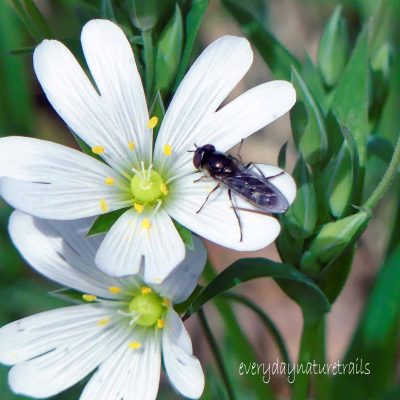
200323-1208-BEWP- (148s)-Platycheirus albimanus (f)

Platycheirus albimanus (f) on Greater Stitchwort

Two days ago I was standing here watching a small black hoverfly on the Greater Stitchwort flowers and from the corner of my eye I saw what I took to be a dog coming down the path towards me. I was preparing to move 2 metres further on as I thought to let its owner pass, when from behind the big Sweet Chestnut tree on the corner of the junction, trotted a Fox! Equally taken by surprise, for a split second our eyes met and we both froze, then it spun to its right and ran away beneath a Yew tree. Amazing! What a lovely animal. From now on I will always think of that path junction as ‘Fox Corner’.

A gorgeous Peacock butterfly landed on the ground in front of me. Another first species sighting of this year.

25/3/20-1st Peacock sighting
Peacock
Peacock


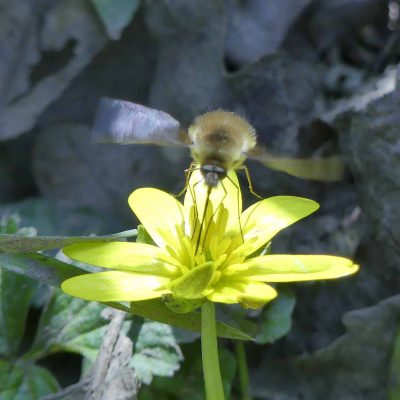
Bee-fly on Lesser celandine

In this spot last year there were mining bees, and where there are mining bees, prowling predatory nomad bees and as before-mentioned, Bee-flies. I supposed that the presence of several Bee-flies here today indicated that they had recently emerged from one of last-year’s mining bee nests. They are fascinating insects to watch.

More about Bee-flies and their relationship with mining bees here: Tawny Mining Bees & the Bee-fly


Bee-fly Bombylius major
Bee-fly-Bombylius major

Orange-tailed Mining Bee-Andrena haemorrhoa

I had a good look around for signs of mining bees and eventually spotted just one feasting on a celandine. It’s difficult to tell from this photograph, but based on what  little I’ve learnt about these tiny bees and help I’ve had with identifying others found in this locality, it’s likely that this is an Orange-tailed Mining Bee.

Carrying on down the path I’m reminded of how much evergreen foliage there is here. In this photograph and just a little further back there is Holly, Ivy, Yew, Evergreen/Holm Oak and Spurge Laurel. I still can’t wait for fresh foliage though.

By its nature, a wander has no shape to it, so I can’t describe a trail to you as I often do, and to appreciate one fully takes a particular mindset. They are not for the impatient walker with an aim in mind, or for those whose idea of birdwatching is to see one and tick it off a list!

200323-1056-BEWP- (34)-Larch Tree-top laden with tiny cones

Larch-Larix decidua

This is typical of how things go with me: I’m wandering along the path in the photograph above and remember that the other day I noticed for the first time that one of the trees growing at the side of this path is a Larch, not a common tree here. So, as one of my aims this year is to try to identify as many of the different species of tree in this patch of woodland as I can, the tree is in my mind as one to investigate further. Larches are deciduous of course, but is this one, full of cones at the very top, but altogether very dry and brown-looking, alive or dead? Just before I reached it I noticed what I thought was a large branch that had fallen from said Larch, so I detoured slightly onto another path to get a better look.

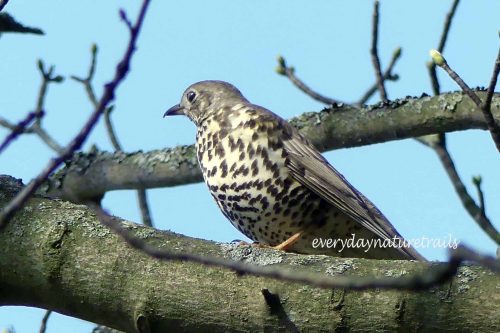
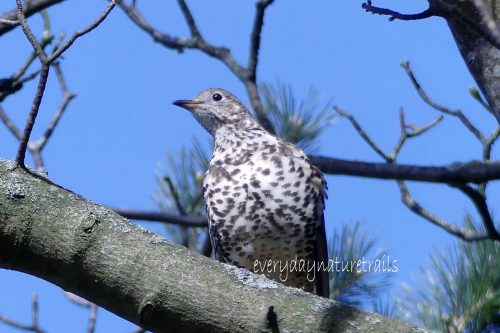
As I was photographing (for future refence) the cones still attached to what is actually a whole, if skinny dead fallen tree, I spotted a bird fly onto the branch a few trees back from where I was standing. I knew straightaway that it was a Mistle Thrush and grabbed a quick snap in case I didn’t get another chance. I moved forward slowly to get a better look and although it had clearly seen me it stayed put. They are handsome birds, their upright posture giving them a strong confident presence, but they are also wary and always on the alert.

Their colouring and arrangement of their markings is highly effective when it comes to camouflage, sitting perfectly still in dappled shade they blend in perfectly.

After a few minutes I realised that the thrush had no plans to move far, which led me to think that it may well be nesting somewhere nearby. Mistle Thrushes are early nesters, so this could have been the male of a pair keeping watch over his nest and territory. The bird moved further back again, towards what I think of as the Pine Grove, where a dozen or so tall, wind-contorted Scots Pines are gathered at the edge of this patch of woodland where it meets an open field. Perfect Mistle Thrush nesting territory.

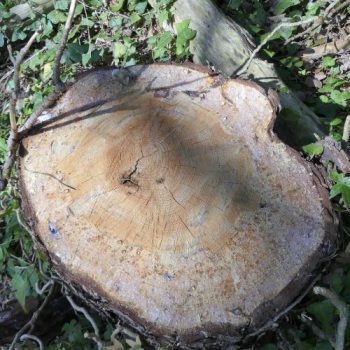
I thought I’d hang around for a while to see if the birds might give me a clue as to where the nest was. I headed for this sawn Scots Pine tree stump as a likely place to sit, but realised just in time that it was oozing beads of resin, so it must have been felled recently. I didn’t sit on it. Counting the rings from my photograph later on I reached somewhere around 60. I wondered why it had been felled as its wood looks quite strong and healthy.

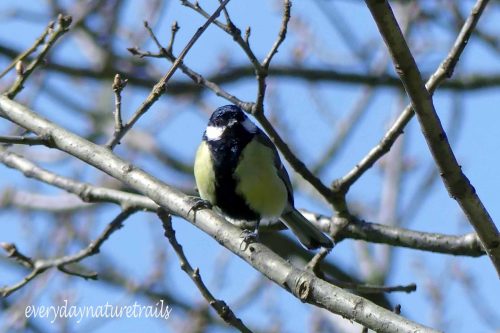
This small patch of the woods is a favourite place of smaller birds too, especially tits and particularly Great Tits. While I was standing still I was treated to a song by the strongly-marked male above. I’m sure I photographed him last year, he’s quite distinctive, or is that heavy black genetic? I had lovely views of two Long-tailed Tits foraging up around the trees and along the field fence.

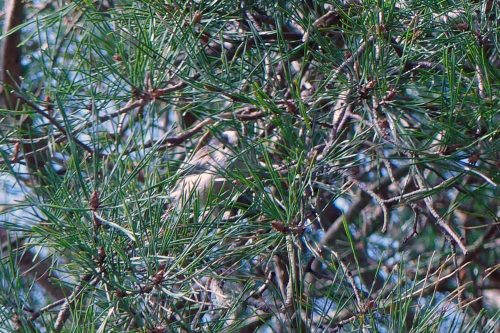
I was hoping to get at least a glimpse of a Nuthatch here, a few days ago there were a pair flitting about here exploring the top branches of the pines; I took a photograph, but  facing into bright sunshine it’s not great, but a record at least. I could hear a male calling persistently and loudly, but try as I might, I couldn’t locate him today. Finding singing or calling birds in trees is definitely not my strong point.

200319-1341-BEDC- (31a)-Nuthatch- 1 of 2 - in Scots Pine

19/3/20 – Nuthatch

Meanwhile, the Mistle Thrush had flown up to a tree branch and sat in full and open view with his chest feathers puffed out, making him look a completely different shape and much bigger; from a distance he looked a bit like a female Sparrowhawk. He was still fully alert though and quickly dashed out when a kafuffle broke out around a neighbouring tree. A Magpie had flown in and perhaps deliberately, must have got close to the nest. I assume the female had been sitting on it and launched herself at the Magpie, which was screeching loudly. Both Mistle Thrushes went on the attack, also calling loudly and saw the Magpie off. Peace resumed and the male went back to his perch, re-fluffed his feathers and sat quietly once more.

I’d been standing still in one spot for a good few minutes, then as I turned to continue along the path I was on to head back home, this lovely little Treecreeper flew onto a pine tree almost right in front of me. It spent a while exploring the bark of the tree, probing into crevices with that long slim wickedly-curved and pointed beak, moving around and slightly up before flying across to another one that had ivy growing up it.

200325-1235-BEWP-(175s)-Treecreeper
200325-1236- BEWP-(178s)-Treecreeper

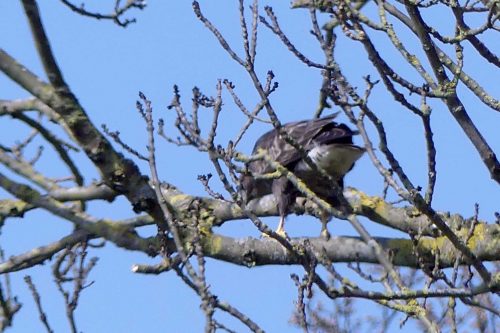
Between watching the Mistle Thrush and the Treecreeper I’d stood and looked over the fence to see if there was any sign of Buzzards there. Two days ago I’d spotted one circling low over the trees here, that had flown in from across the valley. It was joined then by another and they both flew out over the field, circled around, high and low, then both landed in the big tree in the corner of the field. They didn’t stay for long, but I’m really hoping that they were prospecting for a nesting site and that they might choose one close by.

Today it seemed there were no Buzzards to be seen, but then, just as I was walking away one flew in low over the trees. I turned back and walked quickly back to the field edge where I saw it had landed on a tree branch. It was hunched over and peering down intently….

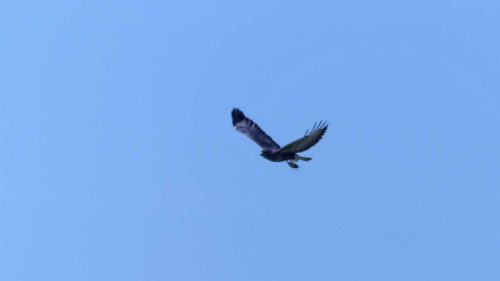
…..then it launched itself from its perch, flew low over the grass and dropped suddenly. It  had landed behind a hillock near the top edge of the field so I couldn’t see it on the ground, but it soon took off again and as it flew in my direction I could see it had something gripped in the talons of one foot. I couldn’t get in close enough to make out what it was, and my photograph doesn’t help with whether it was live prey or carrion. It was interesting that it carried it away too and didn’t eat it where it found it, which made me wonder if it was intended for a mate? Buzzards don’t usually lay till late April, so maybe a bit early for that. Another of life’s little mysteries.So much seen in a small patch of woodland and because I spent longer in each spot I feel the quality of my sightings was good too. Staying away from the main Reserve, where I would have expected to have met more people meant I hadn’t got close to my usual target of 5,000 steps, indeed, I hardly made it to 1,000! But if I’d continued as I would normally have done I’m sure I would have missed a lot of what I saw today. I’m looking forward to more restricted wanderings in the days to come.

Stay safe!


Share this:

  • Share on Facebook (Opens in new window) Facebook
  • Share on Pinterest (Opens in new window) Pinterest
  • Share on X (Opens in new window) X
Like Loading...
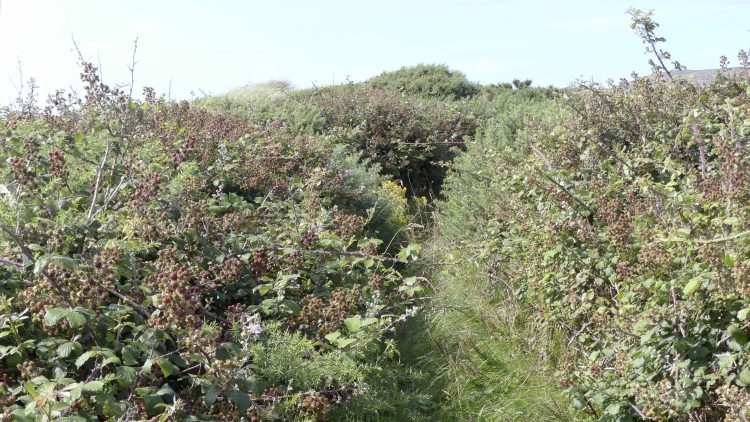
Wild and Windy on West Shore

22 Thursday Aug 2019

Posted by theresagreen in coastal habitat, Nature of Wales, Walking, Wildflowers of Wales, Wildlife of the Wales Coast Path

≈ 14 Comments

Tags

Blue Lettuce, coastal wildflowers, Duke of Argyll's Tea Plant, flowering in August, late summer wildflowers, Llandudno, North Wales Wildlife Trust, seashore, West Shore

August 19th

On Sunday, the North Wales Wildlife Trust held their annual August “Go Wild” event at  Llandudno’s West Shore. From the outset a powerful wind brought a truly Wild element to the proceedings, but the sun shone, it wasn’t cold and better still, it didn’t rain! And we’re a hardy and resourceful lot here in North Wales, so marquees, stalls and games were battened down and sheltered behind a windbreak of cars, big NWWT vans & the minibus all parked bumper to bumper, Wild West Wagon style. All well worth the effort as it turned out to be a really successful and enjoyable day, well-attended by a good number of interested and enthusiastic people of all ages.

Having volunteered to guide a Wildlife Wander on the day I’d done an advance recce on Thursday afternoon of the route I had in mind to get an idea of what we might see  and to take photographs that I wouldn’t have chance to do out with a group of people. It was windy then, but even more so on Sunday, so seeking some shelter from it, and in consideration of some young, tiny but very game wanderers we made a bit of a deviation from the original plan, but happily still managed to see most of the species of wildflowers I’d noted on Thursday, plus a couple I didn’t.

August 15th

Sunday’s wander would set out from our pitch next to the Children’s Playground on the Promenade, but at just past two o’clock today, although it was sunny, a strong wind was blowing and as it’s very open and exposed here I started further down, closer to where the dunes begin. A well-used path starts from Trinity Crescent, passes behind the buildings on the site of the Miniature Railway and travels in a fairly straight line to join the Coast Path through an open, grassy area.

On first impressions, this may appear to be an unkempt wasteland but a lot of wildlife loves such habitat and it’s always well worth closer inspection. This particular patch is home to a great variety of wildflowers, which then attracts insects and if you’re lucky, birds too.

Common Mallow-Malva sylvestris-Hocysen

Some wildflowers are tall and so abundant that you can’t fail to notice them, like Common Mallow. It’s currently in full bloom and full of pretty pink-purple flowers  hoping to catch the attention of any passing pollinators.

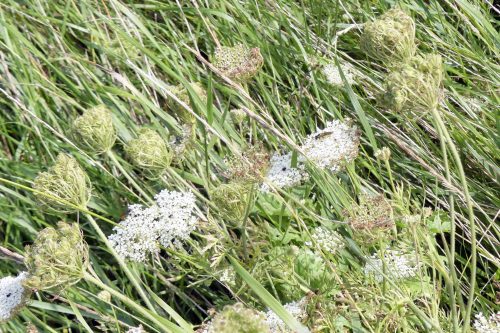
Between stands of Mallow there’s less showy Wild Carrot, largely finished flowering now and setting seed. This is one plant that is definitely in its favoured habitat- rough grassland, on chalky soil and by the sea. It’s a white umbellifer that’s more distinctive than most, as in the centre of the flowerhead is usually a single red-purple flower which is thought to mimic a fly that then attracts insects to assist pollination. After flowering the long umbels fold upwards and inwards to contain the seeds in a sort of cage.

Wild Carrot-Daucus carota-Moron y Maes

I saw an insect on a flowerhead and tried to photograph it, but as you can see the wind was blowing it all over the place and I couldn’t focus on it properly – when I checked the photograph later I saw it was a Sawfly – Rhogogaster viridis. 

190815-LLWS- (30s)-Wild Carrot flowerhead
190815-LLWS- (9b)-Sawfly-Tenthredo on Wild Carrot

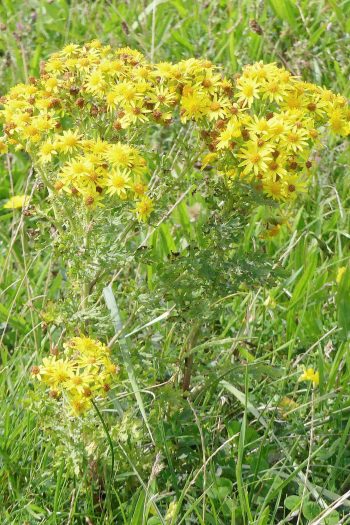
Ragwort-Senecio jacobaea-Creulys lago


There’s a good number of Ragwort plants, many of which were being visited by bees. Most of those I saw were Buff-tailed Bumblebees; big and strong enough to fly between plants on a windy day, although even they weren’t going far.

I checked a lot of plants here looking for the black and yellow caterpillars of the Cinnabar Moth-Tyria jacobeaea, but there were none that were obvious.


190815-LLWS- (20)-Buff-tailed Bumblebee on ragwort
190815-LLWS- (15)-Bumblebee on ragwort flowers

Another abundant flowering plant is Soapwort, which has been left undisturbed and has formed some impressively large patches. It’s in full bloom now and a mass of pretty sugar-pink flowers.

Soapwort-Saponaria officinalis

Bees seem to like these flowers too.


The green leaves and stems of Soapwort were once crushed and boiled in water to make a lathery liquid that was widely used to wash wool and woollen cloth. For that reason it was often grown in fields and gardens close to woollen mills, and the plants growing in the wild today are often found close to places where wool was once woven into cloth.  


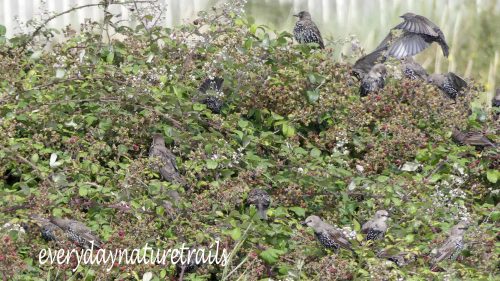
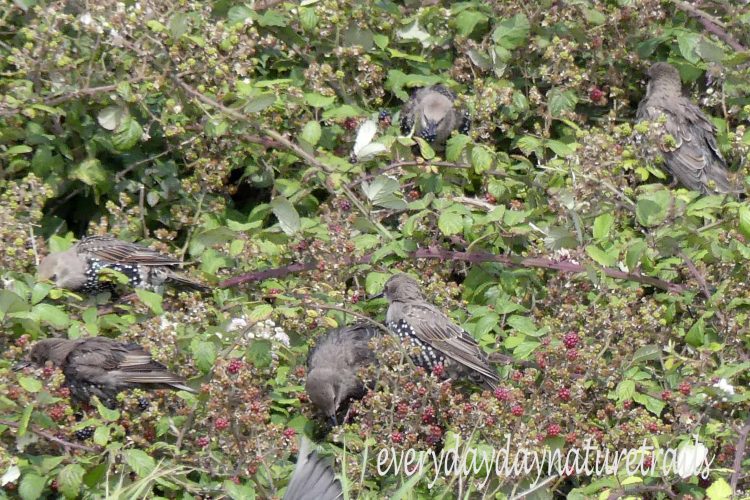
Across the grass at the far end, in front of the Blue Café and next to the entrance to the Miniature Railway is a big tangled bramble bush and my attention was attracted there as a cheerfully noisy flock of birds flew onto it. They were Starlings, most, or maybe all of which I think were juvenile birds, their plumage largely brown with black breast and underparts black with clear white spots.

Common Starling-Sturnus vulgaris-Drudwen

They were clearly enjoying feasting on ripe blackberries.

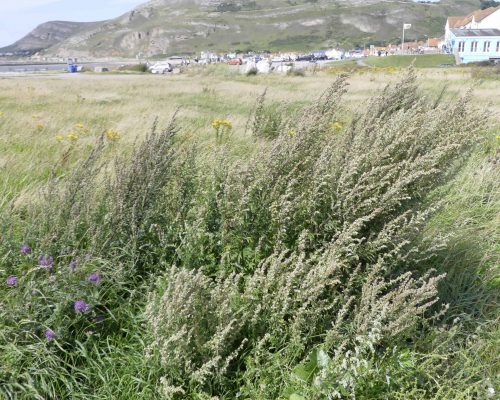
The path leading to the sea is open and exposed to the elements, so plants need to be tough to succeed here. Mugwort is one that both survives and thrives here, it’s not an especially attractive plant to look at, but it’s well adapted to its environment and it also produces aromatic oils, a device to protect itself from being eaten by grazing animals. On Sunday, the general consensus of those that rubbed leaves and tested it was that’s it’s scent is not particularly pleasant, but then it is supposed to repel midges, which may be handy to know….

Mugwort-Artemisia vulgaris

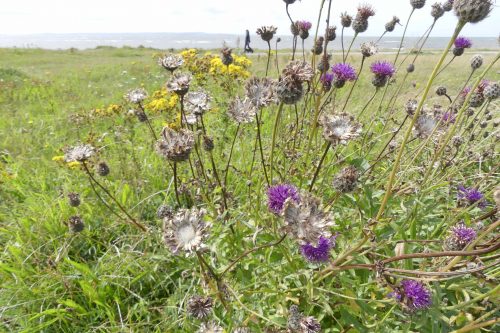
Golden yellow Ragwort and purple Greater Knapweed – the classic colours of late summer and early autumn.

In contrast to the Mugwort, Greater Knapweed is tough and lovely to look at – its open ripe seedheads are as pretty as the flowers.

Greater Knapweed-Centaurea scabiosa

Restharrow


In the grass there was Cat’s-ear Hypochaeris glabra and what was possibly a small  hawkbit – they’re tricky to separate at the best of times. Also small amounts of a white-flowered Common Storksbill, some Restharrow, White Clover, Pale Flax and the odd Dandelion or two were still to be found with flowers.


Where our path met the Coast Path was a lovely spreading patch of the yellow-flowered Ribbed Melilot.

Known as a plant of grassy places and waste ground, it seems to be perfectly happy growing in this sandy stony spot close to the sea.

Ribbed Melilot – Melilotus officinalis

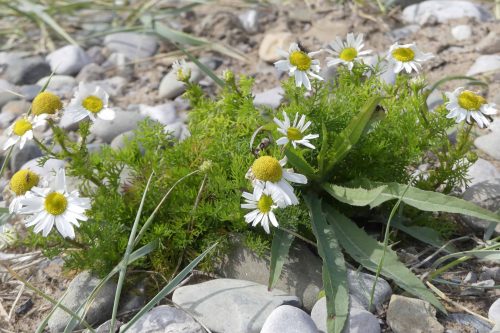
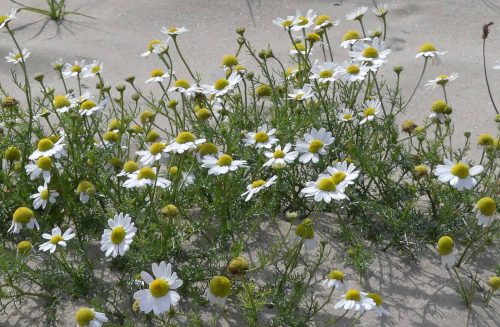
A more common and familiar plant is the Sea Mayweed, a plant of sand and shingle, it can and does pop up in a variety places near to the sea if a seed finds a spot it likes.

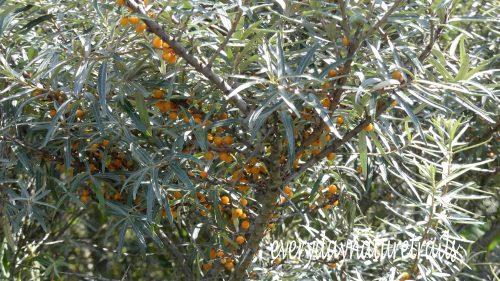
At this end of the path there’s a mass of Sea Buckthorn. This is a thorny shrub with silvery stems and grey-green leaves. It’s flowers are tiny and green and appear before the leaves in the Spring, but now it is now laden with heavy crops of bright orange berries.

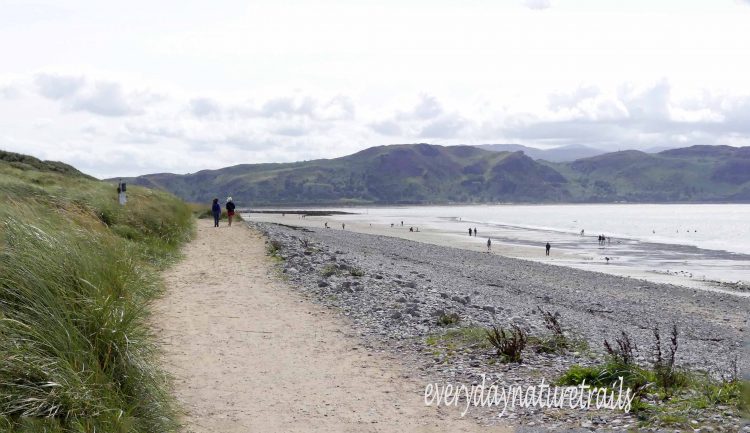
 From here the path, which is also a section of the Wales Coast Path, heads towards the dunes and Deganwy. The views ahead and across the sea to Anglesey and Puffin Island were surprisingly clear today, although there were rainclouds hanging over Snowdonia.

The wind had driven people trying to enjoy a day on the beach into the shelter of the dunes, some camped on the path, so I made a detour around them along the beach.

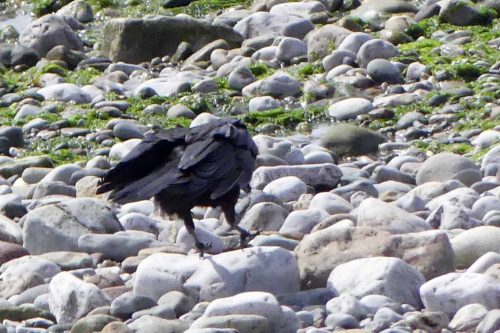
A wind-ruffled Crow foraged among the pebbles on the sea edge

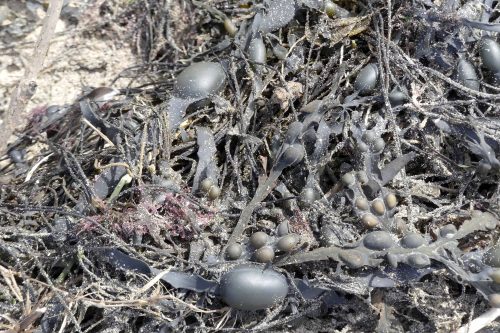
The strandline was strewn with piles of long tangled strands of seaweed: looking a bit like piles of brown spaghetti, this is Thongweed. If I’d been here spending a leisurely afternoon on the beach I would have had to collect some and plait it. In places it was mixed with other seaweeds that had also been wrenched away from their moorings on the submerged rocks.

Flitting around the drying seaweed there were a lot of little flies, perhaps unsurprisingly commonly known as Kelp or Seaweed Flies.

190815-LLWS- (66)-Fly amongst seaweed
190815-LLWS- (61a)-Kelp fly

I photographed a pile of mixed seaweeds which includes Thong Weed, Egg Wrack (the one with big bubbles), Bladderwrack (with smaller bubbles) and some of the reddy-pink Polysiphonia algae that is a parasite of Bladderwrack.

Reaching the stone seabreak I rejoined the dunes, passing a big clump of Sea Rocket, the only one of our seashore plants to have lilac-coloured flowers.

Sea Rocket-Cakile maritima


I love this viewpoint and find it difficult to resist stopping here, and not just for the view: it’s furnished with a semi-circle of cut-stone slabs with lovely tactile polished tops, but it was too windy to hang about for long today. I did stop long enough to photograph the spikily beautiful large Sea Holly plant growing on the edge of the dune below.

Sea Holly-Eryngium maritimum

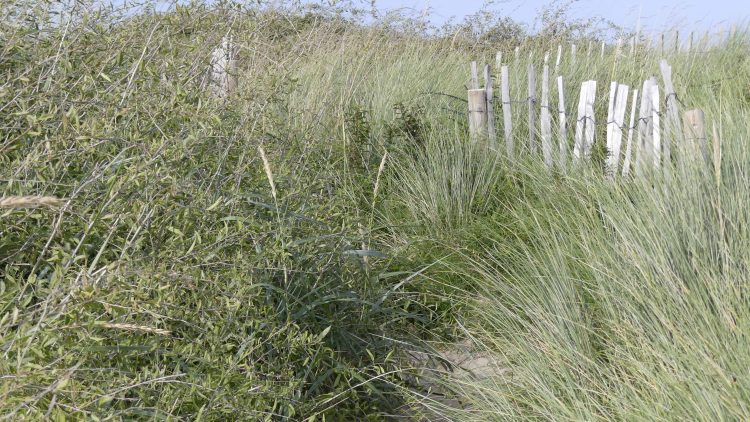
Onwards through the dunes the path was slightly sheltered from the wind, although you can see how the bordering Marram grass was being pressed almost flat against the dune and cliff sides.

Marram grass has ripe, or ripening seedheads now held on tall stems that sway stiffly in the wind. The view is quite clear over to Anglesey.

Marram – Ammophila arenaria

More Sea Holly and a very large clump of Sea Mayweed are flourishing in a sheltered spot.

The dunes end and there opens up the amazing view of the iconic Vadre at Deganwy and the mountains on the far side of the Conwy Estuary.

On the pathside Cat’s Ear is flowering and there is still quite a bit of Bird’s-foot Trefoil available to bees and butterflies, although all I saw today was a single Common Blue.

190815-LLWS- (96a)-Cat's-ear Hypocharis radicata
190815-LLWS- (97a)-Common Blue

Whilst photographing the Cat’s Ear I noticed an insect scuttling about and now and then entering holes made in the sand. Long and black, with a purplish iridescence to its wings and a very narrow ‘waist’, so likely a sand wasp, but I don’t know the species.

190815-LLWS- (86a)-Insect entering hole in sand
190815-LLWS- (91)-Insect 4a

More Sea Rocket, this time growing amongst the stones of the rip-rap. There were bumblebees nectaring on the windswept flowers.

190815-LLWS- (112a)-Sea Rocket
190815-LLWS- (114)-Bumblebee on Sea Rocket flower

On the cliff side of the path there’s more Bird’s-foot Trefoil and quite a lot of Restharrow still flowering.


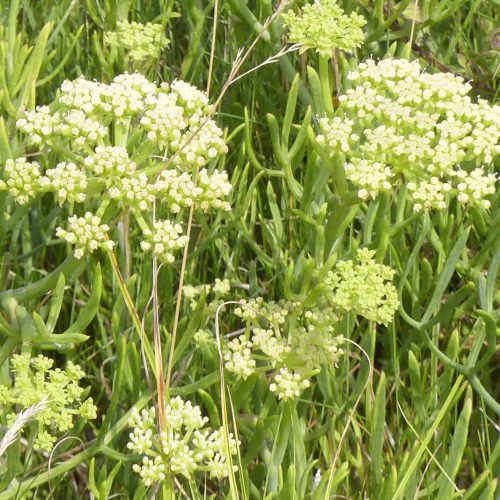
On the cliffside itself, there’s an impressive spread of Rock Samphire. This is our most distinctive yellow-flowered umbellifer and the only one with fleshy leaves. It grows only by the sea.


Rock Samphire-Crithmum maritimum

And more Sea Mayweed, almost buried by sand.

The path continues to curve around the bay towards Deganwy, but this is where I turned around to walk back.

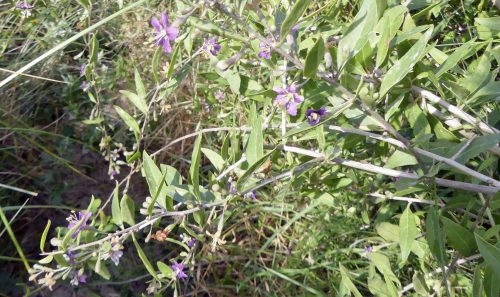
This point on the path is where I first saw the shrubby plant intriguingly named the Duke of Argyll’s Tea Plant. This member of the nightshade family with small purple flowers is not at all a showy plant, but it does have an interesting history.

The story goes that Archibald Campbell, the 3rd Duke of Argyll received this plant, Lycium barbarum together with a tea plant, Camellia sinensis from China in the 1730s. Unfortunately their labels got mixed up, so it was grown under the wrong name in his Middlesex garden and, presumably when the mistake came to light, it subsequently became known as the Duke of Argyll’s Tea Tree or Tea Plant. (From A Dictionary of English Plant Names by Geoffrey Grigson, London 1973.) 


The plant has been used in Britain since the 18th century for hedging, especially in coastal districts. Its red berries are attractive to a wide variety of British birds.


This view back along the path towards the Great Orme is wide and impressive and even better today as now the wind was behind me and the sun at a better angle to light the photograph! I retraced my steps a short way before taking the marked Public Footpath up the cliff, where it continues along the top of the cliff on the edge of the golf course.

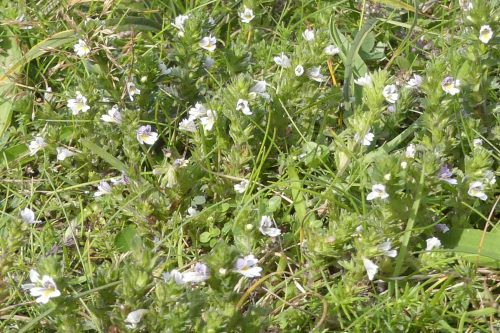
Amongst the grass where the path begins there was a pretty patch of Eyebright,

Eyebright-Euphrasia nemorosa

close by there was Wild Thyme, a smallish umbellifer I’m not sure about and one remaining flower on a Goat’s-beard plant.

mmm

And, at last – a Ragwort plant with Cinnabar Moth caterpillars!

Cinnabar Moth caterpillars
caterpillar of the Cinnabar Moth-Tyria jacobaea

The continuing path is narrow and leads through gorse, taking a brief rest from flowering now, which is taller than me. A prickly path, but well sheltered from the wind and very peaceful.


In parts gorse gives way to equally prickly brambles, some of which are reaching long stems out across the path.

Fruits are developing, a few of them already ripened into blackberries.

This feels like a ‘secret’ path and you never know what treasures you might discover here. In a sunny spot between the banks of brambles, two Gatekeeper butterflies were chasing one another, then settled to bask on leaves. Nearby they were joined by a big Drone Fly.

190815-LLWS- (154)-Gatekeeper butterflies
190815-LLWS- (163)-Eristalis hoverfly

There are a surprising number of wildflowers to be found along here; still with some flowers there was Wood Sage

Wood Sage-Teucrium scorodonia

and Yarrow, which was attracting small black flies, at least one pair of which were mating.

190815-LLWS- (157)-Yarrow with flies
190815-LLWS- (159)-Small black flies mating

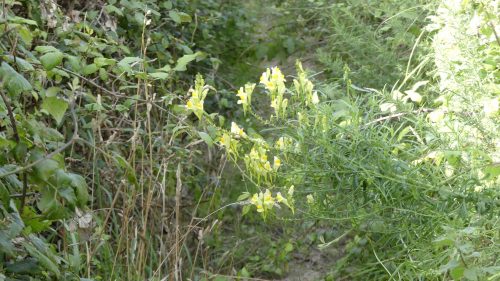
With little room for manoeuvre a large Toadflax plant, grown tall and leggy, had leaned out across the track

Common Toadflax – Linaria vulgaris

it was full of flowers and in this sheltered spot was being investigated by a bumblebee.

190815-LLWS- (167)-Toadflax flowers
190815-LLWS- (169a)-Bumblebee on Toadflax

Another plant with mauvy-blue flowers had also grown long and straggly and was leaning out over the path searching for light – I thought at first it was Michaelmas Daisy, but the flowers’ centres were blue, not yellow – I had to wait till Sunday to be pointed in the right direction to identify it after seeing it again then!

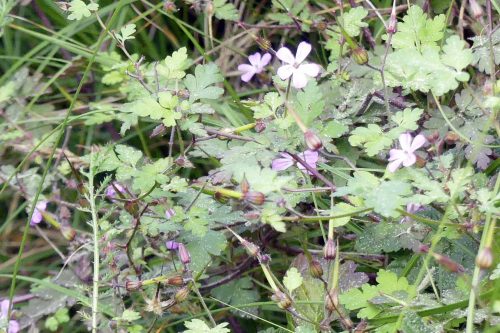
There’s quite a bit of Herb Robert here too, there are still a few flowers but most have finished and the beaked seedheads show the plant to be one of the cranesbills. Even in this sheltered spot plants still get showered with sand.

Herb Robert-Geranium robertianum

As well as Blackberry brambles there are also Dewberries. These fruits are similar to blackberries but the segments are bigger and they are covered with a bloom, a bit like a plum is.

Dewberry-Rubus caesius-fruit
190815-LLWS- (177)-Dewberry flowers

The path emerges back out onto the top of the dunes where the vegetation is dominated by Marram, brambles and a lot more Duke of Argyll’s Tea Plant.

I found a plant that shows off the leaves and flowers quite nicely.

Duke of Argyll’s Tea Plant- Lycium barbarum

There was a little more Ragwort here that was being visited by a Meadow Brown Butterfly.

At this point you can either take a path that leads back down through the dunes to the beach or carry on along the open path around the golf course. I took the latter, hoping to find a few more wildflowers to add to my list.

Apart from a bit of Traveller’s Joy amongst Marram and brambles, there wasn’t much to see that was still in flower, but I did find a small amount of Lady’s Bedstraw, a single Bloody Cranesbill flower, and a few Harebells to finish off with.

Bloody Cranesbill
Bloody Cranesbill
Lady's Bedstraw
Lady’s Bedstraw
Harebell
Harebell
Traveller's Joy
Traveller’s Joy

On Sunday, as I already mentioned we took a slightly different route to avoid the wind, but we did see most of the wildflowers that I’ve photographed or named above, which totals to some 40 or more species, and added a couple more. We also found lots of ripe Dewberries and a Cinnabar moth caterpillar on some Ragwort, saw a few bumblebees, but didn’t see a single butterfly.

Pellitory-of-the-Wall

One wildflower that I should have recognised on the day but that was growing in an unexpected place so had become long and straggly (my excuse!) was Pellitory-of-the-Wall.

And there was a lot  more of the blue-flowered ‘mystery’ plant from Thursday’s walk, which turns out to be a rather rare plant in the UK known as Blue Lettuce, or Russian Blue Sowthistle – Lactuca tatarica. I didn’t have time to take good photographs as the group were moving on, but fortunately the one below was good enough for a friend who had seen the plant here herself and researched it, to give me a clue! She later kindly forwarded me the following info from the UKwildflowers website, which is a direct quote:

Blue Lettuce-Lactuca tatarica

Known at this site from at least 1963, this introduced plant is also known as Russian Blue Sowthistle. It grows very close to the shore in dunes not far from a car park and is well established now on nearby cliffs. Flowering in late summer it provides an unusual display of many blue/purple flower heads.
L. tatarica is known from very few separate sites throughout England, the Isle of man and the Scillies. This appears to be its only site in Wales, there is none to be found in Scotland and only one site in western Ireland. 


Share this:

  • Share on Facebook (Opens in new window) Facebook
  • Share on Pinterest (Opens in new window) Pinterest
  • Share on X (Opens in new window) X
Like Loading...

The Difference a Tide Makes

17 Thursday Jan 2019

Posted by theresagreen in Birdwatching on North Wales coast, coastal habitat, Coastal Snowdonia, Local Nature Reserves, Nature, Nature of Public Places, North Wales, Saltmarsh habitat, Wildlife of the Wales Coast Path

≈ 2 Comments

Tags

bird behaviour, Black-headed Gull, conservation grazing, Curlew, ducks and geese, dunlin, flocks of birds, Glan y Mor Elias Nature Reserve, Llanfairfechan, Oystercatcher, pintail, ringed plover, roosting birds, shelduck, teal, Traeth Lafan, Turnstone, wigeon

January 6th

We’ve had a strange winter thus far, so perhaps I shouldn’t have been too surprised by today’s bright sunny morning, but now I just had to get out and enjoy it. Sunday is not my favourite day for heading to places I know are going to be busy, but I was very tempted to repeat yesterday’s walk on a sunny day. Recently my visits to Traeth Lafan at Llanfairfechan have been at times when the tide has been low, so before deciding to head there I checked the tide times and saw that high tide there would be at 10:36 am, so that settled it, I was going back to see what a difference the influx of water made.

 LLANFAIRFECHAN 

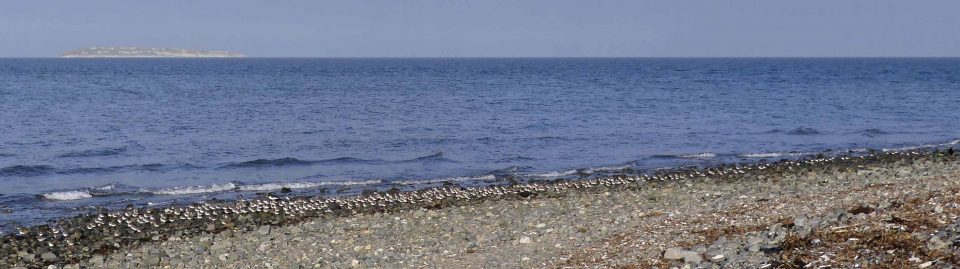
10:24- I’d timed my arrival perfectly; almost simultaneously with me reaching the Promenade and looking over the sea wall a flock of small birds flew in and landed neatly, like a ribbon unfurling along the stony sea edge. I am always impressed with their timing and precision, each bird dropping neatly into place only centimetres away from its neighbour. There were an impressive number of birds here, at a rough count around about 200 and strung out in a line so long it was difficult to get them all into the same frame. (click on the image to enlarge it)

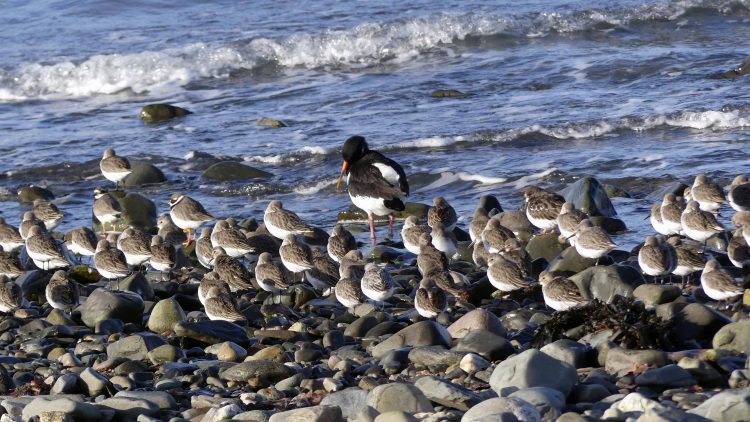
A first glance gave Dunlins, looking tiny next to the Oystercatcher that must have been startled to find itself suddenly surrounded by incomers; I wondered if perhaps the flock leaders had made it their landing beacon.

Dunlins, Ringed Plovers and a single Turnstone surrounding an Oystercatcher

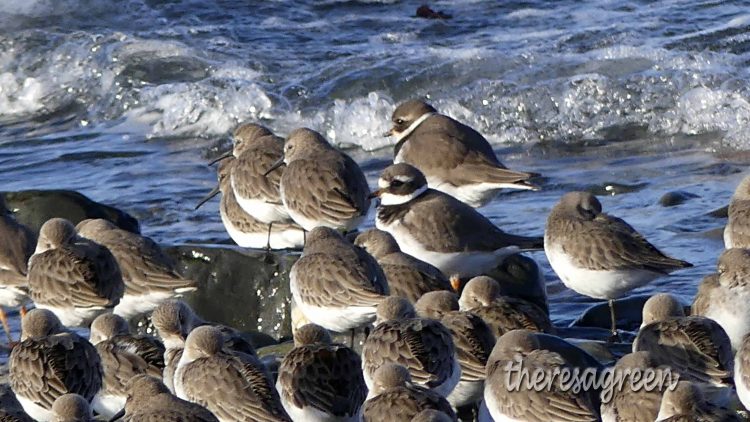
Within seconds of setting down many of the birds had switched to rest mode, tucking heads down and one leg up. They were just a few metres away from where I stood and I zoomed in on a small group for a closer look, realising then that there were similarly-sized Ringed Plovers amongst the predominance of Dunlins.

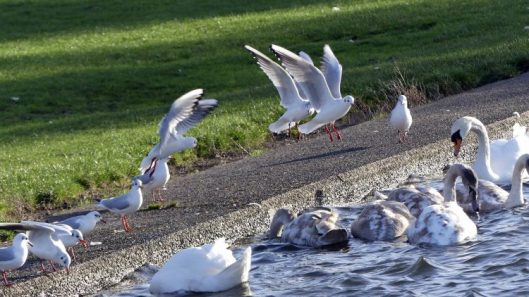
I was momentarily distracted from watching this peaceful scene by the cries and sounds of frantic flapping behind me. A gang of Black-headed Gulls were swooping down towards the edge of the lake where the Swan family had gathered to feast on food thrown in to them by a visitor.

The gulls had no hesitation in diving in amongst the Swans, not at all intimidated by the much larger birds. 

Turning back to the flock of little waders I sought out more Ringed Plovers.

These birds breed here and I could see both adult and juvenile birds, some of which I could see were ringed: I wondered if they’d been born and raised here. There were ringed Dunlins there too.

10:30 It took a while to get to the end of the line, but when I finally reached it I was happy to see the tail-enders were a flock of Turnstones.

Turnstone- Arenaria interpres

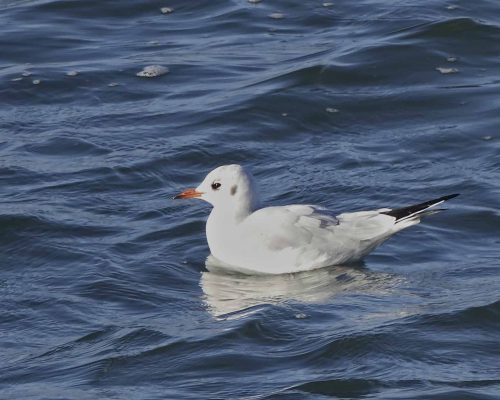
I could have stood and watched for longer, although the birds were resting, so not doing much, but I reminded myself that I wanted to make it round to the Oystercatcher roost before the tide turned and they all disappeared, so I tore myself away. Another Black-headed gull floating around on the sea caught my eye – I’m checking them all out in case one turns out to be a Little gull, which sometimes turn up along this coast. They look similar in winter plumage, both species having similar dark face patches, but the Little gull also retains a dark spot on its crown which this one didn’t have.

Black-headed Gull-larus ridibundis

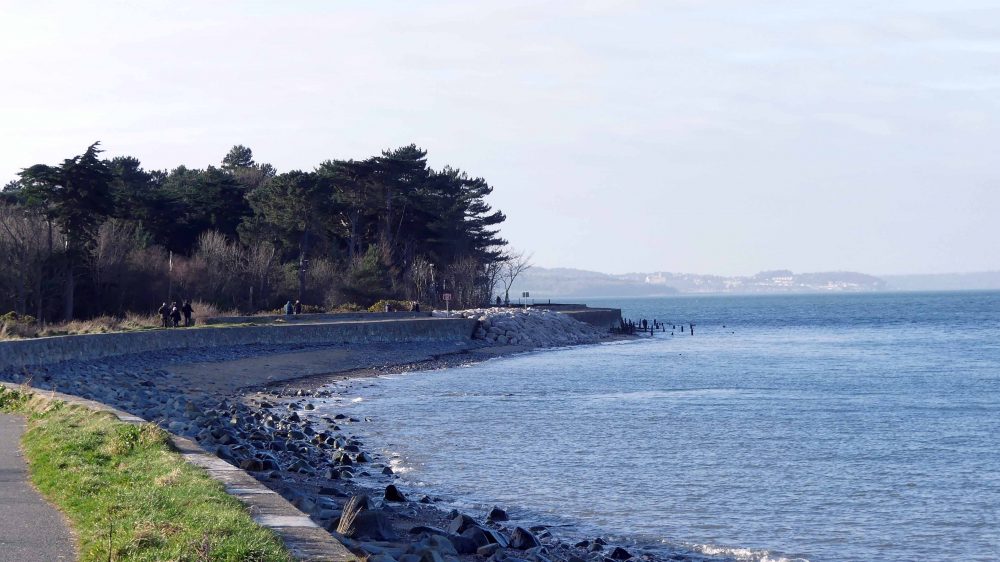
10:38- It really did feel like a completely different place here today. The sunshine and lack of wind made it feel almost warm (the car temperature gauge had said 10º); the tide was high, the sea was blue, calm as a lake and completely covered the sands. It was still quite early, but there were people strolling along the Prom, not speed-walking with heads down against the wind like yesterday. Almost everyone I met smiled and spoke in greeting. 


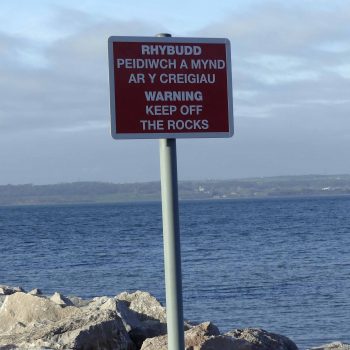
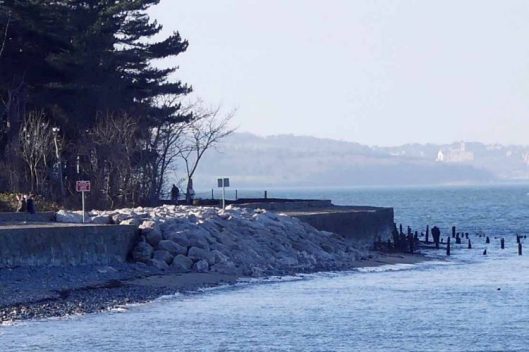
I must have been doing the head-down-not looking-where- was-going-thing myself yesterday as I failed to notice the pile of huge rocks (rip-rap) that has been piled up and over the sea wall on the corner where the path bends round by the trees. I probably only noticed it today as I spotted the bi-lingual warning signs.

10:46-Almost at the end of the paved section of the path I see a distant flock of birds take to the air; something had disturbed and upped the Oystercatchers from their roost. 

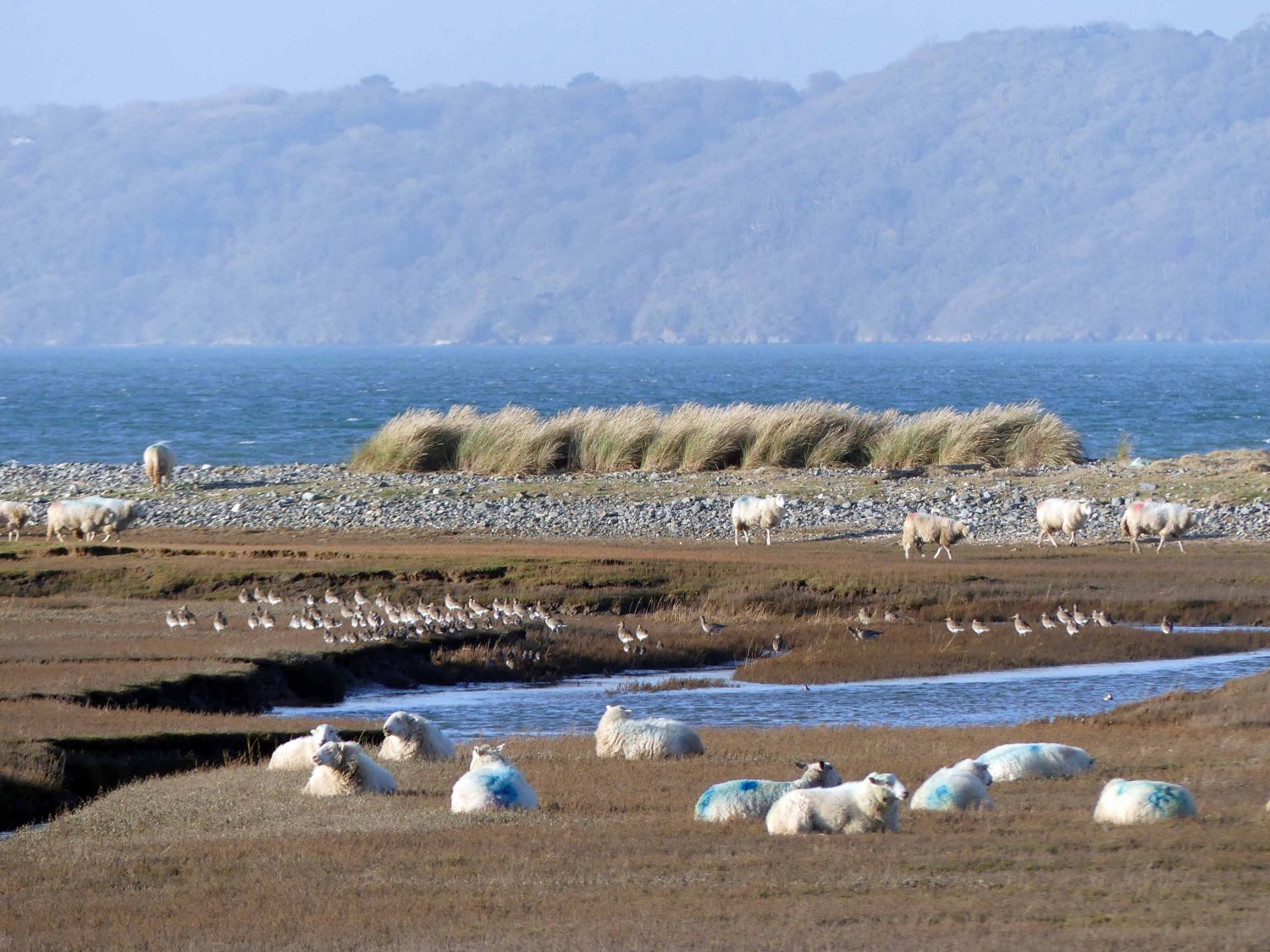
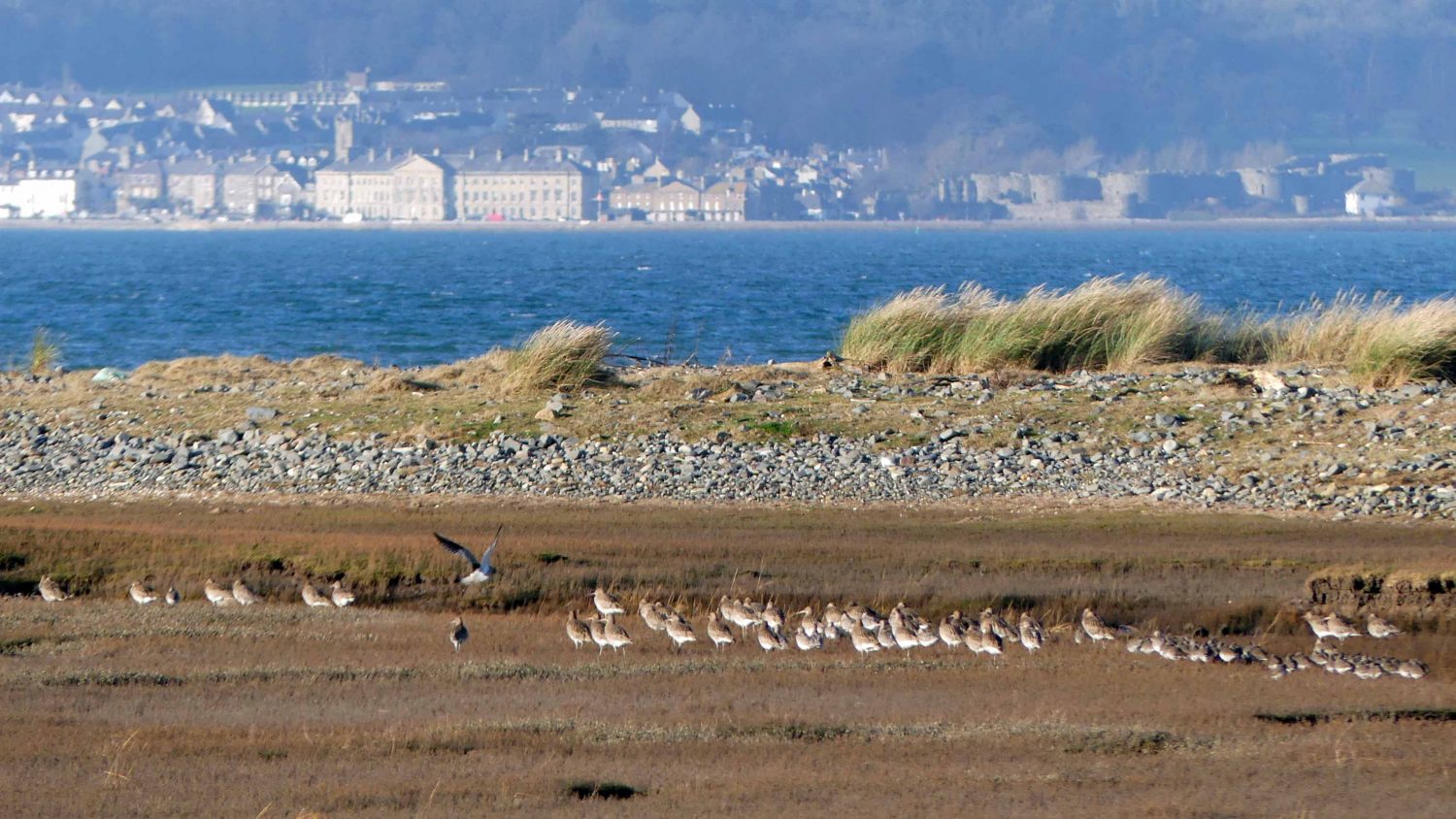
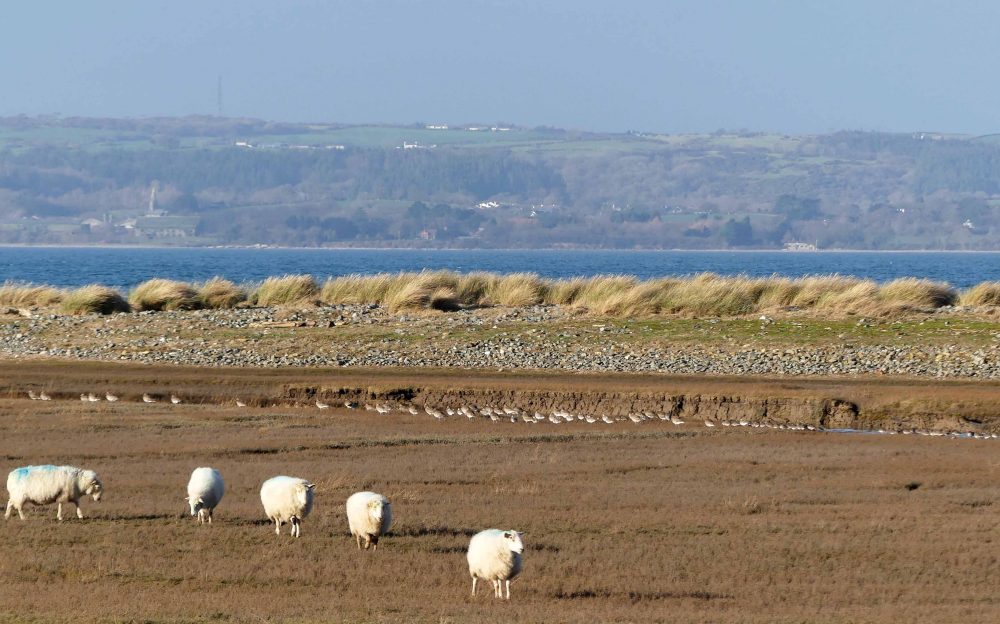
10:48- I try not to dwell on what may have disturbed the birds and concentrate on the scene before me; grazing sheep behind a line of resting birds. Although distant, from the size and colour of them they could only be Curlews. 
10:50-Zooming in on them confirmed they were indeed Curlews, mostly lined up along one side of a deep channel of water. I smiled when I saw the next photograph and saw the two sheep standing face to face looking straight into the albeit-distant lens. It looks like one is whispering in the other’s ear.

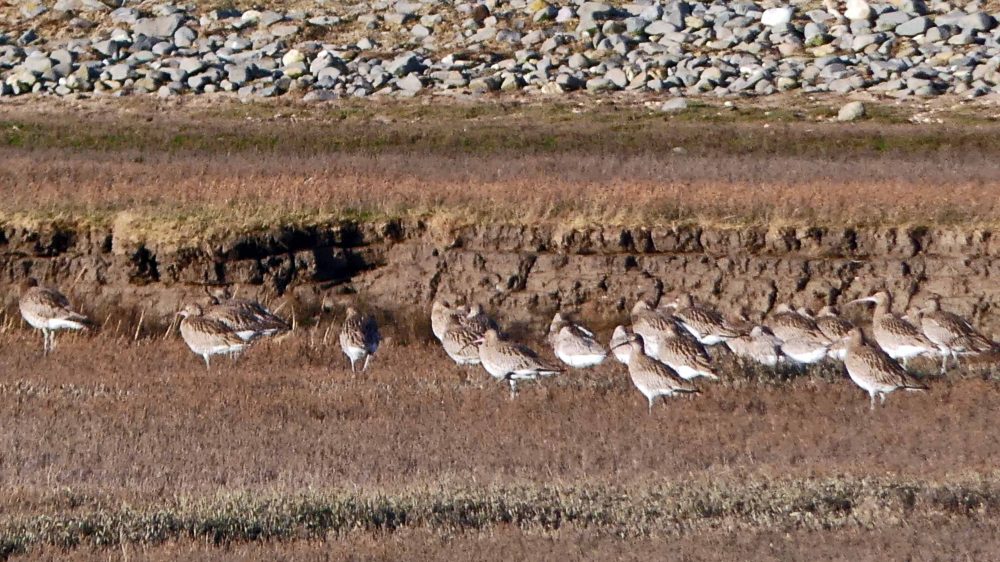
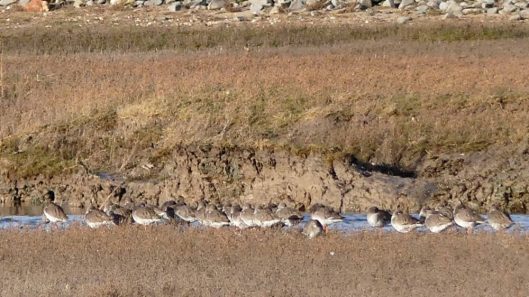
I got onto the wide grassy track leading through the saltmarsh which forms one bank of a deep water channel, filled now by the high tide, which took me slightly closer to the birds. The majority of the Curlew were standing, all facing in the same direction with their backs to the water. They weren’t in a tight pack, but rather in small groups or standing alone; I reckoned there were around 40 birds. From this better vantage point I could see that there was a flock of Redshanks there too, standing behind the bigger Curlews and nearer to the water: they too were all facing in the same direction.

The sheep were travelling away, some were sitting down.

The birds are not far from the edge of the Menai Strait; the view behind them is of Anglesey and the town is Beaumaris – you can see Beaumaris Castle in the right of the picture.

A closer look at the Curlew shows most are standing still but not roosting with their heads tucked down. Perhaps these are the ones charged with keeping alert to spot potential dangers.

More of the Redshanks do seem to be sleeping.

The sheep are moving on.

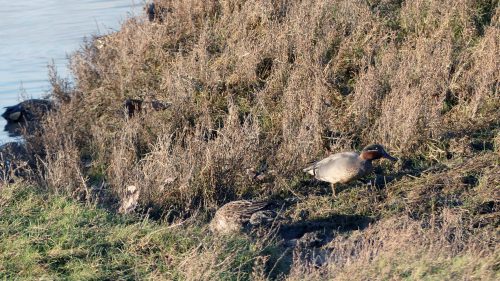
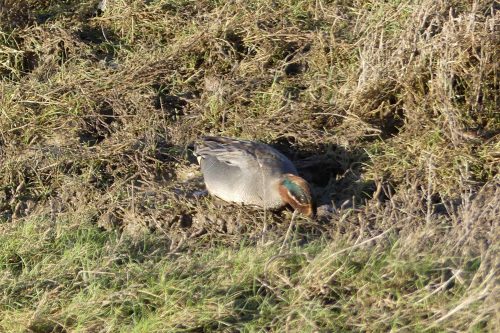
10:58- I spot a pair of Teal rummaging around in the long grass on the far side of the channel I’m walking next to.

The male drake was probing the mud with his bill, digging it in deeply; I didn’t know they did that.

Another pair were foraging along the bankside from the water.

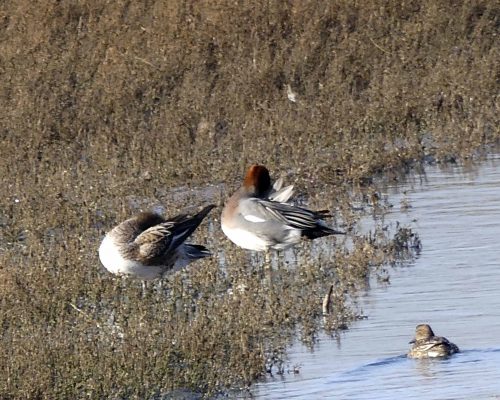
11:01-Across the other side of this channel stood a pair of Wigeon.

They had a good long look around them to make sure it was safe before getting down to preening.

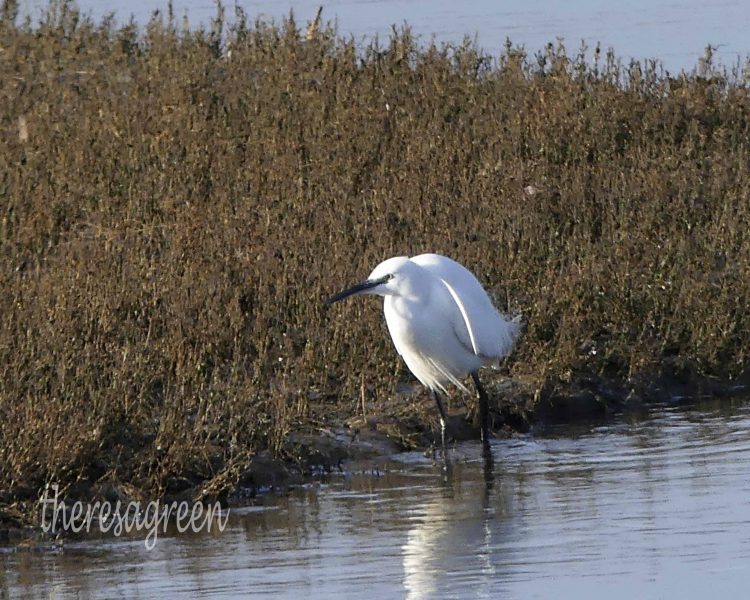
11:02-A Little Egret flew in and landed in the water close to the Wigeon.


The egret stepped out onto the bank, watched by a Redshank.

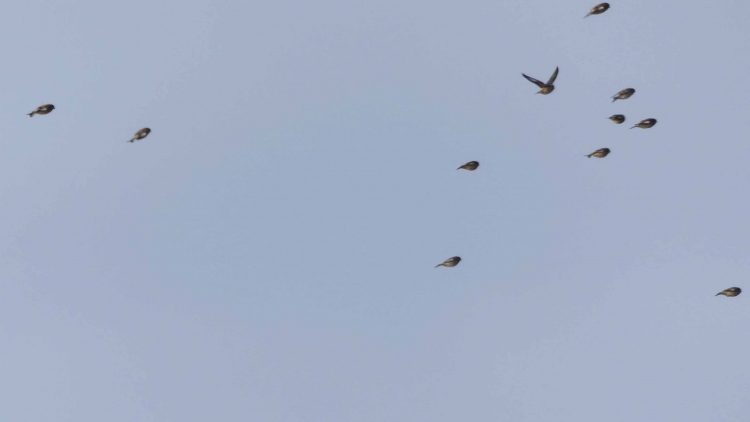
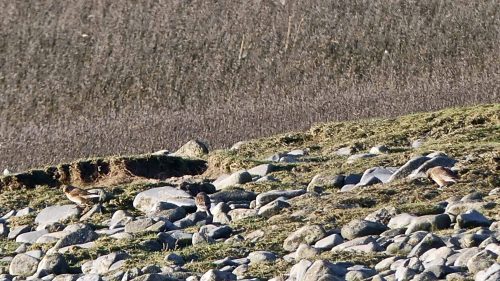
11:06- A small flock of finch-sized birds passed overhead, twittering as they flew and landed on a patch of small rocks and pebbles. Exactly what Linnets do, which is what they were.

Linnet flock in flight

They are difficult to see amongst the stones.

Linnets favour stony ground

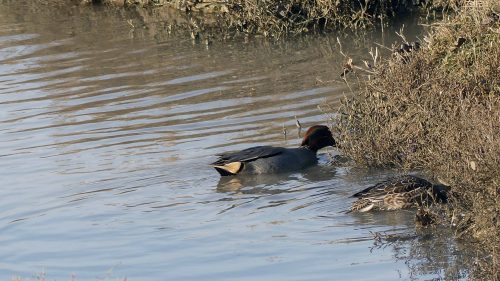
11:10 I have a good clear view of a pair of Teal, their colours in the sunshine showing as they should be.

Teal duck
Teal duck
Teal drake
Teal drake

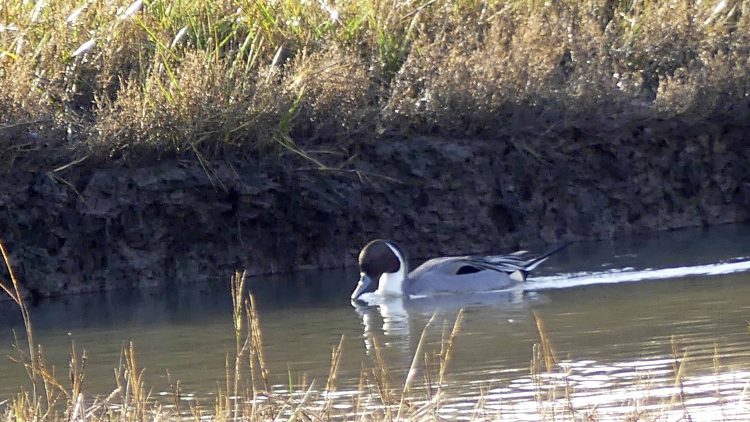
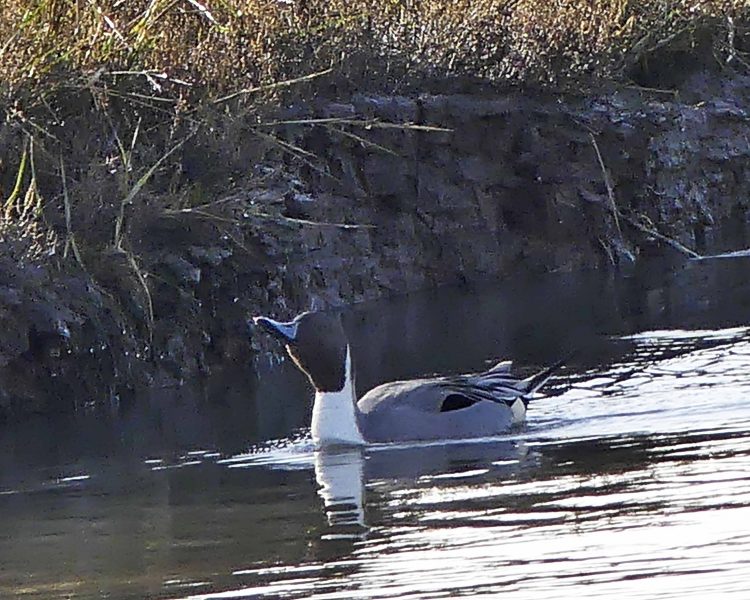
11:10- A larger duck was sailing along the edge of a channel. He was difficult to see properly as he was in the shade cast by a muddy bank and his dark colours weren’t standing out well. My first thought was Pintail – based solely on its overall elegant appearance and the shape of its tail, which as the name suggests is long and sharply pointed. Could I be that lucky? I had no idea as to whether they might be present here, so hoped the photographs I managed to get would be good enough to help me later.

Pintail-Anas acuta

Checking my reference books at home later on I’m happy my instinct was right and it was indeed a Pintail. I’m so chuffed to have seen it, albeit briefly.

The Welsh for Pintail is Hwyaden Lostfain

11:13- The view over the watery saltmarsh to the sunlit mountains was amazing.

To be continued…


Share this:

  • Share on Facebook (Opens in new window) Facebook
  • Share on Pinterest (Opens in new window) Pinterest
  • Share on X (Opens in new window) X
Like Loading...

A Bleak Day on the Saltmarsh

14 Monday Jan 2019

Posted by theresagreen in birds of Wales, Birdwatching on North Wales coast, Local Nature Reserves, Nature of Public Places, Nature of Wales, Saltmarsh habitat, Wildlife of the Wales Coast Path

≈ 9 Comments

Tags

Amber listed birds, Curlew, Glan y Mor Elias Nature Reserve, greenshank, Grey Heron, January, Llanfairfechan, mallard, mute swan, pibydd coeswerdd, redshank, teal, Traeth Lafan, tringa nebularia, tringa totanus, winter

January 5th

Not a great day weather-wise; from my window I could see cloudy grey sky and more than a breeze blowing through the trees. But I hadn’t been out for a proper walk for a while and after a wonderful but hectic family Festive Season I needed fresh air and exercise. And I had a fitness-monitoring, step-counting watch gizmo as a Christmas present that I was keen to try out. Sticking to my resolve to improve my duck recognition skills and knowledge I decided to go back to Llanfairfechan, which would be sure to fulfil the exercise and fresh air part and would hopefully have birds too. My target ducks for the day were to be Teal and I was hoping to improve on the photographs I took at RSPB Conwy a few days ago.

“There’s no such thing as bad weather, only unsuitable clothing.”

13:20 The car temperature gauge read 7°, and minded by Alfred Wainwright’s famous quote, I’d put on extra layers in anticipation of the cold, but a stiff breeze made the air that greeted me in the almost-deserted car park feel bitter: and worse, the café was closed! So no tea to thaw out with when I got back. For birds though, it has to be business as usual or starve, so there were the usual Mallards on the river and a few more on the grass; they and the Jackdaws were looking rather disappointed by the lack of human-donated titbits.

13:21 The Swan family was out sailing on the wind-rippled model boating lake.

The cygnets, if you can still call them that when almost fully-grown, are definitely no longer Ugly Ducklings, they have the size and grace of the adults and are turning white to differing degrees, which I guess must relate to the order they hatched in. They too are used to having food thrown to them by visitors and travelled towards me hopefully. I had nothing to offer even though they posed nicely for photographs.

Mute Swan – Cygnus olor

13:28 It felt cold there, but out from the shelter of the trees at the side of the lake the effects of the wind blowing into my face, it got worse. I met a few hardy souls making their way back, mostly dog walkers braving the elements for the love of their pets, but I almost had the place to myself.

1330: The tide was out but there were a few waders out on the sand close enough to see; a Black-headed gull, an Oystercatcher and a Redshank.

13:41 I reached the corner where the stand of trees gave a smidgen of shelter from the icy blast and stopped for a couple of minutes to look at the pine trees. They are very exposed to the elements here, but in the main they stand straight and tall and look to be a good age.

I think they are Monterey Pines – Pinus radiata, an introduced species originating from California that is probably the most widely planted tree in the world. It is characterised by having branches that radiate out from its trunk, hence radiata. The trees often has conspicuous cones that may fall or that sometimes remain on the tree for years. I must look for cones another day.

13:44 As always, the view over the slate-fenced green field dotted with sheep, with the hills and mountains beyond was beautiful, even on a dull cloudy day like today.

13:45 At the end of the Promenade I stopped again to take in the vastness of the view across the Menai Straits to the dark blue coastline of Anglesey.

 A lone Curlew stalking through shallow water seemed small and vulnerable out there on the expanse of sand, emphasising the bleakness of the day.

13:49 In the rough grass on the other side of the wire fence a small flock of lively Starlings were foraging and bickering amongst themselves as Starlings do.

Apart from the cheery Starlings, my first impression was that the saltmarsh was peaceful – and empty! The great flocks of Wigeon that were here a month ago are gone. I guess they’d exhausted the available food supply here and that most of them will have moved inland to fresh pastures. I’m so glad I got to see them while they were here and with luck thought there may still be a few remaining here to see.

Redshank

13:50 A Redshank, its bill half-covered with mud stood motionless nearby. It must be hard work for birds to find enough food to stay warm, let alone mobile on cold days like this.

13:51 As I said, my target ducks for today were Teal and I was starting to think they too had gone along with the Wigeon; then I spotted a pair swimming together along a water-filled channel. Against the background of the textured water surface they were a pretty sight and may have made a pretty picture if the light had been kinder. But at least I’d seen some and there could be more out there sheltering from the weather.

Teal drake & duck

13:52 Scanning along the channel for more ducks – I actually had binoculars with me today- I caught sight of a Grey Heron standing with its shoulders hunched up and its back turned to a stand of reeds. It was some distance away; in this picture showing the channel the Teal were swimming in, it’s the tiny grey dot on the right hand side, other side of the water just above centre and about an inch in!


It looked miserable; it’s plumage ragged and blowing in the wind and wings folded around itself like a cloak.Grey Heron – Ardea cinerea

I was distracted by some frantic and noisy wing-flapping coming from the muddy bank nearer to me. I felt a moment of dread, half-expecting to see a duck having been seized as prey by something, but it turned out to be Starlings who were dipping  into the water and flapping themselves dry. I couldn’t help thinking they must be hardy little migrants from Russia or Scandinavia or somewhere similarly cold, that water must be icy.

When the tide is out water drains back out of channels exposing the soft mud at the bottom.

13:59 – Thus far I’d not had much luck seeing birds, so I was more than happy to see another Redshank foraging on the side of an empty channel.

I’d rounded the bend in the track and was heading towards the Reserve boundary. The railway line runs through the middle of the photograph below and you can just make out the Expressway (A55) at the base of the mountain.  There were a few Mallards sitting on the edge of a muddy peninsular, more were sheltering below against the bank at the water’s edge.

Three more were hunkered down on top of a gravelly bank with their backs to the wind.

14:05 I’m happy to spot a pair of Teal resting on a muddy beach on the other side of the little peninsular where the Mallards sat.

A bit further along, higher up the bank I found some more.

The little flock was quite spread out, I counted about twenty that were visible, but there could well have been more nearby and further back.

14:08 A pair headed into the water, disturbing a bird already there that otherwise I may well not have seen. I thought for a minute that it may fly off before I’d had a chance to have a proper look, but it just gathered itself together and carried on stalking and scanning the shallow water for potential food.

Apart from having been engaged by the Teal flock, it’s not surprising I hadn’t spotted the wading bird by myself. The light was dull, the water grey, the mud a greyish-brown and the bird merged into all perfectly. I wasn’t holding out much hope of getting any really good images, but my thinking is that when you’re looking at a bird you don’t immediately recognise, take as many shots as you can and chances are some will be good enough to at least confirm an identification and serve as a record.

Greenshank – Tringa nebularia

As it happened I’d worked out what I thought it was as I focussed in on it. It must be a Greenshank, which are pictured on the information boards back at the beginning of the walk. This was the closest view I’d ever had of one though, and the first I’ve been able to photograph, but certain features rang bells: an elegant wader; long, slightly upturned bill and long legs that are as its name implies green. Although they looked more grey to me in this light.

The Welsh name for Greenshank is Pibydd Coeswerdd

In the UK Greenshank breed on the wild moorlands of the Scottish Highlands and Islands. In late summer and autumn they move south on migration, stopping to feed in marsh pools, on estuaries and rather less scenically, on sewage farms and are widespread in the south. Only a few birds remain in Britain over winter, mainly on the Irish coasts, so maybe that’s where this one is heading for. It’s not far to Ireland from here. It’s yet another bird on the BTO’s AMBER list because of breeding numbers and winter range declines. 
It’s moments and sights like this that make the effort of going out on days so worth it!

My favourite moment was when it was joined by a Redshank, which suddenly appeared from nowhere. I was so lucky to get the two related birds in the same shot.

Greenshank with Redshank

The bird carried on with its quest for food regardless of much bigger ducks entering the water nearby. I did wonder if they might be helping by stirring up the mud beneath the water and disturbing anything it may eat, like small fish or worms.
And to put the birds into scale and context within the landscape, this view shows the pool of water the birds were in, tiny specks just visible, and the adjacent bank where the Teal were roosting.

I carried on around the path to the other side of Shell Island and stopped just past the front of the bird hide of the Morfa Madryn Reserve. A few Mallards were resting in the rough grass and out on the gravelly sand; the pebbles may be hard but they’re mostly smooth and may have retained some warmth from the day’s scant sunshine. They gave me a focal point for the photograph too – I loved the zig-zag pattern and different shades and textures of the pebbles and grassy ground.

A few more were up and about foraging on the damp sand.

A Crow, that I’d hoped might have been a Raven, but wasn’t, was also hopefully patrolling the sand.

Once again I contemplated carrying on along the Coast Path for a while, but no, it was way too cold and windy for me to derive any joy from that today.

I took the more sheltered path back. On the scrubland gorse is coming into full bloom now, bringing a welcome and cheering touch of gold to the landscape. 

14:28 I had a closer view of the Heron walking this way. It was still in the exact same spot as before. It must have been sleeping.

The path ahead of me was unusually deserted.

Beyond the railway line Penmaenmawr Mountain, looking big, bulky and brooding.

14:45 I love the view across the Traeth. All you can see is the Pavilion, the café building, the Tower House and a stand of dark pine trees.  Promenade I see that there is only one person on the sands with a dog. At this time on a Saturday there would usually be a lot more. 

14:53  There were a few more birds to see on the way back; Oystercatchers, a Redshank, a Curlew and Black-headed Gulls out on the sand; and on the field side of the path a Chaffinch up in an ash tree and a Dunnock perched on the barbed wire fence.

I didn’t linger to look again at the Swans and other collected ducks and birds that were now gathered on and around the lake. I did wish the café had been open though.

Sightings for the afternoon: Grey Heron; Little Egret; Mute Swans; Teal; Mallard; Khaki Campbell; Oystercatcher; Greenshank; Redshank; Curlew; Black-headed gull; Herring gull; Carrion Crow; Starling; Dunnock

Not too many species today, but what was lacking in quantity was made up for with quality; the Greenshank was a real treat!

Oh, and I logged about 7.300 steps.


Share this:

  • Share on Facebook (Opens in new window) Facebook
  • Share on Pinterest (Opens in new window) Pinterest
  • Share on X (Opens in new window) X
Like Loading...

Wigeon in Winter

11 Friday Jan 2019

Posted by theresagreen in Birdwatching on North Wales coast, Coastal Snowdonia, Local Nature Reserves, Nature of Public Places, Nature of Wales, North Wales, Saltmarsh habitat, Wildlife of the Wales Coast Path

≈ 10 Comments

Tags

anas penelope, bird behaviour, ducks and geese, Glan y Mor Elias Nature Reserve, Llanfairfechan, maraca penelope, overwintering birds, wigeon

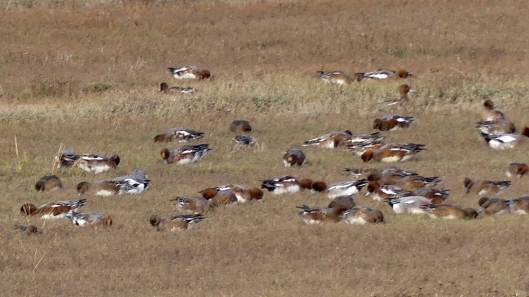
Wigeon are generally known as winter visitors to the UK, although in some places, mainly in Scotland and the north of England, some are established as resident breeders. The birds begin to arrive back in their wintering grounds in the British Isles as early as September. The influx continues through October and November and by December the BTO estimate that they number around 440,000 birds. They gather in spectacular vast flocks mainly in coastal locations, moving inland at dusk to crop the grass in fields and meadows, but some winter inland, in flooded districts and on large lakes and reservoirs. Highly gregarious birds; flocks of Wigeon hundreds strong rest by day on estuaries and mud-flats.

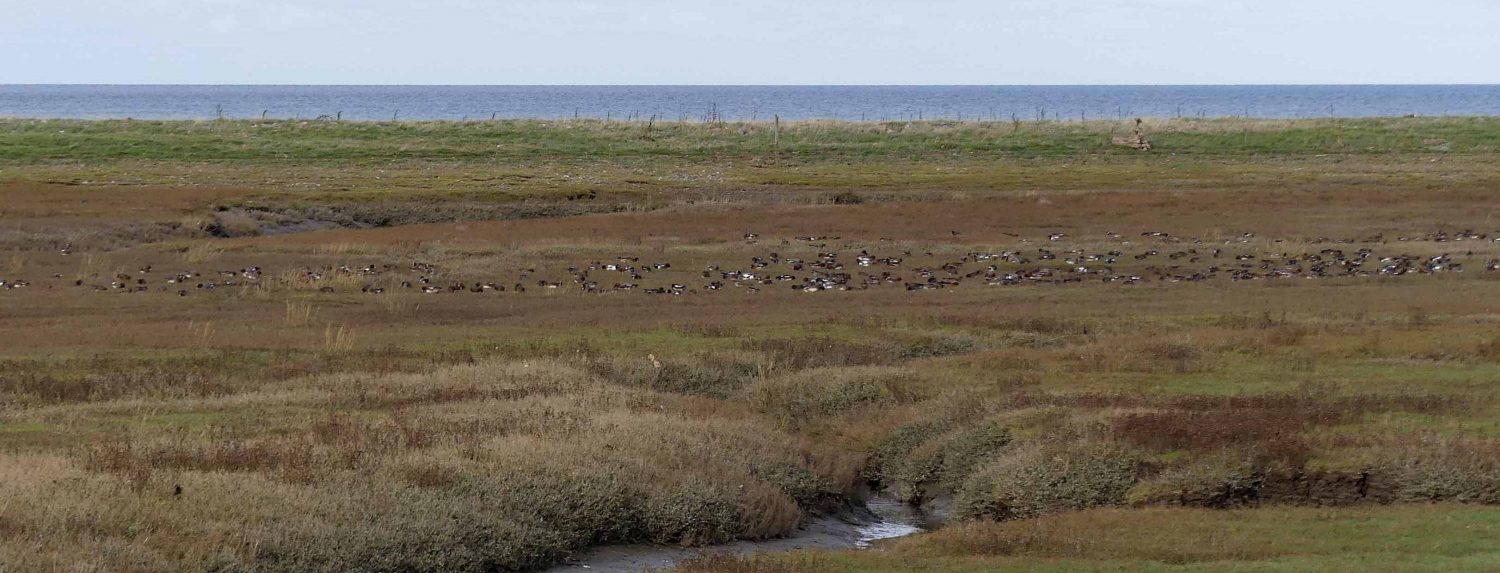
November- Large flocks of Wigeon gathered to graze on the salt-marsh at Llanfairfechan

Wigeon – Maraca penelope (previously Anas penelope) Welsh: Chwiwell

Length: 48 cm: Wingspan: 80 cm: Weight: M: 800 g F: 650 g

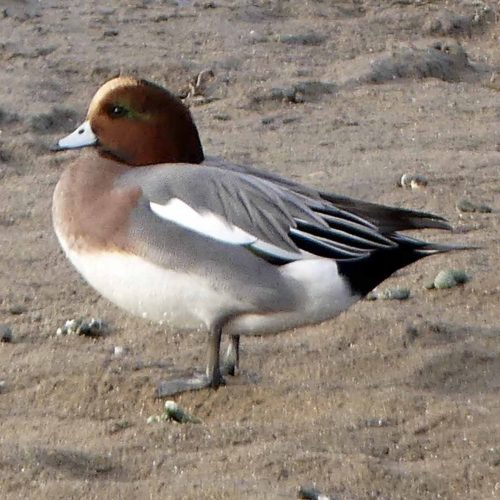
Wigeon drake

The Wigeon drake is one of our most handsome ducks. Medium-sized and distinctively shaped, the head is dark chestnut with a wide creamy yellow stripe extending from the base of his short blue-grey bill upwards between the eyes to the crown of his head. The body is softly patterned grey, the chest pinkish-brown, the underbelly is white and the rear end a contrast of black and white. The wings are pointed and in flight he reveals white shoulders and green wing patches. In eclipse plumage (June-October/November), the male resembles a dark female, but with the white forewing. Immature males lack the white shoulders of the adult.

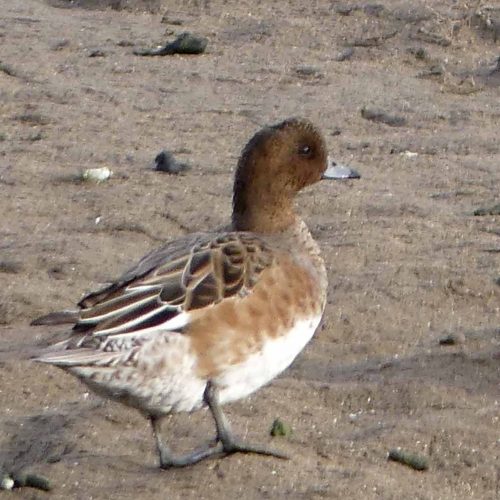
Wigeon duck

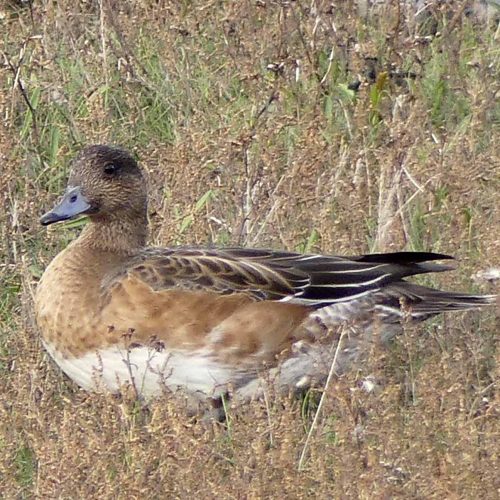
Similarly distinctively shaped, females are more subtly attractive, being more uniformly brown than females of other species. They are slimmer and have a more pointed tail than a female Mallard. As the male, they have a high forehead, but the head is a darker chocolate brown and the bill, still blueish, is smaller than the drake’s. Her back is patterned brown, she has a greyish-green wing patch visible in flight and a white belly.

Immature males lack the white shoulders of the adult


Wigeon are lively birds and the whistling of the drakes and low growling, or “purring” of the ducks, which don’t quack as other species do can often be heard when several birds are together.

181102-wigeon 7

DIET

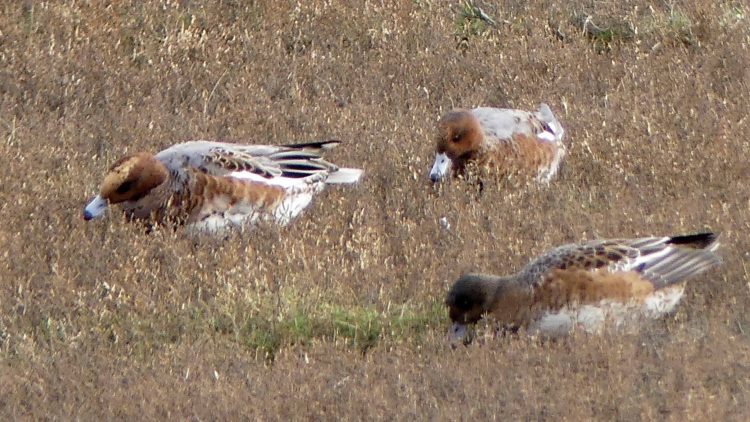
Wigeon are classified as dabbling ducks and are closely related to Mallards, Shovelers, Garganey, Gadwall, Pintail and Teal. But they are unusual amongst ducks as they spend much of their time out of the water, where they graze in waterside grassy areas, rather like geese. Wholly vegetarian, their diet consists mostly of leaves, shoots, rhizomes and also some seeds, which seem to be what those in the photographs above and below are stripping from the grass stems.

Wigeon grazing on grass

The ducks do spend time in the water where they also feed on waterweed, occasionally dipping ‘bottom’s up’ as their cousins do.

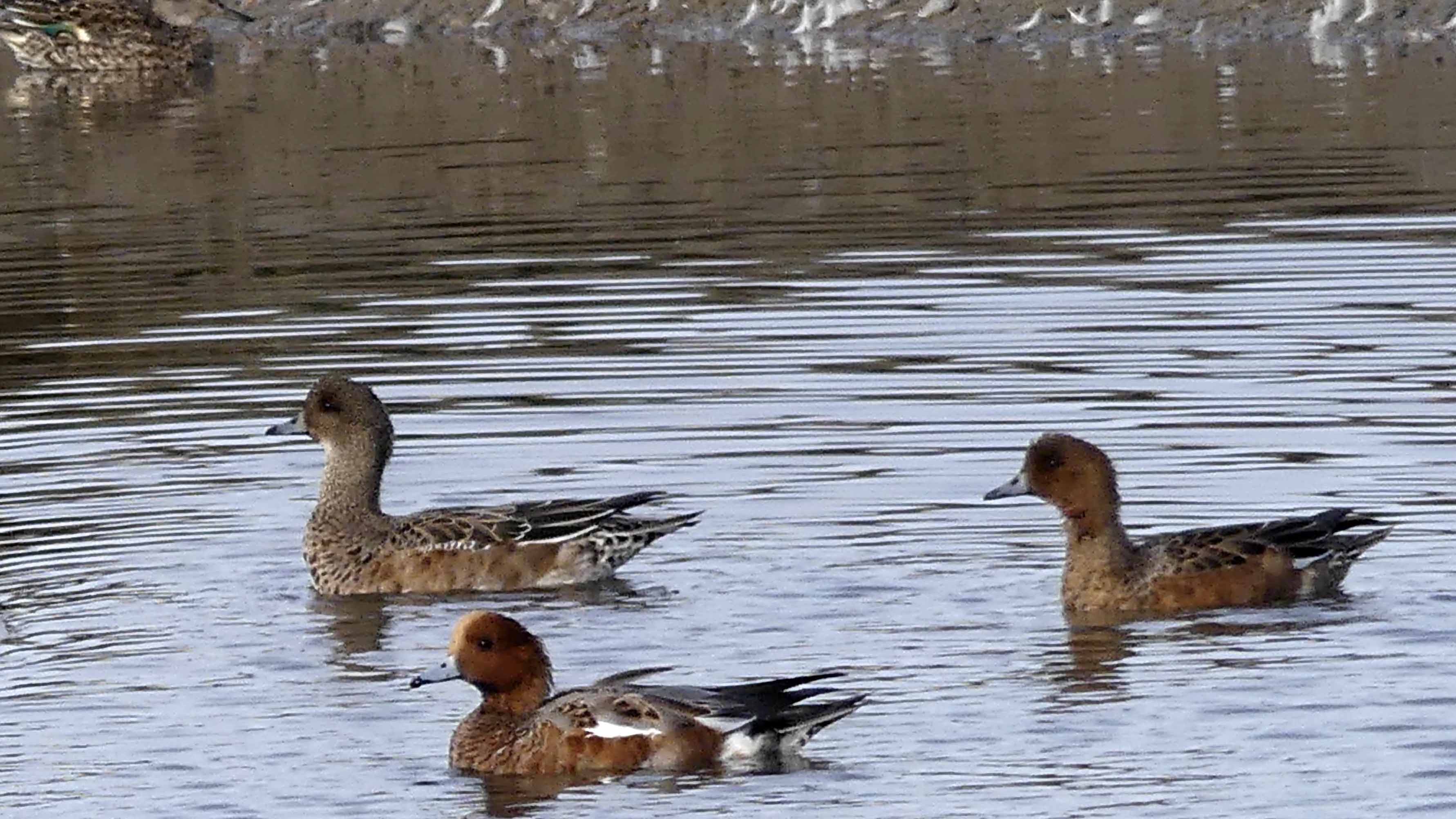
Wigeon male, female & juvenile

BREEDING

The first Wigeon’s nest found in the UK was in 1834, in Sunderland. During the early 1900s Wigeon were expanding as a resident breeding British species, but by the late 1960s this came to a halt and there was then no regular breeding south of Yorkshire. The habitats they favour for breeding are lochs, rivers and marshes, especially those in wooded countryside, although they do occasionally nest on coastal marshes. The BTO estimate there may be somewhere in the region of 400 breeding pairs, mainly in Scotland and northern England. Their habitual breeding grounds are in the far north, in Iceland and throughout a wide Arctic and sub-Arctic belt that runs west from Norway across Asia to the Bering Strait.

ETYMOLOGY

The scientific name for the Wigeon as given by the BTO is now Mareco penelope (prev.Anas penelope) The more recent name derives from both Brazilian Portuguese: marréco=a (small) duck and Greek: penelops=a type of duck. The RSPB and bird books show the previous scientific name of Anas penelope.

Wigeon have been recorded in the British Isles since the Mediaeval times of the 16th century. According to the eminent language expert Professor Walter William Skeat, the name was then spelt “Wigion”. In 1767 Gilbert White in his History of Selbourne recorded seeing “multitudes of Widgeon and Teals (which) in hard weather frequent our lakes in the forest“. It is still referred to as “Widgeon” in one of my old nature books that was copyrighted in 1934. In another which is not dated, but titled “Birds of our Country & of the Dominions, Colonies and Dependencies” that must be of a similar age, the author refers to it as Common Wigeon. These days it is commonly known simply as Wigeon, or as Eurasian Wigeon.

Cream head stripe may have given rise to old name of bald pate

The Old English names are much more fun and evocative, most of them originating in Norfolk and the East of England or in Northumberland where historically the birds have wintered in their thousands.     Whew; Whim; Whewer and variations of these such as Pundle-whim and Pandled Whew, are all thought to have come about from the bird’s whistling call. “Whim” equates to whistle, as in the name of the Whimbrel, which translates as Seven Whistlers. I think the Welsh “Chwiwell” also derives from the bird’s musical call. A “pandle” or “pundle”, is a winkle, which it was thought the ducks collected as they fed on bottom-living water plants.

Another old name is “bald pate”, referring to the broad cream crown stripe and “lady fowl” – I’m not sure about that one!

DUCK HUNTING & CONSERVATION STATUS

The collective name for a flock of Wigeon is a Bunch.

Wigeon have long been hunted for eating. I read that historically, Wigeon were easy prey for wildfowlers, which may be why in the 18th Century the name also came to be used for a stupid person. They may not have always been the first choice of the hunters as according to my trusty “Birds of our Country & of the Dominions, Colonies and Dependencies” – They are not the nicest to eat, for they sometimes have an unpleasant fishy taste, although at other times they may be excellent. As with Wild Geese, which are always very ‘fishy’ when they first arrive but rapidly improve upon a diet of British greenstuff, the flavour of the Wigeon varies with its food. 

That prompted me to research current legislation on the hunting of wildfowl and learned that within the designated shooting season, Sep 1 – Feb 20 in England, Wales, Scotland & Northern Ireland, it is legal to shoot Wigeon. I was surprised to see that: I naively assumed that birds’ with an Amber conservation status, which Wigeon have as a species with declining numbers, that they would automatically be protected. Clearly not. It is also permitted to shoot Gadwall, Goldeneye, Mallard, Pintail, Pochard, Shoveler, Teal and Tufted duck. I knew shooting Mallard, the classic Wild Duck, was approved and had my suspicions about Teal, but as for the rest, how does that fit with our horror at our European neighbours that shoot other migrating species of birds? I don’t suppose anyone knows how many ducks are shot in the wild each season, but game shooting is becoming an increasingly popular sport and without its feathers, who knows what you might be eating in a trendy restaurant with Wild Duck on the menu?

Conservation Status of Wigeon: (BTO)
UK: AMBER because Recent Breeding Population Decline (1981-2007), Recent Winter Population Decline (1981-2007), Recent Breeding Range Decline (1981-2010), Recent Winter Range Decline (1981-2010), Important Non-breeding Population
Previous Assessments: 2009-2014 AMBER 2002-2007 AMBER 1996-2001 AMBER

European: Least Concern Global: Least Concern


Share this:

  • Share on Facebook (Opens in new window) Facebook
  • Share on Pinterest (Opens in new window) Pinterest
  • Share on X (Opens in new window) X
Like Loading...

Llanfairfechan 2

14 Friday Dec 2018

Posted by theresagreen in Birdwatching on North Wales coast, Local Nature Reserves, Nature of Public Places, Nature of Wales, Saltmarsh habitat, Snowdonia, Wales Coast Path, Wildlife of the Wales Coast Path

≈ 12 Comments

Tags

ducks and geese, flowering in November, little egret, Llanfairfechan, Morfa Madryn, sheep grazing as scrub control, shelduck, slate fences, Traeth Lafan, wigeon

Part 2-Hiding while seeking

I had never been into the Morfa Madryn Reserve before, so I thought I’d take a quick look around it while I was here.

As are most bird reserves, this one is furnished with hides, three in fact, that will have been carefully placed to maximise views of particular aspects of the reserve.

13:34- I came upon the first of the three hides, opened the door cautiously and ventured inside. This was partly to see if there was anything to see from there that I couldn’t see from outside and partly to have somewhere to sit for a few minutes out of the cold wind.

I have to say that I’m not a fan of bird hides for several reasons: 1) If I’m alone I dread opening the door in case there’s people in there watching something rare and I upset them by scaring it away. If I’m with someone I always get them to go in first. 2)  If there are other people in there I never know whether to speak or not. 3) I’m not good at sitting still for long periods of time, especially on hard wooden benches. 4) I worry about opening up hatches in case they either break or I can’t do them up again. 5) I confess that I get bored looking at the same view for ages, especially if I’m supposed to be waiting for something to put in a rare appearance that may only last for seconds. 6) I rarely have binoculars with me, so feel like a fraud and can’t really see if there’s anything there to watch unless someone kindly points it out to me. 7) I think about what I might be missing outside.

All that said, this hide was empty and it was definitely warmer in there. I decided to stay for a while. I lifted up one of the heavy extra-wide, slightly warped hatches, worked out how to keep it up and sat down to look out. I quickly realised there was a lot more than bird activity to sit and gaze at, got out my notebook and wrote:

“The tide’s way out so not much to see in the way of birds, but the views across the sands are spectacular: it’s rare to get such clear views of the Anglesey coast.

I’m on the other side of the slate boundary fence now and think what a work of art it is. Each post will have been cut to size, probably by hand as each one is different from its neighbour. It must have been hard work putting it up too, but that now it’s there it will probably last for ever with far greater resistance to the elements than this wooden hide that’s already showing signs of wear and tear. It’s weakness is doubtless the metal wire it’s linked with.  Tradition of Slate Fences 

Slate pillar fences became common in north-west Wales from the middle of the 19th century. In 1861, the Penryhn Quarry at Bethesda, Gwynedd – one of the largest slate quarries in the world at that time – produced around 9,000 individual pillars. These pillars consisted of poor quality blue slate, typically about 150cm (4.9 feet) tall.
They were used to mark fields, gardens, railways lines and roads, with their simple construction being particularly well-suited to the harsh weather experienced by upland areas.

It’s warmer in here and peaceful too if I zone out the constant sound of traffic racing along the nearby A55. Harder to ignore the raucous racket being made by of a couple of Crows though.

13:51- A Little Egret stalks back and forth in a shallow trench of a tidal pool. It takes a few slow graceful paces, pauses and delicately stirs up the muddy sand with one foot. It leans forward peering intently into the water, then strikes down rapidly with its beak.

I enjoyed that, it brought back warm and fuzzy memories of time spent watching them on the little Reserva close to where I lived in Spain.

181102-1351-LLFF (160)
181102-1351-LLFF (159)

A helicopter flies very low overhead making a tremendous noise but the birds must be accustomed to it as none of them react at all.

13:56- I’m getting restless already and about to leave when I spot a swimming duck from the side window. It’s a Wigeon drake and he seems to be thoroughly enjoying a vigorous bathe and preen of his feathers.

Wigeon – Anas penelope – Welsh: Chwiwell

181102-1356-LLFF (162)
181102-1356-LLFF (163)


There’s a Redshank pecking around on the edge of the pool. The chunky Wigeon makes the Redshank look tiny and dainty.

I sit for a bit longer and watch a small flock of Redshank fly in. They are fidgety, taking off, flying around then returning almost immediately to the same spot several times before settling. Maybe they have to check out the health and safety aspects of the spot carefully as they seem to want a nap.

I take in the view across the Menai Strait to Puffin Island, in between there are so many shades and textures of shells, sand, mud, grass, rock and water the landscape looks almost other-planetary. 


14:04- A pair of Shelduck come into view waddling across the sand. They have their heads down and look like they’re hoovering up what’s in front of them with their bills.

(more about Shelduck here)

14:11 – The formerly noisy Crows come back for a quiet shellfish lunch.

14:12- Sheep have wandered into view, heads down intent on grazing, which is exactly the job they are here to do; keeping down the grass and helping to clear scrub from bird nesting sites.

I stand up to leave, having a quick look through the rather dirty window on the other side of the hide before I do. There’s quite a large pool here but I can’t see it properly as it’s hidden behind reeds. I did see a dragonfly though. I’m surprised to see it this late in the year. I tried opening the window as it was too dirty to see through properly, but one of its hinges was broken, (see back to reason 6 of why I don’t like hides!), I tried to close it back properly but it was too heavy; sorry, hope it’s still there. I take a snap of the manufacturers details on the door just in case, but I suspect the guarantee is up now….

14:21 The Reserve is well vegetated and the height of the shrubbery either side of the paths is quite disorientating and feels a bit like a maze. I didn’t see even a single small bird in there today, but I’m sure there’s enough of a mix here to suit a variety of species. A train passing, this time coming from the Holyhead direction, makes me aware how close the train tracks are.

The busy A55 is also only a small field’s width away too.

The far end of the Reserve is open and has a seat but I couldn’t quite work out why it was placed at the angle it is; it doesn’t directly face either the view overlooking the saltmarsh and Menai Strait or the mountains and there’s a young tree growing up in front of it too.

I may have placed it to face this way….. Not that it mattered really as it was too cold for sitting around. 

14:35- I’d left the reserve and came upon this lovely little party of Wigeon swimming about in a pool of water. You can see it was windy by the ripples on the water.

I noticed that the birds were all facing into the wind, I wonder if that made them more aerodynamic to stop them being buffeted about, or perhaps they had only just flown in and landed. Another Redshank stood nearby watching them.

They soon broke out of their orderly arrangement on the water and began free swimming in all directions. I noticed from the photograph that two of them are looking upwards; perhaps checking for aerial predators.

This little group of three may (or may not!) be a family. There’s an adult drake with his more patterned back plumage and chestnut head with the lighter stripe and a plainer chocolate brown duck, so I think the one with the white underbelly and brown upper parts must be a juvenile.

I dither about what to do now, should I carry on along the Coast Path for a while or start heading back? I opted to walk on a short way, then stopped, admired the view, saw how long and open the path going forward was, realised the light was already beginning to fade, that it was getting noticeably colder and turned round to walk back.

Wales Coast Path heading towards Bangor

The Spit or Shell Island

The beach area here in front of the reserve is the Spit, or Shell Island and it’s clear where it got its more attractive name from.

It literally is a stretch composed almost entirely of empty seashells.

In my previous post, which covers the first part of this walk, you may recall the notice that requests that you stay off this area from March-September to avoid disturbing nesting birds and also at high tide from October-February so as not to disturb roosting birds.

A further notice here advises that Ringed Plovers nest on the shell ridge till the end of August, so please stick to the Coast path that follows the line of the fence, and once again keep dogs under control. This is one of many instances along the Coast Path route where there is a conflict of interest between people and nature.  Of course walkers want to be as close as possible to the coast, but unfortunately don’t always respect that this is first and foremost a wild habitat that they have the privilege of passing through.

There’s a mix of shells here, cockles, mussels and clams to name a few. Most are broken or crushed, but some remain intact. Beyond the high tide line at the back of the beach there are small plants, mostly moss, which is often one of the first plants to establish on rocky land: they can break down rock and soil to create a more hospitable environment for other plants and absorb moisture so act as sponges, soaking up rainfall and helping prevent erosion of the landscapes. I noticed a lot of rabbit pellets scattered around too, adding fertiliser and fibre. I was pleased to spot this tiny storksbill plant in flower. I’m not certain of the species but I’m hoping it was Sticky Storksbill-Erodium lebelli. (Storksbills are notoriously tricky to identify with certainty).

A last view from here over Traeth Lafan sands to Puffin Island and Anglesey and I set off to walk back. 


Share this:

  • Share on Facebook (Opens in new window) Facebook
  • Share on Pinterest (Opens in new window) Pinterest
  • Share on X (Opens in new window) X
Like Loading...

Llanfairfechan

10 Monday Dec 2018

Posted by theresagreen in Birdwatching on North Wales coast, Local Nature Reserves, Nature of Public Places, Nature of Wales, Saltmarsh habitat, Snowdonia, Wales Coast Path, Wildlife of the Wales Coast Path

≈ 6 Comments

Tags

Curlew, Glan y Mor Elias Nature Reserve, khaki campbell, Llanfairfechan, Morfa Madryn, Oystercatcher, redshank, Traeth Lafan, wigeon

Part 1 – to Morfa Madryn

Located about halfway between Conwy and Bangor, Llanfairfechan is linked to the other small seaside towns of the North Wales coast popularised by adventurous  Victorians by the main Chester to Holyhead railway line and more latterly the A55 North Wales Expressway. The town grew on a narrow strip of coastal land backed by the steep hillsides and mountains of the Carneddau range. Its continuing wide appeal is easy to see. The scenery and views are spectacular and there is an array of well-established wonderfully diverse walks along the coast, through woodland, along the river and in the mountains behind it.

Once mostly privately owned, much of the landscape is now the responsibility of Conwy Borough Council and managed as a series of Local Nature Reserves and I was heading for one of them, Morfa Madryn, which sounds and often looks like it belongs in a Tolkein novel, but is the salt marsh area that lies to the west of the town. I’m trying to improve my recognition and knowledge of ducks, so I was particularly hoping to see some of the ducks and waders that are permanently resident or that overwinter here.

The route I took on a gloriously sunny November day began and ended in the seafront car park at the beginning of the Promenade. As always I found a great deal of interesting stuff to see along the way and on the way back; too much for a single post, hence this being Part 1.

Penaenmawr Mountain from Llanfairfechan

12:12 The tide was out, it was cold, a bit windy but brightly sunny with a bit of a haze on the horizon. Being a Saturday, the  (free) car park was already busy. The café was filling up but a good few people were out walking along the Promenade, or the Cob as it is known locally and there were others on the beach. It’s a popular spot with dog walkers. The great bulk of Penmaenmawr Mountain fills the view to the east, but then from the Promenade the sea views are wide and spectacular. Vast expanses of the sands of Traeth Lafan are exposed and the bulks of rocky headlands are dwarfed under endless skies. The Great Orme could almost be mistaken for an island, but today you can see the tenuous connection, upon which Llandudno is built, that tethers it to the mainland.

Great Orme headland across Traeth Lafan

A bit further along are Puffin Island and the distinctive lighthouse painted with black and white rings that stands in the sound between the island and Penmon Point on the tip of Anglesey.

I followed the Promenade and crossed the bridge over the river, the Afon Llanfairfechan, the water was shallow but fast-flowing and the resident flock of Mallard was hanging around hopeful of some easy lunch. Dippers are often to be seen further upstream, so it’s always worth a look for one here, although I’ve yet to see one this far down.

Afon Llanfairfechan

The bridge leads into the landscaped recreational area with lawns, tennis courts, bowling green, children’s playground and a large lake. Originally built as a Model Yacht Pond it is still used today by enthusiasts of engine-powered model boats. In the shelter of the pavilion sun-faded information boards show the ducks and waders most likely to be spotted here. Ducks include Shelduck, Gt Crested Grebe, Widgeon, Goldeneye, Teal, Red-breasted Merganser, and of course Mallard. Waders pictured are Curlew, Bar-tailed Godwit, Black-tailed Godwit, Redshank, Greenshank, Oystercatcher, Ringed Plover, Grey Plover, Lapwing, Dunlin, Turnstone and Knot. I guess the spikes on top of the boards are to deter less desirable birds from roosting in the shelter.

Larger Waders
Larger Waders
Smaller Waders
Smaller Waders
Ducks
Ducks

I headed away from the Promenade towards the children’s playground to follow the path along the far side of the Boating Lake. The mountain in the background with its distinctive peak is Garreg Fawr.

An orderly line of well-groomed pine trees stands to attention along the edge of the path.

The Model Boating Lake

On the grassy lawns around the lake Black-headed Gulls rest or seek prey in the grass. Their heads showed varying stages of plumage; most now have lost their dark heads and sport the winter-white head with the black spot to the side of each eye. One was darker around the eyes; I’m not sure if it’s late changing from breeding to winter plumage or already beginning to gain back its breeding plumage.

181102-1221-LLFF (15)
181102-1221-LLFF (14)

The Promenade here is a safe and popular spot for outings with families and with dog walkers, so there are many signs advising what not to do. Lakeside, one such reminds folk to resist the temptation to feed the ducks and swans with bread and chips! I’m not sure how much notice is taken of that one.

A pair of Khaki Campbells

Most of the resident ducks are recognisably Mallards, but a few clearly have both Mallard and domestic ducks as ancestors, inheriting characteristics from both as have this pair I passed on the edge of the lake.  Typically a blend of Mallard, Rouen and Runner ducks, these are Khaki Campbells Anas platyrhynchos domesticus and are often kept commercially for their generous egg production. They come in variations on three basic colours, khaki, dark and white. A Khaki Campbell drake is mostly khaki coloured with a darker head, usually olive green and without the white ring (male) of its Mallard ancestors;  the duck (female) typically has a more modest plumage of khaki covering her entire body.

One notice on the wall, placed there in 1908 is well worth stopping to read; a reminder that this wild and free land was once privately owned and public access granted under sufferance and a strict code of conduct!

click to enlarge and read

Small ferns push out their fronds from crevices in the stone wall that bounds the woodland. Mostly Common Polypody, there are also a few smaller, finer plants of Maidenhair Spleenwort. Both species have seed spores, sori, on the backs of their fronds.

Common Polypody -Polypodium vulgare
Polypody sori
Polypody sori
Maidenhair spleenwort
Maidenhair spleenwort sori

The pathway soon rejoins the Promenade and continues past a few houses and fields on the landward side. Residents here have enviable views over the sands and the Menai Strait to the coast of Anglesey, but it gets wild here in the winter.

Traeth Lafan with Anglesey coastline on the horizon

I stopped to watch an Oystercatcher in a pool of water. The mud and sands hold a bountiful supply of cockles, mussels, lugworms and small fish which draws in large numbers of wading birds. Needless to say the food supply also attracts humans and the gathering of shellfish together with water pollution is impacting on the fragile ecology of the area.

Oystercatcher (with leg ring)

The exposed sand is left patterned and textured by the movement of water rippling over it creating fascinating artistic effects. Changes in level results in tidal pools of varying depths being left; good hunting places for the birds. In the bright sunlight it took a while to ‘get my eye in’ and spot wading birds, especially when they were as distant and well camouflaged as this Redshank was. Camera at full zoom I watched as it stalked knee-deep in water, scanning intently for prey, then stopped to plunge the entire length of its long bill below the surface.

Redshank – Welsh: Pibydd Coesgoch

Another stalked the sands, better showing its diagnostic red legs. Stopping it too probed deep into the sand and pulled out something, maybe a smallish flat fish which it carried away clamped in its bill.

181102-1234-LLFF (37)
181102-1234-LLFF (38)


12:46 A metal fence/gate with more notices pertaining to dogs, fines and disturbance safeguards the entrance to Glan y Môr Elias Reserve.

Log counter-weight


I love the log tied on with rope that acts as a counter-weight to keep the gate closed. Simple but effective.


A short way into the reserve a movement on the sands below gave me my first view of the day of a Little Egret. A lucky spot as its bright white plumage rendered it barely visible in the bright sunlight.

It elegantly and stealthily stalked prey in a shallow stream of water, its lethal dagger-like bill poised then struck at speed.

181102-1253-LLFF (73)
181102-1252-LLFF (70)

Further out again, the wet muddy sands were punctuated with hunting Oystercatchers, which interestingly were all travelling along in the same direction. 

Thus far the path had followed the woodland edge. Now it was open and exposed to the elements on both sides allowing a wonderful view of the mountains. The field boundary fence has remnants of traditional slate ‘posts.’  

12:56 The main Chester to Holyhead train track defines the boundary of the reserve. Trains pass by frequently, this one an Arriva operated train (now Transport for Wales).

The Promenade peters out here where the expanse of salt marsh begins and stretches forwards along the Menai Strait. 

A wooden bench located here offers two widely-differing panoramic vistas.

You can sit and gaze both at the mountains and out across the exposed windswept mudflats where Puffin Island and the tip of Anglesey are visible on the horizon. I was surprised to find Sea Daisies still flowering here. Despite the sunshine the wind was keeping the air temperature down, not a day for lingering on benches, best to admire the views while in motion.

13:02 The Wales Coast Path includes the section of the Promenade I’d followed to here and it continues on to follow the line of the seashore as a grass trail along a raised embankment. Before carrying on I obeyed another sign in front of a gate to STOP. It asks that from March-August: Please keep off the spit (Shell Island) at all times. This is to prevent disturbance to breeding birds. September-February: Please keep off the spit (Shell Island) when the tide reaches the base of the white-topped fence post. This is to prevent disturbance to roosting birds at high tide. And another plea to keep dogs under close control.

It took a few minutes for me to realise that there was a large flock of ducks on the ground in front of me, but to be fair you can see how tiny they were in the landscape and they were moving very slowly if at all. 

At times like this I know I should carry binoculars. But with the camera I could see there were what appeared to be two large flocks, separated by an inlet and that they were Wigeon. 

Wigeon, or Eurasian Wigeon Mareca penelope, are our largest native dabbling duck and unusual amongst ducks as they often graze on grass like a goose. They are the most numerous of the overwintering species: the BTO quote an estimate of 440,000 pairs throughout Great Britain. There must be several hundred here. Intent on grazing they were lovely to see, but tricky to get good views of, so I left them to it, hoping for better views later.

13:07 – A speeding Virgin train bound for Holyhead shows how close the train tracks are to the reserve’s boundary.

There was a sign to say the coastal section of the path was closed. There were people peering over a plastic barricade to see why that might be. I decide to heed the sign and continue around the alternative more inland track. As I was about to move on, a flock of noisily-chatting Starlings descends on the bank and lands in the long grass. They can’t seem to settle and flit around restlessly, seeming to be squabbling amongst themselves.


Small groups of birds dash off in varying directions, some heading off over the heads of the intently grazing ducks, who barely give them a glance.

The track I’m heading for sweeps around the marsh in front of the line of trees.

I spotted a single wading bird, again regretting my lack of binoculars as the sun directly on camera lens. It seemed quite large but perspective is a funny thing and it didn’t have much in the way of identifying features. Most likely another Redshank. 

13:14 Looking back a nice view of Penmaenmawr Mountain partly shadowed by a large passing cloud.
13:18 In front haze softens the  dark, somewhat intimidating bulk of Penrhyn Castle

Across the reedy marsh to the other path it seems quite a few people have ignored the sign advising that the route is closed.

Whilst looking in that direction I spotted a Curlew.

and  have a closer look at the reeds too.

A flowering Gorse brings a touch of gold to the landscape. The fields and farms in the background are on Anglesey.


Towards the end of this section of the path which is damp and shaded by trees I was surprised to find Yarrow still blooming.


Back out into open ground a small bridge crosses a stream


You can choose whether to follow the grassy path around and back to where you started (the track that’s supposed to be closed), or follow the slate fence around to continue on the Wales Coast Path as indicated by another signpost.

I decided to carry on a bit further and have a quick look around the fenced-off woodland of the Morfa Madryn Reserve before heading back. 


Share this:

  • Share on Facebook (Opens in new window) Facebook
  • Share on Pinterest (Opens in new window) Pinterest
  • Share on X (Opens in new window) X
Like Loading...

September Hillside

24 Sunday Sep 2017

Posted by theresagreen in British hoverflies, Bryn Euryn Nature Reserve, Butterflies of Wales, calcareous grassland, hoverflies, Nature of Wales, North Wales, slugs & snails, Wildflowers of Wales

≈ 7 Comments

Tags

Arion flagellus, common carder bee, common knapweed, eyebright, green-soled slug, hemp agrimony, robin's pincushion, scabious, speckled wood, volucella zonaria, yarrow

September 8th-Bryn Euryn

As I’ve already said, it was mighty windy out here on the not-quite-summit of the hill; not the day for hanging around gazing at the views, no matter how stunning they may be.

Windswept not-quite-summit of Bryn Euryn

A quick look around showed there to be little left in the way wildflowers in bloom, but there was colour on a wild rose – a whole colony of bright red Robin’s Pincushion galls. I don’t recall ever having seen as many on a single plant. The fuzzy growths will gradually fade to brown and the little wasps that cause the growths will emerge in June. If I’m lucky, one of these days I’ll catch them coming out, although the galls also attract ‘squatters’ and there can be a dozen or more species lodging in there!

I was to keen to keep moving, but when I spotted this lovely patch of Eyebright I couldn’t resist stopping again.

The dip between this part of the hill and the slope up to the summit is usually sheltered and offers a brief respite from the wind and the noise of traffic from the A55 below, but not so today. Yarrow likes this spot and there was quite a good large patch of it still in flower here. As with Eyebright, Yarrow is a plant designed to withstand tough growing conditions and is pretty persistent, as anyone that has tried to eliminate it from a lawn will testify; you cut it down and it grows right back! Personally I prefer the ferny-leaved Yarrow to the boring grass! Funny how we discriminate against certain plants, this wildflower Yarrow’s taller-growing golden-yellow flowered relative, Achillea, is a cherished garden plant!

Some insects rather like its flowers too, I found a tiny bee motionless on a flower today and recalled I’d seen a similar looking insect on Yarrow in the Rhiwleddyn reserve a few weeks ago.

Tiny bee on Yarrow – enlarged

On the summit a patch of purple Knapweed was fuelling a few Common Carder bees that were managing to cling on and fly short distances despite the best efforts of the wind to dislodge them. The little bees had varying appearances; some were practically perfect, others a bit more battered, their ‘fur’ worn away and at least one that had a bleached appearance like it had spent too long out in the sun.

Common carder bee-practically perfect
Common carder bee-a little faded
Common carder bee-fur worn from back
Common carder bee-bleached

There was another lovely clump of Eyebright up here, this one framed by the distinctively-arranged pods that give the Bird’s-foot trefoil its name.

More Yarrow too, this plant sheltering a tiny fly.

I was hoping that the other side of the hill would be a bit more protected from the wind, but alas, most of it wasn’t. The sun was putting in sporadic appearances though, so at least it felt a bit warmer. Ironically, the sea looked to be calm, was coloured in shades of beautiful blue and its surface merely ruffled. The blades of the wind turbines were motionless.

Looking over in the opposite direction to te sea, the view to the oddly-shaped hill at Deganwy, was fairly clear, although beyond it, Anglesey and the Menai Strait were shrouded in a light haze. I’m not sure if I’ve mentioned it before, but the hill is named the Vardre and gets its unusual appearance from having two rocky summits. It has a little less height than Bryn Euryn, it being 108m, (354 feet) while the Bryn is 131m (365 feet). It was once home to fortifications that included Deganwy Castle.

On the woodland edge leaves are beginning to change colour. Hawthorn is one of the first to go

along with Silver birch as I mentioned in the previous post. Out here in the open it was easier to appreciate the combination of yellow leaves against a clear blue sky.

Next to the Silver birch is a single Whitebeam, which bears berries. The berries are orange in colour now but will gradually turn red.

In the short grass there are still a few Rock-roses in flower and here and there are big fat ‘penny-bun’, or Bolete mushrooms. At least they would have been big and fat before they were nibbled away. I like the different shades and textures such nibbling has left on this one; there was a little black spider on it too.

I have often wondered what nibbled the mushrooms. A picture I took a few weeks ago, at the end of July may have the answer. The sight amused me and I wondered if it was a romantic al-fresco lunch for two? Of course there is more to slugs than meets the eye. No gardener is ever going to welcome them onto their plot, but out in the wild they are another important cog in the wheel of the natural waste-disposal system. Although one slug may look rather like another, there are rather a lot of different species of them in our British Isles. I submitted this image to the very helpful folk that run the Slugs and Snails of the British Isles Facebook Group, who responded that to be accurate they need to see the undersides of the slugs too, but from other features that it is likely they are juvenile Arion flagellus – the Green-soled slug.

poss. Arion flagellus- the Green-soled slug

The bottom of the grassy ‘downland’ hill was still flowery with Hemp Agrimony, Knapweed, touches of Scabious and a sprinkling of Ragwort.

I walked down to where it meets with the woodland edge and lo and behold, for a few glorious minutes the sun came out. Suddenly it was warm and bright and the scene came alive with a whole host of insects vying with one another for the best blossoms.

Speckled wood on Hemp agrimony

I hardly knew where to look first, but then couldn’t resist the sight of a pristine Speckled wood feasting on Hemp agrimony. There were several of them, all looking freshly beautiful; most were nectaring on various flowers while some rested on the leaves of nearby trees basking in the sunshine. The only other butterflies in evidence were Red Admirals which unusually stayed out of range of the camera.

Speckled wood on ragwort

There was a good variety of hoverflies,large and small, a Common wasp and more Common carder bees too.

Hoverfly - Eristalis sp
Hoverfly – Eristalis sp
Hoverfly - Eristalis sp
Hoverfly – Eristalis sp
Hoverfly-Helophilus sp
Common wasp
Common wasp

Common Carder bee on Scabious

Volucella zonaria

A beautiful cast of insects, but the star of today’s show was a big handsome hoverfly, which surprisingly doesn’t have a common name, but whose scientific name, Volucella zonaria makes it sound a bit like an Italian pasta dish. This is the largest British hoverfly and is quite a recent addition to our native list, appearing on the south coast of England during the late 1930s. According to my Hoverfly bible, from there it has spread upwards and outwards across the country as far as Cheshire and Humberside and South Wales in the West. We’re not so far from the Cheshire border here, so they must still be spreading, this is the second one I’ve seen this year, the other was in my daughter’s garden a few weeks ago.

170908-1510-BEICT-Hoverfly-Volucella zonaria 3
170908-1510-BEICT-Hoverfly-Volucella zonaria 5

The spell of sunshine didn’t last long and the wind was still blowing relentlessly; time to set off in the direction of home.

Wind-blown ash tree


Share this:

  • Share on Facebook (Opens in new window) Facebook
  • Share on Pinterest (Opens in new window) Pinterest
  • Share on X (Opens in new window) X
Like Loading...

A Windy Wildflower Trail – completion

18 Monday Sep 2017

Posted by theresagreen in Butterflies of Wales, calcareous grassland, coastal walks, nationally scarce wildflowers, Nature of Wales, North Wales Wildlife Trust, plants important to wilflife, Rhiwledyn Nature Reserve, Wales Coast Path, wildflowers on limestone

≈ 11 Comments

Tags

Banded burdock fly, Brown Argus, comma, dropwort, Horehound moth, Spiked speedwell, Veronica spicata, White horehound

August 3rd

Part 3 – Rhiwleddyn Nature Reserve

It is wonderful to wander through places that have been left alone and to find indigenous plants that could have been growing there for hundreds of years, or in some cases, even thousands. But areas that have in one way or another been ‘disturbed’ often bring forth species of flora and fauna not seen in areas that haven’t, as in the next part of my wander around the reserve.

Brambles and nettles threaten to take over this small, scrubby area in the midst of the reserve, but there are plants tough enough to hold their own there, one being Common Sorrel.

Common Sorrel Rumex acetosa

The tall stately Great Mullein with its large beautiful grey-green velvety leaves sometimes graces a disturbed scrubby patch. It’s a biennial plant, so flowers appear during each plant’s second year. It is a locally common plant, but its appearance in a specific area each year is not predictable; which makes it more of a treat when you do find it. Each plant usually produces a single flowering spike; one with multiple spikes may indicate that it was nibbled by rabbits in the early stages of its growth.

Great Mullein – Verbascum thrapsis

White horehound, is one of the scarcer plants to be found within the reserve. Its presence here is tenuous year on year, as it is constantly under threat of being out-competed by rampant ‘coarse’ vegetation such as nettles and brambles; its survival largely dependent upon diligent scrub-clearing and management by the reserve management team and Wildlife Trust volunteers. The plant is also found, in greater amounts, on the Great Orme.

June 2017-larva of the Horehound Moth – Wheeleria spilodactylus on foodplant

White horehound is important as it is the only food plant of the larvae of the Horehound Moth Wheeleria spilodactylus. Inhabiting chalky soils, this is a localised species of plume moth, largely confined to the Isle of Wight and a few scattered localities in Wales and Southern England. The exceptionally well-camouflaged caterpillars appeared on plants here earlier in the year when I took this photograph; they are evidence that the battle to maintain its ongoing presence is important to this species of moth.

I haven’t seen the moth myself, but found this perfect picture of one, appropriately taken on the foodplant on the Great Orme by John Martin. Respecting the copyright of the image, this is the link to it. http://www.ukmoths.org.uk/species/wheeleria-spilodactylus/adult-on-foodplant-2/

A little grasshopper sat basking, sheltered from the wind and very well camouflaged on a bramble leaf. I doubt I’d have seen him if I’d not caught sight of him land there.

Grasshopper on bramble leaf

This is him/her greatly enlarged

Grasshopper on bramble leaf (enlarged)

Another tough plant here is the Lesser Burdock. I like the plant with its round prickly flower heads and tufts of purple flowers that will soon dry into ‘burrs’ and stick to anything that brushes against them. I approached the plant to photograph it; as I did so, I got excited to see that a little butterfly had the same idea and had only my second sighting so far this year of a perfect little Brown Argus.

Brown Argus Aricia argestis

The poor thing was fighting to stay put in the strong wind and I was struggling to keep my camera lens focussed on it. I was vaguely aware of a small fly sharing the same space on the plant as the butterfly, but was too intent on the matter in hand to pay much heed to it. It was small and yellowish and flitting about a fair bit, but at the time it didn’t click that this might be a fly I’d been hoping to find for the past few years that is a burdock specialist.

Brown Argus & Banded burdock fly

Banded burdock fly-Terellia tussilaginis

It wasn’t until the next day, when I looked at my images properly that I realised this little fly was indeed most likely a Banded burdock fly-Terellia tussilaginis and that I’d almost missed it!

At least it gives me good reason to show more images of the lovely little butterfly.

Brown Argus & Banded burdock fly

I was getting a bit fed up with the wind now but battled on towards the top as I wanted to get an image of the stunning view of Llandudno that you get from this side of the Little Orme headland. It was only when I got there I remembered that I had actually been somewhat sheltered from the full force of the wind! it was still so strong it took my breath away and I had to lean against a rock to brace myself, not only to steady the camera but also myself. Worth it though, what a view!

I didn’t stay to lingeringly admire the view, and was quickly on the way back down to seek a calmer spot. Facing now in the other direction and looking down onto the fields below I had the random sight of a male Pheasant, not a bird I see often. He was looking a bit bedraggled and was clearly limping. Had he been been shot and survived, hit by a car, or even attacked by a fox or dog? Fortunately he seemed still to be able to fly well enough.

Limping pheasant

A little further on I spotted a little splash of blue in the short grass in front of me and much to my surprise here was one of the Reserve’s special treasures – a single stem of the lovely little Spiked Speedwell. This is a plant that is cultivated and grown in gardens, but only grows in the wild in the Breckland grasslands of East Anglia and very locally in Wales and Western England.

Spiked Speedwell-Veronica spicata

A few metres away, standing a little taller, a single flower stem of Dropwort, another specialist of calcareous grassland, this one being bent almost to the ground by the strength of the wind.

Dropwort – Filipendula vulgaris

Hawthorn is one of the few species of tree that is not nibbled by rabbits or sheep in its early stages and that can also withstand exposure to the strong, salt-laden winds the headland is subject to. Most are contorted into weird and wonderful shapes, but this one, although short has grown large and spread fairly evenly.

I met up with the young Robin again on my way back down.

Young Robin

And a beautiful Comma butterfly landed on the bare earth of the track.

Comma

The sheep were where I’d left them, settled down comfortably now for an afternoon siesta in the sunshine.

Looking up from the track below I saw they were still watching me, with definite smug, self-satisfied smiles on their faces.

I was more than happy with my final wildflower tally for this walk, which included (in no particular order!): Common calamint; Common rock-rose; Black horehound; White horehound; Hedge woundwort; Water mint; Lady’s bedstraw; Spiked speedwell; Dropwort; Wild thyme; Common cinquefoil; Centaury; Carline thistle; Goldenrod; Lesser burdock; Common sorrel; Great mullein; Harebell; Perforate St John’s Wort; Wild clematis; Yellow-wort; Wild fennel; Marjoram; Wild carrot; Hemlock; Ragwort; Ploughman’s spikenard; Yarrow


Share this:

  • Share on Facebook (Opens in new window) Facebook
  • Share on Pinterest (Opens in new window) Pinterest
  • Share on X (Opens in new window) X
Like Loading...
← Older posts
Follow everyday nature trails on WordPress.com

Enter your email address to follow this blog and receive notifications of new posts by email.

‘But it is the common species that keep the living world ticking over and provide most of our experiences of wildlife, and I would argue that maintaining the abundance of these is as important a conservation priority as maintaining the existence of rarities’. Richard Mabey

MOST RECENT POSTS

  • A Glimpse of Spring to Come January 22, 2025
  • Hunting the Wren December 28, 2024
  • Oh, Christmas Tree December 18, 2024
  • In and Out of the Ivy February 15, 2024
  • Nature’s Fireworks November 30, 2023
  • Wild Autumn along the Coast Path November 3, 2023

OLDER POSTS

LOOKING FOR SOMETHING IN PARTICULAR?

  • Catchers, a Duck and Divers
    Catchers, a Duck and Divers
  • Sights and Sounds from the Little Orme 1
    Sights and Sounds from the Little Orme 1
  • A Windy Wildflower Trail
    A Windy Wildflower Trail
  • Shades, Sounds and Scents of the Woods
    Shades, Sounds and Scents of the Woods
  • Butterflies and more rare treats
    Butterflies and more rare treats
  • The Foxglove - of Fairytales, Myths & Medicine
    The Foxglove - of Fairytales, Myths & Medicine
  • Beautiful blooms and some rare treats (1)
    Beautiful blooms and some rare treats (1)
  • Love your weeds - Red Deadnettle
    Love your weeds - Red Deadnettle
  • Following a river to a Fairy Glen
    Following a river to a Fairy Glen
  • Things Bright and Beautiful
    Things Bright and Beautiful

nightingale trails

The Walk of the Monarch Butterfly-Sendero de la Mariposa Monarca

The Walk of the Monarch Butterfly-Sendero de la Mariposa Monarca

MY WILDFLOWER BLOG: where the wildflowers are

Snowdrop

Snowdrop

most recent posts

Follow everyday nature trails on WordPress.com

Social

  • View teresamaygreen’s profile on Twitter

Enter your email address to follow this blog and receive notifications of new posts by email.

Website Built with WordPress.com.

  • Subscribe Subscribed
    • everyday nature trails
    • Join 358 other subscribers
    • Already have a WordPress.com account? Log in now.
    • everyday nature trails
    • Subscribe Subscribed
    • Sign up
    • Log in
    • Report this content
    • View site in Reader
    • Manage subscriptions
    • Collapse this bar
 

Loading Comments...
 

    %d