• Home
  • about
  • about the photographs
  • Local Nature Reserves
    • Bryn Euryn Local Nature Reserve
    • Mynydd Marian
  • Wales Coast Path
    • Grey Seals in North Wales
    • St.Trillo’s Chapel
    • Wildflowers of North Wales Coastal Paths, Cliffs and Dunes

everyday nature trails

everyday nature trails

Category Archives: birds of Wales

Wales Coast Path – Little Orme

24 Sunday May 2015

Posted by theresagreen in birds of Wales, Birdwatching on North Wales coast, coastal walks, coastal wildflowers, Little Orme, Nature of Wales, Rhiwledyn Nature Reserve, The Wales Coast Path, Wildflowers of Wales

≈ 3 Comments

Tags

Cormorant, cormorants nesting, fulmar, fulmar nesting, ground ivy, jackdaw, sea campion, The Wales Coast Path-Little Orme

The Little Orme is a highlight of both the northern Wales Coast Path and the North Wales Path; it is a Nature Reserve with diverse habitats and wildlife and is popular with visitors and locals. I walk here often throughout the year but thought I would photograph this walk, taken at the end of April, as though I was following the Path, while meandering around as I usually do admiring the views and the special wildlife.

The Coast Path follows the promenade from Rhos-on-Sea around the Point and up to Penrhyn Bay. To reach the Little Orme turn off the main road and walk along Beach Road, which ends in a cul-de-sac where there are steps up to the site. Turn right at the top of the path from the steps to continue on the route.

In late winter to early spring Fulmars return to their nest sites here. They are noisy birds and vocalise loudly in the first weeks of their return as they sort out who is nesting where. Now, in late April they have quietened down and are settled into their nest sites on the more sheltered sides of the cliffs. There are currently five pairs on the more inland cliff and three or four more pairs on the lee sides of the cliff faces nearest to the sea. Their numbers are few but seem to be reasonably consistent year on year.

Fulmar nest on cliff nearer the sea

Fulmar nest on cliff nearer the sea

Fulmar pair sitting on cliff edge

Fulmar pair sitting on cliff edge

At the base of the cliff forming one side of Angel Bay, Sea Campion is flowering.
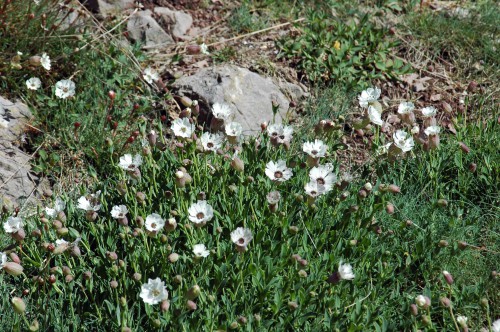
Sea Campion

Sea Campion-Silene maritima

I usually head for the cliff edge overlooking Angel Bay to see if there are any Grey Seals about. Today there were just two young ones swimming close to the rocks. The path to the summit involves an initial steep climb up an incline locally known as ‘Rabbit Hill’. It looks a gentle slope in the photograph, but it really isn’t, especially when you are as unfit as I was after my marathon-long virus! I had to stop twice today, but who cares when there are stunning views to look back at.

The Coast Path continues up steeply sloping 'Rabbit Hill'

The Coast Path continues up steeply sloping ‘Rabbit Hill’

Jackdaws are numerous residents and pairs of the characterful birds are nesting in nooks and crannies all over the cliffs. It’s always good to see them nesting communally in their ‘proper’ habitat rather than in the chimneys of houses in towns and villages. There are a particularly large number of them nesting up on the cliff at the back of the flat quarried-out grassy area at the top of Rabbit Hill and as I reached there I watched them as they used their numbers to chase off two Herring Gulls that were probably speculating for unguarded eggs.

Cliff face of the old quarry  that is now inhabitated by Jackdaws

Cliff face of the old quarry that is now inhabitated by Jackdaws

Jackdaw foraging at the base of the cliff

Jackdaw foraging at the base of the cliff

Onwards and upwards from the rock-strewn quarry field the track is bordered by gorse bushes and the air was perfumed with its wonderful coconut scent. Every bush was smothered with thousands of tightly packed golden flowers, a truly glorious treat for both eyes and nose. The grass is kept closely cropped by both rabbits and wandering sheep and a variety of birds including blackbirds, robins, chaffinches, goldfinches and dunnocks all forage here on the ground or amongst the scrubby shrubbery.

A baby bunny dozing in a sunny spot at the side of the track

A baby bunny dozing in a sunny spot at the side of the track

The track upwards bends to the right now and passes by an enclosed rough pasture grazed by  sheep and is frequented by Jackdaws. It’s always worth checking to see if any of the black birds are actually Chough.

A sheep pauses from grazing in the enclosed field to admire the view

A sheep pauses from grazing in the enclosed field to admire the view

At the top of the field the track turns sharply left and continues bordered by more gorse, blackthorn and hawthorn. Today walking through the fragrant gorse and blackthorn blossom was blissful.

The  trail winds through a thicket of gorse and blackthorn
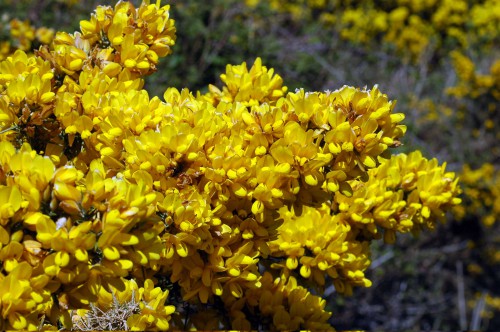
The trail winds through a thicket of gorse and blackthorn

Every gorse bush was packed tight with blossoms

Every gorse bush was packed tight with fragrant blossoms

Eristalis Hoverfly nectaring on gorse flower

Eristalis Hoverfly nectaring on gorse flower

If you had been walking the Coast Path, there is a perfect view from the top of this section of the track of where you have walked if coming from the direction of Abergele, or of where you will be walking if going the other way.

View from the cliff edge showing the route of the Coast Path from Abergele, past Lladdulas and around Colwyn Bay and Rhos Point

View from the cliff edge showing the route of the Coast Path from Abergele, past Lladdulas and around Colwyn Bay and Rhos Point

I could hear a Chaffinch singing so diverted from the main track here along one made by sheep to try to find him. It wasn’t long before I spotted him in a hawthorn tree preening himself and intermittently responding to the song of another male somewhere nearby.
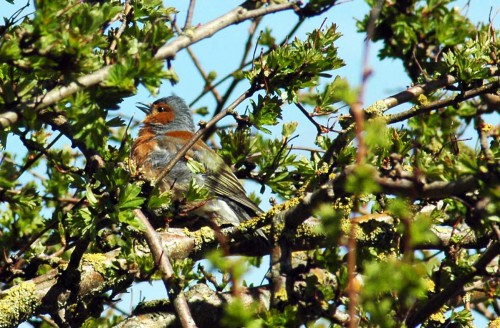
Male Chaffinch singing and preening

Male Chaffinch singing and preening

Ground Ivy

Ground Ivy

The track continues upwards towards the top

The track continues upwards towards the top waymarked Wales Coast Path and North Wales Path

One of the reasons for taking this walk today was to check up on the Cormorants that nest on the sea cliffs of the headland. I wouldn’t recommend making this diversion to the cliff edge if you have children or a dog not on a lead with you, or if you are of a nervous disposition as to get a good view of the birds you do have to go carefully down a slope which has no barrier between its edge and the drop down. It was windy today too, as you can see by the ruffled sea.

A ewe with her lamb on the slope of the cliff edge

A ewe with her lamb on the slope of the cliff edge

There are large numbers of Cormorants here all year round and in Welsh the bird is known as ‘llanc llandudno’. I’m sure they have nest sites all around the headland, but this is the only one I know of that is reasonably visible from the cliffs. The limestone rock is smooth and sheer so it is amazing that the Cormorants, quite large birds, find safe places to site their nests here.
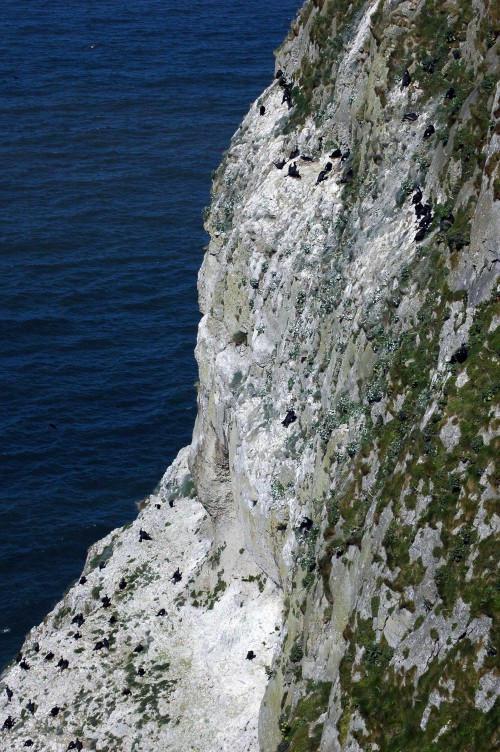
A view of the nest site on the almost-sheer cliff face

An overview of the nest site on the almost-sheer cliff face

There are three areas the birds are gathered in, an area at the top, a middle section and a few on a shelf quite near the bottom.
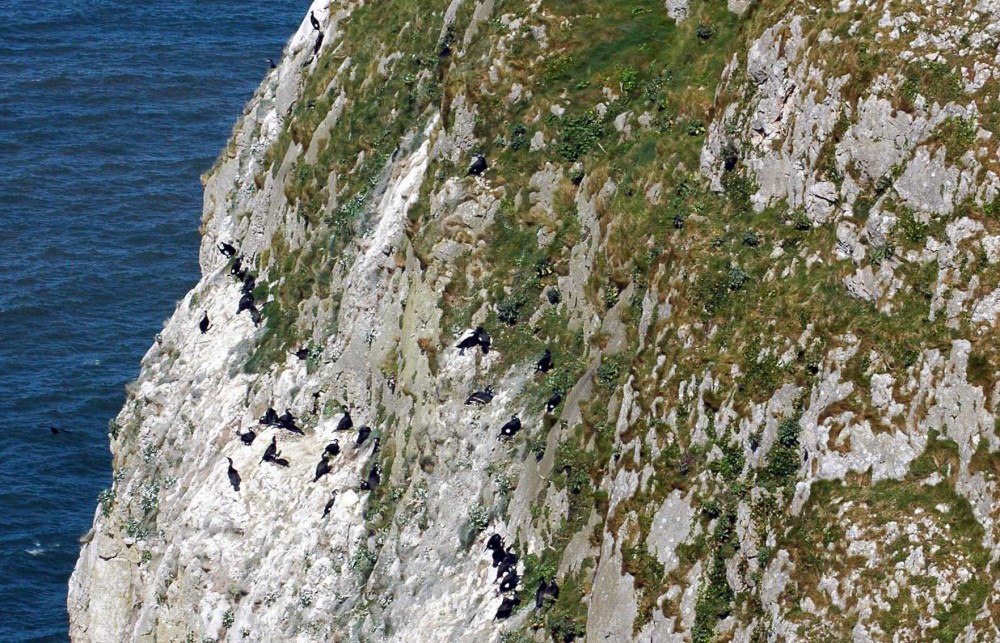
A closer view of the area most of the birds were gathered in

A closer view of the top-level area some of the birds were gathered in
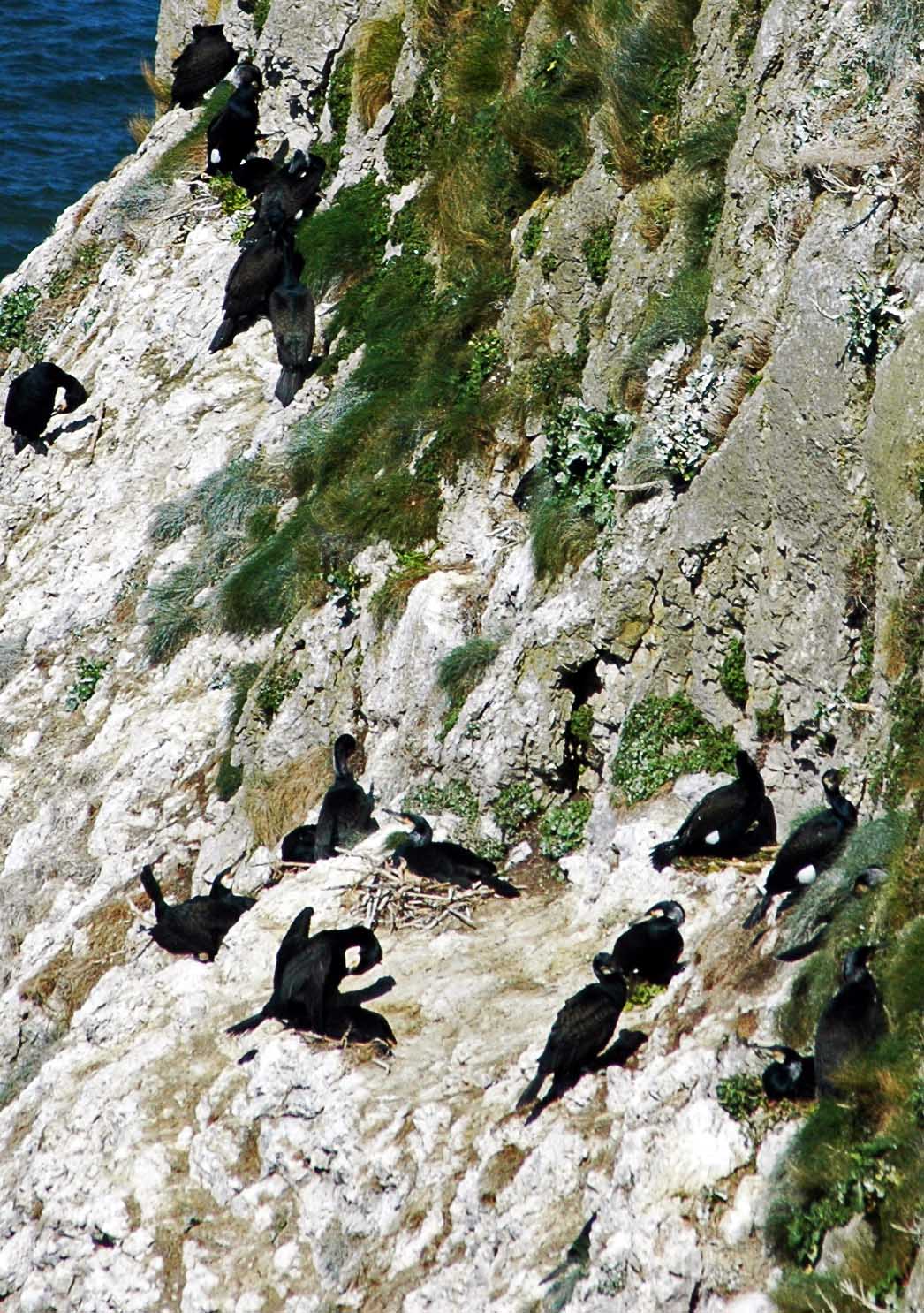
A few birds wwere sitting on nests while others, probably males, sat with their backs to the sea

A few birds were sitting on nests while others sat with their backs to the sea

Cormorants sitting against the cliff with backs to the sea
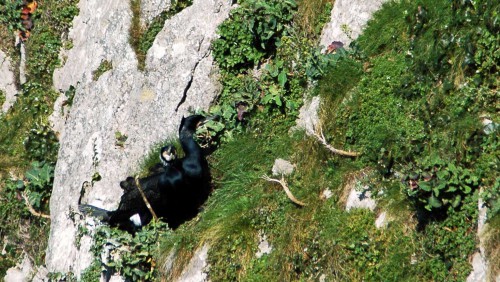
Cormorants sitting against the cliff with backs to the sea

A pair of birds nesting amongst wild cabbage plants

A pair of birds nesting amongst wild cabbage plants

Another pair on a sloping rocky ledge

Another pair on a sloping rocky ledge

Cormorant flying past cliff

Cormorant flying past cliff

Fascinating as the Cormorants were, it was chilly here on the windy cliff, so I went back up and along the cliff edge to the part below the summit which was sheltered from the wind and from where there are stunning views across the bay to Llandudno’s Victoria Pier and Little Orme’s big brother, the Great Orme. In the background is the Isle of Anglesey.This view shows the route of the ongoing Coast Path around Llandudno Bay.
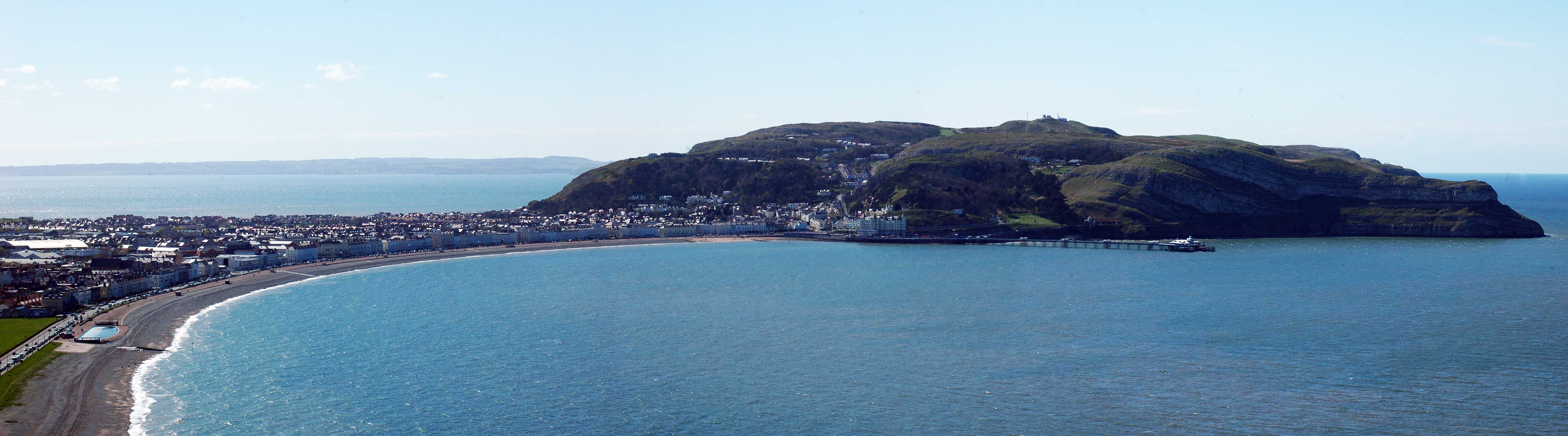
Panoramic view of Llandudno, the pier and Great Orme with Anglesey in the background (click to enlarge)

Panoramic view of Llandudno, the pier and Great Orme with Anglesey in the background (click to enlarge)

Cormorants race past and Herring Gulls are always to be seen flying or gliding around this part of the cliff, and there is occasionally a Kestrel, but today I was surprised to see two Buzzards flying out over the sea and a Sparrowhawk flying in and heading towards the Great Orme.

The ongoing Coast Path

The ongoing Coast Path passes around Llandudno and on to Deganwy and Conwy

It is possible to go up a little further to reach the trig point on the summit but the views are no better from there so I don’t often get that far and turn around to go back the way I came. If you were following the Coast Path though you would follow the track that takes you down to rejoin the main road at Craigside and continue towards Llandudno.

Share this:

  • Share on Facebook (Opens in new window) Facebook
  • Share on Pinterest (Opens in new window) Pinterest
  • Share on X (Opens in new window) X
Like Loading...

Celebrating new lives

26 Saturday Jul 2014

Posted by theresagreen in bird behaviour, birds of Wales, Bryn Euryn Nature Reserve, frogs & toads, Little Orme, Nature, Nature of Wales, Rhiwledyn Nature Reserve

≈ 2 Comments

Tags

common frog, house sparrow, kestrel, rabbit, raven

It seems to have been a good year for our local wildlife so far and the following are some of the photographs I have taken of a few new young lives.

Ravens nest early in the year, so firstly here is an image of this year’s Little Orme young one quite well grown but still in the nest at the end of May.

140531TG-Raven young in nest 2-Little Orme

31st May: Young Raven in nest on Little Orme

I was lucky enough to catch up with him/her on the summit of the Bryn a few weeks later, now looking extremely fit and handsome in glossy black plumage.

June: Young Raven on the summit of Bryn Euryn

June 15th: Young Raven on the summit of Bryn Euryn

June: A fine high place with plenty of open sky to practise flying skills

June 15th: A fine high place with plenty of open sky to practise flying skills

Back to May again. Whilst the Raven was still in the nest, a young Kestrel was already out practising their manoeuvring skills over the rocky cliff at the top of the Little Orme. When I spotted it first I thought I’d been fortunate to spot a bird out hunting, but as I got closer it kept up its position and made no attempt to fly away at my approach. I realised then it was a young bird out honing its skills. It was wonderful to be allowed to watch so closely

May 31st

May 31st: Young Kestrel practising hunting techniques above the Little Orme

May 31st: The length of time the bird held its position was impressive

May 31st: The length of time the bird held its position was impressive

May 31st: Swooping and diving

May 31st: Swooping and diving

The Kestrel disappeared over the headland for a few minutes then reappeared flying out over the sea. As it passed where I stood on the cliff edge it looked in my direction. Perhaps to make sure I was still watching and was suitably impressed.

Flying past the cliff edge where I stood

Flying past the cliff edge where I stood

May 31st: Out over the sea, maybe using the gull to focus on

May 31st: Out over the sea, maybe using the gull to focus on

Still on the Little Orme it was apparent there has been a proliferation of cute baby rabbits this year too:

May 31st: Baby rabbit on the Little Orme

May 31st: Baby rabbit on the Little Orme

On the first of July we discovered a Dunnock’s nest in the garden with tiny new chicks with enormous gapes.

July 1st: Hungry baby Dunnocks

July 1st: Hungry baby Dunnocks

Then there was a miniature frog that I just happened to spot struggling through the damp grass on the lawn, possibly heading for nest door’s lovely pond. I caught it in my hand and transferred it to a glass for a few minutes so I could photograph it.

20th July: A tiny froglet

20th July: A tiny froglet

It had no trouble at all climbing to the top of the glass. The froglet was less than an inch (2.5cm) long, but completely perfect.

July 20th: A rare view of the speckled underside

July 20th: A rare view of the speckled underside

I didn’t keep it for long before releasing it back where I found it.

July 20th: Then I let him go again

July 20th: Then I let him go again

Last weekend I sat outside to drink a cup of tea and was kept entertained by a family of House sparrows that had brought their latest brood out for their first outing. The young birds were wobbly and fluttery while trying to perch on twiggy branches of the recently drastically cut privet hedge and still begging their parents for food.

July 20th: A very young House sparrow out for a first outing

July 20th: A very young House sparrow out for a first outing

Dad seemed to be on feeding duty, popping back and forth with bits and pieces.

Dad seemed to be the one in charge of feeding this morning

Dad seemed to be the one in charge of feeding this morning

I caught him feeding one of the offspring with something that I’m sure mum would definitely have disapproved of.

Not quite on target

Not quite on target

Something lurid pink about to be passed on

Something lurid pink about to be passed on

Down the hatch

Down the hatch

Whatever it was, it was certainly sticky. Cake icing maybe?

Whatever it was, it was certainly sticky. Cake icing maybe?

I wonder if the hard working parents will get a rest now?


Share this:

  • Share on Facebook (Opens in new window) Facebook
  • Share on Pinterest (Opens in new window) Pinterest
  • Share on X (Opens in new window) X
Like Loading...

Mistle Thrush

25 Sunday May 2014

Posted by theresagreen in birds of Wales, Bryn Euryn Nature Reserve, Nature, Nature of Wales, nature of woodlands

≈ 10 Comments

Tags

mistle thrush, turdus viscivorus

Following on from my butterfly hunt I followed the track through the lower woodland of the Bryn and again had arrived at a perfect moment; the air was filled with birdsong. Blackbirds and robins provided melody that was accented by chiffchaff, wren, blue tit, great tit and chaffinch. But all were relegated to background accompanists by the loud, unmistakable ringing song of a Mistle Thrush. From the sheer volume of the delivery it was clear the singer was close by, but though standing for a good fifteen minutes trying to spot him up amongst the complex tracery of tree branches and leaves, I couldn’t  locate him. When the singing stopped I carried on walking upwards and as I neared the top of the track it began again. The thrush had clearly flown to another spot and once more I stood scanning the vegetation, but still could not see him. I resigned myself to being content with having been treated to the singing performances, which alone were rather special, but then I recalled that one late afternoon last year, wandering around this side of the top of the hill, intent on photographing rockroses, I met a mistle thrush out hunting on a narrow track around the rocky cliff edge.

I  headed off in that direction now, reckoning on this being an established mistle thrush territory and on that basis they could be out and about in any part of it.  I could hardly believe my luck then, when I spotted two largish birds flying towards a tree on the edge of the wooded slope below, near the bottom of the hill. One landed at the very top and from its size and overall grey-brown appearance I was pretty sure this bird at least was indeed a Mistle thrush.

Thrush landed at the top of a tree

Although some distance away I could see that the birds had been drawn to the tree by ivy berries and I was able to watch them for a good few minutes while they stayed to feed on them.

Mistle Thrush with ivy berry

Mistle thrush with ivy berry – showing pale tip to the tail feathers

140421TGNW-Bryn Euryn-Mistle thrush at top of tree 1

The other of the two, better showing the breast

Flying away

Flying away

I sat on a rock, a damp one as I realised when I stood up, and watched the birds for some time until they flew away.

________________________________________________________________________________

Mistle Thrush – Turdus viscivorus 

Other traditional names: Missel Thrush; Storm Cock Welsh: Brych y coed

The mistle thrush was first described by Linnaeus in his Systema naturae  in 1758 under its current scientific name. The bird’s fondness for mistletoe berries is indicated by both its English and scientific names: Turdus  is the Latin for “thrush”, and viscivorus, “mistletoe eater”, comes from viscum “mistletoe” and vorare, “to devour”.

Description

The largest thrush native to Europe, the Mistle thrush is a large greyish thrush, with larger breast spots than the Song thrush, from which it is also distinguishable in flight by the flash of whitish underwing. The long tail has white tips on the outer feathers. There are no plumage differences between the sexes; juveniles are similar to adults, but have paler upperparts with creamy centres to many of the feathers and smaller spots on the yellowish underparts. By their first winter they are very similar to adults, although the underparts are usually more buff-toned.

The mistle thrush is quite terrestrial, hopping with its head held up and body erect; when excited, it will flick its wings and tail. The flight consists of undulating bounds interspersed with glides.

Voice

One of the finest songs of our resident birds, the male mistle thrush has a loud melodious ringing song with fluted whistles that are repeated three to six times, and used to advertise his territory, attract a mate and maintain the pair bond. He doesn’t have much of a song, just a reiteration of a few notes, but those are rich and deep in tone, and delivered with great energy and enthusiasm. Compared to its relatives, the song thrush and the blackbird, the repertoire is less varied, lacking the mellow fluting of the blackbird and the elegantly repeated phrases of the song thrush. The delivery is slower too, however the song is much louder, often audible up to 2 km (2,000 yds) away and can be sustained for up to an hour in a single performance.

The song is given from a treetop or other elevated position and welcomed as it comes early in the year before the other birds are in full song. The song may be heard in any month, although mainly between February and May/June, as being an early nester it is one of the first of the songbirds to fall quiet.

The mistle thrush has another traditional name too, the storm cock, attributed to the bird for the way in which it will sing from a tree top in all weathers, even in the teeth of a fierce winter gale-force wind. Unlike most other birds, who seek shelter from stormy weather, the Mistle Thrush actually seems to be stimulated by approaching storms and will sing or call lustily before and through bad weather.

 The main call, given by both sexes, is a dry chattering krrrr, louder when it is alarmed or excited. It is often likened to the sound of a football rattle. There is also a squeaky tuk contact call.

Ecology

Generally found in cultivated country, farmland, gardens, parks,orchards and where there are scattered trees.

The mistle thrush feeds on a wide variety of invertebrates, seeds and berries. Its preferred fruits including those of the mistletoe, holly and yew.  Mistletoe is favoured where it is available. An interesting behavioural trait  displayed by Mistle Thrushes in winter is resource guarding, when one or sometimes two birds will vigorously defend a food source such as mistletoe clumps, holly, yew or nowadays even a cotoneaster. This is defended against all-comers, the vigilant bird trying to ensure that food resources are maintained for itself throughout the winter. It has been shown that resource guarding birds have bigger and earlier clutches than birds that do not do it. 

Mistle thrushes are found as individuals or pairs for much of the year, although families forage together in late summer, and groups may merge to form flocks of several tens of birds and it is not uncommon for up to 50 thrushes to feed together at that time of year. They roost at night in trees or bushes, again typically as individuals or pairs, but with families roosting together in autumn.

The nest

Breeding typically commences in mid-March in the south and west of Europe and late February in Britain.

The nest is built by the female, although the male may help. The thrush’s nest is a large bulky cup of sticks, dry grass, roots and moss, coated on the inside with a layer of mud and lined with fine grass and leaves and frequently ‘decorated’ with white scraps of paper or rag. It is usually built 10-40 feet up in a tree, often in an exposed position, but not uncommonly lower down and occasionally in a hedge or bush or on a ledge of a cliff or a building.

Typically the breeding season of the mistle thrush is March to early June, but the nest may contain eggs as early as February, long before there are any leaves to offer any protection. Nests built early in the breeding season are sometimes destroyed by bad weather. 3-5 eggs are laid and are incubated by the hen only, hatching within 13-14 days and nestlings then leave after about 15 days. There is often a second brood. 

During this time the mistle thrush may display aggression; it may even attack a person or another bird should they venture too near its nest and has been known to swoop down to threaten a cat.

The common chaffinch often nests close to a mistle thrush, the vigilance of the finch and the aggressive behaviour of the thrush benefiting both species.

__________________________________________________________________________________

I turned and walked back and up towards the hill’s summit to look for orchids and other flora, and once again the song of the thrush rang out from the trees below. I still couldn’t find him though and had resigned myself to being contented with the singing and the sightings I had already enjoyed. Then as I walked slowly back down the track, still keeping half an eye out for a glimpse of the songster, the singing stopped. At the same moment a largish bird flew to an ash tree and there finally I had sight of a  mistle thrush, although I wasn’t convinced it was the one that had been singing.

Finallly, a better view

Finallly, a better view

The sun by now was lower and shining directly behind the bird, so I wasn’t hopeful of getting a good shot, but it turned out to be good enough as a front view. Even better, as I reached the bottom of the track the singing began again and this time from a slightly higher vantage point than on the way into the woods earlier on, I managed to locate the singer high up on a leafy branch. The markings on this bird were much heavier.

A well-marked, singing mistle thrush

A well-marked, singing mistle thrush

I was pleased I’d had these opportunities to hear and see the mistle thrushes, as returning a week later there were none to be heard, although I did catch sight of one out hunting amongst the rockroses in the meadow. It was some distance away from me, but good to see it away from the trees and demonstrating the birds characteristic upright posture.

A mistle thrush out hunting

A mistle thrush out hunting amongst the rockroses


Share this:

  • Share on Facebook (Opens in new window) Facebook
  • Share on Pinterest (Opens in new window) Pinterest
  • Share on X (Opens in new window) X
Like Loading...

Noisy birds and sleeping seals

09 Sunday Feb 2014

Posted by theresagreen in bird behaviour, birds of Wales, Nature, Nature of Wales, nature photography

≈ 6 Comments

Tags

Aderyn-Drycin y Graig, coastal birds, fulmar, fulmarus glacialis, grey seals, Little Orme, northern fulmar, Rhiwledyn Nature Reserve, rock pipit, seals in Angel Bay

This post was inspired by a walk taken last weekend with some lovely people I met for the first time then: Gill who is the chairperson of the Bryn Euryn Users’ Association and her partner Tony who is a ‘proper’ birdwatcher. As well as enjoying their company I also learnt a lot from them both; from Gill it was how the Bryn had evolved into a Local Nature Reserve and some of how its habitats are maintained, which I’m hoping to discover more about in the near future.

Little Orme

Tony reminded me how much I’ve been missing here and I rediscovered that when it comes to spotting birds, particularly when they are faraway dots on a wavy sea, three pairs of eyes are better than one and that a telescope widens the horizons in more ways than one!

Two grey seals swimming in Angel Bay

Two grey seals swimming in Angel Bay

Firstly though, we had some good sightings of Fulmar which are back at their nest sites on the cliff face. The Raven was up in his favourite spot just above them and Tony showed me their nest site where we saw and heard them both a little later on. We also spent a few minutes hunting for signs of a Black Redstart that was reported being seen here a few weeks ago, but no luck. From the clifftop overlooking Angel Bay there were two Grey Seals swimming and further out to sea there were some great seabirds including numbers of Great Crested Grebe, Red-throated Diver , Guillemot & Razorbill as well as the more easily seen Shags & Cormorants. Walking around the rocky outcrop to the ledge that overlooks Penrhyn Bay and the wider sea, we encountered a Rock Pipit pecking around the grass and rocks, not at all concerned that we were there and presenting an irresistible photo opportunity. 

Rock Pipit-

Rock Pipit- Anthus spinoletta

This week I waited for a break in the weather to return to the Little Orme for more viewing and Friday’s sunshine was just what I’d been waiting for. I was particularly keen to see more of the Fulmar so headed in their direction first. The Raven pair were once more sitting up in their favourite spot above the Fulmar site. They are both looking gorgeously fit and healthy, their plumage shining brightly in the sunlight.

The Raven pair gleaming in the sunlight

The Raven pair gleaming in the sunlight

I counted three pairs of Fulmar here initially, who were later joined by what I think was a single male on a site just around the rock. Some birds were easier to see than others as they have chosen their nests sites carefully to give them some shelter from the elements, and those I’m assuming to be the females were mostly tucked behind a rock or back into clefts in the rock-face.

Fulmar pair on a rock ledge

Fulmar pair on a rock ledge

The birds were noisy; males are definitely proclaiming their territories and there was quite a bit of aerial activity, taking off, swooping around and then landing again with more vocals. The sound has been described as harsh, throaty and machine-gun like.

There were a lot of Jackdaw on the cliffs too and I suspect that much of the Fulmar’s vocalising was aimed at them and they in turn were giving back as good as they got, so it got very noisy at times.

Jackdaws up on the cliff-Wild Cabbage has established up there

Jackdaws up on the cliff-Wild Cabbage has established up there

There were more of the birds on the cliff-face at the edge of Angel Bay; they were making even more noise, much of it directed at a single bird that was flying around and attempting to land in spots already occupied by pairs of birds. I think there may be 8 pairs in total, which will be easier to establish once they’ve settled down.

 FULMAR

Common name: Fulmar or Northern Fulmar; Scientific name: Fulmarus glacialis Welsh name: Aderyn-Drycin y Graig

BTO Conservation Status: AMBER because Recent Breeding Population Decline (1981-2007), Localised Breeding Population

The common name is derived from the Old Norse word ‘full’ meaning foul and ‘mar’ meaning seabird or gull. The foul part refers to the fact that they can spit out a foul-smelling oily fluid to defend their territories from intruders; it’s not all bad though, the oil is also an energy rich food source for chicks and for the adults during their long flights. The glacialis of the scientific name means icy.

They are long-lived, with a lifespan of 40 years not uncommon.

Fulmar sitting on guard

Fulmar sitting on guard

The Fulmar is a bird of the open sea, a ‘tube-nose’ that is a first cousin of the albatross and belonging to the same group of birds as the shearwaters and petrels. They feed at sea  on crustaceans, squid, fish, offal and carrion mostly from the surface.To deal with excesses of salt they take in with their food they have a gland located above the nasal tube through which all the bird’s blood is pumped and the salt removed. The salt-laden discharge runs from the tube nose along a groove in the beak and drips off away from the body, keeping plumage clean.

Fulmar glide effortlessly with stiff wings

Fulmar glide effortlessly with stiff wings

At first sight Fulmars resemble gulls but seen more closely are distinguished by the shape of their beak which has a tube-shaped proturberance on the top and a thicker neck. They have long, narrow wings and fly low over the sea on stiff wings, with shallow wingbeats, gliding and banking to show its white underparts then grey upperparts.

Head on the Fulmar is sleek and has a blade-like profile

Head on the Fulmar is sleek and has an almost blade-like profile

At its breeding sites it will fly high up the cliff face, riding the updraughts.

Flying in to land

Flying in to land showing underside

Nesting sites are deserted in September and Fulmars are usually absent offshore during October and November. Their absence from the breeding cliffs is short-lived as by late November or early December the birds are back prospecting around the nesting sites.

Both of the pair calling

Both of a pair calling noisily

The nest itself may be nothing more elaborate than a depression in bare rock or a scrape in turf, although they are sometimes lined with a few pebbles. The female lays a single white egg in May, so they’ve a while to go yet.

A quick glance down onto Angel Bay brought a pleasant surprise – a mixed size group of 22 Grey seals. They were very chilled, many of them asleep on their backs; gorgeous.

A mixed group of Grey seals

A mixed group of Grey seals

Many of the seals were asleep on their backs

Many of the seals were asleep on their backs – I love their flippers

I think these were posing for the camera

I think some were posing for the camera

I was a bit worried that one of these appeared to have blood around its head

I was a bit worried that one of these appeared to have blood around its head

This one was scratching an itch

This one was scratching an itch

These pups were wide awake

These pups were wide awake

A view from the end of the bay includes most of the group

A view from the end of the bay includes most of the group

140206-Little Orme 25- Sea crashing onto rocks

Ending with a splash

Share this:

  • Share on Facebook (Opens in new window) Facebook
  • Share on Pinterest (Opens in new window) Pinterest
  • Share on X (Opens in new window) X
Like Loading...

…and back down again

26 Sunday Jan 2014

Posted by theresagreen in birds of Wales, Nature, Nature of Wales, nature photography

≈ 8 Comments

Tags

dunnock, Little Orme, Rhiwledyn Nature Reserve, Robin, song thrush, views from the Little Orme, views of Rhos-on-Sea, walk on the Little Orme

January 11th, last leg of the walk on the Little Orme

The winter months offer an opportunity to see places as they really are. Stripped of leaves and layers of foliage, without the colourful distractions of wildflowers and the movements of their insect visitors to draw the eyes, this is the time to appreciate the structure, the bare bones of a place. Walking back down from the top of the Little Orme, not only are the views spectacular, but you also see more clearly the layout of the reserve. On this scale you get a sense of how the patchwork of differing habitats mesh together and create the synergy that has resulted in the rich variety of wildlife that make this such a special place.

140111TG-Little Orme-View from near the top

A myriad of textures in one small patch of land

The sun, lower in the sky now reveals the true contours of a landscape. You realise a surface which til now has appeared smooth and rounded, is actually textured with a multitude of dips and hollows that are revealed by back-light and shadows.

Going down-a view of the pastures on the Little Orme

Further down a view of the enclosed pastures on the Little Orme that add yet another layer of texture

There is some farming activity on the lower slopes of the reserve where small fields are cultivated for crops and pastureland is enclosed with hedges or small walls and used for grazing sheep. Sheep are also free to range and graze other parts of the reserve too; they are an effective way to keep areas of grass shorn and clear of too much shrubbery and are aided and abetted in their mission by a healthy population of rabbits.

Despite what I wrote earlier about their being less distractions from the bigger picture of a place, I should probably know myself better and accept that I will always find distractions in the details whatever the season. Like a leafless, gnarly, knobbly hawthorn twig softened with lichen and highlighted by the sun.

Lichen on a sunlit hawthorn twig

Lichen on a sunlit hawthorn twig

Going back down Rabbit Hill was trickier than going up as it turned out, as it was quite wet and muddy and slippery underfoot. There was a dunnock so intent on feeding himself before going to roost for the night that he allowed me quite close before shooting off into cover. He wasn’t presenting his best side now, but its good to see things from a different angle now and then. I felt sorry for my disturbance, I know how hard it is for birds to find enough food to keep them going in the winter, especially through the cold nights.

A dunnock feeding on the slope of the downhill track

A dunnock feeding on the slope of the downhill track

At the bottom the Robin was still about too, adopting the classic hunting method of the species by perching up off the ground and scanning the ground beneath them, then pouncing down onto potential prey.

Robin scanning the ground beneath for something edible

Robin scanning the ground beneath for something edible

This little tree is testament to the strength of the prevailing winds

This little tree is testament to the strength of the prevailing winds

I had the thought of finishing off my walk along the quarried-out gorge that ends, or begins near one of the entrances to the reserve, but to my surprise much of its floor was covered by a pool of water several inches deep. My reason for wanting to go that way was to see if there may be a Song Thrush hunting for snails along the rocky wall there. Last year I spotted a pair nesting there and watched them as they hammered a succession of snails into palatable food for their young ones.

Song Thrush, photographed last July. One of a nesting pair.

Song Thrush, photographed last July. One of a nesting pair.

Instead I carried along in the same direction, but around the top towards the large, sculptural lump of limestone that always puts me in mind of the Sugar Loaf Mountain, but in miniature of course. Sort of, with a bit of imagination? Regardless, I love that rock and have often wondered how it ended up there. 

The limestone rock in context

The limestone rock in context- you can just see the edge of the man-man quarried gorge in the foreground (click on to enlarge)

I am referring to the Sugar-loaf Mountain in Rio de Janeiro here, not the one in Wales that has the same name!

The rock baclit by the sun and the gorgeous view behind it

The rock backlit by the sun and the gorgeous view behind it (click on to enlarge)

One last thing, are there really green leaf buds on this tree already?

Signs of buds bursting

Signs of buds bursting

Share this:

  • Share on Facebook (Opens in new window) Facebook
  • Share on Pinterest (Opens in new window) Pinterest
  • Share on X (Opens in new window) X
Like Loading...

The Brambles: des. res. for Whitethroats, sea views

31 Wednesday Jul 2013

Posted by theresagreen in birds of Wales, Nature, Nature of Wales, Pembrokeshire coastal path, Rhiwledyn Nature Reserve

≈ 6 Comments

Tags

birds nesting in brambles, brown bird with white throat, Little Orme, sylvia communis, whitethroat

On the Little Orme there is a huge bramble tangle set in the middle of a sea of long grass. Surrounded thus, it is some distance from the close-cut grass pathways on the clifftop and as there are other more easily accessed bushes, I may not have approached this particular one if I hadn’t noticed a bird fly across to it.

From the bird’s behaviour and general ‘jizz’ I thought and hoped it may be a Whitethroat, a summer migrant that I have heard before, but never had a close view of in this location.

(Jizz is a term used by birders to describe the overall first impression of a sighted bird, based on such characteristics as shape, posture, flying style or other movements, size and colouration combined with voice, habitat and location.)

As I moved a little closer the bird flew up nearer the top of the bramble, I saw it had an insect in its beak and that it was definitely a lovely male Whitethroat. So, there was a nest in there, confirmed when a female also carrying food made an appearance on the far side of the bush.

Whitethroat trying to hide

Whitethroat trying to hide

Although I was keeping my distance neither bird was happy I was there at all and the male expressed his annoyance by “churring”, raising his crest and puffing his throat out a bit, which showed he was upset. I don’t like upsetting birds,  but it did make for a more interesting photograph.

Common Whitethroat- Sylvia communis

Common Whitethroat- Sylvia communis

Whitethroat– Sylvia communis

Welsh: Llwydfron

The Whitethroat is a summer visitor and passage migrant to Britain that may be seen in all parts of the country and most frequently choose arable land, scrub and reedbeds as nesting sites.  They arrive during April-May and leaving in late September-early October to winter in Africa, some heading as far south as South Africa.

Graph from BTO showing Whitethroat population trend for Wales

Graph from BTO showing Whitethroat population trend for Wales

In 1968, Whitethroats sustained heavy losses as their wintering grounds in sub-Saharan Africa suffered major drought – breeding Whitethroats suffered a 90% drop in the UK. Numbers have not fully recovered yet and the BTO state their Conservation Status as AMBER because of the recent breeding population decline (1969-2007).

A male Whitethroat, Ceibwr, Pemrokeshire

A male Whitethroat, Ceibwr, Pemrokeshire

Description

The Whitethroat is a medium-sized, long-tailed warbler. The male is grey dusted with rust brown above, with bright chestnut brown fringes to the wing feathers, the head is a pale grey, the breast pinkish-buff and the throat is a bright white. The bill is greyish-brown and the legs are pale brown. The eye is pale brown with a white eye ring. Females are similar but brown on the head and nape where the male is grey.

Whitethroats prefer to stay concealed in bushes

Whitethroats prefer to stay concealed in bushes

Behaviour & song

Warblers in general are often described as ‘skulking’, but the Whitethroat is not quite as secretive as some; the male will perch in full view to deliver its brief song with gusto. The song is variously described as sweet, ‘scratchy’  and having a jolty rhythm. They are also very inquisitive birds and will venture to the top of a bush to investigate any intruders, before scolding them with a rapid churring call.

Nesting

The male whitethroat may mate with the first female to cross the territory it immediately stakes out upon his arrival back in Britain. He begins making a number of trial nests, perhaps as many as three. The female then chooses a nest, which will be a deep cup shaped construction located close to the ground in cover, and lines it with hair, down and wool.  4-5  eggs are laid which are about 18 mm by 14 mm, smooth and glossy, pale green or buff in colour with olive-grey speckles. The duties of incubating the eggs are performed by both parents. Both adults feed the young birds. There may be one or two broods raised in a season.

Food

In the breeding season whitethroats eat mainly insects, especially beetles, caterpillars and bugs. They also eat spiders and towards the end of the summer and into the autumn they turn increasingly to fruit and berries, sometimes invading gardens to raid soft fruit crops.

Where to see Whitethroats in Wales

Whitethroats  breed in many areas including woodland edges and clearings, country lanes anywhere they may find brambles, briers, bushes or overgrown hedges. They may also nest in gardens, but avoid urban and mountainous places.

In Wales they frequently find their favoured habitat on clifftops: locally on the Little Orme and I have seen them in various spots when walking along the Pembrokeshire Coastal Path. Another reliable spot for hearing and seeing them has always been in the similarly-vegetated area on the road down to Martin’s Haven, where you get the boat to Skomer Island.

June 11th 2010  

One late afternoon in June, my friends and I set off for a walk along a part of the Pembrokeshire Coastal Path beginning at Ceibwr and heading in the Poppit Sands direction (we’ve never yet made it that far). There were several Whitethroats about, but we didn’t expect to get the close up views we were treated to. Firstly, there was the one in the first two photographs above, that was in amongst a huge tangle of brambles at the back of the beach. Another flew right in front of us as we walked up the pathway to the clifftop.

A whitethroat flew in front of us

A whitethroat flew in front of us

At the top of the upwards part of the path we caught sight of one very close to the edge of it with food in its beak. It clearly wanted to reach its nest on the opposite side of the path but was reluctant to reveal its location, so it stayed put perched on a hogweed stem perhaps hoping we hadn’t seen it.

11/6/10-A whitethroat with food perched on hogweed-Ceibwr, Pembrokeshire

11/6/10-A whitethroat with food perched on hogweed-Ceibwr, Pembrokeshire

We stood still to give it the chance to make a break for it and it crossed to perch on a barbed-wire fence. It was hanging on tightly to the caterpillar in its beak and finally flew off into a shrub a few metres away to present it to its nestlings.

The whitethroat perched   on the wire fence hanging on to its nestling's tea

The whitethroat perched on the wire fence hanging on to its nestlings’ snack

 Similar species : Lesser Whitethroat 

The Common Whitethroat can be distinguished from the smaller Lesser Whitethroat by the absence of the dark mask on their cheeks and the presence of  rusty brown edges to their wing feathers, pinky chest and longer tail.

Read more about whitethroats in Cambridgeshire in Finn Holding’s blog, the Naturephile

http://thenaturephile.com/2013/05/23/whitethroats-and-awards/

53.308051 -3.749941

Share this:

  • Share on Facebook (Opens in new window) Facebook
  • Share on Pinterest (Opens in new window) Pinterest
  • Share on X (Opens in new window) X
Like Loading...

Herring Gulls-love them or loathe them

19 Friday Aug 2011

Posted by theresagreen in birds of the seashore, birds of Wales, garden wildlife, Nature, Nature of Wales

≈ 2 Comments

Tags

herring gull, herring gull nuisance, herring gull status, herring gulls in towns, herring gulls nesting on roofs, larus argentus

April 2011

A pair of Herring Gulls are regularly visiting the flat roof immediately below the window of the bedroom I am staying in. At the moment they are not roosting here overnight, but they arrive back early each morning, announcing their arrival with much raucous calling and strutting around. I have been very aware of Herring gulls locally, flying around, perching on rooftops and up amongst the chimney pots, but put it down to being so close to the seashore where there appears to be plenty of natural food. However it would seem that a number of pairs have claimed several of the chimney-rich sites as nest locations. Their strongly territorial and aggressive-defensive behaviour makes them difficult and, sadly, dreaded birds to have as close neighbours, which is a  pity as when viewed closely and unemotionally, they are very clean-looking and handsome birds, if a touch arrogant in demeanour.

European Herring Gull – Larus argentatus

Length 55-67cm; Wingspan 130-158cm

The Herring Gull is one of the commonest gulls of Northern European coasts, bigger than a Common Gull it has rather fierce-looking pale eyes with a yellow iris and pink legs and feet.

A visit to the seaside wouldn’t be the same without the sound of gulls, but when they are intent on sharing your house, you rather wish they’d turn the volume down.  A very noisy bird it makes a variety of squealing notes, sometimes sounding like it may be chuckling and also producing some quite dog-like yelping and ‘barking’ sounds.

A Herring Gull peacefully resting in the sun

The male gull brought in some strange ‘tokens’ for his chosen mate, a turkey-leg bone and a fairly large piece of stone amongst them, and they began to display bonding behaviour, the female ‘begging’ for food, and greeting one another vocally and with body contact.

I am very interested in the ways in which wildlife interacts  (and learns to exploit) people and although I had no previous experience of living this closely to them, I was aware that herring gulls had a reputation for some anti-social behavioural traits. We had a chat with the next-door neighbour, who related her previous experiences with locally nesting gulls  that could have come from the Hitchcock horror story. She alleged attacks made against herself, her visitors and particularly her dog, whilst minding their own business in their own garden! She had rung the RSPCA who had told her there was nothing she could do as the birds were protected, and that the nuisance would only last for seven weeks while the birds were nesting!

A herring gull nest built on a flat roof

A herring gull nest built on a flat roof

I was keen to learn more, so  began to research the subject, beginning by checking out the status of the gulls. Surprisingly perhaps, the herring gull has been accorded red status by the RSPB,  the highest conservation priority, as its numbers have declined dramatically in its former haunts, disappearing completely from some areas. (There are 40% less herring gulls now than in 1970) To quote from a page on their website , this means that:

” Gulls, like all UK wild bird species, are protected under the Wildlife and Countryside Act 1981. This makes it a criminal offence to kill, injure or take a gull; or to take, damage or destroy its nest whilst the nest is in use or being built. It is also a criminal offence to take or destroy their eggs.”

The best general information I found concerning the bird-human interaction was on Wikipedia and thought it worth reading in full:

” The European Herring Gull is an increasingly common roof-nesting bird in urban areas of the UK. The Clean Air Act of 1956 forbade the burning of refuse at landfill sites, providing the European Herring Gull with a regular and plentiful source of food. As a direct result of this, European Herring Gull populations in Britain sky-rocketed. Faced with a lack of space at their traditional colonies, the gulls ventured inland in search of new breeding grounds. Dwindling fish stocks in the seas around Britain may also have been a significant factor in the gulls’ move inland.

The gulls are found all year round in the streets and gardens of Britain, due to the presence of street lighting, (which allows the gulls to forage at night), discarded food in streets, food waste contained in easy-to-tear plastic bin bags, food intentionally left out for other birds (or the gulls themselves), the relative lack of predators and readily available, convenient, warm and undisturbed rooftop nesting space in towns and cities. Particularly large urban gull colonies (composed primarily of European Herring Gulls and Lesser Black-backed gulls are now present in the cities of Cardiff, Bristol, Gloucester and Aberdeen to name but a few.

The survival rate for urban gulls is much higher than their counterparts in coastal areas, with an annual adult mortality rate of less than 5%. It is also common for each European Herring Gull pair to successfully rear three chicks per year. This, when combined with the long-lived nature of European Herring Gulls, has resulted in a massive increase in numbers over a relatively short period of time and has brought the species into conflict with humans.

Once familiar with humans, urban European Herring Gulls show little hesitation in swooping down to steal food from the hands of humans. During the breeding season, the gulls will also aggressively ‘dive bomb’ and attempt to strike with claws and wings (sometimes spraying faeces or vomit at the same time) at humans that they perceive to be a threat to their eggs and chicks — often innocent passers-by or residents of the buildings on which they have constructed their nests. Large amounts of gull excrement deposited on property and the noise from courting pairs and begging chicks in the summer months is also considered to be a nuisance by humans living alongside the European Herring Gull. Non-lethal attempts to deter the gulls from nesting in urban areas have been largely unsuccessful. The European Herring Gull is intelligent and will completely ignore most ‘bird-scaring’ technology after determining that it poses no threat. Rooftop spikes, tensioned wires, netting and similar are also generally ineffective against this species, as it has large, wide feet with thick, leathery skin which affords the seagull excellent weight distribution and protection from sharp objects (the bird may simply balance itself on top of these obstacles with little apparent concern). If nests are removed and eggs are taken, broken, or oiled, the gulls will simply rebuild and/or re-lay, or choose another nest site in the same area and start again.

Attempts to scare the gulls away using raptors are similarly ineffective. Although they are intimidated by birds of prey, European Herring Gulls, in addition to being social birds with strength in numbers, are large, powerful and aggressive as individuals and are more than capable of fighting back against the potential predator, particularly if they consider their chicks to be at risk. European Herring Gulls are also naturally accustomed to predators (such as Skuas and Great Black-backed Gulls) living in the vicinity of their nest sites in the ‘wild’ and are not particularly discouraged from breeding by their presence.

Despite the increasing number of urban European Herring Gulls in the UK, the species, when taken as a whole is declining significantly across the country, its population having decreased by 50% in 25 years. In 2009, the RSPB placed the European Herring Gull on its ‘Red List’ of threatened bird species, affording it the highest possible conservation status. In response, Natural England in January 2010, following a public consultation, removed the European Herring Gull from the list of species covered by its general licenses, which had previously permitted authorized persons (e.g. landowners or occupiers) to kill the birds under certain circumstances (e.g. to prevent serious damage to crops or livestock, to prevent disease, or to preserve public health or safety) without requiring additional permission. ”

It would seem that there is no easy quick-fix solution to the problem and currently not a lot you can do if the birds take a fancy to nesting on your roof, there doesn’t seem to be a great deal of advice or help available to householders either, a bit worrying bearing in mind that many of them won’t be aware of the law.

Related newspaper article:  http://www.telegraph.co.uk/earth/outdoors/7818115/Seabirds-Quick-fix-isonly-for-the-gull-ible.html

A LOCALLY-RELATED SNIPPET FROM THE ABOVE ARTICLE:

  • During the late 1800s a man in Llandudno constructed wings from gull feathers and string and tried to fly. He failed.

Share this:

  • Share on Facebook (Opens in new window) Facebook
  • Share on Pinterest (Opens in new window) Pinterest
  • Share on X (Opens in new window) X
Like Loading...
Newer posts →
Follow everyday nature trails on WordPress.com

Enter your email address to follow this blog and receive notifications of new posts by email.

‘But it is the common species that keep the living world ticking over and provide most of our experiences of wildlife, and I would argue that maintaining the abundance of these is as important a conservation priority as maintaining the existence of rarities’. Richard Mabey

MOST RECENT POSTS

  • A Glimpse of Spring to Come January 22, 2025
  • Hunting the Wren December 28, 2024
  • Oh, Christmas Tree December 18, 2024
  • In and Out of the Ivy February 15, 2024
  • Nature’s Fireworks November 30, 2023
  • Wild Autumn along the Coast Path November 3, 2023

OLDER POSTS

LOOKING FOR SOMETHING IN PARTICULAR?

  • Sights and Sounds from the Little Orme 1
    Sights and Sounds from the Little Orme 1
  • Following a river to a Fairy Glen
    Following a river to a Fairy Glen
  • Fine Dining for Crows
    Fine Dining for Crows
  • Catchers, a Duck and Divers
    Catchers, a Duck and Divers
  • The Foxglove - of Fairytales, Myths & Medicine
    The Foxglove - of Fairytales, Myths & Medicine
  • May Bee Appearing on Ivy near You
    May Bee Appearing on Ivy near You
  • Shades, Sounds and Scents of the Woods
    Shades, Sounds and Scents of the Woods
  • Beautiful blooms and some rare treats (1)
    Beautiful blooms and some rare treats (1)
  • Things Bright and Beautiful
    Things Bright and Beautiful
  • A Windy Wildflower Trail
    A Windy Wildflower Trail

nightingale trails

The Walk of the Monarch Butterfly-Sendero de la Mariposa Monarca

The Walk of the Monarch Butterfly-Sendero de la Mariposa Monarca

MY WILDFLOWER BLOG: where the wildflowers are

Snowdrop

Snowdrop

most recent posts

Follow everyday nature trails on WordPress.com

Social

  • View teresamaygreen’s profile on Twitter

Enter your email address to follow this blog and receive notifications of new posts by email.

Website Built with WordPress.com.

  • Subscribe Subscribed
    • everyday nature trails
    • Join 358 other subscribers
    • Already have a WordPress.com account? Log in now.
    • everyday nature trails
    • Subscribe Subscribed
    • Sign up
    • Log in
    • Report this content
    • View site in Reader
    • Manage subscriptions
    • Collapse this bar

Loading Comments...

    %d