• Home
  • about
  • about the photographs
  • Local Nature Reserves
    • Bryn Euryn Local Nature Reserve
    • Mynydd Marian
  • Wales Coast Path
    • Grey Seals in North Wales
    • St.Trillo’s Chapel
    • Wildflowers of North Wales Coastal Paths, Cliffs and Dunes

everyday nature trails

everyday nature trails

Author Archives: theresagreen

Evening on the Estuary

12 Sunday Feb 2012

Posted by theresagreen in Nature, nature photography

≈ Leave a comment

Tags

Conwy castle, Conwy estuary, Curlew, estuary at low tide, shelduck

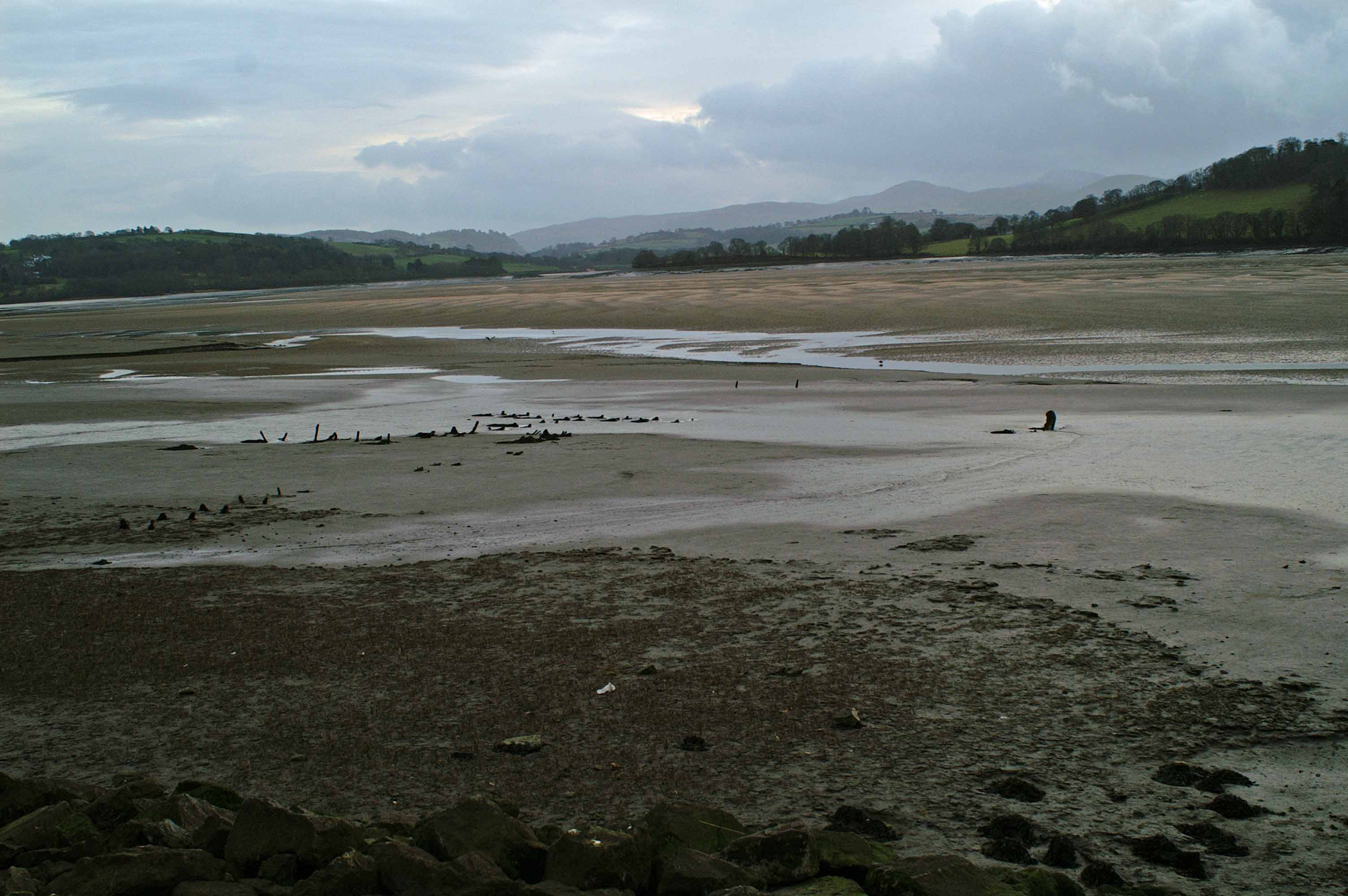
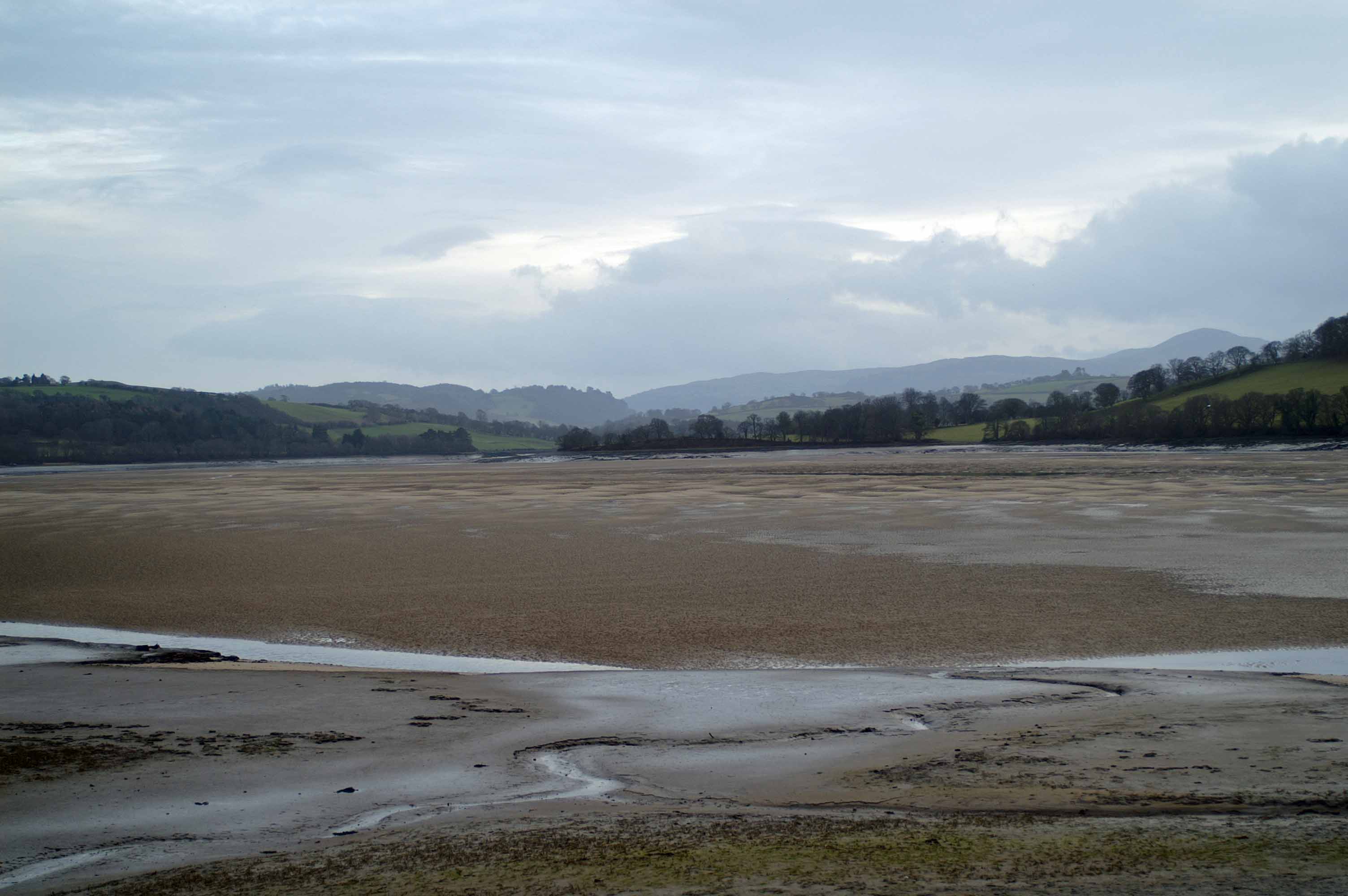
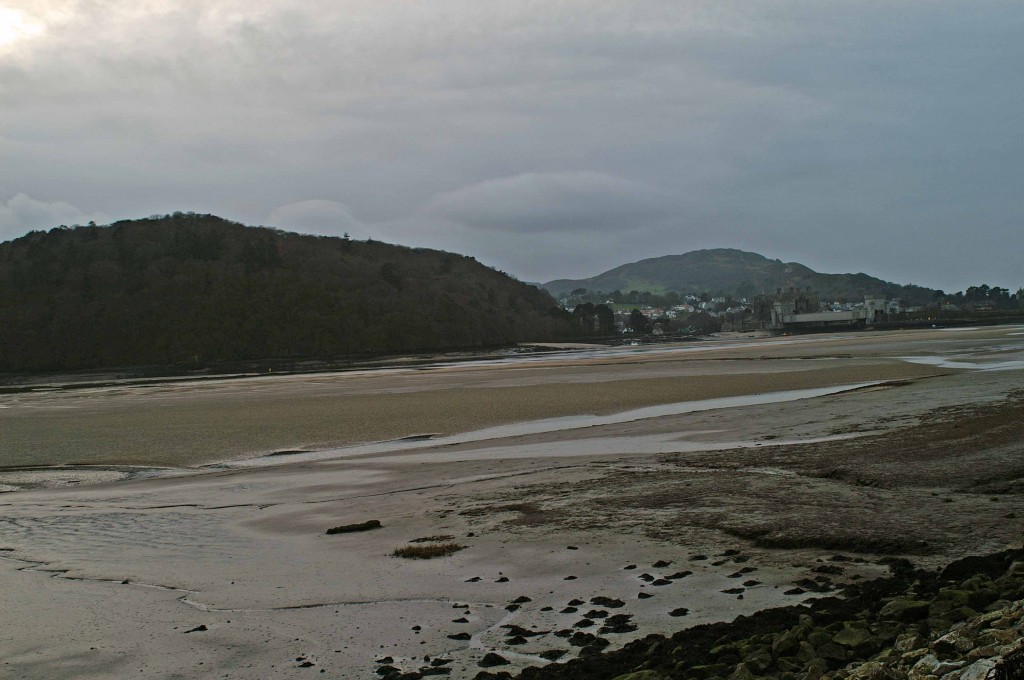
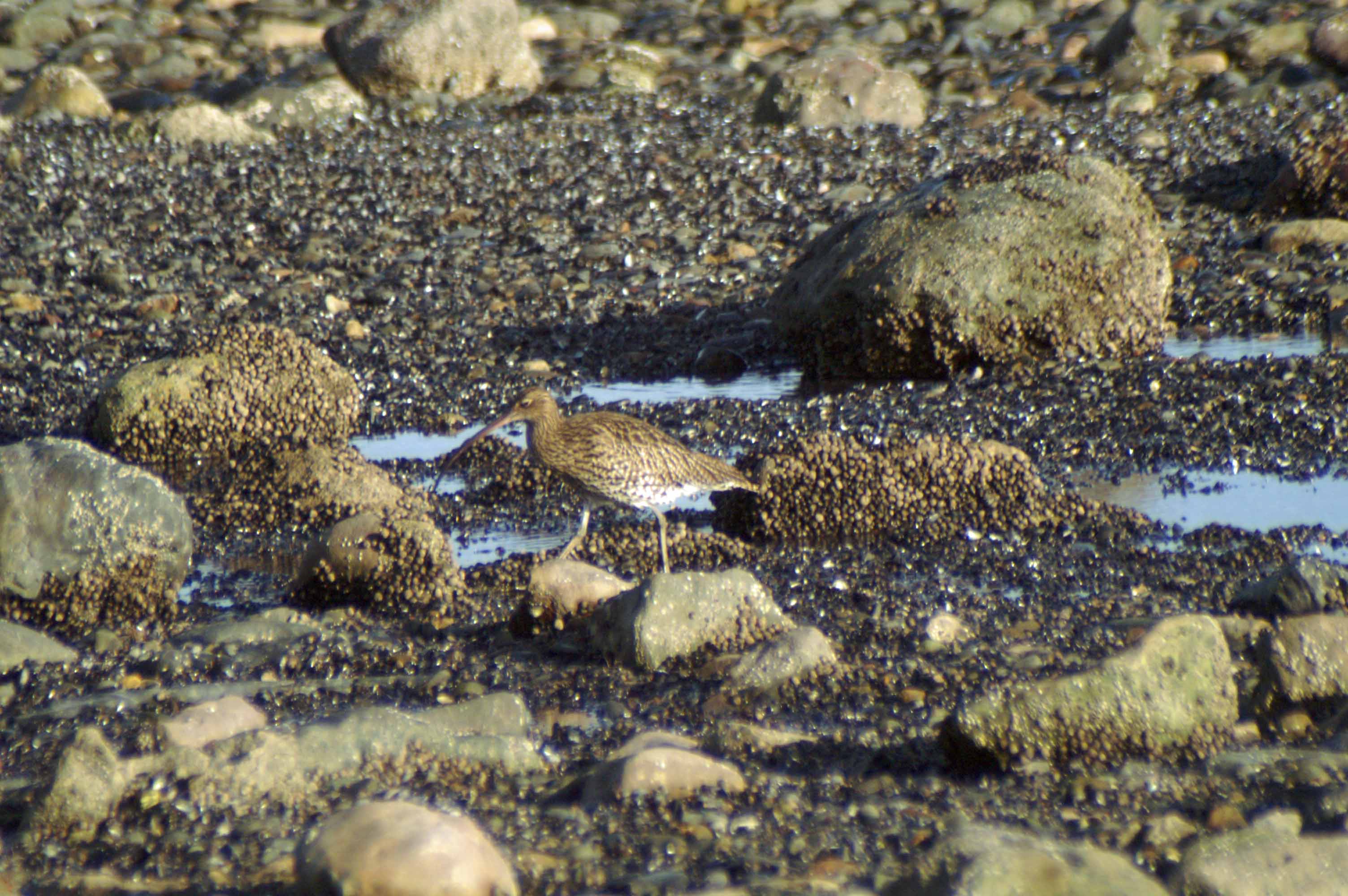
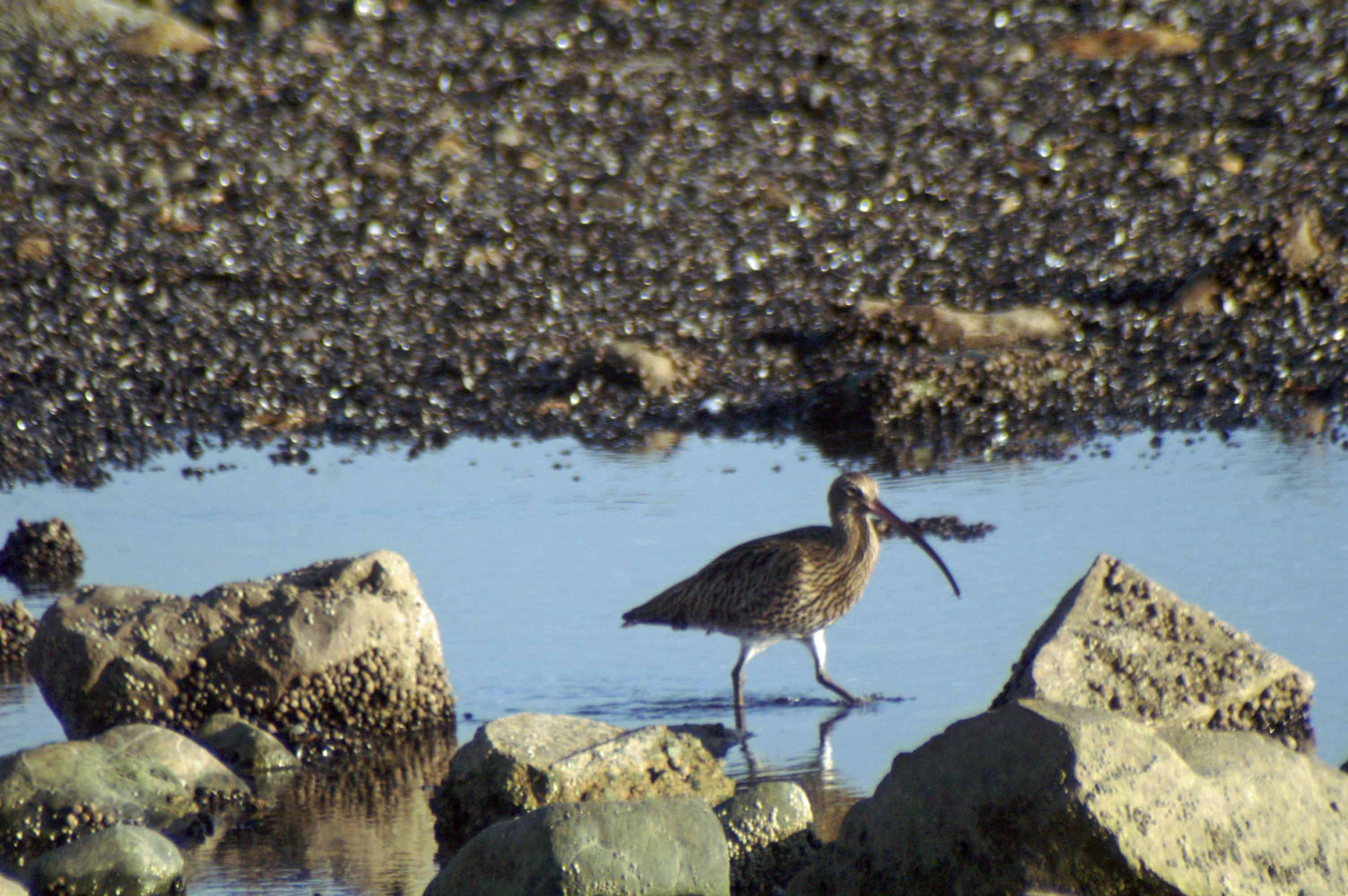
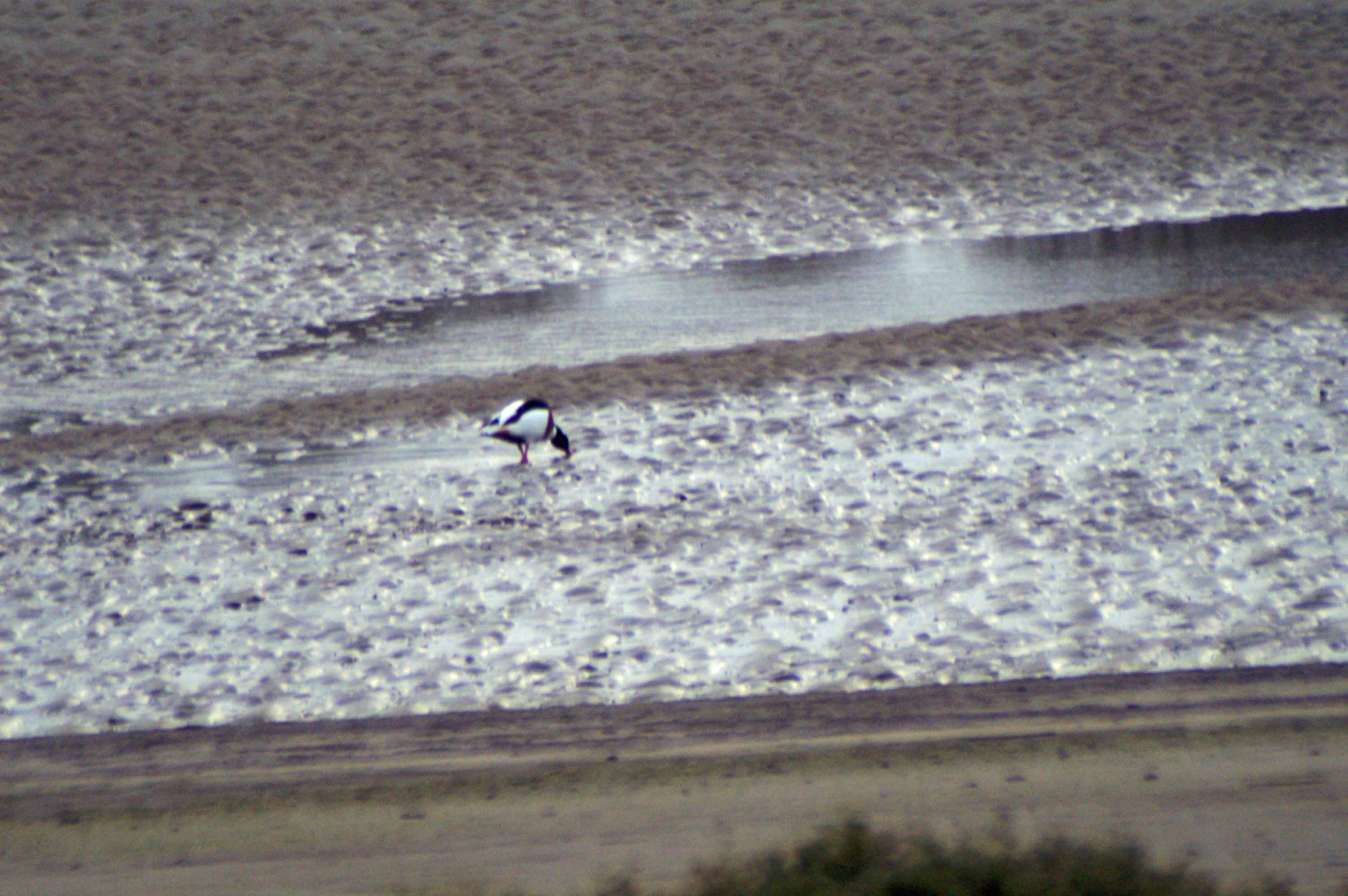
An evening walk alongside the Conwy Estuary. The sun was low in a cloudy sky, it was very cold and the tide was fully out exposing the wonderful contours and textures of the river bottom.  A few pools of shallow water remained and the only birds to be seen were a very few Curlew and a pair of Shelduck.

Shelduck

Contours and textures at low tide

A stalking Curlew blends easily into the estuary landscape

View upriver

Looking down the estuary towards the castle

Click on any of the images to enlarge them.

Share this:

  • Share on Facebook (Opens in new window) Facebook
  • Share on Pinterest (Opens in new window) Pinterest
  • Share on X (Opens in new window) X
Like Loading...

Cold weather and bird behaviour

07 Tuesday Feb 2012

Posted by theresagreen in bird behaviour, birds of the seashore, Nature, nature photography, Rhos-on-Sea

≈ 2 Comments

Tags

black-headed gull changing plumage, crow perched in the rain, herring gull catching earthworms, herring gull foot-paddling, oystercatcher in the rain

In common with the rest of the country we  had a week of proper winter weather last week, although we have so far missed out on any snow. The compensation  for below- freezing temperatures was that for three days the skies were clear and the sun shone. The mornings are lighter earlier now and when I leave the house the air is full of the sounds of birds. The tides have changed too and by 8.30am the sea has receded and the rocky shore and beach are already busy with foraging birds. The daylight hours are gradually lengthening too and it is now staying light till just past 5pm; it’s amazing how much better that makes you  feel.

My drive back and forth to work follows the coast closely; the road runs alongside the promenade all the way from the far end of Colwyn Bay, through Rhos on Sea and reaching almost as far as the Little Orme at the end of Penrhyn Bay. It is a treat to have such a scenic journey, especially as each day brings a different view depending on the state of the tide and the light. It hasn’t been a great week  for getting out and about, so this week’s observations are a bit limited and have been made from the shelter of the car at points along the route I drive.

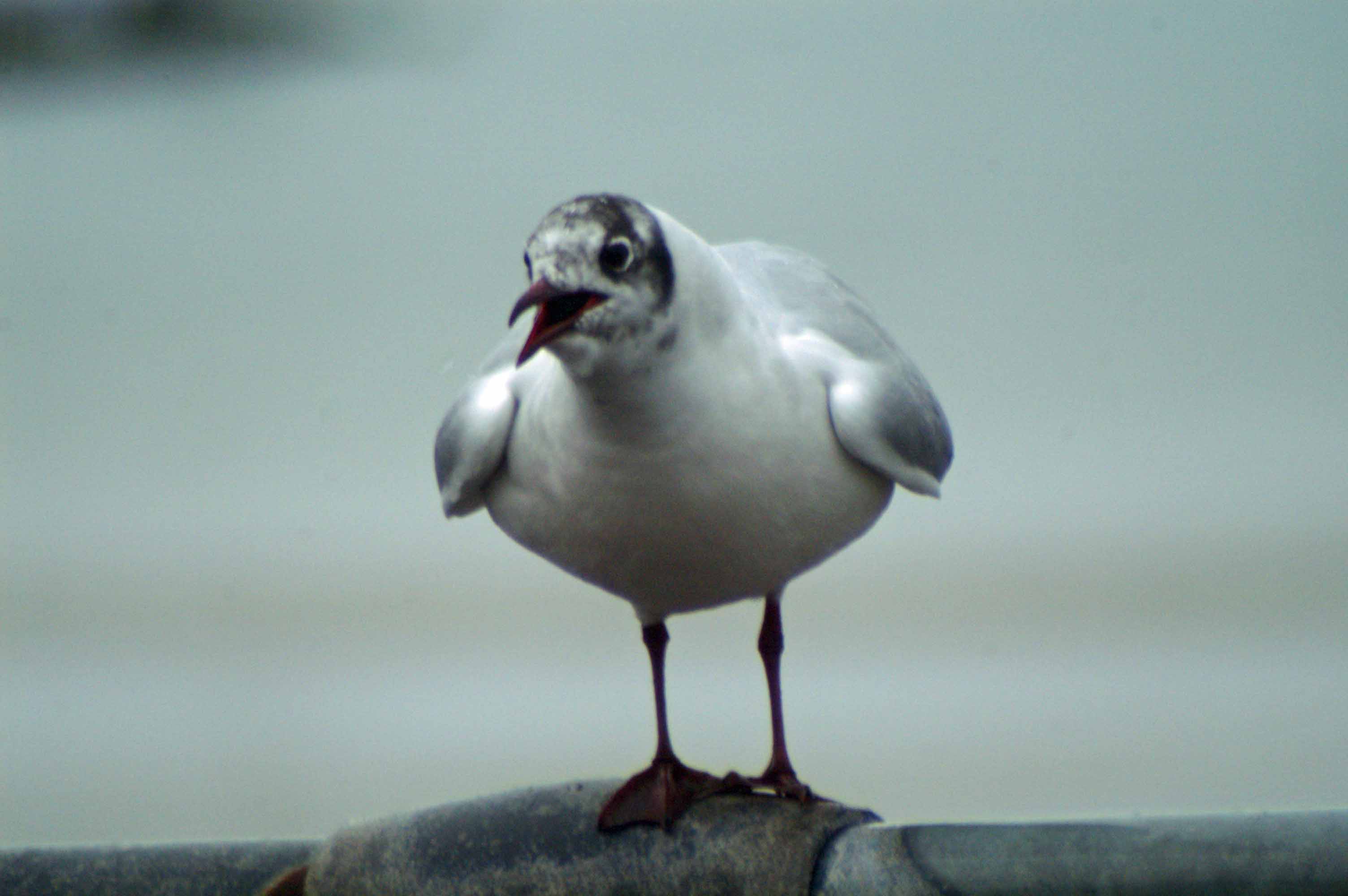
Saturday began cold with a light frost and by noon, where others were being snowed upon, we had some very cold rain instead. But whatever the weather, life along the seashore carries on pretty much as usual; birds simply have to eat. On my way home at lunch time I pulled in alongside the promenade at the Old Colwyn end  of the promenade to have a look at how the rain was affecting the birds. A few black-headed gulls are regularly perched on the railings here and as I stopped two birds obligingly flew in, probably hoping or some food to be thrown to them. One of them was well on his way to regaining his characteristic dark head plumage, looking a bit strange at the moment, but it won’t be long before he’s back to his handsome best. He was behaving territorially, squawking loudly at the approach of the other bird both on the ground and from the apparently desirable perch on the railings.

Black-headed gull with his head noticeably turning darker

Black-headed gull squawking from his perch

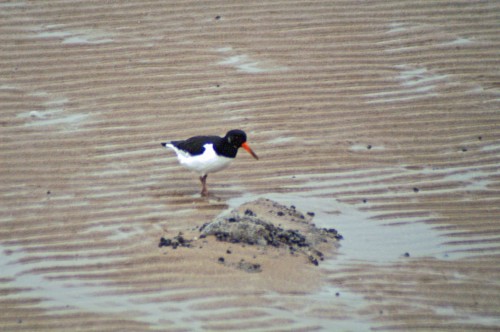
Down on the rain-lashed beach a lone oyster catcher was  running around foraging, periodically probing the sand with its bill. It  found a mussel and scuttled off at speed. I don’t know what it was running away  from, it had the whole beach practically to itself.

Oystercatcher foraging in the`rain on the sandy shore of Colwyn Bay

The Oystercatcher found himself a mussel and scuttled off along the beach with it in his bill

Crows are regular visitors to the seashore here and can often be seen perched on the railings and on the wall on the opposite side of the road or  foraging on the steep grass bank behind it. They have also learnt that the hard surface of the  promenade is helpful in breaking open mussel shells and they can be watched dropping the shellfish and picking them up repetitively until the soft body inside can be reached and eaten.

Crow sitting on the wall, hunched against the rain

Crow looking down his beak at me

Herring gulls are master opportunists when it comes to  finding  food, and they too are often seen foraging on the steep grassy banks along the coast road.  It is only very recently that I’ve  noticed one or two birds ‘ foot-paddling’ on the ground, a technique gulls and some other waders use to bring marine invertebrates to the surface. It is  fascinating to watch the birds dance on the spot, rhythmically drumming the ground with their big webbed feet; it seems to do the trick too, the one I photographed pulled out and ate several earthworms as I watched.

Herring gull ' foot-paddling' for worms


The Herring gull eating a worm

Share this:

  • Share on Facebook (Opens in new window) Facebook
  • Share on Pinterest (Opens in new window) Pinterest
  • Share on X (Opens in new window) X
Like Loading...

Strangers on and off the shore

30 Monday Jan 2012

Posted by theresagreen in Birdwatching on North Wales coast, Nature, nature photography, wading birds

≈ 2 Comments

Tags

black-throated diver, coastal birds, dunlin, purple sandpiper, purple sandpiper at rhos-on-sea, red-throated diver, ringed plover, shag, Turnstone

Saturday dawned bright, sunny and very cold, but at least it wasn’t windy. The sunshine encouraged me out to walk and I headed for the beach where I had hoped to take advantage of the clear light and take some shots of the mussel beds that are central to the presence of the wading birds. However, when I reached the end of our road I could see the tide was almost fully in, so that put paid to that idea. The sea was remarkably calm, but it was penetratingly cold and I almost turned around to go back for the car and drive somewhere more sheltered. Then I spotted a couple with telescopes peering out to sea and naturally had to find out what they were looking for. As I approached them I spotted a bird on the rocks, a Rock pipit was foraging along the boulders of the sea-break. It was a lovely healthy-looking bird and getting around quite nimbly despite the fact that the poor thing had lost most of one of its legs.

Rock pipit

Rock pipit, back view

It turned out that the couple with the telescopes were hoping to see divers, although apparently without much luck today. I know many birders enjoy sea-watching and spotting some of the less commonly seen species of sea birds, but as the best sightings are during the colder months and a lot of patience  is  required to achieve often very distant sightings, it’s not really my cup of tea. I am interested by the fact that it is possible to sight the birds around this coast though, and did a little research into them in the warmth of the house. The following information is from the RSPB website and from that I think the Red-throated diver is the species most likely to be seen offshore here.

Black-throated Diver- Gavia arctica

Family : Divers – (Gaviidae)

Black-throated Diver (RSPB image)-Found on Scottish Highland lochs in summer and around sheltered coasts in winter, and rarely along Irish Sea coasts. Moray Firth and W coast of Scotland best in winter, as well as the NE and SW coasts of England. Sometimes seen at inland reservoirs.

Streamlined diving birds that sit low in the water and dive with consummate ease. On land they are clumsy, barely able to walk with their legs so far back on their bodies. They are easily disturbed when breeding and their vulnerability to marine pollution make them a vulnerable as well as rare breeding species.

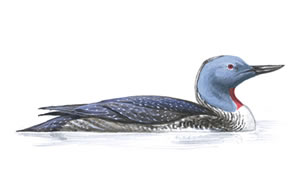
Red-throated Diver- Gavia stellata

Family : Divers – (Gaviidae)

Red-throated Diver- Gavia stellata -Outside the breeding season it is numerous along the UK's east coast, and occurs patchily along the west coast, with concentrations off west Scotland and around north-west Wales.

The smallest of the UK’s divers, its grey-brown plumage and up-tilted bill readily distinguish it from the other species. In summer it has a distinctive red throat. They usually jump up to dive and can stay underwater for a minute and a half. They are very ungainly on land, only coming ashore to breed. A recent moderate population decline make them an Amber List species.

Shetland is the UK stronghold for this species with other key populations on Orkney, the Outer Hebrides and the north Scottish mainland. They are also found along the whole of west Scotland south to the Mull of Kintyre. Outside the breeding season it is numerous along the UK’s east coast, and occurs patchily along the west coast, with concentrations off west Scotland and around north-west Wales.

The sea-watching couple had seen a couple of guillemots out at sea and also mentioned a Purple Sandpiper they had spotted on the breakwater rocks, which piqued my interest and sent me off my own ‘twitch’. I walked along the promenade, scouring the rocks in the hope of catching sight of the little Sandpiper, but with no luck. I also paid more attention to the sea and got out my binoculars for a closer look at a distant bird swimming around on the surface. Cormorant-like, but smaller,  with yellow patches at the base of its bill and around the eyes and with a  distinctive raised crest on its head, it was a Shag – Phalocrocorax aristotelis.

Walking back, another swimming bird, closer to shore this time definitely was neither a cormorant nor a shag.  I had no picture in my head then of what a diver looked like, but this was behaving like one, diving frequently and staying under the water for a good while before popping up again. It occurred to me that it was a Great crested Grebe, although I’d never seen one at sea before. It was a delight to watch, swimming around at some speed then diving elegantly. Once it came up almost directly beneath a floating black-headed gull, that was most put out and then just seconds later it dived again and came up with a sizeable fish.

Great crested Grebe- Podiceps cristatis

The Great crested Grebe caught a sizeable fish

It was too cold to stand around for long and my fingers on the camera controls were numb, so I walked back home via the shelter of the neighbouring streets. It’s been a while since I walked that way and I was very surprised by the amount of flowers in bloom in the front gardens. There are already snowdrops, crocus, grape hyacinth, the occasional daffodil and most surprisingly, wallflowers. The weather forecast for next week is not good – overnight frosts, sleet and below-freezing temperatures are not so good for too-early flowers.

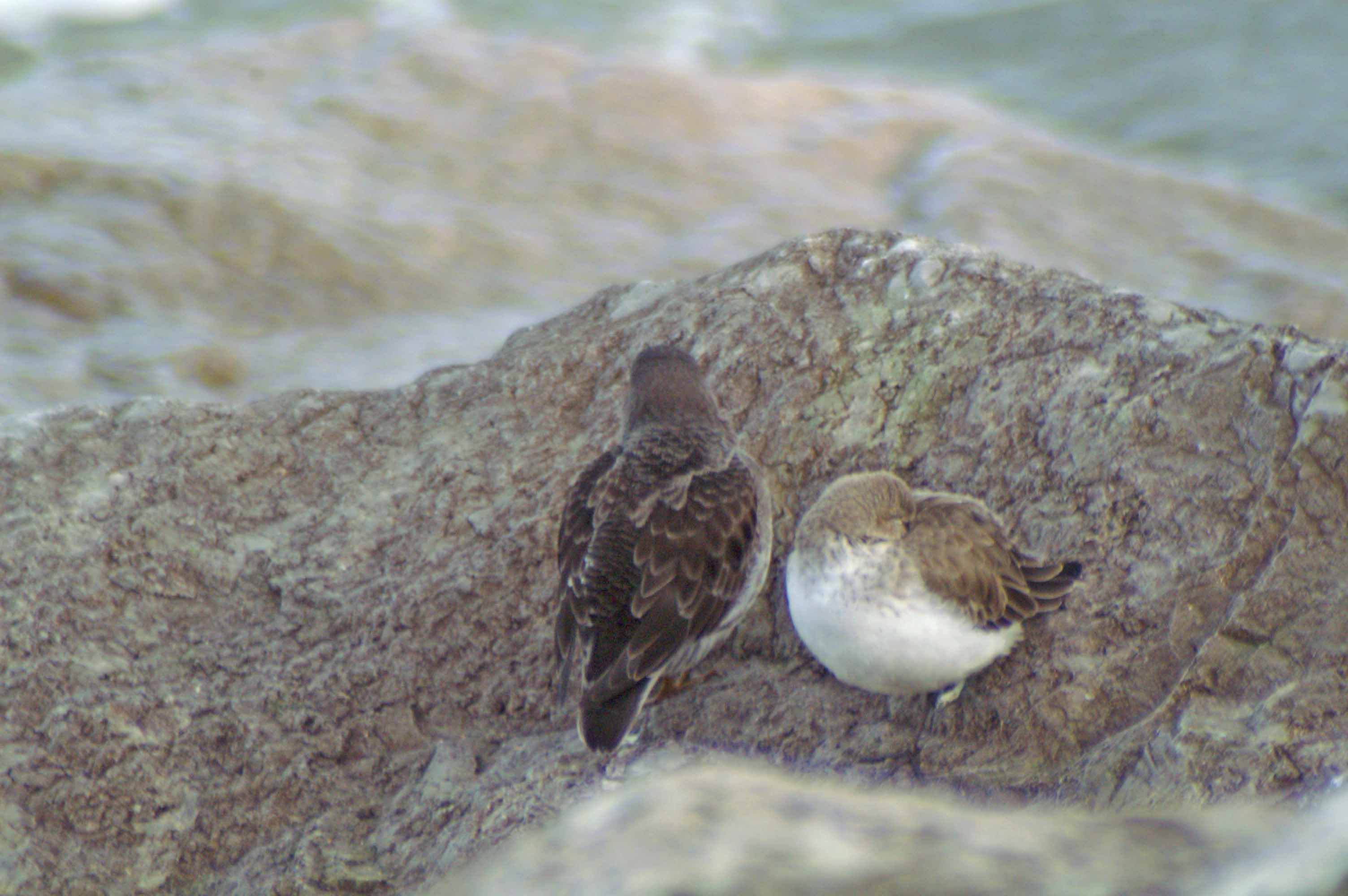
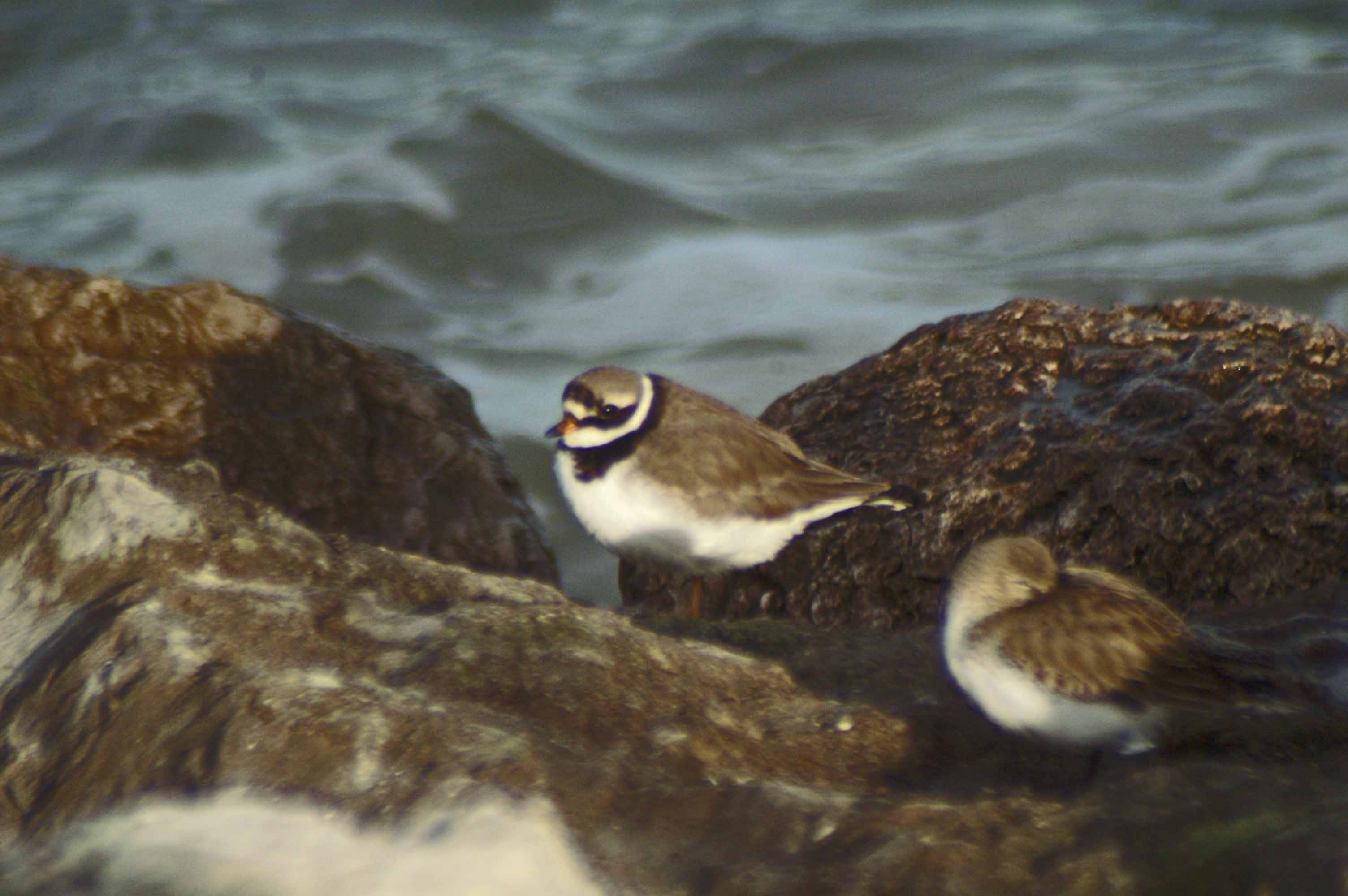
An hour in the house with a cup of tea and a sandwich and I’d warmed up enough to venture out again. This time I took the car as I was intending to drive over to the RSPB reserve on the Conwy estuary. (Point of interest: this morning’s sea-watchers had also told me that a firecrest had been ‘twitched’ there earlier in the day.) That was not why I was going there, but anyhow as I approached Rhos village I thought I’d pull over and have a quick look around the harbour beach  for the Purple Sandpiper. The winter sunshine had drawn a lot of others out to walk too and I parked in the  first available space and took the steps down to the promenade. There, almost right in front of me were a group of small birds peacefully dozing on the rocks waiting for the tide to turn. I recognised the turnstones and ringed plovers immediately, but was not so sure of the identification of the members of the majority of the group. I had to wait for one to stand up and show itself properly to be fairly sure they were dunlin – it was the long bill, slightly decurved at the end that clinched it.

A turnstone, 2 ringed plover and 6 Dunlin on one rock

I was more than happy to those three species together, but things got even better when I realised there were a small number of purple sandpipers tucked in there as well ; fortunately they are much more distinctive and I recognised them with no problem. I saw 3 in total, but there could have been more tucked down lower on the rocks.

Purple Sandpiper close to a dunlin compares their size and plumage; the dunlin is slightly smaller and much lighter in colour

The Purple Sandpiper is usually a strictly coastal wader that visits Britain in the non-breeding season and then flies north to breed during the summer. They are seldom found on sandy beaches but prefer rocky coasts, where they can be seen searching for molluscs and crustaceans among the rocks and rock pools. In the North West They can turn up on any rocky coast from the tip of the Llyn peninsular in North Wales to Morecambe bay in the North. They begin to arrive in October, reaching a peak by November and start to leave again in April. By June, at the latest, they are gone.They are about the same size as a turnstone, with whom they are often seen, and a dark bird overall.

Purple Sandpiper-Calidris maritima

The purple sandpiper is the only small dark wader with yellow/orange legs likely to be seen on rocky shores,frequently in association with turnstones. They have a rather round-shouldered appearance, the wings are very dark grey, the head and back a slightly paler shade and the partially streaked breast an even paler shade. They have a longish beak for their size which is dark grey/black with a yellow or orange base. Their legs appear fairly substantial and are bright yellow or pale orange. In flight they appear very dark with just a faint, narrow white wing-bar and bold white edges on a black/dark grey tail.

Purple sandpiper amongst dunlin & a ringed plover

A purple sandpiper joins another group, showing all 4 species together; dunlin, ringed plover & a turnstone

Dunlin - Calidris alpina

Ringed plover-charadrius hiaticula, in sunlight

2 ringed plover side by side; the one at the back is an adult, the other an immature with no black head band and an incomplete, brownish breast band

The birds were so close to the promenade that quite a few people passing by noticed them; some of whom stopped and asked me to identify the species for them. Perhaps not too surprisingly, it was the attractive Ringed Plovers that aroused the most amount of  interest.

Share this:

  • Share on Facebook (Opens in new window) Facebook
  • Share on Pinterest (Opens in new window) Pinterest
  • Share on X (Opens in new window) X
Like Loading...

The Welsh Red Dragon

24 Tuesday Jan 2012

Posted by theresagreen in Welsh culture and mythology

≈ 1 Comment

Tags

Conwy castle, mabinogion, mametz wood memorial, red dragon of Wales, welsh flag, Welsh Highland Railway

My blog is usually about real everyday nature, in real time, but today at the beginning of this Chinese New Year of the Dragon, I am writing instead about the significance of this mythological creature here in Wales.

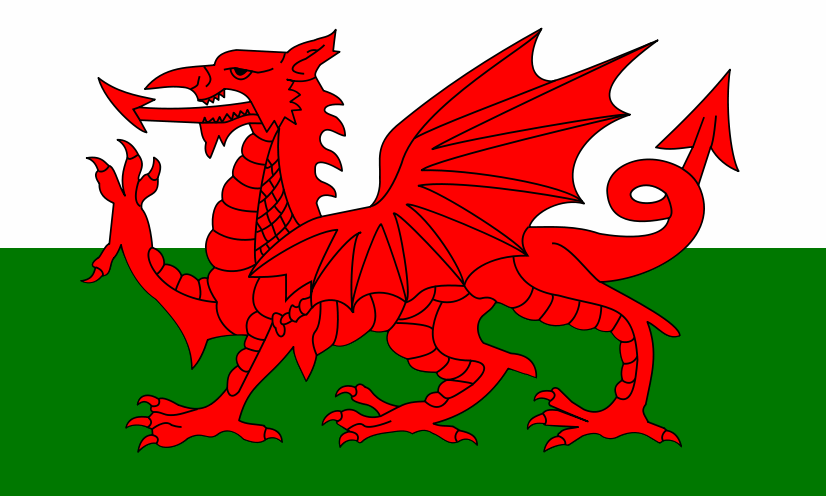
The Welsh Dragon, in Welsh Y Ddraig Goch, (Red Dragon) is the indisputable and most highly prominent icon of the country. It is employed and proudly displayed in a myriad of ways and places, from  playful car bumper stickers and drinking mugs to more serious applications such as that as the symbol of  the Welsh Assembly Government, but its most significant role is as the centrepiece of  the nation’s flag.

welsh_flag

The Welsh Dragon appears on the national flag of Wales (the flag itself is also called “Y Ddraig Goch”). During the reigns of the Tudor monarchs, the red dragon was used as a supporter in the English crown’s coat of arms (one of two supporters, along with the traditional English lion).

Mythology of the red dragon

The mythology connecting the Red Dragon to Wales begins in the Mabinogion,  a collection of eleven prose stories collated from mediaeval Welsh manuscripts. The tales draw on pre-Christian Celtic mythology, international folktale motifs, and early mediaeval historical traditions.

Mabinogion

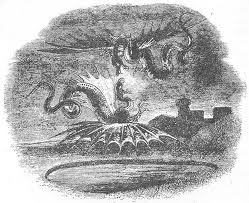
The fight between the Red and White Dragons

In the Mabinogion story of Lludd and Llefelys, the Red Dragon fights with an invading White Dragon. His awful pained shrieks bring about mayhem and disaster; women  miscarry, animals  perish and plants become barren. Lludd, the then king of Britain,seeks help from his wise brother Llefelys in France. Llefelys tells him to dig a pit in the centre of Britain, fill it with mead, and cover it with cloth. Lludd does this, and the dragons drink the mead and fall asleep. Lludd imprisons them, still wrapped in their cloth, in Dinas Emrys in Snowdonia (Welsh:Eryri).

Historia Brittonum
The tale is taken up by Nennius in the Historia Brittonum. The dragons remain at Dinas Emrys for centuries until King Vortigern tries to build a castle there. Every night the castle walls and foundations are demolished by unseen forces. Vortigern consults his advisers, who tell him to find a boy with no natural father, and sacrifice him. Vortigern finds such a boy (who is later, in some tellings, to become Merlin) who is supposed to be the wisest wizard to ever live. On hearing that he is to be put to death to solve the demolishing of the walls, the boy dismisses the knowledge of the advisors. The boy tells the king of the two dragons. Vortigern excavates the hill, freeing the dragons. They continue their fight and the red dragon finally defeats the white dragon. The boy tells Vortigern that the white dragon symbolises the Saxons and that the red dragon symbolises the people of Vortigern. If Vortigern is accepted to have lived in the fifth century, then these people are the British whom the Saxons failed to subdue and who became the Welsh.

The same story is repeated in Geoffrey of Monmouth’s History of the Kings of Britain, where the red dragon is also a prophecy of the coming of King Arthur. It is notable that Arthur’s father was Uther Pendragon (“chief dragon”, erroneously translated by Geoffrey as “dragon’s head”).

The dragon has always been a symbol of a people, not an individual. 

In 1400 Owain Glyndwr raised the dragon during his revolt against Henry IV, echoing its role in Welsh mythology as a symbol of struggle and resistance. However, this didn’t confer exclusivity to Wales: the dragon reappeared alongside Henry V at the battle of Agincourt (1415).

The dragon began to roar even louder after the Wars of the Roses in the 15th century. The House of Tudor was the Welsh dynasty who defeated the House of York at the Battle of Bosworth in 1485.

The Tudors’ livery was white and green. As he marched his troops through Wales to Bosworth, Henry Tudor – shortly to be Henry VII – flew the red dragon of Cadwallader, from whom he claimed ancestry, on the white and green Tudor colours. After the battle the flag was carried in state to St. Paul’s Cathedral to be blessed.

It was the beginning of the flag as we know it today.

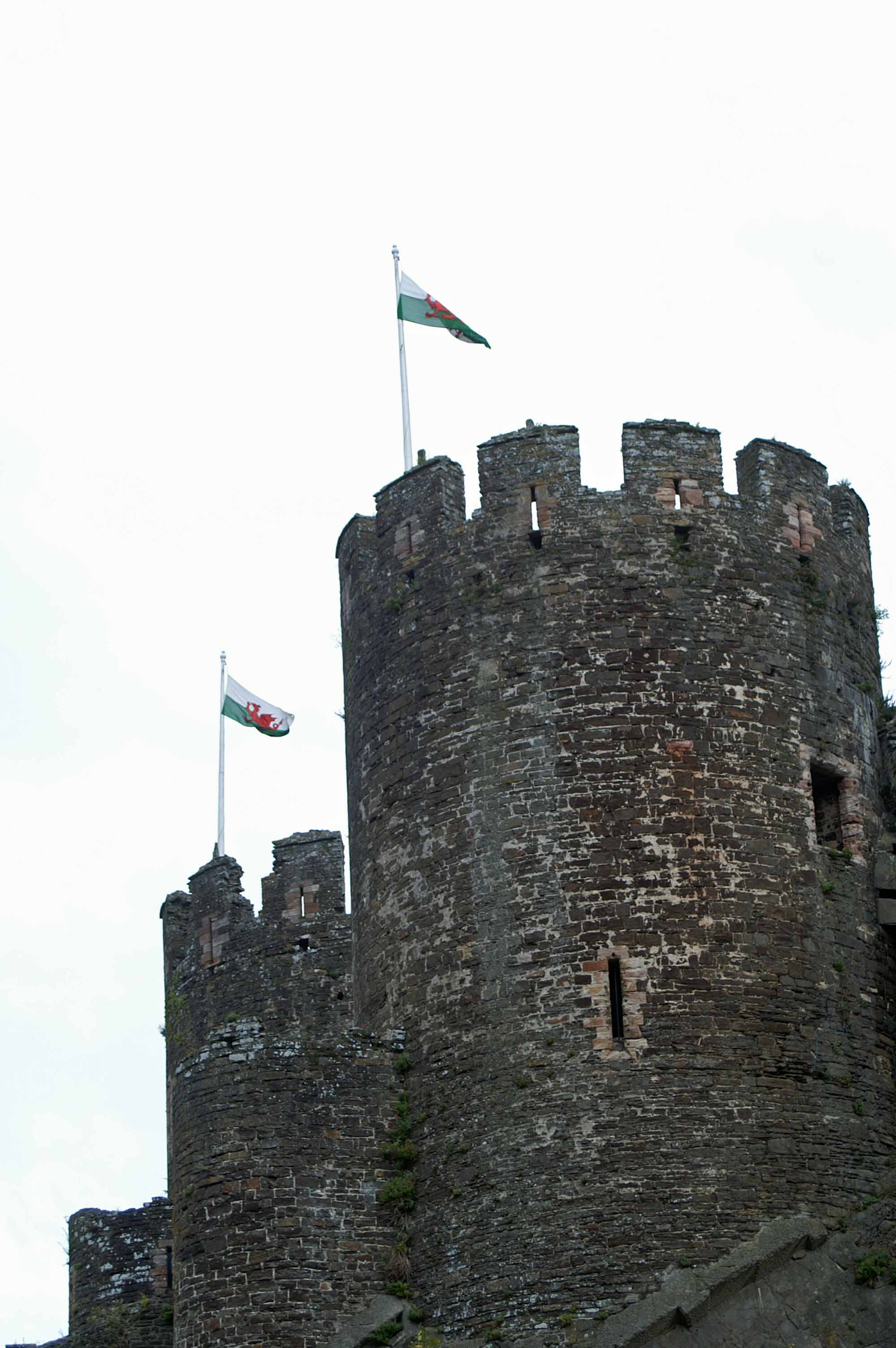
Welsh flags on a tower of Conwy castle

splash_logo-e1327421675816

A dragon is displayed on the logo of the Welsh government

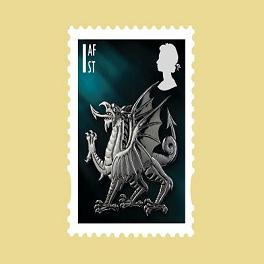
The dragon is featured on the welsh royal mail 1st class postage stamp

In the town of Newcastle Emlyn, a Heart of the Dragon Festival  is held every two years (the next one is in 2013).  Local legends say that the last dragon was slain there during a village festival.  The Heart of the Dragon Festival aims to resurrect the “spirit of the dragon,” in the form of a baby dragon egg, which ultimately “hatches,” to reveal a miniature dragon.  www.heartofthedragonwales.org

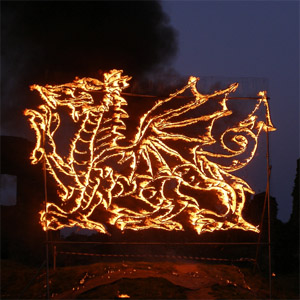
Dragon fire sculpture

The Mametz Wood Memorial

http://www.somme-1916.com/memorial003.htm

38th Division

The 38th (Welsh) Division was recruited from battalions of the Welsh Regiment, South Wales Borderers and Royal Welsh Fusiliers in 1914. Lloyd George had a heavy hand in the raising of the formation; one of his sons being an officer in the division. It crossed to France in late 1915, and came down to fight on the Somme in July 1916. The first attack on Mametz Wood was on 7th July, when the division lost heavily in ‘Death Valley’ during the advance on the ‘Hammer Head’. The next attack went in on the 10th, and by 14th July the wood was cleared – but at the cost of over 5,000 casualties in the 38th (Welsh) Division. A memorial was placed in Mametz Church in the 1920s, but this Red Dragon monument was placed here in the late 1980s on the wishes of a number of Mametz Wood veterans, former Sergeant Tom Price among them.

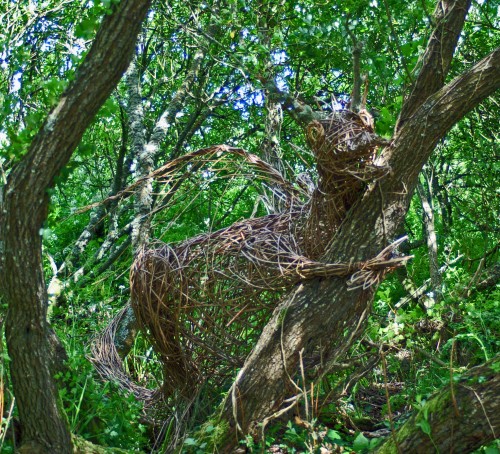
Not all welsh dragons take themselves seriously. My friends and I discovered this cleverly crafted one in a tree next to a path along the Nevern Estuary, Newport, Pembrokeshire

Share this:

  • Share on Facebook (Opens in new window) Facebook
  • Share on Pinterest (Opens in new window) Pinterest
  • Share on X (Opens in new window) X
Like Loading...

Winter treats on the Little Orme

23 Monday Jan 2012

Posted by theresagreen in bird behaviour, Birdwatching on North Wales coast, Little Orme, Nature, nature photography, Rhiwledyn Nature Reserve

≈ Leave a comment

Tags

chough, chough in North Wales, flowering gorse, raven, stonechat

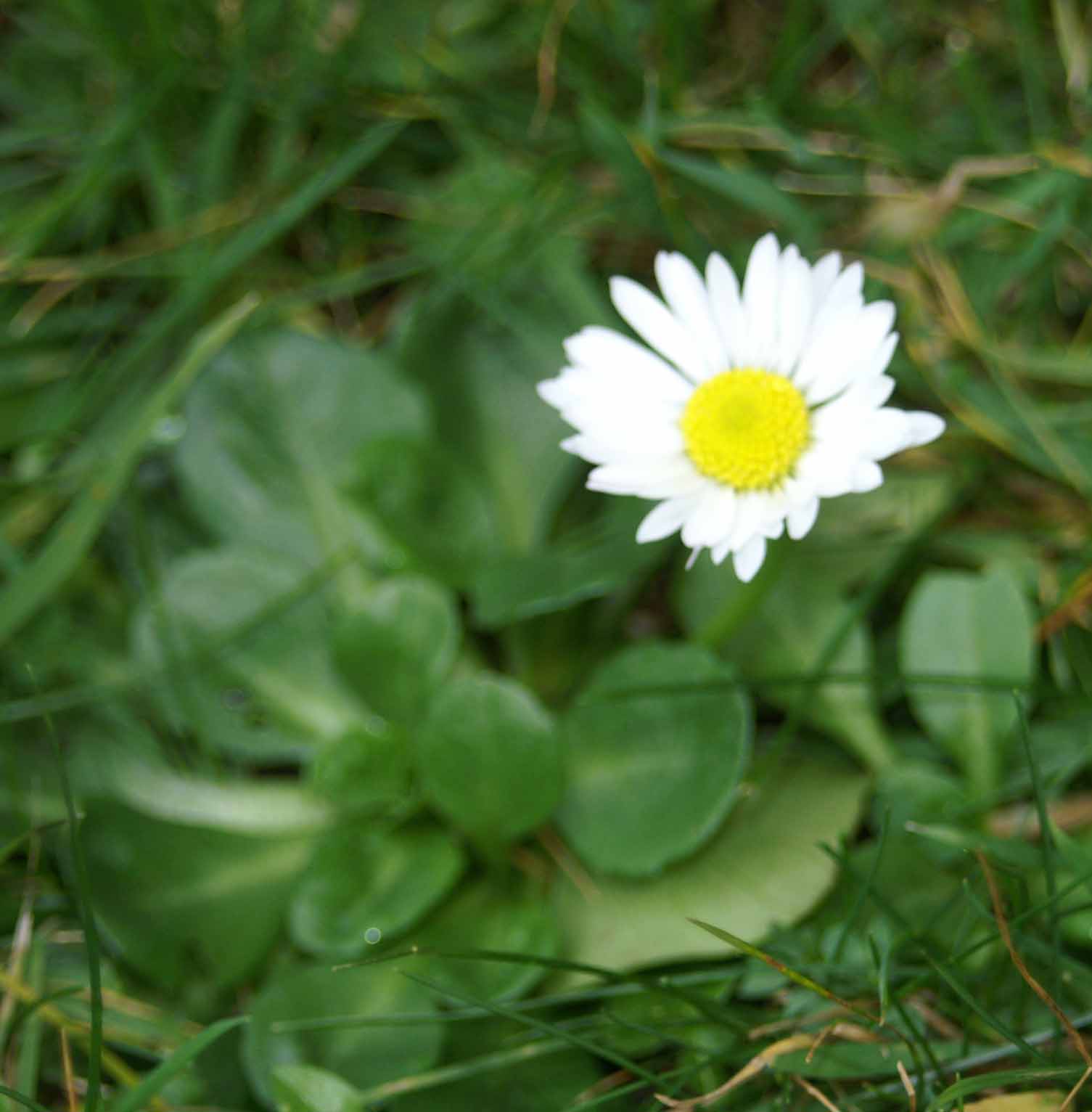
10th January - Daisy in the lawn

In common with the rest of Britain, we have experienced a mixed bag of winter weather on the North Wales coast so far this year and last week brought the whole selection together in its 7 day span. There were gale force winds, dull grey overcast days and some clear bright sunny days that darkened into clear night skies  full of brilliant stars. Of  course the clear nights brought forth morning frost and freezing temperatures, but they did not last for long.

Wood pigeon perched on the frosted roof

I usually try to avoid popular local walking spots on high days and holidays, but a need for some quick-fix fresh air and exercise on a cold but sunny Sunday afternoon found me heading for the nearby nature reserve on the headland of the Little Orme. When I first arrived I was pleasantly surprised by how few other people were there and set off towards the cliff edge to look out across the small bay. There were a few cormorants flying back and forth with a few more diving off the  tip of the headland. I watched a pair of fulmar flying around close to the cliff face, but that was it for sea birds; even the gulls were otherwise occupied elsewhere.

I turned around to walk back and heard the distinctive ‘barking’ call of a raven that I tracked to the top of the rockface. The bird was perched, hunched down with its head and neck pointed upwards and with its feathers bristling out around  its body. At that point I couldn’t see any other birds around that may have been provoking its behaviour, but a little later I heard it calling again from the cliff edge slightly further inland and looked up to see two buzzards circling closely above it, so maybe they were the objects of his annoyance.

Disgruntled raven

I already mentioned that this was a sunny day, but not yet that the sky was blue and – wait for it – so was the sea. One of the things I had come out hoping to photograph was gorse in bloom and luckily there were several bushes with flowers, but this picture of sunshine-golden gorse against a background of a blue Irish Sea had to be the one I included. It reminded me so much of Spain – apart from the sharp cold air that is.

Golden gorse in bloom against a background of blue sea

In total contrast I was then drawn to a patch of what from a distance I took to be low-growing white flowers but that was actually frosted moss.

a patch of frosted moss

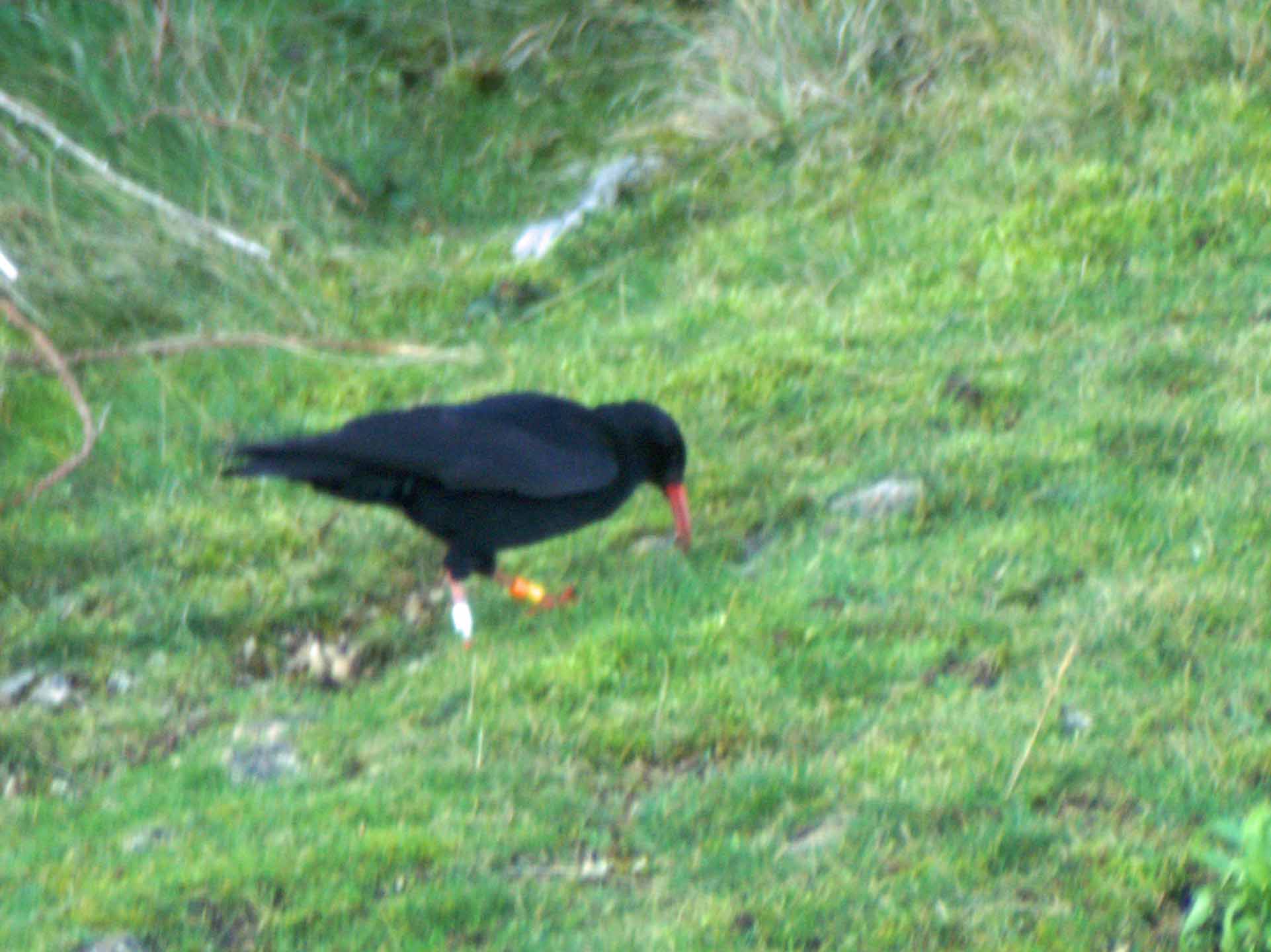
I had been meandering around rather than walking with any purpose and stood for a moment looking around trying to decide which direction to head in, or as the place suddenly seemed to be filling up with people and their dogs, whether to  leave and move on somewhere else. Just then a small flock of jackdaw flew in very close to me and landed on the short grass at the base of the cliff. I am very fond  of these intelligent and sociable birds, and for want of much else to photograph I decided to approach them and try for some close shots.  I got within a few metres, began to slowly raise the camera so as not to spook them, then almost dropped it when I realised that foraging alongside the jackdaws there were two chough. I was excited by the completely unexpected sighting of these much rarer birds, and panicking too as I could see a couple with a loose dog heading straight for me. I managed to get two shots only, one that was too out of focus to present and this one that is a long way from brilliant but does record the event.

A lucky glimpse of a Chough (Pyrrhocorax pyrrhocorax) on the Little Orme

I got my shots with just seconds to spare as the dog spotted the birds and bounded towards them, deliberately chasing them away. I watched disappointedly as they flew away, but sadly the dog owners smiled at me as they passed, probably amused by their dog’s ‘playfulness’. I was not at all amused. I had a long enough look to see that one of the chough had quite a collection of leg rings of varying colours, so it is obviously one that has been well monitored and it  should be possible to find out where it came from. Most probable is the nearby Great Orme, but South Stack on  Anglesey is another possibility. If anyone recognises the rings, I’d be very interested to hear from them.

Stonechat - Saxicola torquata

I considered the possibility that the birds may return, so to while away a few minutes I walked down the sloping path into the valley created by past removal of limestone rock. It was sunnier there and almost immediately a small bird perched on a gorse bush caught my eye. Its general size, shape and familiar behaviour  immediately brought stonechat to mind, but this is another bird I’d yet to see here, so I was pleased to confirm that as I focussed the camera lens on  it.

Stonechat (m) in ash tree

As I was leaving the site I had another glimpse of the Stonechat where it was perched in a small ash tree. It was joined there by another bird which I initially thought may have been a female, but was actually a Dunnock.

Dunnock

Share this:

  • Share on Facebook (Opens in new window) Facebook
  • Share on Pinterest (Opens in new window) Pinterest
  • Share on X (Opens in new window) X
Like Loading...

New Year catch up part 11

22 Sunday Jan 2012

Posted by theresagreen in bird behaviour, birds of the seashore, Nature, nature photography, Rhos-on-Sea, wading birds

≈ 3 Comments

Tags

curlew camouflage, oyster catcher, redshank, Turnstone

The variety of  wading bird species regularly foraging on the seashores of Rhos-on-Sea and Colwyn Bay remains pretty much the same as reported in the late summer/autumn of last year; i.e in the main, curlew, oystercatcher, redshank and turnstone. The numbers of  individuals of some species has decreased, but there are still plenty to be seen and in respect of studying the birds more closely, I find that less is more. With fewer numbers to distract my attention I concentrate more on watching individual birds and pick up on aspects of their behaviour, the way they move, how they feed  and such like.  I seem to find this the most effective way to assimilate information about a species and how I learn to identify them more quickly in different settings by means of what practised birdwatchers call the bird´s ´giss´ (general impression size and shape).

Oystercatchers are resident here and there are always plentiful numbers to be seen and heard in a variety of places along the seashore. They are very distinctive in their appearance and its long orange bill make it unlikely to be confused with any other large pied wader .

Oystercatcher- Haematopus ostralegus

Two oystercatchers (one ringed) and a redshank also with a leg-ring

Oystercatchers flying along the sea edge with wind turbines in the background

Curlews are best seen once the tide is quite well out as they arrive to forage around the exposed rocks and shallow pools. Despite their size and bulk, their cryptic camouflage is so effective that they can be difficult to pick out against the background of rocks, particularly those that host colonies of periwinkles. Once you have spotted one, more seem to magically appear, rather like those 3D pictures that were fashionable a few years ago that required your eyes to go slightly out of of focus before the image was revealed.

At low tide curlews are perfectly camouflaged against the rocks studded with periwinkles

Curlew-Numenius arquata

There is plenty of space here and the birds range widely across it. Often they may be spotted foraging independently and sometimes in small groups of two or three. I have only once witnessed an altercation between two individuals when one decided to oust the other from what was clearly a prime pool.

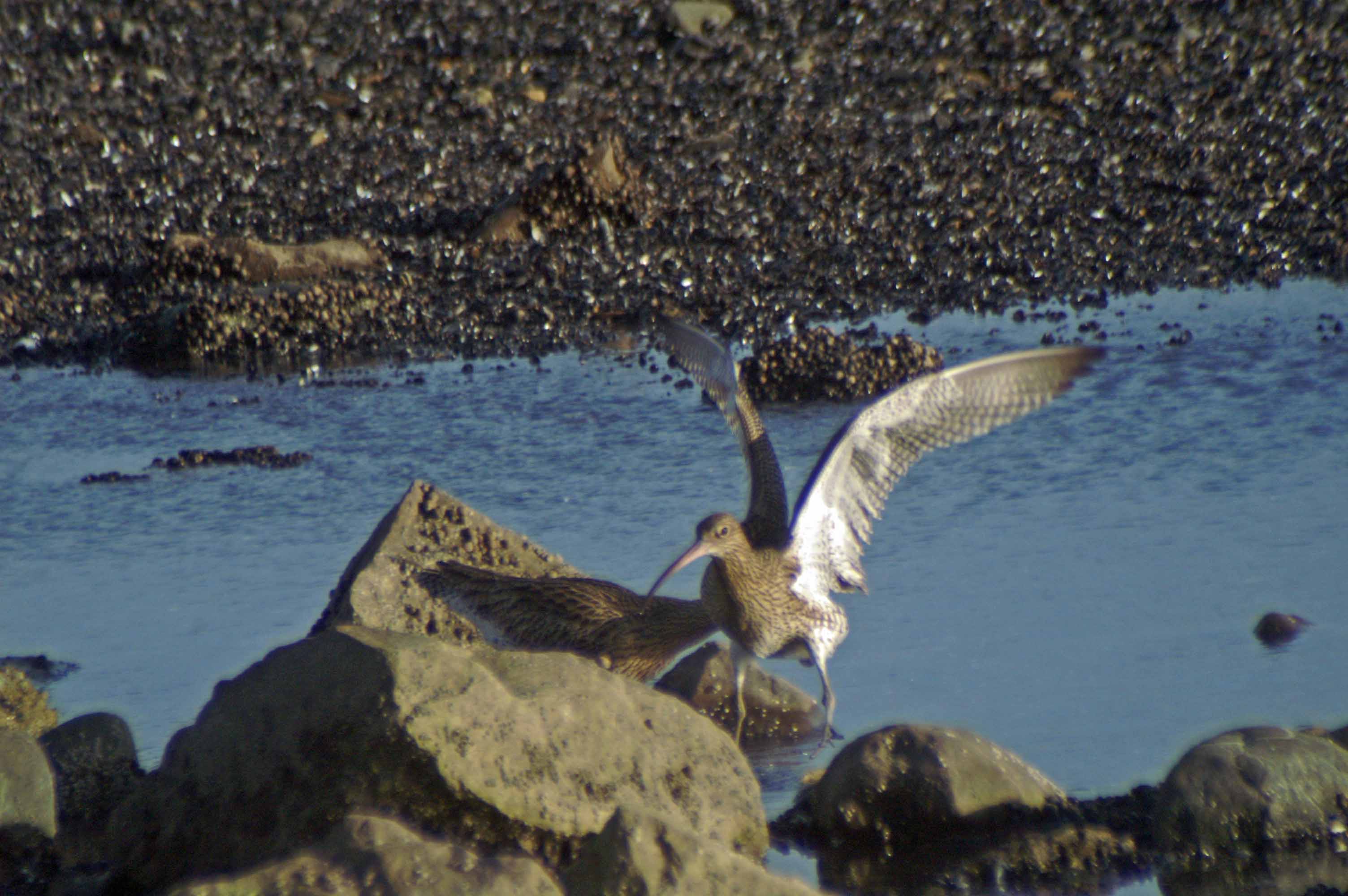
A skirmish between two curlew resulted in a great view of the bird's outstretched wings

Turnstones waiting for the tide to turn take the opportunity to rest quietly on the big rocks of the breakwater, springing into action as soon as the first strip of the shoreline is revealed by the retreating water.

Turnstones resting and preening in the winter sunshine waiting for the tide to turn

The particular spot I photographed the birds in is a favourite roosting spot quite close to the edge of the promenade, but they are not in the least perturbed by passing people or dogs. They know exactly when the water will begin to retreat and some of the birds move nearer to the sea edge to wait despite being splashed by waves.

Turnstone on a sea-splashed rock

Occasionally the cold shower pays dividends and a stray shellfish may be thrown up nearby.

A Turnstone seizes a mussel thrown up by a wave

Those on the alert quickly move further down the shore to be the first to explore the first areas to be exposed by the retreating water.

A closer look at the undersides of a Turnstone as it flies away

Share this:

  • Share on Facebook (Opens in new window) Facebook
  • Share on Pinterest (Opens in new window) Pinterest
  • Share on X (Opens in new window) X
Like Loading...

New year nature part 1

15 Sunday Jan 2012

Posted by theresagreen in Nature, nature photography, Rhos-on-Sea

≈ 4 Comments

Tags

birds`with brown plumage, blackbird, feeding birds, garden birds, house sparrow, rhos on sea, starling

I’d like to begin by wishing a belated but very sincere happy new year to everyone taking the  time and trouble to read this blog. It seems like an age since I posted my last offering, but other commitments, including our daughter’s wedding on Boxing Day and my venturing out of more-or-less retirement back into the world of work for the forthcoming next three months, have taken up much of my time and most of my energy.  As a consequence, for the last few months most of my nature watching has been glimpsed through glass, either from the house or the car, but I’m still aware of what’s happening around me, although with less time to record it.

(To avoid confusion I should probably mention at this point that I am back in Rhos-on-Sea, North Wales)

I have been restricted in my freedom to roam thus far, but I thought that I  would make that into an opportunity to have a closer look at some of the birds that are conspicuously present, but whose numbers or commonness we tend to take for granted.

The mild winter temperatures we have experienced during the first two weeks of January have given grace to the garden visiting birds to forage for natural food and there have been regular sightings of blackbird, robin, dunnock, house sparrows, great tit and blue tit doing just that. There were also a few visits from a beautiful song thrush earlier in the month, but I haven’t seen it lately. In the nearby trees there are regularly chaffinch, wood pigeon, collared dove,magpie and carrion crow. Then of course there are the herring gulls that regularly patrol the skies on the look out for a snack. They do make you think twice before putting out additional food for the garden birds, so is probably better offered confined to wire hanging feeders.

In the garden at the back of the house I often see two female blackbirds together that I think may be mother and daughter. This is the younger one with more mottled plumage. There is a male around, but I don't see him as often.

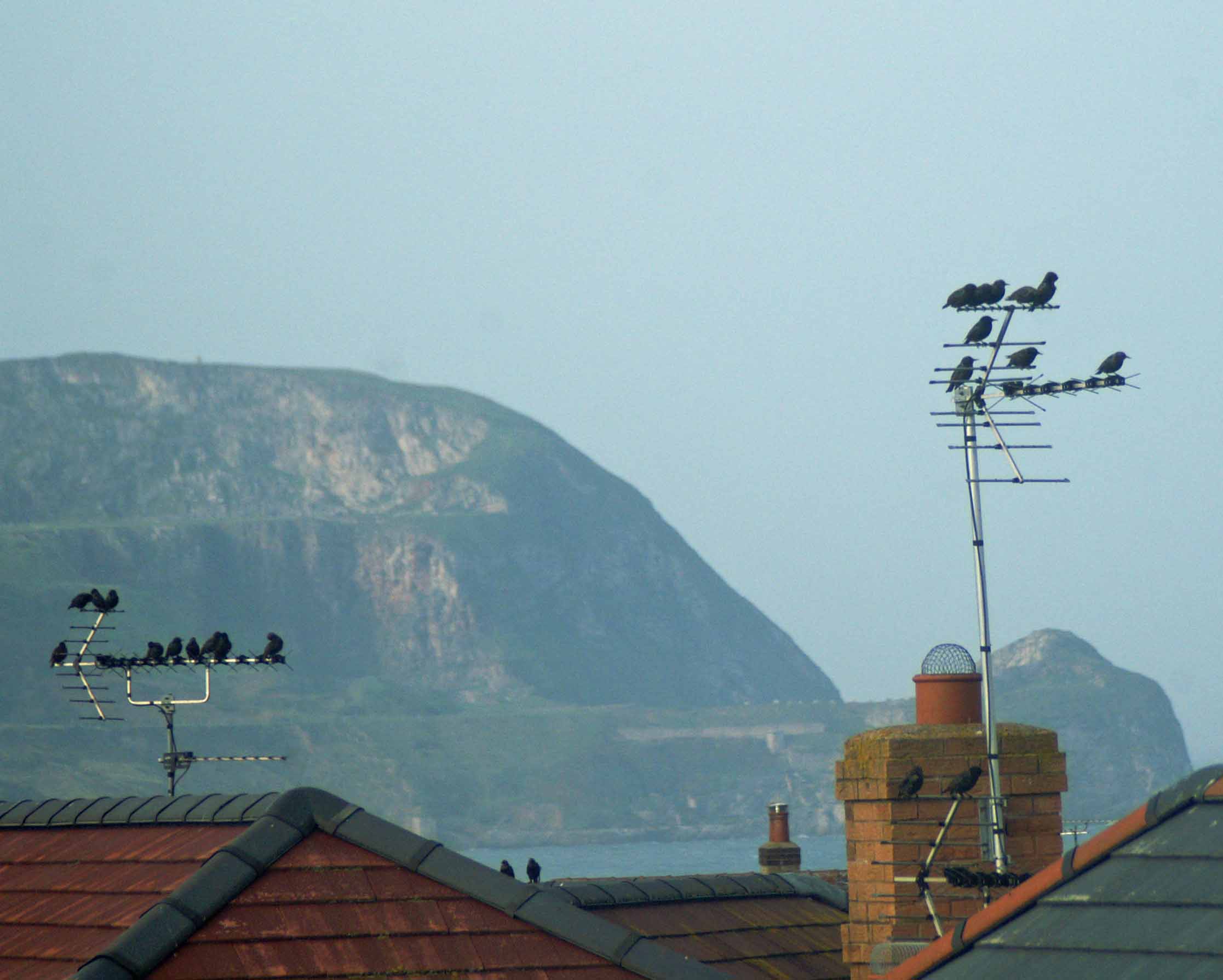
Starlings are everywhere, mostly sticking together in small flocks that travel around the area gathering in trees and on rooftops where they perch high on TV ariels  and chimney pots. They also frequent the rocks of the breakwaters in the harbour to forage amongst the rocks.

Starlings with an 'ariel' view of the Little Orme

Hanging up a feeder filled with fat balls has given me some lovely close up views of  the colourful and complexly marked plumage of individual birds.

The beautiful plumage of a starling feeding in the garden

European Starling – Sturnus vulgaris

Convervation status: Red

Still one of the commonest of UK garden birds, its decline elsewhere makes it a Red List species.

Family – Starlings (Sturnidae)

Smaller than blackbirds, Starlings are neatly shaped birds that have a short tail, a rather pointed head and triangular shaped wings. They appear to be coloured black at a distance, but when seen more closely they are in fact very glossy with an iridescent sheen of purples and greens. In fresh winter plumage they are brown, covered in brilliant white spots.

Their flight is fast and direct and they walk and run confidently on the ground. Noisy and gregarious, starlings spend a lot of the year in flocks.

Food and foraging behaviour

The European Starling is insectivorous, and typically consumes insects including caterpillars and moths, and also spiders. While the consumption of invertebrates is necessary for successful breeding, starlings are omnivorous and can also eat grains, seeds, fruits, nectars, and even rubbish, if the opportunity arises. There are several methods by which they forage for their food; but for the most part, they forage from or near the ground, taking insects from or beneath the surface of the soil by probing with their strong pointed bills. The bird plunges its beak into the ground randomly and repetitively until an insect has been found. Probing is often accompanied by bill gaping, where the bird opens its beak while probing to enlarge a dirt hole or to separate a lump of grass.  Generally, starlings prefer foraging amongst short-cropped grasses and are often found between and on top of grazing animals out to pasture.

Starlings are also adept at grabbing invertebrates directly from the air.

Song & calls

The Common Starling is a noisy bird uttering a wide variety of both melodic and mechanical-sounding sounds, including a distinctive “wolf-whistle”. Starlings are mimics, like many of its family.

Songs are more commonly sung by males, although females also sing. Songs consist of a mixture of mimicry, clicks, wheezes, chattering, whistles, rattles, and piping notes. Even when a flock of starlings is completely silent, the synchronized movements of the flock make a distinctive whooshing sound that can be heard hundreds of metres away.

Starlings are resident all year round in the UK, with their population boosted by large numbers of migrants that  arrive in autumn to spend the winter here.

As the shorter autumn/winter days draw to an end the birds head for their night-time roosts, gathering together in large numbers. Huge roosts may be found in a variety of locations including reed beds and city centres. In this area they head for the old pier at Colwyn Bay, performing their wonderful aerobatic display nightly and completely free of charge.

House Sparrow -Passer domesticus

House sparrow male

House Sparrows have always held a special place in my heart and I consider myself lucky that in each place I have lived there has been a little colony living alongside us, often literally sharing the building.  The local House Sparrow population here seem to be thriving; they had a successful breeding season last year and on several occasions towards the end of last summer I counted up to thirty birds feeding on the berries of the pyracantha hedge. Their plumage also merits a closer look, the shades of brown range from almost black, chocolate and chestnut to creamy white on the male, with females necessarily being restricted to more subtle shades, but still attractively marked.

The male is duller in fresh non-breeding plumage, with buff tips on many feathers. Wear and preening expose bright markings of brown and black, including a throat and chest patch, called a “bib” or a “badge”. This patch is variable in width and general size, and some scientists have suggested that patches signal social status or fitness,  although studies have only conclusively shown that patches increase in size with age. In breeding plumage, the male has a grey crown, and is marked with black on its throat and beneath the crown. The cheeks and underparts are pale grey. The female has no black on head or throat, nor a grey crown and its upperparts are streaked with brown. The juvenile is deeper brown, and the white is replaced by buff; the beak is pink to dull yellow.
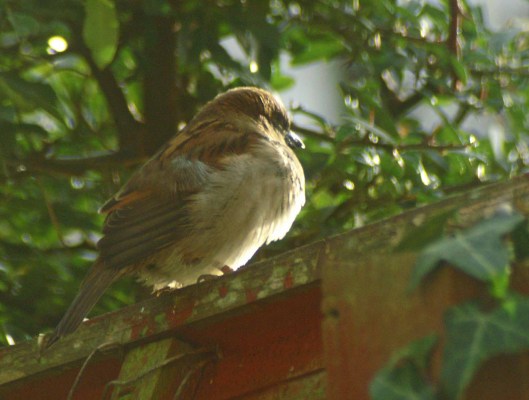
House Sparrow female

The House Sparrow is a bird of the sparrow family Passeridae, found in most parts of the world occuring naturally in most of Europe, the Mediterranean region, and much of Asia. Its intentional or accidental introductions to many regions, including parts of Australia, Africa, and the Americas, make it the most widely distributed wild bird. A small bird, it has a length of 16 centimetres (6.3 in) and a weight of 24–39.5 grams (0.85–1.39 oz).

The House Sparrow is a very social bird. It is gregarious at all seasons when feeding, often forming flocks with other types of bird. It also roosts communally, its nests are usually grouped together in clumps, and it engages in a number of social activities, such as dust and water bathing, and “social singing”, in which birds call together in bushes. The House Sparrow feeds mostly on the ground, but it flocks in trees and bushes. For the larger part it is sedentary, rarely moving more than a few kilometres. Non-breeding House Sparrows roost in large groups in trees, gathering some time before and calling together.
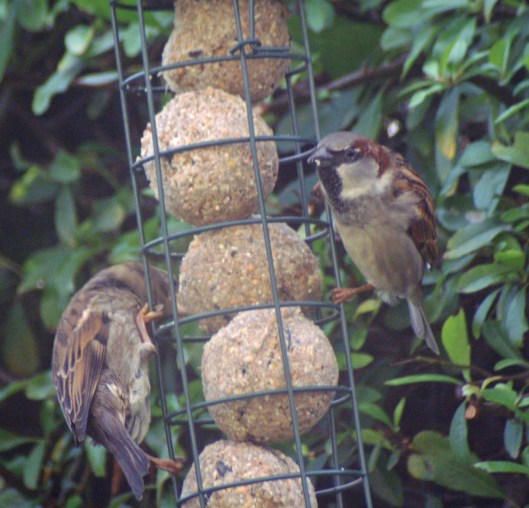
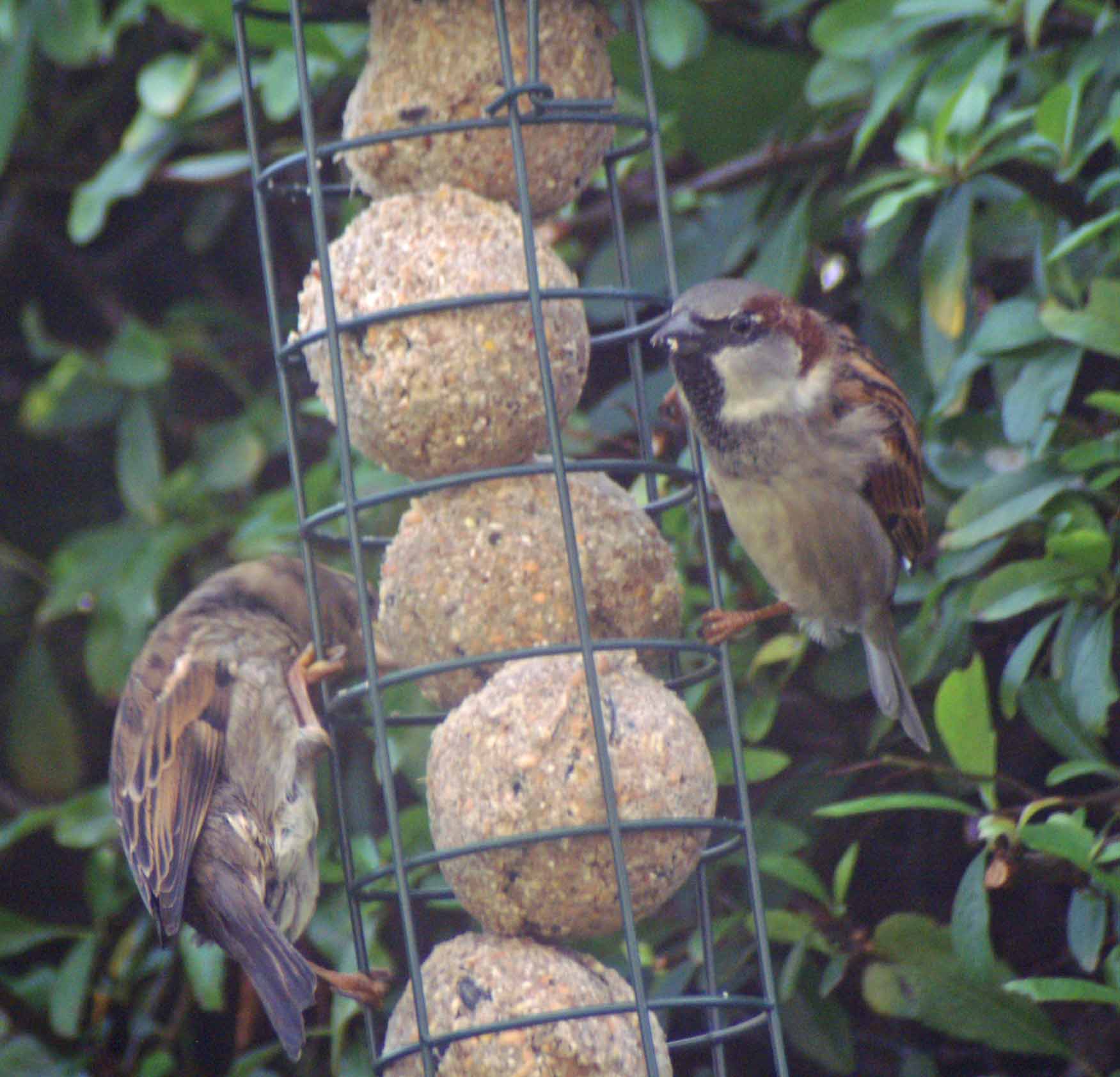
At feeding stations and nests, females are dominant despite their smaller size

The House Sparrow is strongly associated with human habitations, and can live in urban or rural settings. They have been much persecuted in the past for helping themselves to our domestic crops and their numbers in towns and cities have declined massively. However, the intelligent little birds continue to adapt to our generally messy eating habits as sources of easy pickings and are often found around the areas where food is consumed outside, they inhabit zoos and wildlife parks; others gain access to the inside spaces of supermarkets and some birds have even learned how to operate the automatic doors.

To many people across the world, the House Sparrow is the most familiar wild animal. One of the reasons for the introduction of House Sparrows throughout the world was their association with the European homeland of many immigrants. Often it is regarded as a pest, since it consumes agricultural products and is blamed for the spread of disease to humans and their domestic animals. In most of the world the House Sparrow is not protected by law and attempts to control their numbers still include the trapping, poisoning, or shooting of adults; the destruction of their nests and eggs; or less directly, blocking nest holes and scaring off sparrows with noise, glue, or porcupine wire. However, attempts at the large-scale control of the House Sparrow have failed.

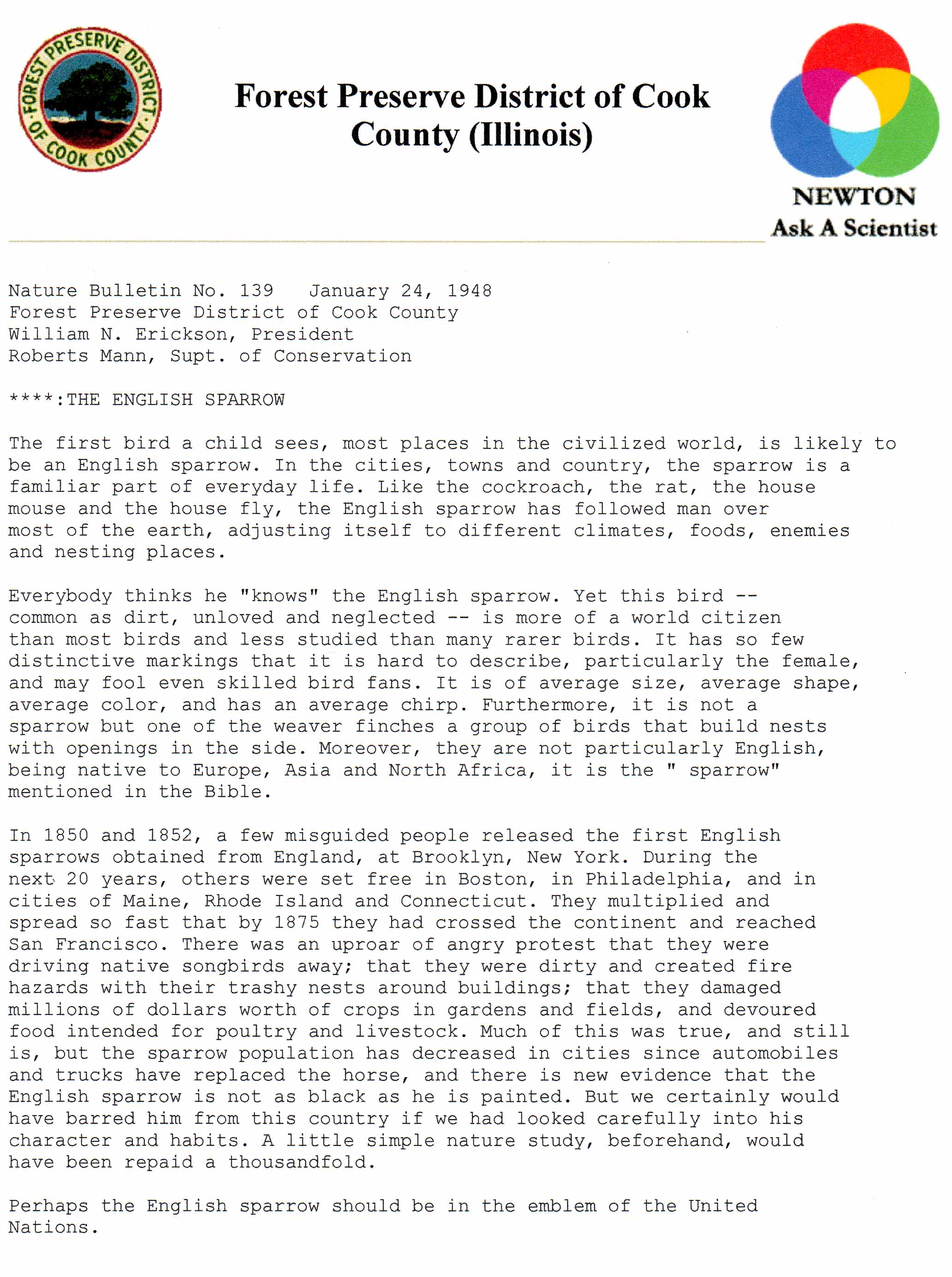
I came across this nature bulletin several years ago when researching the status of house sparrows introduced into other countries and loved it, so am passing it on.

Share this:

  • Share on Facebook (Opens in new window) Facebook
  • Share on Pinterest (Opens in new window) Pinterest
  • Share on X (Opens in new window) X
Like Loading...

Woodland birds on the move

31 Monday Oct 2011

Posted by theresagreen in bird behaviour, nature photography, woodland birds

≈ 3 Comments

Tags

bird migration, Black Redstart, blackbird, Chiffchaff, migrant birds, Robin

This is a wonderful time of year to see numbers of birds here in southern Spain,when many migrants from northern and western Europe arrive to remain for the winter, or stay for a short while to take advantage of available food supplies before continuing their journeys across to north or sub-Saharan Africa.

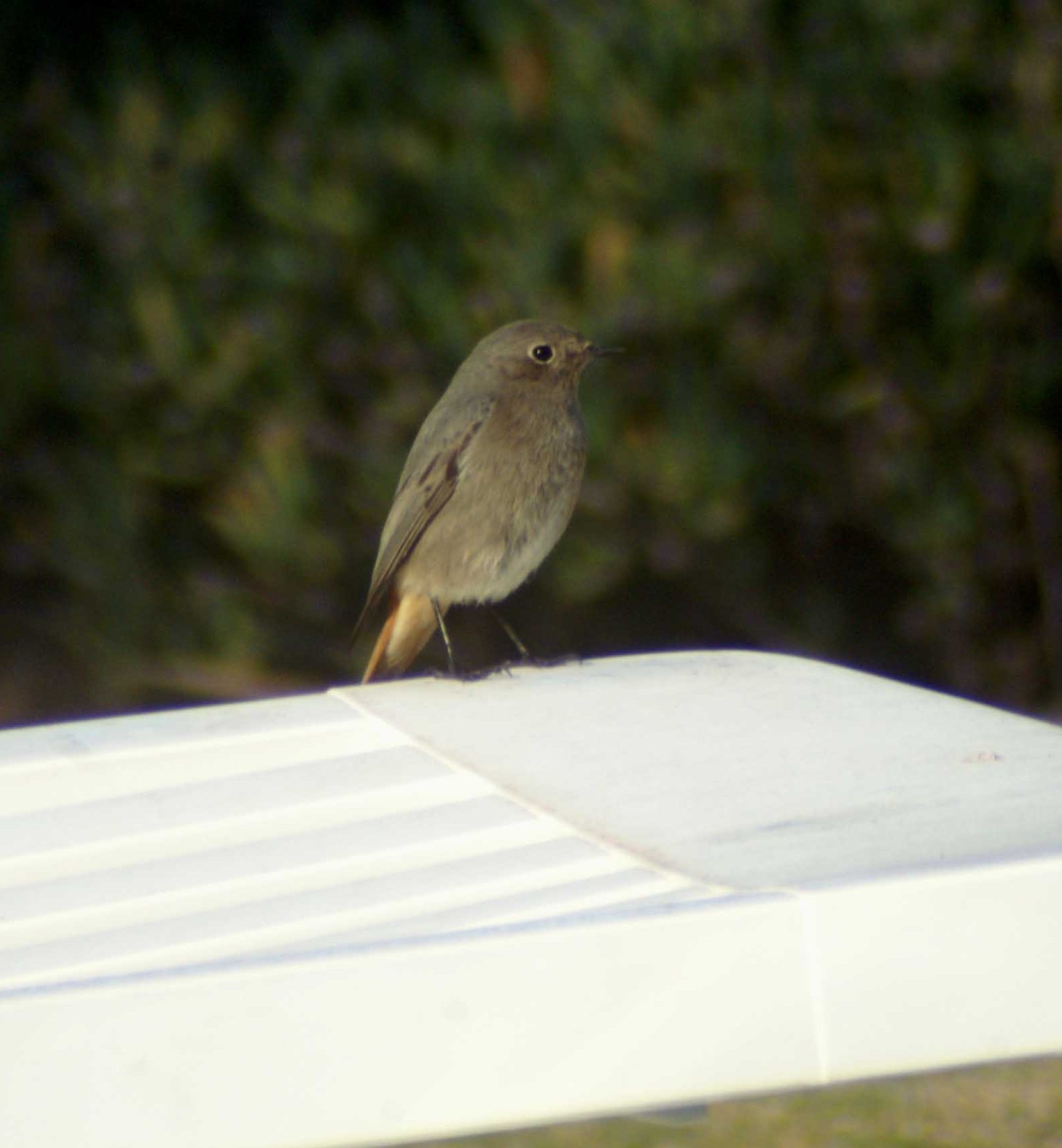
On my return from the UK, the first bird I looked out for in my garden was a Black Redstart. This species is resident in Spain, breeding in the mountains then migrating in large numbers during the autumn, when they head here to the southern coastal areas of the country. Many will stay until March, while many more cross the Straits of Gibraltar to winter in Africa.

Black Redstart - Phoenicurus ochruros (Spanish-Colirrojo Tizon). This is either a female or possibly a juvenile, perched on a sun-lounger.

The male Black Redstart is a very striking bird

This will be our ninth winter of living in this house and each year a Black Redstart has arrived to stake a claim to a territory that includes our garden. It is always a bird that resembles the one above, so either a female or a young bird, it’s tricky to tell the difference. I would like to believe that it is the same bird that returns each year, but that may be construed as sentimental and not at all realistic or scientific. I am told that this may simply be recognised as ‘a territory’. Anyway, I look forward to the arrival of the delightful little bird. They are always quite a few to be seen throughout the area, some will stay around where there are buildings, others in cultivated areas, on golf courses and even on the edges of beaches.

For the past two or three years, I haven’t got to see ‘my’ Black Redstart as often as I used to, as we  have also had resident Robins. The two species are closely related and the Robins, that are resident locally all year round, stake out the territory earlier on and defend it vigilantly. So, as soon as the Black Redstart puts its beak over the garden wall, the Robin is there to chase it away.

Robin-Erithacus rubecula (Spanish - Petirrojo)

It is interesting to see Robins as migrant birds, and this time of year sees the arrival of birds from the more northern parts of Europe swelling the resident numbers, with numbers of birds peaking in October-November. As with the Black Redstarts, some will stay here to overwinter while others will travel on to Africa.

Blackbird-Turdus merula (Spanish-Mirlo Comun) with very prominent white wing feathers

Blackbirds are amongst the most numerous bird species resident locally, but at this time of year their presence is especially noticeable. Juveniles disperse in August and September and ‘foreign’ birds arrive or pass through the locality, with numbers peaking in mid-October. Numbers of Blackbirds are attracted to our garden now by the masses of tiny berries produced by the Florida palms. As they are present all year, it is usually impossible to spot ‘incomers’ other than by territorial behaviour, when those I assume to be resident birds chase others away. The Blackbird in my photograph made it easy to spot that it was an ‘incomer’ as he was marked with white feathers. I would definitely have noticed him earlier in the year.

Chiffchaff-Phylloscopus collybita (Spanish-Mosquitero Comun)

There are a lot of tiny Chiffchaff around presently, at one time in the garden early this afternoon I counted ten and there could well have been more. A few will stay here for the winter, most will move on. Chiffchaffs are delightful little birds and very entertaining to watch as they flit and flutter through trees and shrubs searching leaves for insects. On sunny days, when there are clouds of flies or gnats about they perch on the tips of twigs and palm leaves, then dive down and chase the insects, balletically turning and twisting in the air.

It never ceases to amaze me that such tiny birds impart on these long journeys, especially those that are no more than a few months old, and marvel at their innate knowledge of where to go and how to get there and back again. And we call people ‘bird-brained’ as an insult!
Share this:

  • Share on Facebook (Opens in new window) Facebook
  • Share on Pinterest (Opens in new window) Pinterest
  • Share on X (Opens in new window) X
Like Loading...
Bring back Pampas grass

28 Friday Oct 2011

Posted by theresagreen in bird behaviour, grasses, Nature

≈ Leave a comment

Tags

Greenfinch, house sparrows taking pampas grass, invasive weeds, pampas grass

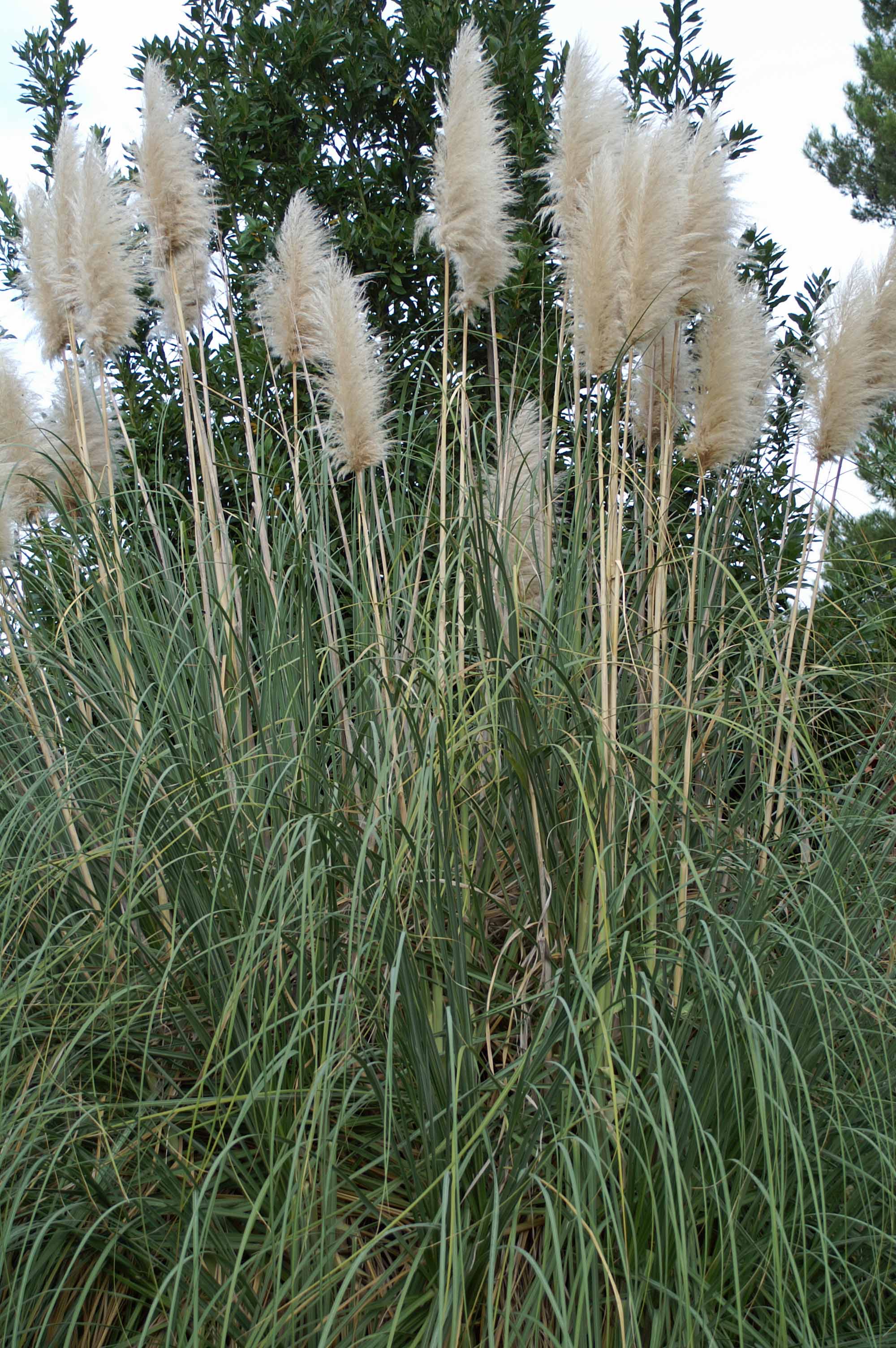
There was a large clump of Pampas grass in full flower in the Botanical Gardens in Leicester, and when I arrived back in Spain the plant in my garden is  flowering also. I like the dramatic appearance of this very large plant, the feathery flowerheads are beautiful when lit by the sun and bow and sway gracefully when the wind passes through.

The clump of pampas grass in my garden

Cortaderia selloana, commonly known as Pampas Grass, is a tall grass native to southern South America and Patagonia and is named for the areas of pampas where it is found.

Pampas Grass is a tall grass, growing in dense tussocks that can reach a height of 3 m (9.8 ft) . The leaves are evergreen, usually bluish-green but can be silvery grey; they are long and slender, 1–2 m (3.3 to 6.6 ft) long and 1 cm broad, and one of the downsides of the plant is that they have very sharp edges and should be handled with care.

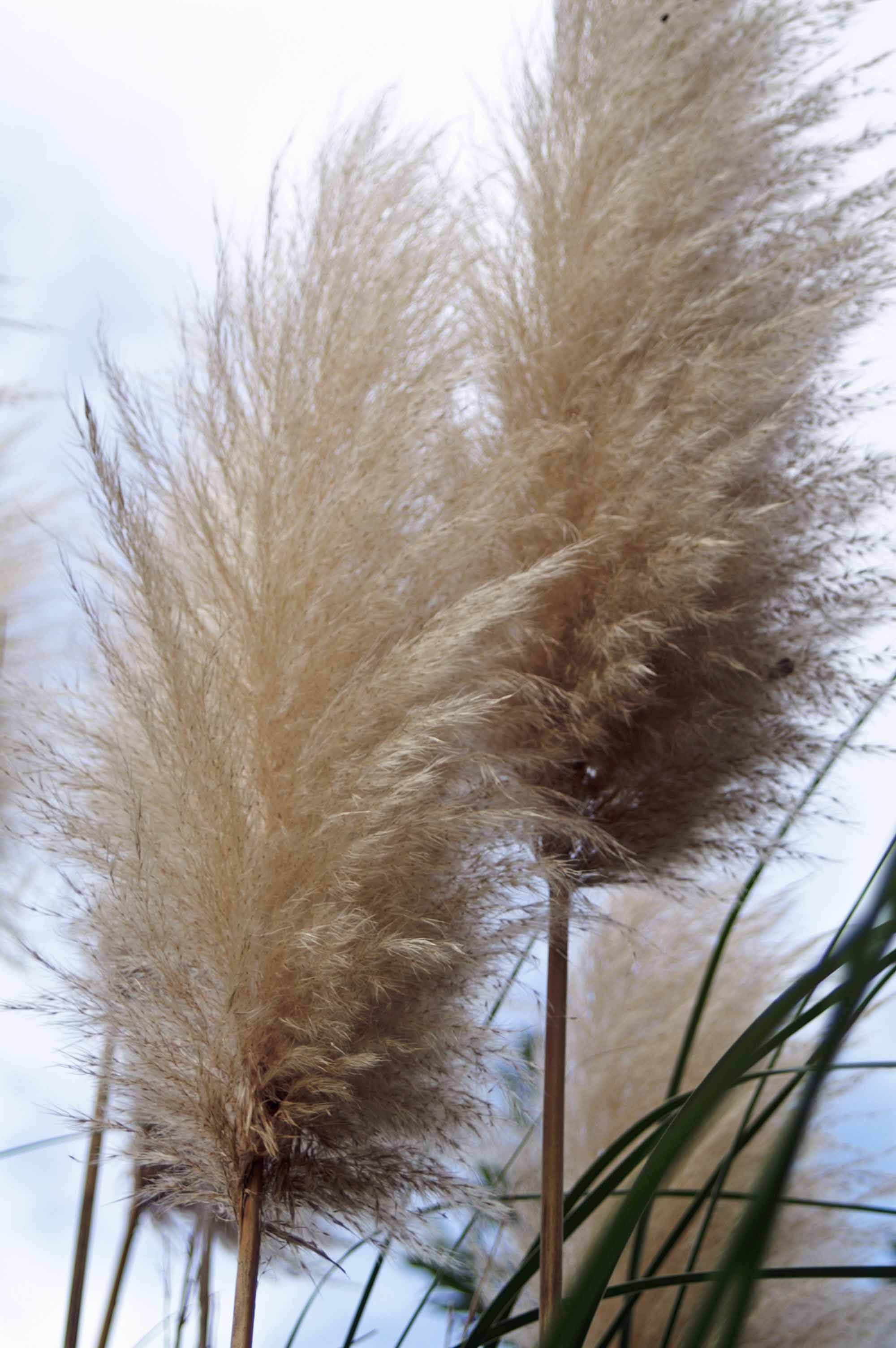
Pampas grass flowerheads

The flowers are produced in dense silvery white panicles from 20–40 cm (7.9 – 15.8 inches) long and on a 2–3 m (6.6 – 9.8 ft) tall stem.

The plant was named by Alexander von Humboldt in 1818, after the German botanist and naturalist Friedrich Sellow, who studied the flora of South America, especially that of Brazil.

Pampas grass plants may produce up to a million seeds during its lifetime

Pampas Grass is highly adaptable and can grow in a wide range of environments and climates. In some areas (for example California, Hawaii and parts of the cooler Northern areas of Spain),  it is regarded as an invasive weed, whilst in New Zealand and South Africa the plant is banned from sale and propagation for the same reasons.

I am not too clear how it is regarded here in southern Spain, but it is a frequent sight around our area where it grows on the roadsides and more particularly in our local nature reserve. It does not seem to cause concern there and is actually named on one of the information boards as being present.

House Sparrow (m) atop Pampas

The flowerheads are very long-lasting, appearing first in September, but after a winter of being battered by rain and wind, the plant begins to look rather scruffy. Despite that, I leave mine to stand beacause at some time towards the end of April or early May, the local flock of House Sparrows will begin to arrive to collect what remains of the fluffy flowerheads.

April-May-House Sparrows begin to strip the old flowerheads

It is a delightful scene; over the course of a few days the Sparrows strip the stems piece by piece, cramming their beaks with as much material as possible, then fly off with it, I assume in order to line their nests. They come in relays, both males and females and work industriously until there is nothing left on the dry stems and even pieces dropped to the ground will be gleaned. This has to be instinctive species behaviour as the House Sparrows that shared our garden in South Wales used to do exactly the same thing to the plant in our neighbour’s garden.

A male house sparrow with his beak full

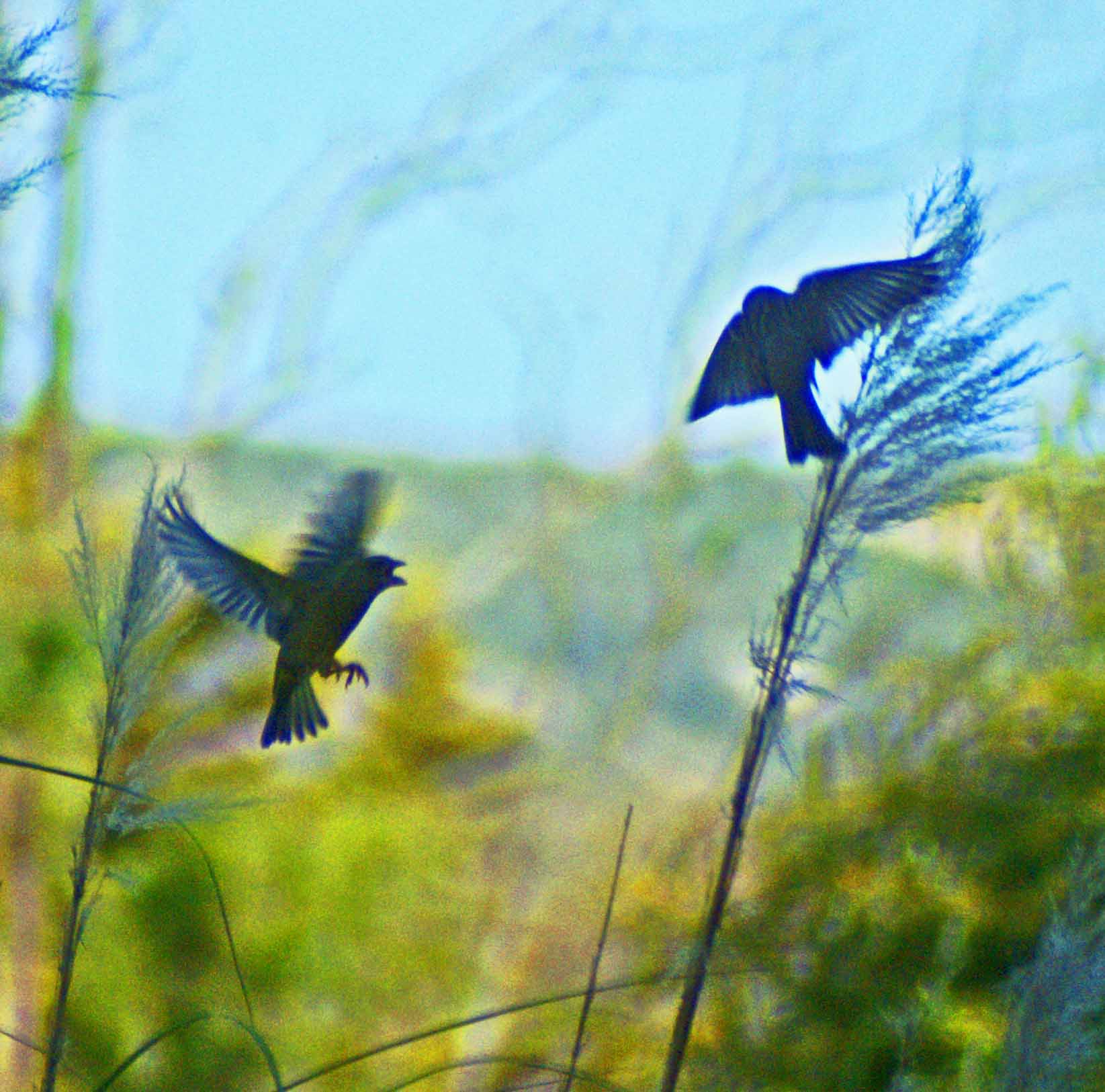
My plant grows a distance away from where I sit to watch the birds and it is in a shaded spot, so I did not immediately spot that Greenfinches sometimes join with the sparrows for a share of the grass. I am not sure whether they too take it for nesting purposes or because there may still be seeds there to eat, but they want it badly enough to squabble over. They are not the only species I’ve spotted muscling in, the last couple of years Blackbirds have also been taking a share.

A Greenfinch squabbling with a House Sparrow

Pampas as a part of social history

Pampas grass was a very fashionable garden plant back in the 1970s, advocated for inclusion by the likes of Percy Thrower and has become a gardening icon of that decade. It was equally stylish to have a large vase of the dried fluffy plumes in the living room, where they looked very decorative, (I confess to having them myself- they collected a lot of dust). In recent years the plant seems to have fallen from favour, perhaps because it is a very large and modern gardens are on the small side, or maybe it is because growing the plant seems to have acquired a new symbolism, particularly if you display it in your front garden….

(tongue in cheek this next bit, no offence intended)

Urban Myth-Swinging

A widespread urban myth is that Pampas grass is used by swingers to advertise their presence to other swingers in the area. The most commonly repeated version states that in the UK and Ireland a patch of Pampas grass is planted somewhere in the front garden to act as a signal to passers by that swingers live in the home.

I had not heard that before and have to say that my plant was in the garden when I arrived, and will remain to attract and benefit a different kind of wildlife ( fortunately a high wall conceals its presence from the sight of non-flying passers-by.)

Despite the connotations, I would still recommend Pampas grass as an addition to a garden designed to benefit wildlife, if only to enhance the lives of your local House Sparrows, just be careful where you place it!

Interesting links relating to growing Pampas grass from: The Daily Telegraph on How to grow Pampas  and The Independent- In Praise of Naff

Share this:

  • Share on Facebook (Opens in new window) Facebook
  • Share on Pinterest (Opens in new window) Pinterest
  • Share on X (Opens in new window) X
Like Loading...

Autumn in glorious form and colour

25 Tuesday Oct 2011

Posted by theresagreen in Nature, nature photography

≈ 2 Comments

Tags

autumn colour, chestnut brown slug, fungi on trees, leicester botanical gardens, quince fruit, white berries

A post that speaks for itself, these images were taken in the University Botanical Gardens, Leicester.

Share this:

  • Share on Facebook (Opens in new window) Facebook
  • Share on Pinterest (Opens in new window) Pinterest
  • Share on X (Opens in new window) X
Like Loading...
← Older posts
Newer posts →
Follow everyday nature trails on WordPress.com

Enter your email address to follow this blog and receive notifications of new posts by email.

‘But it is the common species that keep the living world ticking over and provide most of our experiences of wildlife, and I would argue that maintaining the abundance of these is as important a conservation priority as maintaining the existence of rarities’. Richard Mabey

MOST RECENT POSTS

  • A Glimpse of Spring to Come January 22, 2025
  • Hunting the Wren December 28, 2024
  • Oh, Christmas Tree December 18, 2024
  • In and Out of the Ivy February 15, 2024
  • Nature’s Fireworks November 30, 2023
  • Wild Autumn along the Coast Path November 3, 2023

OLDER POSTS

LOOKING FOR SOMETHING IN PARTICULAR?

  • Sights and Sounds from the Little Orme 1
    Sights and Sounds from the Little Orme 1
  • Catchers, a Duck and Divers
    Catchers, a Duck and Divers
  • Following a river to a Fairy Glen
    Following a river to a Fairy Glen
  • Fine Dining for Crows
    Fine Dining for Crows
  • Shades, Sounds and Scents of the Woods
    Shades, Sounds and Scents of the Woods
  • Things Bright and Beautiful
    Things Bright and Beautiful
  • A Windy Wildflower Trail
    A Windy Wildflower Trail
  • A Window on the Woods-Winter 1
    A Window on the Woods-Winter 1
  • Butterflies and more rare treats
    Butterflies and more rare treats
  • May Bee Appearing on Ivy near You
    May Bee Appearing on Ivy near You

nightingale trails

The Walk of the Monarch Butterfly-Sendero de la Mariposa Monarca

The Walk of the Monarch Butterfly-Sendero de la Mariposa Monarca

MY WILDFLOWER BLOG: where the wildflowers are

Snowdrop

Snowdrop

most recent posts

Follow everyday nature trails on WordPress.com

Social

  • View teresamaygreen’s profile on Twitter

Enter your email address to follow this blog and receive notifications of new posts by email.

Website Built with WordPress.com.

  • Subscribe Subscribed
    • everyday nature trails
    • Join 359 other subscribers
    • Already have a WordPress.com account? Log in now.
    • everyday nature trails
    • Subscribe Subscribed
    • Sign up
    • Log in
    • Report this content
    • View site in Reader
    • Manage subscriptions
    • Collapse this bar
 

Loading Comments...
 

    %d