• Home
  • about
  • about the photographs
  • Local Nature Reserves
    • Bryn Euryn Local Nature Reserve
    • Mynydd Marian
  • Wales Coast Path
    • Grey Seals in North Wales
    • St.Trillo’s Chapel
    • Wildflowers of North Wales Coastal Paths, Cliffs and Dunes

everyday nature trails

everyday nature trails

Monthly Archives: October 2011

Woodland birds on the move

31 Monday Oct 2011

Posted by theresagreen in bird behaviour, nature photography, woodland birds

≈ 3 Comments

Tags

bird migration, Black Redstart, blackbird, Chiffchaff, migrant birds, Robin

This is a wonderful time of year to see numbers of birds here in southern Spain,when many migrants from northern and western Europe arrive to remain for the winter, or stay for a short while to take advantage of available food supplies before continuing their journeys across to north or sub-Saharan Africa.

On my return from the UK, the first bird I looked out for in my garden was a Black Redstart. This species is resident in Spain, breeding in the mountains then migrating in large numbers during the autumn, when they head here to the southern coastal areas of the country. Many will stay until March, while many more cross the Straits of Gibraltar to winter in Africa.
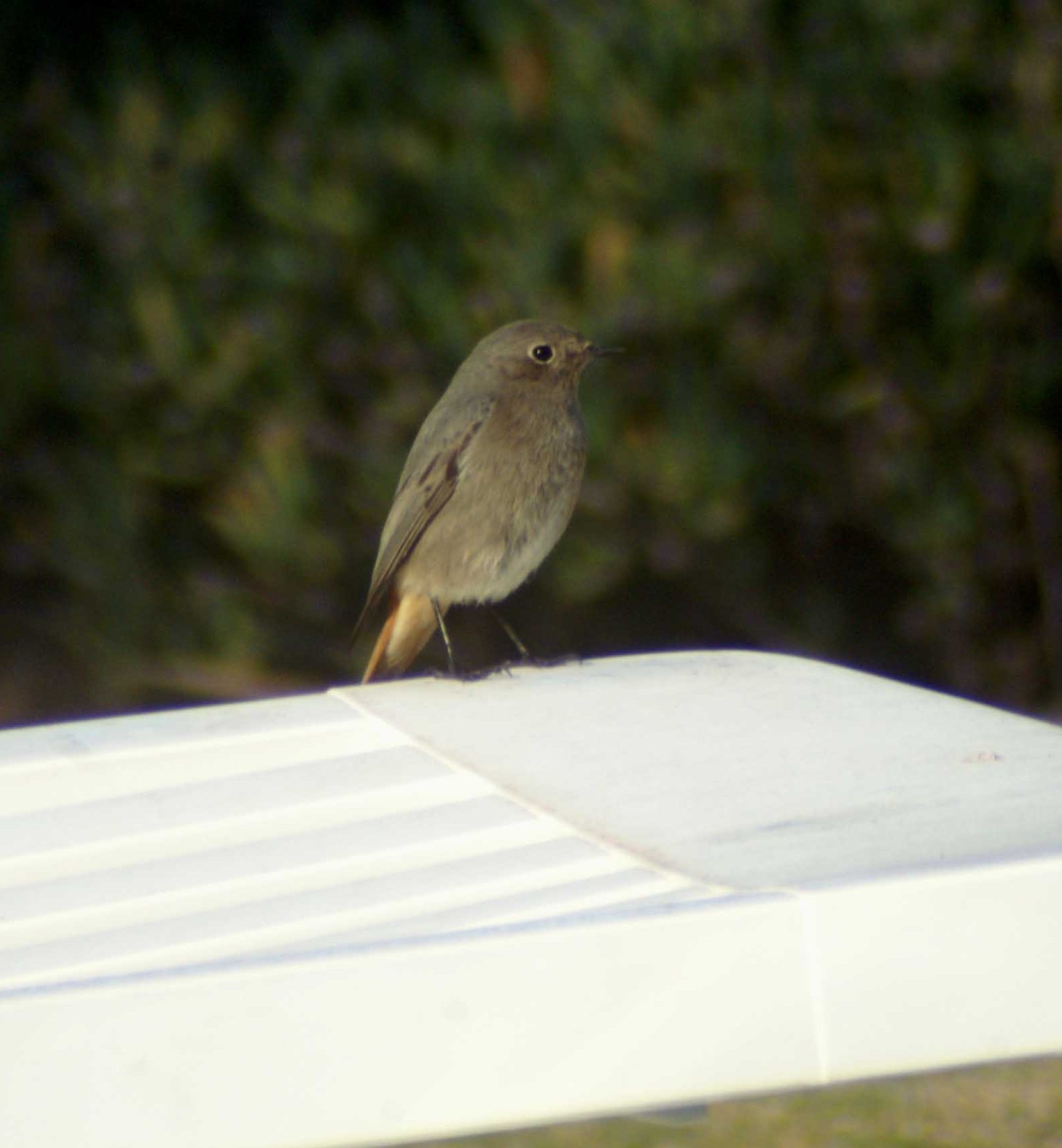
Black Redstart - Phoenicurus ochruros (Spanish-Colirrojo Tizon). This is either a female or possibly a juvenile, perched on a sun-lounger.

The male Black Redstart is a very striking bird

This will be our ninth winter of living in this house and each year a Black Redstart has arrived to stake a claim to a territory that includes our garden. It is always a bird that resembles the one above, so either a female or a young bird, it’s tricky to tell the difference. I would like to believe that it is the same bird that returns each year, but that may be construed as sentimental and not at all realistic or scientific. I am told that this may simply be recognised as ‘a territory’. Anyway, I look forward to the arrival of the delightful little bird. They are always quite a few to be seen throughout the area, some will stay around where there are buildings, others in cultivated areas, on golf courses and even on the edges of beaches.

For the past two or three years, I haven’t got to see ‘my’ Black Redstart as often as I used to, as we  have also had resident Robins. The two species are closely related and the Robins, that are resident locally all year round, stake out the territory earlier on and defend it vigilantly. So, as soon as the Black Redstart puts its beak over the garden wall, the Robin is there to chase it away.

Robin-Erithacus rubecula (Spanish - Petirrojo)

It is interesting to see Robins as migrant birds, and this time of year sees the arrival of birds from the more northern parts of Europe swelling the resident numbers, with numbers of birds peaking in October-November. As with the Black Redstarts, some will stay here to overwinter while others will travel on to Africa.

Blackbird-Turdus merula (Spanish-Mirlo Comun) with very prominent white wing feathers

Blackbirds are amongst the most numerous bird species resident locally, but at this time of year their presence is especially noticeable. Juveniles disperse in August and September and ‘foreign’ birds arrive or pass through the locality, with numbers peaking in mid-October. Numbers of Blackbirds are attracted to our garden now by the masses of tiny berries produced by the Florida palms. As they are present all year, it is usually impossible to spot ‘incomers’ other than by territorial behaviour, when those I assume to be resident birds chase others away. The Blackbird in my photograph made it easy to spot that it was an ‘incomer’ as he was marked with white feathers. I would definitely have noticed him earlier in the year.

Chiffchaff-Phylloscopus collybita (Spanish-Mosquitero Comun)

There are a lot of tiny Chiffchaff around presently, at one time in the garden early this afternoon I counted ten and there could well have been more. A few will stay here for the winter, most will move on. Chiffchaffs are delightful little birds and very entertaining to watch as they flit and flutter through trees and shrubs searching leaves for insects. On sunny days, when there are clouds of flies or gnats about they perch on the tips of twigs and palm leaves, then dive down and chase the insects, balletically turning and twisting in the air.

It never ceases to amaze me that such tiny birds impart on these long journeys, especially those that are no more than a few months old, and marvel at their innate knowledge of where to go and how to get there and back again. And we call people ‘bird-brained’ as an insult!
Share this:

  • Share on Facebook (Opens in new window) Facebook
  • Share on Pinterest (Opens in new window) Pinterest
  • Share on X (Opens in new window) X
Like Loading...

Bring back Pampas grass

28 Friday Oct 2011

Posted by theresagreen in bird behaviour, grasses, Nature

≈ Leave a comment

Tags

Greenfinch, house sparrows taking pampas grass, invasive weeds, pampas grass

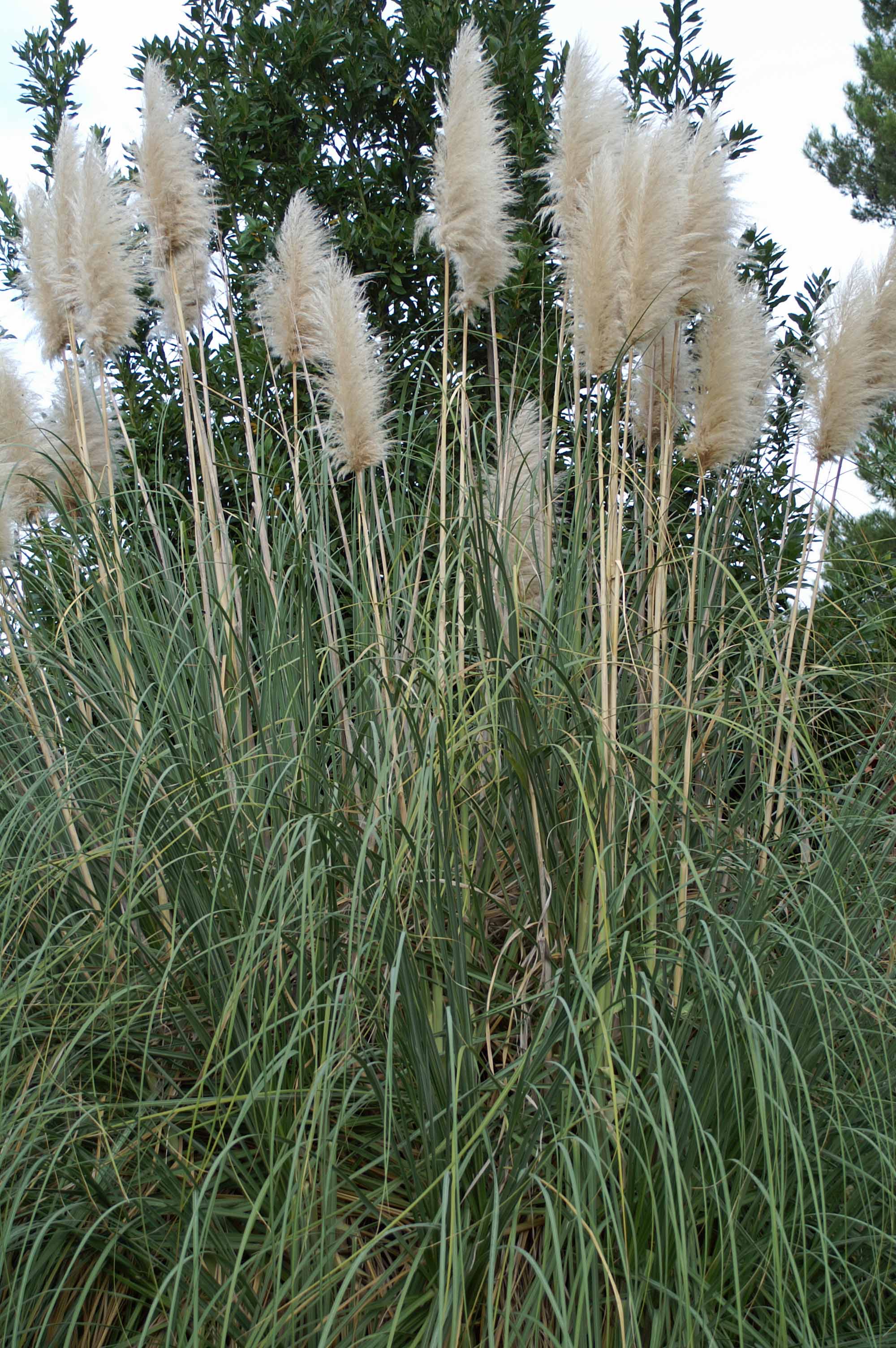
There was a large clump of Pampas grass in full flower in the Botanical Gardens in Leicester, and when I arrived back in Spain the plant in my garden is  flowering also. I like the dramatic appearance of this very large plant, the feathery flowerheads are beautiful when lit by the sun and bow and sway gracefully when the wind passes through.

The clump of pampas grass in my garden

Cortaderia selloana, commonly known as Pampas Grass, is a tall grass native to southern South America and Patagonia and is named for the areas of pampas where it is found.

Pampas Grass is a tall grass, growing in dense tussocks that can reach a height of 3 m (9.8 ft) . The leaves are evergreen, usually bluish-green but can be silvery grey; they are long and slender, 1–2 m (3.3 to 6.6 ft) long and 1 cm broad, and one of the downsides of the plant is that they have very sharp edges and should be handled with care.

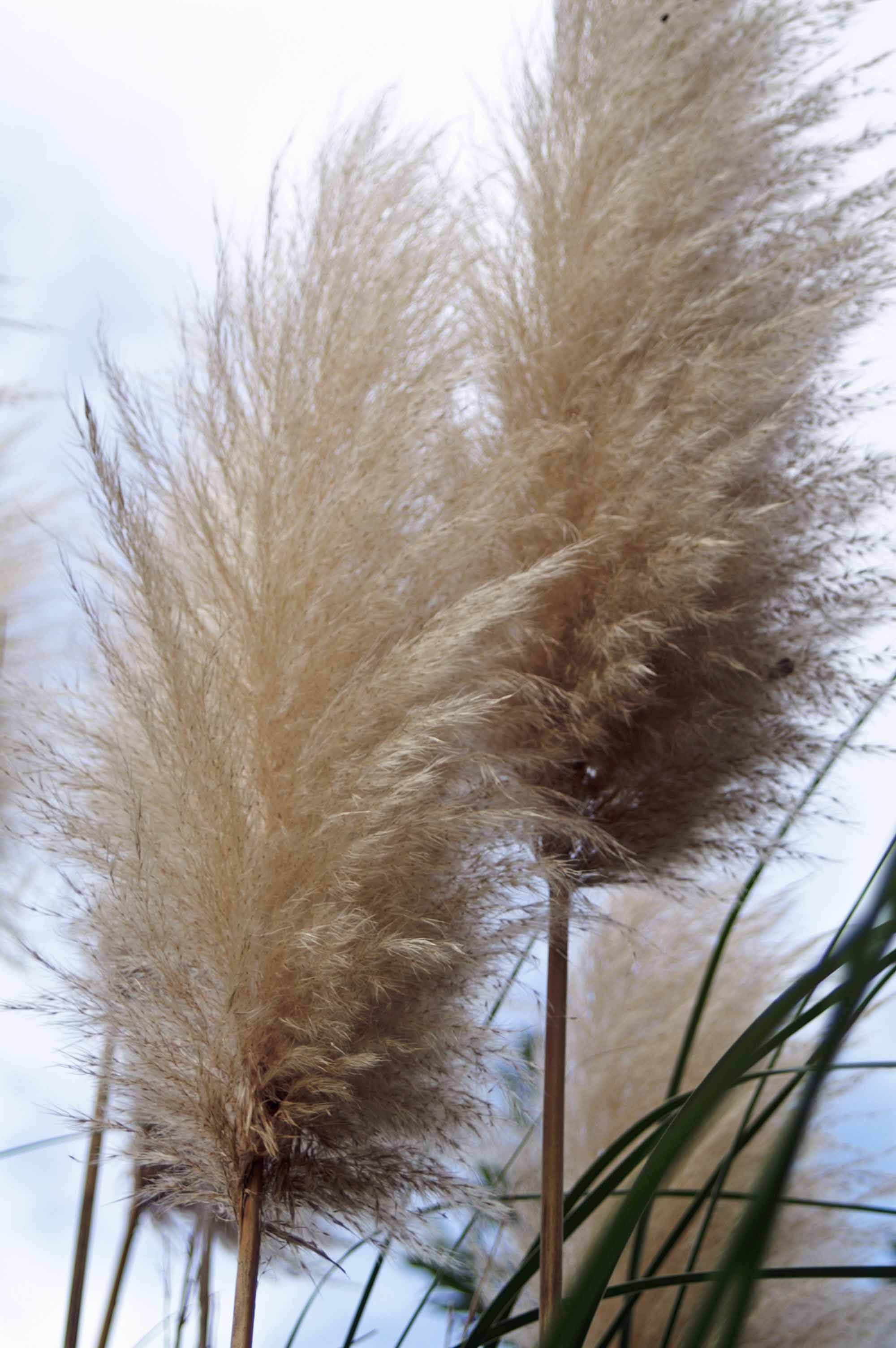
Pampas grass flowerheads

The flowers are produced in dense silvery white panicles from 20–40 cm (7.9 – 15.8 inches) long and on a 2–3 m (6.6 – 9.8 ft) tall stem.

The plant was named by Alexander von Humboldt in 1818, after the German botanist and naturalist Friedrich Sellow, who studied the flora of South America, especially that of Brazil.

Pampas grass plants may produce up to a million seeds during its lifetime

Pampas Grass is highly adaptable and can grow in a wide range of environments and climates. In some areas (for example California, Hawaii and parts of the cooler Northern areas of Spain),  it is regarded as an invasive weed, whilst in New Zealand and South Africa the plant is banned from sale and propagation for the same reasons.

I am not too clear how it is regarded here in southern Spain, but it is a frequent sight around our area where it grows on the roadsides and more particularly in our local nature reserve. It does not seem to cause concern there and is actually named on one of the information boards as being present.

House Sparrow (m) atop Pampas

The flowerheads are very long-lasting, appearing first in September, but after a winter of being battered by rain and wind, the plant begins to look rather scruffy. Despite that, I leave mine to stand beacause at some time towards the end of April or early May, the local flock of House Sparrows will begin to arrive to collect what remains of the fluffy flowerheads.

April-May-House Sparrows begin to strip the old flowerheads

It is a delightful scene; over the course of a few days the Sparrows strip the stems piece by piece, cramming their beaks with as much material as possible, then fly off with it, I assume in order to line their nests. They come in relays, both males and females and work industriously until there is nothing left on the dry stems and even pieces dropped to the ground will be gleaned. This has to be instinctive species behaviour as the House Sparrows that shared our garden in South Wales used to do exactly the same thing to the plant in our neighbour’s garden.

A male house sparrow with his beak full

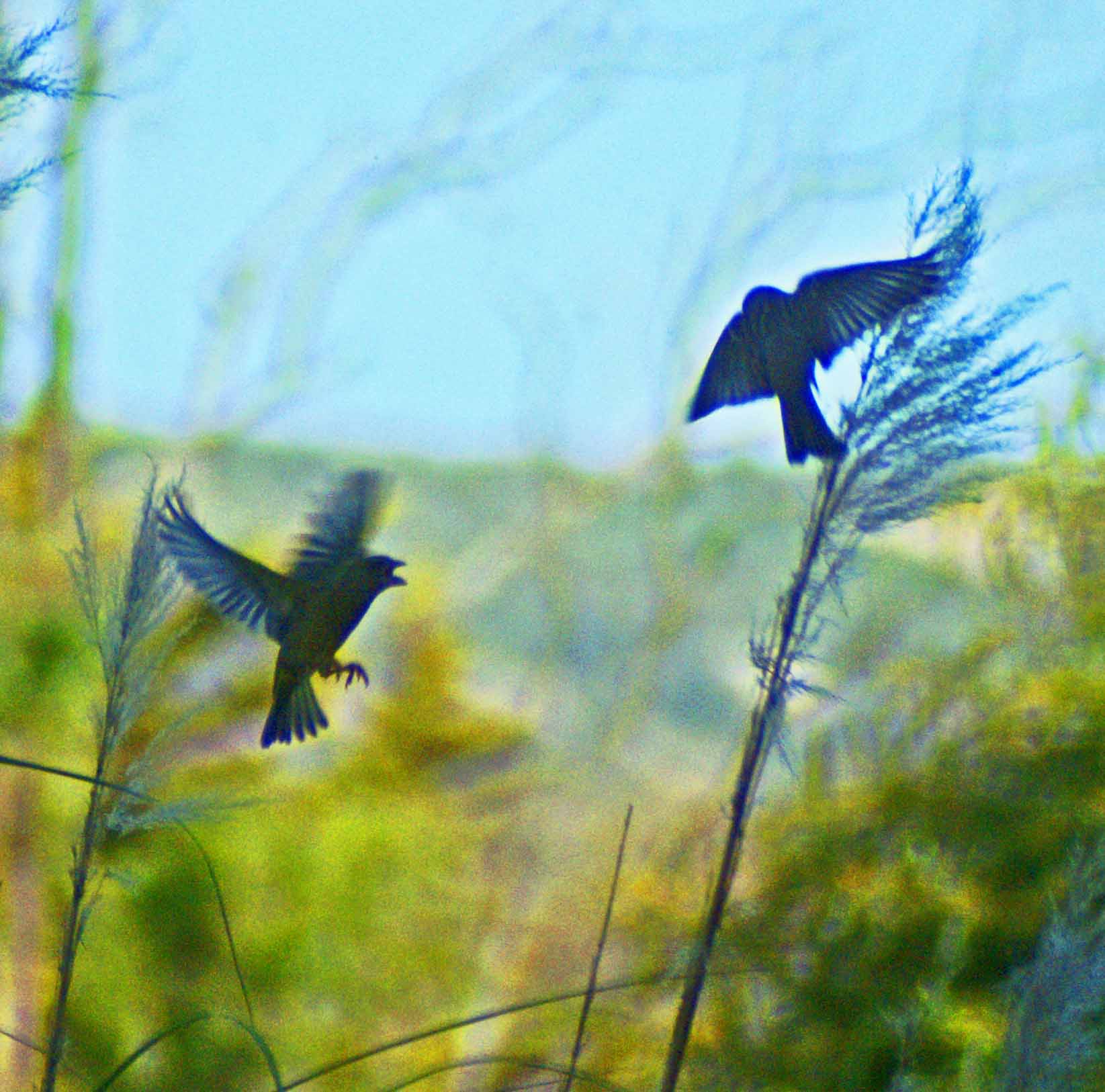
My plant grows a distance away from where I sit to watch the birds and it is in a shaded spot, so I did not immediately spot that Greenfinches sometimes join with the sparrows for a share of the grass. I am not sure whether they too take it for nesting purposes or because there may still be seeds there to eat, but they want it badly enough to squabble over. They are not the only species I’ve spotted muscling in, the last couple of years Blackbirds have also been taking a share.

A Greenfinch squabbling with a House Sparrow

Pampas as a part of social history

Pampas grass was a very fashionable garden plant back in the 1970s, advocated for inclusion by the likes of Percy Thrower and has become a gardening icon of that decade. It was equally stylish to have a large vase of the dried fluffy plumes in the living room, where they looked very decorative, (I confess to having them myself- they collected a lot of dust). In recent years the plant seems to have fallen from favour, perhaps because it is a very large and modern gardens are on the small side, or maybe it is because growing the plant seems to have acquired a new symbolism, particularly if you display it in your front garden….

(tongue in cheek this next bit, no offence intended)

Urban Myth-Swinging

A widespread urban myth is that Pampas grass is used by swingers to advertise their presence to other swingers in the area. The most commonly repeated version states that in the UK and Ireland a patch of Pampas grass is planted somewhere in the front garden to act as a signal to passers by that swingers live in the home.

I had not heard that before and have to say that my plant was in the garden when I arrived, and will remain to attract and benefit a different kind of wildlife ( fortunately a high wall conceals its presence from the sight of non-flying passers-by.)

Despite the connotations, I would still recommend Pampas grass as an addition to a garden designed to benefit wildlife, if only to enhance the lives of your local House Sparrows, just be careful where you place it!

Interesting links relating to growing Pampas grass from: The Daily Telegraph on How to grow Pampas  and The Independent- In Praise of Naff

Share this:

  • Share on Facebook (Opens in new window) Facebook
  • Share on Pinterest (Opens in new window) Pinterest
  • Share on X (Opens in new window) X
Like Loading...

Autumn in glorious form and colour

25 Tuesday Oct 2011

Posted by theresagreen in Nature, nature photography

≈ 2 Comments

Tags

autumn colour, chestnut brown slug, fungi on trees, leicester botanical gardens, quince fruit, white berries

A post that speaks for itself, these images were taken in the University Botanical Gardens, Leicester.

Share this:

  • Share on Facebook (Opens in new window) Facebook
  • Share on Pinterest (Opens in new window) Pinterest
  • Share on X (Opens in new window) X
Like Loading...

Bird Study: Cormorant

24 Monday Oct 2011

Posted by theresagreen in Birdwatching on North Wales coast, Nature, nature photography

≈ 3 Comments

Tags

coastal birds, Cormorant, phalacrocorax carbo

Cormorants are breeding residents here and since I arrived in July sightings of the birds flying or swimming in the sea have been consistently frequent, but in recent weeks their numbers have increased manyfold. Numbers of them now joined the ranks of oystercatchers and gulls that line the sea-edge as the tide comes in, and they can be spotted on the rocks of the harbour breakwater and perched on top of available posts. There are almost always a few to be seen on the lower reaches of the Little Orme, but now there are many, their black forms punctuating the pale limestone.

Cormorant – Phalacrocorax carbo

Scientific name from: Greek: phalakros=bald + korax=the raven and Latin:  carbo=charcoal

Common name: definitions of ‘Cormorant’

  1. (n.) A voracious eater; a glutton, or gluttonous servant.
  2. (n.) Any species of Phalacrocorax, a genus of sea birds having a sac under the beak. Cormorants devour fish voraciously, and have become the emblem of gluttony. They are generally black, and hence are also called sea ravens, and coalgeese.

The Cormorant's flight is strong and purposeful

A large and conspicuous waterbird, the cormorant has an almost primitive look about it.Its long neck makes it appear almost reptilian, particularly when swimming with the bulk of its body submerged.

Some of the Cormorants dotted across the base of the Little Orme

Cormorants are coastal rather than oceanic birds, and many have colonised inland waters – in fact the original ancestor of cormorants seems to have been a fresh-water bird, judging from the habitat of the most ancient lineage. They range around the world, except for the central Pacific islands.

All are fish-eaters, feeding mainly on small eels and flat fish. They dive from the surface of the water. All four toes on each foot are webbed which aids them in swimming and in pursuing fish underwater.

Cormorants are supreme fishers which can bring them into conflict with anglers and they have been persecuted in the past, although some enterprising Japanese and Chinese fishermen employ the bird’s expertise to assist them, training one species of the birds to dive and catch fish for them.

A juvenile Cormorant with partial paler underparts still present.

The birds are often seen standing with their wings held out to dry and the reason for that is a bit of a mystery and the focus of study. It seems strange that a bird that spends much of its time in the water should need to dry their plumage and all cormorants have preen gland secretions that are used ostensibly to keep the feathers waterproof. It has been variously stated that cormorants have waterproof feathers; they have water permeable feathers; that the outer plumage absorbs water but does not permit it to penetrate the layer of air next to the skin; that it aids thermoregulation,digestion, balances the bird or indicates presence of fish. However, a detailed study of the Great Cormorant concludes that it is without doubt to dry the plumage. (extracts from article in Wikipaedia)

Male Cormorant in his full breeding plumage, wings outstretched. This is one of my favourite Cormorant photographs, I took it in Sotogrande, Spain earlier this year (Feb).

Click on the link for more photographs of Cormorants in Spain on my blog ‘Nightingale Trails’.

Cormorants in human culture

  • Cormorants feature quite commonly in heraldry and medieval ornamentation, usually in their “wing-drying” pose, which was seen as representing the Christian cross. For example, the Norwegian municipalities of Røst, Loppa and Skjervøyhave cormorants in their coat-of-arms. The species depicted in heraldry is most likely to be the Great Cormorant, the most familiar species in Europe.
  • In 1853, a woman wearing a dress made of cormorant feathers was found on San Nicolas Island, off the southern coast of California. She had sewn the feather dress together using whale sinews. She is known as the Lone Woman of San Nicolas and was later baptized “Juana Maria” (her original name is lost). The woman had lived alone on the island for 18 years before being rescued.
  • The bird has inspired numerous writers, including Amy Clampitt, who wrote a poem called “The Cormorant in its Element”.
  • The cormorant was the disguise used by Satan in Milton’s Paradise Lost. The cormorant was significant as a symbol of “true Life/ Thereby regain’d,” and was ironically used by Satan. Satan sat on top of the Tree of Life as a cormorant in his first attempt to deceive and tempt Eve.
  • There is a cormorant portrayed in the first of the fictional paintings by Jane Eyre in Charlotte Bronte’s novel, representing Blanche Ingram.
  • The mythical ‘Liver Bird’ symbol of Liverpool is commonly thought to be a cross between an eagle and a cormorant.

Share this:

  • Share on Facebook (Opens in new window) Facebook
  • Share on Pinterest (Opens in new window) Pinterest
  • Share on X (Opens in new window) X
Like Loading...

Clifftop to seashore

24 Monday Oct 2011

Posted by theresagreen in birds of the seashore, Nature

≈ 4 Comments

Tags

brown seaweed, Linnet, Little Orme, redshank, Rhiwledyn Nature Reserve, rhos-on-sea, rocky seashores, seashore walks

I will be following the migrating birds soon, leaving the cooling shores of North Wales for the warmer ones of southern Spain, but I have a few things left that I want to include in the blog before I leave, including this last walk up to the Little Orme and back along the seashore to Rhos-on-Sea.

This was a very sunny day following a week or so of cooler rainy days. Arriving at the headland there was a strong breeze blowing in from the sea, so although it felt very warm in sheltered spots,it was considerably cooler out in the open.

Kestrel hovering over the cliff slope

As I walked towards the bay I was surprised by the sight of a Kestrel hovering low down over the cliff edge. Views of Kestrels have been scarce during the time I’ve been here, so although the photograph I took is not good I’ve used it as testament to having seen one at all. I love these little raptors and never cease to be amazed at their ability to hang almost motionless in the air for minutes at a time. This one was utilising the wind and air currents and remained suspended in this position for quite some time, perhaps having spotted potential prey, before being disturbed by people walking along the path close by.

There were very few insects about ; this Common Blue butterfly sheltered from the wind down in the long grass

I reached the cliff edge above the bay and sat for a while looking out over the sea. I had half-hoped I might see a seal or two here as they do breed in the locality, but all I saw was a lone Guillemot swimming and diving in the choppy water. The sighting was another first for me here, so I was pleased to see it, if only briefly. By far the commonest and most numerous birds here currently are cormorants, with a great number of them being dotted around the lower slope of the cliff and more flying back and forth. They are such a feature of the area that I think they merit a post of their own, so they will probably be the subject of my next one.

There is a published list of the ‘special’ plants found growing within the Rhiwledyn Nature Reserve on the Little Orme. Many had finished flowering by the time I arrived here in July, but I have discovered a few of them during the course of my walks. I was pleased to add one more today, the Wild Cabbage. It doesn’t sound too glamorous I know, but it is not a common plant, so its continued presence here is quite important.

Brassica oleracea, or wild cabbage, is a species of Brassica that is mainly native to coastal southern and western Europe. Its tolerance of salt and lime and its intolerance of competition from other plants typically restrict its natural occurrence to limestone sea cliffs.

Wild Cabbage-Brassica oleracea

Wild B. oleracea is a tall biennial plant. In the first year of growth the plant forms a stout rosette of large leaves. The leaves are fleshier and thicker than those of other species of Brassica, which are adaptations made by the plant to store water and nutrients in its difficult growing environment. In its second year, the stored nutrients are used to produce a flower spike 1 to 2 metres (3–7 ft) tall bearing numerous yellow flowers.

The dry, spent flower spikes of a wild cabbage plant. I like the effect of the tracery of bone dry silvery stems against the clear blue sky.

These cliffs are the haunt of corvids; I heard the characteristic deep ‘bark’ calls of Ravens and looked up to see a pair circling the rocky peak. There were one or two Carrion Crows about and quite a few Jackdaws foraging around on the ground.

A glossy black Jackdaw, beak agape

There wasn’t a great deal else to see here today that I have not already mentioned in previous posts, which perversely I was quite glad about: I would hate to think I might be leaving having missed something.

I had walked along the promenade and around the residential streets to get here, so I decided to walk back along the seashore as far as I could, accessing the beach via the steps at the end of a walkway between the houses. This far end of the beach of Penrhyn Bay, sheltered by the cliffs of the Little Orme has a different character to the open stretches leading to Rhos-on-Sea. Some vegetation has become established, nothing wildly exciting, but clumps of flowering Sea Mayweed were attracting quite a few insects.

Drone fly on a flower of Sea Mayweed

The seashore of Rhos-on-Sea consists of rocks in various sizes and first impressions may be of a harsh, barren environment predominantly coloured in shades of brown. It is not the traditional people-friendly playground that most holidaymakers seek; even walking across the uneven rocky surface is a feat of endurance requiring concentration and a good sense of balance lest you stumble and twist an ankle or worse. But the rocks form an essential part of the protective barrier between land and sea, dissipating some of the force of wild winter seas and creating a rich and reasonably undisturbed environment for wildlife.

A view to the Little Orme and Penrhyn Bay across the rocky seashore

The view in the opposite directions to Rhos-on-Sea and beyond

Some of the birds I photographed on my walk today:

A Redshank wading on the sea edge

Curlew investigating his reflection in a rockpool

Turnstone

A Herring Gull preparing to take off from a rock

Lift off. The gull has beautiful wings and they need strength too to be able to lift up that bulky body from a standing start. I think this one may have something wrong with its foot.

I spotted some small birds fly over the sea wall and land on the rocks of the breakwater that I imagine defines the boundary between Penrhyn Bay and Rhos-on-Sea. It was a little party of Linnets that were here to feast on the seeds of the wild plants that manage to grow here.

A little flock of Linnets gathered at the base of the sea wall to feed on flower seeds

Linnet-Carduelis cannabina, in winter plumage with a beak full of seeds

The tide was on its way out, leaving behind freshly exposed rocks covered with gleaming seaweed and a myriad of shallow rock pools. This is such an important habitat for wading birds I felt it would be remiss of me not to include a very brief look at some of the predominant features of this part of the seashore.

Bladder Wrack-Fucus vesiculosus

Brown seaweeds are the most common type of seaweed found on rocky beaches. They normally have a method to strongly attach themselves to rock surfaces.The brown colour of the seaweed is due to the brown pigment fucoxanthin overriding the green pigment chlorophyll. Both pigments are used in the photosynthesis of light, fucoxanthin improving the process when the algae is covered by water.

Toothed Wrack-Fucus serratus, underwater

Small dry clumps of seaweed are a common sight blowing around on many beaches. Also in this pool is some bright green Sea Lettuce-Ulva lactulva

The Limpet's conical shape means there is a large surface area in contact with the rockface. This allows for a large foot, providing limpets with a phenomenal grip, to such an extent that they cannot easily be prised off by hand.Limpets have an important affect on their environment, they keep it clear of algae. If you look in rock pools, often the only algae seen growing is on the ungrazed backs of limpets.

Periwinkles abound here, I think they are the edible variety. Brown leathery straps of seaweed are Oarweed-Laminaria digitata.

Of course, being me, once I started paying proper attention I kept noticing more and more, but I have to leave my self more to discover next time I am here, so that’s it from this seashore for now.


Share this:

  • Share on Facebook (Opens in new window) Facebook
  • Share on Pinterest (Opens in new window) Pinterest
  • Share on X (Opens in new window) X
Like Loading...

Birds and the art of fly catching

20 Thursday Oct 2011

Posted by theresagreen in Birds, birds of the seashore, Nature, nature photography

≈ 2 Comments

Tags

anthus petrosus, motacilla alba yarellii, Pied Wagtail, rhos-on-sea, rock pipit

As I continued my walk behind the rocky sea-break, it occurred to me that if I was finding it hard going walking against the strong wind,then the small birds I was hoping to see may be finding it even harder and may not be there today. Fortunately I was underestimating the powerful draw that an abundant supply of food is to hungry intelligent and opportunistic birds.The reason the Rock Pipits and the Pied Wagtails, (both species members of the motacillidae family) gather in this small area, more-or-less at the spot where Rhos-on-Sea becomes Penrhyn Bay is not pretty. A sewer outlet, that I was informed serves the village of Mochdre, runs beneath the sea wall and out into the sea here, and for some reason I do not really want to ponder too much, large numbers of flies swarm around the sea wall here. The flies are quite sizeable and it was quite unpleasant walking through the midst of a crowd of them, but the opportunity they presented to watch some beautiful birds in action was well worth a bit discomfort.

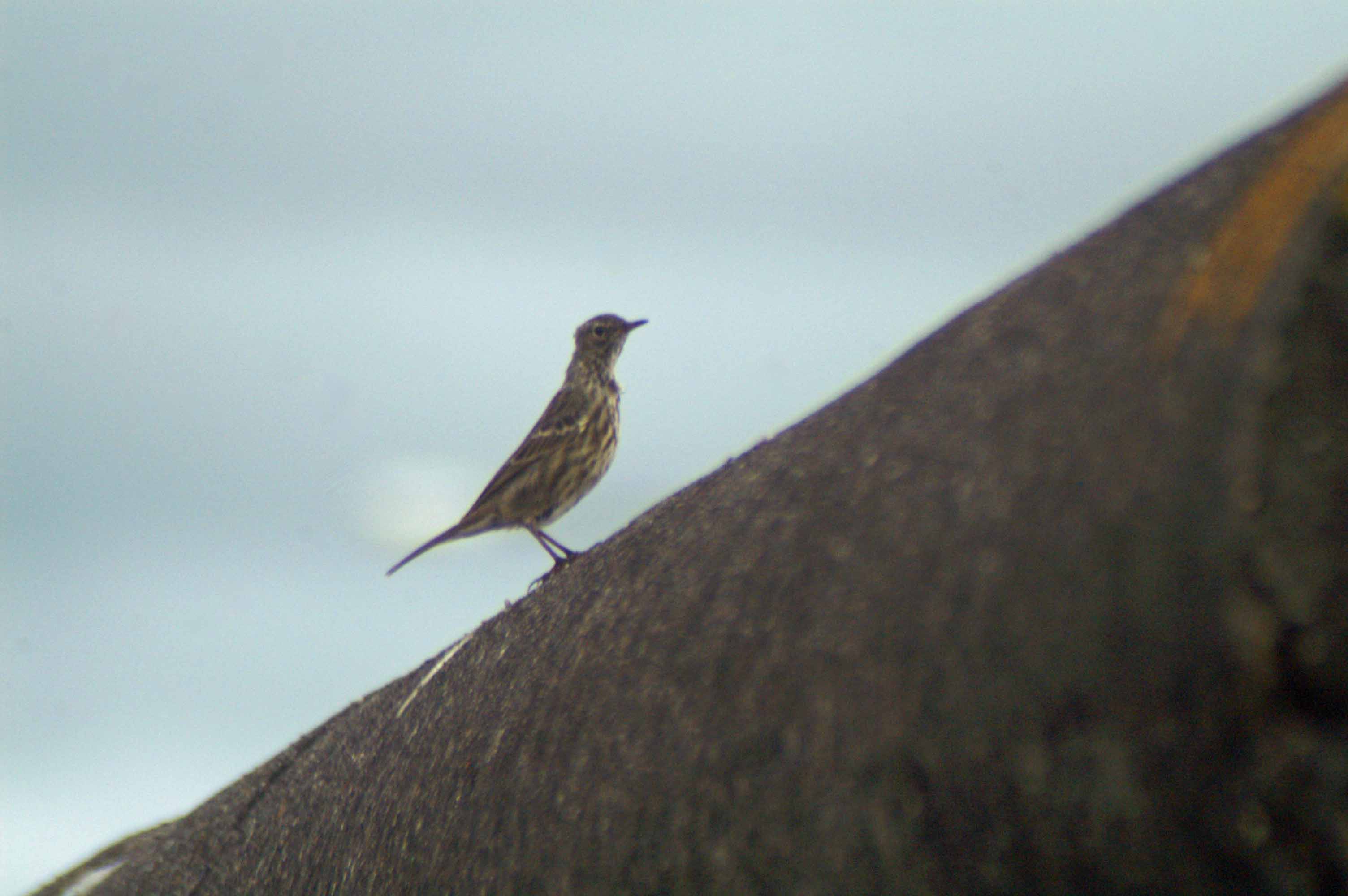
Rock Pipit-Anthus petrosus

I sat down close to where the main fly-catching action was taking place hoping the birds would not feel too threatened by the presence of me and my long camera lens. At first both Pipits, of which there were 2,  and the more numerous Wagtails did fly off, but only to a very short distance away and they returned to resume their feasting very quickly, elegantly pursuing their prey along the top of the sea wall then darting across to the rocks and back again. Their speed and acrobatic turns were impressive and highly entertaining, mostly too quick for my manually-focused lens, but wonderful to observe.

Rock pipit – Anthus petrosus

Family: Motacillidae

Scientific name from: Gr.: anthos=a small grassland bird described by Aristotle and Gr.: petros=a rock

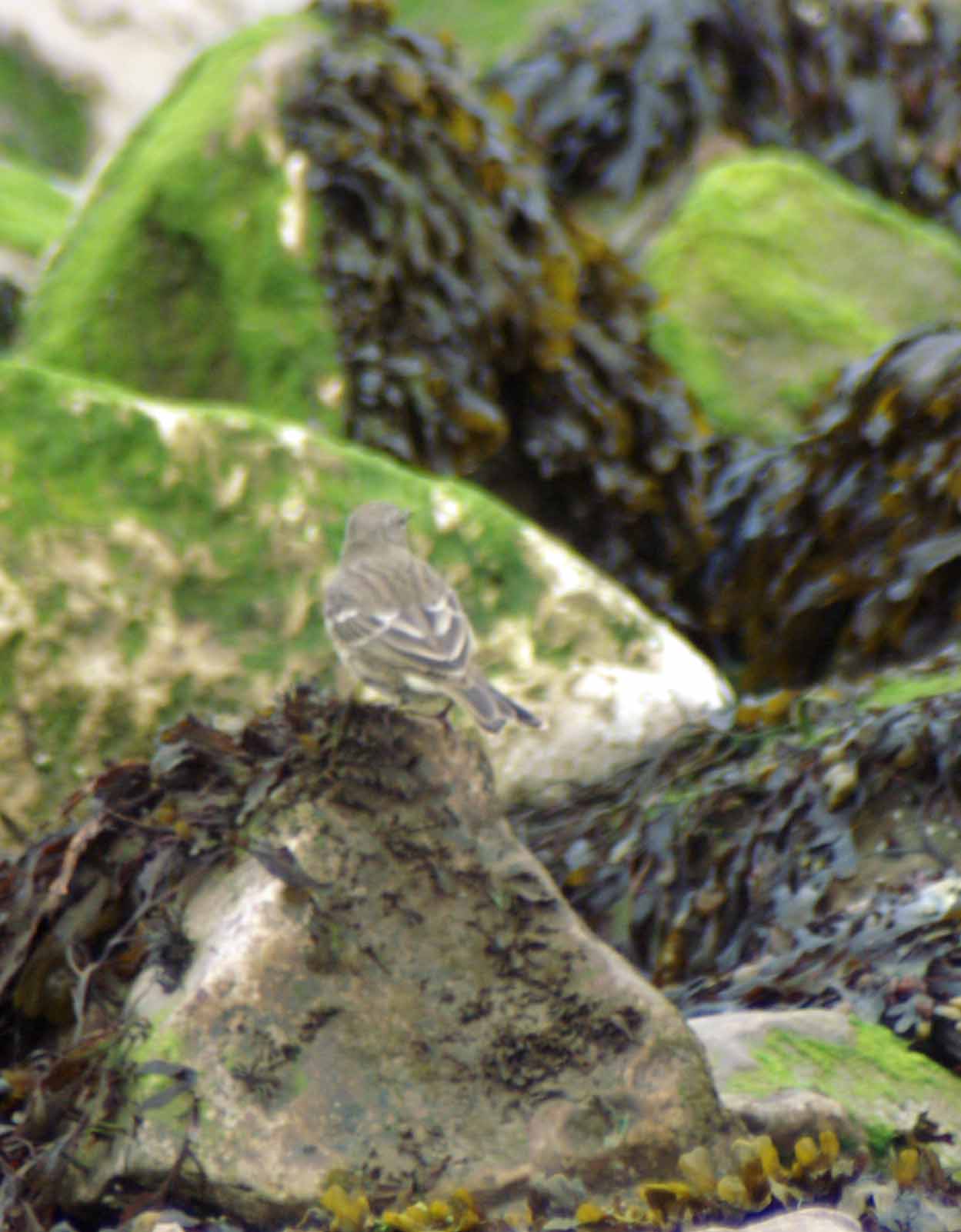
Rock Pipit-Anthus petrosus

A coastal bird with a preference for rugged coastlines, Rock Pipits are easy to miss as their inconspicuous plumage shaded in greys, olives and buffs blends readily with the seaweed as they search for food amongst the boulders. It is larger and darker than its close relative, the meadow pipits and has a more heavily-streaked breast and dark olive-brown upper parts. In flight the dark-coloured legs and orange soles of the feet may be seen.

The Rock Pipit can be identified by grey outer tail feathers (white in Meadow Pipit) and by its alarm call - a thin 'phist'

The Rock Pipit is very strongly linked to rocky shores and usually nests in rather inaccessible sites on cliffs and among boulders of sheltered coves and gullies. During the winter months however, it sometimes deserts the high cliffs and may be seen on flat sandy coastlines and inland at sewage farms, floodlands and the borders of reservoirs.

Rock Pipit chasing flies across seaweed covered rocks

Their food includes a large proportion of marine animals, such as sandhoppers, small worms and marine molluscs.

Rock Pipits live partly on insects living in rotting seaweed, such as kelp flies. It also eats seashore plant food. This one was on the beach around Rhos harbour.

 Pied Wagtail – Motacilla alba yarrellii

Scientific name from:  Greek: muttex a bird described by Hesychius and Latin: albus=white

Family: Motacillidae

Once regarded as a species in its own right, the pied wagtail is now regarded by ornithologists as a race of the white wagtail of mainland Europe and Asia. The white wagtail may be seen on migration; it has paler grey upper parts and there is no join between the black cap and bib.

Increased numbers of Pied Wagtails have been a regular sight across the area for some weeks now. Small parties of them, which as they are mixed adults and juveniles could be families, can often be spotted foraging on the seashore amongst the vegetation and dry seaweed.

Pied Wagtail on the beach - black cap and bib merge together

Pied Wagtails really live up to their name, with black upper parts, throat and breast contrasts sharply with a white forehead, face and chest and long black tails that are in constant motion. Females show a lesser degree of contrast and have less black on their heads and a slate-grey back.

Juveniles are brownish-grey above, dusty below, with black crescent-shaped breast-band

Probably a more-developed juvenile, this bird still lacks the black throat of the adult

Overhead the Pied Wagtail’s call is as distinctive as their undulating, looping flight – a few flaps followed by a descending glide that is accompanied constantly by the ‘tschizzuck’ flight call.

In the early evenings I have seen them gathering on the lawns lining the streets that back onto the Little Orme. Pied Wagtails roost communally during the winter, often in great numbers, meeting up in the same place every evening before taking off together to roost for the night. Roosts may be in a reedbed, a copse or even in a built-up area.

Share this:

  • Share on Facebook (Opens in new window) Facebook
  • Share on Pinterest (Opens in new window) Pinterest
  • Share on X (Opens in new window) X
Like Loading...

Between the rocks and the sea wall

19 Wednesday Oct 2011

Posted by theresagreen in Nature, nature photography

≈ 4 Comments

Tags

crystals in limestone rock, lichens on rock, limestone rock, moss on rock, rhos-on-sea, riprap breakwater, sea wall

On days when the wind blows in strongly from the north-east, blustering across the Irish Sea and whipping up the waves into foamy ‘sea-horses’, strolling along the promenade can be challenging and I have to admit, not that pleasant. On such a day I was heading towards Penrhyn Bay hoping to catch sight of Rock Pipits and to photograph Pied Wagtails, both of which I had seen recently on and around the sea wall there. The strength of the wind took me by surprise and if I had gone out with the sole purpose of taking an enjoyable walk I may well have reviewed my plans and set off elsewhere, but as I’d never seen Rock Pipits elsewhere, I was keen to see some.

Fortunately there is an alternative walk-way that was created when the original sea wall was constructed: a ledge, about 3′ (1m) wide was created on the wall’s seaward side placed about half-way up its height. In the 1980’s further protection from the wild winter seas was required and the breakwater, consisting of an immense pile of enormous rocks was piled in front of the wall. The rock pile rises higher than the walkway ledge, thus creating a sheltered passageway between the two structures. There is no view from there, the dark seawall encloses one side and the length of the summit of the rock pile the other, so other than for shelter from the wind I would not normally choose to walk this way.

A length of the rock breakwater running from Rhos-on-Sea to Penrhyn Bay in front of the sea wall

The piling of large rocks, also known as riprap, at the base of vertical Edwardian and Victorian sea walls is frequently used as a secondary defence mechanism to prevent them being undermined. Riprap works by absorbing and deflecting the impact of waves before they reach the defended structure. The size and mass of the riprap material absorbs the impact energy of waves, while the gaps between the rocks trap and slow the flow of water, lessening its ability to erode soil or structures on the coast. 

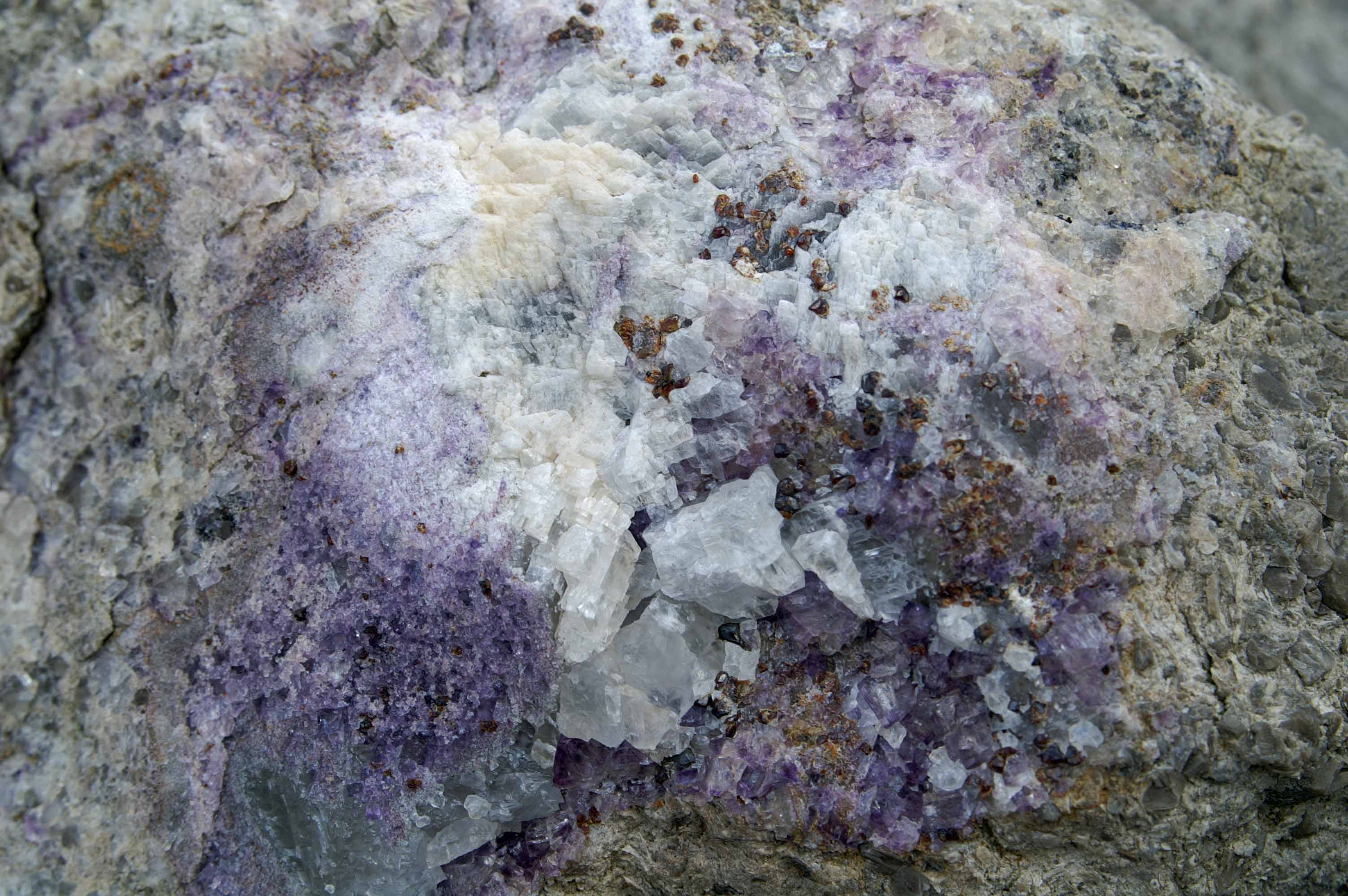
As I walked along, wondering where the vast amount of rock had been taken from, I began to see this confined, shaded and slightly claustrophobic space in a different way. I was drawn to individual rocks that had interesting surface patterns, crystals or layers of other types of rock or minerals and wished I knew what they were. I recognised too that a micro-climate exists here that is helping to create a habitat for an interesting number of plant species from vascular plants to mosses and lichens.

Limestone rock with a tracery of worm-like squiggles and touches of pink colouration. The pink stuff may be a lichen.

The rocks themselves are predominantly locally-occurring limestone and it is humbling to reflect on the fact that eons ago they would have been forming the sea-bed and now carry evidence to ancient life forms.

The beautiful crystals in this picture may be dolomite or perhaps quartz and the purple may be fluorite.

An interesting crystal-like deposit

A ribbon of mineral(s) marks this rock

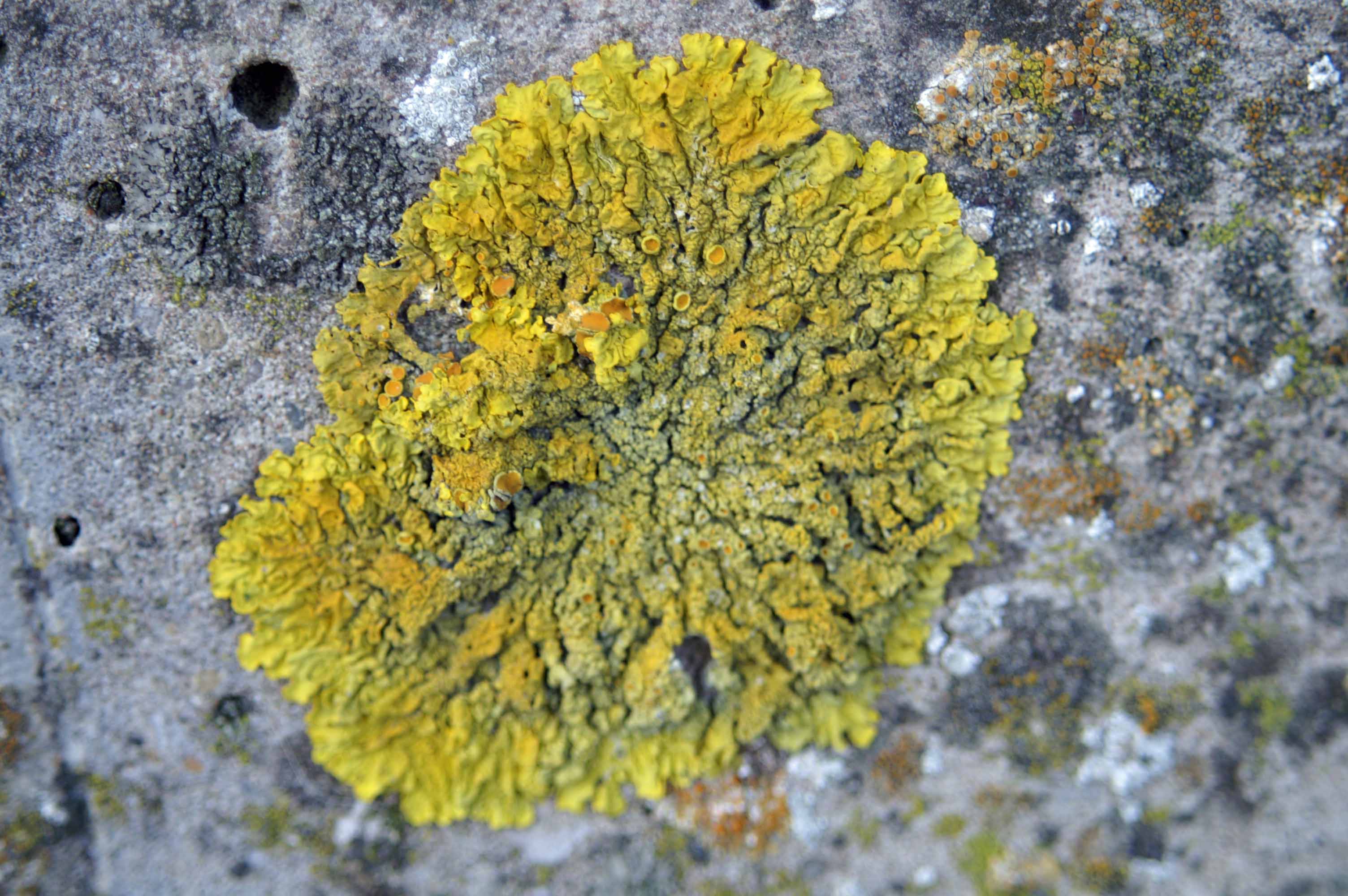
A macro view of a patch of a Xanthoria sp of algae

A yellow-coloured species of algae

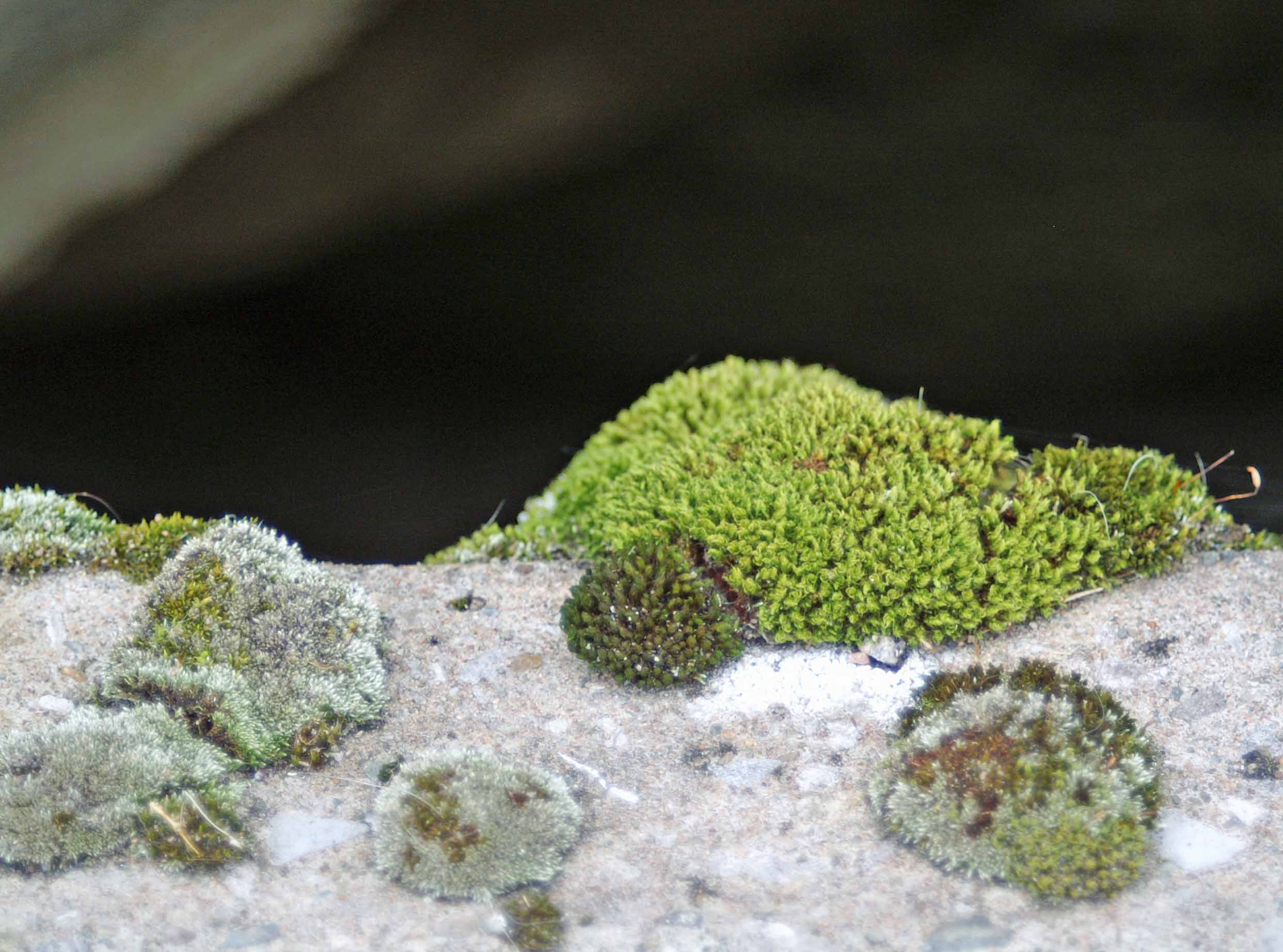
Cushions of moss

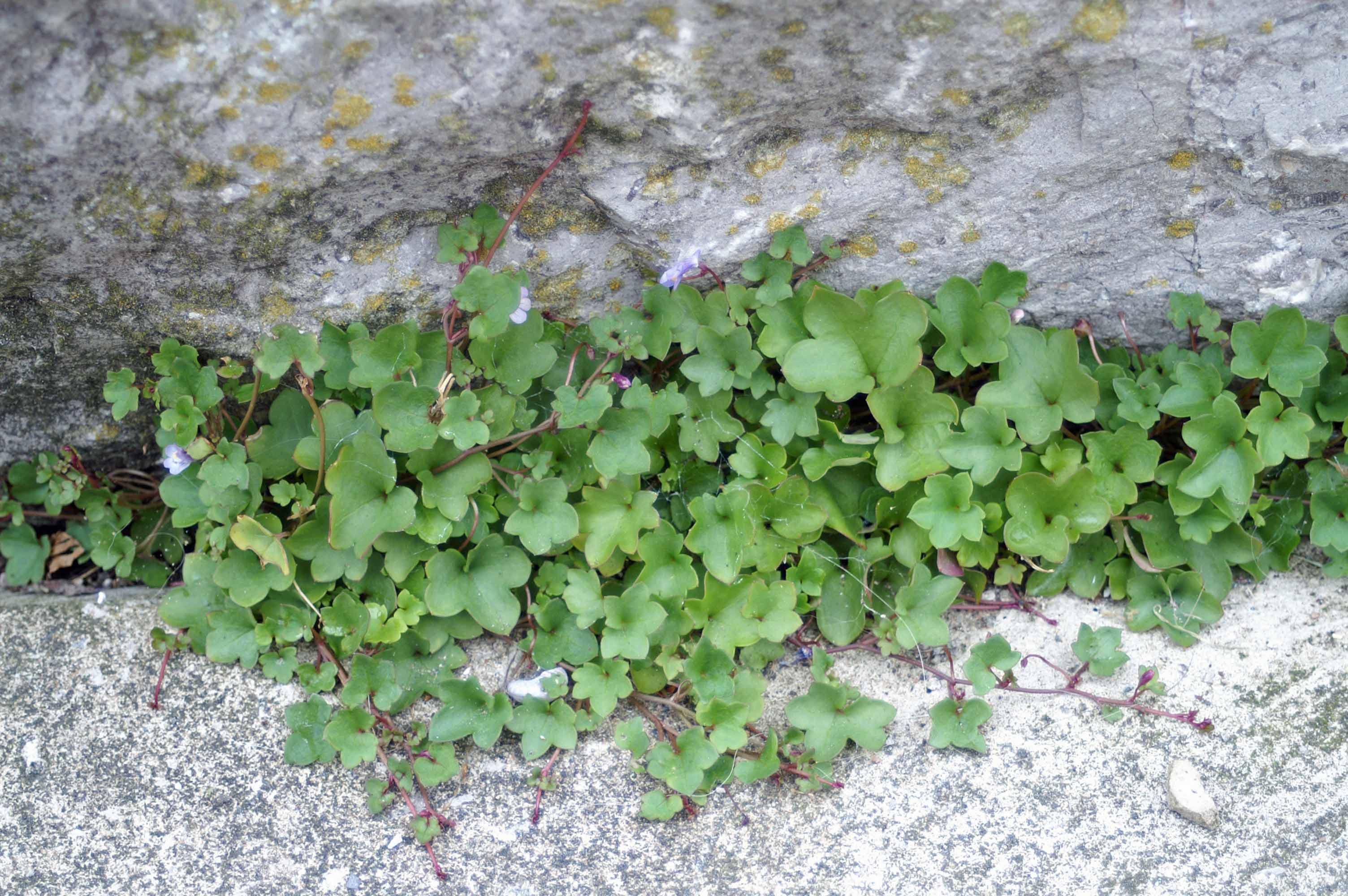
Plants have begun to colonise some of the spaces between the rocks and somehow manage to grow at the base of the rocks where they make contact with the sea wall.

A fern squeezing out from between two rocks

Ivy-leaved Toadflax - Cymbalaria muralis

An enlarged view of the delightful little flower and leaves of the Ivy-leaved toadflax

A tiny flower, enlarged, that I think may be English stonecrop-Sedum anglicum. The spiky leaves in the background are of a separate plant, quite possibly Thrift.

Red Valerian is an intrepid and highly successful uninvited coloniser that originates from the Mediterranean region

Red valerian has very pretty flowers that here were attracting several small moth-like insects that I think may have been Owl Midges.

Growing up between the rocks and the sea wall, I have yet to identify this plant

As they frequently do, my walk turned out to be unexpectedly interesting and I did get to see my Rock Pipits, which will be featured in my next post that will be following very shortly.

Share this:

  • Share on Facebook (Opens in new window) Facebook
  • Share on Pinterest (Opens in new window) Pinterest
  • Share on X (Opens in new window) X
Like Loading...

Bird study – Curlew

10 Monday Oct 2011

Posted by theresagreen in Nature, nature photography, wading birds

≈ 2 Comments

Tags

bird camouflage, bird migration, Curlew, curlew folklore, curlew on seashore, Oystercatcher, rhos on sea

An aura of wildness surrounds the curlew perhaps more than any other wading bird. Its onomatopeoic, haunting cries ringing out across the lonely marshes and the tideways it inhabits embody the atmosphere of these often lonely and desolate places.

The curlew is the largest European wading bird, instantly recognisable on winter estuaries or summer moors by its long, downcurved bill, brown upperparts, long legs and evocative call.

Increasing numbers of Curlews have been present on the seashore at Rhos-on-Sea for a few weeks now, but I’ve been waiting to get some reasonable photographs before I wrote about them in more detail. There were several obstacles along the path to obtaining some clear images, not least of which was the fact that they are almost perfectly camouflaged within this rocky landscape, where brown is the predominant colour.

Despite their size, curlews blend perfectly into this landscape

BTO BIRDFACTS:

Curlew Numenius arquata   [Linnaeus, 1758]

Order: Charadriiformes Family: Scolopacidae
 Number in Britain: 105 thousand pairs (Summer)
 Conservation Status:
UK: AMBER
European: 2 Concern, most in Europe; Declining
Global: Near Threatened ( Details )

Curlews fly fast and low along the sea edge-in flight the white rump is very noticeable

Curlews glide smoothly and quietly through pools of water hunting for small invertebrates

The long curved beak enables the curlew to probe well under rocks

A curlew foraging peacefully alongside an oystercatcher

Breeding

In Great Britain the greatest numbers of breeding curlews are found here in North Wales, but a glance at a field guide will indicate the vast area occupied by the birds. Their range extends from this country east to the Urals and from Scandinavia and Russia in the north. This wide extent of habitats includes upland moors, grassy or boggy open areas in forests and damp grasslands and traditionally managed hayfields particularly in river valleys.

Autumn and winter

Directly after the nesting season the birds shift to marine coastal areas especially favouring mudflats and sands extensively exposed at low tide. Like most waders, at high water curlew form large roosts on either the highest saltings or on fields and marshes behind the sea walls. In some localities the birds move to nocturnal roosting spots at dusk, leaving again at dawn.

The curlew flock numbers several hundred. They roost in this field at the foot of Bryn Euryn, close to houses and a main road. They return at high tide too when they may be seen foraging in the field or standing quietly with their bills tucked under their wings.

When they are not foraging along the seashore here in Rhos-on-Sea the curlew flock surprisingly shares a field with cows, sheep and a couple of horses. Their choice of roost took me by surprise as the field is very close to a busy road, in total contrast to the deserted open spaces they are usually identified with.

When roosting the more dominant curlew tend to occupy the better sheltered areas within the assembly; birds at the front of flocks form closely packed ‘walls’ in high winds.

Coastal numbers build up from July and reach a peak in January and February. The resident UK population is boosted by incoming migrants to some 99,500–125-000 pairs. 

Curlew from Scotland spend autumn and winter on the British west coast and in Ireland. Populations from Scandinavia, the former Baltic States and north-west Russia head south-westwards towards this country: each of international importance for wintering curlew, the four localities holding largest numbers are Morecombe Bay, the Solway, the Wash and the Dee. Others, remarkably, winter in Iceland and the Faroes. And yet others penetrate to the West African coast. Curlew are capable of migrating at remarkable altitudes, even crossing the Himalayas at a height of 20,000 feet.

Curlews foraging at sea edge

The Curlew in folklore

The curlew features strongly in folklore, often not too favourably.

To hear a curlew call is not good. If you hear it at night, it means that bad luck is coming, but if heard during the day it signifies the arrival of bad weather.

The curlew has always been a bird of bad omen to sailors who have seen them flying overhead and if you hearing their call means that a storm is brewing and its inadvisable to set sail for the open sea.

St Beuno and the Curlew

It is hard to find the nest of the curlew; this story from the folklore of North Wales, attributed to St Beuno offers an explanation for that.

When he lived at Clynnog St Beuno used to go regularly on Sundays to preach at Llanddwyn, off the coast of Anglesey, walking on the sea with the book of sermons, which he used to carry about with him. One Sunday, as he was coming back from Llanddwyn to Clynnog, treading the surface of the sea as if it had been dry land, he dropped his precious writings into the water, and failed to recover them. The saint was much worried, because even for saints the task of writing sermons is a troublesome one.

When he reached dry land he was much relieved to find his book on a stone out of the reach of the tide,with a curlew mounting guard over it. The pious bird had picked it up, and brought it to safety. Thereupon the holy man knelt down and prayed for the protection and favour of the Creator for the curlew. His
prayer was heard, and ever since it has been extremely difficult to discover where the long-beaked bird lays its eggs.


Share this:

  • Share on Facebook (Opens in new window) Facebook
  • Share on Pinterest (Opens in new window) Pinterest
  • Share on X (Opens in new window) X
Like Loading...
Follow everyday nature trails on WordPress.com

Enter your email address to follow this blog and receive notifications of new posts by email.

‘But it is the common species that keep the living world ticking over and provide most of our experiences of wildlife, and I would argue that maintaining the abundance of these is as important a conservation priority as maintaining the existence of rarities’. Richard Mabey

MOST RECENT POSTS

  • A Glimpse of Spring to Come January 22, 2025
  • Hunting the Wren December 28, 2024
  • Oh, Christmas Tree December 18, 2024
  • In and Out of the Ivy February 15, 2024
  • Nature’s Fireworks November 30, 2023
  • Wild Autumn along the Coast Path November 3, 2023

OLDER POSTS

LOOKING FOR SOMETHING IN PARTICULAR?

  • Sights and Sounds from the Little Orme 1
    Sights and Sounds from the Little Orme 1
  • Things Bright and Beautiful
    Things Bright and Beautiful
  • Catchers, a Duck and Divers
    Catchers, a Duck and Divers
  • Fine Dining for Crows
    Fine Dining for Crows
  • Shades, Sounds and Scents of the Woods
    Shades, Sounds and Scents of the Woods
  • Following a river to a Fairy Glen
    Following a river to a Fairy Glen
  • May Bee Appearing on Ivy near You
    May Bee Appearing on Ivy near You
  • Beautiful blooms and some rare treats (1)
    Beautiful blooms and some rare treats (1)
  • Keeping up with the Herring Gulls
    Keeping up with the Herring Gulls
  • The Windhover
    The Windhover

nightingale trails

The Walk of the Monarch Butterfly-Sendero de la Mariposa Monarca

The Walk of the Monarch Butterfly-Sendero de la Mariposa Monarca

MY WILDFLOWER BLOG: where the wildflowers are

Snowdrop

Snowdrop

most recent posts

Follow everyday nature trails on WordPress.com

Social

  • View teresamaygreen’s profile on Twitter

Enter your email address to follow this blog and receive notifications of new posts by email.

Website Built with WordPress.com.

  • Subscribe Subscribed
    • everyday nature trails
    • Join 358 other subscribers
    • Already have a WordPress.com account? Log in now.
    • everyday nature trails
    • Subscribe Subscribed
    • Sign up
    • Log in
    • Report this content
    • View site in Reader
    • Manage subscriptions
    • Collapse this bar

Loading Comments...

    %d