Tags
aphantopus hyperantus, argynnis aglaja, dark green fritillary, Gatekeeper, maniola jurtina, Meadow Brown, pyronia tythonus, Ringlet, small skipper, thymelicus sylvestris
In the meadow the grass is long and beginning to turn golden brown as it sets seed.

The meadow grass is long , brightened by patches of yellow Lady’s Bedstraw
Bright golden yellow patches of Lady’s Bedstraw, scented like new mown hay catch my eye.

Lady’s Bedstraw-Galium verum
At this end of the field there are more brambles and I spot several dark brown butterflies flying low down along the length of them. It was a while before any settled for long enough to see properly what they were. As I hoped, some were dark, chocolatey brown Ringlets.

Ringlet butterfly on bramble leaf – wings of butterflies that frequent brambles often get torn on prickles
One Ringlet male was clearly patrolling a territory. The brambles fill a corner of the field; he was flying to one ‘end’ of the patch, turning around, flying to the other end, then where the bramble curves around the corner he cut across to the other side of the track, flitted a short way through the long grass then back across the track to the brambles. Occasionally he paused for rest or to skirmish with intruders.

An undamaged Ringlet
As well as Ringlets there were Meadow Browns, some of which were also coloured dark brown, hence my initial hesitation identifying the Ringlets. It’s quite unusual to see Meadow Browns resting with their wings fully open and it is interesting to see how variable this species is in size and colouring.

The male Meadow Brown is darker brown than the female and may not have orange patches

A lighter shaded female Meadow Brown

Meadow Brown (male) underside showing orange underwing and eyespots
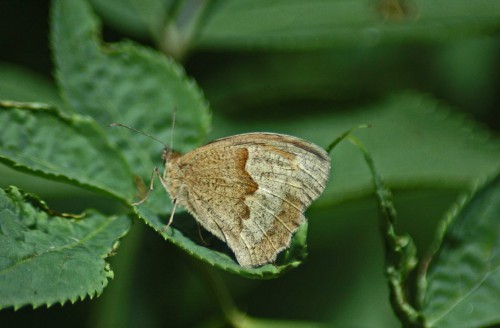
Meadow Brown underside-female
I was pleased to see a lovely fresh Gatekeeper here too, my first one for this year. This one was a male; he has dark scent scale patches in the centre of the forewings which females don’t have.
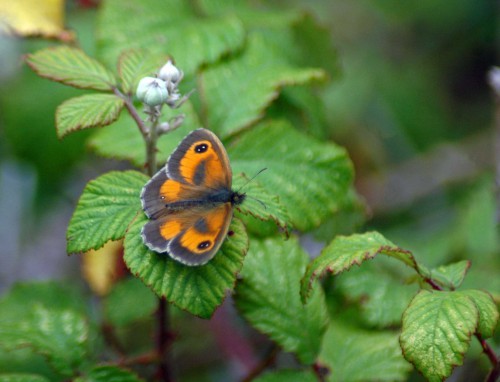
Gatekeeper-Pyronia tithonus
In the opposite corner of the field there are more brambles; there were more Meadow Browns here and little golden brown Skippers that happily are abundant here and that also occur in other nearby locations, particularly on the Little Orme.
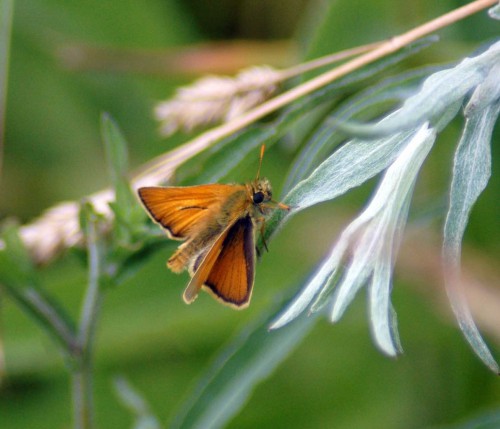
Small Skipper (male) has a line of black scent scales on forewings
There were a good number of these lovely little butterflies flitting about, expertly manoeuvering at speed between the long grass stems.

Small Skipper-Thymelicus sylvestris
Ringlets are not widespread throughout the site, but rather occur in colonies in a few different locations. I walked on up past the top end of the field where I have found them in previous years, again on brambles. I was pleased to see there were; maybe half a dozen individuals, mostly flying around in the long grass in front of the brambles. Finally one flew up to feed on one of the last remaining flowers.

Ringlet feeding on the last of the bramble flowers
I was wondering what there was for the butterflies to feed on here now the bramble flowers are over, then saw one fly up onto a nearby oak tree. A closer look revealed it appeared to be feeding on something on a leaf surface, or maybe there were a few drops of moisture there.
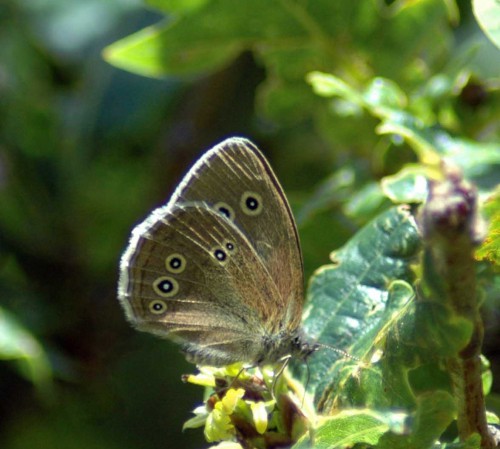 Last year I didn’t see any Ringlets at all, perhaps I missed their rather short season, which is just July-August, or maybe there were only a few which I overlooked. As they are here now there must have been some to generate this year’s brood. Now I wanted to know if there were any to be found in yet another spot I found them in the year before last, which is at the bottom of the ‘downland’ slope that leads up to the summit of the hill. Happily, there were indeed some there too. So, a good year for Ringlets.
Emerging from the woodland onto the steep slope I had caught sight of a flash of orange flying over a stand of Rosebay Willow Herb, so headed off now to investigate that. It wasn’t long before I saw more orange flashes of speeding Dark Green Fritillaries, the most special butterfly treats of this reserve. This patch of the hillside and sometimes a spot on the other side of the hill are the only places I have seen them, Colonies are more plentifully populated some years than others.

Dark green Fritillary- Argynnis aglaja
The fritillaries were feeding mainly on thistles, for want of anthing much else. They would also feed on knapweed, but it’s not quite out yet and scabious, of which there is only a little flowering nearby.
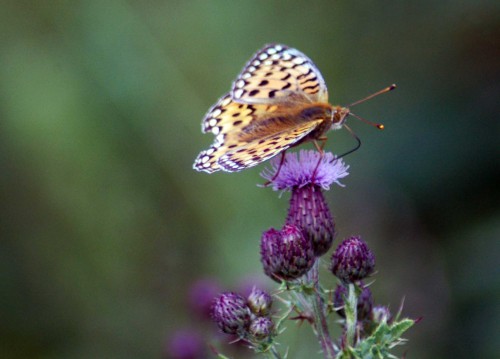
An older, more faded butterfly
There were perhaps 10-12 individuals, some faded, others much fresher.

They are strong, fast flyers and glide on flat wings.

On the hindwings there are silver spots on a dark green background
 everyday nature trails