• Home
  • about
  • about the photographs
  • Local Nature Reserves
    • Bryn Euryn Local Nature Reserve
    • Mynydd Marian
  • Wales Coast Path
    • Grey Seals in North Wales
    • St.Trillo’s Chapel
    • Wildflowers of North Wales Coastal Paths, Cliffs and Dunes

everyday nature trails

everyday nature trails

Tag Archives: importance of ivy to late summer insects

May Bee Appearing on Ivy near You

07 Friday Oct 2016

Posted by theresagreen in garden wildlife, Insects, Nature, Nature of Wales, nature photography, North Wales, plants important to wilflife, Rhos-on-Sea

≈ 13 Comments

Tags

BWARS, importance of ivy to late summer insects, Ivy bee, ivy flowers, small bee on ivy flowers, solitary bees

I know our native evergreen climbing ivy can be a pain in a garden, but at this time of year when it’s flowering it is a magnet to a wide variety of late-flying insects. To one particular little bee that has set up residency here in Great Britain in recent years, it is vital.

October 6th

It’s always exciting to see a ‘new-to-you (or me)  species on your own patch and this week I had my first sightings of a little solitary bee I have only recently become aware of. It is commonly named the Ivy bee, as its emergence is set to coincide with the flowering time of yes, you guessed, the common but invaluable to late flying insects Ivy or Hedera helix, on which it feeds.

161004-rosrc-ivy-bee

4/10/16-First ever sighting of an Ivy bee-Colletes hederae

161004-rosrc-ivy-bee-1

Ivy bees are found in Austria, Belgium, Channel Islands, Croatia, Cyprus,France, Germany, Greece, Italy, Luxembourg, Netherlands, Serbia, Slovenia, Spain and Switzerland and are recent arrivals in Great Britain, but spreading and establishing fast.

BWARS – The Bees, Wasps & Ants Recording Society has been mapping the spread of the Ivy bee since its discovery in Britain 15 years ago. They say:

Colletes hederae was recorded as new to Britain in 2001 when Ian Cross discovered specimens at Langton Matravers in Dorset. Since then, the bee has spread across much of southern England (as far north as Shropshire, Staffordshire & Norfolk) and into south Wales. It is now extremely plentiful in some coastal localities, and increasingly, inland. Peak activity matches the flowering period of its key pollen forage plant, Ivy (Hedera helix), and the species is on the wing from early September until early November. This makes it the last solitary bee species to emerge each year. 

Where to find them

161006-rosrc-ivy-bee-2Ivy bees like patches of flowering ivy in sunny spots, often in gardens.They look like small honeybees but have an orange-yellow striped abdomen and a furry ginger thorax, so they are quite noticeable as they bustle over the green balls of ivy blossom. If there is a nest site nearby you may see several of them on the flowers at any one time.

161006-rosrc-ivy-bee-4Ivy bee lifecycle

Unlike the larger honeybee, which is a social insect and has queens, drones and workers, the ivy bee is solitary. They are mining bees and after mating, a female Ivy bee digs out a burrow in loose earth or sand, and creates underground chambers. She then lays several eggs which she stocks with pollen to provide food for the larvae when they hatch. Although each female ivy bee digs her own burrow, tens or even hundreds of females nest close together in colonies, usually on sandy banks.

As with many insects, the mating process may be a brutal affair. Male bees wait by the burrows for females to return, then ambush them. Many males may attempt to mate with a single female in their quest to sire the next generation, forming a writhing mass – or mating ball. The female dies a few weeks after mating and laying her eggs, but the larvae pupate and become adults, staying underground until autumn, emerging to repeat the cycle.


Share this:

  • Click to share on Facebook (Opens in new window) Facebook
  • Click to share on Pinterest (Opens in new window) Pinterest
  • Click to share on X (Opens in new window) X
Like Loading...

Irresistible ivy

22 Thursday Sep 2011

Posted by theresagreen in butterflies, Nature, nature photography

≈ 2 Comments

Tags

bluebottle, Drone fly, hoverflies, importance of ivy to late summer insects, ivy flowers, marmalade hoverfly, Red Admiral

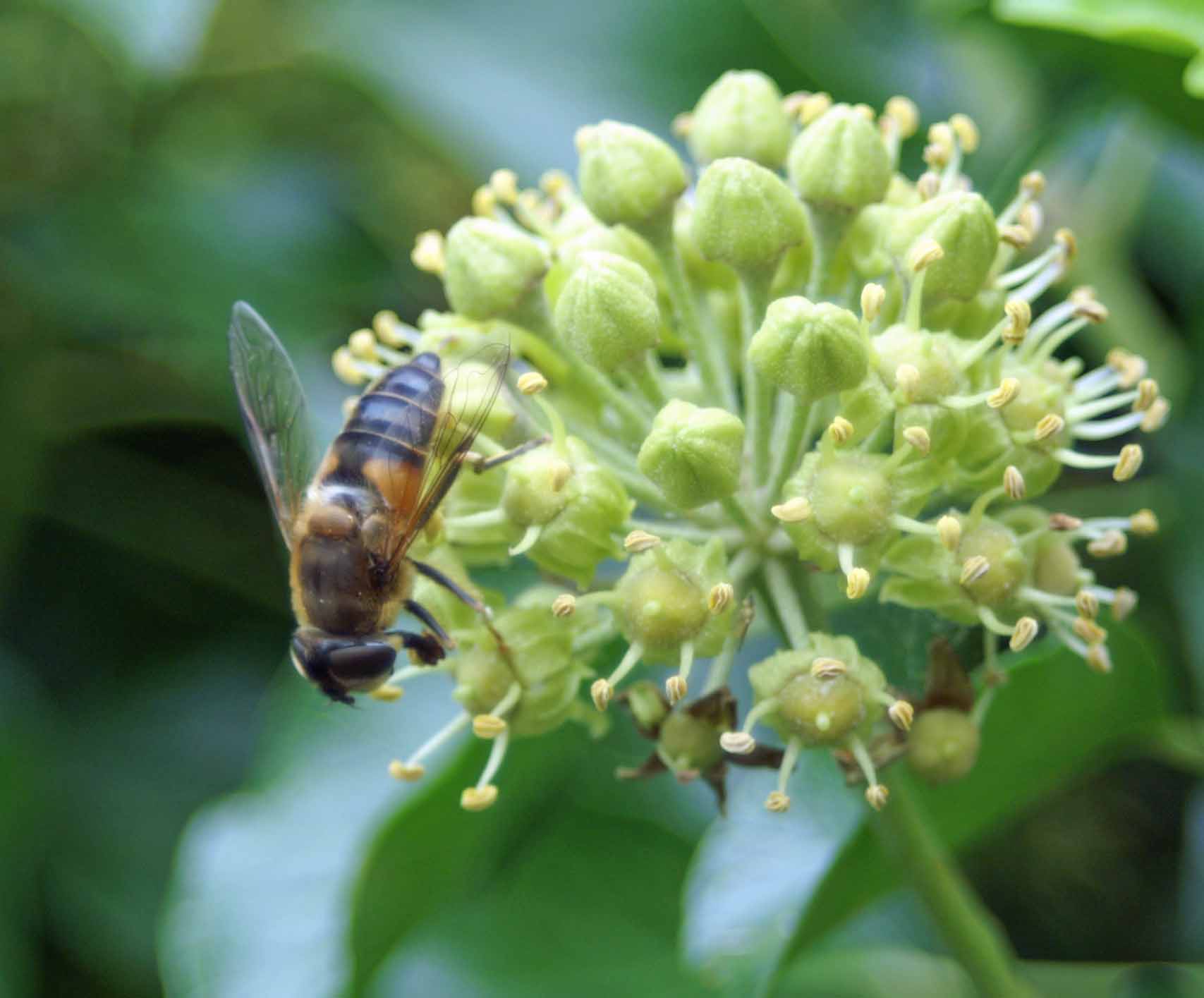
Ivy plants are flowering locally and are drawing in crowds of insects, particularly hoverflies but also bumblebees and butterflies. The flowers are not completely out yet, so I’m sure that there will be more to see shortly, if we have some sunshine, but the following are what I’ve spotted so far.

15/9/11-Red Admiral

Ivy flowers are produced from late summer until late autumn, the individual flowers are small and clustered in 3–5 cm diameter umbels. They are greenish-yellow in colour and very rich in nectar  and an important late autumn food source for many insects.

A bright shiny bluebottle fly

The most numerous insects drawn to the flowers were from various species of hoverfly.

Tapered Drone Fly-Eristalis pertinax

15/9/11-A larger yellow and black hoverfly, not yet identified

15/9/11-Hoverfly-syrphus ribesii

Marmalade Hoverfly-Episyrphus balteatus

Share this:

  • Click to share on Facebook (Opens in new window) Facebook
  • Click to share on Pinterest (Opens in new window) Pinterest
  • Click to share on X (Opens in new window) X
Like Loading...
Follow everyday nature trails on WordPress.com

Enter your email address to follow this blog and receive notifications of new posts by email.

‘But it is the common species that keep the living world ticking over and provide most of our experiences of wildlife, and I would argue that maintaining the abundance of these is as important a conservation priority as maintaining the existence of rarities’. Richard Mabey

MOST RECENT POSTS

  • A Glimpse of Spring to Come January 22, 2025
  • Hunting the Wren December 28, 2024
  • Oh, Christmas Tree December 18, 2024
  • In and Out of the Ivy February 15, 2024
  • Nature’s Fireworks November 30, 2023
  • Wild Autumn along the Coast Path November 3, 2023

OLDER POSTS

LOOKING FOR SOMETHING IN PARTICULAR?

  • The Foxglove - of Fairytales, Myths & Medicine
    The Foxglove - of Fairytales, Myths & Medicine
  • Pretty prickly Thistles
    Pretty prickly Thistles
  • Willsbridge Mill, Bristol
    Willsbridge Mill, Bristol
  • Following a river to a Fairy Glen
    Following a river to a Fairy Glen
  • Pines and Primroses
    Pines and Primroses
  • Everyday Birds - The Blue Tit
    Everyday Birds - The Blue Tit
  • Fine Dining for Crows
    Fine Dining for Crows
  • Wild and Windy on West Shore
    Wild and Windy on West Shore
  • Of Gorse, Furze or Whin
    Of Gorse, Furze or Whin
  • Wildflowers of North Wales Coastal Paths, Cliffs and Dunes
    Wildflowers of North Wales Coastal Paths, Cliffs and Dunes

nightingale trails

The Walk of the Monarch Butterfly-Sendero de la Mariposa Monarca

The Walk of the Monarch Butterfly-Sendero de la Mariposa Monarca

MY WILDFLOWER BLOG: where the wildflowers are

Snowdrop

Snowdrop

most recent posts

Follow everyday nature trails on WordPress.com

Social

  • View teresamaygreen’s profile on Twitter

Enter your email address to follow this blog and receive notifications of new posts by email.

Website Built with WordPress.com.

  • Subscribe Subscribed
    • everyday nature trails
    • Join 359 other subscribers
    • Already have a WordPress.com account? Log in now.
    • everyday nature trails
    • Subscribe Subscribed
    • Sign up
    • Log in
    • Report this content
    • View site in Reader
    • Manage subscriptions
    • Collapse this bar
 

Loading Comments...
 

    %d