• Home
  • about
  • about the photographs
  • Local Nature Reserves
    • Bryn Euryn Local Nature Reserve
    • Mynydd Marian
  • Wales Coast Path
    • Grey Seals in North Wales
    • St.Trillo’s Chapel
    • Wildflowers of North Wales Coastal Paths, Cliffs and Dunes

everyday nature trails

everyday nature trails

Tag Archives: common rockrose

A Windy Wildflower Walk II

27 Sunday Aug 2017

Posted by theresagreen in Butterflies of Wales, calcareous grassland, coastal walks, Nature of Wales, North Wales Wildlife Trust, Rhiwledyn Nature Reserve, Wales Coast Path, Wildflowers of Wales, wildflowers on limestone, Wildlife of the Wales Coast Path

≈ 3 Comments

Tags

black horehound, common rockrose, harebell, hedge woundwort, Lady's bedstraw, Nature in August, Perforate St John's Wort, speckled wood, water mint, yellow dung fly

August 3rd

Part 2 – Rhiwledyn Nature Reserve -The main track

Onwards and upwards; a flight of shallow stone steps make a steep rocky section of the path a little easier to climb (except when it’s wet & they get a bit slippery).
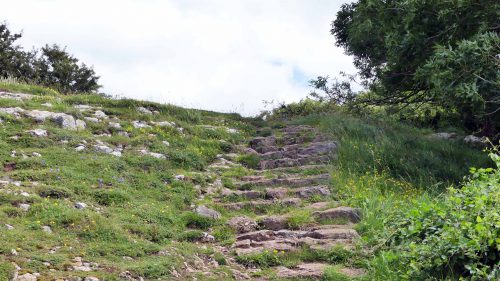
Pause here to admire the views back down onto the road and the many shades of green of the fields and woodland on its opposite side.
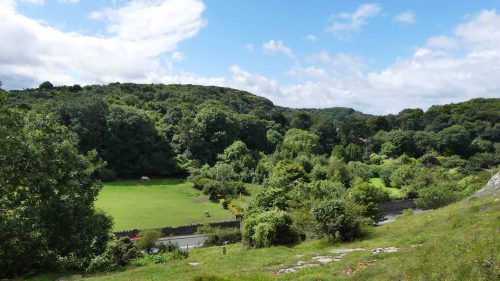
Looking down onto the road into Llandudno

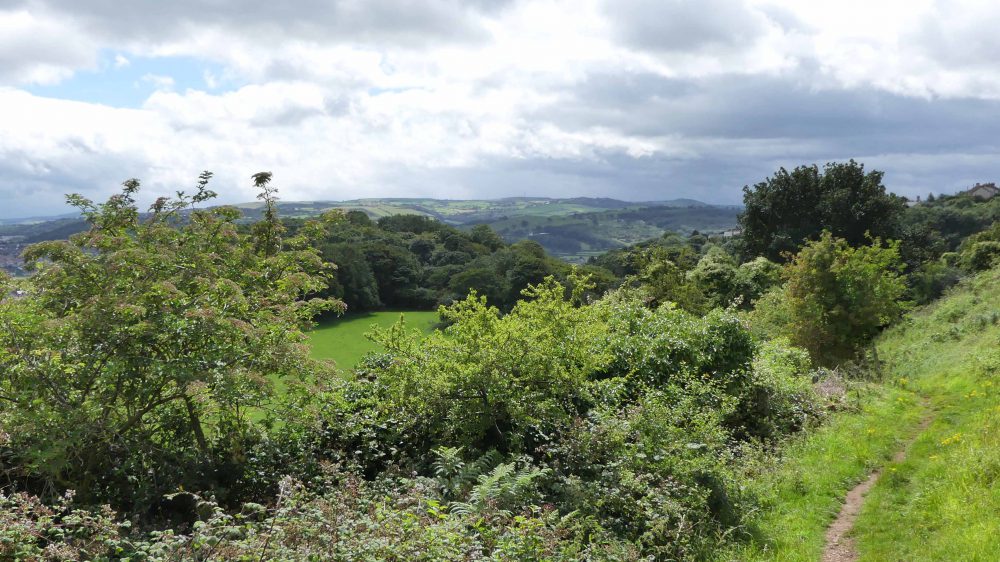
Facing around to the way I’m going, the views to the right of me, seen over a rampant tangle of brambles and wild clematis on the reserve boundary, are extensive and stunning. At once pastoral and contained and wild and open to the elements.

On the other side of the track is the biggest and best patch of harebells that I have seen for years, a truly beautiful sight.

Harebell- Campanula rotundifolia

I can’t resist sitting to watch them being blown and rippled by the wind and am captivated by their charm. For me this little flower has it all. Beautiful in colour and form, they have delicacy and fragility but also great adaptability and resilience to an often hostile environment. Each flower had turned its bell back to the wind to reduce its impact; their slender but tough and wiry stems having the flexibility to bend to the wind, not break. A life lesson in a wildflower!

There were yet more of the little beauties a little higher up on the slope contrasting delightfully in colour and form with frothy lemon-yellow Lady’s bedstraw. I clambered up rather inelegantly to take a closer look. Amongst other plants, these had grown taller and in a more sheltered spot, their bells were turned to the light rather than away from the wind.

Before going back down to the track, I take another look at the glorious view across the bays to the Clwydian Hills and with sheep where they are supposed be.

click to enlarge

Back on track there is a change in ambience and habitat. There are small trees and shrubs on the boundary with the farmland sufficient to cast shade, and the sloping ground on the other side provides a windbreak. The trees are mostly hawthorn, prevalent throughout the headland as its one of the few plants not grazed by sheep or rabbits and again, tough enough to withstand exposure to fierce salty winds.

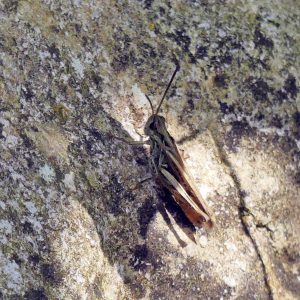
I spot a movement and see a small Grasshopper jump onto a lichen speckled rock catching dappled sunlight; the perfect place to soak up a little warmth whilst staying camouflaged.

I round a bend in the track and see – sheep! Five naughty trespassing sheep! They are strictly banned from the reserve unless invited in as their indiscriminate grazing may damage or even destroy the rarer wildflowers that grow here. Fencing prevents them wandering into the higher part of the reserve from the rest of the Little Orme where they are not restricted, so I think they got in at this field level, no doubt irresistibly tempted by the sight of the lush long grass over here. I tell them they should return to their field, but can’t see where they may have got through and they pay me no heed anyway, just amble away showing me their bottoms.

I let them get ahead, the last thing I want to do is frighten them and send them scattering and concentrate on the patch of golden flowers I see amongst the long grass on the slope. I thought at first it may be Goldenrod as I’d seen some on the roadside earlier, but soon realised it was a Hypericum – St.John’s Wort.
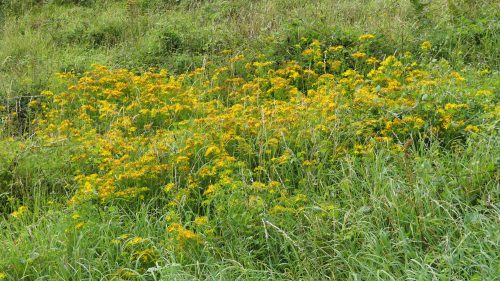
Another plant with several species that share the same common name, but this is the one I am most familiar with and has all the right features to be Perforate St John’s Wort – Hypericum perforatum.

St John’s Wort-Hypericum perforatum
click to enlarge

Black horehound – Ballota nigra

I apologise, but need to digress a little here to explain the significance of my next plant. Earlier on in the summer a group of NWWT members were treated to a walk around this reserve guided by its manager, Rob and a guest expert botanist, Nigel. It was a brilliant walk on many levels and we learnt a lot about our special flora and its history, about its fauna and the trials and tribulations of modern Reserve management. Typically as on any walk, even guided group ones, I lagged behind snapping interesting stuff and in a rough bramble-and- nettle patch (in the pic above), spotted the plant to the right, which is still going strong. Yet another minty-looking one I didn’t recognise. I took hasty photographs and hurried after the rest of the group. No-one else immediately recognised it either, so Nigel suggested I email the pics to him later on so he could have a better look. From them his best guess was that it was Black Horehound, reservations having been that this was a vigorous, tall specimen of a plant that usually is, in his words, ‘much scruffier-looking’ He also mentioned it smells unpleasant, so this time I had a closer look and bruised and smelt a leaf. It definitely did not smell pleasant and as all its other important bits match the botanical specs, I’m taking that as another one to add to my list of wildflowers-I-will-know-how-to-identify in the future. (Unless anyone has a different idea……?)
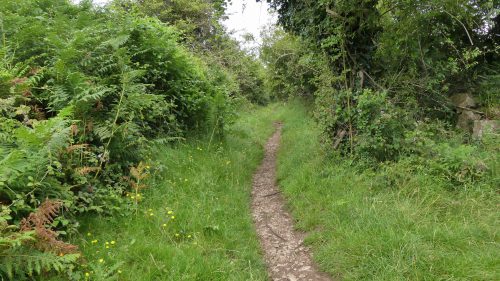
It’s amazing what you can see in five minutes along a short shady stretch of track. I watched a dragonfly patrol up and down at speed, pausing only in his labour several times to ‘buzz’ me and let me know I was in his space. I was hoping he’d stop so I could at least see what he was, but no, much too busy. There was yet more mint here, and one I recognised from the distinctive scent of a crushed leaf – this is Water Mint-Mentha aquatic. A similar-looking plant is Corn Mint, but it grows shorter than this and doesn’t have a ‘terminal’ flowerhead (one that crowns the top of the stalk).
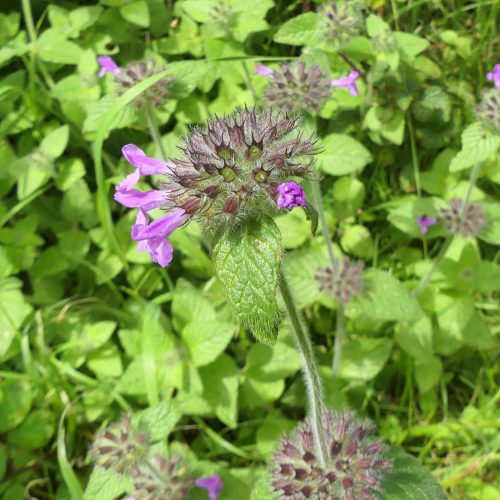
Water mint-Mentha aquatica

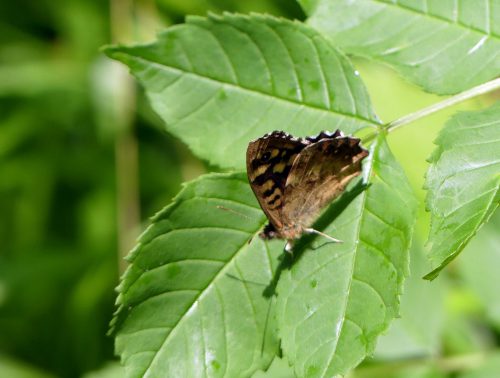
A fresh-looking Speckled Wood rested on a sun-warmed stone on the path

Speckled Wood

and a Red Admiral flew across to seek out the nectar of bramble flowers
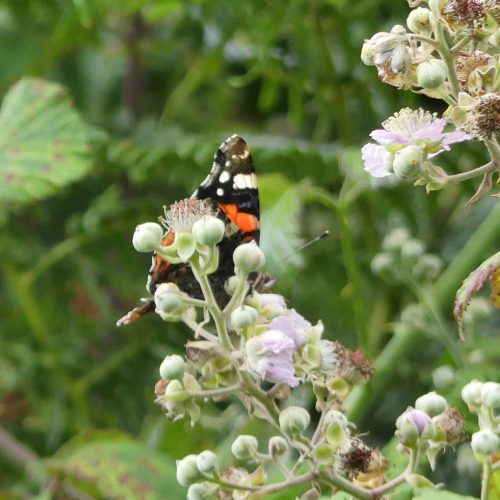
Red Admiral – Vanessa atalanta

There is a farm gate here which I checked for security, but tightly closed there would have been no exit for sheep. Another great Clematis-framed view from here, considerably enhanced by the clouds I think, although they were blocking out the sun at this point.

click to enlarge

At the side of the gate another member of the Lamiceae (mints & dead-nettles) family, this one I know well, the Hedge Woundwort Stachys arvensis.

Yellow Dung Fly – Scathophaga stercoraria

I moved on and round the next bend found evidence I was still on the trail of the errant sheep; a smallish neat and fairly recent deposit of fresh dung. And where there is dung there may be Dung-flies, one of my favourite insects, although I’m not exactly sure why. Perhaps because I’m keen on recycling? As I hoped, a single male Yellow Dung Fly had laid claim to the heap of treasure and was intent on guarding it. A bit of a drama then ensued, but I’m saving that for later.

To the top

I had reached the Reserve boundary, marked by a gate through which the two marked ‘Trails’ continue on to cross the rest of the Little Orme headland. There is no marked official track up to the top reaches of the reserve from here though, so getting up there is a matter of a)wanting to; b) paying attention to where you are putting your feet; c)taking care not to slip on damp grass and d) watching out for rabbit holes.

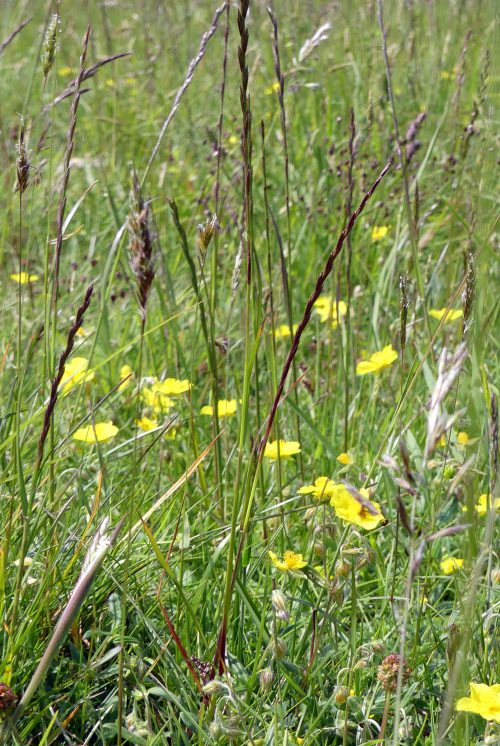
Rock-roses are still fresh and lovely up here, as is the fragrant Lady’s Bedstraw.

I followed the path chosen by the sheep; they almost always know how to find the best way upwards. They were up there now, all standing facing the view. I may have thought they were admiring it, but one of them who seemed to be in charge, maybe the mother of some of them, was bleating loudly, eliciting a response from the field below. Was she calling to her friends telling them about the feast to be had on this side and inviting them over?
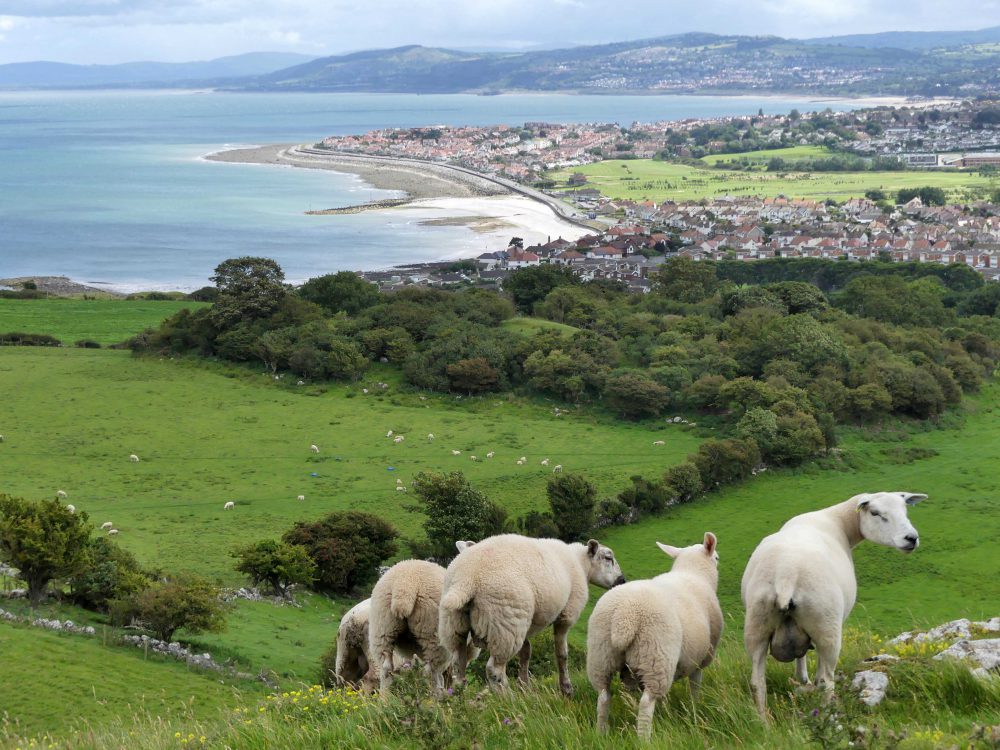
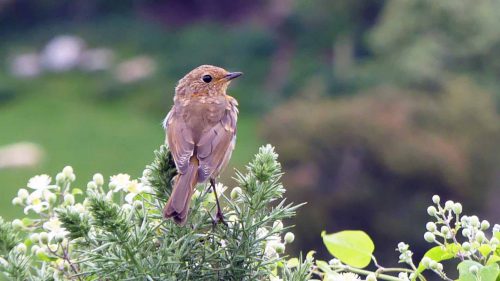
Once more I reminded them they were not welcome here, but Mrs Boss Sheep just gave me ‘the look’ that clearly said “mind your own business and what are you doing up here yourself?” Once past them it became more overgrown and not as clear where to head, but I kept going in the general direction of where I wanted to be and hoped for the best. I heard a bird making some squeaky sounds and spotted him as he perched atop a gorse bush, a speckly young Robin beginning to get his adult feathers. I realised this was the first bird I’d seen and heard so far on this walk apart from gulls and the occasional cormorant flying overhead.
I also realised it was lunchtime, so time to find a sheltered spot, take a break and sit and admire the sheep’s-eye view.


Share this:

  • Share on Facebook (Opens in new window) Facebook
  • Share on Pinterest (Opens in new window) Pinterest
  • Share on X (Opens in new window) X
Like Loading...

Butterflies and more rare treats

29 Wednesday Jun 2016

Posted by theresagreen in Bryn Euryn Nature Reserve, bumblebees, Butterflies of Wales, calcareous grassland, day-flying moths, Insects, nationally scarce wildflowers, Nature of Wales, Wildflowers of Wales

≈ 15 Comments

Tags

Adscita geryon, Cistus Forester moth, common blue, common rockrose, Cryptocephalus hypochaeridis, Dingy Skipper, Jewel beetles, Nottingham Catchfly, Pyramidal Orchid, salad burnet, Silene nutans, small heath, small shiny metallic green beetle, speckled wood

June 5th

One of the most fascinating, and sometimes a little frustrating thing about observing wildlife is that no two days, even in the same location are ever the same. I know that, but I had to retrace yesterday’s steps in the hope of further sightings of a Dingy Skipper or two didn’t I?

Along the Woodland Trail, Speckled Woods seemed  even more numerous than yesterday, and a little more willing to bask with open or partially open wings.

Speckled Wood

Speckled Wood and shadow

Leaving the shelter of the trees and entering the open meadow there was a fairly strong, cool breeze blowing – not the best of conditions for photographing butterflies that tend to stay low in the grass on such days, despite today’s sunshine. That didn’t deter me from stubbornly attempting to get some images of a lovely fresh male Common Blue. It was highly mobile, but during their frantic circuiting, these butterflies frequently return to the same spot to settle for a breather and luckily this was the case with this beauty; he favoured this particular grass stem or a nearby head of clover, so I waited there and eventually caught him during moments when the breeze briefly stilled. Not as sharp an image as I’d like, but a record.

Common Blue male upperside

Common Blue male upperside

Common Blue male underside

Common Blue male underside

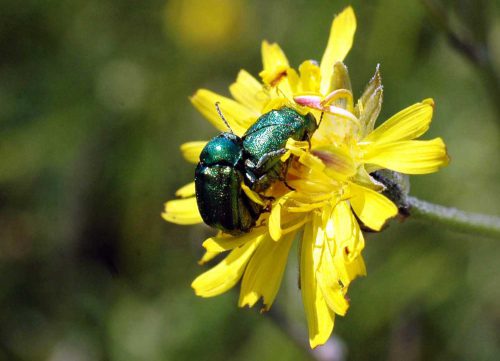
I wondered if I might see the little green jewel beetle again. Last night, looking for information about this species I read they favour yellow compositeae flowers and remembered there were a few hawkweed plants close to where I found it yesterday. Lo and behold, I found not just one there, but a mating pair. I’ve put in two images of them, one to show their real size and another enlarged one to show how beautiful they are.

160605-BE26-Green metallic beetles-mating pair

Mating pair of Cryptocephalus aureolus

160605-BE33a-Green metallic beetles-mating pair

After a few minutes of photographing the obligingly oblivious pair I noticed a female Swollen-thighed Beetle -Oedemera nobilis (females don’t have the swollen thighs of the male) that had landed on a nearby flowerhead.

160605-BE31-Green metallic beetles-mating pair

She decided to take a closer look at what the mating pair were up to. (Sorry about blurry image-swaying flower stem!)

160605-BE39-Green metallic beetles-mating pair

Mating pair of Cryptocephalus aureolus observed by a female Oedemera nobilis

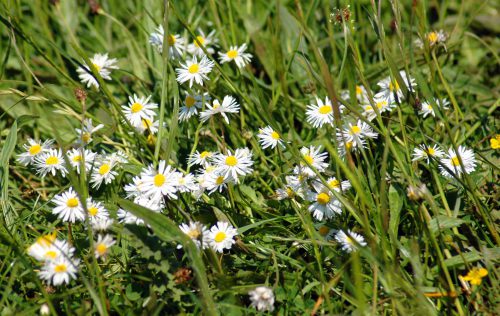
I couldn’t resist this patch of pretty Common Daisies in the long grass.

160605-BE-Daisies

A slight variation on yesterdays route took me up the track that comes out the other side of the hill. It was even breezier up there, but there were insects about taking advantage of the nectar and pollen on offer from the abundant wildflowers, mainly Rock-roses and clovers.

A Carder bumblebee in action on red and then white clover:

160605-BE42-Bee approaching clover160605-BE43-Bee on clover160605-BE44-Bee on clover160605-BE46-Bee on clover160605-BE45-Bee on clover

This side of the hill’s summit was looking beautiful, carpeted with sunshine yellow Rock-rose and Bird’s-foot Trefoil.

160605-BE1305-Rock-roses on summit

Summit carpeted with the sunshine yellow blooms of Rockroses and Bird’s-foot Trefoil (click on image to enlarge)

I stood still for a few minutes scanning the flowers for butterflies. Small Heaths  were most numerous, but I did spot a single Dingy Skipper. Living up to its name, it was skipping around randomly at speed, too fast and mobile for a photograph, but at least I’d seen it. I had more luck with a lovely little iridescent green Forester Moth that landed on a Salad Burnet flowerhead and stayed there.

160605-BEMTH-Forester moth on Salad Burnet 3a160605-BEMTH-Forester moth on Salad Burnet 1

There are three similar species of Forester Moth in Britain that can be difficult to tell apart, but I think this one is a Cistus Forester-Adscita geryon. According to the Butterfly Conservation info: “This species is generally smaller than the Forester or Scarce Forester and the presence of good quantities of the Cistus Forester’s foodplant, Common Rock-rose, can be a useful indication of this species.”

Now for the ‘rare treat’! Since I came  to live here, I have been looking out for a ‘Nationally Scarce’ plant that is recorded as growing here, the fascinating Nottingham Catchfly-Silene nutans. I’d only seen pictures and read about it, imagining I would find it in a rocky place on the cliffs or in bare ground. But, much to my amazement and delight, I found it today well-hidden amongst lush long grasses near the edge of a track. Getting my eye in, I saw there were several smaller clumps of the plant further back from the track edge, so clearly a good year for it. Difficult to photograph in the strong breeze, I’ve edited and sharpened my images a little so the plant is more visible than it was on the day!

160605-BE1256-Nottingham Catchfly (5)

Nottingham Catchfly amongst swaying long grasses

The plant is so-named because it was first found on the walls of Nottingham Castle. It no longer grows there as the site was destroyed during work done on the site in the 19th century. The flower remains the County Flower for Nottinghamshire though.

160605-BE1256-Nottingham Catchfly (4)

The plant is vespertine like many of the catchflies. This means that the flowers tend to stay closed in the daytime and open in the evening or at night, when they release a heavy scent into the evening air in order to attract night-flying insects and moths.

160605-BE1256-Nottingham Catchfly (3)

Flowers are drooping, in very open clusters and all usually pointing one way. Petals white above, greenish or pinkish beneath.

Each flower opens over three successive nights revealing one whorl of stamens on the first night and another on the second and the styles on the third. This is thought to prevent self fertilisation.

160605-BE1256-Nottingham Catchfly (2)

Moving on up to the summit I found my first Pyramidal Orchid of the year, still tightly in bud.

First Pyramidal Orchid

First Pyramidal Orchid-Anacamptis pyramidalis amongst Common Rock-rose

Back in the same spot as yesterday I got another brief glimpse of a Dingy Skipper nectaring on Bird’s-foot Trefoil.

160605-BEBFY-Dingy Skipper 1b

Dingy Skipper on Birds-foot Trefoil

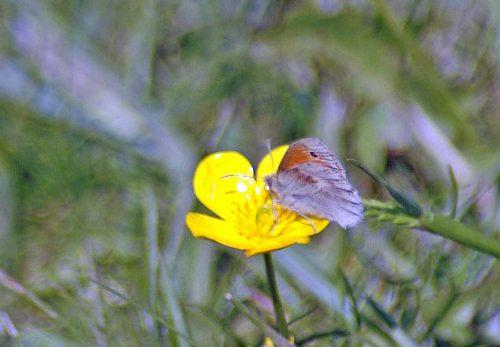
At the bottom of the ‘downland’ slope I finally caught up with a Small Heath on a buttercup.

160605-BEBFLY-Small Heath on buttercup 1a

And to finish, a female Common Blue.

160605-BEBFLY-Common Blue (f) upperside 1 160605-BEBFY-Common Blue (f) 1


Share this:

  • Share on Facebook (Opens in new window) Facebook
  • Share on Pinterest (Opens in new window) Pinterest
  • Share on X (Opens in new window) X
Like Loading...

Beautiful blooms and some rare treats (1)

26 Sunday Jun 2016

Posted by theresagreen in Beetles, Bryn Euryn Nature Reserve, Butterflies of Wales, calcareous grassland, grasses, Insects, Nature, Nature of Wales, nature photography, North Wales, Wildflowers of Wales

≈ 12 Comments

Tags

brachypodium sylvaticum, burnet rose, common rockrose, Cryptocephalus hypochaeridis, Dingy Skipper, Erynnis tages, false brome, foxglove, hoary rockrose, Jewel beetles, small shiny metallic green beetle, speckled wood

160604-BE6-View across field

160604-BE15-Foxgloves

Foxglove-Digitalis

The first week of June was full of the promise of a glorious summer to come. A  run of warm sunny days had brought forth perfect and prolific blooms and began to coax out the butterflies.

June 4th

Along the woodland trail that circuits the lower slopes of the Bryn Euryn Nature Reserve, the early summer wildflowers are peaking. Foxgloves are at their perfect best, with stems full of open blooms graduating upwards to buds. There are not many plants on this site, but they seem to be gradually increasing in number year on year.

Honeysuckle is blooming prolifically, the best I have ever seen it and it smells heavenly.

160604-BE19-Honeysuckle


The wild strawberry patch is also full of flowers, promising a bumper crop to come,although it is in danger of becoming overwhelmed by encroaching ivy and other vegetation.

160604-BE23-Wild strawberry flowers

Wild Strawberry


Birds were heard but not seen, concealed by the dense foliage of the tree canopy; Chiffchaff, Wren, and Blackbirds were all still singing between nesting duties.


160604-BE20-Blackbird

A Blackbird male paused from singing to hunt  on the woodland track

False Brome-Brachypodium sylvaticum

False Brome-Brachypodium sylvaticum


Some of the clumps of grass that grow along the woodland tracks are flowering now. This is False Brome-Brachypodium sylvaticum, a perennial grass common in woodlands where it prefers the shade of the canopy.


160604-BE3-Sunlit False Brome

Flowering False Brome

Oak leaves are already being eaten

Oak leaves are already being eaten

One of the more severe winter storms brought down three Scots Pines. Two have been sawn up and cleared away but the largest has been left where it fell and poignantly continues to live, now producing new cones.

New cones on fallen Scots Pine

New cones on fallen Scots Pine

New leaves on Yew tree

New leaves on Yew tree

Beautiful fresh Speckled Wood butterflies were out in number and busy patrolling territories or sitting on leaves, wings closed in wait for intruders or potential mates.

160604-BE22-Speckled wood on ash

Speckled Wood on Ash leaf

Up the steps and into the small open meadow the first impression was of lush greenery. The grass is growing long and closer inspection reveals it is studded with purple and white clovers, yellow Common Rock-rose and buttercups and the curiously flowered salad burnet.

160604-BE24-Adder's field

160604-BE30-Grasses

A variety of meadow grasses with Common rockrose and Salad burnet

Along the edge of the tree-line another burnet, the beautiful Burnet Rose (visible centre left of the photograph above) is also in full flower. It too smells divine and was absolutely buzzing with a variety of bumblebee species revelling in the pollen and nectar bounty on offer.

160604-BE27-Burnet rose patch

Burnet rose with Tree bumblebee

Burnet rose with Tree bumblebee

In previous years I have noted that the Burnet roses have played host to a bright orange fungus, this is Rust fungus Phragmidium rosa-pimpinellifoliae. It doesn’t appear to harm the plants, but this year the fungus is almost as prolific as the blooms themselves.

160604-BE26a-Burnet rose with fungus

Burnet roses with Rust fungus

On the small rocky outcrop at the top end of the field there are pretty clumps of Common Rock-rose-Helianthemum nummularium.

160604-BE37-Hoary rockrose

160604-BE31-Shiny emerald beetle

Cryptocephalus aureolus

A glint of emerald green drew my attention to a tiny shiny beetle in the centre of a Rock-rose flower. This little Jewel beetle doesn’t appear to have a Common name, so is known by its Scientific name of Cryptocephalus aureolus. The generic name of the beetle and its relatives refers to the insects’ heads being hidden under the pronotum. This is a new species recording for me here on the Bryn, which is not to say they haven’t always been here, just that I hadn’t seen one till now

I saw some little butterflies from here, a couple of Common Blues and Small Heaths, but all flying low in the long grass and in no mood to settle to pose for portraits.

Onwards and upwards along the Summit Trail, taking the track that comes out at the bottom of the steep ‘downland’ slope. This is often a good place to find Common Blue and Brown Argus butterflies, but not today, although there were a good number of Small Heaths to be seen, again not settling for me.

160604-BE38a-Summit Trail woodland

Summit Trail

I progressed fairly slowly up the steep slope and near the summit was  attracted to a sheltered corner backed by trees, bordered by raspberry brambles and where the ground was covered by Common Rock-rose and Bird’s-foot Trefoil flowers. I was drawn there by the sight of a small brown butterfly, which I hoped may be a Brown Argus, but which turned out to be a female Common Blue.

160604-BE42c-Dingy skipper on bramble

Then I noticed a slightly larger brown flutterer that I thought at first was a moth. A closer view changed my mind, this was a butterfly and although it was rather faded and a bit tattered round the wing-edges, was the right size and shape for a Skipper. Old records for the site indicate the presence of the Dingy Skipper-Erynnis tages, whose common name may not inspire much excitement, but this is a fairly uncommon butterfly in the UK, with recorded sightings at sites in North Wales not exceeding low single figures. I hope now my ID is right – if anyone knows better, please let me know!

Dingy Skipper

Dingy Skipper from a distance

I’m sure I’m not alone here, but I get nervous when I’m confronted by a new-to-me species of anything; especially when I’m aware this may be my one and only chance to record a sighting. So, I find I hold my breath, begin to panic slightly that I won’t get a photograph that will help me confirm its identity back at home and pray no-one will pass close by and disturb my target. My ‘technique’ thereafter is quite basic – to start from a distance and gradually move in closer, capturing as many images as I can before my subject takes off!

160604-BE44-Dingy skipper

Dingy Skipper-Erynnis tages

This particular butterfly was not making things easy and was restlessly flitting about amongst the flowers, staying low to the ground and frequently hidden amongst the plants. I felt quite dizzy staying focussed and following it around, probably down to lack of oxygen intake from the not-breathing. As ever, I would have liked more opportunities for photographs, but did manage to get a couple of fairly clear images that at least have given me my sighting record.

160604-BE45b-Dingy skipper underside

Dingy Skipper underside

After a few moments the butterfly took off away down the hill and I lost track of it. The camera battery also chose that moment to expire and as this had been a spur of the moment, travel light walk, I had no spare with me!

I have written detailed posts about many of the subjects mentioned in this one, so rather than repeat myself, I have added links to click onto if you would like to see more about any of them. For more about the Dingy Skipper, go to http://butterfly-conservation.org/679-1101/dingy-skipper.html


Share this:

  • Share on Facebook (Opens in new window) Facebook
  • Share on Pinterest (Opens in new window) Pinterest
  • Share on X (Opens in new window) X
Like Loading...

Wildflowers on a Limestone pavement

27 Thursday Jun 2013

Posted by theresagreen in Bryn Pydew, Butterflies of Wales, Limestone Pavement, Nature, Nature of Wales, nature photography, North Wales Wildlife Trust, Wildflowers of Wales

≈ 11 Comments

Tags

bloody cranesbill, Brown Argus, common blue, common rockrose, common shrew, dropwort, heath-spotted orchid, limestone pavement, North Wales Wildlife Trust, salad burnet, small heath, wildflowers of Bryn Pydew

The North Wales Wildlife Trust reserve at Bryn Pydew is becoming one of my new favourite places to visit, especially to see some of our less-common wildflowers and a variety of insects.

The first thing to attract my attention today was a Small Heath butterfly.  Fluttering along low to the ground it kept disappearing from my sight as it landed amongst the stems of long grass, but I managed to follow it along the woodland edge for a short way until I was distracted by the corpse of a little shrew. It didn’t appear to have been there for long, but there were puncture wounds around its back so had clearly been caught by something with sharp teeth and the fact that it had not been eaten suggests a domestic cat; they don’t like the taste of shrew and often leave their victims lying at the side of paths etc.
A Pygmy Shrew (dead)

Common Shrew  – Sorex araneus  Welsh: Llyg Cyffredin

British shrews are protected by the Wildlife and Countryside Act 1981, and it is an offence to kill them without a special licence.

Description: As with all  shrews, the common shrew has a long, flexible snout, small eyes and tiny ears.  They have dark brown fur on their backs, paler sides and an even paler underside.  Their heads are not as domed in shape as that of the even smaller pygmy shrew and the tail is proportionately shorter than that of the smaller species.

Food: All shrews have voracious appetites; they need to feed every 2-3 hours and consume up to 90% of their body weight in any 24 hour period. They eat most terrestrial insects, but also take worms, slugs and snails; they have a good sense of smell and feeling, but they do not dig for their prey.They lack the fat reserves to see them though the winter so do not hibernate and can be seen all year round.  Apart from those killed by cats, shrew corpses may also be those of animals that have not been able to find enough food.

Behaviour: They are solitary, territorial animals and often fight when they come into contact with their neighbours.  The high pitched squeaking sound that they make can often be heard as you walk along footpaths; they are most active at night and during dawn and dusk and intersperse periods of intense activity with resting.

Reproduction

Shrews build nests below the ground or under dense vegetation. After a gestation period of 22-25 days, females give birth to 4-7 young, which are weaned after 22 days. They breed from April to October, with a peak in the summer.

_______________________________________________________

I lost the butterfly but was soon compensated with a lovely bright metallic green beetle rummaging around in the stamens of a Welsh poppy.

Oedemera nobilis feeding on pollen

Oedemera nobilis feeding on pollen

This was the first, rather hasty photograph I took of the handsome beetle and followed it with a number of what I thought would be much better shots, but when I downloaded the day’s bounty I discovered all of them were unreadable, so goodness knows what happened there. Hopefully I will find more another day.

Dog Rose- Rosa canina

Dog Rose- Rosa canina

The open patch of ground just inside the site boundary is lovely now, lush with a mix of tall meadow grasses swaying gently in the day’s light breeze and catching the sunlight. Dog rose shrubs are in glorious full bloom.

A lush display of tall meadow grasses

A lush display of tall meadow grasses

In a sunny patch of shorter turf where there was Red Clover and Bird’s-foot Trefoil growing I stopped to watch Common Blue and Brown Argus butterflies and bumblebees. Both species of butterfly are territorial despite their tiny size and were chasing off anything and everything that dared enter their airspace.

A Common Blue male taking off from Bird's-foot Trefoil

A Common Blue male taking off from Bird’s-foot Trefoil

Brown Argus

Common Carder Bee on red clover

Common Carder Bee on red clover

There’s not much to see in the woodland here, the trees, including a good number of yews grow closely together, shutting out much of the sunlight, so it is very dark and quiet in there. I did spot a young Wren demanding attention from a parent though, calling loudly and flapping its wings wildly to try to maintain its balance on a fence post. It is only a short downhill walk to take before reaching the open area of Limestone Pavement. It’s a little more overgrown now than the last time I saw it, with quite a few tree saplings and brambles getting a foothold. I know little or nothing about how you would go about maintaining a limestone pavement though, so have no idea what would be removed, or when, but there are some lovely wildflowers here currently and it would be a shame if they were smothered by brambles.

The main expanse of Limestone Pavement

The main expanse of Limestone Pavement

Common Rockrose

Common Rockrose

There is quite a bit of rockrose, interspersed with salad burnet with its curious flowerheads.

Salad Burnet– Sanguisorba minor is a low-growing herb of chalk and limestone grasslands which produces rounded, reddish flower heads from May to September. The leaves of Salad Burnet comprise up to 12 pairs of rounded, toothed leaflets, and form a rosette at the base of the flower stem. The rounded flower heads are reddish and speckled.

Salad Burnet flower

Salad Burnet flower

The leaves are famous for smelling of cucumber if crushed or walked upon, and this plant lives up to its name as a popular addition to salads and summer drinks.

The leaves of Salad Burnet comprise up to 12 pairs of rounded, toothed leaflets, and form a rosette at the base of the flower stem.

The leaves of Salad Burnet comprise up to 12 pairs of rounded, toothed leaflets, and form a rosette at the base of the flower stem.

I try not to plan my outings too much, preferring to take things as they come at the time, but I was hoping to find one of this site’s ‘special’ plants in flower today. Dropwort-filipendula vulgaris is a clumsy (pardon the pun) name for a very elegant and rather ‘frothy’ plant. I found a couple of stems at the end of their flowering late last summer, but hoped to find more today. I was pleased then to find the first ones, which I recognised by the pretty fern-like leaves, but alas the flowers were still tightly budded. Once I had spotted one I found more, but all were tightly closed.

Dropwort in bud

Dropwort in bud

Again there was compensation for not finding what I was hoping for; this time it was Bloody Cranesbill –Geranium Sanguinem, which is not at all a common plant and in Wales restricted to a few limestone-rich coastal areas. It grows also on the Great Orme, a few miles away in Llandudno and I have also seen it on Llanddwyn Island in Anglesey.

Bloody Cranesbill-Geranium sanguinem

Bloody Cranesbill-Geranium sanguinem growing in a ‘gryke’ of the limestone pavement

There are many colour variations of this plant species, but it takes the ‘Bloody’ part of its name from the blood-red sepals that remain after the petals have fallen.

Broad-leaved Willowherb

Broad-leaved Willowherb, one of the more ‘ordinary’ wildflowers to be found here

Wood Avens

Wood Avens

Leaving this main area of the limestone pavement and continuing downhill through a narrow belt of woodland you emerge into an open grassy area that is so pretty I was half-expecting Bambi and friends to pop out. There were a few Purple Spotted Orchids here, very nearly finished, an impressive group of Bloody Cranesbill and more Rockroses.

At the far end of this small woodland glade is another smaller section of pavement, which is where I found the Dropwort last year. There was no sign of the plant in the exact same place, but I did spot a couple of little pale pink orchids. Once again, as I got my eye in, I found more of them, most not quite fully out yet.

Heath-spotted Orchid- Dactylorhiza maculata

Heath-spotted Orchid- Dactylorhiza maculata

I sat in the sunshine on the edge of the rocky pavement for a while, admiring the view across to Penrhyn Bay and watching more Small Heath butterflies fluttering over the stony ground where they settled to bask occasionally. I realised then that the reason I was finding it difficult to spot them earlier was because they settle very low to the ground, almost horizontal to it. As I got up to leave one fluttered along the grass in front of me, settling some metres ahead, so I took a series of photographs as I inched towards it, each one a little closer. It allowed me to get very close before flying off from here.

Small Heath - Coenonympha pamphilus

Small Heath – Coenonympha pamphilus

Quite unexpectedly then, just a short distance away from the butterfly I glanced up to see the flower I was hoping for in peachy pink and creamy white frothy glory. A Dropwort in almost full glorious bloom. What a treat.

Dropwort in full peaches and cream frothy glory

Dropwort in full peaches and cream frothy glory

Dropwort (Filipendula vulgaris), also known as Fern-leaf Dropwort, is a perennial herb of the family Rosaceae and closely related to Meadowsweet. It is found in dry pastures across much of Europe and central and northern Asia, preferring full sun to partial shade and is more tolerant of dry conditions than most other members of its genus.

It has finely-cut, radical leaves, fern-like in appearance, and an erect stem 20–50 centimetres (8–20 in) tall. The tiny creamy white flowers appear in dense clusters from late spring to mid summer. The crushed leaves and roots have a scent of oil of wintergreen (Methyl salicylate).

Share this:

  • Share on Facebook (Opens in new window) Facebook
  • Share on Pinterest (Opens in new window) Pinterest
  • Share on X (Opens in new window) X
Like Loading...

Bryn Euryn a walk of several parts. Part 2 – Rare Rockroses

04 Tuesday Jun 2013

Posted by theresagreen in Bryn Euryn Nature Reserve, Nature, Nature of Wales, nature photography, Wildflowers of Wales

≈ 1 Comment

Tags

Bryn Euryn Nature Reserve, common rockrose, helianthemum canum, helianthemum chemaecistus, hoary rockrose, wildflowers of Bryn Euryn, wildflowers with yellow flowers

I reluctantly left the Long-tailed Tits to their labours and headed up though the woods towards the summit.

Emerging from the shelter of the trees near the summit of the hill I was confronted by a chilly breeze and on another day would have headed for the more sheltered side, but I wanted to see the Rockroses, which are at their best and most prolific on the exposed limestone cliff on this side. Happily the reward was well worth putting up with a bit of discomfort for; the sunshine yellow flowers on the edge of the cliff and cascading down the rocky hillside were spectacular.

The stiff breeze made focusing on the flowers in the following photographs a bit tricky though. The Latin name Helianthemum translates as sun flower, which refers to the flower’s habit of opening up on sunny days and closing on sunless ones. Being very sunny today there was a profusion of blooms but those out in the open were waving about, so I tried for ones in the shelter of rocks which were then shaded.

Cliff smothered with golden rockroses-Bryn Euryn, North Wales

Large clumps of Rockroses spilling down the exposed limestone

There are two species of Rockrose found here; one is the Common Rockrose –Helianthemum nummularium and the other is a species more common to the Mediterranean than the UK, the Hoary Rockrose Helianthemun canum, which is one of the specialty plants of this reserve.

Common Rockrose-Helianthemum chemaecistus

Common Rockrose-Helianthemum chemaecistus

The Common Rockrose is an evergreen plant, an undershrub, usually prostrate and spreading. The small leaves are a dark grey-green above and grey-white and woolly-hairy beneath. Flowering from April-July, it is common on chalk downs and an occasional plant in other types of grassland, but always on dry and base-rich soil.

Rockrose flower with two tiny and one minuscule beetle

Rockrose flower dotted with two tiny and one minuscule beetle

The flowers of the native Rockrose are usually bright sunshine yellow, but may also be darker gold or even pale orange. Flowers are 12-20mm across, with 5 slightly crinkled petals. Each flower last only a day, but there are many of them. In the flower centre is a tight cluster of stamens.

Common Rockrose is a good provider of nectar for various species of bee and is also the foodplant of several species of moths and butterflies such as the Brown Argus, Green Hairstreak and the rare Silver-studded Blue. Many of the flowers I looked closely at today were playing host to at least one, usually more tiny little beetles.

Hoary Rockrose – Helianthemum canum (L.) Baumg

Status: scarce

Hoary Rockrose flowers

Hoary Rockrose flowers

As I already mentioned, the Hoary Rockrose is one of the specialty plants growing on Bryn Euryn and its major British stronghold is located just a few miles away on the Great Orme in Llandudno. The plant is restricted to Carboniferous limestone. It is found on rocky outcrops and on the face of scars and cliffs, often on the upper parts of outcrops and in sparse vegetation on shallow soil near the edges of cliffs. It can be very abundant on steep, rocky, exposed, often south to west-facing sites, of 0-540m, which are prone to summer drought, which fits the location in which plants are most prolific here on the Bryn.

Hoary Rockrose-Helianthemum canum

Hoary Rockrose-Helianthemum canum

H. canum is a shrubby, mat-forming perennial. Plants flower freely and set abundant seed unless they are subjected to particularly heavy grazing. There is no specialised means of dispersal. Seeds produced in one summer germinate gradually over a long period but the successful establishment of seedlings requires a period of damp weather long enough for young plants to develop a root system which will withstand subsequent drought (Griffiths & Proctor 1956).

Hoary Rockrose flowers

Hoary Rockrose flowers

The flowers are smaller than those of the Common Rockrose, just 8-15mm across, but there are many more of them.

There are five slightly crinkled petals and at the centre of each flower there is a crowded cluster of golden stamens.

Factual extracts are from : The Online Atlas of the British and Irish Flora http://www.brc.ac.uk/plantatlas/index.php?q=plant/helianthemum-oelandicum

Share this:

  • Share on Facebook (Opens in new window) Facebook
  • Share on Pinterest (Opens in new window) Pinterest
  • Share on X (Opens in new window) X
Like Loading...

Last of the summer nectar

23 Friday Sep 2011

Posted by theresagreen in Insects, Nature, nature photography, wildflowers

≈ 1 Comment

Tags

Bryn Euryn Nature Reserve, carder bumblebee, common rockrose, hoverflies, knapweed, late summer wildflowers, red-tailed bumblebee

18/9/11-A hoverfly on wild clematis flower

18/9/11-Carder bumblebee on Knapweed

18/9/11-Red-tailed bumblebee on thistles

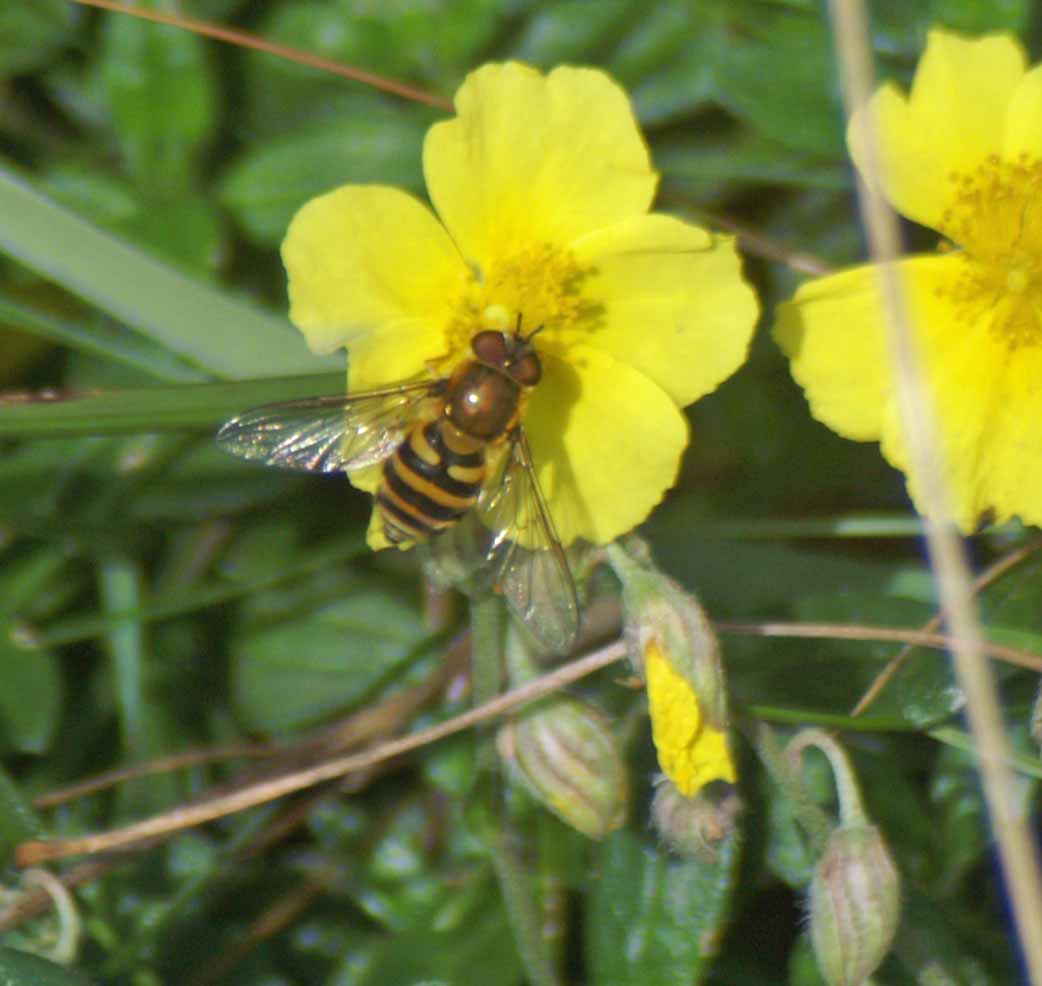
18/9/11-A hoverfly on Common Rockrose

Share this:

  • Share on Facebook (Opens in new window) Facebook
  • Share on Pinterest (Opens in new window) Pinterest
  • Share on X (Opens in new window) X
Like Loading...

Bryn Euryn Nature Reserve

19 Friday Aug 2011

Posted by theresagreen in Bryn Euryn Nature Reserve, Butterflies of Wales, Nature, Nature of Wales, nature photography, Wildflowers of Wales

≈ Leave a comment

Tags

ash tree, Bryn Euryn Nature Reserve, common rockrose, early purple orchid, hoary rockrose, wildflowers of Bryn Euryn

27th April

I haven’t seen much of the countryside since I’ve  been here in North Wales, other than through a car window, and I was very keen to see some spring flowers and fresh greenery. I know the wildflowers in Spain will be amazing when I get back there next week, but the native British wildflowers have an altogether gentler and more subtle beauty that I love. I have been planning to make a trip to the local nature reserve on Bryn Euryn, and as I will only be in the locality for a couple more days I decided to head there this morning.

Bryn Euryn is a limestone hill rising to 131metres (365 ft) above sea level and a well-loved local landmark of Rhos-on-Sea that is now a Local Nature Reserve. Its slopes are clothed with a mixture of woodland and grassland, part of which has been declared a Site of Special Scientific Interest. From its summit their are extensive panoramic views over Rhos-on-Sea and Colwyn Bay and across to the mountains of Snowdonia in the west. 

I parked in the small car park that is surrounded by trees, and as soon as I got out of the car I heard a Chiffchaff ‘singing’. I couldn’t see him,but as I tried to locate his whereabouts a Robin flew into a nearby tree and also began to sing. Moving off towards the beginning of the track that leads up to the summit of the hill I stopped to watch a Song Thrush hunting on the woodland edge where it borders a grassed area.

I soon came upon a patch of bluebells growing alongside some wild garlic whose flowers are almost finished. There were a few wood anemones still flowering, but they too are all but over; wild strawberry plants were flowering along a length of the path edge in dry shade, they have a long flowering period beginning in April and continuing until October, with fruits appearing throughout the summer. It was lovely walking in the dappled shade of the woodland, listening to the birds singing and coming across flowers that gave me the opportunity to make a stop on the fairly steep upward climb. A special find was a sunlit Early Spotted Orchid growing beneath the trees. The presence of this delightful bloom, together with that of bluebells and wood anemones is a sign of an ‘old wood’,  indicating that this area has never been anything other than woodland.

Purple Spotted Orchid

Dog Violet

There was a pretty patch of little blue/purple dog violets and the surprise of a Cowslip plant on a steep bank; this one must have strayed from the grassy downland on the other side of the hill; the more usual habitat of Cowslips.

Cowslip

Rock Rose

At the top of the hill you emerge from the woodland onto a surprisingly large expanse of open grassy heathland. There were large patches of yellow flowers growing here, taking a closer look I saw there were of two separate species; I recognised rock rose, but was unfamiliar with the other. Looking it up when I got home I realised it was Hoary Rockrose, one of the plants named on the information board in the car park that is apparently very scarce in the British Isles.

Hoary Rockrose – Helianthemum canum

The views from the top here are truly spectacular, extending from the Little Orme around and across Rhos-on-Sea and Colwyn Bay with the mountains of Snowdonia to the west. The only downside, at least from this side of the hilltop, was the traffic noise arising from the busy A55.

A panoramic view of Rhos-on-Sea and Colwyn Bay

View from Bryn Euryn summit – mountains of Snowdonia on far horizon

View across summit of Bryn Euryn to Conwy Estuary and beyond to Snowdonia

Germander Speedwell

Buff-tailed Bumblebee

Turning around I walked across to the other side of the summit, passing through a shrubby area, the woodland edge, where there are shrubs and small trees growing. Here, Hawthorn is in full bloom and I stopped to watch a furry bumblebee as she burrowed into the leafy debris on the ground beneath.

Hawthorn, or May blossom

I discovered another early purple orchid plant here, this one had an earlier, or perhaps even last year’s, dried flower spike attached.

I reached the true summit of the hill, which has a concrete trig point on it that is part of the nationwide network built by the Ordnance survey to create their maps of the UK in the old days before computers.There is also a board depicting how the ancient hill fort may have looked. I was very surprised to come across an extensive patch of orchids here, I roughly counted them and estimated at least 100 flowers.

Summit of Bryn Euryn with Trig point & mass of purple spotted orchids in the foreground

The Fort

The summit of Bryn Euryn was once occupied by a small but strong fortification. This may have been the ‘Bear’s Den’ mentioned by Gidas the Wise and thought to have been a stronghold of Cynlas the ‘Red Butcher’, king in Rhos around the middle of the sixth century. Only the faint traces of the limestone rampart’s foundations are  visible today, protruding through the turf and ringing the summit of the hill, to remind us of its former importance.

It was much quieter and more peaceful on this side of the hill and I sat for a while enjoying the sunshine and the view out to sea and across to the Little Orme.  Two Red Admiral butterflies were flying around the nearby shrubbery, one kept attempting to sun itself on a bramble leaf, the other kept disturbing it, the basking one chased after its disturber then returned to the same spot etc. etc. It took a lot of patience to get the photograph.

Red Admiral basking on new bramble leaf

Speckled Wood on a leaf on the ground

Even trickier to photograph was this Speckled Wood. Once again there were two of the insects chasing one another – these little butterflies are especially territorial, but I wanted to get a photograph as they were much paler in colour than the ones I had been seeing in the garden. That made getting the photograph even harder, as when they did land it was on dried leaves and they were so well camouflaged I couldn’t find them through the lens.

There are some beautiful trees growing here, including Ash, whose leaves are quite well grown now.

new ash leaves

They brought to mind the old country rhyme about their predicting the forthcoming summer weather:-

“Ash before oak, look for a soak, oak before ash, look for a splash”

I had a quick look at a neighbouring oak and would say they were pretty much on a level, so hopefully that means some rain, but not too much.
Share this:

  • Share on Facebook (Opens in new window) Facebook
  • Share on Pinterest (Opens in new window) Pinterest
  • Share on X (Opens in new window) X
Like Loading...
Follow everyday nature trails on WordPress.com

Enter your email address to follow this blog and receive notifications of new posts by email.

‘But it is the common species that keep the living world ticking over and provide most of our experiences of wildlife, and I would argue that maintaining the abundance of these is as important a conservation priority as maintaining the existence of rarities’. Richard Mabey

MOST RECENT POSTS

  • A Glimpse of Spring to Come January 22, 2025
  • Hunting the Wren December 28, 2024
  • Oh, Christmas Tree December 18, 2024
  • In and Out of the Ivy February 15, 2024
  • Nature’s Fireworks November 30, 2023
  • Wild Autumn along the Coast Path November 3, 2023

OLDER POSTS

LOOKING FOR SOMETHING IN PARTICULAR?

  • Sights and Sounds from the Little Orme 1
    Sights and Sounds from the Little Orme 1
  • Catchers, a Duck and Divers
    Catchers, a Duck and Divers
  • Things Bright and Beautiful
    Things Bright and Beautiful
  • Following a river to a Fairy Glen
    Following a river to a Fairy Glen
  • The life of a Yellow Dung-fly
    The life of a Yellow Dung-fly
  • Butterflies and more rare treats
    Butterflies and more rare treats
  • Burnet Rose- Rosa pimpinellifolia
    Burnet Rose- Rosa pimpinellifolia
  • Winter Promenades
    Winter Promenades
  • Shades, Sounds and Scents of the Woods
    Shades, Sounds and Scents of the Woods
  • A Windy Wildflower Trail - completion
    A Windy Wildflower Trail - completion

nightingale trails

The Walk of the Monarch Butterfly-Sendero de la Mariposa Monarca

The Walk of the Monarch Butterfly-Sendero de la Mariposa Monarca

MY WILDFLOWER BLOG: where the wildflowers are

Snowdrop

Snowdrop

most recent posts

Follow everyday nature trails on WordPress.com

Social

  • View teresamaygreen’s profile on Twitter

Enter your email address to follow this blog and receive notifications of new posts by email.

Website Built with WordPress.com.

  • Subscribe Subscribed
    • everyday nature trails
    • Join 358 other subscribers
    • Already have a WordPress.com account? Log in now.
    • everyday nature trails
    • Subscribe Subscribed
    • Sign up
    • Log in
    • Report this content
    • View site in Reader
    • Manage subscriptions
    • Collapse this bar
 

Loading Comments...
 

    %d