• Home
  • about
  • about the photographs
  • Local Nature Reserves
    • Bryn Euryn Local Nature Reserve
    • Mynydd Marian
  • Wales Coast Path
    • Grey Seals in North Wales
    • St.Trillo’s Chapel
    • Wildflowers of North Wales Coastal Paths, Cliffs and Dunes

everyday nature trails

everyday nature trails

Tag Archives: cherry plum

Scouting Signs of Spring

16 Thursday Mar 2023

Posted by theresagreen in Nature of Wales, nature of woodlands

≈ 1 Comment

Tags

Bryn Euryn Nature Reserve, cherry plum, early flowering trees, flowering in March, jelly-ear fungus, March, tree buds opening, woodland birds

Snow was forecast to reach us later in the day today and the prediction for the next few days sounded like stay-at home-and-catch-up weather. As there’s always the possibility they’d got it right, I had to take the opportunity to get outside while the going was still fairly good to scout for signs that spring is not too far away. The bright sunshine pouring through my windows had been deceptive. Outside it was very cold, bitterly so when the wind intermittently blew, and I headed for some shelter in the woods, I was soon glad of the extra layers I’d piled on.

There are two choices of path through the first part of the woodland; the ‘official’ signposted public path and one that is a little higher up, accessed by scrambling inelegantly up a rocky bank, which is the one I took today. This is my favourite path, less used and with more of a feel of ‘proper’, older woodland on either side. Even at this time of the year there’s usually something interesting to see; there are some lovely big old trees and there’s always the likelihood of catching sight of a bird or two along here too.

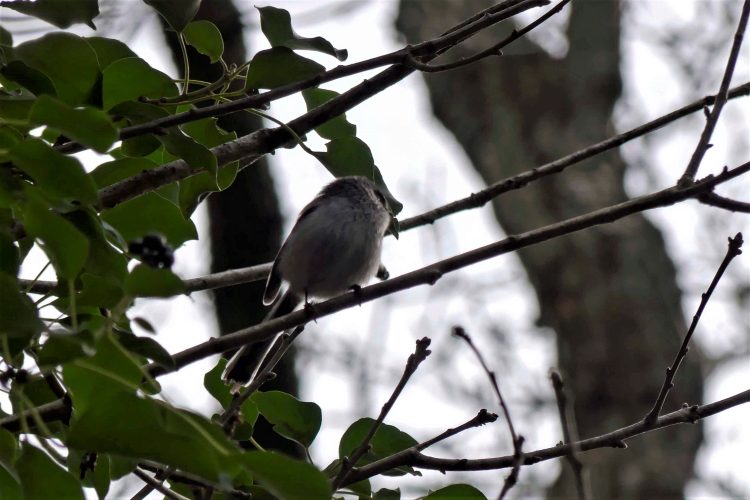
On either side of me I could hear the contact calls of blue tits and close by the scolding calls of a small bird, made whilst flitting animatedly from branch to branch of a small tree. The sun shining behind it meant I had to squint to see it properly, but as I suspected, it was a lovely little long-tailed tit. Fingers crossed it was one of a pair and they’re nesting somewhere close by.
Several trees have been lost from here over the last few years. Any loss is sad, but there’s some compensation in that the space they occupied and the extra light allowed through to reach the lower levels of the woodland, new plants have the opportunity to grow. There’s competition along the path edges, budding twigs of seedling ash cluster close together for now, but eventually some will thrive and others won’t. Other seeds fortuitously landed in more spacious spots and are growing quickly into sturdy saplings. Amongst them, no surprise, are several sycamores and a little less expected, a couple of horse chestnuts. These saplings have already begun to release their new leaves from their tight buds, needing to grab as much light as they can to help fuel their growth before the big trees open up theirs and close off the canopy. Both have the most beautiful buds that are just beginning to open.

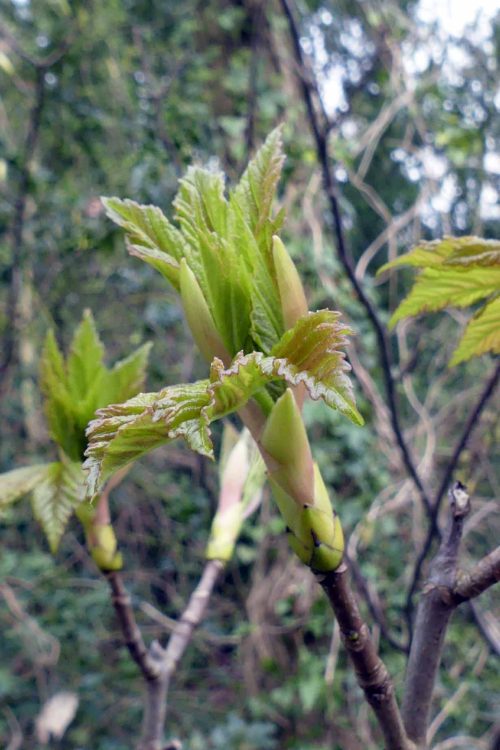
an opening ‘sticky bud’ of horse chestnut
an opening sycamore bud

As well as the sapling trees there’s a mixed scramble of shrubbery along the path edges, ground-covering ivy, long whippy canes of dog rose and thorny lengths of bramble snake out seeking spots in which to touch down and take root. Honeysuckle, always one of the first woodland plants to put forth new leaves clambers over whatever it comes into contact with and climbs upwards trees where it can. There’s an abundance of holly in plants of varying sizes; and checking one or two of the bigger shrubs I found one that already has flower buds. Closed tight at the moment, these are buds on a male plant and they will open up into tiny white, scented flowers. It will take there to be a female plant nearby to benefit from the pollen of the male flowers if there are to be berries. There are touches of mahonia, which despite managing to flower each year and increasing in number of plants, doesn’t seem to really thrive here; plants stay small with thin foliage and leggy woody stems. Although it’s an ‘incomer’ to the woods, its early flowers are a useful source of nectar and pollen for early foraging bumblebee queens.

tight male flower buds on holly
Jelly-ear fungus Auricularia auricula-judae

The felled trunk of what I think was a sycamore tree caught my eye as it’s smothered with the fascinatingly formed jelly-ear fungus Auricularia auricula-judae. This fungus is also known by the common name Judas’s ear, translated from the Latin auricula – ear and judae – Judas. Unfortunately, at some point in the past this was mis-translated and was frequently also referred to as the now unacceptable Jew’s ear.

Strongly associated with elder trees, these old common names for the fungus came about in part because of their distinctive shape and because Judas Iscariat, the betrayer of Christ reputedly hanged himself from an elder tree. The accepted English name is now jelly-ear, which aptly describes both the shape and texture of the fungus and is unlikely to cause offence.

Towards the end of the path, the alexanders plants are flowering. A particular favourite of yellow dung flies, I’d already found a couple of them in this spot on an even earlier flower a week or two ago. Not today though -it was way too cold, even with their little furry coats.

Some spurge laurel plants still have flowers, others flowers and forming fruits and some just fruits.
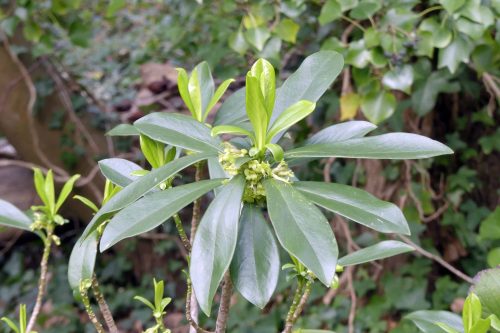
spurge laurel with flowers and fruits
spurge laurel forming fruits

In an open space a young hazel tree is gradually securing its place and is showing a good number of new fresh green leaves.
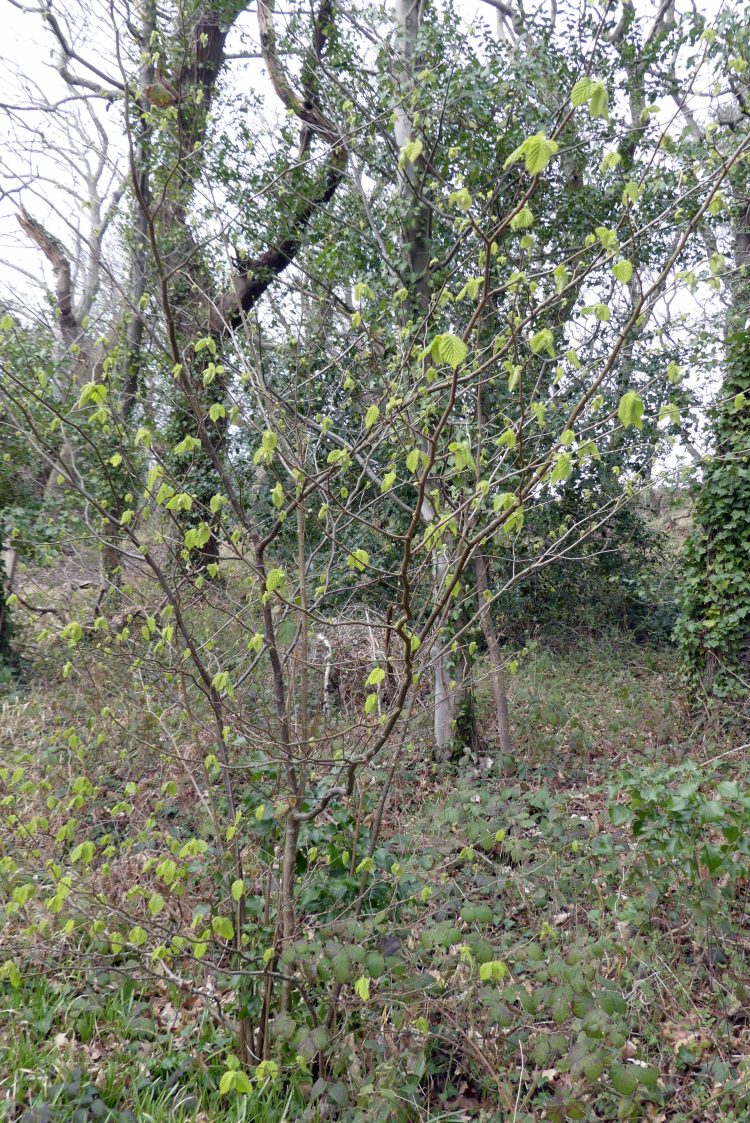
young hazel
new hazel leaves unfurling

There are still catkins on the mature hazel trees. but they’re starting to look a bit straggly and worn now. These dangling tassels are the obvious showy, pollen-bearing flowers of the hazel and are male. You have to look much closer to find the female flowers, which when fertilised will develop into nuts; they are bright dark pink, but very tiny and remind me of miniature sea anemones.

male hazel catkins
fertilised female hazel flower

A branch fallen from a tree has been left to lie across the path. It’s only slender, but it’s provided a barrier against trampling feet and cold winds and together with leaves trapped against it, it has provided a safe place for opportunistic plants. False brome (grass), lesser celandine, nettle and speedwell have all found a foothold here.

Out on the Woodland Trail, the flowering currant, another sometime garden escape has both its pretty pink blossom and new leaves.

Flowering Currant Ribes Sanguineum 
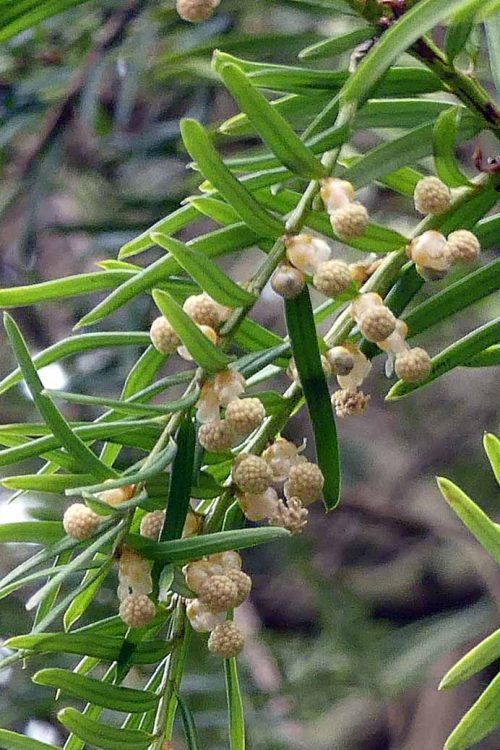
male flowers of yew

Yew has separate male and female trees and they too are flowering now. On some trees the male pollen-bearing flowers are quite prolific and very visible. In close-up they look like miniature heads of cauliflower in close-up.

Female flowers are tiny and green and are much harder to see. I did look, but admittedly not too hard as it was too cold to stay still for long and I couldn’t find any today.

male yew with clusters of tiny flowers

Further along the trail, the tall not-so-wild, cherry plum is still flowering beautifully, but not for much longer. Already many white petals are sprinkled like confetti on the earth of the trail beneath it, and it has already opened most of its new, red-purple tinted leaves.

On the muddy bank at the junction of the Woodland Trail with the ‘shortcut’ up to Adder’s Field the white sweet violets are out, although not doing too well this year. It’s not too surprising given the weather of the past year, but at least they’re clinging on. A purple flower amongst them caught my eye – there have only ever been white violets here that I have seen, but a closer look showed it to be an especially early, early dog violet.
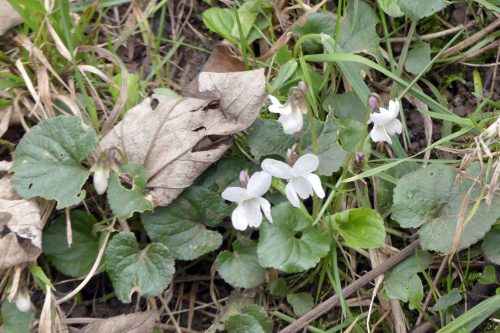
sweet violet viola odorata
early dog violet viola reichenbachiana

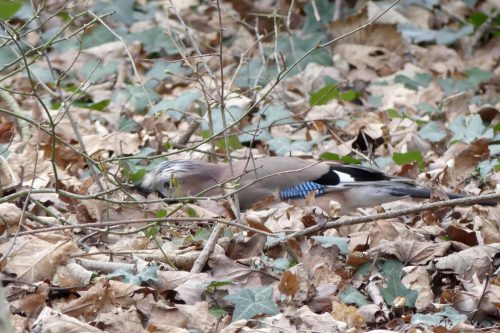
This is often a good spot in which to see birds. There’s almost always a robin here, often the sight or if not, the song of a wren to be heard, blackbirds forage along the trail edges and in past years there have been mistle thrushes. Today a robin did appear for me, and there were glimpses of blackbirds rustled ivy leaves as they lunged for ripe berries. There were more sounds than sightings – a couple of disturbed wood pigeons clattered out of the trees, a great tit chimed his song, crows cawed and herring gulls squawked – a reminder that even though surrounded by woodland the sea is close by. Not a day for too much hanging about, I took the shortcut up to the field and came upon one of the treats of the day. A gorgeous jay was on the ground, rummaging in the deep leaf litter. It may have been searching for one of its autumn stashes of acorns, or perhaps was hoping to find insects. This is a hard time of the year for hungry birds.
Coming out from the shelter of the trees into the open field I was met by a cold wind and the first tentative flurry of fine snow. As I was about to move quickly on, another little bird caught my eye, a coal tit at the top of a branch of a small ash tree. This was my first sight of one so far this year and I’ve never seen one in this part of the reserve before, so another treat for the day.
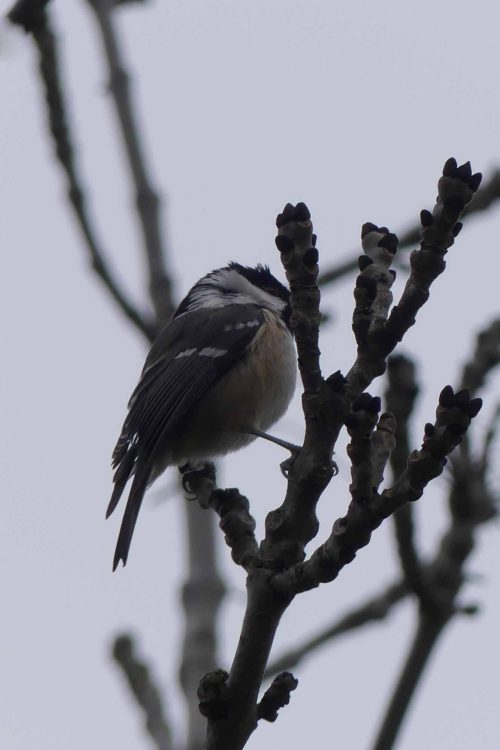
coal tit
swelling buds on young ash

The Cherry Plums

As I mentioned in my previous post, each year I look forward to seeing the ‘wild’ cherry plum tree here in its full glorious snowy-white blossom. Visiting it has become almost like an annual pilgrimage, a vision to behold at the end of winter that promises the approaching spring. I’d been a bit worried that I might have missed it at its best as I’d been away for a week or so, but having already seen the not-so-wild one earlier on, I was hopeful. It did not disappoint – despite there being a few petals sprinkled on the ground beneath, it was as beautiful as it could be, loaded to the tips if its branches with perfect starry white flowers.

‘wild’ cherry plum
red-purple leaved cherry plum

The flowers of cherry plums almost always appear before the leaves and there are still only a few new glossy green leaves open yet; enough though to show the difference between this tree and the similar one on the other corner of this bottom end of the field. Quite young yet, this one is more of a tall shrub than a tree. It too has been flowering for a while, and has very similar-looking, although sparser pretty white blossom. It has already opened most of its leaves, which are quite well-grown. Tinted purple-red, the leaves show it has grown from the fruit of a cultivated variety of cherry plum, perhaps the similar big tree on the Woodland Trail that I passed earlier.

wild cherry plum flowers & new leaves
red-purple leaves of not-so-wild cherry plum

Walking up the hill to the top end of the field through thickening falling snow I picked up my pace and covered my camera, thinking I’d done for the day, but then the wind dropped and the snow stopped. As my dad would have said though, the sky was still full of it, so no doubt this would just be a brief lull.

Time though to have a look at the progress of the oak tree leaf buds – still tight as yet. At the end of one twig, what looks like a cluster of leaf buds is a knobbly growth produced by the knopper gall wasp, Andricus quercuscalicis, that causes ridged outgrowths, or ‘galls’, on the acorns of our native pedunculate oak. Forming in August they are sticky and red at first, then later become woody and brown. A second generation of the wasps then develops in the catkins of turkey oak.

A sky full of snow covering Colwyn Bay

Tucked into the shelter of blackthorn, a patch of budding celandines and leaves of lords and ladies, some marked with dark spots, others not.

Almost home – snowy white sweet violets carpet grass.

.. a pretty forget-me-not…

…. and a grey squirrel, watching me pass. Doesn’t it know they’re supposed to give us a break and stay tucked up indoors when it snows?

Share this:

  • Click to share on Facebook (Opens in new window) Facebook
  • Click to share on Pinterest (Opens in new window) Pinterest
  • Click to share on X (Opens in new window) X
Like Loading...

A Cosmopolitan Woodland

01 Friday Mar 2019

Posted by theresagreen in Nature of Wales, Walking Trails, woodland birds, woodland walks

≈ 11 Comments

Tags

Bryn Euryn Nature Reserve, cherry plum, coal tit, flowering in February, garden escapes, hazel catkins, non-native plants, Nuthatch

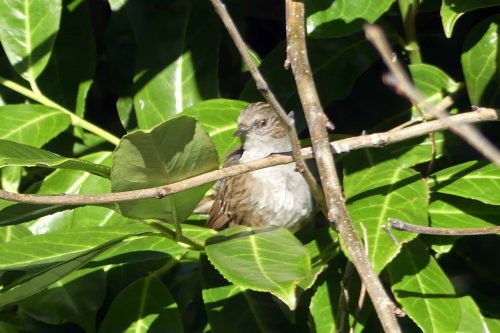
Enjoying the sunshine of this glorious morning, a bright-eyed Dunnock sat on a platform of leaves of the Laurel hedge preening and soaking up the warmth.

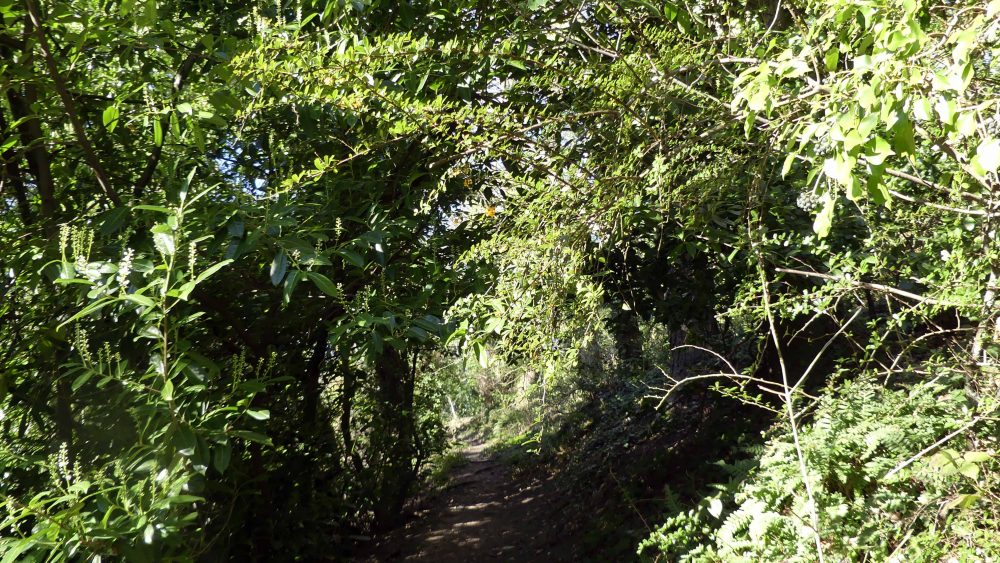
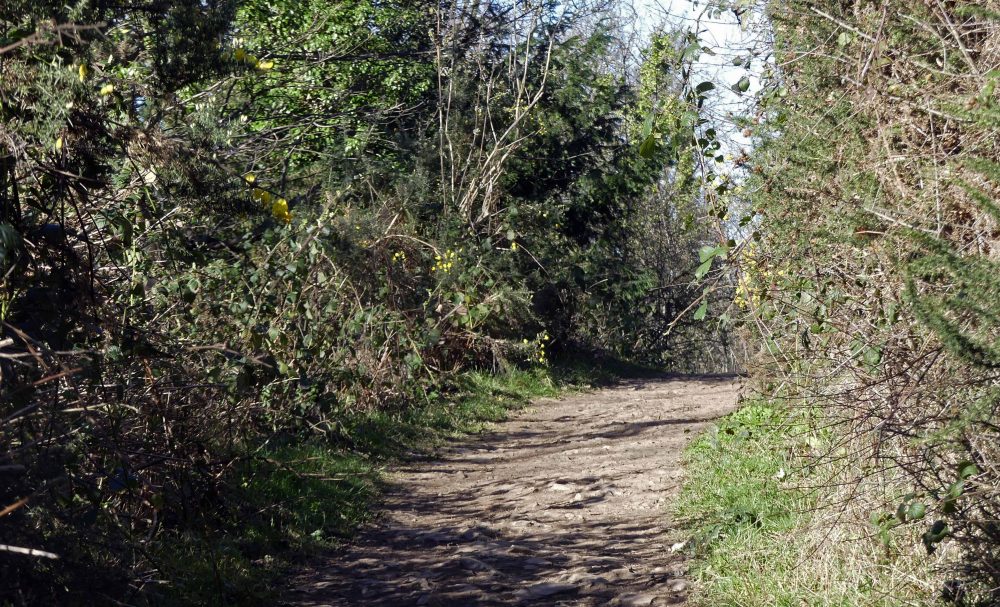
Woodland Path

The sight of the sunbathing Dunnock sparked the idea of a theme for this morning’s walk, or rather the Laurel did. Bryn Euryn is almost an island, virtually surrounded by houses and running the length of the side I often begin my walks, is the busy A55 North Wales Expressway. Its summit was once the site of an ancient Hill Fort, where a Trig Point now stands. There are ruins of an old manor house and exposed rock cliffs around a field next to the car park mark the site of an old quarry. Opposite the car park there’s a large area of land given over to allotments. This long-reaching proximity of people and the plantings in their gardens, has inevitably led to the presence of trees, shrubs and flowers that wouldn’t be there naturally. Today I thought I’d make a point of looking out for some of the more obvious ones amongst the natives.


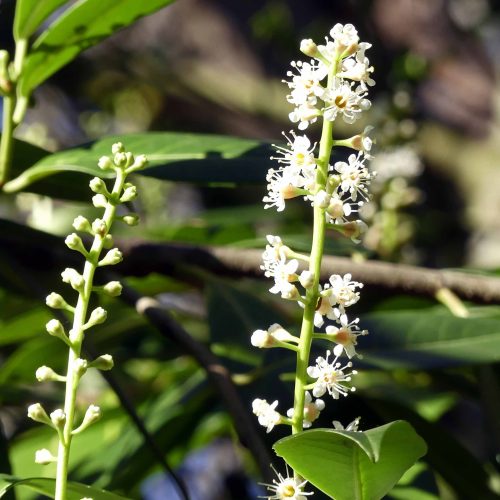
Cherry Laurel- Prunus laurocerasus

There’s quite a lot of Laurel growing in this particular spot on Bryn Euryn, doubtless planted when a grand house occupied the site now replaced with our small development of flats. This is Cherry Laurel, introduced from south-east Europe in 1547 and quickly popularised for creating ornamental hedges. Apart from the Rhododendron, it is the most common introduced evergreen in Britain. It’s beginning to flower here now: the flowerheads stand erect  like candles and are made up of small creamy-white flowers that smell a bit like marzipan.

Twining into the Laurel, reaching across the path is Honeysuckle, which is a true native; its leaves already almost fully grown.

Honeysuckle-Lonicera

Greater Periwinkle-Vinca major

On the edge of the track and scrambling up the woodland slope deep blue Greater Periwinkle is flowering. Evergreen under-shrubs native to Europe, north-west Africa and southern Asia, this would most likely have been planted here originally, but the Periwinkles are long enough established and widespread in the wild to be included in wildflower books, often listed as garden escapes.

A Song Thrush was singing its energetic and joyous song rising up  from somewhere on the steep slope below. eating Ivy berries, A Great Tit called out its signature ‘teacher-teacher’, loud and clear. Blue Tits were all around me, calling to one another as they flitted about investigating shrubs and trees in their endless quest to find food. I caught a glimpse of one above my head; it was pure luck that I caught one holding a twig in its claw while it pecked at a leaf bud. The marks above its head are insects, not specks on my lens!

Blackbirds were rustling around in thick Ivy, grabbing berries.

Another shrubby archway reaches over the path formed by more Laurel and Berberis, which is just beginning to flower. Berberis, or Barberry, is another shrub familiar in gardens. I also spotted a few small Mahonia plants along the way, all bearing flowers.

On a Polypody fern frond sat a bright shiny new hoverfly, gleaming bronze in the bright light. Two Greenbottle flies chose an Ivy leaf to sunbathe upon.

190226-BE (13)-Hoverfly on polypody fern
190226-BE (18)-2 greenbottle flies on ivy leaf

Towering over the greenery, bare trees, their branches silvery against the intensely blue sky, remind that there is still a while to go before the true Spring arrives.

Grey Squirrels have been active throughout this mild winter; there have been very few days when I haven’t seen at least one from my windows. I’m not a fan of this introduced species  because of their dominance over our native Reds and the  tremendous amount of damage they do to our woodland trees. I have to remind myself they have no natural enemies, it’s not their fault they’re here and they’re just trying to stay alive; how are they supposed to know better?
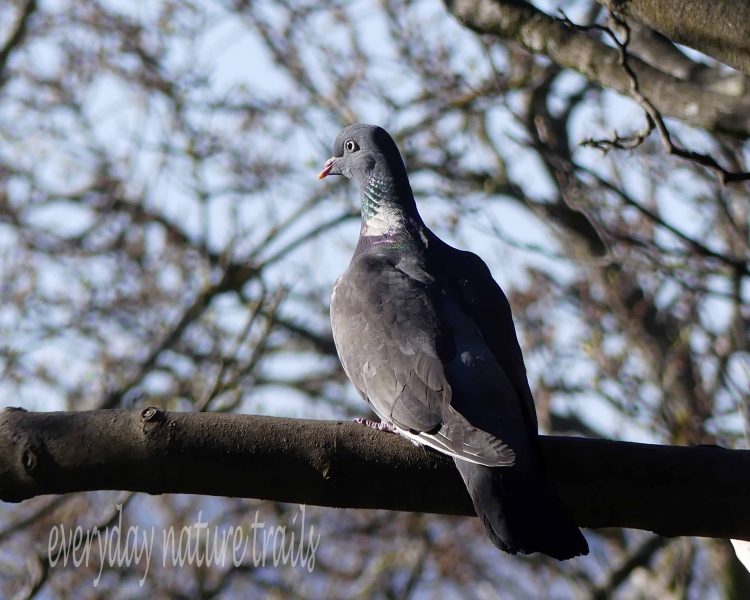
Like most people, I’m sure, I barely go a day without seeing a Wood Pigeon which are common and numerous just about everywhere in Great Britain. They’re another species that have taken full advantage of what we put out on offer and their populations seem to have benefitted from changes in farming practices. They are generally considered as pests by farmers, gardeners and gamekeepers as they’ll eat grains and greens, especially newly sprouting ones, all day long. I rather like them, most of the time they seem very laid-back and have that beautiful soft grey and pinky-purple plumage and the white neck patch; it is nice to see them actually in the woods.

Wood Pigeon – Columba palumbus

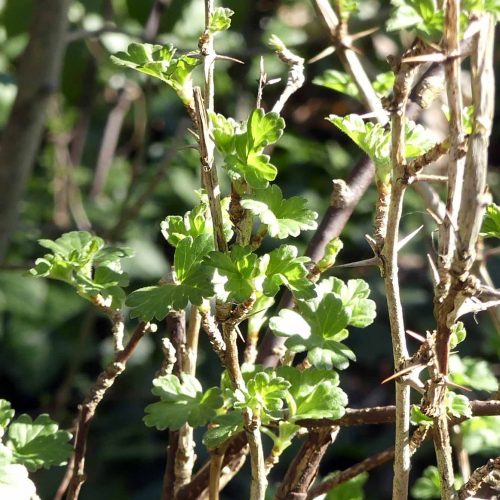
Gooseberry – Ribes uva-crispa

In one spot up near the top of this Woodland Path there’s a well-established Gooseberry bush, with a few smaller ones dotted around nearby on both sides of the track. More familiar in gardens and allotments, Gooseberry is frequently found in the wild, growing in woods, in scrub and in hedges and are probably mostly bird-sown.

Stopping to photograph the Gooseberry I heard a Wren singing. It was close to me but I couldn’t spot it. There are a few Celandines flowering, but they’re quite sparse, perhaps because it’s been so dry.

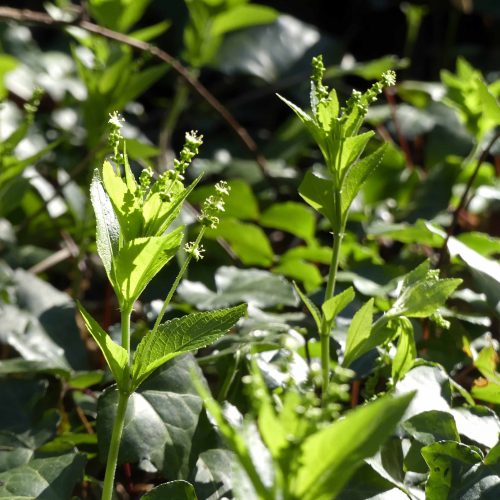
A native wild flower, Dog’s Mercury is flowering. It’s still short, not yet more than six inches (7.5cm) tall.

Dog’s Mercury-Mercurialis perennis

Here and there are clumps of pretty ferny moss. This one is in the middle of the Wood Sorrel patch, whose shamrock-shaped leaves are just beginning to unfurl.

Spurge Laurel – Daphne laureola

Spurge Laurel is one of the more unusual plants that grows here on the Bryn. It is a native plant that favours wooded chalky hillsides, so I have no reason to think it’s not here naturally, but I haven’t seen it on any other sides of the hill.  A very small shrub that must contend with much taller trees and shrubs  towering over it, it’s equipped with thick leathery evergreen leaves, resembling those of Laurel, that can withstand dripping rainwater. It produces its small green fragrant flowers early in the year to make the most of the light before a new canopy of leaves shuts it out.

The near hills and more distant mountains were veiled by a misty haze. Patches of snow clung to the highest peaks, another reminder that winter is still not past. As I stood looking at the view I heard a Woodpecker drumming back in the direction I’d just walked.

Alexanders puts out it new leaves early, often in early February and it’s quite well grown now. It has established on the path-side just before it reaches the reserve and although woodland is not it’s usual habitat, it seems to be spreading. Another introduced plant, Alexanders was brought in as a food plant by the Romans; it has a mild, celery-like taste. This a plant that isn’t usually found far from the sea; there’s a lot of it locally on the Little Orme and in recent years it has spread prolifically along the verge of Llandudno Road, which I suppose is not that far away as birds fly.

Alexanders – Smyrnium olusatrum

The Woodland Trail

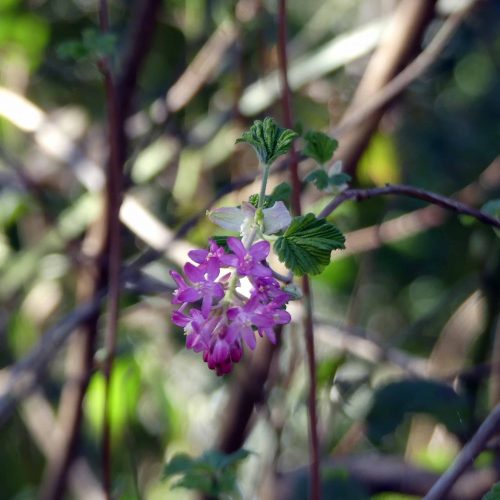
Where the Woodland Path meets the Woodland Trail of the Nature Reserve, a Flowering Currant bush is in bloom.

Flowering Currant – Ribes sanguineum


A popular and familiar garden shrub, with pungently aromatic leaves,this one was again probably also bird-sown. As with the Gooseberry, Flowering Currant can be found throughout the British Isles naturalised in woods, scrub and on waysides.


The Trail is dry and baked hard. The unseasonal warm sunny weather is a treat, but we’re going to need some rain soon. Gorse is flowering more strongly now. I can never resist a chance to smell the warm coconut aroma of its golden flowers. Delicious.

As I reached the enormous bramble patch a Long-tailed Tit flew across the trail in front of me. It disappeared into the dense shrubbery, but then I saw another in the bramble patch. I could see it through the tangle of stems but not clearly enough to photograph. I waited for a few  minutes hoping for a better view, but no luck. About to walk on I heard a whistling call and watched a bird fly strongly over the track and land high in a Sycamore tree. It was clearly on the move, so I took a ‘panic pic’ in case I missed it, but just managed to catch it before it zoomed off; a Nuthatch. I was thrilled, I’ve had very sparse sightings of them here, and never this high up in the woods.

Nuthatch – Sitta europaea

Yew trees are our third native conifer tree, after Scots Pine and Juniper. They are widespread throughout these woods, where they grow well on the chalky hillside. A number of them line a section of the Trail, with other single trees on the other side.

One in particular was heavily laden with flowers. Yews are one of those species that have separate male and female trees. This one is a male; the female flowers are less conspicuous, being tiny and green.

Yew – Taxus baccata

Then there’s a line of Ash saplings, they are growing so closely together they almost make a living fence. More ‘invaders’ grow along the edge of this stretch of the Trail; Tutsan and the dreaded Cotoneaster, which has thus far escaped being routed out.

Beyond the Ash are the Hazels. From the way in which they grow it would seem that at some time in their history they were pollarded as now most of the trees are multi-stemmed and form a small thicket. They are all quite tall though, so if ever they were cut it must have been some time ago.

Because the trees are tall and growing on a steep slope, you perhaps don’t get the full effect of their crop of pale golden yellow catkins, you have to look up. 

There were more Blue Tits here exploring the Hazels and the surrounding vegetation. At the beginning of this month, on an equally blue-skied sunny day I’d stopped here to look for the female flowers of the tree, which are tiny and red and quite hard to spot, especially if you need reading glasses, as I do, but can’t be bothered to keep putting them on to look for things when out walking.

This was not the best place to look as even the lower branches are above my head, so the  photograph above is one I made earlier. Once again though, my hanging around brought a reward. Often a good spot for catching sight of parties of Tits, I was lucky enough to see a pair of Coal Tits arrive and spend a few minutes foraging through the trees. I loved the way they grasped individual Catkins, inspecting them closely to check for hiding insects.

A bit further along the Trail and on the other side from the Hazels, a tree smothered with frothy white blossom shown up perfectly by the deep blue sky; a proper floral treat.

This is a Cherry Plum, although not the truly native wild one as it has bronzy-coloured leaves and not the plain green of the wild one. It could be Prunus atropurpurea, which is a popular garden tree, but I’m not sure.


I don’t think its exact pedigree matters too much, it was lovely to look at and more importantly was also attracting the attentions of quite a few insects. All very high up though. There were definitely a couple of smallish bees and small long hoverflies.

The blossom won’t last for long; already petals are falling and strewing the ground below like confetti.

Another good reason to take one last photograph with the sun shining through it.

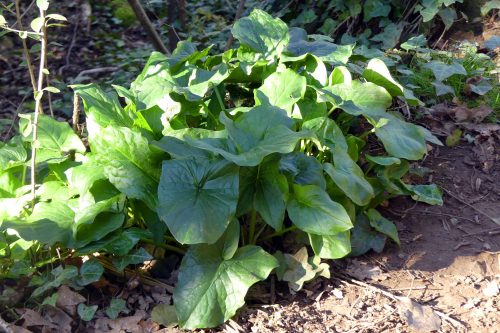
Back at ground level, the leaves of Lords and Ladies, or Cuckoo Pint if you prefer, are well grown now, they began to appear back in late January.

Lords & Ladies, Cuckoo Pint – Arum maculatum

and to finish, a first sighting this year of a single Dog Violet.

190226-BE (59)-Dog Violet
190226-BE (60)-Dog Violet profile

Birds today: Wood Pigeon; Carrion Crow; Raven; Magpie; Herring Gull; Nuthatch; Blackbird; Robin; Dunnock; Great Tit; Blue Tit; Long-tailed Tit Heard: Song Thrush; Wren; Gt Spotted Woodpecker (drumming)

Share this:

  • Click to share on Facebook (Opens in new window) Facebook
  • Click to share on Pinterest (Opens in new window) Pinterest
  • Click to share on X (Opens in new window) X
Like Loading...
Follow everyday nature trails on WordPress.com

Enter your email address to follow this blog and receive notifications of new posts by email.

‘But it is the common species that keep the living world ticking over and provide most of our experiences of wildlife, and I would argue that maintaining the abundance of these is as important a conservation priority as maintaining the existence of rarities’. Richard Mabey

MOST RECENT POSTS

  • A Glimpse of Spring to Come January 22, 2025
  • Hunting the Wren December 28, 2024
  • Oh, Christmas Tree December 18, 2024
  • In and Out of the Ivy February 15, 2024
  • Nature’s Fireworks November 30, 2023
  • Wild Autumn along the Coast Path November 3, 2023

OLDER POSTS

LOOKING FOR SOMETHING IN PARTICULAR?

  • The Foxglove - of Fairytales, Myths & Medicine
    The Foxglove - of Fairytales, Myths & Medicine
  • Pretty prickly Thistles
    Pretty prickly Thistles
  • Fine Dining for Crows
    Fine Dining for Crows
  • Pines and Primroses
    Pines and Primroses
  • Birds and the art of fly catching
    Birds and the art of fly catching
  • Grey Seals on the rocks
    Grey Seals on the rocks
  • What a beautiful day
    What a beautiful day
  • Everyday Birds - The Blue Tit
    Everyday Birds - The Blue Tit
  • A trip to Pembrokeshire:Part 2: Flowers in the rain
    A trip to Pembrokeshire:Part 2: Flowers in the rain
  • Parakeets in the Ash Tree
    Parakeets in the Ash Tree

nightingale trails

The Walk of the Monarch Butterfly-Sendero de la Mariposa Monarca

The Walk of the Monarch Butterfly-Sendero de la Mariposa Monarca

MY WILDFLOWER BLOG: where the wildflowers are

Snowdrop

Snowdrop

most recent posts

Follow everyday nature trails on WordPress.com

Social

  • View teresamaygreen’s profile on Twitter

Enter your email address to follow this blog and receive notifications of new posts by email.

Website Built with WordPress.com.

  • Subscribe Subscribed
    • everyday nature trails
    • Join 359 other subscribers
    • Already have a WordPress.com account? Log in now.
    • everyday nature trails
    • Subscribe Subscribed
    • Sign up
    • Log in
    • Report this content
    • View site in Reader
    • Manage subscriptions
    • Collapse this bar
 

Loading Comments...
 

    %d