I have mentioned that my first butterfly sighting this year was of a beautiful little Holly Blue skipping along the sunny side of the privet hedge, but at the time I couldn’t catch it being still long enough to photograph. Last weekend though there were more, and from their pristine condition and the fact that they stayed basking in one sunny spot for quite a while I think it is safe to assume that they were very newly emerged.

Holly Blue on an ivy leaf
- Common name: Holly Blue
- Latin name : Celastrina argiolus
- Family group: Blues
The Holly Blue is the earliest of the blue butterflies to emerge in the spring, so for that reason alone is easy to identify. It also tends to fly high around trees and bushes while other blues are more likely to be found at grass level.
Distribution and status
In Great Britain the Holly Blue is largely confined to England and Wales, although there are very sporadic records from Scotland and Ireland, but its population numbers fluctuate greatly from year to year. Worldwide it is widespread throughout Europe, reaches Japan and is also found in North Africa and North America.
The conservation status of the holly blue is presently of no concern in Britain; population levels are secure and the species’ range is increasing, although it is protected in Ireland. Similarly in Europe the range is rated as stable, with recent expansions in some countries.
Habitat
The Holly Blue occurs in a wide range of habitats, including hedgerows, field margins, woodland rides, gardens, and parks, including those in urban and suburban areas. In England, it often breeds in churchyards, many of which have Holly and Ivy. In Ireland, it is limited mainly to deciduous woods with Holly and, occasionally, country gardens.
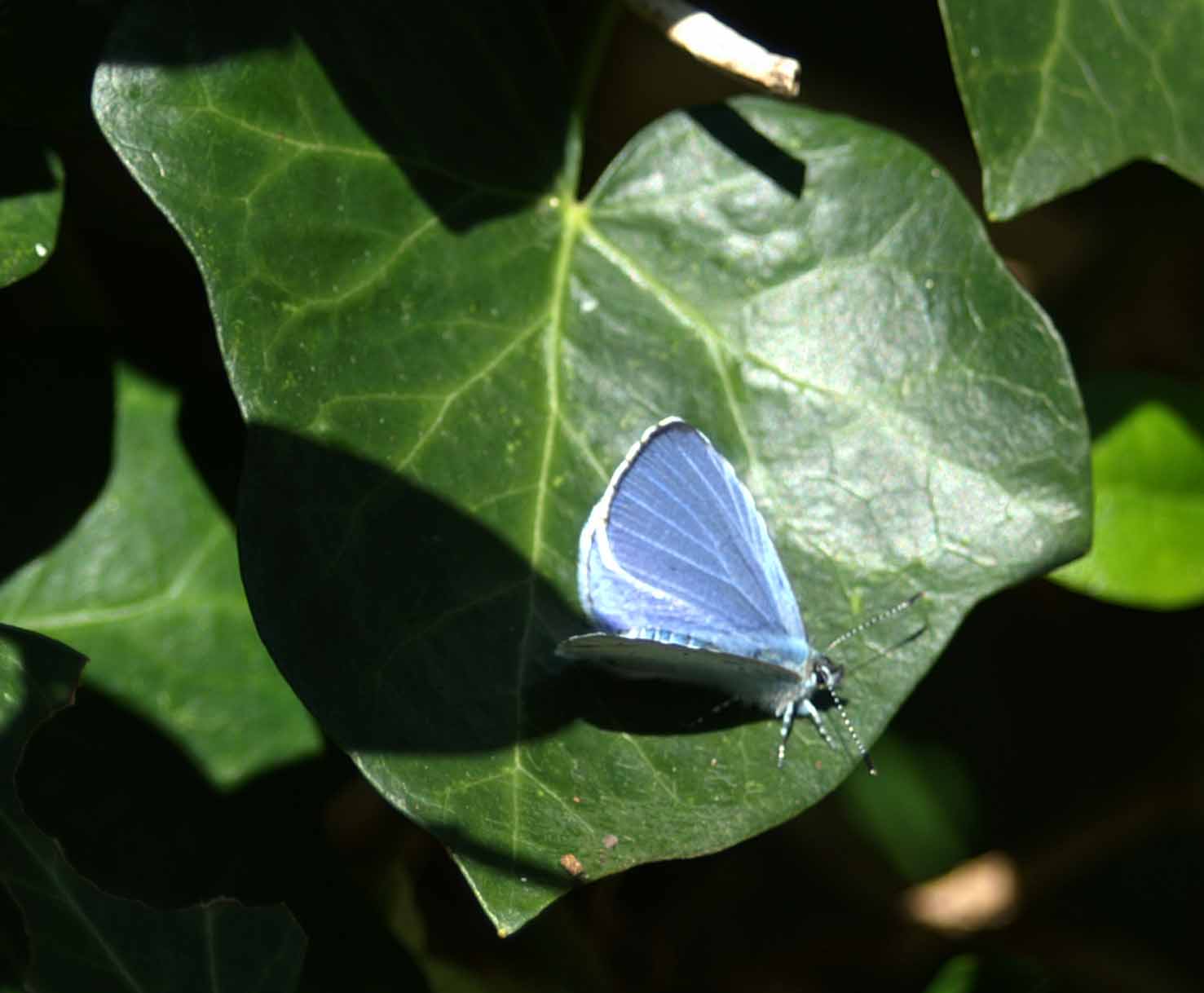
Wings are bright blue. Females have black wing edges. Undersides pale blue with small black spots which distinguish them from Common Blue. Antennae & legs are striped with black.
Life-cycle
The lovely little holly blue has a strange but interesting life-cycle. The first generation of the year emerges quite early in spring and the females of this generation will lay their eggs singly, mainly on holly, but also on dogwood, gorse or buckthorn. The green slug-like caterpillars feed nocturnally on the flower buds, developing seeds and berries of the various foodplants, and rarely on the young tender leaves. They habitually sit on the skin of a berry, with their head buried inside it. The caterpillar is easy to find, either by searching directly, or by looking for half eaten berries in which the caterpillar has left a distinctive circular hole. As well as the plain green form of the caterpillar, there are also forms with prominent whitish and purplish markings.
The adults emerge in August and these second-generation females lay their eggs mainly on ivy, which flowers and fruits in the autumn and winter, but also on privet, gorse, heather, rowan and snowberry. The adults of this generation are the ones we are seeing now. The eggs are almost also laid on bushes growing in sunny and sheltered locations and hatch after about a week.
Adult behaviour
Adult Holly Blues commonly feed on the aphid secretions ( honey dew ) which coats the upper surface of ash and oak leaves, but also sometimes settle on the ground to feed at bird droppings or take moisture from damp paths. Additionally, in spring they nectar at hawthorn, daisies and wood spurge. The second brood nectars on a wider range of plants including bramble, hemp agrimony, fleabane, bell heather, cross-leaved heath, hogweed and burdock.
When feeding they always keep their wings closed, but in the low sunshine of early evening they may settle on bushes to bask, holding their wings partly open.
Relationships with other insects
In common with most Lycaenids, the larvae are attended by various species of ants, which obtain sugary secretions from a gland on the caterpillar.
The larvae may be parasitised by a host-specific ichneumon wasp, listrodomus nycthemerus, which is thought to be an important factor in the population fluctuations of the species. In certain years, when climatic conditions favour the wasp, the butterflies can be extremely scarce. However when mild winters are followed by hot summers the wasps emerge out of synchrony with the caterpillars, and consequently in such years the butterflies are far more common.
 everyday nature trails