• Home
  • about
  • about the photographs
  • Local Nature Reserves
    • Bryn Euryn Local Nature Reserve
    • Mynydd Marian
  • Wales Coast Path
    • Grey Seals in North Wales
    • St.Trillo’s Chapel
    • Wildflowers of North Wales Coastal Paths, Cliffs and Dunes

everyday nature trails

everyday nature trails

Category Archives: Wildlife of the Wales Coast Path

Butterflies of the Great Orme

31 Sunday Jul 2016

Posted by theresagreen in Butterflies of Wales, coastal habitat, Great Orme, Nature of Wales, North Wales Wildlife Trust, Wildflowers of Wales, Wildlife of the Wales Coast Path, y Gogarth

≈ 8 Comments

Tags

Cinnabar moth, Conservation issues, crickets, dark green fritillary, grayling, Grayling (ssp. Thyone), hipparchia semele ssp.Thyone, Plejebus argus ssp. Caernensis, Red Admiral, Silver-studded Blue, Silver-studded Blue (spp.caernensis), small tortoiseshell, y Gogarth

July 14th – Great Orme

The great bulk of the west face of the Great Orme rises steeply from the shore of the Irish Sea; its scarred and fissured face testament to centuries of the relentless onslaught of invading weather fronts. Glancing upwards from its base it looks intimidating, barren save for a few patches of eroded grass and seemingly hostile as habitat for anything save the odd nimble Kashmiri goat. However, as in the best tradition of myths, legends and fairystories, looks can be deceptive and here-upon, not too far away, lies a magical kingdom populated by tiny beautiful creatures.
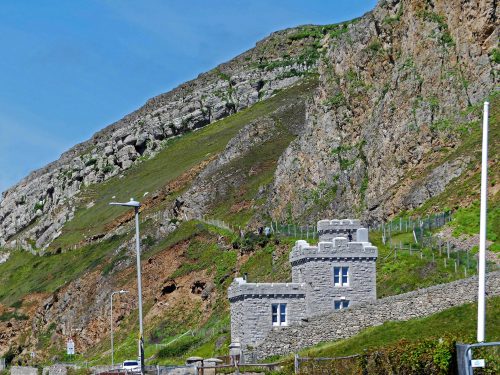
160714-Gt Orme 3-West Beach-Cliff face & toll house

The toll house on Marine Drive marks the beginning (or end) of the cliff path

The creatures take the form of butterflies. Two diverse species have evolved and adapted themselves to survival in this unlikely place and have been recognised and classified as ‘sub-species’. One is a variant of the rare Silver-studded Blue, classified as Plejebus argus ssp. Caernensis and the other a variant of Hipparchia semele (Grayling), classified as (ssp.Thyone). Both are ‘dwarf races’ and considered to be endemic to the site.

The ‘butterfly kingdom’ spills into the Great Orme or y Gogarth Reserve owned and managed by the North Wales Wildlife Trust, which has no paths, but there is a narrow stony path along a ledge cut about a third of the way up the cliff, which is indicated on the photograph above as a line of wire netting that both marks its edge and keeps people safe and goats in. I walked alongside the West Shore from the town end and joined the path at the back of the Toll House, but if you are coming down from the other direction, the other end of the track is waymarked to your left. A word of caution – this is a very narrow, unevenly surfaced track, so take care.

The day was sunny but windy, conditions which bring out the butterflies but often keeps them low to the ground or amongst long grass stems. I wasn’t expecting to start seeing the little Silver-studded Blues as easily as I did, but there on a patch of red valerian below the ‘dangerous cliffs’ sign I spotted my first ones. Most were looking rather worn and a bit tatty, but I was happy to see them at all.

First sight of a worn and battered female
Mating pair attracted others

As I watched I spotted a pair coupled together who were then joined by two others with another fresher-looking male also heading their way. Unlike their cousins, the Common Blues, these smaller butterflies don’t zoom away at speed just as you’re about to press the shutter button, but flutter gently from place to place, tending not to fly any distance away. They seem to bask quite frequently.

Silver-studded Blue male
Silver-studded Blue female

The uppersides of males are a glorious vivid blue with a dark border. Females’ uppersides are browner with a row of orange spots; in this sub-species they also have a variable flush of blue that extends over the hindwings and the base of the forewings. The Silver-studded Blue takes its name from the light blue reflective scales found on the underside of most adults and which are quite visible when light reflects off them in fresh butterflies, but they wear off quite quickly as the butterfly ages and can be quite difficult to see. In the main, the undersides are a brownish-grey with black spots, a row of orange spots, and small greenish flecks on the outer margin.  Males are similar to the Common Blue, which lacks greenish spots.

160714-GO-Silver studded blue underside (s) 3
160714-GO-Silver-studded Blue on nettle

Weathered male mating with a fresher female

The Silver-studded Blue is a Priority Biodiversity Action Plan (BAP) species.

Generally they are found in close-knit colonies, most containing less than a thousand adults. Here on the Orme numbers fluctuate over the season, but may rise to a peak of a thousand or more. Today I met a warden and an assistant on the path that were assessing current numbers – in one spot alone they had counted 130 individuals, so despite the recent inclement weather, they appear to be doing OK.

The number of Graylings I saw also took me by surprise; in other locations I’ve been more than happy to come across the occasional one; along this path I encountered a good few patrolling the path. I’m hesitant to give a number as I have no idea how many times I might have seen the same one as it circumnavigated a territory. It could well be that the same one or two were circling me!

160714-Gt Orme 50a-West Shore-Grayling

Hipparchia semele ssp. Thyone (Thompson, 1944)

H. semele ssp. Thyone flies earlier than is usual with other races of Grayling, being on the wing towards the third week in June, and disappearing by the end of July.

160714-Gt Orme 57a-West Shore-Grayling

I am not practised enough to be able to recognise subtle differences between species & sub-species of butterflies and have no desire to catch any to compare them, so I have taken points from Mr Thompson’s comparisons:

Hipparchia semele ssp. Thyone

♂ Strikingly smaller than any other British race of semele. Coloration is more uniform than in typical semele, with the pale areas more ochreous. Forewing spots are smaller than in other races, with the lower of the two frequently absent. Underside coloration duller and less contrasting than in the type, with the white areas of hindwings tinged with ochre. ♀ Also smaller than other races. Spots are smaller than in normal specimens.

The special butterflies were not alone here. In  a small sheltered quarried out area at the side of the track more red valerian was attracting some larger visitors. I was most thrilled to see a Small Tortoishell, only the second I’ve seen this year and the first to stay put long enough to photograph.

There was a Red Admiral there too, a few Meadow Browns and a single Dark Green Fritillary that was repeatedly chased away by Graylings.

Small Tortoishell
Small Tortoishell
Red Admiral
Red Admiral
Dark Green Fritillary-Argynnis aglaja
Grayling
Grayling
Cinnabar Moth

Cinnabar Moth


Another first sighting for this year was a Cinnabar Moth. I was musing just the other day about why I rarely see the adult moths when the distinctive yellow and black caterpillars are so numerous at this time of year; perhaps they don’t over-winter well? It was tricky to get even this less-than-brilliant image as it was fighting against the wind trying to stay on the cliff edge.
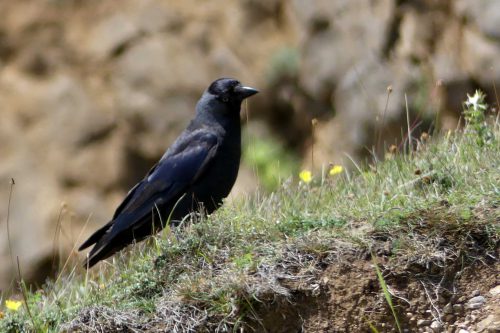
Jackdaw

Jackdaw

Wildflowers of the day:

Dewberry
Dewberry
Silver-studded Blue (f) on dewberry flower
Centaury
Centaury
Restharrow
Restharrow
Bloody Cranesbill
Bloody Cranesbill
Pyramidal Orchid
Pyramidal Orchid

Other insects

Common Green Grasshopper
Speckled Bush Cricket


Share this:

  • Click to share on Facebook (Opens in new window) Facebook
  • Click to share on Pinterest (Opens in new window) Pinterest
  • Click to share on X (Opens in new window) X
Like Loading...

Pines and Primroses

27 Saturday Feb 2016

Posted by theresagreen in Colwyn Bay, Nature of Wales, Trees, Wales Coast Path, Wildlife of the Wales Coast Path

≈ 18 Comments

Tags

Colwyn Bay embankment, early spring flowers, King Alfred's Cakes fungus, pine trees by the sea, Porth Eirias, primrose

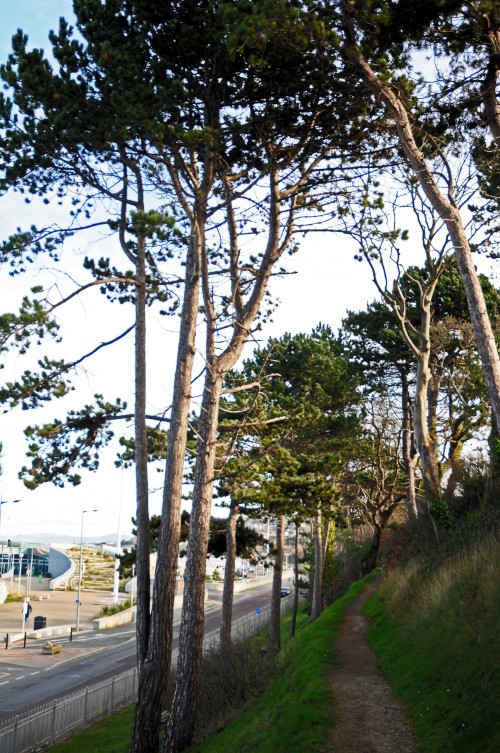
Pine trees are well-used as feature plantings in many parts of Colwyn Bay, but those with the greatest impact are those elegantly lining the road into Rhos-on-Sea set on the steep sea-facing railway embankment.

Pine trees along Colwyn Bay embankment

Pine trees along Colwyn Bay embankment

Where the trees thin out primroses smother the grassy embankment. They began flowering early this year but look as though they will continue for some time to come.

Pine tree and primroses

Pine tree and primroses

A lovely clump of fragrant primroses

A lovely clump of fragrant primroses

The back of Colwyn Bay railway station

The back of Colwyn Bay railway station

The grassy embankment is a favourite spot for Herring gulls to paddle for worms.

Herring gulls paddling for worms

Herring gulls paddling for worms

I walked along the promenade then crossed the road at the point where there’s access to the elevated pathway near the top of the embankment.

View to Rhos-on-Sea

View to Rhos-on-Sea

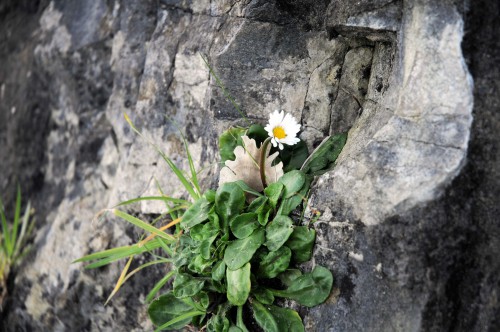
Daisy growing from embankment wall

Daisy growing from embankment wall

Fallen pine cones on embankment wall

Fallen pine cones on embankment wall

The pathway high up on the embankment leads through the pines and offers some protection on cold windy days such as this one was as well as an elevated view. I’ve always been curious about where this gated tunnel leads, but assume it comes out somewhere close to the railway station. It looks like it would be a good place for bats to roost or hibernate; I wonder if they do?

Iron gate closing off a tunnel under the railway line

Iron gate closing off a tunnel under the railway line

Pathway along the embankment

Pathway along the embankment

Ivy clambering high into a pine tree

Ivy clambering high into a pine tree

This can be a good place to see a number of bird species amongst the trees, but today there was just a solitary crow.

Crow enjoying the view out to sea

Crow enjoying the view out to sea

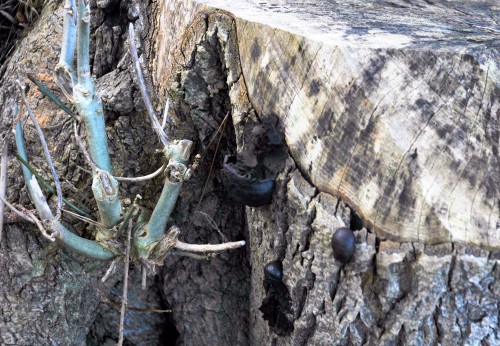
There are other species of tree along the path and I came across the stump of a felled ash tree that is regenerating from its base. It also had a mature patch of the curious brittle black King Alfred’s Cakes Daldinia concentrica  fungus.

Cut ash tree regenerating with King Alfred's Cakes fungus

Cut ash tree regenerating with King Alfred’s Cakes fungus

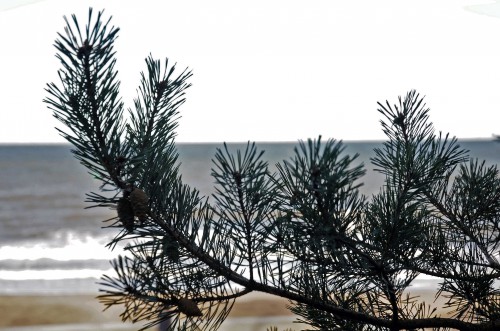
Scots Pine branch with cones

Scots Pine branch with cones

Approaching the end of the path

Approaching the end of the path

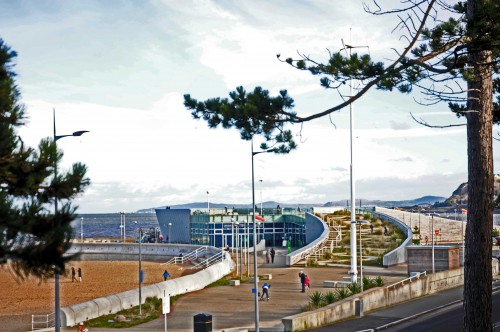
The elevated pathway offers a good view of the Porth Eirias Watersports centre

The elevated pathway offers a good view of the Porth Eirias Watersports centre

The pathway ends by the railway bridge opposite Porth Eirias where these beautiful Hellebores were growing.

Hellebores (Lenten Roses) with green flowers

Hellebores (Lenten Roses) with green flowers

It’s good to see that the traditional planting of pines is being continued. There are several young trees in beds at the front of Porth Eirias.

A newly-planted pine tree at Porth Eirias

A newly-planted pine tree at Porth Eirias

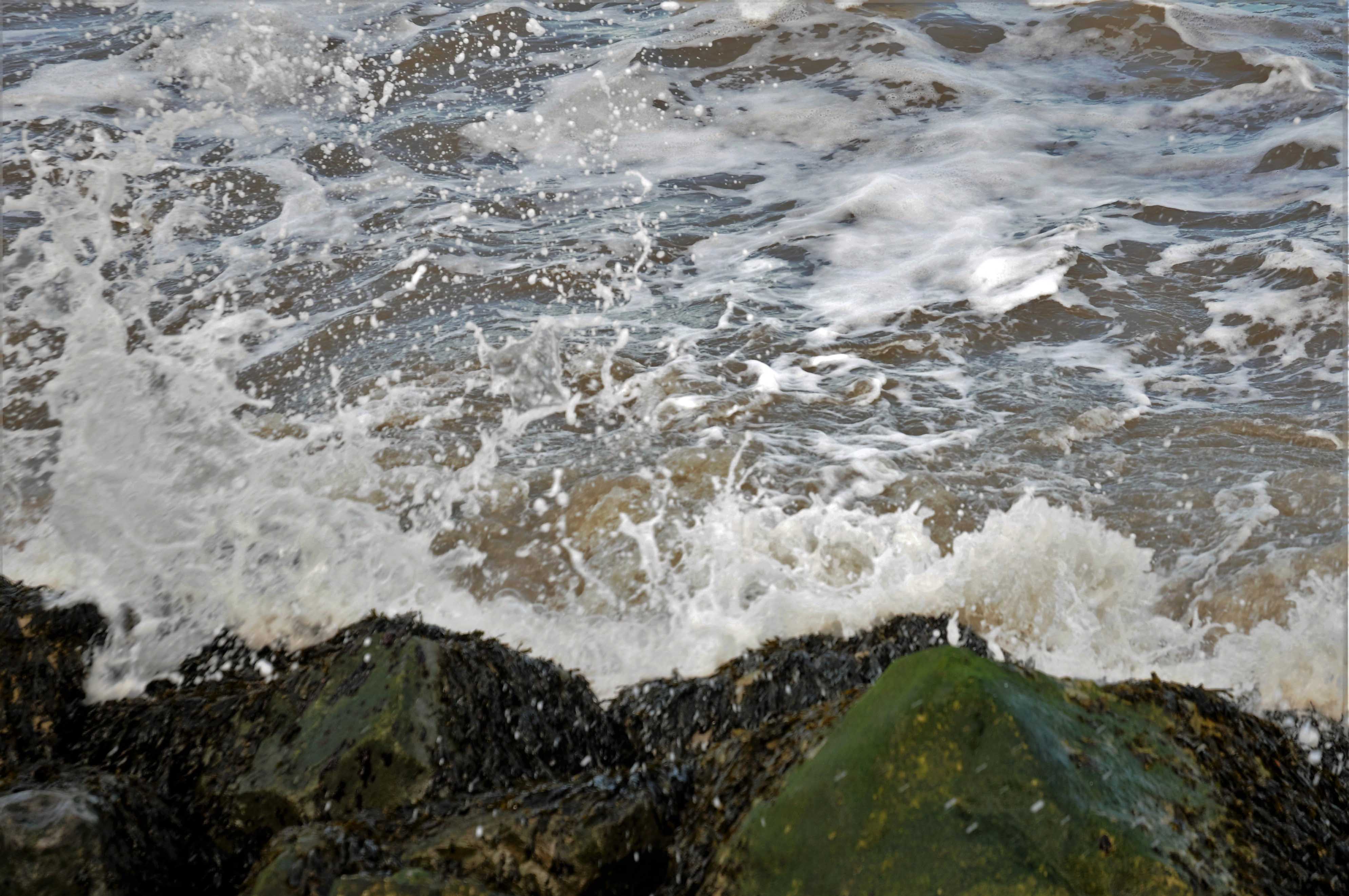
A last look at the sea splashing up onto the rocks at the base of the sea wall before gratefully retreating into the shelter of my car.

160214-Sea splashing on rocks

Share this:

  • Click to share on Facebook (Opens in new window) Facebook
  • Click to share on Pinterest (Opens in new window) Pinterest
  • Click to share on X (Opens in new window) X
Like Loading...

The Foxglove – of Fairytales, Myths & Medicine

20 Wednesday Jun 2012

Posted by theresagreen in coastal walks, flower folklore, flower mythology, Nature, nature photography, The Wales Coast Path, wildflowers, Wildlife of the Wales Coast Path

≈ 22 Comments

Tags

digitalis purpurea, foxglove, medicinal plants, Pembrokeshire coastal path, plants associated with fairies, poisonous wildflowers

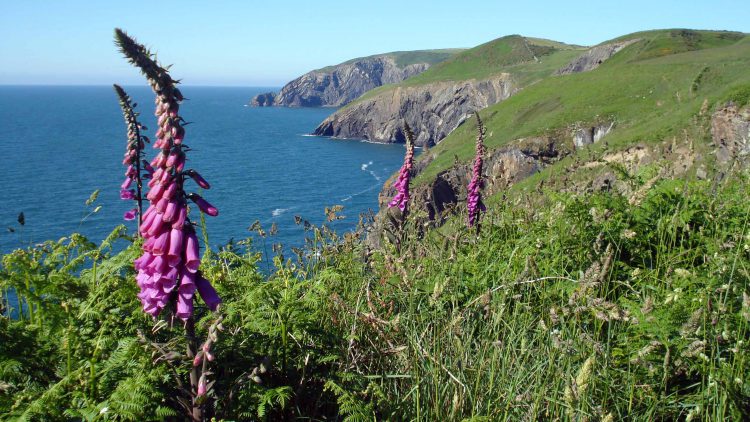
June is the month when elegant Foxgloves are at their best in many parts of Wales. I took most of the photographs in this post in Pembrokeshire where they adorn woodlands, roadsides and cliffs of the mainland and some of the offshore islands. Beautiful to behold, poisonous in the wrong hands yet life-saving when used for good, they have a long-held and fascinating place in our natural history.

Foxglove-Digitalis purpuraea


Foxglove–Digitalis purpurea – Welsh – Ffion or Maneg Ellyllyn — The Good People’s Glove

The graceful Foxglove is a downy biennial herb that thrives in acidic soils in a wide range of habitats. In their first year large downy basal leaves are produced, followed in their second year by impressive flower spikes from 3-6 feet (1-2m) tall. The plants die once they have seeded, but if the flowers are picked before they go to seed, the basal leaves will last another year and they will attempt to seed again.


Flowers open first at the base of the stem and graduates upwards

A stand of Foxgloves in a Pembrokeshire woodland

Three basic colours self-seed – pink, purple & white. They can come true to the parent plant where colour forms are isolated, but they cross-pollinate freely & many stands of foxgloves include all three shades.

In a Pembrokeshire woodland


In Wales the Foxglove  is a characteristic plant of early summer, thriving on acidic soil in the shady conditions of open woods, woodland clearings and hedge banks. But it also tolerates the open and exposed habitats of moorland and heath margins, sea-cliffs and rocky mountain slopes.

It may also  appear where  ground has been disturbed, such as in newly cleared woodland, or where the old vegetation has been burnt.


Pembrokeshire Coastal Path

ORIGIN OF THE NAME

There have been many suggestions for the derivation of the name “foxglove”. It is an ancient name and exists in a list of plants as old as the time of Edward III (King of England from 1327-1377). The prefix ‘fox‘ has most likely been commuted over time from “folks”, who to our fourteenth century ancestors were the fairies, but so-called as to speak of them  explicitly was believed to get their attention & cause them to do mischief.  ‘Glove‘ may have come from the Anglo-Saxon gliew, which was the name for a musical instrument consisting of many small bells. So, put the two together and you could make it ‘Fairy Bells’. However it came about, Foxglove is the English  common name we all know and love it by.

There appear to be two Welsh names for the Foxglove, one is Ffion, from which the popular Welsh female name is taken and the other Maneg Ellyllyn which translate as  “The Good People’s Glove.” Similar then to Folk’s Glove and its association with fairies.

In Gaelic they were Lus Mor, the Great Herb, for being the most magical of all herbs.

Plants that are widespread & medicinally potent invariably acquire a large number of folk-names, & the foxglove’s many names are a case study in our ancestor’s imaginations.

A whole host of alternative common names reflect the association with fairies Fairy Caps, Fairy Gloves, Fairy Thimbles, Fairy Herb, Fairybells, Fairy-fingers, Goblin Gloves, Fairy Petticoats, Fairyweed.

Another name, Dead Man’s Bells served to warn of the plant’s poisonous disposition.

The names Flopdock, Floppydock, Flop-a-Dock, Flapdock, Popdock, Flop-poppy, Flop-top, Cowflop, Gooseflops, Rabbit’s Flowers or Bunny Rabbits all allude to the foxglove’s large soft downy leaves.

Mythology and legends

One story has it that fairies would hide themselves inside the flowers. Mischievous children, wanting to hear fairy thunder, would hold one of the flower bell then strike the other end on their hand. The poor fairy, rightly upset and probably rather cross, would make a snapping sound, a clap of fairy thunder, while she escaped from her retreat.

Another Welsh legend explains why foxgloves bend and sway so gracefully. It has nothing to do with the wind, but that as the flower is sacred to the fairies, it has the power of recognising them, and indeed all spiritual beings who pass by, and that it bows in deference to them as they waft along.

Foxgloves supposedly bowed to Fairies

IN ENGLISH LITERATURE

At least two great poets, Wordsworth and Tennyson were moved to immortalise the foxglove in words; the former clearly aware of  the deadly qualities of the plant. In The Borderers, a tragedy, a woman describes a dream she had:

“My poor Babe
Was crying, as I thought, crying for bread
When I had none to give him; whereupon,
I put a slip of foxglove in his hand,
Which pleased him so, that he was hushed at once:
When, into one of those same spotted bells
A bee came darting, which the Child with joy
Imprisoned there, & held it to his ear,
And suddenly grew black, as he would die.”

Sounds more like a nightmare to me!

Tennyson names the flower in the poem ‘In Memoriam’ –

” …. Bring orchis, bring the foxglove spire…”

and also in ‘The Two Voices’ –

”  ….The foxglove cluster dappled bells …”

MODERN MEDICINAL USES

Foxglove-digitalis purpurea. A plant that is beautiful on the outside but toxic at its heart. All parts of the plant are poisonous.

Foxglove is the source of  digitalis, derived from several cardiac glycosides produced by the plant, and widely used as a heart medication. It is used to increase cardiac contractility and as an antiarrhythmic agent to control the heart rate, particularly in individuals affected by irregular (and often fast) atrial fibrillation and especially if they have been diagnosed with congestive heart failure. Which basically translates to it regulates the heartbeat.

The use of Digitalis purpurea extract containing cardiac glycosides for the treatment of heart conditions was first described in English language medical literature by William Withering, in 1785, which is considered the beginning of modern therapeutics.

With careful usage and expert pharmaceutical  guidance, doctors have subsequently used digitalis and saved thousands of lives, but it is at the same time a dangerously toxic plant. Used wrongly it can cause heart palpitations, delirium, hallucinations, vomiting, & possibly death.

TRADITIONAL, FOLK & HERBAL MEDICINE

Modern-day herbalists have largely abandoned the use of digitalis because of its narrow therapeutic index and the difficulty of determining the amount of active drug in herbal preparations. Once the usefulness of digitalis in regulating the human pulse was understood, it was employed for a variety of purposes, including the treatment of epilepsy and other seizure disorders, which are now considered to be inappropriate treatments.

The Doctrine of Signatures

The openings of the bells were thought to resemble an open animal’s mouth

Foxglove flowers were supposed to look like an animal’s open mouth. Within the doctrine of signatures this meant it must have some medicinal value in treatment of injuries of the mouth & throat. The speckles in the mouth of the flower were, according to the Doctrine symbolic of inflammation of the throat. Another array of folk-names reflect foxglove’s association with the mouth: Throatwort, Rabbit’s Mouth, Bunny Mouths, Tiger’s Mouth, Duck’s Mouth, Gap-Mouth, & Dragon’s Mouth.

Another, less charming name of Scabbit Dock came about as in Culpepper’s day Foxglove was used in an ointment or shampoo for treating impetigo or “scabby head”.

Midwifery

An association with midwifery probably gave rise to the names Granny’s Gloves or Granny’s Bonnets, & Witch’s or Witches’ Gloves. Witches & grannies, or at least midwives & other herbal practitioners, had many uses for this plant. Dr William Withering, the aforementioned man credited with discovering digitalis as a heart remedy circa 1775, apparently learned of its potency from an unnamed midwife.

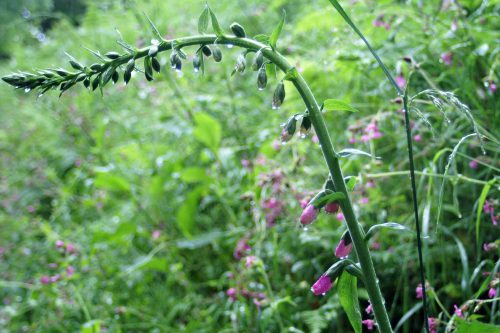
September – The dried seedhead of a Foxglove still stands-Conwy Mountain


Share this:

  • Click to share on Facebook (Opens in new window) Facebook
  • Click to share on Pinterest (Opens in new window) Pinterest
  • Click to share on X (Opens in new window) X
Like Loading...
Newer posts →
Follow everyday nature trails on WordPress.com

Enter your email address to follow this blog and receive notifications of new posts by email.

‘But it is the common species that keep the living world ticking over and provide most of our experiences of wildlife, and I would argue that maintaining the abundance of these is as important a conservation priority as maintaining the existence of rarities’. Richard Mabey

MOST RECENT POSTS

  • A Glimpse of Spring to Come January 22, 2025
  • Hunting the Wren December 28, 2024
  • Oh, Christmas Tree December 18, 2024
  • In and Out of the Ivy February 15, 2024
  • Nature’s Fireworks November 30, 2023
  • Wild Autumn along the Coast Path November 3, 2023

OLDER POSTS

LOOKING FOR SOMETHING IN PARTICULAR?

  • Pretty prickly Thistles
    Pretty prickly Thistles
  • The Foxglove - of Fairytales, Myths & Medicine
    The Foxglove - of Fairytales, Myths & Medicine
  • Fine Dining for Crows
    Fine Dining for Crows
  • Pines and Primroses
    Pines and Primroses
  • Grey Seals in North Wales
    Grey Seals in North Wales
  • Bryn Euryn - a walk of several parts. Part 1
    Bryn Euryn - a walk of several parts. Part 1
  • A Blackthorn Winter
    A Blackthorn Winter
  • Birds and the art of fly catching
    Birds and the art of fly catching
  • Grey Seals on the rocks
    Grey Seals on the rocks
  • What a beautiful day
    What a beautiful day

nightingale trails

The Walk of the Monarch Butterfly-Sendero de la Mariposa Monarca

The Walk of the Monarch Butterfly-Sendero de la Mariposa Monarca

MY WILDFLOWER BLOG: where the wildflowers are

Snowdrop

Snowdrop

most recent posts

Follow everyday nature trails on WordPress.com

Social

  • View teresamaygreen’s profile on Twitter

Enter your email address to follow this blog and receive notifications of new posts by email.

Website Built with WordPress.com.

  • Subscribe Subscribed
    • everyday nature trails
    • Join 359 other subscribers
    • Already have a WordPress.com account? Log in now.
    • everyday nature trails
    • Subscribe Subscribed
    • Sign up
    • Log in
    • Report this content
    • View site in Reader
    • Manage subscriptions
    • Collapse this bar
 

Loading Comments...
 

    %d