• Home
  • about
  • about the photographs
  • Local Nature Reserves
    • Bryn Euryn Local Nature Reserve
    • Mynydd Marian
  • Wales Coast Path
    • Grey Seals in North Wales
    • St.Trillo’s Chapel
    • Wildflowers of North Wales Coastal Paths, Cliffs and Dunes

everyday nature trails

everyday nature trails

Category Archives: Wildlife of the Wales Coast Path

Winter Waterbirds

03 Thursday Jan 2019

Posted by theresagreen in Birdwatching on North Wales coast, Coastal Snowdonia, Nature of Wales, RSPB Reserves, Wales Coast Path, Wildlife of the Wales Coast Path

≈ 10 Comments

Tags

Conwy castle, Conwy estuary, December, ducks and geese, estuary-side habitat, gadwall, goldeneye, Lapwing, little egret, RSPB Conwy, teal

31st December 2018-Conwy RSPB Reserve 
Location:  Llandudno Junction Postcode: LL31 9XZ
Grid ref:  SH797773

Located on the eastern side of the Estuary of the river Conwy, this reserve is a perfect example of how a once industrial site can be reclaimed by and for nature. The reserve  was created in the early 1990s from material dug out from the estuary during the construction of the A55 road tunnel that passes under the River Conwy to bypass the historic town of Conwy. The reserve also incorporates mudflats and saltmarsh, part of the Afon Conwy SSSI, important for migratory waders including curlew, oystercatcher and redshank.
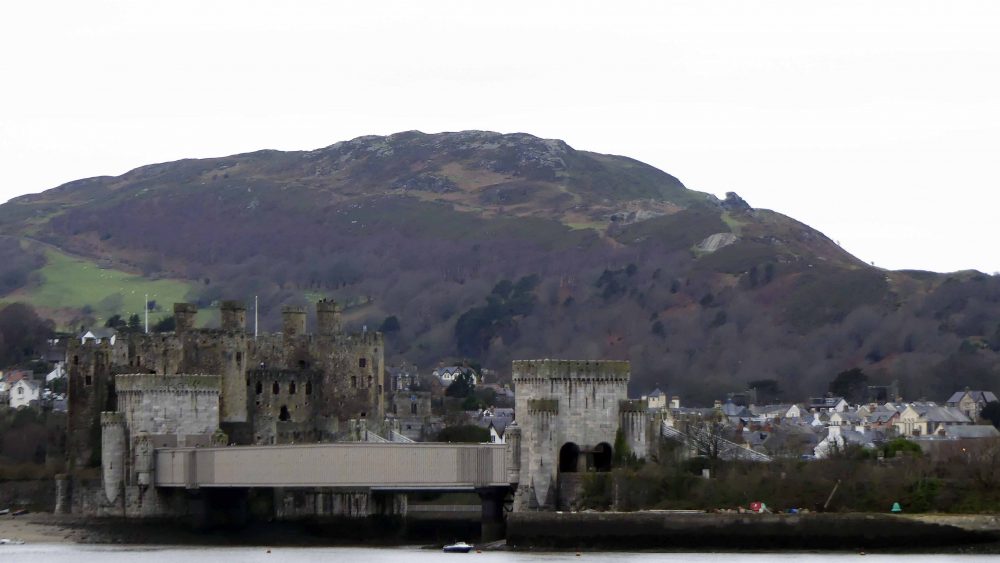
Conwy Castle

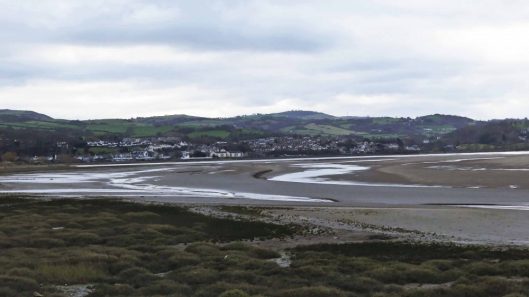
I was meeting up with friends this morning and arrived a few minutes early, so I pulled into the parking area in front of the estuary to admire the views across and along the sands and mudflats of the estuary of the River Conwy. This is the eastern side of the estuary, so firstly looking north there are perfect views of Conwy Castle and town with Conwy Mountain behind it.
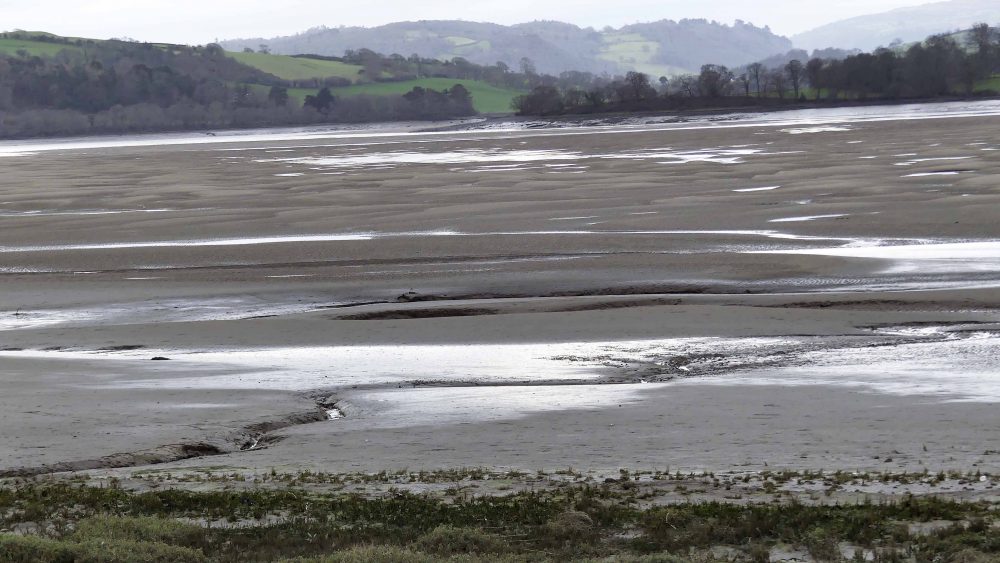
Most of the land on the opposite western side of the estuary is within Snowdonia National Park. To the south is the town of Glan Conwy.
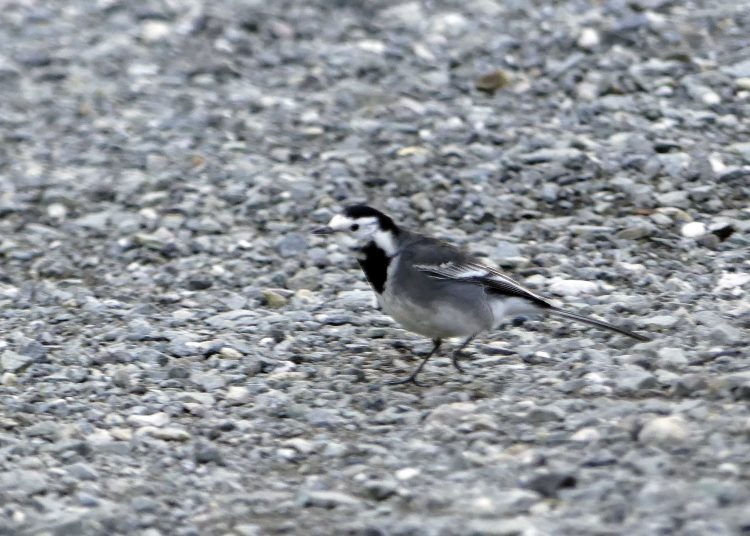


A Pied Wagtail scuttling over a patch of lime chippings was my first bird of the day.
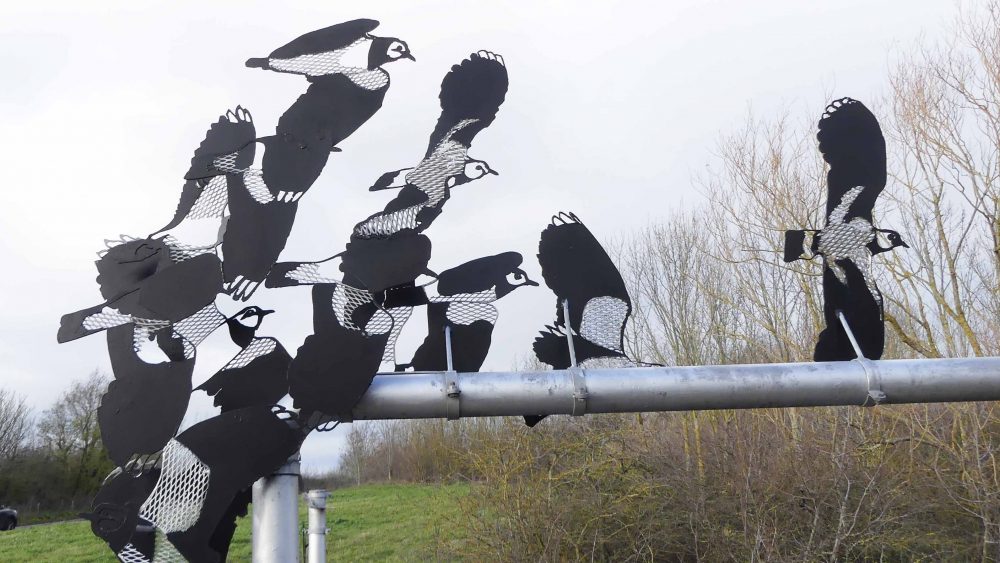


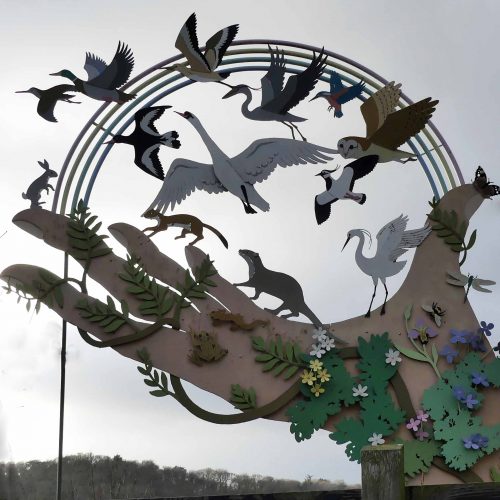
A flock of metal Lapwing adorn the entrance to the Reserve

As you enter the Reserve there is a man-made mound in front of you that acts as a vantage point from which to get an overview of the site. Circular walks have been created that pass through a variety of habitats such as reedbed, young woodland, grassland and scrub.
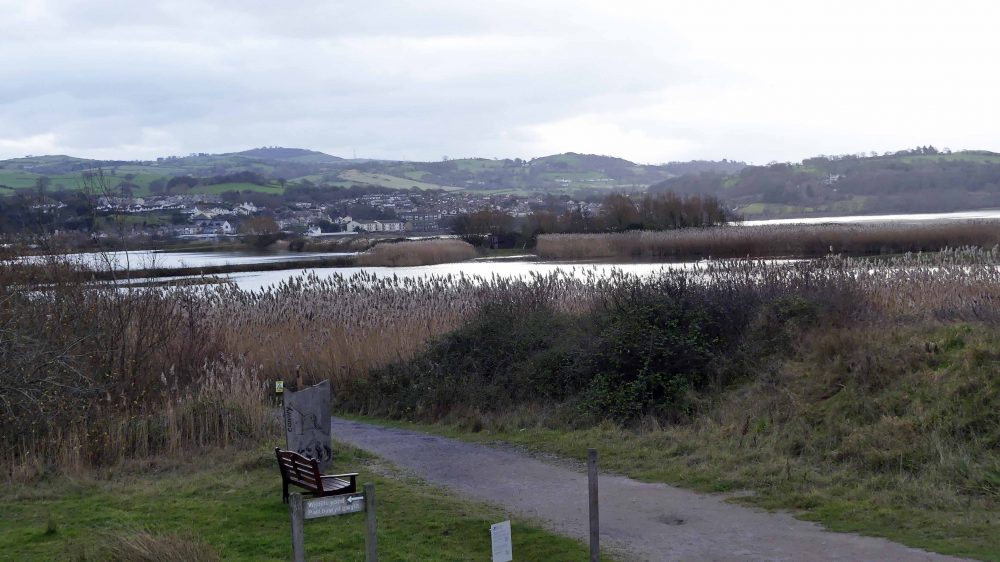
There are two lagoons, originally created to hold the sludge from the tunnel excavations; one holds shallow water while the other is much deeper, both of which attract waders and waterbirds, especially from August to March. The lagoons are filled with fresh, not tidal water and are dependant on winter rains to fill them. If they ever need to be topped up, water is taken directly from the nearby river, the Afon Ganol. Islands have been created within them providing havens for roosting and nesting birds. These are best for birds at high tide, when the river covers the mudflats pushing waders to roost and feed on the islands.
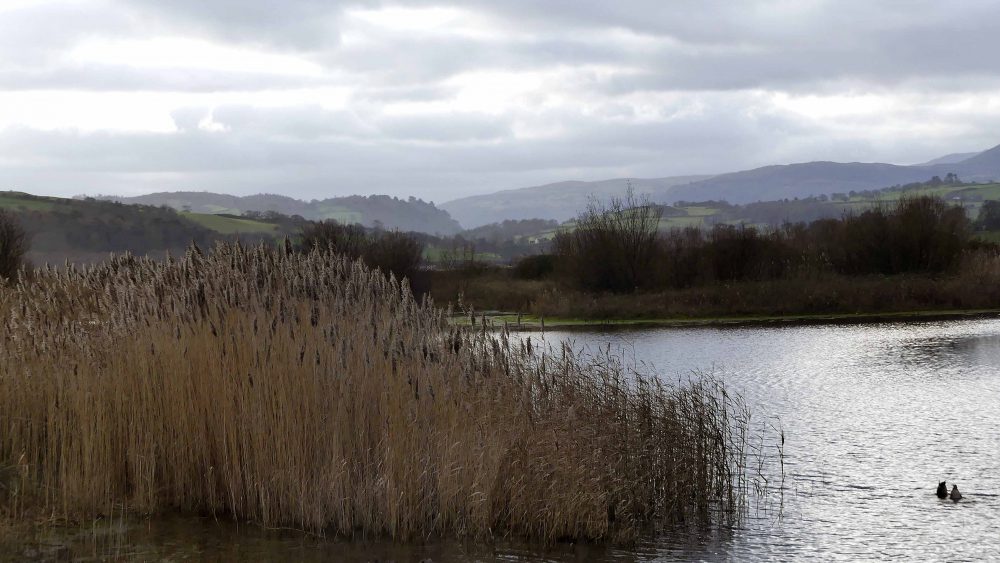
At low tide, as now, there are not as many birds to see as there may be when the tide floods back into the estuary, but our first sighting gave me another duck species to add to my list of ones I might recognise when I see them again. We worked out these were a pair of Gadwall, which are quite understated in their appearance, not colourful or flashy, but quite common so likely to be seen again.
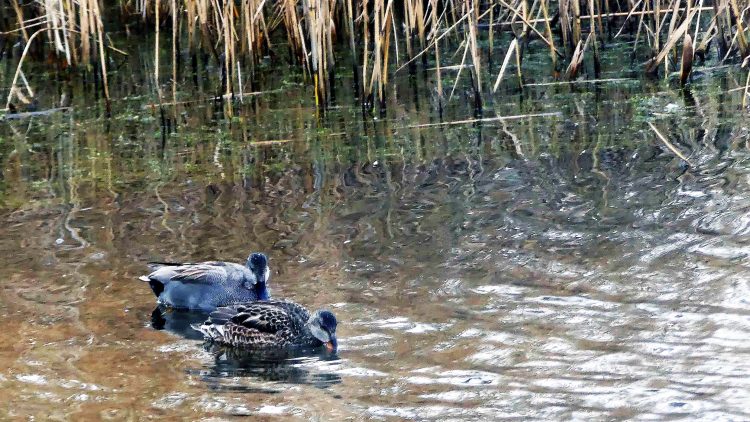
Gadwall-Hwyaden Lwyd

11:19-The sun shining through a break in the clouds momentarily created a darkly dramatic, almost monochromatic view of the lagoon and the distant mountains.
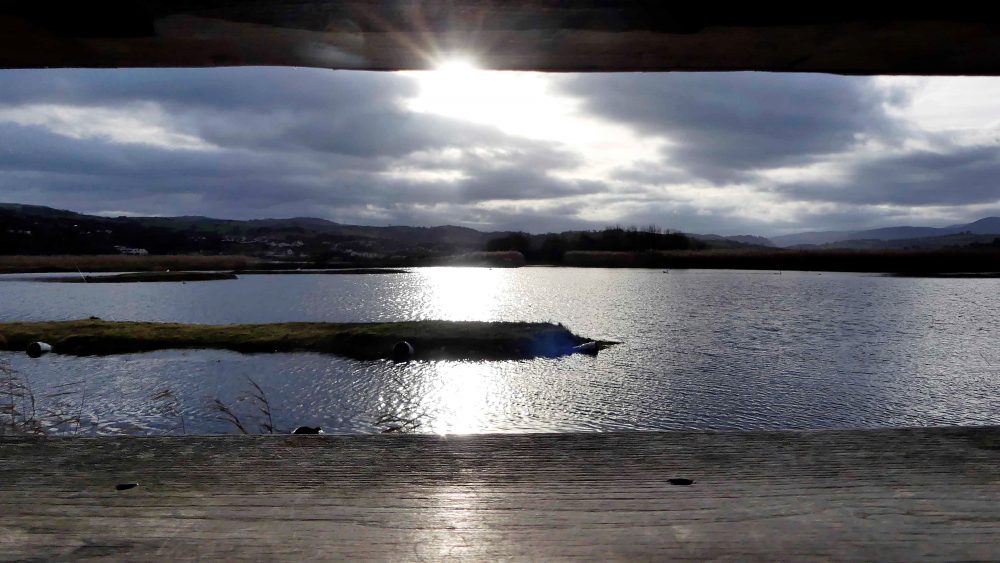
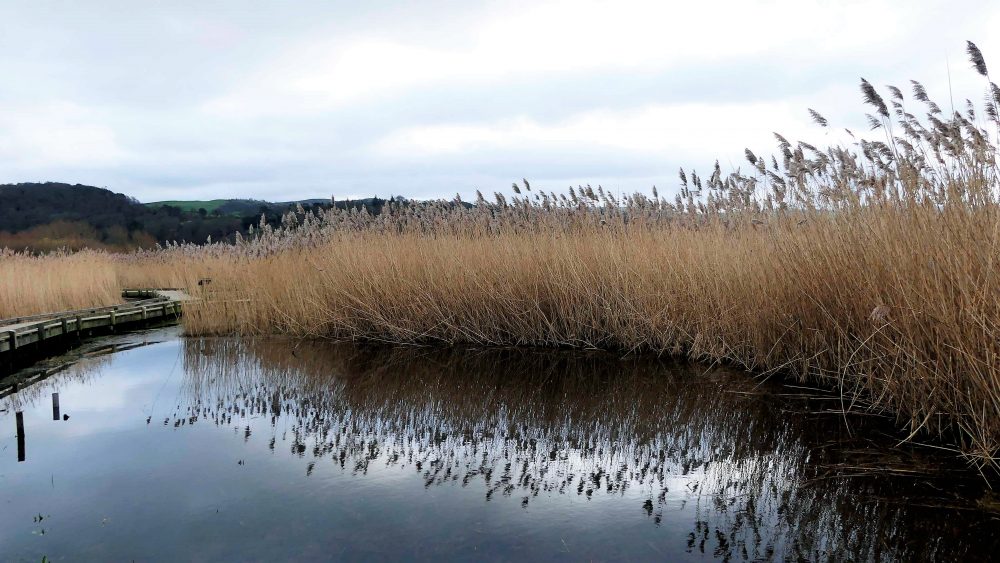
We moved on and followed the boardwalk that wends through the reedbeds. Water Rail are resident here and sighted fairly frequently, so we were listening out for their distinctive calls, but all was quiet. We admired the surroundings instead; the dried reed stems glowing golden in the sunlight and reflected in the clear water of the well-filled pools are a beautiful sight.
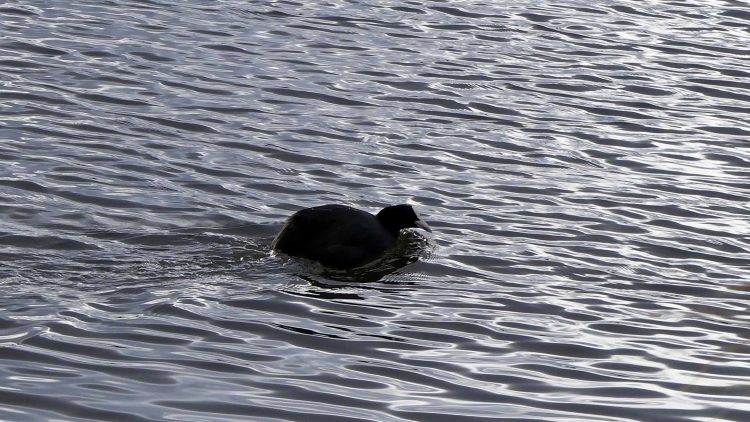
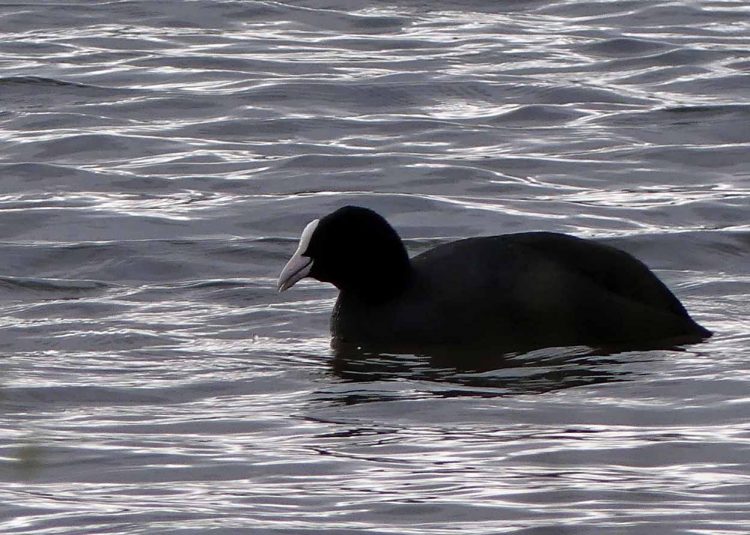
11:19- A Coot cuts purposefully across the wind-rippled surface of the lagoon temporarily disrupting its pattern.
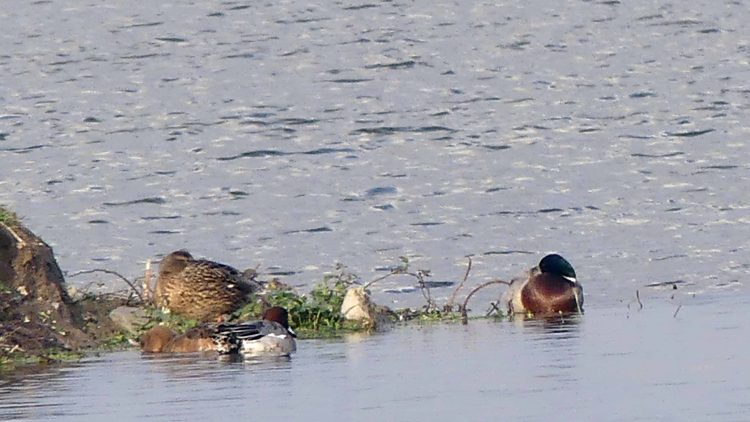
11:21- A pair of Mallard occupy on the end of a grassy island, the male standing watchfully over the resting female.
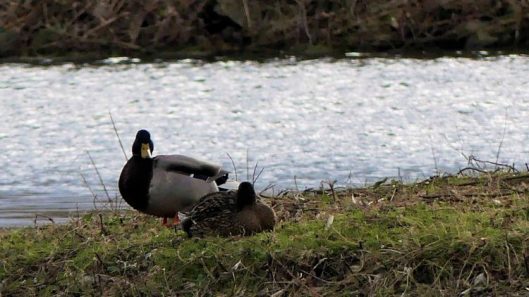
Mallard – Hywaden Wyllt

11:29 A Mute Swan glides across the water, wings raised.
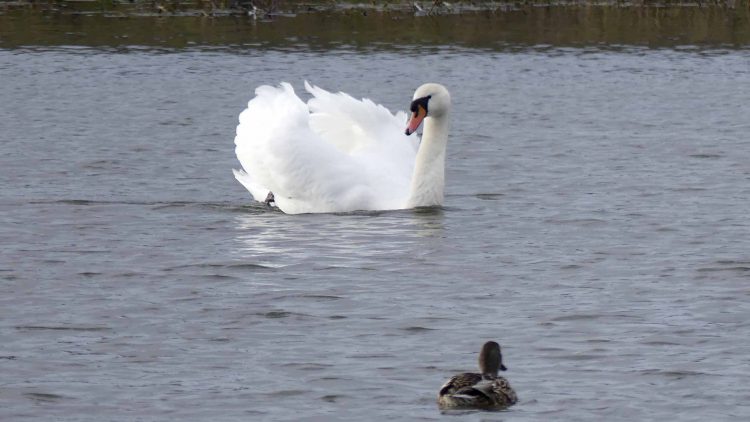
11:30- A minute later the peace is shattered as another suddenly rears up in the water with a great deal of splashing and drama and sets off in pursuit of it.
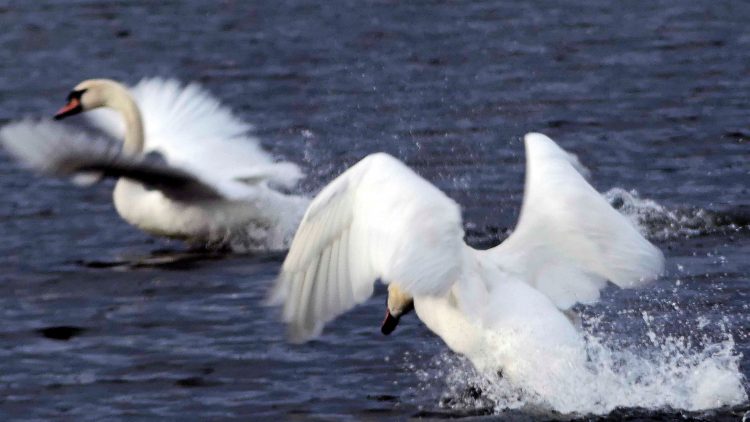
The first Swan turned and travelled away as quickly as it could towards a narrow grassy island, the other in close pursuit and catching up just as it reached the edge of the spit of land.
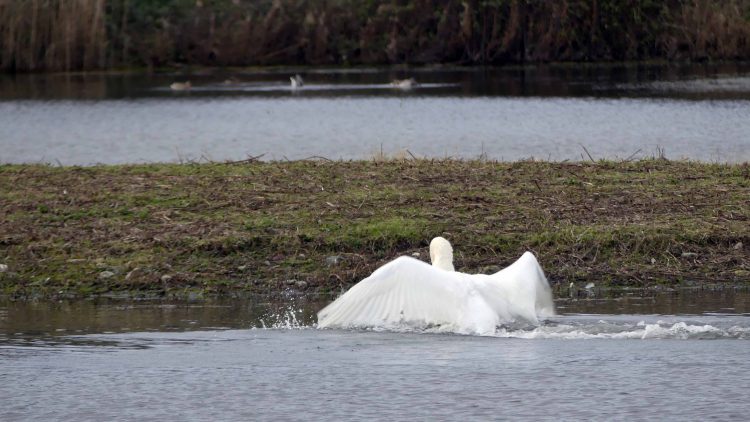
The pursuer heaved himself from the water and on top of the other, which we now realised must be a female, his weight almost forcing her beneath the water as he positioned himself to mate. Mute Swans mate for life, so we couldn’t be sure if this was consensual or whether the female had been trying to escape or hoping to get onto the firmer ground of the island or just the shallower water at the edge of the island before she was caught. Either way it didn’t look like much fun for her.
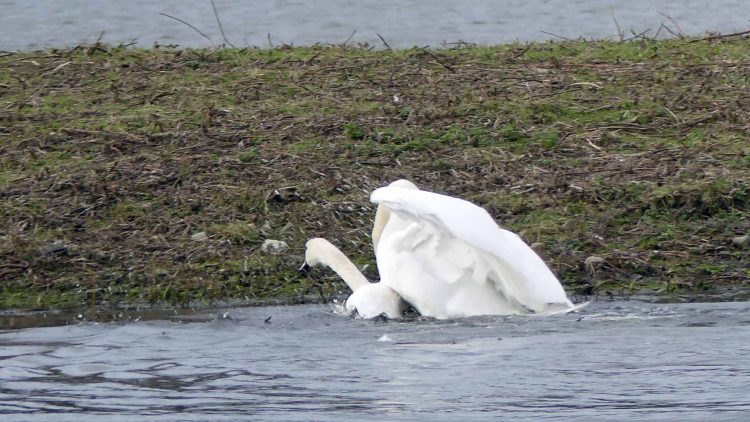
Although it all took place in little more than a minute or so, the activity attracted the interest of another individual who sailed up close to the mating pair, its wings raised.
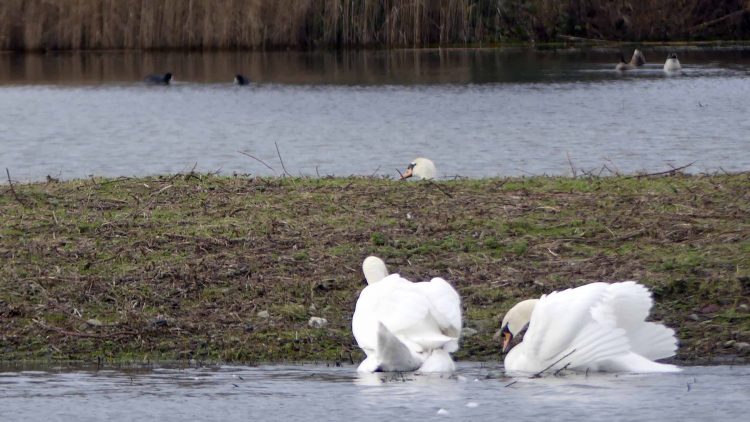
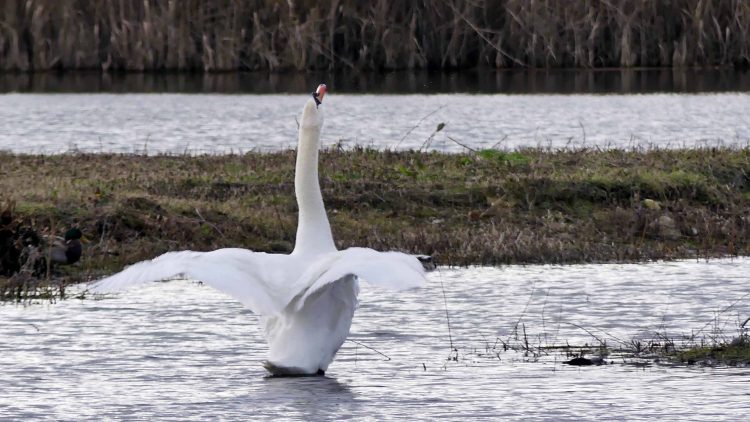
The mating male turned to face the intruder, rearing himself up with the poor female still pinned beneath him and the other mirroring the movement, stretching its neck up towards the other.
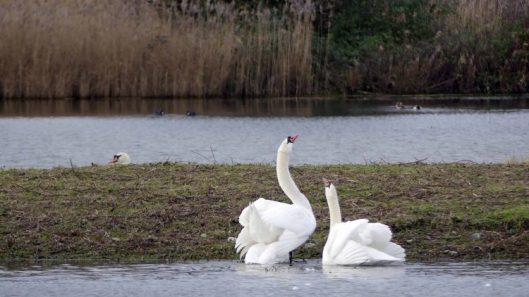
Was this a victory display?
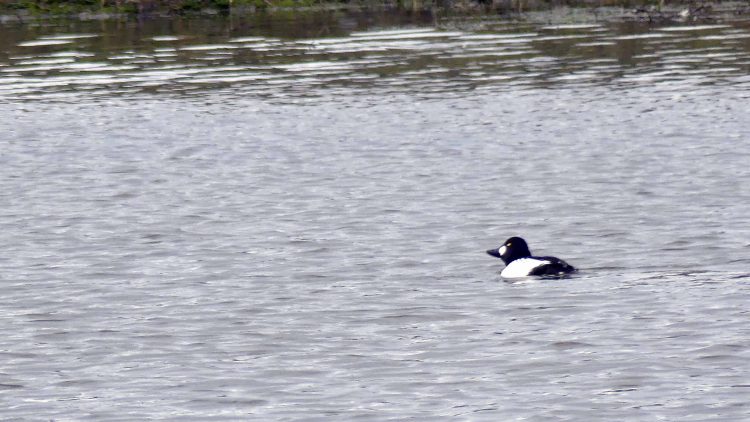
Goldeneye (m)

Whilst all this had been going on a black and white duck had been unconcernedly carrying on with the business of searching for food nearby. It was tricky to follow as it spent much of its time below the surface, bobbing up only briefly before dipping down again. I managed only one quick snap of it, fortunately good enough to be identified later on by one of the staff volunteers as a male Goldeneye.

He also identified another mostly brown duck that had been behaving similarly in the water in front of the hide, as a female Tufted Duck.
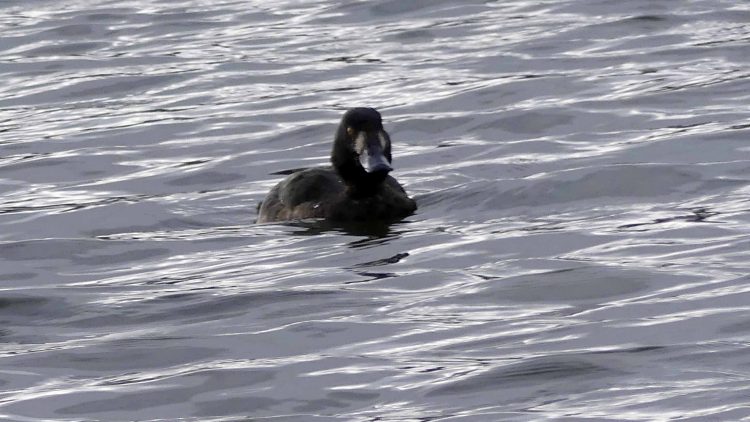
Tufted Duck- Hywaden Gopog

Another Coot
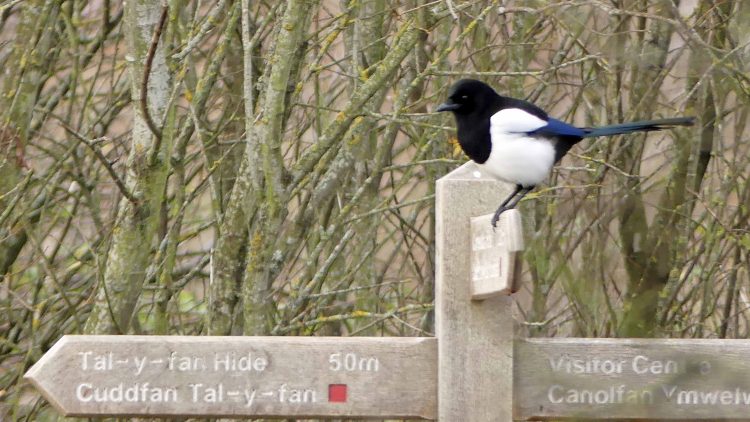
11:38 – We got back out onto the path and turned off to head towards the eastern edge of the Reserve as indicated by the Magpie that landed on the signpost.
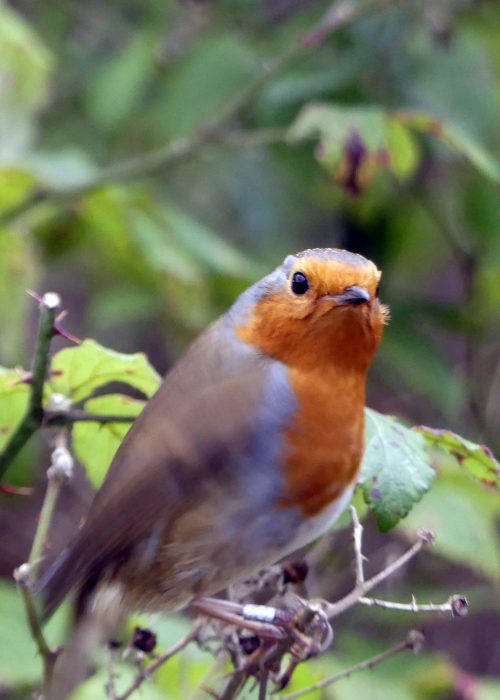
 

A short way up the path we spent a few minutes being completely charmed by a close encounter with an exceptionally confiding Robin. He, or she, sat on the tip of a bramble stem at the edge of the path, tilting its head to look at us. I think if we had been able to offer it food it may have come to a hand to be fed.
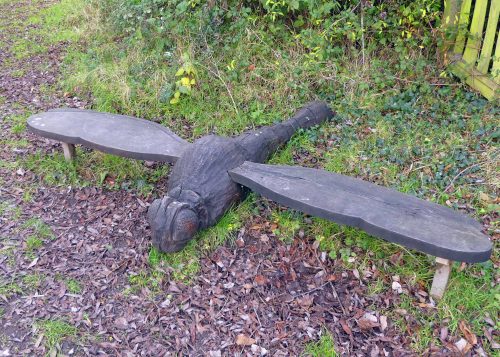
 

A grounded giant dragonfly

We reached the gate that gives access to the fenced area of wilder scrub vegetation.
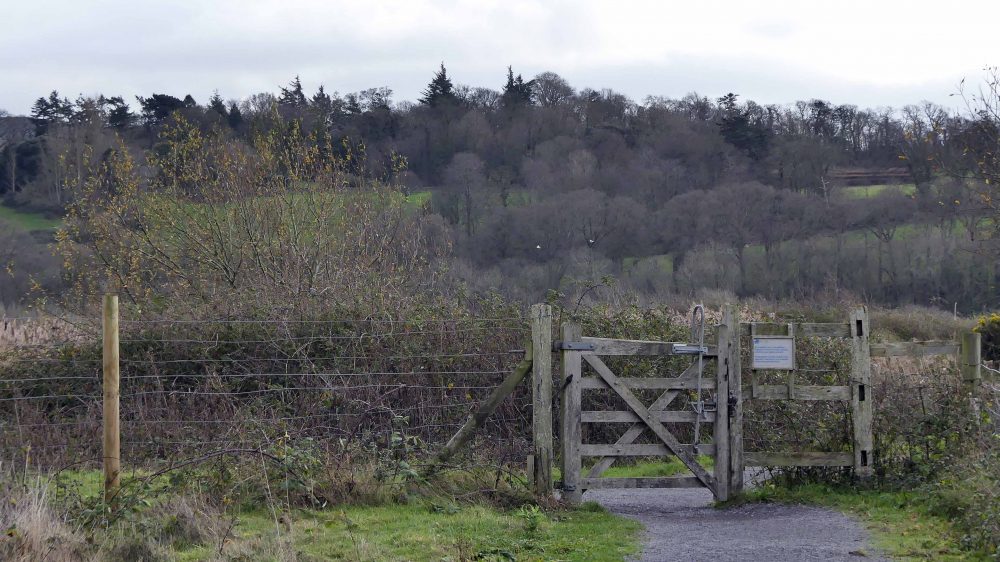
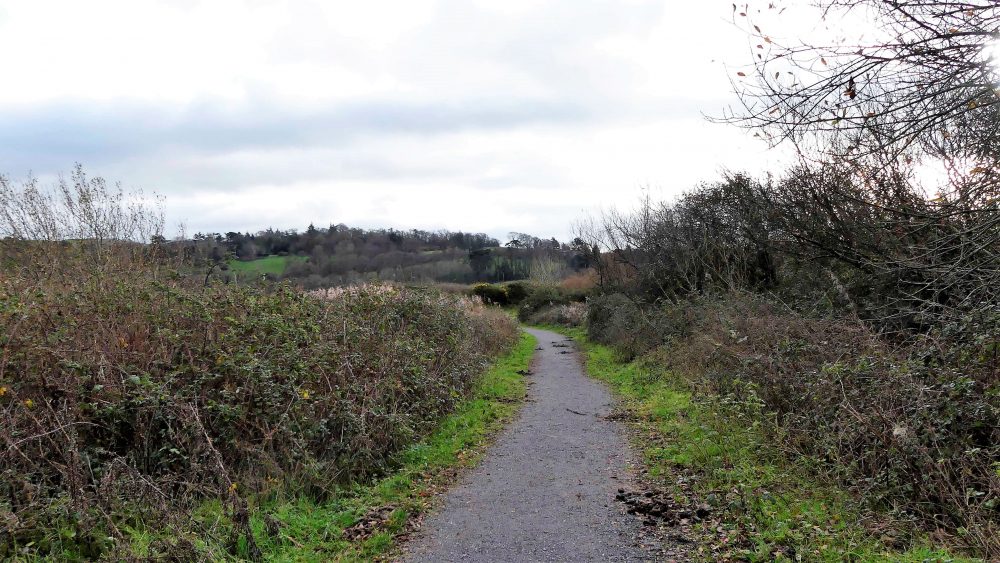
This path leads to the Estuary edge.
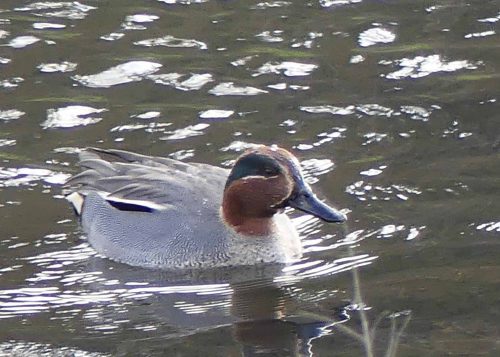
To the left of the path in a dyke below us, a small party of Teal travelled slowly upstream, stopping frequently to feed.
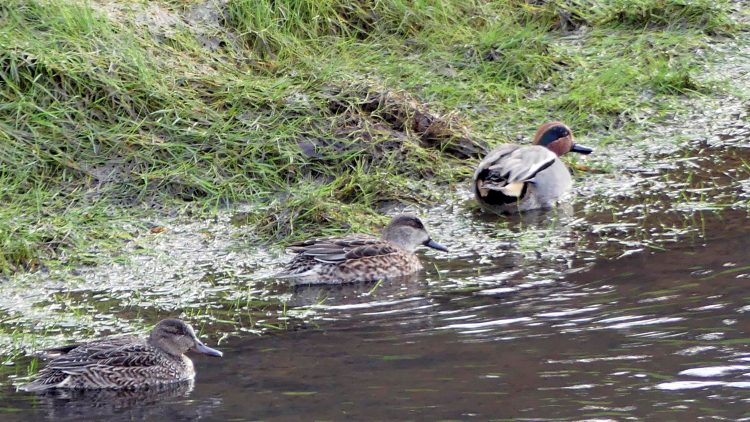
The bright light and shadows weren’t helpful in showing off the real beauty of the little male, so you’ll have to trust me when I say he was looking splendid in his bright breeding colours.
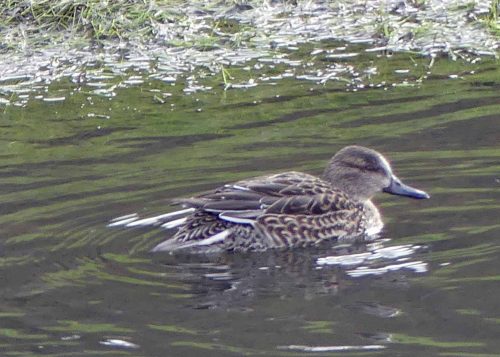
The female may be brown, but she has her own subtle beauty in her brown-shaded plumage, with each of her feathers edged with white.   
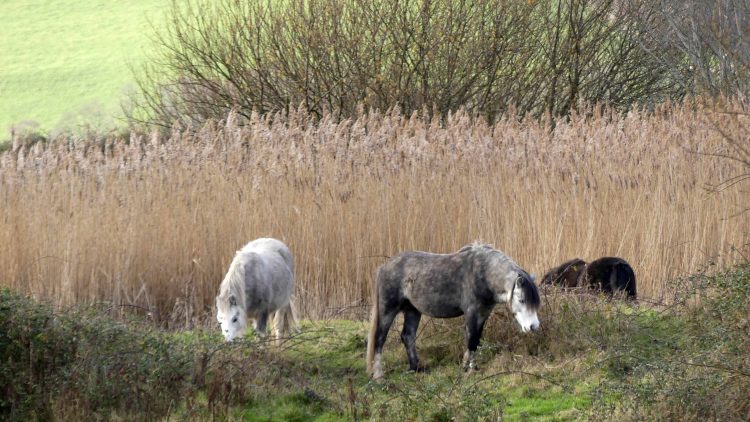
A trail of freshly deposited poo on the path finally led us to the Carneddau mountain ponies that roam the southern section of the reserve where they graze down unwanted vegetation. They will happily munch on brambles, reeds and rushes as well as grass,  which they keep short creating the habitat needed by a wide variety of wildlife.
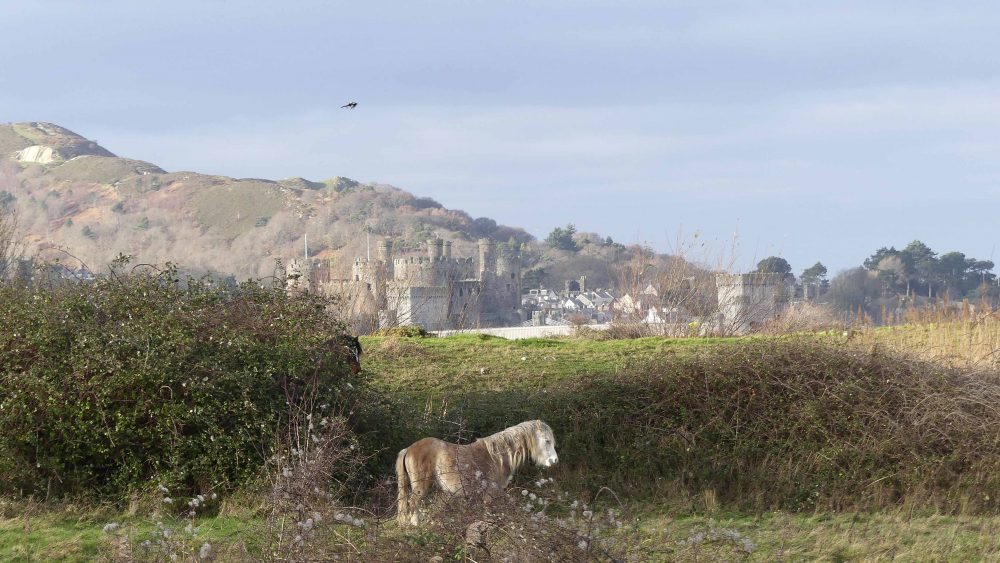
The sun came out again as we got to this spot, lighting up the Castle and Conwy Mountain behind it.
The bright sunlight also rendered birds feeding on the Estuary mud as silhouettes, most of their colour hidden in shadow. Shelduck are distinctive in size and shape though, and in the way they dip their heads to ‘hoover’ the ground in front of them.

181231-1205-RSPBCWY-50-Shelduck
181231-1208-RSPBCWY-52-Shelduck

The Shelducks were behind a large flock of foraging Redshank. The buildings in the background are in the village of Glan Conwy.
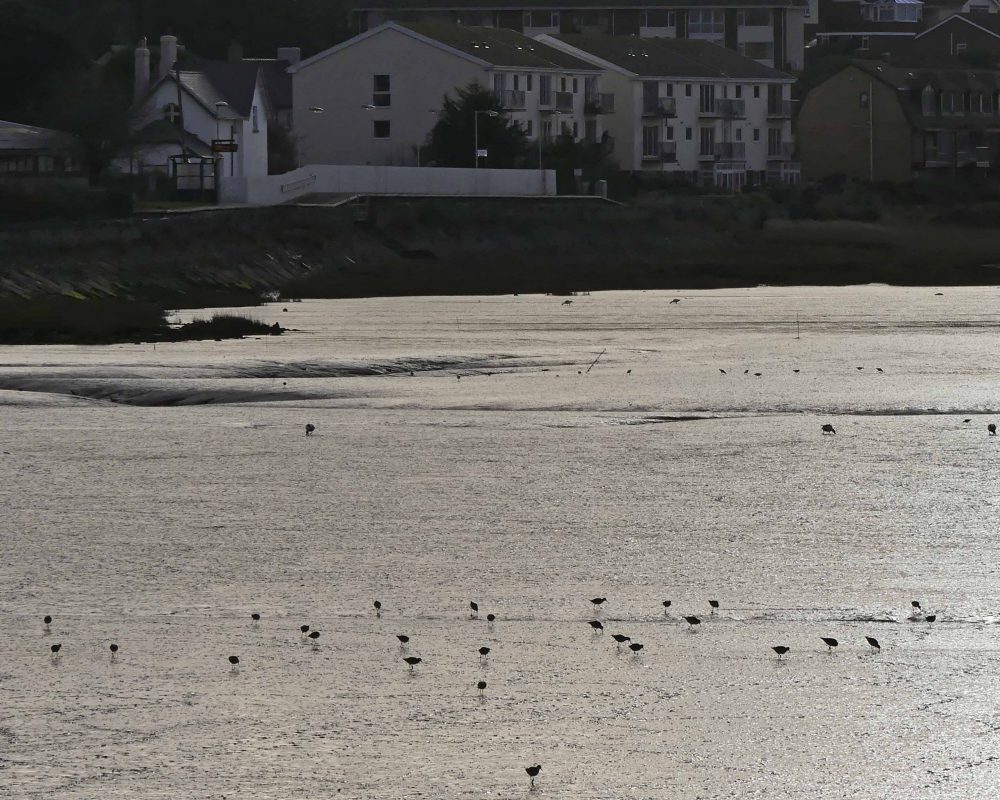
There were more along the edges of a channel of water
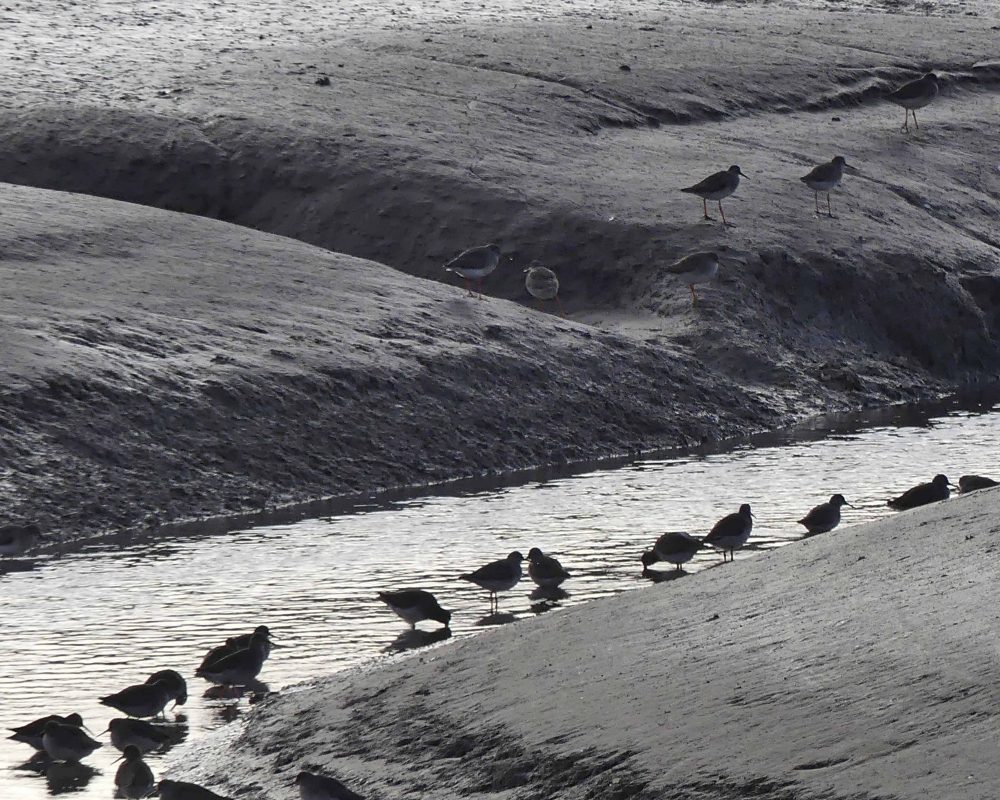
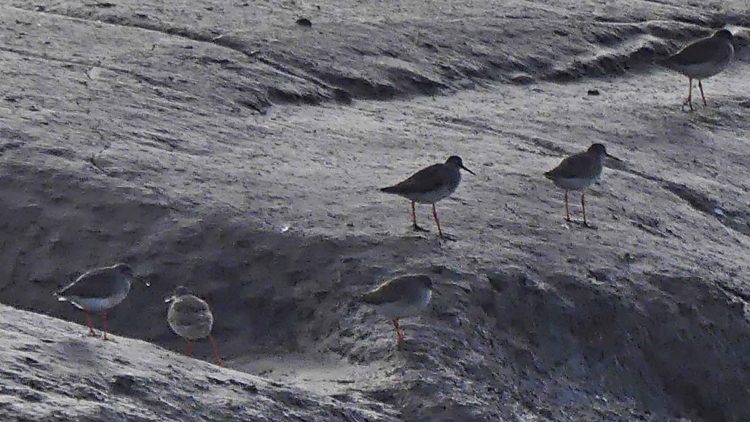
A few higher up on the bank made it possible to distinguish their diagnostic orange-red legs.
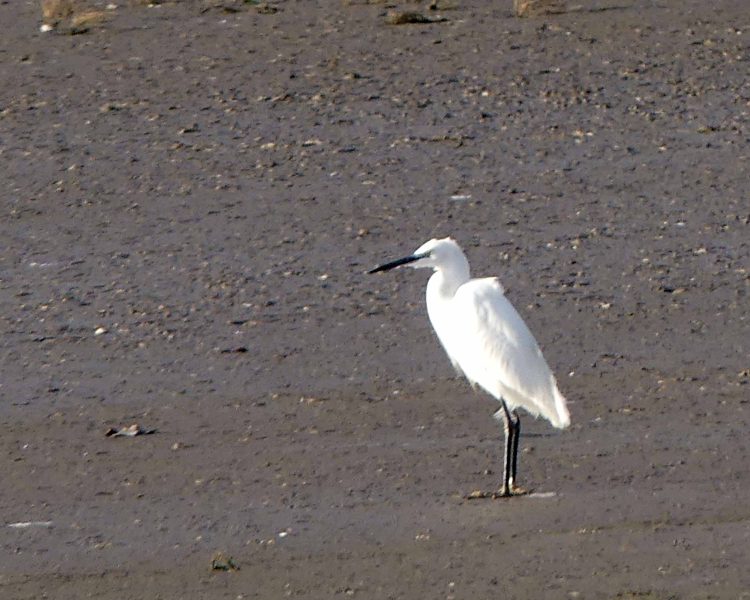
A solitary Little Egret stood stock still on the mud gazing intently out over the Estuary. Perhaps waiting for the tide to turn and bring in fresh food.
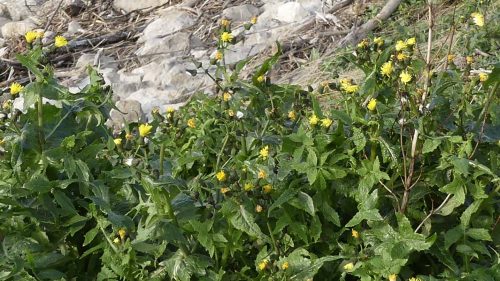
A surprise was this large patch of Sow-thistle in lush green leaf and in full bloom.
A view back into the reserve gave us Canada Geese, Mallard and a Goldeneye male, maybe the same one we saw earlier.
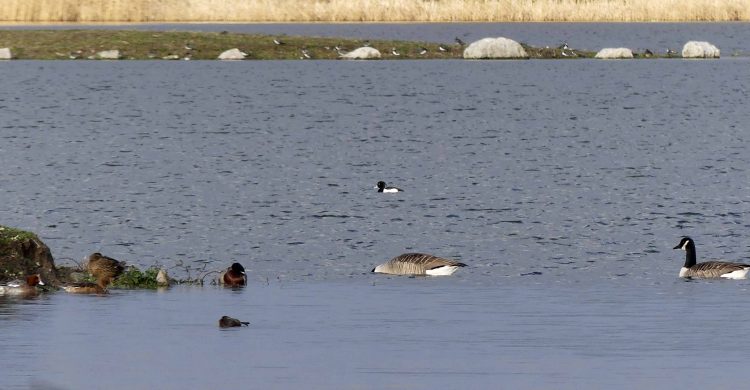
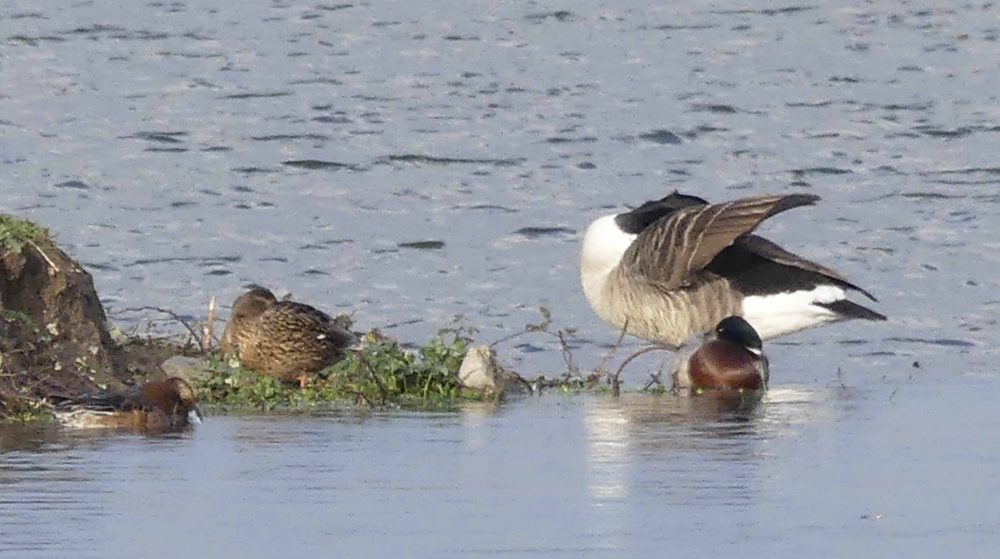
And on a narrow rock-strewn island in front of a hide, one of the iconic birds of the reserve, Lapwings.
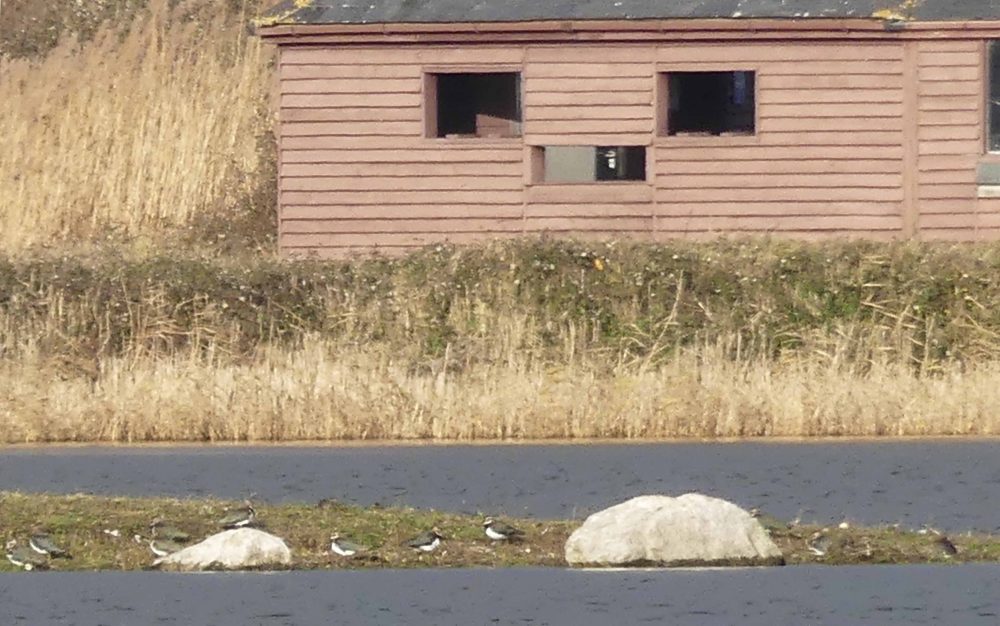
They were too distant from where we stood to see them well, but just a few moments later as we continued to walk, something had disturbed them and the whole flock was up in the air.
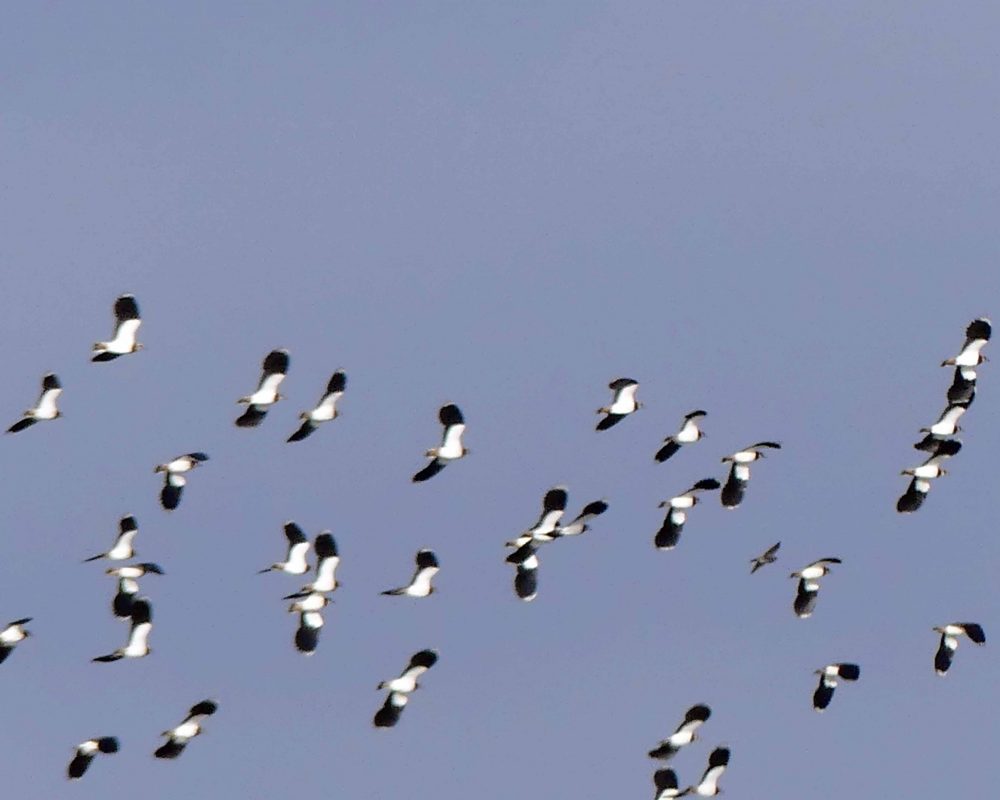
There is another bird visible in the photograph, but it’s too small and distant to make out whether that could have caused the disturbance. Whatever the cause, a flock of Lapwing flying is always a lovely sight and particularly so today as the sunshine caught the white undersides of their wings turning them silver. Mesmerising.
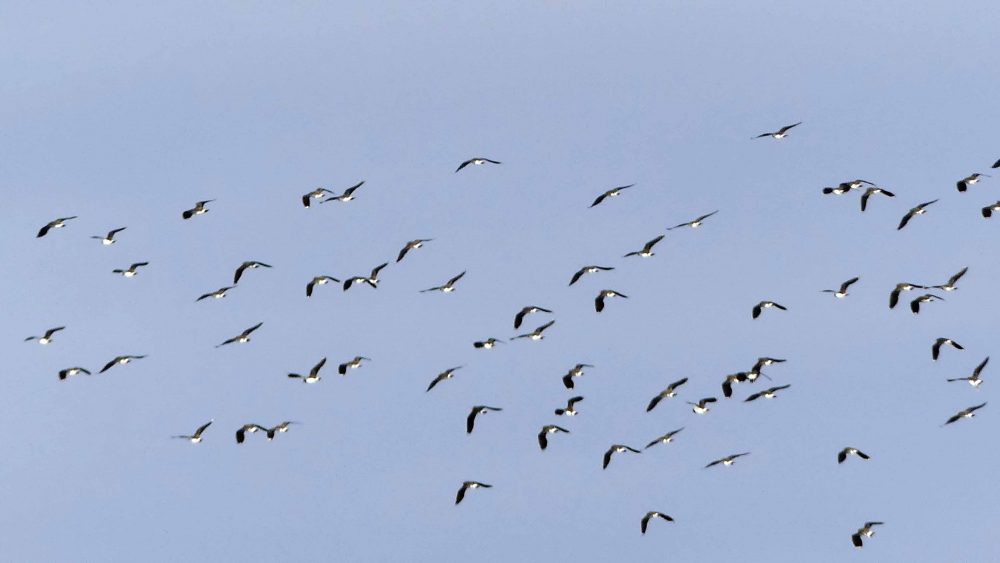
Back down to earth and a much less glamorous sighting of a Dunnock gave us our final sighting. It had fluttered in front of us, giving the impression of something a bit more exotic – we’d been keeping an eye out for Brambling – but it was a nice sighting none the less and didn’t let us stopping to stare at it put it off having a little snooze in the sun.

181231-1228-RSPBCWY-73-Dunnock
181231-1228-RSPBCWY-72-Dunnock
181231-1228-RSPBCWY-71-Dunnock

The path leads back to the gate at the parking layby I mentioned at the beginning of the post that marks the boundary of the Reserve.
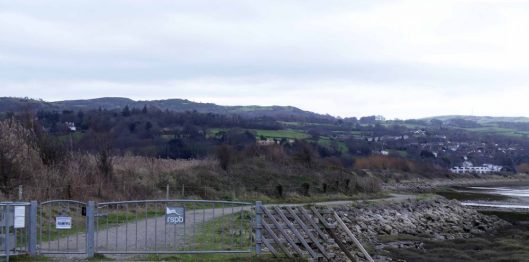
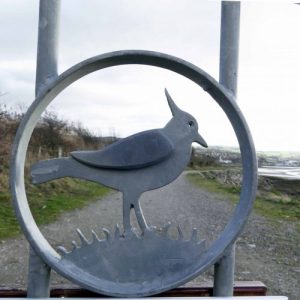


It too is embellished with Lapwing images.
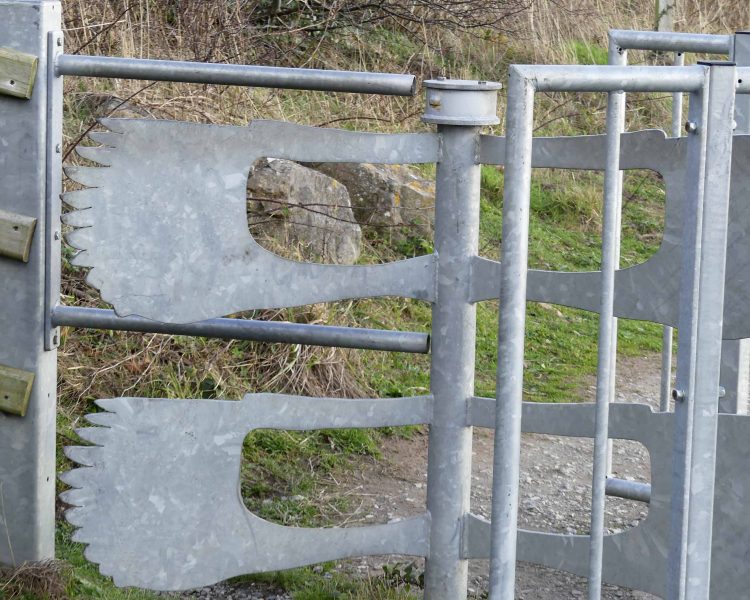
The bars of the kissing gate resemble the wings of a Lapwing

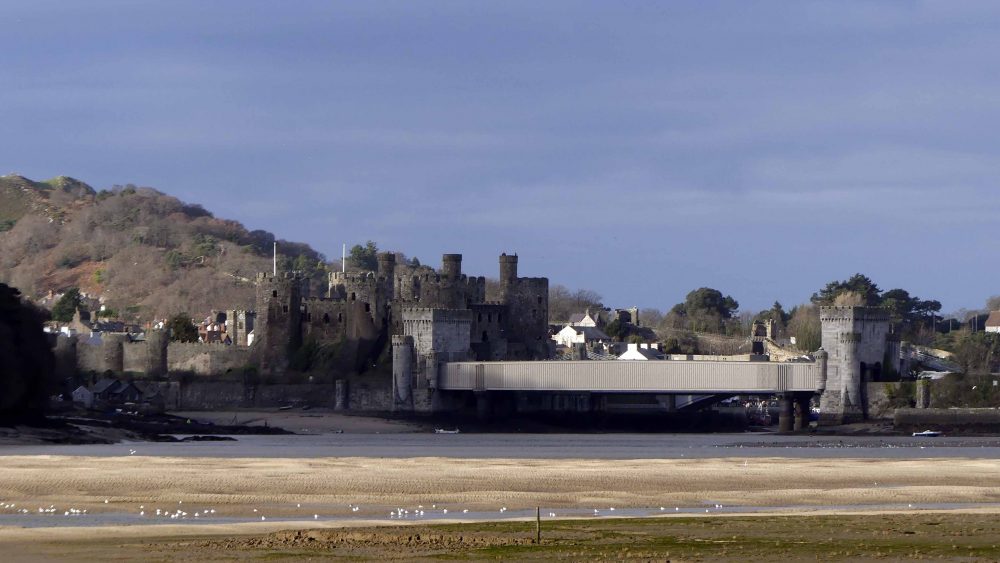
I thought I’d finish as I started, with another view of the Castle, now lit by the sun before we headed to the café to thaw out with soup and a cup of tea.
Thanks to Jill, Pete and Christine for an enjoyable outing on which to end 2018 and a Happy New Year to everyone that reads this!


Share this:

  • Click to share on Facebook (Opens in new window) Facebook
  • Click to share on Pinterest (Opens in new window) Pinterest
  • Click to share on X (Opens in new window) X
Like Loading...

Llanfairfechan 2

14 Friday Dec 2018

Posted by theresagreen in Birdwatching on North Wales coast, Local Nature Reserves, Nature of Public Places, Nature of Wales, Saltmarsh habitat, Snowdonia, Wales Coast Path, Wildlife of the Wales Coast Path

≈ 12 Comments

Tags

ducks and geese, flowering in November, little egret, Llanfairfechan, Morfa Madryn, sheep grazing as scrub control, shelduck, slate fences, Traeth Lafan, wigeon

Part 2-Hiding while seeking

I had never been into the Morfa Madryn Reserve before, so I thought I’d take a quick look around it while I was here.

As are most bird reserves, this one is furnished with hides, three in fact, that will have been carefully placed to maximise views of particular aspects of the reserve.

13:34- I came upon the first of the three hides, opened the door cautiously and ventured inside. This was partly to see if there was anything to see from there that I couldn’t see from outside and partly to have somewhere to sit for a few minutes out of the cold wind.

I have to say that I’m not a fan of bird hides for several reasons: 1) If I’m alone I dread opening the door in case there’s people in there watching something rare and I upset them by scaring it away. If I’m with someone I always get them to go in first. 2)  If there are other people in there I never know whether to speak or not. 3) I’m not good at sitting still for long periods of time, especially on hard wooden benches. 4) I worry about opening up hatches in case they either break or I can’t do them up again. 5) I confess that I get bored looking at the same view for ages, especially if I’m supposed to be waiting for something to put in a rare appearance that may only last for seconds. 6) I rarely have binoculars with me, so feel like a fraud and can’t really see if there’s anything there to watch unless someone kindly points it out to me. 7) I think about what I might be missing outside.

All that said, this hide was empty and it was definitely warmer in there. I decided to stay for a while. I lifted up one of the heavy extra-wide, slightly warped hatches, worked out how to keep it up and sat down to look out. I quickly realised there was a lot more than bird activity to sit and gaze at, got out my notebook and wrote:

“The tide’s way out so not much to see in the way of birds, but the views across the sands are spectacular: it’s rare to get such clear views of the Anglesey coast.

I’m on the other side of the slate boundary fence now and think what a work of art it is. Each post will have been cut to size, probably by hand as each one is different from its neighbour. It must have been hard work putting it up too, but that now it’s there it will probably last for ever with far greater resistance to the elements than this wooden hide that’s already showing signs of wear and tear. It’s weakness is doubtless the metal wire it’s linked with.  Tradition of Slate Fences 

Slate pillar fences became common in north-west Wales from the middle of the 19th century. In 1861, the Penryhn Quarry at Bethesda, Gwynedd – one of the largest slate quarries in the world at that time – produced around 9,000 individual pillars. These pillars consisted of poor quality blue slate, typically about 150cm (4.9 feet) tall.
They were used to mark fields, gardens, railways lines and roads, with their simple construction being particularly well-suited to the harsh weather experienced by upland areas.

It’s warmer in here and peaceful too if I zone out the constant sound of traffic racing along the nearby A55. Harder to ignore the raucous racket being made by of a couple of Crows though.

13:51- A Little Egret stalks back and forth in a shallow trench of a tidal pool. It takes a few slow graceful paces, pauses and delicately stirs up the muddy sand with one foot. It leans forward peering intently into the water, then strikes down rapidly with its beak.

I enjoyed that, it brought back warm and fuzzy memories of time spent watching them on the little Reserva close to where I lived in Spain.

181102-1351-LLFF (160)
181102-1351-LLFF (159)

A helicopter flies very low overhead making a tremendous noise but the birds must be accustomed to it as none of them react at all.

13:56- I’m getting restless already and about to leave when I spot a swimming duck from the side window. It’s a Wigeon drake and he seems to be thoroughly enjoying a vigorous bathe and preen of his feathers.

Wigeon – Anas penelope – Welsh: Chwiwell

181102-1356-LLFF (162)
181102-1356-LLFF (163)


There’s a Redshank pecking around on the edge of the pool. The chunky Wigeon makes the Redshank look tiny and dainty.

I sit for a bit longer and watch a small flock of Redshank fly in. They are fidgety, taking off, flying around then returning almost immediately to the same spot several times before settling. Maybe they have to check out the health and safety aspects of the spot carefully as they seem to want a nap.

I take in the view across the Menai Strait to Puffin Island, in between there are so many shades and textures of shells, sand, mud, grass, rock and water the landscape looks almost other-planetary. 


14:04- A pair of Shelduck come into view waddling across the sand. They have their heads down and look like they’re hoovering up what’s in front of them with their bills.

(more about Shelduck here)

14:11 – The formerly noisy Crows come back for a quiet shellfish lunch.

14:12- Sheep have wandered into view, heads down intent on grazing, which is exactly the job they are here to do; keeping down the grass and helping to clear scrub from bird nesting sites.

I stand up to leave, having a quick look through the rather dirty window on the other side of the hide before I do. There’s quite a large pool here but I can’t see it properly as it’s hidden behind reeds. I did see a dragonfly though. I’m surprised to see it this late in the year. I tried opening the window as it was too dirty to see through properly, but one of its hinges was broken, (see back to reason 6 of why I don’t like hides!), I tried to close it back properly but it was too heavy; sorry, hope it’s still there. I take a snap of the manufacturers details on the door just in case, but I suspect the guarantee is up now….

14:21 The Reserve is well vegetated and the height of the shrubbery either side of the paths is quite disorientating and feels a bit like a maze. I didn’t see even a single small bird in there today, but I’m sure there’s enough of a mix here to suit a variety of species. A train passing, this time coming from the Holyhead direction, makes me aware how close the train tracks are.

The busy A55 is also only a small field’s width away too.

The far end of the Reserve is open and has a seat but I couldn’t quite work out why it was placed at the angle it is; it doesn’t directly face either the view overlooking the saltmarsh and Menai Strait or the mountains and there’s a young tree growing up in front of it too.

I may have placed it to face this way….. Not that it mattered really as it was too cold for sitting around. 

14:35- I’d left the reserve and came upon this lovely little party of Wigeon swimming about in a pool of water. You can see it was windy by the ripples on the water.

I noticed that the birds were all facing into the wind, I wonder if that made them more aerodynamic to stop them being buffeted about, or perhaps they had only just flown in and landed. Another Redshank stood nearby watching them.

They soon broke out of their orderly arrangement on the water and began free swimming in all directions. I noticed from the photograph that two of them are looking upwards; perhaps checking for aerial predators.

This little group of three may (or may not!) be a family. There’s an adult drake with his more patterned back plumage and chestnut head with the lighter stripe and a plainer chocolate brown duck, so I think the one with the white underbelly and brown upper parts must be a juvenile.

I dither about what to do now, should I carry on along the Coast Path for a while or start heading back? I opted to walk on a short way, then stopped, admired the view, saw how long and open the path going forward was, realised the light was already beginning to fade, that it was getting noticeably colder and turned round to walk back.

Wales Coast Path heading towards Bangor

The Spit or Shell Island

The beach area here in front of the reserve is the Spit, or Shell Island and it’s clear where it got its more attractive name from.

It literally is a stretch composed almost entirely of empty seashells.

In my previous post, which covers the first part of this walk, you may recall the notice that requests that you stay off this area from March-September to avoid disturbing nesting birds and also at high tide from October-February so as not to disturb roosting birds.

A further notice here advises that Ringed Plovers nest on the shell ridge till the end of August, so please stick to the Coast path that follows the line of the fence, and once again keep dogs under control. This is one of many instances along the Coast Path route where there is a conflict of interest between people and nature.  Of course walkers want to be as close as possible to the coast, but unfortunately don’t always respect that this is first and foremost a wild habitat that they have the privilege of passing through.

There’s a mix of shells here, cockles, mussels and clams to name a few. Most are broken or crushed, but some remain intact. Beyond the high tide line at the back of the beach there are small plants, mostly moss, which is often one of the first plants to establish on rocky land: they can break down rock and soil to create a more hospitable environment for other plants and absorb moisture so act as sponges, soaking up rainfall and helping prevent erosion of the landscapes. I noticed a lot of rabbit pellets scattered around too, adding fertiliser and fibre. I was pleased to spot this tiny storksbill plant in flower. I’m not certain of the species but I’m hoping it was Sticky Storksbill-Erodium lebelli. (Storksbills are notoriously tricky to identify with certainty).

A last view from here over Traeth Lafan sands to Puffin Island and Anglesey and I set off to walk back. 


Share this:

  • Click to share on Facebook (Opens in new window) Facebook
  • Click to share on Pinterest (Opens in new window) Pinterest
  • Click to share on X (Opens in new window) X
Like Loading...

Llanfairfechan

10 Monday Dec 2018

Posted by theresagreen in Birdwatching on North Wales coast, Local Nature Reserves, Nature of Public Places, Nature of Wales, Saltmarsh habitat, Snowdonia, Wales Coast Path, Wildlife of the Wales Coast Path

≈ 6 Comments

Tags

Curlew, Glan y Mor Elias Nature Reserve, khaki campbell, Llanfairfechan, Morfa Madryn, Oystercatcher, redshank, Traeth Lafan, wigeon

Part 1 – to Morfa Madryn

Located about halfway between Conwy and Bangor, Llanfairfechan is linked to the other small seaside towns of the North Wales coast popularised by adventurous  Victorians by the main Chester to Holyhead railway line and more latterly the A55 North Wales Expressway. The town grew on a narrow strip of coastal land backed by the steep hillsides and mountains of the Carneddau range. Its continuing wide appeal is easy to see. The scenery and views are spectacular and there is an array of well-established wonderfully diverse walks along the coast, through woodland, along the river and in the mountains behind it.

Once mostly privately owned, much of the landscape is now the responsibility of Conwy Borough Council and managed as a series of Local Nature Reserves and I was heading for one of them, Morfa Madryn, which sounds and often looks like it belongs in a Tolkein novel, but is the salt marsh area that lies to the west of the town. I’m trying to improve my recognition and knowledge of ducks, so I was particularly hoping to see some of the ducks and waders that are permanently resident or that overwinter here.

The route I took on a gloriously sunny November day began and ended in the seafront car park at the beginning of the Promenade. As always I found a great deal of interesting stuff to see along the way and on the way back; too much for a single post, hence this being Part 1.

Penaenmawr Mountain from Llanfairfechan

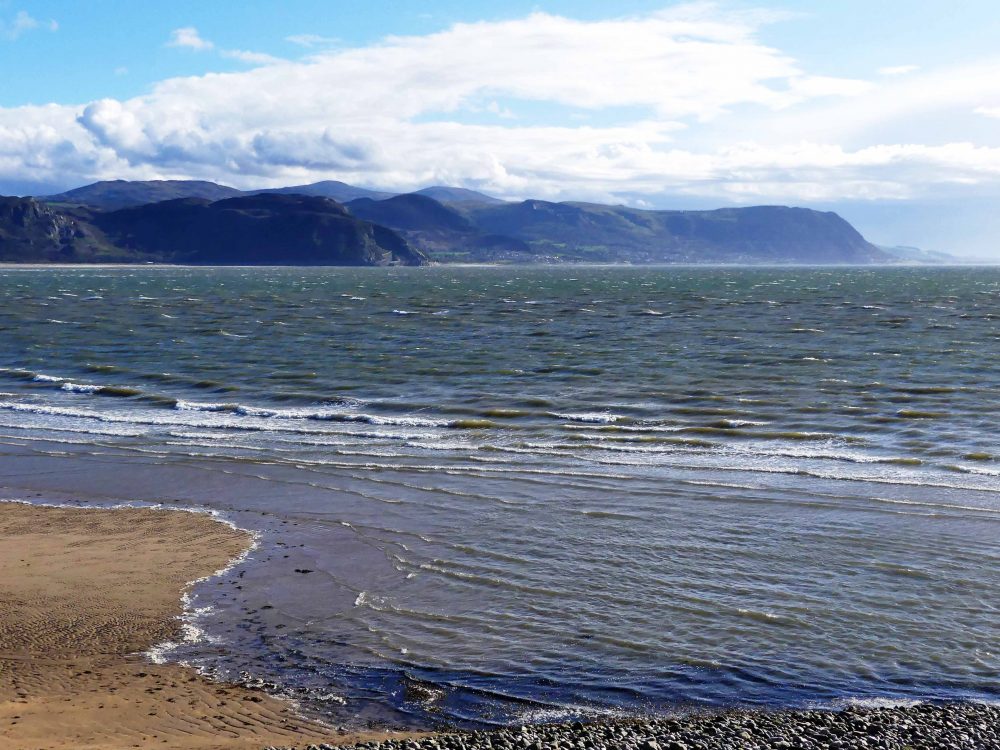
12:12 The tide was out, it was cold, a bit windy but brightly sunny with a bit of a haze on the horizon. Being a Saturday, the  (free) car park was already busy. The café was filling up but a good few people were out walking along the Promenade, or the Cob as it is known locally and there were others on the beach. It’s a popular spot with dog walkers. The great bulk of Penmaenmawr Mountain fills the view to the east, but then from the Promenade the sea views are wide and spectacular. Vast expanses of the sands of Traeth Lafan are exposed and the bulks of rocky headlands are dwarfed under endless skies. The Great Orme could almost be mistaken for an island, but today you can see the tenuous connection, upon which Llandudno is built, that tethers it to the mainland.

Great Orme headland across Traeth Lafan

A bit further along are Puffin Island and the distinctive lighthouse painted with black and white rings that stands in the sound between the island and Penmon Point on the tip of Anglesey.

I followed the Promenade and crossed the bridge over the river, the Afon Llanfairfechan, the water was shallow but fast-flowing and the resident flock of Mallard was hanging around hopeful of some easy lunch. Dippers are often to be seen further upstream, so it’s always worth a look for one here, although I’ve yet to see one this far down.

Afon Llanfairfechan

The bridge leads into the landscaped recreational area with lawns, tennis courts, bowling green, children’s playground and a large lake. Originally built as a Model Yacht Pond it is still used today by enthusiasts of engine-powered model boats. In the shelter of the pavilion sun-faded information boards show the ducks and waders most likely to be spotted here. Ducks include Shelduck, Gt Crested Grebe, Widgeon, Goldeneye, Teal, Red-breasted Merganser, and of course Mallard. Waders pictured are Curlew, Bar-tailed Godwit, Black-tailed Godwit, Redshank, Greenshank, Oystercatcher, Ringed Plover, Grey Plover, Lapwing, Dunlin, Turnstone and Knot. I guess the spikes on top of the boards are to deter less desirable birds from roosting in the shelter.

Larger Waders
Larger Waders
Smaller Waders
Smaller Waders
Ducks
Ducks

I headed away from the Promenade towards the children’s playground to follow the path along the far side of the Boating Lake. The mountain in the background with its distinctive peak is Garreg Fawr.

An orderly line of well-groomed pine trees stands to attention along the edge of the path.

The Model Boating Lake

On the grassy lawns around the lake Black-headed Gulls rest or seek prey in the grass. Their heads showed varying stages of plumage; most now have lost their dark heads and sport the winter-white head with the black spot to the side of each eye. One was darker around the eyes; I’m not sure if it’s late changing from breeding to winter plumage or already beginning to gain back its breeding plumage.

181102-1221-LLFF (15)
181102-1221-LLFF (14)

The Promenade here is a safe and popular spot for outings with families and with dog walkers, so there are many signs advising what not to do. Lakeside, one such reminds folk to resist the temptation to feed the ducks and swans with bread and chips! I’m not sure how much notice is taken of that one.

A pair of Khaki Campbells

Most of the resident ducks are recognisably Mallards, but a few clearly have both Mallard and domestic ducks as ancestors, inheriting characteristics from both as have this pair I passed on the edge of the lake.  Typically a blend of Mallard, Rouen and Runner ducks, these are Khaki Campbells Anas platyrhynchos domesticus and are often kept commercially for their generous egg production. They come in variations on three basic colours, khaki, dark and white. A Khaki Campbell drake is mostly khaki coloured with a darker head, usually olive green and without the white ring (male) of its Mallard ancestors;  the duck (female) typically has a more modest plumage of khaki covering her entire body.

One notice on the wall, placed there in 1908 is well worth stopping to read; a reminder that this wild and free land was once privately owned and public access granted under sufferance and a strict code of conduct!

click to enlarge and read

Small ferns push out their fronds from crevices in the stone wall that bounds the woodland. Mostly Common Polypody, there are also a few smaller, finer plants of Maidenhair Spleenwort. Both species have seed spores, sori, on the backs of their fronds.

Common Polypody -Polypodium vulgare
Polypody sori
Polypody sori
Maidenhair spleenwort
Maidenhair spleenwort sori

The pathway soon rejoins the Promenade and continues past a few houses and fields on the landward side. Residents here have enviable views over the sands and the Menai Strait to the coast of Anglesey, but it gets wild here in the winter.

Traeth Lafan with Anglesey coastline on the horizon

I stopped to watch an Oystercatcher in a pool of water. The mud and sands hold a bountiful supply of cockles, mussels, lugworms and small fish which draws in large numbers of wading birds. Needless to say the food supply also attracts humans and the gathering of shellfish together with water pollution is impacting on the fragile ecology of the area.

Oystercatcher (with leg ring)

The exposed sand is left patterned and textured by the movement of water rippling over it creating fascinating artistic effects. Changes in level results in tidal pools of varying depths being left; good hunting places for the birds. In the bright sunlight it took a while to ‘get my eye in’ and spot wading birds, especially when they were as distant and well camouflaged as this Redshank was. Camera at full zoom I watched as it stalked knee-deep in water, scanning intently for prey, then stopped to plunge the entire length of its long bill below the surface.

Redshank – Welsh: Pibydd Coesgoch

Another stalked the sands, better showing its diagnostic red legs. Stopping it too probed deep into the sand and pulled out something, maybe a smallish flat fish which it carried away clamped in its bill.

181102-1234-LLFF (37)
181102-1234-LLFF (38)


12:46 A metal fence/gate with more notices pertaining to dogs, fines and disturbance safeguards the entrance to Glan y Môr Elias Reserve.

Log counter-weight


I love the log tied on with rope that acts as a counter-weight to keep the gate closed. Simple but effective.


A short way into the reserve a movement on the sands below gave me my first view of the day of a Little Egret. A lucky spot as its bright white plumage rendered it barely visible in the bright sunlight.

It elegantly and stealthily stalked prey in a shallow stream of water, its lethal dagger-like bill poised then struck at speed.

181102-1253-LLFF (73)
181102-1252-LLFF (70)

Further out again, the wet muddy sands were punctuated with hunting Oystercatchers, which interestingly were all travelling along in the same direction. 

Thus far the path had followed the woodland edge. Now it was open and exposed to the elements on both sides allowing a wonderful view of the mountains. The field boundary fence has remnants of traditional slate ‘posts.’  

12:56 The main Chester to Holyhead train track defines the boundary of the reserve. Trains pass by frequently, this one an Arriva operated train (now Transport for Wales).

The Promenade peters out here where the expanse of salt marsh begins and stretches forwards along the Menai Strait. 

A wooden bench located here offers two widely-differing panoramic vistas.

You can sit and gaze both at the mountains and out across the exposed windswept mudflats where Puffin Island and the tip of Anglesey are visible on the horizon. I was surprised to find Sea Daisies still flowering here. Despite the sunshine the wind was keeping the air temperature down, not a day for lingering on benches, best to admire the views while in motion.

13:02 The Wales Coast Path includes the section of the Promenade I’d followed to here and it continues on to follow the line of the seashore as a grass trail along a raised embankment. Before carrying on I obeyed another sign in front of a gate to STOP. It asks that from March-August: Please keep off the spit (Shell Island) at all times. This is to prevent disturbance to breeding birds. September-February: Please keep off the spit (Shell Island) when the tide reaches the base of the white-topped fence post. This is to prevent disturbance to roosting birds at high tide. And another plea to keep dogs under close control.

It took a few minutes for me to realise that there was a large flock of ducks on the ground in front of me, but to be fair you can see how tiny they were in the landscape and they were moving very slowly if at all. 

At times like this I know I should carry binoculars. But with the camera I could see there were what appeared to be two large flocks, separated by an inlet and that they were Wigeon. 

Wigeon, or Eurasian Wigeon Mareca penelope, are our largest native dabbling duck and unusual amongst ducks as they often graze on grass like a goose. They are the most numerous of the overwintering species: the BTO quote an estimate of 440,000 pairs throughout Great Britain. There must be several hundred here. Intent on grazing they were lovely to see, but tricky to get good views of, so I left them to it, hoping for better views later.

13:07 – A speeding Virgin train bound for Holyhead shows how close the train tracks are to the reserve’s boundary.

There was a sign to say the coastal section of the path was closed. There were people peering over a plastic barricade to see why that might be. I decide to heed the sign and continue around the alternative more inland track. As I was about to move on, a flock of noisily-chatting Starlings descends on the bank and lands in the long grass. They can’t seem to settle and flit around restlessly, seeming to be squabbling amongst themselves.


Small groups of birds dash off in varying directions, some heading off over the heads of the intently grazing ducks, who barely give them a glance.

The track I’m heading for sweeps around the marsh in front of the line of trees.

I spotted a single wading bird, again regretting my lack of binoculars as the sun directly on camera lens. It seemed quite large but perspective is a funny thing and it didn’t have much in the way of identifying features. Most likely another Redshank. 

13:14 Looking back a nice view of Penmaenmawr Mountain partly shadowed by a large passing cloud.
13:18 In front haze softens the  dark, somewhat intimidating bulk of Penrhyn Castle

Across the reedy marsh to the other path it seems quite a few people have ignored the sign advising that the route is closed.

Whilst looking in that direction I spotted a Curlew.

and  have a closer look at the reeds too.

A flowering Gorse brings a touch of gold to the landscape. The fields and farms in the background are on Anglesey.


Towards the end of this section of the path which is damp and shaded by trees I was surprised to find Yarrow still blooming.


Back out into open ground a small bridge crosses a stream


You can choose whether to follow the grassy path around and back to where you started (the track that’s supposed to be closed), or follow the slate fence around to continue on the Wales Coast Path as indicated by another signpost.

I decided to carry on a bit further and have a quick look around the fenced-off woodland of the Morfa Madryn Reserve before heading back. 


Share this:

  • Click to share on Facebook (Opens in new window) Facebook
  • Click to share on Pinterest (Opens in new window) Pinterest
  • Click to share on X (Opens in new window) X
Like Loading...

Going Wild on the Beaches

10 Sunday Jun 2018

Posted by theresagreen in coastal walks, coastal wildflowers, Nature of Public Places, Nature of Wales, North Wales, Wildlife of the Wales Coast Path

≈ 2 Comments

Tags

Buck's-horn Plantain, Curled Dock, flowering in June, flowering in May, rhos-on-sea, Sea Beet, street wildflowers, wildflowers on beaches

Rhos-on-Sea

Rhos-on-Sea has a small sandy beach protected from the worst of the elements by the piled stones of the breakwater wall.

Most of the time it’s quiet, with most beach-seekers opting for the bigger expanse of sand further round Colwyn Bay, but it can get busy on warm sunny days as it’s handy for the village cafés, shops and the all-important public loos. It’s popular too with some of the younger local Herring Gulls whilst the grown-ups are otherwise occupied with raising the next generation.

The nearby wooden jetty is a draw for those wanting to try out the gentle sport of ‘crabbing’ too.

But my interest in the beach is with other visitors, the opportunistic wildflowers that grow there, mainly at the back of the sandy beach pressed against the sea wall.

The line of small dinghies lodged haphazardly against the wall don’t get much exercise by the look of things, but they help give the plants a bit more shelter. There’s a nice spread of Wall Barley,

Wall Barley- Hordeum murinum

then more Wall Barley, touches of Dandelion and Groundsel surround a clump of Sweet Alison. This does have origins as a wildflower and it grows wildly around the Mediterranean, but is more familiar to us as a garden edging plant. This one is probably the offspring of such a one that has escaped the formality of a bedding scheme in favour of a wilder life.

There’s more Dandelion, past flowering for now, and a couple of clumps of Curled Dock. This is one of our two most common docks, whose narrower leaves with wavy edges make it distinguishable from the other more familiar Broad-leaved Dock, a much sturdier plant whose leaves we used as kids to alleviate the pain of nettle stings.

Dandelion and Curled Dock-Rumex crispus

Sea Mayweed-Tripleurospermum maritimum


There’s some Sea Beet here, but much more further along, so I’ll get back to that. By far the most prolific plant though is Sea Mayweed, which has the odd flower open but although it’s leaves are pretty, it’s not at its best yet.

There’s another Mayweed too, the Pineapple Mayweed, so named because it’s supposed to smell of the fruit when it’s crushed.

Pineapple Mayweed-Matricaria discoidea

More Curled Dock, silvery-grey leaved Fat Hen which is not flowering yet and Shepherd’s Purse with the distinctive heart-shaped seed capsules that give it its common name.

Curled Dock, Fat Hen and Shepherds Purse

And to finish this section a nice group photo featuring most of the aforementioned main characters.

At the far end of the beach, there’s a change in character. The sand thins  gradually petering out, and the now stony ground offers an opportunity for other plant species to stake a claim. I find it amazing that any plant can survive the harsh conditions of any beach, let alone one as exposed and seemingly hostile as this one. Some like the Sea Beet and the Curled Dock are perennials and look tough enough to have staked a permanent claim.  Others appear at first sight to be small and fragile, although looks are often deceptive and some, like this White Clover should surely be somewhere more lush and grassy?

Growing through the clover in my photo above are bits of a plant I like very much, the Buck’s-horn Plantain, named for the shape of its attractive leaves. This one is a toughie, and is found on disturbed ground and on rocky sites mainly near the sea, but it may be pushing its boundaries a bit here.

Bucks-horn Plantain-Plantago coronopus

There’s a sprinkling of Annual Wall Rocket plants

Annual Wall Rocket-

and a straggly looking Cat’s-ear, one of the few hawkbit-hawk’s beard or otherwise dandelion-flowered hawk-something that I think I know.

Cats-ear-Hypochaeris radicata

There’s more ferny-foliaged Sea Mayweed

Sea Mayweed

more Curled Dock

Curled Dock

and another one of my favourite toughies, the pretty Common Mallow.

Common Mallow-Malva

There’s more Wall Barley too.

And some impressive specimens of Sea Beet. I’m surprised this doesn’t get fashionably-foraged for one of our trendier local restaurants – it’s the plant from which our cultivated beets originated, so does have edible roots.

Behind the now empty buildings it grows prolifically.

Speaking of the buildings, I stop and wonder what will happen to them. They are very much a local landmark with an interesting history. An impressive pier once stretched out into the sea from this point and the buildings, including the iconic octagonal one, originally served as a toll both and entrance building for passengers embarking on steamers that docked here. There have been a few subsequent changes of use since the council finally bought the pier and demolished it in 1954. Many people seem to particularly remember the café once located here.The  walls on this beach side also form part of the sea wall, so perhaps partly for that reason their continuing presence was secured last May when it was added to the Grade II list of buildings.

Looking towards the old pier buildings

Leaving the beach there were more little plants to see on the paved areas at the side of the buildings and on the steps leading up to the front of it, so maybe this area is not included on the council’s weed hit list.

Against the pink-painted wall

Sow Thistle, Rocket & Chickweed

and from a crack in the paving

Pineapple Mayweed & Wall Barley

and growing across a drain grille was this White Stonecrop

White Stonecrop

THE PROMENADE

From here I walked back along the Prom; this view is taken looking back  along a section I’d already walked along   

Promenade Rhos on Sea

and this is going forward showing the embankment. Quite unusually I thought, it had been allowed to grow long, so was sprinkled with patches of buttercups, red clover and flowering grasses. It’s uncut state is probably more to do with council budget cuts than as an aid to wildlife. I’m sure it’ll be neatened up before the start of the official High Season.

Buttercups and Plantain

Red Clover

Sweet Vernal Grass
Sweet Vernal Grass
False Oat Grass
False Oat Grass
Yorkshire Fog
Yorkshire Fog
Cock's-foot Grass
Cock’s-foot Grass

Several plants have colonised the huge piled up rocks that provide extra sea defence, including a Sycamore tree which is currently flowering and  visited by Bumblebees. Despite the sunshine and the flowers on offer, admittedly not a great selection, there were very few insects about. I saw perhaps half a dozen bees and one White sp. butterfly.

Sycamore flowers with Bumblebee

The daisies have been spectacular here this year.

Daisies by the sea

To finish, almost home I spotted another couple of little gems tucked in against walls on the street

Wall Speedwell

and two tiny pink-flowered Cranesbills

Dove's-foot Cranesbill
Dove’s-foot Cranesbill
Shining Cranesbill
Shining Cranesbill


Share this:

  • Click to share on Facebook (Opens in new window) Facebook
  • Click to share on Pinterest (Opens in new window) Pinterest
  • Click to share on X (Opens in new window) X
Like Loading...

The Place for Wheatears,Pipits & Chough

08 Tuesday May 2018

Posted by theresagreen in Birds, Birdwatching on North Wales coast, Great Orme, Nature of Wales, The Wales Coast Path, Wildlife of the Wales Coast Path

≈ 10 Comments

Tags

birds on migration, chough, Greenland race of wheatear, meadow pipit, Northern Wheatear, Oryctolagus cuniculus, Pyrrhocorax, rabbit, Red-billed chough

April 25th – Great Orme 

A bright sunny morning prompted me to leave early for the Great Orme today, giving myself time to walk at least part of the way up to the summit and arrive on time to do my shift in the Wildlife Trust shop. Bearing in mind that wherever I walked up from I would have to walk back down to later on, regardless of what the weather may be doing by then, I decided to park in the layby just beyond St. Tudno’s Church. It was much fresher up here, still sunny and clear but a strong breeze made it feel cool.

view from half-way up looking down onto St Tudno’s church

13:05 From here at the bottom of the steep slope, there are obvious short-cropped grass trails that lead off in various directions including up to the cable car station and the Summit Complex, where I was heading. Walking at a good speed it may take 10 minutes to get up to the top if you’re reasonably fit, or a bit longer if you stop to admire the views behind you or need to stop for breath on the steepest part nearer the top. Of course you all expect by now that I would take longer, as I would inevitably find things of interest that I would need to stop and photograph.

Either side of the tracks the hillside is lumpy and bumpy, with hillocks and hollows clothed with long tussocky grass and bushes of dwarf gorse; perfect terrain for the Meadow pipit that I was hoping to see. Birds foraging here are often well concealed, suddenly appearing and disappearing like this Magpie, one of a pair out hunting.

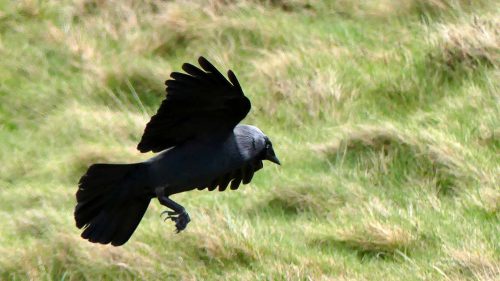
Sometimes they leave flying off until you’re almost on top of them, as this Jackdaw did.

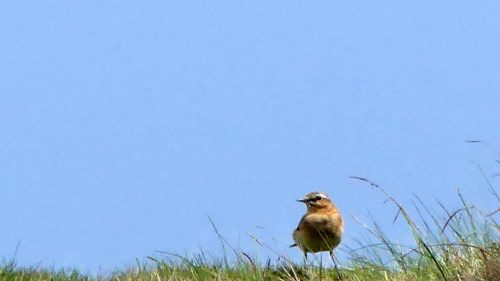
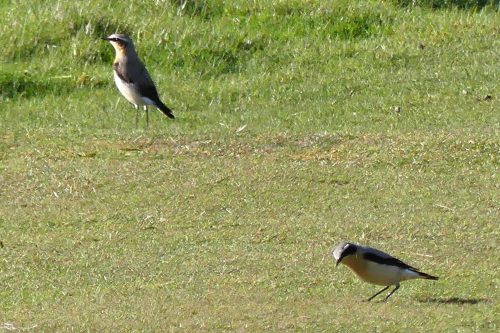
Fond as I am of the Corvids, the unexpected sight of this elegant male Northern Wheatear was a lot more exciting.

Northern Wheatear-Oenanthe oenanthe- Welsh: Tinwen y Garn

and the excitement was doubled when a more softly plumaged female popped up onto the top of a hillock.

Absorbed with the female wheatear a distance away, a Meadow pipit popping up onto a hummock close by me took me by surprise, but a sighting at last and some photographs! It was hunting and I was pleased to get a pic of it with an insect in its beak.

Meadow pipits, in common with the majority of basically brown birds don’t get much of a write-up in the bird books. They’re mostly described as something like ” a small, brown, streaky bird, the most common songbird in upland areas, where it’s high piping call is a familiar sound’. Perhaps because of their lack of glamour we take them too much for granted, as according to the RSPB, ‘Meadow pipit numbers in the UK have been declining since the mid-1970s, resulting in this species being included on the amber list of conservation concern.’

Meadow Pipit- Anthus pratensis- Welsh-Corhedydd y Waun

Meadow pipit with insect

It’s strange that we  give such high praise to the similar-looking Skylark and the not-dissimilar Song Thrush and are so dismissive of the pipits. Is the bias based on the fact that the latter sing delightfully and pipits not so much? For sure our hills and uplands would be lonely without them, so perhaps we could appreciate them more and enjoy them at every opportunity.

There are little wildflower treats hidden down in the grass like this pretty violet.

13:25 As usual I’d been led astray by the birds and had to put a spurt on and get to the top in time to start my ‘shift’. As I said earlier it was breezy on this side of the Orme, but crossing the top and starting down the other side I was suddenly fighting to make progress against a continuous very strong head wind! Checking the wind gauge inside the visitor centre it indicated it was blowing in from a North-north westerly direction, so it felt cold too despite the sunshine. I anticipated selling more hats and gloves!

4:50 Finished for the day I retraced my steps along the trail back down towards where I left my car. On my own time now I was free to take my time and paused to admire the view over towards the Little Orme and beyond. The post tells you that this is the way to The Town (Llandudno).

A closer view of the Little Orme shows its intact, non-quarried side which was deliberately preserved to present a much prettier view to visitors and residents of Llandudno.

A little further on there is an interpretation panel that reminds you that this is the ‘Historic Trail’ and informs that 800 years ago you would have been looking down onto one of perhaps three villages established on the Orme, whose inhabitants would have grown crops and raised animals to eat or trade. I was hoping the wheatears may still be around and I was in luck – I soon spotted a female.

The sun was lower now, creating shadows and highlights and the wind, stronger now, rippled across the long silvered grass, creating a magical almost alien landscape. In amongst it I realised there were more Wheatears, another three birds.

All Wheatears spend winter in tropical Africa, heading northwards via Spain in the spring. Those that breed in the British Isles sometimes arrive on our coast as early as late February, but mainly during March, with males arriving ahead of females. They move inland to  breed.

GREENLAND WHEATEAR

It is possible that the birds I saw here today belong to another race, known as the Greenland wheatear, which arrives a little later in April. Many wheatears make a refuelling stopover in North Africa, but as the Greenland wheatears fly furthest, they need to put on more fat before leaving and spend longer at stopovers. They have a long journey ahead to their breeding sites on the other side of the Atlantic. From Britain they fly northwest across the sea, via Iceland, until they reach the Arctic tundra of Greenland and northern Canada. By June they will have started to breed there.

Wheatear & Meadow pipit

Whichever they were I was appreciating some lovely views of the two males and two females foraging together in the long grass, using the little hillocks as look-out platforms to survey the ground around them for likely prey.

Female wheatear

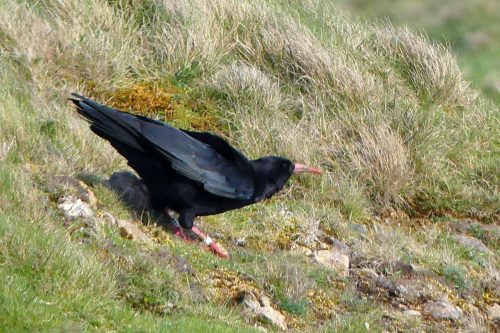
Then a distraction; a black bird flew in that I may have dismissed as a Jackdaw had it not called out. This was a Chough. It had landed somewhere behind a particularly hillocky part of the hillside, which is also pitted with well-disguised sunken craters. You have to watch your footing if you risk going off the proper trails.

Landscape pitted with sunken craters

I walked carefully until I spotted the bird, almost up to its beak in the long grass.

It had its back to me, eventually turning enough to show its diagnostic curved bill and legs, these are bright red in an adult bird, but this was a juvenile so it hasn’t quite got that far yet and its are more of a dull orange colour.

Chough, Red-billed chough – Pyrrhocorax

It didn’t stay for long before taking off, but it’s always a treat to see them at all, especially this closely.

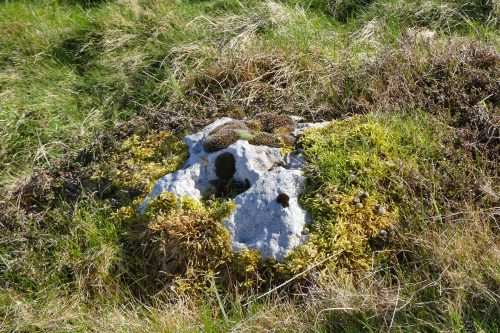
Making my way back to the main track I noticed this rock, a little island rising out of a sea of grass and heather, it was almost totally encrusted with white lichen and embellished with mosses.

There was a lovely patch of violets growing in a grass-lined crater too.

I spotted two Wheatears perched on the top of a gorse bush; a male and a female. The birds spend most of their time on the ground, travelling in hops or runs on the ground, so it’s quite unusual to see them perched up higher.

I couldn’t have asked for a prettier picture than a handsome male Wheatear perched amongst golden-flowered gorse.

I liked the two images below too; perfect records of the birds’ exact location!

180425-GO-1709-Female wheatear on post
180425-GO-1709-Male wheatear next to post

Two males together on the short turf of the trail

And one last image of a nicely posed one on his own.

17:16 Walking on down I spotted three bunnies on high alert, in poses that could have come straight out of Watership Down.

Rabbit-Oryctolagus cuniculus


But then I saw the new Peter Rabbit film during the Easter holiday too and thought this one, which I think may be the ‘big bunny’ of a previous post, may have seen it too – he’s got Peter’s pose to a ‘T’.


180425-GO-1716-Bunny 1
180425-GO-1716-Bunny3

And wouldn’t you know? After all my efforts to find a Meadow pipit, there was one posing on a rock almost in front of my parked car!

It flew down to the ground and looked back over its shoulder at me as if to say

“what kept you? I’ve been here for hours waiting for you!”

It allowed me a couple of photographs, then took off, leaving a lone Jackdaw to patrol the layby edge for his supper.

On the way down I had to stop just past the church as these little Goldfinches fluttered down onto the bare ground of a bank where they must have spotted food potential.

180425-GO-1730-Goldfinches on bank past church 1
180425-GO-1730-Goldfinches on bank past church

The views were stunning as always; good today as the mountains were more clearly visible than usual and the clouds above added to their drama.

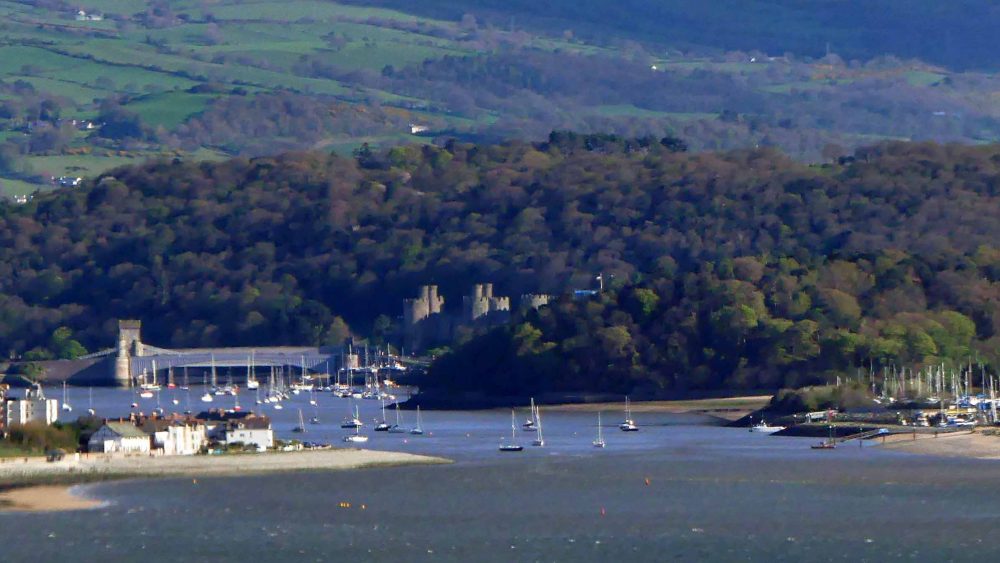
17:45 The view of the Conwy Estuary was stunning too, the sun was hitting the castle perfectly so it stood out from the trees, you can clearly see the road bridge that takes you across the river to the town and there were boats on the water….. the perfect scene for a painting.

The view of the sea meeting West Shore wasn’t bad either.


Share this:

  • Click to share on Facebook (Opens in new window) Facebook
  • Click to share on Pinterest (Opens in new window) Pinterest
  • Click to share on X (Opens in new window) X
Like Loading...

The Windhover

09 Monday Oct 2017

Posted by theresagreen in bird behaviour, birds of Wales, Birdwatching on North Wales coast, Little Orme, Wildlife of the Wales Coast Path

≈ 13 Comments

Tags

falco tinnunculus, kestrel

September 15th – Little Orme – Angel Bay

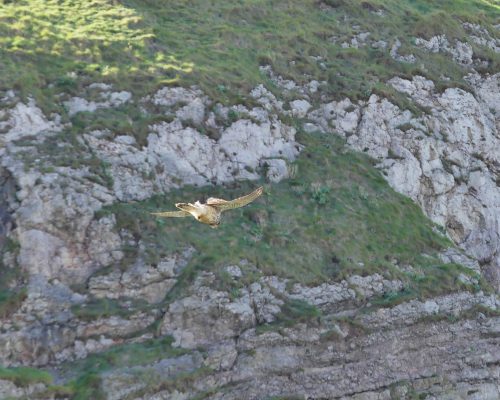
15:00 – Walking towards Angel Bay, it was sunny and eye-squintingly bright but as always of late it felt cool as there was a strong wind blowing in off the sea. Heading for the cliff edge to see if there were any seals about, I was distracted by the sight of a Kestrel hovering almost motionlessly at the edge of the cliff peering intently down. I have had some of my best views of these charismatic little falcons here on the Little Orme, but it’s not every day that you’re graced with such a close presence of one that was clearly totally absorbed in hunting mode and seemingly oblivious to the small audience gathered beneath it. 

As I got closer the bird swooped away to land on the rocky cliff to the right of the bay.  I tried to get some shots of the landed Kestrel, failing to get the images I’d have liked as I was distracted by a lady asking if I would use my zoom lens to check out the details of a far distant ship! If only I was better at saying no! I did see that the bird had a chestnut head though, which is the colouration of females of the species; males have a blueish-grey head.

Fortunately it didn’t fly far away, just headed for the other side of the bay, now mostly in shade. It suddenly looked small and fragile against the bulk of the cliff, but despite being buffeted by the strong wind it held its position, hardly moving.

Another brief landing then it rose again into the air, hovering in front of us at not much more than eye-level. Perfectly beautiful and an amazing opportunity to see the bird from all angles.

The bird dropped down slightly, showing off the lovely rich chestnut-brown plumage of its back. A similar shade beginning to colour its tail feathers further confirmed this was a female, a young one I think. Young males also have a chestnut head but grey tails and adult males then have both a grey head and tail. Females are slightly larger than males.

Common English name: Kestrel, Common kestrel Scientific name: Falco tinnunculus Welsh: Cudyll coch Local and other names: Windhover, Hoverhawk, Standgale, Creshawk.

The scientific name is taken from the Latin falco = falcom, which translates as sickle, referring to the birds’ hooked talons and the Latin tinnulus, which translates as shrill-sounding. The old country names Windhover, Hoverhawk & Standgale all acknowledge the birds’ unsurpassed mastery of the hovering technique.

The next image is not sharply focussed but I love the way the bird is looking back over her shoulder as if to check if we were all still watching.

HUNTING AND HOVERING TECHNIQUE

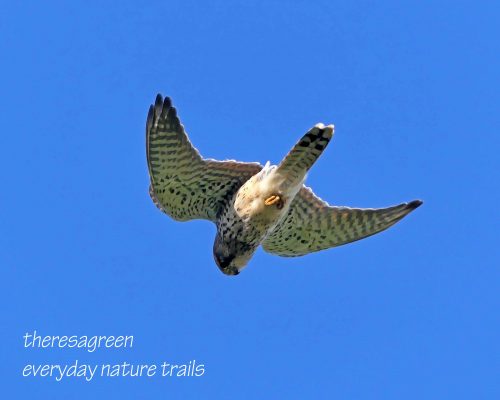
A hunting Kestrel typically flies along until it either spots prey or a spot where it is likely to find something. It pauses, then hovers with deeper wing-beats and tail fanned out and pointing downwards for stability; they always keep their head into the wind when hovering. For a few moments the bird remains perfectly motionless in mid-air except for the rapid vibration of its wings. It may then shift its position by a few metres and hovers again, intently scanning every centimetre of the ground below for the slightest movement that may give away the presence of a small rodent; little escapes its telescopic vision. Once prey is detected the bird drops down in stages before making a final pounce and grasping its target with its talons.

During the course of my watching the Kestrel was harassed several times by Jackdaws attempting to drive it away and even by a pair of larger Crows, but she was undeterred and held her position, barely flinching.

CONSERVATION STATUS

Apart from the Game Laws, no measure for the protection of wild birds in Britain existed before the year 1880. Prior to this date, gamekeepers and farmers were responsible for destroying all kinds of birds they suspected as being injurious in any way. Kestrels, along with Barn Owls and Tawny Owls, all of which would have been doing far more good than harm in their controlling of rodents, were accused of taking young Pheasants and therefore on the ‘hit list’ in areas where game birds were reared.

Even twenty years ago the sight of a Kestrel hovering over a motorway verge used to be a fairly common sight, but sadly not so much these days. Drops in Kestrel population figures caused concern in the late 1950s and 1960s when they were reduced to low numbers: changes in farming practices are believed to have been the primary cause. Their numbers have subsequently recovered somewhat and according to the British Trust for Ornithology(BTO), the Conservation Status of the Kestrel in Britain is now Amber and their breeding population is currently estimated at 45,000 breeding pairs. Across the rest of Europe numbers are greater and generally the Kestrel population is currently of ‘Least Concern’.

Kestrels are to some extent migratory. Other than during the breeding season they  move from one part of the country to another, and large numbers cross from our southern coasts to Europe and beyond during the winter to be replaced by others that come here from farther north. Despite being a protected species, Kestrels are as vulnerable as any other species of bird on migration that passes over countries still permitted to shoot certain wild birds. As recently as 2015, the hunting season in Malta was brought to an end three days early when a man shot dead a Kestrel.

Maybe the one I watched was here feeding up to make such a journey herself, in which case I wish her safe passage and a safe return next Spring.


Share this:

  • Click to share on Facebook (Opens in new window) Facebook
  • Click to share on Pinterest (Opens in new window) Pinterest
  • Click to share on X (Opens in new window) X
Like Loading...

The life of a Yellow Dung-fly

05 Tuesday Sep 2017

Posted by theresagreen in Insects, Nature, Nature of Wales, Wildlife of the Wales Coast Path

≈ 12 Comments

Tags

dung flies, golden dung fly, insects seen on animal dung, Scathophaga stercoraria, yellow dung fly

This post is possibly not one for the squeamish, but lately I’ve become more aware of these bright little flies and given thought to the vital role they and their kind play in maintaining balance in our environment, so decided it was time to learn more about them. Yellow dung-flies are one of the most familiar and abundant flies here in the United Kingdom and indeed throughout much of the Northern Hemisphere. They are out and about from March to November and at their peak in the summer. Anyone that walks in the countryside, particularly in areas where there are large mammals will undoubtedly have seen them. They may look a little fearsome close up, but are harmless to us, they do not sting or bite people or other animals!

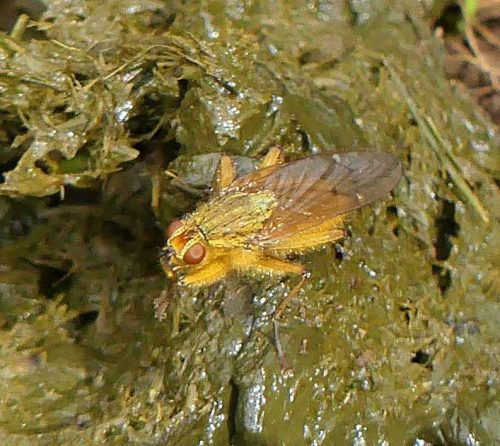
Common Yellow dung-fly or Golden dung-fly – Scathophaga stercoraria

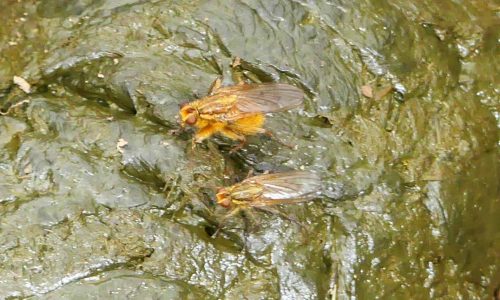
Yellow -dung-fly male

As its common name suggests, the life of a Yellow dung-fly, particularly that of the males is centred on, yes you’ve guessed it … dung! They spend most of their lives either upon it, or looking for it. They favour cow pats, but are adaptable and will settle for the dung of other large mammals such as horses, deer or wild boar if that’s what’s available. Unsurprisingly here in Wales they mostly have to settle for that of sheep.


Male and female yellow dung-flies

Dung-flies belong to the Scathophagidae family of flies which are integral within the animal kingdom in the role of  assisting in the process of the natural decomposition of dung in fields and grasslands. 

Description: 5-11mm long. Average lifespan is 1-2 months. Sexually dimorphic, males are golden-yellow with orange-yellow fur on their front legs and are larger than the females. Females are generally duller in appearance, more of a green-brown colour and have no brightly coloured fur on their front legs.

Behaviour 

Males and females are attracted to fresh dung by its scent and actually approach deposits flying into the wind. Males spend most of their time on the dung waiting for females to mate with and being predatory insects, sometimes feeding on other insects that visit the dung, such as blow flies. Females on the other hand spend most of their time foraging in vegetation and only visit dung to mate and subsequently deposit her eggs.

Reproduction 

Rival male dive-bombing a mating pair

The male-female ratio of flies on a dung pat is typically heavily biased towards males. Often several males can be seen waiting for a female to arrive, so if and when one does, competition to mate is high: the smaller, outnumbered females don’t have much say in choosing their mate.

The act of copulation lasts 20 to 50 minutes during which the couple may be subject to aerial attacks from rival males attempting to dislodge the male. When the act is completed, the male attempts to guard the female from the attentions of other males, although both males and females often mate with several individuals.

Life-cycle

The adult dung-fly is mainly carnivorous, catching and eating smaller insects, but they also eat nectar. After mating females lay their eggs on the dung, where she selects small ‘hills’ on its surface, deliberately avoiding depressions and sharper pointed areas. This strategy is aimed at preventing desiccation and drowning thus giving eggs and offspring the greatest chance of survival. Depending on ambient temperature eggs hatch into larvae after 1-2 days. Larvae burrow quickly into the dung for their protection and proceed to feed on it; they also predate on other insect larvae also living in the dung. They grow rapidly and after 10-20 days the larvae burrow into the soil around and beneath the dung where they pupate.

Environmental influences 

The Yellow dung-fly has a short life cycle, a factors that has made them of interest to scientists, who have been able to study not only the insects themselves but also the effects various environmental factors has on them. For example:

The viability of a clutch of eggs depends strongly on the environment. In warmer climates a sharp drop in population occurs during the summer when temperatures increase to 28° or above. This does not happen in places with a colder climate such as Iceland, Finland and the north of Britain, nor at higher elevations.

The health of juvenile dung flies is in turn affected by the quality of the dung they inhabit, factors such as water content, nutritional quality, the presence of parasites & drugs and chemicals given to the animal that excreted it may all contribute.


Share this:

  • Click to share on Facebook (Opens in new window) Facebook
  • Click to share on Pinterest (Opens in new window) Pinterest
  • Click to share on X (Opens in new window) X
Like Loading...

A Windy Wildflower Walk II

27 Sunday Aug 2017

Posted by theresagreen in Butterflies of Wales, calcareous grassland, coastal walks, Nature of Wales, North Wales Wildlife Trust, Rhiwledyn Nature Reserve, Wales Coast Path, Wildflowers of Wales, wildflowers on limestone, Wildlife of the Wales Coast Path

≈ 3 Comments

Tags

black horehound, common rockrose, harebell, hedge woundwort, Lady's bedstraw, Nature in August, Perforate St John's Wort, speckled wood, water mint, yellow dung fly

August 3rd

Part 2 – Rhiwledyn Nature Reserve -The main track

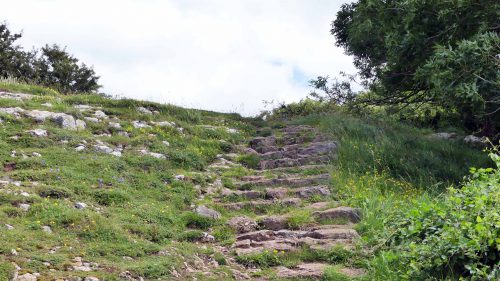
Onwards and upwards; a flight of shallow stone steps make a steep rocky section of the path a little easier to climb (except when it’s wet & they get a bit slippery).

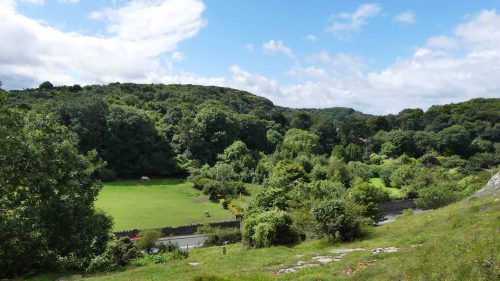
Pause here to admire the views back down onto the road and the many shades of green of the fields and woodland on its opposite side.

Looking down onto the road into Llandudno

Facing around to the way I’m going, the views to the right of me, seen over a rampant tangle of brambles and wild clematis on the reserve boundary, are extensive and stunning. At once pastoral and contained and wild and open to the elements.

On the other side of the track is the biggest and best patch of harebells that I have seen for years, a truly beautiful sight.

Harebell- Campanula rotundifolia

I can’t resist sitting to watch them being blown and rippled by the wind and am captivated by their charm. For me this little flower has it all. Beautiful in colour and form, they have delicacy and fragility but also great adaptability and resilience to an often hostile environment. Each flower had turned its bell back to the wind to reduce its impact; their slender but tough and wiry stems having the flexibility to bend to the wind, not break. A life lesson in a wildflower!

There were yet more of the little beauties a little higher up on the slope contrasting delightfully in colour and form with frothy lemon-yellow Lady’s bedstraw. I clambered up rather inelegantly to take a closer look. Amongst other plants, these had grown taller and in a more sheltered spot, their bells were turned to the light rather than away from the wind.

Before going back down to the track, I take another look at the glorious view across the bays to the Clwydian Hills and with sheep where they are supposed be.

click to enlarge

Back on track there is a change in ambience and habitat. There are small trees and shrubs on the boundary with the farmland sufficient to cast shade, and the sloping ground on the other side provides a windbreak. The trees are mostly hawthorn, prevalent throughout the headland as its one of the few plants not grazed by sheep or rabbits and again, tough enough to withstand exposure to fierce salty winds.

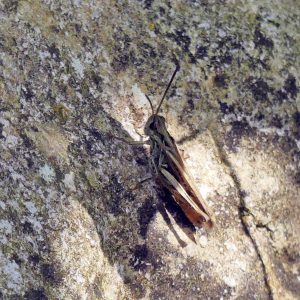
I spot a movement and see a small Grasshopper jump onto a lichen speckled rock catching dappled sunlight; the perfect place to soak up a little warmth whilst staying camouflaged.

I round a bend in the track and see – sheep! Five naughty trespassing sheep! They are strictly banned from the reserve unless invited in as their indiscriminate grazing may damage or even destroy the rarer wildflowers that grow here. Fencing prevents them wandering into the higher part of the reserve from the rest of the Little Orme where they are not restricted, so I think they got in at this field level, no doubt irresistibly tempted by the sight of the lush long grass over here. I tell them they should return to their field, but can’t see where they may have got through and they pay me no heed anyway, just amble away showing me their bottoms.

I let them get ahead, the last thing I want to do is frighten them and send them scattering and concentrate on the patch of golden flowers I see amongst the long grass on the slope. I thought at first it may be Goldenrod as I’d seen some on the roadside earlier, but soon realised it was a Hypericum – St.John’s Wort.

Another plant with several species that share the same common name, but this is the one I am most familiar with and has all the right features to be Perforate St John’s Wort – Hypericum perforatum.

St John’s Wort-Hypericum perforatum

click to enlarge

Black horehound – Ballota nigra

I apologise, but need to digress a little here to explain the significance of my next plant. Earlier on in the summer a group of NWWT members were treated to a walk around this reserve guided by its manager, Rob and a guest expert botanist, Nigel. It was a brilliant walk on many levels and we learnt a lot about our special flora and its history, about its fauna and the trials and tribulations of modern Reserve management. Typically as on any walk, even guided group ones, I lagged behind snapping interesting stuff and in a rough bramble-and- nettle patch (in the pic above), spotted the plant to the right, which is still going strong. Yet another minty-looking one I didn’t recognise. I took hasty photographs and hurried after the rest of the group. No-one else immediately recognised it either, so Nigel suggested I email the pics to him later on so he could have a better look. From them his best guess was that it was Black Horehound, reservations having been that this was a vigorous, tall specimen of a plant that usually is, in his words, ‘much scruffier-looking’ He also mentioned it smells unpleasant, so this time I had a closer look and bruised and smelt a leaf. It definitely did not smell pleasant and as all its other important bits match the botanical specs, I’m taking that as another one to add to my list of wildflowers-I-will-know-how-to-identify in the future. (Unless anyone has a different idea……?)

It’s amazing what you can see in five minutes along a short shady stretch of track. I watched a dragonfly patrol up and down at speed, pausing only in his labour several times to ‘buzz’ me and let me know I was in his space. I was hoping he’d stop so I could at least see what he was, but no, much too busy. There was yet more mint here, and one I recognised from the distinctive scent of a crushed leaf – this is Water Mint-Mentha aquatic. A similar-looking plant is Corn Mint, but it grows shorter than this and doesn’t have a ‘terminal’ flowerhead (one that crowns the top of the stalk).

Water mint-Mentha aquatica

A fresh-looking Speckled Wood rested on a sun-warmed stone on the path

Speckled Wood

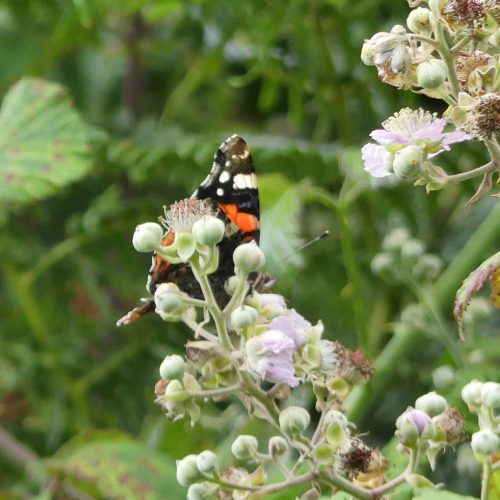
and a Red Admiral flew across to seek out the nectar of bramble flowers

Red Admiral – Vanessa atalanta

There is a farm gate here which I checked for security, but tightly closed there would have been no exit for sheep. Another great Clematis-framed view from here, considerably enhanced by the clouds I think, although they were blocking out the sun at this point.

click to enlarge

At the side of the gate another member of the Lamiceae (mints & dead-nettles) family, this one I know well, the Hedge Woundwort Stachys arvensis.

Yellow Dung Fly – Scathophaga stercoraria

I moved on and round the next bend found evidence I was still on the trail of the errant sheep; a smallish neat and fairly recent deposit of fresh dung. And where there is dung there may be Dung-flies, one of my favourite insects, although I’m not exactly sure why. Perhaps because I’m keen on recycling? As I hoped, a single male Yellow Dung Fly had laid claim to the heap of treasure and was intent on guarding it. A bit of a drama then ensued, but I’m saving that for later.

To the top

I had reached the Reserve boundary, marked by a gate through which the two marked ‘Trails’ continue on to cross the rest of the Little Orme headland. There is no marked official track up to the top reaches of the reserve from here though, so getting up there is a matter of a)wanting to; b) paying attention to where you are putting your feet; c)taking care not to slip on damp grass and d) watching out for rabbit holes.

Rock-roses are still fresh and lovely up here, as is the fragrant Lady’s Bedstraw.

I followed the path chosen by the sheep; they almost always know how to find the best way upwards. They were up there now, all standing facing the view. I may have thought they were admiring it, but one of them who seemed to be in charge, maybe the mother of some of them, was bleating loudly, eliciting a response from the field below. Was she calling to her friends telling them about the feast to be had on this side and inviting them over?

Once more I reminded them they were not welcome here, but Mrs Boss Sheep just gave me ‘the look’ that clearly said “mind your own business and what are you doing up here yourself?” Once past them it became more overgrown and not as clear where to head, but I kept going in the general direction of where I wanted to be and hoped for the best. I heard a bird making some squeaky sounds and spotted him as he perched atop a gorse bush, a speckly young Robin beginning to get his adult feathers. I realised this was the first bird I’d seen and heard so far on this walk apart from gulls and the occasional cormorant flying overhead.

I also realised it was lunchtime, so time to find a sheltered spot, take a break and sit and admire the sheep’s-eye view.


Share this:

  • Click to share on Facebook (Opens in new window) Facebook
  • Click to share on Pinterest (Opens in new window) Pinterest
  • Click to share on X (Opens in new window) X
Like Loading...

A Windy Wildflower Trail

25 Friday Aug 2017

Posted by theresagreen in Butterflies of Wales, calcareous grassland, Nature of Wales, North Wales, North Wales Wildlife Trust, Rhiwledyn Nature Reserve, Wildflowers of Wales, Wildlife of the Wales Coast Path

≈ 15 Comments

Tags

carline thistle, centaury, common blue, common calamint, Gatekeeper, goldenrod, harebell, montbretia, Nature in August, ploughman's spikenard, wild carrot, wild fennel, yellow-wort

August 3rd – Weather – intermittently sunny, warm but with a very strong cooling wind. 

As August began I wanted to get out to see wildflowers. This is one of my favourite times of year for that, when there is every chance that there may be earlier flowering plants still around and the late-summer bloomers should be at or reaching their best. Most of the sites I visit regularly are good for wildflowers, but as they are mostly located on hills or headlands and exposed to the elements, they would not be particularly enjoyable on a strongly windy day like today and taking photographs would be difficult. I decided on Rhiwledyn Nature Reserve, one of my favourites as it covers a range of interesting habitats within its 12 acre site and as it is located on the eastern side of the Little Orme there was a chance that much of it would be sheltered from the worst of the wind.

There are three ways to access the reserve, all of which require a bit of an uphill hike. One route is from Llandudno, another from the other side of the Little Orme, but for me the most interesting route to its main entrance is along the path at the base of a section of the Orme that runs up Penrhyn Hill. Marked as a 10% gradient, this is a steepish stretch to walk, but worth the effort as the rock supports an array of plants, both wildflowers and some garden escapees, and is a nature trail in itself. This provides me with the perfect excuse to amble up the hill and take frequent excusable pauses for breath rather than stride purposefully along.

Looking back along Penrhyn Hill towards Penrhyn Bay. The hill in the centre background is Bryn Euryn

Part 1 – Penrhyn Hill roadside to the reserve

My first sighting was of a male Common blue butterfly taking a break from his battle with the wind on the flower of a hop trefoil, low down in the vegetation. Amongst long grass and ivy, a grey leaved Yellow-wort; this is an annual favouring short calcareous grassland but is found in a variety of spots throughout the headland.

Common blue
Common blue
Yellow wort-Blackstonia perfoliata

There were several clumps of a plant that was definitely a member of the mint family with strongly aromatic leaves. I don’t know what it is yet.

  • since publishing this Suzanne has kindly suggested in a comment that it is Common calamint Clinopodium ascendens. This is a mint that grows in dry grassland, hedgerows and verges, often on chalk or limestone soils, so habitat fits perfectly.

Common calamint – Clinopodium ascendens

And another aromatic plant – Wild Fennel, growing as tall as me, in front of gorse.

A pretty snail clung to the leaf of a Valerian plant; I lifted it gently to check the colour of its underside lip – brown – then replaced it. A few bees were braving the breeze, mostly Buff-tailed bumblebees. I photographed one on marjoram, which may or may not be a wild plant.

Brown-lipped snail
Buff-tailed bumblebee on marjoram

There is Wild Carrot in various stages of flowering from tight buds to maturing seedheads. Most often found in rough grassland, near the sea and again mostly on chalky soil. This is one of the easier of the white umbellifers to identify, with feathery leaves and bracts beneath the flowerheads and always a red flower in its centre.

Wild Carrot-Daucus carota

Windy days are not good for butterflies, but I did see a couple of Gatekeepers. Both sticking close within the vegetation, one found Marjoram to nectar on, the other attempted to bask on a Wild Clematis leaf. Both were faded and looking a little the worse for wear.

Gatekeeper on Marjoram- fruits of Herb Robert behind
Gatekeeper
Gatekeeper

A flowering Goldenrod plant sprawled out across the edge of the path.

Goldenrod – Solidago virgaurea

So too a sprawling patch of Montbretia

Montbretia

and this one with its flowers like small dandelions, which I think may be one of the Hawkweeds. Another one to work on.

A stone wall marking the boundary of the farm’s land breaks the vegetated path edge, but behind it the small field is golden with Ragwort and long seeding grass. There were butterflies in there, mostly Whites, but it’s off-limits so couldn’t get a closer look.

Trees on the edge of the small wood in the background of the photograph now cast shade over the path and its edge and there are less flowering plants. There is plenty of ivy, Wild Clematis a flourishing Wild Cabbage, more of the not yet id’d mint and a clump of the usually sun-seeking Rockrose.

Rhiwledyn Nature Reserve

Half an hour after parking my car I finally reach the entrance to the reserve. The sun is shining and a fly basks in the warmth reflected by the glass of the narrative board.

A pretty clump of Marjoram flowers at its base.

I turned left to first walk the short length of the path at the base of the headland where it meets Llandudno Bay. The strength of the wind here took my breath away and walking into it head on was a challenge, but now I’d got this far I wanted to carry on to the far end of this eastern side of the headland as far as I could. 

Up on the cliff a patch of harebells gave a rare opportunity to get close to these lovely little flowers without having to lie on the ground. They look delicate and their thin stems seem fragile, but they are tougher than they look and were holding their own in today’s wind.

Spiky starry Carline thistles caught my eye. Kneeling to photograph them I see they are growing amongst bird’s-foot trefoil and that there is another little star there too – a tiny white flower of Pearlwort.

There is Yellow-wort flowering next to Wood sage which is setting seed.

Another Carline thistle, this time with Eyebright and an unwelcome invader, cotoneaster, one of the banes of the lives of hard-pressed reserve managers.

Nearby, more Harebells with a little pink Centaury and the grey felty leaves of Mouse-eared Hawkweed.

I was almost relieved to reach the end of the track and be blown back to retrace my steps to the beginning of the upward track.

First I went ‘off piste’ a little to reach a stand of golden yellow Ploughman’s Spikenard.

Ploughman’s Spikenard – Inula conyzae

Then a scramble back down to the start of the track proper. A badged wooden post here reassures you that you are officially following both the Wales Coast Path and the North Wales Path.


Share this:

  • Click to share on Facebook (Opens in new window) Facebook
  • Click to share on Pinterest (Opens in new window) Pinterest
  • Click to share on X (Opens in new window) X
Like Loading...

A Warbling Whitethroat

23 Friday Jun 2017

Posted by theresagreen in birds singing, Birdwatching on North Wales coast, Little Orme, Nature of Wales, Wildlife of the Wales Coast Path

≈ 10 Comments

Tags

birds singing, Llwydfron, sylvia communis, whitethroat

I saved this treat from the end of my walk on the Little Orme as I thought it would be better enjoyed on its own.

I heard the Whitethroat singing from somewhere in front of me, obscured from immediate view by gorse bushes and a bend in the track. I walked forward slowly and there he was, at the top of another bare stem, this time of Elder. A perfect, close, unrestricted view of him warbling away, declaring himself king of all he could survey, which is a great deal from where he was perched, to whom-so-ever it may concern.

The Whitethroat is a summer visitor and passage migrant to Britain that may be seen in all parts of the country and most frequently choose arable land, scrub and reedbeds as nesting sites.  They arrive during April-May and leaving in late September-early October to winter in Africa, some heading as far south as South Africa.

Whitethroat- Sylvia communis Welsh: Llwydfron

A medium-sized, long-tailed warbler, the male is grey, dusted with rust brown above, with bright chestnut-brown fringes to the wing feathers, the head is a pale grey, the breast pinkish-buff and the throat a bright white. The bill is greyish-brown and the legs are pale brown. The eye is pale brown with a white eye ring. Females are similar but brown on the head and nape where the male is grey.

Whitethroat singing

Warblers in general are often described as ‘skulking’, but the Whitethroat is not quite as secretive as some; the male will perch in full view to deliver its brief song with gusto.

I could see flies in the air around him, but he made no attempt to catch any of them, he was far more intent on singing although he did take a few short breaks to do a bit of preening. I think he had a bit of an itch.

I watched and listened for some time and took a few photographs before risking taking this short video, which is not the most professional you’ll have ever seen, but it gives more of the bird’s personality than a still. It’s better on full screen too.

The song is variously described as sweet, ‘scratchy’  and having a jolty rhythm. They are also very inquisitive birds and will venture to the top of a bush to investigate any intruders, before scolding them with a rapid churring call.

I hope you enjoy it as much as I did. You even got to share the atmosphere of the sunny, windy day!


Share this:

  • Click to share on Facebook (Opens in new window) Facebook
  • Click to share on Pinterest (Opens in new window) Pinterest
  • Click to share on X (Opens in new window) X
Like Loading...
← Older posts
Newer posts →
Follow everyday nature trails on WordPress.com

Enter your email address to follow this blog and receive notifications of new posts by email.

‘But it is the common species that keep the living world ticking over and provide most of our experiences of wildlife, and I would argue that maintaining the abundance of these is as important a conservation priority as maintaining the existence of rarities’. Richard Mabey

MOST RECENT POSTS

  • A Glimpse of Spring to Come January 22, 2025
  • Hunting the Wren December 28, 2024
  • Oh, Christmas Tree December 18, 2024
  • In and Out of the Ivy February 15, 2024
  • Nature’s Fireworks November 30, 2023
  • Wild Autumn along the Coast Path November 3, 2023

OLDER POSTS

LOOKING FOR SOMETHING IN PARTICULAR?

  • Pretty prickly Thistles
    Pretty prickly Thistles
  • The Foxglove - of Fairytales, Myths & Medicine
    The Foxglove - of Fairytales, Myths & Medicine
  • Fine Dining for Crows
    Fine Dining for Crows
  • Pines and Primroses
    Pines and Primroses
  • Following a river to a Fairy Glen
    Following a river to a Fairy Glen
  • Rosebay willowherb
    Rosebay willowherb
  • Wigeon in Winter
    Wigeon in Winter
  • Bryn Euryn - a walk of several parts. Part 1
    Bryn Euryn - a walk of several parts. Part 1
  • A Blackthorn Winter
    A Blackthorn Winter
  • Birds and the art of fly catching
    Birds and the art of fly catching

nightingale trails

The Walk of the Monarch Butterfly-Sendero de la Mariposa Monarca

The Walk of the Monarch Butterfly-Sendero de la Mariposa Monarca

MY WILDFLOWER BLOG: where the wildflowers are

Snowdrop

Snowdrop

most recent posts

Follow everyday nature trails on WordPress.com

Social

  • View teresamaygreen’s profile on Twitter

Enter your email address to follow this blog and receive notifications of new posts by email.

Website Built with WordPress.com.

  • Subscribe Subscribed
    • everyday nature trails
    • Join 359 other subscribers
    • Already have a WordPress.com account? Log in now.
    • everyday nature trails
    • Subscribe Subscribed
    • Sign up
    • Log in
    • Report this content
    • View site in Reader
    • Manage subscriptions
    • Collapse this bar
 

Loading Comments...
 

    %d