• Home
  • about
  • about the photographs
  • Local Nature Reserves
    • Bryn Euryn Local Nature Reserve
    • Mynydd Marian
  • Wales Coast Path
    • Grey Seals in North Wales
    • St.Trillo’s Chapel
    • Wildflowers of North Wales Coastal Paths, Cliffs and Dunes

everyday nature trails

everyday nature trails

Category Archives: Wildflowers of Wales

Lesser Celandine

27 Monday Feb 2012

Posted by theresagreen in flower folklore, flower mythology, Nature, nature of woodlands, nature photography, wildflowers, Wildflowers of Wales, woodland wildflowers

≈ 2 Comments

Tags

early spring flowers, lesser celandine, ranunculus ficularia, woodland flowers

Lesser Celandine- Ranunculus ficularia, also known in English as pilewort, small celandine, smallwort, figwort, brighteye, butter and cheese. In Welsh it is Lygad ebrill. 

Lesser celandine-Ranunculus ficaria

The Lesser celandine has been one of my favourite wildflowers since childhood. As a child growing up in Northamptonshire, a part of my walking route to school included a green lane. This was a narrow pathway with grass verges backed by hawthorn hedgerows and used as a short-cut to the village by anyone walking or riding a horse or bike. Behind the hedge on one side was a small field that was often boggy and there was a drainage ditch on the lane side to prevent it flooding. Needless to say it was damp there and generally shady; the perfect place for celandines to thrive. They were the first of the wildlowers to appear here and I looked forward to their appearance avidly. I used to think their shiny golden yellow faces captured some of the sunshine whilst it shone, then held it within their tightly closed petals to keep them warm on cold dull cloudy days. I learnt that these were not flowers to take home to my mum though, as they closed up when picked, but I remember how the sight of them used to gladden my heart, as it still does, signalling that the spring was on its way.

21/2/12-Lesser Celandines, Colwyn Bay
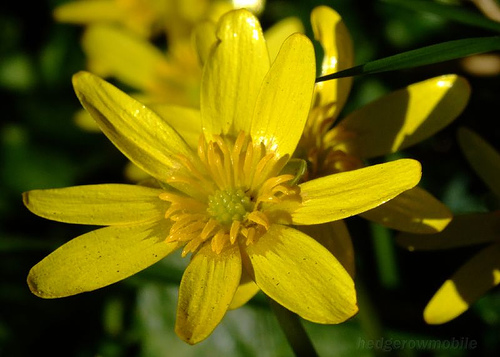
Lesser celandine

The plant itself is small (5-30cm tall). The dark green, shiny, heart-shaped leaves grow spirally arranged around long weak stalks from the base. The leaves are sometimes mottled with light or dark markings; they lie flat on the ground unless held up by surrounding plants.The flowers are bright, glossy yellow, fading to nearly white at the petal base as they age.

The Lesser celandine is one of the first flowering plants to appear at the end of the winter (February to May). Gilbert White, the famed author of  ‘The Natural History o Selborne’  reported that the plants came out on February 21, but it is more commonly reported to flower from March until May, and is sometimes called the “spring messenger” as a consequence. The flowers close just before it begins to rain, and are pollinated by bees, such as the Buff-tailed bumble bee, Red-tailed bumble bee, flies and beetles, but very few seeds are typically set. They open when few insects are around so not many seeds are produced and spread is mainly vegetative by tiny bulbils which develop in the leaf axils and these drop onto the soil as the plant dies back.

THE MEANING OF THE NAME

The plant’s  common name, lesser celandine, was mistakenly given to it when it was thought to be one and the same plant as the true or greater celandine, to which it bears no resemblance except in the colour of its flowers – both being yellow.

The word celandine comes from the Greek word chelidon, meaning swallow, the greater celandine coming into bloom when these birds arrive, and withering on their departure. The scientific name Ranunculus is Late Latin for “little frog,” from rana “frog” and a diminutive ending. This probably refers to many species being found near water, like frogs. The plant grows from root-tubers, which are said to look like bunches of figs. This explains the second part of the scientific name of the plant, ficaria, which is Latin for fig.

THE CELANDINE IN POETRY
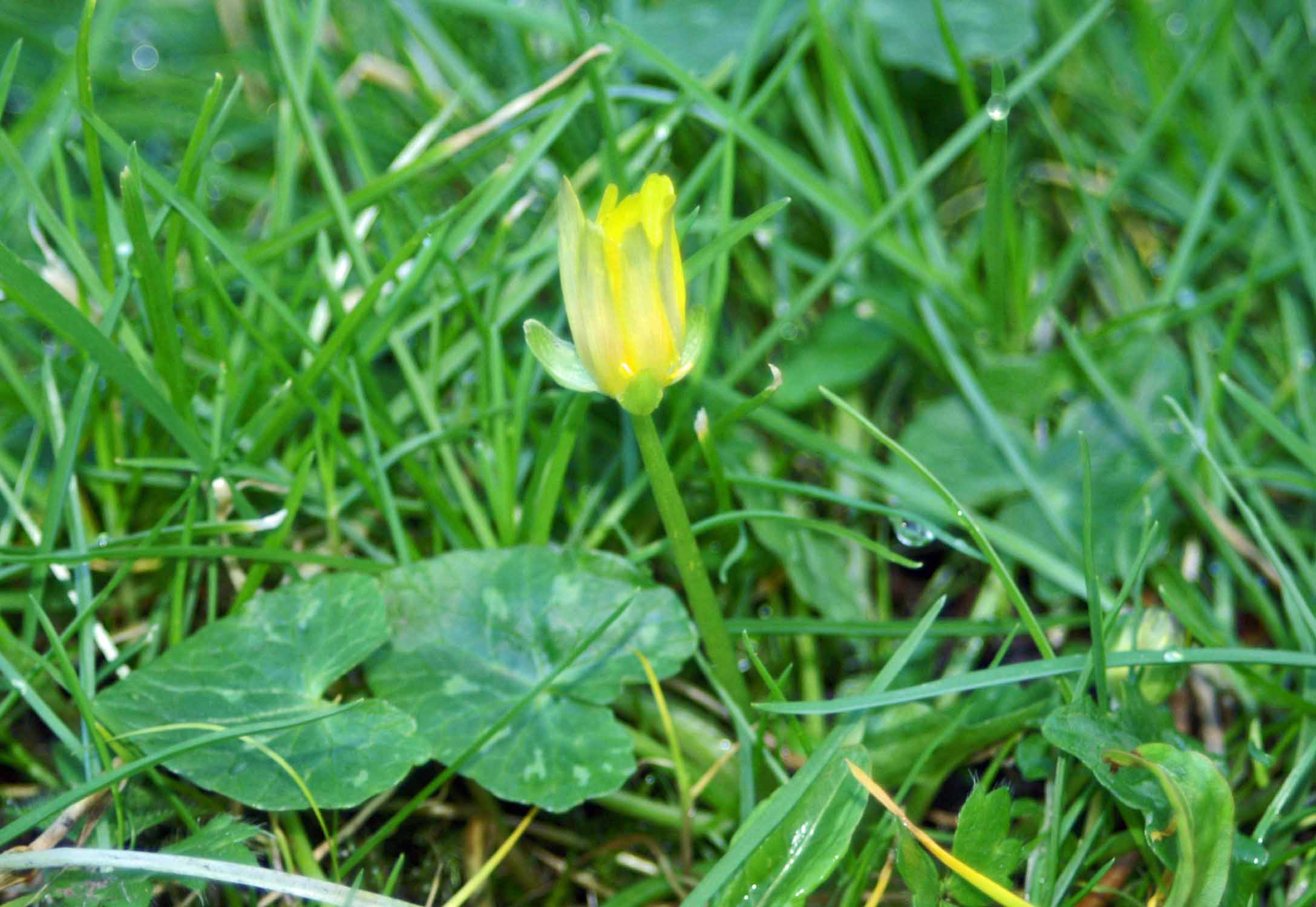
The flower folds its petals on dull and wet days

A number of poems have been written about the celandine. The poet William Wordsworth was very fond of the flower and it inspired him to write three poems including the following, which are the first two verses from his ode to the celandine:

The Lesser Celandine 

There is a Flower, the Lesser Celandine,
That shrinks, like many more, from cold and rain;
And, the first moment that the sun may shine,
Bright as the sun himself, ’tis out again!

When hailstones have been falling, swarm on swarm,
Or blasts the green field and the trees distressed,
Oft have I seen it muffled up from harm,
In close self-shelter, like a Thing at rest.

William Wordsworth

Upon Wordsworth’s death it was proposed that a celandine be carved on his memorial plaque inside the church of Saint Oswald at Grasmere, but unfortunately the Greater Celandine Chelidonium majus,  was mistakenly used.

THE CELANDINE IN TRADITIONAL HERBAL MEDICINE

The plant used to be known as Pilewort because it was used to treat haemorrhoids. Supposedly, the knobbly tubers of the plant resemble piles, and according to the doctrine of signatures, this resemblance suggests that pilewort could be used to cure piles. The German vernacular Scharbockskraut (“Scurvyherb”) derives from the use of the early leaves, which are high in vitamin C, to prevent scurvy. The plant is widely used in Russia and is sold in most pharmacies as a dried herb.

THE CELANDINE IN NON-NATIVE LOCATIONS

In many parts of the northern United States and Canada, lesser celandine is cited as an invasive species.

Share this:

  • Share on Facebook (Opens in new window) Facebook
  • Share on Pinterest (Opens in new window) Pinterest
  • Share on X (Opens in new window) X
Like Loading...

Bring back Pampas grass

28 Friday Oct 2011

Posted by theresagreen in bird behaviour, grasses, Nature

≈ Leave a comment

Tags

Greenfinch, house sparrows taking pampas grass, invasive weeds, pampas grass

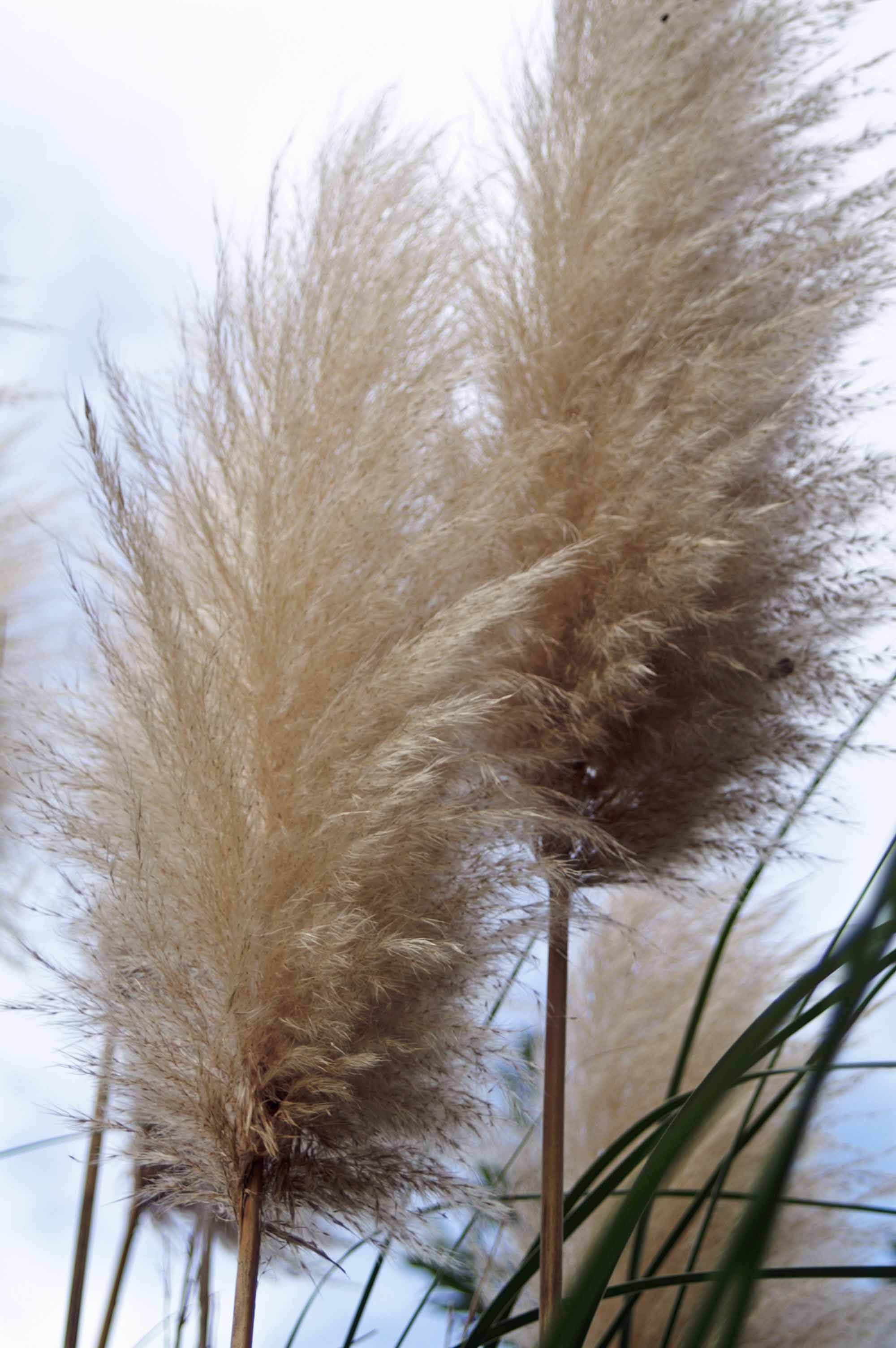
There was a large clump of Pampas grass in full flower in the Botanical Gardens in Leicester, and when I arrived back in Spain the plant in my garden is  flowering also. I like the dramatic appearance of this very large plant, the feathery flowerheads are beautiful when lit by the sun and bow and sway gracefully when the wind passes through.

The clump of pampas grass in my garden

Cortaderia selloana, commonly known as Pampas Grass, is a tall grass native to southern South America and Patagonia and is named for the areas of pampas where it is found.

Pampas Grass is a tall grass, growing in dense tussocks that can reach a height of 3 m (9.8 ft) . The leaves are evergreen, usually bluish-green but can be silvery grey; they are long and slender, 1–2 m (3.3 to 6.6 ft) long and 1 cm broad, and one of the downsides of the plant is that they have very sharp edges and should be handled with care.

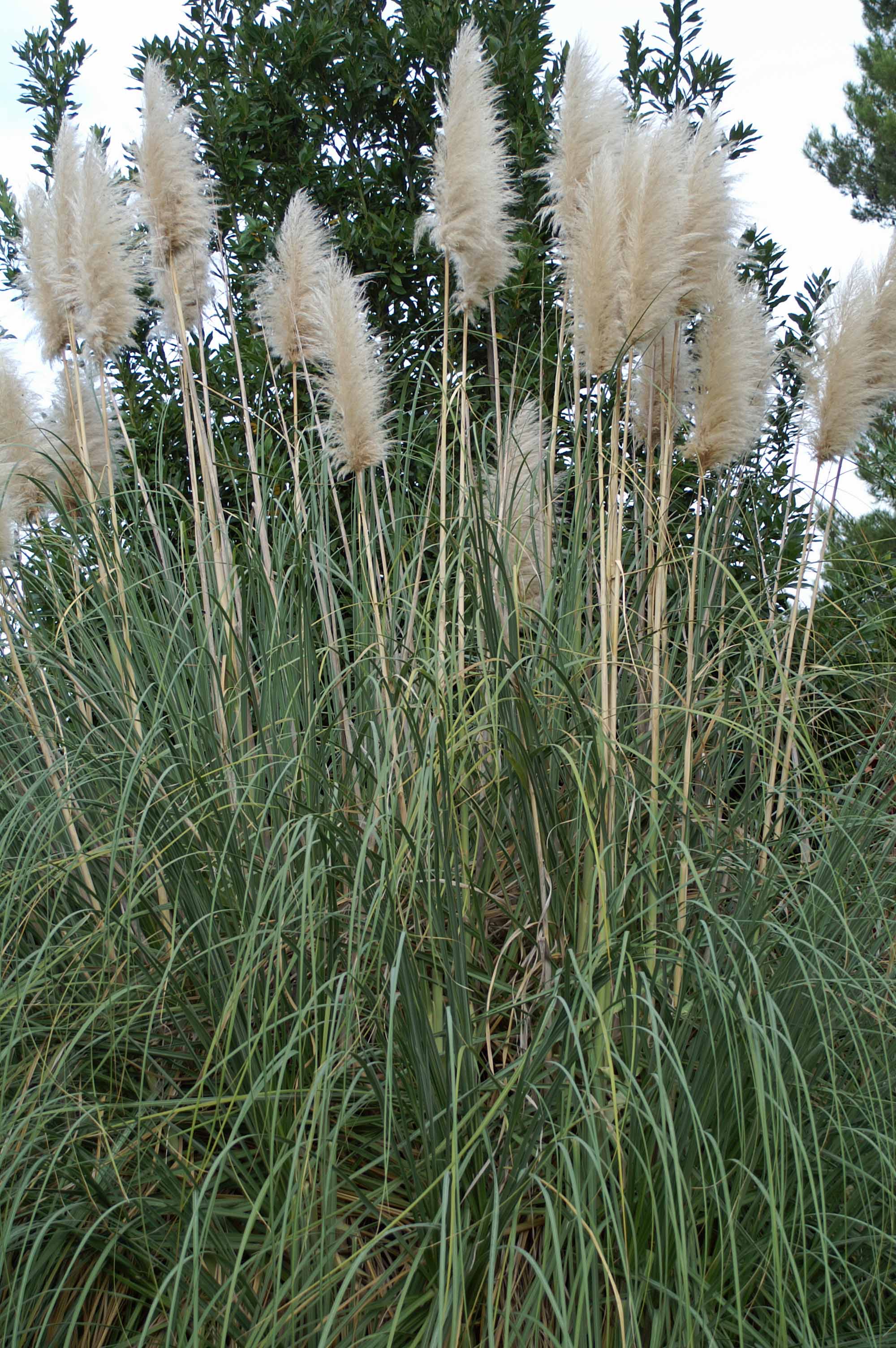
Pampas grass flowerheads

The flowers are produced in dense silvery white panicles from 20–40 cm (7.9 – 15.8 inches) long and on a 2–3 m (6.6 – 9.8 ft) tall stem.

The plant was named by Alexander von Humboldt in 1818, after the German botanist and naturalist Friedrich Sellow, who studied the flora of South America, especially that of Brazil.

Pampas grass plants may produce up to a million seeds during its lifetime

Pampas Grass is highly adaptable and can grow in a wide range of environments and climates. In some areas (for example California, Hawaii and parts of the cooler Northern areas of Spain),  it is regarded as an invasive weed, whilst in New Zealand and South Africa the plant is banned from sale and propagation for the same reasons.

I am not too clear how it is regarded here in southern Spain, but it is a frequent sight around our area where it grows on the roadsides and more particularly in our local nature reserve. It does not seem to cause concern there and is actually named on one of the information boards as being present.

House Sparrow (m) atop Pampas

The flowerheads are very long-lasting, appearing first in September, but after a winter of being battered by rain and wind, the plant begins to look rather scruffy. Despite that, I leave mine to stand beacause at some time towards the end of April or early May, the local flock of House Sparrows will begin to arrive to collect what remains of the fluffy flowerheads.

April-May-House Sparrows begin to strip the old flowerheads

It is a delightful scene; over the course of a few days the Sparrows strip the stems piece by piece, cramming their beaks with as much material as possible, then fly off with it, I assume in order to line their nests. They come in relays, both males and females and work industriously until there is nothing left on the dry stems and even pieces dropped to the ground will be gleaned. This has to be instinctive species behaviour as the House Sparrows that shared our garden in South Wales used to do exactly the same thing to the plant in our neighbour’s garden.

A male house sparrow with his beak full

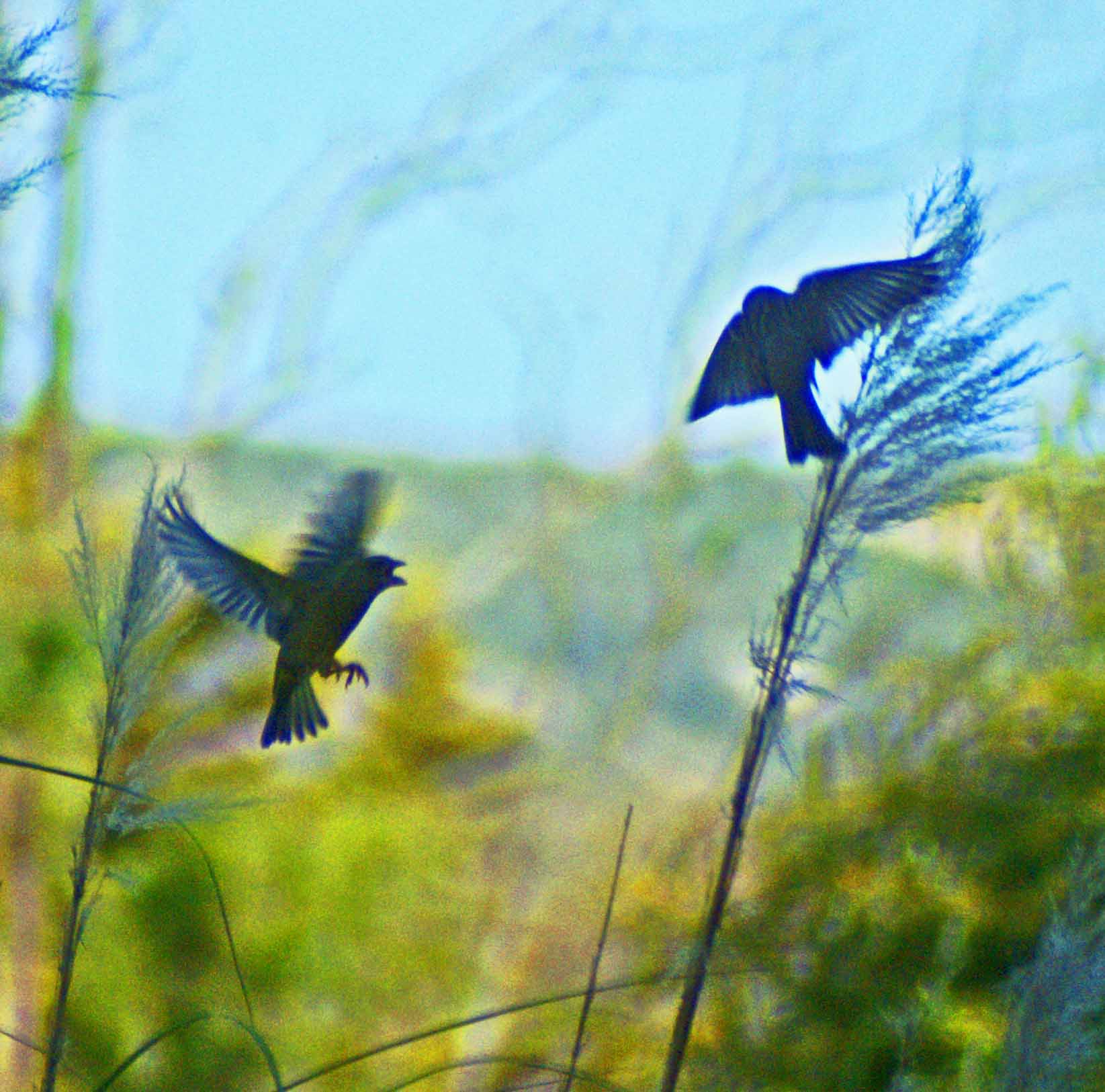
My plant grows a distance away from where I sit to watch the birds and it is in a shaded spot, so I did not immediately spot that Greenfinches sometimes join with the sparrows for a share of the grass. I am not sure whether they too take it for nesting purposes or because there may still be seeds there to eat, but they want it badly enough to squabble over. They are not the only species I’ve spotted muscling in, the last couple of years Blackbirds have also been taking a share.

A Greenfinch squabbling with a House Sparrow

Pampas as a part of social history

Pampas grass was a very fashionable garden plant back in the 1970s, advocated for inclusion by the likes of Percy Thrower and has become a gardening icon of that decade. It was equally stylish to have a large vase of the dried fluffy plumes in the living room, where they looked very decorative, (I confess to having them myself- they collected a lot of dust). In recent years the plant seems to have fallen from favour, perhaps because it is a very large and modern gardens are on the small side, or maybe it is because growing the plant seems to have acquired a new symbolism, particularly if you display it in your front garden….

(tongue in cheek this next bit, no offence intended)

Urban Myth-Swinging

A widespread urban myth is that Pampas grass is used by swingers to advertise their presence to other swingers in the area. The most commonly repeated version states that in the UK and Ireland a patch of Pampas grass is planted somewhere in the front garden to act as a signal to passers by that swingers live in the home.

I had not heard that before and have to say that my plant was in the garden when I arrived, and will remain to attract and benefit a different kind of wildlife ( fortunately a high wall conceals its presence from the sight of non-flying passers-by.)

Despite the connotations, I would still recommend Pampas grass as an addition to a garden designed to benefit wildlife, if only to enhance the lives of your local House Sparrows, just be careful where you place it!

Interesting links relating to growing Pampas grass from: The Daily Telegraph on How to grow Pampas  and The Independent- In Praise of Naff

Share this:

  • Share on Facebook (Opens in new window) Facebook
  • Share on Pinterest (Opens in new window) Pinterest
  • Share on X (Opens in new window) X
Like Loading...

On the trail of native woodland flora

02 Friday Sep 2011

Posted by theresagreen in ferns, fungi, nature of woodlands

≈ Leave a comment

Tags

feathery moss, holly, native trees of Wales, orange lichen on tree trunk, silver birch, turkey-tail fungus, woodland walk

Bryn Euryn’s woodland is home to a good number of native species of trees, including Ash, Beech, Silver Birch and Sessile Oak. There are also many large Sycamore trees, which although well-recognised and widespread in Britain are the true natives of woodlands of Central Europe.

11/8/11-Steps wind uphill through the trees

Amongst the large trees are sprinklings of native shrubs or smaller trees of Holly and the occasional Yew, with Hawthorns on the woodland edges.

11/8/11-European Holly -Ilex aquifolium

Ivy is another plant that is so widespread and commonly occurring that I was quite surprised to find it is not a native plant in Northern Europe, but hails from western, central and southern Europe.

11/8/11-Ivy-Hedera helix

11/8/11- An impressive Silver Birch -Betula pendula

11/8/11-Moss growing on the trunk of a silver birch tree

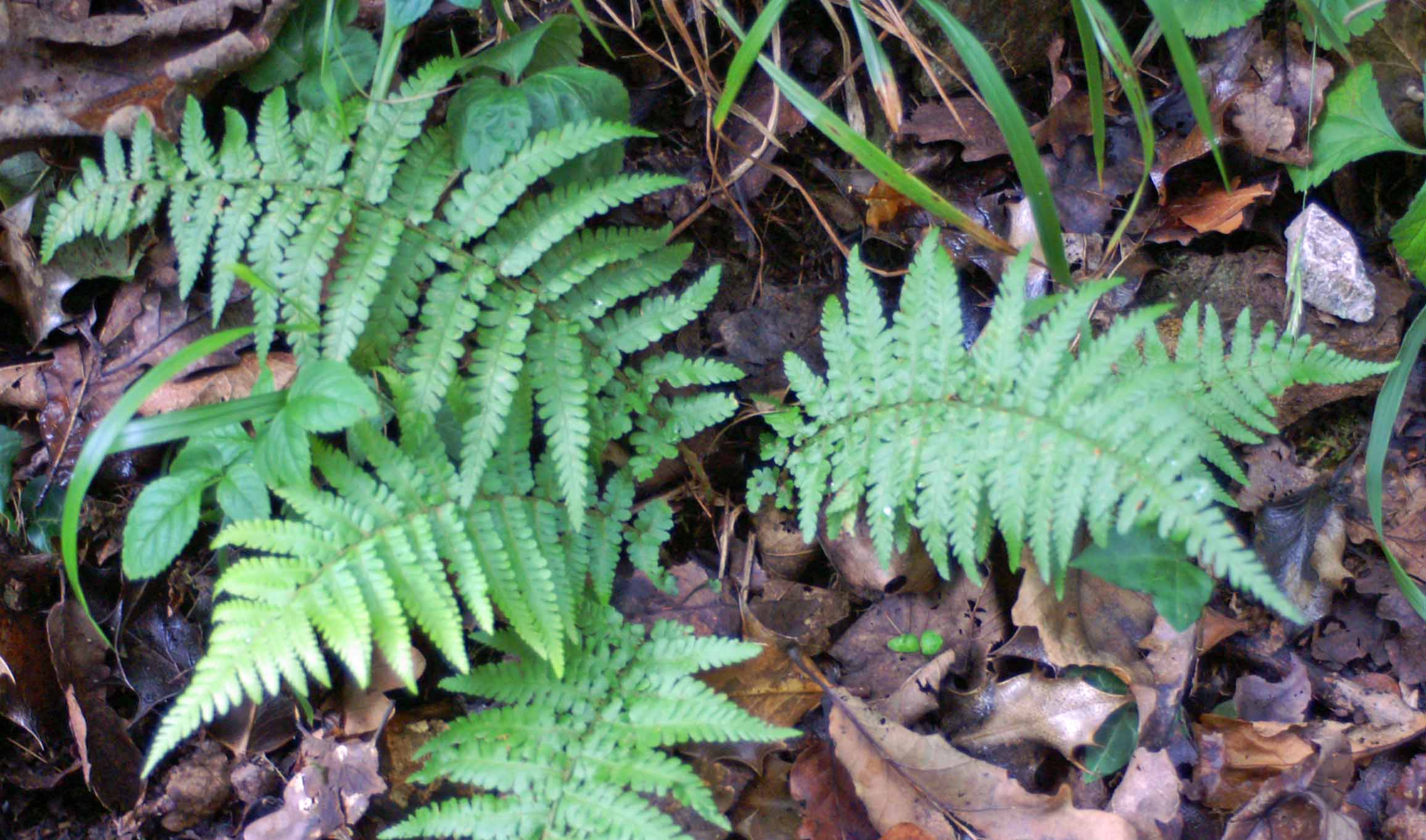
The cool shady and damp woodlands provide perfect habitat for various species of ferns, mosses and lichens too.

“Wales only occupies about 10 per cent of the land area of the British Isles but it has an extraordinary diversity of lower plants and fungi including 75 per cent of the mosses and liverworts, 74 per cent of the lichens and 80 per cent of the rust fungi. This diversity is probably thanks to Wales having such a broad range of relatively un-disturbed habitats and a small population”

http://www.plant-talk.org

11/8/11-Common Feather-moss-Kindbergia praelonga

I love coming across little ‘scenes’ such as the one below, where moss partially clothes a craggy rock which also supports a blue-green lichen and is surrounded by dried leaves and twigs. So many textures shades of colours in a very small area of the woodland floor, and doubtless many insects and micro-organisms are there too.

11/8/11-A mossy rock in a bed of dry leaves

11/8/11- Male Fern-Dryopteris filix-mas

In open spots on the woodland edge there are brambles, flowering at the moment and attracting lots of little hoverflies.

11/8/11-Hoverfly-Melangyna cincta on bramble flower

11/8/11- Mustard Powder Lichen-Chrysothrix candelaris on a sycamore trunk

The bright yellow Mustard Powder lichen or Gold Dust lichen– Chrysothrix candelaris  commonly grows on tree bark. It is widespread and common in the United Kingdom, being found on the bark of deciduous trees, especially rugged old specimens, such as sycamore, alder, oak, willow, beech, and Pinus species, normally in dry shaded parts.

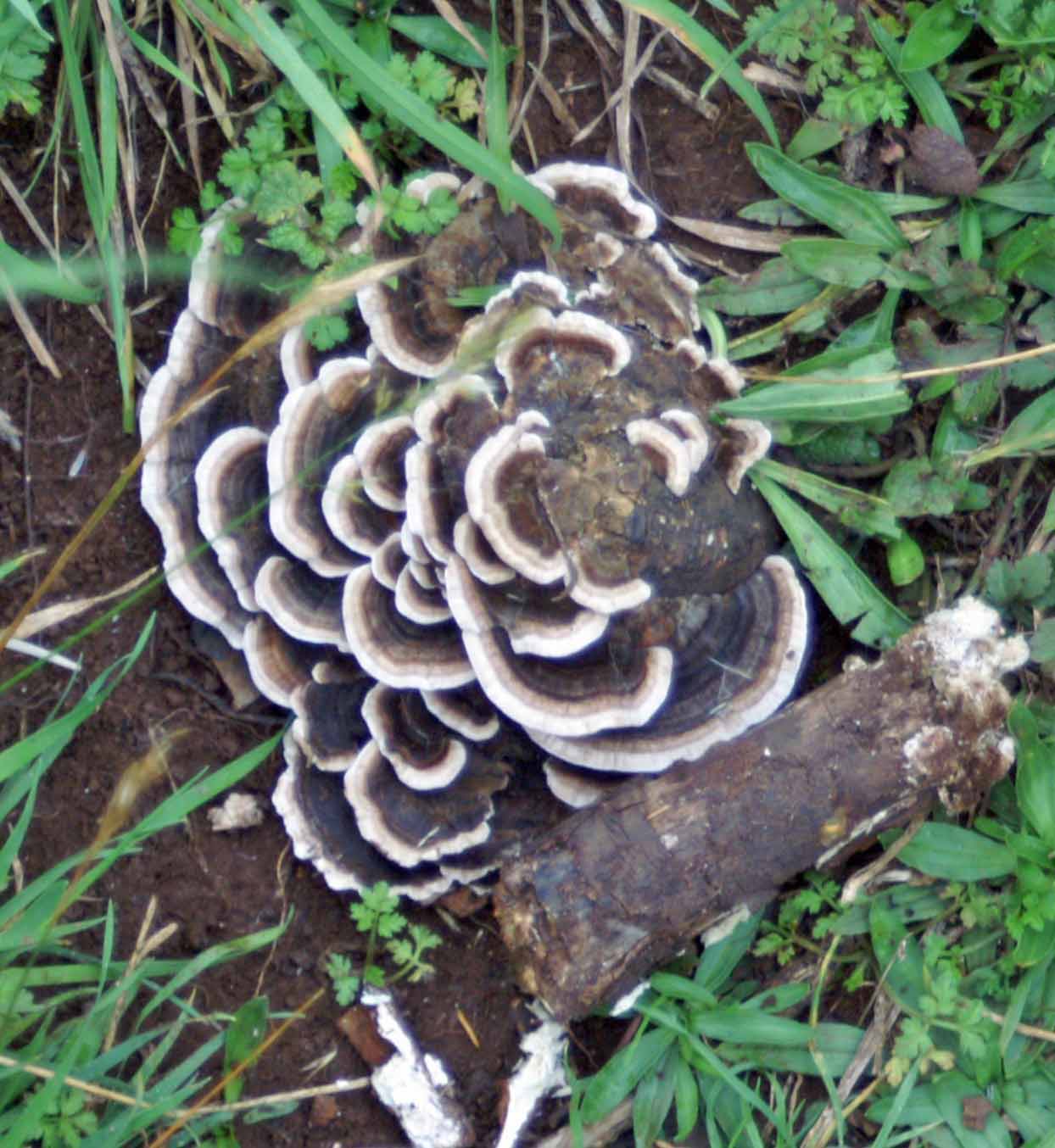
11/8/11-Turkey- tail fungus - Tramates versicolor

I came across the ‘Turkey-tail’ fungus on a path around the summit of the hill and thought it was fascinating. It takes its common name from the way in which the patterning and the cup or spoon shaped fungus resembles, well, the shape and patterning a turkey’s tail. It is a common bracket fungus which grows on the sides of logs or trees and occurs in a variety of colours including brown, tan, orange, white, red or purple, sometimes all together (Versicolor means ‘of several colours’). Turkey Tails are not poisonous to people but they are not eaten either.

Share this:

  • Share on Facebook (Opens in new window) Facebook
  • Share on Pinterest (Opens in new window) Pinterest
  • Share on X (Opens in new window) X
Like Loading...

A walk on the Great Orme

27 Saturday Aug 2011

Posted by theresagreen in coastal walks, Great Orme, Nature, Nature of Wales, North Wales, North Wales Wildlife Trust, Wildflowers of Wales

≈ Leave a comment

Tags

bell heather, carline thistle, heather in bloom, jackdaw, limestone heath, ling, Little Orme, rabbit, views of Llandudno

The Great Orme is a prominent headland, which lies at the north-western tip of the Creuddyn Peninsula near Llandudno. Conwy County Borough Council as a Country Park and Local Nature Reserve manages most of the site, and this comprises a headland of Carboniferous limestone of some 291 hectares (719 acres) which rises from sea level to 207m (679 feet) at the summit.

5/8/11-The Great Orme under a beautiful sky

The weather has been very unpredictable lately, so I took advantage of a mostly sunny afternoon to explore some of the Little Orme’s big brother – the Great Orme. This much larger promontory has a very different character and has a fascinating history. Parts of it are used commercially to provide leisure activities for visitors to Llandudno town, but most of the Great Orme is designated a Special Area of Conservation (SAC) as it contains habitats and species which are considered to be rare or threatened within Europe. It is also a Site of Special Scientific Interest (SSSI) and is included in both the Nature Conservation Review and Geological Conservation Review, indicating its national importance. The site is also designated a Heritage Coast, a definition denoting a landscape quality of national importance.

5/8/11-A welsh rabbit out in the afternoon sun

From the car park at the top where the ‘toboggan run’ is located, I walked across to the path that takes you up onto the open clifftops to admire the views over Llandudno towards the Little Orme and out across the Irish Sea.

5/8/11-A view of Llandudno curving around the bay and the hills beyond
5/8/11-Llandudno Pier and across to the Little Orme
5/8/11-The Little Orme’s best side

Quarrying activity on the Little Orme was restricted to the Rhos-on-Sea side of it so as not to spoil the view from the resort of Llandudno, as I have mentioned before. I have photographed it often from that side, but less so from its natural, unspoilt side, which looks very different.

There wasn’t much to be found on the clifftops today, I saw just one Meadow Brown butterfly, but I did come across a Carline Thistle. It was just a small specimen, but the only one I’ve come across in the area so far.

Carline Thistle

Carline Thistle is interesting as its flower heads expand in dry weather and close in moist weather. The dried flowers will continue to do this for a long time and they thus form a basic hygrometer for use in weather forecasting.

There is a choice of paths to follow, including one to the summit, but I decided to walk in the direction of St. Tudno’s church. It was beautiful walking in the bright late afternoon sunshine on the grassy track through heathland that is presently a living patchwork of green, purple and gold. It was peaceful too – I was the only person there and the only other sign of life I had was a Meadow Pipit that flew up from near the edge of the track and startled me.

Limestone Heath

The heathland on the Great Orme is of international importance and occupies approximately one quarter of the site. Dominant species are the dwarf shrubs; Heather, Bell Heather and Western Gorse.

5/8/11-Great Orme -Heather-Calluna vulgaris& Western Gorse-Ulex gallii

About one third of the heathland is species-rich and amongst the dwarf shrubs many lime-lime-loving (calcicolous) herbs grow, such as Common Rockrose, Dropwort, Wild Thyme and Birds-foot Trefoil. This species-rich heath tends to be short (35cm height or lower). Another third of the heath is less species-rich, supporting herbs such as Tormentil and Harebell.

5/8/11-In places the heather & gorse extends to the edge of the cliffs

It was too late to walk all the way to the church today, but I will definitely be back to complete the route soon.

Share this:

  • Share on Facebook (Opens in new window) Facebook
  • Share on Pinterest (Opens in new window) Pinterest
  • Share on X (Opens in new window) X
Like Loading...

Bryn Euryn on a sunny summer’s afternoon

22 Monday Aug 2011

Posted by theresagreen in Bryn Euryn Nature Reserve, ferns

≈ Leave a comment

Tags

dark green fritillary, grayling, green-veined white, Red Admiral, small heath, small skipper, summer orchids

I was surprised to find just one other car in the car park when I arrived at ‘the Bryn’ on a warm sunny early afternoon last week; I had expected it to be busier, so was pleased that I would be able to enjoy this lovely but popular reserve while it was peaceful. The peace didn’t last long! I began my walk with a circuit of the grassy area next to the car park, checking out the wildflowers for any interesting insects and was soon joined by a man walking a smallish dog. It appeared he was doing the job on sufferance, releasing it from its lead while he wandered around talking loudly on his mobile phone, breaking off frequently to shout at the dog. Things got even worse when another man with two dogs, both on leads, arrived, causing the loose dog much excitement and its walker to shout even more. I decided to leave this bit for another day and hurried off onto the stepped track woodland track towards the top of the hill.

I stopped halfway up, in front of the cottage where the track divides as I caught sight of a large bramble bush covered with blossom. I saw a Comma butterfly feeding here but missed the brief photo opportunity; I also missed a Holly Blue, but I did catch one of a Green-veined White basking on a clematis leaf.

Green-veined White – Pieris napi

Hoverfly-Syrphus ribesii

The woodland was silent, usual at this time of year due to the lack of birdsong and calls, but making you wish you could move more quietly and be less conscious of every footfall you make.

I was taken by surprise when the silence was broken by a soft ‘huit’call from close by and I looked up to see a young Chiffchaff in a sycamore tree.

A young Chiffchaff sitting in a Sycamore tree

The foliage of the woodland trees is still fresh, not yet showing the dusty tiredness of late summer, the greenness is carried through and down to the floor beneath, accented by glossy Hart’s Tongue ferns and cushions of soft green moss.

Harts Tongue Fern – Asplenium scolopendrium
A perfect Speckled Wood resting lightly on a fern frond

Emerging from the dappled shade onto the grassy hilltop my eye was caught by the low fluttery flight of small orange and brown butterflies- Small Heaths, several of which were flying in quite a small area and looking perfect and newly-emerged.

Small Heath – Coenonympha pamphilus

There were a lot of Meadow Browns too, keeping low to the ground and often disappearing from sight as they tucked themselves down on the ground amongst the grass stems.

Meadow Brown – Maniola jurtina

I carrried on round the hilltop admiring the stunning panoramic views stretched out beneath and across to the Snowdonia mountains, making for the summit, then continued on down the other side onto the grassy meadowland.

Just below the summit a scabious plant is growing from a crevice in a rock

The grass was studded with beautiful blue Harebells that look dainty and delicate but must be pretty hardy to thrive in the habitats they are found in.

Harebell-Campanula rotundifolia
The long grass and tall wildflowers attracting many butterflies

I had half-decided to continue walking down the slope to the woodland at the bottom, but as I passed by the area where the grass has been kept longer and where brambles, thistles and knapweed were flowering, I caught sight of a large brown butterfly flying fast and strongly, that then landed on a knapweed flower. Unmistakably a fritillary, although I had no idea of the species: its colours looked rather faded and it there was some damage to the wing edges, so it may have been around for a while and I didn’t get sight of its underwings. Checking later on I think its most likely a Dark Green Fritillary, but as ever I’m happy to be corrected.

20/7/11-Dark green Fritillary-Argynnis aglaja

I sat on the grassy slope for a while hoping for more fritillary sightings, which happily I got; in addition there were more Green-veined Whites and several Small Skippers flitting around low amongst the long grass.

Small Skipper – Thymelicus sylvestris
A Silver Y moth – Autographa gamma, also caught my eye as it fluttered in the long grass

I heard the ‘bark’ of a Raven and just caught sight of it as descended, landing somewhere beyond the slope out of sight. A Buzzard circled overhead. Preparing to leave and retrace my steps I crossed to the other side of the slope, took a photograph of the Little Orme and spotted a lovely specimen of Thistle.

A view of the Little Orme from the top of Bryn Euryn

Scotch Thistle-Onopordum acanthium

Reaching the thistle I was delighted to spot orchids growing in the quite-long grass, I wasn’t expecting that at all. As with the fritillary butterfly they were a little past their best, but still pretty;  most were pink in colour, but there were some white ones too. (I still am unsure what species they are, will update when I find out.)

A group of pink-purple orchids
Pink-purple specimen
A white-flowered specimen

Leaving the orchids I was more than happy with my afternoon’s discoveries and turned to head back up to the summit then down and back to the car. I couldn’t resist sitting to gaze at the view for a few minutes and got distracted by flies, flesh-flies to be accurate, that have rather unpleasant eating habits, but that actually look quite attractive.

Flesh-fly – Sarcophaga carnaria

Making my way back down the slope I spotted another butterfly land on a warm rock,  a gorgeous Grayling.

A Grayling – Hipparchia semele resting on a warm limestone rock

Then close by a female Large White landed on a leaf.

20/7/11-Large White (f)-Pieris brassicae

Finally reaching the top of the path downwards I very shortly stopped again for yet another butterfly, this time a Red Admiral that posed beautifully on a wild rose leaf  in a spot of sunlight.

Red Admiral-Vanessa atalanta

There were more people around as I made my walk down, most of whom were walking dogs. I made a quick stop at the brambles where I’d seen the Comma earlier, hoping it may return, which of course it didn’t, but I did see some young Chaffinches in a tree there. As I got close to the bottom of the hill I caught sight of a bird on the ground tugging at something it had found. It was a Thrush and by the way it took little notice of me I assumed it was a young one. I attempted to photograph it but it was far too shady there, so I just stood and watched it for several minutes. It carried on foraging quite untroubled until we both heard the ‘mewing’ of a Buzzard and the simultaneous rough cawing of a Crow. The Buzzard, again I think a young one, came crashing through the trees and landed on a branch, looking very ruffled and quite upset: I assume the Crow must have pursued it there. The Thrush was long gone.

Common Mallow

My total butterfly sightings were from 11 species: Large White, Green-veined White, Comma,Red Admiral, Dark Green Fritillary, Grayling, Small Heath, Speckled Wood,Meadow Brown,Holly Blue & Small Skipper.

Share this:

  • Share on Facebook (Opens in new window) Facebook
  • Share on Pinterest (Opens in new window) Pinterest
  • Share on X (Opens in new window) X
Like Loading...

Bryn Euryn Nature Reserve

19 Friday Aug 2011

Posted by theresagreen in Bryn Euryn Nature Reserve, Butterflies of Wales, Nature, Nature of Wales, nature photography, Wildflowers of Wales

≈ Leave a comment

Tags

ash tree, Bryn Euryn Nature Reserve, common rockrose, early purple orchid, hoary rockrose, wildflowers of Bryn Euryn

27th April

I haven’t seen much of the countryside since I’ve  been here in North Wales, other than through a car window, and I was very keen to see some spring flowers and fresh greenery. I know the wildflowers in Spain will be amazing when I get back there next week, but the native British wildflowers have an altogether gentler and more subtle beauty that I love. I have been planning to make a trip to the local nature reserve on Bryn Euryn, and as I will only be in the locality for a couple more days I decided to head there this morning.

Bryn Euryn is a limestone hill rising to 131metres (365 ft) above sea level and a well-loved local landmark of Rhos-on-Sea that is now a Local Nature Reserve. Its slopes are clothed with a mixture of woodland and grassland, part of which has been declared a Site of Special Scientific Interest. From its summit their are extensive panoramic views over Rhos-on-Sea and Colwyn Bay and across to the mountains of Snowdonia in the west. 

I parked in the small car park that is surrounded by trees, and as soon as I got out of the car I heard a Chiffchaff ‘singing’. I couldn’t see him,but as I tried to locate his whereabouts a Robin flew into a nearby tree and also began to sing. Moving off towards the beginning of the track that leads up to the summit of the hill I stopped to watch a Song Thrush hunting on the woodland edge where it borders a grassed area.

I soon came upon a patch of bluebells growing alongside some wild garlic whose flowers are almost finished. There were a few wood anemones still flowering, but they too are all but over; wild strawberry plants were flowering along a length of the path edge in dry shade, they have a long flowering period beginning in April and continuing until October, with fruits appearing throughout the summer. It was lovely walking in the dappled shade of the woodland, listening to the birds singing and coming across flowers that gave me the opportunity to make a stop on the fairly steep upward climb. A special find was a sunlit Early Spotted Orchid growing beneath the trees. The presence of this delightful bloom, together with that of bluebells and wood anemones is a sign of an ‘old wood’,  indicating that this area has never been anything other than woodland.

Purple Spotted Orchid

Dog Violet

There was a pretty patch of little blue/purple dog violets and the surprise of a Cowslip plant on a steep bank; this one must have strayed from the grassy downland on the other side of the hill; the more usual habitat of Cowslips.

Cowslip

Rock Rose

At the top of the hill you emerge from the woodland onto a surprisingly large expanse of open grassy heathland. There were large patches of yellow flowers growing here, taking a closer look I saw there were of two separate species; I recognised rock rose, but was unfamiliar with the other. Looking it up when I got home I realised it was Hoary Rockrose, one of the plants named on the information board in the car park that is apparently very scarce in the British Isles.

Hoary Rockrose – Helianthemum canum

The views from the top here are truly spectacular, extending from the Little Orme around and across Rhos-on-Sea and Colwyn Bay with the mountains of Snowdonia to the west. The only downside, at least from this side of the hilltop, was the traffic noise arising from the busy A55.

A panoramic view of Rhos-on-Sea and Colwyn Bay

View from Bryn Euryn summit – mountains of Snowdonia on far horizon

View across summit of Bryn Euryn to Conwy Estuary and beyond to Snowdonia

Germander Speedwell

Buff-tailed Bumblebee

Turning around I walked across to the other side of the summit, passing through a shrubby area, the woodland edge, where there are shrubs and small trees growing. Here, Hawthorn is in full bloom and I stopped to watch a furry bumblebee as she burrowed into the leafy debris on the ground beneath.

Hawthorn, or May blossom

I discovered another early purple orchid plant here, this one had an earlier, or perhaps even last year’s, dried flower spike attached.

I reached the true summit of the hill, which has a concrete trig point on it that is part of the nationwide network built by the Ordnance survey to create their maps of the UK in the old days before computers.There is also a board depicting how the ancient hill fort may have looked. I was very surprised to come across an extensive patch of orchids here, I roughly counted them and estimated at least 100 flowers.

Summit of Bryn Euryn with Trig point & mass of purple spotted orchids in the foreground

The Fort

The summit of Bryn Euryn was once occupied by a small but strong fortification. This may have been the ‘Bear’s Den’ mentioned by Gidas the Wise and thought to have been a stronghold of Cynlas the ‘Red Butcher’, king in Rhos around the middle of the sixth century. Only the faint traces of the limestone rampart’s foundations are  visible today, protruding through the turf and ringing the summit of the hill, to remind us of its former importance.

It was much quieter and more peaceful on this side of the hill and I sat for a while enjoying the sunshine and the view out to sea and across to the Little Orme.  Two Red Admiral butterflies were flying around the nearby shrubbery, one kept attempting to sun itself on a bramble leaf, the other kept disturbing it, the basking one chased after its disturber then returned to the same spot etc. etc. It took a lot of patience to get the photograph.

Red Admiral basking on new bramble leaf

Speckled Wood on a leaf on the ground

Even trickier to photograph was this Speckled Wood. Once again there were two of the insects chasing one another – these little butterflies are especially territorial, but I wanted to get a photograph as they were much paler in colour than the ones I had been seeing in the garden. That made getting the photograph even harder, as when they did land it was on dried leaves and they were so well camouflaged I couldn’t find them through the lens.

There are some beautiful trees growing here, including Ash, whose leaves are quite well grown now.

new ash leaves

They brought to mind the old country rhyme about their predicting the forthcoming summer weather:-

“Ash before oak, look for a soak, oak before ash, look for a splash”

I had a quick look at a neighbouring oak and would say they were pretty much on a level, so hopefully that means some rain, but not too much.

Share this:

  • Share on Facebook (Opens in new window) Facebook
  • Share on Pinterest (Opens in new window) Pinterest
  • Share on X (Opens in new window) X
Like Loading...
Newer posts →
Follow everyday nature trails on WordPress.com

Enter your email address to follow this blog and receive notifications of new posts by email.

‘But it is the common species that keep the living world ticking over and provide most of our experiences of wildlife, and I would argue that maintaining the abundance of these is as important a conservation priority as maintaining the existence of rarities’. Richard Mabey

MOST RECENT POSTS

  • A Glimpse of Spring to Come January 22, 2025
  • Hunting the Wren December 28, 2024
  • Oh, Christmas Tree December 18, 2024
  • In and Out of the Ivy February 15, 2024
  • Nature’s Fireworks November 30, 2023
  • Wild Autumn along the Coast Path November 3, 2023

OLDER POSTS

LOOKING FOR SOMETHING IN PARTICULAR?

  • Sights and Sounds from the Little Orme 1
    Sights and Sounds from the Little Orme 1
  • Things Bright and Beautiful
    Things Bright and Beautiful
  • Following a river to a Fairy Glen
    Following a river to a Fairy Glen
  • Catchers, a Duck and Divers
    Catchers, a Duck and Divers
  • May Bee Appearing on Ivy near You
    May Bee Appearing on Ivy near You
  • Shades, Sounds and Scents of the Woods
    Shades, Sounds and Scents of the Woods
  • Fine Dining for Crows
    Fine Dining for Crows
  • Butterflies and more rare treats
    Butterflies and more rare treats
  • The Windhover
    The Windhover
  • A Windy Wildflower Trail
    A Windy Wildflower Trail

nightingale trails

The Walk of the Monarch Butterfly-Sendero de la Mariposa Monarca

The Walk of the Monarch Butterfly-Sendero de la Mariposa Monarca

MY WILDFLOWER BLOG: where the wildflowers are

Snowdrop

Snowdrop

most recent posts

Follow everyday nature trails on WordPress.com

Social

  • View teresamaygreen’s profile on Twitter

Enter your email address to follow this blog and receive notifications of new posts by email.

Website Built with WordPress.com.

  • Subscribe Subscribed
    • everyday nature trails
    • Join 359 other subscribers
    • Already have a WordPress.com account? Log in now.
    • everyday nature trails
    • Subscribe Subscribed
    • Sign up
    • Log in
    • Report this content
    • View site in Reader
    • Manage subscriptions
    • Collapse this bar
 

Loading Comments...
 

    %d