• Home
  • about
  • about the photographs
  • Local Nature Reserves
    • Bryn Euryn Local Nature Reserve
    • Mynydd Marian
  • Wales Coast Path
    • Grey Seals in North Wales
    • St.Trillo’s Chapel
    • Wildflowers of North Wales Coastal Paths, Cliffs and Dunes

everyday nature trails

everyday nature trails

Category Archives: Nature

Forest Fungus Foray

26 Saturday Oct 2019

Posted by theresagreen in Conwy Valley, Nature of Wales, Snowdonia, Walking Trails

≈ 10 Comments

Tags

autumn woodland, birch polypore, candlesnuff fungus, dyer's mazegill, fungi in woodland, fungus foray, Gwydir Forest, hare's-ear fungus, honey fungus, North Wales Wildlife Trust, recovering industrial sites, recovering woodland, Trefriw, turkey-tail fungus, wood woolly-foot

October 13th

The annual guided Fungus Forays are very popular guided walks organised by our Conwy Valley Branch of the North Wales Wildlife Trust, and this year there were two, one last weekend and the other today. The venue was the forest above Trefriw, located on the West side of the Conwy Valley and on the edge of the Snowdonia National Park. Trefriw village is popular with tourists, well known for its traditional Welsh Woollen Mill and is part of the Walkers are Welcome network, having several marked trails to follow.
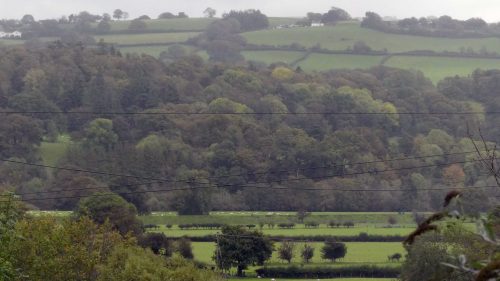
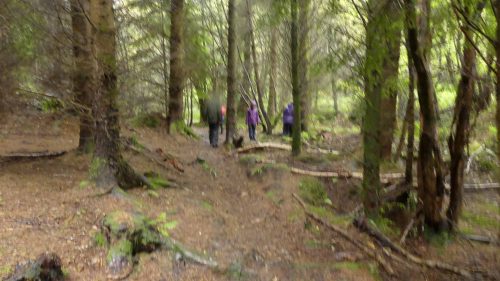
12:45 Driving along the valley towards the village I could see that heavy cloud was obscuring the hills in front of me and by the time I got there they were shedding rain. Justly renowned as an area of great natural beauty and diversity, Snowdonia is equally famous as one of the wettest places in the British Isles and October is also one of the wettest months of the year. Forewarned and so forearmed, i.e clad from head to toe in waterproofs, our intrepid Forayers left the shelter of the veranda in front of the village shops, setting off like a moving rainbow to brave the elements in search of Fungi treasure.

13:15 A good beginning was this view as we crossed the road bridge that spans the tumbling Afon Crafnant. Flowing down from Llyn Crafnant located higher up the hill, it races down a series of falls through the village to join forces with the nearby Afon Conwy.

We turned left onto the road that leads up to the Lakes (Llyn Geirionydd and the afore-mentioned Llyn Crafnant), walked uphill to just past the end of the building in my photograph above, then turned left again onto a Trail that travels upstream alongside the river, approaching the top of the Fairy Falls. A fair bit of rain has already fallen this Autumn, adding to the impact of this series of falls, which become increasingly dramatic as you approach the main rocky drop.
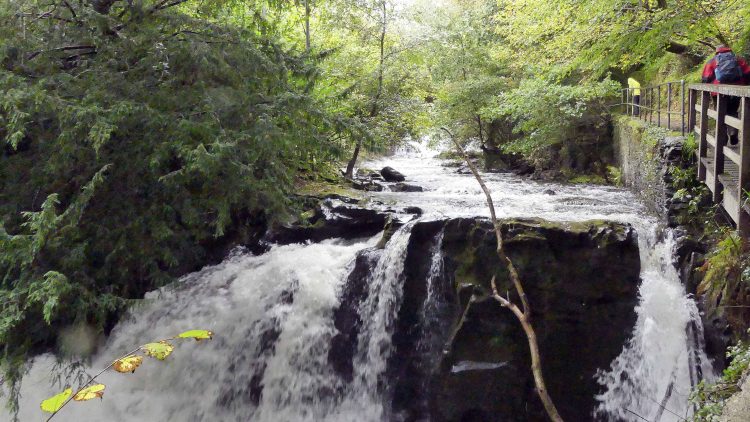
Afon Crafnant – Trefiw
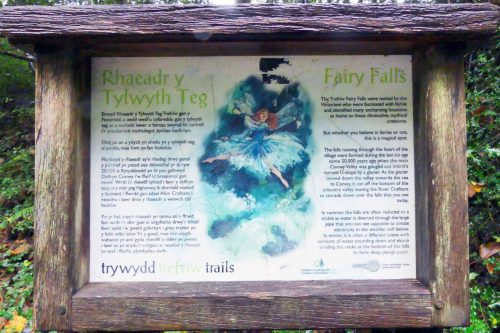
Named the Fairy Falls to appeal to Victorian tourists, who were enchanted by thoughts of fairies, this is one of many such beautiful locations in our area that are so-named. And why not? There is definitely a magical energy in the air surrounding a powerful fall of water.
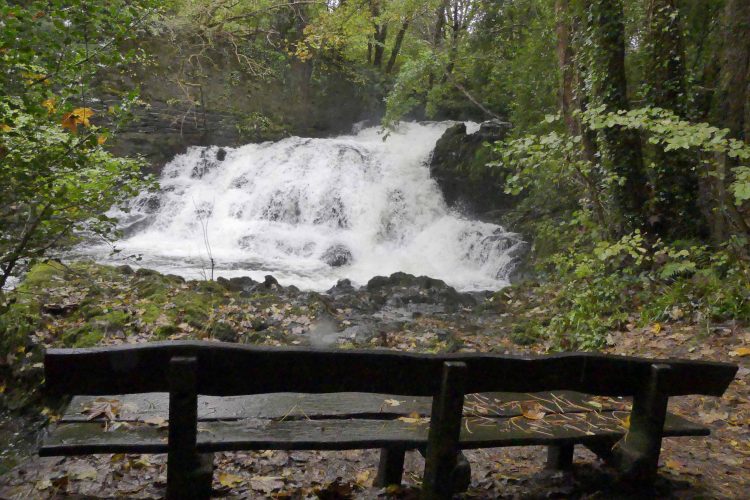
Fairy Falls -Trefriw

Just beyond the waterfall, near the beginning of the trail that climbs steeply up through the woodland, a pair of sharp young eyes focussed in on our first fungus. Brightly coloured and close to the edge of the path, this was Hare’s Ear, cunningly camouflaged amongst fallen oak leaves. The fungus takes both its common and scientific names from the form in which it grows.

Hare's-ear-Otidea onotica
Hare’s-ear-Otidea onotica
Hare's-ear-Otidea onotica
Hare’s-ear-Otidea onotica

Then at the base of a pine tree, a bracket fungus called Dyer’s Mazegill. This was quite a large one and perhaps a bit past its prime, fresher ones are fleshier and more yellow, turning darker with age. We learn that this is a destructive organism that feeds on the roots of the tree it attaches to that will eventually kill its unfortunate host. The common name Dyer’s Mazegill comes from its use for dyeing yarn; the fungus’ fruitbody produces various shades of yellow, orange and brown, depending on its age and the type of metal used as a fixative. The Mazegill part is reference to the complex, maze-like arrangement of its gills.
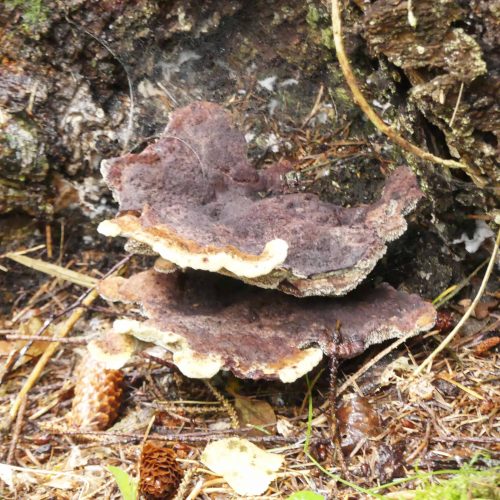
Dyer’s Mazegill- Phaeolus schweinitzii

Next, one of the few fungi I recognise and can put a name to, the attractive and decorative Turkeytail, or to give it its more prosaic common name Many-zoned Polypore.
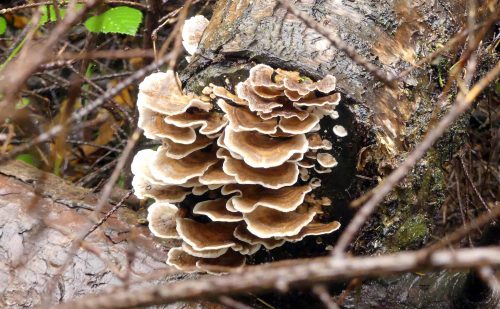
Turkeytail or Many-zoned Polypore – Trametes versicolor

Another bracket fungus, which as its name, Birch Polypore implies, grows on birch tree trunks or branches, whether they’re alive or dead. In the event a host branch falls from the tree, the fungus has the ability to ‘right’ itself, so its gills always remain beneath it and its spores can fall to the ground. Also known as the Razor Strop Fungus, Barbers used to ‘strop’ or sharpen their cut-throat razors on tough, leathery strips cut from the surfaces of these polypores.
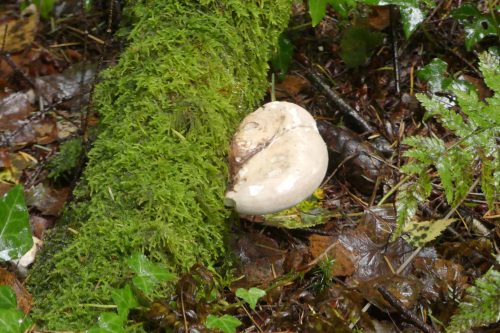
Birch Polypore or Razor Strop Fungus – Piptoporus betulinus

Sulphur Tufts are a wood-rotting fungus feeding on both deciduous hardwoods and conifers. Fruiting on fallen trees or decaying stumps or, sometimes in the hollow trunks of living trees, they are often found in a mixed woodland from April through to the first heavy frosts. Gregarious fungi, they tend to appear in large groups so tightly packed that the caps may be unable to expand regularly.
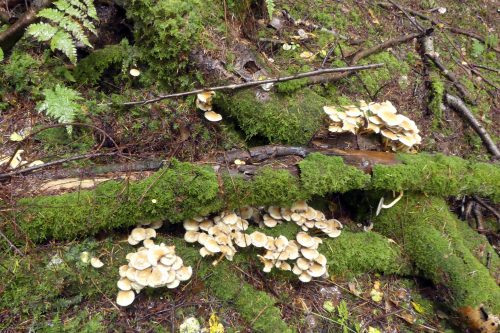
Sulphur Tuft – Hypholoma fasciculare

The name Butter Cap makes our next fungus sound tasty, but then you find out it used often to be referred to as the Greasy Toughshank, which sounds much less appealing. The names refer to the colour and appearance of the cap. It’s a very variable fungus that occurs in all types of woodland, but is mainly associated with coniferous forests on acid soils, growing beneath even the darkest of canopies, often in groups or fairy rings. We came across it fairly frequently during our foray in a variety of sizes, numbers and forms.
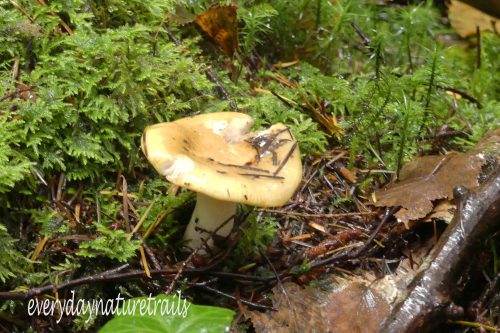
Butter Cap – Rhodocollybia butyracea

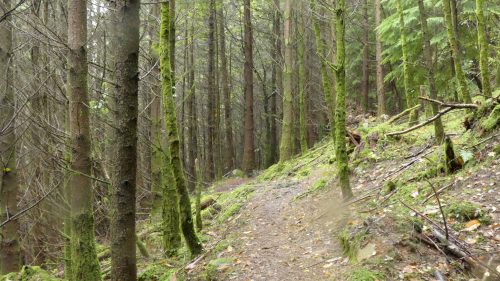
We continued to climb up through the woodland and the rain continued to fall heavily, in fact it seemed the higher we got the harder it fell. Derek Brockway, everyone’s favourite Welsh Walking Weatherman had warned it would do that until about 3pm, so holding the thought he might be right, and it would eventually stop, we pressed on with our mission. The steeply sloping ground and the free-draining soil beneath a layer of pine needles meant at least the ground wasn’t too slippery underfoot.
More sensible members of our group were using the cameras on their mobile phones to capture images of our finds: I could have done that too, but I’d brought my ‘proper’ camera, carrying it carefully tucked inside my coat, so I persevered with it, hoping it wouldn’t suffer too much. The light in the woods, or rather the lack of it was difficult and raindrops on the lens were a bit of a pain, but I think the wetness of everything did bring an interesting extra dimension to images. Those that I managed to keep in focus, that is.
Obscured by raindrops

I only caught the tail end of the chat about this Oysterling mushroom, so I didn’t hear anything interesting said about it. Looking it up later I read that the genus name Sarcomyxa comes from the Greek word särkō-, meaning flesh, and -myxa (again from Ancient Greek via Latin), meaning mucus or slime. Slimy flesh-like mushroom that does look a bit like a shelled oyster would seem to describe it well enough to remember.
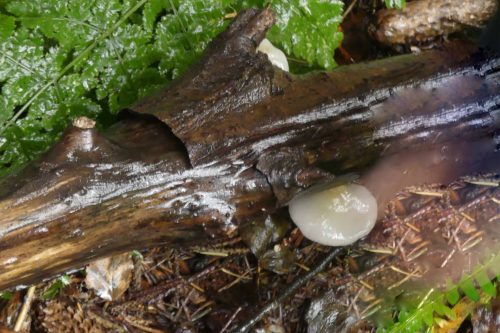
Olive Oysterling – Sarcomyxa serotina

14:04 Apart from the fungi, there was more that caught my eye, in the shape of ferns, lichens and mosses, but that’s not what we were here to see today. I did stop to photograph a Hard Fern, which I don’t come across often and looked nice with shiny wet fronds. Widespread throughout the UK and the rest of Europe, Hard Ferns are most often found in well shaded places, preferring moist, acidic, humus-rich conditions in woodland sites, so it’s very at home here.
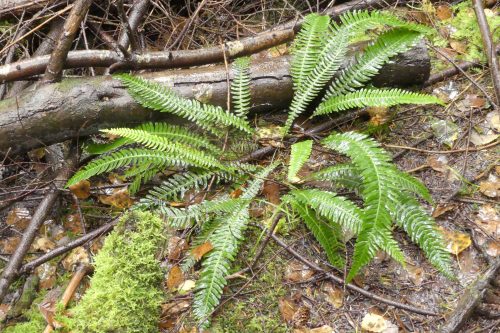
Hard Fern-Blechnum spicant

This woodland, named Coed Creigiau feels like it’s always been there, but is actually a recovering woodland and a part of the Gwydir Forest. From 1850 till 1919 the mining of lead and zinc dominated the area and when it stopped it left behind a derelict industrial landscape with sparse natural woodland. The First World War had identified a national shortage in wood production, bringing about the Forestry Act of 1919 and the land was acquired from its former owners by the newly created Forestry Commission: planting of the forest began in 1921. Some natural trees would have been growing on the hills, but the majority of the original planted forest is conifer and includes Sitka spruce, Douglas fir, Japanese larch, Norway spruce and Scots pine. It’s likely that most of those original trees will have been felled as they have a plant-to-harvest cycle of 20-40 years according to the species, so those there now could be a second, third or even fourth generation.  Now managed by Natural Resources Wales, recent years have seen the increased planting of native broadleaf species such as Welsh Oak, beech and ash, but faster-growing conifers are still grown to meet commercial demands for timber.
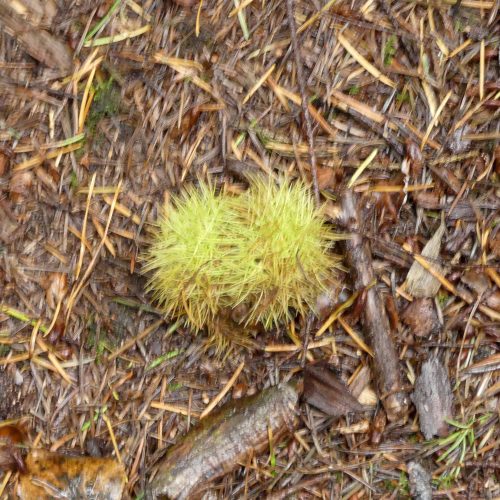
Spending much of the time looking down to a) look out for fungi b) watch where we were putting our feet and c) avoid getting raindrops or drips from trees in our eyes, I was interested to find the prickly husks of Sweet Chestnuts scattered amongst the pines. I began to pay more attention to the presence of the trees they had come from and realised there are quite a lot of them. Introduced into this country by the Romans, the wood of the Sweet Chestnut is similar to oak but more lightweight and easier to work. Young wood has a straight grain but this spirals in older trees, so trees were coppiced and the new straight trunks used as support poles in mines.
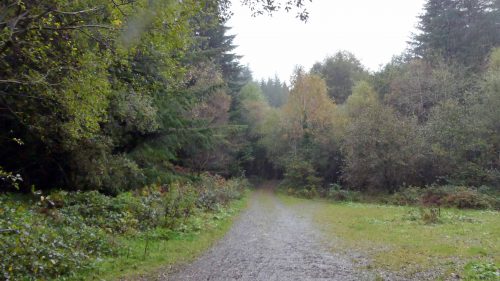
We crossed a hard-surfaced track, and on the edge of the next section of forest, one of my favourite sights of the day, a group of weird and intriguingly named Candlesnuff fungus, growing with moss atop a Birch stump. Its name might imply it is something that once gave light but which has been put out, but I learned that ‘it is a bioluminescent fungus, and in a really dark place it can be seen to emit light continually as phosphorus accumulated within the mycelium reacts with oxygen and other chemicals in the fungus‘. (firstnature.com)
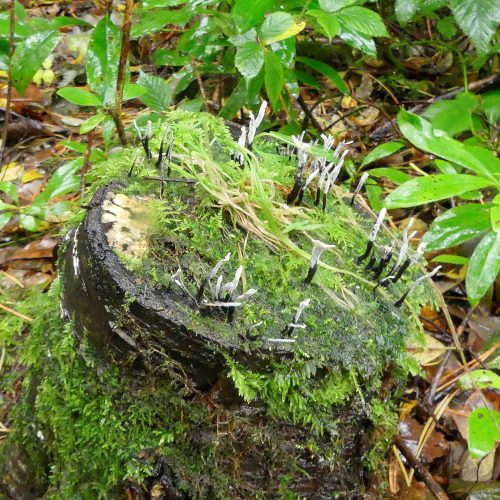
Candlesnuff-Xylaria hypoxylon

Stinkhorn -Phallus-impudicus (egg)

In a nest of pine needles, we spotted the ‘egg’ from which the phallically formed Stinkhorn Fungus will emerge.

Some Victorians were so offended or embarrassed by the appearance of these fungi that they’d go out at dawn and batter them with cudgels to stop them spreading their spores, and to avoid letting the Stinkhorns make a ‘bad impression’ on any  young ladies who might decide to take a morning walk in the woods!

Later on we discovered a fully grown specimen – led to it from some distance away by the truly bad smell it emitted, like that of a dead animal. You definitely wouldn’t confuse that one with anything else!
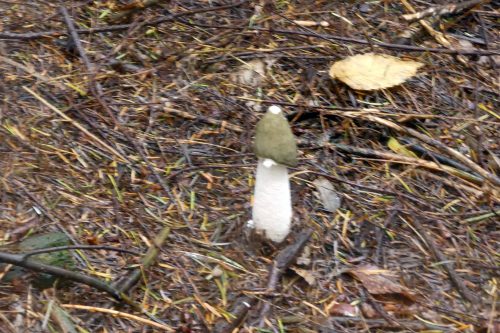
Stinkhorn-Phallus-impudicus

My main interest lies in the amazing array of shapes, forms and colours of the different species, then how they got their names and of course how photogenic they are. I’m too cowardly and way too inexperienced in the identification of most fungi to risk eating almost any gathered from the wild. However, this next one I do know well as one of the most sought after fungi, much prized by foodies and chefs. Pushing up through pine needles, twigs and cones we came upon this cluster of colourful Chanterelles, one I have eaten and may again, especially witht belt-and-braces id from an expert, as today.
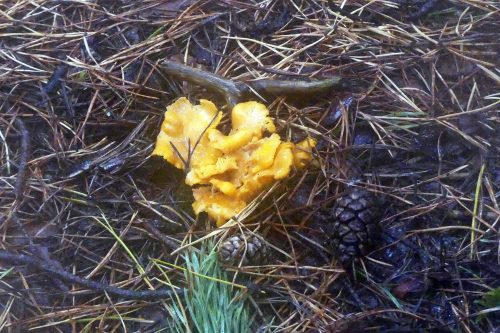
Chanterelle – Cantharellus cibarius

AT THE RISK OF REPEATING MYSELF – PLEASE BEWARE OF THESE!! Around 10% of fungi species are poisonous and there are some you definitely must learn to identify positively if you’re a forager – death from eating any of these fungi would be a horrible way to go!

Growing just a metre or so away from the Chanterelles was a fungus to be avoided at all cost: the Destroying Angel, more likely to be encountered in the more mountainous areas of the British Isles as here, than in the lowlands.
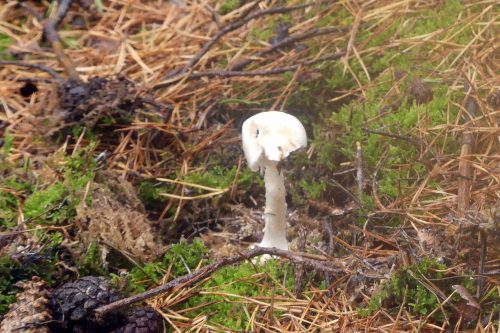
Destroying Angel-Amanita virosa
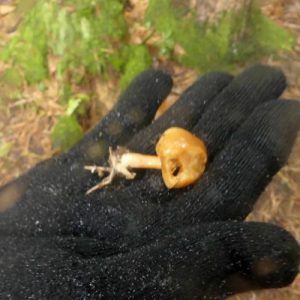
Funeral Bell

I think (hope!) I’ve matched the right image for this next one as it’s another fungus to be avoided at all costs. The common name for this is Funeral Bell and pro rata its size, we were told it is one of the most poisonous of all fungi growing in the British Isles, containing the same deadly poisonous toxins that occur in the Death Cap. This notorious Funeral Bell appears on conifer stumps and occasionally on the stumps of broadleaf trees.

Back on safer ground, for people that is, the common-and-dreaded-by-gardeners Honey Fungus. I had no idea it could, and clearly does grow this big!
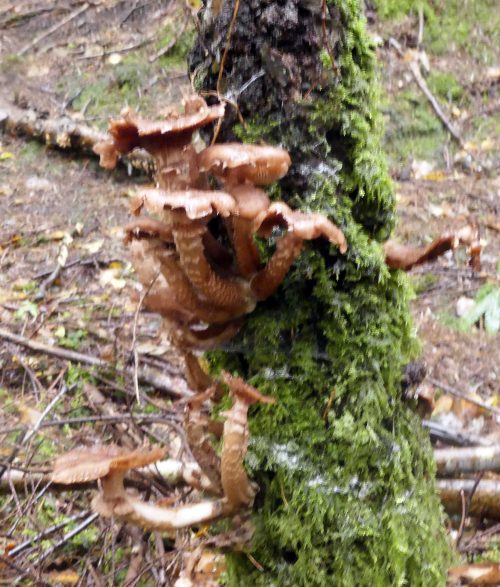
Honey Fungus – Armillaria mellea

There were several large mushrooms up here whose caps looked like they’d been trodden on and were covered in leaf-litter, pine needles and the like. We were told these are Large Rustlers, Russula sp. (I don’t know which one) that apparently push themselves up to the surface fully open, an unusual trait amongst fungi.

Large Rustler – Russula sp

15:10 From this point we made a right turn onto a track through the trees to begin our descent. This is where we smelt the Stinkhorn featured further back and where following our noses to locate it, we found another fascinating species, known as Piggyback fungus, so-called as it parasitizes other species of mushrooms. I’m claiming really bad light and a need to hurry on to catch up again as an excuse for this blurry image. You get the general idea though.

Piggyback fungus

Scurrying downwards we soon emerged from the forest onto a hard-surfaced track and, joy, it stopped raining and gradually, a mere 15 minutes or so later than Derek had predicted, the sun came out!
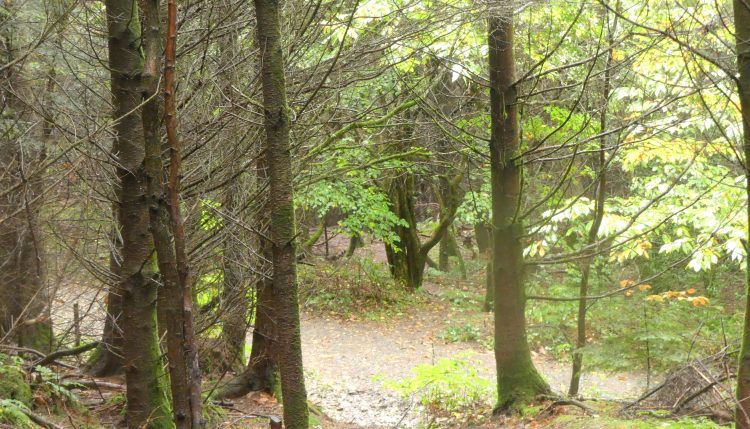
There were a few more fungi spots including more nice Birch polypores, clearly growing on a living Birch tree.
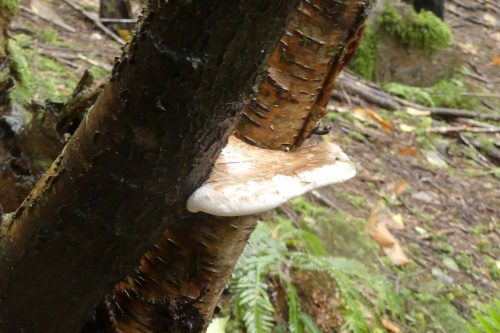
Birch Polypore or Razor Strop Fungus – Piptoporus betulinus

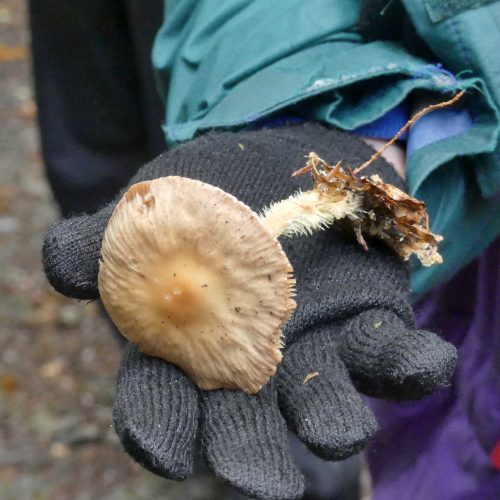
And to finish there was this attractive little fungus called the Wood Woolly-foot Gymnopus peronatus (syn. Collybia peronata); its common name refers to the lower half of the stem being covered in fine white hairs.
The last part of our walk back to where we started was pleasant, the sunny interlude allowing us time to chat, warm up a little and amble back rather than hurry to get out of the rain. But I hope this account goes to show that good outings can still happen in not-so good weather!

AFTERTHOUGHTS & ACKNOWLEDGMENTS

Led by two of our members, Dave and Joan Prime, I was amazed at the number and variety of species found for us and about which Dave shared his extensive knowledge so generously and in such an entertaining way. This was my first guided Fungus Foray in Wales, many of the species were completely ‘new’ to me and I would have struggled to accurately identify them from reference books. Those I’ve included in this post are mostly the ones I took the clearest or most interesting photographs of and which I’m pretty confident I’ve matched the correct names to. We were actually shown more than I could properly record without missing out on information, a good reason to go back for more next year!

If you are planning to forage for fungi as free wild food, do please make sure you absolutely know without a shadow of a doubt which are the poisonous ones!

References: To find more information, scientific names etc for species I referred frequently to my own reference books, the First Nature website and also to Wikipedia for more general information. As always, if you spot any inaccuracies please let me know and I’ll amend them.



Share this:

  • Share on Facebook (Opens in new window) Facebook
  • Share on Pinterest (Opens in new window) Pinterest
  • Share on X (Opens in new window) X
Like Loading...

Sloe Picking down a Memory Lane

19 Saturday Oct 2019

Posted by theresagreen in Nature, Northamptonshire

≈ 9 Comments

Tags

common centaury, flowering in October, October, Polebrook Airfield Nature Reserve, robin's pincushion, sites reclaimed by nature, spotted crane-fly

Polebrook Airfield Then

Memories of childhood wanderings were brought back vividly the weekend before last as my sisters, niece and little great-niece headed out on a sloe-and-blackberry foraging foray around the old Polebrook Airfield in east Northamptonshire. Once a flat, open site used for agriculture, the site was commissioned for use by the RAF and then used by the US Airforce as a base for bomber aircraft during World War II. After the war ended it was decommissioned by the Air Ministry and sold back to the adjacent Ashton Estate. Most of the buildings were removed from the site’s surface, but below ground many concrete shelters and chambers remained, rendering it unfeasible to restore it back to use as agricultural land. The woodland of Ashton Wold was already a Private Nature Reserve and separated from the old Airfield only by a narrow country road, so their owner took the opportunity to leave it alone as a protective buffer zone between the Nature Reserve and the surrounding farmed land, interested to see what happened when nature was allowed to venture back in.

1960s

Way back in the mid to late 60s we lived at Ashton Wold and in my early double-figure days, I spent hours wandering around the woods and fields and sometimes ventured over to the Airfield. Then it was unfenced, easily accessed and without the warning signs that might pepper such a place nowadays. It was doubtless a potentially hazardous place for people, strewn with all kinds of crumbling, part-demolished buildings and underground shelters half-hidden by long grass and brambles. There was always the sense that you shouldn’t really be there, which of course added to its appeal. At that time I had no real idea about the site’s history or plans for its future. But I did know that in the Spring I could find Great-Crested Newts swimming in what I thought of as water-filled ‘tanks’, probably old concrete foundations or something similar, then later Lapwings (or Peewits as we knew them) nested here; hunting for their hidden ground-level nests is how I learned that the parent bird would sometimes feign an injury to try to draw you away from a nest. There were wildflowers too and I’m sure a great deal that passed me by in this burgeoning sanctuary.

AND NOW

The site now is almost, but to us, never completely unrecognisable. Part of the site is used by a Warehousing Company, part is once more farmed and most importantly the Northern edge of the site is now also designated as a Private Nature Reserve. A Bioblitz there, carried out by the Northamptonshire Biodiversity Records Centre in August 2015, resulted in an impressive species count that included 40 species that have a notable or protected status at National level, including 17 birds, 2 bats, 7 moths, 3 butterflies, 1 amphibian, 9 lichens and 1 moss species.

Today we were there to gather sloes and blackberries, but needless to say, even now on a cool, damp and intermittently sunny Autumn day, there was so much more to see it was impossible to keep focussed.

Blackberries and red berries of Black Bryony

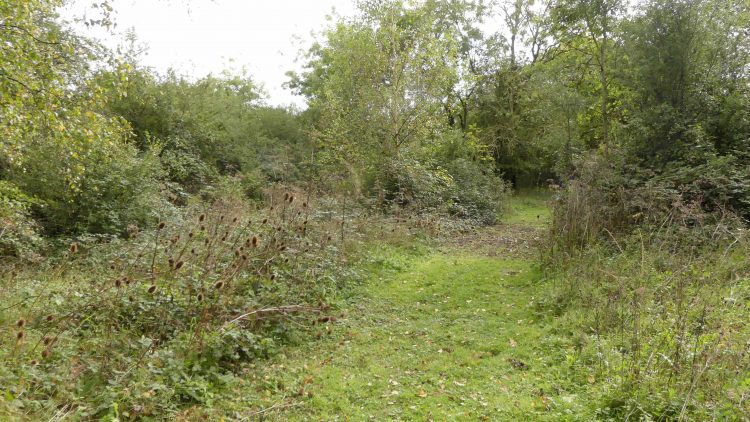
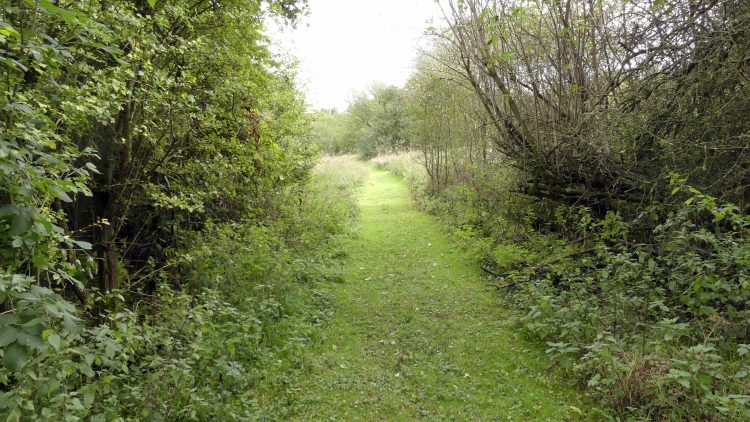
Wide mown grass paths now crisscross areas of Hawthorn and Blackthorn scrub bound up with tangles of brambles and wild rose briars that are interspersed with rough grassland.

There were always Teasels here and it’s good to see them thriving still. It’s a native plant and an important source of summer nectar and pollen for insects – Bumblebees love the flowers and then in the autumn the distinctive prickly dried heads hold seed that is sought by birds, particularly Goldfinches.

191006-AWPA- (9)-Teasels
191006-AWPA- (10)-Teasel

Amongst the large patches of rough scrubby grass there were still a few flowers to be found, a sprinkle of purple thistles and a few plants of Common Centaury. The latter plant only fully opens its flowers in the sun, which was only intermittently shining on us, so I didn’t get to see them out unfortunately.

191006-AWPA- (8)-thistle
Common Centaury-Centaurium erythraea

There are lengths of old concrete aircraft runways or service roads still in place, but now colonised by moss enriched by decomposed fallen leaves, they are concealed beneath a growing medium sufficiently deep for plants adapted to dry conditions to establish. In one such place we came across a spreading colony of Great Mullein, whose thick silver-grey felted leaves are perfectly adapted to potentially dry conditions.

Great Mullein-Verbascum thapsus

One plant stood out from the crowd as it had produced the most enormous leaves I’ve ever seen on this species. it was amazing and must have sprung from a seed that had fallen in an especially fertile spot.

It’s downy leaves, additionally warmed by sunshine were attracting insects too and must have made a cosy place for these Spotted Craneflies to couple-up.

Mating Spotted Craneflies

Flies paused to rest there too; I managed to catch a bright shiny Bluebottle and a golden-brown, or officially Orange Muscid Fly basking in a spell of warm sunshine.

Muscid Fly - Phaonia palida
Muscid Fly – Phaonia palida
Bluebottle
Bluebottle

Some Blackthorn looks old, and has grown into small spreading trees. Their brittle branches and tangles of twigs are mostly leafless and bear sparse fruits, but they are encrusted beautifully with lichen.

We wandered through the maturing woodland where the trees are mainly Ash and Oak with some Silver Birch. The ground beneath the trees is strewn only with fallen branches; it may be kept clear as there are numerous deep rectangular holes, their covers moved to the side and covered with moss. Quite hazardous if you don’t watch where you’re going. There are still intact brick and concrete-built shelters here too, their roofs are now camouflaged by vegetation, but the entrances are clear and accessible and it would seem watertight.

On a moss-covered fallen log, tiny mushrooms with pretty mauve caps were growing. I tried to persuade my 3 year old great-niece that they were stools for fairies or pixies, but she didn’t believe me! She just wanted to walk along the log! I don’t know the name, but have been advised it’s probably a species of Marasmius, commonly known as ‘parachute mushrooms’ because of the ribbed and domed shape of their caps.

We headed out of the woods and back onto safer ground to resume our berry hunt. Many were tantalising beyond our reach, like these that hung high above a twining rope of heavily-berried Black Bryony.

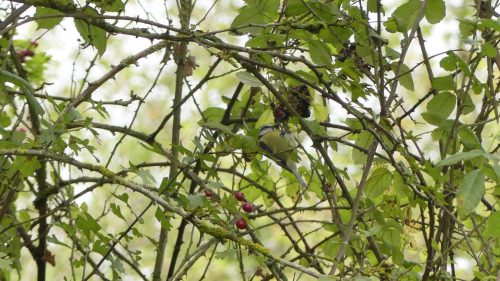
Beyond us, but all the better for small birds like this Blue Tit – one of a party that were travelling around, keeping up a companionable dialogue of contact as they foraged.

We passed by a huge spread of Knapweed, entirely gone to seed now, but it must have been a lovely sight back in the late summer.

Clusters of ‘keys’ dangle from Ash trees

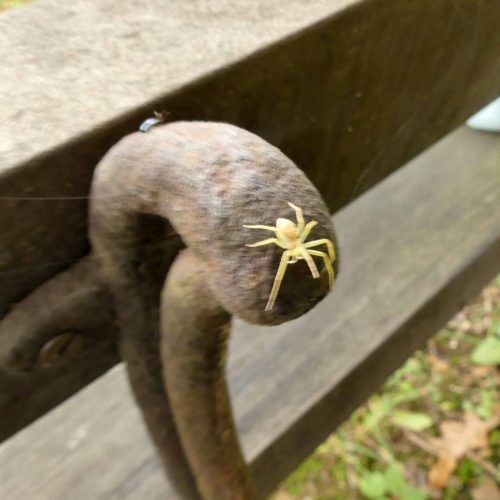
Intriguingly a small iron-framed wooden bench seat has been set beneath an oak tree.

A rather beautiful yellow-green spider was finding the sun-warmed metal much to its liking. My picture isn’t great, but I think it may be a Green Huntsman Spider.


We reached the high dense Blackthorn hedge that forms an effective boundary with the road. There were sloes to be found here, but there distribution was a bit erratic; some bushes had a lot, many had few or even none at all.

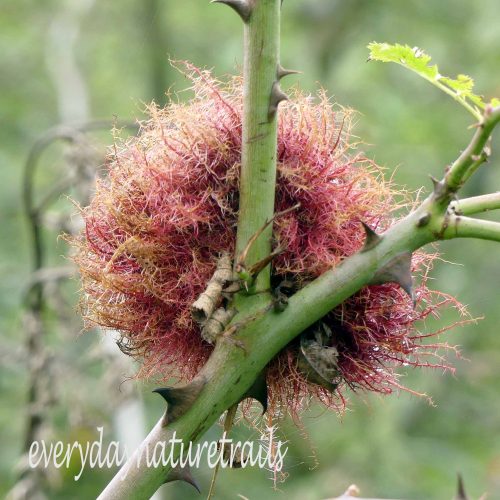
A wild rose using the hedge for support is decorated with ferny-mossy Robin’s Pincushions, also known as the Bedeguar Gall. The familiar fibrous growths are the plant’s reaction to being chosen to host the larvae of a tiny gall wasp, Dipoloepis rosae.

Heading back I found clumps of aromatic Wild Basil in the long grass; this plant is a member of the Deadnettle family

Wild Basil-Clinopodium vulgare

and a little later I came across a close relative, a nice patch of White Deadnettle, whose leaves remind me of stinging nettles.

A lovely family wander which brought back happy memories for my sisters and me that I hope may be recalled and even better, relived by our children and grandchildren in another fifty years!


Share this:

  • Share on Facebook (Opens in new window) Facebook
  • Share on Pinterest (Opens in new window) Pinterest
  • Share on X (Opens in new window) X
Like Loading...

Party Season

08 Tuesday Oct 2019

Posted by theresagreen in bird behaviour, birds of Wales, Bryn Euryn Nature Reserve, Nature of Wales, woodland birds

≈ 2 Comments

Tags

bird behaviour, Blue tit, coal tit, foraging party of birds, goldcrest, Great Tit, long-tailed tit, mixed-species feeding flocks

Party season has arrived in the woodlands once more: the time when many of the more sociable and colourful of our smaller bird species temporarily put aside territorial squabbles, joining together to form a foraging cooperative and sweep through the trees en masse on unified hunts for prey. Variously referred to as ‘mixed-species feeding flocks’, ‘mixed hunting parties’ or less formally a ‘bird wave’, all describe the structure and purpose of these entities, but none can convey the vibrant energy that accompanies the birds on their whirlwind woodland tours.

September 26th

Bursting out from the woods, scattering into all parts of the Wych Elm like popping corn, excited Blue Tits immediately begin picking their way around the leafy twigs. There are a quite lot of them, too tricky to count accurately as they are so mobile. Blue Tits are numerous here and you rarely have to go far to see or hear one or more, so this could well be several local neighbouring families that have joined forces.

Foraging party member-Blue Tit

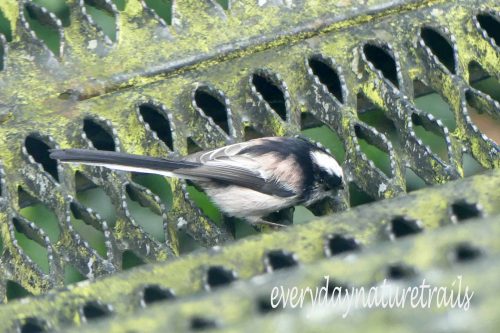
Seconds behind them dainty Long-tailed Tits appear, much gentler in their approach but then suddenly they’re everywhere, there must have been at least 12, maybe more.

Foraging party member- Long-tailed Tit

I realise I’m being treated to a close-up, eye-level view of a travelling foraging party! I wish I could better convey the excitement and energy transmitted by these little birds that I felt even through my double-glazed kitchen window, it’s quite magical. I’d have been happy with just the Blue and Long-tailed Tits, but then there are Great Tits too;  only three that I can see, one of which is a smartly feathered juvenile, similarly coloured to the adults that arrived with it but not as brightly yellow. Again, probably a family.

Foraging party member- Great Tit

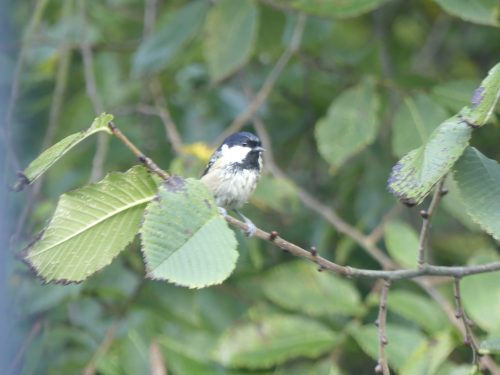
Birds continue to arrive, more Blue Tits, long-tailed Tits and then two Coal Tits, one of which perched on the end of a leafy twig and launched itself at the window, fluttering madly as it inspected its corners and joints for hiding insects or spiders.

Foraging party member-Coal Tit

Then just as I thought the last of the party members had arrived there are two Goldcrests. They are tricky to focus on as one seems to be chasing the other at speed through the tree branches. They may be our tiniest birds, but they’re quite feisty.

Most of the birds stay within the cover of the trees, but a few more adventurous ones venture over to check out parts of the building too. I already mentioned the Coal Tit coming to my window, but others were exploring the metal fire escape, which permanently in shade tends to have a coating of algae and lichens.

Blue and Long-tailed Tits tend to be the bravest, and where one bird ventures others follow to see what they’ve found, including a curious Goldcrest. Slightly below the level of my windows, I got to see the birds from some interesting angles,

FORAGING FLOCKS

These travelling foraging flocks typically have a core species around which others gather, typically Tits. Here I’m sure that Blue Tits are the central characters as well as being their most numerous members. They seem to lead or guide the flock and so are the first to arrive in a chosen foraging spot when they’re on the move. Other species accompanying or following them are known as attendants and they tend to join the foraging flock only when it enters their territory. Attendants may be other insectivores such as Nuthatches, Treecreepers and sometimes Woodpeckers.

Blue Tit in Wych Elm – leaves still covered with greenfly

The formation of mixed-species flocks is thought to benefit individuals by reducing the risk of predation; the more pairs of eyes that can spot predators such as Sparrowhawks and raise an alarm the better. On the same principal, it’s likely that their numbers and variety of feeding methods also increases foraging efficiency, the more pairs of eyes seeking insects the greater the chances of finding them. Differing sizes and methods of feeding allows the different species to forage in close proximity without conflict.


Share this:

  • Share on Facebook (Opens in new window) Facebook
  • Share on Pinterest (Opens in new window) Pinterest
  • Share on X (Opens in new window) X
Like Loading...

Wild and Windy on West Shore

22 Thursday Aug 2019

Posted by theresagreen in coastal habitat, Nature of Wales, Walking, Wildflowers of Wales, Wildlife of the Wales Coast Path

≈ 14 Comments

Tags

Blue Lettuce, coastal wildflowers, Duke of Argyll's Tea Plant, flowering in August, late summer wildflowers, Llandudno, North Wales Wildlife Trust, seashore, West Shore

August 19th

On Sunday, the North Wales Wildlife Trust held their annual August “Go Wild” event at  Llandudno’s West Shore. From the outset a powerful wind brought a truly Wild element to the proceedings, but the sun shone, it wasn’t cold and better still, it didn’t rain! And we’re a hardy and resourceful lot here in North Wales, so marquees, stalls and games were battened down and sheltered behind a windbreak of cars, big NWWT vans & the minibus all parked bumper to bumper, Wild West Wagon style. All well worth the effort as it turned out to be a really successful and enjoyable day, well-attended by a good number of interested and enthusiastic people of all ages.

Having volunteered to guide a Wildlife Wander on the day I’d done an advance recce on Thursday afternoon of the route I had in mind to get an idea of what we might see  and to take photographs that I wouldn’t have chance to do out with a group of people. It was windy then, but even more so on Sunday, so seeking some shelter from it, and in consideration of some young, tiny but very game wanderers we made a bit of a deviation from the original plan, but happily still managed to see most of the species of wildflowers I’d noted on Thursday, plus a couple I didn’t.

August 15th

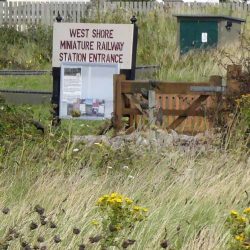
Sunday’s wander would set out from our pitch next to the Children’s Playground on the Promenade, but at just past two o’clock today, although it was sunny, a strong wind was blowing and as it’s very open and exposed here I started further down, closer to where the dunes begin. A well-used path starts from Trinity Crescent, passes behind the buildings on the site of the Miniature Railway and travels in a fairly straight line to join the Coast Path through an open, grassy area.

On first impressions, this may appear to be an unkempt wasteland but a lot of wildlife loves such habitat and it’s always well worth closer inspection. This particular patch is home to a great variety of wildflowers, which then attracts insects and if you’re lucky, birds too.

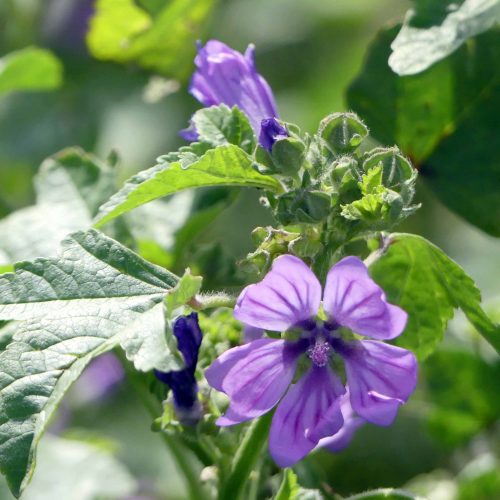
Common Mallow-Malva sylvestris-Hocysen

Some wildflowers are tall and so abundant that you can’t fail to notice them, like Common Mallow. It’s currently in full bloom and full of pretty pink-purple flowers  hoping to catch the attention of any passing pollinators.

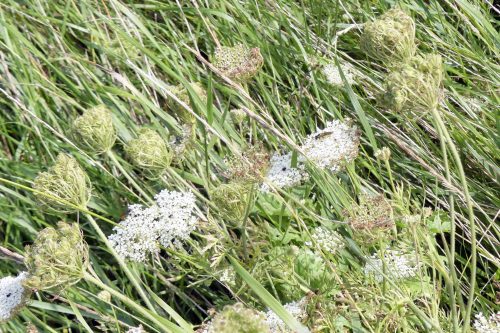
Between stands of Mallow there’s less showy Wild Carrot, largely finished flowering now and setting seed. This is one plant that is definitely in its favoured habitat- rough grassland, on chalky soil and by the sea. It’s a white umbellifer that’s more distinctive than most, as in the centre of the flowerhead is usually a single red-purple flower which is thought to mimic a fly that then attracts insects to assist pollination. After flowering the long umbels fold upwards and inwards to contain the seeds in a sort of cage.

Wild Carrot-Daucus carota-Moron y Maes

I saw an insect on a flowerhead and tried to photograph it, but as you can see the wind was blowing it all over the place and I couldn’t focus on it properly – when I checked the photograph later I saw it was a Sawfly – Rhogogaster viridis. 

190815-LLWS- (30s)-Wild Carrot flowerhead
190815-LLWS- (9b)-Sawfly-Tenthredo on Wild Carrot

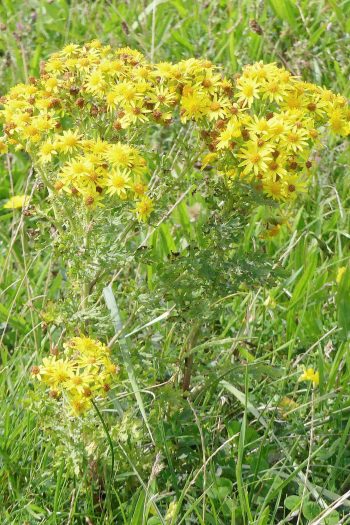
Ragwort-Senecio jacobaea-Creulys lago


There’s a good number of Ragwort plants, many of which were being visited by bees. Most of those I saw were Buff-tailed Bumblebees; big and strong enough to fly between plants on a windy day, although even they weren’t going far.

I checked a lot of plants here looking for the black and yellow caterpillars of the Cinnabar Moth-Tyria jacobeaea, but there were none that were obvious.


190815-LLWS- (20)-Buff-tailed Bumblebee on ragwort
190815-LLWS- (15)-Bumblebee on ragwort flowers

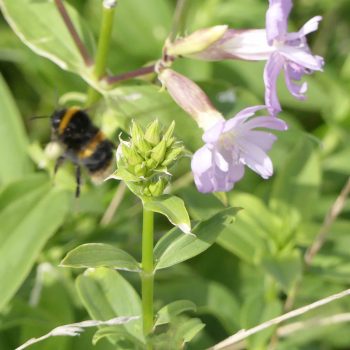
Another abundant flowering plant is Soapwort, which has been left undisturbed and has formed some impressively large patches. It’s in full bloom now and a mass of pretty sugar-pink flowers.

Soapwort-Saponaria officinalis

Bees seem to like these flowers too.


The green leaves and stems of Soapwort were once crushed and boiled in water to make a lathery liquid that was widely used to wash wool and woollen cloth. For that reason it was often grown in fields and gardens close to woollen mills, and the plants growing in the wild today are often found close to places where wool was once woven into cloth.  


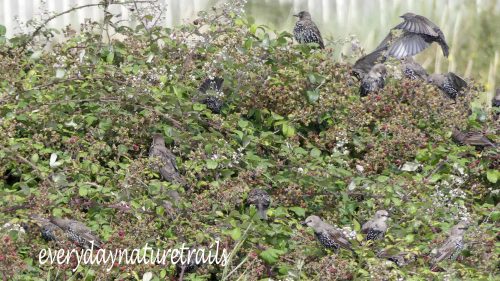
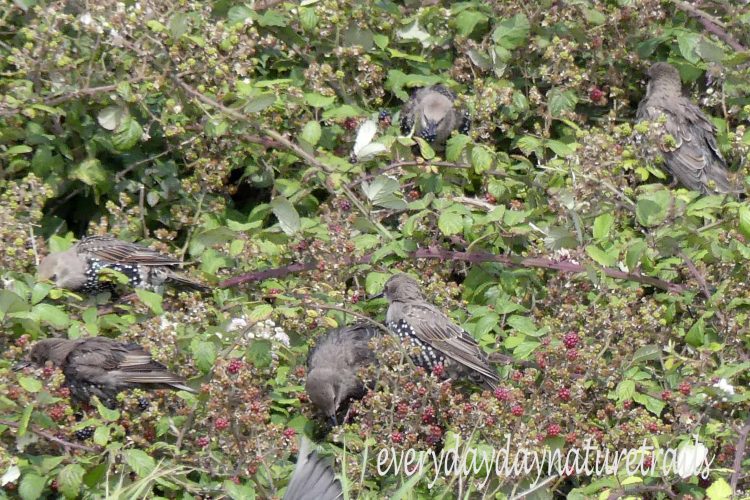
Across the grass at the far end, in front of the Blue Café and next to the entrance to the Miniature Railway is a big tangled bramble bush and my attention was attracted there as a cheerfully noisy flock of birds flew onto it. They were Starlings, most, or maybe all of which I think were juvenile birds, their plumage largely brown with black breast and underparts black with clear white spots.

Common Starling-Sturnus vulgaris-Drudwen

They were clearly enjoying feasting on ripe blackberries.

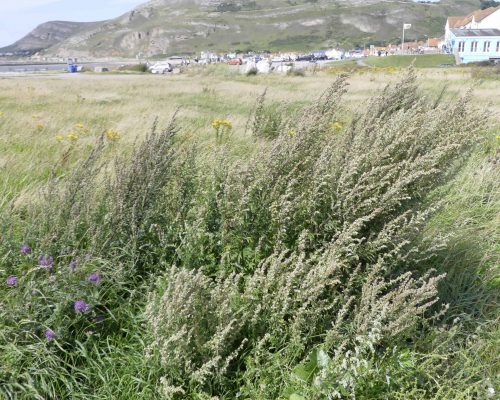
The path leading to the sea is open and exposed to the elements, so plants need to be tough to succeed here. Mugwort is one that both survives and thrives here, it’s not an especially attractive plant to look at, but it’s well adapted to its environment and it also produces aromatic oils, a device to protect itself from being eaten by grazing animals. On Sunday, the general consensus of those that rubbed leaves and tested it was that’s it’s scent is not particularly pleasant, but then it is supposed to repel midges, which may be handy to know….

Mugwort-Artemisia vulgaris

Golden yellow Ragwort and purple Greater Knapweed – the classic colours of late summer and early autumn.

In contrast to the Mugwort, Greater Knapweed is tough and lovely to look at – its open ripe seedheads are as pretty as the flowers.

Greater Knapweed-Centaurea scabiosa

Restharrow


In the grass there was Cat’s-ear Hypochaeris glabra and what was possibly a small  hawkbit – they’re tricky to separate at the best of times. Also small amounts of a white-flowered Common Storksbill, some Restharrow, White Clover, Pale Flax and the odd Dandelion or two were still to be found with flowers.


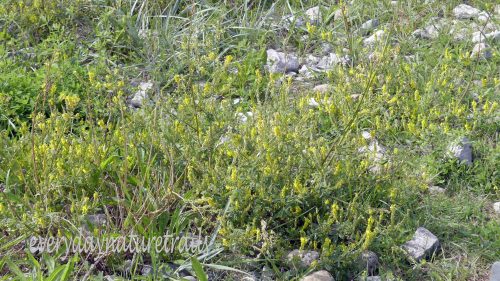
Where our path met the Coast Path was a lovely spreading patch of the yellow-flowered Ribbed Melilot.

Known as a plant of grassy places and waste ground, it seems to be perfectly happy growing in this sandy stony spot close to the sea.

Ribbed Melilot – Melilotus officinalis

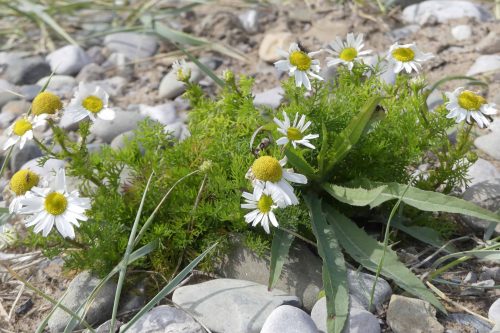
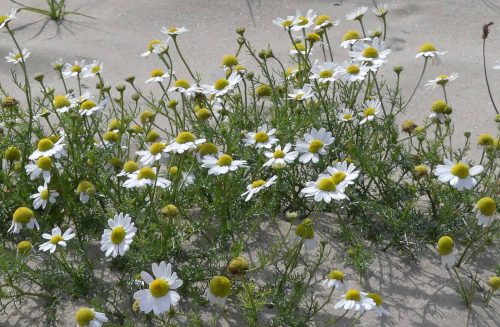
A more common and familiar plant is the Sea Mayweed, a plant of sand and shingle, it can and does pop up in a variety places near to the sea if a seed finds a spot it likes.

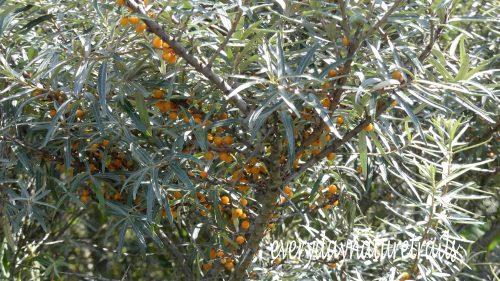
At this end of the path there’s a mass of Sea Buckthorn. This is a thorny shrub with silvery stems and grey-green leaves. It’s flowers are tiny and green and appear before the leaves in the Spring, but now it is now laden with heavy crops of bright orange berries.

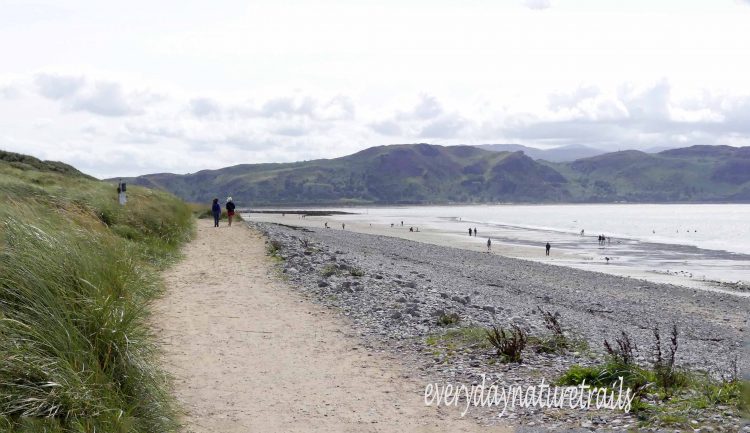
 From here the path, which is also a section of the Wales Coast Path, heads towards the dunes and Deganwy. The views ahead and across the sea to Anglesey and Puffin Island were surprisingly clear today, although there were rainclouds hanging over Snowdonia.

The wind had driven people trying to enjoy a day on the beach into the shelter of the dunes, some camped on the path, so I made a detour around them along the beach.

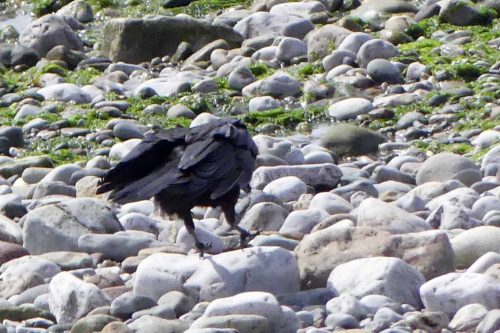
A wind-ruffled Crow foraged among the pebbles on the sea edge

The strandline was strewn with piles of long tangled strands of seaweed: looking a bit like piles of brown spaghetti, this is Thongweed. If I’d been here spending a leisurely afternoon on the beach I would have had to collect some and plait it. In places it was mixed with other seaweeds that had also been wrenched away from their moorings on the submerged rocks.

Flitting around the drying seaweed there were a lot of little flies, perhaps unsurprisingly commonly known as Kelp or Seaweed Flies.

190815-LLWS- (66)-Fly amongst seaweed
190815-LLWS- (61a)-Kelp fly

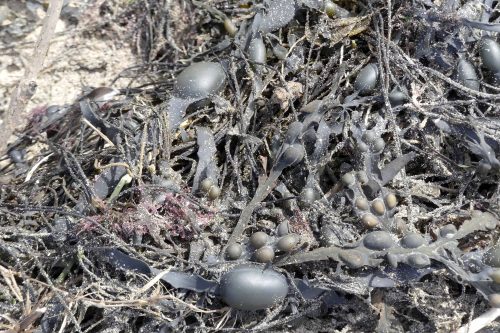
I photographed a pile of mixed seaweeds which includes Thong Weed, Egg Wrack (the one with big bubbles), Bladderwrack (with smaller bubbles) and some of the reddy-pink Polysiphonia algae that is a parasite of Bladderwrack.

Reaching the stone seabreak I rejoined the dunes, passing a big clump of Sea Rocket, the only one of our seashore plants to have lilac-coloured flowers.

Sea Rocket-Cakile maritima


I love this viewpoint and find it difficult to resist stopping here, and not just for the view: it’s furnished with a semi-circle of cut-stone slabs with lovely tactile polished tops, but it was too windy to hang about for long today. I did stop long enough to photograph the spikily beautiful large Sea Holly plant growing on the edge of the dune below.

Sea Holly-Eryngium maritimum

Onwards through the dunes the path was slightly sheltered from the wind, although you can see how the bordering Marram grass was being pressed almost flat against the dune and cliff sides.

Marram grass has ripe, or ripening seedheads now held on tall stems that sway stiffly in the wind. The view is quite clear over to Anglesey.

Marram – Ammophila arenaria

More Sea Holly and a very large clump of Sea Mayweed are flourishing in a sheltered spot.

The dunes end and there opens up the amazing view of the iconic Vadre at Deganwy and the mountains on the far side of the Conwy Estuary.

On the pathside Cat’s Ear is flowering and there is still quite a bit of Bird’s-foot Trefoil available to bees and butterflies, although all I saw today was a single Common Blue.

190815-LLWS- (96a)-Cat's-ear Hypocharis radicata
190815-LLWS- (97a)-Common Blue

Whilst photographing the Cat’s Ear I noticed an insect scuttling about and now and then entering holes made in the sand. Long and black, with a purplish iridescence to its wings and a very narrow ‘waist’, so likely a sand wasp, but I don’t know the species.

190815-LLWS- (86a)-Insect entering hole in sand
190815-LLWS- (91)-Insect 4a

More Sea Rocket, this time growing amongst the stones of the rip-rap. There were bumblebees nectaring on the windswept flowers.

190815-LLWS- (112a)-Sea Rocket
190815-LLWS- (114)-Bumblebee on Sea Rocket flower

On the cliff side of the path there’s more Bird’s-foot Trefoil and quite a lot of Restharrow still flowering.


On the cliffside itself, there’s an impressive spread of Rock Samphire. This is our most distinctive yellow-flowered umbellifer and the only one with fleshy leaves. It grows only by the sea.


Rock Samphire-Crithmum maritimum

And more Sea Mayweed, almost buried by sand.

The path continues to curve around the bay towards Deganwy, but this is where I turned around to walk back.

This point on the path is where I first saw the shrubby plant intriguingly named the Duke of Argyll’s Tea Plant. This member of the nightshade family with small purple flowers is not at all a showy plant, but it does have an interesting history.

The story goes that Archibald Campbell, the 3rd Duke of Argyll received this plant, Lycium barbarum together with a tea plant, Camellia sinensis from China in the 1730s. Unfortunately their labels got mixed up, so it was grown under the wrong name in his Middlesex garden and, presumably when the mistake came to light, it subsequently became known as the Duke of Argyll’s Tea Tree or Tea Plant. (From A Dictionary of English Plant Names by Geoffrey Grigson, London 1973.) 


The plant has been used in Britain since the 18th century for hedging, especially in coastal districts. Its red berries are attractive to a wide variety of British birds.


This view back along the path towards the Great Orme is wide and impressive and even better today as now the wind was behind me and the sun at a better angle to light the photograph! I retraced my steps a short way before taking the marked Public Footpath up the cliff, where it continues along the top of the cliff on the edge of the golf course.

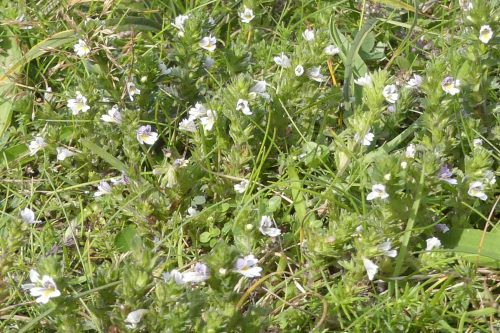
Amongst the grass where the path begins there was a pretty patch of Eyebright,

Eyebright-Euphrasia nemorosa

close by there was Wild Thyme, a smallish umbellifer I’m not sure about and one remaining flower on a Goat’s-beard plant.

mmm

And, at last – a Ragwort plant with Cinnabar Moth caterpillars!

Cinnabar Moth caterpillars
caterpillar of the Cinnabar Moth-Tyria jacobaea

The continuing path is narrow and leads through gorse, taking a brief rest from flowering now, which is taller than me. A prickly path, but well sheltered from the wind and very peaceful.


In parts gorse gives way to equally prickly brambles, some of which are reaching long stems out across the path.

Fruits are developing, a few of them already ripened into blackberries.

This feels like a ‘secret’ path and you never know what treasures you might discover here. In a sunny spot between the banks of brambles, two Gatekeeper butterflies were chasing one another, then settled to bask on leaves. Nearby they were joined by a big Drone Fly.

190815-LLWS- (154)-Gatekeeper butterflies
190815-LLWS- (163)-Eristalis hoverfly

There are a surprising number of wildflowers to be found along here; still with some flowers there was Wood Sage

Wood Sage-Teucrium scorodonia

and Yarrow, which was attracting small black flies, at least one pair of which were mating.

190815-LLWS- (157)-Yarrow with flies
190815-LLWS- (159)-Small black flies mating

With little room for manoeuvre a large Toadflax plant, grown tall and leggy, had leaned out across the track

Common Toadflax – Linaria vulgaris

it was full of flowers and in this sheltered spot was being investigated by a bumblebee.

190815-LLWS- (167)-Toadflax flowers
190815-LLWS- (169a)-Bumblebee on Toadflax

Another plant with mauvy-blue flowers had also grown long and straggly and was leaning out over the path searching for light – I thought at first it was Michaelmas Daisy, but the flowers’ centres were blue, not yellow – I had to wait till Sunday to be pointed in the right direction to identify it after seeing it again then!

There’s quite a bit of Herb Robert here too, there are still a few flowers but most have finished and the beaked seedheads show the plant to be one of the cranesbills. Even in this sheltered spot plants still get showered with sand.

Herb Robert-Geranium robertianum

As well as Blackberry brambles there are also Dewberries. These fruits are similar to blackberries but the segments are bigger and they are covered with a bloom, a bit like a plum is.

Dewberry-Rubus caesius-fruit
190815-LLWS- (177)-Dewberry flowers

The path emerges back out onto the top of the dunes where the vegetation is dominated by Marram, brambles and a lot more Duke of Argyll’s Tea Plant.

I found a plant that shows off the leaves and flowers quite nicely.

Duke of Argyll’s Tea Plant- Lycium barbarum

There was a little more Ragwort here that was being visited by a Meadow Brown Butterfly.

At this point you can either take a path that leads back down through the dunes to the beach or carry on along the open path around the golf course. I took the latter, hoping to find a few more wildflowers to add to my list.

Apart from a bit of Traveller’s Joy amongst Marram and brambles, there wasn’t much to see that was still in flower, but I did find a small amount of Lady’s Bedstraw, a single Bloody Cranesbill flower, and a few Harebells to finish off with.

Bloody Cranesbill
Bloody Cranesbill
Lady's Bedstraw
Lady’s Bedstraw
Harebell
Harebell
Traveller's Joy
Traveller’s Joy

On Sunday, as I already mentioned we took a slightly different route to avoid the wind, but we did see most of the wildflowers that I’ve photographed or named above, which totals to some 40 or more species, and added a couple more. We also found lots of ripe Dewberries and a Cinnabar moth caterpillar on some Ragwort, saw a few bumblebees, but didn’t see a single butterfly.

Pellitory-of-the-Wall

One wildflower that I should have recognised on the day but that was growing in an unexpected place so had become long and straggly (my excuse!) was Pellitory-of-the-Wall.

And there was a lot  more of the blue-flowered ‘mystery’ plant from Thursday’s walk, which turns out to be a rather rare plant in the UK known as Blue Lettuce, or Russian Blue Sowthistle – Lactuca tatarica. I didn’t have time to take good photographs as the group were moving on, but fortunately the one below was good enough for a friend who had seen the plant here herself and researched it, to give me a clue! She later kindly forwarded me the following info from the UKwildflowers website, which is a direct quote:

Blue Lettuce-Lactuca tatarica

Known at this site from at least 1963, this introduced plant is also known as Russian Blue Sowthistle. It grows very close to the shore in dunes not far from a car park and is well established now on nearby cliffs. Flowering in late summer it provides an unusual display of many blue/purple flower heads.
L. tatarica is known from very few separate sites throughout England, the Isle of man and the Scillies. This appears to be its only site in Wales, there is none to be found in Scotland and only one site in western Ireland. 


Share this:

  • Share on Facebook (Opens in new window) Facebook
  • Share on Pinterest (Opens in new window) Pinterest
  • Share on X (Opens in new window) X
Like Loading...

Before this Blackthorn Winter

07 Sunday Apr 2019

Posted by theresagreen in birds of Wales, Nature of Wales, North Wales, Wildflowers of Wales

≈ 9 Comments

Tags

Blackcap, Blackthorn winter, comma, hoverflies, March, Nuthatch, woodland wildfowers

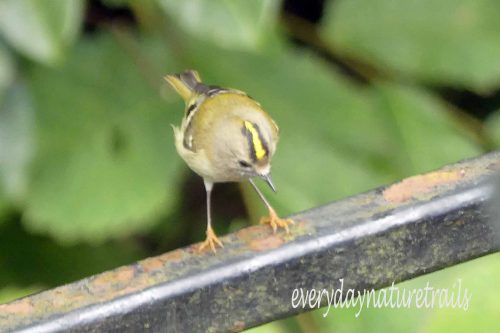
Just in case you hadn’t noticed, we are currently experiencing the aforementioned Blackthorn Winter! At least we are in North Wales where the past week or so has been cold, some days extremely windy and we’ve been doused with heavy showers of cold rain and hail. I’m glad I got out for a couple of lovely walks to see some of the newly emerged wildlife before the weather changed. Before getting onto the walks and staying with the Blackthorn theme, I wanted to share this photograph that I took from my kitchen window. This was the first Spring sighting I had of a female Blackcap checking for anything edible on Blackthorn blossom. I have no way of knowing if this is the one that stayed with us over winter or a newly arrived migrant, but either way she brightened up a dull morning.
At this time of year I can’t imagine there being a better place to walk than in woodland, where so much is happening everywhere you look.

March 19th-30th Bryn Euryn Woodland Path

I didn’t have to walk far before starting to see hoverflies; lots of bright shiny new ones, some seeking pollen and nectar, others basking on leaves soaking up the sunshine. There were a few Bumblebees about, big Red-tailed and Buff-tailed queens mainly, flying low over the undergrowth, some maybe seeking nest sites and others beginning to stock theirs with provisions for the next generation of working daughters.


Carder Bee on periwinkle
One of many similar hoverflies

I’d forgotten this tree was a lovely blossoming one; there were a few Bumbles visiting it but none stayed still for long enough for me to see what they were. 

Cherry Laurel was still in full bloom around the middle of the month but going over towards its end.

Greater Stitchwort is one of my favourite Spring flowers,the small starry flowers are the perfect size for the smaller hoverflies and they seem to suit the furry little Bee-flies too – they don’t have to land on flowers, they simply hover in front of them and use their long fixed proboscis to suck up nectar.


190330-BEWP (20)
190330-BEWP (17)

There were a good number of small black hoverflies about too; in the sunlight you can see the silver-grey markings on their long bodies through their dark wings. They were a species of Platycheirus, perhaps Platycheirus albimanus, or White-footed Hoverfly


190330-BEWP (28)
190330-BEWP (23)

I found Wood Anemones

and a few Bluebells have already opened

If you’re a fairly regular birdwatcher then you most likely know that when you hear birdsong or sounds that you don’t recognise, they’re very likely to be coming from a Great Tit! Apart from their recognised ‘teacher-teacher‘ song they have a whole repertoire of other whistles and calls but I still often find myself caught out, scanning branches looking for the source of unrecognised calls and finding once again it’s yet another.  It happened today, it took me a while to locate this trickster up in a tangle of twigs but when I did he gave me a look then turned his back and carried on singing.

His black markings are particularly strongly, especially around his rump and I’m sure I’ve photographed him this past winter from my kitchen window; he’s quite distinctive and I’d say within range. 

As I stood watching and listening to him I heard another, louder whistling call that I hadn’t heard in a long while, but recognised as the calls of a Nuthatch. It sounded close by but I’m not the best at pinpointing where bird sounds are coming from so I edged slowly along the path trying to stay behind trees where possible hoping to see movement. I could hardly believe my luck when he flew onto a tree branch leaning at almost a 90° angle and just high enough above me to see most of him. He put on a wonderful performance, moving first to stage right, lifting his head and stretching his neck skywards, then opening his beak wide and putting his whole self into his song. He repeated this several times, then stopped, had a little rummage about then turned, moved to stage left and repeated the act facing the other direction. I felt very privileged to be his audience and thanked him as he flew off down into the inaccessible lower slope of the woodland.


190330-BEWP (39)
190330-BEWP (42)

This all took place close to the boundary with the open field beyond it, so I looked over as I always do, hoping one day they’ll be something there to see, but again not today and the view was obscured by mist too.

There were more wildflowers to see alongside the path though, a few blooms of dainty Wood Sorrel and Common Dog Violets.


190330-BEWP (55)
190324-BE (25)-Dog violets

WOODLAND TRAIL

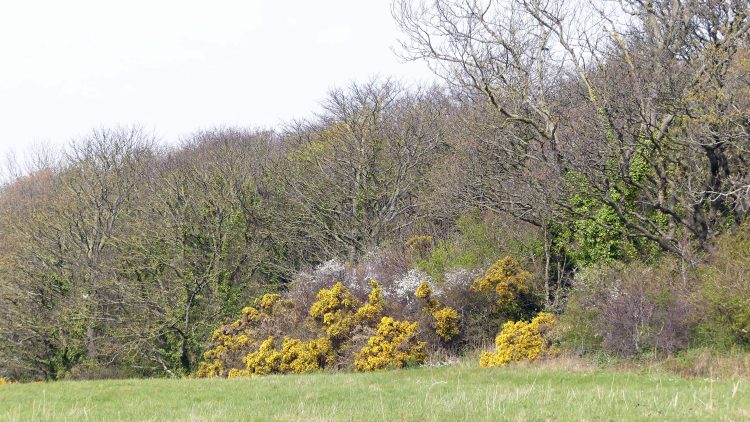
Mid month the Blackthorn on this part of the trail was still in bloom, Gorse was fully out as was the pink flowering currant.

I have learnt to approach this area, one of my wildlife ‘hotspots’ with care as you never know what might be there. Again, mid-month I saw this lovely Long-tailed Tit with a large fluffy white feather in its bill, so nest building must have already reached the final lining stage. I guess she may be sitting on eggs by now. 

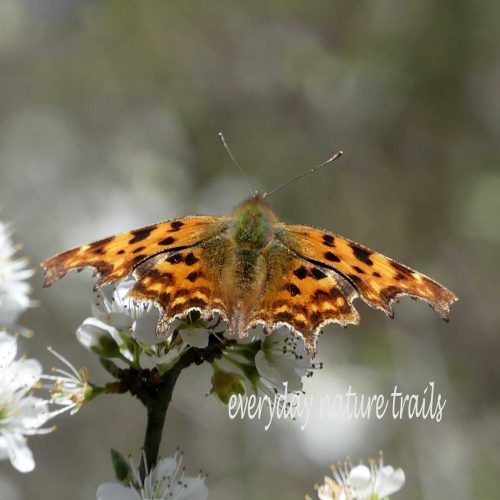
This is a spot favoured by beautiful Comma butterflies too and moving on from watching the Long-tailed Tit, I disturbed one from its basking on the bare ground of the track. It flew around for a while, had a bit of a scuffle with another that appeared from the other direction, then settled on the Blackthorn to resume his sunbathing.

There were quite a few hoverflies feasting on the blossoms too, mainly yellow and black ones which are species of Syrphus, One or two drone flies and more of the little Platycheirus.


190324-BEWT (35)-Hoverfly on Blackthorn
190324-BE (194)-Eristalis hoverfly on blackthorn
190324-BE (176)-Tiny hoverfly on blackthorn
190324-BE (175)-Hoverfly on blackthorn

The next-door Gorse had a few visitors too, but the richly coloured and scented flowers never seem to attract as many insects as I think it should.


190324-BE (163)-Hoverfly on Gorse
190324-BE (160)-Bumblebee

Down below, I watched one Hoverfly on the bare earth seemingly sucking up something- minerals or maybe just moisture? Others rested basking on leaves soaking up warmth.


190330-BEWT- (1)
190330-BEWP (57)

And every dandelion flower had at least one diner.


190324-BE (216)-Hoverfly on dandelion
190324-BE (211)-Hovefly on dandelion-face view

New Hazel leaves are bright fresh green and still soft and wrinkled.

I found a little bit of Herb Robert and new leaves of Wild Strawberry


190324-BEWT (62)-Herb Robert
190324-BEWT (73)-Wild strawberry leaves

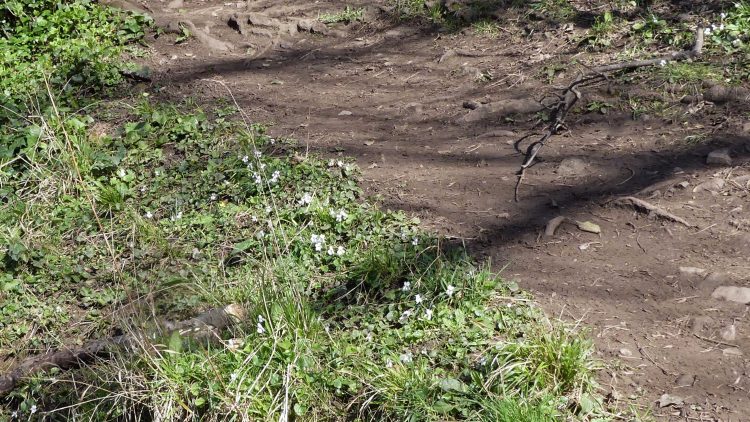
There’s a ‘shortcut’ up to the lower meadow and at its junction with the Woodland Trail white Sweet Violets grow. The plants have spread well over the past few years and although their leaves and flowers tend to get splashed with mud they are still a pretty sight.

There are Common Dog Violets nearby too


190330-BEWT- (9)
190330-BEWT- (8)

and also the subtly different Early Dog Violet

At the top of this steeply sloping track I heard a Robin singing and located him in a Blackthorn that has become a small tree; its blossom is still mostly in bud. This area on the corner of the open meadow is definitely a Robin territory and is well guarded. Last time I passed by there were two birds, one either side of the track and one loudly expressed their disapproval at my intrusion.


190330-BEWT- (13)
190330-BEWT- (14)

The ‘official’ entrance to the meadow, gained via the steps is close by in the opposite corner and I walked around to see the progress of the Cherry Plum tree. There were still a few blossoms, but now the leaves are well grown and a beautiful fresh green.

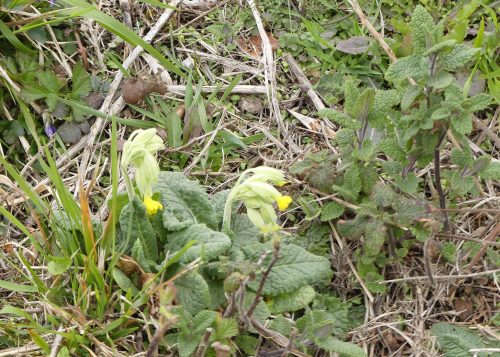
Gorse on the field edge is smothered in golden blossom, of course I had to walk over to it for my ‘fix’ of delicious coconutty perfume. I wish we were equipped with a scent recall sense!There was  more to come along the Summit Trail, but to finish here, the first of the Cowslip flowers had appeared, but still bent over shyly hiding their tiny faces.

Share this:

  • Share on Facebook (Opens in new window) Facebook
  • Share on Pinterest (Opens in new window) Pinterest
  • Share on X (Opens in new window) X
Like Loading...

A Cosmopolitan Woodland

01 Friday Mar 2019

Posted by theresagreen in Nature of Wales, Walking Trails, woodland birds, woodland walks

≈ 11 Comments

Tags

Bryn Euryn Nature Reserve, cherry plum, coal tit, flowering in February, garden escapes, hazel catkins, non-native plants, Nuthatch

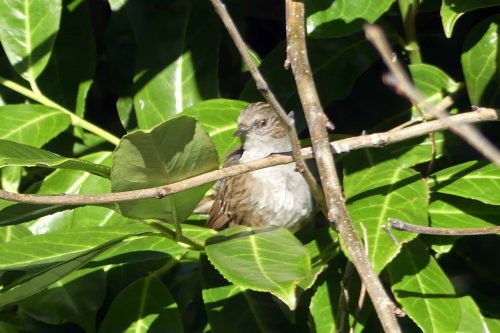
Enjoying the sunshine of this glorious morning, a bright-eyed Dunnock sat on a platform of leaves of the Laurel hedge preening and soaking up the warmth.

Woodland Path

The sight of the sunbathing Dunnock sparked the idea of a theme for this morning’s walk, or rather the Laurel did. Bryn Euryn is almost an island, virtually surrounded by houses and running the length of the side I often begin my walks, is the busy A55 North Wales Expressway. Its summit was once the site of an ancient Hill Fort, where a Trig Point now stands. There are ruins of an old manor house and exposed rock cliffs around a field next to the car park mark the site of an old quarry. Opposite the car park there’s a large area of land given over to allotments. This long-reaching proximity of people and the plantings in their gardens, has inevitably led to the presence of trees, shrubs and flowers that wouldn’t be there naturally. Today I thought I’d make a point of looking out for some of the more obvious ones amongst the natives.


Cherry Laurel- Prunus laurocerasus

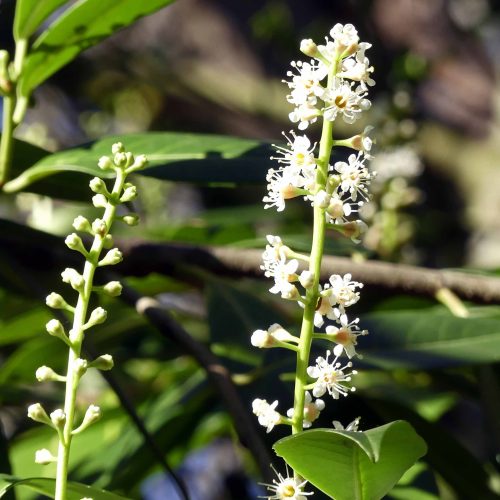
There’s quite a lot of Laurel growing in this particular spot on Bryn Euryn, doubtless planted when a grand house occupied the site now replaced with our small development of flats. This is Cherry Laurel, introduced from south-east Europe in 1547 and quickly popularised for creating ornamental hedges. Apart from the Rhododendron, it is the most common introduced evergreen in Britain. It’s beginning to flower here now: the flowerheads stand erect  like candles and are made up of small creamy-white flowers that smell a bit like marzipan.

Twining into the Laurel, reaching across the path is Honeysuckle, which is a true native; its leaves already almost fully grown.

Honeysuckle-Lonicera

Greater Periwinkle-Vinca major

On the edge of the track and scrambling up the woodland slope deep blue Greater Periwinkle is flowering. Evergreen under-shrubs native to Europe, north-west Africa and southern Asia, this would most likely have been planted here originally, but the Periwinkles are long enough established and widespread in the wild to be included in wildflower books, often listed as garden escapes.

A Song Thrush was singing its energetic and joyous song rising up  from somewhere on the steep slope below. eating Ivy berries, A Great Tit called out its signature ‘teacher-teacher’, loud and clear. Blue Tits were all around me, calling to one another as they flitted about investigating shrubs and trees in their endless quest to find food. I caught a glimpse of one above my head; it was pure luck that I caught one holding a twig in its claw while it pecked at a leaf bud. The marks above its head are insects, not specks on my lens!

Blackbirds were rustling around in thick Ivy, grabbing berries.

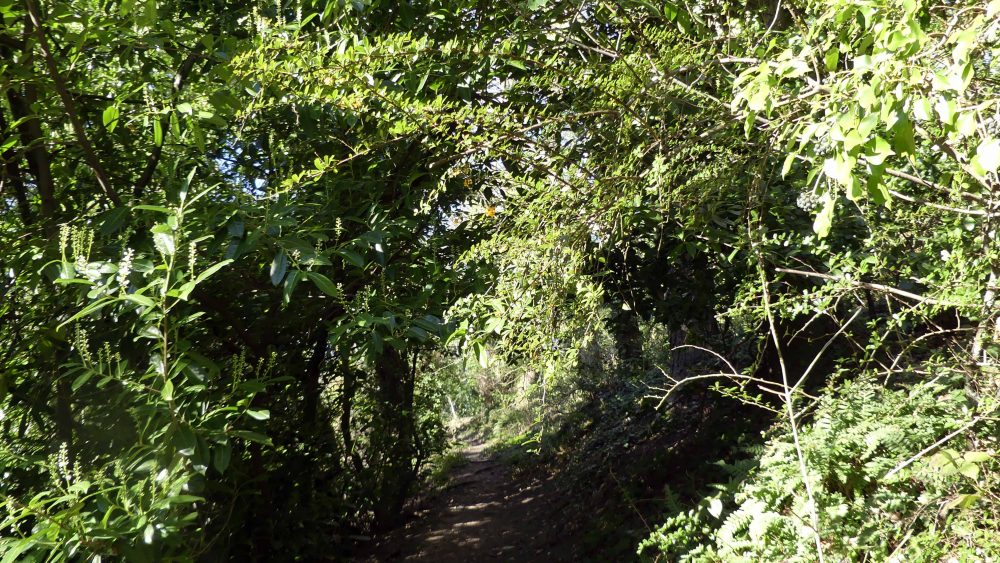
Another shrubby archway reaches over the path formed by more Laurel and Berberis, which is just beginning to flower. Berberis, or Barberry, is another shrub familiar in gardens. I also spotted a few small Mahonia plants along the way, all bearing flowers.

On a Polypody fern frond sat a bright shiny new hoverfly, gleaming bronze in the bright light. Two Greenbottle flies chose an Ivy leaf to sunbathe upon.

190226-BE (13)-Hoverfly on polypody fern
190226-BE (18)-2 greenbottle flies on ivy leaf

Towering over the greenery, bare trees, their branches silvery against the intensely blue sky, remind that there is still a while to go before the true Spring arrives.

Grey Squirrels have been active throughout this mild winter; there have been very few days when I haven’t seen at least one from my windows. I’m not a fan of this introduced species  because of their dominance over our native Reds and the  tremendous amount of damage they do to our woodland trees. I have to remind myself they have no natural enemies, it’s not their fault they’re here and they’re just trying to stay alive; how are they supposed to know better?

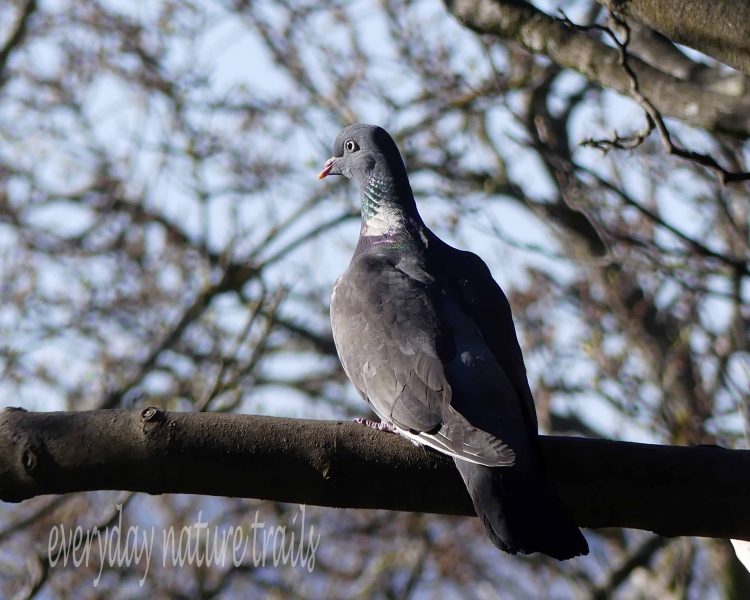
Like most people, I’m sure, I barely go a day without seeing a Wood Pigeon which are common and numerous just about everywhere in Great Britain. They’re another species that have taken full advantage of what we put out on offer and their populations seem to have benefitted from changes in farming practices. They are generally considered as pests by farmers, gardeners and gamekeepers as they’ll eat grains and greens, especially newly sprouting ones, all day long. I rather like them, most of the time they seem very laid-back and have that beautiful soft grey and pinky-purple plumage and the white neck patch; it is nice to see them actually in the woods.

Wood Pigeon – Columba palumbus

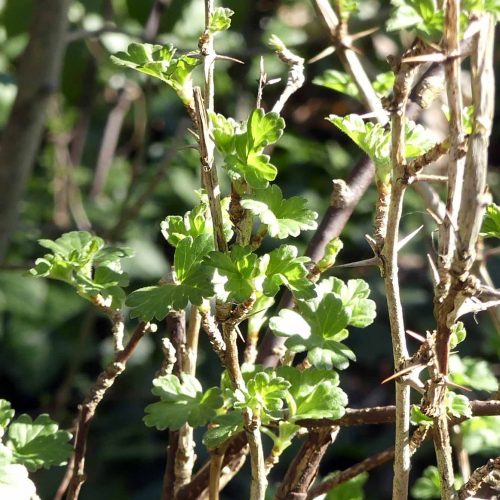
Gooseberry – Ribes uva-crispa

In one spot up near the top of this Woodland Path there’s a well-established Gooseberry bush, with a few smaller ones dotted around nearby on both sides of the track. More familiar in gardens and allotments, Gooseberry is frequently found in the wild, growing in woods, in scrub and in hedges and are probably mostly bird-sown.

Stopping to photograph the Gooseberry I heard a Wren singing. It was close to me but I couldn’t spot it. There are a few Celandines flowering, but they’re quite sparse, perhaps because it’s been so dry.

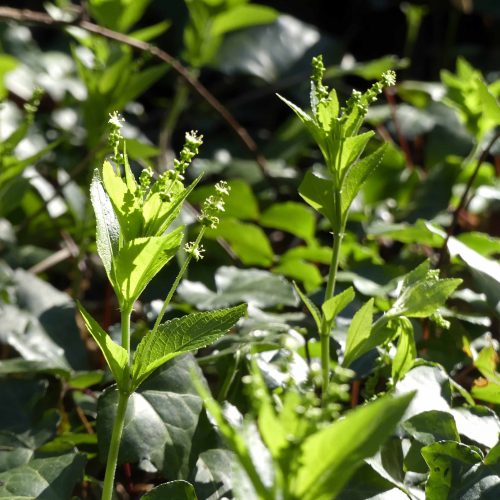
A native wild flower, Dog’s Mercury is flowering. It’s still short, not yet more than six inches (7.5cm) tall.

Dog’s Mercury-Mercurialis perennis

Here and there are clumps of pretty ferny moss. This one is in the middle of the Wood Sorrel patch, whose shamrock-shaped leaves are just beginning to unfurl.

Spurge Laurel – Daphne laureola

Spurge Laurel is one of the more unusual plants that grows here on the Bryn. It is a native plant that favours wooded chalky hillsides, so I have no reason to think it’s not here naturally, but I haven’t seen it on any other sides of the hill.  A very small shrub that must contend with much taller trees and shrubs  towering over it, it’s equipped with thick leathery evergreen leaves, resembling those of Laurel, that can withstand dripping rainwater. It produces its small green fragrant flowers early in the year to make the most of the light before a new canopy of leaves shuts it out.

The near hills and more distant mountains were veiled by a misty haze. Patches of snow clung to the highest peaks, another reminder that winter is still not past. As I stood looking at the view I heard a Woodpecker drumming back in the direction I’d just walked.

Alexanders puts out it new leaves early, often in early February and it’s quite well grown now. It has established on the path-side just before it reaches the reserve and although woodland is not it’s usual habitat, it seems to be spreading. Another introduced plant, Alexanders was brought in as a food plant by the Romans; it has a mild, celery-like taste. This a plant that isn’t usually found far from the sea; there’s a lot of it locally on the Little Orme and in recent years it has spread prolifically along the verge of Llandudno Road, which I suppose is not that far away as birds fly.

Alexanders – Smyrnium olusatrum

The Woodland Trail

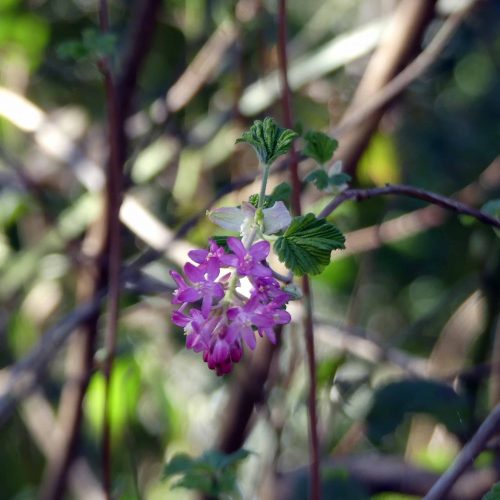
Where the Woodland Path meets the Woodland Trail of the Nature Reserve, a Flowering Currant bush is in bloom.

Flowering Currant – Ribes sanguineum


A popular and familiar garden shrub, with pungently aromatic leaves,this one was again probably also bird-sown. As with the Gooseberry, Flowering Currant can be found throughout the British Isles naturalised in woods, scrub and on waysides.


The Trail is dry and baked hard. The unseasonal warm sunny weather is a treat, but we’re going to need some rain soon. Gorse is flowering more strongly now. I can never resist a chance to smell the warm coconut aroma of its golden flowers. Delicious.

As I reached the enormous bramble patch a Long-tailed Tit flew across the trail in front of me. It disappeared into the dense shrubbery, but then I saw another in the bramble patch. I could see it through the tangle of stems but not clearly enough to photograph. I waited for a few  minutes hoping for a better view, but no luck. About to walk on I heard a whistling call and watched a bird fly strongly over the track and land high in a Sycamore tree. It was clearly on the move, so I took a ‘panic pic’ in case I missed it, but just managed to catch it before it zoomed off; a Nuthatch. I was thrilled, I’ve had very sparse sightings of them here, and never this high up in the woods.

Nuthatch – Sitta europaea

Yew trees are our third native conifer tree, after Scots Pine and Juniper. They are widespread throughout these woods, where they grow well on the chalky hillside. A number of them line a section of the Trail, with other single trees on the other side.

One in particular was heavily laden with flowers. Yews are one of those species that have separate male and female trees. This one is a male; the female flowers are less conspicuous, being tiny and green.

Yew – Taxus baccata

Then there’s a line of Ash saplings, they are growing so closely together they almost make a living fence. More ‘invaders’ grow along the edge of this stretch of the Trail; Tutsan and the dreaded Cotoneaster, which has thus far escaped being routed out.

Beyond the Ash are the Hazels. From the way in which they grow it would seem that at some time in their history they were pollarded as now most of the trees are multi-stemmed and form a small thicket. They are all quite tall though, so if ever they were cut it must have been some time ago.

Because the trees are tall and growing on a steep slope, you perhaps don’t get the full effect of their crop of pale golden yellow catkins, you have to look up. 

There were more Blue Tits here exploring the Hazels and the surrounding vegetation. At the beginning of this month, on an equally blue-skied sunny day I’d stopped here to look for the female flowers of the tree, which are tiny and red and quite hard to spot, especially if you need reading glasses, as I do, but can’t be bothered to keep putting them on to look for things when out walking.

This was not the best place to look as even the lower branches are above my head, so the  photograph above is one I made earlier. Once again though, my hanging around brought a reward. Often a good spot for catching sight of parties of Tits, I was lucky enough to see a pair of Coal Tits arrive and spend a few minutes foraging through the trees. I loved the way they grasped individual Catkins, inspecting them closely to check for hiding insects.

A bit further along the Trail and on the other side from the Hazels, a tree smothered with frothy white blossom shown up perfectly by the deep blue sky; a proper floral treat.

This is a Cherry Plum, although not the truly native wild one as it has bronzy-coloured leaves and not the plain green of the wild one. It could be Prunus atropurpurea, which is a popular garden tree, but I’m not sure.


I don’t think its exact pedigree matters too much, it was lovely to look at and more importantly was also attracting the attentions of quite a few insects. All very high up though. There were definitely a couple of smallish bees and small long hoverflies.

The blossom won’t last for long; already petals are falling and strewing the ground below like confetti.

Another good reason to take one last photograph with the sun shining through it.

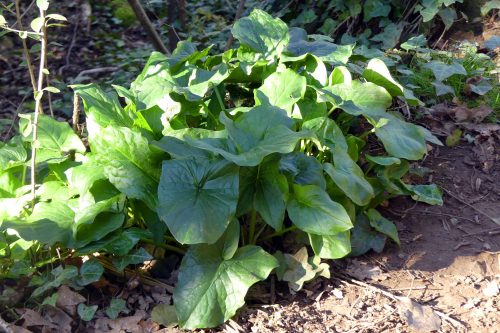
Back at ground level, the leaves of Lords and Ladies, or Cuckoo Pint if you prefer, are well grown now, they began to appear back in late January.

Lords & Ladies, Cuckoo Pint – Arum maculatum

and to finish, a first sighting this year of a single Dog Violet.

190226-BE (59)-Dog Violet
190226-BE (60)-Dog Violet profile

Birds today: Wood Pigeon; Carrion Crow; Raven; Magpie; Herring Gull; Nuthatch; Blackbird; Robin; Dunnock; Great Tit; Blue Tit; Long-tailed Tit Heard: Song Thrush; Wren; Gt Spotted Woodpecker (drumming)

Share this:

  • Share on Facebook (Opens in new window) Facebook
  • Share on Pinterest (Opens in new window) Pinterest
  • Share on X (Opens in new window) X
Like Loading...

Fine Dining for Crows

02 Saturday Feb 2019

Posted by theresagreen in Birdwatching on North Wales coast, Nature of Wales, Promenades, Wildlife of the Wales Coast Path

≈ 19 Comments

Tags

Carrion Crow, corvids, rhos on sea, Rhos Point, scavengers, what birds eat

Historically, the Carrion Crow Corvus corone, is one of our most maligned and persecuted birds and the species continues to sustain losses at the hand, or gun, of man. But as one of the cleverest and most adaptable of our birds they continue to thrive despite us. And in common with other resourceful species dependent on their wits and equipped for  scavenging, many can be found taking full advantage of our amenities and messy lifestyles.  I was reminded of that on a recent walk along the Prom at Rhos on Sea where the rocky shoreline and mussel bed are a regular foraging ground for Crows.

Carrion Crow eating a crab

I noticed a Crow dropping what I assumed was a shellfish onto rocks still exposed by the incoming tide quite close-in below us. (Us being me and my 16 month old grandson snug in his buggy). I’ve watched this fascinating behaviour before, but this was the closest view I’d had. Fumbling for my camera with gloved hands whilst manipulating the pushchair meant I missed getting a shot of the final successful drop, but I was able to watch the bird tuck into his tasty mussel snack.

This was one of three Crows foraging along this rocky stretch, one of which was rummaging amongst the dry seaweed and debris collected on the strand line.

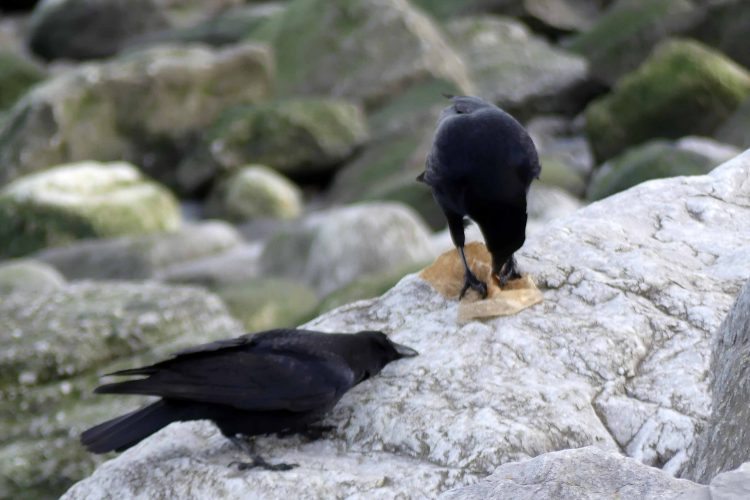
It was working hard to extricate something from amongst the seaweed debris then having tugged it loose, it carried it off to a large rock nearby.

I couldn’t work out what on earth it was, but watching the bird tear off smallish pieces to eat, a piece of old, greasy chip paper came to mind! Even looking more closely at my photographs hasn’t enlightened me, so I’d be interested to hear anyone’s alternative suggestions. Whatever it was the Crow seemed more than happy with it, clamping it to the rock with its feet to make tearing easier.

As I said earlier, there were three Crows foraging more or less together. They seem to be adolescent birds, so could well be siblings from last year’s brood produced by the resident local pair. It wasn’t long before one of the others spotted the potential to share the bounty and, crouching low to the rock, tried to sneak in stealthily.

Going in from the front clearly wasn’t the brightest idea, and it was soon sent  packing.

It didn’t give up and soon tried again, this time more assertively. That didn’t work either, it just made the feeder more annoyed and this time the would-be robber was dispatched with cawing and an aerial attack.

Even that wasn’t enough to put it off though and it soon came back again, sneaking up from behind this time.

A determined lunge and a grab with its formidable beak finally secured it a piece of whatever-it-was and it fluttered off to a spot surprisingly close by to enjoy its stolen prize.


I’m sure the snack was all the tastier for not having had to work for it.

I thanked the birds for sharing their mealtime with me and left them to it.


Share this:

  • Share on Facebook (Opens in new window) Facebook
  • Share on Pinterest (Opens in new window) Pinterest
  • Share on X (Opens in new window) X
Like Loading...

Siesta Time On the Saltmarsh

22 Tuesday Jan 2019

Posted by theresagreen in Birdwatching on North Wales coast, Coastal Snowdonia, Local Nature Reserves, Nature of Wales, North Wales, Special Protection Area, Wildlife of the Wales Coast Path

≈ 4 Comments

Tags

Curlew, Goosander, Haematopus ostralegus, Llanfairfechan, mistle thrush, overwintering birds, Oystercatcher, redshank, roosting birds, SSS1, Traeth Lafan

January 6th

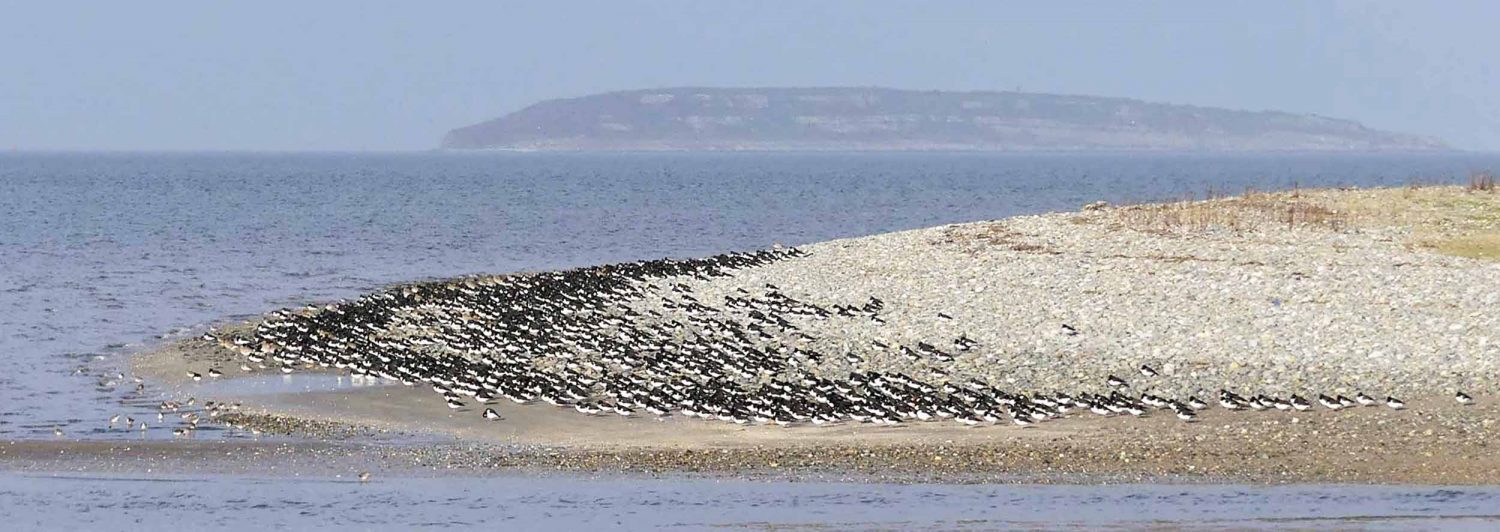
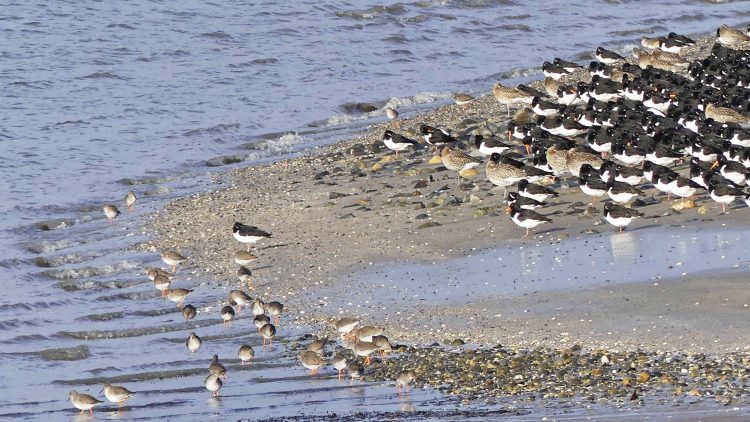
11:19- A first view of the Oystercatcher roost. This regular high-tide spectacle was what I was here to see, but though I knew the birds would be there, that first sight always brings mixed feelings. Firstly there’s relief that things are as they should be, which is quickly followed by the delight of witnessing a truly amazing sight. The numbers of overwintering Oystercatchers are the reason that Traeth Lafan holds the status of Special Protection Area (SPA), which in theory means that measures are put in place to protect populations of specific species of birds of European importance. How that works in practise and what the measures taken are, I’m not too sure. According to Natural Resources Wales, there can be somewhere in the region of 5,000 Oystercatchers present over the winter months, which is at least 0.5% of the wintering Europe and North & Western Africa population. On the same basis as the SPA, the birds are also a qualifying component of the site’s SSSI status.

Oystercatchers roost, rest or preen at high tides when their feeding grounds are flooded

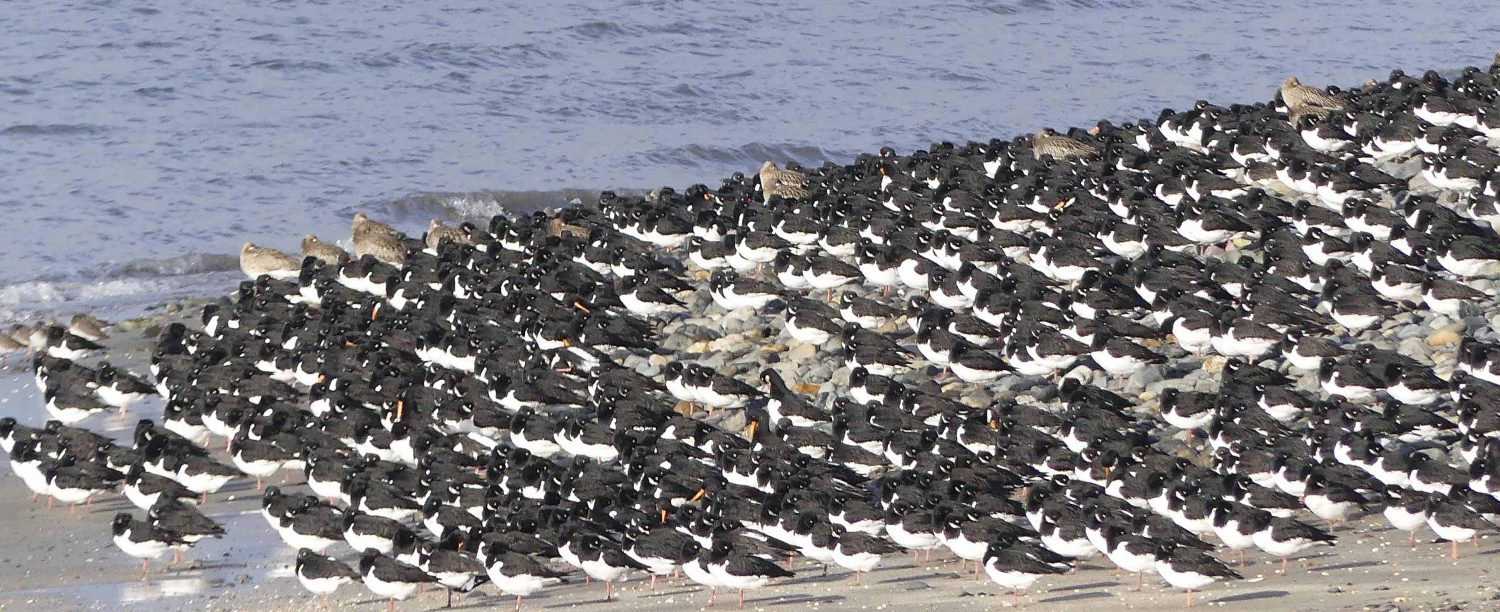
As I’ve confessed before, I’m not good at counting large numbers of birds at the best of times and these were packed tightly together with more out of sight over the far side of the raised spit, so I’m sure they number in the low thousands. Oystercatchers don’t always roost tightly packed together, so it was interesting to see how in this photograph a lot of the birds are pressed together and standing neatly in straight horizontal lines, particularly those on the outsides of the flock.

This roost wasn’t entirely about the Oystercatchers either; a number of Curlew were squeezed in amongst them and Redshanks had tagged on too. The Redshanks were the first ones awake and back in action at the very instant the tide turned and the water started to recede. I imagine the Oystercatchers resting more peacefully with Redshanks present which will sound off alarms at any potential threat.

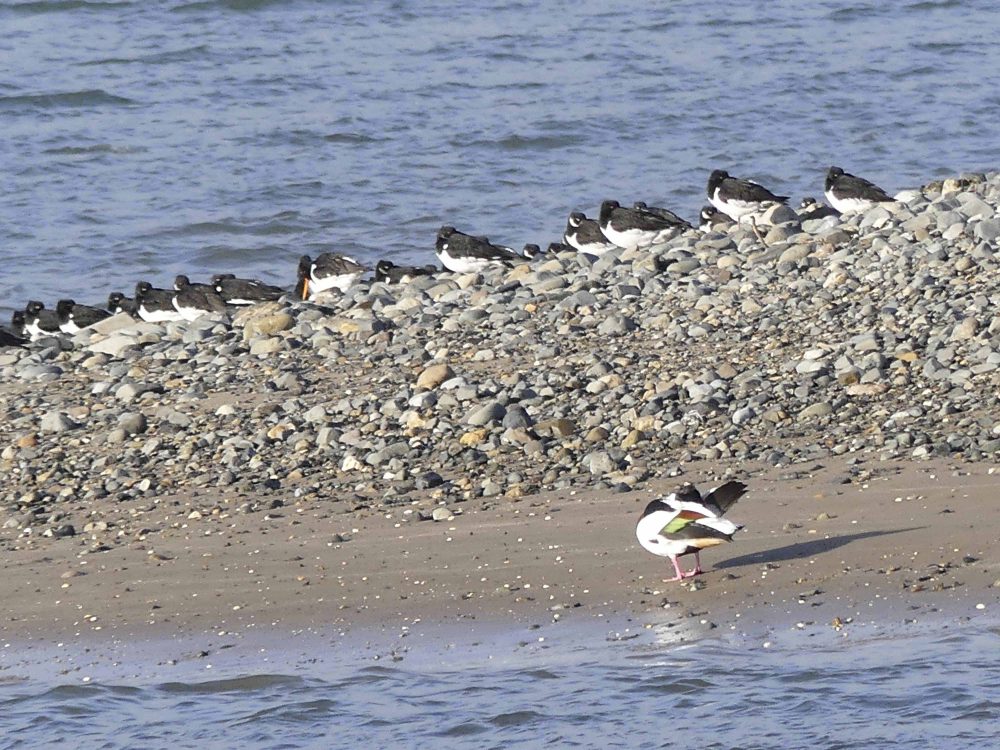
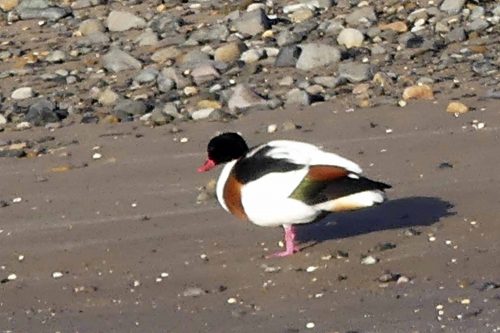
A Shelduck was standing on the sandy edge of the stony spit enjoying a lengthy thorough preening session.

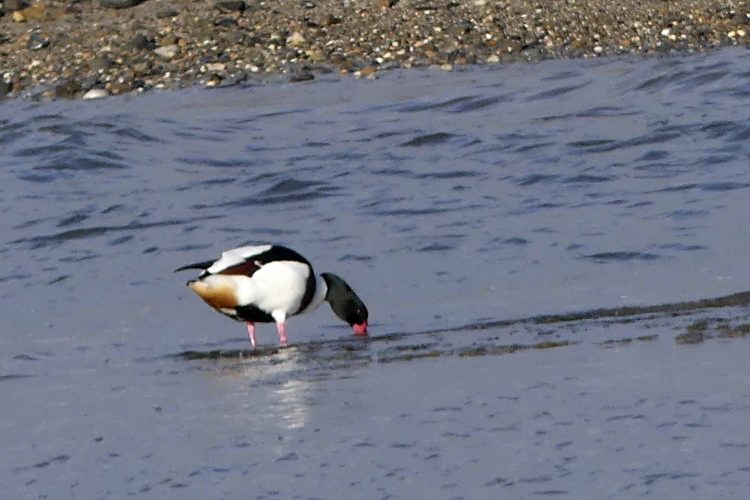
Shelduck – Tadorna tadorna

Once it had finished it too waddled into the shallow water to begin again the endless quest for food. Shelduck are surface feeders, taking mostly animal food from mud or shallow water.

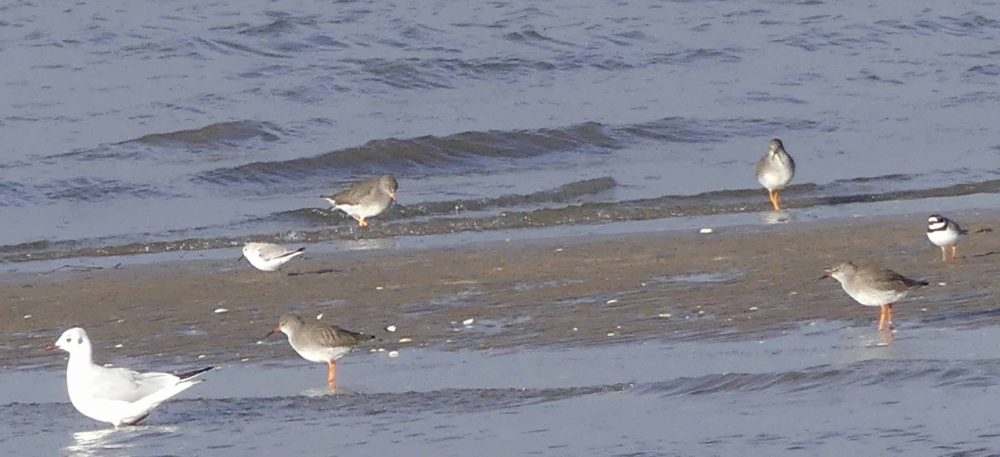
The Redshanks were joined by a flock of Dunlin and Ringed Plovers that flew in and scattered along the freshly exposed sand; quite possibly these were at least some of those that I saw back at the beginning of my walk. 

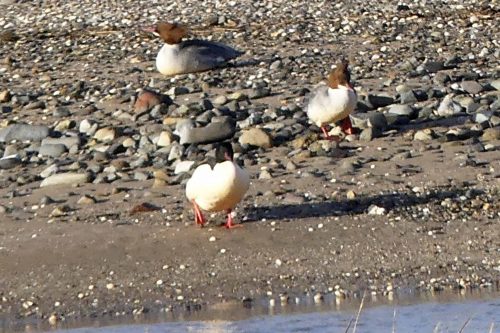
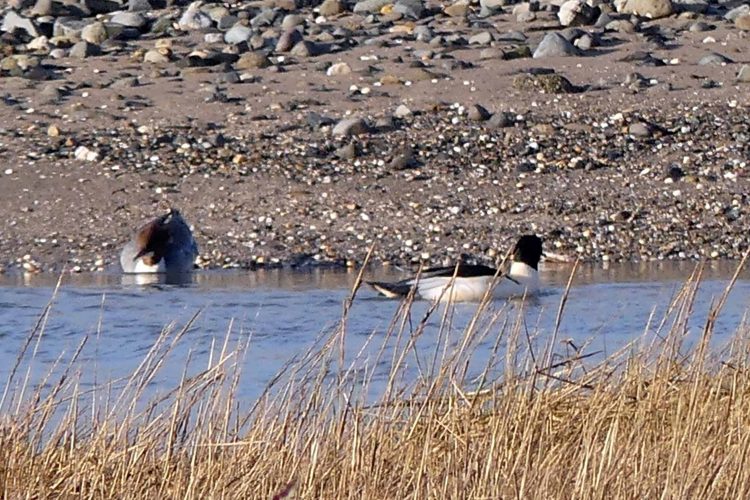
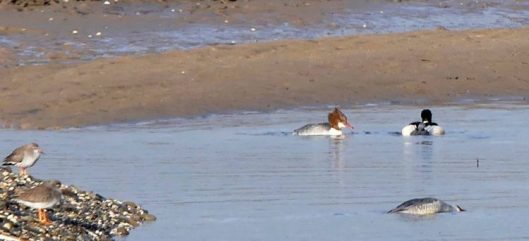
A little further inland at the back of the Oystercatcher roost I’d spotted three ducks resting on a stony bank. There was one dark-headed male and two with reddy brown heads that I took to be either females or juveniles. They were quite a distance away and as they were sitting I had no idea what they were, then they got up and headed into the water.

On land the birds had seem plump and awkward, but out on the water they became elegant, gliding across the water and diving effortlessly and often. Based on the appearance of the male I thought Goosander, but then doubted myself as this species of diving duck usually prefer freshwater lakes and don’t often swim in the sea. If I’d only seen the females I would probably have thought they were Red-breasted Mergansers, which often swim on the sea and are associated more with this location.  The females of both species look similar, but there’s definitely no red breast on this male.

Goosander – Mergus merganser

The female Goosander has a similar brown head to the Red-breasted Merganser female, but the Goosander has a flatter crown.

Walking back the water had already almost completely drained from the channels that cut through the marshland.


Hearing a Redshank making a loud and insistent racket I walked towards the sound to see what was happening to alarm it. There was nothing I could see, but I was treated to a charming display of it stamping and dancing in the mud, which it accompanied with some loud piping.


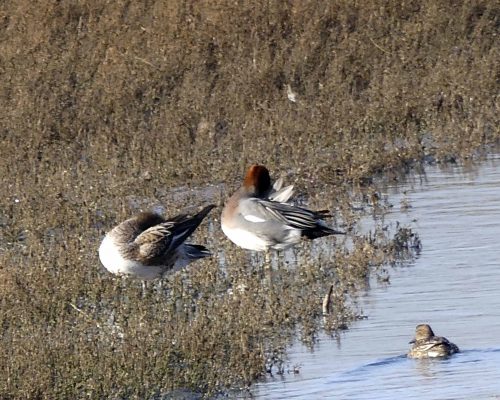
A small flock of Wigeon were resting; some on a newly-exposed mud bank and more up in the grass.

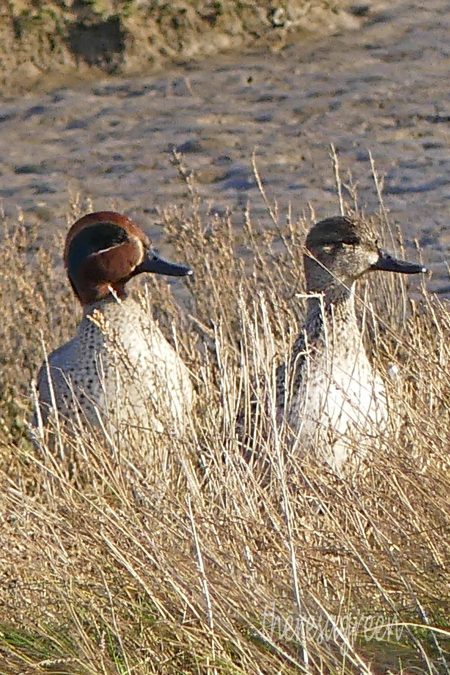
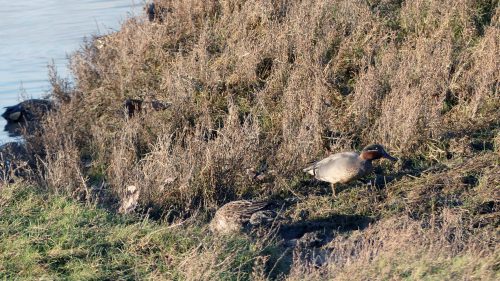
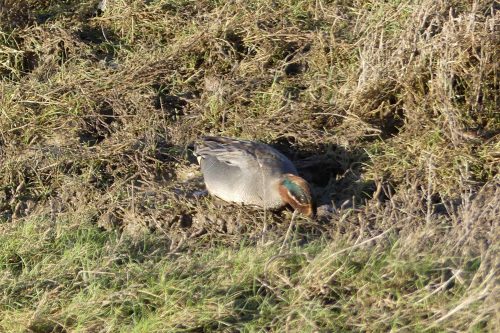
A pair of Teal sitting up in the long grass was perhaps my favourite pic of the day.

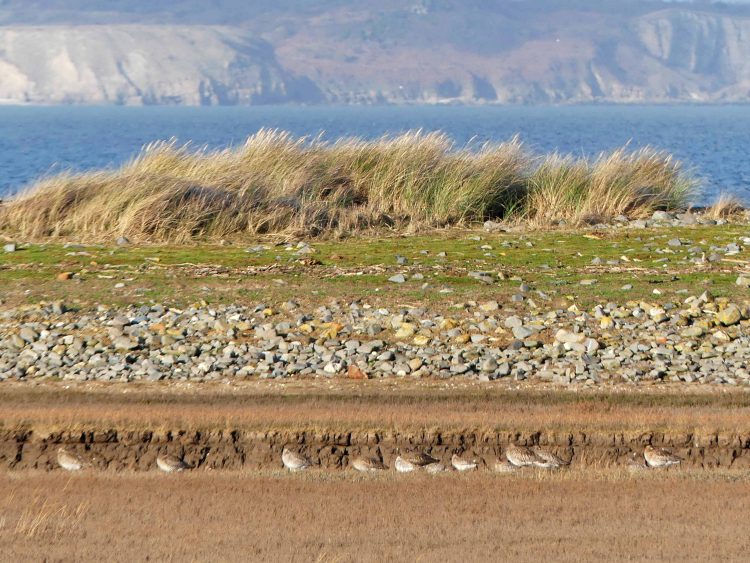
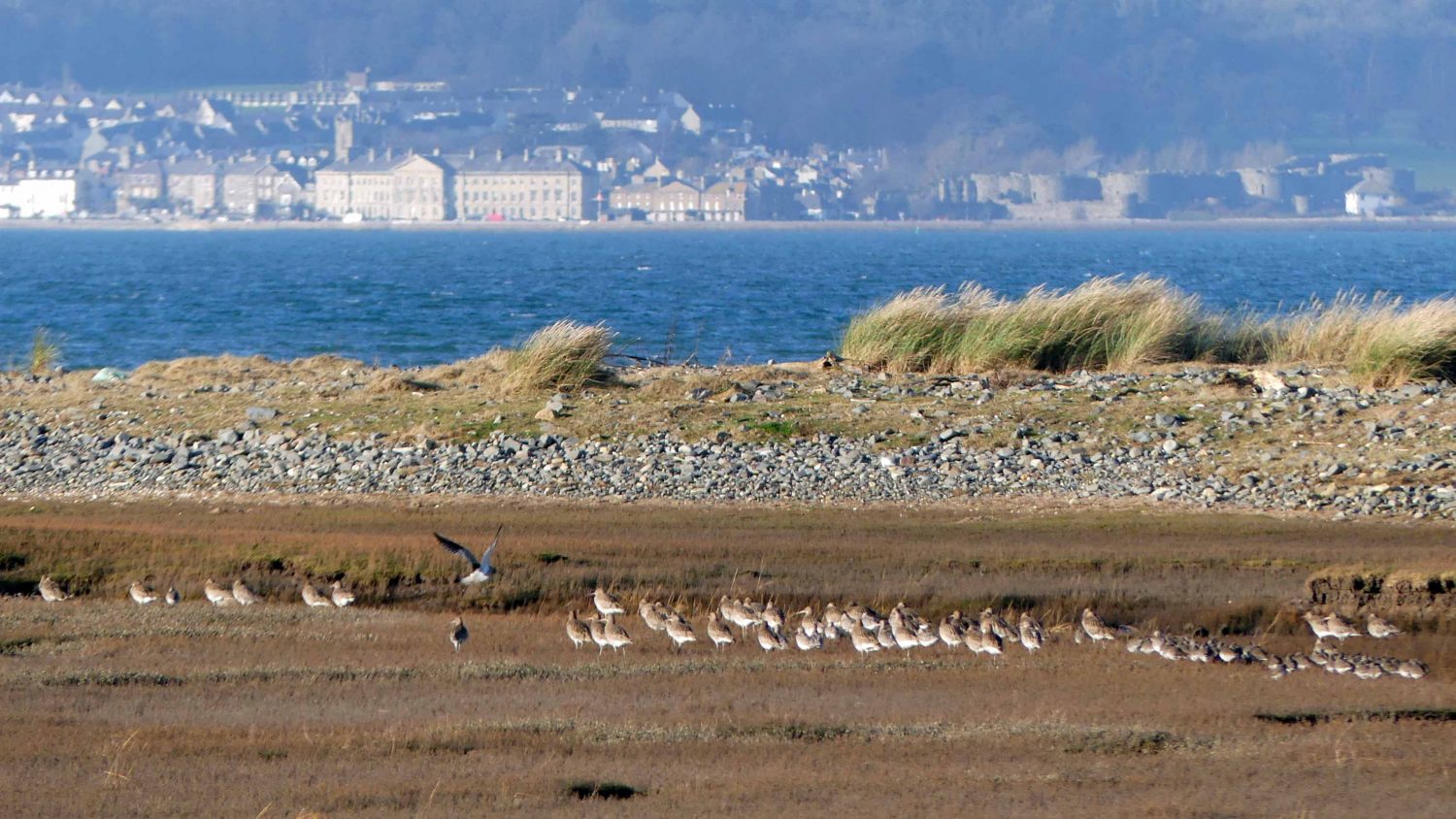
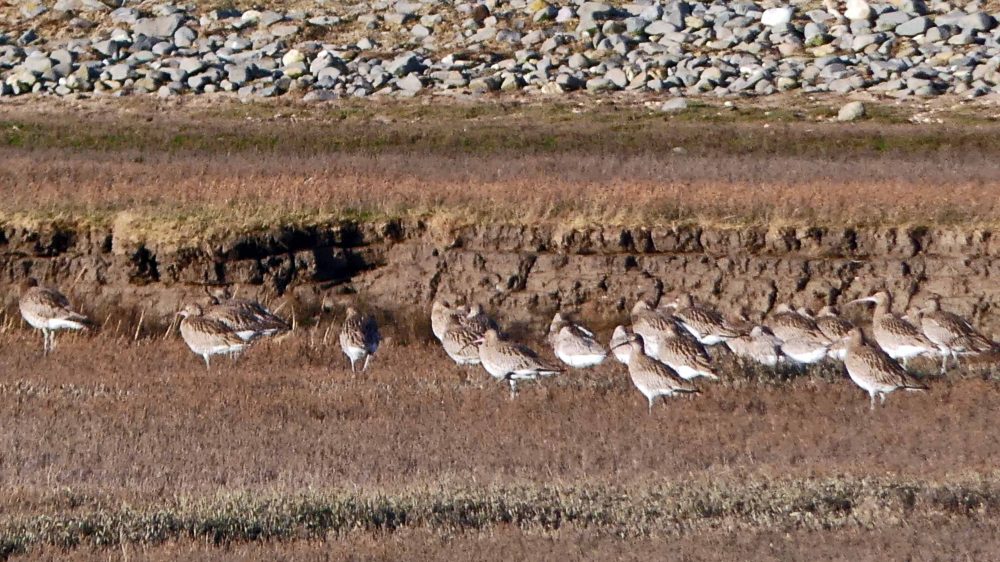
Curlews were also still resting in the sunshine.

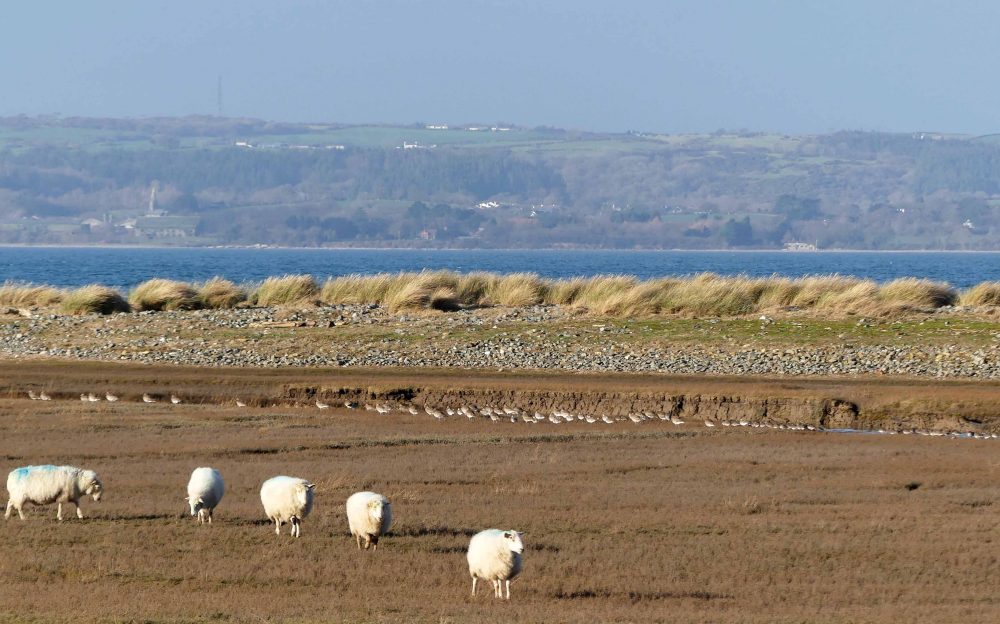
But the sheep were on the move, I met them head on as they were walking in single file back in the direction of the field the Curlew were in. I stood to the side so they could pass in peace, they startle quite easily.

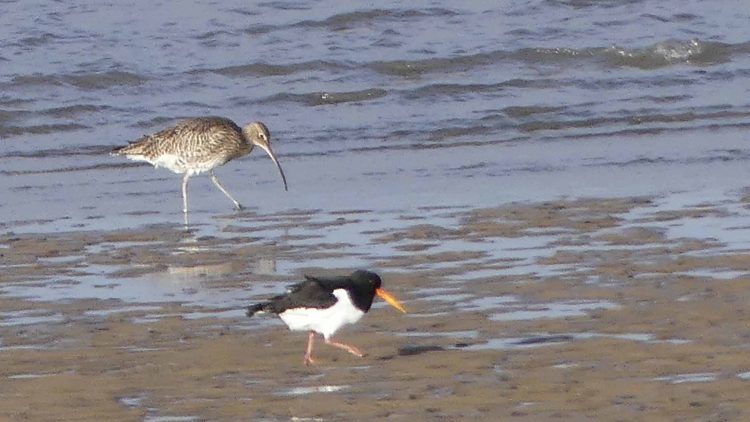
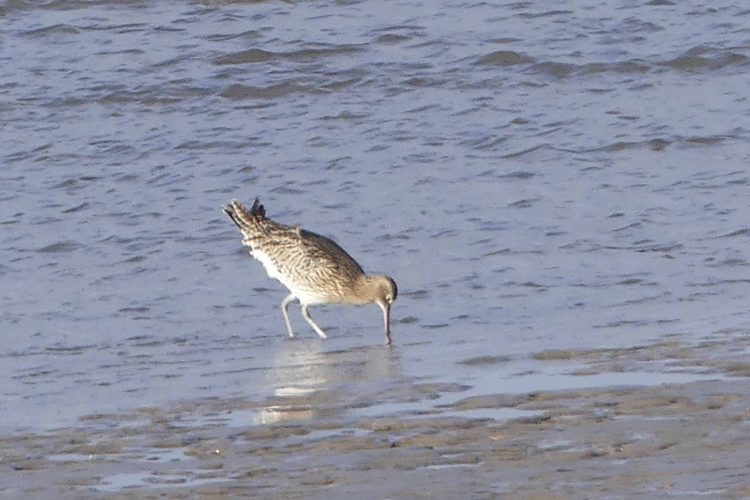
On the seashore a few waders were already out searching for shellfish in the still-soft damp sand.It’s fascinating watching the birds in action, the Curlew with its long curved bill can probe deeply into the sand.


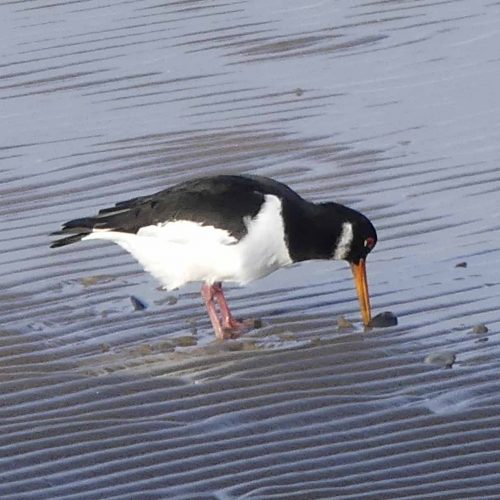
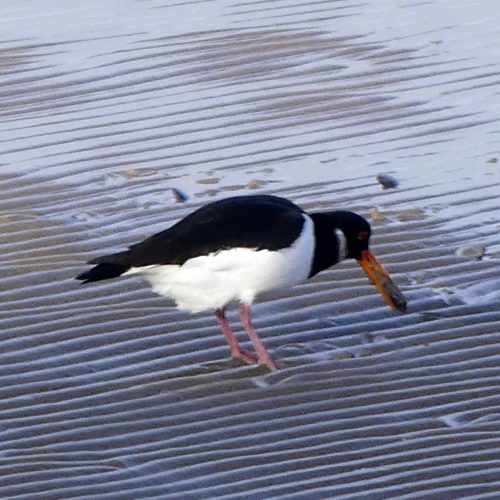
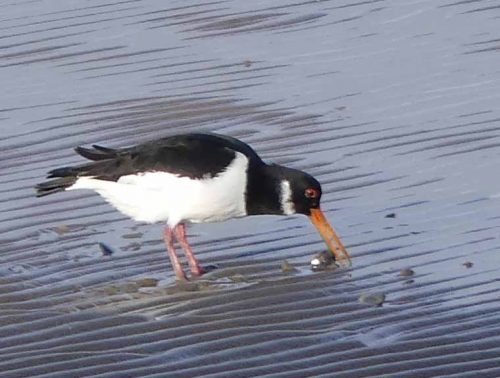
Oystercatchers walk slowly over damp mud or sand probing their bills into the sand right up to the base if necessary in search of shellfish. This one seemed to be doing well; I watched it retrieve several mussels as I watched it. Different individuals use differing techniques to get the animals out of their shells, some like this one, stab the muscle that holds the shell halves together and retain their pointed bill. Others take a less delicate approach and hammer the shell open, often on stones or rocks, which blunts the end of their bills.


Oystercatcher adeptly opening a mussel shell

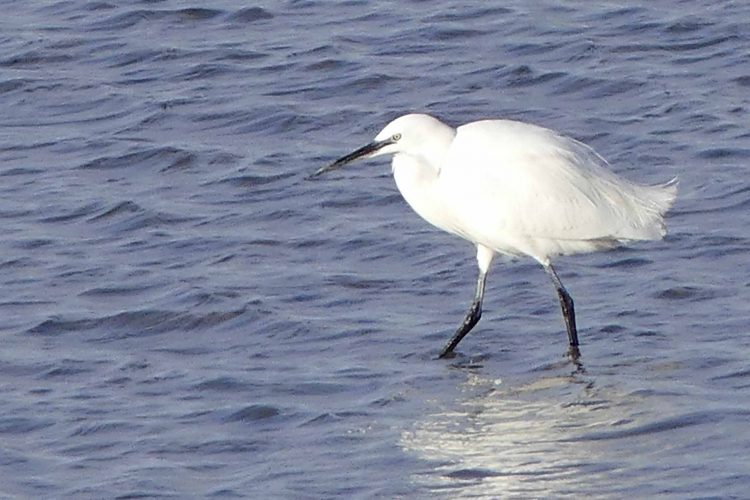
A Little Egret stalked close to the shore. Gorgeous views of the sunlit bird against the steely blue seawater.

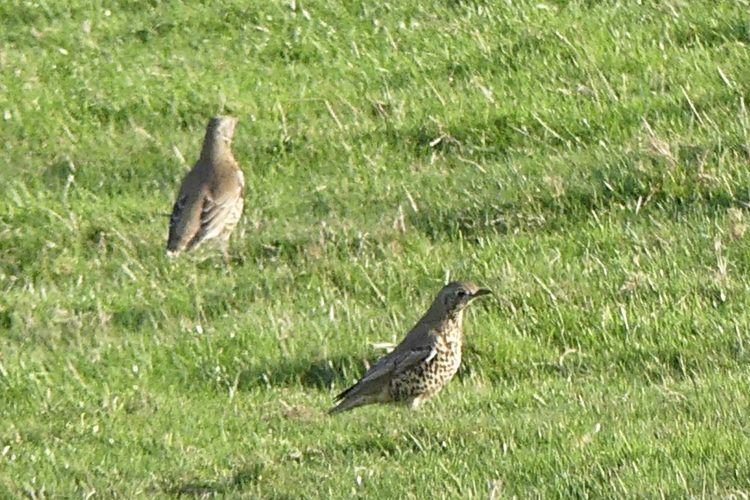
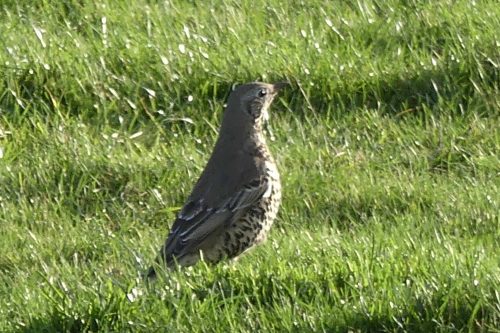
And to finish on dry land, lovely views of a pair of Mistle Thrushes also out hunting, this time on the damp ground of the grassy field. It could well be that they are preparing for nesting; the Mistle Thrush is one of the earliest species to breed, some nest as early as February.

The Mistle Thrush has the most upright stance of all of the thrushes and moves around with bold heavy hops. Unlike the more secretive Song Thrush they like to feed out in the open in large grassy spaces.

Sightings summary over two consecutive days: Goosander; Pintail; Shelduck; Mallard; Mute Swan; Wigeon;Teal; Grey Heron; Little Egret; Curlew; Redshank; Greenshank; Oystercatcher; Turnstone; Dunlin; Ringed Plover; Herring Gull; Black-headed Gull; Carrion Crow; Jackdaw; Mistle Thrush; Chaffinch; Dunnock & a lot of sheep


Share this:

  • Share on Facebook (Opens in new window) Facebook
  • Share on Pinterest (Opens in new window) Pinterest
  • Share on X (Opens in new window) X
Like Loading...

The Difference a Tide Makes

17 Thursday Jan 2019

Posted by theresagreen in Birdwatching on North Wales coast, coastal habitat, Coastal Snowdonia, Local Nature Reserves, Nature, Nature of Public Places, North Wales, Saltmarsh habitat, Wildlife of the Wales Coast Path

≈ 2 Comments

Tags

bird behaviour, Black-headed Gull, conservation grazing, Curlew, ducks and geese, dunlin, flocks of birds, Glan y Mor Elias Nature Reserve, Llanfairfechan, Oystercatcher, pintail, ringed plover, roosting birds, shelduck, teal, Traeth Lafan, Turnstone, wigeon

January 6th

We’ve had a strange winter thus far, so perhaps I shouldn’t have been too surprised by today’s bright sunny morning, but now I just had to get out and enjoy it. Sunday is not my favourite day for heading to places I know are going to be busy, but I was very tempted to repeat yesterday’s walk on a sunny day. Recently my visits to Traeth Lafan at Llanfairfechan have been at times when the tide has been low, so before deciding to head there I checked the tide times and saw that high tide there would be at 10:36 am, so that settled it, I was going back to see what a difference the influx of water made.

 LLANFAIRFECHAN 

10:24- I’d timed my arrival perfectly; almost simultaneously with me reaching the Promenade and looking over the sea wall a flock of small birds flew in and landed neatly, like a ribbon unfurling along the stony sea edge. I am always impressed with their timing and precision, each bird dropping neatly into place only centimetres away from its neighbour. There were an impressive number of birds here, at a rough count around about 200 and strung out in a line so long it was difficult to get them all into the same frame. (click on the image to enlarge it)

A first glance gave Dunlins, looking tiny next to the Oystercatcher that must have been startled to find itself suddenly surrounded by incomers; I wondered if perhaps the flock leaders had made it their landing beacon.

Dunlins, Ringed Plovers and a single Turnstone surrounding an Oystercatcher

Within seconds of setting down many of the birds had switched to rest mode, tucking heads down and one leg up. They were just a few metres away from where I stood and I zoomed in on a small group for a closer look, realising then that there were similarly-sized Ringed Plovers amongst the predominance of Dunlins.

I was momentarily distracted from watching this peaceful scene by the cries and sounds of frantic flapping behind me. A gang of Black-headed Gulls were swooping down towards the edge of the lake where the Swan family had gathered to feast on food thrown in to them by a visitor.

The gulls had no hesitation in diving in amongst the Swans, not at all intimidated by the much larger birds. 

Turning back to the flock of little waders I sought out more Ringed Plovers.

These birds breed here and I could see both adult and juvenile birds, some of which I could see were ringed: I wondered if they’d been born and raised here. There were ringed Dunlins there too.

10:30 It took a while to get to the end of the line, but when I finally reached it I was happy to see the tail-enders were a flock of Turnstones.

Turnstone- Arenaria interpres

I could have stood and watched for longer, although the birds were resting, so not doing much, but I reminded myself that I wanted to make it round to the Oystercatcher roost before the tide turned and they all disappeared, so I tore myself away. Another Black-headed gull floating around on the sea caught my eye – I’m checking them all out in case one turns out to be a Little gull, which sometimes turn up along this coast. They look similar in winter plumage, both species having similar dark face patches, but the Little gull also retains a dark spot on its crown which this one didn’t have.

Black-headed Gull-larus ridibundis

10:38- It really did feel like a completely different place here today. The sunshine and lack of wind made it feel almost warm (the car temperature gauge had said 10º); the tide was high, the sea was blue, calm as a lake and completely covered the sands. It was still quite early, but there were people strolling along the Prom, not speed-walking with heads down against the wind like yesterday. Almost everyone I met smiled and spoke in greeting. 


I must have been doing the head-down-not looking-where- was-going-thing myself yesterday as I failed to notice the pile of huge rocks (rip-rap) that has been piled up and over the sea wall on the corner where the path bends round by the trees. I probably only noticed it today as I spotted the bi-lingual warning signs.

10:46-Almost at the end of the paved section of the path I see a distant flock of birds take to the air; something had disturbed and upped the Oystercatchers from their roost. 

10:48- I try not to dwell on what may have disturbed the birds and concentrate on the scene before me; grazing sheep behind a line of resting birds. Although distant, from the size and colour of them they could only be Curlews. 
10:50-Zooming in on them confirmed they were indeed Curlews, mostly lined up along one side of a deep channel of water. I smiled when I saw the next photograph and saw the two sheep standing face to face looking straight into the albeit-distant lens. It looks like one is whispering in the other’s ear.

I got onto the wide grassy track leading through the saltmarsh which forms one bank of a deep water channel, filled now by the high tide, which took me slightly closer to the birds. The majority of the Curlew were standing, all facing in the same direction with their backs to the water. They weren’t in a tight pack, but rather in small groups or standing alone; I reckoned there were around 40 birds. From this better vantage point I could see that there was a flock of Redshanks there too, standing behind the bigger Curlews and nearer to the water: they too were all facing in the same direction.

The sheep were travelling away, some were sitting down.

The birds are not far from the edge of the Menai Strait; the view behind them is of Anglesey and the town is Beaumaris – you can see Beaumaris Castle in the right of the picture.

A closer look at the Curlew shows most are standing still but not roosting with their heads tucked down. Perhaps these are the ones charged with keeping alert to spot potential dangers.

More of the Redshanks do seem to be sleeping.

The sheep are moving on.

10:58- I spot a pair of Teal rummaging around in the long grass on the far side of the channel I’m walking next to.

The male drake was probing the mud with his bill, digging it in deeply; I didn’t know they did that.

Another pair were foraging along the bankside from the water.

11:01-Across the other side of this channel stood a pair of Wigeon.

They had a good long look around them to make sure it was safe before getting down to preening.

11:02-A Little Egret flew in and landed in the water close to the Wigeon.


The egret stepped out onto the bank, watched by a Redshank.

11:06- A small flock of finch-sized birds passed overhead, twittering as they flew and landed on a patch of small rocks and pebbles. Exactly what Linnets do, which is what they were.

Linnet flock in flight

They are difficult to see amongst the stones.

Linnets favour stony ground

11:10 I have a good clear view of a pair of Teal, their colours in the sunshine showing as they should be.

Teal duck
Teal duck
Teal drake
Teal drake

11:10- A larger duck was sailing along the edge of a channel. He was difficult to see properly as he was in the shade cast by a muddy bank and his dark colours weren’t standing out well. My first thought was Pintail – based solely on its overall elegant appearance and the shape of its tail, which as the name suggests is long and sharply pointed. Could I be that lucky? I had no idea as to whether they might be present here, so hoped the photographs I managed to get would be good enough to help me later.

Pintail-Anas acuta

Checking my reference books at home later on I’m happy my instinct was right and it was indeed a Pintail. I’m so chuffed to have seen it, albeit briefly.

The Welsh for Pintail is Hwyaden Lostfain

11:13- The view over the watery saltmarsh to the sunlit mountains was amazing.

To be continued…


Share this:

  • Share on Facebook (Opens in new window) Facebook
  • Share on Pinterest (Opens in new window) Pinterest
  • Share on X (Opens in new window) X
Like Loading...

A Bleak Day on the Saltmarsh

14 Monday Jan 2019

Posted by theresagreen in birds of Wales, Birdwatching on North Wales coast, Local Nature Reserves, Nature of Public Places, Nature of Wales, Saltmarsh habitat, Wildlife of the Wales Coast Path

≈ 9 Comments

Tags

Amber listed birds, Curlew, Glan y Mor Elias Nature Reserve, greenshank, Grey Heron, January, Llanfairfechan, mallard, mute swan, pibydd coeswerdd, redshank, teal, Traeth Lafan, tringa nebularia, tringa totanus, winter

January 5th

Not a great day weather-wise; from my window I could see cloudy grey sky and more than a breeze blowing through the trees. But I hadn’t been out for a proper walk for a while and after a wonderful but hectic family Festive Season I needed fresh air and exercise. And I had a fitness-monitoring, step-counting watch gizmo as a Christmas present that I was keen to try out. Sticking to my resolve to improve my duck recognition skills and knowledge I decided to go back to Llanfairfechan, which would be sure to fulfil the exercise and fresh air part and would hopefully have birds too. My target ducks for the day were to be Teal and I was hoping to improve on the photographs I took at RSPB Conwy a few days ago.

“There’s no such thing as bad weather, only unsuitable clothing.”

13:20 The car temperature gauge read 7°, and minded by Alfred Wainwright’s famous quote, I’d put on extra layers in anticipation of the cold, but a stiff breeze made the air that greeted me in the almost-deserted car park feel bitter: and worse, the café was closed! So no tea to thaw out with when I got back. For birds though, it has to be business as usual or starve, so there were the usual Mallards on the river and a few more on the grass; they and the Jackdaws were looking rather disappointed by the lack of human-donated titbits.

13:21 The Swan family was out sailing on the wind-rippled model boating lake.

The cygnets, if you can still call them that when almost fully-grown, are definitely no longer Ugly Ducklings, they have the size and grace of the adults and are turning white to differing degrees, which I guess must relate to the order they hatched in. They too are used to having food thrown to them by visitors and travelled towards me hopefully. I had nothing to offer even though they posed nicely for photographs.

Mute Swan – Cygnus olor

13:28 It felt cold there, but out from the shelter of the trees at the side of the lake the effects of the wind blowing into my face, it got worse. I met a few hardy souls making their way back, mostly dog walkers braving the elements for the love of their pets, but I almost had the place to myself.

1330: The tide was out but there were a few waders out on the sand close enough to see; a Black-headed gull, an Oystercatcher and a Redshank.

13:41 I reached the corner where the stand of trees gave a smidgen of shelter from the icy blast and stopped for a couple of minutes to look at the pine trees. They are very exposed to the elements here, but in the main they stand straight and tall and look to be a good age.

I think they are Monterey Pines – Pinus radiata, an introduced species originating from California that is probably the most widely planted tree in the world. It is characterised by having branches that radiate out from its trunk, hence radiata. The trees often has conspicuous cones that may fall or that sometimes remain on the tree for years. I must look for cones another day.

13:44 As always, the view over the slate-fenced green field dotted with sheep, with the hills and mountains beyond was beautiful, even on a dull cloudy day like today.

13:45 At the end of the Promenade I stopped again to take in the vastness of the view across the Menai Straits to the dark blue coastline of Anglesey.

 A lone Curlew stalking through shallow water seemed small and vulnerable out there on the expanse of sand, emphasising the bleakness of the day.

13:49 In the rough grass on the other side of the wire fence a small flock of lively Starlings were foraging and bickering amongst themselves as Starlings do.

Apart from the cheery Starlings, my first impression was that the saltmarsh was peaceful – and empty! The great flocks of Wigeon that were here a month ago are gone. I guess they’d exhausted the available food supply here and that most of them will have moved inland to fresh pastures. I’m so glad I got to see them while they were here and with luck thought there may still be a few remaining here to see.

Redshank

13:50 A Redshank, its bill half-covered with mud stood motionless nearby. It must be hard work for birds to find enough food to stay warm, let alone mobile on cold days like this.

13:51 As I said, my target ducks for today were Teal and I was starting to think they too had gone along with the Wigeon; then I spotted a pair swimming together along a water-filled channel. Against the background of the textured water surface they were a pretty sight and may have made a pretty picture if the light had been kinder. But at least I’d seen some and there could be more out there sheltering from the weather.

Teal drake & duck

13:52 Scanning along the channel for more ducks – I actually had binoculars with me today- I caught sight of a Grey Heron standing with its shoulders hunched up and its back turned to a stand of reeds. It was some distance away; in this picture showing the channel the Teal were swimming in, it’s the tiny grey dot on the right hand side, other side of the water just above centre and about an inch in!


It looked miserable; it’s plumage ragged and blowing in the wind and wings folded around itself like a cloak.Grey Heron – Ardea cinerea

I was distracted by some frantic and noisy wing-flapping coming from the muddy bank nearer to me. I felt a moment of dread, half-expecting to see a duck having been seized as prey by something, but it turned out to be Starlings who were dipping  into the water and flapping themselves dry. I couldn’t help thinking they must be hardy little migrants from Russia or Scandinavia or somewhere similarly cold, that water must be icy.

When the tide is out water drains back out of channels exposing the soft mud at the bottom.

13:59 – Thus far I’d not had much luck seeing birds, so I was more than happy to see another Redshank foraging on the side of an empty channel.

I’d rounded the bend in the track and was heading towards the Reserve boundary. The railway line runs through the middle of the photograph below and you can just make out the Expressway (A55) at the base of the mountain.  There were a few Mallards sitting on the edge of a muddy peninsular, more were sheltering below against the bank at the water’s edge.

Three more were hunkered down on top of a gravelly bank with their backs to the wind.

14:05 I’m happy to spot a pair of Teal resting on a muddy beach on the other side of the little peninsular where the Mallards sat.

A bit further along, higher up the bank I found some more.

The little flock was quite spread out, I counted about twenty that were visible, but there could well have been more nearby and further back.

14:08 A pair headed into the water, disturbing a bird already there that otherwise I may well not have seen. I thought for a minute that it may fly off before I’d had a chance to have a proper look, but it just gathered itself together and carried on stalking and scanning the shallow water for potential food.

Apart from having been engaged by the Teal flock, it’s not surprising I hadn’t spotted the wading bird by myself. The light was dull, the water grey, the mud a greyish-brown and the bird merged into all perfectly. I wasn’t holding out much hope of getting any really good images, but my thinking is that when you’re looking at a bird you don’t immediately recognise, take as many shots as you can and chances are some will be good enough to at least confirm an identification and serve as a record.

Greenshank – Tringa nebularia

As it happened I’d worked out what I thought it was as I focussed in on it. It must be a Greenshank, which are pictured on the information boards back at the beginning of the walk. This was the closest view I’d ever had of one though, and the first I’ve been able to photograph, but certain features rang bells: an elegant wader; long, slightly upturned bill and long legs that are as its name implies green. Although they looked more grey to me in this light.

The Welsh name for Greenshank is Pibydd Coeswerdd

In the UK Greenshank breed on the wild moorlands of the Scottish Highlands and Islands. In late summer and autumn they move south on migration, stopping to feed in marsh pools, on estuaries and rather less scenically, on sewage farms and are widespread in the south. Only a few birds remain in Britain over winter, mainly on the Irish coasts, so maybe that’s where this one is heading for. It’s not far to Ireland from here. It’s yet another bird on the BTO’s AMBER list because of breeding numbers and winter range declines. 
It’s moments and sights like this that make the effort of going out on days so worth it!

My favourite moment was when it was joined by a Redshank, which suddenly appeared from nowhere. I was so lucky to get the two related birds in the same shot.

Greenshank with Redshank

The bird carried on with its quest for food regardless of much bigger ducks entering the water nearby. I did wonder if they might be helping by stirring up the mud beneath the water and disturbing anything it may eat, like small fish or worms.
And to put the birds into scale and context within the landscape, this view shows the pool of water the birds were in, tiny specks just visible, and the adjacent bank where the Teal were roosting.

I carried on around the path to the other side of Shell Island and stopped just past the front of the bird hide of the Morfa Madryn Reserve. A few Mallards were resting in the rough grass and out on the gravelly sand; the pebbles may be hard but they’re mostly smooth and may have retained some warmth from the day’s scant sunshine. They gave me a focal point for the photograph too – I loved the zig-zag pattern and different shades and textures of the pebbles and grassy ground.

A few more were up and about foraging on the damp sand.

A Crow, that I’d hoped might have been a Raven, but wasn’t, was also hopefully patrolling the sand.

Once again I contemplated carrying on along the Coast Path for a while, but no, it was way too cold and windy for me to derive any joy from that today.

I took the more sheltered path back. On the scrubland gorse is coming into full bloom now, bringing a welcome and cheering touch of gold to the landscape. 

14:28 I had a closer view of the Heron walking this way. It was still in the exact same spot as before. It must have been sleeping.

The path ahead of me was unusually deserted.

Beyond the railway line Penmaenmawr Mountain, looking big, bulky and brooding.

14:45 I love the view across the Traeth. All you can see is the Pavilion, the café building, the Tower House and a stand of dark pine trees.  Promenade I see that there is only one person on the sands with a dog. At this time on a Saturday there would usually be a lot more. 

14:53  There were a few more birds to see on the way back; Oystercatchers, a Redshank, a Curlew and Black-headed Gulls out on the sand; and on the field side of the path a Chaffinch up in an ash tree and a Dunnock perched on the barbed wire fence.

I didn’t linger to look again at the Swans and other collected ducks and birds that were now gathered on and around the lake. I did wish the café had been open though.

Sightings for the afternoon: Grey Heron; Little Egret; Mute Swans; Teal; Mallard; Khaki Campbell; Oystercatcher; Greenshank; Redshank; Curlew; Black-headed gull; Herring gull; Carrion Crow; Starling; Dunnock

Not too many species today, but what was lacking in quantity was made up for with quality; the Greenshank was a real treat!

Oh, and I logged about 7.300 steps.


Share this:

  • Share on Facebook (Opens in new window) Facebook
  • Share on Pinterest (Opens in new window) Pinterest
  • Share on X (Opens in new window) X
Like Loading...
← Older posts
Newer posts →
Follow everyday nature trails on WordPress.com

Enter your email address to follow this blog and receive notifications of new posts by email.

‘But it is the common species that keep the living world ticking over and provide most of our experiences of wildlife, and I would argue that maintaining the abundance of these is as important a conservation priority as maintaining the existence of rarities’. Richard Mabey

MOST RECENT POSTS

  • A Glimpse of Spring to Come January 22, 2025
  • Hunting the Wren December 28, 2024
  • Oh, Christmas Tree December 18, 2024
  • In and Out of the Ivy February 15, 2024
  • Nature’s Fireworks November 30, 2023
  • Wild Autumn along the Coast Path November 3, 2023

OLDER POSTS

LOOKING FOR SOMETHING IN PARTICULAR?

  • Sights and Sounds from the Little Orme 1
    Sights and Sounds from the Little Orme 1
  • Things Bright and Beautiful
    Things Bright and Beautiful
  • Following a river to a Fairy Glen
    Following a river to a Fairy Glen
  • Catchers, a Duck and Divers
    Catchers, a Duck and Divers
  • A Window on the Woods-Winter 1
    A Window on the Woods-Winter 1
  • A Windy Wildflower Trail
    A Windy Wildflower Trail
  • Fine Dining for Crows
    Fine Dining for Crows
  • May Bee Appearing on Ivy near You
    May Bee Appearing on Ivy near You
  • Shades, Sounds and Scents of the Woods
    Shades, Sounds and Scents of the Woods
  • Butterflies and more rare treats
    Butterflies and more rare treats

nightingale trails

The Walk of the Monarch Butterfly-Sendero de la Mariposa Monarca

The Walk of the Monarch Butterfly-Sendero de la Mariposa Monarca

MY WILDFLOWER BLOG: where the wildflowers are

Snowdrop

Snowdrop

most recent posts

Follow everyday nature trails on WordPress.com

Social

  • View teresamaygreen’s profile on Twitter

Enter your email address to follow this blog and receive notifications of new posts by email.

Website Built with WordPress.com.

  • Subscribe Subscribed
    • everyday nature trails
    • Join 359 other subscribers
    • Already have a WordPress.com account? Log in now.
    • everyday nature trails
    • Subscribe Subscribed
    • Sign up
    • Log in
    • Report this content
    • View site in Reader
    • Manage subscriptions
    • Collapse this bar
 

Loading Comments...
 

    %d