• Home
  • about
  • about the photographs
  • Local Nature Reserves
    • Bryn Euryn Local Nature Reserve
    • Mynydd Marian
  • Wales Coast Path
    • Grey Seals in North Wales
    • St.Trillo’s Chapel
    • Wildflowers of North Wales Coastal Paths, Cliffs and Dunes

everyday nature trails

everyday nature trails

Category Archives: Local Nature Reserves

Fairy Glen Friday

07 Saturday Apr 2012

Posted by theresagreen in Local Nature Reserves, Nature, nature of woodlands, nature photography, woodland birds

≈ 2 Comments

Tags

bluebell, chaffinch, Fairy Glen, grey wagtail, long-tailed tit, nesting birds, ramsons, river Colwyn, spring flowers, woodland flowers, woodland walk

Friday seems to have become my day for a walk around the Local Nature Reserve of Fairy Glen, Old Colwyn. It is just a short walk from my current workplace, the busy post office, and very handy for an hour of fresh air and a chance to catch up with the progress of the season. The following pictures are those I took on the last Friday of March in less than an hour.

Bluebells are beginning to open

The wild garlic, or ramsons, is also showing one or two blooms

The horse chestnut leaves have grown significantly since last Friday and there are already flower buds appearing

It was quite a dull, cool day compared with last Friday and shady in the woodland. I didn’t have very long to linger, so I headed straight for the sycamore tree where the nuthatch and  blue tit pairs are nesting. I was hoping to get some better views of a nuthatch, but although I could hear the male’s distinctive calling from close by and followed his movements through the trees, he stayed away from the actual nest site. However, the blue tits were working hard furnishing the nest box and I had some lovely views of them both with beaks stuffed with moss.

The blue tit was waiting to carry material into the nest box

I carried on along the path, watching out for great tits, a species that I have heard calling and singing and seen here, but that continues to elude my camera. There was a pair flitting about in the trees and shrubbery close to the path, but they don’t stay still or visible for long. I did manage to get a quick shot of the male which is not great but included for the record.

The male great tit has a much broader black breast stripe than the female

Following after the great tits I stepped off the path a short way and caught a glimpse of bird in a tangle of brambles that turned out to be a male blackcap, yet another species to add to the list for this small area of woodland. He disappeared very quickly and quietly, but then I realised there was another bird in there too, a single long-tailed tit. As I stood watching it emerged from its cover and spent quite a few minutes foraging around the twiggy branches of a nearby small tree, allowing me some lovely close views.

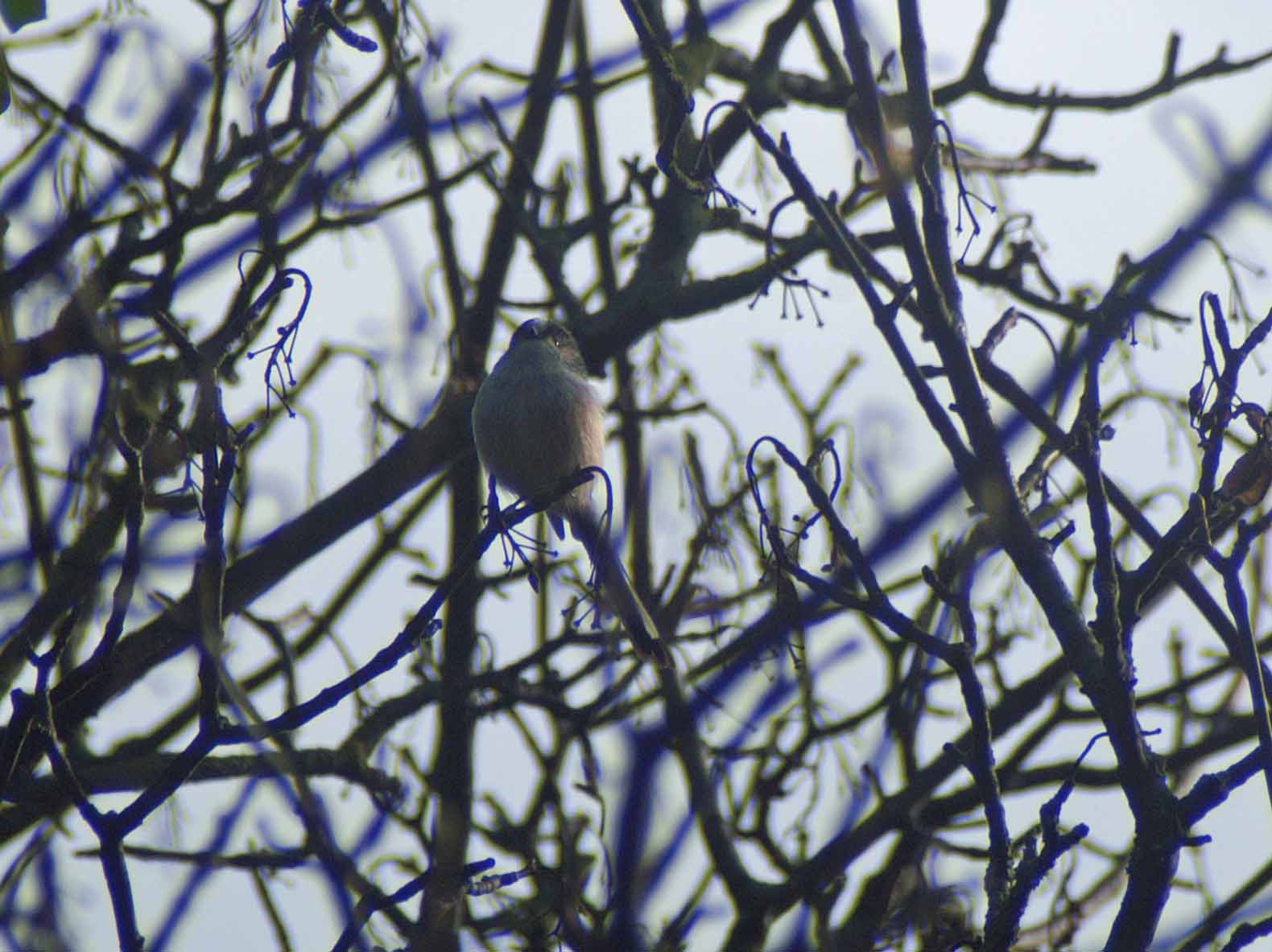
Long-tailed tit, front view

Long-tailed tit from the back

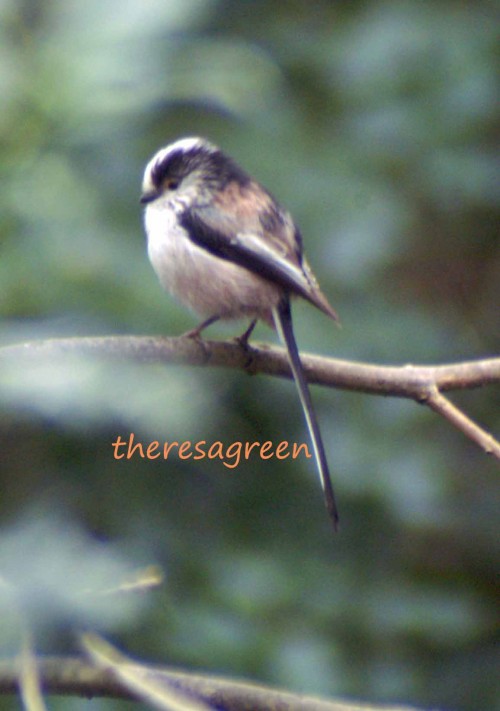
A privileged view of a lovely bird. Long-tailed Tit – Aegithalos cordatus

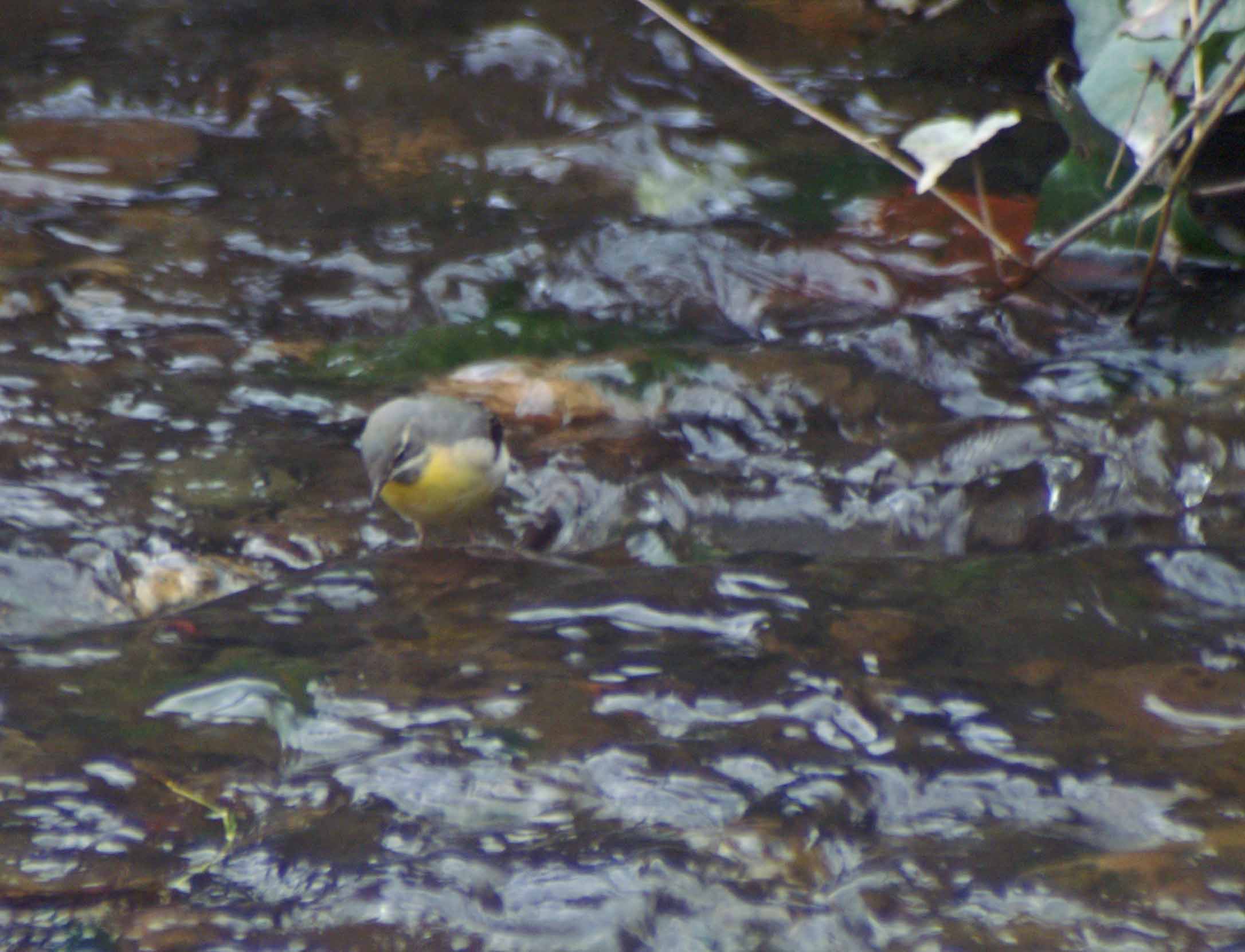
The recent dry and warm weather has been a treat, but the effect of lack of rainfall is very evident in the current shallowness of the river. I wandered along the path,  lost in contemplation about water levels and was taken completely by surprise when, rounding a bend I spotted a pair of grey wagtails hunting in the shallow water. I have  no idea if this was the same pair that I have seen lower downstream, although I suspect it may be. I watched them flitting gracefully over the water, balancing on small rocks and darting out to chase flies, flashing their yellow underparts as they lived up to their name, wagging their long tails. A man and a dog finally disturbed them and they flew up into  nearby trees before heading back downstream.

Male grey wagtail showing a small amount of black around the throat area

Where the kingcups are  growing there is now also a large clump of  yellow flowered arum. This is an exotic plant of South African origin, but clearly flourishing in the boggy ground of this part of the riverbank.

An arum with large leaves and a yellow sheath; this is Lysichiton americanus

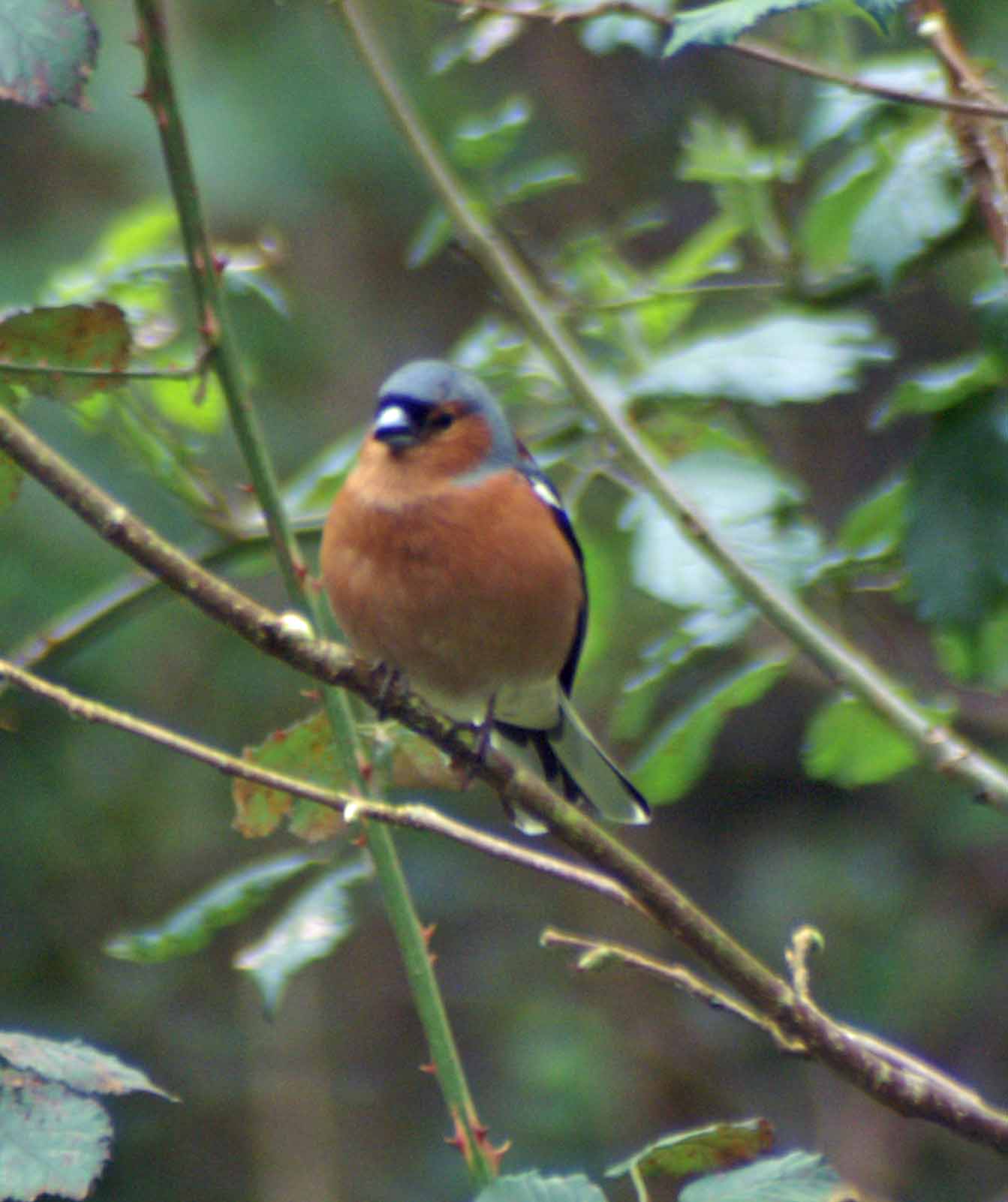
Close by I watched a male chaffinch hunting around an area of shallow water that then flew up into some twiggy shrubbery overhanging the water. He was gorgeous, plump and healthy and with a shiny beak and strong vibrant colours.

A colourful male chaffinch that was foraging on the riverbank before flying up onto a low shrub

The vibrantly coloured chaffinch from the front. Chaffinch – fringilla coelebs; the ‘coelebs’ translates as ‘bachelor bird’.

Further along the path I stopped to watch a subduedly plumaged female chaffinch searching the ground for nesting material. She picked up what I think may be strands of dog hair; holding them in her beak she flew up to a tree branch away from me.

The female Chaffinch is much more subtle in her appearance

Share this:

  • Share on Facebook (Opens in new window) Facebook
  • Share on Pinterest (Opens in new window) Pinterest
  • Share on X (Opens in new window) X
Like Loading...

Lunchtime nature ramblings

25 Sunday Mar 2012

Posted by theresagreen in Local Nature Reserves, Nature, nature photography, wildflowers

≈ 1 Comment

Tags

Fairy Glen, grey wagtail, long-tailed tit, marsh marigold, nesting birds, Nuthatch, nuthatch nest, primrose, spring flowers, wood anemone

I first spotted two  Grey Wagtail one morning last week when they flew across the road in front of me as I was driving to work. They landed somewhere close to the water of the river close to the footbridge that crosses into the little woodland area called Min-y-Don, near the promenade at Old Colwyn. I looked out for them each time I passed since then, but with no luck until this Thursday when I walked there to look for spring flowers. Both birds must have been down close to the water as they flew up to a nearby shrub as I approached, taking me by surprise. I was pleased to see them but thought I had missed an opportunity to photograph them, but then luckily one returned to resume their hunt for food.
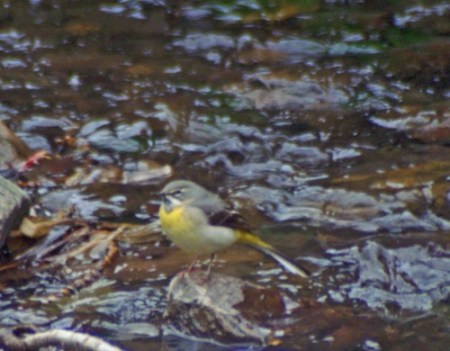
Grey Wagtail-Motacilla cinerea

The grey wagtail is similar in size, shape and to some extent, behaviour, to the pied, or white wagtail, but has an appreciably longer tail. They are very attractive little birds with upperparts that are always blue-grey and a greenish-yellow rump contrasting with whitish underparts makes it distinctive. The breeding male is a brighter yellow than the female and has a black throat that is edged by whitish moustachial stripes. I had assumed the birds were a pair and thought the one I was watching was a female, but looking at my photographs there are definite moustachial stripes and  the throat area looks quite dark: not black though.

Watching the water closely for prey; the birds feed on a variety of aquatic invertebrates including adult flies, mayflies, beetles, crustacea and molluscs.

The grey wagtail’s breeding season is April to July and the nest is placed near fast running streams or rivers, naturally on an embankment between stones and roots or opportunistically on convenient man-made structures such as walls or bridges.
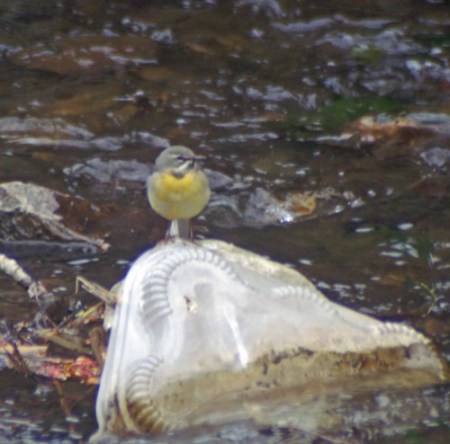
A front view of the bird perched atop an indeterminate piece of plastic

Woodpecker carved into the side of a dead tree trunk

The woodland is at the bottom end of the Old Colwyn Nature and Historical Trail and forms part of  the North Wales Coastal Path.  It continues up into Tan y Coed Gardens, described as ‘ a very pleasant public open space on a sloping site, consisting of deciduous and coniferous trees, lawns and a network of paths. The park extends for most of the eastern side of the valley from behind the property on Abergele Road to near the promenade’. Tan y Coed garden is regarded as a valuable part of the conservation area which it is vital to sustain. The gardens themselves have been recognized as an important habitat that holds a great deal of wildlife and are recognized for their biodiversity.’ Much of the garden space has been left in a natural state and I found the wildflowers I was hoping  for growing on the banks beneath the trees.

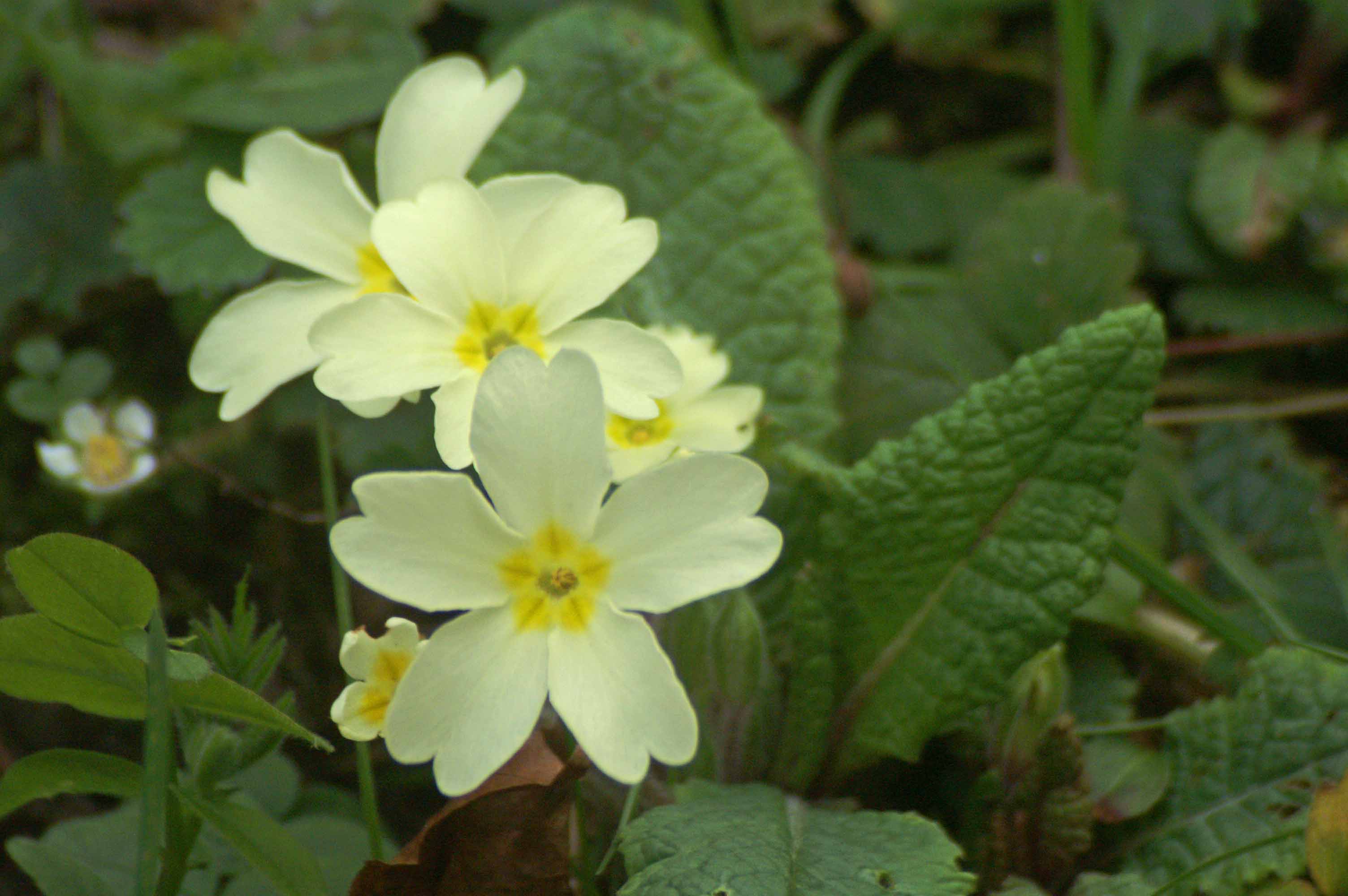
Primrose-primula vulgaris

The harbinger of spring, creamy yellow primroses are amongst the earliest and best-loved wildflowers, flowering well before the trees come into leaf.  The name “Primrose” is originally from  Old French primerose or Latin  prima rosa, meaning “first rose”. 

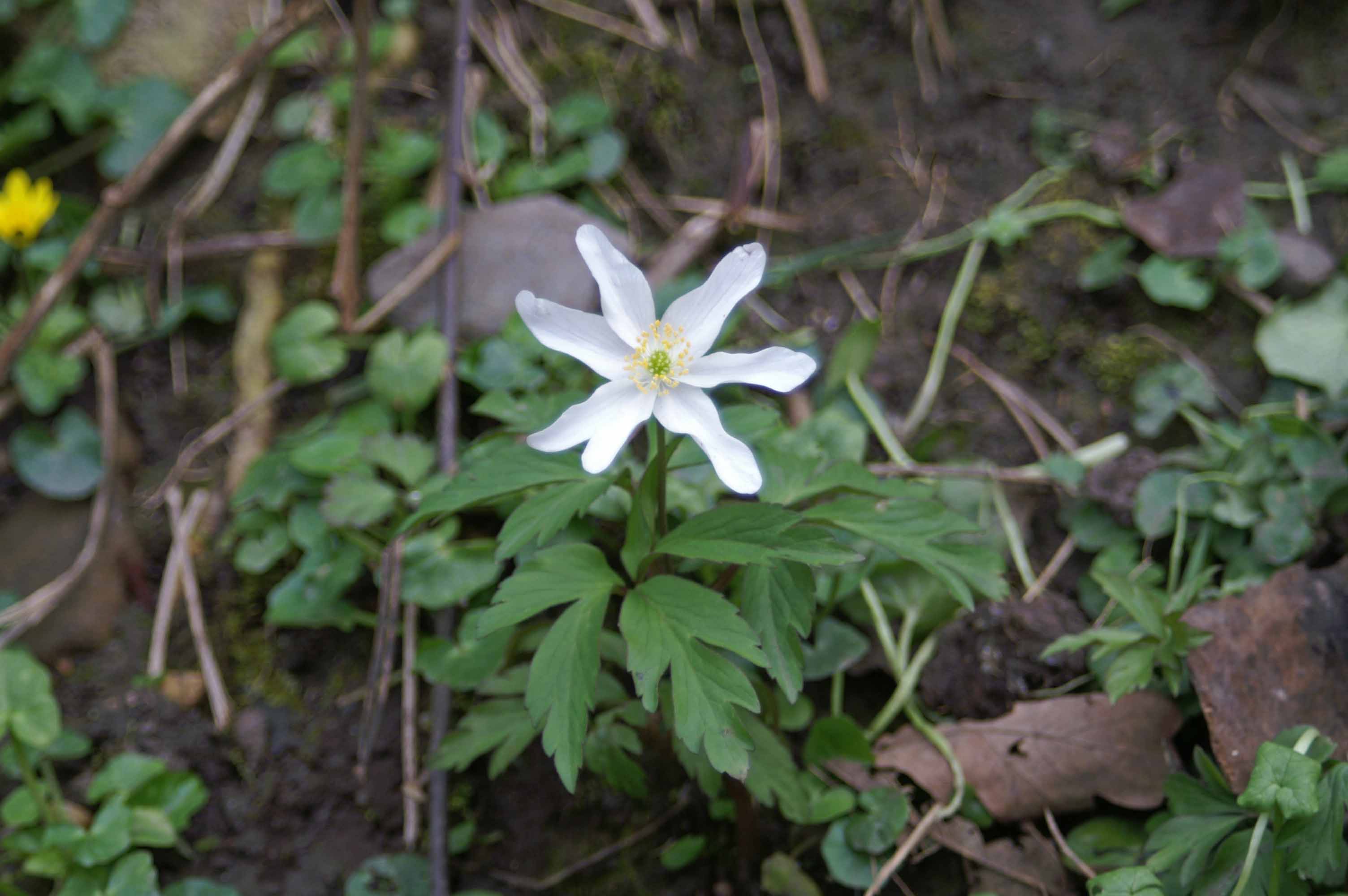
Wood anemone-Anemone nemorosa. The presence of these beautiful wildflowers is often an indicator of an old woodland

Usually appearing slightly after the primrose, the sight of the bright starry flowers of the wood anemone on a sunny spring day leaves you in no doubt that spring is truly here. However, on a dull or wet day they seem  to disappear as the flowers remain closed and hang their heads, protecting their delicate and precious pollen from rain. When the sun shines again, stems straighten and the flowers are held aloft, fully open, their faces following the sun’s course across the sky.
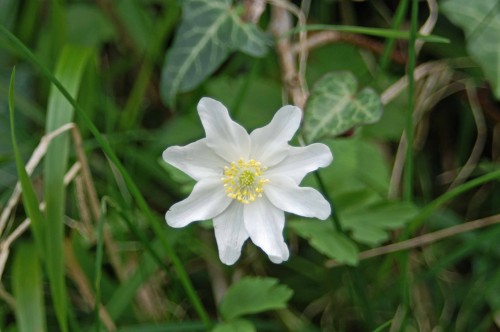
Wood anemone's are also evocatively known as 'windflowers'.

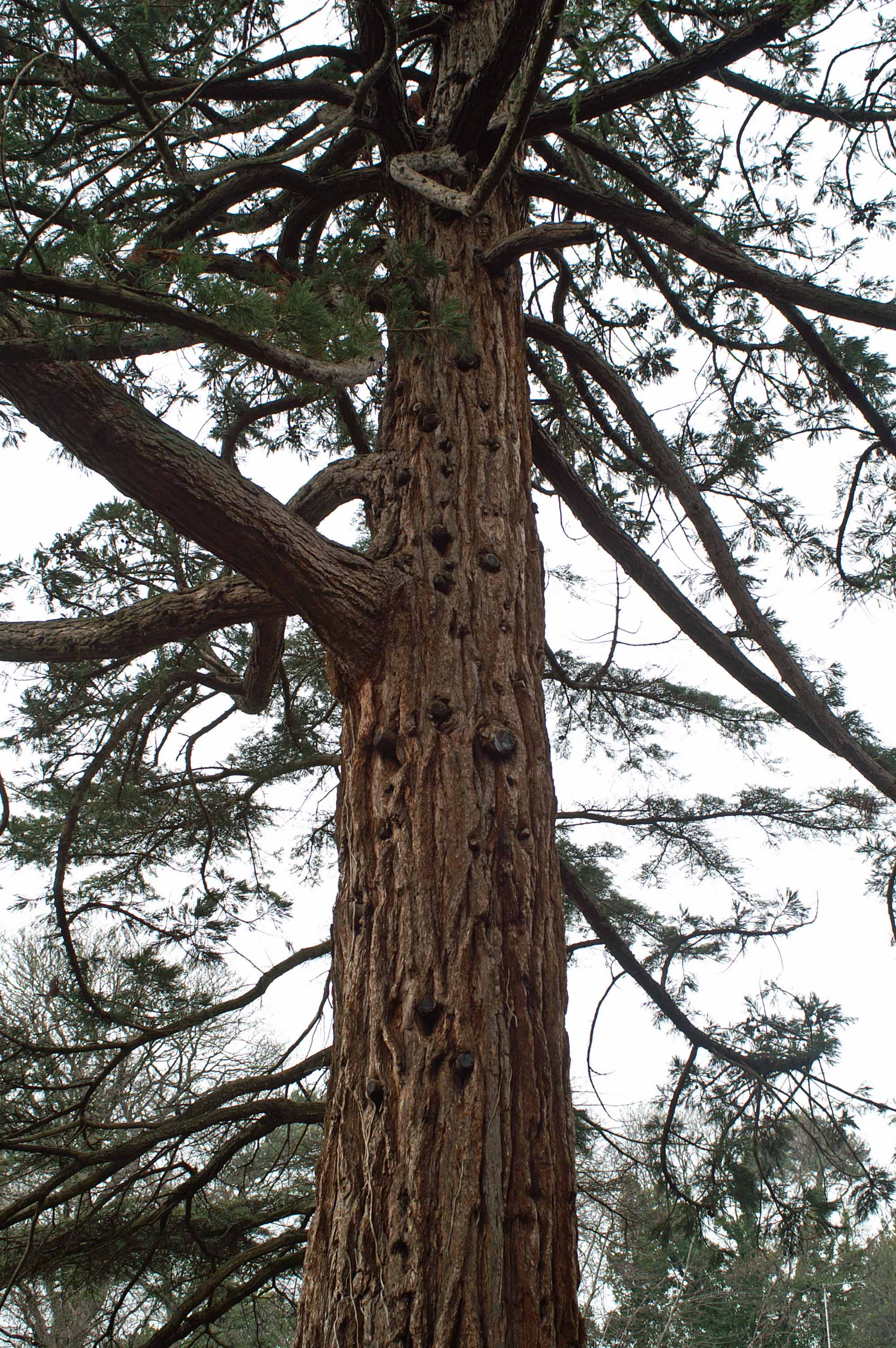
This old pine tree is magnificent, very straight and tall and has the most amazing bark

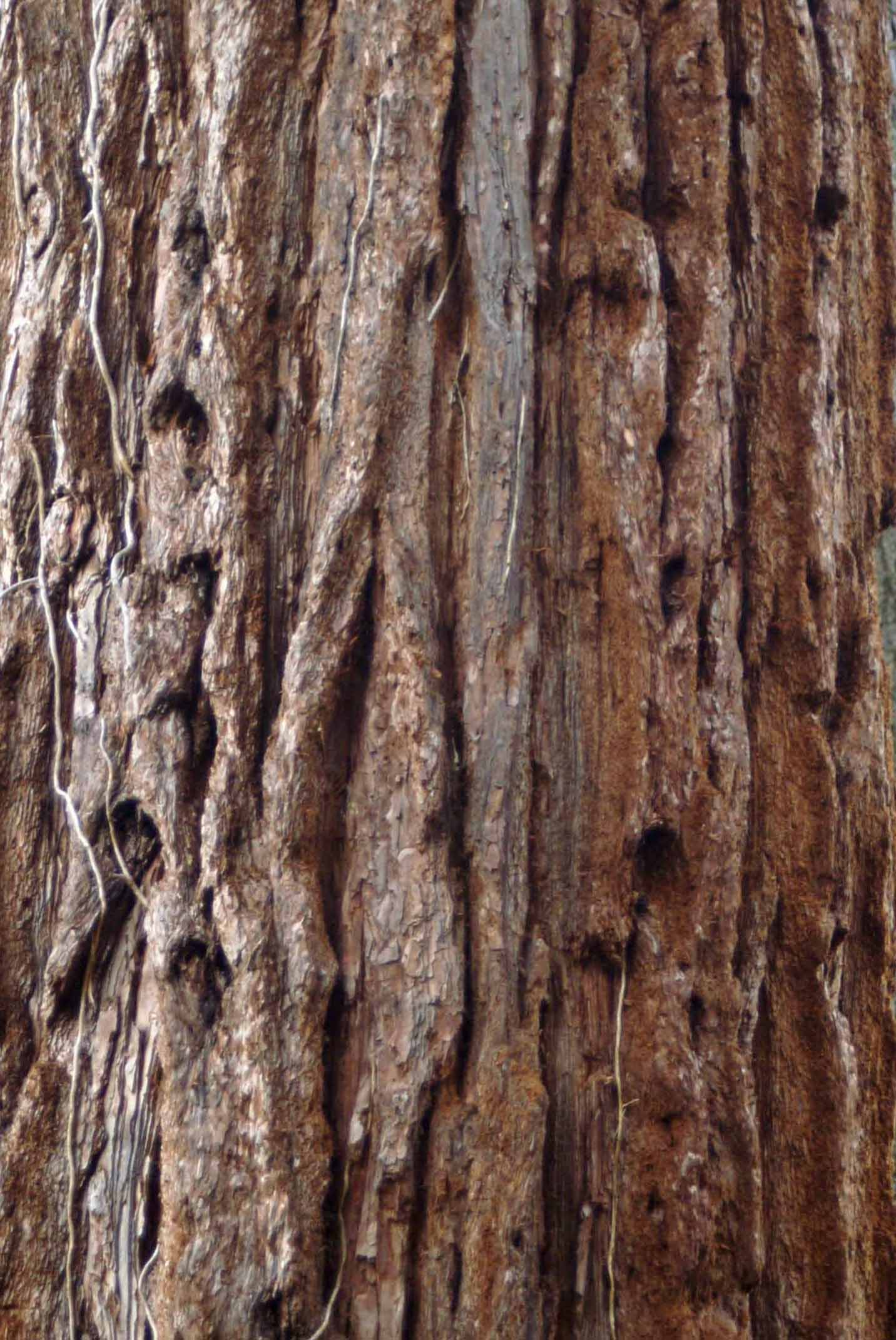
The amazingly deeply textured bark of the pine tree

A snippet of local history

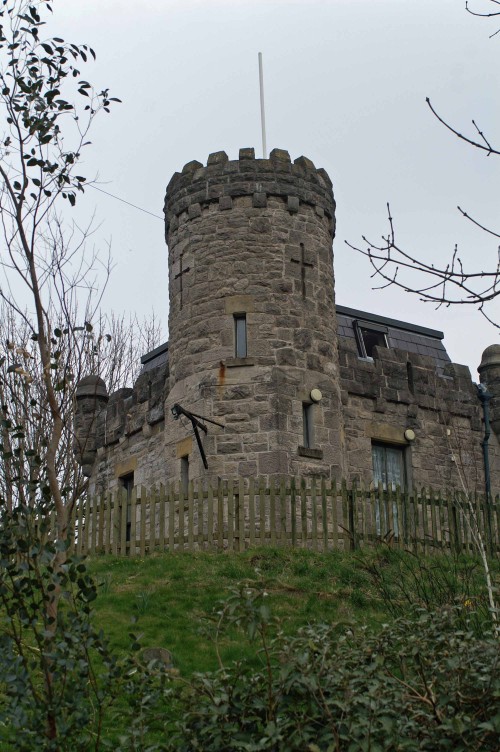
The Folly

At the top of the hill, at the Cliff Road access to the gardens, is an intriguing small castle-like building known locally as ‘The Folly”. It was built by Sir Charles Woodall, a Manchester shipping magnate who lived in the now demolished Tan-y-Coed mansion. It appears that Sir Charles had it built as a retreat so he could indulge his pipe-smoking habit which his wife wouldn’t allow him to do  at home. The tower has been restored in recent years, but remains unoccupied.

On Friday, after a morning  spent catching glimpses of the sunshine through the window, I just had to escape for a while at lunchtime and headed for the nearby Fairy Glen.
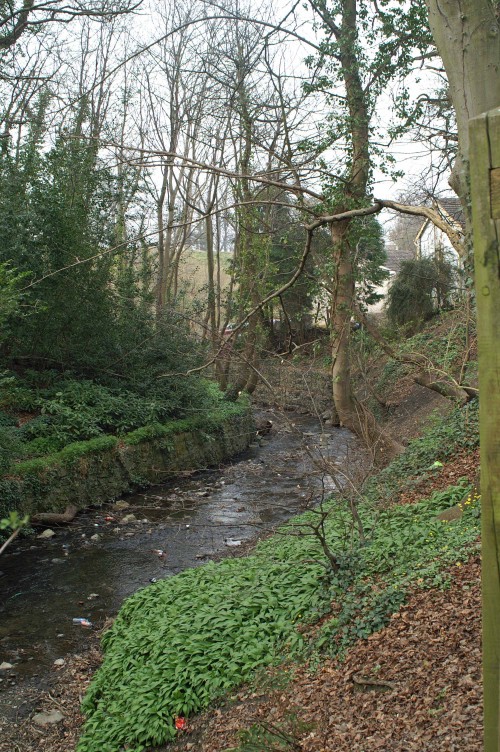
The River Colwyn flowing through Fairy Glen, Old Colwyn

The sound of the river and the birds singing were an instant tonic, and the sight of masses of golden yellow celandines interspersed here and there with blue violets  was a delight to the eyes.

Masses of celandines beneath the trees
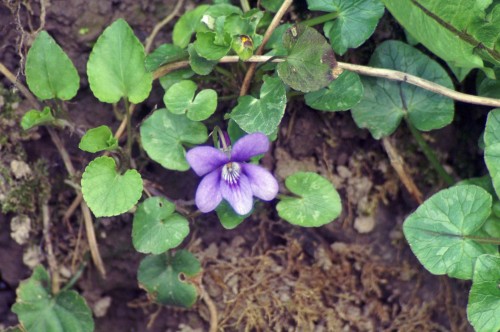
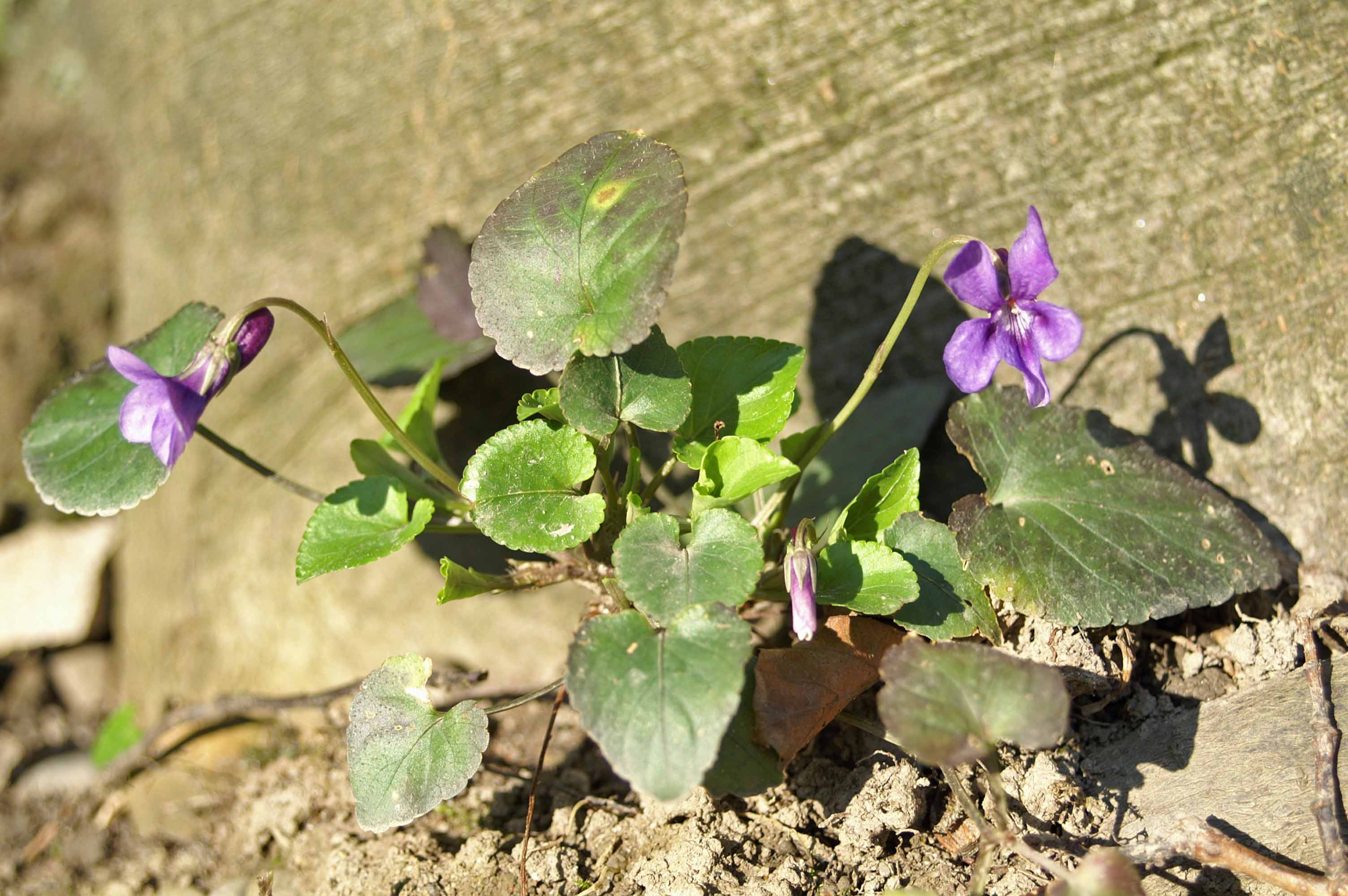
Common Dog Violet - viola riviniana
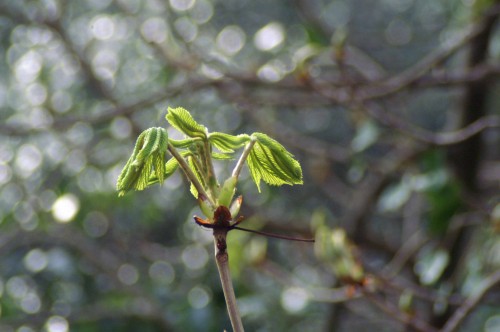
Sycamore leaves unfolding

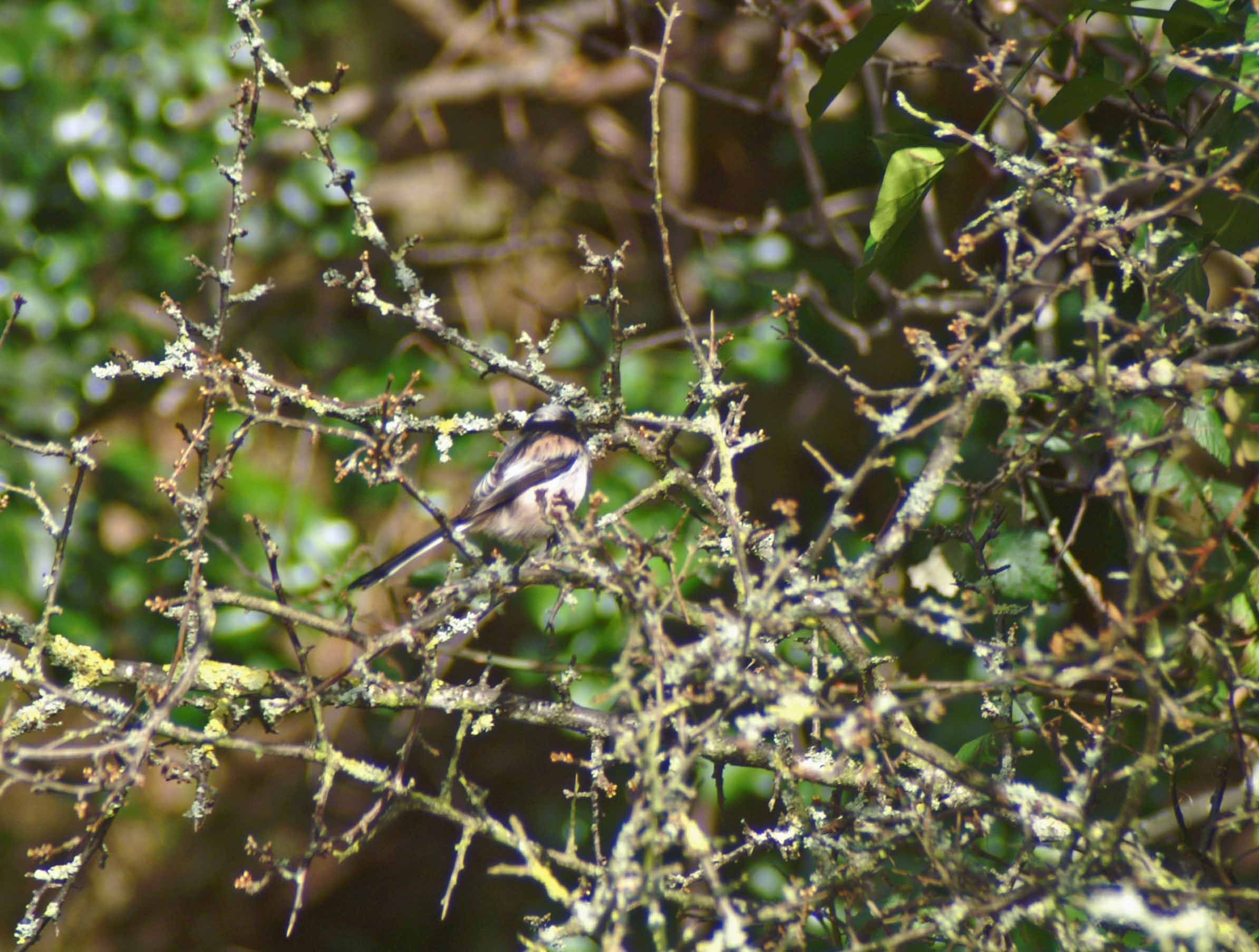
There were birds singing all around me, but none that I could really see properly until I just caught a glimpse of movement and a flash of black and white     from a tangle of shrubbery. It was not till a bird emerged and flew up into a tree that I realised it had been the tail end of a long-tailed tit that I had seen. There were at least two flitting about, but this was the best view I had; a very brief one, and the photograph was almost good – it really shows the length of the tail shame it was looking away from me.
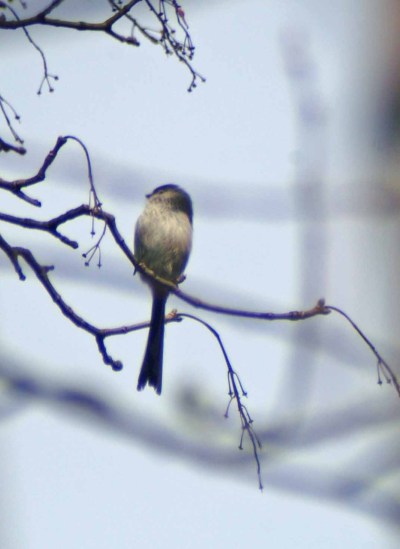
Long-tailed Tit- Aegithalos caudatus

As always I was thrilled to catch sight of the delightful little birds and to add another species to my list of birds seen in this small local nature reserve. Whilst watching the long-tailed tits I was half aware of another bird calling; it was a call I recognised but could not place until I traced it back to a bird quite high in a tree almost next to me – a nuthatch.
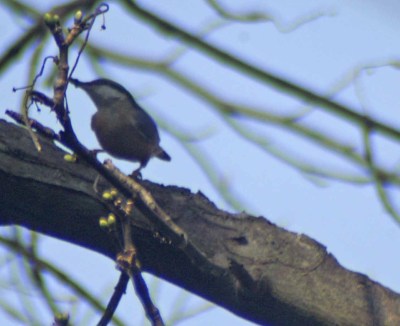
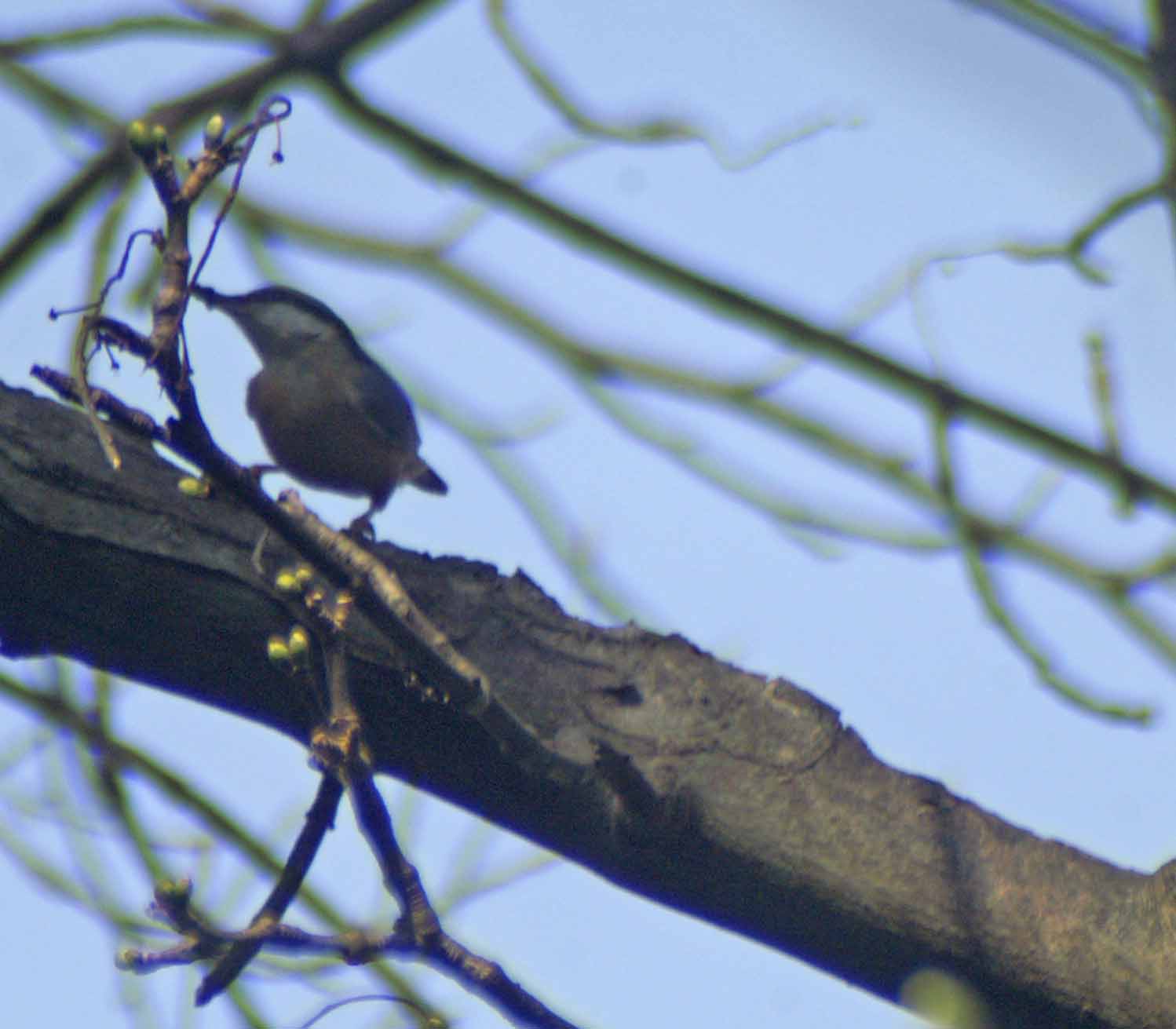
Nuthatch - Sitta europaea, with something in its beak, possibly mud

I was even happier now, with two new species for my list and things just got better; there were two nuthatch there and it quickly became apparent that they were in the process of working on a nest hole. This was located on a kind of ‘elbow’ of a branch high up on a very tall tree, a sycamore I think, and well covered with ivy. Both birds were working away in turn and occasionally small pellets of material fell to the path beneath them.

One of the nuthatch pair at the nest hole
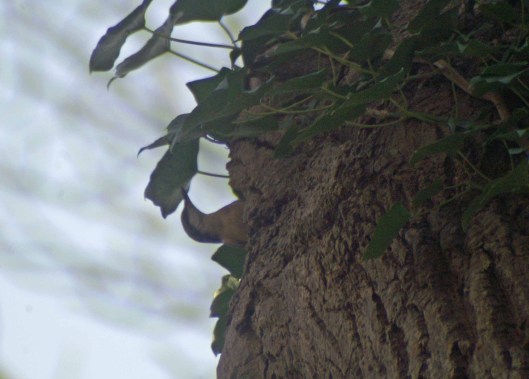
Very acrobatic birds, this one is working upside down

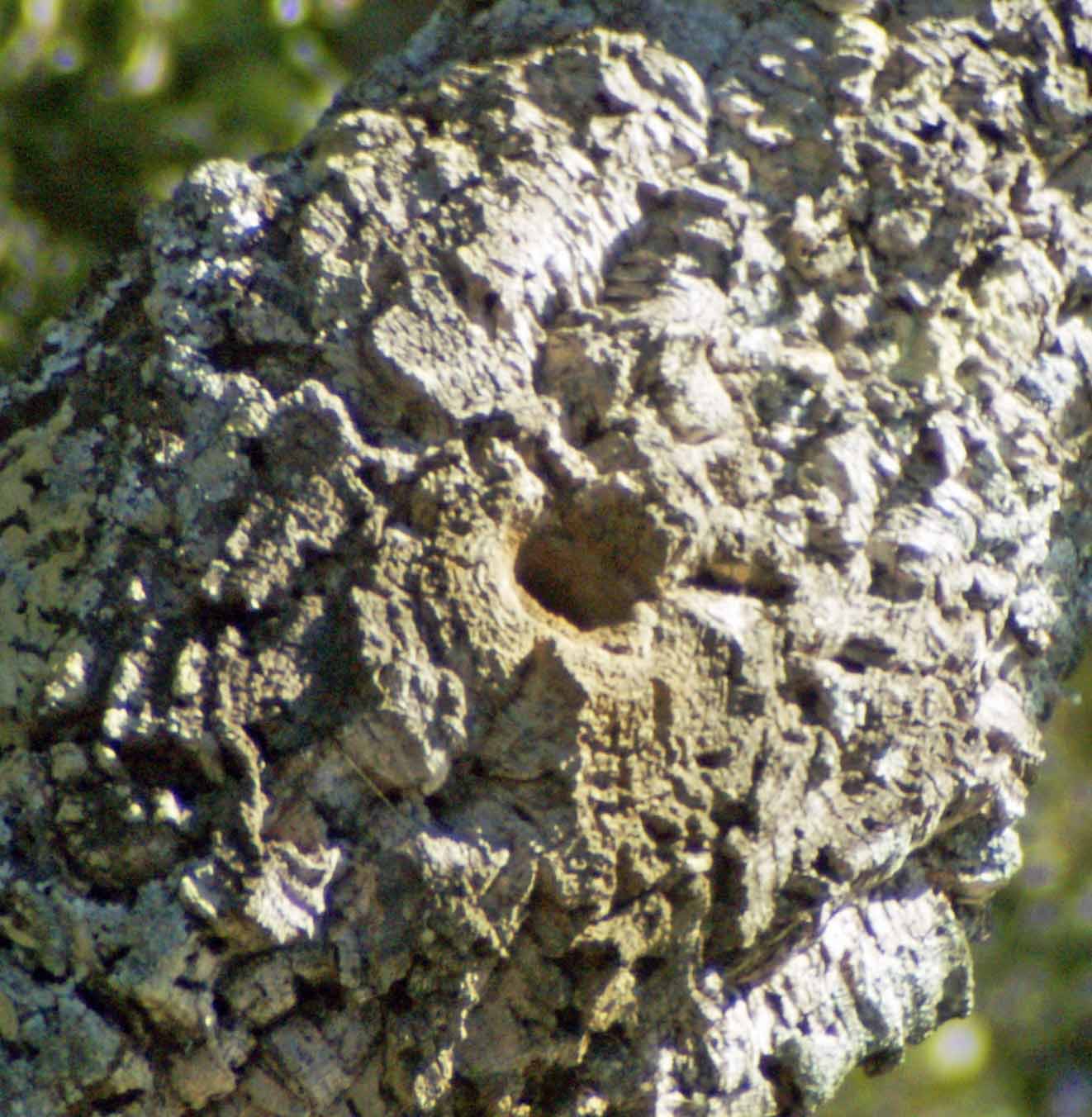
The nest hole of a nuthatch is beautifully crafted. Firstly they select a suitable hole in a tree, usually near to a source of water. The hole is then excavated and cleaned out and lined with dry grass, leaves etc. When the interior work is finished the birds then fetch mud which they mould around the entrance hole until it is the perfect size and shape for them to pass through. The best views of this process I have had were in Southern Spain on a gonhs* member’s outing to a part of the Alcornocales Natural Park known as el Picacho (March 2007).

A newly-completed nuthatch nest hole in a cork oak tree, with mud in the process of drying

We watched a pair of nuthatch finishing off their construction with mud from the nearby lagoon, went off on our walk then stopped for another look on our return a few hours later. The job was clearly completed to the satisfaction of the female as now she allowed the male to mate with her.

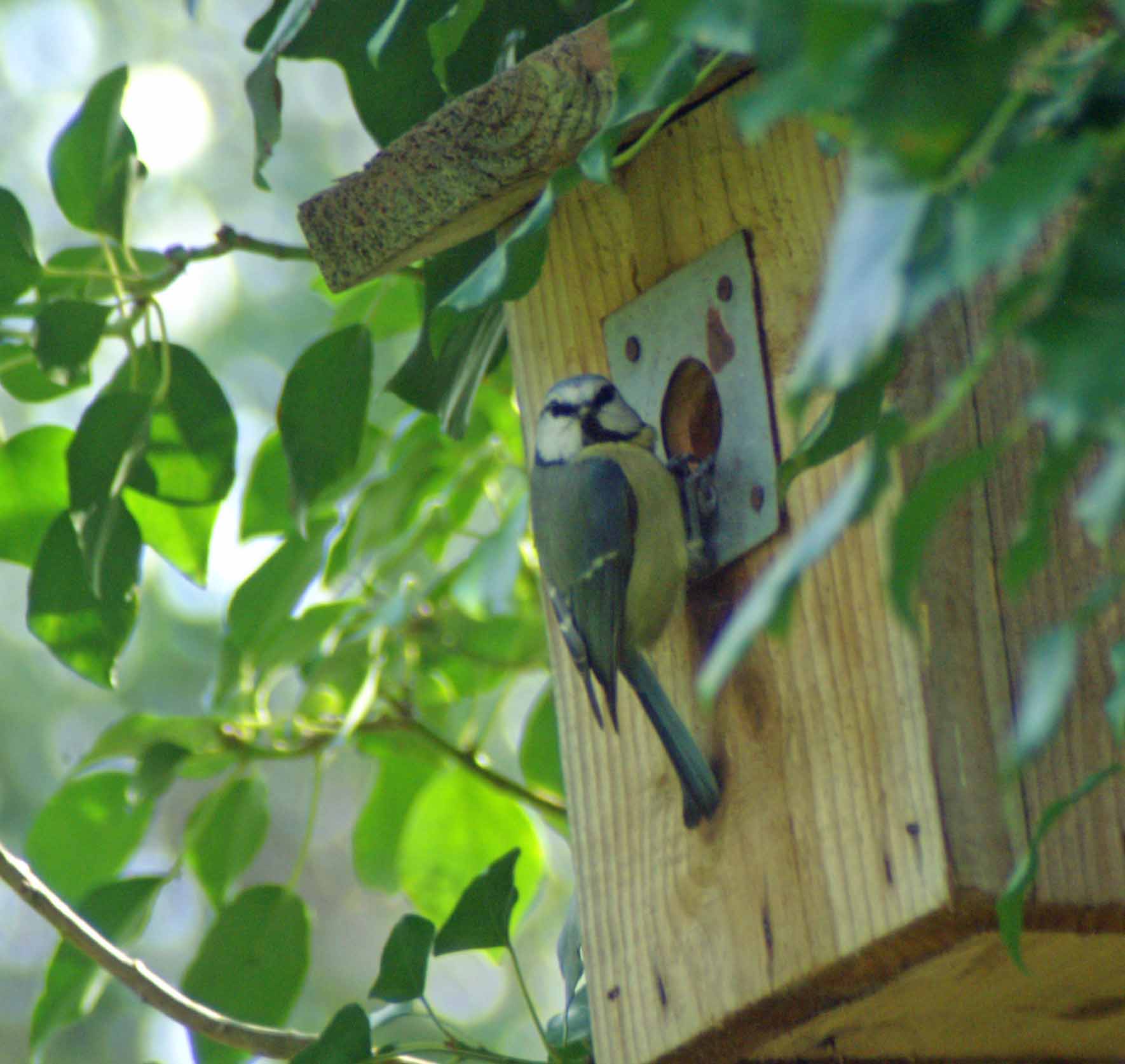
I moved from one side of the tree to the other to try to get a better view of the nuthatch, and as I did so a blue tit flew down to the nest box fastened to the same tree much lower down. Deciding I was just a nuisance rather than a threat, it went in, rummaged around a bit, threw out some rubbish then left to be replaced by its partner. So now I know the location of two nests to keep an eye on.
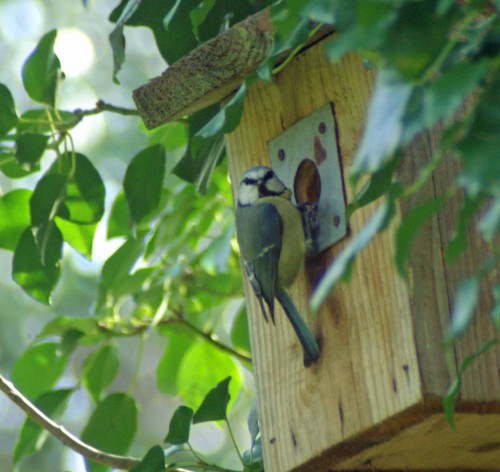
The blue tit was not happy that I was so close to the nest box

One of the blue tits throwing out the rubbish from their new home

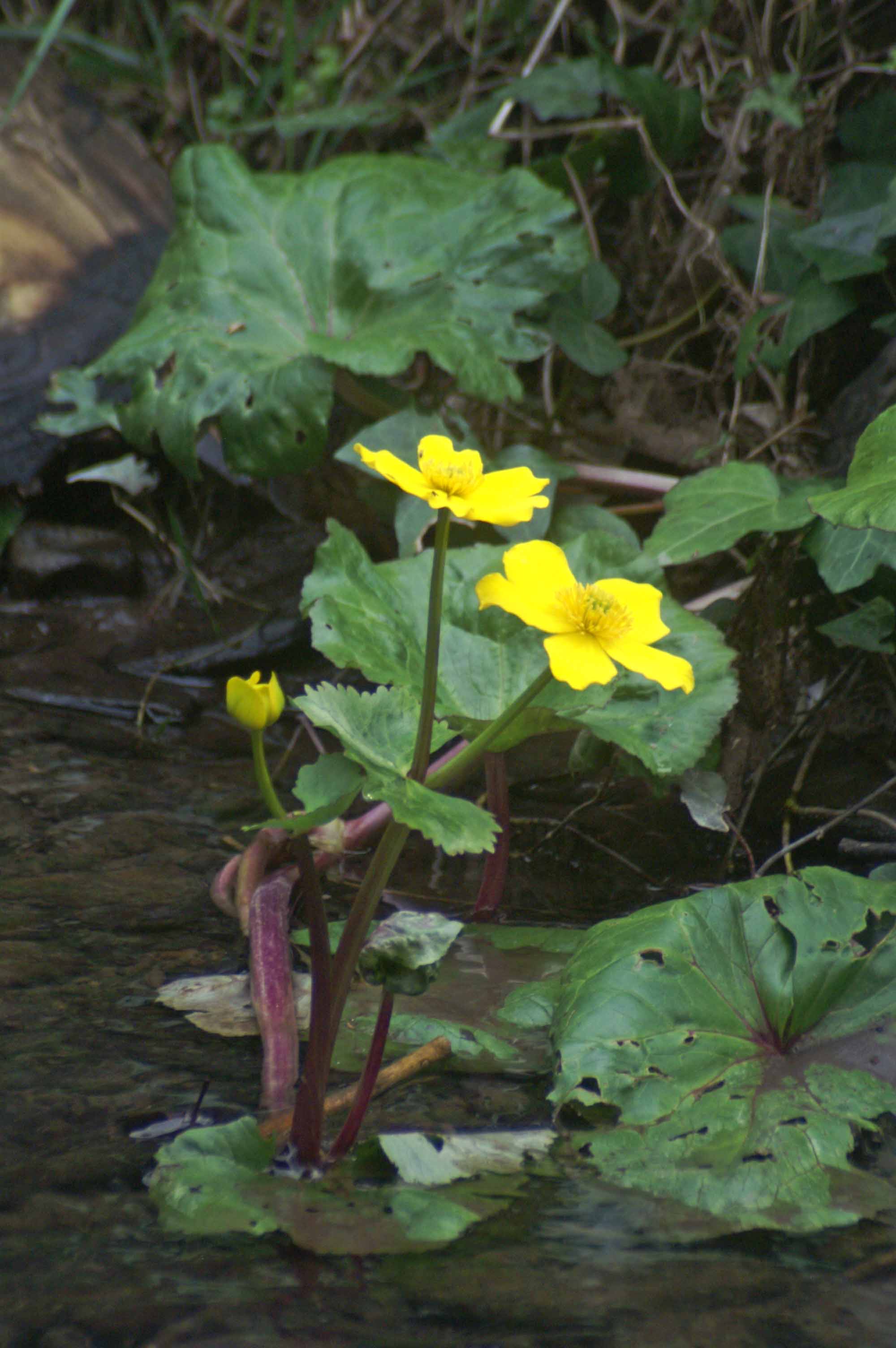
On the way back to work I made a stop to photograph these glorious golden marsh marigolds, or to me King Cups.

Marsh Marigolds- Caltha palustris, or to me King Cups, growing on the muddy river bank

In the UK, Caltha palustris is known by a variety of common names. These include Marsh Marigold and Kingcup, Mayflower, May Blobs, Mollyblobs, Pollyblobs, Horse Blob, Water Blobs, Water Bubbles, Gollins. Balfae (in Caithness) and the Publican. The common name of marigold refers to its use in churches in medieval times at Easter time as a tribute to the Virgin Mary, as in Mary gold.

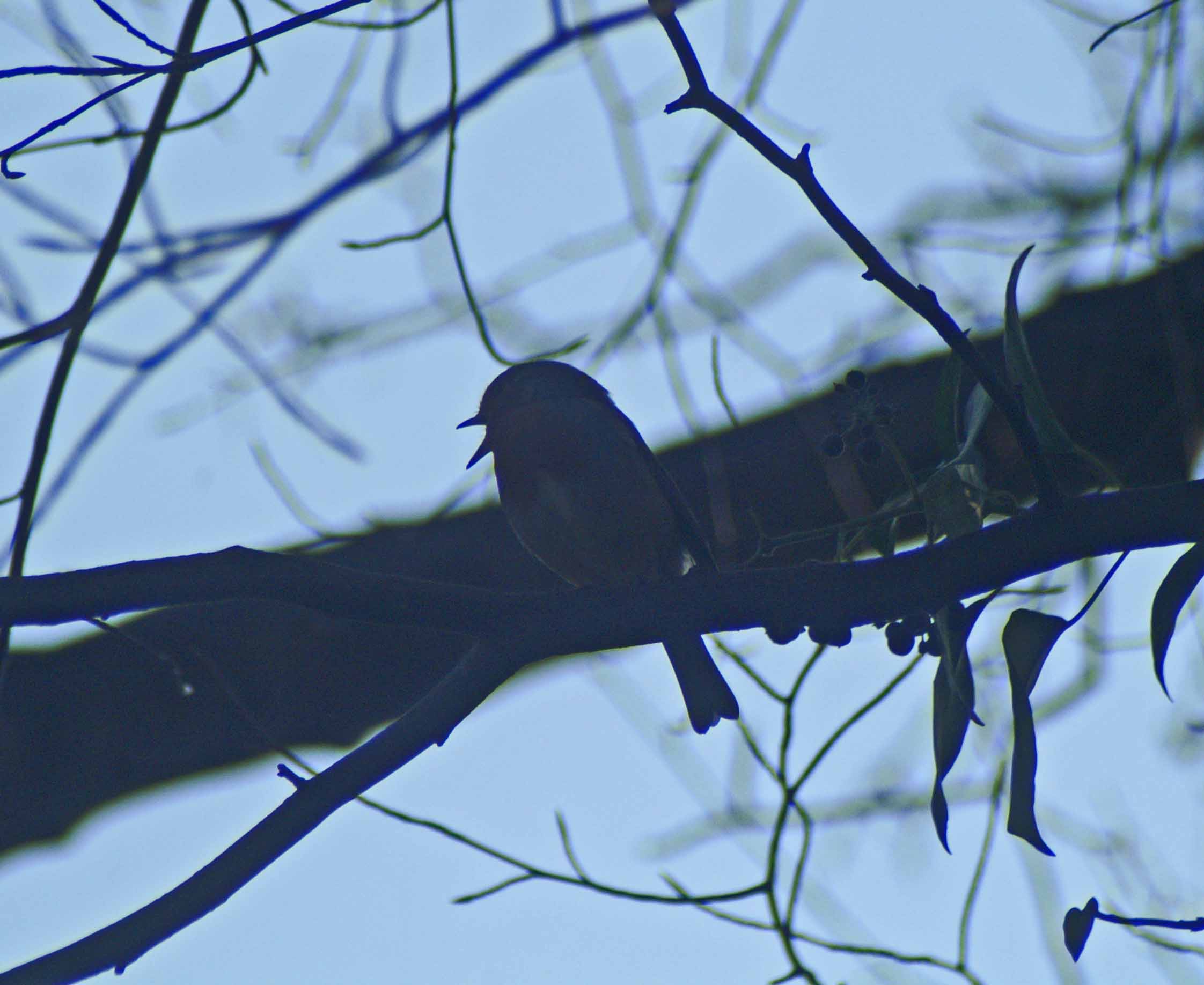
I couldn’t  ignore the beautifully singing Robin either
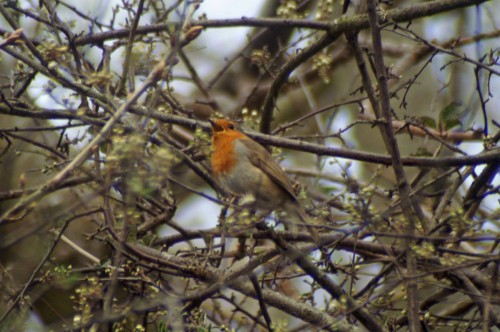
The robin was singing a few phrases then stopping to listen with his head on one side as another responded.

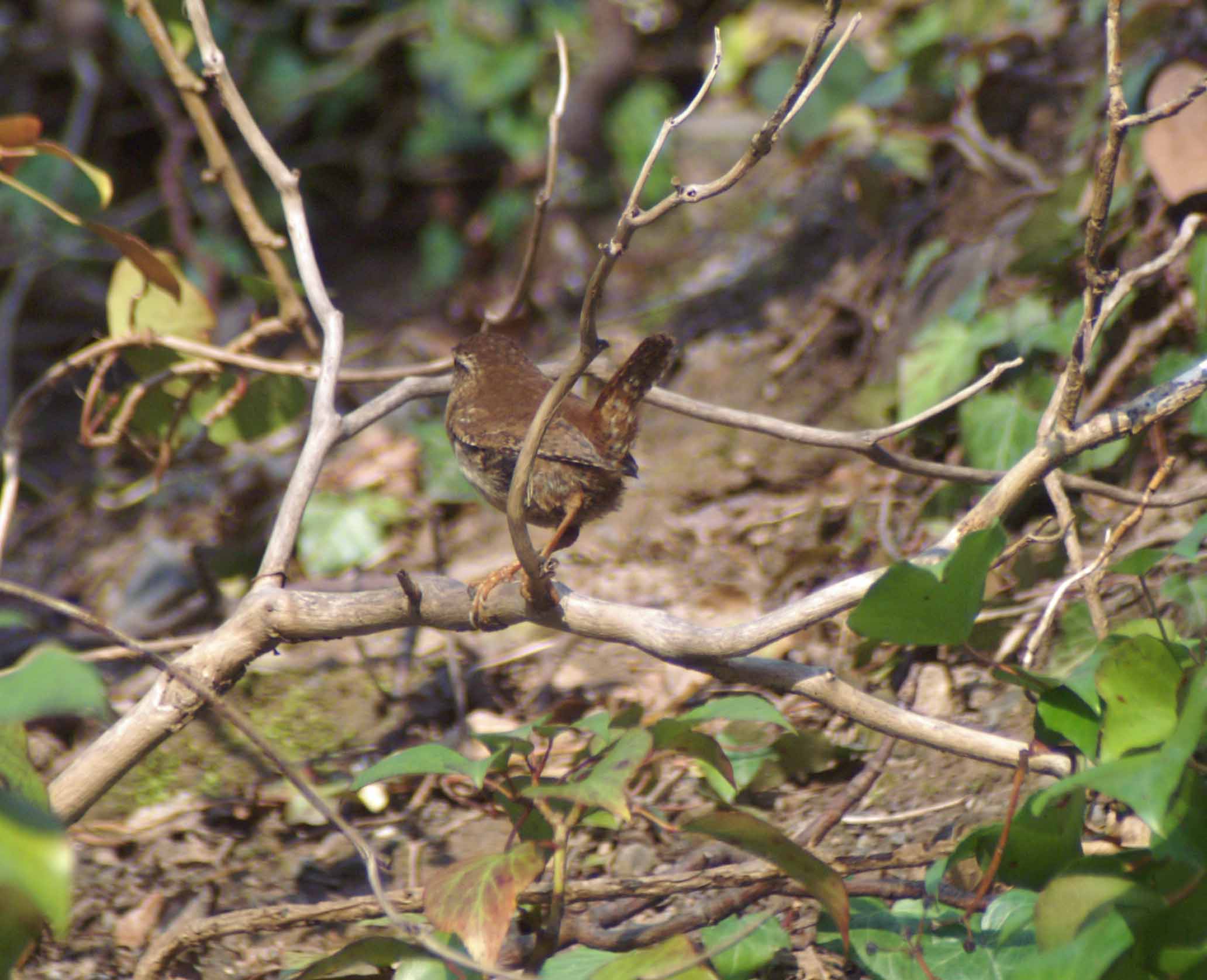
I heard a Wren singing and located it; it was my 'tail-less' one from the last time I was here. Looks like the tail may be growing back.

* gonhs – Gibraltar Ornithological & Natural History Society
Share this:

  • Share on Facebook (Opens in new window) Facebook
  • Share on Pinterest (Opens in new window) Pinterest
  • Share on X (Opens in new window) X
Like Loading...

Bryn Euryn in preparation for Spring

12 Monday Mar 2012

Posted by theresagreen in Local Nature Reserves, Nature, nature of woodlands, nature photography, woodland birds

≈ 1 Comment

Tags

Bryn Euryn Nature Reserve, catkins, dunnock, long-tailed tit, pussy willow, Robin, treecreeper

I hadn’t visited the Bryn Euryn Local Nature Reserve for quite some time and thought I would rectify that last weekend. The morning weather had been varying between sunshine and showers, and arriving at the site during a sunny spell I  walked first around the edge of the small quarry field to see what was growing there.

Lush growth of leaves of Arum maculatum -cuckoo pint, or lords & ladies

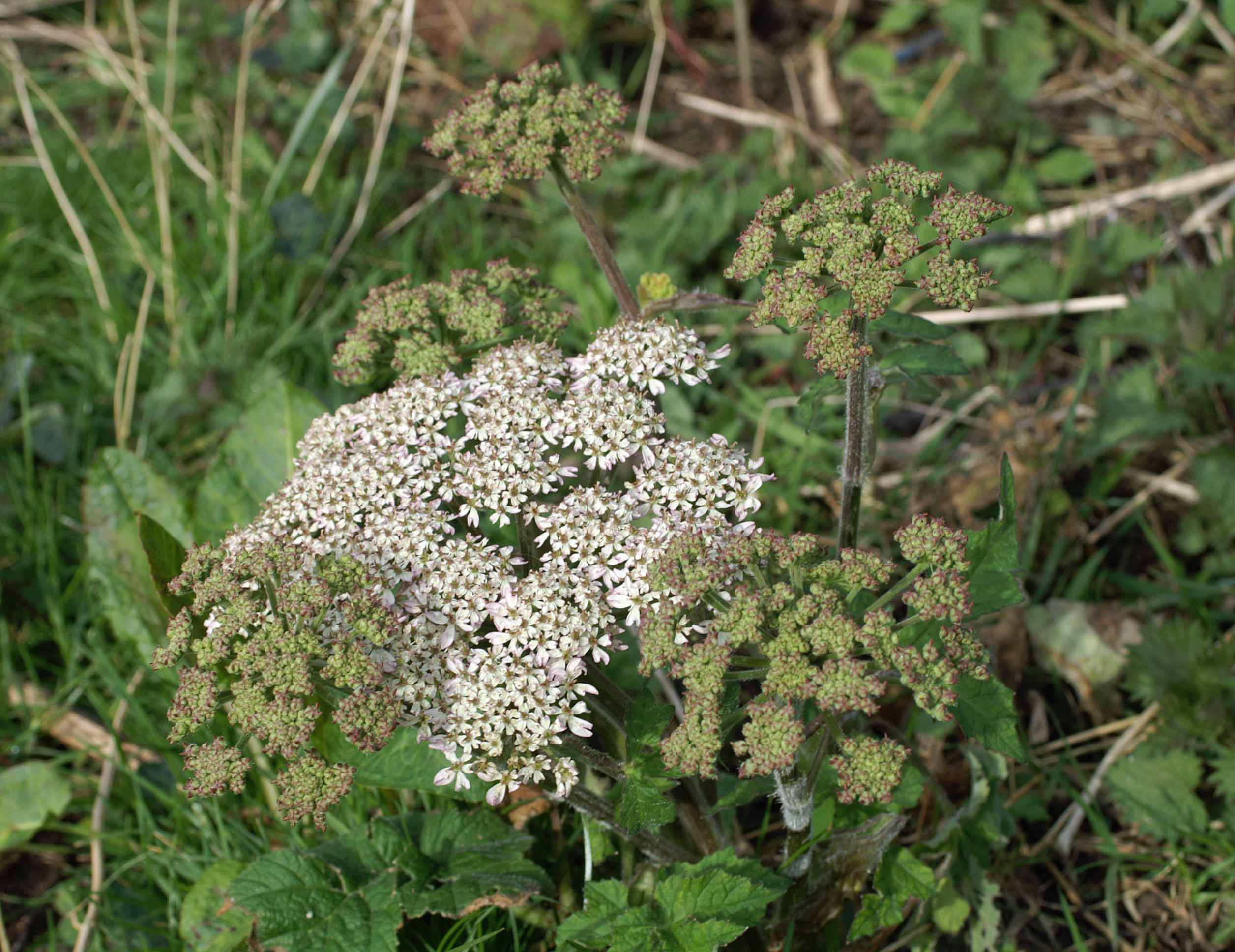
A very early flowering specimen of Heracleum sphondylium - common hogweed or cow parsnip. This is a herbaceous perennial or biennial belonging to the family Apiaceae. It is an umbelliferous plant, in the same group as fennel, cow parsley, ground elder and giant hogweed.

Dry seed heads of burdock

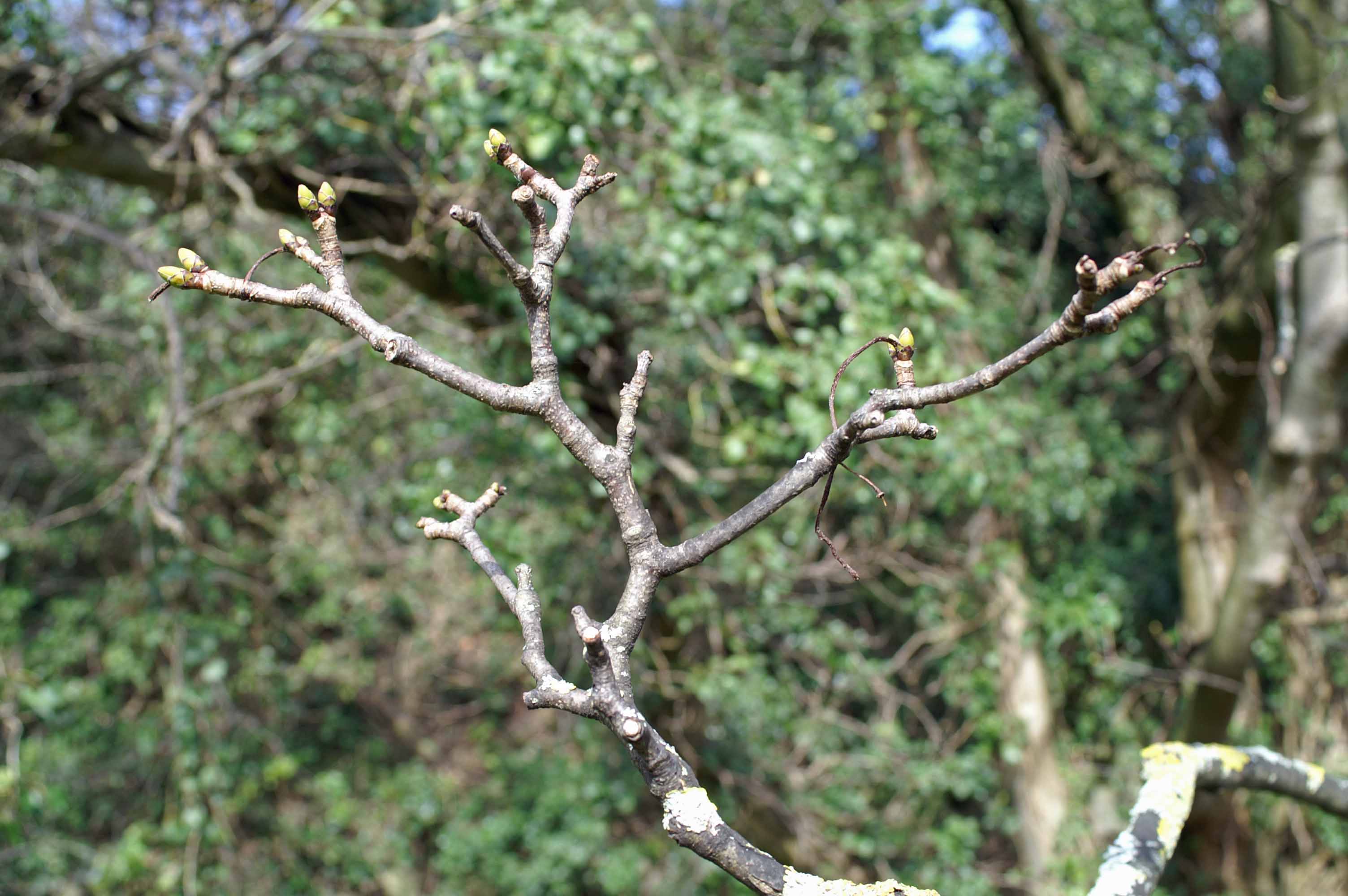
Swelling leaf buds

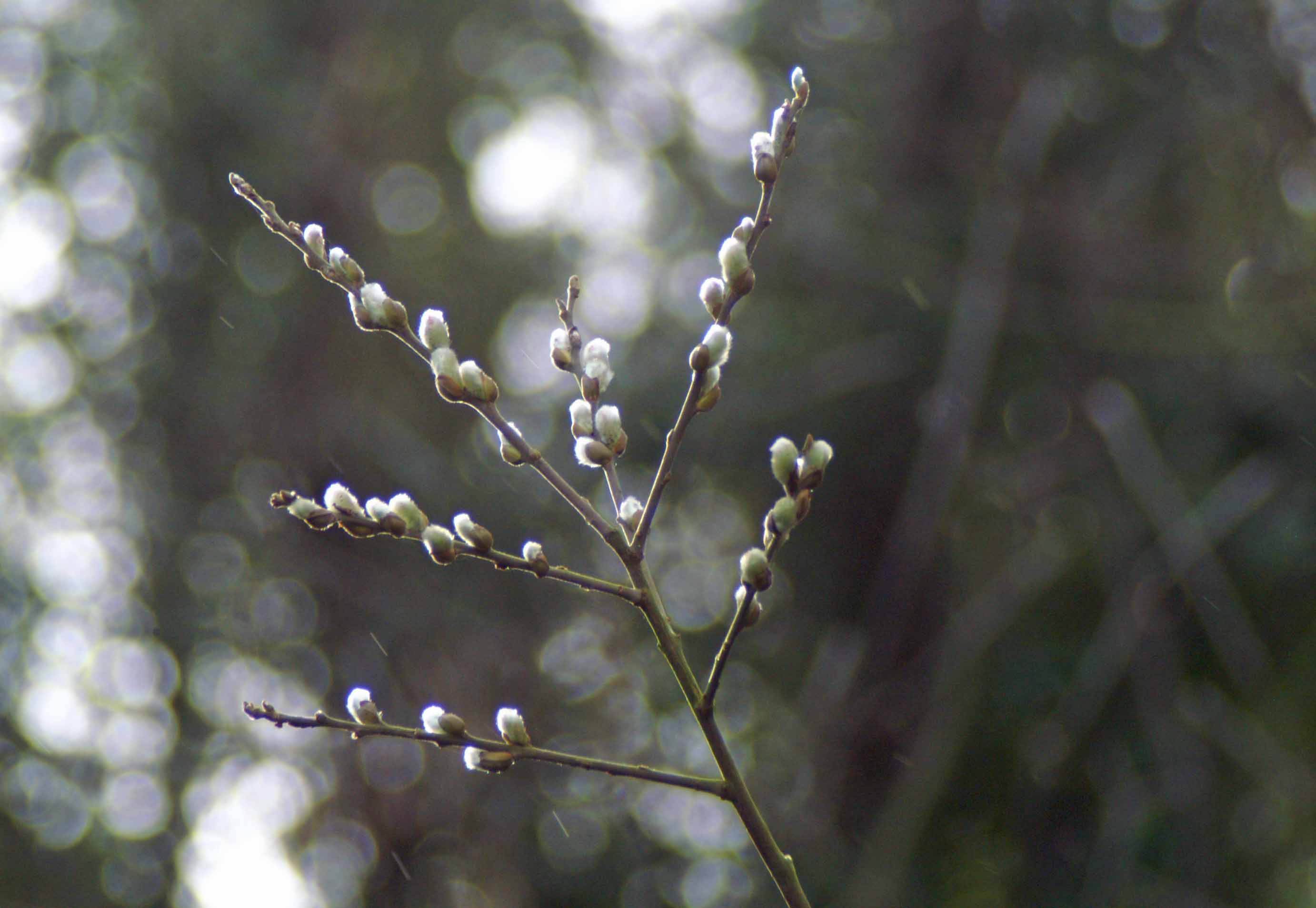
Silvery pussy willow

Pussy willow is a name given to many of the smaller species of the genus Salix (willows and sallows) when their furry catkins are young in early spring. Before the male catkins of these species come into full flower they are covered in fine, greyish fur and hence likened to tiny ‘pussy cats’. The catkins appear quite some time before the leaves, and are one of the earliest signs of spring. It is customary to gather branches of  pussy willow to decorate the house in the springtime, particularly on Palm Sunday, as a substitute for palm branches.

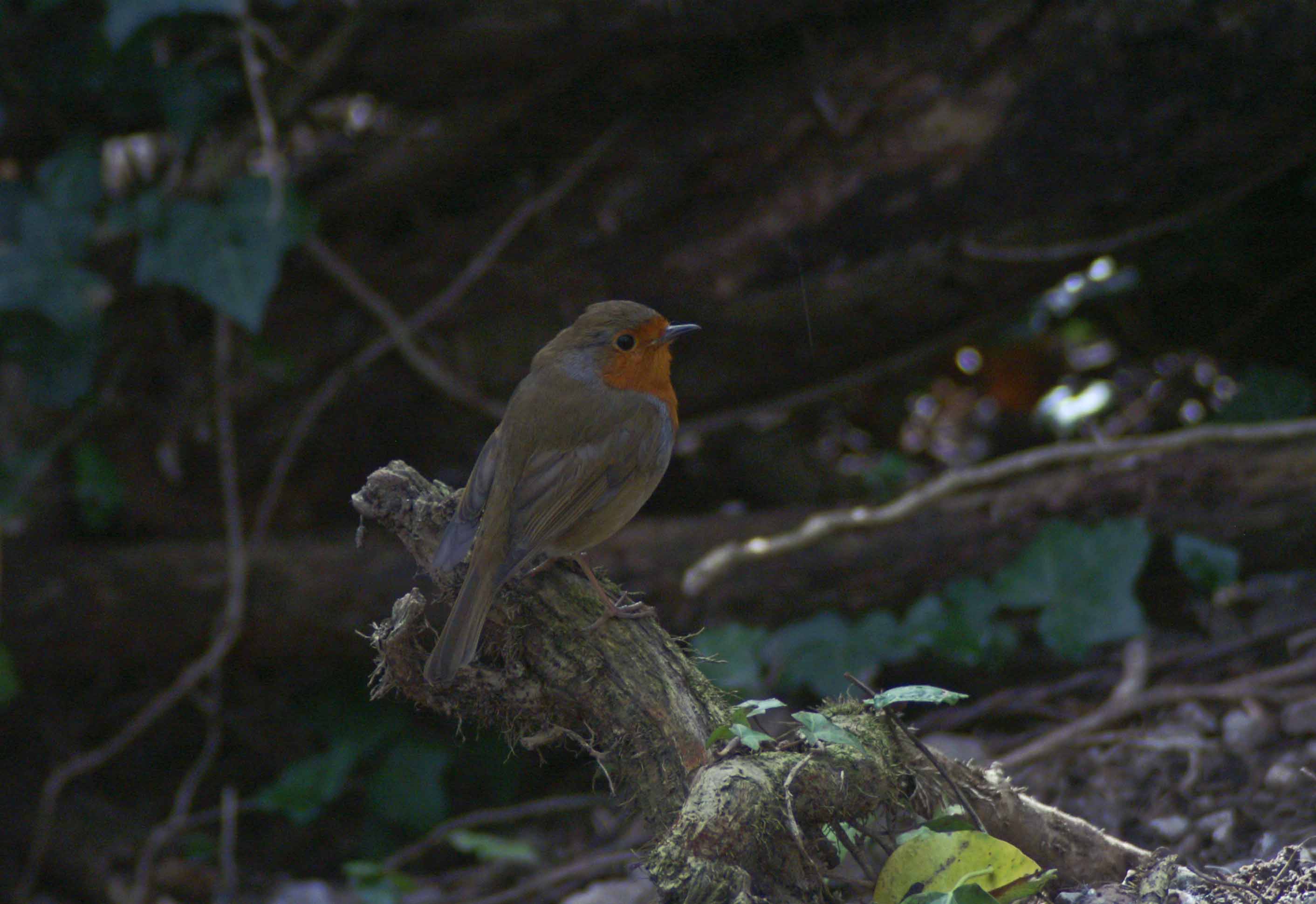
From the field I crossed onto the track on the edge of the woodland which passes by an open area of allotments. There is often  a robin  to be seen here, which today continued with its foraging regardless of me being very close by, even stopping to pose on a nice mossy wooden perch in a patch of  sunlight.


Posing robin

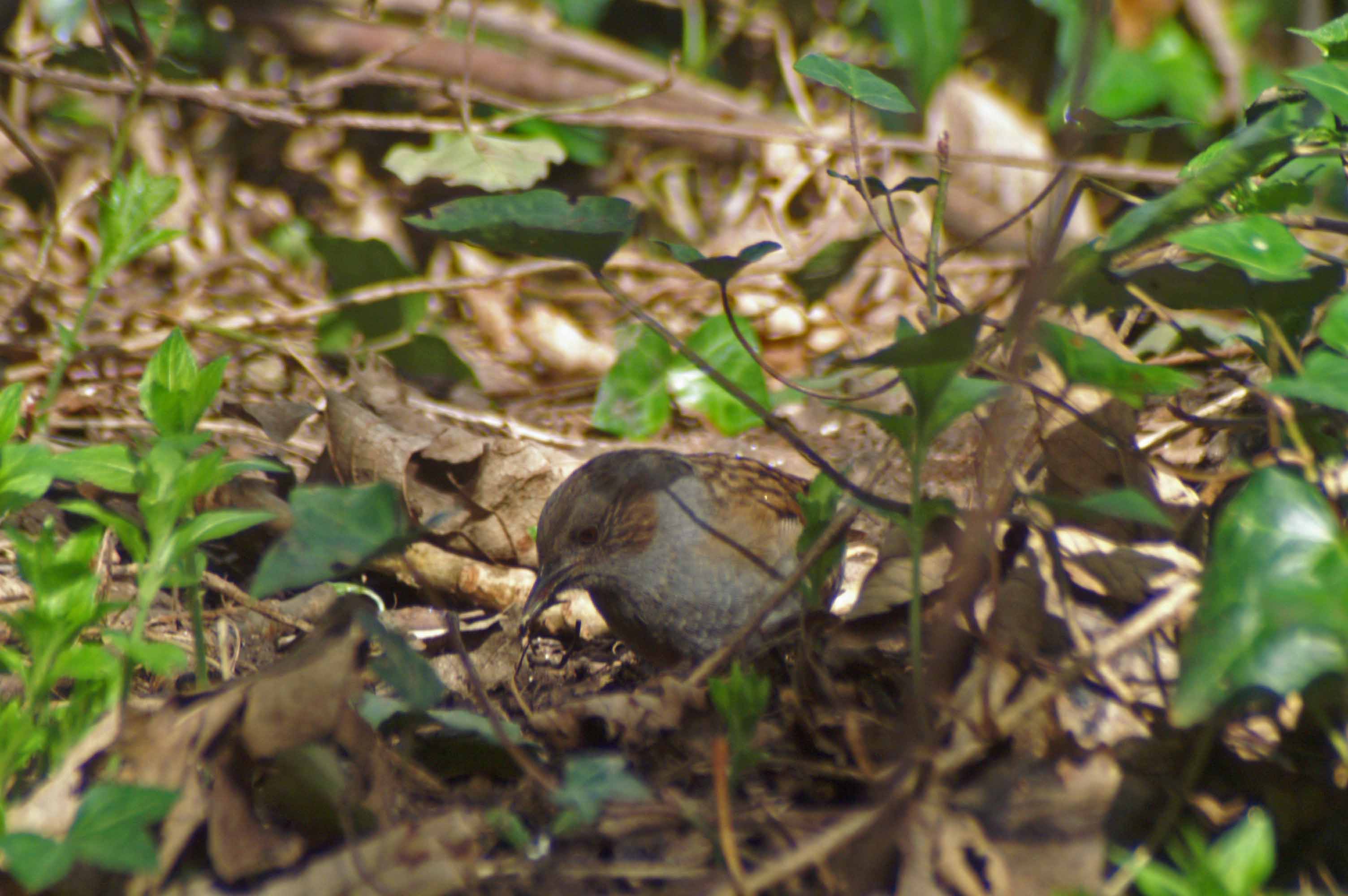
I had some good views of a dunnock there too as it pecked around amongst the dry leaves beneath the trees.

Dunnock -Prunella modular - almost at my eye-level

Dunnock-back view

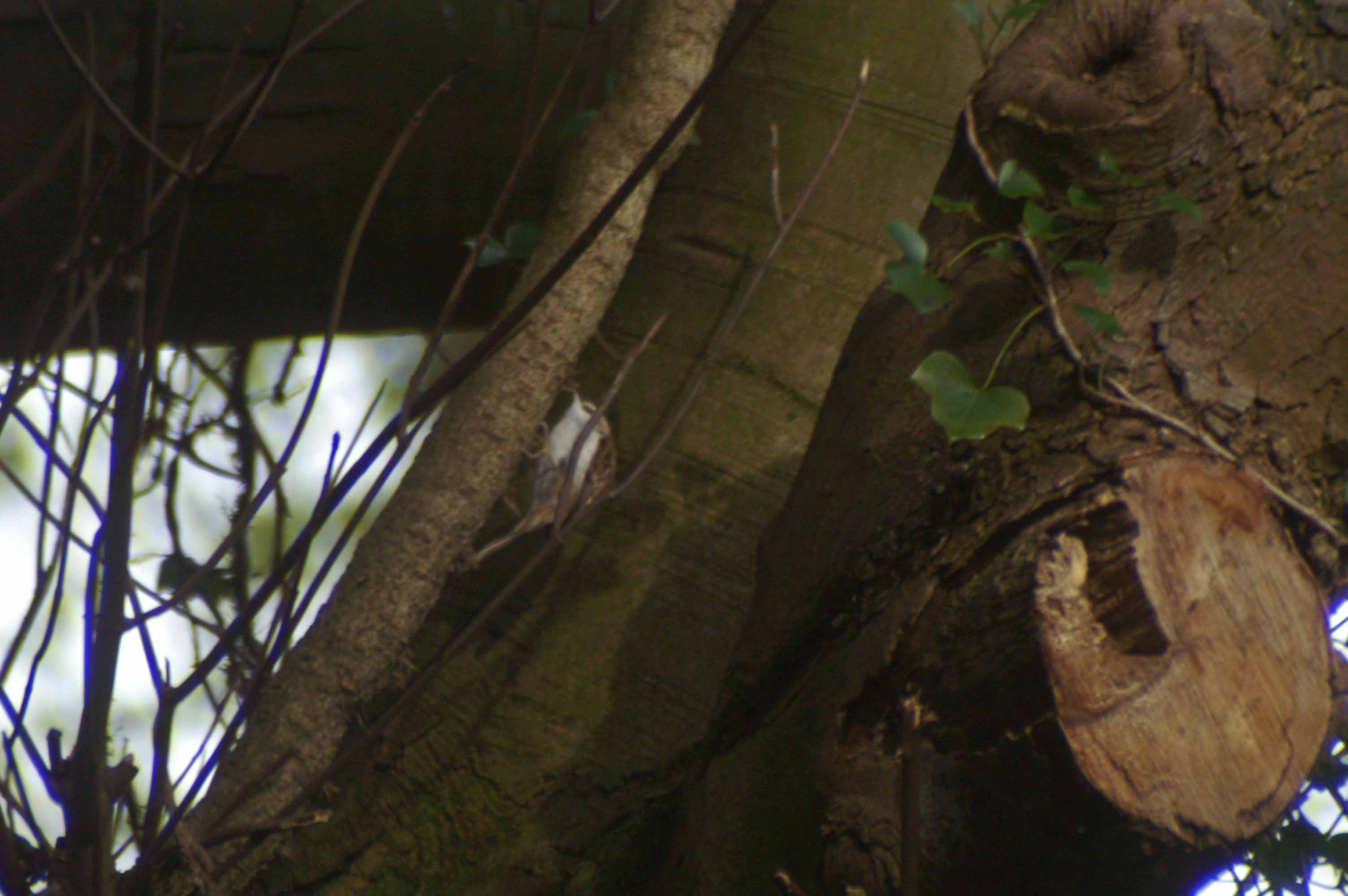
Moving on towards the bottom of the steps, another brown bird flew past me and landed on the trunk of a big sycamore tree; a treecreeper. I was delighted to recognise it as a treecreeper, the first and only one I have seen so far in this location. I watched it or quite some time as it explored the tree trunk and higher branches, probing its beak into nooks and crannies searching or insects and spiders.

Treecreeper - the first I have sen in this location

The Treecreeper– Certhia familiaris is small, very active, bird that lives in trees. It has a long, slender, downcurved bill, patterned brown upperparts, whitish underparts, and long stiff tail feathers which help it creep up tree trunks. It breeds in the UK and is resident here. Birds may leave their breeding territories in autumn but most range no further than 20 km.

In Spain the very similar short-toed treecreeper – Certhia brachydactyla occurs. They are frequent visitors to our garden there, where they are equally as comfortable scuttling up the tall straight trunks of the palm trees as they are exploring the nooks and crannies of the native cork oaks. They are much easier to photograph there too being more in the open and in better light.

e

A short-toed treecreeper on the trunk of a palm tree, Sotogrande, Southern Spain.

According to my bird books, the main points of difference between the two species are location and that the short-toed species has brownish flanks and a different voice: the short-toed’s song is said to be louder and less high-pitched and the call note louder, more piping and sometimes trilling. However, it is a possibility that there is in actuality only one species as presented convincingly in this brilliant blog:  http://10000birds.com/short-toed-treecreepers-do-not-exist.htm 

Catkin - A long, thin, indeterminate inflorescence of tiny, petalless flowers growing on willows, birches, oaks, poplars, and certain other trees. The flowers on a catkin are either all male or all female. The female flowers are usually pollinated by the wind. Also called ament.

The woodland was full of birdsong and following the track up through the trees towards the summit of the hill (bryn) I was accompanied by a chorus of robin, blackbird, chaffinch, blue tit and great tit with stand-out performances from a couple of  wrens and intermittent coo-ing interventions from wood pigeons. As I neared the top it began to rain quite heavily so I stood under an ivy-clad tree branch for a few minutes just listening until it stopped.

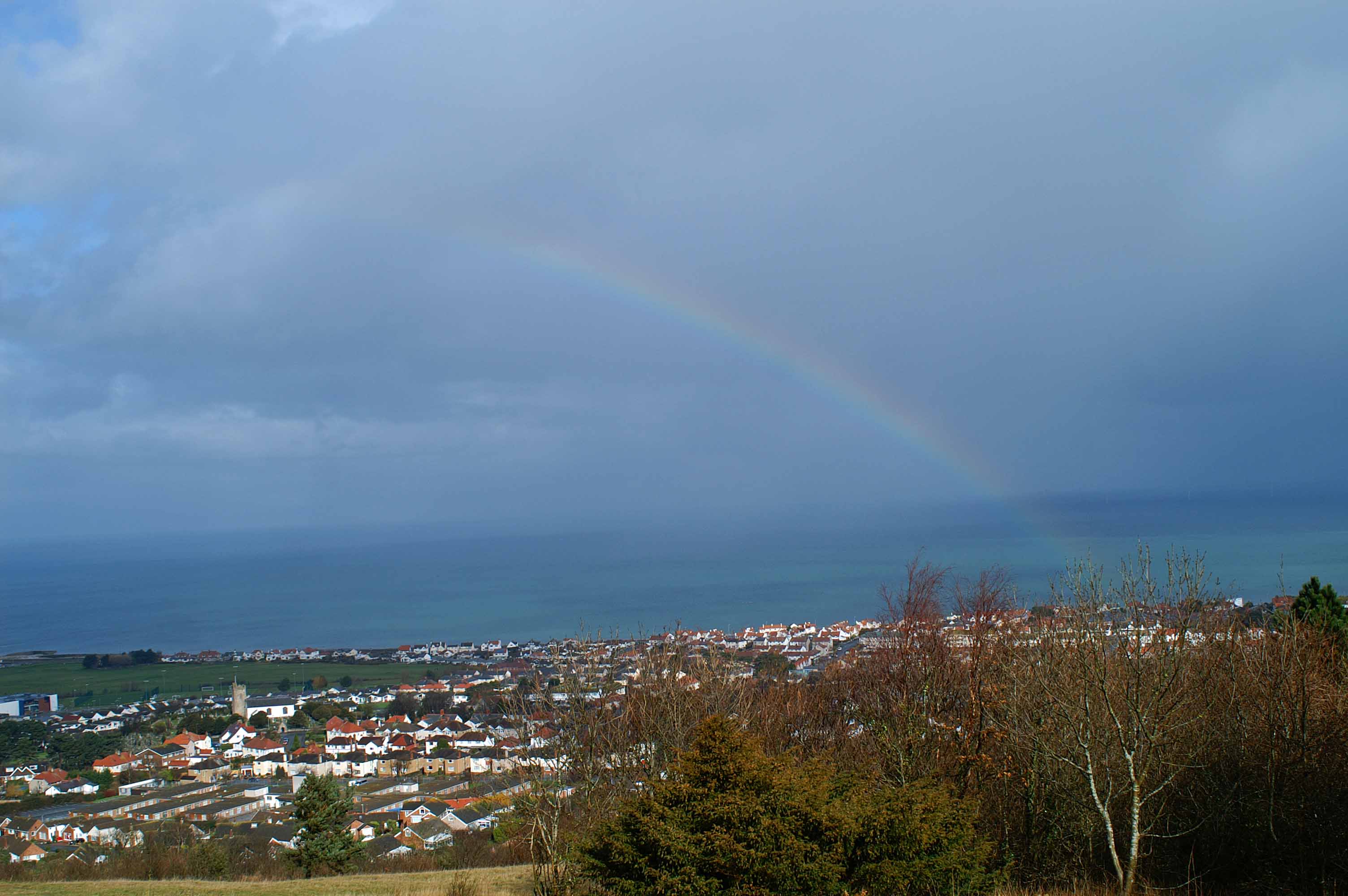
I carried on up to the summit, passing the trig point and over onto the open meadow or downs area that covers one slope of the hill. I was greeted by the sight of a complete arc of a rainbow that  spanned a width far greater than I could fit into my viewfinder.

A rainbow arced across the sky bridging Rhos-on-sea and Penrhyn Bay

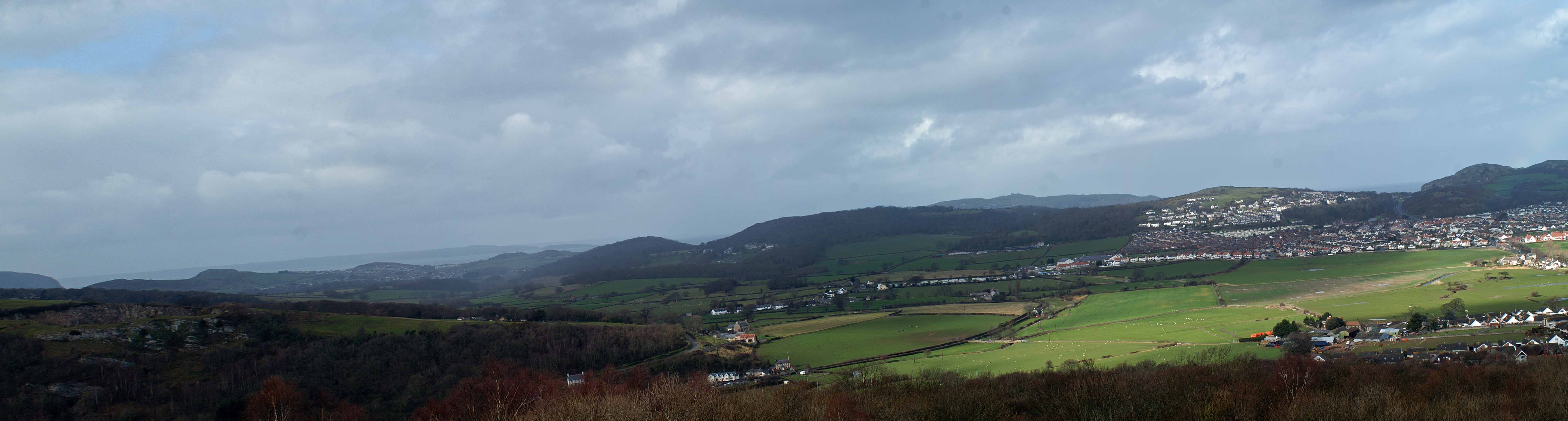
Part of the spectacular view from the summit of Bryn Euryn (click on photo to enlarge)

A close up of golden common gorse flowers and spiky leaves

On the path back down to the bottom a female blackbird was taking a bath in a newly filled puddle, disturbed from her ablutions by, yes, you’ve guessed, a bounding unleashed dog. I had been standing watching a small number of goldfinch foraging in the tops of a stand of tall trees, but I know when it’s time to leave and let the dogs have their share of the day.

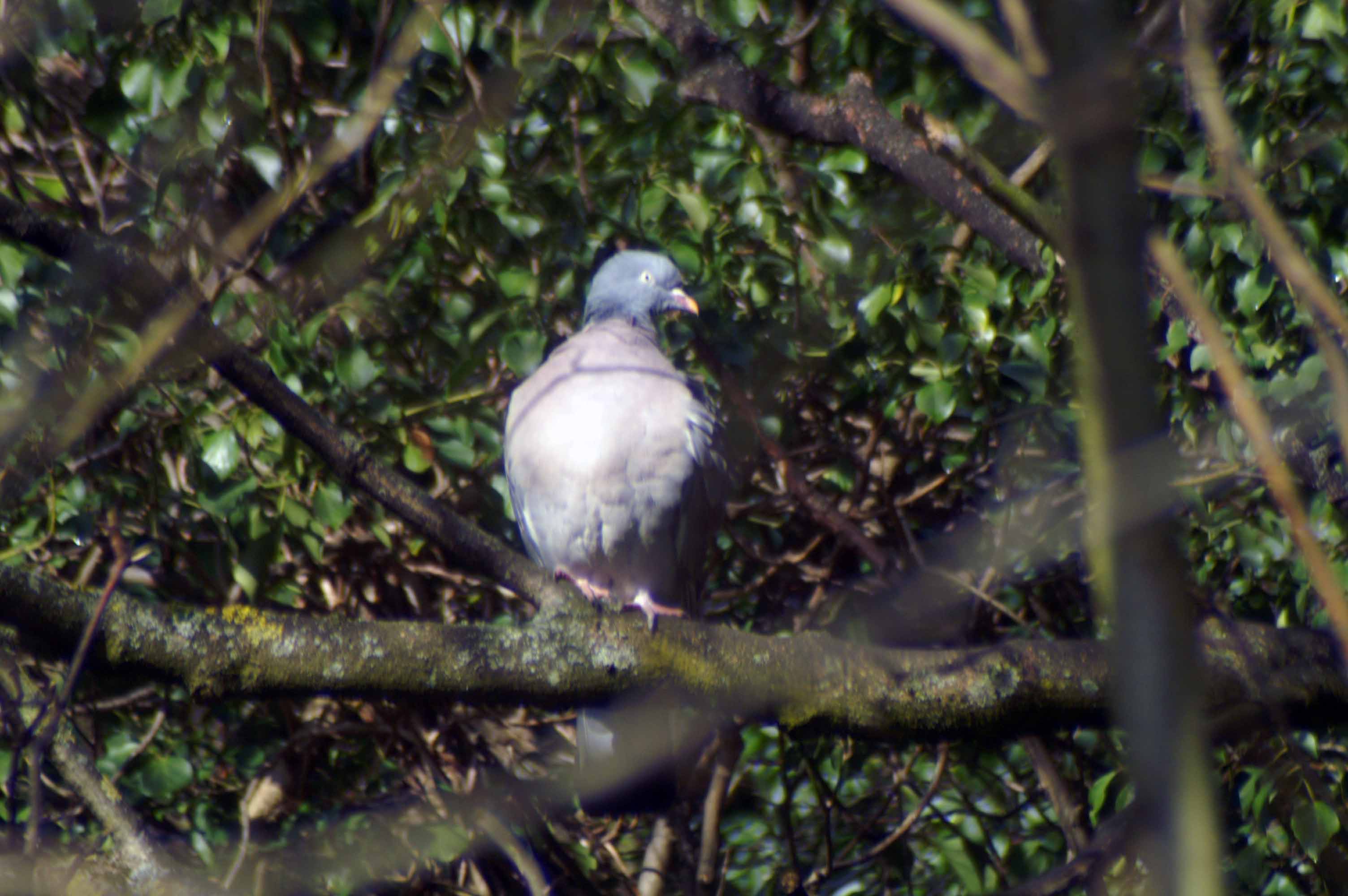
There were a few more treats awaiting me in the car-parking area however. Two wood pigeons, probably a pair, sat preening on a branch in a patch of sunlight and a pair of great tit were foraging around the fenced part of the field.

Wood pigeon - Columba palumbus

I have always found great tit elude me when it comes to photographing them, so I hung around for a while hoping to capture an image or two. They flew across the car park into the low trees there and attempting to pick up on them I found four long-tailed tits instead. A special favourite of mine, I was more than happy with that, especially as they stayed around acrobatically and thoroughly scouring the intricate twigs of the trees.

Long-tailed tit - Aegithalos caudatus

Long-tailed Tit, back view

A robin was investigating the ground beneath the shrubbery the long-tailed tit was photographed in, then unexpectedly flew up onto a branch in full sunshine and began to sing.

Another robin singing, but this time in sunshine

Share this:

  • Share on Facebook (Opens in new window) Facebook
  • Share on Pinterest (Opens in new window) Pinterest
  • Share on X (Opens in new window) X
Like Loading...

Fairy Glen

04 Sunday Mar 2012

Posted by theresagreen in Local Nature Reserves, Nature, nature of woodlands, nature photography, woodland birds

≈ 2 Comments

Tags

blackbird eating berries, Blue tit, coal tit, Fairy Glen, Old Colwyn, Wren

I am currently working in Old Colwyn and as it would have been a pity not to take advantage of some of last week’s sunny spring-like weather, so I ventured out during my lunch breaks to explore some  of the locality. In a recent blog – What a beautiful day- I featured photographs that I had taken in the small area of woodland alongside the final stretch of the river Colwyn. This is called Min-y-Don woodland and is a remnant of an ancient woodland that would once have covered the whole valley. From there it is possible to walk along a footpath leading up to the village that follows the course of the river. At the top, if you cross the Abergele Road and follow the signs to ‘Fairy Glen’, you reach a narrow wooded dell that the river runs through, bounded by roads and houses.

In present day Old Colwyn, much of which sadly has seen better days, Fairy Glen seems an incongruous name for a part of it, but it harks back to when this whole area was wealthier and hugely popular with well-to-do Victorian holidaymakers. This area of woodland was said to contain many different spirits including fairies, hence its name, which dates from the Victorian era and is a common name from that period (another local one being the “Fairy Glen” in Penmaenmawr).

The wooden road sign for Fairy Glen

Fairy Glen has recently been designated as a Local Nature Reserve and has undergone  regeneration with funding from the local council and it is now possible to walk through it easily. Presently the Fairy Glen is subject to an ownership dispute between Conwy County Borough Counciland the water company, Dŵr Cymru, each claiming that the maintenance of the area is the responsibility of the other. The trail was funded by Cydcoed Forestry Commission Wales.

“A path broadly follows the Afon Conwy which, with the Fairy Glen (then known as Y Nant), was mentioned by the traveller Edward Llwyd in 1699. He described the area as having seven wells and being completely wooded. There are, in fact, remaining indicators in Fairy Glen which identify it as an ancient woodland.”

I doubt that today’s Fairy Glen would have suited the Victorian visitors romantic aesthetic, but it is a pleasant enough place to spend half an hour. It is barely a five minute walk from work and I headed there for my first ‘reccie’ last Friday afternoon; I was very pleasantly surprised by the sightings I had there.

My first surprise was finding this violet plant flowering at the base of a large tree

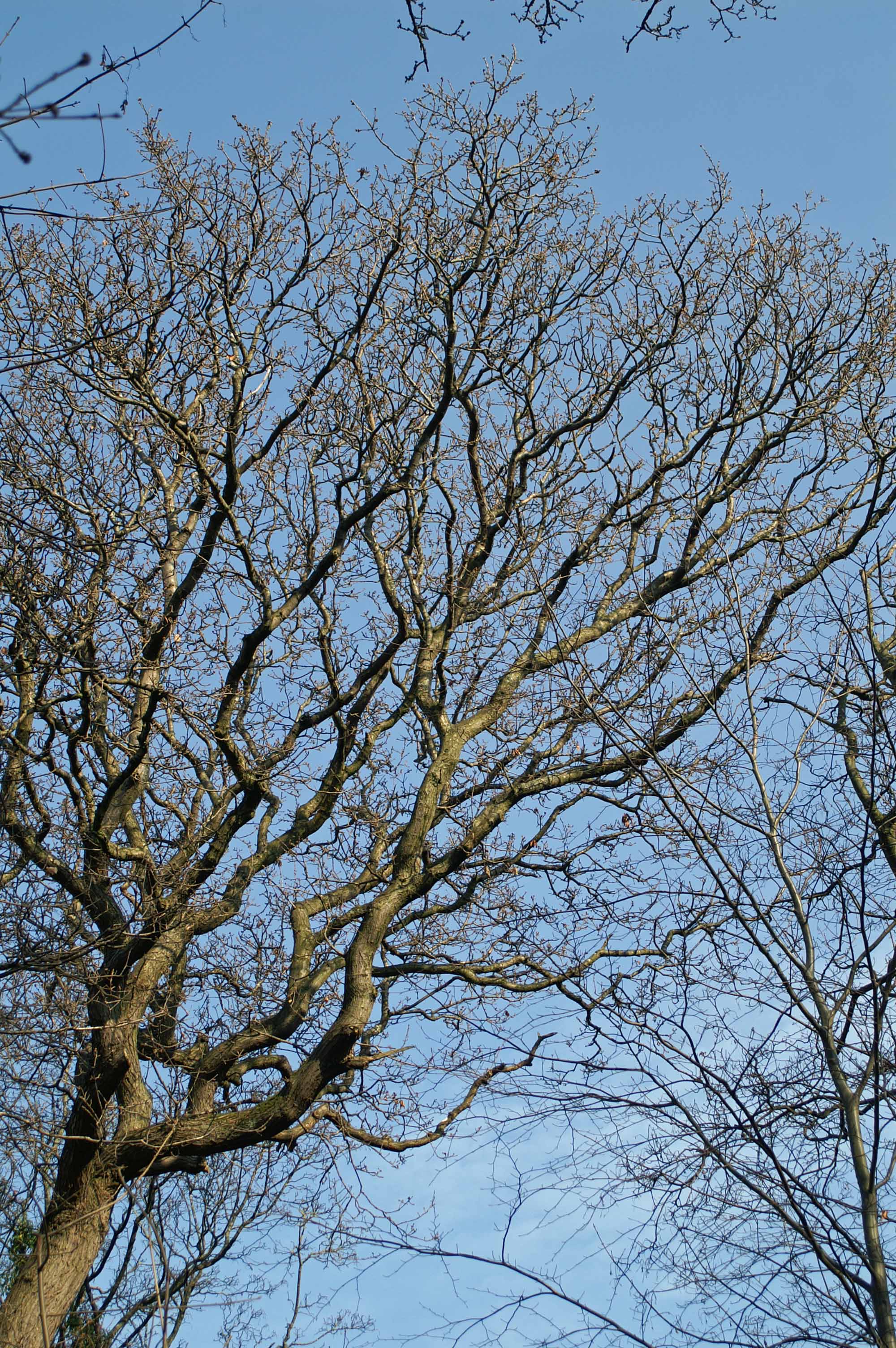
A tracery of bare twigs and branches against a perfectly blue cloudless sky

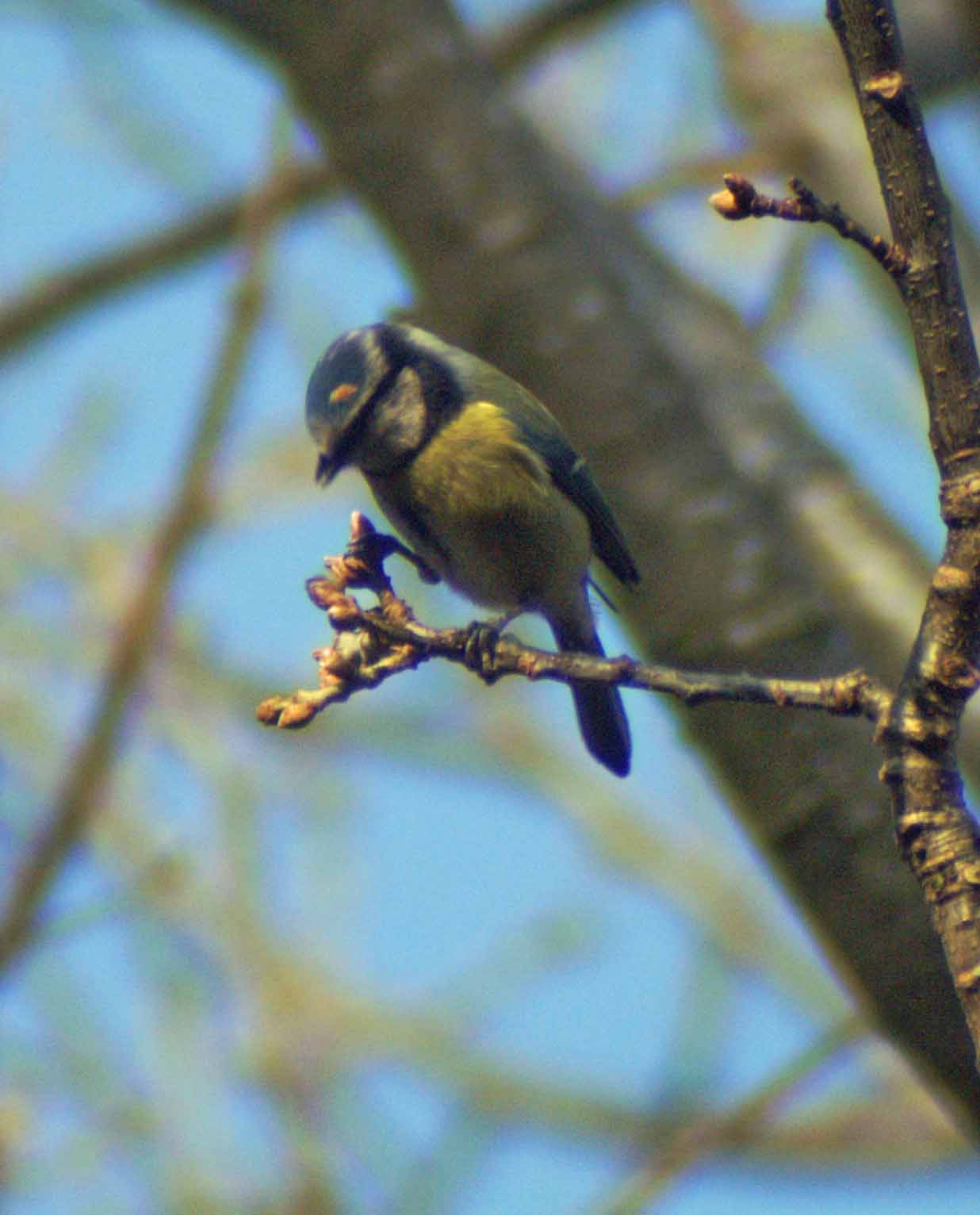
Blue Tits seemed to be everywhere

Blue Tit picking delicately around the sticky leaf buds

Hazel catkins

A grey squirrel sat on a tree branch eating something held in its paws, possibly an acorn it had buried back in the autumn

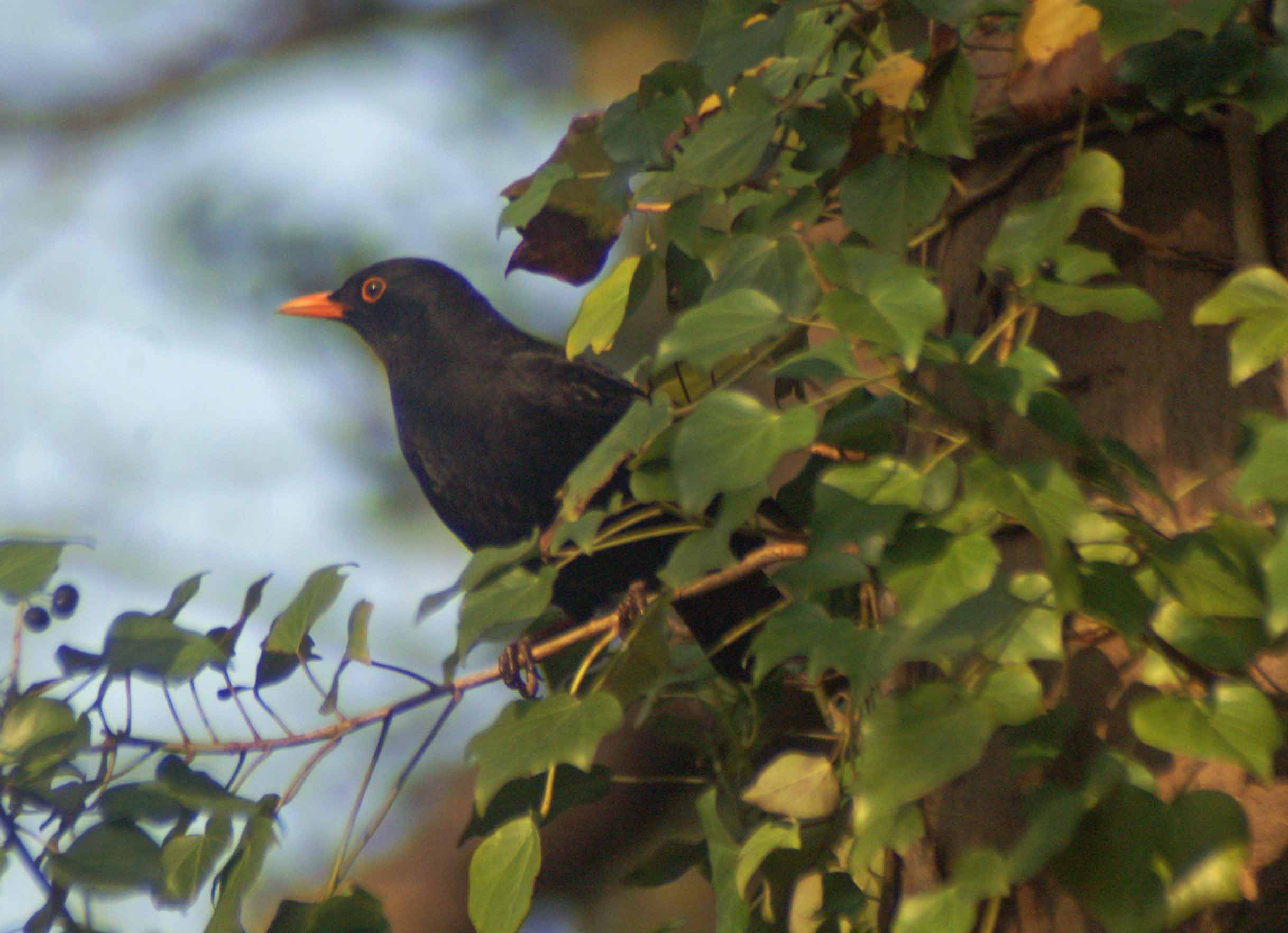
A beautiful male blackbird was picking off ripe ivy berries

The blackbird contorted himself to reach a berry

The blackbird with a berry in his beak

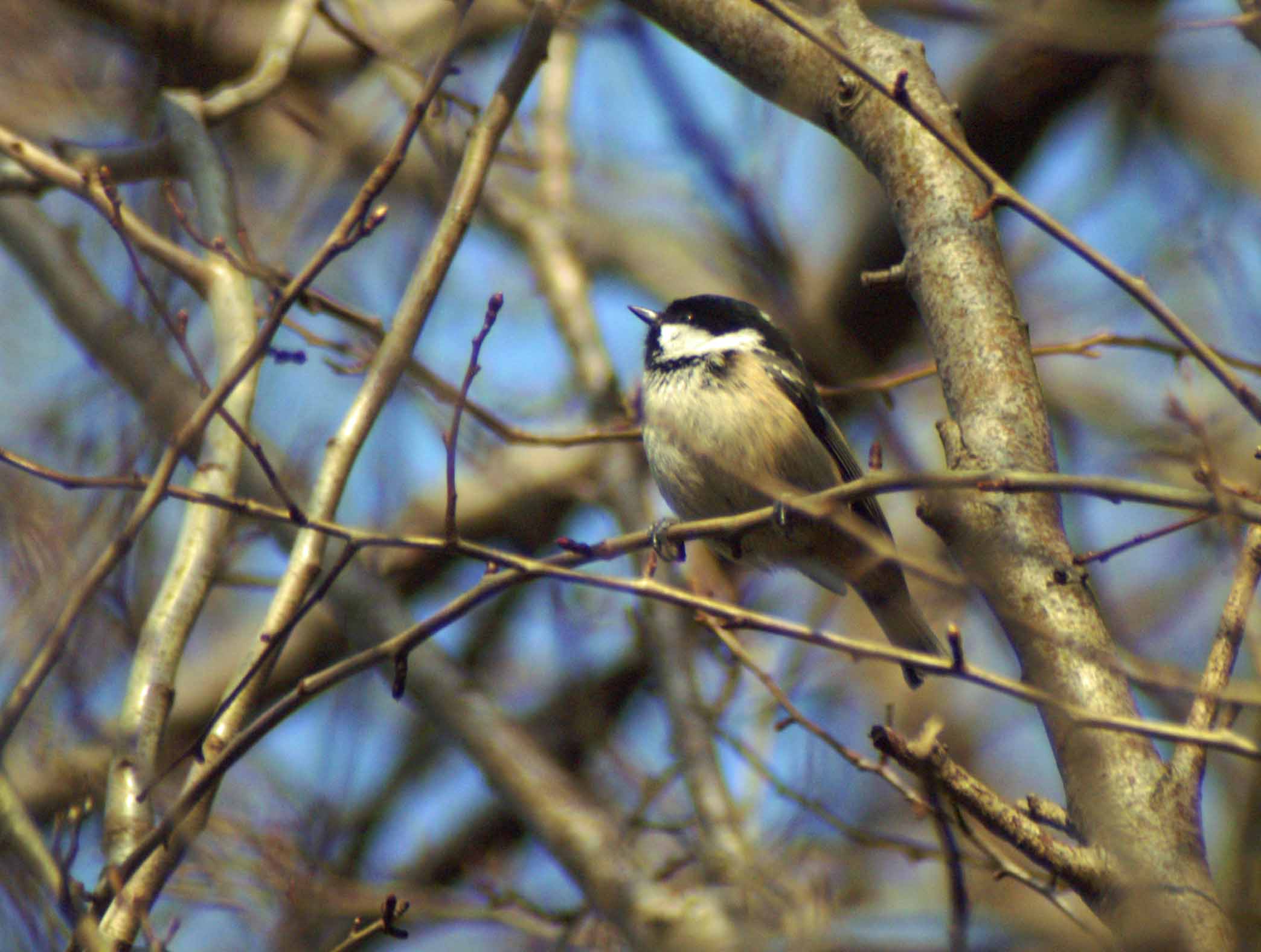
A big surprise was the sighting of this lovely coal tit

A wren singing from a low branch

Another wren flew across the path and perched on the fence. It looked a little odd, but it took a few seconds to realise it was because he was missing his characteristic upturned tail

The missing tail did not seem to be inhibiting the little bird too much – he was bright eyed and flitting around singing enthusiastically

A robin singing beautifully, but in the shade

A pair of nike trainers thrown up into a tree. A reminder that this is a just an oasis in a small urban jungle

Share this:

  • Share on Facebook (Opens in new window) Facebook
  • Share on Pinterest (Opens in new window) Pinterest
  • Share on X (Opens in new window) X
Like Loading...

Red-berry trail

31 Wednesday Aug 2011

Posted by theresagreen in Bryn Euryn Nature Reserve, Nature of Wales, nature of woodlands

≈ Leave a comment

Tags

cotoneaster in the wild, cuckoo pint, haws, hawthorn, hawthorn berries, poisonous berries, red berries, wild arum

11th August

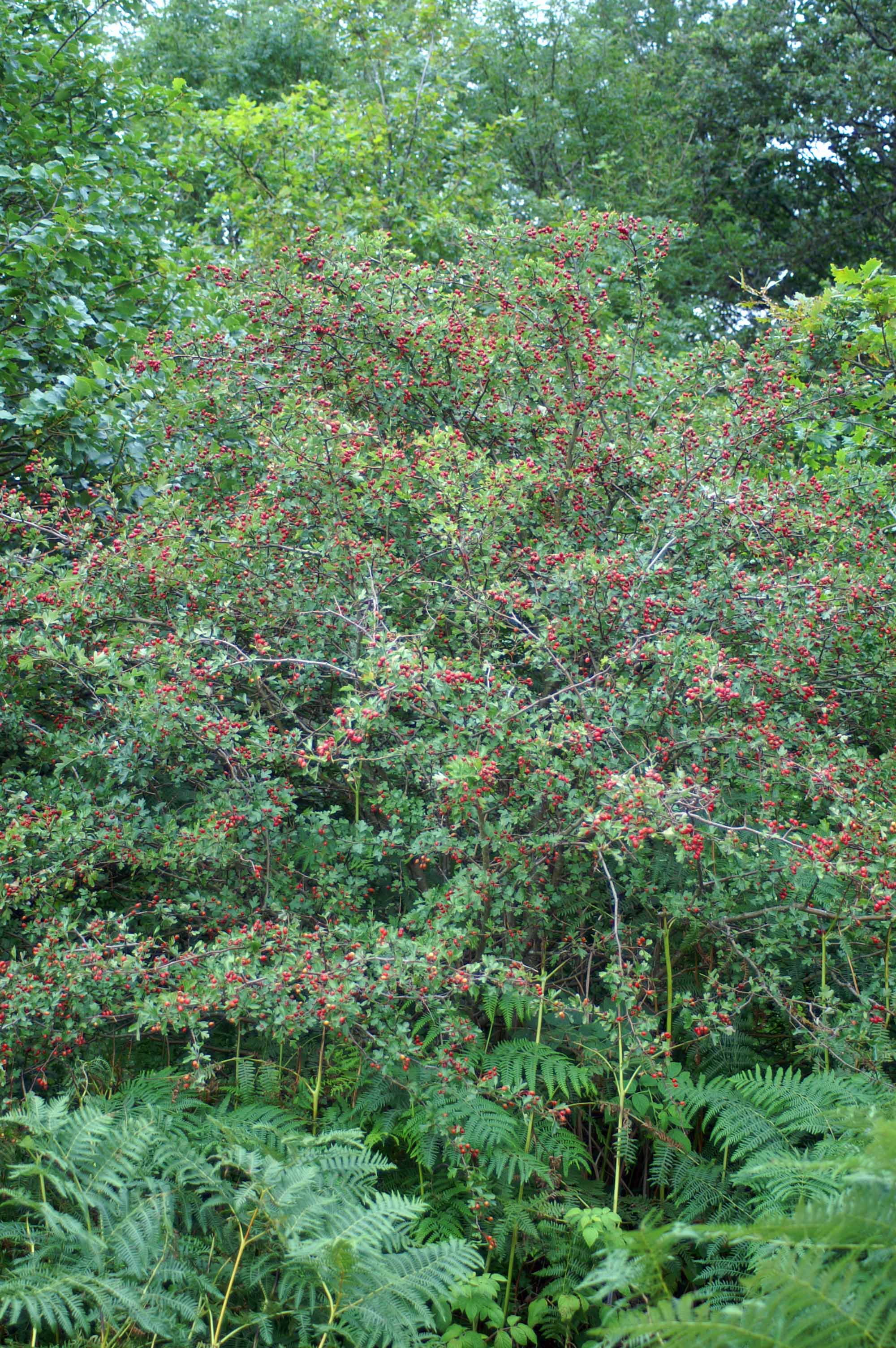
I resumed my woodland walk, passing by a Hawthorn tree laden with red berries.

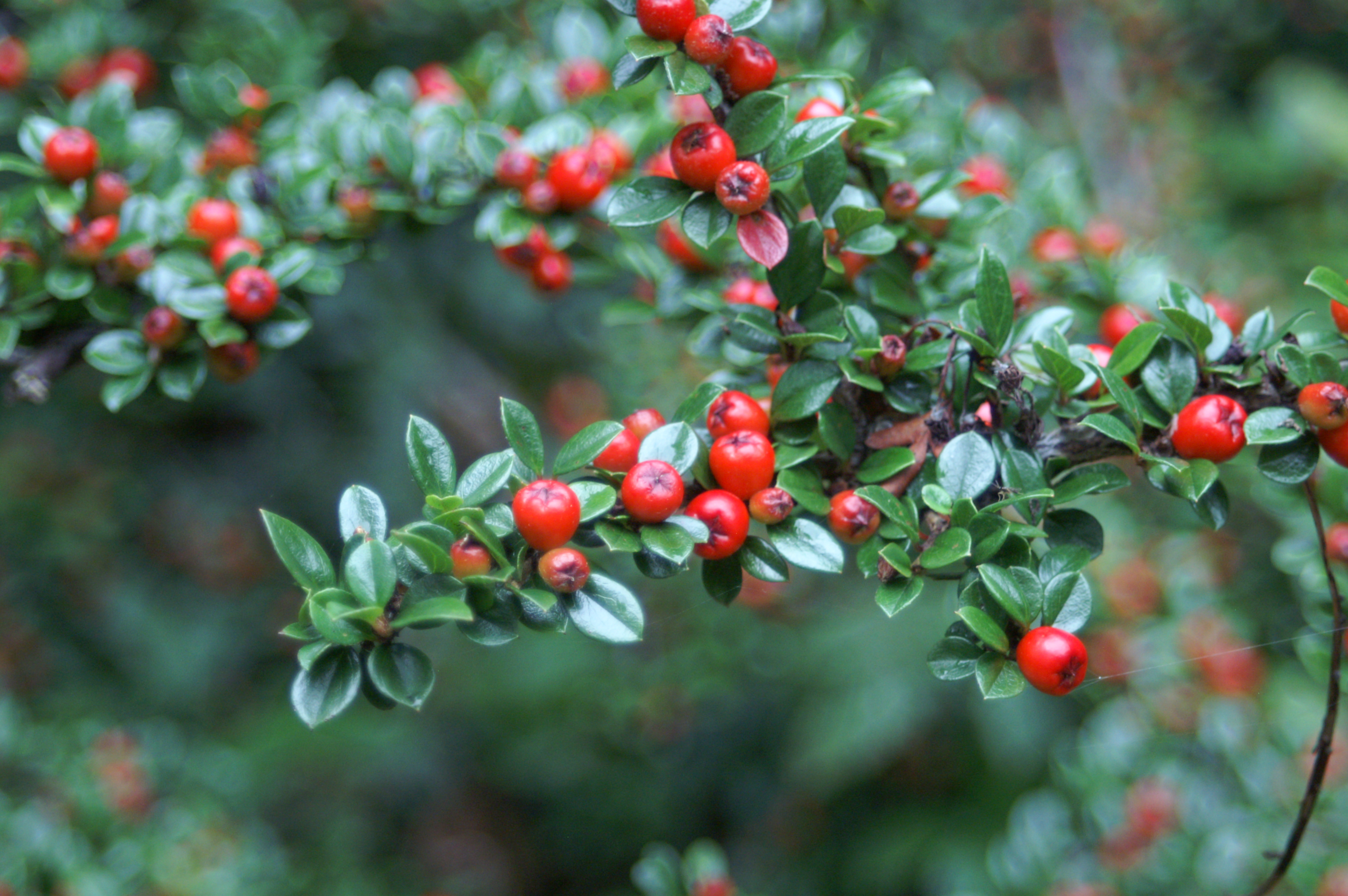
11/8/11-Common Hawthorn -Crataegus monogyna, fully laden with a crop of berries

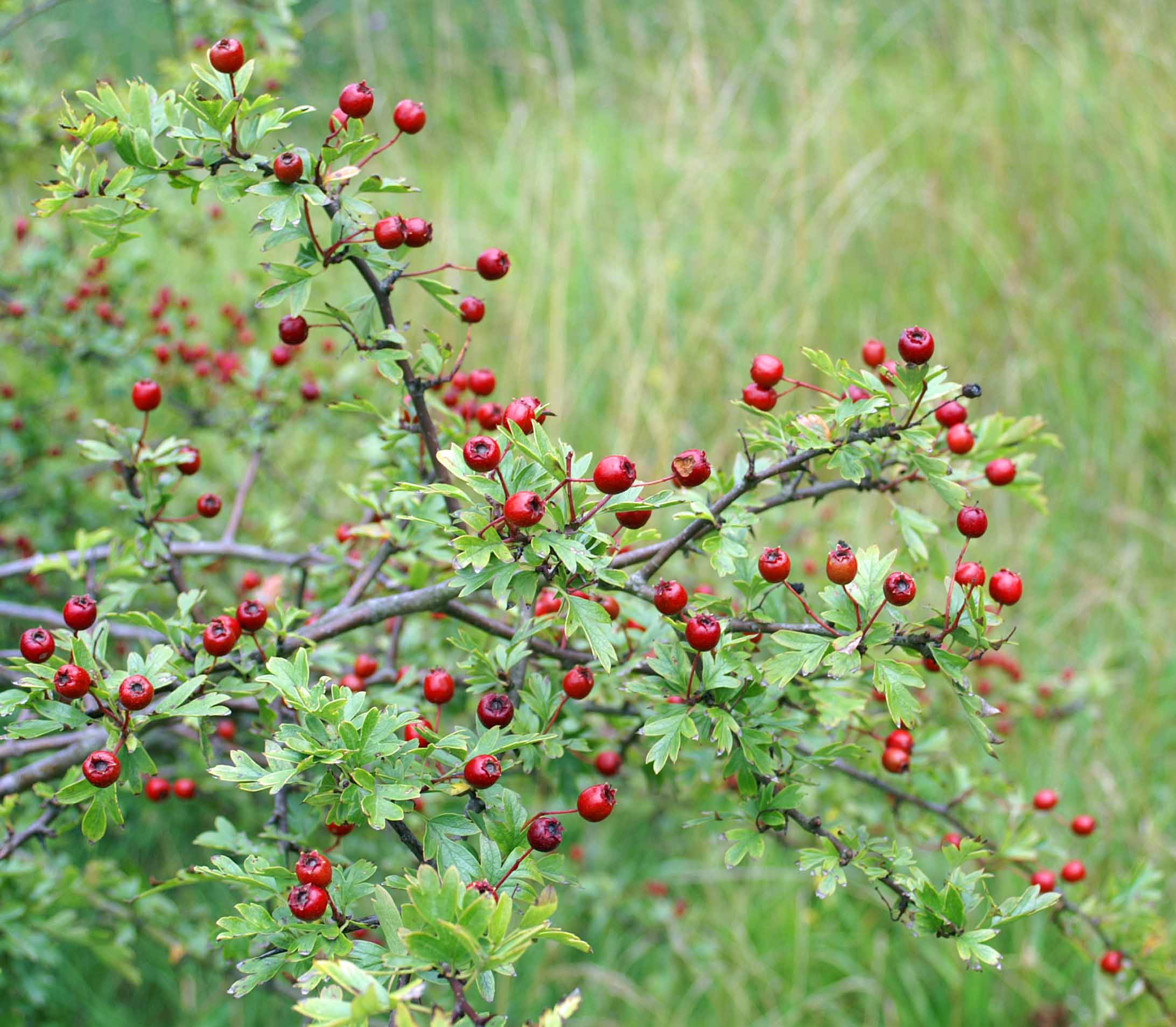
Crataegus commonly called hawthorn or thornapple, is a large genus of shrubs and trees in the rose family, Rosaceae, native to temperate regions of the Northern Hemisphere in Europe, Asia and North America.  They are shrubs or small trees, mostly growing to 5–15 m tall, with small pome fruit and (usually) thorny branches. The thorns are small sharp-tipped branches that arise either from other branches or from the trunk, and are typically 1–3 cm long.  The fruit, sometimes known as a “haw”, is berry-like, but structurally a pome containing from 1 to 5 pyrenes that resemble the “stones” of plums, peaches, etc.

11/8/11-Hawthorn berries, or haws

Hawthorns provide food and shelter for many species of birds and mammals, and the flowers are important for many nectar-feeding insects. Hawthorns are also used as food plants by the larvae of a large number of Lepidoptera species and haws are important for wildlife in winter, particularly thrushes and waxwings.

I have noted several cotoneaster shrubs growing throughout this site, which I have assumed to have arrived there via bird droppings as the shrub is not generally a native of Britain, but is widely planted in gardens.

11/8/11-Berries of Cotoneaster horizontalis

* * There is an indiginous native cotoneaster that is found growing only on the Great Orme: Cotoneaster cambricus (Wild Cotoneaster;  Welsh: Creigafal y Gogarth “rock apple of Gogath”) is a species of Cotoneaster endemic to the Great Orme peninsula in north Wales. It is the only species of Cotoneaster native to the British Isles. It has never been found naturally at any other location.

______________________________________________________

I very recently came upon the following on the ‘Plantlife’ website on the very subject of ‘escapee cotoneasters’:

Cotoneaster species

Non-native invasive plants.

Cotoneasters provide an important reminder that even with the best intentions of gardeners, the wind, birds and other animals can help plants to ‘escape over the garden wall’.

Plantlife is particularly concerned about four types of cotoneaster:

  • Hollyberry cotoneaster (C. bullatus)
  • Wall cotoneaster (C. horizontalis)
  • Small-leaved cotoneasters (C. microphyllus agg.)
  • Himalayan cotoneaster (C. simonsii).

What’s the problem?

These popular garden and landscaping shrubs are also popular with birds who enjoy the berries and spread the seed. This can spread cotoneasters in the wild, where they can be difficult to eradicate.

What are we doing about it?

Find out more about Plantlife’s invasive plant programme by clicking here

_____________________________________________________

Another probable garden escape is Hypericum – St. John’s Wort, also growing in various spots throughout the site and also now bearing red berries.

11/8/11-berries of St John's Wort-Hypericum

A native plant, the Arum lily or as I know it, Cuckoo Pint or Lords and Ladies, is also bearing bright scarlet berries now. I found them in a few places, mostly tucked almost out of sight beneath other shrubbery.

11/8/11-The poisonous berries of the Wild arum

Arum maculatum is a common woodland plant species of the Araceae family. It is widespread across temperate northern Europe and is known by an abundance of common names including Wild arum, Lords and Ladies, Devils and Angels,Cows and Bulls, Cuckoo-Pint, Adam and Eve, Bobbins, Naked Boys, Starch-Root and Wake Robin.

Share this:

  • Share on Facebook (Opens in new window) Facebook
  • Share on Pinterest (Opens in new window) Pinterest
  • Share on X (Opens in new window) X
Like Loading...

Late summer wildflowers and busy bumblebees

31 Wednesday Aug 2011

Posted by theresagreen in Bryn Euryn Nature Reserve, bumblebees, Nature

≈ 2 Comments

Tags

carder bee, forest bug, hemp agrimony, hoverflies, knapweed, late summer wildflowers, michaelmas daisy

11th August

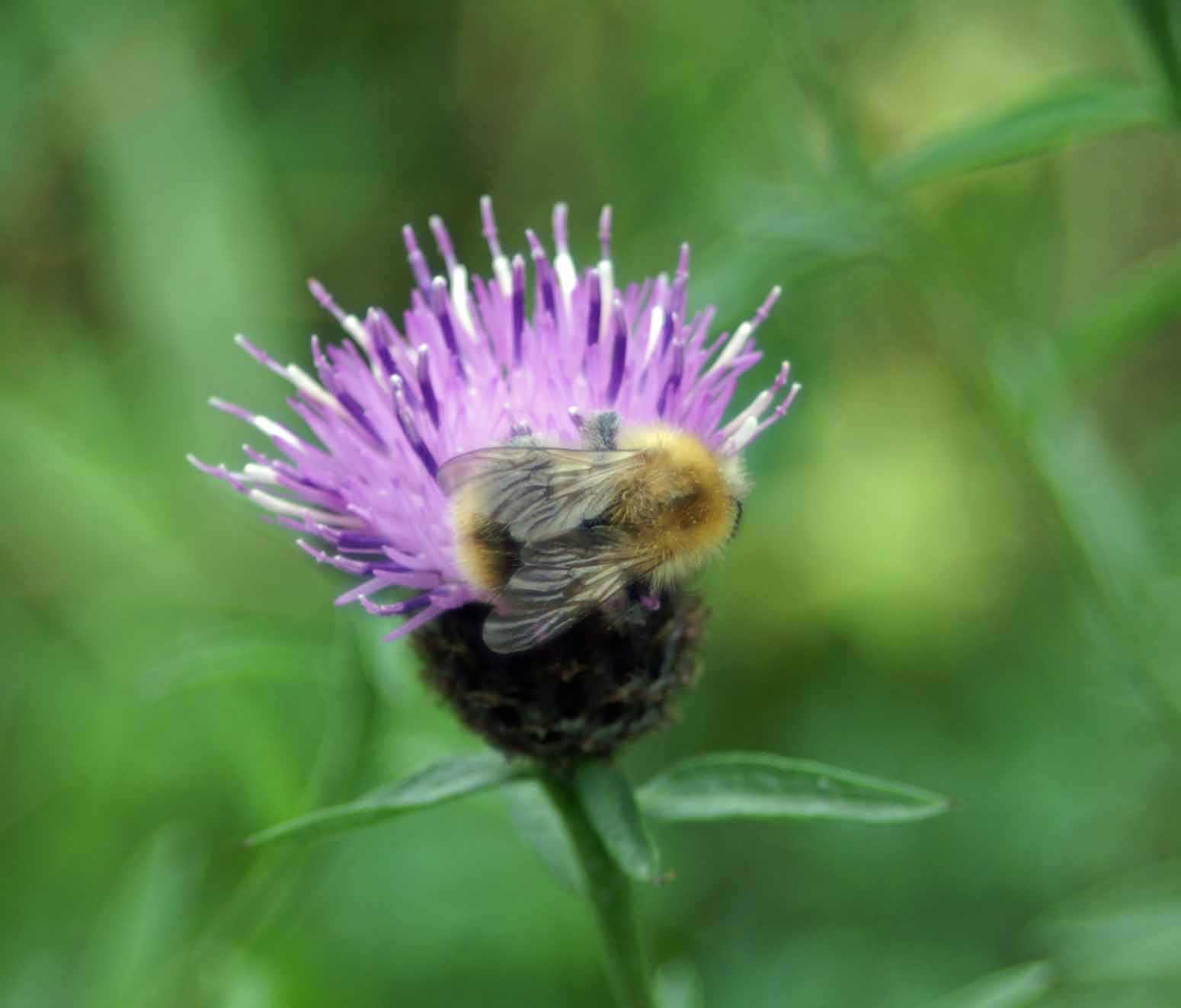
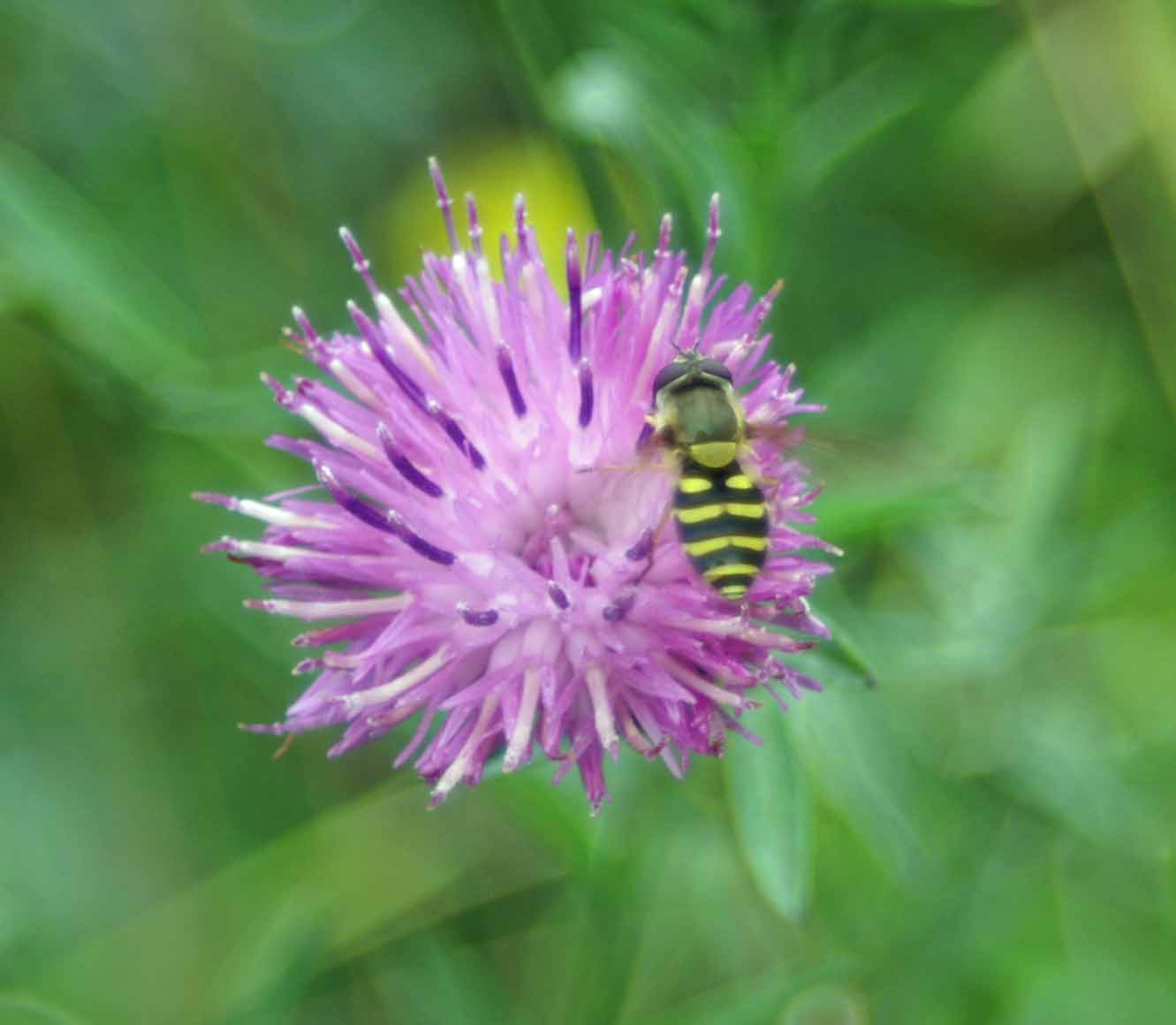
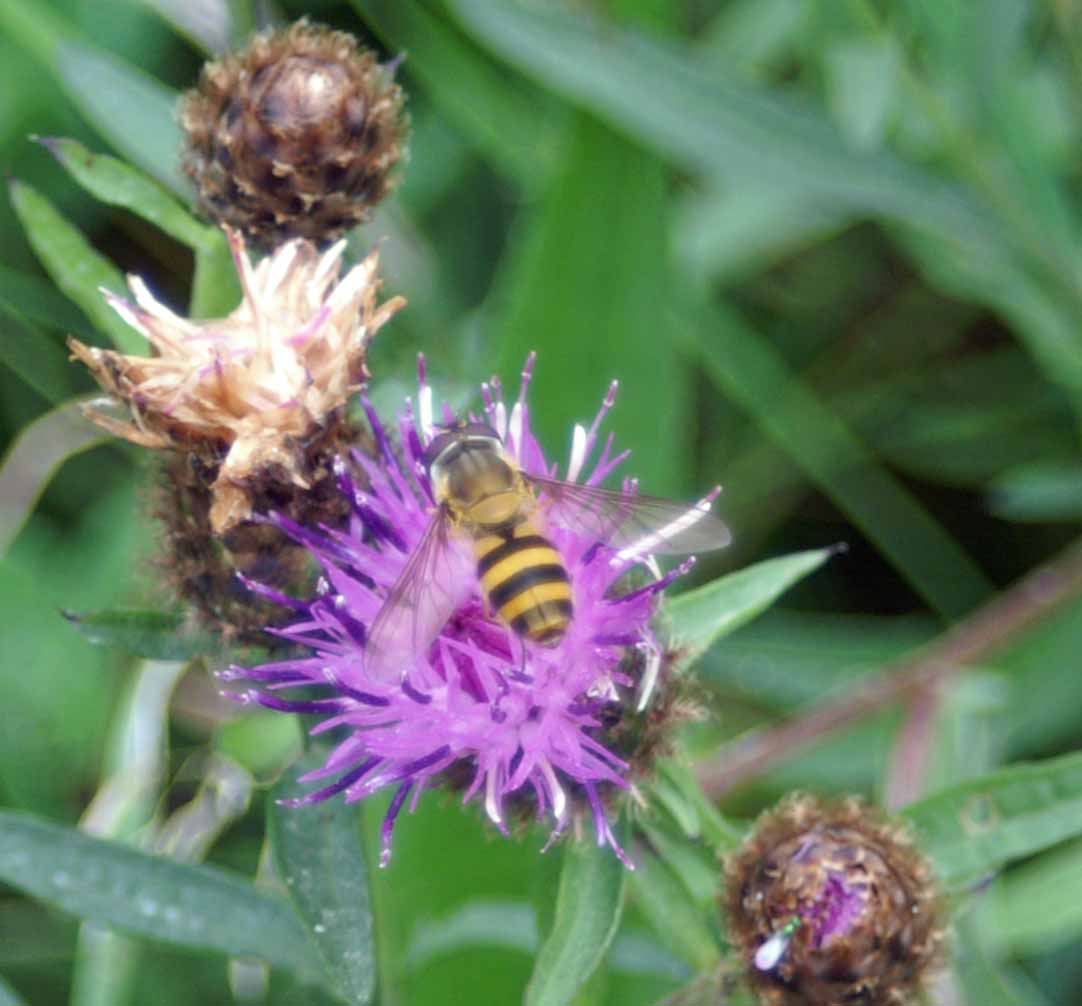
Taking advantage of a pause in the rain I headed up to Bryn Euryn for some fresh air. Planning to stick to the woodland areas in case it began raining again, the track passed by a cleared grassy area that was bright with purple knapweed flowers and noticing insects flying, despite the coolness and dampness of the afternoon, I got waylaid for a while. Looking more closely I realised there were large numbers of bumblebees and hoverflies of several different species flying around the flowers busily taking nectar or collecting pollen, all doubtless also taking advantage of the dry interlude. The opportunity to get a good look at the insects as they were slowed down a little by the coolness of the air kept me there, stooped over with the camera, for a good half and hour or so and also got me some funny looks from passing dog-walkers.

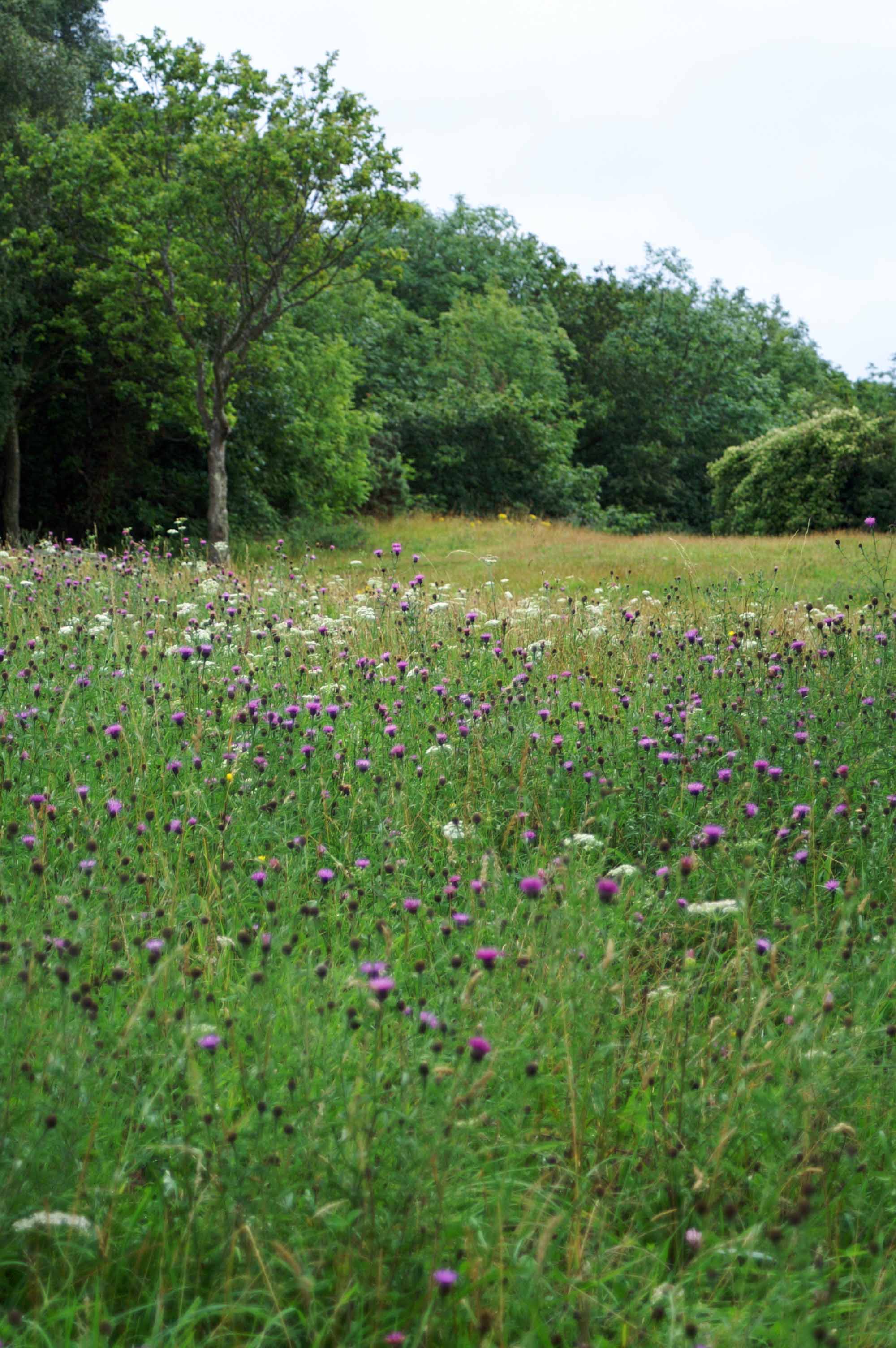
11/8/11- Flowery grassland attracting dozens of insects

11/8/11-Black Knapweed-Centaurea nigra

Centaurea nigra is a species of flowering plant in the daisy family known by the common names Lesser Knapweed, Common Knapweed and Black Knapweed. A local vernacular name is Hardheads. The plant flowers from July until September and is important  for a large number of insects including Gatekeeper, Large skipper, Lime-speck pug moth, Meadow Brown, Painted lady, Peacock, Red admiral, Small copper, Small Skipper, Honeybee and Bumblebees and Hoverflies. Goldfinches later feed on the seeds.

The plant is native to Europe but it is known on other continents as an introduced species where it is often treated as a noxious weed.

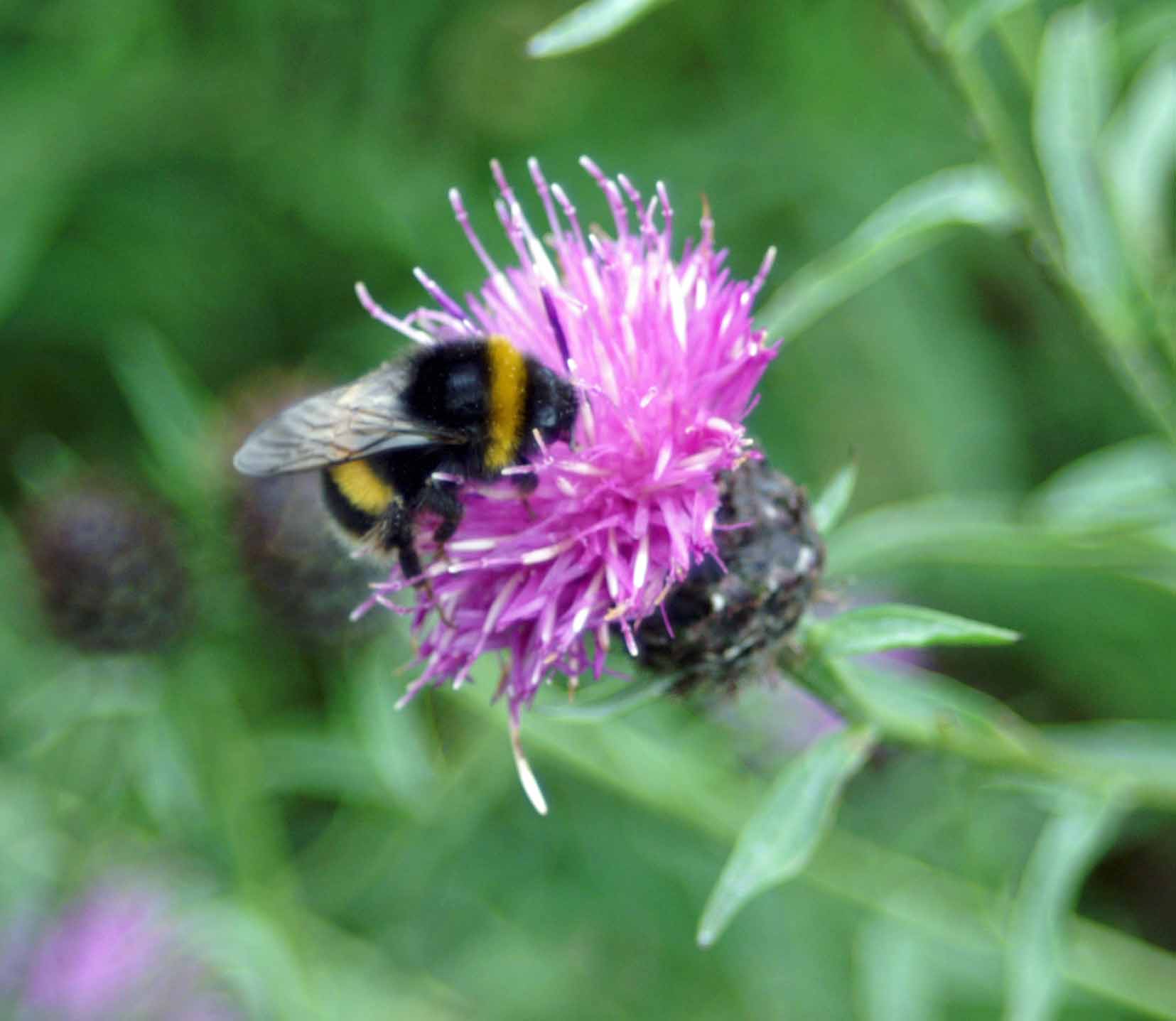
11/8/11-Buff-tailed bumblebee-Bombus terrestris

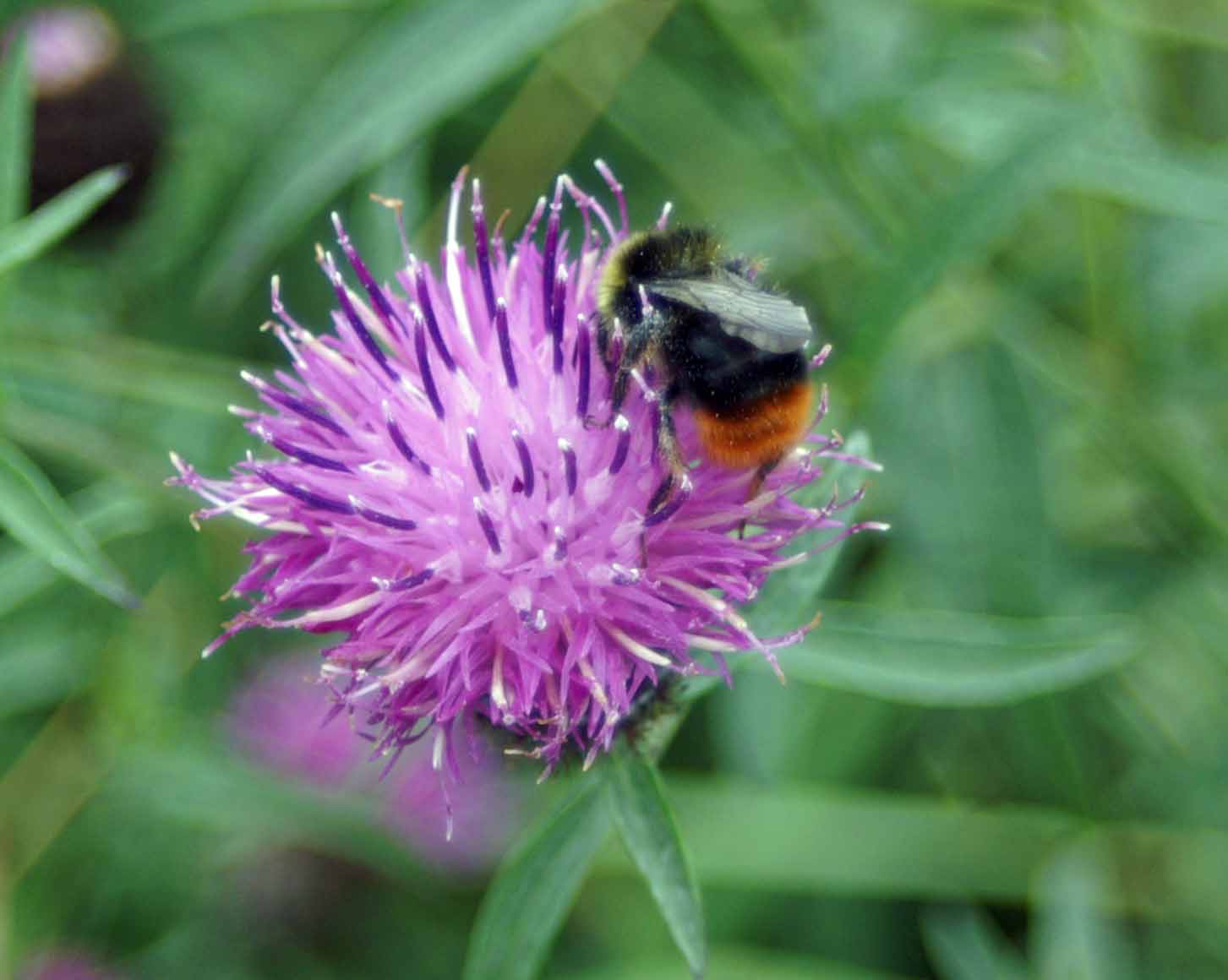
11/8/11-Red-tailed bumblebee (m)-Bombus lapidarius

11/8/11-Common Carder Bee-Bombus pascuorum

The common carder bee, Bombus pascuorum, has shaggy hair and can be seen at flowers late in the year, often into November in southern Britain. It is one of our most common bumblebee species, found even in the centres of large cities.

11/8/11-Hoverfly-Syrphus ribesii

11/8/11-Hoverfly- Melangyna cincta

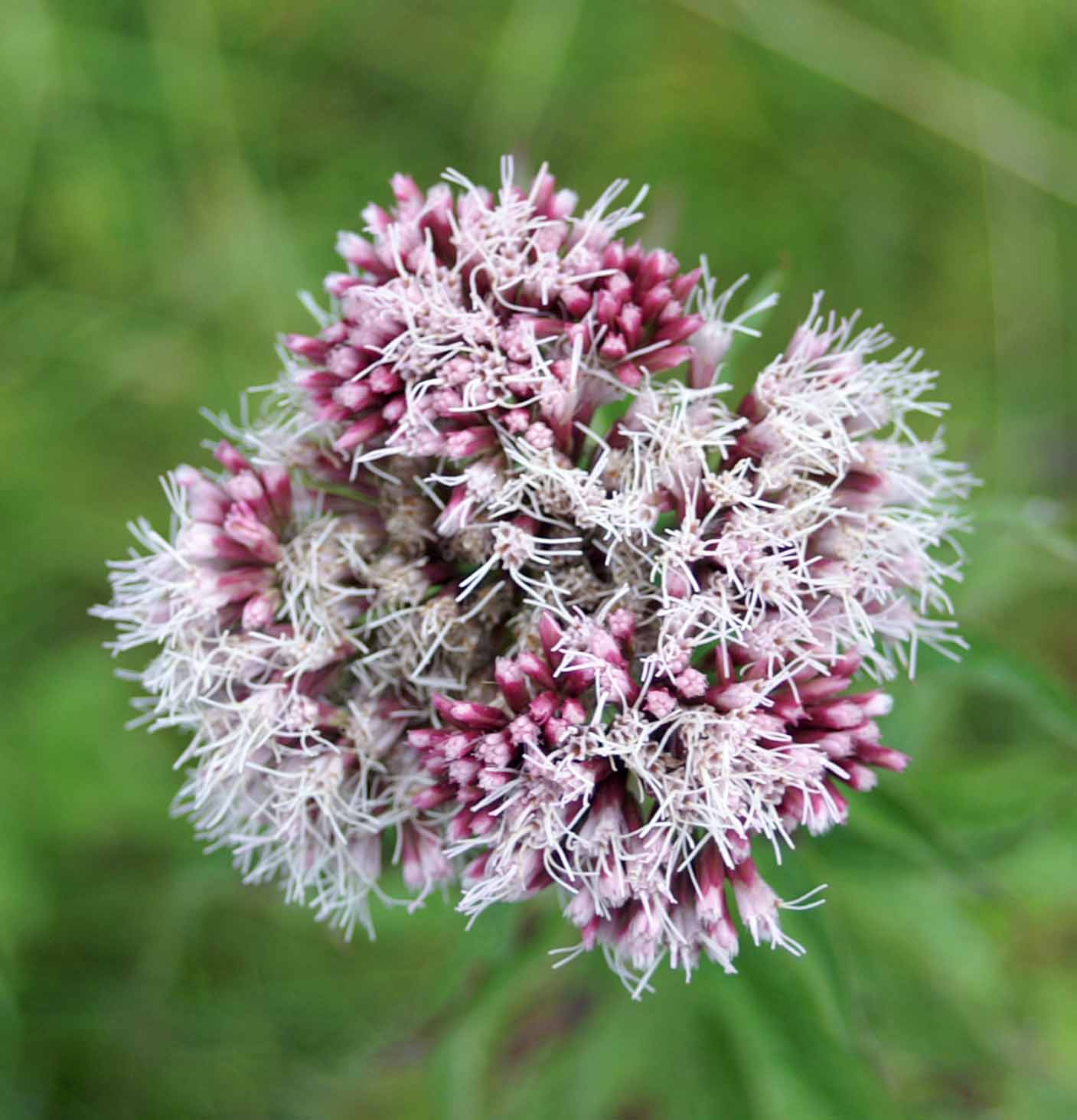
11/8/11-Hemp Agrimony

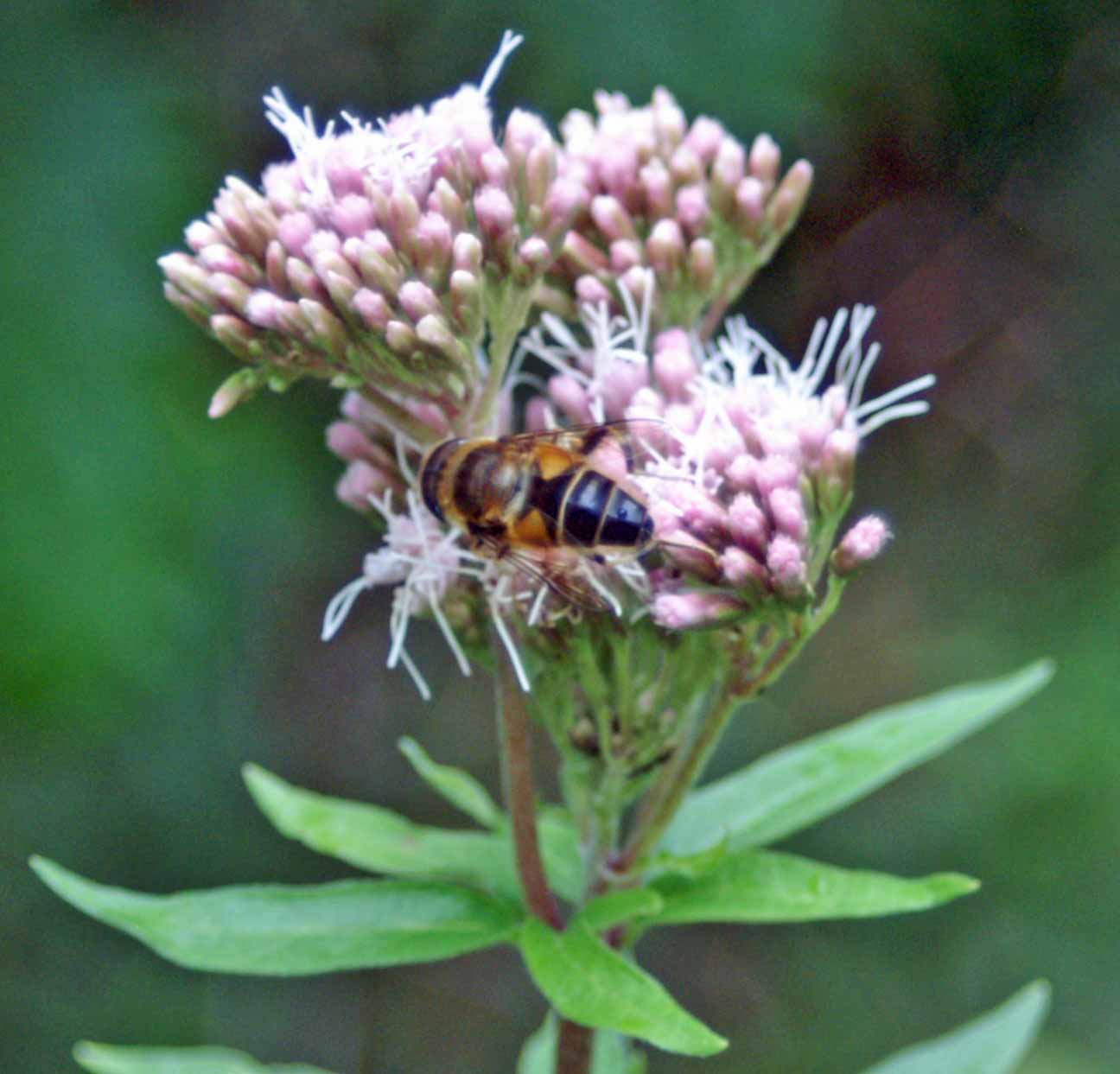
Also attracting the attentions of a few insects were the flowers of Hemp Agrimony –  (Eupatorium cannabinum)

A large plant (1-2m) often found in clumps with big, fluffy heads of tiny pink flowers. Its leaves grow up to 10cm long and are arranged in pairs on a reddish stem.

Can be found throughout the UK growing in open or shady, damp or dry areas; waste ground and near water.

Flowers July-September.

11/8/11- Hemp Agrimony- Eupatorium cannabinum

The ‘hemp’ part of the plant’s common name comes from the similarity between its leaves and that of the cannabis plant. The two species are entirely unrelated, however, and do not share any other properties!

Hemp-agrimony is one of the flowers Plantlife keep track of in their Wildflowers Count survey – click here to find out how you can help out.

11/8/11-Drone fly-Eristalsis arbustorum

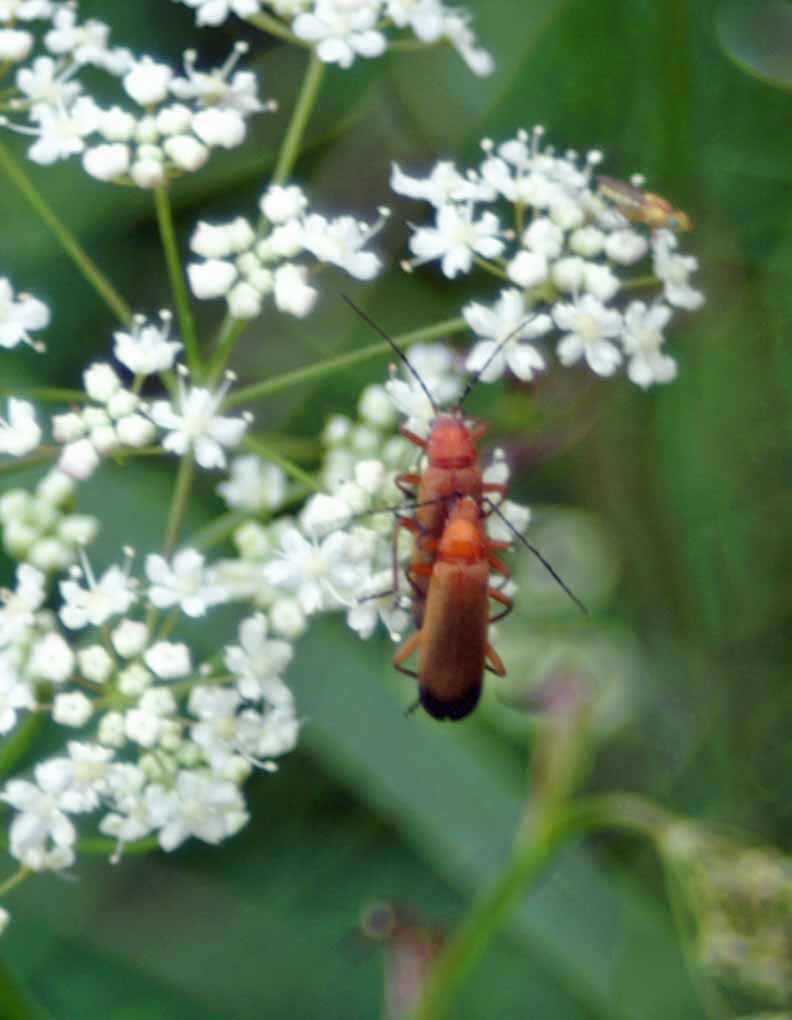
11/8/11-A mating pair of Red Soldier beetles

A plant I’m not sure about the identity of has similar flowerheads to the wild carrot/parsley but all parts are smaller and more delicate. This particular one was supporting a mating pair of Red Soldier beetles as well attracting a variety of small flies.

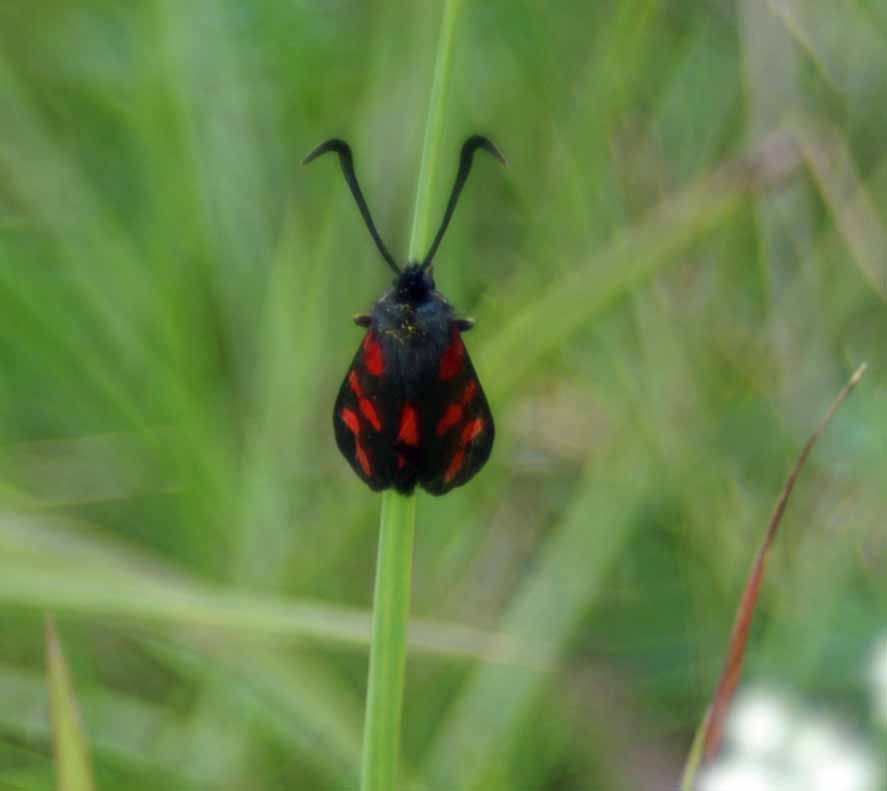
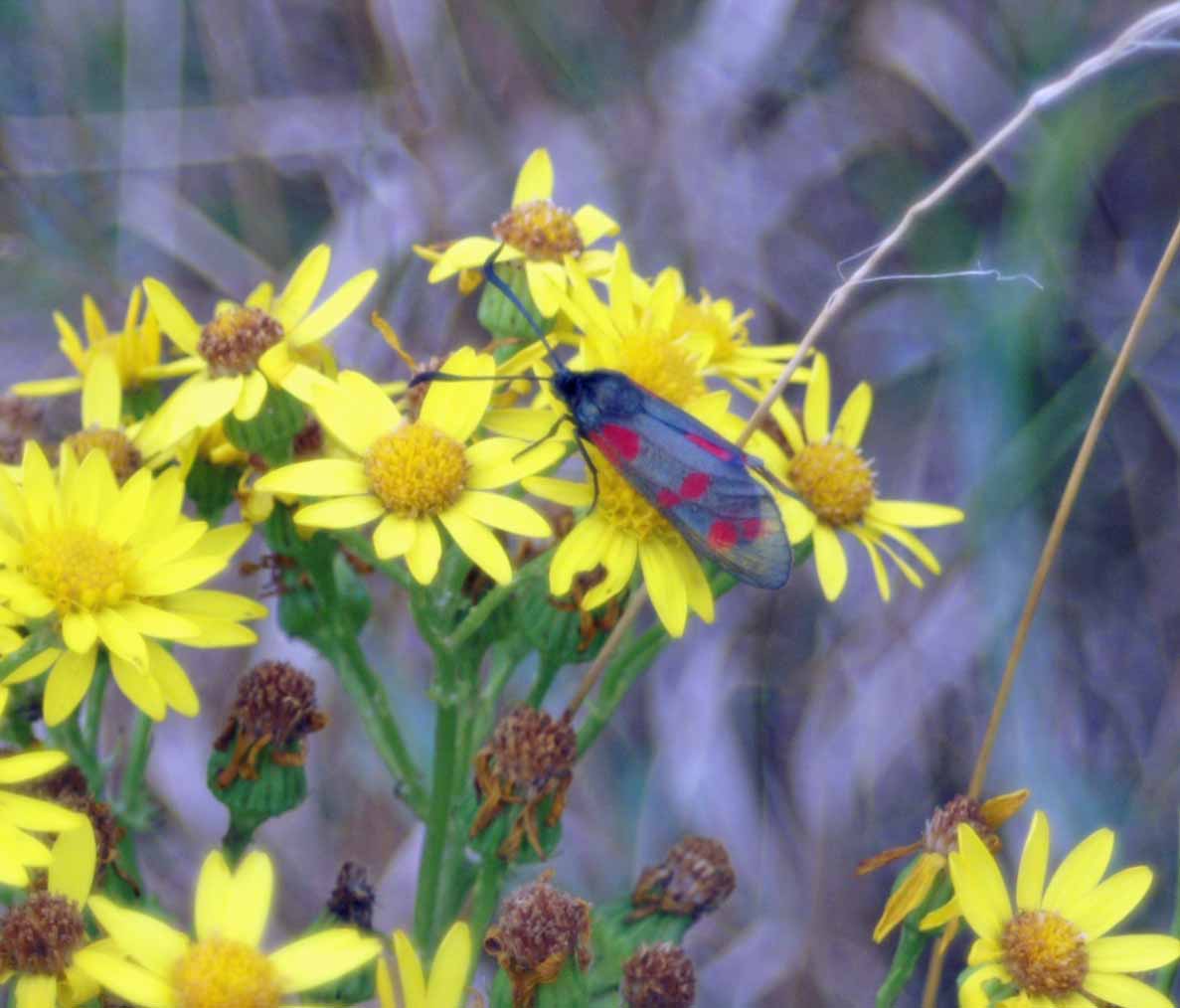
A 6-spot Burnet Moth was sheltering from the showers, clinging to a grass stem.

11/8/11-A 6-spot Burnet Moth resting on a grass stem

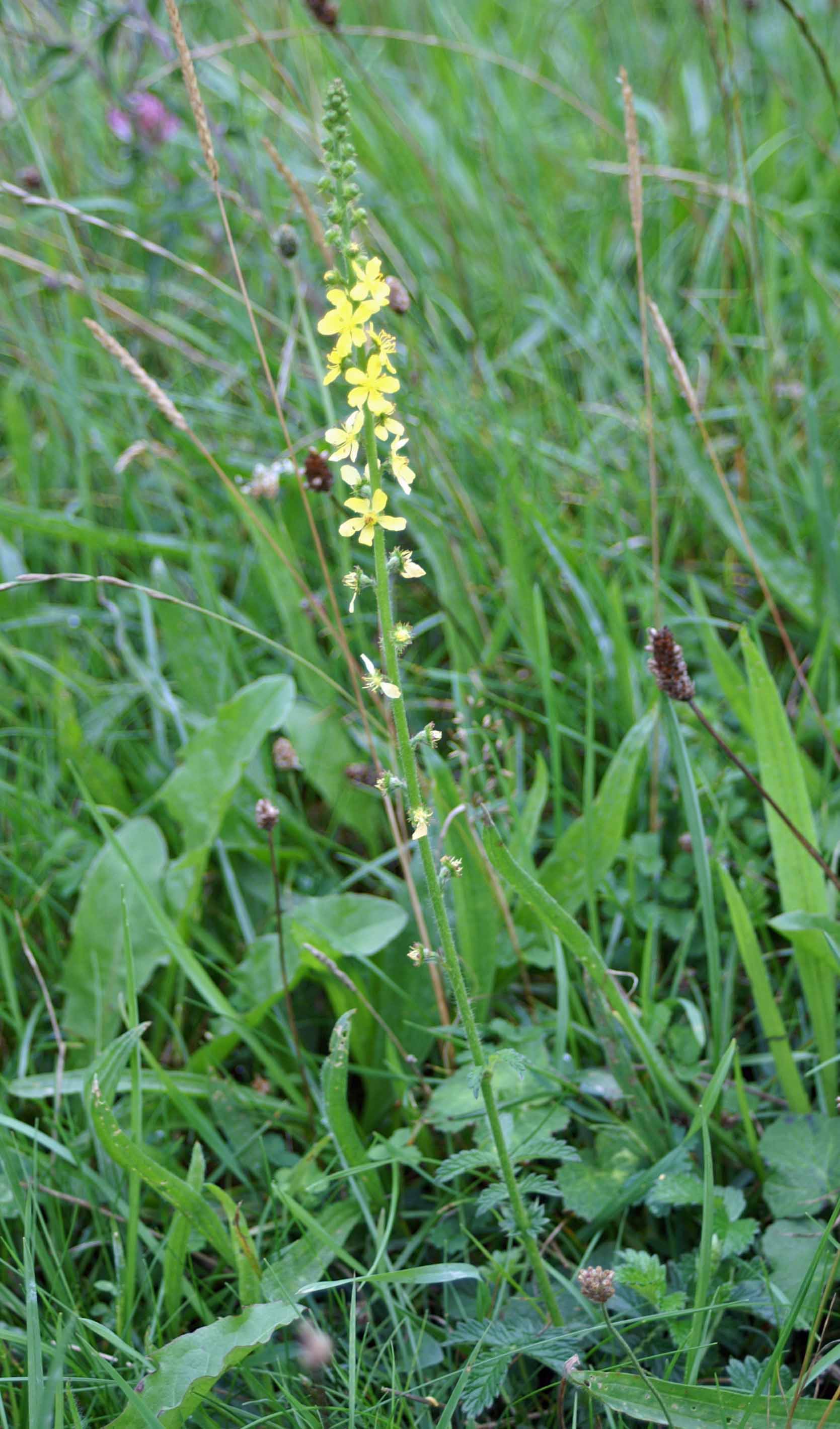
A wildflower I do recognise and can name is Agrimony, also familiar to me as one of the 38 Bach flower remedies. The plant is quite delicate-looking and may be easily overlooked, but it has a long history of use as a healing herb.

11/8/11-Agrimony

Agrimonia eupatoria is a species of agrimony that is often referred to as common agrimony, church steeples or sticklewort.

The common agrimony grows as a deciduous, perennial herbaceous plant and reached heights of up to 100 centimeters. Its roots are deep rhizomes , from which spring the stems. It is characterized by its typical serrated edged pinnate leaves. The whole plant is dark green with numerous soft hairs that assist in the plant’s seed pods sticking to any animal or person coming in contact with the plant. The flower spikes have a delicately spicy scent, a little like apricots.

A. eupatoria is a foodplant for the caterpillars of the snout moth Endotricha flammealis.

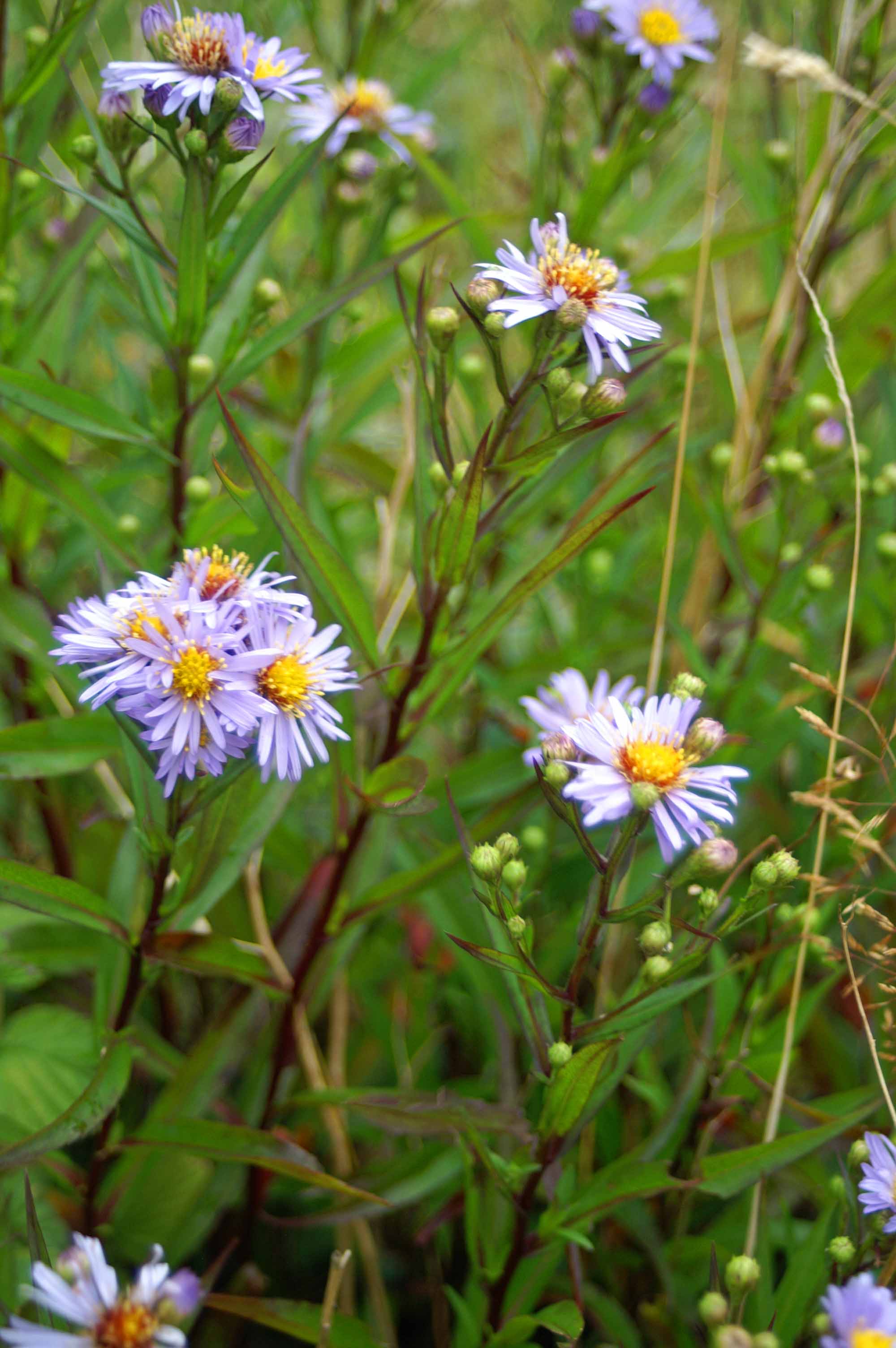
11/8/11-Michaelmas daisy-Aster novi-belgii

Originating in North America, Michaelmas daisies were originally introduced to Britain from North America in the early 1700’s. Although they are not native, they survive extremely well and are grown in gardens for their late summer flowers. The plant has also become naturalised and is found in wild places throughout the UK, often growing on damp ground or close to streams. It flowers from August through to late October providing late-flying butterflies such as peacocks and small tortoiseshells with a good source of nectar.

Michaelmas means Michael’s Mass. The flowers traditionally bloom on September 29th which is ‘The Feast of Saint Michael’.

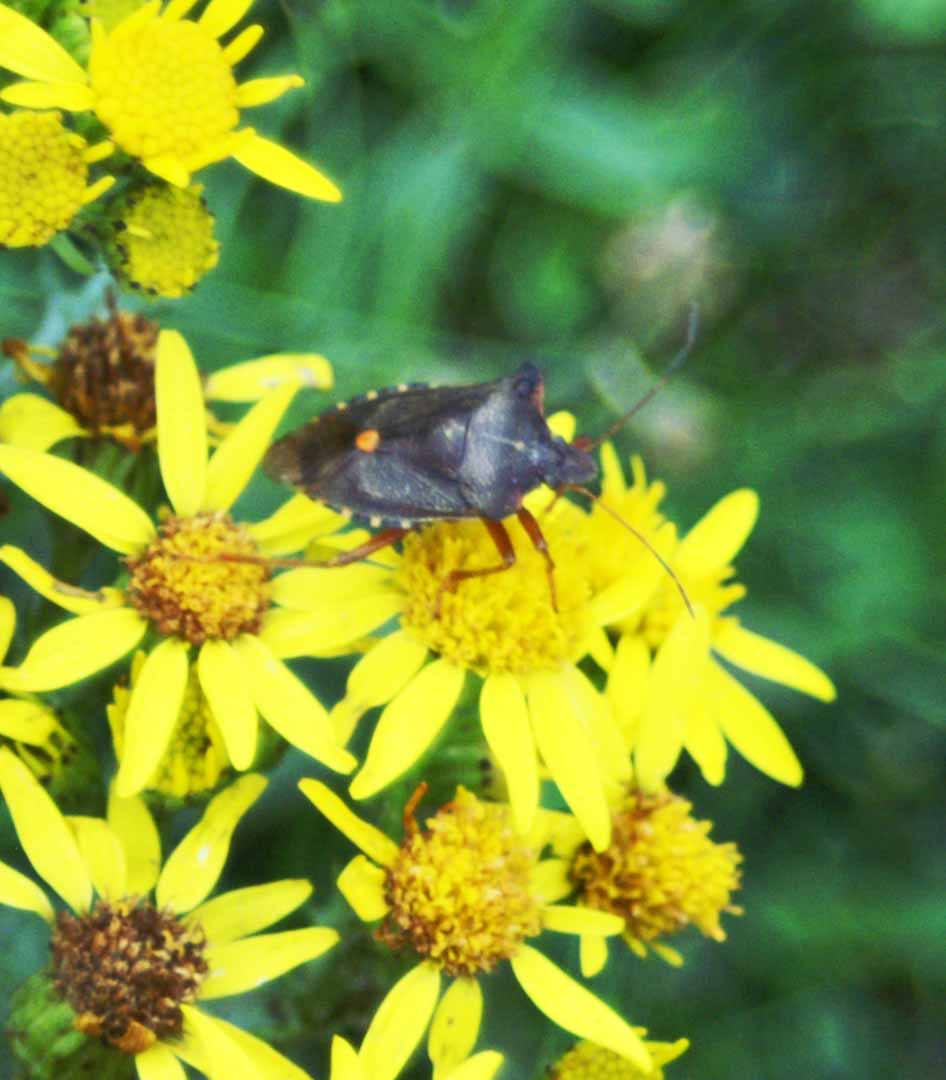
Ragwort is still flowering profusely and I photographed a further two insects on separate plants, a Forest bug and a 6-spot Burnet Moth.

11/8/11- Forest bug - Pentatoma rufipes

The forest bug, Pentatoma rufipes, is a species of shield bug in the family Pentatomidae. It is a common and widespread species found in forests and woodlands worldwide. It is shiny dark brown with red-orange markings on its body and bright orange legs. It is shaped like an escutcheon-type shield, flat, and about 14 millimetres (0.55 in) long. Its distinguishing characteristic is a pair of plates extending forward from the shoulders at the front of its dorsal thorax.

The forest bug’s main food source is any of several species of oak. It is a sap-feeder and uses piercing mouthparts to withdraw the liquid. It can also be found on other species of deciduous trees. The forest bug may also be regarded an agricultural and garden pest, as it will not hesitate to feed on fruit and nut trees. Occasionally it will consume other insects.

Adults lay eggs during the summer in the cracks of tree bark, and the larvae hatch the following spring.

11/8/11-6-spot Burnet moth on ragwort

Share this:

  • Share on Facebook (Opens in new window) Facebook
  • Share on Pinterest (Opens in new window) Pinterest
  • Share on X (Opens in new window) X
Like Loading...

A walk on the Great Orme

27 Saturday Aug 2011

Posted by theresagreen in coastal walks, Great Orme, Nature, Nature of Wales, North Wales, North Wales Wildlife Trust, Wildflowers of Wales

≈ Leave a comment

Tags

bell heather, carline thistle, heather in bloom, jackdaw, limestone heath, ling, Little Orme, rabbit, views of Llandudno

The Great Orme is a prominent headland, which lies at the north-western tip of the Creuddyn Peninsula near Llandudno. Conwy County Borough Council as a Country Park and Local Nature Reserve manages most of the site, and this comprises a headland of Carboniferous limestone of some 291 hectares (719 acres) which rises from sea level to 207m (679 feet) at the summit.

5/8/11-The Great Orme under a beautiful sky

The weather has been very unpredictable lately, so I took advantage of a mostly sunny afternoon to explore some of the Little Orme’s big brother – the Great Orme. This much larger promontory has a very different character and has a fascinating history. Parts of it are used commercially to provide leisure activities for visitors to Llandudno town, but most of the Great Orme is designated a Special Area of Conservation (SAC) as it contains habitats and species which are considered to be rare or threatened within Europe. It is also a Site of Special Scientific Interest (SSSI) and is included in both the Nature Conservation Review and Geological Conservation Review, indicating its national importance. The site is also designated a Heritage Coast, a definition denoting a landscape quality of national importance.

5/8/11-A welsh rabbit out in the afternoon sun

From the car park at the top where the ‘toboggan run’ is located, I walked across to the path that takes you up onto the open clifftops to admire the views over Llandudno towards the Little Orme and out across the Irish Sea.

5/8/11-A view of Llandudno curving around the bay and the hills beyond
5/8/11-Llandudno Pier and across to the Little Orme
5/8/11-The Little Orme’s best side

Quarrying activity on the Little Orme was restricted to the Rhos-on-Sea side of it so as not to spoil the view from the resort of Llandudno, as I have mentioned before. I have photographed it often from that side, but less so from its natural, unspoilt side, which looks very different.

There wasn’t much to be found on the clifftops today, I saw just one Meadow Brown butterfly, but I did come across a Carline Thistle. It was just a small specimen, but the only one I’ve come across in the area so far.

Carline Thistle

Carline Thistle is interesting as its flower heads expand in dry weather and close in moist weather. The dried flowers will continue to do this for a long time and they thus form a basic hygrometer for use in weather forecasting.

There is a choice of paths to follow, including one to the summit, but I decided to walk in the direction of St. Tudno’s church. It was beautiful walking in the bright late afternoon sunshine on the grassy track through heathland that is presently a living patchwork of green, purple and gold. It was peaceful too – I was the only person there and the only other sign of life I had was a Meadow Pipit that flew up from near the edge of the track and startled me.

Limestone Heath

The heathland on the Great Orme is of international importance and occupies approximately one quarter of the site. Dominant species are the dwarf shrubs; Heather, Bell Heather and Western Gorse.

5/8/11-Great Orme -Heather-Calluna vulgaris& Western Gorse-Ulex gallii

About one third of the heathland is species-rich and amongst the dwarf shrubs many lime-lime-loving (calcicolous) herbs grow, such as Common Rockrose, Dropwort, Wild Thyme and Birds-foot Trefoil. This species-rich heath tends to be short (35cm height or lower). Another third of the heath is less species-rich, supporting herbs such as Tormentil and Harebell.

5/8/11-In places the heather & gorse extends to the edge of the cliffs

It was too late to walk all the way to the church today, but I will definitely be back to complete the route soon.

Share this:

  • Share on Facebook (Opens in new window) Facebook
  • Share on Pinterest (Opens in new window) Pinterest
  • Share on X (Opens in new window) X
Like Loading...

Bryn Euryn on a sunny summer’s afternoon

22 Monday Aug 2011

Posted by theresagreen in Bryn Euryn Nature Reserve, ferns

≈ Leave a comment

Tags

dark green fritillary, grayling, green-veined white, Red Admiral, small heath, small skipper, summer orchids

I was surprised to find just one other car in the car park when I arrived at ‘the Bryn’ on a warm sunny early afternoon last week; I had expected it to be busier, so was pleased that I would be able to enjoy this lovely but popular reserve while it was peaceful. The peace didn’t last long! I began my walk with a circuit of the grassy area next to the car park, checking out the wildflowers for any interesting insects and was soon joined by a man walking a smallish dog. It appeared he was doing the job on sufferance, releasing it from its lead while he wandered around talking loudly on his mobile phone, breaking off frequently to shout at the dog. Things got even worse when another man with two dogs, both on leads, arrived, causing the loose dog much excitement and its walker to shout even more. I decided to leave this bit for another day and hurried off onto the stepped track woodland track towards the top of the hill.

I stopped halfway up, in front of the cottage where the track divides as I caught sight of a large bramble bush covered with blossom. I saw a Comma butterfly feeding here but missed the brief photo opportunity; I also missed a Holly Blue, but I did catch one of a Green-veined White basking on a clematis leaf.

Green-veined White – Pieris napi

Hoverfly-Syrphus ribesii

The woodland was silent, usual at this time of year due to the lack of birdsong and calls, but making you wish you could move more quietly and be less conscious of every footfall you make.

I was taken by surprise when the silence was broken by a soft ‘huit’call from close by and I looked up to see a young Chiffchaff in a sycamore tree.

A young Chiffchaff sitting in a Sycamore tree

The foliage of the woodland trees is still fresh, not yet showing the dusty tiredness of late summer, the greenness is carried through and down to the floor beneath, accented by glossy Hart’s Tongue ferns and cushions of soft green moss.

Harts Tongue Fern – Asplenium scolopendrium
A perfect Speckled Wood resting lightly on a fern frond

Emerging from the dappled shade onto the grassy hilltop my eye was caught by the low fluttery flight of small orange and brown butterflies- Small Heaths, several of which were flying in quite a small area and looking perfect and newly-emerged.

Small Heath – Coenonympha pamphilus

There were a lot of Meadow Browns too, keeping low to the ground and often disappearing from sight as they tucked themselves down on the ground amongst the grass stems.

Meadow Brown – Maniola jurtina

I carrried on round the hilltop admiring the stunning panoramic views stretched out beneath and across to the Snowdonia mountains, making for the summit, then continued on down the other side onto the grassy meadowland.

Just below the summit a scabious plant is growing from a crevice in a rock

The grass was studded with beautiful blue Harebells that look dainty and delicate but must be pretty hardy to thrive in the habitats they are found in.

Harebell-Campanula rotundifolia
The long grass and tall wildflowers attracting many butterflies

I had half-decided to continue walking down the slope to the woodland at the bottom, but as I passed by the area where the grass has been kept longer and where brambles, thistles and knapweed were flowering, I caught sight of a large brown butterfly flying fast and strongly, that then landed on a knapweed flower. Unmistakably a fritillary, although I had no idea of the species: its colours looked rather faded and it there was some damage to the wing edges, so it may have been around for a while and I didn’t get sight of its underwings. Checking later on I think its most likely a Dark Green Fritillary, but as ever I’m happy to be corrected.

20/7/11-Dark green Fritillary-Argynnis aglaja

I sat on the grassy slope for a while hoping for more fritillary sightings, which happily I got; in addition there were more Green-veined Whites and several Small Skippers flitting around low amongst the long grass.

Small Skipper – Thymelicus sylvestris
A Silver Y moth – Autographa gamma, also caught my eye as it fluttered in the long grass

I heard the ‘bark’ of a Raven and just caught sight of it as descended, landing somewhere beyond the slope out of sight. A Buzzard circled overhead. Preparing to leave and retrace my steps I crossed to the other side of the slope, took a photograph of the Little Orme and spotted a lovely specimen of Thistle.

A view of the Little Orme from the top of Bryn Euryn

Scotch Thistle-Onopordum acanthium

Reaching the thistle I was delighted to spot orchids growing in the quite-long grass, I wasn’t expecting that at all. As with the fritillary butterfly they were a little past their best, but still pretty;  most were pink in colour, but there were some white ones too. (I still am unsure what species they are, will update when I find out.)

A group of pink-purple orchids
Pink-purple specimen
A white-flowered specimen

Leaving the orchids I was more than happy with my afternoon’s discoveries and turned to head back up to the summit then down and back to the car. I couldn’t resist sitting to gaze at the view for a few minutes and got distracted by flies, flesh-flies to be accurate, that have rather unpleasant eating habits, but that actually look quite attractive.

Flesh-fly – Sarcophaga carnaria

Making my way back down the slope I spotted another butterfly land on a warm rock,  a gorgeous Grayling.

A Grayling – Hipparchia semele resting on a warm limestone rock

Then close by a female Large White landed on a leaf.

20/7/11-Large White (f)-Pieris brassicae

Finally reaching the top of the path downwards I very shortly stopped again for yet another butterfly, this time a Red Admiral that posed beautifully on a wild rose leaf  in a spot of sunlight.

Red Admiral-Vanessa atalanta

There were more people around as I made my walk down, most of whom were walking dogs. I made a quick stop at the brambles where I’d seen the Comma earlier, hoping it may return, which of course it didn’t, but I did see some young Chaffinches in a tree there. As I got close to the bottom of the hill I caught sight of a bird on the ground tugging at something it had found. It was a Thrush and by the way it took little notice of me I assumed it was a young one. I attempted to photograph it but it was far too shady there, so I just stood and watched it for several minutes. It carried on foraging quite untroubled until we both heard the ‘mewing’ of a Buzzard and the simultaneous rough cawing of a Crow. The Buzzard, again I think a young one, came crashing through the trees and landed on a branch, looking very ruffled and quite upset: I assume the Crow must have pursued it there. The Thrush was long gone.

Common Mallow

My total butterfly sightings were from 11 species: Large White, Green-veined White, Comma,Red Admiral, Dark Green Fritillary, Grayling, Small Heath, Speckled Wood,Meadow Brown,Holly Blue & Small Skipper.

Share this:

  • Share on Facebook (Opens in new window) Facebook
  • Share on Pinterest (Opens in new window) Pinterest
  • Share on X (Opens in new window) X
Like Loading...

Bryn Euryn Nature Reserve

19 Friday Aug 2011

Posted by theresagreen in Bryn Euryn Nature Reserve, Butterflies of Wales, Nature, Nature of Wales, nature photography, Wildflowers of Wales

≈ Leave a comment

Tags

ash tree, Bryn Euryn Nature Reserve, common rockrose, early purple orchid, hoary rockrose, wildflowers of Bryn Euryn

27th April

I haven’t seen much of the countryside since I’ve  been here in North Wales, other than through a car window, and I was very keen to see some spring flowers and fresh greenery. I know the wildflowers in Spain will be amazing when I get back there next week, but the native British wildflowers have an altogether gentler and more subtle beauty that I love. I have been planning to make a trip to the local nature reserve on Bryn Euryn, and as I will only be in the locality for a couple more days I decided to head there this morning.

Bryn Euryn is a limestone hill rising to 131metres (365 ft) above sea level and a well-loved local landmark of Rhos-on-Sea that is now a Local Nature Reserve. Its slopes are clothed with a mixture of woodland and grassland, part of which has been declared a Site of Special Scientific Interest. From its summit their are extensive panoramic views over Rhos-on-Sea and Colwyn Bay and across to the mountains of Snowdonia in the west. 

I parked in the small car park that is surrounded by trees, and as soon as I got out of the car I heard a Chiffchaff ‘singing’. I couldn’t see him,but as I tried to locate his whereabouts a Robin flew into a nearby tree and also began to sing. Moving off towards the beginning of the track that leads up to the summit of the hill I stopped to watch a Song Thrush hunting on the woodland edge where it borders a grassed area.

I soon came upon a patch of bluebells growing alongside some wild garlic whose flowers are almost finished. There were a few wood anemones still flowering, but they too are all but over; wild strawberry plants were flowering along a length of the path edge in dry shade, they have a long flowering period beginning in April and continuing until October, with fruits appearing throughout the summer. It was lovely walking in the dappled shade of the woodland, listening to the birds singing and coming across flowers that gave me the opportunity to make a stop on the fairly steep upward climb. A special find was a sunlit Early Spotted Orchid growing beneath the trees. The presence of this delightful bloom, together with that of bluebells and wood anemones is a sign of an ‘old wood’,  indicating that this area has never been anything other than woodland.

Purple Spotted Orchid

Dog Violet

There was a pretty patch of little blue/purple dog violets and the surprise of a Cowslip plant on a steep bank; this one must have strayed from the grassy downland on the other side of the hill; the more usual habitat of Cowslips.

Cowslip

Rock Rose

At the top of the hill you emerge from the woodland onto a surprisingly large expanse of open grassy heathland. There were large patches of yellow flowers growing here, taking a closer look I saw there were of two separate species; I recognised rock rose, but was unfamiliar with the other. Looking it up when I got home I realised it was Hoary Rockrose, one of the plants named on the information board in the car park that is apparently very scarce in the British Isles.

Hoary Rockrose – Helianthemum canum

The views from the top here are truly spectacular, extending from the Little Orme around and across Rhos-on-Sea and Colwyn Bay with the mountains of Snowdonia to the west. The only downside, at least from this side of the hilltop, was the traffic noise arising from the busy A55.

A panoramic view of Rhos-on-Sea and Colwyn Bay

View from Bryn Euryn summit – mountains of Snowdonia on far horizon

View across summit of Bryn Euryn to Conwy Estuary and beyond to Snowdonia

Germander Speedwell

Buff-tailed Bumblebee

Turning around I walked across to the other side of the summit, passing through a shrubby area, the woodland edge, where there are shrubs and small trees growing. Here, Hawthorn is in full bloom and I stopped to watch a furry bumblebee as she burrowed into the leafy debris on the ground beneath.

Hawthorn, or May blossom

I discovered another early purple orchid plant here, this one had an earlier, or perhaps even last year’s, dried flower spike attached.

I reached the true summit of the hill, which has a concrete trig point on it that is part of the nationwide network built by the Ordnance survey to create their maps of the UK in the old days before computers.There is also a board depicting how the ancient hill fort may have looked. I was very surprised to come across an extensive patch of orchids here, I roughly counted them and estimated at least 100 flowers.

Summit of Bryn Euryn with Trig point & mass of purple spotted orchids in the foreground

The Fort

The summit of Bryn Euryn was once occupied by a small but strong fortification. This may have been the ‘Bear’s Den’ mentioned by Gidas the Wise and thought to have been a stronghold of Cynlas the ‘Red Butcher’, king in Rhos around the middle of the sixth century. Only the faint traces of the limestone rampart’s foundations are  visible today, protruding through the turf and ringing the summit of the hill, to remind us of its former importance.

It was much quieter and more peaceful on this side of the hill and I sat for a while enjoying the sunshine and the view out to sea and across to the Little Orme.  Two Red Admiral butterflies were flying around the nearby shrubbery, one kept attempting to sun itself on a bramble leaf, the other kept disturbing it, the basking one chased after its disturber then returned to the same spot etc. etc. It took a lot of patience to get the photograph.

Red Admiral basking on new bramble leaf

Speckled Wood on a leaf on the ground

Even trickier to photograph was this Speckled Wood. Once again there were two of the insects chasing one another – these little butterflies are especially territorial, but I wanted to get a photograph as they were much paler in colour than the ones I had been seeing in the garden. That made getting the photograph even harder, as when they did land it was on dried leaves and they were so well camouflaged I couldn’t find them through the lens.

There are some beautiful trees growing here, including Ash, whose leaves are quite well grown now.

new ash leaves

They brought to mind the old country rhyme about their predicting the forthcoming summer weather:-

“Ash before oak, look for a soak, oak before ash, look for a splash”

I had a quick look at a neighbouring oak and would say they were pretty much on a level, so hopefully that means some rain, but not too much.

Share this:

  • Share on Facebook (Opens in new window) Facebook
  • Share on Pinterest (Opens in new window) Pinterest
  • Share on X (Opens in new window) X
Like Loading...
Newer posts →
Follow everyday nature trails on WordPress.com

Enter your email address to follow this blog and receive notifications of new posts by email.

‘But it is the common species that keep the living world ticking over and provide most of our experiences of wildlife, and I would argue that maintaining the abundance of these is as important a conservation priority as maintaining the existence of rarities’. Richard Mabey

MOST RECENT POSTS

  • A Glimpse of Spring to Come January 22, 2025
  • Hunting the Wren December 28, 2024
  • Oh, Christmas Tree December 18, 2024
  • In and Out of the Ivy February 15, 2024
  • Nature’s Fireworks November 30, 2023
  • Wild Autumn along the Coast Path November 3, 2023

OLDER POSTS

LOOKING FOR SOMETHING IN PARTICULAR?

  • Sights and Sounds from the Little Orme 1
    Sights and Sounds from the Little Orme 1
  • Catchers, a Duck and Divers
    Catchers, a Duck and Divers
  • Shades, Sounds and Scents of the Woods
    Shades, Sounds and Scents of the Woods
  • Following a river to a Fairy Glen
    Following a river to a Fairy Glen
  • A Windy Wildflower Trail
    A Windy Wildflower Trail
  • Fine Dining for Crows
    Fine Dining for Crows
  • May Bee Appearing on Ivy near You
    May Bee Appearing on Ivy near You
  • Sleeping Seals and Stonechats
    Sleeping Seals and Stonechats
  • Bird study: Blackcap
    Bird study: Blackcap
  • The Windhover
    The Windhover

nightingale trails

The Walk of the Monarch Butterfly-Sendero de la Mariposa Monarca

The Walk of the Monarch Butterfly-Sendero de la Mariposa Monarca

MY WILDFLOWER BLOG: where the wildflowers are

Snowdrop

Snowdrop

most recent posts

Follow everyday nature trails on WordPress.com

Social

  • View teresamaygreen’s profile on Twitter

Enter your email address to follow this blog and receive notifications of new posts by email.

Website Built with WordPress.com.

  • Subscribe Subscribed
    • everyday nature trails
    • Join 358 other subscribers
    • Already have a WordPress.com account? Log in now.
    • everyday nature trails
    • Subscribe Subscribed
    • Sign up
    • Log in
    • Report this content
    • View site in Reader
    • Manage subscriptions
    • Collapse this bar
 

Loading Comments...
 

    %d