• Home
  • about
  • about the photographs
  • Local Nature Reserves
    • Bryn Euryn Local Nature Reserve
    • Mynydd Marian
  • Wales Coast Path
    • Grey Seals in North Wales
    • St.Trillo’s Chapel
    • Wildflowers of North Wales Coastal Paths, Cliffs and Dunes

everyday nature trails

everyday nature trails

Category Archives: Birdwatching on North Wales coast

New gulls on the block

17 Tuesday Jul 2012

Posted by theresagreen in bird behaviour, Birdwatching on North Wales coast, Nature, nature photography

≈ 3 Comments

Tags

coastal birds, herring gull, herring gulls in towns, larus argentatus, rhos on sea

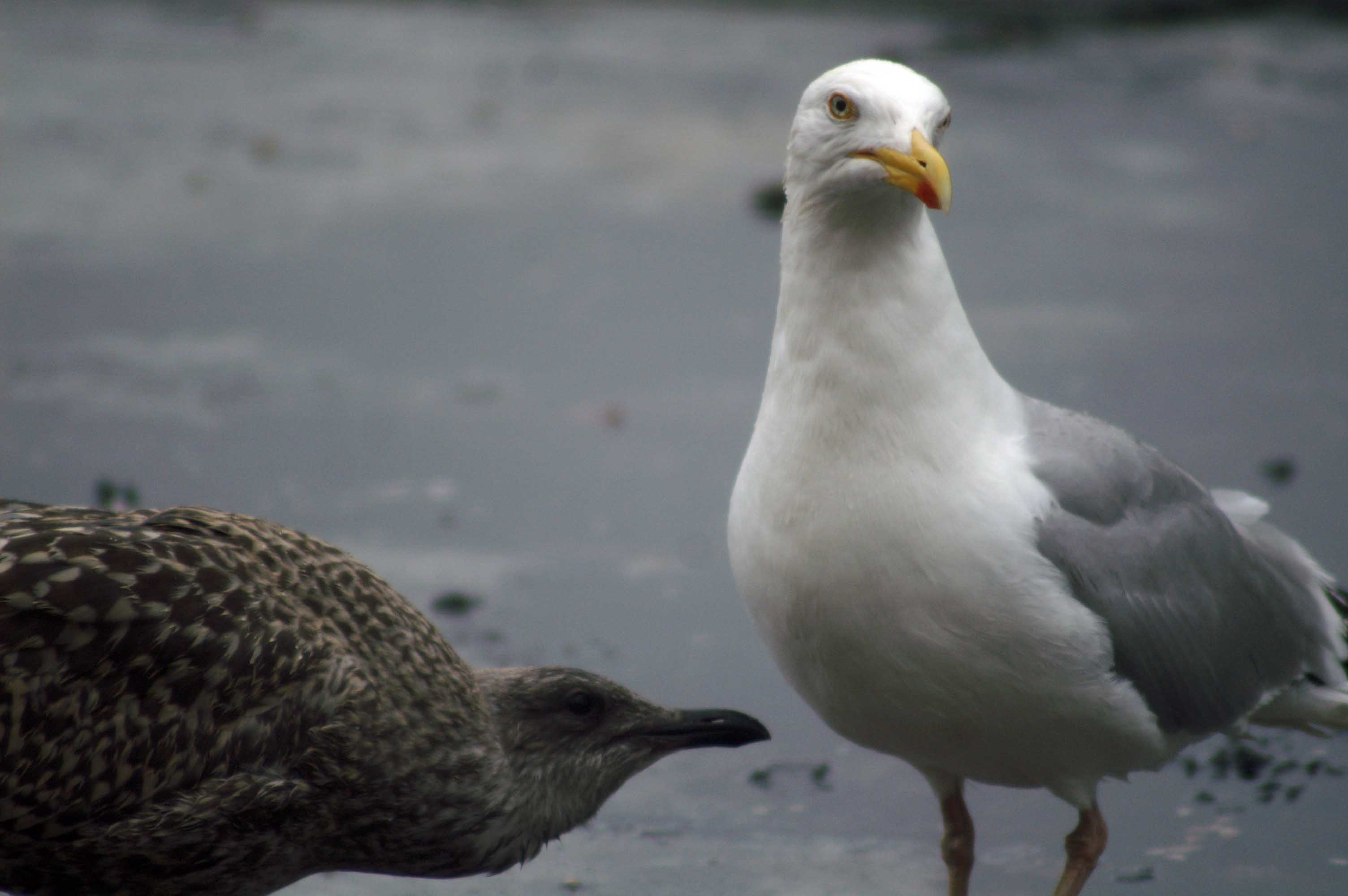
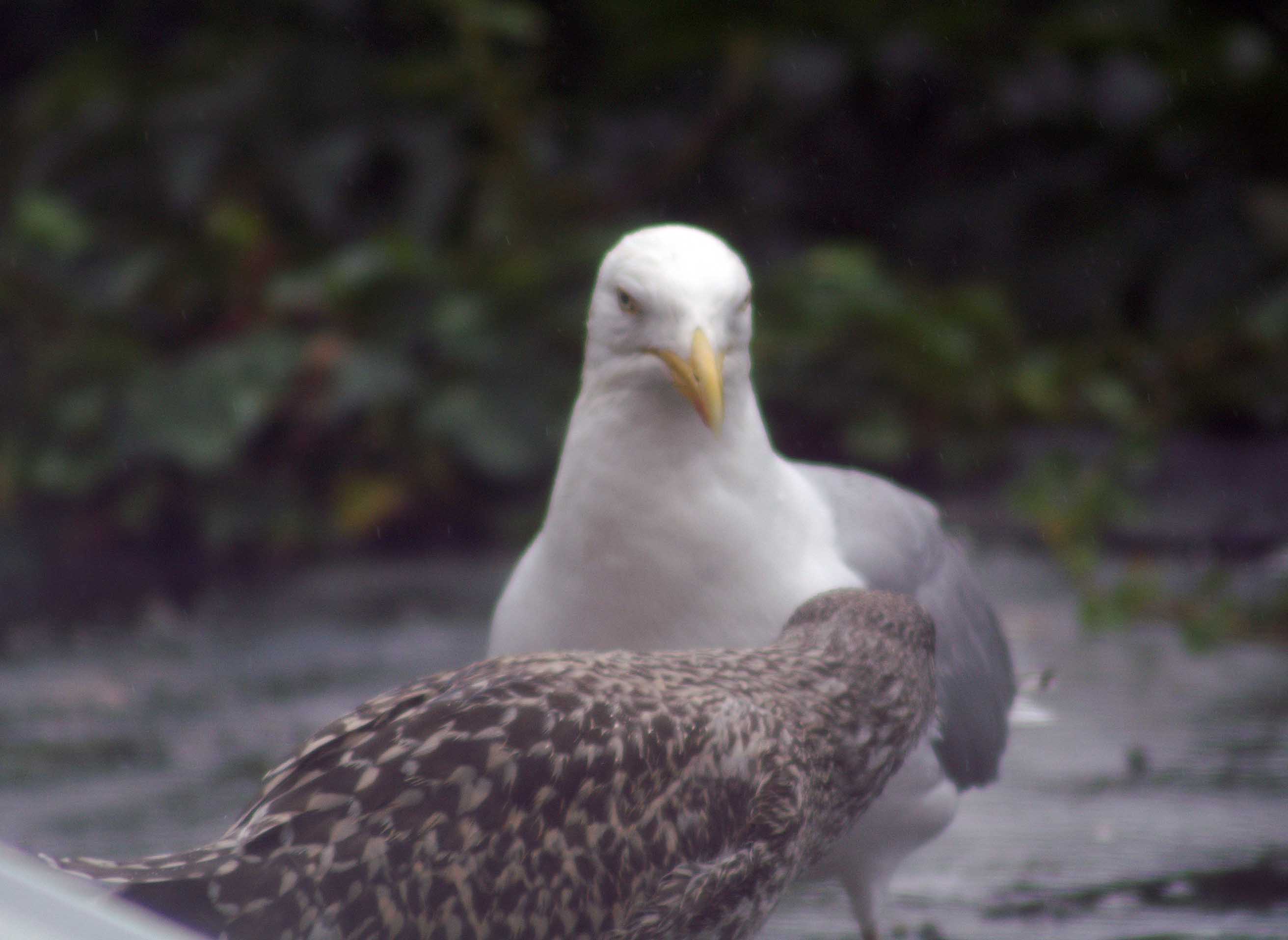
I’ve been away quite a bit lately, so there’s quite a bit of catching up to do  here in Rhos-on-Sea. The weather here, as everywhere else has not been conducive to venturing far, but I have been able to do some very productive birdwatching from my bedroom window, which I probably would not have done had I been out and about, so some clouds do have silver linings. In this case the silver has been in the shape of Herring Gulls – (the scientific name larus argentatus translates as silver gull). The activity has been brought about by the recent fledging of the single offspring produced by the pair that nested atop our next-door neighbour’s chimney pot.

At first the young gull spent a lot of time resting on the flat roof, where it is surprisingly well camouflaged.

The newly-fledged gull resting

In between bouts of resting it wandered around the rooftop picking at the odd collection of sticks, shells, bones and other random items brought there by its parents hoping to find something edible it may have missed.

First portrait of the new arrival

I don’t need to sit and watch and wait for the parents to arrive with food as both adult and their young one set off such a cacophony of noise at the sight of one another I can hear them from wherever I am in the house. Once a parent lands the youngster automatically adopts the typical crouched, hunched shoulder begging posture that makes it look a bit like a small vulture.

In begging posture

The loud communication between the two birds continues for a minute or so, then the parent allows the young one to approach and finally to tap the red spot on its beak to stimulate the regurgitation of the food it has brought.

The young gull approaching its parent

Getting into position

The young gull taps the red spot on its parent’s beak  to stimulate regurgitation of its lunch

What follows is not pretty as the parent brings back whatever food it has managed to find and deposits it in front of its youngster. It seems to be thriving on a diet that does not always look particularly healthy; in the following pictures the meal is raw chicken, but on another occasion it was a pile of french fries. There have also been more natural offerings of crab, which is consumed shell and all and small fish.

The adult regurgitating raw meat, maybe chicken

Fortunately the young gull is not a fussy eater

Once the food has been swallowed by the young one the parent leaves immediately, its departure once more accompanied by more loud cries.

Over the course of the last few days the young gull has gained much in confidence and now flies off  to spend much of the day elsewhere, but it is still returning to the high roof in the evenings with its parents and to the flat roof for intervals, maybe to rest where it feels safe.

The young one is gaining in confidence and strength daily

Share this:

  • Share on Facebook (Opens in new window) Facebook
  • Share on Pinterest (Opens in new window) Pinterest
  • Share on X (Opens in new window) X
Like Loading...

Strangers on and off the shore

30 Monday Jan 2012

Posted by theresagreen in Birdwatching on North Wales coast, Nature, nature photography, wading birds

≈ 2 Comments

Tags

black-throated diver, coastal birds, dunlin, purple sandpiper, purple sandpiper at rhos-on-sea, red-throated diver, ringed plover, shag, Turnstone

Saturday dawned bright, sunny and very cold, but at least it wasn’t windy. The sunshine encouraged me out to walk and I headed for the beach where I had hoped to take advantage of the clear light and take some shots of the mussel beds that are central to the presence of the wading birds. However, when I reached the end of our road I could see the tide was almost fully in, so that put paid to that idea. The sea was remarkably calm, but it was penetratingly cold and I almost turned around to go back for the car and drive somewhere more sheltered. Then I spotted a couple with telescopes peering out to sea and naturally had to find out what they were looking for. As I approached them I spotted a bird on the rocks, a Rock pipit was foraging along the boulders of the sea-break. It was a lovely healthy-looking bird and getting around quite nimbly despite the fact that the poor thing had lost most of one of its legs.

Rock pipit

Rock pipit, back view

It turned out that the couple with the telescopes were hoping to see divers, although apparently without much luck today. I know many birders enjoy sea-watching and spotting some of the less commonly seen species of sea birds, but as the best sightings are during the colder months and a lot of patience  is  required to achieve often very distant sightings, it’s not really my cup of tea. I am interested by the fact that it is possible to sight the birds around this coast though, and did a little research into them in the warmth of the house. The following information is from the RSPB website and from that I think the Red-throated diver is the species most likely to be seen offshore here.

Black-throated Diver- Gavia arctica

Family : Divers – (Gaviidae)

Black-throated Diver (RSPB image)-Found on Scottish Highland lochs in summer and around sheltered coasts in winter, and rarely along Irish Sea coasts. Moray Firth and W coast of Scotland best in winter, as well as the NE and SW coasts of England. Sometimes seen at inland reservoirs.

Streamlined diving birds that sit low in the water and dive with consummate ease. On land they are clumsy, barely able to walk with their legs so far back on their bodies. They are easily disturbed when breeding and their vulnerability to marine pollution make them a vulnerable as well as rare breeding species.

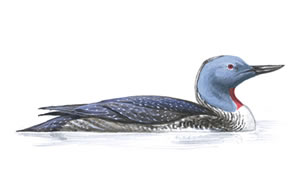
Red-throated Diver- Gavia stellata

Family : Divers – (Gaviidae)

Red-throated Diver- Gavia stellata -Outside the breeding season it is numerous along the UK's east coast, and occurs patchily along the west coast, with concentrations off west Scotland and around north-west Wales.

The smallest of the UK’s divers, its grey-brown plumage and up-tilted bill readily distinguish it from the other species. In summer it has a distinctive red throat. They usually jump up to dive and can stay underwater for a minute and a half. They are very ungainly on land, only coming ashore to breed. A recent moderate population decline make them an Amber List species.

Shetland is the UK stronghold for this species with other key populations on Orkney, the Outer Hebrides and the north Scottish mainland. They are also found along the whole of west Scotland south to the Mull of Kintyre. Outside the breeding season it is numerous along the UK’s east coast, and occurs patchily along the west coast, with concentrations off west Scotland and around north-west Wales.

The sea-watching couple had seen a couple of guillemots out at sea and also mentioned a Purple Sandpiper they had spotted on the breakwater rocks, which piqued my interest and sent me off my own ‘twitch’. I walked along the promenade, scouring the rocks in the hope of catching sight of the little Sandpiper, but with no luck. I also paid more attention to the sea and got out my binoculars for a closer look at a distant bird swimming around on the surface. Cormorant-like, but smaller,  with yellow patches at the base of its bill and around the eyes and with a  distinctive raised crest on its head, it was a Shag – Phalocrocorax aristotelis.

Walking back, another swimming bird, closer to shore this time definitely was neither a cormorant nor a shag.  I had no picture in my head then of what a diver looked like, but this was behaving like one, diving frequently and staying under the water for a good while before popping up again. It occurred to me that it was a Great crested Grebe, although I’d never seen one at sea before. It was a delight to watch, swimming around at some speed then diving elegantly. Once it came up almost directly beneath a floating black-headed gull, that was most put out and then just seconds later it dived again and came up with a sizeable fish.

Great crested Grebe- Podiceps cristatis
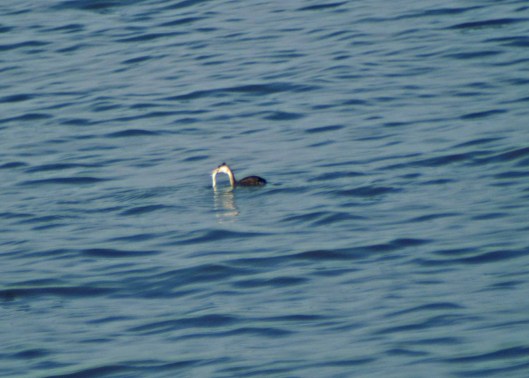
The Great crested Grebe caught a sizeable fish

It was too cold to stand around for long and my fingers on the camera controls were numb, so I walked back home via the shelter of the neighbouring streets. It’s been a while since I walked that way and I was very surprised by the amount of flowers in bloom in the front gardens. There are already snowdrops, crocus, grape hyacinth, the occasional daffodil and most surprisingly, wallflowers. The weather forecast for next week is not good – overnight frosts, sleet and below-freezing temperatures are not so good for too-early flowers.

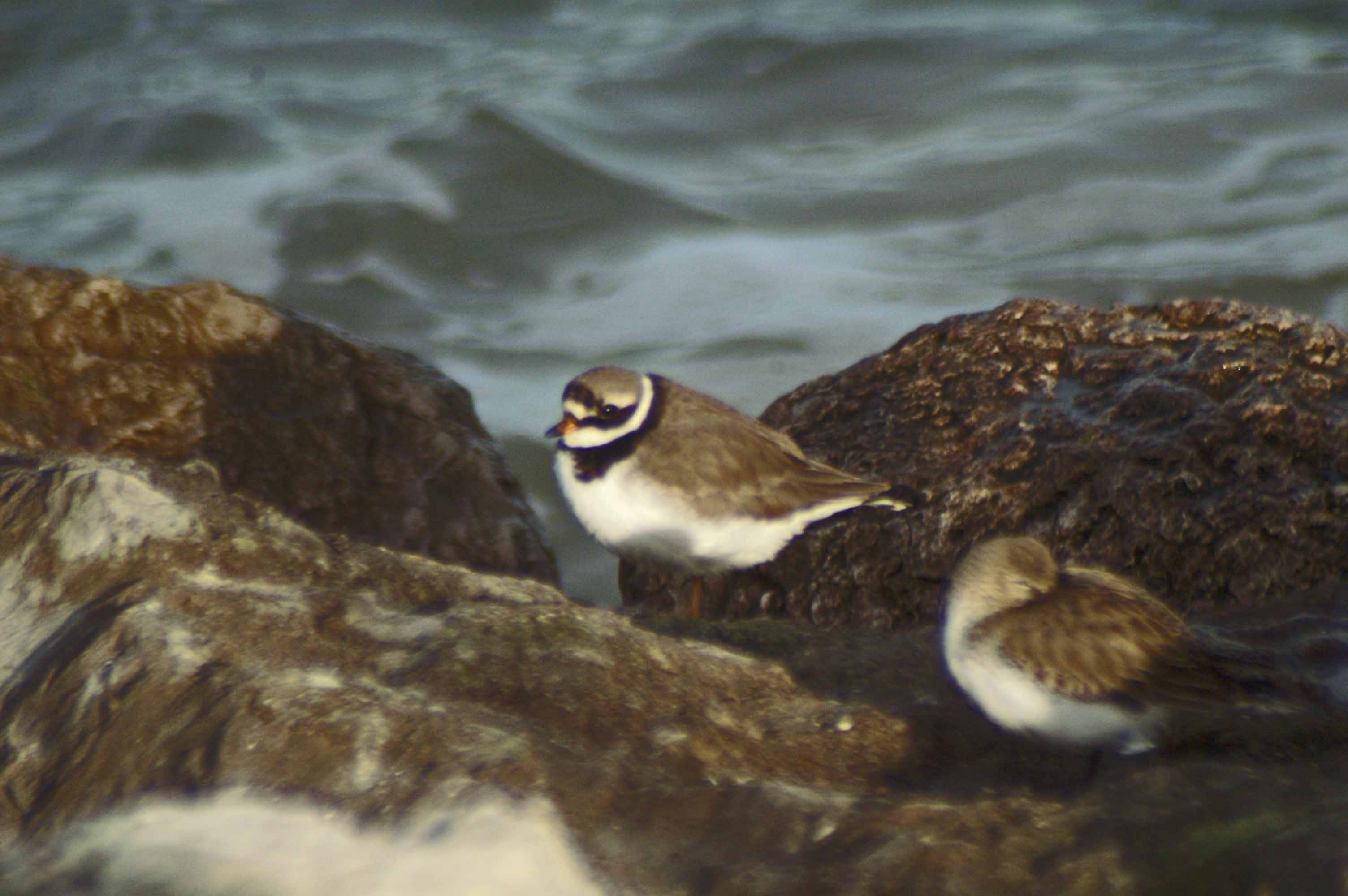
An hour in the house with a cup of tea and a sandwich and I’d warmed up enough to venture out again. This time I took the car as I was intending to drive over to the RSPB reserve on the Conwy estuary. (Point of interest: this morning’s sea-watchers had also told me that a firecrest had been ‘twitched’ there earlier in the day.) That was not why I was going there, but anyhow as I approached Rhos village I thought I’d pull over and have a quick look around the harbour beach  for the Purple Sandpiper. The winter sunshine had drawn a lot of others out to walk too and I parked in the  first available space and took the steps down to the promenade. There, almost right in front of me were a group of small birds peacefully dozing on the rocks waiting for the tide to turn. I recognised the turnstones and ringed plovers immediately, but was not so sure of the identification of the members of the majority of the group. I had to wait for one to stand up and show itself properly to be fairly sure they were dunlin – it was the long bill, slightly decurved at the end that clinched it.

A turnstone, 2 ringed plover and 6 Dunlin on one rock

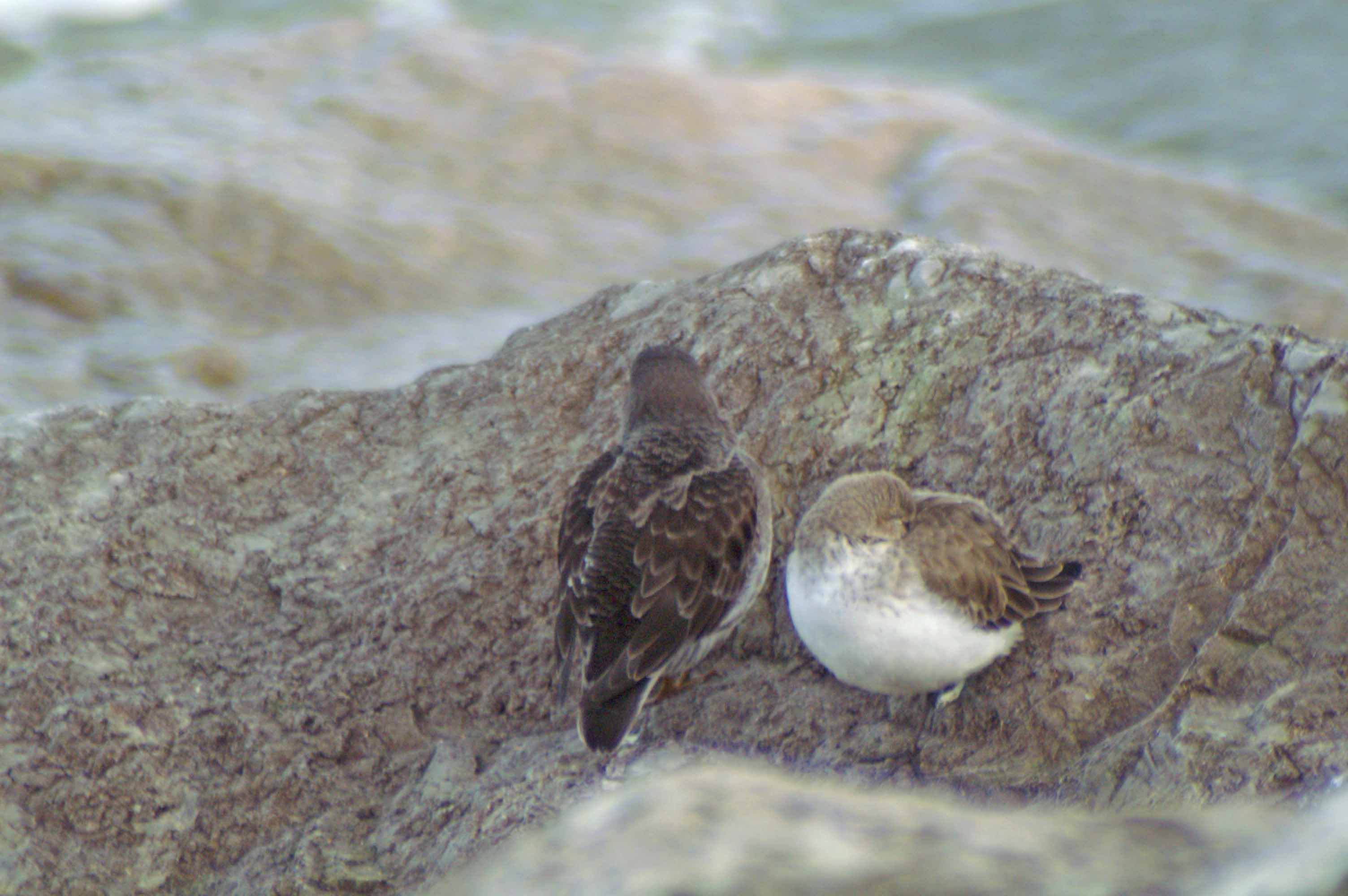
I was more than happy to those three species together, but things got even better when I realised there were a small number of purple sandpipers tucked in there as well ; fortunately they are much more distinctive and I recognised them with no problem. I saw 3 in total, but there could have been more tucked down lower on the rocks.
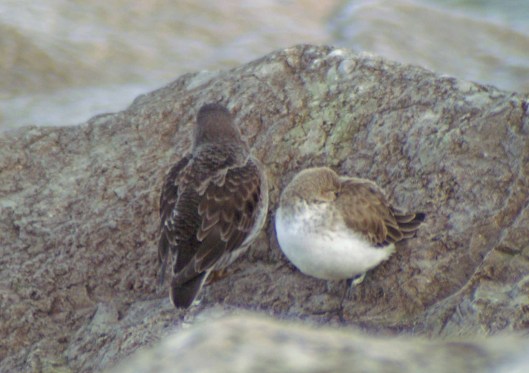
Purple Sandpiper close to a dunlin compares their size and plumage; the dunlin is slightly smaller and much lighter in colour

The Purple Sandpiper is usually a strictly coastal wader that visits Britain in the non-breeding season and then flies north to breed during the summer. They are seldom found on sandy beaches but prefer rocky coasts, where they can be seen searching for molluscs and crustaceans among the rocks and rock pools. In the North West They can turn up on any rocky coast from the tip of the Llyn peninsular in North Wales to Morecambe bay in the North. They begin to arrive in October, reaching a peak by November and start to leave again in April. By June, at the latest, they are gone.They are about the same size as a turnstone, with whom they are often seen, and a dark bird overall.
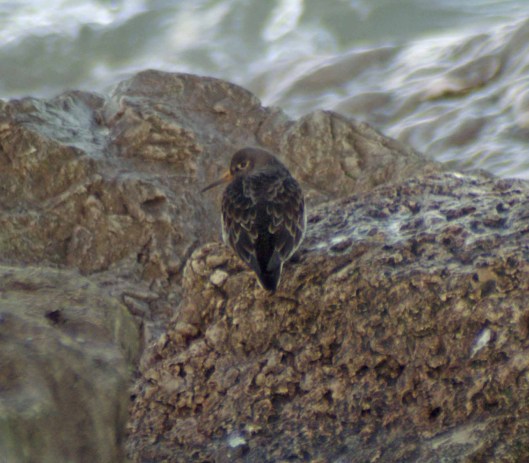
Purple Sandpiper-Calidris maritima

The purple sandpiper is the only small dark wader with yellow/orange legs likely to be seen on rocky shores,frequently in association with turnstones. They have a rather round-shouldered appearance, the wings are very dark grey, the head and back a slightly paler shade and the partially streaked breast an even paler shade. They have a longish beak for their size which is dark grey/black with a yellow or orange base. Their legs appear fairly substantial and are bright yellow or pale orange. In flight they appear very dark with just a faint, narrow white wing-bar and bold white edges on a black/dark grey tail.

Purple sandpiper amongst dunlin & a ringed plover

A purple sandpiper joins another group, showing all 4 species together; dunlin, ringed plover & a turnstone

Dunlin - Calidris alpina

Ringed plover-charadrius hiaticula, in sunlight

2 ringed plover side by side; the one at the back is an adult, the other an immature with no black head band and an incomplete, brownish breast band

The birds were so close to the promenade that quite a few people passing by noticed them; some of whom stopped and asked me to identify the species for them. Perhaps not too surprisingly, it was the attractive Ringed Plovers that aroused the most amount of  interest.
Share this:

  • Share on Facebook (Opens in new window) Facebook
  • Share on Pinterest (Opens in new window) Pinterest
  • Share on X (Opens in new window) X
Like Loading...

Winter treats on the Little Orme

23 Monday Jan 2012

Posted by theresagreen in bird behaviour, Birdwatching on North Wales coast, Little Orme, Nature, nature photography, Rhiwledyn Nature Reserve

≈ Leave a comment

Tags

chough, chough in North Wales, flowering gorse, raven, stonechat

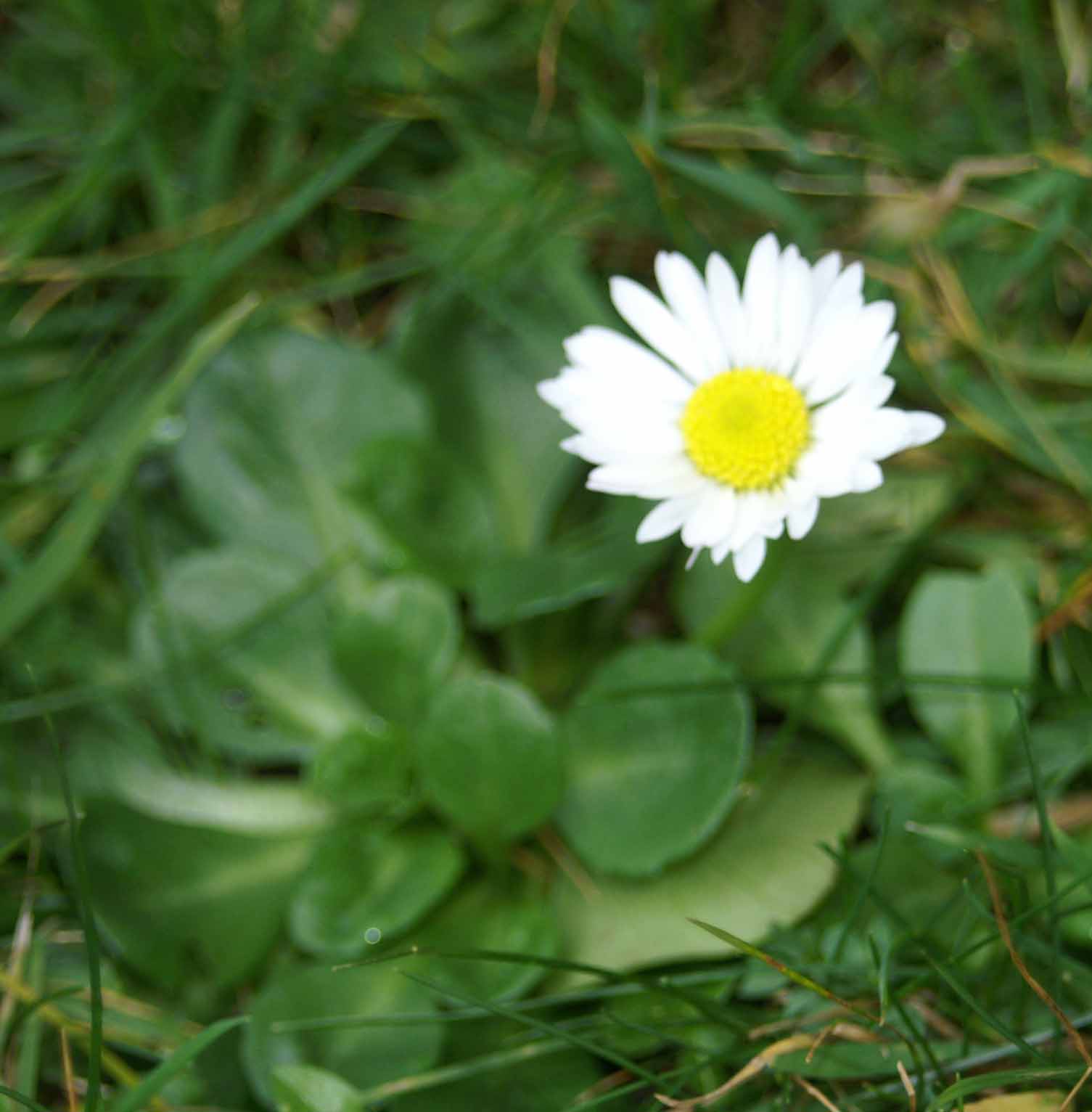
10th January - Daisy in the lawn

In common with the rest of Britain, we have experienced a mixed bag of winter weather on the North Wales coast so far this year and last week brought the whole selection together in its 7 day span. There were gale force winds, dull grey overcast days and some clear bright sunny days that darkened into clear night skies  full of brilliant stars. Of  course the clear nights brought forth morning frost and freezing temperatures, but they did not last for long.

Wood pigeon perched on the frosted roof

I usually try to avoid popular local walking spots on high days and holidays, but a need for some quick-fix fresh air and exercise on a cold but sunny Sunday afternoon found me heading for the nearby nature reserve on the headland of the Little Orme. When I first arrived I was pleasantly surprised by how few other people were there and set off towards the cliff edge to look out across the small bay. There were a few cormorants flying back and forth with a few more diving off the  tip of the headland. I watched a pair of fulmar flying around close to the cliff face, but that was it for sea birds; even the gulls were otherwise occupied elsewhere.

I turned around to walk back and heard the distinctive ‘barking’ call of a raven that I tracked to the top of the rockface. The bird was perched, hunched down with its head and neck pointed upwards and with its feathers bristling out around  its body. At that point I couldn’t see any other birds around that may have been provoking its behaviour, but a little later I heard it calling again from the cliff edge slightly further inland and looked up to see two buzzards circling closely above it, so maybe they were the objects of his annoyance.

Disgruntled raven

I already mentioned that this was a sunny day, but not yet that the sky was blue and – wait for it – so was the sea. One of the things I had come out hoping to photograph was gorse in bloom and luckily there were several bushes with flowers, but this picture of sunshine-golden gorse against a background of a blue Irish Sea had to be the one I included. It reminded me so much of Spain – apart from the sharp cold air that is.

Golden gorse in bloom against a background of blue sea

In total contrast I was then drawn to a patch of what from a distance I took to be low-growing white flowers but that was actually frosted moss.

a patch of frosted moss

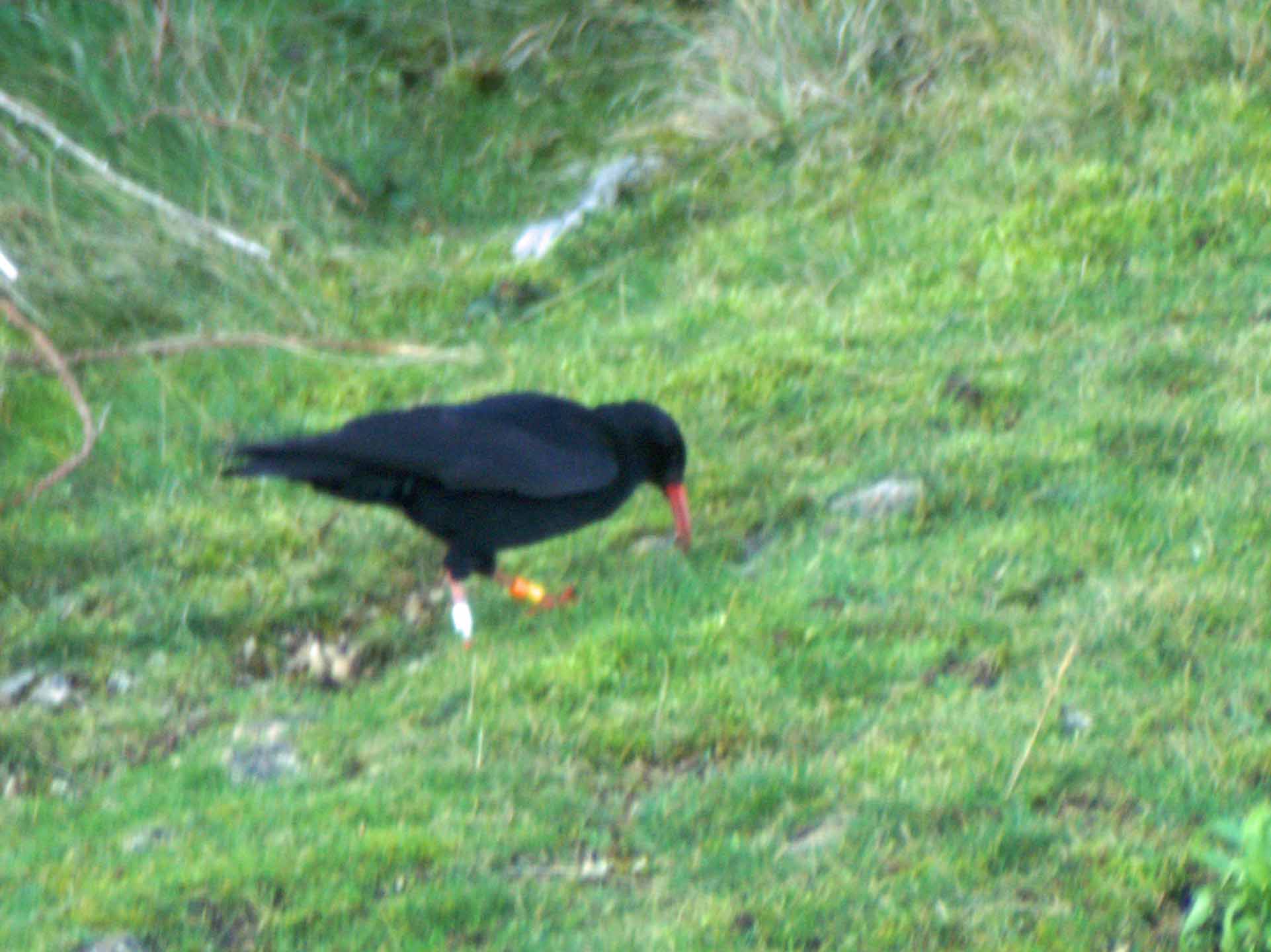
I had been meandering around rather than walking with any purpose and stood for a moment looking around trying to decide which direction to head in, or as the place suddenly seemed to be filling up with people and their dogs, whether to  leave and move on somewhere else. Just then a small flock of jackdaw flew in very close to me and landed on the short grass at the base of the cliff. I am very fond  of these intelligent and sociable birds, and for want of much else to photograph I decided to approach them and try for some close shots.  I got within a few metres, began to slowly raise the camera so as not to spook them, then almost dropped it when I realised that foraging alongside the jackdaws there were two chough. I was excited by the completely unexpected sighting of these much rarer birds, and panicking too as I could see a couple with a loose dog heading straight for me. I managed to get two shots only, one that was too out of focus to present and this one that is a long way from brilliant but does record the event.

A lucky glimpse of a Chough (Pyrrhocorax pyrrhocorax) on the Little Orme

I got my shots with just seconds to spare as the dog spotted the birds and bounded towards them, deliberately chasing them away. I watched disappointedly as they flew away, but sadly the dog owners smiled at me as they passed, probably amused by their dog’s ‘playfulness’. I was not at all amused. I had a long enough look to see that one of the chough had quite a collection of leg rings of varying colours, so it is obviously one that has been well monitored and it  should be possible to find out where it came from. Most probable is the nearby Great Orme, but South Stack on  Anglesey is another possibility. If anyone recognises the rings, I’d be very interested to hear from them.

Stonechat - Saxicola torquata

I considered the possibility that the birds may return, so to while away a few minutes I walked down the sloping path into the valley created by past removal of limestone rock. It was sunnier there and almost immediately a small bird perched on a gorse bush caught my eye. Its general size, shape and familiar behaviour  immediately brought stonechat to mind, but this is another bird I’d yet to see here, so I was pleased to confirm that as I focussed the camera lens on  it.

Stonechat (m) in ash tree

As I was leaving the site I had another glimpse of the Stonechat where it was perched in a small ash tree. It was joined there by another bird which I initially thought may have been a female, but was actually a Dunnock.

Dunnock

Share this:

  • Share on Facebook (Opens in new window) Facebook
  • Share on Pinterest (Opens in new window) Pinterest
  • Share on X (Opens in new window) X
Like Loading...

Bird Study: Cormorant

24 Monday Oct 2011

Posted by theresagreen in Birdwatching on North Wales coast, Nature, nature photography

≈ 3 Comments

Tags

coastal birds, Cormorant, phalacrocorax carbo

Cormorants are breeding residents here and since I arrived in July sightings of the birds flying or swimming in the sea have been consistently frequent, but in recent weeks their numbers have increased manyfold. Numbers of them now joined the ranks of oystercatchers and gulls that line the sea-edge as the tide comes in, and they can be spotted on the rocks of the harbour breakwater and perched on top of available posts. There are almost always a few to be seen on the lower reaches of the Little Orme, but now there are many, their black forms punctuating the pale limestone.

Cormorant – Phalacrocorax carbo

Scientific name from: Greek: phalakros=bald + korax=the raven and Latin:  carbo=charcoal

Common name: definitions of ‘Cormorant’

  1. (n.) A voracious eater; a glutton, or gluttonous servant.
  2. (n.) Any species of Phalacrocorax, a genus of sea birds having a sac under the beak. Cormorants devour fish voraciously, and have become the emblem of gluttony. They are generally black, and hence are also called sea ravens, and coalgeese.

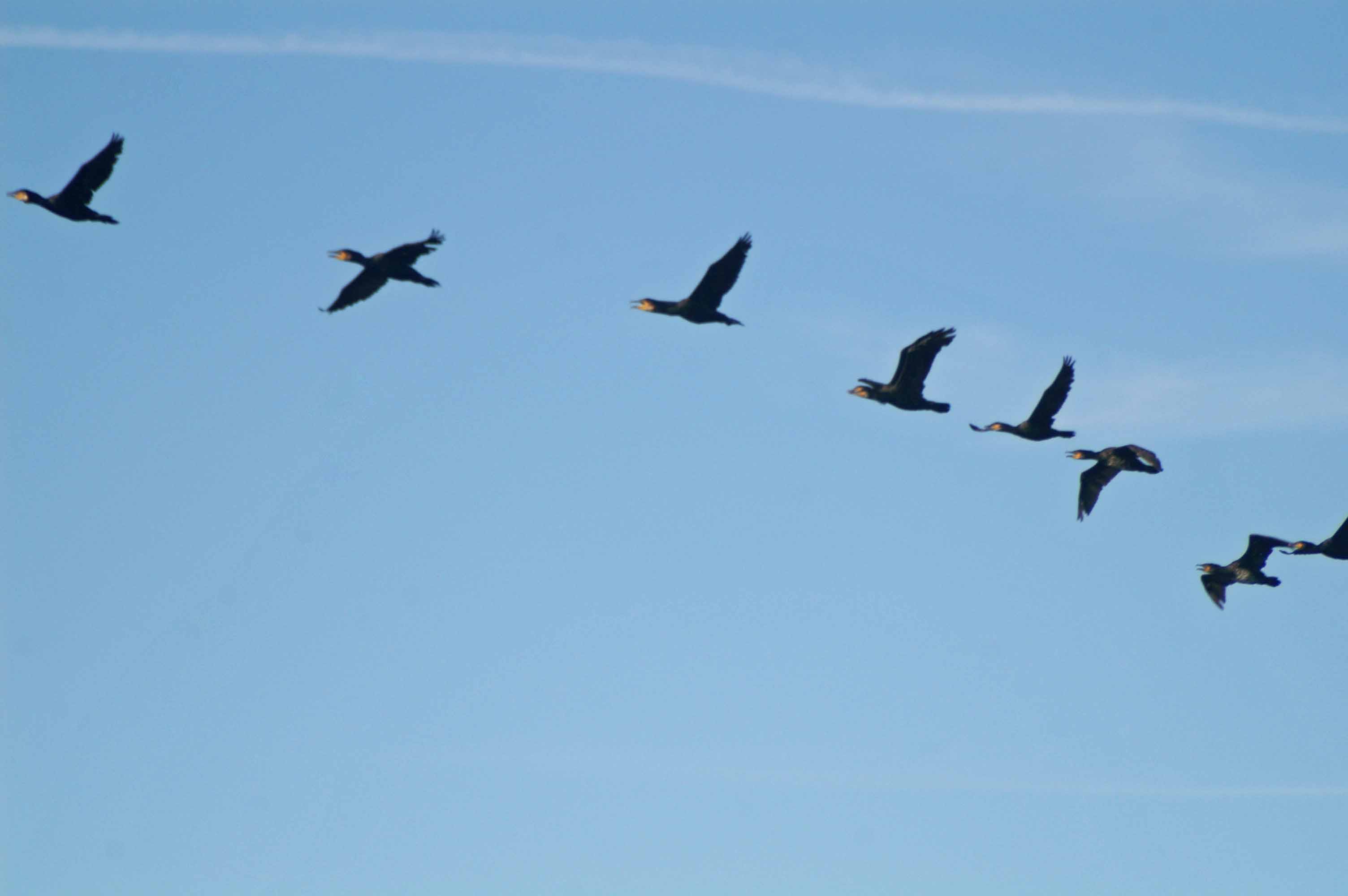
The Cormorant's flight is strong and purposeful

A large and conspicuous waterbird, the cormorant has an almost primitive look about it.Its long neck makes it appear almost reptilian, particularly when swimming with the bulk of its body submerged.

Some of the Cormorants dotted across the base of the Little Orme

Cormorants are coastal rather than oceanic birds, and many have colonised inland waters – in fact the original ancestor of cormorants seems to have been a fresh-water bird, judging from the habitat of the most ancient lineage. They range around the world, except for the central Pacific islands.

All are fish-eaters, feeding mainly on small eels and flat fish. They dive from the surface of the water. All four toes on each foot are webbed which aids them in swimming and in pursuing fish underwater.

Cormorants are supreme fishers which can bring them into conflict with anglers and they have been persecuted in the past, although some enterprising Japanese and Chinese fishermen employ the bird’s expertise to assist them, training one species of the birds to dive and catch fish for them.

A juvenile Cormorant with partial paler underparts still present.

The birds are often seen standing with their wings held out to dry and the reason for that is a bit of a mystery and the focus of study. It seems strange that a bird that spends much of its time in the water should need to dry their plumage and all cormorants have preen gland secretions that are used ostensibly to keep the feathers waterproof. It has been variously stated that cormorants have waterproof feathers; they have water permeable feathers; that the outer plumage absorbs water but does not permit it to penetrate the layer of air next to the skin; that it aids thermoregulation,digestion, balances the bird or indicates presence of fish. However, a detailed study of the Great Cormorant concludes that it is without doubt to dry the plumage. (extracts from article in Wikipaedia)

Male Cormorant in his full breeding plumage, wings outstretched. This is one of my favourite Cormorant photographs, I took it in Sotogrande, Spain earlier this year (Feb).

Click on the link for more photographs of Cormorants in Spain on my blog ‘Nightingale Trails’.

Cormorants in human culture

  • Cormorants feature quite commonly in heraldry and medieval ornamentation, usually in their “wing-drying” pose, which was seen as representing the Christian cross. For example, the Norwegian municipalities of Røst, Loppa and Skjervøyhave cormorants in their coat-of-arms. The species depicted in heraldry is most likely to be the Great Cormorant, the most familiar species in Europe.
  • In 1853, a woman wearing a dress made of cormorant feathers was found on San Nicolas Island, off the southern coast of California. She had sewn the feather dress together using whale sinews. She is known as the Lone Woman of San Nicolas and was later baptized “Juana Maria” (her original name is lost). The woman had lived alone on the island for 18 years before being rescued.
  • The bird has inspired numerous writers, including Amy Clampitt, who wrote a poem called “The Cormorant in its Element”.
  • The cormorant was the disguise used by Satan in Milton’s Paradise Lost. The cormorant was significant as a symbol of “true Life/ Thereby regain’d,” and was ironically used by Satan. Satan sat on top of the Tree of Life as a cormorant in his first attempt to deceive and tempt Eve.
  • There is a cormorant portrayed in the first of the fictional paintings by Jane Eyre in Charlotte Bronte’s novel, representing Blanche Ingram.
  • The mythical ‘Liver Bird’ symbol of Liverpool is commonly thought to be a cross between an eagle and a cormorant.

Share this:

  • Share on Facebook (Opens in new window) Facebook
  • Share on Pinterest (Opens in new window) Pinterest
  • Share on X (Opens in new window) X
Like Loading...

Hungry Herring Gulls

21 Wednesday Sep 2011

Posted by theresagreen in birds of the seashore, Birdwatching on North Wales coast, Nature, Nature of Wales, Rhos-on-Sea

≈ 2 Comments

Tags

colwyn bay beach, herring gull, herring gull feeding behaviour, herring gull juveniles begging for food, larus argentus

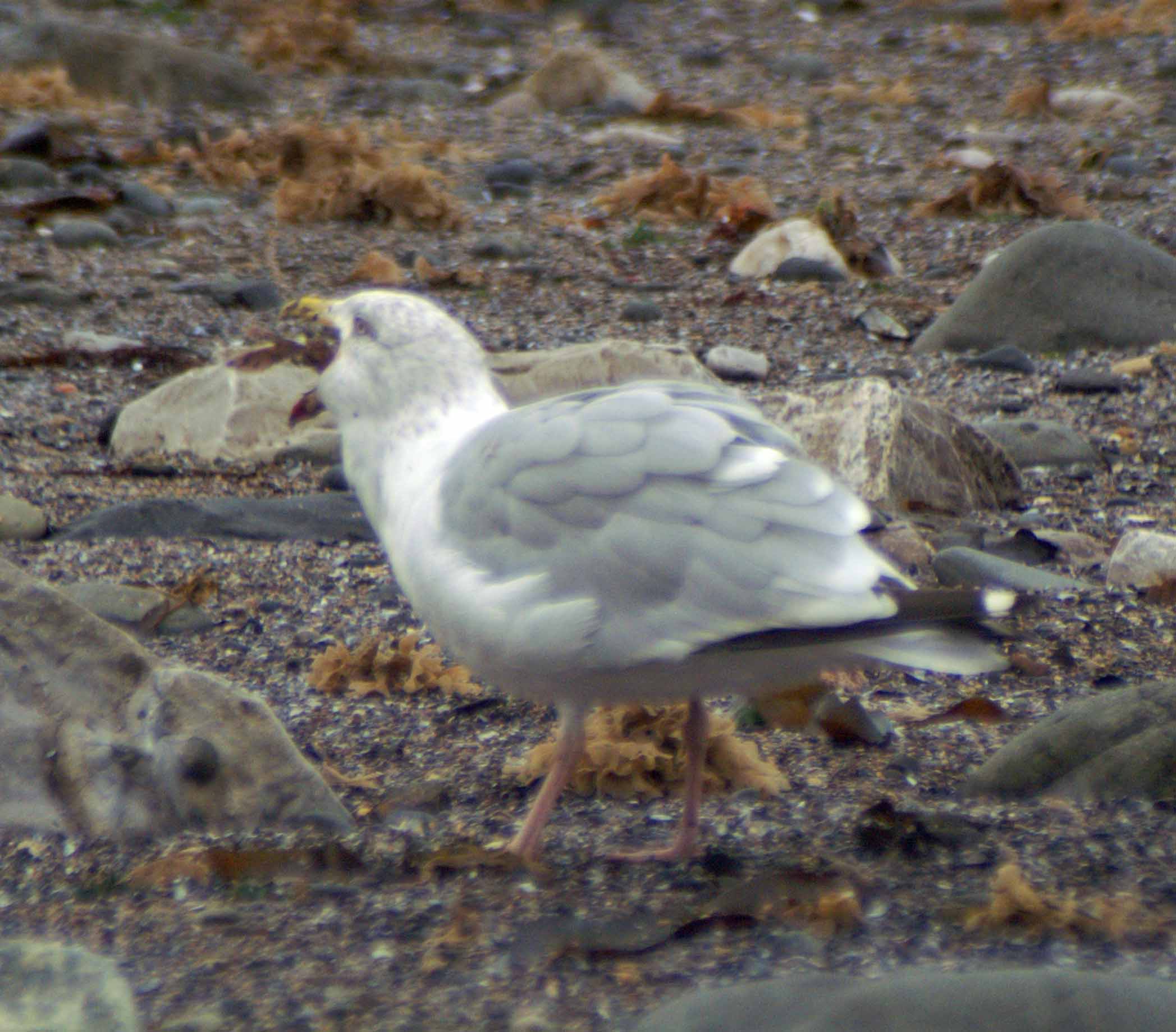
Walking along the sea shore the other day I came across a Herring Gull in the process of eating a fish. I have no idea what species of fish it was, all I can say is that it was a flat fish and either whole or almost-whole, either way, large enough for me to be amazed that a bird could even attempt swallow it.

17/9/11-The gull with most of the fish in its gullet

17/9/11- It was not going down easily, so it had to come back up again

17/9/11-A second attempt -and this time the fish disappeared

17/9/11- All that remained was a lump in the gull's crop - it should keep him going till at least lunchtime

Herring Gulls are  omnivores and opportunists like most Larus gulls, and will scavenge from rubbish dumps, landfill sites, and sewage outflows; food obtained this way may comprise up to half of the bird’s diet. Despite their name, they have no special preference for herrings — in fact, examinations have shown that echinoderms and crustaceans comprised a greater portion of these gulls’ stomach contents than fish.

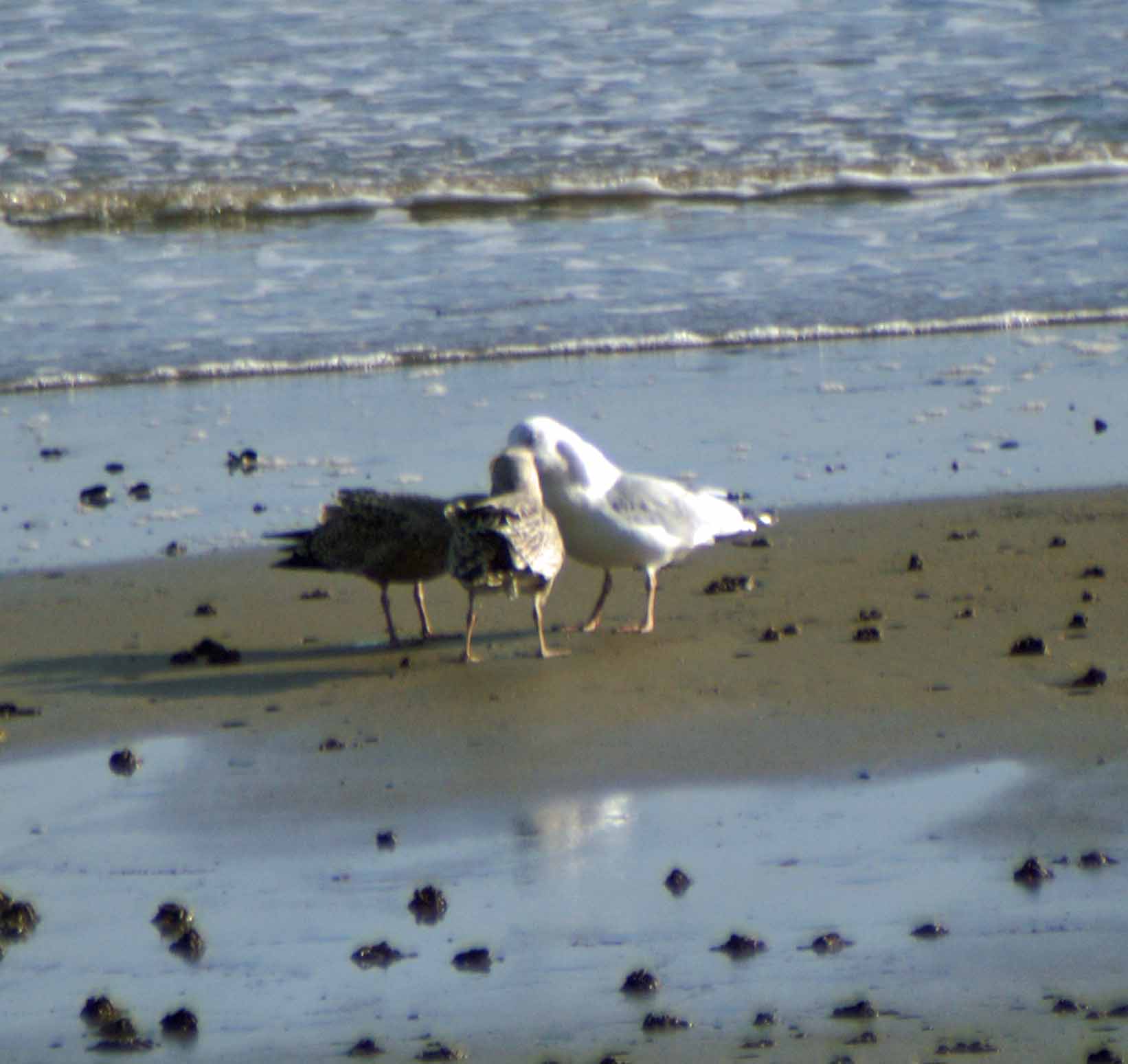
On Colwyn Bay seashore I witnessed more gull feeding behaviour, this time two juveniles were begging an adult, presumably a parent, to feed them.

Young Herring gulls persuading a parent to feed them

Juveniles use their beaks to “knock” on the red spot on the beaks of adults to indicate hunger. Parents typically disgorge food for their offspring when they are “knocked”.

Parent gulls will feed their offspring for up to 6months if they continue to beg

Chicks are generally fed by their parents until they are 11–12 weeks old but the feeding may continue up to six months of age, if the young gull continues to beg. The male feeds the chick more often than the female before fledging, the female more often post-fledging.

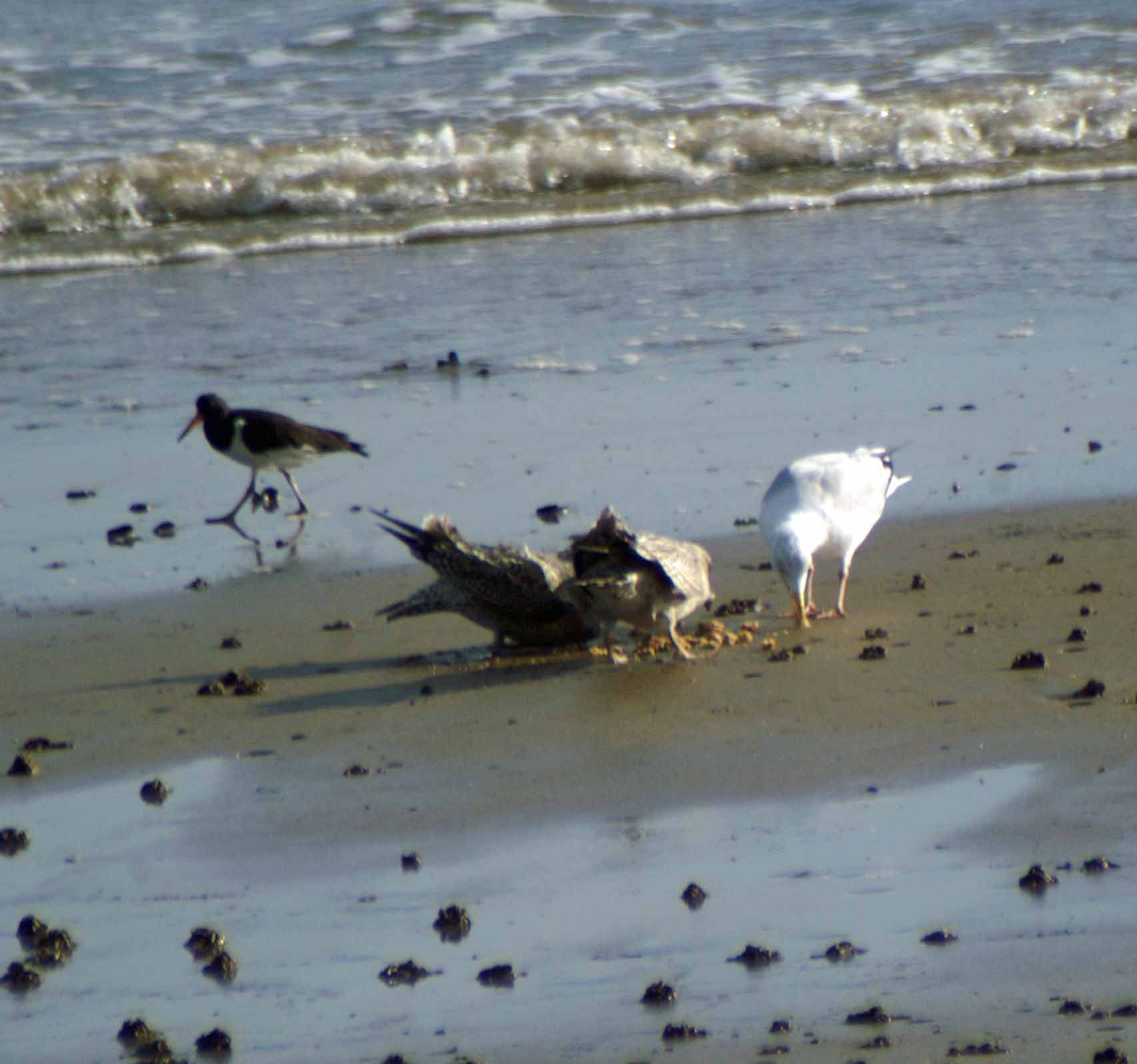
The adult was persuaded to disgorge what it had eaten onto the sand

The young birds begging did the trick and the adult disgorged whatever it had eaten onto the beach, which did not look at all appetising from where I was standing, but the three birds seemed to be happy with it.

Share this:

  • Share on Facebook (Opens in new window) Facebook
  • Share on Pinterest (Opens in new window) Pinterest
  • Share on X (Opens in new window) X
Like Loading...

Northern Wheatears stop-over

18 Sunday Sep 2011

Posted by theresagreen in Birdwatching on North Wales coast, Nature

≈ Leave a comment

Tags

bird migration, birds on rocks, Northern Wheatear, northern wheatear migration, northern wheatear non-breeding plumage, oenanthe oenanthe, penrhyn bay

Summer is definitely on the wane and signs of encroaching autumn are becoming increasingly apparent on an almost daily basis. The hoped-for Indian Summer has yet to arrive and the weather continues to be as unpredictable as ever. It keeps life interesting though and the new season has already brought forth some amazing sightings of birds that threaten to dominate the blog now if I’m not careful. I thought I might feature one particular species of bird every week or so, beginning with the Northern Wheatear as they are clearly on migration now and sightings will probably be sporadic and for a brief time only.

9th September

Walking along the promenade between Rhos-on-Sea and Penrhyn Bay I stopped to watch some Pied Wagtails that were chasing flies along a length of the wall and over the big boulders of the sea defense. I love their agility and grace and could watch them for ages, but today I was distracted from their antics by the presence of a less common visitor, a handsome Northern Wheatear.

9/9/11-A very strongly-coloured individual

The Northern Wheatear or Wheatear (Oenanthe oenanthe) is a small passerine bird that was formerly classed as a member of the thrush family Turdidae, but is now more generally considered to be an Old World flycatcher, Muscicapidae. It is the most widespread member of the wheatear genus  Oenanthe in Europe and Asia.

9/9/11-Wheatears are larger than a European Robin at 14.5-16cm in length. Both sexes have a white rump with a black inverted 'T' pattern at the end of the tail.

The Northern Wheatear is a migratory insectivorous species breeding in open stony country in Europe and Asia with footholds in northeastern Canada and Greenland as well as in northwestern Canada and Alaska. It nests in rock crevices and rabbitburrows. All birds winter in Africa.

9/9/11-Wheatears have the typical upright stance of Members of the thrush family

I am more used to seeing these birds in their summer breeding plumage; in Spain they breed in the mountains, and in Wales I have seen them in mainland Pembrokeshire and on Skomer Island,when males and females have been easy to separate. The distinctive plumage of the summer male has grey upperparts, buff throat and black wings and face mask. However, in autumn it resembles the female apart from the black wings. The female is pale brown above and buff below with darker brown wings.

I’m not altogether sure what sex the ones I saw belong to – the difference in the strength of colour on the breasts was quite marked, with some individuals being a very warm pink-orange and others a paler buff-pink.

9/9/11- The Wheatears feed on insects and larvae

The male has a whistling, crackly song. Its call is a typical chat chack noise.

Migration 

The birds I am seeing here will be on their return journey to Africa where they will spend the winter, stopping over to take advantage of any available food to fuel the next stage of their journey south.

9/9/11- Glimpsed from this angle, the Wheatear may be confused with a European Robin

The Northern Wheatear makes one of the longest journeys of any small bird, crossing ocean, ice, and desert. It migrates from Sub-Saharan Africa in Spring over a vast area of the northern hemisphere that includes northern and central Asia, Europe, Greenland, Alaska, and parts of Canada. In Autumn all return to Africa, where their ancestors have wintered.

Birds of the large, bright Greenland race, leucorhoa, makes one of the longest transoceanic crossings of any passerine. In spring most migrate along a route (commonly used by waders and waterfowl) from Africa via continental Europe, the British Isles, and Iceland to Greenland. However, autumn sightings from ships suggest that some birds cross the North Atlantic directly from Canada and Greenland to southwest Europe (a distance of up to 2500 km). Birds breeding in eastern Canada are thought to fly from Newfoundland to the Azores (a distance of 1600 km) before flying onwards to Africa. Other populations from western Canada and Alaska migrate by flying over much of Eurasia to Africa.

Share this:

  • Share on Facebook (Opens in new window) Facebook
  • Share on Pinterest (Opens in new window) Pinterest
  • Share on X (Opens in new window) X
Like Loading...

Activity and new arrivals on the seashore

16 Friday Sep 2011

Posted by theresagreen in birds of the seashore, Birdwatching on North Wales coast, Nature, Rhos-on-Sea

≈ Leave a comment

Tags

cormorants flying, Oystercatcher, redshank, ringed plover, sandwich, Turnstone

The summer is rapidly coming to an end and many species of birds are on the move, some returning to their winter feeding grounds in this country, others flying in from the north and others taking off to return to the warmer regions of Southern Europe and Africa. During the past few weeks I have already noted that the numbers of Oystercatchers and Sandwich Terns have increased dramatically here at Rhos-on-Sea on the North Wales coast and that Curlews have become a regular sight foraging on the seashore.

24th August

There was a lot of activity on the seashore late in the afternoon as the tide turned. I’m not the best at counting large numbers of birds, especially when they’re mobile, but there are definitely several hundred Sandwich Terns here presently and even more Oystercatchers. Mixed flocks of the birds line up along the sea edge, moving closer inshore as the water encroaches the rocky beach.

24/8/11-Sandwich Terns and Oystercatchers line up expectantly along the sea edge as the tide comes in

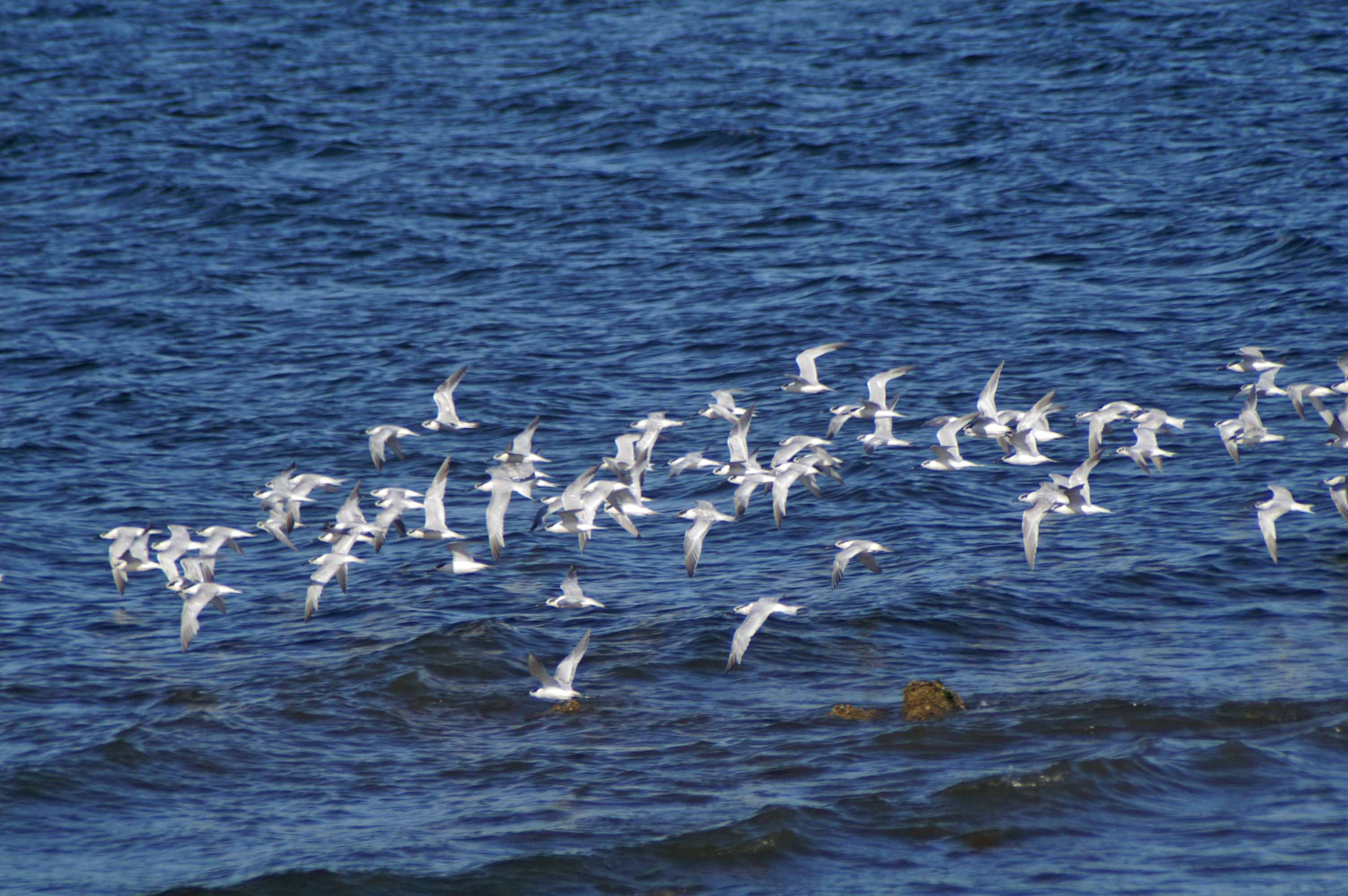
The Terns are restless; there are a lot of to-ings and fro-ings between their various groups and occasionally a whole flock takes off in unison, only to return to the same spot seconds later. The Oystercatchers take little notice of their flighty companions and continue to wait or forage patiently.

24/8/11- Sandwich Terns take off in unison

24/8/11-Terns settling back down amongst Oystercatchers

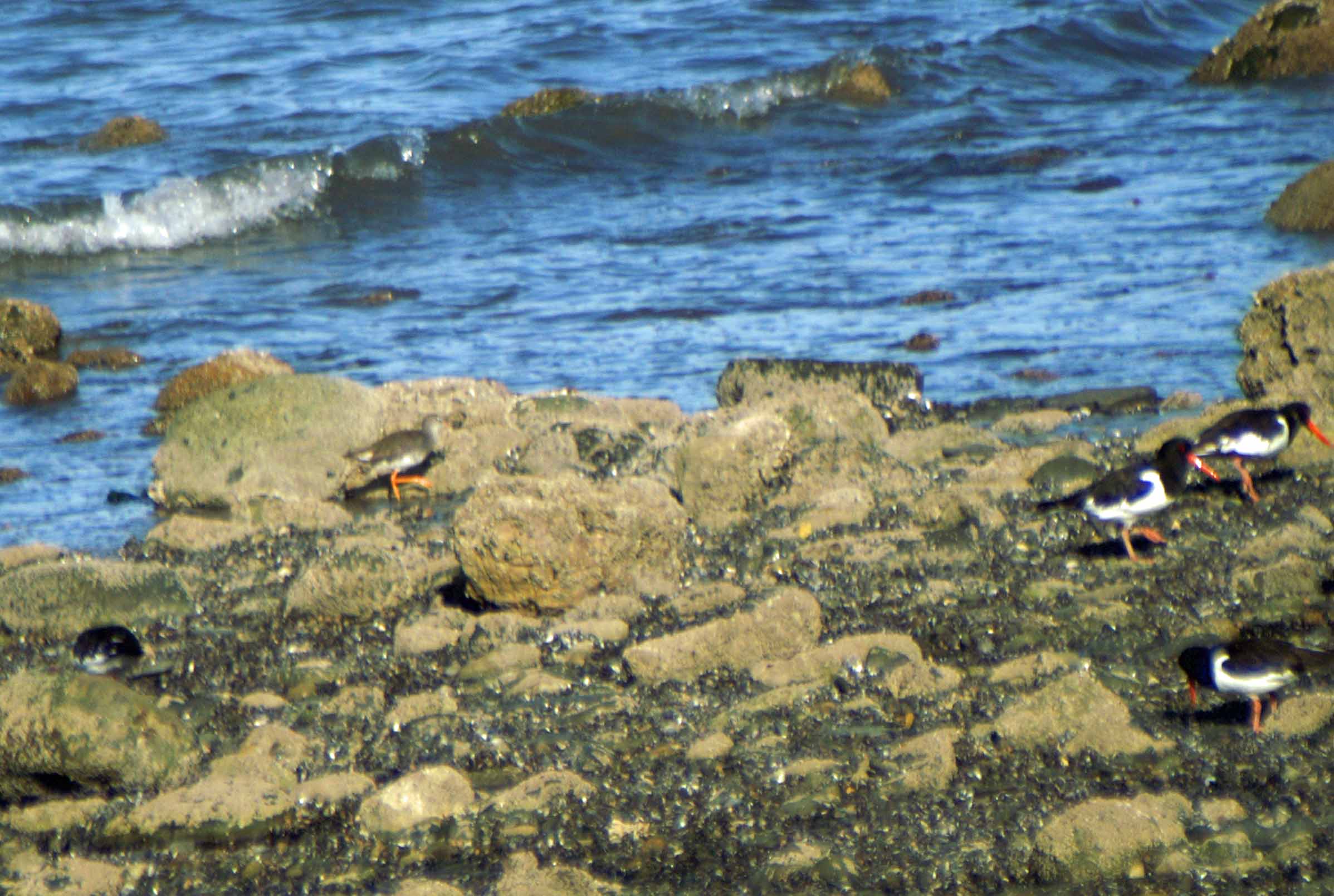
I was content watching the Tern displays, then noticed a couple of other waders well-camouflaged against the greys and browns of the shore; the bright red legs that give the birds their name gave away Redshanks that had infiltrated the ranks of Oystercatchers. The proximity of the two species shows the contrast in size. The Redshanks were quite distant, but now I have seen them I hope for better views another time.

24/8/11-Redshanks amongst Oystercatchers

I was feeling pleased to have Redshank to add to my sightings list, then spotted two separate flocks of smallish birds fly in almost simultaneously and was delighted to witness the arrival of both Turnstones and Ringed Plovers. The individuals of both flocks landed on rocks at the sea edge that were surrounded by water, then stayed put for a few minutes before venturing on to the shore to forage. I estimated that there were around 20 birds in each flock.

24/8/11-Turnstones arrived with Ringed Plovers

24/8/11- Turnstone flock flying away

24/8/11-Cormorants flying toward the Little Orme, calling as they flew

24/8/11-Black-headed Gull flying

Birds to be seen currently on the shore at Rhos-on-Sea:

Cormorant – Phalacrocorax carbo, Oystercatcher – Haematopus ostralagus,  Ringed Plover – Charadrius hiaticula, Turnstone – Arenaria interpres, Redshank –  Tringa totanus, Curlew – Numenius arquata,Black-headed Gull – Larus ridibundus, Herring Gull – Larus argenatus, Lesser Black-backed Gull – Larus fuscus, Sandwich Tern – Sterna sandvicencis, Pied Wagtail – Motacilla alba, yarellii

Share this:

  • Share on Facebook (Opens in new window) Facebook
  • Share on Pinterest (Opens in new window) Pinterest
  • Share on X (Opens in new window) X
Like Loading...
Newer posts →
Follow everyday nature trails on WordPress.com

Enter your email address to follow this blog and receive notifications of new posts by email.

‘But it is the common species that keep the living world ticking over and provide most of our experiences of wildlife, and I would argue that maintaining the abundance of these is as important a conservation priority as maintaining the existence of rarities’. Richard Mabey

MOST RECENT POSTS

  • A Glimpse of Spring to Come January 22, 2025
  • Hunting the Wren December 28, 2024
  • Oh, Christmas Tree December 18, 2024
  • In and Out of the Ivy February 15, 2024
  • Nature’s Fireworks November 30, 2023
  • Wild Autumn along the Coast Path November 3, 2023

OLDER POSTS

LOOKING FOR SOMETHING IN PARTICULAR?

  • Catchers, a Duck and Divers
    Catchers, a Duck and Divers
  • Following a river to a Fairy Glen
    Following a river to a Fairy Glen
  • Things Bright and Beautiful
    Things Bright and Beautiful
  • A Windy Wildflower Trail
    A Windy Wildflower Trail
  • Sights and Sounds from the Little Orme 1
    Sights and Sounds from the Little Orme 1
  • May Bee Appearing on Ivy near You
    May Bee Appearing on Ivy near You
  • Fine Dining for Crows
    Fine Dining for Crows
  • The life of a Yellow Dung-fly
    The life of a Yellow Dung-fly
  • Butterflies and more rare treats
    Butterflies and more rare treats
  • Shades, Sounds and Scents of the Woods
    Shades, Sounds and Scents of the Woods

nightingale trails

The Walk of the Monarch Butterfly-Sendero de la Mariposa Monarca

The Walk of the Monarch Butterfly-Sendero de la Mariposa Monarca

MY WILDFLOWER BLOG: where the wildflowers are

Snowdrop

Snowdrop

most recent posts

Follow everyday nature trails on WordPress.com

Social

  • View teresamaygreen’s profile on Twitter

Enter your email address to follow this blog and receive notifications of new posts by email.

Website Built with WordPress.com.

  • Subscribe Subscribed
    • everyday nature trails
    • Join 358 other subscribers
    • Already have a WordPress.com account? Log in now.
    • everyday nature trails
    • Subscribe Subscribed
    • Sign up
    • Log in
    • Report this content
    • View site in Reader
    • Manage subscriptions
    • Collapse this bar
 

Loading Comments...
 

    %d